
Here’s wishing all of you happy holidays and a joyous and fulfilling twenty-nineteen.
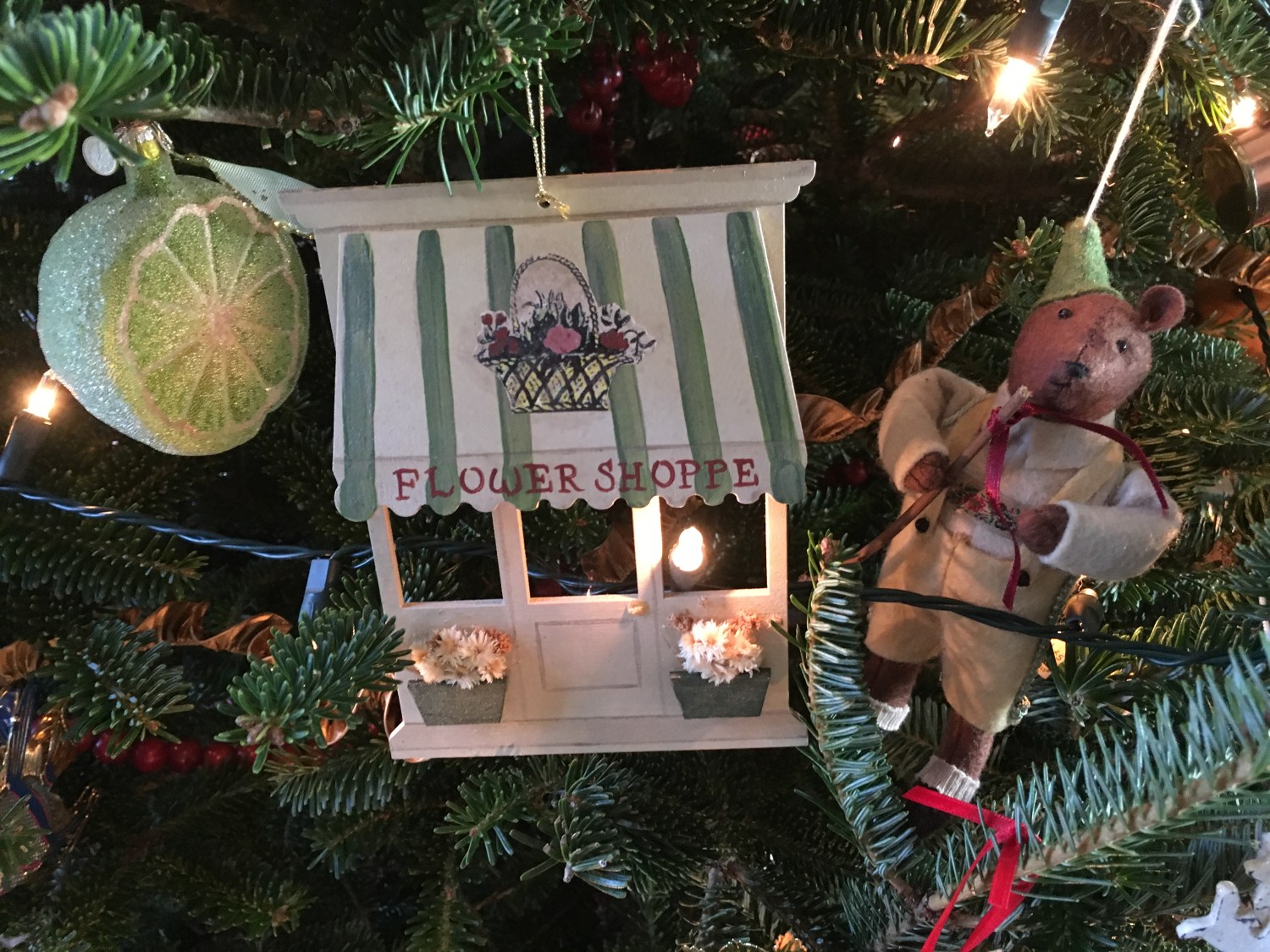
Here’s our Christmas tree, from our house to yours. 🙂

One of our shortest Christmas trees ever!


where travel meets art
Here’s wishing all of you happy holidays and a joyous and fulfilling twenty-nineteen.
Here’s our Christmas tree, from our house to yours. 🙂
One of our shortest Christmas trees ever!
Chaco Culture National Historic Park was a major cultural center between 850 and 1250 AD, and it is remarkable both for its monumental architecture and its status as a center of trade, politics and ceremony. It was designated a UNESCO World Heritage Site in 1987.
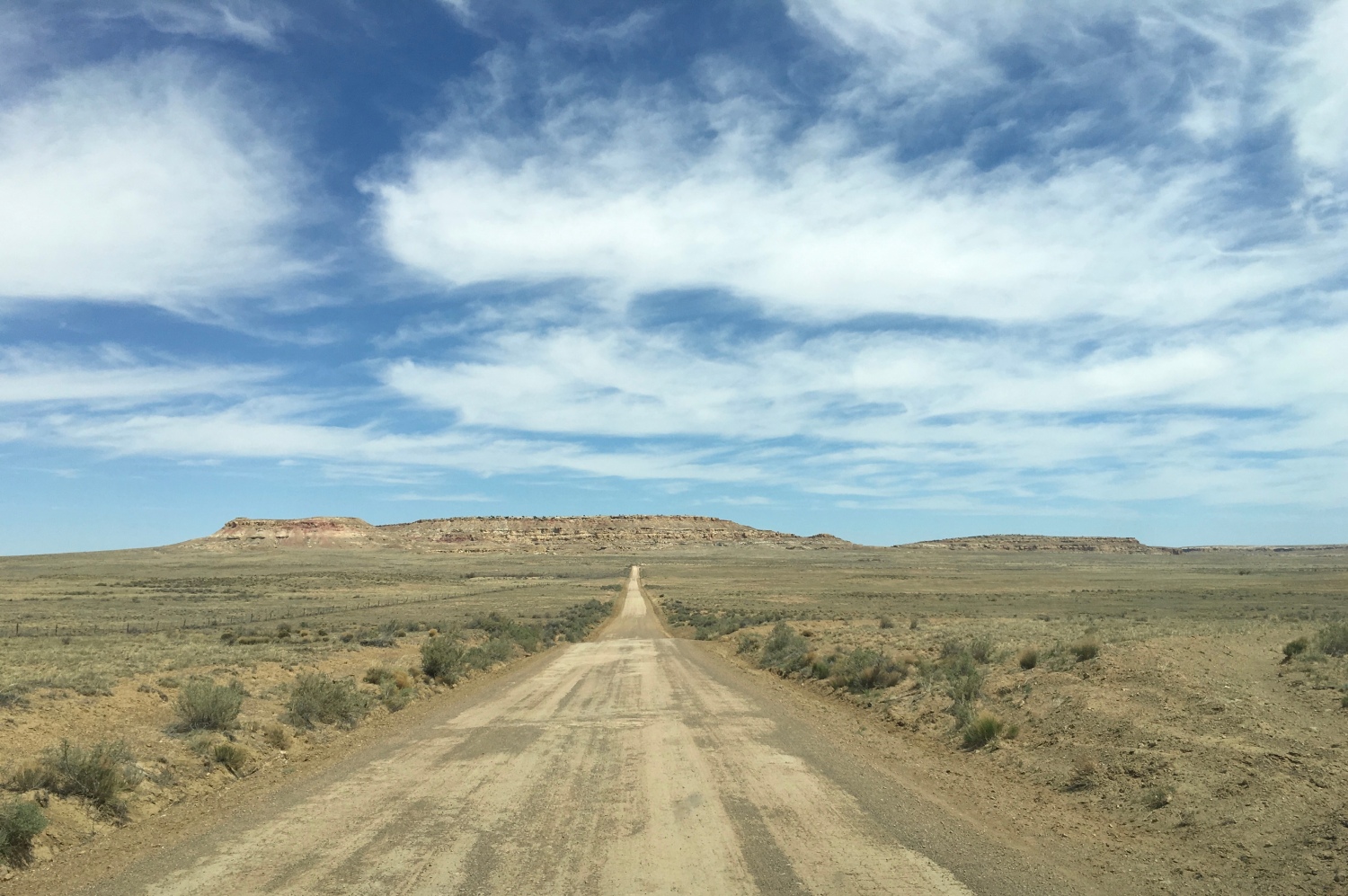
The park is in northwestern New Mexico, and can only be accessed by dirt roads. From the south, one must traverse a 20-mile-long rough dirt road, and since I drove from Gallup, NM, this was the way I came.
From Gallup, I drove past the spectacular Red Rocks, the Wind Bells Indian Village and the Continental Divide, and then through the San Jose Watershed. I stopped at Giant to buy a huge bottle of water, and stood behind a Native American man buying a 12-pack of Budweiser at 10:00 a.m.
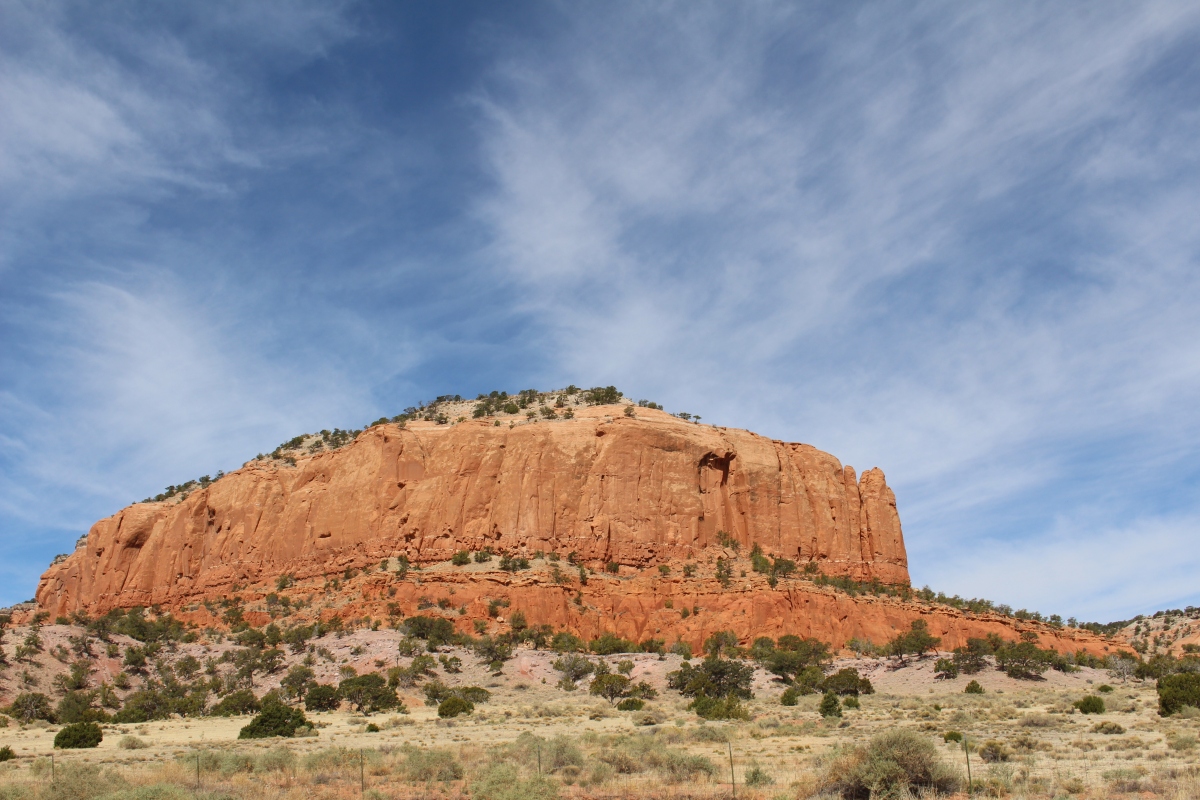
Red Rocks, New Mexico
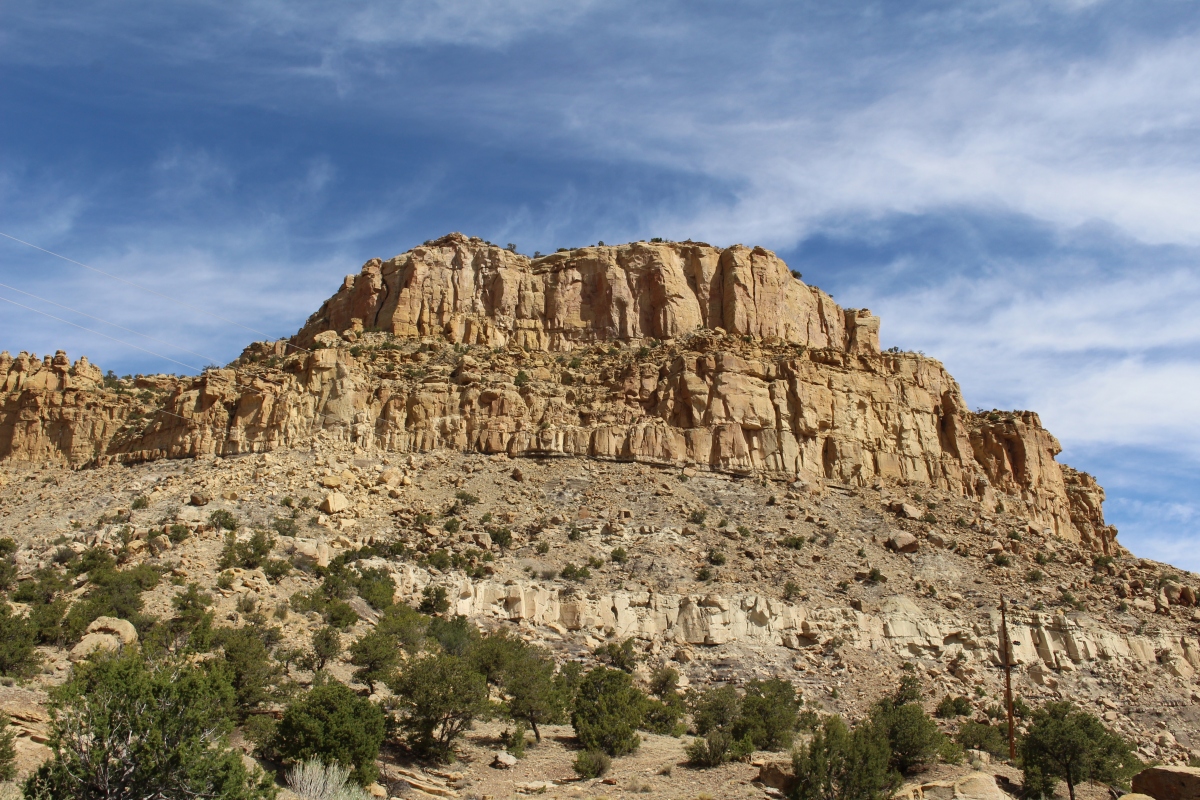
Red Rocks, New Mexico
As I continued towards Chaco Canyon, scruffy dogs scrounged about beside derelict buildings in a desolate landscape. An 8-sided hogan stood on a homestead with other prefabricated buildings. A man walked along the desolate highway with his head hung low. Hunched forlornly beside the roadside was a mobile home with a junkyard attached; weeds and vines swallowed a school bus and other vehicles.
Driving on the 20-mile dirt road felt like one of my old adventures when I lived in Oman.
I encountered curious cows who checked me out when I stopped beside them.
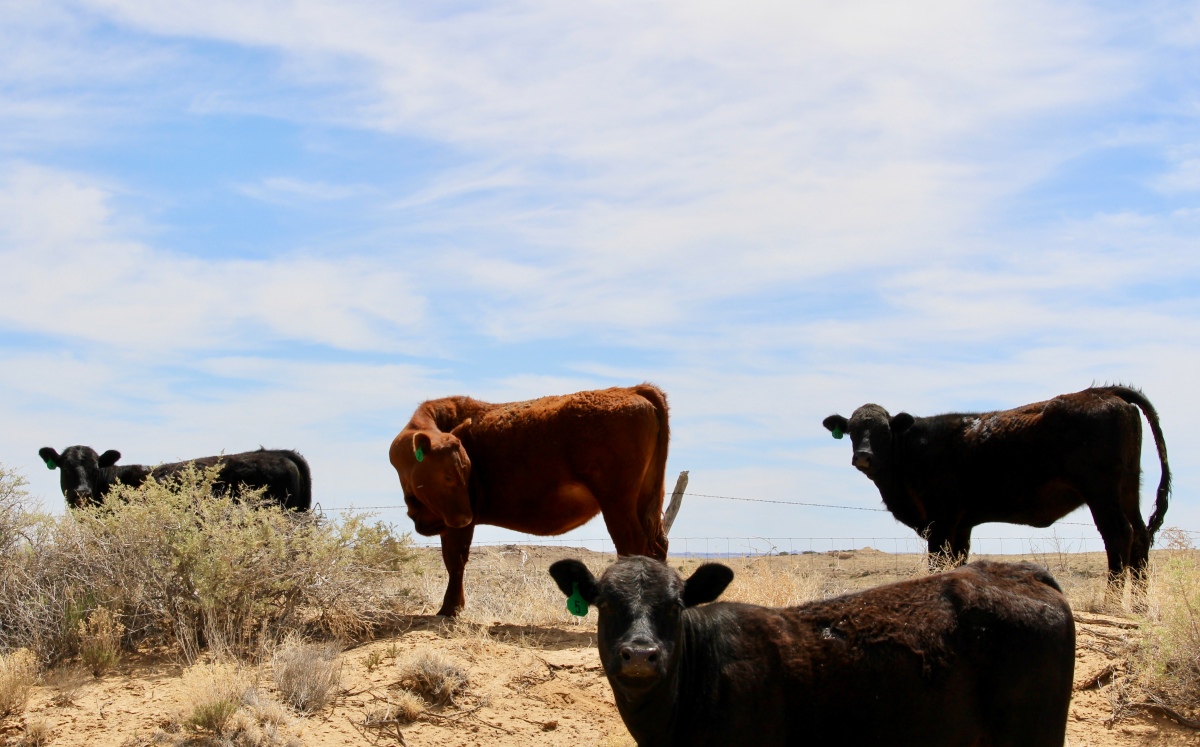
Cows on the road to Chaco Canyon
Clouds swept across the blue skies and the air was fresh and cool.
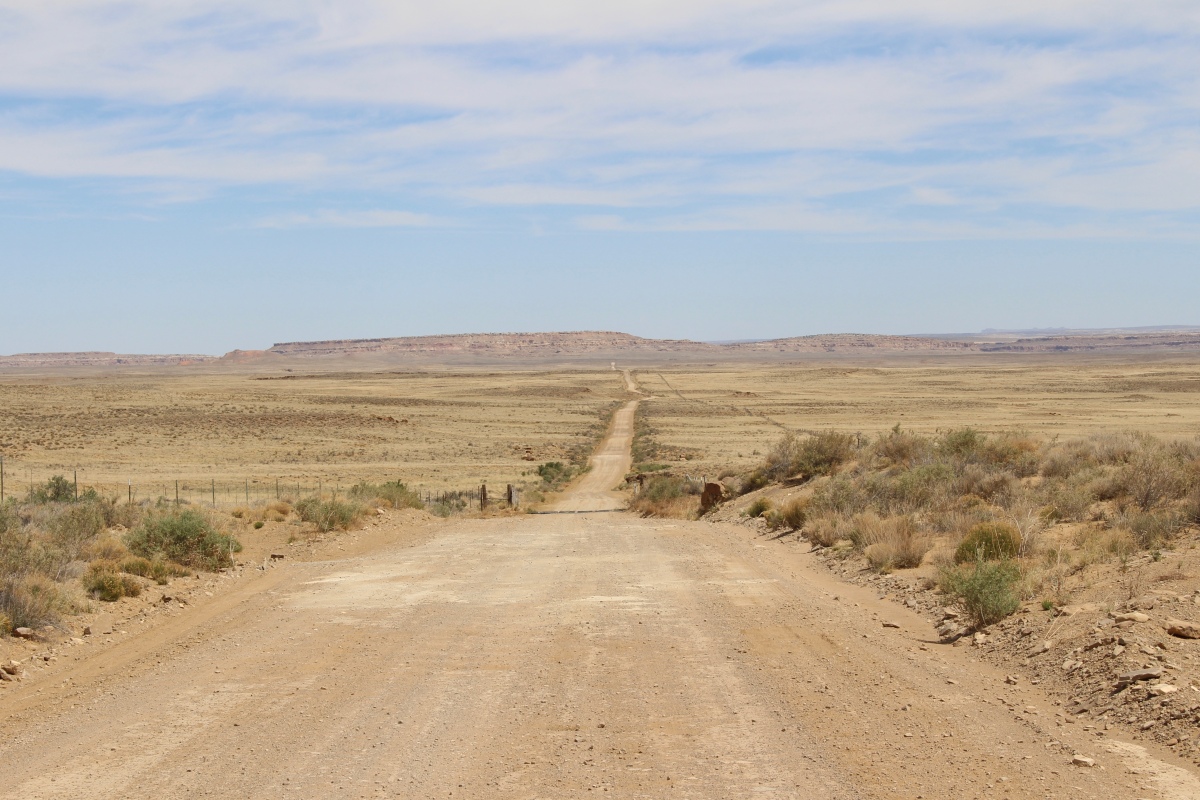
the dirt road to Chaco Culture National Historical Park
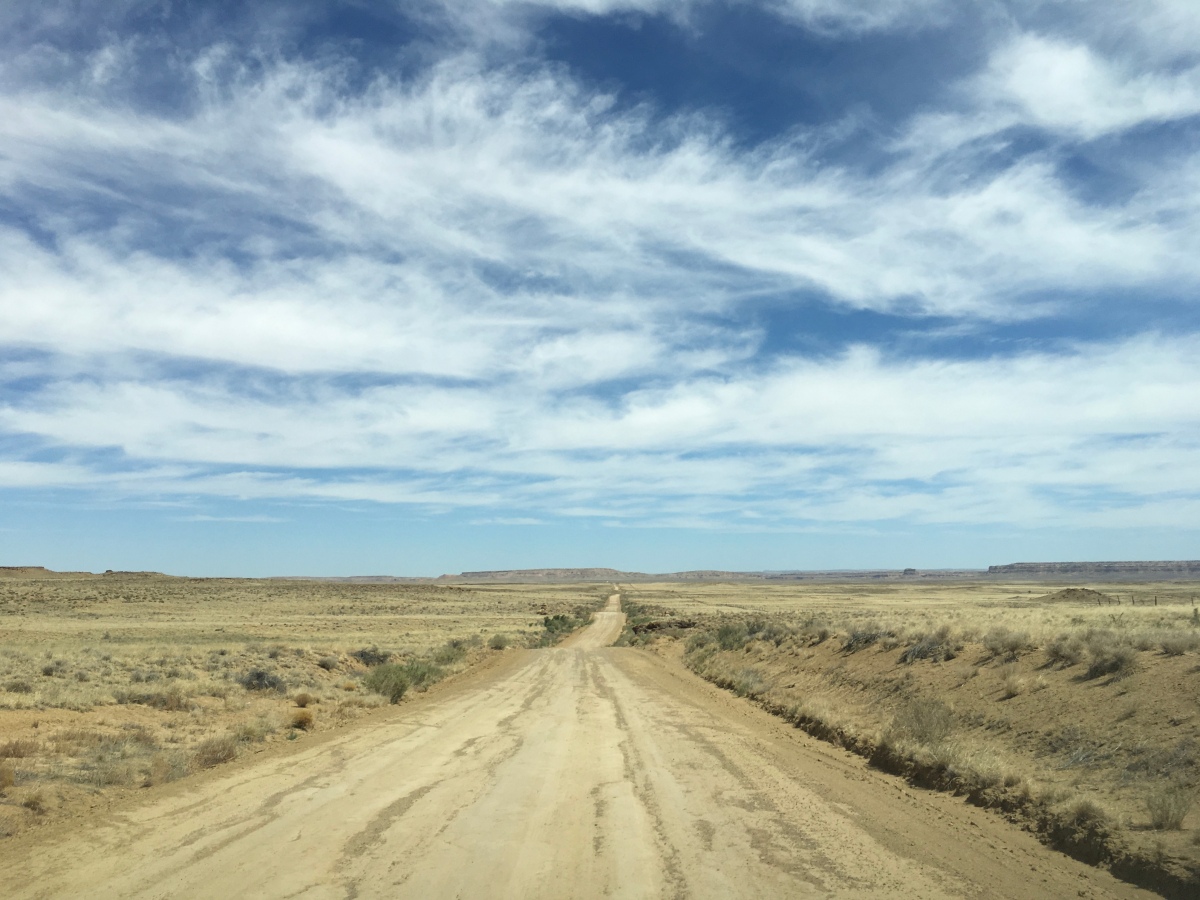
the road to Chaco Canyon
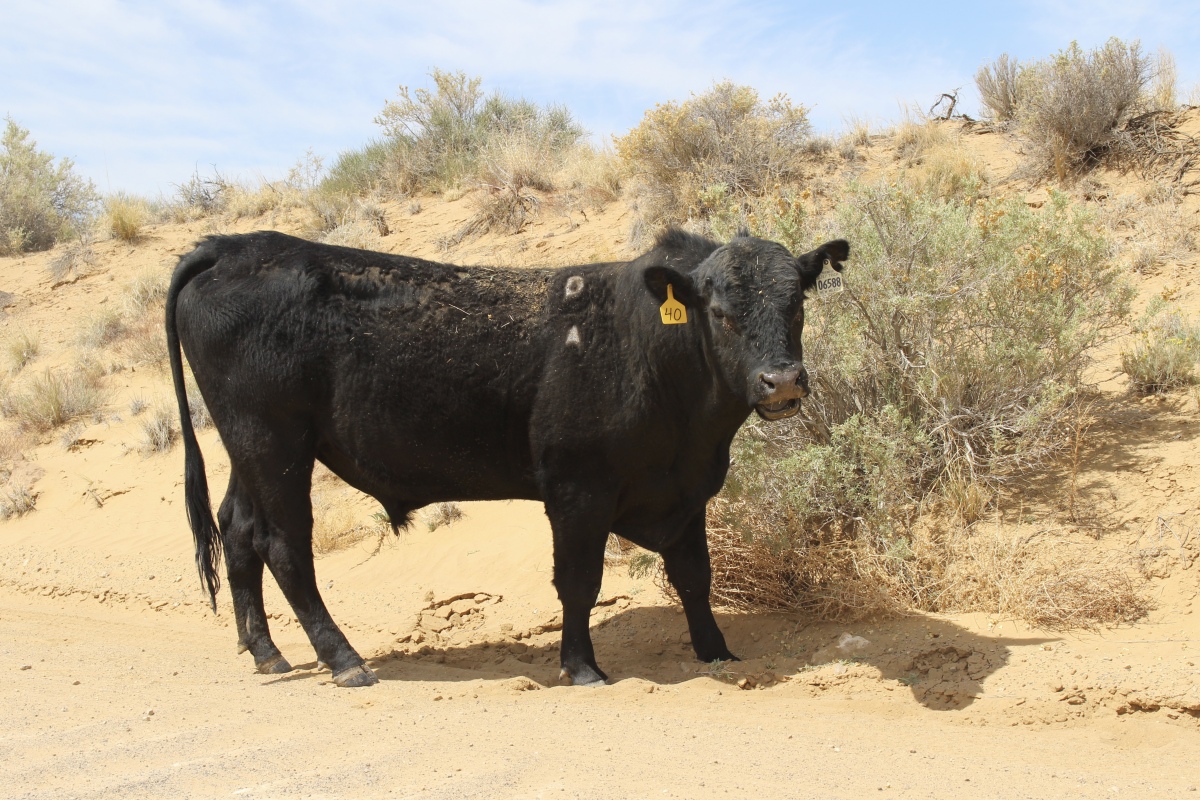
another cow friend
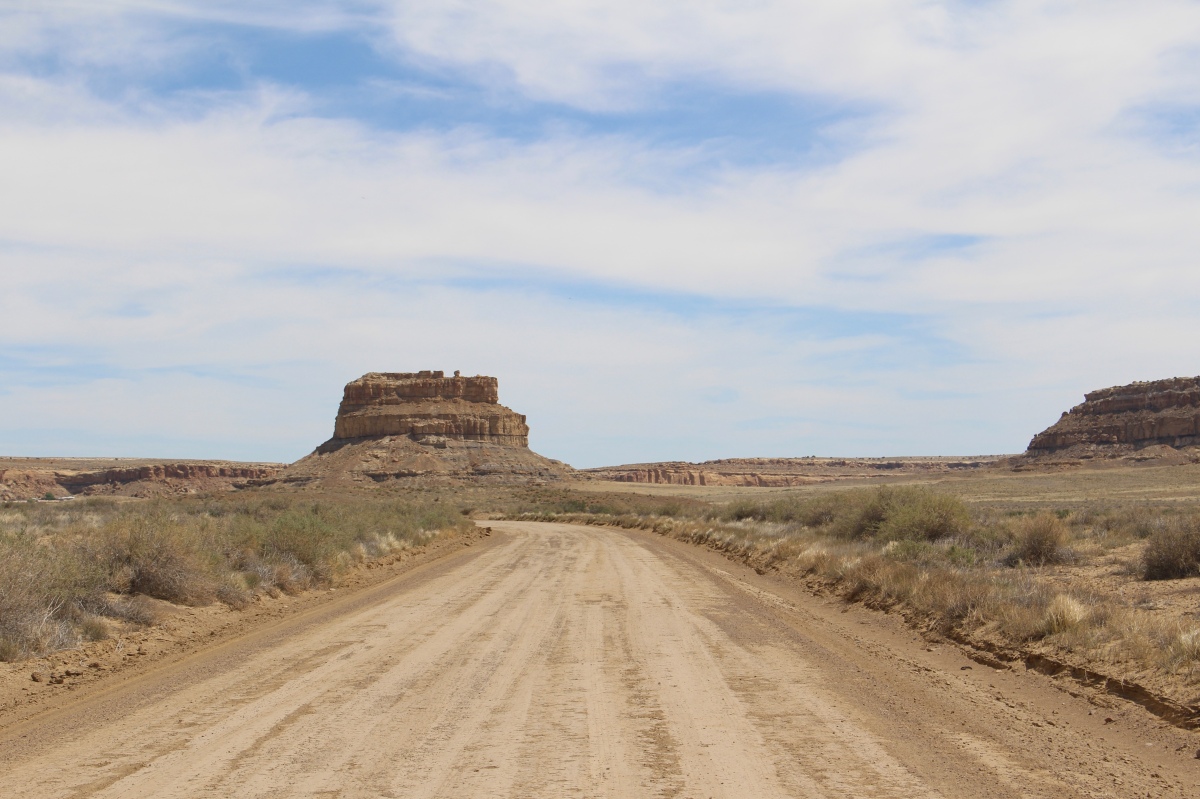
the road to Chaco Canyon
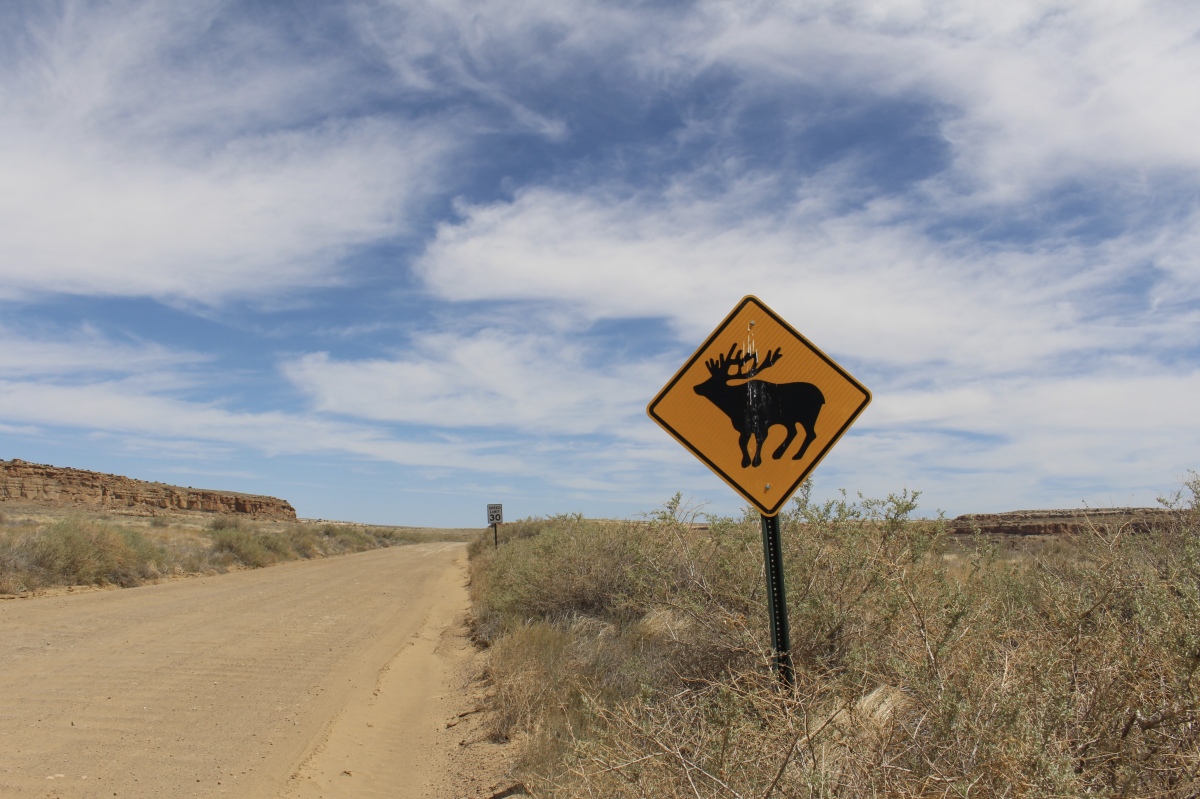
moose sign
A thousand years ago, this valley was the center of a thriving culture that lasted more than 300 years, beginning in the mid 800s. The people built massive Great Houses of multiple stories with hundreds of rooms. The architecture used masonry techniques unique for the time. Construction was planned from the start, rather than rooms being added as needed, and took place over decades or even centuries. Architectural features were uniquely Chacoan.
Chaco had become the ceremonial, administrative, and economic center of the San Juan Basin, exerting extensive influence over the area by 1050. Dozens of great houses in Chaco Canyon were connected by roads to more than 150 great houses throughout the region. It is surmised that the great houses were used during times of ceremony, commerce, and trading when temporary populations came to the canyon for these events.
The Chacoan Great House (monumental public building) closest to the visitor center is Una Vida. Construction began close to 850 AD and continued for over 250 years. Una Vida is Spanish for “one life;” the site was named by a military expedition that discovered the structure. It contains about 100 ground floor rooms and kivas, and a great kiva in an enclosed plaza. Only about 20 rooms in this large building have been excavated, first in the early 1900s and then again in the 1950s by the National Park Service. Centuries of blowing sand have covered the rooms with a protective blanket of sand and native vegetation.
The Una Vida Trail at Chaco Culture National Historical Park is a 1/2 mile round-trip trail plus 1/4 mile to see the petroglyphs.
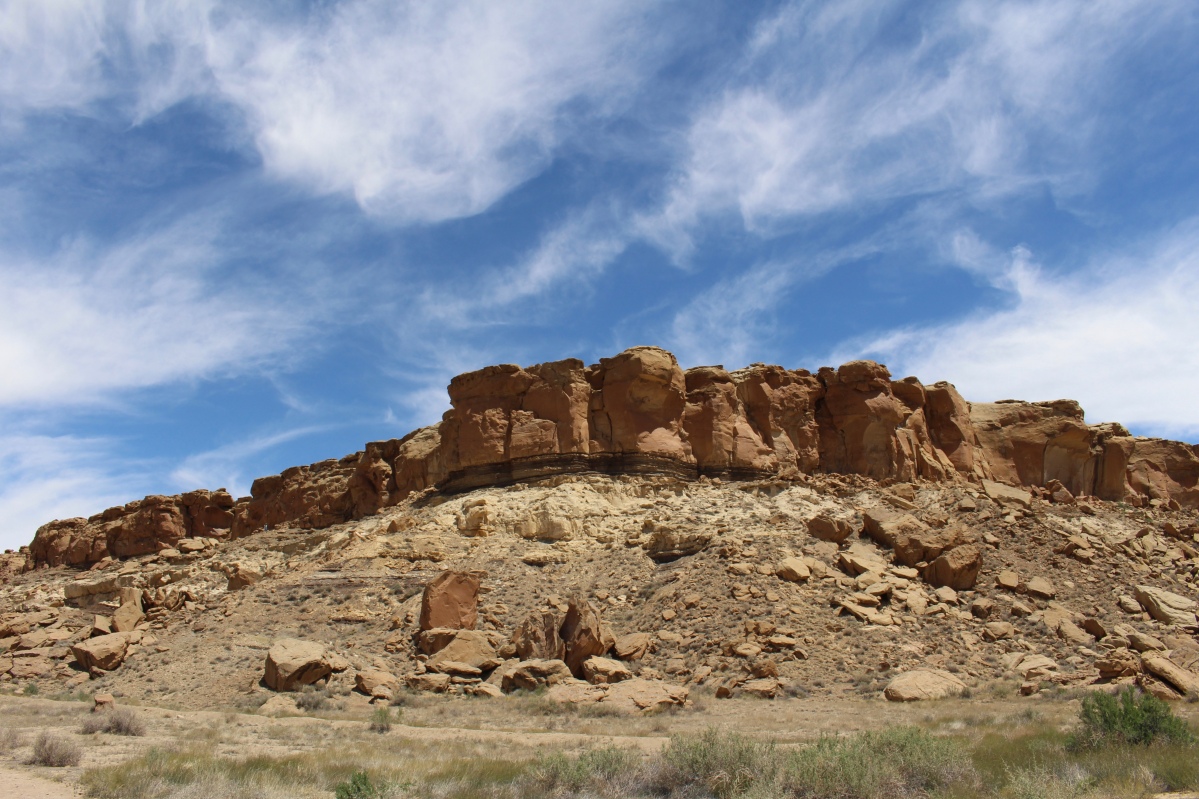
Una Vida trail
Una Vida is a large multi-storied public building with distinctive masonry, formal architecture and a great kiva. Situated at the top of a natural rise in the landscape, it dominated the nearby community. By the time great houses were built in Chaco Canyon, agriculture was well-established in the area.
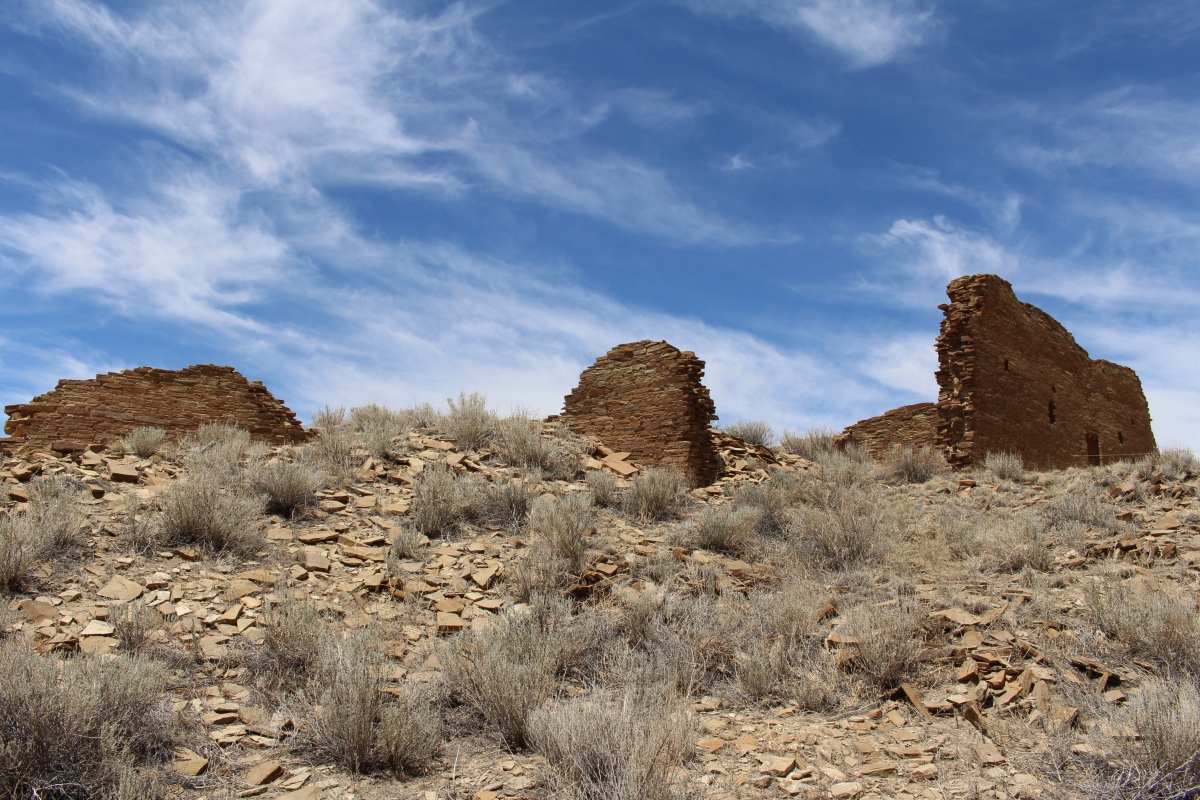
Una Vida Trail
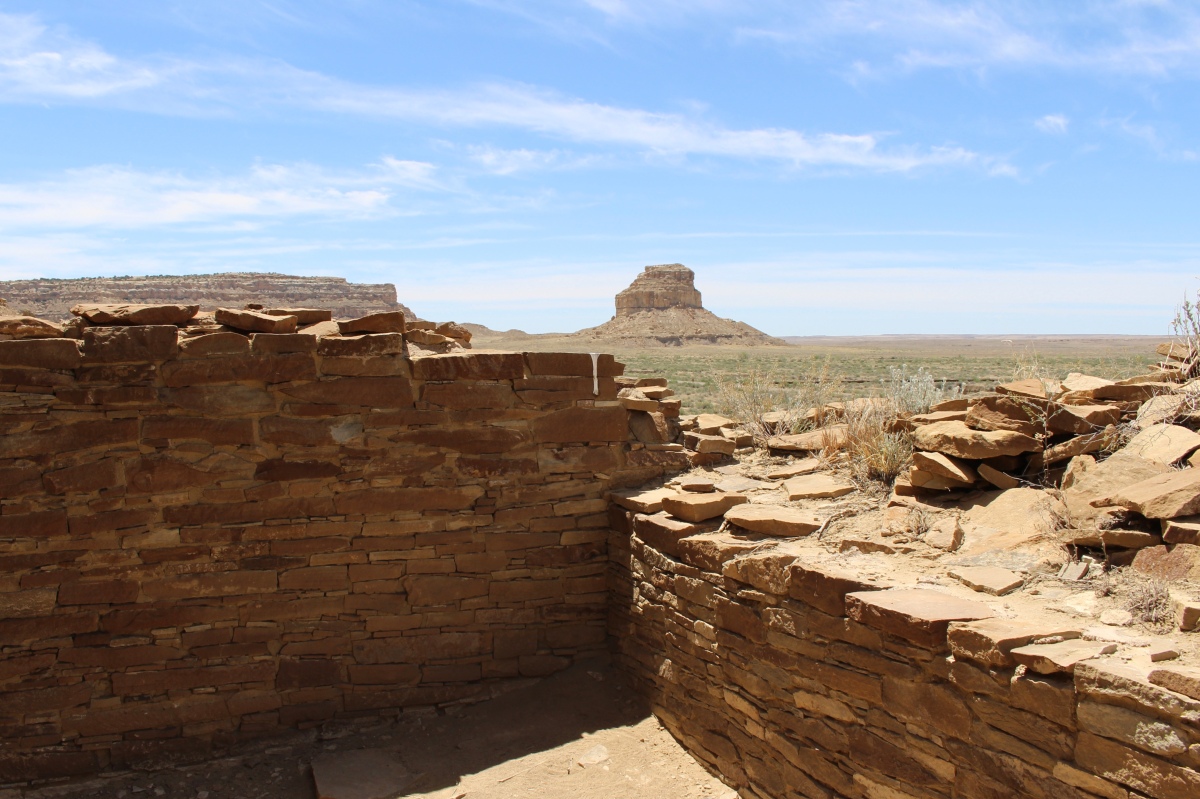
Una Vida Great House
The early great houses such as Una Vida were a much larger building style than other structures in the region. The rough-looking walls were among the first built at the site.
One early masonry style used large tabular sandstone blocks chinked with smaller stones set in mortar.
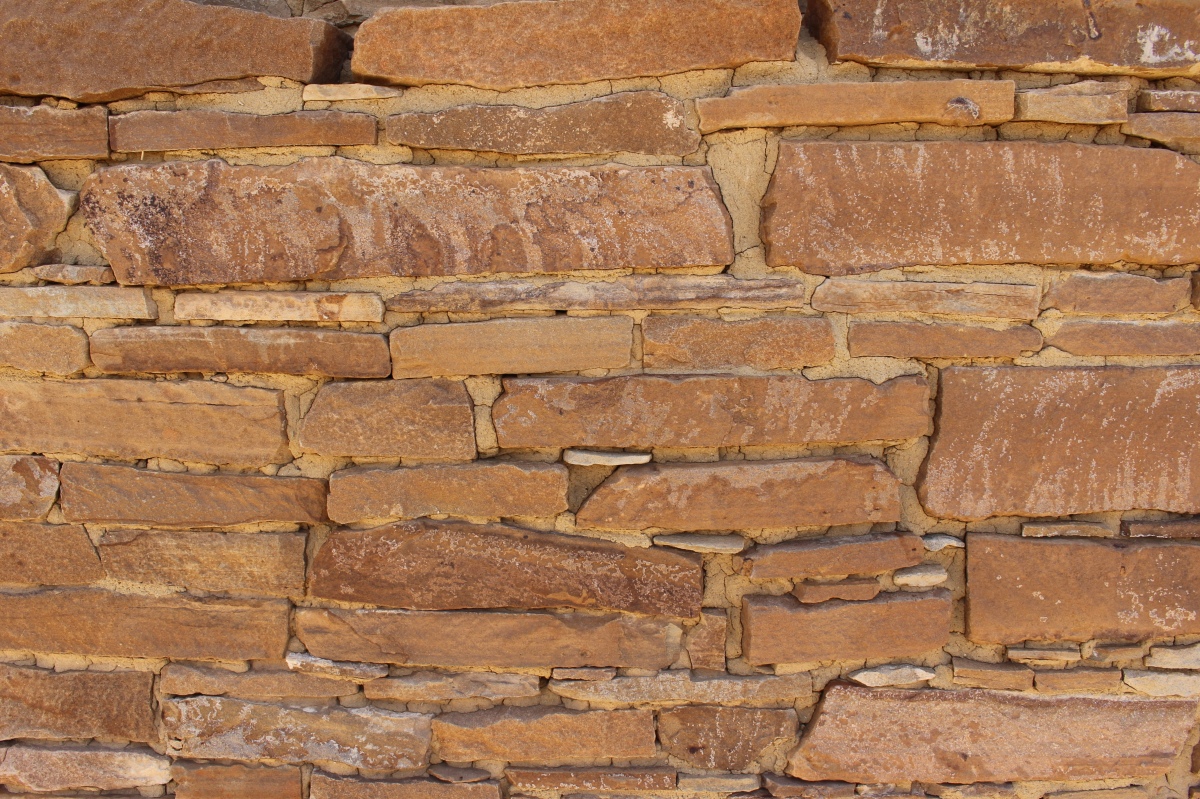
Una Vida construction
The Chacoans developed more intricate masonry styles through the mid- to late-1000s. Yet they covered many walls in plaster, sometimes with painted or engraved decorations.
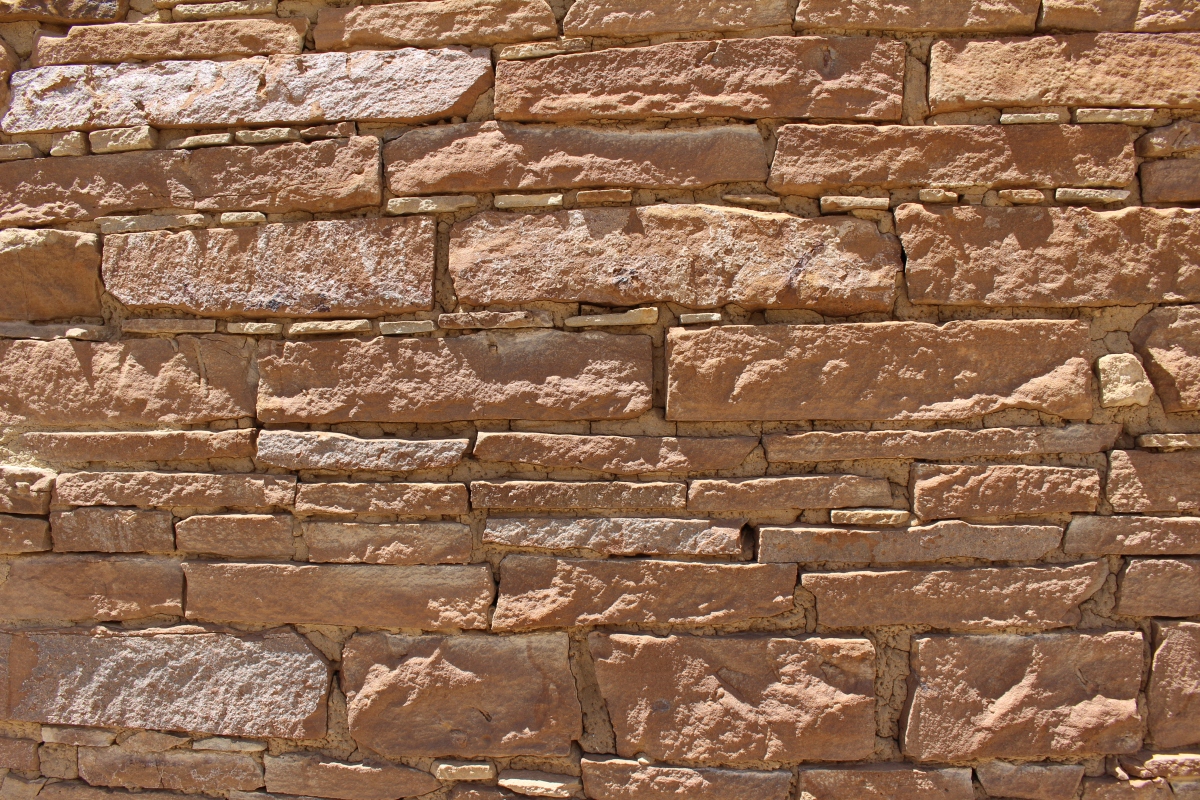
Great House construction at Una Vida
Una Vida is an “L” shaped, 2- to 3-story building which opened toward the southeast. Single story rooms fronted the plaza and stepped back to two stories further from the plaza. A few room blocks at the southwest corner rose to 3-stories.
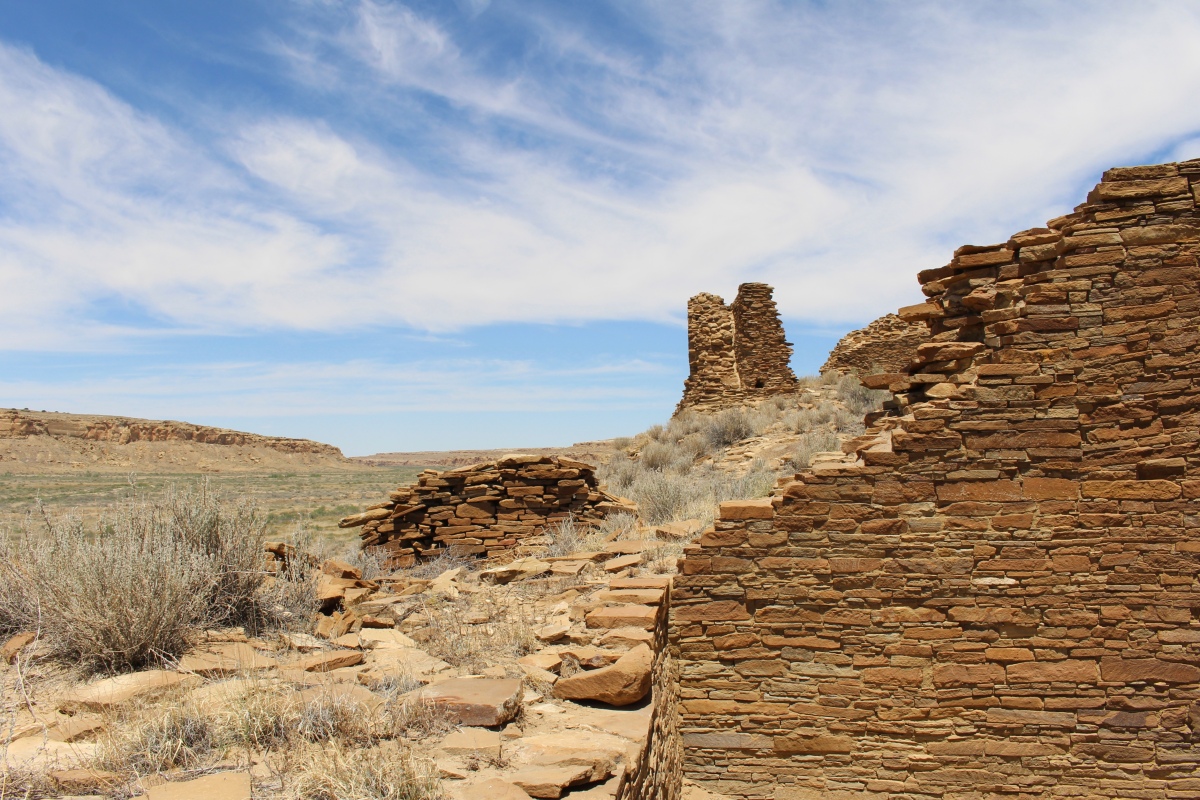
Una Vida Great House
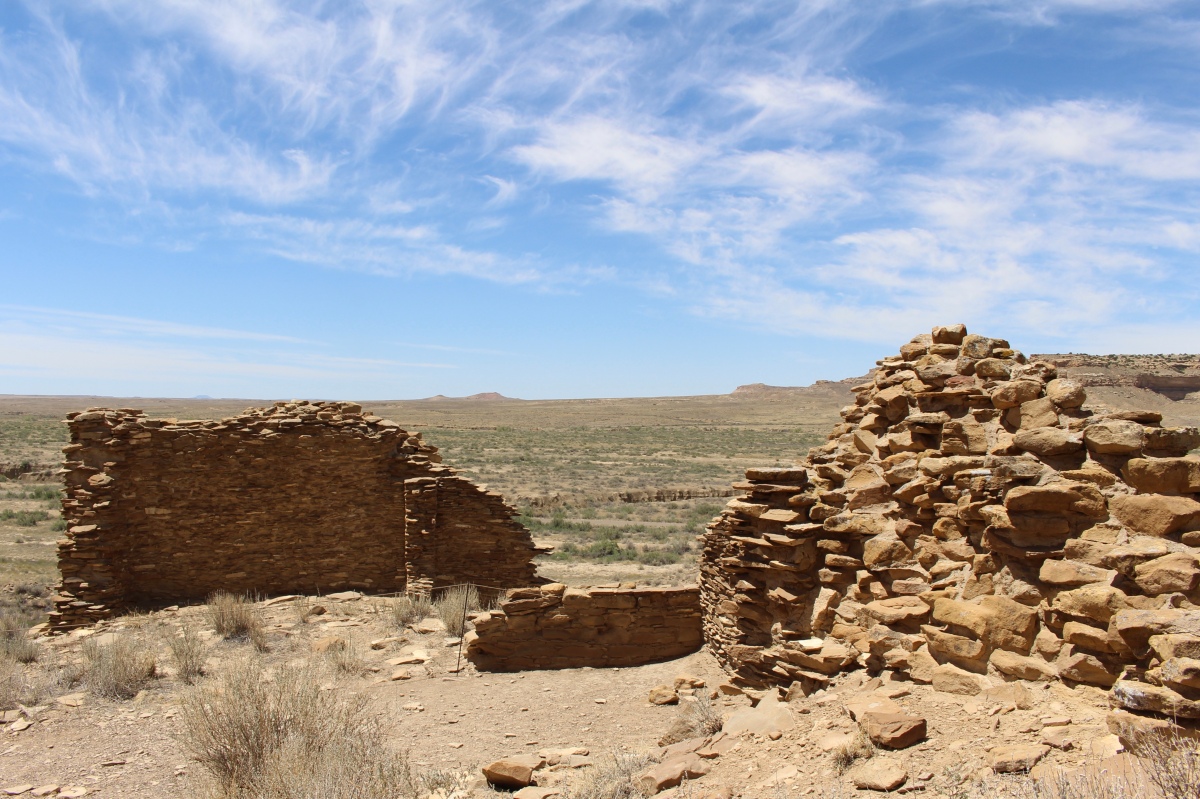
Una Vida Great House
The earliest walls were one stone thick and bonded with generous courses of mud mortar. To make higher, longer walls, the Chacoan builders widened the rubble cores and added structural stone veneers and internal wooden supports.
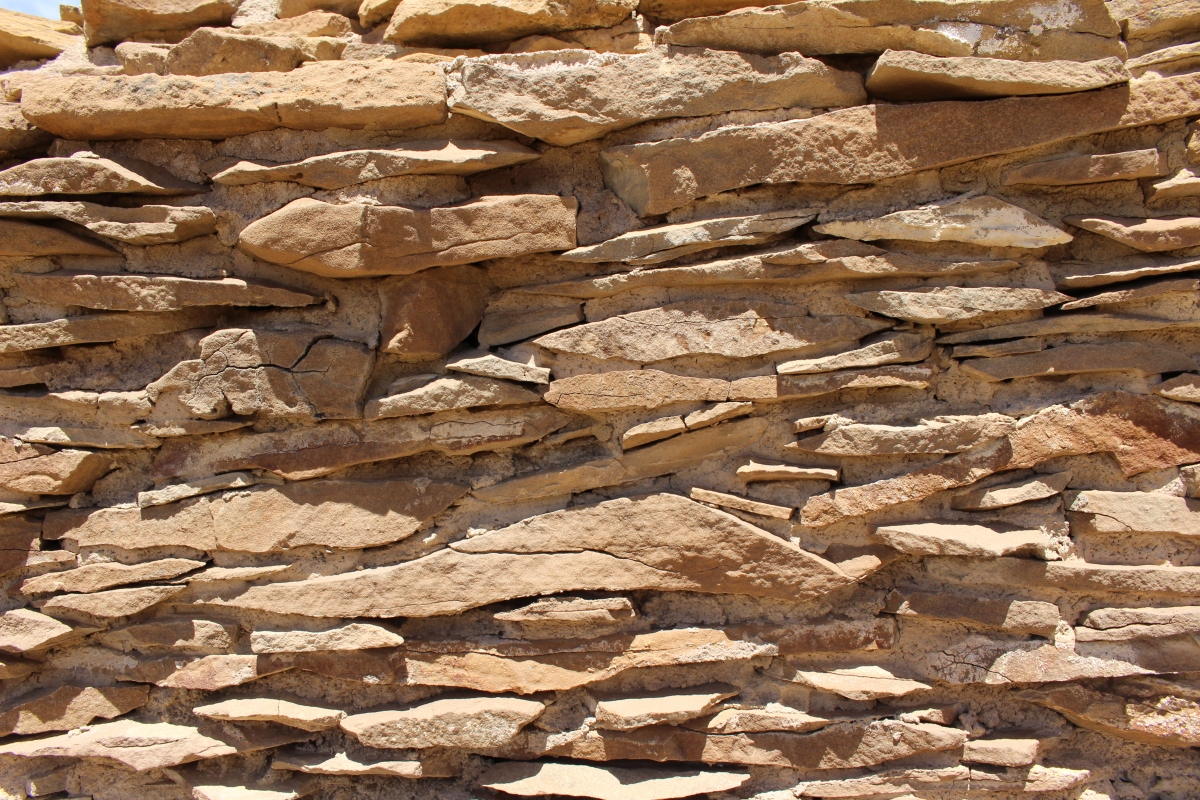
Great house construction

View overlooking the Una Vida Great House
I climbed up a slope to two petroglyph panels. Petroglyphs are images that are pecked, incised, and abraded into the sandstone to create designs. It is difficult to know the meaning of the images today, but Puebloan and Navajo people today often recognize images as symbols for specific clans, or elements in stories.


Petroglyphs
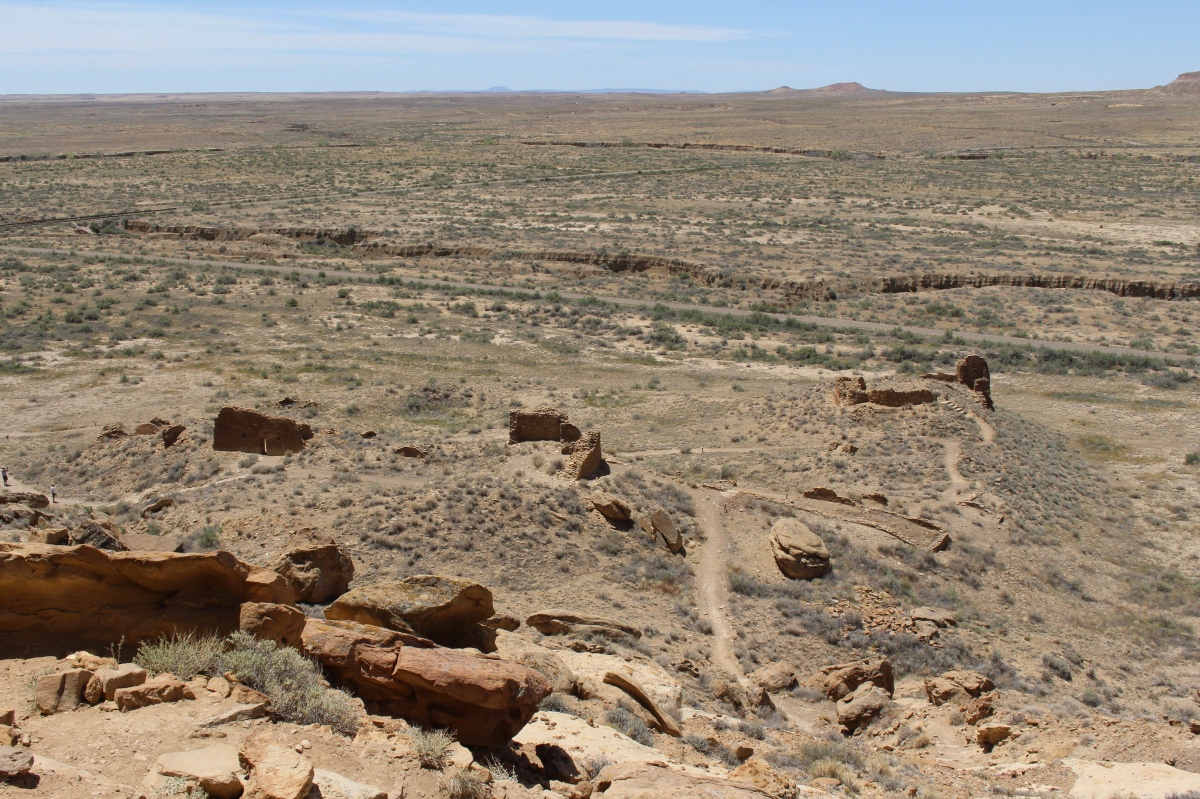
Coming back down the trail from the petroglyphs
***********************
On Sundays, I post about hikes or walks that I have taken in my travels; I may also post on other unrelated subjects. I will use these posts to participate in Jo’s Monday Walks or any other challenges that catch my fancy.
This post is in response to Jo’s Monday Walk: Blessing the Fishermen.
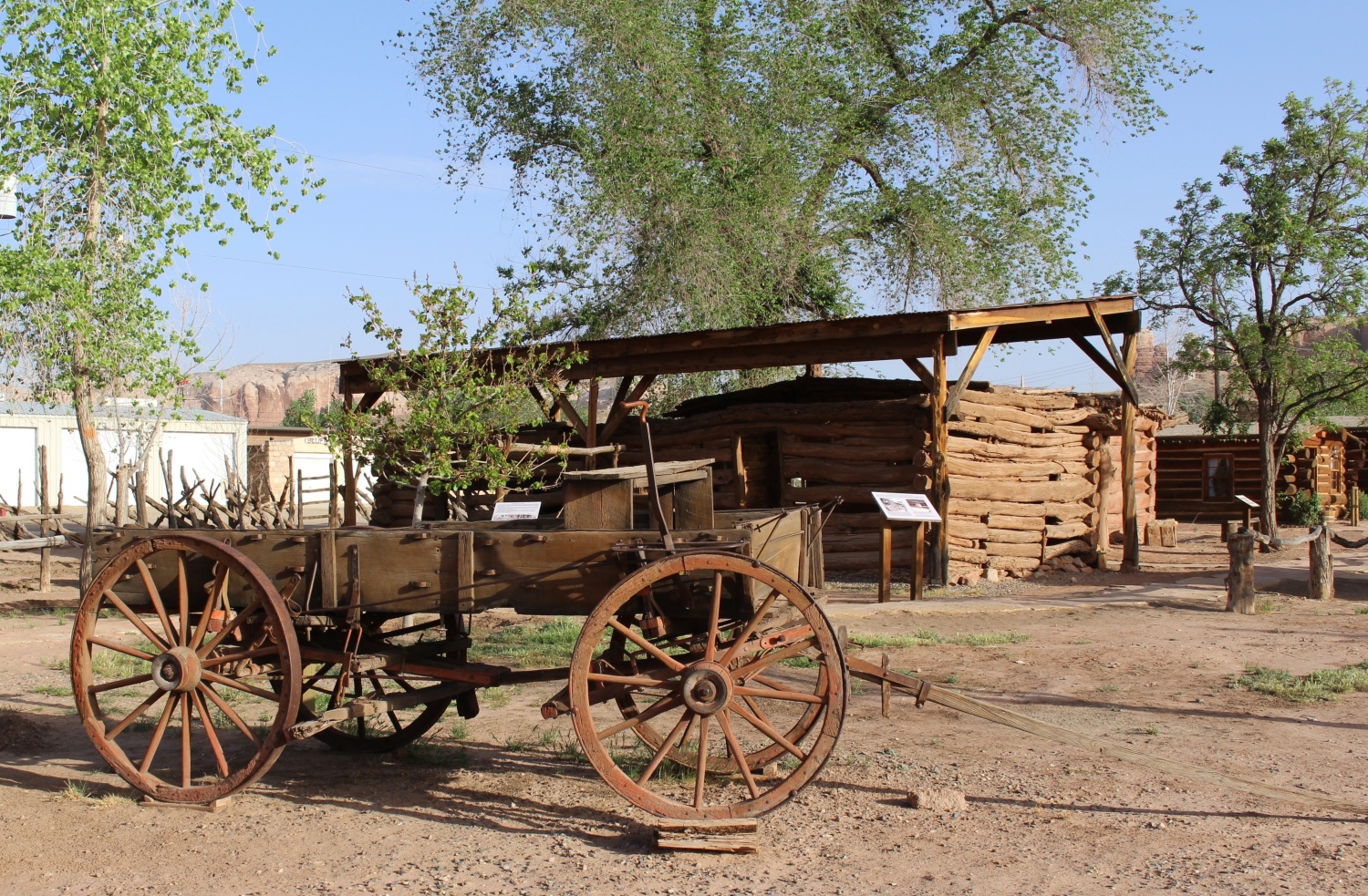
In April of 1880, 250 pioneers arrived in Bluff, Utah after an arduous 6-month journey. They were part of the San Juan Mission / Bluff expedition, sent by the Church of Jesus Christ of Latter-day Saints. The Bluff Fort was the first and probably only settlement purposely placed adjacent to two Indian nations with the goal of establishing better Indian relations. The San Juan missionaries faced the task of establishing a livelihood in a desolate landscape, nurturing peaceful relations with the Indians, establishing law and order in a lawless land, and opening the area to future colonization.
On this Friday in May, 138 years after these hardy pioneers settled in, we arrived in Bluff after a busy day visiting Natural Bridges National Monument and Hovenweep. We checked into one of the few motels in town, the Mokee Motel, whose proprietor was a woman with straggly blonde hair and a missing tooth. She greeted us wearing a yellow floral house dress. Our room smelled like a mixture of cigarette smoke and the sickly sweet fragrance of aerosol spray. We sat at a table outside our room and shared a glass of wine and Triscuits topped with dill Havarti before heading out in search of dinner.
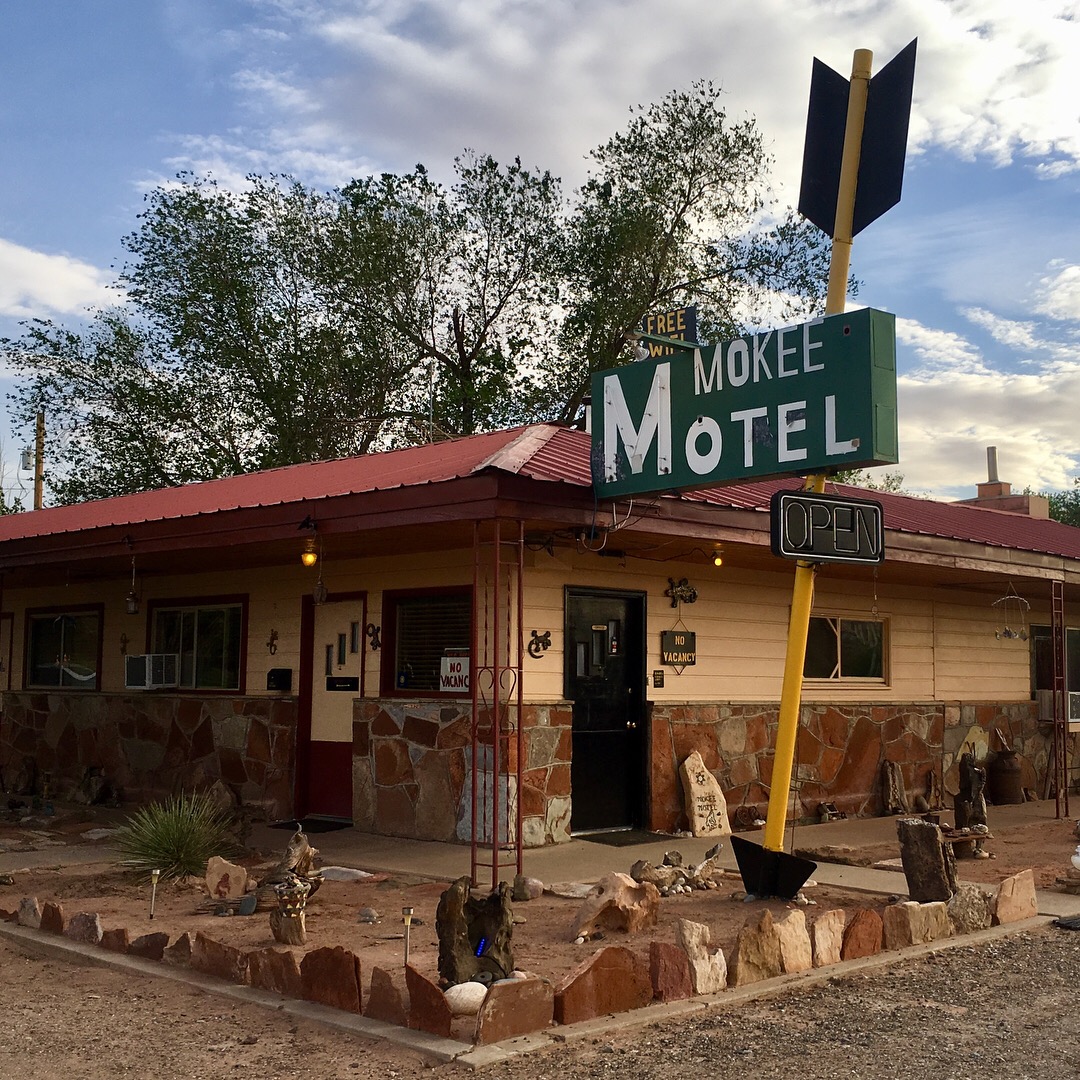
The Mokee Motel
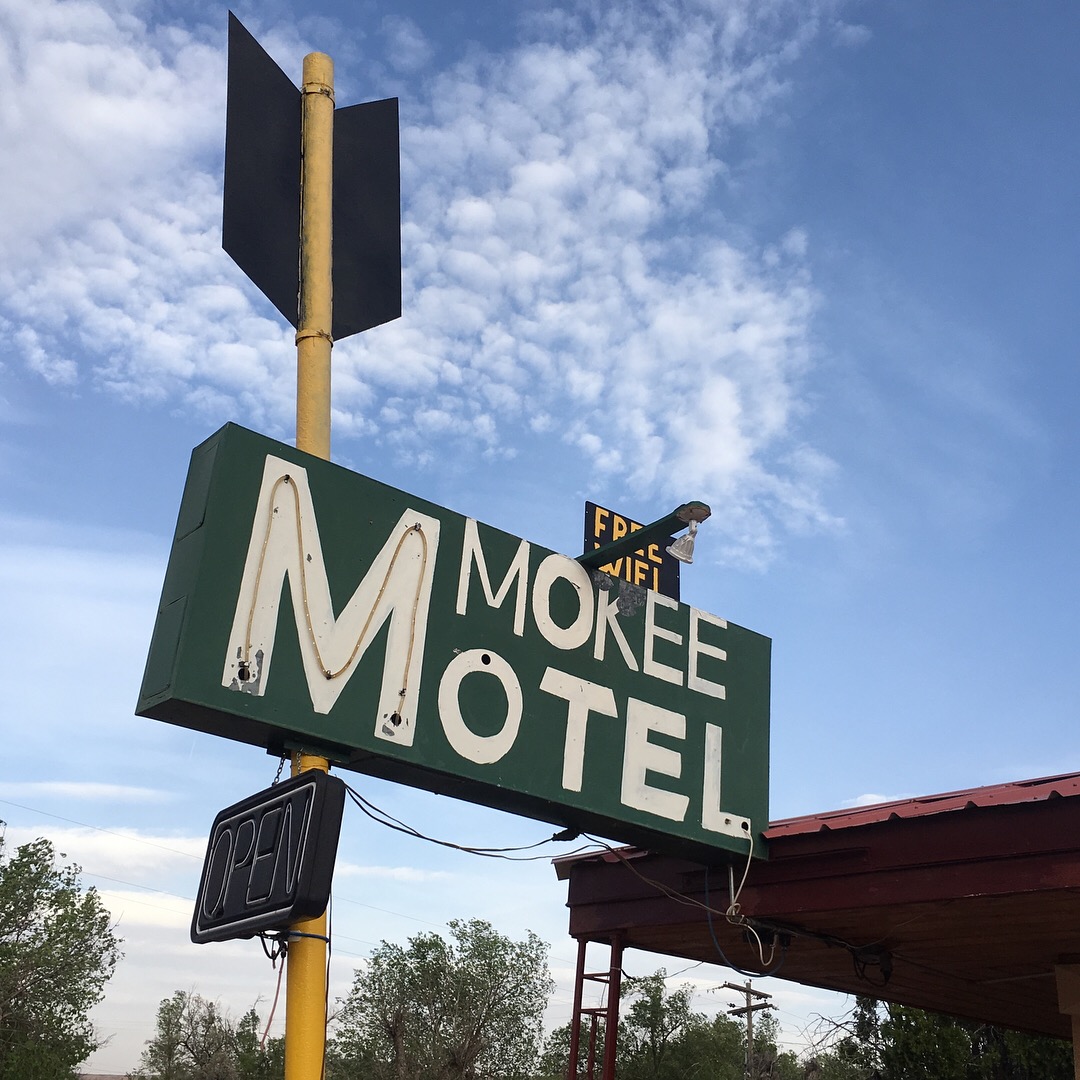
The Mokee Motel
At the Comb Ridge Bistro & Espresso Bar, we had to wait for a table, so we walked around the grounds as the sun was setting and a cold wind blew across the prairie. As the waitress added our name to the wait list, she declared that it was always windy in Bluff. Last night she went home and her window covering had been knocked off and she found her house filled with dust.
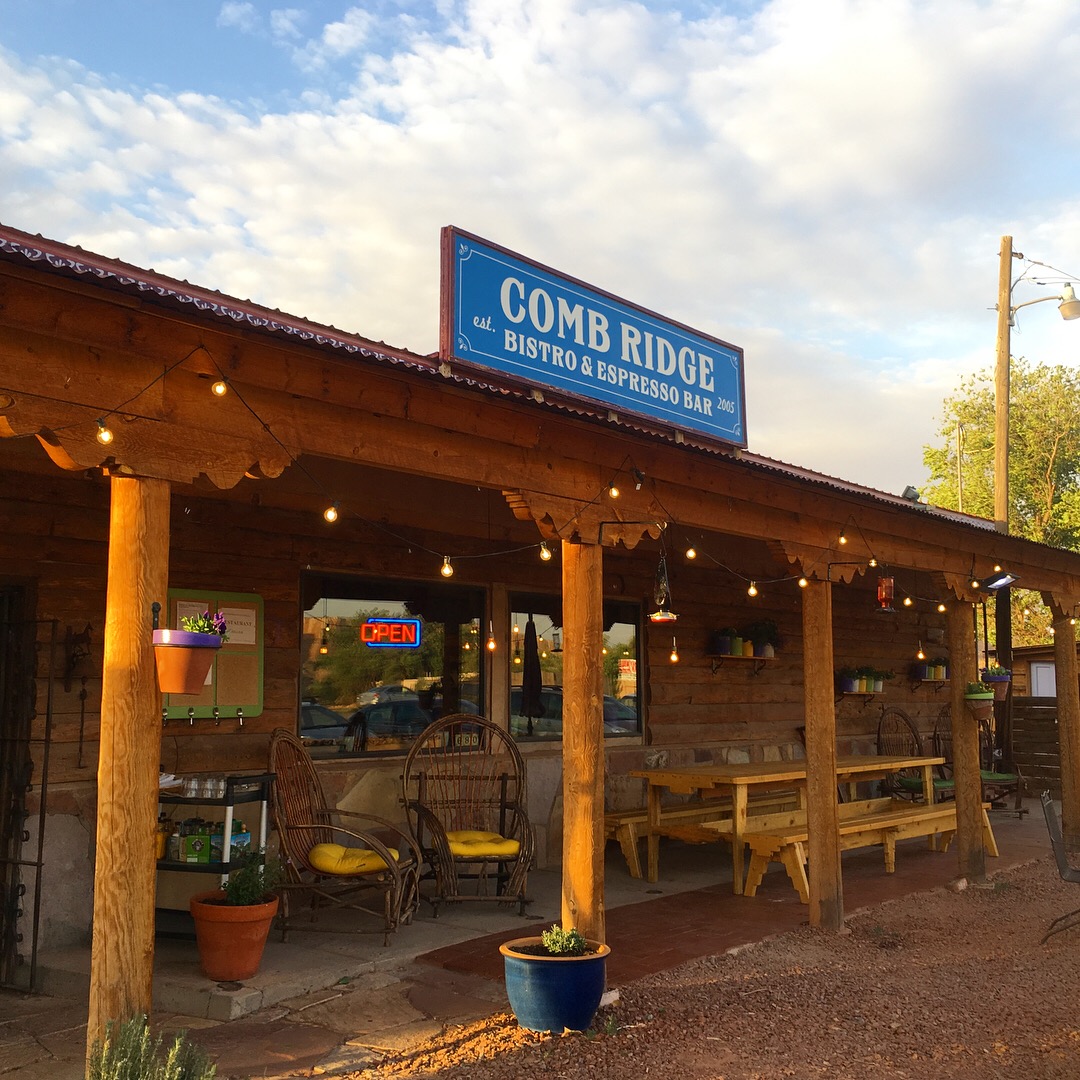
Comb Ridge Bistro & Espresso Bar
Out front, a quirky art installation of life-size rusted figures greeted us. We were serenaded by a dinosaur playing a trombone, while a steely horse and Native American totems stood by. The Willow Street Cottages out back looked more inviting than our motel.


Next door to the restaurant, we found a decrepit homestead that was photogenic in the waning light.

Bluff sunset
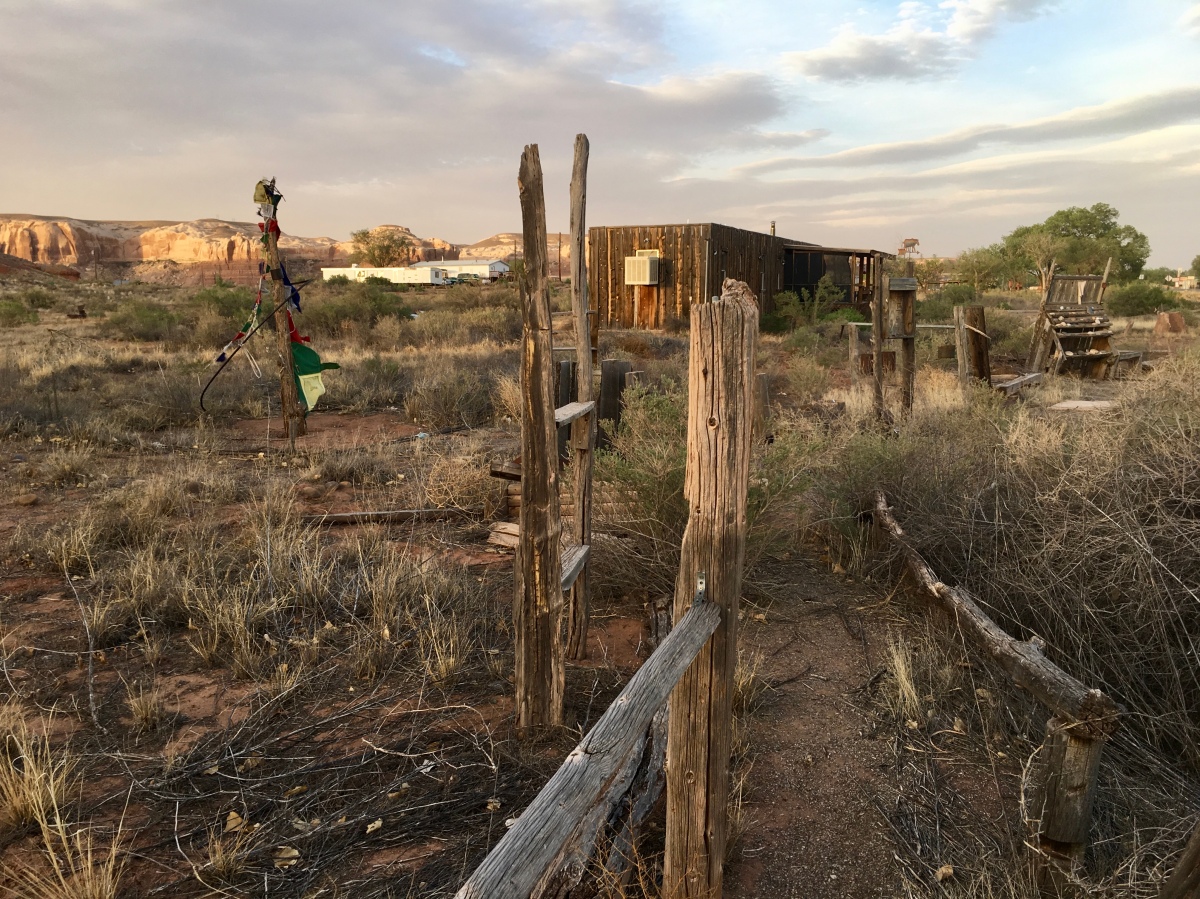
homestead in Bluff
A rusty green gutted GMC truck stood in the parking lot beside modern-day cars.
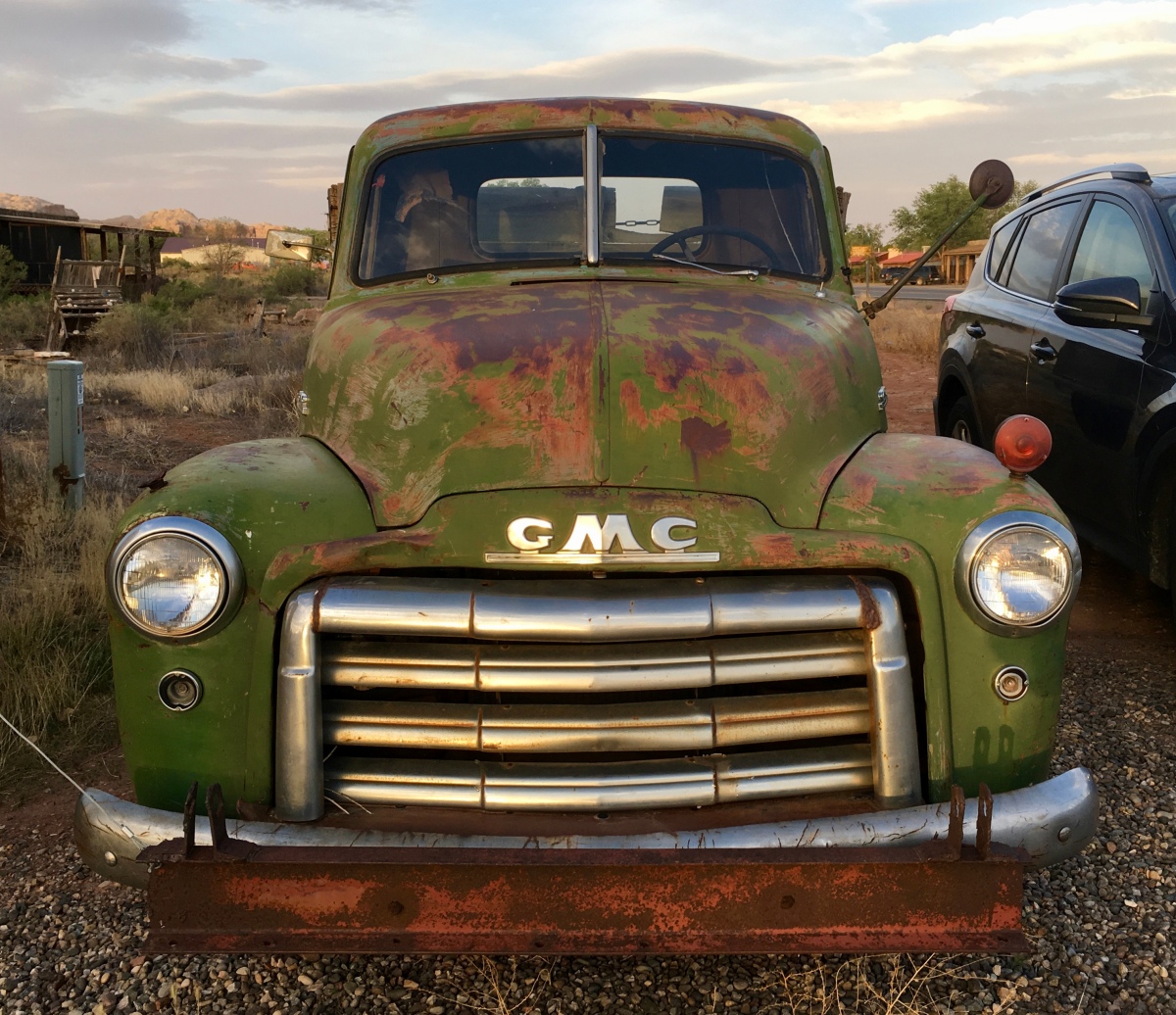
GMC
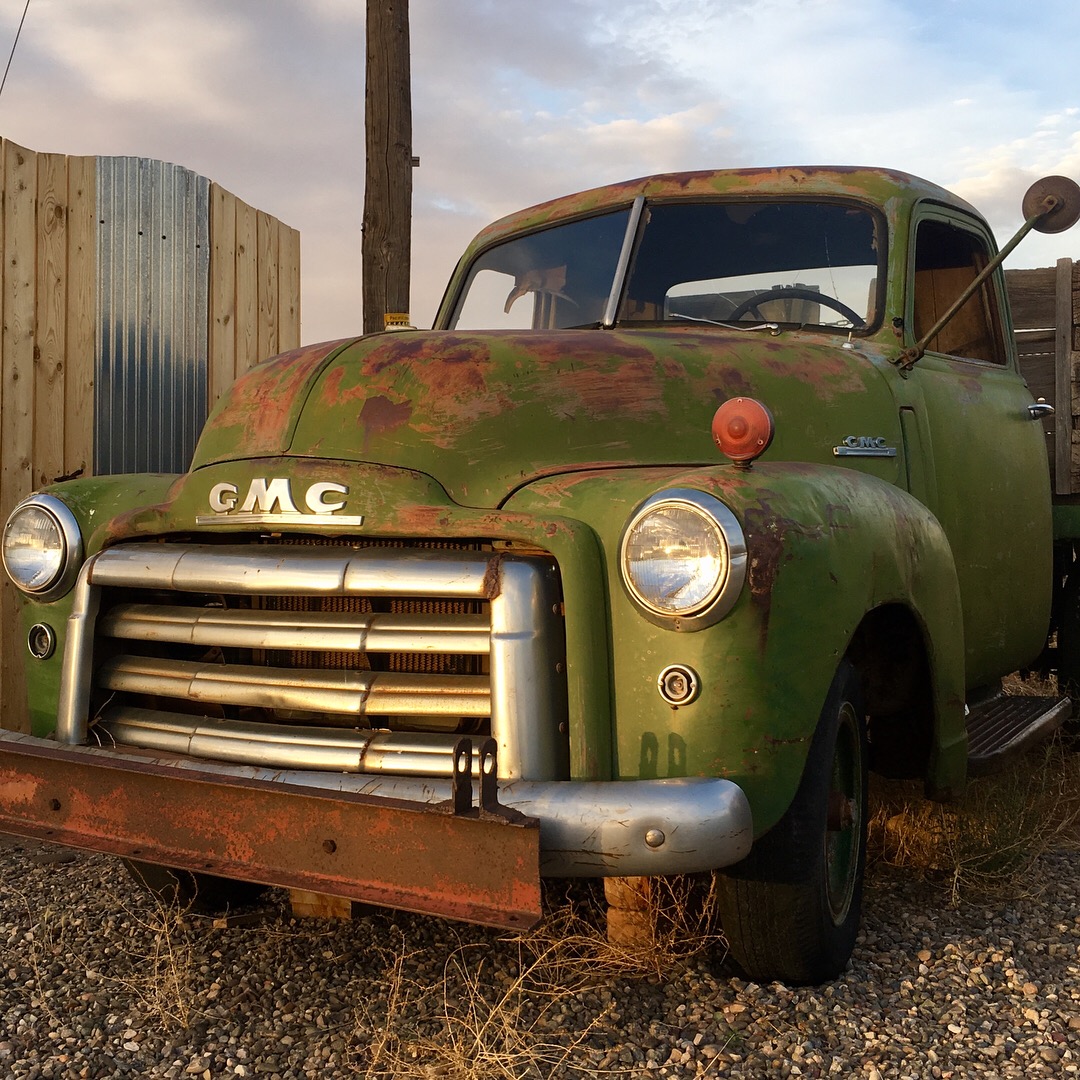
GMC
The atmosphere and the meal at the Comb Ridge Bistro were one of the best dining experiences of our entire trip. After a Hefeweizen for Mike and a Petite Syrah for me, Mike had a falafel taco salad and I had a quiche with blue cheese, red pepper and onion. A group of six Chinese students sat behind us; one of them from California translated the menu and the waitress interactions for the others.
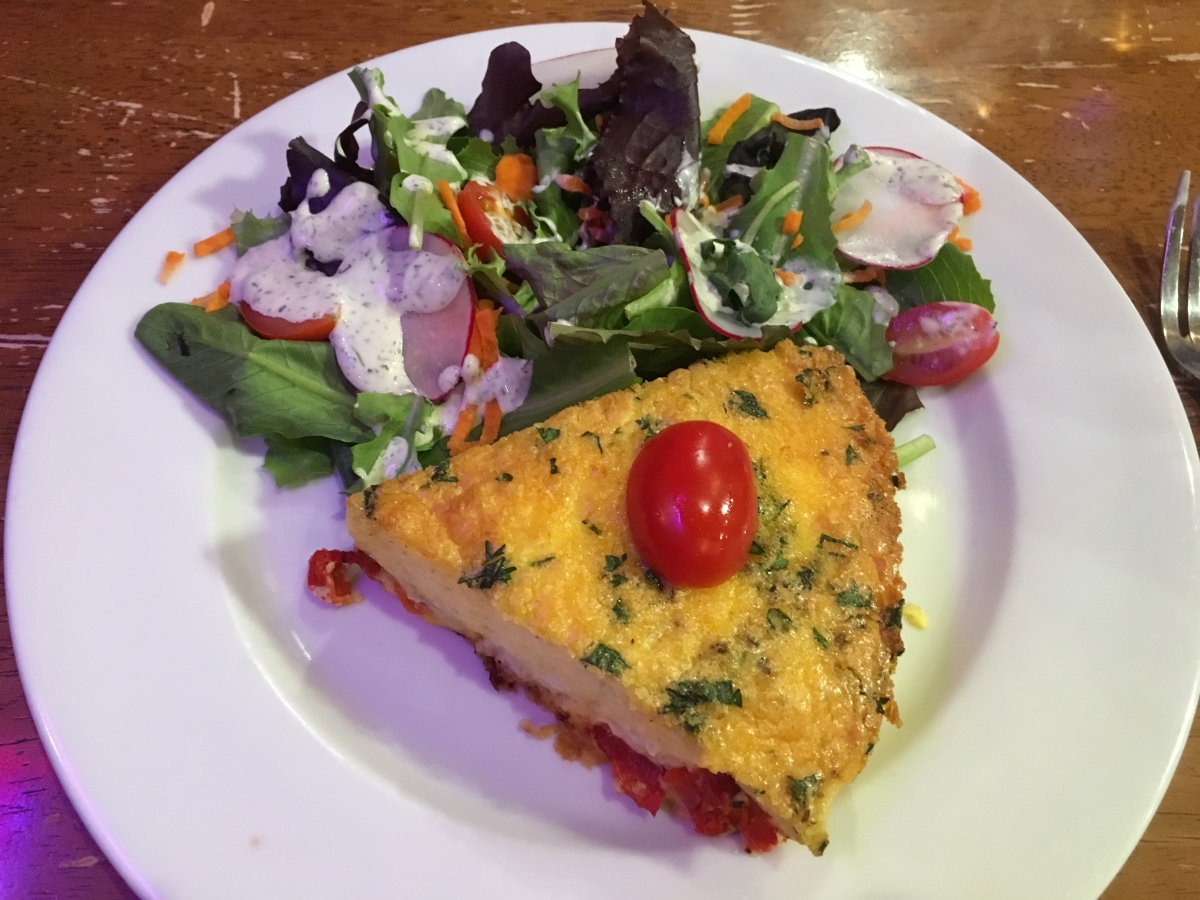
quiche with blue cheese, red pepper and onion
At the front of the charming cafe, art was offered for sale: tie-dyed scarves, earrings, painted notecards, framed photos of the area, and necklaces of natural stone, including turquoise. Mike was happy to get me out of there before I made a purchase.
After a restless night in our stinky motel room, we got up early to make a quick visit of the Bluff Fort Historic Site. At this early hour, the Visitor Center was closed, but the site was open. We walked around through pioneer log cabins with quilted beds, an Ute teepee, a Hopi mud hut, covered wagons, and a blacksmith shop.
The Bluff Fort Historic Site recognizes the Bluff expedition of 1880 and the pioneers who settled here. This expedition was the last organized wagon train of its size in the United States. Due to the harsh terrain, the missionaries averaged only 1.7 miles per day, a slower average than the Oregon Trail expeditions, the Brigham Young-led Mormon expeditions, the Mormon handcart expeditions and even the ill-fated Donner party expeditions.
No wagon road was built through rougher terrain than the Hole-in-the-Rock trail. Today, this trail is the most preserved wagon road in the West. The trail provided a crucial supply and access link between the Four Corners area and the western Utah settlements. Many of its most challenging sites are untouched from when the pioneers blasted and cut their path.
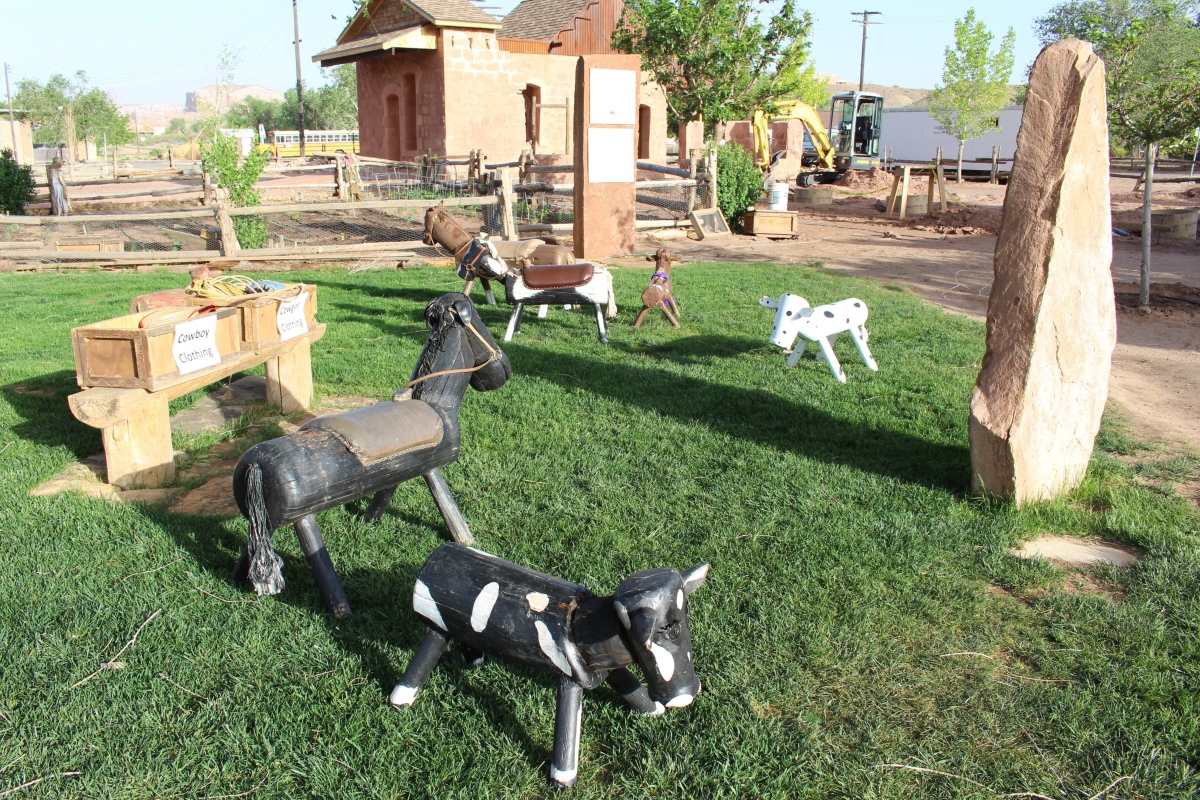
romping livestock
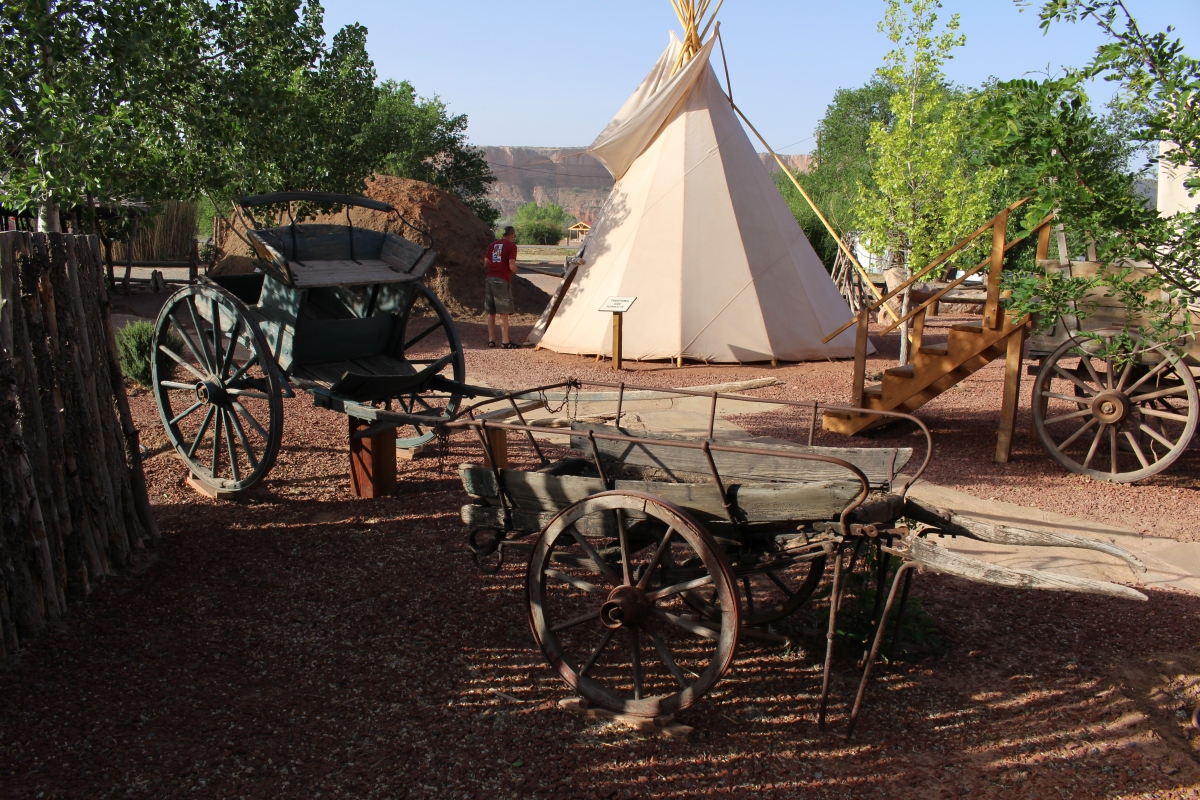
traditional Ute homesite and wagons
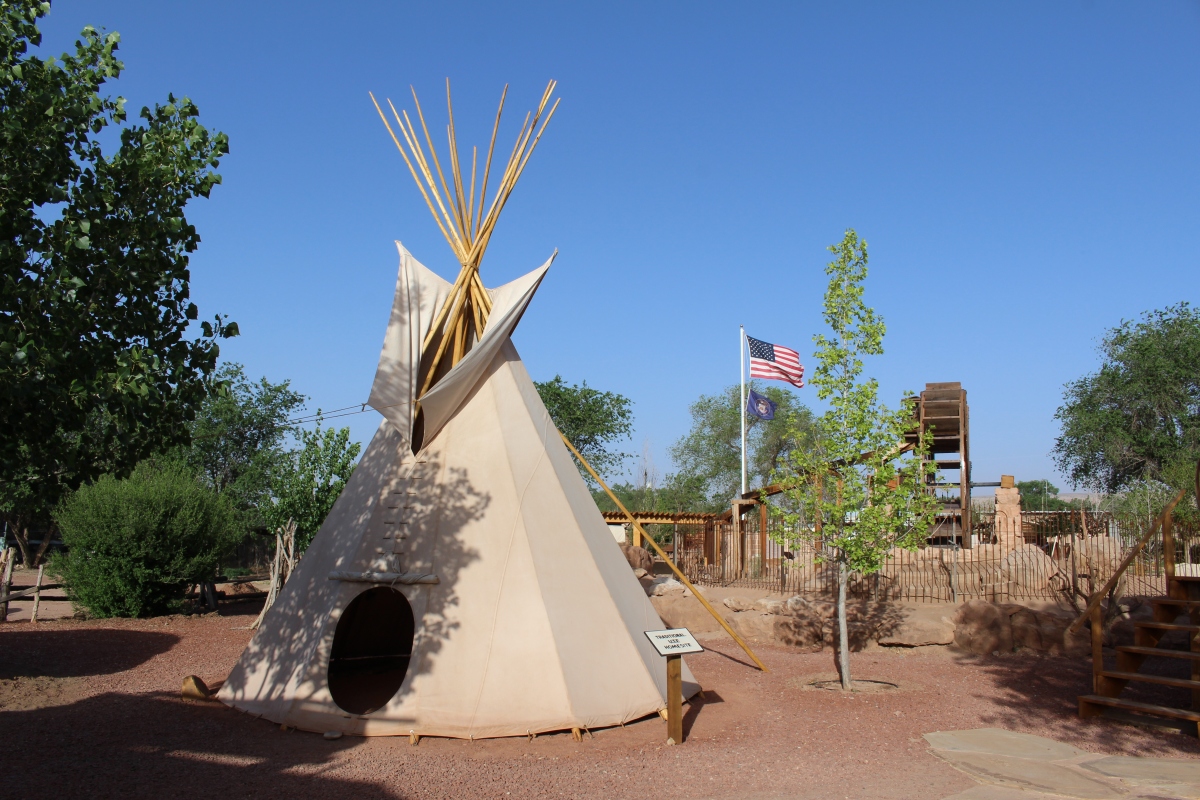
traditional Ute homesite
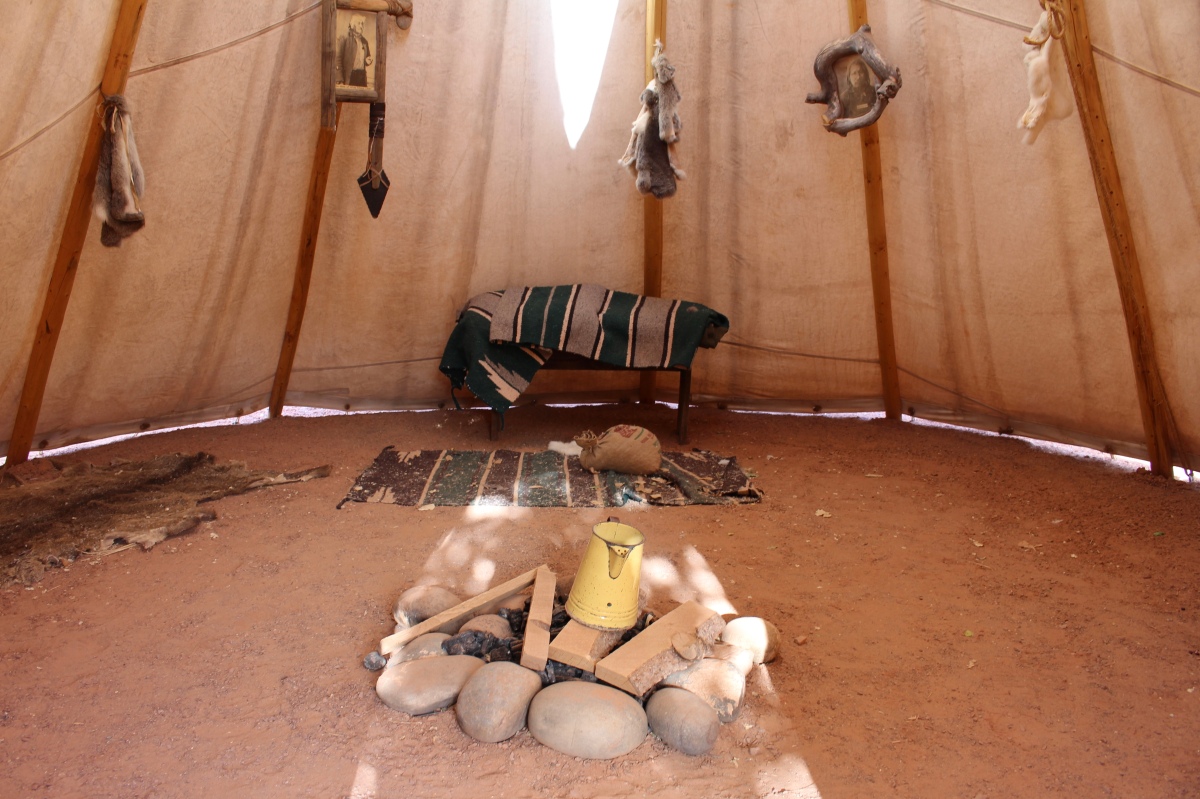
inside the traditional Ute home

covered wagon
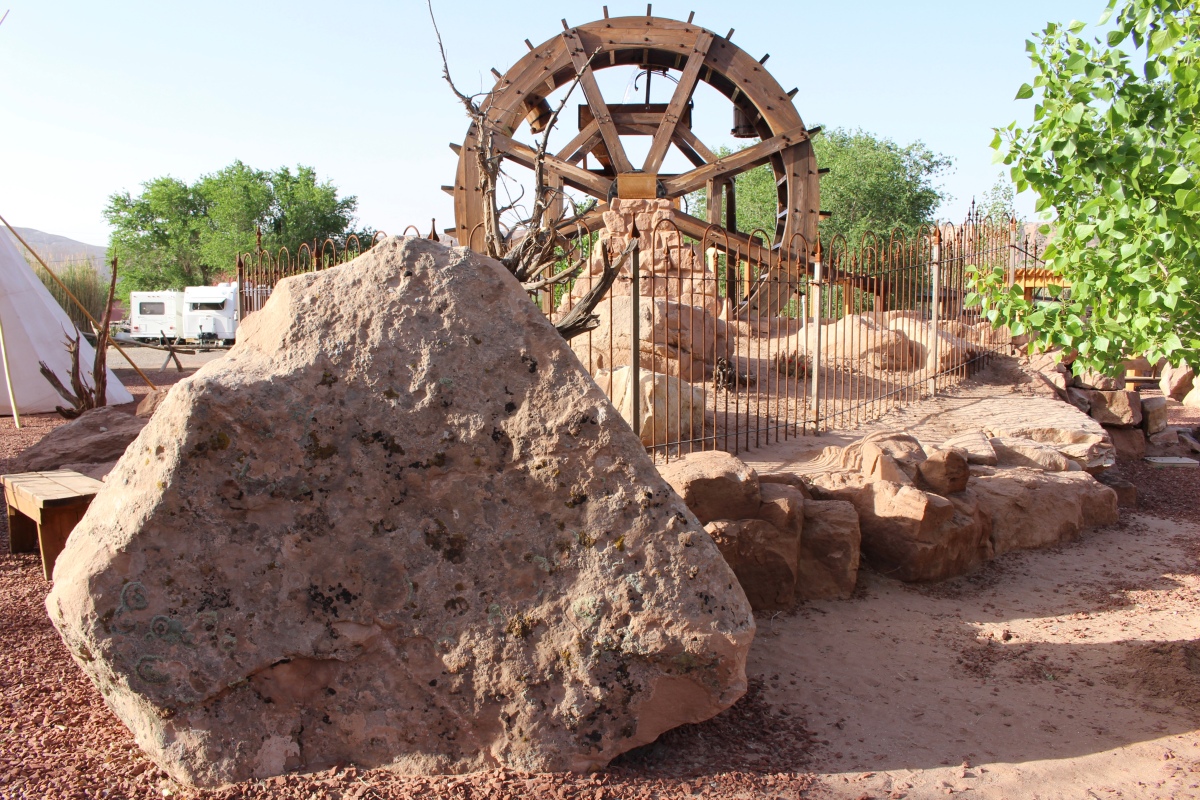
water wheel
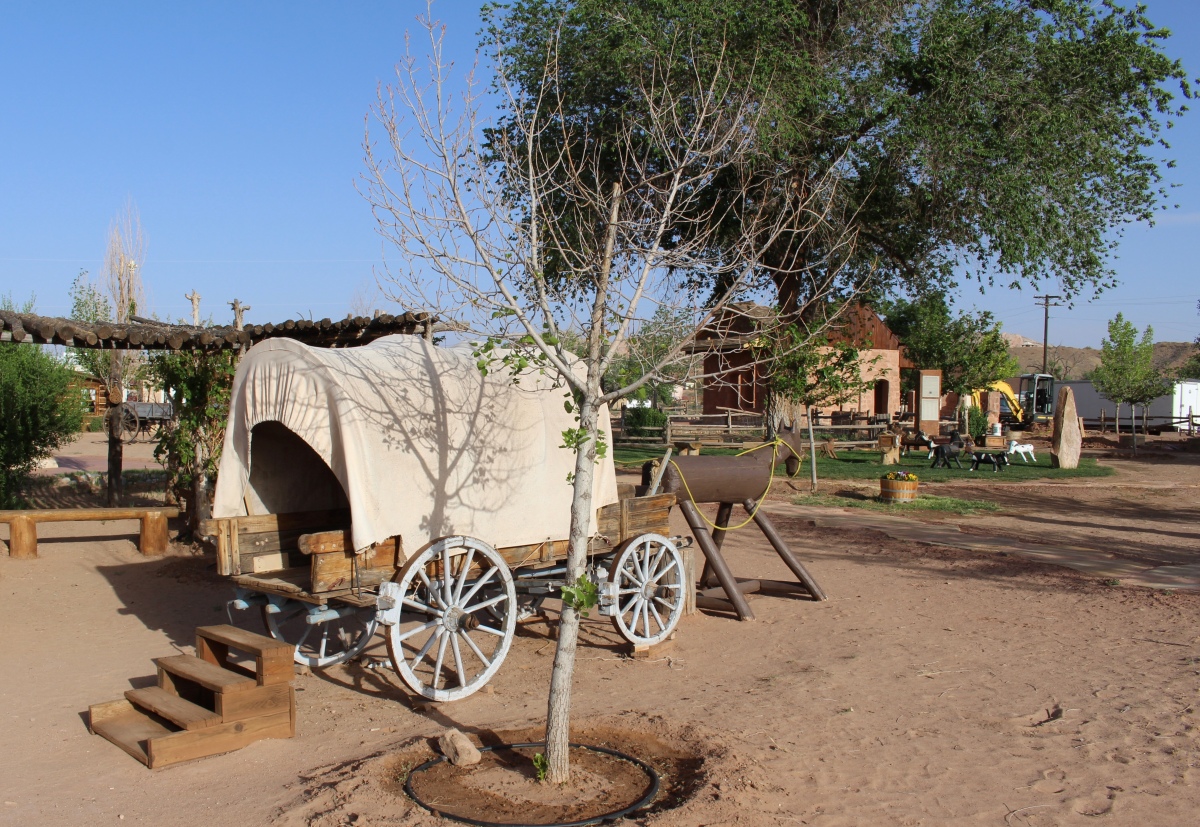
covered wagons
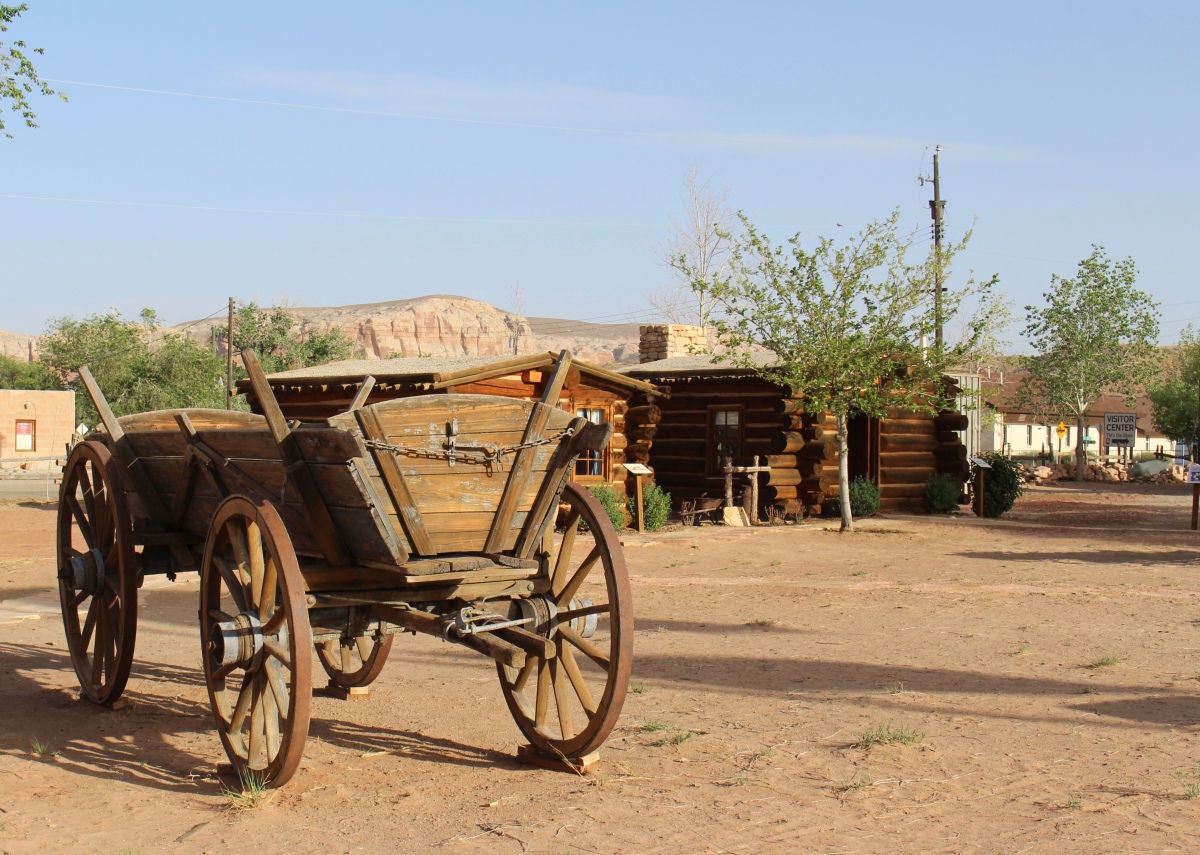
wagon and log cabins
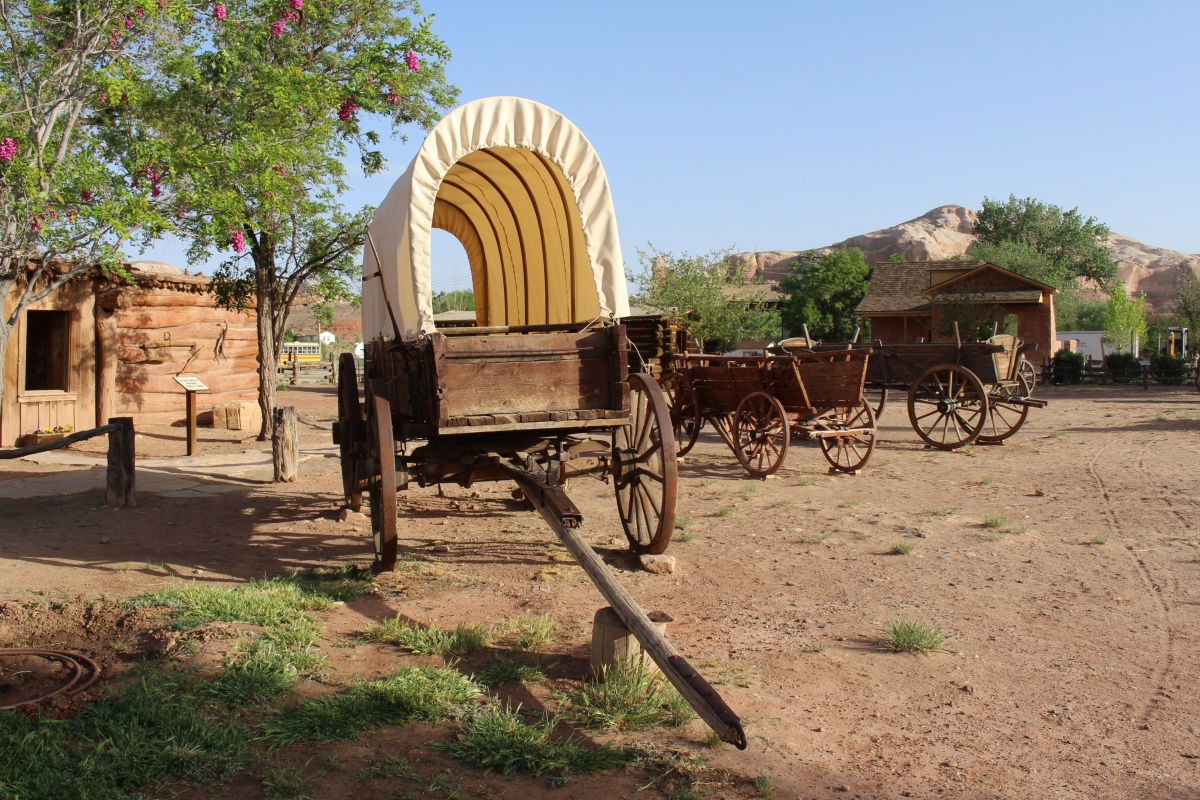
wagons
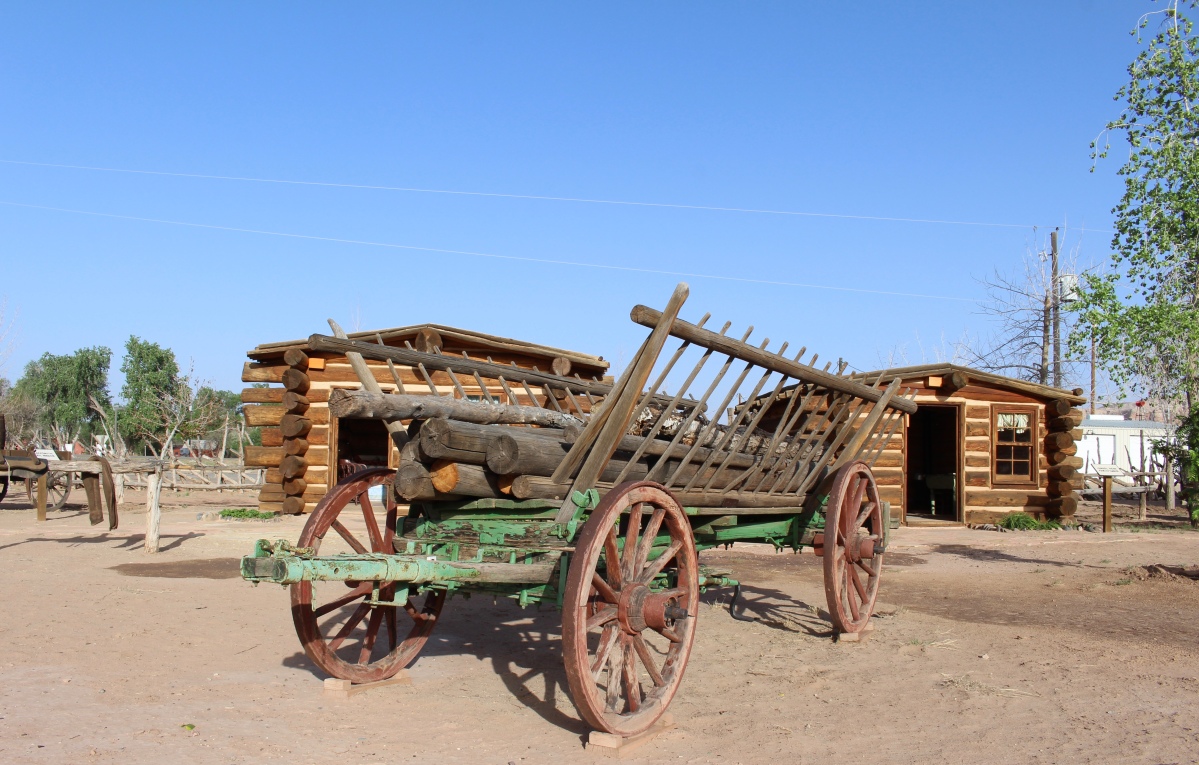
wagon and log cabins

Navajo blanket

quilt inside the log cabin
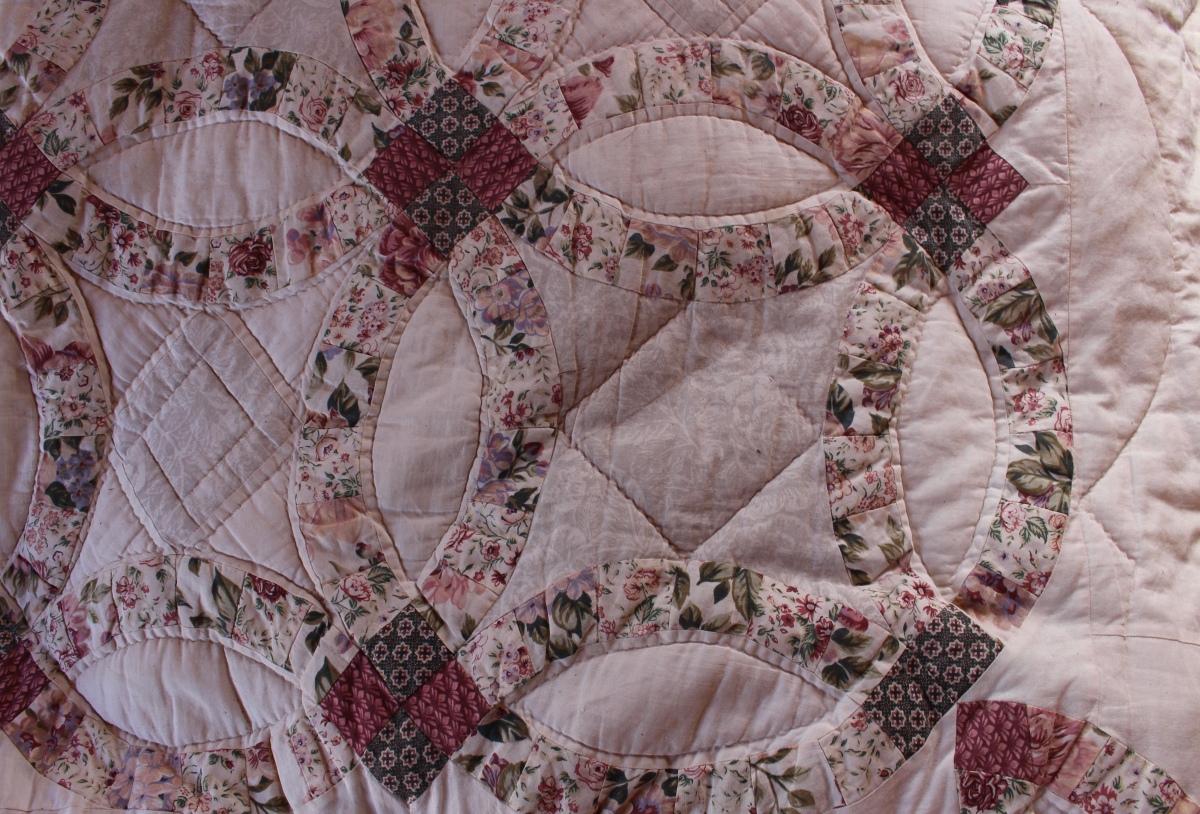
close up of quilt
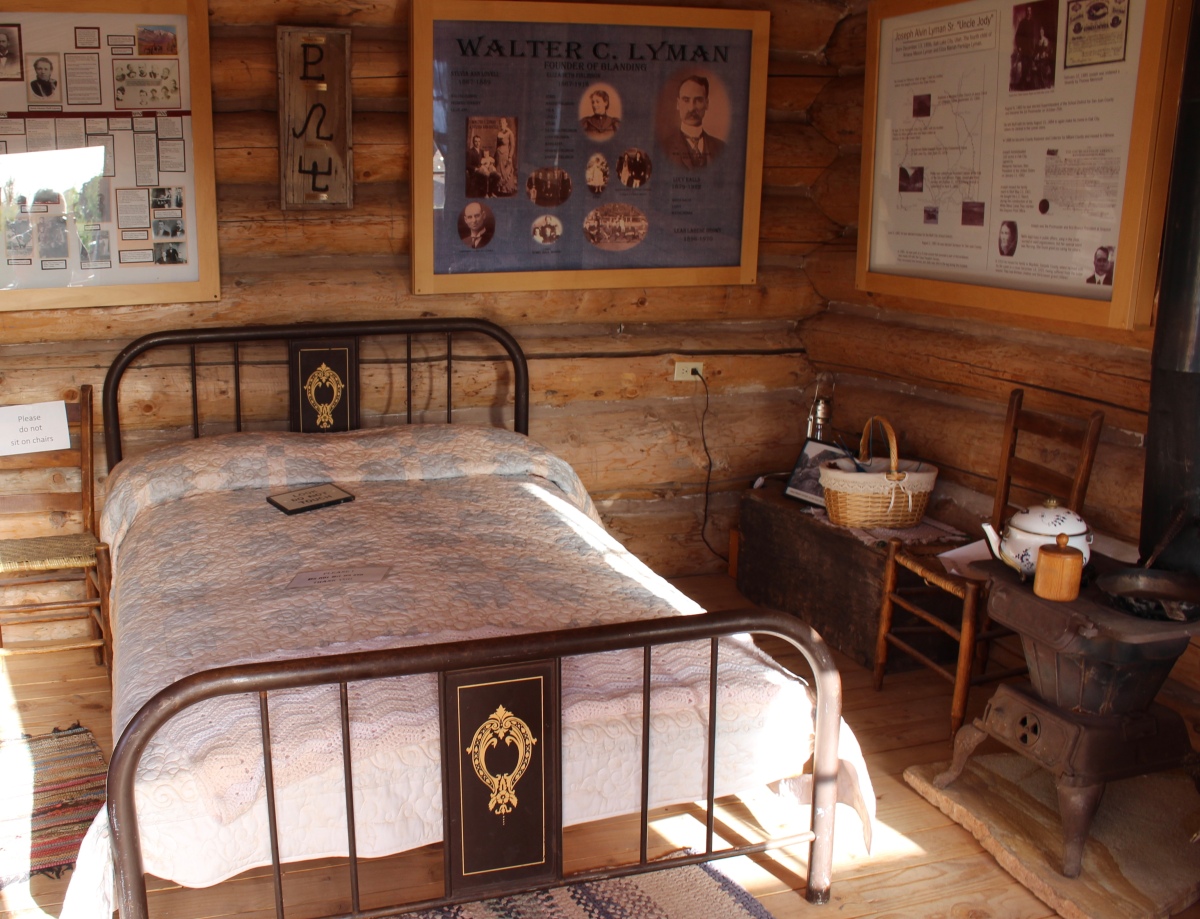
inside the log cabin

quilt-covered bed
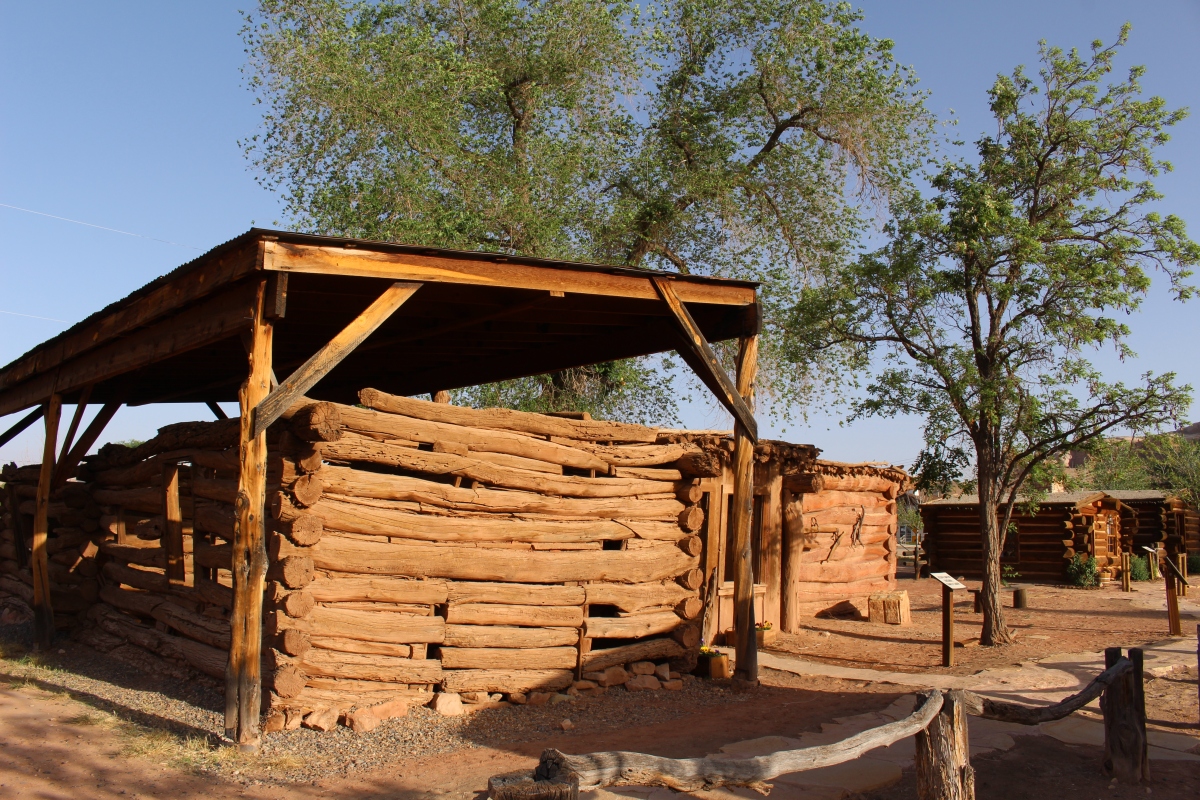
log building
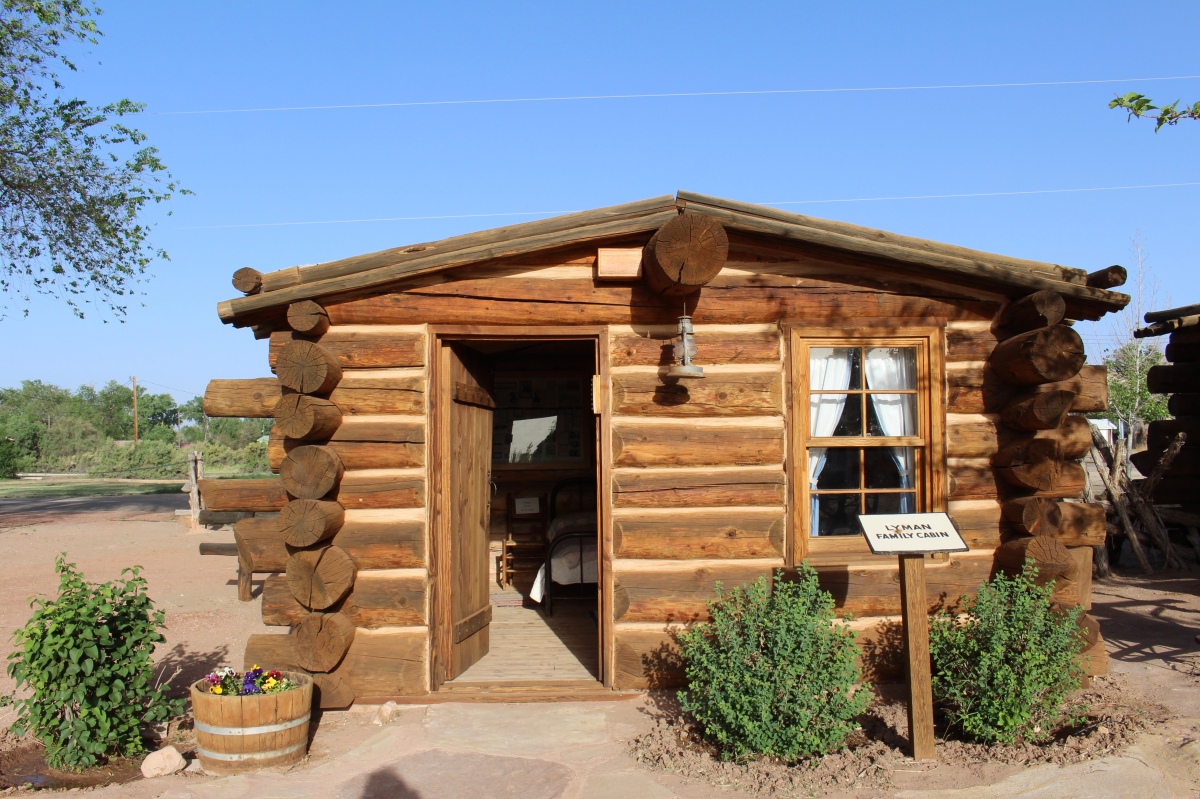
Lyman family cabin
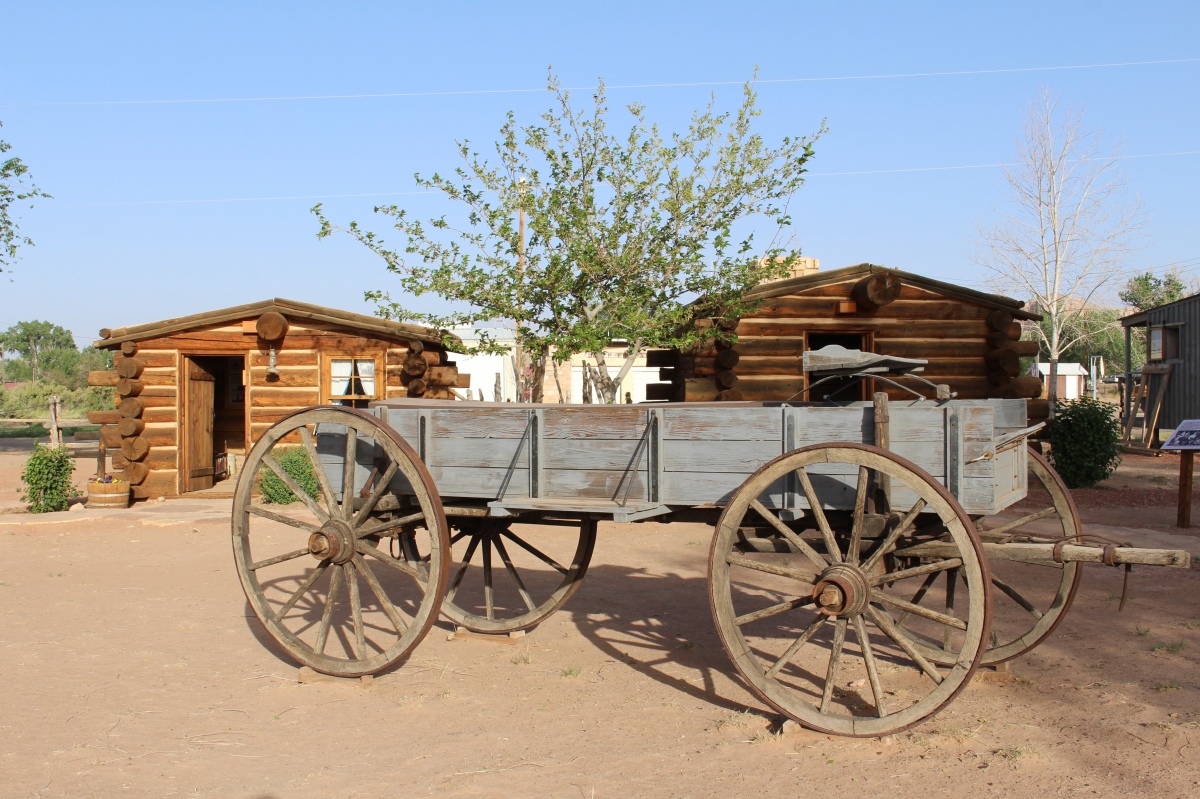
wagon
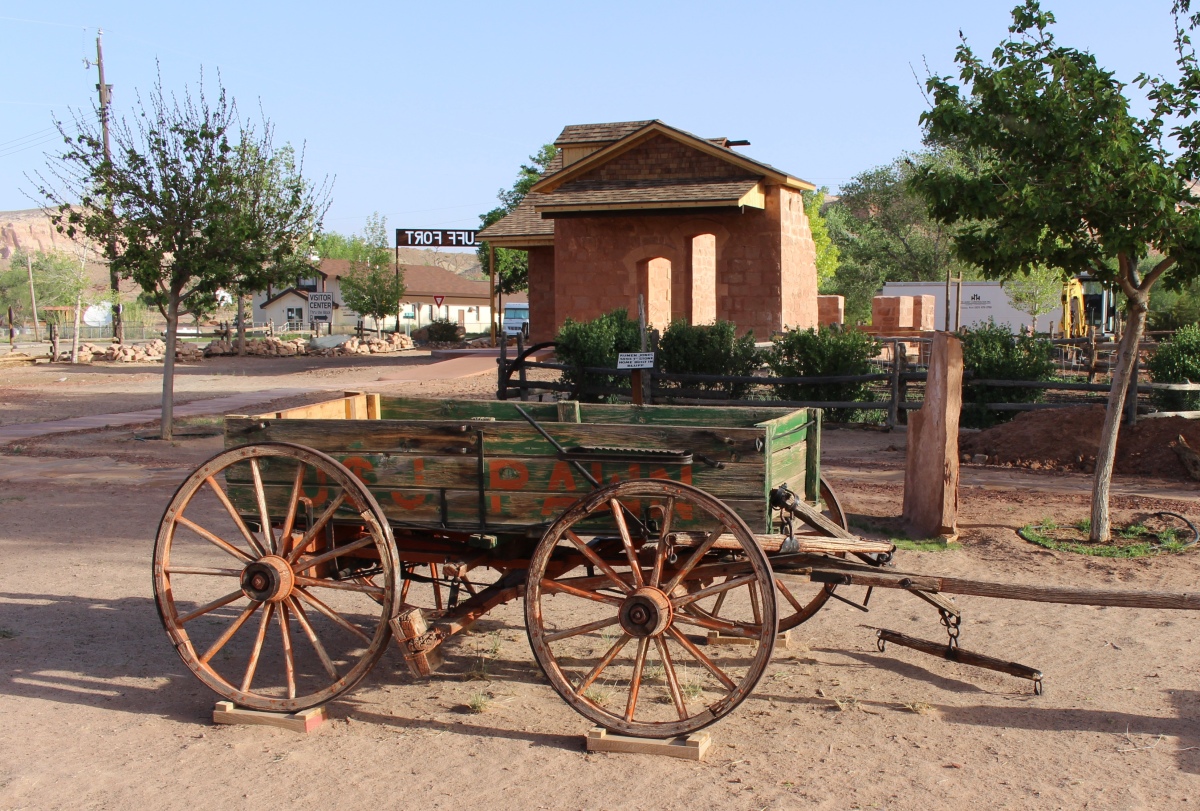
wagon
*Friday- Saturday, May 11-12, 2018*
*********************
“PHOTOGRAPHY” INVITATION: I invite you to create a photography intention and then create a blog post for a place you have visited. Alternately, you can post a thematic post about a place, photos of whatever you discovered that set your heart afire. You can also do a thematic post of something you have found throughout all your travels: churches, doors, people reading, people hiking, mountains, patterns, all black & white, whatever!
You probably have your own ideas about this, but in case you’d like some ideas, you can visit my page: photography inspiration.
I challenge you to post no more than 20 photos (I have more here!) and to write less than 500 words about any travel-related photography intention you set for yourself. Include the link in the comments below by Wednesday, January 2 at 1:00 p.m. EST. When I write my post in response to this challenge on Thursday, January 3, I’ll include your links in that post.
This will be an ongoing invitation, every first and third (& 5th, if there is one) Thursday of each month. Feel free to jump in at any time. 🙂
I hope you’ll join in our community. I look forward to reading your posts!
the ~ wander.essence ~ community
I invite you all to settle in and read a few posts from our wandering community. I promise, you’ll be inspired!
Thanks to all of you who shared posts on the “photography” invitation. 🙂

“It is good to have an end to journey towards; but it is the journey that matters in the end.” ~ Usula LeGuin
One thing that struck me while I was walking the Camino de Santiago from September to October was that the journey itself was the thing that gave me joy. I did it in my own slow and careful way, usually walking no more than 10-12 miles a day spread out over 44 days of walking. While most pilgrims forged past me at breakneck speed, I took my time and enjoyed the journey. Although I looked forward to reaching my destination each day so I could rest, I also simply enjoyed putting one foot in front of the other, watching the changing scenery, stopping into churches for moments of prayer, sampling Spanish food in cafés, meeting fellow pilgrims and having conversations with them. I enjoyed moments of silence – both mindless and insightful moments. In the beginning, I rarely thought about how far I had to walk to reach Santiago. If I had allowed myself to think of that huge gaping distance between me and my destination, I might have thrown up my hands in despair.
After all those days of walking, climbing mountains, descending steep rocky trails, walking over monotonous landscapes, and being awed by painterly sunrises, dramatic landscapes or charming Spanish towns, I arrived at the Cathedral in Santiago. I attended a mass, as an interloper, for a group of German pilgrims, and then attended the regular pilgrim mass; I watched in awe as the Botafumiero arced enthusiastically toward the vault of the cathedral, and to the heavens. It was an emotional and breathtaking experience.
And, it was over. Just like that.
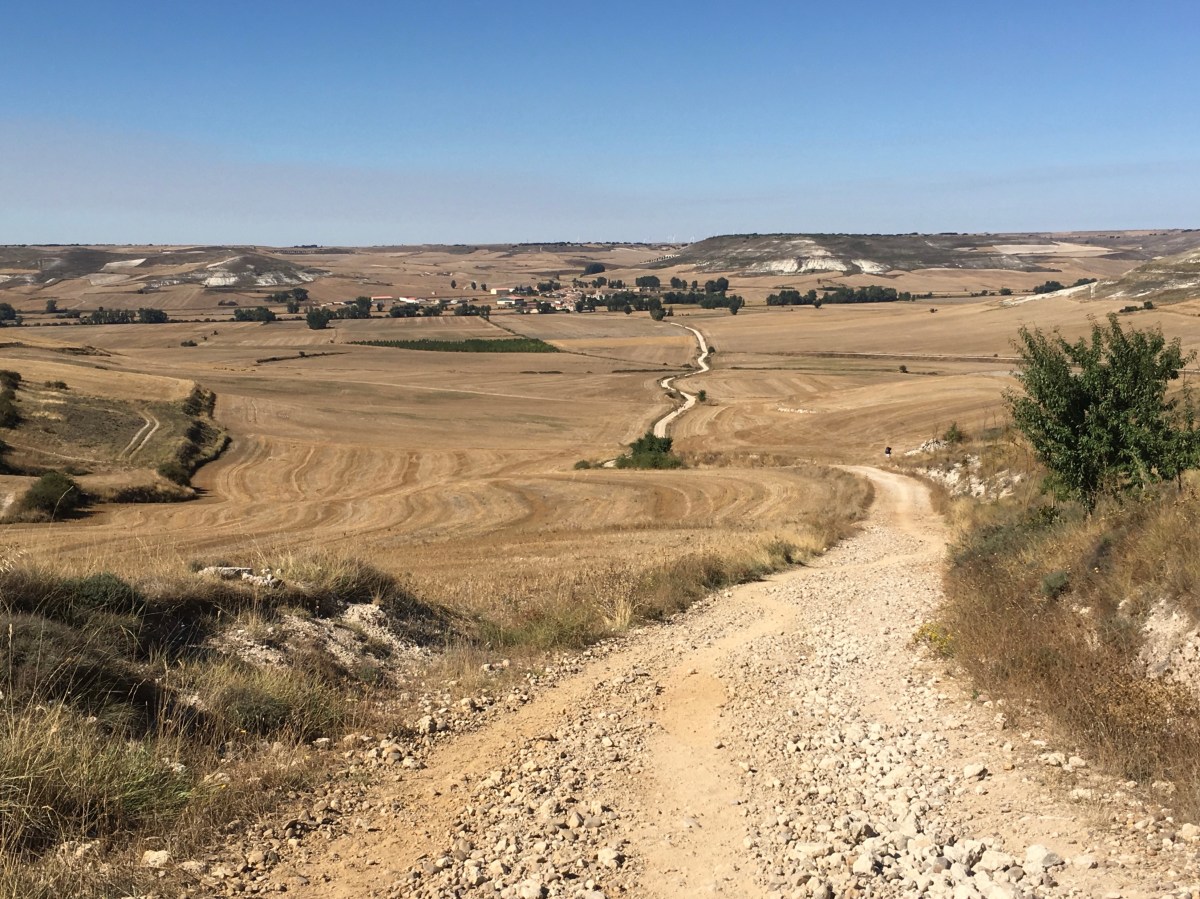
The journey may look overwhelming but it consists of putting one foot in front of the other. 🙂
When I think of the Camino, I don’t think so much of that ending accomplishment, but of the delightful and even the arduous days I spent walking, and walking, and walking.
Today, it seems like a distant dream, something I did in another lifetime, and I find myself longing for that simple act of putting one foot in front of the other.
“You can measure your worth by your dedication to your path, not by your successes or failures.”
― Big Magic: Creative Living Beyond Fear
It’s a strange thing to me — that I actually walked 799 kilometers, almost 500 miles, across northern Spain. It’s almost as if that journey were in another life, or some alternate universe. Sometimes I forget I even did it. And honestly, I’ve felt a bit lost since since I returned. I’d like to capture some of the feeling I had while I was there, and carry it with me in my everyday life.
Over the years, I’ve had numerous goals, only some of which I’ve completed: To make stunning quilts. To make jewelry. To draw blueprints for my dream house. To have an interior design business. To complete my Master’s and get a job abroad in international aid. To get my completed novel published. To work in the Middle East. To finish writing my memoir. To finish my road trip novel. To write more poetry. To learn to draw, to paint, and to make art journals. To write a book of related short stories. To walk the Camino!
There are so many things I want to accomplish. But they often seem overwhelming to me because I doubt I’m up to the task. For instance, I’ve sent my novel to numerous agents and have been rejected every time, so I’ve convinced myself I’m not a good enough writer, that I have no talent, and though I could self-publish, no one would read my book. I’m simply not creative enough. I’ve set myself up for failure from the get-go, so I’m afraid indulge my creative impulses. I get stuck in my belief that I’ll always be stuck.
After discovering the joy I found in the simple journey of following my curiosity and doing the Camino, of putting one foot in front of the other with little thought of the final destination, I’ve decided I should apply this lesson to my life. I’ve decided that in 2019, I’m going to pick a few projects to focus on, and do them simply because I enjoy them.
I’ve always wondered if I could learn to draw, as I’ve never had any artistic ability whatsoever. People have told me I can learn. Although I am skeptical, I’ve decided to explore my curiosity. I’ve signed up to take a beginning drawing class this winter. I’m going in with no preconceptions about my ability to learn. I’m going to enjoy the process of learning. I’m also interested in Art Journaling, and though I’ve signed up for a class, I’m #5 on the waitlist, so it’s possible I won’t get in.
I have had fun toying around with poetry this year on my blog and though I know I have a lot to learn, and my poems are a far cry from what I wish they could be, I’m going to continue to play around with them. I’ve signed up for a “Found Poetry” class this winter. Later in the year, I’d love to take a class on “Poetic Forms.” Most of all, I want to let my imagination run wild, and to enjoy wordplay.
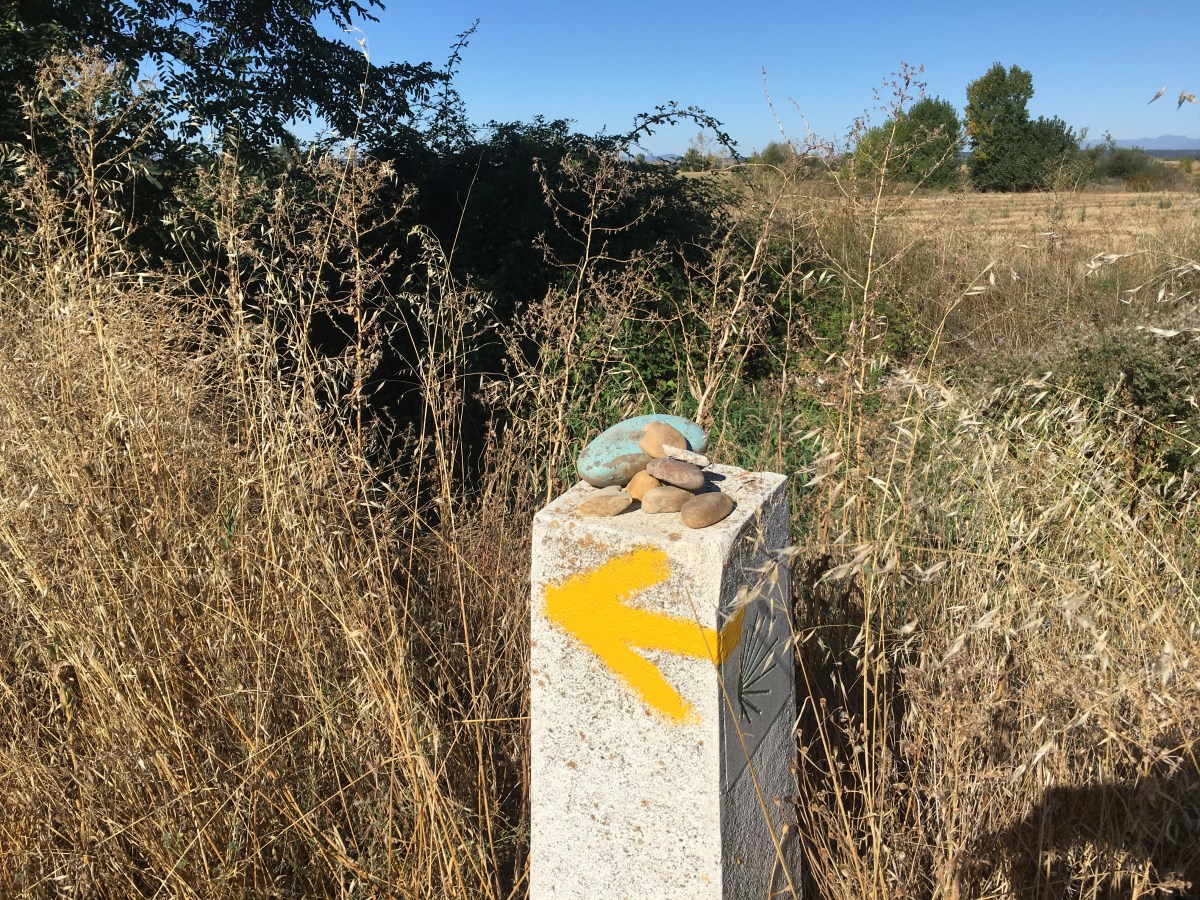
The yellow arrow always points the way.
Finally, I hope to work on a number of unfinished projects. I want to read books that I already have on my bookshelves (50 is my goal); many of these books I’ve had for 10 years or more! I want to keep plugging away at the Kon Mari decluttering we started a couple of years ago. And I want to finish the first draft of my road trip novel, and to have fun with it, without any regard to whether it’s good enough, or whether I’m creative or imaginative enough, or whether it will ever be published. I want to look at each day of writing as an adventure, and to enjoy the fun of failure!
I also plan to continue to make intentions for my travels, to have fun making my travels more artful, and experimenting with different ways to create art from those travels.
The Camino also awakened a spiritual desire in me, and I want to explore a couple of churches in my area in the coming year. My wish is to find community, and a place that does some social justice work, without getting caught up too much in religious dogma.
My travels this year I hope will include:
In the U.S., I hope to take several road trips:
Most of all, I want to enjoy the journey, to follow my curiosity, to look at all my attempts as adventures.
“You can measure your worth by your dedication to your path, not by your successes or failures.”
― Big Magic: Creative Living Beyond Fear
I don’t want to think about the end goals because end goals seem to suggest that the journey itself is drudgery. I hope to enjoy the journey for its own sake, as I did the Camino.
“Curiosity is the one thing invincible in nature.” ~ Freya Stark
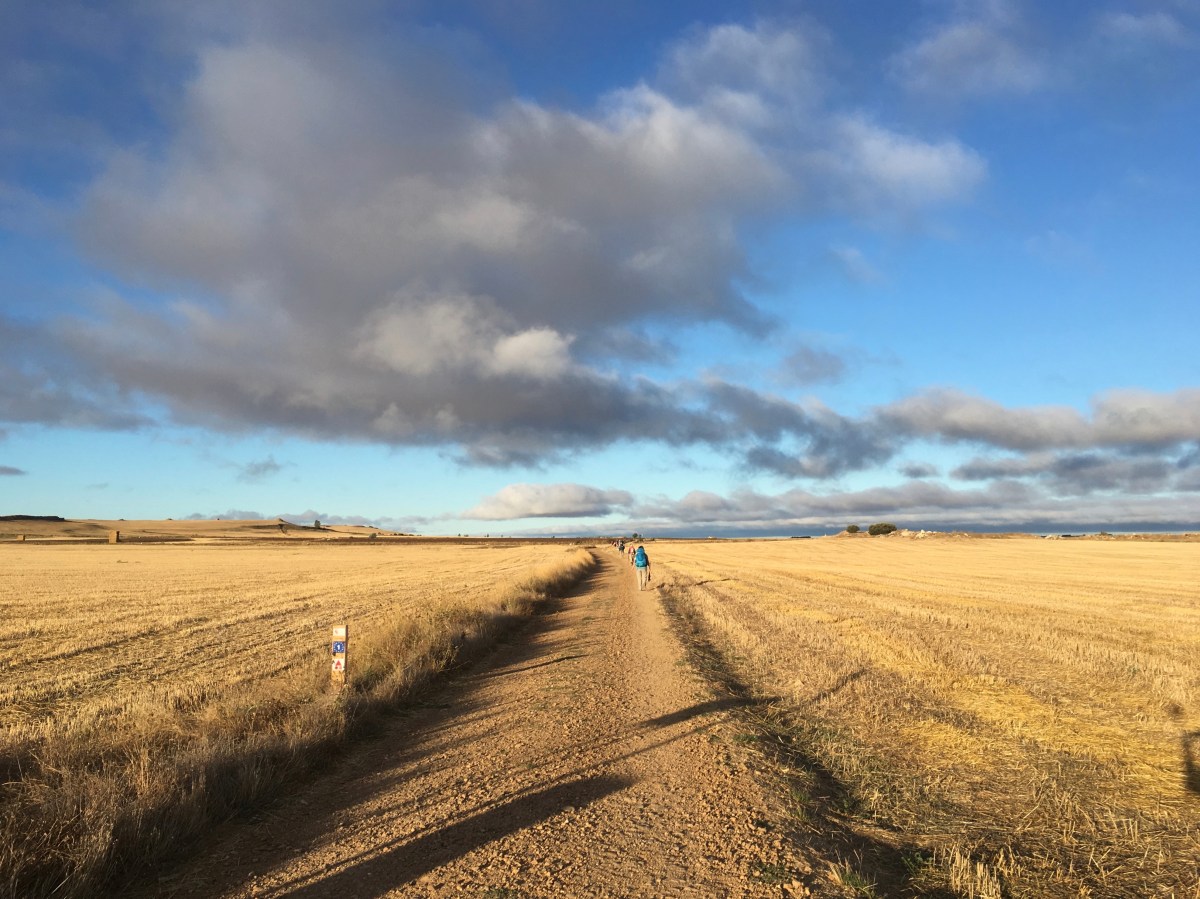
the stunning road of life
**********************
“ON JOURNEY” INVITATION: I invite you to write a post on your own blog about the journey itself for a recently visited specific destination. Or you can write about the journey you hope to take in the year ahead. If you don’t have a blog, I invite you to write in the comments.
Include the link in the comments below by Tuesday, January 15 at 1:00 p.m. EST. When I write my post in response to this challenge on Wednesday, January 16, I’ll include your links in that post.
This will be an ongoing invitation, once on the third Wednesday of each month. Feel free to jump in at any time. 🙂
I hope you’ll join in our community. I look forward to reading your posts!
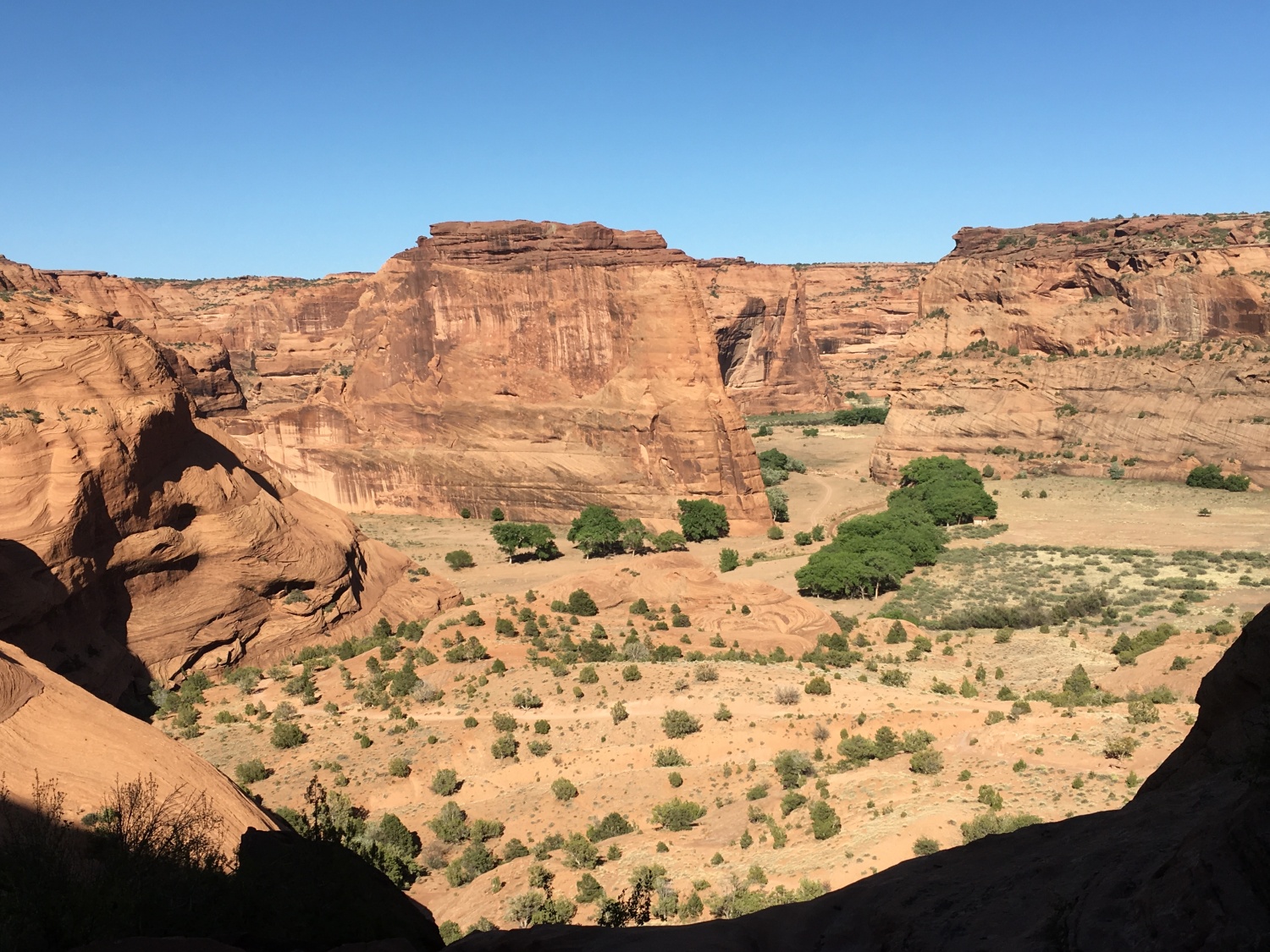
At Canyon de Chelly’s visitor center, the ranger there suggested I do the White House Trail close to 5:00 p.m. because I’d be in the shade from the canyon walls when I came back up. I took her advice as well as I could, saving the 2.5 mile round trip hike for the end of my day. I still had to drive back to Gallup, New Mexico when I finished here, so I started earlier than she suggested, at 3:45 p.m.
The White House Trail is the only trail visitors can take into the canyon without a permit or an authorized Navajo guide. It takes about 2 hours to do the round-trip hike.
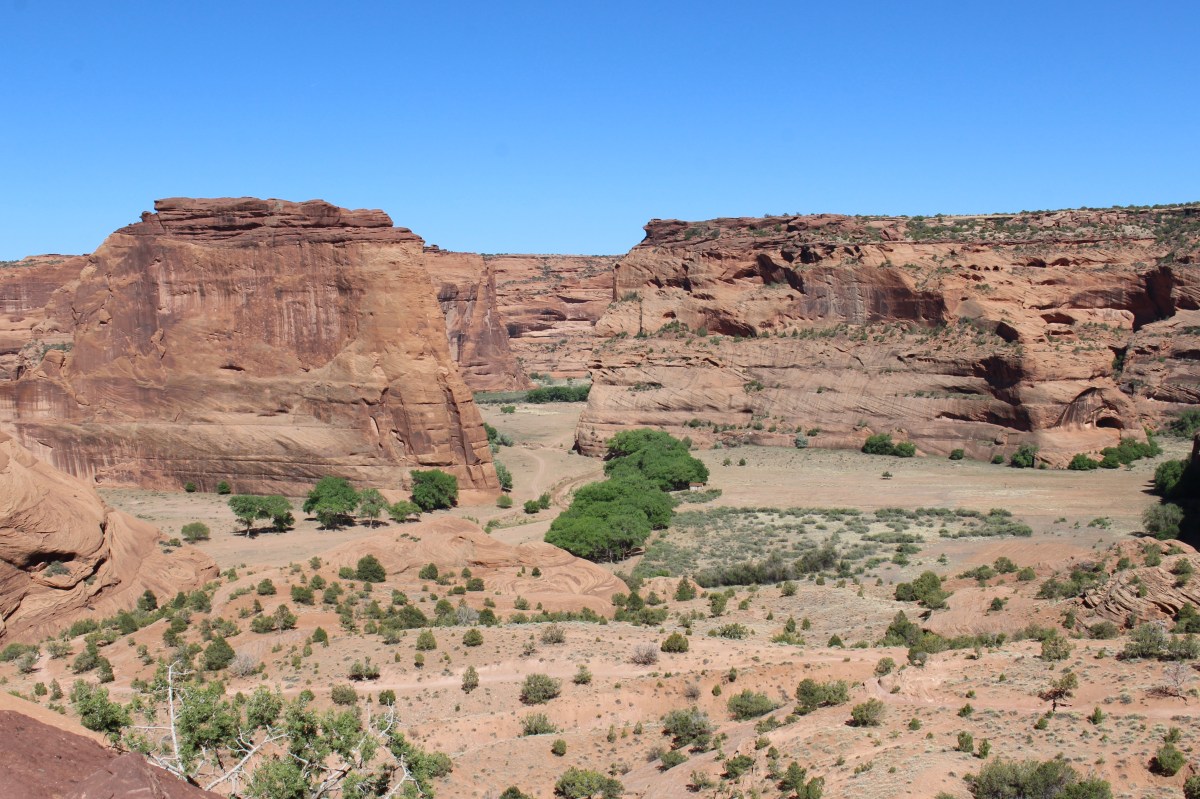
At the White House Overlook, I looked down to the deep canyon below and tried to decide if I really wanted to do this on my own. I squinted, looking for other people on the trail. When I saw a few clusters of people, I decided to do it. I was so happy I did!
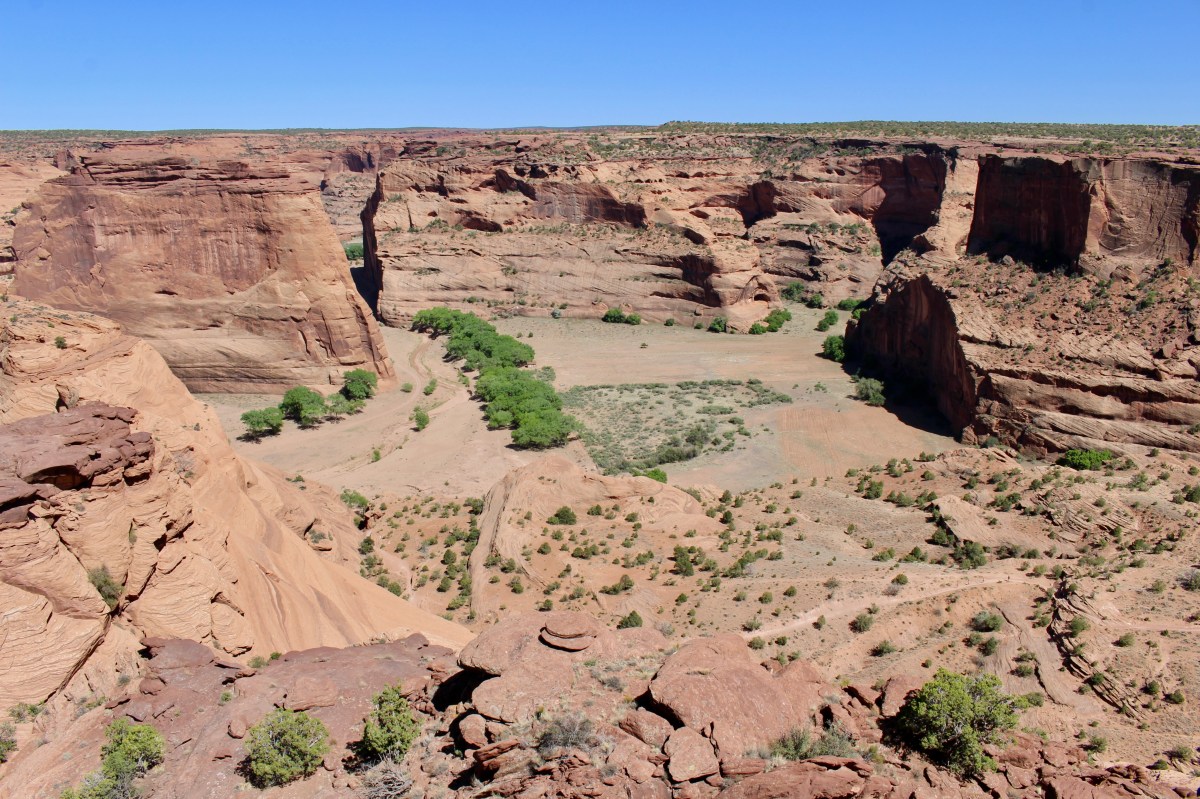
view from the White House Overlook

view from the White House Overlook
Before I started the hike, I encountered a Native American man with a bandana over his face. He was holding tight to a powerful-looking pit bull; the dog was in a harness and it seemed the man was having some trouble holding on to it. I hate pit bulls and could only think of that poor girl who was practically eaten recently by her own two pit bulls. I was determined to keep my distance from the man and his dog, so I made sure they were well ahead of me before I started my descent.

view from the White House Overlook
Most of the trail is carved into the cliff face, much like I imagine the Grand Canyon must be. I passed through two tunnels carved through the rock, some steps, and some sandy areas. At one point on the trail, the man with the pit bull stopped; by then some of his family had joined him. I had no choice but to walk by at close range. I didn’t like it, but I made it past without incident and hightailed it down the trail to keep distance between him and myself.
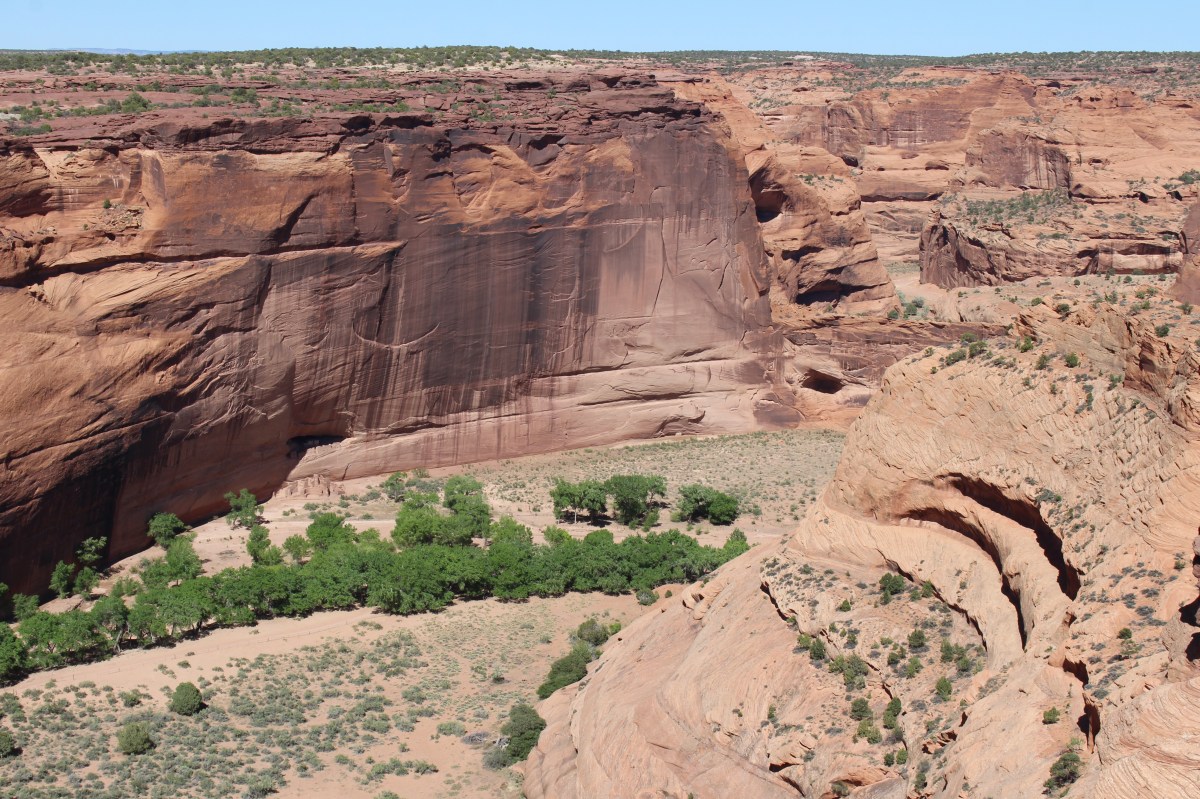
Walking down the White House Trail
Descending into the canyon
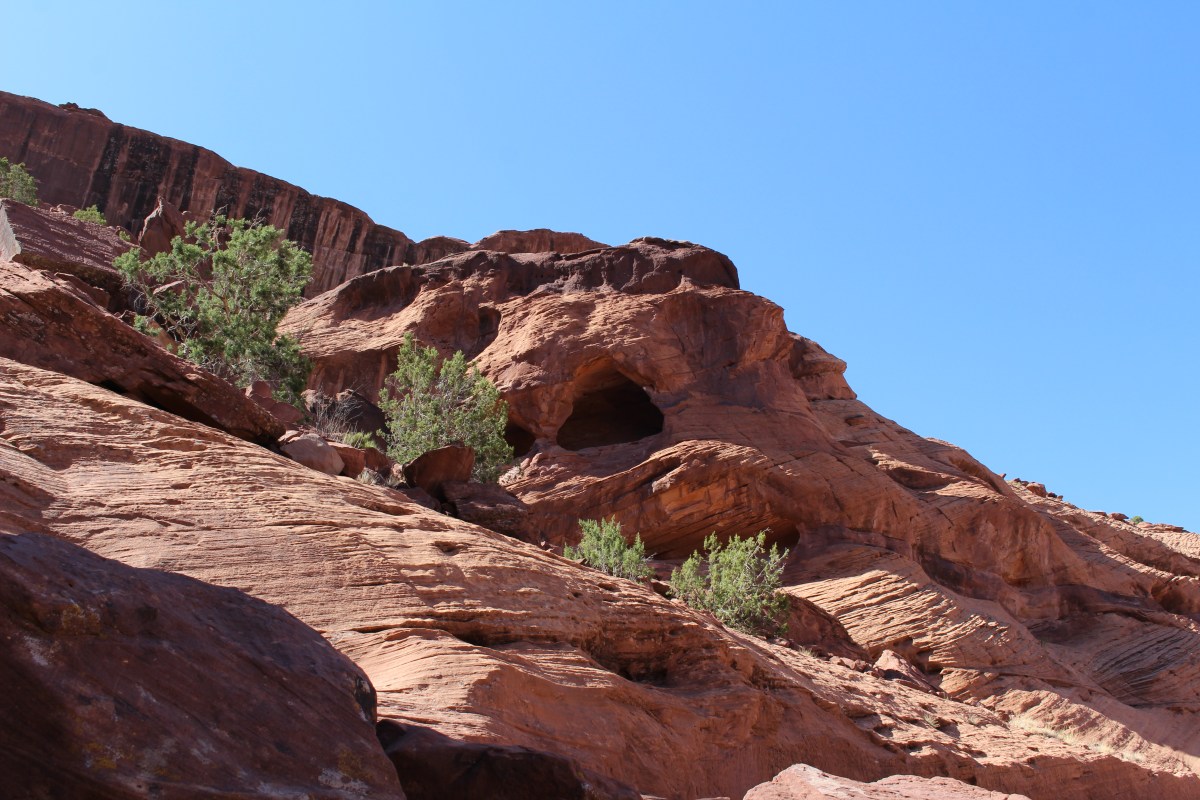
descending along the rock face
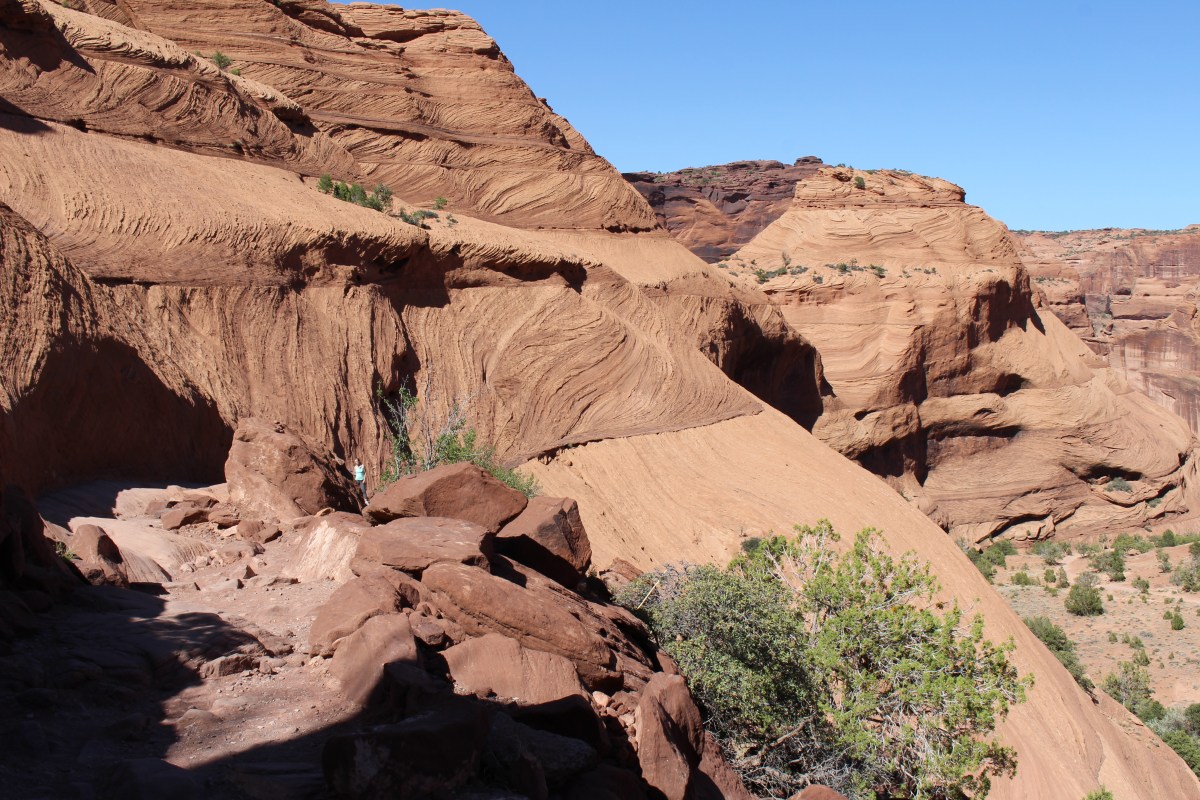
the trail down
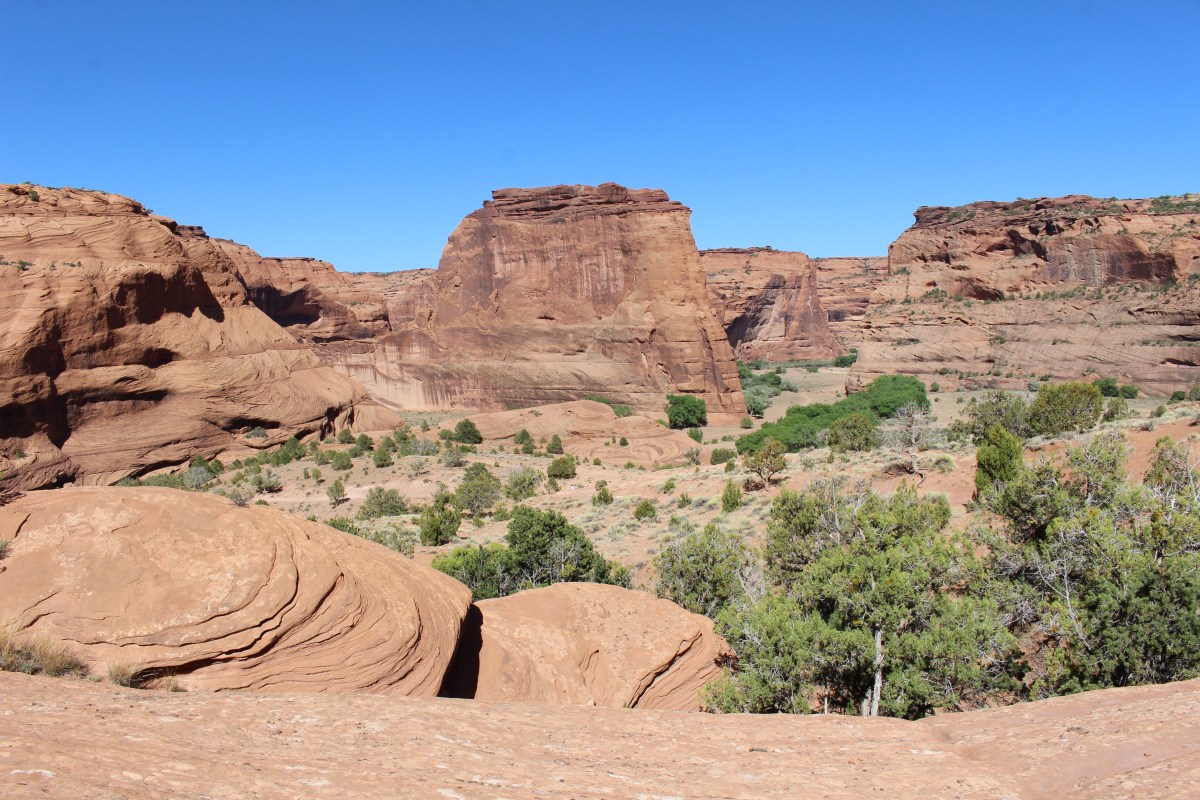
views from the trail down
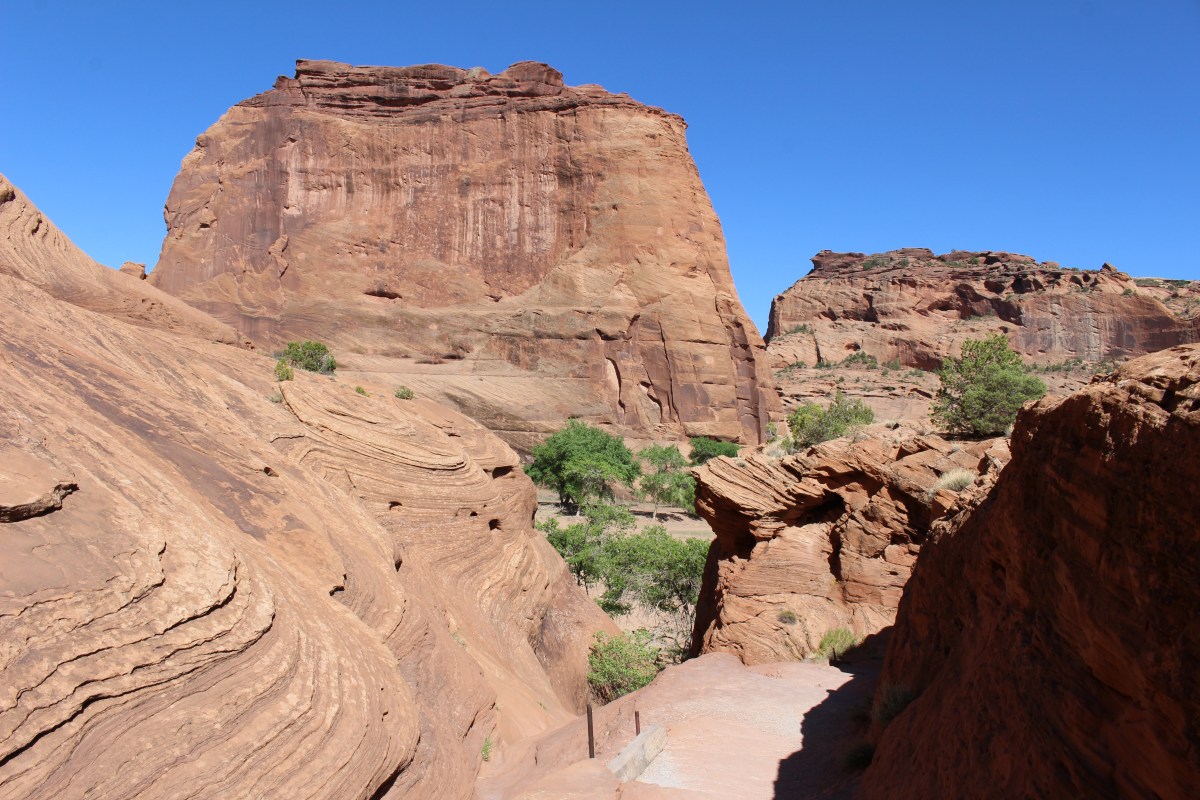
views from the trail
When I got to the canyon floor, I walked over a bridge and on jeep tracks to the White House Ruin. Ancestral Puebloans built and occupied this place about 1,000 years ago. It is named for the long, white plaster wall in the upper dwelling.
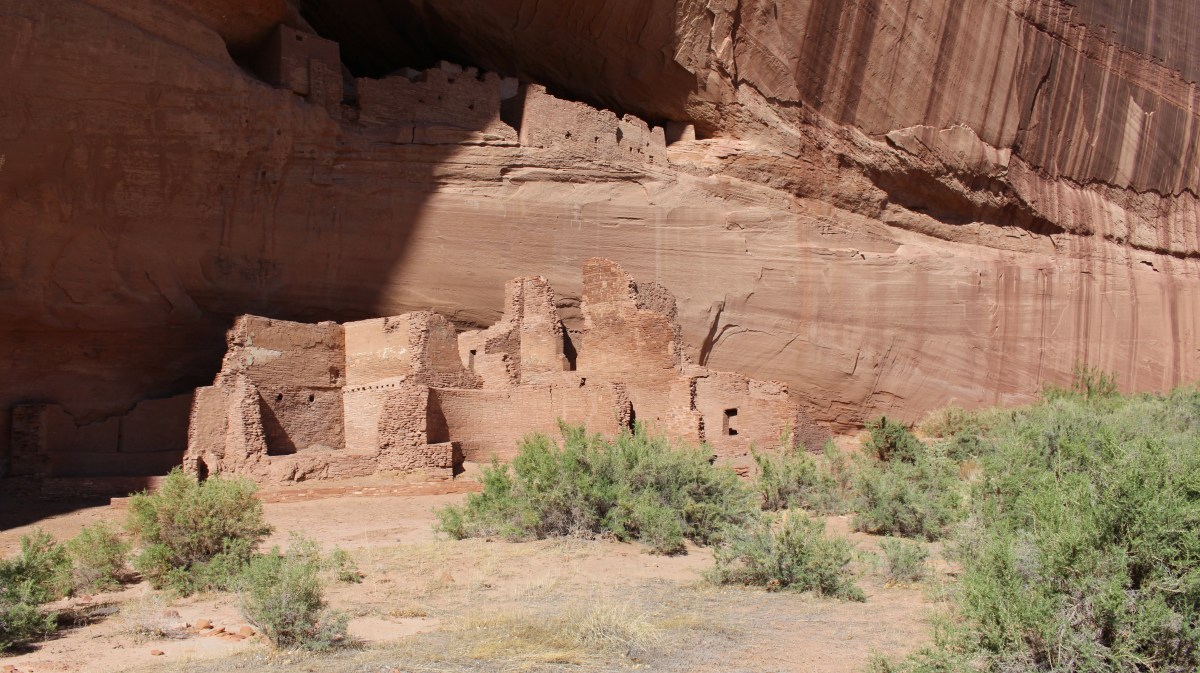
The White House Ruin
The ruins were beautiful up close, extensive and well-structured.
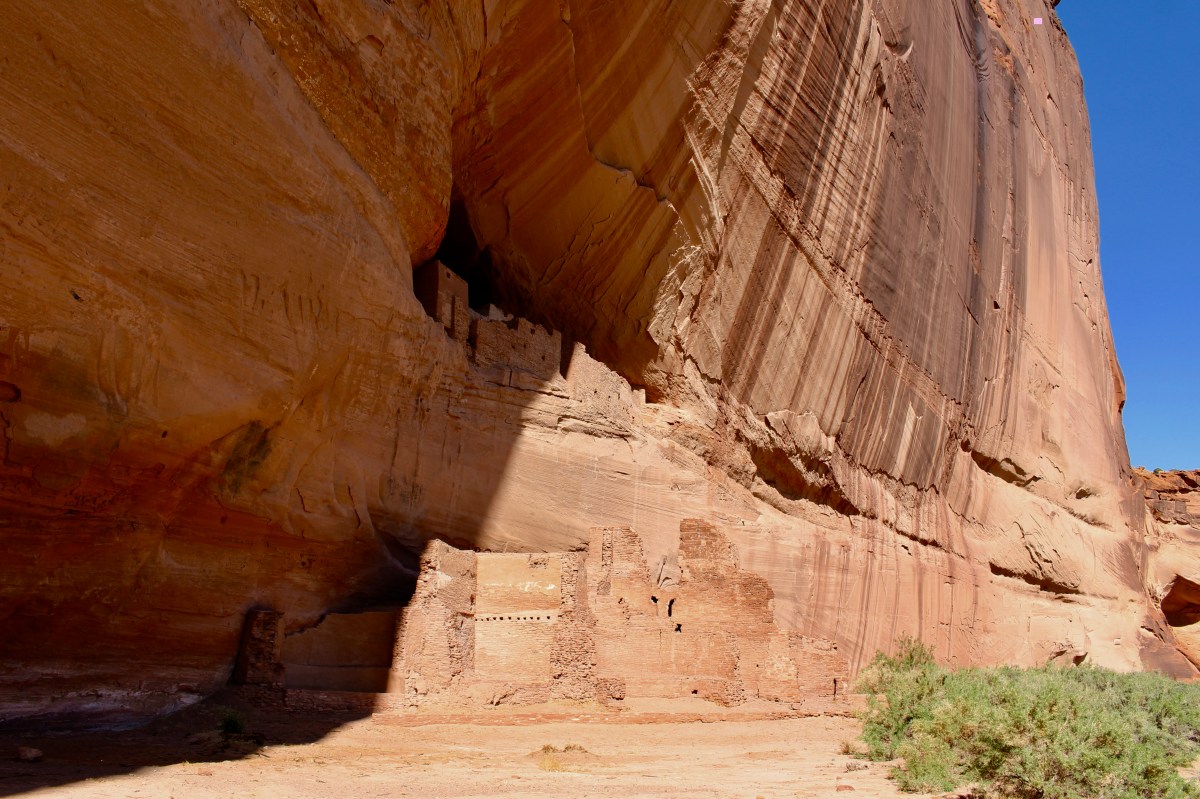
The White House Ruin
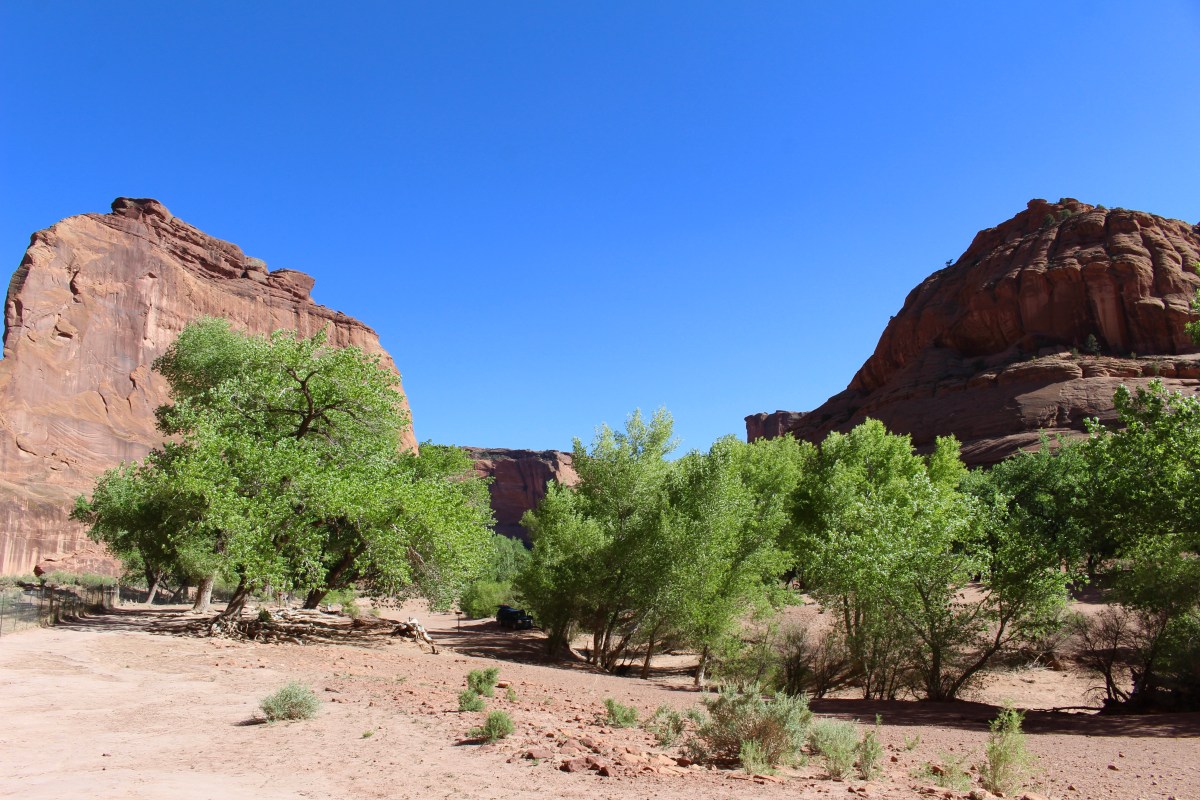
in the canyon with the cottonwoods
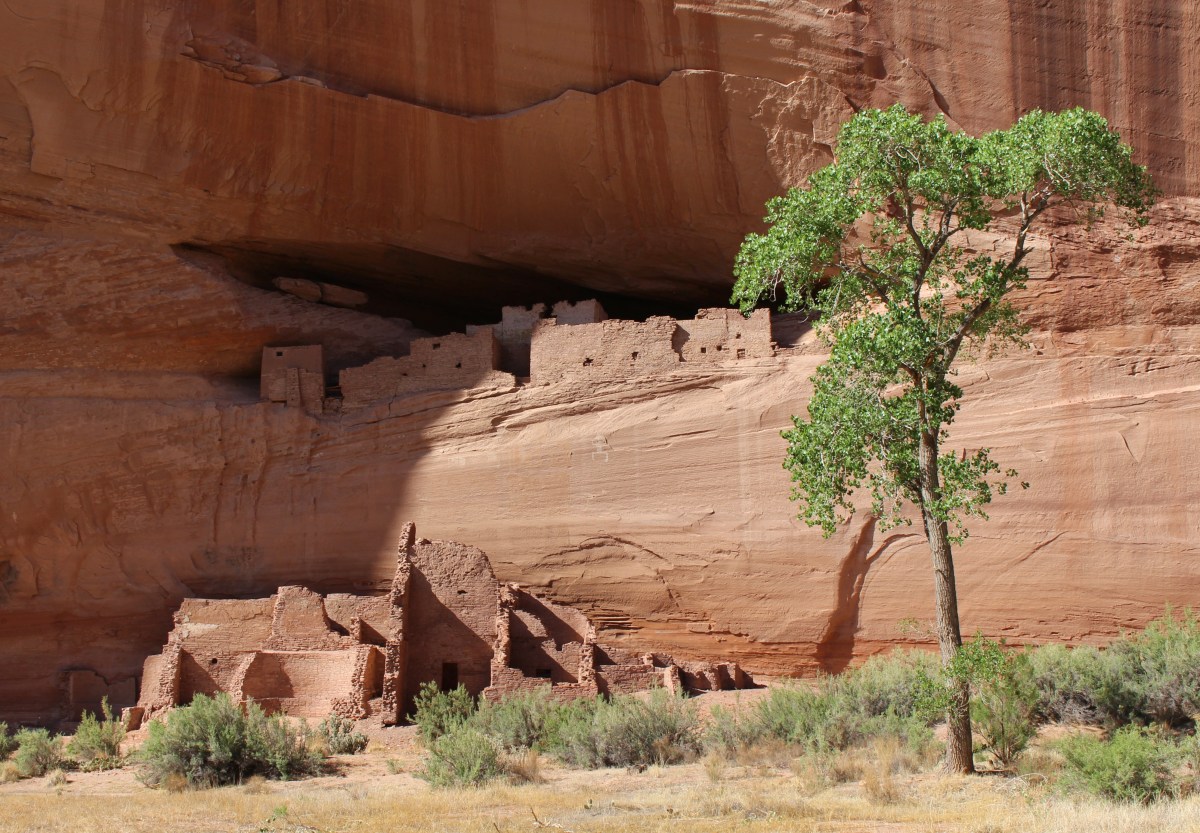
The White House Ruin
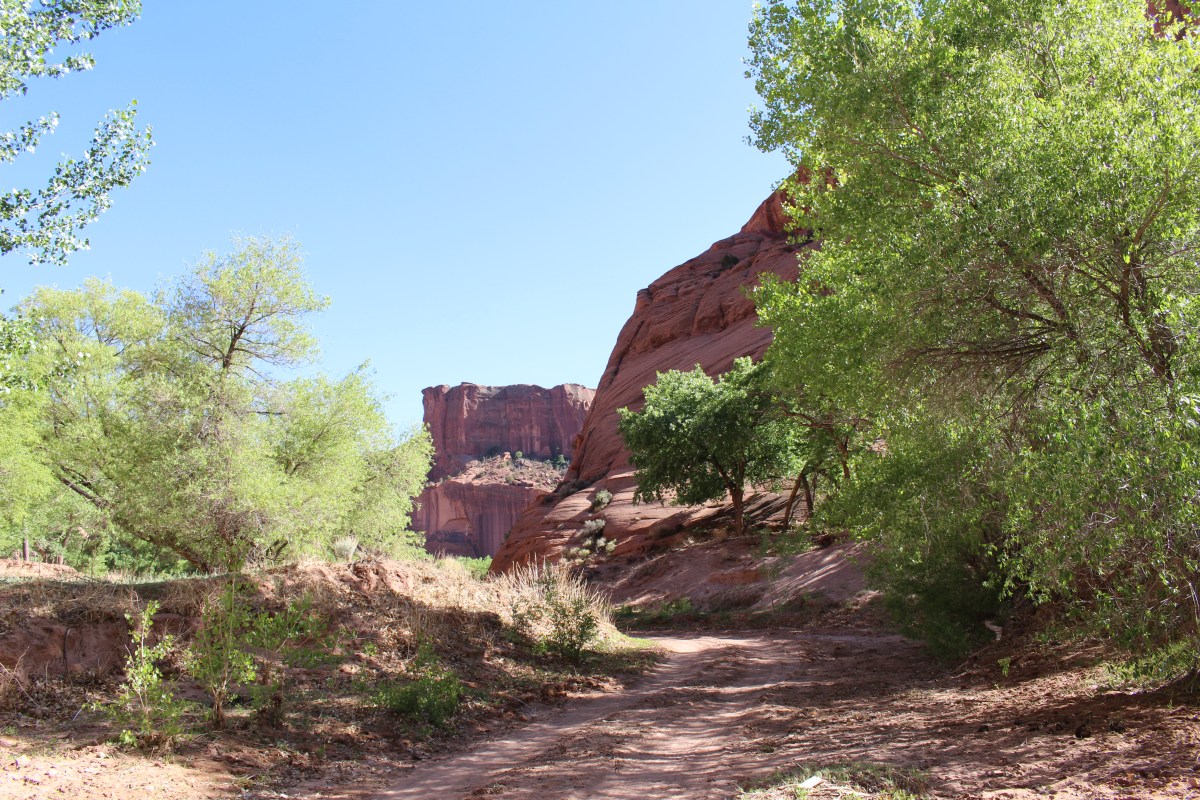
in the canyon
After lingering here for a bit, I made my way back up the trail to the top. Luckily I never saw the man with the pit bull again.
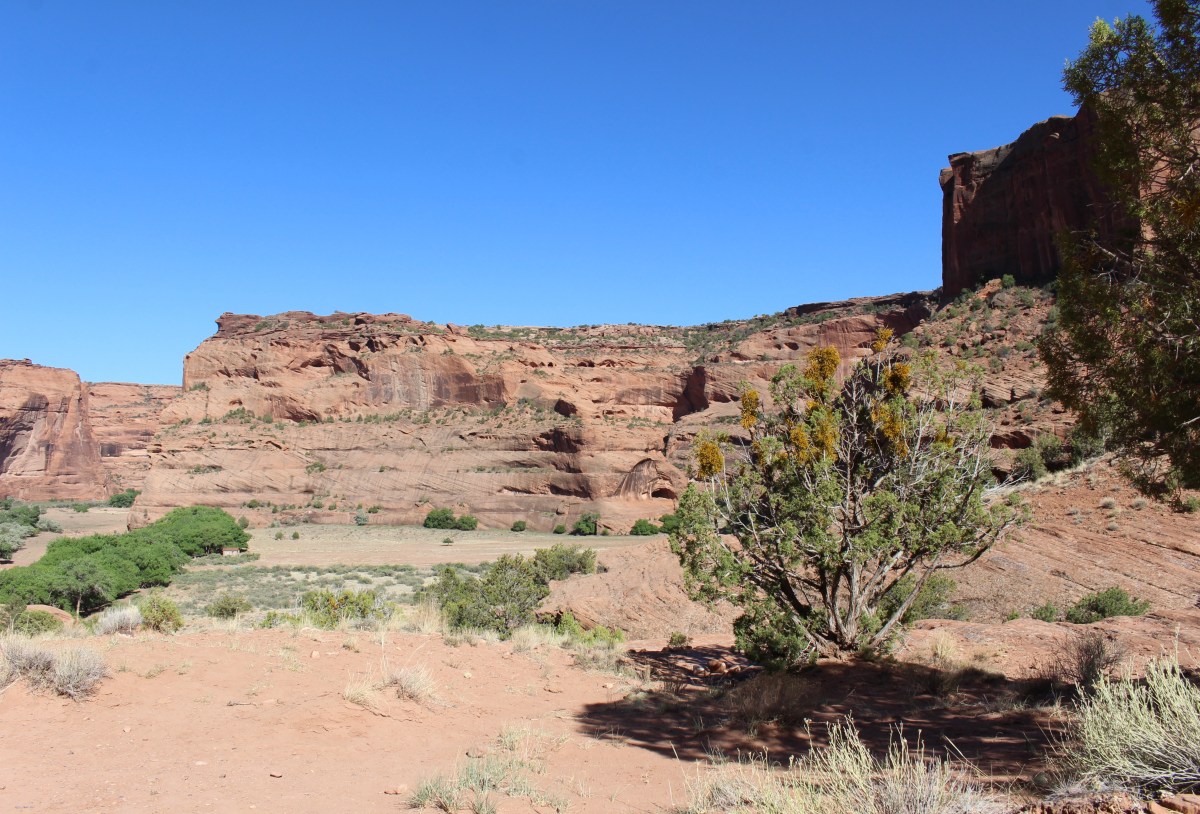
heading back up
It was a gorgeous walk all around. The views were magnificent, and it was shady as I climbed back up.
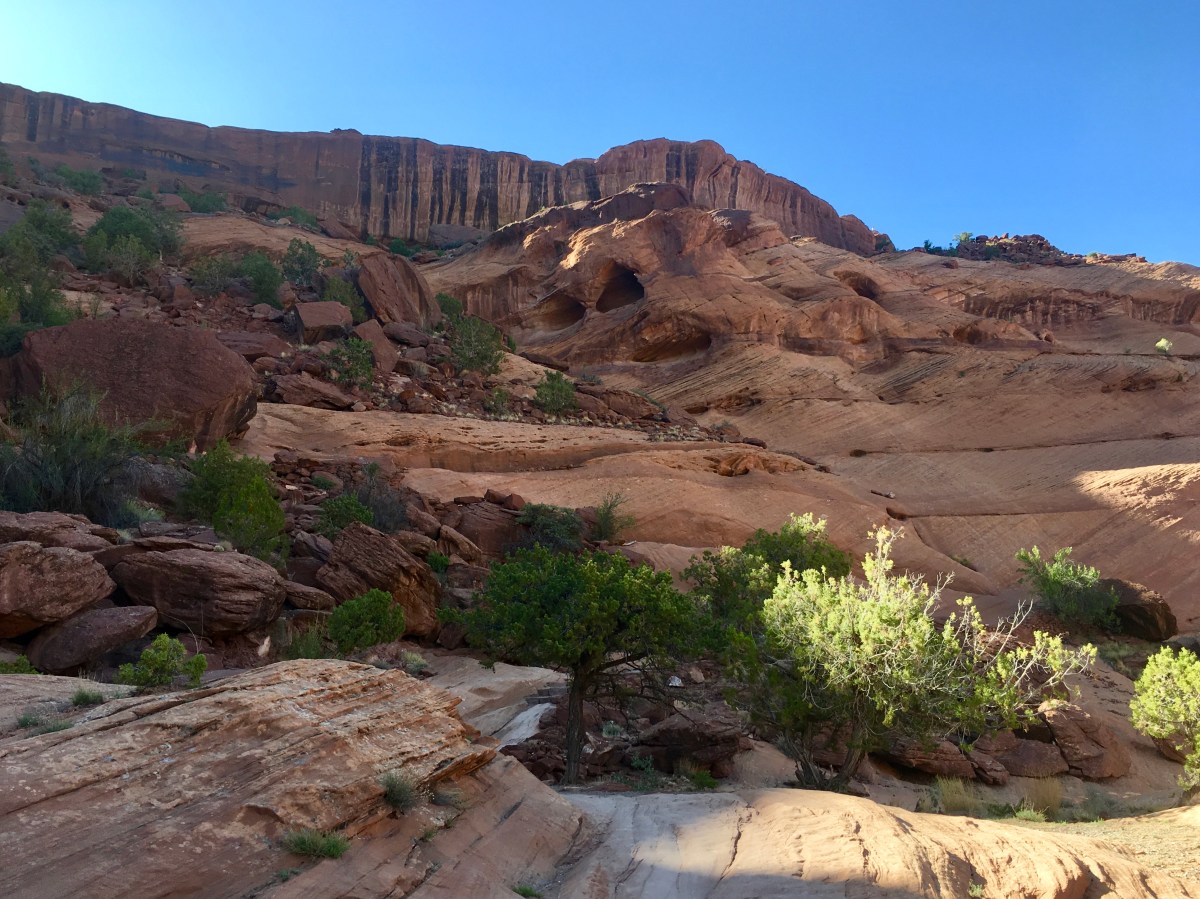
going back up the canyon wall

the White House Trail
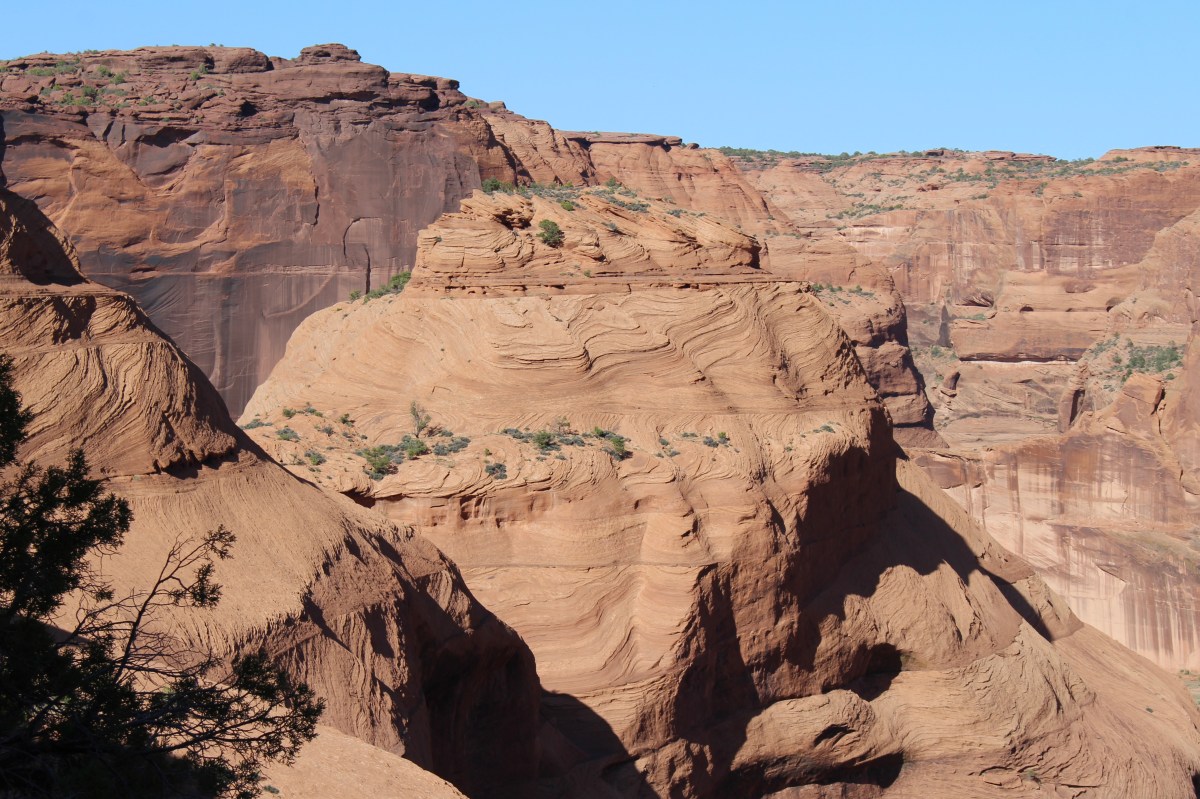
view back down
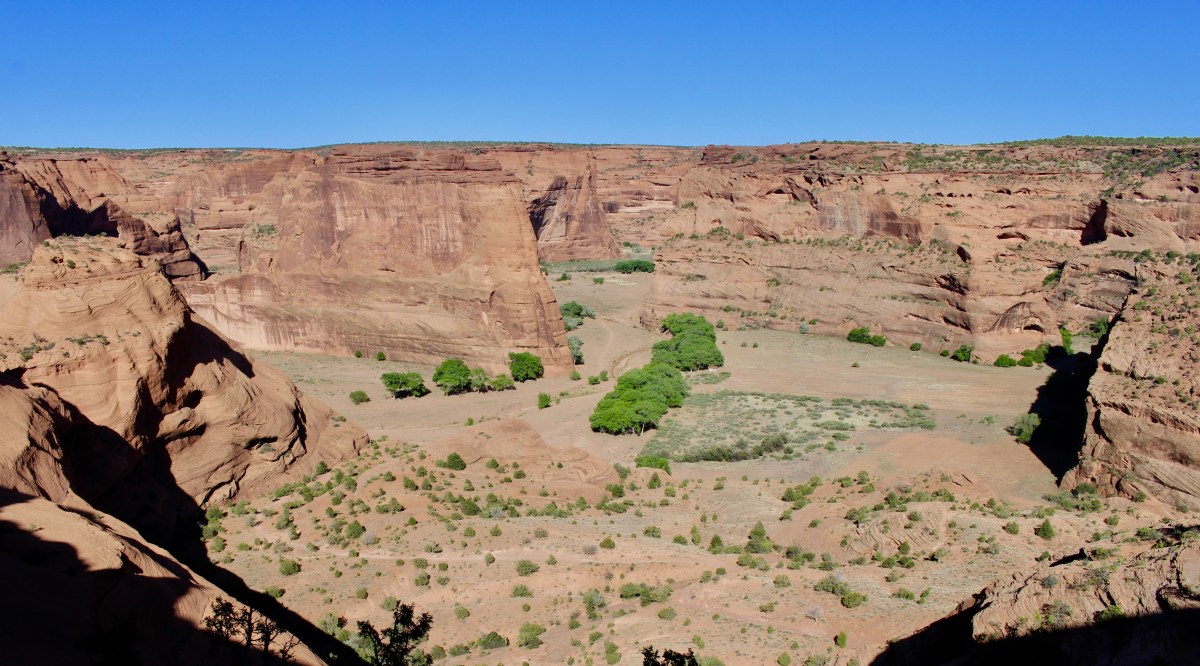
the canyon view from the top
I was so glad I did the hike, despite my initial misgivings and fears. What a fabulous hike!
And of course, I got my sticker and cancellation stamp. 🙂
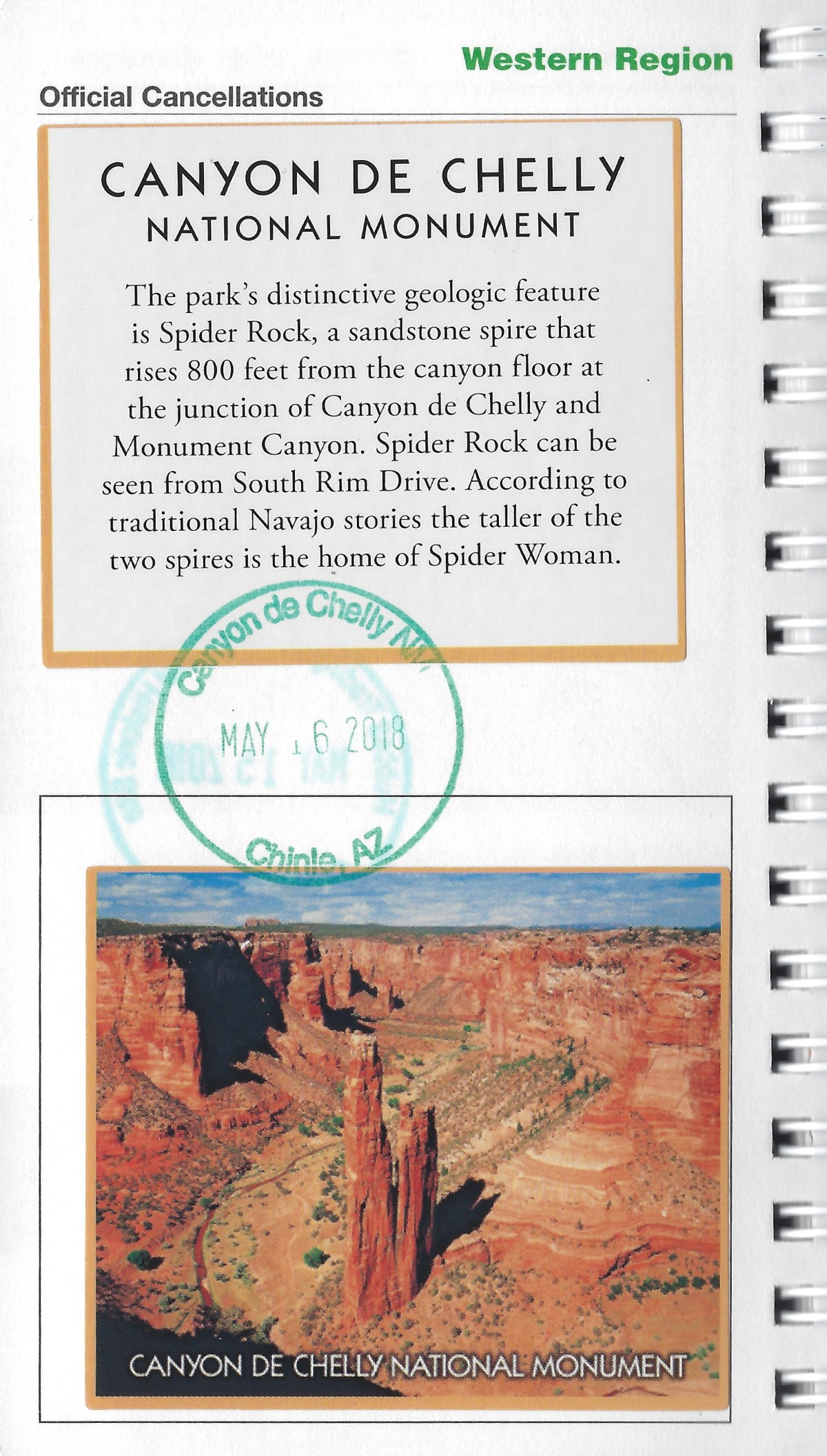
my sticker and cancellation stamp
Private vendors at Canyon de Chelly offer hiking, back-country camping, horseback, and 4-wheel-drive vehicle tours into the canyon with an authorized guide. Sadly, I didn’t have time to take one of these tours, but I wish I had.
*Steps: 18,854, or 7.99 miles*
*Wednesday, May 16, 2018*
***********************
On Sundays, I post about hikes or walks that I have taken in my travels; I may also post on other unrelated subjects. I will use these posts to participate in Jo’s Monday Walks or any other challenges that catch my fancy.
This post is in response to Jo’s Monday Walk: La Rábida and Muelle de las Carabellas.
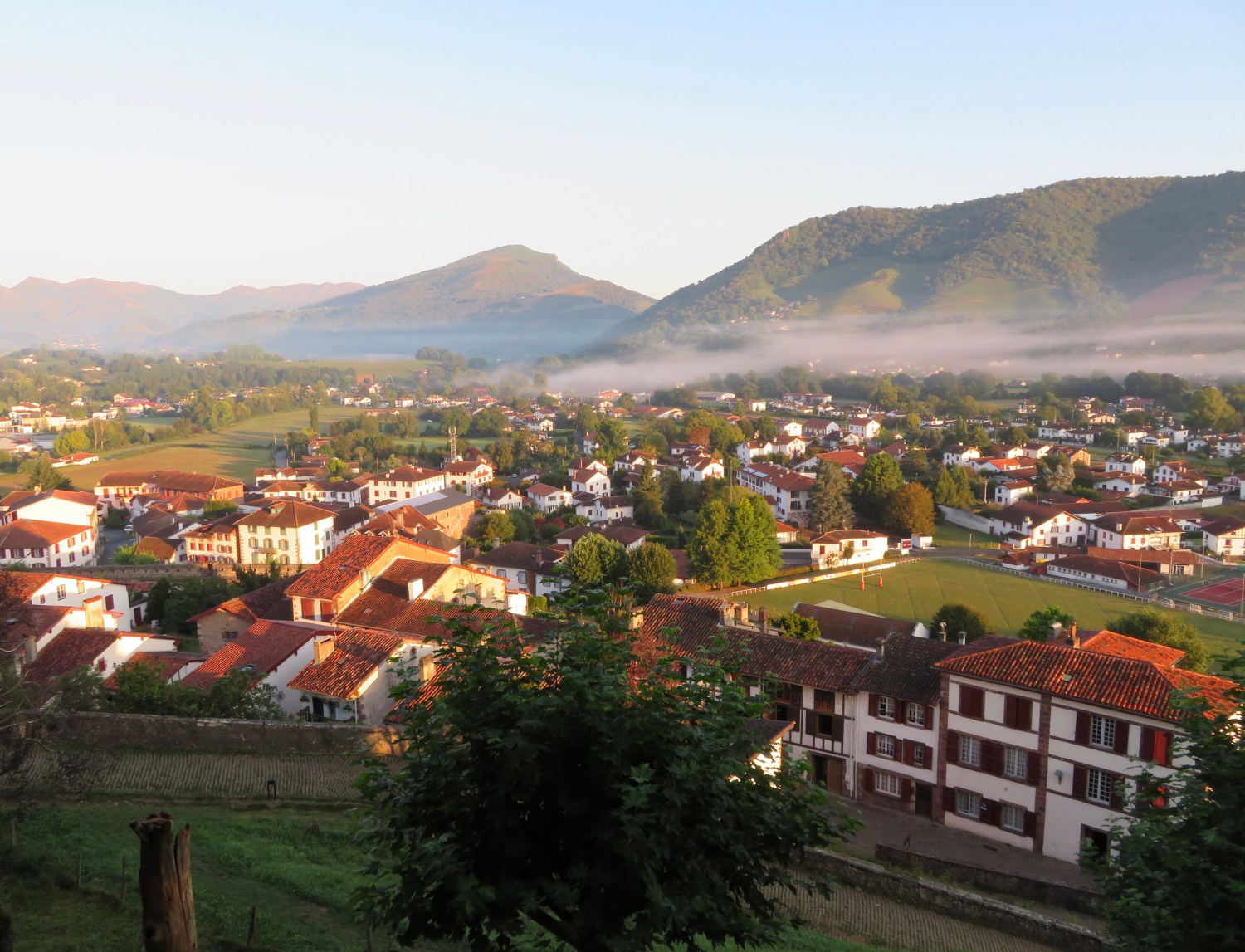
Gentle chanting pulled us from our dreams on Monday morning at 6:15. The pilgrims in my room stretched, whispered, and rustled in the dark until everyone was awake. Once lights were on, they taped feet, organized backpacks, ate breakfast. I was the only pilgrim that would stay another day before walking, and the hospitaleros at Beilari told me I would have to leave the albergue at 8:00 a.m. I could return at 12:30 through the back door, though new pilgrims wouldn’t be admitted until later. While everyone got ready to leave me behind, I put rock tape on my knee and did some physical therapy exercises. At 8:00, I was out the door.
St-Jean-Pied-de-Port nestles in the foothills of the Pyrenees in the French Basque countryside, at the “foot of the pass” (pied-de-port) to Roncesvalles in Spain. I strolled in the cool morning air on the cobbled rue de la Citadelle. On the façades of the stone buildings, window boxes overflowed with petunias and impatiens. At the far end of town, I walked through the 15th-century Port St. Jacques, where pilgrims walking from other parts of France enter the town to begin the Camino Frances.
I climbed to the Citadelle for views over the walled town and the Pyrenees. Built on the fortified château of the kings of Navarre, it is a stronghold with moats, firearms, swing bridges, draw bridges and walls flanked by bastions. Below, a gauzy layer of mist lay fetchingly in the mountain folds and wove its way through the valley. There were few people at this hour; I encountered only a couple of large slimy tan slugs in the path.
Walking back into town, I stopped in at the 14th-century Notre Dame du Bout du Pont (The Church of Our Lady at the End of the Bridge), now known as Iglesia de la Asunción. I had the church to myself and lit a candle to ask for blessings for my pilgrimage and for my family and then for each of my children individually. I asked for guidance for them, and for protection and self-fulfillment. I felt awed by the task ahead of me: to walk 790 kilometers, or 490 miles, across Spain to Santiago de Compostela. By the time I left the church, I felt assured I wouldn’t be alone on my journey, and it humbled me.
I took a stroll through the Porte Notre Dame, through which I’d pass when I began my walk on Tuesday, and across the Pont d’Eyheraberry, where the Nive River mirrored the old stone buildings on its shores.
I continued out Porte D’Espagne, at the opposite end of town from Port St. Jacques; the road from this gate leads up into the Pyrenees. I checked out my route for Tuesday morning on the Route de Napoléon (25.1km to Roncesvalles). I’d be stopping 8km up the mountains at Orisson.
While enjoying a lunch of an omelette fromage and vin blanc at an outdoor cafe on the main road, I wrote postcards to my husband and children, mailing them from the local post office.
When I returned to Beilari, I found Ingrid, who I’d met yesterday on the train, standing outside the albergue, which didn’t open until 2:30. She was talking to two lively fellows, Newton from Brazil and Mike, originally from South Africa but most recently from California. We had an intense but agreeable conversation bemoaning the current U.S. president. It was a thorough Trump-bashing, peppered with laughs and plenty of indignation.
Once Beilari opened its doors, Ingrid settled in, and I sat on the patio with a beer, writing in my journal. I felt a bit lost as all the pilgrims I’d met last night had taken off. I wondered if I’d ever see them again. Ingrid joined me on the patio after she’d settled in, and we talked of Archie Bunker-type fathers, gay siblings, the president and his daily outrages, her involvement in the Unitarian Church and Habitat for Humanity, her job as a journalist and photographer, my stints teaching abroad and my blogging. We talked about our families and our pilgrimage and the next day’s walk. She had trained quite rigorously in Colorado at high elevations over the summer, and felt strong and ready to begin her pilgrimage. I remained wary of my knee and wondered how it would hold up.
Beilari doesn’t have Wi-fi; they encourage people to talk to each other. Some of us congregated in front of the Pilgrim Office across the street, trying to use their Wi-fi signal. Ingrid asked if I’d reserved a room at the monastery in Roncesvalles. I hadn’t so I checked online to try to reserve. Surprisingly, I found it was full for Wednesday night, when I’d arrive there. That made me nervous, so I reserved a room two towns further along, in Espinal. As I became increasingly nervous about making it over the Pyrenees the first two days, and even adding another 6.7 km to Espinal, I decided I’d use Express Bourricot to send my backpack ahead in two stages, first to Orisson and then to Espinal. I would carry a simple day pack.
At apertivo, we went through the same routine from the night before: tossing the invisible ball, the sharing, the toasts. At dinner, two tables of pilgrims shared a meal of white bean soup, salad topped with hard boiled eggs and carrots, ratatouille on rice, and chocolate mousse. It was a crowd of different nationalities and languages, making it hard to connect. Paõ from Barcelona, who later slept in a bunk in my room, played a ukelele while pilgrims danced to his “La Bamba.” Suddenly it was 10:30 and lights out.
Anxious about my first day of walking, I had a restless night, worrying about the Pyrenees. Could I make the entire pilgrimage? Could I connect with people? Could I, by some miracle, discover the art of living?
*13,153 steps, or 5.57 miles*
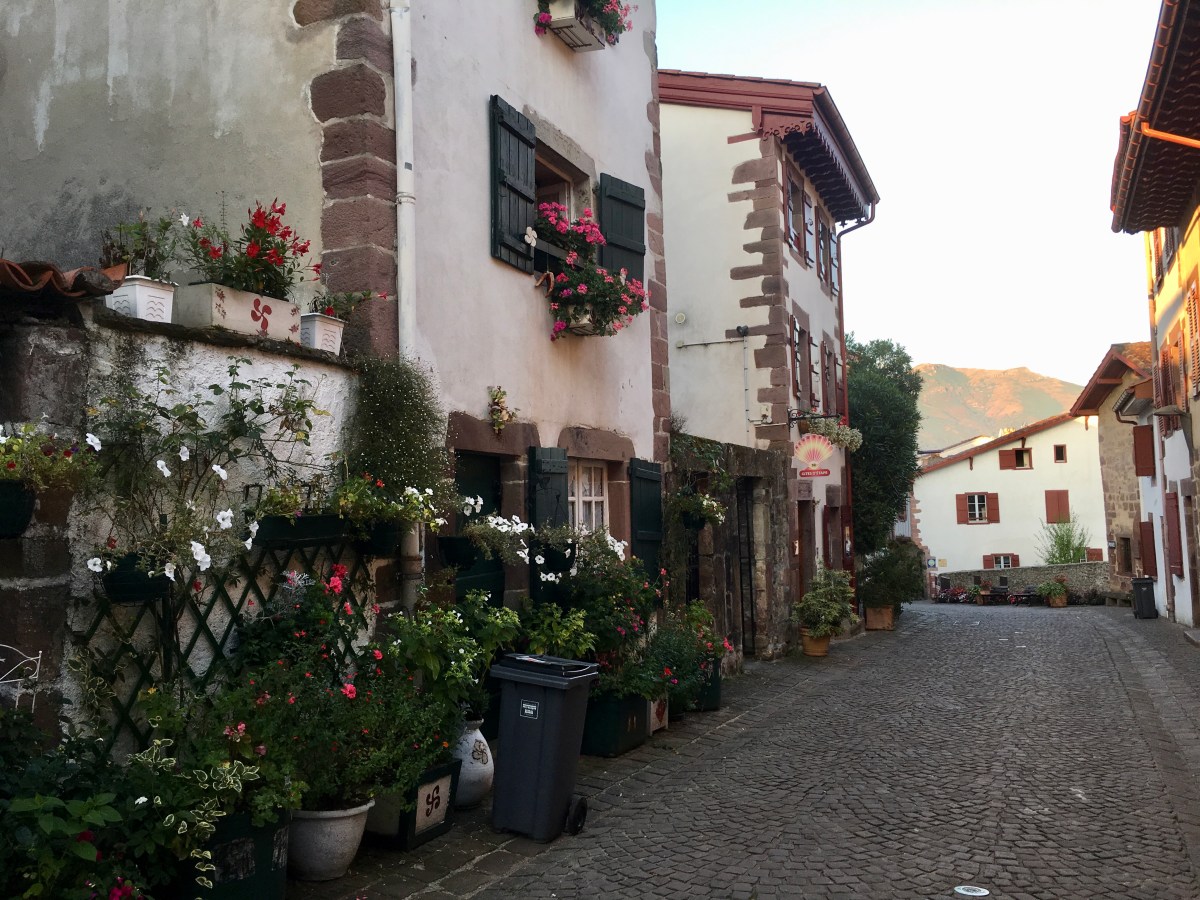
Streets of St-Jean-Pied-de-Port
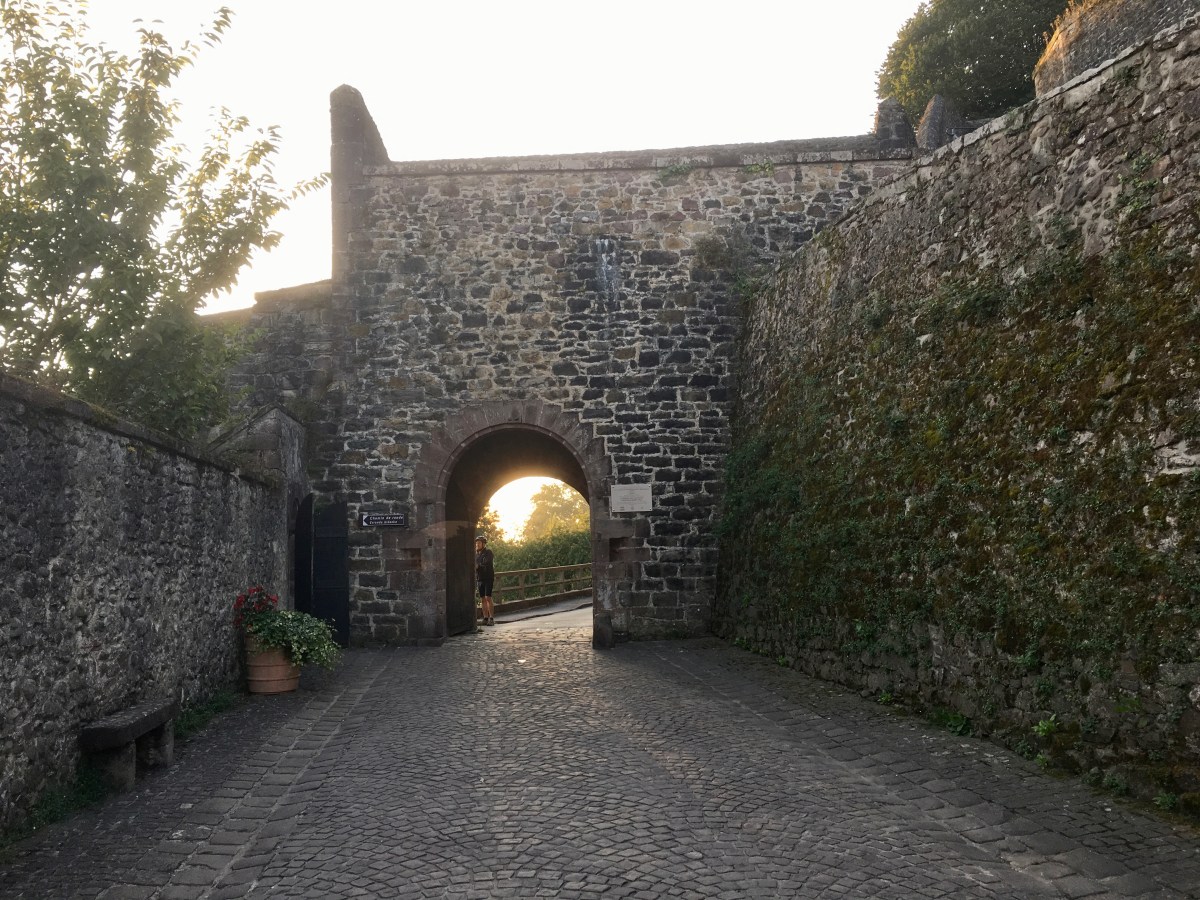
Port St. Jacques
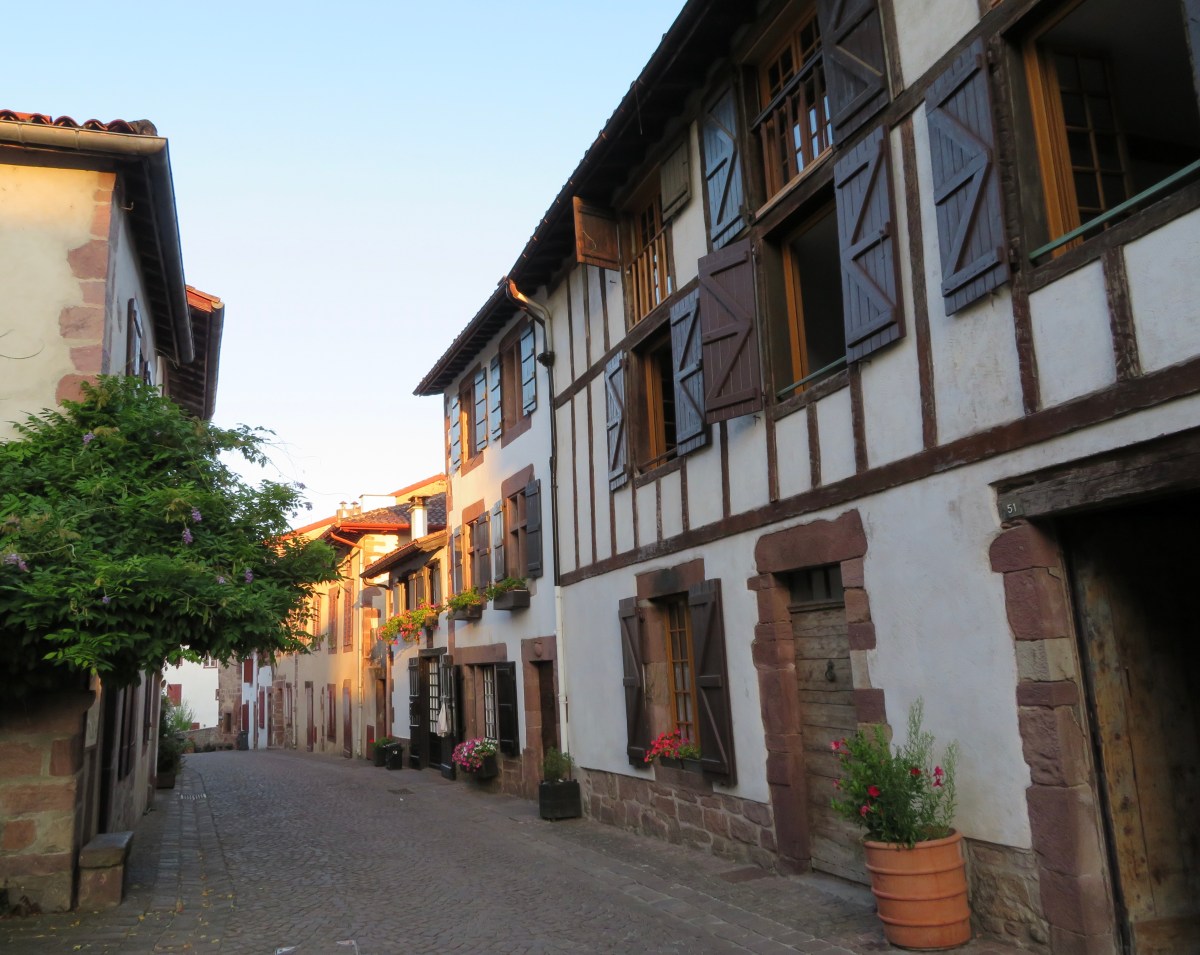
Streets of St-Jean-Pied-de-Port

early morning overlooking St-Jean-Pied-de-Port
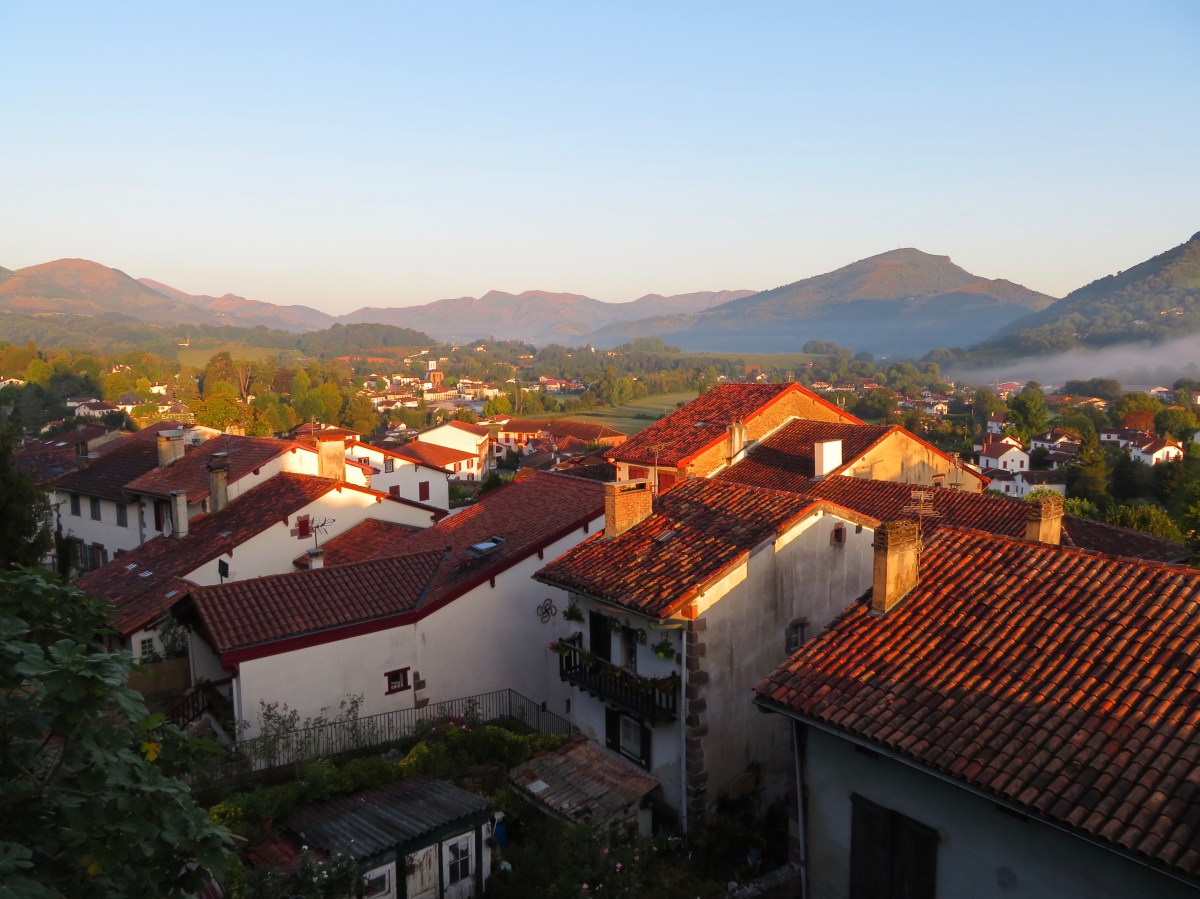
St-Jean-Pied-de-Port
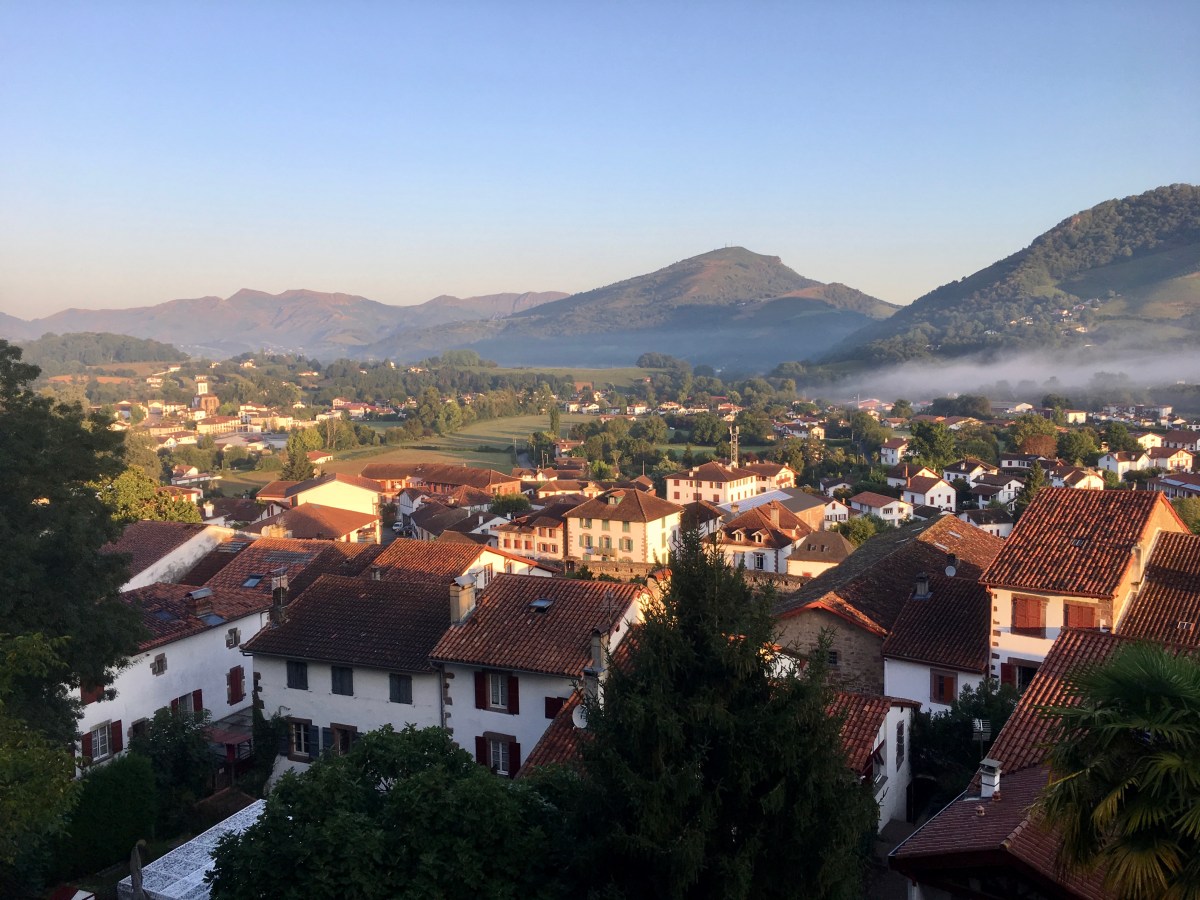
St-Jean-Pied-de-Port
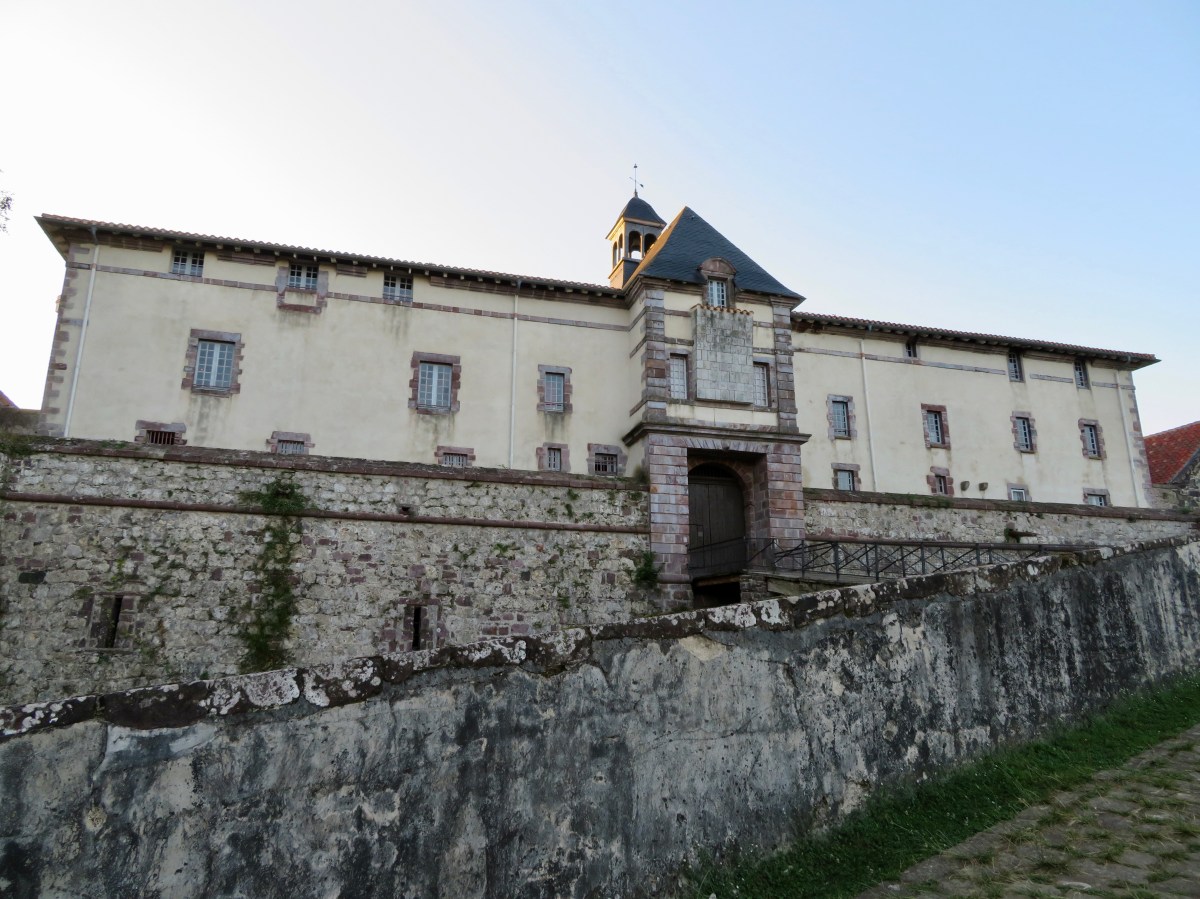
The Citadelle

St-Jean-Pied-de-Port
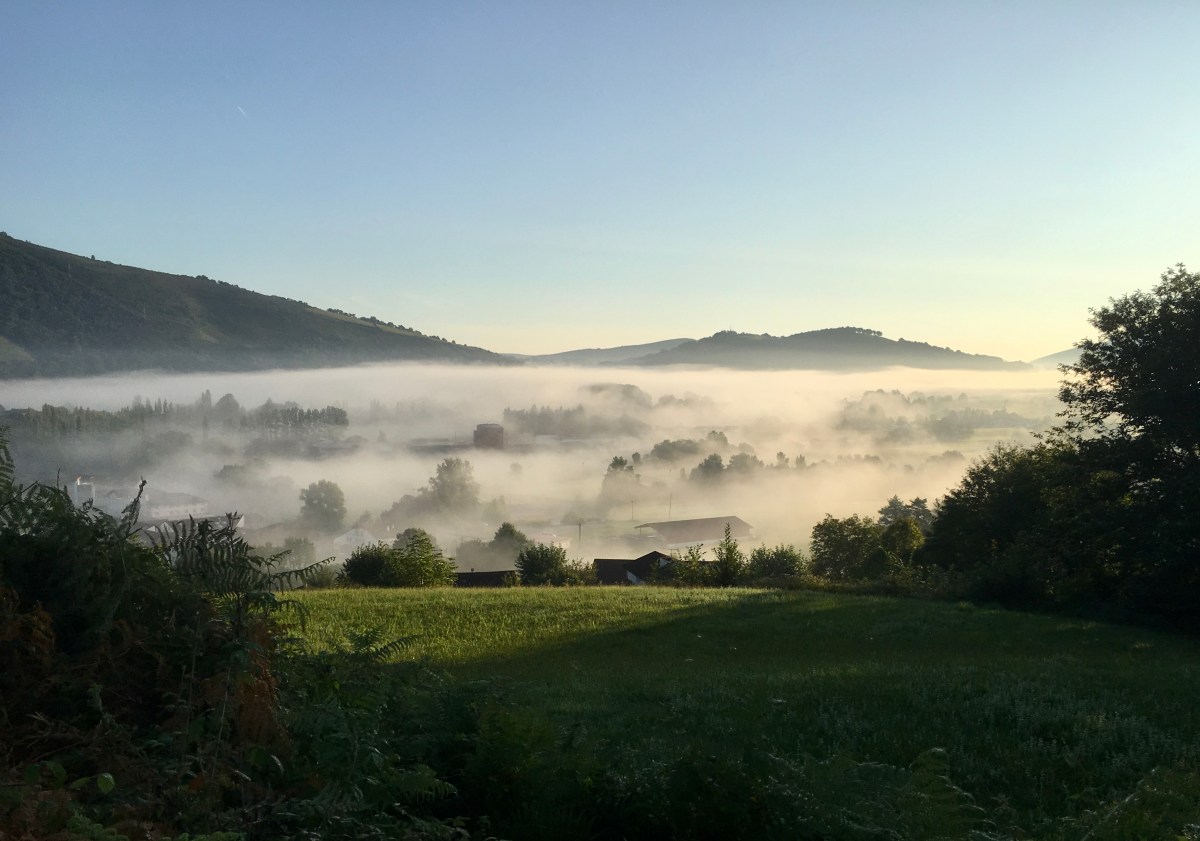
Morning mist


I loved the bridge over the Nive River.

the Nive River

Pont d’Eyheraberry over the Nive River
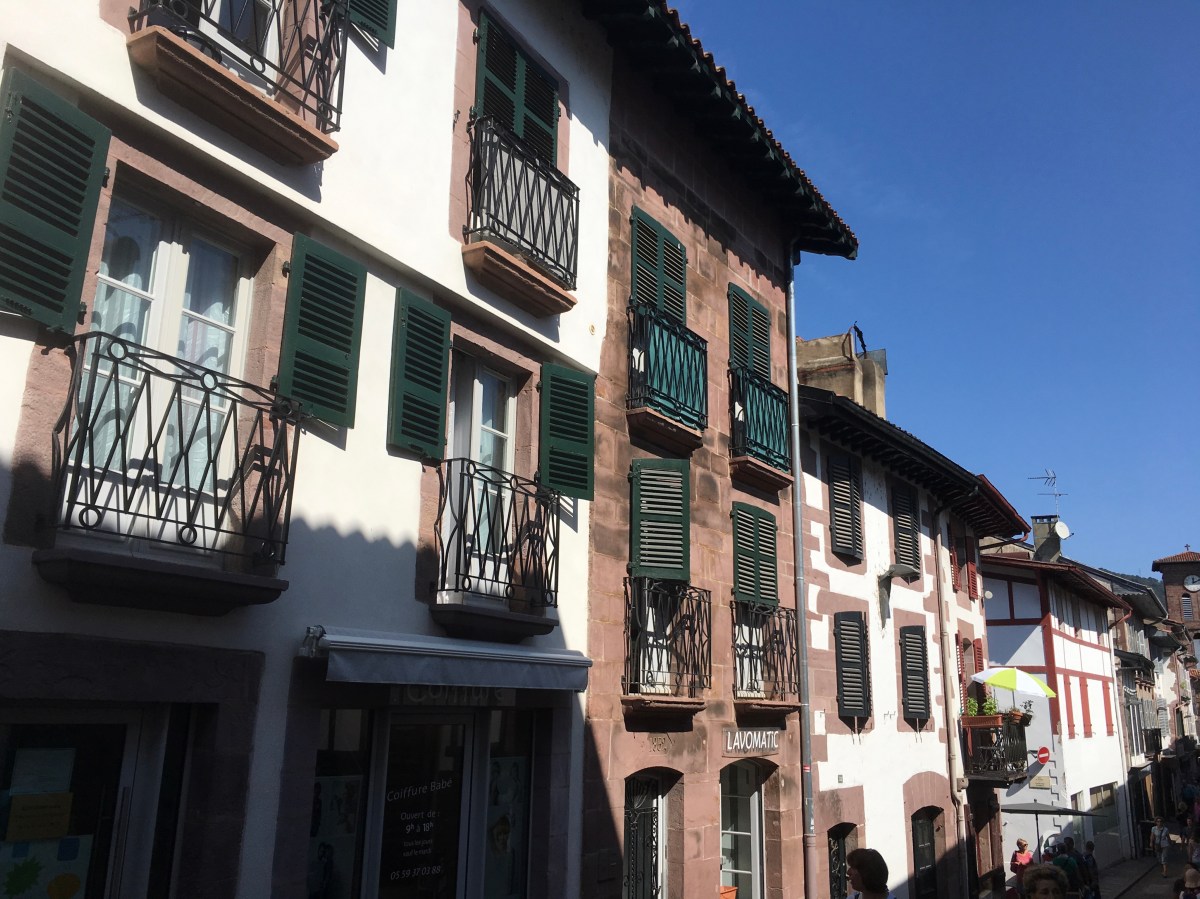
Streets of St-Jean-Pied-de-Port
The Notre-Dame gateway, the Porte Notre-Dame, is the best preserved of the gateways to the town.
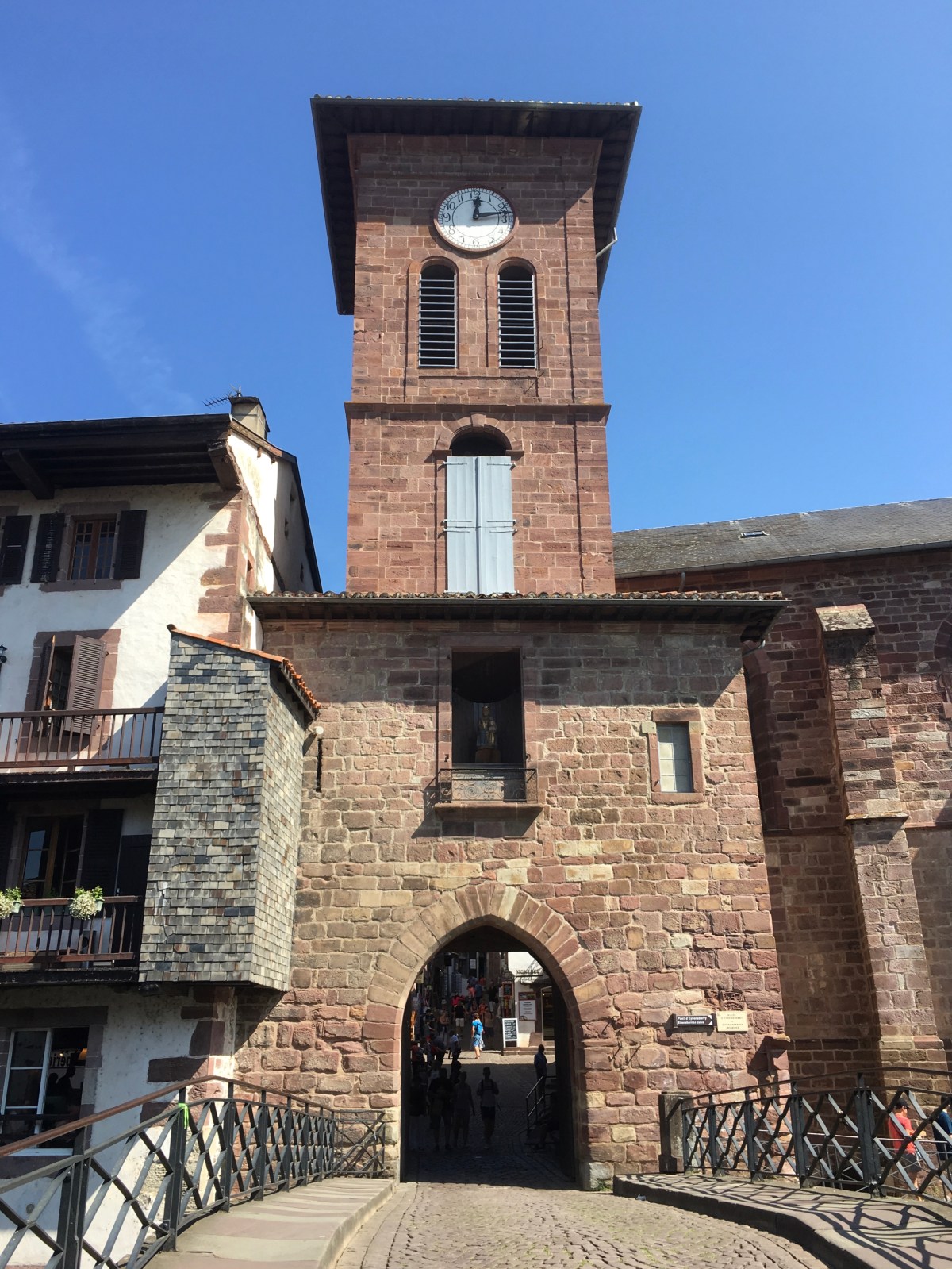
Porte Notre-Dame


A lively market offered enticing seafood, cheeses and wines outside the town walls.

fish market
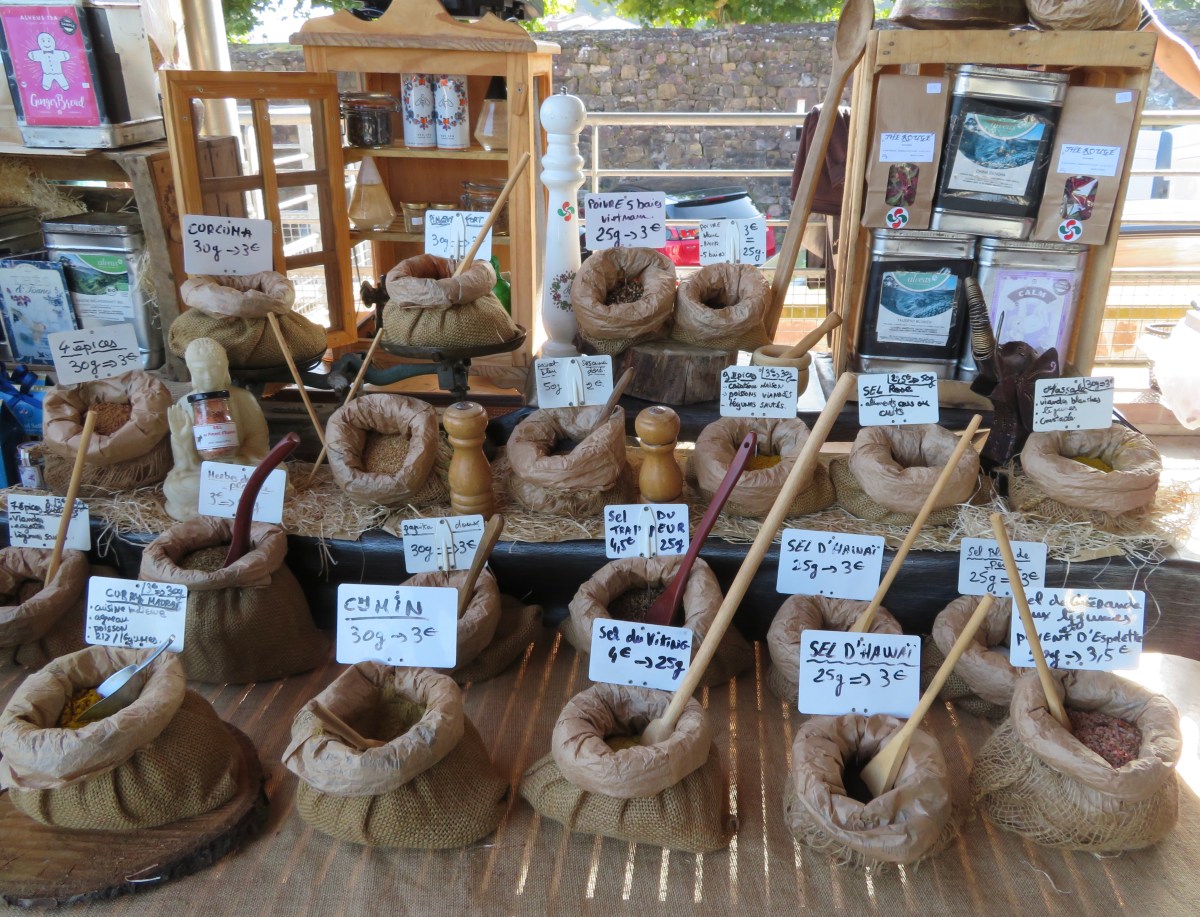
market

sheep at the market
Another Roman bridge sits in a wooded area south of the Pont d’Eyheraberry over the Nive River.
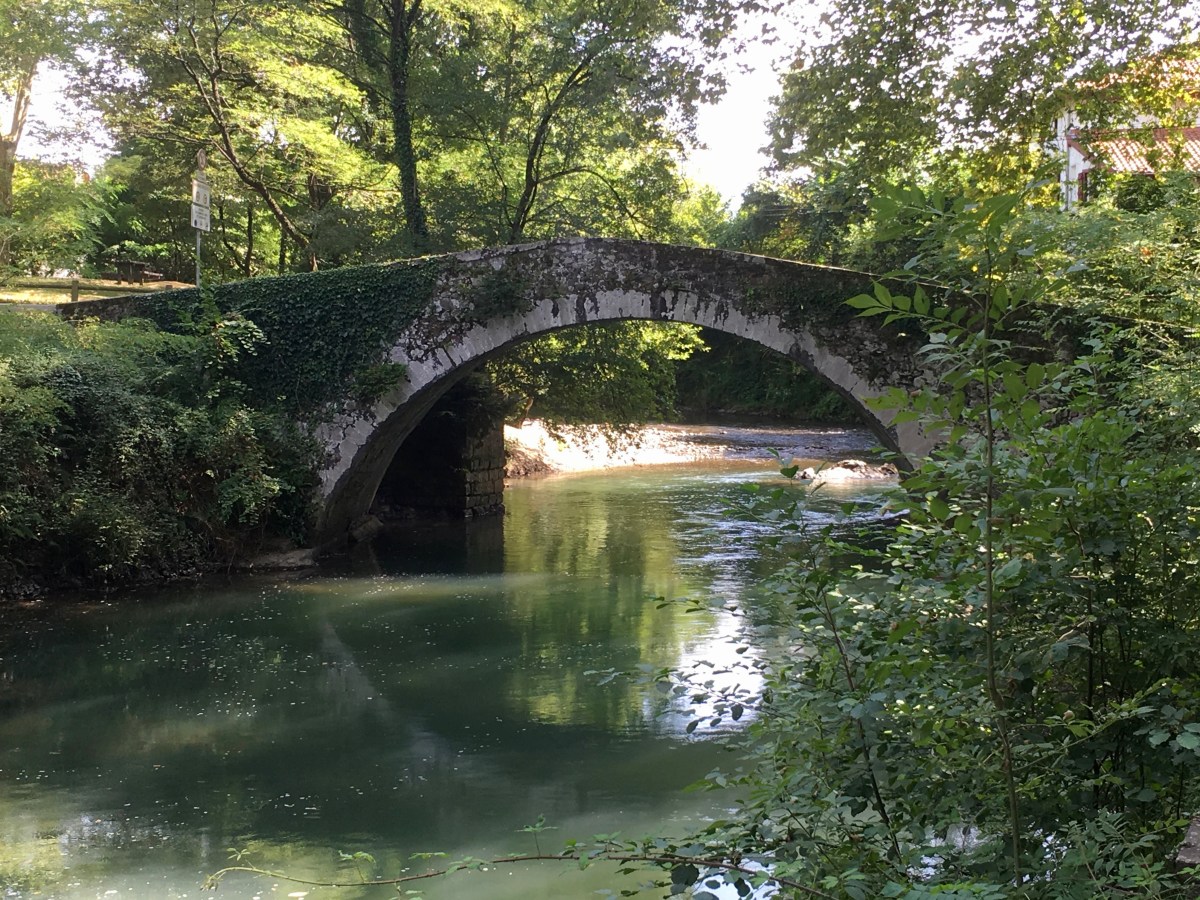
Roman bridge

tower
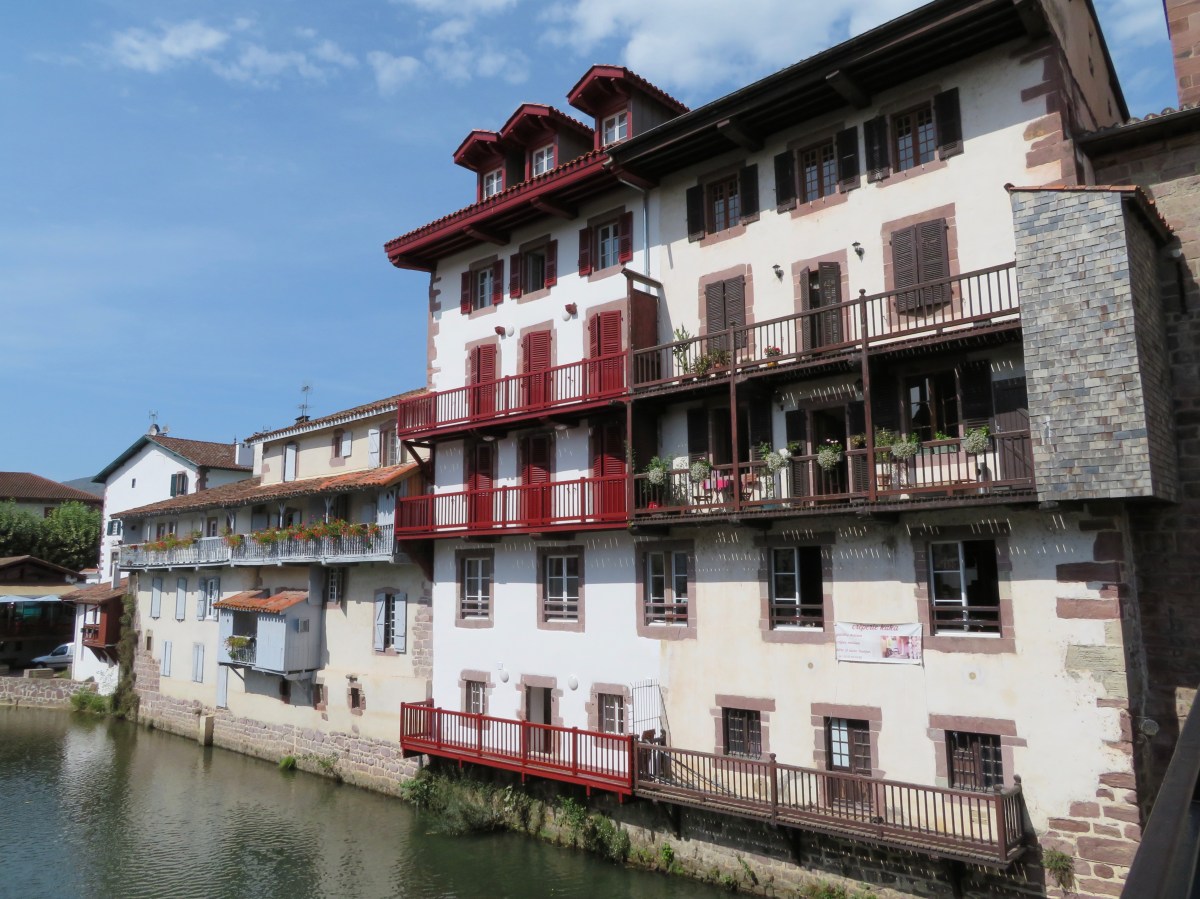
Houses on the Nive River
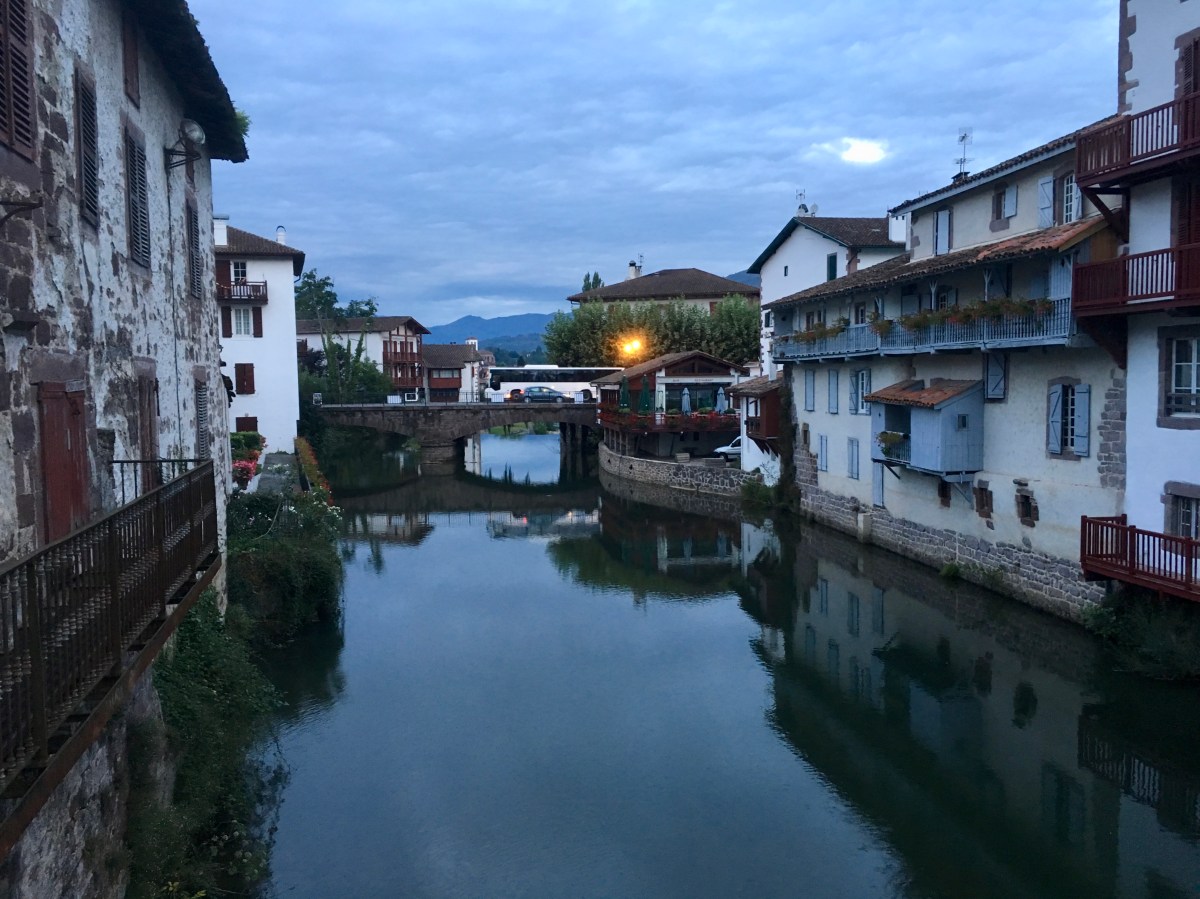
evening from the Pont d’Eyheraberry (Eyheraberry bridge)
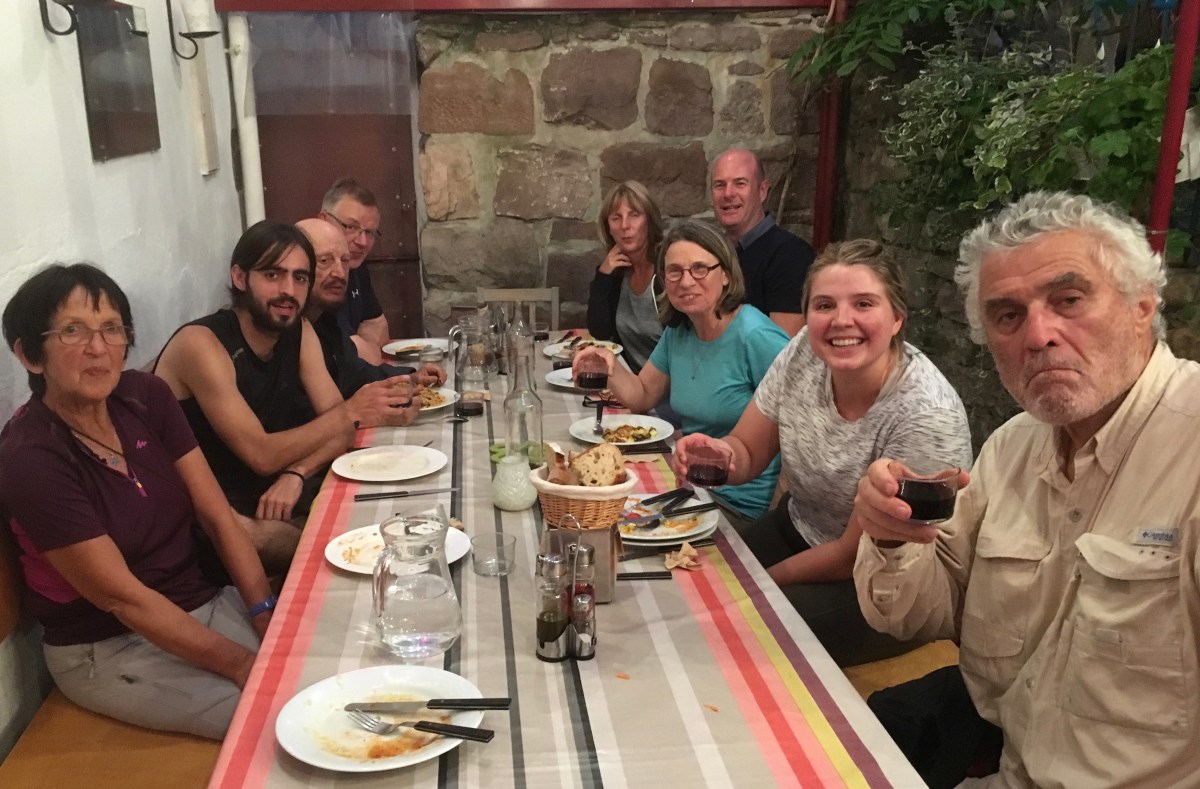
Dinner at Beilari
*Monday, September 3, 2018*
on journey: launching my camino
**********************
“PROSE” INVITATION: I invite you to write up to a post on your own blog about a recently visited particular destination (not journeys in general). Concentrate on any intention you set for your prose. In this case, one of my intentions for my Camino was to write using all my senses to describe place and to capture snippets of meaningful conversations with other pilgrims.
It doesn’t matter whether you write fiction or non-fiction for this invitation. You can either set your own writing intentions, or use one of the prompts I’ve listed on this page: writing prompts: prose & poetry. (This page is a work in process.) You can also include photos, of course.
Include the link in the comments below by Monday, December 24 at 1:00 p.m. EST. When I write my post in response to this invitation on Tuesday, December 25, I’ll include your links in that post.
This will be an ongoing invitation. Feel free to jump in at any time. 🙂
I hope you’ll join in our community. I look forward to reading your posts!

Four sacred mountains enclose what is known as Canyon de Chelly in northeastern Arizona. The Diné, or Navajo people, still live here today, calling it Tsegi, their physical and spiritual home. The landscape nourishes the people, and the land and language weave together to create the people’s culture, spirituality, and identity. This sacred land is considered the epicenter of Navajo culture.
After driving the North Rim, I drive on the South Rim Road (37 miles round-trip) to Spider Rock Overlook, which looks over both Spider Rock and Face Rock at the junction of Canyon de Chelly and Monument Canyon.
Walking out to the overlook, the trail is quite deserted. Someone hidden from view is playing a Navajo flute and the notes dance over the junipers and narrowleaf yuccas. The scenery below is breathtaking. Spider Rock, an impressive 800-foot sandstone spire, rises from the canyon floor. The deep reds of the canyon walls and the greens of snakeweed, sagebrush, sumac and juniper make for painterly views.
Spider Rock is a sacred place to the Navajo, home of the mythical Spider Woman, or Na’ashje’ii Asdzaa. She lived at the top of Spider Rock and lowered her home-spun silken web to the ground. With that web, she snared misbehaving children and devoured them. Navajo children were told that the top of Spider Rock was white from the unbleached bones of naughty Diné children.
She also taught the native people how to destroy all the monsters that roamed the land. Because she protected the people, the Diné revered and worshiped her.
Other variations of the legend report that Spider Woman taught her people the fine art of weaving on a loom.
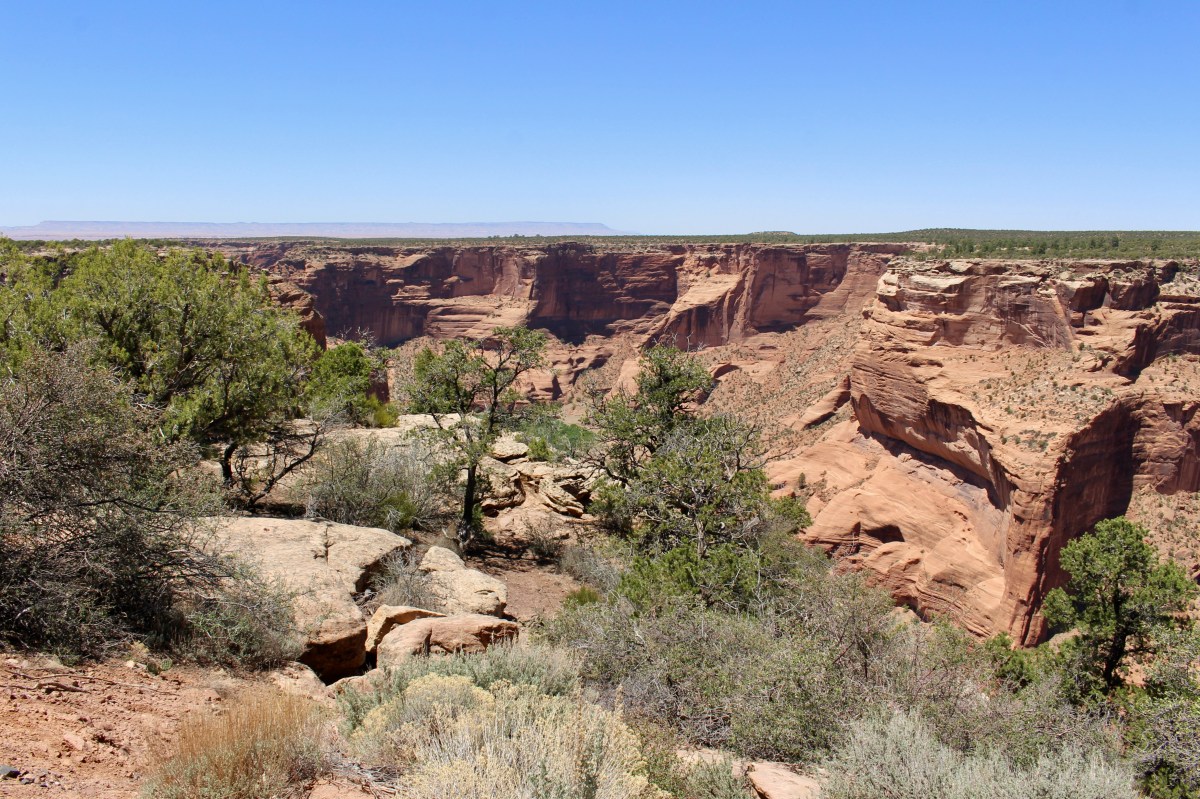
Spider Rock Overlook
From the lookout, I can see the volcanic core of Black Rock Butte and the Chuska Mountains on the horizon.
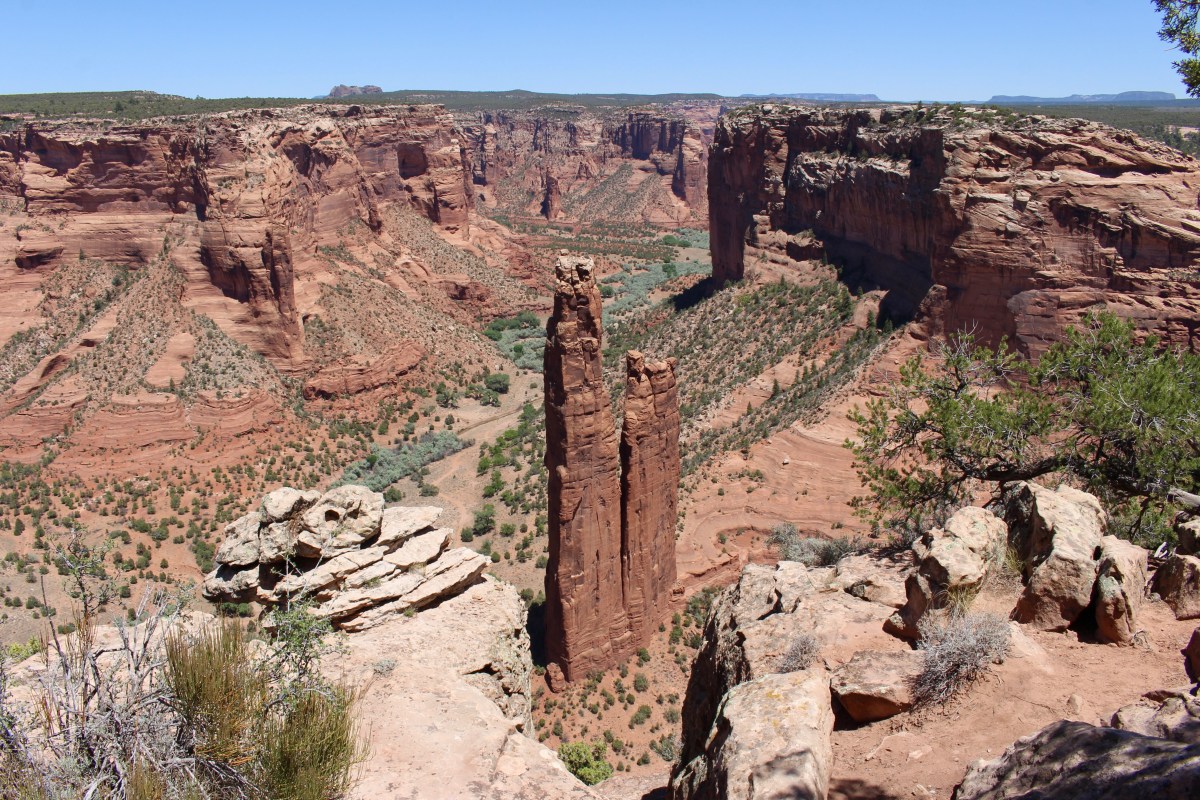
Spider Rock
Face Rock is a prominent fin, projecting from the north rim a little way upstream.
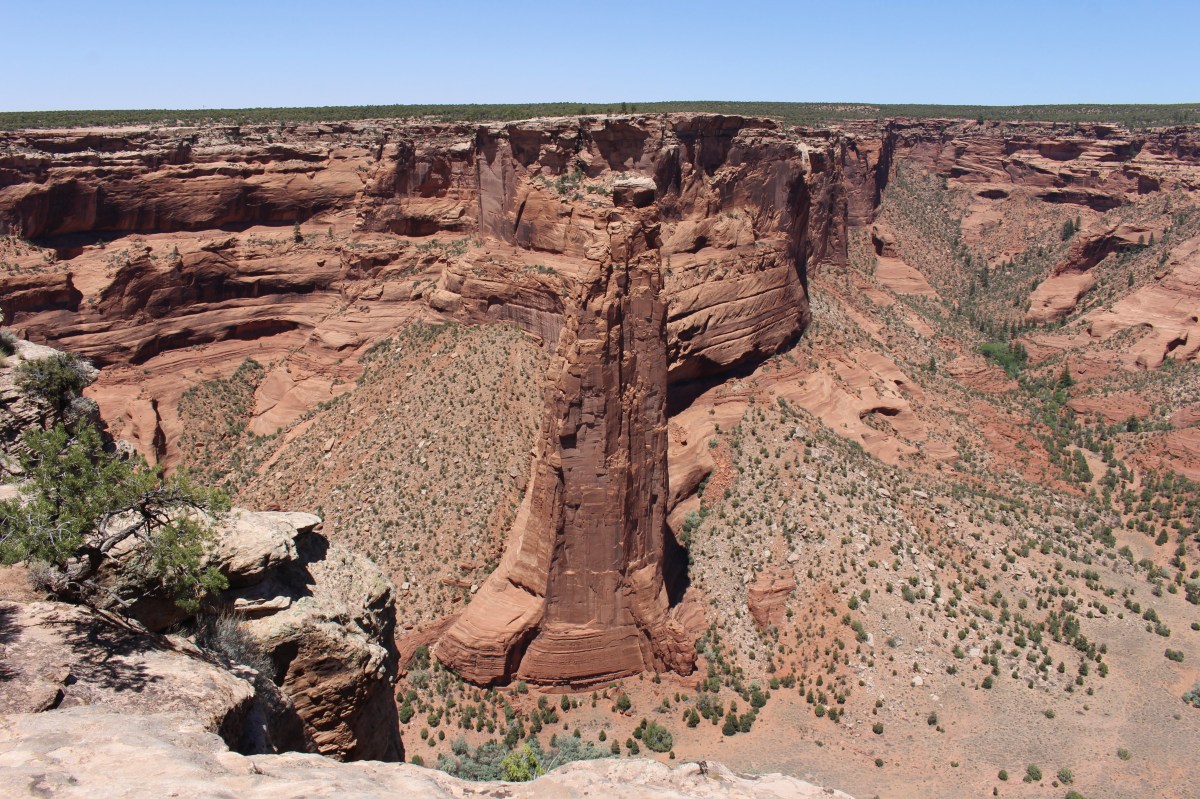
Face Rock
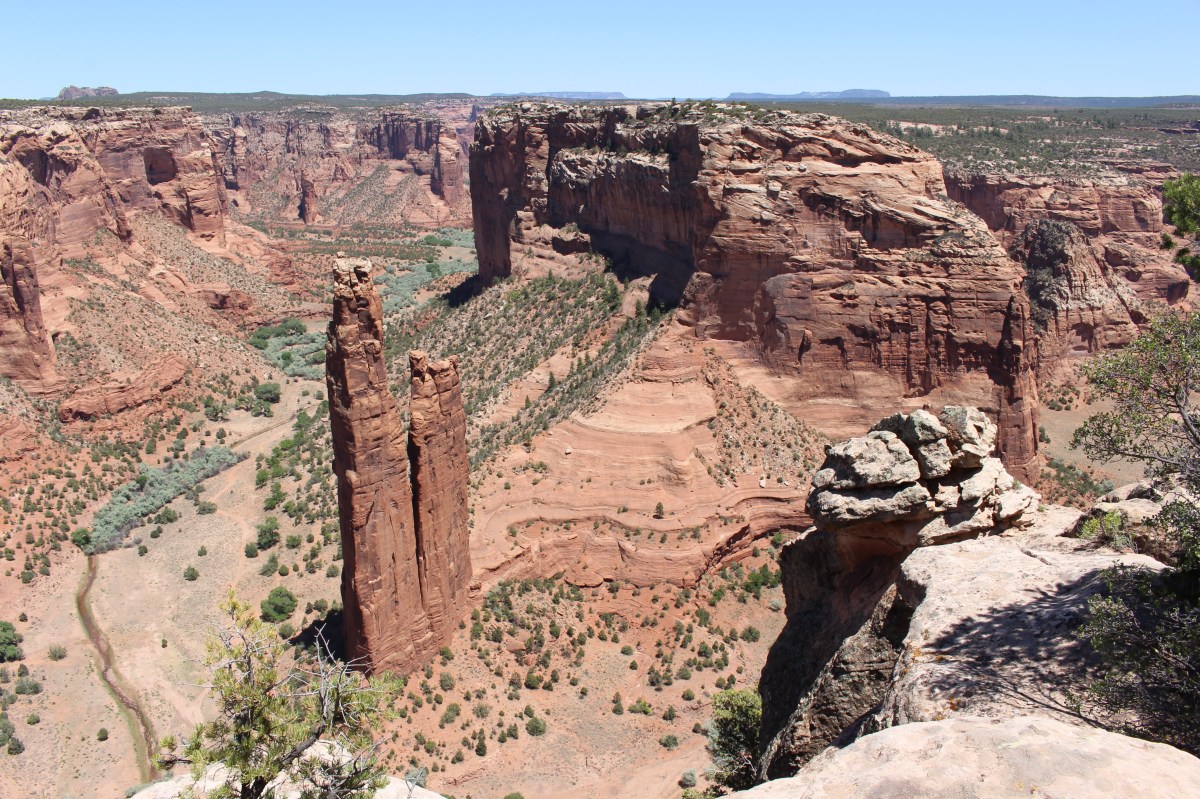
Spider Rock
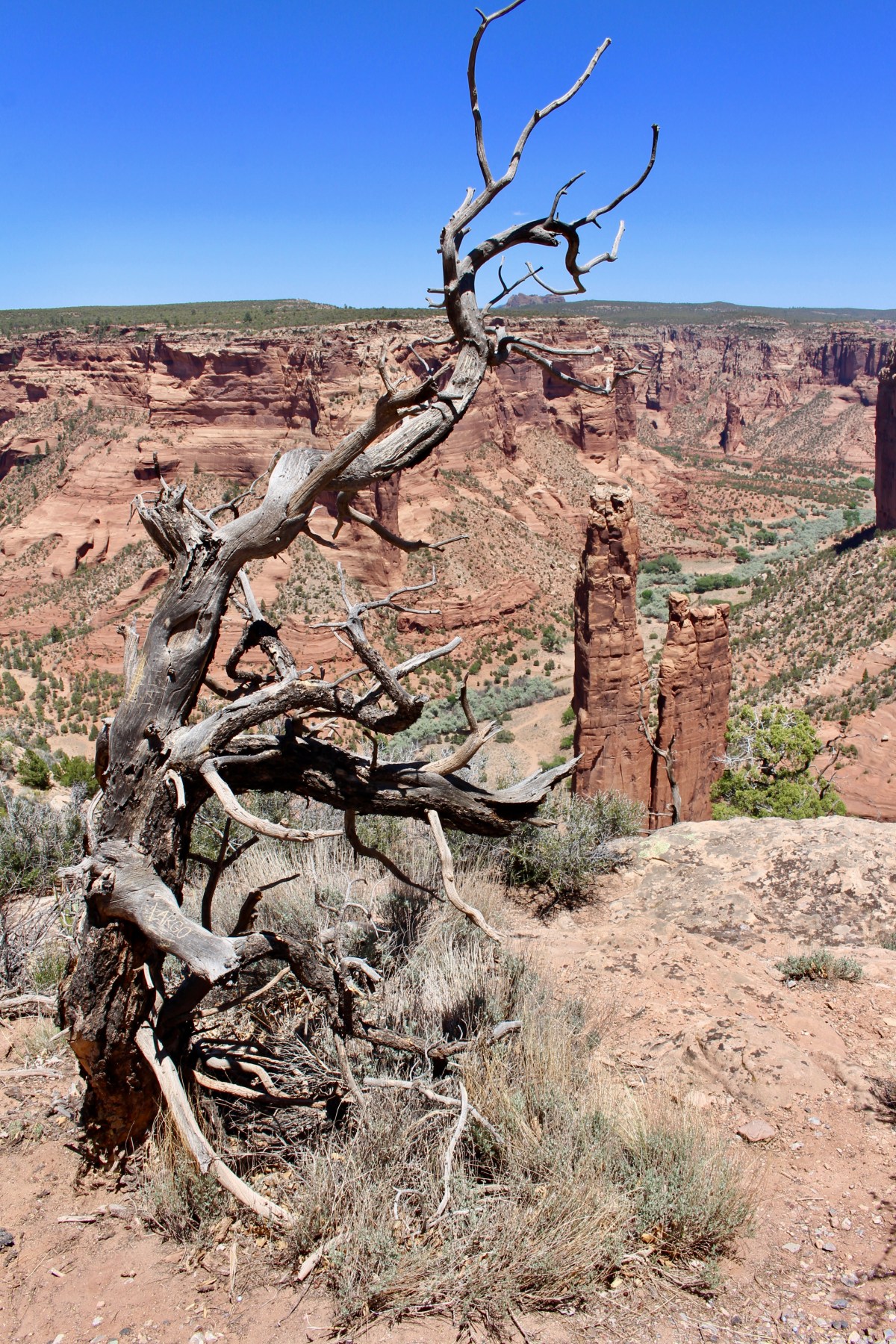
Gnarled juniper & Spider Rock

Spider Rock
Sliding House Overlook overlooks Sliding House Ruin, a medium-sized site in a shady alcove built on a sloping surface. It appears to slide downwards. The overlook is situated on a projecting section of the canyon rim edged by sheer cliffs on three sides, so it allows different views from each edge.

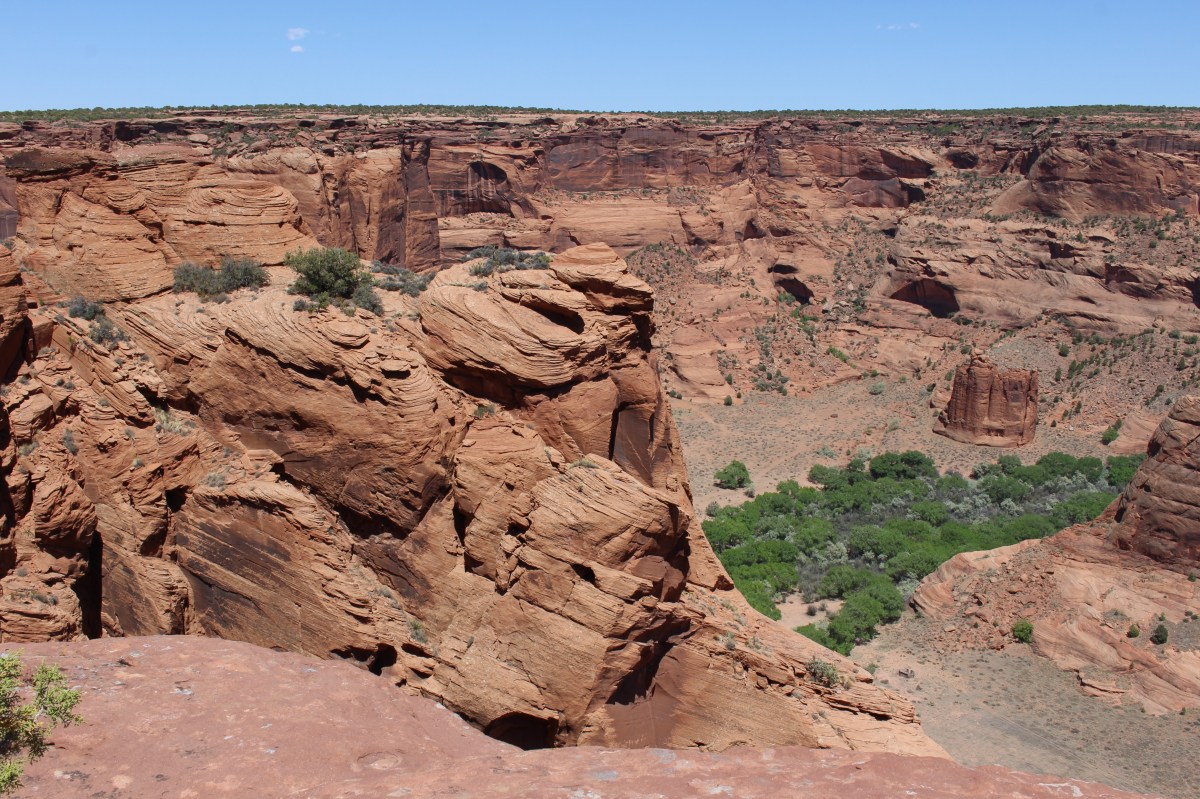
Sliding House Overlook

Sliding House Ruins
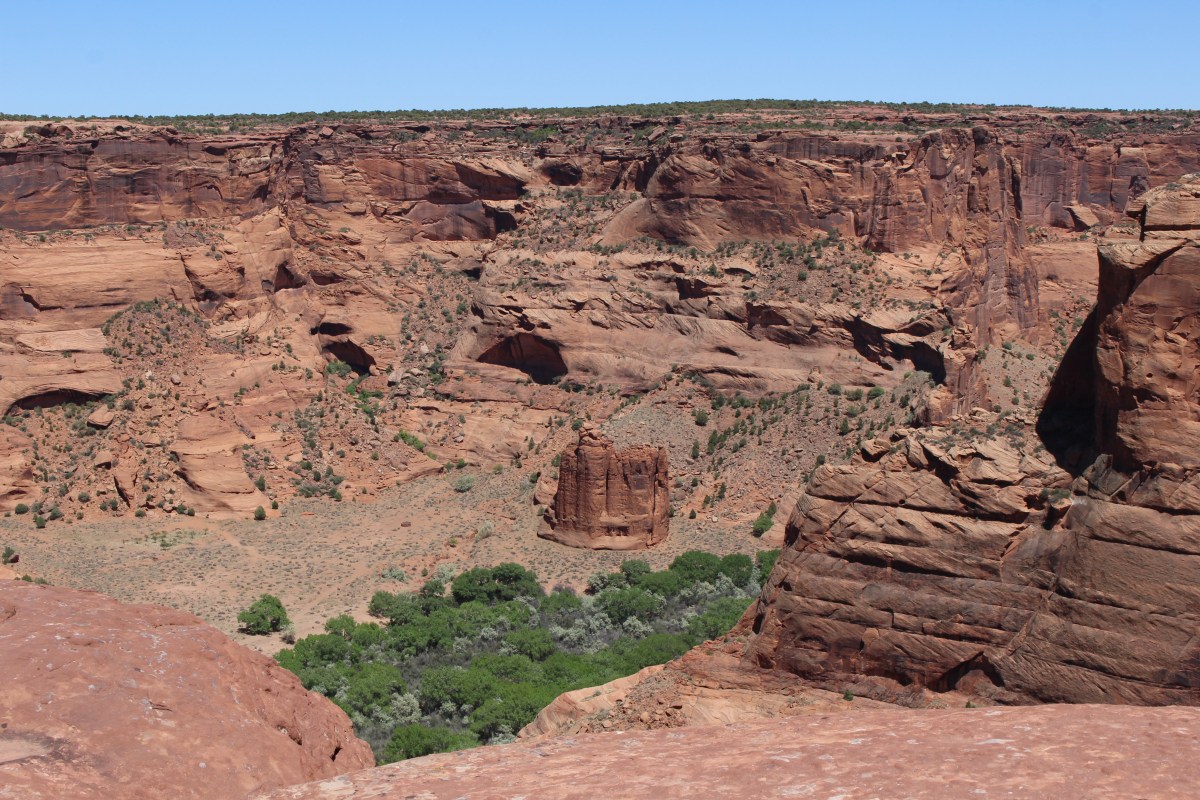
Sliding House Overlook
On the South Rim Drive I pass a couple of horses and a colt making their way along the canyon rim.
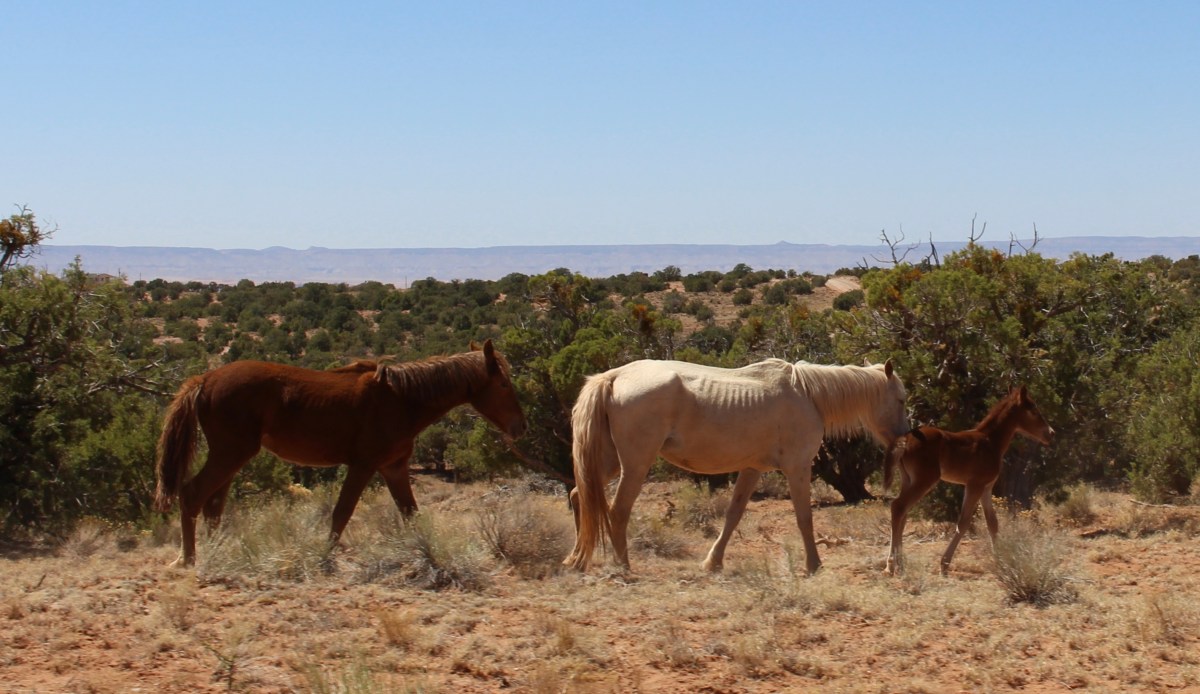
Horses along South Rim Drive

Horses along South Rim Drive
Junction Overlook has views of Chinle Valley and the intersection of Canyon del Muerto and Canyon de Chelly. Up on the rim, I encounter a dog who seems lost and frightened; he is running to and fro whining and whimpering. I can’t help but hope he finds his way home.
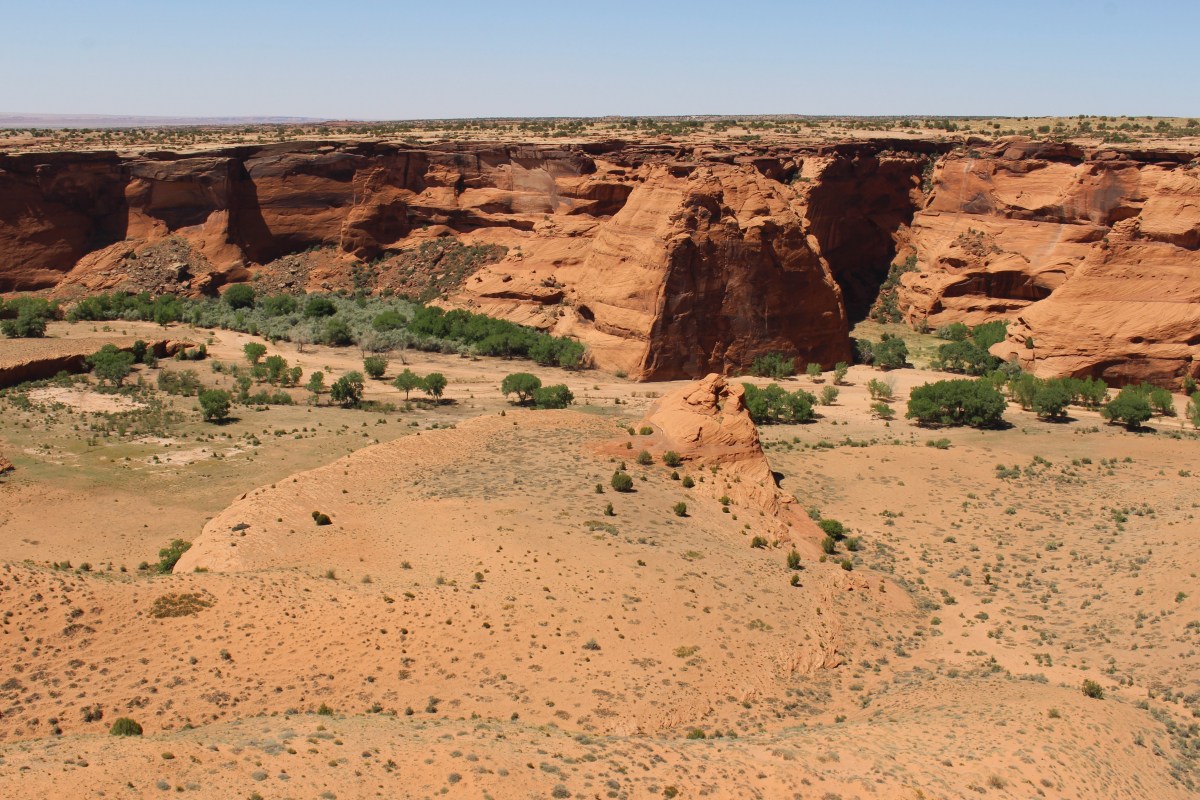
Junction Overlook
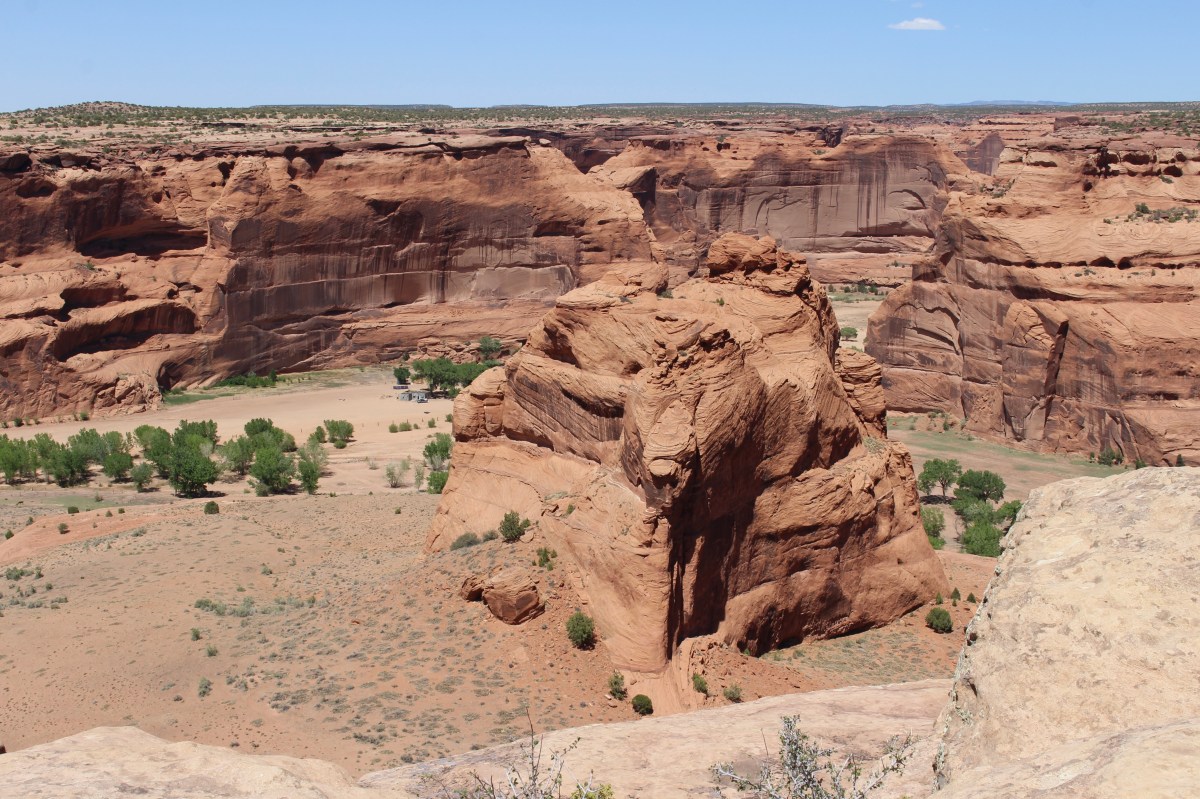
Junction Overlook
At Tsegi Overlook, I have sweeping views of Navajo farmlands on the canyon floor, as well as a 4WD kicking up dust on the dirt roads.


Tunnel Overlook is a short, boulder-filled side canyon. Here I have a partial view down to the main gorge, which is quite shallow here, only about 250 feet deep.
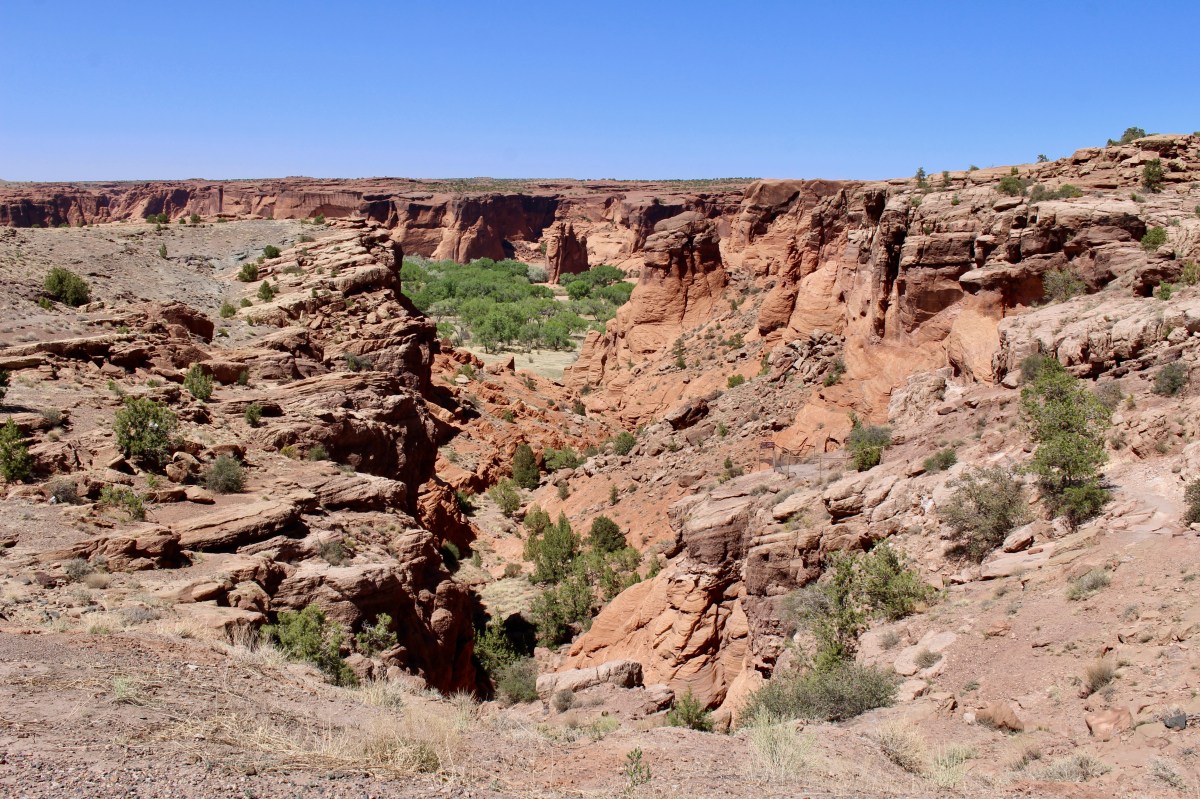
Tunnel Overlook
*Wednesday, May 16, 2018*
***********************
On Sundays, I post about hikes or walks that I have taken in my travels; I may also post on other unrelated subjects. I will use these posts to participate in Jo’s Monday Walks or any other challenges that catch my fancy.
This post is in response to Jo’s Monday Walk: La Collina Verde to Moncarapacho.
O, Teddy!
Where did you go that hot September day,
as President McKinley lay, allegedly recovering,
with an assassin’s bullet raging deep in his body?
O, Teddy! You took your cowboy
self hiking up the highest mountain in New York.
You hauled that exuberance of yours right up Mt. Marcy,
embracing the “strenuous life.”
O Teddy! Were you still running from the cruel asthma
attacks you suffered in your boyhood,
those night terrors of suffocation?
Or were you climbing to build muscle and courage,
steeling yourself for what the future might bring? You said,
“It was a dreadful thing to come into the presidency this way.”
And I believe it was.
Yet. O, Teddy. Yet.
You leaned into it. Took charge. Walked softly and carried
a big stick. You came alive with the thrumming heartbeats
of smudge-faced coal workers, of downtrodden
ragamuffins laboring in textile mills. You became the trust-busted
railroads and the Panama Canal, the wind caves
and cratered lakes, the devil’s towers and petrified forests
fighting against oblivion at the hands of greedy corporations.
You were the exhausted redwoods, alpine meadows,
peregrine falcons and golden eagles
seeking safe haven in which to flourish.
You were the quintessential man, O Teddy.
Don’t flinch. I know you hated the nickname, but I mean it
as a term of endearment. You rode in the saddle, drove cattle, hunted
big game. You collected insects and watched birds.
By god. You even captured an outlaw. You were a war hero,
Lieutenant Colonel of the Rough Riders – I salute you! –
in the Spanish-American War. A true progressive, ahead of your time.
After all was said and done, your face was carved into
Mt. Rushmore, indefatigable and indelible. Towering there, unrelenting
champion of the disenfranchised – the children, the poor, the brown man,
the immigrant, the forests, the streams – you seem troubled
by today’s political maelstrom. I wonder, did the thousands of books
you read in multiple languages inform you, make you expansive?
O, Teddy! You found the time – and the heart — for it all.
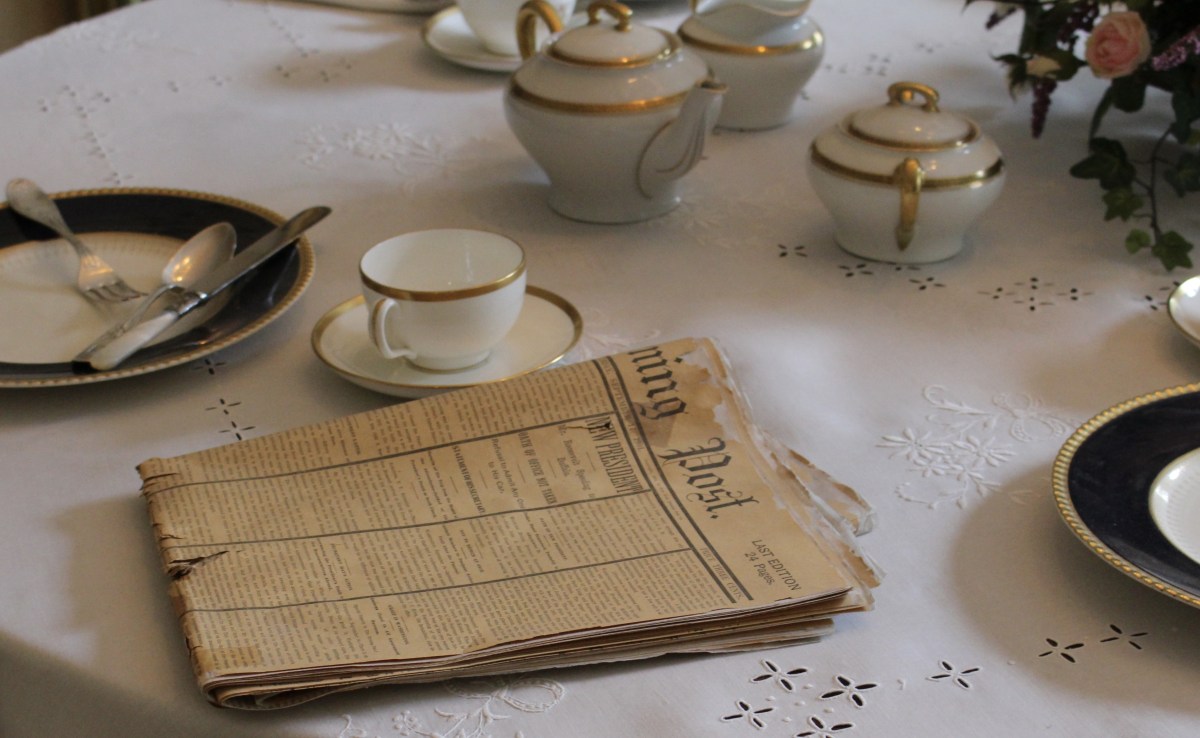
NEW PRESIDENT
*************************
“POETRY” Invitation: I invite you to write a poem of any poetic form on your own blog about a particular travel destination. Or you can write about travel in general. Concentrate on any intention you set for your poetry.
In this case, my intention was to write an apostrophe poem about some aspect of my trip to Buffalo and Niagara Falls. An apostrophe poem addresses a dead or absent person; it can also address an abstract concept, like love, a place, or even a thing, like the sun or the stars.
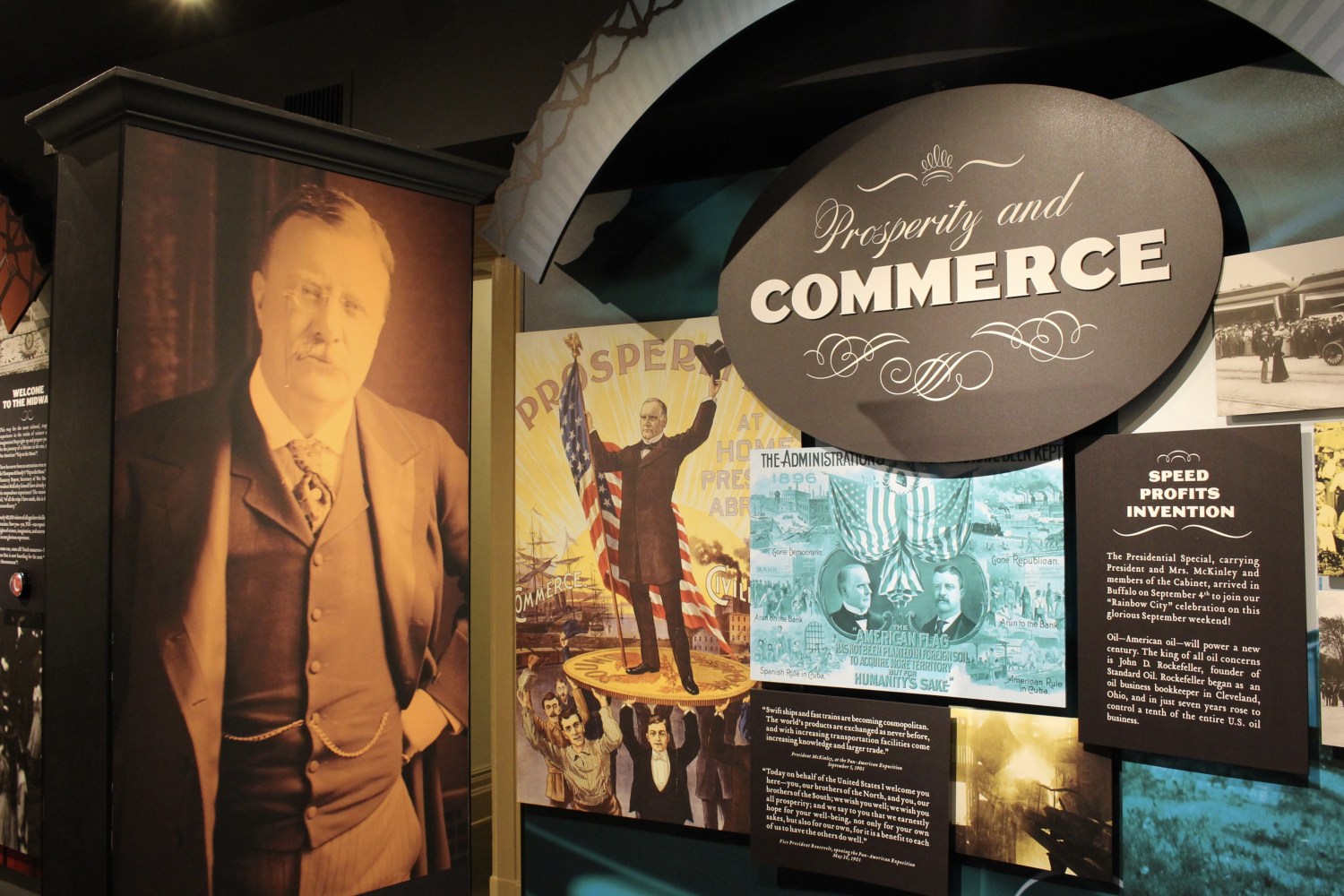
I was inspired to address our nation’s 26th president after visiting the Theodore Roosevelt Inaugural National Historic Site in Buffalo. I was awed by this site, and learned much I hadn’t known before. Teddy, as the President was often called (much to his annoyance), came alive for me here as he never had during my school days. The more I learned of him, the more I admired. I loved the story of how he came into the presidency after President McKinley’s assassination. And I found interesting parallels between the issues we face today and the issues he faced as President in 1901.
You can either set your own poetic intentions, or use one of the prompts I’ve listed on this page: writing prompts: poetry. (This page is a work in process). You can also include photos, of course.
Include the link in the comments below by Thursday, January 3 at 1:00 p.m. EST. When I write my post in response to this challenge on Friday, January 4, I’ll include your links in that post.
This will be an ongoing invitation, on the first Friday of each month. Feel free to jump in at any time. 🙂
I hope you’ll join in our community. I look forward to reading your posts!

U.S. Route 66, established on November 11, 1926, was one of the original highways in the U.S. Highway System. The legendary highway, also known as the “Main Street of America” or the “Mother Road,” originally ran from Chicago, Illinois through Missouri, Kansas, Oklahoma, Texas, New Mexico and Arizona before ending in Santa Monica, California.
Route 66 was officially removed from the U.S. Highway system in 1985, after being bypassed by the Interstate Highway system. Portions of the road have been designated as “Historic Route 66,” and people today can drive on many of these portions. Since it was decertified, it has taken on a mythic status, becoming a symbol of freedom and innocence, escape and loss; it has become emblematic of America’s last carefree times.
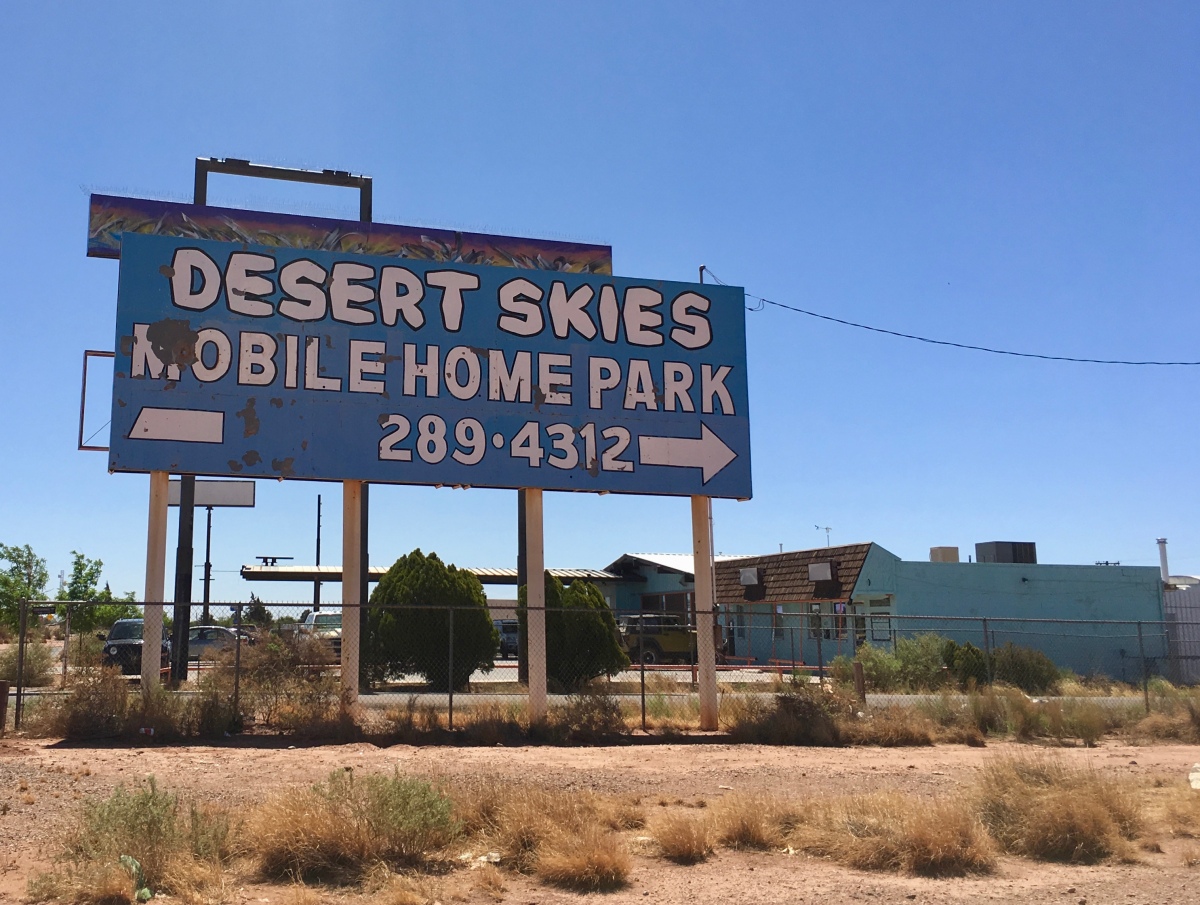
Desert Skies Mobile Home Park sign
In Arizona, over 200 miles of the original highway are still drivable. The preservation movement began here, according to Arizona Kicks on Route 66 by Roger Naylor. When I drove from Flagstaff to Petrified Forest National Park, I made a number of stops to check out the Americana, nostalgic reminders of a bypassed America.
The 1924 steel truss Winona Bridge sits on a bit of abandoned roadway in Winona, AZ.
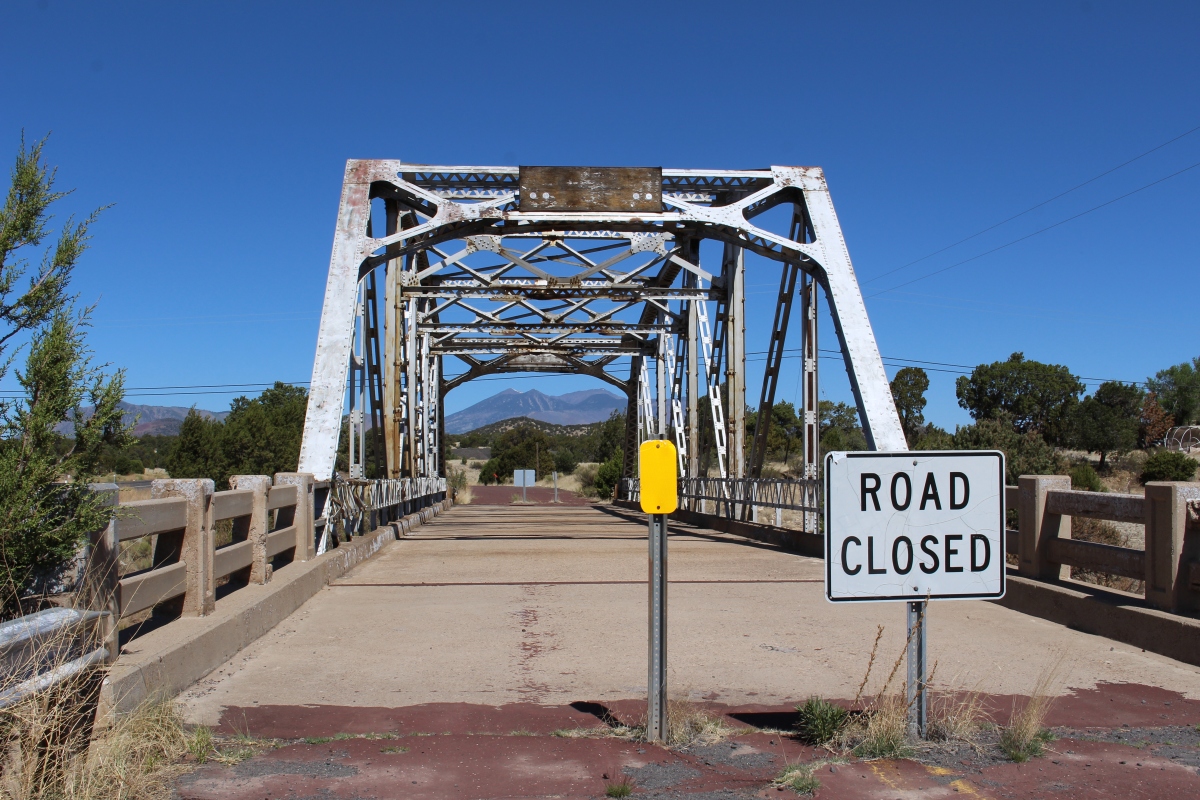
Winona Bridge
The Twin Arrows Trading Post is now an abandoned and derelict gathering of graffiti-marred buildings, but its Twin Arrows were restored in 2009.

Twin Arrows
Standin’ on the Corner Park in Winslow, AZ celebrates the Eagles song “Take It Easy,” which mentions a corner in Winslow. (See my previous post: 🎶 standing on a corner in winslow, arizona 🎶)
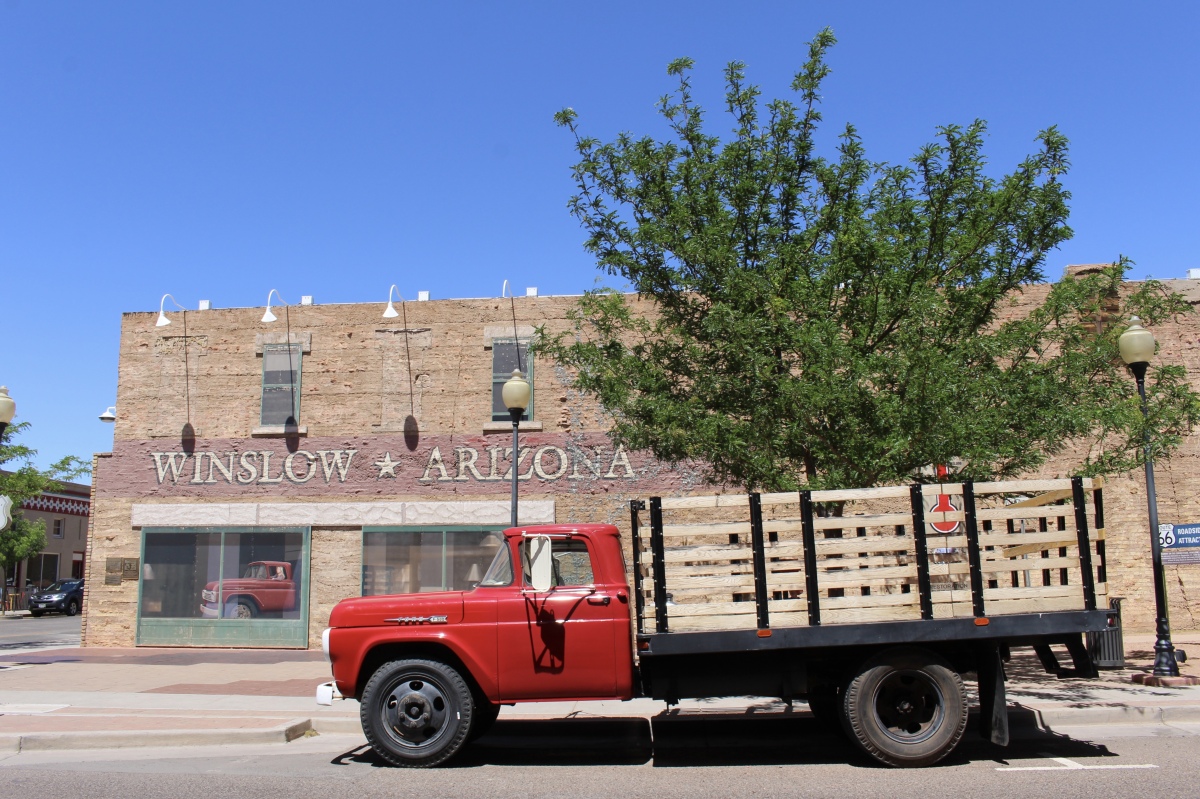
“It’s a girl, my Lord, in a flatbed Ford slowin’ down to take a look at me”
La Posada, built originally in 1930, was a high-class hotel on the Santa Fe Railway line. It was restored in 1997. (See my previous post: la posada in winslow, arizona)

La Posada
Mesa Restaurant in Holbrook is still serving up good Italian food today. I like the old-fashioned sign.
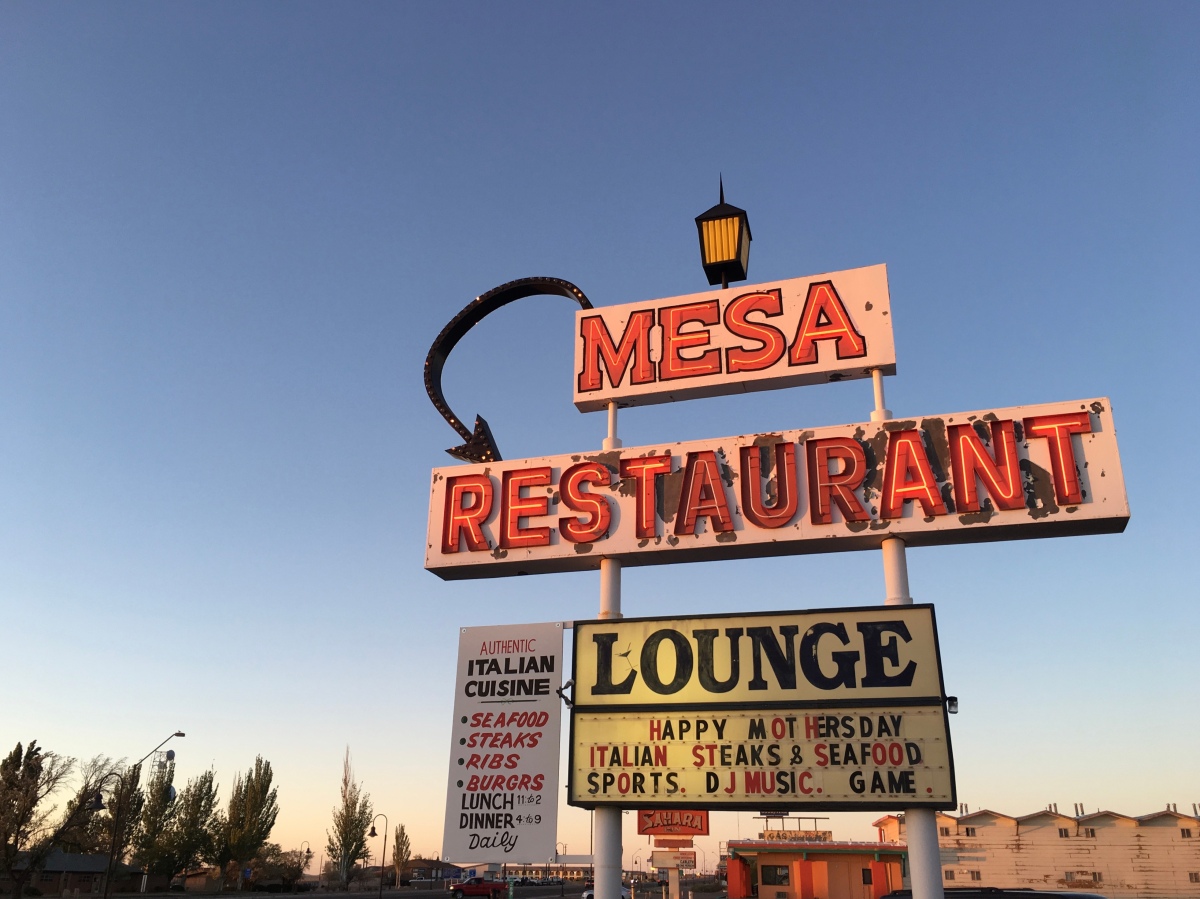
Mesa Restaurant
Joe and Aggie’s Cafe boasts a map of the Mother Road on its side. It was bought by Joe and Aggie Montano in 1945, two years after the eatery opened under a different name.

Joe & Aggies Cafe
Butterfield Stage Co. Steakhouse looks like it has seen better days.

Butterfield Stage Co. Steakhouse
I drove up and down the old Route 66, pulling into the small parking lots and driveways to take pictures of signs. Some businesses are still operational, others appear to be defunct.
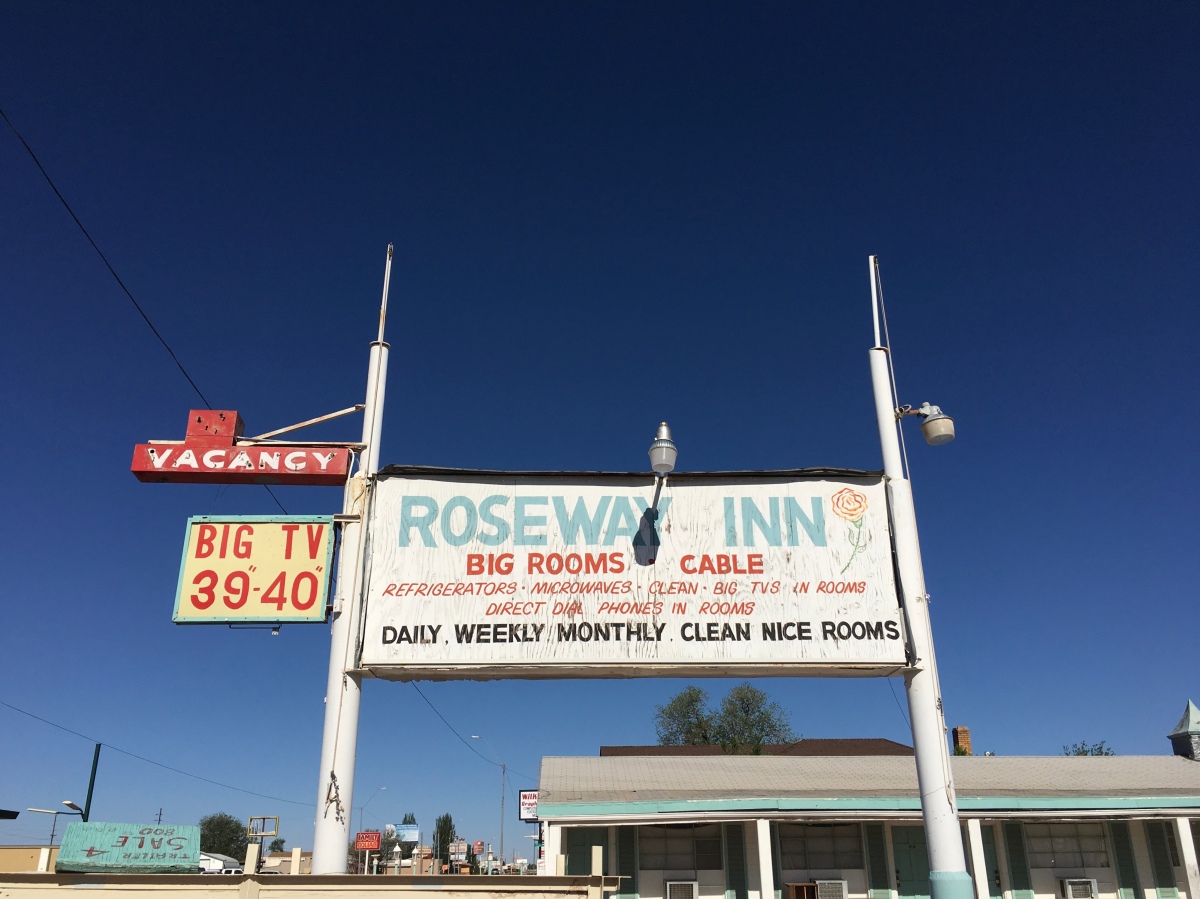
Roseway Inn

Street Eagle
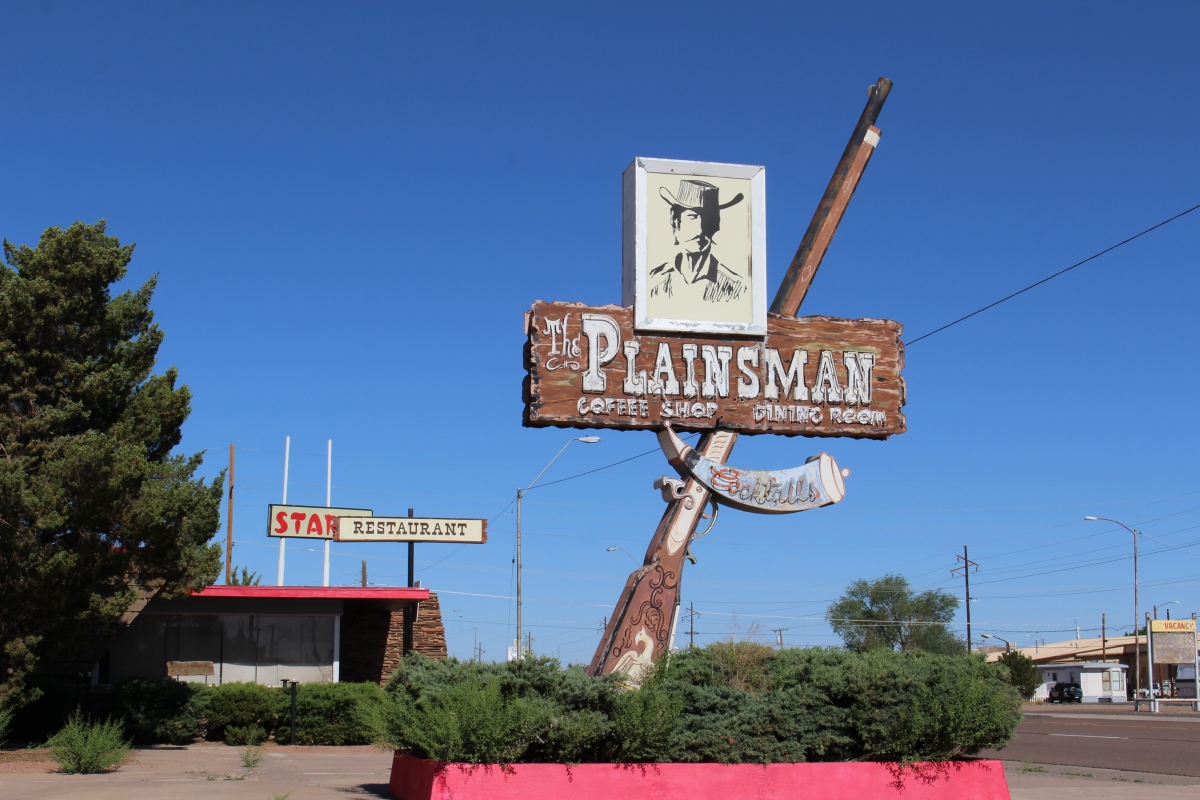
Plainsman
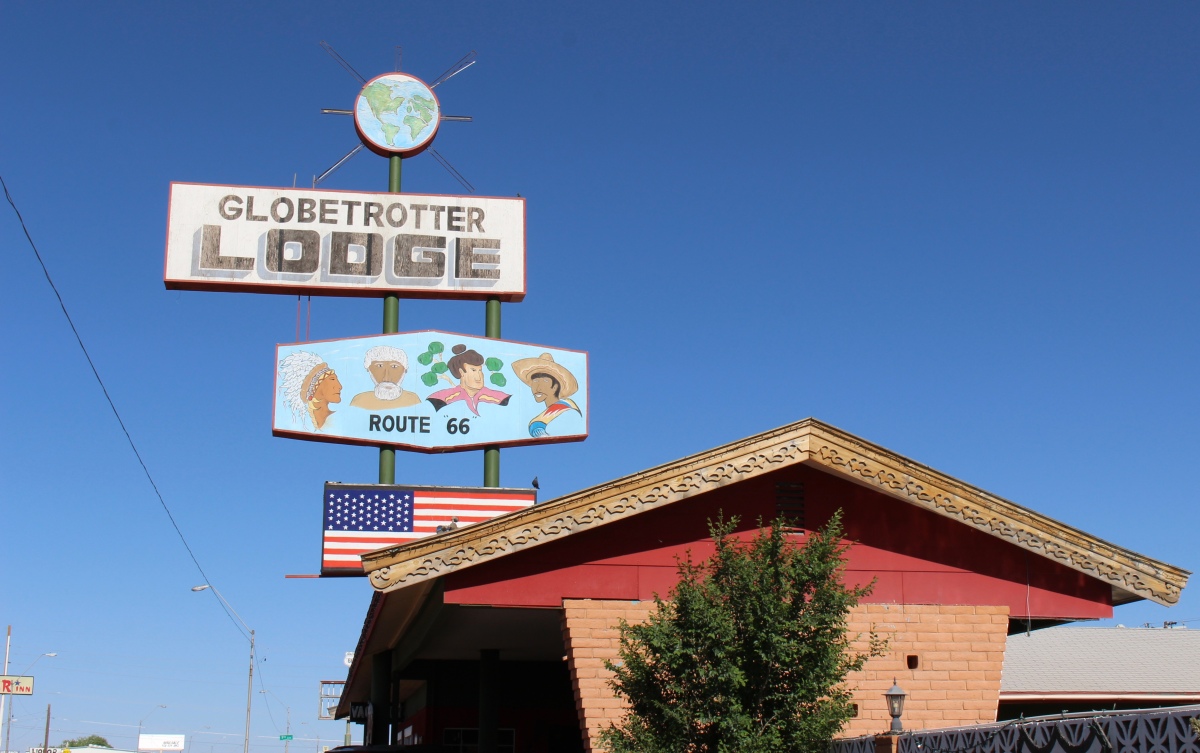
Globetrotter Lodge

Video Games
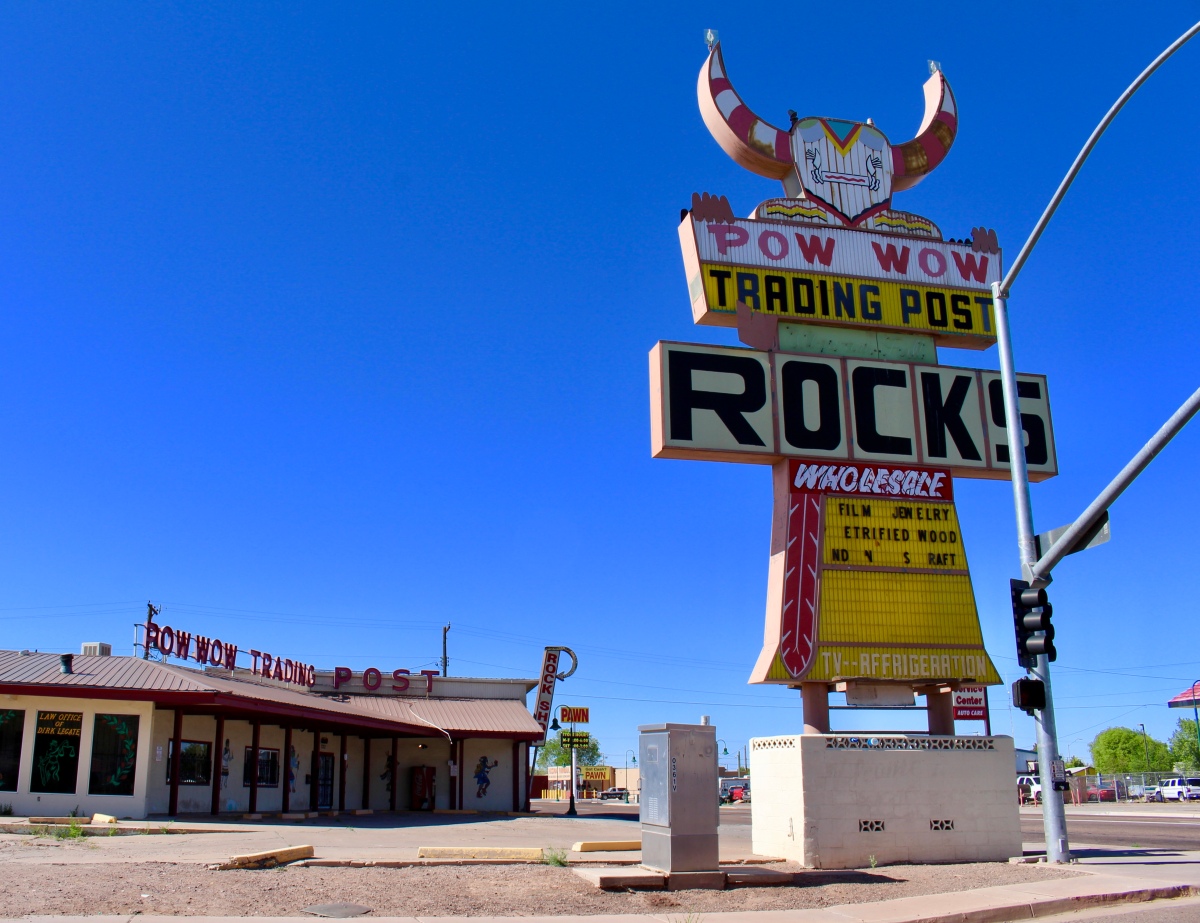
Pow Wow Trading Post
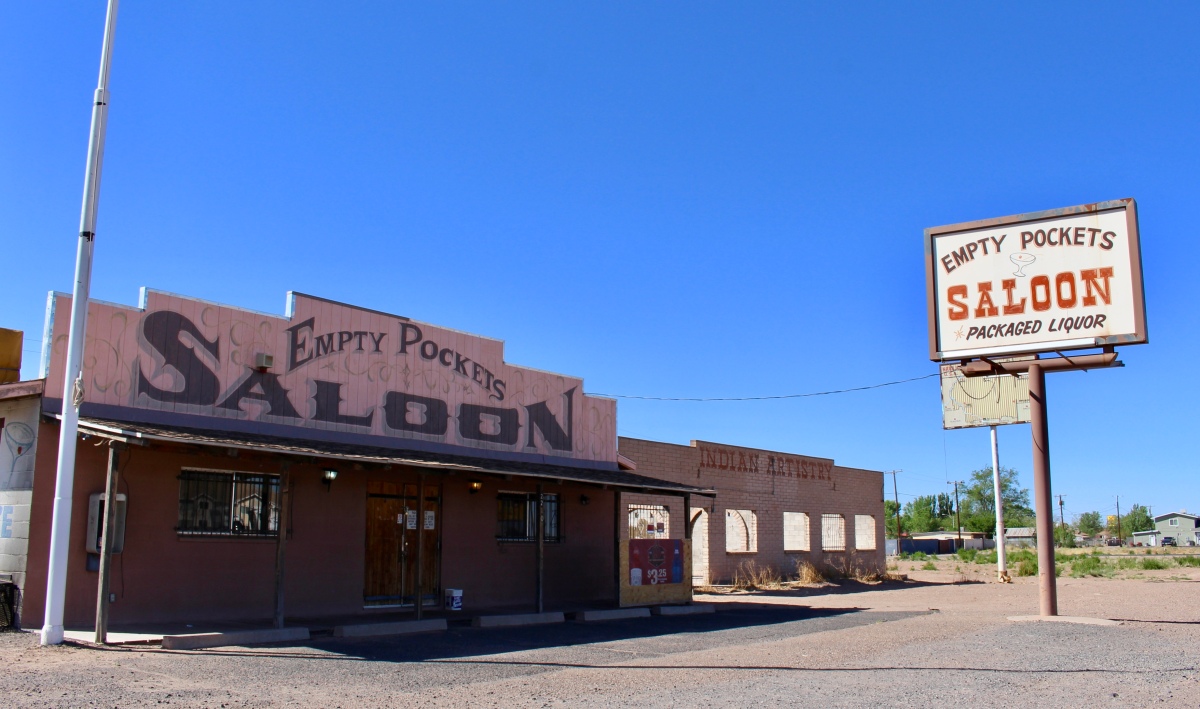
Empty Pockets Saloon

Ryan’s Petrified Wood Co.
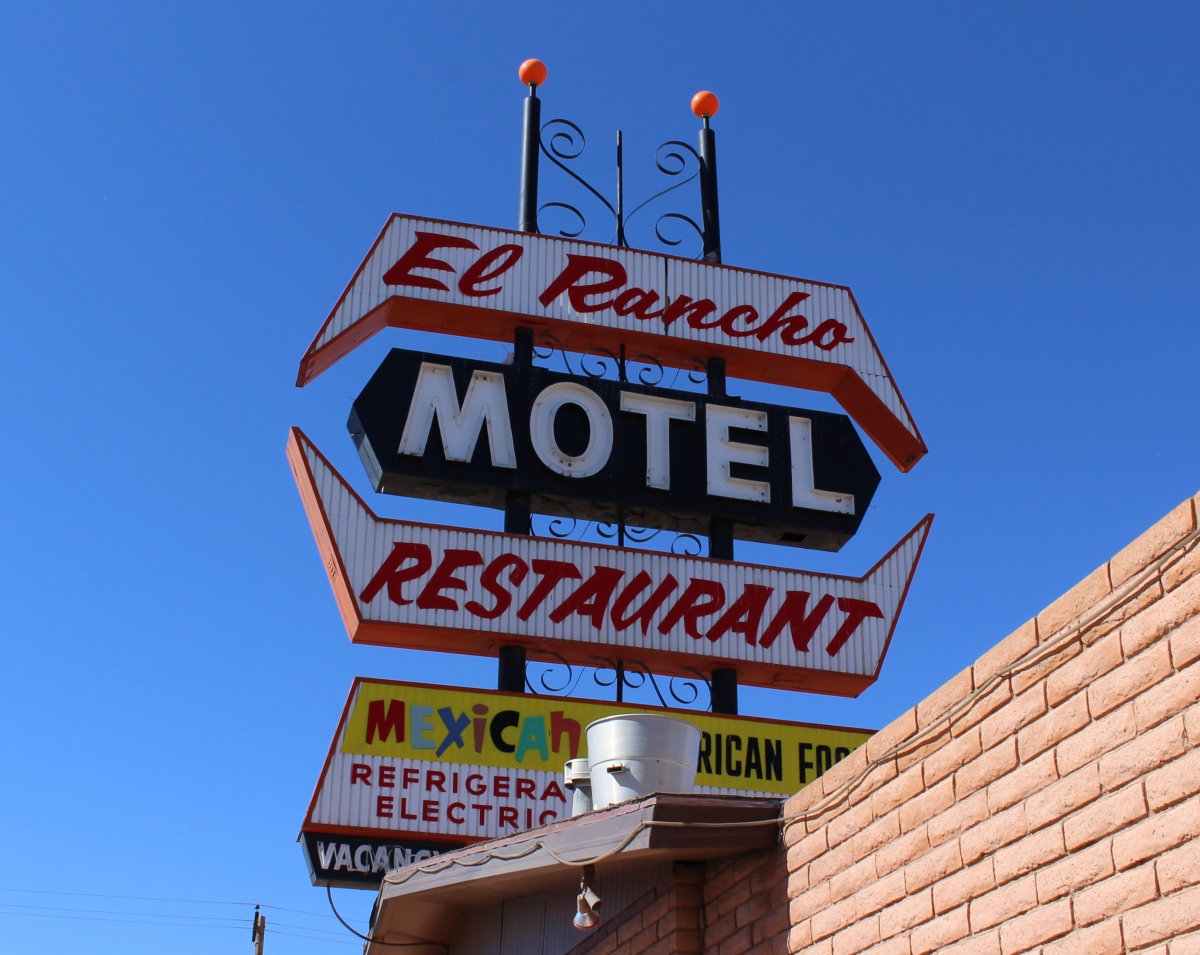
El Rancho Motel
The historical Holbrook saloon, The Corral, has iconic Route 66 wall murals on both sides.
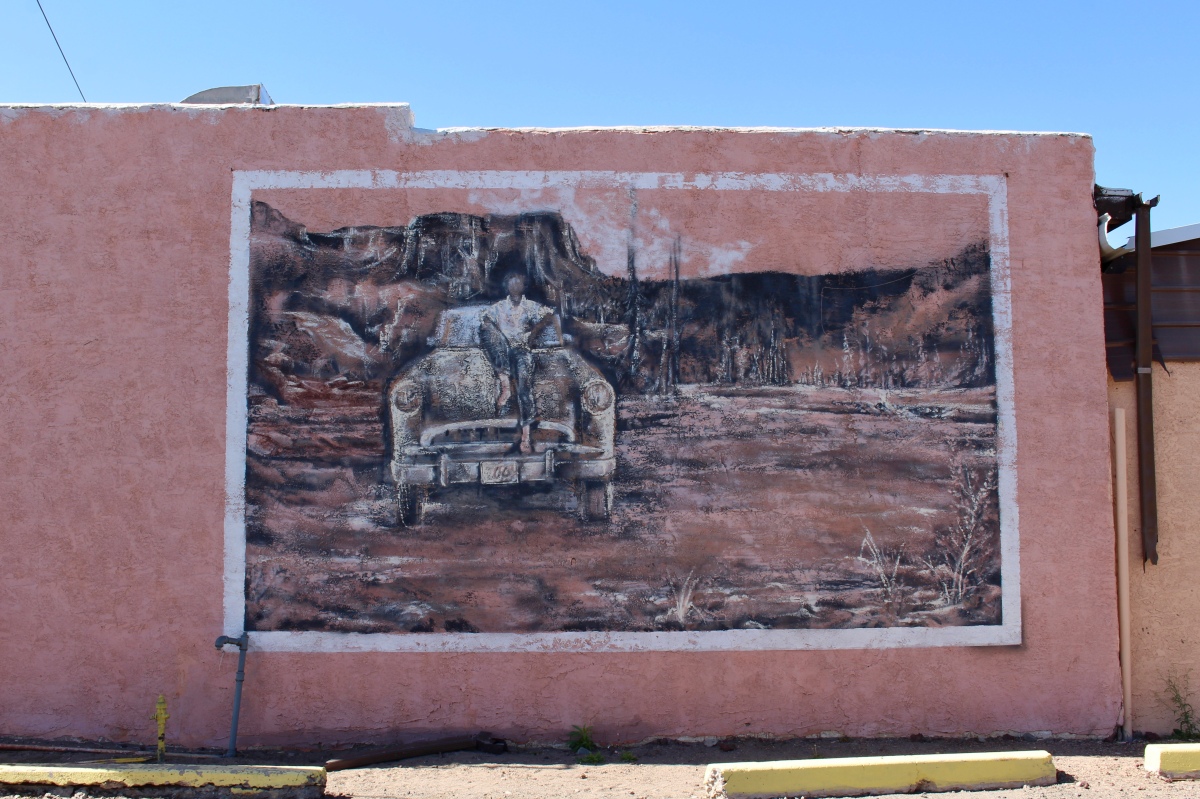
Street art on The Corral
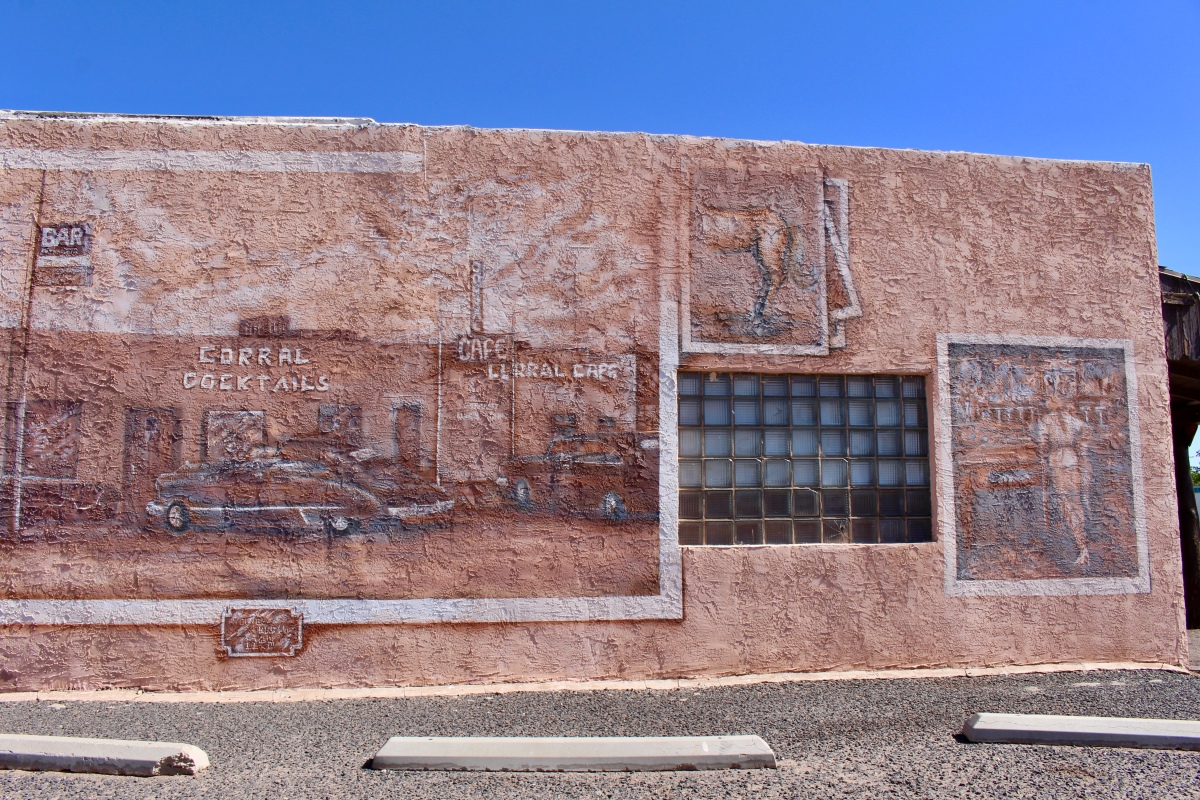
Street art on The Corral
Dinosaurs at the Rainbow Rock Shop are reminders that Petrified Forest National Park is nearby, with its fields of fossils.
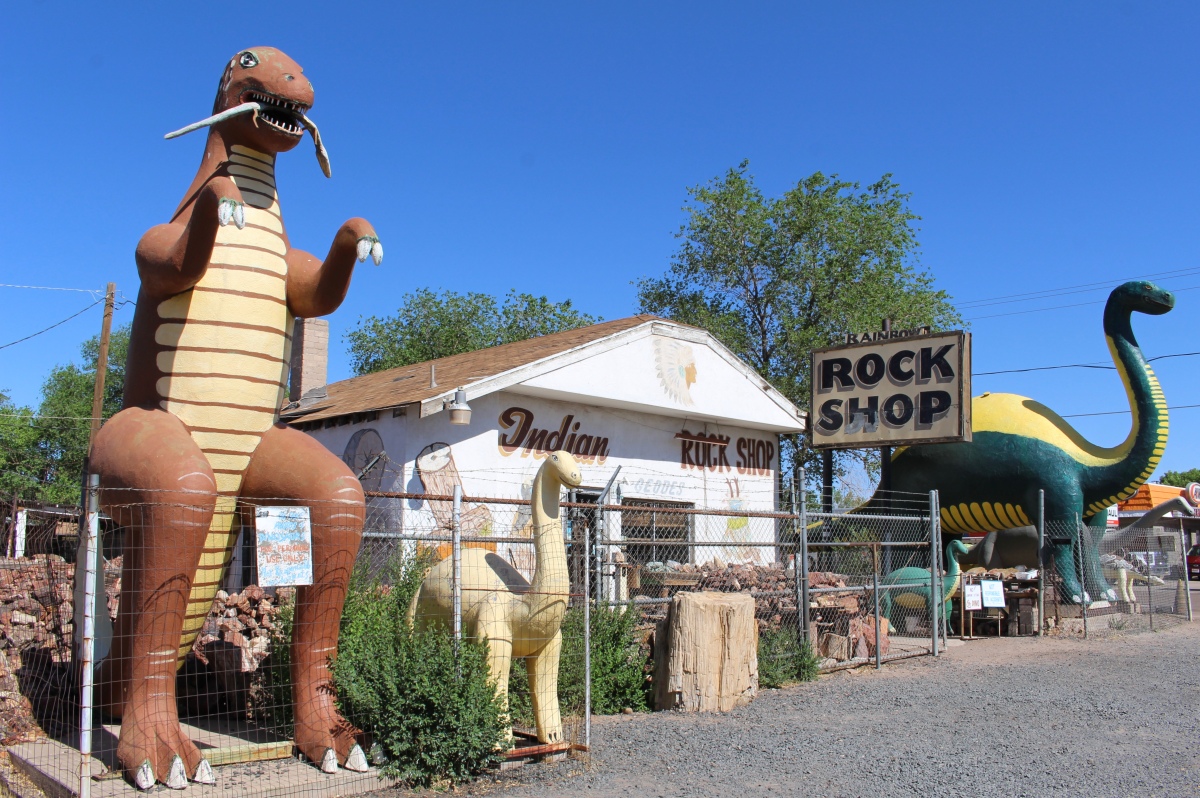
Indian Rock Shop
The Horsehead Crossing Deli and Ice Cream Parlor must be named for Holbrook’s original name, Horsehead Crossing; the town was located where the Rio Pureco joined the Little Colorado.

Horsehead Crossing
*********************
“PHOTOGRAPHY” INVITATION: I invite you to create a photography intention and then create a blog post for a place you have visited. Alternately, you can post a thematic post about a place, photos of whatever you discovered that set your heart afire. You can also do a thematic post of something you have found throughout all your travels: churches, doors, people reading, people hiking, mountains, patterns, all black & white, whatever!
You probably have your own ideas about this, but in case you’d like some ideas, you can visit my page: photography inspiration.
I challenge you to post no more than 20 photos (fewer is better) and to write less than 350-400 words about any travel-related photography intention you set for yourself. Include the link in the comments below by Wednesday, December 19 at 1:00 p.m. EST. When I write my post in response to this challenge on Thursday, December 20, I’ll include your links in that post.
This will be an ongoing invitation, every first and third (& 5th, if there is one) Thursday of each month. Feel free to jump in at any time. 🙂
I hope you’ll join in our community. I look forward to reading your posts!
the ~ wander.essence ~ community
I invite you all to settle in and read a few posts from our wandering community. I promise, you’ll be inspired!
Thanks to all of you who shared posts on the “photography” invitation. 🙂
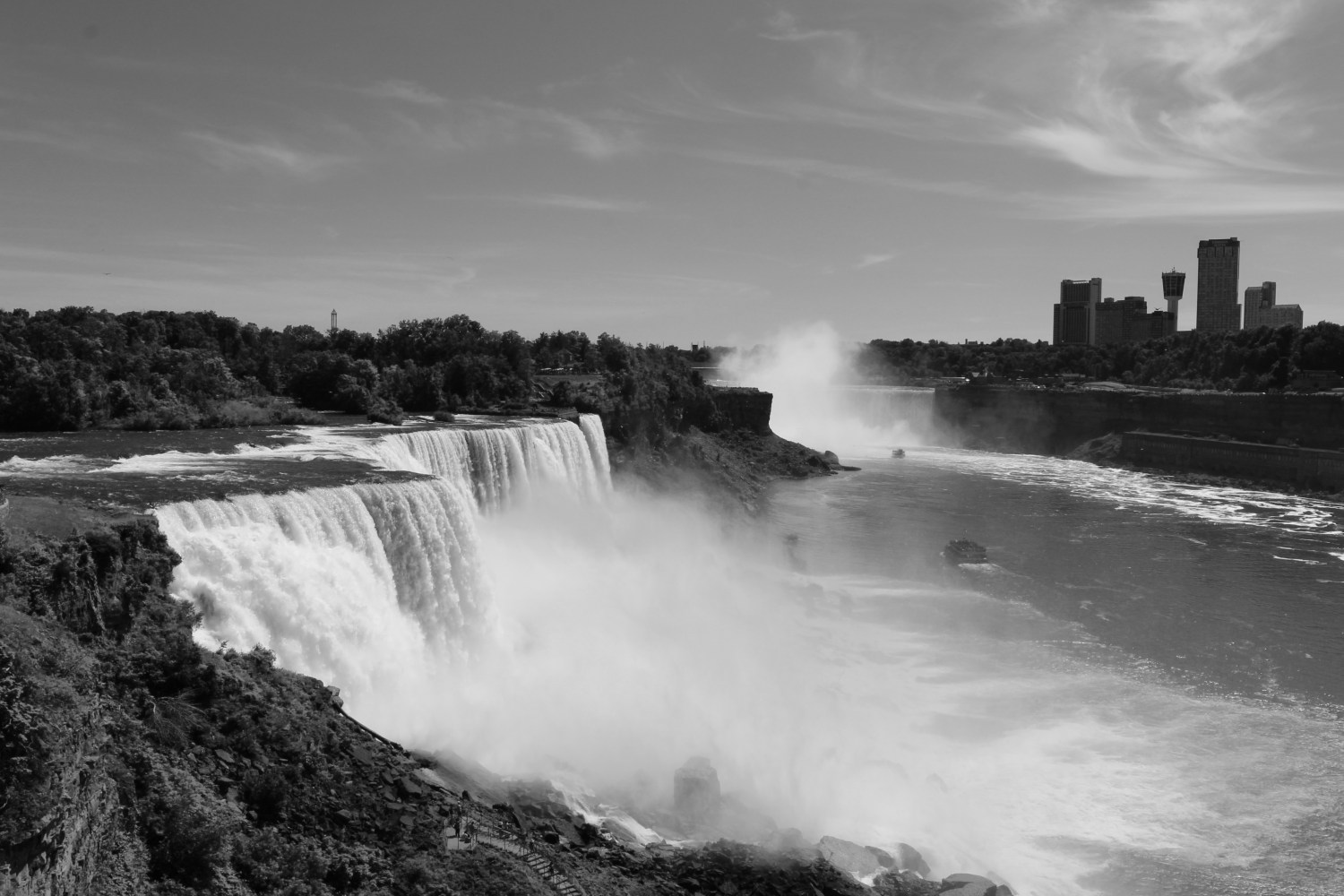
On Friday, June 29, I left Niagara Falls, Ontario and headed for the U.S. border, getting stuck in a very slow-moving line at Border Control.
I pulled up to the booth of a Border Patrol Agent, a real macho guy with a snide attitude. He began by grilling me suspiciously.
“What were you doing in Canada?” he said.
“Visiting Niagara Falls.”
“Why did you have to go to Canada when you can see the Falls from New York?”
“The views are much better from the Canadian side.”
“So you’re driving up here alone?”
“Yep.”
“So you just decided to drive all the way up here from Virginia and go to Niagara Falls and cross the border into Canada by yourself?” Like there is something wrong with that.
I said, “Yeah. I travel alone a lot. I’ve traveled all over the world on my own.”
“Do you work?”
“No.”
“So what does your husband do?”
“He works for a government contractor in northern Virginia.”
He continues with his snide look. “Oh, so he just pays for you to come on up here?”
“Yes.”
“Where are your bags?”
“Bags? Oh, you mean my suitcase? In the trunk.”
He then instructed me to turn off my car, pop the trunk, roll down my back seat window, and give him my keys.
“Is there anything in your trunk I’m not going to be happy to find?”
I said, “Uh, I don’t think so.”
Then he proceeded to search through my trunk and rifle through my suitcase.
Finally, he slammed my trunk and waved me through, looking pissed off that he was unable to find that I was doing something wrong. I really wanted to wipe that snide look right off of his face.
So what was going on? I am a white woman of an advanced age traveling alone. Was there some problem with that? Apparently our current administration, supported by the Christian Evangelicals who think a woman’s place is in the home, feel threatened by an independent woman traveling alone. They had better get used to it, because I don’t plan to stop!
If I got that much of a grilling, I can only imagine what people with brown skin have to deal with every day when crossing borders or dealing with our government.
I am so sick of our current administration’s border policies. Our country has been separating children from their parents and imprisoning them. Recently, women and children seeking asylum were tear gassed. It’s an outrage. Our government has no compassion for human beings who are suffering in this world.
I’m sure we don’t know the half of what is really going on at our borders.
********
Once I arrived home, I began to work on my intentions:


Greetings from New York
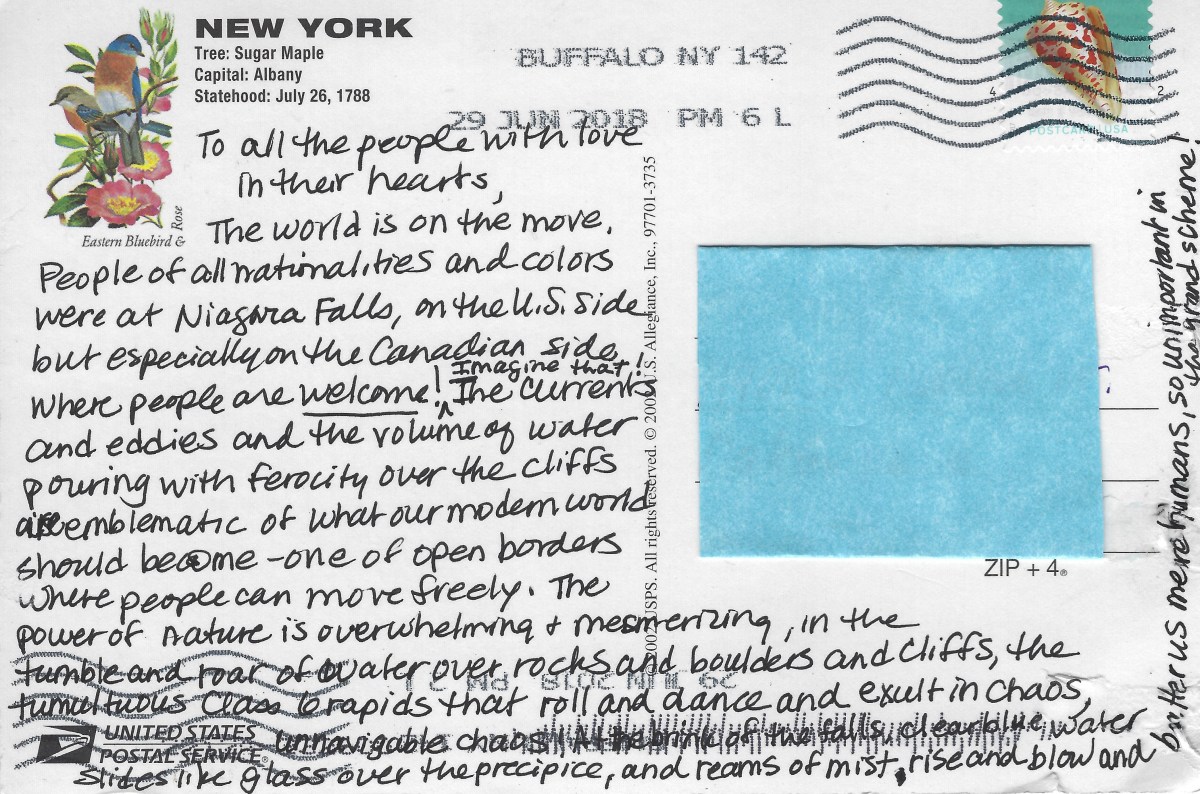
Hastily written postcard 🙂

Rosebay Rhododendron earrings and Postcards from the End of America from Talking Leaves Bookstore in Buffalo
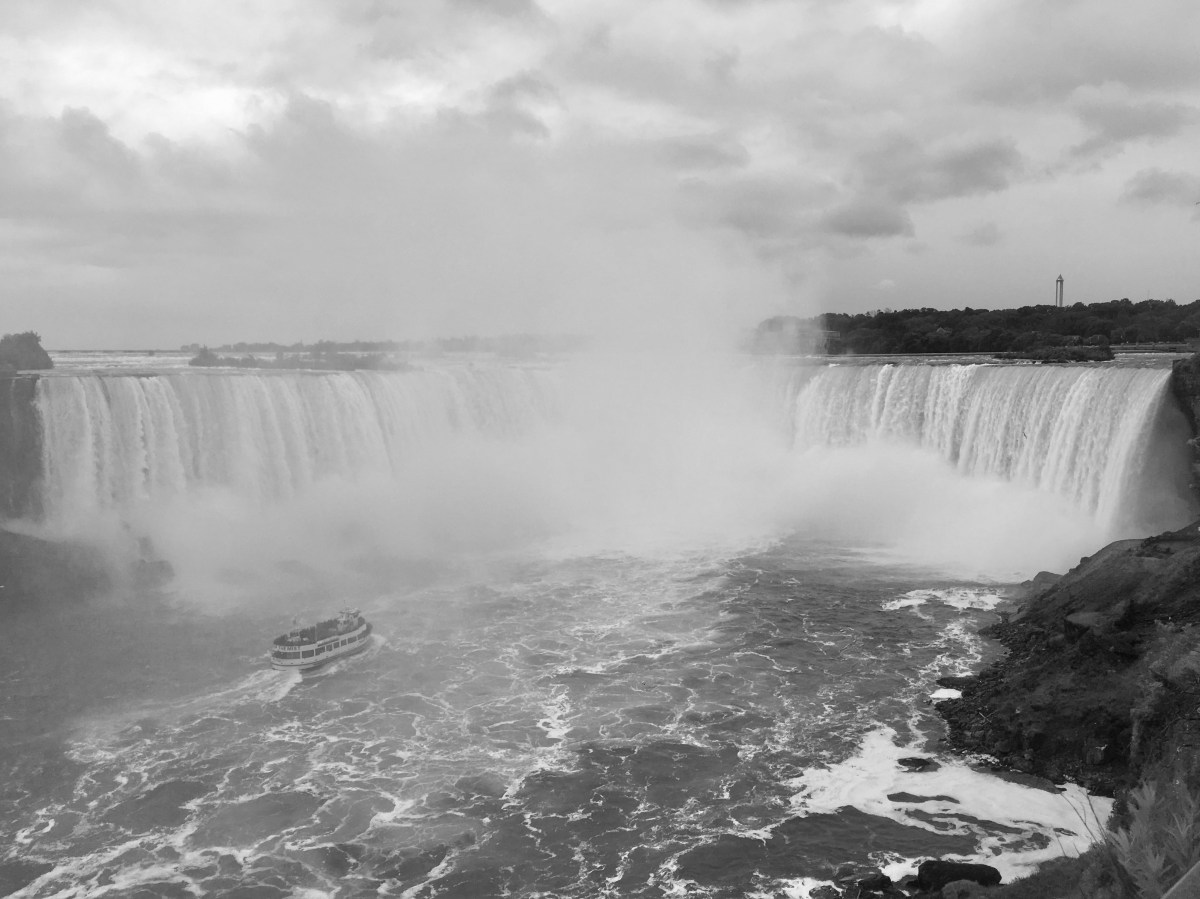
Horseshoe Falls from the Canadian side
Overall, I was glad I finally made the trip up north to visit Niagara Falls. The Canadian side has the best views but also a huge commercial footprint and a lot of tacky shops. The American side has a more natural environment, and allows visitors to get up close and personal with the Falls as they tumble over the precipice. In the end, I left the U.S.-Canadian border with a bad taste in my mouth, and felt outraged and gloomy over what is becoming of our country. Though I was awed by the amazing Falls and the White Water Walk, and I enjoyed seeing my friend Mona Lisa, I don’t think I would ever return again.
Here’s my trip shown on the Polarsteps app. Of course, this app doesn’t show the actual roads taken.

my Polarsteps app
************************
“ON RETURNING HOME” INVITATION: I invite you to write a post on your own blog about returning home from one particular destination or, alternately, from a long journey encompassing many stops. How do you linger over your wanderings and create something from them? How have you changed? Did the place live up to its hype, or was it disappointing? Feel free to address any aspect of your journey and how it influences you upon your return. If you don’t have a blog, I invite you to write in the comments.
For some ideas on this, you can check out the original post about this subject: on returning home.
Include the link in the comments below by Sunday, January 6 at 1:00 p.m. EST. When I write my post in response to this challenge on Monday, January 7, I’ll include your links in that post.
This will be an ongoing invitation on the first Monday of each month. Feel free to jump in at any time. 🙂
I hope you’ll join in our community. I look forward to reading your posts!
Can I have a bite?
living abroad in Guanacaste
Spiritual Insights & Personal Empowerment
An Adventure Travel Blog
"My sketchbook is a witness of what I am experiencing, scribbling things whenever they happen." - Vincent Van Gogh
Remembering past journeys, recording current trips and planning for the next one!
Put pictures on your travel dreams
Roaming, at home and abroad
Living a creative life
Living, Loving, Laughing, Learning and (Being) Lucrative
My path less traveled. Rediscovering self after surviving the abuse that almost sunk me. Goal of strengthening and thriving on my adult legs. 👣🙏🏻 #recovery #forgiveness
I love light, I love to write, I love life - I create my words and images to capture the light in my life.
Live your life!! Life is beautiful!!
Independent Travel & Photography Stories
Mettez des images sur vos rêves de voyages
THE MATURE ART OF TRAVELLING ALONE. MY NEW EMAIL IS: OldBirdTravels@proton.me PLEASE LIKE AND SHARE AT THE BOTTOM OF THE POST!
storytelling the world
Motivation
World travel culture and history
This blog is for those who wish to be creative, authors, people in the healing professions, business people, freelancers, journalists, poets, and teachers. You will learn about how to write well, and about getting published. Both beginning and experienced writers will profit from this blog and gain new creative perspectives. Become inspired from global writers, and find healing through the written word.
Come journey with me as we navigate through this thing called life
This is where I share my passions
Life is all about being curious, asking questions, and discovering your passion. And it can be fun!
Creative Nonfiction & Poetry
Avid adventurer, travel blogger, and experience seeker. Starting each morning with a desire to see the world through a different lens.
Feeding an Empty Belly and Starving Mind
Our travels and thoughts through photographs. It does not matter, sunrise or sunset, just have fun in between.
seeking solace in the horizon of life and beyond
Walks Stories and Nature
Everything Family Travel: Work Hard, Play Hard
Culture and Communities at the Heart Of India
Explore, discover and experience the world through Meery's Eye. Off the beat budget traveler. Explore places, cultural and heritage. Sustainable trotter. shareable tales of Meery is Meeryable
photography, poetry, paintings
Work by Rain Alchemist
Following my heart, Daring to dream, Living without regrets
Smiling through the good times and the bad
Words and Pictures from the Middle East
 ~ wander.essence ~
You must be logged in to post a comment.