Skip to content
  • Home
  • about ~ wander.essence ~
    • ~ the places i’ve been ~
    • ~ places i’ve been in the u.s.a. ~
  • Travel Destinations
    • America
      • Boston
      • Delaware
      • District of Columbia
        • Washington
      • Georgia
        • Atlanta
      • Maryland
      • New Jersey
        • Cape May
      • New York
        • Adirondacks
        • Buffalo
        • Niagara Falls
      • Pennsylvania
        • Pittsburgh
      • South Carolina
      • Tennessee
        • Nashville
      • Virginia
    • American Road Trips
      • Canyon & Cactus Road Trip
      • Florida Road Trip
        • Everglades
        • Fort Lauderdale
        • Florida Keys
        • Miami
        • St. Augustine
      • Four Corners Road Trip
        • Arizona
          • Monument Valley
          • Petrified Forest National Park
          • Sunset Crater National Monument
          • Walnut Canyon National Monument
          • Winslow
          • Wupatki National Monument
        • Colorado
          • Colorado National Monument
          • Colorado Towns
          • Great Sand Dunes National Park
          • Grand Junction
        • New Mexico
        • Utah
          • Arches National Park
          • Canyonlands
          • Navajo National Monument
          • Dead Horse Point State Park
          • Hovenweep National Monument
          • Moab
          • Valley of the Gods
          • Natural Bridges National Monument
      • Great Lakes Road Trip
        • Michigan
        • Minnesota
        • Wisconsin
      • Midwestern Triangle
        • Illinois
          • Carbondale
          • Murphysboro
        • Kentucky
          • Covington
          • Lexington
          • Louisville
        • Ohio
          • Cincinnati
      • Road Trip to Nowhere
        • Nebraska
        • North Dakota
        • South Dakota
      • Tex-New Mex Road Trip
        • Texas & New Mexico Road Trip
        • New Mexico
        • Texas
    • International Travel
      • Africa
        • african meanderings {& musings}
        • Egypt
          • Cairo
        • Ethiopia
        • Morocco
      • Asia
        • Cambodia
        • China
          • China Diaries
          • Guangxi Province
        • India
          • Rishikesh
          • Varanasi
        • Japan
          • Kyoto
        • Myanmar
        • Oman
          • a nomad in the land of nizwa
          • Nizwa
        • Singapore
        • South Korea
          • catbird in korea
        • Thailand
        • Turkey
          • Cappadocia
        • Vietnam
      • Central America
        • Costa Rica
        • El Salvador
        • Nicaragua
        • Panama
          • Bocas del Toro
          • Panama City
      • Europe
        • In Search of a Thousand Cafés
        • Croatia
          • Dalmatia
            • Istria
            • Dubrovnik
            • Plitvice Lakes National Park
            • Split
            • Zadar
            • Zagreb
        • Czech Republic
          • Český Krumlov
        • England
        • France
        • Greece
        • Hungary
          • Budapest
          • Esztergom
        • Iceland
        • Italy
          • Bergamo
          • Cinque Terre
          • The Dolomites
          • Florence
          • Rome
          • Tuscany
          • Venice
          • Verona
          • Via Francigena
        • Portugal
        • Spain
          • Camino de Santiago
            • packing list for el camino de santiago 2018
      • North America
        • Canada
          • The Maritimes
            • New Brunswick
            • Nova Scotia
            • Prince Edward Island
          • Ontario
        • Mexico
          • Guanajuato
          • Mexico City
            • Teotihuacán
          • Querétaro
          • San Miguel de Allende
      • South America
        • Colombia
        • Ecuador
          • Cuenca
          • Quito
    • how to make the most of a staycation
      • Coronavirus Coping
  • Imaginings
    • imaginings: the call to place
  • Travel Preparation
    • journeys: anticipation & preparation
  • Travel Creativity
    • on keeping a travel journal
    • on creating art from travels
      • Art Journaling
    • photography inspiration
      • Photography
    • writing prompts: prose
      • Prose
        • Fiction
        • Travel Essay
        • Travelogue
    • writing prompts: poetry
      • Poetry
  • On Journey
    • on journey: taking ourselves from here to there
  • Books & Movies
    • books | international a-z |
    • books & novels | u.s.a. |
    • books | history, spirituality, personal growth & lifestyle |
    • movies | international a-z |
    • movies | u.s.a. |
  • On Returning Home
    • on returning home
  • Annual recap
    • twenty-fifteen
    • twenty-eighteen
    • twenty-nineteen
    • twenty-twenty
    • twenty-twenty-one
    • twenty twenty-two
    • twenty twenty-three
    • twenty twenty-four
    • twenty twenty-five
  • Contact

Enter your email address to follow this blog and receive notifications of new posts by email.

Join 1,060 other subscribers
Follow ~ wander.essence ~ on WordPress.com
  • Home
  • about ~ wander.essence ~
    • ~ the places i’ve been ~
    • ~ places i’ve been in the u.s.a. ~
  • Travel Destinations
    • America
      • Boston
      • Delaware
      • District of Columbia
        • Washington
      • Georgia
        • Atlanta
      • Maryland
      • New Jersey
        • Cape May
      • New York
        • Adirondacks
        • Buffalo
        • Niagara Falls
      • Pennsylvania
        • Pittsburgh
      • South Carolina
      • Tennessee
        • Nashville
      • Virginia
    • American Road Trips
      • Canyon & Cactus Road Trip
      • Florida Road Trip
        • Everglades
        • Fort Lauderdale
        • Florida Keys
        • Miami
        • St. Augustine
      • Four Corners Road Trip
        • Arizona
          • Monument Valley
          • Petrified Forest National Park
          • Sunset Crater National Monument
          • Walnut Canyon National Monument
          • Winslow
          • Wupatki National Monument
        • Colorado
          • Colorado National Monument
          • Colorado Towns
          • Great Sand Dunes National Park
          • Grand Junction
        • New Mexico
        • Utah
          • Arches National Park
          • Canyonlands
          • Navajo National Monument
          • Dead Horse Point State Park
          • Hovenweep National Monument
          • Moab
          • Valley of the Gods
          • Natural Bridges National Monument
      • Great Lakes Road Trip
        • Michigan
        • Minnesota
        • Wisconsin
      • Midwestern Triangle
        • Illinois
          • Carbondale
          • Murphysboro
        • Kentucky
          • Covington
          • Lexington
          • Louisville
        • Ohio
          • Cincinnati
      • Road Trip to Nowhere
        • Nebraska
        • North Dakota
        • South Dakota
      • Tex-New Mex Road Trip
        • Texas & New Mexico Road Trip
        • New Mexico
        • Texas
    • International Travel
      • Africa
        • african meanderings {& musings}
        • Egypt
          • Cairo
        • Ethiopia
        • Morocco
      • Asia
        • Cambodia
        • China
          • China Diaries
          • Guangxi Province
        • India
          • Rishikesh
          • Varanasi
        • Japan
          • Kyoto
        • Myanmar
        • Oman
          • a nomad in the land of nizwa
          • Nizwa
        • Singapore
        • South Korea
          • catbird in korea
        • Thailand
        • Turkey
          • Cappadocia
        • Vietnam
      • Central America
        • Costa Rica
        • El Salvador
        • Nicaragua
        • Panama
          • Bocas del Toro
          • Panama City
      • Europe
        • In Search of a Thousand Cafés
        • Croatia
          • Dalmatia
            • Istria
            • Dubrovnik
            • Plitvice Lakes National Park
            • Split
            • Zadar
            • Zagreb
        • Czech Republic
          • Český Krumlov
        • England
        • France
        • Greece
        • Hungary
          • Budapest
          • Esztergom
        • Iceland
        • Italy
          • Bergamo
          • Cinque Terre
          • The Dolomites
          • Florence
          • Rome
          • Tuscany
          • Venice
          • Verona
          • Via Francigena
        • Portugal
        • Spain
          • Camino de Santiago
            • packing list for el camino de santiago 2018
      • North America
        • Canada
          • The Maritimes
            • New Brunswick
            • Nova Scotia
            • Prince Edward Island
          • Ontario
        • Mexico
          • Guanajuato
          • Mexico City
            • Teotihuacán
          • Querétaro
          • San Miguel de Allende
      • South America
        • Colombia
        • Ecuador
          • Cuenca
          • Quito
    • how to make the most of a staycation
      • Coronavirus Coping
  • Imaginings
    • imaginings: the call to place
  • Travel Preparation
    • journeys: anticipation & preparation
  • Travel Creativity
    • on keeping a travel journal
    • on creating art from travels
      • Art Journaling
    • photography inspiration
      • Photography
    • writing prompts: prose
      • Prose
        • Fiction
        • Travel Essay
        • Travelogue
    • writing prompts: poetry
      • Poetry
  • On Journey
    • on journey: taking ourselves from here to there
  • Books & Movies
    • books | international a-z |
    • books & novels | u.s.a. |
    • books | history, spirituality, personal growth & lifestyle |
    • movies | international a-z |
    • movies | u.s.a. |
  • On Returning Home
    • on returning home
  • Annual recap
    • twenty-fifteen
    • twenty-eighteen
    • twenty-nineteen
    • twenty-twenty
    • twenty-twenty-one
    • twenty twenty-two
    • twenty twenty-three
    • twenty twenty-four
    • twenty twenty-five
  • Contact

wander.essence

wander.essence

Home from Morocco & Italy

Home sweet home!May 10, 2019
I'm home from Morocco & Italy. :-)

Italy trip

Traveling to Italy from MoroccoApril 23, 2019
On my way to Italy!

Leaving for Morocco

Casablanca, here I come!April 4, 2019
I'm on my way to Casablanca. :-)

Home from our Midwestern Triangle Road Trip

Driving home from Lexington, KYMarch 6, 2019
Home sweet home from the Midwest. :-)

Leaving for my Midwestern Triangle Road Trip

Driving to IndianaFebruary 24, 2019
Driving to Indiana.

Returning home from Portugal

Home sweet home from Spain & Portugal!November 6, 2018
Home sweet home from Spain & Portugal!

Leaving Spain for Portugal

A rendezvous in BragaOctober 26, 2018
Rendezvous in Braga, Portgual after walking the Camino de Santiago. :-)

Leaving to walk the Camino de Santiago

Heading to Spain for the CaminoAugust 31, 2018
I'm on my way to walk 790 km across northern Spain on the Camino de Santiago.

Home from my Four Corners Road Trip

Home Sweet Home from the Four CornersMay 25, 2018
Home Sweet Home from the Four Corners. :-)

My Four Corners Road Trip!

Hitting the roadMay 1, 2018
I'm hitting the road today for my Four Corners Road Trip: CO, UT, AZ, & NM!

Recent Posts

  • the january cocktail hour: a belated nicaraguan christmas & a trip to costa rica’s central pacific coast February 3, 2026
  • bullet journals as a life repository: bits of mine from 2025 & 2026 January 4, 2026
  • twenty twenty-five: nicaragua {twice}, mexico & seven months in costa rica {with an excursion to panama} December 31, 2025
  • the december cocktail hour: mike’s surgery, a central highlands road trip & christmas in costa rica December 31, 2025
  • top ten books of 2025 December 28, 2025
  • the november cocktail hour: a trip to panama, a costa rican thanksgiving & a move to lake arenal condos December 1, 2025
  • panama: the caribbean archipelago of bocas del toro November 24, 2025
  • a trip to panama city: el cangrejo, casco viejo & the panama canal November 22, 2025
  • the october cocktail hour: a trip to virginia, a NO KINGS protest, two birthday celebrations, & a cattle auction October 31, 2025
  • the september cocktail hour: a nicoya peninsula getaway, a horseback ride to la piedra del indio waterfalls & a fall bingo card September 30, 2025
  • the august cocktail hour: local gatherings, la fortuna adventures, & a “desfile de caballistas”  September 1, 2025
  • the july cocktail hour: a trip to ometepe, nicaragua; a beach getaway to tamarindo; & homebody activities August 3, 2025
  • the june cocktail hour: our first month in costa rica June 30, 2025

Archives

  • February 2026
  • January 2026
  • December 2025
  • November 2025
  • October 2025
  • September 2025
  • August 2025
  • June 2025
  • May 2025
  • April 2025
  • March 2025
  • February 2025
  • January 2025
  • December 2024
  • November 2024
  • October 2024
  • September 2024
  • August 2024
  • July 2024
  • June 2024
  • May 2024
  • April 2024
  • March 2024
  • February 2024
  • January 2024
  • December 2023
  • November 2023
  • September 2023
  • August 2023
  • June 2023
  • May 2023
  • April 2023
  • March 2023
  • February 2023
  • January 2023
  • December 2022
  • November 2022
  • October 2022
  • September 2022
  • August 2022
  • June 2022
  • May 2022
  • April 2022
  • March 2022
  • February 2022
  • January 2022
  • December 2020
  • November 2020
  • October 2020
  • September 2020
  • August 2020
  • July 2020
  • June 2020
  • May 2020
  • April 2020
  • March 2020
  • February 2020
  • January 2020
  • December 2019
  • November 2019
  • October 2019
  • September 2019
  • August 2019
  • July 2019
  • June 2019
  • May 2019
  • April 2019
  • March 2019
  • February 2019
  • January 2019
  • December 2018
  • November 2018
  • October 2018
  • September 2018
  • August 2018
  • July 2018
  • June 2018
  • May 2018
  • April 2018
  • March 2018

Blog Stats

  • 126,421 hits
February 2026
M T W T F S S
 1
2345678
9101112131415
16171819202122
232425262728  
« Jan    

Categories

  • Aït-Ben-Haddou (4)
  • Abingdon (1)
  • Abiquiu (1)
  • Acquapendente (2)
  • Adirondacks (3)
  • Africa (39)
  • Ainokura (2)
  • Alabama (1)
  • Alajuela (3)
  • Alamogordo (1)
  • Albuquerque (3)
  • Alexandria (1)
  • Alma (1)
  • Alpe di Siusi (1)
  • Alsace-Lorraine (1)
  • Alto Adige Wine Road (1)
  • Amarante (2)
  • America (69)
  • American Bison (1)
  • American books (22)
  • American Road Trips (255)
  • American Visionary Art Museum (1)
  • Americana (1)
  • Andrew Johnson National Historic Site (1)
  • Annapolis Valley (1)
  • Annual recap (10)
  • Anticipation (45)
  • Antietam National Battlefield (2)
  • Aramak Tour (1)
  • Arches National Park (8)
  • architecture (1)
  • Arena Stage (1)
  • Arizona (28)
  • Aroumd (2)
  • Art Journaling (9)
  • Asciano (1)
  • Asia (41)
  • Assisi (1)
  • Astorga (2)
  • Atapuerca (1)
  • Athens (1)
  • Atlanta (7)
  • Austin (2)
  • Aveiro (2)
  • Azofra (2)
  • Aztec Ruins National Monument (1)
  • óbidos (1)
  • Baños (2)
  • Badlands National Park (1)
  • Bagan (1)
  • Bagno Vignoni (2)
  • Bajos del Toro (1)
  • Balcony House (1)
  • Bali (9)
  • Baltimore (7)
  • Baltimore Museum of Art (1)
  • Bandelier National Monument (1)
  • Bangkok (2)
  • Bear Butte (1)
  • Beatrice (1)
  • Beihai (1)
  • Belize (2)
  • Beppu (1)
  • Bergamo (3)
  • Big Bend National Park (2)
  • Bijagua (2)
  • Bismarck (3)
  • Bismarck Art Alley (1)
  • Bitchu-Takahashi (1)
  • Blue Falls of Costa Rica (1)
  • Bluff (1)
  • Bluff Fort Historic Site (1)
  • Bocas del Toro (2)
  • Bocas Town (1)
  • Bogotá (4)
  • Bolsena (2)
  • Bolzano (2)
  • Bonanzaville (1)
  • Books (47)
  • Bosque de Chapultepec (1)
  • Boston (2)
  • Boulder (1)
  • Boys Town (1)
  • Braga (3)
  • Brookings (1)
  • Brunico/Bruneck (1)
  • Budapest (1)
  • Buffalo (9)
  • Bukit Peninsula (1)
  • Bullet journaling (1)
  • Buonconvento (2)
  • Burano (2)
  • Burgos (4)
  • Cañas (2)
  • Cabo da Roca (1)
  • Caddo Lake (2)
  • Cairo (3)
  • California (4)
  • Cambodia (4)
  • Cambridge (1)
  • Camino de Santiago (64)
  • Campagnano di Roma (2)
  • Canada (15)
  • Canyon & Cactus Road Trip (4)
  • Canyon de Chelly (3)
  • Canyonlands (3)
  • Cape May (7)
  • Cappadocia (2)
  • Capranica (1)
  • Carbondale (9)
  • Carlsbad (1)
  • Carlsbad Caverns National Park (2)
  • Cartagena (4)
  • Casablanca (9)
  • Casco Viejo (1)
  • Castellina in Chianti (1)
  • Catarata del Toro (1)
  • Catskill Mountains (1)
  • Cedar Creek & Belle Grove National Historical Park (1)
  • Central America (43)
  • Central Highlands (1)
  • Centro Histórico (1)
  • Chaco Culture National Historical Park (4)
  • challenge: a call to place (38)
  • Channel Islands National Park (3)
  • Chapel in the Hills (1)
  • Charles Pinckney National Historic Site (1)
  • Charleston (11)
  • Chefchaouen (5)
  • Cheyenne (2)
  • Cheyenne Depot Museum (1)
  • Cheyenne Frontier Days Old West Museum (1)
  • Chicago (3)
  • Chillicothe (2)
  • Chimayó (1)
  • Chimney Rock (1)
  • China (8)
  • Chinatown (1)
  • Christmas (5)
  • Churchill Downs (1)
  • Cihuatán (1)
  • Cincinnati (15)
  • Cincinnati Art Museum (1)
  • Cinque Terre (10)
  • Cinquera (1)
  • Civita di Bagnoregio (1)
  • Cloudcroft (1)
  • Cocktail Hour (23)
  • Cocoa Beach (2)
  • Coeur d'Alene (1)
  • Collalbo/Klobenstein (1)
  • Colle di Val d'Elsa (2)
  • Colombia (9)
  • Colorado (31)
  • Colorado National Monument (3)
  • Colorado Towns (6)
  • Colorful (1)
  • Condesa (1)
  • Connecticut (1)
  • Cordoba (1)
  • Coronavirus Coping (14)
  • Cortina d’Ampezzo (1)
  • Costa Nova (1)
  • Costa Rica (21)
  • Covington (7)
  • Cowgirls of the West (1)
  • Coyoacán (1)
  • Crazy Horse Memorial (1)
  • Crestone (1)
  • Crete (1)
  • Croatia (3)
  • Cuenca (3)
  • Curves (1)
  • Custer (1)
  • Custer State Park (1)
  • Czech Republic (1)
  • Dakota Dinosaur Museum (1)
  • Dali (1)
  • Dalmatia (1)
  • De Smet (1)
  • Dead Horse Point State Park (1)
  • Dead Sea (1)
  • Deadwood (3)
  • decay (1)
  • Delaware (9)
  • Delphi (1)
  • Denver (1)
  • destinations (44)
  • Devils Tower National Monument (2)
  • Diamante Eco Adventure Park (1)
  • Dickinson (1)
  • District of Columbia (22)
  • Dobbiaco/Toblach (1)
  • Dolores Hidalgo (1)
  • Drawing (7)
  • Dubrovnik (1)
  • Durango (1)
  • Dwight D. Eisenhower Memorial (1)
  • Ecuador (14)
  • Egypt (3)
  • El Cangrejo (1)
  • El Salvador (6)
  • El-Khorbat (1)
  • Embudo (1)
  • Enchanted Rock State Natural Area (1)
  • England (3)
  • Erg Chebbi (3)
  • Española (1)
  • Essaouira (4)
  • Esztergom (1)
  • Ethiopia (3)
  • Europe (121)
  • Evan Williams Bourbon Experience (1)
  • Everglades (3)
  • Evora (1)
  • Fargo (2)
  • Fès (3)
  • Fenghuang (1)
  • Fez (2)
  • Fiction (6)
  • Findlay Market (1)
  • Finisterre (2)
  • Finland (1)
  • Fira (1)
  • Fiumicino (2)
  • Flatirons Vista Trail (1)
  • Flight 93 National Memorial (1)
  • Florence (8)
  • Florida Keys (3)
  • Florida Road Trip (5)
  • Formello (1)
  • Fort Abraham Lincoln State Park (1)
  • Fort Atkinson State HIstorical Park (1)
  • Fort Calhoun (1)
  • Fort Collins (2)
  • Fort Lauderdale (2)
  • Fort Mandan (1)
  • Fort McHenry National Monument and Historic Shrine (1)
  • Fort Robinson State Park (1)
  • Fort Sumter and Fort Moultrie National Historical Park (1)
  • Fort Union Trading Post National Historic Site (1)
  • Four Corners Road Trip (74)
  • France (7)
  • Frazier Museum (1)
  • Fredericksburg (1)
  • Fucecchio (1)
  • Fundy National Park (1)
  • G Adventures Tour (10)
  • Gallina (2)
  • Gambassi Terme (2)
  • Gateway Arch National Park (1)
  • Gavin's Point Dam (1)
  • George Rogers Clark National Historical Park (2)
  • Georgia (7)
  • Gerald R. Ford Birthsite (1)
  • Germany (1)
  • Gettysburg National Military Park (1)
  • Goals (3)
  • Gothenburg (1)
  • Grand Junction (1)
  • Great Falls (2)
  • Great Lakes Road Trip (6)
  • Great Sand Dunes National Park (2)
  • Grecia (1)
  • Greece (3)
  • Greeneville (1)
  • Greenville (1)
  • Greve in Chianti (1)
  • Guadalupe Mountains National Park (1)
  • Guanacaste (11)
  • Guanajuato (5)
  • Guangxi Province (4)
  • Guatapé (5)
  • Guatemala (2)
  • Guilin (1)
  • Guimarães (2)
  • Halifax (3)
  • Halong Bay (1)
  • Hanoi (1)
  • Heidelberg (1)
  • Hida Furukawago (2)
  • High Road to Taos (1)
  • Hikes & Walks (202)
  • HISTORIC NAKASENDO TRAIL (1)
  • Hoa Lu (1)
  • Holbrook (1)
  • Holidays (6)
  • Hong Kong (1)
  • Hopewell Culture National Historical Park (2)
  • Hopewell Rocks Provincial Park (1)
  • Hotel Hacienda Guachipelin (1)
  • Hovenweep National Monument (1)
  • Hubbell Trading Post (1)
  • Hungary (1)
  • Iceland (1)
  • Idaho (1)
  • Illinois (17)
  • Imaginings (45)
  • Imlil (2)
  • India (7)
  • Indiana (6)
  • Indonesia (9)
  • Ingapirca (2)
  • Inle Lake (1)
  • Innichen/San Candido (1)
  • International Books (31)
  • International Peace Garden (1)
  • International Travel (335)
  • Iowa (1)
  • Isla Bastimentos (1)
  • Isla Carenero (1)
  • Isla Colón (1)
  • Istanbul (2)
  • Istria (1)
  • Italy (62)
  • Jamestown (1)
  • Japan (20)
  • Japan Alps (4)
  • Jefferson (1)
  • Jewel Cave National Monument (1)
  • Jimbaran (1)
  • Joachim Regional Museum & Prairie Outpost Park (1)
  • Johnstown Flood National Memorial (1)
  • Jordan (3)
  • Joseph N. Nicollet Tower and Interpretive Center (1)
  • Joshua Tree National Park (3)
  • Joslyn Art Museum (1)
  • Journaling (9)
  • Joya de Cerén (1)
  • Kansas (2)
  • Kathmandu (2)
  • Kentucky (17)
  • KMAC (1)
  • Knife River Indian Villages (2)
  • Kunming (1)
  • Kurashiki Bikan Historical Quarter (1)
  • Kyoto (5)
  • Kyushu (4)
  • La Fortuna (2)
  • La Giustiniana (2)
  • La Peñol (1)
  • La Romita (1)
  • La Spezia (6)
  • Lago d'Iseo (1)
  • Lago di Garda (1)
  • Lago di Garda (1)
  • Laguna de Apoyo (1)
  • Laguna Quilotoa (2)
  • Languedoc-Roussillon (1)
  • Latacunga (3)
  • laundry (1)
  • Lazio (6)
  • León (2)
  • León (2)
  • Leeds (1)
  • Lens-Artists (2)
  • Lewis & Clark Interpretive Center (2)
  • Lexington (8)
  • Lijiang (1)
  • Lincoln Boyhood Home National Memorial (2)
  • Lincoln City (3)
  • lines (1)
  • Lisbon (8)
  • Logroño (3)
  • Lombardy (3)
  • Longji Rice Terraces (1)
  • Longreads (6)
  • Looking ahead (3)
  • Lorca (2)
  • Lory State Park (1)
  • Los Alamos (3)
  • Los Angeles (3)
  • Louisiana (1)
  • Louisville (13)
  • Low Road to Taos (1)
  • Lucca (3)
  • Luckenbach (1)
  • Lunenburg (1)
  • Madison (1)
  • Madison County Historical Society Museum (1)
  • Magnolia Plantations & Gardens (1)
  • Magome-juku (1)
  • Mahone Bay (1)
  • Maine (1)
  • Managua (5)
  • Manarola (1)
  • Mandalay (1)
  • Mandan (1)
  • Manhattan Project National Historical Park (1)
  • Mapmaking (2)
  • Marfa (1)
  • Market towns near Cuenca (2)
  • markets (1)
  • Marrakech (7)
  • Maryland (11)
  • Massachusetts (2)
  • Matagalpa (2)
  • Mathews (1)
  • Meadowlark Botanical Gardens (4)
  • Medellín (5)
  • Medora (5)
  • Memoir (4)
  • Merzouga (5)
  • Mesa Verde National Park (4)
  • Meteora (1)
  • Mexico (11)
  • Mexico City (7)
  • Miami (3)
  • Michigan (4)
  • Middletown (1)
  • Midwestern Triangle (30)
  • Minas Basin (1)
  • Mine of Santa Brigida (1)
  • Mineral de Pozos (1)
  • Ministers Island (1)
  • Minnesota (1)
  • Minnesota (3)
  • Minot (1)
  • Minuteman Missile National Historic Site (1)
  • Mirador de Catarina (1)
  • Mississippi (1)
  • Missouri (4)
  • Missouri National Recreation River (1)
  • Missouri River Basin Lewis & Clark Center (2)
  • Mitchell (1)
  • Moab (2)
  • Montalcino (1)
  • Montana (1)
  • Montefiascone (1)
  • Montefioralle (1)
  • Montepulciano (1)
  • Monteriggioni (3)
  • Monteroni d'Arbia (1)
  • Monterosi (1)
  • Monterosso al Mare (2)
  • Monteverde (1)
  • Monthly recap (23)
  • Monument Valley (1)
  • Moorhead (1)
  • Morocco (37)
  • Mount Pleasant (1)
  • Mt. Rushmore National Memorial (1)
  • Mulberry Bend Overlook (1)
  • Murano (2)
  • Murphysboro (10)
  • Muruzabal (1)
  • Muscat (1)
  • Museum of the Shenandoah Valley (1)
  • Muxia (2)
  • Myanmar (2)
  • Nagoya (4)
  • Nagoya Castle (2)
  • Nanning (3)
  • Naoshima (1)
  • Narita (5)
  • Nashville (8)
  • National Gallery of Art (2)
  • natural bridges (1)
  • Natural Bridges National Monument (2)
  • Navajo National Monument (2)
  • Nebraska (21)
  • Nepal (4)
  • New Belgium Brewing (1)
  • New Brunswick (6)
  • New Castle (2)
  • New England Road Trip (2)
  • New Hampshire (2)
  • New Jersey (7)
  • New Mexico (12)
  • New Mexico (1)
  • New Mexico (12)
  • New York (16)
  • Newport (1)
  • Niagara Falls (7)
  • Nicaragua (25)
  • Nice (1)
  • Nicoya Peninsula (1)
  • Nizwa (3)
  • Norfolk (1)
  • Normandy (1)
  • North America (22)
  • North Dakota (26)
  • North Dakota Heritage Center (2)
  • North Platte (1)
  • Norway (1)
  • Nosara (1)
  • Nova Scotia (5)
  • Nuevo Arenal (1)
  • Nusa Dua (1)
  • Oakland (1)
  • Oakton (23)
  • Ogallala (1)
  • Ohio (17)
  • Ohkay Owingeh Pueblo (1)
  • Oia (1)
  • Okayama (4)
  • Oklahoma (1)
  • Oklahoma City (1)
  • Old Market (1)
  • Omaha (5)
  • Oman (4)
  • Ometepe (15)
  • On Journey (44)
  • On Returning Home (40)
  • On-a-Slant Village (1)
  • Ontario (4)
  • Orisson (2)
  • Ortesei/St. Ulrich (1)
  • Orvieto (1)
  • Otavalo (2)
  • Ouray (1)
  • Pagosa Springs (1)
  • Pamplona (2)
  • Panama (4)
  • Panama Canal (2)
  • Panama City (2)
  • Panchimalco (1)
  • Panzano in Chianti (1)
  • Paris (2)
  • Parque Nacional Cajas (2)
  • Parque Nacional Cotopaxi (2)
  • Parque Nacional Volcán Poás (1)
  • Parque Nacional Volcán Tenorio (2)
  • Parque Nactional Volcán Rincón de la Vieja (2)
  • pastels (1)
  • Patterns (3)
  • Peña de Bernal (1)
  • Pecos National Historical Park (1)
  • Peniche (1)
  • Pennsylvania (14)
  • Perugia (2)
  • Petrified Forest National Park (5)
  • petroglyphs (1)
  • Phnom Penh (3)
  • Photography (266)
  • Phuket (2)
  • Pilgrimage (75)
  • Ping'An (1)
  • Pisa (1)
  • Pittsburgh (11)
  • Playa Costa del Sol (1)
  • Playa Hermosa (3)
  • Plitvice Lakes National Park (1)
  • Poetry (33)
  • Pokhara (2)
  • Polanco (1)
  • Ponca State Park (1)
  • Ponte a Cappiano (1)
  • Porto (4)
  • Portovenere (1)
  • Portugal (25)
  • Prairie Homestead Historic Site (1)
  • Prince Edward Island (2)
  • Prose (207)
  • Puerta del Diablo (1)
  • Querétaro (4)
  • Quito (2)
  • Rapid City (6)
  • Red Cloud (1)
  • Redlin Art Center (1)
  • Regent (1)
  • Rehoboth (2)
  • Renon (1)
  • Renon/Ritten Plateau (1)
  • Reverse culture shock (2)
  • Richmond (7)
  • Riobamba (2)
  • Rishikesh (2)
  • Rittner Horn (1)
  • Riverbend Park (1)
  • Road Trip to Nowhere (63)
  • Rocky Mountain National Park (1)
  • Roma Norte (2)
  • Rome (16)
  • Roof Squares (1)
  • Route 66 (1)
  • Ruidoso (1)
  • Sackville (1)
  • Sahara (3)
  • Saint John (1)
  • Saint-Jean-Pied-de-Port (4)
  • San Ángel (1)
  • San Francisco (2)
  • San Gimignano (5)
  • San José (2)
  • San Juan del Sur (2)
  • San Juan Skyway Scenic Byway (3)
  • San Lorenzo Nuovo (1)
  • San Miguel de Allende (6)
  • San Miniato (1)
  • San Quirico d'Orcia (4)
  • San Salvador (5)
  • San Sebastián Bernal (1)
  • San Simeon (2)
  • Sant'Antimo (1)
  • Santa Barbara (2)
  • Santa Fe (5)
  • Santa Maddalena (1)
  • Santa Rosa de Lima (1)
  • Santiago (4)
  • Santo Domingo de la Calzada (2)
  • Santorini (1)
  • Sarchí (1)
  • Sámara (1)
  • Scandinavian Heritage Center (1)
  • Scotts Bluff National Monument (1)
  • Semarapura (2)
  • Shanghai (1)
  • Shenandoah National Park (1)
  • Shepherdstown (1)
  • Shibao Shan (2)
  • Shikoku 88-Temple Pilgrimage Route (4)
  • Shirakawa-go (2)
  • Shreveport (1)
  • Sidemen (1)
  • Siem Reap (3)
  • Siena (2)
  • Silverton (1)
  • Singapore (3)
  • Sintra (2)
  • Sioux Falls (2)
  • Sisseton (1)
  • Smithsonian American Art Museum (SAAM) (5)
  • Smithsonian National Museum of Asian Art (2)
  • South America (25)
  • South Carolina (12)
  • South Dakota (24)
  • South Dakota Art Museum (1)
  • South Korea (5)
  • Spain (68)
  • Spearfish (2)
  • Spello (1)
  • Spirit Mound Historic Prairie (1)
  • Split (1)
  • Springfield (3)
  • St. Andrews by-the-Sea (1)
  • St. Augustine (2)
  • St. Louis (2)
  • Stanton (1)
  • Staycation (8)
  • Stonewall (1)
  • Street Art (2)
  • Sturgis (2)
  • Suchitoto (1)
  • Sullivan's Island (2)
  • Sunset Crater National Monument (1)
  • Sunsets (1)
  • Supreme Court of the United States (2)
  • Sweden (1)
  • Swedish Heritage Center (1)
  • Takayama (3)
  • Tam Coc (1)
  • Tamarindo (1)
  • Tangier (3)
  • Taos (4)
  • Tejutepeque (2)
  • Telluride (2)
  • Tennessee (10)
  • Teotihuacán (1)
  • Terlingua (1)
  • Termas de Papallacta (2)
  • Tex-New Mex Road Trip (16)
  • Texas (8)
  • Texas & New Mexico Road Trip (20)
  • Thailand (3)
  • Thanksgiving (1)
  • The Battery (1)
  • The Dolomites (4)
  • The Enchanted Highway (1)
  • The Journey Museum (1)
  • The Maritimes (10)
  • The Veneto (5)
  • The Walters Art Museum (1)
  • Theodore Roosevelt National Park (4)
  • Tigua (2)
  • Tilarán (11)
  • Tinghir (2)
  • Toadstool Geologic Park (1)
  • Todra Gorge (1)
  • Tokushima (1)
  • Tokyo (6)
  • Topeka (1)
  • Torres del Rio (2)
  • Travel (657)
  • Travel Creativity (363)
  • Travel Essay (201)
  • Travel Inspiration (45)
  • Travel photography (245)
  • Travel Preparation (49)
  • Travel videos (48)
  • Travelogue (202)
  • Trentino & South Tyrol (5)
  • Trinidad & Tobago (2)
  • Tronadora (7)
  • Truchas (1)
  • Tsumago-juku (1)
  • Turkey (5)
  • Tuscany (31)
  • twenty twenty-five (1)
  • twenty twenty-four (1)
  • twenty twenty-three (1)
  • twenty twenty-two (1)
  • twenty twenty-two (2)
  • twenty-eighteen (1)
  • twenty-fifteen (1)
  • twenty-nineteen (1)
  • twenty-twenty (2)
  • twenty-twenty-one (1)
  • Ubud (1)
  • Uluwatu (1)
  • Ulysses S Grant National Historic Site (1)
  • Umbria (10)
  • Union Market (2)
  • United Arab Emirates (UAE) (2)
  • Utah (26)
  • Valley City (1)
  • Valley of the Gods (1)
  • Varanasi (2)
  • Vatican City (1)
  • Vatican Museums (1)
  • Venice (2)
  • Venice (5)
  • Ventosa (2)
  • Vermillion (1)
  • Vermont (2)
  • Vernazza (1)
  • Verona (2)
  • Vetralla (1)
  • Via Francigena (15)
  • Vicksburg (1)
  • Vienna (10)
  • Vietnam (4)
  • Villamayor de Monjardín (2)
  • Villamayor del Rio (1)
  • Vincennes (3)
  • Virginia (41)
  • Virginia Museum of Fine Arts (5)
  • Viterbo (2)
  • Volcán Chimborazo (2)
  • Volcán Cotopaxi (2)
  • Volterra (2)
  • Volubilis (1)
  • Wall (4)
  • Walnut Canyon National Monument (1)
  • Washburn (2)
  • Washington (20)
  • Watertown (2)
  • Watford City (1)
  • West Virginia (1)
  • White Sands National Park (2)
  • Wigwam Motel (1)
  • Wilber (1)
  • Wildlife (1)
  • Wildwood (3)
  • William Howard Taft National Historic Site (1)
  • Wilmington (3)
  • Winchester (1)
  • Wind Cave National Park (1)
  • Window Rock Navajo Tribal Park (1)
  • Winslow (3)
  • Wisconsin (2)
  • Writing (248)
  • Wupatki National Monument (2)
  • Wyoming (6)
  • Xi'an (1)
  • Yangon (1)
  • Yangshuo (1)
  • Yankton (1)
  • Yokohama (4)
  • Yorktown (2)
  • Yufuin (1)
  • Yunnan Province (2)
  • Zadar (1)
  • Zagreb (1)
  • Zarcero (1)
  • Zhangjiajie (1)
  • Ōsu Kannon Temple (2)
  • Český Krumlov (1)

Africa America American books American Road Trips Annual recap Anticipation Arches National Park Arizona Art Journaling Asia Bali Books Buffalo Camino de Santiago Canada Carbondale Casablanca Central America challenge: a call to place Charleston China Cincinnati Cinque Terre Cocktail Hour Colombia Colorado Coronavirus Coping Costa Rica Delaware destinations District of Columbia Ecuador Europe Four Corners Road Trip G Adventures Tour Guanacaste Hikes & Walks Illinois Imaginings Indonesia International Books International Travel Italy Japan Journaling Kentucky Louisville Maryland Mexico Midwestern Triangle Monthly recap Morocco Murphysboro Nashville Nebraska New Mexico New York Nicaragua North America North Dakota Oakton Ohio Ometepe On Journey On Returning Home Pennsylvania Photography Pilgrimage Pittsburgh Poetry Portugal Prose Road Trip to Nowhere Rome South America South Carolina South Dakota Spain Tennessee Tex-New Mex Road Trip Texas & New Mexico Road Trip The Maritimes Tilarán Travel Travel Creativity Travel Essay Travel Inspiration Travelogue Travel photography Travel Preparation Travel videos Tuscany Umbria Utah Via Francigena Vienna Virginia Washington Writing

Pages

  • about ~ wander.essence ~
  • books & novels | u.s.a. |
  • books | history, spirituality, personal growth & lifestyle |
  • books | international a-z |
  • how to make the most of a staycation
  • movies | international a-z |
  • movies | u.s.a. |
  • on creating art from travels
  • on keeping a travel journal
  • packing list for el camino de santiago 2018
  • photography inspiration
  • writing prompts: poetry
  • writing prompts: prose
  • ~ places i’ve been in the u.s.a. ~
  • ~ the places i’ve been ~
  • Contact

Translate

Goodreads

Blogs I Follow

Unknown's avatar
Unknown's avatar
Unknown's avatar
Unknown's avatar
Unknown's avatar
Unknown's avatar
Unknown's avatar
Unknown's avatar
Unknown's avatar
Unknown's avatar
Unknown's avatar
Unknown's avatar
Unknown's avatar
Unknown's avatar
Unknown's avatar
Unknown's avatar

Top Posts & Pages

  • Contact
  • utah: points southwest
  • anticipation & preparation: jordan in 2011
  • norfolk, nebraska: childhood home of johnny carson
  • journeys: anticipation & preparation
  • on journey: twenty-nineteen
  • poetic journeys: awakening
  • anticipation & preparation: chicago, illinois
  • on returning home from thailand in 2008
  • tuscany: montalcino

wander.essence

wander.essence
  • Home
  • about ~ wander.essence ~
  • Travel Destinations
  • Imaginings
  • Travel Preparation
  • Travel Creativity
  • On Journey
  • Books & Movies
  • On Returning Home
  • Annual recap
  • Contact

~ wander.essence ~

where travel meets art

  • Home
  • about ~ wander.essence ~
    • ~ the places i’ve been ~
    • ~ places i’ve been in the u.s.a. ~
  • Travel Destinations
    • America
      • Boston
      • Delaware
      • District of Columbia
        • Washington
      • Georgia
        • Atlanta
      • Maryland
      • New Jersey
        • Cape May
      • New York
        • Adirondacks
        • Buffalo
        • Niagara Falls
      • Pennsylvania
        • Pittsburgh
      • South Carolina
      • Tennessee
        • Nashville
      • Virginia
    • American Road Trips
      • Canyon & Cactus Road Trip
      • Florida Road Trip
        • Everglades
        • Fort Lauderdale
        • Florida Keys
        • Miami
        • St. Augustine
      • Four Corners Road Trip
        • Arizona
          • Monument Valley
          • Petrified Forest National Park
          • Sunset Crater National Monument
          • Walnut Canyon National Monument
          • Winslow
          • Wupatki National Monument
        • Colorado
          • Colorado National Monument
          • Colorado Towns
          • Great Sand Dunes National Park
          • Grand Junction
        • New Mexico
        • Utah
          • Arches National Park
          • Canyonlands
          • Navajo National Monument
          • Dead Horse Point State Park
          • Hovenweep National Monument
          • Moab
          • Valley of the Gods
          • Natural Bridges National Monument
      • Great Lakes Road Trip
        • Michigan
        • Minnesota
        • Wisconsin
      • Midwestern Triangle
        • Illinois
          • Carbondale
          • Murphysboro
        • Kentucky
          • Covington
          • Lexington
          • Louisville
        • Ohio
          • Cincinnati
      • Road Trip to Nowhere
        • Nebraska
        • North Dakota
        • South Dakota
      • Tex-New Mex Road Trip
        • Texas & New Mexico Road Trip
        • New Mexico
        • Texas
    • International Travel
      • Africa
        • african meanderings {& musings}
        • Egypt
          • Cairo
        • Ethiopia
        • Morocco
      • Asia
        • Cambodia
        • China
          • China Diaries
          • Guangxi Province
        • India
          • Rishikesh
          • Varanasi
        • Japan
          • Kyoto
        • Myanmar
        • Oman
          • a nomad in the land of nizwa
          • Nizwa
        • Singapore
        • South Korea
          • catbird in korea
        • Thailand
        • Turkey
          • Cappadocia
        • Vietnam
      • Central America
        • Costa Rica
        • El Salvador
        • Nicaragua
        • Panama
          • Bocas del Toro
          • Panama City
      • Europe
        • In Search of a Thousand Cafés
        • Croatia
          • Dalmatia
            • Istria
            • Dubrovnik
            • Plitvice Lakes National Park
            • Split
            • Zadar
            • Zagreb
        • Czech Republic
          • Český Krumlov
        • England
        • France
        • Greece
        • Hungary
          • Budapest
          • Esztergom
        • Iceland
        • Italy
          • Bergamo
          • Cinque Terre
          • The Dolomites
          • Florence
          • Rome
          • Tuscany
          • Venice
          • Verona
          • Via Francigena
        • Portugal
        • Spain
          • Camino de Santiago
            • packing list for el camino de santiago 2018
      • North America
        • Canada
          • The Maritimes
            • New Brunswick
            • Nova Scotia
            • Prince Edward Island
          • Ontario
        • Mexico
          • Guanajuato
          • Mexico City
            • Teotihuacán
          • Querétaro
          • San Miguel de Allende
      • South America
        • Colombia
        • Ecuador
          • Cuenca
          • Quito
    • how to make the most of a staycation
      • Coronavirus Coping
  • Imaginings
    • imaginings: the call to place
  • Travel Preparation
    • journeys: anticipation & preparation
  • Travel Creativity
    • on keeping a travel journal
    • on creating art from travels
      • Art Journaling
    • photography inspiration
      • Photography
    • writing prompts: prose
      • Prose
        • Fiction
        • Travel Essay
        • Travelogue
    • writing prompts: poetry
      • Poetry
  • On Journey
    • on journey: taking ourselves from here to there
  • Books & Movies
    • books | international a-z |
    • books & novels | u.s.a. |
    • books | history, spirituality, personal growth & lifestyle |
    • movies | international a-z |
    • movies | u.s.a. |
  • On Returning Home
    • on returning home
  • Annual recap
    • twenty-fifteen
    • twenty-eighteen
    • twenty-nineteen
    • twenty-twenty
    • twenty-twenty-one
    • twenty twenty-two
    • twenty twenty-three
    • twenty twenty-four
    • twenty twenty-five
  • Contact
  • American Road Trips
  • Medora
  • North Dakota

the north dakota cowboy hall of fame & medora

wanderessence1025's avatar wanderessence1025 October 20, 2020

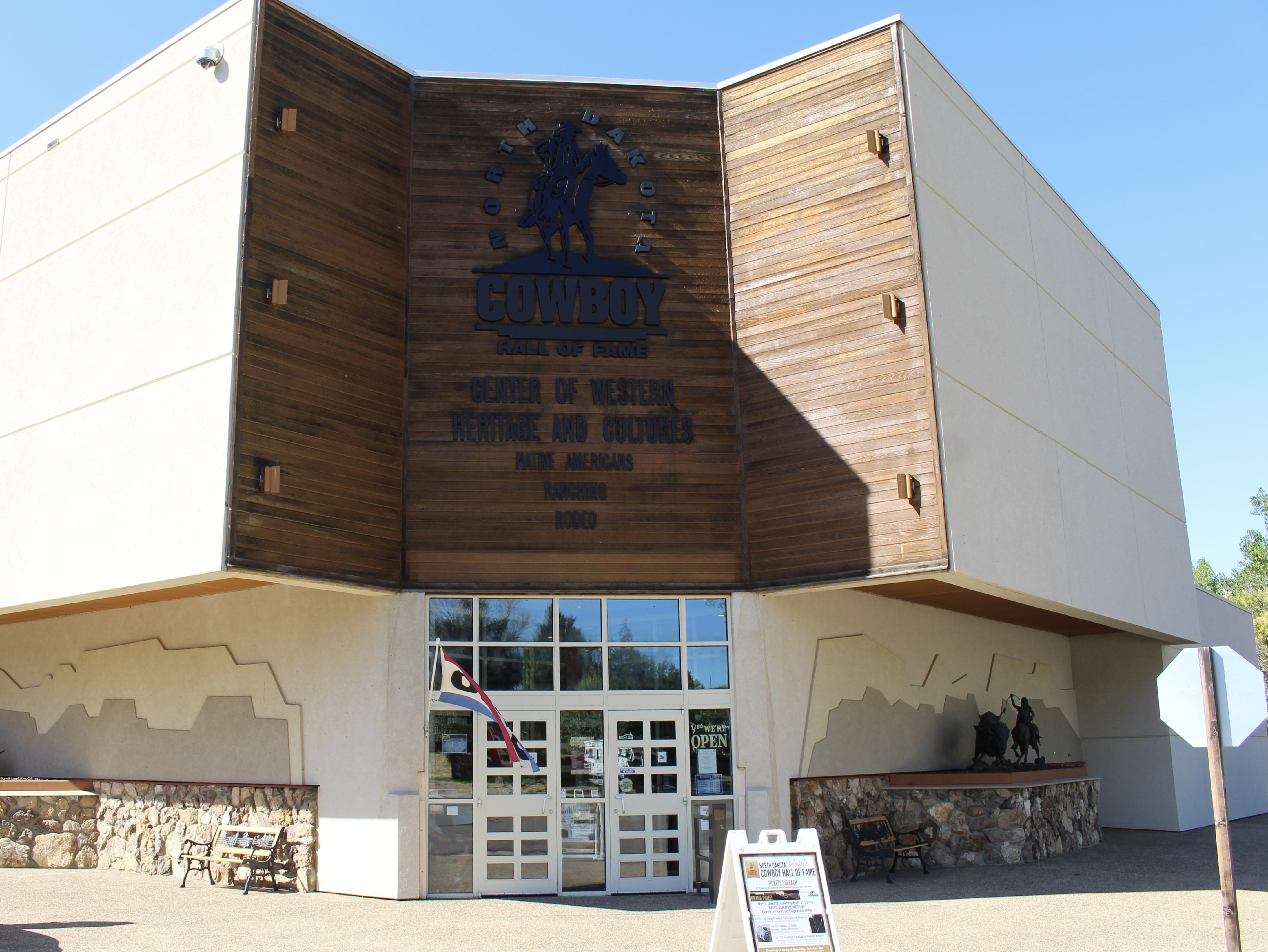
Taking a break from Theodore National Park, I went into Medora to the North Dakota Cowboy Hall of Fame.  The museum strives to preserve the history and promote the culture of North America’s Native American, ranching and rodeo communities by informing and educating people of all nations and cultures about the state’s rich and colorful Western heritage, according to its website.

I watched the film about the history of the cowboy, rodeos, horses, buffalo and wars.

fullsizeoutput_1f07c

North Dakota Cowboy Hall of Fame

fullsizeoutput_1f07d

North Dakota Cowboy Hall of Fame

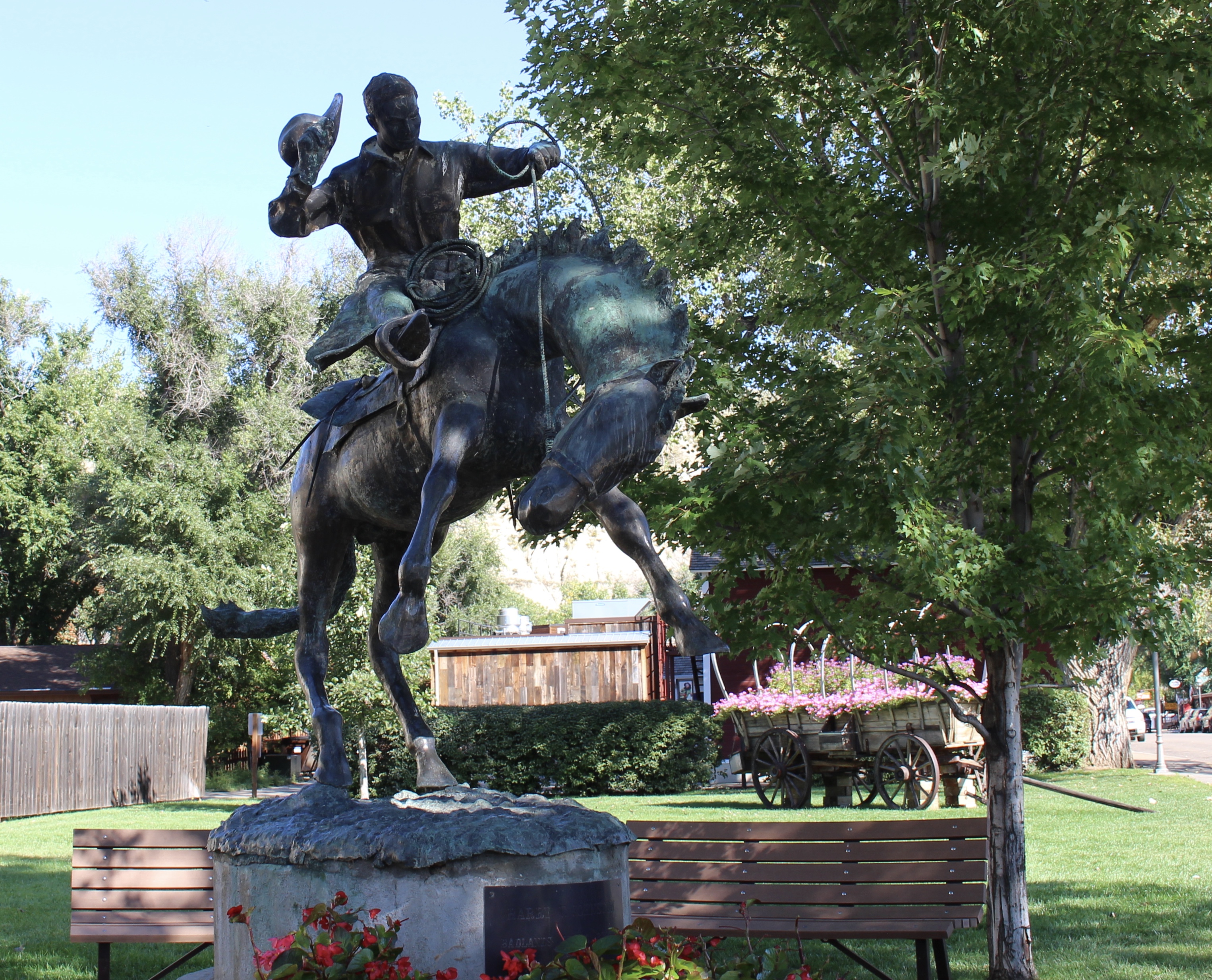
A rider in a rodeo begins his ride with his feet over the bronc’s shoulders, giving the horse the advantage. The point of the event is to stay on the horse for 8 seconds, until the buzzer sounds.  The rider is disqualified if he touches the animal, himself, or equipment with his free hand or if either foot slips out of the stirrup, if he drops the rein he is holding in one hand, or if he fails to have his feet in the proper position at the beginning of the ride. His score is derived from how good his riding style is: a rider who synchronizes his spurring action with the animal’s bucking will get a high score.  Judges also consider other factors: the cowboy’s control throughout the ride, the length of his spurring stroke, and how hard the horse bucks.

Other rodeo events include bareback riding and bull riding.  Bull riding is similar to the bareback event except that the bull is bigger and wider than a horse. As in all riding events, half the score is determined by the animal. Upper body control and strong legs are essential to riding bulls. The rider tries to remain forward, or “over his hand,” at all times. Leaning back could cause him to be whipped forward when the bull bucks.

North Dakota Cowboy Hall of Fame

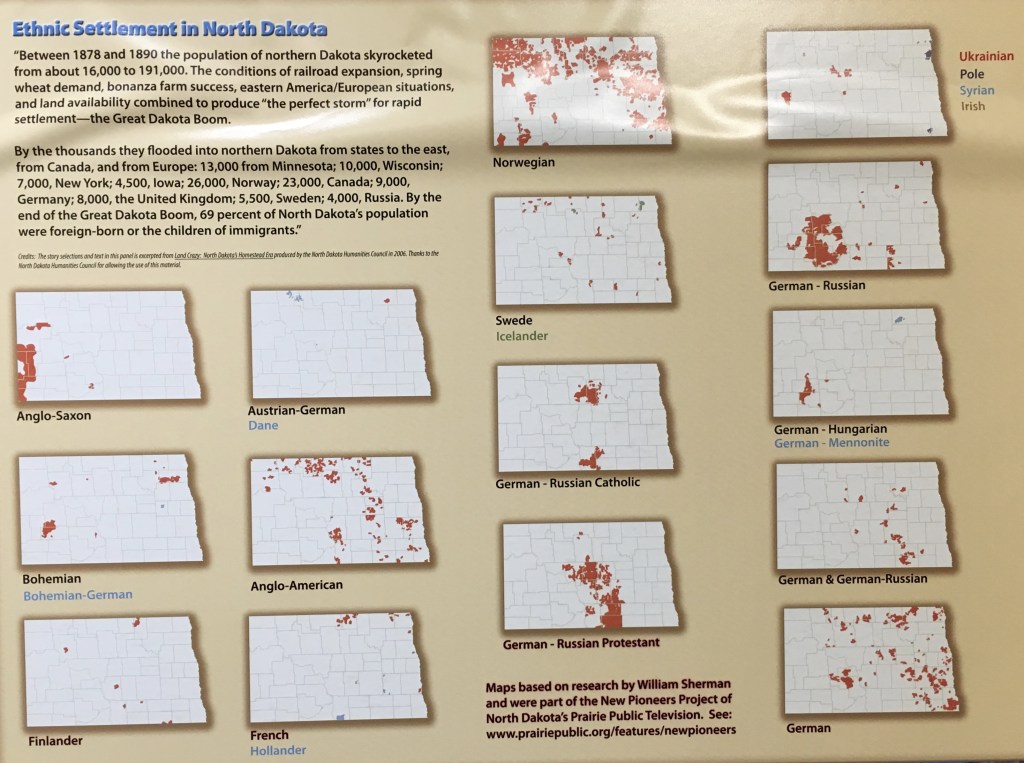
Between 1878 and 1890, the population of northern Dakota skyrocketed from about 16,000 to 191,000. The Great Dakota Boom was caused by railroad expansion, spring wheat demand, bonanza farm success, eastern America/European situations, and land availability.

Ethnic Settlement in North Dakota

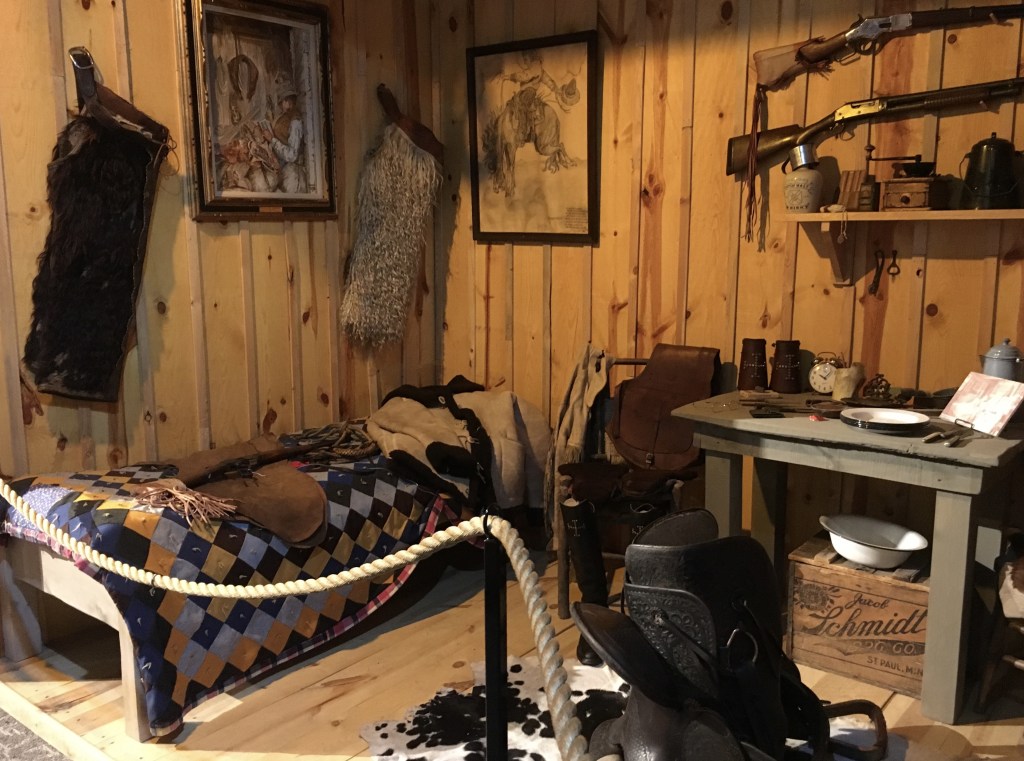
A line shack or settler’s shack had small living quarters with few comforts.  The Chaps, Cowboy Drawing, Antler Mount and Hat belonged to Bill McCarty who ranched in this area in the 1940s.

Line Shack

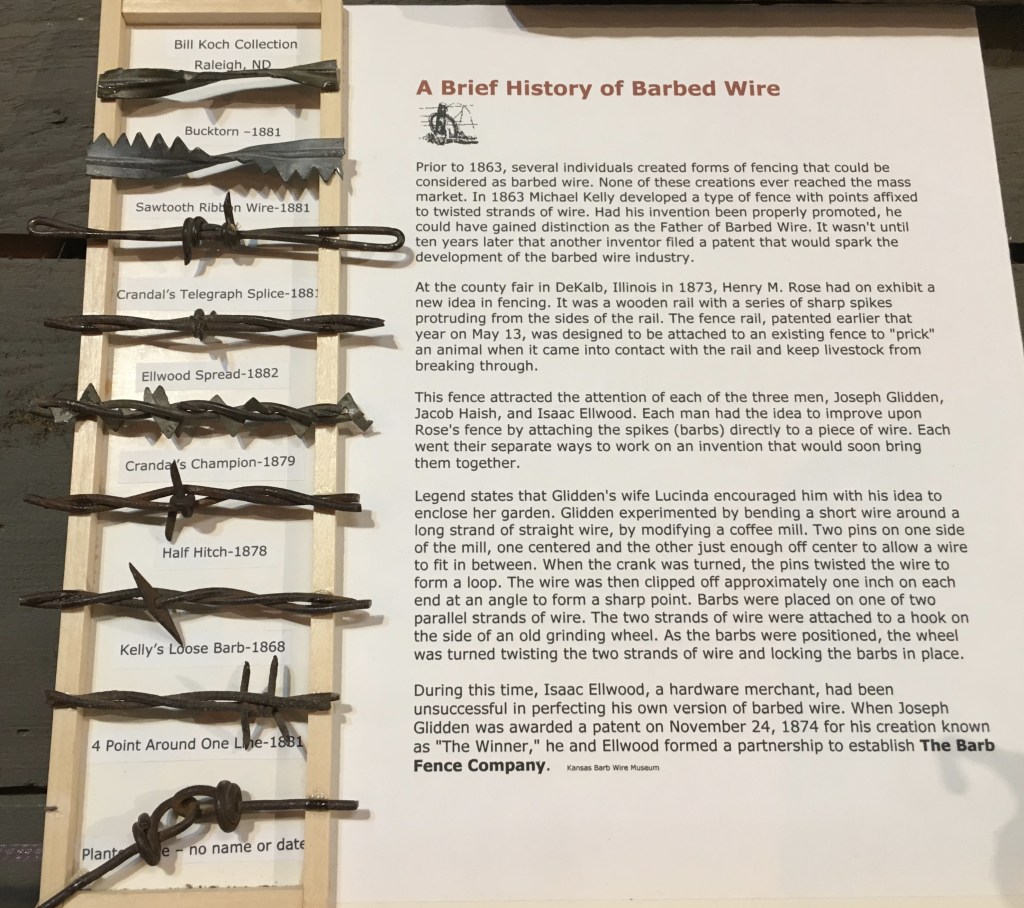
I found “A Brief History of Barbed Wire,” which told about how the fence rail was designed to be attached to an existing fence to “prick” an animal when it came into contract with the rail and keep livestock from breaking through. Others later improved upon the original fence by attaching the spikes (barbs) directly to a piece of wire.

“A Brief History of Barbed Wire”

“A Brief History of Barbed Wire”

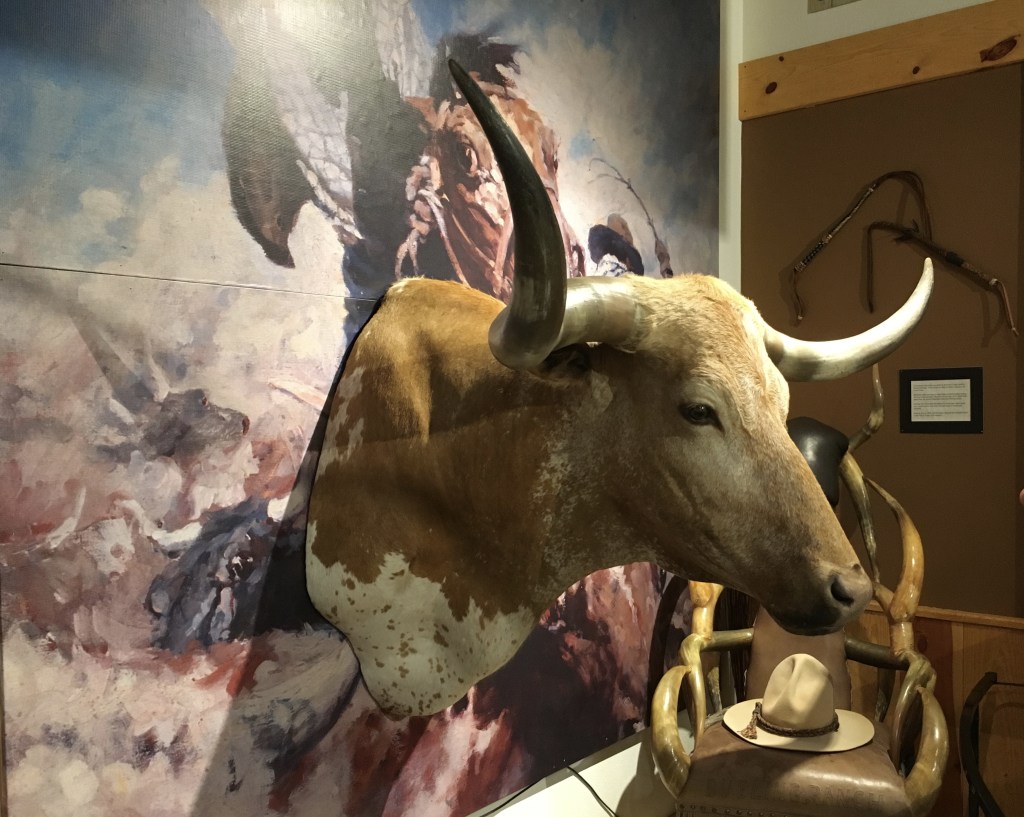
The Mighty Texas Longhorn mounted on the wall was one of 300 steers originating from Fort Worth, Texas, driven 1500 miles over a six-month period to Miles City, Montana in 1995.  Called the “Great American Cattle Drive” this journey sought to recreate the old west tradition.

Mighty Texas Longhorn

Tobacco pouches were carried by plains Indians.  Tobacco was a prized item used in ceremonial and religious events.  The pouches below were made of deer hide, porcupine quills dyed with natural pigments and sewn with sinew.  The pouches came from the Lakota, Chippewa, Hidatsa, and Arikara tribes.

Tobacco pouches

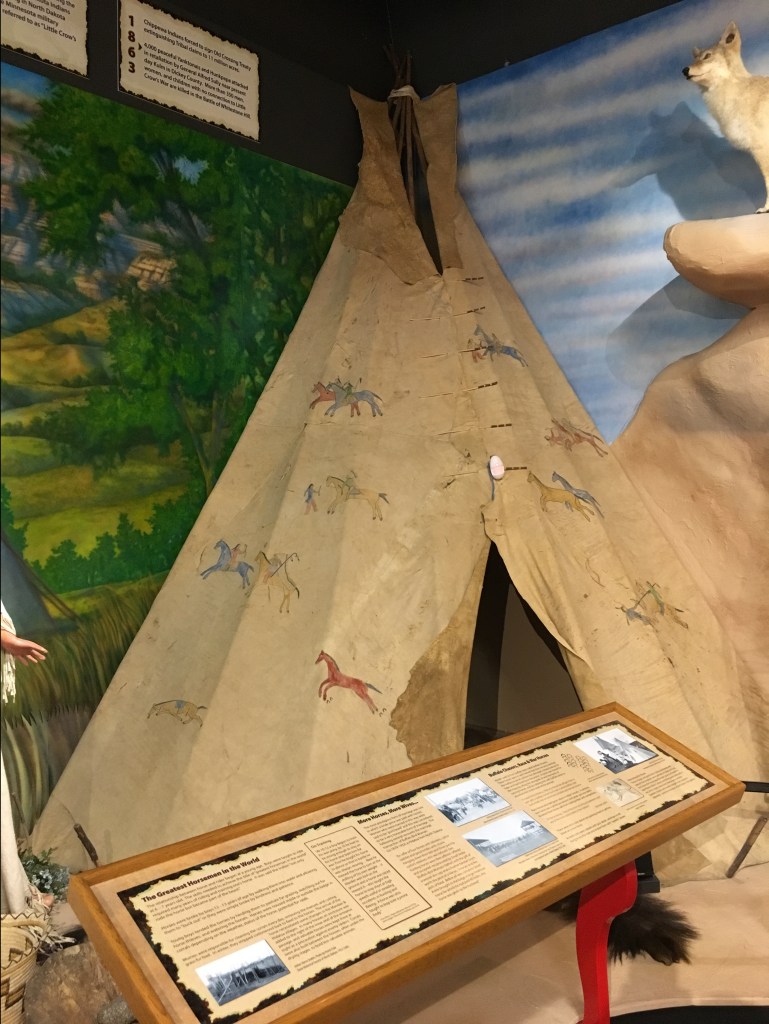
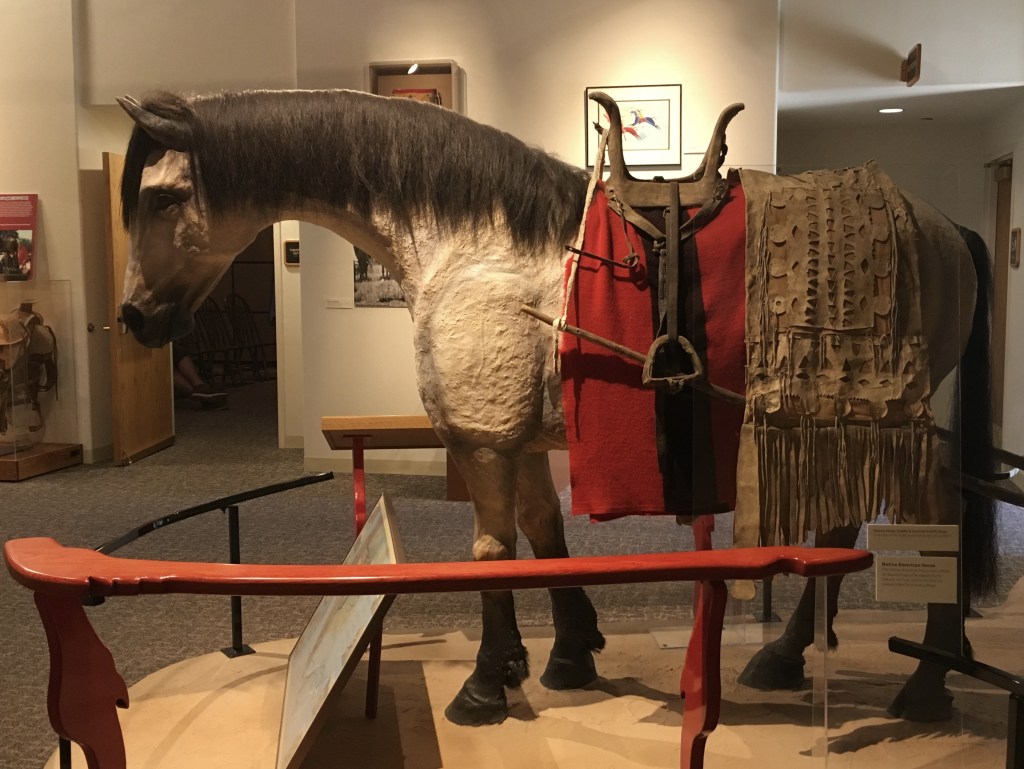
The most prestigious form of marriage was one in a which a bride-price was paid with horses.  Women who were married in this way were said to be “purchased” and this was considered to be a very honorable form of marriage.

More horses, more wives…

tipi

Horses used to hunt buffalo were called Buffalo Chasers.  These horses were so well trained that they not only watched the buffalo to avoid collision but also kept a sharp lookout for holes and bad footing on the prairie.  A horse was trained for the chase by riding him alongside of and into herds of running horses, and by rubbing him with buffalo robes to accustom him to the smell of the animals.  Race horses also had great value in Indian society.  A winning race horse was a prized possession and great care was taken to keep these horses safe from raiding tribes and competitors.

race horses and buffalo chasers

racehorses and buffalo chasers

Before leaving, I admired the paintings at the North Dakota Cowboy Hall of Fame.

North Dakota Cowboy Hall of Fame

After venturing back into the park and visiting the Painted Canyon Nature Trail, I returned to Medora to have dinner at the Little Missouri Saloon.  I had a Polish waitress again who told me she and her friends were participating in some kind of work program. I had Fish & Chips and Pinot Grigio.

Little Missouri Saloon
fish and chips
fish and chips

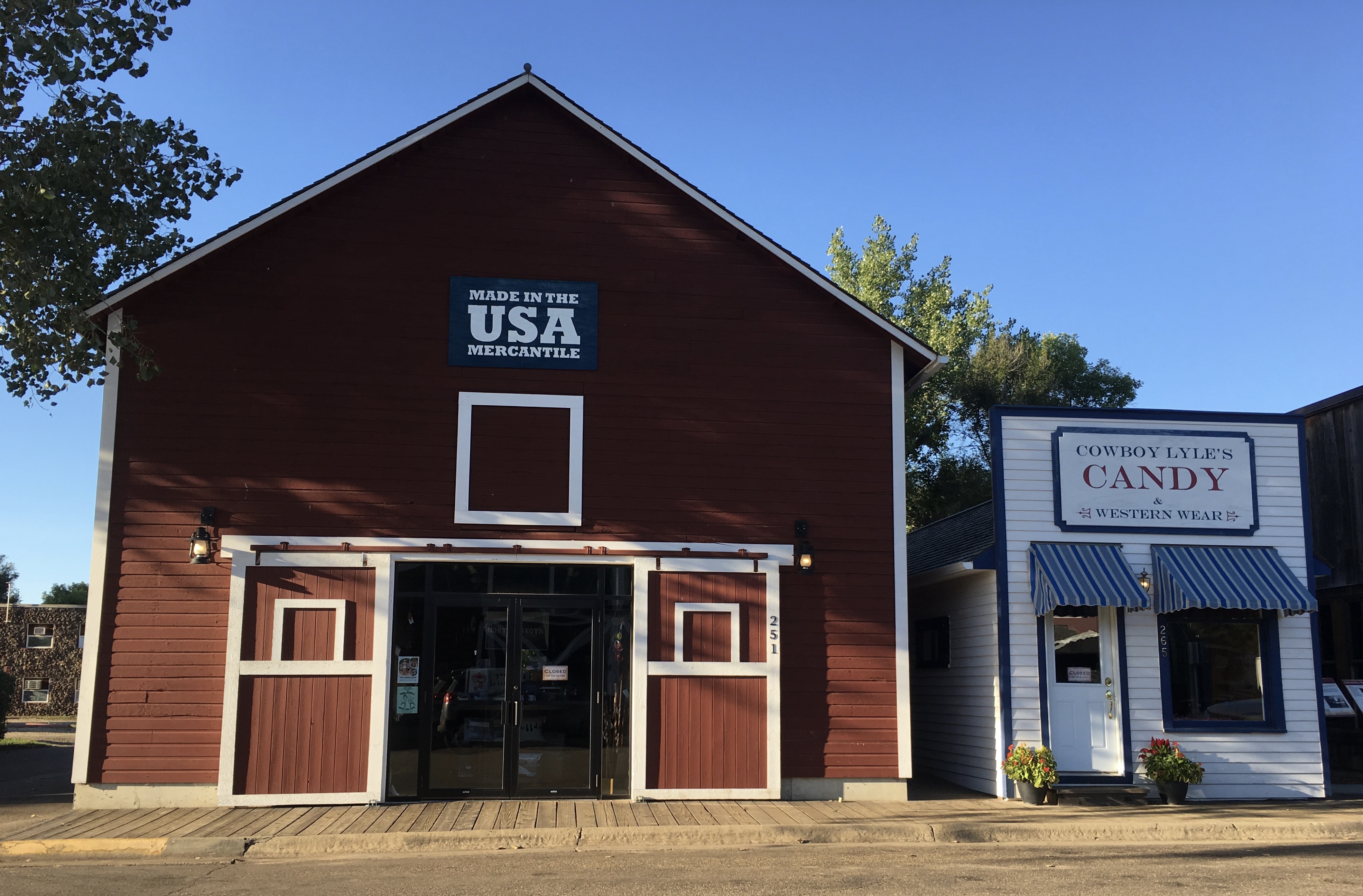
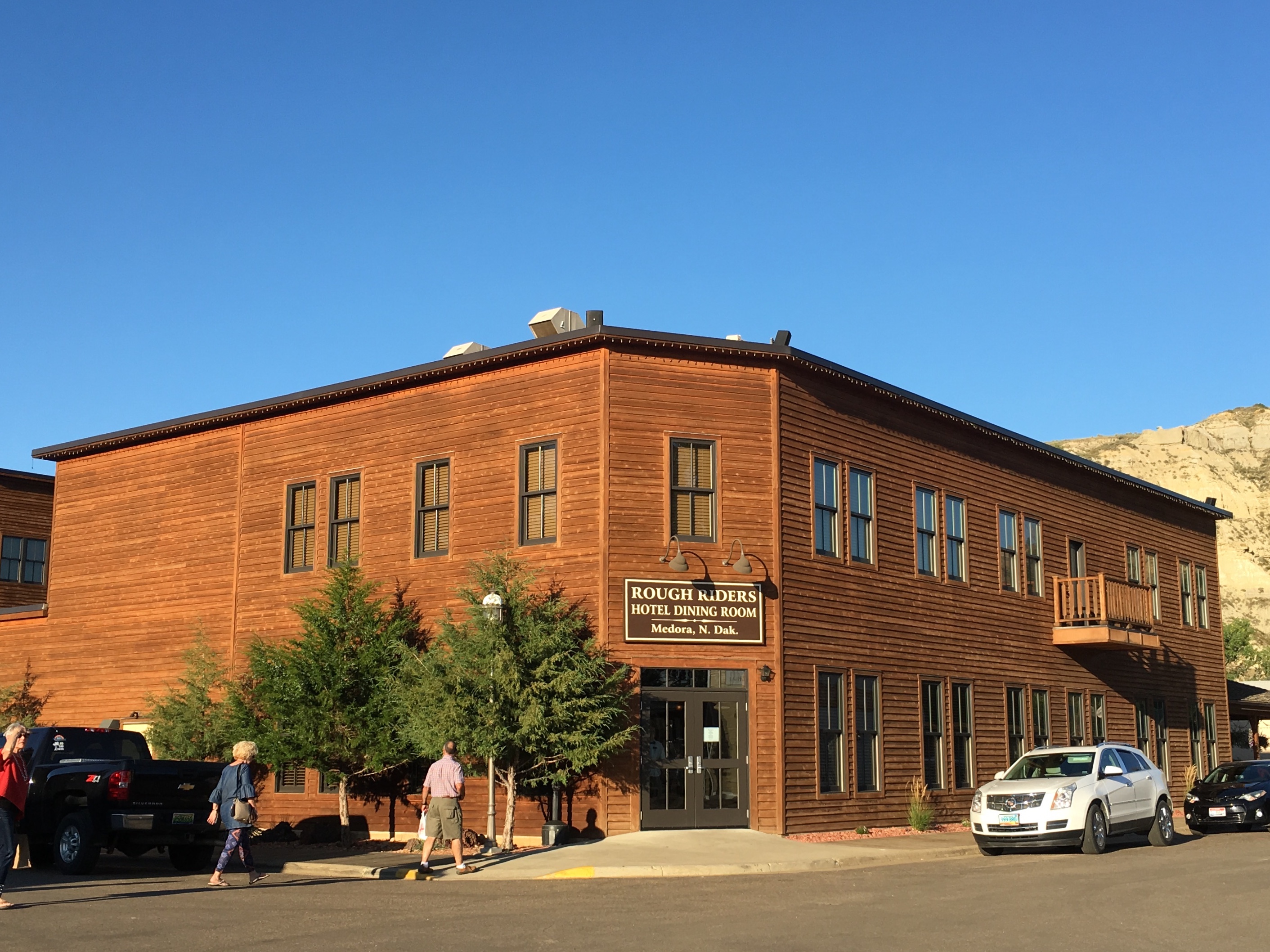
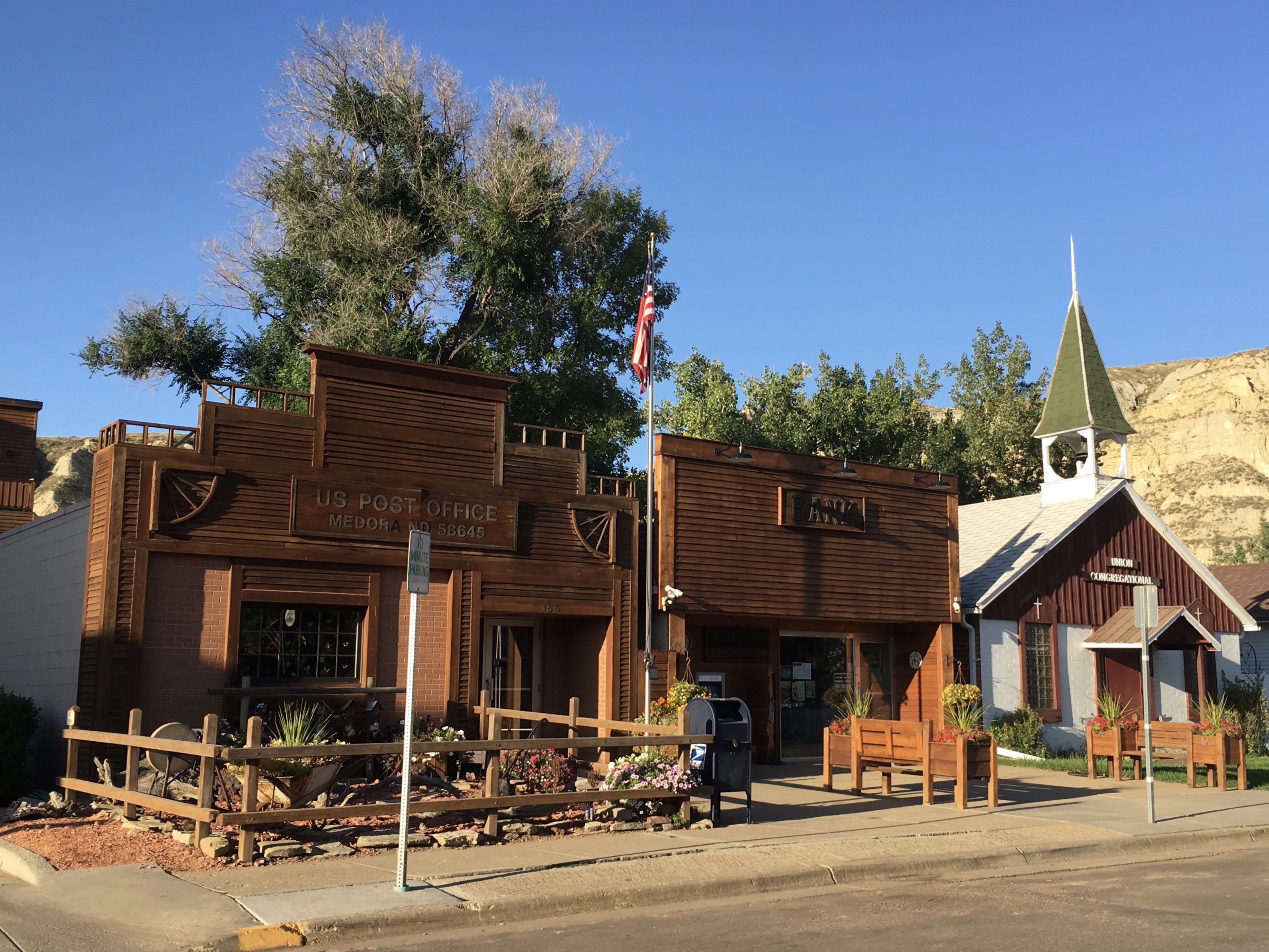
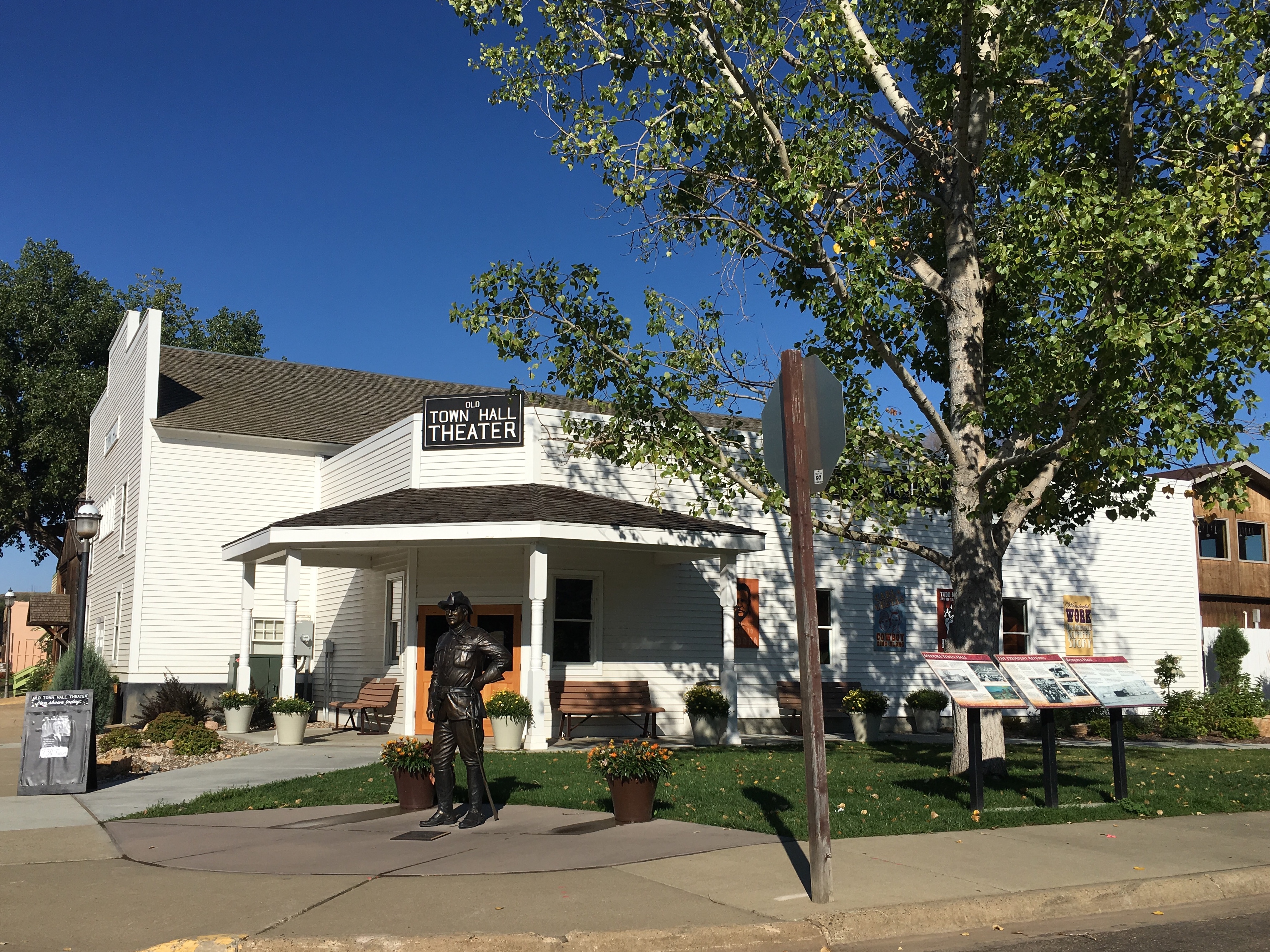
Then I strolled around the town of Medora.  Some of the pictures I took the next morning on my way out of town.

fullsizeoutput_1f0b8

Medora

fullsizeoutput_1a454

Medora

IMG_1762

Medora

fullsizeoutput_1f0ba

Medora

fullsizeoutput_1f0c3

Medora

fullsizeoutput_1a44f

Medora

fullsizeoutput_1f0c1

Medora

*Sunday, September 15, 2019*

Share this:

  • Share on X (Opens in new window) X
  • Share on Facebook (Opens in new window) Facebook
  • More
  • Email a link to a friend (Opens in new window) Email
  • Print (Opens in new window) Print
  • Share on Pinterest (Opens in new window) Pinterest
Like Loading...
  • American Road Trips
  • Hikes & Walks
  • Medora

theodore roosevelt national park (south unit)

wanderessence1025's avatar wanderessence1025 October 18, 2020

After a breakfast of pancakes and eggs, I went to Theodore Roosevelt National Park – South Unit Visitor Center, where I got my passport cancellation stamp and watched the film about Theodore Roosevelt and his time in the Badlands. On the same day in the same house on February 14, 1884, he lost his wife Alice (22) in childbirth and his mother (50) to typhus.  In his diary on that day he wrote one line:

“The light has gone out of my life.”

X

His first ranch was the Maltese Cross in 1883 and his second was The Elkhorn in 1884.

One stretch of road in the park was closed off, so it was a 24-mile out-and-back scenic drive.  I was determined to drive to the end and work my way back.

I first stopped at Medora Overlook.

IMG_1521

Medora Overlook

IMG_1522

Medora Overlook

I had to keep pulling over to see the Prairie Dog Towns. I loved watching them scurrying about in the fields and popping in and out of their holes.

Prairie Dog Towns
Prairie Dog Towns
Prairie Dog Towns
Prairie Dog Towns
Prairie Dog Towns
Prairie Dog Towns
Prairie Dog Towns
Prairie Dog Towns
horse on the road
horse on the road
Prairie Dog Towns
Prairie Dog Towns
Do Not Feed the Prairie Dogs

I drove most of the way, stopping briefly here and there to the Badlands Overlook, where I had to turn around.

fullsizeoutput_1f069

Badlands Overlook

IMG_1557

Badlands Overlook

I was lucky to see a couple of bison near the road.

fullsizeoutput_1f06e

bison at Theodore Roosevelt National Park

bison
bison
bison
bison
bison
bison
bison
bison

I finally changed the time on my camera from 12:30 to 11:30. It was so confusing going back and forth between Central and Mountain Time.

At Buck Hill, I ate a sandwich in the car and climbed up a short steep trail.  A path went off to infinity, and I followed it as far as I felt like without having brought any water along.  I also walked up a hill on the opposite side for views in another direction.  Buck Hill was 0.2 miles round trip (my hike was longer).  It was the highest accessible place in the park.

Buck Hill
Buck Hill
Buck Hill
Buck Hill
Buck Hill
Buck Hill
Buck Hill
Buck Hill
Buck Hill
Buck Hill
Buck Hill
Buck Hill
Buck Hill
Buck Hill
Buck Hill
Buck Hill
Buck Hill
Buck Hill
Buck Hill
Buck Hill
Buck Hill
Buck Hill
Buck Hill
Buck Hill
Buck Hill
Buck Hill
Buck Hill
Buck Hill
Buck Hill
Buck Hill
Buck Hill
Buck Hill
Buck Hill
Buck Hill

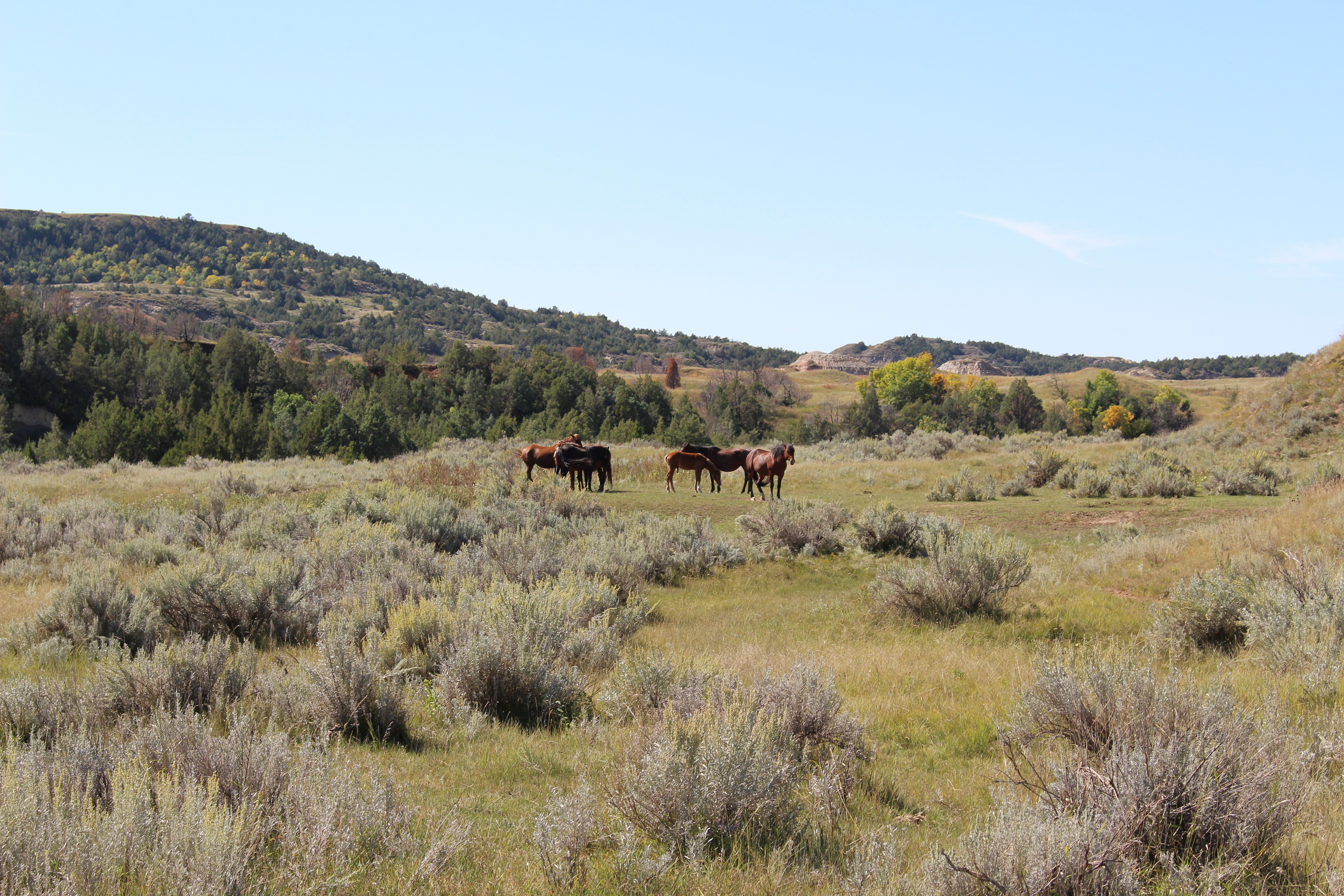
I saw some horses in a field alongside the road on the way to Boicourt Overlook.

IMG_0734

horses on the way to Boicourt Overlook

IMG_0793

horses on the way to Boicourt Overlook

IMG_0794

I then walked on the Boicourt Trail (0.3 miles round trip).  A gentle gravel path led to a viewing area that looked across the park to the south. The park looked green and lively from this southern-facing vantage point.  I stopped at Boicourt Overlook too.

Boicourt Trail
Boicourt Trail
Boicourt Trail
Boicourt Trail
Boicourt Trail
Boicourt Trail
Boicourt Trail
Boicourt Trail
Boicourt Trail
Boicourt Trail
Boicourt Trail
Boicourt Trail
Boicourt Trail
Boicourt Trail
Boicourt Trail
Boicourt Trail
Boicourt Trail
Boicourt Trail
Boicourt Trail
Boicourt Trail
Boicourt Trail
Boicourt Trail
Boicourt Trail
Boicourt Trail
Boicourt Trail
Boicourt Trail
Boicourt Trail
Boicourt Trail
Boicourt Trail
Boicourt Trail
Boicourt Trail
Boicourt Trail
Boicourt Trail
Boicourt Trail
Boicourt Trail
Boicourt Trail
Boicourt Trail
Boicourt Trail
Boicourt Trail
Boicourt Trail
Boicourt Trail
Boicourt Trail
Boicourt Trail
Boicourt Trail
Boicourt Trail
Boicourt Trail

I stopped at the Peaceful Valley Ranch and enjoyed views of the surrounding area. This complex spans the successive eras of the area’s recent history.  It was a ranch in the late 1800s, dude ranch in the 1920s, headquarters of the CCC and WPA in the 1930s, park headquarters in the 1950s and 60s, and facility for guided horseback rides until 2014.

IMG_1662

Peaceful Valley Ranch

fullsizeoutput_1f096

Peaceful Valley Ranch

IMG_0817

surrounds at Peaceful Valley Ranch

IMG_0820

surrounds at Peaceful Valley Ranch

IMG_1666

surrounds at Peaceful Valley Ranch

IMG_1669

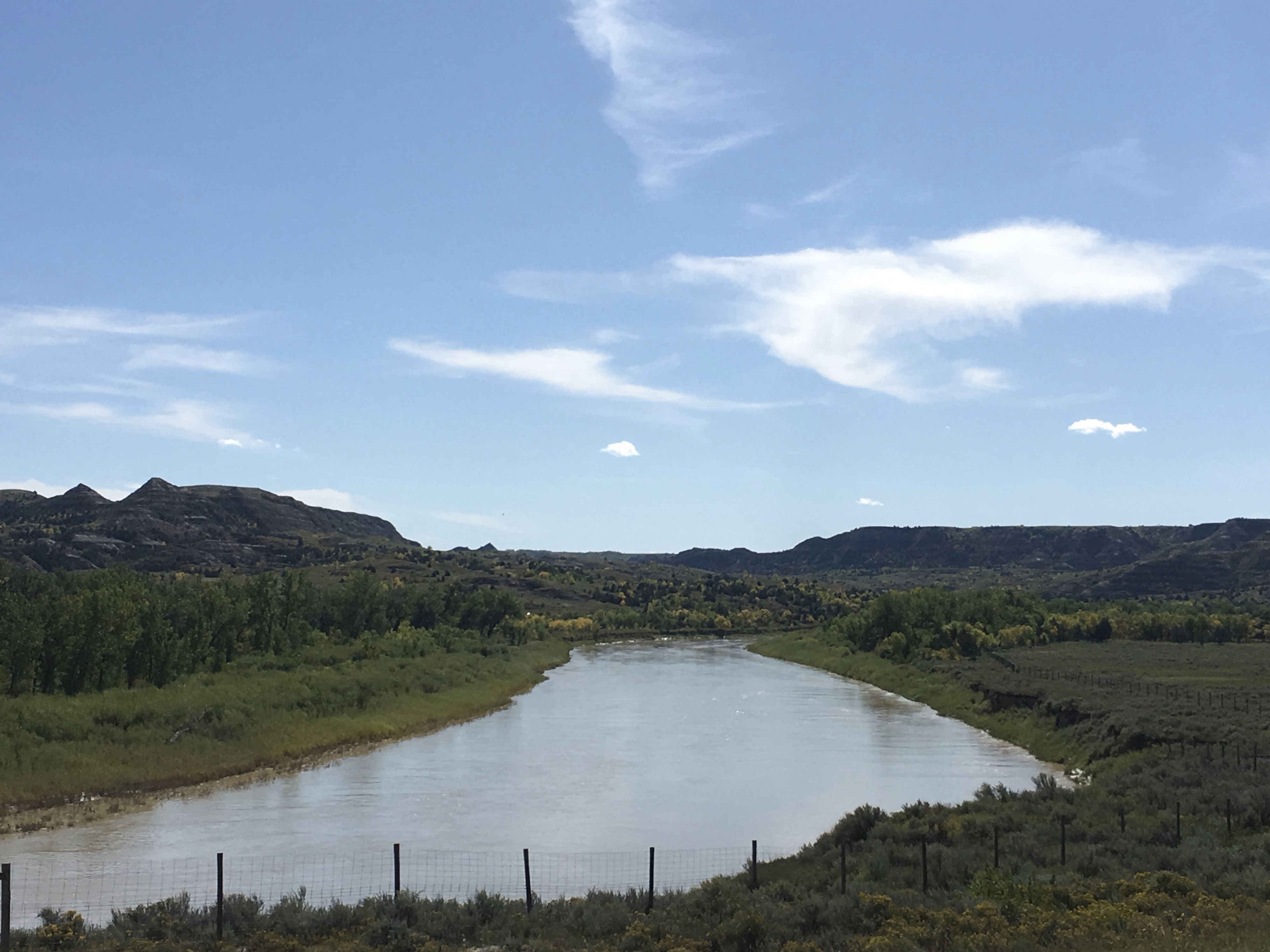
My next stop was Skyline Vista, a 0.2 mile round trip.  A short paved path led to a viewing area overlooking the Little Missouri River.

IMG_1672

Skyline Vista

IMG_1674

Today, I met clacking flying bugs, bison and horses, along with numerous prairie dog towns and yellow cottonwoods.

I took a break to stop at the Visitor Center because I hadn’t yet looked at the museum.  It was all about Teddy Roosevelt.  Then I went into Medora to the North Dakota Cowboy Hall of Fame. Another post will follow with this visit.

I went to the Painted Canyon Visitor Center and The Painted Canyon Nature Trail. From here,  I could explore the Badlands from top to bottom and back up again.  It covered interesting geology and good views splashed with yellow cottonwoods.

fullsizeoutput_1f0bd

Wildlife Petting Chart at the Painted Canyon Visitor Center

The Painted Canyon Nature Trail

After eating dinner and exploring Medora, I went back into the park at 5:45 for 11 miles.  A little deer with rounded ears bounded across the road.  I walked up the Wind Canyon Trail (0.4 mile loop). The short trail followed a cliff edge overlooking the Little Missouri River.  It is a favorite place for photographers at sunset.  I had to leave before sunset because nature and a tree were calling my name.

IMG_0908

Wind Canyon Trail

IMG_0910

Wind Canyon Trail

IMG_0911

Wind Canyon Trail

fullsizeoutput_1a457

Wind Canyon Trail

fullsizeoutput_1f0bf

Wind Canyon Trail

fullsizeoutput_1a44d

Wind Canyon Trail

Wind Canyon Trail
Wind Canyon Trail
Wind Canyon Trail
Wind Canyon Trail

I was utterly exhausted today because I had woken up at 4:00 a.m. and never went back to sleep, although I had planned to sleep in. It was so nice to stay in one place for two nights, although I never hung around my room until 7:00 p.m.

Back at the homefront, Mike and our son went on a leisurely bike ride exploring roads from Penderbrook and around.  Our son was agitated because he’d tried to get his friend M.J. to go to Riverbend Park to find pawpaws, but M.J. had never answered, and when he did call he said he’d been watching a soccer game with friends.  He went with Mike to Barbara’s with take out.

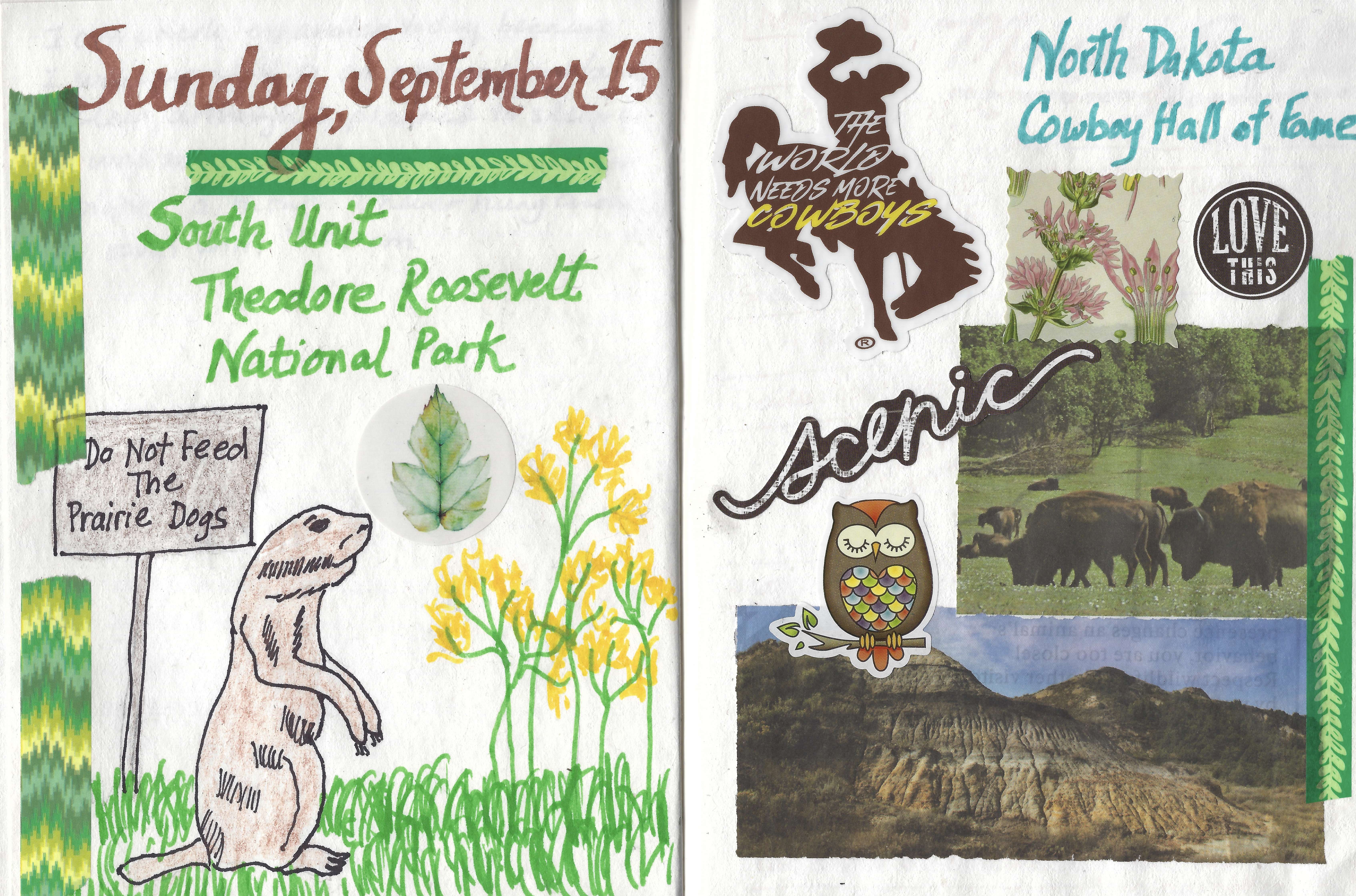
Below is the journal spread from this day.

fullsizeoutput_1e78f

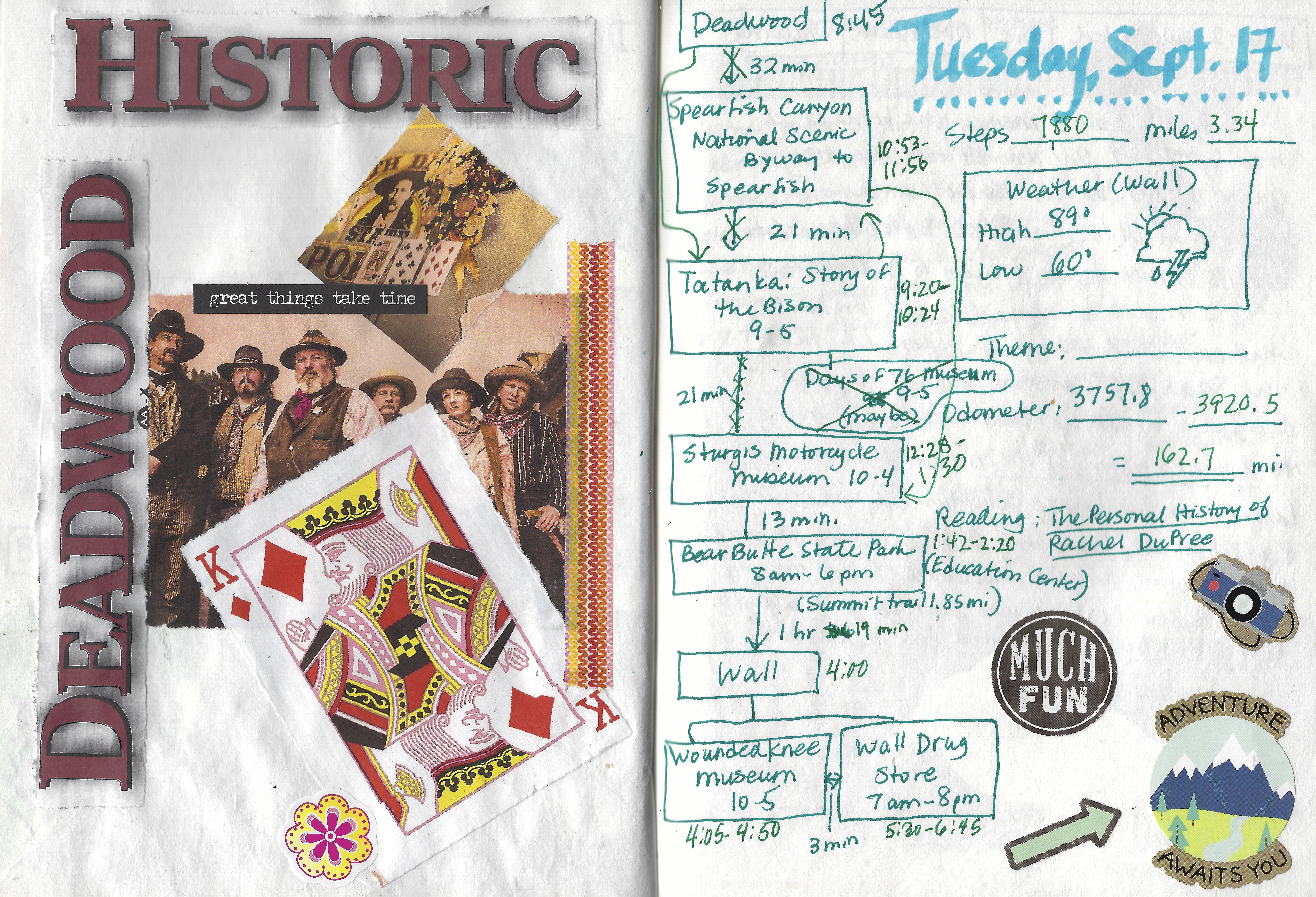
journal spread for September 15, 2019

*Drove: 89.9 miles; Steps: 14,931, or 6.33 miles*

*Sunday, September 15, 2019*

Share this:

  • Share on X (Opens in new window) X
  • Share on Facebook (Opens in new window) Facebook
  • More
  • Email a link to a friend (Opens in new window) Email
  • Print (Opens in new window) Print
  • Share on Pinterest (Opens in new window) Pinterest
Like Loading...
  • American Road Trips
  • Medora
  • North Dakota

theodore roosevelt national park (north unit)

wanderessence1025's avatar wanderessence1025 October 15, 2020

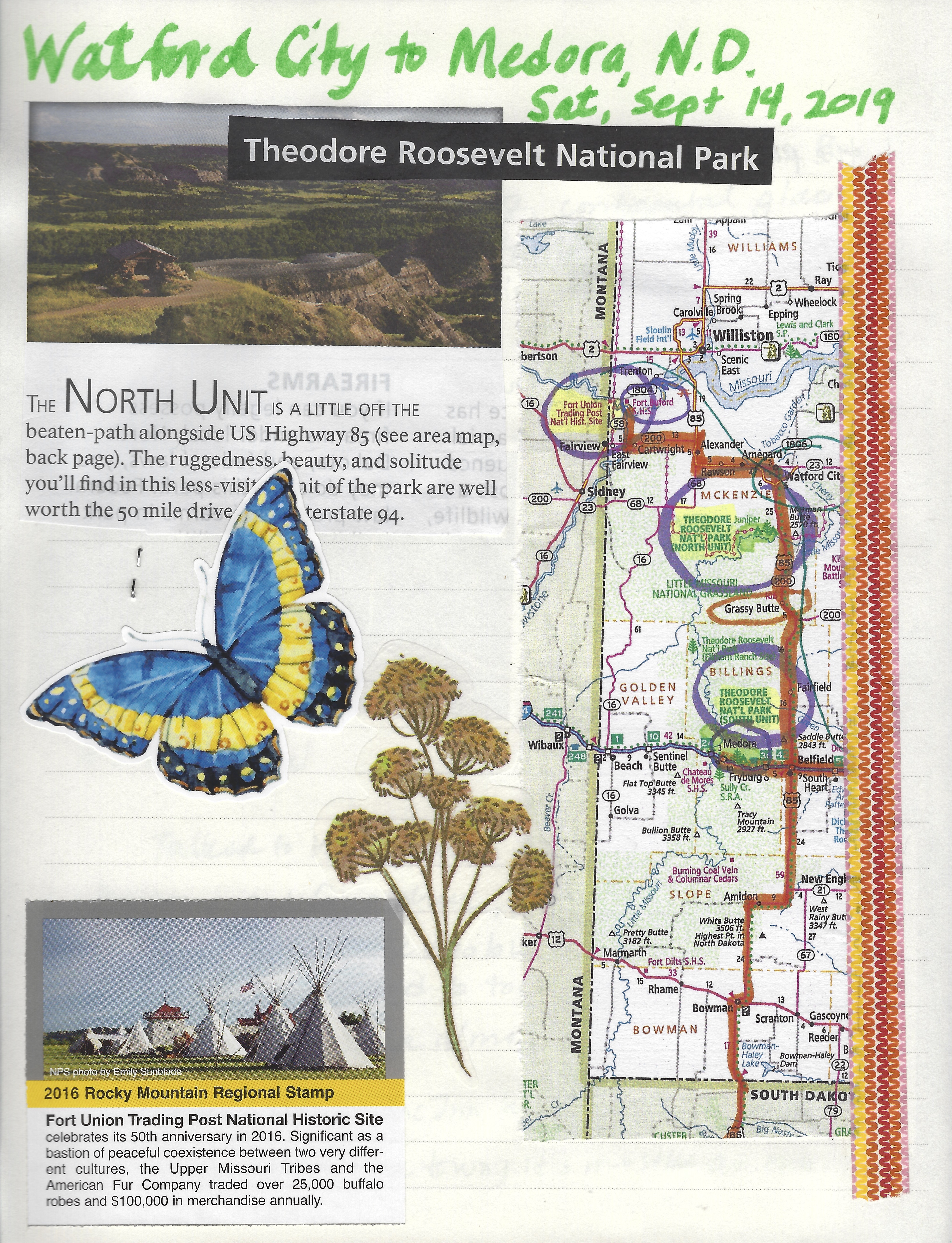
After leaving Fort Union Trading Post, I arrived at the North Unit of Theodore Roosevelt National Park at about 1:30 p.m.  The park memorializes our 26th president and his conservation legacy.

Theodore Roosevelt first came to the Dakota Territory in 1883 to hunt bison and to invest in a local cattle operation known as the Maltese Cross Ranch, south of Medora.  After both his mother and wife died on Valentine’s Day of the following year, he returned to immerse himself in the vast otherworldly landscape. He started a second ranch, the Elkhorn, and in this strange land, he found healing, solitude, adventure, and purpose. Though his ranch ultimately failed, his love for the rugged beauty of the land beckoned him to return time and again throughout his life.

Roosevelt credited his Dakota experience for his ground-breaking preservation efforts and the shaping of his own character. As president from 1901-09, he translated his love of nature into law. He established the U.S. Forest Service and signed the 1906 Antiquities Act, under which he proclaimed 18 national monuments.  He worked with Congress to create five national parks, 150 national forests, and dozens of federal reserves – over 230 million acres of protected land.

Theodore Roosevelt National Park was established in 1947 as a national memorial park to honor President Roosevelt and to provide a place for visitors to experience his beloved Badlands.

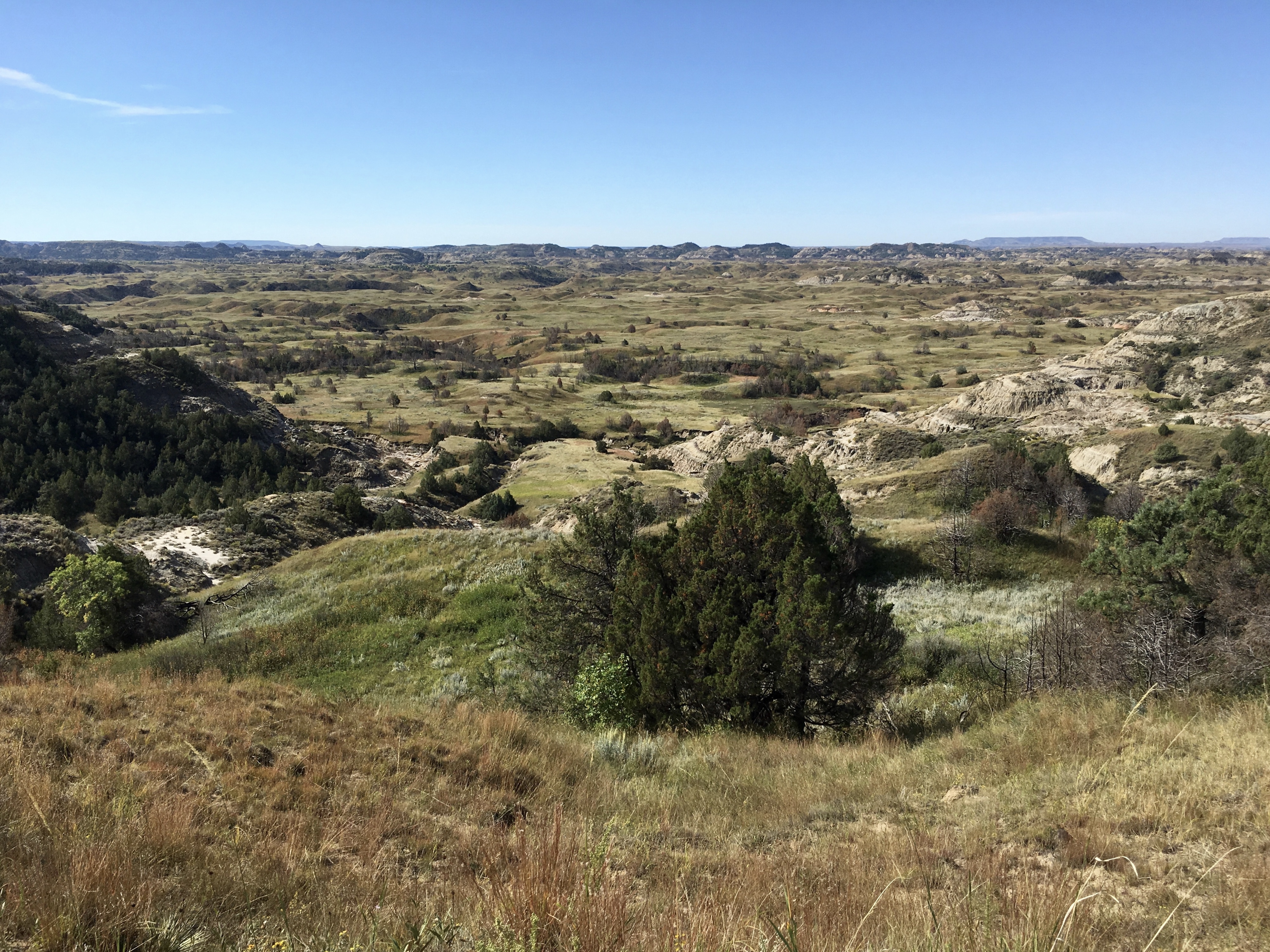
The park is comprised of the North Unit, South Unit and the Elkhorn Ranch Site, site of Roosevelt’s home ranch.  The 70,000 acre park offers colorful vistas and opportunities to view wildlife in the North Dakota badlands.

fullsizeoutput_1eeee

Theodore Roosevelt National Park

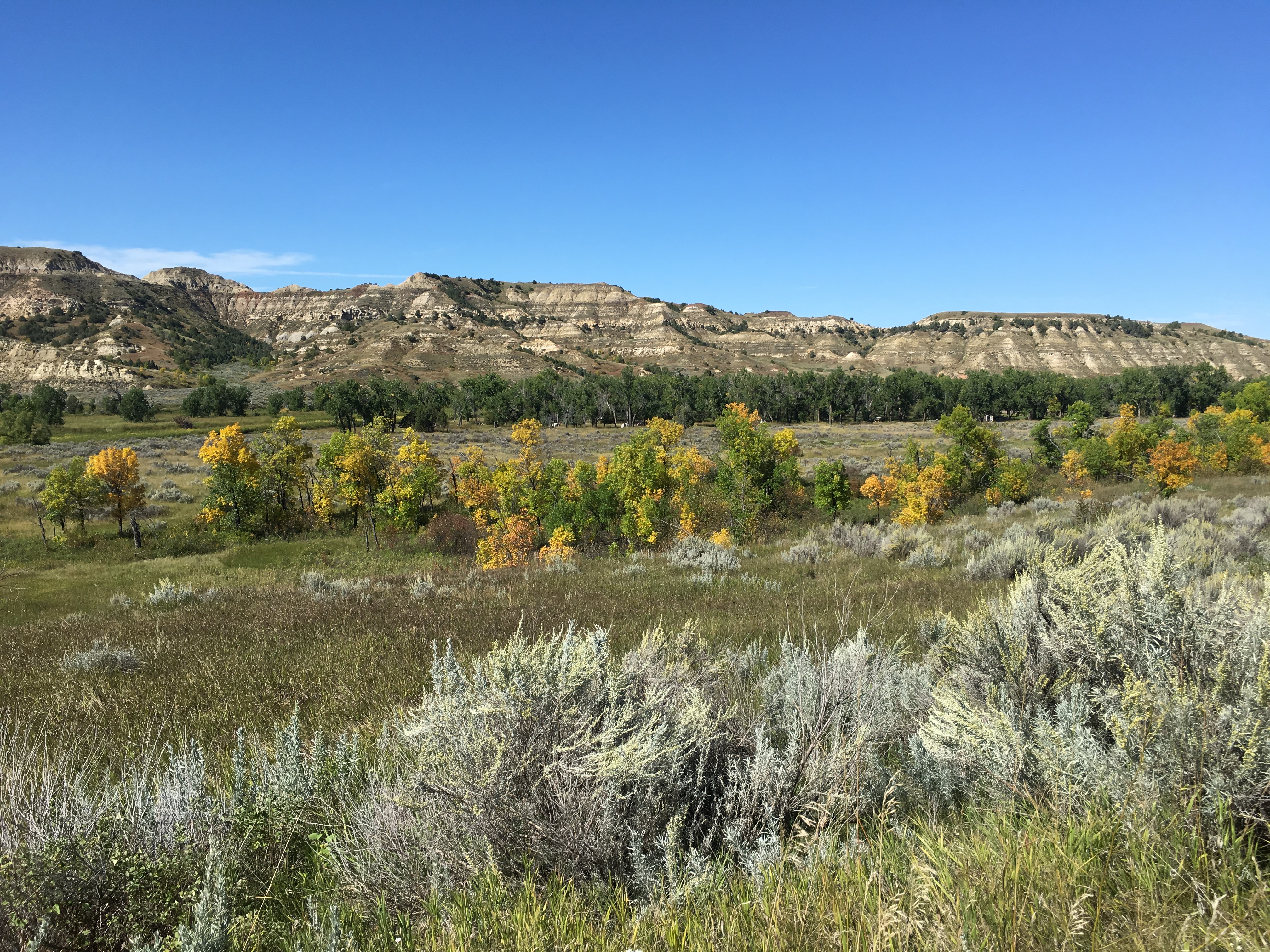
I drove the 14-mile scenic drive (28 miles round trip), stopping at all the overlooks. The drive goes through the badlands and meanders past River Bend Overlook.

Long ago, the Little Missouri River was flowing along a steep cliff face, on the left in the photos below.  The moving water cut into the base of the cliff, leaving a large mass of rock unsupported. The unsupported rock mass gave way, sliding down intact and rotating as it came to rest in the river channel.  As the river’s course shifted slowly across the valley, rain water eroded the cliff face which widened the gap between the cliff and the slump block, which is the hump to the right.

Theodore Roosevelt National Park

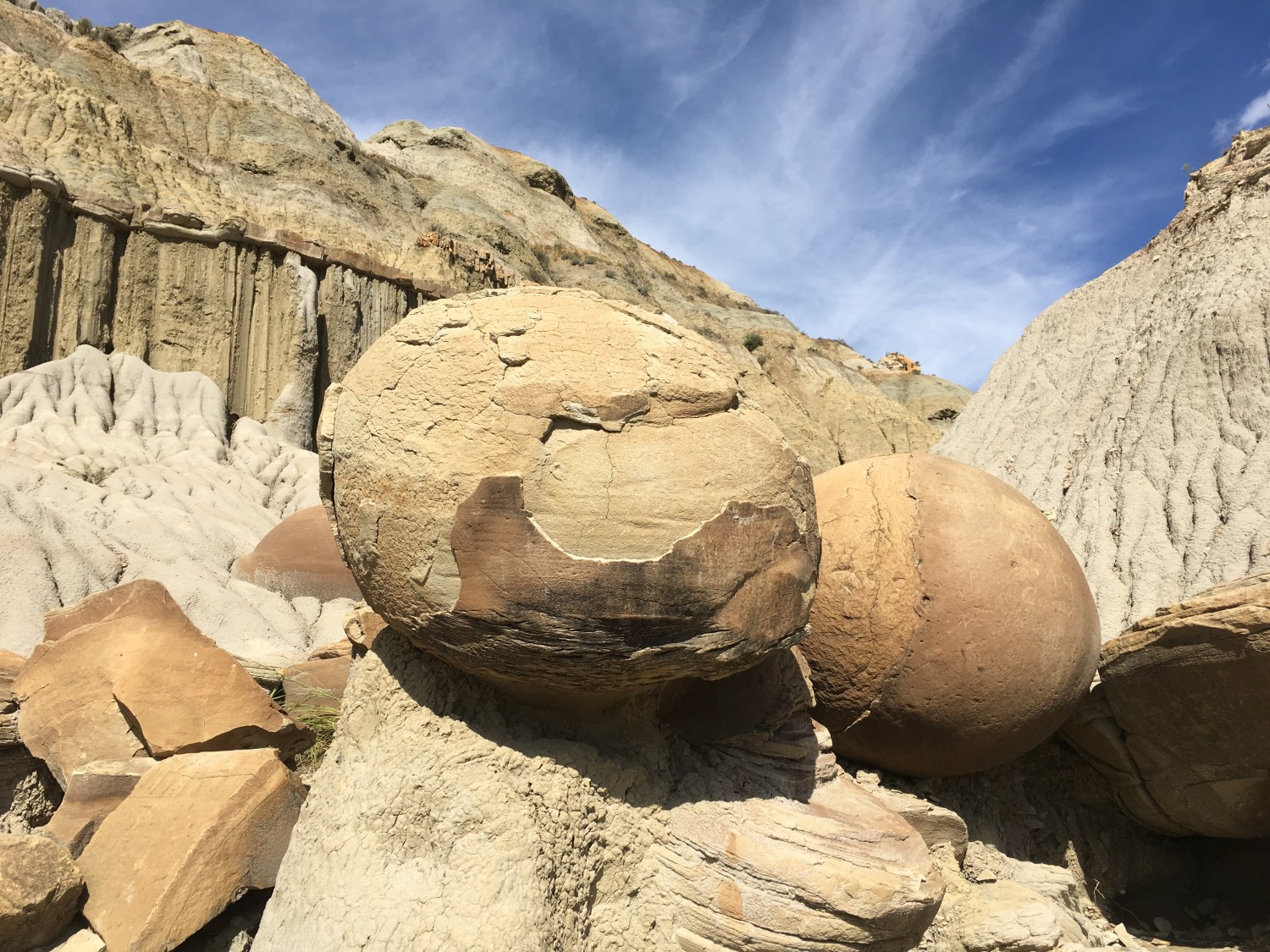
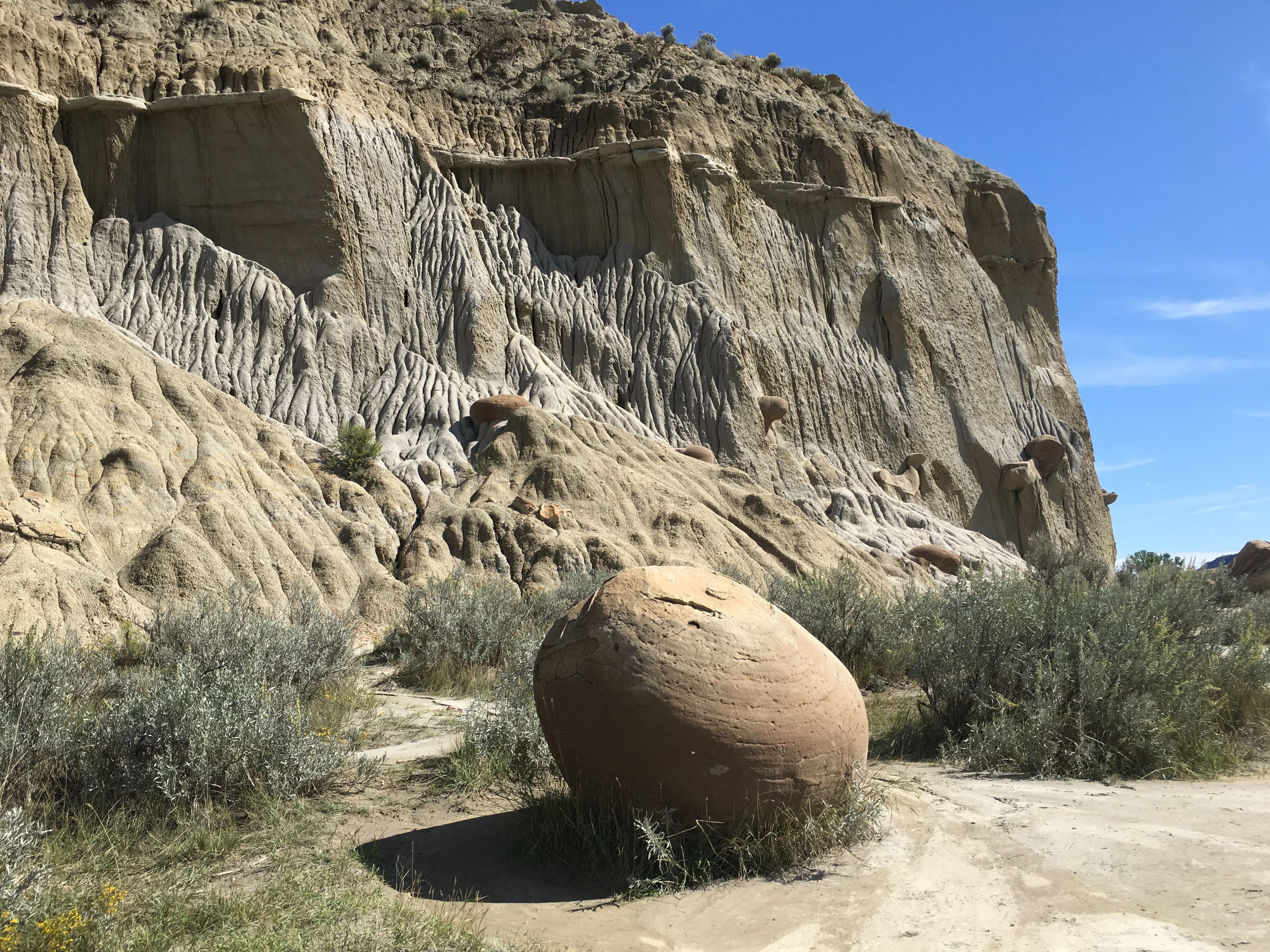
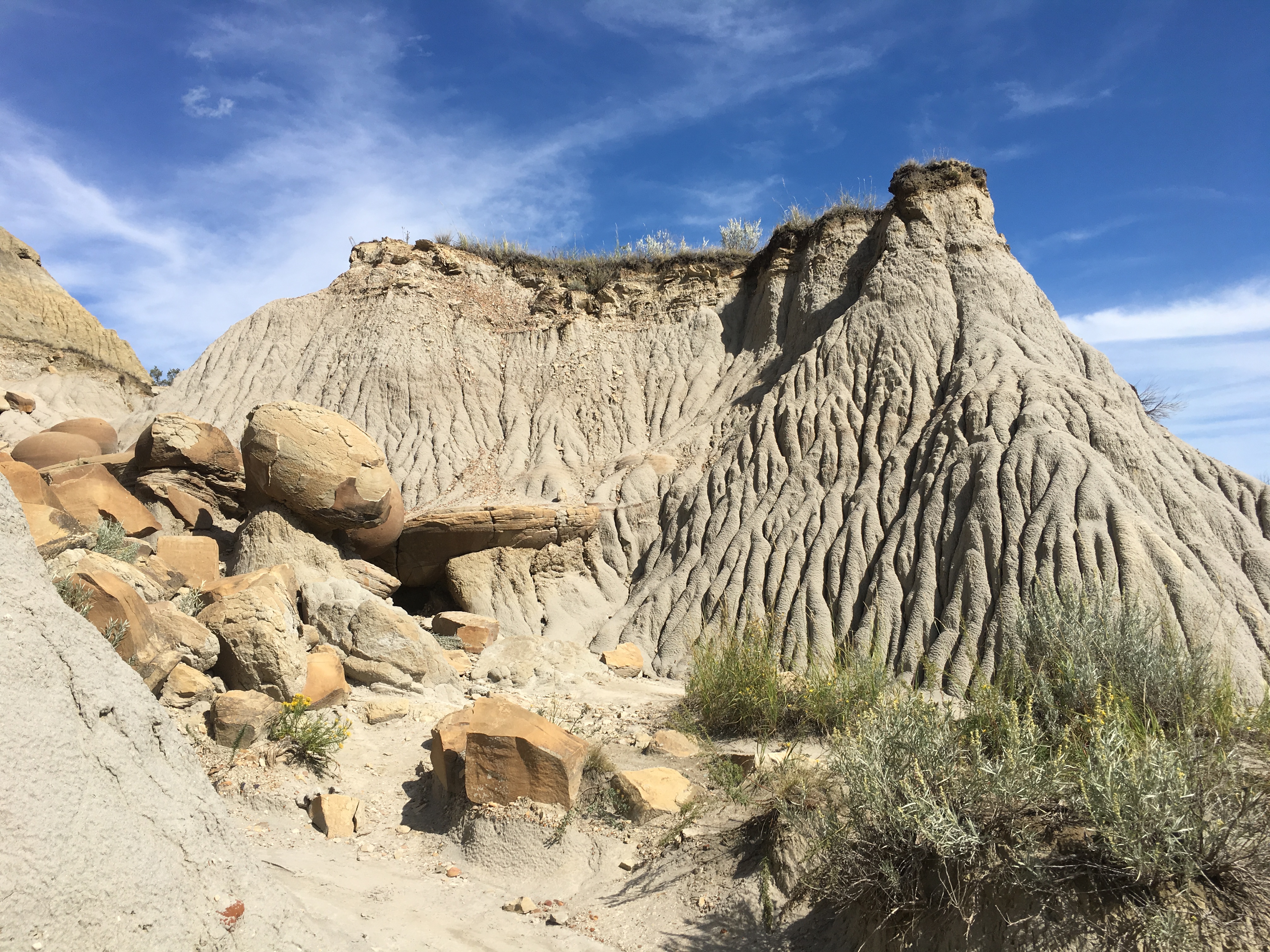
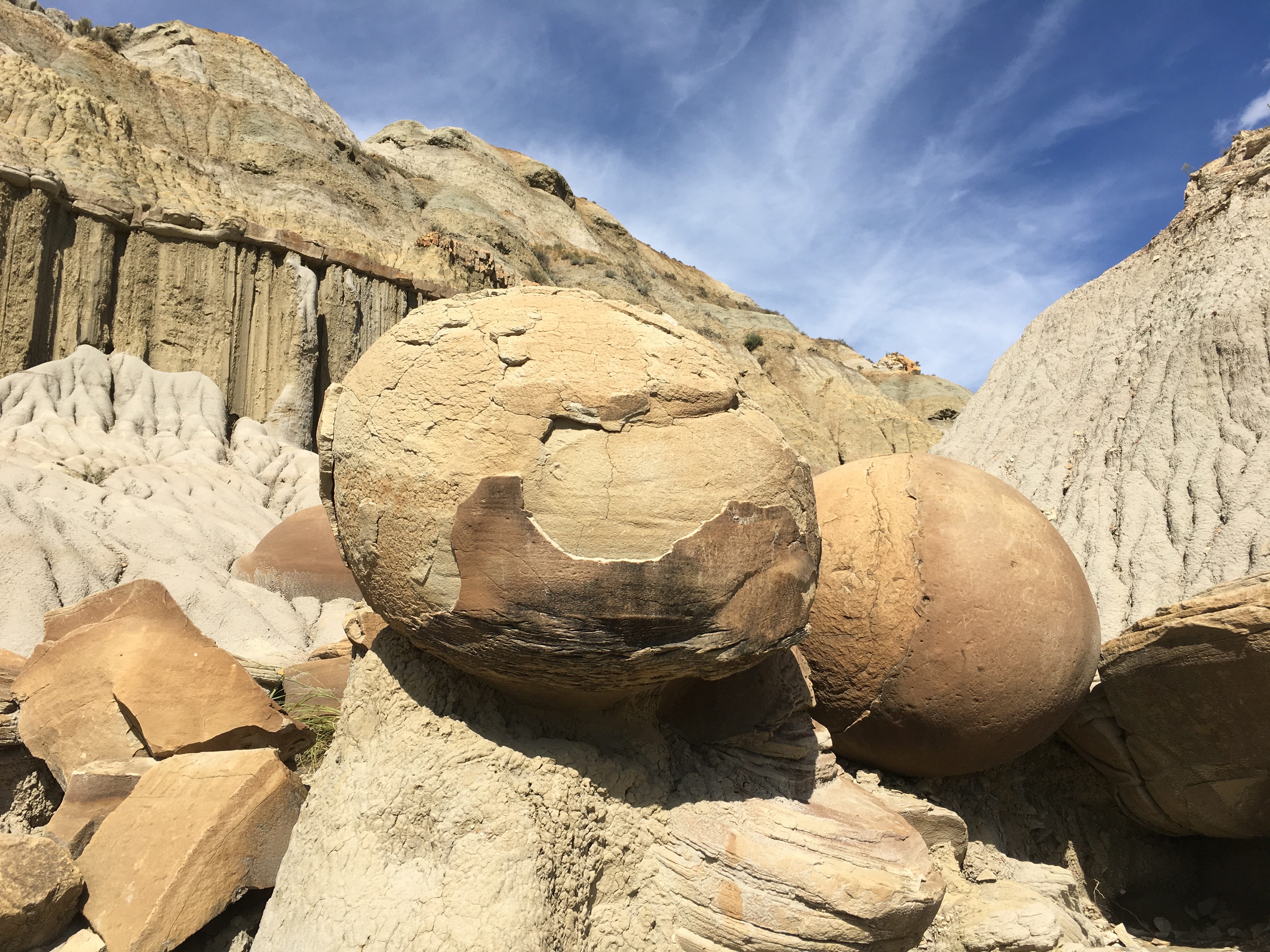
My first stop was the Cannonball Concretions Pullout.  These “cannonballs” were formed when sand grains from an ancient river deposit were cemented together by minerals dissolved in groundwater.

Concretions form in many different shapes and sizes.  Those that are spherical are called “cannonballs.” Formed within the sediment layers of the badlands, erosion is now exposing these buried treasures.

IMG_0602

Cannonball Concretions Pullout

IMG_1402

Cannonball Concretions Pullout

IMG_1404

Cannonball Concretions Pullout

fullsizeoutput_1eef3

Cannonball Concretions Pullout

IMG_1412

Cannonball Concretions Pullout

fullsizeoutput_1f10e

Cannonball Concretions Pullout

IMG_1413

Cannonball Concretions Pullout

IMG_1417

Cannonball Concretions Pullout

IMG_1418

Cannonball Concretions Pullout

IMG_1419

Cannonball Concretions Pullout

IMG_1421

Cannonball Concretions Pullout

IMG_1424

Cannonball Concretions Pullout

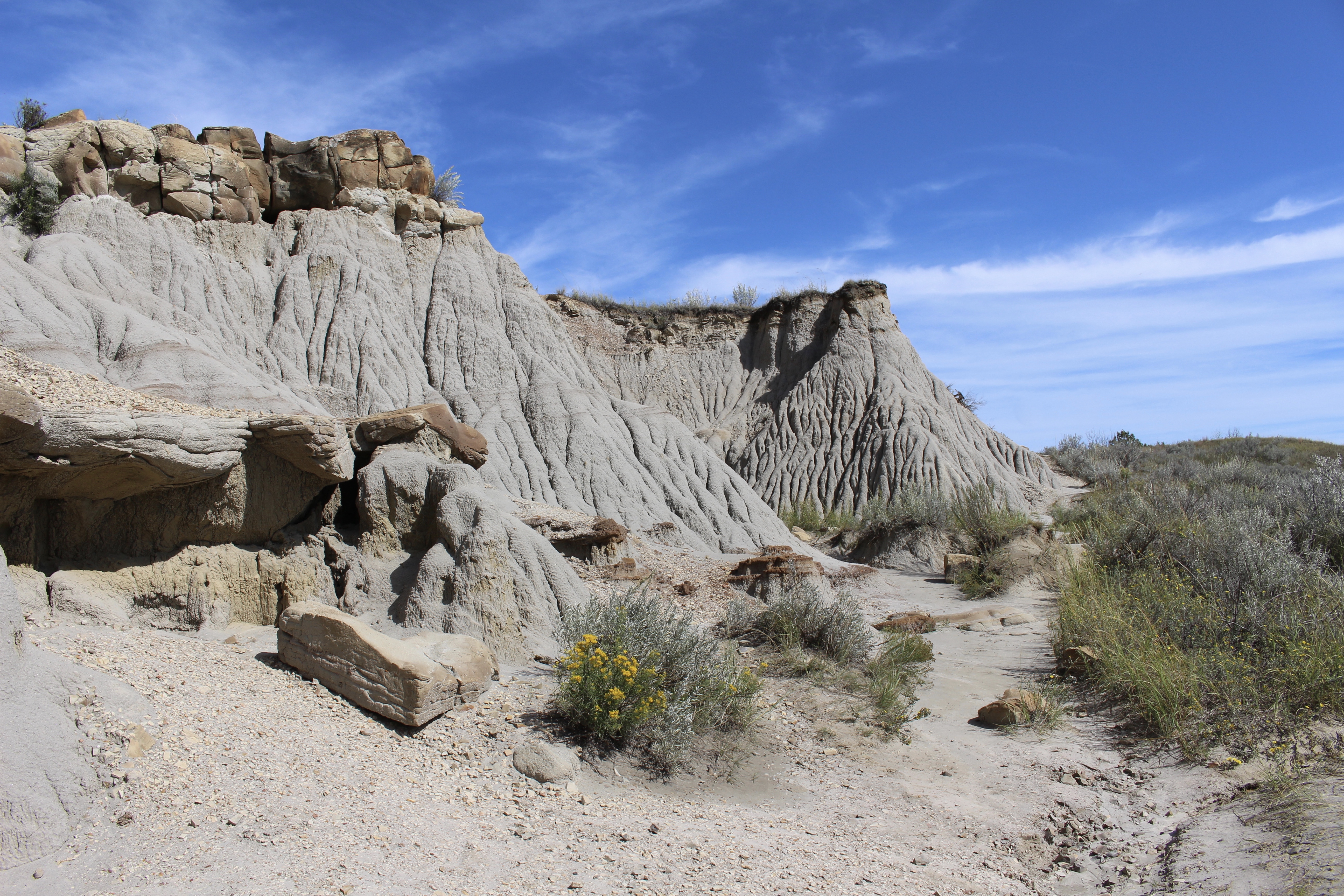
From the pullout, I also took a hike along the Caprock Coulee Trail, where I could see open prairie, sun-baked buttes, and juniper forests.

Caprock Coulee Trail
fullsizeoutput_1eeed

Caprock Coulee Trail

IMG_1435

Caprock Coulee Trail

IMG_1436

Caprock Coulee Trail

fullsizeoutput_1eef9

Caprock Coulee Trail

I stopped at the River Bend Overlook to a view of the Little Missouri floodplain. A small wedding was taking place at the stone shelter, built in the 1930s by the Civilian Conservation Corps.

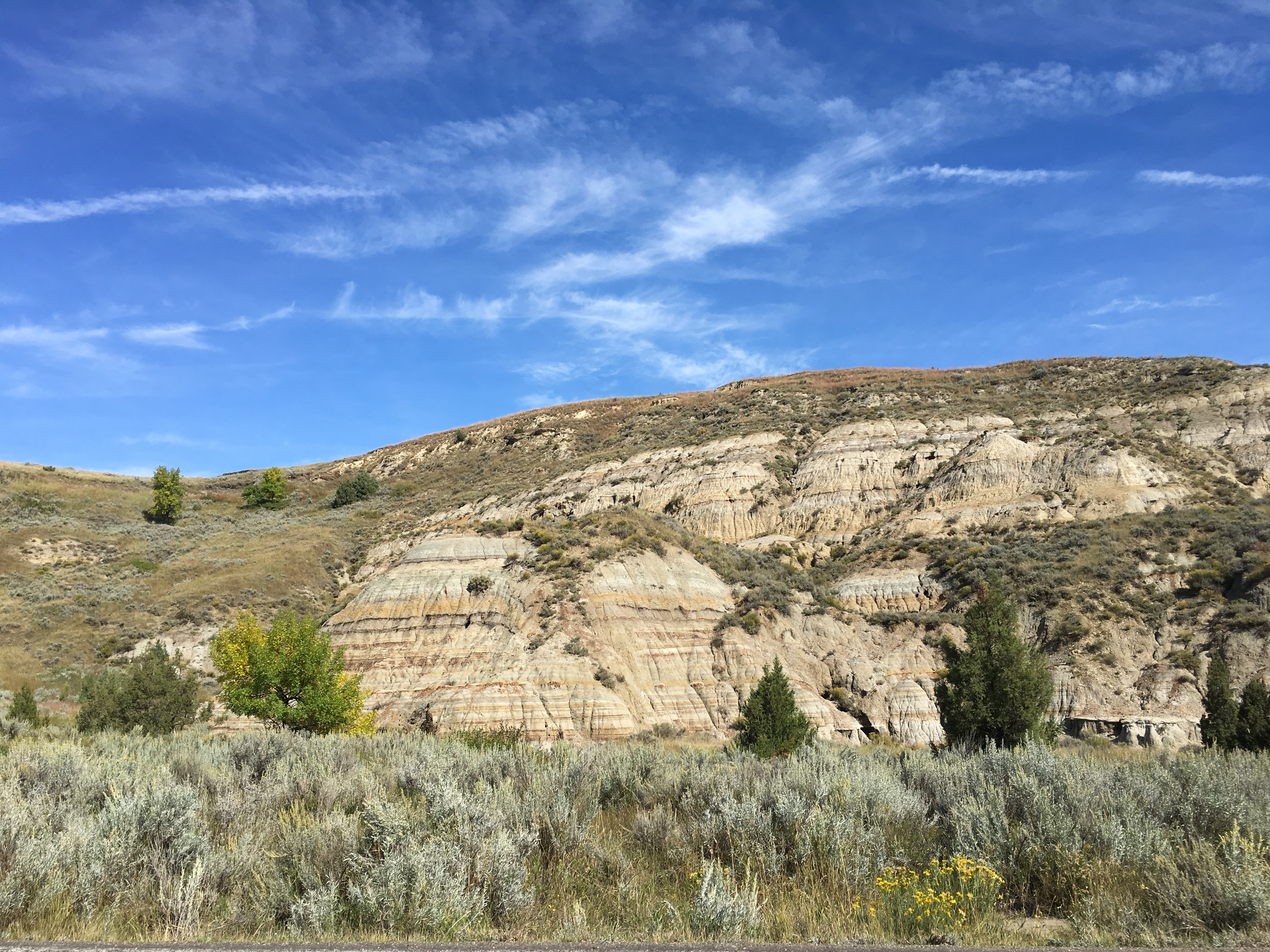
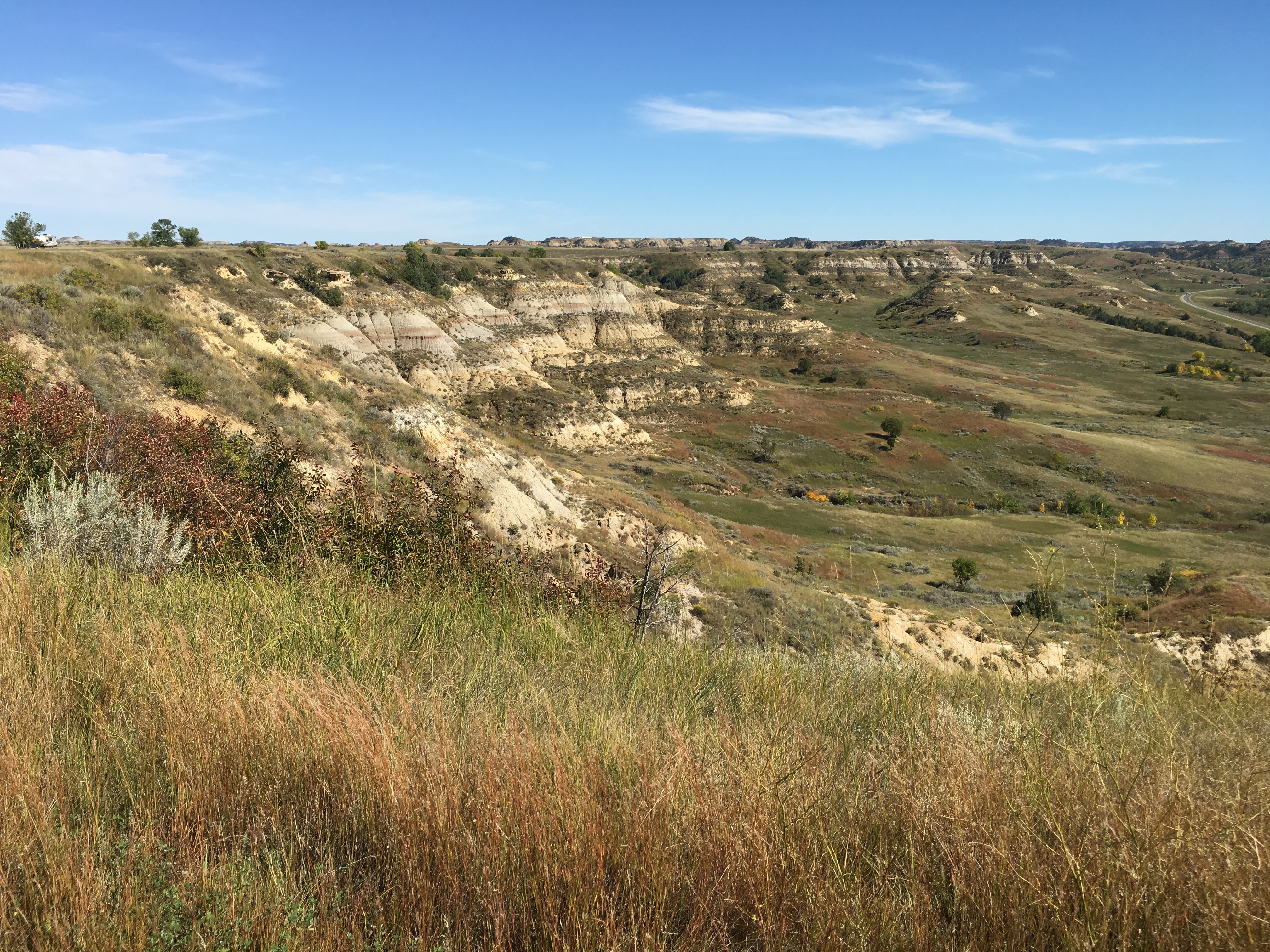
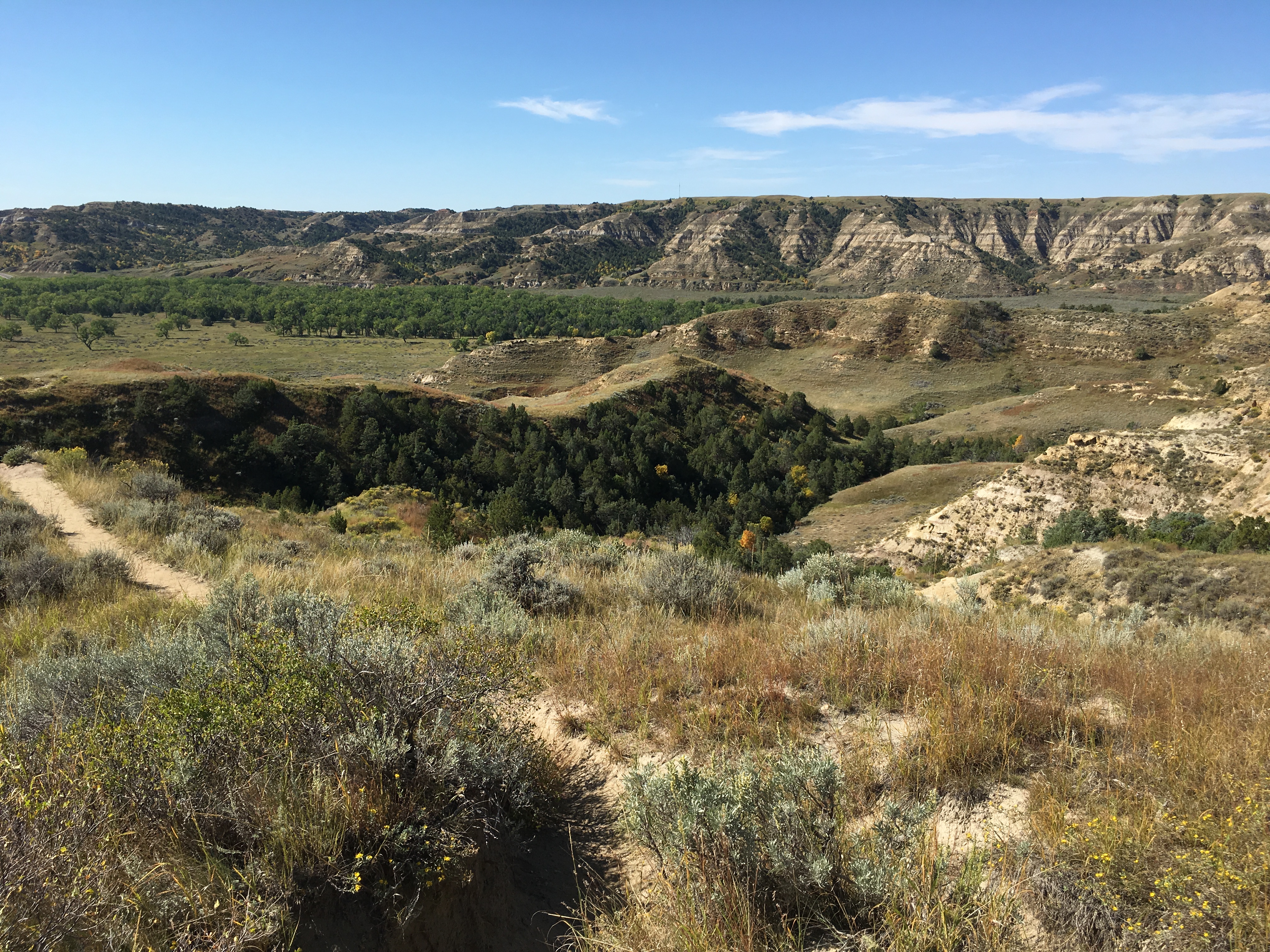
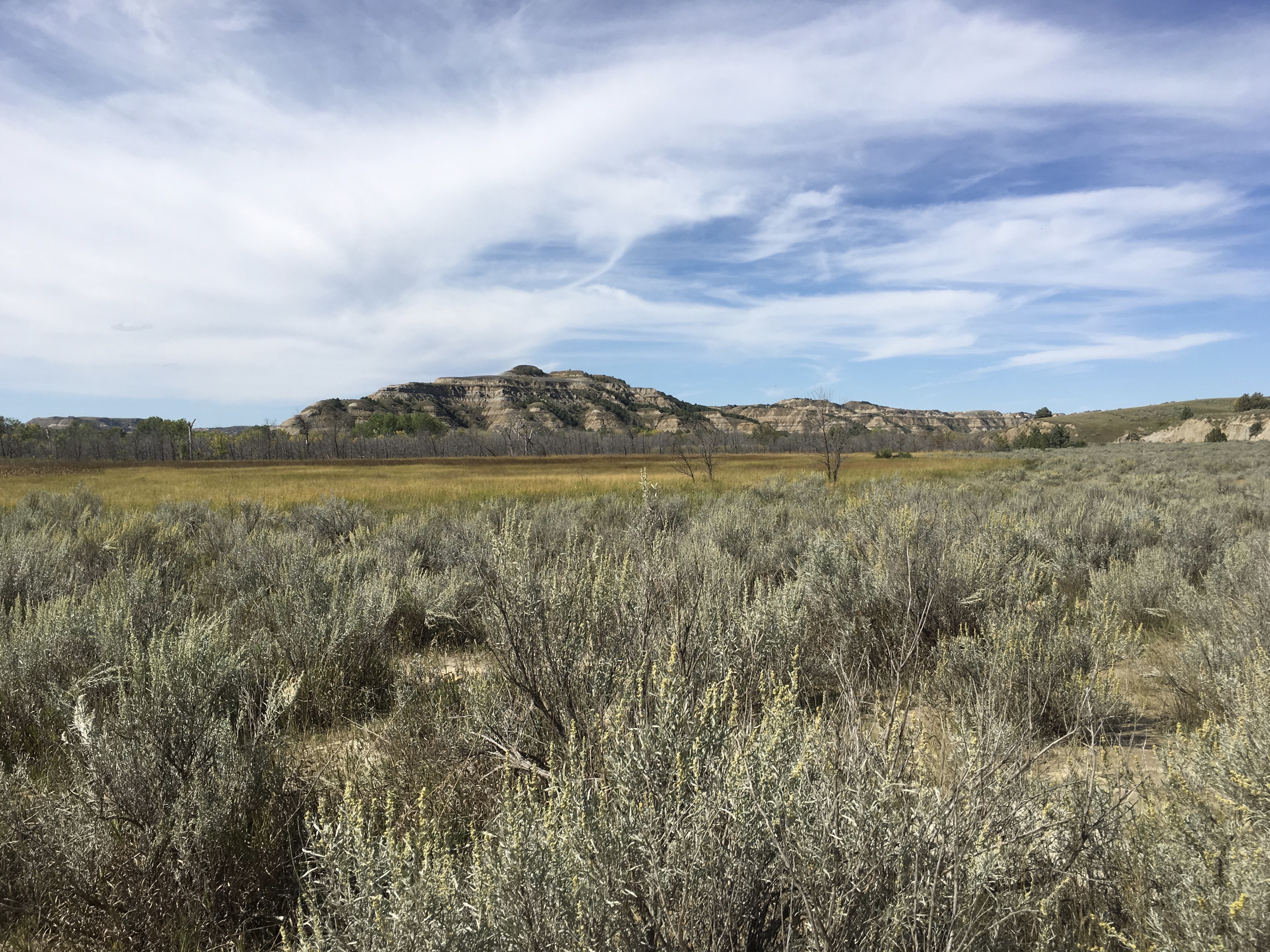
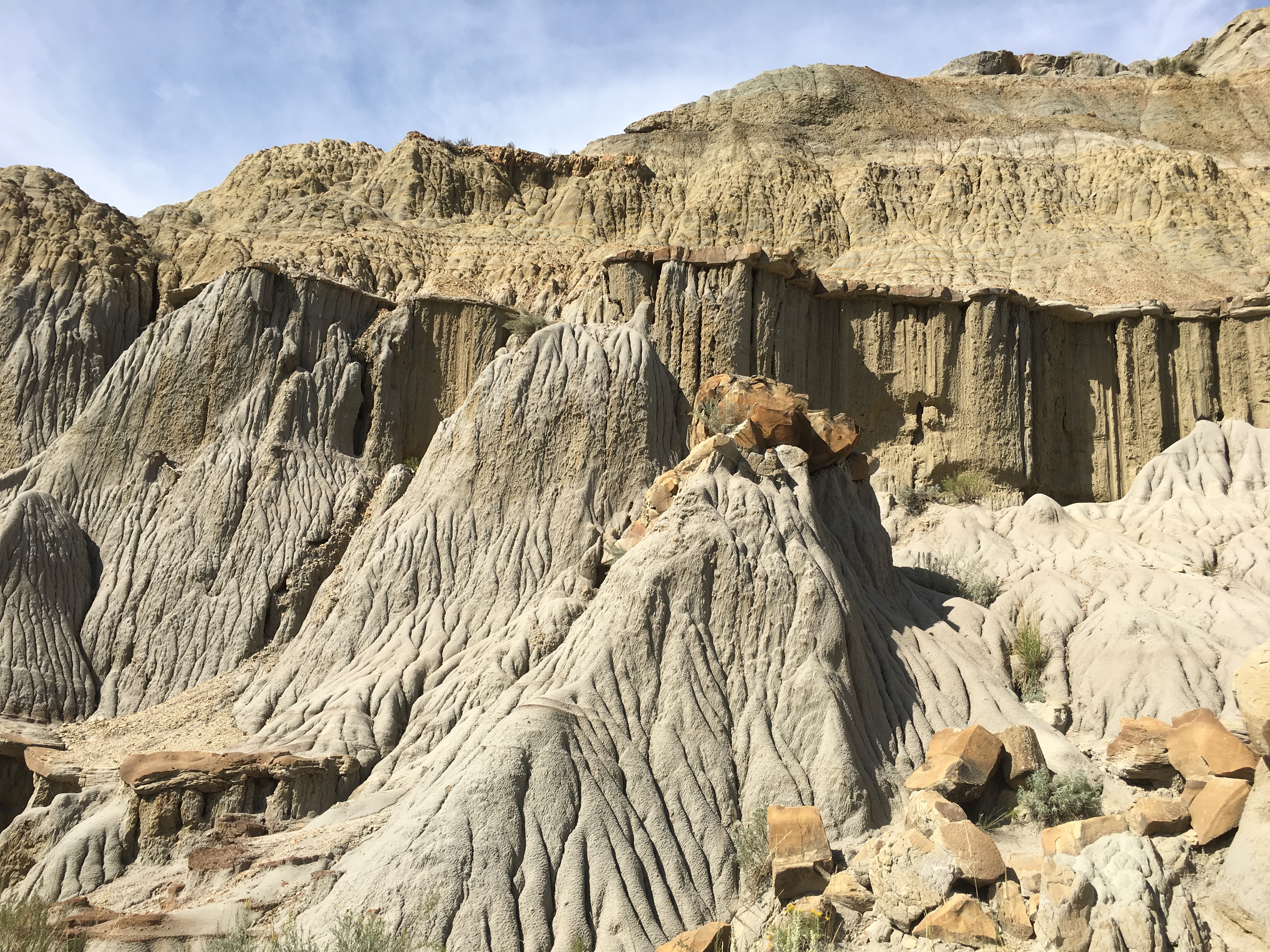
Over thousands of years, the Little Missouri River and its tributaries have cut through the soft sedimentary layers of the northern Great Plains.  Flowing water, along with wind, ice and plants, continue their erosive action. Each passing rain shower sculpts away the rolling plains, forming the rugged badlands.

River Bend Overlook
River Bend Overlook
River Bend Overlook
River Bend Overlook
River Bend Overlook
River Bend Overlook
River Bend Overlook
River Bend Overlook
River Bend Overlook
River Bend Overlook
River Bend Overlook
River Bend Overlook
River Bend Overlook
River Bend Overlook
River Bend Overlook
River Bend Overlook

By the 1880s, Roosevelt witnessed overhunting, overgrazing, and other threats to the natural world, so he became concerned about conservation.  Through careful management, many animals that nearly became extinct are now living here again.

The bison is one success story.  They once roamed the plains in the millions, until wholesale slaughter in the 1800s diminished their numbers to a few hundred. In 1956, a small herd was reintroduced here and has grown to the point where it has to be carefully managed. Elk, bighorn sheep, and pronghorn have also been reintroduced successfully.

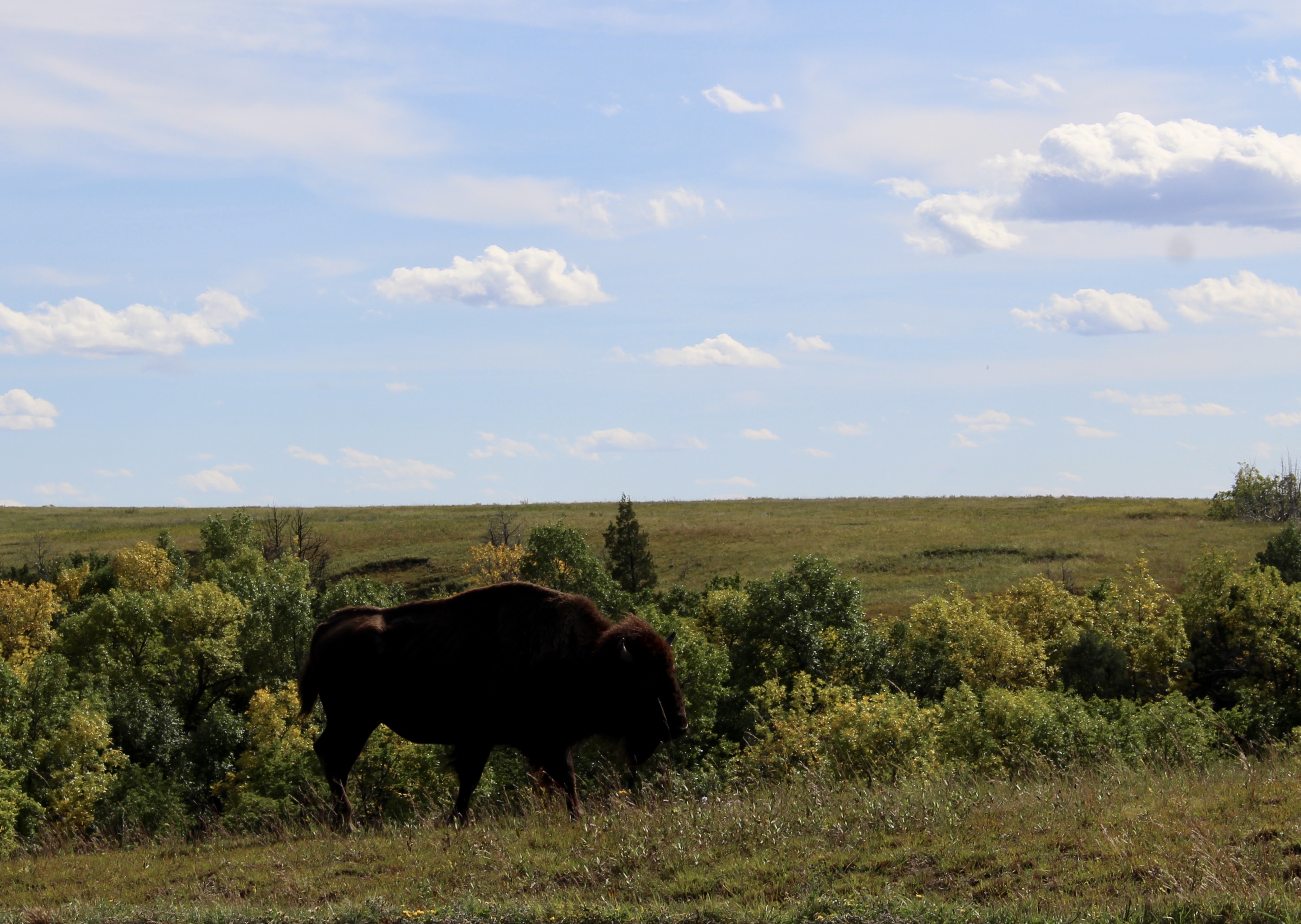
On my way to Oxbow Overlook, I pulled over to take a few pictures of a lone bison.

fullsizeoutput_1eef1

bison at Theodore Roosevelt National Park

IMG_1481

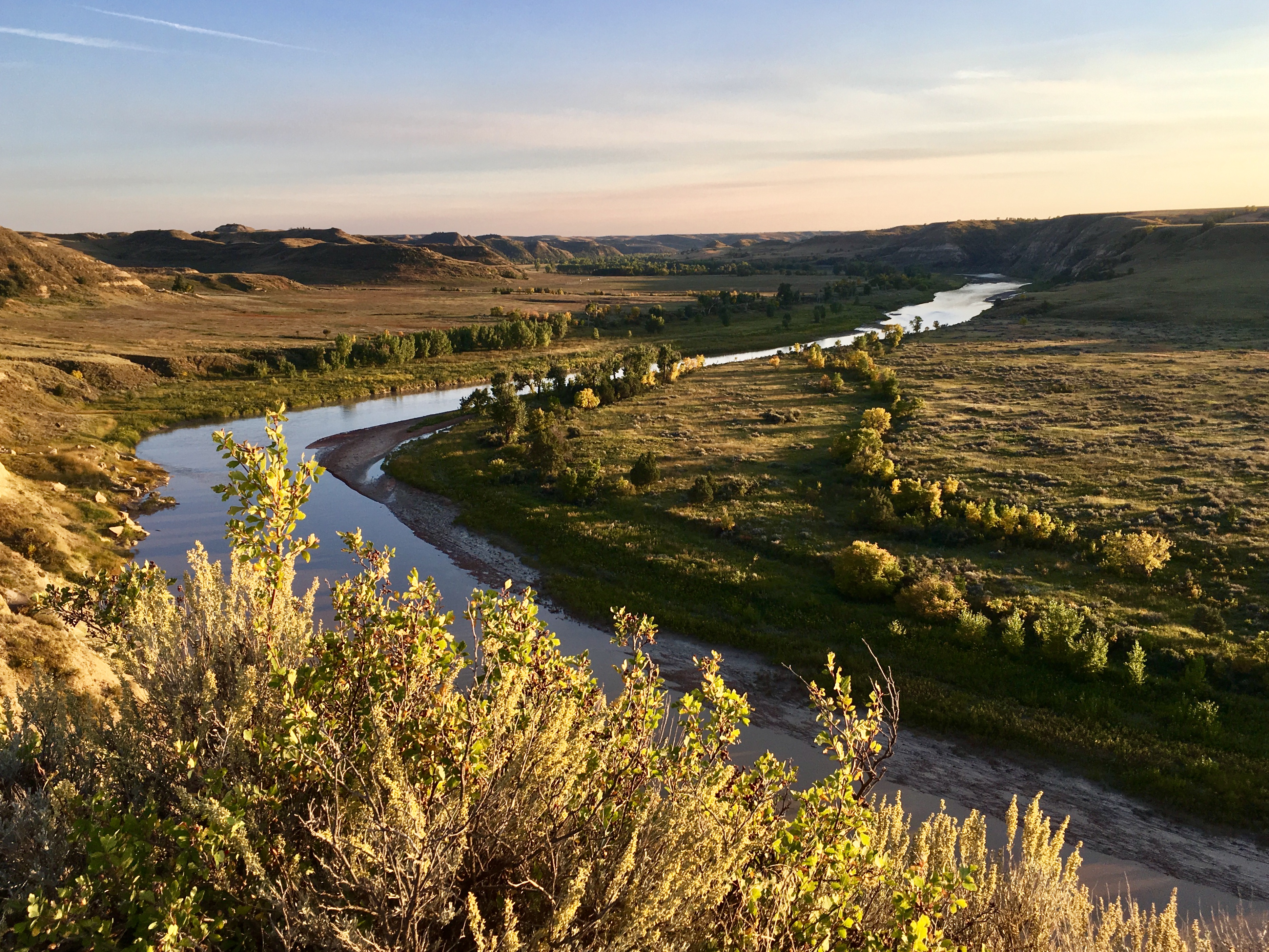
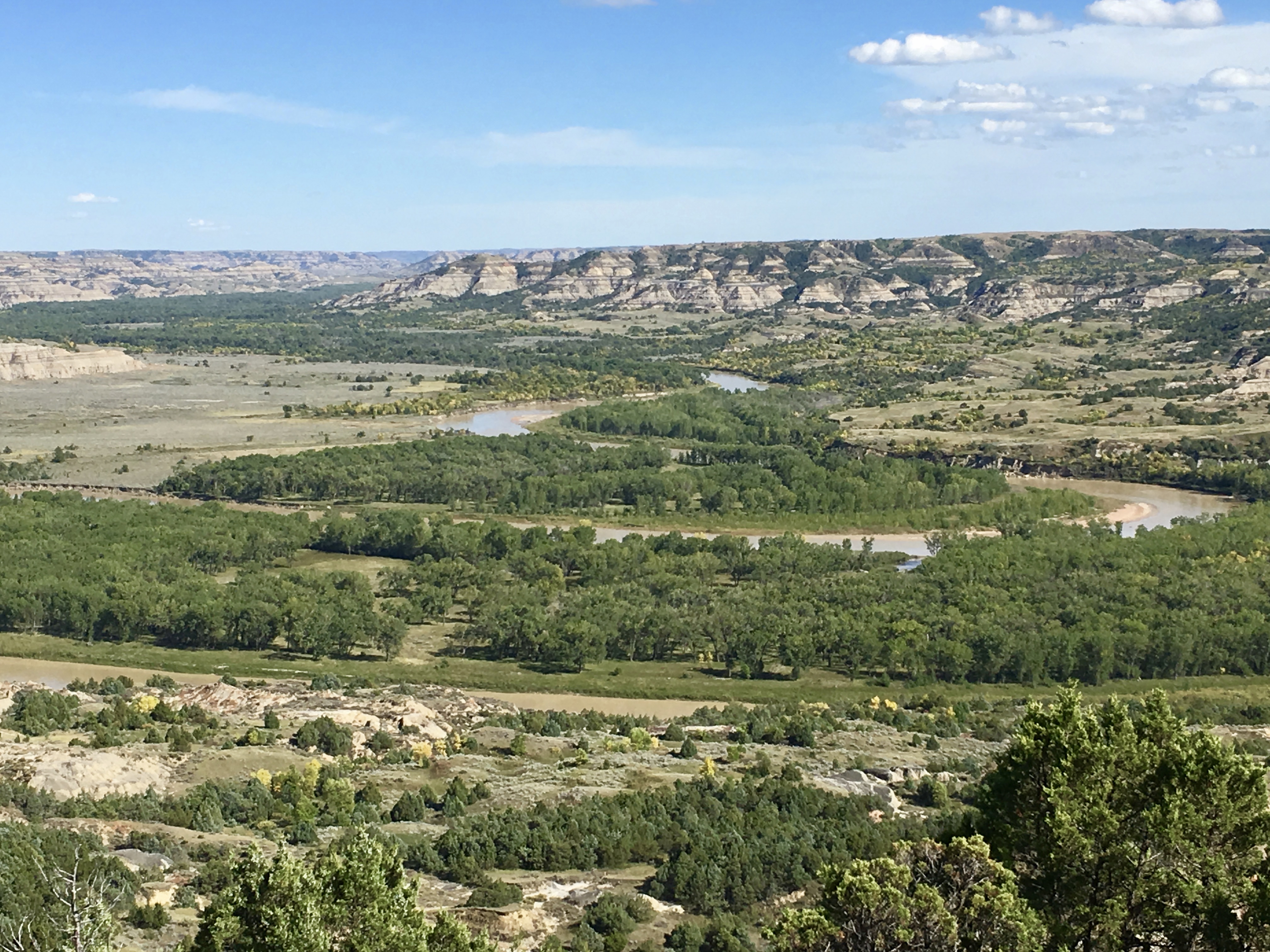
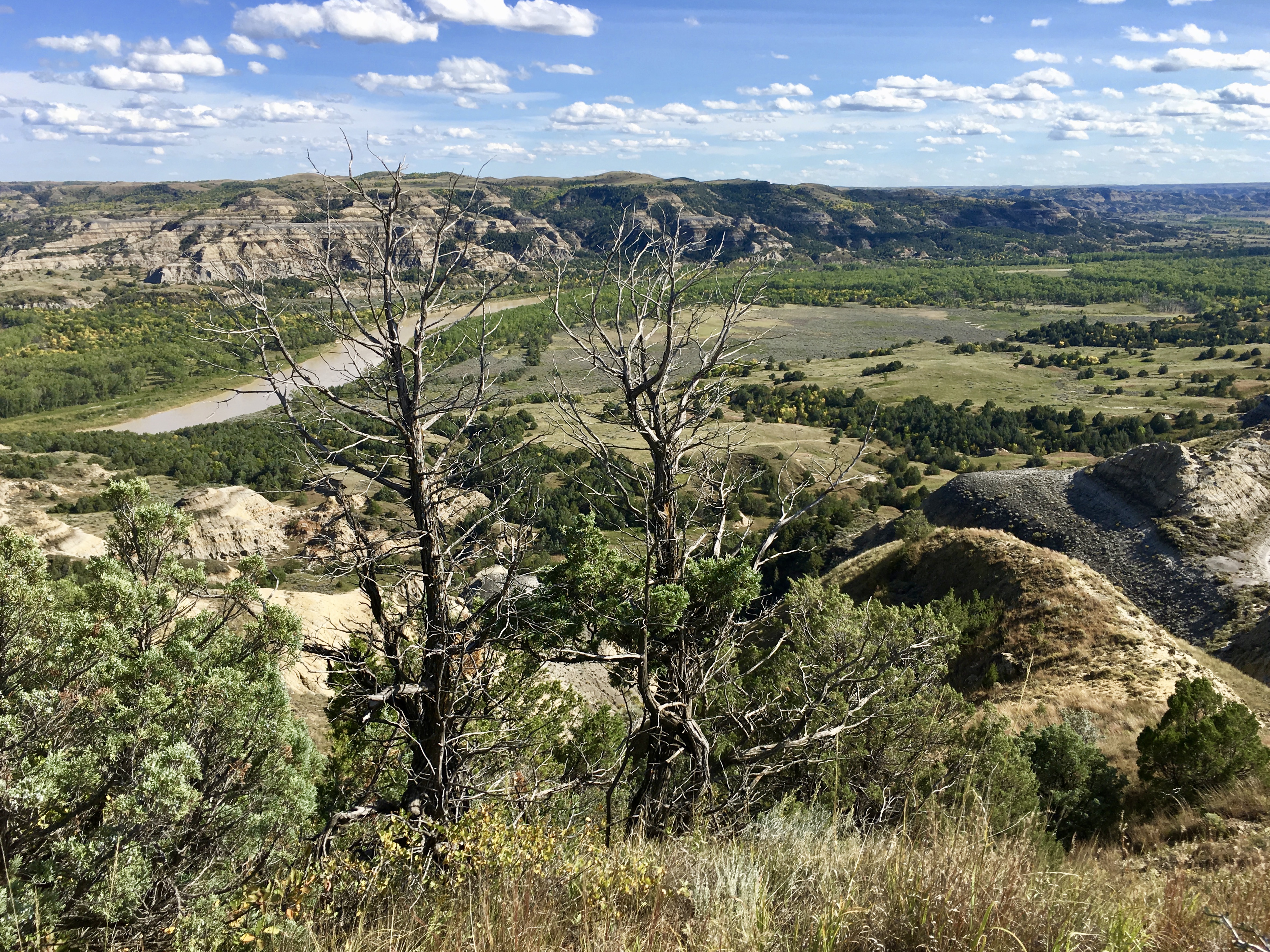
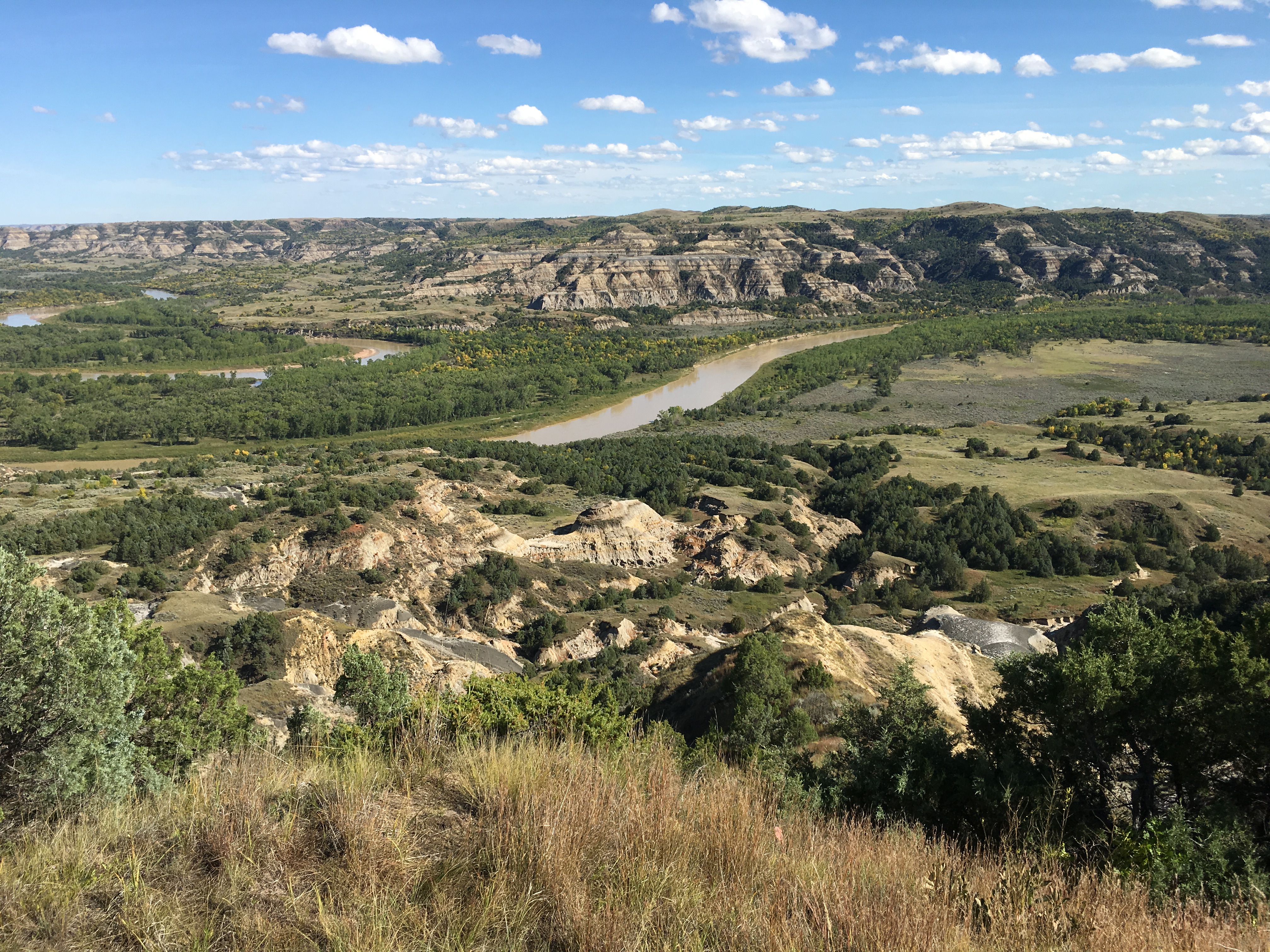
I took the hike to Sperati Point (1.2 miles each way); it was a breezy 75°F. Walking across grassland, I found fabulous views of the Little Missouri River with its twists and turns down in the valley.  Cottonwood trees lined the riverbanks.

The mixed-grass prairie at Theodore Roosevelt National Park is a blend of shortgrass species like buffalograss and tallgrass species like big bluestem. Mixed-grass prairie survives on 15-24 inches of annual precipitation.

hike to Sperati Point

At Sperati Point, I met Mike and Deb from Dayton, Ohio.  Mike said he worked as a chemist in petrochemicals.  He told me I should check out an artist, Henry Farney, who often has paintings in the Cincinnati Art Museum.  We talked about artist-explorer Karl Bodmer, China, travel and North and South Dakota.  They told me I’d love Rapid City and Custer State Park.

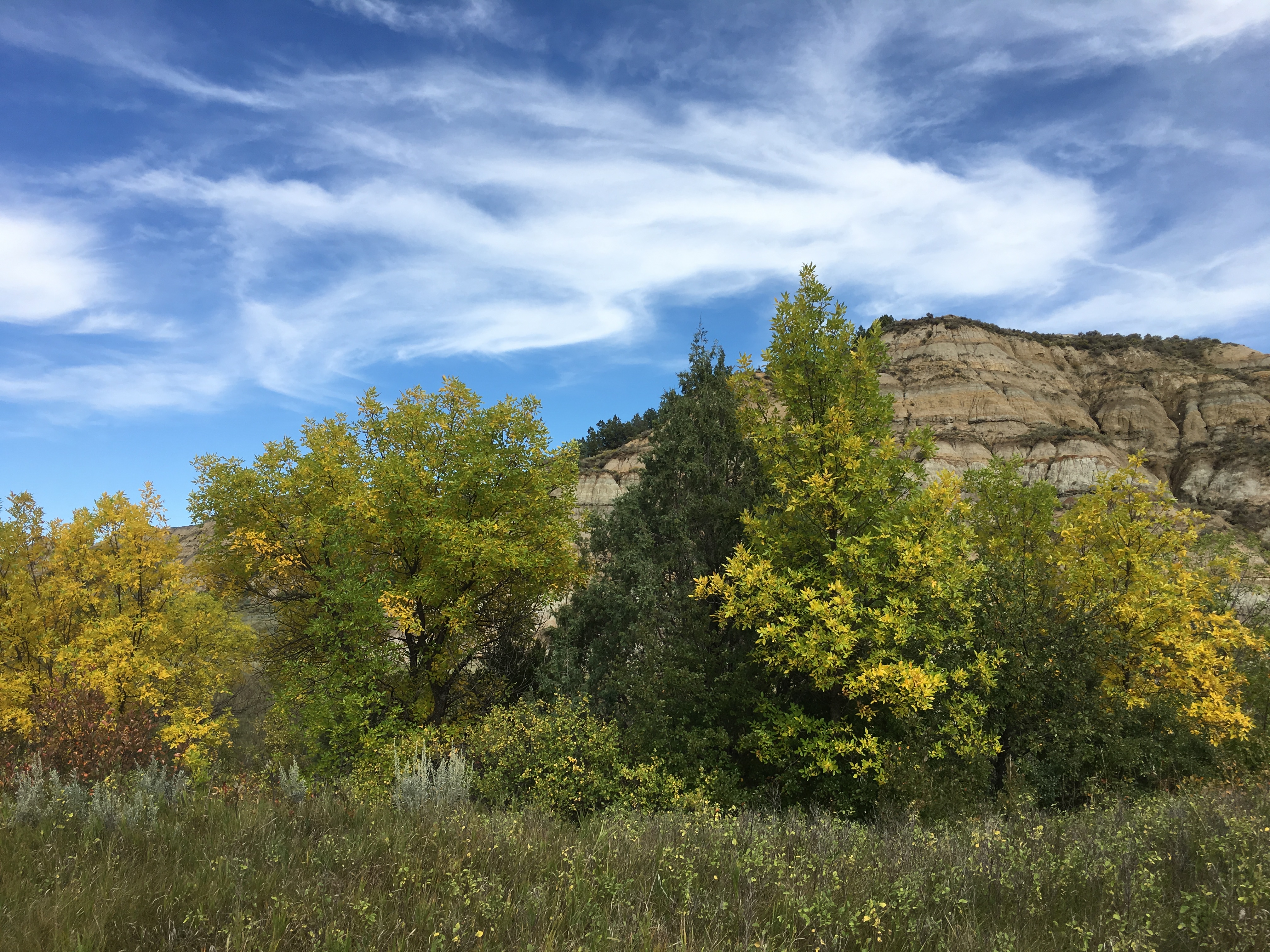
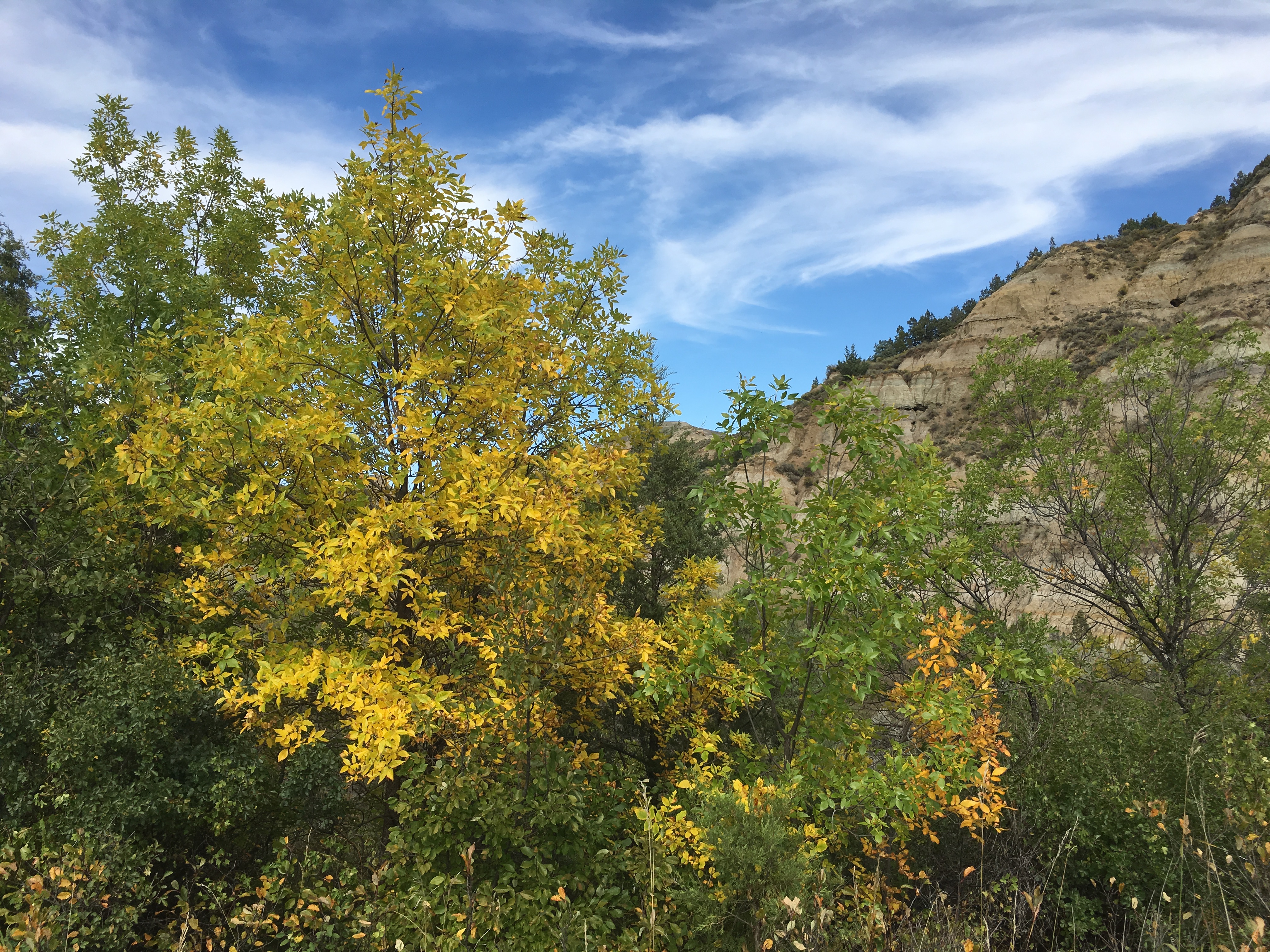
The undammed Little Missouri River floods often, eroding areas of floodplain and depositing new land.  This new land next to the river offers plenty of water and sunlight.  It’s the only place cottonwood seedlings can survive. As the river changes slowly from year to year, new generations of cottonwood trees grow in its wake.

fullsizeoutput_1ef0f

Sperati Point and the Little Missouri River

This natural cycle of flooding and tree growth is disappearing across the Great Plains where most rivers are tamed by dams and do not flood.  Without natural flooding, new generations of cottonwoods fail to thrive.  Other species, some of which are invasive, replace old generations of cottonwoods when they die.

fullsizeoutput_1ef02

Sperati Point and the Little Missouri River

Cottonwoods are water-loving trees with heart-shaped leaves.  Their seeds are well adapted to the wet areas in which they grow.  The fluffy, white “cotton” helps the seeds float on the surface of the water and cling to the soil where the water deposits them.

fullsizeoutput_1ef10

Sperati Point and the Little Missouri River

IMG_1501

Sperati Point and the Little Missouri River

fullsizeoutput_1ef11

Sperati Point and the Little Missouri River

After reaching the point, I made the long walk back.

IMG_0675

walk back from Sperati Point

IMG_0677

walk back from Sperati Point

I walked to Oxbow Overlook, a fabulous view of where the Little Missouri takes a hard turn to the east. The river originally continued north to the Hudson Bay.  During the most recent ice age, continental glaciers blocked its way, hence the turn.

fullsizeoutput_1ef13

Oxbow Overlook

IMG_0691

Oxbow Overlook

fullsizeoutput_1ef0b

Oxbow Overlook

I stopped at another overlook on my way out of the park.

IMG_1512

Theodore Roosevelt National Park

IMG_1514

I left the North Unit of the park at 5:40 Central Time.  At 5:41, I entered Mountain Time Zone after crossing the Little Missouri.  By Grassy Butte, I had gained an hour and drove 85S to 94W.

I talked to Mike while I was driving.  He had taken his sister, Barbara, out for a drive, just to keep her from going crazy after her knee replacement. He was busy roasting okra and onion and garlic cloves to add to tofu. My youngest son had been going over to help Barbara every day before his Massage Therapy class.

I checked in to AmericInn by Wyndham Medora.  There wasn’t much to the town of Medora; it was mostly an entrance to Theodore Roosevelt National Park South Unit, which I would explore the following day.

I ate dinner at the Little Missouri Saloon where the servers were all Polish girls.  Service wasn’t great and neither was the menu.  I ate out on the patio –  Pinot Grigio and Taco Salad.

Here’s my journal spread for today.

fullsizeoutput_1de29

Saturday, September 14, 2019

*Drove 231.2 miles; Steps: 19,890, or 8.43 miles*

*Saturday, September 14, 2019*

Share this:

  • Share on X (Opens in new window) X
  • Share on Facebook (Opens in new window) Facebook
  • More
  • Email a link to a friend (Opens in new window) Email
  • Print (Opens in new window) Print
  • Share on Pinterest (Opens in new window) Pinterest
Like Loading...
  • American Road Trips
  • Charleston
  • Fort Sumter and Fort Moultrie National Historical Park

charleston: fort moultrie, sullivan’s island, & a shopping spree on king street

wanderessence1025's avatar wanderessence1025 October 14, 2020

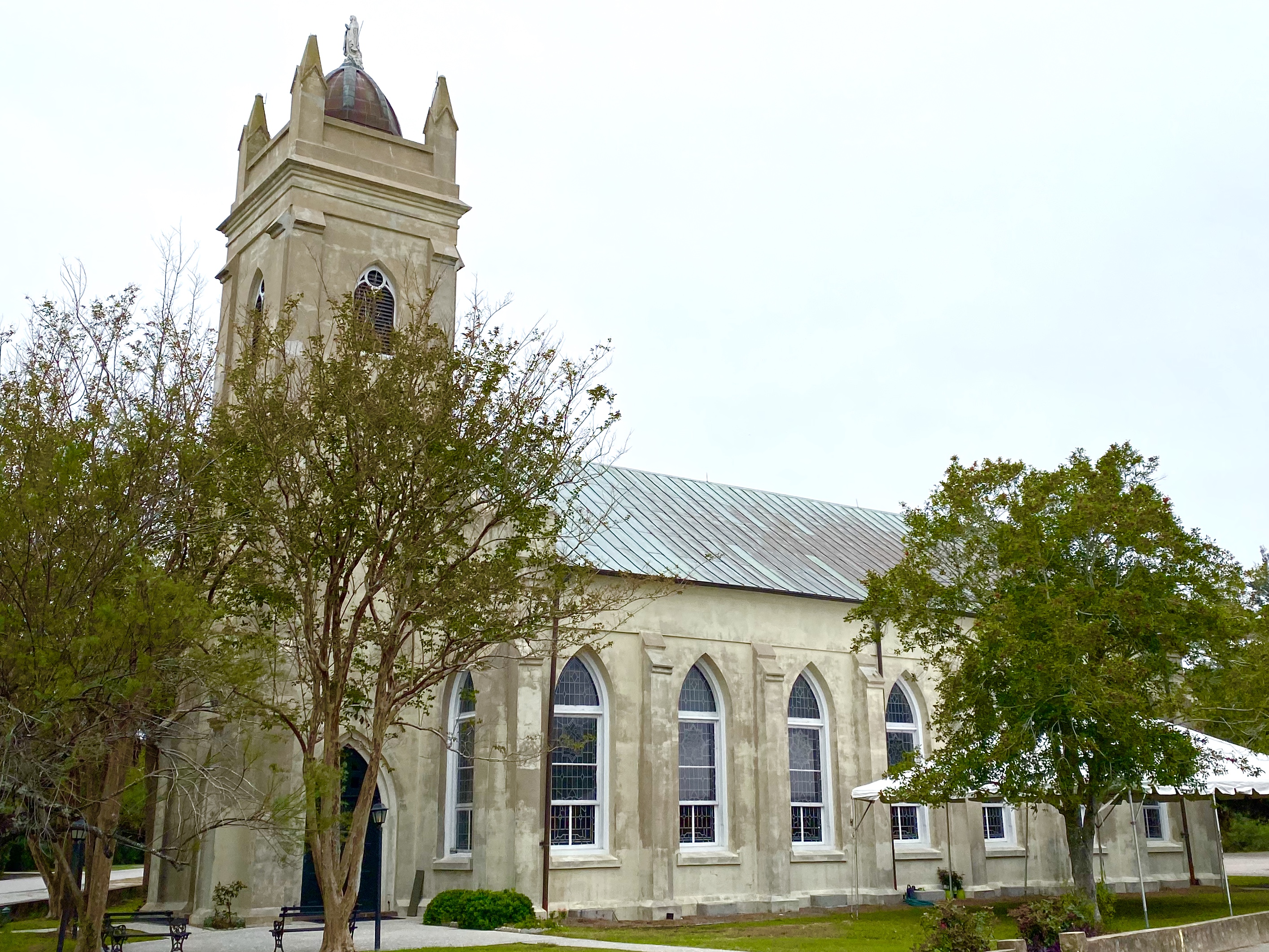
After leaving the Pinckney site, I drove through Isle of Palms and then to Sullivan’s Island, where I cruised past the tiny downtown area and Stella Maris Roman Catholic Church. Edgar Allan Poe was inspired by Sullivan’s Island’s lonely windswept landscape to write The Gold Bug and other works.

fullsizeoutput_1b28d

Stella Maris Roman Catholic Church

I dropped into Fort Moultrie, part of Fort Sumter and Fort Moultrie National Historical Park.  I watched a hokey film there that must have been made 40 years ago!  It was long and rather ridiculous.

Fort Moultrie is the only area of the National Park System where the entire 171-year-history of American seacoast defense (1776-1947) can be traced.

Fort Moultrie was part of the first system of fortifications in the United States. Moultrie’s first incarnation, a perimeter of felled palm trees, didn’t even have a name when it was unsuccessfully attacked by the British in the summer of 1776, the first victory of the colonists in the Revolution.  Redcoat cannonballs bounced off the flexible trunks, from which South Carolina’s nickname, “The Palmetto State,” comes.

During the British occupation in 1780-1782, the Fort was called Fort Arbuthnot. The Fort was renamed for the U.S. patriot Commander in the Battle of Sullivan’s Island, General William Moultrie.

Atop the decayed original Fort Moultrie, the Army completed a new fort in 1798; the Army also built 19 other forts along the Atlantic coast. After years of neglect, the Antigua-Charleston hurricane destroyed Fort Moultrie in 1804.

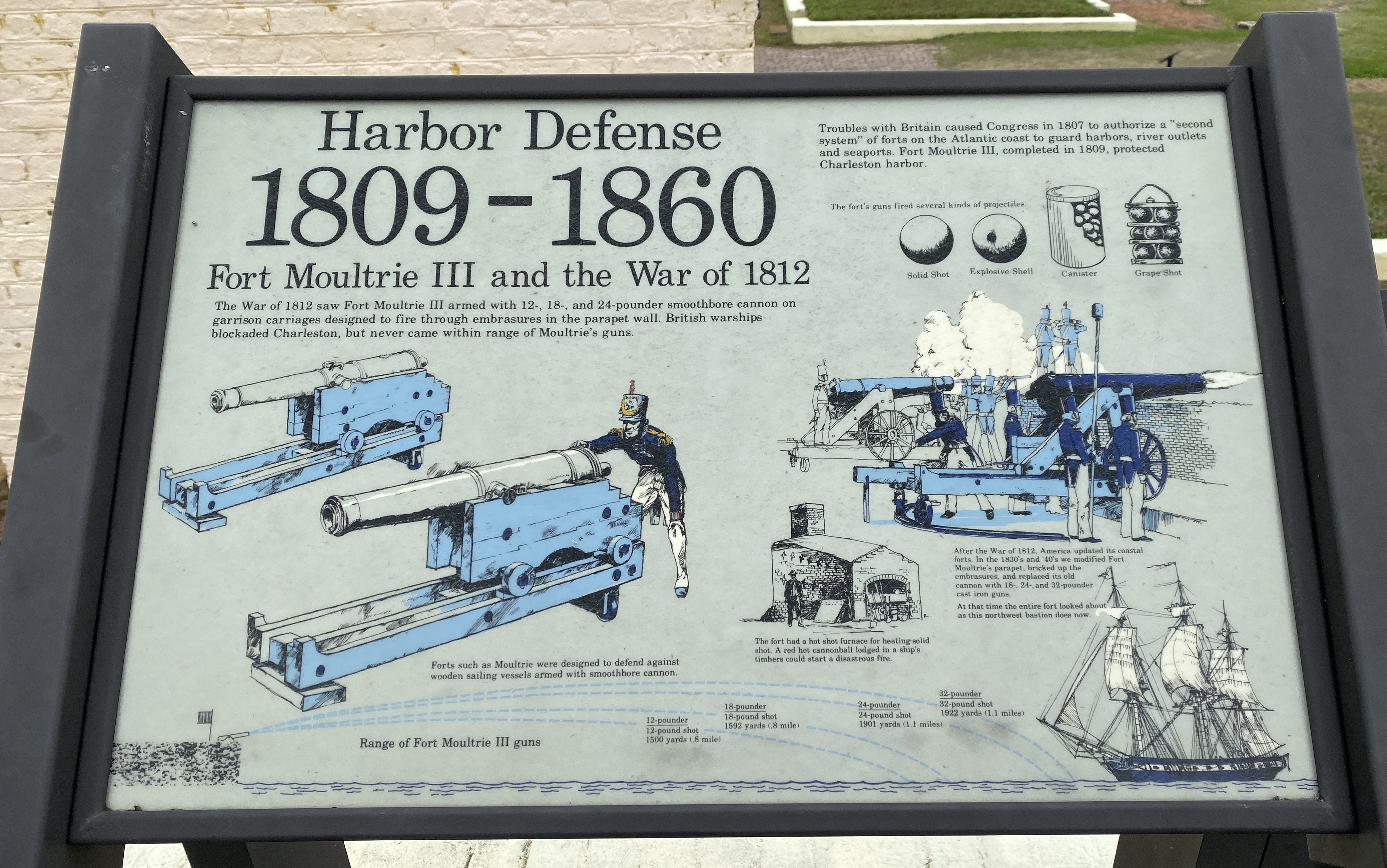
In 1809, a brick fort was built. Young Lt. William Tecumseh Sherman was stationed here in the 1830s, well before the Civil War. The Great Chief Osceola, along with his fellow Seminoles, was detained here after his capture in 1837.  The Chief died at the Fort in 1838 of malaria.

The main design didn’t change over the next five decades. By the time of the Civil War, Fort Moultrie, Fort Sumter, Fort Johnson, and Castle Pinckney surrounded and defended Charleston.

fullsizeoutput_1e7b2

Harbor Defense 1809-1860

South Carolina seceded from the Union on December 20, 1860 after the first election of President Abraham Lincoln. A Federal garrison was sent to Fort Moultrie. On December 26, 1860, Union Major Robert Anderson moved the garrison to Fort Sumter because Fort Moultrie was thought too vulnerable from the landward side.  On February 8, 1861, South Carolina joined five other seceded deep southern states to form the Confederate States of America. In April, 1861, Confederate troops shelled Fort Sumter and the American Civil War began.

Moultrie’s main Civil War role was as a target for Union shot during the long siege of Charleston.  It was pounded so hard that a wall fell below a sand hill.

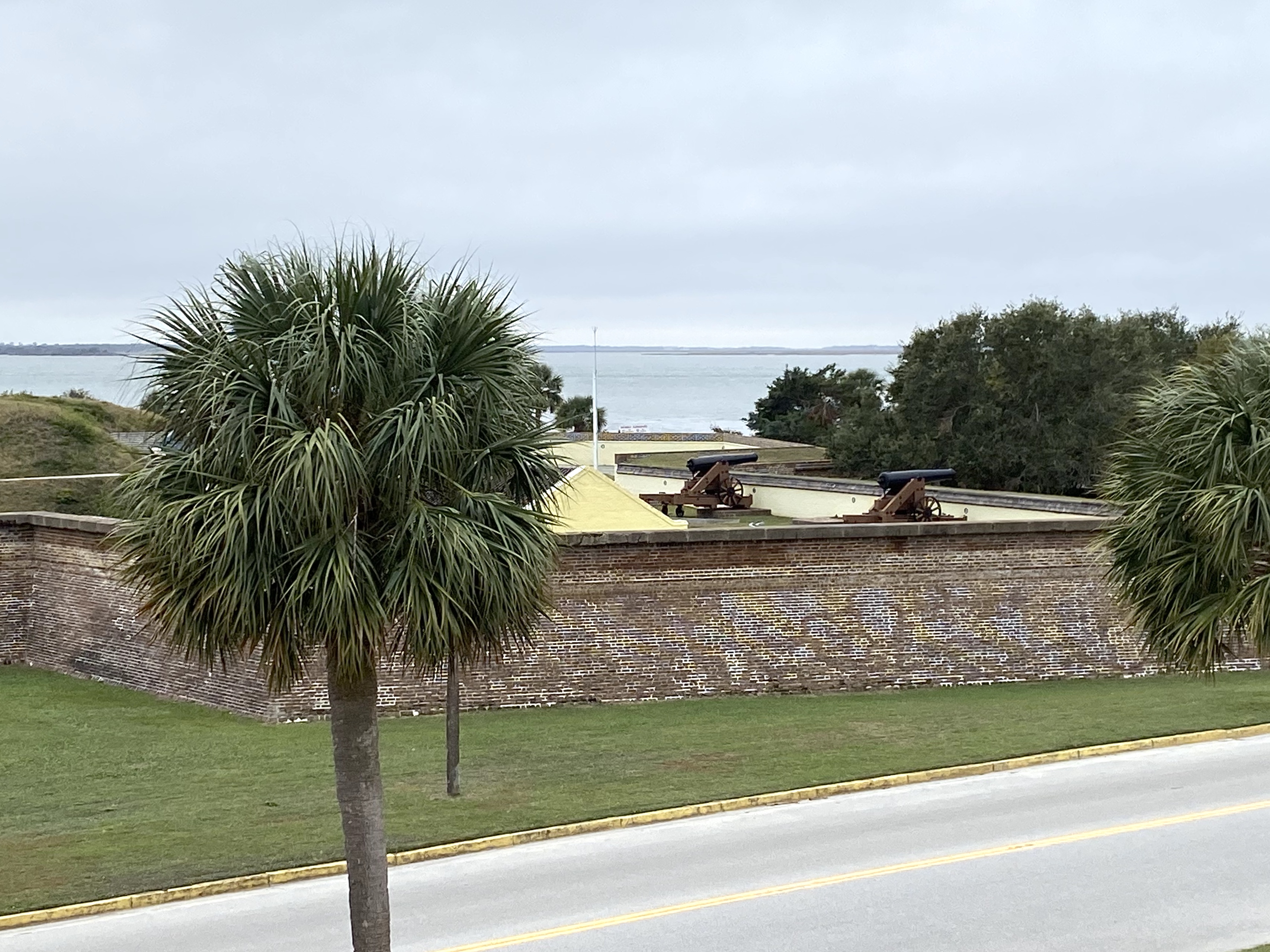
Cannons at Fort Moultrie

A full military upgrade happened in the late 1800s, extending over most of Sullivan’s Island.

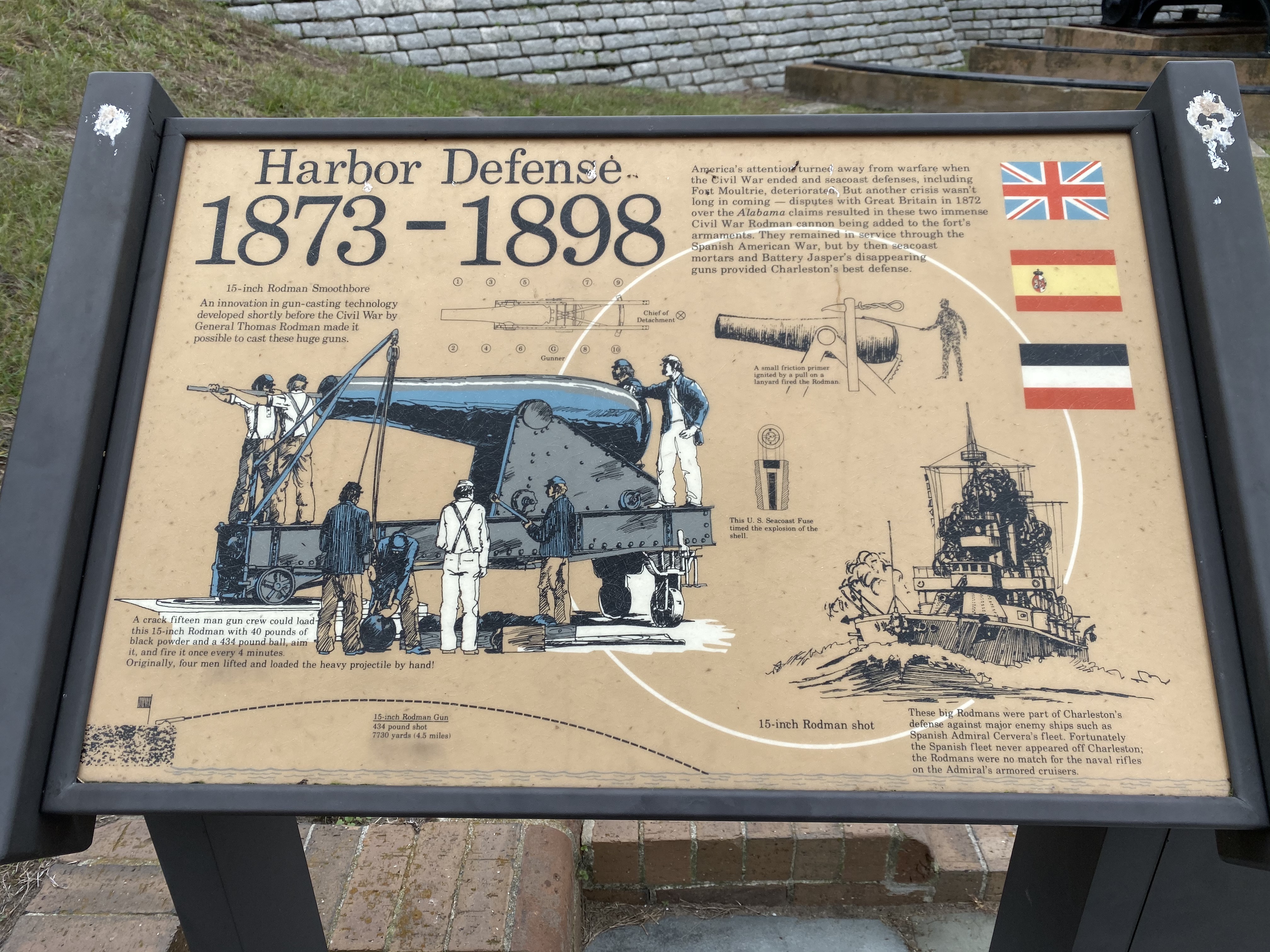
The U.S. Army modernized Fort Moultrie in the 1870s with new weapons and deep concrete bunkers. In 1898, the Spanish-American War broke out with Fort Moultrie’s smaller rapid-fire batteries still years from completion.

20ZxJETnR8WOQzT4WBpaNA

Harbor Defense 1873-1898

Fort Moultrie
Fort Moultrie
Fort Moultrie
Fort Moultrie

After the U.S. entered World War I, four 6″ guns were removed for service on field carriages on the Western Front in 1917 and were never returned to the fort.

a%Z4HU36SdGSv1e4Nyu1zg

Harbor Defense 1898-1939

nC+7A2YsQZeFP40KHKKlCA

Fort Moultrie

v+YE2TbsTVKzaCN%1iTq1A

Fort Moultrie

gCHEMBMqSnCJjjxaTH2zPw

Fort Moultrie

zrJobyDsRjWZjPLsmnLPIg

Fort Moultrie

gAxw74NRTcO%KrRbp3h0mw

Fort Moultrie

XrhX+LBDTJK2zZuTy6TGFA

Fort Moultrie

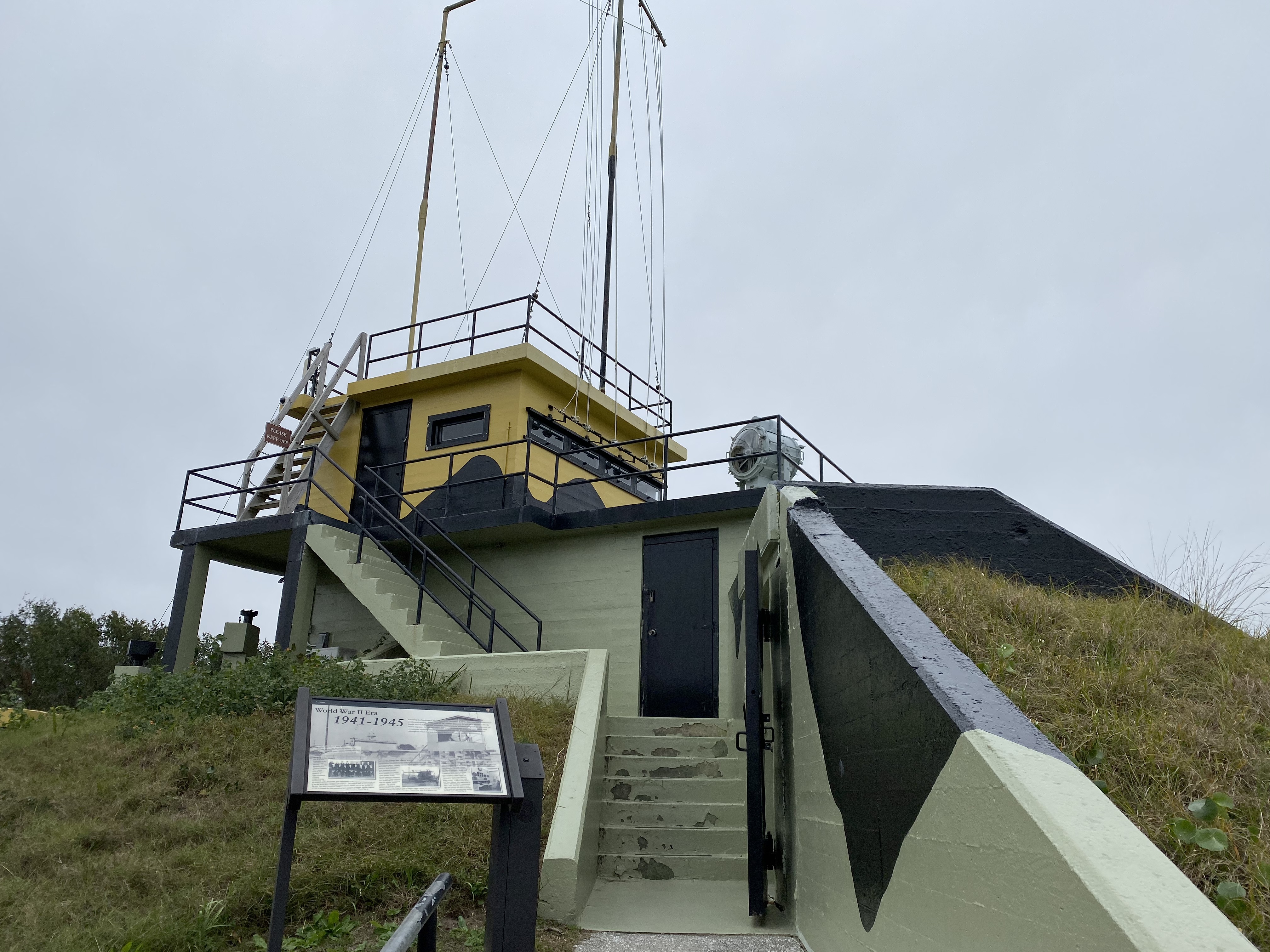
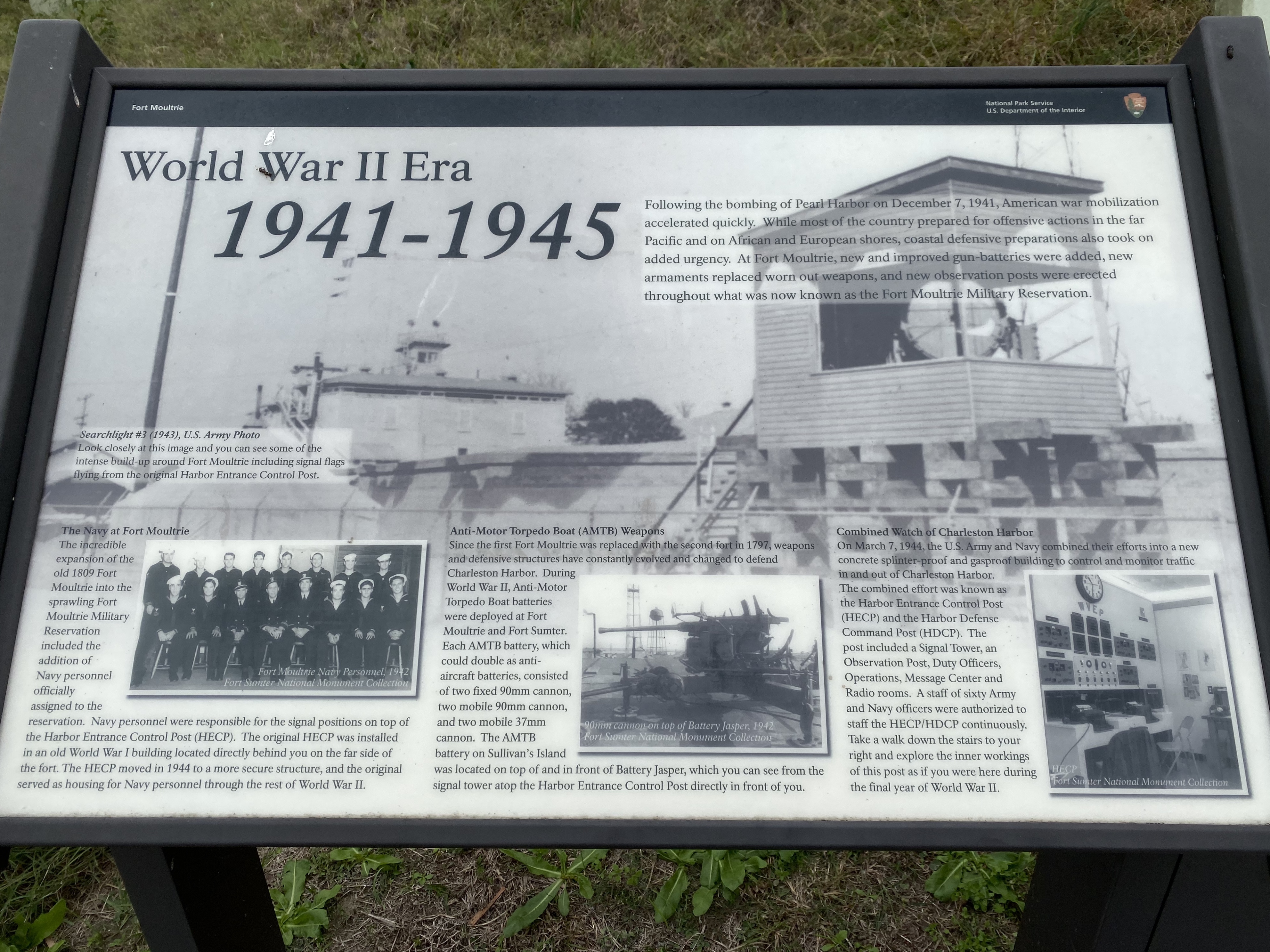
With the outbreak of World War II in 1939, and the fall of France in 1940, there was an upgrade of coastal fortifications.

fullsizeoutput_1e7b3

World War II Era 1941-1945

On August 15, 1947, the Army lowered Fort Moultrie’s flag for the last time, ending 171 years of service. Due to changes in military technology, including submarines and nuclear weapons, seacoast defense of the U.S. ceased to be a viable strategy.

After walking around the Fort, I went into the Visitor’s Center to see the displays.  Many of them were about Sullivan’s Island and the slave trade.

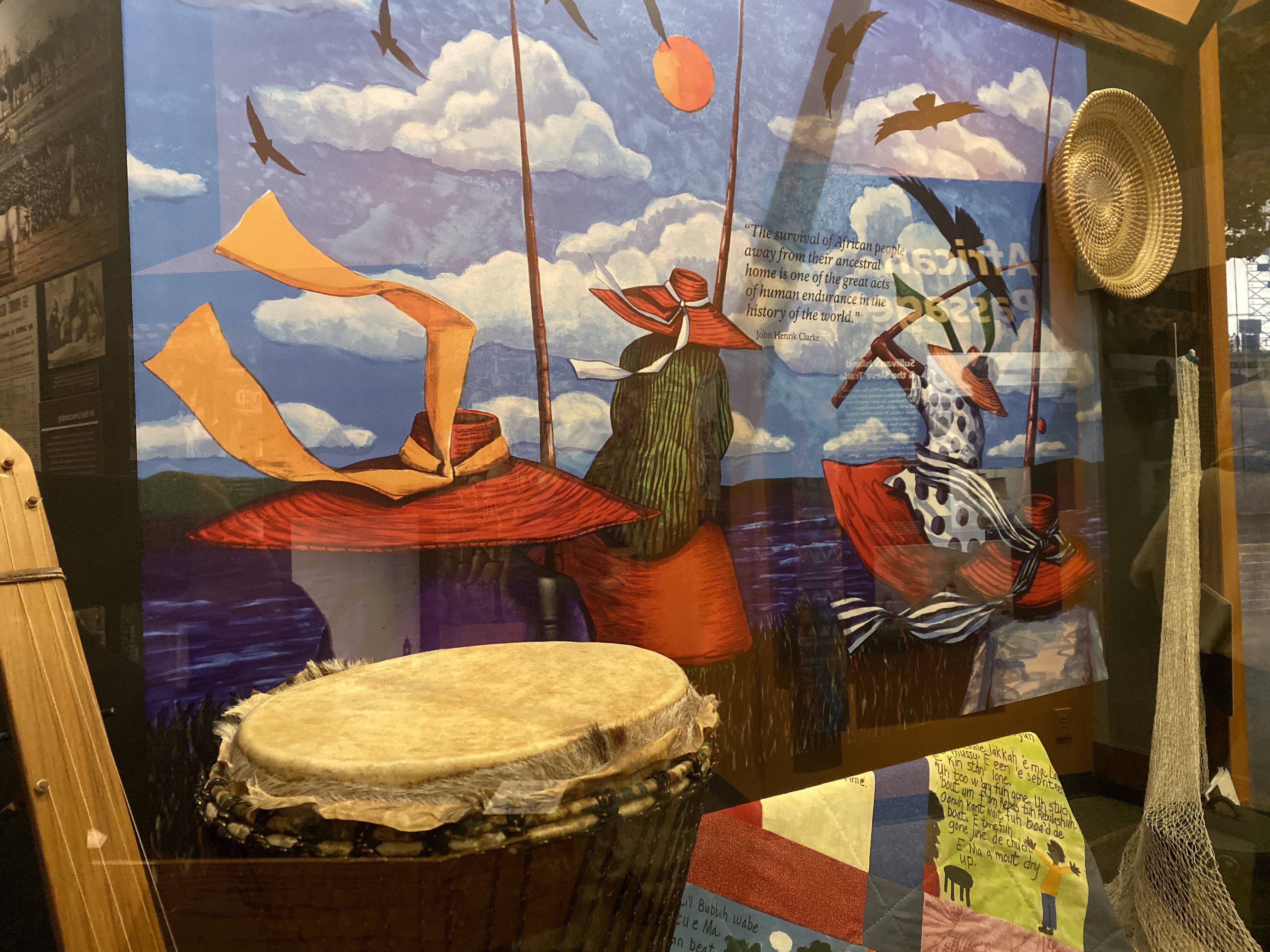
The forced exodus of West Africans to the New World often ended on Sullivan’s Island near Charleston, the entry point for nearly half the captive Africans shipped to North America. Beyond military defense, the island had quarantine stations to protect the colony from deadly diseases.  Between 1707 and 1799, when arriving ships carried infectious diseases, their free or enslaved passengers were quarantined either aboard ship or in island “pest houses.” This painful history makes Sullivan’s Island a gateway through which many African Americans can trace their entry into America.

Bwyi7yZqTB2cVSsFG0xJ6Q

Slavery before the Civil War

The mixing of African and European cultures gave rise to the Gullah/Geechee culture that still exists today along the Atlantic coast of North Carolina, South Carolina, Georgia, and Florida. Gullah/Geechee people have retained more of their African traditions of language, food, religion, crafts and folklore than any other African American community.

%5uNDaynQ5ikBMrSPU93Cg

Slavery before the Civil War

The threat of cruel punishment or being sold from one’s family forever didn’t stop an enslaved black majority from resisting.  In their resolve, they ran away, went on work slowdowns, destroyed property, or poisoned their owners. They also rebelled like in the Stono Rebellion in 1739 and the failed Denmark Vesey conspiracy in 1822.  In an effort to prevent runaways, Charleston required hired-out slaves to wear badges as proof of their enslavement.

I had read much about the badges and the Denmark Vesey conspiracy in the excellent novel by Sue Monk Kidd, The Invention of Wings.

fullsizeoutput_1b1dc

Slavery before the Civil War

The Civil War forced an end to slavery, ushering in the period of Reconstruction, during which a newly freed people enjoyed a brief period of near equality.  It would take over a century for the promises of a social revolution to become a reality for people whose ancestors came to America in chains.

Sadly, they are still fighting for equality today.

From the beginning, Africans were the backbone of Carolina’s economy.  English colonists brought a plantation system perfected on the sugar islands of Barbados. Africans cleared the land for agricultural production.  They made the tar and pitch to keep ships afloat. They stirred the indigo pots, herded the cattle, and fished the waters. But their labor and ancient ingenuity growing rice was prized the most. They skillfully tamed the freshwater swamps to grow a fickle crop that required a balanced flow of water for profitable yields.  The Africans grew the “white gold” that made Carolina rich.

An end to slavery
An end to slavery
Slavery in the Low Country
Charles Pinckney's words about slavery
Charles Pinckney’s words about slavery

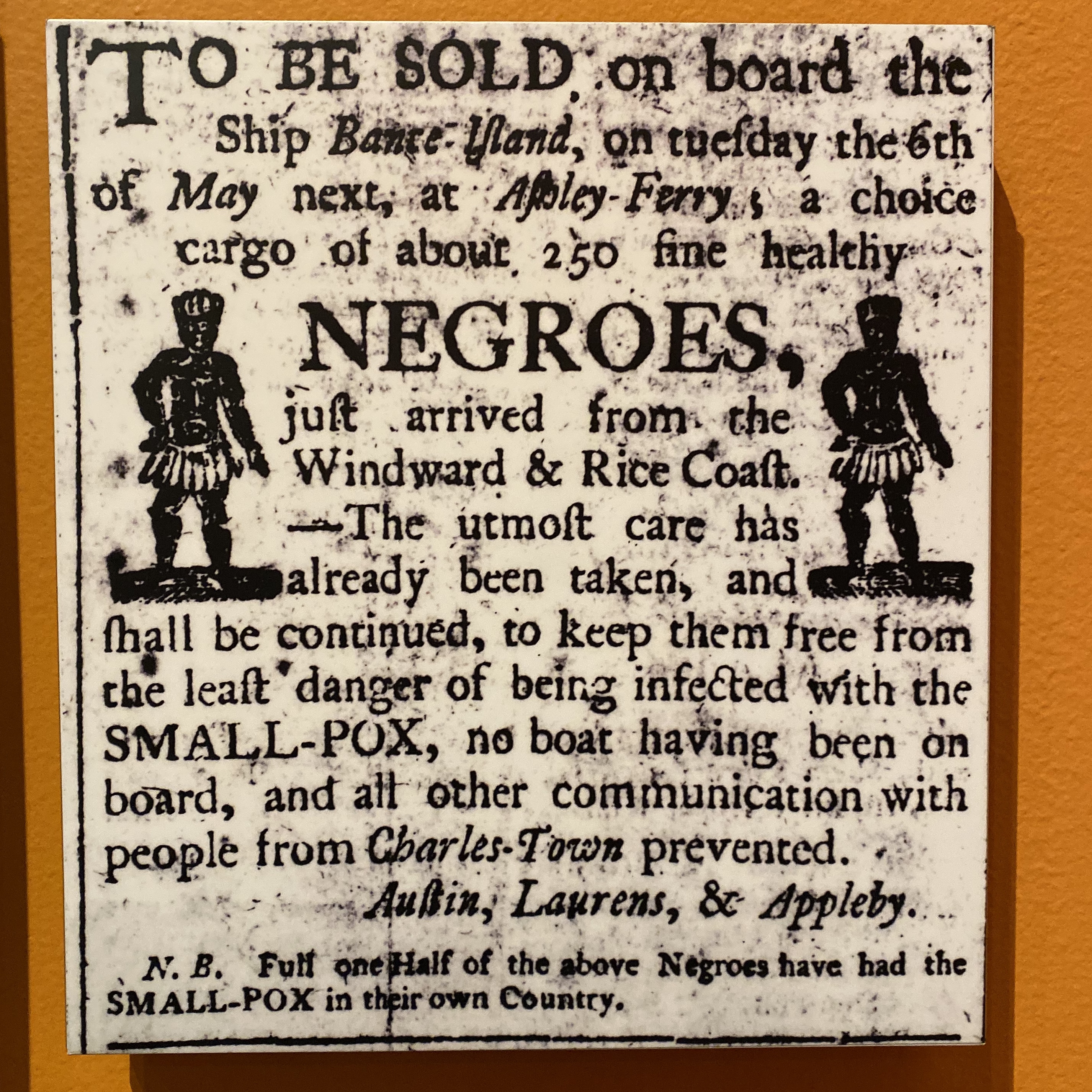
In Charleston, port physicians inspected incoming ships to protect the settlement from contagious diseases.  If a ship was suspected of carrying infection, Africans and white passengers arriving from Europe or other American colonies were quarantined.  They were isolated aboard ship, in homes, or in pest houses.

The first public pest house or “lazaretto” was constructed on Sullivan’s Island around 1707.  During the next 80 years four public pest houses were built between Fort Moultrie and the western end of the island. Following complaints by island residents, the last pest house was closed and sold in 1796.

fullsizeoutput_1b1e0

Bill of sale

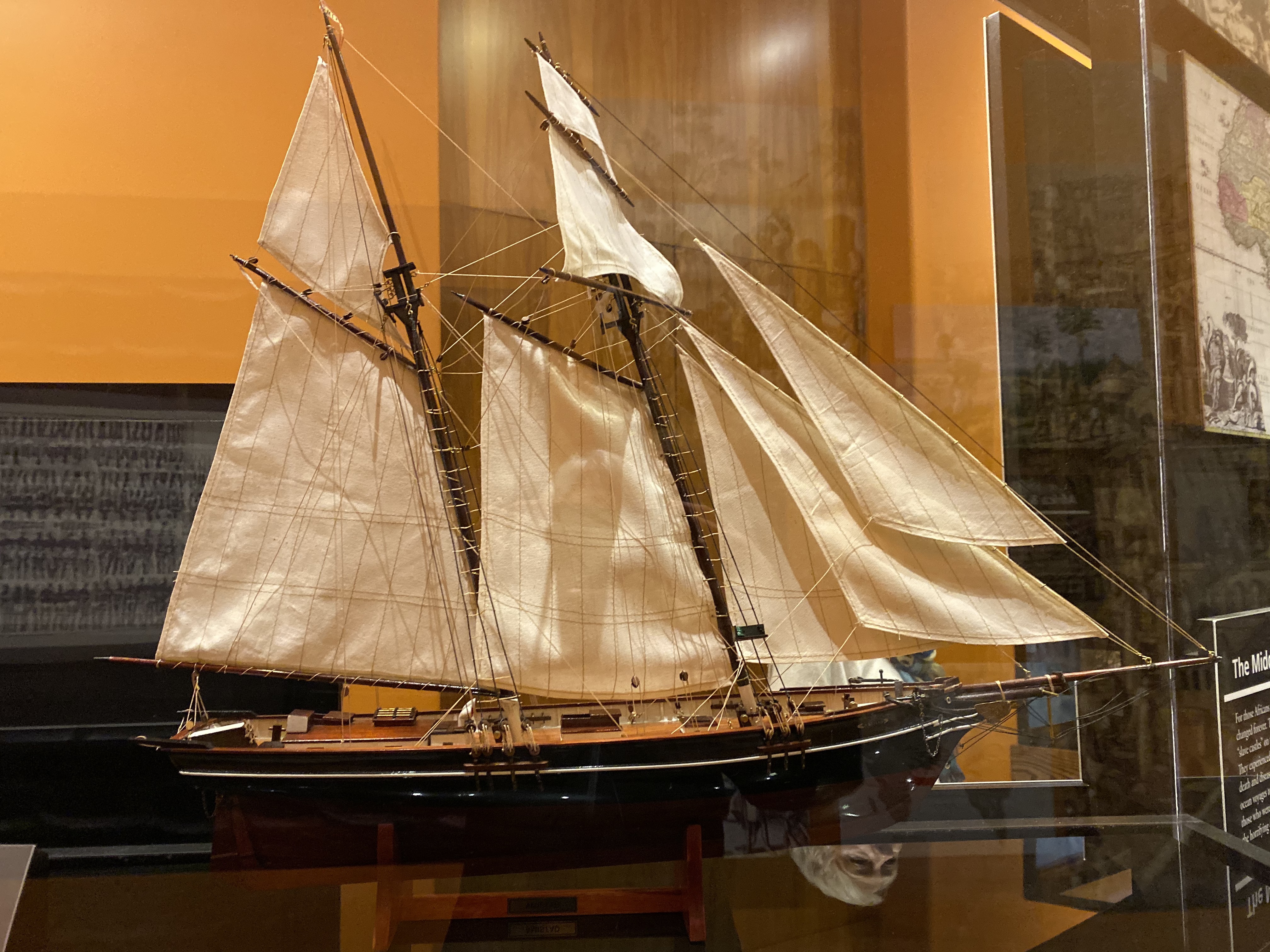
In July 1839, 53 enslaved Africans revolted on board La Amistad, leading to a U.S. Supreme Court ruling that set the Africans free. The captives were smuggled to the Americas from Africa after the international slave trade was outlawed. The Africans revolted off the coast of Cuba, and their case for freedom was heard in a New England court.

CvdBLfWwR5mUivDEgVbpFg

La Amistad

CLVpLRuHT0S%nWakzz0wzg

model of La Amistad

fullsizeoutput_1e7bd

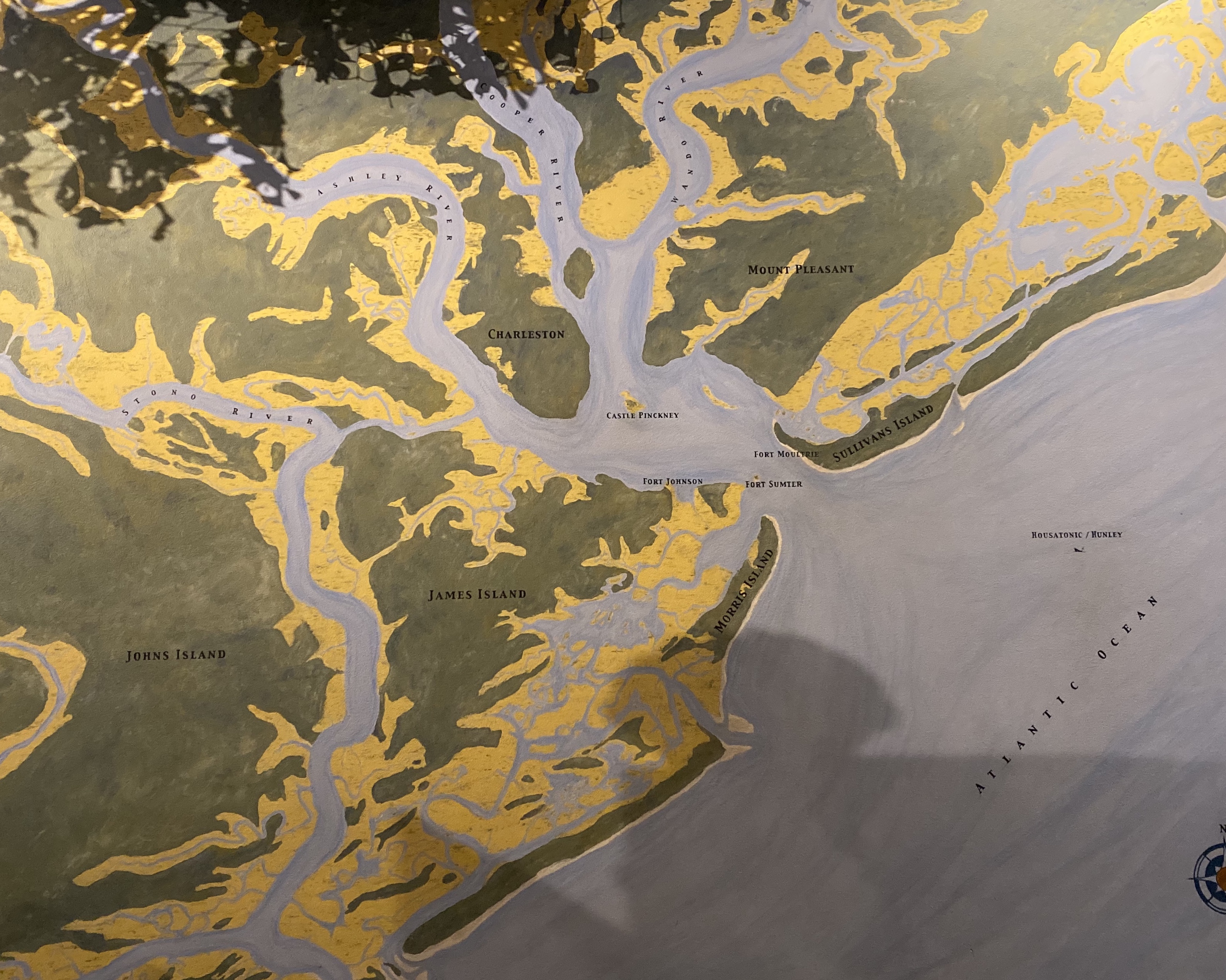
map of Charleston Harbor

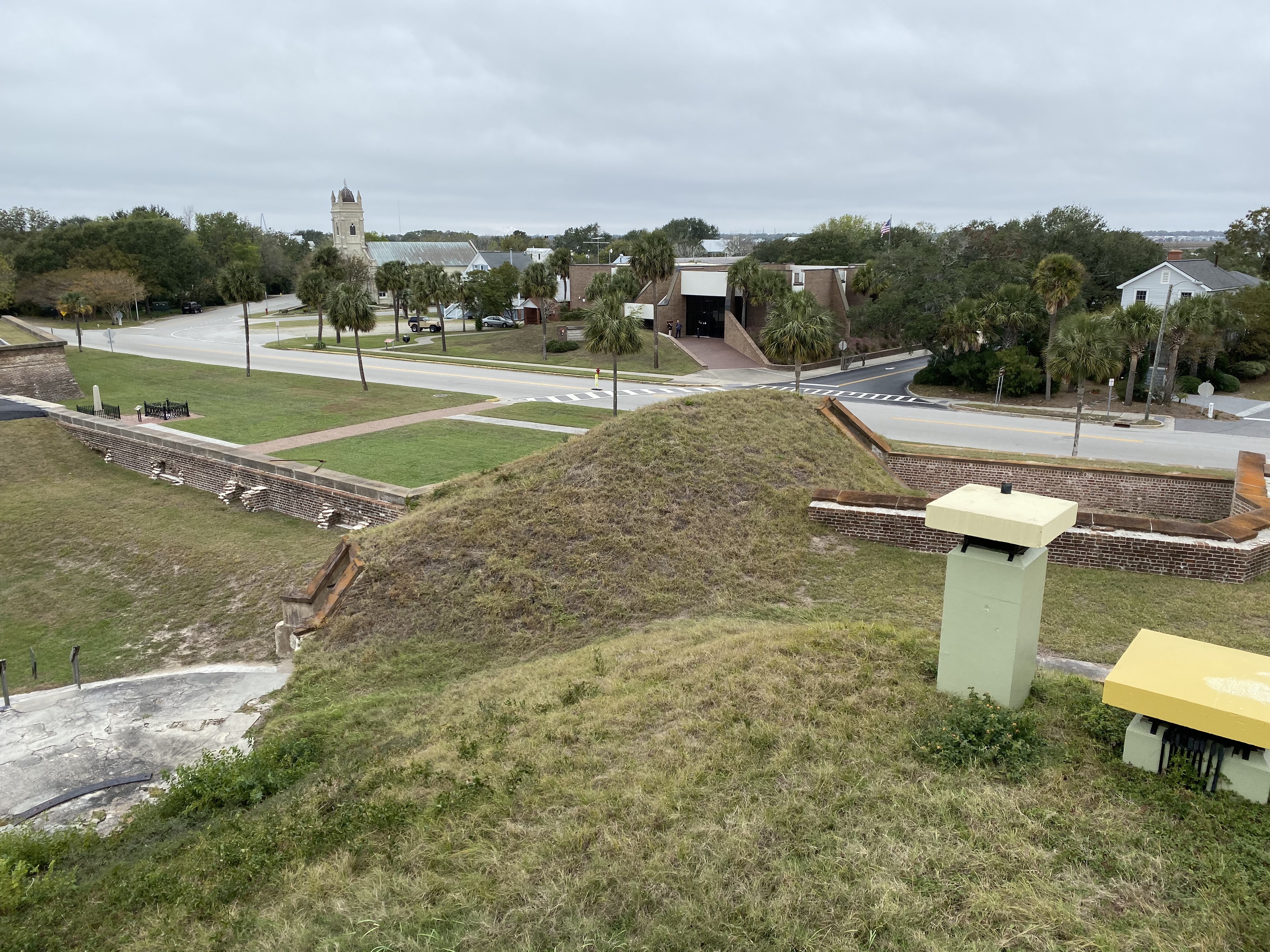
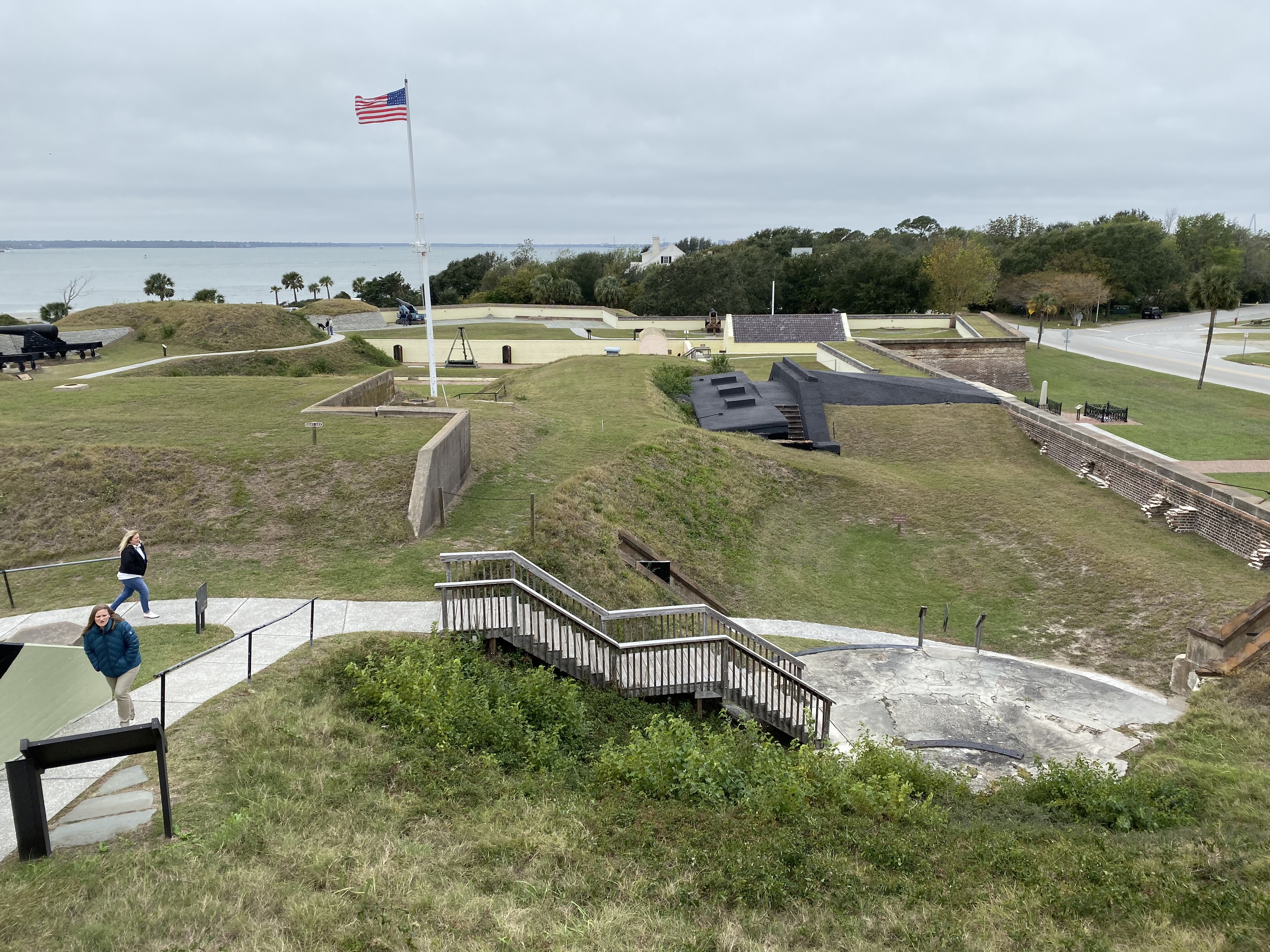
After walking around the Visitor’s Center, I climbed to the observation deck to see a view of the fort from on high. From this deck, the strategic value of Fort Moultrie became clear. Charleston Harbor’s main ship channel — the only deepwater access to the port — passes directly in front of the fort. Ships entering the harbor had to pass close under the fire of Fort Moultrie’s guns. From the time of the American Revolution through World War II, the fort’s position on the south end of Sullivan’s Island was the key to defending Charleston.

fullsizeoutput_1b1e2

view of Fort Moultrie from the rooftop of the Visitor’s Center

hnf6OXa6TH2rOQIyzRkghQ

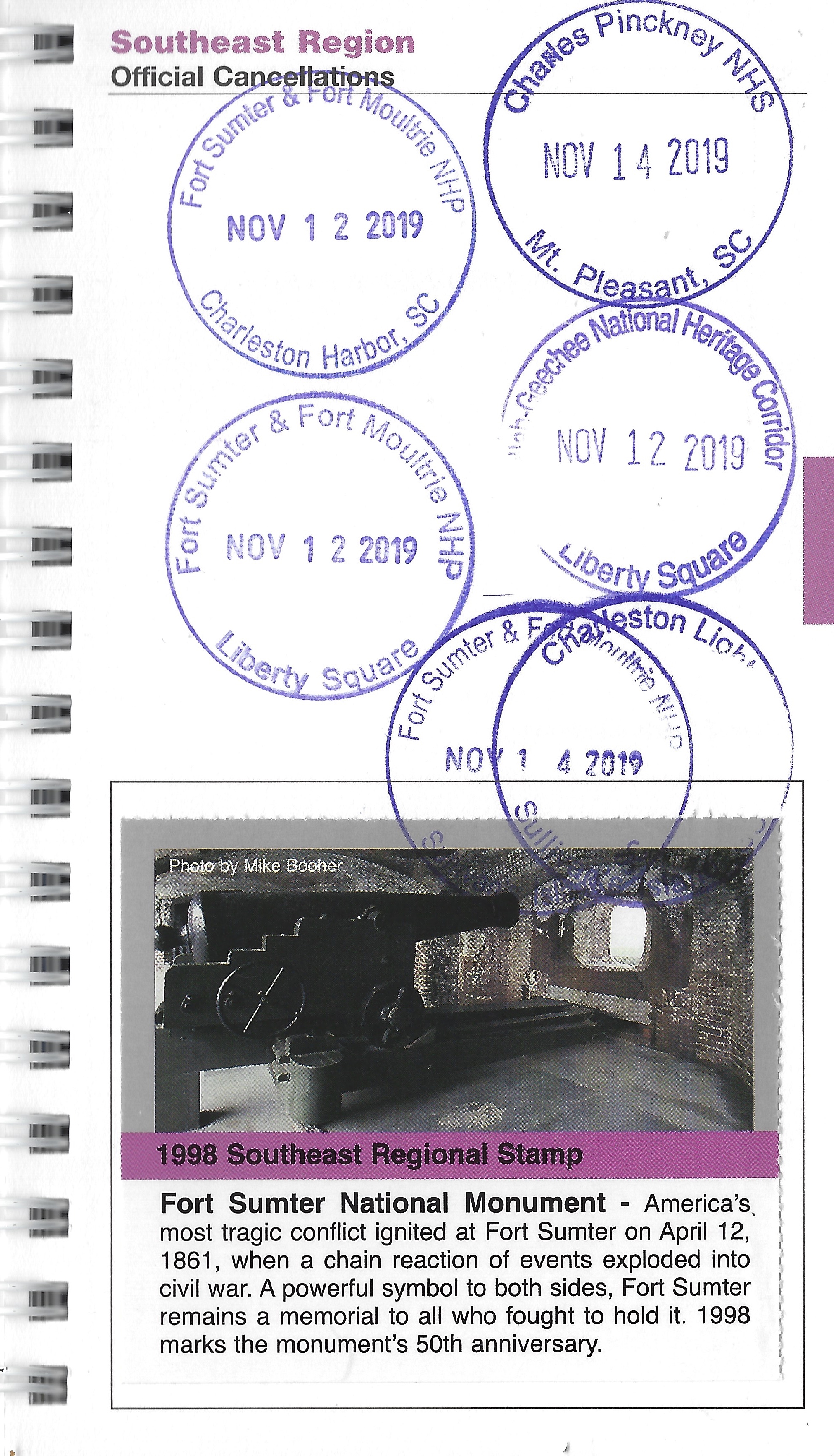
Below is my cancellation stamp for Fort Sumter, the Charles Pinckney National Historic Site, and Fort Moultrie.

fullsizeoutput_1e762

cancellation stamp for Fort Sumter, Charles Pinckney National Historic Site, and Fort Moultrie

By the time I left Fort Moultrie, it was raining.  I went back to the Airbnb and Sarah and I ate lunch there (chicken poblano soup and various crackers and cheeses/hummus/salami/chicken salad).  We watched a bit of Falling Inn Love (when city girl Gabriela wins a rustic New Zealand Inn in a contest and teams up with contractor Jake to fix and flip it).

Then we drove back to King Street in the pouring rain to go shopping.  We went first to Blue Bicycle Books (used, rare, and local) and browsed for a while.  “DEBORAH” was in the window and a book by Deborah Burns, Saturday’s Child: A Daughter’s Memoir, for an upcoming book talk.  When I stopped to take a picture of the window design, a guy walked by and said “Are you Deborah?”  That was random!

sign at Blue Bicycle Books
Sarah at Blue Bicycle Books
Blue Bicycle Books
Blue Bicycle Books
DEBORAH
DEBORAH

We went to H&M, where I bought three turtlenecks (black, purple and pink) and Sarah bought a bunch of stuff.  Sarah also bought earrings at Anthropologie and two pairs of very expensive jeans (with buttons) at Madewell.  We popped in and out of lots of small boutiques.

Tiring of the rain, we drove back to our Airbnb and watched the rest of the movie and had a glass of wine.

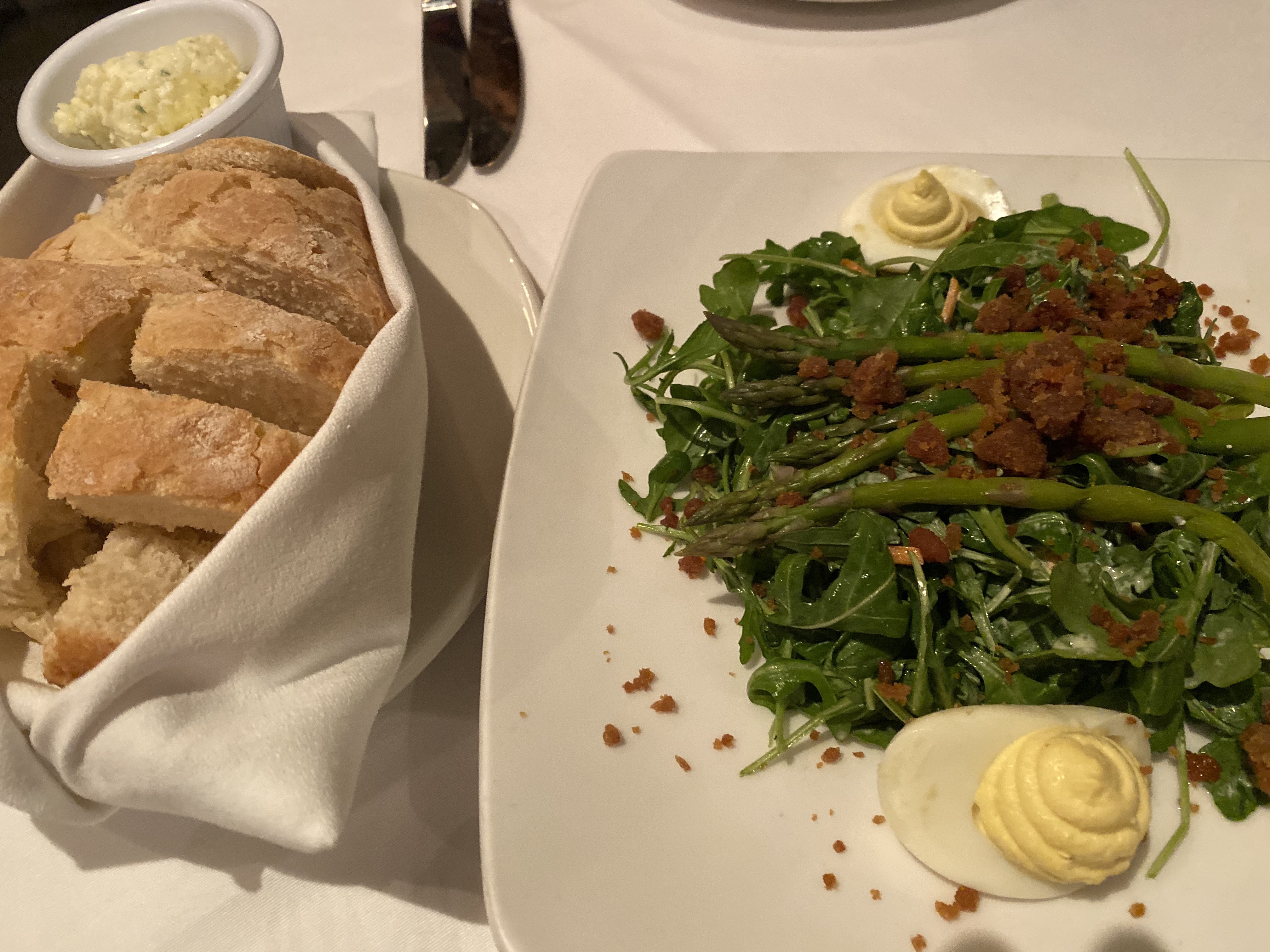
Then we drove back to Charleston to go Magnolias, with a “delightful take on Southern classics.” It was cozy, noisy and boisterous inside but the food was mediocre. I had an Uptown Fizz (Aperol, Moscato Rosé, & fresh cucumber).  We had an asparagus salad with arugula that we shared.  I had Buttermilk Fried Chicken Breast with mashed potatoes, collard greens (with too much vinegar), creamed corn, a cracked pepper biscuit, and herb gravy.  The chicken was dry and everything else was tasteless.

p5z2i0AOTQSwLMY7MD+lEA

asparagus salad with arugula

FHfg93frR021Si48Ygp5%g

Sarah had Shellfish over Grits: sautéed shrimp, sea scallops, creamy white grits, lobster butter sauce, and fried spinach. She complained hers was gelatinous and bland.

After dinner, we got cozy in our Airbnb and watched several episodes of This Is Us.

*Steps: 11,392, or 4.83 miles*

*Thursday, November 14, 2019*

Share this:

  • Share on X (Opens in new window) X
  • Share on Facebook (Opens in new window) Facebook
  • More
  • Email a link to a friend (Opens in new window) Email
  • Print (Opens in new window) Print
  • Share on Pinterest (Opens in new window) Pinterest
Like Loading...
  • Fort Union Trading Post National Historic Site
  • Montana
  • North Dakota

fort union trading post national historic site & grasshopper encounters

wanderessence1025's avatar wanderessence1025 October 13, 2020

Every morning, when I got up early for breakfast during my Road Trip to Nowhere, I was surrounded by construction workers from out of town who were involved in some project or another. I seemed to be the lone traveler.

I was heading to Fort Union Trading Post today, and then onward to the north unit of Theodore Roosevelt National Park.  After spending the afternoon at the park, I would go south to Medora, North Dakota from where I could access the south unit of the park.

By 8:00, I had left Watford City and was on the road.  I had a lot of territory to cover.  I passed by oil drills and rigs, containers and silos.  I crossed the Yellowstone River, and then the Missouri River.  By 9:33, I was at Fort Union Trading Post National Historic Site.

Fort Union Trading Post was the most important fur trading post on the upper Missouri River for 39 years (1828 – 1867).  It was a center of peaceful economic and social exchange between Plains Indian and white cultures. In 1966, Congress designated Fort Union Trading Post National Historic Site to commemorate its rich history and significant role in the development of the American West, according to the National Park Service brochure for the site.

The fort here now is a full-scale reconstruction built on the exact locations of the original structures.

I watched the film and walked through the Visitor Center in the Bourgeois House. The Bourgeois House was the home of the bourgeois (field agent) and chief clerk.  By 1851, a smaller building was enlarged into this two-story house with a porch.

fullsizeoutput_1e8e4

Fort Union Trading Post National Historic Site

Upper Missouri tribes had a traditional trade system in place for centuries. Plains tribes traveled throughout the area of the confluence of the Missouri and Yellowstone rivers in search of buffalo, elk, and other animals that provided them with subsistence. The area was traditionally Assiniboine, but other tribes made contact in the area too. The Assiniboine, Blackfeet, Crow, Cree, Ojibway, Hidatsa, and Mandan traded buffalo robes, meat, corn, beans, squash, and other materials.  As Euro-Americans came into their area, trade for European goods attracted their interest. Fort Union Trading Post was established to meet this growing demand.

The Assiniboine people, one of about nine plains tribes who traded at Fort Union, considered this area their homeland.  The Assiniboine presence here was a reminder that Fort Union had been built on their land.

In trade exchanges, each culture felt it was superior to the other.  Traders were comfortable in their superior technology, while Indians thought whites valued robes and furs too highly.  They believed they got the best of the exchange. The fur trade was a snapshot in time when there was a balance between two cultures.

The American Fur Company (AFC) was an international business established by John Jacob Astor in 1808. Astor aggressively sought access to the western fur trade based in St. Louis.  By 1827, he merged with his two rivals, Bernard Pratte and Company and the Columbia Fur Company, to dominate the fur trade on the upper Missouri.

“King of the Upper Missouri” McKenzie, a former Canadian North West Fur Company trader, joined John Jacob Astor’s American Fur Company in 1827 to manage the newly established Upper Missouri Outfit.  He directed construction of Fort Union in 1828.

fullsizeoutput_1e8c3

Trading Empire of the American Fur Company

fullsizeoutput_1e8c5

Fur Traders

fullsizeoutput_1e8c6

Fur Traders

IMG_0518

Furs

fullsizeoutput_1e8c9

Flag Pole

fullsizeoutput_1e8d7

Bourgeois House, Visitor Center

fullsizeoutput_1e8cc

Dwelling range and ice house

IMG_0537

furs

fullsizeoutput_1e8d8

Bourgeois House

fullsizeoutput_1e8e5

Bourgeois House

Interactions between white men and tribes was very ceremonial: sharing gifts, smoking traditional pipes, speeches — all done according to tribal custom. Buffalo robes, beaver pelts, and other furs were traded in exchange for guns, pots, beads, knives, blankets, cloth and other items of value to the tribes.

Goods the tribes received allowed them to dominate their environment more effectively.  Traders were able to sell the robes and furs to a growing population back East and to European fur markets.

Clerk's Office
Clerk’s Office
Bourgeois House
Bourgeois House
Karl Bodmer's watercolor of an Assiniboine encampment
Karl Bodmer’s watercolor of an Assiniboine encampment
praire around Fort Union Trading Post

Economic exchanges between the traders and tribes became social.  Intermarriage, adoption, and participation in tribal ceremonies because an active part of the white traders’ lives. Traders married Indian women for companionship, to cement business transactions, and because no white women lived on the upper Missouri.

I walked outside the gates to see the Indian encampment.

IMG_1330

Indian encampment

fullsizeoutput_1e8db

Indian encampment

fullsizeoutput_1e8d2

Indian encampment

IMG_1336

Southwest Bastion and Palisade Walls

IMG_0561

Main and Inner Gates and Strong Room

IMG_0562

Bourgeois House

The advance of pioneers starting in the 1860s marked the end of the Plains Indian buffalo hunting culture.  White encroachment from Minnesota, coupled with the discovery of gold in Montana, brought Indian uprisings.  The federal government sent army troops to subdue the Plains Indians.  Finally, the expansion of transcontinental railroads brought more settlers to the upper Missouri country, eventually extinguishing the Plains Indian resistance.

I left the site and passed a WELCOME TO NORTH DAKOTA sign so I must have briefly been in Montana. I was in search of the Bodmer Overlook Trail and ended up at the Missouri-Yellowstone Confluence Interpretive Center, where the nice lady there set me straight.  A wedding was being set up there.

Confluence Interpretive Center
photo showing the confluence of the Yellowstone and Missouri Rivers
Yellowstone & Missouri Rivers

On the way back to the trail, I accidentally ran over a pheasant. 😦

The Bodmer Overlook Trail was 0.9 miles each way.  In 1833, Karl Bodmer sketched images of Fort Union, Assiniboine Indians, and the confluence of the Missouri and Yellowstone Rivers.  The trail passed the site of the former town of Mondak (named because it straddled the Montana and North Dakota border).

Bodmer Overlook Trail

At the Bodmer Overlook Trail, I walked through grassland, with grasshoppers hopping, crickets chirping and butterflies fluttering. The grasses shimmered in gold and green like an impressionist painting in progress.

I walked 1.73 miles in 41 minutes.

fullsizeoutput_1e8dc

Bodmer Overlook Trail

fullsizeoutput_1e8e1

Bodmer Overlook Trail

IMG_1359

Bodmer Overlook Trail

IMG_1361

Bodmer Overlook Trail

fullsizeoutput_1e8e2

Bodmer Overlook Trail

IMG_0574

Bodmer Overlook Trail

IMG_0575

Bodmer Overlook Trail

At the Bodmer Overlook, I was moved by the sight of the rivers and Fort Union down below, and the thought that Karl Bodmer was was at this spot almost two centuries ago painting the active trading scene he saw below.

fullsizeoutput_1e8e3

Bodmer Overlook Trail

IMG_1371

Bodmer Overlook Trail

IMG_0577

Bodmer Overlook Trail

IMG_0580

Bodmer Overlook Trail

IMG_0582

Bodmer Overlook Trail

fullsizeoutput_1e8dd

Bodmer Overlook Trail

fullsizeoutput_1e8de

Bodmer Overlook Trail

IMG_1382

Bodmer Overlook Trail

IMG_1385

Bodmer Overlook Trail

fullsizeoutput_1e8df

I drove back out of the park, passing Welcome to North Dakota Legendary, then down the road to Fairview (Montana again), then back past Welcome to North Dakota Legendary.  I drove 200 to 85S for 35 miles, while Guy Clark sang about stuff that works.

I passed the Tumbleweed Inn and Suites, Patriot Fuel and Patriot Lodging, while Big Thief sang about objects, and The XX sang “I dare you.”

IMG_1388

Occident Flour

IMG_1389

As I drove from Fort Union to the north unit of Theodore Roosevelt National Park, I felt pricks on my skin, as if something was stinging me. With my hand, I felt something hard under my shirt, but it kept moving around, stinging me as it moved.  I pulled off the road and whipped off my shirt. A grasshopper hopped out and after much hollering and shooing, I finally managed to show him out of the car.  He hopped into the horizon as Kodaline sang “Follow Your Fire.”

Information about Fort Union Trading Post comes from a pamphlet distributed by the National Park Service.

Here is my cancellation stamp for Fort Union Trading Post.

fullsizeoutput_1f29f

Cancellation stamp for Fort Union Trading Post NHS

*Saturday, September 14, 2019*

Share this:

  • Share on X (Opens in new window) X
  • Share on Facebook (Opens in new window) Facebook
  • More
  • Email a link to a friend (Opens in new window) Email
  • Print (Opens in new window) Print
  • Share on Pinterest (Opens in new window) Pinterest
Like Loading...
  • American Road Trips
  • Dakota Dinosaur Museum
  • Dickinson

mandan to the enchanted highway to watford city, north dakota

wanderessence1025's avatar wanderessence1025 October 11, 2020

I left Bismarck and headed to Mandan, passing Burning Desires Fireplaces, horses, and cone-type hills.  It was 50°F and raining.

On the way to Fort Abraham Lincoln State Park, I was stopped in my tracks by a glowing scene of a creek running through a field with a rainbow overhead.

fullsizeoutput_1a49d

a rainbow near Fort Abraham Lincoln

At Fort Abraham Lincoln State Park, I watched a film about the history of the Missouri River and all the people who lived along it. I looked around the museum at displays about the Indians who lived there and about George Armstrong Custer. The park is home to a number of historical sites including General Custer’s house and the On-A-Slant Mandan Indian Village.

The land here was dedicated to the state in 1907 by President Theodore Roosevelt. Park development started in 1934 by the Civilian Conservation Corps (CCC), who built the visitor center, earthlodges, blockhouses, shelters and roads, and placed cornerstones to mark buildings at the infantry and cavalry posts.

IMG_0380

Fort Abraham Lincoln State Park

George Armstrong Custer was the commanding officer of Fort Abraham Lincoln from the fall of 1873 until he perished in the Battle of the Little Big Horn in 1876.

Many events led up to the Battle of the Little Big Horn.  The presence of the white men in the Black Hills, caused by the Black Hills Expedition, was one major factor.  Also, Sioux Indians had been leaving their reservation to raid small settlements and farms.  In 1875, the Interior Department ordered all Indians to report to reservations by January 31, 1876. By February 1, many Indians had not reported and the Interior Department turned the problem over to the military.  On February 7, orders were given to commend military action against the hostile Sioux.

The Battle of the Little Bighorn, commonly referred to as Custer’s Last Stand, was an armed engagement between combined forces of the Lakota, Northern Cheyenne, and Arapaho tribes and the 7th Cavalry Regiment of the United States Army. The battle, which resulted in the defeat of U.S. forces, was the most significant action of the Great Sioux War of 1876. It took place on June 25–26, 1876, along the Little Bighorn River in the Crow Indian Reservation in southeastern Montana Territory.

fullsizeoutput_1e7fb

Three-pronged movements in the Sioux campaign of 1876

For both officers and enlisted men, and their families, life on a frontier post was both demanding and full of hardships.

The Indian War soldiers were all volunteers.  Few men were educated, and most were illiterate. Immigrants made up a large number of the recruits. Soldiers joined for a variety of reasons: to learn to speak English, to escape from the law or their wives, or to seek adventure.

The mainstays of the enlisted man’s menu were hash, stew, baked beans, hard tack, salt bacon, green coffee, coarse bread, beef, and sometimes brown sugar, salt, vinegar, or molasses.  Scurvy was a common disease due to the lack of fresh fruits or vegetables.

An officer’s life was a little easier than an enlisted man’s life, but they both shared feelings of isolation and boredom. Much of an officer’s day was occupied by conducting drills, directing work details and construction projects, and day-to-day administrative work.  Sometimes the men organized activities such as dances and plays put on by the soldiers themselves, or by attending musical performances put on by the post band.  Much time was spent drinking and gambling, and the post trader’s store was a main source of recreation.  Unfortunately, results of the boredom often led some soldiers to alcoholism and desertion.

During most of the Indian Wars, the basic enlisted man’s salary was $13.00 per month.  This low rate of pay was one major cause of a high desertion rate.

During the summer months, favorite forms of recreation for the soldiers were baseball and horseback riding.  Card games and billiards were also favorite pastimes.

statue for Civilian Conservation Corps
Major General George Armstrong Custer
Holster and Belt
Holster and Belt
The Frontier Soldier's Free Time
The Frontier Soldier’s Free Time
soldiers at Fort Abraham Lincoln

Indian scouts were an important part of frontier military campaigns. The scout was enlisted for his knowledge of the territory and his ability to communicate with members of the other tribes. Military scouts were also helpful in training new recruits in frontier survival and in tactics and techniques for combat.

Scattered Corn (1854-1940) was the first female Corn Priest of the Mandan tribe. At the age of 12, she learned the secrets and details in the art of building an earthlodge. By the age of 18, she built a total of four earthlodges for her own use.  In 1934, with the assistance of the Civilian Conservation Corps, she designed and reconstructed five earthlodges at Abraham Lincoln State Park.

fullsizeoutput_1e7fe

Scattered Corn

During the six years following the Battle of the Little Big Horn, the Fort continued its mission to protect transportation routes and railroad construction crews, as well as government property.

Upon completion of the railroad to the Montana line, Fort Abraham Lincoln fulfilled its purpose.  Consequently, the fort gradually declined in importance.

In 1882, the 7th Cavalry headquarters were transferred to Fort Meade, now in South Dakota.  The army abandoned Fort Abraham Lincoln in 1891.

******

The Mandan Indians, an agricultural Indian tribe, settled On-a-Slant Village from 1575-1781 with a population once as high as 15,000. It received its name because of the sloping ground upon which it was situated. The Indians farmed miles of Missouri River bottomland from 10-12 fortified cities here on the Slant River. The villages were empty and wiped out by smallpox by the time Lewis and Clark visited.

IMG_0418

On-a-Slant Village

At the pinnacle of their wealth and power, the Mandans built cozy round earth lodges like the ones at Knife River.  On-a-Slant Village shows traces of 75 lodges, including a large ceremonial lodge that is 84 feet in diameter.

Inside the walls of On-a-Slant Village, approximately 85 extended family earthlodges were constructed.  It appears that each of them was round, with the exception of one large public building, the Tixopinic, or Medicine Lodge, which was a D-shaped lodge.  Major religious and social events were held in the Tixopinic.

In the center of the central plaza was the Mini-midi-douxx, generally known as the Ark of the Lone Man.  This shrine commemorated the protection Lone Man offered the Mandan during a Great Flood that covered the earth.  The Mini-midi-douxx was the center of public religious events, like the O-kee-pa.

From earliest times, the Mandan protected their villages from attack by construction of defensive fortifications, usually wide ditches backed with palisade walls made of cottonwood and other timbers.

fullsizeoutput_1a4ae

On-a-Slant Village

The Mandan were known as peaceful people who were brave when attacked.  In other words, their reputation was that they didn’t look for trouble, but they knew what to do when trouble came. Almost every man over 15 was a warrior until he was too old to fight.

The village was alive with activity: women bringing produce from the garden, men watching the women work and maybe planning a fall buffalo hunt, children playing in the streets.

fullsizeoutput_1e802

Indian dance

Mandan cities paid attention to public sanitation, and they were kept fairly clean.  Garbage was organic and biodegradable. It was placed in midden piles which, when placed near the village walls, may have served a dual purpose as ramparts to raise defenders against any attackers.

The predominant makeup of the park is mixed grass prairie.  The floodplain forest and upland woody draws and shrublands also make up the park.

In 1781, a smallpox epidemic spread to every Native nation in the heart of America.  They all suffered greatly, but none so severely as the earthlodge people. Their population of 10,000 to 15,000 was reduced to a couple thousand people.  Four of every five Mandan died in 1781.  The survivors left their centuries-old villages like On-a-Slant and moved north, settling Mitutanka near the Hidatsa by the Knife River.

fullsizeoutput_1e809

On-a-Slant Village

fullsizeoutput_1e80a

On-a-Slant Village

fullsizeoutput_1e80c

On-a-Slant Village

fullsizeoutput_1e819

On-a-Slant Village

fullsizeoutput_1e81a

On-a-Slant Village

fullsizeoutput_1e81d

On-a-Slant Village

On-a-Slant Village
On-a-Slant Village
On-a-Slant Village
On-a-Slant Village
On-a-Slant Village
On-a-Slant Village
On-a-Slant Village
On-a-Slant Village
On-a-Slant Village
On-a-Slant Village
On-a-Slant Village
On-a-Slant Village

Every part of the Buffalo was used by Native Americans: bone, organs and hide.

fullsizeoutput_1e82a

Uses of the buffalo

On October 26, 1804, Sheheke-shote (born ~1766), Civil Chief of the Mandan, welcomed Meriwether Lewis to Mitutanka.  Six days later, he told Lewis and William Clark that the Mandan (Nu’eta) would agree to make peace with the Arikara, and guaranteed that the Americans would have food throughout the coming winter. “If we eat, you shall eat, if we starve, you must starve also,” he said.

fullsizeoutput_1e803

“If we eat, you shall eat.”

Through the winter of 1804-05, Sheheke helped his American neighbors, who called him Big White.  He took them on their first buffalo hunt, brought them meat and corn, helped William Clark make a map of the Yellowstone River, entertained them in his village, and even marched Lewis and 20 soldiers in pursuit of more than 100 mounted Sioux warriors.

fullsizeoutput_1e805

Lewis & Clark & Seaman

I walked by General George Armstrong Custer’s house at Fort McKeen.

There were also buildings of the cavalry and infantry posts. I saw the central barracks, the commissary store, and the blockhouses standing guard over the old fort. Prior to the time Custer led the army expeditions into the Black Hills and before he was killed at the Battle of Little Big Horn in Montana, he was a young Civil War hero stationed at Fort Lincoln in what was then the Dakota territory.

I stopped in the commissary and bought some stickers for my journal.

I didn’t take any of the trails because I was pressed for time and it was still quite wet and cold.

fullsizeoutput_1e80d

The Custer House

fullsizeoutput_1e80e

Barracks

fullsizeoutput_1e810

The Custer House

fullsizeoutput_1e811

The Custer House

fullsizeoutput_1e814

Barracks

fullsizeoutput_1e836

The Custer House

fullsizeoutput_1a496

I left Mandan at 10:45 and it was still gloomy and raining.  I was surprised by the hilly landscape.  I stopped for a scenic view at Sweetbriar Lake. I saw a giant metal cow on a hillock.  There was still a ceiling of clouds, but some blue peeked through here and there.

On my way, I ate a 6″ tuna sandwich from Subway.  Then I drove through sunflower fields and rolling hills.  It seemed the elevation of the land was increasing.

fullsizeoutput_1e83c

North Dakota landscape

IMG_1204

As the sun came out, it streaked the fields with alleys of gold. More sunflowers were all around, with cone-shaped hills scattered through the land. Then there were blackened sunflowers near Glen Ullin and Beulah and John Hiatt sang that the “wind don’t have to hurry.”

I arrived in Gladstone at 12:30; this was the start of the Enchanted Highway. It would be a 33-mile drive to Regent, and then I’d have to backtrack that same stretch of highway.

Former teacher and school principal Gary Greff, with no welding or art training, was worried his town of Regent (population 200) would disappear off the map like so many other farm-dependent towns. When he saw people stopping to take pictures of a giant man made of hay bales, he decided to do mural sculptures. In 1991, he finished Tin Family, made from used farm equipment.

The first sculpture I saw was Geese in Flight, completed in June of 2001.  It is in the Guinness Book of World Records as the largest scrap metal sculpture in the world. It was built of used oil well pipe and oil tanks.  It weighs over 75 tons.  The largest goose has a 30 foot wing span and is 19 feet long.

IMG_1208

Geese in Flight

Deer Crossing/The Deer Family was completed in 2001, and erected in 2002. It was made of old oil well tanks cut apart and welded to form the shadow design.

IMG_1210

Deer Crossing/The Deer Family

Grasshoppers in the Field was done in 1999 as a reminder of hardships farmers had to overcome. The 40-foot grasshoppers represent one of the Midwest’s most devastating plagues. The largest grasshopper is 50 feet long and 40 feet tall.

IMG_1217

Grasshoppers in the Field

Fisherman’s Dream was completed in 2006. It is a three-dimensional sculpture that is made out of tin to form seven fish.  The fish swimming under the water scene include a small mouth bass, walleye, catfish, northern salmon, and bluegill, which measure 30 feet long.  Jumping out of the water is a 70 foot long rainbow trout.

IMG_1228

Fisherman’s Dream

IMG_1234

Fisherman’s Dream

Fisherman's Dream
Fisherman’s Dream
Fisherman's Dream
Fisherman’s Dream

Pheasants on the Prairie, from 1996, was surrounded by sunflowers, corn and hay bales. It is made of wire mesh and took three years to complete. The rooster is 40 feet high and 70 feet long.  There was hardly a cloud in the sky and hardly a soul on the road.

fullsizeoutput_1e83e

Pheasants on the Prairie

fullsizeoutput_1e83f

Pheasants on the Prairie

IMG_1246

Pheasants on the Prairie

IMG_1241

farmland around Pheasants on the Prairie

Teddy Rides Again is from 1993 and is a tribute to Theodore Roosevelt’s part in North Dakota’s history.  The sculpture was built of used well pipe. Teddy and his favorite horse “Mulley” stand 51 feet tall and weigh over 9,000 pounds. It stands just south of Black Butte, which is 3,112 feet above sea level.

IMG_1250

Teddy Rides Again

Tin Family, from 1991, was the first site erected on the Enchanted Highway. It was built of used farm equipment that took farmers hours of labor and welding to achieve.

IMG_1256

Tin Family

Whirly Gigs was near the town of Regent.

Whirly Gigs
Whirly Gigs
Enchanted Highway Gift Shop in Regent, ND
Regent, ND
Regent, ND

After arriving in Regent, I went north again to Exit 72, and passed through sunflowers and more grasslands. It was a long drive down with all the stops and then I had to backtrack, so it took a good chunk of the day.

When I arrived in Dickinson, I realized there was no way I could make it to Fort Union by the time they closed, so I decided to go ahead and visit the Badlands Dinosaur Museum, an earth science museum that features dinosaur bones found in North Dakota, including a complete triceratops, which lived in the Badlands when it was a warm and swampy area, and a duck-billed edmontosaurus.  There were ten other full-scale dinosaurs, a complete fossil rhino, and rocks and minerals.

IMG_1313

Dakota Dinosaur Museum

fullsizeoutput_1e85b

Dakota Dinosaur Museum

Thescelosaurus
Thescelosaurus
Edmontosaurus
Edmontosaurus
Thescelosaurus & co.
dinosaurs hatching
dinosaurs hatching
dino skull
dino skull
owls
owls
Pteranodon sternbergi
Albertosaurus
Albertosaurus
Equisetum
Equisetum
bones
bones
various skulls
various skulls
another dinosaur skull
Coelophysis
Coelophysis
Allosaurus
Allosaurus
Stegosaurus
Stegosaurus
Albertosaurus
Albertosaurus
Triceratops
Triceratops
Deinonychus antirropus
Cephalopoda
Cephalopoda
Pelecypoda (Opalized Oyster)
Tiger Iron
Tiger Iron
Okenite
Okenite
Agate
Agate
Gypsum (Selenite)
Gypsum (Selenite)
Halite (Pink)
Halite (Pink)
Modern Coral
Modern Coral
Thorny Oyster
Thorny Oyster
Sea Urchin
Sea Urchin
Corals
Corals
Trilobita (Trilobite) - Morocco
Trilobita (Trilobite) – Morocco
glowing minerals
glowing minerals
oviparity & viviparity
Eggs
Eggs
Eggs and eggshells
Eggs and eggshells

Adjacent was the Joachim Regional Museum & Prairie Outpost Park.  It showed how pioneers settled southwestern North Dakota.

Joachim Regional Museum & Prairie Outpost Park

Outdoors, I saw a Norwegian stabbur (storage house), a German-from-Russia homestead house, a one room schoolhouse, a railroad depot, a church and other buildings that reflected the area’s ethnic and immigrant past.

Shipley School
Shipley School
Ridgeway Luthern Church, built 1914-1915
Gorham Store & Post Office
South Heart Depot and rail car
windmill and garden
windmill and garden
prairie house
prairie house
Stabbur
Stabbur
Ceska Radnice Czech Town Hall
Memorial Pioneer Stone House erected by Germans from Russia
Veterans Memorial Chapel

It was a long drive north on 85 to get to Watford City.  I drove past the north unit entry to Theodore Roosevelt National Park, which was only about 15 miles south of Watford City.  I’d be going there the next day after going to Fort Union.

I found panoramic views of the badlands — canyon walls with colorful and fantastic shapes.  The ever-changing landscape has horizontal layers of multi-colored sandstone, clay and shale complimented by scattered beds of lignite coal and patches of pastel pink scoria.  Scoria, or clinker, is created when the soft lignite burns, baking the surrounding clay to this bright color.

Other layers contain concentrations of petrified logs and stumps of redwood, cypress and cedar. The rock layers are easily eroded, thus the scene is constantly changing.

It was beautiful with with the green and gold foliage, so I looked forward to exploring more the next day.

IMG_0499

Badlands just outside of Theodore Roosevelt National Park

IMG_0503

Badlands just outside of Theodore Roosevelt National Park

IMG_0504

Badlands just outside of Theodore Roosevelt National Park

fullsizeoutput_1e86d

Badlands just outside of Theodore Roosevelt National Park

IMG_1316

Badlands just outside of Theodore Roosevelt National Park

IMG_1320

Badlands just outside of Theodore Roosevelt National Park

IMG_1322

I checked in to the Little Missouri Inn and Suites, which was quite nice, and expensive.

I tried to go to Outlaw’s Bar and Grill but it was too crowded.  Then I went to the Tokyo Japanese Steakhouse, where only two servers were working.  When I asked when I’d get service, the rude guy told me if I wanted to wait, I could stay, otherwise, I should go ahead and leave.  I said I would go ahead and leave.  I said, “No wonder they say on Yelp that this place has bad service.”  He said, “No one cares about that.”  I said, “Obviously, they do or it wouldn’t be so empty.”

I then tried to go to Hardee’s but the menu was unrecognizable to me.

So I ended up eating Subway again, this time a meatball marinara 6″.  This was the first unpleasant evening I’d had on my trip so far.

Information from the various sites is taken from signs at the sites.

Below are a few of my journal pages from today’s trip.

journal pages: Mandan to Watford City

*Drove 267.6 miles; Steps 9,903, or 4.2 miles*

*Friday, September 13, 2019*

Share this:

  • Share on X (Opens in new window) X
  • Share on Facebook (Opens in new window) Facebook
  • More
  • Email a link to a friend (Opens in new window) Email
  • Print (Opens in new window) Print
  • Share on Pinterest (Opens in new window) Pinterest
Like Loading...
  • American Road Trips
  • Charles Pinckney National Historic Site
  • Charleston

charleston: the charles pinckney national historic site

wanderessence1025's avatar wanderessence1025 October 8, 2020

My daughter informed me this morning that she wanted to go on a run and just have a leisurely morning; she didn’t want to accompany me to Charles Pinckney National Historic Site, Sullivan’s Island, or Fort Moultrie.  I felt like there was still some residual anger and tension in the air over our arguments about TV shows and dining out from the night before.  I wasn’t about to let her disrupt my travel goals, so I went out determined to enjoy my time.

However, I didn’t enjoy the time, not at all.  It was gloomy and threatening rain, which often affects my moods.  Also, I had been having dreams of escape lately, especially with all the stuff going on with our youngest son. I had dreamed of finding a job in Richmond and getting an apartment there where I could at least hang out periodically with Sarah. This morning, it was clear to me that moving to Richmond wouldn’t solve my problems, as my daughter didn’t seem to enjoy my company either.  I felt anxious, more sure than ever that I was not made for motherhood, in fact, that I was a huge failure at it. I wished a huge sum of money would drop down from the sky, so I could move back to Coeur d’Alene, Idaho, or to a Greek island.  I knew in my head that it wouldn’t solve my problems, but my heart was telling me otherwise.

So.  I was in a dark mood as I drove under gloomy skies to the Charles Pinckney National Historic Site on Sullivan’s Island.

Charles Pinckney National Historic Site commemorates Charles Pinckney’s life of public service and contributions to the United States Constitution, and preserves a remnant of his 715-acre coastal plantation, Snee Farm.

fullsizeoutput_1e676

Snee Farm

Charles Pinckney was a long-time advocate of a strong central government with clear separation of powers.  He advocated for protecting property interests and helped to shape the U.S. Constitution.

fullsizeoutput_1e65f

Charles Pinckney National Historic Site

KzFBcwI9RmWVk2jwR6UURA

Charles Pinckney National Historic Site

Charles was born into a prominent Charleston family on October 26, 1757. His father, a wealthy planter and attorney, was commanding officer of the local militia, member of the General Assembly, and president of the state’s Provincial Congress.

Charles received his basic schooling from a South Carolina scholar who emphasized history, the classics, political science, and languages.  Growing political unrest with Great Britain disrupted Charles’ plan to attend school in England.  He ended up staying home and studying law with his father.

fullsizeoutput_1e667

Charles Pinckney

In 1779, during the Revolutionary War, Pinckney represented Christ Church Parish in the State Assembly.  As a lieutenant in his father’s militia regiment, he helped to retake Savannah from the British.  The next year, after the British captured Charleston, he and his father were imprisoned along with other American officers.  The older Pinckney was freed after swearing allegiance to the British Crown, which saved the Pinckney estate.  Charles wasn’t released until June 1781.

In 1784, Pinckney became a delegate to Congress. In May, 1787, he and others represented the state at the Constitutional Convention in Philadelphia. On May 23, 1788, South Carolina ratified the new Constitution.

In April of 1788, Charles married Eleanor Laurens and they eventually had three children.  Over the next ten years, he held a variety of political offices, including Governor of South Carolina and U.S. Senator.

During his grand tour of the southern states in 1791, President George Washington breakfasted at Charles Pinckney’s Snee Farm.

In 1795, Charles Pinckney joined with Thomas Jefferson’s Democratic Republicans, championing the interests of rural Americans over those of the coastal aristocracy.

In the 1800 Presidential campaign, Pinckney was Jefferson’s South Carolina campaign manager.  Jefferson rewarded Pinckney with the ambassadorship to Spain.  Pinckney helped facilitate the acquisition of Louisiana from France and tried unsuccessfully to to get Spain to cede Florida to the U.S.

From 1806-1808, he served his 4th and final term as governor of South Carolina and he retired from the U.S. Congress in 1821.  He died in Charleston on October 29, 1824 at age 67. He spent 42 years devoted to serving the community, the state and the nation.

Today’s Constitution includes some 30 provisions from the “Pinckney Draft”: a two-part legislature; a single chief executive; an annual State of the Union address; the emoluments clause (restricting government officials from receiving gifts or titles of nobility from foreign states); and protection of individual citizens’ rights.

Today’s Snee Farm, which is one of Charles Pinckney’s properties, consists of only 28 acres of the original property of 715 acres. Charles inherited it from his father. The present house was built in 1828 on the site of Pinckney Plantation House.  It included a typical tidewater cottage once common throughout southern coastal areas. The ponds and fields were used for growing indigo, rice and cotton.

I watched the film, walked through the museum, and then walked on the trail.

Coiled basketry is one of the oldest West African crafts in America.  Made from native sweetgrass and pine needles sewn with strips of palmetto leaf, this cultural craft appeared in South Carolina in the late 1700s. Originally designed as a tool of rice production and processing, the baskets were an authentic cultural connection for slaves to their native Africa. The craft has since been handed down through generations of the Gullah Geechee.  Today, sweetgrass baskets are sold along roadside stands and markets throughout the lowcountry and are considered art for display as much as they are tools for use.

fullsizeoutput_1e660

sweetgrass baskets

fullsizeoutput_1b284

sweetgrass baskets

Utensils in slave quarters consisted of a large iron pot and a few hollowed out dried gourds.

fullsizeoutput_1e662

implements

dU0NLQD7Sey2TE2s8oX8Zg

inside the Charles Pinckney house

fullsizeoutput_1e668

fireplace in the house

fullsizeoutput_1e66b

African American slave

fullsizeoutput_1e678

porch on Pinckney House

fullsizeoutput_1b1d2

Pinckney House

I strolled past native red cedars, remains of slave quarters, tidal wetlands, towering magnolias and live oaks, wax myrtle, yaupon holly, Spanish moss, palmettos, Sabal palmetto (Cabbage palm), Sabal minor (dwarf palmetto), and early imported plants that have naturalized, such as popcorn trees (Chinese tallow), wisteria and privet (ligustrum), native sea lavender and black needlerush.

tp3lzes0R7uUfQw+YmFHyg

Snee Farm

During Pinckney’s ownership, his property included 40-60 enslaved Americans, valued at £2,230 pounds in 1787. In 2000 U.S. dollars, this translates to $231,256.36. They tended the indigo and rice fields, and many were skilled wheelwrights, coopers, sawyers, carpenters, and gardeners.

“Carolina Gold” rice, along with indigo and cotton, fueled the economy of Charleston and the young nation as a whole.  Farmers depended on slave labor to harvest crops.  Enslaved Africans here evolved a common culture and language, known today as Gullah or Geechee.

Pinckney was a slaveholder and defender of the institution of slavery.  He adamantly refused to allow even the mention of slavery into the U.S. Constitution, threatening to withdraw South Carolina support if the issue was addressed. Slavery formed the basis of the South’s economy.  Many Southern representatives held the same view.

Archeological excavations uncovered evidence of three buildings used to house slaves.

fullsizeoutput_1e66d

Snee Farm

fullsizeoutput_1e679

Snee Farm

fullsizeoutput_1b1d1

Snee Farm

fullsizeoutput_1b1d0

Snee Farm

fullsizeoutput_1e66f

Snee Farm

fullsizeoutput_1e670

Snee Farm

fullsizeoutput_1e671

Snee Farm

fullsizeoutput_1e672

Snee Farm

I walked onto the boardwalk over a tiny branch of Wampacheone Creek, a tidal estuary, which joins the Wando River that empties into the Cooper boat landing on a larger creek.  Rice and other table crops were floated by barge to markets in Charleston.

The marsh grass here is black needlerush, a coarse rigid grass with sharp tips.

fullsizeoutput_1e674

boardwalk over tiny branch of Wampacheone Creek

CzOt+TcTSPGA1QGDeMFOaA

branch of Wampacheone Creek

fullsizeoutput_1b1d5

Snee Farm

fullsizeoutput_1b1cf

Spanish moss

fullsizeoutput_1b1ce

Snee Farm

I saw a model rice trunk, a device of West African origin, installed in embankments to control the flow of water to rice fields. During high tide, the gates on the river side would be raised to flood the field, and lowered to retain the water during tide shifts. When fields needed to be drained for weeding and harvesting, gates would then be raised during low tide and water would be released into the river.

Rice was the main cash crop of South Carolina until it was overtaken by cotton just before the Civil War.

fullsizeoutput_1e675

Rice Trunk

fullsizeoutput_1e661

drawing of rice trunk in the museum

Historically, indigo dye was extracted from three different plants of the same indigo genus. Eliza Lucas Pinckney, great-aunt of Charles Pinckney, and her enslaved workers were the first people in the colonies to successfully cultivate indigo in 1739. Pinckney shared her seeds with other planters, who learned how to efficiently grow large quantities of indigo.  These improved growing methods made indigo dye a dominant export from Charleston in the early 1800s.

2Fb7EEVzT+m%qgRfey819A

Indigo

Below is my cancellation stamp for Fort Sumter, the Charles Pinckney National Historic Site, and Fort Moultrie.

fullsizeoutput_1e762

cancellation stamp for Charles Pinckney National Historic Site

I left the Charles Pinckney site and Mount Pleasant and drove next through Isle of Palms and then to Sullivan’s Island.

Information about Charles Pinckney and the Historic Site is taken from signs at the site and from pamphlets published by the National Park Service.

*Thursday, November 14, 2019*

Share this:

  • Share on X (Opens in new window) X
  • Share on Facebook (Opens in new window) Facebook
  • More
  • Email a link to a friend (Opens in new window) Email
  • Print (Opens in new window) Print
  • Share on Pinterest (Opens in new window) Pinterest
Like Loading...
  • American Road Trips
  • Bismarck
  • Bismarck Art Alley

bismarck art alley

wanderessence1025's avatar wanderessence1025 October 7, 2020

After seeing the prehistoric exhibit at the North Dakota Heritage Center, I went to Bismarck Art Alley. Alley 5.5, located in downtown Bismarck, runs the full length of the alley between Fifth and Sixth Streets, and features murals by local and regional artists depicting the culture and heritage of North Dakota.

The Bismarck Art Alley Program is a public art project partnership between the Dakota West Arts Council, a 2016 Leadership Bismarck Mandan Project Team, and the community of Bismarck. The purpose is to foster ongoing efforts to create public art in the city and to create a sense of place and build a stronger, more connected community.

Going into the downtown area to see the murals, I discovered the roads around that area had been closed off the previous night because they had been setting up for a craft festival. This morning, crafters were busily setting up their booths.  I was sad I’d missed dinner at the Pirogue Cafe, but my sushi had been delicious.

I took some pictures of Bismarck Art Alley.  Sadly, a bunch of garbage cans in the alley not only blocked the colorful artwork, but emitted unpleasant odors as well.

What I loved about Art Alley was how it magnified the character of North Dakota using motifs of farming, canning of produce, Native Americans and Native symbols, honeybees, bison, windmills, rodeos, and Theodore Roosevelt National Park.

fullsizeoutput_1e51e

Bismarck Art Alley

fullsizeoutput_1e51f

Bismarck Art Alley

fullsizeoutput_1e520

Bismarck Art Alley

fullsizeoutput_1e521

Bismarck Art Alley

fullsizeoutput_1e523

Bismarck Art Alley

fullsizeoutput_1e524

Bismarck Art Alley

fullsizeoutput_1e522

Bismarck Art Alley

fullsizeoutput_1e528

Bismarck Art Alley

fullsizeoutput_1e529

Bismarck Art Alley

fullsizeoutput_1e530

Bismarck Art Alley

IMG_0377

Bismarck Art Alley

IMG_0379

Bismarck Art Alley

fullsizeoutput_1a4b0

Bismarck Art Alley

fullsizeoutput_1a49f

Bismarck Art Alley

fullsizeoutput_1a4af

Bismarck Art Alley

fullsizeoutput_1e52f

Bismarck Art Alley

fullsizeoutput_1a4a6

Bismarck Art Alley

fullsizeoutput_1a4ab

Bismarck Art Alley

fullsizeoutput_1a4a5

Bismarck Art Alley

fullsizeoutput_1a4a1

Bismarck Art Alley

fullsizeoutput_1e532

Bismarck Art Alley

fullsizeoutput_1a49b

Bismarck Art Alley

*Friday, September 13, 2019*

Share this:

  • Share on X (Opens in new window) X
  • Share on Facebook (Opens in new window) Facebook
  • More
  • Email a link to a friend (Opens in new window) Email
  • Print (Opens in new window) Print
  • Share on Pinterest (Opens in new window) Pinterest
Like Loading...
  • American Road Trips
  • Bismarck
  • North Dakota

the north dakota heritage center in bismarck: adaptation gallery

wanderessence1025's avatar wanderessence1025 October 6, 2020

During breakfast at the Ramada Wyndham, I got irritated that the hotel was playing Fox News, Trump’s propaganda network, on TV.  I decided I would make a negative comment about that on Booking.com.

I returned to the North Dakota Heritage Center & State Museum by 8:15.  This time, I went to the Adaptation Gallery: Geologic Time, which was fabulous.  I learned about prehistoric times and the Ice Age, including dinosaurs.

The museum’s website explained the gallery thus:

From the monstrous sea creatures living in primordial oceans to the rise and extinction of dinosaurs, from tropical swamplands with crocodiles and palm trees to the appearance of elephant-like mammals during the ice age, this is the fascinating story of geology and life in North Dakota. This gallery introduces you to North Dakota as it was at different times in the geologic past, from 600 million years ago to the appearance of humans about 13,000 years ago.

Underwater World

Some 80 million years ago, North Dakota was completely underwater.  A much warmer climate meant no polar ice caps and higher sea levels. The warm shallow oceans were part of the Western Interior Seaway that periodically connected the Arctic Ocean with the Gulf of Mexico, splitting the North American continent in two.

Xiphactinus was a 16-foot-long tarpon-like fish.

fullsizeoutput_1e50a

Xiphactinus

IMG_0316

Xiphactinus

Archelon (“Ruler Turtle”) is a sea turtle fossil, which is rare in North Dakota.  Some of the Cretaceous sea turtles grew as long as 15 feet.  These turtles laid their eggs on land, where they were vulnerable to attacks by predators.

IMG_0317

Archelon (“Ruler Turtle”)

IMG_0320

Archelon (“Ruler Turtle”)

Around 65 million years ago (during the Mesozoic Cretaceous Period 68 – 65,000,000 years ago), North Dakota was as warm as south Florida.  Instead of plains, valleys and badlands, western North Dakota was covered with woodlands, ponds and swamps.  Many exotic plants and animals lived here, including dinosaurs. Unusual animals such as mosasaurs (40-foot-long sea marine lizards), also lived in the ocean that still covered eastern North Dakota.

Tyrannosaurus rex (“tyrant lizard king”) was one of the largest carnivorous dinosaurs.  It was bigger than Triceratops, growing to 40 feet long and weighing about eight tons. A keen sense of smell and the ability to travel at high speeds for short distances made them fearsome hunters. While no complete skeletons of T. rex have been found in North Dakota, its teeth and bones have been recovered from several fossil sites in the state.

fullsizeoutput_1e50b

Tyrannosaurus rex

fullsizeoutput_1e50c

Tyrannosaurus rex

Triceratops (“three-horned face”) was one of the largest and heaviest of the herbivorous, or plant-eating, horned dinosaurs.  Growing to 30 feet long and weighing as much as 5 tons, this dinosaur would be larger than the biggest African elephants today.

fullsizeoutput_1e50d

Triceratops

Dromaeosaurus (“Swift running lizard”) was part of the family of small, ferocious predators often called raptors.  A large claw on each hind food was used to slash through flesh.  It had a large brain and may have hunted in packs like wolves.

fullsizeoutput_1e50f

Dromaeosaurus

About 65 million years ago, half of all living things, including three-quarters of marine life, died out.  This mass extinction is one of the greatest biological catastrophes ever recorded. Its cause is still debated by scientists today, but most evidence points to a devastating asteroid impact.

Once the dinosaurs died out, in the Cenozoic Tertiary period (65-55,000,000 years ago), other species flourished in North Dakota’s forested swamplands.  Across the globe, climates were warm and humid, creating a welcoming environment for plants and animals to recover. New predators gained dominance, and other species evolved. In this new era, crocodiles, alligators and champsosaurs (crocodile-like reptiles) became top predators, preying on all types of fish, birds and even mammals. Mammals started to become the dominant life forms during this time.

IMG_0340

crocodile

By the end of the Oligocene Epoch, the number and diversity of mammal species in North Dakota had increased dramatically. Cooler temperatures and open scrublands and grasslands were perfect habitats for large groups of grazing mammals, while small woodlands around lakes and rivers supported smaller animals like rodents.

Fossil evidence shows that North Dakota was once the home of huge rhinoceros and giant pig-like animals, as well as saber-toothed, cat-like mammals called nimravids.  Although these species became extinct, many of the ancient mammals were members of groups that still exist today, including ancestral dogs, camels, deer and mice.

IMG_0344

mammals

other creatures
other creatures
prehistoric creatures

Nearly all large mammals during this time, including mammoths and mastodons, became extinct in North America between 11,000 and 9,000 years ago.  Only the medium-sized (bison, deer, pronghorns) and smaller mammals survived.

The large and agile creatures known as Bison antiquus were the ancestors of modern bison.  Larger than bison we know today, Bison antiquus lived in  herds and fed on the grasses and low-growing shrubs of the North Dakota landscape.  They became extinct about 10,000 years ago.

IMG_1101

Bison antiquus

The possible causes of the extinction of the large mammals has been debated for decades.  One of the most controversial theories, termed the “overkill hypothesis,” suggests that mammals were hunted to extinction by humans. Others argue that the large mammals became extinct because they could not adapt to rapid climate warming and habitat changes. Possibly these and other factors all played a role in the extinction of 32 species of mammals.

IMG_0349

backside of prehistoric creature

IMG_0356

more prehistoric creatures

Mastodons were large mammals that looked and acted much like today’s elephants. Thick, long hair covered their bodies. They were browsing animals like today’s moose. They lived in coniferous forests and ate tree twigs, leaves, and marsh vegetation. Mastodons lived in North America at the end of the last Ice Age, about 10,000 to 20,000 years ago. They lived millions of years after dinosaurs had become extinct. People followed herds of large animals, such as mastodons, across vast distances. The animals were hunted for their meat, hides and bones.

In 1890, workmen excavated this mastodon skeleton near Highgate, Ontario, Canada.  For the next eight years, the bones were on tour in Canada, North Dakota, and Minnesota.

The owner donated the bones to the University of North Dakota in 1902.  The university donated the skeleton to the State Historical Society of North Dakota in 1947.

fullsizeoutput_1e517

Mastodon

fullsizeoutput_1e518

prehistoric creatures

I left this fabulous museum and went directly to Bismarck’s Art Alley.

fullsizeoutput_1e51d

leaving the North Dakota Heritage Center & State Museum

All information about the Geologic Time Gallery are from signs at the North Dakota Heritage Center & State Museum.

*Friday, September 13, 2019*

Share this:

  • Share on X (Opens in new window) X
  • Share on Facebook (Opens in new window) Facebook
  • More
  • Email a link to a friend (Opens in new window) Email
  • Print (Opens in new window) Print
  • Share on Pinterest (Opens in new window) Pinterest
Like Loading...
  • Cinque Terre
  • Europe
  • Florence

on returning home from italy in 2019

wanderessence1025's avatar wanderessence1025 October 5, 2020

We took a shuttle to the Fiumicino airport at 6:30 to get there by 6:45 a.m. The United gates didn’t open until 7:00, so we got there early for no good reason.  Check-in went quickly, as did security and passport control.  We enjoyed coffee and croissants in the airport and then waited until our 9:45 departure, with a 1:35 p.m. arrival time at Dulles International Airport near our home in Northern Virginia. Before boarding, I finished the book I’d been reading in Morocco and Rome, The Forgiven.

During the flight, I watched Crazy Rich Asians, On the Basis of Sex (about Ruth Bader Ginsburg), and I started the TV show My Brilliant Friend, but I didn’t have time to finish it.

We had a lunch of spinach and ricotta manicotti and bread.  I took a Valium after lunch and managed to sleep for a couple of hours, but it was so freezing on the plane, it was hard to get comfortable. I had on my black knit flowy pants, a t-shirt, my gray knit zipper jacket and my jean jacket all buttoned up, plus a very thin blanket provided by the airline, but I was freezing the entire flight.

Lots of seats on the flight were empty.  We paid for Economy Plus, so we had a little more leg room than others. Mike had the window seat and I had the aisle, 23K and L.

It was 12:01 p.m. Washington time (and 6:02 p.m. Italy time), and we were to arrive at 1:35. I could see were were flying toward Boston on the flight path screen.  We were over the Atlantic most of the flight, soon after flying over Ireland and Great Britain.

I hoped we’d get one more snack, but none seemed to be coming.  I couldn’t wait to get off the plane and to get warm in our cozy home. By that time, we’d traveled 4,728 miles and we were at 34,009 feet in altitude.  The outside temperature was -50°C, or -58°F.

Everyone had the window shades closed through the entire flight, so it had been dark in the cabin. It seemed it would warm up if they opened the “blinds” and let the light in.

Neither of us was excited about having our youngest son move back home as life had always been stressful with him in our house. He had agreed to the conditions we had laid out our last night in Rome, but neither of us were convinced he would actually meet them. He had agreed to get therapy, go to AA, work on his drinking, and gain a skill. I didn’t think he would make much money as a massage therapist, so I didn’t see that as a long-term solution, but it was a step in at least some direction.  We would be seeing him back in our house soon after we arrived home. I was decidedly not looking forward to our homecoming.

My older son had already arranged to come home that week upon our return, as he would be the best man in his friend’s wedding.  As my older and younger sons had several months earlier had a huge falling out over their shared living situation in Colorado, this would create additional stress.  When we informed my older son that the younger would be home when he came home, he was very upset, as we figured he would be.  I could perfectly understand his feelings.

We came home to a very stressful situation, although it was wonderful to see my older son and to have a tenuous glimmer of hope, once again, that our youngest son might actually follow through on his commitments.

Once we settled back in at home, we watched a couple of movies set in Italy that we hadn’t had time to watch before our trip: Three Coins in the Fountain and To Rome with Love. We also began the fabulous TV series, My Brilliant Friend, which we are still watching.

Eventually, I wrote a number of posts about our travels in Italy:

  1. on journey: morocco to rome
  2. rome: forgoing the colosseum & dipping into the “heart of rome”
  3. rome: continuing the “heart of rome” walk past the trevi fountain & the spanish steps
  4. my last day in rome – to, from & around part of the vatican museums
  5. promises, promises in the vatican museums
  6. on journey: a drive from rome to la spezia
  7. the cinque terre: monterosso al mare
  8. the cinque terre: a crowded hike to vernazza
  9. cinque terre: charming portovenere
  10. cinque terre: a vineyard walk in stunning manarola
  11. italy: pisa’s campo dei miracoli & the leaning tower
  12. lucca to florence, italy
  13. the uffizi in florence, italy
  14. a first glimpse into the glory of florence
  15. a morning at the galleria dell’accademia in florence
  16. florence: a day of sweeping views & perpetual grazing
  17. florence to montefioralle to greve in chianti
  18. under a wisteria sky at panzano in chianti
  19. a quick climb in castellina & an epic detour in the maze of san gimignano
  20. san gimignano: a city of medieval skyscrapers
  21. volterra in tuscany
  22. tuscany: exploring siena
  23. a short stroll through damp monteriggioni
  24. tuscany: an encounter with the fiat 500 club italia in asciano
  25. tuscany: montalcino
  26. tuscany: sant’antimo > san quirico d’orcia > montepulciano
  27. montepulciano > bagno vignoni > san quirico d’orcia (again)
  28. umbria: a chilly afternoon in perugia
  29. assisi & the basilica di san francesco
  30. umbria: a short stroll around spello
  31. umbria: the gorgeous town of spoleto
  32. poetic journeys: eight ways of looking at italy
  33. orvieto in southern umbria
  34. umbria: civita di bagnoregio & on to fiumicino
view from our Airbnb at Castello di Fulignano
Monteriggioni
Monteriggioni
il Campo
il Campo
View of Siena from the Panorama del Facciatone
Duomo di Siena
Duomo di Siena
Castellina in Chianti
wisteria arbo
wisteria arbo
Giardino delle Rose
Giardino delle Rose
the Duomo's famous dome
the Duomo’s famous dome
Ponte Vecchio - again
Ponte Vecchio – again
Florence's Duomo
Florence’s Duomo
Venus of Urbino - Titian, 1538
Venus of Urbino – Titian, 1538

We enjoyed our travels in Italy.  We especially loved most of the Cinque Terre (despite the crowds) and Portovenere, Florence, Lucca, San Gimignano and Volterra, the Tuscan countryside, Assisi and Orvieto. The major drawback was the weather, which, once we got to Tuscany and Umbria, was fickle: rainy, cold, windy, with bouts of sunshine too few and far between.

*April 23 to May 10, 2019*

*************************

“ON RETURNING HOME” INVITATION: I invite you to write a post on your own blog about returning home from one particular destination or, alternately, from a long journey encompassing many stops.  How do you linger over your wanderings and create something from them?  How have you changed? Did the place live up to its hype, or was it disappointing? Feel free to address any aspect of your journey and how it influences you upon your return. If you don’t have a blog, I invite you to write in the comments.

For some ideas on this, you can check out the original post about this subject: on returning home.

Include the link in the comments below by Sunday, November 1 at 1:00 p.m. EST.  When I write my post in response to this challenge on Monday, November 2, I’ll include your links in that post.

This will be an ongoing invitation on the first Monday of each month. Feel free to jump in at any time.

Share this:

  • Share on X (Opens in new window) X
  • Share on Facebook (Opens in new window) Facebook
  • More
  • Email a link to a friend (Opens in new window) Email
  • Print (Opens in new window) Print
  • Share on Pinterest (Opens in new window) Pinterest
Like Loading...

Posts pagination

Previous 1 … 20 21 22 … 67 Next
Blog at WordPress.com.
a pura vida year in costa rica

living abroad in Guanacaste

Lush Life Layers

Lake Garda Tourist

Susana Cabaço

Spiritual Insights & Personal Empowerment

Monkey's Tale

An Adventure Travel Blog

Journey with my Sketchbook

"My sketchbook is a witness of what I am experiencing, scribbling things whenever they happen." - Vincent Van Gogh

The Eternal Traveller

Remembering past journeys, recording current trips and planning for the next one!

Lookoom

Put pictures on your travel dreams

Still Restlessjo

Roaming, at home and abroad

The Creative Life Adventure

Living a creative life

Inside My Sling Bag

Living, Loving, Laughing, Learning and (Being) Lucrative

Introvert Awakenings

My path less traveled. Rediscovering self after surviving the abuse that almost sunk me. Goal of strengthening and thriving on my adult legs. 👣🙏🏻 #recovery #forgiveness

Changcha Travel Tales

LightWriteLife

I love light, I love to write, I love life - I create my words and images to capture the light in my life.

the rak's sphere

Phosphene's Write

Live your life!! Life is beautiful!!

Image Earth Travel

Travel and Photography Site

Nanchi.blog

Lookoom

Mettez des images sur vos rêves de voyages

Retire In Branson

Old Bird Travels Solo!

THE MATURE ART OF TRAVELLING ALONE. MY NEW EMAIL IS: OldBirdTravels@proton.me PLEASE LIKE AND SHARE AT THE BOTTOM OF THE POST!

P e d r o L

storytelling the world

Welcome

RECYCLE YOUR PAIN

Motivation

Jim's Travel Culture and History Blog

World travel culture and history

Charlotte Digregorio's Writer's Blog

This blog is for those who wish to be creative, authors, people in the healing professions, business people, freelancers, journalists, poets, and teachers. You will learn about how to write well, and about getting published. Both beginning and experienced writers will profit from this blog and gain new creative perspectives. Become inspired from global writers, and find healing through the written word.

Musings of the Mind

Come journey with me as we navigate through this thing called life

robynsewsthisandthat

This is where I share my passions

Saania's diary - reflections, learnings, sparkles

Life is all about being curious, asking questions, and discovering your passion. And it can be fun!

The Wild Heart of Life

Creative Nonfiction & Poetry

deventuretime

Avid adventurer, travel blogger, and experience seeker. Starting each morning with a desire to see the world through a different lens.

Stu's Camino

The Frugal Foodies

Feeding an Empty Belly and Starving Mind

The Lost-o-graph

photographs

Our travels and thoughts through photographs. It does not matter, sunrise or sunset, just have fun in between.

My Serene Words

seeking solace in the horizon of life and beyond

HANNA'S WALK

Walks Stories and Nature

One Girl, Two Dogs & Two Thousand Miles

Brawnerology

Everything Family Travel: Work Hard, Play Hard

ROAD TO NARA

Culture and Communities at the Heart Of India

MEERYABLE

Explore, discover and experience the world through Meery's Eye. Off the beat budget traveler. Explore places, cultural and heritage. Sustainable trotter. shareable tales of Meery is Meeryable

Poetry 365

citysonnet.wordpress.com/

photography, poetry, paintings

Poetry collection

Work by Rain Alchemist

Eúnoia

Following my heart, Daring to dream, Living without regrets

VICENTE ROMERO - Paintings

Still Smiling

Smiling through the good times and the bad

flaviavinci

John Wreford Photographer

Words and Pictures from the Middle East

Lower the Bar for More Fun

Traveling the World, Expecting Less, and Experiencing More

~ wander.essence ~
Blog at WordPress.com.
  • Subscribe Subscribed
    • ~ wander.essence ~
    • Join 1,032 other subscribers
    • Already have a WordPress.com account? Log in now.
    • ~ wander.essence ~
    • Subscribe Subscribed
    • Sign up
    • Log in
    • Report this content
    • View site in Reader
    • Manage subscriptions
    • Collapse this bar
 

Loading Comments...
 

You must be logged in to post a comment.

    %d