Wednesday, August 10, 2022: After another fabulous breakfast at Hostal Huasicama in Latacunga, we were on our way to Parque Nacional Cotopaxi. In 40 minutes we were at the Main Southern Entrance to the park. It had been warm and sunny in Latacunga, but as soon as we entered the park, it suddenly became cold, windy and rainy.
Cotopaxi is among the highest active volcanoes in the world. Its most recent eruption began on August 14, 2015, and ended on January 24, 2016. It is known to have erupted 87 times.
The park includes three volcanoes, Cotopaxi itself along with two others, the dormant Rumiñahui to its northwest and the historical Sincholagua Volcano, which last erupted in 1877, to the southeast.
We had all the right rain and cold weather gear, so we just bundled up and walked on the only trail people are allowed to walk unless they have access to a 4×4 vehicle. This was the Laguna Limpiopungo Trail, a 2.5 km walk around a lagoon. It is a shallow reedy lake at the base of Volcán Rumiñahui.
We saw much of the same high Andes vegetation we encountered in the páramo at Parque Nacional Cajas, further south near Cuenca. The Limpiopungo Lagoon is the natural habitat for at least eight species of aquatic and migratory birds: the Andean lapwing, Baird’s Sandpiper, Andean Coot, Caracara, Andean Gull, Andean Teal, the Solitary sandpiper and one other.
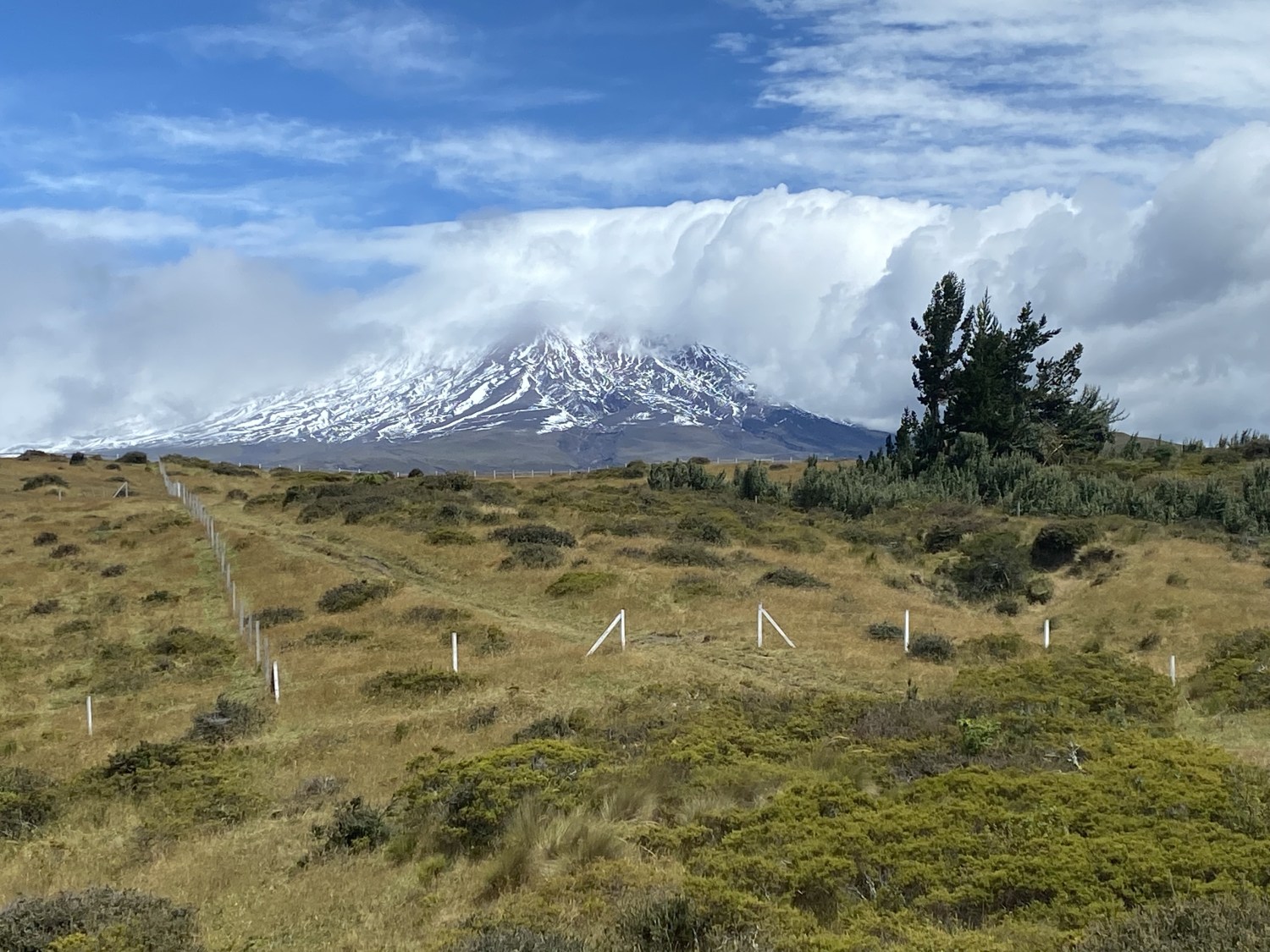
Sadly, we couldn’t see views of Cotopaxi as the volcano was shrouded in clouds and rain.
It was pretty miserable walking around the lagoon on this cold and blustery day.
Laguna Limpiopungo
Laguna Limpiopungo
Laguna Limpiopungo
Laguna Limpiopungo
Mike all bundled up
me looking like an astronaut
Laguna Limpiopungo
Laguna Limpiopungo
Laguna Limpiopungo
Laguna Limpiopungo
Laguna Limpiopungo
Laguna Limpiopungo
Laguna Limpiopungo
Laguna Limpiopungo
Laguna Limpiopungo
Laguna Limpiopungo
Laguna Limpiopungo
Laguna Limpiopungo
Laguna Limpiopungo
Laguna Limpiopungo
Laguna Limpiopungo
Laguna Limpiopungo
Laguna Limpiopungo
Laguna Limpiopungo
Laguna Limpiopungo
a little glimpse of Cotopaxi from Laguna Limpiopungo
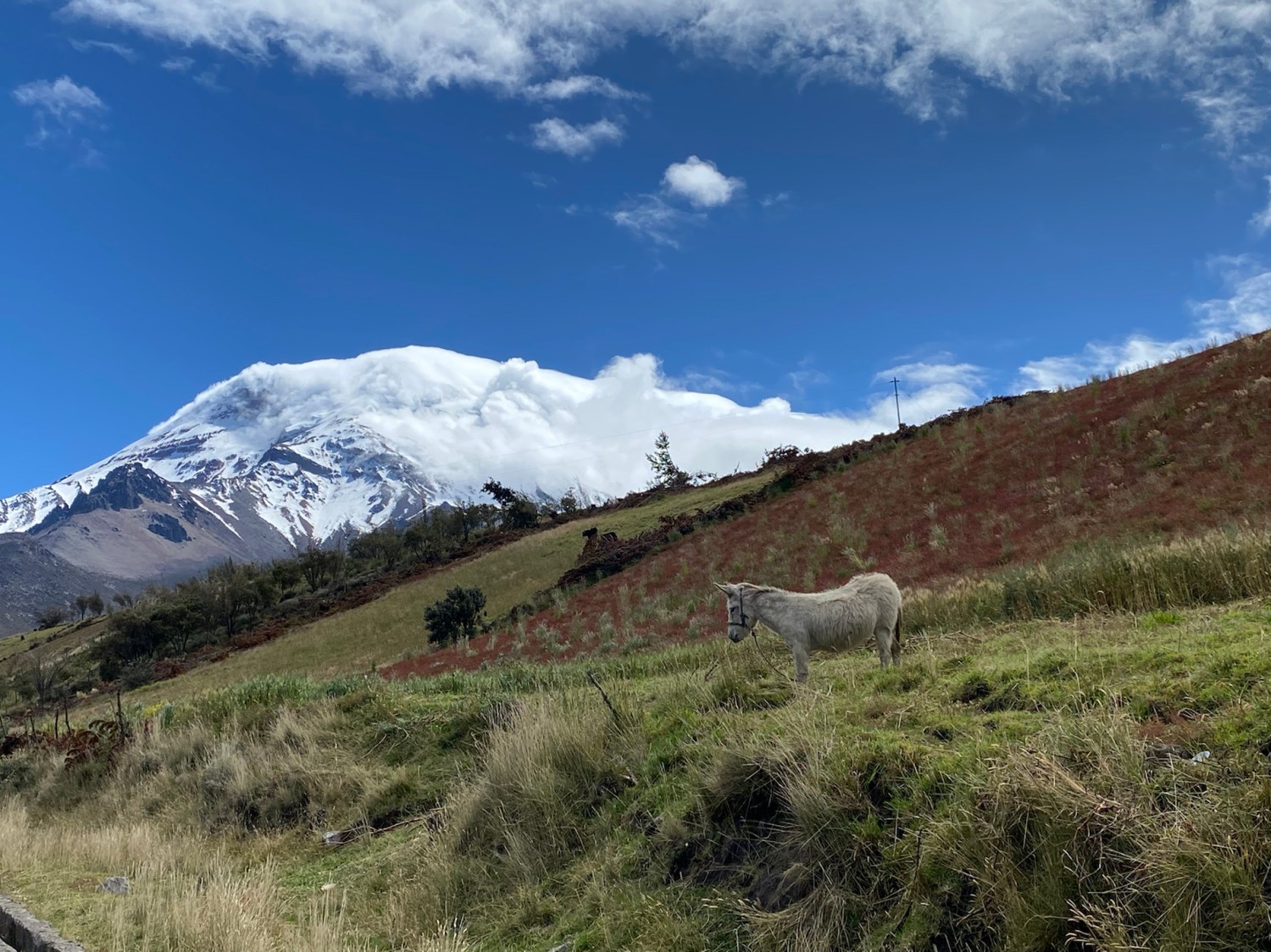
As we left the lagoon, we saw some wild horses grazing.
wild horses at Volcán Cotopaxi
As the road veered north away from the volcano, it got much more gravelly and bumpy and the drive was slow going. We’d been advised by the people at Hacienda Los Mortiños, where we’d spend two nights, that the southern way to the hacienda was doable with a regular sedan, whereas if we had come from Quito to the north, we would have needed a 4×4. I was still afraid we’d get a flat tire in our little Yaris, but luckily we made it there intact.
We stopped at Tambopaxi, a red lodge and restaurant within the park boundaries. We enjoyed some hot coffee and soup to warm up. The place was a certified sustainable tourism project involved in wildlife conservation and watershed protection, and it hired local workers.
Tambopaxi
mural in Tambopaxi
horses all saddled up at Tambopaxi
I’d been excited about the haciendas we’d booked for our last four nights in Ecuador. We exited Nacional Parque Cotopaxi through the north gate of the park to find Hacienda Los Mortiños. It is a modern adobe dwelling with views of the neighboring volcanoes. We in fact got the “King room with Cotopaxi View.” It was too bad we had no view because of the rain and fog.
view as we approached Hacienda Los Mortiños
Entrance to Hacienda Los Mortiños
the property at Hacienda Los Mortiños
driving up to Hacienda Los Mortiños
Hacienda Los Mortiños
The hacienda was cold in the afternoon. We had found most of the places we stayed in Ecuador didn’t have heat, but this was the first time the cold permeated through our bones, even in our room. Our room and the others had wood stoves that the staff said they’d light around 4:00-5:00.
Mike took a walk around the property upon our arrival, but I was so cold after our morning walk, I took a hot shower and cuddled up in bed under fuzzy blankets with the space heater on full blast. I read a bit and posted pictures to Instagram.
We went to the downstairs bar/restaurant and ordered drinks and chatted with the bartender/receptionist “man about the house,” Franklin. At the bar we also chatted with a young Dutch man staying there with a large group from Amsterdam. They were all tall, lean and put together and were on a post-college trip with lots of friends (maybe ~25). The boisterous guys were guzzling down beers and had planned a climb up Cotopaxi for that afternoon.
We went back up the room, where the staff had stocked it with wood and kindling and lit the fireplace. Mike made us drinks in the room and we pulled up chairs around the wood stove.
Later for dinner in the dining room, I enjoyed some excellent Tilapia with Creamy Sauce, zucchini and potatoes. Mike ate a ham and cheese sandwich that was finally the “grilled one” he’d envisioned at an earlier stop.
the view from our room at Hacienda Los Mortiños
our room at Hacienda Los Mortiños
me trying to warm up with a drink, a fire, and a heavy wool Ecuadorian sweater
our room at Hacienda Los Mortiños
bar/dining room at Hacienda Los Mortiños & the “man about the house,” Franklin
Tilapia for dinner
Steps: 8,696; Miles 3.69.
Thursday, August 11: After enjoying a great breakfast at Hacienda Los Mortiños, we saddled up for our three-hour horseback ride around Parque Nacional Cotopaxi. It was slow going, as my horse, Fortunato, was “muy perezoso” (lazy) so I was lagging increasingly behind our guide, Edizon, and Mike.
the view as we started our ride
Me lagging behind on Fortunata
Finally, Edizon switched horses with me. Then I was on the feisty Dorado, who always wanted to be ahead, “un jefe” (a boss) wannabe.
Before we started our ride, Edizon had asked if I had any experience riding horses. I explained that when I was a young girl, I rode horses and even jumped them. I let that exaggeration stand; of course, I meant I had jumped on Maybe, who was a small pony and not a horse. I’d ride him over jumps, and when he landed, at the moment I was most off-balance, maybe he’d buck me and maybe he wouldn’t. When he did start bucking, I held on for dear life on the underside of his belly until I fell off. One time I rode him galloping across the Yorktown Battlefield, and he abruptly stopped and put his head down! I went sailing over his head.
Here at Cotopaxi, when we reached a creek, Dorado jumped across with me hanging on for dear life. The other horses simply waded across. He did this twice. After the second jump, where the horse jumped and then ran quickly up a steep bank, I barely managed to hang on. Edizon told me I needed to hold tighter to the reins and keep better control of him. I felt foolish acting as if I really had experience riding horses!
After that last jump, I was quite shaken and I knew I had to pee. We found a large rock where I hunkered down to go. Though Mike and Edizon couldn’t see me, there was a group not too far off who had stopped to look at something. They might not have been able to see me clearly, but I’m sure they could see enough to figure out what I was doing. There was nowhere to hide on that wide-open plain.
We were lucky it wasn’t raining because rain had been forecast. It was fiercely windy and cold. I even heard a pitter-patter on my raincoat that may have been freezing rain or tiny hailstones.
Still, for three hours, we had the grandest vistas imaginable, only a few of which I was able to capture since I was on horseback. We even rode at one point along the precipice of a deep canyon, which seemed mighty dangerous. I kept hoping the horse wanted to live as much as I did.
The windy landscape reminded me a bit of Iceland in its stark and sweeping beauty.
Near the end of the ride, the clouds finally lifted enough for us to see glimpses of Cotopaxi. It was stunning. Seeing it didn’t stop the bitter wind or the frigid temps, but it made the whole ride magical.
We arrived back at the Hacienda and hitched up our horses. My behind was sore after all that riding and I felt like a stiff 90-year-old walking around after.
Riding at Cotopaxi
Riding at Cotopaxi
Riding at Cotopaxi
We rode along the edge of this canyon
The cold and windy plain
Brrrr…. Frigid temps here.
First view of Cotopaxi
Mike and me and Cotopaxi
Volcán Cotopaxi
Volcán Cotopaxi
Volcán Cotopaxi
Volcán Cotopaxi
Mike and Volcán Cotopaxi
me, Dorado and Volcán Cotopaxi
Volcán Cotopaxi
Dorado all hitched up
After showering and getting changed, we enjoyed lunch in Los Mortiños: I slurped up the traditional Ecuadorian Locro de papa soup; Mike had an empañada. Franklin and his merry band of staffers were scampering about trying to keep all the guests happy.
Then it was a long and boring afternoon as we waited for dinner and tried to keep warm. We walked upstairs for a view of Cotopaxi under blue skies. We even could see the volcano out our window.
View from our room at Hacienda Los Mortiños
Evacuation route from Los Mortiños
me on the balcony of Los Mortiños
Volcán Cotopaxi from Los Mortiños
We went back down to the dining room for a drink and to kill time. There was another large group of young Dutch men, but they looked rather slovenly compared to the first group. They were getting ready to hike up to Cotopaxi with a guide and were loading up with a bunch of beers to take along. They had a horseback ride planned for the following morning.
We ate at around 6:45 in the dining room. Again, I had the delicious Tilapia with Creamy Sauce and Mike ordered spaghetti, a real Ecuadorian dish!
Steps: 19,912 (obviously the horse’s steps!); 8.12 miles. 🙂
Friday, August 12: Another fabulous breakfast and then we were off, backtracking to the southern entrance of the park even though we were heading north of Quito to Otavalo. This time the sky was bright and blue and we enjoyed many fabulous views of Cotopaxi and its vast boulder fields.
Last morning view of Cotopaxi from our window
Volcán Cotopaxi
Volcán Cotopaxi
Volcán Cotopaxi
Volcán Cotopaxi
Volcán Cotopaxi
Volcán Cotopaxi
Volcán Cotopaxi
Volcán Cotopaxi
We then headed north to go around Quito to Otovalo.
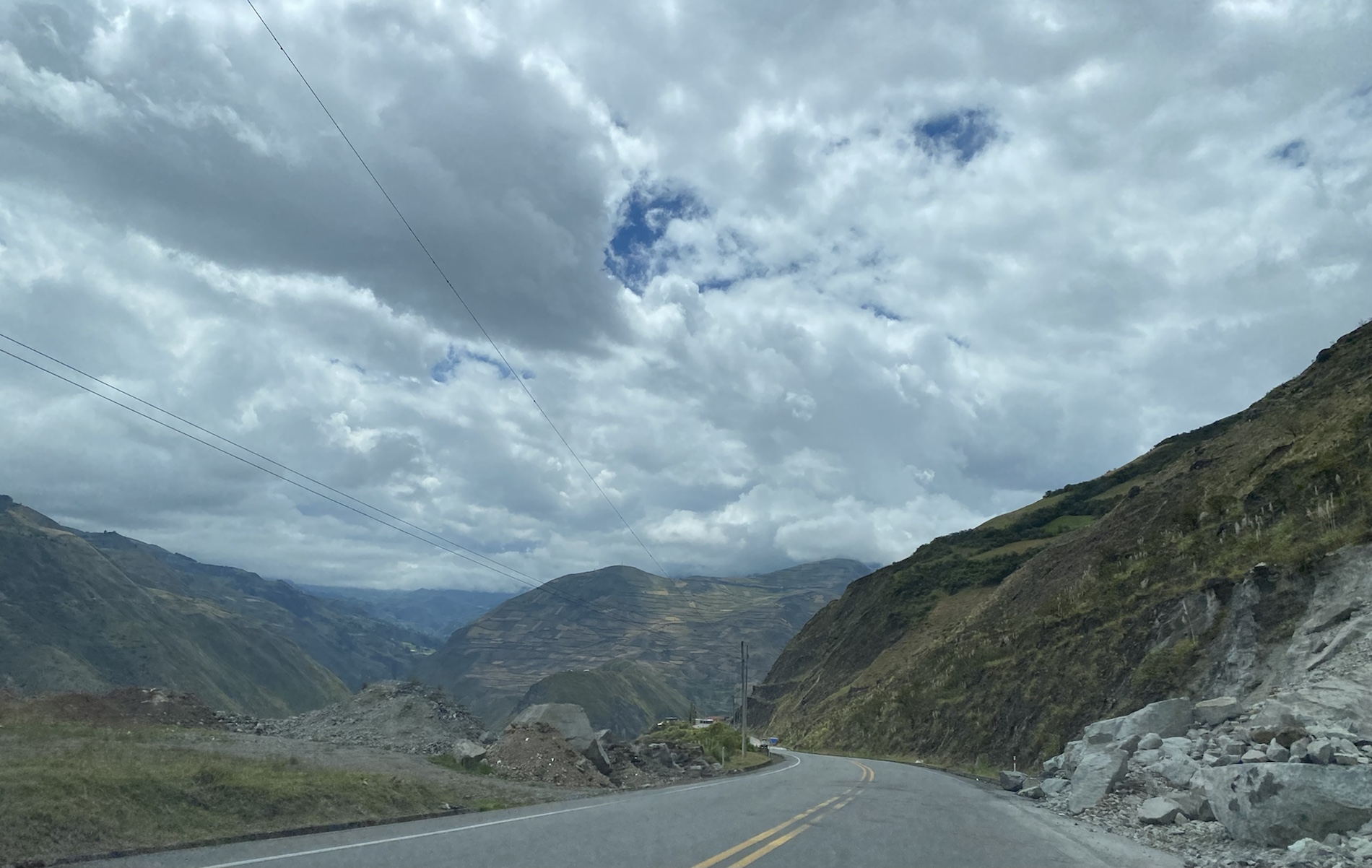
Saturday, August 6: We spent four hours cruising north at nosebleed heights around curvy mountain bends on the PanAmerican Highway, from Ingapirca to Riobamba. The patchwork farmland and homesteads dotting the majestic Andes were serene yet dramatic.
Driving along the PanAmerican Highway to Riobamba
We got our first glimpse of Volcán Chimborazo as we approached Riobamba.
first glimpses of Chimborazo
Riobamba
We checked into Casa 1881, where we met the friendly Santiago. He gave us the lay of the land on a photocopied map of the town, marking sites to see in purple Xs and circles, and we went out promptly to explore.
Casa 1881
Casa 1881
Casa 1881
Santiago at Casa 1881
We stopped at an encebollados stand, where we ate the famous soup of fish, potatoes, and corn while chatting in our pequito Spanish with the vendor, her daughter and her granddaughter.
encebollados stand
encebollados
the vendor and her granddaughter at the encebollados stand
The city has a strong indigenous presence displayed in the Saturday market, which we perused. The layout and architecture reflect the colonizing influences of the Spanish. Overall, though, the town had a derelict feel to it that was disappointing after having spent six days in lovely Cuenca.
In the afternoon, we happened upon a city parade with costumed dancers stepping to Latin beats from different areas within the province of Chimborazo. We asked some fellow spectators what it was all about and they said it was a kind of city celebration. Santiago later rolled his eyes and said these celebrations happen all the time. Even as a local, he didn’t know what this one was for.
See the video at the end of this post for live scenes of the city celebration.
Riobamba
Parque and Collegio Maldonada
Riobamba
Riobamba
Riobamba
Riobamba
Riobamba
Riobamba
Riobamba
Riobamba
Riobamba
Riobamba
Riobamba
Riobamba
Much of the city seemed rather ramshackle. It was my least favorite of the trip so far, especially as the reason we came, for the bikeride down Chimborazo, didn’t seem like it was going to happen. Our guide Eddie, of Spirit Mountain Biking, sadly got COVID. At that point, he was still trying to find an alternate guide and we’d told him if he felt okay, we’d go with him and all wear masks.
We were able to spy the white-topped Chimborazo from the streets of the town.
view of Chimborazo from Riobamba streets
We had dinner at a Spanish tapas place called Amona. I enjoyed Gambas al Ajillo (Shrimp Scampi) and Mike had Tablita de Picados (Jamon serrano, chorizo, queso tilsi, aceitunas, y pan). The proprietor in the cozy little restaurant locked the front door after every patron entered. Desperate children pressed their faces to the glass front door and made feeding motions, hands to mouths. On the way home in the dark, beside the deserted train station, a young man approached and started tailing us, but we turned abruptly and crossed the street. We looked back and saw him putting on a mask. It was disturbing and I felt uneasy in that part of town after dark.
Gambas al Ajillo at Amona
Tablita de Picados at Amona
Steps: 11,659; miles 4.93.
Riobamba to Baños
Sunday, August 7: Santiago prepared us a fabulous breakfast at Casa 1881: waffles, scrambled eggs, fruit galore, coffee. Afterwards, we drove a long mountainous road to Baños. Originally our plan was to bikeride down Chimborazo on the Sunday after we arrived in Riobamba (equal to today), but once we cancelled in June because of the protests, we lost our spot with Spirit Biking. We scheduled with Eddie for Monday (tomorrow), but he tested positive for COVID and hadn’t yet been able to find another guide. Thus we had two days in Riobamba with all our plans awry.
Our plan was to bicycle down through tunnels and past waterfalls in Baños. Lonely Planet Ecuador describes Baños as a “mixed bag.” There are steep gorges, waterfalls, dense forests. The town itself has “drab architecture, and an overcrowded backpacker-ghetto feel.”
There were many activities one could do in Baños, according to the guidebook. “Puenting” (crudely translated as “bridging”) is swinging from a rope tethered to two bridges. That was most definitely not appealing. There are thermal baths and massages to be had and all kinds of sports such as mountain biking, hiking, rafting, ziplining and partying. The ziplining places didn’t look appealing due to the ramshackle nature of not only the operations but also the surroundings. We were supposed to do the most popular mountain biking ride, “Rutas de Cascadas” to Rioverde. It is described as a “dramatic descent past a series of waterfalls on the road to Puyo, a jungle town 61km to the east.”
When we arrived in the town, we weren’t at all impressed. We just weren’t feeling the biking here. We drove down the “ruta” through five or six long dripping rudimentary tunnels and we barely saw any waterfalls. We felt relieved once we decided not to bother renting bikes.
Sometimes travel days are simply disappointing and there is nothing to do but take them in stride. Though the drive to Baños was a stunning one, everything about the area and the town itself seemed shabby and derelict. Though I do my best to find the positive in every place, I didn’t see anything enticing in this town.
The strange thing was that numerous people had asked us if we were going to Baños. “It will be so crowded on Sunday!” and “It’s a great place for ziplining!” and “You’ll love Baños, it’s beautiful!” I didn’t understand the enthusiasm.
The only saving grace was the roadside El Rancho Restaurant, where we enjoyed some coffee, fruit juice and tortillas de maíz.
El Rancho Restaurant
A little hut next to El Rancho Restaurant
Back to Riobamba
When we finally got back to Riobamba around 3:00, the town was dead because it was a Sunday. We sought out an ice cream spot Santiago recommended, Helados de Paila, and then wandered aimlessly taking pictures of each other wearing our Panama hats. Mike posed in front of a cool mural where a woman had her breast exposed and a cup of milk (breast milk?) that a hummingbird was drinking from. I posed in front of a mural with a rearing horse and the town of Riobamba with Chimborazo in the background.
Mike at Helados de Paila
Whiling the day away
Riobamba
Mike and the milk mural
Me with Riobamba & Chimborazo
Riobamba
Riobamba
We stopped at Parque la Libertad, built in 1920. It commemorated the 100th anniversary of the city’s independence.
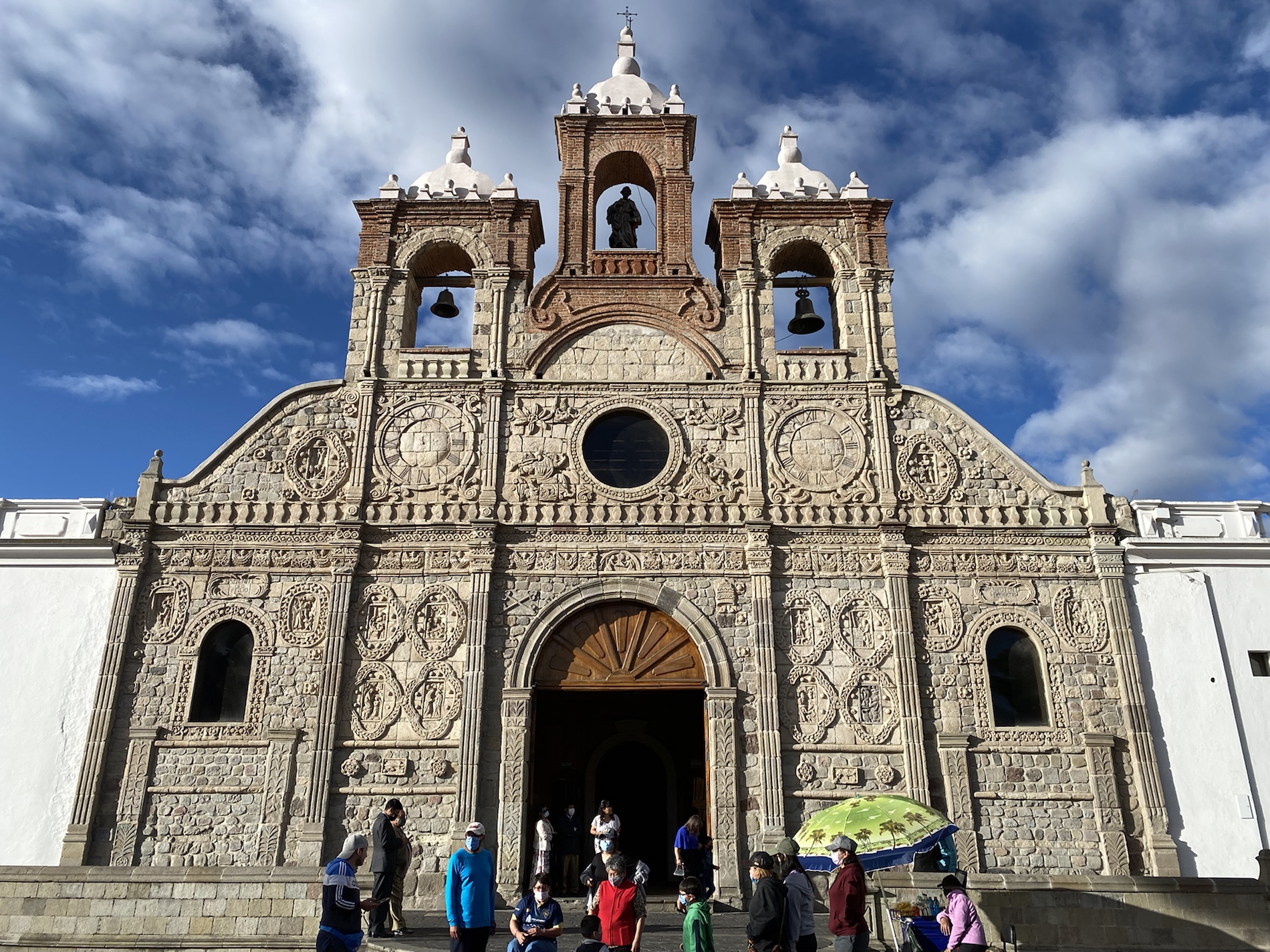
The main church is La Catedral, on Plaza Mayor, built after the earthquake in 1797. The earthquake obliterated the city, which was later rebuilt about 14km from its original location. Parts of the modern cathedral are built using stones from the former city that was destroyed in that earthquake. The exterior mixed indigenous symbols with traditional Catholic elements in an effort to sway the indigenous population toward Catholicism. Inside the church was very modern and preparations for a concert were underway.
La Catedral
We found ourselves at one point under a street with umbrellas hanging overhead and a little pool of water in half a tomato (or apple?). Wandering further, we found a sushi restaurant across from Amona, the tapas place where we ate last night. We got sushi to go and ate it at the dining room table in Casa 1881. Santiago was surprised, “Is that sushi? Where did you get that? I didn’t know we had a sushi place here.” I started to think we had experienced more of the city than he had!
umbrellas in Riobamba
sushi in Riobamba
We cuddled up under blankets for an early night, not knowing until Eddie texted us late that night that we wouldn’t have to get up at the crack of dawn for our bikeride down Chimborazo. He was feeling too sick and couldn’t find an alternate guide. We were both disappointed and relieved. We were told the weather was often frigid and rainy atop the volcano, so we had been nervous about that. In addition, I had trouble breathing at the higher altitudes, and Chimborazo was the highest in Ecuador. Instead, we would drive to the volcano on our way to Latacunga on Monday.
Steps: 8,640; Miles 3.66.
Riobamba to Volcán Chimborazo
Monday, August 8: We left Riobamba at around 9:15 after meeting Eddie from Spirit Mountain Biking. He came by to meet us since he felt bad he’d had to cancel our ride due to COVID. We all stood outside and talked with our masks on and he brought us a Spirit Mountain Biking buff.
We drove to Volcán Chimborazo and were bowled over all the way. The day was sunny and blue, relatively warm and breezy. We stopped numerous times to take pictures of the volcano from every angle.
Volcán Chimborazo
Volcán Chimborazo
Volcán Chimborazo
Volcán Chimborazo
Volcán Chimborazo
Volcán Chimborazo
Volcán Chimborazo
The indigenous people in the area call Volcán Chimborazo “Taita” (Father). It is 6,310m (20,702 feet) tall and is Ecuador’s tallest mountain, a strapping giant topped by a massive glacier. Not only is the extinct Volcán Chimborazo the highest mountain in Ecuador, but its peak, due to the earth’s equatorial bulge, is also the furthest terrestrial point from the center of the earth, according to Lonely Planet Ecuador.
Volcán Chimborazo
Volcán Chimborazo
The volcano sits near a smaller volcano, Volcán Cariuairazo (5020m), within the Reserva de Producción Faunistica Chimborazo. It is called a ‘fauna-production reserve’ because it is home to hundreds of vicuña, a wild relative of the llama. Once hunted to extinction, they were imported from Chile and Bolivia in the 1950s.
We caught the elegant silhouettes of the vicuña as they grazed in the foreground of the great volcano.
vicuña at Volcán Chimborazo
We were mesmerized watching what seemed like a living breathing being. The clouds were like a thick fleece blanket caressing the peak in a sensual way. It was captivating to watch, this symbiotic relationship between cloud and mountain. We stopped several times, in awe of it all. (You can see the living and breathing volcano in the video at the end of this post).
Volcán Chimborazo
Volcán Chimborazo
Though we were supposed to bike down the volcano, we wondered if we were better served by driving after all. We were able to stop many times to take pictures, which we may not have been able to do on a bike. It was disappointing to miss the adventure, but it was amazing to see the volcano by car as well.
Entering the park
Visitor Center
Visitor Center
Visitor Center
We drove up to the access point for the Refugio Hermanos Carrel at 4,800 meters. Mike walked up a bit to the cemetery with gravestones marking people in recent years who have died trying to climb Chimborazo. Many monuments were scattered about in that barren landscape. One climber who died was Santiago Fabian Naveda Gonzalez: B. 6/25/1983 D. 12/22/2021.
Refugio Hermanos Carrel
one of many markers of climbers who were killed
Refugio Hermanos Carrel
We continued around the western side of Chimborazo on our way to Latacunga. This side is called the arenal (arena means ‘sand’) and it is very arid.
parting view of Chimborazo
the arenal
the north side of the volcano
Volcán Chimborazo to Latacunga
Before driving through Ambato, we stopped at a restaurant to grab some lunch. We were hungry because it was almost 2:00. I tried to ask the waitress about the menu in Spanish and she started laughing so hard she scampered away and sent her mother over to take our order. Apparently our Spanish speaking made us a laughingstock! I ordered a shrimp dish (shrimp in a garlic sauce served in a lettuce bowl) with rice and a tomato/red onion garnish. The mother misunderstood our order and brought two of the same dish, one for me and one for Mike, even though Mike had ordered a cheese “sandwich” only to find what he imagined would be grilled cheese was just a slice of cheese stuck inside a bun. We took away Mike’s cheese bun but were stuffed from eating the two large shrimp meals.
local restaurant
our shrimp meal x2
We had a long drive then on a confusing and convoluted route right through the center of Ambato. It took us forever to get out of that maze of heavily trafficked roads. When we finally arrived on the north side of that chaotic city, the drive became calmer again. We made it to Latacunga and settled into our cute hotel, Hostal Huasicama.
Steps: 4,912; Miles 2.07.
Here is a video showing the street celebration in Riobamba and some live views of Chimborazo.
Saturday, July 30: We took an early morning flight from Quito to Cuenca on LATAM Airlines, arriving around 10:00. Unfortunately, we hadn’t planned very well, because we couldn’t check into our Airbnb apartment until noon, so we had to sit around waiting at Cuenca’s tiny airport until 11:30, at which time we took a taxi to the Airbnb. The occupants, a family from Washington state, were a bit late checking out so we were standing in the hallway when they finally came out at 12:30. The host had told us we could drop our bags in the apartment while the cleaning people did their thing, so we did that and headed out for a quick lunch at Chill & Grill Express before embarking on a walking tour of the city with Gustavo Jiménez Morales, a wonderful tour guide recommended by our Airbnb host.
Our apartment was modern and well-appointed. It was right across the Río Tomebamba from the Old Town.
Our beautiful Airbnb apartment in Cuenca
After lunch, Gustavo took us to his apartment, situated in a building next door to ours. We met his daughter Camilla and her boyfriend Martín. Camilla graduated recently with a degree in architecture. I loved the colorful and cool decor in Gustavo’s apartment. Gustavo was once a veterinarian specializing in large animals; he had become a tour guide because he loves helping and meeting people and introducing them to his beloved city.
Gustavo, Camilla and Martín
Gustavo’s bookshelf
Gustavo led us on a walking tour of Cuenca’s Old Town (Centro de Cuenca). We crossed the bridge over Río Tomebamba from our temporary home in the New Town and strolled along the river, gurgling peacefully through a shaded park. We climbed an endless number of steps to the historic town where we admired the classic balconied buildings lining the street.
Mural on Gustavo’s apartment building
Río Tomebamba
our path to the Old Town
We walked along a high street from which we could view the New Town of Cuenca below. Gustavo pointed out relief carvings through the town. The first was of a woman who lost her young son and calls for him at night because she hears him crying. The headless monk relief symbolized how the “man of God” frequented whorehouses with a hood over his head so no one would recognize him. We saw the Art Extremo Museum and Cafe, a grim reaper-themed gallery, bar and nightclub. A statue in a small square represented a greased pole that children climb to get trinkets during Corpus Christi. We dropped into the shop of a man who cleans and repairs people’s Panama hats. We strolled through a park with beautiful green and yellow palms. Cuenca is a town filled with artistic flourishes.
balconies with flourishes
view of Cuenca
walking the hilltop streets of Cuenca
a woman calling for her son
headless monk relief
Art Extremo Museum & Cafe
animals on the rooftop
beautiful tiled building
Trompe-l’œil
the greased pole for Corpus Christi
the Panama hat cleaner
mural in Cuenca
more balconies
more balconies
Colonial-era buildings
more balconies
We wandered through the Hotel Alcazar with its gorgeous courtyard and gardens and then took a leisurely stroll through the flower market. Finally we reached the New Cathedral, which dominates Parque Calderón, the city’s largest plaza. Construction of the cathedral began in 1885. Its giant domes of sky-blue Czech tiles are visible from all over the town. The bell towers are a bit short because of a design error which made the intended height of the belfries impossible for the building to support.
gardens of Hotel Alcazar
the New Cathedral’s domes as seen from a nearby courtyard
more balconies
the flower market
the flower market
the flower market
another imposing building
We topped off our first half day in Cuenca by eating a light dinner at El Mercado. I enjoyed Langostinos Asados (grilled prawns). Mike had Berenjenas a la Mediterranea: roasted eggplants, baked tomato sauce, feta cheese, basil and sourdough bread. We shared the ubiquitous locro de papas (potato soup with cheese and avocado). And drinks of course.
Monday, August 1: Today was our first day in Cuenca on our own. Gustavo had gone to the beach with his family, so we wouldn’t see him again.
Cuenca’s historic center dates from the 16th century and is a UNESCO World Heritage Site. It is famous for its skyline of massive rotundas and soaring steeples, cobblestone streets, and geranium-filled balconies as well as its barranco (cliff) along Calle Larga. Many craft traditions are centered here, especially ceramics, metalwork and the famous Panama Hat.
Three cultures have made a mark on the city. When the Spanish arrived in the 1540s, they encountered the ruins of a great but short-lived Incan city called Tomebamba (Valley of the Sun). The Spanish proceeded to tear it apart, using the Incan stones in their own structures. Before the Incas, the indigenous Cañari people had lived in the region for possibly 3,000 years.
We first came upon the Church of San Francisco which towers over Plaza de San Francisco; it features the “cuenca” sign in the midst of a rather shabby street market; it is bordered by old arcaded buildings with wooden balconies. We ventured into the Casa de la Mujer, which houses over 100 craft stalls selling handmade musical instruments, embroidered clothing, baskets, jewelry, ceramics, ironwork, wooden utensils, guinea pig roasters and gaudy religious paraphernalia.
Cuenca’s barranco
Church of San Francisco
“cuenca” sign in Plaza de San Francisco
relief mural in Casa de la Mujer
Inside Casa de la Mujer
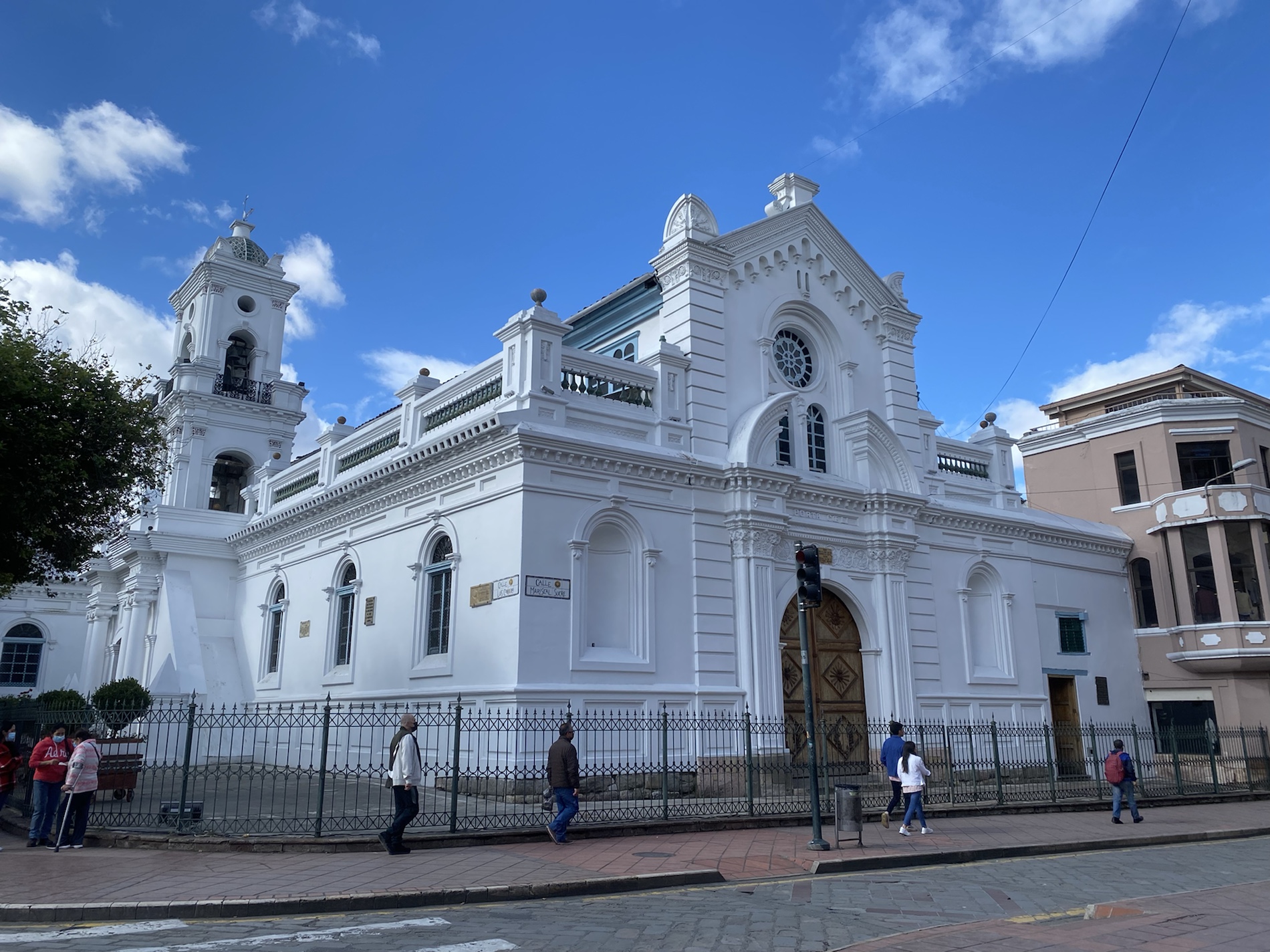
Next to the flower market we’d seen Saturday, we found the stark white Church of El Carmen de la Asunción, founded in 1682. Inside its Santuario Mariano we found an over-the-top, rather showy interior. Gustavo had told us that Cuenca has 52 churches, one for every week of the year. The city is rich with colonial-era buildings.
Church of El Carmen de la Asunción
We stumbled into Dos Chorreras Chocolateria with a cool vintage red car inside stacked high with chocolates and a colorful disco ball hanging overhead. A long bark canoe was filled with burlap bags of chocolate beans. We enjoyed churros and chocolate there.
Centro de Cuenca
Dos Chorreras Chocolateria
Centro de Cuenca
We intended to climb the towers of the New Cathedral, but they were closed for lunch. Instead we went shopping nearby at Mercantile Tosi. For once Mike bought more than I did; he found four shirts.
By the time we finished, the towers were open, so we climbed over 150 steps to the terrace for views over Cuenca.
New Cathedral
domes on the New Cathedral
Parque Calderón
domes on the New Cathedral
view of Cuenca from the New Cathedral
domes on the New Cathedral
After walking all over, we relaxed back at the apartment in the afternoon, sitting in the hot tub and drinking Mike’s famous traveling concoction of whiskey and ginger ale.
In the evening, we went to the charming Consuelo; it is housed inside the stunning La Casa del Parque. The beautiful Renaissance-style building was conceived in 1880 for one of the richest and most influential women in Cuencan society at the end of the 19th century: Hortensia Mata. Her family’s wealth was acquired through various activities such as the export of quinine, cocoa husks, and toquilla straw hats.
A later owner of the house, Mrs. Gladys Eljuri, decided to add touristic value to the house by converting it to an upscale gourmet center. It boasts everything culinary from cheese shops to fancy restaurants to a Dunkin’ Donuts.
La Casa del Parque, the building housing the food court, including Consuelo
We enjoyed an unusual meal of Maduro Asado con Queso (lima beans with cheese), Caldo de pollo (chicken soup), and mote sucio (“dirty mote” – the “dirty” comes form pork crackling and mote is a hominy-like grain). We couldn’t translate the menu, even using Google, and couldn’t communicate with the waiter about food items. We figured we’d just go with whatever we got.
We sat on a velvet couch with bunches of roses overhead, Spanish music playing and a painting of a woman nursing her baby with milk dribbling down her dress. It was such a cool atmospheric place and the food was offbeat but delicious.
A couple sitting nearby said they’d just opened a fondue restaurant in Quito and were visiting Cuenca. All of us marveled over the strange concoction the waiter brought to top off our meal: Espumilla, a kind of Ecuadorian dessert of merengue and ice cream cones with various toppings such as flaked coconut, blackberry marmalade and “grajeas” (sprinkles?). We had seen this dessert offered by street vendors all over Cuenca.
Consuelo
Consuelo
Consuelo
Consuelo
Consuelo
Maduro Asado con Queso
Caldo de Pollo
Mote Sucio
Espumilla
Steps: 12,158; Miles 5.15
********************
Tuesday, August 2: We started our day by going to the Museo del Sombrero de Paja Toquilla. It is a small museum where you can see the various processes used in making the famous hats. We loved the outdoor terrace looking over the Tomebamba, the new town, and beyond to the Mirador del Turi.
Cuenca’s barranco
Museo del Sombrero de Paja Toquilla
me on the balcony of the Museo del Sombrero de Paja Toquilla
Mike on the balcony
view of Cuenca’s New Town from the balcony of the Museo del Sombrero de Paja Toquilla
View of Park Cajas from the balcony
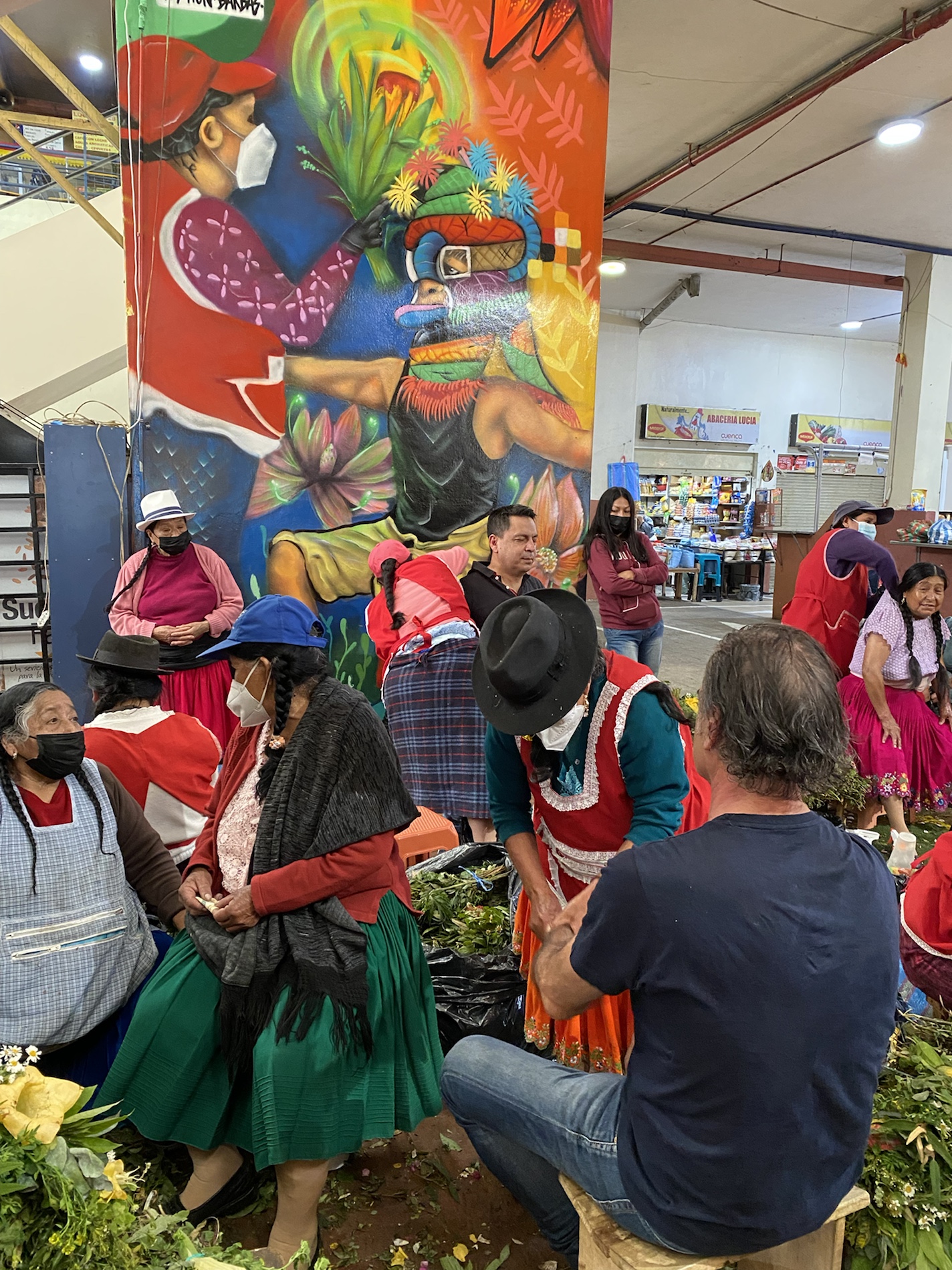
Our next stop was Mercado 10 de Agosto, a colorful buzzing place with lots of activity. In abundance were colorful murals and every kind of fruit, vegetable and meat imaginable. We enjoyed wandering through and eating lunch in the upstairs food court.
Mercado 10 de Agosto
lunch at Mercado 10 de Agosto
Mercado 10 de Agosto
Later in the afternoon, we stopped by the market again to peek under the escalators at the Limpias, sturdy women who clean out bad energy from souls. These women speak mostly Quechua, the ancient language family of the Incan Empire.
We watched this healing ritual for a bit then we sat in plastic chairs to partake. The Limpias whipped our faces, arms, necks and bellies with bundles of herbal plants. The scent was calming but the vigorous whipping was invigorating. The limpias made shushing sounds to scare away the bad energy. The “diagnosis” of what is wrong with your soul comes in the form of an egg that is cracked open into a cup. After breaking the egg, she showed it to us, but I wasn’t sure what it signified or what to look for. They then rubbed an intact egg all around our arms and bellies.
Next came a cleansing with alcohol. They sprayed it all over our bodies and into our palms and instructed us to put our hands over our noses to inhale the strong odor. Then they rubbed charcoal or ash on our foreheads as some kind of blessing or to keep bad spirits away.
It was a wild experience, but I have no idea if it succeeded in driving bad energy away. You can see the Limpias in action in the video at the end of this post.
the Limpias in action at Mercado 10 de Agosto
We stopped at a cooperative where I looked at Ikat shawls and scarves, but I only bought a pair of earrings and a colorful little bowl.
Gustavo had recommended we go the Museo Municipal de Arte Moderno, housed in a former home for the insane. Sadly much of the building was undergoing renovation today; we wandered through the rooms that were open and admired the beautiful paintings by children from ages 8-12.
Inlaid sidewalk with the outline of the Museo Municipal de Arte Moderno
Museo Municipal de Arte Moderno
paintings by children ages 8-12
Museo Municipal de Arte Moderno
a house: pretty in pink
one of Cuenca’s many churches
After our wanderings, we went to the airport to pick up our rental car, which we would keep for the next 12 days, a white Toyota Yaris. We drove directly to the nearby Homero Ortega Hat Museum, recommended by Gustavo, to see the Panama hats being made. We had both read about the process in The Panama Hat Trail by Tom Miller so there were no surprises. The museum was nicer than the one we’d been to earlier and of course I had to buy a vintage style grayish-blue hat. Mike forbid me to buy any more since I don’t wear hats often, but I rarely listen to his admonitions.
Homero Ortega Hat Museum
After the hat museum, we drove to Mirador del Turi to see views of Cuenca. On the way, we almost got broadsided by a huge truck barreling into a traffic circle. It stopped inches away without a sound, no squealing tires or anything. It was surreal, as if time stopped. I almost felt like we were killed and then continued on after a momentary lapse into a parallel universe. It was incredibly bizarre.
We saw the stark white church of Turi but the viewpoint was messy because of construction.
Church of Turi
Mirador del Turi
We stayed in for dinner and cooked up some of the potatoes, tomatoes, eggs and spinach we’d picked up at the market.
Steps: 9,056; Miles 3.84.
********************
Wednesday, August 3: Today we drove to Park Nacional Cajas, where we hiked around Laguna Toreadora. I wrote about it here: a day trip to parque nacional cajas.
********************
Thursday, August 4: On our last day in Cuenca, we walked along the Río Tomebamba in sputtering rain, finding some cool murals depicting Panama hats. It was a long walk to Cuenca’s most important museum, the Pumapungo Museum.
Murals along the Río Tomebamba
Murals near the Pumapungo Museum
We walked outdoors through the archeological park, where we saw extensive ruins of buildings believed to be part of the old Incan city of Tomebamba. Spanish conquistadors absconded with much of the stone to build Cuenca, so there wasn’t much left. The Incan city was constructed at the end of the 15th century. The site represents the history of the Cañari or the Inca.
Pumapungo Museum
Pumapungo Museum
Pumapungo Museum
Pumapungo Museum
Pumapungo Museum
Mike at the Pumapungo Museum
Pumapungo Museum
Pumapungo Museum
Me at the Pumapungo Museum
harvest at the Pumapungo Museum
Pumapungo Museum
Pumapungo Museum
Pumapungo Museum
Pumapungo Museum
Pumapungo Museum
Inside the museum, we found colorfully animated dioramas displaying traditional costumes of Ecuador’s diverse indigenous cultures, including Afro-Ecuadorians and their reconstructed houses from Esmeraldas province, the cowboy-like montubios (coastal farmers) of the western lowlands, several rainforest groups and all major highland groups including Cañaris and Cholas. Sadly all the information inside the museum was in Spanish only.
Pumapungo Museum
Pumapungo Museum
Pumapungo Museum
Pumapungo Museum
Pumapungo Museum
Pumapungo Museum
Pumapungo Museum
Pumapungo Museum
Pumapungo Museum
Pumapungo Museum
Pumapungo Museum
Pumapungo Museum
At the end we encountered five eerie tzantzas (shrunken heads) from the Shuar culture of the southern Oriente. The tzantzas are severed and specially prepared human heads used for trophy, ritual, or trade purposes. The meaning of Shuar is “man” or “human being,” but they are often known as “Jibaro” (savage). The community rejects this term as pejorative. They live in the southern part of the Ecuadorian and the northern part of the Peruvian Amazon region at 2,000m above sea level. There, dense vegetation and numerous waterfalls slowed penetration by outsiders for a long time.
tzantza from the Shuar culture
Shuar culture
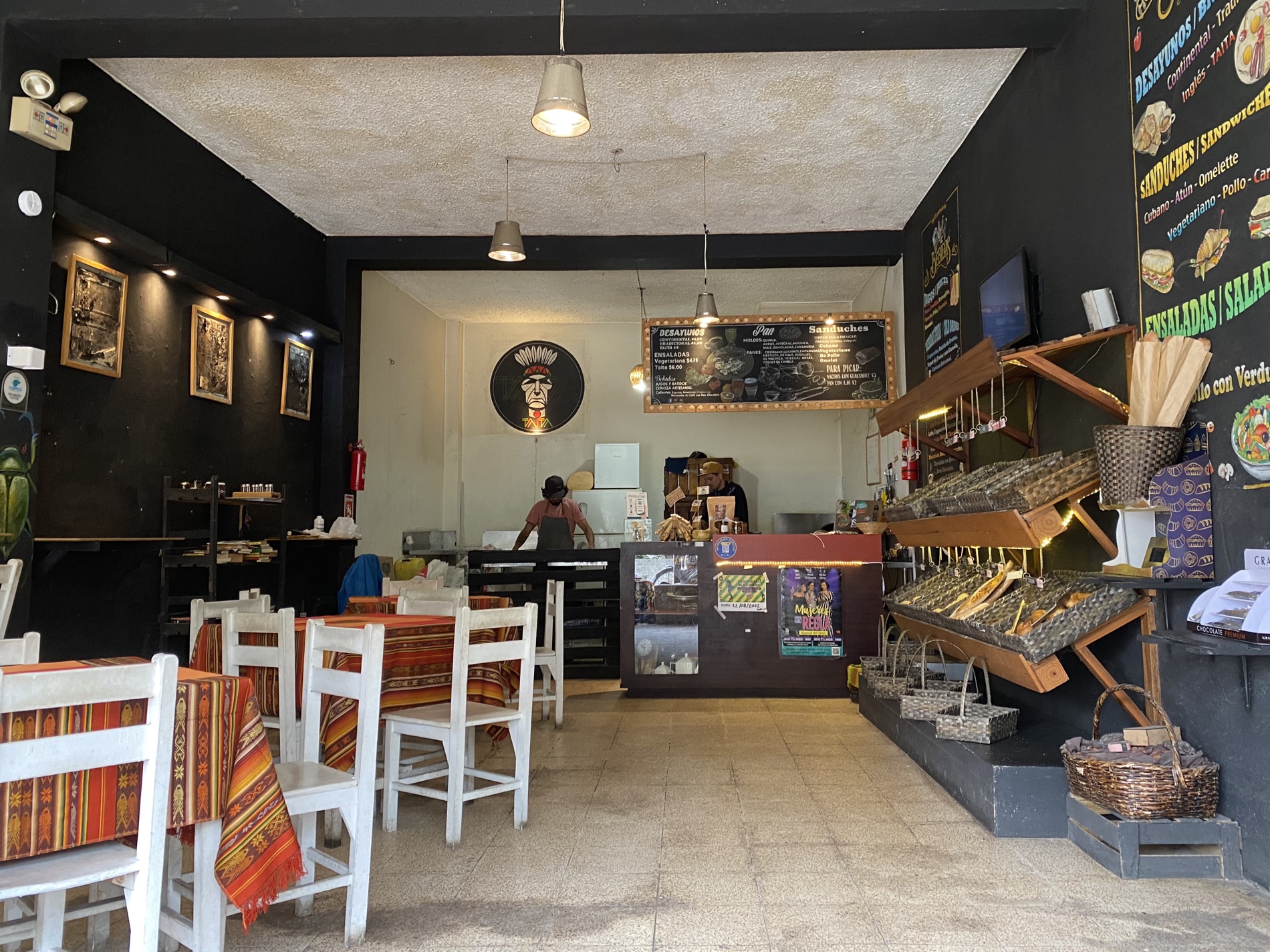
After leaving the museum, we stopped at Taita Café for an espresso and chocolate croissant.
We walked quite a long distance to see Church of San Blas on the east end of the historical center. It occupies what was once known as the “low neighborhood.” It is one of the city’s largest and the only one built in the form of a Latin Cross.
Church of San Blas
Church of San Blas
Church of San Blas
Church of San Blas
As a culinary finale, we headed to Guajibamba on Luís Cordero, known for its cuy (guinea pig). The courtyard restaurant with a relaxed atmosphere serves traditional Ecuadorian food, but our focus was the cuy, which Mike mostly ate. I ordered the Locro de Papas. The skin of the cuy was the best part, but overall it was much like eating quail or something like it, with little meat on the bones.
Guajibamba
courtyard at Guajibamba
The cuy meal
Mike eats cuy
We strolled back to Parque Calderón and took an elevator to the terrace of Negroni, where we enjoyed cappuccino, a chocolate mousse torte and wonderful views of the three blue domes of the New Cathedral. In order to use the bathroom, we had to step through a window.
rooftop veiw from Negroni
view of Parque Calderón from Negroni
Mike at Negroni
chocolate mousse torte at Negroni
view of the New Cathedral from Negroni
Finally, after a cloudy and rainy day, the sun came out and the weather was beautiful.
On the other side of Parque Calderón, we found the whitewashed ‘old cathedral,’ El Sagrario. Construction began in 1557, the year Cuenca was founded. In 1739 French explorer, geographer and mathematician Charles Marie de La Condamine’s expedition used its towers as a triangulation point to measure the shape of the earth. It is now deconsecrated and serves as a religious museum and a recital hall.
We wandered again through the flower market and to Calle Larga back to the Museo del Sombrero de Paja Toquilla where I bought a brown and tan striated hat, the third of my Panama hats. 🙂
flower market
my brown & tan hat from Museo del Sombrero de Paja Toquilla
Back at the Mercado 10 de Agosto, we bought more fruit from the same vendor from our first visit. We bought some bread from a bakery then walked back in the sunshine along the Río Tomebamba where we admired, for our last time, the barranco, where the city’s 18th- and 19th-century ‘hanging houses’ seem to float above the river.
view of the barranco along the Río Tomebamba
Back at the apartment, we did laundry, drank wine, fixed sandwiches and relaxed.
On the Wednesday during our week in Cuenca, we headed west to Parque Nacional Cajas. We drove the rental car we’d picked up at the airport the evening before, a white Toyota Yaris. When we stopped to buy some extra masks at a gas station, one of us did something to set off the car alarm and we couldn’t figure out for the life of us how to turn it off. We turned on the car, we turned off the car, we closed and opened both doors. Nothing worked. Finally we started driving through town, with the car alarm blaring away. We couldn’t figure out how to stop it and we felt like damn fools driving down the road. Finally we pulled into a parking lot, people glaring at us all around. Somehow the infernal noise stopped. We had no idea how we did it, and we resolved we’d have to go back to the airport the next day to have the rental agent check it out.
Gustavo had told us to take a sharp left at a sign for Laguna Llaviucu before we reached the actual park. We headed down the very steep and rough road. We bounced along for what seemed an eternity with no end in sight. Finally we turned around because we didn’t want to risk getting a flat on our car. Back at the top, we saw on the sign that it was 2.3km to the lake, and we’d probably gone 2/3 of the way, but by this time we’d had enough; we headed straight to the National Park.
the bumpy road to Laguna Llaviucu
cows on the road to Laguna Llaviucu
view from near the bottom at Laguna Llaviucu
Parque Nacional Cajas lies 30km west of Cuenca and encompasses 2,854 sq. km. of golden moor-like páramo (high altitude Andean grasslands) dotted with hundreds of cold lakes set in a bleak rough countryside.
a friend we met on the road to Park Cajas
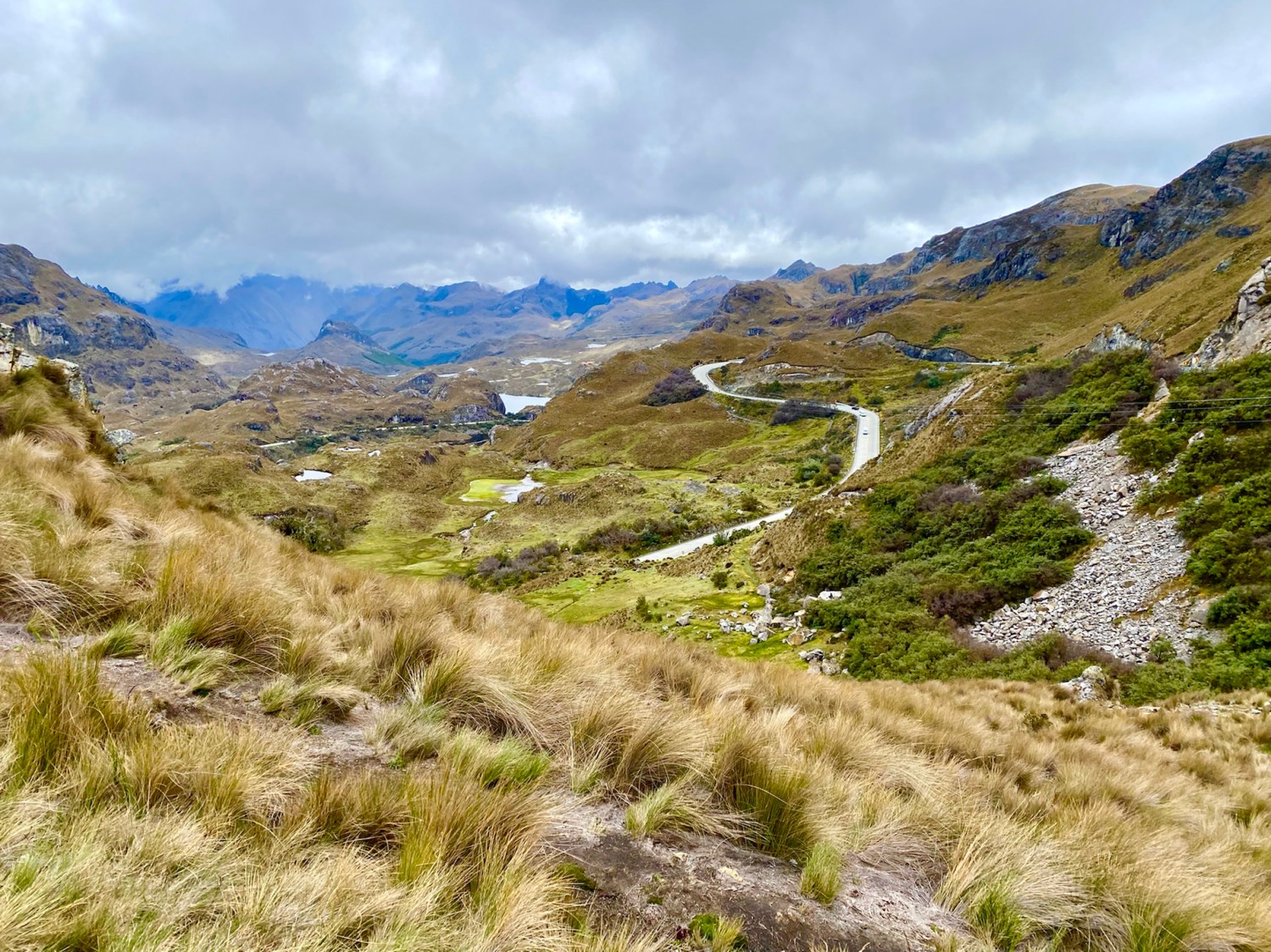
The park, a place of water, sits at altitudes over 3,100m (10,170 ft), resulting in tundra vegetation that blankets the area. A network of 786 lakes, lagoons and ponds are connected by crystal clear streams. A carpet of sponge-like plants absorb water, releasing it slowly over weeks and months. We found spongy mosses, succulents, and the amazing straw grass that is mesmerizing to behold. High altitude scenic drives reach elevations as high as 4,310m (13,550 ft).
It is doubtful that the park’s name comes from cajas (boxes) because the lakes resemble them. It’s more likely it comes from the Quichua word cassa meaning “gateway to the snowy mountains.” It could also come from caxa, the Quichua word for cold.
Cold it was. We had multiple layers on, but we weren’t quite prepared mentally for the frigid temperatures. After checking in with our passports at the park’s information center, we started our hike around Laguna Toreadora. We walked counterclockwise but in retrospect, I wished we’d gone clockwise, as most of the climbing was on the south side of the lake. Because of the elevation, I got winded every time we had to climb.
Laguna Toreadora
Laguna Toreadora
Laguna Toreadora
vegetation at Laguna Toreadora
Laguna Toreadora
Laguna Toreadora
Laguna Toreadora
Laguna Toreadora
Laguna Toreadora
Laguna Toreadora
Laguna Toreadora
Laguna Toreadora
Laguna Toreadora
hike around Laguna Toreadora
succulents at Laguna Toreadora
Laguna Toreadora
Laguna Toreadora
Laguna Toreadora
Laguna Toreadora
Laguna Toreadora
vegetation at Laguna Toreadora
mosses at Laguna Toreadora
vegetation
hike around Laguna Toreadora
spongy mosses
spongy mosses
more mosses
more sponginess
Laguna Toreadora
Laguna Toreadora
Mike in the grasses
mosses
me in the grasses
Laguna Toreadora
Laguna Toreadora
Forests of “paper trees,” also known as Polylepis trees or Quinuas, are found in sheltered hollows and natural depressions. Polylepis trees have adapted to grow at higher elevations than almost any other tree in the world.
Polylepis trees
Polylepis trees
After a good three hours of hiking, we were chilled since the weather had been cloudy, blustery and cold. We huddled over steamy hot chocolate at the café and then drove up to Mirador Tres Cruces, which marks the continental divide where the drainage basin on one side flows to the Pacific Ocean and the basin on the other side flows to the Atlantic. The road to Guayaquil goes over this pass.
Mirador Tres Cruces
Mirador Tres Cruces
Mirador Tres Cruces
Mirador Tres Cruces
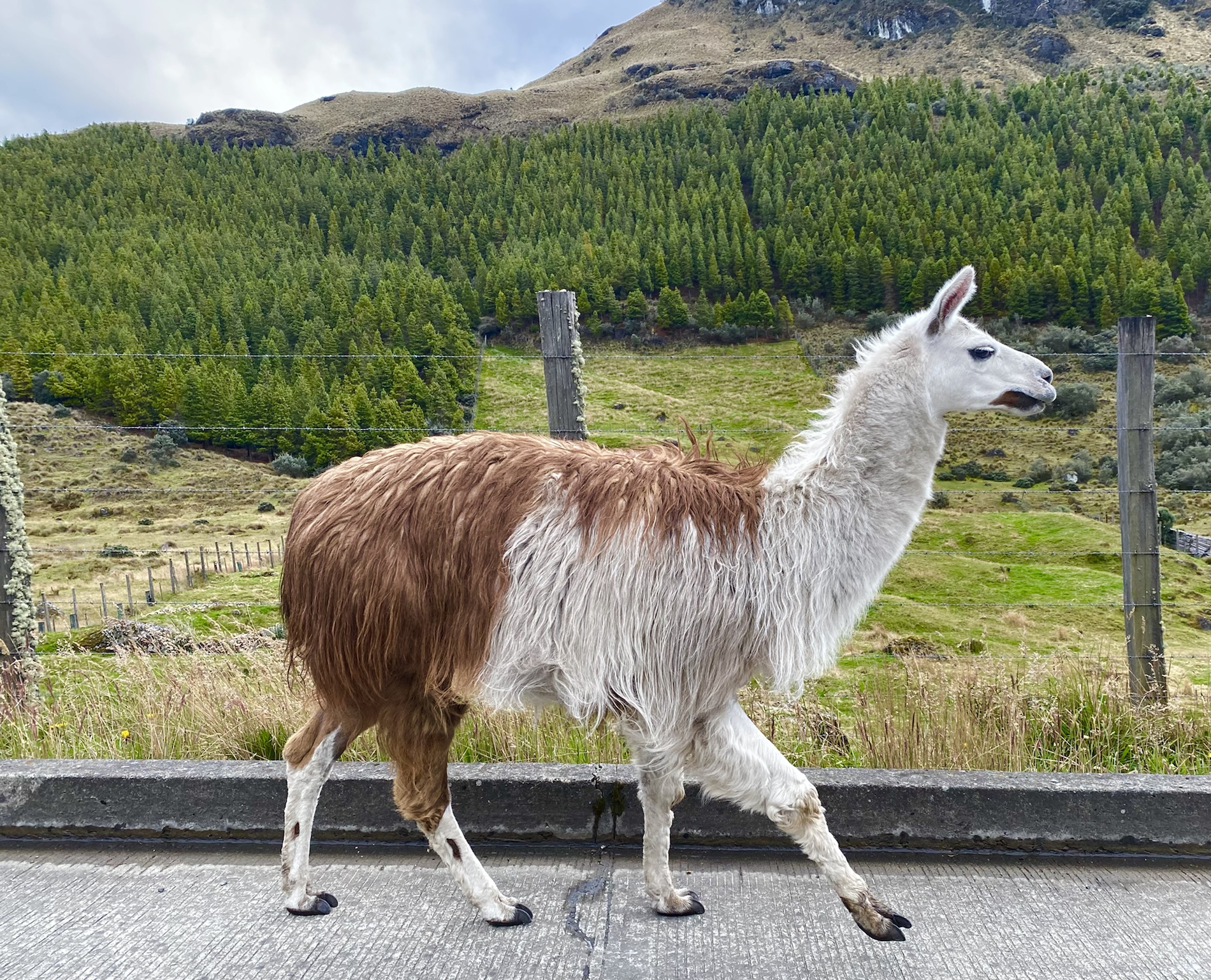
Llama crossing
We drove back to our Airbnb in Cuenca, where we rested and soaked in our hot tub. I hadn’t been feeling very good, so the nice soak felt delectable.
We were so exhausted that we barely managed to drag ourselves out to dinner at El Jardín in Hotel Victoria. The place was rather deserted and a little too formal for our taste. It overlooks the Río Tomebamba, but it was too dark to see the river by the time we arrived. I enjoyed Langostinos El Jardín and Mike had an empañada and Sopa de Cebolla. We got a great night’s sleep after our rugged and active day.
Mike at El Jardín
me at El Jardín
Langostinos El Jardín
a nighttime view of the Church of San Francisco
Steps: 12,849; Miles: 5.45.
Below is a short video of the live action at Park Cajas. I suggest watching on YouTube for the best result.
We had one more full day in Cuenca, and then we would drive our trusty Toyota Yaris north on the Pan American Highway.
We took a road trip to South Florida in March 2022. Our itinerary included Miami, Everglades National Park, the Florida Keys, and Fort Lauderdale. On our way back home, at the northeast corner of Florida, we spent two nights in St. Augustine. This post, part three, includes Fort Lauderdale and St. Augustine (& Cocoa Beach, where I stopped before going to Miami but is between Fort Lauderdale and St. Augustine on the coast). The first two parts of our trip can be found here: a florida road trip {part one}: miami and a florida road trip {part two}: the everglades & the keys.
In Cocoa Beach, I bought beach cover-ups at Ron Jon Surf Shop. Later, we took a water taxi through Fort Lauderdale’s Inland Waterway, known as the “Venice of America,” and admired the mansions of the rich and famous. We wandered up and down Las Olas Boulevard, enjoyed dinner at Cuba Libre and happened to hit the Las Olas Oceanside Park Market on Saturday morning. We waded through the surf at Fort Lauderdale Beach. We headed north to St. Augustine, where we explored the Historic Old Town, the Castillo San Marcos National Monument, the St. Augustine Light Station and Fort Mantazas National Monument. We enjoyed a delicious lunch on the breezy rooftop of Salt Life Food Shack and saw the old Ponce de Leon Hotel that now houses Flagler College. We topped off our time in Florida at the Tini Martini Bar. On the way home, we stopped to visit Mike’s college friends, Bob and Barbara Trott, and had lunch with Sarah in Richmond.
I recommend watching on YouTube for the best experience.
Our top things to do in Fort Lauderdale, Cocoa Beach, and St. Augustine were:
8) Fort Mantazas National Monument in St. Augustine
7) Ron Jon Surf Shop in Cocoa Beach
6) Tini Martini Bar in St. Augustine
5) Castillo de San Marcos National Monument in St. Augustine
4) Historic Old Town St. Augustine and Flagler College in the old Ponce de Leon Hotel
3) Fort Lauderdale Beach and the Las Olas Oceanside Park Market
2) Las Olas Boulevard and Cuba Libre in Fort Lauderdale
1) Water taxi through the inland waterways of Fort Lauderdale, the “Venice of America”
our Florida road trip
Miami, The Everglades and Fort Lauderdale
St. Augustine
Overall, these are our top ten favorites for our entire Florida Road Trip:
10) Fort Lauderdale Beach and the Las Olas Oceanside Park Market
9) Kayaking in Big Cypress National Preserve with Shurr Adventures Kayaking & Eco Tours
8) Airboat ride through the River of Grass at Everglades National Park with our hyperbolic guide at Gator Park
7) Las Olas Boulevard and Cuba Libre in Fort Lauderdale
6) Wynwood Walls in Miami
5) Key West
4) Water taxi through the inland waterways of Fort Lauderdale, the “Venice of America”
3) South Beach – the beach itself and the Art Deco lifeguard stations, Miami
2) South Beach Art Deco Historic District, Miami
1) Calle Ocho in Little Havana, Miami
Thank you for watching! I invite you to subscribe to my YouTube channel.
We took a road trip to South Florida in March 2022. Our itinerary included Miami, Everglades National Park, the Florida Keys, and Fort Lauderdale. On our way back home, at the northeast corner of Florida, we spent two nights in St. Augustine. This post, part two, includes Everglades National Park & The Keys. Part three will include Fort Lauderdale and St. Augustine. The first part of our trip, in Miami, can be found here: a florida road trip {part one}: miami.
We hiked the Anhinga Trail and the Gumbo Limbo Trail at Everglades National Park, and then took the Flamingo Adventures Boat ride where we saw American crocodiles and manatees. We strolled amidst tropical hardwood hammocks, mahogany trees, sabal palms, cypresses and mangroves. We ate a delicious and lively dinner at Yardie Spice, a Jamaican restaurant in Homestead, with Jamaican owner J.P. hosting. We pedaled for 15 miles at Shark Valley Visitor Center and then sped over the river of grass in an air boat at Gator Park. We kayaked in a tandem in Big Cypress National Preserve where we communed with alligators and birds of all feathers and ended up bickering as we got tangled up in the mangrove trees. We visited two state parks in the Florida Keys, the nicest being Bahia Honda State Park, and shopped, strolled, nibbled and imbibed in Key West all the way to the Southernmost Point in the Continental U.S., which is 90 miles from Cuba and 150 miles from Miami. We enjoyed a Hoochie Mama Mojito and key lime pie at Paradise Restaurant in Key West as a rooster strutted his stuff near our table. Then we lounged by the pool at our hotel and waded in the seaweed-infested surf at Sombrero Beach in Marathon.
I recommend watching on YouTube for the best experience.
Our top ten things to do in the Everglades and the Florida Keys were:
10) Sombrero Beach in Marathon (Keys)
9) Big Cypress Bend Boardwalk (Big Cypress National Preserve)
8) The Anhinga Trail and the Gumbo Limbo Trail at the Ernest F. Coe Visitor Center (Everglades National Park)
7) Flamingo Adventures Boat Ride (Everglades)
6) Bahia Honda State Park (Keys)
5) Dinner (twice) at the Jamaican Yardie Spice in Homestead
4) Bicycling 15 miles at Shark Valley (Everglades)
3) Kayaking in Big Cypress National Preserve with Shurr Adventures Kayaking & Eco Tours
2) Key West
1) Airboat ride through the River of Grass with our hyperbolic guide at Gator Park
our Florida road trip
Everglades National Park & Florida Keys
Thank you for watching! I invite you to subscribe to my YouTube channel.
We took a road trip to South Florida in March 2022. Our itinerary included Miami, Everglades National Park, the Florida Keys, and Fort Lauderdale. On our way back home, at the northeast corner of Florida, we spent two nights in St. Augustine. This post includes our time in Miami, which was my favorite part of the trip. Part two will include Everglades National Park & The Keys, and part three will include Fort Lauderdale and St. Augustine.
I first stopped at Falls Park on the Reedy in Greenville, South Carolina. I visited my youngest brother Robbie and his partner Rob at their new house in Columbus, Georgia, where we commiserated over politics, ate sushi and chile rellenos, and drank sake and margaritas. I bought beach cover-ups at Ron Jon Surf Shop in Cocoa Beach, Florida.
Falls Park on the Reedy in Greenville, SC
my brother Rob & me in Columbus, GA
Columbus, GA
Ron Jon Surf Shop in Cocoa Beach, FL
I met Mike at the Miami Airport and we strolled through the Art Deco Historic District on South Beach, saw an adorable pink lifeguard tower, and spent a feisty evening on Calle Ocho in Little Havana among roosters and coffee stores. Mike puffed on a cigar at Guantanamera. We immersed ourselves at Wynwood Walls, an outdoor museum of funky international street art. We wandered among orchids, coral trees, palms, cyads, and a rainforest at Fairchild Tropical Botanic Garden. We spent a barefoot morning lollygagging on South Beach, admiring the colorful art deco lifeguard stands then spent the afternoon basking in the sun at Bill Baggs Cape Florida State Park. We returned to Little Havana for another night of Cuban food and a history lesson on the failed Bay of Pigs Invasion (April 17, 1961) and paid tribute at the Eternal Torch in Honor of the 2506th Brigade, many of whom lost their lives or were incarcerated in horrible conditions in Cuban prisons.
I recommend watching on YouTube for the best experience.
Our top experiences in Miami were:
7) Coconut Grove
6) Fairchild Tropical Botanic Garden
5) Bill Baggs Cape Florida State Park
4) Wynwood Walls
3) South Beach – the beach itself and the Art Deco lifeguard stands
2) South Beach Art Deco Historic District
1) Calle Ocho in Little Havana
our Florida road trip
Miami, The Everglades and Fort Lauderdale
Thank you for watching! I invite you to subscribe to my YouTube channel.
We spent three days in Boston, Massachusetts from November 10-14, 2021. We’d been to New England a number of times – to Cape Cod, New Hampshire and Vermont – but never to Boston. We very much enjoyed our fall getaway.
In this oldest of towns, the birthplace of American history, we cheered the Cheers bar and danced along with weeping willows and ginkgo trees in Boston Public Garden. We followed the redbrick road known as The Freedom Trail, from the Park Street Church, which played a key role in abolishing slavery, to the Granary Burying Ground, final resting place of Paul Revere, Samuel Adams, and John Hancock. We paid tribute to the Old South Meeting House, where arguments in 1773 led to the Boston Tea Party. We walked by Faneuil Hall, where Samuel Adams railed against “taxation without representation.” Finally we saluted Paul Revere’s house, his equestrian statue, and the Old North Church, of “One if by land, two if by sea” fame. We bumped our heads below deck on the U.S.S. Constitution, aka “Old Ironsides,” in Charlestown.
We admired harvest doors in Beacon Hill and circled Fenway park, where we were caught in a sudden deluge. We fought chaotic rain and gale force winds that turned our umbrellas inside out, while making our way to the marvelous Isabella Stewart Gardner Museum, which we enjoyed despite being soaked through and through. On our final day, we strolled through Cambridge, admiring sculptures and architecture at The Massachusetts Institute of Technology (MIT) and at Harvard. We ate lobster rolls, sushi and bibimbap and toasted autumn in New England with a Southern Tier Pumking Beer with cinnamon on the rim and a Cisco Gray Lady. In a flash, we were on the “T” to the airport and back home in plenty of time for Thanksgiving.
I recommend watching on YouTube for the best experience.
Our top ten experiences in Boston were:
10) Boston Irish Famine Memorial
9) Fenway Park
8) Acorn Street
7) Cambridge: (1) MIT & (2) Harvard
6) The North End, aka “Little Italy”
5) Boston Public Library
4) Beacon Hill (the neighborhood where we stayed)
3) Boston Public Garden
2) The Freedom Trail: (1) the statue of Paul Revere & the Old North Church; (2) Granary Burying Ground; (3) Old State House & Boston Massacre Site; (4) Copp’s Hill Burying Ground
1) Isabella Stewart Gardner Museum
Thank you for watching! I invite you to subscribe to my YouTube channel. 🙂
We visited Croatia in October of 2021. After leaving Plitvice Lakes National Park, we headed to the east shore of the Adriatic Sea, known as Dalmatia, starting in Zadar then working our way south through Šibenik, Primošten, Split (including Hvar and Trogir), and finally Dubrovnik.
After leaving Plitvice Lakes National Park, we drove through tunnels and over mountains to Zadar, where we listened to the Sea Organ and watched the “Greeting to the Sun,” a light show powered by the sun’s energy. We enjoyed a fabulous dinner of John Dory fillet at Restaurant Bruschetta in Zadar and then strolled along the Riva. We climbed up to St. Michael’s Fortress in Šibenik and enjoyed a waterfront lunch. We wandered around the beaches of Primošten. We arrived in Split to cold and blustery weather and stopped for a warm-up with pear brandy at Semafor. We braved a miserable rainy and cold day in Split visiting Diocletian’s Palace, and then visited it again the next day when the sun came out. We climbed the Venetian bell tower at noon and got an earful of clanging bells. We drove to the Marjan Peninsula and visited Kašjuni Beach and then drove to Trogir and strolled the waterfront promenade. We ate one of our best meals of avocado & shrimp salad and stuffed green peppers with mashed potatoes at Semafor. We took the ferry to Hvar, where we zoomed through tunnels and mountain roads over the Island on a quad, with an enjoyable stop at a hidden winery in Jelsa. We took a ferry to the Pelješac Peninsula, saw shellfish cultivation, vineyards, and the Great Wall of Croatia, and imbibed in oysters at Mali Ston. We braved the hair-raising cliff drive into Dubrovnik. We strolled around Dubrovnik and stopped in at Buža I, where concrete stairs led to a beach. We ate delicious grilled calamari at Konoba Jezuite while bundled in a pink blanket against the frigid bura. We took our COVID tests with (luckily) negative results. We walked around the Dubrovnik City Walls and up to the Fort of St. Lawrence, where we had a birds’-eye view of the City Walls. We devoured Bosnian meatballs at the Taj Mahal and, the next morning, took the cable car to Mount Srd, where we had a great view of all of Dubrovnik. We climbed to Park Gradac for views and then ate our final meal at Restaurant Jezuite.
I recommend watching on YouTube for the best experience.
Our top eight experiences in Dalmatia were:
8) The Pelješac Peninsula and Mali Ston: eating shellfish, drinking wine. Climbing the “Great Wall of Croatia would have been fun, but we didn’t have time.
7) Primošten: the beach is beautiful and would be nice in summer.
6) Trogir: the rich and famous and their yachts.
5) Šibenik: Climbing to St. Michael’s Fortress for amazing views.
4) Dubrovnik: Walking around the City Walls. Otherwise, very touristy.
3) Split: lots to do. We were unlucky with weather but it would be great in warm weather.
2) Zadar: the town, restaurants, Sea Organ and “Greeting to the Sun.” Not so touristy.
1) Hvar: taking a quad and a secret winery at Jelsa. 🙂
We visited Croatia in October of 2021, starting in Zagreb, and working our way west to Istria, where we stopped in Opatija, Motovun, Rovinj and Pula. Then we continued southeast to Plitvice Lakes National Park where we explored the park in cold, windy and rainy weather. This was our first international trip since the pandemic started.
We also went south to Dalmatia, along the coast, which I’ll feature in an upcoming video.
In Croatia, we strolled among the disheveled and forlorn populace of Zagreb and ate pizza and fluffy pillows of warm bread with beer and rakija. We took a funicular to the Upper Town and visited the Museum of Broken Relationships with its sad tales and detritus of heartbreak. We chatted with the waiter at the Bulldog Café about divisive matters of the world. Later, we walked around the Green Horseshoe and found actors rehearsing an opera on the portico of the Croatian National Theatre. We drove to the Eastern Riviera in Opatija and promenaded down the Lungomare to meet a woman surrounded by seagulls. We enjoyed the vineyard views of Istria from the hill town of Motovun. We immersed ourselves in blue light with harbor views and seafood at Gostionica “La Gondola” in Rovinj. We wandered through the Old Town and to the Church of St. Euphemia after checking out the rock-carved “beaches.” We bicycled on a trail leading to a rocky beach where we swam under the shade of cypresses and Aleppo pines. We visited the Roman amphitheater and strolled through Pula. Finally, we were serenaded by waterfalls as we traipsed through Plitvice National Park in the pouring rain on boardwalks lined with tropical plants and marsh grasses growing out of limestone.
I recommend watching on YouTube for the best experience. 🙂
Our top six experiences in the northern portion of Croatia were:
6) Plitvice Lakes National Park (rainy, cold and miserable, but beautiful)
5) Zagreb, especially the Upper Town (Gradac) and Tkalčićeva Street
4) Motovun
3) Opatija
2) Pula and the Roman ruins
1) Rovinj (our favorite of the entire trip)
My path less traveled. Rediscovering self after surviving the abuse that almost sunk me. Goal of strengthening and thriving on my adult legs. 👣🙏🏻 #recovery #forgiveness
This blog is for those who wish to be creative, authors, people in the healing professions, business people, freelancers, journalists, poets, and teachers. You will learn about how to write well, and about getting published. Both beginning and experienced writers will profit from this blog and gain new creative perspectives. Become inspired from global writers, and find healing through the written word.
Explore, discover and experience the world through Meery's Eye. Off the beat budget traveler. Explore places, cultural and heritage. Sustainable trotter.
shareable tales of Meery is Meeryable
You must be logged in to post a comment.