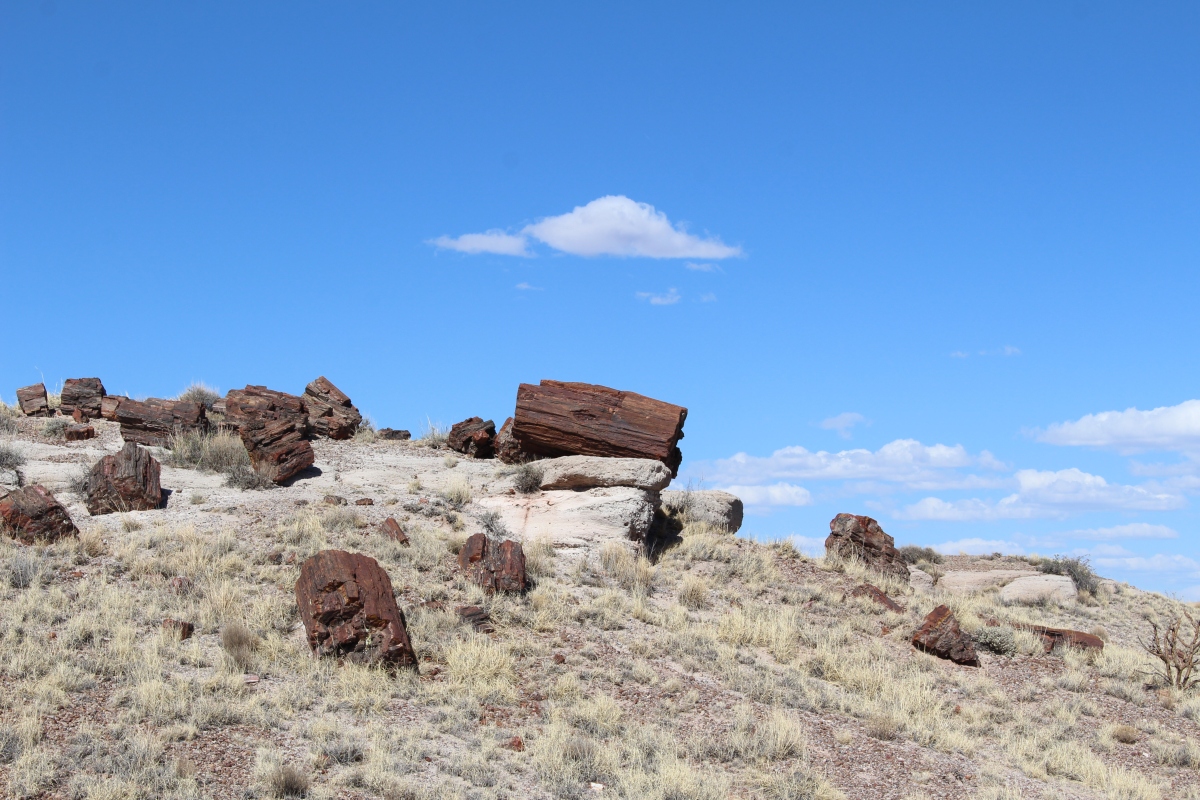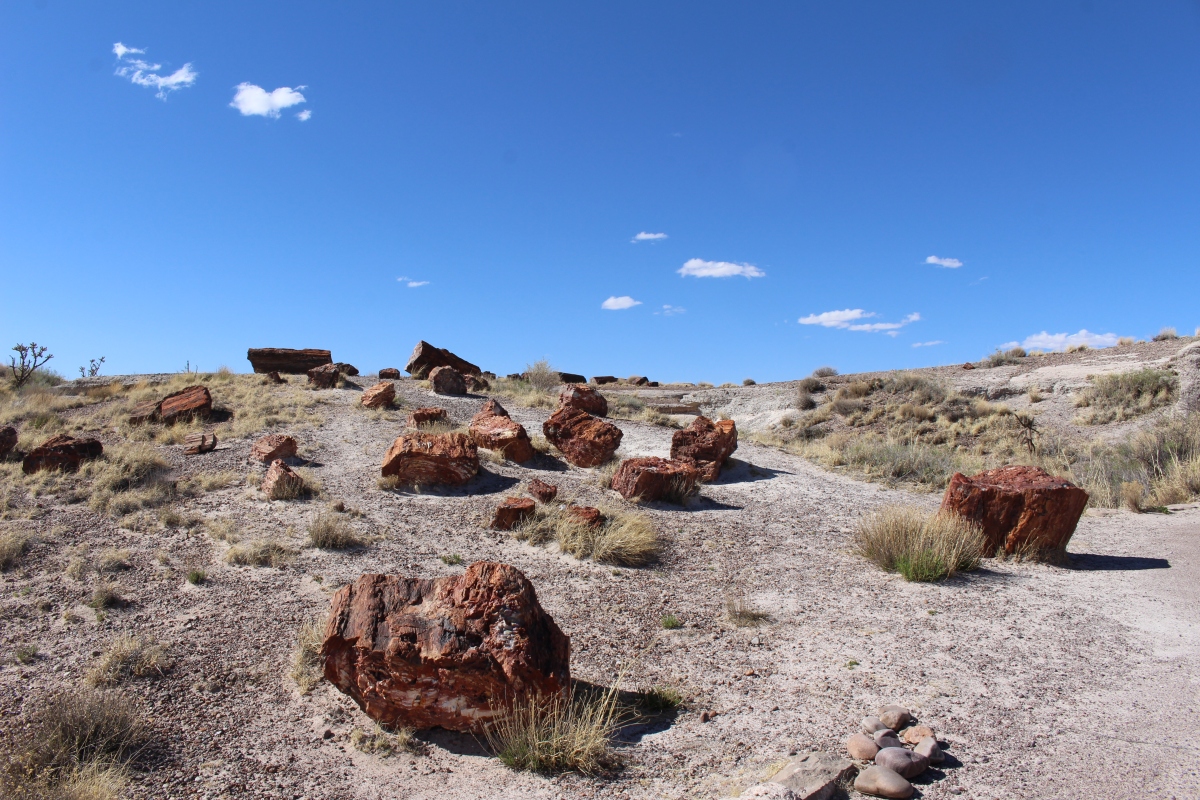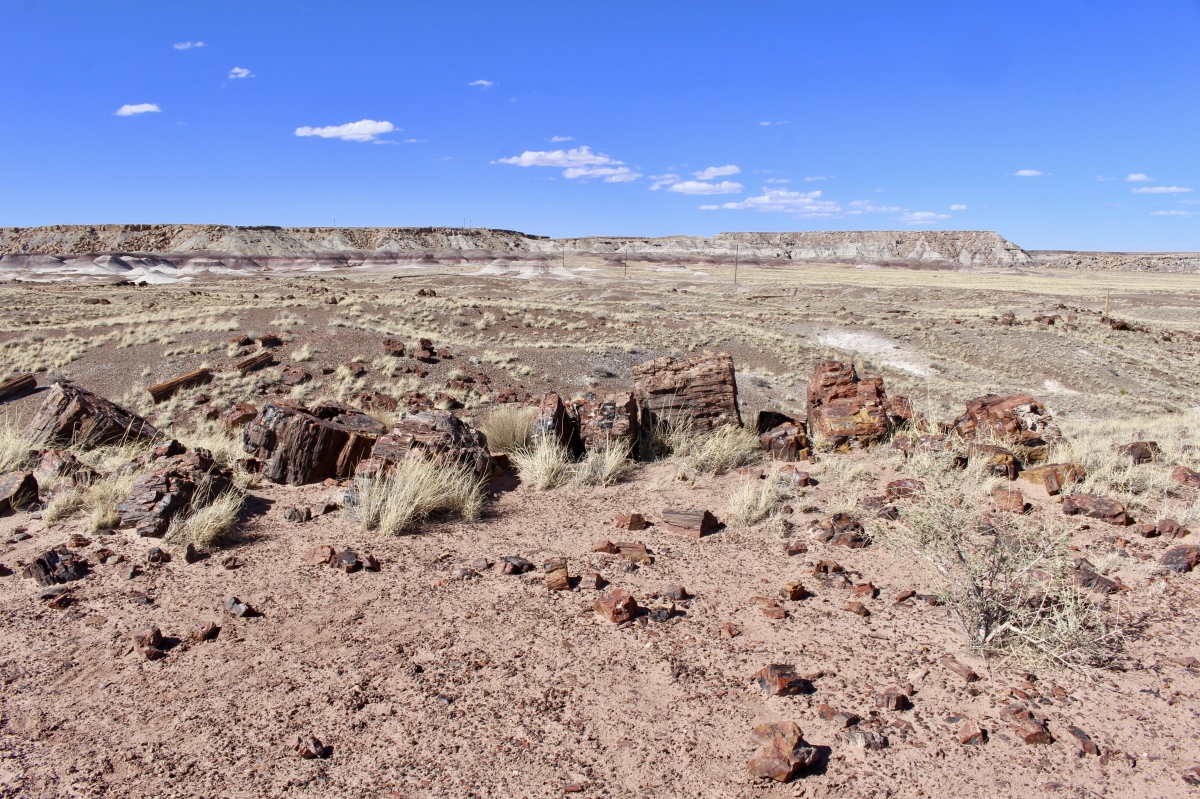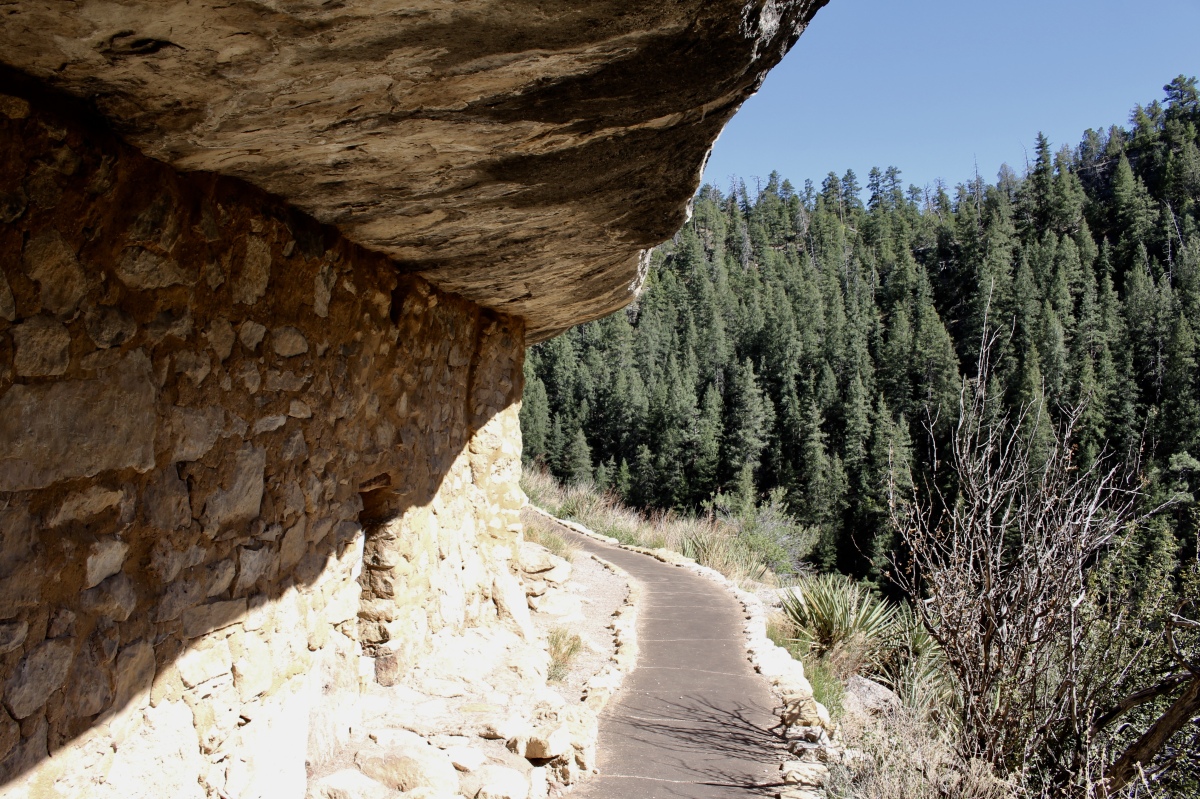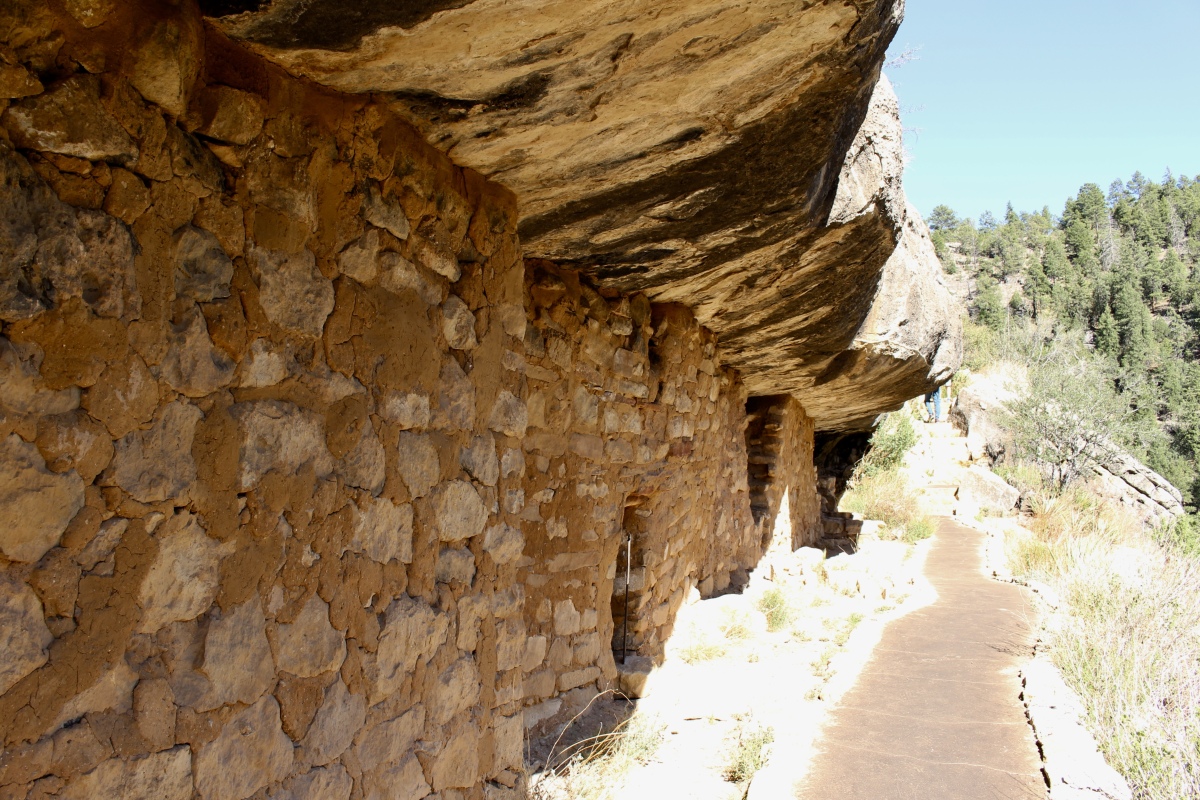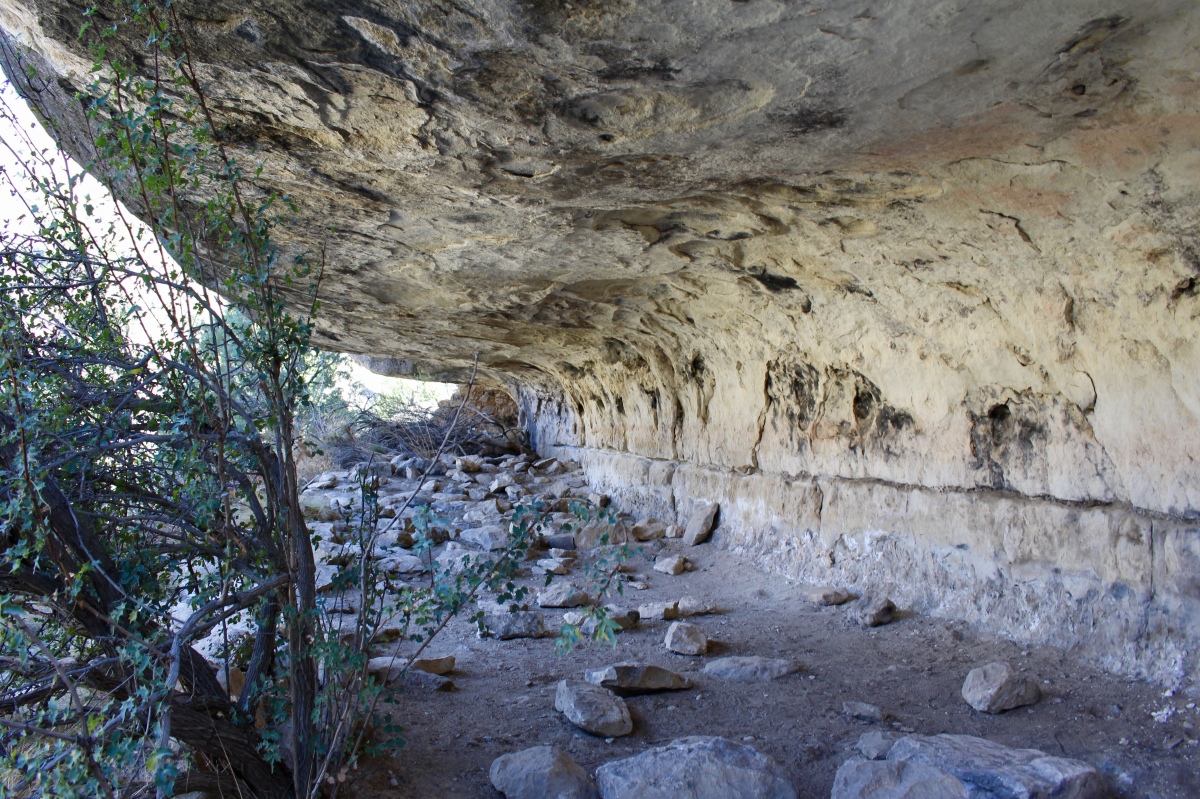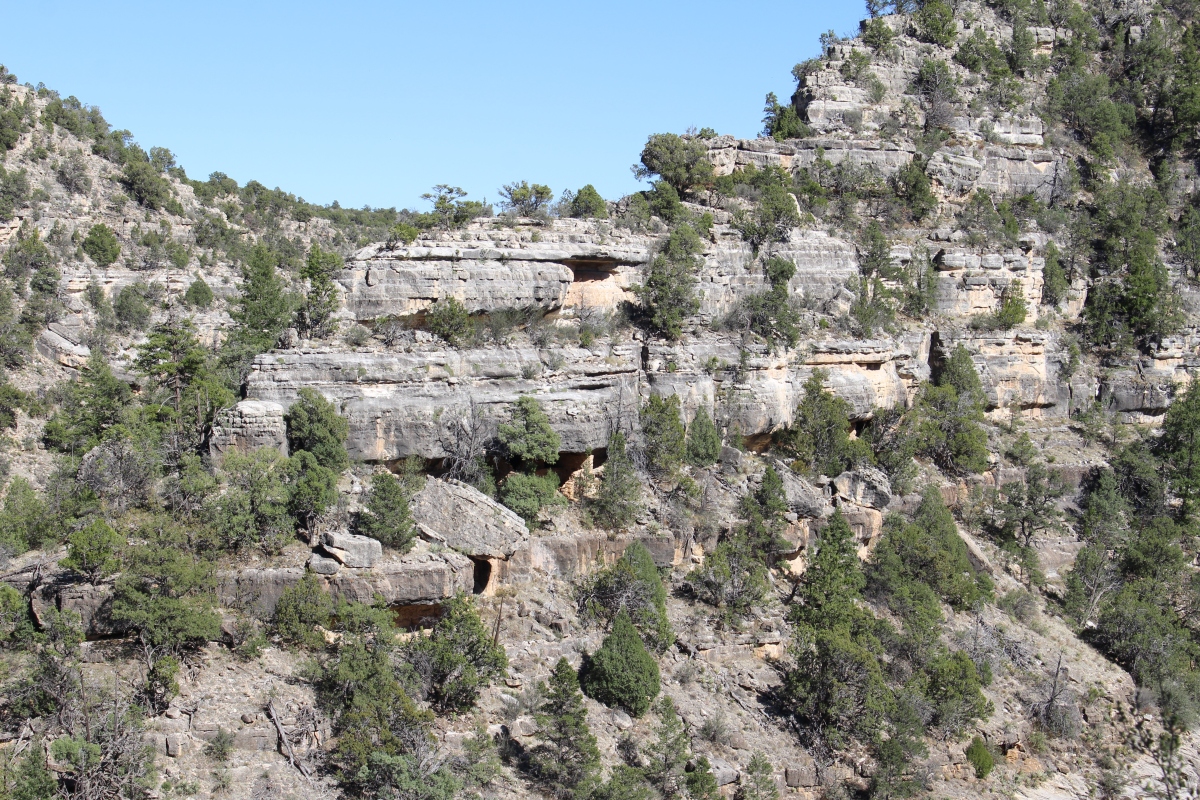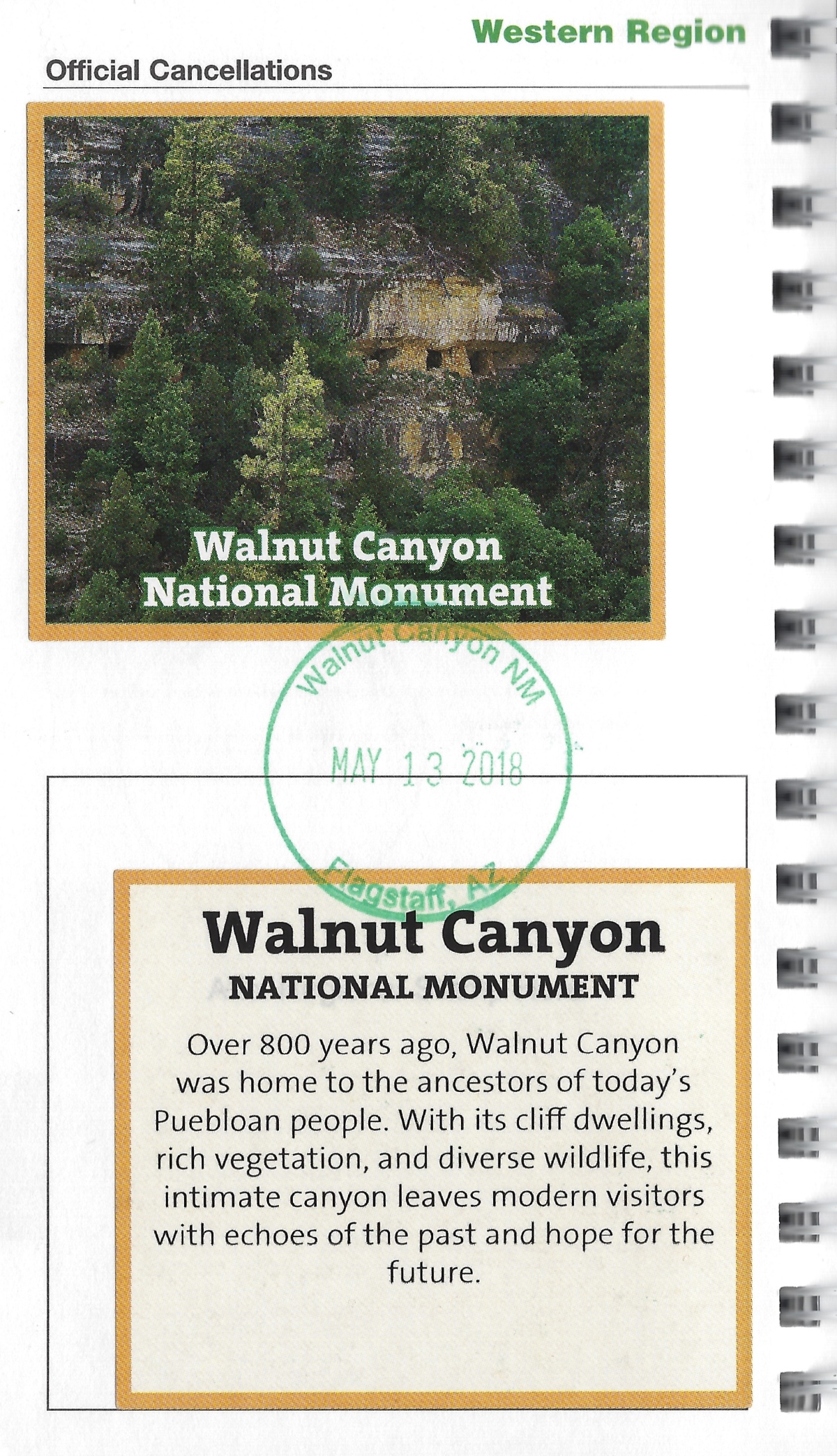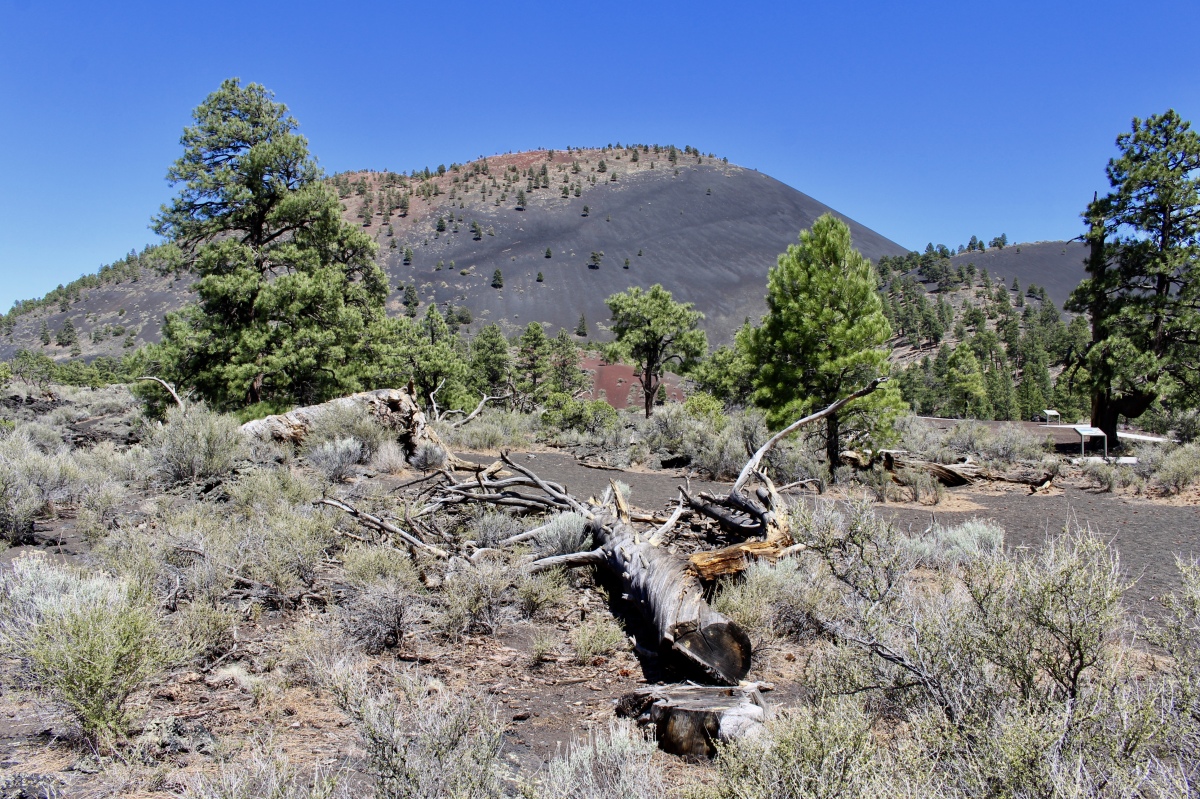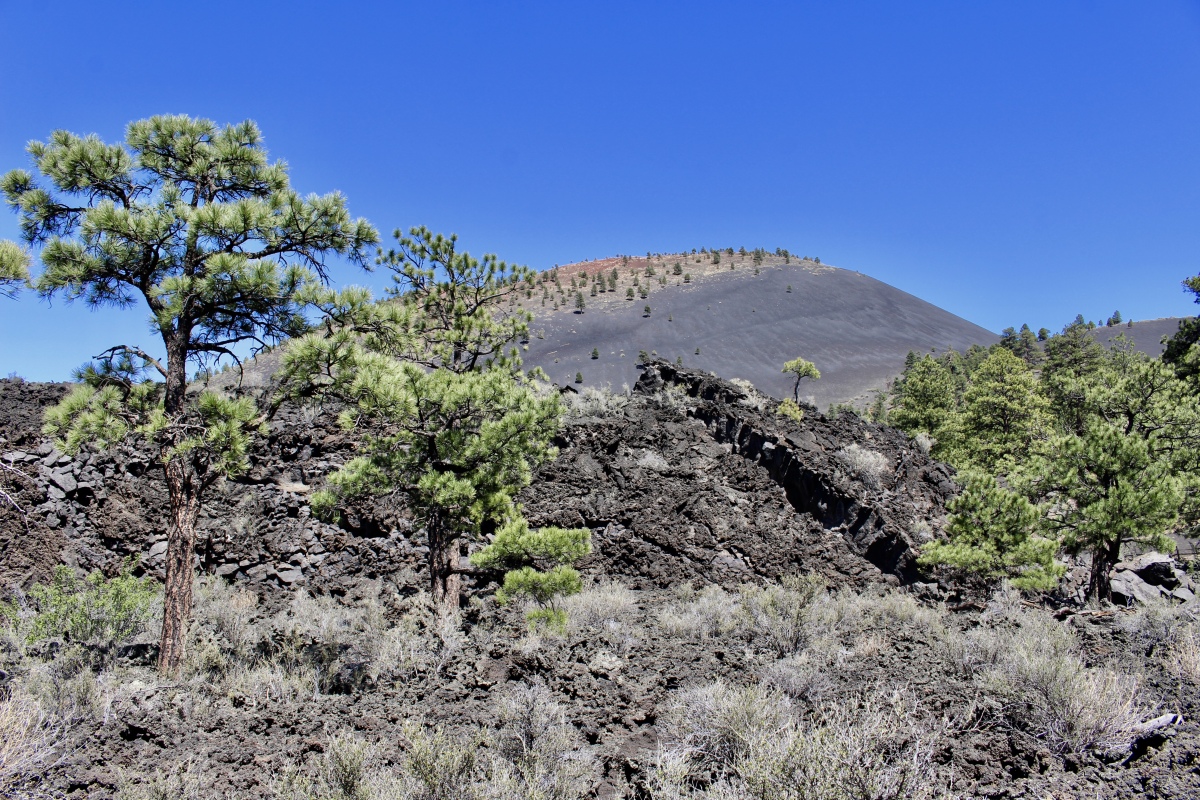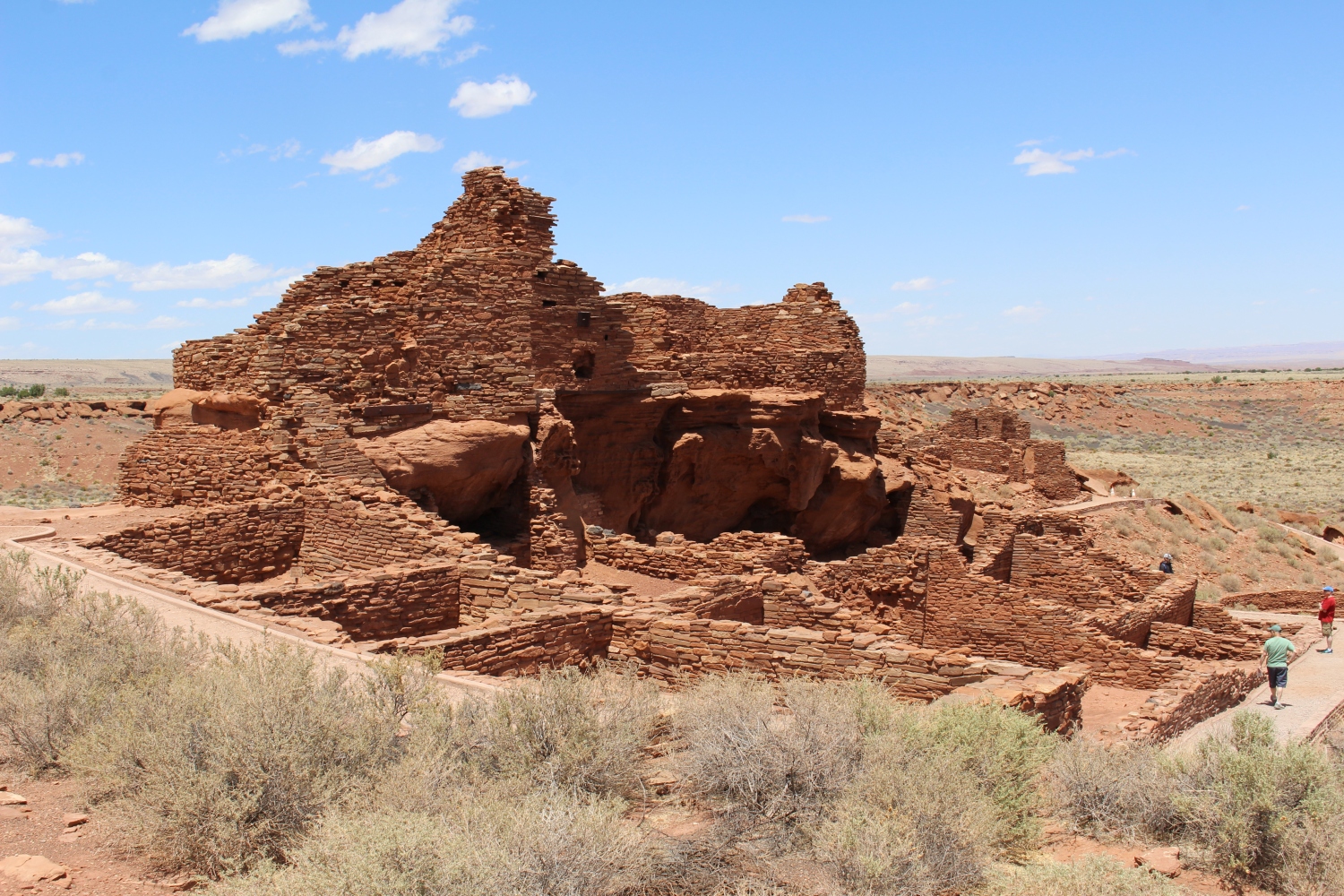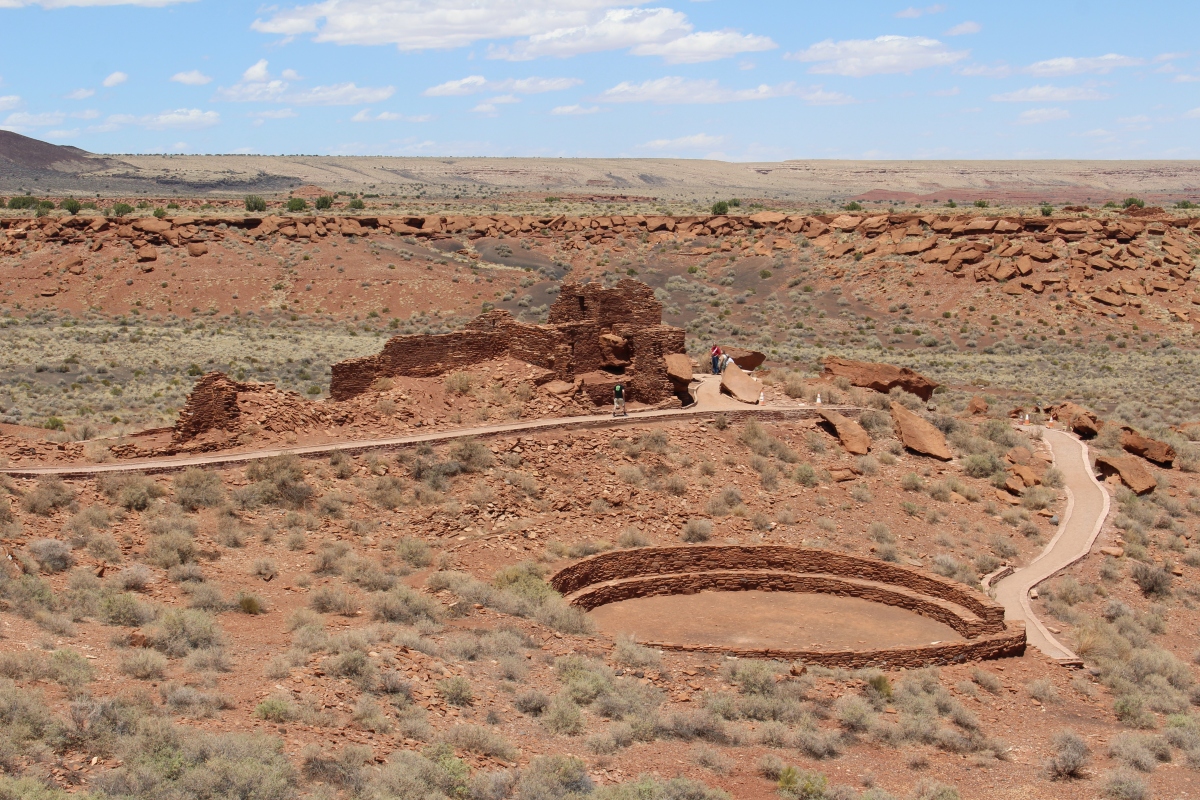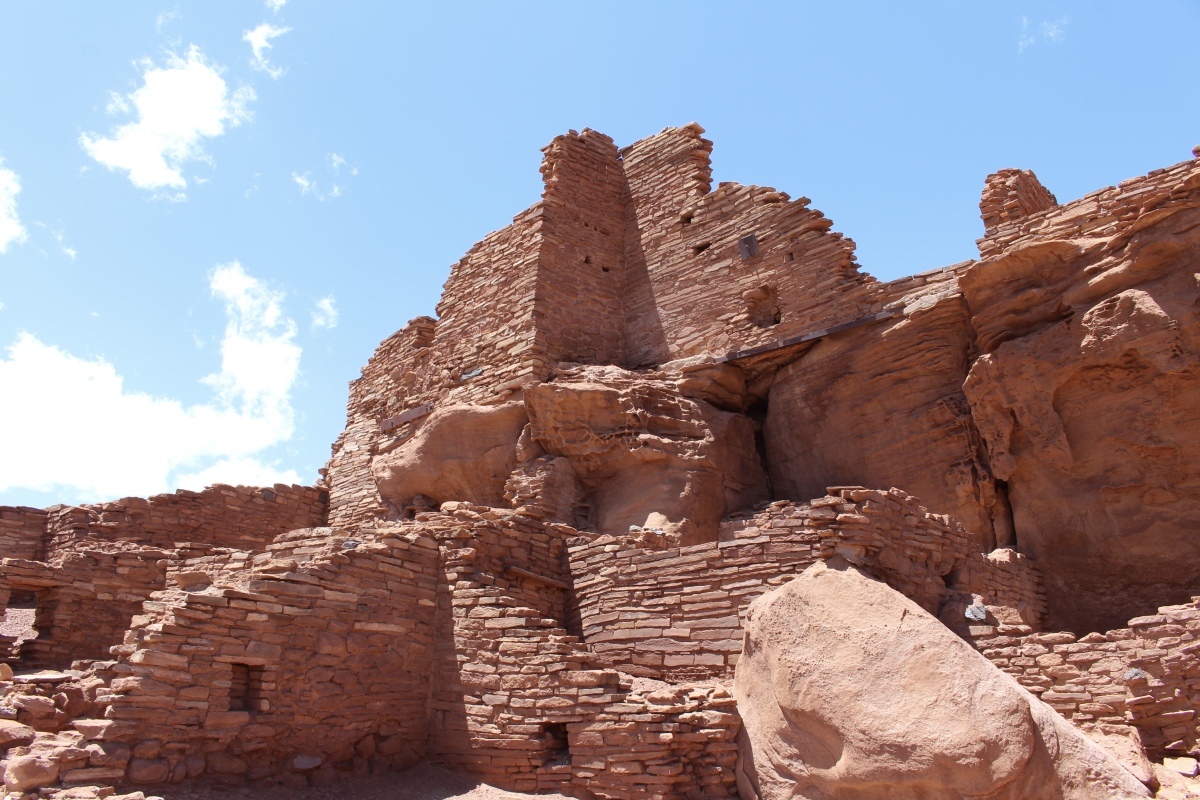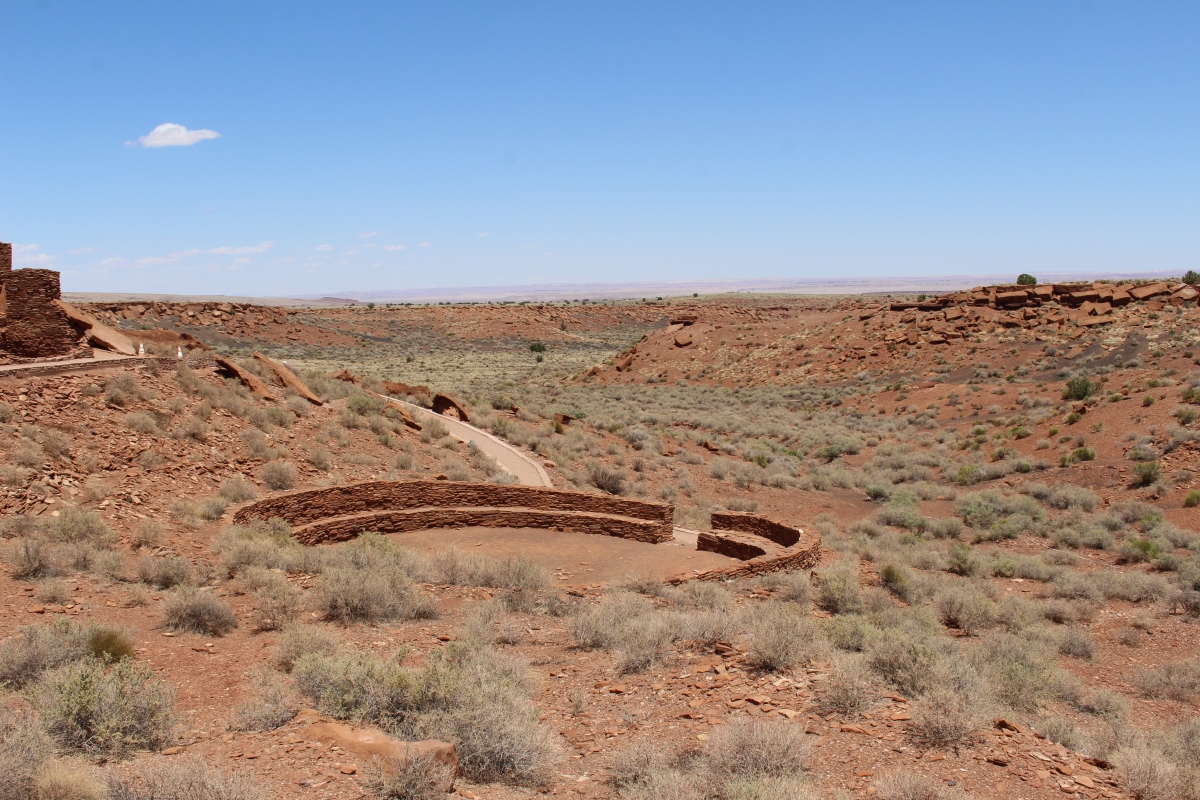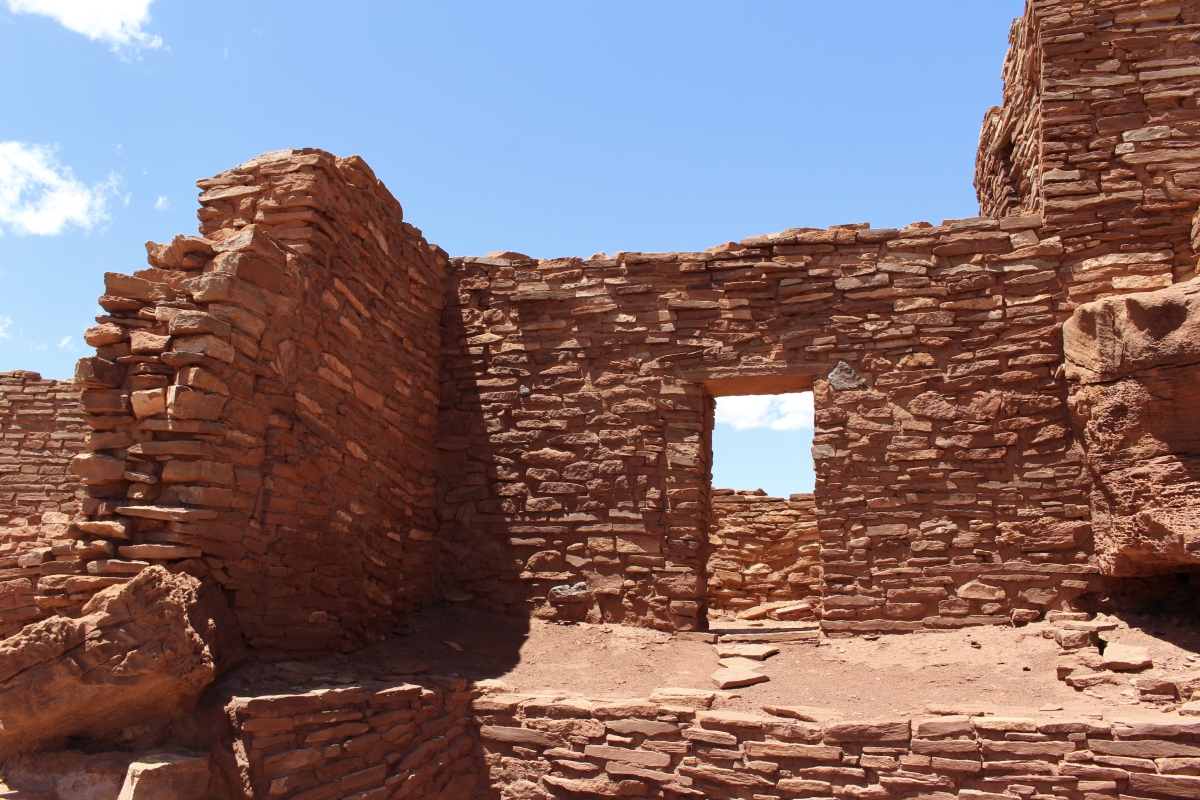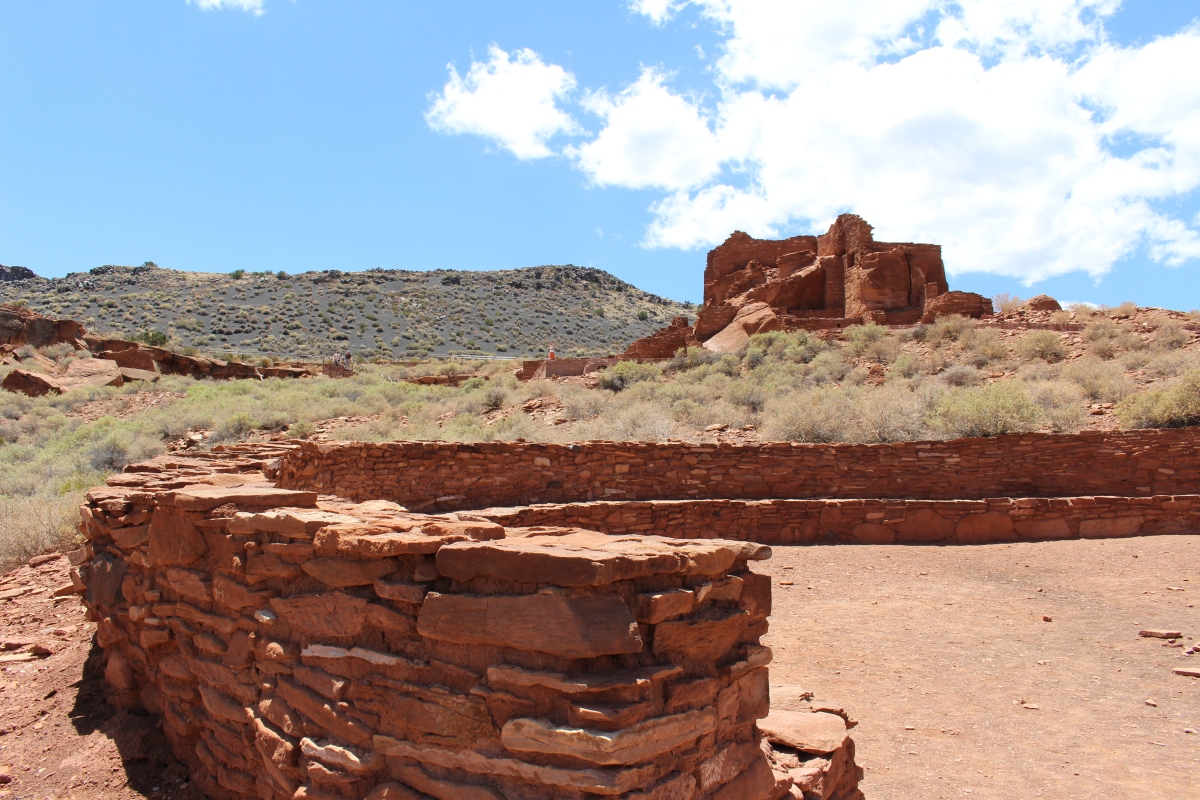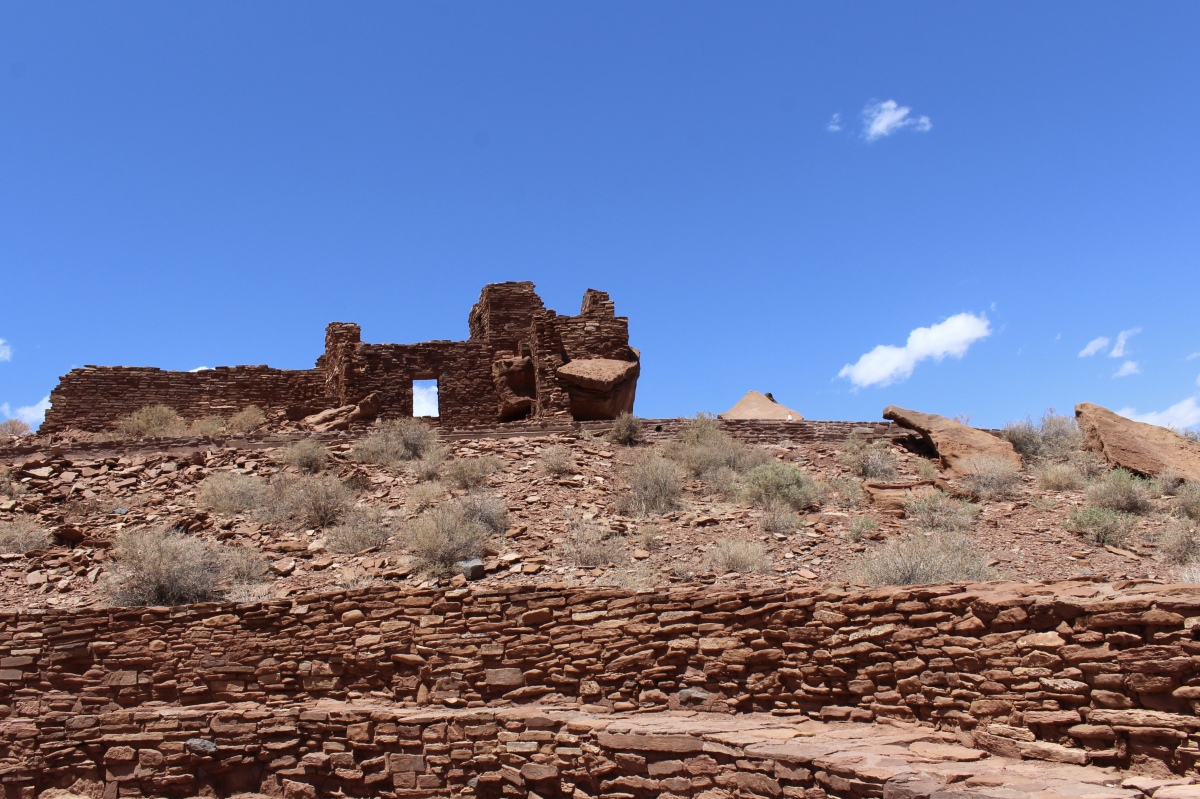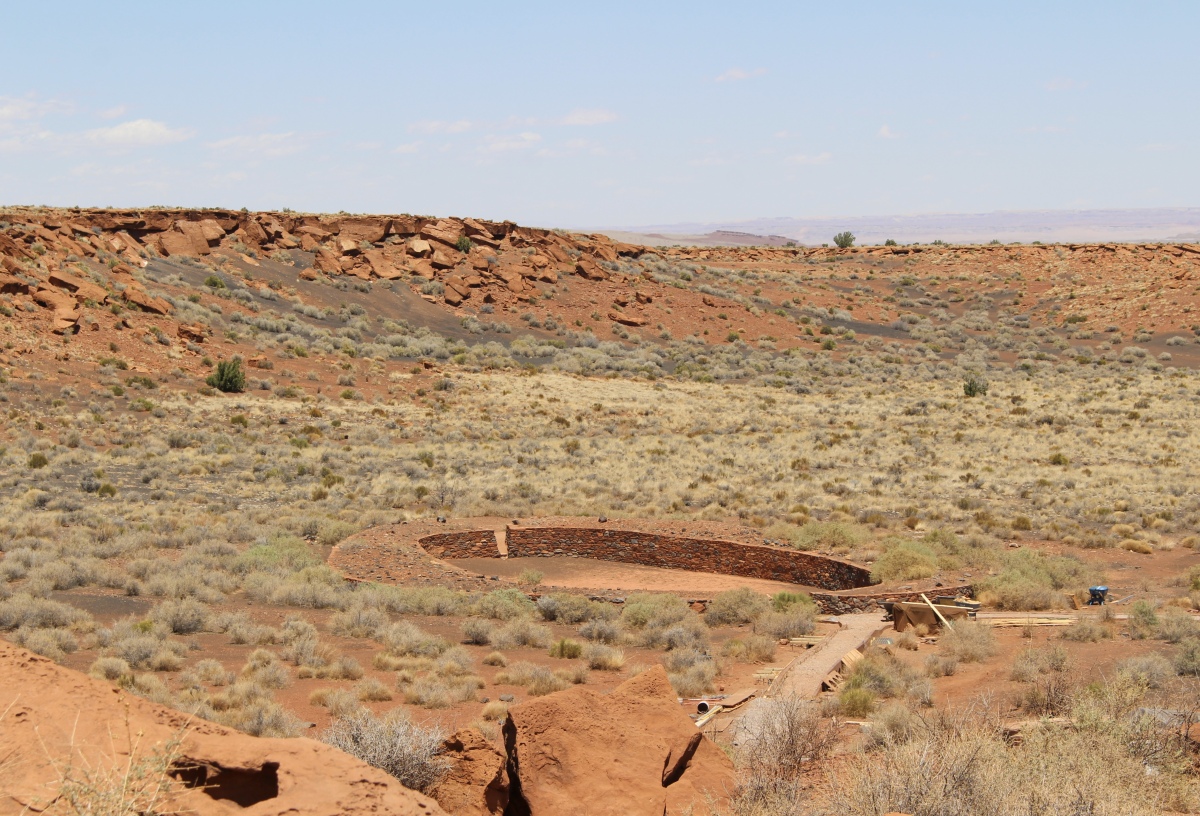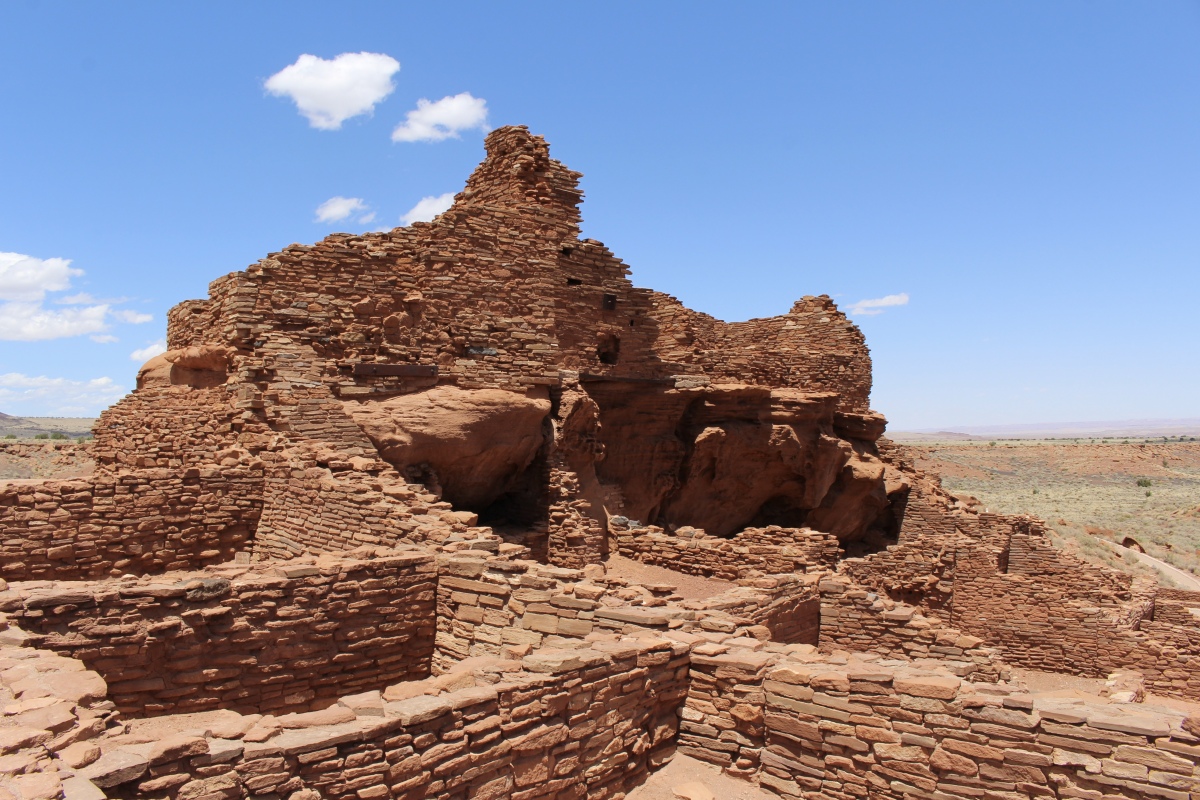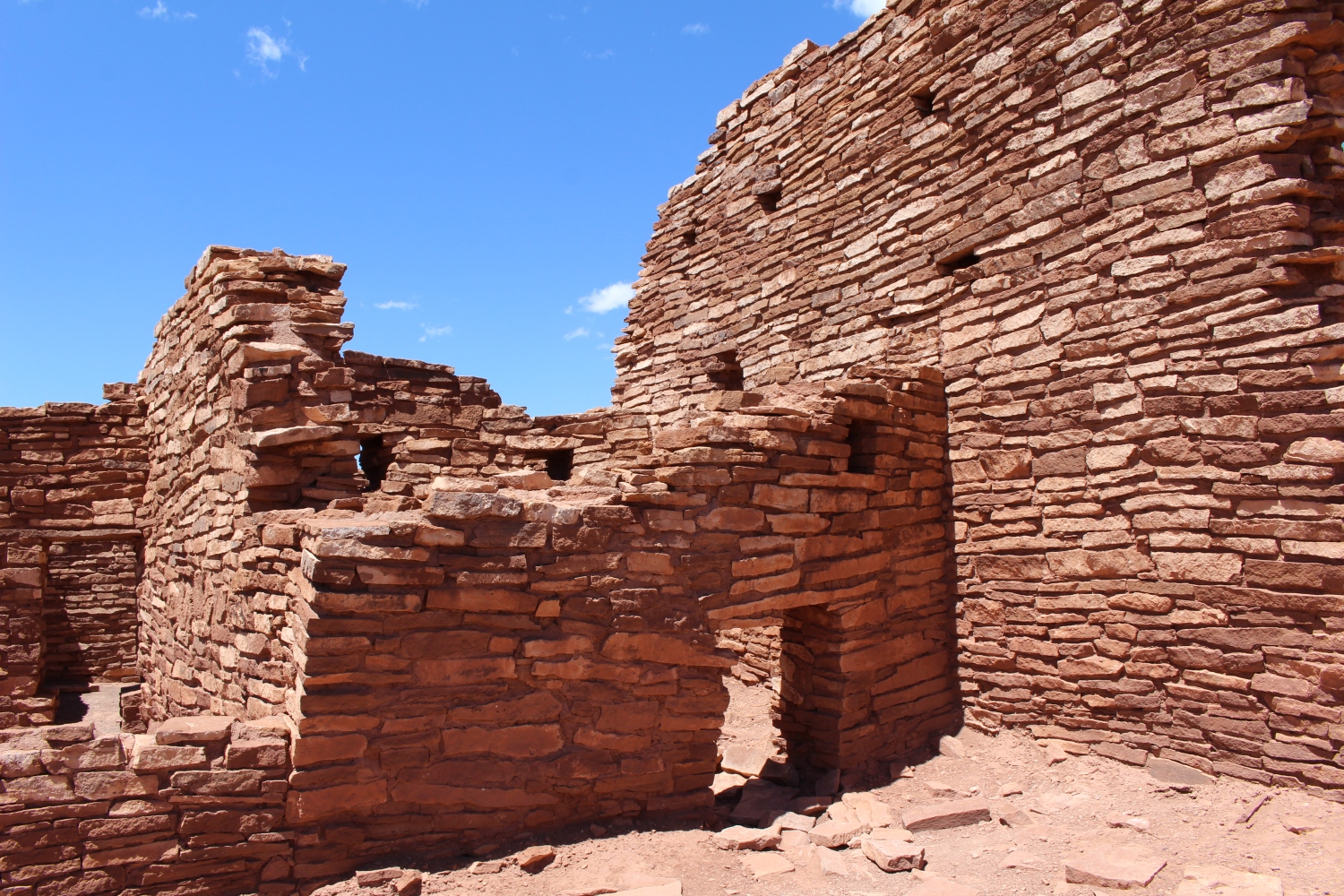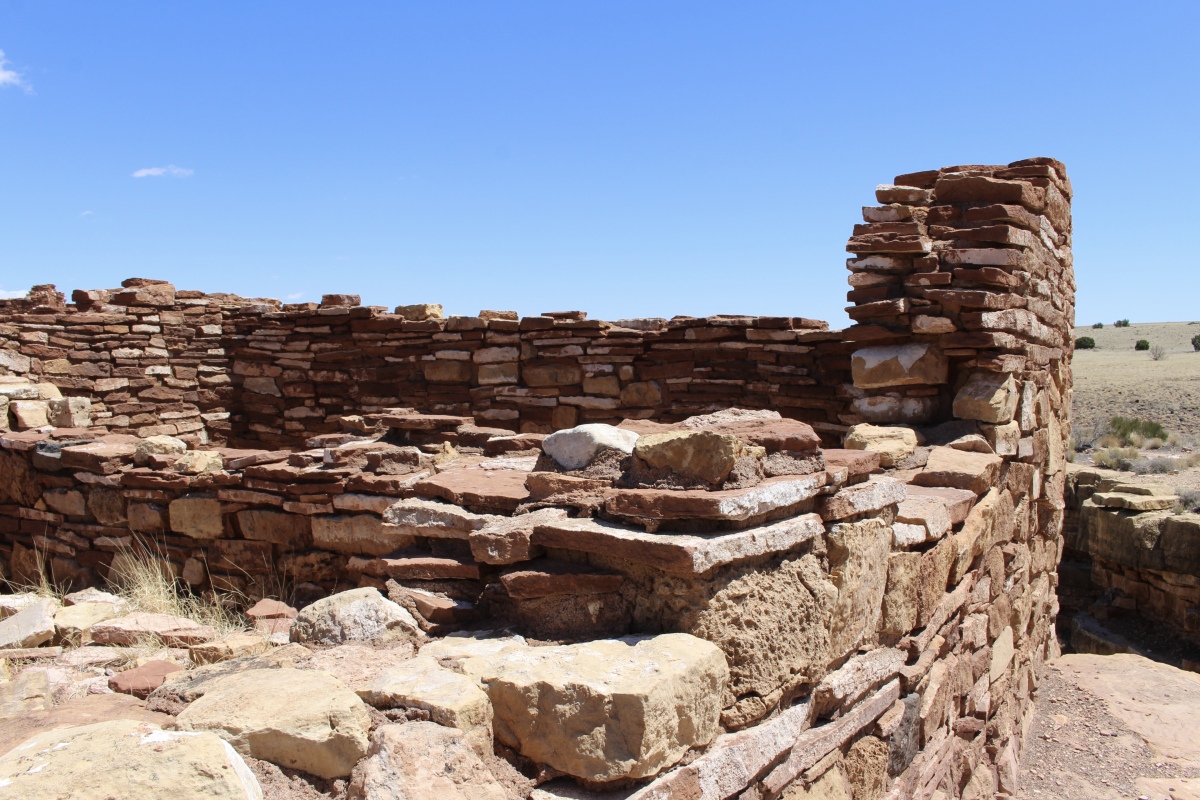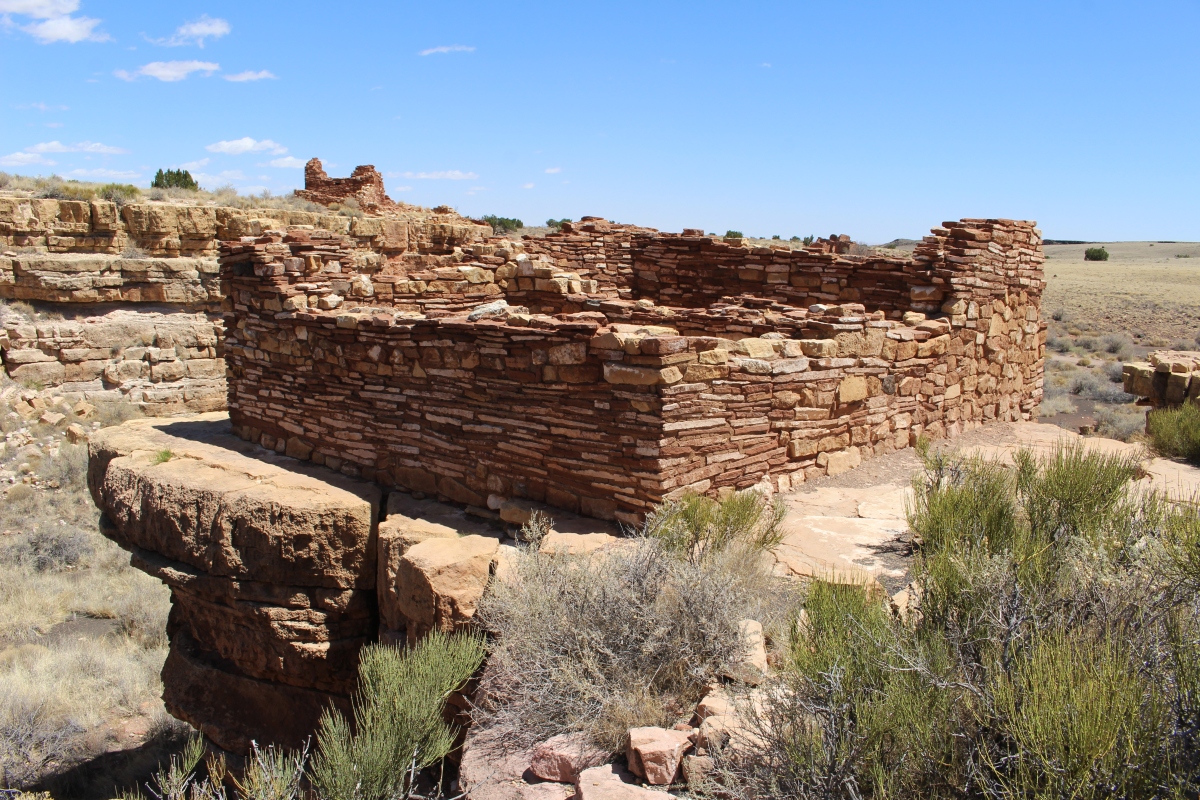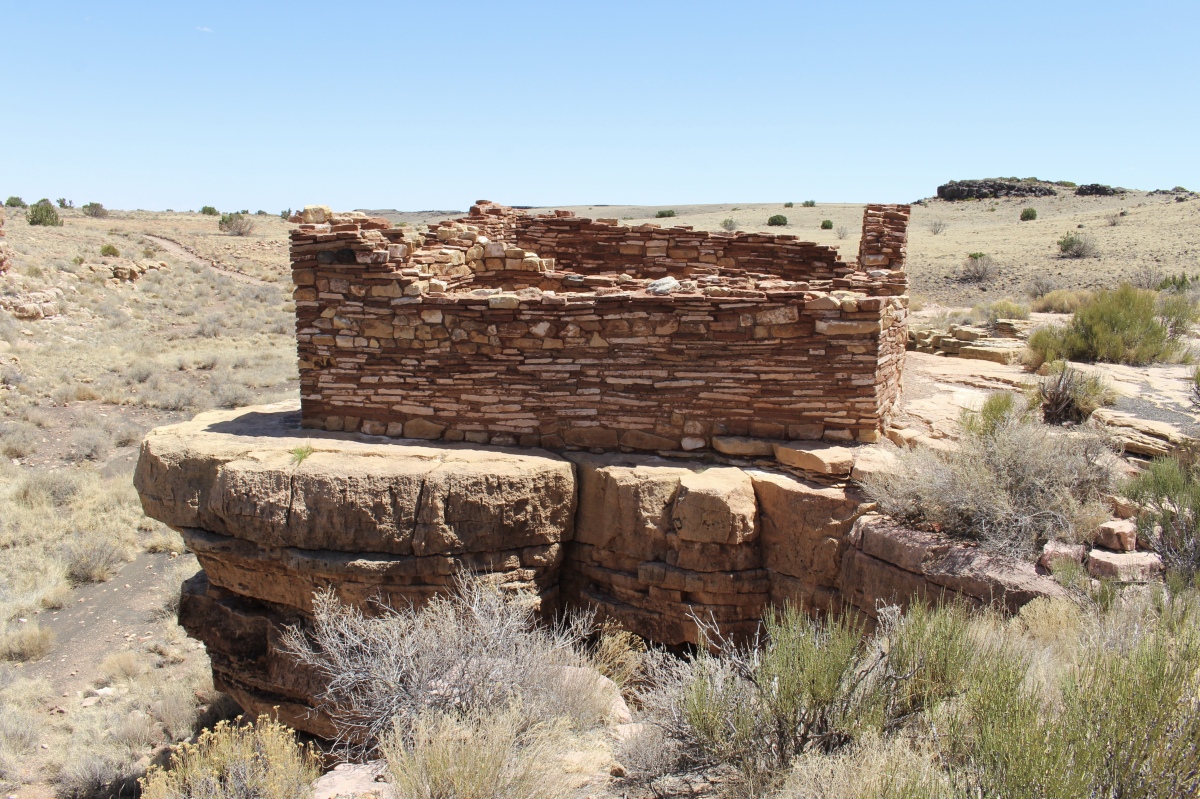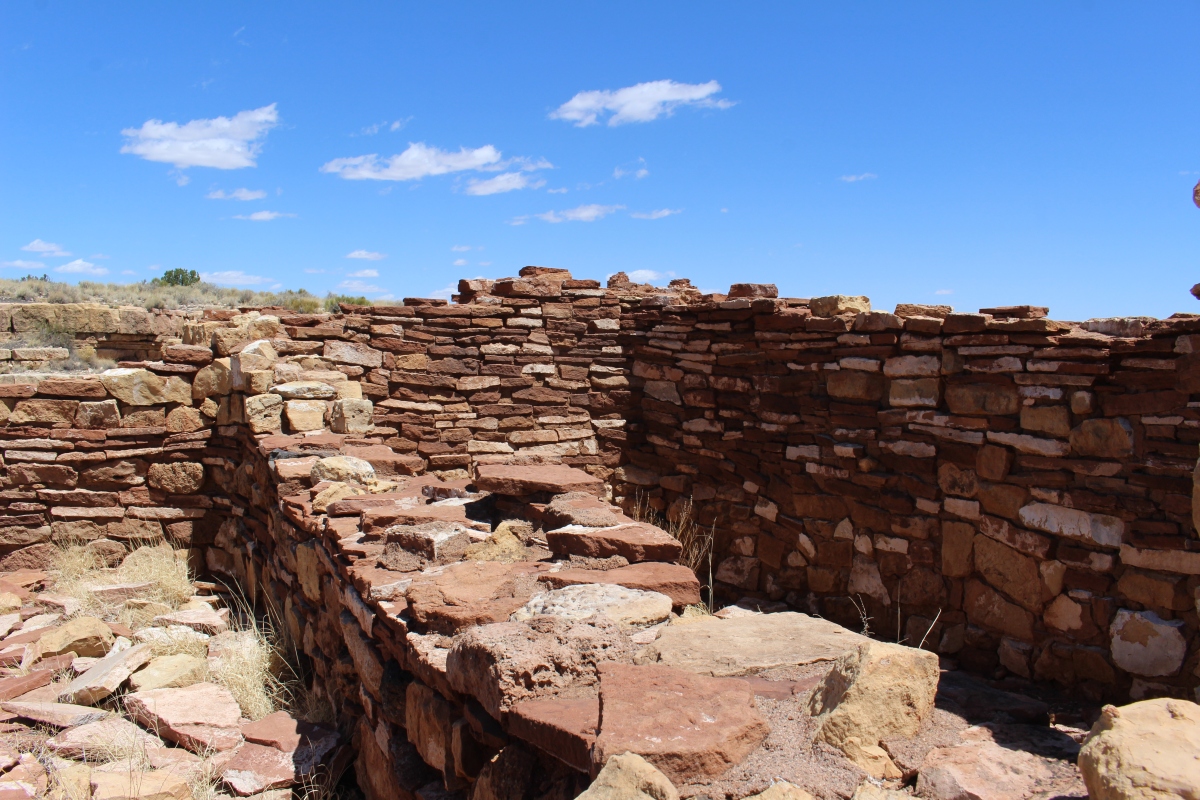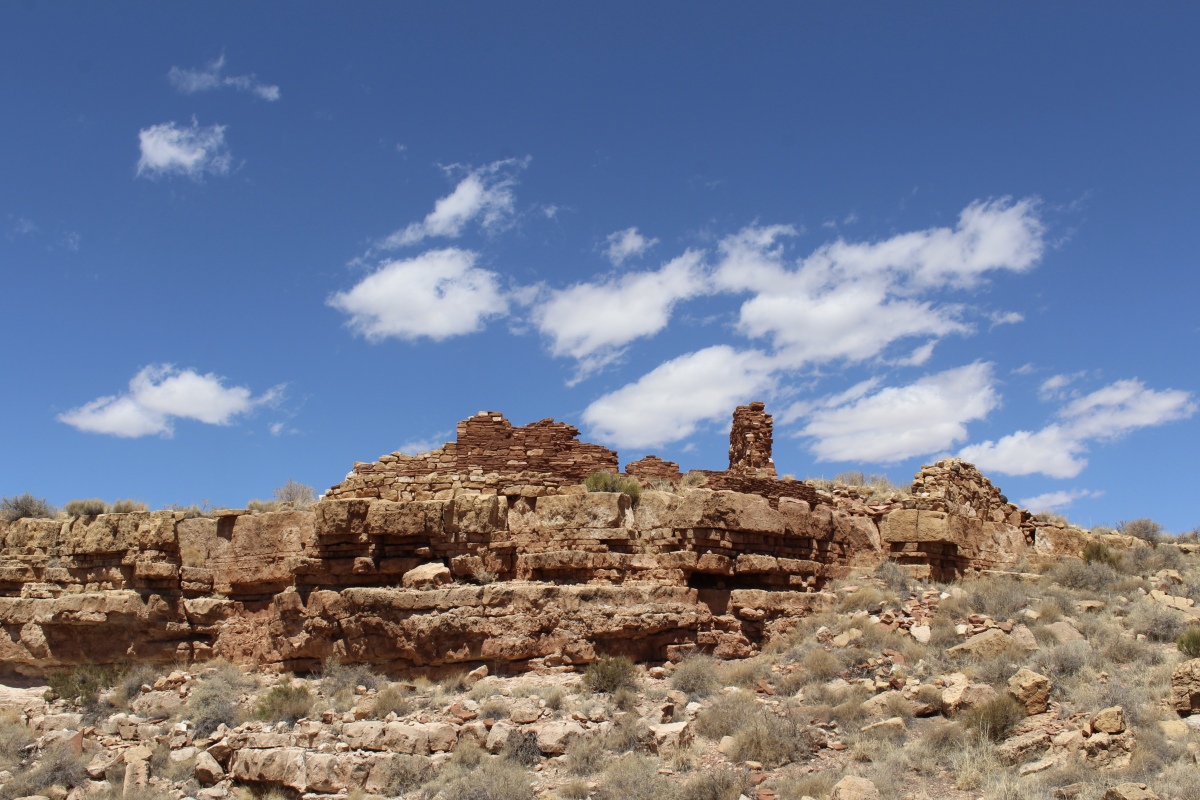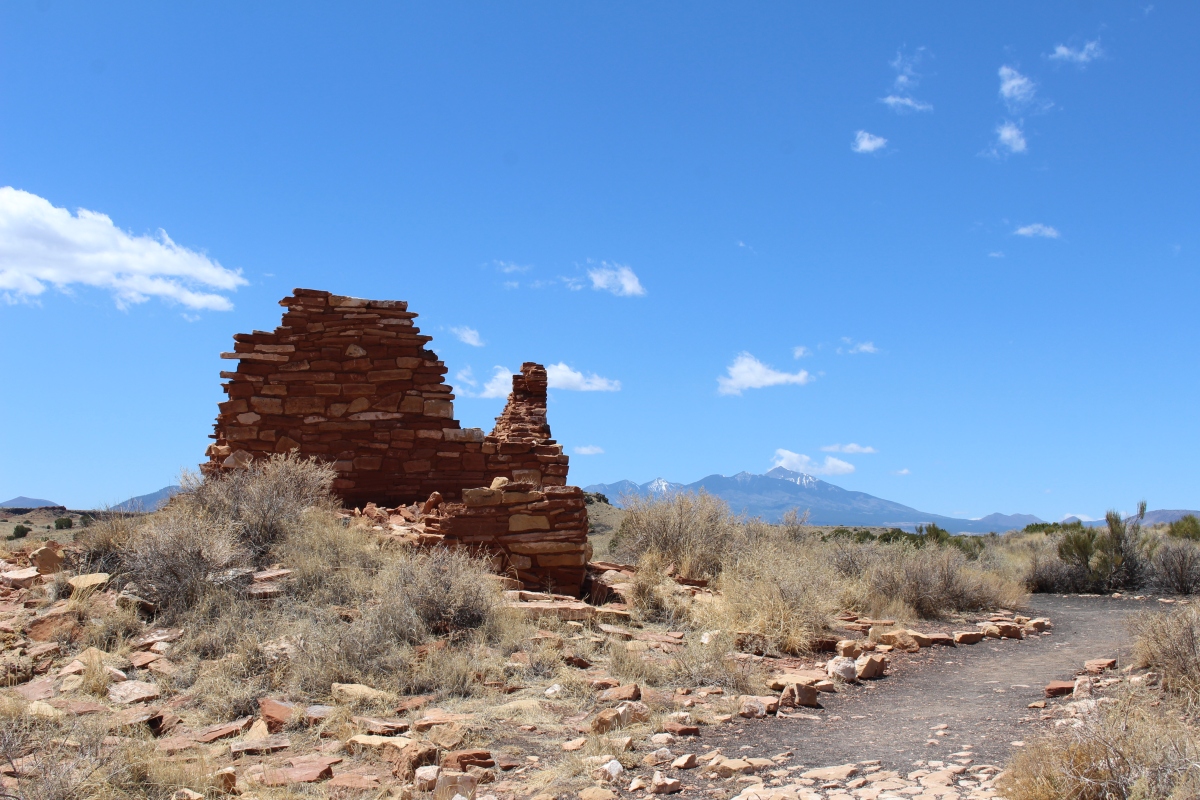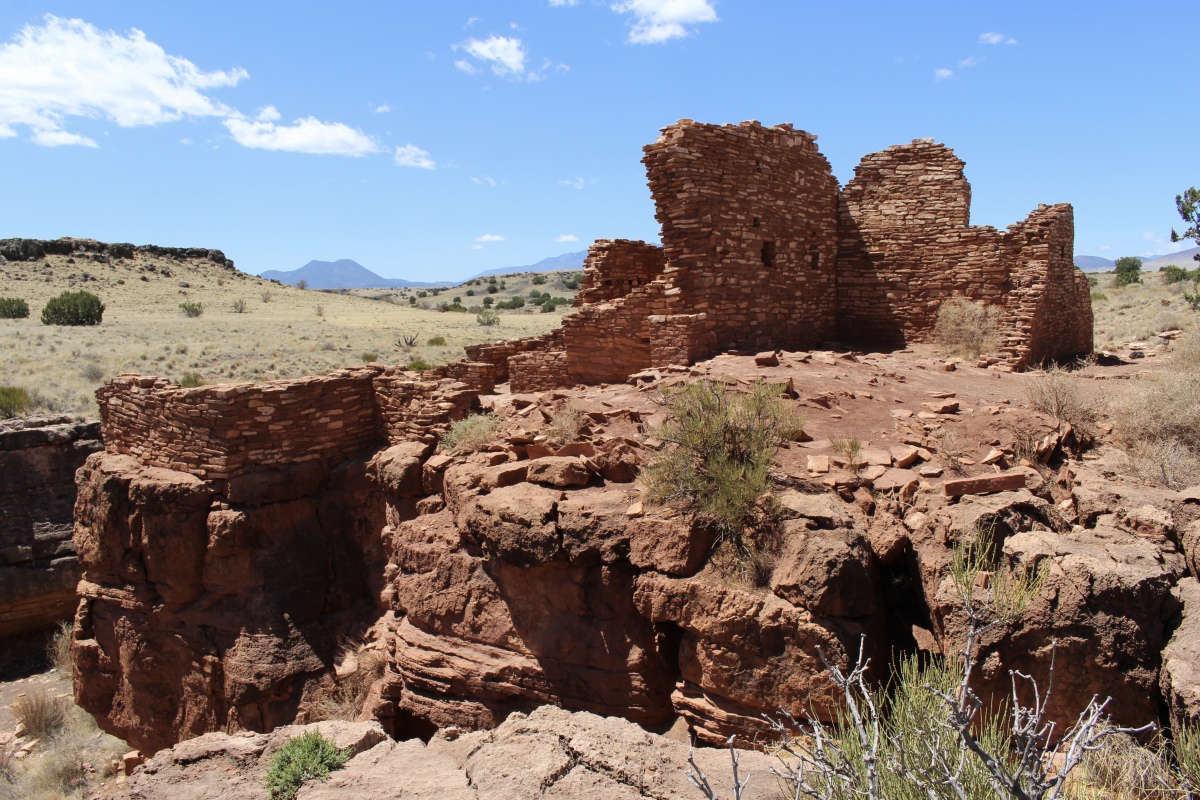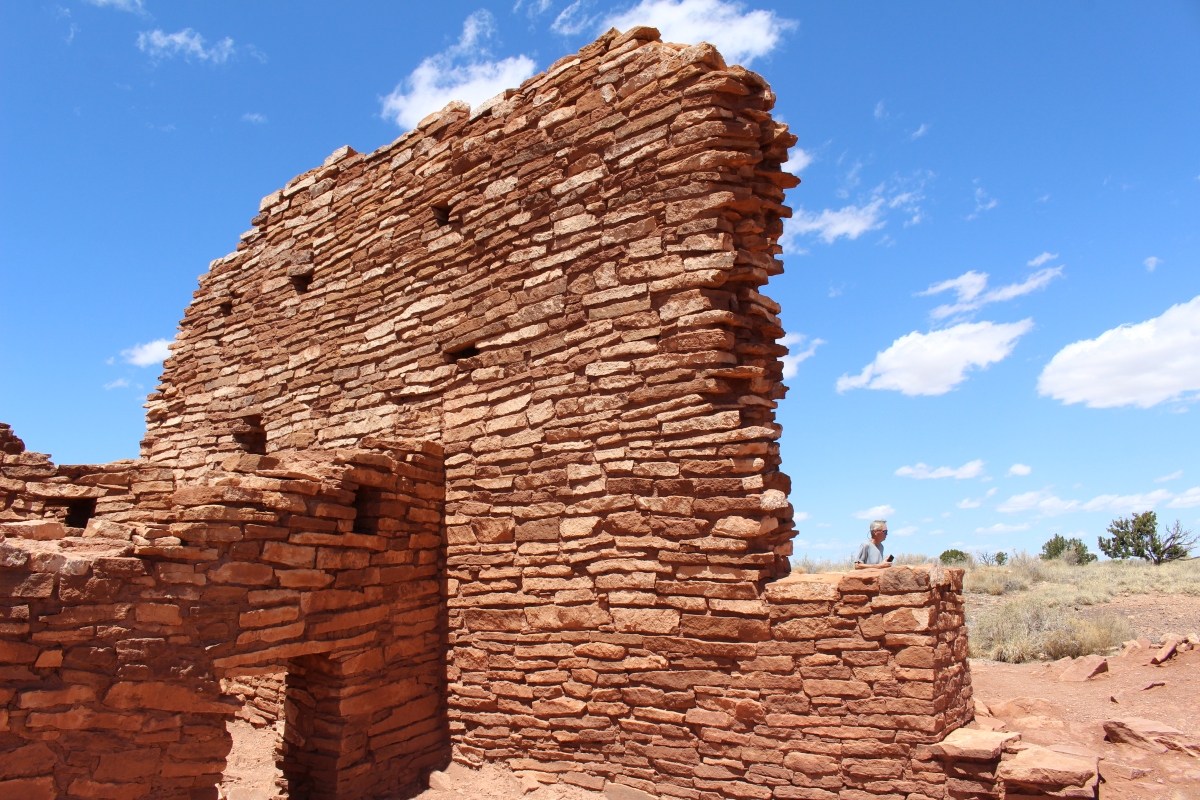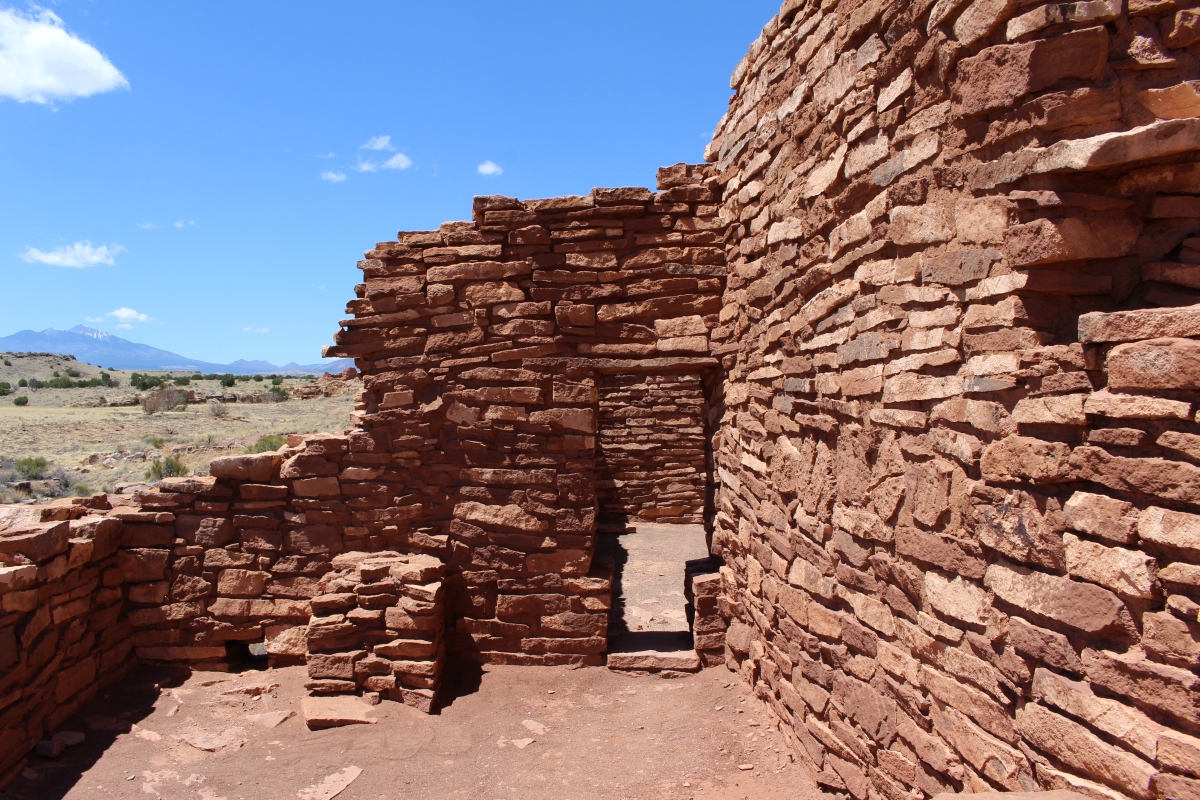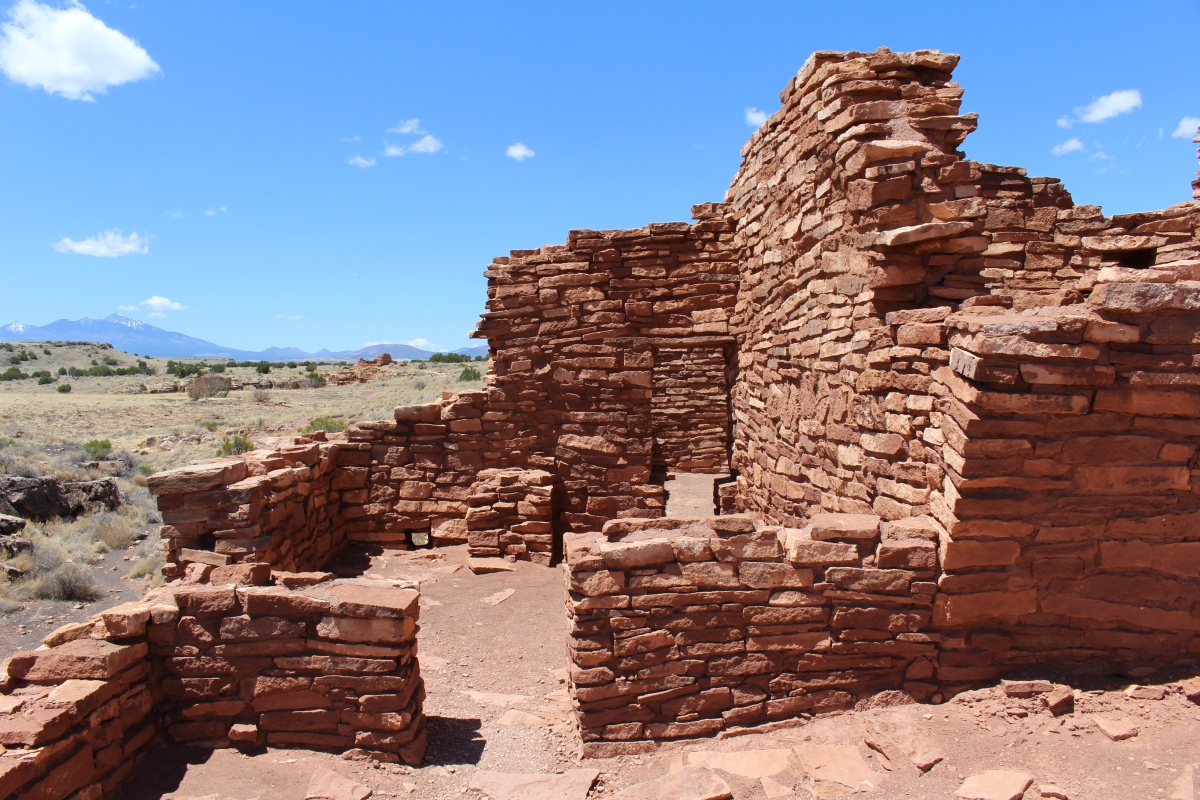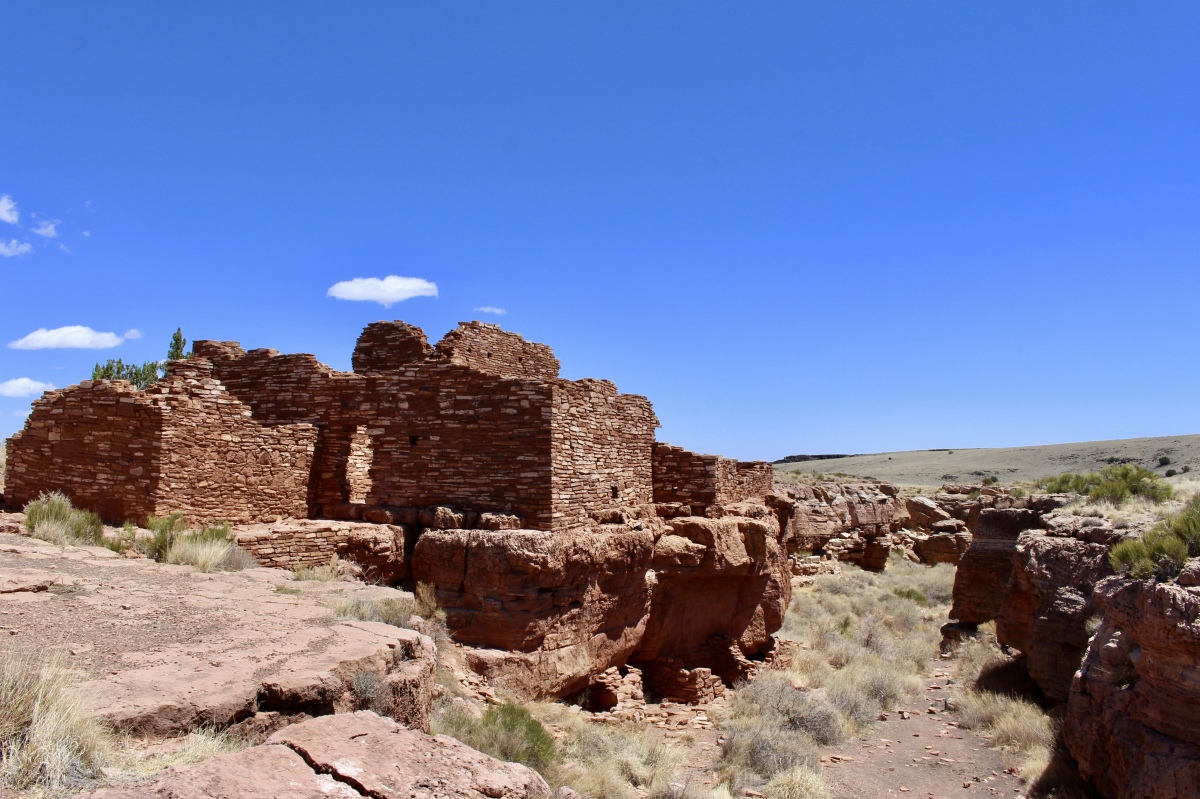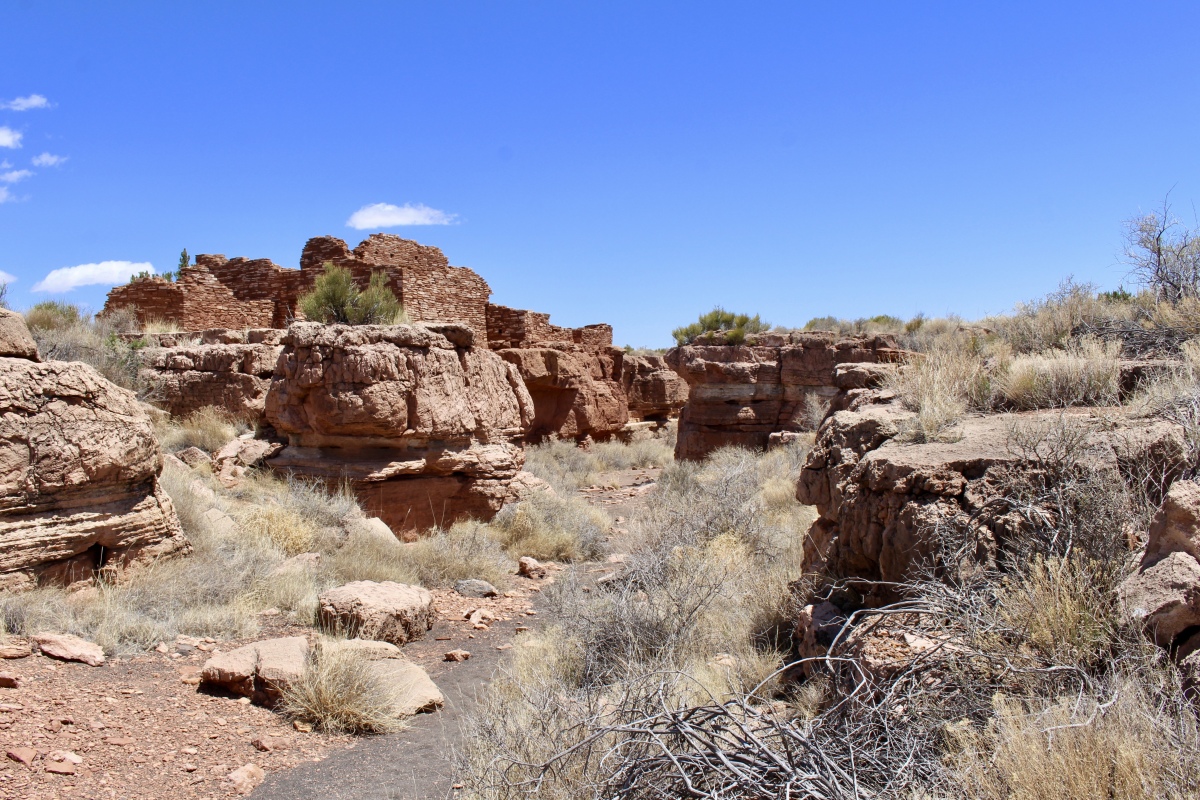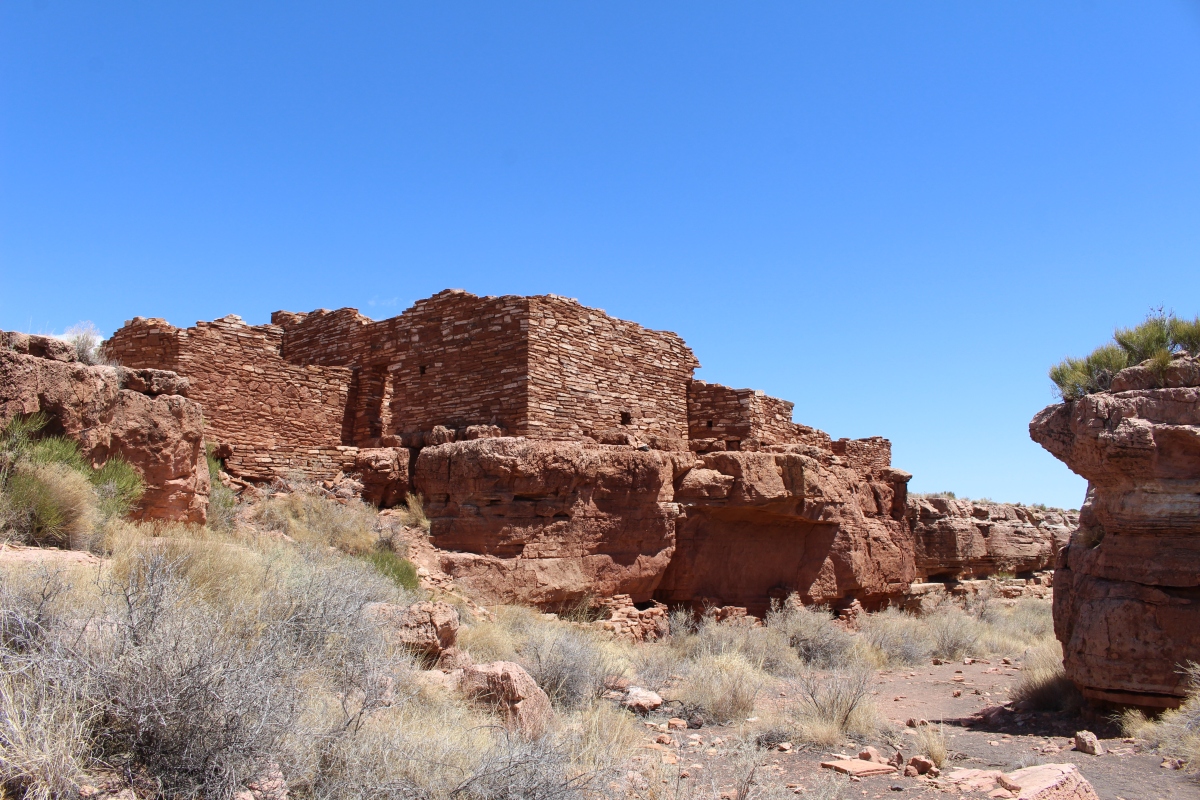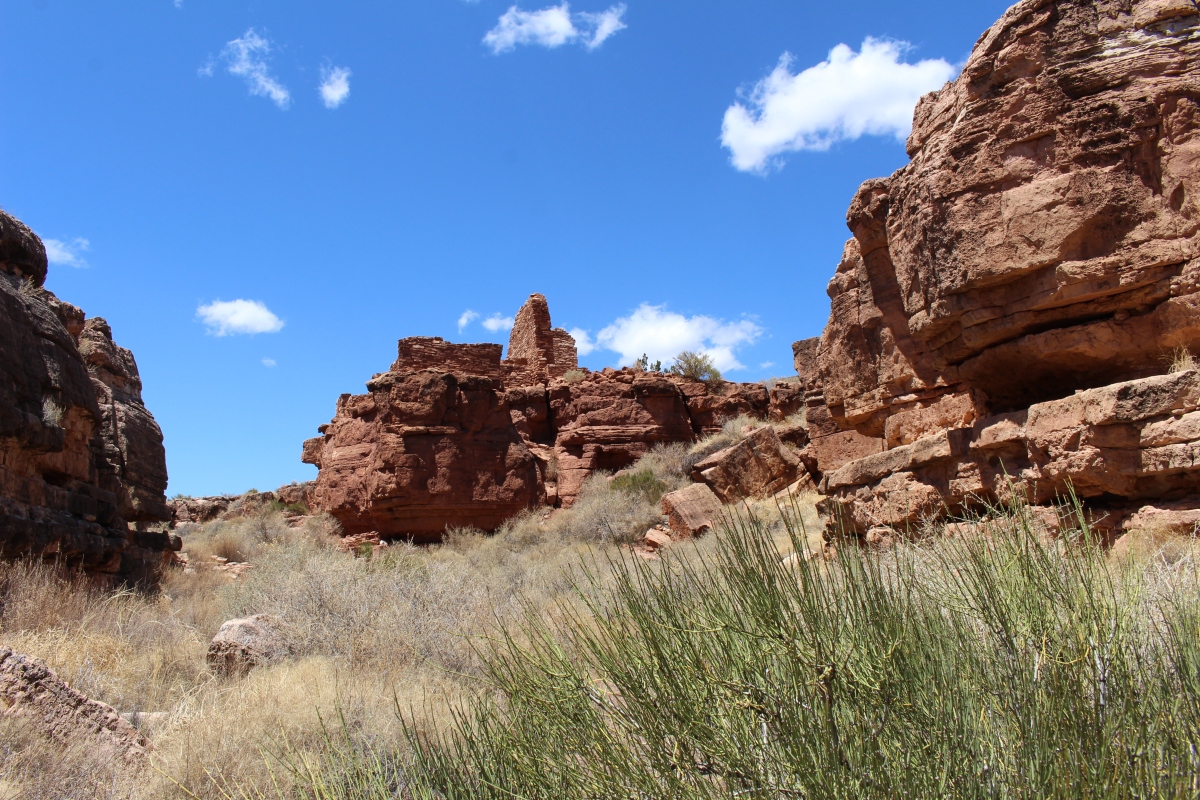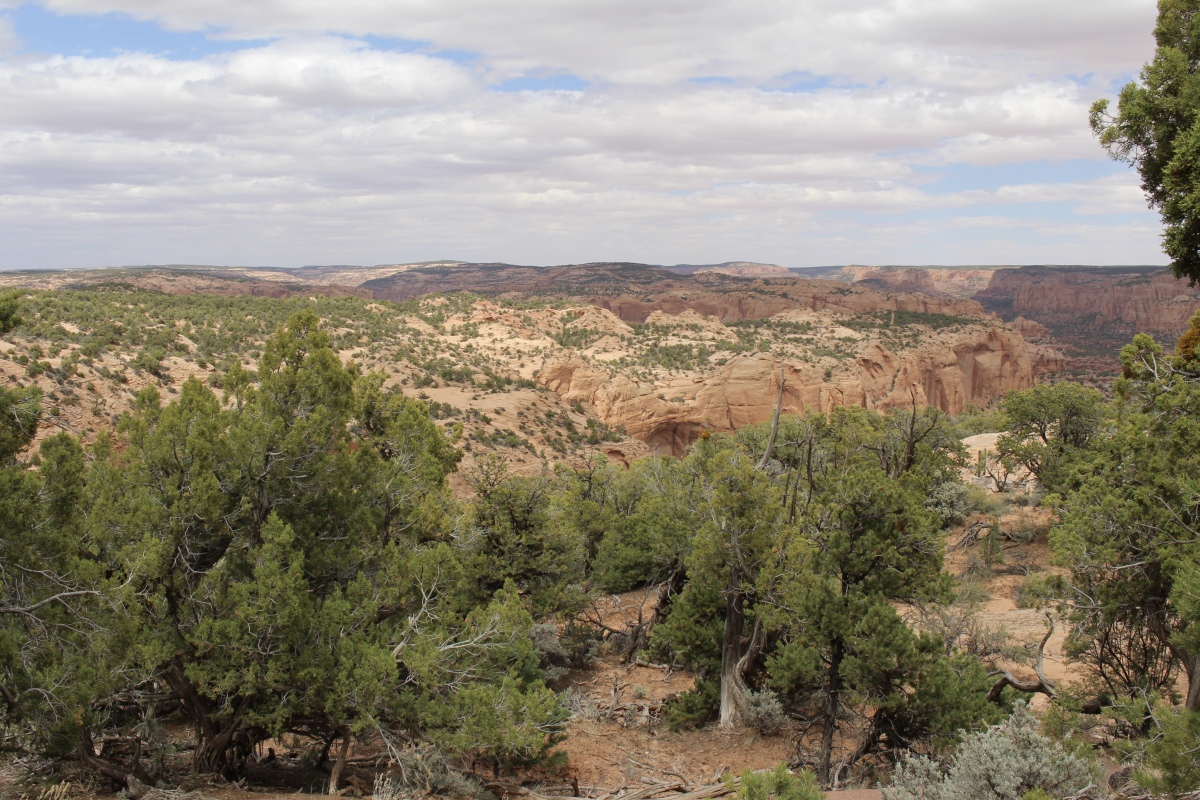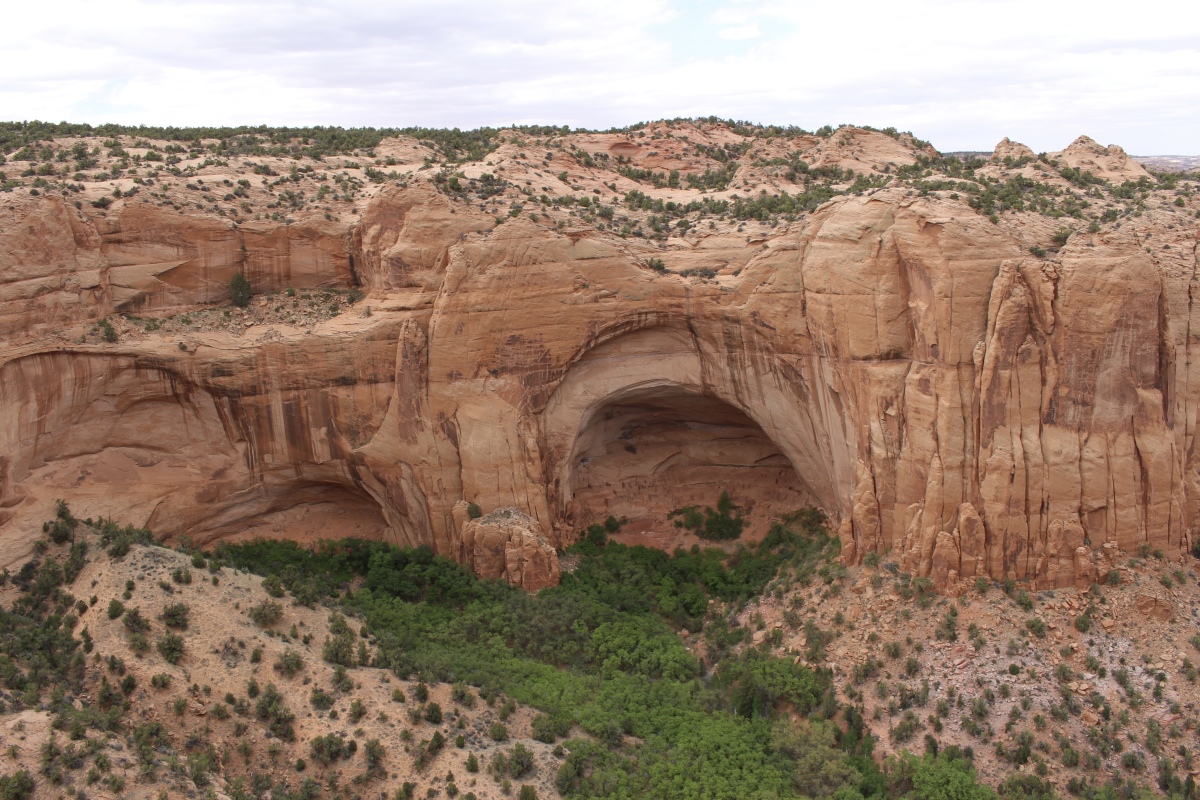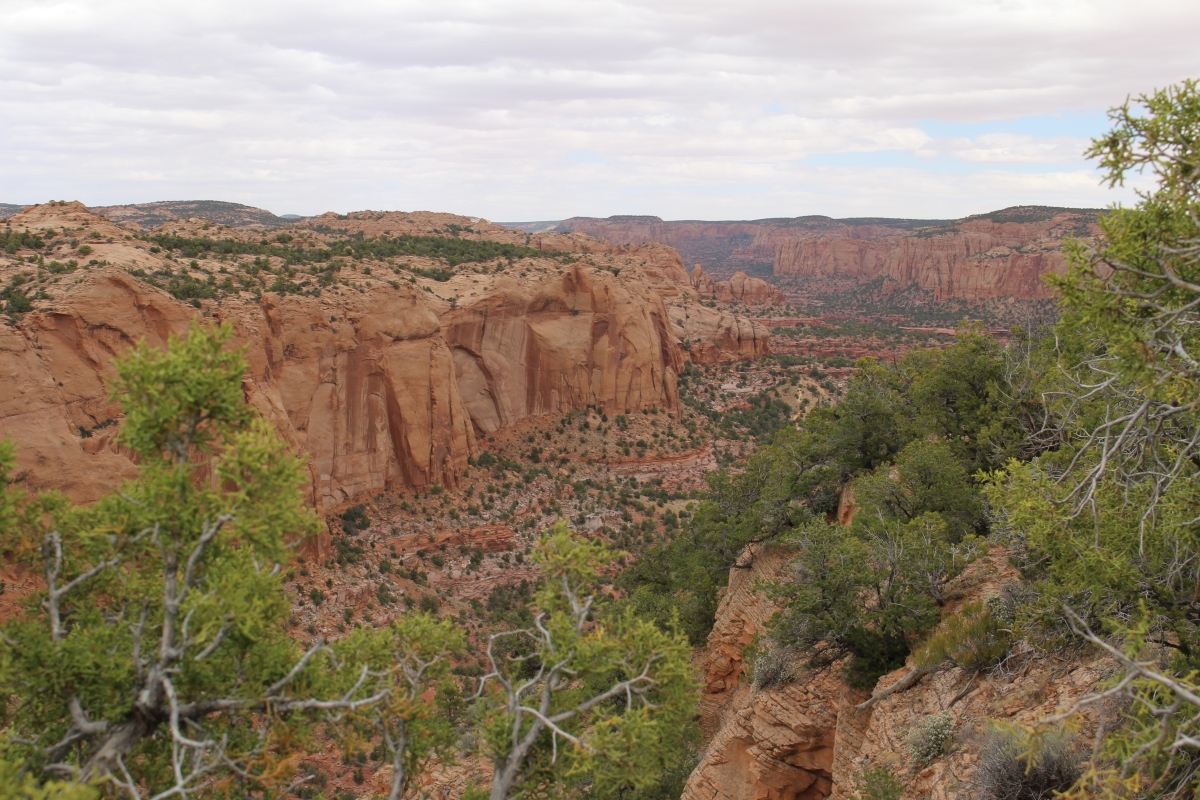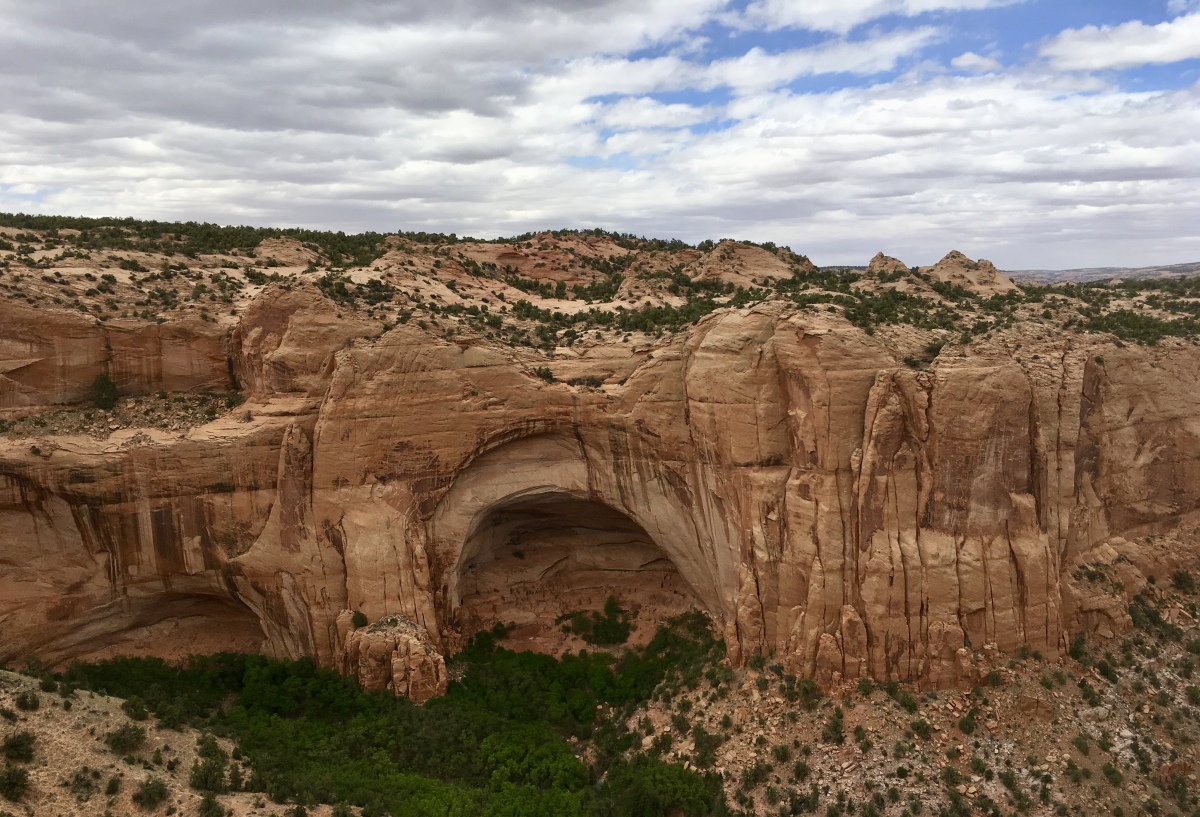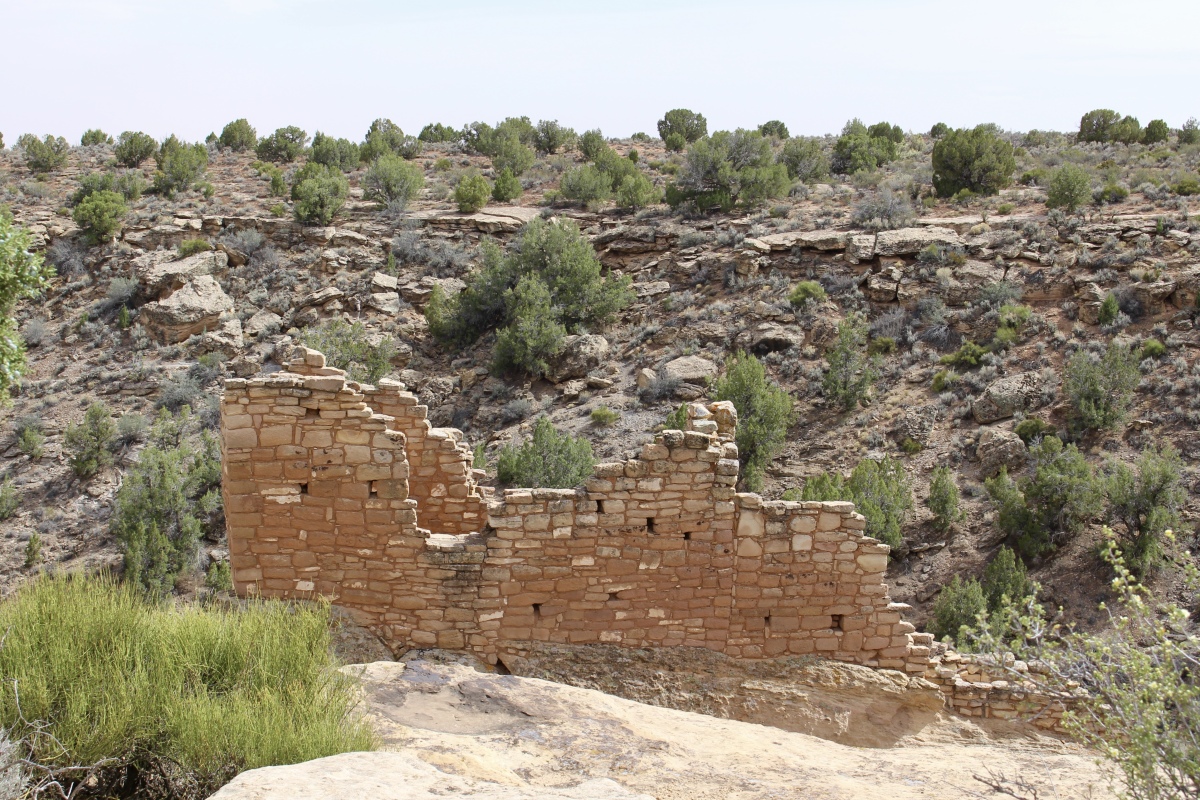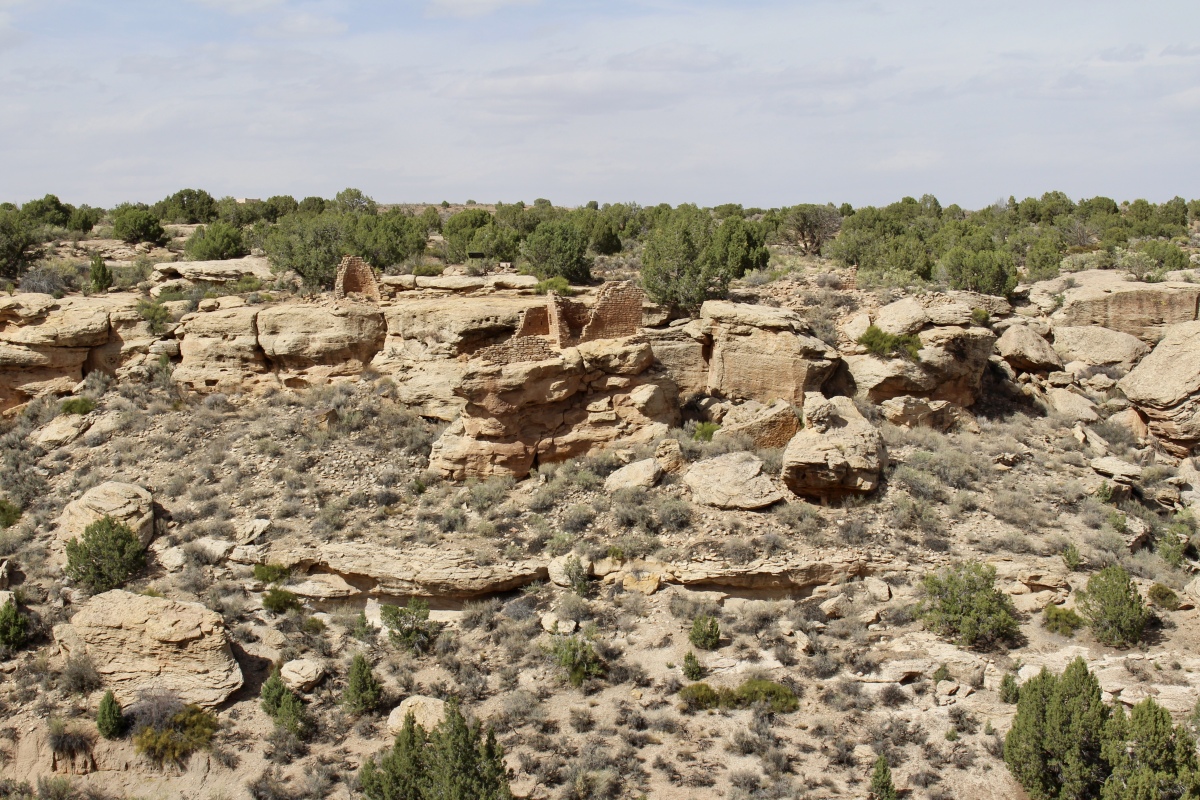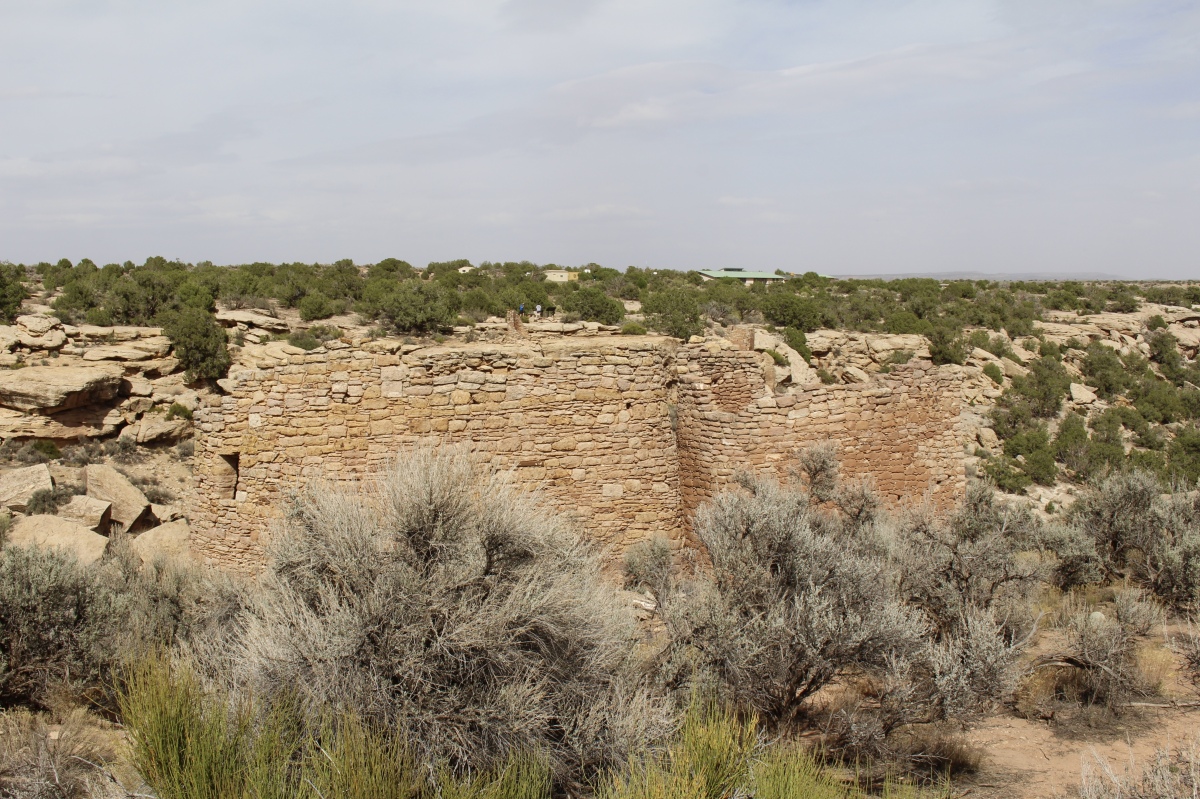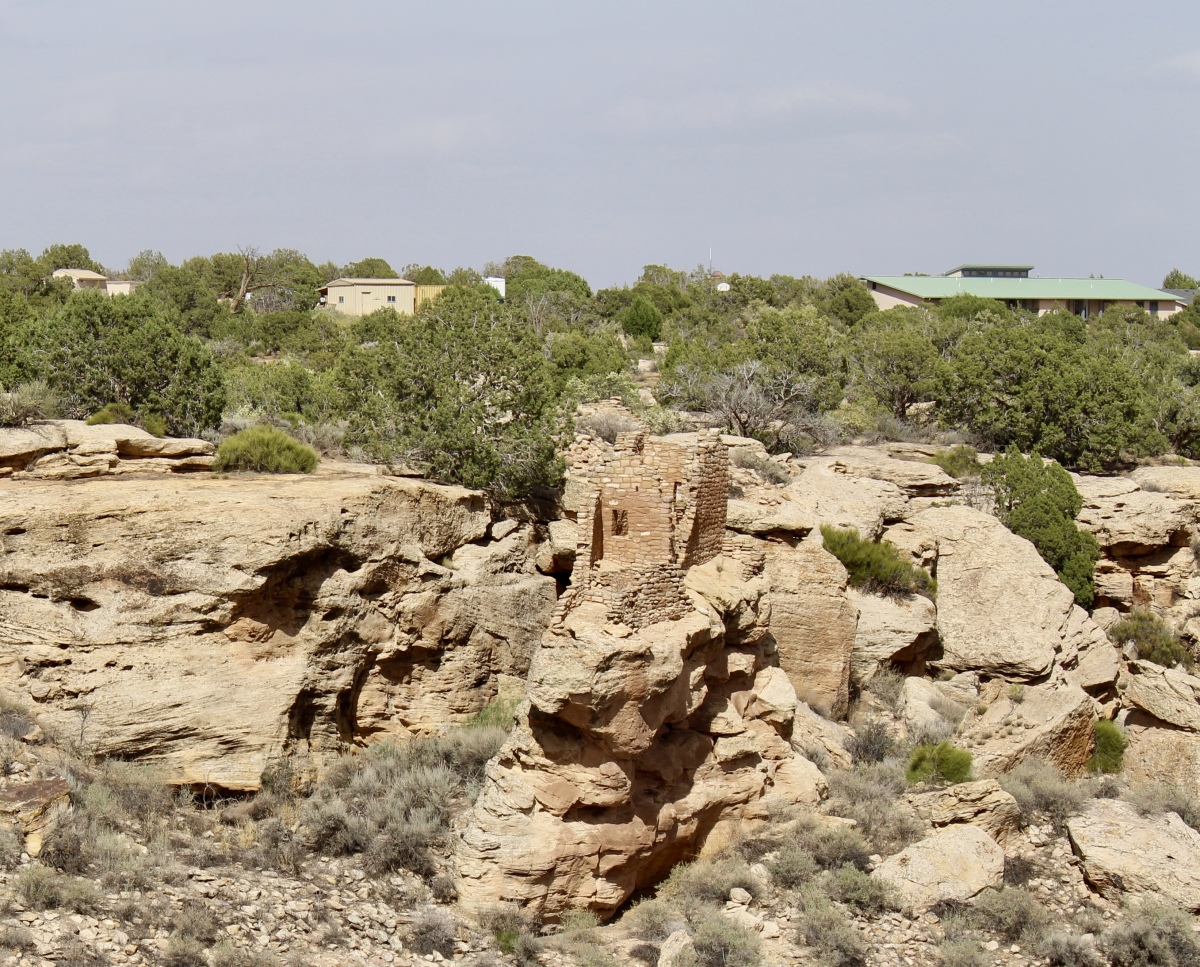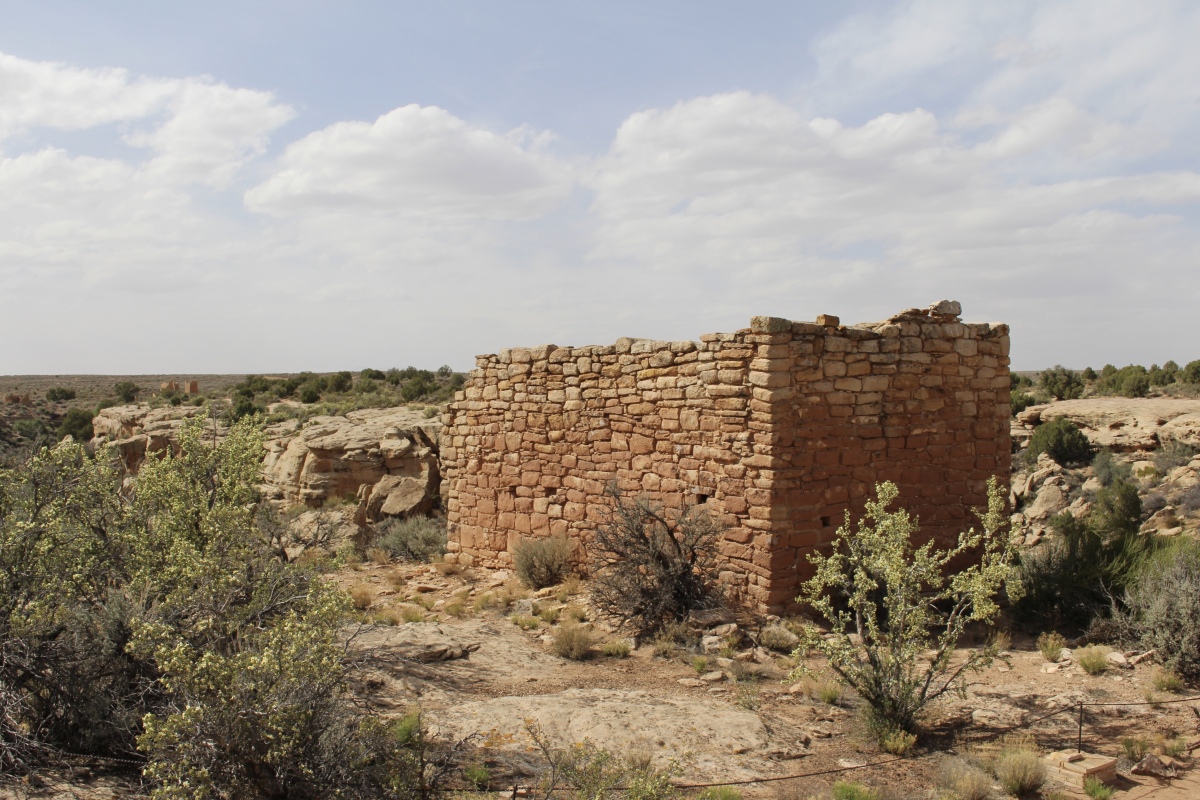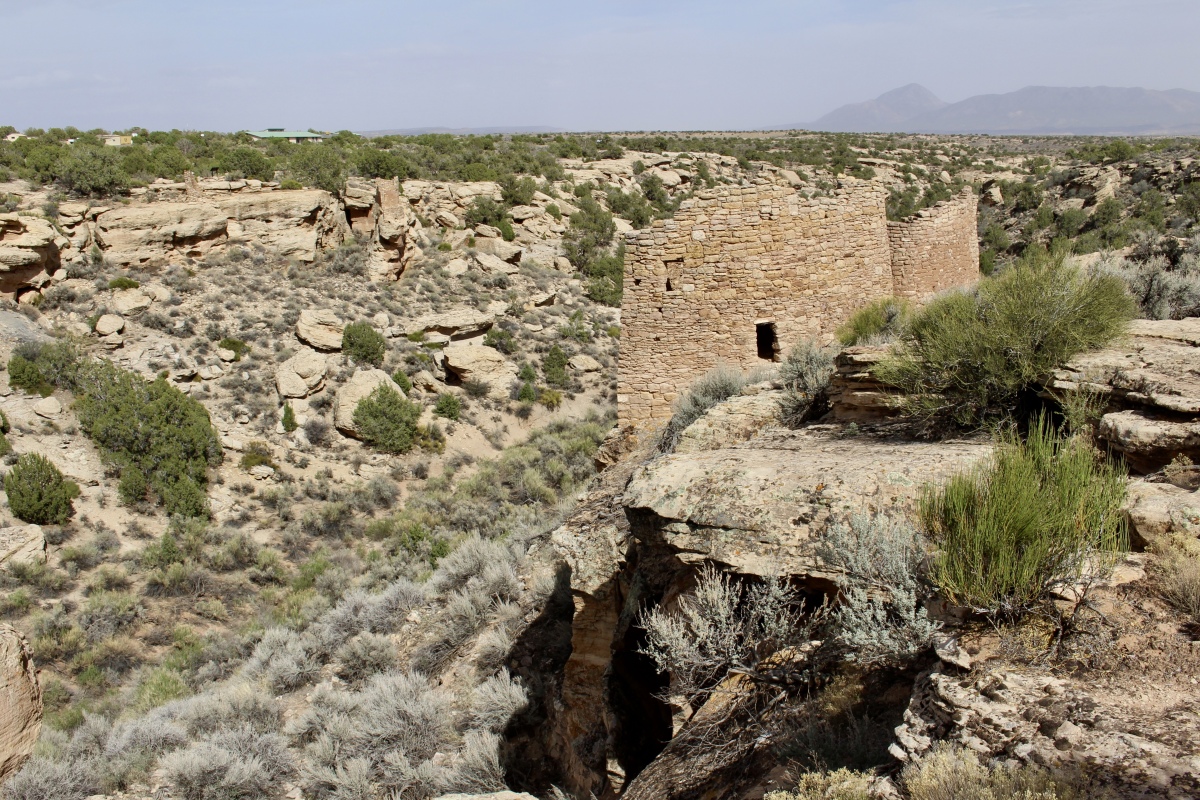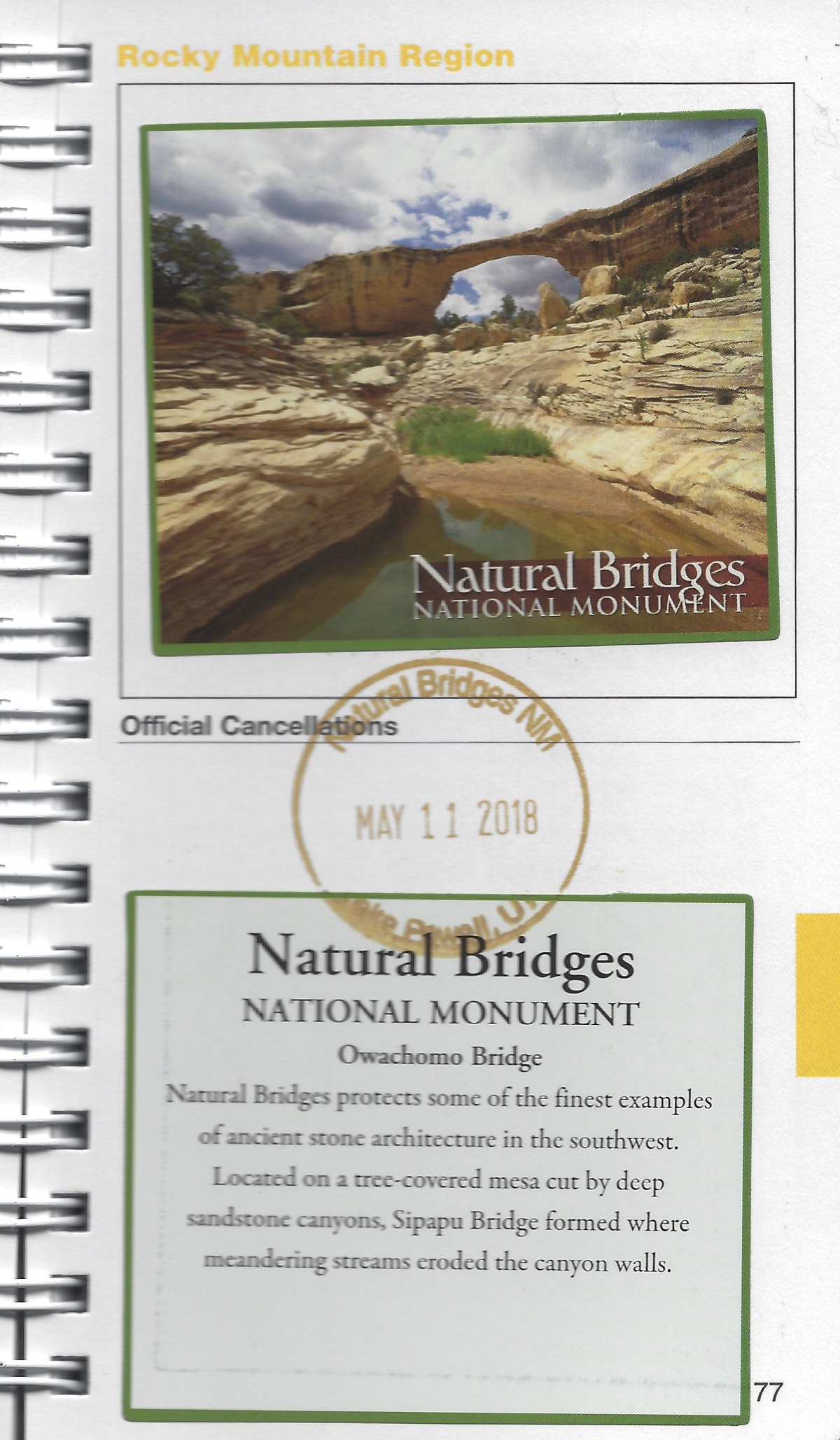
Near the Visitor’s Center at Wupatki National Monument sits the amazing Wupatki Pueblo, a multi-level high rise. People gathered here during the 1100s, gradually building this 100-room pueblo with a community room and ballcourt. It was the largest dwelling for at least fifty miles. By 1182, perhaps 85 to 100 people lived here. Within a day’s walk, a population of several thousand surrounded Wupatki.
This particular village became the heart of a thriving community and was a landmark, a gathering place, and a ceremonial center. This monumental structure may have signaled control over farm lands and united a community that changed as it grew and accepted immigrants.
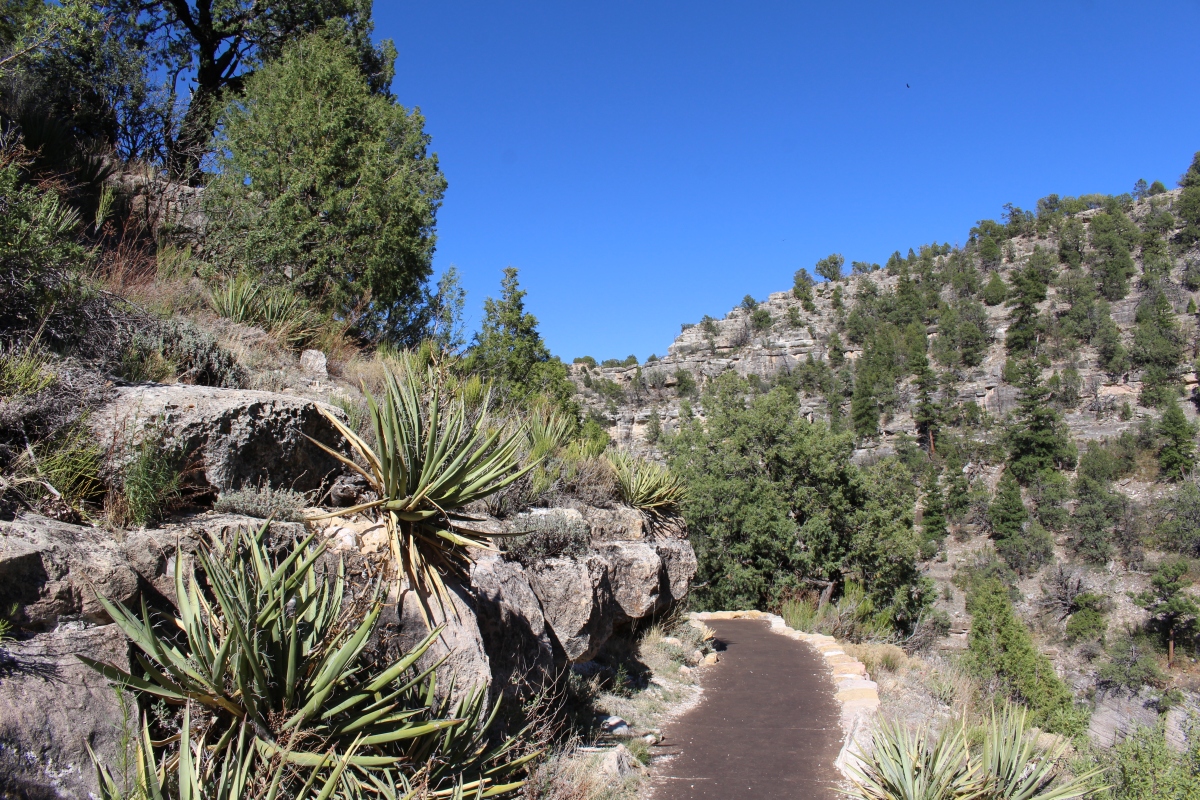
We walk a half-mile loop around the pueblo.
Wupatki Pueblo
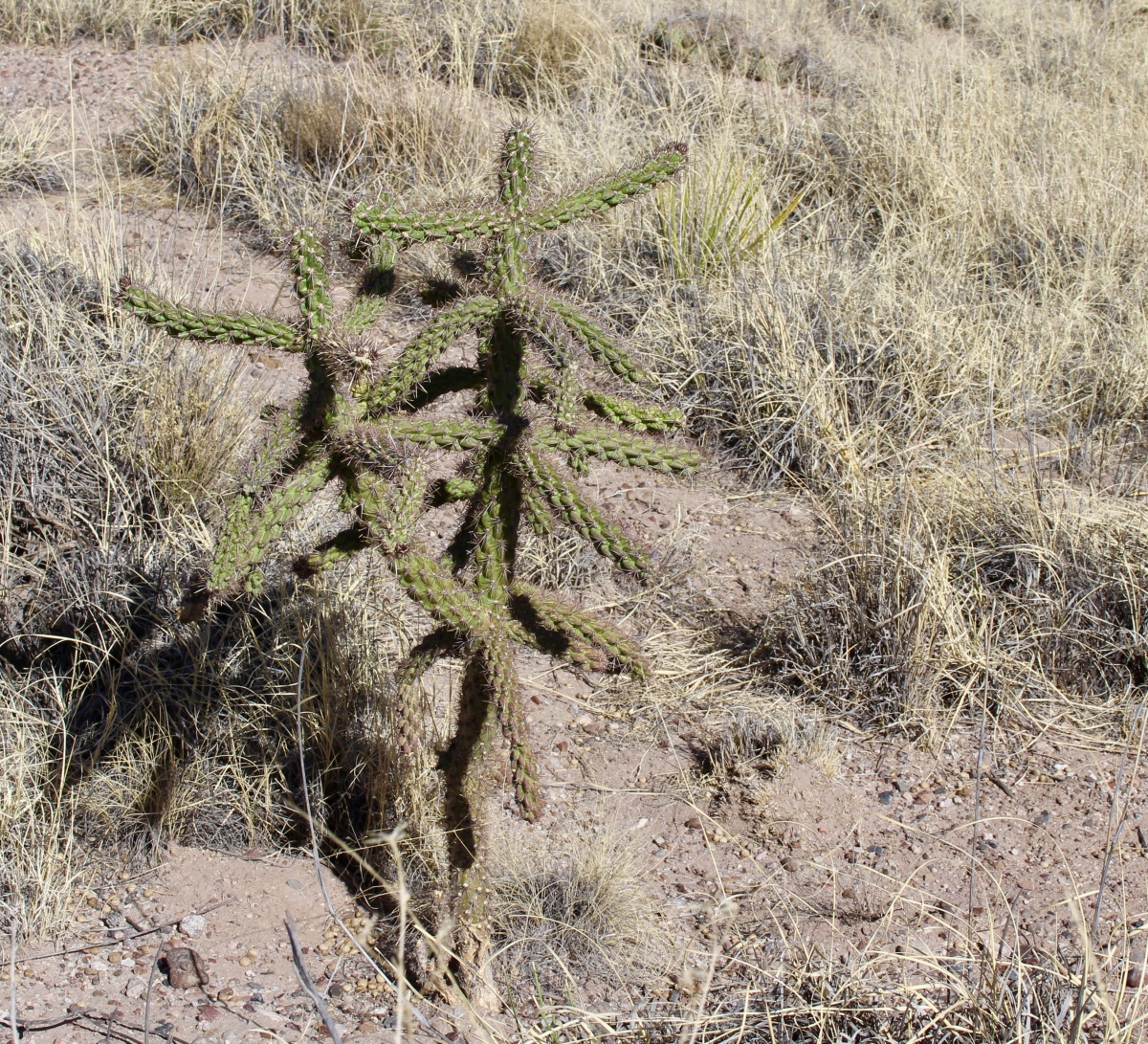
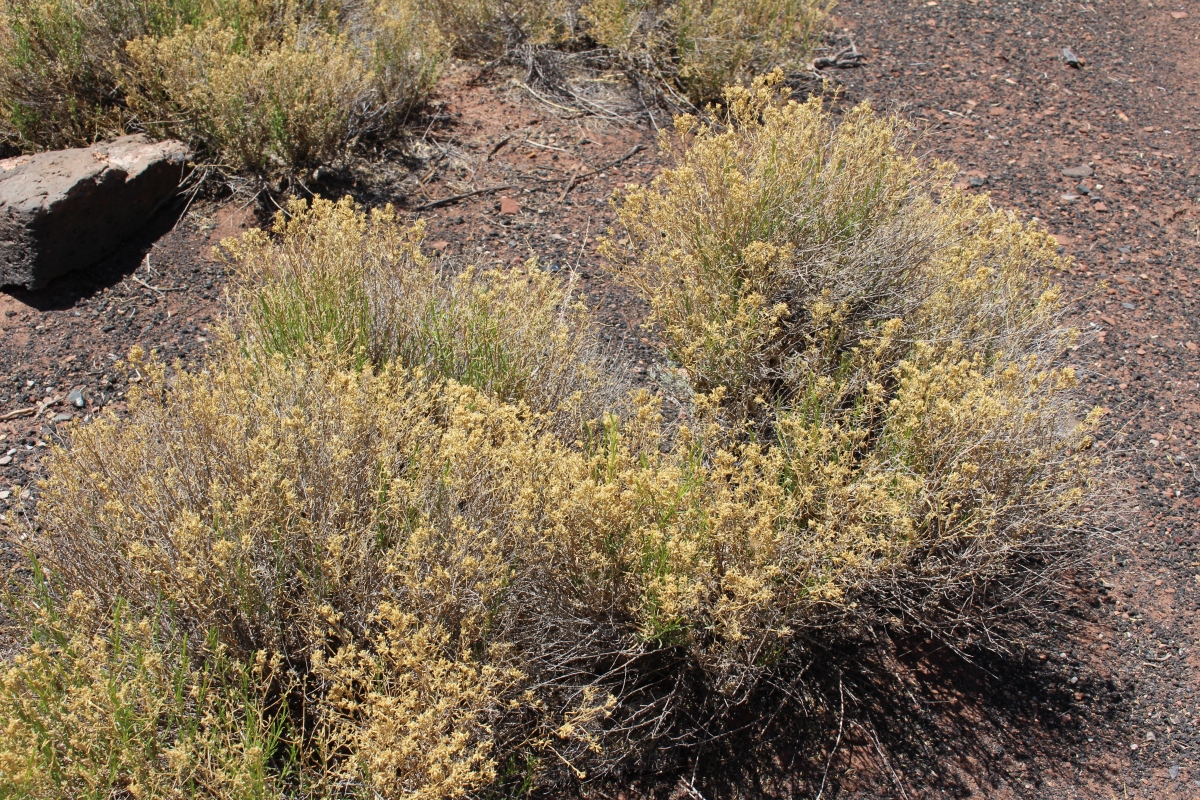
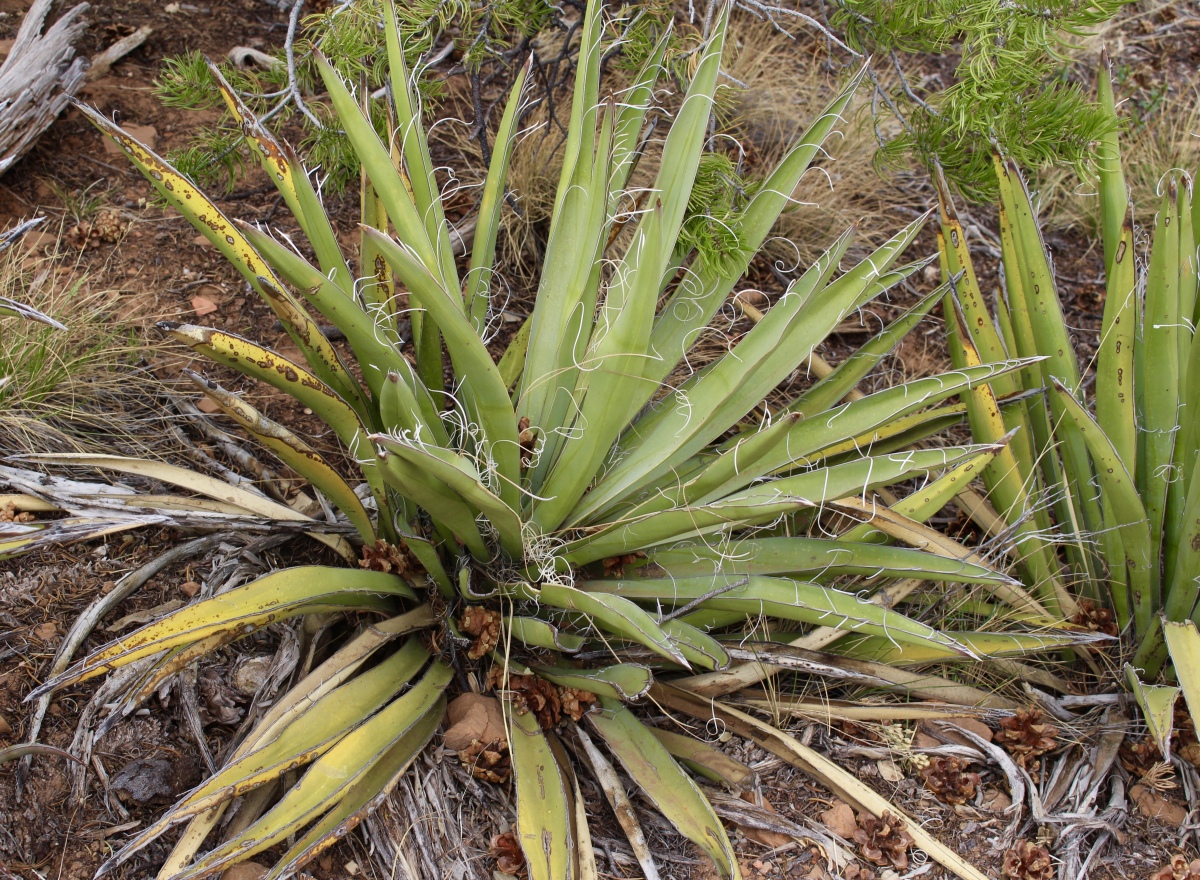
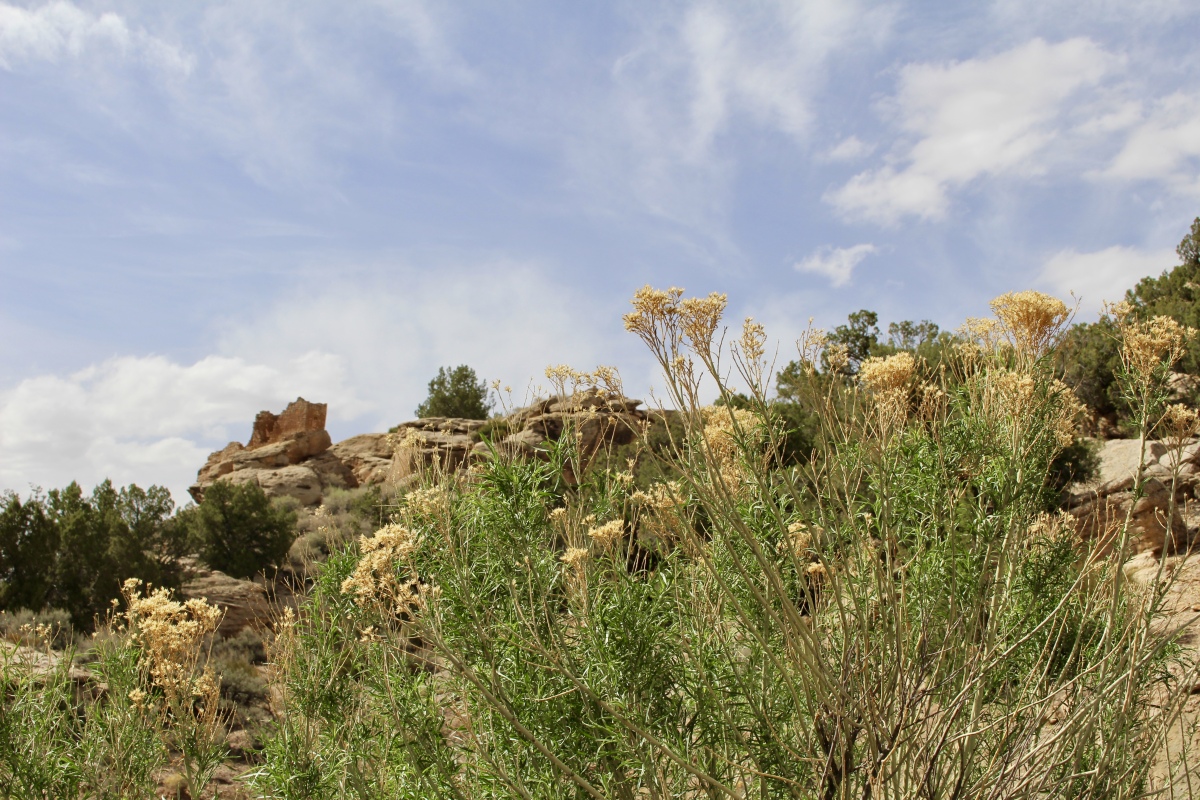
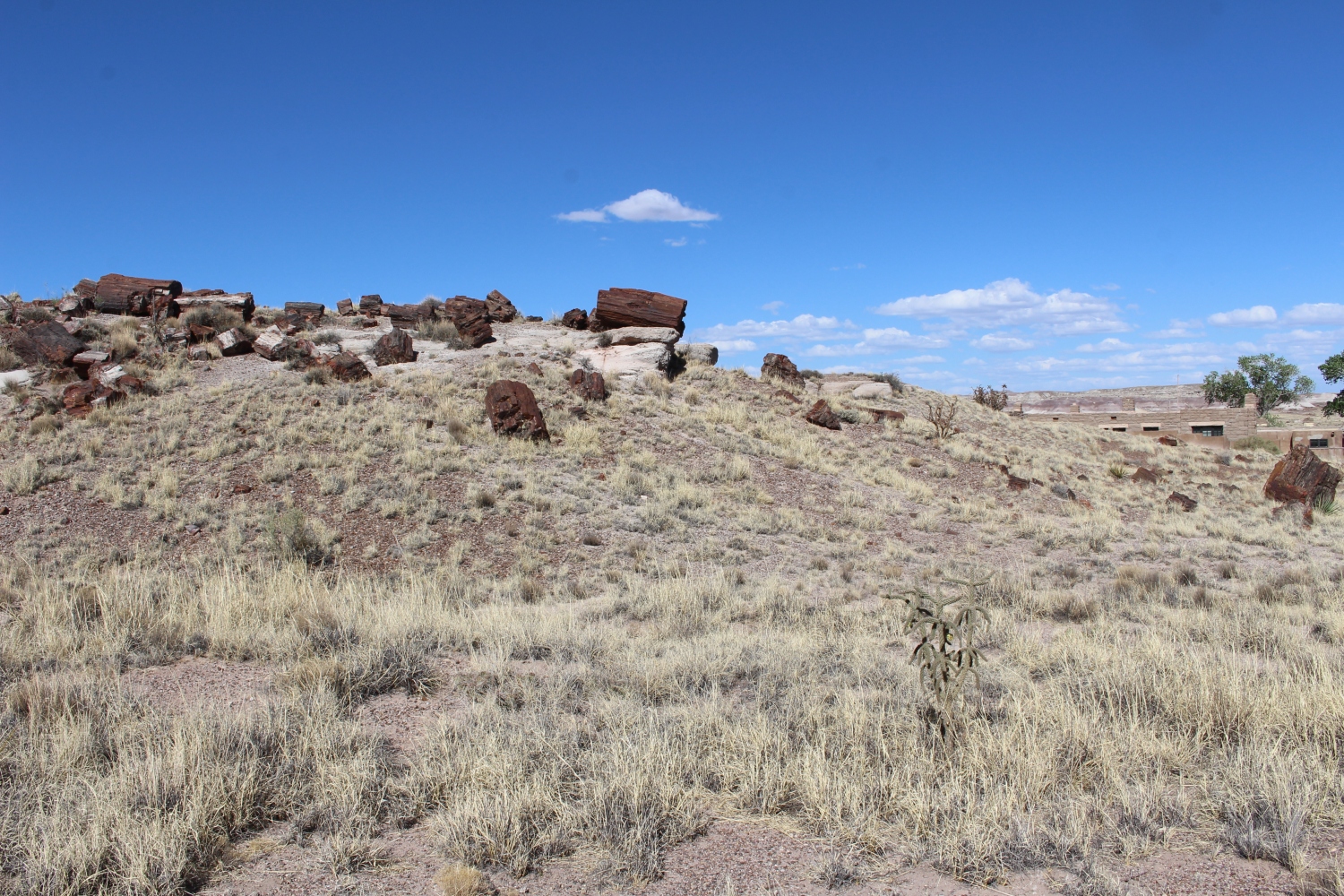
Puebloan and Navajo peoples have a long list of medicinal uses for this profuse native plant, broom snakeweed, from cures for colds, stomachaches, and eye problems to rattlesnake bites. But it might not have been readily available to their ancestors. Scientists have not yet found this plant in archeological settings.
Broom Snakeweed
Many people lived in numerous small dwellings found for miles around; those living here may have held ritual and leadership responsibilities.
Wupatki Pueblo
Descendants say prophesy and beliefs guided decisions and that villages like this were purposefully settled and left. When clans departed, doorways were sealed and items left in rooms; maybe people hoped to return one day.
Community room at Wupatki Pueblo
Below is a depiction of Pueblo life here 900 years ago, based on historical accounts and archeological evidence. This embellished interpretation helps us visualize the vibrant Wupatki society. Hopi and Zuni oral histories say that people of diverse origins came together here. Plain red-brown pottery originated near Flagstaff, while the painted black and white pots came from Kayenta country to the northeast. The architecture is both Chacoan and Kayenta in style, and the ballcourt and abundant shell jewelry indicate ties to the far south.
Through trade, villagers acquired numerous Mesoamerican scarlet macaws and copper bells needed for ceremonies and rituals. Perhaps in return, they offered their woven cotton textiles, with various styles and decorative techniques from all over the Southwest. Life here involved sharing and trading.
Life in the past
Wupatki today appears abandoned, but it is actually remembered and cared for. Though it is no longer physically occupied, Hopi believe the people who lived and died here remain as spiritual guardians. Stories of Wupatki are passed on among Hopi, Zuni, Navajo, and perhaps other tribes. Members of the Hopi Bear, Sand, Lizard, Rattlesnake, Water, Snow, and Katsina Clans return periodically to deepen their personal understanding of their clan history.
Wupatki Pueblo
Wupatki Pueblo
Villagers shared walls, water, food, protection, and prayer. They depended on one another, celebrated life and marked passages, planned for, reacted, and adapted to environmental and social circumstances. People gathered to celebrate harvest and honor their way of life. Women prepared food and men and boys engaged in contests in the ballcourt. Ceremonies and rituals established harmony and encouraged rain and fertility.
Community room
Wupatki Pueblo
from the Community Room looking up at Wupatki Pueblo
Community Room & Wupatki Pueblo
Ballcourt
It is remarkable that this land, so dry and hot, supported a large farming community. Moisture-conserving cinders from the eruption of nearby Sunset Crater volcano made for slightly better farming conditions during the 1100s. But extensive land and labor would have been required.
the surrounding land
Located at the crossroads between Sinagua, Cohonina, and Kayenta Anasazi cultural traditions, Wupatki exhibits a unique cultural brew. The exchange of ideas shows up in homes built the Anasazi way but furnished with Sinagua-style pottery, textiles, and tools. Archeologists still debate whether this represents different cultures interacting here, or if it is just the “many different ways to be Sinagua.”
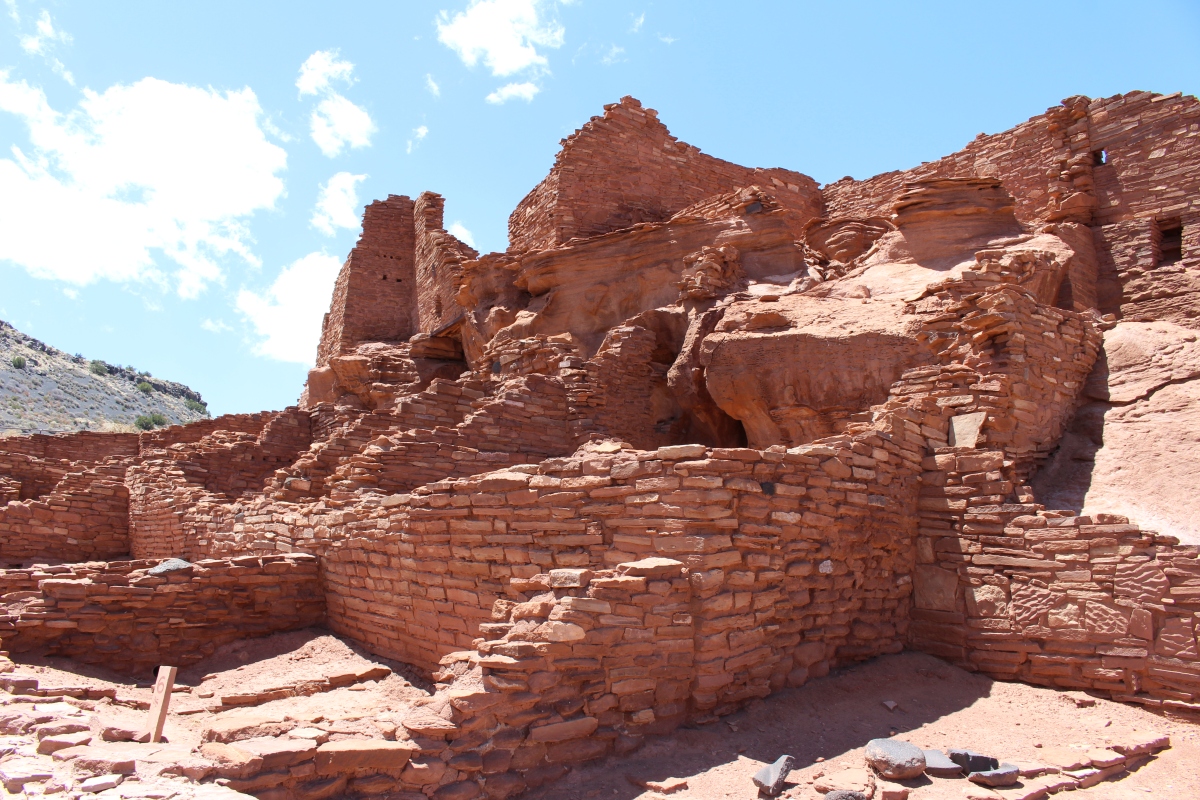
masonry at Wupatki Pueblo
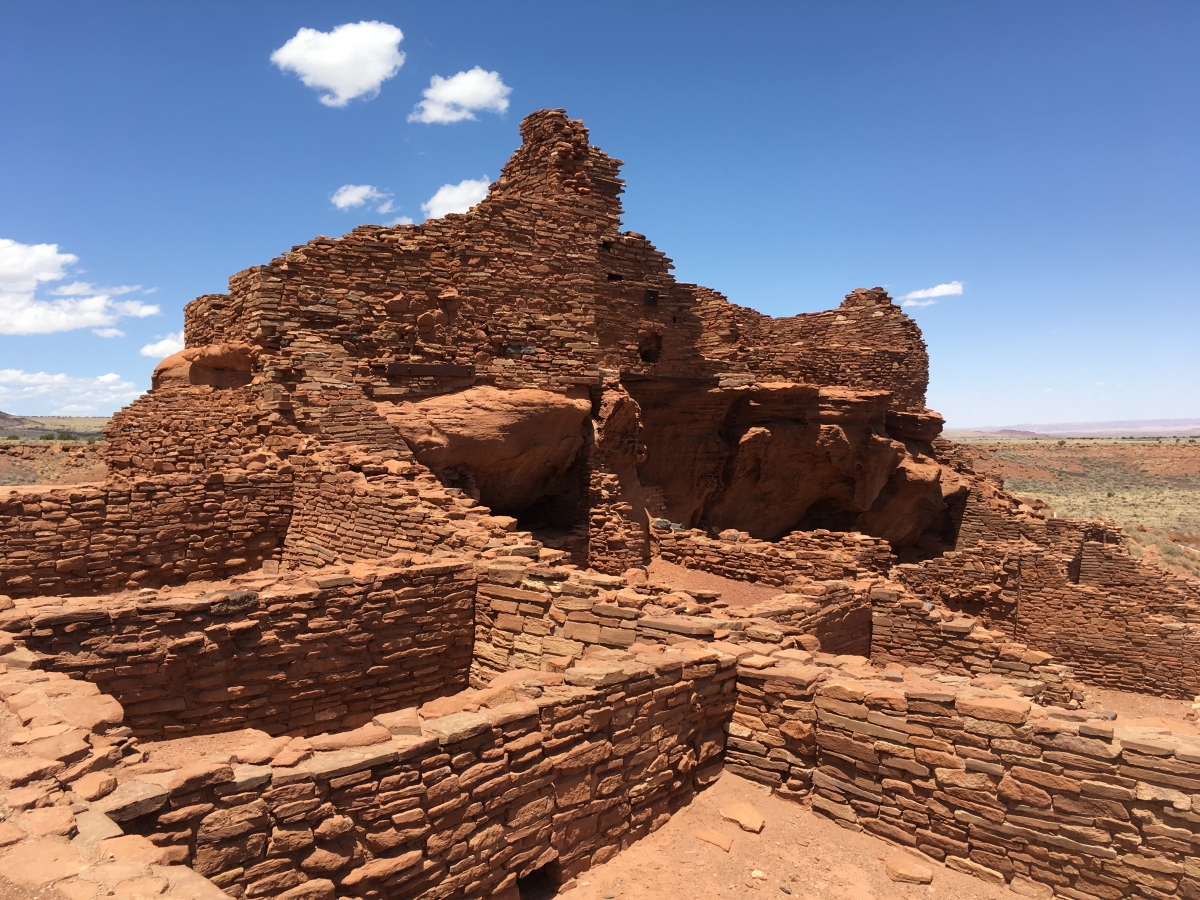
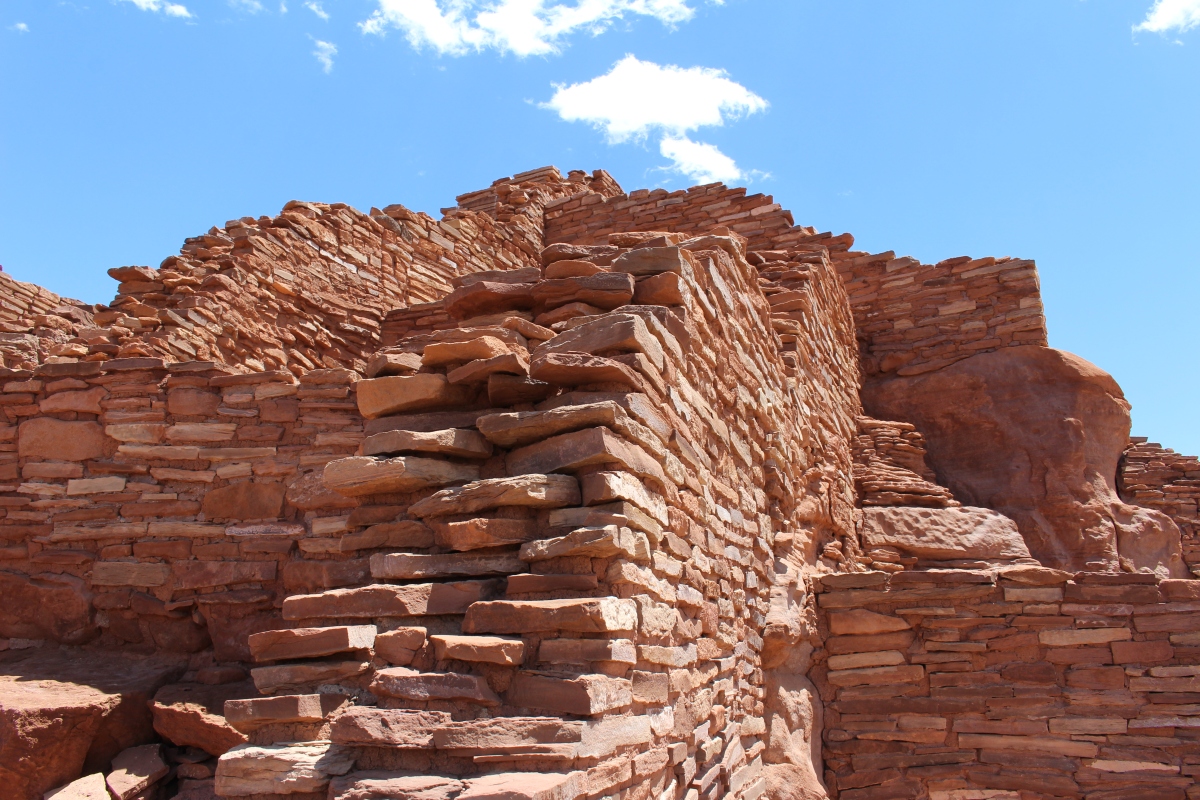
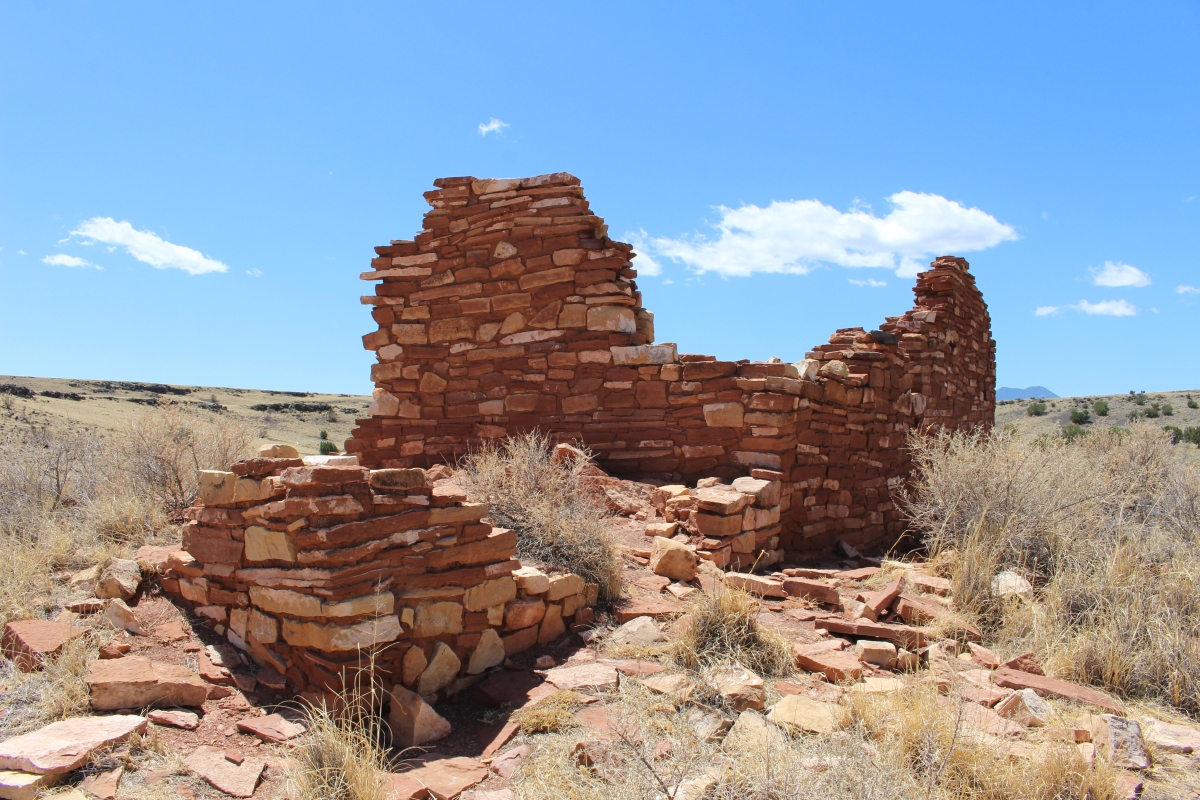
The environment provided materials ideal for the construction of freestanding masonry dwellings. Sandstone slabs, limestone blocks, and chunks of basalt set with a clay-based mortar yielded sturdy buildings that, despite weathering and vandalism, remain partially intact more than 700 years after their owners departed.
masonry at Wupatki Pueblo
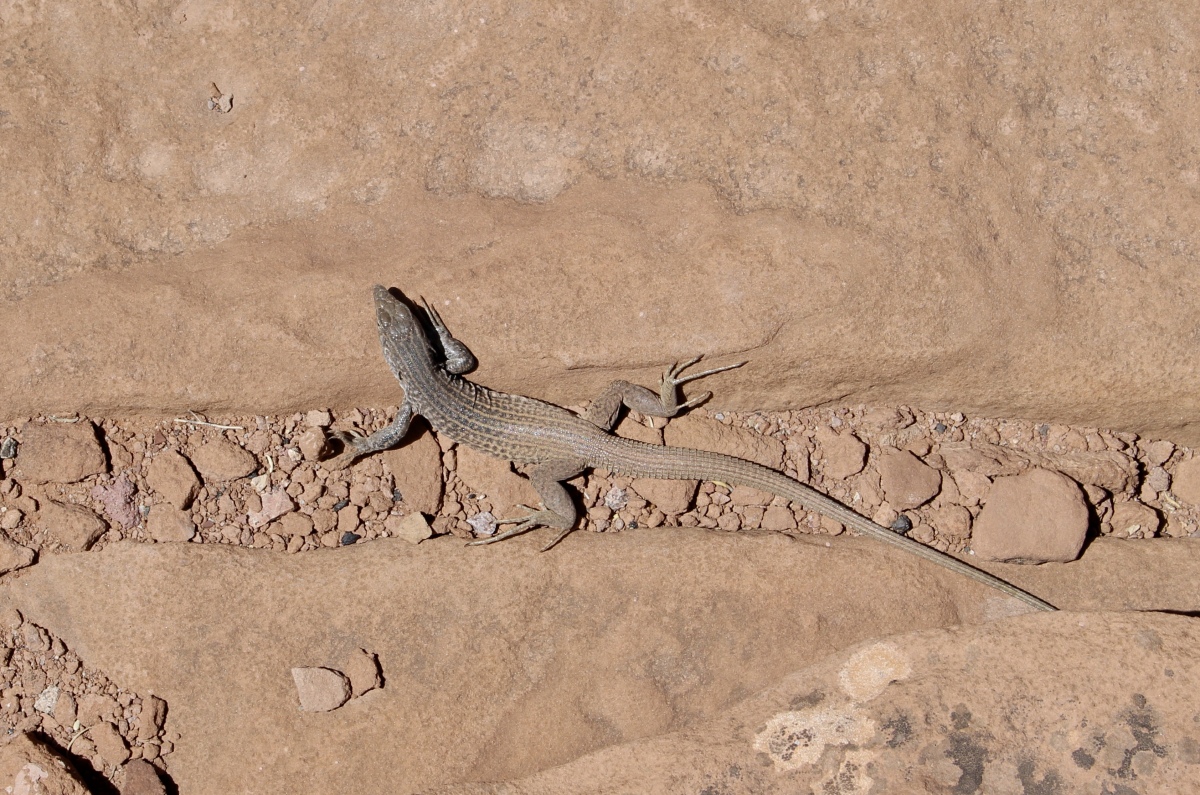
This high desert area is home to lizards and gopher snakes, which are non-venomous and feed on rodents that live around the dwellings. Mike was disappointed to have missed out on snake encounters in these desert areas.
lizard friend
Wupatki Pueblo
The reasons people left were likely varied. By the 1200s, the area was denuded of trees and shrubs and soils were depleted. As the environment changed, perhaps conflicts increased or trade networks shifted and other villages had more to offer.
Descendants of these inhabitants, the Hopi, Zuni, and other Pueblo groups, still adhere to a lifestyle that values hard work and spiritual life over material possessions.
Of course, at the Visitor’s Center, I got my sticker and cancellation stamp!
Wupatki National Monument sticker and Passport stamp
*Sunday, May 13, 2018*
***********************
On Sundays, I plan to post various walks that I took on our Four Corners trip as well as hikes I take locally while training for the Camino de Santiago; I may also post on other unrelated subjects. I will use these posts to participate in Jo’s Monday Walks or any other challenges that catch my fancy.
Quite by accident, we discovered three National Monuments right around Flagstaff, Arizona: Wupatki, Sunset Crater Volcano, and Walnut Canyon. None of these places were on our itinerary, so they were a pleasant surprise. Each one was rather small as well, so we were able to do all three after we left Tuba City and Coal Mine Canyon. This would be our last day together; Mike had to fly out via Phoenix the next day, and the rest of the trip, I would be on my own.
We drove south down Rt. 89 through the Painted Desert, imbued with cinnamon, buff and chestnut, and dotted with feathery sagebrush. Big electrical grids and wires criss-crossed the fairly flat landscape and the abandoned Wauneta Trading Post hunkered down beside the road, faded and decrepit.
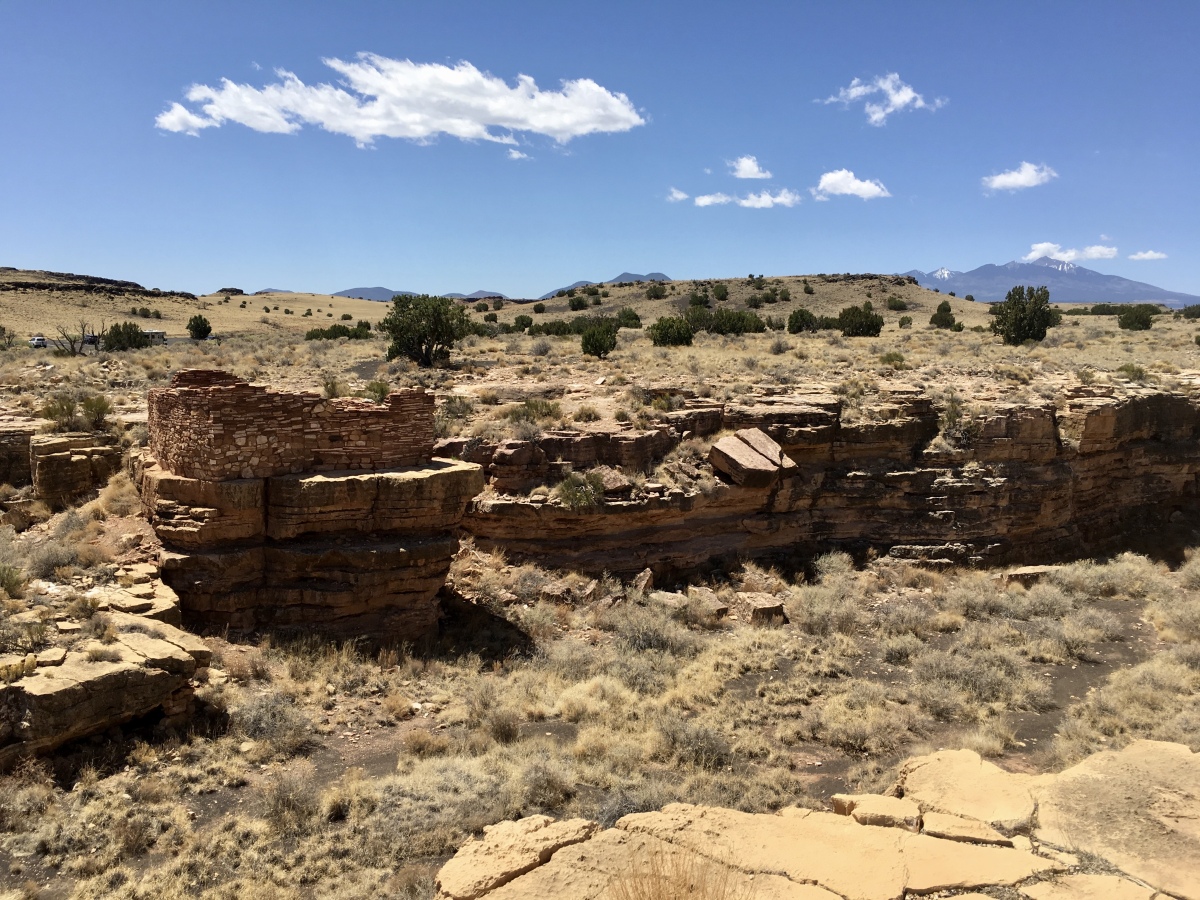
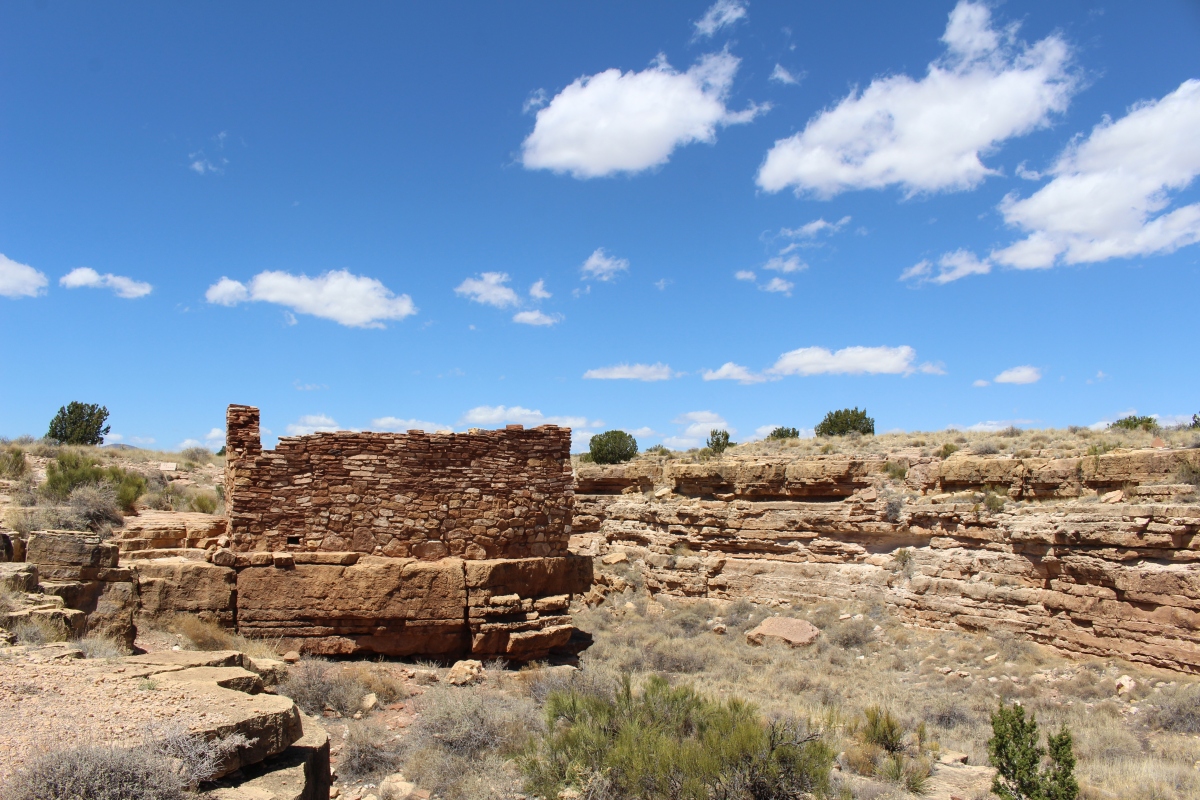
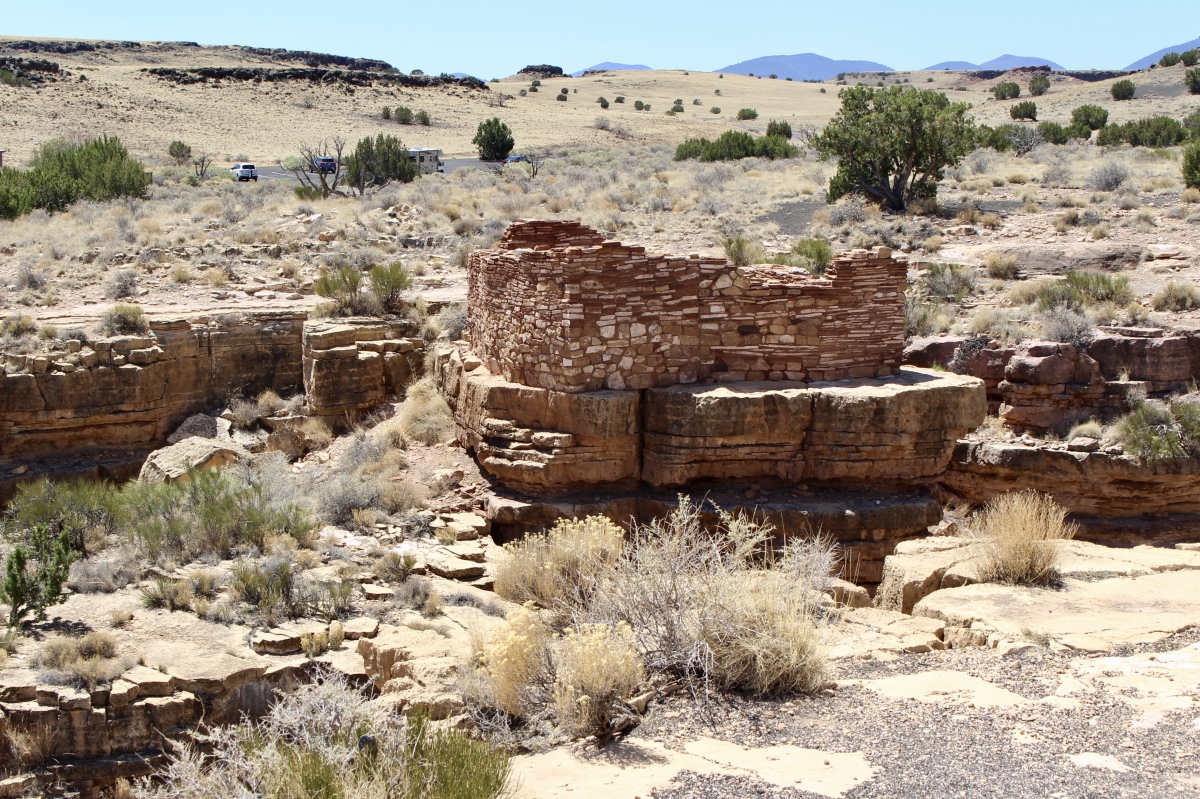
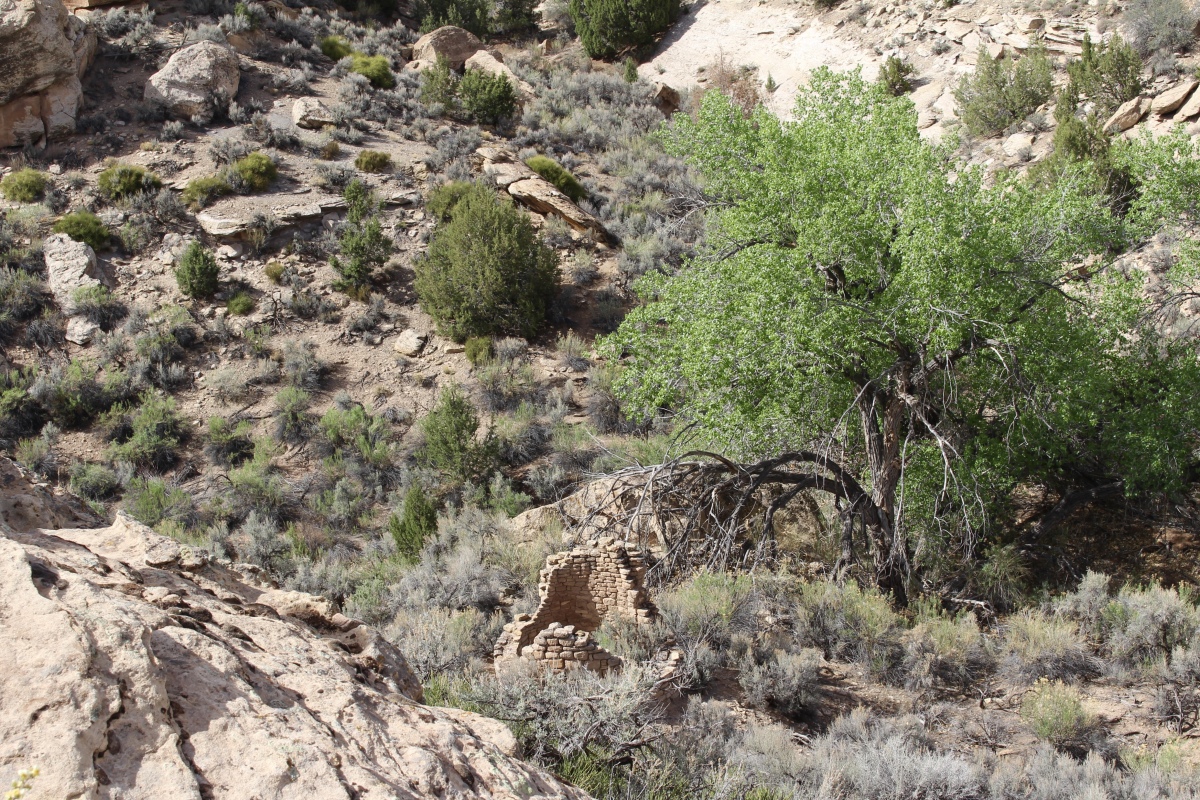
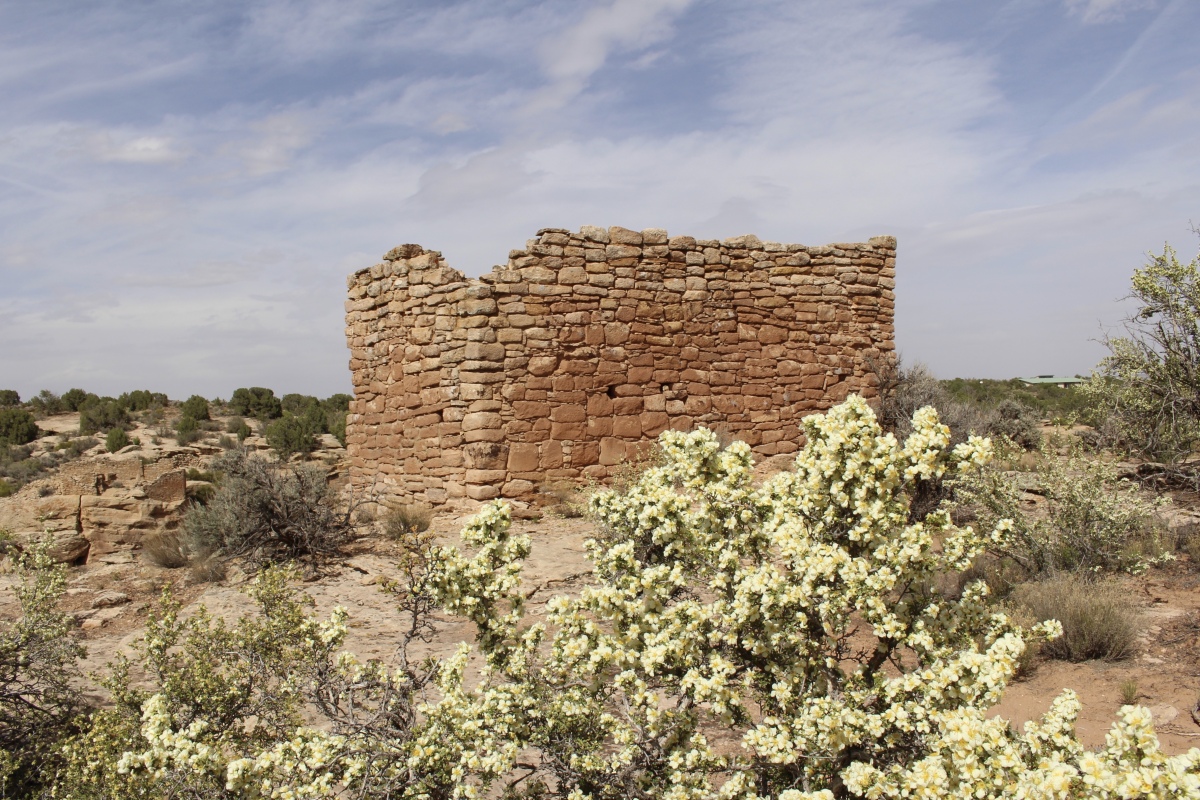
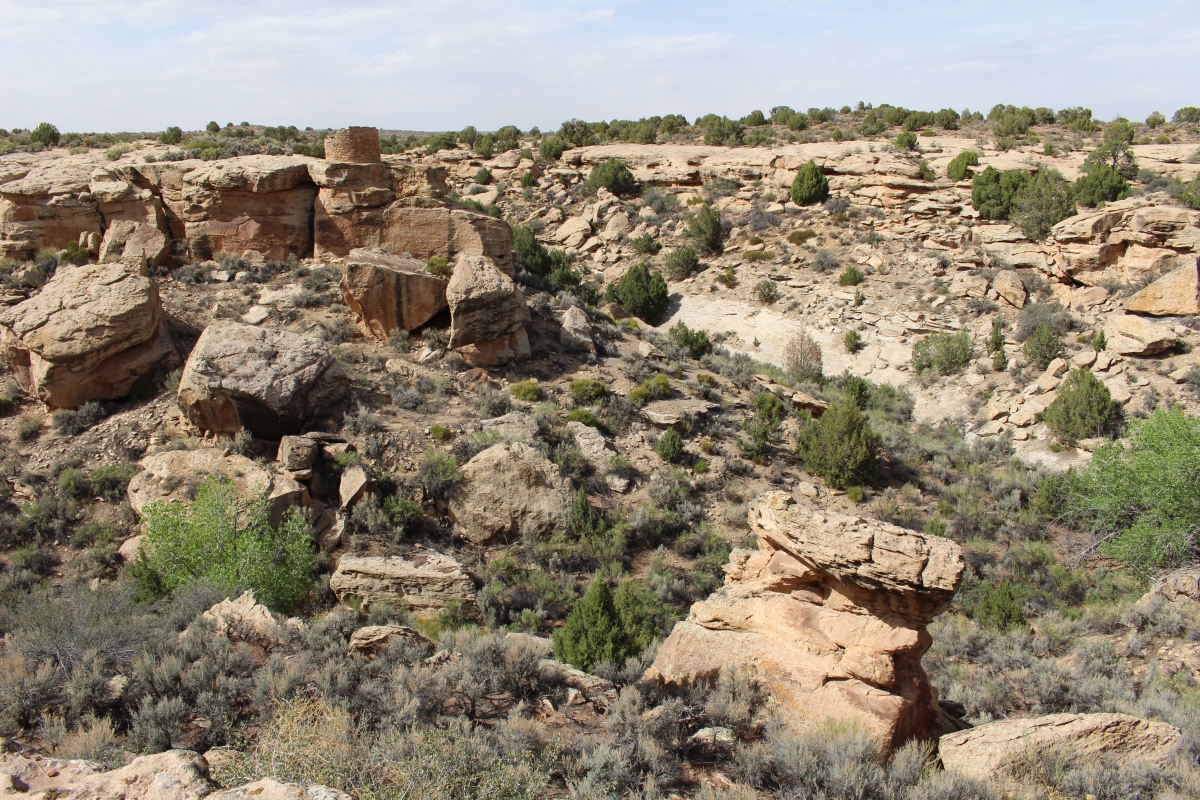
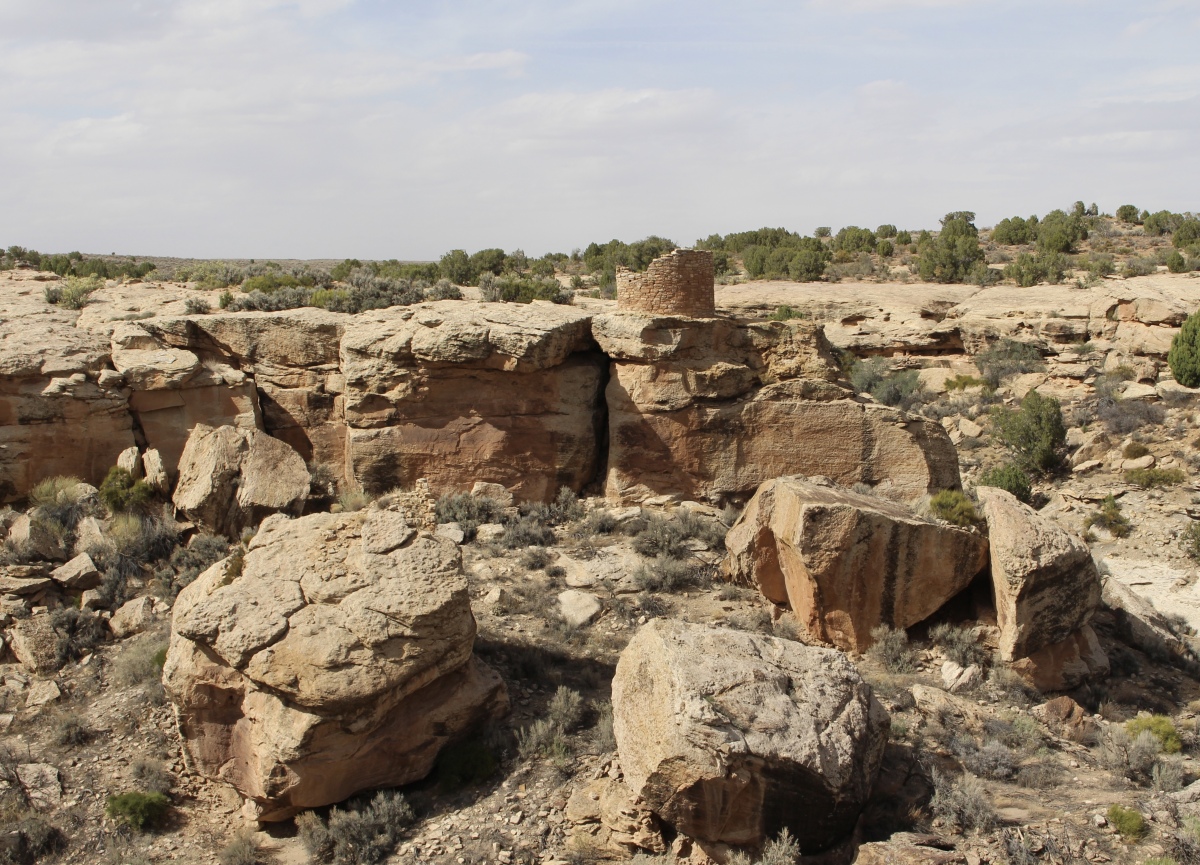
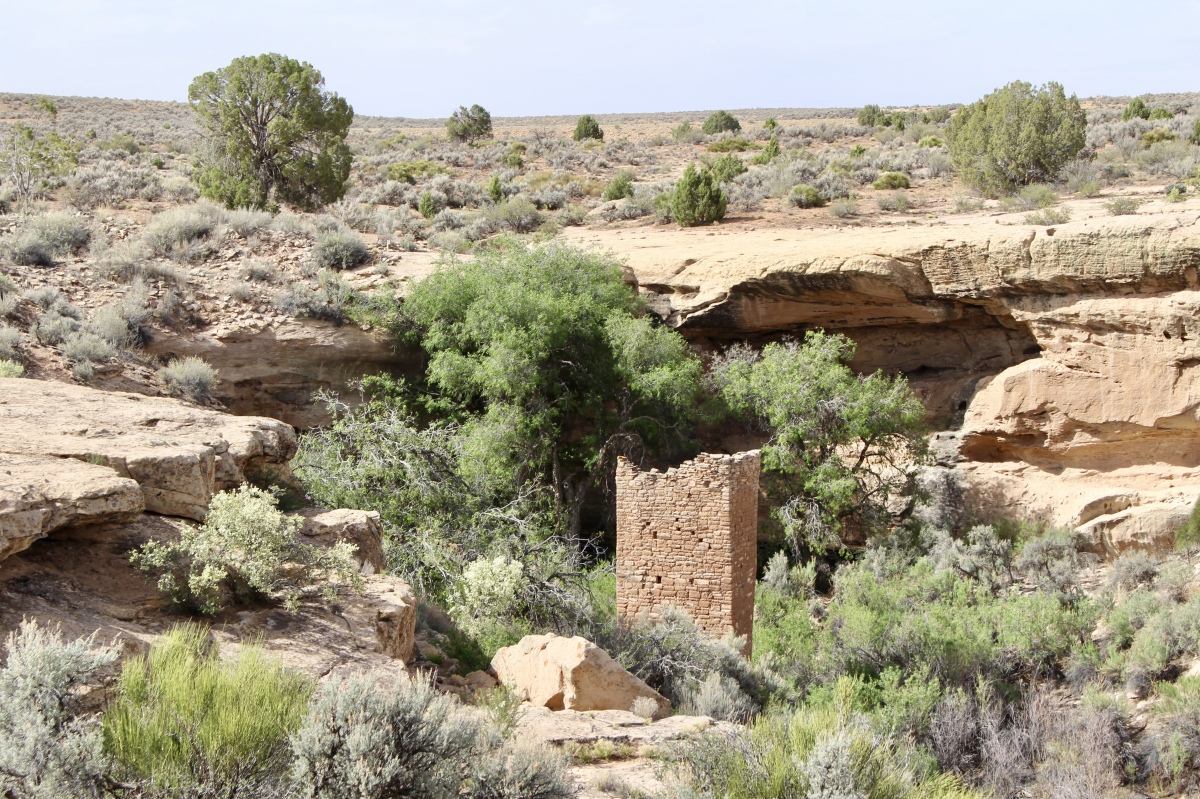
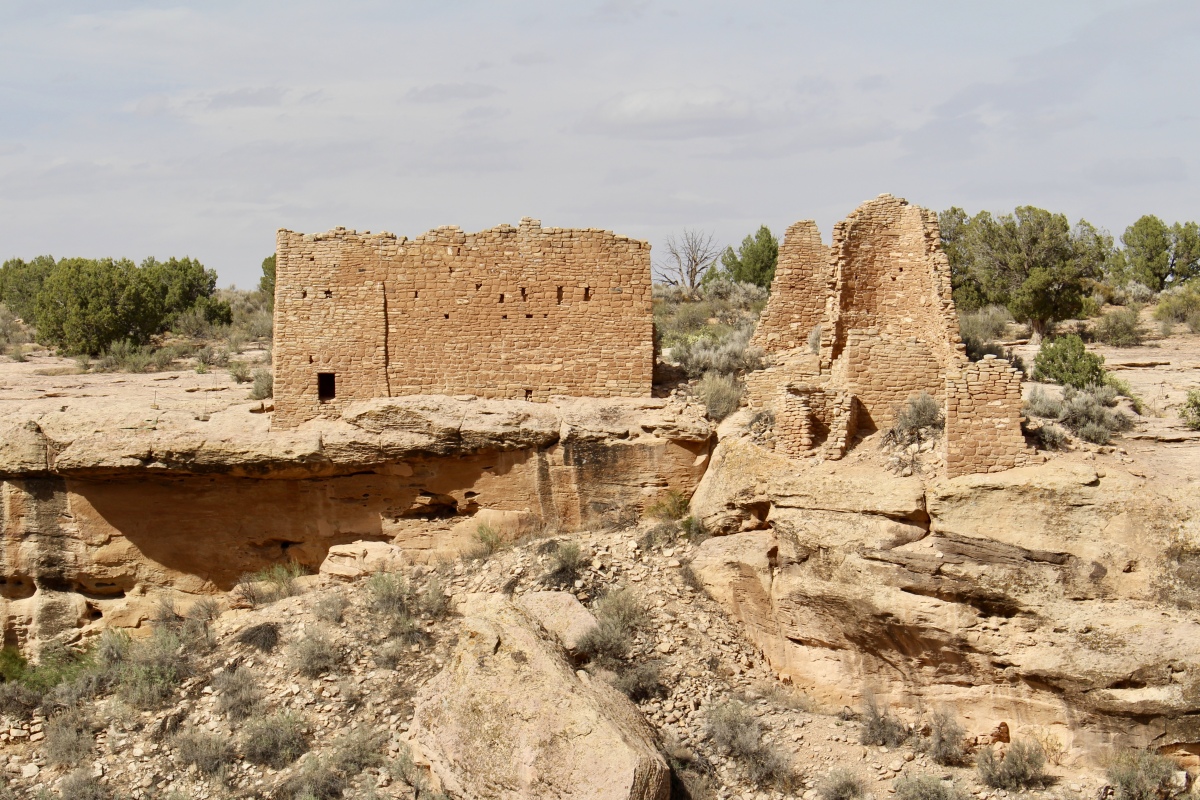
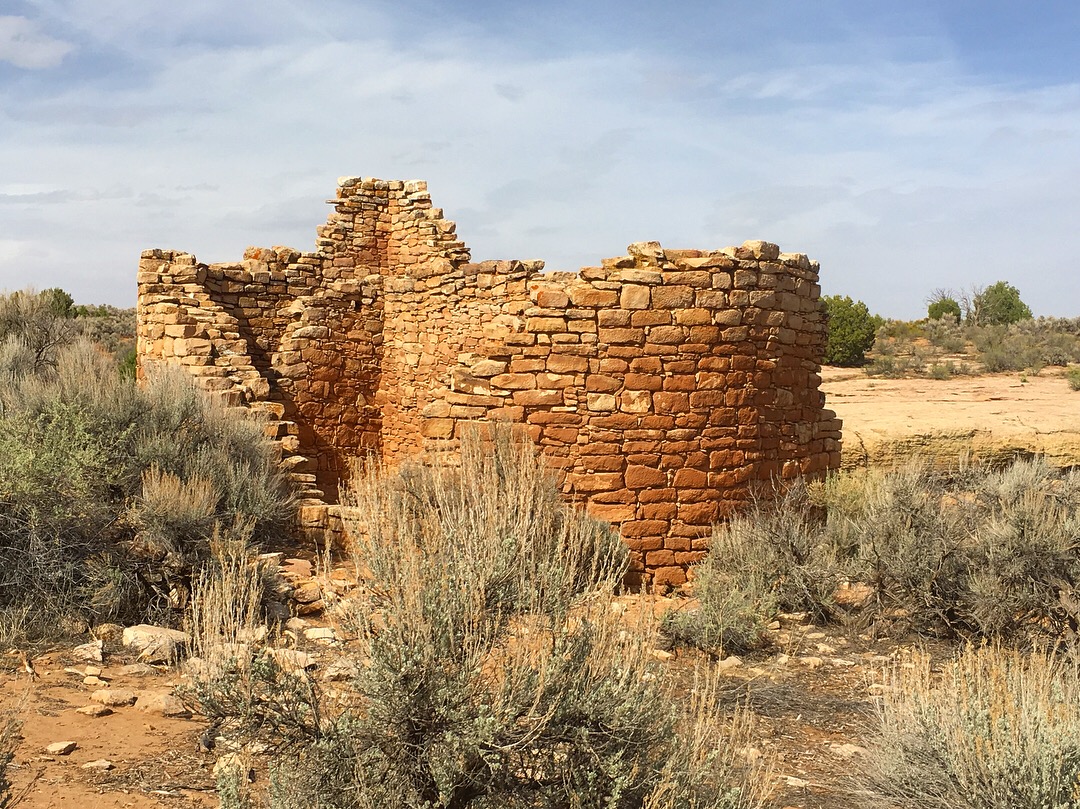
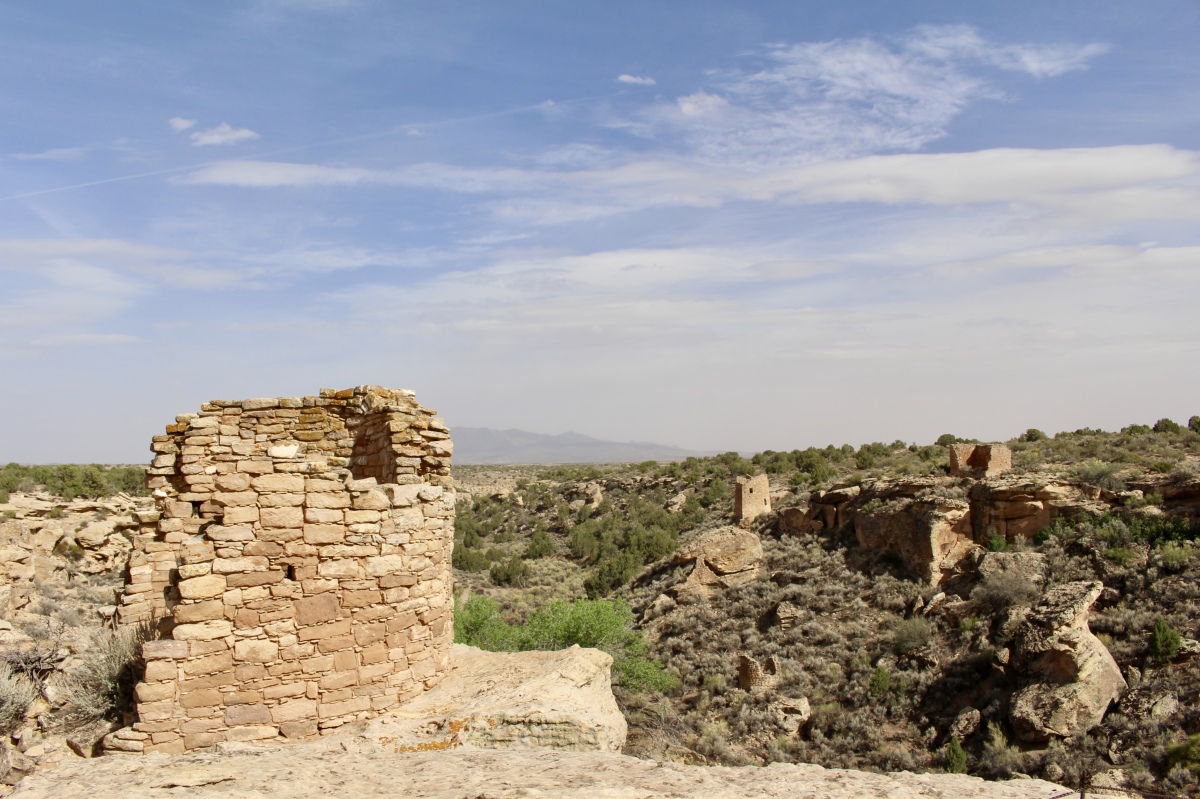
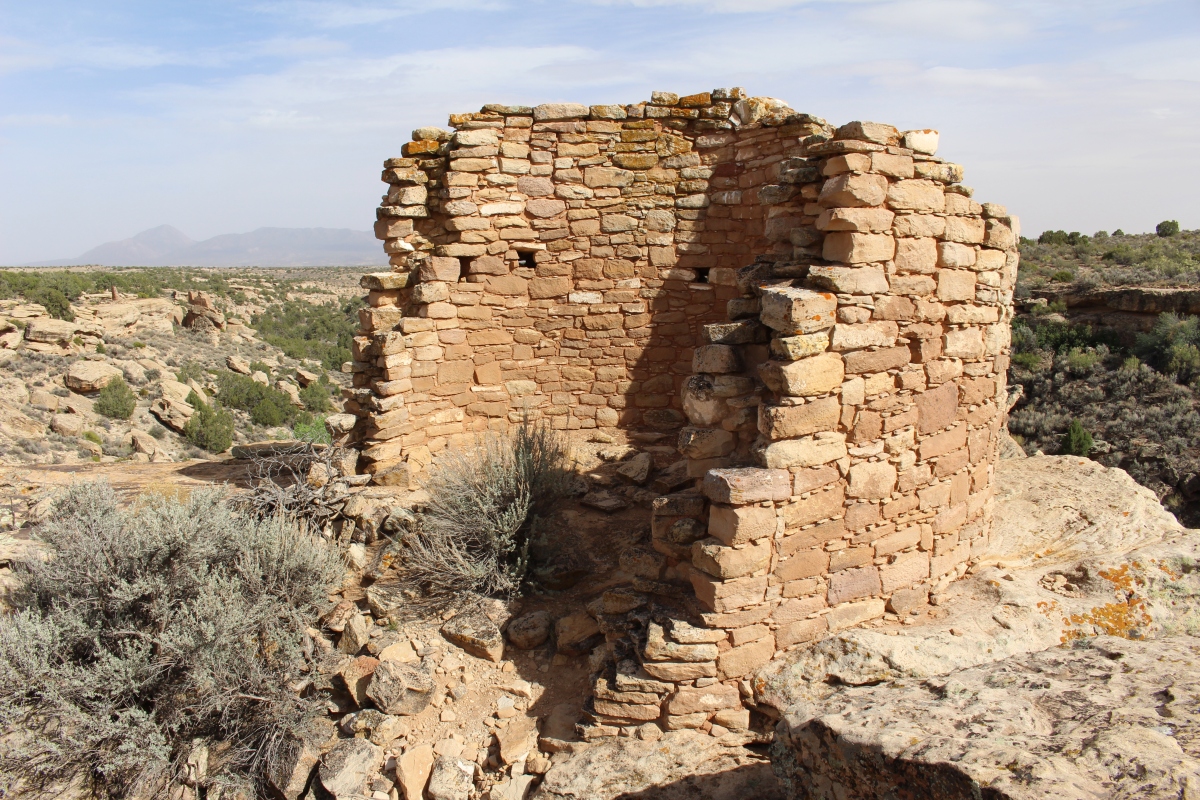
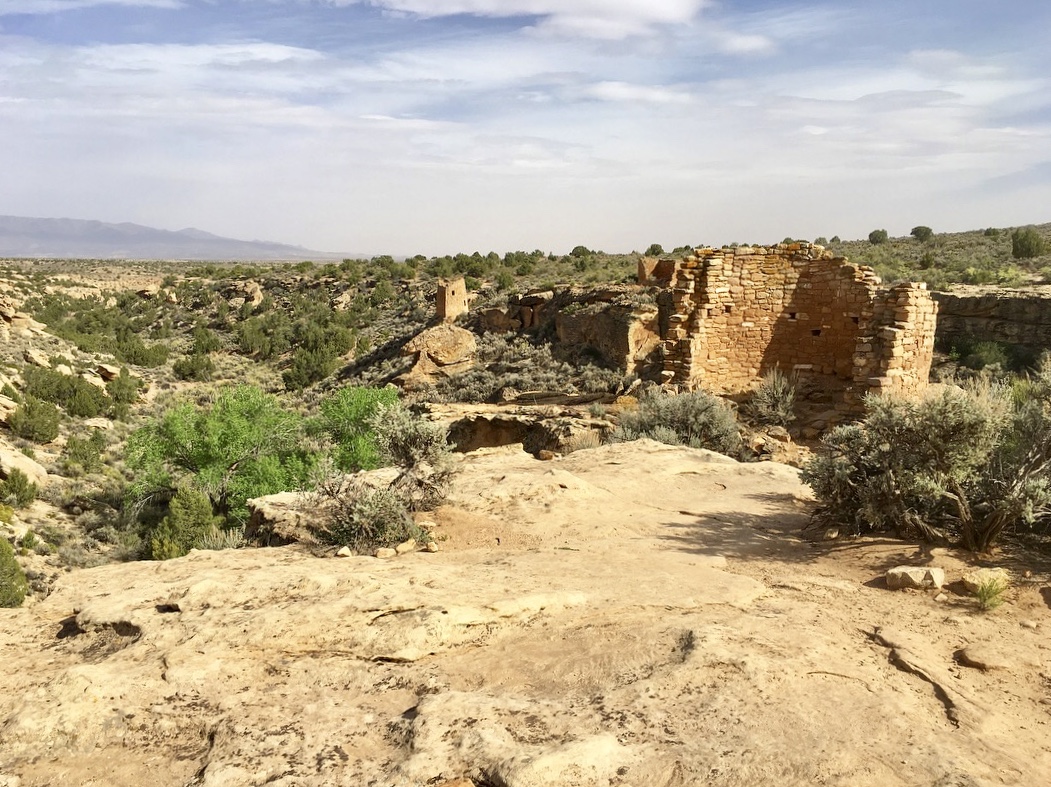
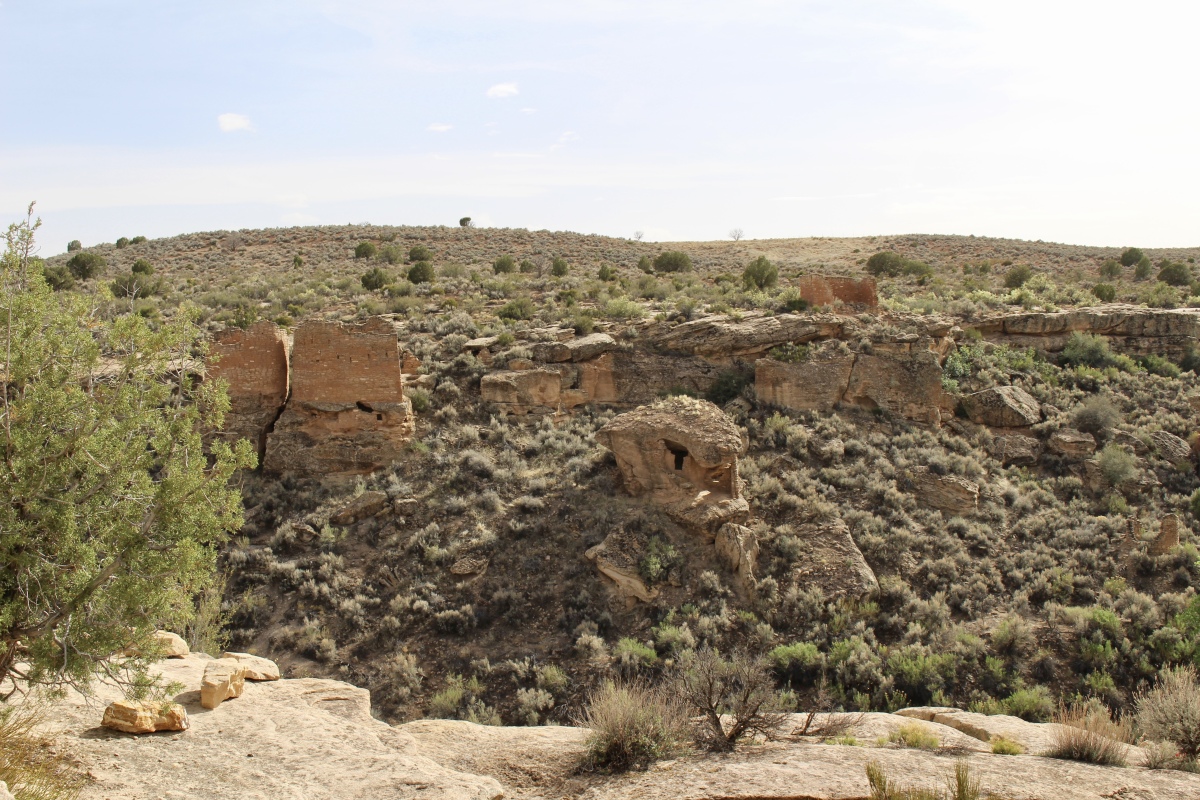
At Wupatki National Monument, we stopped first to do the Lomaki Trail. On foot, we approached the Box Canyon Ruins, typical of many pueblos found in this region. Early inhabitants constructed walls of nearby sandstone and limestone, and used local soils to cement stones together. The flat roofs were built of timbers laid side by side, covered with smaller branches and finally plastered over with mud.
Smoke was vented from rooms through a square hole in the ceiling which frequently served as the only access to the room. Doorways were small and windows almost non-existent. As the rooms were abandoned, the timbers were often scavenged and used in other pueblos or burned as firewood, a precious commodity in this environment.
Box Canyon Ruins
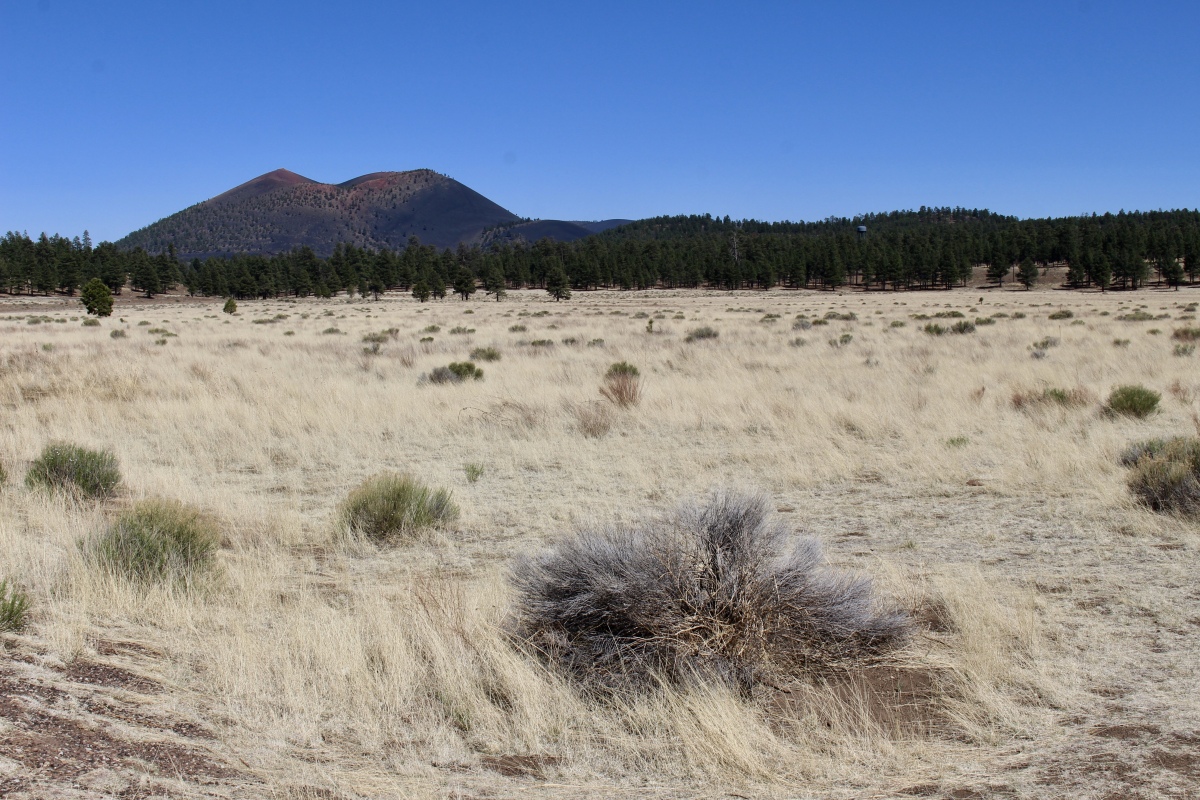
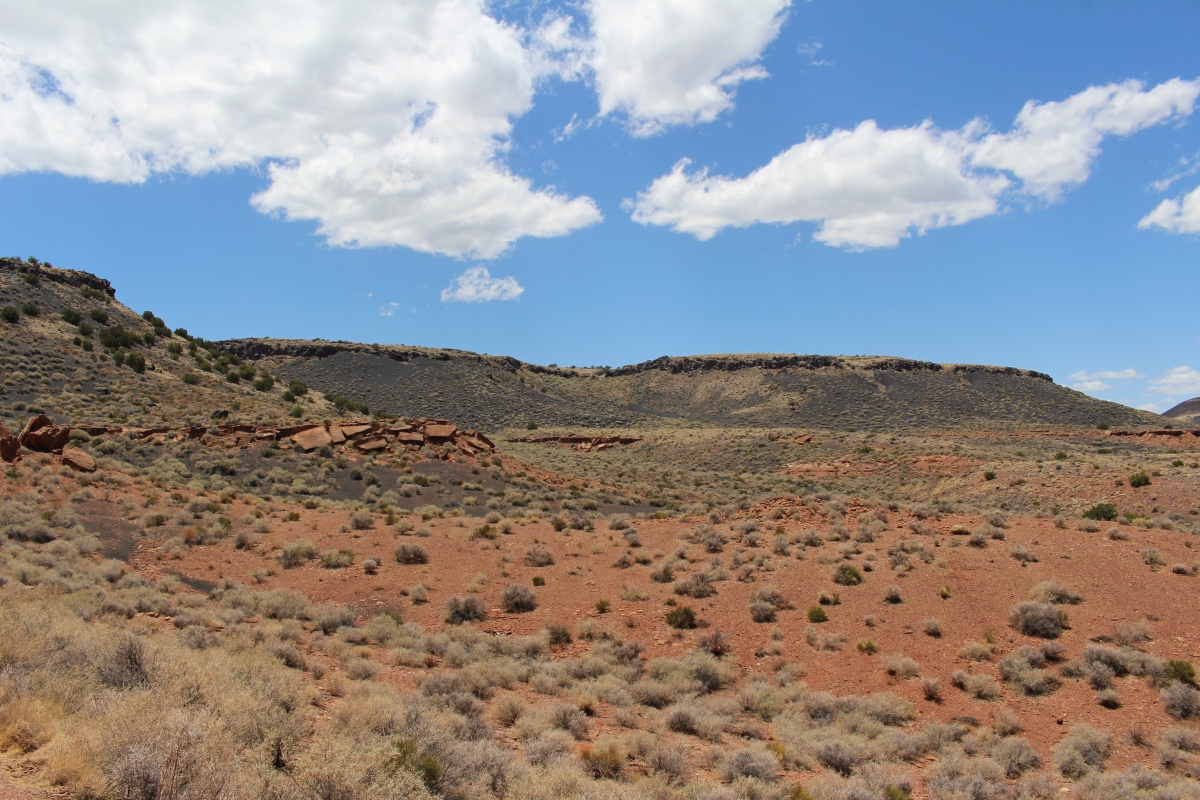
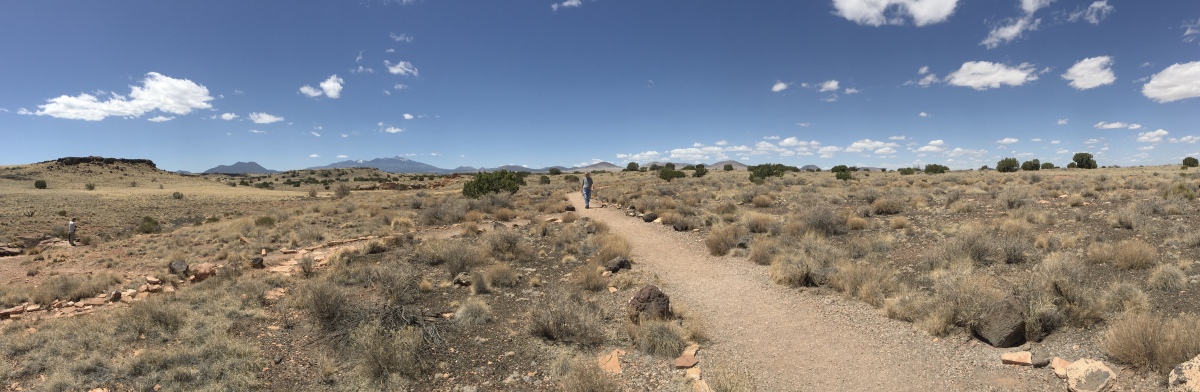
On Antelope Prairie, depending on the season, wind can knock a person flat. Lightning and storm clouds create a dance of shadow and light. Heat waves distort the horizon. In this landscape, a large community farmed during the 1100s, its focal point Citadel Pueblo just to the south. Later, Navajo families grazed sheep here, followed by cattle ranchers.
Eight hundred years ago, a savannah-like grassland covered much of this high desert with abundant grasses. The residents would have collected and burned much of the nearby fuel, necessitating long walks to adjacent areas to gather wood. Sparse annual rainfall forced the inhabitants to catch and save as much water as they could, or walk miles to other sources.
Since the use of the area by modern ranchers, the land has undergone other dramatic changes. Cattle grazing stripped much of the native vegetation away, allowing other plants, such as rabbitbrush, saltbush and snakeweed to dominate the vegetation. Although Wupatki National Monument was established in 1924, grazing continued until 1989, when a fence was built around the monument boundary.
Antelope Prairie
The ruins appear today just as they did when discovered in the late 1800s. The National Park Service has stabilized the walls to help preserve them. None are reconstructed. These 800-year-old walls are fragile and easily disturbed.
Box Canyon Ruins
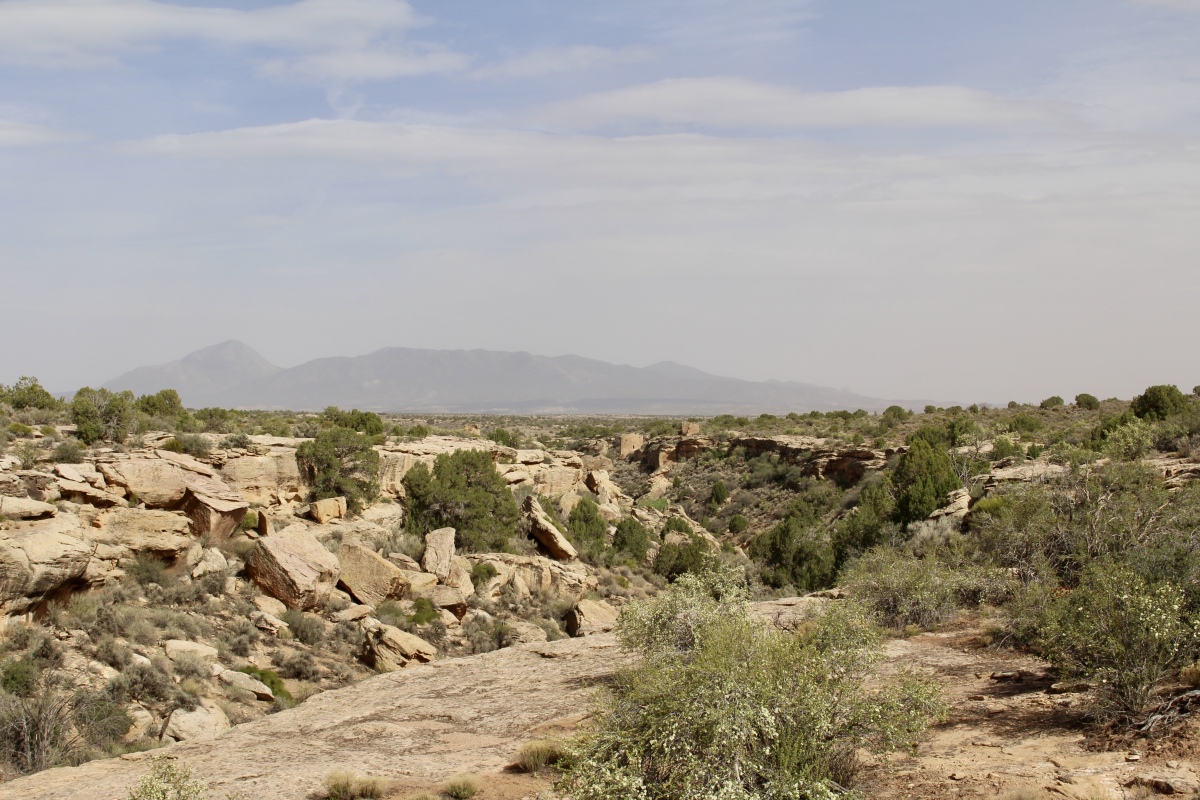
Volcanic activity to the south, from Sunset Crater Volcano, produced giant fissures or earthcracks throughout the Wupatki area in the Kaibab Limestone. The Sinagua and Anasazi Indians who inhabited these ancient pueblos probably found the earthcracks to be the most productive farming sites. There is no evidence of streams close by which could provide water. All farming was dependent on rainfall.
Corn, squash and other crops were planted along the canyon slopes and wash bottoms. Small check dams along the drainage courses provided level areas for farming. These flat areas retained more moisture and the accumulated silt enriched the soil. The bottom of Box Canyon, below the ruins, may have been an ideal area for farming.
Box Canyon Ruins
Juniper, amaranth, yucca, Indian rice grass and other native plants were used as food, along with antelope, rabbit, squirrels, packrats and reptiles, to name a few.
Box Canyon Ruins
Box Canyon Ruins
Box Canyon Ruins
Box Canyon Ruins
Box Canyon Ruins
Box Canyon Ruins
Box Canyon Ruins
The Lomaki Ruin sits at the far end of the path. Lomaki means The Beautiful House.
At Lomaki Ruin, an open area in the pueblo near the rim of the earthcrack is known as the plaza. In pueblos, the plaza was the center of daily activities including grinding corn, making pottery, working obsidian into arrowheads, processing other plants for food, and cooking. It would have also been used for meetings, conducting trade, and as a controlled play area for children. During the warmer months, the plaza was used extensively from dawn to dusk. Rooms inside the pueblo were used only for sleeping and some cooking.
Lomaki Ruin
Lomaki Ruin
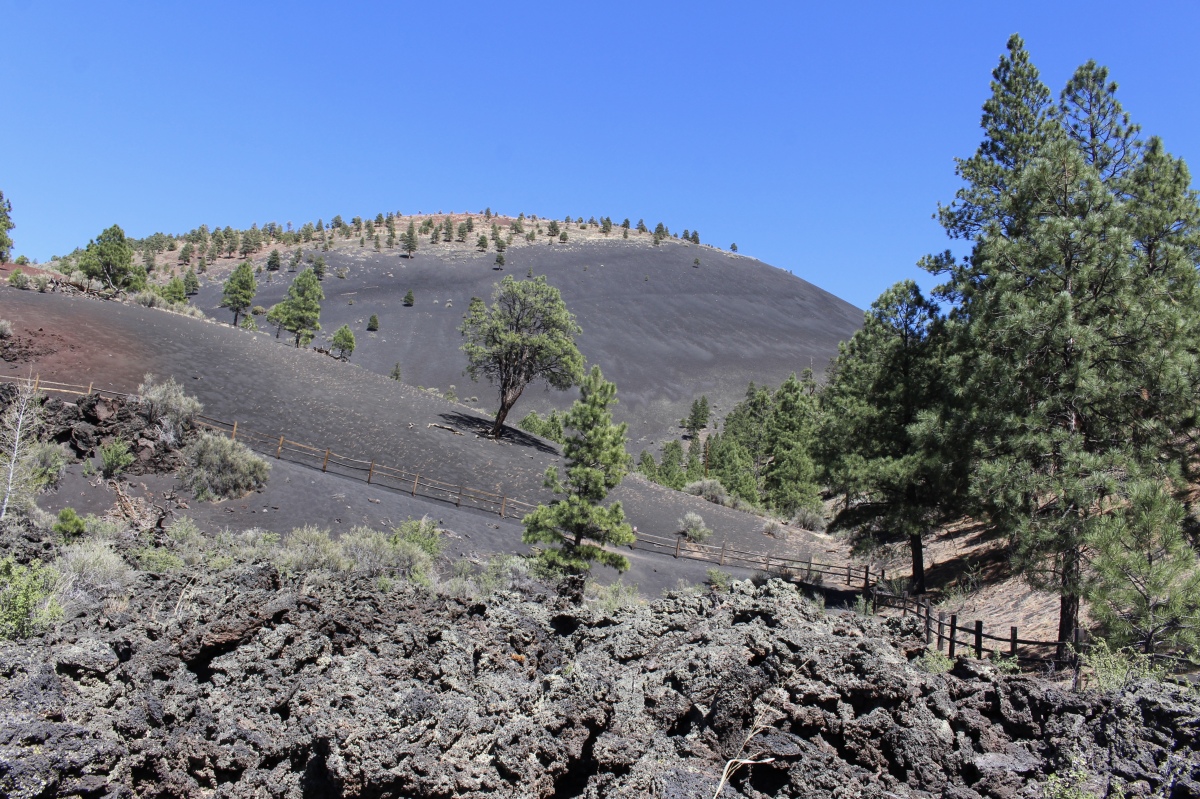
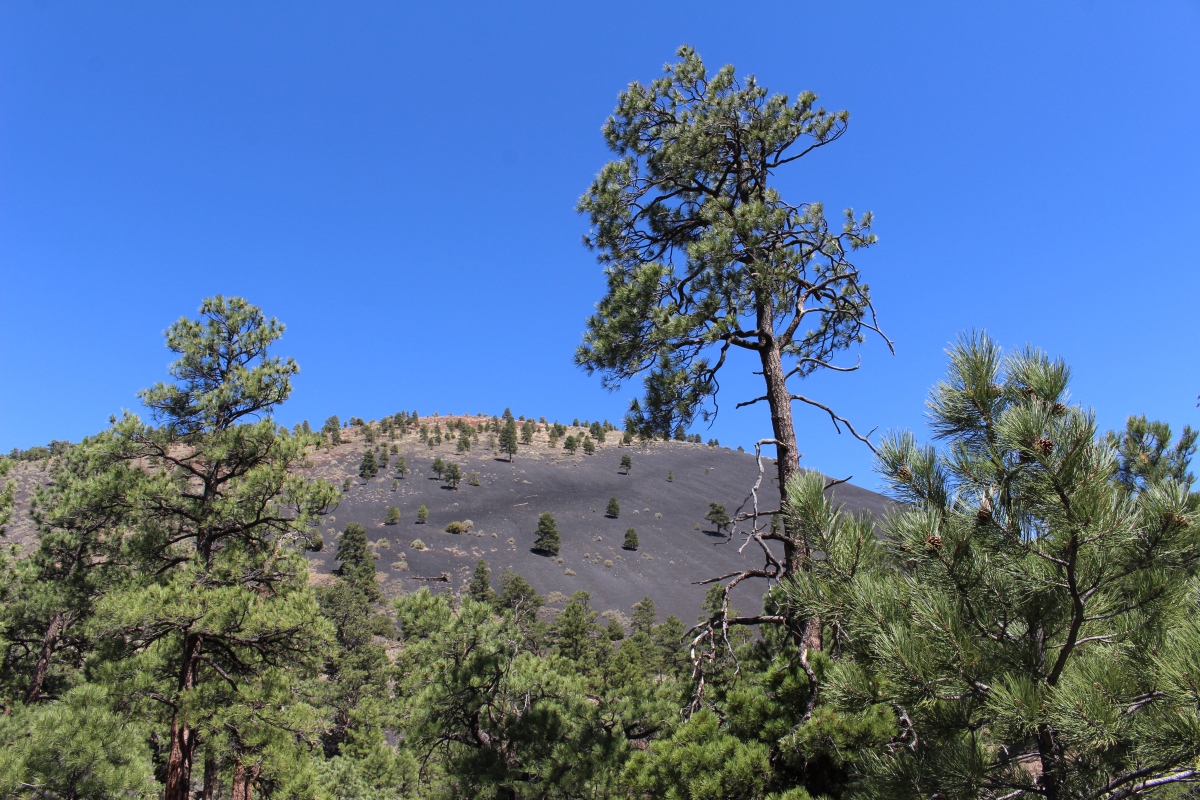
To the east of this area, Sunset Crater Volcano would have been belching black smoke and cinders when the Sinagua and Anasazi lived here. The thick layer of cinders over the sandy soil helped hold moisture, which was beneficial to the growing of crops. Eventually, even Sunset Crate Volcano grew quiet, and the winds blew the cinders away and dried out the soil.
Why the Lomaki residents departed is not certain. There are indications of disease affecting the population, or a lengthy drought creating a landscape barren of vegetation, animals and firewood. Or invading host tribes may have contributed to the abandonment of this area by the mid-1200s.
Lomaki Ruin
Lomaki Ruin
Lomaki Ruin
Lomaki Ruin
Lomaki Ruin
At the bottom of the earthcrack is a prehistoric check dam that captured the frequent run-off. The pueblo’s inhabitants placed pottery jars at the base of overhangs to catch rainwater. When the rain didn’t come, they had to walk 10 miles to the Little Colorado River drainage to fill their pottery jars.
Lomaki Ruin
Lomaki Ruin
Lomaki Ruin
By 1180, thousands of people were farming on the Wupatki landscape. By 1250, when the volcano had quieted, pueblos stood empty. The people of Wupatki had moved on. Many people crossed the high deserts of the Colorado Plateau over time, but few stayed long. Those who did adapted to the region’s challenging environment. Their descendants still live nearby, including Hopi, Zuni and Navajo people.
Lomaki Ruin
This walk was only 1.11 miles.We continued on to the Visitor’s Center and Wupatki Pueblo, where a sticker and stamp were awaiting me. 🙂
*Sunday, May 13, 2018*
***********************
On Sundays, I plan to post various walks that I took on our Four Corners trip as well as hikes I take locally while training for the Camino de Santiago; I may also post on other unrelated subjects. I will use these posts to participate in Jo’s Monday Walks or any other challenges that catch my fancy.
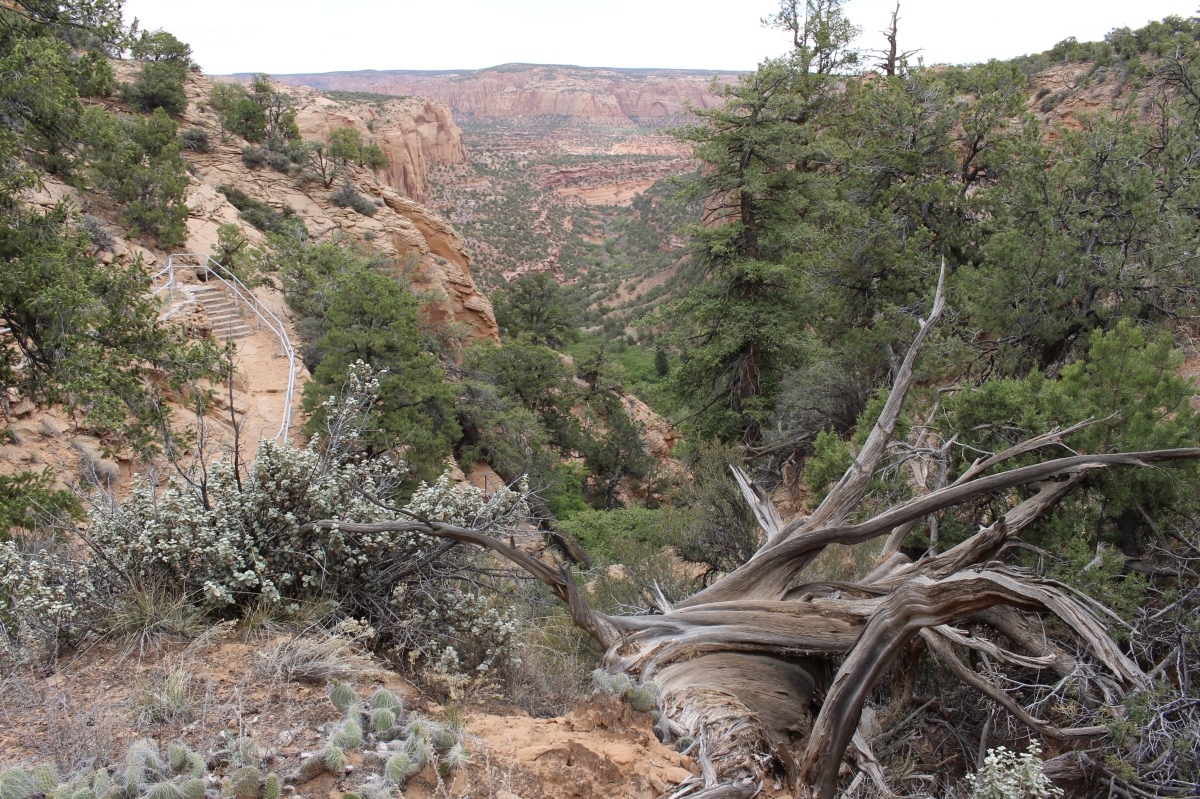
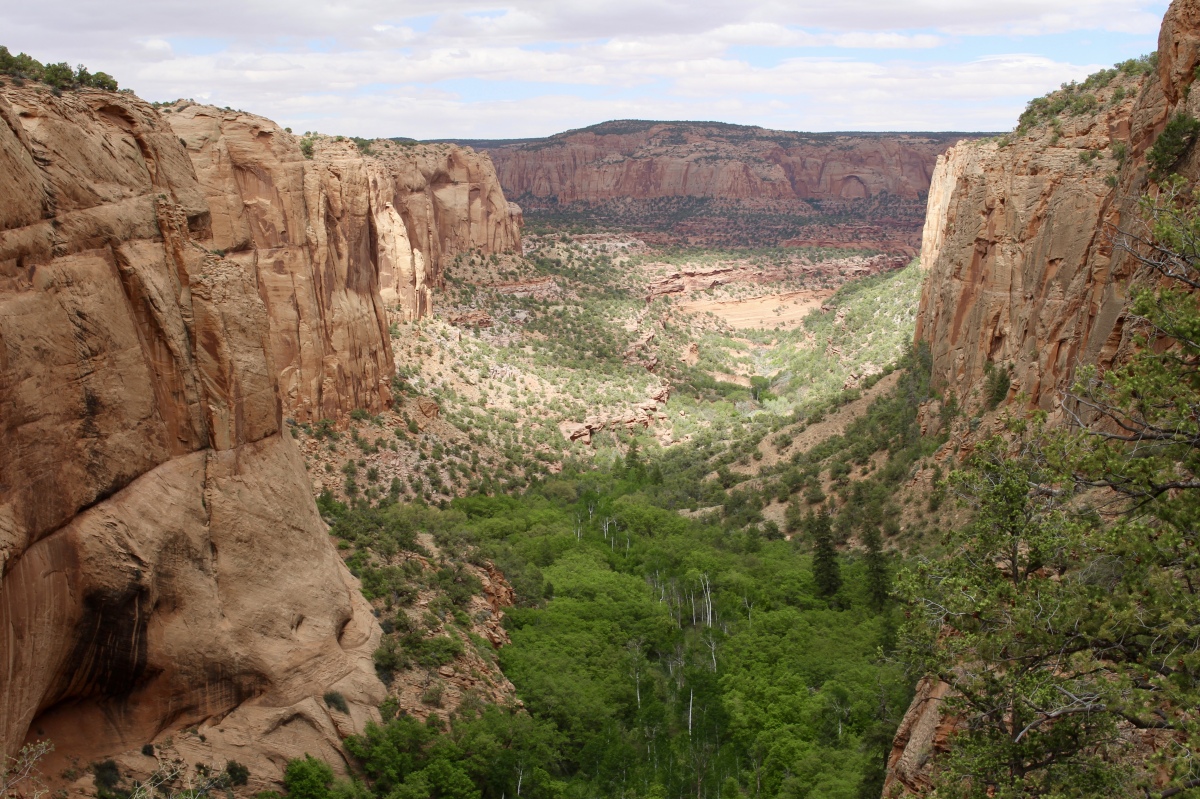
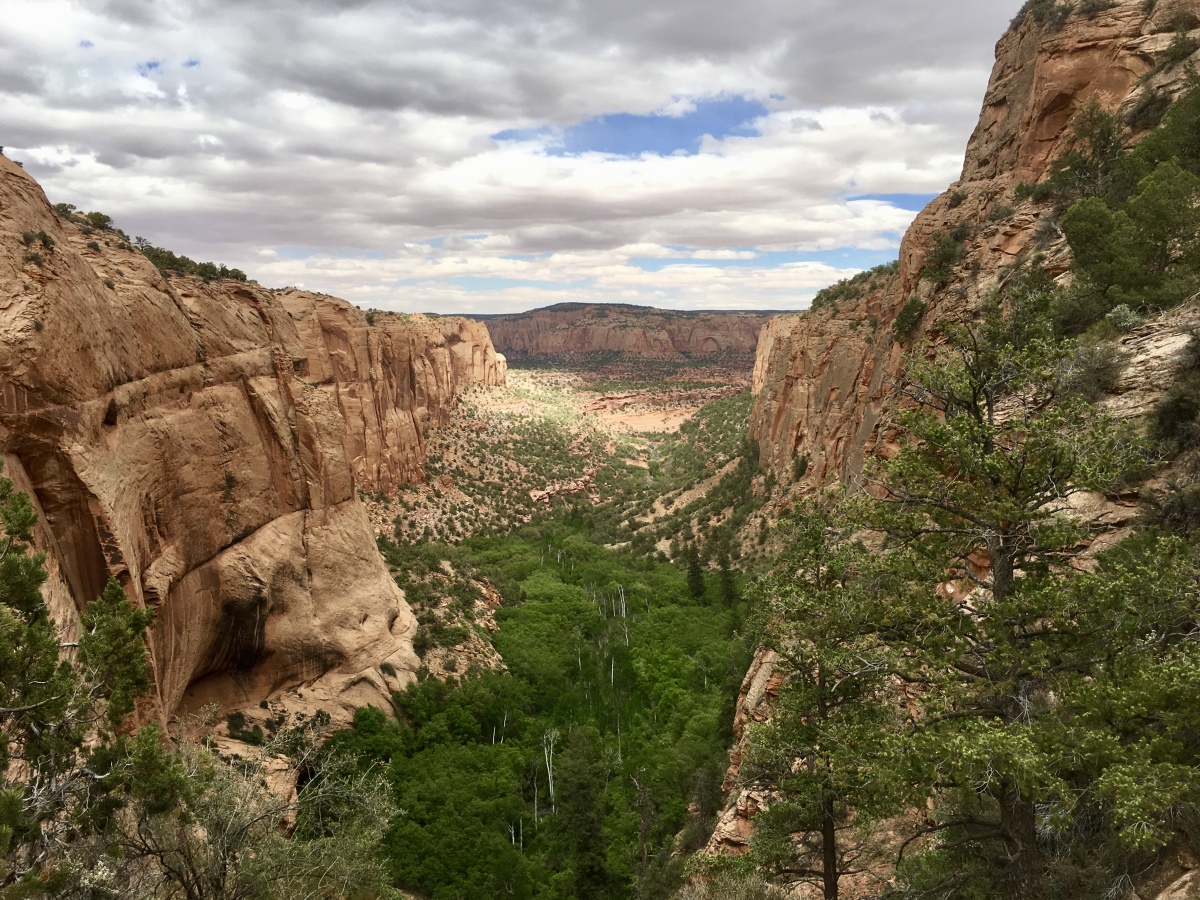
The Aspen Trail at Navajo National Monument branches off the Sandal Trail and descends 300 feet to view a relic forest of aspen, habitat for the endangered Mexican spotted owl.
at the top of the Aspen Trail
the Aspen Trail
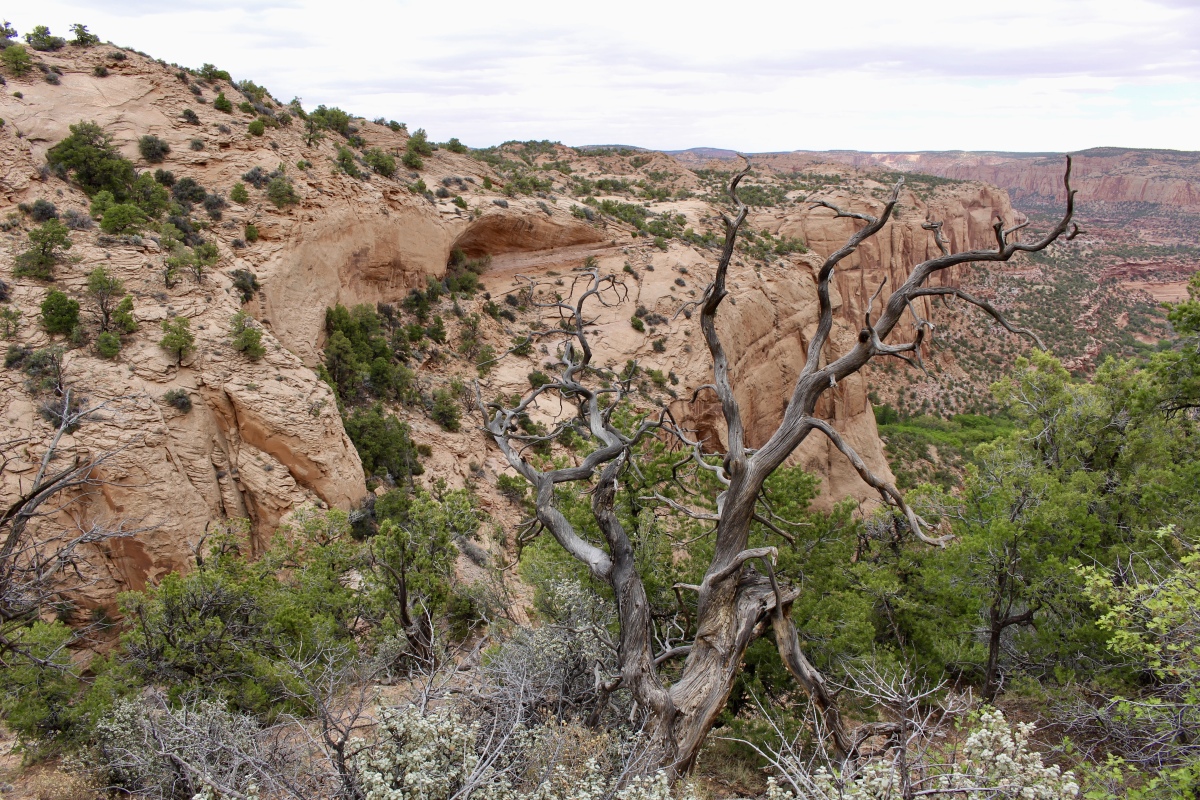
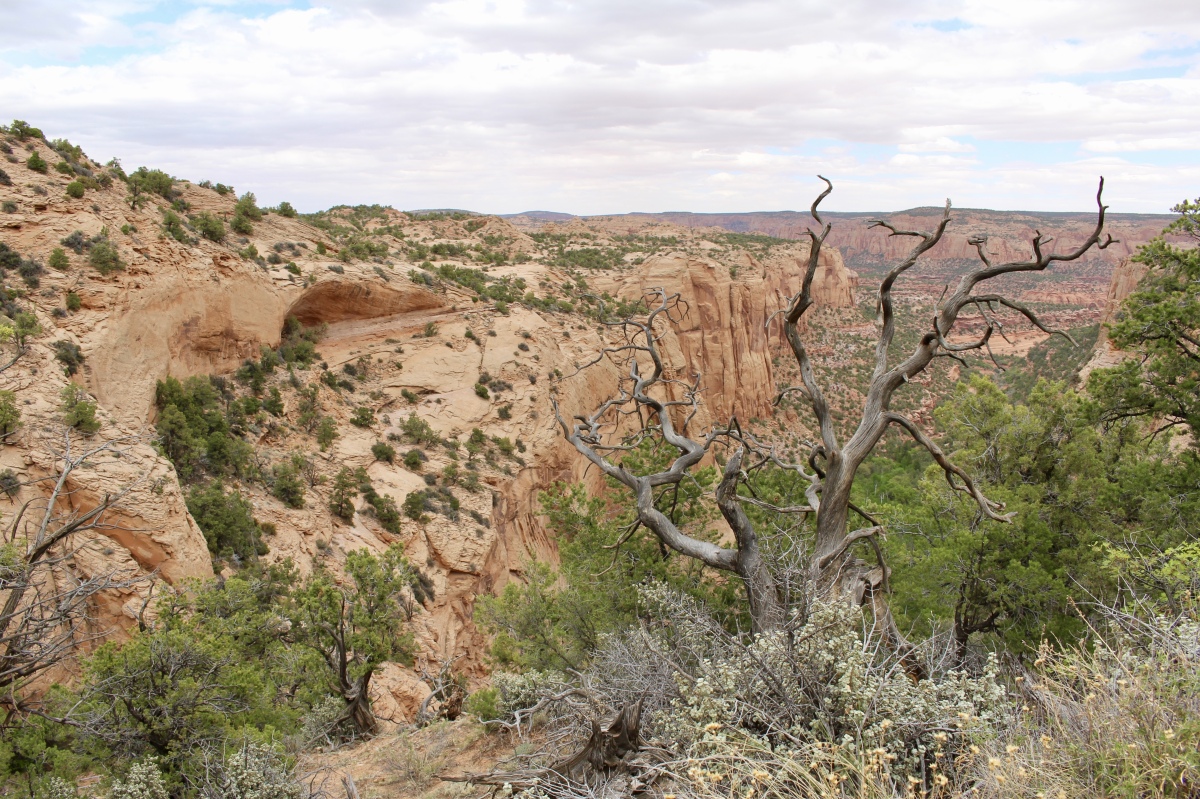
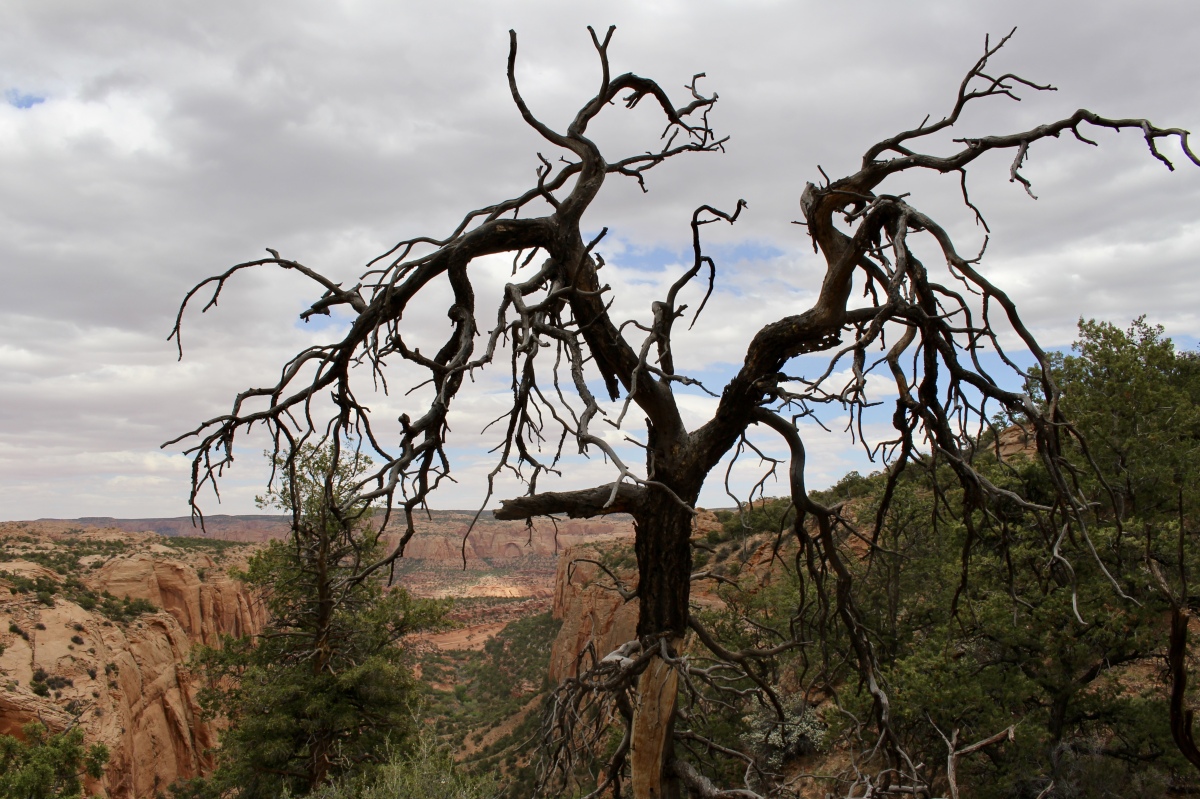
gnarled juniper
heading down
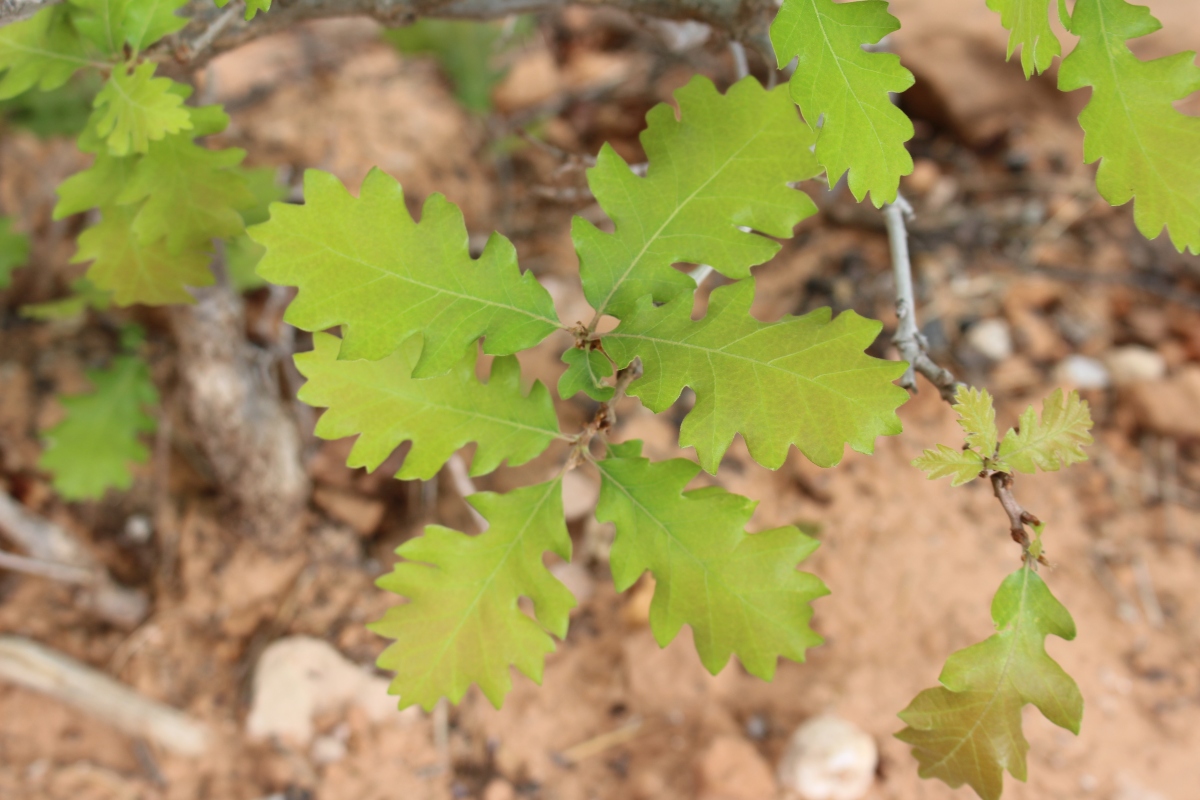
Going down the trail we see the most common oak in Navajoland, the Gambel Oak, which has a hard durable wood still used for ax handles, weaving battens, and cradleboard hoops. The leafy branches are favored for shade ramadas in the summer. Solutions of a root bark are used to dye wool and as a purifying drink during Navajo ceremonies.
Gambel Oak
Gambel Oak
The acorns of Gambel oak are less bitter than those of other oaks and were eaten by Navajos in former times. They were served raw, roasted, or as ground meal in stews or cakes. The Navajo name is tse ch’il, or “rock plant;” the Hopi name is kwingvi.
Gambel Oak
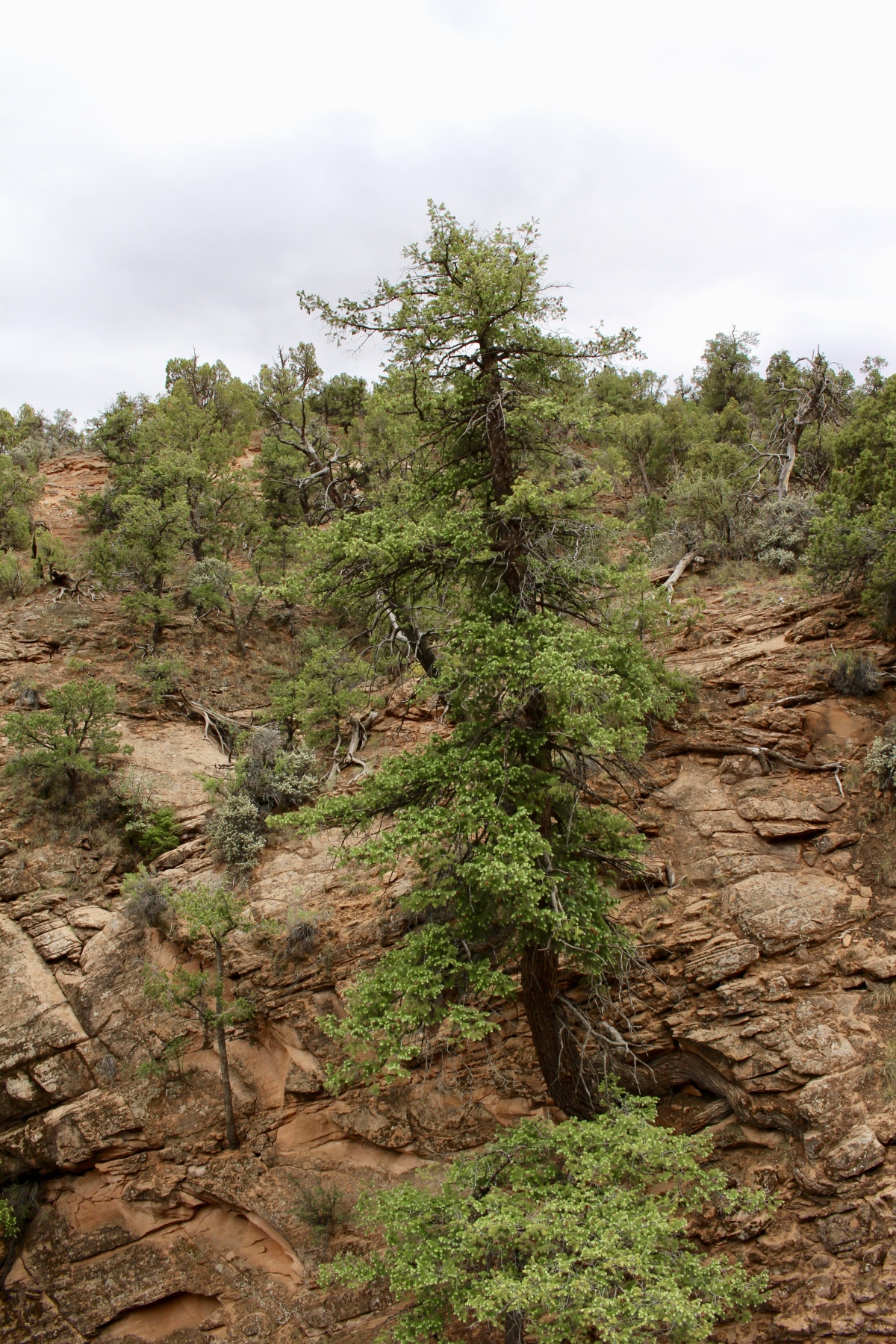
Usually a mountain species, the tall Douglas fir thrives in the deep shade of high-walled Betatakin Canyon. The early Anasazi found the strength and rigidity of this wood ideal for roof building. Generations of Hopis have traveled far from their arid mesa-top homes to collect Douglas Fir boughs and branches. Navajos also traded cut boughs to the Hopis in exchange for corn. Each culture requires fir neck-wreaths for the dancers of certain sacred ceremonies.
Both cultures also gauge weather by the Douglas fir. Bright green spring foliage means that the Hopi kachinas, spirit beings in the religious beliefs of the Pueblo people, will bring plenty of rain for crops. By contrast, dull growth on fir trees is said to bring “evil” winds. Navajos have seldom used this wood for household items, since they associate the tree with tornadoes. In former times, they did however plant corn seed with fir parts to insure a good crop. The Navajo name is ch’o, or “spruce,” while the Hopi name is salavi.
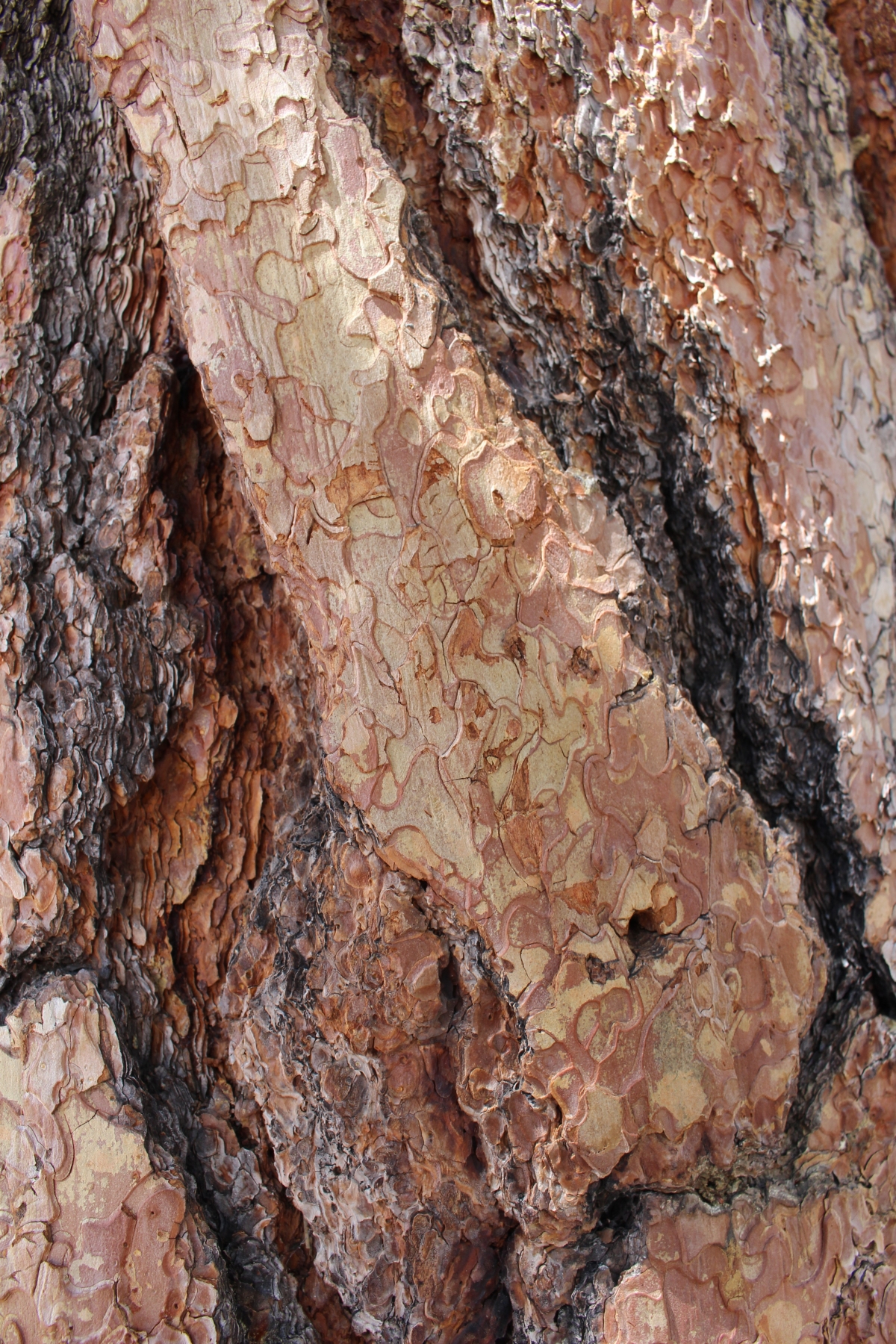
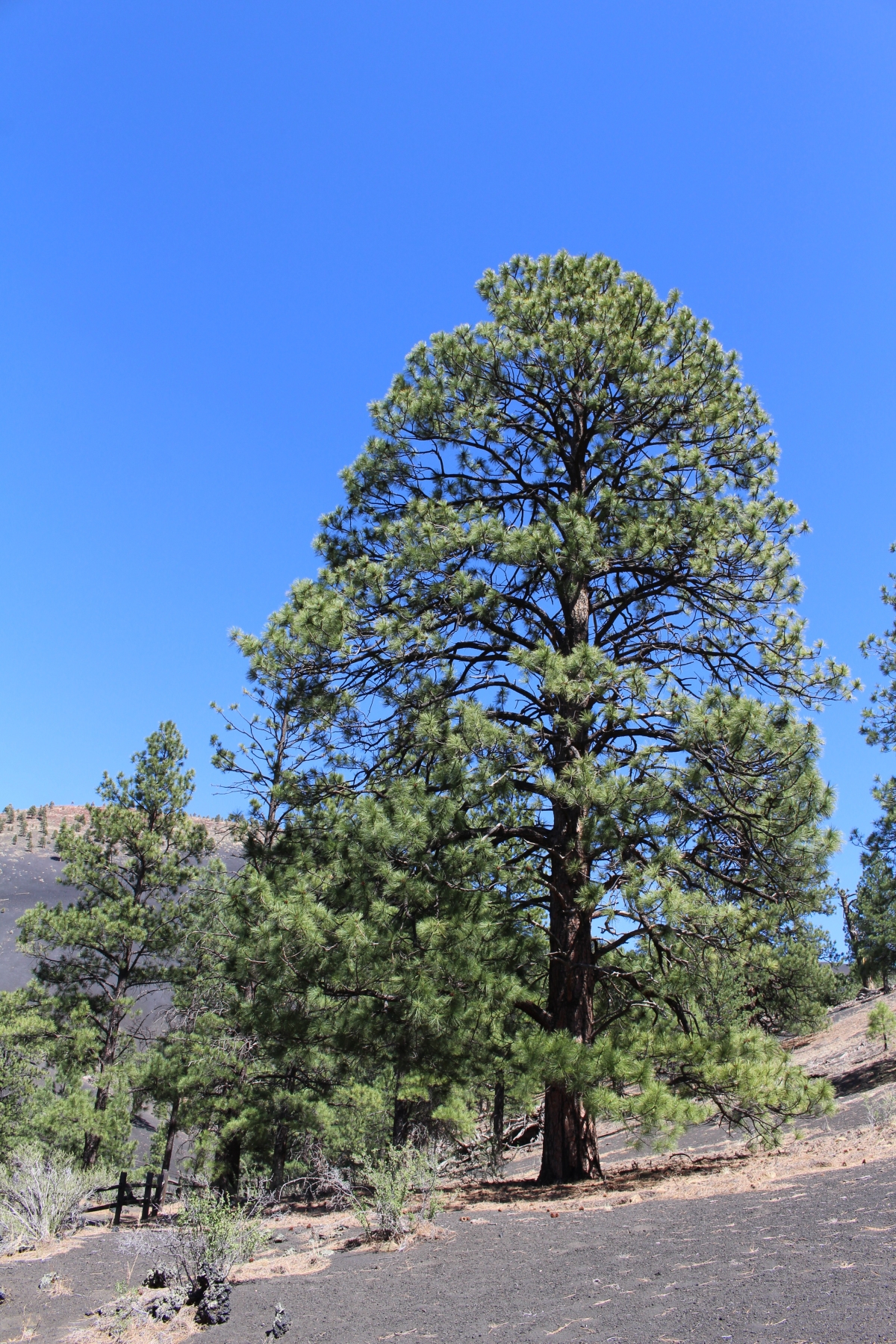
Ponderosa Pine
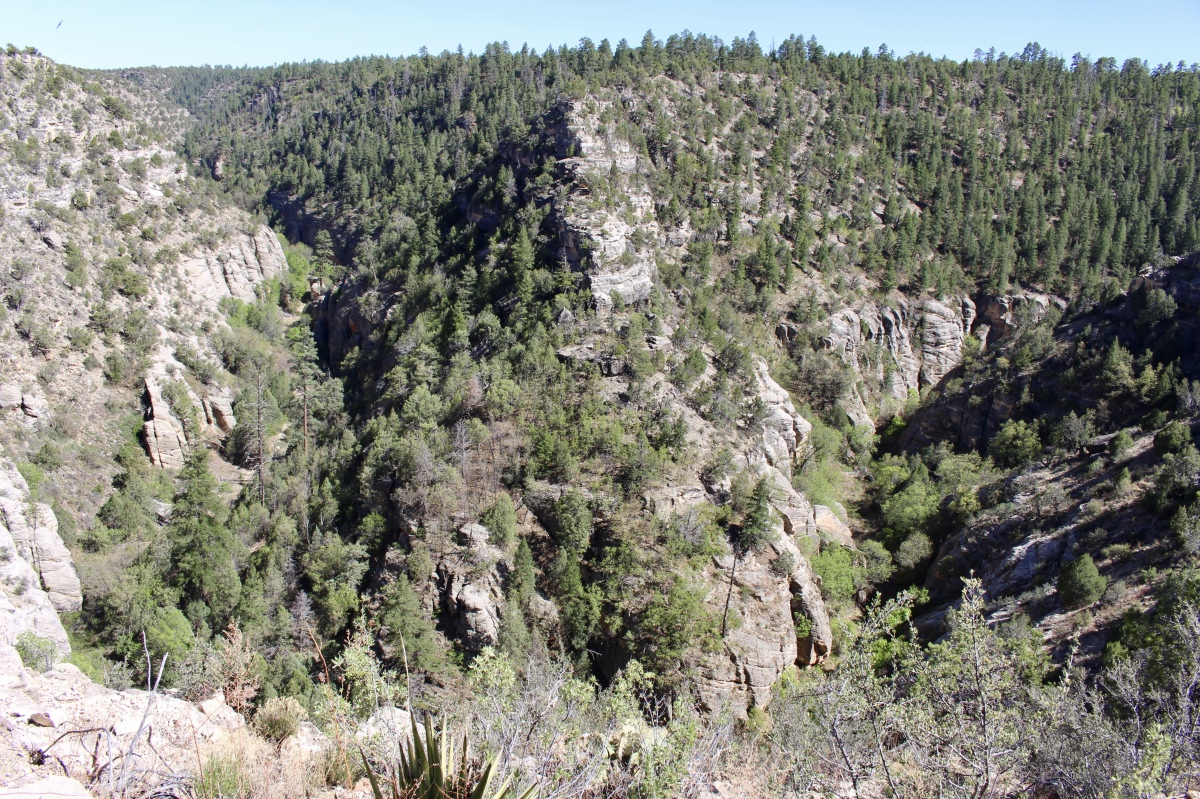
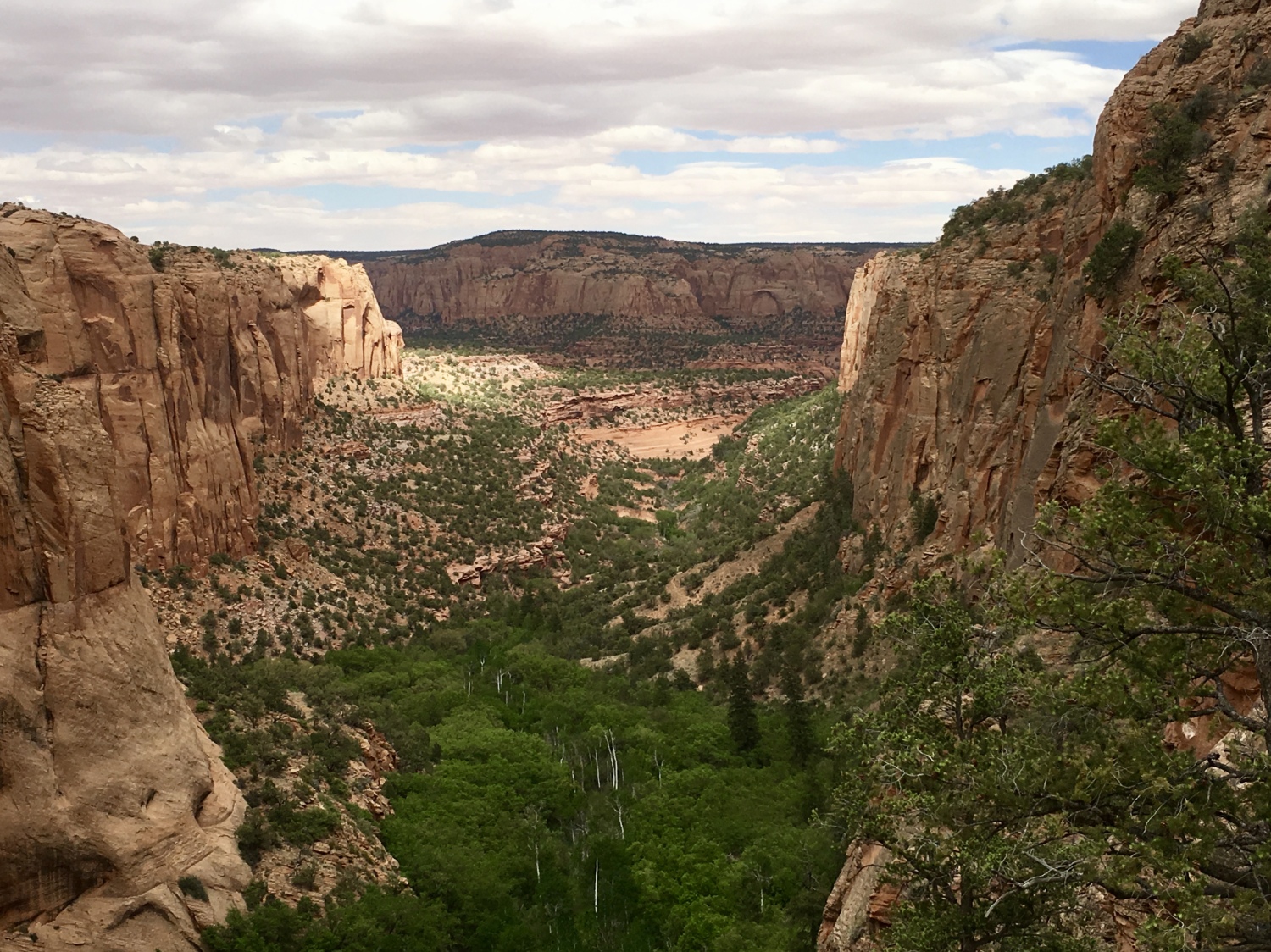
Below us lies a tributary of the Tsegi Canyon watershed. A quaking aspen grove graces the canyon floor, while the north-facing cliff (right) offers shady habitat for towering Douglas Fir trees.
Betatakin Canyon from the Aspen Trail
Hopi Indians burn rabbit brush kindling with three other wood fuels in their ceremonial kivas. Slender, flexible stems are woven into basketry. Green dye comes from the inner bark, while early autumn flowers yield a yellow dye. The Hopis once structured windbreaks from mature stems of rabbit brush. Such branches were also used for arrow shafts.
Navajos continue to rely on rabbit brush for relief from respiratory ailments, fever and pain. Parts of the shrub are given to purify the body during ceremonies. Navajos formerly ate stewed rabbit brush greens and ground the seeds into mush. The Navajo names is k’iilsoii, or “yellow leaf,” and the Hopi name is siva’pi or sivapi.
rabbit brush
Thriving here in this desert wilderness is an unexpected deciduous forest. The steep canyon walls, seeping cherished moisture into the basin at the canyon head, have preserved a shaded and humid environment. Water-loving plants and trees that would be more at home on mountain slopes find refuge here. These isolated pockets of unanticipated landscapes are called relic forests – survivors from an ice age environment that they dominated some 10,000 to 20,000 years ago.
Betatakin Canyon from the Aspen Trail 4
The white-trunked quaking aspen thrives at high elevations and in northwestern lands of North America. The presence of aspen and Douglas fir here reminds us that climates in the Southwest were once much cooler and wetter.
coming back up the Aspen Trail
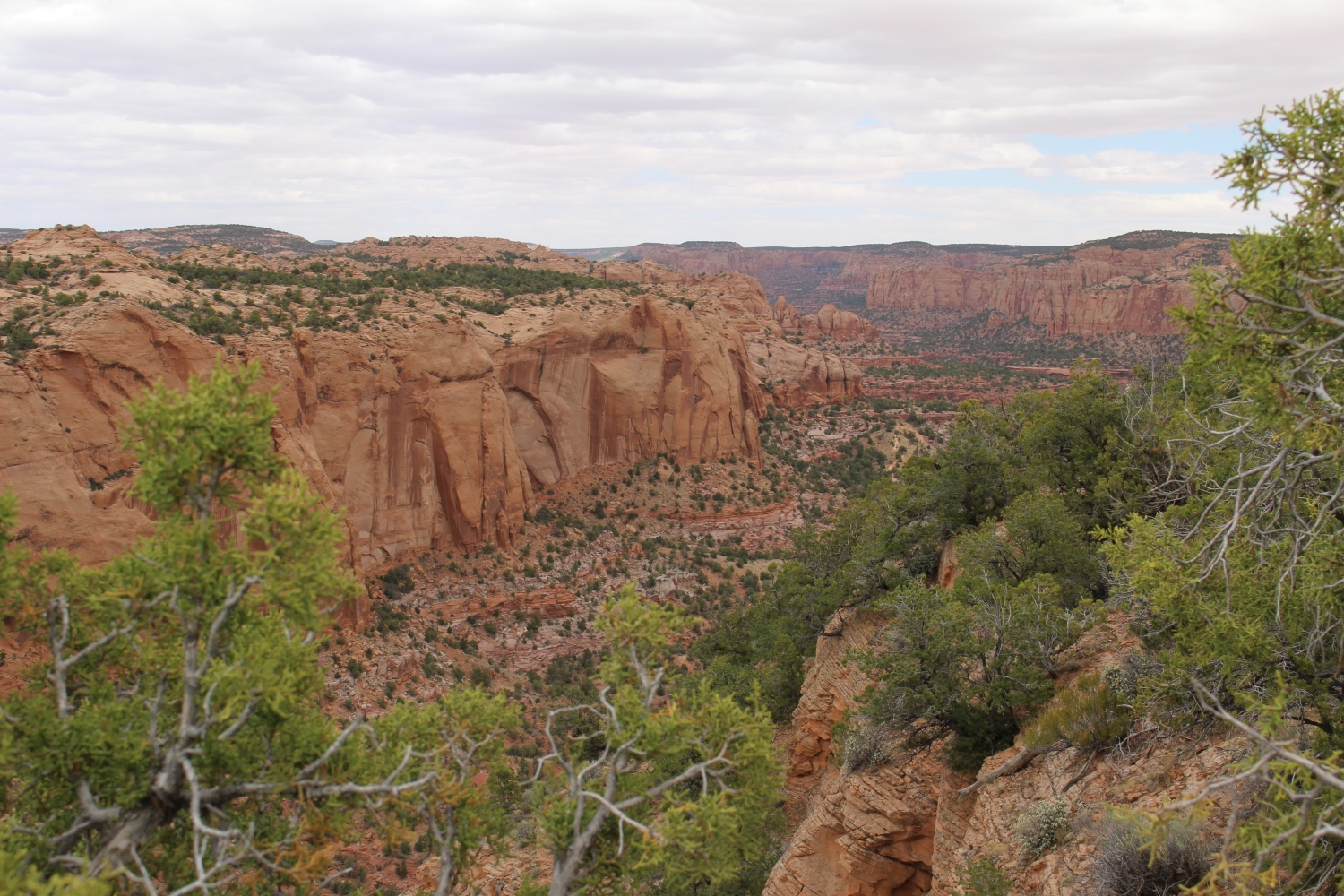
After climbing out of the canyon to the rim, we take the Canyon View Trail to a view from the head of Betatakin Canyon and continuing to the historic ranger station.
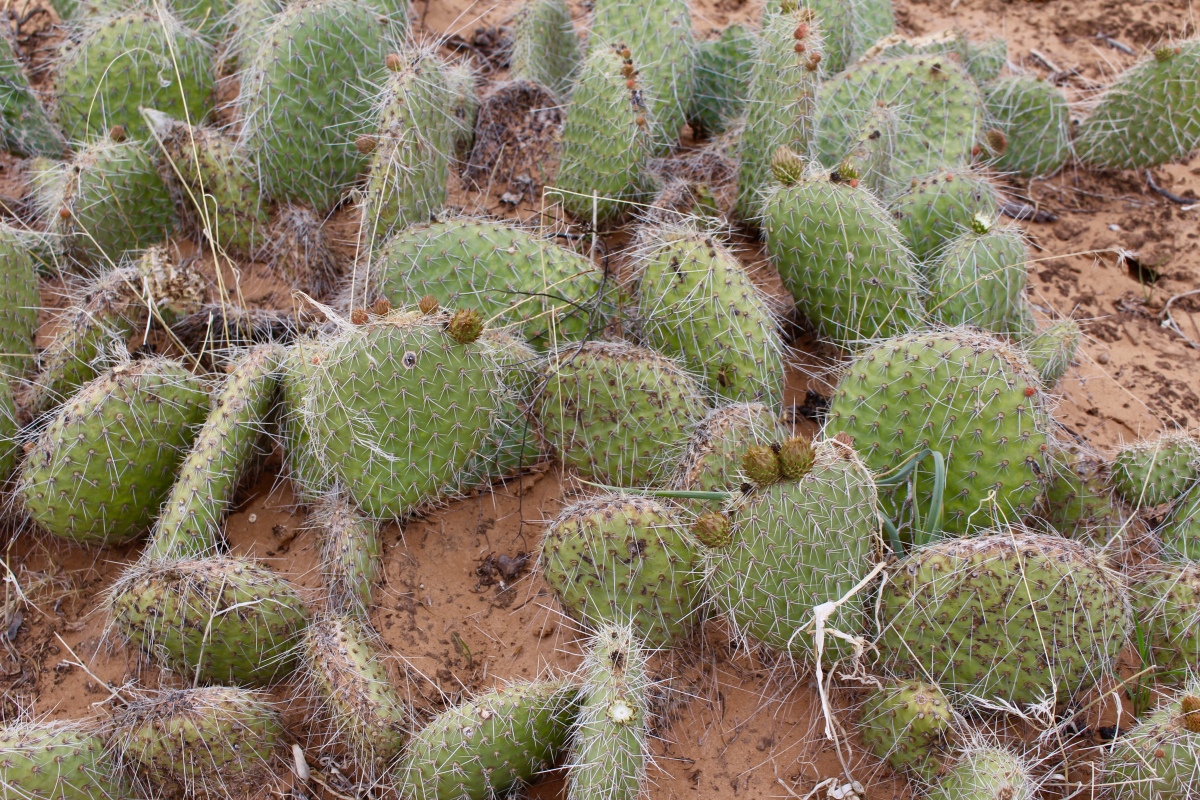
cacti
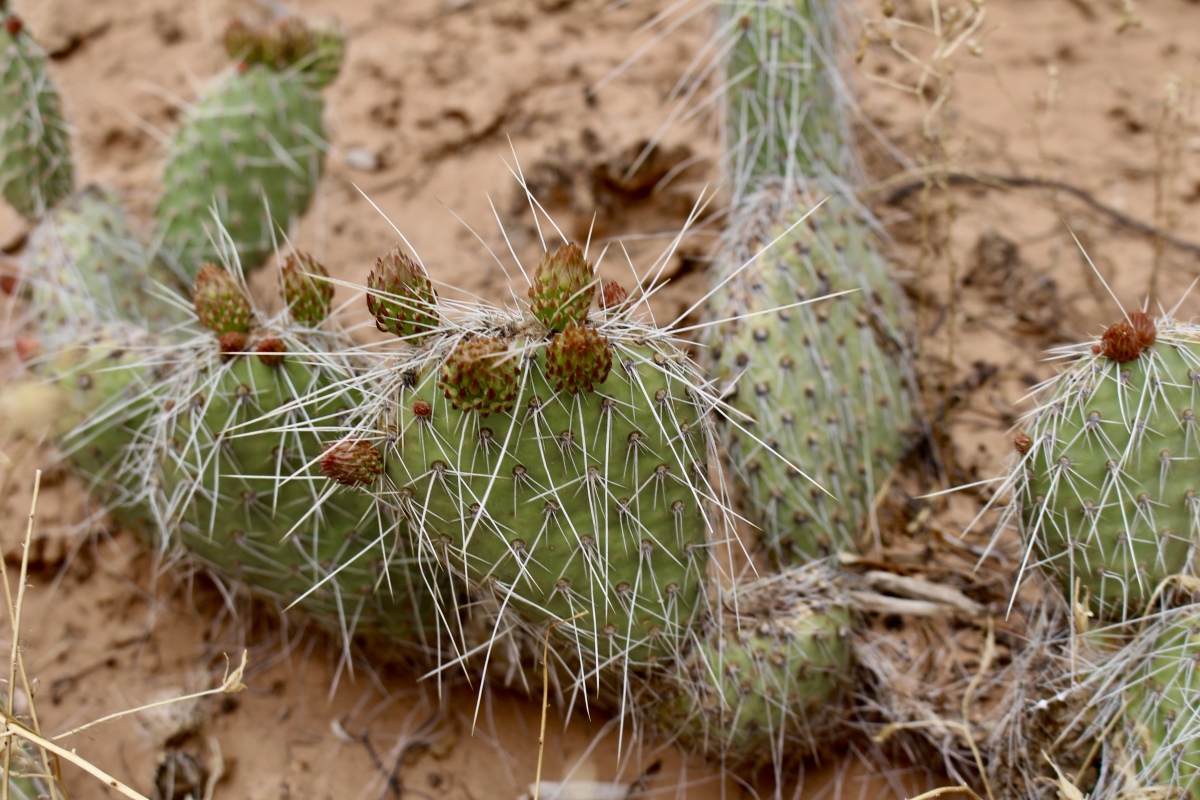
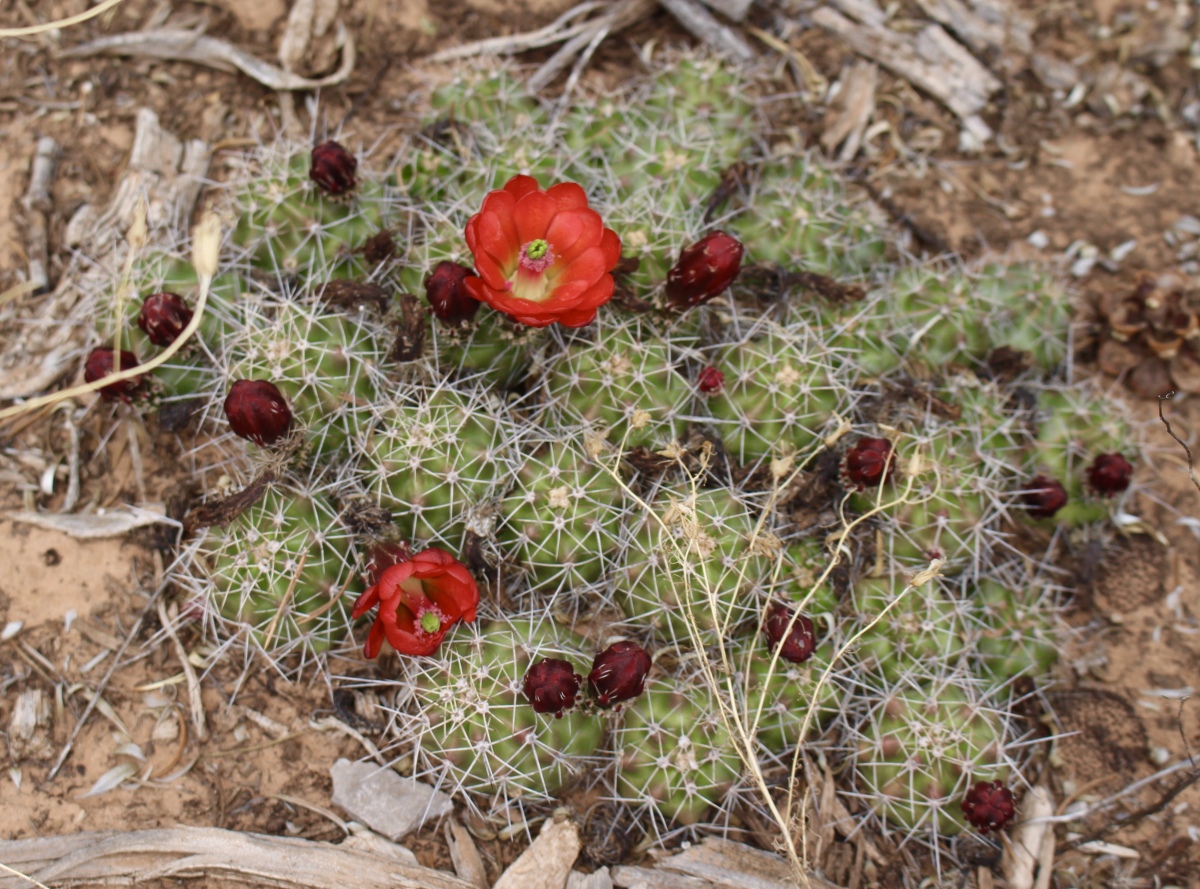
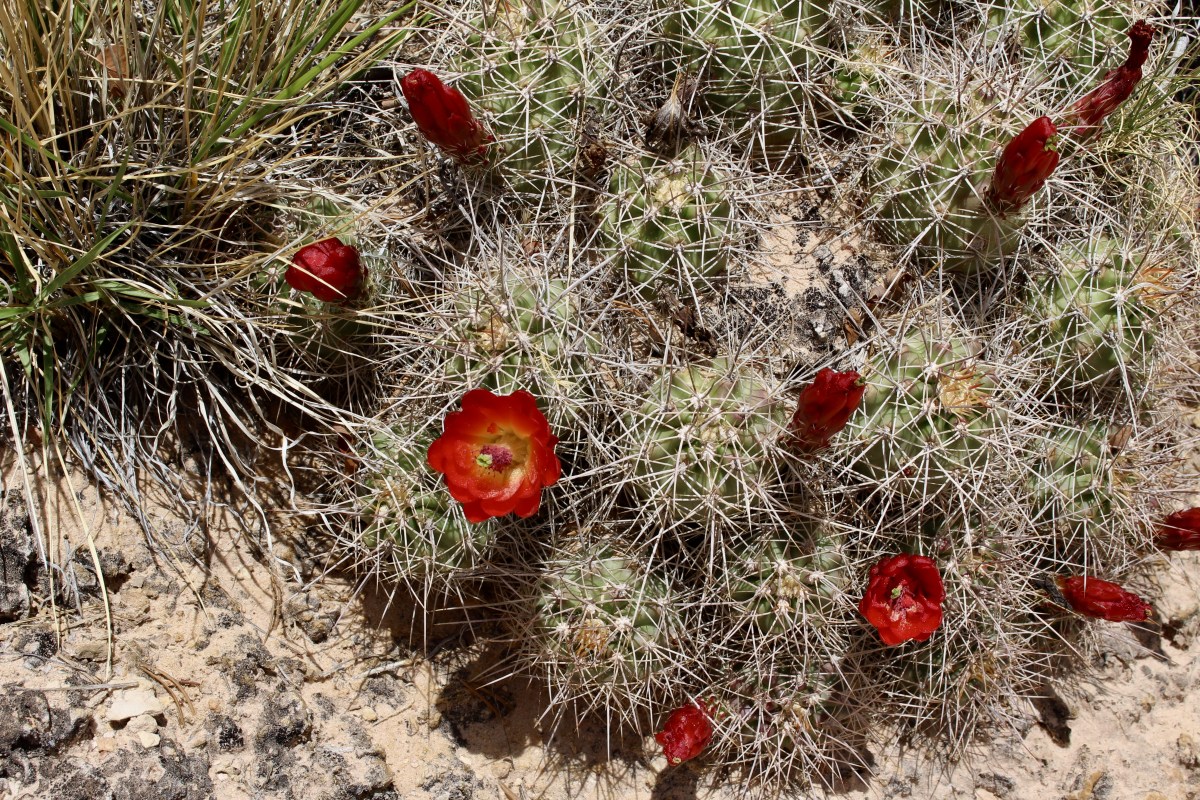
claretcup cactus
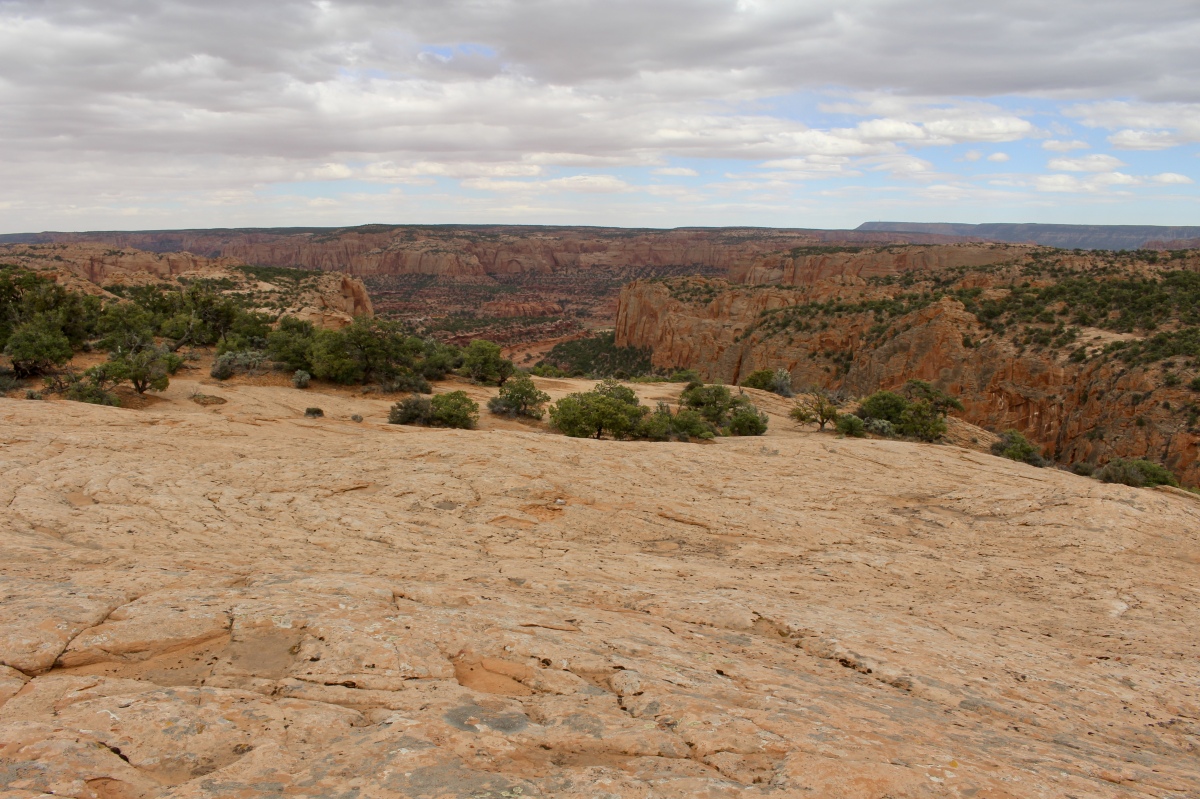
the Canyon View Trail
cacti
Each of these hikes was about 0.8 miles round trip.
*Saturday, May 12, 2018*
***********************
On Sundays, I plan to post various walks that I took on our Four Corners trip as well as hikes I take locally while training for the Camino de Santiago; I may also post on other unrelated subjects. I will use these posts to participate in Jo’s Monday Walks or any other challenges that catch my fancy.
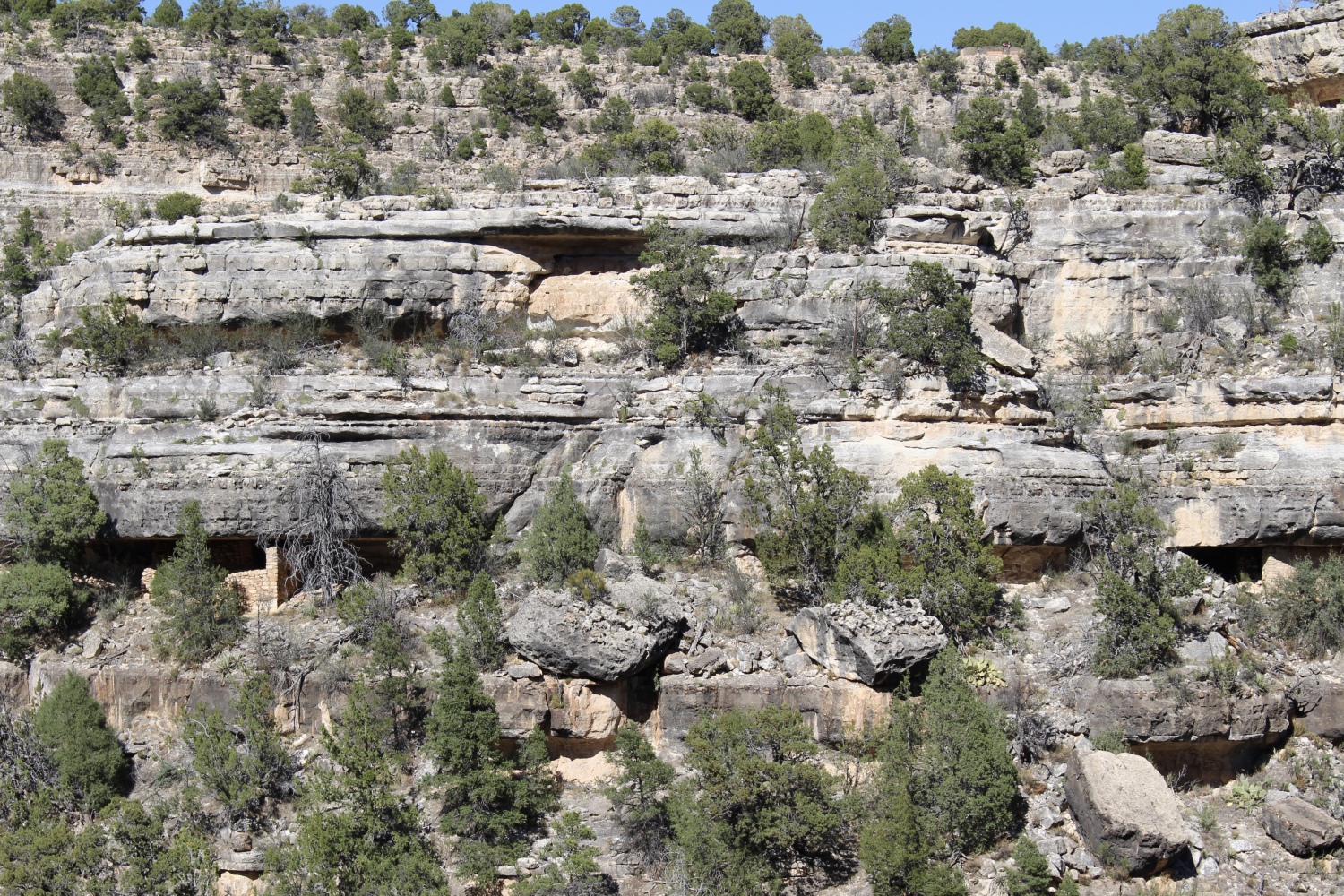
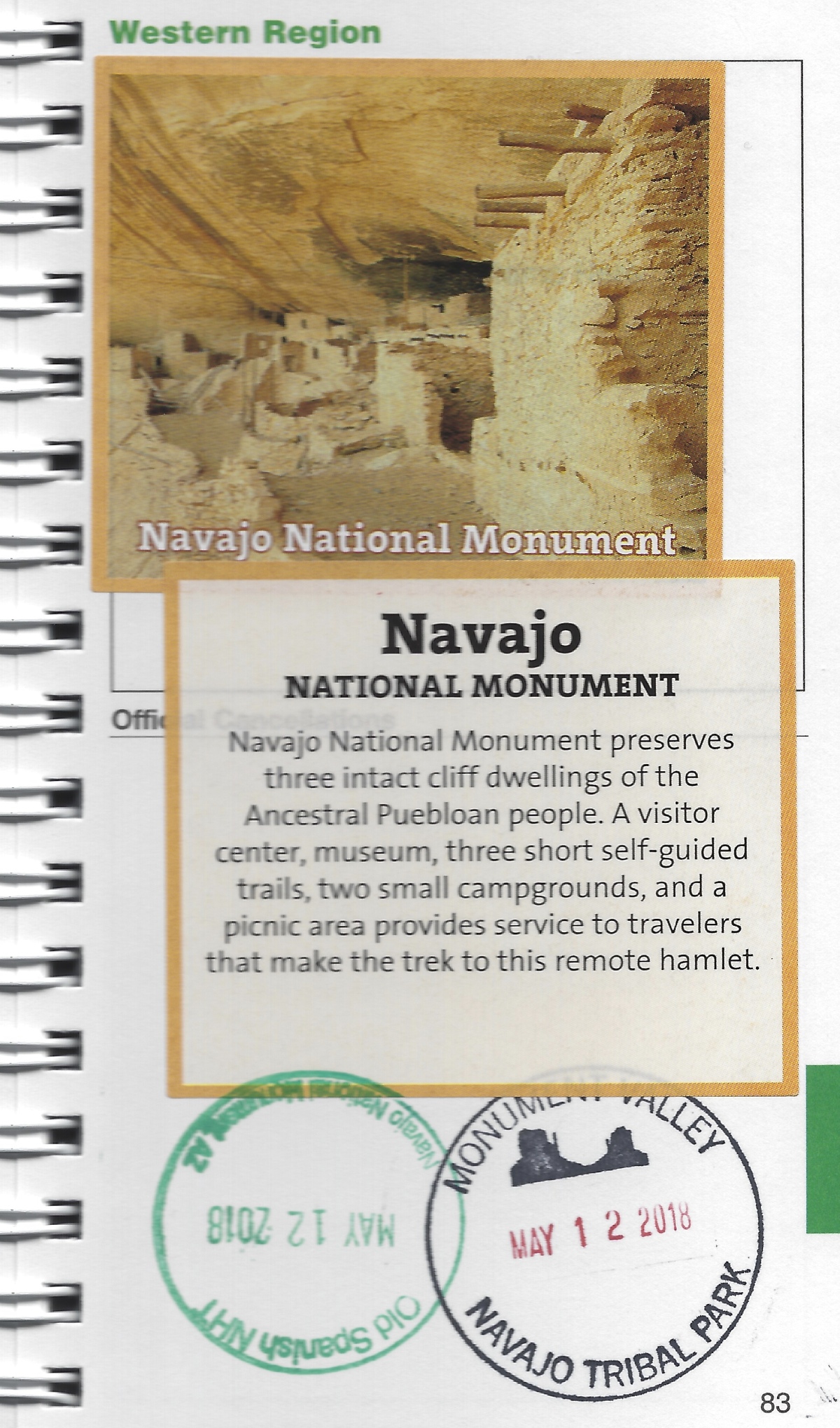
Named for the people who now occupy this region, Navajo National Monument in Arizona protects three well-preserved dwellings built hundreds of years ago by the ancient people of the Four Corners region, called Ancestral Puebloans. The dwellings are Betatakin, Keet Steel, and Inscription House, dating from 1250-1300. In the cliff faces and terraces of the Tsegi Canyon system, modern Diné (Navajo) life carries on today, hand in hand with the distant past. The Diné are sometimes called Anasazi, or “ancient ones,” or “ancestors of the aliens,” however the preferred term is Ancestral Puebloans.
Around 2,000 years ago, a distinct culture of farmers emerged, and by 1200 the land surrounding the National Monument was dotted with farms of the Ancestral Puebloans. Rainfall was as scarce as it is now, but usually they adapted their lives and crops to the drought conditions. Harder times prompted the people to move their farms and villages, sometimes into the cliffs. After flourishing here for five decades, the people began to move away. Theories for their departure include: drought, erosion, social pressures, religious dictates, or other unknown influences.
The Ancestral Puebloans were great traders. They made ceramic pottery for trade. Rocks from elsewhere were used for grinding stones, tools or arrowheads. They traded for turquoise, shell, parrots, and macaws.
Visits to Betatakin and Keet Steel must done on a ranger-guided hike. Inscription House is closed to the public. The hike to Betatakin is a strenuous 5-mile round trip hike that takes 3-5 hours. The Keet Steel hike is a strenuous 17-mile round trip hike, wading at times through water.
Since we didn’t make reservations, and we didn’t have time to do the ranger-led tours, we opted for the three shorter trails in the park, starting with the Sandal Trail. This paved trail from the visitor center leads to an overlook with a stunning cross-canyon view of the ancient village of Betatakin, framed in its sandstone arch.
South of Sandal Trail, we enjoyed a magnificent view of Fir Canyon, filled with lush vegetation. The deeper and narrower the canyon, the less sunshine reaches into its depths, meaning less evaporation of rainwater. Because of this, plant life flourishes.
Fir Canyon
It is said that the climate of Fir Canyon is like an inverted mountain; the bottom is cooler and more humid and thus encourages plant growth and animal life. Ponderosa pine, Douglas fir, and aspen flourish in Fir Canyon.
Fir Canyon
atop the Sandal Trail with Betatakin Canyon to the north
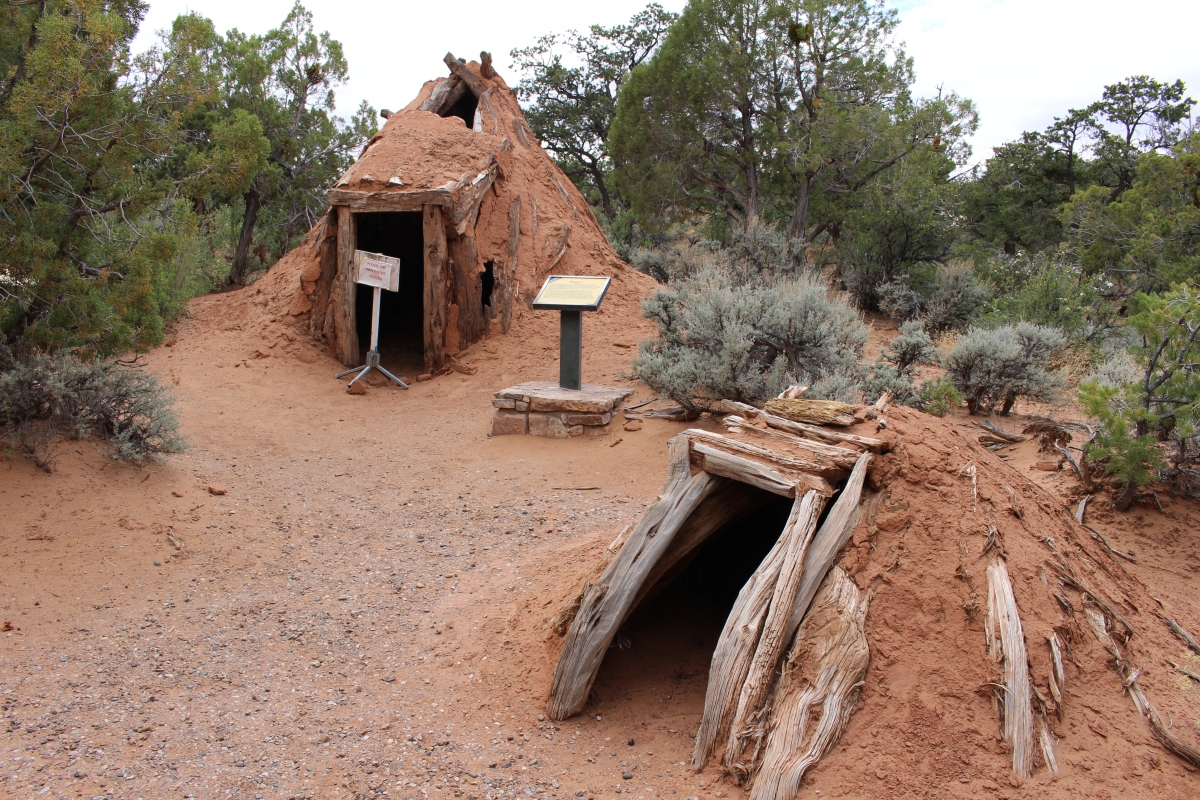
The Navajo Indians created the sturdy fork-stick hogan, made up of three poles with their forked ends interlocked at the top, as their desert dwelling.
The miniature fork-sticked hogan without a smoke hole is an effective bath, an ancient solution to keeping clean in a place where water is scarce. In the sweathouse, stones are heated in a fire, then rolled in, or carried in on a wooden fork. The bathers undress outside then crawl inside. A blanket is hung over the opening. Radiant heat then does its work; people relaxed their muscles and sang sweathouse songs. The bathers then emerged to rinse off with water, if any was available, or to rub dry with the soft, absorbent sand of Navajo country.
Hogan & Sweathouse
Both Navajos and Hopis used sagebrush to make medicine for stomach aches. The Navajos used it to cure colds and headaches.
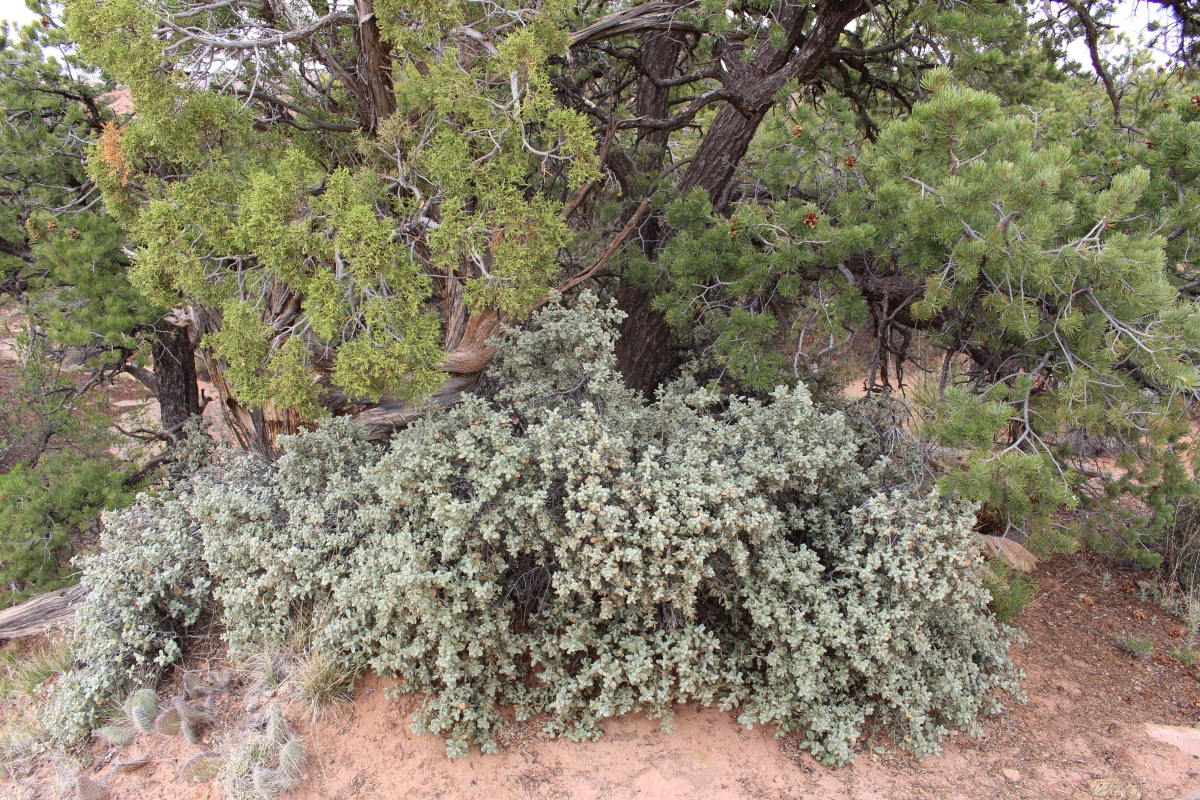
The roundleaf buffaloberry was used as a salve to treat irritation in sheep’s eyes. As the first domestic sheep were brought to the Southwest in the 16th century, it wasn’t used until white men came to the area.
Roundleaf Buffaloberry
pinyon pine
juniper
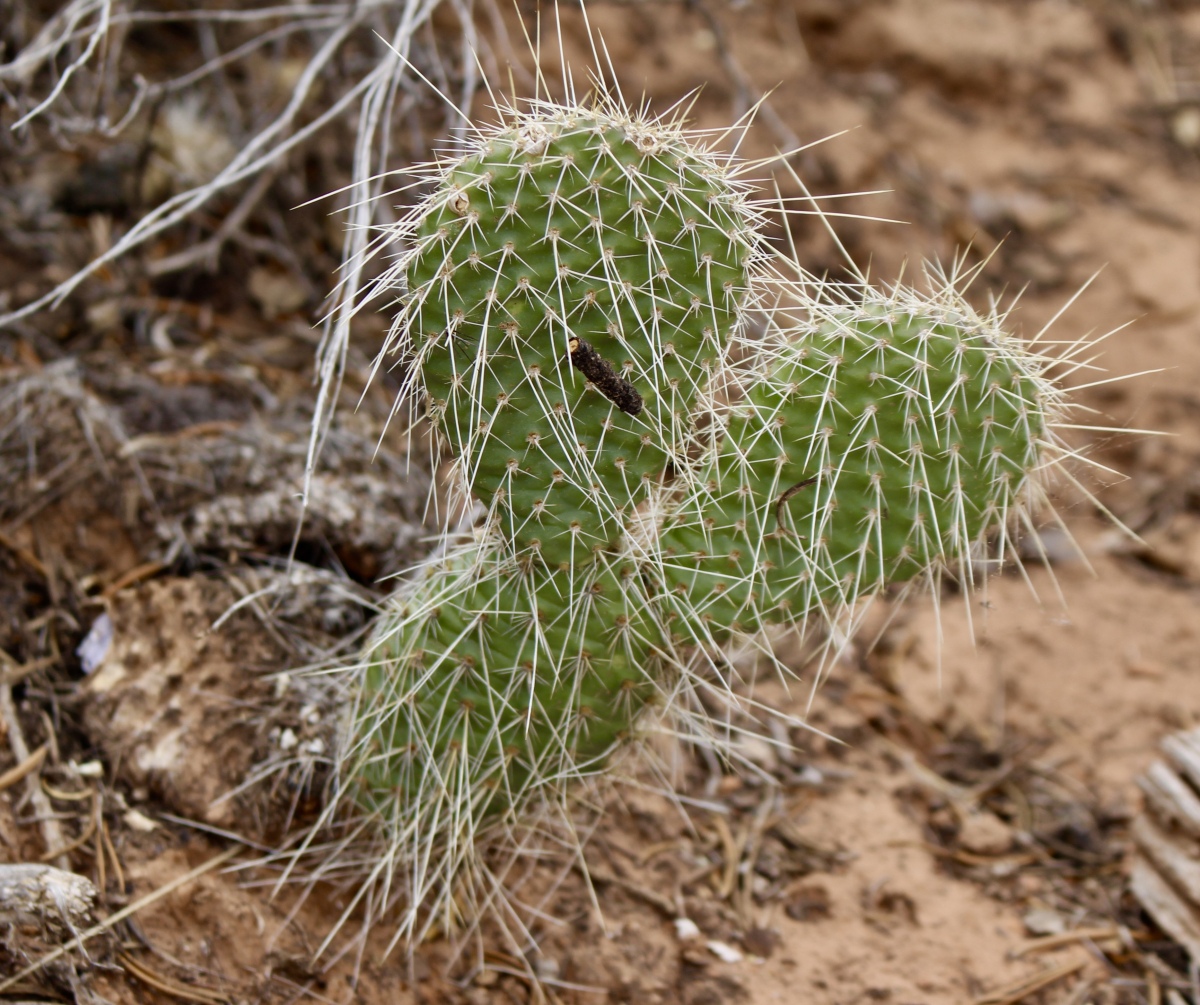
The fruit of the Grizzlybear Pricklypear cactus was widely eaten, fresh or dried, by Southwestern Indians.
Grizzlybear Pricklypear
Juniper on Sandal Trail
As with the narrowleaf yucca, native people ate the fruit of the broadleaf yucca, and shredded and twisted the leaves into cord and rope. Soap came from the crushed roots and was used as a shampoo in Navajo and Hopi ceremonies.
Broadleaf Yucca
Mormon Tea, when made into a brew, was medicine for stomach trouble, kidney afflictions, venereal disease, and coughs.
The Utah Juniper had many uses. Many roof beams in Betatakin were juniper. Fires were started with juniper: the shredded bark was used for tinder and the wood was used for fuel. The shredded bark also served as diaper pads, was braided into rope, and was coiled into rings to support pottery jars. A brew from the leaves was used by the Hopis as a laxative, and when people were hungry, the berries were eaten.
Mormon Tea
Pinyon Pine
Utah Juniper
Finally, we arrived at the Betatakin Overlook. We could see the south-facing alcove, which provided winter and summer shade, shelter from the elements, and springwater for drinking and cooking. At its height, 100-125 people lived here in clan or family groups. They didn’t spend much time indoors; most activities took place in open courtyards or agricultural fields. Archeologists have documented 135 rooms, some now destroyed by rockfall. Rooms were used for food storage, living, and ceremonies. The people used sandstone, soil, wood, bark, reeds and grasses either alone or in combination. Smoke residue indicates fires for cooking, warming or ceremonies.
Betatakin
The Puebloans grew cotton, using dry-land and irrigated farming techniques.
Betatakin
Betatakin, a Diné word for “House on a Ledge,” is also known as Talastima, which means “Place of the Blue Corn Tassels.” Today, this place is surrounded by the Navajo Nation, as it has been for hundreds of years.
Betatakin Canyon
Betatakin
Tree-ring dating shows that a 20-year drought ended about 1300. The farmers who had a close relationship with the land took this as a message that it was time to move on to find the spiritual center of the world. Hopi oral history says this sacred site is not abandoned; the builders are still here with us.
Sandal Trail
Sandal Trail
Pinyon Pine
The Sandal Trail is said to be 1.3 miles round trip, but somehow we mapped three miles. Of course, I got my National Park passport sticker and stamp! 🙂
Navajo National Monument
*Saturday, May 12, 2018*
***********************
On Sundays, I plan to post various walks that I took on our Four Corners trip as well as hikes I take locally while training for the Camino de Santiago; I may also post on other unrelated subjects. I will use these posts to participate in Jo’s Monday Walks or any other challenges that catch my fancy.
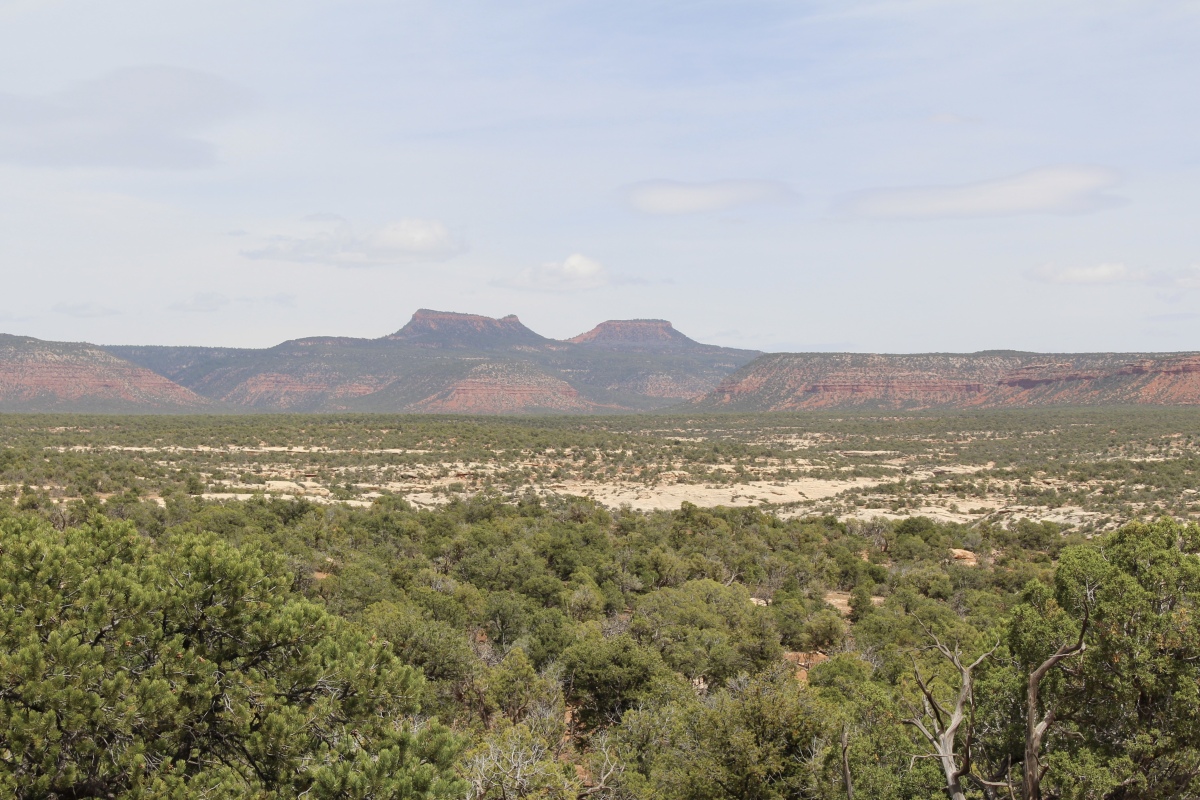
After leaving Natural Bridges National Monument, we headed east to Hovenweep National Monument. It was quite a long drive through a barren landscape, but it was well worth the visit. We got a far-away glimpse of Bears Ears National Monument along the way. Several Native American groups, including the Navajos, Utes and Pueblos, consider this area sacred and include it in their oral traditions. Our President has directed that it be reduced substantially in size.
Bears Ears National Monument from a distance
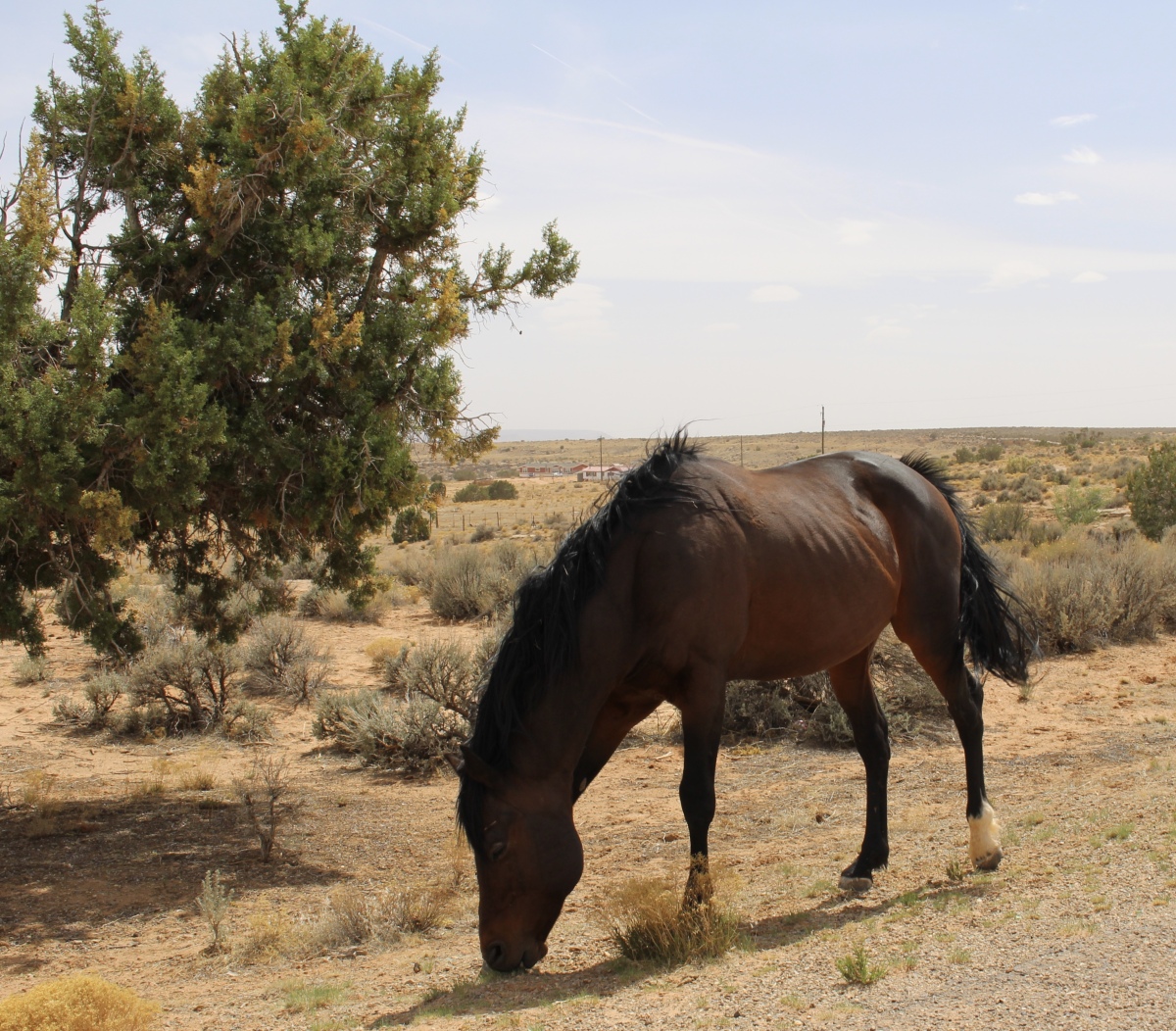
The landscape as we drove through the Navajo Nation was arid, all tans and browns with barely a speck of green. Donkeys grazed on open range and rather skeletal-looking horses kept their heads down. A strong wind bandied about swirls of red dust. Derelict trailers squatted on acres of dirt. A wooden sign for Church of God flapped from a signpost in the wind, while a white steeple perched atop a brown weathered barn like an afterthought. Small oil rigs bobbed up and down amidst sagebrush. It was a desolate drive.
horse on the way to Hovenweep
When we arrived at the Visitor’s Center, of course I had to get my passport sticker and cancellation stamp (see below). We saw a young lady collecting stamps for the Junior Ranger program. Wearing a straw hat, she brought to mind Mary Ann on Gilligan’s Island; her companion reminded us of the Professor. Later Mike said she probably had a hell of a time hanging on to that hat in the heady wind.
Hovenweep National Monument
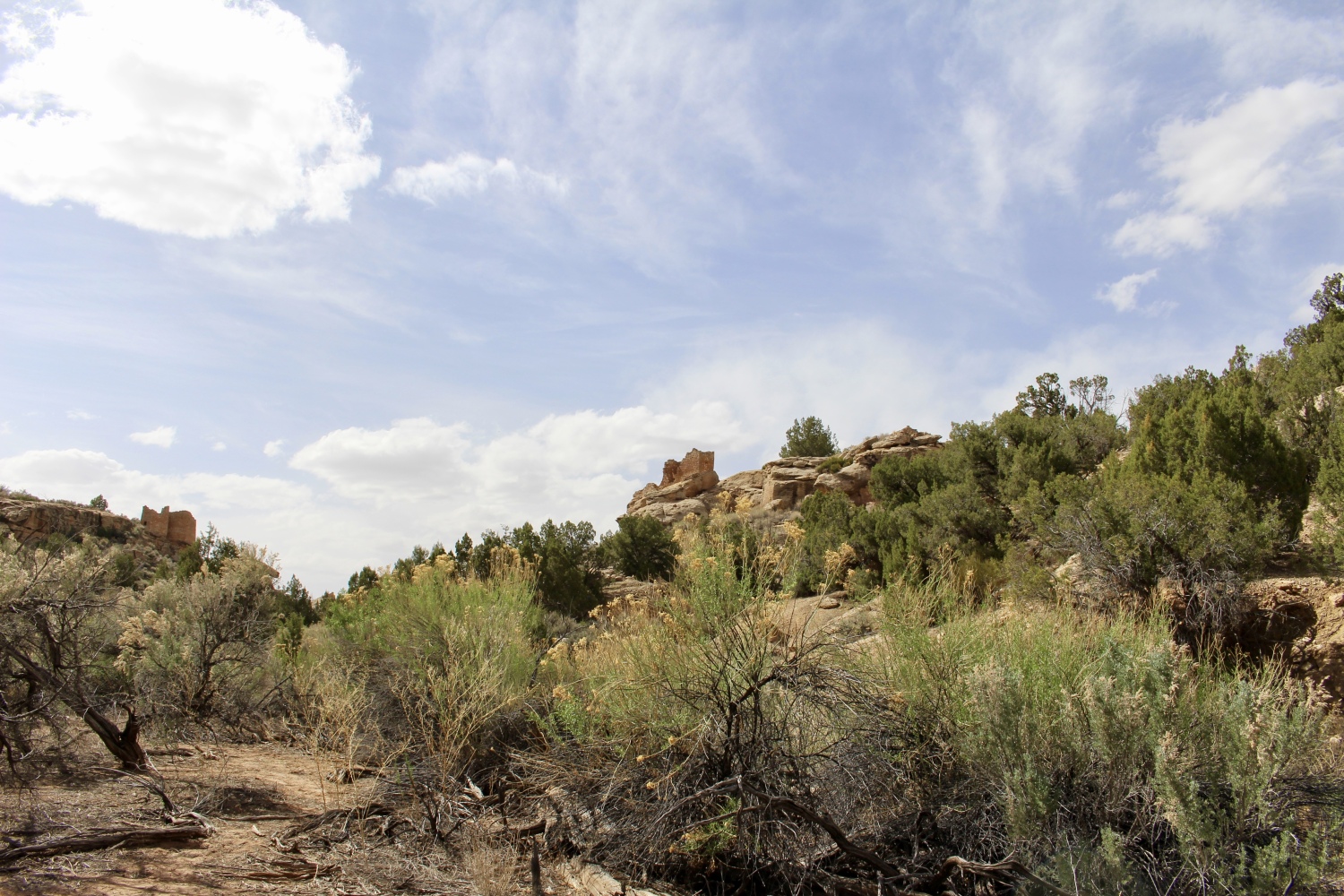
Hovenweep, which is Ute/Paiute for “deserted valley,” was once home to resourceful ancestors of today’s Pueblo Indian tribes. It was once a sizeable network of prehistoric villages. Many Pueblo people built their dwellings on canyon rims, often near springs and seeps near canyon heads. Some locations suggest the people were protecting something, if not themselves then perhaps the water – essential to desert-dwellers. By the 1200s, the population had grown dramatically.
Despite marginal growing conditions, ancestral Pueblo people raised corn, beans, squash and other crops in small fields and terraces, often using check dams for irrigation. They used solar calendars and astronomy to calculate growing seasons. They also created pottery, jewelry and clothing to improve and add color to their lives. They were creative in building these rock, wood and mud mortar dwellings of various geometric shapes.
Perhaps drought, depleted resources, or internal strife accounted for the people’s sudden departure in the late 1200s. Today, the Hopi, Zuni and Rio Grande Pueblo tribes are considered the modern-day descendants of the people who created Hovenweep’s structures.
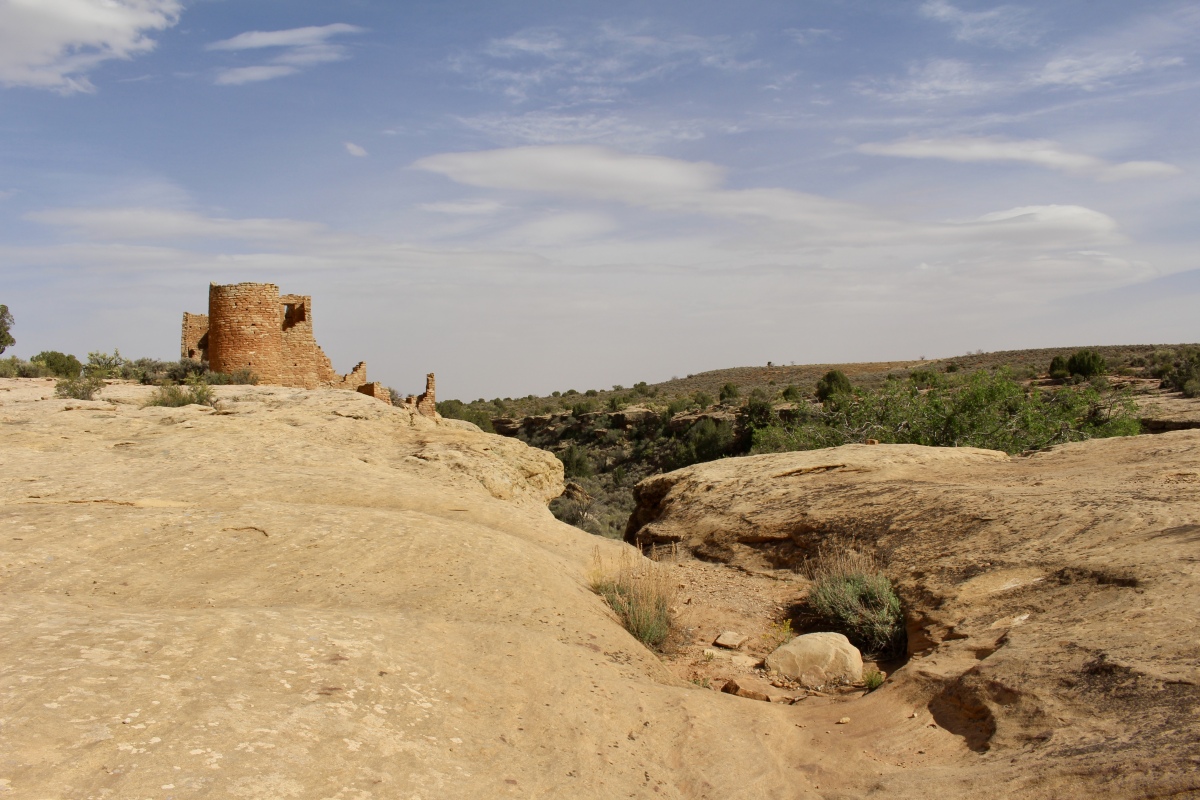
We set out to do the 2-mile Little Ruin Trail. First we found the Stronghold House, named for its fortress-like appearance. This is actually the upper story of a large pueblo built on the slope below. People entered the house by way of hand-and-toe holds chipped into the rock, or possibly by a wooden ladder.
Stronghold house
As the trail is a loop, we had to go down 80 feet into the Little Ruin Canyon, which was quite warm. Around us, we found big basin sagebrush (in the sunflower family), Green Ephedra (Mormon Tea), Utah juniper and cliffrose.
the path through the canyon
broom in the canyon
From the canyon bottom, we could see the ruins of Hovenweep Castle on the ridge at the far end.
the canyon
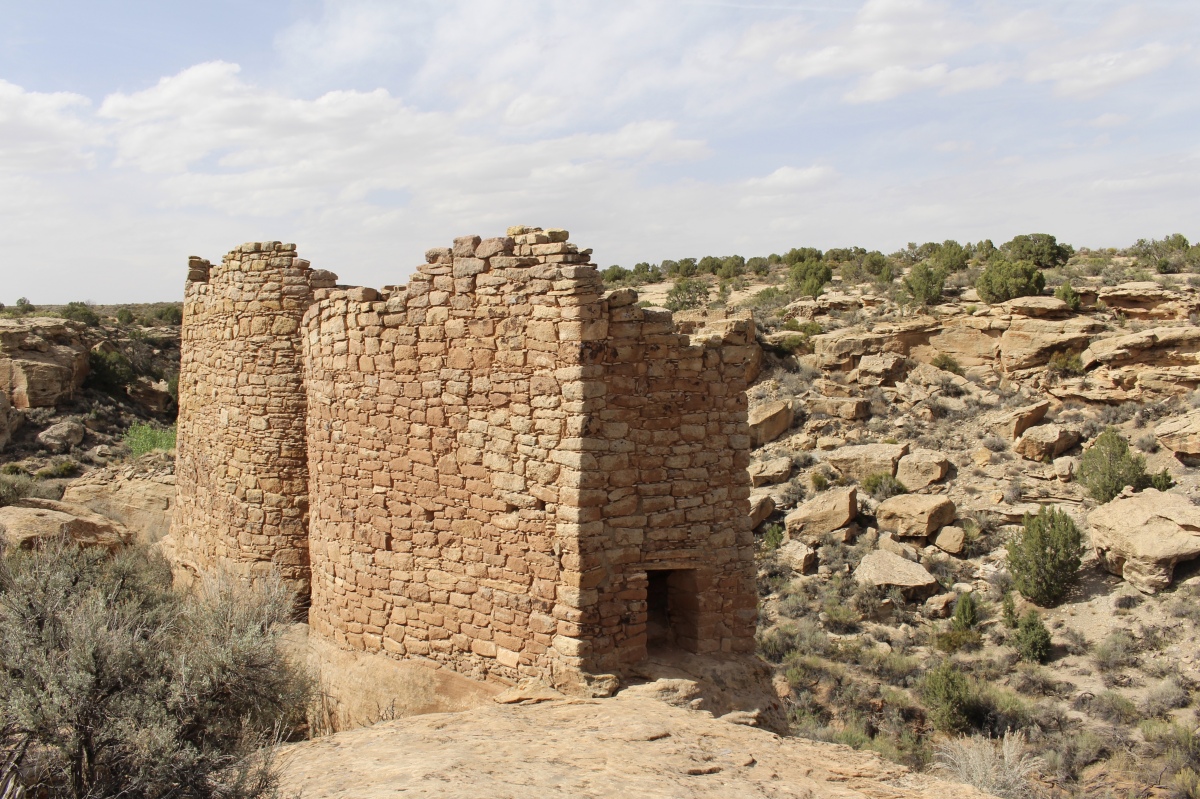
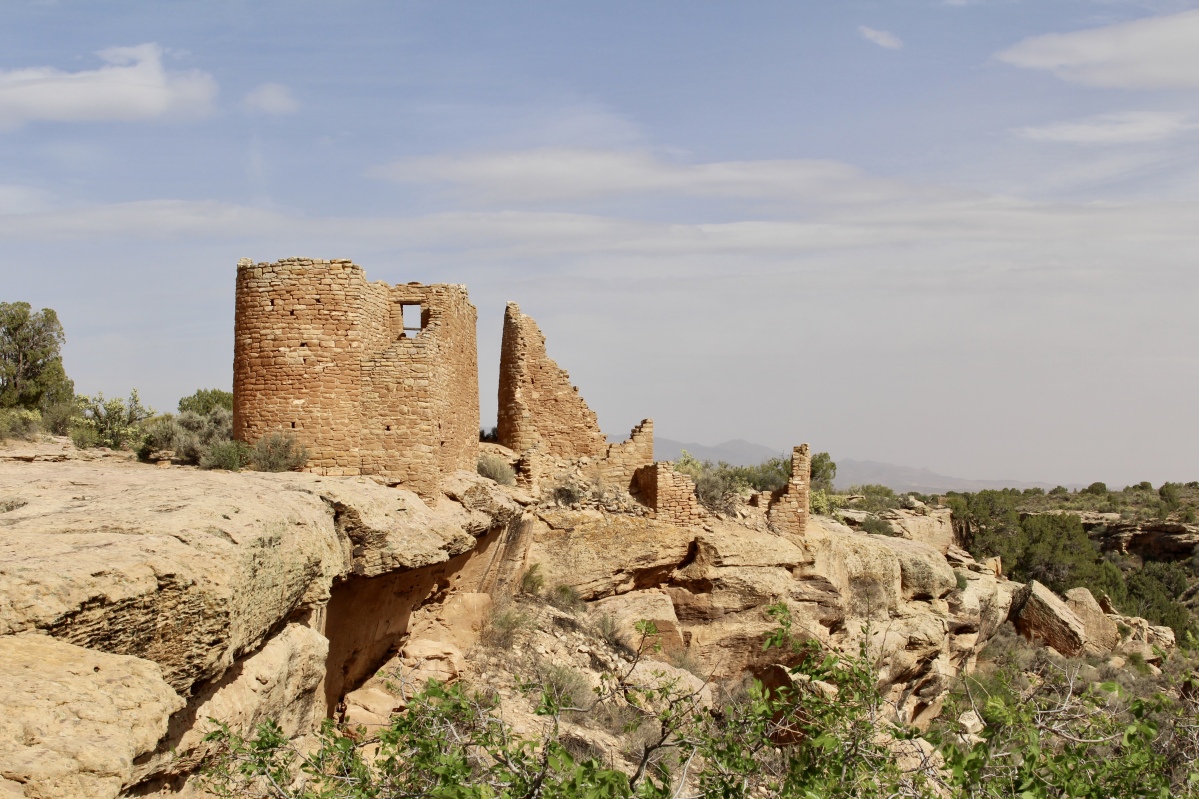
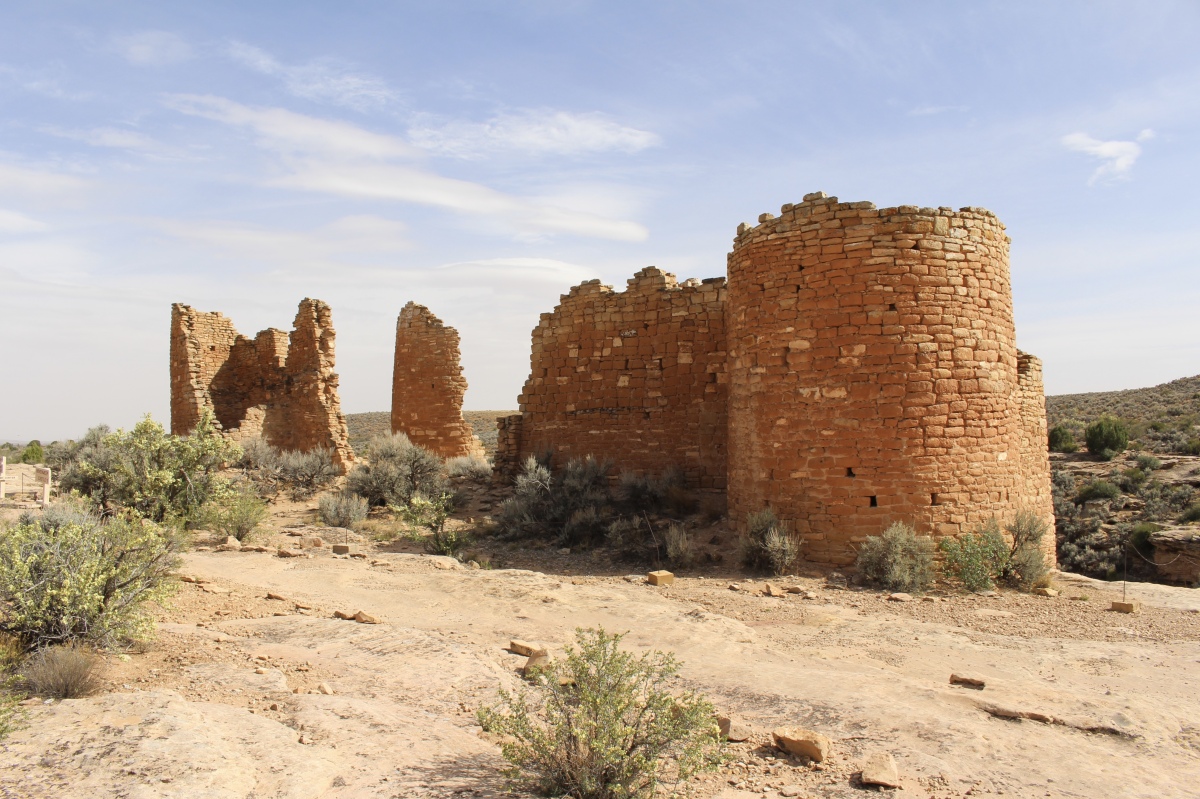
On the other side of the canyon, we found the Twin Towers. Together they had 16 rooms. The two buildings, one oval and one horseshoe-shaped, rose from the bedrock, their walls almost touching.
Twin Towers
Twin Towers
Square Tower
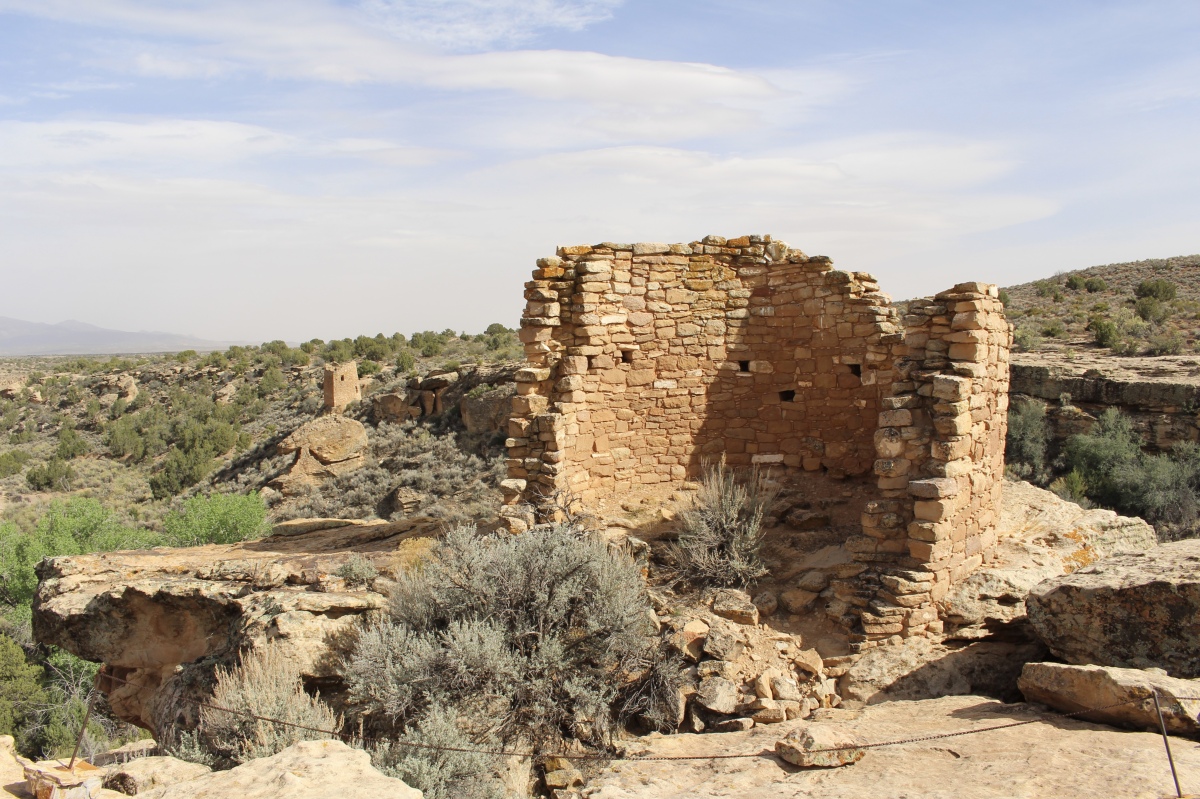
The Rimrock House lacks any room divisions, so it appears no one lived here. Rectangular in shape, it stands two stories high. Small openings placed at unusual angles may have served as peepholes, observation ports for sun tracking, or ventilation.
Rim Rock House
Twin Towers
In the canyon, we saw the remains of Round Tower. It was almost perfectly circular and was likely two stories tall.
Round Tower
Hovenweep Castle stands at the end of the canyon. It consists of two D-shaped towers perched on the rim of Little Ruin Canyon. Logs in this ruin were cut in the year 1277 CE. This was a residence, but not for royalty; rather, it housed farmers.
Hovenweep Castle
Hovenweep House was the center of one of the largest Pueblo villages in the Square Tower group. The masons took great pains with the stonework.
Hovenweep House
From the canyon rim, we could see Tower Point at the end. Here, people stored crops such as corn, beans and squash. A surplus harvest was essential for the Puebloans to get through years when crops failed. These granaries had to be tight and secure against rodents and seeping water.
Tower Point
Tower Point
the Little Ruin Trail
Hovenweep Castle
The two-story-tall Square Tower stands down in the canyon. A kiva was excavated beside Square Tower. Beside the tower are large hackberry trees that tell of the seep that trickles under the alcove. This precious permanent water source held the Square Tower settlement together.
Square Tower
Hovenweep Castle
the canyon
Tower Point
A line of rocks spanning a small streambed was a checkdam, built by the original early inhabitants. Hovenweep farmers built a series of checkdams all over the mesa, used to slow water in flash floods, back up rich pockets of soil, or enhance the flow of springs below. Others may have prevented washouts of crops planted in the canyon bottoms.
A great deal of the mesa top land was devoted to agriculture. Pueblo farmers had to plan for bad years by locating fields in favorable places, staggering plant times, and employing various water collection methods.
Checkdam
Hovenweep Castle
Hovenweep Castle
The most striking thing about Tower Point was its commanding view up and down Little Ruin Canyon.
Tower Point
Tower Point
Tower Point
Tower Point
We made our way back to the Visitor’s Center, passing a Unit Type House. This was a basic building plan found throughout the southwest, usually containing a few living and storage areas and one kiva. It likely served as home to a family or clan.
Unit Type House
Eroded Boulder House incorporated the huge rock under which it sat as part of its roof and walls.
Eroded Boulder House
We finished the two-mile hike at 5:30. It was a great hike, down into and up out of the canyon, then a mostly level loop around the rim over slickrock.
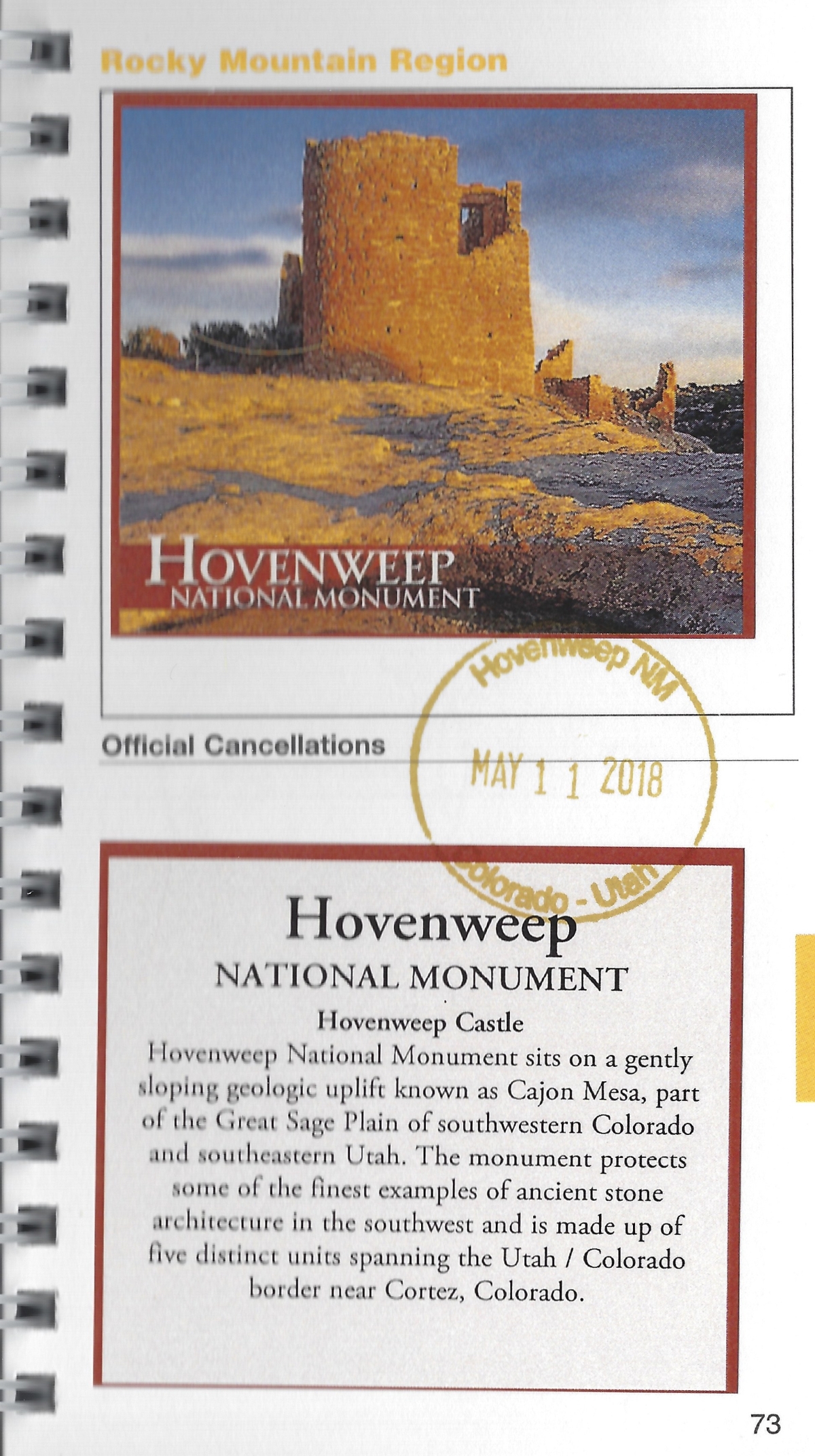
Here is my National Monument sticker and stamp for Hovenweep. As I’d already filled in all the spaces for the Rocky Mountain Region in my first passport, I had to buy a second passport. I wonder how many I’ll need when all is said and done!
Hovenweep National Monument sticker and stamp
After leaving Hovenweep, we drove to Bluff, Utah, where we spent the night. All in all, we walked 14,602 steps today, or 6.18 miles.
*Friday, May 11, 2018*
***********************
On Sundays, I plan to post various walks that I took on our Four Corners trip as well as hikes I take locally while training for the Camino de Santiago; I may also post on other unrelated subjects. I will use these posts to participate in Jo’s Monday Walks or any other challenges that catch my fancy.
After leaving Moab, we headed to one of our favorite parks we encountered on the trip, Natural Bridges National Monument. It sits in a high desert environment, with elevations of 5,500-6,500 feet and average yearly precipitation of 13 inches. As the park is somewhat off-the-beaten-track, we only had time to visit this one and Hovenweep National Monument today, ending up in Bluff, Utah.
We drove the 9-mile paved one-way loop road around Bridge View Drive, which leads to overlooks and trailheads for all three natural bridges and the Horse Collar Ruin archeological site. As we were limited in time today, we sadly only had time for one hike. I would love to have done more. I will share photos of the overlooks to the other bridges and the ruins in another post.
Declared a National Monument in 1908, the bridges are named Sipapu, Kachina, and Owachomo in honor of the Native Americans that once made this area their home. All three bridges have gone through name changes over the years.
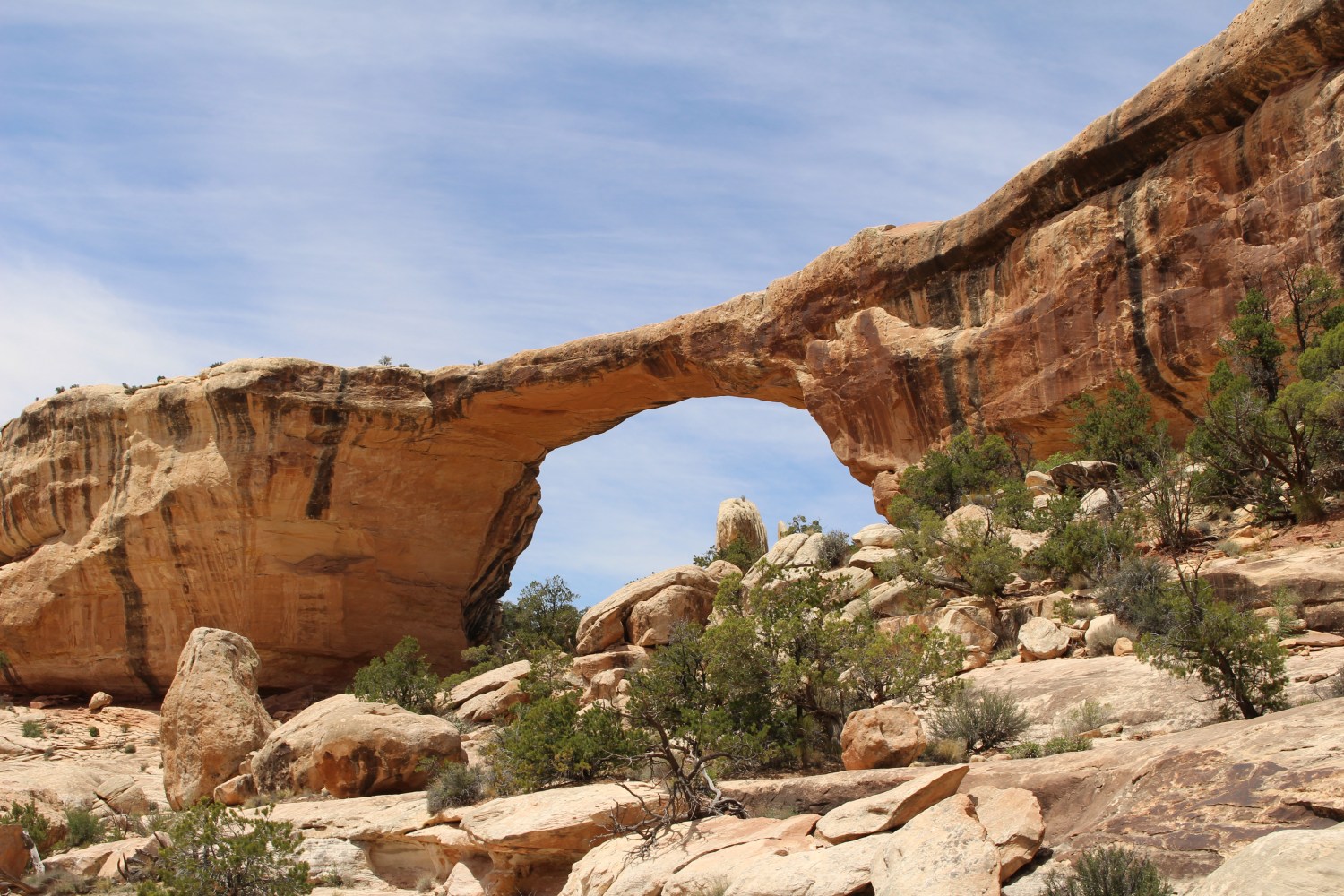
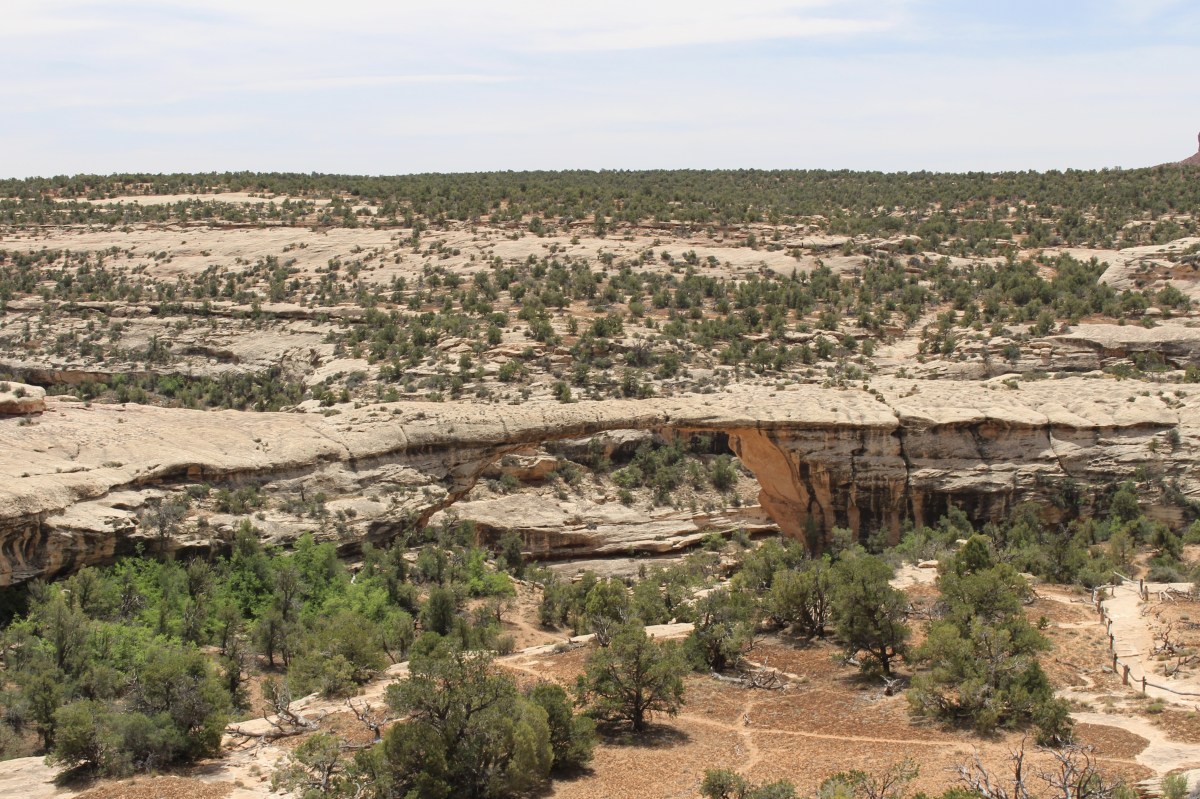
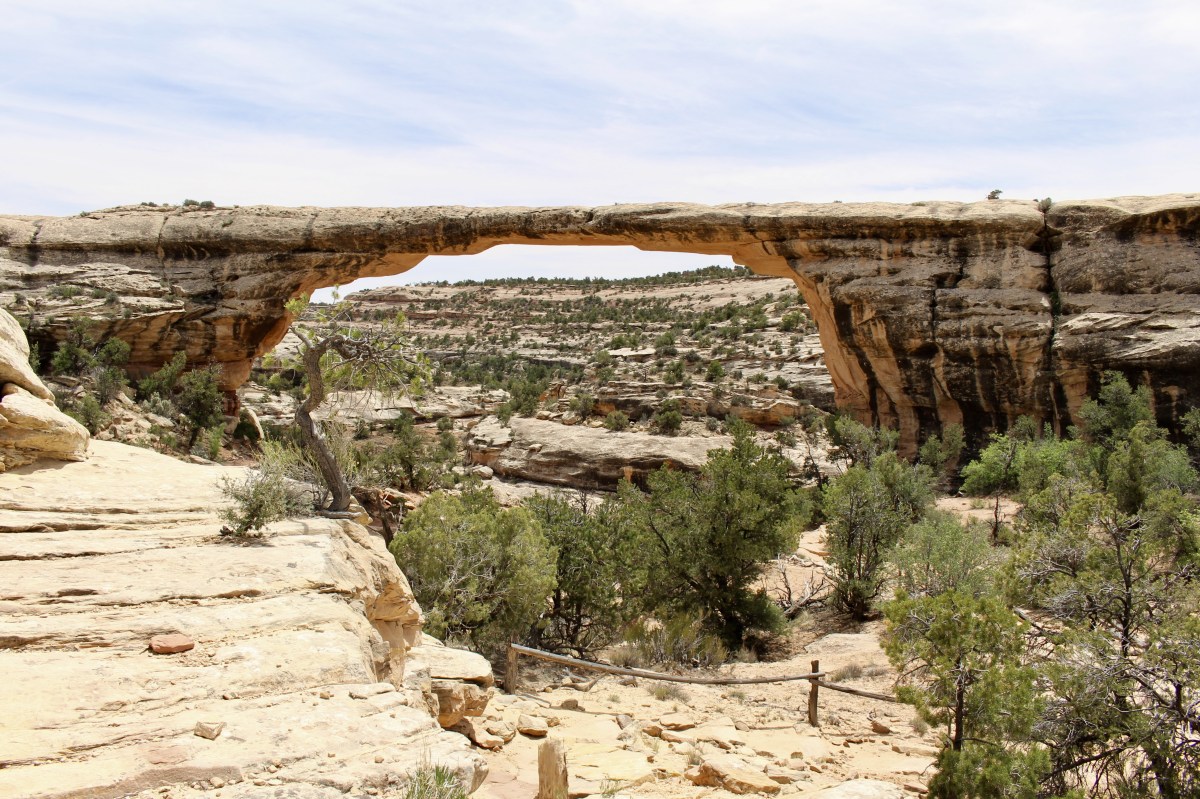
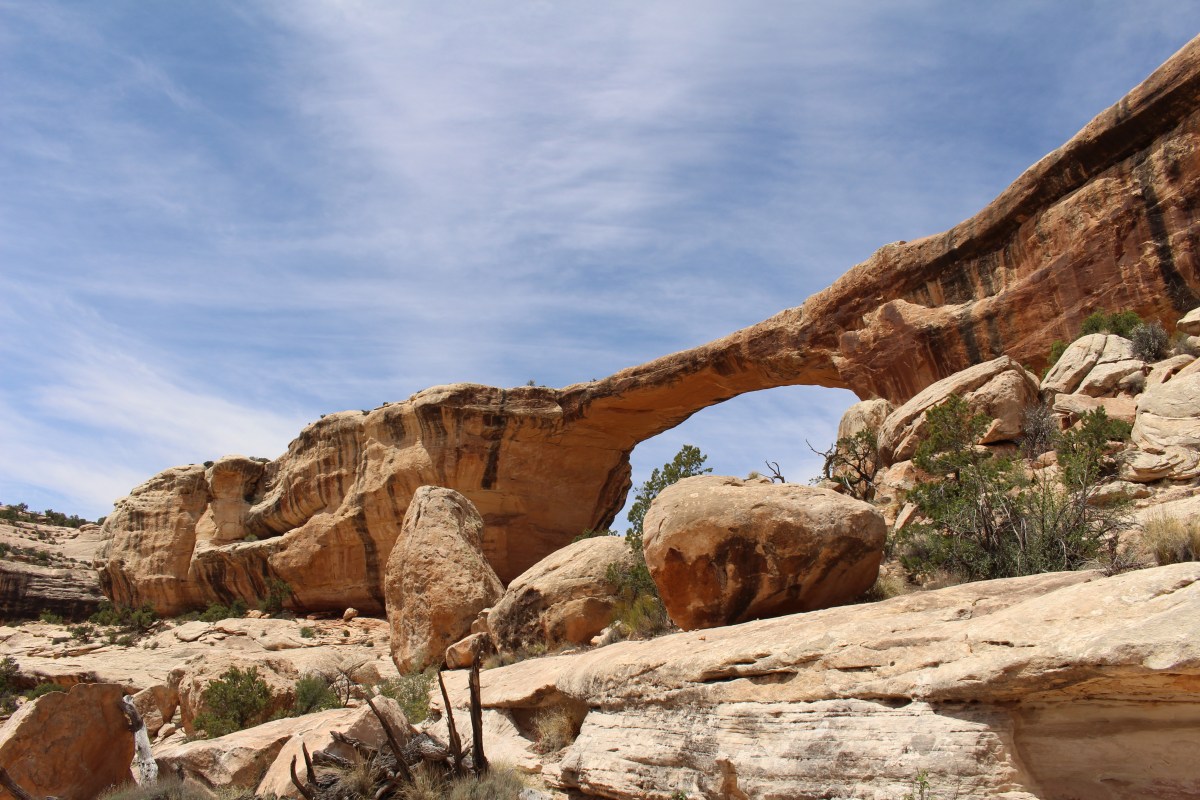
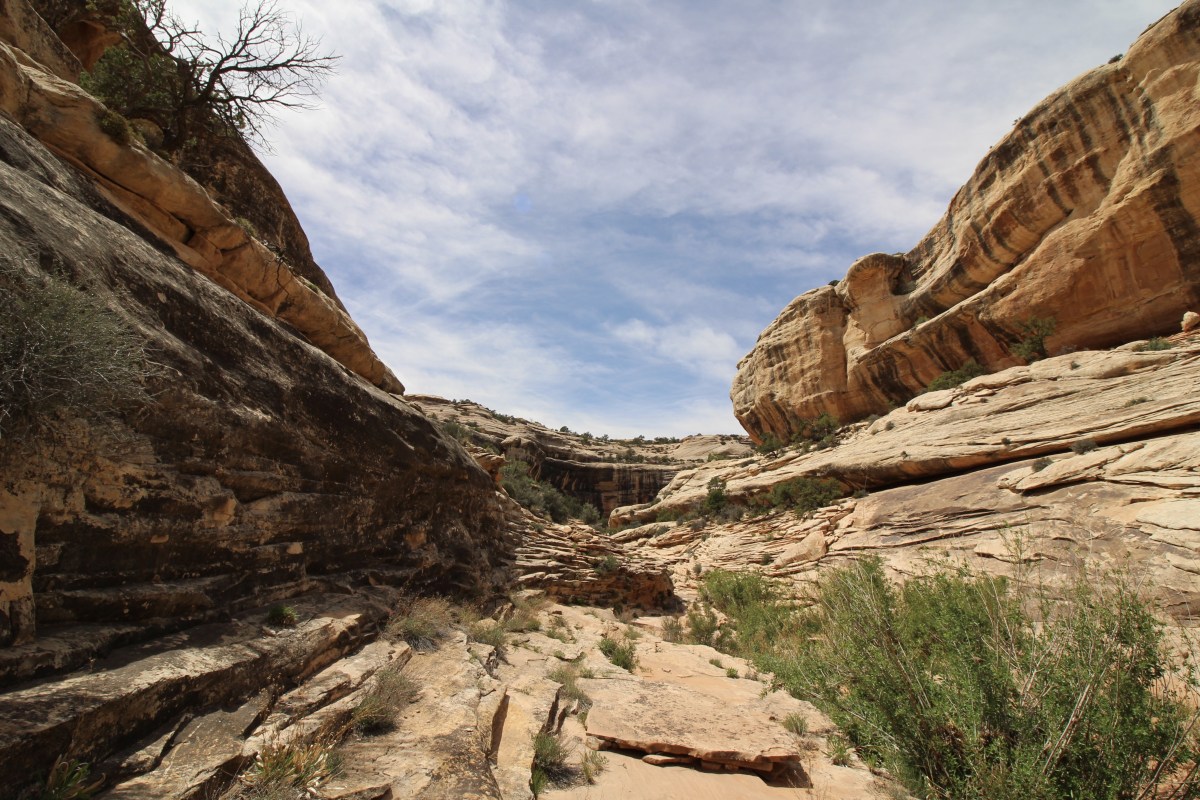
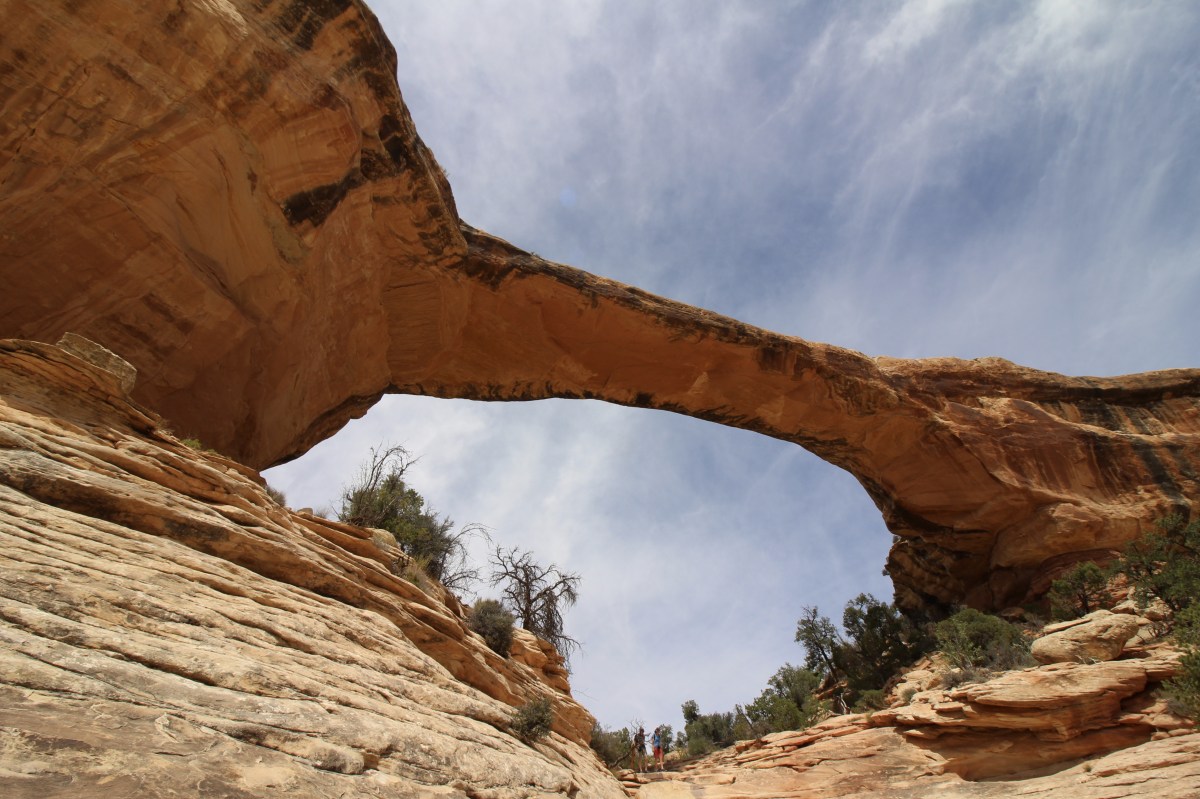
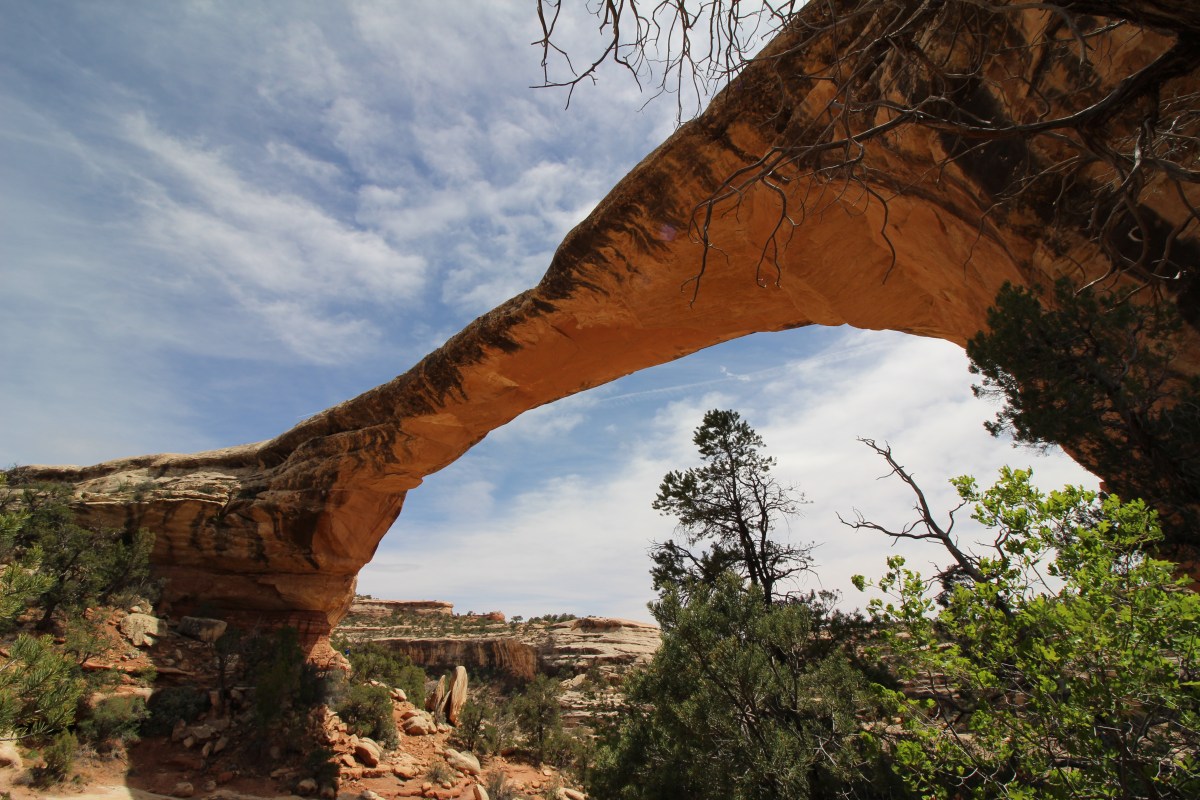
We took the Owachomo Bridge hike through pinyon-juniper forest, grasses, shrubs, hanging gardens, willows, cottonwood, Douglas fir and Ponderosa pine trees. Owachomo was once named Congressman; as the shortest in height at 106 feet, with a 180-foot span, it took the less powerful name, after President (Sipapu) and Senator (Kachina). Later explorers renamed the bridge Edwin. When the park was enlarged in 1909 to protect nearby Puebloan structures, the General Land Office affixed the Hopi names to the bridges.
looking down on Owachomo Bridge
Owachomo means “rock mound,” a feature atop the bridge’s east abutment.
looking down on Owachomo Bridge
approaching Owachomo Bridge
Mike at Owachomo Bridge
Owachomo Bridge
We went through the bridge to Armstrong Canyon on the other side. Here, Mike went one way and I went another. I think he missed out because I got the best views!
crossing through to the other side
cacti
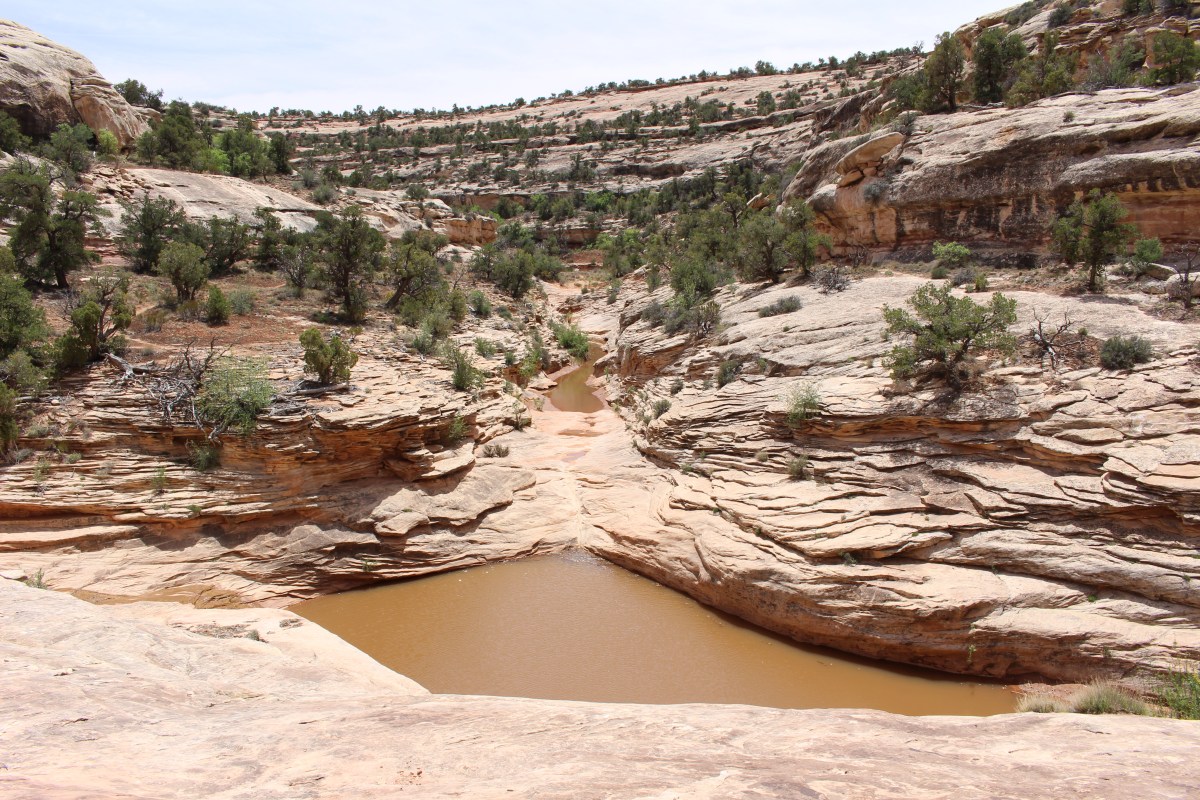
stream through Armstrong Canyon
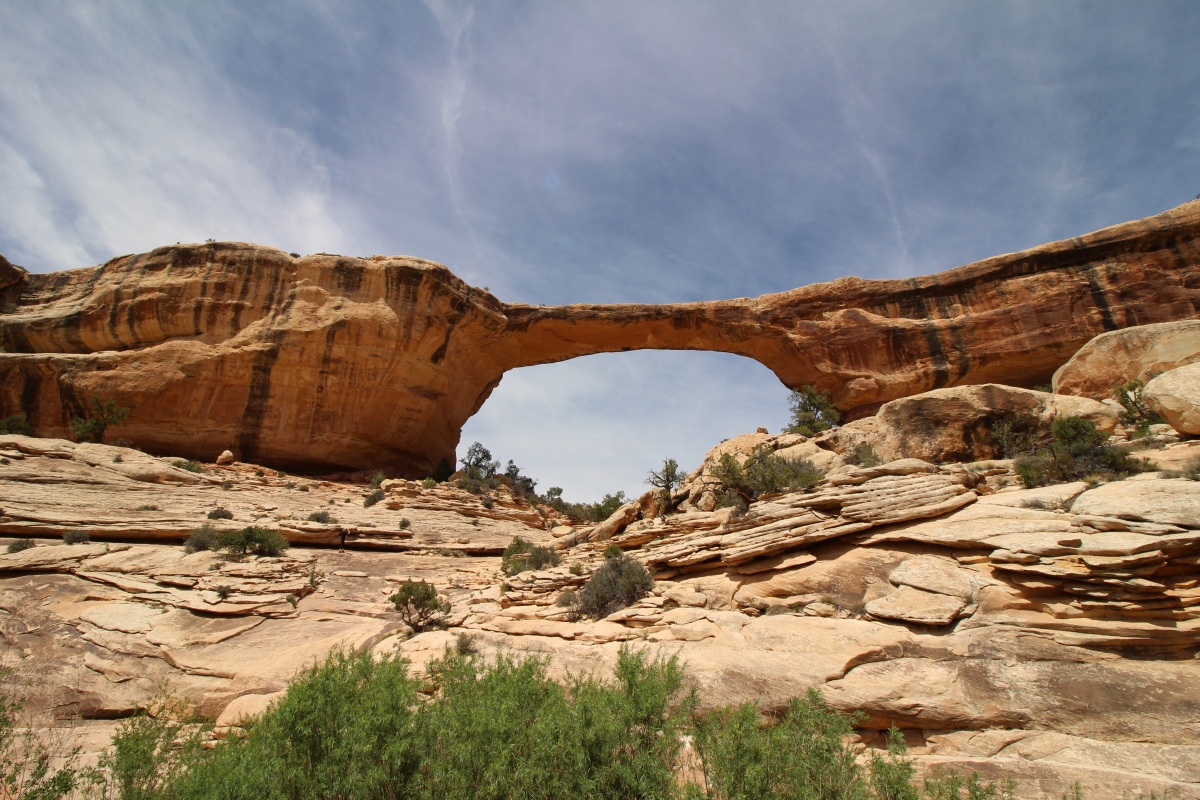
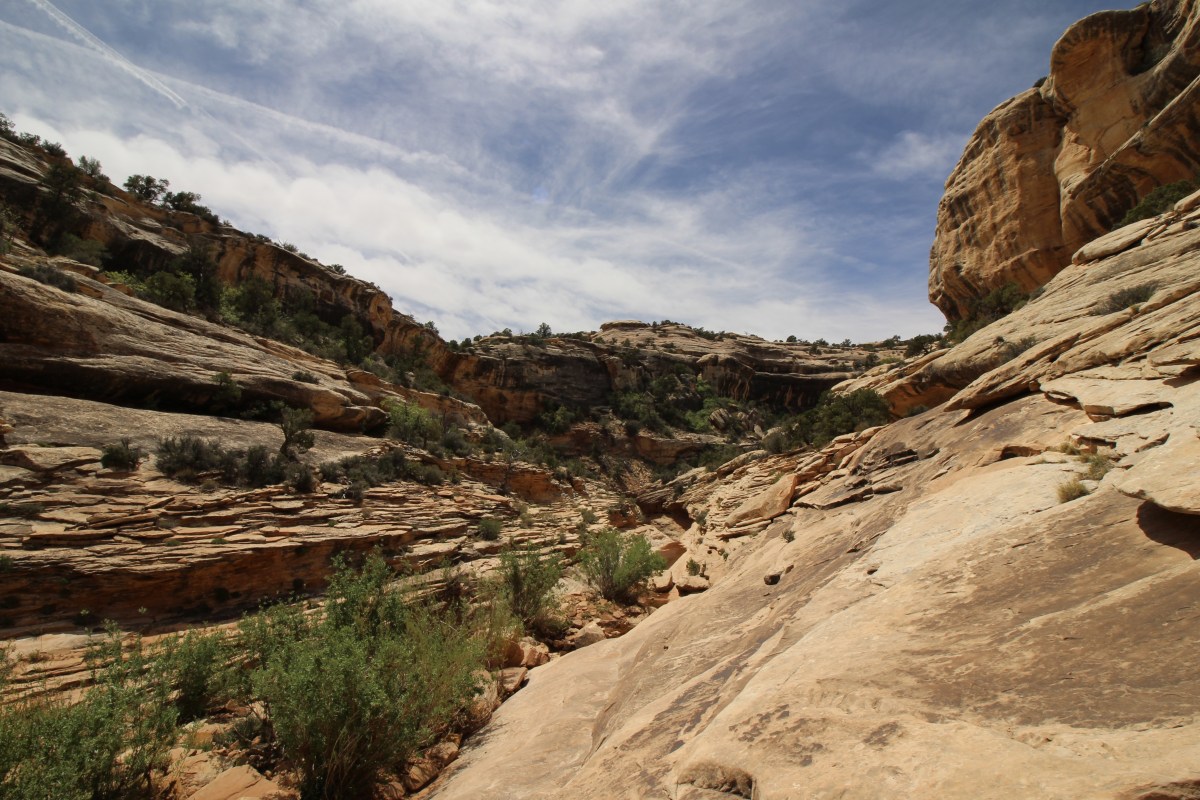
The rock here at Natural Bridges National Monument is sandstone first formed by windblown sand. White and Armstrong Canyons and their three bridges are results of water’s relentless action against the crossbedded sandstone. Episodes of great heads of water and sand scouring the desert stream set the conditions for forming the natural bridges. Owachomo, straddling no stream now, apparently was cut by two streams.
Owachomo Bridge
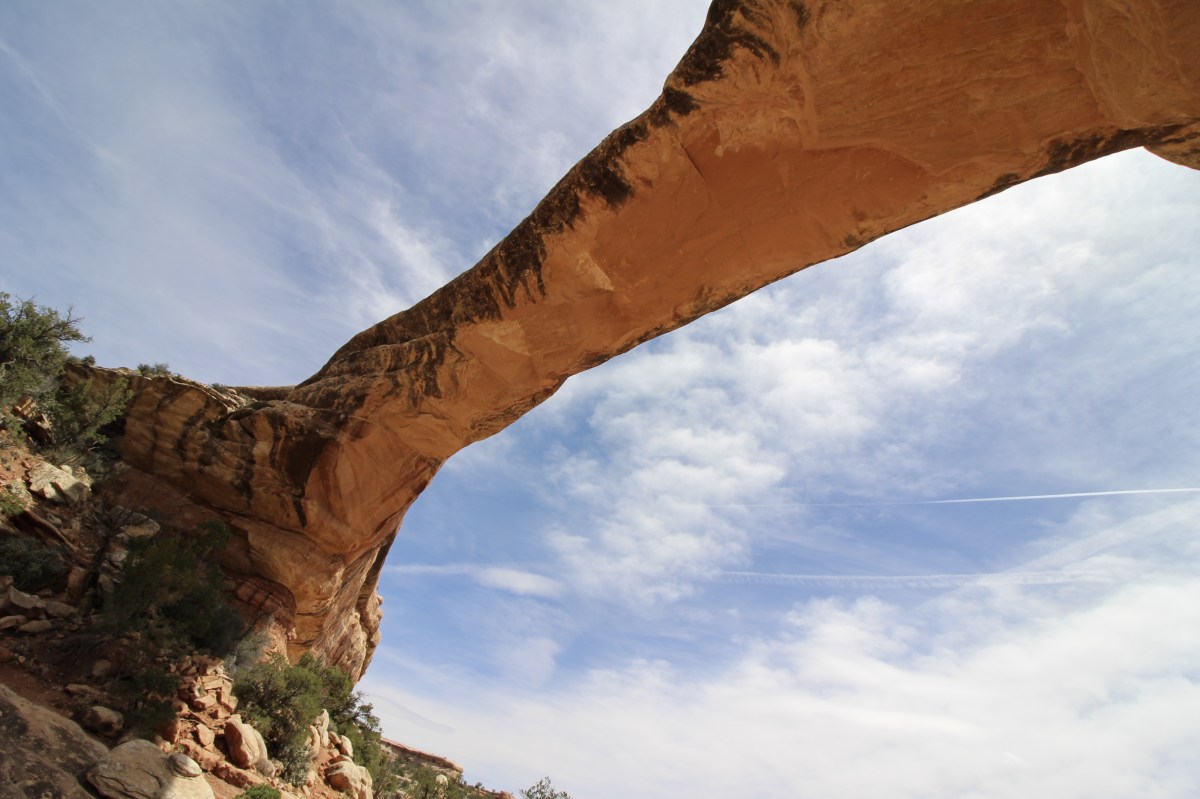
A natural bridge is temporary. Blocks fall from its underside, and its surfaces weather, wear, and weaken. The span of Owachomo, the oldest, has now worn thin.
Owachomo Bridge
Armstrong Canyon
Owachomo Bridge
Armstrong Canyon
Owachomo Bridge
in Armstrong Canyon
Owachomo Bridge
Towards the end of the hike, I changed to my wide angle lens to capture as much of the bridge as possible.
Owachomo Bridge with wide angle
Armstrong Canyon with wide angle
Owachomo Bridge with wide angle
Of course, I got my sticker and cancellation stamp for my National Parks passport. 🙂
My passport sticker and cancellation stamp 🙂
This hike wasn’t that long, only 1.18 miles, but we lingered a while here, so the entire hike took 50:12 minutes. This was most beautiful hike we took today! 🙂
*Friday, May 11, 2018*
***********************
On Sundays, I plan to post various walks that I took on our Four Corners trip as well as hikes I took locally while training for the Camino de Santiago; I may also post on other unrelated subjects. I will use these posts to participate in Jo’s Monday Walks or any other challenges that catch my fancy.
After leaving the Upheaval Dome and Whale Rock, we drive south through Canyonlands, stopping at several overlooks.
We make a quick stop at the Holman Spring Canyon Overlook.
Holman Spring Canyon Overlook
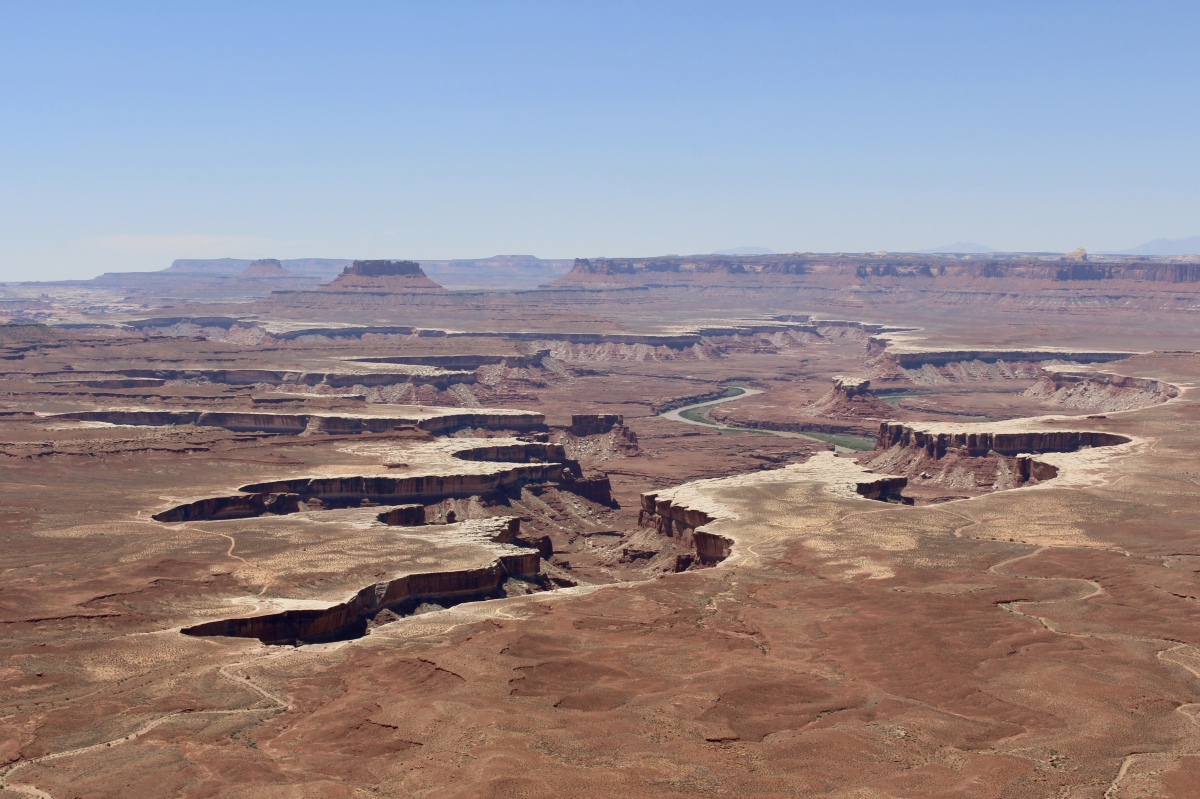
Island in the Sky sits atop a mesa overlooking two great rivers that come together, the Green River and the Colorado River. We stop at the Green River Overlook and look west over the Green River.
the trail to the Green River Overlook
Green River Overlook
We then stop for a view of the Colorado River to the east from the Buck Canyon Overlook.
Buck Canyon Overlook
The Buck Canyon Overlook also offers views of the La Sal Mountains in the distance.
Buck Canyon Overlook
Further south still, we stop briefly at the Orange Cliffs Overlook.
Orange Cliffs Overlook
me with Mike at the Orange Cliffs Overlook
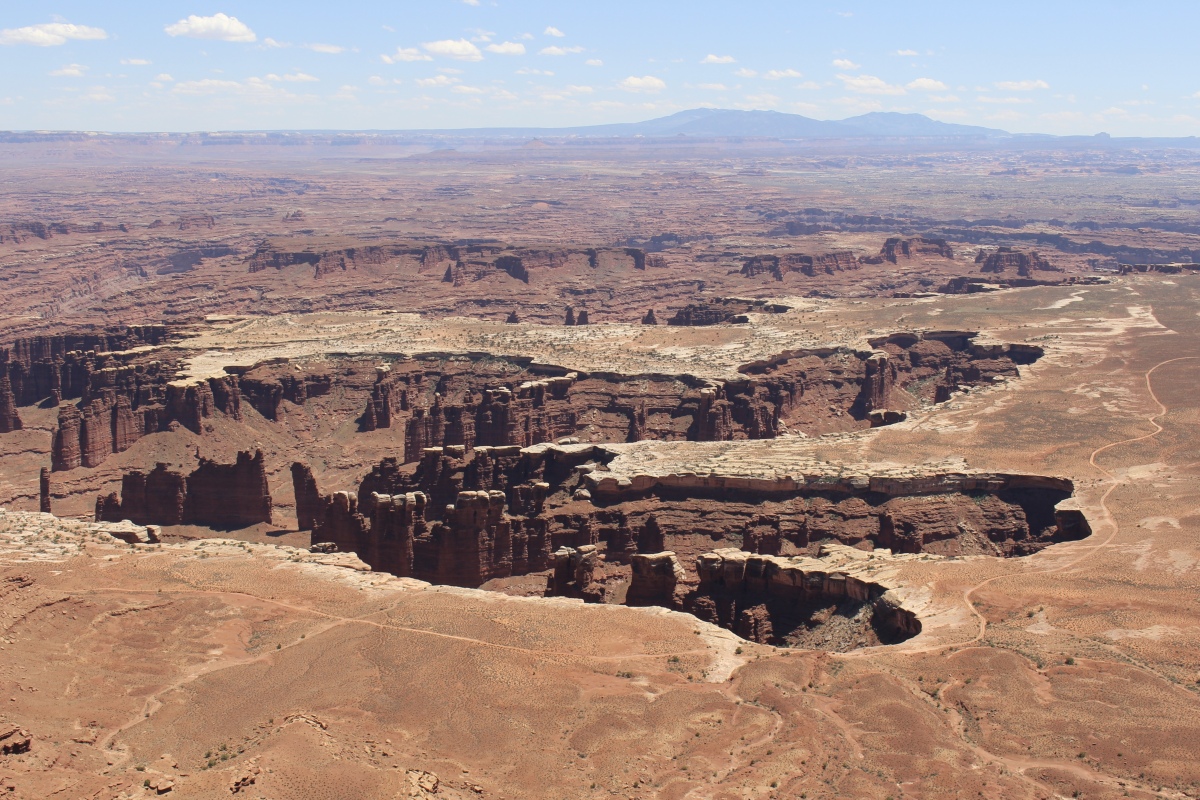
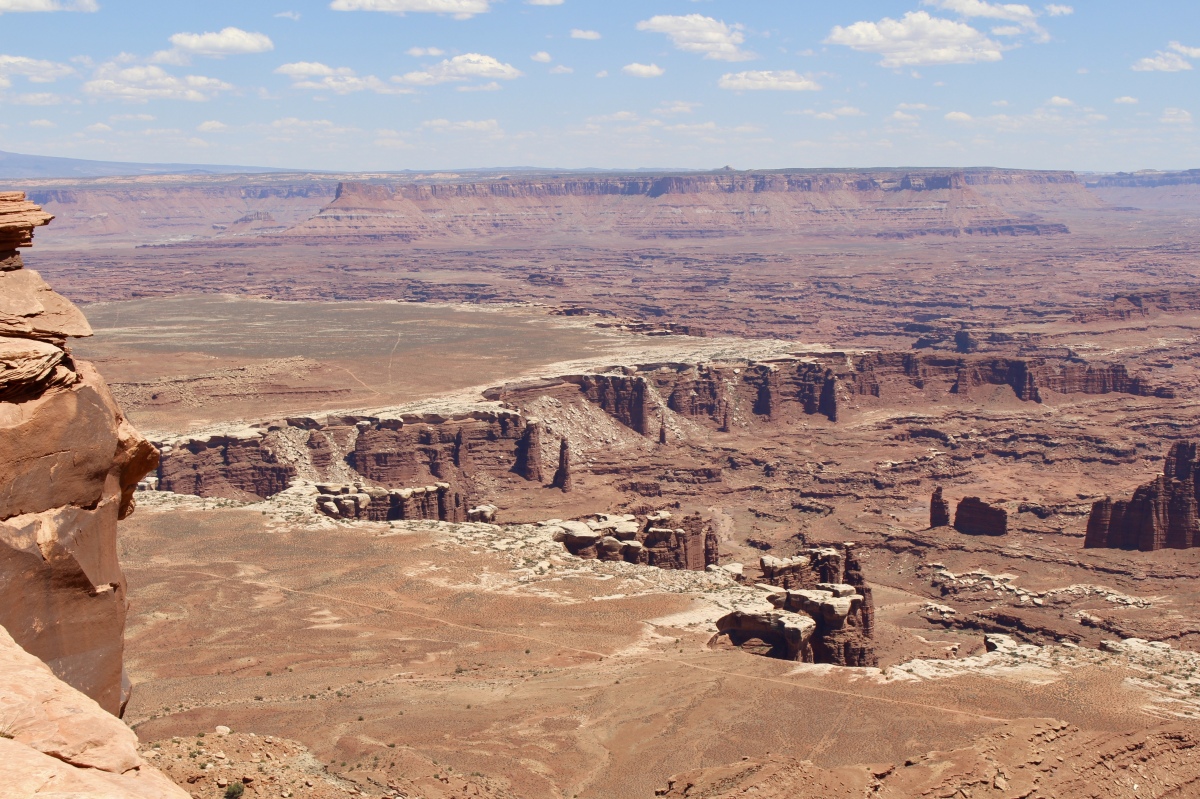
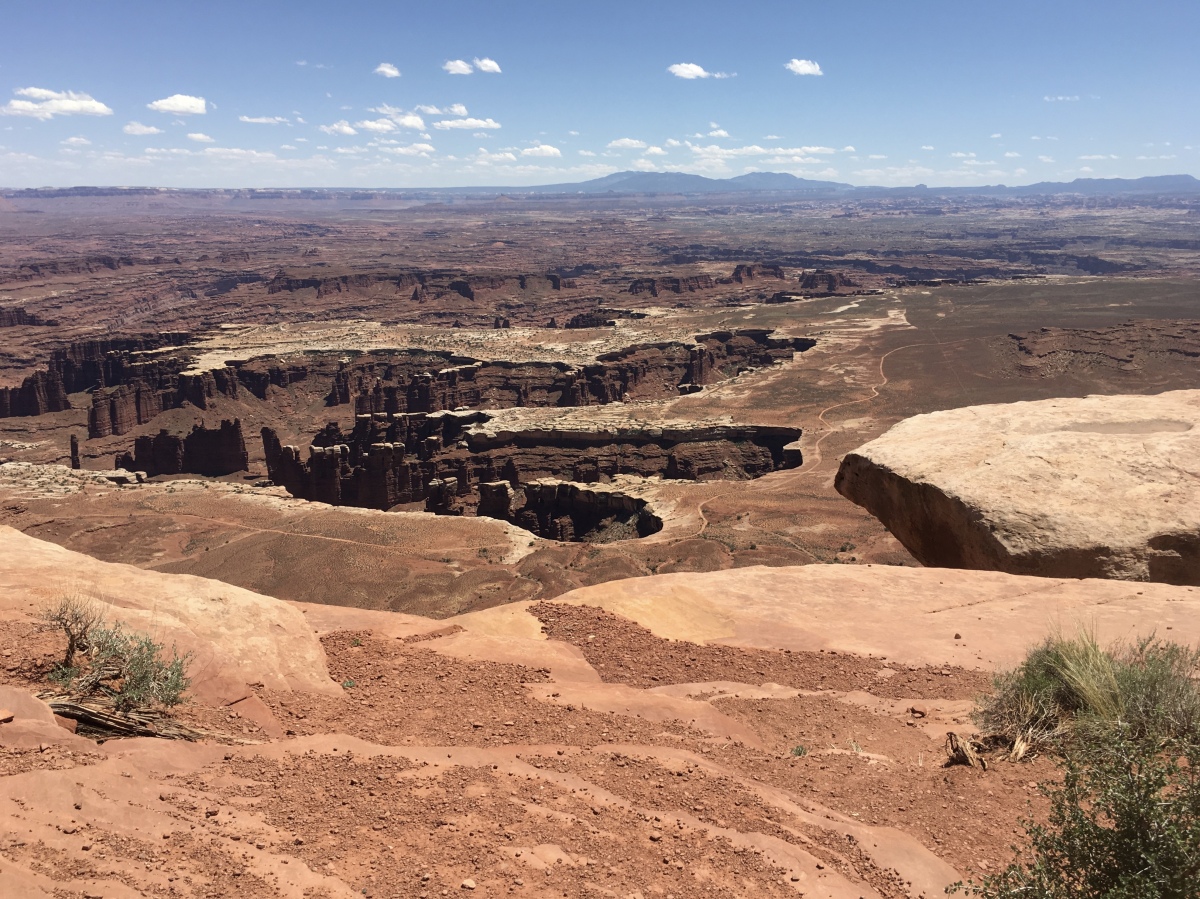
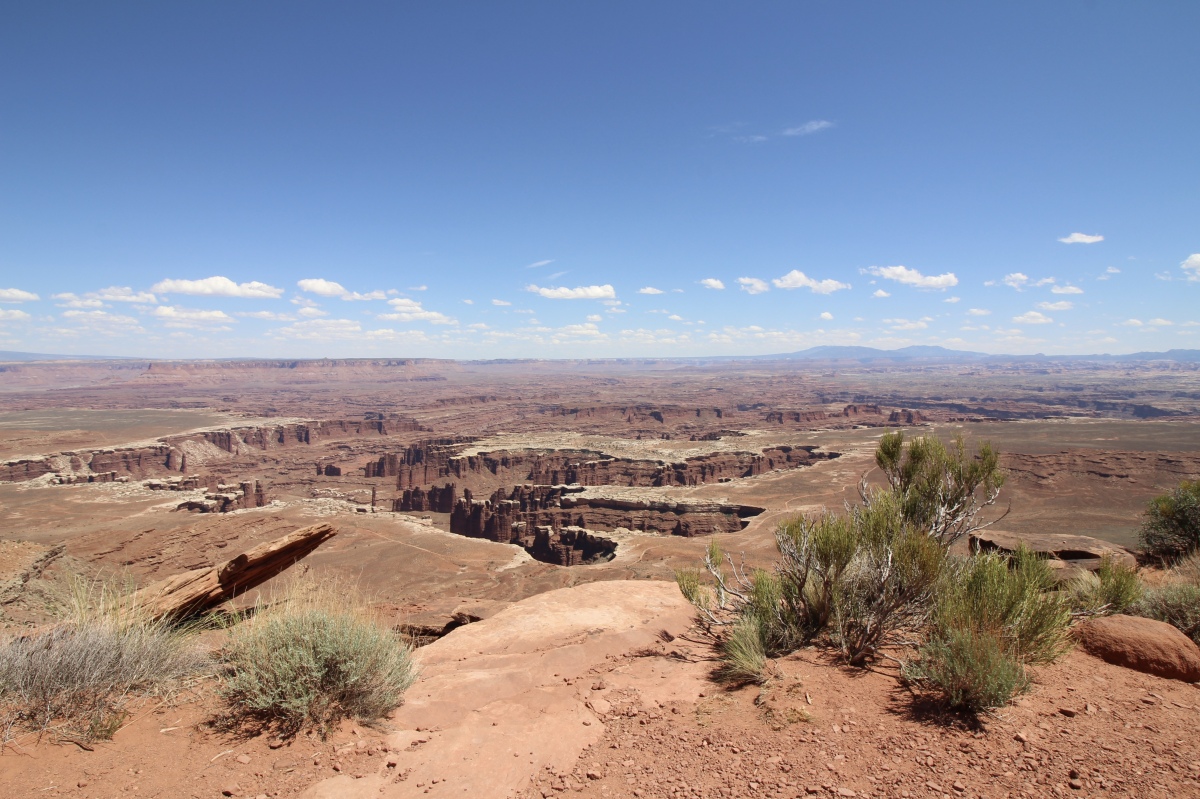
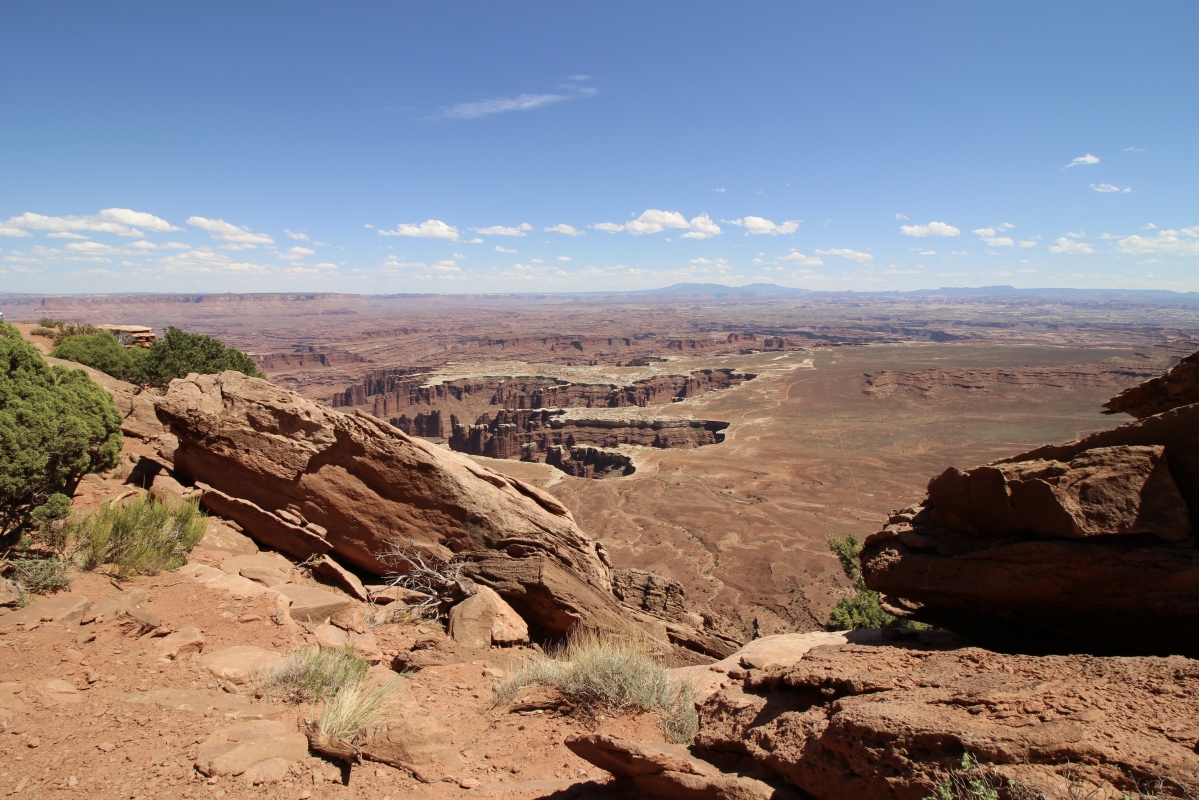
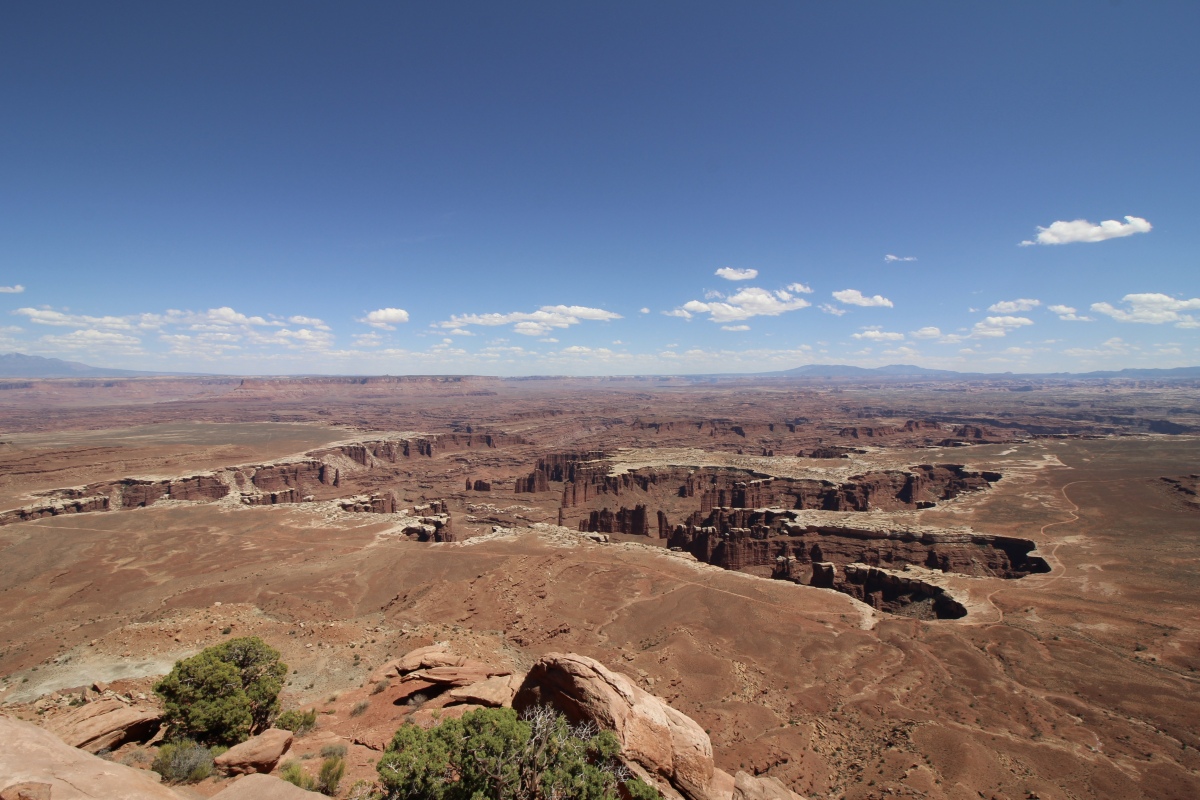
Finally, we reach the southernmost point at Island in the Sky, Grand View Point Overlook. It is quite hot today, but we hike a mile out and a mile back along the top of the canyon edge. The Grand View encompasses the confluence of the Colorado and the Green Rivers in the distance; in the foreground, we see Meander Canyon and The Loop of the Colorado River.
Grand View Point Overlook
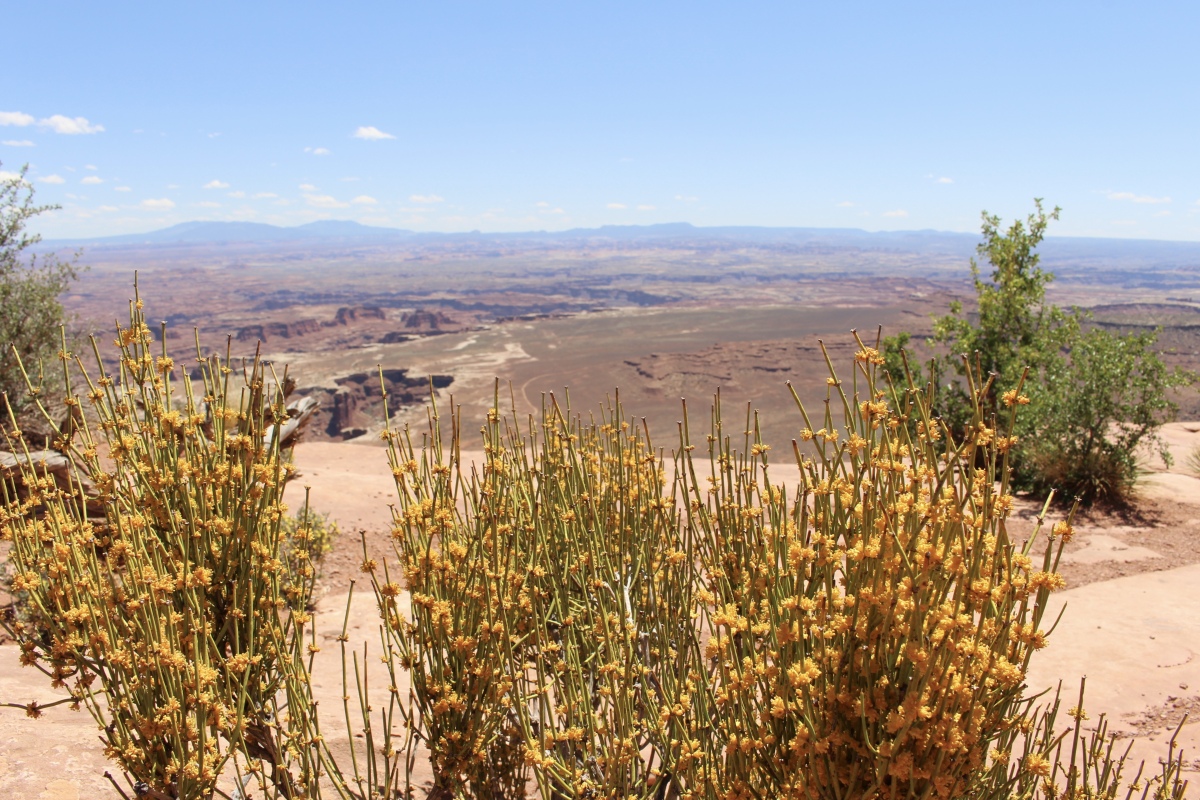
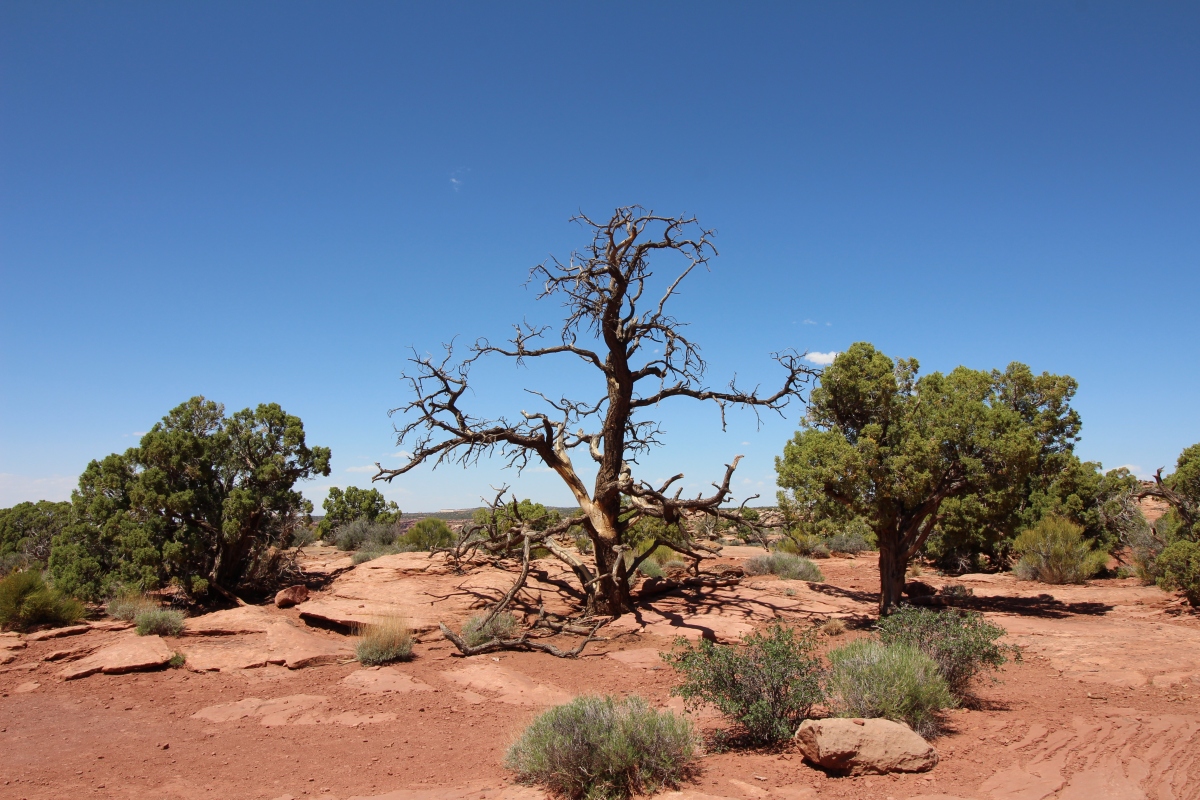
Mormon Tea at the Grand View Point Overlook
Grand View Point Overlook
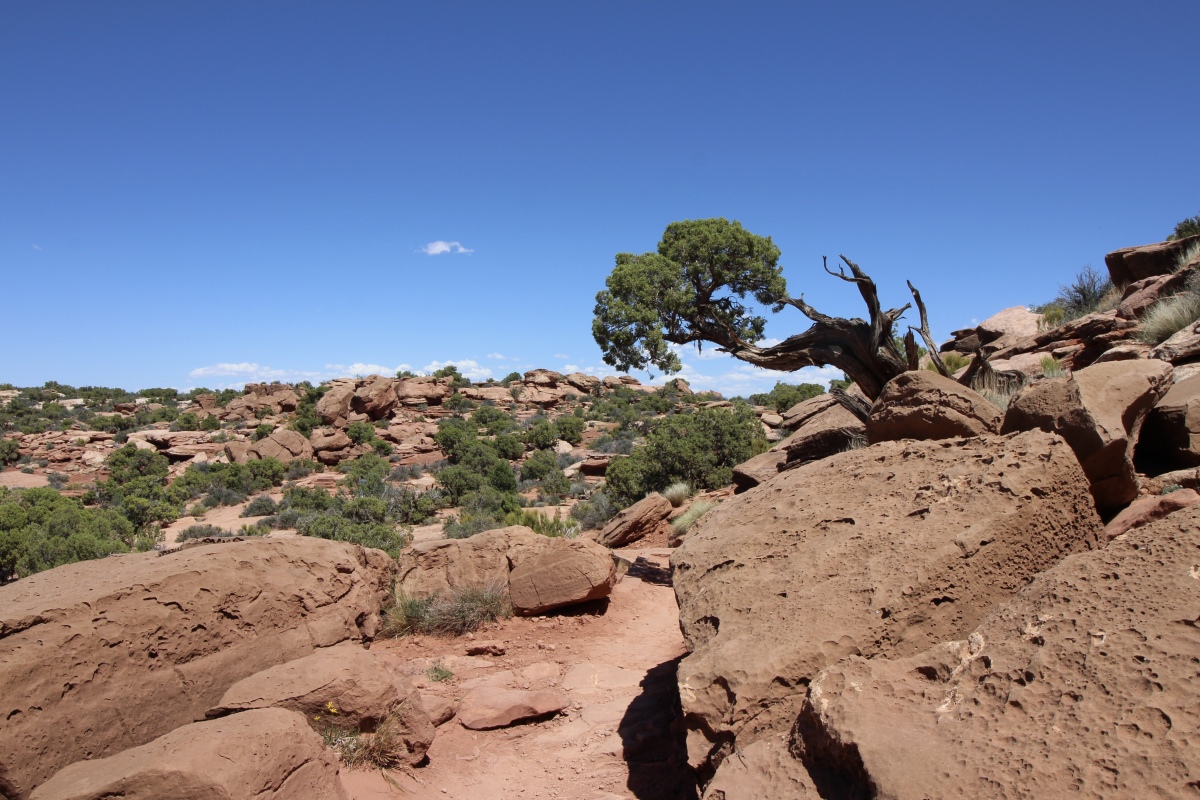
The Grand View Point Overlook trail
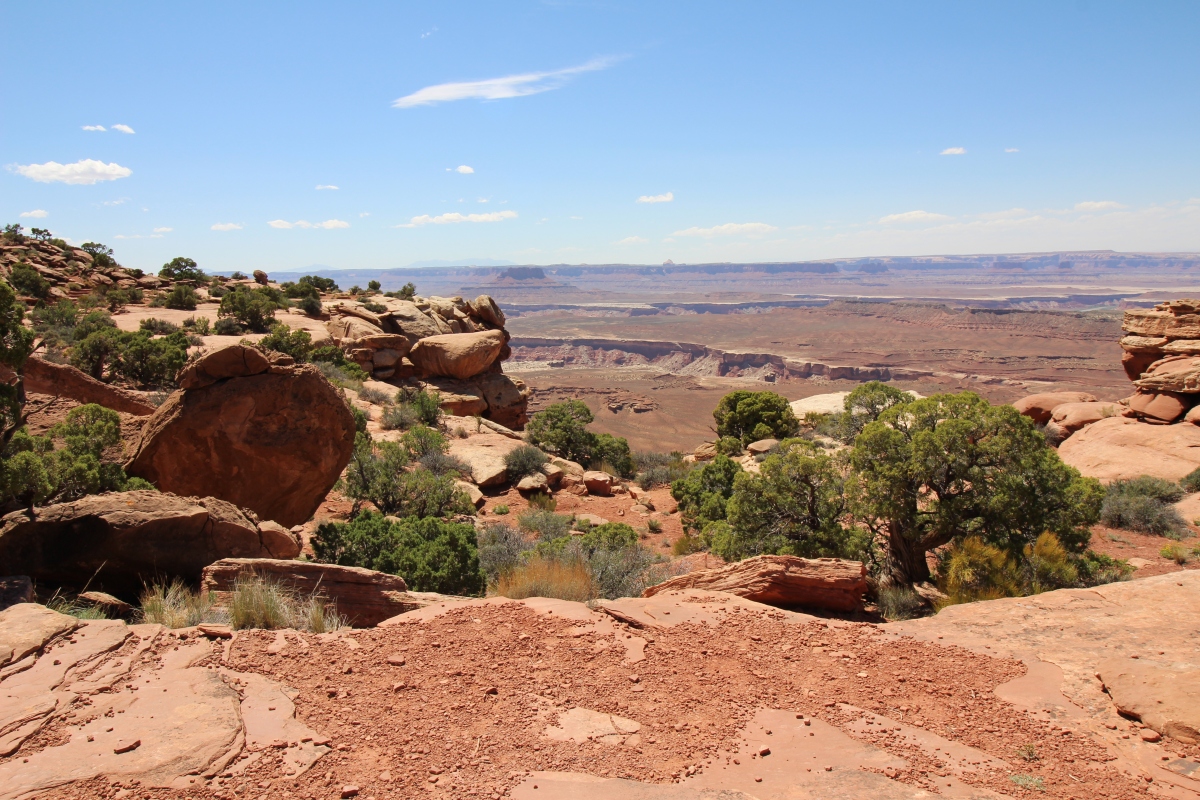
On our way back from the end point of the trail, I change my lens, using a wide-angle to capture our last views of the canyon.
The Grand View Overlook trail
Grand View Point Overlook trail
All in all, we walk 2.19 miles over 1:16 hours.
*Thursday, May 10, 2018*
***********************
On Sundays, I plan to post various walks that I took on our Four Corners trip as well as hikes I take locally while training for the Camino de Santiago; I may also post on other unrelated subjects. I will use these posts to participate in Jo’s Monday Walks or any other challenges that catch my fancy.
Don’t overthink. Remember, it’s YOUR Camino. The Camino will provide. You will be fine! Buen Camino! This is some of the advice and encouragement I hear repeatedly from pilgrims who have completed the Camino de Santiago across northern Spain. On the various Facebook pages, books, and online Camino websites and forums, there seems a limitless amount of advice, often contradictory. So, if it’s to be MY Camino, I am picking and choosing which advice I will heed, and which I will toss out. What else is there to do? 🙂
I’m not good at following advice telling me not to overthink. My husband says if there is a bell curve of people planning to walk the Camino, I would be on the far extreme of over-preparation. Though he might be right in some regards, I don’t agree with him totally. Physically, I’m afraid I’m under-prepared.
The Camino hasn’t been far from my mind over this entire year. In mid-July, I dreamed I was in St-Jean-Pied-de-Port and everywhere I looked were impossibly tall mountains, bursting with flowers and tropical trees. Paths wound their way up all of them. I was quite overwhelmed and wondered which of the paths I should follow. My first impulse was to pull out my camera to photograph the stunning scene. Suddenly I realized I had forgotten my camera, so I called my husband in a panic, asking him to mail it to me. Of course, it would take days to get to me. I was devastated to have forgotten my camera and berated myself mercilessly for my forgetfulness!
Resources
There are multitudes of books you can read about the Camino, either personal accounts, advice on packing, guidebooks, or history books. These are some that I have read or am in the process of reading. The Brierley guidebook I will take along with me, tearing out the pages for that day’s walk and disposing of them after walking, lightening my load each day. 🙂
Let the Camino train you.It’s just walking. Just put one foot in front of the other. Walk into your pack weight. Walk two days straight for 10-12 miles carrying your full pack. I’ve encountered this advice while preparing for the Camino.
In early December of 2017, on a 7.7 mile hike around Burke Lake, I met a great lady named Susan who walked the Camino. She introduced me to a group called the American Pilgrims on the Camino – Mid-Atlantic Chapter. The group is for anyone who has ever done the Camino or who wants to do the Camino. After I met her, I signed up immediately for newsletters from this group. Outside of the group, Susan and I have been in touch regularly and have walked together numerous times. She’s been one of my most valuable sources of information and encouragement.
To immerse myself in the Camino experience, I shared Spanish tapas with pilgrims and wanna-be pilgrims at a potluck for American Pilgrims on the Camino in early February. I chatted with a lot of folks who were full of good advice.
I accompanied the Mid-Atlantic Pilgrims for a 10-mile walk in March starting from Arlington National Cemetery, past the Martin Luther King Memorial, up the National Mall and around the back of the U.S. Capitol, and then back down the Mall again to the Lincoln Memorial. I got a taste of what it’s like walking a long distance with other pilgrims walking at different paces. One man was especially helpful in telling me what a typical day on the Camino was like. Another lady told me, as I carried a 5-lb backpack, that I should be walking into my pack weight. In other words, I should carry the entire 15-lb from the beginning and then slowly increase my distance. I didn’t follow this advice, although it might have been a good thing to do.
Martin Luther King Memorial on our 10-mile walk in D.C.
On June 9, I attended a shell ceremony with the group, where the leader read aloud an inspirational piece about the Camino and then bestowed blessings on us pilgrims, placing shells around our necks to accompany us on our journey.
me with my shell 🙂
the group at the shell ceremony
Training: I was gung-ho in the early months. I wonder if I should have just decided to do the Camino two months before doing it, instead of spending so many months training. Below are some photos of walks I did in June and July.
Manassas National Battlefirst – First Manassas Trail
Manassas National Battlefirst – Second Manassas Trail
Turkey Run
Turkey Run
Burke Lake
The Fairfax Cross-County Trail
Below I’ve outlined my progress: “dedicated walking” means I went out for a purposeful walk aiming to cover a certain distance. Sometimes I carried an 11-lb pack; more often I didn’t. The FitBit simply measured distance by how many steps I took over the course of each day. At least once a week, sometimes twice, I went to the gym to do upper body and lower body weights, from February to April. You can see how my training has slacked off, mainly due to right knee pain, caused by bursitis and osteoarthritis, that curtailed my training:
Month“Dedicated” milesFitbit miles
February: 68 100
March: 103 139
April: 73 114
May: 71 157*
June: 67 123**
July: 62 103
August: 27 58
*In May, I was in the Four Corners where the GPS on MapMyWalk didn’t always work.
** In June, I often carried an 11 lb. backpack and my right knee started causing me pain.
Overall, I’ve walked 471 miles in “dedicated” walking since February. That’s less than the distance of the entire Camino’s 490 miles. My Fitbit miles are higher, at 793 miles. However, this walking is spread out over 7 months! That’s quite different than compacting that same distance into 52 days. As it turns out, I never did two days in a row of 10-12 miles carrying my full pack.
After I started having knee pain in June, I finally found a good orthopedic doctor in early August who administered a cortisone injection in my right knee, prescribed biweekly physical therapy sessions, and gave me the NSAID (non-steroidal anti-inflammatory drug) Diclofenac, which is just a heavy dose of time-released ibuprofen. Between all of this, my knee has been getting stronger, but I haven’t wanted to push it by training too much. I’d rather be pain-free to start out, and simply Let the Camino train me!
So, now I either walk 3-5 miles OR ride the indoor bike for 30 minutes OR go to physical therapy. I have to do sets of PT exercises 2x/day and ice 2x/day for 10 minutes. While I’m icing my knees for 10 minutes, I study a bit of Spanish using Spanish in 10 minutes a day by Kristine K. Kershul. Yo quiero un vaso de vino!
Butterfly at Manasssas National Battlefield – First Manassas Trail
Packing and gear
Packing and gear – my packing list is too long and complicated to list here, so I created a separate page: packing list for el camino 2018. I will revise it over the next week as I try to reduce my pack weight from 16 lb to 14 lb. The general rule of thumb is that pilgrims should carry no more than 10% of their body weight. When I return, I’ll update it, after I know what I didn’t use and what I wished I’d had.
Hair
As my hair is so often the bane of my existence, and since I’ve heard there are no hair dryers provided in albergues, or pilgrim hostels, I got my hair cut shorter and will have it straightened before I leave. It will still look like hell without a hair dryer, but I’m carrying a hat to mitigate the horrid mess it will be.
Travel Insurance
I don’t always buy trip insurance when I travel, but in this case, I figured it might be wise because of my knee and because of the daily physical exertion and strain. However, I hemmed and hawed and took my sweet time about it. When I finally decided to go for it, it was more than two weeks after I bought my plane ticket, and I had seen a doctor about my knee in the interim. I was told my knee is now considered a pre-existing condition and thus any knee-related problem would not be covered. It would have been okay if I’d bought it less than two weeks after my ticket. So after hemming and hawing some more, I went ahead, because it covers any medical emergency that isn’t related to my right knee – sickness, a broken bone, a death in the family, etc. Because of the duration of my trip, it was quite expensive: $289! This seemed like highway robbery, but the dirty deed is done now.
Getting to St. Jean-Pied-de-Port – It’s part of the journey…
Since Mike will meet me in Portugal on October 26 and we’ll fly back home together from Lisbon on November 6, it made sense for me to get a round trip ticket to Lisbon. This is not the usual starting point for most people doing the Camino Frances. I wasn’t sure how I would get from Lisbon to St. Jean Pied-de-Port (SJPP) in France, so I posted the question on the Facebook Camino page, an invaluable resource. A Portuguese man suggested I take the overnight train (with sleeping compartments) from Lisbon to Hendaye on the French border. Then, I’m to take another train to Bayonne, and then another to St. Jean. I’ve booked the TrenHotel from Lisbon, leaving at 9:30 pm on September 1; the man assured me I’d be able to get the next stage tickets at the Hendaye station. I hope he’s right. I have to trust that the Camino will provide! It will be a very long day for me in Lisbon, because I arrive at 10:30 a.m. and the train doesn’t leave until 9:30 p.m. I guess I won’t be able to sleep until I get on that train!
I’m booked to stay in Beilari when I finally reach SJPP on September 2. I’ll stay two nights and embark on my walk on September 4. I have reserved a bed at Refuge Orisson about 1/3 of the way over the Pyrenees for that night, so I have to wait that extra day in SJPP.
After that, until I meet Mike in Braga on October 26, nothing else is planned except walking, washing my clothes, eating, sleeping. Repeat, repeatedly. One step, one day at a time.
You carry your fears. It is said that the bigger your backpack, the more fears you are carrying. I admit I do have some fears. Since I’ve been reading so much, I’ve heard of so many things that can go wrong. Here are my biggest fears and how I hope to deal with them:
Dogs. I’m carrying a whistle and my hiking poles, and will try my best to remain calm if I encounter any vicious dogs.
Being a woman alone. Being harassed by anyone or being the victim of a crime. I’ve heard any problems are rare. I just need to be vigilant and pay attention. And I have my whistle.
Bed bugs. Spray my sleeping bag and backpack with Permethrin. Deal with them if I encounter them.
Thunderstorms with laser-sharp lightning strikes. Get down low and hope it passes quickly.
Not finding a bed at the end of the day. Hire a taxi and go to the next town.
Having an accident on the trail and being unable to get help. Be careful, slow and steady and pay attention.
Getting lost. Again, go slow and pay attention.
Flexibility & Faith
Overall, I must have faith that all will be okay. Flexibility is key. If I’m in pain or feel I need a rest day, I’ll take one. If I can’t complete the whole thing, I’ll complete what I can. If I’m close, but not quite able to complete it, I can always take a bus to Sarria and complete the last 100km to get the Compostela, or the certificate of completion.
Journal and intentions
I have no intention of writing any kind of memoir on my pilgrimage for two reasons:
There are already multitudes of personal pilgrimage accounts out there, so unless I have something truly inspirational or earth-shattering to share, I don’t plan to add my story.
I have too many other unfinished projects.
However, I have set some intentions for myself.
my creative intentions
Journal & guidebook
the Camino Frances
Instagram:
I won’t be blogging during my pilgrimage, but I aim to post photos and tidbits along the way on Instagram: cathybirdsong
************************
“ANTICIPATION & PREPARATION” INVITATION: I invite you to write a post on your own blog about anticipation & preparation for a particular destination (not journeys in general). If you don’t have a blog, I invite you to write in the comments.
Include the link in the comments below by Thursday, August 30 at 1:00 p.m. EST. If you link after August 30, I will not be able to include your link in my next post, so please feel free to add your link to that post as soon as it publishes (since I’m leaving for the Camino on August 31).
My next anticipation & preparation post is scheduled to post on Friday, September 28. If you’d like, you can use the hashtag #wanderessence.
This will be an ongoing invitation, on the 4th Friday of each month. Feel free to jump in at any time. 🙂 If you’d like to read more about the topic, see: journeys: anticipation & preparation.
I hope you’ll join in our community. I look forward to reading your posts!
We left Arches National Park and drove north on US 191, where clouds trailed overhead into wispy cones that hinted of cyclones. Along the road, slickrock areas promised mountain bike adventures. We sped by Horse Thief Campground and Mineral Bottom Road.
Driving to Dead Horse Point State Park with view of La Sal Mountains
Heading south on SR 313, we crossed open range where calves frolicked and black cows wandered lazily across the road or grazed in the flat grassland. Under one lone tree, two cows huddled for shade. The fragrance of cliffrose danced through the air.
hoodoos and slickrock along the way
According to one legend, Dead Horse State Park was once used as a corral for wild mustangs roaming the mesa. Cowboys in the 1800s rounded up these horses, and herded them across the narrow neck of land and onto the point. The neck, which is only 30 yards wide, was then fenced off with branches and brush, creating a natural corral surrounded by precipitous cliffs. Cowboys then chose the horses they wanted and, for reasons unknown, left the other horses corralled on the parched point, where they died of thirst within view of the Colorado River, 2,000 feet below. The people who found the remains of the unfortunate horses gave this place its name.
Oh, the cruelty of humans.
Dead Horse Point State Park
We stopped first at Dead Horse Point Overlook, where we enjoyed grand views of the canyon and the Colorado River from the top of the mesa.
Dead Horse Point State Park
We soaked in the iconic view of the gooseneck in the Colorado River.
Dead Horse Point State Park
Mike stood at the Dead Horse Point Overlook to admire the views.
Mike at Dead Horse Point Overlook
Dead Horse Point State Park
From the East Rim Trail, we saw bright blues on the desert floor; these are solar evaporation ponds for a mine owned by Intrepid Potash, Inc. Potash is potassium chloride, a salt found in the Paradox Formation. Salt deposited from ancient seas made up this formation as it evaporated and was buried by other sediments.
Solar Evaporation Ponds
Water is pumped down into the formation to dissolve the salt. This salt water is then pumped into the shallow, vinyl-lined ponds seen below. A blue dye is added to speed up evaporation. The dry desert air and many sunny days make this a productive operation.
Twenty-ton scrapers, guided by lasers, harvest the dry salt. A local refinery transforms this concentrated form of potassium chloride into plant fertilizer.
solar evaporation ponds
The West Rim Trail offered the best views of the Colorado River, so we walked along the edges of the canyon.
Dead Horse Point State Park
tree at Dead Horse Point State Park
Dead Horse Point State Park
We stopped at the 30-yard-wide neck, where the wild horses were corralled off, according to legend.
the neck at Dead Horse Point State Park
Dead Horse Point State Park
On our way back to Moab, we stopped to admire The Monitor and the Merrimac Buttes. Towering 600 feet above their Navajo Sandstone base, they can be seen from many points along the highway. The Buttes were named after the Civil War ironclad ships of the same names. The shapes of the buttes mimic the actual shapes of those historic ships. The Merrimac, the large rock on the left, was the Confederate ship, called the “Virginia” by the southern forces. The Monitor, on the right, was the Union ship sent to destroy the Merrimac. The resulting sea battle changed maritime warfare forever. Long after both ships lie on the sea bottom, their rock counterparts remain locked in perpetual battle.
Monitor and Merrimac buttes
Minerals contribute to the painterly rock colors of The Colorado Plateau, seen clearly here. Reds and yellows come from iron, the black sheen is formed from manganese (known as “desert varnish”), and purples and greens are caused by clay minerals.
At this viewpoint, visitors have carefully constructed scores of cairns.
cairns at Monitor and Merrimac buttes
Underlying this view area is Navajo sandstone, deposited 200 million years ago and found throughout the Colorado plateau. At that time, the area was a vast desert system, complete with shifting sand dunes, much like today’s Sahara Desert. These sand dunes hardened over centuries. Erosion exposed the “petrified” sand millions of years later, creating the Navajo sandstone formations we see today.
Navajo sandstone often creates dramatic scenery such as cliffs and rounded domes.
Utah juniper
Although Dead Horse Point State Park is not a National Park, the Visitor Center had a sticker and a cancellation stamp, which I happily added to my National Park passport.
Cancellation stamp
Between our hikes today at Devils Garden in Arches and Dead Horse Point State Park, we walked 21,743 steps, or 9.21 miles.
*Wednesday, May 9, 2018*
***********************
On Sundays, I plan to post various walks that I took on our Four Corners trip as well as hikes I take locally while training for the Camino de Santiago; I may also post on other unrelated subjects. I will use these posts to participate in Jo’s Monday Walks or any other challenges that catch my fancy.
The Devils Garden Trail at the far end of Arches National Park offers routes of various difficulty and length, varying from 1.6-7.2 miles. The longest of the maintained trails in Arches National Park, Devils Garden Trail goes to seven impressive arches, with several more visible from the trail.
On our second morning, we took the hike to Landscape Arch and then climbed up further to Partition Arch and Navajo Arch. We had to hustle to keep ahead of the Chinese tourists who were disembarking from their tour bus.
The Landscape Arch Trail is easy and well-graded, providing a close look at one of the longest natural stone spans in the world.
For this hike, I used, for the first time, my new wide-angle lens (with the exception of the last two photos).
walking through a slot canyon into Devils Garden
Devils Garden Trail
Devils Garden Trail
Devils Garden Trail
Devils Garden Trail
Devils Garden Trail
Devils Garden Trail
Devils Garden Trail
Devils Garden Trail
cliffrose along Devils Garden Trail
Landscape Arch is slightly longer than a football field.
first glimpse of Landscape Arch
Around Landscape Arch
Landscape Arch
Devils Garden Trail
The path past Landscape Arch is more difficult, winding along the narrow tops of exposed sandstone fins, then up and over short, steep crevices where steps have been carved into the rock. This section is not recommended for hikers with a fear of heights.
We escaped the crowds at Landscape Arch with a plan to clamber our way up to Partition and Navajo Arch. The route looked scary — a steep climb up slickrock with slot-canyon drop-offs on either side — so I was hesitant to go up. While we stood looking at the climb, a woman from a canyon beneath us called up and asked if we’d seen her husband, and she went on to describe his T-shirt.
the slickrock way up to Partition Arch
The woman asked that, if we saw him, we inform him that she went up an alternate route, through this canyon. We stood debating for a while, and we finally decided to take the woman’s option up through the adjacent canyon. We climbed up only to realize that the path was blocked off with pieces of dead wood at the upper end – Closed. Oh well, we didn’t know, and it was easy enough to walk over the wood barriers! There was no way I was going to climb down that slickrock, so the sign wouldn’t deter us from coming back down that same route!
We continued on to Partition Arch.
Partition Arch
standing inside Partition Arch looking out over the mesa
Partition Arch
We then hiked to Navajo Arch, not quite as impressive.
inside Navajo Arch
view of Navajo Arch from outside
rock patterns near Navajo Arch
Finally, we worked out way back down and out, through our secret canyon, and past Landscape Arch once again.
Devils Garden Trail
Devils Garden Trail
our secret canyon
Devils Garden Trail
cow parsnip?
Adding Partition Arch and Navajo Arch to Landscape Arch made for a hike of 5.65 miles. It took us 2:52 hours at a pace of 30:32 minutes/mile. We were quite exhausted when it was said and done, but that didn’t stop us from making a few more detours before we returned to our car.
There is nothing like the dramatic landscape at Arches to make a person feel insignificant and overwhelmingly awed.
*Wednesday, May 9, 2018*
***********************
On Sundays, I plan to post various walks that I took on our Four Corners trip as well as hikes I take locally while training for the Camino de Santiago; I may also post on other unrelated subjects. I will use these posts to participate in Jo’s Monday Walks or any other challenges that catch my fancy.
My path less traveled. Rediscovering self after surviving the abuse that almost sunk me. Goal of strengthening and thriving on my adult legs. 👣🙏🏻 #recovery #forgiveness
This blog is for those who wish to be creative, authors, people in the healing professions, business people, freelancers, journalists, poets, and teachers. You will learn about how to write well, and about getting published. Both beginning and experienced writers will profit from this blog and gain new creative perspectives. Become inspired from global writers, and find healing through the written word.
Explore, discover and experience the world through Meery's Eye. Off the beat budget traveler. Explore places, cultural and heritage. Sustainable trotter.
shareable tales of Meery is Meeryable
You must be logged in to post a comment.