Skip to content
  • Home
  • about ~ wander.essence ~
    • ~ the places i’ve been ~
    • ~ places i’ve been in the u.s.a. ~
  • Travel Destinations
    • America
      • Boston
      • Delaware
      • District of Columbia
        • Washington
      • Georgia
        • Atlanta
      • Maryland
      • New Jersey
        • Cape May
      • New York
        • Adirondacks
        • Buffalo
        • Niagara Falls
      • Pennsylvania
        • Pittsburgh
      • South Carolina
      • Tennessee
        • Nashville
      • Virginia
    • American Road Trips
      • Canyon & Cactus Road Trip
      • Florida Road Trip
        • Everglades
        • Fort Lauderdale
        • Florida Keys
        • Miami
        • St. Augustine
      • Four Corners Road Trip
        • Arizona
          • Monument Valley
          • Petrified Forest National Park
          • Sunset Crater National Monument
          • Walnut Canyon National Monument
          • Winslow
          • Wupatki National Monument
        • Colorado
          • Colorado National Monument
          • Colorado Towns
          • Great Sand Dunes National Park
          • Grand Junction
        • New Mexico
        • Utah
          • Arches National Park
          • Canyonlands
          • Navajo National Monument
          • Dead Horse Point State Park
          • Hovenweep National Monument
          • Moab
          • Valley of the Gods
          • Natural Bridges National Monument
      • Great Lakes Road Trip
        • Michigan
        • Minnesota
        • Wisconsin
      • Midwestern Triangle
        • Illinois
          • Carbondale
          • Murphysboro
        • Kentucky
          • Covington
          • Lexington
          • Louisville
        • Ohio
          • Cincinnati
      • Road Trip to Nowhere
        • Nebraska
        • North Dakota
        • South Dakota
      • Tex-New Mex Road Trip
        • Texas & New Mexico Road Trip
        • New Mexico
        • Texas
    • International Travel
      • Africa
        • african meanderings {& musings}
        • Egypt
          • Cairo
        • Ethiopia
        • Morocco
      • Asia
        • Cambodia
        • China
          • China Diaries
          • Guangxi Province
        • India
          • Rishikesh
          • Varanasi
        • Japan
          • Kyoto
        • Myanmar
        • Oman
          • a nomad in the land of nizwa
          • Nizwa
        • Singapore
        • South Korea
          • catbird in korea
        • Thailand
        • Turkey
          • Cappadocia
        • Vietnam
      • Central America
        • Costa Rica
        • El Salvador
        • Nicaragua
        • Panama
          • Bocas del Toro
          • Panama City
      • Europe
        • In Search of a Thousand Cafés
        • Croatia
          • Dalmatia
            • Istria
            • Dubrovnik
            • Plitvice Lakes National Park
            • Split
            • Zadar
            • Zagreb
        • Czech Republic
          • Český Krumlov
        • England
        • France
        • Greece
        • Hungary
          • Budapest
          • Esztergom
        • Iceland
        • Italy
          • Bergamo
          • Cinque Terre
          • The Dolomites
          • Florence
          • Rome
          • Tuscany
          • Venice
          • Verona
          • Via Francigena
        • Portugal
        • Spain
          • Camino de Santiago
            • packing list for el camino de santiago 2018
      • North America
        • Canada
          • The Maritimes
            • New Brunswick
            • Nova Scotia
            • Prince Edward Island
          • Ontario
        • Mexico
          • Guanajuato
          • Mexico City
            • Teotihuacán
          • Querétaro
          • San Miguel de Allende
      • South America
        • Colombia
        • Ecuador
          • Cuenca
          • Quito
    • how to make the most of a staycation
      • Coronavirus Coping
  • Imaginings
    • imaginings: the call to place
  • Travel Preparation
    • journeys: anticipation & preparation
  • Travel Creativity
    • on keeping a travel journal
    • on creating art from travels
      • Art Journaling
    • photography inspiration
      • Photography
    • writing prompts: prose
      • Prose
        • Fiction
        • Travel Essay
        • Travelogue
    • writing prompts: poetry
      • Poetry
  • On Journey
    • on journey: taking ourselves from here to there
  • Books & Movies
    • books | international a-z |
    • books & novels | u.s.a. |
    • books | history, spirituality, personal growth & lifestyle |
    • movies | international a-z |
    • movies | u.s.a. |
  • On Returning Home
    • on returning home
  • Annual recap
    • twenty-fifteen
    • twenty-eighteen
    • twenty-nineteen
    • twenty-twenty
    • twenty-twenty-one
    • twenty twenty-two
    • twenty twenty-three
    • twenty twenty-four
    • twenty twenty-five
  • Contact

Enter your email address to follow this blog and receive notifications of new posts by email.

Join 1,059 other subscribers
Follow ~ wander.essence ~ on WordPress.com
  • Home
  • about ~ wander.essence ~
    • ~ the places i’ve been ~
    • ~ places i’ve been in the u.s.a. ~
  • Travel Destinations
    • America
      • Boston
      • Delaware
      • District of Columbia
        • Washington
      • Georgia
        • Atlanta
      • Maryland
      • New Jersey
        • Cape May
      • New York
        • Adirondacks
        • Buffalo
        • Niagara Falls
      • Pennsylvania
        • Pittsburgh
      • South Carolina
      • Tennessee
        • Nashville
      • Virginia
    • American Road Trips
      • Canyon & Cactus Road Trip
      • Florida Road Trip
        • Everglades
        • Fort Lauderdale
        • Florida Keys
        • Miami
        • St. Augustine
      • Four Corners Road Trip
        • Arizona
          • Monument Valley
          • Petrified Forest National Park
          • Sunset Crater National Monument
          • Walnut Canyon National Monument
          • Winslow
          • Wupatki National Monument
        • Colorado
          • Colorado National Monument
          • Colorado Towns
          • Great Sand Dunes National Park
          • Grand Junction
        • New Mexico
        • Utah
          • Arches National Park
          • Canyonlands
          • Navajo National Monument
          • Dead Horse Point State Park
          • Hovenweep National Monument
          • Moab
          • Valley of the Gods
          • Natural Bridges National Monument
      • Great Lakes Road Trip
        • Michigan
        • Minnesota
        • Wisconsin
      • Midwestern Triangle
        • Illinois
          • Carbondale
          • Murphysboro
        • Kentucky
          • Covington
          • Lexington
          • Louisville
        • Ohio
          • Cincinnati
      • Road Trip to Nowhere
        • Nebraska
        • North Dakota
        • South Dakota
      • Tex-New Mex Road Trip
        • Texas & New Mexico Road Trip
        • New Mexico
        • Texas
    • International Travel
      • Africa
        • african meanderings {& musings}
        • Egypt
          • Cairo
        • Ethiopia
        • Morocco
      • Asia
        • Cambodia
        • China
          • China Diaries
          • Guangxi Province
        • India
          • Rishikesh
          • Varanasi
        • Japan
          • Kyoto
        • Myanmar
        • Oman
          • a nomad in the land of nizwa
          • Nizwa
        • Singapore
        • South Korea
          • catbird in korea
        • Thailand
        • Turkey
          • Cappadocia
        • Vietnam
      • Central America
        • Costa Rica
        • El Salvador
        • Nicaragua
        • Panama
          • Bocas del Toro
          • Panama City
      • Europe
        • In Search of a Thousand Cafés
        • Croatia
          • Dalmatia
            • Istria
            • Dubrovnik
            • Plitvice Lakes National Park
            • Split
            • Zadar
            • Zagreb
        • Czech Republic
          • Český Krumlov
        • England
        • France
        • Greece
        • Hungary
          • Budapest
          • Esztergom
        • Iceland
        • Italy
          • Bergamo
          • Cinque Terre
          • The Dolomites
          • Florence
          • Rome
          • Tuscany
          • Venice
          • Verona
          • Via Francigena
        • Portugal
        • Spain
          • Camino de Santiago
            • packing list for el camino de santiago 2018
      • North America
        • Canada
          • The Maritimes
            • New Brunswick
            • Nova Scotia
            • Prince Edward Island
          • Ontario
        • Mexico
          • Guanajuato
          • Mexico City
            • Teotihuacán
          • Querétaro
          • San Miguel de Allende
      • South America
        • Colombia
        • Ecuador
          • Cuenca
          • Quito
    • how to make the most of a staycation
      • Coronavirus Coping
  • Imaginings
    • imaginings: the call to place
  • Travel Preparation
    • journeys: anticipation & preparation
  • Travel Creativity
    • on keeping a travel journal
    • on creating art from travels
      • Art Journaling
    • photography inspiration
      • Photography
    • writing prompts: prose
      • Prose
        • Fiction
        • Travel Essay
        • Travelogue
    • writing prompts: poetry
      • Poetry
  • On Journey
    • on journey: taking ourselves from here to there
  • Books & Movies
    • books | international a-z |
    • books & novels | u.s.a. |
    • books | history, spirituality, personal growth & lifestyle |
    • movies | international a-z |
    • movies | u.s.a. |
  • On Returning Home
    • on returning home
  • Annual recap
    • twenty-fifteen
    • twenty-eighteen
    • twenty-nineteen
    • twenty-twenty
    • twenty-twenty-one
    • twenty twenty-two
    • twenty twenty-three
    • twenty twenty-four
    • twenty twenty-five
  • Contact

wander.essence

wander.essence

Home from Morocco & Italy

Home sweet home!May 10, 2019
I'm home from Morocco & Italy. :-)

Italy trip

Traveling to Italy from MoroccoApril 23, 2019
On my way to Italy!

Leaving for Morocco

Casablanca, here I come!April 4, 2019
I'm on my way to Casablanca. :-)

Home from our Midwestern Triangle Road Trip

Driving home from Lexington, KYMarch 6, 2019
Home sweet home from the Midwest. :-)

Leaving for my Midwestern Triangle Road Trip

Driving to IndianaFebruary 24, 2019
Driving to Indiana.

Returning home from Portugal

Home sweet home from Spain & Portugal!November 6, 2018
Home sweet home from Spain & Portugal!

Leaving Spain for Portugal

A rendezvous in BragaOctober 26, 2018
Rendezvous in Braga, Portgual after walking the Camino de Santiago. :-)

Leaving to walk the Camino de Santiago

Heading to Spain for the CaminoAugust 31, 2018
I'm on my way to walk 790 km across northern Spain on the Camino de Santiago.

Home from my Four Corners Road Trip

Home Sweet Home from the Four CornersMay 25, 2018
Home Sweet Home from the Four Corners. :-)

My Four Corners Road Trip!

Hitting the roadMay 1, 2018
I'm hitting the road today for my Four Corners Road Trip: CO, UT, AZ, & NM!

Recent Posts

  • call to place, anticipation & preparation: guatemala & belize March 3, 2026
  • the february cocktail hour: witnessing wedding vows, a visit from our daughter & mike’s birthday March 1, 2026
  • the january cocktail hour: a belated nicaraguan christmas & a trip to costa rica’s central pacific coast February 3, 2026
  • bullet journals as a life repository: bits of mine from 2025 & 2026 January 4, 2026
  • twenty twenty-five: nicaragua {twice}, mexico & seven months in costa rica {with an excursion to panama} December 31, 2025
  • the december cocktail hour: mike’s surgery, a central highlands road trip & christmas in costa rica December 31, 2025
  • top ten books of 2025 December 28, 2025
  • the november cocktail hour: a trip to panama, a costa rican thanksgiving & a move to lake arenal condos December 1, 2025
  • panama: the caribbean archipelago of bocas del toro November 24, 2025
  • a trip to panama city: el cangrejo, casco viejo & the panama canal November 22, 2025
  • the october cocktail hour: a trip to virginia, a NO KINGS protest, two birthday celebrations, & a cattle auction October 31, 2025
  • the september cocktail hour: a nicoya peninsula getaway, a horseback ride to la piedra del indio waterfalls & a fall bingo card September 30, 2025
  • the august cocktail hour: local gatherings, la fortuna adventures, & a “desfile de caballistas”  September 1, 2025

Archives

  • March 2026
  • February 2026
  • January 2026
  • December 2025
  • November 2025
  • October 2025
  • September 2025
  • August 2025
  • June 2025
  • May 2025
  • April 2025
  • March 2025
  • February 2025
  • January 2025
  • December 2024
  • November 2024
  • October 2024
  • September 2024
  • August 2024
  • July 2024
  • June 2024
  • May 2024
  • April 2024
  • March 2024
  • February 2024
  • January 2024
  • December 2023
  • November 2023
  • September 2023
  • August 2023
  • June 2023
  • May 2023
  • April 2023
  • March 2023
  • February 2023
  • January 2023
  • December 2022
  • November 2022
  • October 2022
  • September 2022
  • August 2022
  • June 2022
  • May 2022
  • April 2022
  • March 2022
  • February 2022
  • January 2022
  • December 2020
  • November 2020
  • October 2020
  • September 2020
  • August 2020
  • July 2020
  • June 2020
  • May 2020
  • April 2020
  • March 2020
  • February 2020
  • January 2020
  • December 2019
  • November 2019
  • October 2019
  • September 2019
  • August 2019
  • July 2019
  • June 2019
  • May 2019
  • April 2019
  • March 2019
  • February 2019
  • January 2019
  • December 2018
  • November 2018
  • October 2018
  • September 2018
  • August 2018
  • July 2018
  • June 2018
  • May 2018
  • April 2018
  • March 2018

Blog Stats

  • 128,292 hits
March 2026
M T W T F S S
 1
2345678
9101112131415
16171819202122
23242526272829
3031  
« Feb    

Categories

  • Aït-Ben-Haddou (4)
  • Abingdon (1)
  • Abiquiu (1)
  • Acquapendente (2)
  • Adirondacks (3)
  • Africa (39)
  • Ainokura (2)
  • Alabama (1)
  • Alajuela (3)
  • Alamogordo (1)
  • Albuquerque (3)
  • Alexandria (1)
  • Alma (1)
  • Alpe di Siusi (1)
  • Alsace-Lorraine (1)
  • Alto Adige Wine Road (1)
  • Amarante (2)
  • America (69)
  • American Bison (1)
  • American books (22)
  • American Road Trips (255)
  • American Visionary Art Museum (1)
  • Americana (1)
  • Andrew Johnson National Historic Site (1)
  • Annapolis Valley (1)
  • Annual recap (10)
  • Anticipation (46)
  • Antietam National Battlefield (2)
  • Antigua (1)
  • Aramak Tour (1)
  • Arches National Park (8)
  • architecture (1)
  • Arena Stage (1)
  • Arizona (28)
  • Aroumd (2)
  • Art Journaling (9)
  • Asciano (1)
  • Asia (41)
  • Assisi (1)
  • Astorga (2)
  • Atapuerca (1)
  • Athens (1)
  • Atlanta (7)
  • Austin (2)
  • Aveiro (2)
  • Azofra (2)
  • Aztec Ruins National Monument (1)
  • óbidos (1)
  • Baños (2)
  • Badlands National Park (1)
  • Bagan (1)
  • Bagno Vignoni (2)
  • Bajos del Toro (1)
  • Balcony House (1)
  • Bali (9)
  • Baltimore (7)
  • Baltimore Museum of Art (1)
  • Bandelier National Monument (1)
  • Bangkok (2)
  • Bear Butte (1)
  • Beatrice (1)
  • Beihai (1)
  • Belize (3)
  • Beppu (1)
  • Bergamo (3)
  • Big Bend National Park (2)
  • Bijagua (2)
  • Bismarck (3)
  • Bismarck Art Alley (1)
  • Bitchu-Takahashi (1)
  • Blue Falls of Costa Rica (1)
  • Bluff (1)
  • Bluff Fort Historic Site (1)
  • Bocas del Toro (2)
  • Bocas Town (1)
  • Bogotá (4)
  • Bolsena (2)
  • Bolzano (2)
  • Bonanzaville (1)
  • Books (48)
  • Bosque de Chapultepec (1)
  • Boston (2)
  • Boulder (1)
  • Boys Town (1)
  • Braga (3)
  • Brookings (1)
  • Brunico/Bruneck (1)
  • Budapest (1)
  • Buffalo (9)
  • Bukit Peninsula (1)
  • Bullet journaling (1)
  • Buonconvento (2)
  • Burano (2)
  • Burgos (4)
  • Cañas (2)
  • Cabo da Roca (1)
  • Caddo Lake (2)
  • Cairo (3)
  • California (4)
  • Cambodia (4)
  • Cambridge (1)
  • Camino de Santiago (64)
  • Campagnano di Roma (2)
  • Canada (15)
  • Canyon & Cactus Road Trip (4)
  • Canyon de Chelly (3)
  • Canyonlands (3)
  • Cape May (7)
  • Cappadocia (2)
  • Capranica (1)
  • Carbondale (9)
  • Carlsbad (1)
  • Carlsbad Caverns National Park (2)
  • Cartagena (4)
  • Casablanca (9)
  • Casco Viejo (1)
  • Castellina in Chianti (1)
  • Catarata del Toro (1)
  • Catskill Mountains (1)
  • Cedar Creek & Belle Grove National Historical Park (1)
  • Central America (45)
  • Central Highlands (1)
  • Centro Histórico (1)
  • Chaco Culture National Historical Park (4)
  • challenge: a call to place (39)
  • Channel Islands National Park (3)
  • Chapel in the Hills (1)
  • Charles Pinckney National Historic Site (1)
  • Charleston (11)
  • Chefchaouen (5)
  • Cheyenne (2)
  • Cheyenne Depot Museum (1)
  • Cheyenne Frontier Days Old West Museum (1)
  • Chicago (3)
  • Chillicothe (2)
  • Chimayó (1)
  • Chimney Rock (1)
  • China (8)
  • Chinatown (1)
  • Christmas (5)
  • Churchill Downs (1)
  • Cihuatán (1)
  • Cincinnati (15)
  • Cincinnati Art Museum (1)
  • Cinque Terre (10)
  • Cinquera (1)
  • Civita di Bagnoregio (1)
  • Cloudcroft (1)
  • Cocktail Hour (24)
  • Cocoa Beach (2)
  • Coeur d'Alene (1)
  • Collalbo/Klobenstein (1)
  • Colle di Val d'Elsa (2)
  • Colombia (9)
  • Colorado (31)
  • Colorado National Monument (3)
  • Colorado Towns (6)
  • Colorful (1)
  • Condesa (1)
  • Connecticut (1)
  • Cordoba (1)
  • Coronavirus Coping (14)
  • Cortina d’Ampezzo (1)
  • Costa Nova (1)
  • Costa Rica (23)
  • Covington (7)
  • Cowgirls of the West (1)
  • Coyoacán (1)
  • Crazy Horse Memorial (1)
  • Crestone (1)
  • Crete (1)
  • Croatia (3)
  • Cuenca (3)
  • Curves (1)
  • Custer (1)
  • Custer State Park (1)
  • Czech Republic (1)
  • Dakota Dinosaur Museum (1)
  • Dali (1)
  • Dalmatia (1)
  • De Smet (1)
  • Dead Horse Point State Park (1)
  • Dead Sea (1)
  • Deadwood (3)
  • decay (1)
  • Delaware (9)
  • Delphi (1)
  • Denver (1)
  • destinations (44)
  • Devils Tower National Monument (2)
  • Diamante Eco Adventure Park (1)
  • Dickinson (1)
  • District of Columbia (22)
  • Dobbiaco/Toblach (1)
  • Dolores Hidalgo (1)
  • Drawing (7)
  • Dubrovnik (1)
  • Durango (1)
  • Dwight D. Eisenhower Memorial (1)
  • Ecuador (14)
  • Egypt (3)
  • El Cangrejo (1)
  • El Salvador (6)
  • El-Khorbat (1)
  • Embudo (1)
  • Enchanted Rock State Natural Area (1)
  • England (3)
  • Erg Chebbi (3)
  • Española (1)
  • Essaouira (4)
  • Esztergom (1)
  • Ethiopia (3)
  • Europe (121)
  • Evan Williams Bourbon Experience (1)
  • Everglades (3)
  • Evora (1)
  • Fargo (2)
  • Fès (3)
  • Fenghuang (1)
  • Fez (2)
  • Fiction (6)
  • Findlay Market (1)
  • Finisterre (2)
  • Finland (1)
  • Fira (1)
  • Fiumicino (2)
  • Flatirons Vista Trail (1)
  • Flight 93 National Memorial (1)
  • Florence (8)
  • Flores (1)
  • Florida Keys (3)
  • Florida Road Trip (5)
  • Formello (1)
  • Fort Abraham Lincoln State Park (1)
  • Fort Atkinson State HIstorical Park (1)
  • Fort Calhoun (1)
  • Fort Collins (2)
  • Fort Lauderdale (2)
  • Fort Mandan (1)
  • Fort McHenry National Monument and Historic Shrine (1)
  • Fort Robinson State Park (1)
  • Fort Sumter and Fort Moultrie National Historical Park (1)
  • Fort Union Trading Post National Historic Site (1)
  • Four Corners Road Trip (74)
  • France (7)
  • Frazier Museum (1)
  • Fredericksburg (1)
  • Fucecchio (1)
  • Fundy National Park (1)
  • G Adventures Tour (10)
  • Gallina (2)
  • Gambassi Terme (2)
  • Gateway Arch National Park (1)
  • Gavin's Point Dam (1)
  • George Rogers Clark National Historical Park (2)
  • Georgia (7)
  • Gerald R. Ford Birthsite (1)
  • Germany (1)
  • Gettysburg National Military Park (1)
  • Goals (3)
  • Gothenburg (1)
  • Grand Junction (1)
  • Great Falls (2)
  • Great Lakes Road Trip (6)
  • Great Sand Dunes National Park (2)
  • Grecia (1)
  • Greece (3)
  • Greeneville (1)
  • Greenville (1)
  • Greve in Chianti (1)
  • Guadalupe Mountains National Park (1)
  • Guanacaste (12)
  • Guanajuato (5)
  • Guangxi Province (4)
  • Guatapé (5)
  • Guatemala (3)
  • Guatemala City (1)
  • Guilin (1)
  • Guimarães (2)
  • Halifax (3)
  • Halong Bay (1)
  • Hanoi (1)
  • Heidelberg (1)
  • Hida Furukawago (2)
  • High Road to Taos (1)
  • Hikes & Walks (202)
  • HISTORIC NAKASENDO TRAIL (1)
  • Hoa Lu (1)
  • Holbrook (1)
  • Holidays (6)
  • Hong Kong (1)
  • Hopewell Culture National Historical Park (2)
  • Hopewell Rocks Provincial Park (1)
  • Hotel Hacienda Guachipelin (1)
  • Hovenweep National Monument (1)
  • Hubbell Trading Post (1)
  • Hungary (1)
  • Iceland (1)
  • Idaho (1)
  • Illinois (17)
  • Imaginings (46)
  • Imlil (2)
  • India (7)
  • Indiana (6)
  • Indonesia (9)
  • Ingapirca (2)
  • Inle Lake (1)
  • Innichen/San Candido (1)
  • International Books (32)
  • International Peace Garden (1)
  • International Travel (337)
  • Iowa (1)
  • Isla Bastimentos (1)
  • Isla Carenero (1)
  • Isla Colón (1)
  • Istanbul (2)
  • Istria (1)
  • Italy (62)
  • Jamestown (1)
  • Japan (20)
  • Japan Alps (4)
  • Jefferson (1)
  • Jewel Cave National Monument (1)
  • Jimbaran (1)
  • Joachim Regional Museum & Prairie Outpost Park (1)
  • Johnstown Flood National Memorial (1)
  • Jordan (3)
  • Joseph N. Nicollet Tower and Interpretive Center (1)
  • Joshua Tree National Park (3)
  • Joslyn Art Museum (1)
  • Journaling (10)
  • Joya de Cerén (1)
  • Kansas (2)
  • Kathmandu (2)
  • Kentucky (17)
  • KMAC (1)
  • Knife River Indian Villages (2)
  • Kunming (1)
  • Kurashiki Bikan Historical Quarter (1)
  • Kyoto (5)
  • Kyushu (4)
  • La Fortuna (3)
  • La Giustiniana (2)
  • La Peñol (1)
  • La Romita (1)
  • La Spezia (6)
  • Lago d'Iseo (1)
  • Lago de Atitlán (1)
  • Lago di Garda (1)
  • Lago di Garda (1)
  • Laguna de Apoyo (1)
  • Laguna Quilotoa (2)
  • Languedoc-Roussillon (1)
  • Latacunga (3)
  • laundry (1)
  • Lazio (6)
  • León (2)
  • León (2)
  • Leeds (1)
  • Lens-Artists (2)
  • Lewis & Clark Interpretive Center (2)
  • Lexington (8)
  • Lijiang (1)
  • Lincoln Boyhood Home National Memorial (2)
  • Lincoln City (3)
  • lines (1)
  • Lisbon (8)
  • Logroño (3)
  • Lombardy (3)
  • Longji Rice Terraces (1)
  • Longreads (6)
  • Looking ahead (3)
  • Lorca (2)
  • Lory State Park (1)
  • Los Alamos (3)
  • Los Angeles (3)
  • Louisiana (1)
  • Louisville (13)
  • Low Road to Taos (1)
  • Lucca (3)
  • Luckenbach (1)
  • Lunenburg (1)
  • Madison (1)
  • Madison County Historical Society Museum (1)
  • Magnolia Plantations & Gardens (1)
  • Magome-juku (1)
  • Mahone Bay (1)
  • Maine (1)
  • Managua (5)
  • Manarola (1)
  • Mandalay (1)
  • Mandan (1)
  • Manhattan Project National Historical Park (1)
  • Mapmaking (2)
  • Marfa (1)
  • Market towns near Cuenca (2)
  • markets (1)
  • Marrakech (7)
  • Maryland (11)
  • Massachusetts (2)
  • Matagalpa (2)
  • Mathews (1)
  • Meadowlark Botanical Gardens (4)
  • Medellín (5)
  • Medora (5)
  • Memoir (4)
  • Merzouga (5)
  • Mesa Verde National Park (4)
  • Meteora (1)
  • Mexico (11)
  • Mexico City (7)
  • Miami (3)
  • Michigan (4)
  • Middletown (1)
  • Midwestern Triangle (30)
  • Minas Basin (1)
  • Mine of Santa Brigida (1)
  • Mineral de Pozos (1)
  • Ministers Island (1)
  • Minnesota (1)
  • Minnesota (3)
  • Minot (1)
  • Minuteman Missile National Historic Site (1)
  • Mirador de Catarina (1)
  • Mississippi (1)
  • Missouri (4)
  • Missouri National Recreation River (1)
  • Missouri River Basin Lewis & Clark Center (2)
  • Mitchell (1)
  • Moab (2)
  • Montalcino (1)
  • Montana (1)
  • Montefiascone (1)
  • Montefioralle (1)
  • Montepulciano (1)
  • Monteriggioni (3)
  • Monteroni d'Arbia (1)
  • Monterosi (1)
  • Monterosso al Mare (2)
  • Monteverde (1)
  • Monthly recap (24)
  • Monument Valley (1)
  • Moorhead (1)
  • Morocco (37)
  • Mount Pleasant (1)
  • Mt. Rushmore National Memorial (1)
  • Mulberry Bend Overlook (1)
  • Murano (2)
  • Murphysboro (10)
  • Muruzabal (1)
  • Muscat (1)
  • Museum of the Shenandoah Valley (1)
  • Muxia (2)
  • Myanmar (2)
  • Nagoya (4)
  • Nagoya Castle (2)
  • Nanning (3)
  • Naoshima (1)
  • Narita (5)
  • Nashville (8)
  • National Gallery of Art (2)
  • natural bridges (1)
  • Natural Bridges National Monument (2)
  • Navajo National Monument (2)
  • Nebraska (21)
  • Nepal (4)
  • New Belgium Brewing (1)
  • New Brunswick (6)
  • New Castle (2)
  • New England Road Trip (2)
  • New Hampshire (2)
  • New Jersey (7)
  • New Mexico (12)
  • New Mexico (1)
  • New Mexico (12)
  • New York (16)
  • Newport (1)
  • Niagara Falls (7)
  • Nicaragua (25)
  • Nice (1)
  • Nicoya Peninsula (1)
  • Nizwa (3)
  • Norfolk (1)
  • Normandy (1)
  • North America (22)
  • North Dakota (26)
  • North Dakota Heritage Center (2)
  • North Platte (1)
  • Norway (1)
  • Nosara (1)
  • Nova Scotia (5)
  • Nuevo Arenal (2)
  • Nusa Dua (1)
  • Oakland (1)
  • Oakton (23)
  • Ogallala (1)
  • Ohio (17)
  • Ohkay Owingeh Pueblo (1)
  • Oia (1)
  • Okayama (4)
  • Oklahoma (1)
  • Oklahoma City (1)
  • Old Market (1)
  • Omaha (5)
  • Oman (4)
  • Ometepe (15)
  • On Journey (44)
  • On Returning Home (40)
  • On-a-Slant Village (1)
  • Ontario (4)
  • Orisson (2)
  • Ortesei/St. Ulrich (1)
  • Orvieto (1)
  • Otavalo (2)
  • Ouray (1)
  • Pagosa Springs (1)
  • Pamplona (2)
  • Panama (4)
  • Panama Canal (2)
  • Panama City (2)
  • Panchimalco (1)
  • Panzano in Chianti (1)
  • Paris (2)
  • Parque Nacional Cajas (2)
  • Parque Nacional Cotopaxi (2)
  • Parque Nacional Volcán Poás (1)
  • Parque Nacional Volcán Tenorio (2)
  • Parque Nactional Volcán Rincón de la Vieja (2)
  • pastels (1)
  • Patterns (3)
  • Peña de Bernal (1)
  • Pecos National Historical Park (1)
  • Peniche (1)
  • Pennsylvania (14)
  • Perugia (2)
  • Petrified Forest National Park (5)
  • petroglyphs (1)
  • Phnom Penh (3)
  • Photography (267)
  • Phuket (2)
  • Pilgrimage (75)
  • Ping'An (1)
  • Pisa (1)
  • Pittsburgh (11)
  • Playa Costa del Sol (1)
  • Playa Hermosa (4)
  • Plitvice Lakes National Park (1)
  • Poetry (33)
  • Pokhara (2)
  • Polanco (1)
  • Ponca State Park (1)
  • Ponte a Cappiano (1)
  • Porto (4)
  • Portovenere (1)
  • Portugal (25)
  • Prairie Homestead Historic Site (1)
  • Prince Edward Island (2)
  • Prose (208)
  • Puerta del Diablo (1)
  • Querétaro (4)
  • Quito (2)
  • Rapid City (6)
  • Red Cloud (1)
  • Redlin Art Center (1)
  • Regent (1)
  • Rehoboth (2)
  • Renon (1)
  • Renon/Ritten Plateau (1)
  • Reverse culture shock (2)
  • Richmond (7)
  • Riobamba (2)
  • Rishikesh (2)
  • Rittner Horn (1)
  • Riverbend Park (1)
  • Road Trip to Nowhere (63)
  • Rocky Mountain National Park (1)
  • Roma Norte (2)
  • Rome (16)
  • Roof Squares (1)
  • Route 66 (1)
  • Ruidoso (1)
  • Sackville (1)
  • Sahara (3)
  • Saint John (1)
  • Saint-Jean-Pied-de-Port (4)
  • San Ángel (1)
  • San Francisco (2)
  • San Gimignano (5)
  • San Ignacio (1)
  • San José (3)
  • San Juan del Sur (2)
  • San Juan Skyway Scenic Byway (3)
  • San Lorenzo Nuovo (1)
  • San Miguel de Allende (6)
  • San Miniato (1)
  • San Quirico d'Orcia (4)
  • San Salvador (5)
  • San Sebastián Bernal (1)
  • San Simeon (2)
  • Sant'Antimo (1)
  • Santa Barbara (2)
  • Santa Fe (5)
  • Santa Maddalena (1)
  • Santa Rosa de Lima (1)
  • Santiago (4)
  • Santo Domingo de la Calzada (2)
  • Santorini (1)
  • Sarchí (1)
  • Sámara (1)
  • Scandinavian Heritage Center (1)
  • Scotts Bluff National Monument (1)
  • Semarapura (2)
  • Shanghai (1)
  • Shenandoah National Park (1)
  • Shepherdstown (1)
  • Shibao Shan (2)
  • Shikoku 88-Temple Pilgrimage Route (4)
  • Shirakawa-go (2)
  • Shreveport (1)
  • Sidemen (1)
  • Siem Reap (3)
  • Siena (2)
  • Silverton (1)
  • Singapore (3)
  • Sintra (2)
  • Sioux Falls (2)
  • Sisseton (1)
  • Smithsonian American Art Museum (SAAM) (5)
  • Smithsonian National Museum of Asian Art (2)
  • South America (25)
  • South Carolina (12)
  • South Dakota (24)
  • South Dakota Art Museum (1)
  • South Korea (5)
  • Spain (68)
  • Spearfish (2)
  • Spello (1)
  • Spirit Mound Historic Prairie (1)
  • Split (1)
  • Springfield (3)
  • St. Andrews by-the-Sea (1)
  • St. Augustine (2)
  • St. Louis (2)
  • Stanton (1)
  • Staycation (8)
  • Stonewall (1)
  • Street Art (2)
  • Sturgis (2)
  • Suchitoto (1)
  • Sullivan's Island (2)
  • Sunset Crater National Monument (1)
  • Sunsets (1)
  • Supreme Court of the United States (2)
  • Sweden (1)
  • Swedish Heritage Center (1)
  • Takayama (3)
  • Tam Coc (1)
  • Tamarindo (1)
  • Tangier (3)
  • Taos (4)
  • Tejutepeque (2)
  • Telluride (2)
  • Tennessee (10)
  • Teotihuacán (1)
  • Terlingua (1)
  • Termas de Papallacta (2)
  • Tex-New Mex Road Trip (16)
  • Texas (8)
  • Texas & New Mexico Road Trip (20)
  • Thailand (3)
  • Thanksgiving (1)
  • The Battery (1)
  • The Dolomites (4)
  • The Enchanted Highway (1)
  • The Journey Museum (1)
  • The Maritimes (10)
  • The Veneto (5)
  • The Walters Art Museum (1)
  • Theodore Roosevelt National Park (4)
  • Tigua (2)
  • Tikal (1)
  • Tilarán (12)
  • Tinghir (2)
  • Toadstool Geologic Park (1)
  • Todra Gorge (1)
  • Tokushima (1)
  • Tokyo (6)
  • Topeka (1)
  • Torres del Rio (2)
  • Travel (659)
  • Travel Creativity (364)
  • Travel Essay (202)
  • Travel Inspiration (46)
  • Travel photography (246)
  • Travel Preparation (50)
  • Travel videos (48)
  • Travelogue (203)
  • Trentino & South Tyrol (5)
  • Trinidad & Tobago (2)
  • Tronadora (8)
  • Truchas (1)
  • Tsumago-juku (1)
  • Turkey (5)
  • Tuscany (31)
  • twenty twenty-five (1)
  • twenty twenty-four (1)
  • twenty twenty-three (1)
  • twenty twenty-two (1)
  • twenty twenty-two (2)
  • twenty-eighteen (1)
  • twenty-fifteen (1)
  • twenty-nineteen (1)
  • twenty-twenty (2)
  • twenty-twenty-one (1)
  • Ubud (1)
  • Uluwatu (1)
  • Ulysses S Grant National Historic Site (1)
  • Umbria (10)
  • Union Market (2)
  • United Arab Emirates (UAE) (2)
  • Utah (26)
  • Valley City (1)
  • Valley of the Gods (1)
  • Varanasi (2)
  • Vatican City (1)
  • Vatican Museums (1)
  • Venice (2)
  • Venice (5)
  • Ventosa (2)
  • Vermillion (1)
  • Vermont (2)
  • Vernazza (1)
  • Verona (2)
  • Vetralla (1)
  • Via Francigena (15)
  • Vicksburg (1)
  • Vienna (10)
  • Vietnam (4)
  • Villamayor de Monjardín (2)
  • Villamayor del Rio (1)
  • Vincennes (3)
  • Virginia (41)
  • Virginia Museum of Fine Arts (5)
  • Viterbo (2)
  • Volcán Chimborazo (2)
  • Volcán Cotopaxi (2)
  • Volterra (2)
  • Volubilis (1)
  • Wall (4)
  • Walnut Canyon National Monument (1)
  • Washburn (2)
  • Washington (20)
  • Watertown (2)
  • Watford City (1)
  • West Virginia (1)
  • White Sands National Park (2)
  • Wigwam Motel (1)
  • Wilber (1)
  • Wildlife (1)
  • Wildwood (3)
  • William Howard Taft National Historic Site (1)
  • Wilmington (3)
  • Winchester (1)
  • Wind Cave National Park (1)
  • Window Rock Navajo Tribal Park (1)
  • Winslow (3)
  • Wisconsin (2)
  • Writing (249)
  • Wupatki National Monument (2)
  • Wyoming (6)
  • Xi'an (1)
  • Xunantunich (1)
  • Yangon (1)
  • Yangshuo (1)
  • Yankton (1)
  • Yokohama (4)
  • Yorktown (2)
  • Yufuin (1)
  • Yunnan Province (2)
  • Zadar (1)
  • Zagreb (1)
  • Zarcero (1)
  • Zhangjiajie (1)
  • Ōsu Kannon Temple (2)
  • Český Krumlov (1)

Africa America American books American Road Trips Annual recap Anticipation Arches National Park Arizona Art Journaling Asia Bali Books Buffalo Camino de Santiago Canada Carbondale Casablanca Central America challenge: a call to place Charleston China Cincinnati Cinque Terre Cocktail Hour Colombia Colorado Coronavirus Coping Costa Rica Delaware destinations District of Columbia Ecuador Europe Four Corners Road Trip G Adventures Tour Guanacaste Hikes & Walks Illinois Imaginings Indonesia International Books International Travel Italy Japan Journaling Kentucky Louisville Maryland Mexico Midwestern Triangle Monthly recap Morocco Murphysboro Nashville Nebraska New Mexico New York Nicaragua North America North Dakota Oakton Ohio Ometepe On Journey On Returning Home Pennsylvania Photography Pilgrimage Pittsburgh Poetry Portugal Prose Road Trip to Nowhere Rome South America South Carolina South Dakota Spain Tennessee Tex-New Mex Road Trip Texas & New Mexico Road Trip The Maritimes Tilarán Travel Travel Creativity Travel Essay Travel Inspiration Travelogue Travel photography Travel Preparation Travel videos Tuscany Umbria Utah Via Francigena Vienna Virginia Washington Writing

Pages

  • about ~ wander.essence ~
  • books & novels | u.s.a. |
  • books | history, spirituality, personal growth & lifestyle |
  • books | international a-z |
  • how to make the most of a staycation
  • movies | international a-z |
  • movies | u.s.a. |
  • on creating art from travels
  • on keeping a travel journal
  • packing list for el camino de santiago 2018
  • photography inspiration
  • writing prompts: poetry
  • writing prompts: prose
  • ~ places i’ve been in the u.s.a. ~
  • ~ the places i’ve been ~
  • Contact

Translate

Goodreads

Blogs I Follow

Unknown's avatar
Unknown's avatar
Unknown's avatar
Unknown's avatar
Unknown's avatar
Unknown's avatar
Unknown's avatar
Unknown's avatar
Unknown's avatar
Unknown's avatar
Unknown's avatar
Unknown's avatar
Unknown's avatar
Unknown's avatar
Unknown's avatar
Unknown's avatar
Unknown's avatar

Top Posts & Pages

  • on journey: virginia to indiana
  • {camino: day 2} crossing the pyrenees
  • on returning home
  • jude's photo challenge: textures
  • writing prompts: prose
  • poetic journeys: refugio
  • the call to place: the four corners area
  • on journey: launching my camino
  • anticipation & preparation: vietnam in 2011
  • call to place: the sultanate of oman

wander.essence

wander.essence
  • Home
  • about ~ wander.essence ~
  • Travel Destinations
  • Imaginings
  • Travel Preparation
  • Travel Creativity
  • On Journey
  • Books & Movies
  • On Returning Home
  • Annual recap
  • Contact

~ wander.essence ~

where travel meets art

  • Home
  • about ~ wander.essence ~
    • ~ the places i’ve been ~
    • ~ places i’ve been in the u.s.a. ~
  • Travel Destinations
    • America
      • Boston
      • Delaware
      • District of Columbia
        • Washington
      • Georgia
        • Atlanta
      • Maryland
      • New Jersey
        • Cape May
      • New York
        • Adirondacks
        • Buffalo
        • Niagara Falls
      • Pennsylvania
        • Pittsburgh
      • South Carolina
      • Tennessee
        • Nashville
      • Virginia
    • American Road Trips
      • Canyon & Cactus Road Trip
      • Florida Road Trip
        • Everglades
        • Fort Lauderdale
        • Florida Keys
        • Miami
        • St. Augustine
      • Four Corners Road Trip
        • Arizona
          • Monument Valley
          • Petrified Forest National Park
          • Sunset Crater National Monument
          • Walnut Canyon National Monument
          • Winslow
          • Wupatki National Monument
        • Colorado
          • Colorado National Monument
          • Colorado Towns
          • Great Sand Dunes National Park
          • Grand Junction
        • New Mexico
        • Utah
          • Arches National Park
          • Canyonlands
          • Navajo National Monument
          • Dead Horse Point State Park
          • Hovenweep National Monument
          • Moab
          • Valley of the Gods
          • Natural Bridges National Monument
      • Great Lakes Road Trip
        • Michigan
        • Minnesota
        • Wisconsin
      • Midwestern Triangle
        • Illinois
          • Carbondale
          • Murphysboro
        • Kentucky
          • Covington
          • Lexington
          • Louisville
        • Ohio
          • Cincinnati
      • Road Trip to Nowhere
        • Nebraska
        • North Dakota
        • South Dakota
      • Tex-New Mex Road Trip
        • Texas & New Mexico Road Trip
        • New Mexico
        • Texas
    • International Travel
      • Africa
        • african meanderings {& musings}
        • Egypt
          • Cairo
        • Ethiopia
        • Morocco
      • Asia
        • Cambodia
        • China
          • China Diaries
          • Guangxi Province
        • India
          • Rishikesh
          • Varanasi
        • Japan
          • Kyoto
        • Myanmar
        • Oman
          • a nomad in the land of nizwa
          • Nizwa
        • Singapore
        • South Korea
          • catbird in korea
        • Thailand
        • Turkey
          • Cappadocia
        • Vietnam
      • Central America
        • Costa Rica
        • El Salvador
        • Nicaragua
        • Panama
          • Bocas del Toro
          • Panama City
      • Europe
        • In Search of a Thousand Cafés
        • Croatia
          • Dalmatia
            • Istria
            • Dubrovnik
            • Plitvice Lakes National Park
            • Split
            • Zadar
            • Zagreb
        • Czech Republic
          • Český Krumlov
        • England
        • France
        • Greece
        • Hungary
          • Budapest
          • Esztergom
        • Iceland
        • Italy
          • Bergamo
          • Cinque Terre
          • The Dolomites
          • Florence
          • Rome
          • Tuscany
          • Venice
          • Verona
          • Via Francigena
        • Portugal
        • Spain
          • Camino de Santiago
            • packing list for el camino de santiago 2018
      • North America
        • Canada
          • The Maritimes
            • New Brunswick
            • Nova Scotia
            • Prince Edward Island
          • Ontario
        • Mexico
          • Guanajuato
          • Mexico City
            • Teotihuacán
          • Querétaro
          • San Miguel de Allende
      • South America
        • Colombia
        • Ecuador
          • Cuenca
          • Quito
    • how to make the most of a staycation
      • Coronavirus Coping
  • Imaginings
    • imaginings: the call to place
  • Travel Preparation
    • journeys: anticipation & preparation
  • Travel Creativity
    • on keeping a travel journal
    • on creating art from travels
      • Art Journaling
    • photography inspiration
      • Photography
    • writing prompts: prose
      • Prose
        • Fiction
        • Travel Essay
        • Travelogue
    • writing prompts: poetry
      • Poetry
  • On Journey
    • on journey: taking ourselves from here to there
  • Books & Movies
    • books | international a-z |
    • books & novels | u.s.a. |
    • books | history, spirituality, personal growth & lifestyle |
    • movies | international a-z |
    • movies | u.s.a. |
  • On Returning Home
    • on returning home
  • Annual recap
    • twenty-fifteen
    • twenty-eighteen
    • twenty-nineteen
    • twenty-twenty
    • twenty-twenty-one
    • twenty twenty-two
    • twenty twenty-three
    • twenty twenty-four
    • twenty twenty-five
  • Contact
  • Anticipation
  • Books
  • Ecuador

anticipation & preparation: ecuador – someday :-)

wanderessence1025's avatar wanderessence1025 July 24, 2020

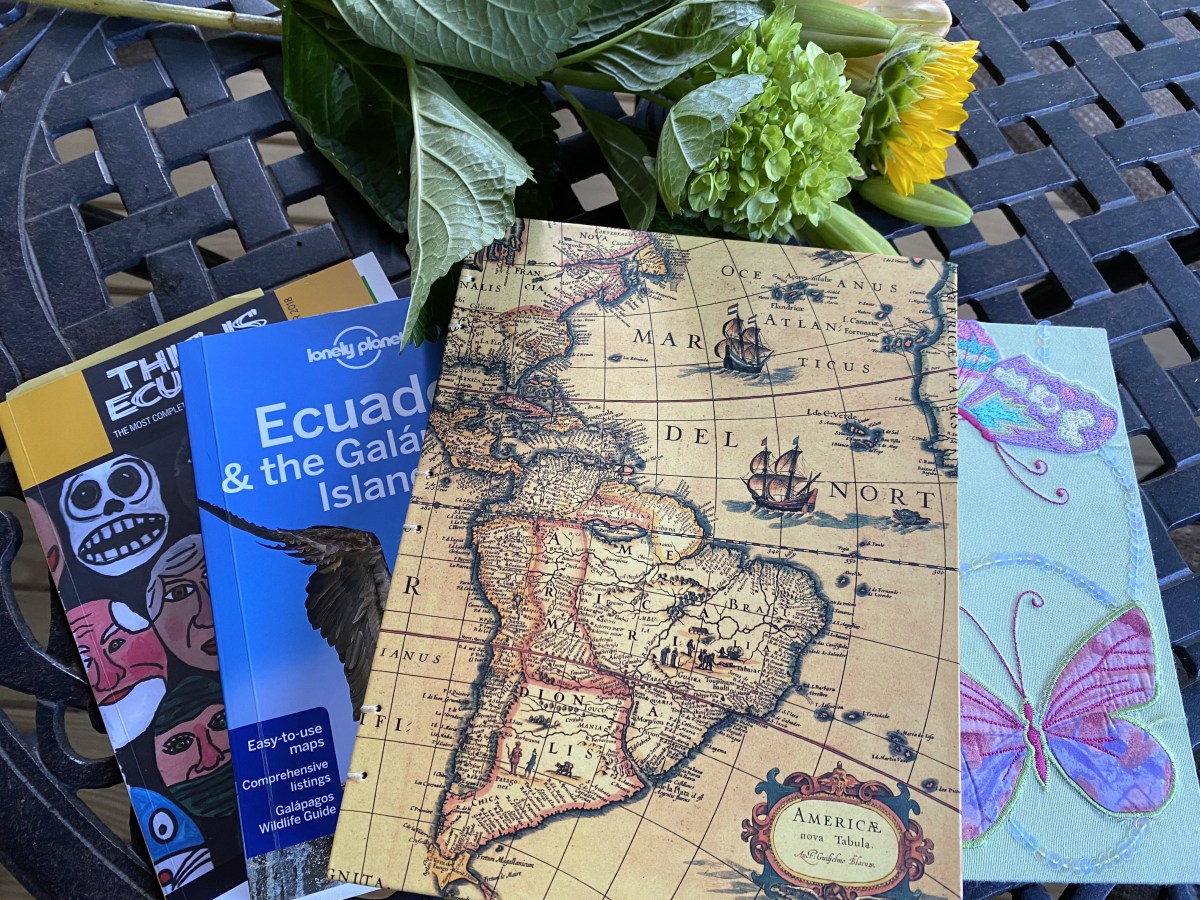
I began the new year with hopes of going to Ecuador in July, so I started reading Lonely Planet Ecuador & the Galápagos Islands and another little brochure (This is Ecuador: The Most Complete Guide to Ecuador Since 1968, dated December 2018) that somehow made its way to me.

fullsizeoutput_1e2f4

Lonely Planet guide to Ecuador & the Galápagos Islands, along with two journals

Since I was hoping to “live like a local,” I started a Spanish class at the end of January.  I’m embarrassed to say that I studied Spanish for four years in high school. I had rarely used it, so I didn’t remember much of anything. Thus I started all over at the beginning, at level 100. We started in-person classes, but due to the pandemic, we had to meet online for the remaining courses. The virtual classes haven’t been much fun.  I was never crazy about the teacher, who I felt could have given us a lot more practice time. She is also terrible about keeping the class on track.  We had our last class for level 200 this past Wednesday, and I’ve decided I will try to study on my own because I hate the Zoom classes.  Whenever I am able to go to Ecuador, I hope to take immersion classes in Quito.

For my class, I had to do a Power Point presentation about “Music of Ecuador,” so I learned about the country’s traditional music including pasillo, pasacalle, yarabi, marimba, bomba, and Sanjuanito.  I also learned about some Indie rock groups, including Da Pawn and La Máquina Camaleön, both of which I love. I created a short playlist on Spotify: ecuadorian music, which I’ll add to over the coming months.

I found an article that I also read for ideas: culture trip: 12 Amazing Things You Didn’t Know About Ecuador.

Of course, I always love to read books set in my destination, so I read some of the books below (indicated with stars and ratings).  Others are suggested reading; since I can’t go to Ecuador this year, maybe I can read some of the others.

  1. the queen of water: a novel based on a true story by Laura Resau and María Virginia Farinango (YA) ****
  2. America Was Hard to Find by Kathleen Alcott (currently reading)
  3. The Panama Hat Trail by Tom Miller
  4. Our House in the Clouds: Building a Second Life in the Andes of Ecuador by Judy Blankenship
  5. Cañar: A Year in the Highlands of Ecuador by Judy Blankenship
  6. Pieces of My Life by Rachel Dann
  7. Villa Pacifica by Kapka Kassabova
  8. The Amnesia Clinic by James Scudamore
  9. City on the Ledge by Philip Kraske
  10. The General in His Labyrinth by Gabriel Garcia Marquez (+ Columbia + Venezuela)
  11. Fool’s Gold by P.J. Skinner
  12. Huasipungo: The Villagers by Jorge Icaza
  13. Measure of the Earth: The Enlightenment Expedition That Reshaped Our World by Larrie D. Ferreiro
  14. The Farm on the River of Emeralds by Moritz Thomsen
  15. Galápagos Islands
    1. Enchanted Islands by Allison Amand ***
    2. Floreana by Margret Whittmer
    3. The Evolution of Jane by Cathleen Schine
    4. To the Edge of the World by Harry Thompson
    5. Mr. Darwin’s Shooter by Roger McDonald
    6. The Origin of Murder by Jerold Last
    7. Plundering Paradise: The Hand of Man on the Galápagos Islands by Michael D’Orso
    8. Galápagos Regained by James K. Morrow
    9. The Voyage of the Beagle: Journal of Researches into the Natural History and Geology of the Countries Visited During the Voyage of H.M.S. Beagle Round the World by Charles Darwin (intro. by Steve Jones)
    10. Pilgrim on the Great Bird Continent: The Importance of Everything and Other Lessons from Darwin’s Lost Notebooks by Lyanda Lynn Haupt
    11. The Beak of the Finch by Jonathan Weiner
    12. The Origin: A Biographical Novel of Charles Darwin by Irving Stone

For more international books, see my page: books | international a-z |.

fullsizeoutput_1e30a

Books I’m reading set in Ecuador

I found movies set in Ecuador, but sadly I haven’t seen any of them.  Hopefully, I can find some of these in the coming months.

  1. Entre Marx y una Mujer Desnuda (1996)
  2. Proof of Life (2000)
  3. Crónicas (2004)
  4. Qué tan lejos (2006)
  5. Crude (2009)
  6. Rage (2009)
  7. Fisherman (Pescador) (2011)
  8. With My Heart in Yambo (Con mi Corazó en Yambo) (2011)
  9. The Porcelain Horse (Mejor no hablar de ciertas cosas) (2012)
  10. The Death of Jaime Roldos (La Muerte de Jaime Roldós) (2013)
  11. El Facilitador (2013)
  12. The Galapagos Affair: Satan Came to Eden (2013)
  13. Holiday (Feriado) (2014)
  14. El Secreto de Magdalena (2015)
  15. Medardo (2015)
  16. A Secret in the Box (Un Secreto en la Caja) (2016)
  17. Translucido (Translúcido) (2016)
  18. Such Is Life in the Tropics (Sin Muertos No Hay Carnaval) (2016)
  19. Special Correspondents (2016)
  20. Alba (2016)
  21. Snatched (2017)
  22. Final Minute (2018)
  23. The Longest Night (2019)

After having read more about Ecuador, I am no longer certain about my plan to stay only in Quito for a month.  Now, I want to go to Cuenca (both Quito and Cuenca are UNESCO World Heritage Sites).  I would also love to go to Guayaquil, and possibly from there to the Galápagos Islands. Originally, I didn’t think I’d have an interest in going there, but now that I’ve read about it, maybe I will have to visit.

I’m not sure when I’ll be able to go, but I am certain that someday, this pandemic will come to an end, and we’ll all be able to travel again.

I prepared one journal, and depending on how long I end up staying, it’s possible I’ll use two or three.

fullsizeoutput_1e2f6

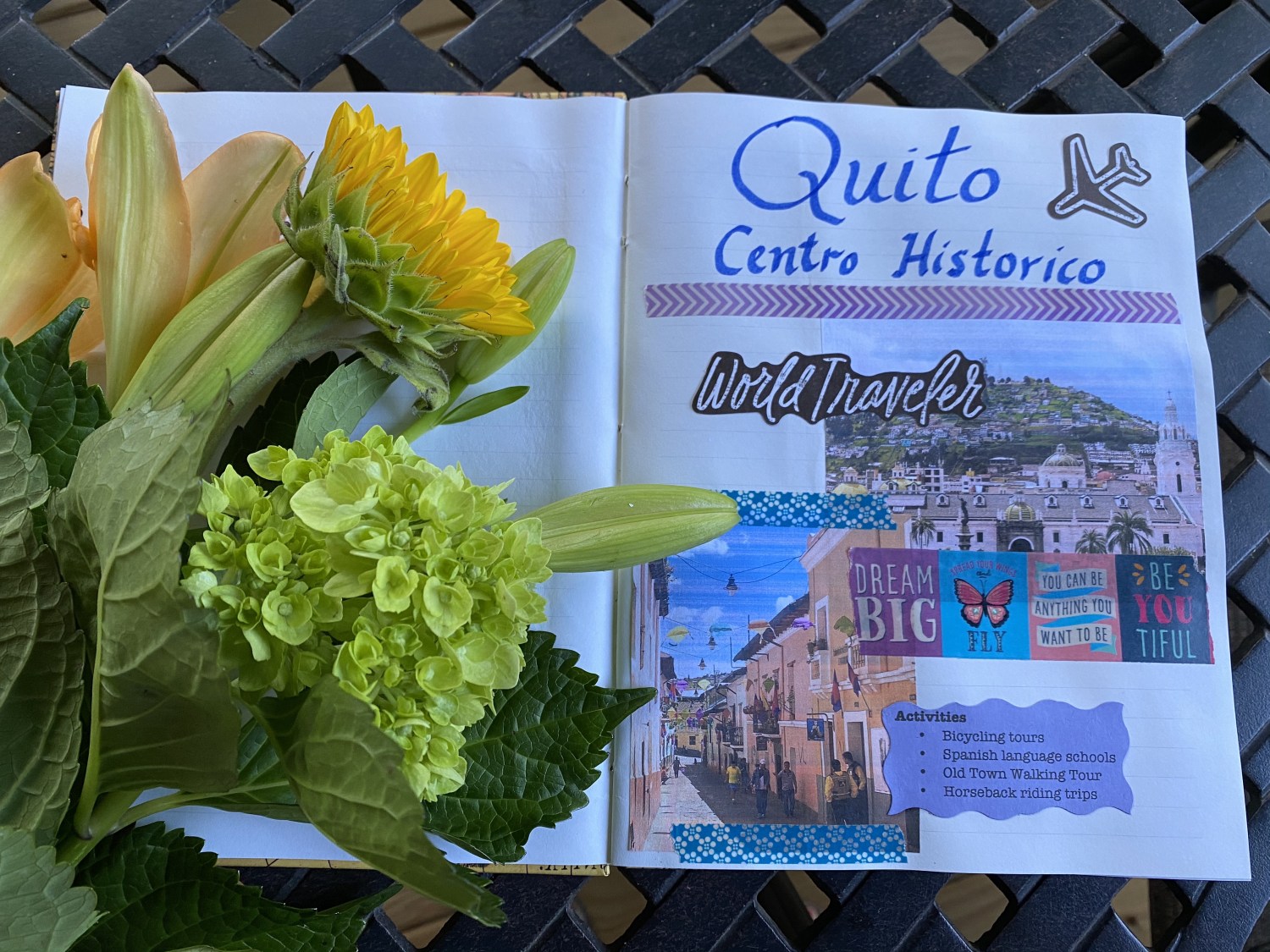
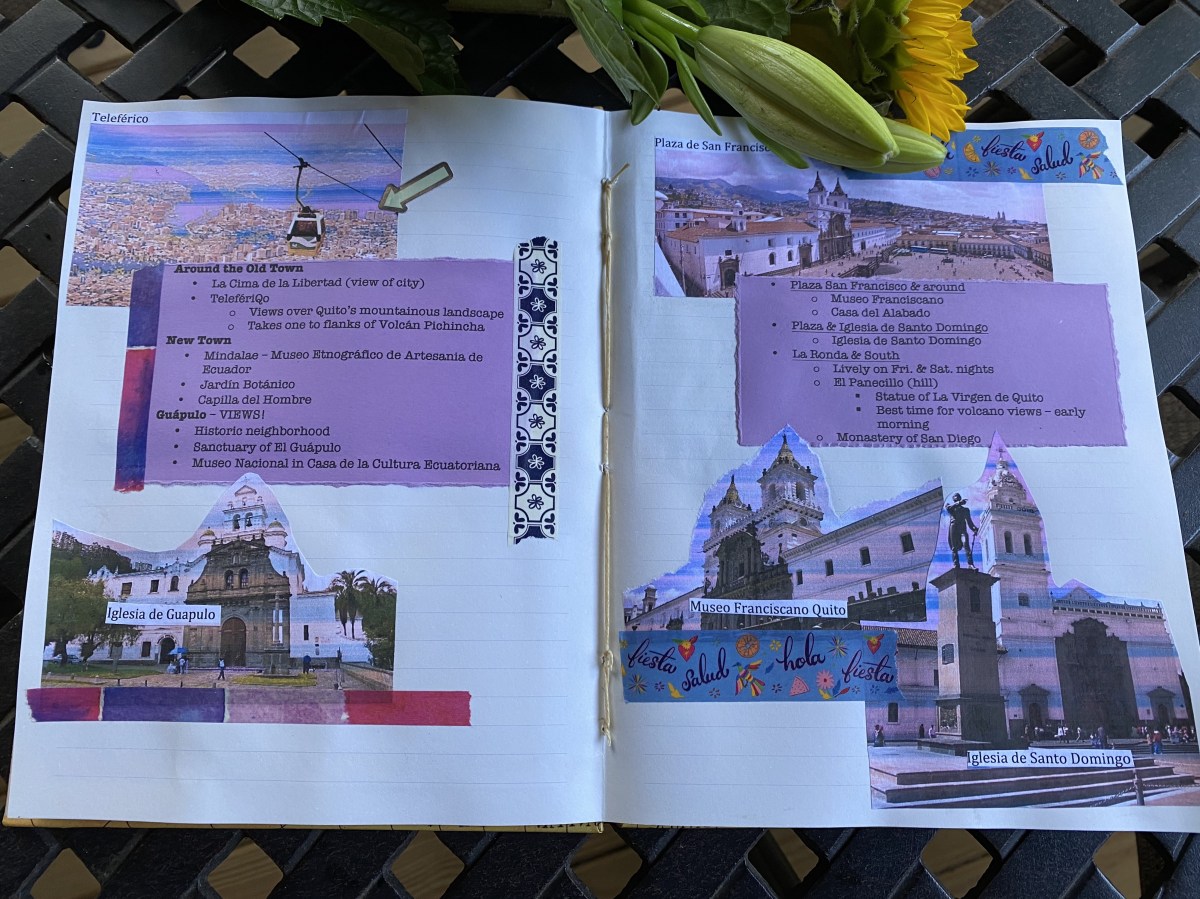
Quito

fullsizeoutput_1e2fc

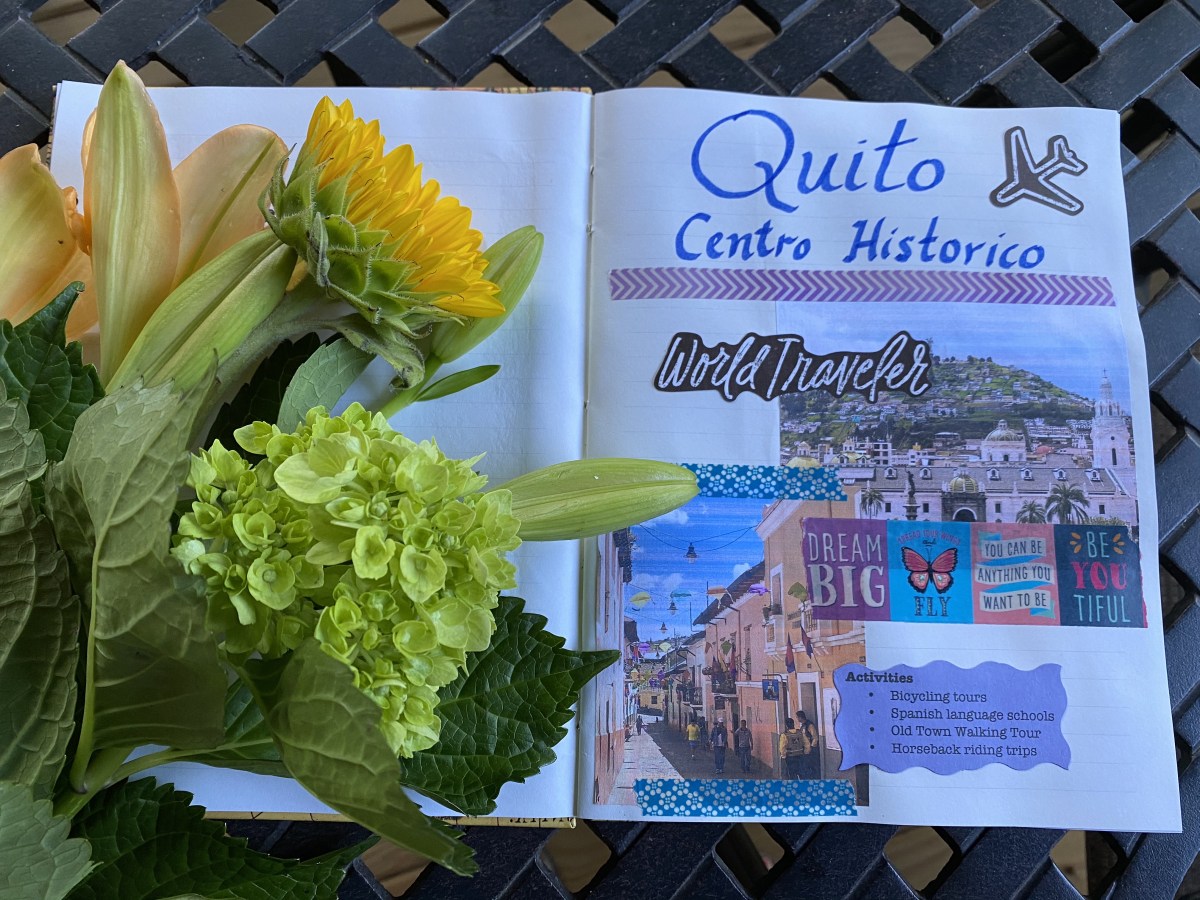
more Quito

fullsizeoutput_1e2fb

Cuenca

fullsizeoutput_1e2ff

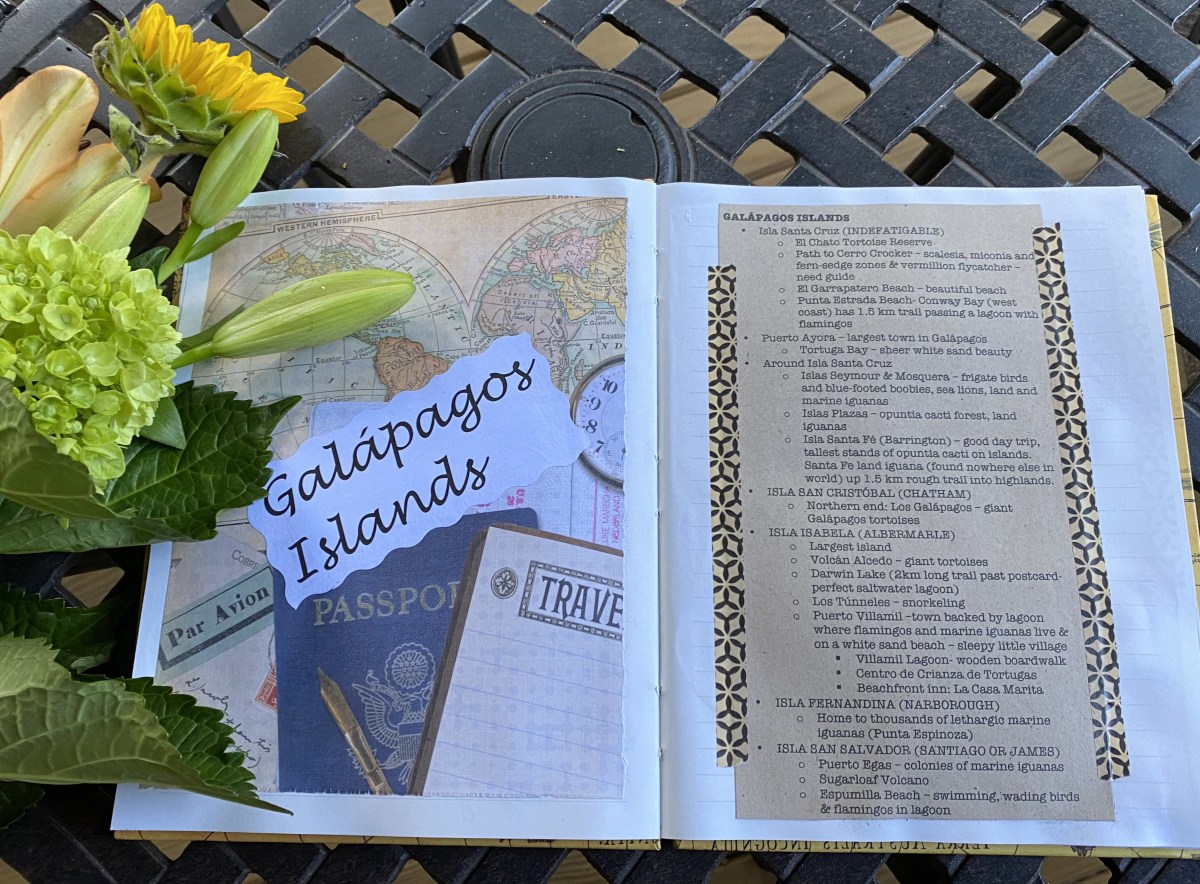
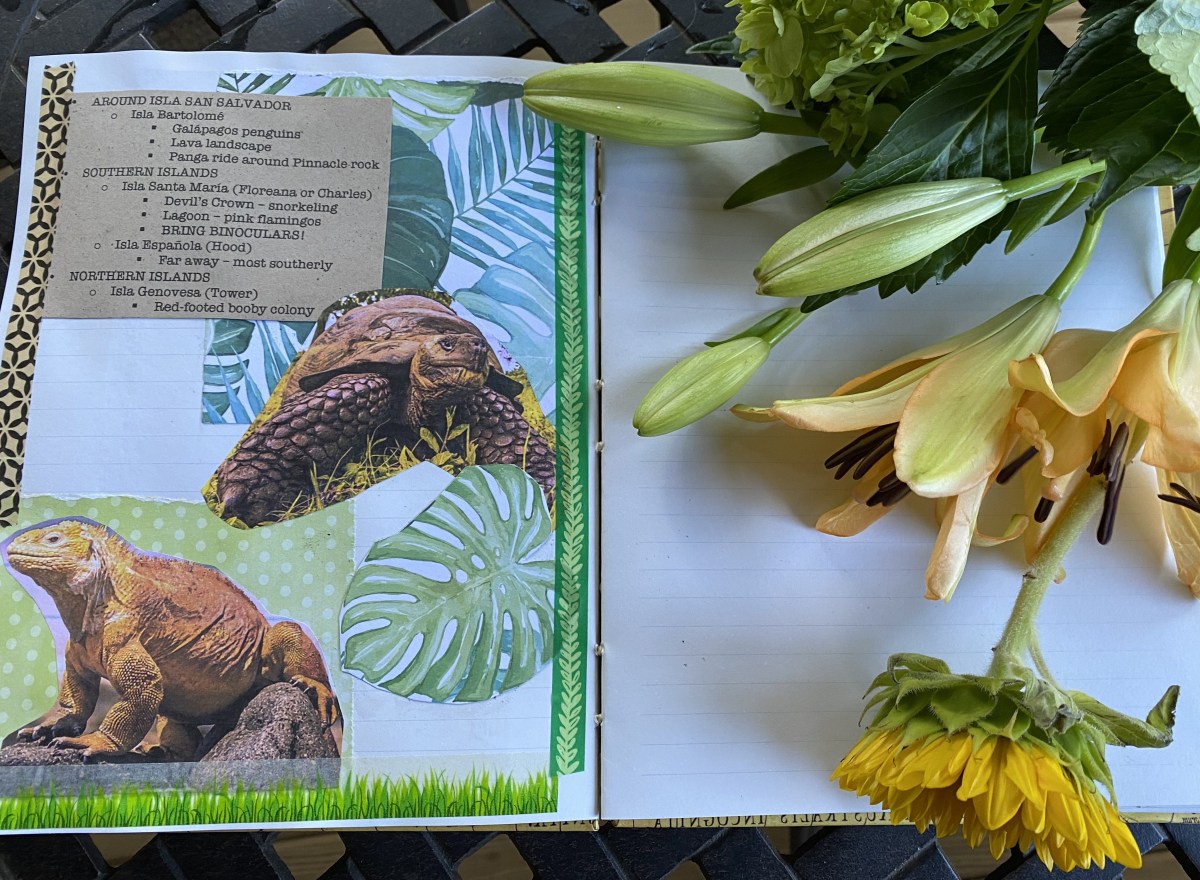
Galápagos Islands

fullsizeoutput_1e302

Galápagos Islands

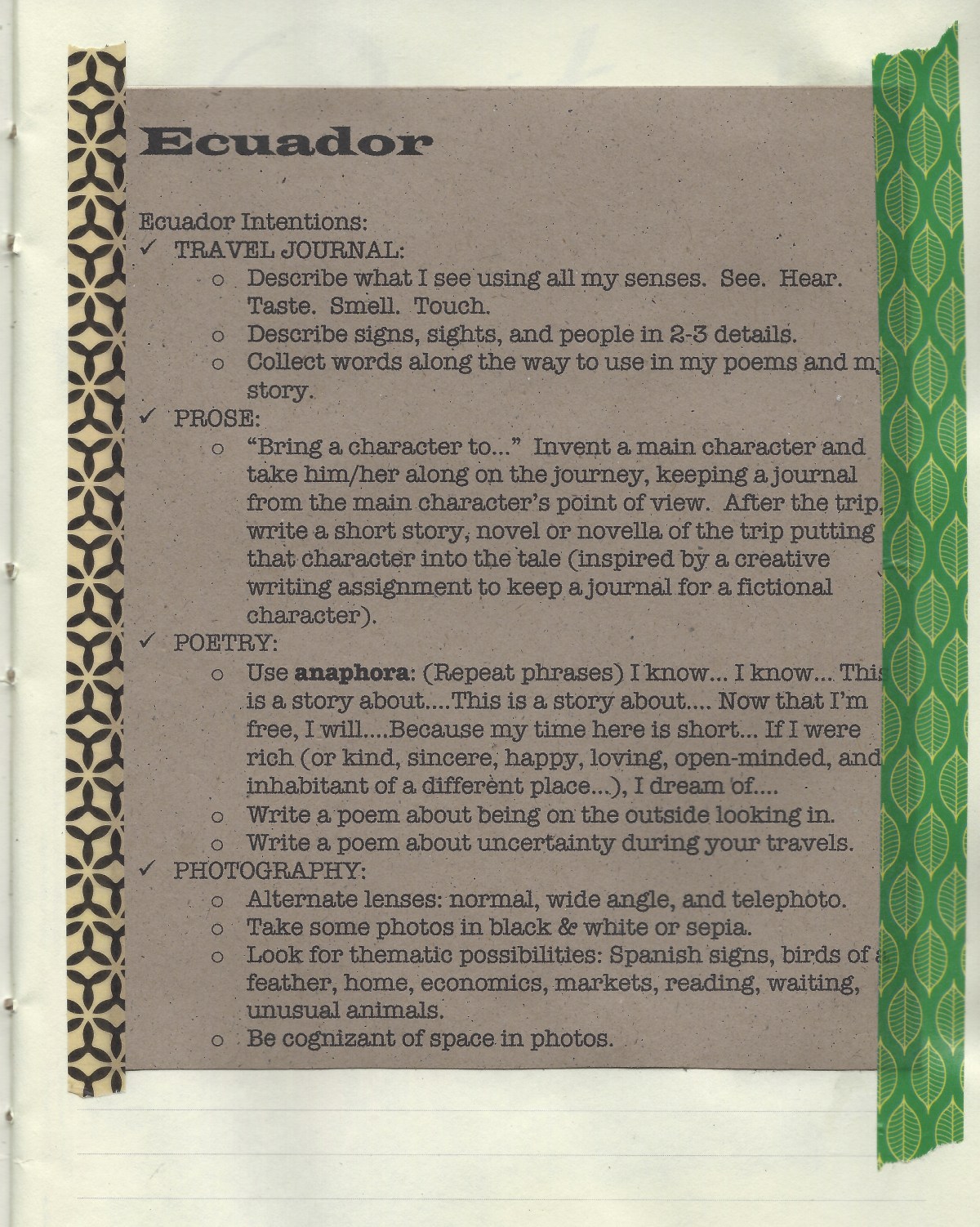
As always, I created some intentions for my travels.

fullsizeoutput_1e308

Ecuador intentions

I still hope to go in July of either 2021 or 2022.  My friend Jayne in Jersey, England has said she wants me to come to her 60th birthday next July, which would mean I’d plan to travel somewhere in Europe (assuming Americans are allowed there!).  That would put my trip back another year.  Someday, I hope! 🙂


Share this:

  • Share on X (Opens in new window) X
  • Share on Facebook (Opens in new window) Facebook
  • More
  • Email a link to a friend (Opens in new window) Email
  • Print (Opens in new window) Print
  • Share on Pinterest (Opens in new window) Pinterest
Like Loading...
  • challenge: a call to place
  • destinations
  • Ecuador

call to place: ecuador

wanderessence1025's avatar wanderessence1025 July 23, 2020

Since my years of living and working abroad, I’ve had a dream to travel to a place and simply live like a local. I love the experience of living in a place vs. traveling to a place. The first is a deep immersion while the second is skimming the surface. I love diving in and learning the culture and getting to know the people. It’s an entirely different experience.

I knew it would be expensive to live somewhere for an extended period, and I wondered how I might do it.  I figure the key would be finding a cheap place to live.  For a while, I followed some bloggers who lived in Quito, Ecuador and what surprised me was that they were renting a house for $325/month.  They were actually living there long term, so they had probably signed a long-term lease.  That would be impossible for me, because I only wanted to stay a month or slightly longer.

Still. I thought maybe it might be possible.  While there, I could study Spanish, write about a fictional character living in Quito, and wander aimlessly through the culture.

This appealed to me and I determined I would figure out a way to do it in July of this year, 2020, the year that has turned into a perpetual waiting, a stressful year in which we’ve mostly been staying at home, waiting to be released back to normal life.  I wanted to go in July because it is said that the best weather for visiting with less rain and warm clear days is from June-September. I found July to be the driest month and so decided that’s when I wanted to go.

I am also enticed to travel to South America, a part of the world I’ve never visited.

When I began reading in the newspaper in late March that the Ecuadorean city of Guayaquil was hit by one of the world’s worst coronavirus outbreaks, I knew my plans were doomed. The country’s collapsed health system had forced families to leave the corpses of loved ones on street corners, sometimes for days under the burning sun.

Since I realized I wouldn’t be going ANYWHERE in July, I hunkered down and read all about Ecuador.  I figured I would have an idea of what I wanted to do when next July, or the next, rolls around. I hope beyond all hope that I can get there in one of the next couple of years.

Most people go to Ecuador to see the Galapagos Islands, but when I first dreamed of going to Ecuador, I didn’t think I had any interest in going there. As I read more about the country, my ideas about what I wanted to do there began to evolve into another sort of trip altogether.

fullsizeoutput_1e262

South America

Share this:

  • Share on X (Opens in new window) X
  • Share on Facebook (Opens in new window) Facebook
  • More
  • Email a link to a friend (Opens in new window) Email
  • Print (Opens in new window) Print
  • Share on Pinterest (Opens in new window) Pinterest
Like Loading...
  • Coronavirus Coping
  • District of Columbia
  • Hikes & Walks

a mural walk in washington on a hot july day

wanderessence1025's avatar wanderessence1025 July 19, 2020

One hot and humid Sunday in July, we followed a mural walk in D.C. that was outlined in the Weekend Section of The Washington Post: “Need an art fix? Take a mural stroll.” We didn’t actually walk, because it was about 95°F, so we drove from mural to mural following the walk in the article, putting our masks on every time we hopped out of the car.

Most of the museums in Washington are still closed, going on four months now, so it was fun to have an excuse to go downtown and see some street art. This three-mile walk starts near the Columbia Heights Metro station in Northwest Washington, and it ends at the U Street Station. Many of the artworks have been commissioned by MuralsDC – a public program that funds murals.  The pieces on this walk reveal the city’s cultural and economic history, highlighting the city’s native folks.

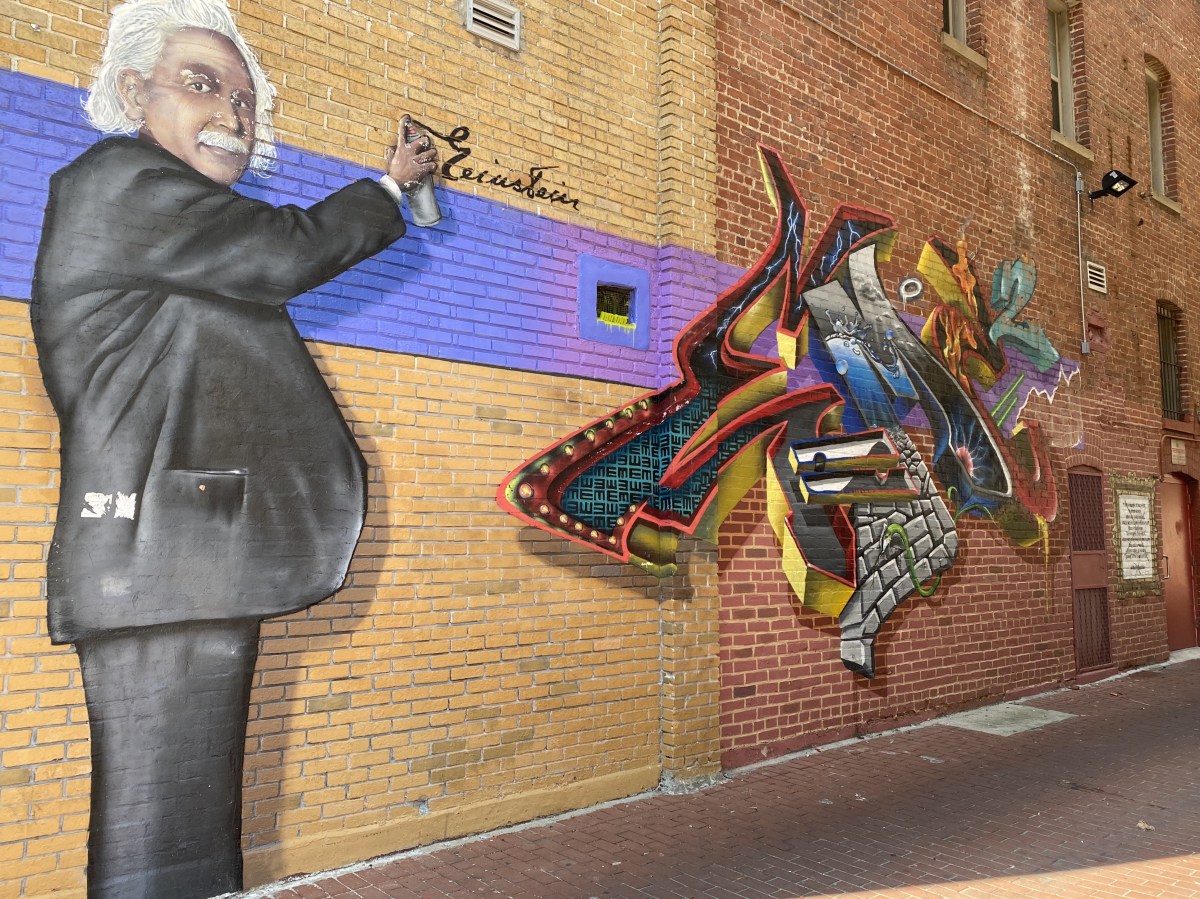
Here Einstein spray paints his famous formula on the wall like graffiti.

fullsizeoutput_1df9a

E=MC2 by Nessar Jahanbin (3018 14th St.)

"You Are Welcome" by Cita Sadeli, a.k.a. Miss Chelove (3020 14th St)
“You Are Welcome” by Cita Sadeli, a.k.a. Miss Chelove (3020 14th St)
by G. Byron Peck (2500 14th St)
unknown
unknown

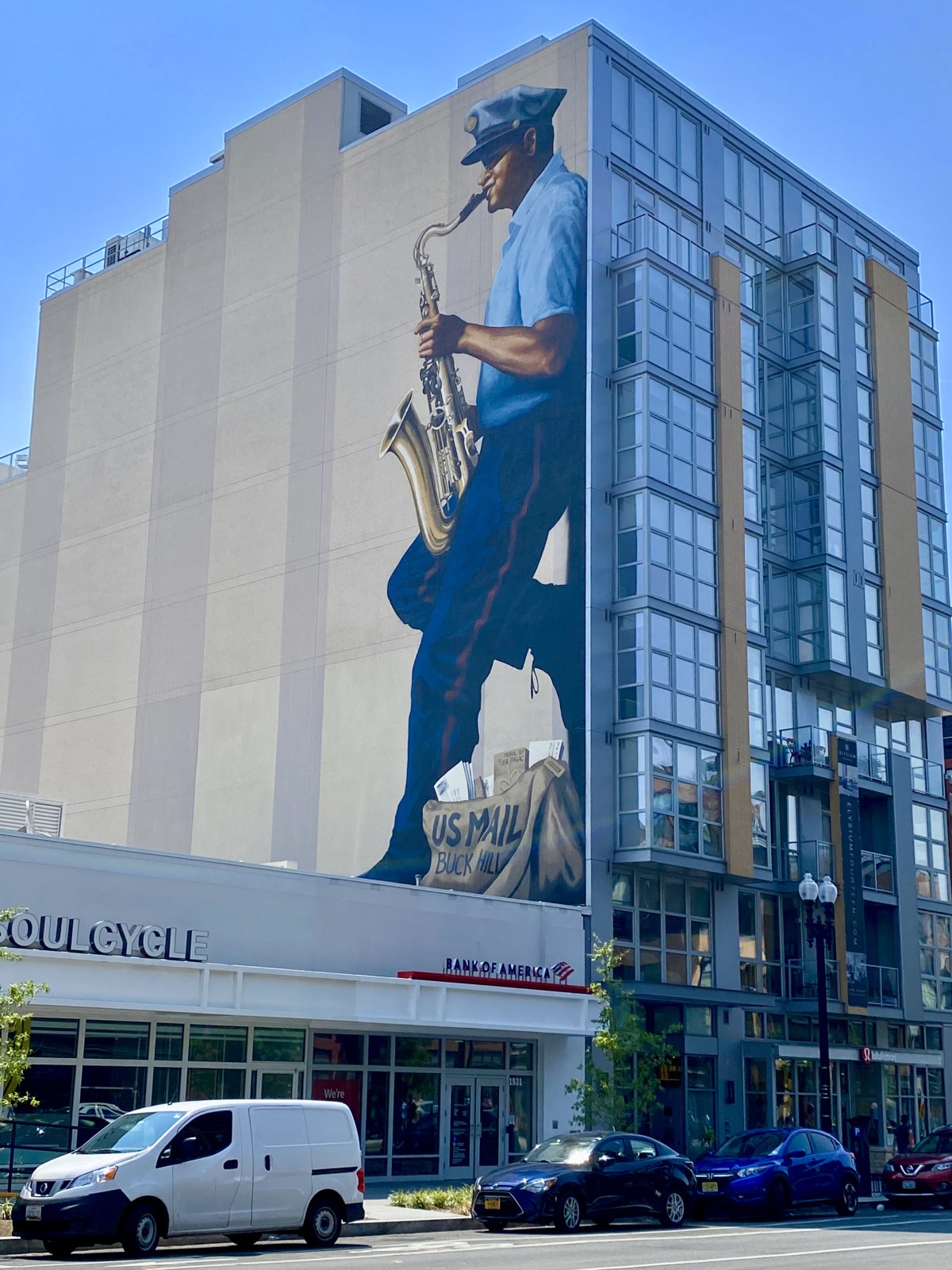
“Buck Hill” is the 70-foot-tall saxophone-playing “wailin’ mailman” painted by Joe Pagac; it celebrates the jazz musician and postal worker.

fullsizeoutput_1e1e2

Buck Hill by Joe Pagac (1925 14th St.)

We found three murals by Aniekan Udofia, one of D.C.’s most well-known visual artists. One of them is a gagged George Washington; another is Ruth Bader Ginsburg.

Ruth Bader Ginsberg - by Aniekan Udofia
Ruth Bader Ginsberg – by Aniekan Udofia
unknown by Aniekan Udofia
gagged George Washington by Aniekan Udofia

We found a number of famous and recent murals celebrating African American icons such as Paul Robeson (1898 – 1976); he was an American bass baritone concert artist and stage and film actor who became famous both for his cultural accomplishments and for his political activism.

Paul Robeson (1351 U. St)
Ben's Next Door by Eric B. Ricks
Ben’s Next Door by Eric B. Ricks
Ben's Next Door by Eric B. Ricks
Ben’s Next Door by Eric B. Ricks
Ben's Next Door by Eric B. Ricks
Ben’s Next Door by Eric B. Ricks

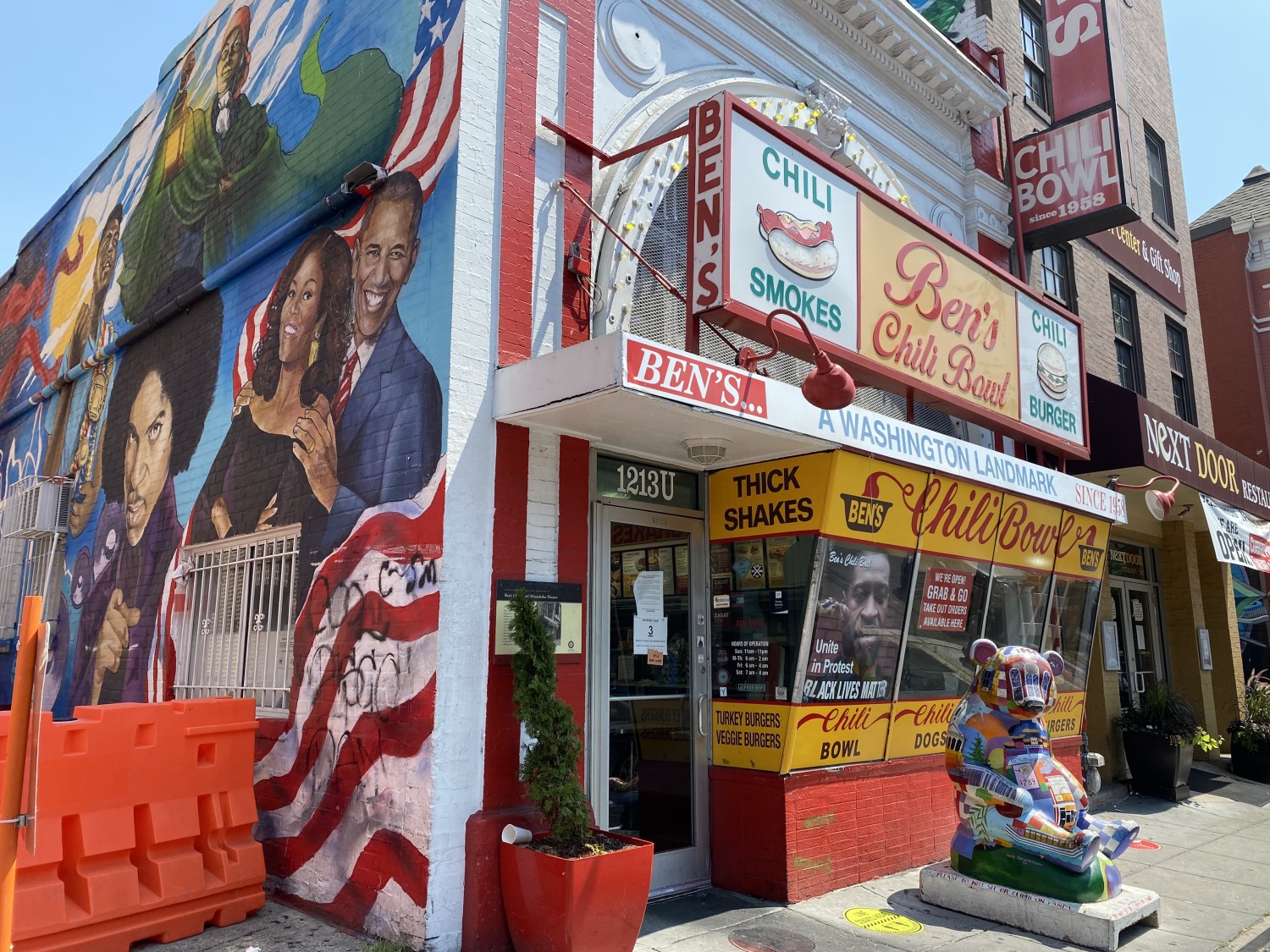
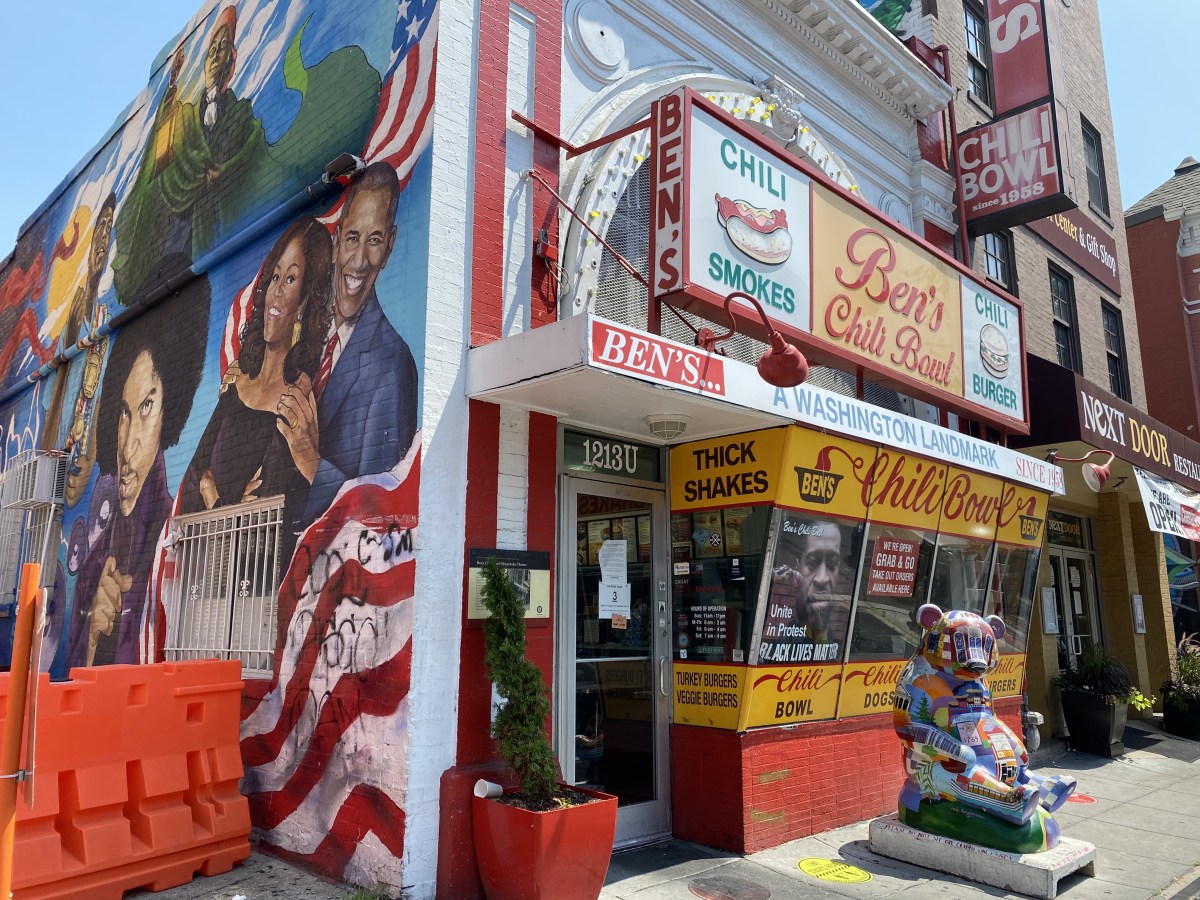
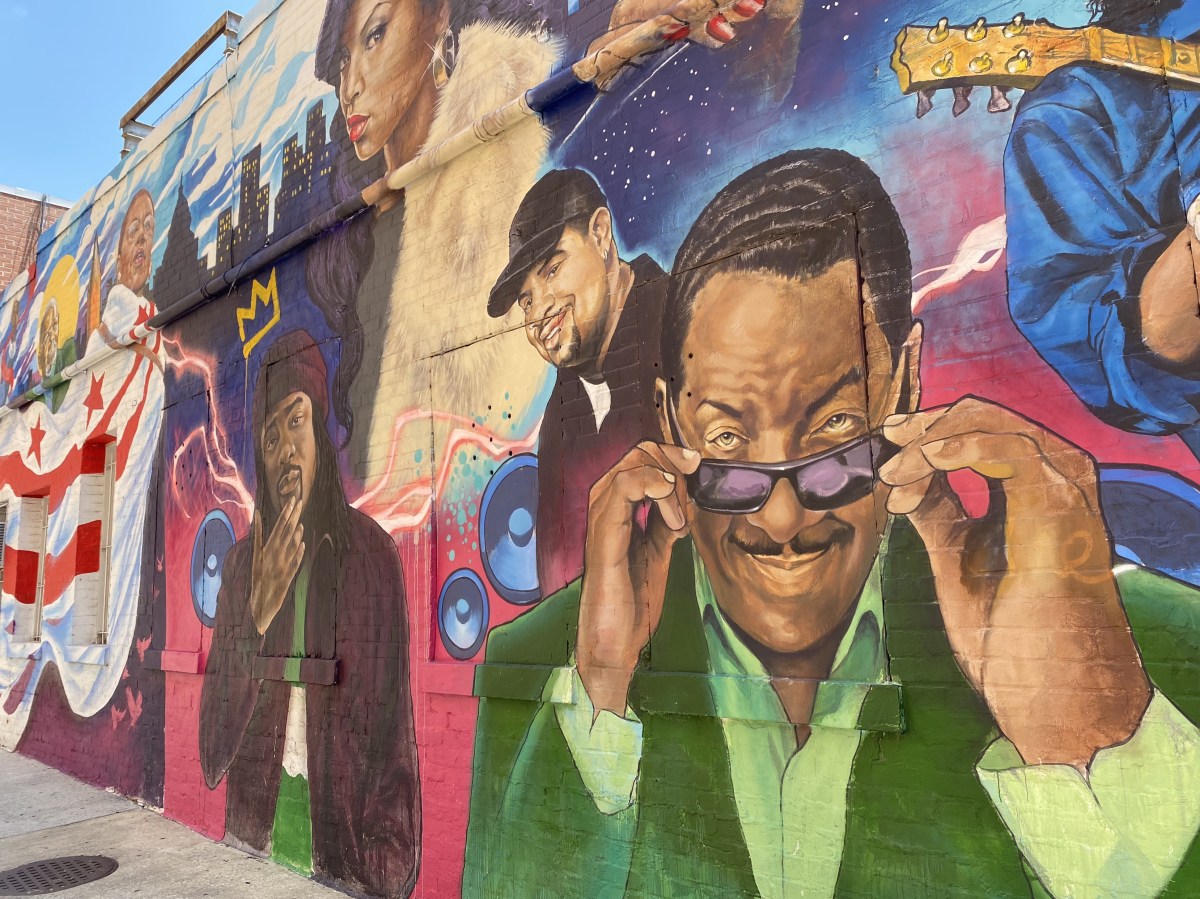
The Torch by Aniekan Udofia, at Ben’s Chili Bowl, is one of the most photographed murals in the city. Here we found Prince, the Obamas and Duke Ellington.

Ben’s Chili Bowl, founded in 1958 by Ben and Virginia Ali, is one of the oldest continuous businesses on U Street. It is also one of the few to survive both the riots that followed the 1968 assassination of the Rev. Martin Luther King, Jr. and the years of disruptive Metro construction in the late 1980s. Thanks in part to the patronage of entertainer Bill Cosby, Ben’s has become a national landmark. The restaurant occupies the former Minnehaha Theater, a 1910 movie house that was owned and operated from 1913 to 1920 by Sherman H. Dudley, once a leading vaudeville performer and entrepreneur.

fullsizeoutput_1dfc1

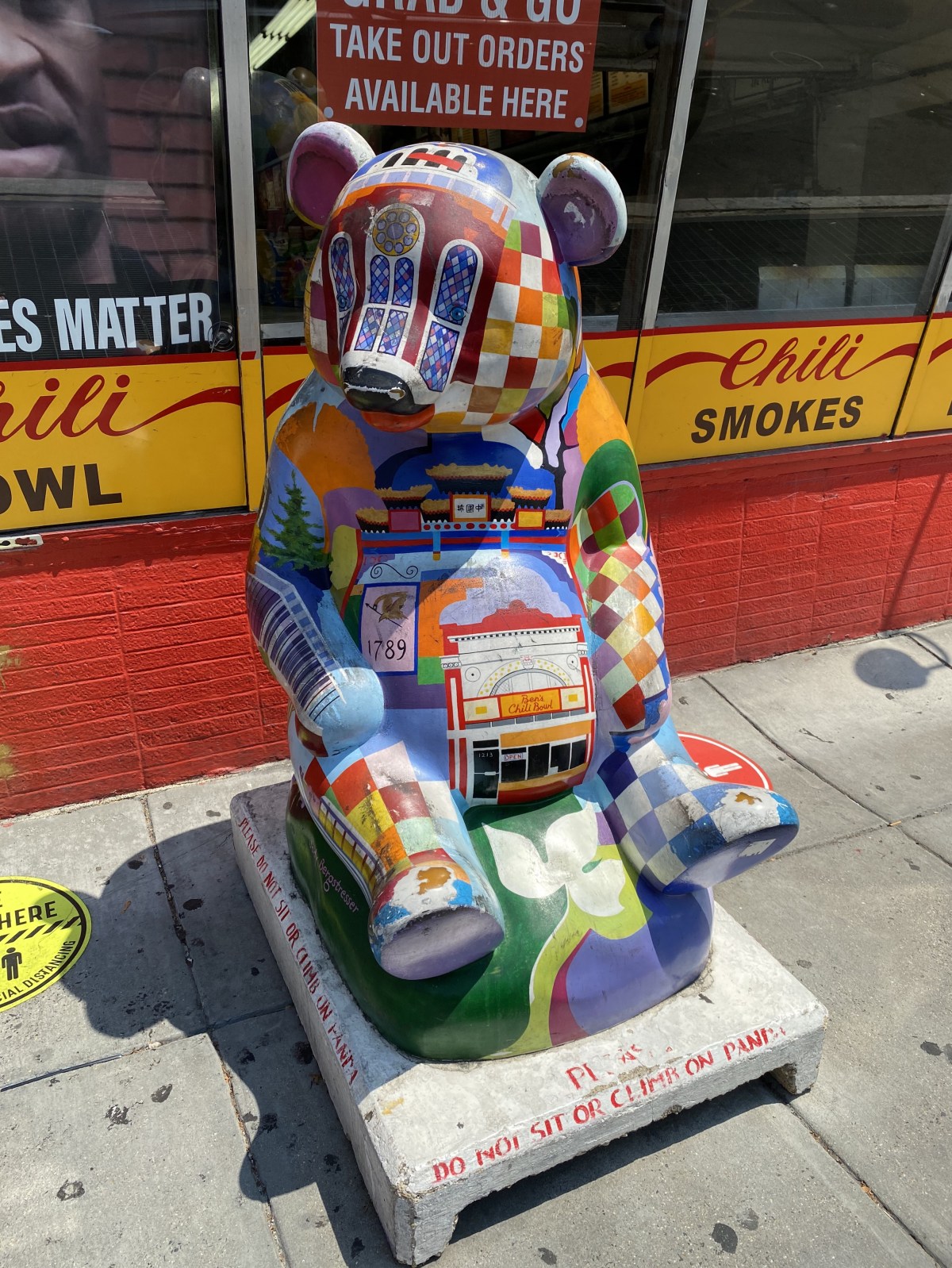
bear mascot at Ben’s Chili Bowl

On the corner of Ben’s Chili Bowl, we saw the Obamas draped in an American flag.

9Q3DpmiJSLGMWWlAJQDm8Q

The Obamas and Ben’s Chili Bowl

x1nMCs7GSIWVt7IN4f4wvg

The Torch at Ben’s Chili Bowl

Bn%BpkjXQteYd18iPQ9xiQ

The Torch at Ben’s Chili Bowl

fullsizeoutput_1dfc2

The Torch at Ben’s Chili Bowl

fullsizeoutput_1dfc3

The Torch at Ben’s Chili Bowl

fullsizeoutput_1dfc5

The Torch at Ben’s Chili Bowl

fullsizeoutput_1dfc8

The Torch at Ben’s Chili Bowl

fullsizeoutput_1dfca

The Torch at Ben’s Chili Bowl

fullsizeoutput_1dfcc

The Torch at Ben’s Chili Bowl

Kaliq Crosby painted William P. and Winnifred Lee outside their flower shop at 1026 U. St. NW.

Lee's Legacy (William P. and Winnifred Lee) (1026 U St.)
Lee’s Legacy (William P. and Winnifred Lee) (1026 U St.)
Lee's Flower Shop
Lee’s Flower Shop
Black Lives Matter at Lee's Flower Shop
Black Lives Matter at Lee’s Flower Shop

We stopped on a side street to see Aniekan Udofia’s mural of D.C. native Marvin Gaye (710 S St. NW).

fullsizeoutput_1dff0

Marvin Gaye (710 S St. NW) by Aniekan Udofia

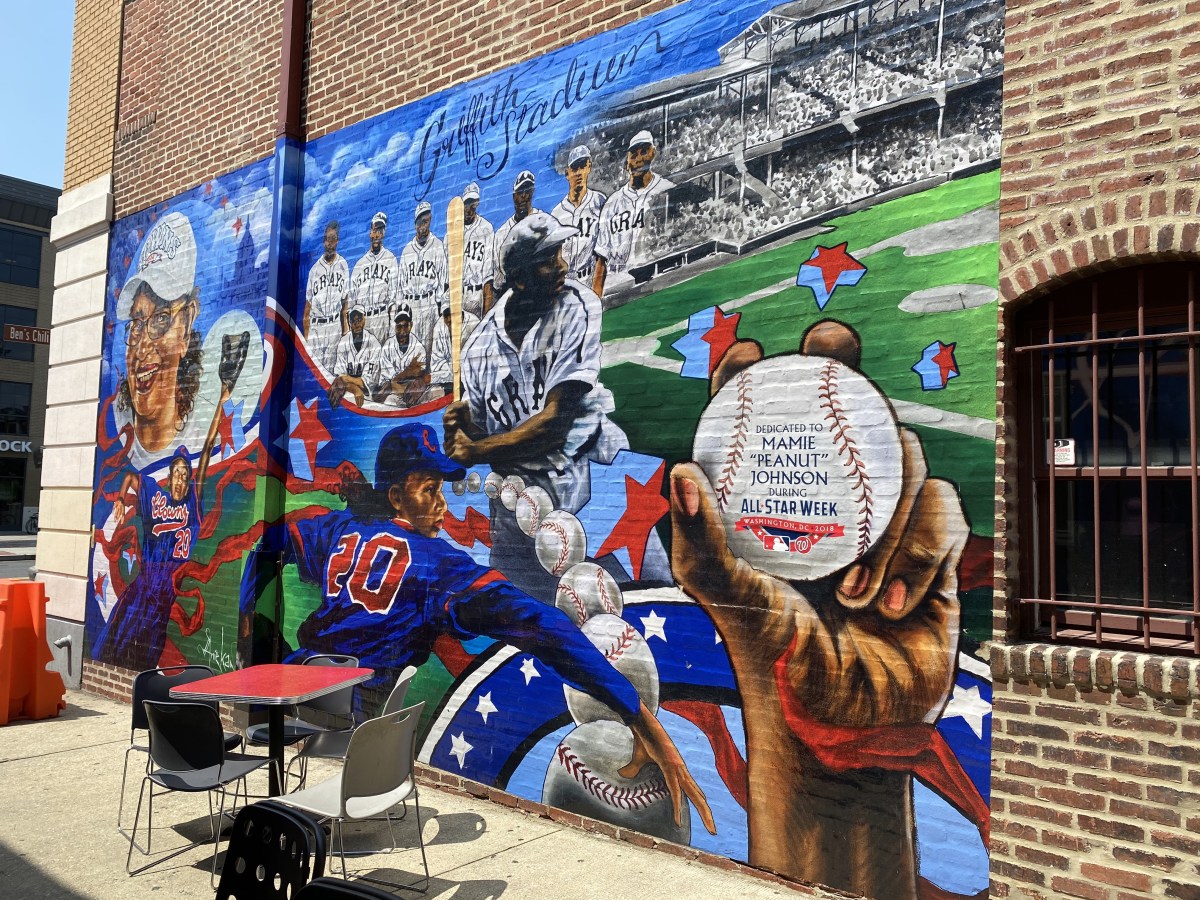
We found a number of random murals and buildings along the way.

random murals in D.C.
BLACK LIVES MATTER
BLACK LIVES MATTER
random murals in D.C.
Pabst Blue Ribbon
Pabst Blue Ribbon
Bohemian Cavern
Bohemian Cavern
random murals in D.C.
Industrial Bank
Industrial Bank
random murals in D.C.

Three separate murals in an alley celebrate the neighborhood’s musical roots.

D.C. to the World by Cita Sadeli (637 T Street, NW)

I love this one, but I’m not sure what it’s titled or who the artist is.

fullsizeoutput_1dffd

unknown title or artist

We found another alley full of murals. Here the alley had a rather pungent odor. 😦

more D.C. murals
more D.C. murals
more D.C. murals
more D.C. murals

Finally, we saw the very tall “Kindred” by Alberto Clerencia (1210 V St.).

fullsizeoutput_1e007

“Kindred” by Alberto Clerencia (1210 V St.)

It felt good to get out of the house after four long months of rarely going anywhere interesting.

*Sunday, July 5, 2020*

Share this:

  • Share on X (Opens in new window) X
  • Share on Facebook (Opens in new window) Facebook
  • More
  • Email a link to a friend (Opens in new window) Email
  • Print (Opens in new window) Print
  • Share on Pinterest (Opens in new window) Pinterest
Like Loading...
  • American Road Trips
  • Iowa
  • Nebraska

tower of the four winds & the desoto national wildlife refuge

wanderessence1025's avatar wanderessence1025 July 16, 2020

I left Omaha on a highway that cut through cornfields neatly trimmed with white wooden fences, all glimmering in the breeze. Vaguely rolling hills, soft and green, surrounded me. It seemed everyone in these parts had SUVs or pickup trucks. Soon I passed a Christmas tree farm called Santa’s Woods.

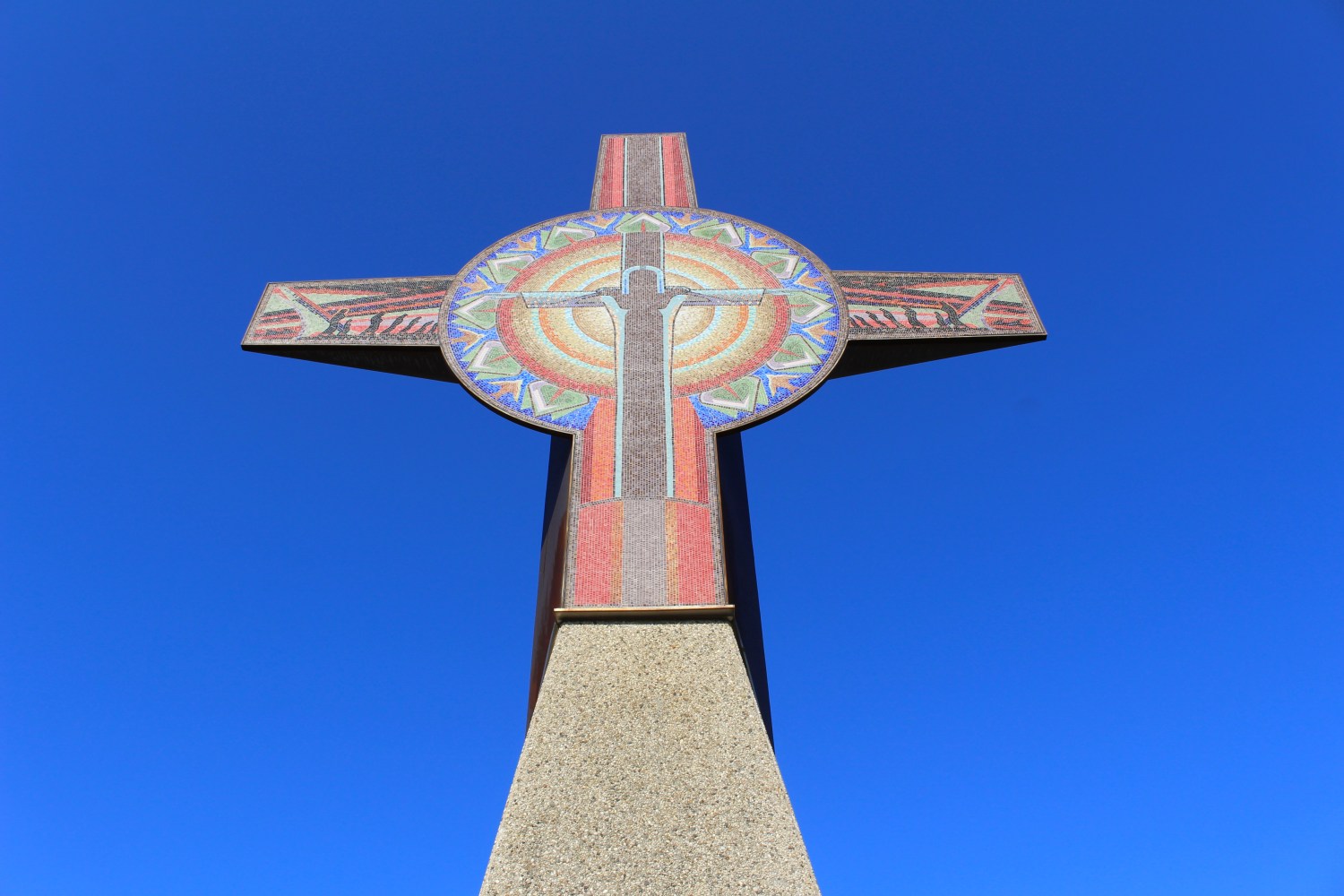
I was looking for the city of Blair and found “Dana College” painted on the town’s water tower. I went directly to Black Elk-Neihardt Park to see the Tower of the Four Winds, designed by Dana College professor F.W. Thomsen.  Built to promote world peace, brotherhood and humanity, it portrays the message of Black Elk, an Oglala Sioux holy man and visionary.  He is said to have envisioned a radiant person with outstretched arms in a blessing to all people, standing in front of the tree of life.  The 45-foot tower, made from native rock and covered with a 50,000 piece mosaic, represents the messiah-like figure of Black Elk’s vision.

fullsizeoutput_1df97

Tower of the Four Winds

Several trails crisscrossed the 80 acres of rolling hills in the park. They included a paved trail with pedestal mosaics by Prof. Thomsen depicting Native-American descriptions of north, south, east and west.

South
South
East
East
North
North
North
North
West
West
West
West

I took a pleasant and breezy stroll around the park in a happy start to my morning.  At the “heights,” I had some views of flat Nebraska.

fullsizeoutput_1c3c6

Blair, Nebraksa

fullsizeoutput_1c3c8

Blair, Nebraksa

IMG_9048

Blair, Nebraksa

Tower of the Four Winds

I then crossed the Missouri River into Iowa, where I entered the DeSoto National Wildlife Refuge.  Established in 1958, it encompasses land in both Iowa and Nebraska. It lies on the wide plain formed by prehistoric flooding and shifting of the Missouri River. The Refuge’s primary purpose is to serve as a stopover for migrating ducks and geese.  Peak populations of 50,000 or more ducks, mostly mallards, are common on the refuge during the fall migration.

The seven-mile-long lake that is the heart of the refuge was once a hazardous bend in the Missouri River.  The DeSoto Bend got its name from the nearby river town of DeSoto.

Lewis and Clark’s Corps of Discovery traveled through this area in 1804 and 1806. They set up camp along DeSoto Bend after meeting with Indians at “council bluff” (according to William Clark’s journal) on August 3, 1804.

FD177E7E-3EDB-45F4-AEC7-84B027894E73

Desoto National Wildlife Refuge

I looked around the Visitor’s Center, including the goods scavenged from the Steamboat Bertrand, which sank on April 1, 1865.

fullsizeoutput_1c3d5

Facts about Steamboat Bertrand

By the mid-1800s, the Missouri River had become an artery for trade that opened the West. Steamboats carried supplies to the early fur trading posts, frontier settlements, and mining towns.  But the turbulent, snag-infested “Big Muddy” took its toll on the early stern and side-wheelers. During the 19th and early 20th centuries, more than 400 steamboats sank or were stranded between St. Louis, Missouri and Fort Benton, Montana.

When the Bertrand sank on April 1, 1865, the Missouri River quickly covered the boat in mud.  In 1968, the boat and its cargo were discovered on the refuge and unearthed the following year. The Center holds over 250,000 artifacts from the shipwrecked steamboat.

fullsizeoutput_1c3d4

The Final Voyage

The cargo contained all manner of goods needed for the new Montana Territory, gold mines, logging camps, farms and households. Aside from tools and equipment, even food items and clothing were recovered from the boat. Remarkably preserved, the cargo provided a unique time capsule for researchers.

Steamboat Bertrand
Steamboat Bertrand
April 1, 1865: A Moment Frozen in Time
Steamboat Bertrand
Steamboat Bertrand
Familiar objects from Steamboat Bertrand
Worcestershire Sauce from the Steamboat Bertrand
more artifacts from Steamboat Bertrand

There were also displays about local history and wildlife at the Visitor’s Center.  As the land here was opened up by riverboats, pioneers settled in the area and changed the land to suit their needs.  Croplands replaced the meadows of Bluestem and Indiangrass, and native animals were sometimes displaced along with the plants.  Today, the Refuge is working to restore pieces of prairie.

The lure of gold along the upper reaches of the Missouri produced a major boom in the middle 1860s. By 1865, eager fortune seekers swarmed over the hills and panned in streams. The activities of miners often produced devastated landscapes, sterile mine dumps, and foul water that killed native fish and made streams unfit for drinking by man or animal. Some mining techniques washed entire hillsides into the valley below, destroying wildlife habitat and polluting mountain streams with silt and other sediments.

Towns in the region became focal points for settlements.  Sometimes entire towns sprang up almost overnight on what had once been limitless prairie or wooded river bluffs. The building of a town had much the same effect on wildlife as the activities of the farmer and miner.

coyote in the grasslands
TOWNS: Making Nowhere Somewhere
A Fisherman's Life
A Fisherman’s Life
bobcat
bobcat
water birds
water birds

I watched the film at the refuge then drove through part of the refuge and took a walk on the Grasslands trail (3/4 mile), where I saw a variety of grasses, goldenrod, and other yellow flowers that looked like rudbeckia – yellow petals with brown faces. Critters kept skittering across the trail in front of me, but they were so fast I couldn’t tell if they were lizards, grasshoppers or tiny frogs. I heard a commotion in a pine tree and saw three large raccoons scampering up the tree.  Lots of action in these wetlands!

fullsizeoutput_1c3fc

Grasslands trail

IMG_9442

Grasslands trail

fullsizeoutput_1c3ea

Grasslands trail

IMG_9445

Grasslands trail

IMG_9067

Grasslands trail

fullsizeoutput_1df98

Grasslands trail

fullsizeoutput_1c42e

Grasslands trail

fullsizeoutput_1c3ee

butterfly along the Grasslands trail

fullsizeoutput_1c3f1

Grasslands trail

fullsizeoutput_1c437

Missouri River

fullsizeoutput_1c3f5

Missouri River

fullsizeoutput_1c3f6

Missouri River

fullsizeoutput_1c43c

Missouri River

I left the wildlife refuge close to 11:00 a.m. and headed to Fort Atkinson State Historical Park.

*Thursday, September 5, 2019*


Share this:

  • Share on X (Opens in new window) X
  • Share on Facebook (Opens in new window) Facebook
  • More
  • Email a link to a friend (Opens in new window) Email
  • Print (Opens in new window) Print
  • Share on Pinterest (Opens in new window) Pinterest
Like Loading...
  • America
  • American Road Trips
  • Charleston

on journey: a drive from richmond to charleston

wanderessence1025's avatar wanderessence1025 July 15, 2020

Getting underway with my daughter is not always easy, so we started our 8-hour drive to Charleston an hour later than I hoped, close to 10:00 a.m. While she got ready, I talked to my husband about our son’s meltdown the previous night; the details put a black mood over me for our upcoming trip.  I would have to work hard all day to get out of my distress and my funk.

We took I-95 almost the entire way from Richmond to Charleston, so it was an incredibly boring drive landscape-wise.  The only interesting things that happened were inside the car: conversations with Sarah and songs from her eclectic playlist.

An hour after leaving Richmond, we were welcomed to “North Carolina: Nation’s Most Military Friendly State.”

We were soon driving past exits for Lake Gaston, a place I spent many happy summer vacations with friends when I was a teenager. My friend Melissa’s mother had a family-sized permanent tent set up on her lakefront property, and another open-air awning sheltering a picnic table and cooking area.  Melissa lived there with her mom and siblings for much of each summer and we outsiders were sometimes invited to stay a week or so.  We spent many happy hours water skiing, lounging on the floating dock, diving and swimming off the dock, and even skinny dipping in the evenings. The mother had a lot of friends who congregated around the picnic table in the evenings, drinking, playing cards and joking around, and I remember learning my most famous card trick from one of the men who hung out at that lakefront. I can still picture the set-up at Lake Gaston and the carefree times we had there.

We drove along the highway, cotton fields stretched out on either side of us.  A sign said “Real Christians Forgive Like Jesus.” We passed the Roanoke River and signs for Roanoke Rapids.  A car whizzed past with a a Harley Davidson sticker and a license plate: PSYCHWARD. As we passed Rose’s, about 103 miles north of the South Carolina border, a sign reminded us that “When You Die You Will Meet God.” We passed Selma, Goldsboro and a sign for the Cape Lookout National Seashore.  We would come to the the famous roadside attraction, South of the Border, in another hour and a half; signs started popping up telling us how far we had to go and what attractions we’d find there:

  • Reptile Lagoon: South of the Border
  • ¡Caliente! – South of the Border
  • ¿Where the Hell is South of the Border?

We passed Black Ops Paintball and more cotton fields.  Sarah mentioned that her friend Daniel used to live in Rocky Mount, N.C. and he said there were a bunch of “podunks” there. A Confederate flag flapped in the wind along the highway and we both expressed our disgust.

  • Pedro’s Sombrero: Observation Deck – South of the Border
  • No Shoot Ze Bull – South of the Border

We passed the Cape Fear River, Fayetteville, Elizabethtown, the Lumber River and Lumbertown.  A pink sign promised “Fantasy Video and Novelties.”

  • Take a Walk on the Wild Side – South of the Border
  • Too Much Tequila – South of the Border

At 2:45, South Carolina welcomed us and we saw the 100-foot-tall Pedro statue sporting a huge sombrero.  We kept on driving.

  • Back Up – You Missed It!

We passed the Lynches River, Lynchburg and Shiloh — such southern (& racist) names.

We finally checked in to our Airbnb at 65 Vincent Drive, Mt. Pleasant, by 5:55. It was a very nice duplex in a huge yard in a quiet neighborhood.

my room in the Airbnb
Airbnb kitchen
Airbnb kitchen

After unpacking our stuff, we headed into the city of Charleston to Poogan’s Porch.

HjV5nEOqTlKTt0CUAn2e5g

Poogan’s Porch

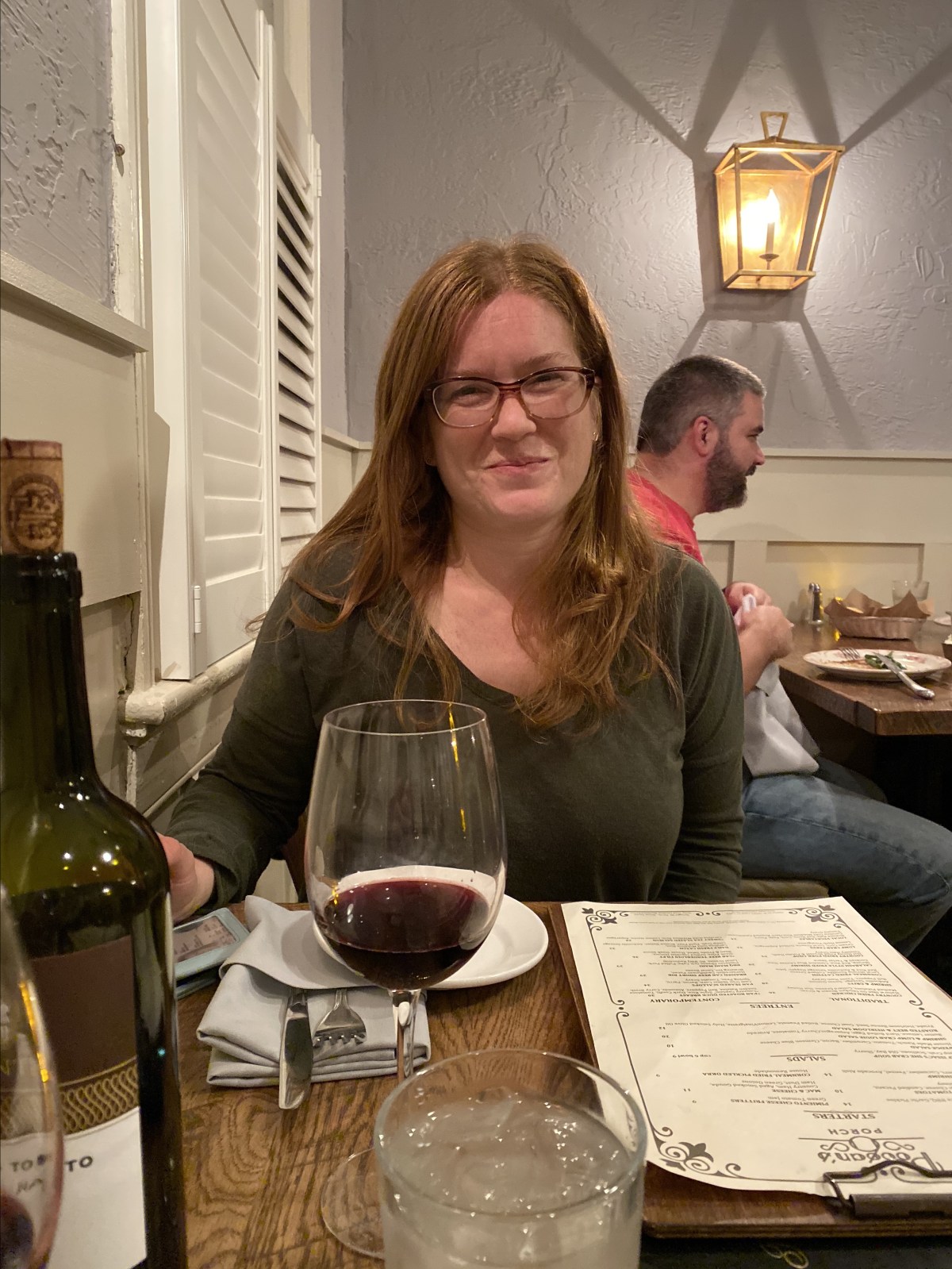
Sarah treated us to a bottle of wine, Poggio Torto: Toscana Rosso 2016, bringing back memories of Tuscany for both of us. She had gone to the region several years earlier than I had, with her father and stepmother and their family.

wine
wine
fireplace in the dining area of Poogan's Porch
fireplace in the dining area of Poogan’s Porch
3aG8d8yiTLWgA5FB+SIatQ

Sarah at Poogan’s Porch

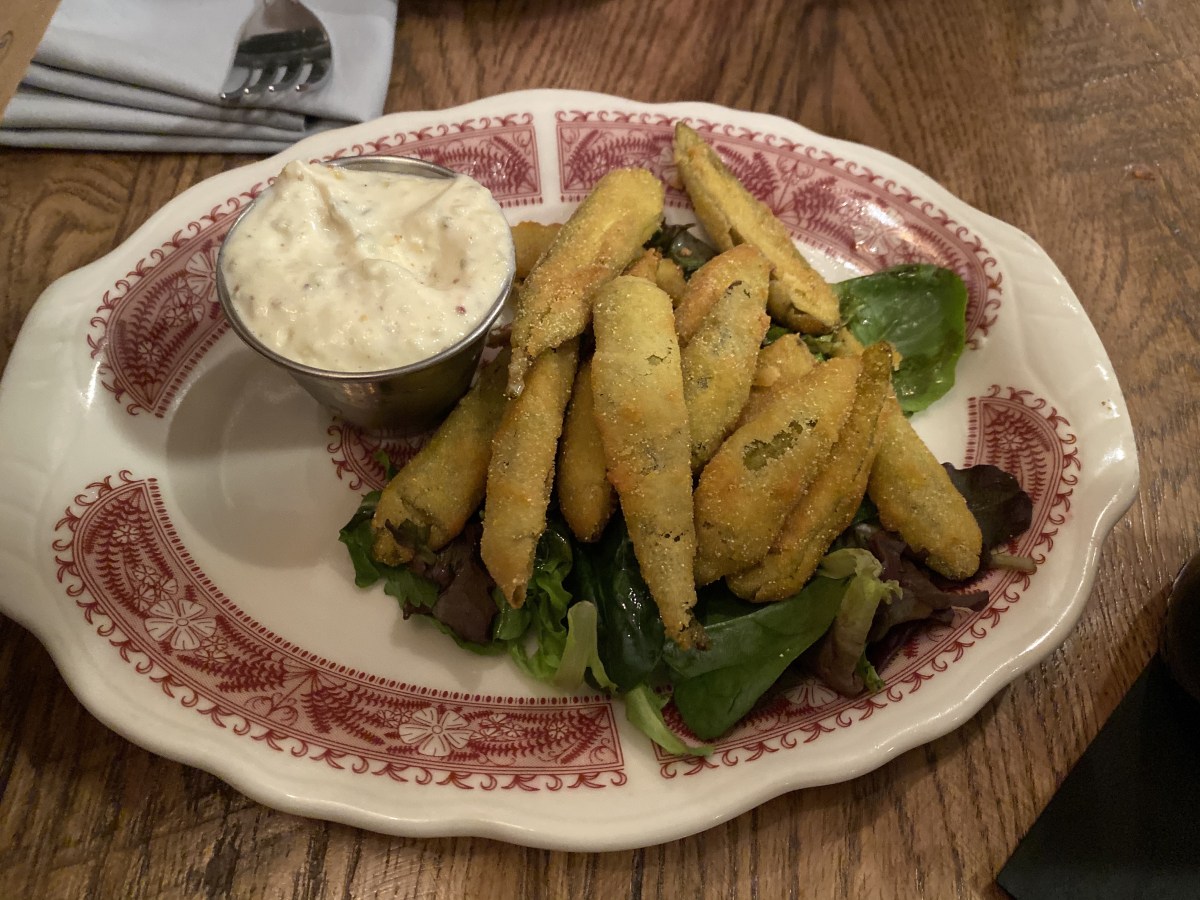
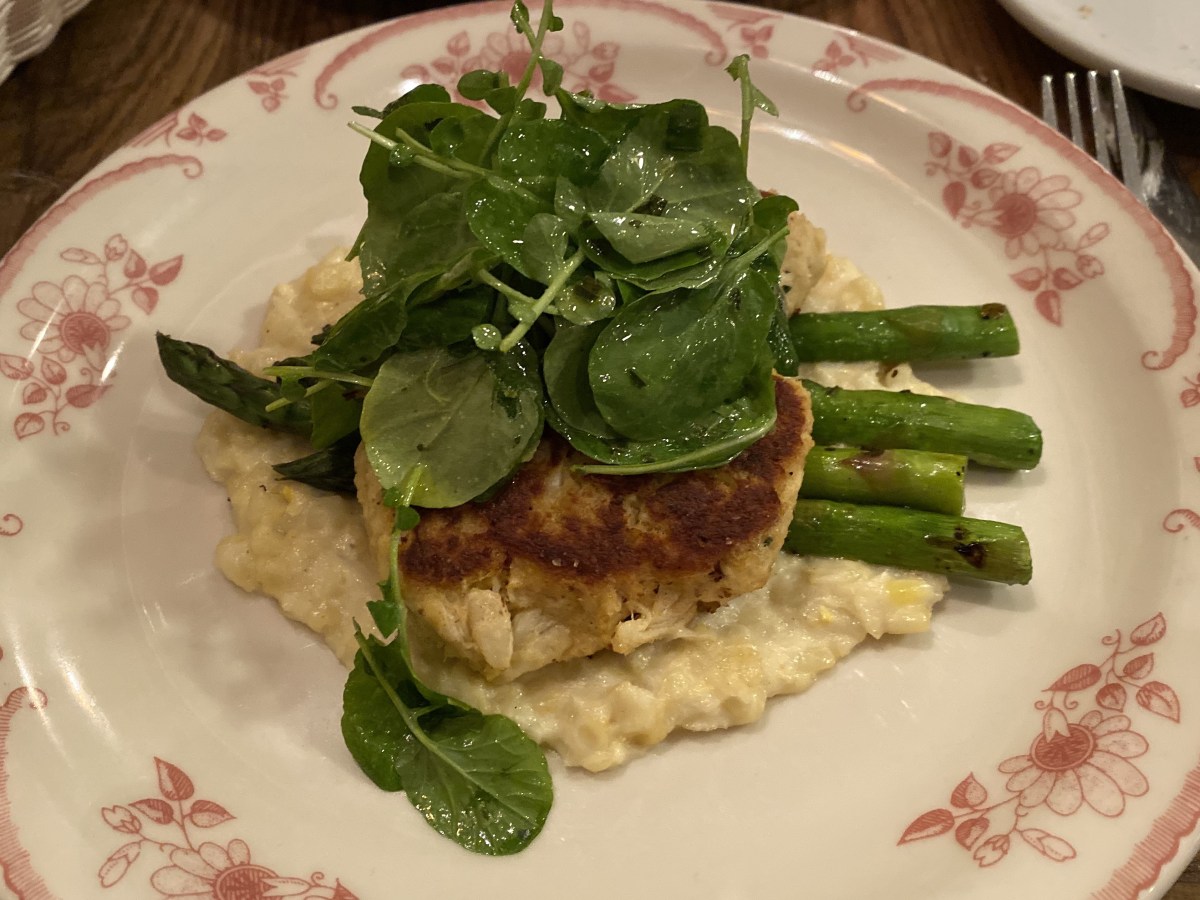
We shared an appetizer of fried pickled okra. I enjoyed Lump Crab Cakes, cream corn, local greens, and grilled asparagus with a lemon herb vinaigrette.  Sarah had Pan-Roasted Duck Breast, “Country Captain” style rice, duck confit, tomatoes, golden raisins, bell peppers, almonds and curry broth.  My crabcakes were excellent.

This is what I would love in Charleston, good southern home cooking. As my daughter is an avid foodie, we would try many eateries during our stay here.

fullsizeoutput_1b114

Fried pickled okra

fullsizeoutput_1b116

Lump Crab Cakes, creamed corn, asparagus and greens

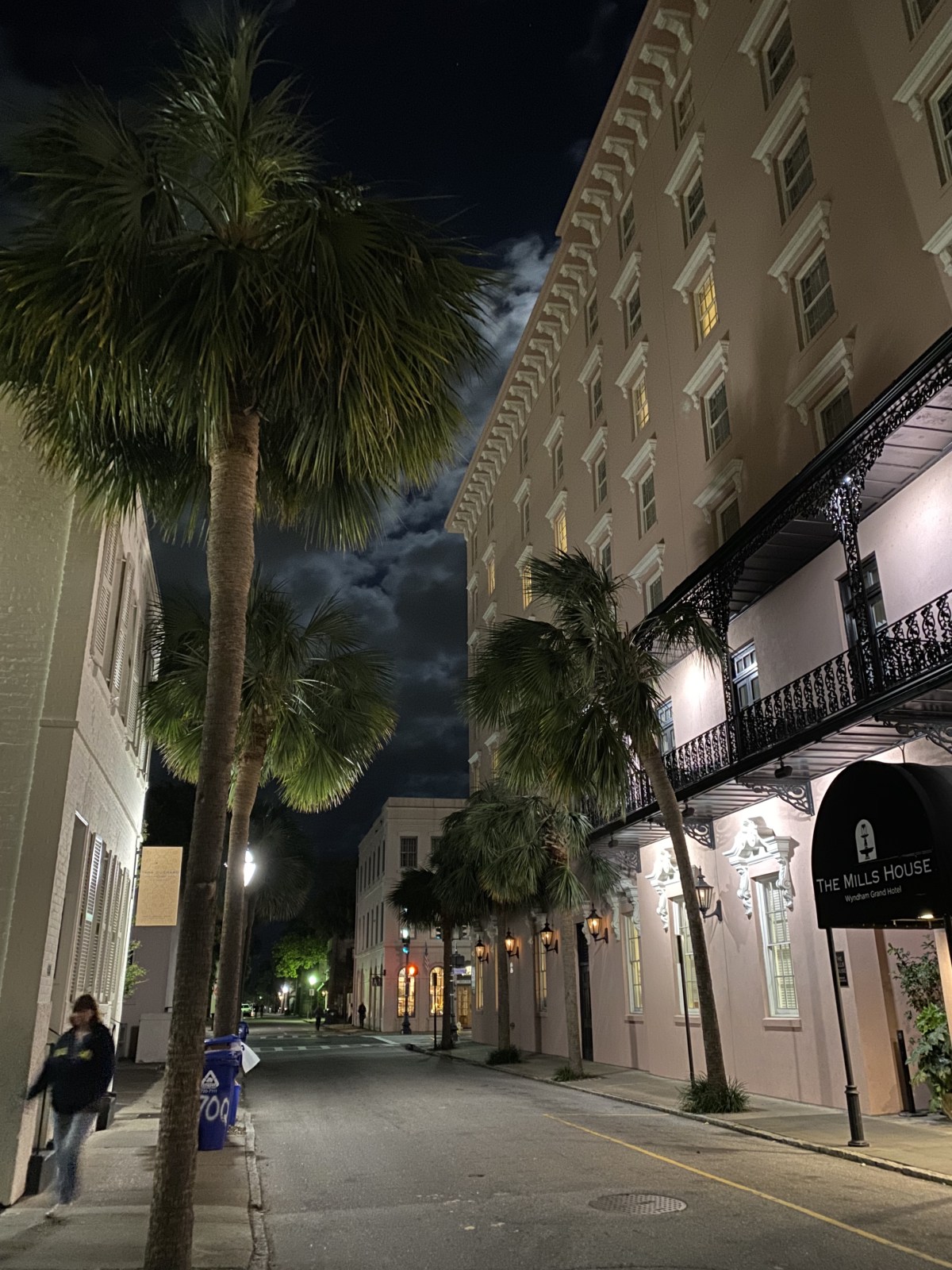
Out on the street, the sky and palm trees imparted an otherworldly feel.

fullsizeoutput_1df3d

the street outside Poogan’s Porch

fullsizeoutput_1df3f

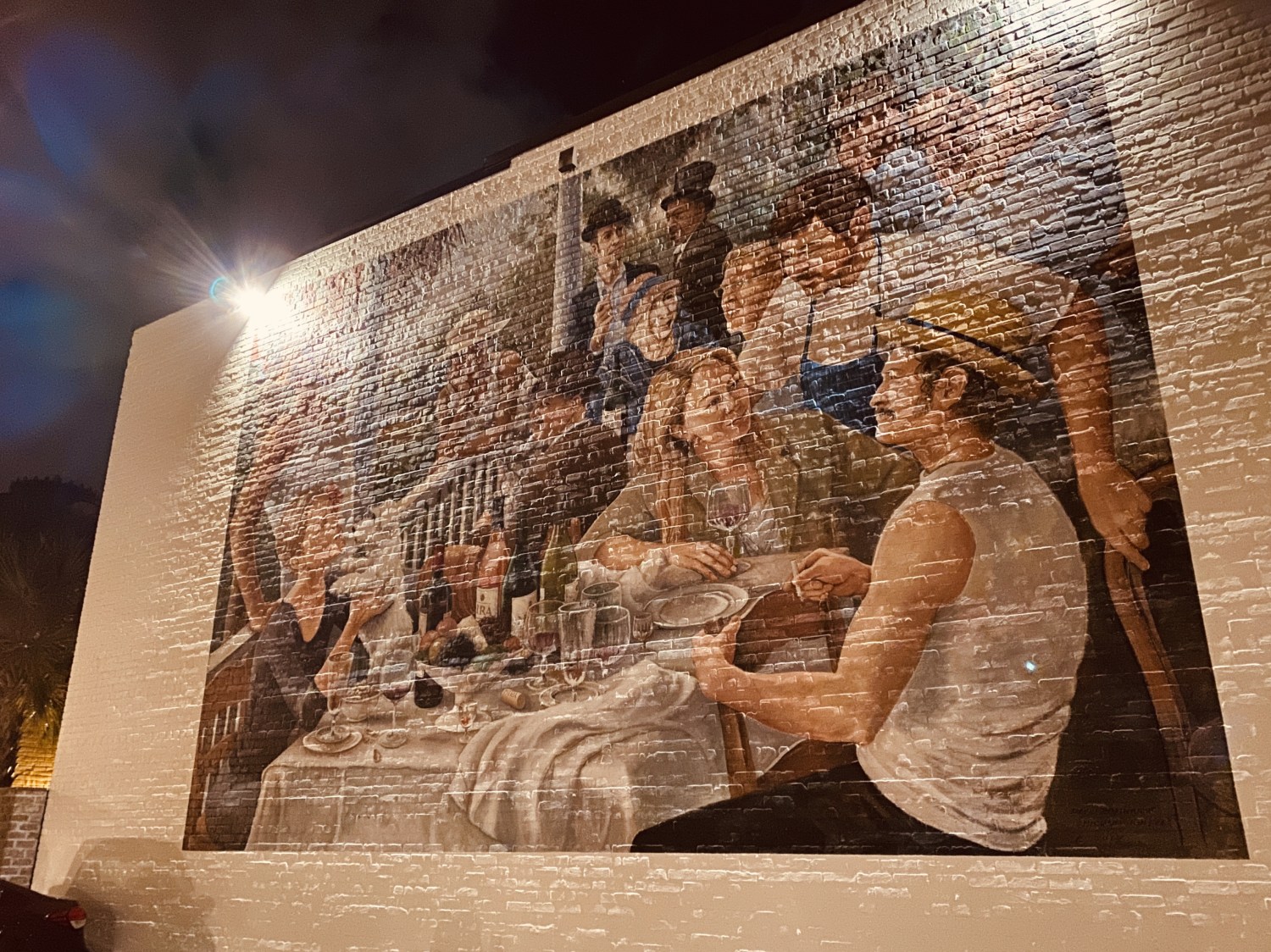
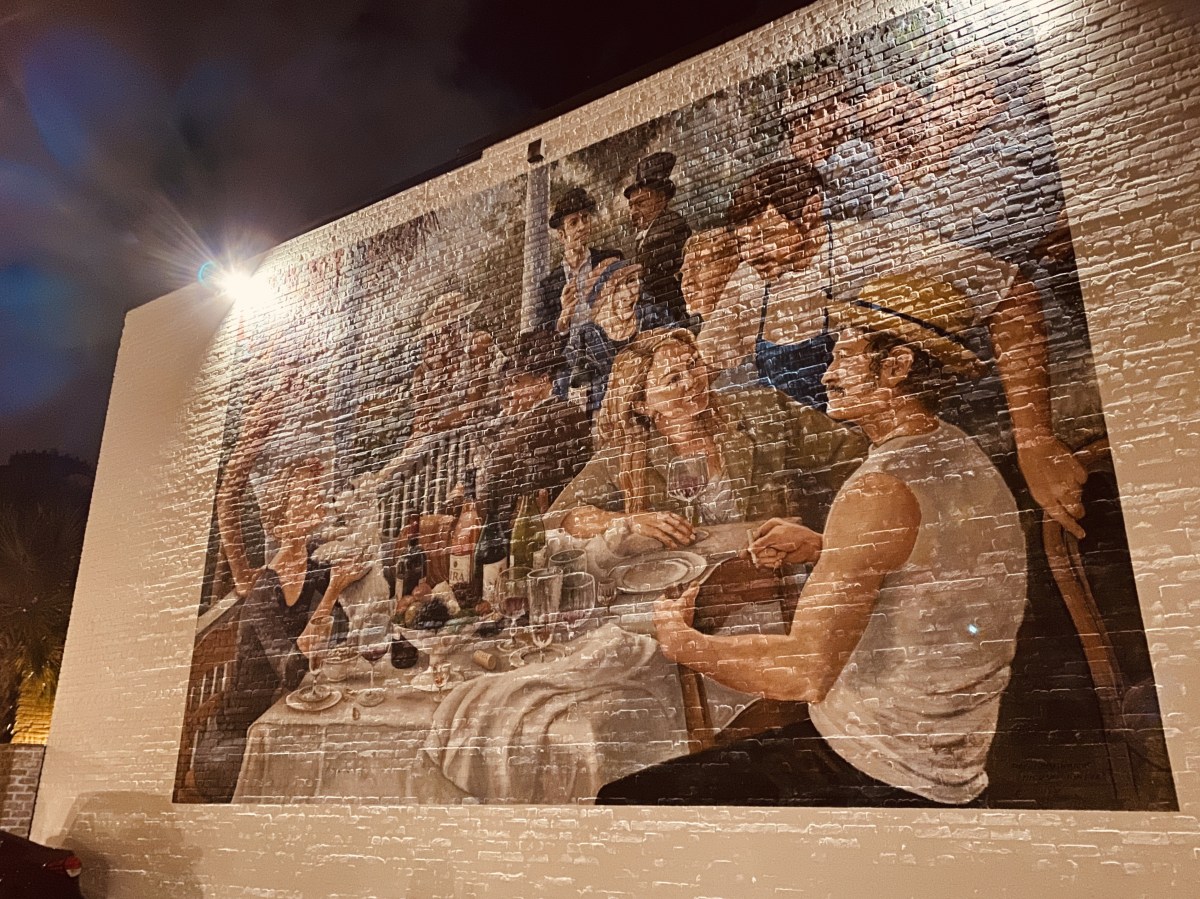
mural in the parking lot of Poogan’s Porch

We were tired after our long drive and our big dinner, so we went back to our cozy Airbnb to relax. Sarah introduced me to some of her favorite shows, but I didn’t care for some of them. She seemed offended that we didn’t share the same taste. One we finally settled on was This Is Us. This was the first time I’d seen this show, and I’m still watching it today.

The next day, we’d begin exploring Charleston.

*Drove: 455.8 miles.  Steps: 3,234, or 1.37 miles*

*Monday, November 11, 2019*
Share this:

  • Share on X (Opens in new window) X
  • Share on Facebook (Opens in new window) Facebook
  • More
  • Email a link to a friend (Opens in new window) Email
  • Print (Opens in new window) Print
  • Share on Pinterest (Opens in new window) Pinterest
Like Loading...
  • Europe
  • International Travel
  • Italy

tuscany: exploring siena

wanderessence1025's avatar wanderessence1025 July 14, 2020

After Chef Mike cooked up his eggs Florentine (eggs with cheese and spinach) and plain toast, accompanied by peach juice and espresso, we were on our way to Siena.  The forecast was for rain, so we took our raincoats and umbrellas despite the day’s auspicious partly-sunny beginnings. Actually, clouds scuttled across the sky, but I held on to my optimism through much of the day, until it actually started raining in Siena at 2:30.

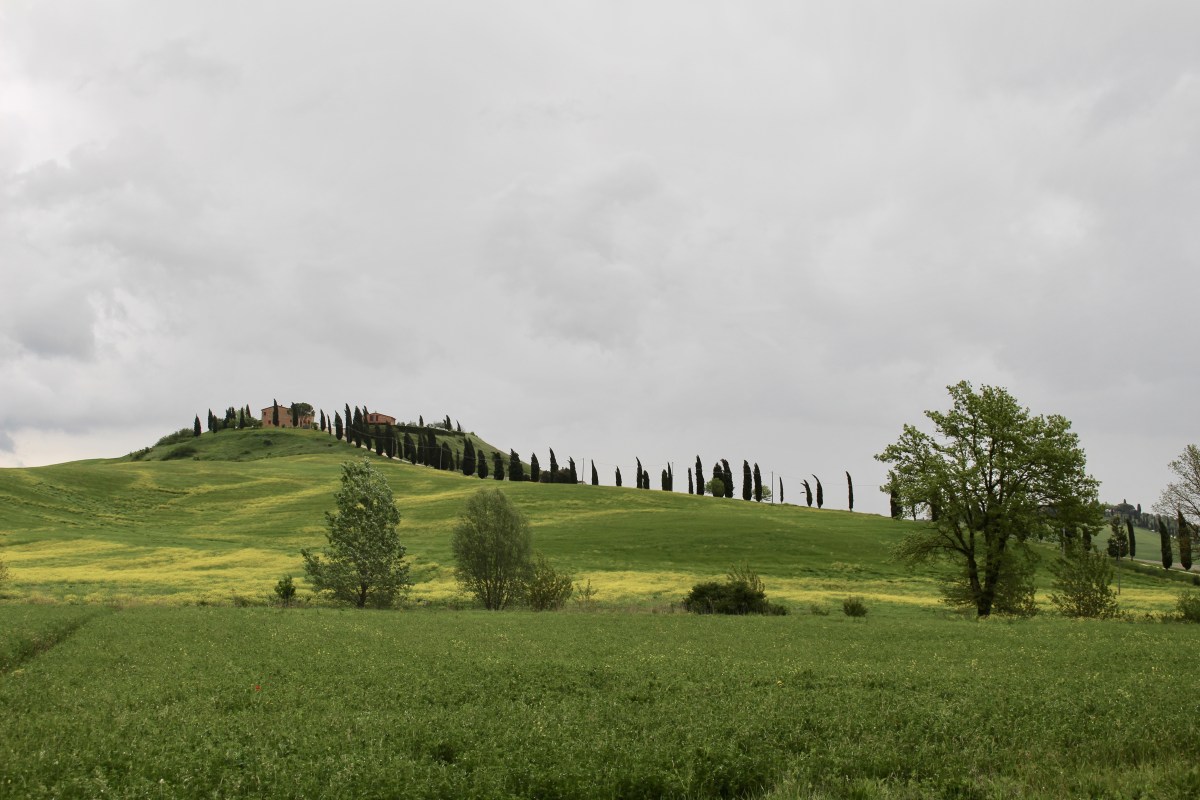
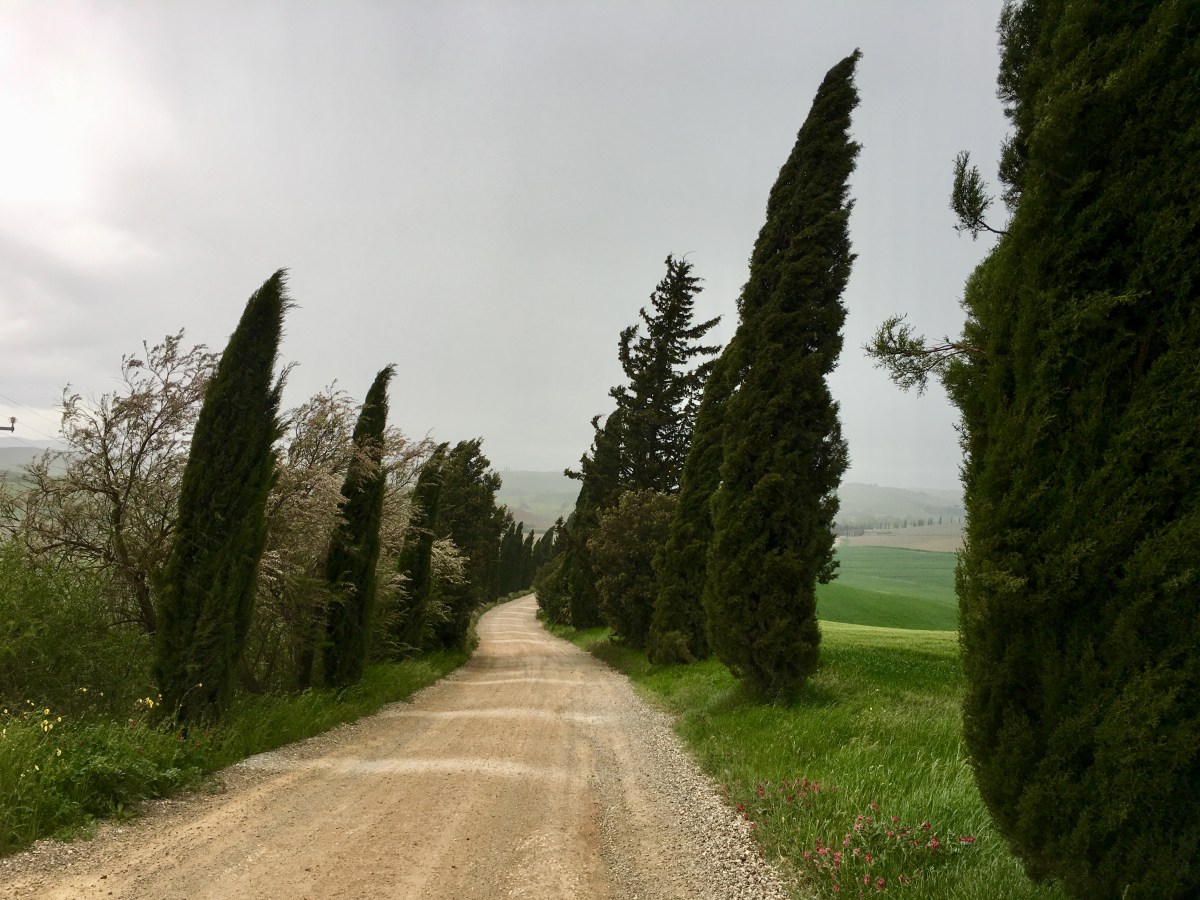
We stopped along the way to take pictures of the beautiful farms lined with cypress trees.

fullsizeoutput_18f69

cypress trees all lined up

cypress trees all lined up
Tuscan countryside
Tuscan countryside

On the way into Siena, one of Italy’s best preserved medieval towns, we passed the huge Basilica of San Dominico, an imposing red brick box begun in 1226.  Named for the founder of the Dominican order, it is now more closely associated with St. Catherine of Siena (1347-1380).

fullsizeoutput_18f5f

entering Siena

fullsizeoutput_18f8e

Basilica of San Dominico

Fiat in Siena
Fiat in Siena
Siena's streets
Siena’s streets
a cute little sconce
bicycle in Siena
bicycle in Siena

We stopped first for coffee and croissants and then bought tickets for one of Italy’s finest Gothic churches, Siena’s Duomo, or Cathedral. It was completed in two brief phases at the end of the 13th and 14th centuries.  Giovanni Pisano designed the white, green and red marble facade. Multicolored marbles and painted decoration seemed to be the Italian approach to Gothic architecture.

fullsizeoutput_1dd63

Duomo di Siena

fullsizeoutput_1dd65

The Duomo has a striking interior with black and white striped columns and a gilded dome. It holds the oldest example of stained glass in Italy (1288) in a circular window; the carousel pulpit, carved by Nicola Pisano in 1265, and Renaissance frescoes in the Biblioteca Piccolomini.

fullsizeoutput_1ddc2

Duomo di Siena

IMG_7772

Duomo di Siena

fullsizeoutput_1ddd9

Duomo di Siena

inside Duomo di Siena
fullsizeoutput_18f70

Life of Virgin Mary Stained Glass, 1288, in Duomo di Siena

The Duomo is famous for its inlaid marble floors, which took nearly 200 years to complete. They include 56 separate compositions, including Biblical scenes, allegories, religious symbols, and civic emblems. These sorts of “Bible in images” were created between 1369 and 1547 to the designs of great painters such as Matteo di Giovanni and Dominico Beccafumi.

fullsizeoutput_1ddca

the Duomo’s inlaid marble floors

IMG_7760

the Duomo’s inlaid marble floors

fullsizeoutput_1ddcb

the Duomo’s inlaid marble floors

the Duomo's inlaid marble floors
the Duomo’s inlaid marble floors
the Duomo's inlaid marble floors
the Duomo’s inlaid marble floors
the Duomo's inlaid marble floors
the Duomo’s inlaid marble floors
the Duomo's inlaid marble floors
the Duomo’s inlaid marble floors
the Duomo's inlaid marble floors
the Duomo’s inlaid marble floors
the Duomo's inlaid marble floors
the Duomo’s inlaid marble floors
the Duomo's inlaid marble floors
the Duomo’s inlaid marble floors
the Duomo's inlaid marble floors
the Duomo’s inlaid marble floors
the Duomo's inlaid marble floors
the Duomo’s inlaid marble floors

The interior was exquisite in many ways.

Duomo di Siena
Duomo di Siena
Duomo di Siena
Duomo di Siena
Duomo di Siena
Duomo di Siena
Duomo di Siena
Duomo di Siena

We then went into the Museo dell’Opera, where we waited in line for a while to climb the tower inside the museum, the Panorama del Facciatone. They only allowed 28 people go up at a time as the stairway up was extremely narrow. People who climbed up were only allowed 15 minutes at the top.

fullsizeoutput_1dde1

View of Siena from the Panorama del Facciatone

fullsizeoutput_1dde2

View of Siena from the Panorama del Facciatone

IMG_7806

View of Siena from the Panorama del Facciatone

IMG_7807

View of Siena from the Panorama del Facciatone

fullsizeoutput_185d4

View of Siena from the Museum

View of Siena from the Panorama del Facciatone
Mike in Siena
Mike in Siena
il Campo
il Campo
me with il Campo in the background

We walked briefly through the Museo dell’Opera, which contains the Duomo’s treasury and some of the original decoration from its facade and interior.

The masterpiece at the museum was Duccio di Boninsegna’s Maestà (1308-1311).  One side of the altarpiece had 26 panels showing episodes of the Passion, and the other side had a Madonna and Child Enthroned.  Duccio’s Maestà set Italian painting on a course leading away from the representations of Byzantine art towards more direct presentations of reality.

fullsizeoutput_1ddeb

The Maestà, or Maestà of Duccio

The Maestà, or Maestà of Duccio

Also in the Museo dell’Opera:

Museo dell'Opera
Museo dell’Opera
Museo dell'Opera
Museo dell’Opera
Museo dell'Opera
Museo dell’Opera
Museo dell'Opera
Museo dell’Opera
Museo dell'Opera
Museo dell’Opera
Museo dell'Opera
Museo dell’Opera
Museo dell'Opera
Museo dell’Opera

We popped into the Battistero di San Giovanni, the Duomo’s 14th century Gothic Baptistery, built to prop up the apse of the cathedral. There were beautiful frescoes throughout. The highlight was the huge bronze 15th century baptismal font designed by Jacopo della Quercia (1374-1438).

fullsizeoutput_1dd61

Battistero di San Giovanni

After the Battistero, we went in search of lunch.  We settled into a small outdoor cafe on a side street, Ristorante Le Campane, where I finally discovered one of the orange drinks I’d seen everywhere, Aperol Spritz, vino bianco secco e soda (dry white wine and soda).

IMG_7836

streets of Siena

fullsizeoutput_1dda8

I was finally able to order the dish my daughter Sarah had recommended: Picio Cacio e pepe: Homemade Sienese pasta with black pepper and pecarino (ewe’s milk) cheese. Mike ordered a Pumpkin Velouté with sausage crumbles (a soup) and a side dish of spinach and Swiss chard.

Picio Cacio e pepe
Picio Cacio e pepe
Pumpkin Velouté
Pumpkin Velouté

It was all yummy, and we relaxed at the cute outdoor cafe with greenery and flowers hugging the balcony.  We thanked the waiter: “Va tutto benissimo, grazie,” or “Everything’s great, thank you.”

We strolled down to the Piazza del Campo, a fan-shaped sloping plaza simply known as il Campo (The Field). It was built toward the end of the 12th century and is the heart of the town. The focal point of the Piazza is Palazzo Pubblico, a Gothic building that has served as Siena’s town hall since the 1300s. Its distinctive bell tower, Torre del Mangia, completed in 1349, apparently offers superb views, but we didn’t climb.

On July 2 and August 16 of each year, the Palio, the famous horse race preceded by a splendid historical procession, takes place at il Campo.

fullsizeoutput_1ddb1

il Campo and Palazzo Pubblico

fullsizeoutput_1ddb4

il Campo

IMG_7129

il Campo

fullsizeoutput_1ddb9

il Campo

It started raining at 2:30, so we headed toward our parked car.  Our parking expired at 3:30, so on the way out of town, we dipped into a scarf shop. I would have bought two more Italian scarves, but the saleswoman reprimanded me for taking one of the €59 scarves off the rack and trying it on; she pointed to a sign written in Italian.  I said, “I’m sorry, I don’t read Italian,” and she said she’d have to write it in every language to accommodate every tourist. As we were the only ones in the shop, she easily could have told us directly not to try on her scarves. It was ridiculous and I refused to patronize someone so unaccommodating and rude. There was no skin off my neck; I’d bought plenty of scarves already. 🙂

Siena
Siena
Siena
Siena
fullsizeoutput_1ddfa

last view of Siena

Leaving Siena, we drove on to Monteriggioni.

*13,001 steps, or 5.51 miles*

Saturday, May 4, 2019*
 

Share this:

  • Share on X (Opens in new window) X
  • Share on Facebook (Opens in new window) Facebook
  • More
  • Email a link to a friend (Opens in new window) Email
  • Print (Opens in new window) Print
  • Share on Pinterest (Opens in new window) Pinterest
Like Loading...
  • America
  • American Road Trips
  • Charleston

“beauty of harmony” at the virginia museum of fine arts

wanderessence1025's avatar wanderessence1025 July 12, 2020

After seeing the Edward Hopper exhibit at the Virginia Museum of Fine Arts in Richmond, VA on my way to Charleston, SC (on journey: an encounter with edward hopper on the way to charleston), I enjoyed an exhibit called Beauty of Harmony: Japanese Landscape Prints by Kawase Hasui. The exhibit of 13 woodblock prints displayed historical and religious landmarks in cities such as Tokyo, Kanazawa, Kyoto, and Nara, as well as countryside scenes.

Kawase Hasui (1883-1957) made a series of expeditions across Japan during his lifetime, sketching landscapes, cityscapes, and  the nation’s historical and religious landmarks to prepare for his prints.

As I looked at these prints, I realized I had visited many of these places when I went to Kyoto in 2011, and when I was teaching English outside of Tokyo in 2017. Where I have pictures of the places from these prints, I have included them along with the print.

Kinkakuji Temple was first built as a villa in the late 14th century, but later was reconstructed as a Zen Buddhist temple in 1420. This print, created in 1922, captures the scene before a young monk burned down the three-story pavilion in 1950.

fullsizeoutput_1d968

iKinkakuji Temple in Snow, from the Series Views of Japanese Scenery, 1922 by Kawase Hasui

Kinkakuji Temple, Kyoto, 2011

Kiiyomizu Temple, literally, “the temple of clear spring,” was built in the 8th century atop a small mountain on the eastern side of Kyoto, offering a bird’s-eye view of the city. Here, Hasui depicts a temple hall leading to a vast veranda, where a lonely woman holding an umbrella gazes beyond the foliage-covered hills.

fullsizeoutput_1d969

Rain at Kiyomizu Temple, from the series Souvenirs of Travel II, 1921 by Kawase Hasui

Kiiyomizu Temple, Kyoto, 2011

This print illustrates a shaded empty lane, where a lone woman in a kimono walks away from the viewer, recalling the former glory of the area as a home for powerful feudal clans.

fullsizeoutput_1d96a

Shimobonda Town, Kanazawa, from the series Souvenirs of Travel II, 1921

Asano River is one of the largest rivers in Kanazawa.  The first bridge over the river was built in 1594.  This print illustrates a picturesque view of a single man walking across a bridge at sunset, while a flock of geese frolics in the water below. Two years after Hasui produced this print, a disastrous flood washed away the bridge.

fullsizeoutput_1d96b

Asano River in Kanazawa, from the series Souvenirs of Travel 1, 1920 by Kawase Hasui

Lake Ashinoko, which translates as “lake of reeds,” was formed about 3,000 years ago following a volcanic eruption at nearby Mount Hakone. It is one of Japan’s largest and most scenic lakes, surrounded by hot springs, temples, shrines, and villas. Lake Ashinoko offers the best views of Mount Fuji when the weather permits. In this print, Hasui illustrates a snow-capped Mount Fuji soaring between the hills, with cedar trees and a glimmering sky reflecting in the water while a fisherman sails across the lake.

The day was very overcast when I was there, so I sadly had no views of Mt. Fuji, although I was able to see it on another trip.

fullsizeoutput_1d96c

Lake Ashinoko in Hakone, 1935, by Kawase Hasui

P5280030

Lake Ashinoko, Hakone, 2017

fullsizeoutput_1d96d

Kikyo Gate, from the series Twenty Views of Tokyo, 1929, by Kawase Hasui

Otemon Gate, the main entrance of the East Garden of the Imperial Palace in Tokyo, opened to the public in 1968. Located at the city’s center, the East Garden occupies 52 acres and features gardens, a pond and a castle.  In this spring scene, Hasui illustrates the outside of Otemon Gate, showing the willow trees lining the sidewalk.

fullsizeoutput_1d96e

A Spring Evening at Otemon Gate, 1952, by Kawase Hasui

fullsizeoutput_1deea

Otemon Gate, Imperial Palace, Tokyo 2017

The Meiji Shrine was built in 1921 in memory of Emperor Meiji (1852-1912) and Empress Shoken (1849-1914).  Encompassing 170 acres, the shrine is known for its combination of forests and an iris garden. Here, Hasui depicts purple and white irises in the foreground and visitors strolling around the garden.

fullsizeoutput_1d96f

Iris Garden at Meiji Shrine, 1951 by Kawase Hasui

P5038464

Iris garden (not blooming) at Meiji Shrine

In this print, Hasui illustrates the corner of Asakusa Temple, on the eastern side of Tokyo. We see a huge stone lantern, and women in kimonos gathering inside on a rainy morning. The intricate details, from vibrant umbrellas to blooming flowers and yellow trees, reveal the artist’s expertise in depicting seasonal variations.

fullsizeoutput_1d970

Rainy Morning in Asakusa, 1930 by Kawaase Hasui

fullsizeoutput_1d971

Clear Sky After Snow, Asakusa Kannon Temple, from the series Twenty Views of Tokyo, 1926

fullsizeoutput_1deeb

Asakusa Temple, Tokyo, 2017

Kasuga Shrine is a Shinto site built in the capital of Nara in the 8th century.  According to Japanese mythology, a god of thunder traveled on a white deer to Nara, followed by several treasured gods now enshrined here. After 1,200 years, the building has remained the same, with its vermilion columns, white walls, dark cypress-bark roofs, and surrounding green trees. Wandering deer, who inhabit the shrine and the nearby mountains, are believed to be sacred messengers of Shinto gods (kami).

fullsizeoutput_1d972

Kasuga Shrine in Nara, from the series Souvenirs of Travel II, 1921 by Kawase Hasui

Kasuga Shrine
Kasuga Shrine
deer of Nara
deer of Nara
deer of Nara
deer of Nara
deer of Nara
deer of Nara
fullsizeoutput_1d973

Rain in Nara (Tower of Kofukuji Temple), 1951 by Kawase Hasui

fullsizeoutput_12f33

Tower of Kofukuji Temple, Nara, 2017

I saw a couple of other random pieces of art, then headed to my daughter’s house so we could leave for Charleston early the next morning.

Olpe (Pitcher), ca. 600 BC
Untitled (2004-7) by Jun Kaneko
Chloe, 2016, by Jaume Plensa
Robinson House
Robinson House
fullsizeoutput_1d975

Virginia Museum of Fine Arts, Richmond, 2019

(All information came from plaques at the exhibit.)

*Steps: 5,740, or 2.43 miles*

*Sunday, November 10, 2019*
Share this:

  • Share on X (Opens in new window) X
  • Share on Facebook (Opens in new window) Facebook
  • More
  • Email a link to a friend (Opens in new window) Email
  • Print (Opens in new window) Print
  • Share on Pinterest (Opens in new window) Pinterest
Like Loading...
  • American Road Trips
  • Art Journaling
  • Journaling

art journal spreads: bismarck to medora, north dakota

wanderessence1025's avatar wanderessence1025 July 10, 2020

My travel journal was filling up, and I was less than halfway through my “Road Trip to Nowhere.”  I tried to squeeze in Friday and Saturday, September 13 & 14, but sadly I couldn’t leave any free pages to do a journal spread later.  I would have to move to a new journal on September 15. Instead of doing art spreads, I thought I’d just share my journal pages for those two days.

My pages for Friday, September 13, 2019 cover my trip from Bismarck, North Dakota to Gladstone and the Enchanted Highway and onward to Dickinson and Watford City, ND.

Travel journal for September 13, 2019
fullsizeoutput_1de2f

Journal spread for September 13, 2019

Travel journal for September 13, 2019
fullsizeoutput_1de18

Travel journal for September 13, 2019

My pages for Saturday, September 14, 2019 cover my trip from Watford City, ND. to Fort Union Trading Post National Historic Site, on to the North Unit of Theodore Roosevelt National park, and finally to Medora, North Dakota.

fullsizeoutput_1de1c

Travel journal for September 14, 2019

Travel journal for September 14, 2019

fullsizeoutput_1de29I filled up my first journal, and I still would be traveling from September 15-October 4.  It turned out I would fill up two more journals. :-)

**********************

“ART JOURNAL” INVITATION: I invite you to post a journal spread on your own blog about your travels. You can do collage, watercolor, acrylics, stamps, drawing or stencils — whatever art form your heart desires.  These are my first art journal spreads and drawings, so I can only hope I’ll become more creative as I practice and play. I invite you to do the same!

One of my intentions for my “Road Trip to Nowhere” in September of 2019 was to “Make art journal spreads for each state (Nebraska, South Dakota, North Dakota, Wyoming, and Colorado) through collage, drawing or collecting items.”  I’m having so much fun with this that I’ve decided to make a journal spread for each day of my journey.

If you’d like some ideas on creating an art journal, please see my page: on creating art from travels.  I actually don’t have many ideas yet, but I hope to add more as I experiment with different art forms.  Also, I would love to see any great ideas from the artists out there. Feel free to add a link to your own blog if you do bullet or travel journals of your own.

Include the link in the comments below by Thursday, August 6 at 1:00 p.m. EST.  When I write my post in response to this challenge on Friday, August 7, I’ll include your links in that post.

This will be an ongoing invitation, once on the second Friday of each month. Feel free to jump in at any time. 🙂

I hope you’ll join in our community. I look forward to reading your posts!

the ~ wander.essence ~ community

I invite you all to settle in and read a few posts from our wandering community.  I promise, you’ll be inspired!

  • Pauline, of Living in Paradise…, creates some magnificent art journals, using sketching and watercolor, from her travels.
    • Art Journal Memories – New Zealand.

Thanks to all of you who shared posts on the “art journal spreads” invitation.

Share this:

  • Share on X (Opens in new window) X
  • Share on Facebook (Opens in new window) Facebook
  • More
  • Email a link to a friend (Opens in new window) Email
  • Print (Opens in new window) Print
  • Share on Pinterest (Opens in new window) Pinterest
Like Loading...
  • America
  • District of Columbia
  • Photography

a glimpse of iran at the sackler gallery

wanderessence1025's avatar wanderessence1025 July 9, 2020

One Sunday in October of last year, we went to the Arthur M. Sackler Gallery, part of the Smithsonian’s National Museum of Asian Art, in D.C. to see an exhibit titled “My Iran: Six Women Photographers.”

Public perceptions of Iran over the last 40 years have been shaped by the upheaval of the Islamic Revolution in 1978-79, when the country’s social and cultural traditions were dramatically transformed.

The works of six female photographers, from the 1970s to the present, offer a complicated and deeply personal view of the country of their birth. Whether created inside or outside of Iran, the carefully staged, often cinematic, images are about memory, loss, and exile, but also about hope. These women acknowledge the past and challenge the present to shed light on their identity as artists, while also offering nuanced interpretations of their Iran.

Hengameh Golestan, along with her husband Kaveh, was one of the photographers who documented the early March 1979 protests that erupted in Tehran after Ayatollah Ruhollah Khomeini issued a decree requiring all women to wear the chador (veil) in public. Her images capture both the last day Iranian women were in the streets without head coverings and the first widespread protest since Khomeini’s return. In these photos, she poignantly conveys the short-lived sense of excitement, solidarity, and optimism that permeated the first months of the Iranian Revolution.

fullsizeoutput_1b8e5

From the series Witness 1979 by Hengameh Golestan

fullsizeoutput_1b8ec

From the series Witness 1979 by Hengameh Golestan

Malekeh Nayiny was born in Tehran and has lived and worked in the West since 1979.

Red Cloth references her father’s profession as a physician.  The photo evokes a sense of care and comfort but also anxiety and suffering, a range of emotions that Nayiny associates with her life before and after leaving Iran.

fullsizeoutput_1b8ed

Red Cloth from the series Sketches of a Fractured Song by Malekeh Nayiny

In Nayiny’s series, Updating a Family Album, Nayiny scanned photographs of her family members taken in the early 20th century.  By “updating” them and digitally adding color and patterns, Nayiny also lends whimsy to the photos.

fullsizeoutput_1b8ef

Untitled from the series Updating a Family Album by Malekeh Nayiny

fullsizeoutput_1b8f1

Untitled from the series Updating a Family Album by Malekeh Nayiny

fullsizeoutput_1b8f2

Untitled from the series Updating a Family Album by Malekeh Nayiny

Mitra Tabrizian creates stages cinematic photos that convey a sense of alienation and stillness.  Her Border series focuses on Iranians in exile. The photos suggest a state of physical and emotional limbo.

In one photograph, a man stands near an open door, staring into the distance.  A former soldier in Iran’s Imperial Army, he now works as a mechanic outside of London. He is separated both physically and emotionally from a younger male figure and a wrecked car in the background.

fullsizeoutput_1b8f3

A Deadly Affair From the series Border by Mitra Tabrizian

In the next photo, a woman dressed in black stares directly at the camera.  She seems to have been in that quiet pose for days. Her small suitcase stands in front of a closed door, a symbol of her memories and conflicting desires perhaps to leave or return home.

fullsizeoutput_1b8f4

A Long Wait from the series Border by Mitra Tabrizian

Gohar Dashti draws on her recollections of growing up during the Iran-Iraq War (1980-88).  The clusters of people in her series Iran, Untitled are similarly isolated from the world.  Here too, the figures are shown with small suitcases, an emblem of their memories and desires.

IMG_2389

from the series Iran, Untitled by Gohar Dashti

IMG_2397

from the series Iran, Untitled by Gohar Dashti

Works by Gohar Dashti are dramatically composed scenes infused with anxiety and uncertainty. In her recent series Home, she photographed hundreds of plants arranged in abandoned buildings.  Even when neglected and forgotten, nature thrives here, confirming the persistence of life and hope for a better future.

fullsizeoutput_1b8f5

Untitled from the series Home by Gohar Dashti

fullsizeoutput_1b8f7

Untitled from the series Home by Gohar Dashti

(All information is from plaques at the exhibit.)

On the way out of the museum, we encountered the Buddha in a Buddhist temple.

fullsizeoutput_1acf6

Encountering the Buddha

As we returned to our car, we came upon a drum group, Batalá Washington, an all-women Afro-Brazilian band that plays Samba-Reggae rhythms. It was quite a lively performance.

IMG_2403

Batalá Washington

On our way home, we stopped at Luzmila’s Bolivian Restaurant for a lunch of Sopa de Mani, or peanut soup, Choclo, or white corn cob, and empañadas.  It wasn’t very good, except for the empañadas.

me at Luzmila's Bolivian Restaurant
me at Luzmila’s Bolivian Restaurant
Luzmila's Bolivian Restaurant
Luzmila’s Bolivian Restaurant

*October 19, 2019*

Share this:

  • Share on X (Opens in new window) X
  • Share on Facebook (Opens in new window) Facebook
  • More
  • Email a link to a friend (Opens in new window) Email
  • Print (Opens in new window) Print
  • Share on Pinterest (Opens in new window) Pinterest
Like Loading...
  • Africa
  • Ethiopia
  • International Travel

on returning home from ethiopia in 2012

wanderessence1025's avatar wanderessence1025 July 6, 2020

My journey to Ethiopia, on my 57th birthday, began at just after midnight on October 25, with a drive from Nizwa to Muscat, Oman.  I dressed in an outfit appropriate to Africa, in coral and brown and olive-green: “safari clothes” with a pop of color.  No safari was planned, but, oh well. The corduroy of the olive-green jacket would hopefully keep me warm in the cool land of Ethiopia, a land where temperatures hover around 70 degrees Fahrenheit (21 Celsius) every day of the year.

Other colleagues from the University of Nizwa were on this trip, though we were traveling separately. Gail was looking for Armenian connections in Addis Ababa. Talib and Chantal had planned an ambitious trip to far-fetched places in the country. Their itinerary included ten-hour bus rides with their daughter in tow! Chantal’s Jamaican origins led her on a quest to discover the Jamaica-Ethiopia connection based on Emperor Haile Selassie (previously Prince Ras Tafari) and the Rastafarians of Jamaica. Being Muslims, they were both especially interested in Harar, an important center of Islamic scholarship in the 17th and 18th centuries. Here Islam penetrated the Horn of Africa.

We took off at 4:50 a.m., flying for 3 1/2 hours, arriving over Ethiopia in the morning light. The landscape from the air was like a rumpled patchwork quilt of golds and greens: mountains, valleys, plateaus and grids of farmland. I wasn’t expecting this of Ethiopia. Stunning.

Gail and me at the airport
Flying into Addis Ababa

First day in Addis Ababa

At the airport, my friend Ed, who was on his second year of duty at the U.S. Embassy in Addis Ababa, was waiting for me.  I left my colleagues to follow their own itineraries.  It was around 8 a.m.  I had a whole day ahead of me in Addis Ababa, the capital city of Ethiopia that means “New Flower.”

Ed thought I would be tired, so he didn’t plan to do much on this first day. He suggested I sleep while he went to work. Taking his advice, I slept until about 1:00. Then I puttered around, read my guidebook, drank tea at the patio table, and killed time taking pictures of what was probably a typical Embassy house.

I took a walk in the neighborhood past an Ethiopian school as it was letting out. Dark skinned children in sky blue sweaters swarmed out of the school. I walked through them to a German bakery, where I ordered a cappuccino and a chocolate croissant and sat on the patio.

Once Ed returned from work, we went out to Yod Abyssinia, an authentic Ethiopian restaurant that served foods from the various ethnic groups in the country. The night was cool and crisp, and the neighborhood’s middle class houses stood silently around us, bounded by concrete walls topped with curled barbed wire. Many houses had round-the-clock guards sitting in little guard houses within the gates.

The restaurant was packed with people of every nationality.  Especially evident were the Chinese, who apparently had numerous building projects in Ethiopia, including a ring road around Addis Ababa.

We arrived at the restaurant in the middle of song and dance performances. The Oromo, the Tigrigna, Gurage, the Amhara and other Ethiopian ethnic groups’ dances and music were included in the nightly live performance.  The performance was energetic and lively and the music had a fun African beat.  Some of the dancers moved so fast, their arms and legs looked like a blur.

Yod Abyssinia served more than 35 varieties of local dishes comprising fasting food (made of an array of vegetables) and non-fasting foods (meats).  Various type of wat, or stew, from beef and lamb, doro wot (spicy chicken stew, a rare delicacy in Ethiopia), and tibs, roasted meat, were on the menu.  All of the stews and sauces were served on injera, a spongy pancake made of a local grain called tef.  We ordered a sample of all of the above, as well as messer, a lentil curry made with onions, chilies and various spices, and a kale dish. In addition, we were served up neat rolls of injera that looked like napkin rolls.  We tore the injera into pieces and used the bread as a kind of utensil to pick up bites of the various dishes.  They were delicious!

It was such a fun evening for my birthday!  It made up for my long day of waiting around and doing nothing.  The meal was Ed’s treat and when we returned to his house, he served up a piece of banana bread with a candle on it.  Luckily I didn’t have trouble blowing out the one candle, which would have been quite pathetic!  He gave me a sweet gift of a delicate monkey necklace made of coconut shell that he picked up on a recent trip to Rodrigues Island in Mauritius.

Happy birthday to me in the land of Abyssinia. 🙂

wandering around Addis Ababa
mural in Addis Ababa
Ed's Embassy house
Ed’s Embassy house
Yod Abyssinia
Yod Abyssinia
menu at Yod Abyssinia
Yod Abyssinia
Yod Abyssinia
me with Ed
me with Ed
washing our hands
washing our hands
our meal is served
our meal is served
Injera and vegetables
Yod Abyssinia
Yod Abyssinia
Yod Abyssinia
Yod Abyssinia
Yod Abyssinia
Yod Abyssinia
Yod Abyssinia
Yod Abyssinia
Yod Abyssinia
Yod Abyssinia

Here is a clip of the live performance if you’d like to watch the Ethiopian dancers in action!

Here’s another:

Lalibela

Friday, October 26:  For the second day in a row, I was up early to catch a 7:40 a.m. flight.  We left Addis Ababa for Lalibela in the north of Ethiopia.  Locals had told us the drive to Lalibela took several days because the roads were not good.   Lucky for us, our flight was only an hour.

After getting off the plane, we drove through the countryside to reach Lalibela, passing fields of tef, the grain used to make the spongy Ethiopian bread called injera.  We saw the Mesket Escarpment, where multi-day trekking tours could be arranged. Children herded a menagerie of sheep, goats, donkeys and cows along the dusty road, amidst agricultural fields and tukuls, Ethiopian traditional cylindrical huts with cone-shaped roofs. Men, boys, and children carried crops on their heads.

After settling in briefly at the Mountain View Hotel Lalibela, we went out to explore the rock-hewn churches of the town. These churches are important in the history of rock-cut architecture.  Though the exact dates they were carved are not certain, most are thought to have been built during the reign of King Lalibela, a member of the Zagwe Dynasty, during the 12th and 13th centuries.

plane to Lalibela
plane to Lalibela
driving to Lalibela
driving to Lalibela
driving to Lalibela
driving to Lalibela
driving to Lalibela
driving to Lalibela
driving to Lalibela
driving to Lalibela
driving to Lalibela
driving to Lalibela
Mesket Escarpment
Mesket Escarpment
driving to Lalibela
driving to Lalibela
driving to Lalibela
driving to Lalibela
Mountain View Hotel Lalibela
view from Mountain View Hotel Lalibela

Lalibela was an important place of Ethiopian Christianity, still a place of pilgrimage and devotion.  The churches were a UNESCO World Heritage Site.  UNESCO had built rather unsightly scaffolding and roofing over many of the churches to protect their interior frescoes from water seepage, a necessary evil.

According to UNESCO, the churches were hewn from the living rock of monolithic blocks. These blocks were further chiseled out, forming doors, windows, columns, various floors, roofs etc. This gigantic work was further completed with an extensive system of drainage ditches, trenches and ceremonial passages, some with openings to hermit caves and catacombs.

Four of the churches were finished as completely free-standing structures, attached to their mother rock only at their bases. The remaining churches ranged from semi-detached to ones whose facades were the only features that had been ‘liberated’ from the rock.

Our guide was Masala, a young Ethiopian man who grew up in the village. He was kind and conveyed so many tidbits of knowledge that I was happy we had him along.

Every time we entered a church, we had to leave our shoes outside. We had a shoe minder who followed us to each of the churches, where he sat outside and “minded” our shoes. He glowed with love and each time, as I struggled with untying and tying my tennis shoes, he helped me put them back on my feet.

We first visited the northern group of churches. Bet Medhane Alem (Savior of the World), was said to be the largest rock-hewn church in the world. Our guide showed us three empty graves in one corner, prepared for Abraham, Isaac and Jacob. Cross-shaped panels pierced the walls.  This church held the legendary 7kg gold Lalibela cross, but we weren’t afforded a glimpse of it.

After putting our shoes back on, we proceeded through a passageway cut into solid rock to Bet Maryam, possibly the oldest of the Lalibela churches.   Bet Maryam was small, but decorated to the hilt with paintings, frescoes, and intricate carvings on the walls and ceilings. The church was dedicated to the Virgin Mary, who was particularly respected in Ethiopia, and was the most popular church among pilgrims.

On the northern wall, we saw what looked like a Nazi swastika, but our guide Masala assured us this symbol went in the opposite direction of the swastika and was in reality an ancient Christian symbol showing that Christ’s love goes out in every direction, to all corners of the earth.

Bet Meskel and Bet Danaghel, a semi-chapel and chapel, sat on either side of Bet Maryam like two dwarf sentinels.

We walked through another passageway cut into solid rock to Bet Mikael, where we came upon a group of men dressed in white, chanting, beating on drums, and burning incense.  They were in the midst of a church service which was beyond my understanding.  The men seemed suspended in some mystical, ethereal world, dressed as they were and enveloped in a haze of incense smoke and streaming sunlight.  We stood, enraptured by them for quite some time, amazed that we happened upon this holy ceremony.

Bet Medhane Alem
Bet Medhane Alem
Bet Medhane Alem
Bet Medhane Alem
Bet Medhane Alem
Bet Medhane Alem
Bet Medhane Alem
Bet Medhane Alem
Bet Medhane Alem
Bet Medhane Alem
Bet Medhane Alem
Bet Medhane Alem
the chapel of Bet Danaghel
Bet Maryam
Bet Maryam
Bet Maryam
Bet Maryam
inside Bet Maryam
inside Bet Maryam
inside Bet Maryam
inside Bet Maryam
inside Bet Maryam
inside Bet Maryam
inside Bet Maryam
inside Bet Maryam
inside Bet Maryam
inside Bet Maryam
inside Bet Maryam
inside Bet Maryam
inside Bet Maryam
inside Bet Maryam
inside Bet Maryam
inside Bet Maryam
a chanting service in Bet Mikael
a painting in Bet Mikael
a chanting service in Bet Mikael
outside of Bet Uraiel
the “Tomb of Adam”
the “Tomb of Adam”
Me, Ed and a Lalibelan woman pose in front of the Tomb of Adam

We left the northern group of Lalibela churches and headed through the preserved tukul village known as Hadish Adi.  The site was protected so that visitors could see the round thatch-roofed homes inside and out.

As we walked through the village, we caught sight of a column of white-clad worshipers traipsing through the tukul village, probably after attending the chanting service we witnessed at Bet Mikael.

According to a 2010 Mission Report by UNESCO, the traditional housing of Lalibela is characterized by two main types of buildings: the circular one-story tukul houses (ground and one floor), with external staircases leading to the upper level and the rectangular one-story residences (ground and one floor). The walls are built of stone laid in mud mortar. The interior surfaces of the walls are often plastered with a rich mix of earth, straw and cow dung. The earth is mixed with straw from the teff plant (Eragrostis tef) and the mixture is applied to the wall after undergoing necessary processing.

Our guide Masala told us that he grew up with his seven siblings in one of the tukuls; he led us to his childhood home. He happily posed for a photo in front of the house where he “spent the happiest years of his life.”

We found a little open air hut where an artist was painting scrolls in the Lalibela style. I couldn’t help but buy one. I loved the symbolic style and color of these painted scrolls.

While we browsed through the scrolls, a large group of boys surrounded us and asked if we would buy them a football (soccer ball to Americans) for 500 Ethiopian birr (about $28). They said they were a sports team called Team Obama and they really NEEDED a new ball. However, we had been warned not to give children any money in Ethiopia because it only enticed them to stay out of school. Apparently, a common ploy was to ask tourists for soccer balls or school books, which the children might even buy in the tourist’s presence. As soon as the generous victim’s back was turned, the children returned the books or balls to the shopkeeper for cash.

tukuls
tukuls
tukuls
tukuls
tukuls
tukuls
a column of worshipers leaves the Lalibela church of Bet Mikael
tukuls
tukuls
Masala at his childhood home
tukuls
tukuls
tukuls
tukuls
an artist paints scrolls at Lalibela
scrolls in Lalibela
scrolls in Lalibela
tukuls
tukuls

As we walked down the gravelly and dusty hill from the tukul village to the western group of churches, the gravel slipped out from under my feet and I crashed to the ground, my right knee collapsing under me like a jackknife.  I couldn’t stop the barrage of unladylike words that sprang out of my mouth.  Three years earlier, I had had a partial knee replacement in my right knee, and it seemed whenever I fell, that was the knee that snapped.  When I fell today, it hurt like hell!  I thought I had seriously damaged it.

Masala and Ed pulled me up. After dusting myself off and shaking it out, I found my limbs appeared to be intact. I was in pain but seemed to be okay. Ethiopia, and especially Lalibela, was not a place where I would want to have a medical emergency!

We continued down the hill to Bet Giyorgis, the most spectacular of all the Lalibela churches.  For one, it was perfectly formed in the shape of a Greek cross.  It was 15 meters (49 feet) high, carved out of a deep trench, and was the best preserved of the churches.  Because it was well-preserved, it lacked the obtrusive and unsightly UNESCO roof and scaffolding that most of the other churches had.

Carved from solid red volcanic rock in the 12th century, it was the most well-known and last built of the eleven churches in the Lalibela area. Legend has it that Ethiopia’s patron saint, Saint George, unexpectedly came to visit King Lalibela on a white horse, just as the King was finishing off his churches. St. George was a little peeved that none of the churches were dedicated to him. King Lalibela immediately sought to make amends by building St. George the most beautiful church of all, Bet Giyorgis, which means Church of Saint George.

Inside were colorful paintings, a priest, and two 800-year-old olive-wood boxes: one was rumored to have been carved by King Lalibela himself and was said to contain a crucifix, made with gold brought from King Solomon’s Temple in Jerusalem.

Masala told me I could ask the priest to wave his cross over me for healing. I asked him to do so, and he waved the cross all around my knees, and then all over my body for healing. Ed had him wave the cross over him too, for general back pain. We tipped him several Ethiopian birr.

Bet Giyorgis
Bet Giyorgis
me at Bet Giyorgis
me at Bet Giyorgis
Bet Giyorgis
Bet Giyorgis
Bet Giyorgis
Bet Giyorgis
Bet Giyorgis
Bet Giyorgis
local at Bet Giyorgis
Bet Giyorgis
Bet Giyorgis
Bet Giyorgis
Bet Giyorgis
Bet Giyorgis from the hilltop above

After lunch at the Mountain View Hotel, we headed out again with Masala to the southeastern group of Lalibela churches.  On the way, Masala pointed out The River Jordan and Mount Tabor, named after Jerusalem’s holy sites.

We entered Bet Gabriel-Rufael from the top of the church, walking over a rock-carved bridge that crossed a deep trench. Scholars thought this church might have been a fortified palace for Aksumite royalty in the 7th and 8th centuries.  The monumental facade was the most interesting thing about this church.

We made our way through a pitch-black tunnel, which Masala likened to the experience of descending into hell.  We emerged into light (likened to heaven) into Bet Merkorios, which some say may have once been the town’s prison.  This is because of ankle shackles found within the church.  Inside was a fresco representing the three wise men, possibly created in the 15th century.

The freestanding Bet Amanuel was a finely-carved church and may have been the royal family’s private chapel.

Finally, we visited Bet Abba Libanos, a hypogeous church.  This meant it was under the earth’s surface.  In fact, the church was attached to rock at the top and bottom.  Legend said it was built overnight by Lalibela’s wife with the help of a few angels.  It seemed to grow sandwiched between slabs of rock.

After leaving the Lalibela churches, we headed back to our rooms, where I took a little nap.  Then we went up to the terrace for a bottle of Ethiopian wine: Gonder, produced in Addis Ababa.  We ran into some colleagues of Ed’s from the embassy and chatted with them a bit.  We sat and enjoyed the sunset and the wine over the beautiful valley of Lalibela.   Dinner followed at the Mountain View Hotel, which was not at all memorable.

tukuls
tukuls
The River Jordan in Lalibela
Bet Gabriel-Rufael
Bet Gabriel-Rufael
shoes to be minded
shoes to be minded
Bet Gabriel-Rufael
Bet Gabriel-Rufael
Bet Gabriel-Rufael
Bet Gabriel-Rufael
Bet Gabriel-Rufael
Bet Gabriel-Rufael
Bet Gabriel-Rufael
Bet Gabriel-Rufael
Bet Gabriel-Rufael
Bet Gabriel-Rufael
Bet Amanuel
Bet Amanuel
Bet Amanuel
Bet Amanuel
me with a priest at Bet Amanuel
Bet Abba Libanos
Bet Abba Libanos
Bet Abba Libanos
Bet Abba Libanos
leaving the Lalibela churches
the view of the Lalibela valley from our hotel as the sun is setting
me at Mountain View Hotel Lalibela
sunset from Mountain View Hotel Lalibela

Lalibela’s Saturday Market

Saturday, October 27:  I woke up feeling sick, with severe cramps and a wicked headache, as well as general malaise.  I blamed the malaria medication I was taking.  At the advice of doctors in Nizwa, I was to begin one medication on Thursday, upon arrival in Ethiopia, which I did.  However, on Friday, I was supposed to take another medication, and then switch back on Saturday to the first medication.  Whatever they gave me for Friday obviously had some bad side effects, as I woke in the middle of the night feeling horrible.

I couldn’t eat breakfast.  As Ed ate a delicious-looking omelet, I just sat and nibbled on some plain toast.  He asked if I wanted to skip our visit to the Lalibela Saturday market, but how could I?  I loved local markets and I couldn’t bear the thought of missing it. So I told him I wanted to go.  We had a flight back to Addis Ababa at 12:45.  I would just put one foot in front of the other and visit the market.

The market was spread out over a big dirt area in the middle of the town.  The villagers had set up tarps or temporary stalls made of eucalyptus poles and textiles. Some just sat under umbrellas to hide from the sun.  Some people spread out their grains, vegetables or textiles on tarps or blankets on the ground.  It was hot, dusty and chaotic.

People were selling everything imaginable from firewood to salt blocks.  Salt was a precious commodity for people and their animals, and was even used as a kind of currency, according to Lonely Planet Ethiopia & Eritrea.  Nomads and their camels, even today, travel to the salt lakes in the Danakil Depression in eastern Ethiopia, where they cut by hand rectangular blocks of salt, known as amole, and then spend weeks traveling by caravan to market, where they barter using the bars.

We saw these salt blocks for sale, along with teff.  The low quality teff was dark and course, while the more expensive, high-quality teff was pale and smooth.

Also for sale were dried peppers, cabbages, onions, peas and lentils, whole wheat, collard greens and numerous other grains and greens.  We also found traditional clothing, colorful textiles and blankets, live chickens, and long eucalyptus poles used for construction.

People came from miles around, mostly on foot, to the Saturday market.  The lucky ones had donkeys to carry their goods, but most people carried their goods on their backs or their heads.  It was amazing even after we left the market how we passed hordes of people heading to the market from miles and miles away.

The rest of the day, I felt miserable.  We caught our plane to Addis Ababa, but we had to endure an extra hour flight as the plane made a stop in Gonder.  When we arrived back in Addis, I took a bath and a long nap.  I decided to stop taking the malaria medication.  I would take my chances.  The next day, we would head to Lake Langano, about three hours south of Addis by car.  I didn’t want to be sick for that trip!

Lalibela's Saturday market
Lalibela’s Saturday market
tukuls
tukuls
Lalibela's Saturday market
Lalibela’s Saturday market
Lalibela's Saturday market
Lalibela’s Saturday market
Lalibela's Saturday market
Lalibela’s Saturday market
Lalibela's Saturday market
Lalibela’s Saturday market
Lalibela's Saturday market
Lalibela’s Saturday market
Lalibela's Saturday market
Lalibela’s Saturday market
Lalibela's Saturday market
Lalibela’s Saturday market
Lalibela's Saturday market
Lalibela’s Saturday market
Lalibela's Saturday market
Lalibela’s Saturday market
Lalibela's Saturday market
Lalibela’s Saturday market
Lalibela's Saturday market
Lalibela’s Saturday market
Lalibela's Saturday market
Lalibela’s Saturday market
Lalibela's Saturday market
Lalibela’s Saturday market
Lalibela's Saturday market
Lalibela’s Saturday market
Lalibela's Saturday market
Lalibela’s Saturday market
Lalibela's Saturday market
Lalibela’s Saturday market
Lalibela's Saturday market
Lalibela’s Saturday market

Drive to Lake Langano

Sunday, October 28:  We woke up early for our 3-hour drive to Lake Langano, south of Addis Ababa.  I felt better, after being sick all day yesterday.  I think it was because I discontinued that malaria medicine and it was finally clearing out of my system.

Once we escaped the crowds, dirt, and poverty that swarmed around us in Addis, we emerged into beautiful countryside full of acacia trees, tukul huts that rose naturally out of the land, and undulating hills in a patchwork of greens and golds.  I fell in love with Africa.

After about two hours, we passed through an area that was more dry and arid than the first 2/3 of the drive. It was not nearly so pretty here, but it still had its charms, with the locals, dressed in mismatched colorful clothing, in continual motion along the dusty roads. Many of them were burdened with some kind of load, carrying firewood or sacks of grain on their heads or backs.

When finally turned off to Bishangari Lodge, the eco-lodge where we would stay, we had a very rough drive over a bumpy dirt track for about 15 kilometers. It was slow going, but this was where we saw rural Ethiopians prodding their livestock along, sitting outside their tukul huts, or just playing in the dirt.  We also passed cool trees, cacti, flowers and birds.  We even saw a goat having a bit of lunch up on a fallen tree.

drive to Lake Langano
pumpkins along the eway
drive to Lake Langano

Lake Langano

It turned out that Lake Langano would be my favorite part of Ethiopia.

Sunday, October 28:  We stayed for 2 nights at the Bishangari Eco-Lodge at Lake Langano, Ethiopia.  Here, we explored the wetlands, the beach and lake, the forest, an otherworldly pumice rock landscape and an acacia shrub zone replete with birds, horses and baboons.  We ate the Menus of the Day, posted before each meal with curlicue writing on bark signs. We went birdwatching in the dewy forest as the sun rose, encountering multitudes of birds, Colobus monkeys, and baboons, as well as children walking to school with books in their arms.  We got relaxing oily massages.  We walked along the beach and then swung in hammocks beside the lake. We sat on the porch of our cabin and perused bird books, jotting down the birds we identified.  We took a hippo-spotting hike where we didn’t spot any hippos, but we encountered a simultaneous sunset and moon rise over the wetlands in a glowing blue light.  We watched the staff while the hours away playing checkers using bottle caps. And at the end of each day, we shared Gonder Ethiopian wine at the lovely Tree House bar with the sounds of birds twittering, chirping, chanting and singing all around us.

The weather was a fabulous 70 degrees Fahrenheit (21 degrees C) during the days.  At night I burrowed under blankets and slept like I’d never slept before.

I was amazed by this landscape, especially as the light waned in the afternoon. We walked along the rocky surface, checking out the birds preening and flitting about along the lakeshore: pied kingfishers, spur-winged plovers, Senegal thick-knees, Great cormorants, Nyanza swifts.

Along the lake we wandered. We admired the birds, we stared out over a horizon heavy with gray clouds, we listened to the choppy waves hit the shore. We took pictures. Ed, being a veteran bird-watcher, knew his birds and educated me as to what was what. He pointed out a Great cormorant, a Senegal thick-knee and some spur-winged plovers.

After our afternoon of exploring the pumice stone area, the beach, and the lakeshore, we headed to the Tree House bar where we shared a bottle of Gonder Ethiopian red wine. We toasted to our safe arrival at the lake. We ate a dinner of mushroom soup, black olive salad, pan-fried fish served with French fries, vegetables and pasta, and a crepe Suzette for dessert. Cicadas chirped in the background, a musical serenade.

Bishangari Eco-Lodge
cabin at Bishangari Eco-Lodge
pumice stone ecozone at Lake Langano
beach at Lake Langano
pumice stone ecozone at Lake Langano
Lake Langano
Lake Langano
me at Lake Langano
me at Lake Langano
Ed at Lake Langano
Ed at Lake Langano
pumice stone ecozone at Lake Langano
Lake Langano
Lake Langano
pumice stone ecozone at Lake Langano
beach at Lake Langano
massage hut at Bishangari Eco-Lodge
dining hall at Bishangari Eco-Lodge
Tree House
Tree House
Tree House
Tree House

Monday, October 29:  This morning we woke up before dawn to go on a guided birdwatching stroll.  While waiting for our guide near the lodge dining area, wild horses grazed near the lodge dining area.

Once our guide arrived, we spent two hours traipsing in the acacia zone by the lake and then through the forest. We crossed a big open field, and then wandered along the fringes of the forest. Yellow-fronted parrots flitted about in trees near the lake.

In the forest, we marveled at the huge gnarled ficus trees, and as we walked out into the open field, we come across a group of baboons romping around and grooming each other.  We nearly stumbled into a hole dug by an aardvark, and up in the trees, we spotted three black & white Colobus monkeys watching us like spies.

A line of children dressed in colorful mismatched clothing, books under their arms, passed by us in the field on their way to school. One elderly gentleman accompanied his children on horseback.

We found scores of different birds.  Most of them I wasn’t able to capture on film. Blue-breasted bee eaters flitted about on some bushes. Greater blue-eared starlings hopped about in the field.  A red-headed weaver industriously built a nest.

Later, as we had breakfast at the lodge, Ed identified all the birds we saw on the walk: speckled pigeons, lemon doves, African paradise flycatchers, white-rumped babblers, Grey-headed bush shrikes, fork-tailed drongos, red-checked cordon bleu, white-throated seed eaters, African dusty flycatchers, Eurasian hoopoes, common red starts. And many more elusive little birds with colorful names.

After our morning of birdwatching, we each had an hour-long massage in the massage hut. It was wonderfully relaxing, except for the deep tissue kneading the masseuse did on my calves.  They felt bruised and beaten after all was said and done.

After our massages, we took another walk along the lakeshore, where we saw a couple of scary-looking birds that appeared to be right out of some prehistoric age, Abyssinian ground hornbills, and they didn’t seem frightened of us at all.  They just strutted their stuff confidently under the acacia trees and across the pumice rock.

A yellow-billed stork sat quietly on the lakeshore and a companionable little group of spur-winged plovers and Senegal thick-knees relaxed on the pumice stones.

This was the first time I had ever done any birdwatching, and I found it quite fascinating, especially as Ed knew his birds and had a book about birds of Ethiopia. I loved being out in nature at this place along Lake Langano.

In the evening, we went with our guide on a hippo-spotting walk.  Sadly, we didn’t see any hippos.  However, we did see a beautiful marshland, glowing acacia trees growing out of a pumice moonscape, and a simultaneous sunset and moonrise.  All this while we were enveloped by beautiful blue light and a cool gentle breeze.

PA297521

acacia trees at Lake Langano

fullsizeoutput_41e1

acacia trees at Lake Langano

PA297524

yesterday's menu board at Bishangari
yesterday’s menu board at Bishangari
wild horses
wild horses
wild horses
wild horses
Lake Langano after sunrise
acacia trees
acacia trees
acacia trees
acacia trees
acacia trees
acacia trees
acacia trees
acacia trees
ficus trees
ficus trees
baboons
baboons
baboons
baboons
schoolgirls
schoolgirls
Bishangari Lodge dining hall
books at Bishangari
books at Bishangari
a game
a game
menu board for today
pasta for dinner
pasta for dinner
spiders in a web
spiders in a web
Abyssinian ground hornbills
yellow-billed stork
yellow-billed stork
spur-winged plovers and Senegal thick-knees
Lake Langano
Lake Langano
Lake Langano
Lake Langano
beach at Lake Langano
acacia trees
acacia trees
acacia trees
acacia trees
acacia trees
acacia trees
acacia trees
acacia trees
acacia trees
acacia trees
sunset at Lake Langano
blue light at Lake Langano
sunset at Lake Langano
moonrise
moonrise
blue light at Lake Langano

Tuesday, October 30:  This morning, we packed up for our return trip to Addis Ababa.  We ate a breakfast of omelets: Ed had an Ethiopian Omelet with tomato, onion, & chili, and I had an Omelet a la Bishangari, with mango, pineapple, banana and sugar. I was surprised it had more of a savory flavor than sweet.  We drank fresh papaya juice and coffee. It was our last day here and I was sad to leave.

We took one last walk along the lake edge to check out the shorebirds. The day was crisp and breezy; the clouds were in fine form in a hazy blue sky. Ed was hesitant to cross outside of the fenced-in area of Bishangari Lodge, but I figured we went there last night and it was perfectly fine, so why not? He was afraid we’d be harassed by the locals for money or handouts. I wasn’t worried because I knew how to say no and how to ignore people who harass me. I was determined to cross no matter what he decided to do. In the end, he came along.

Our adventurous foray was richly rewarded. We saw speckled pigeons, little egrets, white and gray pelicans, cormorants, and ducks. They allowed us to approach them without flying away. We lingered for a long time, creeping silently closer. Finally, after most of them leisurely swam or flew away, showing no fear of us at all, we made our way back to the lodge. We met an olive baboon and strolled under more amazing ficus trees. Then we headed back on the road to Addis Ababa.

In the evening, when we returned to Addis Ababa, we ate a meal that Ed’s housekeeper / cook Kitay had prepared for us: injera, wat, cabbage & potatoes, lentils.  We topped it off with some Montrouge Merlot.  Later, Ed showed me pictures on his computer, but when I wanted to show him pictures of my time in Greece, he wasn’t really interested.

As there was really nothing to do in the evening, he suggested we watch a movie.  Just as he was about to put it on, he said he needed to make a business call to the U.S.  I waited.  And waited.  Finally I went upstairs to my room, and I heard him chatting away on Skype to his sons.  He was heading back to the U.S. on Saturday, and today was Tuesday, so I figured the conversation would be short.  It wasn’t.  As a matter of fact, I gave up and got in my bed to read, telling him I was no longer interested in watching the movie.  This was one time I wished I had the numbers of my colleagues from Oman so I could join them somewhere in Addis for some fun.

coffee at Bishangari
omelet for breakfast
checkers with bottle caps
locals playing checkers with bottle caps
shorebirds
shorebirds
acacia trees
acacia trees
acacia trees
acacia trees
egrets
egrets
Lake Langano
Lake Langano
pelicans
pelicans
pelicans
pelicans
cows
cows
pelicans
pelicans
pelicans
pelicans
pelicans
pelicans
pelicans
pelicans
pelicans
pelicans
shorebirds
shorebirds
me at Bishangari
me at Bishangari
ficus trees
ficus trees
me with the ficus
me with the ficus
spider in a web
spider in a web
Tree House
Tree House
baboon
baboon
on the road back to Addis
tukul huts on the road back to Addis

Addis Ababa

Wednesday, October 31:  We got up at 6:00 a.m. so we could leave bright and early for the U.S. Embassy.  Ed needed to do some work before we took off for sightseeing, so he brought me along to twiddle my thumbs and wait…and wait.  From the embassy, after nearly two hours of waiting, we headed directly into the Entoto Mountains.

The Entoto Mountains, north of Addis Ababa, were the site of Emperor Menelik’s former capital.  We admired the sprawling view of the city below.  We passed donkeys carrying loads of eucalyptus, which the locals had cut branch by branch off the trees on the mountain, leading to soil erosion and deterioration of the forest. Some donkeys carried grass to sell to the locals who spread grass over their mud floors when they had guests.  Women trudged up and down the mountain carrying loads of firewood on their backs. Apparently aid organizations were trying to find these women other means of livelihood, but it was obvious many women were still dependent upon this work.

Near the top of the mountain, we stopped at St. Raguel & Elias Historical Church. Inside the church were multitudes of brightly colored paintings that told bizarre stories. We saw paintings, as we did in every Ethiopian church, of St. George, the patron saint of the country.  We saw the apostles meeting gruesome deaths.  We saw the devil looking quite devilish.  Ethiopia’s Christian stories are rich in legend, and these legends are told pictorially in these paintings.  We found a saint who prayed for 7 years; though one of his legs had fallen off, he did have 6 wings. We saw Doubting Thomas.  We saw a large painting of the miracles of Christ: here he healed a blind man, there he turned water into wine, and here he raised Lazarus from the dead.

After we drove down from the Entoto Mountains, we headed for lunch at the Lucy Gazebo Restaurant, attached to the National Museum of Ethiopia.

The outdoor Lucy Gazebo Restaurant was lush with tropical plants, decorative sculptures and Ethiopian art.  I started with carrot soup and then ate a delicious chicken avocado pizza with tomatoes, peppers, mushrooms and cheese.

St. Raguel & Elias Historical Church
donkey in Entoto Mountains
streets of Addis Ababa
Lucy Gazebo
Lucy Gazebo
Lucy Gazebo
Lucy Gazebo
Lucy Gazebo
Lucy Gazebo
pizza for lunch
pizza for lunch
decor at Lucy Gazebo
Lucy Gazebo
Lucy Gazebo

Next door, the National Museum of Ethiopia housed one of the most important collections in sub-Saharan Africa, according to Lonely Planet Ethiopia & Eritrea.  The paleontology exhibit on the basement level showcased the extinct sabre-toothed cat Homotherium and the huge savannah pig Notochoerus.

The most interesting things were the two amazing casts of the 3.2 million year-old Lucy, a fossilized hominid discovered in 1974.  One lay prone in a glass case and the other was standing. Her small frame was a reminder of how small our ancestors were.

Lucy was discovered in a dried-up lake near Hadar in northeast Ethiopia.  This new species, called A. afarensis walked on two legs, which overturned earlier theories that our ancestors only started walking upright after they evolved larger brains.

According to one of the museum’s curators, the real bones, which were normally preserved in the museum’s archives, were currently on tour in the USA.   Lucy’s tour began at the Houston Museum of Natural History; after Houston, she would travel to Seattle, Boston and back to Houston.  Lucy’s pilgrimage was designed to let the international community know Ethiopia’s importance to the history of humans.

When I walked into the basement, one of the museum’s curators was opening the glass case that contained the casts of Lucy’s prone bones. He took one of the finger bones and handed it over to a group of young men who wanted to borrow it. This group was making a film showing primates’ connection to humans through Lucy and they wanted to borrow the cast finger bone for their documentary. This seemed quite crazy to me, as I could not imagine a curator at any museum in the USA taking out a piece of an exhibit and handing it over to someone to “borrow!”

The center of the ground floor of the museum showcased a collection of royal paraphernalia including Emperor Haile Selassie’s enormous carved wooden throne. On the walls of this central area were paintings of Ethiopia’s rulers, including Emperor Menelik, Emperor Yohannes, and of course Haile Selassie. Surprisingly, among these emperors was a painting of Colonel Mengistu Haile Mariam, the leader of the horrible Derg (Committee) that deposed Haile Selassie in 1974. Their destructive rule, including the Red Terror, lasted until 1991.

On the first floor, what we in America call the 2nd floor, was a colorful display of Ethiopian art ranging from early parchment to 20th century canvas oil paintings by modern artists, including Afewerk Tekle’s African Heritage.

Finally, on the top floor, we found a secular arts and crafts collection, including traditional clothing, weapons, jewelry, utensils and musical instruments.

National Museum of Ethiopia
Lucy
Lucy
LUCY: The beginning of human mankind
Lucy's Place in Nature
Lucy’s Place in Nature
"Selam" - the earliest child
“Selam” – the earliest child
National Museum of Ethiopia

The ornate Holy Trinity Cathedral is believed to be the second most important place of worship in Ethiopia, after the Old Church of Saint Mary of Zion in Aksum, according to Lonely Planet Ethiopia & Eritrea.  It also contained the huge Aksumite-style granite tombs of Emperor Haile Selassie and his wife, Empress Menen Asfaw.

The cathedral was a mixture of international styles and boasted a copper dome, slender pinnacles and interesting statues. Inside were some grand murals, rich stained glass windows and two imperial thrones of ebony, ivory and marble. In one of the large murals, Emperor Haile Selassie stood in front of the League of Nations asking for help against the Italian occupiers. They refused to help, except for Mexico, which became a long-lasting friend of Ethiopia.

In a cemetery surrounding the Cathedral were the remains of ministers who were killed by the Derg in 1974. Other remains include patriots who died fighting the Italian occupation from 1935 to 1941. Italy invaded Ethiopia in 1935, killing 275,000 Ethiopians with illegal mustard gas and bombing. In 1936, they captured Addis Ababa, and Emperor Haile Selassie fled the country. At that time the King of Italy was made Emperor of Ethiopia. Ethiopian patriots played a major role before, during and after the liberation campaign, which ended in May of 1941, when the emperor and his men took over Addis Ababa.

After our explorations of Addis, we headed back to Ed’s house where we relaxed a bit. Later, we went to an excellent French-ish restaurant called Loti. The restaurant had a lovely ambiance, with pressed leaves and dried flowers decorating the walls, a colorful poinsettia and artsy plates. We had some red wine and munched on crackers made of oats, barley and sesame seeds, dipped in a delicious guacamole dip. I ordered tilapia assay: tilapia with cabbage, peppers, tomatoes, carrots and potatoes. For dessert, we indulged on pumpkin pie with ice cream.

The owner, Mani, walked around to greet all the patrons. She told us she studied in the U.S. on a USAID scholarship and she was proud of her education. She had created a beautiful restaurant and was rightfully proud of her achievement.

Holy Trinity Cathedral
cemetery at Holy Trinity Cathedral
Loti
Loti
me at Loti
me at Loti
Ed at Loti
Ed at Loti
dinner at Loti
dinner at Loti
Mani, the owner of Loti

Thursday, November 1:  On my last day in Addis, Ed had to work at the embassy all day.  He arranged with his guard to have a friend of his drive me around all day for around $35.  The guide, whose name I’ve now forgotten, was such an easy-going and likeable guy, I ended up having a great time.

He began by taking me to the Makush Art Gallery.  I was determined to buy a piece of Ethiopian art.  The day before, while I was twiddling my thumbs at the embassy, someone told me this was the place to go.  I found out very quickly that Makush was an upscale gallery and the prices were quite high.  This trip hadn’t cost me much money and I still had $200 left in my budget.  I ended up spending all of it on two pieces from this gallery.

After tossing my two paintings into the back seat, we drove through the streets of Addis, teeming with dusty and obviously poor residents wearing colorful but mismatched clothes. The streets were dirty and slightly chaotic. Corrugated tin stalls lined up along every street; people were trying to eke out a space to make a living. It seemed there was no rhyme or reason to the layout of this city. There seemed to be no center of town. It was urban sprawl everywhere.

We arrived at the octagonal St. George Cathedral, conceived to commemorate the 1896 defeat of the Italians in Adwa.  It was commissioned by Emperor Menelik and was dedicated to Ethiopia’s patron saint, St. George.  With the help of Armenian, Greek and Indian artists, the cathedral was completed in 1911.  Its neoclassical style contrasted sharply with the colorful murals inside.

We drove to the Ethnological Museum, set in Haile Selassie’s former palace, and surrounded by the lush grounds of Addis Ababa University. Right outside the entrance to the museum was a spiral staircase that led to nowhere. The Italians placed one step here for every year that Mussolini held power, beginning from his march to Rome in 1922. The symbol of the Ethiopian monarchy, a Lion of Judah, sat atop the stairs, a symbol of the eventual defeat of the Italians by Ethiopia.

Ethiopian artifacts and handicrafts were displayed in the order of the human life cycle, beginning with Childhood with themes of birth, games and rites of passage, followed by Adult themes of beliefs, traditional medicine, war, hunting and even pilgrimages. Death and Beyond showcased burial structures and tombs.

Also preserved intact in the museum were Haile Selassie’s bedroom, bathroom and changing room. On the 2nd floor was some amazing religious art, especially diptychs, triptychs, icons and crosses. In another cave-like room sat a collection of musical instruments, put in the dark to preserve them from the ravages of light and to showcase them in an ethereal way.

We ate lunch at the Lime Tree Restaurant.  After lunch, my guide convinced me to try wheat grass juice.  It didn’t sound very appealing to me, but he assured me it would improve my health considerably.  I tried it and was surprised to find it was actually quite delicious.  And I had to say, I felt much better for the rest of the day, and throughout my long overnight trip back to Muscat.

Makush Art Gallery
Makush Art Gallery
Makush Art Gallery
Makush Art Gallery
Makush Art Gallery
Makush Art Gallery
streets of Addis Ababa
my guide today
my guide today
St. George Cathedral
spiral staircase to nowhere
Ethnological Museum
Ethnological Museum
Ethnological Museum
Ethnological Museum
Ethnological Museum
Ethnological Museum
Ethnological Museum
Ethnological Museum
Ethnological Museum
Ethnological Museum
Ethnological Museum
Ethnological Museum
Ethnological Museum
Ethnological Museum
Ethnological Museum
Ethnological Museum
Haile Selassie’s bedroom
Haile Selassie
Haile Selassie
Haile Selassie’s uniform
Haile Selassie’s bathroom
Ethnological Museum
Ethnological Museum
Ethnological Museum
Ethnological Museum
Ethnological Museum
Ethnological Museum
musical instruments in the Ethnological Museum
Ethnological Museum
Ethnological Museum
Ethnological Museum
Ethnological Museum
Ethnological Museum
Ethnological Museum
Ethnological Museum
Ethnological Museum
Lime Tree Restaurant
lunch at Lime Tree Restaurant
wheat grass juice
wheat grass juice
wheat grass at the Lime Tree

*October 25-November 1, 2012*
 

*************************
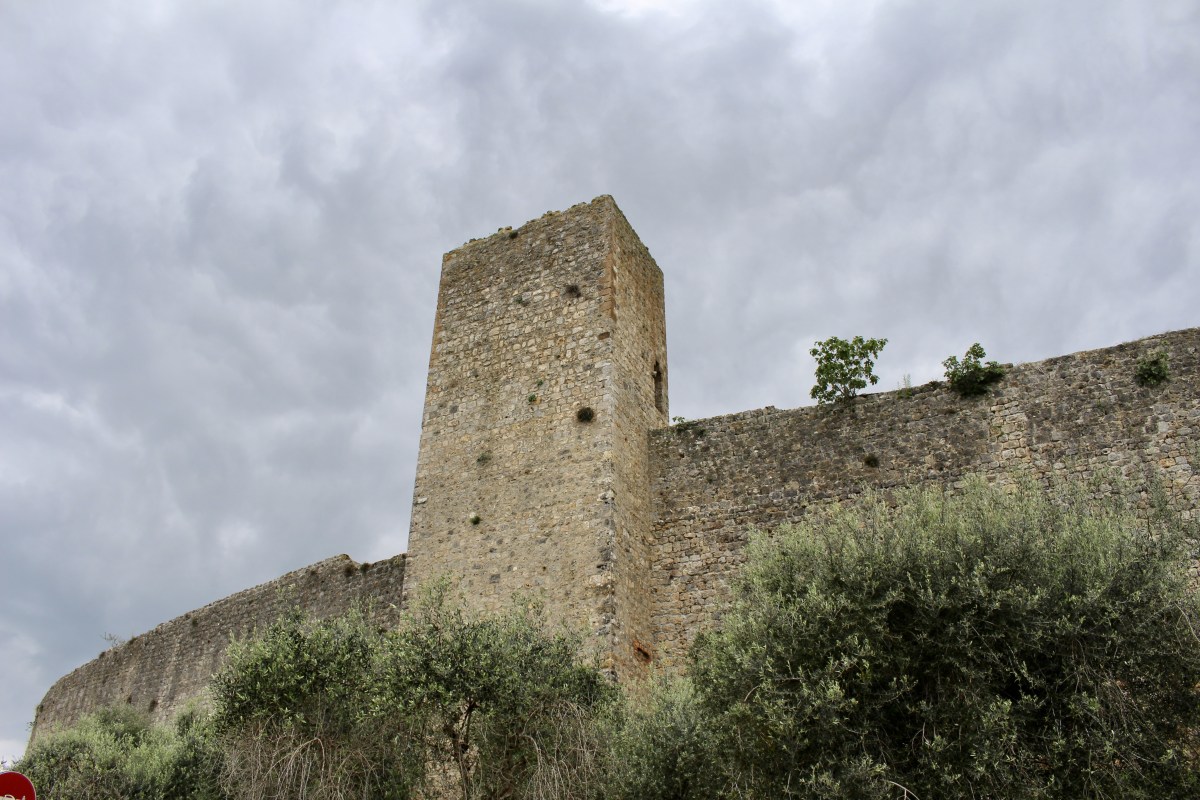
“ON RETURNING HOME” INVITATION: I invite you to write a post on your own blog about returning home from one particular destination or, alternately, from a long journey encompassing many stops.  How do you linger over your wanderings and create something from them?  How have you changed? Did the place live up to its hype, or was it disappointing? Feel free to address any aspect of your journey and how it influences you upon your return. If you don’t have a blog, I invite you to write in the comments.

For some ideas on this, you can check out the original post about this subject: on returning home.

Include the link in the comments below by Sunday, August 2 at 1:00 p.m. EST.  When I write my post in response to this challenge on Monday, August 3, I’ll include your links in that post.

This will be an ongoing invitation on the first Monday of each month. Feel free to jump in at any time.

the ~ wander.essence ~ community

I invite you all to settle in and read a few posts from our wandering community.  I promise, you’ll be inspired!

  • Indra, of TravTrails, wrote about returning home from Cyprus in August of 2000:
    • Cyprus: Bubble in the Sea

Thanks to all of you who shared posts on the “returning home” invitation.


Share this:

  • Share on X (Opens in new window) X
  • Share on Facebook (Opens in new window) Facebook
  • More
  • Email a link to a friend (Opens in new window) Email
  • Print (Opens in new window) Print
  • Share on Pinterest (Opens in new window) Pinterest
Like Loading...

Posts pagination

Previous 1 … 25 26 27 … 68 Next
Blog at WordPress.com.
Let Me Bite That

Can I have a bite?

a pura vida year in costa rica

living abroad in Guanacaste

Lush Life Layers

Lake Garda Tourist

Susana Cabaço

Spiritual Insights & Personal Empowerment

Monkey's Tale

An Adventure Travel Blog

Journey with my Sketchbook

"My sketchbook is a witness of what I am experiencing, scribbling things whenever they happen." - Vincent Van Gogh

The Eternal Traveller

Remembering past journeys, recording current trips and planning for the next one!

Lookoom

Put pictures on your travel dreams

Still Restlessjo

Roaming, at home and abroad

The Creative Life Adventure

Living a creative life

Inside My Sling Bag

Living, Loving, Laughing, Learning and (Being) Lucrative

Introvert Awakenings

My path less traveled. Rediscovering self after surviving the abuse that almost sunk me. Goal of strengthening and thriving on my adult legs. 👣🙏🏻 #recovery #forgiveness

Changcha Travel Tales

LightWriteLife

I love light, I love to write, I love life - I create my words and images to capture the light in my life.

the rak's sphere

Phosphene's Write

Live your life!! Life is beautiful!!

Image Earth Travel

Independent Travel & Photography Stories

Nanchi.blog

Lookoom

Mettez des images sur vos rêves de voyages

Retire In Branson

Old Bird Travels Solo!

THE MATURE ART OF TRAVELLING ALONE. MY NEW EMAIL IS: OldBirdTravels@proton.me PLEASE LIKE AND SHARE AT THE BOTTOM OF THE POST!

P e d r o L

storytelling the world

Welcome

RECYCLE YOUR PAIN

Motivation

Jim's Travel Culture and History Blog

World travel culture and history

Charlotte Digregorio's Writer's Blog

This blog is for those who wish to be creative, authors, people in the healing professions, business people, freelancers, journalists, poets, and teachers. You will learn about how to write well, and about getting published. Both beginning and experienced writers will profit from this blog and gain new creative perspectives. Become inspired from global writers, and find healing through the written word.

Musings of the Mind

Come journey with me as we navigate through this thing called life

robynsewsthisandthat

This is where I share my passions

Saania's diary - reflections, learnings, sparkles

Life is all about being curious, asking questions, and discovering your passion. And it can be fun!

The Wild Heart of Life

Creative Nonfiction & Poetry

deventuretime

Avid adventurer, travel blogger, and experience seeker. Starting each morning with a desire to see the world through a different lens.

Stu's Camino

The Frugal Foodies

Feeding an Empty Belly and Starving Mind

The Lost-o-graph

photographs

Our travels and thoughts through photographs. It does not matter, sunrise or sunset, just have fun in between.

My Serene Words

seeking solace in the horizon of life and beyond

HANNA'S WALK

Walks Stories and Nature

One Girl, Two Dogs & Two Thousand Miles

Brawnerology

Everything Family Travel: Work Hard, Play Hard

ROAD TO NARA

Culture and Communities at the Heart Of India

MEERYABLE

Explore, discover and experience the world through Meery's Eye. Off the beat budget traveler. Explore places, cultural and heritage. Sustainable trotter. shareable tales of Meery is Meeryable

Poetry 365

citysonnet.wordpress.com/

photography, poetry, paintings

Poetry collection

Work by Rain Alchemist

Eúnoia

Following my heart, Daring to dream, Living without regrets

VICENTE ROMERO - Paintings

Still Smiling

Smiling through the good times and the bad

flaviavinci

John Wreford Photographer

Words and Pictures from the Middle East

~ wander.essence ~
Blog at WordPress.com.
  • Subscribe Subscribed
    • ~ wander.essence ~
    • Join 1,031 other subscribers
    • Already have a WordPress.com account? Log in now.
    • ~ wander.essence ~
    • Subscribe Subscribed
    • Sign up
    • Log in
    • Report this content
    • View site in Reader
    • Manage subscriptions
    • Collapse this bar
 

Loading Comments...
 

You must be logged in to post a comment.

    %d