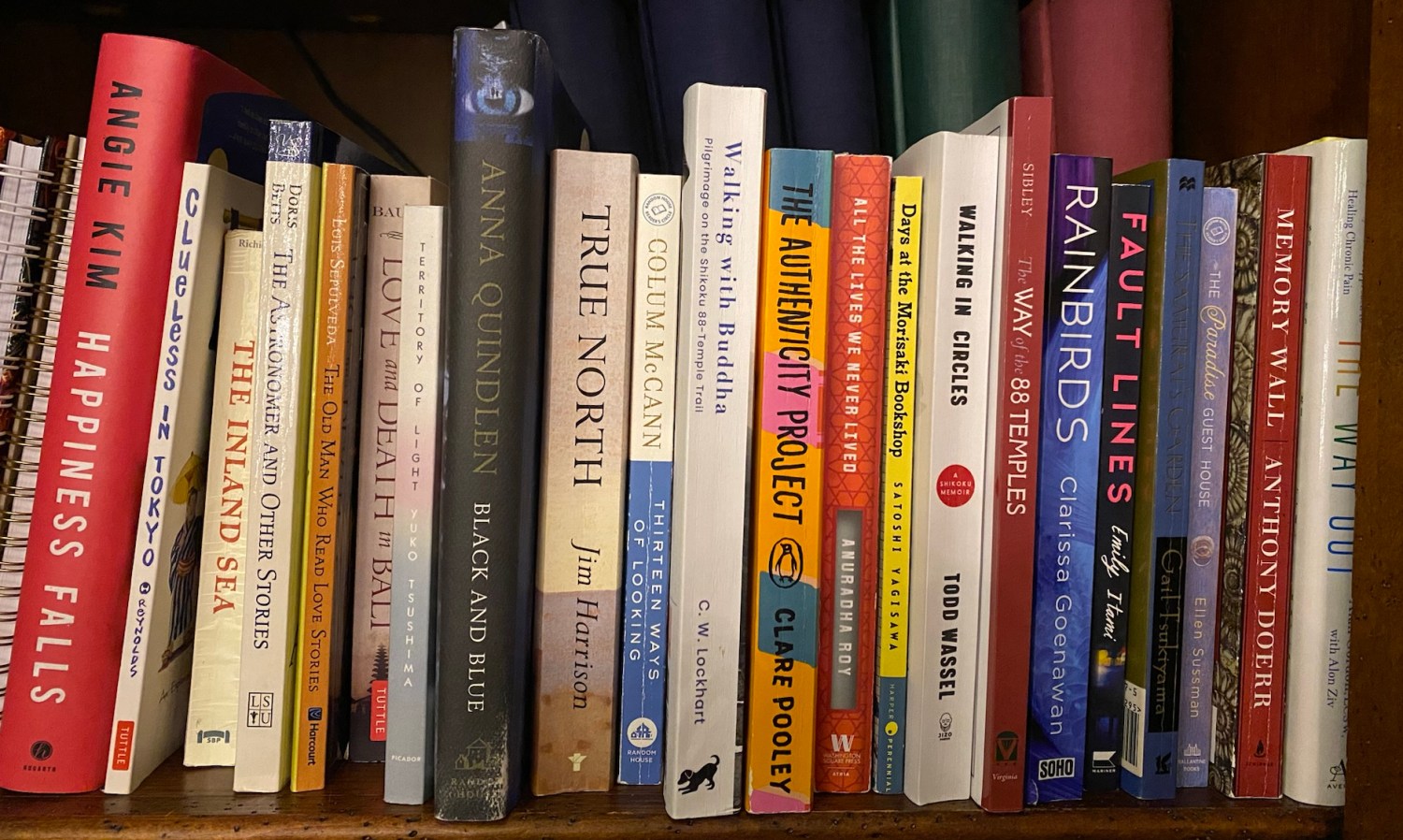

I choose many of my books for the year either based on my planned travels for the year, or from my huge book collection. On this year’s list, I picked books that took place in Colombia, Japan and Bali. I read 52 books in total, with four taking place in Colombia, four in Bali, Indonesia, 24 in Japan, and others in miscellaneous places. In all, I read some 14,600 pages. Because many of them were short Japanese books, the average length of books I read was 280 pages. I also read 5 short story collections. No wonder I don’t seem to get much else done!
Sadly I fell short in reading nonfiction, although I had many nonfiction books on my list. I hope to improve on that in 2025.

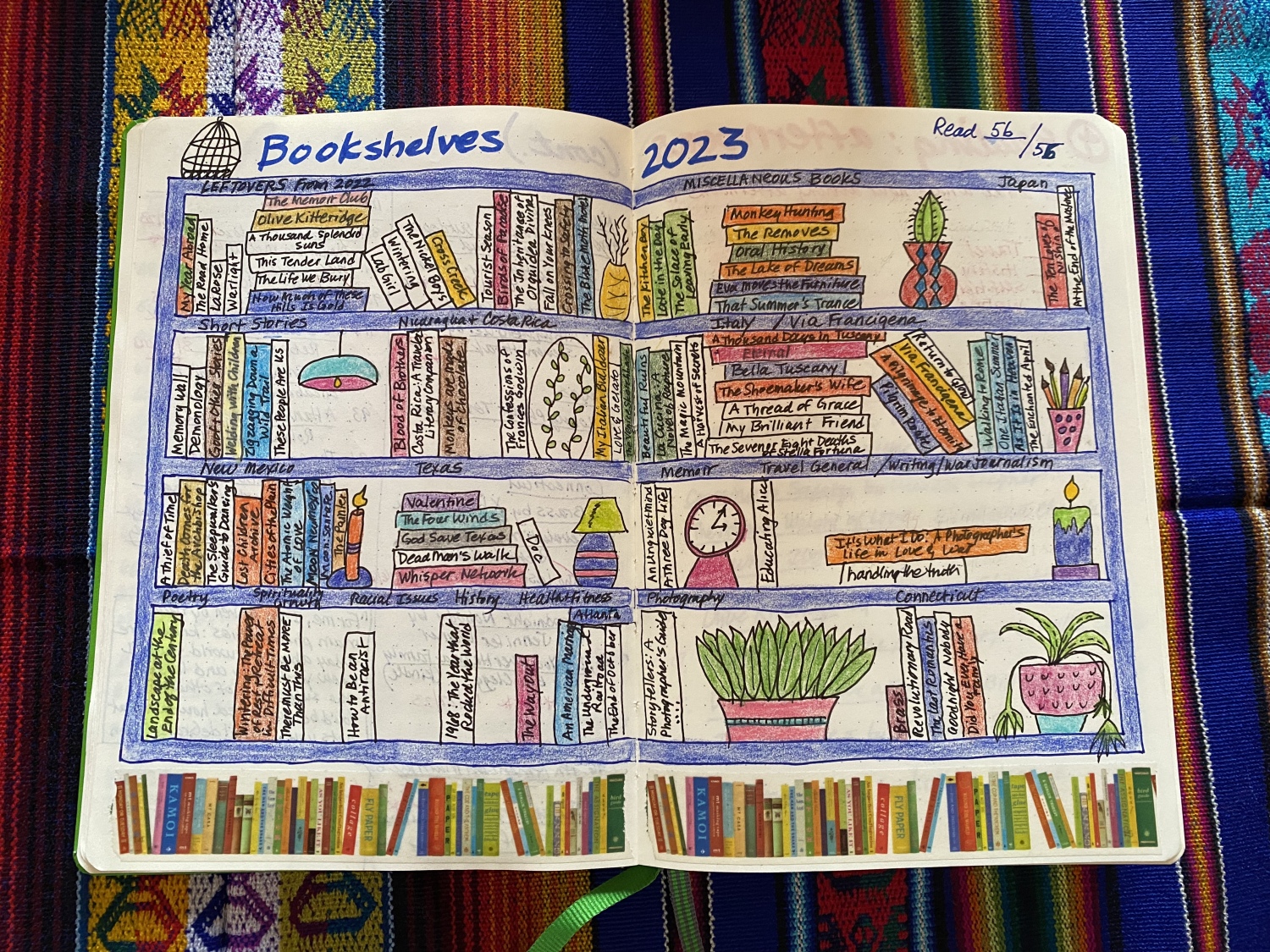
My 2024 Reading Bookshelves
Here, you can see my 2024 Year in Books. And below are my 10 favorites + one bonus book. 🙂
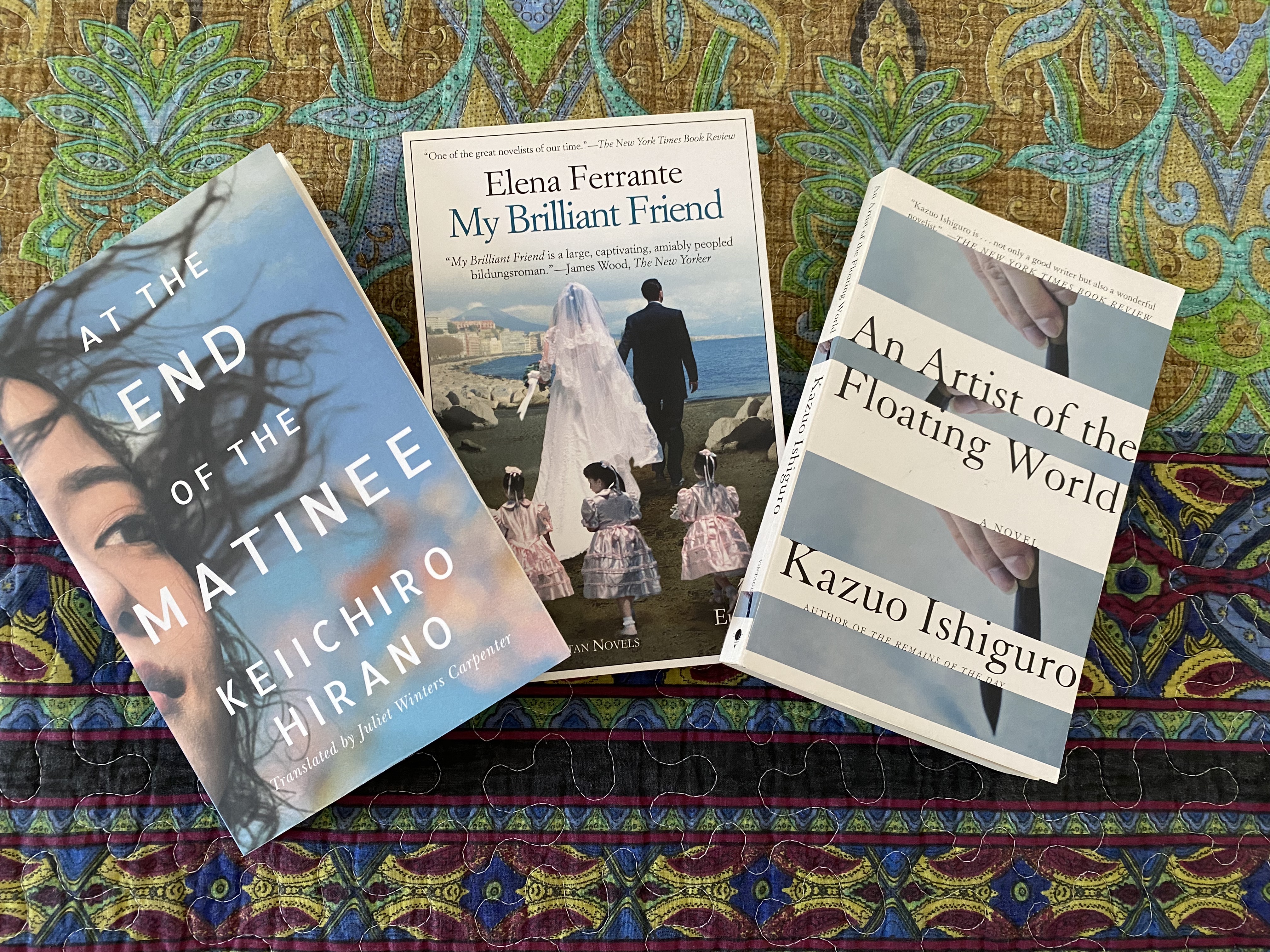
At the End of the Matinee, My Brilliant Friend, and An Artist of the Floating World
1) At the End of the Matinee by Keiichirō Hirano *****
I loved this book. The two characters, classical guitarist Satoshi Makino and journalist Yoko Komine, are deeply drawn and sympathetic. Yoko heard Makino’s music when she was younger and when she finally meets him after one of his concerts, they form an immediate bond. But they lead complicated lives; Makino lives in Tokyo but performs all over the world. He seems to be in a slump with his music and much of the story is about his struggle to revive his career and how meeting Yoko affects him and his music.
Yoko is a journalist who lives in Paris but is assigned to work in the war zone in Baghdad; she has a fiance, Richard, who seems a rather blah and superficial American. After a bomb attack in Baghdad where Yoko just misses being killed, she later finds she cannot sleep and is suffering from PTSD. She is the daughter of a Japanese woman who was on the fringes of the atomic bombing in Nagasaki and a Yugoslavian father who is a famous filmmaker. Her father was largely absent from her life, but she develops a relationship with him when she learns to speak English. His films are thought-provoking works exploring the conflicts in Yugoslavia and both Makino and Yoko find a common bond in their appreciation of his films and the musical scores to them.
The meeting between Yoko and Makino leaves a lasting impression on both of them and both of them think often of each other when apart and cannot wait to meet again. The story tells of their attempts to get together, and all the barriers that contrive to keep them apart.
2) My Brilliant Friend by Elena Ferrante *****
Usually I never read a book after watching a movie or TV series based on it, but in this case, I found the series of My Brilliant Friend so intriguing, that I decided to read the book. This is the first of four of the “Neopolitan Novels,” and now, since I’ve seen seasons 1-3 of the series, I want to read the other books. The book gives so much more context and goes into the characters’ heads more than the series can do, so I think reading it adds much depth and understanding to the story. It tells the story of a post-war Naples neighborhood, in the 1950s and 1960s, with a focus on the close yet fraught friendship between Elena Greco, known as Lenù, and her “brilliant friend,” Raffaella Cerullo, known to Elena as Lila.
I love the writing of Elena Ferrante, pseudonymous Italian novelist, and look forward to reading more of her works.
3) An Artist of the Floating World by Kazuo Ishiguro *****
This book seems on its surface an ordinary and quoditian story about an elderly artist, Masuji Ono, and his life after World War II, as Japan is rebuilding and modeling itself on American-style democracy. He is the narrator, and a rather unreliable one at that. He draws you in, and you sympathize with him, but there is innuendo by the characters who he encounters, wispy & ephemeral suggestions, that he is not without guilt in helping to contribute to, and even encourage, the war effort in Japan.
Ono was educated in a community of artists who painted “the floating world,” that world of geisha houses, evening entertainment districts lit with lanterns, the nocturnal pleasures found in pre-War Japan. It was when Ono decided he wanted to do something more substantive and meaningful that his art seemed to delve into criticisms of the old businessmen and politicians who sent the young men to war; at another time, he ended up painting provocations against China, political posters that encouraged the war effort. His life pivoted from heroic to traitorous to heroic. His reputation became tainted, and he felt regrets over things he had done, but he insisted that what he did was suitable at that time; it was the best he could do under the circumstances. In fact many of the older generation of businessmen and politicians that sent young men to war ended up committing suicide by seppuku, in Japanese “self-disembowelment,” and it seemed some of Ono’s acquaintances and even one of his daughters seemed to suggest such might be appropriate for him.
I found Ishiguro’s writing very interesting as, in a very matter-of-fact way, he showed Ono delve into these moral dilemmas while at the same time going back in time to his artistic training, his encounters and misunderstandings with other artists. Then, in the current time, he interacts with his grandson and daughters as he tries to secure his youngest daughter’s marriage and his own reputation.

The Sound of Things Fallling and Mad Honey
4) The Sound of Things Falling by Juan Gabriel Vásquez *****
The sound of things falling: people getting shot on the street, airplanes falling out of the sky, a whole society falling prey to violence due to political factions and drug cartels. In this excellent novel, young lawyer Antonio Yammara looks back on the insane world of Colombia in the 1980s when Pablo Escobar was at war with Colombia’s government forces and seemed to rule the country with his Medellín drug cartels, his assassinations, and his terrorist attacks. Pablo Escobar was finally shot in 1993, ridding the country of what had been a long shadow over its history.
Pablo Escobar once had a zoo called Hacienda Nápoles, from which a hippo had escaped in 2007; the hippo was shot dead in the middle of 2009, when this story begins. This incident brings back a memory to Antonio, that of a man named Ricardo Laverde, a pilot, who seemed unassuming and even meek upon their meeting. It wasn’t long before Laverde was murdered on the street while Antonio was walking with him; Antonio also took a bullet but wasn’t killed. This incident led him to investigate Laverde’s life, which led him to discover disturbing things about him and about Colombia all the way back to the 1960s.
I love the way this book is written, although the timeline is a bit difficult to follow. The story is told in a straightforward manner and the reader is spurred on the learn more about Ricardo Laverde and how knowing this man impacted Antonio’s life, as well as how Pablo Escobar’s power tragically affected an entire generation.
5) Strange Weather in Tokyo by Hiromi Kawakami (Kindle)*****
I loved the feeling I got while reading this novel, so I was sad when it came to an end. Just like the one semester I lived alone in Japan, teaching English at a university, I experienced a certain feeling of bliss and contentment by simply immersing myself in Japan. It’s a feeling of basking in solitude and in nature, in losing oneself in the tastes and textures of food and drink… and in soaking up the overall atmosphere and even melting into it. Like the main character, from whose viewpoint the story is told, Tsukiko, I was middle aged (actually quite older than her 38 years), and walked home to my tiny apartment each evening, stopping at least a couple times a week at a cozy wood-paneled bar to imbibe in a drink and eat the delectable fish prepared with great care by the owner. I didn’t meet anyone else there, except the friendly bar owner, who could speak a bit of English.
Tsukiko, on the other hand, goes often to a bar, Saturo’s, where she mainly eats and drinks (a lot) alone, but from time to time sits at the bar near “Sensei,” an old teacher (30 years her senior) of hers from high school. At first their relationship echoes their student-teacher relationship, with Sensei gently chastising Tsukiko for not paying attention to certain lessons in school. He recites Haiku to her and tells her his impressions of her as his long-ago student. Soon, Sensei reveals his interests to Tsukiko, inviting her to see his old battery collection or to go mushroom hunting. Tsukiko herself doesn’t seem to have many interests of her own, but finds Sensei to be dignified & old-fashioned, and she finds the way he appreciates simple things intriguing. She even admits of herself: “…as the years passed, I turned into quite a childlike person. I suppose I just wasn’t able to ally myself with time.”
They slowly develop feelings for each other, but these feelings take their sweet time to bloom. The slow-motion building of their emotional connection is fascinating to watch. They even go periods of time without seeing each other, and later, after Tsukiko confesses her love to Sensei, she goes to great lengths to avoid him, telling herself not to hope for any reciprocal feelings from him.
Both characters live lonely existences, but they don’t seem to mind being alone. They both think they’re perfectly happy being alone, but when they become closer, they add a depth and richness to each other’s lives that they couldn’t have imagined.
This could be a book I return to many times, just to recapture that feeling I had while living in Japan, a feeling I hope to recapture this fall as I return to Japan without having to work there. I hope to be able to bask in the feelings of contentment I felt when I was there before.
6) Mad Honey by Jodi Picoult & Jenniver Finney Boylan *****
I was intrigued by this book from the beginning, and I loved the way the co-authors started with the day of the alleged murder of a girl, Lily Campanello, and then went backwards in time and forward in time from that day, slowly unraveling any preconceived notions the reader might develop along the way. It turns out Asher McAfee was Lily’s boyfriend of only 3 months. He was found in Lily’s house holding Lily, who passed out with a bash to the head; shortly thereafter Lily dies. Asher becomes the prime suspect in her murder.
The story is told from the points of view of Asher’s mother, Olivia McAfee, a beekeeper who many years ago left an abusive relationship after hiding bruises for years, and from the victim Lily’s point of view in the months leading up to her death. Secrets are revealed, about Lily’s gender transformation, about Asher’s violent temper, about Olivia’s constant excuse-making in her marriage about her husband Braden’s abuse of her.
The story moved quickly and kept me engrossed. It is a long read, but I found it intriguing. I also learned a lot about marital abuse, beekeeping, and transgender identities and struggles.
I thank Random House Publishing Group-Ballantine for the ARC.

The Samurai’s Garden and All the Lovers in the Night
7) All the Lovers in the Night by Mieko Kawakami *****
How I love stories set in Japan that revolve around lonely people who blithely live their lives, come to a realization that something needs to change, and try, however tenuously, to connect with other people. I’ve read a number of similarly-themed books in various forms with different characters, yet all of them are unique because of the circumstances and people. In this case, the protagonist Fuyuko Irie is a proofreader in her late 30s who doesn’t connect with the people in her office, so when she is offered the chance to become a freelancer and work from home, she happily accepts the offer. However, working from home isolates her even more.
When Fuyuko realizes eventually that her life has nothing to it, that she cannot even speak to her boss Hijiri about anything of interest in her life, she decides something needs to change. She begins drinking at all times of day. She looks into taking some classes at a cultural center, but after several unsuccessful attempts, she passes out and loses her bag. A kind man in his 50s, Mitsutsuka, helps her when her bag can’t be recovered and they end up meeting in a cafe sporadically, then once a week, and finally twice a week, with some periods interspersed where Fuyuko backs off, fearing her intensifying feelings, and doesn’t show up. Fuyuko thinks often of Mitsutsuka yet she knows nothing about him except that he is a high school physics teacher. They both have an interest in light, and Mitsutsuka teaches her everything he knows about light. I love how the author uses light imagery and nature as reflections of Fuyuko’s ever-deepening feelings.
Fuyuko has a small circle of women friends, one from high school, Noriko, who is married with children but never has sex with her husband and is convinced he is cheating on her. Noriko is also having an affair. Fuyuko’s only other woman friend is her boss Hijiri, who is an intense, hard-working woman who sleeps with men whenever it suits her. Often, Fuyuko remains quiet when talking with them because her life has nothing in it except her work, her loneliness and the bad memory of a sexual assault in her senior year of high school. In much of the book, I think Fuyuko is trying to figure out her role as a woman in modern Japanese society, and to find her place amidst the expectations society has of women.
I loved all the layers in this book, and felt emotionally invested in Fuyuko’s life. Just my kind of story.
8) The Samurai’s Garden by Gail Tsukiyama *****
I adored this Japanese novel with its Zen-like quality and the quiet characters. Stephen is a young Chinese man whose parents have sent him from his home in Hong Kong to his family’s seaside home in Tarumi, Japan in September of 1937. They want him to have time to rest and recover from tuberculosis at this quiet town with its sea breezes. The caretaker of the family home is Matsu, an older Japanese man of few words. One day he takes Stephen for a walk to Yamaguchi, a small remote village where a colony of lepers has been forced to live in isolation. There Stephen is introduced to Sachi, a once beautiful woman, whose face (half of it) has been severely disfigured by leprosy. Stephen can see Sachi’s beauty, a beauty that radiates from within as well as the parts of her that are not disfigured. He watches as Matsu comes alive around Sachi. Later, in the village of Tarumi, they meet Kenzo, Matsu’s childhood friend who had once loved Sachi but abandoned her after she was afflicted with leprosy.
Stephen also meets a beautiful young woman, Keiko, who he yearns to connect with. He only meets her a few times but it is obvious there is a bond between them. However, as Stephen is Chinese, he is forbidden to see Keiko by her father during these tense years while Japan is invading China (beginning July 7, 1937), destroying everything in the Imperial Army’s path.
Besides the war in China looming over Stephen’s stay, his mother has informed him by letter that Stephen’s father, an international businessman, has a Japanese woman who he lives with in Kobe. When Stephen confronts his father about this, his father says he’s in love with the Japanese woman and refuses to leave her, but he will never abandon his family.
Between the stresses of the war news and the father’s infidelity, and the clash that inevitably occurs when Kenzo realizes that Matsu and Sachi are seemingly in love, Stephen tries to find peace in his deepening appreciation of the Japanese garden that Matsu so lovingly tends, in the sea and swimming, and in his growing friendship with Matsu and Sachi. It is a heartwarming story of a young man’s awakening to both the horrors and blessings of the world.
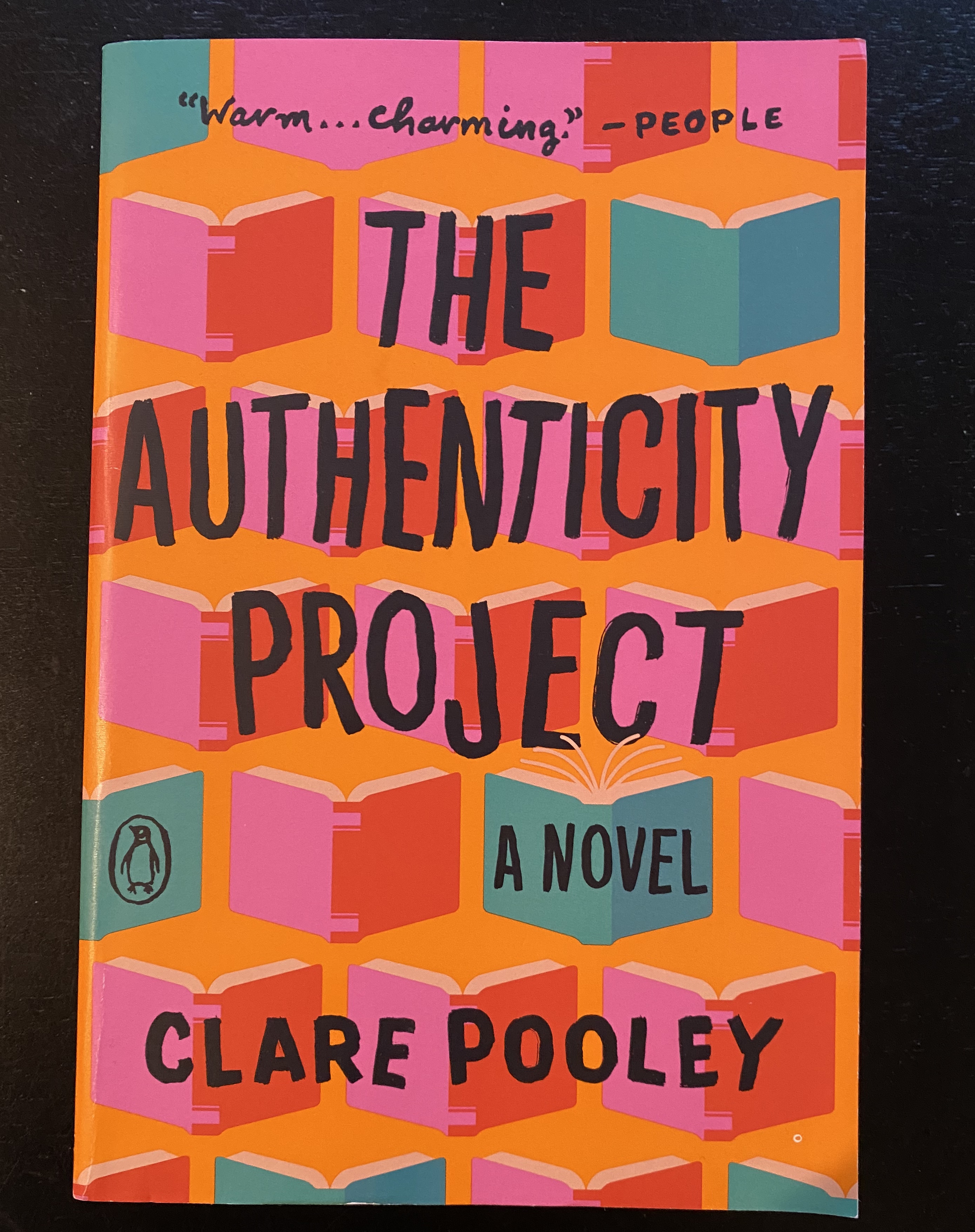
The Authenticity Project by Clare Pooley
9) The Authenticity Project by Clare Pooley *****
I really enjoyed this book. First, I always love a story told from different points of view and moving forward in time. I like the premise, that a person writes something authentic and revealing about himself in a book titled “The Authenticity Project,” and then leaves the book for other people to find it and do what they will with it. The first author in The Authenticity Project is Julian, a 79-year-old man who reveals his loneliness after his wife Mary died; after he writes his story and leaves the book in Monica’s coffee shop, we learn about Monica. Then Hazard, then Riley, then Alice, and so on and so forth. It was a pleasure to read about this little band of people who come together in the material world and form a community, such a refreshing and rare (in this day and age) coming together of people in real life.
In the Acknowledgments, the author tells how she was an addict and in trying to get sober, she started a blog, telling of her struggles and revealing her authentic self. I too write a blog and have revealed much of myself through various blogs over a 14-year period. You do form a community of sorts when you are authentic in telling your truth and in being open to others. Still, I like the community that is formed around Monica and wish for more of that myself, in real life. 🙂
10) Norwegian Wood by Haruki Murakami (Kindle) ****
I always enjoy a quiet Japanese read, and although this story is quiet, there is a deep undercurrent of emotion, pain and heartbreak. Toru Watanabe immerses himself in memories of his first love, Naoko, the girlfriend of his best friend Kizuki, who committed suicide. Toru doesn’t seem to have much going on in his life; for some reason people befriend him but he doesn’t understand why. He’s certainly not someone with a strong and decisive personality. He doesn’t know why but he somehow became a third wheel to Naoko and Kizuki, who were a couple when they were in high school. Toru doesn’t understand why Kizuki killed himself, and hadn’t noticed any hints that he might do such a thing.
After Kizuki’s suicide, Toru tries to be there for Naoko, but she is struggling with her own mental health issues and in fact stays of her own accord in a kind of self-healing place with an older woman and other societal misfits who also have emotional issues. There are apparently no doctors at this facility and it seems it is like a commune removed from the real world. And the “patients” expect to be healed by the community and by themselves from their emotional traumas.
Toru seems disillusioned by the world, has no direction until he decides to to man up and be whatever Naoko needs him to be. But Naoko really doesn’t seem to need him or want to improve her life. She says she wants to be better, but she has been too devastated by Kisuki’s death, as they were close since they were children. She seems unable to escape her grief. It is frustrating for Toru, and for the reader, that she is so aloof and unreachable.
Overall, I liked the story, which took place in the late 1960s mostly in Tokyo, with a lot of musical references like the Beatles’ “Norwegian Wood,” thus the title.
BONUS: Special Interest Book:

The Way of the 88 Temples: Journeys on the Shikoku Pilgrimage
The Way of the 88 Temples: Journeys on the Shikoku Pilgrimage by Robert C. Sibley *****
This is an excellent account of author Robert C. Sibley’s experience of walking the 1,400km Shikoku 88-temple pilgrimage in Japan. He describes his reason for walking the pilgrimage at first as “escapist”; he wanted “to escape the confines of everyday life.” He admitted he wasn’t a Buddhist; however, pilgrimages have a way of changing people, and he was open to finding a “spiritual sensibility.” Sibley had completed the Camino de Santiago in Spain already (as I have), and this was another quest for him. He wove together interactions with his companions and other henro (pilgrims) he met along the way, Japanese culture, landscape and food, and finally the proper ways to approach and offer prayers in each temple.
He met a Japanese father and son, Shūji and Jun, who were walking together in hopes of solving the son’s “problems.” They became friends on the trail, although it wasn’t until deep into the pilgrimage that Sibley found out the extent of the family’s struggles. He also met another Japanese man, Tanaka-san, who was walking to “fill an emptiness in his heart.” Together, the four of them completed the pilgrimage despite many struggles and blessings along the way.
I don’t think from his descriptions that I could walk such a pilgrimage with all of the mountains on this pilgrimage route. But it was wonderful to share in his experience by reading about it. It seemed a wonderful experience.
******
Did you read any great books this year? What were some of your favorites?





 ~ wander.essence ~
You must be logged in to post a comment.