Skip to content
  • Home
  • about ~ wander.essence ~
    • ~ the places i’ve been ~
    • ~ places i’ve been in the u.s.a. ~
  • Travel Destinations
    • America
      • Boston
      • Delaware
      • District of Columbia
        • Washington
      • Georgia
        • Atlanta
      • Maryland
      • New Jersey
        • Cape May
      • New York
        • Adirondacks
        • Buffalo
        • Niagara Falls
      • Pennsylvania
        • Pittsburgh
      • South Carolina
      • Tennessee
        • Nashville
      • Virginia
    • American Road Trips
      • Canyon & Cactus Road Trip
      • Florida Road Trip
        • Everglades
        • Fort Lauderdale
        • Florida Keys
        • Miami
        • St. Augustine
      • Four Corners Road Trip
        • Arizona
          • Monument Valley
          • Petrified Forest National Park
          • Sunset Crater National Monument
          • Walnut Canyon National Monument
          • Winslow
          • Wupatki National Monument
        • Colorado
          • Colorado National Monument
          • Colorado Towns
          • Great Sand Dunes National Park
          • Grand Junction
        • New Mexico
        • Utah
          • Arches National Park
          • Canyonlands
          • Navajo National Monument
          • Dead Horse Point State Park
          • Hovenweep National Monument
          • Moab
          • Valley of the Gods
          • Natural Bridges National Monument
      • Great Lakes Road Trip
        • Michigan
        • Minnesota
        • Wisconsin
      • Midwestern Triangle
        • Illinois
          • Carbondale
          • Murphysboro
        • Kentucky
          • Covington
          • Lexington
          • Louisville
        • Ohio
          • Cincinnati
      • Road Trip to Nowhere
        • Nebraska
        • North Dakota
        • South Dakota
      • Tex-New Mex Road Trip
        • Texas & New Mexico Road Trip
        • New Mexico
        • Texas
    • International Travel
      • Africa
        • african meanderings {& musings}
        • Egypt
          • Cairo
        • Ethiopia
        • Morocco
      • Asia
        • Cambodia
        • China
          • China Diaries
          • Guangxi Province
        • India
          • Rishikesh
          • Varanasi
        • Japan
          • Kyoto
        • Myanmar
        • Oman
          • a nomad in the land of nizwa
          • Nizwa
        • Singapore
        • South Korea
          • catbird in korea
        • Thailand
        • Turkey
          • Cappadocia
        • Vietnam
      • Central America
        • Costa Rica
        • El Salvador
        • Nicaragua
        • Panama
          • Bocas del Toro
          • Panama City
      • Europe
        • In Search of a Thousand Cafés
        • Croatia
          • Dalmatia
            • Istria
            • Dubrovnik
            • Plitvice Lakes National Park
            • Split
            • Zadar
            • Zagreb
        • Czech Republic
          • Český Krumlov
        • England
        • France
        • Greece
        • Hungary
          • Budapest
          • Esztergom
        • Iceland
        • Italy
          • Bergamo
          • Cinque Terre
          • The Dolomites
          • Florence
          • Rome
          • Tuscany
          • Venice
          • Verona
          • Via Francigena
        • Portugal
        • Spain
          • Camino de Santiago
            • packing list for el camino de santiago 2018
      • North America
        • Canada
          • The Maritimes
            • New Brunswick
            • Nova Scotia
            • Prince Edward Island
          • Ontario
      • South America
        • Colombia
        • Ecuador
          • Cuenca
          • Quito
    • how to make the most of a staycation
      • Coronavirus Coping
  • Imaginings
    • imaginings: the call to place
  • Travel Preparation
    • journeys: anticipation & preparation
  • Travel Creativity
    • on keeping a travel journal
    • on creating art from travels
      • Art Journaling
    • photography inspiration
      • Photography
    • writing prompts: prose
      • Prose
        • Fiction
        • Travel Essay
        • Travelogue
    • writing prompts: poetry
      • Poetry
  • On Journey
    • on journey: taking ourselves from here to there
  • Books & Movies
    • books | international a-z |
    • books & novels | u.s.a. |
    • books | history, spirituality, personal growth & lifestyle |
    • movies | international a-z |
    • movies | u.s.a. |
  • On Returning Home
    • on returning home
  • Annual recap
    • twenty-fifteen
    • twenty-eighteen
    • twenty-nineteen
    • twenty-twenty
    • twenty-twenty-one
    • twenty twenty-two
    • twenty twenty-three
    • twenty twenty-four
    • twenty twenty-five
  • Contact

Enter your email address to follow this blog and receive notifications of new posts by email.

Join 1,061 other subscribers
Follow ~ wander.essence ~ on WordPress.com
  • Home
  • about ~ wander.essence ~
    • ~ the places i’ve been ~
    • ~ places i’ve been in the u.s.a. ~
  • Travel Destinations
    • America
      • Boston
      • Delaware
      • District of Columbia
        • Washington
      • Georgia
        • Atlanta
      • Maryland
      • New Jersey
        • Cape May
      • New York
        • Adirondacks
        • Buffalo
        • Niagara Falls
      • Pennsylvania
        • Pittsburgh
      • South Carolina
      • Tennessee
        • Nashville
      • Virginia
    • American Road Trips
      • Canyon & Cactus Road Trip
      • Florida Road Trip
        • Everglades
        • Fort Lauderdale
        • Florida Keys
        • Miami
        • St. Augustine
      • Four Corners Road Trip
        • Arizona
          • Monument Valley
          • Petrified Forest National Park
          • Sunset Crater National Monument
          • Walnut Canyon National Monument
          • Winslow
          • Wupatki National Monument
        • Colorado
          • Colorado National Monument
          • Colorado Towns
          • Great Sand Dunes National Park
          • Grand Junction
        • New Mexico
        • Utah
          • Arches National Park
          • Canyonlands
          • Navajo National Monument
          • Dead Horse Point State Park
          • Hovenweep National Monument
          • Moab
          • Valley of the Gods
          • Natural Bridges National Monument
      • Great Lakes Road Trip
        • Michigan
        • Minnesota
        • Wisconsin
      • Midwestern Triangle
        • Illinois
          • Carbondale
          • Murphysboro
        • Kentucky
          • Covington
          • Lexington
          • Louisville
        • Ohio
          • Cincinnati
      • Road Trip to Nowhere
        • Nebraska
        • North Dakota
        • South Dakota
      • Tex-New Mex Road Trip
        • Texas & New Mexico Road Trip
        • New Mexico
        • Texas
    • International Travel
      • Africa
        • african meanderings {& musings}
        • Egypt
          • Cairo
        • Ethiopia
        • Morocco
      • Asia
        • Cambodia
        • China
          • China Diaries
          • Guangxi Province
        • India
          • Rishikesh
          • Varanasi
        • Japan
          • Kyoto
        • Myanmar
        • Oman
          • a nomad in the land of nizwa
          • Nizwa
        • Singapore
        • South Korea
          • catbird in korea
        • Thailand
        • Turkey
          • Cappadocia
        • Vietnam
      • Central America
        • Costa Rica
        • El Salvador
        • Nicaragua
        • Panama
          • Bocas del Toro
          • Panama City
      • Europe
        • In Search of a Thousand Cafés
        • Croatia
          • Dalmatia
            • Istria
            • Dubrovnik
            • Plitvice Lakes National Park
            • Split
            • Zadar
            • Zagreb
        • Czech Republic
          • Český Krumlov
        • England
        • France
        • Greece
        • Hungary
          • Budapest
          • Esztergom
        • Iceland
        • Italy
          • Bergamo
          • Cinque Terre
          • The Dolomites
          • Florence
          • Rome
          • Tuscany
          • Venice
          • Verona
          • Via Francigena
        • Portugal
        • Spain
          • Camino de Santiago
            • packing list for el camino de santiago 2018
      • North America
        • Canada
          • The Maritimes
            • New Brunswick
            • Nova Scotia
            • Prince Edward Island
          • Ontario
      • South America
        • Colombia
        • Ecuador
          • Cuenca
          • Quito
    • how to make the most of a staycation
      • Coronavirus Coping
  • Imaginings
    • imaginings: the call to place
  • Travel Preparation
    • journeys: anticipation & preparation
  • Travel Creativity
    • on keeping a travel journal
    • on creating art from travels
      • Art Journaling
    • photography inspiration
      • Photography
    • writing prompts: prose
      • Prose
        • Fiction
        • Travel Essay
        • Travelogue
    • writing prompts: poetry
      • Poetry
  • On Journey
    • on journey: taking ourselves from here to there
  • Books & Movies
    • books | international a-z |
    • books & novels | u.s.a. |
    • books | history, spirituality, personal growth & lifestyle |
    • movies | international a-z |
    • movies | u.s.a. |
  • On Returning Home
    • on returning home
  • Annual recap
    • twenty-fifteen
    • twenty-eighteen
    • twenty-nineteen
    • twenty-twenty
    • twenty-twenty-one
    • twenty twenty-two
    • twenty twenty-three
    • twenty twenty-four
    • twenty twenty-five
  • Contact

wander.essence

wander.essence

Home from Morocco & Italy

Home sweet home!May 10, 2019
I'm home from Morocco & Italy. :-)

Italy trip

Traveling to Italy from MoroccoApril 23, 2019
On my way to Italy!

Leaving for Morocco

Casablanca, here I come!April 4, 2019
I'm on my way to Casablanca. :-)

Home from our Midwestern Triangle Road Trip

Driving home from Lexington, KYMarch 6, 2019
Home sweet home from the Midwest. :-)

Leaving for my Midwestern Triangle Road Trip

Driving to IndianaFebruary 24, 2019
Driving to Indiana.

Returning home from Portugal

Home sweet home from Spain & Portugal!November 6, 2018
Home sweet home from Spain & Portugal!

Leaving Spain for Portugal

A rendezvous in BragaOctober 26, 2018
Rendezvous in Braga, Portgual after walking the Camino de Santiago. :-)

Leaving to walk the Camino de Santiago

Heading to Spain for the CaminoAugust 31, 2018
I'm on my way to walk 790 km across northern Spain on the Camino de Santiago.

Home from my Four Corners Road Trip

Home Sweet Home from the Four CornersMay 25, 2018
Home Sweet Home from the Four Corners. :-)

My Four Corners Road Trip!

Hitting the roadMay 1, 2018
I'm hitting the road today for my Four Corners Road Trip: CO, UT, AZ, & NM!

Recent Posts

  • twenty twenty-five: nicaragua {twice}, mexico & seven months in costa rica {with an excursion to panama} December 31, 2025
  • the december cocktail hour: mike’s surgery, a central highlands road trip & christmas in costa rica December 31, 2025
  • top ten books of 2025 December 28, 2025
  • the november cocktail hour: a trip to panama, a costa rican thanksgiving & a move to lake arenal condos December 1, 2025
  • panama: the caribbean archipelago of bocas del toro November 24, 2025
  • a trip to panama city: el cangrejo, casco viejo & the panama canal November 22, 2025
  • the october cocktail hour: a trip to virginia, a NO KINGS protest, two birthday celebrations, & a cattle auction October 31, 2025
  • the september cocktail hour: a nicoya peninsula getaway, a horseback ride to la piedra del indio waterfalls & a fall bingo card September 30, 2025
  • the august cocktail hour: local gatherings, la fortuna adventures, & a “desfile de caballistas”  September 1, 2025
  • the july cocktail hour: a trip to ometepe, nicaragua; a beach getaway to tamarindo; & homebody activities August 3, 2025
  • the june cocktail hour: our first month in costa rica June 30, 2025
  • a pura vida year in costa rica June 12, 2025
  • the may cocktail hour: final wrap up, a wedding & leaving for costa rica June 2, 2025

Archives

  • December 2025
  • November 2025
  • October 2025
  • September 2025
  • August 2025
  • June 2025
  • May 2025
  • April 2025
  • March 2025
  • February 2025
  • January 2025
  • December 2024
  • November 2024
  • October 2024
  • September 2024
  • August 2024
  • July 2024
  • June 2024
  • May 2024
  • April 2024
  • March 2024
  • February 2024
  • January 2024
  • December 2023
  • November 2023
  • September 2023
  • August 2023
  • June 2023
  • May 2023
  • April 2023
  • March 2023
  • February 2023
  • January 2023
  • December 2022
  • November 2022
  • October 2022
  • September 2022
  • August 2022
  • June 2022
  • May 2022
  • April 2022
  • March 2022
  • February 2022
  • January 2022
  • December 2020
  • November 2020
  • October 2020
  • September 2020
  • August 2020
  • July 2020
  • June 2020
  • May 2020
  • April 2020
  • March 2020
  • February 2020
  • January 2020
  • December 2019
  • November 2019
  • October 2019
  • September 2019
  • August 2019
  • July 2019
  • June 2019
  • May 2019
  • April 2019
  • March 2019
  • February 2019
  • January 2019
  • December 2018
  • November 2018
  • October 2018
  • September 2018
  • August 2018
  • July 2018
  • June 2018
  • May 2018
  • April 2018
  • March 2018

Blog Stats

  • 121,601 hits
January 2026
M T W T F S S
 1234
567891011
12131415161718
19202122232425
262728293031  
« Dec    

Categories

  • Aït-Ben-Haddou (4)
  • Abingdon (1)
  • Abiquiu (1)
  • Acquapendente (2)
  • Adirondacks (3)
  • Africa (39)
  • Ainokura (2)
  • Alabama (1)
  • Alajuela (3)
  • Alamogordo (1)
  • Albuquerque (3)
  • Alexandria (1)
  • Alma (1)
  • Alpe di Siusi (1)
  • Alsace-Lorraine (1)
  • Alto Adige Wine Road (1)
  • Amarante (2)
  • America (69)
  • American Bison (1)
  • American books (21)
  • American Road Trips (255)
  • American Visionary Art Museum (1)
  • Americana (1)
  • Andrew Johnson National Historic Site (1)
  • Annapolis Valley (1)
  • Annual recap (10)
  • Anticipation (44)
  • Antietam National Battlefield (2)
  • Aramak Tour (1)
  • Arches National Park (8)
  • architecture (1)
  • Arena Stage (1)
  • Arizona (28)
  • Aroumd (2)
  • Art Journaling (9)
  • Asciano (1)
  • Asia (41)
  • Assisi (1)
  • Astorga (2)
  • Atapuerca (1)
  • Athens (1)
  • Atlanta (7)
  • Austin (2)
  • Aveiro (2)
  • Azofra (2)
  • Aztec Ruins National Monument (1)
  • óbidos (1)
  • Baños (2)
  • Badlands National Park (1)
  • Bagan (1)
  • Bagno Vignoni (2)
  • Bajos del Toro (1)
  • Balcony House (1)
  • Bali (9)
  • Baltimore (7)
  • Baltimore Museum of Art (1)
  • Bandelier National Monument (1)
  • Bangkok (2)
  • Bear Butte (1)
  • Beatrice (1)
  • Beihai (1)
  • Belize (1)
  • Beppu (1)
  • Bergamo (3)
  • Big Bend National Park (2)
  • Bijagua (2)
  • Bismarck (3)
  • Bismarck Art Alley (1)
  • Bitchu-Takahashi (1)
  • Blue Falls of Costa Rica (1)
  • Bluff (1)
  • Bluff Fort Historic Site (1)
  • Bocas del Toro (2)
  • Bocas Town (1)
  • Bogotá (4)
  • Bolsena (2)
  • Bolzano (2)
  • Bonanzaville (1)
  • Books (46)
  • Bosque de Chapultepec (1)
  • Boston (2)
  • Boulder (1)
  • Boys Town (1)
  • Braga (3)
  • Brookings (1)
  • Brunico/Bruneck (1)
  • Budapest (1)
  • Buffalo (9)
  • Bukit Peninsula (1)
  • Buonconvento (2)
  • Burano (2)
  • Burgos (4)
  • Cañas (2)
  • Cabo da Roca (1)
  • Caddo Lake (2)
  • Cairo (3)
  • California (4)
  • Cambodia (4)
  • Cambridge (1)
  • Camino de Santiago (64)
  • Campagnano di Roma (2)
  • Canada (15)
  • Canyon & Cactus Road Trip (4)
  • Canyon de Chelly (3)
  • Canyonlands (3)
  • Cape May (7)
  • Cappadocia (2)
  • Capranica (1)
  • Carbondale (9)
  • Carlsbad (1)
  • Carlsbad Caverns National Park (2)
  • Cartagena (4)
  • Casablanca (9)
  • Casco Viejo (1)
  • Castellina in Chianti (1)
  • Catarata del Toro (1)
  • Catskill Mountains (1)
  • Cedar Creek & Belle Grove National Historical Park (1)
  • Central America (41)
  • Central Highlands (1)
  • Centro Histórico (1)
  • Chaco Culture National Historical Park (4)
  • challenge: a call to place (38)
  • Channel Islands National Park (3)
  • Chapel in the Hills (1)
  • Charles Pinckney National Historic Site (1)
  • Charleston (11)
  • Chefchaouen (5)
  • Cheyenne (2)
  • Cheyenne Depot Museum (1)
  • Cheyenne Frontier Days Old West Museum (1)
  • Chicago (3)
  • Chillicothe (2)
  • Chimayó (1)
  • Chimney Rock (1)
  • China (8)
  • Chinatown (1)
  • Christmas (5)
  • Churchill Downs (1)
  • Cihuatán (1)
  • Cincinnati (15)
  • Cincinnati Art Museum (1)
  • Cinque Terre (10)
  • Cinquera (1)
  • Civita di Bagnoregio (1)
  • Cloudcroft (1)
  • Cocktail Hour (22)
  • Cocoa Beach (2)
  • Coeur d'Alene (1)
  • Collalbo/Klobenstein (1)
  • Colle di Val d'Elsa (2)
  • Colombia (9)
  • Colorado (31)
  • Colorado National Monument (3)
  • Colorado Towns (6)
  • Colorful (1)
  • Condesa (1)
  • Connecticut (1)
  • Cordoba (1)
  • Coronavirus Coping (14)
  • Cortina d’Ampezzo (1)
  • Costa Nova (1)
  • Costa Rica (19)
  • Covington (7)
  • Cowgirls of the West (1)
  • Coyoacán (1)
  • Crazy Horse Memorial (1)
  • Crestone (1)
  • Crete (1)
  • Croatia (3)
  • Cuenca (3)
  • Curves (1)
  • Custer (1)
  • Custer State Park (1)
  • Czech Republic (1)
  • Dakota Dinosaur Museum (1)
  • Dali (1)
  • Dalmatia (1)
  • De Smet (1)
  • Dead Horse Point State Park (1)
  • Dead Sea (1)
  • Deadwood (3)
  • decay (1)
  • Delaware (9)
  • Delphi (1)
  • Denver (1)
  • destinations (44)
  • Devils Tower National Monument (2)
  • Diamante Eco Adventure Park (1)
  • Dickinson (1)
  • District of Columbia (22)
  • Dobbiaco/Toblach (1)
  • Dolores Hidalgo (1)
  • Drawing (7)
  • Dubrovnik (1)
  • Durango (1)
  • Dwight D. Eisenhower Memorial (1)
  • Ecuador (14)
  • Egypt (3)
  • El Cangrejo (1)
  • El Salvador (6)
  • El-Khorbat (1)
  • Embudo (1)
  • Enchanted Rock State Natural Area (1)
  • England (3)
  • Erg Chebbi (3)
  • Española (1)
  • Essaouira (4)
  • Esztergom (1)
  • Ethiopia (3)
  • Europe (120)
  • Evan Williams Bourbon Experience (1)
  • Everglades (3)
  • Evora (1)
  • Fargo (2)
  • Fès (3)
  • Fenghuang (1)
  • Fez (2)
  • Fiction (6)
  • Findlay Market (1)
  • Finisterre (2)
  • Fira (1)
  • Fiumicino (2)
  • Flatirons Vista Trail (1)
  • Flight 93 National Memorial (1)
  • Florence (8)
  • Florida Keys (3)
  • Florida Road Trip (5)
  • Formello (1)
  • Fort Abraham Lincoln State Park (1)
  • Fort Atkinson State HIstorical Park (1)
  • Fort Calhoun (1)
  • Fort Collins (2)
  • Fort Lauderdale (2)
  • Fort Mandan (1)
  • Fort McHenry National Monument and Historic Shrine (1)
  • Fort Robinson State Park (1)
  • Fort Sumter and Fort Moultrie National Historical Park (1)
  • Fort Union Trading Post National Historic Site (1)
  • Four Corners Road Trip (74)
  • France (7)
  • Frazier Museum (1)
  • Fredericksburg (1)
  • Fucecchio (1)
  • Fundy National Park (1)
  • G Adventures Tour (10)
  • Gallina (2)
  • Gambassi Terme (2)
  • Gateway Arch National Park (1)
  • Gavin's Point Dam (1)
  • George Rogers Clark National Historical Park (2)
  • Georgia (7)
  • Gerald R. Ford Birthsite (1)
  • Germany (1)
  • Gettysburg National Military Park (1)
  • Goals (2)
  • Gothenburg (1)
  • Grand Junction (1)
  • Great Falls (2)
  • Great Lakes Road Trip (6)
  • Great Sand Dunes National Park (2)
  • Grecia (1)
  • Greece (3)
  • Greeneville (1)
  • Greenville (1)
  • Greve in Chianti (1)
  • Guadalupe Mountains National Park (1)
  • Guanacaste (9)
  • Guanajuato (5)
  • Guangxi Province (4)
  • Guatapé (5)
  • Guatemala (1)
  • Guilin (1)
  • Guimarães (2)
  • Halifax (3)
  • Halong Bay (1)
  • Hanoi (1)
  • Heidelberg (1)
  • Hida Furukawago (2)
  • High Road to Taos (1)
  • Hikes & Walks (202)
  • HISTORIC NAKASENDO TRAIL (1)
  • Hoa Lu (1)
  • Holbrook (1)
  • Holidays (6)
  • Hong Kong (1)
  • Hopewell Culture National Historical Park (2)
  • Hopewell Rocks Provincial Park (1)
  • Hotel Hacienda Guachipelin (1)
  • Hovenweep National Monument (1)
  • Hubbell Trading Post (1)
  • Hungary (1)
  • Iceland (1)
  • Idaho (1)
  • Illinois (17)
  • Imaginings (45)
  • Imlil (2)
  • India (7)
  • Indiana (6)
  • Indonesia (9)
  • Ingapirca (2)
  • Inle Lake (1)
  • Innichen/San Candido (1)
  • International Books (30)
  • International Peace Garden (1)
  • International Travel (333)
  • Iowa (1)
  • Isla Bastimentos (1)
  • Isla Carenero (1)
  • Isla Colón (1)
  • Istanbul (2)
  • Istria (1)
  • Italy (62)
  • Jamestown (1)
  • Japan (20)
  • Japan Alps (4)
  • Jefferson (1)
  • Jewel Cave National Monument (1)
  • Jimbaran (1)
  • Joachim Regional Museum & Prairie Outpost Park (1)
  • Johnstown Flood National Memorial (1)
  • Jordan (3)
  • Joseph N. Nicollet Tower and Interpretive Center (1)
  • Joshua Tree National Park (3)
  • Joslyn Art Museum (1)
  • Journaling (8)
  • Joya de Cerén (1)
  • Kansas (2)
  • Kathmandu (2)
  • Kentucky (17)
  • KMAC (1)
  • Knife River Indian Villages (2)
  • Kunming (1)
  • Kurashiki Bikan Historical Quarter (1)
  • Kyoto (5)
  • Kyushu (4)
  • La Fortuna (2)
  • La Giustiniana (2)
  • La Peñol (1)
  • La Romita (1)
  • La Spezia (6)
  • Lago d'Iseo (1)
  • Lago di Garda (1)
  • Lago di Garda (1)
  • Laguna de Apoyo (1)
  • Laguna Quilotoa (2)
  • Languedoc-Roussillon (1)
  • Latacunga (3)
  • laundry (1)
  • Lazio (6)
  • León (2)
  • León (2)
  • Leeds (1)
  • Lens-Artists (2)
  • Lewis & Clark Interpretive Center (2)
  • Lexington (8)
  • Lijiang (1)
  • Lincoln Boyhood Home National Memorial (2)
  • Lincoln City (3)
  • lines (1)
  • Lisbon (8)
  • Logroño (3)
  • Lombardy (3)
  • Longji Rice Terraces (1)
  • Longreads (6)
  • Looking ahead (2)
  • Lorca (2)
  • Lory State Park (1)
  • Los Alamos (3)
  • Los Angeles (3)
  • Louisiana (1)
  • Louisville (13)
  • Low Road to Taos (1)
  • Lucca (3)
  • Luckenbach (1)
  • Lunenburg (1)
  • Madison (1)
  • Madison County Historical Society Museum (1)
  • Magnolia Plantations & Gardens (1)
  • Magome-juku (1)
  • Mahone Bay (1)
  • Maine (1)
  • Managua (5)
  • Manarola (1)
  • Mandalay (1)
  • Mandan (1)
  • Manhattan Project National Historical Park (1)
  • Mapmaking (2)
  • Marfa (1)
  • Market towns near Cuenca (2)
  • markets (1)
  • Marrakech (7)
  • Maryland (11)
  • Massachusetts (2)
  • Matagalpa (2)
  • Mathews (1)
  • Meadowlark Botanical Gardens (4)
  • Medellín (5)
  • Medora (5)
  • Memoir (4)
  • Merzouga (5)
  • Mesa Verde National Park (4)
  • Meteora (1)
  • Mexico (11)
  • Mexico City (7)
  • Miami (3)
  • Michigan (4)
  • Middletown (1)
  • Midwestern Triangle (30)
  • Minas Basin (1)
  • Mine of Santa Brigida (1)
  • Mineral de Pozos (1)
  • Ministers Island (1)
  • Minnesota (1)
  • Minnesota (3)
  • Minot (1)
  • Minuteman Missile National Historic Site (1)
  • Mirador de Catarina (1)
  • Mississippi (1)
  • Missouri (4)
  • Missouri National Recreation River (1)
  • Missouri River Basin Lewis & Clark Center (2)
  • Mitchell (1)
  • Moab (2)
  • Montalcino (1)
  • Montana (1)
  • Montefiascone (1)
  • Montefioralle (1)
  • Montepulciano (1)
  • Monteriggioni (3)
  • Monteroni d'Arbia (1)
  • Monterosi (1)
  • Monterosso al Mare (2)
  • Monteverde (1)
  • Monthly recap (22)
  • Monument Valley (1)
  • Moorhead (1)
  • Morocco (37)
  • Mount Pleasant (1)
  • Mt. Rushmore National Memorial (1)
  • Mulberry Bend Overlook (1)
  • Murano (2)
  • Murphysboro (10)
  • Muruzabal (1)
  • Muscat (1)
  • Museum of the Shenandoah Valley (1)
  • Muxia (2)
  • Myanmar (2)
  • Nagoya (4)
  • Nagoya Castle (2)
  • Nanning (3)
  • Naoshima (1)
  • Narita (5)
  • Nashville (8)
  • National Gallery of Art (2)
  • natural bridges (1)
  • Natural Bridges National Monument (2)
  • Navajo National Monument (2)
  • Nebraska (21)
  • Nepal (4)
  • New Belgium Brewing (1)
  • New Brunswick (6)
  • New Castle (2)
  • New England Road Trip (2)
  • New Hampshire (2)
  • New Jersey (7)
  • New Mexico (12)
  • New Mexico (1)
  • New Mexico (12)
  • New York (16)
  • Newport (1)
  • Niagara Falls (7)
  • Nicaragua (23)
  • Nice (1)
  • Nicoya Peninsula (1)
  • Nizwa (3)
  • Norfolk (1)
  • Normandy (1)
  • North America (22)
  • North Dakota (26)
  • North Dakota Heritage Center (2)
  • North Platte (1)
  • Nosara (1)
  • Nova Scotia (5)
  • Nuevo Arenal (1)
  • Nusa Dua (1)
  • Oakland (1)
  • Oakton (23)
  • Ogallala (1)
  • Ohio (17)
  • Ohkay Owingeh Pueblo (1)
  • Oia (1)
  • Okayama (4)
  • Oklahoma (1)
  • Oklahoma City (1)
  • Old Market (1)
  • Omaha (5)
  • Oman (4)
  • Ometepe (13)
  • On Journey (44)
  • On Returning Home (40)
  • On-a-Slant Village (1)
  • Ontario (4)
  • Orisson (2)
  • Ortesei/St. Ulrich (1)
  • Orvieto (1)
  • Otavalo (2)
  • Ouray (1)
  • Pagosa Springs (1)
  • Pamplona (2)
  • Panama (4)
  • Panama Canal (2)
  • Panama City (2)
  • Panchimalco (1)
  • Panzano in Chianti (1)
  • Paris (2)
  • Parque Nacional Cajas (2)
  • Parque Nacional Cotopaxi (2)
  • Parque Nacional Volcán Poás (1)
  • Parque Nacional Volcán Tenorio (2)
  • Parque Nactional Volcán Rincón de la Vieja (1)
  • pastels (1)
  • Patterns (3)
  • Peña de Bernal (1)
  • Pecos National Historical Park (1)
  • Peniche (1)
  • Pennsylvania (14)
  • Perugia (2)
  • Petrified Forest National Park (5)
  • petroglyphs (1)
  • Phnom Penh (3)
  • Photography (265)
  • Phuket (2)
  • Pilgrimage (75)
  • Ping'An (1)
  • Pisa (1)
  • Pittsburgh (11)
  • Playa Costa del Sol (1)
  • Playa Hermosa (2)
  • Plitvice Lakes National Park (1)
  • Poetry (33)
  • Pokhara (2)
  • Polanco (1)
  • Ponca State Park (1)
  • Ponte a Cappiano (1)
  • Porto (4)
  • Portovenere (1)
  • Portugal (25)
  • Prairie Homestead Historic Site (1)
  • Prince Edward Island (2)
  • Prose (206)
  • Puerta del Diablo (1)
  • Querétaro (4)
  • Quito (2)
  • Rapid City (6)
  • Red Cloud (1)
  • Redlin Art Center (1)
  • Regent (1)
  • Rehoboth (2)
  • Renon (1)
  • Renon/Ritten Plateau (1)
  • Reverse culture shock (2)
  • Richmond (7)
  • Riobamba (2)
  • Rishikesh (2)
  • Rittner Horn (1)
  • Riverbend Park (1)
  • Road Trip to Nowhere (63)
  • Rocky Mountain National Park (1)
  • Roma Norte (2)
  • Rome (16)
  • Roof Squares (1)
  • Route 66 (1)
  • Ruidoso (1)
  • Sackville (1)
  • Sahara (3)
  • Saint John (1)
  • Saint-Jean-Pied-de-Port (4)
  • San Ángel (1)
  • San Francisco (2)
  • San Gimignano (5)
  • San José (2)
  • San Juan del Sur (1)
  • San Juan Skyway Scenic Byway (3)
  • San Lorenzo Nuovo (1)
  • San Miguel de Allende (6)
  • San Miniato (1)
  • San Quirico d'Orcia (4)
  • San Salvador (5)
  • San Sebastián Bernal (1)
  • San Simeon (2)
  • Sant'Antimo (1)
  • Santa Barbara (2)
  • Santa Fe (5)
  • Santa Maddalena (1)
  • Santa Rosa de Lima (1)
  • Santiago (4)
  • Santo Domingo de la Calzada (2)
  • Santorini (1)
  • Sarchí (1)
  • Sámara (1)
  • Scandinavian Heritage Center (1)
  • Scotts Bluff National Monument (1)
  • Semarapura (2)
  • Shanghai (1)
  • Shenandoah National Park (1)
  • Shepherdstown (1)
  • Shibao Shan (2)
  • Shikoku 88-Temple Pilgrimage Route (4)
  • Shirakawa-go (2)
  • Shreveport (1)
  • Sidemen (1)
  • Siem Reap (3)
  • Siena (2)
  • Silverton (1)
  • Singapore (3)
  • Sintra (2)
  • Sioux Falls (2)
  • Sisseton (1)
  • Smithsonian American Art Museum (SAAM) (5)
  • Smithsonian National Museum of Asian Art (2)
  • South America (25)
  • South Carolina (12)
  • South Dakota (24)
  • South Dakota Art Museum (1)
  • South Korea (5)
  • Spain (68)
  • Spearfish (2)
  • Spello (1)
  • Spirit Mound Historic Prairie (1)
  • Split (1)
  • Springfield (3)
  • St. Andrews by-the-Sea (1)
  • St. Augustine (2)
  • St. Louis (2)
  • Stanton (1)
  • Staycation (8)
  • Stonewall (1)
  • Street Art (2)
  • Sturgis (2)
  • Suchitoto (1)
  • Sullivan's Island (2)
  • Sunset Crater National Monument (1)
  • Sunsets (1)
  • Supreme Court of the United States (2)
  • Swedish Heritage Center (1)
  • Takayama (3)
  • Tam Coc (1)
  • Tamarindo (1)
  • Tangier (3)
  • Taos (4)
  • Tejutepeque (2)
  • Telluride (2)
  • Tennessee (10)
  • Teotihuacán (1)
  • Terlingua (1)
  • Termas de Papallacta (2)
  • Tex-New Mex Road Trip (16)
  • Texas (8)
  • Texas & New Mexico Road Trip (20)
  • Thailand (3)
  • Thanksgiving (1)
  • The Battery (1)
  • The Dolomites (4)
  • The Enchanted Highway (1)
  • The Journey Museum (1)
  • The Maritimes (10)
  • The Veneto (5)
  • The Walters Art Museum (1)
  • Theodore Roosevelt National Park (4)
  • Tigua (2)
  • Tilarán (9)
  • Tinghir (2)
  • Toadstool Geologic Park (1)
  • Todra Gorge (1)
  • Tokushima (1)
  • Tokyo (6)
  • Topeka (1)
  • Torres del Rio (2)
  • Travel (655)
  • Travel Creativity (361)
  • Travel Essay (200)
  • Travel Inspiration (45)
  • Travel photography (244)
  • Travel Preparation (48)
  • Travel videos (48)
  • Travelogue (201)
  • Trentino & South Tyrol (5)
  • Trinidad & Tobago (2)
  • Tronadora (5)
  • Truchas (1)
  • Tsumago-juku (1)
  • Turkey (5)
  • Tuscany (31)
  • twenty twenty-five (1)
  • twenty twenty-four (1)
  • twenty twenty-three (1)
  • twenty twenty-two (1)
  • twenty twenty-two (2)
  • twenty-eighteen (1)
  • twenty-fifteen (1)
  • twenty-nineteen (1)
  • twenty-twenty (2)
  • twenty-twenty-one (1)
  • Ubud (1)
  • Uluwatu (1)
  • Ulysses S Grant National Historic Site (1)
  • Umbria (10)
  • Union Market (2)
  • United Arab Emirates (UAE) (2)
  • Utah (26)
  • Valley City (1)
  • Valley of the Gods (1)
  • Varanasi (2)
  • Vatican City (1)
  • Vatican Museums (1)
  • Venice (2)
  • Venice (5)
  • Ventosa (2)
  • Vermillion (1)
  • Vermont (2)
  • Vernazza (1)
  • Verona (2)
  • Vetralla (1)
  • Via Francigena (15)
  • Vicksburg (1)
  • Vienna (10)
  • Vietnam (4)
  • Villamayor de Monjardín (2)
  • Villamayor del Rio (1)
  • Vincennes (3)
  • Virginia (41)
  • Virginia Museum of Fine Arts (5)
  • Viterbo (2)
  • Volcán Chimborazo (2)
  • Volcán Cotopaxi (2)
  • Volterra (2)
  • Volubilis (1)
  • Wall (4)
  • Walnut Canyon National Monument (1)
  • Washburn (2)
  • Washington (20)
  • Watertown (2)
  • Watford City (1)
  • West Virginia (1)
  • White Sands National Park (2)
  • Wigwam Motel (1)
  • Wilber (1)
  • Wildlife (1)
  • Wildwood (3)
  • William Howard Taft National Historic Site (1)
  • Wilmington (3)
  • Winchester (1)
  • Wind Cave National Park (1)
  • Window Rock Navajo Tribal Park (1)
  • Winslow (3)
  • Wisconsin (2)
  • Writing (246)
  • Wupatki National Monument (2)
  • Wyoming (6)
  • Xi'an (1)
  • Yangon (1)
  • Yangshuo (1)
  • Yankton (1)
  • Yokohama (4)
  • Yorktown (2)
  • Yufuin (1)
  • Yunnan Province (2)
  • Zadar (1)
  • Zagreb (1)
  • Zarcero (1)
  • Zhangjiajie (1)
  • Ōsu Kannon Temple (2)
  • Český Krumlov (1)

Africa America American books American Road Trips Annual recap Anticipation Arches National Park Arizona Art Journaling Asia Bali Books Buffalo Camino de Santiago Canada Carbondale Casablanca Central America challenge: a call to place Charleston China Cincinnati Cinque Terre Cocktail Hour Colombia Colorado Coronavirus Coping Costa Rica Delaware destinations District of Columbia Ecuador Europe Four Corners Road Trip G Adventures Tour Guanacaste Hikes & Walks Illinois Imaginings Indonesia International Books International Travel Italy Japan Journaling Kentucky Louisville Maryland Mexico Midwestern Triangle Monthly recap Morocco Murphysboro Nashville Nebraska New Mexico New York Nicaragua North America North Dakota Oakton Ohio Ometepe On Journey On Returning Home Pennsylvania Photography Pilgrimage Pittsburgh Poetry Portugal Prose Road Trip to Nowhere Rome South America South Carolina South Dakota Spain Tennessee Tex-New Mex Road Trip Texas & New Mexico Road Trip The Maritimes Tilarán Travel Travel Creativity Travel Essay Travel Inspiration Travelogue Travel photography Travel Preparation Travel videos Tuscany Umbria Utah Via Francigena Vienna Virginia Washington Writing

Pages

  • about ~ wander.essence ~
  • books & novels | u.s.a. |
  • books | history, spirituality, personal growth & lifestyle |
  • books | international a-z |
  • how to make the most of a staycation
  • movies | international a-z |
  • movies | u.s.a. |
  • on creating art from travels
  • on keeping a travel journal
  • packing list for el camino de santiago 2018
  • photography inspiration
  • writing prompts: poetry
  • writing prompts: prose
  • ~ places i’ve been in the u.s.a. ~
  • ~ the places i’ve been ~
  • Contact

Translate

Goodreads

Blogs I Follow

Unknown's avatar
Unknown's avatar
Unknown's avatar
Unknown's avatar
Unknown's avatar
Unknown's avatar
Unknown's avatar
Unknown's avatar
Unknown's avatar
Unknown's avatar
Unknown's avatar
Unknown's avatar
Unknown's avatar
Unknown's avatar
Unknown's avatar
Unknown's avatar

Top Posts & Pages

  • twenty twenty-five: nicaragua {twice}, mexico & seven months in costa rica {with an excursion to panama}
  • the december cocktail hour: mike's surgery, a central highlands road trip & christmas in costa rica
  • about ~ wander.essence ~
  • nova scotia's minas basin & annapolis valley
  • {camino day 18} atapuerca to burgos
  • anticipation & preparation: central italy
  • guimarães, portugal: occupation

wander.essence

wander.essence
  • Home
  • about ~ wander.essence ~
  • Travel Destinations
  • Imaginings
  • Travel Preparation
  • Travel Creativity
  • On Journey
  • Books & Movies
  • On Returning Home
  • Annual recap
  • Contact

~ wander.essence ~

where travel meets art

  • Home
  • about ~ wander.essence ~
    • ~ the places i’ve been ~
    • ~ places i’ve been in the u.s.a. ~
  • Travel Destinations
    • America
      • Boston
      • Delaware
      • District of Columbia
        • Washington
      • Georgia
        • Atlanta
      • Maryland
      • New Jersey
        • Cape May
      • New York
        • Adirondacks
        • Buffalo
        • Niagara Falls
      • Pennsylvania
        • Pittsburgh
      • South Carolina
      • Tennessee
        • Nashville
      • Virginia
    • American Road Trips
      • Canyon & Cactus Road Trip
      • Florida Road Trip
        • Everglades
        • Fort Lauderdale
        • Florida Keys
        • Miami
        • St. Augustine
      • Four Corners Road Trip
        • Arizona
          • Monument Valley
          • Petrified Forest National Park
          • Sunset Crater National Monument
          • Walnut Canyon National Monument
          • Winslow
          • Wupatki National Monument
        • Colorado
          • Colorado National Monument
          • Colorado Towns
          • Great Sand Dunes National Park
          • Grand Junction
        • New Mexico
        • Utah
          • Arches National Park
          • Canyonlands
          • Navajo National Monument
          • Dead Horse Point State Park
          • Hovenweep National Monument
          • Moab
          • Valley of the Gods
          • Natural Bridges National Monument
      • Great Lakes Road Trip
        • Michigan
        • Minnesota
        • Wisconsin
      • Midwestern Triangle
        • Illinois
          • Carbondale
          • Murphysboro
        • Kentucky
          • Covington
          • Lexington
          • Louisville
        • Ohio
          • Cincinnati
      • Road Trip to Nowhere
        • Nebraska
        • North Dakota
        • South Dakota
      • Tex-New Mex Road Trip
        • Texas & New Mexico Road Trip
        • New Mexico
        • Texas
    • International Travel
      • Africa
        • african meanderings {& musings}
        • Egypt
          • Cairo
        • Ethiopia
        • Morocco
      • Asia
        • Cambodia
        • China
          • China Diaries
          • Guangxi Province
        • India
          • Rishikesh
          • Varanasi
        • Japan
          • Kyoto
        • Myanmar
        • Oman
          • a nomad in the land of nizwa
          • Nizwa
        • Singapore
        • South Korea
          • catbird in korea
        • Thailand
        • Turkey
          • Cappadocia
        • Vietnam
      • Central America
        • Costa Rica
        • El Salvador
        • Nicaragua
        • Panama
          • Bocas del Toro
          • Panama City
      • Europe
        • In Search of a Thousand Cafés
        • Croatia
          • Dalmatia
            • Istria
            • Dubrovnik
            • Plitvice Lakes National Park
            • Split
            • Zadar
            • Zagreb
        • Czech Republic
          • Český Krumlov
        • England
        • France
        • Greece
        • Hungary
          • Budapest
          • Esztergom
        • Iceland
        • Italy
          • Bergamo
          • Cinque Terre
          • The Dolomites
          • Florence
          • Rome
          • Tuscany
          • Venice
          • Verona
          • Via Francigena
        • Portugal
        • Spain
          • Camino de Santiago
            • packing list for el camino de santiago 2018
      • North America
        • Canada
          • The Maritimes
            • New Brunswick
            • Nova Scotia
            • Prince Edward Island
          • Ontario
      • South America
        • Colombia
        • Ecuador
          • Cuenca
          • Quito
    • how to make the most of a staycation
      • Coronavirus Coping
  • Imaginings
    • imaginings: the call to place
  • Travel Preparation
    • journeys: anticipation & preparation
  • Travel Creativity
    • on keeping a travel journal
    • on creating art from travels
      • Art Journaling
    • photography inspiration
      • Photography
    • writing prompts: prose
      • Prose
        • Fiction
        • Travel Essay
        • Travelogue
    • writing prompts: poetry
      • Poetry
  • On Journey
    • on journey: taking ourselves from here to there
  • Books & Movies
    • books | international a-z |
    • books & novels | u.s.a. |
    • books | history, spirituality, personal growth & lifestyle |
    • movies | international a-z |
    • movies | u.s.a. |
  • On Returning Home
    • on returning home
  • Annual recap
    • twenty-fifteen
    • twenty-eighteen
    • twenty-nineteen
    • twenty-twenty
    • twenty-twenty-one
    • twenty twenty-two
    • twenty twenty-three
    • twenty twenty-four
    • twenty twenty-five
  • Contact
  • American Road Trips
  • Arizona
  • Four Corners Road Trip

the lava flow trail at sunset crater national monument

wanderessence1025's avatar wanderessence1025 October 21, 2018

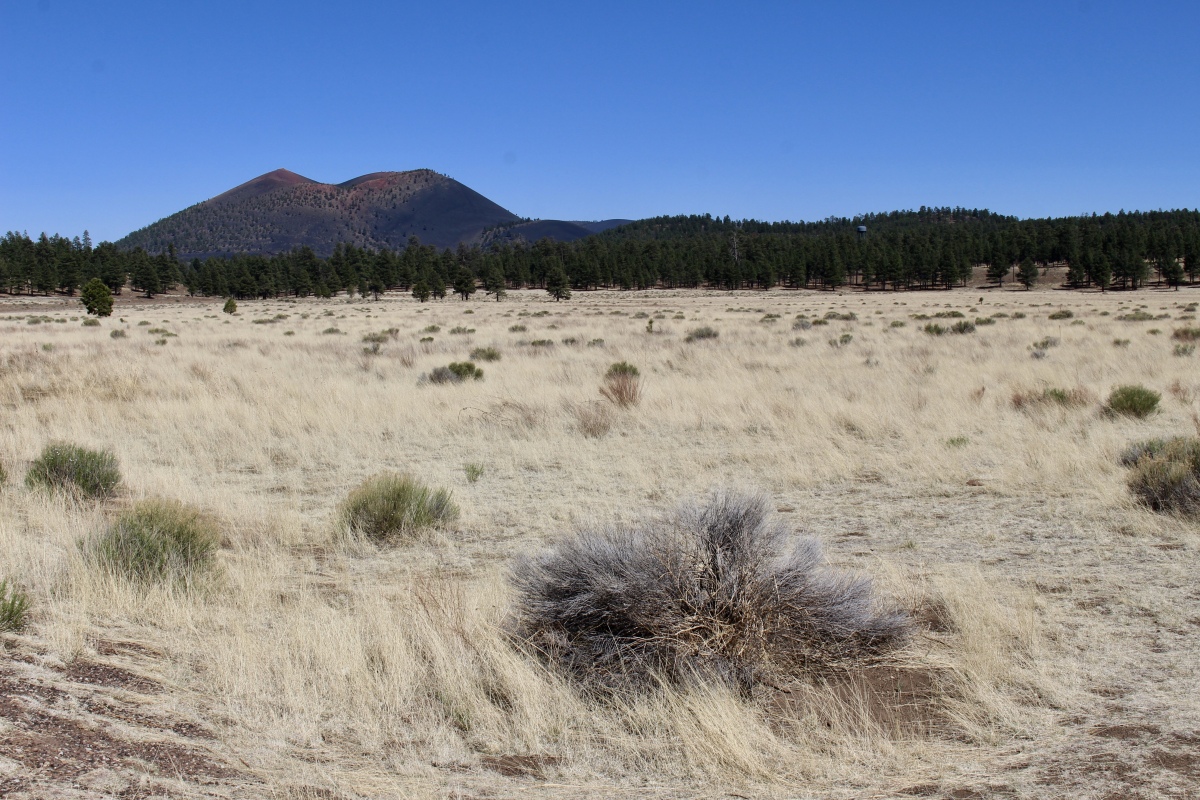
Sunset Crater Volcano National Monument lies south of Wupatki National Monument, just north of Flagstaff, Arizona.  Erupting sometime between 1064 and 1100, Sunset Crater is the most recent in a six-million-year history of volcanic activity in the Flagstaff area.  It reminds us of violent forces that have shaped the earth, creating 600 hills and mountains in the San Francisco volcanic field.  These mountains have affected the climate and habitat of all living things in the region.

With the first eruption, a thin layer of ash absorbed precious moisture and helped prevent evaporation.  Climate change provided more rainfall during the growing season, helping agriculture flourish.  By 1180, thousands of people were farming on the Wupatki landscape.  By 1250, when the volcano had quieted, their pueblos stood empty.

Sunset Crater is a cinder cone, formed during early explosive stages of an eruption. Magma rises up from the underground.  As the magma ascends, the pressure drops and gases are released. The high levels of gas in the magma cause an explosion out of the central vent, creating a mound or cone of solidified rock pieces around the vent. Lava flows produced by lower-gas magma may escape from the side or base of the cone.

We stop for a look at the Cinder Hills Overlook, treading carefully among the skunkbrush sumac, the berries of which, when mixed with sugar and water, make a popular “lemonade” for indigenous people.

Here we see a series of cinder-covered vents, marking a fissure along which the most recent volcanic activity occurred.

fullsizeoutput_14fd6

Cinder Hills Overlook

IMG_0300

Cinder Hills Overlook

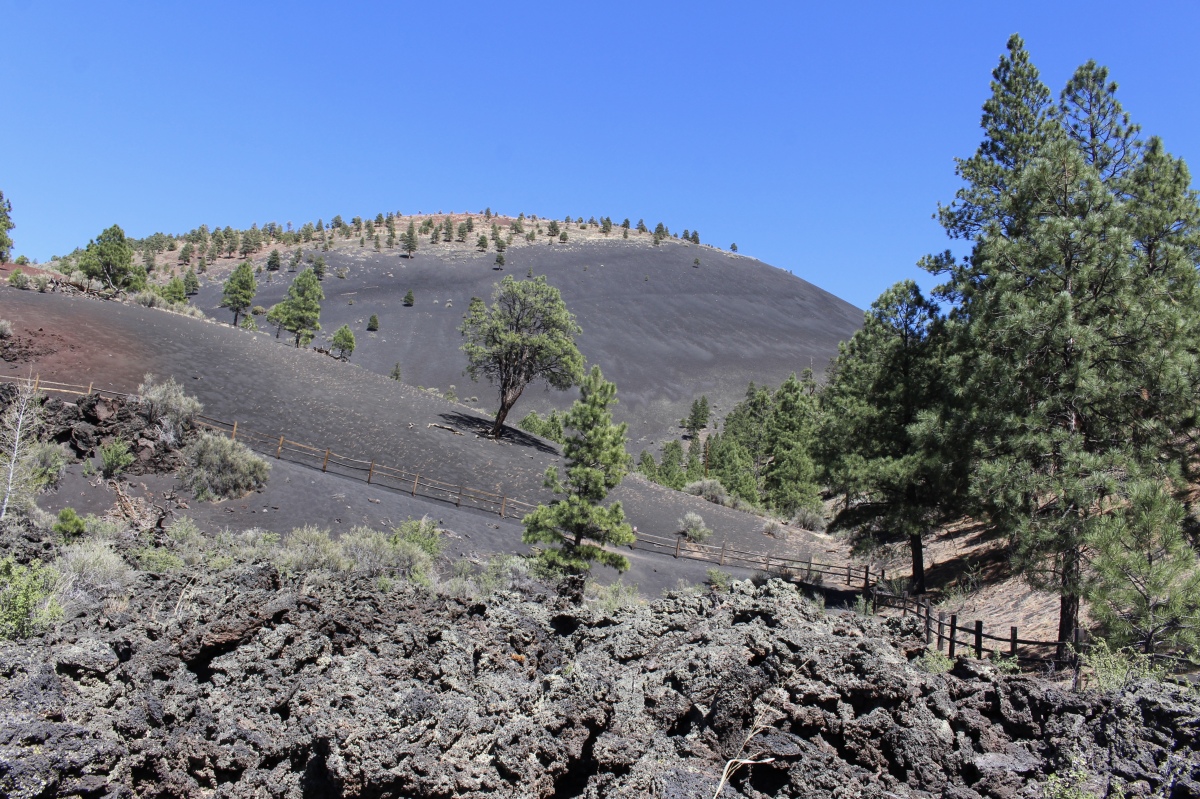
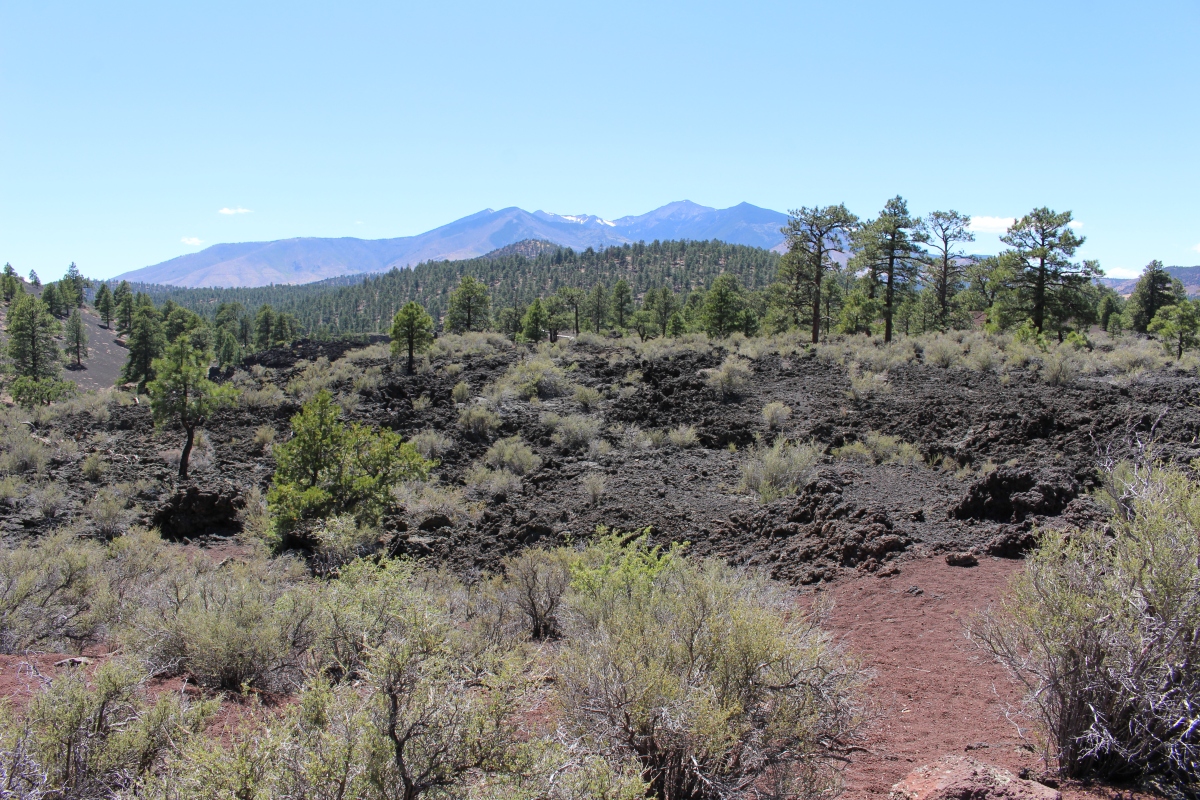
We drive further into the park, where we take a 1.23-mile walk around the Lava Flow Trail to the base of Sunset Crater Volcano.

fullsizeoutput_14fe0

Lava Flow Trail

Lichen, in a myriad of forms and colors, paint the lava flow’s basalt.

IMG_0323

lichen on the Lava Flow Trail

fullsizeoutput_14fe5

Lava Flow Trail

IMG_0329

Lava Flow Trail

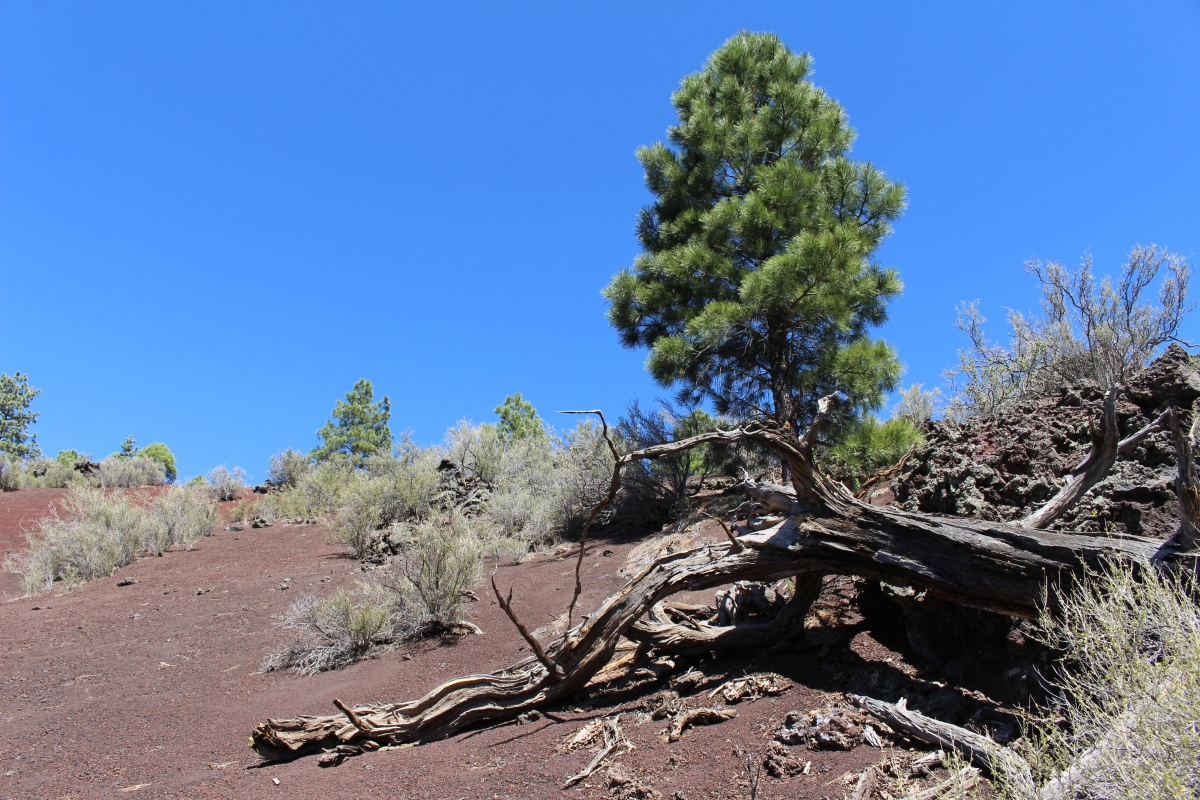
Many of the pines show twisting and spiraling wood under the bark.  Spiral growth increases flexibility, helping the tree survive wind and snow damage.

gnarled pines
gnarled pines
tree swirls
tree swirls

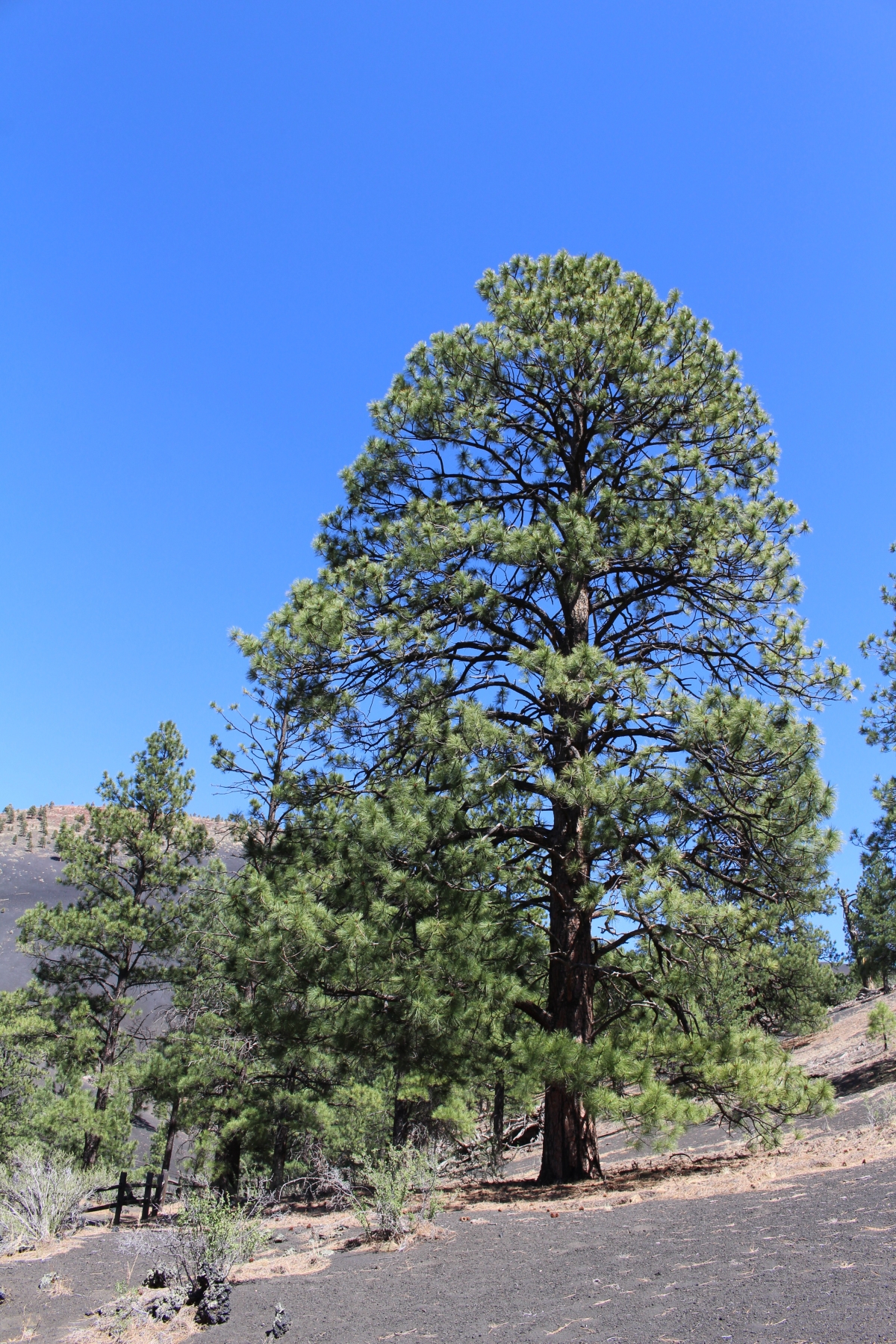
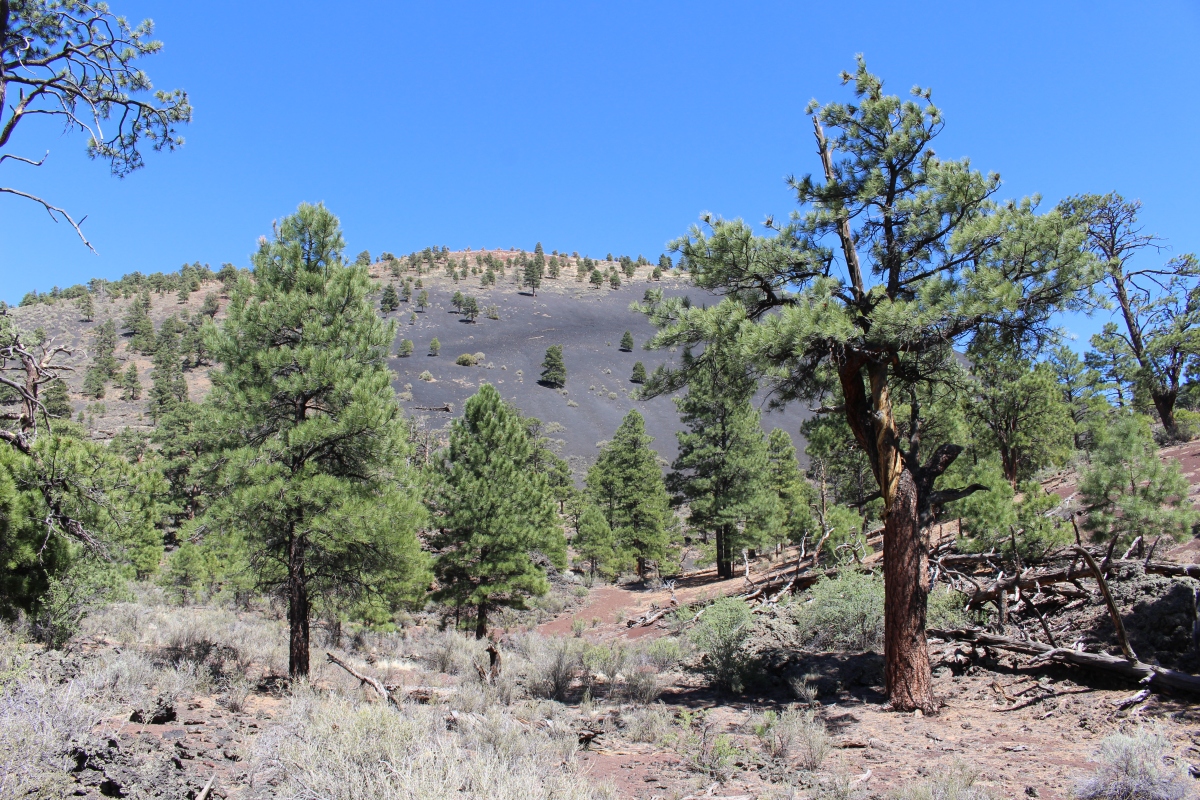
Most of the Ponderosa Pines along the trail don’t look like their majestic counterparts growing in nearby forests. The drier, hotter environment and nutrient-poor soils of this volcanic landscape stunt growth.

fullsizeoutput_14fe8

Ponderosa pines

img_0342.jpg

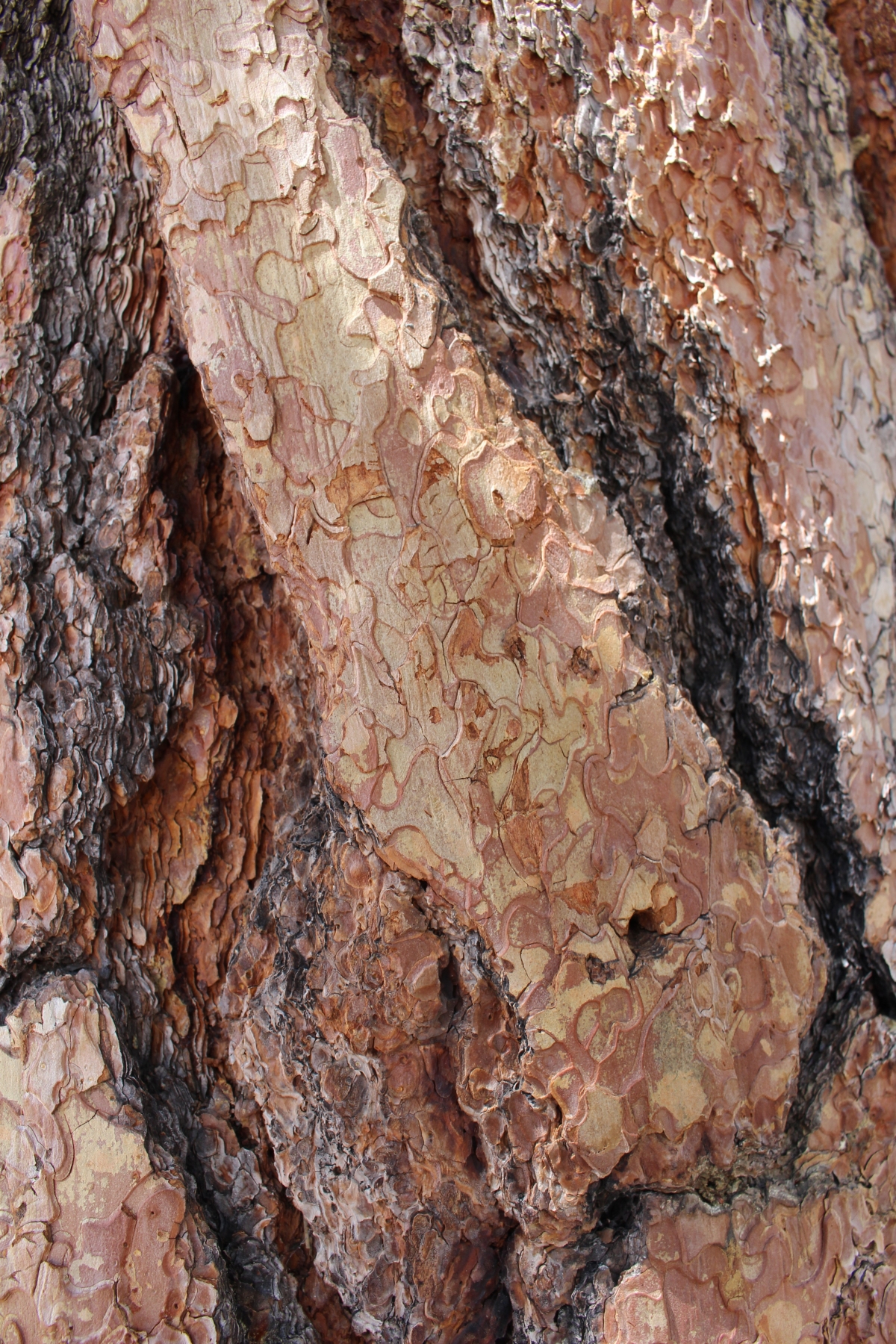
pine bark

img_0346.jpg

Ponderosa Pines

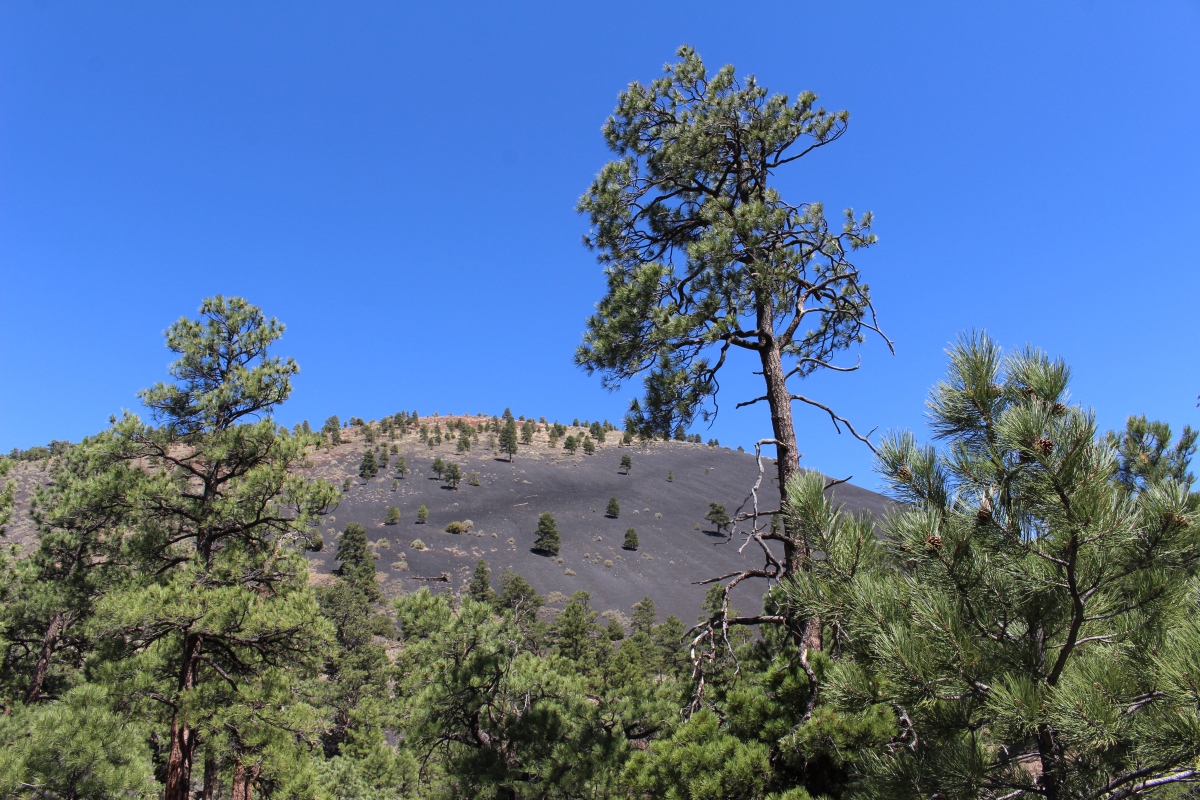
Cinder cones like Sunset Crater Volcano erode easily and scars are slow to heal. In 1973, Sunset Crater was closed to climbing when 2-foot-wide trails eroded to 60-foot-wide swaths.  Tons of cinder were shoveled back up the cone to fill hip-deep trenches.  The scars are still visible today.  Plants will eventually return to areas where cinders are left undisturbed.  Walking in barren areas dislodges soil particles forming between the cinders.

fullsizeoutput_14fec

Sunset Crater Volcano

IMG_0353

Sunset Crater Volcano

IMG_0357

the wasteland

fullsizeoutput_14fec

Sunset Crater Volcano

IMG_0353

Sunset Crater Volcano

IMG_0357

the wasteland

As a living ancestral homeland to the Hopi, Zuni, Yavapai, Havasupai, Hualapai, Navajo, Western Apache, and Southern Paiute, Sunset Crater is revered and cared for.  People return often, bringing prayers and engaging in timeless traditions.

fullsizeoutput_14fef

the lava field

Hopi people believe their ancestors’ spirits, the Katsinas, travel from the San Francisco Peaks to the Hopi villages and back each year via Sunset Crater and Bonito Park.  Some deities reside in the immediate area.

IMG_0361

Lava Flow Trail

The Pueblo of Zuni considers Sunset Crater part of a much larger sacred landscape which continues to be important for plant and mineral collection.  Pilgrimages have taken place in historic times.

IMG_0366

Lava Flow Trail

The Navajo people believe the cinder cones surrounding San Francisco Peaks, including Sunset Crater, are the guardians of the peaks.  Within these sacred mountains reside Navajo deities honored with everyday offerings.

IMG_0367

Sunset Crater Volcano from the Lava Flow Trail

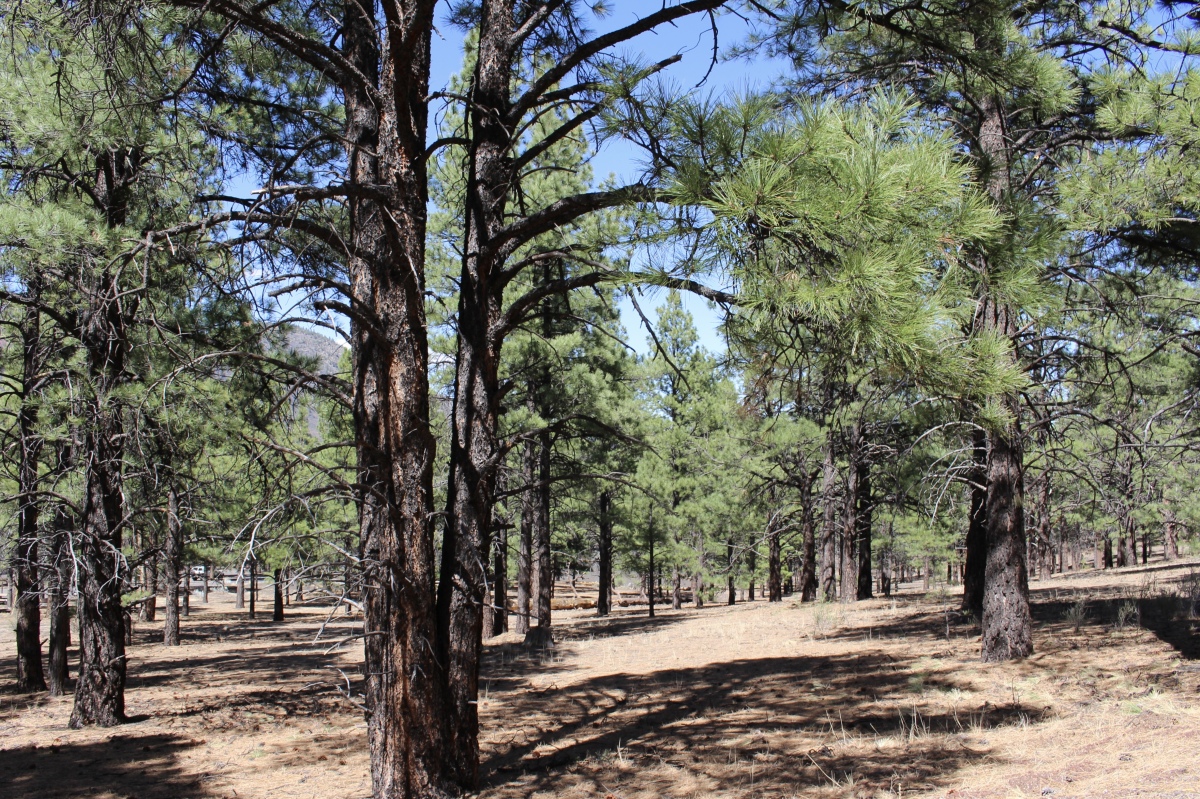
As we leave the park, we pass through a pretty sparse pine forest.

fullsizeoutput_14ff5

sparse pine forest

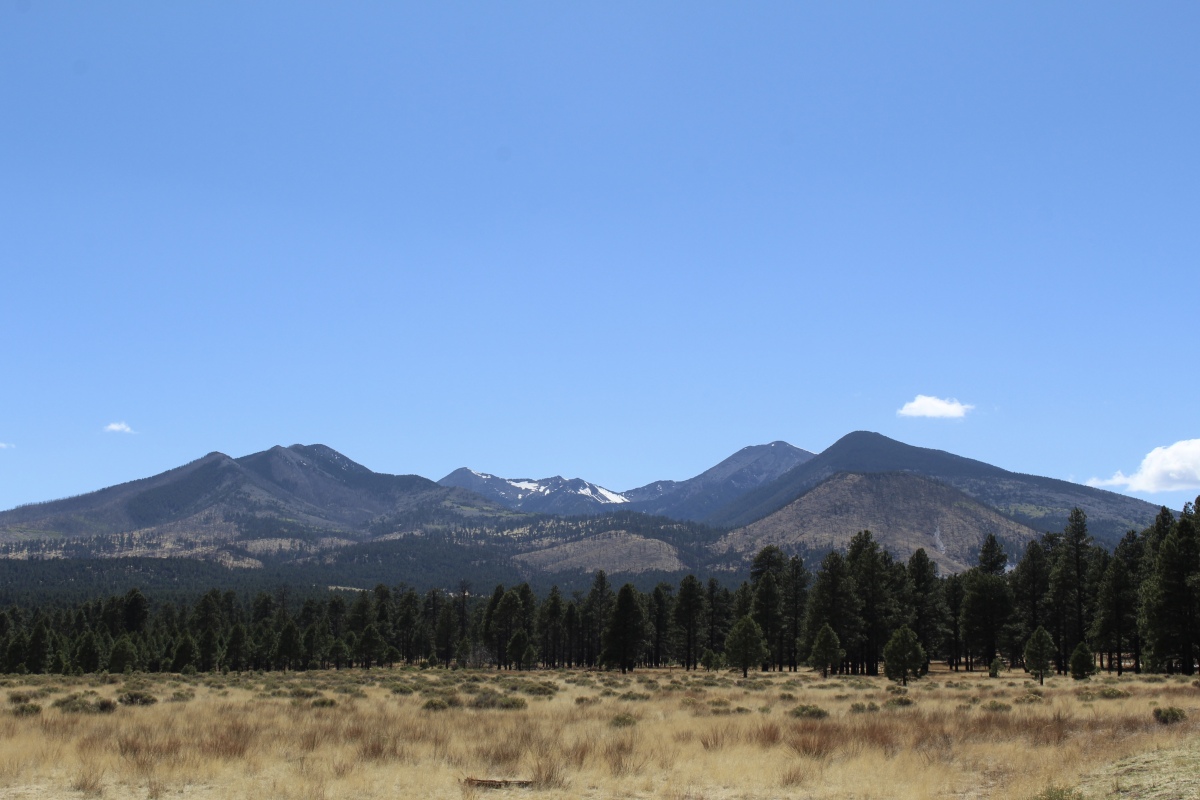
“The Peaks” dominate the horizon at the Bonito Park Overlook, rising 12,636 feet to Arizona’s highest point.  Visible for miles from all directions, they are revered by Native people.

Spanish friars christened these peaks as San Francisco Mountain in 1629 to honor St. Francis of Assisi.  The first wave of Spanish explorers, surprised that such large mountains didn’t spawn lakes or streams, charted them the Sierra Sin Agua — mountains without water.  On the other hand, most Native names for the peaks are a reference to a mountain with life-giving moisture.

This immense stratovolcano captures large amounts of rain and snowfall, yet surface water is scarce.  Moisture drains down rapidly through fractured bedrock and much is sponged up by porous volcanic rock.  The closest river, the Little Colorado, is connected to the peaks by drainages but rarely receives water directly.

The mountain is sculpted into four peaks from left to right: Agassiz, Humphreys, Fremont, and Doyle.

fullsizeoutput_14ff6

San Francisco Peaks

fullsizeoutput_14ff8

Bonito Park Overlook

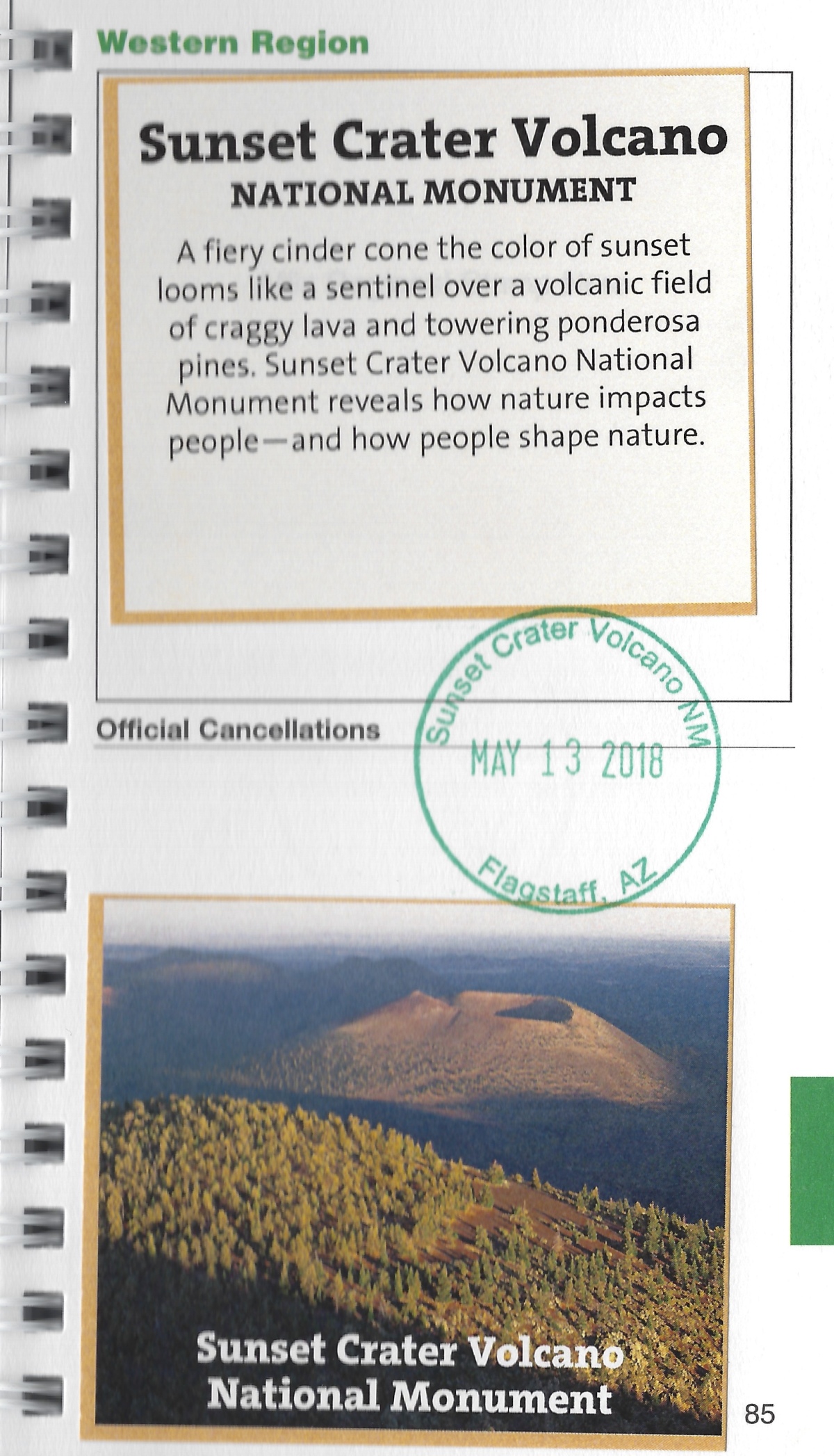
Of course, I had to get my sticker and stamp for my National Parks Passport!

fullsizeoutput_15dba

Sunset Crater Volcano National Monument sticker and stamp 🙂
There were several other hikes we could have done here, but the ranger told us if we wanted to walk around the Island Trail at Walnut Canyon National Monument, we had to begin the trail by 4:00.  We left Sunset Crater at 2:47 and made a mad rush to get to Walnut Canyon.  Mike would be leaving Monday morning to fly back home via Phoenix, so he wanted to squeeze in the last National Monument around Flagstaff before heading home.

*Sunday, May 13, 2018*

***********************

On Sundays, I plan to post various walks that I took on our Four Corners trip as well as hikes I take locally while training for the Camino de Santiago; I may also post on other unrelated subjects. I will use these posts to participate in Jo’s Monday Walks or any other challenges that catch my fancy.

This post is in response to Jo’s Monday Walk.

Share this:

  • Click to share on X (Opens in new window) X
  • Click to share on Facebook (Opens in new window) Facebook
  • More
  • Click to email a link to a friend (Opens in new window) Email
  • Click to print (Opens in new window) Print
  • Click to share on Pinterest (Opens in new window) Pinterest
Like Loading...
  • American Road Trips
  • Arches National Park
  • Arizona

petroglyphs in the four corners

wanderessence1025's avatar wanderessence1025 October 18, 2018

Rock art and petroglyphs are widespread throughout the Four Corners area. They are like whispers of history from indigenous people, revealing something about their long-ago cultures.

Petroglyphs are images, symbols or designs scratched, pecked, carved, or incised on the surface of rock.  Archeologists can guess at the meaning of the rock art, or they can ask contemporary indigenous communities about the meaning of these images.

In Utah, near Wolfe Ranch at Arches National Park, we found a stylized horse and rider surrounded by bighorn sheep and dog-like animals.  Typical of Ute rock art, these figures were carved sometime between 1650 and 1850.  Today this rock art panel is important to Native Americans in the region because it was created by their ancestors.

IMG_8741

Ute Rock Art at Arches National Park

IMG_8742

Ute Rock Art at Arches National Park

On Utah Highway Route 279 outside of Moab, prehistoric Native American rock art is found along the Colorado River and its tributary rivers, streams and side canyons. The rock art is depicted in either pictograph (painted) or petroglyph (pecked, incised, chiseled) images.  Anthropomorphic (human characteristic) and Zoomorphic (animal characteristic) images are found here.

fullsizeoutput_1558a

Cliffs along the Colorado River near Moab

IMG_9181

Cliffs along the Colorado River near Moab

Archeologists believe most of the rock art was created during Archaic (6,000-1000 B.C.) and Fremont (450-1300 A.D.) cultural periods.

Archaic rock art consists of pictographs and petroglyphs depicting anthropomorphs and zoomorphs, curvilinear lines, zigzags, wavy lines, concentric circles, and abstract symbols.

fullsizeoutput_1558b

Petroglyphs on Rt. 279

IMG_9186

Petroglyphs on Rt. 279

Fremont Indian rock art often depicts trapezoidal anthropomorphs with horns, bighorn sheep, dogs, hunting scenes with weapons, and abstract objects.

fullsizeoutput_1558c

Petroglyphs on Rt. 279

fullsizeoutput_1558d

Petroglyphs on Rt. 279

Archaic and Fremont Indian petroglyphs can sometimes be found on the same rock art panel.

fullsizeoutput_15590

Petroglyphs on Rt. 279

Native American groups ascribe religious functions to some of the rock art panels and consider them to be sacred sites. Rock art has also been interpreted as depicting concepts of migration routes, fertility, hunting magic, ceremonies, and cosmic events.

IMG_9198

Petroglyphs on Rt. 279

At Petrified Forest National Park in Arizona, the images below depict circular faces on a dark rock surface.  Modern groups identify these as Kachinas, or spirit beings, in Pueblo religion and cosmology.  Research suggests that the “Kachina culture” arrived in this region around 1300 A.D.  Similar symbols, found on modern Puebloan pottery and weavings, remind us of the continuity between prehistoric sites and the present.

IMG_0675

Petrified Forest National Park in Arizona

Contemporary tribes have identified the step symbol on the rock below as a migration symbol, an important theme in Puebloan oral history.

fullsizeoutput_150c4

Petrified Forest National Park in Arizona

The dark coating on the boulder below is desert varnish – a concentration of mineral, clay, and organic material that accumulates over time  Prehistoric artists created rock art by exposing the lighter material underneath.

Members of the Zuni tribe believe that this rock art depicts clan ties of the artist – perhaps a mother from the Crane Clan and father from the Frog Clan.  An alternative Hopi interpretation recalls stories of a giant bird that came to villages to eat bad children.

The image below is similar to the white-faces ibis, a water bird, native to Petrified Forest, that eats frogs and other small animals. A close looks reveals what might represent water drops below the frog.  This petroglyph likely represents aquatic resources and fertility.

fullsizeoutput_150c6

Petrified Forest National Park in Arizona

fullsizeoutput_150c8

Petrified Forest National Park in Arizona

*May, 2018*

*********************

“PHOTOGRAPHY” INVITATION:  I invite you to create a photography intention and then create a blog post for a place you have visited. Alternately, you can post a thematic post about a place, photos of whatever you discovered that set your heart afire. You can also do a thematic post of something you have found throughout all your travels: churches, doors, people reading, people hiking, mountains, patterns, all black & white, whatever!

You probably have your own ideas about this, but in case you’d like some ideas, you can visit my page: photography inspiration.

I challenge you to post no more than 20 photos (fewer is better) and to write less than 500-700 words about any travel-related photography intention you set for yourself.

While I’m in Spain walking the Camino de Santiago from August 31 – October 25, and then in Portugal from October 26 – November 6, I kindly request that if you have a photography post you’d like to share, please simply link it to the appropriate post, this one or my next one as soon as it publishes. I will try my best to read your posts while I’m on my journey, but I won’t have a computer or the time or ability to add links to my posts. 

My next scheduled photography post will be on November 1, 2018.

This will be an ongoing invitation, every first and third Thursday of each month. Feel free to jump in at any time. 🙂

I hope you’ll join in our community. I look forward to reading your posts!

the ~ wander.essence ~ community

I invite you all to settle in and read a few posts from our wandering community.  I promise, you’ll be inspired! See below in the comments for any links.

Thanks to all of you who shared posts on the “photography” invitation. 🙂
Share this:

  • Click to share on X (Opens in new window) X
  • Click to share on Facebook (Opens in new window) Facebook
  • More
  • Click to email a link to a friend (Opens in new window) Email
  • Click to print (Opens in new window) Print
  • Click to share on Pinterest (Opens in new window) Pinterest
Like Loading...
  • International Travel
  • On Journey
  • South Korea

on journey: digging deep ~ edgy korean bus culture, tea bushes & wetlands, & the surrendered

wanderessence1025's avatar wanderessence1025 October 17, 2018

One early Saturday morning in October, I ventured out on the first leg of a quest to discover the hidden Korea, that of the former war zone. Destination: the southwest of the country, Jeollanam-do province. I wanted to see the tea plantations of Boseong and the eco-park of Suncheon Bay.  I was lugging a hardback copy of the 2010 book, The Surrendered, by Korean author Chang-Rae Lee, who teaches creative writing at Princeton University.

Since I had a 3-month stretch ahead with virtually no holidays, I decided I would explore as much of Korea as I could on the yellow- and scarlet-hued autumn weekends. Granted, my destination this time was not a war zone. Maybe this destination never even figured prominently in the Korean War.  Maybe. But as I read this book, I thought that there was probably not a place in Korea left unscathed by that war. I was trying to dig in deep, to see Korea in a light shadowed to this day by a war that ravaged this country fewer than 60 years before.

I left my apartment at 6 a.m. to catch the 7:05 bus to Suncheon from the Seobu bus terminal in Daegu. The bus ride, which I was told would be 3 to 3 1/2 hours, was uneventful, except for the delightful surprise that it was only 2 1/2 hours! During the ride, I was caught up in the story of June, an 11-year-old Korean girl, who in 1950 witnessed the death of her mother and sister, and the arrest of her father and older brother. On her own, she was caring for her 7-year-old twin brother and sister. June took on the responsibility for transporting her siblings safely toward Busan, along with thousands of other refugees fleeing the war. What might have otherwise been a pretty journey through “hills just turning the colors of pumpkin and hay and pomegranate” was in fact a harrowing journey; this 11-year-old girl suffered horribly and ultimately lost both of her siblings in a gruesome train accident along the way.

Not happy reading, granted. But I wanted to see what makes Koreans tick, what in their history makes them the way they are. So I read along, totally engrossed, until I got to Suncheon.

At the Suncheon bus terminal, I boarded a bus to Boseong. Walking down the aisle, I passed a Korean man dressed in black yelling into his cell phone in the front seat. This was not so abnormal in Korea; many Koreans yell into their cell phones as a matter of course. But it became quickly evident that this man was furious.

I didn’t witness what happened next, but possibly the bus driver came on board and told the man to quiet down. By this time, I was seated about a third of the way back from the front of the bus. Suddenly the yelling man began to punch the bus driver, forcing him toward the back; he pushed the driver into a seat maybe four rows behind me. The yelling man was pummeling the poor bus driver who was cowering against the window. This violent man then pulled off his shirt, revealing tattoos on his arm and back, and grabbed the bus driver around the throat and was knocking him upside the head, so that his head was bouncing like a rubber ball against the window.

All the passengers sat in their seats, stupefied by this spectacle. I stood up along with a Korean girl. I thought briefly about stepping into the middle but realized this would be idiotic. This man wouldn’t hesitate to hit a woman. I was terrified he would kill the poor bus driver. The Korean girl and I looked at each other and we quickly ducked off the bus to find help. She spoke to some guys standing in the bus terminal (they looked like employees at the terminal) and I was yelling and making fighting gestures and beckoning them to follow, which they did.

Back on the bus, the man was still beating on the bus driver. Both of them were yelling angrily, but the bus driver was taking the brunt of the blows. The bus terminal men entered the fray and pulled the two apart and forcibly removed the crazy guy from the bus. The bus driver, clearly shaken, went to the front and started to collect tickets, front to back. Surprisingly, he didn’t look bloodied or bruised, but he was an emotional wreck. He said something to me, and a Korean guy sitting nearby told me in English that the bus driver thanked me.

As the bus took off, I caught the eye of a young red-headed guy who I’d seen earlier in the bus terminal. We started commiserating about the fight, trying to figure out what precipitated it. He said, “Did you see that guy’s stomach? It had scars all over it. He’s been in a lot of fights.” We couldn’t figure out exactly what started it. I told him I was thinking of stepping into the middle; I hoped they wouldn’t dare hit a woman. The red-head said he was told that if there were ever any trouble in Korea, a foreigner should NEVER get involved because foreigners are often blamed as instigators.

On our one hour ride to Boseong, we talked a lot: the red-head whose name was Peter, the English-speaking Korean guy who went by the English name of Jacob, and me. The fight excited us such that we became garrulous. Jacob was full of questions about both of us, asking Peter and me what we were doing in Korea. Jacob himself was a Korean who had been living and working in the Philippines for 10 years. He was 50 years old, married, and had three children: a 20-year-old daughter, and 18-year-old twins. He was in “trade” – mainly vitamins and health foods. He asked my age, but I insisted it was a mystery. He was in Korea working and also exploring on weekends parts of the country he hadn’t seen before. He told me he was headed to the tea plantations for the day and I said that’s where I was going too.

Peter, who was 27, was from New Brunswick, Canada, and had been teaching in Korea for one month in a public middle school in Boseong. He told me that in Boseong they have a 5-day market. Every 5 days, everyone gathers their goods together to sell or to barter. Today was the market day.

Once we arrived in Boseong, Peter took off for his home, and Jacob and I waited for the bus to Yulpo Beach, which would drop us at the tea plantations.

inside the seobu bus terminal in daegu
inside the bus
inside the bus
Jacob and Peter
Jacob and Peter

At the bus terminal, Jacob motioned for me to sit on a bench with some ajumas for a picture. I was happy about this as I’ve been trying to surreptitiously take pictures of ajumas but have never actually gotten one full on with their awareness and participation. They were quite happy to smile and pose; afterward I showed them each the picture and the one wearing a pink shirt held on to my camera, telling Jacob she wanted a copy of the picture. They asked Jacob if we were husband and wife. This was the first of such questions thrown our way throughout the day. Each time we laughed and said, no, we had just met on the bus!

fullsizeoutput_1447f

me with the ajumas

On the derelict bus, hardscrabble Korean locals carried bags or boxes of products to take to the 5-day market: dried chili peppers, live chickens (!), rice, roots and various leafy vegetables.  They disembarked well before the tea farms.  The bus driver made one stop to drop off a huge plastic bag full of red chili peppers.  I wondered if the chili peppers had to pay the bus fare.

the local bus to the market
a local Korean man on the way to the Boseong market

Jacob and I got dropped at the entrance to Daehan Dawon, touted as Korea’s one and only “green tea farm” theme park.  We went into a little shop and the lady there served us some green tea.  I was surprised that green tea tasted more like a broth than the tea I’m accustomed to.  The lady asked Jacob’s age; he told her 50 and she told him he looked very young.  She asked him my age, and he explained to her that apparently it was a very sensitive issue!  She then asked us if we were husband and wife, and we both laughed and said that we just met on the bus. We drank our tea and walked through a lovely canopy of trees toward the plantation.  This place was so lushly green, with its millions of tea plants and its cedar, cypress, yew, ginkgo, maple and camellia trees.

the tea lady
the tea lady
me and Jacob having tea

In 1939, a study concluded that Boseong was an ideal place to cultivate green tea.  Optimal conditions include annual rainfall of more than 60 inches (1500 mm), porous and permeable soil, cool weather with a great daily temperature range, and high humidity.  Soon after the study, tea planting started across the region.  But, during the Korean War, all the fields were ravaged.

It turns out I was right: no place in Korea was left unscathed by the war.   In 1957, the tea industry started again.  Now there are 5.8 million tea plants growing on this green tea farm.  In 2005, the plantation’s tea was certified as organic.

Jacob and I wandered leisurely through the lush green carpets of tea bushes and then climbed up a steep hill to a vantage point.  He said, It smells so good!  I sniffed the air and I couldn’t smell anything. 😦

After walking up and down and taking multitudes of photos, we returned to the bottom. Jacob told me his wife worked as a volunteer teacher for a Christian missionary organization. She taught elementary school. Apparently when their children leave home, his wife would like to return to Korea where, because of her years of teaching, she could make a lot of money. But Jacob told her that he could provide and that God would like it best if she continued her volunteer teaching. Both he and his wife were really concerned that their children didn’t know enough about Korean culture. Jacob told me he went on a trip with a church group to Turkey to follow St. Paul’s travels. He went to many of the same places I did, but he lost his USB with all his photos on it. Jacob also told me that that morning he had prayed to God that he would meet someone today to explore Korea with. He says his prayer was answered because he met me.

fullsizeoutput_8cf

Boseong Tea Plantation

fullsizeoutput_2b02

Boseong Tea Plantation

1545

me at Boseong Tea Plantation

We returned to the tea shop to retrieve our bags, with the intention of taking the Yulpo Beach bus further south, where there were supposedly even more beautiful tea plantations. The proprietor told us the bus would arrive at 2:50. We waited until 3:30 and then decided we couldn’t wait any longer. Jacob had to go to Gwangju and then to Daejeon this evening to meet some friends and I wanted to go back to Suncheon and find a hotel before it started raining. So we crossed under the bridge to catch the bus back to Boseong. In Boseong, Jacob went on his merry way toward his friends. I was disappointed not to see the next tea farm, but, as it turned out, I finally arrived back in Suncheon just before a downpour. I had to find a hotel and with the help of a patient and kind-hearted lady at the Suncheon terminal tourist information, I was directed to the BMW Motel.

When I walked up to the BMW Motel, smoke was pouring out of the parking lot into the entryway. The proprietor was using a fire extinguisher on the source of the fire; it looked like a trashcan and some bedding from one of the rooms. He sprayed it with the fire extinguisher and came into the hotel to check me in. I told him, using gestures, that I wanted to see the room before paying, but he simply could not understand and kept sticking out his hand for my money. While this failure to communicate was transpiring, the fire flared up again, and I gestured wildly to him that the fire had revived. He was unperturbed by my gestures, so I got wilder and more demented-looking in my miming: Come! Come! Fire!! He was utterly clueless. Finally, he got up from behind his little glass enclosed cage and grabbed the fire extinguisher again.

1653

the BMW Hotel

Meanwhile, I called a friend to translate for me that I wanted to see the room before paying. Finally. I inspected the room and paid the 30,000 won. I left my bag and stupidly headed out into the rain and the impending darkness to go to Suncheon Bay. I was hoping that by the time I returned to the BMW, the fire would be extinguished. I hoped the whole motel wouldn’t burn down in my absence.

By the time I finally got to the bay, it was dark and pouring down rain! I was obviously not yet ready to accept the shorter days of fall.  I didn’t want to be dropped in the middle of nowhere, but the driver gestured vehemently that I had to get off.  Luckily the bus stop was covered and I waited with a few other stragglers for a good 20 minutes to go back to Suncheon. I caught the same bus with the same driver who forced me to get off in the first place.

In Suncheon, I found a Paris Baguette, ate a shrimp and vegetable bun, bought a beer, and settled into my room, where I planned to relax, read, and watch TV.  However, I was so wound up that I couldn’t sleep.  I dove into The Surrendered, which was so intense that I found it impossible to sleep.  I was up until well after midnight, trudging along with 11-year-old June Han and other desperate war refugees to the south of Korea, hungry, terrified, surrounded by death and utter confusion, and hanging on to survival by a flimsy filament of hope and determination.

1563

Unable to sleep because of The Surrendered

The story followed three main characters: June, Hector and Sylvie; its locale moved from Korea to New Jersey to Manchuria.  It was a complicated story about the effects of war on people’s psyches.  I came across excellent descriptions of the Korea I had come to know.  At one point, Hector, who had fought in the mountains of Korea, ruminated about the cold: “He knew the cold in Korea, at least in the mountains in the far north, how it seeped into you and then resided with an unrelenting grip…”  My own father, who also served in the U.S. Navy during the Korean War told me before I came here that all he could remember about Korea was that it was the coldest place he’d ever been.  I arrived in Korea in February, and it was bitter, unrelentingly cold.

Hector also mused about the mountains of Korea, which are certainly ubiquitous: “The grounds of the orphanage were set on a low and wide plateau amid steeper, higher hills and mountains that ranged across much of the country.  The land was a lesson in hills, one right after the next.”

The book reminded me how tenuous life can be.  There is normalcy, and then, suddenly, there is not.  War does that.  The atrocities people are capable of inflicting on one another during extreme situations like war are beyond belief.

After reading The Surrendered, when I saw old farmers and bent-backed ajumas in Korea, I knew they had seen horrors in their lives that we could never imagine.  I hoped the 50+ year armistice between North and South Korea would hold, or would someday be resolved, so that this resilient country wouldn’t have to suffer such hardships again.

*Saturday, October 2, 2010*

**********************

“ON JOURNEY” INVITATION: I invite you to write a post on your own blog about the journey itself for a recently visited specific destination. If you don’t have a blog, I invite you to write in the comments.

In this case, my intention was to explore far flung parts of Korea and to learn something about how the Korean War impacted the people and the country, as informed by taking along the book, The Surrendered.  On the journey, I encountered a cast of unusual characters, a cross section of Korean culture.

Include the link in the comments below by Tuesday, November 20 at 1:00 p.m. EST.  When I write my post in response to this challenge on Wednesday, November 21, I’ll include your links in that post.

This will be an ongoing invitation, once on the third Wednesday of each month. Feel free to jump in at any time. 🙂

I hope you’ll join in our community. I look forward to reading your posts!

the ~ wander.essence ~ community

I invite you all to settle in and read a few posts from our wandering community.  I promise, you’ll be inspired! See below in the comments for any links.

Many thanks to all of you who wrote posts about the journey. I’m inspired by all of you! 🙂


Share this:

  • Click to share on X (Opens in new window) X
  • Click to share on Facebook (Opens in new window) Facebook
  • More
  • Click to email a link to a friend (Opens in new window) Email
  • Click to print (Opens in new window) Print
  • Click to share on Pinterest (Opens in new window) Pinterest
Like Loading...
  • American Road Trips
  • Arizona
  • Four Corners Road Trip

wupatki pueblo

wanderessence1025's avatar wanderessence1025 October 14, 2018

Near the Visitor’s Center at Wupatki National Monument sits the amazing Wupatki Pueblo, a multi-level high rise.  People gathered here during the 1100s, gradually building this 100-room pueblo with a community room and ballcourt. It was the largest dwelling for at least fifty miles. By 1182, perhaps 85 to 100 people lived here. Within a day’s walk, a population of several thousand surrounded Wupatki.

This particular village became the heart of a thriving community and was a landmark, a gathering place, and a ceremonial center. This monumental structure may have signaled control over farm lands and united a community that changed as it grew and accepted immigrants.

We walk a half-mile loop around the pueblo.

IMG_2944

Wupatki Pueblo

Puebloan and Navajo peoples have a long list of medicinal uses for this profuse native plant, broom snakeweed, from cures for colds, stomachaches, and eye problems to rattlesnake bites. But it might not have been readily available to their ancestors. Scientists have not yet found this plant in archeological settings.

IMG_0213

Broom Snakeweed

Many people lived in numerous small dwellings found for miles around; those living here may have held ritual and leadership responsibilities.

fullsizeoutput_14fa0

Wupatki Pueblo

Descendants say prophesy and beliefs guided decisions and that villages like this were purposefully settled and left. When clans departed, doorways were sealed and items left in rooms; maybe people hoped to return one day.

IMG_0216

Community room at Wupatki Pueblo

Below is a depiction of Pueblo life here 900 years ago, based on historical accounts and archeological evidence. This embellished interpretation helps us visualize the vibrant Wupatki society.  Hopi and Zuni oral histories say that people of diverse origins came together here.  Plain red-brown pottery originated near Flagstaff, while the painted black and white pots came from Kayenta country to the northeast. The architecture is both Chacoan and Kayenta in style, and the ballcourt and abundant shell jewelry indicate ties to the far south.

Through trade, villagers acquired numerous Mesoamerican scarlet macaws and copper bells needed for ceremonies and rituals. Perhaps in return, they offered their woven cotton textiles, with various styles and decorative techniques from all over the Southwest. Life here involved sharing and trading.

fullsizeoutput_15db4

Life in the past

Wupatki today appears abandoned, but it is actually remembered and cared for. Though it is no longer physically occupied, Hopi believe the people who lived and died here remain as spiritual guardians. Stories of Wupatki are passed on among Hopi, Zuni, Navajo, and perhaps other tribes. Members of the Hopi Bear, Sand, Lizard, Rattlesnake, Water, Snow, and Katsina Clans return periodically to deepen their personal understanding of their clan history.

fullsizeoutput_14fa6

Wupatki Pueblo

IMG_0228

Wupatki Pueblo

Villagers shared walls, water, food, protection, and prayer. They depended on one another, celebrated life and marked passages, planned for, reacted, and adapted to environmental and social circumstances.  People gathered to celebrate harvest and honor their way of life. Women prepared food and men and boys engaged in contests in the ballcourt.  Ceremonies and rituals established harmony and encouraged rain and fertility.

IMG_0229

Community room

fullsizeoutput_14fab

Wupatki Pueblo

IMG_0239

from the Community Room looking up at Wupatki Pueblo

fullsizeoutput_14fad

Community Room & Wupatki Pueblo

fullsizeoutput_14fb0

Ballcourt

It is remarkable that this land, so dry and hot, supported a large farming community. Moisture-conserving cinders from the eruption of nearby Sunset Crater volcano made for slightly better farming conditions during the 1100s. But extensive land and labor would have been required.

IMG_0248

the surrounding land

Located at the crossroads between Sinagua, Cohonina, and Kayenta Anasazi cultural traditions, Wupatki exhibits a unique cultural brew.  The exchange of ideas shows up in homes built the Anasazi way but furnished with Sinagua-style pottery, textiles, and tools. Archeologists still debate whether this represents different cultures interacting here, or if it is just the “many different ways to be Sinagua.”

IMG_0258

masonry at Wupatki Pueblo

The environment provided materials ideal for the construction of freestanding masonry dwellings. Sandstone slabs, limestone blocks, and chunks of basalt set with a clay-based mortar yielded sturdy buildings that, despite weathering and vandalism, remain partially intact more than 700 years after their owners departed.

masonry at Wupatki Pueblo

This high desert area is home to lizards and gopher snakes, which are non-venomous and feed on rodents that live around the dwellings.  Mike was disappointed to have missed out on snake encounters in these desert areas.

fullsizeoutput_14fbb

lizard friend

fullsizeoutput_14fbd

Wupatki Pueblo

The reasons people left were likely varied.  By the 1200s, the area was denuded of trees and shrubs and soils were depleted. As the environment changed, perhaps conflicts increased or trade networks shifted and other villages had more to offer.

Descendants of these inhabitants, the Hopi, Zuni, and other Pueblo groups, still adhere to a lifestyle that values hard work and spiritual life over material possessions.

Of course, at the Visitor’s Center, I got my sticker and cancellation stamp!

fullsizeoutput_15db9

Wupatki National Monument sticker and Passport stamp

*Sunday, May 13, 2018*

***********************

On Sundays, I plan to post various walks that I took on our Four Corners trip as well as hikes I take locally while training for the Camino de Santiago; I may also post on other unrelated subjects. I will use these posts to participate in Jo’s Monday Walks or any other challenges that catch my fancy.

This post is in response to Jo’s Monday Walk.

Share this:

  • Click to share on X (Opens in new window) X
  • Click to share on Facebook (Opens in new window) Facebook
  • More
  • Click to email a link to a friend (Opens in new window) Email
  • Click to print (Opens in new window) Print
  • Click to share on Pinterest (Opens in new window) Pinterest
Like Loading...
  • American Road Trips
  • New York
  • Niagara Falls

things i learned in niagara falls, new york

wanderessence1025's avatar wanderessence1025 October 9, 2018

I learned that our Gray Lines tour guide, an American citizen whose ancestors are from India and who was born in Uganda, has been leading tours here since 1994.  I am reminded daily how much immigrants add to the fabric of our society.  But then I’ve always known that.

I learned that I always prefer to avoid tours because of the combustible mix of personalities, selfish people, and the alliances and cliques that inevitably form.

I learned that Trump-supporting Texans really annoy me.  Especially ones who obviously could care less about being politically correct.

I learned that views of Niagara Falls are not as good on the American side of the Falls as they are on the Canadian side; the views are decent from the Maid of the Mist and the Observation Tower, but they’re not as spectacular as from the Canadian shore.

fullsizeoutput_15d3d

American Falls & Bridal Veil Falls from Maid of the Mist

fullsizeoutput_15d47

Bridal Veil Falls and Cave of the Winds from Maid of the Mist

fullsizeoutput_15d4c

Horseshoe Falls from Maid of the Mist

fullsizeoutput_15d57

American & Bridal Veil Falls, and the Observation Tower, from Maid of the Mist

I learned that three waterfalls make up Niagara Falls: American Falls, Bridal Veil Falls, and Horseshoe Falls.

fullsizeoutput_15d5e

View of all three falls from the Observation Tower – American, Bridal Veil, and Horseshoe (left to right)

View downriver & the Rainbow Bridge from the Observation Tower
View of Canada & the Rainbow Bridge

I learned that the Maid of the Mist, with passengers wearing blue ponchos, departs from the American side, while Hornblower Cruises, with red ponchos, departs from the Canadian side.  Both go boldly into the middle of the churning water in the semi-circle of Horseshoe Falls.

fullsizeoutput_15d60

View of the Canadian side & Hornblower Cruises from the Observation Tower

I learned the view of Horseshoe Falls from Terrapin Point on Goat Island is disappointing.

IMG_3694

view of Horseshoe Falls from Terrapin Point

view of Horseshoe Falls from Terrapin Point

I learned that I could feel the immense power of the Niagara River from above American Falls.

fullsizeoutput_15d6d

View above American Falls from Prospect Point


fullsizeoutput_15d6e

View of the Niagara River before it plummets over American Falls

I learned that standing on the Hurricane Deck at Cave of the Winds beneath Bridal Veil Falls is like standing in the midst of a typhoon.

IMG_3247

Cave of the Winds beneath Bridal Veil Falls

fullsizeoutput_15d95

Cave of the Winds beneath Bridal Veil Falls

fullsizeoutput_15ddd

Looking down on the Hurricane Deck at Cave of the Winds

I learned that the Niagara River flows from south to north, which seems counter-intuitive.

fullsizeoutput_15db3

Map of Niagara Falls State Park

I learned that four of the five Great Lakes (Superior, Michigan, Huron, and Erie) drain into Lake Ontario via the Niagara River and Niagara Falls. These five Great Lakes make up almost one-fifth of the world’s fresh water supply.

I learned that 750,000 gallons of water per second hurtle over the Falls.

I learned that erosion and rockfalls moved the brink of Niagara Falls upstream up to six feet each year in its early days, but modern influences, such as diverting the water into power generators at night, have caused the Falls to wear away less quickly.

I learned that there have been many attempted and successful suicides at the Falls. In addition, some adventurous people have done daring stunts, such as tightrope walking or going over in barrels, in hopes of making a hefty profit.

I learned that Niagara Falls State Park is the oldest state park in the country, having opened in July 1885.

I learned that the American side of the Falls is more of a natural environment, while the Canadian side has more glitz and commercialism.

Niagara River going toward American Falls
Nature in Niagara Falls State Park
Niagara River heading to Bridal Veil Falls
View of American Falls from Luna Island

I learned that the strange name of “Goat Island” came from its first owner, John Stedman, who raised a herd of goats on the island.  All but one goat died during a cold winter around 1780.

I learned that in 1879, people couldn’t see the Falls because the views were fenced off, or blocked by “Indian bazaars,” hotels and other tawdry attractions. A person could see the Falls only by paying a fee to see it through a small peephole. The best observation points were “appropriated for private profit, and the shores swarmed with sharpers, hucksters, and peddlers who perpetually” harassed all visitors.

fullsizeoutput_15d70

The Great Niagara Spectacle

I learned that during the Industrial Revolution, industrialists harnessed the force of the water using water wheels to drive their mills and factories. The whole Falls area at that time was an unsightly series of belching smokestacks.

I learned that a statue of Serbian-American inventor and engineer, Nikola Tesla, on Goat Island was a gift from the Yugoslavian government.

fullsizeoutput_15de9

Statue of Nikola Tesla on Goat Island

I learned that the Niagara generating stations supply one quarter of all power used in New York State and Ontario; power grids stretch out all across the area.

I learned that the Power Arch of Adams Power Plant, the world’s first commercial hydroelectric power plant, serves now as a memorial to Niagara’s industrial heritage.

fullsizeoutput_15e06

Power Arch of Adams Power Plant

I learned that Native Americans, such as Chief Clinton Rickard — Ro-Wa-Da-Gah-Ra-Deh, Loud Voice, founder of the Indian Defense League of America — played a part in Niagara Falls history.

fullsizeoutput_15e08

Statue of Chief Clinton Rickard

I learned that at Whirlpool State Park, class VI white water surges down the gorge into a massive whirlpool, considered perhaps the most dangerous stretch of the river.

fullsizeoutput_15dac

Whirlpool State Park

I learned that the area caters to middle class tourists and has its fair share of drive-up motels.

Moonlite Motel - where I stayed :-)
Moonlite Motel – where I stayed 🙂
Caravan Motel
Caravan Motel

I learned that Niagara Falls is not considered a National Park, so I couldn’t get a sticker and cancellation stamp. 😦

**********************

“PROSE” INVITATION: I invite you to write a 1,000-1,500-word post on your own blog about a recently visited particular destination (not journeys in general). Concentrate on any intention you set for your prose.

In this case, my intention was to write a “things I learned each day” list.

It doesn’t matter whether you write fiction or non-fiction for this invitation.  You can either set your own writing intentions, or use one of the prompts I’ve listed on this page: writing prompts: prose & poetry.  (This page is a work in process.) You can also include photos, of course.

While I’m in Spain walking the Camino de Santiago from August 31 – October 25, and then in Portugal from October 26 – November 6, I kindly request that if you write a prose piece, please simply link it to the appropriate post, this one or my next one as soon as it publishes.  I will try my best to read your posts while I’m on my journey, but I won’t have a computer or the time or ability to add links to my posts.

My next scheduled prose post will be on Tuesday, October 23.

This will be an ongoing invitation. Feel free to jump in at any time. 🙂

I hope you’ll join in our community. I look forward to reading your posts!

the ~ wander.essence ~ community

I invite you all to settle in and read a few posts from our wandering community.  I promise, you’ll be inspired!  See below in the comments for any links. 🙂

Thanks to all of you who wrote prosaic posts following intentions you set for yourself.  🙂

Share this:

  • Click to share on X (Opens in new window) X
  • Click to share on Facebook (Opens in new window) Facebook
  • More
  • Click to email a link to a friend (Opens in new window) Email
  • Click to print (Opens in new window) Print
  • Click to share on Pinterest (Opens in new window) Pinterest
Like Loading...
  • American Road Trips
  • Arizona
  • Four Corners Road Trip

the lomaki trail at wupatki national monument

wanderessence1025's avatar wanderessence1025 October 7, 2018

Quite by accident, we discovered three National Monuments right around Flagstaff, Arizona: Wupatki, Sunset Crater Volcano, and Walnut Canyon. None of these places were on our itinerary, so they were a pleasant surprise.  Each one was rather small as well, so we were able to do all three after we left Tuba City and Coal Mine Canyon. This would be our last day together; Mike had to fly out via Phoenix the next day, and the rest of the trip, I would be on my own.

We drove south down Rt. 89 through the Painted Desert, imbued with cinnamon, buff and chestnut, and dotted with feathery sagebrush.  Big electrical grids and wires criss-crossed the fairly flat landscape and the abandoned Wauneta Trading Post hunkered down beside the road, faded and decrepit.

At Wupatki National Monument, we stopped first to do the Lomaki Trail.  On foot, we approached the Box Canyon Ruins, typical of many pueblos found in this region. Early inhabitants constructed walls of nearby sandstone and limestone, and used local soils to cement stones together. The flat roofs were built of timbers laid side by side, covered with smaller branches and finally plastered over with mud.

Smoke was vented from rooms through a square hole in the ceiling which frequently served as the only access to the room.  Doorways were small and windows almost non-existent.  As the rooms were abandoned, the timbers were often scavenged and used in other pueblos or burned as firewood, a precious commodity in this environment.

fullsizeoutput_14f83

Box Canyon Ruins

On Antelope Prairie, depending on the season, wind can knock a person flat.  Lightning and storm clouds create a dance of shadow and light.  Heat waves distort the horizon. In this landscape, a large community farmed during the 1100s, its focal point Citadel Pueblo just to the south.  Later, Navajo families grazed sheep here, followed by cattle ranchers.

Eight hundred years ago, a savannah-like grassland covered much of this high desert with abundant grasses.  The residents would have collected and burned much of the nearby fuel, necessitating long walks to adjacent areas to gather wood. Sparse annual rainfall forced the inhabitants to catch and save as much water as they could, or walk miles to other sources.

Since the use of the area by modern ranchers, the land has undergone other dramatic changes.  Cattle grazing stripped much of the native vegetation away, allowing other plants, such as rabbitbrush, saltbush and snakeweed to dominate the vegetation.  Although Wupatki National Monument was established in 1924, grazing continued until 1989, when a fence was built around the monument boundary.

fullsizeoutput_14f86

Antelope Prairie

The ruins appear today just as they did when discovered in the late 1800s.  The National Park Service has stabilized the walls to help preserve them.  None are reconstructed.  These 800-year-old walls are fragile and easily disturbed.

IMG_0156

Box Canyon Ruins

Volcanic activity to the south, from Sunset Crater Volcano, produced giant fissures or earthcracks throughout the Wupatki area in the Kaibab Limestone. The Sinagua and Anasazi Indians who inhabited these ancient pueblos probably found the earthcracks to be the most productive farming sites. There is no evidence of streams close by which could provide water.  All farming was dependent on rainfall.

Corn, squash and other crops were planted along the canyon slopes and wash bottoms. Small check dams along the drainage courses provided level areas for farming.  These flat areas retained more moisture and the accumulated silt enriched the soil.  The bottom of Box Canyon, below the ruins, may have been an ideal area for farming.

fullsizeoutput_14f8b

Box Canyon Ruins

Juniper, amaranth, yucca, Indian rice grass and other native plants were used as food, along with antelope, rabbit, squirrels, packrats and reptiles, to name a few.

IMG_0163

Box Canyon Ruins

fullsizeoutput_14f8c

Box Canyon Ruins

IMG_0165

Box Canyon Ruins

fullsizeoutput_14f8d

Box Canyon Ruins

IMG_0176

Box Canyon Ruins

fullsizeoutput_14f91

Box Canyon Ruins

fullsizeoutput_14f93

Box Canyon Ruins

The Lomaki Ruin sits at the far end of the path.  Lomaki means The Beautiful House.

At Lomaki Ruin, an open area in the pueblo near the rim of the earthcrack is known as the plaza.  In pueblos, the plaza was the center of daily activities including grinding corn, making pottery, working obsidian into arrowheads, processing other plants for food, and cooking.  It would have also been used for meetings, conducting trade, and as a controlled play area for children.  During the warmer months, the plaza was used extensively from dawn to dusk.  Rooms inside the pueblo were used only for sleeping and some cooking.

IMG_0182

Lomaki Ruin

IMG_0183

Lomaki Ruin

To the east of this area, Sunset Crater Volcano would have been belching black smoke and cinders when the Sinagua and Anasazi lived here.  The thick layer of cinders over the sandy soil helped hold moisture, which was beneficial to the growing of crops.  Eventually, even Sunset Crate Volcano grew quiet, and the winds blew the cinders away and dried out the soil.

Why the Lomaki residents departed is not certain.  There are indications of disease affecting the population, or a lengthy drought creating a landscape barren of vegetation, animals and firewood.  Or invading host tribes may have contributed to the abandonment of this area by the mid-1200s.

IMG_0184

Lomaki Ruin

fullsizeoutput_14f96

Lomaki Ruin

IMG_0192

Lomaki Ruin

IMG_0194

Lomaki Ruin

IMG_0195

Lomaki Ruin

At the bottom of the earthcrack is a prehistoric check dam that captured the frequent run-off.  The pueblo’s inhabitants placed pottery jars at the base of overhangs to catch rainwater.  When the rain didn’t come, they had to walk 10 miles to the Little Colorado River drainage to fill their pottery jars.

fullsizeoutput_14f9a

Lomaki Ruin

fullsizeoutput_14f9c

Lomaki Ruin

IMG_0203

Lomaki Ruin

By 1180, thousands of people were farming on the Wupatki landscape.  By 1250, when the volcano had quieted, pueblos stood empty. The people of Wupatki had moved on.  Many people crossed the high deserts of the Colorado Plateau over time, but few stayed long. Those who did adapted to the region’s challenging environment.  Their descendants still live nearby, including Hopi, Zuni and Navajo people.

IMG_0207

Lomaki Ruin

This walk was only 1.11 miles.We continued on to the Visitor’s Center and Wupatki Pueblo, where a sticker and stamp were awaiting me. 🙂

*Sunday, May 13, 2018*

***********************

On Sundays, I plan to post various walks that I took on our Four Corners trip as well as hikes I take locally while training for the Camino de Santiago; I may also post on other unrelated subjects. I will use these posts to participate in Jo’s Monday Walks or any other challenges that catch my fancy.

This post is in response to Jo’s Monday Walk.

Share this:

  • Click to share on X (Opens in new window) X
  • Click to share on Facebook (Opens in new window) Facebook
  • More
  • Click to email a link to a friend (Opens in new window) Email
  • Click to print (Opens in new window) Print
  • Click to share on Pinterest (Opens in new window) Pinterest
Like Loading...
  • American Road Trips
  • Colorado
  • Four Corners Road Trip

poetic journeys: great sand dunes

wanderessence1025's avatar wanderessence1025 October 5, 2018

Great Sand Dunes

Touched by your heartsong, I am like
the wayward dunes we found that afternoon near Crestone
that the winds had lifted and somehow
lavished between the mountains and the grasslands.

And you might guess by this, I mean I’m ambivalent,
yet mesmerized, and sometimes resigned. Truth is, I don’t
understand exactly what we’ve become, any more
than sand particles in the drifts understand they are part of
capricious dunes, sketched with gossamer swirls and footprints.

Maybe we’re all that’s left of what we were.
But, walking with you, I want to believe you are a visionary
spirit calling forth lush growth around their parched ripples.

What would you call that feeling when the ridged dunes,
even with their desolate silhouettes, start to dazzle?

fullsizeoutput_16091

Great Sand Dunes National Park, Colorado | between the grasslands & the Sangre de Cristo Mountains

*************************

“POETRY” Invitation:  I invite you to write a poem of any poetic form on your own blog about a particular travel destination.  Or you can write about travel in general. Concentrate on any intention you set for your poetry. In this case, I intended to write an abstract poem about any aspect of my May trip to the Four Corners area.

In this case, my intended abstract poem actually became about something.  It reflects my experience of the Great Sand Dunes, but I won’t elaborate on the actual experience.

An abstract poem is meant to be an experiment with sound; the meaning of the words is secondary.  There are several ways to write abstract poems, according to the The Teachers & Writers Handbook of Poetic Forms:

  1. One is to say a word aloud over and over until it loses its meaning.  Your mind quickly focuses on the sound.  Then you write as quickly as possible whatever words come to you because of their sounds.
  2. Take a poem by you or someone else and change most of the words.  Count the number of nouns in the poem, the number of adjectives and the number of verbs.  Make a list of an equal number of new nouns, adjectives, and verbs – all of which you choose because you like their sound rather than their meaning. Then use your lists to replace the corresponding words in the poem.
  3. Take a poem and remove enough of its words so that the remaining words make no sense but sound good together.

In the case of my poem, I used the #2 method, but as I started to play with it, it became about something, so I dropped my intention to write the abstract poem and let the poem go where it would.

You can either set your own poetic intentions, or use one of the prompts I’ve listed on this page: writing prompts: poetry.  (This page is a work in process).  You can also include photos, of course.

While I’m in Spain walking the Camino de Santiago from August 31 – October 25, and then in Portugal from October 26 – November 6, I kindly request that if you write a poetic piece, please simply link it to the appropriate post, this one or my next one as soon as it publishes.  I will try my best to read your posts while I’m on my journey, but I won’t have a computer or the time or ability to add links to my posts.

My next post will be on Friday, November 2. This will be an ongoing invitation, on the first Friday of each month. Feel free to jump in at any time. 🙂

I hope you’ll join in our community. I look forward to reading your posts!

the ~ wander.essence ~ community

I invite you all to settle in and read a few posts from our wandering community.  I promise, you’ll be inspired!  See below in the comments for any links.

Thanks to all of you who wrote about the call to place. 🙂


Share this:

  • Click to share on X (Opens in new window) X
  • Click to share on Facebook (Opens in new window) Facebook
  • More
  • Click to email a link to a friend (Opens in new window) Email
  • Click to print (Opens in new window) Print
  • Click to share on Pinterest (Opens in new window) Pinterest
Like Loading...
  • American Road Trips
  • Four Corners Road Trip
  • Photography

valley of the gods, utah

wanderessence1025's avatar wanderessence1025 October 4, 2018

On our way to Monument Valley, we took a 17-mile gravel and clay surface road through Valley of the Gods, administered by the Bureau of Land Management.  Because it’s not a National Park, there would be no sticker or stamp for me!

fullsizeoutput_157d5

Seven Sailors

The beautiful Cedar Mesa sandstone monoliths, pinnacles and other geological features of this enchanting area are known as a Miniature Monument Valley.  These sandstone sentinels were eroded by wind and water over eons of time, dating from some 250 million years ago.

A number of the monoliths here have been given local names.

fullsizeoutput_157dc

Setting Hen Butte

The 1,200 foot thick sandstone was cemented by calcium carbonate interspersed with lenses of red siltstone and was deposited in huge sand dunes near the shores of an ancient sea.  Erosion by water, wind and ice over millions of years chiseled rock formations into the unique shapes seen today.

fullsizeoutput_157df

Setting Hen Butte

The Navajo interpret the rock formations as follows (according to Sacred Land, Sacred View by Dr. Robert S. McPherson):

Rock formations are places of power in which spirits reside, and the formations in Valley of the Gods are some of the most distinctive.  These imposing monoliths are Navajo warriors frozen in stone, who can be appealed to for protection.  They are guardians whose power and strength aid young servicemen going to war.

IMG_9761

Battleship Rock

Though you can’t tell it in my photos, a vehement wind was blowing dust everywhere as we drove through this arid landscape.

IMG_9762

Rooster Butte

fullsizeoutput_157e5

Battleship Rock

IMG_2889

Rooster Butte

fullsizeoutput_157e9

Castle Butte

fullsizeoutput_157ed

Road through Valley of the Gods

fullsizeoutput_15d2e

Road through Valley of the Gods

fullsizeoutput_157f4

Valley of the Gods

fullsizeoutput_14b37

Valley of the Gods

fullsizeoutput_157f7

Balanced Rock / Lady in a Tub

fullsizeoutput_157fc

Valley of the Gods

fullsizeoutput_157ff

Valley of the Gods

fullsizeoutput_15800

Valley of the Gods

fullsizeoutput_15806

Valley of the Gods

fullsizeoutput_15808

Valley of the Gods

fullsizeoutput_1580f

Valley of the Gods

fullsizeoutput_15815

Valley of the Gods near the West Entrance

fullsizeoutput_15817

Valley of the Gods near the West Entrance

*Saturday, May 12, 2018*

*********************

“PHOTOGRAPHY” INVITATION:  I invite you to create a photography intention and then create a blog post for a place you have visited. Alternately, you can post a thematic post about a place, photos of whatever you discovered that set your heart afire. You can also do a thematic post of something you have found throughout all your travels: churches, doors, people reading, people hiking, mountains, patterns, all black & white, whatever!

You probably have your own ideas about this, but in case you’d like some ideas, you can visit my page: photography inspiration.

I challenge you to post no more than 20 photos (fewer is better) and to write less than 350-400 words about any travel-related photography intention you set for yourself.

While I’m in Spain walking the Camino de Santiago from August 31 – October 25, and then in Portugal from October 26 – November 6, I kindly request that if you have a photography post you’d like to share, please simply link it to the appropriate post, this one or my next one as soon as it publishes. I will try my best to read your posts while I’m on my journey, but I won’t have a computer or the time or ability to add links to my posts. 

My next scheduled photography post will be on October 18, 2018.

This will be an ongoing invitation, every first and third Thursday of each month. Feel free to jump in at any time. 🙂

I hope you’ll join in our community. I look forward to reading your posts!

the ~ wander.essence ~ community

I invite you all to settle in and read a few posts from our wandering community. I promise, you’ll be inspired! See below in the comments for any links.

Thanks to all of you who wrote photography posts following intentions you set for yourself.

Share this:

  • Click to share on X (Opens in new window) X
  • Click to share on Facebook (Opens in new window) Facebook
  • More
  • Click to email a link to a friend (Opens in new window) Email
  • Click to print (Opens in new window) Print
  • Click to share on Pinterest (Opens in new window) Pinterest
Like Loading...
  • American Road Trips
  • Arizona
  • Colorado

on returning home from the four corners

wanderessence1025's avatar wanderessence1025 October 1, 2018

I returned home from my Four Corners road trip on May 25, after just under four weeks on the road.  Six of those days were spent driving across country and driving back to Virginia. I explored several parts of Colorado and Arizona outside of the Four Corners area, and the rest of the time I stuck within the perimeter of where the four states — Colorado, Utah, Arizona & New Mexico — meet.

Outside of the Four Corners area, I loved visiting my oldest son Alex in Denver and seeing where he lives and works.  I also had a great visit with my youngest son Adam in Crestone and going to the Great Sand Dunes with him.

Freya and Alex at Mt. Sanitas
Adam and me at Great Sand Dunes

I loved Colorado National Monument, Arches and Canyonlands; these parks are not really considered part of the Four Corners.  The three national monuments around Flagstaff, AZ were a pleasant surprise. So was the old Route 66, Winslow, AZ and the Petrified Forest National Park.  I especially loved Arches and the remnants of Route 66 with its vintage hotels and signs.

IMG_8778

Park Avenue Trail at Arches

IMG_0873

the Wigwam Motel in Holbrook, AZ

Within the Four Corners area, I adored Natural Bridges National Monument, Mesa Verde National Park, and Canyon de Chelly. The San Juan Skyway, a 236-mile loop through the spectacular scenery of “America’s Switzerland”and the adorable towns of Durango, Silverton, Ouray and Telluride, Colorado, was a stunning side trip.

IMG_9563

Owachomo Bridge with wide angle

It was quite an adventure to get to Chaco Culture National Historic Park in New Mexico.  I had to drive alone (Mike had flown home by then) over 20 miles of dirt roads in the middle of nowhere to get there.  It reminded me of my adventurous days in Oman, driving on treacherous mountain roads and through wadis.

IMG_1633

kiva at Pueblo Bonito (Chaco Canyon)

I didn’t expect much from Four Corners Monument Navajo Tribal Park, the actual point where the four states meet, but I thought the setting was beautiful.  On the day I was there, a cool breeze was swirling gently about, making it wonderfully pleasant.  I felt the same way about the Hubbell Trading Post in Arizona; the setting and the breezes made my heart soar. 🙂

IMG_1953

me in four states at once!

fullsizeoutput_152ae

Hubbell Trading Post

I was less impressed with Bisti Badlands.  Although I’d seen beautiful photos of the hoodoos online, mostly taken at sunset, there were no directions on how to find concentrations of hoodoos. It was a long way out of my way for not much. Bisti is managed by the Bureau of Land Management, so it’s not set up like the National Parks and Monuments are; no rangers are on site to provide information to visitors.

fullsizeoutput_15705

Hoodoos at Bisti

A lot of the areas I visited were on Native American reservations, and I found most of them poverty-stricken and depressing. It broke my heart to see the dry and arid land where white people have forced our Native people to live, land where it is a challenge to eke out a living. The places I visited on the reservations included Window Rock, Hubbell Trading Post, Canyon de Chelly, and Monument Valley.  Though Monument Valley is iconic, it was a letdown in some ways, mainly because so many cars drive over the main dirt road designated for tourists, kicking up dust everywhere.

fullsizeoutput_15394

The Mittens at Monument Valley

What struck me most about this area is that ancient native people lived here for centuries, eking out a living on inhospitable land. I loved visiting all their preserved dwellings, on cliff edges and in canyons, and wondering how on earth they lived here for so long.  Most of them left the area in around 1250, but archeologists can only guess at the reasons for their departures.

Before embarking, I set intentions for my journey.  They were as follows:

fullsizeoutput_149b8

FOUR CORNERS Intentions

I’ve already edited over 4,000 photos, and tried to identify thematic possibilities. I’ve posted photos on themes including: Colorado towns, hoodoos & badlands, red rocks, La Posada, Winslow, AZ, and the pinyon-juniper woodland.

I’m mostly happy with how I kept my travel journal, although I still need to focus more on using all five senses to describe places. I also failed to describe people I met using 2-3 details. I did collect words I found along the way to use in various writings and poems.

I wrote rough drafts of two chapters to my road trip novel.  I hope to work on this further when I return from Spain & Portugal in November. I picked random titles from poems and short stories as my chapter titles and let the titles inform the tale.

  • (on journey) chapter 1: on borrowed time {part 1}
  • chapter 1: on borrowed time {part 2}
  • chapter 2: missouri as it seemed {part 1}
  • (on journey) chapter 2: missouri as it seemed {part 2}

I wrote four acrostic poems and what was meant to be an abstract poem but turned into something else:

  • poetic journeys: U T A H
  • poetic journeys: A R I Z O N A
  • poetic journeys: NEW MEXICO
  • poetic journeys: C O L O R A D O
  • poetic journeys: great sand dunes

I loved trying my hand at poetry again after a 15-year hiatus.

I used my wide-angle lens several times, but I could have used it more. 🙂

I sent home four vintage postcards from each of the four states.  Each was written from the viewpoint of Mykaela, the main character in my novel-in-process.  One of the postcards is written to her daughter Viktoria:

Postcard from Utah
Postcard from Utah
Mykaela's note to Viktoria
Mykaela’s note to Viktoria

One was written to her husband Emre:

Postcard from Arizona
Note to Emre
Note to Emre

Another was written to her daughter Lena:

From New Mexico
From New Mexico
Note to Lena
Note to Lena

And lastly, she wrote another to her husband Emre:

From Colorado
From Colorado
note to Emre
note to Emre

Any descriptions in the postcards are directly from the trip, but any personal or character information is pure fiction.  Since I don’t have the entire story worked out, this was difficult to do.

No matter.  I enjoyed traveling with intentions in mind for what I would create on my journey.  These intentions kept me focused and more attentive than I would normally be.

Overall, it was a fantastic road trip and I was thrilled to have visited parts of the USA I hadn’t visited before. 🙂

Here is my Polarsteps app showing the road trip in its entirety and the concentration in the Four Corners area.

The whole Four Corners Road Trip
The Four Corners area

************************

“ON RETURNING HOME” INVITATION: I invite you to write a post on your own blog about returning home from one particular destination or, alternately, from a long journey encompassing many stops.  How do you linger over your wanderings and create something from them?  How have you changed? Did the place live up to its hype, or was it disappointing? Feel free to address any aspect of your journey and how it influences you upon your return. If you don’t have a blog, I invite you to write in the comments.

For some ideas on this, you can check out the original post about this subject: on returning home.

While I’m in Spain walking the Camino de Santiago from August 31 – October 25, and then in Portugal from October 26 – November 6, I kindly request that if you write a “returning home” piece, please simply link it to the appropriate post, this one or my next one as soon as it publishes.  I will try my best to read your posts while I’m on my journey, but I won’t have a computer or the time or ability to add links to my posts.

My next “on returning home” post will be on Monday, November 5, 2018.

This will be an ongoing invitation on the first Monday of each month. Feel free to jump in at any time. 🙂

I hope you’ll join in our community. I look forward to reading your posts!

the ~ wander.essence ~ community

I invite you all to settle in and read a few posts from our wandering community.  I promise, you’ll be inspired! See below in the comments for any links. 🙂

Thanks to all of you who wrote returning home posts following intentions you set for yourself.  🙂


Share this:

  • Click to share on X (Opens in new window) X
  • Click to share on Facebook (Opens in new window) Facebook
  • More
  • Click to email a link to a friend (Opens in new window) Email
  • Click to print (Opens in new window) Print
  • Click to share on Pinterest (Opens in new window) Pinterest
Like Loading...
  • American Road Trips
  • Arizona
  • Four Corners Road Trip

the aspen trail & the canyon view trail at navajo national monument

wanderessence1025's avatar wanderessence1025 September 30, 2018

The Aspen Trail at Navajo National Monument branches off the Sandal Trail and descends 300 feet to view a relic forest of aspen, habitat for the endangered Mexican spotted owl.

fullsizeoutput_14f33

at the top of the Aspen Trail

fullsizeoutput_14f34

the Aspen Trail

fullsizeoutput_14f35

gnarled juniper

fullsizeoutput_14f38

heading down

Going down the trail we see the most common oak in Navajoland, the Gambel Oak, which has a hard durable wood still used for ax handles, weaving battens, and cradleboard hoops.  The leafy branches are favored for shade ramadas in the summer.  Solutions of a root bark are used to dye wool and as a purifying drink during Navajo ceremonies.

Gambel Oak
Gambel Oak
Gambel Oak
Gambel Oak

The acorns of Gambel oak are less bitter than those of other oaks and were eaten by Navajos in former times. They were served raw, roasted, or as ground meal in stews or cakes.  The Navajo name is tse ch’il, or “rock plant;”  the Hopi name is kwingvi.

IMG_0063

Gambel Oak

Usually a mountain species, the tall Douglas fir thrives in the deep shade of high-walled Betatakin Canyon. The early Anasazi found the strength and rigidity of this wood ideal for roof building. Generations of Hopis have traveled far from their arid mesa-top homes to collect Douglas Fir boughs and branches. Navajos also traded cut boughs to the Hopis in exchange for corn.  Each culture requires fir neck-wreaths for the dancers of certain sacred ceremonies.

Both cultures also gauge weather by the Douglas fir.  Bright green spring foliage means that the Hopi kachinas, spirit beings in the religious beliefs of the Pueblo people, will bring plenty of rain for crops.  By contrast, dull growth on fir trees is said to bring “evil” winds.  Navajos have seldom used this wood for household items, since they associate the tree with tornadoes. In former times, they did however plant corn seed with fir parts to insure a good crop. The Navajo name is ch’o, or “spruce,” while the Hopi name is salavi.

fullsizeoutput_14f3b

Ponderosa Pine

Below us lies a tributary of the Tsegi Canyon watershed. A quaking aspen grove graces the canyon floor, while the north-facing cliff (right) offers shady habitat for towering Douglas Fir trees.

fullsizeoutput_14f44

Betatakin Canyon from the Aspen Trail

Hopi Indians burn rabbit brush kindling with three other wood fuels in their ceremonial kivas.  Slender, flexible stems are woven into basketry.  Green dye comes from the inner bark, while early autumn flowers yield a yellow dye.  The Hopis once structured windbreaks from mature stems of rabbit brush.  Such branches were also used for arrow shafts.

Navajos continue to rely on rabbit brush for relief from respiratory ailments, fever and pain.  Parts of the shrub are given to purify the body during ceremonies.  Navajos formerly ate stewed rabbit brush greens and ground the seeds into mush.  The Navajo names is k’iilsoii, or “yellow leaf,” and the Hopi name is siva’pi or sivapi.

fullsizeoutput_15d2b

rabbit brush

Thriving here in this desert wilderness is an unexpected deciduous forest.  The steep canyon walls, seeping cherished moisture into the basin at the canyon head, have preserved a shaded and humid environment. Water-loving plants and trees that would be more at home on mountain slopes find refuge here.  These isolated pockets of unanticipated landscapes are called relic forests – survivors from an ice age environment that they dominated some 10,000 to 20,000 years ago.

fullsizeoutput_14f46

Betatakin Canyon from the Aspen Trail 4

The white-trunked quaking aspen thrives at high elevations and in northwestern lands of North America.  The presence of aspen and Douglas fir here reminds us that climates in the Southwest were once much cooler and wetter.

fullsizeoutput_14f49

coming back up the Aspen Trail

After climbing out of the canyon to the rim, we take the Canyon View Trail to a view from the head of Betatakin Canyon and continuing to the historic ranger station.

fullsizeoutput_14f4a

cacti

fullsizeoutput_14f4b

claretcup cactus

fullsizeoutput_14f4f

the Canyon View Trail

fullsizeoutput_14f50

cacti

Each of these hikes was about 0.8 miles round trip.

*Saturday, May 12, 2018*

***********************

On Sundays, I plan to post various walks that I took on our Four Corners trip as well as hikes I take locally while training for the Camino de Santiago; I may also post on other unrelated subjects. I will use these posts to participate in Jo’s Monday Walks or any other challenges that catch my fancy.

This post is in response to Jo’s Monday Walks.

Share this:

  • Click to share on X (Opens in new window) X
  • Click to share on Facebook (Opens in new window) Facebook
  • More
  • Click to email a link to a friend (Opens in new window) Email
  • Click to print (Opens in new window) Print
  • Click to share on Pinterest (Opens in new window) Pinterest
Like Loading...

Posts pagination

Previous 1 … 57 58 59 … 67 Next
Blog at WordPress.com.
a pura vida year in costa rica

living abroad in Guanacaste

Lush Life Layers

Lake Garda Tourist

Susana Cabaço

Spiritual Insights & Personal Empowerment

Monkey's Tale

An Adventure Travel Blog

Journey with my Sketchbook

"My sketchbook is a witness of what I am experiencing, scribbling things whenever they happen." - Vincent Van Gogh

The Eternal Traveller

Remembering past journeys, recording current trips and planning for the next one!

Lookoom

Put pictures on your travel dreams

Still Restlessjo

Roaming, at home and abroad

The Creative Life Adventure

Living a creative life

Inside My Sling Bag

Living, Loving, Laughing, Learning and (Being) Lucrative

Introvert Awakenings

My path less traveled. Rediscovering self after surviving the abuse that almost sunk me. Goal of strengthening and thriving on my adult legs. 👣🙏🏻 #recovery #forgiveness

Changcha Travel Tales

LightWriteLife

I love light, I love to write, I love life - I create my words and images to capture the light in my life.

the rak's sphere

Phosphene's Write

Live your life!! Life is beautiful!!

Image Earth Travel

Travel and Photography Site

Nanchi.blog

Lookoom

Mettez des images sur vos rêves de voyages

Retire In Branson

Old Bird Travels Solo!

THE MATURE ART OF TRAVELLING ALONE. MY NEW EMAIL IS: OldBirdTravels@proton.me PLEASE LIKE AND SHARE AT THE BOTTOM OF THE POST!

P e d r o L

storytelling the world

Welcome

RECYCLE YOUR PAIN

Motivation

Jim's Travel Culture and History Blog

World travel culture and history

Charlotte Digregorio's Writer's Blog

This blog is for those who wish to be creative, authors, people in the healing professions, business people, freelancers, journalists, poets, and teachers. You will learn about how to write well, and about getting published. Both beginning and experienced writers will profit from this blog and gain new creative perspectives. Become inspired from global writers, and find healing through the written word.

Musings of the Mind

Come journey with me as we navigate through this thing called life

robynsewsthisandthat

This is where I share my passions

Saania's diary - reflections, learnings, sparkles

Life is all about being curious, asking questions, and discovering your passion. And it can be fun!

The Wild Heart of Life

Creative Nonfiction & Poetry

deventuretime

Avid adventurer, travel blogger, and experience seeker. Starting each morning with a desire to see the world through a different lens.

Stu's Camino

The Frugal Foodies

Feeding an Empty Belly and Starving Mind

The Lost-o-graph

photographs

Our travels and thoughts through photographs. It does not matter, sunrise or sunset, just have fun in between.

My Serene Words

seeking solace in the horizon of life and beyond

HANNA'S WALK

Walks Stories and Nature

One Girl, Two Dogs & Two Thousand Miles

Brawnerology

Everything Family Travel: Work Hard, Play Hard

ROAD TO NARA

Culture and Communities at the Heart Of India

MEERYABLE

Explore, discover and experience the world through Meery's Eye. Off the beat budget traveler. Explore places, cultural and heritage. Sustainable trotter. shareable tales of Meery is Meeryable

Poetry 365

citysonnet.wordpress.com/

photography, poetry, paintings

Poetry collection

Work by Rain Alchemist

Eúnoia

Following my heart, Daring to dream, Living without regrets

VICENTE ROMERO - Paintings

Still Smiling

Smiling through the good times and the bad

flaviavinci

John Wreford Photographer

Words and Pictures from the Middle East

Lower the Bar for More Fun

Traveling the World, Expecting Less, and Experiencing More

~ wander.essence ~
Blog at WordPress.com.
  • Subscribe Subscribed
    • ~ wander.essence ~
    • Join 1,033 other subscribers
    • Already have a WordPress.com account? Log in now.
    • ~ wander.essence ~
    • Subscribe Subscribed
    • Sign up
    • Log in
    • Report this content
    • View site in Reader
    • Manage subscriptions
    • Collapse this bar
 

Loading Comments...
 

You must be logged in to post a comment.

    %d