Skip to content
  • Home
  • about ~ wander.essence ~
    • ~ the places i’ve been ~
    • ~ places i’ve been in the u.s.a. ~
  • Travel Destinations
    • America
      • Boston
      • Delaware
      • District of Columbia
        • Washington
      • Georgia
        • Atlanta
      • Maryland
      • New Jersey
        • Cape May
      • New York
        • Adirondacks
        • Buffalo
        • Niagara Falls
      • Pennsylvania
        • Pittsburgh
      • South Carolina
      • Tennessee
        • Nashville
      • Virginia
    • American Road Trips
      • Canyon & Cactus Road Trip
      • Florida Road Trip
        • Everglades
        • Fort Lauderdale
        • Florida Keys
        • Miami
        • St. Augustine
      • Four Corners Road Trip
        • Arizona
          • Monument Valley
          • Petrified Forest National Park
          • Sunset Crater National Monument
          • Walnut Canyon National Monument
          • Winslow
          • Wupatki National Monument
        • Colorado
          • Colorado National Monument
          • Colorado Towns
          • Great Sand Dunes National Park
          • Grand Junction
        • New Mexico
        • Utah
          • Arches National Park
          • Canyonlands
          • Navajo National Monument
          • Dead Horse Point State Park
          • Hovenweep National Monument
          • Moab
          • Valley of the Gods
          • Natural Bridges National Monument
      • Great Lakes Road Trip
        • Michigan
        • Minnesota
        • Wisconsin
      • Midwestern Triangle
        • Illinois
          • Carbondale
          • Murphysboro
        • Kentucky
          • Covington
          • Lexington
          • Louisville
        • Ohio
          • Cincinnati
      • Road Trip to Nowhere
        • Nebraska
        • North Dakota
        • South Dakota
      • Tex-New Mex Road Trip
        • Texas & New Mexico Road Trip
        • New Mexico
        • Texas
    • International Travel
      • Africa
        • african meanderings {& musings}
        • Egypt
          • Cairo
        • Ethiopia
        • Morocco
      • Asia
        • Cambodia
        • China
          • China Diaries
          • Guangxi Province
        • India
          • Rishikesh
          • Varanasi
        • Japan
          • Kyoto
        • Myanmar
        • Oman
          • a nomad in the land of nizwa
          • Nizwa
        • Singapore
        • South Korea
          • catbird in korea
        • Thailand
        • Turkey
          • Cappadocia
        • Vietnam
      • Central America
        • Costa Rica
        • El Salvador
        • Nicaragua
        • Panama
          • Bocas del Toro
          • Panama City
      • Europe
        • In Search of a Thousand Cafés
        • Croatia
          • Dalmatia
            • Istria
            • Dubrovnik
            • Plitvice Lakes National Park
            • Split
            • Zadar
            • Zagreb
        • Czech Republic
          • Český Krumlov
        • England
        • France
        • Greece
        • Hungary
          • Budapest
          • Esztergom
        • Iceland
        • Italy
          • Bergamo
          • Cinque Terre
          • The Dolomites
          • Florence
          • Rome
          • Tuscany
          • Venice
          • Verona
          • Via Francigena
        • Portugal
        • Spain
          • Camino de Santiago
            • packing list for el camino de santiago 2018
      • North America
        • Canada
          • The Maritimes
            • New Brunswick
            • Nova Scotia
            • Prince Edward Island
          • Ontario
        • Mexico
          • Guanajuato
          • Mexico City
            • Teotihuacán
          • Querétaro
          • San Miguel de Allende
      • South America
        • Colombia
        • Ecuador
          • Cuenca
          • Quito
    • how to make the most of a staycation
      • Coronavirus Coping
  • Imaginings
    • imaginings: the call to place
  • Travel Preparation
    • journeys: anticipation & preparation
  • Travel Creativity
    • on keeping a travel journal
    • on creating art from travels
      • Art Journaling
    • photography inspiration
      • Photography
    • writing prompts: prose
      • Prose
        • Fiction
        • Travel Essay
        • Travelogue
    • writing prompts: poetry
      • Poetry
  • On Journey
    • on journey: taking ourselves from here to there
  • Books & Movies
    • books | international a-z |
    • books & novels | u.s.a. |
    • books | history, spirituality, personal growth & lifestyle |
    • movies | international a-z |
    • movies | u.s.a. |
  • On Returning Home
    • on returning home
  • Annual recap
    • twenty-fifteen
    • twenty-eighteen
    • twenty-nineteen
    • twenty-twenty
    • twenty-twenty-one
    • twenty twenty-two
    • twenty twenty-three
    • twenty twenty-four
    • twenty twenty-five
  • Contact

Enter your email address to follow this blog and receive notifications of new posts by email.

Join 1,057 other subscribers
Follow ~ wander.essence ~ on WordPress.com
  • Home
  • about ~ wander.essence ~
    • ~ the places i’ve been ~
    • ~ places i’ve been in the u.s.a. ~
  • Travel Destinations
    • America
      • Boston
      • Delaware
      • District of Columbia
        • Washington
      • Georgia
        • Atlanta
      • Maryland
      • New Jersey
        • Cape May
      • New York
        • Adirondacks
        • Buffalo
        • Niagara Falls
      • Pennsylvania
        • Pittsburgh
      • South Carolina
      • Tennessee
        • Nashville
      • Virginia
    • American Road Trips
      • Canyon & Cactus Road Trip
      • Florida Road Trip
        • Everglades
        • Fort Lauderdale
        • Florida Keys
        • Miami
        • St. Augustine
      • Four Corners Road Trip
        • Arizona
          • Monument Valley
          • Petrified Forest National Park
          • Sunset Crater National Monument
          • Walnut Canyon National Monument
          • Winslow
          • Wupatki National Monument
        • Colorado
          • Colorado National Monument
          • Colorado Towns
          • Great Sand Dunes National Park
          • Grand Junction
        • New Mexico
        • Utah
          • Arches National Park
          • Canyonlands
          • Navajo National Monument
          • Dead Horse Point State Park
          • Hovenweep National Monument
          • Moab
          • Valley of the Gods
          • Natural Bridges National Monument
      • Great Lakes Road Trip
        • Michigan
        • Minnesota
        • Wisconsin
      • Midwestern Triangle
        • Illinois
          • Carbondale
          • Murphysboro
        • Kentucky
          • Covington
          • Lexington
          • Louisville
        • Ohio
          • Cincinnati
      • Road Trip to Nowhere
        • Nebraska
        • North Dakota
        • South Dakota
      • Tex-New Mex Road Trip
        • Texas & New Mexico Road Trip
        • New Mexico
        • Texas
    • International Travel
      • Africa
        • african meanderings {& musings}
        • Egypt
          • Cairo
        • Ethiopia
        • Morocco
      • Asia
        • Cambodia
        • China
          • China Diaries
          • Guangxi Province
        • India
          • Rishikesh
          • Varanasi
        • Japan
          • Kyoto
        • Myanmar
        • Oman
          • a nomad in the land of nizwa
          • Nizwa
        • Singapore
        • South Korea
          • catbird in korea
        • Thailand
        • Turkey
          • Cappadocia
        • Vietnam
      • Central America
        • Costa Rica
        • El Salvador
        • Nicaragua
        • Panama
          • Bocas del Toro
          • Panama City
      • Europe
        • In Search of a Thousand Cafés
        • Croatia
          • Dalmatia
            • Istria
            • Dubrovnik
            • Plitvice Lakes National Park
            • Split
            • Zadar
            • Zagreb
        • Czech Republic
          • Český Krumlov
        • England
        • France
        • Greece
        • Hungary
          • Budapest
          • Esztergom
        • Iceland
        • Italy
          • Bergamo
          • Cinque Terre
          • The Dolomites
          • Florence
          • Rome
          • Tuscany
          • Venice
          • Verona
          • Via Francigena
        • Portugal
        • Spain
          • Camino de Santiago
            • packing list for el camino de santiago 2018
      • North America
        • Canada
          • The Maritimes
            • New Brunswick
            • Nova Scotia
            • Prince Edward Island
          • Ontario
        • Mexico
          • Guanajuato
          • Mexico City
            • Teotihuacán
          • Querétaro
          • San Miguel de Allende
      • South America
        • Colombia
        • Ecuador
          • Cuenca
          • Quito
    • how to make the most of a staycation
      • Coronavirus Coping
  • Imaginings
    • imaginings: the call to place
  • Travel Preparation
    • journeys: anticipation & preparation
  • Travel Creativity
    • on keeping a travel journal
    • on creating art from travels
      • Art Journaling
    • photography inspiration
      • Photography
    • writing prompts: prose
      • Prose
        • Fiction
        • Travel Essay
        • Travelogue
    • writing prompts: poetry
      • Poetry
  • On Journey
    • on journey: taking ourselves from here to there
  • Books & Movies
    • books | international a-z |
    • books & novels | u.s.a. |
    • books | history, spirituality, personal growth & lifestyle |
    • movies | international a-z |
    • movies | u.s.a. |
  • On Returning Home
    • on returning home
  • Annual recap
    • twenty-fifteen
    • twenty-eighteen
    • twenty-nineteen
    • twenty-twenty
    • twenty-twenty-one
    • twenty twenty-two
    • twenty twenty-three
    • twenty twenty-four
    • twenty twenty-five
  • Contact

wander.essence

wander.essence

Home from Morocco & Italy

Home sweet home!May 10, 2019
I'm home from Morocco & Italy. :-)

Italy trip

Traveling to Italy from MoroccoApril 23, 2019
On my way to Italy!

Leaving for Morocco

Casablanca, here I come!April 4, 2019
I'm on my way to Casablanca. :-)

Home from our Midwestern Triangle Road Trip

Driving home from Lexington, KYMarch 6, 2019
Home sweet home from the Midwest. :-)

Leaving for my Midwestern Triangle Road Trip

Driving to IndianaFebruary 24, 2019
Driving to Indiana.

Returning home from Portugal

Home sweet home from Spain & Portugal!November 6, 2018
Home sweet home from Spain & Portugal!

Leaving Spain for Portugal

A rendezvous in BragaOctober 26, 2018
Rendezvous in Braga, Portgual after walking the Camino de Santiago. :-)

Leaving to walk the Camino de Santiago

Heading to Spain for the CaminoAugust 31, 2018
I'm on my way to walk 790 km across northern Spain on the Camino de Santiago.

Home from my Four Corners Road Trip

Home Sweet Home from the Four CornersMay 25, 2018
Home Sweet Home from the Four Corners. :-)

My Four Corners Road Trip!

Hitting the roadMay 1, 2018
I'm hitting the road today for my Four Corners Road Trip: CO, UT, AZ, & NM!

Recent Posts

  • a short jaunt to san ignacio, belize: a saturday market, an iguana project & the mayan sites of xunantunich & cahal pech April 3, 2026
  • the march cocktail hour: a trip to guatemala & belize, a “No Kings” protest, and el gran tope de tronadora March 31, 2026
  • what i learned in flores, petén & the mayan ruins at tikal March 29, 2026
  • guatemala: lago de atitlán March 26, 2026
  • cuaresma in antigua, guatemala March 21, 2026
  • call to place, anticipation & preparation: guatemala & belize March 3, 2026
  • the february cocktail hour: witnessing wedding vows, a visit from our daughter & mike’s birthday March 1, 2026
  • the january cocktail hour: a belated nicaraguan christmas & a trip to costa rica’s central pacific coast February 3, 2026
  • bullet journals as a life repository: bits of mine from 2025 & 2026 January 4, 2026
  • twenty twenty-five: nicaragua {twice}, mexico & seven months in costa rica {with an excursion to panama} December 31, 2025
  • the december cocktail hour: mike’s surgery, a central highlands road trip & christmas in costa rica December 31, 2025
  • top ten books of 2025 December 28, 2025
  • the november cocktail hour: a trip to panama, a costa rican thanksgiving & a move to lake arenal condos December 1, 2025

Archives

  • April 2026
  • March 2026
  • February 2026
  • January 2026
  • December 2025
  • November 2025
  • October 2025
  • September 2025
  • August 2025
  • June 2025
  • May 2025
  • April 2025
  • March 2025
  • February 2025
  • January 2025
  • December 2024
  • November 2024
  • October 2024
  • September 2024
  • August 2024
  • July 2024
  • June 2024
  • May 2024
  • April 2024
  • March 2024
  • February 2024
  • January 2024
  • December 2023
  • November 2023
  • September 2023
  • August 2023
  • June 2023
  • May 2023
  • April 2023
  • March 2023
  • February 2023
  • January 2023
  • December 2022
  • November 2022
  • October 2022
  • September 2022
  • August 2022
  • June 2022
  • May 2022
  • April 2022
  • March 2022
  • February 2022
  • January 2022
  • December 2020
  • November 2020
  • October 2020
  • September 2020
  • August 2020
  • July 2020
  • June 2020
  • May 2020
  • April 2020
  • March 2020
  • February 2020
  • January 2020
  • December 2019
  • November 2019
  • October 2019
  • September 2019
  • August 2019
  • July 2019
  • June 2019
  • May 2019
  • April 2019
  • March 2019
  • February 2019
  • January 2019
  • December 2018
  • November 2018
  • October 2018
  • September 2018
  • August 2018
  • July 2018
  • June 2018
  • May 2018
  • April 2018
  • March 2018

Blog Stats

  • 130,789 hits
April 2026
M T W T F S S
 12345
6789101112
13141516171819
20212223242526
27282930  
« Mar    

Categories

  • Aït-Ben-Haddou (4)
  • Abingdon (1)
  • Abiquiu (1)
  • Acquapendente (2)
  • Adirondacks (3)
  • Africa (39)
  • Ainokura (2)
  • Alabama (1)
  • Alajuela (3)
  • Alamogordo (1)
  • Albuquerque (3)
  • Alexandria (1)
  • Alma (1)
  • Alpe di Siusi (1)
  • Alsace-Lorraine (1)
  • Alto Adige Wine Road (1)
  • Amarante (2)
  • America (69)
  • American Bison (1)
  • American books (22)
  • American Road Trips (255)
  • American Visionary Art Museum (1)
  • Americana (1)
  • Andrew Johnson National Historic Site (1)
  • Annapolis Valley (1)
  • Annual recap (10)
  • Anticipation (46)
  • Antietam National Battlefield (2)
  • Antigua (3)
  • Aramak Tour (1)
  • Arches National Park (8)
  • architecture (1)
  • Arena Stage (1)
  • Arizona (28)
  • Aroumd (2)
  • Art Journaling (9)
  • Asciano (1)
  • Asia (41)
  • Assisi (1)
  • Astorga (2)
  • Atapuerca (1)
  • Athens (1)
  • Atlanta (7)
  • Austin (2)
  • Aveiro (2)
  • Azofra (2)
  • Aztec Ruins National Monument (1)
  • óbidos (1)
  • Baños (2)
  • Badlands National Park (1)
  • Bagan (1)
  • Bagno Vignoni (2)
  • Bajos del Toro (1)
  • Balcony House (1)
  • Bali (9)
  • Baltimore (7)
  • Baltimore Museum of Art (1)
  • Bandelier National Monument (1)
  • Bangkok (2)
  • Bear Butte (1)
  • Beatrice (1)
  • Beihai (1)
  • Belize (5)
  • Beppu (1)
  • Bergamo (3)
  • Big Bend National Park (2)
  • Bijagua (2)
  • Bismarck (3)
  • Bismarck Art Alley (1)
  • Bitchu-Takahashi (1)
  • Blue Falls of Costa Rica (1)
  • Bluff (1)
  • Bluff Fort Historic Site (1)
  • Bocas del Toro (2)
  • Bocas Town (1)
  • Bogotá (4)
  • Bolsena (2)
  • Bolzano (2)
  • Bonanzaville (1)
  • Books (48)
  • Bosque de Chapultepec (1)
  • Boston (2)
  • Boulder (1)
  • Boys Town (1)
  • Braga (3)
  • Brookings (1)
  • Brunico/Bruneck (1)
  • Budapest (1)
  • Buffalo (9)
  • Bukit Peninsula (1)
  • Bullet journaling (1)
  • Buonconvento (2)
  • Burano (2)
  • Burgos (4)
  • Cañas (2)
  • Cabo da Roca (1)
  • Caddo Lake (2)
  • Cahal Pech (1)
  • Cairo (3)
  • California (4)
  • Cambodia (4)
  • Cambridge (1)
  • Camino de Santiago (64)
  • Campagnano di Roma (2)
  • Canada (15)
  • Canyon & Cactus Road Trip (4)
  • Canyon de Chelly (3)
  • Canyonlands (3)
  • Cape May (7)
  • Cappadocia (2)
  • Capranica (1)
  • Carbondale (9)
  • Carlsbad (1)
  • Carlsbad Caverns National Park (2)
  • Cartagena (4)
  • Casablanca (9)
  • Casco Viejo (1)
  • Castellina in Chianti (1)
  • Catarata del Toro (1)
  • Catskill Mountains (1)
  • Cedar Creek & Belle Grove National Historical Park (1)
  • Central America (50)
  • Central Highlands (1)
  • Centro Histórico (1)
  • Chaco Culture National Historical Park (4)
  • challenge: a call to place (39)
  • Channel Islands National Park (3)
  • Chapel in the Hills (1)
  • Charles Pinckney National Historic Site (1)
  • Charleston (11)
  • Chefchaouen (5)
  • Cheyenne (2)
  • Cheyenne Depot Museum (1)
  • Cheyenne Frontier Days Old West Museum (1)
  • Chicago (3)
  • Chichicastenango (1)
  • Chillicothe (2)
  • Chimayó (1)
  • Chimney Rock (1)
  • China (8)
  • Chinatown (1)
  • Christmas (5)
  • Churchill Downs (1)
  • Cihuatán (1)
  • Cincinnati (15)
  • Cincinnati Art Museum (1)
  • Cinque Terre (10)
  • Cinquera (1)
  • Civita di Bagnoregio (1)
  • Cloudcroft (1)
  • Cocktail Hour (25)
  • Cocoa Beach (2)
  • Coeur d'Alene (1)
  • Collalbo/Klobenstein (1)
  • Colle di Val d'Elsa (2)
  • Colombia (9)
  • Colorado (31)
  • Colorado National Monument (3)
  • Colorado Towns (6)
  • Colorful (1)
  • Condesa (1)
  • Connecticut (1)
  • Cordoba (1)
  • Coronavirus Coping (14)
  • Cortina d’Ampezzo (1)
  • Costa Nova (1)
  • Costa Rica (24)
  • Covington (7)
  • Cowgirls of the West (1)
  • Coyoacán (1)
  • Crazy Horse Memorial (1)
  • Crestone (1)
  • Crete (1)
  • Croatia (3)
  • Cuenca (3)
  • Curves (1)
  • Custer (1)
  • Custer State Park (1)
  • Czech Republic (1)
  • Dakota Dinosaur Museum (1)
  • Dali (1)
  • Dalmatia (1)
  • De Smet (1)
  • Dead Horse Point State Park (1)
  • Dead Sea (1)
  • Deadwood (3)
  • decay (1)
  • Delaware (9)
  • Delphi (1)
  • Denver (1)
  • destinations (44)
  • Devils Tower National Monument (2)
  • Diamante Eco Adventure Park (1)
  • Dickinson (1)
  • District of Columbia (22)
  • Dobbiaco/Toblach (1)
  • Dolores Hidalgo (1)
  • Drawing (7)
  • Dubrovnik (1)
  • Durango (1)
  • Dwight D. Eisenhower Memorial (1)
  • Ecuador (14)
  • Egypt (3)
  • El Cangrejo (1)
  • El Salvador (6)
  • El-Khorbat (1)
  • Embudo (1)
  • Enchanted Rock State Natural Area (1)
  • England (3)
  • Erg Chebbi (3)
  • Española (1)
  • Essaouira (4)
  • Esztergom (1)
  • Ethiopia (3)
  • Europe (121)
  • Evan Williams Bourbon Experience (1)
  • Everglades (3)
  • Evora (1)
  • Fargo (2)
  • Fès (3)
  • Fenghuang (1)
  • Fez (2)
  • Fiction (6)
  • Findlay Market (1)
  • Finisterre (2)
  • Finland (1)
  • Fira (1)
  • Fiumicino (2)
  • Flatirons Vista Trail (1)
  • Flight 93 National Memorial (1)
  • Florence (8)
  • Flores (3)
  • Florida Keys (3)
  • Florida Road Trip (5)
  • Formello (1)
  • Fort Abraham Lincoln State Park (1)
  • Fort Atkinson State HIstorical Park (1)
  • Fort Calhoun (1)
  • Fort Collins (2)
  • Fort Lauderdale (2)
  • Fort Mandan (1)
  • Fort McHenry National Monument and Historic Shrine (1)
  • Fort Robinson State Park (1)
  • Fort Sumter and Fort Moultrie National Historical Park (1)
  • Fort Union Trading Post National Historic Site (1)
  • Four Corners Road Trip (74)
  • France (7)
  • Frazier Museum (1)
  • Fredericksburg (1)
  • Fucecchio (1)
  • Fundy National Park (1)
  • G Adventures Tour (10)
  • Gallina (2)
  • Gambassi Terme (2)
  • Gateway Arch National Park (1)
  • Gavin's Point Dam (1)
  • George Rogers Clark National Historical Park (2)
  • Georgia (7)
  • Gerald R. Ford Birthsite (1)
  • Germany (1)
  • Gettysburg National Military Park (1)
  • Goals (3)
  • Gothenburg (1)
  • Grand Junction (1)
  • Great Falls (2)
  • Great Lakes Road Trip (6)
  • Great Sand Dunes National Park (2)
  • Grecia (1)
  • Greece (3)
  • Greeneville (1)
  • Greenville (1)
  • Greve in Chianti (1)
  • Guadalupe Mountains National Park (1)
  • Guanacaste (13)
  • Guanajuato (5)
  • Guangxi Province (4)
  • Guatapé (5)
  • Guatemala (7)
  • Guatemala City (3)
  • Guilin (1)
  • Guimarães (2)
  • Halifax (3)
  • Halong Bay (1)
  • Hanoi (1)
  • Heidelberg (1)
  • Hida Furukawago (2)
  • High Road to Taos (1)
  • Hikes & Walks (204)
  • HISTORIC NAKASENDO TRAIL (1)
  • Hoa Lu (1)
  • Holbrook (1)
  • Holidays (6)
  • Hong Kong (1)
  • Hopewell Culture National Historical Park (2)
  • Hopewell Rocks Provincial Park (1)
  • Hotel Hacienda Guachipelin (1)
  • Hovenweep National Monument (1)
  • Hubbell Trading Post (1)
  • Hungary (1)
  • Iceland (1)
  • Idaho (1)
  • Illinois (17)
  • Imaginings (46)
  • Imlil (2)
  • India (7)
  • Indiana (6)
  • Indonesia (9)
  • Ingapirca (2)
  • Inle Lake (1)
  • Innichen/San Candido (1)
  • International Books (32)
  • International Peace Garden (1)
  • International Travel (342)
  • Iowa (1)
  • Isla Bastimentos (1)
  • Isla Carenero (1)
  • Isla Colón (1)
  • Istanbul (2)
  • Istria (1)
  • Italy (62)
  • Jamestown (1)
  • Japan (20)
  • Japan Alps (4)
  • Jefferson (1)
  • Jewel Cave National Monument (1)
  • Jimbaran (1)
  • Joachim Regional Museum & Prairie Outpost Park (1)
  • Johnstown Flood National Memorial (1)
  • Jordan (3)
  • Joseph N. Nicollet Tower and Interpretive Center (1)
  • Joshua Tree National Park (3)
  • Joslyn Art Museum (1)
  • Journaling (10)
  • Joya de Cerén (1)
  • Kansas (2)
  • Kathmandu (2)
  • Kentucky (17)
  • KMAC (1)
  • Knife River Indian Villages (2)
  • Kunming (1)
  • Kurashiki Bikan Historical Quarter (1)
  • Kyoto (5)
  • Kyushu (4)
  • La Fortuna (3)
  • La Giustiniana (2)
  • La Peñol (1)
  • La Romita (1)
  • La Spezia (6)
  • Lago d'Iseo (1)
  • Lago de Atitlán (3)
  • Lago di Garda (1)
  • Lago di Garda (1)
  • Laguna de Apoyo (1)
  • Laguna Quilotoa (2)
  • Languedoc-Roussillon (1)
  • Latacunga (3)
  • laundry (1)
  • Lazio (6)
  • León (2)
  • León (2)
  • Leeds (1)
  • Lens-Artists (2)
  • Lewis & Clark Interpretive Center (2)
  • Lexington (8)
  • Lijiang (1)
  • Lincoln Boyhood Home National Memorial (2)
  • Lincoln City (3)
  • lines (1)
  • Lisbon (8)
  • Logroño (3)
  • Lombardy (3)
  • Longji Rice Terraces (1)
  • Longreads (6)
  • Looking ahead (3)
  • Lorca (2)
  • Lory State Park (1)
  • Los Alamos (3)
  • Los Angeles (3)
  • Louisiana (1)
  • Louisville (13)
  • Low Road to Taos (1)
  • Lucca (3)
  • Luckenbach (1)
  • Lunenburg (1)
  • Madison (1)
  • Madison County Historical Society Museum (1)
  • Magnolia Plantations & Gardens (1)
  • Magome-juku (1)
  • Mahone Bay (1)
  • Maine (1)
  • Managua (5)
  • Manarola (1)
  • Mandalay (1)
  • Mandan (1)
  • Manhattan Project National Historical Park (1)
  • Mapmaking (2)
  • Marfa (1)
  • Market towns near Cuenca (2)
  • markets (1)
  • Marrakech (7)
  • Maryland (11)
  • Massachusetts (2)
  • Matagalpa (2)
  • Mathews (1)
  • Meadowlark Botanical Gardens (4)
  • Medellín (5)
  • Medora (5)
  • Memoir (4)
  • Merzouga (5)
  • Mesa Verde National Park (4)
  • Meteora (1)
  • Mexico (11)
  • Mexico City (7)
  • Miami (3)
  • Michigan (4)
  • Middletown (1)
  • Midwestern Triangle (30)
  • Minas Basin (1)
  • Mine of Santa Brigida (1)
  • Mineral de Pozos (1)
  • Ministers Island (1)
  • Minnesota (1)
  • Minnesota (3)
  • Minot (1)
  • Minuteman Missile National Historic Site (1)
  • Mirador de Catarina (1)
  • Mississippi (1)
  • Missouri (4)
  • Missouri National Recreation River (1)
  • Missouri River Basin Lewis & Clark Center (2)
  • Mitchell (1)
  • Moab (2)
  • Montalcino (1)
  • Montana (1)
  • Montefiascone (1)
  • Montefioralle (1)
  • Montepulciano (1)
  • Monteriggioni (3)
  • Monteroni d'Arbia (1)
  • Monterosi (1)
  • Monterosso al Mare (2)
  • Monteverde (1)
  • Monthly recap (25)
  • Monument Valley (1)
  • Moorhead (1)
  • Morocco (37)
  • Mount Pleasant (1)
  • Mt. Rushmore National Memorial (1)
  • Mulberry Bend Overlook (1)
  • Murano (2)
  • Murphysboro (10)
  • Muruzabal (1)
  • Muscat (1)
  • Museum of the Shenandoah Valley (1)
  • Muxia (2)
  • Myanmar (2)
  • Nagoya (4)
  • Nagoya Castle (2)
  • Nanning (3)
  • Naoshima (1)
  • Narita (5)
  • Nashville (8)
  • National Gallery of Art (2)
  • natural bridges (1)
  • Natural Bridges National Monument (2)
  • Navajo National Monument (2)
  • Nebraska (21)
  • Nepal (4)
  • New Belgium Brewing (1)
  • New Brunswick (6)
  • New Castle (2)
  • New England Road Trip (2)
  • New Hampshire (2)
  • New Jersey (7)
  • New Mexico (12)
  • New Mexico (1)
  • New Mexico (12)
  • New York (16)
  • Newport (1)
  • Niagara Falls (7)
  • Nicaragua (25)
  • Nice (1)
  • Nicoya Peninsula (1)
  • Nizwa (3)
  • Norfolk (1)
  • Normandy (1)
  • North America (22)
  • North Dakota (26)
  • North Dakota Heritage Center (2)
  • North Platte (1)
  • Norway (1)
  • Nosara (1)
  • Nova Scotia (5)
  • Nuevo Arenal (2)
  • Nusa Dua (1)
  • Oakland (1)
  • Oakton (23)
  • Ogallala (1)
  • Ohio (17)
  • Ohkay Owingeh Pueblo (1)
  • Oia (1)
  • Okayama (4)
  • Oklahoma (1)
  • Oklahoma City (1)
  • Old Market (1)
  • Omaha (5)
  • Oman (4)
  • Ometepe (15)
  • On Journey (45)
  • On Returning Home (40)
  • On-a-Slant Village (1)
  • Ontario (4)
  • Orisson (2)
  • Ortesei/St. Ulrich (1)
  • Orvieto (1)
  • Otavalo (2)
  • Ouray (1)
  • Pagosa Springs (1)
  • Pamplona (2)
  • Panajachel (1)
  • Panama (4)
  • Panama Canal (2)
  • Panama City (2)
  • Panchimalco (1)
  • Panzano in Chianti (1)
  • Paris (2)
  • Parque Nacional Cajas (2)
  • Parque Nacional Cotopaxi (2)
  • Parque Nacional Volcán Poás (1)
  • Parque Nacional Volcán Tenorio (2)
  • Parque Nactional Volcán Rincón de la Vieja (2)
  • pastels (1)
  • Patterns (3)
  • Peña de Bernal (1)
  • Pecos National Historical Park (1)
  • Peniche (1)
  • Pennsylvania (14)
  • Perugia (2)
  • Petrified Forest National Park (5)
  • petroglyphs (1)
  • Phnom Penh (3)
  • Photography (272)
  • Phuket (2)
  • Pilgrimage (75)
  • Ping'An (1)
  • Pisa (1)
  • Pittsburgh (11)
  • Playa Costa del Sol (1)
  • Playa Hermosa (4)
  • Plitvice Lakes National Park (1)
  • Poetry (34)
  • Pokhara (2)
  • Polanco (1)
  • Ponca State Park (1)
  • Ponte a Cappiano (1)
  • Porto (4)
  • Portovenere (1)
  • Portugal (25)
  • Prairie Homestead Historic Site (1)
  • Prince Edward Island (2)
  • Prose (212)
  • Puerta del Diablo (1)
  • Querétaro (4)
  • Quito (2)
  • Rapid City (6)
  • Red Cloud (1)
  • Redlin Art Center (1)
  • Regent (1)
  • Rehoboth (2)
  • Renon (1)
  • Renon/Ritten Plateau (1)
  • Reverse culture shock (2)
  • Richmond (7)
  • Riobamba (2)
  • Rishikesh (2)
  • Rittner Horn (1)
  • Riverbend Park (1)
  • Road Trip to Nowhere (63)
  • Rocky Mountain National Park (1)
  • Roma Norte (2)
  • Rome (16)
  • Roof Squares (1)
  • Route 66 (1)
  • Ruidoso (1)
  • Sackville (1)
  • Sahara (3)
  • Saint John (1)
  • Saint-Jean-Pied-de-Port (4)
  • San Ángel (1)
  • San Francisco (2)
  • San Gimignano (5)
  • San Ignacio (3)
  • San José (4)
  • San Juan del Sur (2)
  • San Juan la Laguna (1)
  • San Juan Skyway Scenic Byway (3)
  • San Lorenzo Nuovo (1)
  • San Marcos la Laguna (1)
  • San Miguel de Allende (6)
  • San Miniato (1)
  • San Pedro la Laguna (1)
  • San Quirico d'Orcia (4)
  • San Salvador (5)
  • San Sebastián Bernal (1)
  • San Simeon (2)
  • Sant'Antimo (1)
  • Santa Barbara (2)
  • Santa Catarina Palopó (1)
  • Santa Fe (5)
  • Santa Maddalena (1)
  • Santa Rosa de Lima (1)
  • Santiago (4)
  • Santo Domingo de la Calzada (2)
  • Santorini (1)
  • Sarchí (1)
  • Sámara (1)
  • Scandinavian Heritage Center (1)
  • Scotts Bluff National Monument (1)
  • Semarapura (2)
  • Shanghai (1)
  • Shenandoah National Park (1)
  • Shepherdstown (1)
  • Shibao Shan (2)
  • Shikoku 88-Temple Pilgrimage Route (4)
  • Shirakawa-go (2)
  • Shreveport (1)
  • Sidemen (1)
  • Siem Reap (3)
  • Siena (2)
  • Silverton (1)
  • Singapore (3)
  • Sintra (2)
  • Sioux Falls (2)
  • Sisseton (1)
  • Smithsonian American Art Museum (SAAM) (5)
  • Smithsonian National Museum of Asian Art (2)
  • South America (25)
  • South Carolina (12)
  • South Dakota (24)
  • South Dakota Art Museum (1)
  • South Korea (5)
  • Spain (68)
  • Spearfish (2)
  • Spello (1)
  • Spirit Mound Historic Prairie (1)
  • Split (1)
  • Springfield (3)
  • St. Andrews by-the-Sea (1)
  • St. Augustine (2)
  • St. Louis (2)
  • Stanton (1)
  • Staycation (8)
  • Stonewall (1)
  • Street Art (3)
  • Sturgis (2)
  • Suchitoto (1)
  • Sullivan's Island (2)
  • Sunset Crater National Monument (1)
  • Sunsets (1)
  • Supreme Court of the United States (2)
  • Sweden (1)
  • Swedish Heritage Center (1)
  • Takayama (3)
  • Tam Coc (1)
  • Tamarindo (1)
  • Tangier (3)
  • Taos (4)
  • Tejutepeque (2)
  • Telluride (2)
  • Tennessee (10)
  • Teotihuacán (1)
  • Terlingua (1)
  • Termas de Papallacta (2)
  • Tex-New Mex Road Trip (16)
  • Texas (8)
  • Texas & New Mexico Road Trip (20)
  • Thailand (3)
  • Thanksgiving (1)
  • The Battery (1)
  • The Dolomites (4)
  • The Enchanted Highway (1)
  • The Journey Museum (1)
  • The Maritimes (10)
  • The Veneto (5)
  • The Walters Art Museum (1)
  • Theodore Roosevelt National Park (4)
  • Tigua (2)
  • Tikal (3)
  • Tilarán (13)
  • Tinghir (2)
  • Toadstool Geologic Park (1)
  • Todra Gorge (1)
  • Tokushima (1)
  • Tokyo (6)
  • Topeka (1)
  • Torres del Rio (2)
  • Travel (664)
  • Travel Creativity (368)
  • Travel Essay (206)
  • Travel Inspiration (46)
  • Travel photography (251)
  • Travel Preparation (50)
  • Travel videos (52)
  • Travelogue (207)
  • Trentino & South Tyrol (5)
  • Trinidad & Tobago (2)
  • Tronadora (9)
  • Truchas (1)
  • Tsumago-juku (1)
  • Turkey (5)
  • Tuscany (31)
  • twenty twenty-five (1)
  • twenty twenty-four (1)
  • twenty twenty-three (1)
  • twenty twenty-two (1)
  • twenty twenty-two (2)
  • twenty-eighteen (1)
  • twenty-fifteen (1)
  • twenty-nineteen (1)
  • twenty-twenty (2)
  • twenty-twenty-one (1)
  • Ubud (1)
  • Uluwatu (1)
  • Ulysses S Grant National Historic Site (1)
  • Umbria (10)
  • Union Market (2)
  • United Arab Emirates (UAE) (2)
  • Utah (26)
  • Valley City (1)
  • Valley of the Gods (1)
  • Varanasi (2)
  • Vatican City (1)
  • Vatican Museums (1)
  • Venice (2)
  • Venice (5)
  • Ventosa (2)
  • Vermillion (1)
  • Vermont (2)
  • Vernazza (1)
  • Verona (2)
  • Vetralla (1)
  • Via Francigena (15)
  • Vicksburg (1)
  • Vienna (10)
  • Vietnam (4)
  • Villamayor de Monjardín (2)
  • Villamayor del Rio (1)
  • Vincennes (3)
  • Virginia (41)
  • Virginia Museum of Fine Arts (5)
  • Viterbo (2)
  • Volcán Chimborazo (2)
  • Volcán Cotopaxi (2)
  • Volterra (2)
  • Volubilis (1)
  • Wall (4)
  • Walnut Canyon National Monument (1)
  • Washburn (2)
  • Washington (20)
  • Watertown (2)
  • Watford City (1)
  • West Virginia (1)
  • White Sands National Park (2)
  • Wigwam Motel (1)
  • Wilber (1)
  • Wildlife (1)
  • Wildwood (3)
  • William Howard Taft National Historic Site (1)
  • Wilmington (3)
  • Winchester (1)
  • Wind Cave National Park (1)
  • Window Rock Navajo Tribal Park (1)
  • Winslow (3)
  • Wisconsin (2)
  • Writing (254)
  • Wupatki National Monument (2)
  • Wyoming (6)
  • Xi'an (1)
  • Xunantunich (3)
  • Yangon (1)
  • Yangshuo (1)
  • Yankton (1)
  • Yokohama (4)
  • Yorktown (2)
  • Yufuin (1)
  • Yunnan Province (2)
  • Zadar (1)
  • Zagreb (1)
  • Zarcero (1)
  • Zhangjiajie (1)
  • Ōsu Kannon Temple (2)
  • Český Krumlov (1)

Africa America American books American Road Trips Annual recap Anticipation Arizona Art Journaling Asia Bali Books Buffalo Camino de Santiago Canada Carbondale Casablanca Central America challenge: a call to place Charleston China Cincinnati Cinque Terre Cocktail Hour Colombia Colorado Coronavirus Coping Costa Rica Delaware destinations District of Columbia Ecuador Europe Four Corners Road Trip G Adventures Tour Guanacaste Hikes & Walks Illinois Imaginings Indonesia International Books International Travel Italy Japan Journaling Kentucky Louisville Maryland Mexico Midwestern Triangle Monthly recap Morocco Murphysboro Nashville Nebraska New Mexico New York Nicaragua North America North Dakota Oakton Ohio Ometepe On Journey On Returning Home Pennsylvania Photography Pilgrimage Pittsburgh Poetry Portugal Prose Road Trip to Nowhere Rome South America South Carolina South Dakota Spain Tennessee Tex-New Mex Road Trip Texas & New Mexico Road Trip The Maritimes Tilarán Travel Travel Creativity Travel Essay Travel Inspiration Travelogue Travel photography Travel Preparation Travel videos Tronadora Tuscany Umbria Utah Via Francigena Vienna Virginia Washington Writing

Pages

  • about ~ wander.essence ~
  • books & novels | u.s.a. |
  • books | history, spirituality, personal growth & lifestyle |
  • books | international a-z |
  • how to make the most of a staycation
  • movies | international a-z |
  • movies | u.s.a. |
  • on creating art from travels
  • on keeping a travel journal
  • packing list for el camino de santiago 2018
  • photography inspiration
  • writing prompts: poetry
  • writing prompts: prose
  • ~ places i’ve been in the u.s.a. ~
  • ~ the places i’ve been ~
  • Contact

Translate

Goodreads

Blogs I Follow

Unknown's avatar
Unknown's avatar
Unknown's avatar
Unknown's avatar
Unknown's avatar
Unknown's avatar
Unknown's avatar
Unknown's avatar
Unknown's avatar
Unknown's avatar
Unknown's avatar
Unknown's avatar
Unknown's avatar
Unknown's avatar
Unknown's avatar
Unknown's avatar
Unknown's avatar

Top Posts & Pages

  • a short jaunt to san ignacio, belize: a saturday market, an iguana project & the mayan sites of xunantunich & cahal pech
  • about ~ wander.essence ~
  • riverbend to great falls: the bluebell path
  • the cheyenne depot museum & cowgirls of the west
  • american signs in cincinnati, ohio
  • cincinnati neighborhoods
  • on returning home from italy in 2019
  • quintessential cape may {in five}
  • picturesque colorado towns: grand junction
  • found art in pittsburgh

wander.essence

wander.essence
  • Home
  • about ~ wander.essence ~
  • Travel Destinations
  • Imaginings
  • Travel Preparation
  • Travel Creativity
  • On Journey
  • Books & Movies
  • On Returning Home
  • Annual recap
  • Contact

~ wander.essence ~

where travel meets art

  • Home
  • about ~ wander.essence ~
    • ~ the places i’ve been ~
    • ~ places i’ve been in the u.s.a. ~
  • Travel Destinations
    • America
      • Boston
      • Delaware
      • District of Columbia
        • Washington
      • Georgia
        • Atlanta
      • Maryland
      • New Jersey
        • Cape May
      • New York
        • Adirondacks
        • Buffalo
        • Niagara Falls
      • Pennsylvania
        • Pittsburgh
      • South Carolina
      • Tennessee
        • Nashville
      • Virginia
    • American Road Trips
      • Canyon & Cactus Road Trip
      • Florida Road Trip
        • Everglades
        • Fort Lauderdale
        • Florida Keys
        • Miami
        • St. Augustine
      • Four Corners Road Trip
        • Arizona
          • Monument Valley
          • Petrified Forest National Park
          • Sunset Crater National Monument
          • Walnut Canyon National Monument
          • Winslow
          • Wupatki National Monument
        • Colorado
          • Colorado National Monument
          • Colorado Towns
          • Great Sand Dunes National Park
          • Grand Junction
        • New Mexico
        • Utah
          • Arches National Park
          • Canyonlands
          • Navajo National Monument
          • Dead Horse Point State Park
          • Hovenweep National Monument
          • Moab
          • Valley of the Gods
          • Natural Bridges National Monument
      • Great Lakes Road Trip
        • Michigan
        • Minnesota
        • Wisconsin
      • Midwestern Triangle
        • Illinois
          • Carbondale
          • Murphysboro
        • Kentucky
          • Covington
          • Lexington
          • Louisville
        • Ohio
          • Cincinnati
      • Road Trip to Nowhere
        • Nebraska
        • North Dakota
        • South Dakota
      • Tex-New Mex Road Trip
        • Texas & New Mexico Road Trip
        • New Mexico
        • Texas
    • International Travel
      • Africa
        • african meanderings {& musings}
        • Egypt
          • Cairo
        • Ethiopia
        • Morocco
      • Asia
        • Cambodia
        • China
          • China Diaries
          • Guangxi Province
        • India
          • Rishikesh
          • Varanasi
        • Japan
          • Kyoto
        • Myanmar
        • Oman
          • a nomad in the land of nizwa
          • Nizwa
        • Singapore
        • South Korea
          • catbird in korea
        • Thailand
        • Turkey
          • Cappadocia
        • Vietnam
      • Central America
        • Costa Rica
        • El Salvador
        • Nicaragua
        • Panama
          • Bocas del Toro
          • Panama City
      • Europe
        • In Search of a Thousand Cafés
        • Croatia
          • Dalmatia
            • Istria
            • Dubrovnik
            • Plitvice Lakes National Park
            • Split
            • Zadar
            • Zagreb
        • Czech Republic
          • Český Krumlov
        • England
        • France
        • Greece
        • Hungary
          • Budapest
          • Esztergom
        • Iceland
        • Italy
          • Bergamo
          • Cinque Terre
          • The Dolomites
          • Florence
          • Rome
          • Tuscany
          • Venice
          • Verona
          • Via Francigena
        • Portugal
        • Spain
          • Camino de Santiago
            • packing list for el camino de santiago 2018
      • North America
        • Canada
          • The Maritimes
            • New Brunswick
            • Nova Scotia
            • Prince Edward Island
          • Ontario
        • Mexico
          • Guanajuato
          • Mexico City
            • Teotihuacán
          • Querétaro
          • San Miguel de Allende
      • South America
        • Colombia
        • Ecuador
          • Cuenca
          • Quito
    • how to make the most of a staycation
      • Coronavirus Coping
  • Imaginings
    • imaginings: the call to place
  • Travel Preparation
    • journeys: anticipation & preparation
  • Travel Creativity
    • on keeping a travel journal
    • on creating art from travels
      • Art Journaling
    • photography inspiration
      • Photography
    • writing prompts: prose
      • Prose
        • Fiction
        • Travel Essay
        • Travelogue
    • writing prompts: poetry
      • Poetry
  • On Journey
    • on journey: taking ourselves from here to there
  • Books & Movies
    • books | international a-z |
    • books & novels | u.s.a. |
    • books | history, spirituality, personal growth & lifestyle |
    • movies | international a-z |
    • movies | u.s.a. |
  • On Returning Home
    • on returning home
  • Annual recap
    • twenty-fifteen
    • twenty-eighteen
    • twenty-nineteen
    • twenty-twenty
    • twenty-twenty-one
    • twenty twenty-two
    • twenty twenty-three
    • twenty twenty-four
    • twenty twenty-five
  • Contact
  • Europe
  • International Travel
  • Italy

rome: forgoing the colosseum & dipping into the “heart of rome”

wanderessence1025's avatar wanderessence1025 February 11, 2020

I welcomed my first morning in Rome with a “Buongiorno,” showered, and put on jeans; they would prove to be my undoing in the day’s heat and humidity.  I went directly across from Atos B&B to a cafe where I enjoyed a complimentary cappuccino, croissant and some red fruit juice, after which Gabriella walked with me for three minutes to The Beehive Hostel Rome.

I was debating whether to get the Roma Pass since I only had two days in the city, but Linda at The Beehive told me the pass didn’t allow you to skip lines, that you still had to reserve time slots online.  There were no slots open to reserve, so I was unable to do anything. I simply deposited my bags and headed out for the day.

I walked about two blocks to Stazione Termini and walked through until I got to Tourist Information, which wasn’t at all helpful.

On the street, a guy presented the City Sightseeing Roma bus, which I bought for 31€ for 48 hours.  They also sold me a timed entry ticket to the Vatican Museums for 34€, but the pass had no time on it and I didn’t really understand how it worked.  I felt foolish getting roped into that because I wasn’t sure I even wanted to go there with all the hordes of tourists.

I stood in a very slow-moving line to get on the bus because the woman was processing payments from customers.  They obviously needed a better system!  People like me who already had tickets should have been able to get on the bus right away.

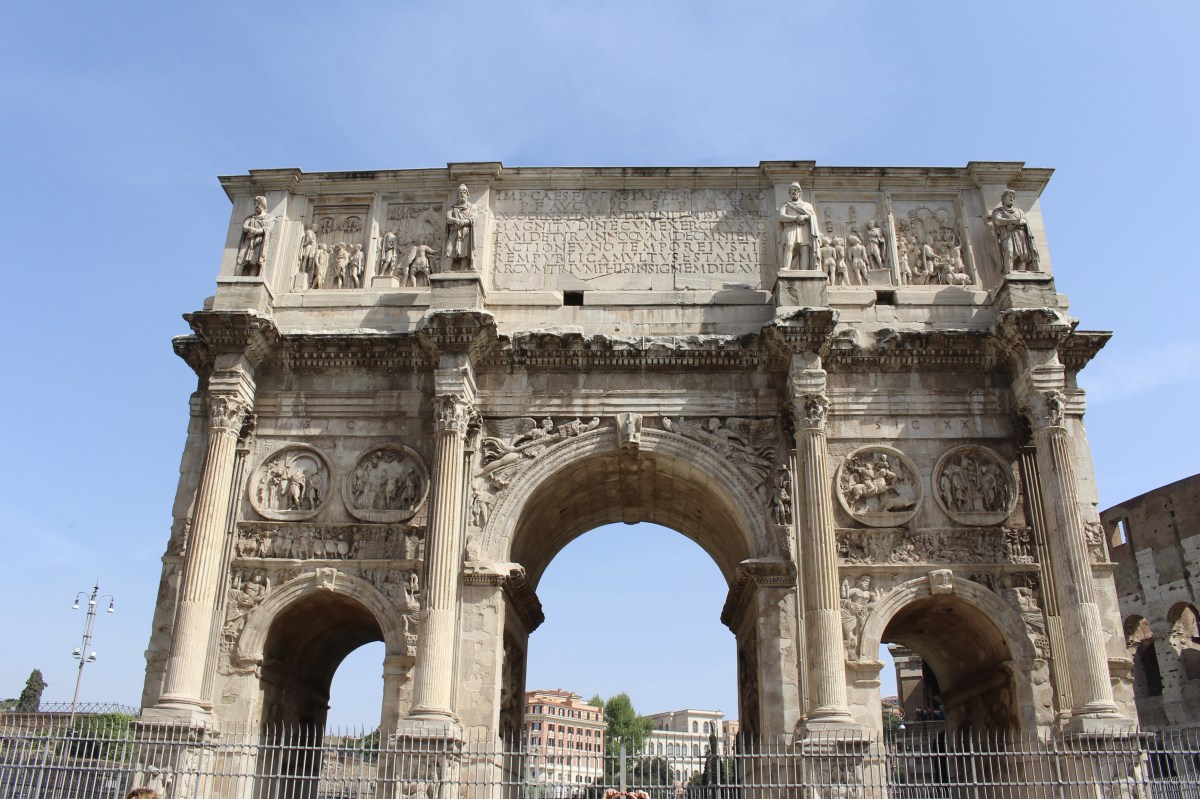
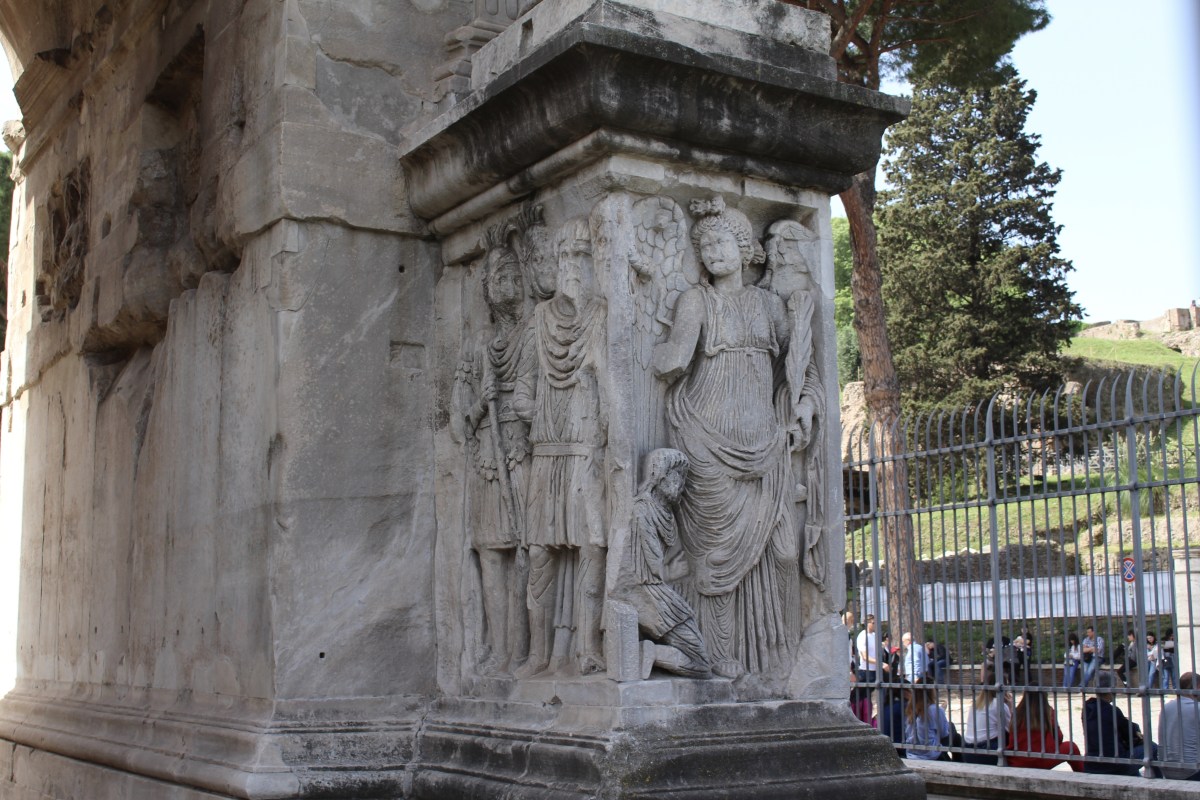
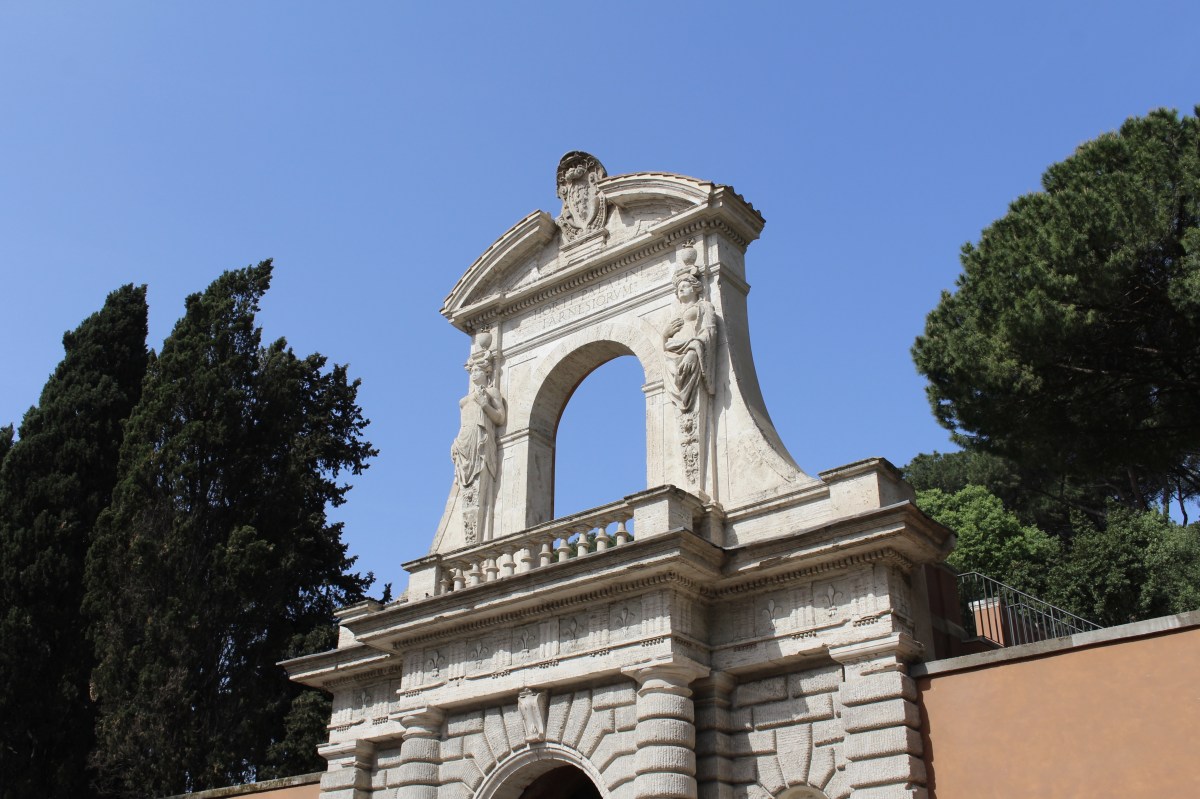
Finally, the bus started moving and we went three stops, going around a church and then to the Colosseum.  I got off just past the Arch of Constantine.  Rick Steves had said the Palatine Hill entrance was best for shorter lines and WCs, but the line to buy tickets was super long, hundreds of people moving at a snail’s pace.
fullsizeoutput_1be72

Palatine Hill

fullsizeoutput_1be90

Arch of Constantine

fullsizeoutput_1be94

part of the Arch of Constantine

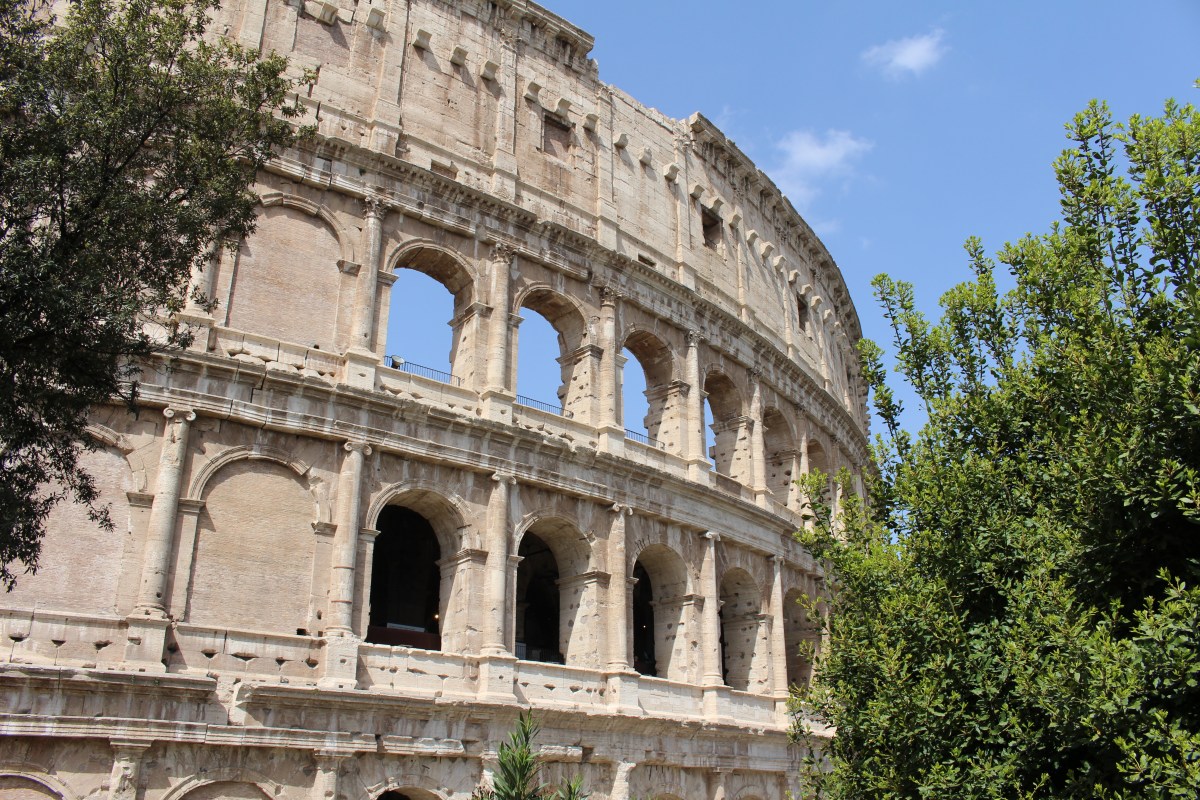
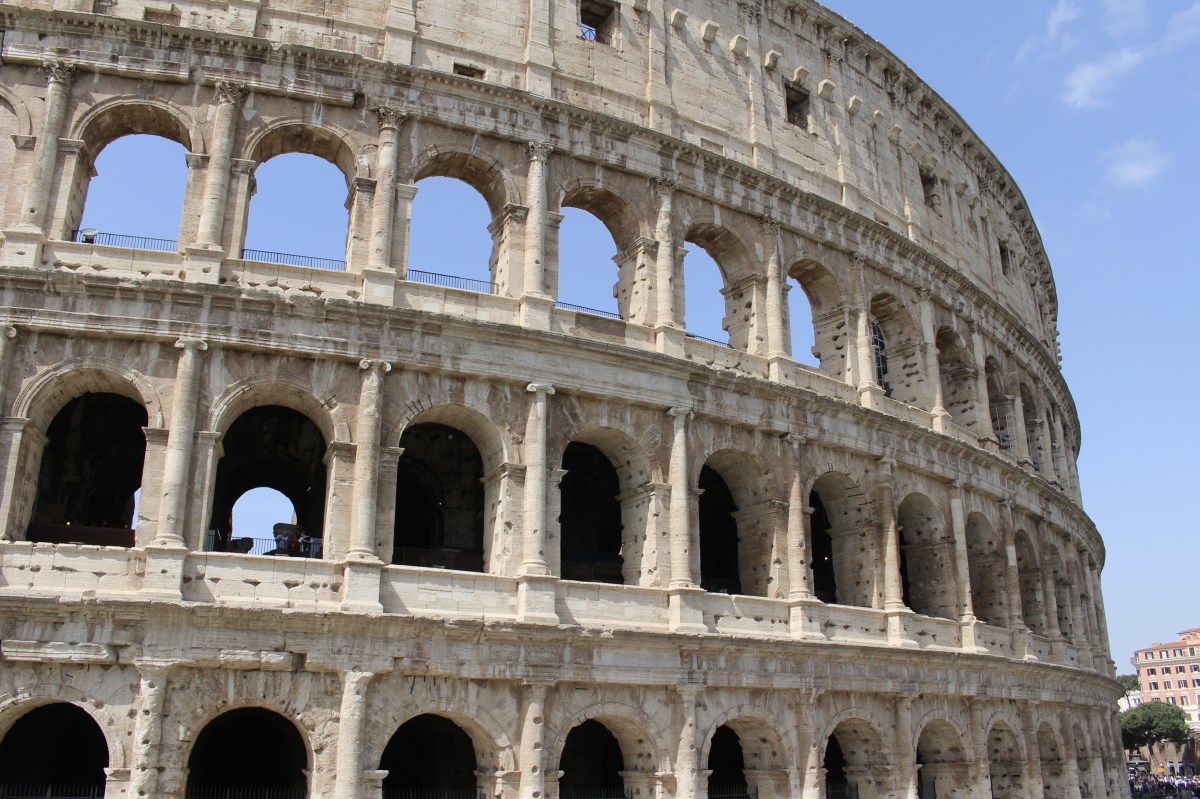
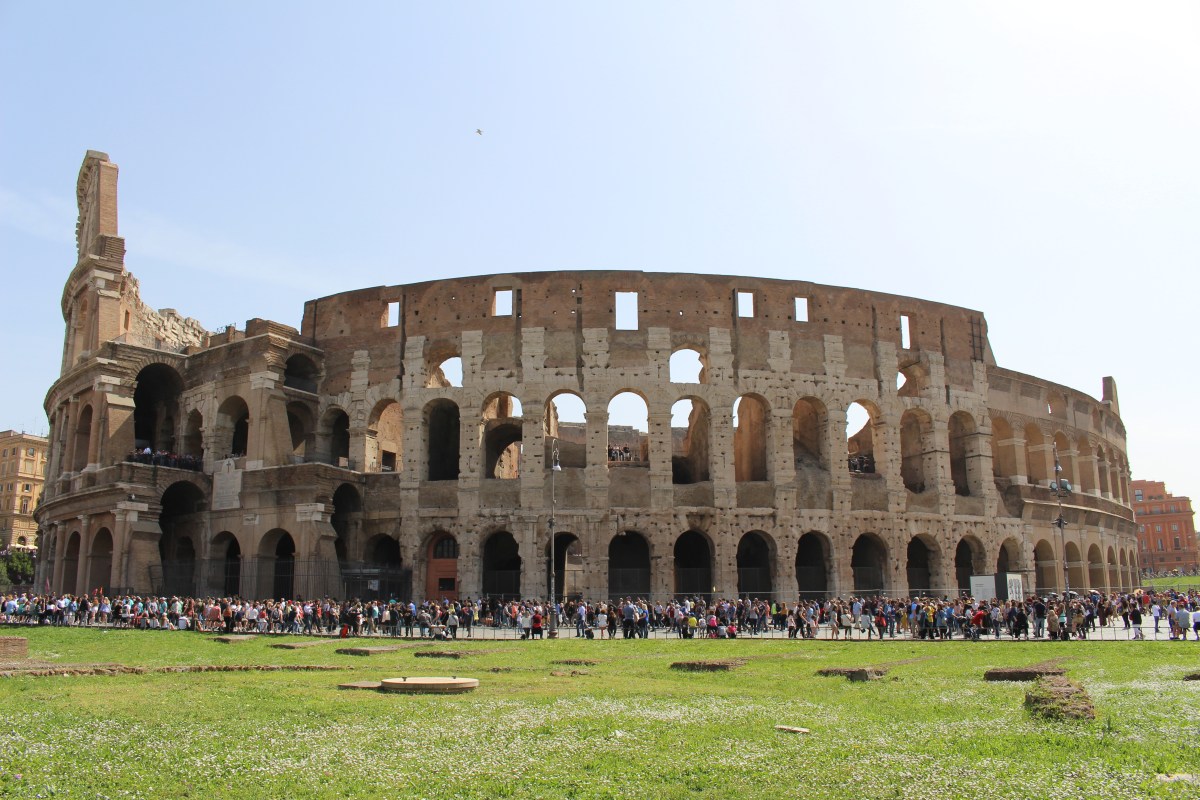
I stood in line for 45 minutes and moved a couple of feet. I could have twiddled my thumbs in that line for two days because I didn’t want to do anything else in Rome but see the ancient arena where gladiators fought to the death, or where doomed prisoners fought off bloodthirsty beasts.  However, I wasn’t so enamored of the idea that I was willing to forego everything else.

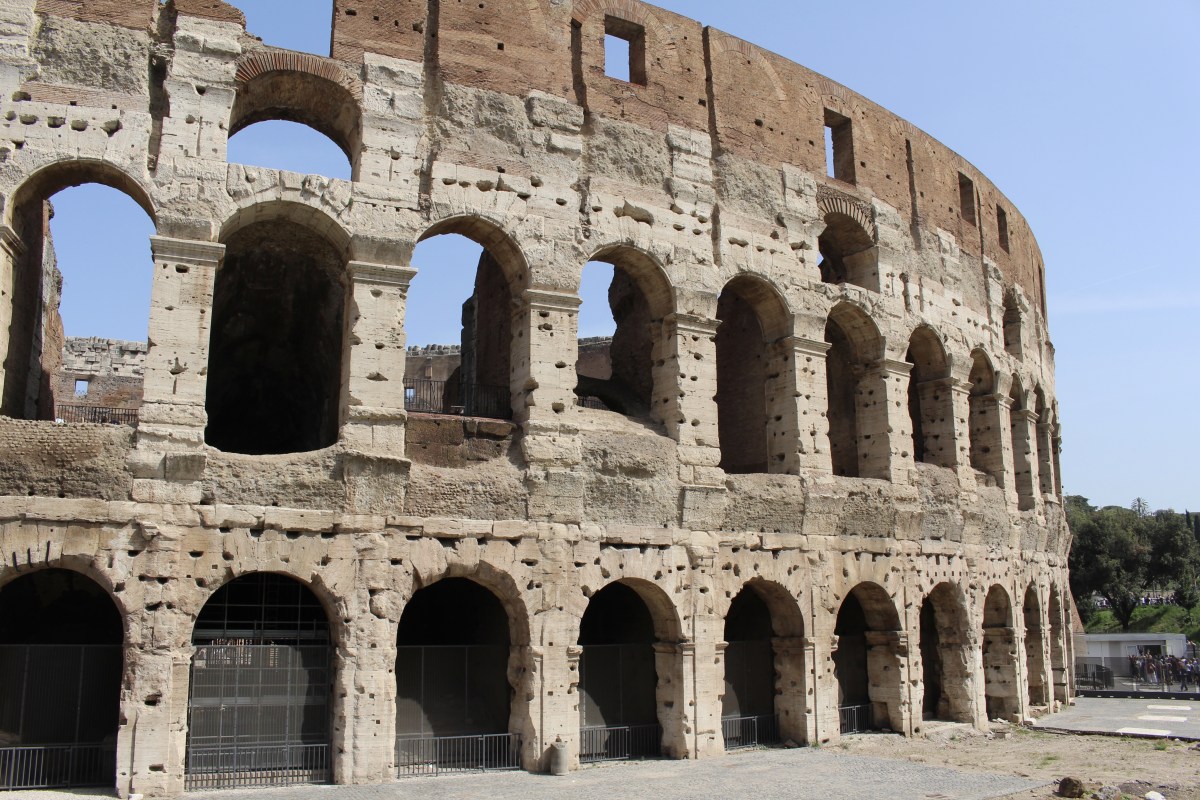
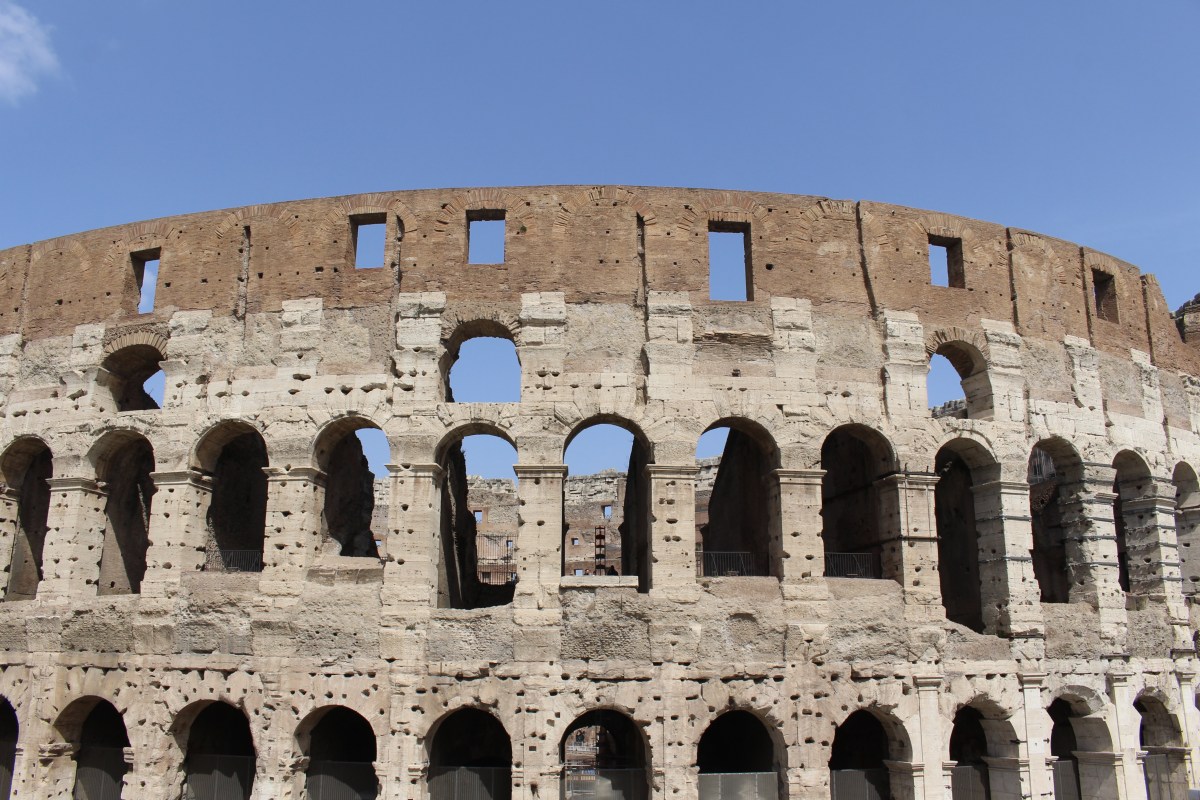
I finally concluded: forget it!  I could wander around outside the gates and see enough to be satisfied. I walked past the Arch of Constantine, then around the perimeter of the Colosseum.
IMG_6435

Colosseum

fullsizeoutput_1be99

Colosseum

fullsizeoutput_1be9a

Colosseum

IMG_6450

Colosseum

fullsizeoutput_1be9e

Colosseum

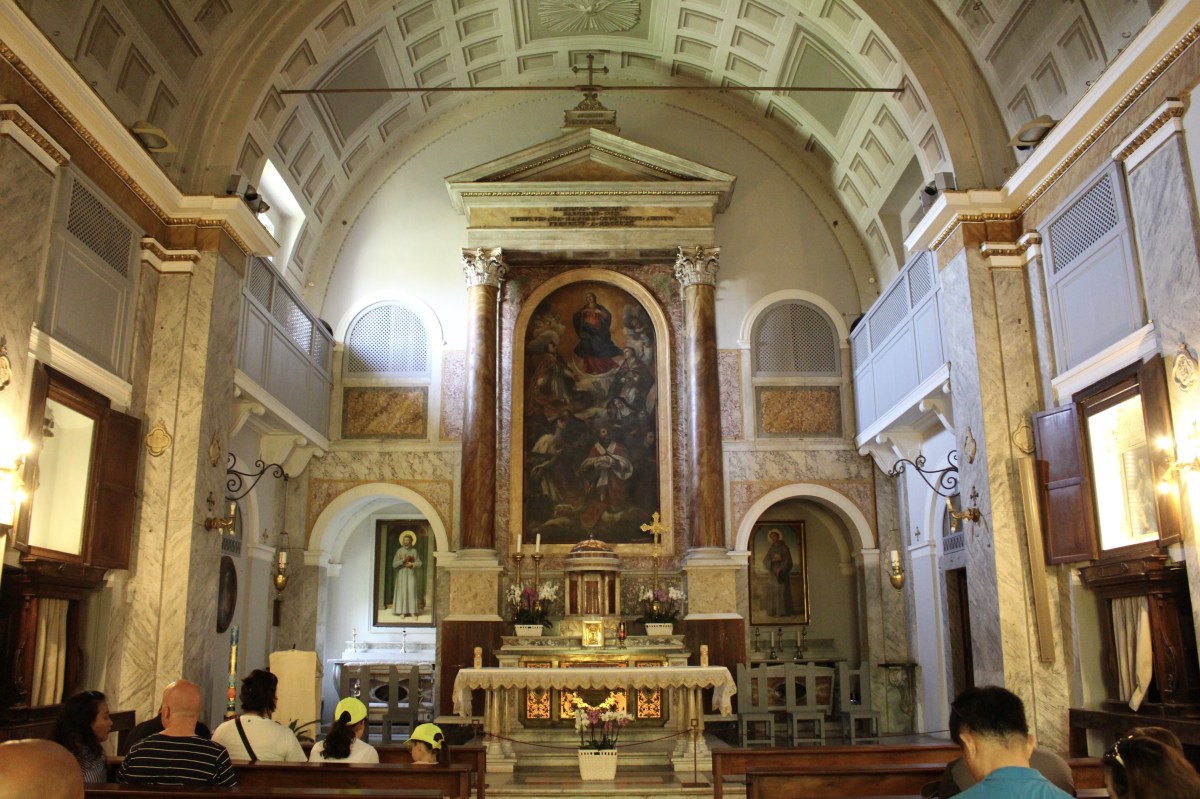
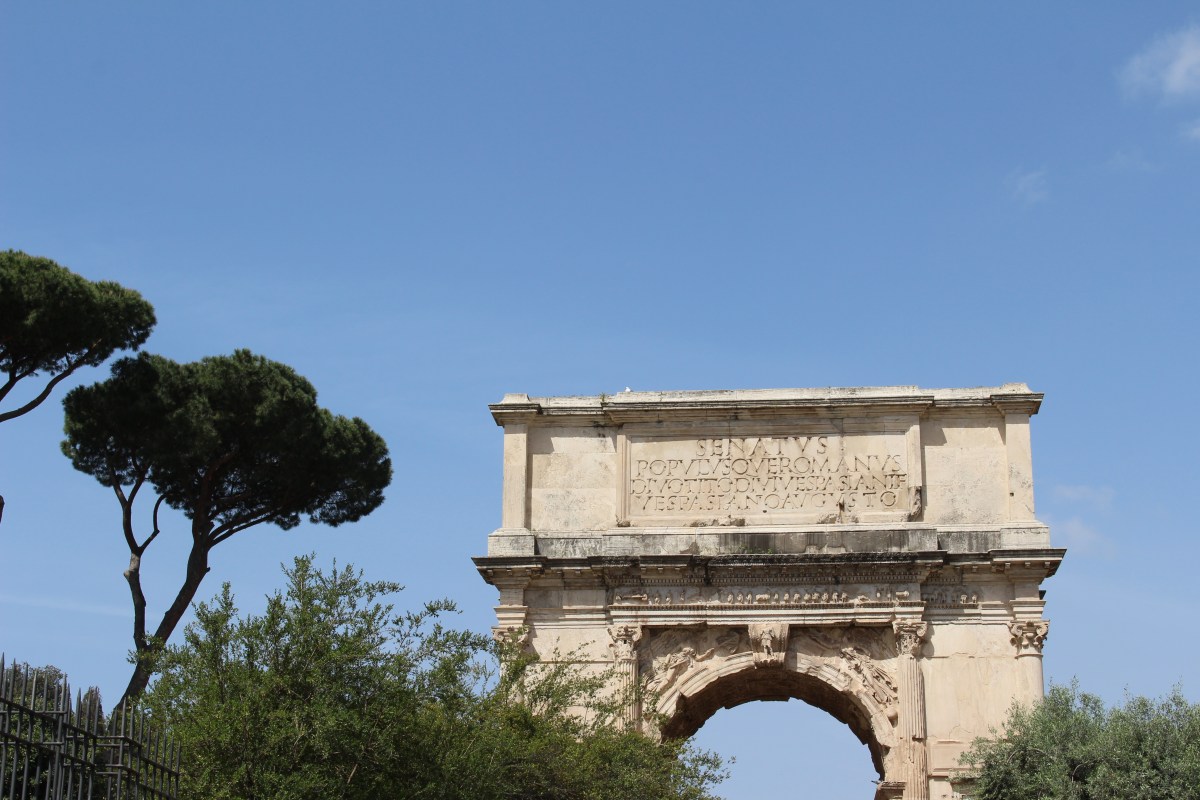
Following the crowds, I wandered up Via Sacra and past the Arch of Titus at the Roman Forum and around the back of the Palatine Hill to a small church.  Of course I was limited to what I could see through the gates.  I could barely see the Temple of Venus and Roma up on the hill overlooking the Colosseum, with its tall brick arch with a cross-hatched ceiling. Part of the Roman Forum, it was once the temple’s cella, or sacred chamber.  The Arch of Titus, built by the Emperor Domitian to honor his elder brother Titus, was said to be the inspiration for the Arc de Triomphe in Paris.  I couldn’t see much of the rest except some glimpses through the gates.
IMG_6457

Arch of Titus

fullsizeoutput_1bea2

Arch of Titus

fullsizeoutput_1bea4

small church

Through the fencing, I only had a peek at the Roman Forum, which in ancient times was a marketplace, religious complex and administrative center.

fullsizeoutput_1bea6

Roman Forum

Finally, I had enough and boarded the hop-on hop-off bus to go anywhere else.  The woman ticket taker told one man to wait for the next bus, but he insisted he was getting on THAT BUS, and he kept trying to push in front of me.  He kept saying “Don’t touch me!” to the woman.  What an asshole.  People in general were testy with all the crowds and the waiting.

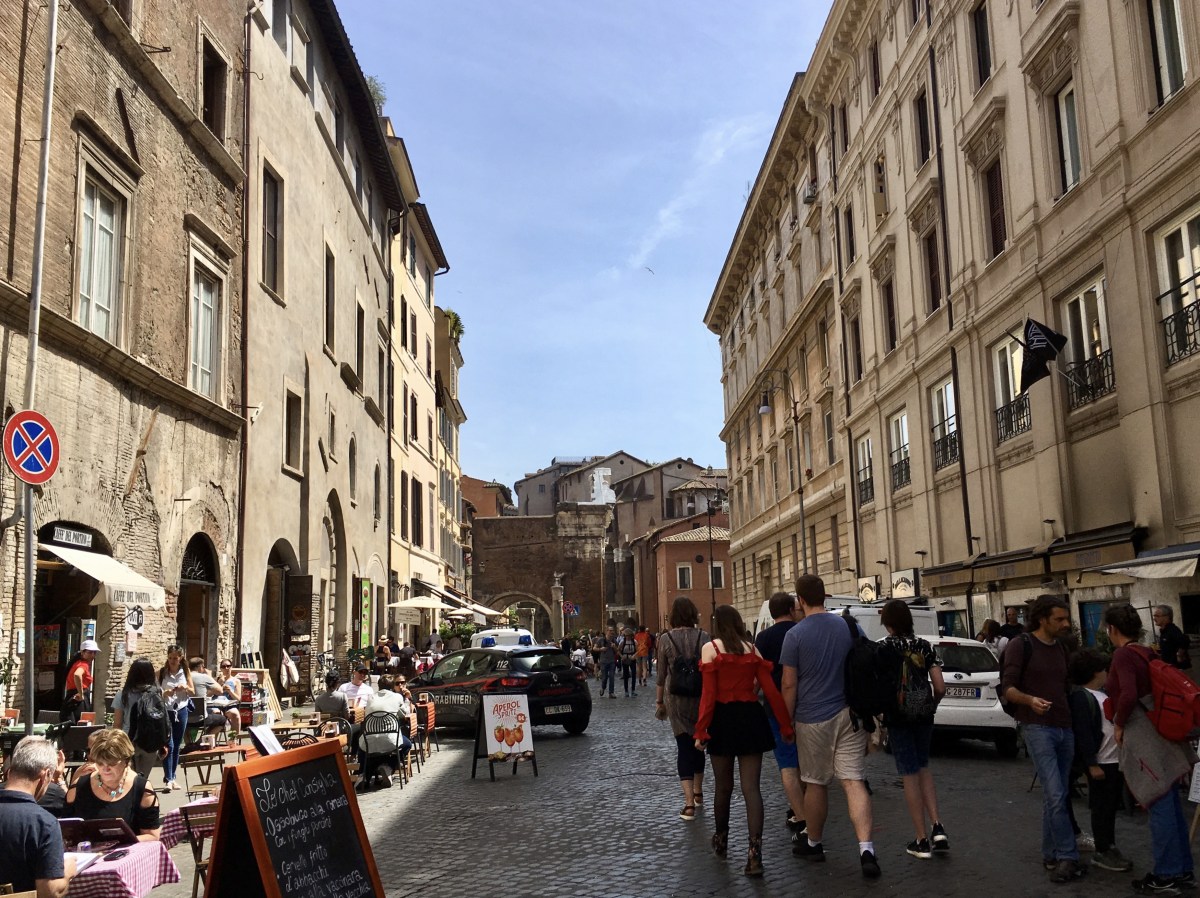
The bus went by Circo Massimo and up to Piazza Venezia, where I got off because I saw a cafe where I might be able to use the bathroom.  It was close to the Teatro di Marcello, or the Theatre of Marcellus, an ancient open-air theater once known for song and dance performances; it was built in the waning years of the Roman Republic.  Julius Caesar cleared space for the theater, but he was murdered before construction began.  It was completed in 13 BC and formally inaugurated in 12 BC by Augustus, named after his nephew Marcus Claudius Marcellus, who had died in 23 BC. It originally held between 11,000 and 20,000 spectators, and was the largest and most important theater in Ancient Rome.

The theater was on the edge of the old Jewish ghetto, Ghetto Ebraico, and I saw they had some kind of Holocaust museum there. The Jewish community in Rome was one of the oldest in Europe, dating back to the 2nd century BC. Jews were confined in the ghetto from 1555 until the 20th century, due to a period of official intolerance ushered in by Pope Paul IV.

fullsizeoutput_1bea7

Teatro di Marcello

fullsizeoutput_1bea8

unknown dignified building

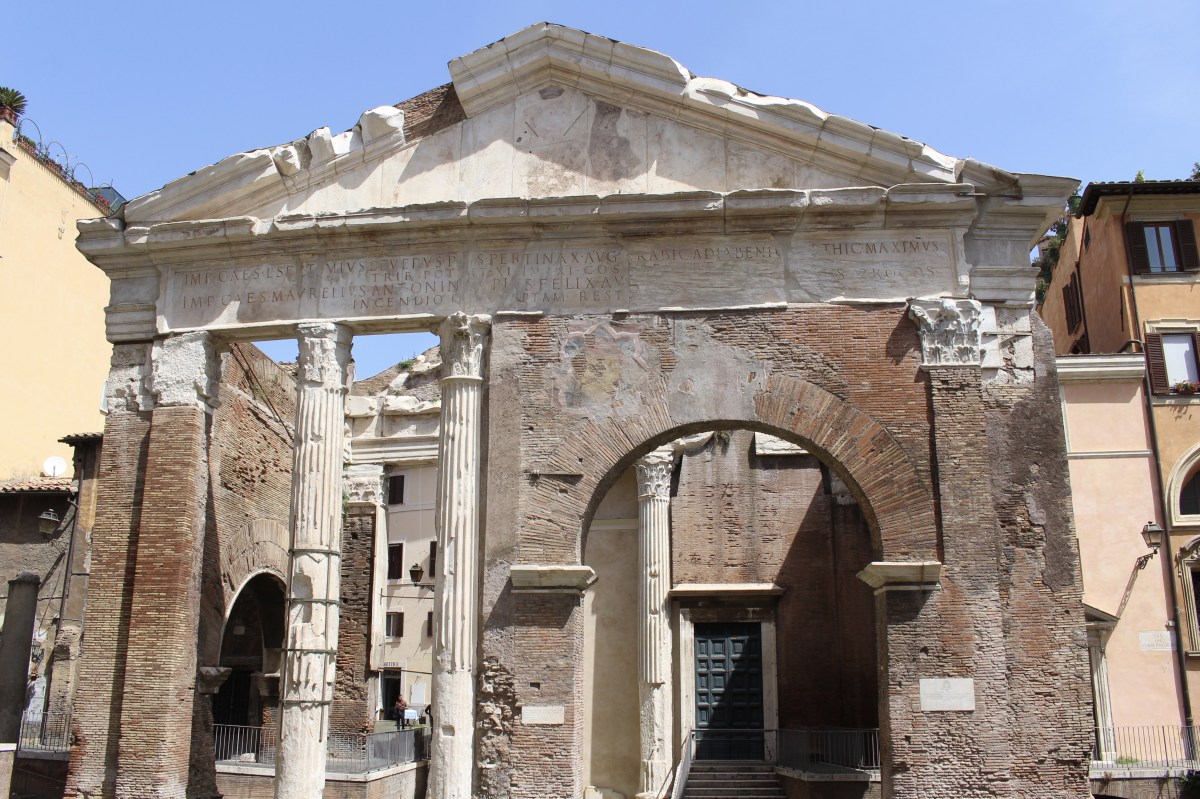
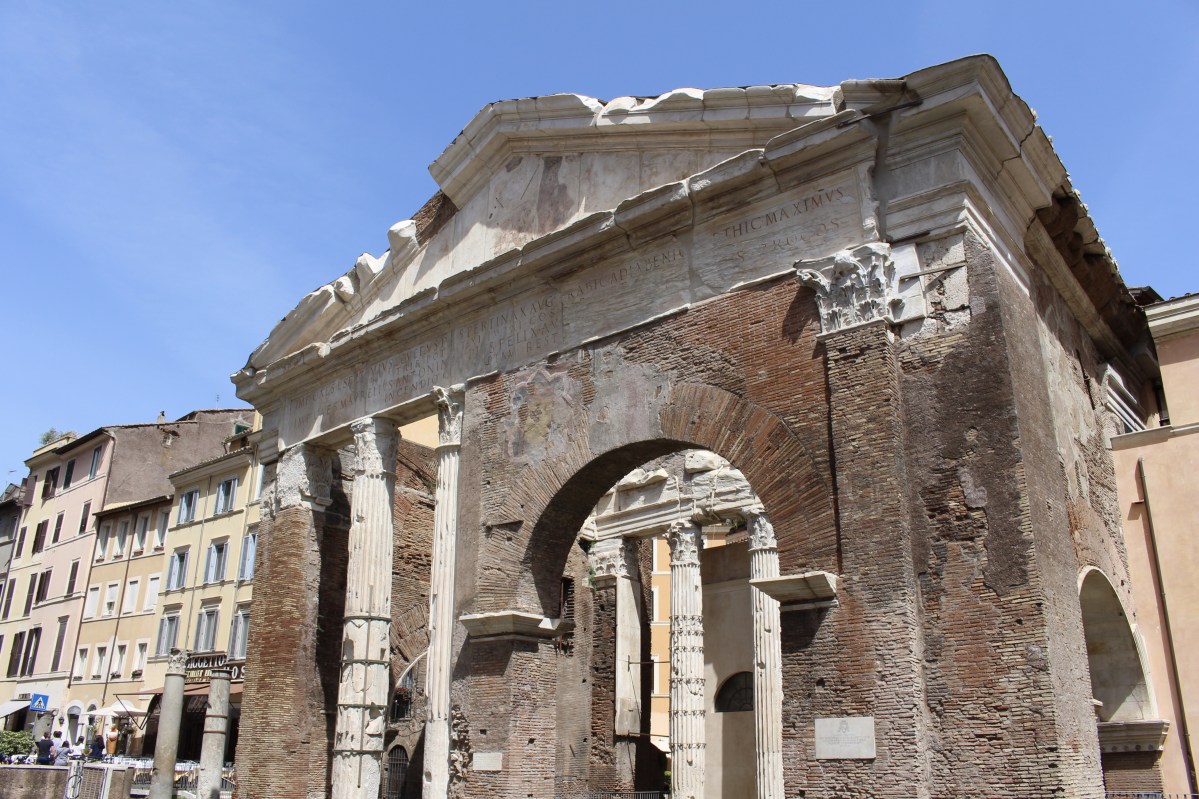
Found in the center of the Jewish ghetto was the Il Portico di Ottavia, built after 27 BC by Augustus in the name of his sister, Octavia Minor. The colonnaded walks of the portico enclosed the temples of Jupiter Stator and Juno Regina, as well as a library. The structure was used as a fish market from the medieval period up to the end of 19th century.
fullsizeoutput_1bead

Il Portico di Ottavia

fullsizeoutput_1beb0

Il Portico di Ottavia

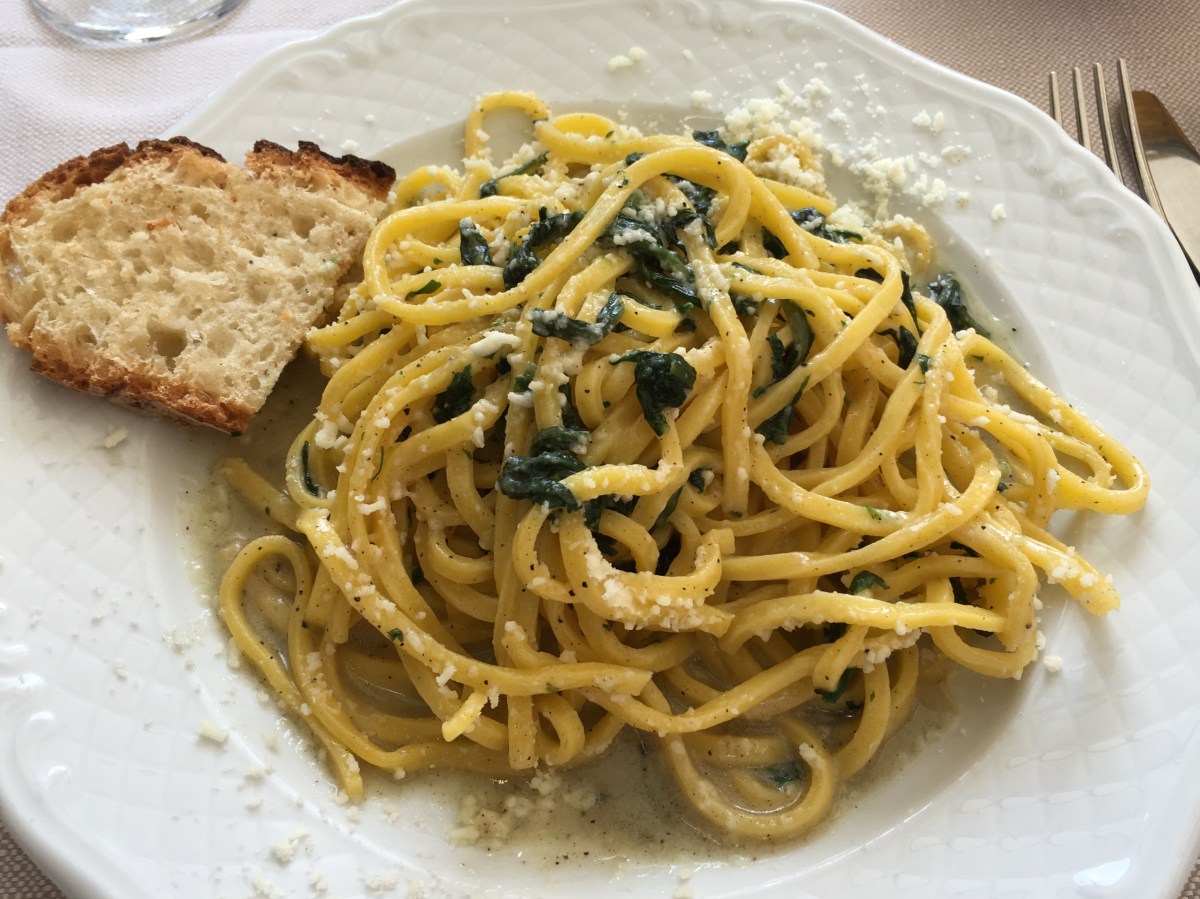
Nearby was the restaurant Il Giardino Romano, where I sat under an awning and enjoyed bread, sparkling water, and fresh pasta with cheese, pepper and chicory.  It was super tasty! 🙂  In retrospect, this was the way I wished I’d spent most of my day, sitting at an outdoor cafe eating delicious food and watching people stroll past.
fullsizeoutput_19021

fresh pasta with cheese, pepper and chicory

From there, I turned on my GPS to lead me to Piazza Campo de Fiori.  I stopped in a cute shop where I bought a green and brown parreo and watched an older heavyset Italian woman with a blue streak in her blonde hair try on an exotic maxi dress.
fullsizeoutput_1beb3

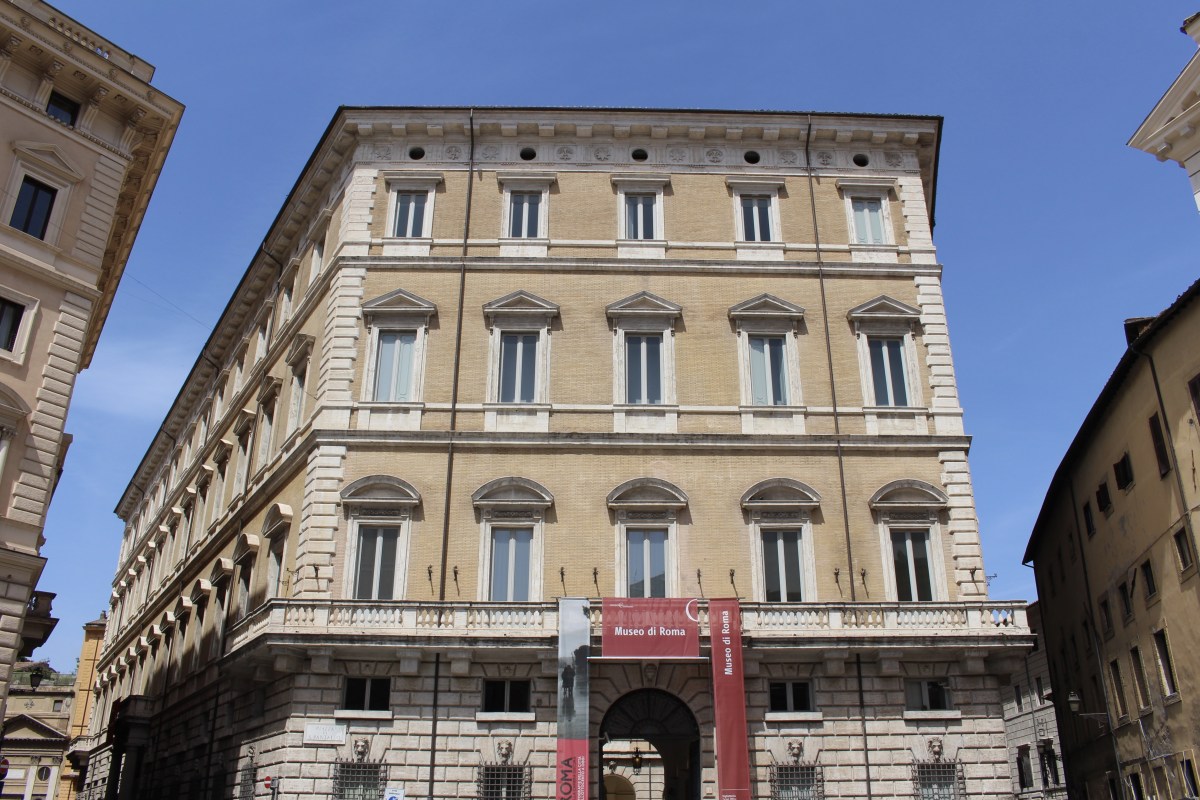
Museo di Roma

fullsizeoutput_1be58

Ghetto Ebraico

fullsizeoutput_1be5a

walking through Rome

fullsizeoutput_1be5b

buildings in Rome

fullsizeoutput_1be5c

a little park

fullsizeoutput_1be5d

streets of Rome

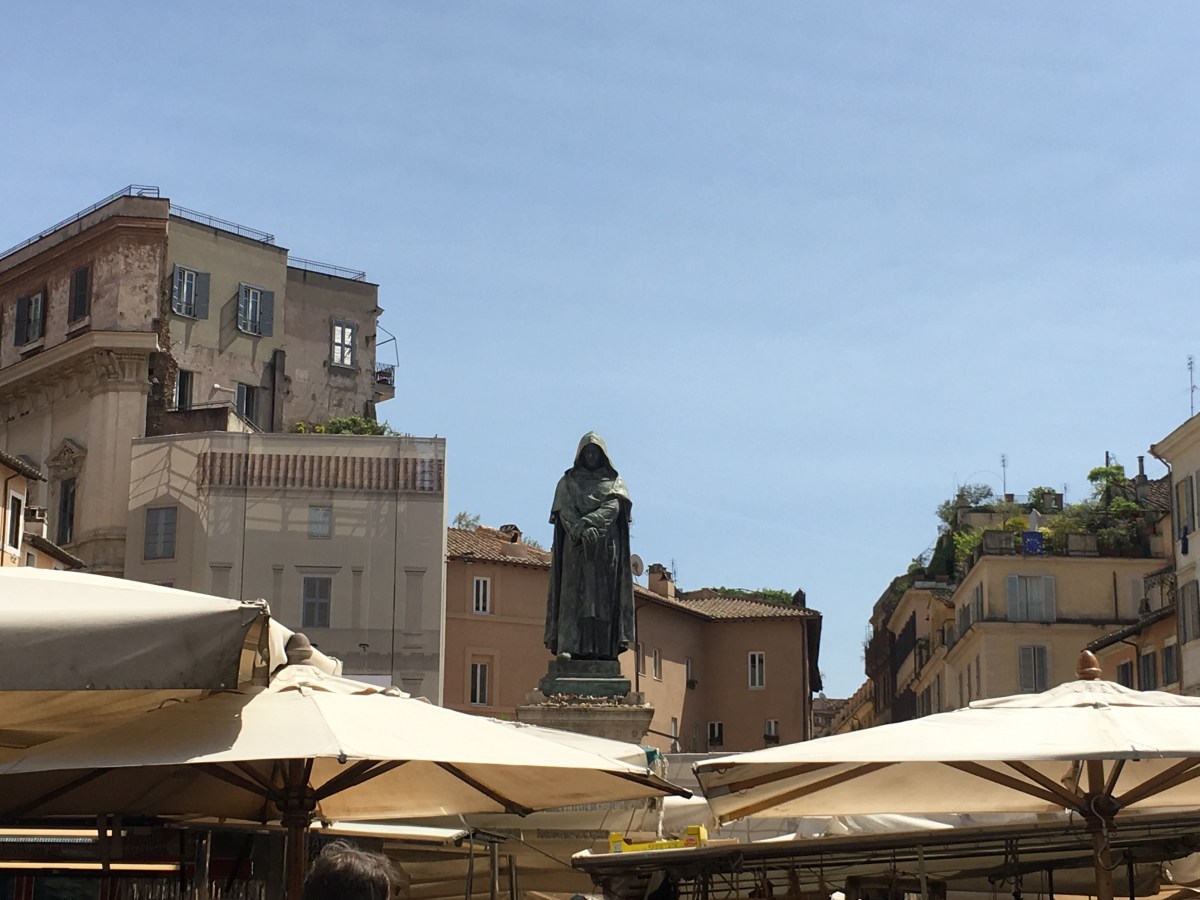
I continued on until I reached Campo de Fiori, a bohemian plaza with a busy fruit and vegetable market and cafes lining the edges.  In the center of the square was a statue of Giordano Bruno, an intellectual heretic who was burned on this spot in 1600.

fullsizeoutput_1be62

Piazza Campo de Fiori

IMG_5874

statue of Giordano Bruno

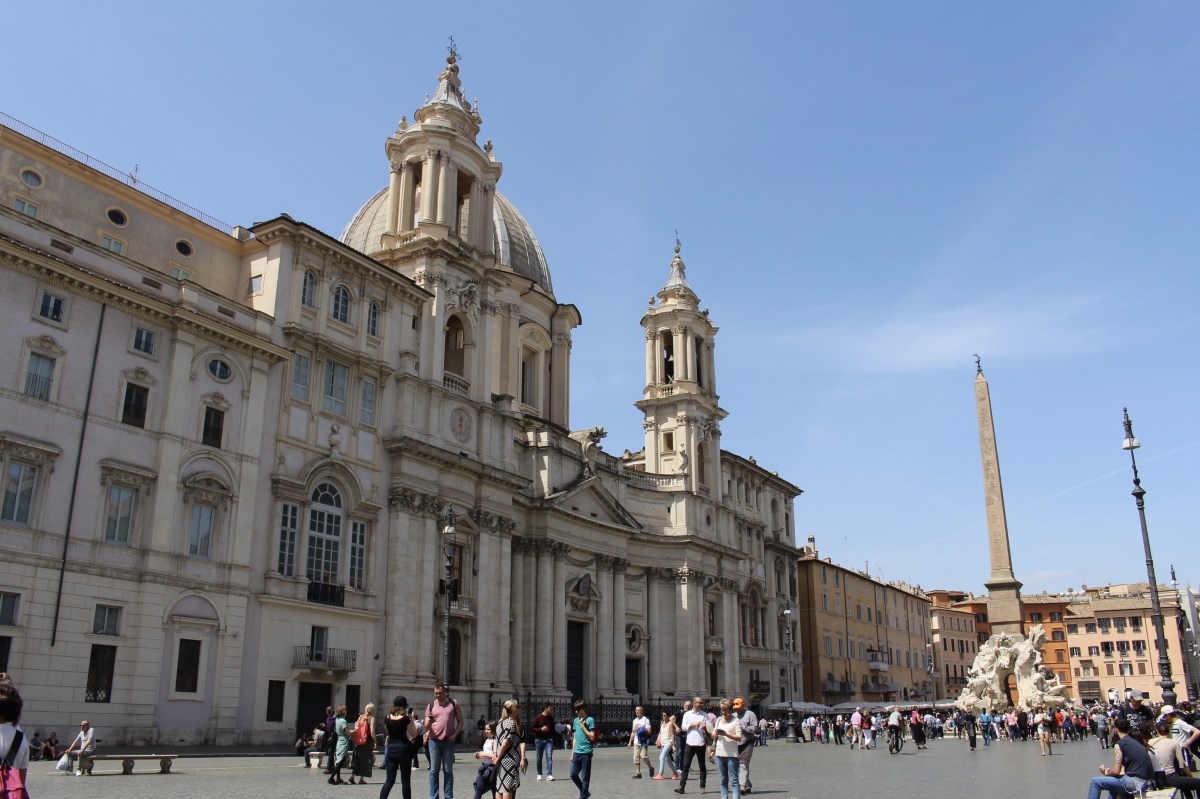
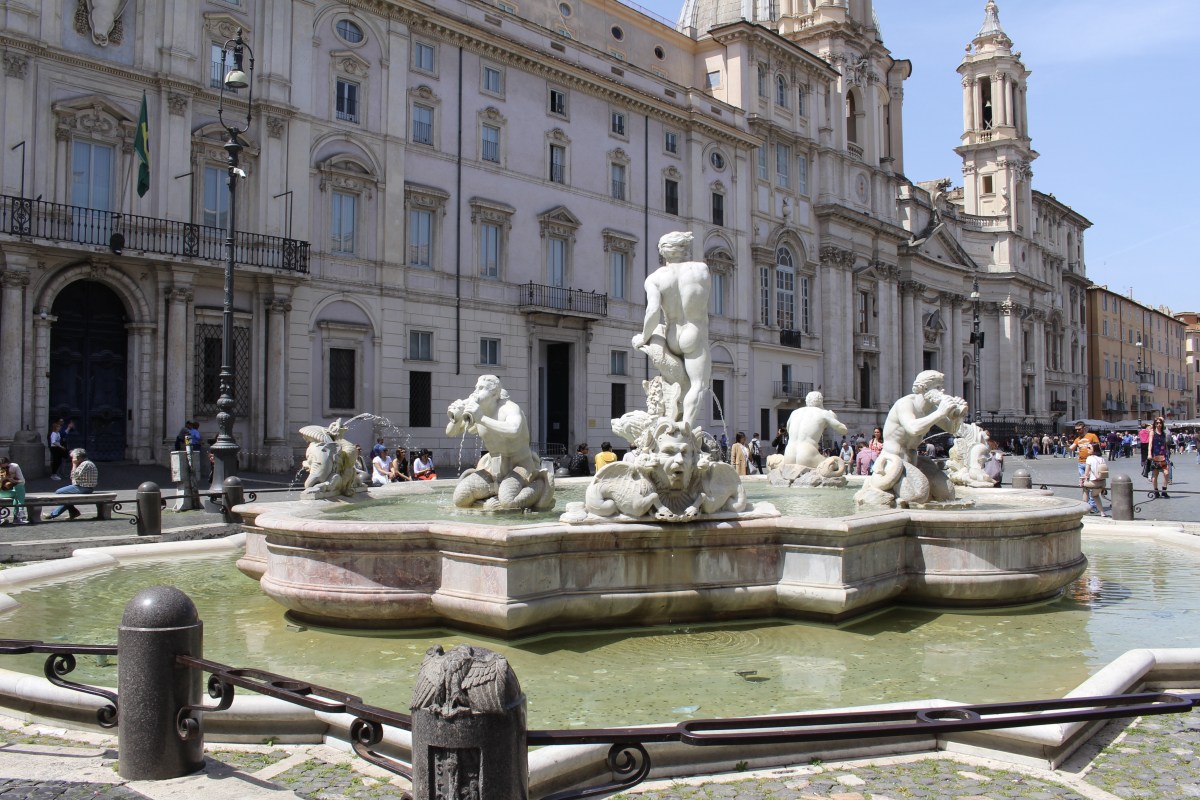
At Piazza Campo de Fiori, I started Rick Steves’ “Heart of Rome Walk.”  I made my way slowly to Piazza Navona, Rome’s showcase square.  The long, oval piazza was built around AD80 by the Emperor Domitian.  I was first greeted at the southern end of the square by the Fontana del Moro, or Fountain of the Moor, designed by Giacomo della Porta in 1576.

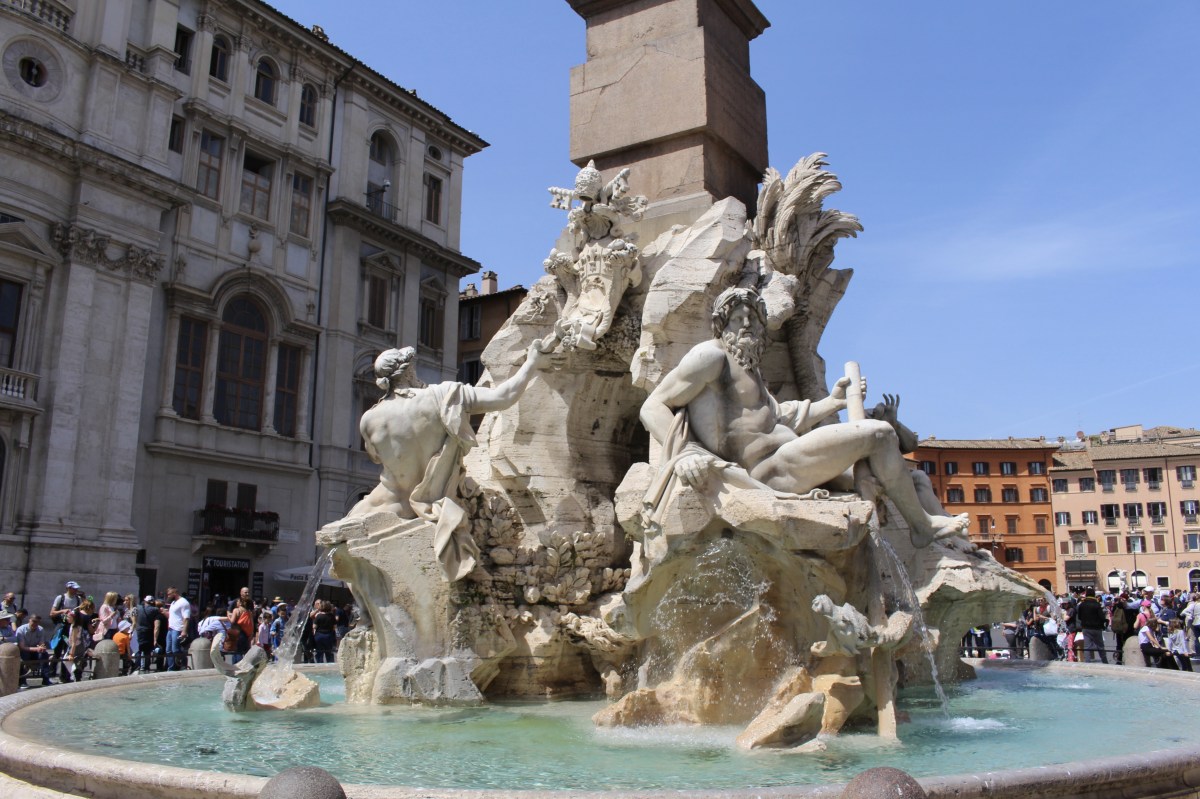
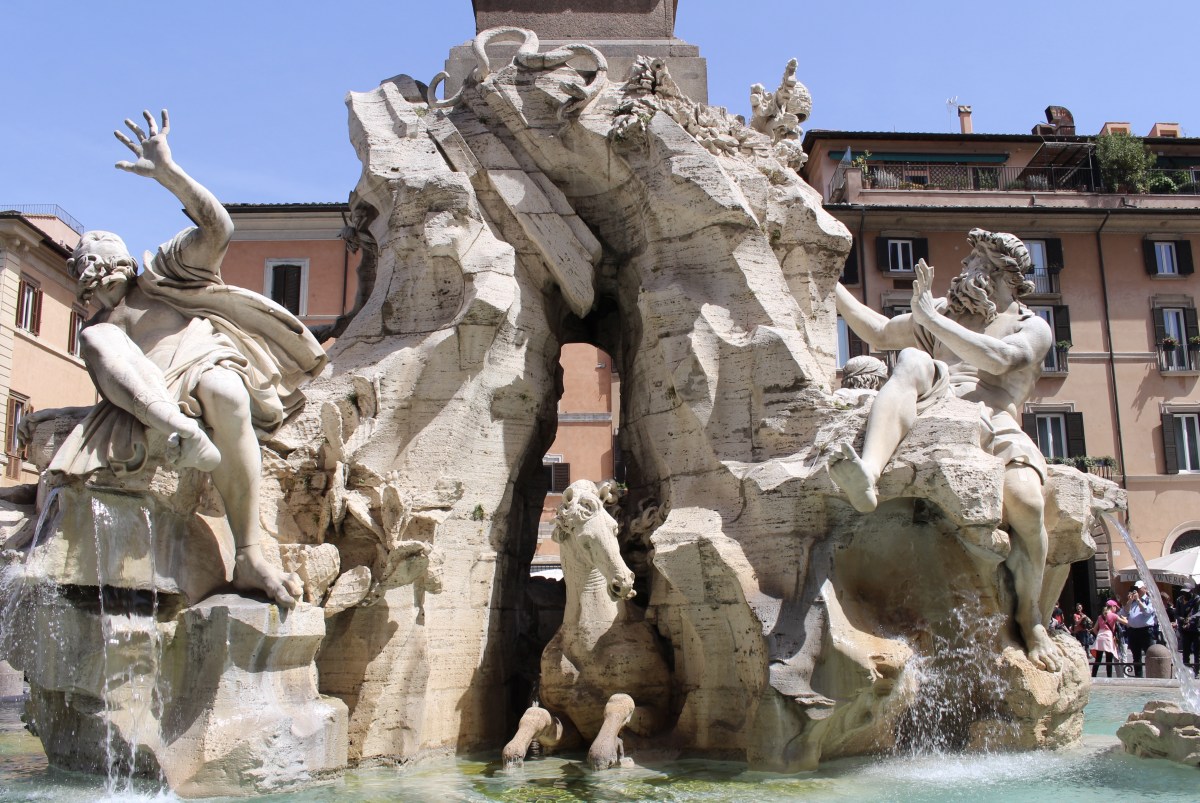
At the center of the square was Bernini’s Fontana dei Quattro Fiumi, the Four Rivers Fountain, with its four burly river gods personifying the rivers Nile, Ganges, Danube and Plate, with an Egyptian-style obelisk in the center.  The fountain showed the Nile with its head covered, the Ganges with an oar, the Danube, who turned to admire the obelisk, and Uruguay’s Rio de la Plata, which tumbled back in shock and gazed upward at the nearby Chiesa di Sant’Agnese in Agone, or Church of St. Agnes.  The church was designed by Francesco Borromini.
fullsizeoutput_1beb6

Fountain of the Moor

fullsizeoutput_1beb9

Piazza Navona

fullsizeoutput_1bf10

Chiesa di Sant’Agnese in Agone

fullsizeoutput_1bebb

Piazza Navona

fullsizeoutput_1bebc

Four Rivers Fountain

fullsizeoutput_1bec2

Four Rivers Fountain

fullsizeoutput_1bec6

Four Rivers Fountain

fullsizeoutput_1bec8

Four Rivers Fountain

fullsizeoutput_1becb

“Heart of Rome” walk

I walked by the 2,000-year-old Pantheon, built by Marcus Agrippa in 27 BC.  After burning down in AD80, it was rebuilt by Domitian, then struck by lightning in AD110.   The current version, with its 40-foot single-piece granite columns and its triangular Greek style roof, was rebuilt by Emperor Hadrian between AD 118 and 125. Hadrian’s version was dedicated to the classical gods, but in 608, it was consecrated as a Christian church.  I didn’t go inside, but there is supposedly a domed room of perfect proportions to be seen there.  I regret that I missed the interior.

fullsizeoutput_1becd

Pantheon

fullsizeoutput_1bece

Pantheon

fullsizeoutput_1bed1

“Heart of Rome” walk

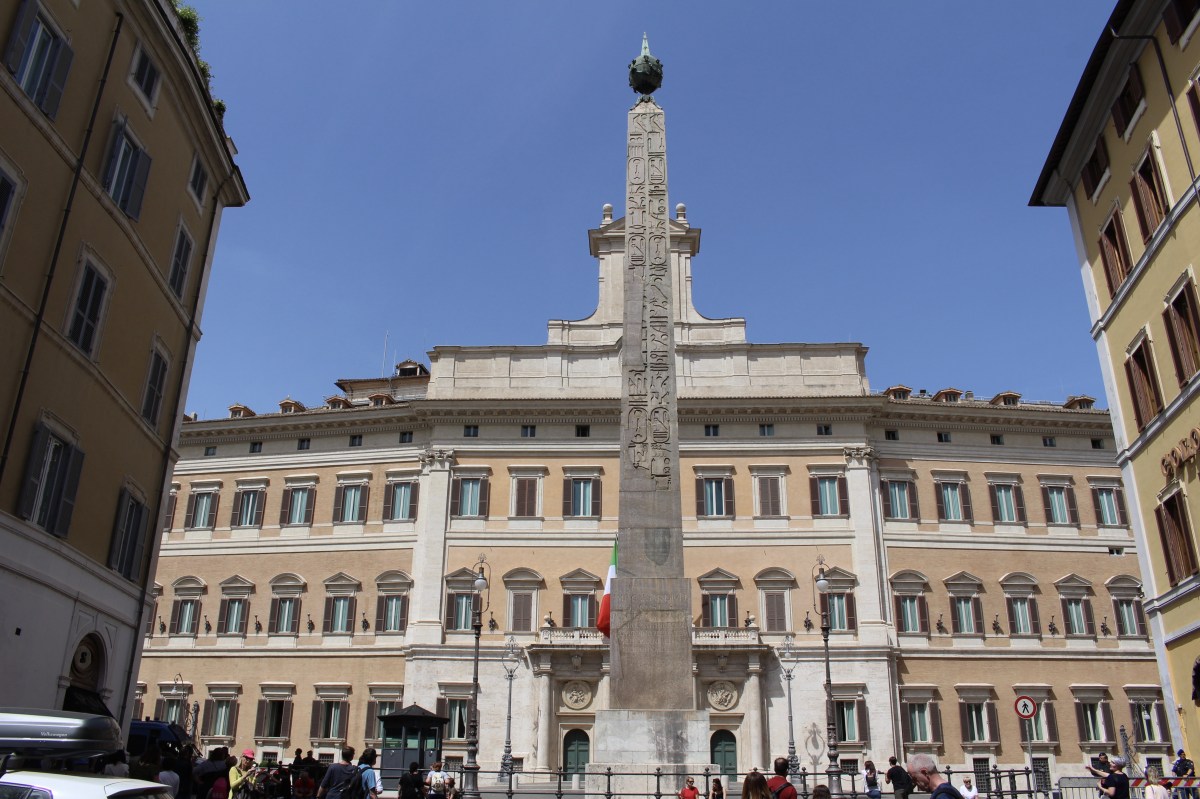
I continued my walk past the Senate building and San Luigi.  After walking past the Parliament, guarded by police or military men, I found a couple more obelisks. In front of the Parliament was a 6th century Egyptian obelisk taken as a trophy by Augustus after his victory over Mark Anthony and Cleopatra in Egypt.

Apparently, Rome has 13 such obelisks, more than any other city.
fullsizeoutput_1bed2

Parliament

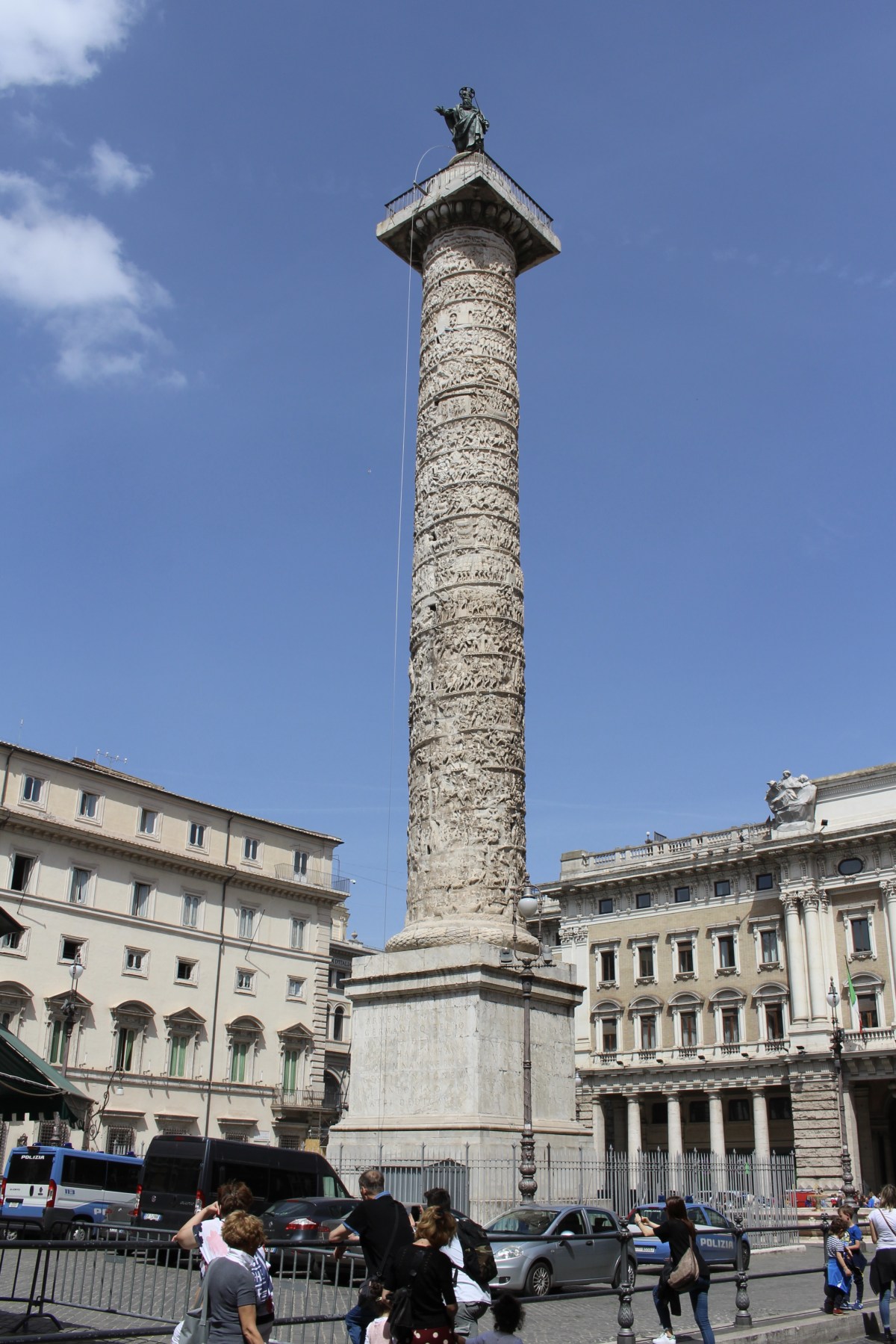
In Piazza Colonna was a huge column from the second century. The decorative relief wrapped like a scroll around its length told in a sort of continuous narration the victories of Emperor Marcus Aurelius over the barbarians. After he died in AD 180, the barbarians began Rome’s three-century-long unraveling. Paul, one of Rome’s patron saints, topped the column that Marcus Aurelius once dominated.
fullsizeoutput_1bed3

Egyptian obelisk

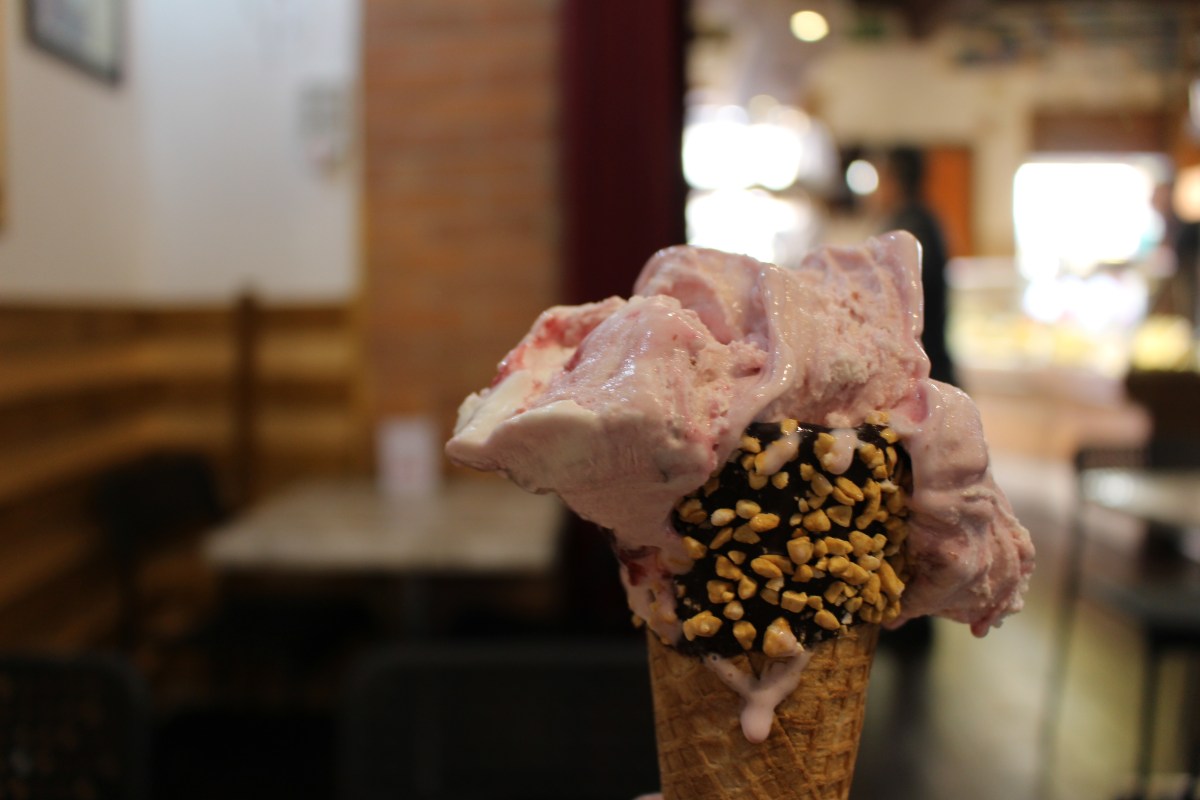
At this point, I stopped to escape from the heat for a gelato.  It had a band of chocolate around the top of the cone, and was topped with walnuts. After this much-needed break, I was ready to turn a corner to the Trevi Fountain, continuing on my “Heart of Rome” walk.
IMG_6515

a refreshing gelato break

*Wednesday, April 24, 2019*

**********************

“PROSE” INVITATION: I invite you to write up to a post on your own blog about a recently visited particular destination (not journeys in general). Concentrate on any intention you set for your prose.

My intentions for my trip to Italy were determined before I left home. One was to use a different Italian word each day.  My word for today was “Buongiorno.” The other intention was as follows: Pick up any book you have on your shelf.  Turn to page 79.  Pick the 4th sentence on the page and write that sentence at the top of each day’s journal entry. Then brainstorm any ideas that come to your mind related to that sentence.  Write a travel essay using that sentence as your topic sentence. 

I must admit this intention didn’t work out so well for today, because this was the sentence I had written in my travel journal. “I chewed on the string every summer because I never had anything else to do out in right field.” ~ from a short story called “Love Story” from the collection GOOF And Other Stories by Sean Enright.  It’s a little difficult to write about being out in right field in a baseball game while you’re in Rome! Thus I altered the sentence and used a version of it to describe my frustration standing in line at the Colosseum. 🙂

It doesn’t matter whether you write fiction or non-fiction for this invitation.  You can either set your own writing intentions, or use one of the prompts I’ve listed on this page: writing prompts: prose. (This page is a work in process.) You can also include photos, of course.

Include the link in the comments below by Monday, February 24 at 1:00 p.m. EST.  When I write my post in response to this invitation on Tuesday, February 25, I’ll include your links in that post.

This will be an ongoing invitation. Feel free to jump in at any time. 🙂

I hope you’ll join in our community. I look forward to reading your posts!
Share this:

  • Share on X (Opens in new window) X
  • Share on Facebook (Opens in new window) Facebook
  • More
  • Email a link to a friend (Opens in new window) Email
  • Print (Opens in new window) Print
  • Share on Pinterest (Opens in new window) Pinterest
Like Loading...
  • America
  • Cedar Creek & Belle Grove National Historical Park
  • Hikes & Walks

cedar creek & belle grove national historical park

wanderessence1025's avatar wanderessence1025 February 9, 2020

In November, I visited Cedar Creek & Belle Grove National Historical Park in Middletown, Virginia.  This park was created by the U.S. Congress in 2002 with the mission to preserve and interpret the history of the area from the time of the first human settlement until today.

It seems the first people arrived in Virginia’s Shenandoah Valley around 10,000 years ago and lived on wildlife and plants.  Eventually they cultivated the land, growing a variety of crops.  Tribal warfare pushed out most American Indians before European settlers arrived.  In 1731, Jost Hite led the first of the new settlers, finding fertile soil and abundant water. They discovered that wheat flourished and made high quality flour.  By the late 1700s, 96% of farmers in the Valley were growing wheat to sell commercially, mostly to Great Britain.  During this Age of Grain, a few plantations were established. Hundreds of mills sprung up along the valley’s fast-flowing streams, which powered the wheels that turned the heavy millstones, grinding the grain into flour.

The Union and Confederacy fought over the Shenandoah Valley throughout the war.  But in 1864, the Union attempted to destroy the “Breadbasket of the Confederacy.”  President Lincoln aimed to devastate the Southern economy and General Ulysses S. Grant wanted the Valley to “remain a barren waste.” The Union systematically burned crops, mills, factories and two thousand barns, along with confiscating or killing thousands of farm animals, leaving residents with no food for themselves, let alone for either Confederate or Union soldiers.

fullsizeoutput_1be20

The Battle of Cedar Creek

On October 19, 1864, Confederate soldiers crossed Cedar Creek and the North Fork of the Shenandoah River to surprise sleeping Union soldiers.  The Confederates chased the Union soldiers north.  By late morning, The Confederates thought they’d won.  However, Union General Philip Sheridan was racing south from Winchester, determined to rally his stunned troops.  By sunset, the Confederates were defeated, and the Confederate Army of the Valley ceased to exist.  Over 8,600 Union and Confederate men were killed, wounded or captured in the second bloodiest of the Shenandoah Valley’s battles.

At the Visitor Contact Station, I was able to watch an active re-enactment of the battles on a topographical map with blue lights showing the Union troops and red lights showing the Confederates.

Battle of Cedar Creek
wheat farmer in Shenandoah Valley

I stopped to have a look at the Cedar Creek Battlefield, and saw a lone white house.  Probably built around 1800, the clapboard-covered log house known as the Heater House was the center of a prosperous 600 acre farm owned by Solomon and Caroline Wunder Heater. Although two of her sons died in Confederate service, Mrs. Heater, a native of Pennsylvania, was a Union supporter and frequently provided shelter and supplies to the federals. Her loyalty was ultimately repaired by a 1901 federal grant for some wartime damages.

fullsizeoutput_1be2a

Heater House

fullsizeoutput_1be31

Cedar Creek Battlefield

Thoburn’s Redoubt, consisting of 134 acres and part of the historic Bowman-Hite farm, was where the Union Army under Col. Joseph Thoburn encamped among the bluffs north of Cedar Creek.

The opening attack of the battle took place in these fields and woods around 5 a.m. on October 19, 1864. The Union troops, utterly surprised, were completely routed in the heavy fog and predawn darkness. Col. Joseph Thoburn’s attempts to rally his men failed, and he was later killed during the retreat through the streets of Middletown. The trail here covers part of the ground where Thoburn’s troops were positioned and then overrun by the Confederate assault.

fullsizeoutput_1be37

The Thoburn Redoubt Trail

Signal Knob, 1500 feet above the Valley floor, marks the northern end of the Massanutten Mountain Range. On October 17, two days before the battle, Confederate officers utilized the advantages provided by Signal Knob, where there was a longstanding signal station. From their viewpoint, they could see Sheridan’s army around Cedar Creek and could pick out all the units’ positions towards Belle Grove.  This gave them the advantage in the attack against the Union army in the first battle on the 19th.

fullsizeoutput_1be38

Signal Knob

A monument to the 128th New York Regiment was erected in 1907. These men had borne the brunt of the Confederate attack against their position around 6:00 a.m.

fullsizeoutput_1be3c

monument at Cedar Creek

Following the successful Confederate surprise attack, Union forces from the 8th and 19th corps formed battle lines across the woods and fields shown below, hoping to slow the overwhelming Southern assault moving in this direction. The fighting delayed the Confederate advance long enough for the rest of the Union army, on the other side of the Valley Pike, time to readjust their lines.

fullsizeoutput_1be3e

Morning Attack Trails

The Middletown Cemetery, on a knoll west of the village, was the only point Union officers believed they could slow the Confederate advance. From this high ground, General George Getty’s division, about 2,500 strong, repulsed two Confederate assaults. Frustrated, the Confederates massed 30 cannons, and with a third attack, they finally forced Getty to withdraw.

yQ4QhTcVRL2atuY3znvBCw

Mt. Carmel Cemetery

General Philip Sheridan arrived on the battlefield following his famous and dramatic “Ride” from his headquarters in Winchester.  Along the way, he ordered Captain (and future U.S. President) William McKinley to stop retreating units and direct them back to the fighting. At the end of his ride, near the point shown below, Sheridan rejected all suggestions to retreat and rode the length of the battle lines to restore his men’s morale. Soon after, he planned a counterattack.

fullsizeoutput_1be4f

Sheridan arrives

fullsizeoutput_1be53

Sheridan arrives

At 4:00 p.m., Sheridan’s reformed battle lines stretched almost two miles east to west, with cavalry anchoring both ends.  Their counterattack took them back over the fields they had earlier fled. The battle hung in the balance due to fierce Confederate resistance, but the Union struck hard and the Confederate line unraveled, turning their retreat into a rout.  Sheridan had snatched a “victory from the jaws of defeat.”

fullsizeoutput_1b0ec

barn near Union counterattack

Union counterattack
Union counterattack
Cancellation stamps
Cancellation stamps

Cedar Creek was a momentous Union victory and marked the end of Sheridan’s overwhelmingly successful campaign and a turning point in the war. Occurring on the eve of the presidential election, the victory assured Abraham Lincoln’s reelection three weeks later.  Within six month of his election, the Civil War was over.

At the end of the Civil War, the farms of the Shenandoah Valley were devastated.  No fences or cultivated fields were visible for miles.  Labor shortages continued due to the abolition of slavery and heavy fatalities of men of working age.  Food prices were inflated due to shortages.

After the war, Valley farmers returned to cultivating the land, turning to mixed farming, with a focus on wheat.  By 1900, wheat yields had increased 63%.

Before visiting the other part of the park, Belle Grove, I stopped for a lunch of a pulled chicken sandwich at the cute Shaffer’s BBQ and Market.

Shaffers BBQ
Shaffers BBQ
Shaffers BBQ
Shaffers BBQ
Shaffers BBQ
Shaffers BBQ
Shaffers BBQ
Shaffers BBQ
Shaffers BBQ
Shaffers BBQ
Shaffers BBQ
Shaffers BBQ

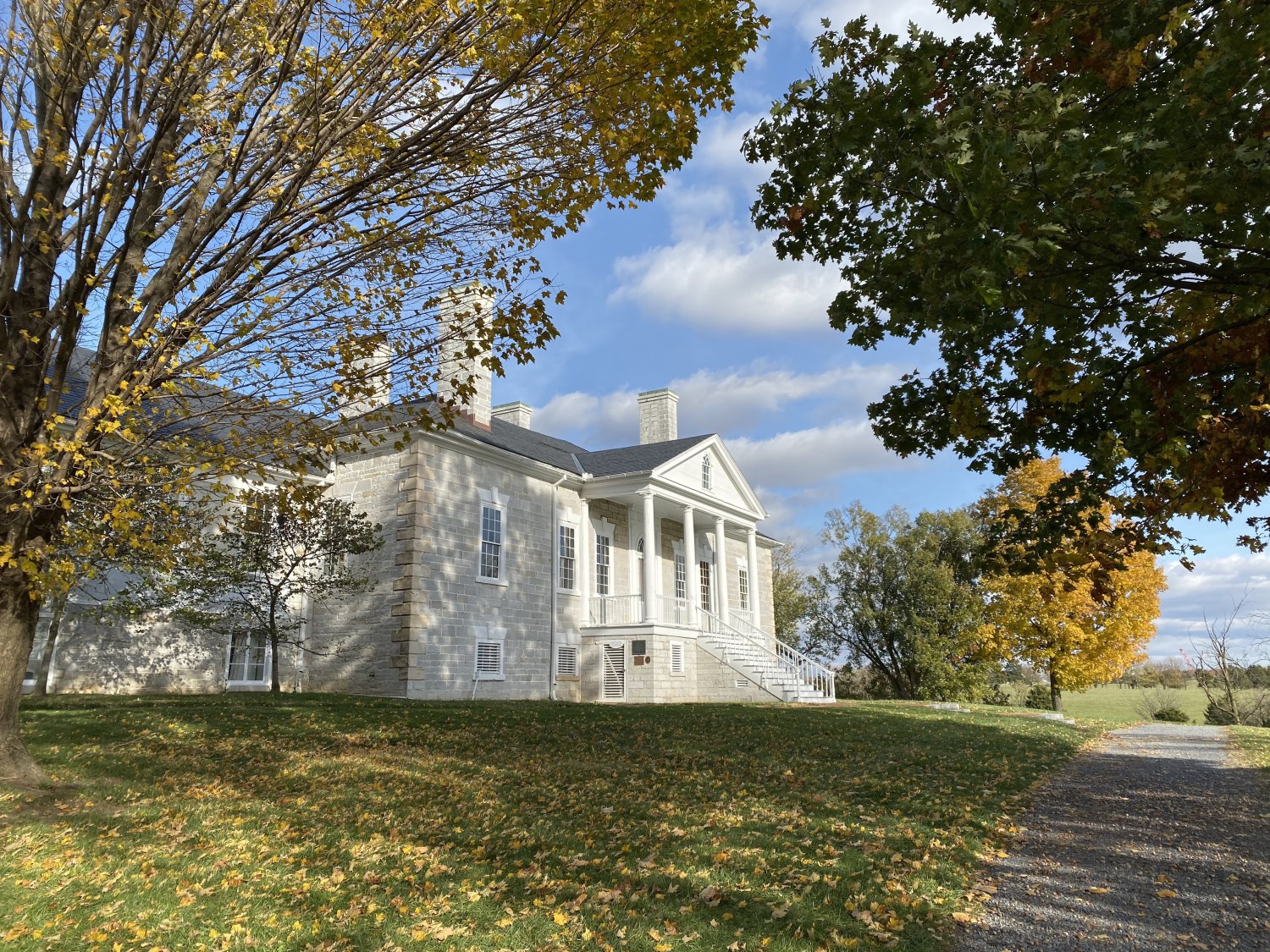
After lunch, I ventured to Belle Grove. As small family-owned farms were booming in the late 1700s, Isaac Hite Jr. began building Belle Grove on the 483 acres that his father had given him in southern Frederick County.  Within twenty years, Hite had increased his holdings to more than 7,500 acres and owned more than 100 slaves.  He lived here with his first wife Nelly Madison, sister of President James Madison.

Belle Grove was Union headquarters during the war, and was surrounded by hundreds of supply wagons, ambulances and tents.  As the Confederates advanced to the plantation manor house, the Union scrambled to evacuate them to safety. Most escaped capture, although the fighting was intense.

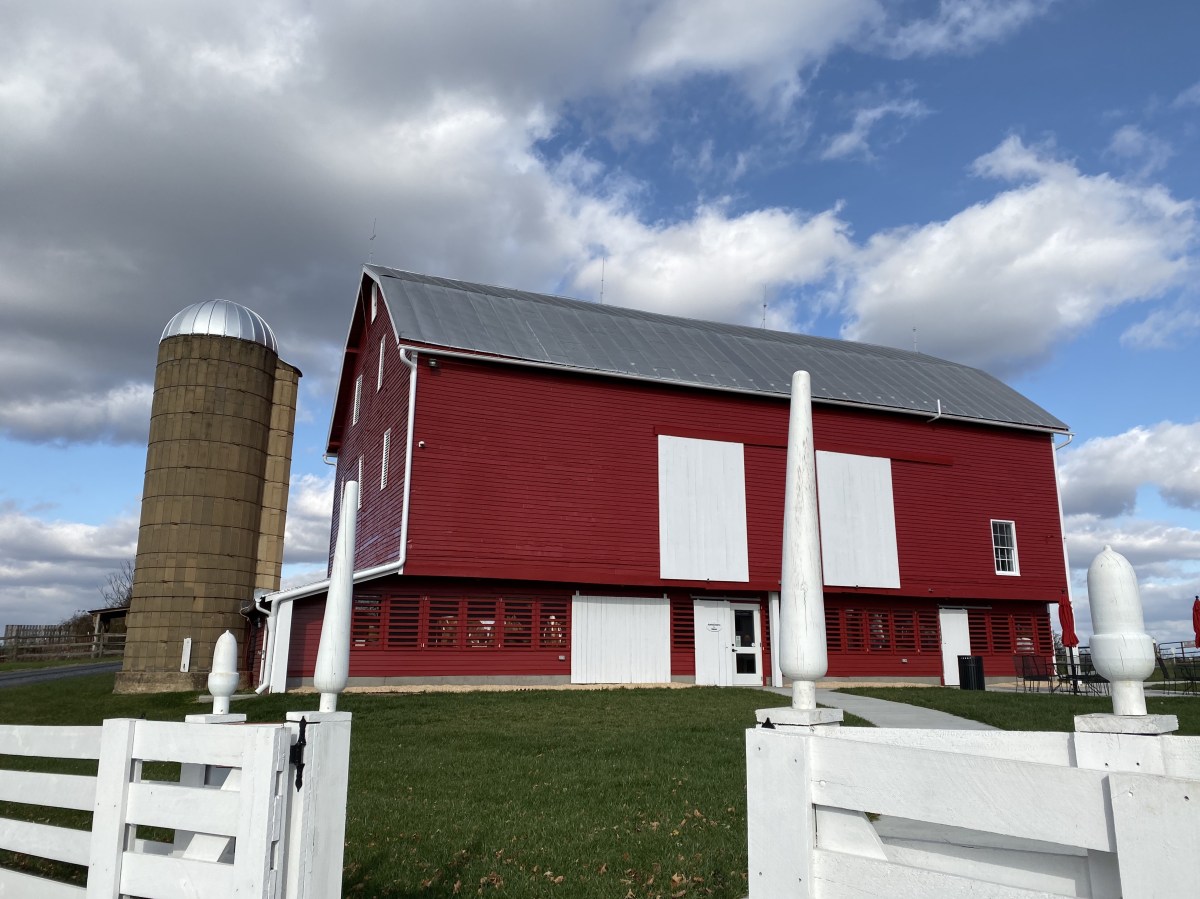
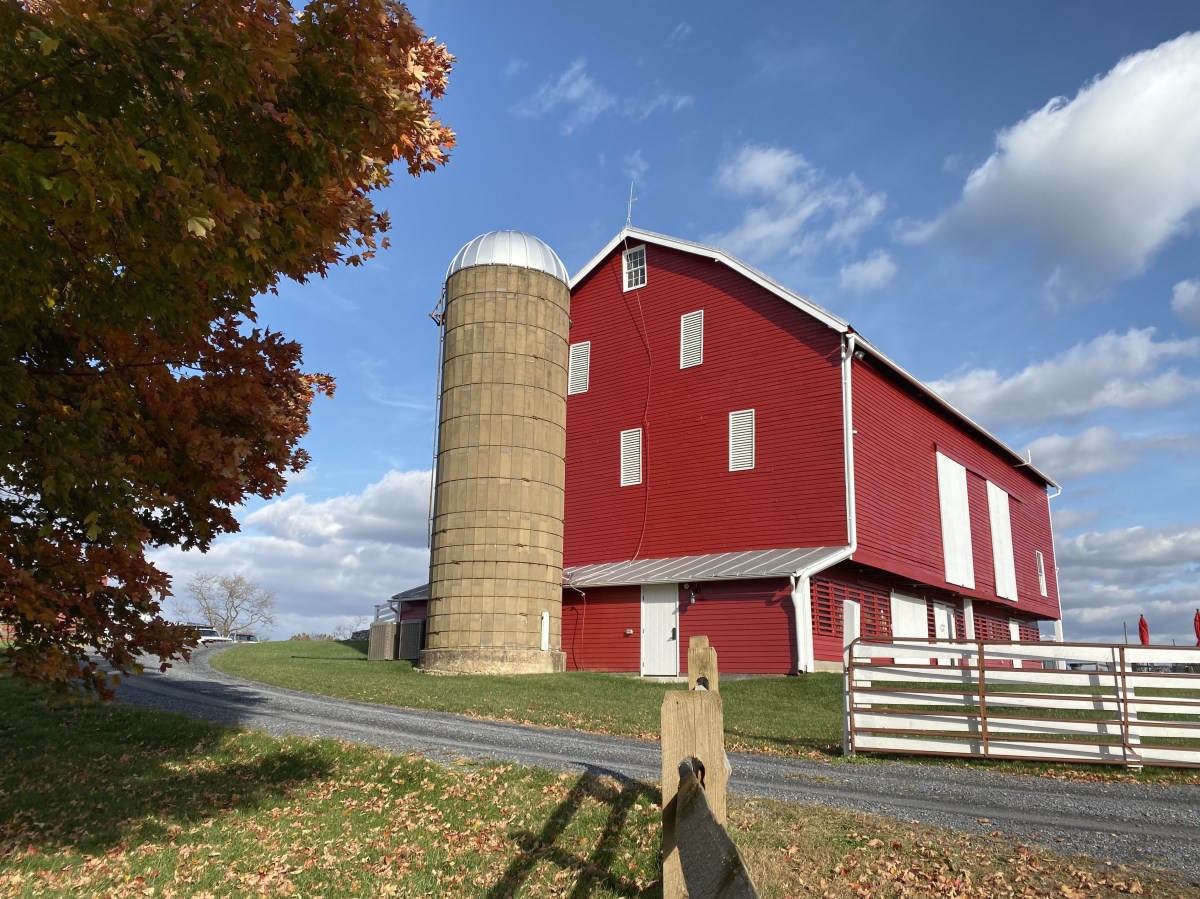
The Belle Grove Bank Barn was built in 1918 by J. Herbert Brumback, who owned Belle Grove from 1907-1929.  The traditional German style barn housed farm animals on the lower level and a threshing floor, granary and haymows in the upper level.

fullsizeoutput_1be43

Belle Grove

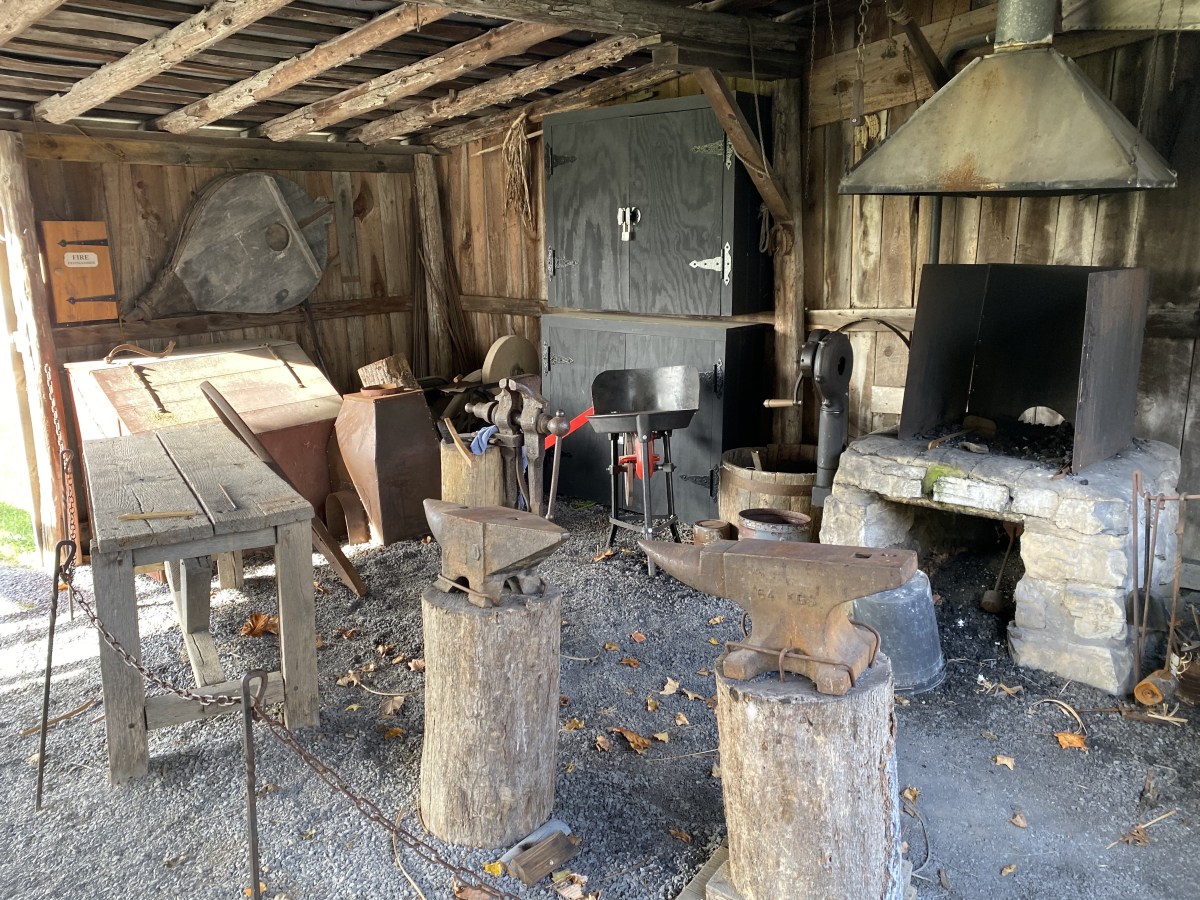
Belle Grove’s blacksmiths were mostly slaves, and they were skilled in many tasks: forging nails, hooks and horseshoes, making and mending farm tools such as axes, shovels, plows and hammers, as well as shoeing horses.  They also made and repaired items used in the house.  Eating utensils, candlesticks, hinges and door latches were common fabricated items.

FhYh7iJoRCKD2pxKqvuUHQ

Belle Grove Forge

v8SvqLmHTGamdudOYktmnA

cow at Belle Grove

Of the many Hite homes in the Valley, Belle Grove is the grandest and the only one open to the public. It is open for guided touring only, but not at the time of year I was there.

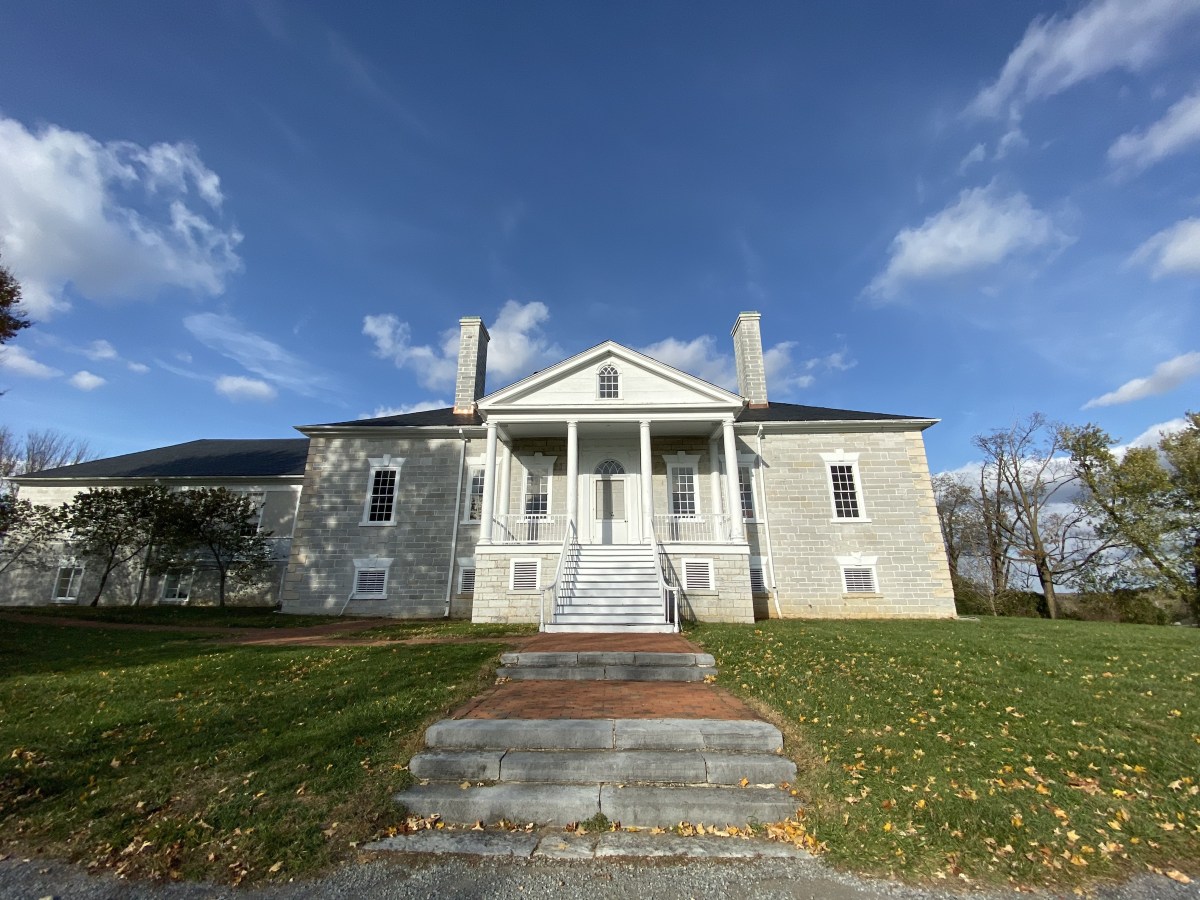
The Manor House was completed in 1797.  Around 1820, the west wing was added to increase living space on the upper level and work space in the basement.

9la7HXb3QJ+xUm1V8dG3DQ

Belle Grove

rAHPiHeJTdpyNTmdlJw

Belle Grove

fg9xBcHYQVyHO2PX%Hi43g

Belle Grove

fullsizeoutput_1be49

Belle Grove

fullsizeoutput_1be4c

Belle Grove

*Friday, Nov 8, 2019*

*11,075 steps, or 4.69 miles*

**************

On Sundays, I post about hikes or walks that I have taken in my travels; I may also post on other unrelated subjects. I will use these posts to participate in Jo’s Monday Walks or any other challenges that catch my fancy.

This post is in response to Jo’s Monday Walk: A Sally through the Salt Marshes.

Share this:

  • Share on X (Opens in new window) X
  • Share on Facebook (Opens in new window) Facebook
  • More
  • Email a link to a friend (Opens in new window) Email
  • Print (Opens in new window) Print
  • Share on Pinterest (Opens in new window) Pinterest
Like Loading...
  • Africa
  • Erg Chebbi
  • International Travel

poetic journeys: letter to the moroccan sahara

wanderessence1025's avatar wanderessence1025 February 7, 2020
                        Letter to the Moroccan Sahara

Dear Erg Chebbi,

It's that time
- listen -
when silence stirs,
after the vanishing roar
of the quads,
after the words 
of the tourists 
are muffled by 
tightly wrapped turbans 
against the onslaught 
of sand.

My day is done.
I shrug off the wind,
the sting of sand,
and admire your voluptuous
ochre brilliance
- fading -
as the sun drifts into
your sea of dunes.
I chew on your thorny plants,
dry grasses and saltbush,
manna in the desert.
I thirst for nothing.

Even after all the moments 
you've graced my life,
you catch me by surprise,
as you fling into the vast
canvas 
     of sky
          ... pinpricks ...
     of sunlight
that you hoarded by day.

They float into darkness
on the whippoorwill's song,
notes serenaded to the night,
and take their proper places
in the constellations,
like a musical score 
to an entrancing ballad.

The night deepens,
the sand chills.
The Egyptian jars
and desert warblers
have their heyday,
singing one thousand
and one nights,
promising not only Scheherazade,
but a long line of virgins,
another morning,
when they might 
shake their bellies
and throw off 
their impenetrable scarves.

With wonder and hope,
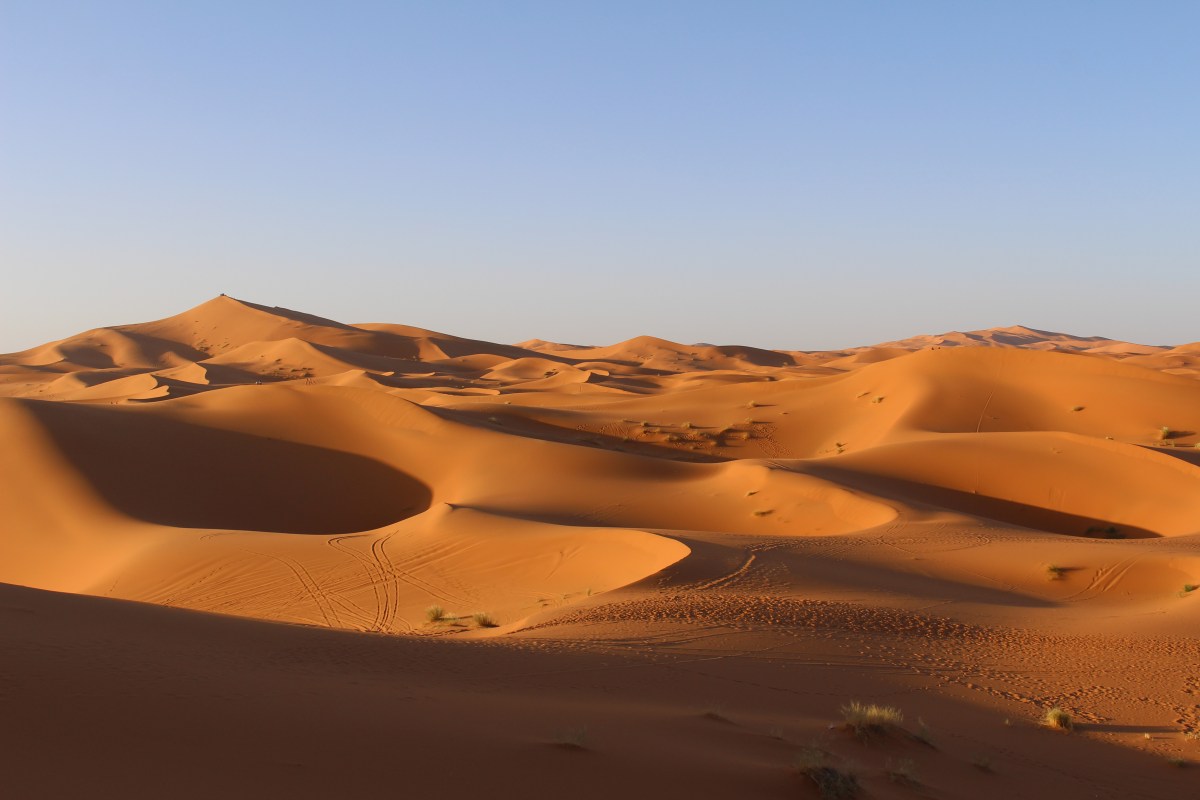
An anonymous dromedary

*Erg Chebbi is an extensive set of sand dunes that are part of the Moroccoan Sahara yet separated from it by a vast hamada (barren, rocky plateau).  It is situated near Merzouga.

IMG_5530

Erg Chebbi

fullsizeoutput_1b5ad

dromedary in the desert

*************************

“POETRY” Invitation: I invite you to write a poem of any poetic form on your own blog about a particular travel destination. Or you can write about travel in general. Concentrate on any intention you set for your poetry.

One of my poetry intentions for my trip to Morocco was this:  Write a letter poem. The poem can be to a town, the sky, a camel, the desert, a famous person, a part of one’s body, to myself, to an idea. Make up a name to sign with. You can write inquiries, or about little things that happen, or things you’ve seen, or made up things (Poetry Everywhere 86). Express affection, fear, curiosity or hope, outrage or gratitude, pride or shame. (Getting the Knack, “Letter Poems,” p. 24-36).

You can either set your own poetic intentions, or use one of the prompts I’ve listed on this page: writing prompts: poetry. (This page is a work in process). You can also include photos, of course.

Include the link in the comments below by Thursday, March 5 at 1:00 p.m. EST. When I write my post in response to this challenge on Friday, March 6, I’ll include your links in that post.

This will be an ongoing invitation, on the first Friday of each month. Feel free to jump in at any time. 🙂

I hope you’ll join in our community. I look forward to reading your posts!

Share this:

  • Share on X (Opens in new window) X
  • Share on Facebook (Opens in new window) Facebook
  • More
  • Email a link to a friend (Opens in new window) Email
  • Print (Opens in new window) Print
  • Share on Pinterest (Opens in new window) Pinterest
Like Loading...
  • America
  • District of Columbia
  • Photography

a japanese take on american landscapes: chiura obata at saam

wanderessence1025's avatar wanderessence1025 February 6, 2020

Chiura Obata (1885-1975) is one of the most important California-based artists and Japanese cultural leaders of the last century.  He received training in classical Japanese sumi-e ink painting in Tokyo, but began to integrate Western practices into his art-making after he immigrated to San Francisco in 1903.  He continued to experiment with different styles and methods throughout his career.

Today the artist is best known for majestic views of the American West, based on hiking trips to capture what he called “Great Nature.”  We went to see an exhibit of his work at the Smithsonian American Art Museum (SAAM) in December.

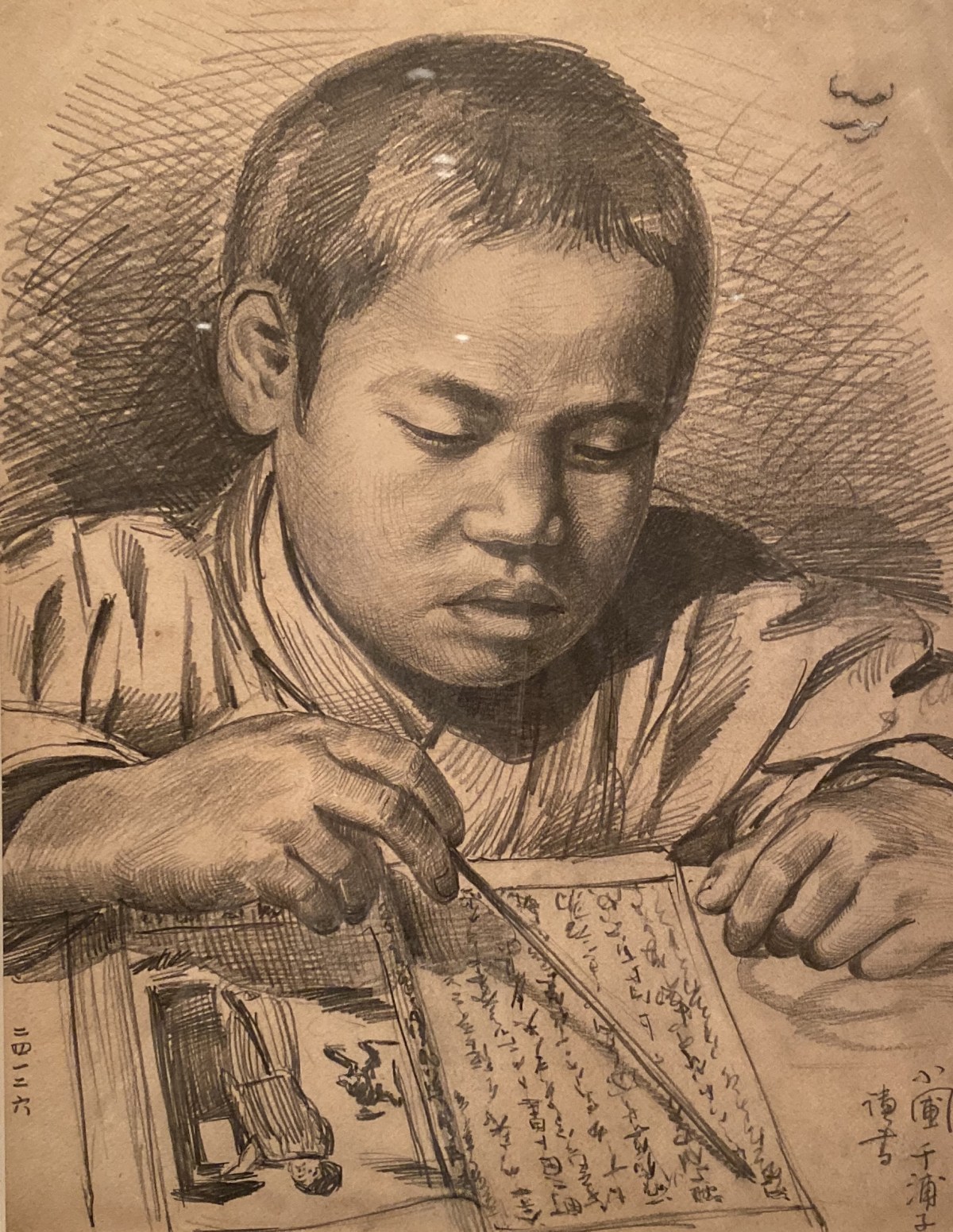
Chiura Obata was born Zoroku Sato in 1885, in Okayama, Japan.  He was raised by his older brother, Rokuichi Obata, a professional artist, who gave him the family name.  He chose a new first name, Chiura – which means “thousand bays.”  This was a common practice among Japanese art students.  His brother sketched a picture of him reading.

fullsizeoutput_1bd8c

Son Chiura Obata Reading by Rokuichi Obata

Obata’s childhood sketchbooks showed an early mastery of brush painting with watercolor and ink. Obata trained in the conservative nihonga (Japanese-style painting) rather than the impressionism that was popular at the time.  This method preferred subjects such as flowers, animals, landscapes and scenes from history and the theater.

fullsizeoutput_1bd8e

Teenage practice book – 1890s

In 1912, Obata married Haruko Kohashi, also an artist and teacher.  She was a master of ikebana, the Japanese practice of arranging flowers in which lines and layers convey moods and poetic messages.  In 1940, she published an ikebana instruction manual, which Obata illustrated.

Maiden of Northern Japan, 1931
Untitled (Magnolia in a Blue Square Vase), about 1930s
Untitled (Aloe and Daffodils), March 1937
Untitled (Narcissuses in a Boat), Feb. 1938
Autumn Weeds, ~ 1930s

Beginning around 1918, Chiura Obata created paintings to use as covers and interior illustrations for JAPAN, a travel magazine for American audiences and customers.

Plum Blossoms, cover of Japan magazine (Feb. 1931)
The Dawn of the New Year, cover of Japan magazine (Jan. 1925)
The Enthronement Drum, cover of Japan magazine (May 1928)
Osaka, the Industrious, cover of Japan magazine (Nov. 1925)

Obata returned to Japan in 1928 and transformed some of his watercolors into woodblock prints. Below is one of a progression of these prints of “Evening at Carl Inn” (1928-30).

fullsizeoutput_1bd9b

“Evening at Carl Inn”

Obata’s first solo show in 1928 led to wide demand for his work.  He was invited to teach in the Art Department at the University of California, Berkeley, in 1932. In 1947, he published a folder of prints reproducing watercolors of landmarks at the University of California, Berkeley, campus.

fullsizeoutput_1bd9c

Campanile (UC Berkeley), 1934

Below are some of Chiura Obata’s tools and materials: a paint box, an ink tray, pigment bottles, brushes, stamps, and minerals used to prepare the pigments.  He often mixed his paints using water collected from streams during summer hikes in the Sierra Nevada.

paint box
paint box
brushes
brushes
pigment bottles
pigment bottles

Obata was an avid traveler who loved to explore the natural beauty of California and other western states. He painted numerous watercolor and ink landscapes outdoors while camping and fishing with other artists.

fullsizeoutput_1bd9d

Evening, about 1930s

fullsizeoutput_1bd9f

Alma, August 6, 1922

fullsizeoutput_1b861

Mountain Stream in Autumn, Happy Isles, 1937

fullsizeoutput_1bda1

Mountain Mist (Gilroy Hot Springs), about 1930s

fullsizeoutput_1bda2

??

fullsizeoutput_1bda4

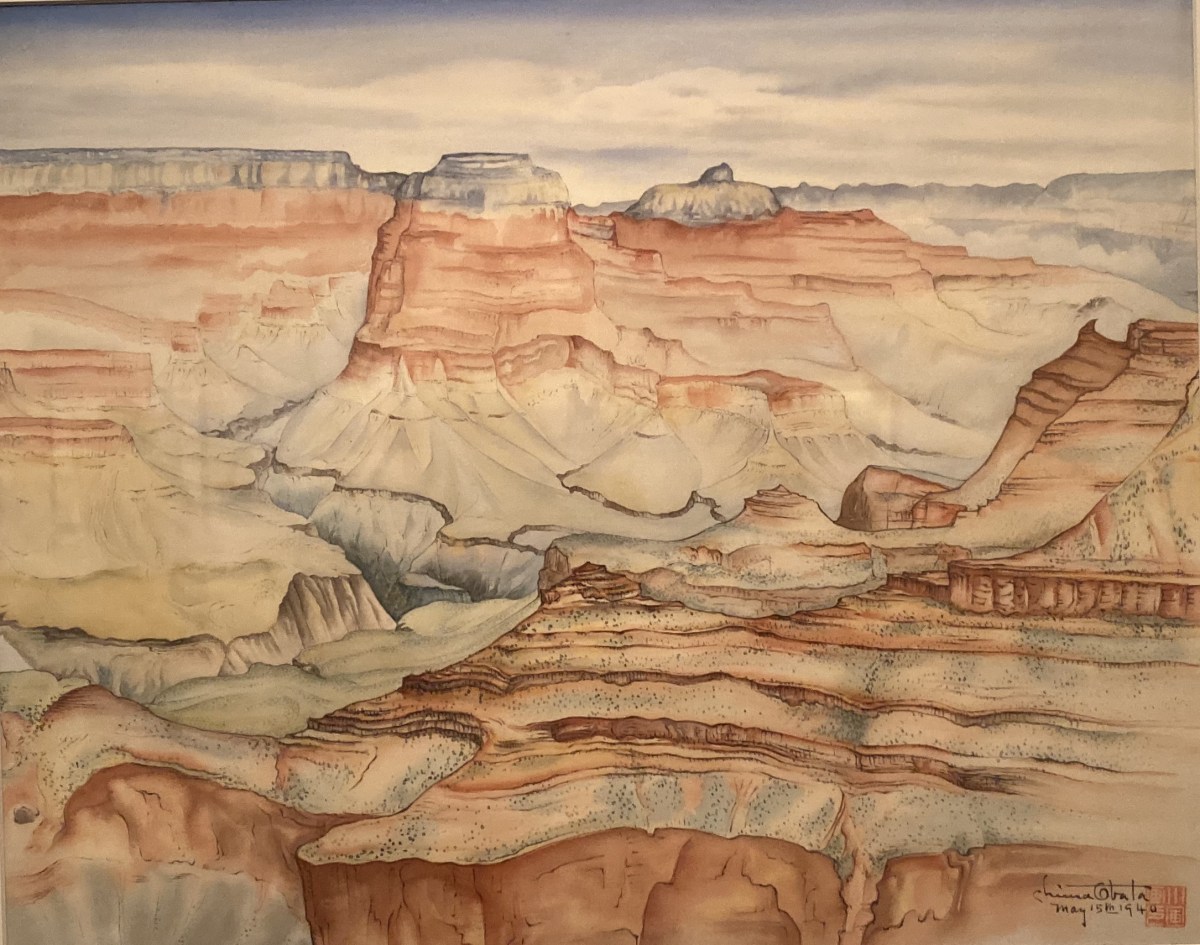
Grand Canyon, May 15, 1940

fullsizeoutput_1bda6

part of the World Landscapes Series, 1930

fullsizeoutput_1bda9

Life and Death, Porcupine Flat, 1930

fullsizeoutput_1bdad

Morning Breeze, High Sierra, 1945

fullsizeoutput_1bdb4

landscape on screen

I loved the artist’s drawings of interiors and his sketchbooks.

indoor-outdoor spots
interior and exterior
sketchbook
sketchbook

As a professor and founder of the East West Art Society, a Bay Area artist’s collective, he opened cross-cultural dialogue despite widespread prejudice against Asian Americans. In 1942, when the U.S. government succumbed to World War II fears, Obata and more than 100,000 West Coast Japanese Americans were forced into incarceration camps.  Obata created art schools in the camps to help prisoners deal with their displacement and imprisonment. Between April 1942 and May 1943, Obata produced more than a hundred drawings and paintings documenting the government’s forced removal of ~120,000 Japanese Americans from their home on the West Coast.

Departure from Berkeley, First Congregational Church, Berkeley, April 30, 1942
In the Train, September 24, 1942
Newcomers from Santa Anita, October 8, 1942
fullsizeoutput_1bdb8

Topaz War Relocation Center by Moonlight, about 1943

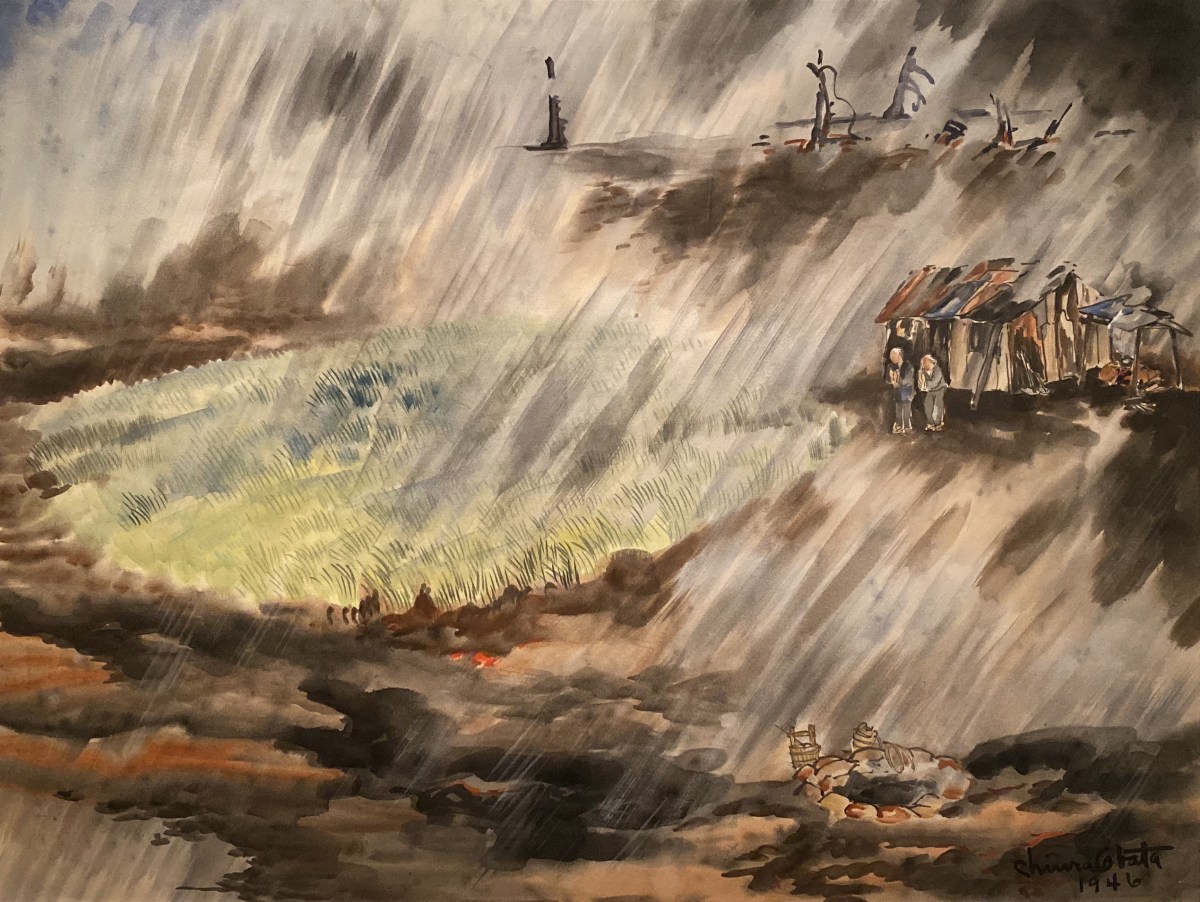
Obata responded to the U.S. atomic bombing of Hiroshima, Japan, in August 1945, with a trio of large watercolor paintings: Devastation, Prayer, and Harmony, showing a cycle of destruction and rebirth.

fullsizeoutput_1bdae

Devastation, 1945

fullsizeoutput_1bdb9

Harmony, 1946

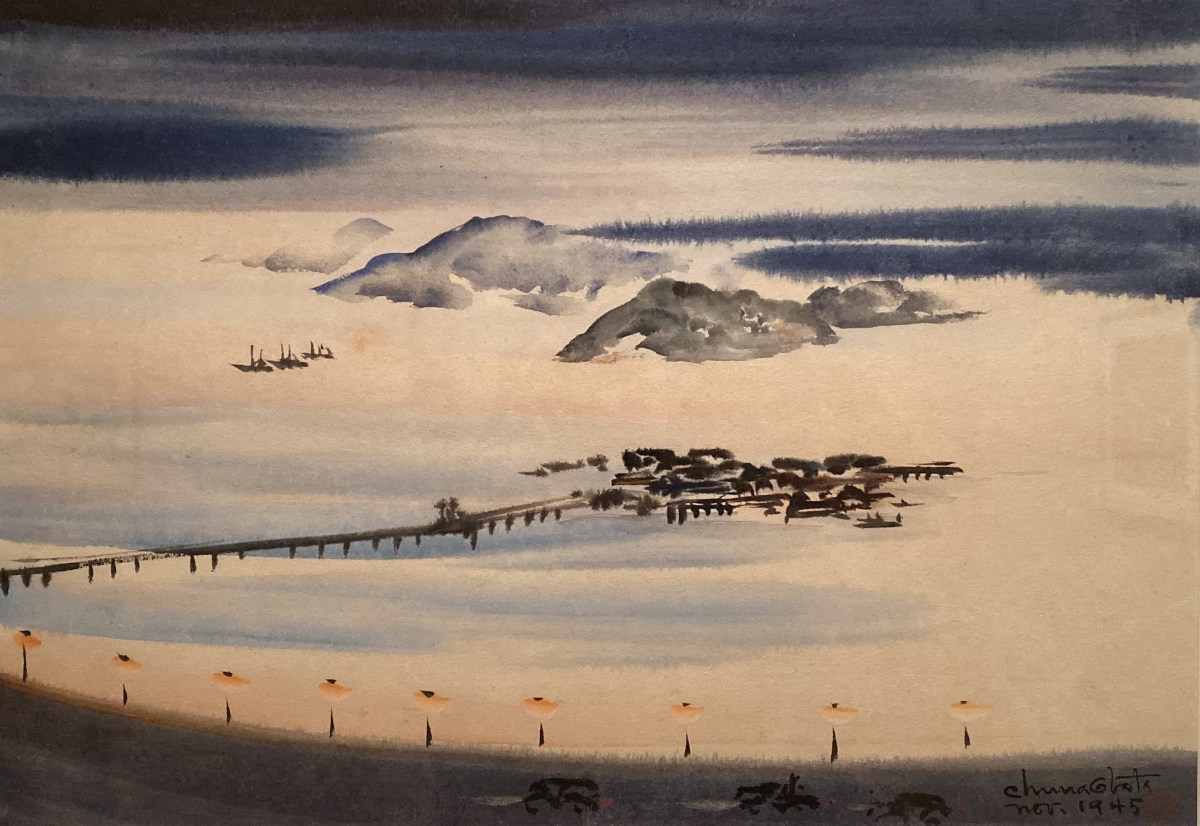
At the end of the war, Obata was asked to resume his art professorship at the Berkeley campus, where he taught until his retirement in 1954.  The painting below captures the moment of his return home in November 1945 after more than three years of imprisonment and displacement.

fullsizeoutput_1bdaf

Dusk: East Bay Bridge, November 1945

*Sunday, December 15, 2019*

The exhibit will continue through May 25, 2020.

(Information about this exhibit came from signs at the exhibit at the Smithsonian American Art Museum.)

*********************

“PHOTOGRAPHY” INVITATION:  I invite you to create a photography intention and then create a blog post for a place you have visited. Alternately, you can post a thematic post about a place, photos of whatever you discovered that set your heart afire. You can also do a thematic post of something you have found throughout all your travels: churches, doors, people reading, people hiking, mountains, patterns, all black & white, whatever!

In this case, I was intrigued to visit the exhibit at the Smithsonian American Art Museum to see a Japanese-American artist’s take on American landscapes.  In addition, I’ve always loved Japanese paintings, and I love Obata’s sketches of the internment of Japanese-American citizens during World War II.

You probably have your own ideas about this, but in case you’d like some ideas, you can visit my page: photography inspiration.

I challenge you to post no more than 20-25 photos and to write less than 1,500 words about any travel-related photography intention you set for yourself. Include the link in the comments below by Wednesday, February 5 at 1:00 p.m. EST.  When I write my post in response to this challenge on Thursday, February 6, I’ll include your links in that post.

This will be an ongoing invitation, every first, second, and third (& 5th, if there is one) Thursday of each month. Feel free to jump in at any time. 🙂

I hope you’ll join in our community. I look forward to reading your posts!

Share this:

  • Share on X (Opens in new window) X
  • Share on Facebook (Opens in new window) Facebook
  • More
  • Email a link to a friend (Opens in new window) Email
  • Print (Opens in new window) Print
  • Share on Pinterest (Opens in new window) Pinterest
Like Loading...
  • American Road Trips
  • Delaware
  • New Castle

on returning home from delaware

wanderessence1025's avatar wanderessence1025 February 3, 2020

My trip to Delaware last June was marred by a case of identity theft. The day before leaving home, I had received a phone call from a number “spoofing” my bank’s phone number (which was entered as a contact in my phone). The person on the line identified himself as being with the bank’s fraud department; he told me someone had used my debit card twice in Atlanta, Georgia to the tune of $500 each time. After 45 minutes on the line with this person, who fooled me into believing he was from my bank, I found out through various notifications from the bank that I had in fact been talking to the fraudster! He had, while on the phone with me, stolen nearly $3,500 from my account from various places in Florida.

I had to stop by my bank on the way out of town to alert them to the fraud, but there was nothing I could do until the withdrawals had cleared.  Thus the situation hung over my head during my entire trip, and I couldn’t do anything about it until I returned home.  I was unable to fully relax and enjoy when I didn’t know the outcome of the fraud.

Luckily, my bank put the stolen money in my account fairly quickly as a temporary deposit. Finally it was resolved, but not until a month or two after I returned home. Apparently many other customers of our bank had been taken by the same scam. It was the “spoofing” of the bank’s phone number that fooled most people.

One of my intentions for my trip to Delaware was to take photos in black and white or sepia.  Since I never wrote a post featuring black & white photos, I picked some of my favorite below to convert.  The black & white lends a nostalgic air to the places I visited.

Another intention was to make a list of all the things I’d miss from my trip once I returned home.

  1.  I’ll miss wandering through the kitschy beach town of Rehoboth, with its salt water taffy, ice cream, and souvenir shops, and its boardwalk along the beach.  I’ll also miss eating the best crab cakes around at Woody’s in Dewey Beach.
fullsizeoutput_1c116

Dolle’s at Rehoboth

fullsizeoutput_1c117

kitschy Rehoboth

fullsizeoutput_1c118

Archie’s at Rehoboth

2. I’ll miss riding my bicycle around Cape Henlopen State Park, with its excellent bike trails through marshlands.

fullsizeoutput_1c119

bicycle at Cape Henlopen State Park

3. I’ll miss visiting the Biggs Museum of American Art in Dover, where I saw an excellent exhibit of African figures from the continent: “Spirit Revealed: New Works by Aaron Paskins.”  I loved finding cool art made from paper, especially one piece that looked like a found poem;  I’ve been trying to write some of those myself.

fullsizeoutput_1c11a

Biggs Museum of American Art

fullsizeoutput_1c11b

paper art at Biggs Museum

fullsizeoutput_1c11c

poetic paper art at Biggs Museum

fullsizeoutput_1c11e

flight of birds outside the Biggs Museum

4. I’ll miss visiting New Castle and learning about the three cultures that vied for dominance in the region: the Dutch, the Swedes, and the English.

fullsizeoutput_1c120

New Castle

5.  Lastly, I’ll miss walking around the beautiful gardens and grounds of Nemours Estate.

fullsizeoutput_1c122

Nemours Estate

There were still more places I wanted to visit in Delaware, but time ran out.  Since the state is so close by, I hope to get back there and revisit Dover and the First State Heritage Park, The Old State House, and the John Victrola Museum. I’d also love to visit one of the other wildlife refuges, like Prime Hook National Wildlife Refuge, and ride a bicycle again at Cape Henlopen State Park. I’d also love to explore more of Bethany Beach and the historic town of Lewes. Finally, I’d like to explore more of Wilmington.

I created a number of posts about my trip to Delaware, reflecting on specific themes for some of the days, and using 5 random nouns in some essays.

  1. the call to place: delaware
  2. anticipation & preparation: delaware
  3. on journey: delaware
  4. marshlands & american art in delaware
  5. the kitschy beach town of rehoboth, delaware
  6. delaware: new castle & old swedes church
  7. delaware: nemours estate
  8. poetic journeys: psychic at the beach

I visited Delaware from June 4-6, 2019.

*************************

“ON RETURNING HOME” INVITATION: I invite you to write a post on your own blog about returning home from one particular destination or, alternately, from a long journey encompassing many stops.  How do you linger over your wanderings and create something from them?  How have you changed? Did the place live up to its hype, or was it disappointing? Feel free to address any aspect of your journey and how it influences you upon your return. If you don’t have a blog, I invite you to write in the comments.

For some ideas on this, you can check out the original post about this subject: on returning home.

Include the link in the comments below by Sunday, March 1 at 1:00 p.m. EST.  When I write my post in response to this challenge on Monday, March 2, I’ll include your links in that post.

This will be an ongoing invitation on the first Monday of each month. Feel free to jump in at any time.

Share this:

  • Share on X (Opens in new window) X
  • Share on Facebook (Opens in new window) Facebook
  • More
  • Email a link to a friend (Opens in new window) Email
  • Print (Opens in new window) Print
  • Share on Pinterest (Opens in new window) Pinterest
Like Loading...
  • Africa
  • Fès
  • Fez

a whirlwind tour of fez, morocco

wanderessence1025's avatar wanderessence1025 February 2, 2020

Today, our local guide in Fez was Hashim.We started in Fez el-Jdid (the new medina of Fez), which is only 700 years old.  The paranoid Merenid Sultan Abu Yusuf Yacoub (1258-86) built the quarter as a political and administrative hub and used Syrian mercenary guards to isolate himself from his subjects.

Our first stop was the Royal Palace, Dar el-Makhzen, at the entrance to the grand square.  It wasn’t open to the public so we just looked at the imposing brass doors, surrounded by fine zellij (tilework) and carved cedar wood.  Lemon trees stood daintily off to the side.  The guards posed for pictures.

fullsizeoutput_1bc7a

Dar el-Makhzen (Royal Palace)

Dar el-Makhzen (Royal Palace)
guards at Dar el-Makhzen (Royal Palace)
the grand square
the grand square
Dar el-Makhzen (Royal Palace)

We walked next to the palace walls along the outer edge of the Jewish Quarter, or Mellah.  In the 14th century, Fez el-Jdid became a refuge for Jews. Mellah means “salt” and was called this because the Jews sold salt, in addition to jewelry.  This quarter offered the Jews protection and they in turn repaid the sultan with loyalty during conflicts.  The Jewish people were also protected by the sultans for their precious metal trade.  The old houses had open balconies of curved wood and wrought iron looking out over the streets, a contrast to Muslim styles. After the 15th century, Jews were not allowed to leave the mellah without papers, and they weren’t allowed to wear shoes outside the mellah.

Now there are only 200 Jews in the Mellah as most have moved to the Villa Nouvelle, or further afield, to France, Israel or the U.S.

fullsizeoutput_1bb99

Mellah

fullsizeoutput_1bb97

Mellah

Our guide drove us to a cemetery on a hill where we had a panoramic view of Fez nestled into its hills. People visit the cemetery on Fridays and Holy Days.  We weren’t allowed to enter it.

fullsizeoutput_1bb9b

cemetery overlooking Fez

fullsizeoutput_1bbbe

cemetery overlooking Fez

fullsizeoutput_1bbc1

cemetery overlooking Fez

IMG_5300

view of Fez from the cemetery

fullsizeoutput_1bba5

cemetery overlooking Fez

fullsizeoutput_1bba7

cemetery overlooking Fez

At a ceramics factory, we watched craftsmen making pottery and tiles.  They did a four-year apprenticeship.  One potter, age 34, had been a potter for 17 years.  He demonstrated how to make different shapes like a tajine and a candlestick. I wanted a beautiful bowl but it was $300 to buy and ship – too much! I was wracked with indecision and didn’t end up buying anything. I liked so much though, and I hoped I’d see cheaper ceramics in the market.  Sadly we didn’t have much free time in Fez for shopping.

ceramics at the factory
pretty bowl
pretty bowl
vase
vase
another vase
another vase
potters
potters
ceramics
ceramics
ceramics
ceramics
potter
potter

When we first went into the old medina, we walked around the residential area, which was very quiet with narrow lanes and mudbrick walls.  This part of Fez was founded in 805 A.D.

fullsizeoutput_1bbc2

residential area of Fez

fullsizeoutput_1bc7b

residential area of Fez

fullsizeoutput_1832c

petals in residence

We then walked through the medina, Fès el-Bali, tempted by olives and fruits.  We walked past the fruit and vegetable sellers and the meat sellers.  The Fez medina is full of labyrinthine lanes where it is easy to get lost; I guess that’s why our guide didn’t turn us loose.

fullsizeoutput_18d81

olives in the medina

IMG_4887

olives in the medina

fullsizeoutput_18330

pears in the medina

walking through the medina
lattice shadows in the medina
a canal in the medina

Some musicians in colorful dress marched through singing, drumming and playing cymbals.

fullsizeoutput_1bbfe

Entertainers in the medina

We headed for the Chouwara Tanneries, one of Fez’s most iconic sights – and smells. They handed us sprigs of mint to put over our noses, but it barely kept the horrible odor at bay. Strong odors of skin and dye wafted all around the tanneries.  Cow, goat, sheep, and camel are all used to make leather.

The tanning pits are surrounded by leather goods shops.  Each shop has a terrace with an overlook.  I bought an emerald green wallet, a mustard yellow wallet, and a deep green tote with turquoise suede lining.

IMG_4897

me with mint over my nose at the tanneries

fullsizeoutput_1bc12

Chouwara Tanneries in Fez

fullsizeoutput_1bc1d

Chouwara Tanneries in Fez

fullsizeoutput_1bc0f

leather bags in Fez

IMG_4908

Chouwara Tanneries in Fez

fullsizeoutput_1bc23

Chouwara Tanneries in Fez

We had a look through the doors of Qaraouiyine Mosque and University, one of Africa’s largest mosques and possibly the oldest university in the world.  This mosque complex is the spiritual heart of Fez and Morocco.  Established in 857 by Fatima al-Fihri, the daughter of a Tunisian refugee, and expanded by the Almoravids in the 12th century, it can accommodate 22,000 at prayer.  We observed it from the gates on Talaa Kebira and Place as-Seffarine.  Non Muslims are forbidden to enter.

fullsizeoutput_1bc0b

Kairaouine Mosque and University

fullsizeoutput_1b482

Kairaouine Mosque and University

Fès el-Bali is a crazy place to walk, because mule drivers and motorized vehicles push their way through the narrow walkways.  Mule drivers yell “balak” or “look out,” which is barely enough warning to avoid getting run down.

fullsizeoutput_18322

dried figs in the medina

IMG_4921

dried fruits in the medina

fullsizeoutput_1bc66

brass plates in the medina

IMG_4941

slippers in the medina

fullsizeoutput_1bc67

slippers in the medina

We dipped into the Islamic college: Medersa el-Attarine, founded by Abu Said in 1325 in the heart of the medina.  It’s a separate annex to the Kairaouine Mosque.  Halls for teaching and a modest masjid (mosque) flank the central courtyard. Multiple floors with dormitories surrounded the courtyard.  It showcases traditional Merenid artisanship: zellij (tilework) base, stuccowork, and cedar wood at the tops of walls and on ceilings.

Medersa el-Attarine
Medersa el-Attarine
Medersa el-Attarine
Medersa el-Attarine
Medersa el-Attarine
Medersa el-Attarine
Medersa el-Attarine
Medersa el-Attarine
Medersa el-Attarine
Medersa el-Attarine
stairway at Medersa el-Attarine
Medersa el-Attarine
Medersa el-Attarine
Medersa el-Attarine
Medersa el-Attarine
Medersa el-Attarine
Medersa el-Attarine
Medersa el-Attarine
Medersa el-Attarine
Medersa el-Attarine
Medersa el-Attarine

We then went to lunch on a terrace overlooking the town. We were served up salad, aubergine, green beans, beets, carrots, anise, lentils, and bread – all in little individual dishes. Susan and I shared a Kafta tajine.  I drank fresh orange juice, always a welcome treat in Arab countries. For dessert we had orange and banana slices sprinkled with cinnamon.  It was delicious.

lunch on the terrace

We stopped into a weaving shop where I bought three scarves: 1) a pink and black striped one; 2) a purple crinkled one; and 3) a blue-gray crinkled one. 🙂 We stopped in another shop selling jewelry, ceramics inlaid with silver, paintings, and lots of other stuff, but I didn’t buy anything.

fullsizeoutput_18312

Door in Fez

fullsizeoutput_1bc44

wedding party in Fez

fullsizeoutput_1bc6e

street art in the medina

fullsizeoutput_1bc7e

patisserie

fullsizeoutput_1bc74

two types of transport

Nicknamed the “Blue Gate” because of the blue zellij tile work on the outside, Bab Boujeloud is one of the newest gates of the medina.  It was built in 1913, and its color reflects the blue color of the city of Fez.

fullsizeoutput_1bc75

the blue gate of Bab Boujeloud in Fez

I felt like we didn’t do Fez justice.  The tour was mostly a waste, taking us to various shops to entice us to spend money.

When we got back to the hotel, Susan went out for a walk and coffee with the young clique, and I went for an hour-long hot stone massage at Hôtel Mounia.  Two Moroccan women massaged me simultaneously with warm oil, using hot smooth stones to rub over my body.  I wore tiny paper bikini underpants and nothing else, so I felt rather exposed! When I turned over on my back, one of the ladies grabbed my chubby belly and said in French “graisse.”  I said in English, yes, I know it is “fat,” but it’s not nice (“harram” – which actually means “sinful” but I didn’t know the proper word to use) to tell a woman that.  After the massage, I was covered in oil, so I had to go up and soak in a hot bath to wash the oil from my hair and body.

Later, I was sitting in the lobby trying to decide what to do, and Susan came back and suggested we go out for a pizza, which we did at a small hole-in-the-wall just down from our hotel. During dinner she told me how her grandfather was a butcher and their family lived for some time above the butcher shop.

*Steps: 11,340, or 4.81 miles*

*Friday, April 12, 2019*

**************

On Sundays, I post about hikes or walks that I have taken in my travels; I may also post on other unrelated subjects. I will use these posts to participate in Jo’s Monday Walks or any other challenges that catch my fancy.

This post is in response to Jo’s Monday Walk: Vaqueiros in Spring.

Share this:

  • Share on X (Opens in new window) X
  • Share on Facebook (Opens in new window) Facebook
  • More
  • Email a link to a friend (Opens in new window) Email
  • Print (Opens in new window) Print
  • Share on Pinterest (Opens in new window) Pinterest
Like Loading...
  • Asia
  • China
  • International Travel

jude’s photo challenge: composition

wanderessence1025's avatar wanderessence1025 January 30, 2020

Jude of Travel Words has challenged us to experiment with our photography using different photographic techniques or topics.  For January, she’s given us several aspects to focus on. Because I didn’t go anywhere this month where I could practice these techniques, I looked for images in my archives which show different composition choices.

  1. Clearly identify your subject. Begin by explaining your choice.  How will you draw attention to it? (2020 Photo Challenge #1)

My subject is a pair of statues: Maitreya, the smiling Buddha, and Guanyin.  They stand on the cliff ledges at Baoxiang Temple, also known as “Suspending Temple,” in Shibao Shan in China.  Here I wanted to show the two statues in their setting, set up high in the nook of a cliff with two small temples flanking them. You can see the rooftop at the bottom of the photo, which shows they sit higher than at least one temple in the complex.  However, this photo doesn’t properly capture the height as it was quite a climb up to the village from the valley floor.

fullsizeoutput_f8c

Baoxiang Temple, also known as “Suspending Temple”

fullsizeoutput_1c05a

Baoxiang Temple, also known as “Suspending Temple”

2. Move in closer to your subject but not too close. Lead the viewer towards the subject. (2020 Photo Challenge #2)

Here, I got closer to the two statues, showing them under the ledge with one of the temples behind them.  The lighting was a real challenge as the statues were in shadow.  In many of my shots, the green hill in the background was totally washed out.

fullsizeoutput_1c05f

Maitreya, the smiling Buddha, and Guanyin

3. Get in closer still. Decide whether to use the vertical or horizontal aspect ratio. Image orientation produces different emphases and can alter the whole dynamic of a shot. (2020 Photo Challenge #3)

Here, I got in closer to the two statues, directly underneath them.  In the first photo, I decided to use the horizontal aspect ratio to capture both statues.  In the second photo, I wanted Guanyin with the temple behind.

fullsizeoutput_455

Maitreya, the smiling Buddha, and Guanyin

fullsizeoutput_1c05d

Guanyin

4. Simplify your image.  What is it you want the viewer to focus on? (2020 Photo Challenge #4)

Finally, I took photos from below each statue individually, looking up at them. Maitreya is horizontal, because the smiling Buddha is so wide.  In the case of Guanyin, I captured it vertically, because the statue is tall and thin.

P2096997

Maitreya, the smiling Buddha

fullsizeoutput_1c05b

Guanyin

I hope next month to be able to participate with new photos! Thanks to Jude for hosting this challenge. 🙂

*********************

“PHOTOGRAPHY” INVITATION:  I invite you to create a photography intention and then create a blog post for a place you have visited. Alternately, you can post a thematic post about a place, photos of whatever you discovered that set your heart afire. You can also do a thematic post of something you have found throughout all your travels: churches, doors, people reading, people hiking, mountains, patterns, all black & white, whatever!

In this case, I’m participating in Jude’s photo challenge, so this is simply in response to her posts.

You probably have your own ideas about this, but in case you’d like some ideas, you can visit my page: photography inspiration.

I challenge you to post no more than 20-25 photos and to write less than 1,500 words about any travel-related photography intention you set for yourself. Include the link in the comments below by Wednesday, February 5 at 1:00 p.m. EST.  When I write my post in response to this challenge on Thursday, February 6, I’ll include your links in that post.

This will be an ongoing invitation, every first, second, and third (& 5th, if there is one) Thursday of each month. Feel free to jump in at any time. 🙂

I hope you’ll join in our community. I look forward to reading your posts!

Share this:

  • Share on X (Opens in new window) X
  • Share on Facebook (Opens in new window) Facebook
  • More
  • Email a link to a friend (Opens in new window) Email
  • Print (Opens in new window) Print
  • Share on Pinterest (Opens in new window) Pinterest
Like Loading...
  • Africa
  • Chefchaouen
  • Fès

morocco: the ancient roman ruins at volubilis

wanderessence1025's avatar wanderessence1025 January 28, 2020

It would be 3 1/2 hours to Volubilis on winding mountain roads through green fields and forests. I was surprised by all the green I was finding in Morocco.  We stopped for one look back at Chefchaouen before we left the blue town behind.

fullsizeoutput_1ba80

farewell to Chefchaouen

We went through a poor area in a mountainous region with ramshackle dirty houses and a river snaking through the valley amidst piles of rubble and laundry hanging on rooftops. Towns were badly in need of fresh paint.

We stopped for a restroom break at a place with a swimming pool and dining tables set formally with tablecloths clustered around the pool.

The landscape flattened and eucalyptus trees lined the road under chilly gray skies.  This was farmland with neat rows of crops – barley and chickpeas – and orange orchards; yellow flowers highlighted the fields. We passed a donkey pulling a cart, a flock of sheep and lambs, a shepherd wearing the djellaba. Cows grazed beside the road.  I felt like I’d taken a trip back in time to a previous century.  Orange groves and olive trees lined up neatly on the horizon. We stopped at a roadside stand for some oranges fresh off the trees.

a stop at the orange orchards
orange orchards
orange orchards

We arrived in Volubilis by noon.  The site is a large expanse of Roman ruins in the middle of a fertile plain about 33km north of Meknès. It is the best preserved archeological site in Morocco, declared a UNESCO World Heritage Site in 1997.  Excavation is slowly ongoing, with only half the site excavated. It has an amazing number of mosaics preserved in situ.

Evidence has been found, such as Neolithic pottery, indicating that this area was settled as long ago as 3000 BC due to its fertile valley. Later it was settled by Phoenicians and subsequently by Carthaginian traders in the 3rd century B.C.  One of the Roman Empire’s most remote outposts, it was annexed around 40 A.D. Up to 20,000 people lived here, planting wheat and deforesting massive swaths of land. The Romans abandoned it in 280.  It then prospered under local rule as an Amazigh capital, and its population of Berbers, Greeks, Jews and Syrians spoke Latin until the arrival of Islam. Moulay Idriss founded a sanctuary here in the 8th century before moving the capital to Fès.

fullsizeoutput_1ba88

The Roman Empire

IMG_5167

Volubilis and its fertile plains

fullsizeoutput_1bb08

Volubilis

fullsizeoutput_1bb0e

Volubilis

Volubilis was inhabited until the 18th century when its marble and precious stone was plundered for Moulay Ismail’s palaces in Meknès.  The buildings were finally destroyed in the Lisbon earthquake of 1755.

fullsizeoutput_1bb17

Volubilis

IMG_4855

Volubilis

fullsizeoutput_1bb1f

Volubilis

fullsizeoutput_1bb34

Volubilis

fullsizeoutput_1bb38

Volubilis

IMG_5192

Volubilis

IMG_5206

Volubilis

fullsizeoutput_1baae

Volubilis

At Volubilis, olive groves and nearly 60 olive presses were found, indicating olive oil was the economic backbone of the settlement.  A female skeleton was found facing Mecca, indicating she was Muslim.

Galen’s Baths was a Roman hammam with underfloor heating and communal toilets.

IMG_5212

Galen’s Baths

fullsizeoutput_1baef

public toilets at Volubilis

The Capitol from 218 was dedicated to the triad Jupiter, Juno and Minerva.

fullsizeoutput_1bfdf

The Capitol

A Roman Basilica to the north had columns topped with storks’ nests. The original building was two stories tall. Local markets were held in the surrounding forum.

fullsizeoutput_1ba95

Roman Basilica

IMG_5188

stork’s nest at the Roman Basilica

fullsizeoutput_1ba9e

Roman Basilica

fullsizeoutput_1ba9f

Roman Basilica

fullsizeoutput_1baab

Roman Basilica

The marble triumphal arch, called the Arch of Caracalla, dated from 217 AD, was built to honor Emperor Caracalla and his powerful mother, Julia Domna.

fullsizeoutput_1bab0

Triumphal Arch

Volubilis
Volubilis
Volubilis
Volubilis
Volubilis
Volubilis
Volubilis
Volubilis
Volubilis
Volubilis
Volubilis
Volubilis
Volubilis
Volubilis

There are a number of houses with mosaics along the main thoroughfare and ceremonial road: Decumanus Maximus.

fullsizeoutput_1baf7

Decumanus Maximus

fullsizeoutput_1bb00

arches along Decumanus Maximus

fullsizeoutput_1bb01

Volubilis

The House of the Acrobat showed an athlete getting a trophy for a race in which he dismounted and jumped back on as the horse raced along.

fullsizeoutput_1baa8

House of the Acrobat

The House of Ephebe showed a man who seems to be fishing with a lot of text and graffiti in a jumble all around him.

fullsizeoutput_1baa9

House of Ephebe mosaic

The Orpheus mosaic showed Orpheus taming the animals with his music.

fullsizeoutput_18375

Orpheus Mosaic

fullsizeoutput_1bb12

Orpheus Mosaic

The House of Columns had columns around an interior court.

fullsizeoutput_1bab9

House of Columns

IMG_5230

House of Columns

fullsizeoutput_1babd

House of Columns

The House of the Knight had an incomplete mosaic of Bacchus and naked Ariadne.

fullsizeoutput_1bb6a

Bacchus and naked Ariadne in the House of the Knight

The House of the Labors of Hercules had a circular mosaic showing the twelve labors.

fullsizeoutput_1baf1

House of the Labors of Hercules

In the House of Orpheus was a mosaic with nine dolphins.

fullsizeoutput_18376

House of Orpheus, Mosaic with Nine Dolphins

Another mosaic showcased sea creatures.

fullsizeoutput_1bb10

mosaic with sea creatures

fullsizeoutput_1bb13

mosaics near sea creatures

fullsizeoutput_1ba8e

mosaic details

There was a lone cypress tree at the House of Venus, showing the rather erotic abduction of Hylas by the Nymphs and Diana Bathing, glimpsed by the hunter Acteon.  She turned him into a stag as punishment.  Sadly, I somehow missed these two most important mosaics in the entire complex!

We didn’t spend much time in the Interpretation Center, but I was caught by one mosaic: Mosaic of the Triton; its dolphins were a symbol of good fortune in Roman times.

fullsizeoutput_1bb1e

Mosaic of the Triton

fullsizeoutput_1bb20

The Roman Empire

We stopped outside of Meknès for a lunch made by a women’s cooperative.  It was a rather derelict building in a rural area with mangy dogs wandering around. The ladies there served up a cucumber tomato salad, a delicious aubergine, lentils, chicken roasted with a nice sauce and olives, oranges and mint tea for dessert.

fullsizeoutput_1836a

chicken lunch in Meknès

fullsizeoutput_1836b

woman in cooperative pouring mint tea in Meknès

I said “Dusharufna” (an archaic form of “pleased to meet you”) to our driver Saeed and he got a hoot out of that.  He kept laughing and greeting me with a handshake and speaking to me in Arabic. It was funny when he laughed and smiled because he had braces, a mouth full of shiny metal.

As we drove the final half hour to Fès, Aziz told us that there are 35 CEOs with G Adventures in Morocco.  He told us habibi means sweetheart, but could also mean best friends for men.  I already knew about the “sweetheart” meaning, but not about the best friends between men.

We arrived in Fès around 5:00.  After settling into our room at Hotel Mounia, Susan and I walked past the food stalls and street vendors selling socks, belts, electronics and juices.  We walked down the wide avenue Hassan II, known by locals as the Camps d’Elysses.  We stopped at a café where I had a small Flag beer and Susan had a coffee.  Christian from Germany joined us for a beer as well.

It was a shame our hotel was in the new town, because it made it impossible to wander freely around the ancient medina of Fès.

After returning to the hotel, we met the group at 7:00 to go out for street food.  We had Moroccan soup with chick peas along with various kebabs – heart & liver, chicken, beef.  I only ate six kofta kebabs. While at dinner, Christian and I told Aziz we’d had a Flag beer at an outdoor cafe, and he argued that we couldn’t have done so because it’s illegal to drink in public in Morocco.  However, we did it, openly and without problem, so he was wrong, yet he continued to argue that we couldn’t have done so!

We went back to Symphonique, the bar in the basement of the hotel, and had another Flag beer and smoked some apple tobacco shisha, which brought back memories of smoking shisha along the Nile in Egypt, but not nearly as nice.  Chai, Gabe, Rene, Natalie, Christian and Susan were all there.

I finally started getting into my book, The Forgiven.  It had been a slow read thus far, but I liked the writing.

*Steps 11,629, or 4.93 miles*

*Thursday, April 11, 2019*

**********************

“PROSE” INVITATION: I invite you to write up to a post on your own blog about a recently visited particular destination (not journeys in general). Concentrate on any intention you set for your prose. One of my intentions was to write using my five senses, which I still struggle with, but tried to incorporate here.

It doesn’t matter whether you write fiction or non-fiction for this invitation.  You can either set your own writing intentions, or use one of the prompts I’ve listed on this page: writing prompts: prose. (This page is a work in process.) You can also include photos, of course.

Include the link in the comments below by Monday, February 10 at 1:00 p.m. EST.  When I write my post in response to this invitation on Tuesday, February 11, I’ll include your links in that post.

This will be an ongoing invitation. Feel free to jump in at any time. 🙂

I hope you’ll join in our community. I look forward to reading your posts!
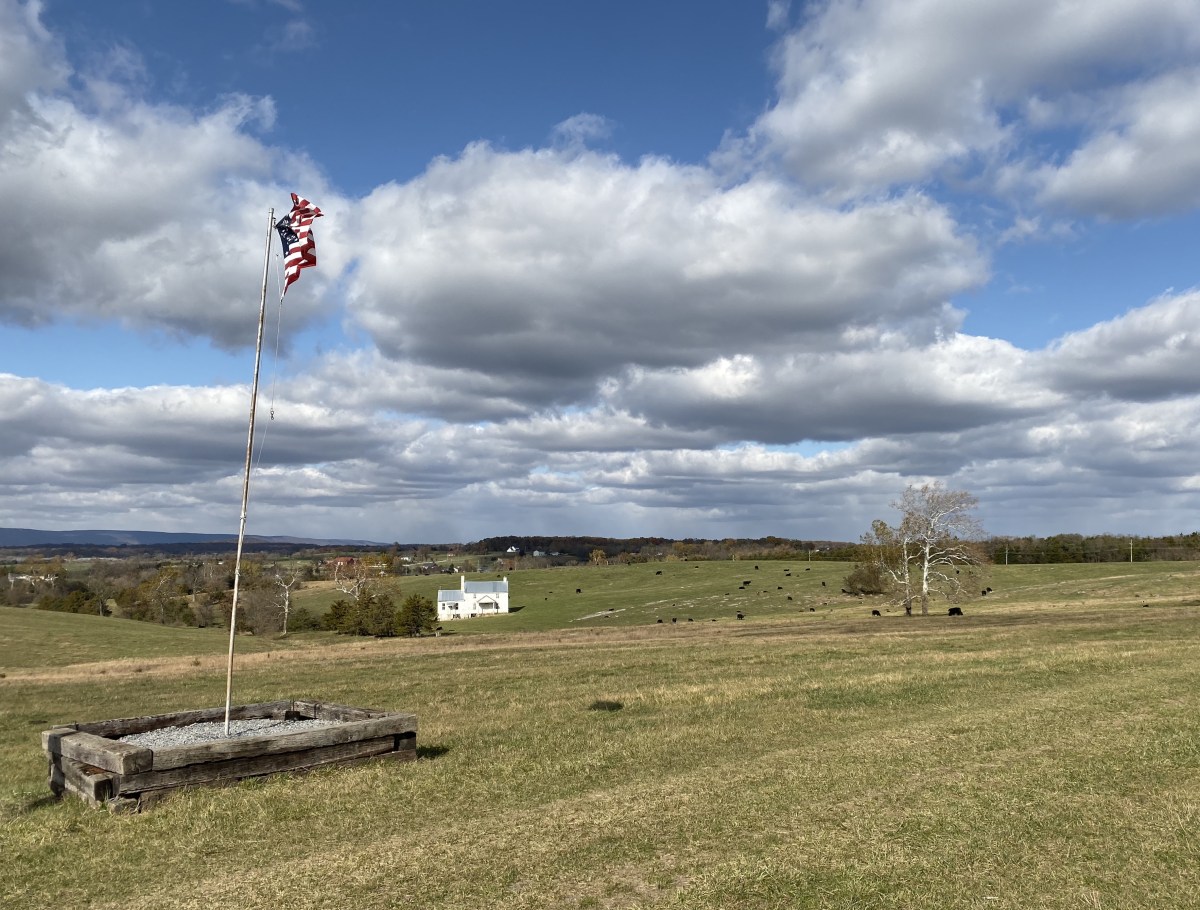
Share this:

  • Share on X (Opens in new window) X
  • Share on Facebook (Opens in new window) Facebook
  • More
  • Email a link to a friend (Opens in new window) Email
  • Print (Opens in new window) Print
  • Share on Pinterest (Opens in new window) Pinterest
Like Loading...
  • Africa
  • Chefchaouen
  • Hikes & Walks

morocco: the blue-washed chefchaouen

wanderessence1025's avatar wanderessence1025 January 26, 2020

Susan and I started our “free day” in the blue-washed Chefchaouen, originally known as Chaouen (“peaks”). It was once isolated and xenophobic; Christians were threatened with death if they entered. Occupied by Spanish troops in 1920, it remained so until independence in 1956. The pale blue wash introduced in the 1930s was supposedly to keep mosquitoes away. Previously windows and doors were painted in traditional Moroccan green. In 1975, the town was renamed Chefchaouen, or “look at the peaks.”

We walked around the red-walled kasbah, built in 1471. The kasbah is a heavily restored walled fortress with a lovely garden.  Moulay Ali Ben Rachid built the fort in Chefchaouen as a defense against the Portuguese who had seized control of Tangier, Asilah, and other port towns. The town expanded with the arrival of Muslim and Jewish refugees from Granada in 1494.

fullsizeoutput_1b9dd

kasbah in Chefchaouen

fullsizeoutput_1b9e8

kasbah in Chefchaouen

fullsizeoutput_1b9f1

kasbah in Chefchaouen

fullsizeoutput_1ba04

me at the kasbah

kasbah in Chefchaouen

We climbed up to the ramparts to gather in a view of Old Chefchaouen, including the plaza and the kasbah, as well as the surrounding countryside.

fullsizeoutput_1b9f4

view of the countryside from the kasbah

fullsizeoutput_1b9fd

view of Chefchaouen from the kasbah

fullsizeoutput_1b9f8

view of Chefchaouen and the Rif Mountains from the kasbah

view of the countryside from the kasbah
view of kasbah in Chefchaouen from the kasbah

The kasbah houses a small Ethnography Museum which we briefly walked through.

Ethnography Museum
Ethnography Museum
courtyard in the Ethnography Museum

Leaving the kasbah, we wandered past the Grand Mosque (Jamaa Kbeer), built by Moulay Mohamed, the son of Moulay Rachid, in 1560.  Its unusual octagonal minaret, with its three tiers of blind arches wrapping around the tower, was built in the 18th century, inspired by the Torre de Oro in Seville.

fullsizeoutput_1ba08

Grand Mosque (Jamaa Kbeer)

We wandered through the lanes of the town, dipping into the enticing shops.  I found a pair of turquoise cotton striped pants that were lightweight.

lanes of Chefchaouen
colorful dresses for sale

While we waited for a tailor to hem my pants, we had coffee at a small outdoor cafe in the cobblestoned Plaza Uta el-Hammam and watched the square as it filled with people.

fullsizeoutput_1ba0e

Plaza Uta el-Hammam

fullsizeoutput_1b9db

Plaza Uta el-Hammam

The buildings of the medina were a fresh blinding blue or white, with terra-cotta tiled roofs adding a taste of Andalucia.  Apparently the medina was recently repaired with Spanish funding. We wandered all around the town, looking at the goods for sale.  I bought a small journal, a scarf, a pair of pink dangly earrings, a small canvas painting of blue steps with flower pots. Other goods included colorful paintings, leather goods, scarves, clothing, shoes, slippers, ceramics, Berber jackets, rugs, woven goods and tajines.

fullsizeoutput_1ba14

Chefchaouen

IMG_4622

slippers for sale

IMG_4634

A photographer was taking photos of a Chinese couple decked out in wedding attire in all the charming spots.  I found so many charming scenes, although the morning shadows made the light challenging. Chinese tourists were in abundance.

fullsizeoutput_1ba2c

Expo d’Art

fullsizeoutput_1838d

Chefchaouen

fullsizeoutput_1837f

Chefchaouen

fullsizeoutput_1ba30

Chefchaouen

IMG_4655

Chefchaouen

fullsizeoutput_1ba32

Chefchaouen

fullsizeoutput_18379

Chefchaouen

We had a glimpse of the Spanish Mosque, where we would climb later in the afternoon.

IMG_4661

Spanish Mosque

We continued our wanderings through the town and the ancient medina.  We ran into Father Anthony having soup and mint tea in a hole-in-the-wall cafe.  A true art lover, he had bought a boatload of goods that he said were excellent quality. Anthony is a 76-year-old bodybuilding Catholic priest who showed us last evening how he travels with a kind of mess kit that includes a chalice and other communion accoutrements. He carries two small bottles of airplane-sized wine that he will stretch out over a month of travels.  He told me he was praying for my loved one and said he hoped I’d pray for him too even if I wasn’t religious.

We left Anthony and wandered some more until we stopped for lunch at a cafe on the plaza.  I had an omelette and an avocado salad with a vegetable-rice mixture, accompanied with “gas” water.

Chefchaouen
Chefchaouen
kitten in Chefchaouen
Al Hamra Hotel
Al Hamra Hotel
Chefchaouen
Chefchaouen
me in Chefchaouen
me in Chefchaouen
Chefchaouen
Chefchaouen
medina of Chefchaouen

The medina here was one of the cleanest I have ever encountered in my travels.

IMG_4717

Chefchaouen’s medina

IMG_4702

Chefchaouen’s medina

fullsizeoutput_1ba4f

Chefchaouen’s medina

fullsizeoutput_1ba50

Chefchaouen’s medina

fullsizeoutput_1ba7d

tailor shop in Chefchaouen’s medina

fullsizeoutput_18355

dyes

IMG_4744

Chefchaouen’s medina

IMG_4748

Chefchaouen’s medina

dried figs
dried figs
Chefchaouen
Chefchaouen

We returned to our hotel to drop some of our purchases.  The Hotel Madrid had an old world lobby with red and white cushions on benches and stools and round painted tables.

fullsizeoutput_1ba5e

lobby of Hotel Madrid

fullsizeoutput_1ba4a

Chefchaouen

fullsizeoutput_1ba60

Chefchaouen

IMG_5132

dyes in Chefchaouen

In the afternoon, we climbed a mountainside path to the so-called Spanish Mosque on a hilltop to the west of the medina. We walked by the Ras el-Ma waterfall where women in djellabas were wading and scrubbing their laundry.

The Spanish Mosque was built by the Spanish for the local population in the 1920s but was never used. From the path and the hilltop, we had great views of the blue town.

fullsizeoutput_1ba62

views of Chefchaouen from the path to the Spanish Mosque

fullsizeoutput_1ba64

views of Chefchaouen from the path to the Spanish Mosque

fullsizeoutput_1ba66

Spanish Mosque

IMG_5149

little goat on the mountainside

fullsizeoutput_1ba68

views of Chefchaouen from the path to the Spanish Mosque

IMG_5155

Spanish Mosque

IMG_4779

views of Chefchaouen from the path to the Spanish Mosque

As we entered the town again, I was captivated by oranges bobbing in water-filled plastic tubs.  The water continuously flowed from a hose into and out of the tub, creating a mini-waterfall.

fullsizeoutput_1907f

Chefchaouen

fullsizeoutput_1ba74

Chefchaouen

We stopped at another cafe to use wi-fi. I had an orange juice with strawberries and Susan had a mint tea.

IMG_4791

Grand Mosque (Jamaa Kbeer)

IMG_4796

Hotel Madrid

Susan and I went to dinner at Casa Hassan.  We sat next to a cozy fire crackling in a large cone-shaped fireplace.  We shared a Moroccan soup of chick peas, vermicelli, lentils, and a bit of ground beef.  We also had a vegetable pastilla (vegetable mix in phyllo) with rice and raisins. We shared a lemon tart for dessert, all for 65 dirhams (~ $7) each.  It was delicious and the atmosphere was lovely.

Casa Hassan
Casa Hassan
Casa Hassan
Casa Hassan
Casa Hassan
Casa Hassan

It was very hard to read in bed with just an overhead light, but I read The Forgiven as long as I could before falling asleep.  The next day we would leave early to go to Fez, with a stop at the Roman ruins of Volubilis.

*Steps: 16,490, or 6.99 miles*

*Wednesday, April 10, 2019*

**************

On Sundays, I post about hikes or walks that I have taken in my travels; I may also post on other unrelated subjects. I will use these posts to participate in Jo’s Monday Walks or any other challenges that catch my fancy.

This post is in response to Jo’s Monday Walk: Sáo Bartholomeu de Messines.

Share this:

  • Share on X (Opens in new window) X
  • Share on Facebook (Opens in new window) Facebook
  • More
  • Email a link to a friend (Opens in new window) Email
  • Print (Opens in new window) Print
  • Share on Pinterest (Opens in new window) Pinterest
Like Loading...
  • Anticipation
  • Asia
  • Books

anticipation & preparation: jordan in 2011

wanderessence1025's avatar wanderessence1025 January 24, 2020

Tuesday, November 4, 2011 marked my first (un)official day of the holiday known in the Islamic world as Eid al-Adha.  This “Festival of Sacrifice” is celebrated by Muslims the world over to commemorate Abraham’s willingness to sacrifice his son Ishmael in obedience to God.  Lucky for Abraham, God intervened and provided his faithful servant with a ram to sacrifice instead of his son.

The real Eid al-Adha didn’t actually start for a couple more days.  To be honest, I didn’t even know which day it officially started.  However, on this Tuesday, we had drenching rain showers and flooding, so the University of Nizwa cancelled classes at 2:00 pm and, as a follow-up, in a stroke of generosity, cancelled classes for Wednesday as well. I was thrilled because it meant our Eid holiday began one day early.

I wasn’t expecting any substantial holiday so soon after arriving in Oman, but since it was handed to me, I had to take advantage.  I immediately booked a trip to Jordan for only 6 days, because it was impossible to get reasonable flights going out on the first couple of days of the holiday.  I would leave Saturday, November 5 and return on Friday morning, November 11.

fullsizeoutput_1bb6d

The Dead Sea, Jordan

Uncharacteristically, I hardly planned anything for this trip.  I had planned to bring my Lonely Planet Middle East guidebook, but after my suitcases were all packed for Oman, I weighed them and found them to be over the baggage limit.  I frantically removed about 10 pounds out of each bag.  One of the things I removed was that guidebook.

On my other travels, I had read extensively about my destination, both fiction and non-fiction, and had been enriched by that preparation.  This time, it all came upon me too quickly.  I’d done almost nothing to prepare for this trip except talk to one of my colleagues, Willem, who recommended every place in Petra where I’d be staying: The Rocky Mountain Hotel and the Seven Wonders Bedouin Camp.  From the owners of the Seven Wonders Camp, I got the name of the Jordan Tower Hotel in Amman.  Other than that, I had NO plans.

PB076210

camels at Petra

I figured a near-spontaneous trip like this, without my regular Type-A planning, might throw me for a loop, knock me totally off-balance. It might teach me to loosen up a bit, go with the flow. No matter. It would certainly be another unforgettable experience to add to many such over the the past year and a half.

If I had read any books set in Jordan, I might have read some of these:

  1. West of the Jordan by Laila Halaby (Kindle)
  2. Live from Jordan: Letters Home from My Journey Through the Middle East by Benjamin Orbach (Kindle)
  3. The Confusion of Languages by Siobhan Fallon
  4. Seven Pillars of Wisdom by Thomas Edward Lawrence
  5. Married to a Bedouin by Marguerite van Geldermalsen
  6. Appointment with Death by Agatha Christie
  7. Cities of Salt by Abdul Rahman Munif
  8. Story of a City: A Childhood in Amman by Abdul Rahman Munif
  9. Forbidden Love by Norma Khouri
  10. The Language of Baklava by Diana Abu-Jaber
  11. The Cry of the Dove by Fadia Faqir
  12. Willow Trees Don’t Weep by Fadia Faqir
  13. Staircase of a Thousand Steps by Masha Hamilton
  14. Shepherd of Solitude: Selected Poems 1979-2004 by Amjad Nasser
  15. Hero: The Life and Legend of Lawrence of Arabia by Michael Korda
  16. Desert Skies, Rebel Souls by M P Tonnesen (also Egypt & Israel)

For more international books, see books | international a-z |.

The only movie set in Jordan that I saw before going was Captain Abu Raed, which was excellent.  The others I might have watched had I had more time to prepare:

  1. Lawrence of Arabia (1962-1963)
  2. Saladin (1963)
  3. Indiana Jones and the Last Crusade (1989)
  4. Free Zone (2005)
  5. Captain Abu Raed (2007) ****
  6. Cherkess (2010)
  7. When I Saw You (2012)
  8. When Monaliza Smiled (2012)
  9. May in the Summer (2013)
  10. Theeb (2014)
  11. From A to B (2015)
  12. Queen of the Desert (2015)
  13. The Rendezvous (2016)
  14. 17 (2017)

For more international movies, see movies | international a-z |.

PB076213

Petra, Jordan

*November 5-11, 2011*

************************

“ANTICIPATION & PREPARATION” INVITATION: I invite you to write a post on your own blog about anticipation & preparation for a particular destination (not journeys in general). If you don’t have a blog, I invite you to write in the comments. Include the link in the comments below by Thursday, February 27 at 1:00 p.m. EST.  When I write my post in response to this challenge on Friday, February 28, I’ll include your links in that post.

This will be an ongoing invitation, on the 4th Friday of each month. Feel free to jump in at any time. 🙂  If you’d like to read more about the topic, see: journeys: anticipation & preparation.

I hope you’ll join in our community. I look forward to reading your posts!
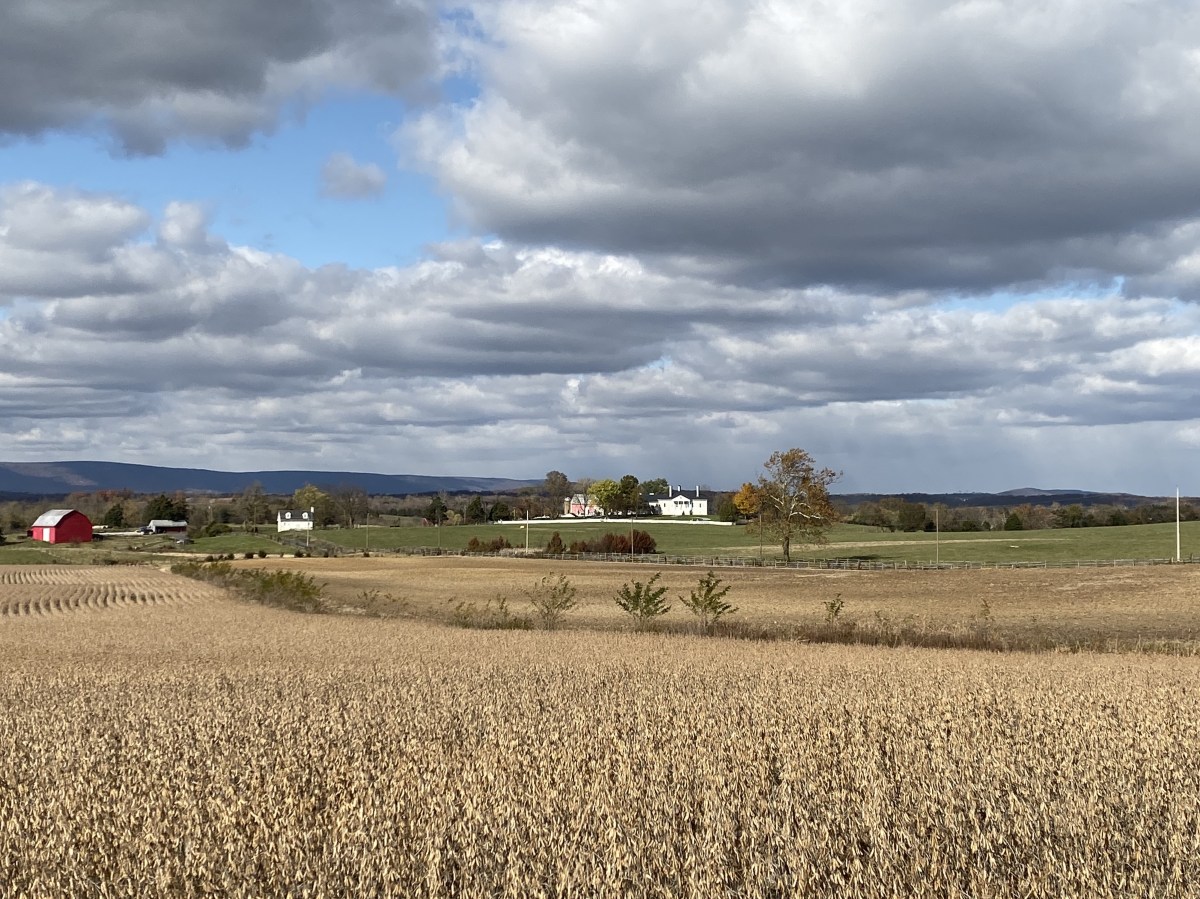
the ~ wander.essence ~ community

I invite you all to settle in and read posts from our wandering community. I hope you’ll be inspired!

  • Mari, of Mari’s Travels with Her Camera, has written about how she prepared for travels in Thailand.
    • Thailand: Anticipation and Preparations

Thanks to all of you who wrote posts about anticipation and preparation.


Share this:

  • Share on X (Opens in new window) X
  • Share on Facebook (Opens in new window) Facebook
  • More
  • Email a link to a friend (Opens in new window) Email
  • Print (Opens in new window) Print
  • Share on Pinterest (Opens in new window) Pinterest
Like Loading...

Posts pagination

Previous 1 … 35 36 37 … 68 Next
Blog at WordPress.com.
Let Me Bite That

Can I have a bite?

a pura vida year in costa rica

living abroad in Guanacaste

Lush Life Layers

Lake Garda Tourist

Susana Cabaço

Spiritual Insights & Personal Empowerment

Monkey's Tale

An Adventure Travel Blog

Journey with my Sketchbook

"My sketchbook is a witness of what I am experiencing, scribbling things whenever they happen." - Vincent Van Gogh

The Eternal Traveller

Remembering past journeys, recording current trips and planning for the next one!

Lookoom

Put pictures on your travel dreams

Still Restlessjo

Roaming, at home and abroad

The Creative Life Adventure

Living a creative life

Inside My Sling Bag

Living, Loving, Laughing, Learning and (Being) Lucrative

Introvert Awakenings

My path less traveled. Rediscovering self after surviving the abuse that almost sunk me. Goal of strengthening and thriving on my adult legs. 👣🙏🏻 #recovery #forgiveness

Changcha Travel Tales

LightWriteLife

I love light, I love to write, I love life - I create my words and images to capture the light in my life.

the rak's sphere

Phosphene's Write

Live your life!! Life is beautiful!!

Image Earth Travel

Independent Travel & Photography Stories

Nanchi.blog

Lookoom

Mettez des images sur vos rêves de voyages

Retire In Branson

Old Bird Travels Solo!

THE MATURE ART OF TRAVELLING ALONE. MY NEW EMAIL IS: OldBirdTravels@proton.me PLEASE LIKE AND SHARE AT THE BOTTOM OF THE POST!

P e d r o L

storytelling the world

Welcome

RECYCLE YOUR PAIN

Motivation

Jim's Travel Culture and History Blog

World travel culture and history

Charlotte Digregorio's Writer's Blog

This blog is for those who wish to be creative, authors, people in the healing professions, business people, freelancers, journalists, poets, and teachers. You will learn about how to write well, and about getting published. Both beginning and experienced writers will profit from this blog and gain new creative perspectives. Become inspired from global writers, and find healing through the written word.

Musings of the Mind

Come journey with me as we navigate through this thing called life

robynsewsthisandthat

This is where I share my passions

Saania's diary - reflections, learnings, sparkles

Life is all about being curious, asking questions, and discovering your passion. And it can be fun!

The Wild Heart of Life

Creative Nonfiction & Poetry

deventuretime

Avid adventurer, travel blogger, and experience seeker. Starting each morning with a desire to see the world through a different lens.

Stu's Camino

The Frugal Foodies

Feeding an Empty Belly and Starving Mind

The Lost-o-graph

photographs

Our travels and thoughts through photographs. It does not matter, sunrise or sunset, just have fun in between.

My Serene Words

seeking solace in the horizon of life and beyond

HANNA'S WALK

Walks Stories and Nature

One Girl, Two Dogs & Two Thousand Miles

Brawnerology

Everything Family Travel: Work Hard, Play Hard

ROAD TO NARA

Culture and Communities at the Heart Of India

MEERYABLE

Explore, discover and experience the world through Meery's Eye. Off the beat budget traveler. Explore places, cultural and heritage. Sustainable trotter. shareable tales of Meery is Meeryable

Poetry 365

citysonnet.wordpress.com/

photography, poetry, paintings

Poetry collection

Work by Rain Alchemist

Eúnoia

Following my heart, Daring to dream, Living without regrets

VICENTE ROMERO - Paintings

Still Smiling

Smiling through the good times and the bad

flaviavinci

John Wreford Photographer

Words and Pictures from the Middle East

~ wander.essence ~
Blog at WordPress.com.
  • Subscribe Subscribed
    • ~ wander.essence ~
    • Join 1,029 other subscribers
    • Already have a WordPress.com account? Log in now.
    • ~ wander.essence ~
    • Subscribe Subscribed
    • Sign up
    • Log in
    • Report this content
    • View site in Reader
    • Manage subscriptions
    • Collapse this bar
 

Loading Comments...
 

You must be logged in to post a comment.

    %d