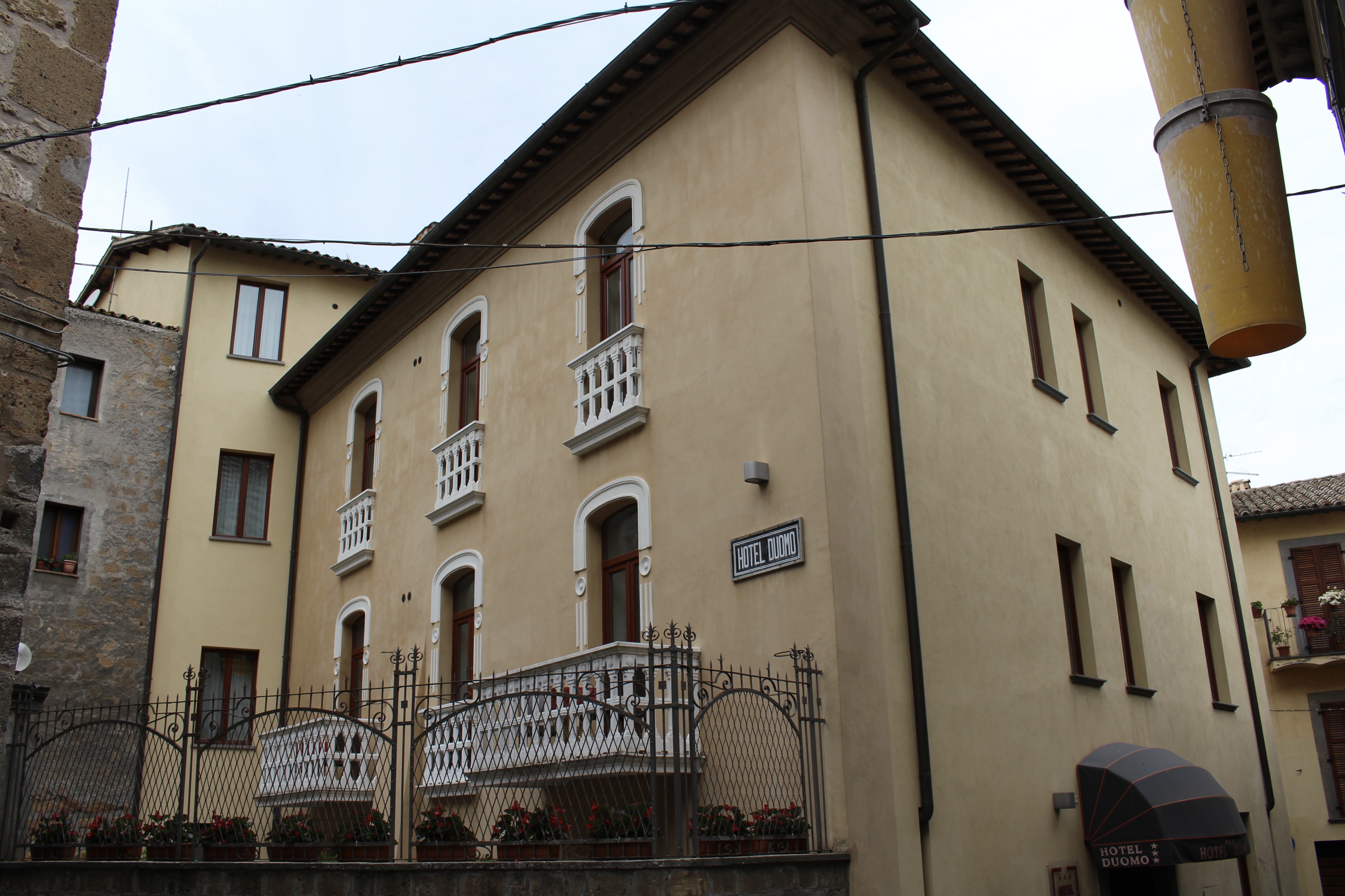
After leaving Spoleto, we drove south and west through mountain passes, arriving in Orvieto, in Southern Umbria, around 3:15. We checked into the annex at the Hotel Duomo, handing over our car to valet parking. It was cold and rainy upon our arrival.
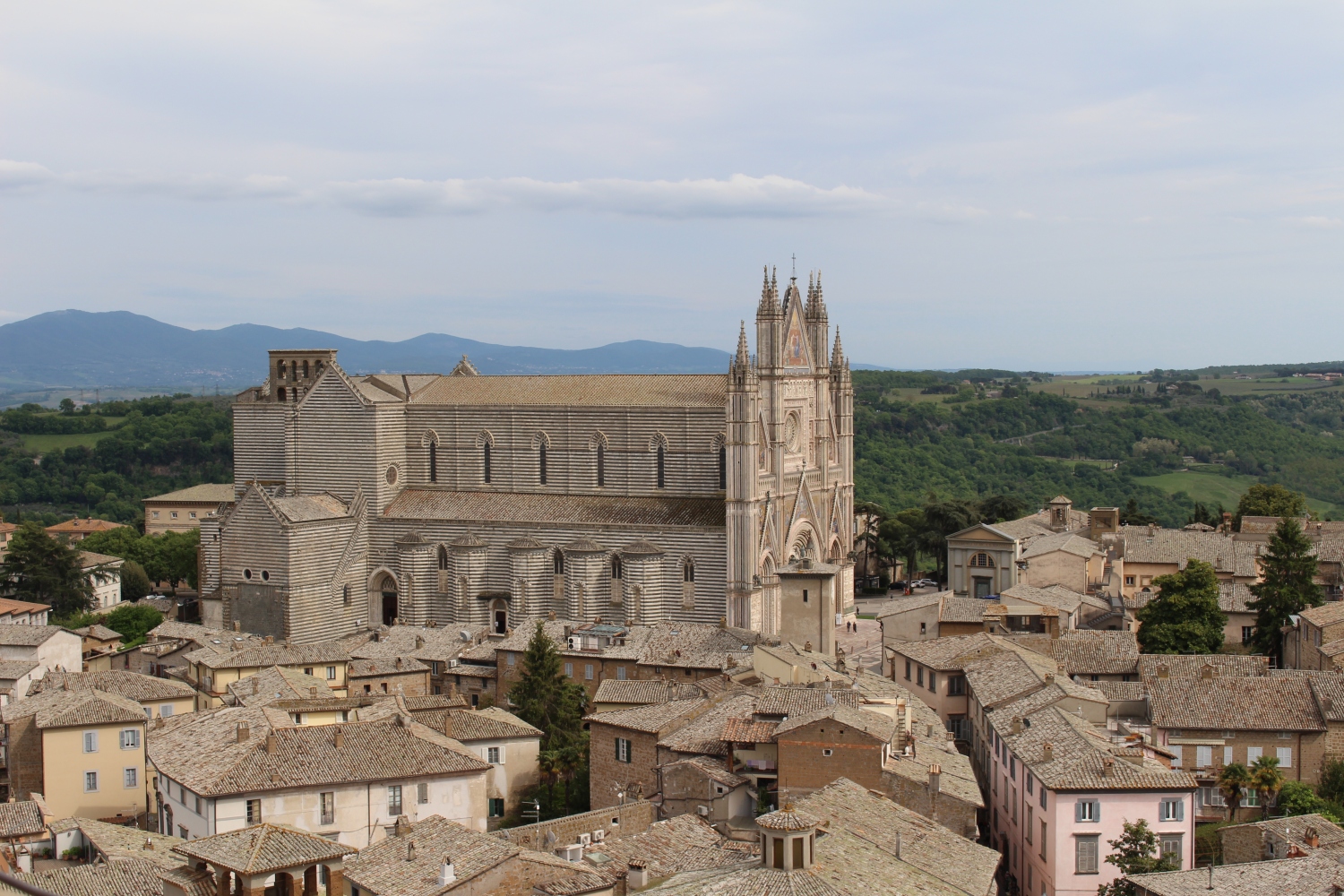
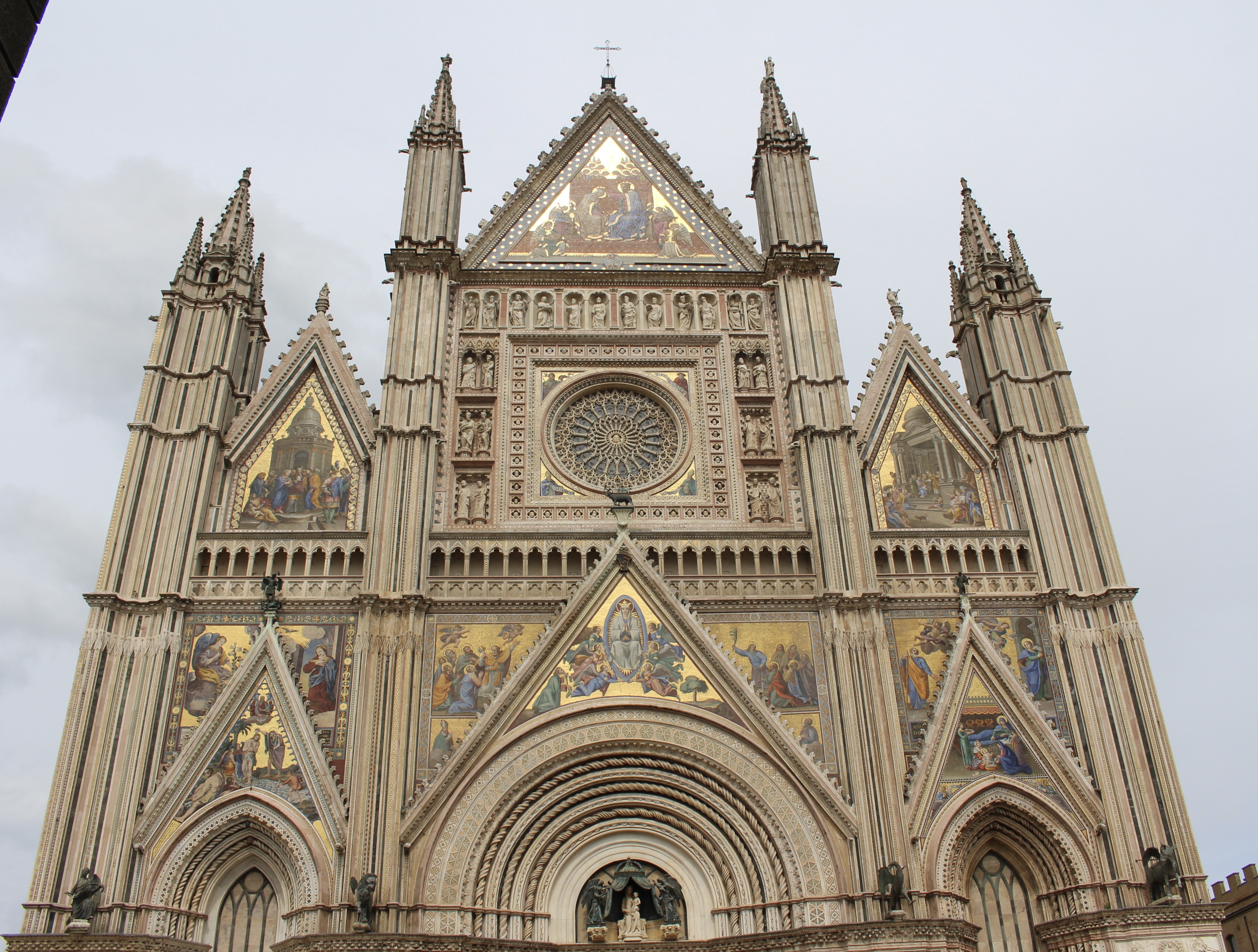
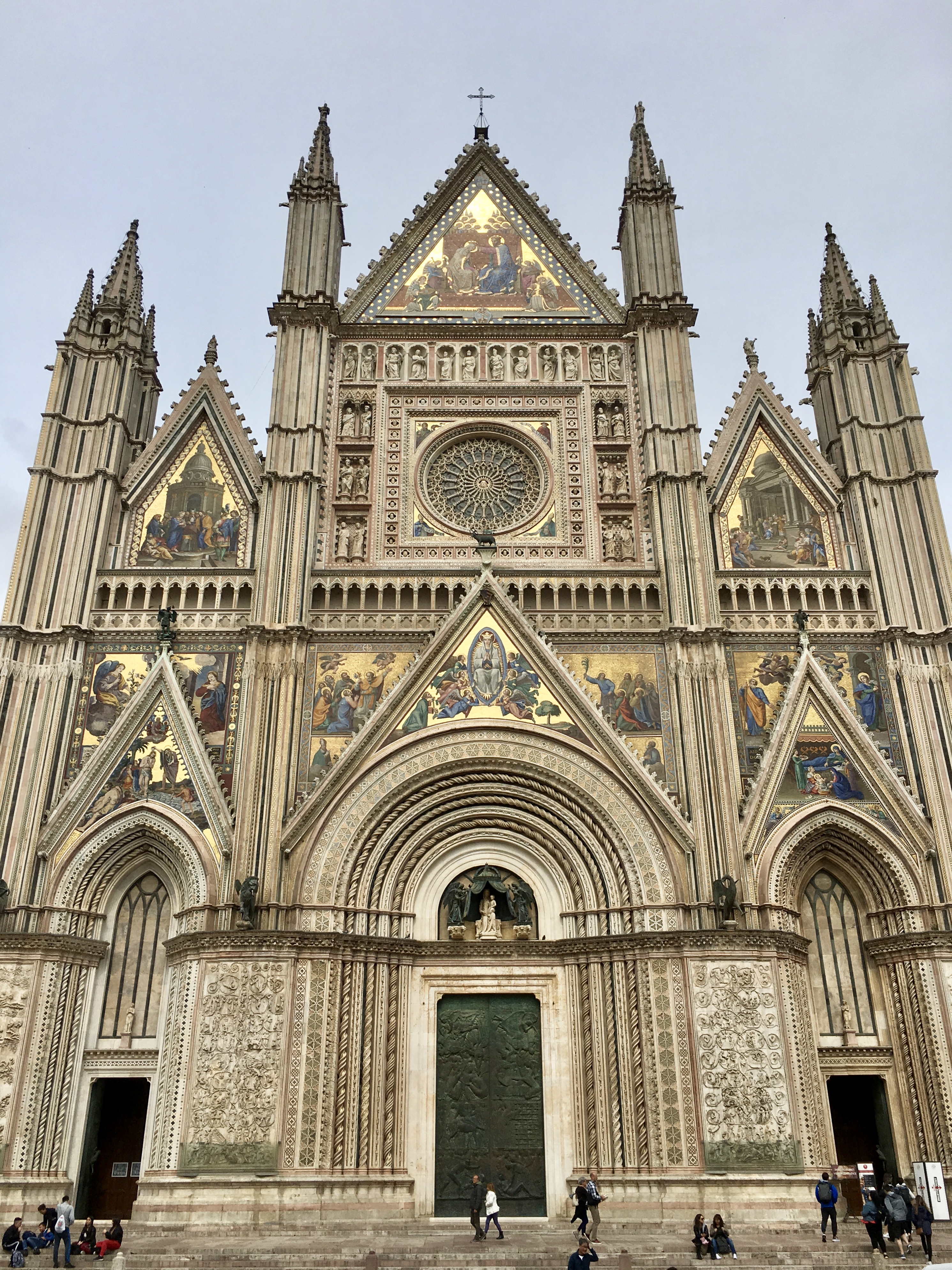
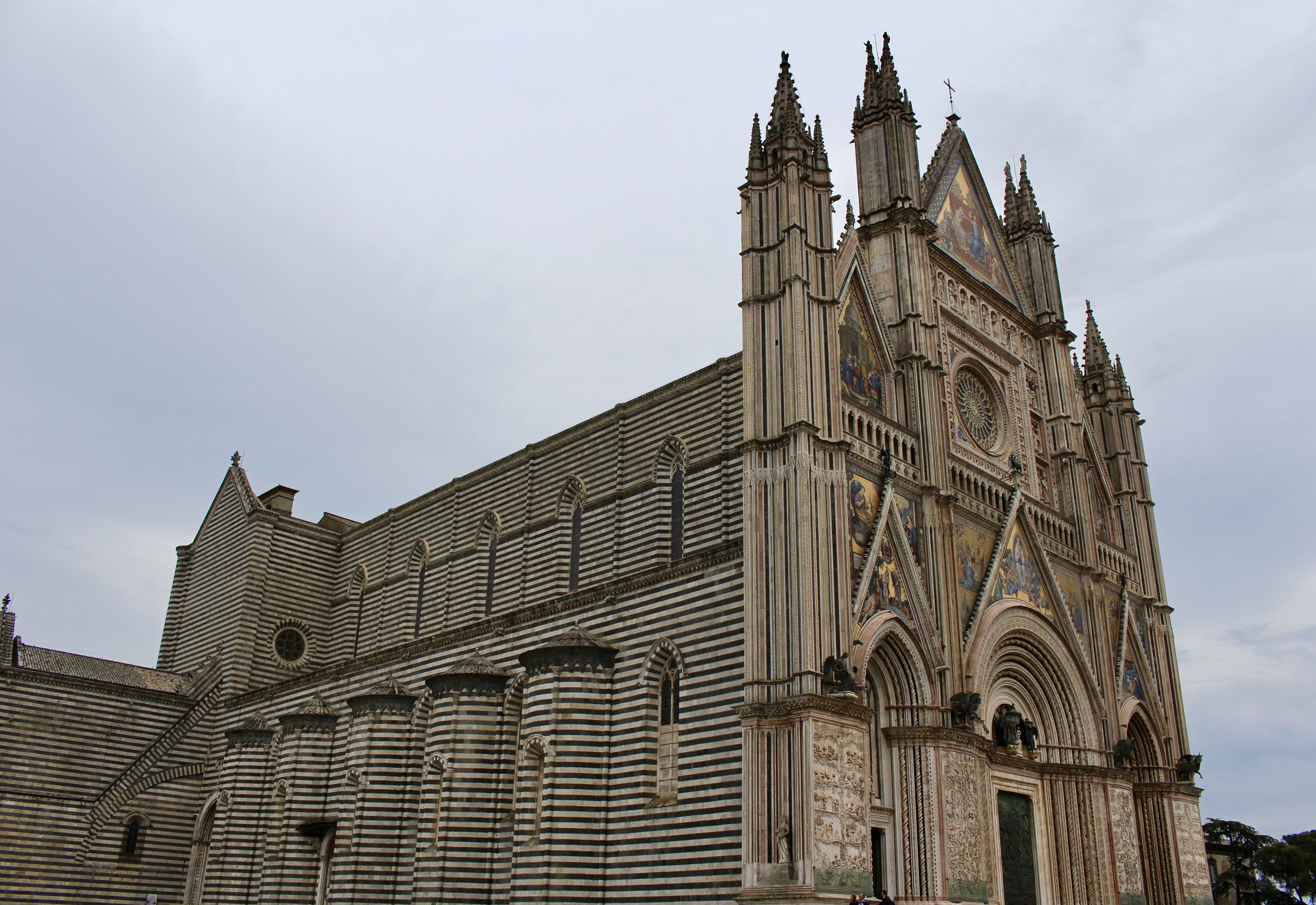
Our hotel was right next to the Duomo di Orvieto, so that’s where we started our walk. The Gothic cathedral, dating to 1290, boasts a black-and-white banded exterior fronted by a breathtaking facade with an exquisite display of rainbow frescoes, jewel-like mosaics, bas-reliefs, and delicate braids of flowers and vines. The bas-relief panels between doorways tell the story of the Creation and the Last Judgment.
The building took 30 years to plan and three centuries to complete. It was started by Fra Bevignate and later additions were made by Sienese master Lorenzo Maitani (c. 1275-1330), Andrea Pisano (of Florence Cathedral fame) and his son Nino Pisano, Andrea Oreagna and Michele Sanmicheli (Lonely Planet Italy).
Duomo di Orvieto
Duomo di Orvieto
Duomo di Orvieto
Duomo di Orvieto
bas-reliefs at Duomo di Orvieto
more bas-reliefs
interior of Duomo di Orvieto
Duomo di Orvieto
Duomo di Orvieto
Duomo di Orvieto
Duomo di Orvieto
Duomo di Orvieto
Duomo di Orvieto
Duomo di Orvieto
Duomo di Orvieto
Duomo di Orvieto
Duomo di Orvieto
Duomo di Orvieto
Duomo di Orvieto
Duomo di Orvieto
Duomo di Orvieto
shop in Orvieto
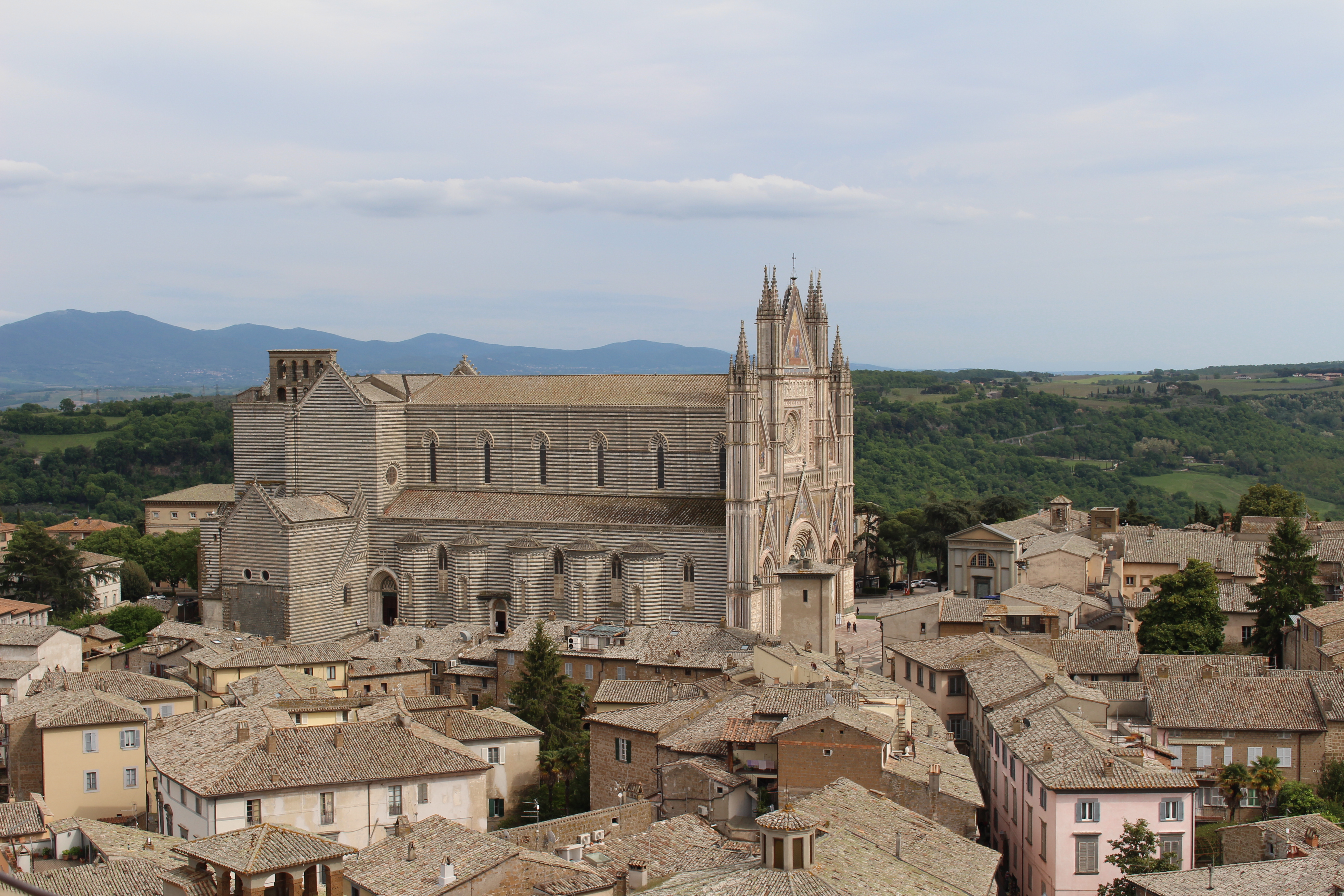
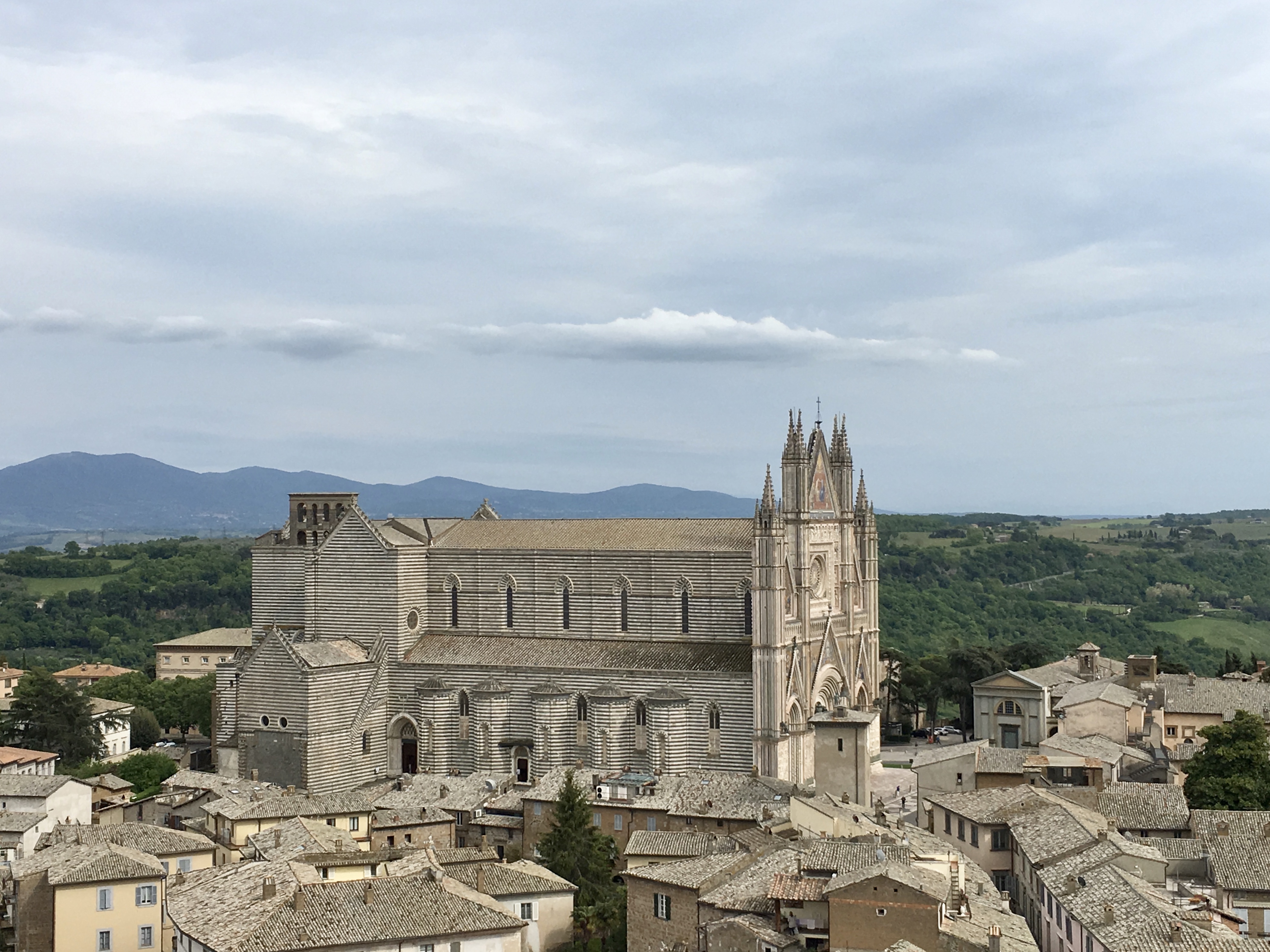
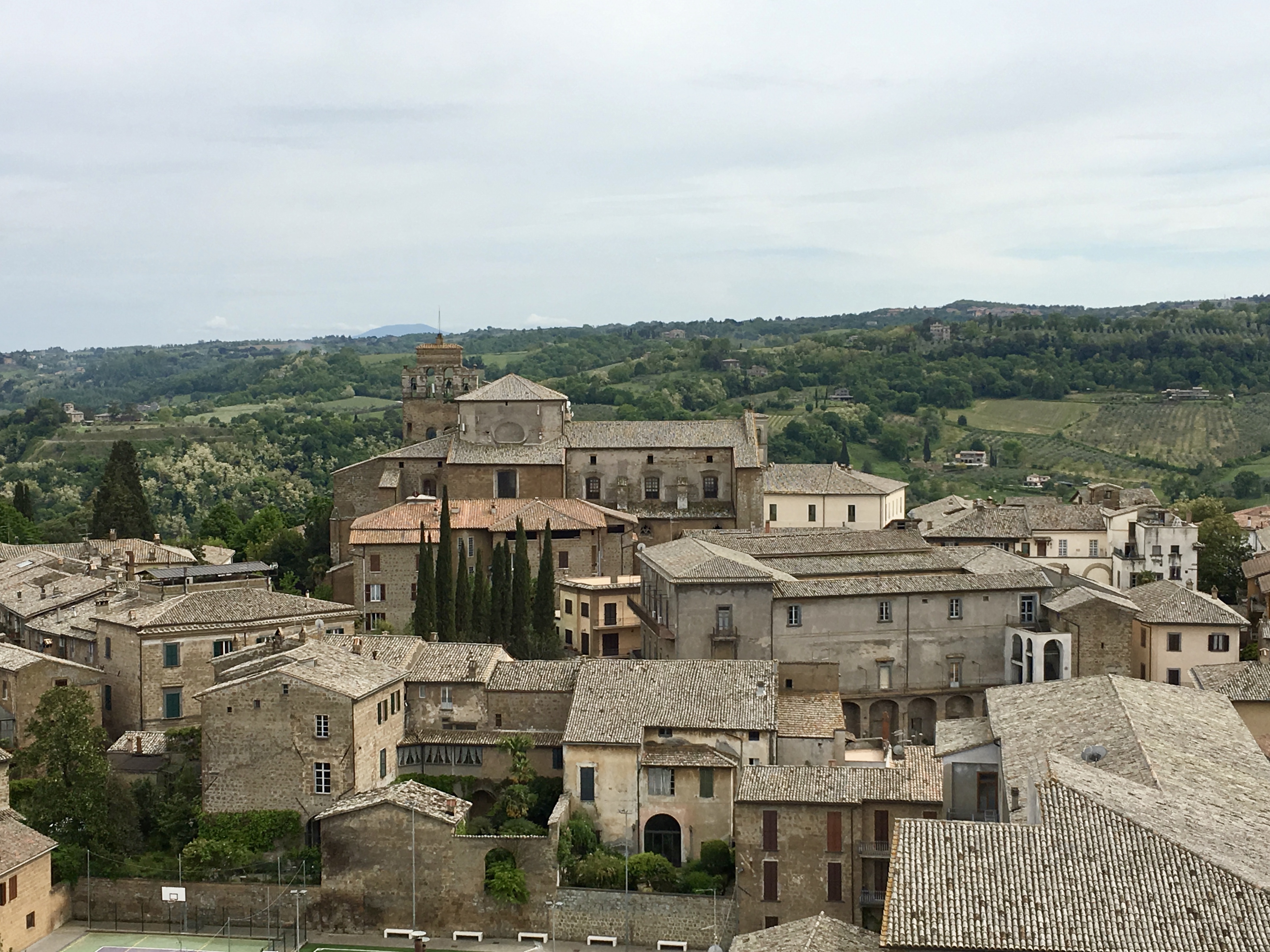
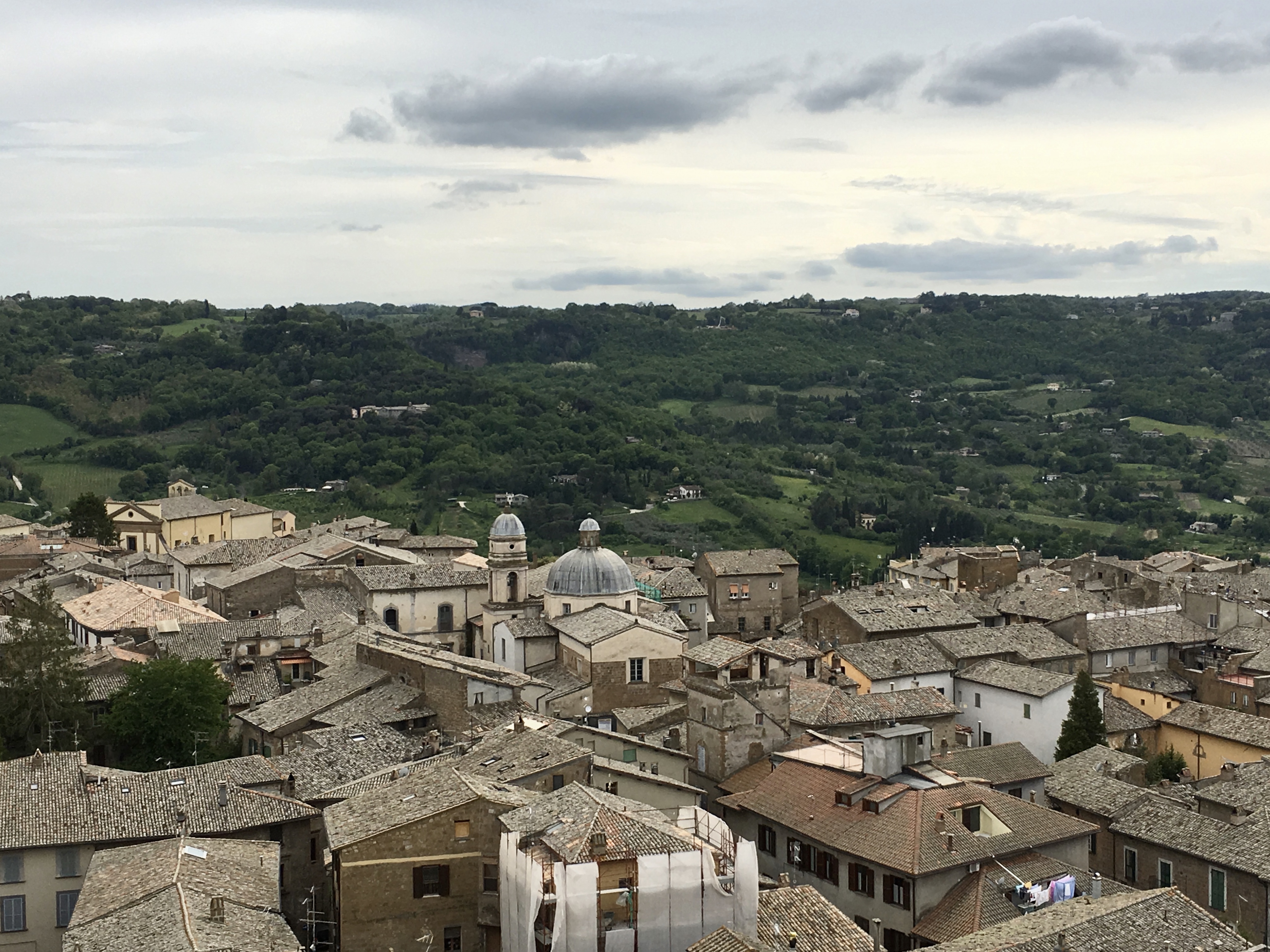
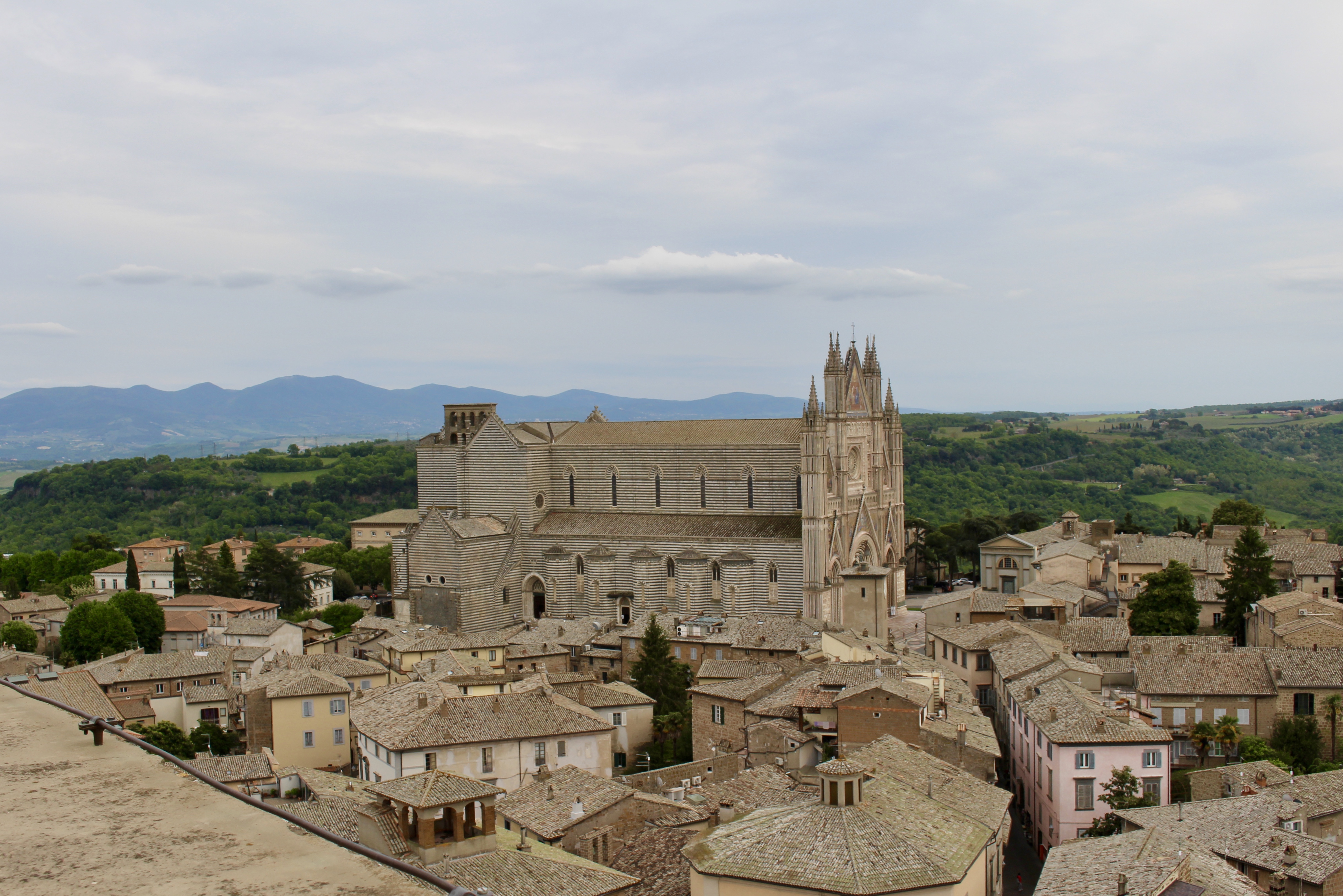
From the Piazza Duomo, we headed northwest along Via del Duomo to Corso Cavour and climbed up 250 steps in the 13th century Torre Del Morro, or Tower of the Moor, where we had sweeping views of the town.
At the end of the thirteenth century, the medieval Commune of Orvieto was at the height of its economic power and political stability. Public buildings became symbols of this authority: the original Town Hall was restored and the Palazzo del Popolo and the Cathedral were built. Extant buildings were restructured, forming a new urban layout with at its fulcrum the Palazzo dei Sette and the Tower known of as del Papa. From the top of the Tower, 47 meters high and almost perfectly oriented to the four cardinal points, the eye could sweep over the “contado” with its rural parishes, its hamlets, and its many castles and over the vast territory subject to the city of Orvieto. To the west, it stretched all the way to the sea.
In the 16th century, the name of the tower appeared as “del Moro,” probably after Raffaele di Sante known as il Moro. In 1865, the reservoir for distributing water from the new aqueduct was installed in the tower at a height of 18 meters. After restoration in 1866, the mechanical clock was set up and the two municipal bells were hoisted to the top.
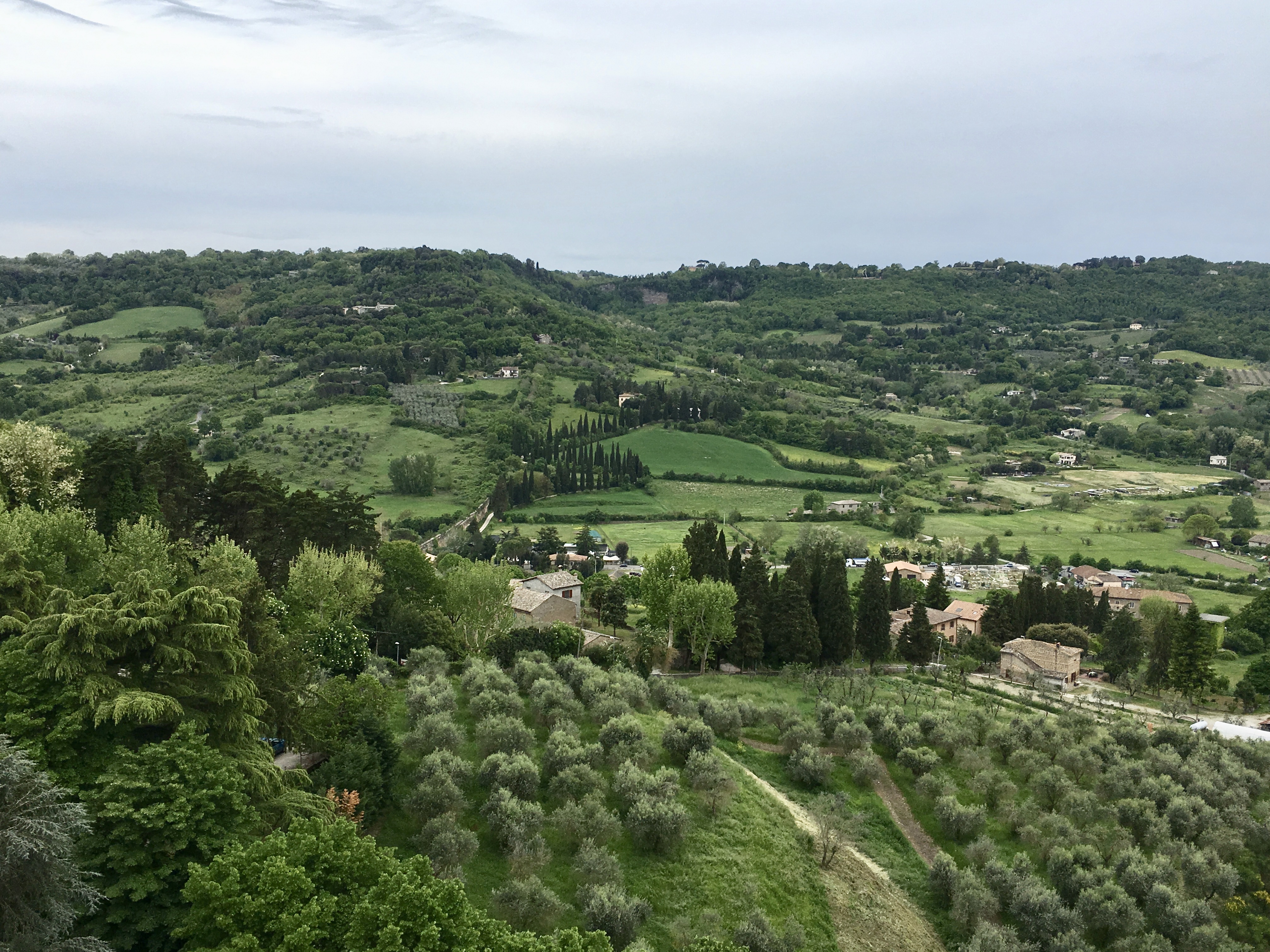
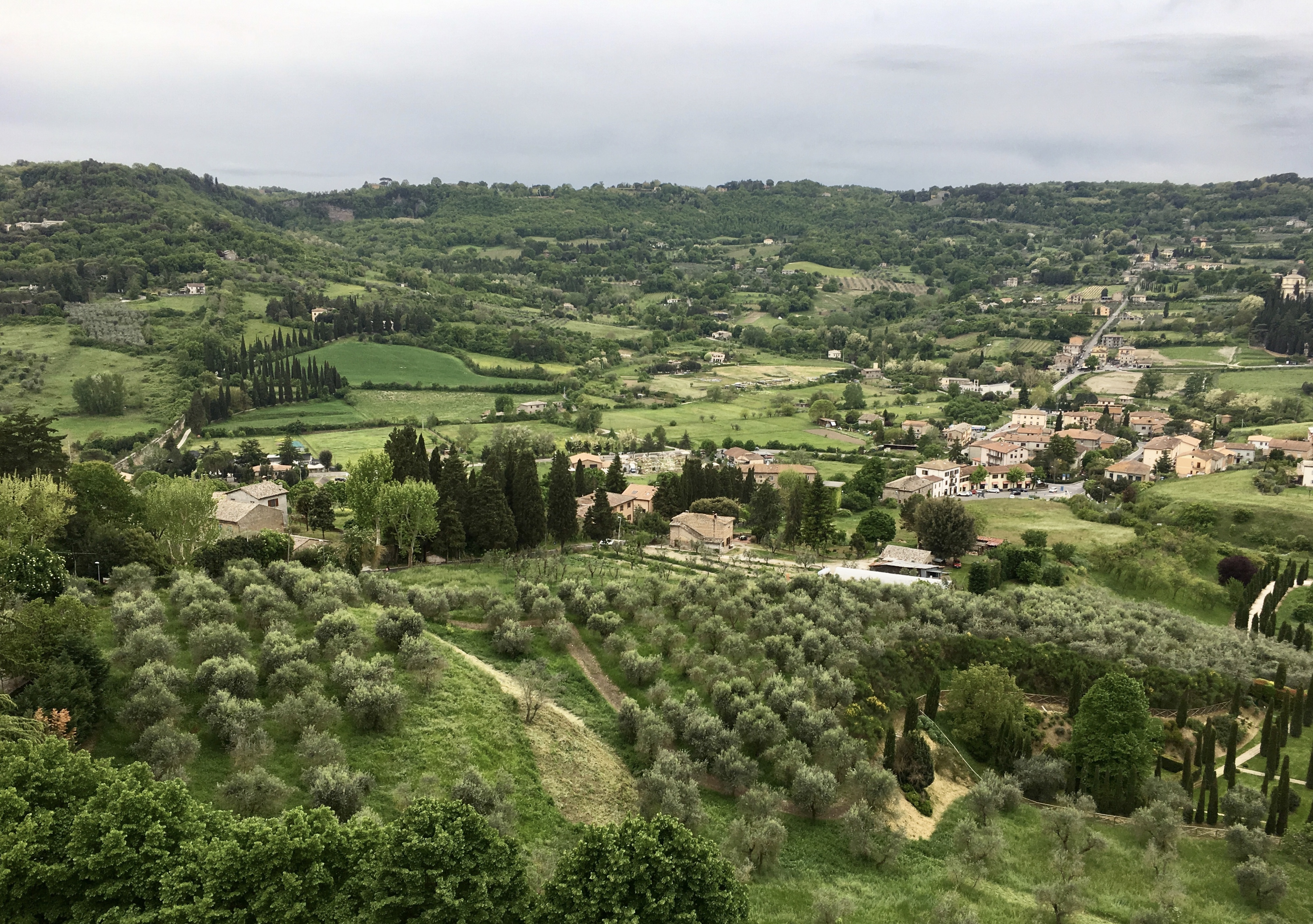
views of Orvieto from Torre Del Morro
views of Orvieto from Torre Del Morro
views of Orvieto from Torre Del Morro
views of Orvieto from Torre Del Morro
views of Orvieto from Torre Del Morro
views of Orvieto from Torre Del Morro
We strolled through the town, admiring the ancient buildings and trying our best to keep warm.
Orvieto
Orvieto
butcher market in Orvieto
Orvieto
Orvieto
We stopped to visit Pozzo della Cava, or Well of the Quarry, the short version of the “Città sotterranea,” or the Orvieto Underground, a labyrinth of caves and tunnels hidden in the dark cliff.
The Etruscans were the first to settle here, digging a honeycombed network of wells and storage caves out of the soft volcanic stone known as tufa. The Romans attacked and destroyed the city in 283 B.C.; since then it has transformed into a charming maze of alleys and squares, all built from the tufa that was removed and used as building blocks, or ground into pozzolana, which was made into mortar.
Over the past 3,000 years, those who lived on top of this high plateau dug a huge number of cavities into the soft volcanic rock on which Orvieto stood. The series of 440 caves, cisterns, secret passageways, storage areas, and cavities (out of 1200 in the system) that overlap and intersect beneath the streets and buildings of the modern town have been unearthed. This reservoir of historical and archaeological information found in these underground structures showed that locals used the the caves over millennia for various purposes, including WWII bomb shelters, refrigerators, wine storage, wells, and as dovecotes to trap pigeons for dinner. Some caves were used to ferment the Trebbiano grapes used in making the region’s popular white wine, Orvieto Classico.
At times the subterranean path runs parallel to the cliff wall, and panoramic openings let in the light, revealing an endless succession of tunnels, stairs, unexpected passageways, and superimposed rooms with innumerable small square niches.
Orvieto Underground
Orvieto Underground
Orvieto Underground
Orvieto Underground
Orvieto Underground
Orvieto Underground
Orvieto Underground
Orvieto Underground
out back at the Orvieto Underground
out back at the Orvieto Underground
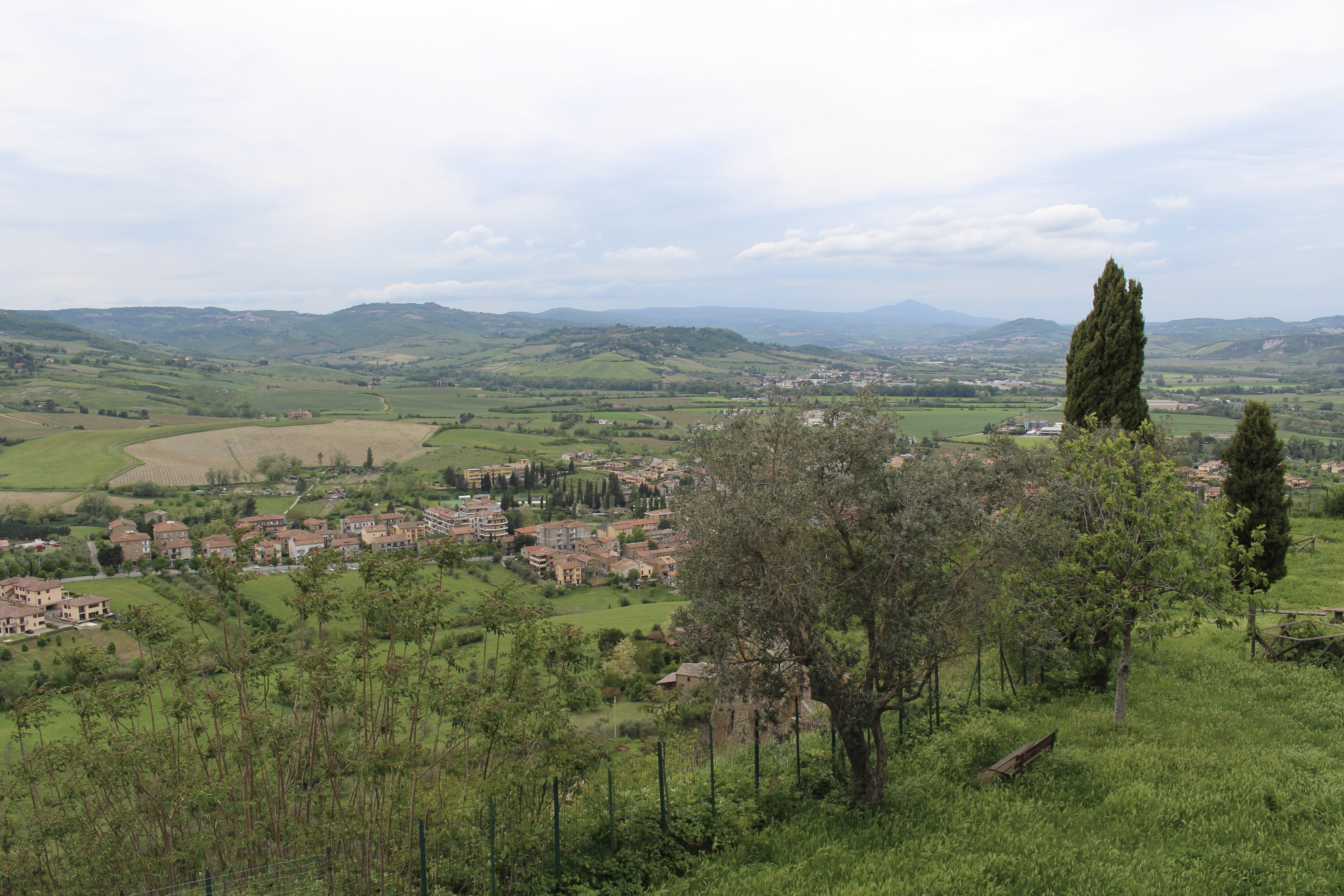
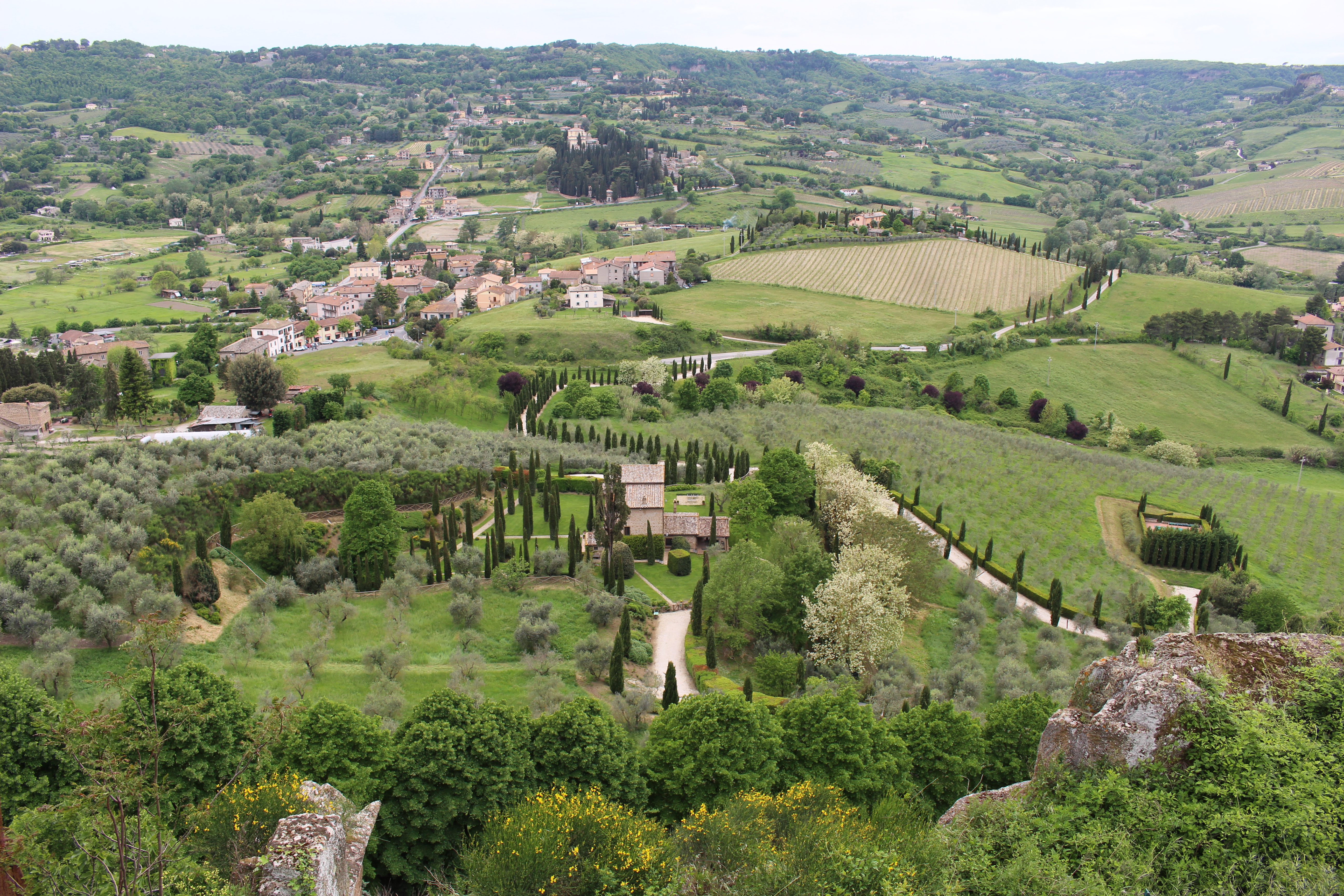
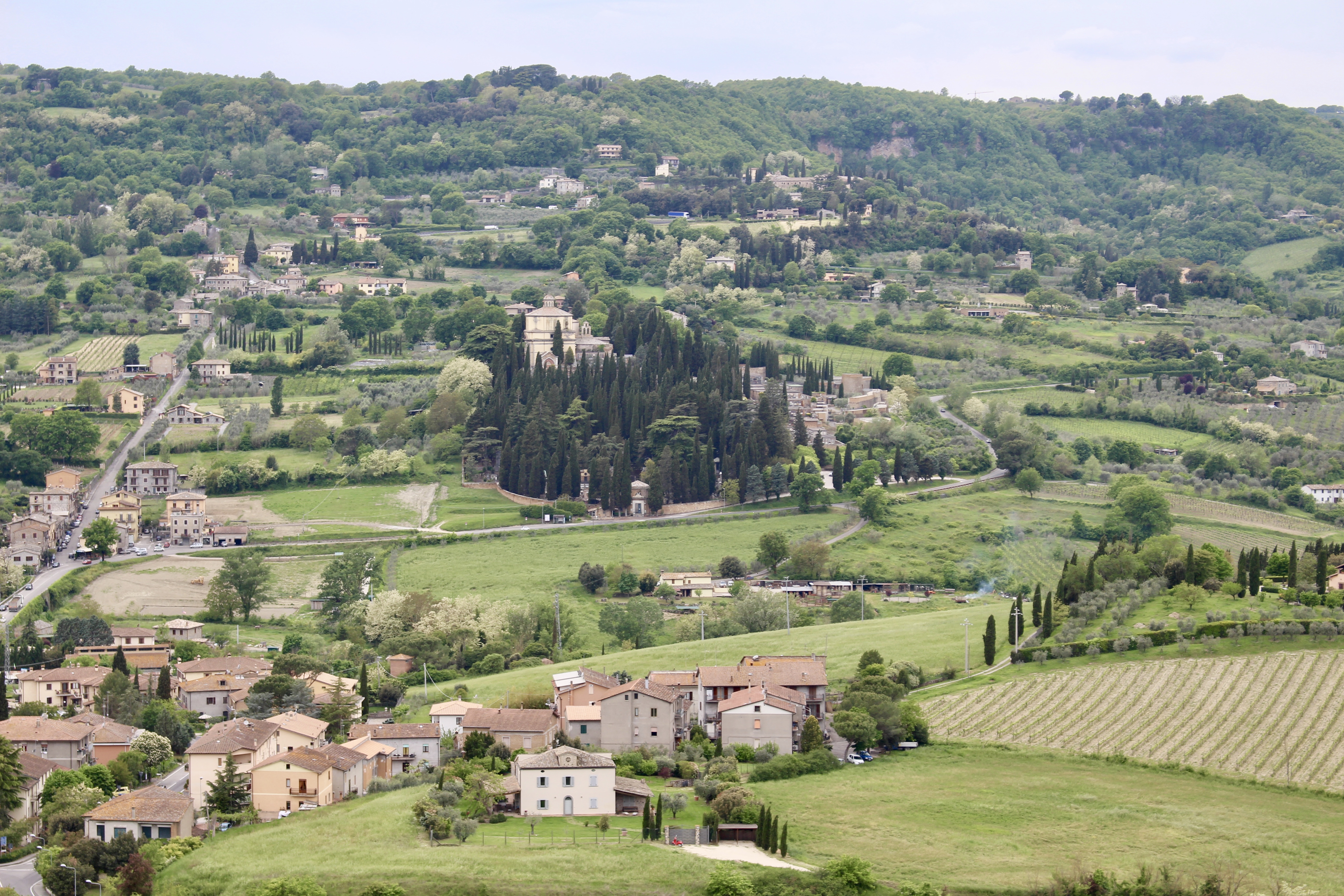
We then walked ever upward to the highest point in the town for views off the cliff into the valley below.
Orvieto
view of Orvieto
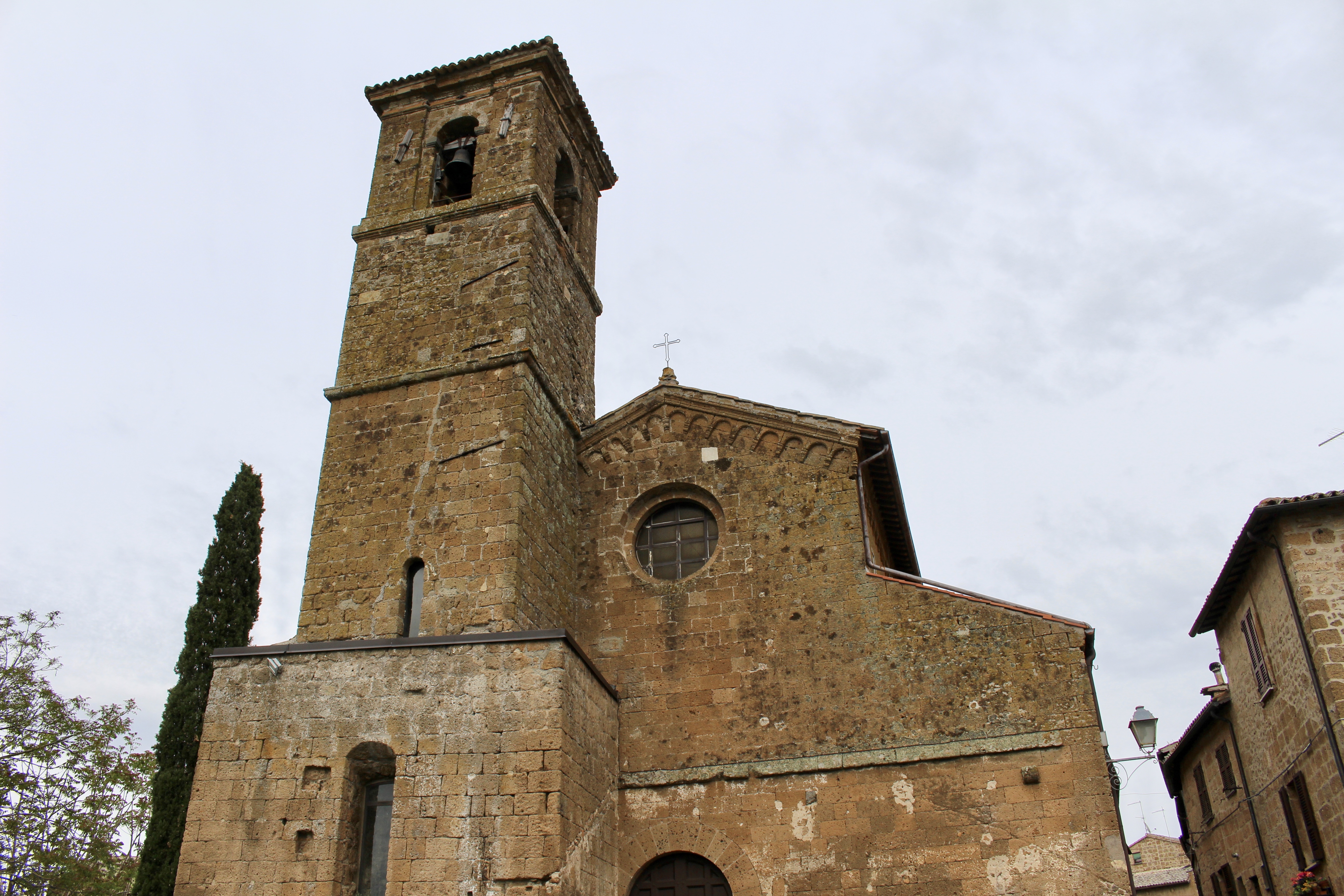
church in Orvieto
view from the cliff in Orvieto
view from the cliff in Orvieto
view from the cliff in Orvieto
view from the cliff in Orvieto
view from the cliff in Orvieto
view from the cliff in Orvieto
view from the cliff in Orvieto
view from the cliff in Orvieto
We walked back down through the town.
pretty window box
note in the bathroom
Off a little alley, we found some interesting wood carvings.
wood carvings
wood carvings
wood carving shop
wood carvings
wood carvings
Shivering, we stopped into the enoteca Bottega Vera, a wine bar where I had Fabbrica Birra Perugia Golden Ale and Mike had a red wine and we shared warm bruschetta with cheese and truffles. We had such a pleasant time.
me at Bottega Vera
me and Mike at Bottega Vera
bruschetta with cheese and truffles
It was so cold outside, that we went back to our room to warm up a bit before dinner.
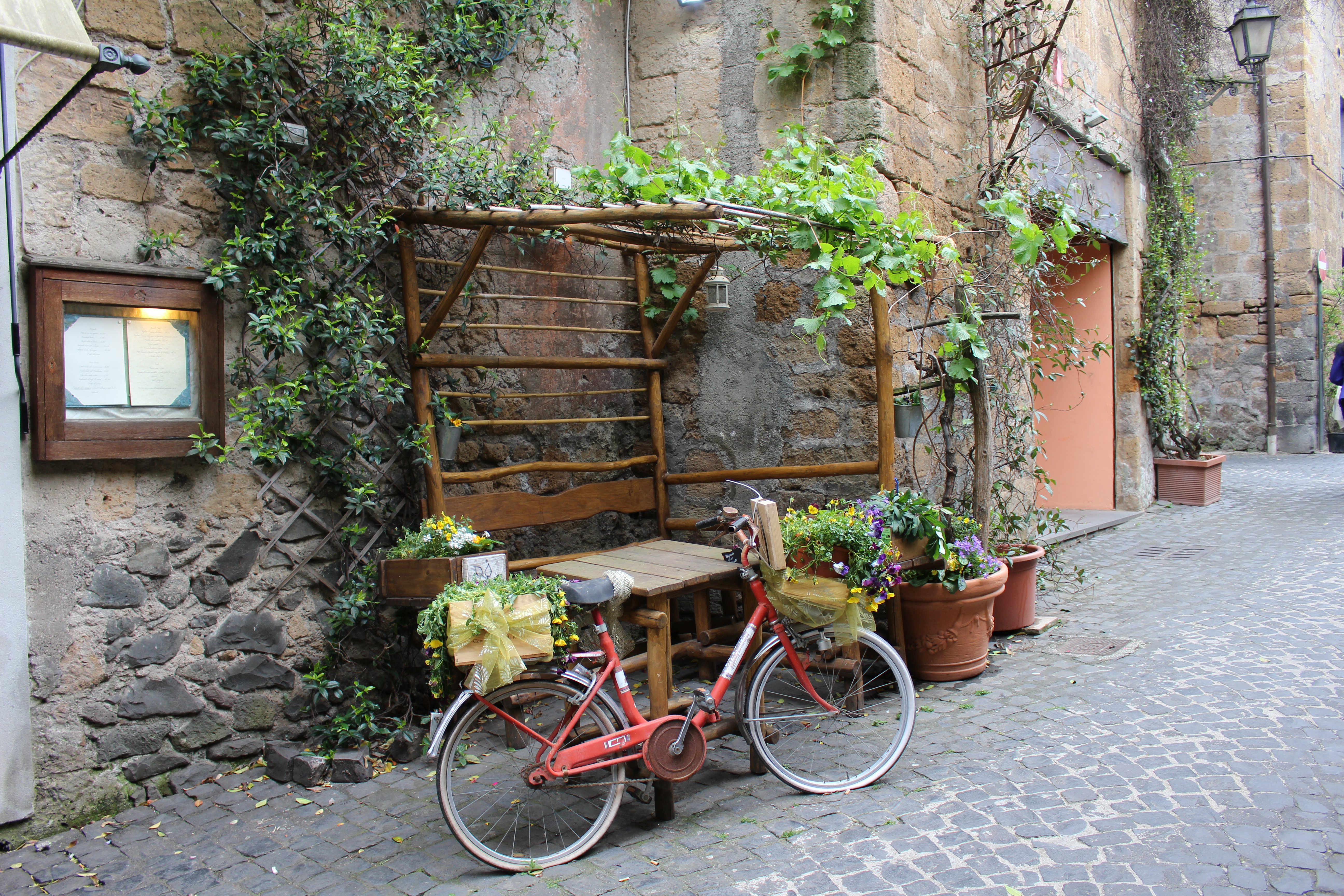
bicycle in Orvieto
Duomo di Orvieto
Orvieto
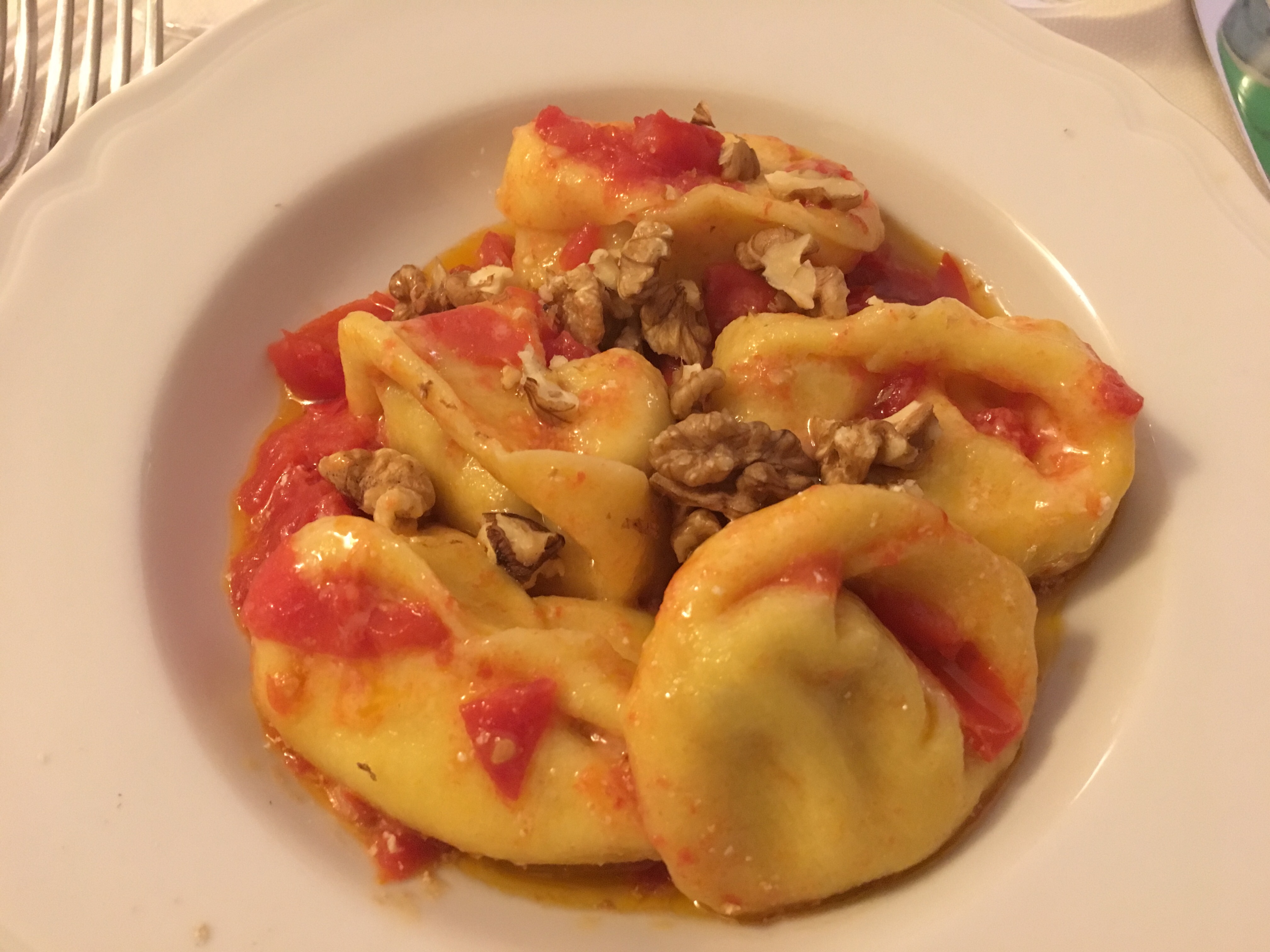
Later, at Il Cocco, Mike had a beer and I had a glass of red wine, and I enjoyed tortellini with cherry tomatoes, ricotta cheese and walnuts. Mike had lasagna with Bolognese sauce. As usual, our food was delicious.
pasta with walnuts
Fiat parked after dark
The next morning, we would head to Rome to spend the night, stopping on our way in Civita di Bagnoregio.
                    Eight Ways of Looking at Italy

I
We dwelt momentarily in many countries: Italy of antiquity,
Italy of vineyards and wines,
of stone monasteries set in silvery olive groves,
Italy of wisteria skies,
of elegant umbrella pines silhouetted against blue skies,
Italy of poppy and rapeseed fields,
of rugged coastlines and half-moons of beach chairs on glittery sand.

II
Amidst cities clad in stone
the only movement was implied --
Oceanus commanding the waters, boats sinking and spouting,
gods taming rivers, hot oil poured from medieval skyscrapers,
gladiators fighting to death,
thirteen obelisks converging on Rome.

III
On ancient maps, Italia was a wobbly sketch of boot,
a pink country jutting into the blue
Tyrrhenian and Mediterranean Seas,
a fashionable high-heeled boot,
flirting with, beckoning,
all the edges of Europe, Asia and Africa.

IV
The Holy Trinity – the Father, Son and Holy Spirit –
the Virgin Mary, the saints, and all the heavenly hosts,
breathed in paintings, sculptures and churches.
In marble, David, slayer of Goliath, was enlivened,
and in small smooth statues of the Virgin
hand-held in supplication.

V
Cypress trees danced frantically in gusts,
innuendos of restlessness.
Cobblestones soaked up rain,
turned slick and mirrored the moon,
which floated behind heavy clouds.
Roads curled though mountains and hills
transporting  travelers to medieval times.

VI
Tempting were the country’s displays of cellophane-wrapped pasta,
its jars of olives, its cloves of garlic hung on string,
its ravioli with fresh truffle,
its pansotti with walnut sauce,
its tortellini in meat broth, its gnocchi, its pasta with chicory,
its zuppa toscana,
its Picio Cacio e pepe,
its imbrecciata,
its rainbow displays of gelato.

VII
Flights to the heights were hard-fought,
climbs ever-upward in hilltop towns
within labyrinths of tightly clustered lanes,
climbs for tower views over terracotta rooftops
and inundating green hills,
climbs to fortress ruins,
to catch horizon glimpses on the wings of sparrows.

VIII
We had a surprise encounter with the Fiat 500 Club Italia.
The little cars zipped through Asciano,
cutting a wake through our path,
singing musical ditties,
like children in colorful raincoats.
In the midst of heavy history,
moments of joviality.
Trevi Fountain, Rome
David at Accademia
Florence
wisteria in Panzano
San Gimignano
road to Volterra
Siena
Fiats in Asciano
Sant’Antimo
on a road in Tuscany
Assisi
“POETRY” Invitation: I invite you to write a poem of any poetic form on your own blog about a particular travel destination. Or you can write about travel in general. Concentrate on any intention you set for your poetry.
One of my intentions for my trip to Italy was to write a “thirteen ways of looking” poem, where I focus on a single subject and reexamine it in a series of imaginative leaps (Poetry Everywhere, p. 173). I narrowed it to eight ways of looking.
I waited way too long to write this poem. Italy as a subject was much too broad. I should have focused on one aspect. I’ll have to work on another poem of this type with a much narrower focus.
You can either set your own poetic intentions, or use one of the prompts I’ve listed on this page: writing prompts: poetry. (This page is a work in process). You can also include photos, of course.
Include the link in the comments below by Thursday, August 6 at 1:00 p.m. EST. When I write my post in response to this challenge on Friday, August 7, I’ll include your links in that post.
This will be an ongoing invitation, on the first Friday of each month. Feel free to jump in at any time.
I hope you’ll join in our community. I look forward to reading your posts!
We left our Airbnb apartment in Perugia at 9:45 because we had to consolidate our suitcases with our multitudes of purchases. Today would be our next to the last day in Italy. We ate yogurt, granola, strawberries, orange juice and coffee. Then we were on our way to Spoleto, another in a succession of sleepy hill towns.
Inside the walled city, set on a slanting hillside, the upper portion is most interesting. We parked at the bottom, so we had a long uphill climb to the top. There were lots of stairs and steep inclines.
Spoleto
Spoleto
Spoleto
Spoleto
Spoleto
Spoleto
The town has beautiful piazzas and streets with Roman and medieval attractions, superb national surroundings with rolling hills, and a dramatic gorge.
Spoleto
Spoleto
Spoleto
Spoleto
Spoleto
Spoleto
Fiat in Spoleto
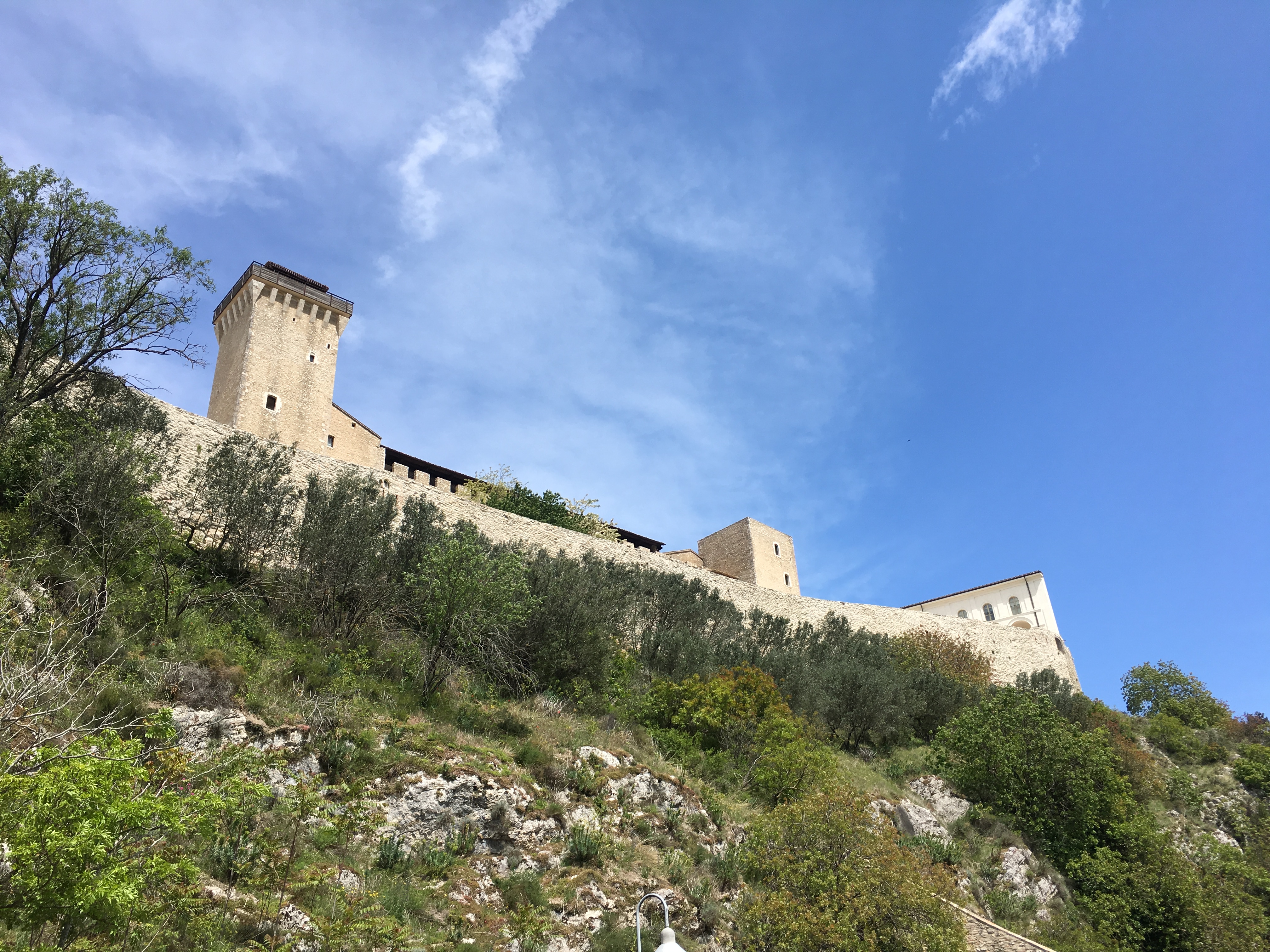
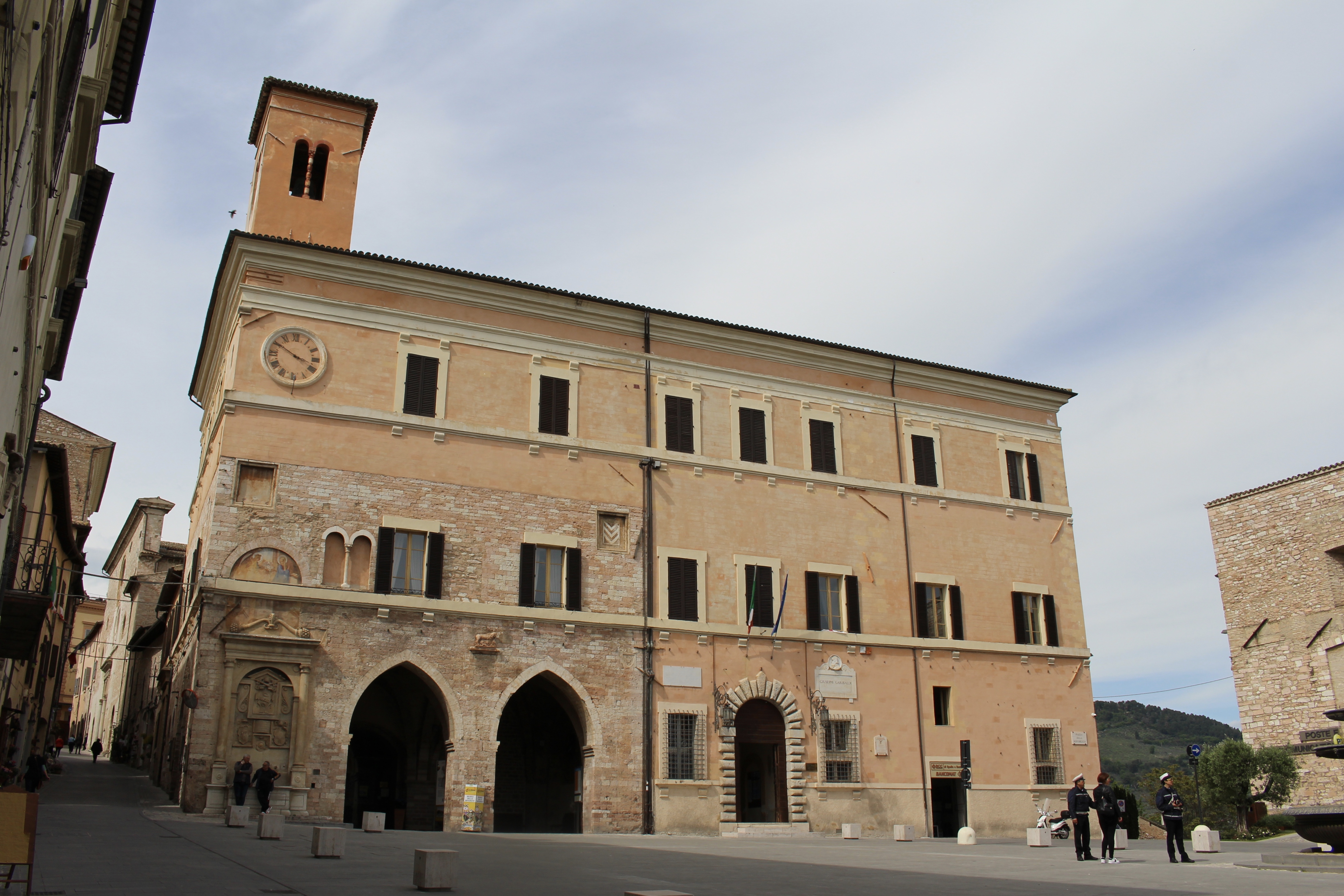
We stopped at a cafe for some salty pastries and coffee. Then we went to La Rocca (or Rocca Albornozlana). We didn’t go into the massive fortress but walked around the perimeter. It was built in the mid-14th century and served as a former papal palace, reflecting the restoration of the Church’s power. It is long and rectangular, with six towers and two grand courtyards.
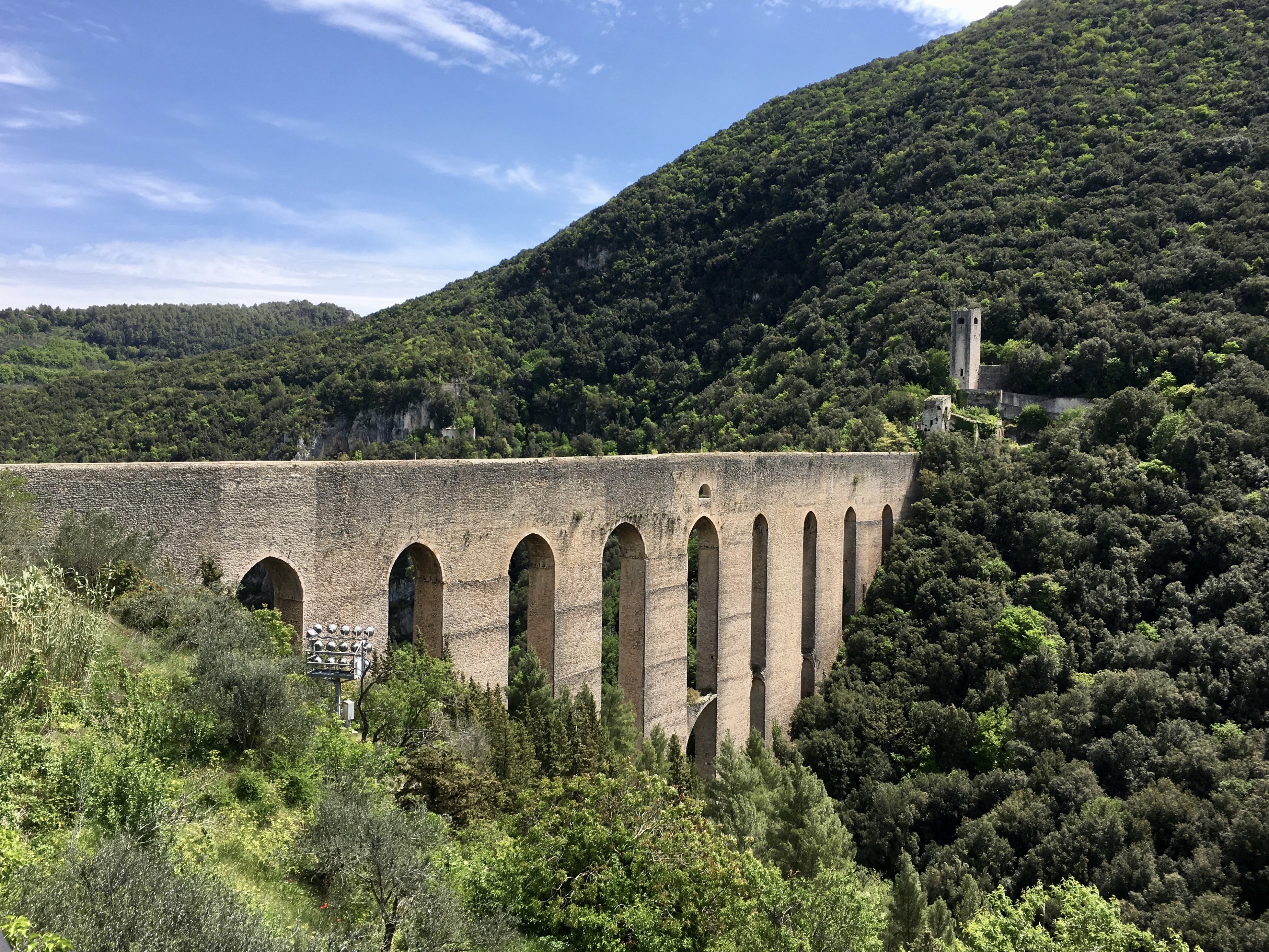
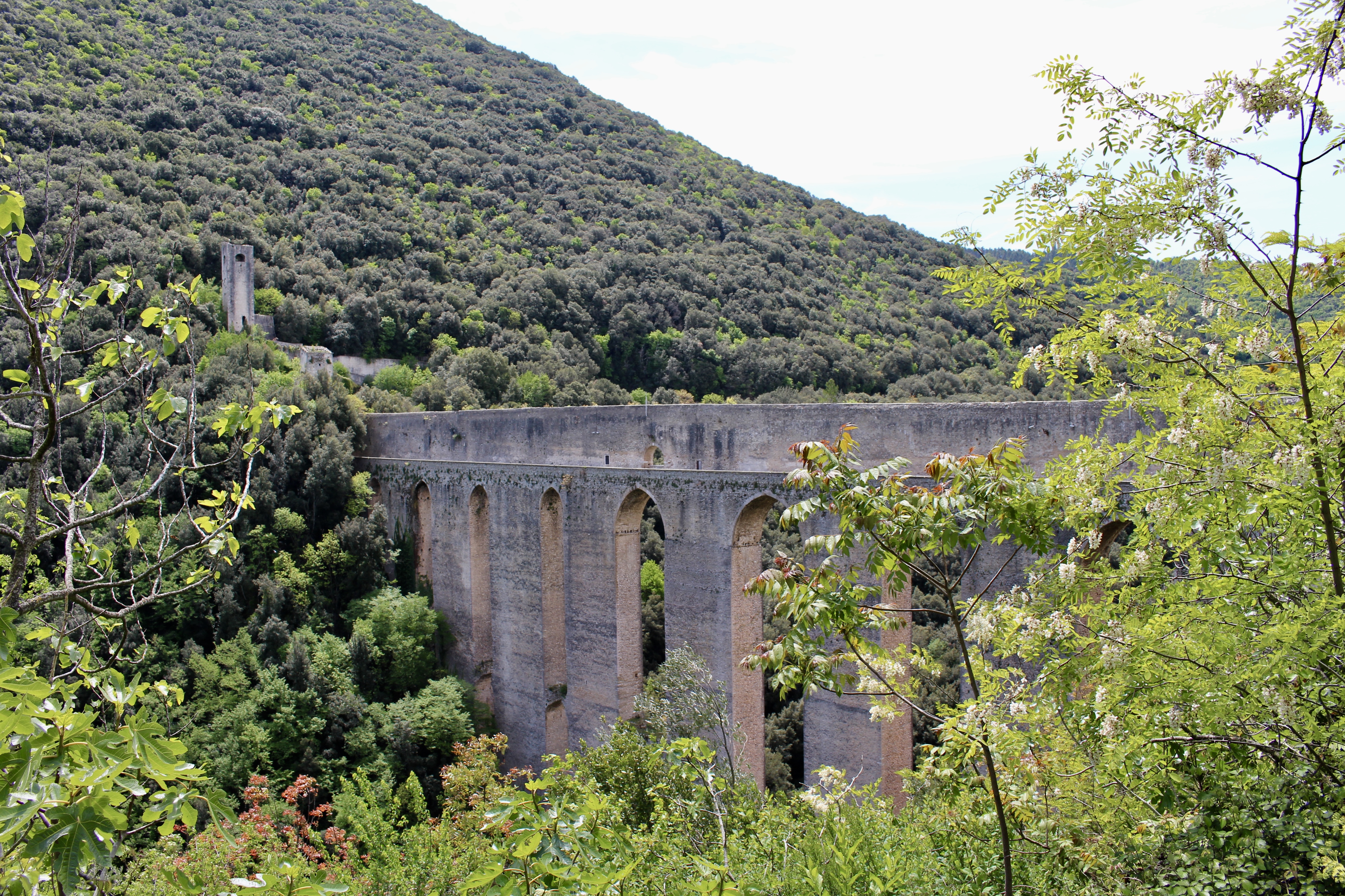
At the back side of the fortress sat the 14th-century Ponte delle Torri (Bridge of the Towers). Massive and graceful, the 10-arch bridge straddles the deep wooded gorge that separates Spoleto from Monteluco. Built over the foundations of a Roman-era aqueduct, it soars 262 feet above the gorge. From there, one could normally enjoy sweeping views over the valley. Sadly, we couldn’t walk across because it was closed due to damage from the August 2016 earthquake.
We met a man from Germany who was walking from Assisi to Rome, part of the St. Francis Way. He had climbed to the top of the town to take pictures and the walk was supposed to be over the bridge to the other side. He had to find another route to cross. He said he’d done the Camino de Santiago before and liked it because of the numbers of people and the infrastructure; he also liked that he was able to send his pack ahead (like I did) on the Camino. 🙂
Spoleto
coffee shop on La Rocca
View of Spoleto from La Rocca
View of Spoleto from La Rocca
View of Spoleto from La Rocca
Ponte delle Torri
Ponte delle Torri
La Rocca
Ponte delle Torri
Ponte delle Torri
La Rocca
view of Spoleto from La Rocca
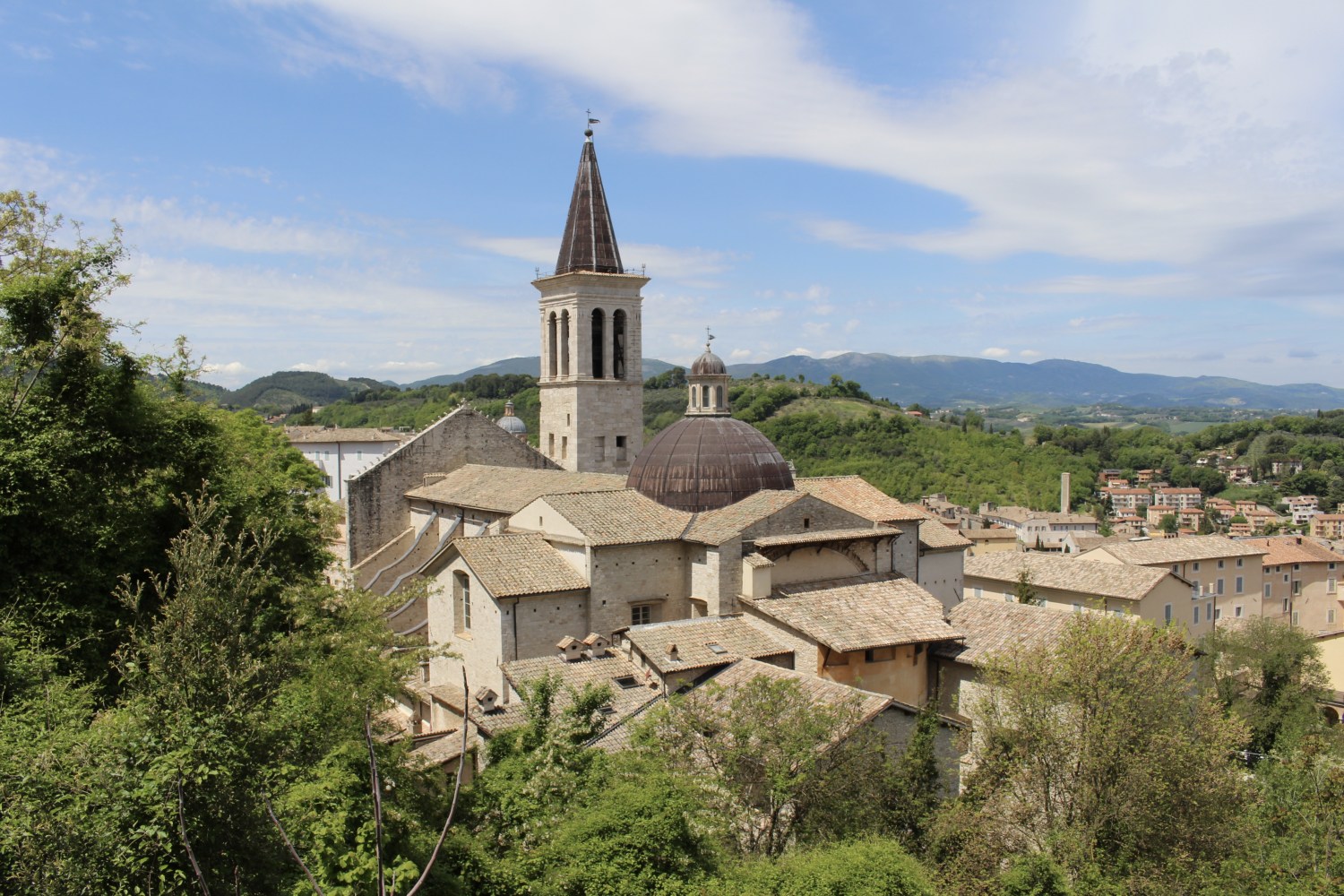
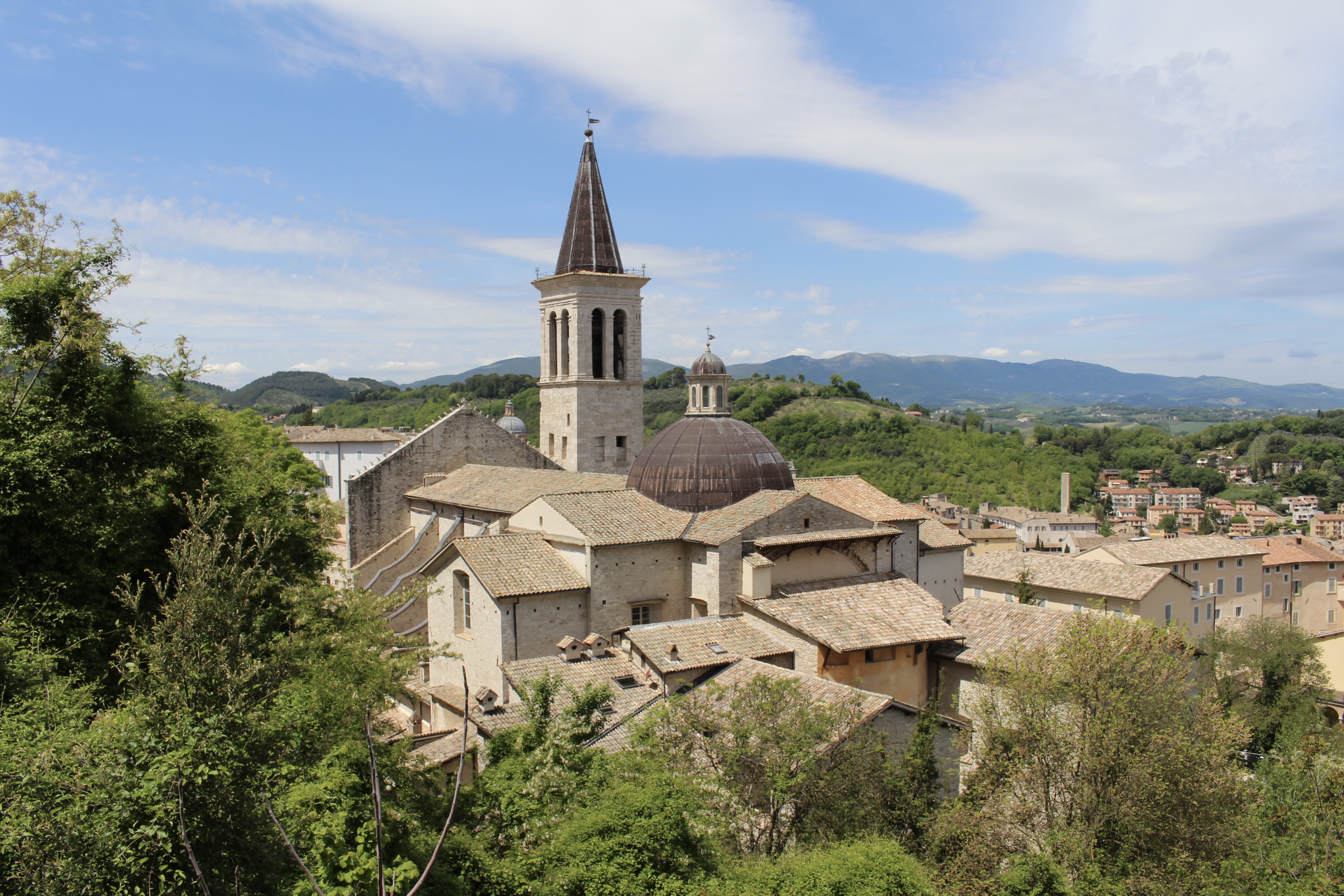
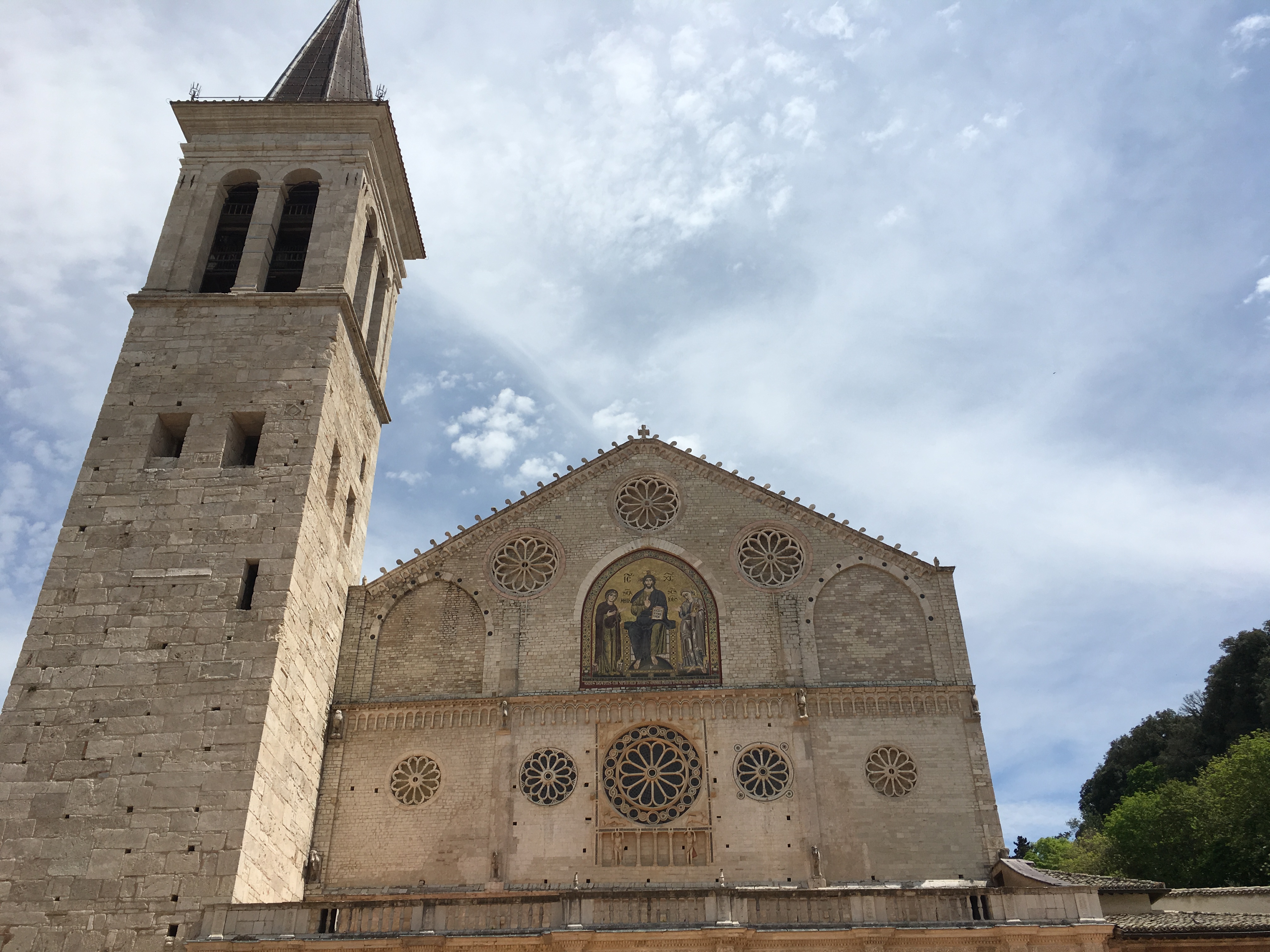
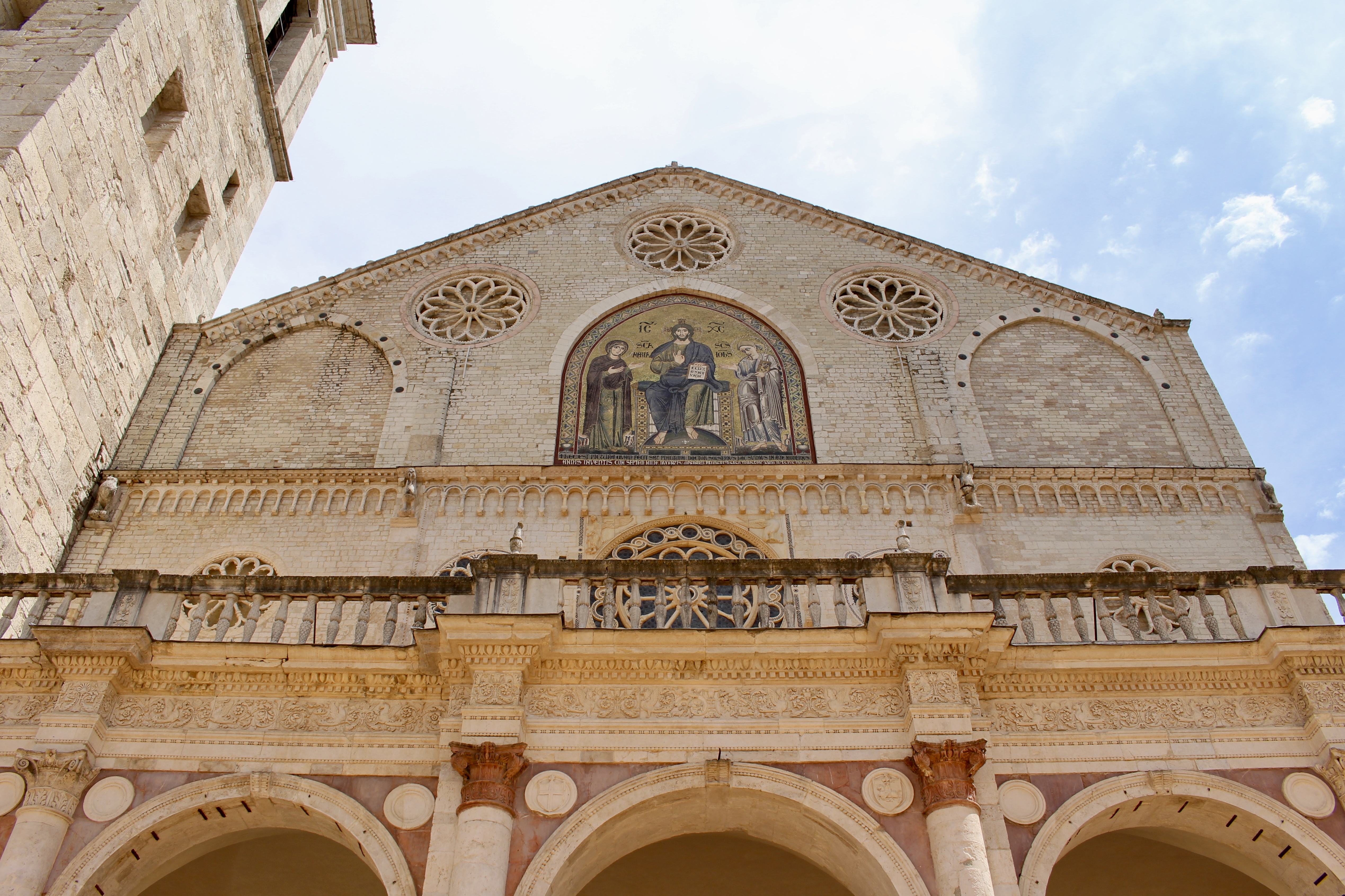
We then walked downhill to see Duomo di Spoleto, with its Romanesque facade. It was originally built in the 11th-century using huge blocks of salvaged stones from Roman buildings for its slender bell tower. It was renovated during the Renaissance with the addition of a loggia in a rosy pink stone, a stunning contrast in styles.
Spoleto’s Duomo
Spoleto’s Duomo
Spoleto’s Duomo
Spoleto’s Duomo
Spoleto’s Duomo
Eight rose windows and original floor tiles remain from an earlier church destroyed by Frederick I (~1123-90). Pope Urban VIII (1568-1644) had the church redecorated in 17th-century Baroque; luckily he didn’t destroy the 15th-century frescoes painted in the apse by Fra Filippo Lippi (~1406-69) between 1466-1469. The immaculately restored masterpieces – the Annunciation, Nativity, and Dormition – tell the story of the life of the Virgin. The Coronation of the Virgin adorns the half dome (Essential Italy: Fodor’s Travel).
Another fresco cycle, including work by Pinturicchio, is off the right aisle; grotesques were used in the ornamentation. The bounty of Umbria is shown in vivid colors in leaves, fruits and vegetables that adorn the center seams in the cross vault.
Spoleto’s Duomo
Spoleto’s Duomo
Spoleto’s Duomo
We walked through the town until we found a lunch place, newpoint, where I had falafel on a salad with olives and chili sauce, and a Schwepps limone.
statue in Spoleto
pasta display in Spoleto
Spoleto
Spoleto
pasta in Spoleto
Spoleto
Spoleto
Spoleto
our lunch spot, newpoint
falafel for lunch
Spoleto
We retrieved our car from the square at the bottom of the town then drove south and west through mountain passes much like those in West Virginia. We arrived in Orvieto around 3:15.
After our visit to Assisi, we drove a short distance to Spello, a hilltop town at the edge of Monte Subasio. The buildings of the town glowed with the warm rosy-beige tones of the local pietra rossa stone.
“The return of Francis” – bronze statue in Spello
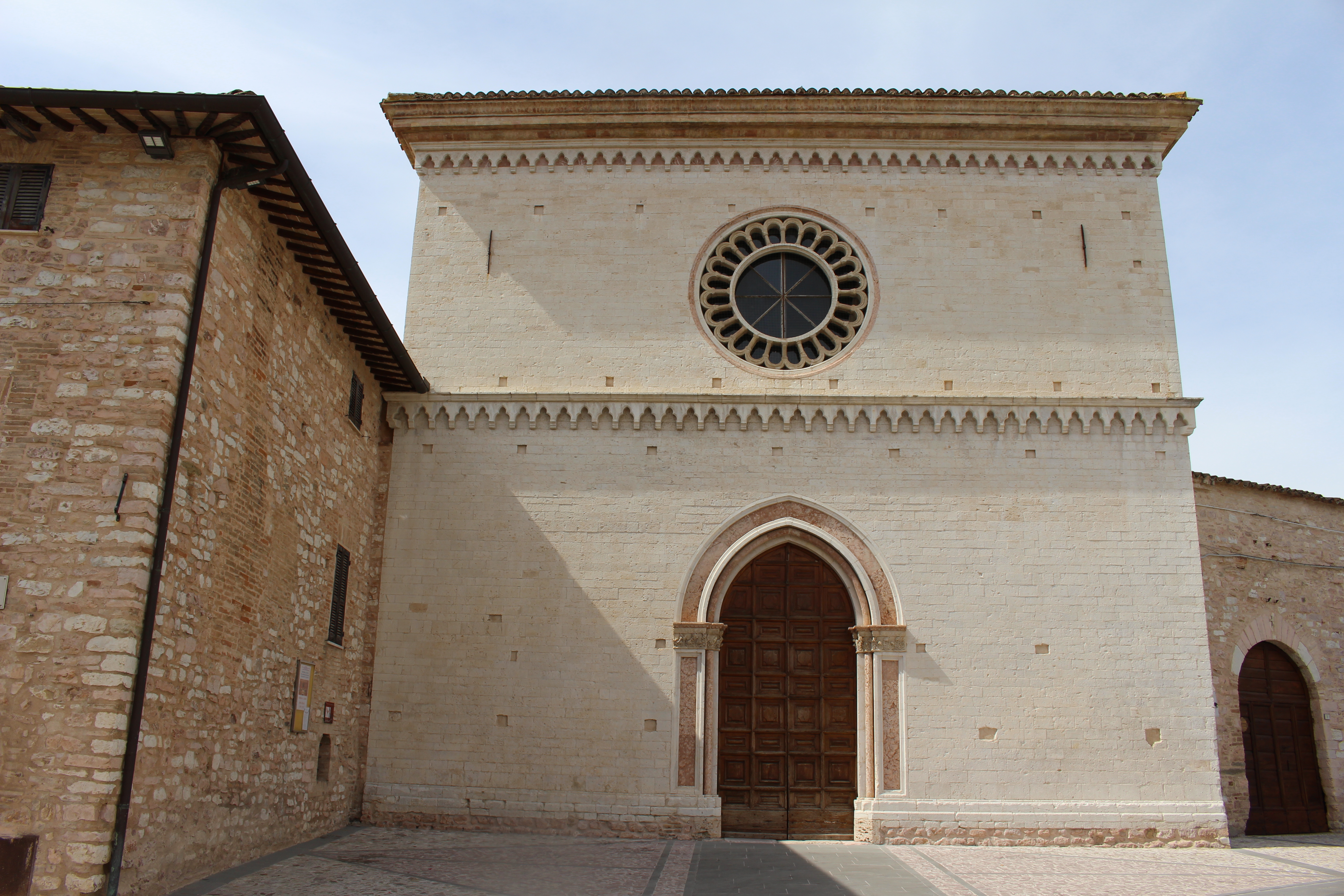
church in Spello
We walked all around the town in a big circle because we were only able to park for one hour. Some obnoxious Americans, two couples, were being very loud, tossing their Southern twangs in a free-for-all around us. We stepped up our pace to keep our distance from them.
Spello
Spello
Spello
Spello
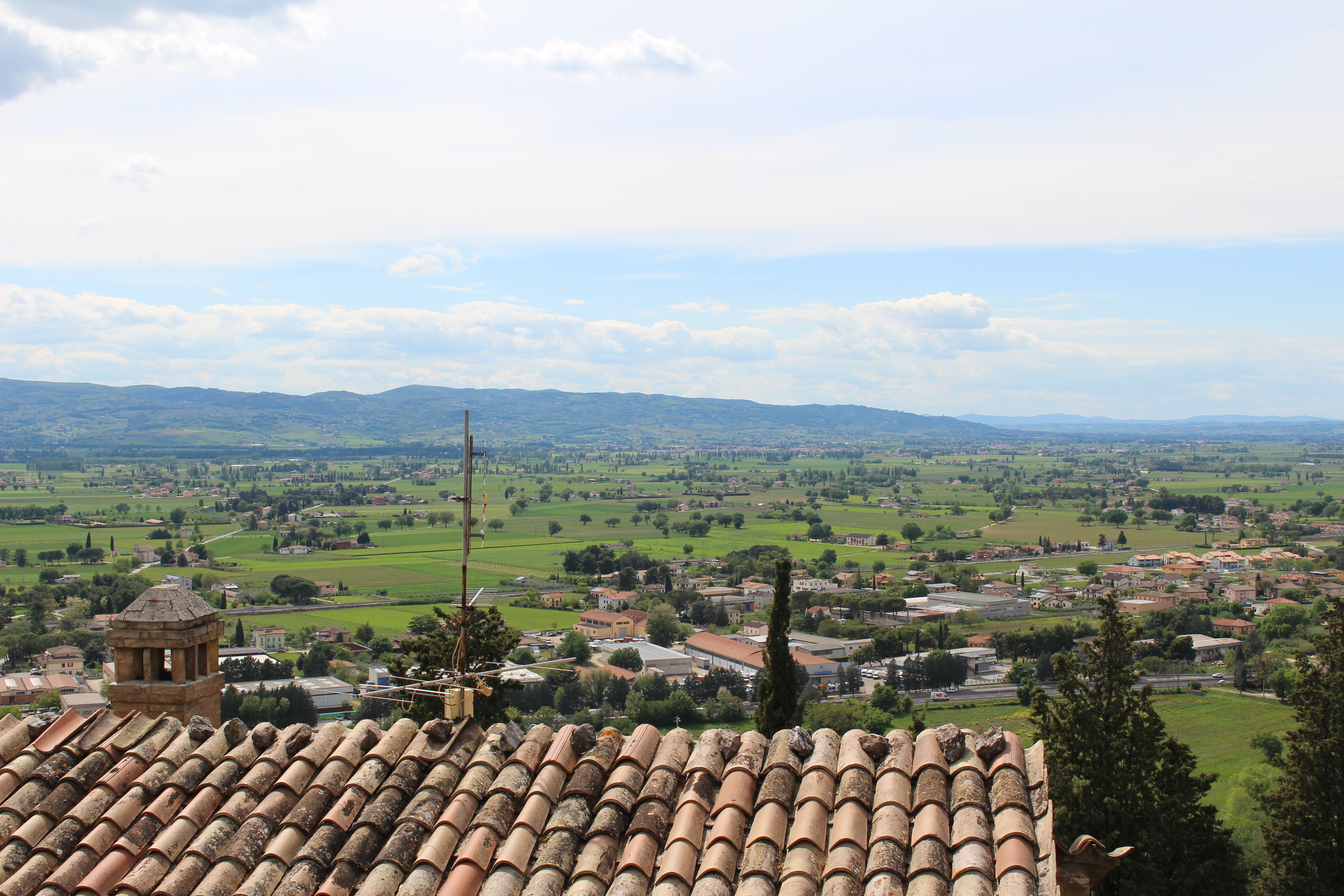
At the edge of town, we enjoyed a view over the Umbrian plain.
view from Spello
Spello
Spello
Spello
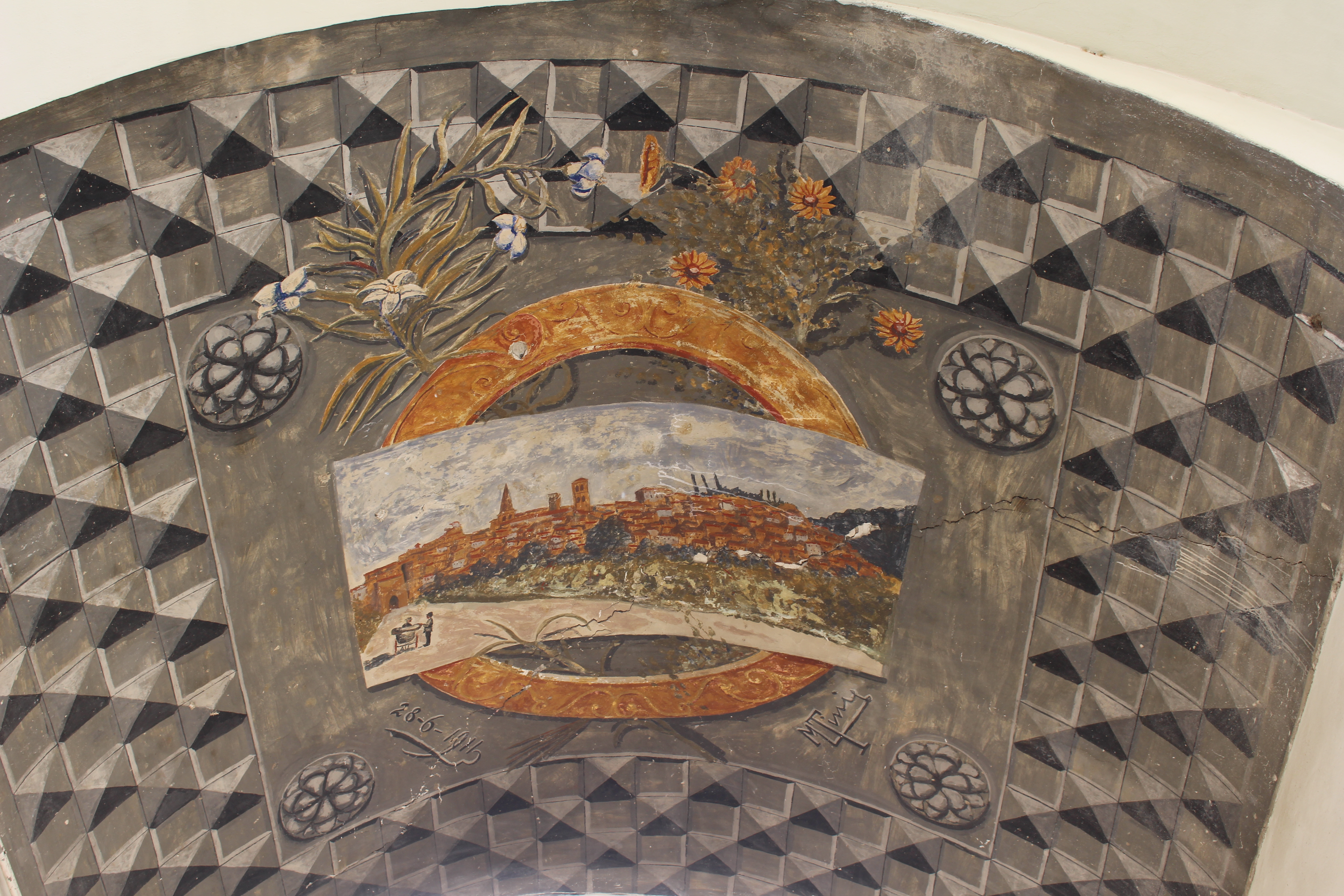
painting on arch in Spello
view from Spello
Spello
painting on a niche in Spello
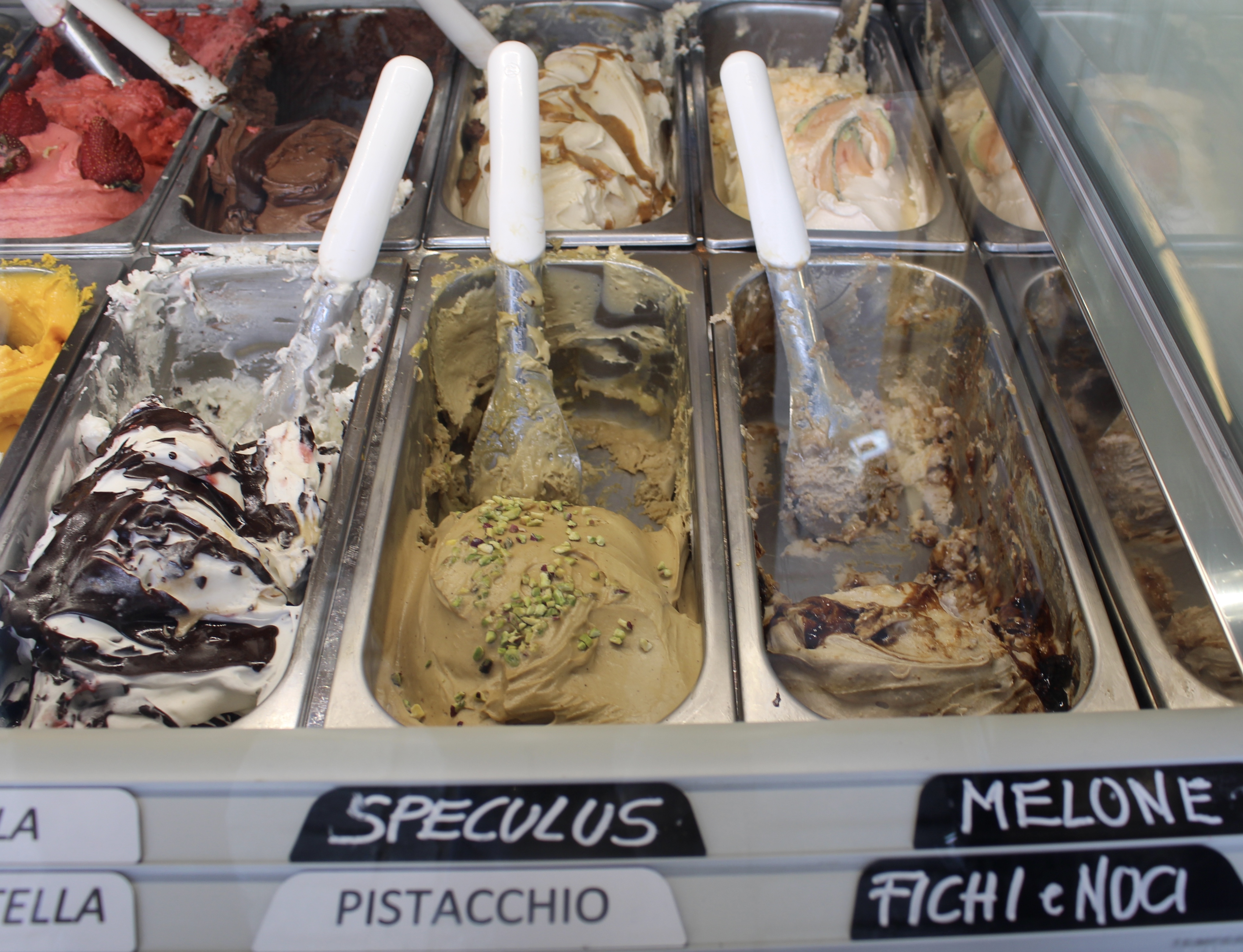
We stopped for a gelato after our walk. I had Amarena (black cherry) and Mike had Fichi e Noci (figs and walnuts).
gelato 🙂
Spello
We returned to our Airbnb in Perugia and had wine on the patio. I took a long hot bath. Francesco came to replace some light bulbs that were out. We had snacks of cheese, prosciutto, and jarred Asparagi verdi (green asparagus).
Perugia Airbnb kitchen
Perugia Airbnb patio
Perugia Airbnb covered patio
Mike whipped up a dinner of tortellini with salsa fave e pecorino (sauce of fava beans and pecorino) and leftover sausage from lunch.
The following morning, we would leave Perugia and head to Orvieto by way to Spoleto.
Some of the things I planned for my trip to California in January of 2014 were as follows:
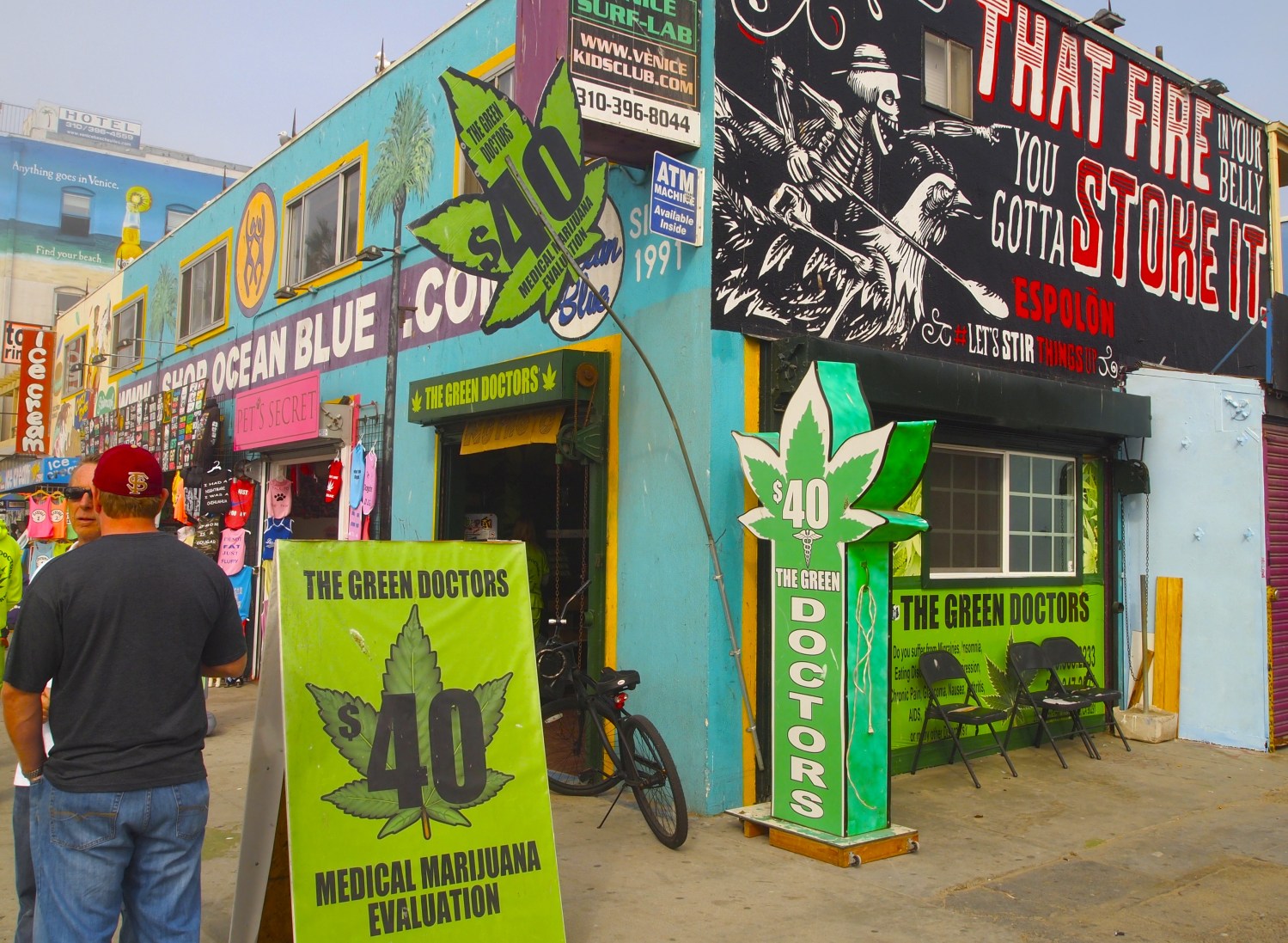
Visit my sister in Los Angeles and explore the Venice Walk-Streets at Venice Beach.
Visit a fellow blogger, Rosie, walk to Bob’s Big Boy and attend Poets and Writers LIVE!
See some of the California missions in Ventura and Santa Barbara.
Go to the Santa Barbara Botanic Garden and Stearns Wharf.
Visit Hearst Castle at San Simeon.
Visit my friend Jayne in Danville, near San Francisco.
Go wine tasting with Jayne on the Silverado Trail in Napa Valley.
Drive the 17-Mile Drive at Pebble Beach.
Visit Monterey.
Venice Beach 2014
Venice Walk-Streets 2014
Monterrey, CA 2014
Fog-enshrouded San Francisco 2014
Hearst Castle 2014
Hearst Castle 2014
Mission Ventura
Malibu Seafood
On my way home from China in July of 2015, I also stopped in California. This time, my plans were as follows:
Visit my sister again in Los Angeles.
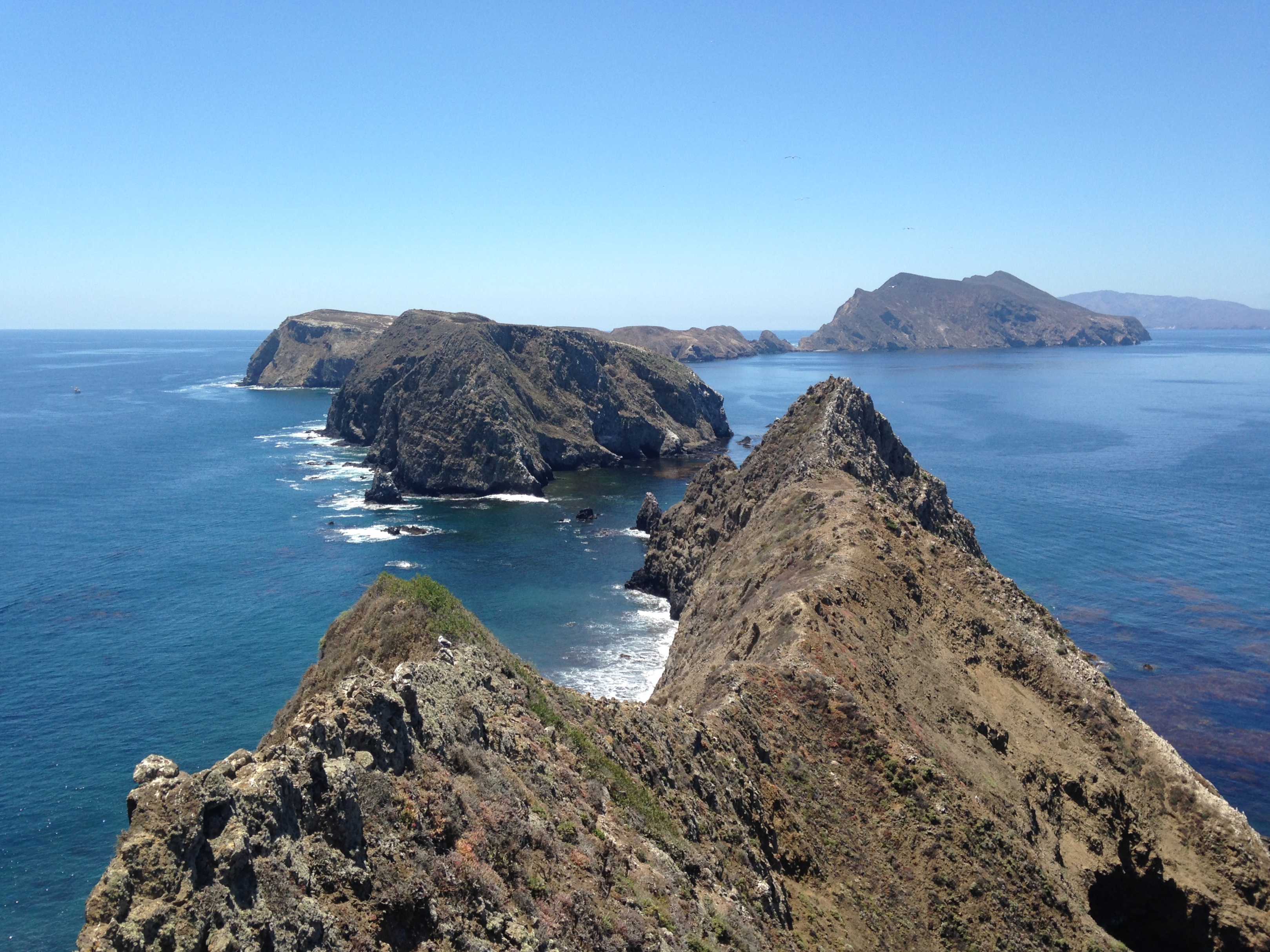
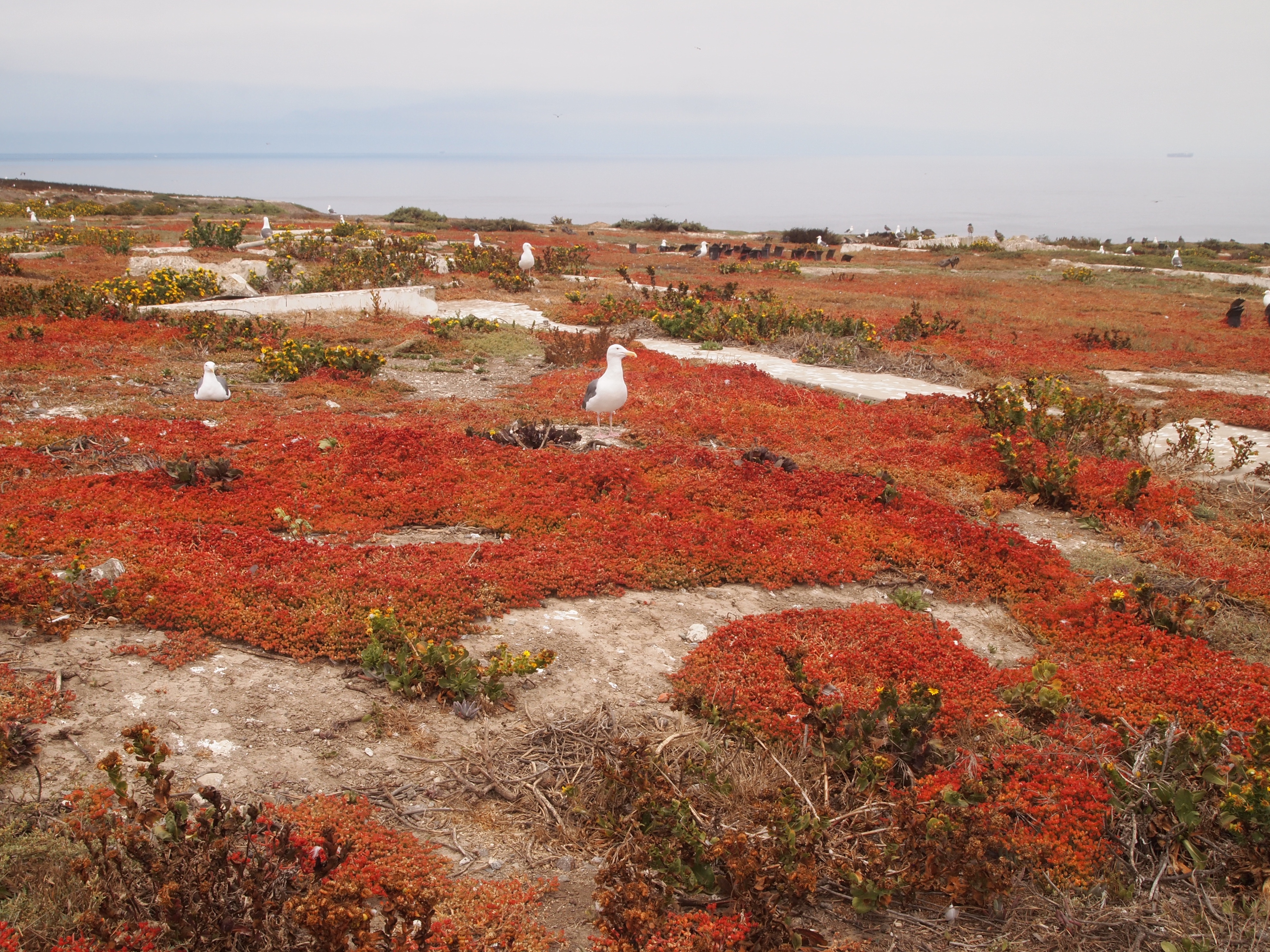
Explore Anacapa Island, part of Channel Islands National Park, with my sister.
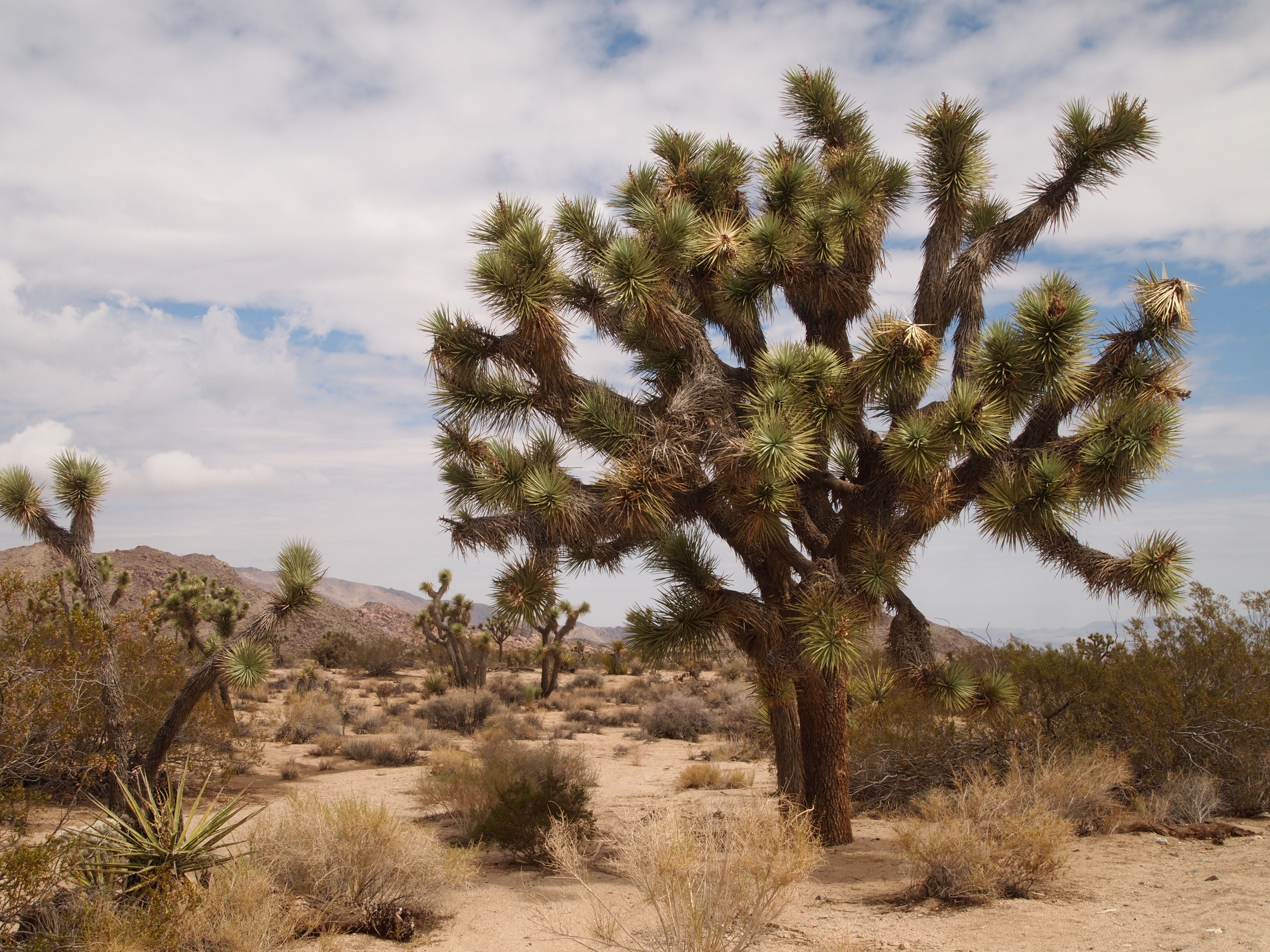
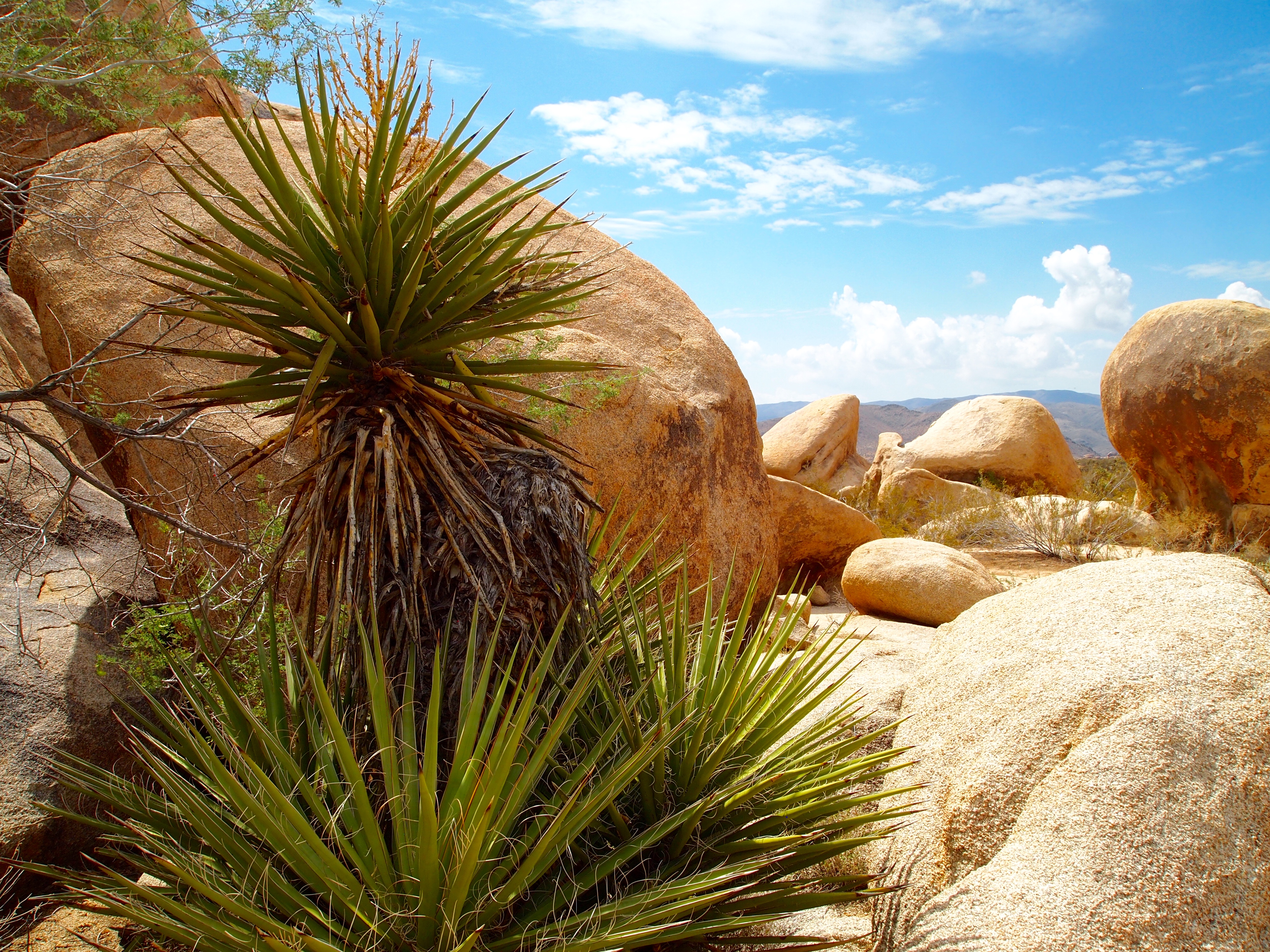
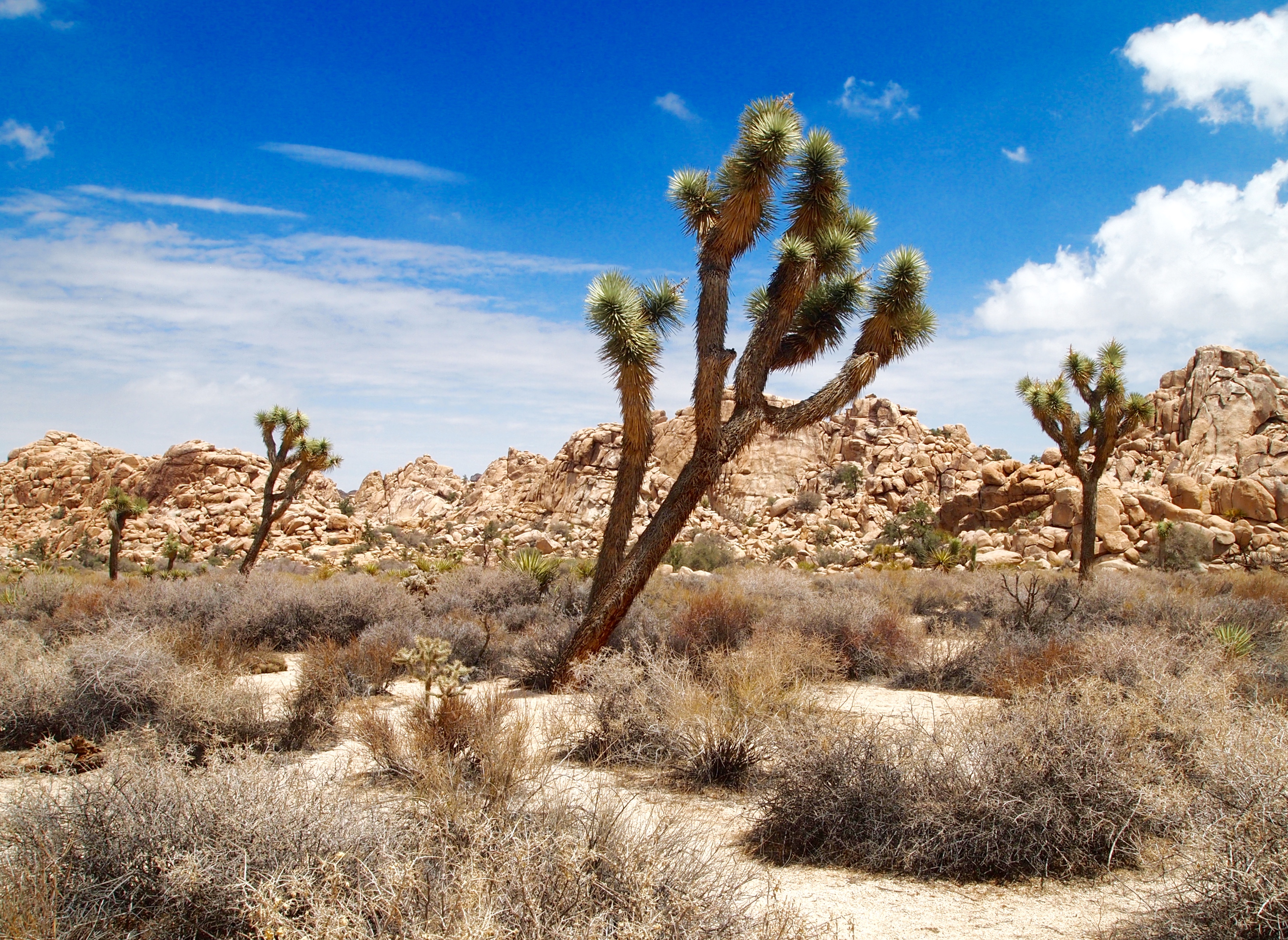
Go with my blogging friend Rosie to Joshua Tree National Park.
Anacapa Island
I didn’t read many books to prepare for my trip to California, but I had read a number in the past and had a huge list of books to choose from (this list is the tip of the iceberg):
California was calling my name. It was January of 2014, and I wanted to get away from the cold winter weather. I also wanted to visit my sister Stephanie and my blogging friend Rosie in Los Angeles, as well as my dearest friend Jayne in San Francisco.
My sister Stephanie in Los Angeles
Steph’s studio
Steph’s art supplies
Rosie and me at Poets & Writers LIVE! in LA
Rosie on a hike near Malibu
Jayne near Pebble Beach
me on the Venice Walk Streets
In July of 2015, I wanted to stop in California to visit my sister on my way home from teaching for a year in China. We planned to visit the Channel Islands during my time there. I would also visit my blogging friend Rosie and we’d go to Joshua Tree National Park together.
I had been to California several times in the distant past. I went on a 3-month road trip in 1979 with my first husband, Bill. That time, we visited Redwood National Forest, Crescent City, Death Valley and Yosemite.
me at Redwood National Forest 1979
Crescent City, CA 1979
Sand dunes at Death Valley
Bill & Lilly at Death Valley
Scotty’s Castle in Death Valley, CA
me on the Devil’s Golf Course, Death Valley, 1979
Yosemite 1979
Since Bill and I lived in Coeur d’Alene, Idaho for four years, from 1980-1984, we took another trip to San Francisco in the early 1980s, probably 1983.
me at Redwood National Forest 1983
Chinatown, San Franciso 1983
Bill and me in Chinatown, San Francisco 1983
San Francisco, CA 1983
San Francisco, CA 1983
San Francisco, CA 1983
me at Alcatraz, 1983
Alcatraz, 1983
Alcatraz, 1983
Alcatraz, 1983
In 2014, I would get to visit my sister and some good friends, and see some places I hadn’t seen on my first couple of trips.
Venice Beach 2014
California blooming 2014
California blooming 2014
the harbor in San Francisco 2014
Pebble Beach near San Francisco 2014
San Francisco 2014
Hearst Castle 2014
Hearst Castle 2014
Mission in Santa Barbara 2014
Mission in Santa Barbara 2014
Bob’s Big Boy 2014
antique cars at Bob’s Big Boy 2014
antique cars at Bob’s Big Boy 2014
Malibu Seafood 2014
In 2015, I’d also visit Stephanie and Rosie, and see a few more places.
Anacapa Island
Joshua Tree National Park
Joshua Tree National Park
Joshua Tree National Park
I would be in California from January 3-13, 2014 and again from July 15-20, 2015.
We had breakfast in our apartment: yogurt, strawberries, granola, orange juice and coffee, although it took Mike a while to figure out the espresso machine. As I am so bad with mechanical things, I always count on him to figure them out. 🙂
We meant to get an early start but didn’t leave until 9:00. We arrived in Assisi at 9:45 and parked on a mountain road on the far side of town.
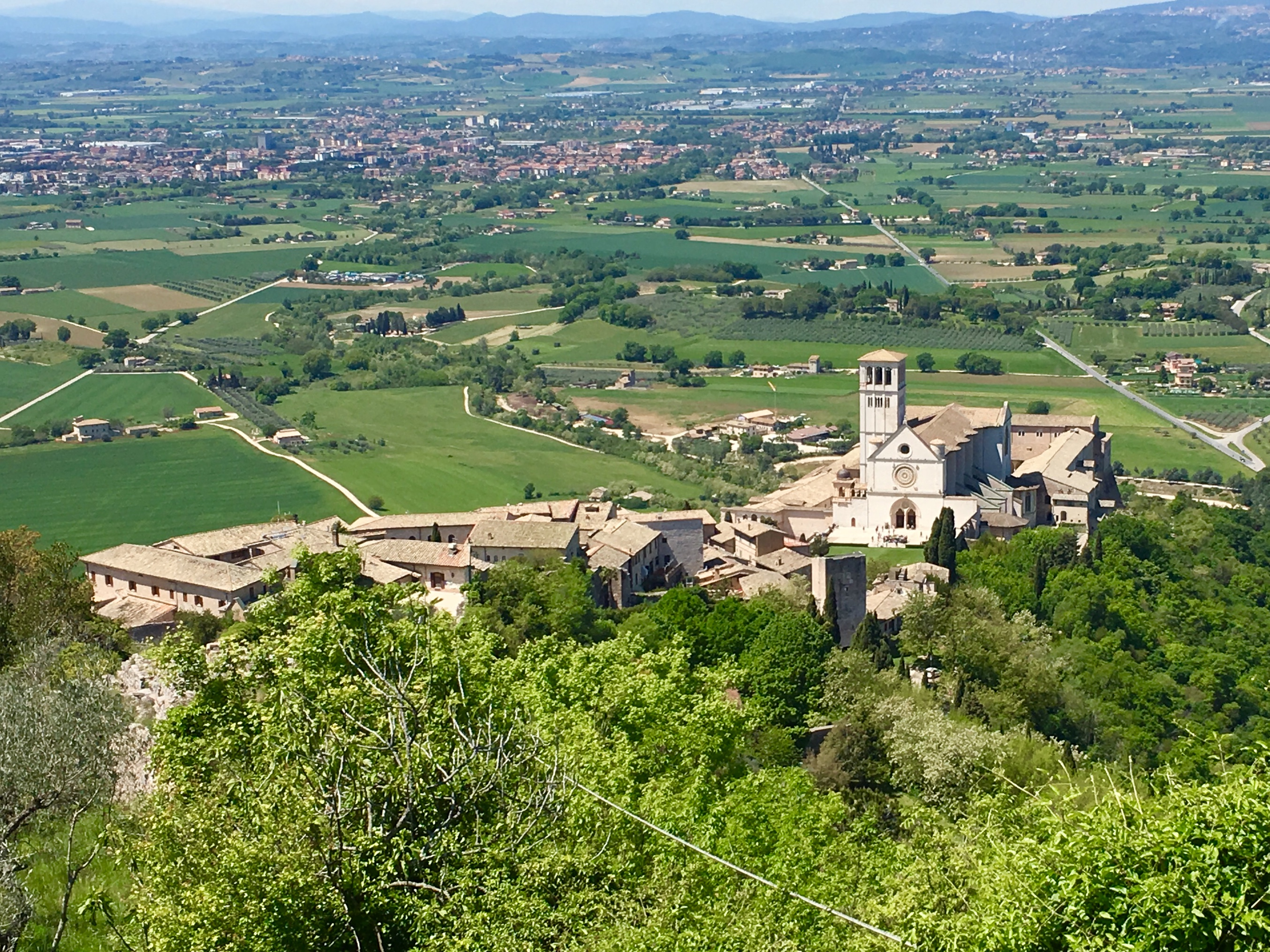
Assisi is one of the Christian world’s most important pilgrimage sites and home of the Basilica di San Francesco, built in honor of St. Francis (1182-1226).
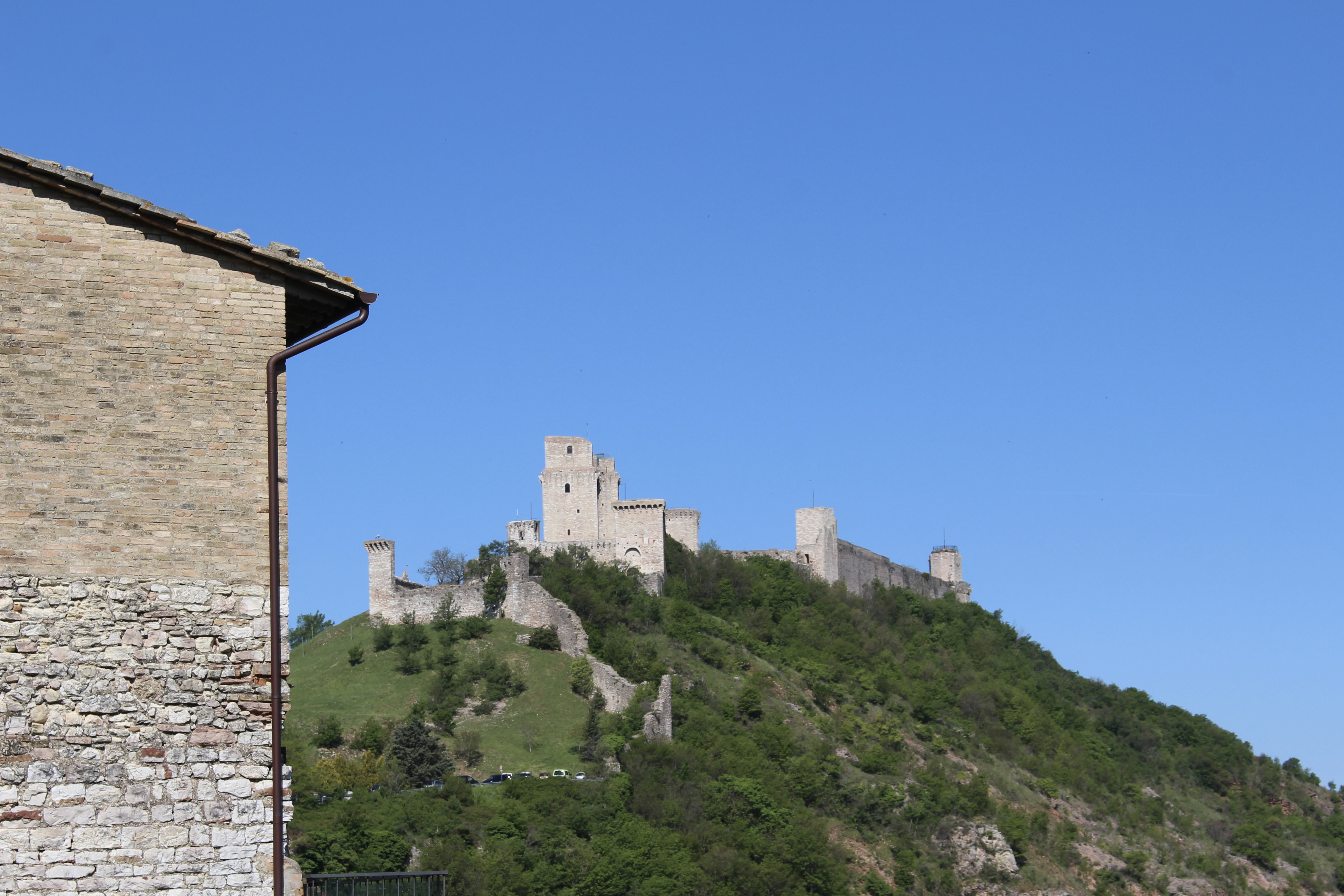
view of Rocca Maggiore from our parking spot
We walked downhill forever until we were in sight of the Basilica di San Francesco. On the way, we passed the Temple of Minerva, which dates from the first century B.C.
walk downhill through Assisi
Bar de Piazzanova
all about lavender
shop on the way downhill in Assisi
alley in Assisi
Temple of Minerva
mural of the Virgin
Cacio pepe e…
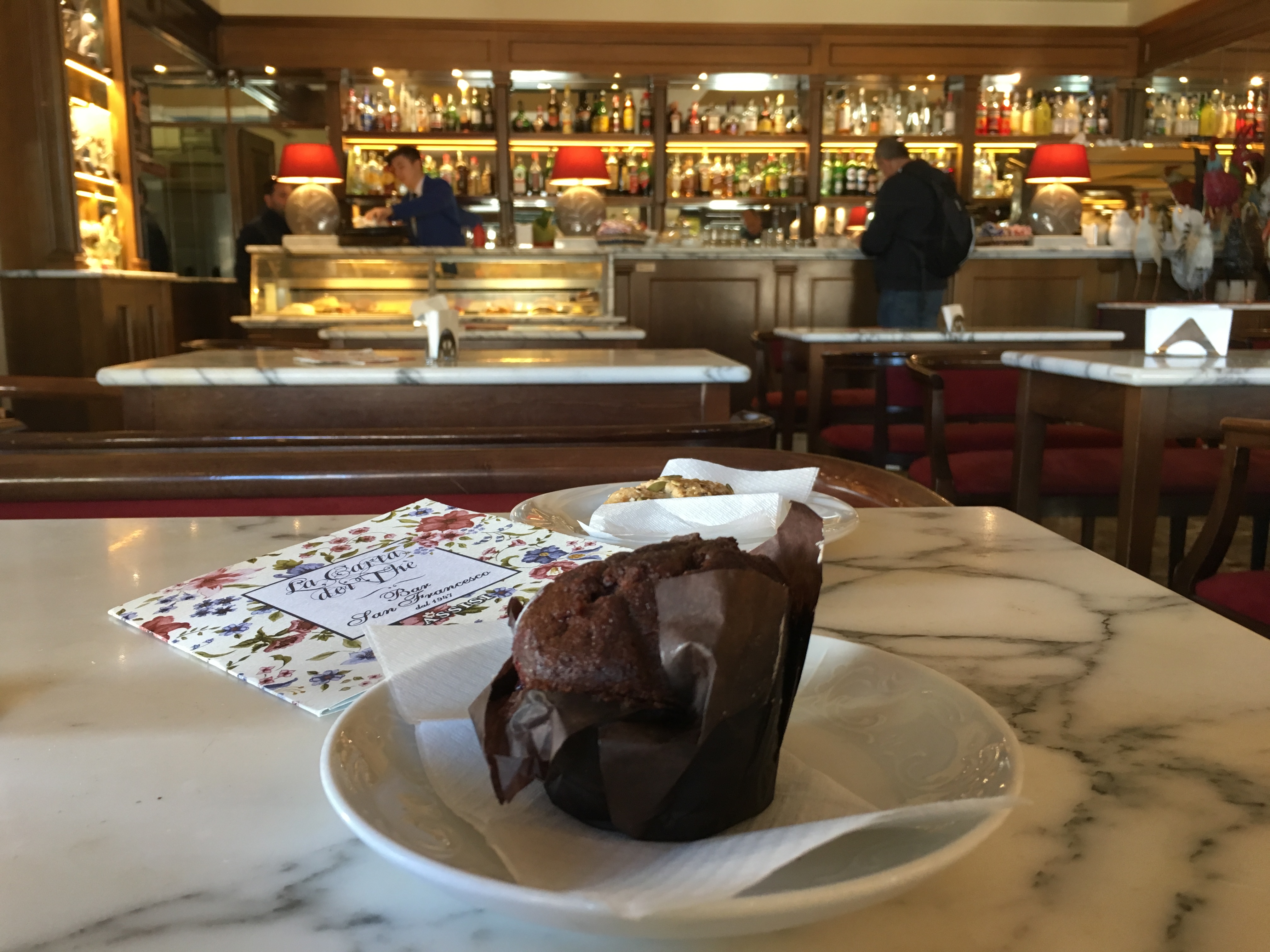
For a restroom break, we stopped at a cafe for a chocolate muffin and Mike had coffee and a pistachio and jam cookie.
a chocolate muffin at a cafe near the Basilica
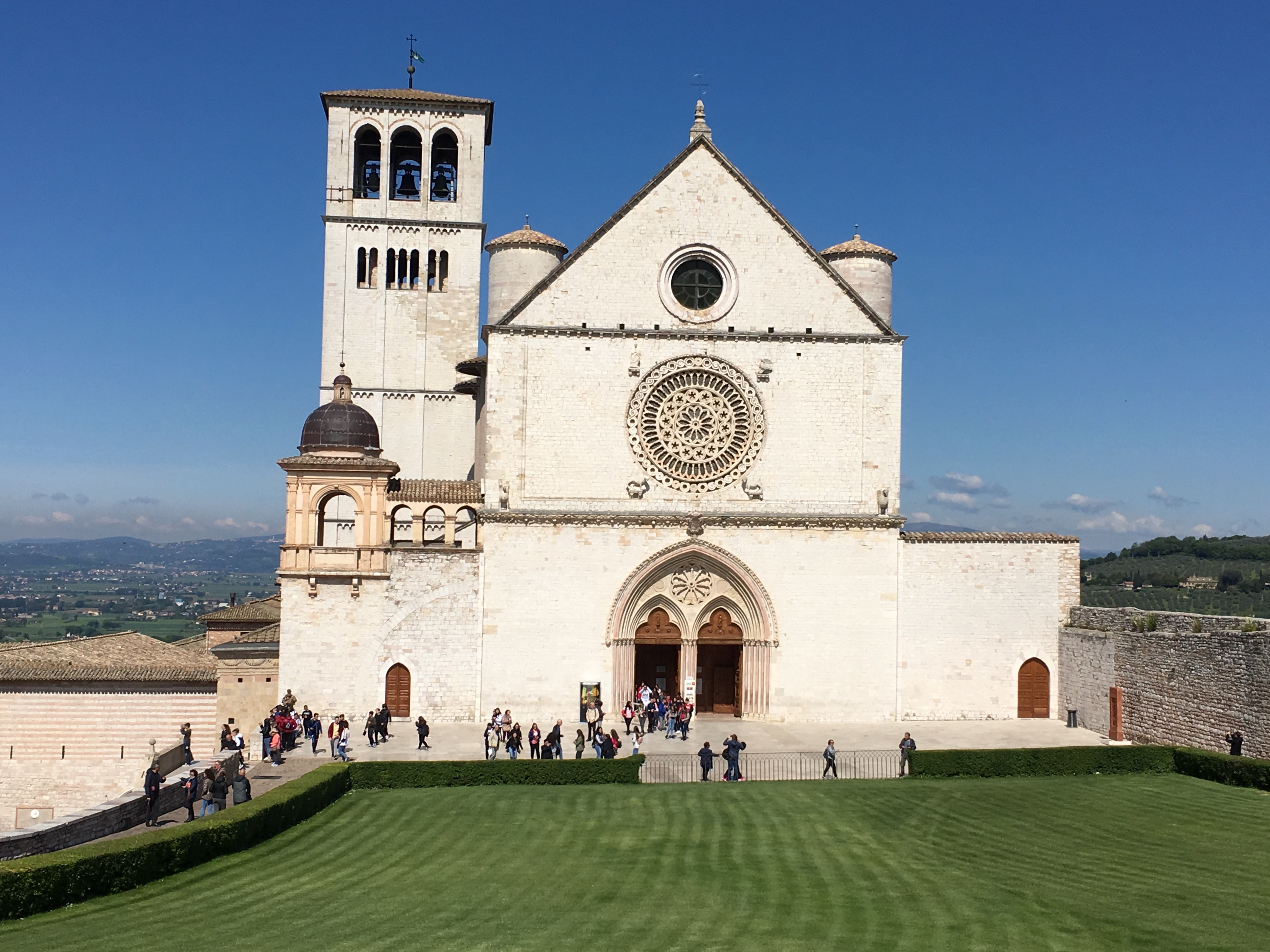
Basilica di San Francesco
We went in to the Gothic Upper Church, known as the Basilica Superiore (built from 1230-1239), which sits atop the lower one. It has soaring arches and tall stained glass windows (the first in Italy). It is covered floor to ceiling with some of Europe’s finest frescoes. Sadly, no photography was allowed. 😦
The St. Francis fresco cycle is the highlight of the Upper Church. Twenty-eight frescoes depict the life of St. Francis, born in Assisi in 1181, the son of a French noblewoman and a wealthy cloth merchant. He had a troubled youth carousing; he was fascinated with troubadours. After a military expedition to Perugia in 1202, he spent a year in prison. He had planned a military career, but during a long illness in 1206, he heard the voice of God, renounced his father’s wealth, and began a life of austerity in imitation of Christ, preaching and helping the poor.
He traveled around Italy and beyond, performing miracles such as curing the sick, communicating with animals, and spending months praying in a cave like a hermit. He embraced poverty, asceticism, and the beauty of man and nature. He quickly attracted a vast number of followers. He was the first saint to receive the stigmata (wounds in his hand, feet and side corresponding to those of Christ on the cross). He died on October 4, 1226 at the age of 45 in the Porziuncola, a secluded chapel in the woods where he’d first preached the virtue of poverty to his disciples. He was declared patron saint of Italy in 1939 and today the Franciscans make up the largest of the Catholic orders.
Peace was for Francis the greatest ideal, the highest aspiration at the center of his life. The Franciscan Rule asks the friars to do what the Gospel says: “In whatever house they enter, before entering, they should say: Peace to this house!”
It is largely believed Giotto was behind the creation of the frescos, but assistants helped with the execution. Some say he wasn’t involved at all.
The 16th century choir is made of delicate inlaid wood. We went to the saint’s tomb over the small altar in the Crypt Church and the reliquary room as well.
We then went to the Romanesque Lower Church, known as the Basilica Inferiore. Construction began in 1228, just two years after St. Francis’ death, and was completed in a few years. It has low ceilings and a candlelit interior. It embodies the introspective spirit of Franciscan life.
In the first chapel to the left, a fresco cycle by Simone Martini depicts scenes from the life of St. Martin. The main altar has “Three Virtues of St. Francis” (poverty, chastity, and obedience), and “St. Francis’s Triumph.” The main body of the church is decorated by Florentine masters Cimabue, Lorenzetti and Martini.
The entire Basilica was truly magnificent.
Outside, the Courtyard overlooks the 15th-century cloister, the heart of the monastic complex. The courtyard also functioned as a cistern to collect rainwater for 200 monks (which have now dwindled down to about 40).
cloister at Basilica di San Francesco
exiting the Basilica di San Francesco
Basilica di San Francesco
Basilica di San Francesco
view over the Umbrian plains from the Basilica di San Francesco
me at the Basilica di San Francesco
Basilica di San Francesco
St. Francis
an ornate church
inside a church
inside a church
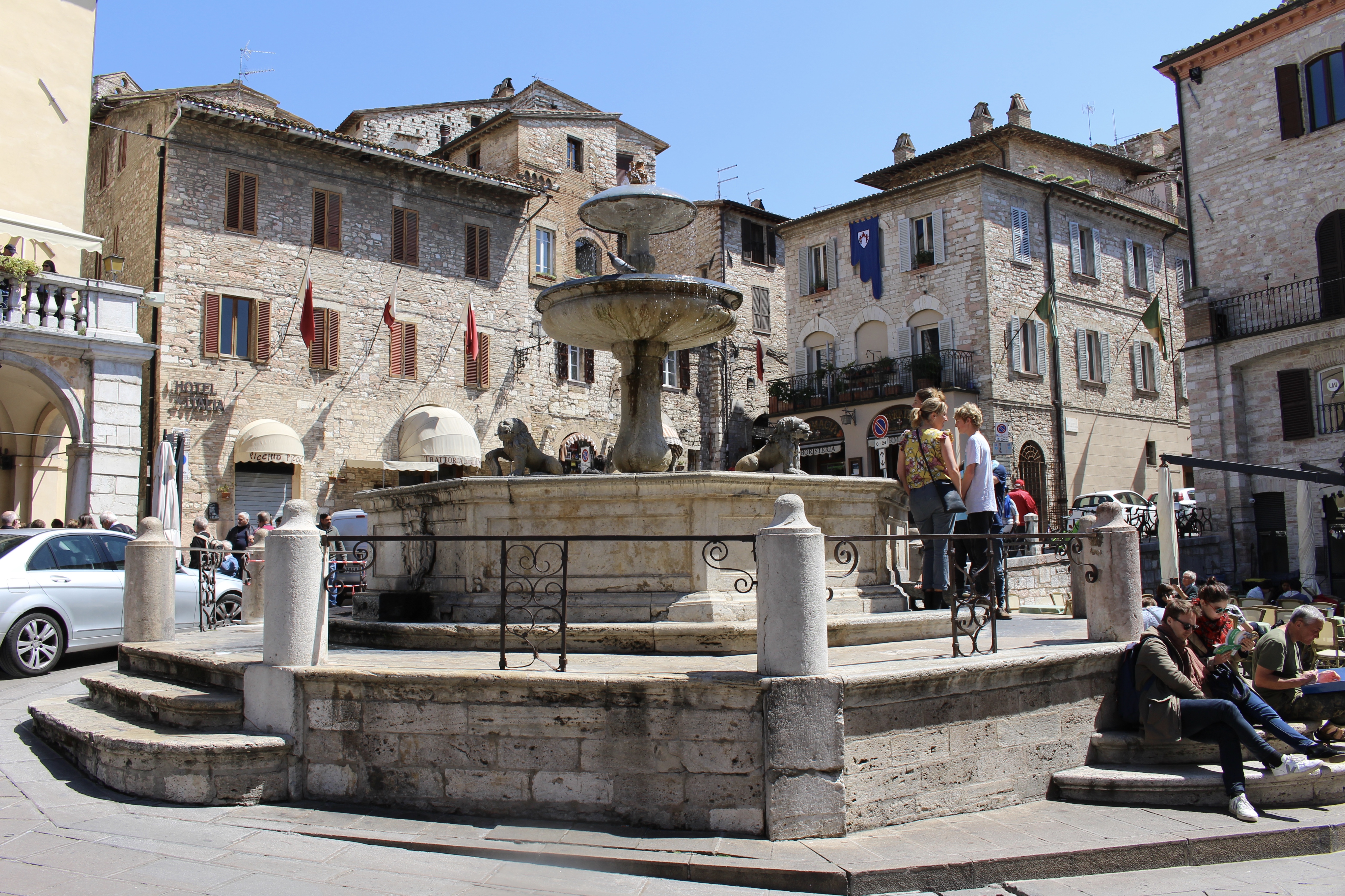
We passed a busy square, the Piazza del Comune, with an elaborate fountain.
fountain in Assisi
On the way to the castle, we stopped in a little church with an exhibition of Virgin Mary images which were meant to be held in hands during prayer. They were beautiful, serene and smooth.
a smooth Virgin Mary to hold in prayer
We stopped into various shops along the way. In one shop, I bought a silk scarf, then I stopped in another shop of the same name and bought two more. The woman there gave us a card for a 10% discount at her family’s Trattoria: Trattoria Spadini.
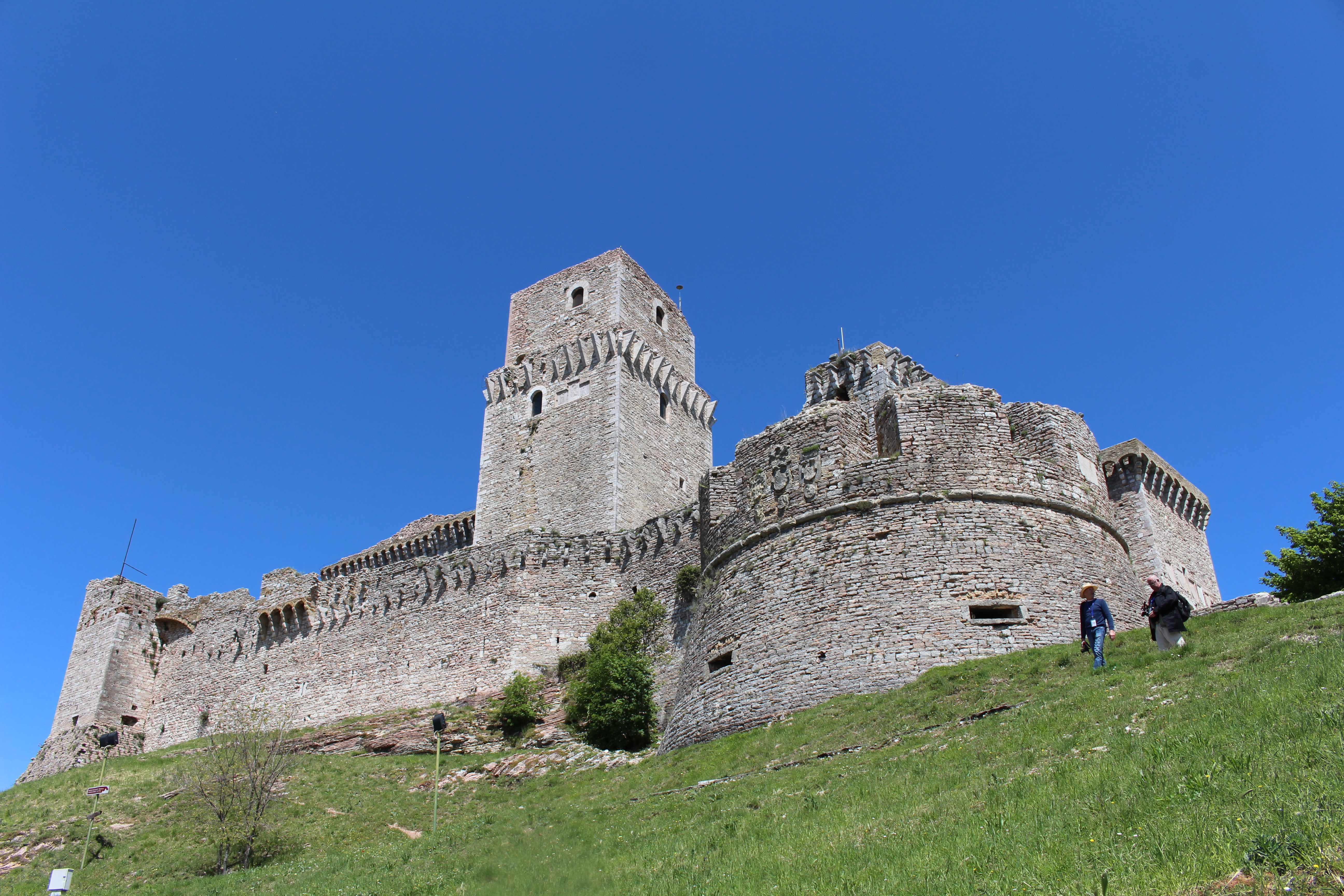
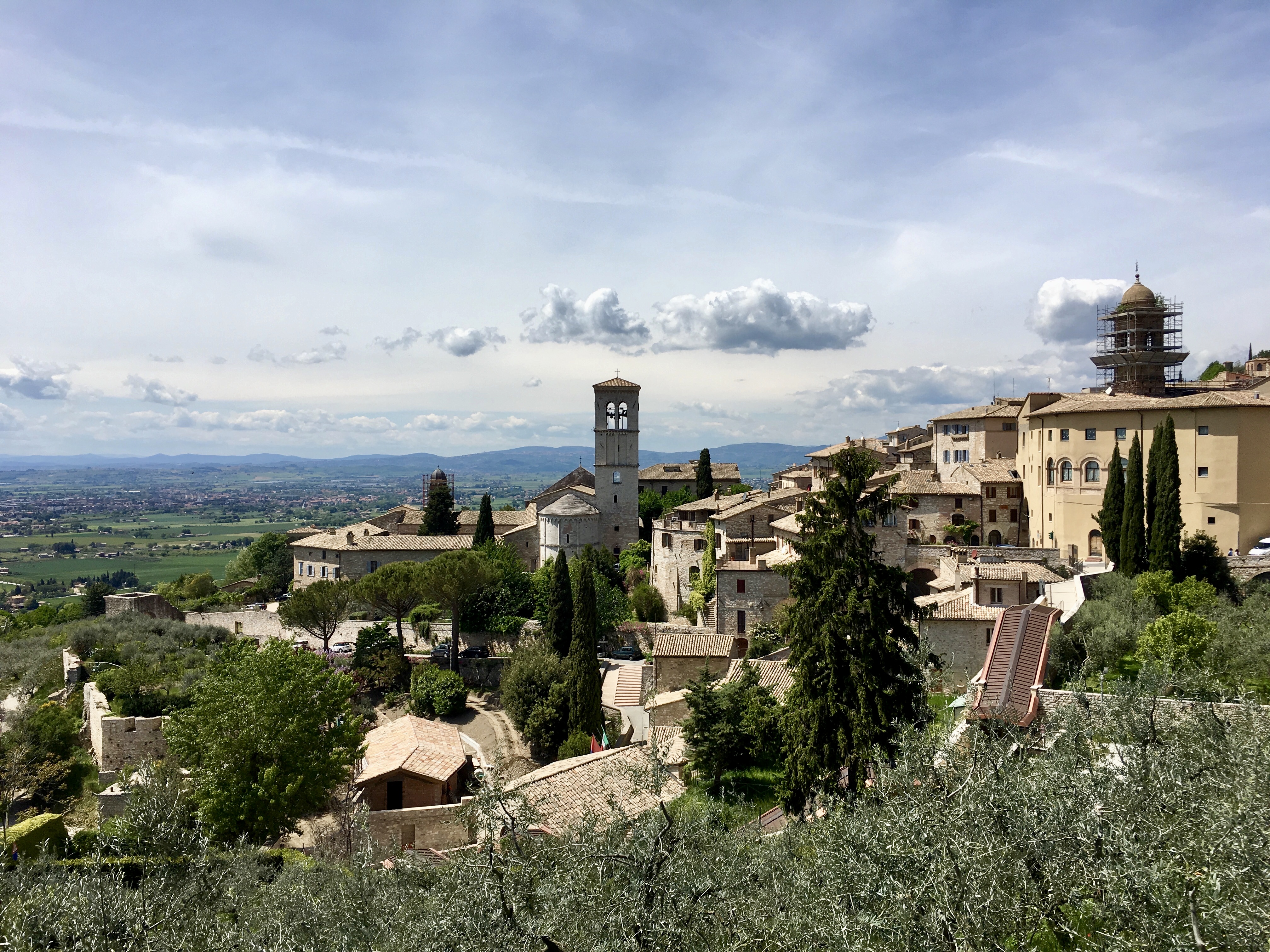
We then walked up to the castle on the hill, the 14th-century Rocca Maggiore. We had great views of Perugia to the north, the surrounding valleys, and the Basilica from on high.
Rocca Maggiore
Rocca Maggiore
Rocca Maggiore
view of Basilica di Santa Chiara from Rocca Maggiore
View of Basilica di San Francisco from Rocca Maggiore
Rocca Maggiore
Rocca Maggiore
view of Basilica di San Francesco from Rocca Maggiore
view from Rocca Maggiore
view from Rocca Maggiore
Rocca Maggiore
Back down in the town, we visited Trattoria Spadini, where I ordered Zuppa dell a casa: imbrecciata (a soup of mixed vegetables: gluten, barley, spelt, soy, & lupini beans). Mike got “Salsicce Umbre alla griglia, con spicchi di torta al testo a verdura cotta,” or Grilled Umbrian Sausages with wedges of flat bread and cooked spinach.
Trattoria Spadini
me at Trattoria Spadini
Zuppa dell a casa: imbrecciata
Grilled Umbrian sausages with wedges of flat bread and spinach
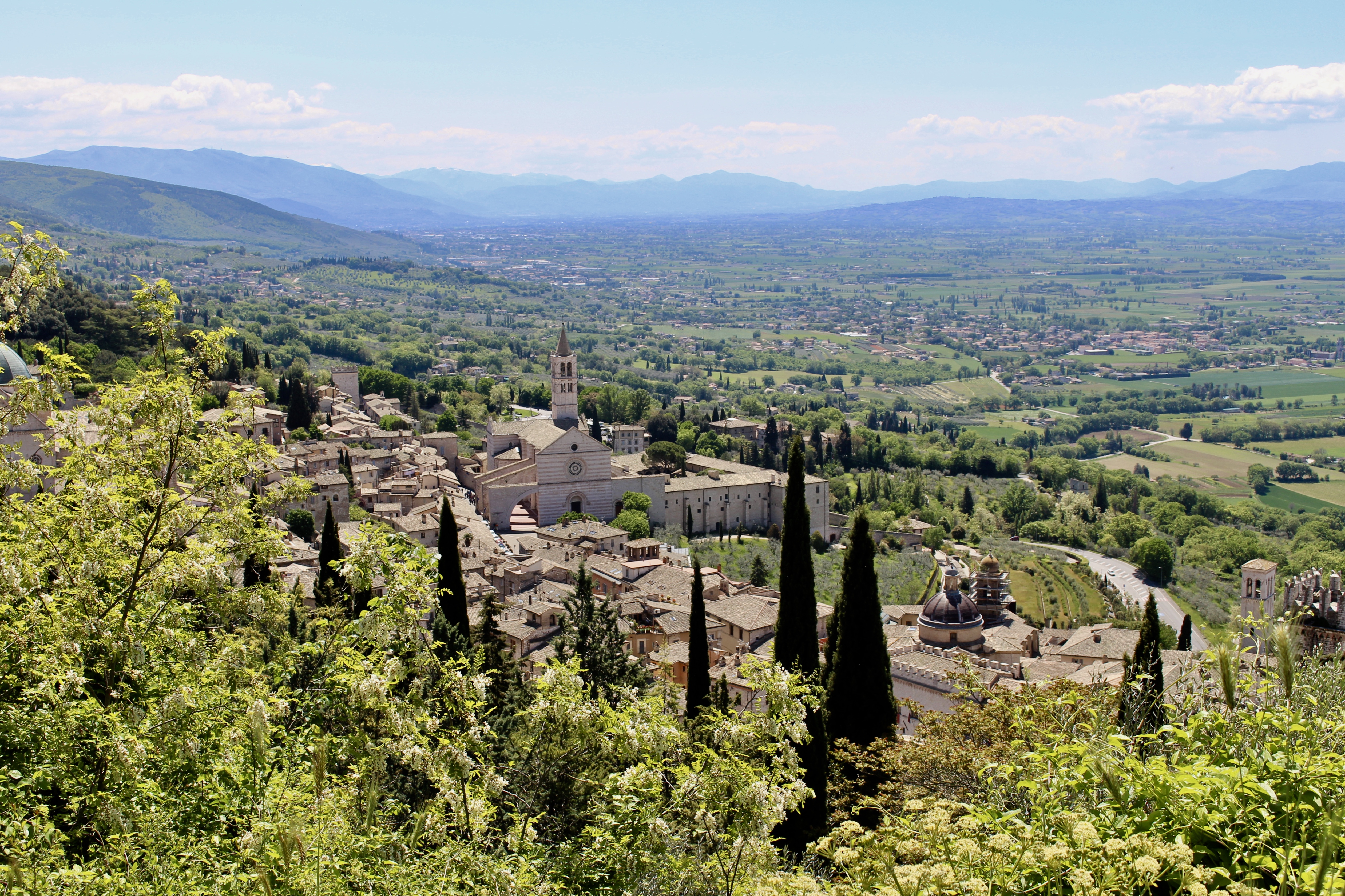
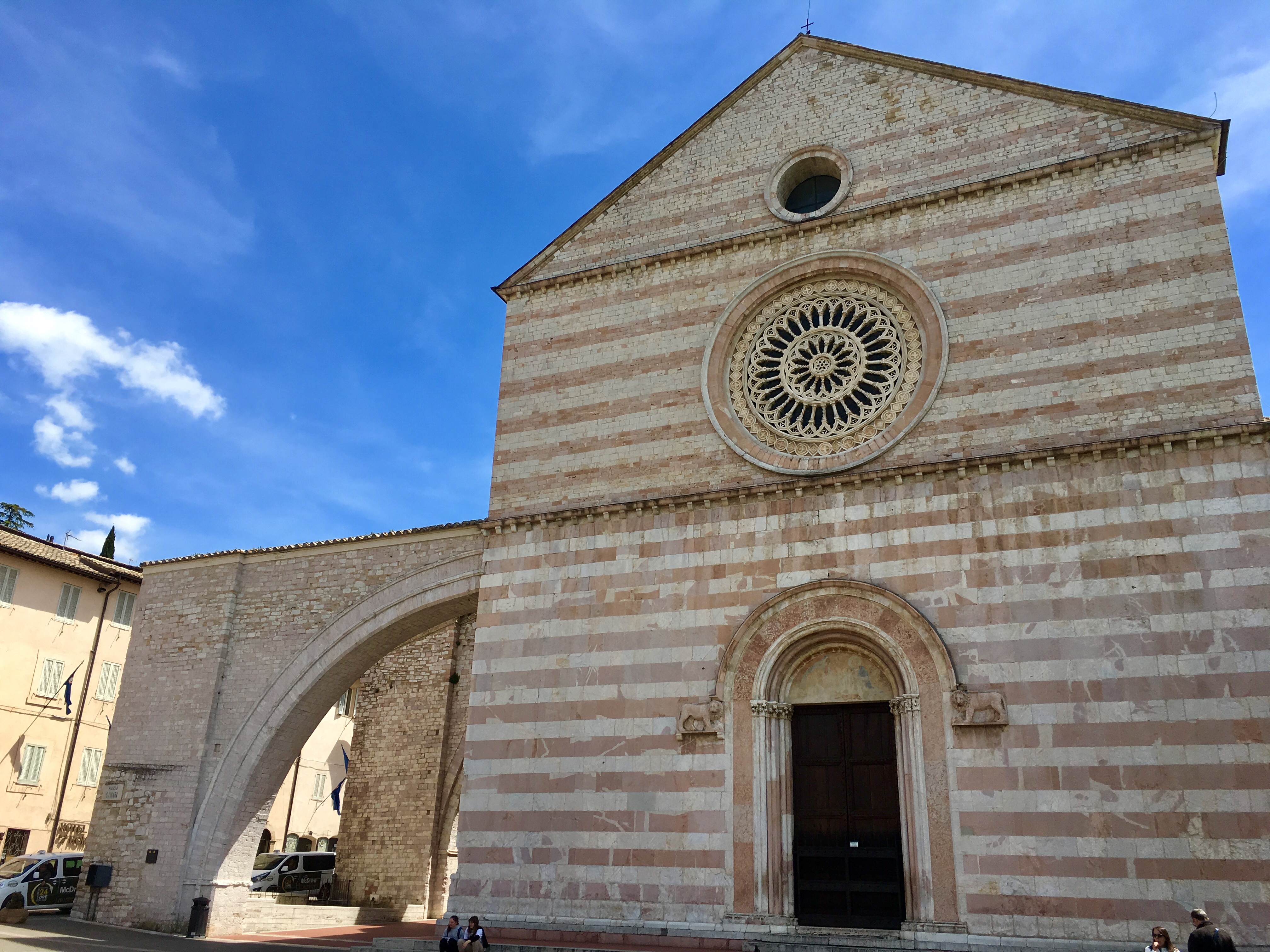
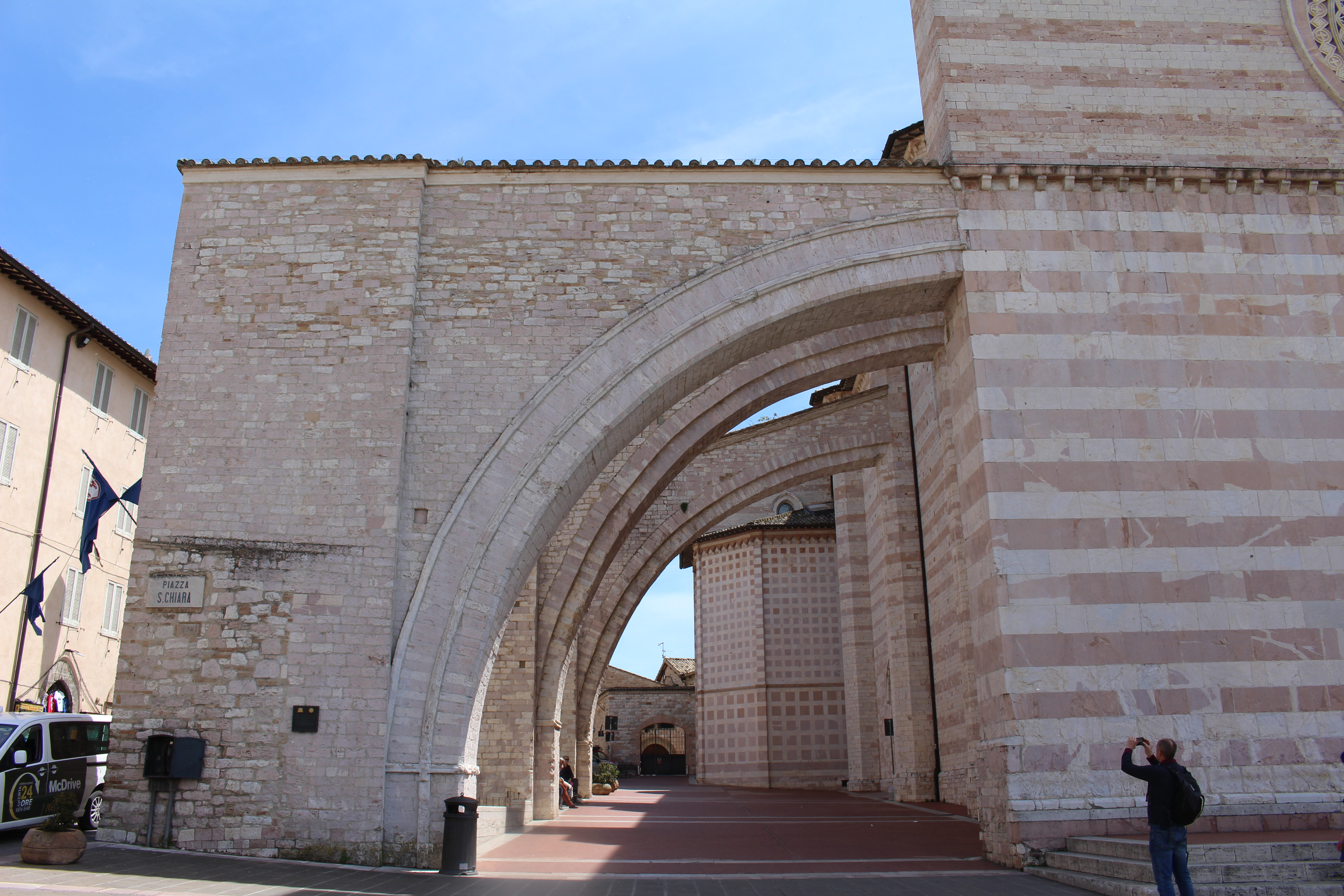
We then walked around the 13th-century Romanesque Basilica di Santa Chiara with its pink and white striped facade, which frames the piazza’s panoramic view over the Umbrian plains. It is dedicated to St. Clare (1194-1253), one of the earliest and most fervent of St. Francis’s followers and the founder of the Sorelle Povere di Santa Chiara, Order of the Poor Ladies, or Poor Clares, based on the Franciscan monastic order. She is buried in the church’s crypt. It was closed so we didn’t go in.
Basilica di Santa Chiara
view from Basilica di Santa Chiara
Basilica di Santa Chiara
Then we walked back out of the town the same way we came in.
Assisi
Assisi
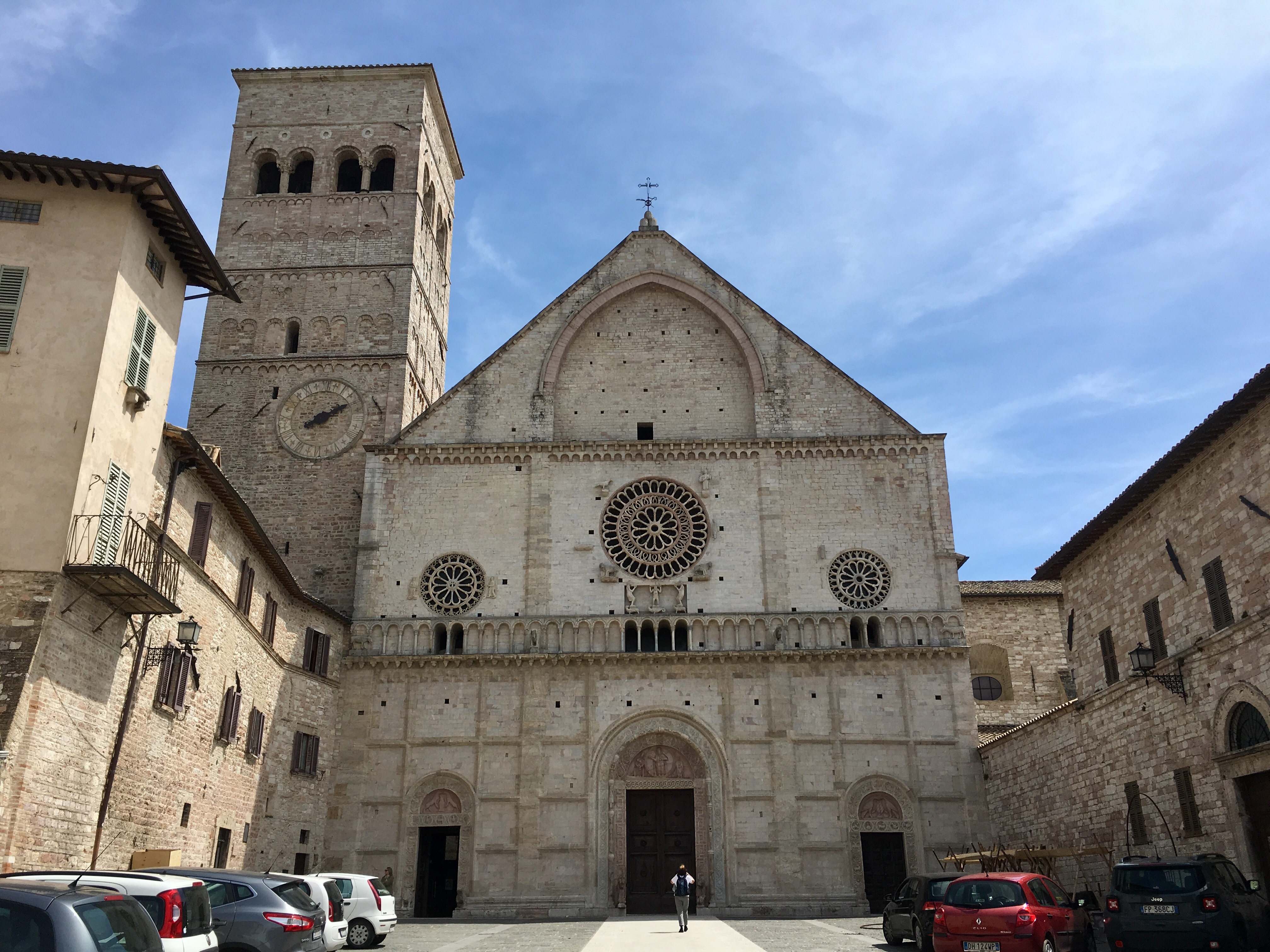
We stopped into the 13th-century Romanesque Cattedrale di San Rufino, remodeled by Galeazzo Alessi in the 16th century. St. Francis and St. Clare were among those baptized in Assisi’s Cattedrale, which was the main church in town until the 12th-century. St. Rufino was martyred on August 11, 238.
Cattedrale di San Rufino
Cattedrale di San Rufino
inside Cattedrale di San Rufino
inside Cattedrale di San Rufino
inside Cattedrale di San Rufino
inside Cattedrale di San Rufino
inside Cattedrale di San Rufino
inside Cattedrale di San Rufino
Adoro questo posto! (I love this place!)
door decor in Assisi
walking out of Assisi
We retrieved our car and were on our way to Spello.
I started my day in Sioux Falls, South Dakota by having biscuits and gravy for breakfast. It seemed hearty meals were called for in this part of the country.
My first stop was the Cathedral of St. Joseph. Its story began when Catholic missionary priests journeyed into what would become the Dakota Territory. The first of these was Father Pierre Jean De Smet, who began ministering in the region in 1838.
After numerous moves and changes, construction of the new Cathedral got underway by 1915. World War I hindered progress by creating a shortage of skilled workers and materials. The cathedral was finally completed and dedicated on May 7, 1919. The first Mass had already been celebrated in the unfinished cathedral on December 8, 1918.
There was a 9:00 Saturday mass in progress, so I slipped into the back and waited till the church had almost cleared out, then I took some photos.
Cathedral of St. Joseph
Children of Life Memorial
inside Cathedral of St. Joseph
inside Cathedral of St. Joseph
inside Cathedral of St. Joseph
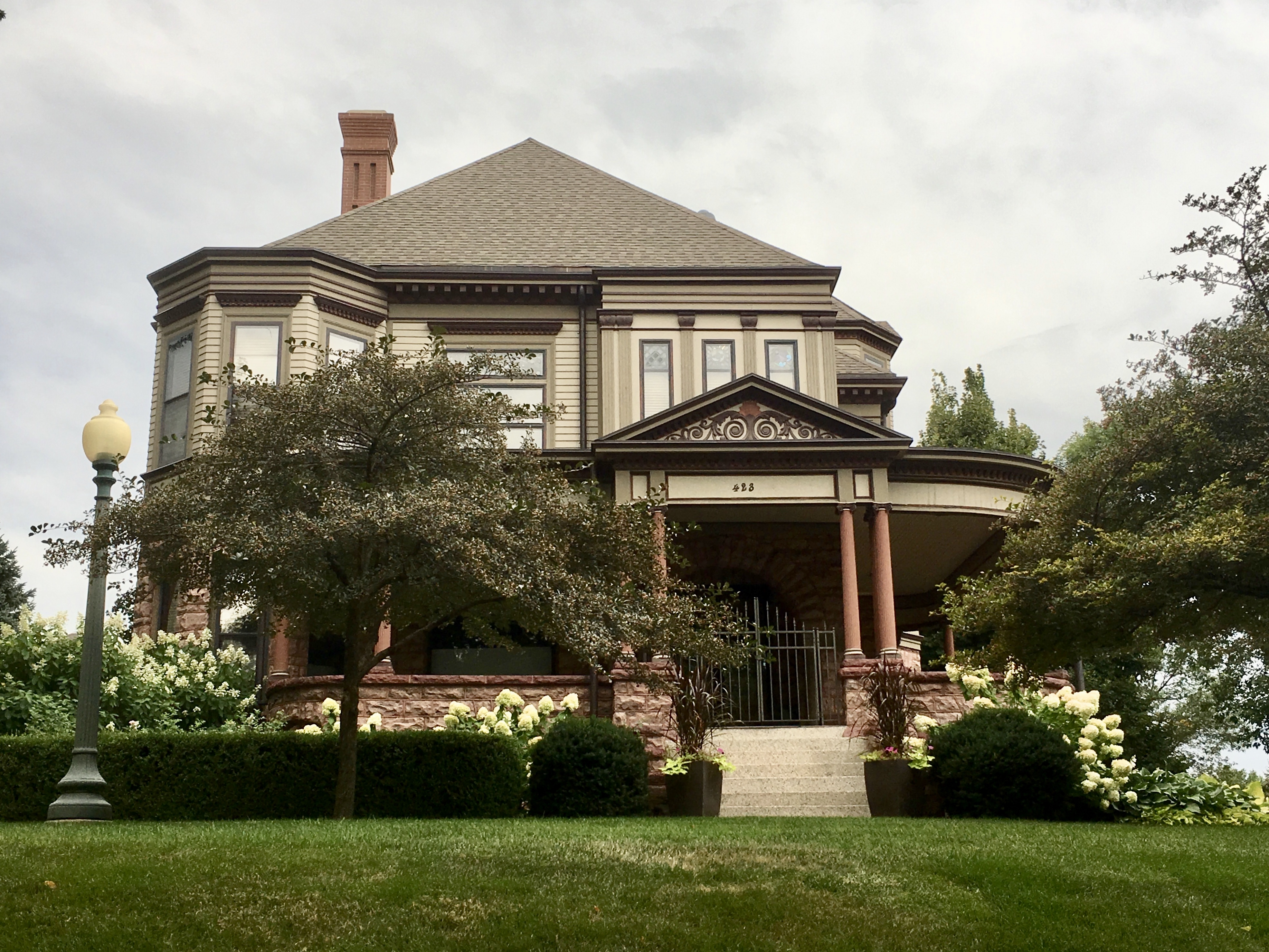
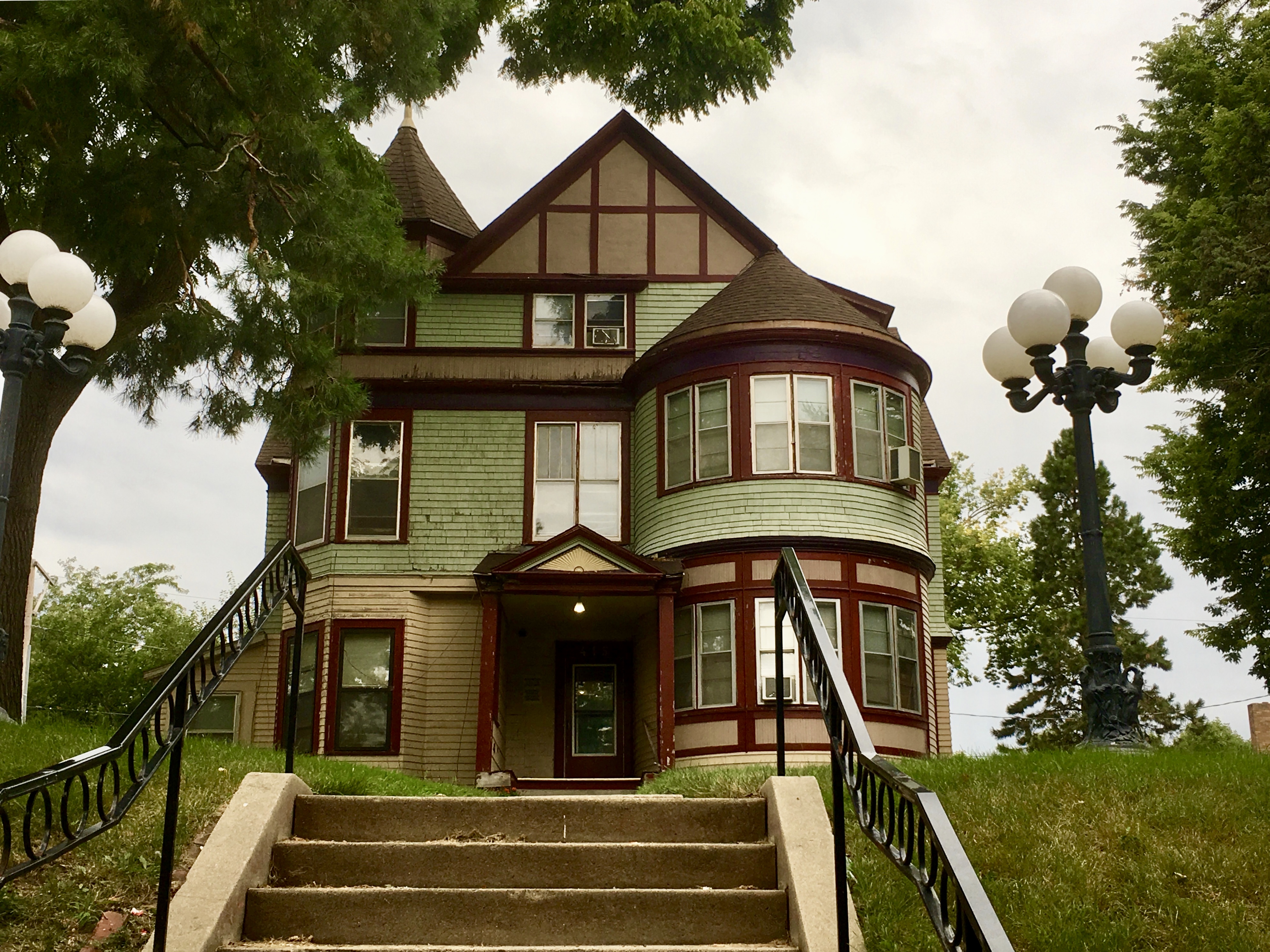
I had a brief walk in the St. Joseph’s Cathedral Historic District. In 1974, this neighborhood became the first historic district in South Dakota to be listed on the National Register of Historic Places. This old Sioux Falls neighborhood contains approximately 220 structures. Of these, 46 percent were built before 1900, and 85 percent were completed by 1920.
At a fenced yard a dog was barking viciously and flung himself at the high fence, his head popping up at the top. One board was missing from the fence; I was afraid he’d get out through there, so I hightailed it out of there.
Historic District Sioux FallsHistoric District Sioux Falls
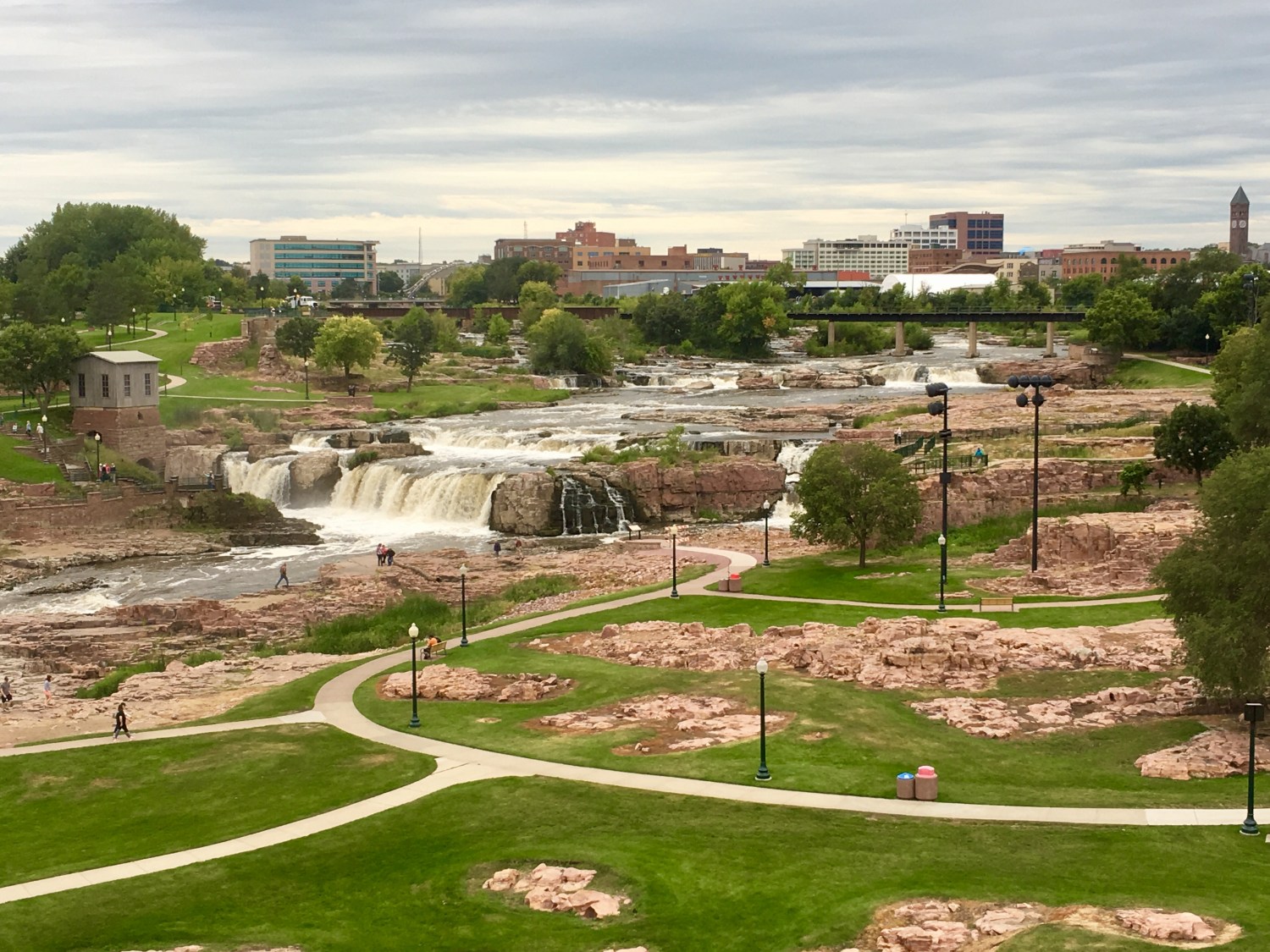
I arrived at Falls Park Visitor Information before they opened at 10:00. I went up to the five-story, 50-foot tall observation tower, then walked all around the 123-acre Falls Park. It was incredibly gloomy, but at least it wasn’t raining – yet.
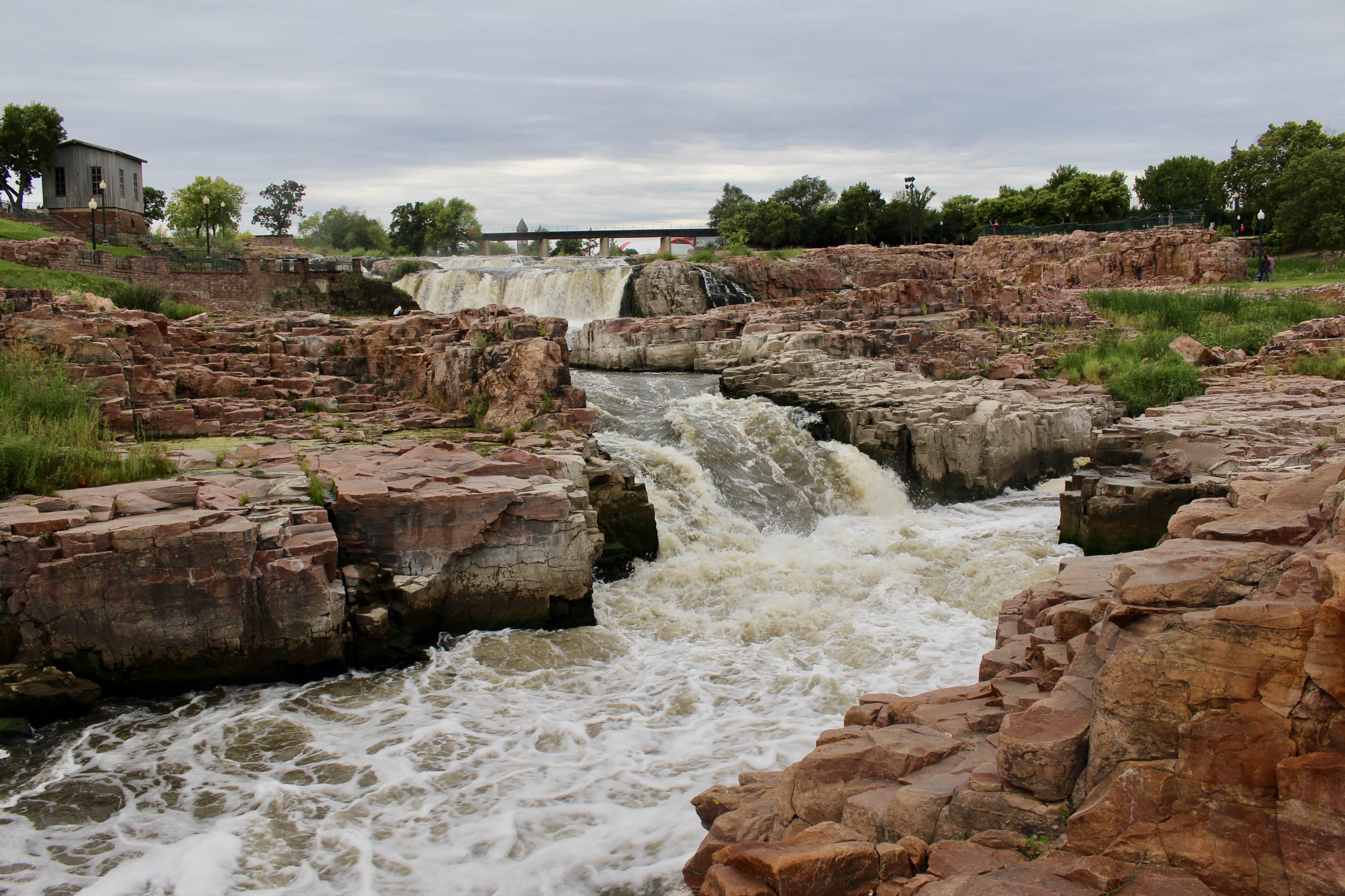
The Big Sioux River has been flowing in its present course here for over 10,000 years. Native Americans were the first to visit the falls and bring stories of them to European explorers. The Falls have been a highlight of recreation and industry since the city was founded in 1856. Many Sioux Falls historic buildings were made from the Sioux Quartzite including several buildings at Falls Park. The “pink rock” is the hardest rock second to diamond. The Sioux Quartzite is among the oldest rock exposed in South Dakota. It is very resistant to erosion.
Each second, an average of 7,400 gallons of water drop 100 feet over the course of the falls.
Falls Park
A man was saying rude things to people walking by, and it was disconcerting. He was causing a disturbance. Later, three police (two men & one woman) came and led him away, holding him on either side by his arms.
Another guy was using a remote control pick up truck on the rose quartzite.
Falls ParkFalls Park
Falls Park
Falls Park
Falls Park
American Farmer by Sondra Jonson
Monarch of the Plains
Falls Park
Falls Park
Falls Park
Falls Park
Falls Park
Falls Park
Falls Park
Falls Park
Falls Park
Falls Park
Falls Park
me at Falls Park
Falls Park
Falls Park
I walked around the remains of the seven-story Queen Bee Mill, built between 1879 and 1881 under the guidance of politician Richard F. Pettigrew. It cost $500,000 and it processed 1,500 bushels of grain each day. By 1883, the mill closed due to inadequate water power and a short supply of wheat. In 1956, fire destroyed the wooden roof and interior floors. The upper walls were later knocked down to prevent them from falling.
Queen Bee Mill
After leaving the Falls, I passed the Silver Moon Bar & Lounge on my way into downtown Sioux Falls, where I walked down Phillips Avenue for the SculptureWalk Sioux Falls, the largest annual exhibit of public sculptures in the world. The art is displayed all year throughout downtown Sioux Falls.
Sioux Falls, South Dakota
Sculpture Walk
Sculpture Walk
Common Thread by Fred Klingelhofer
Sculpture Walk
Kit Fox by Pokey Park
Beetle the Bear by Cedar Mueller
Surround by Hanna Seggerman
Vishnu Bunny Tattoo & Piercing
Protection by Jade Windell
High Five by Christine Knapp
Fulcrum by Dan Perry
Under Construction by Gary Hovey
State Theater
Movie bills at the State Theater
Local Perspective by Jason Richter
Spiral Dance by Harold Linke
The Government Building
Spectrum by Jeff Satter
Spiral Dance by Harold Linke
Corkscrew by Patricia VAder
State Theater
Shriver Square
All the World by Lee Leuning / Sherri Treeby
Sculpture Walk, Sioux Falls
downtown Sioux Falls
downtown Sioux Falls
Journey by Zach Schnock
Sculpture Walk, Sioux Falls
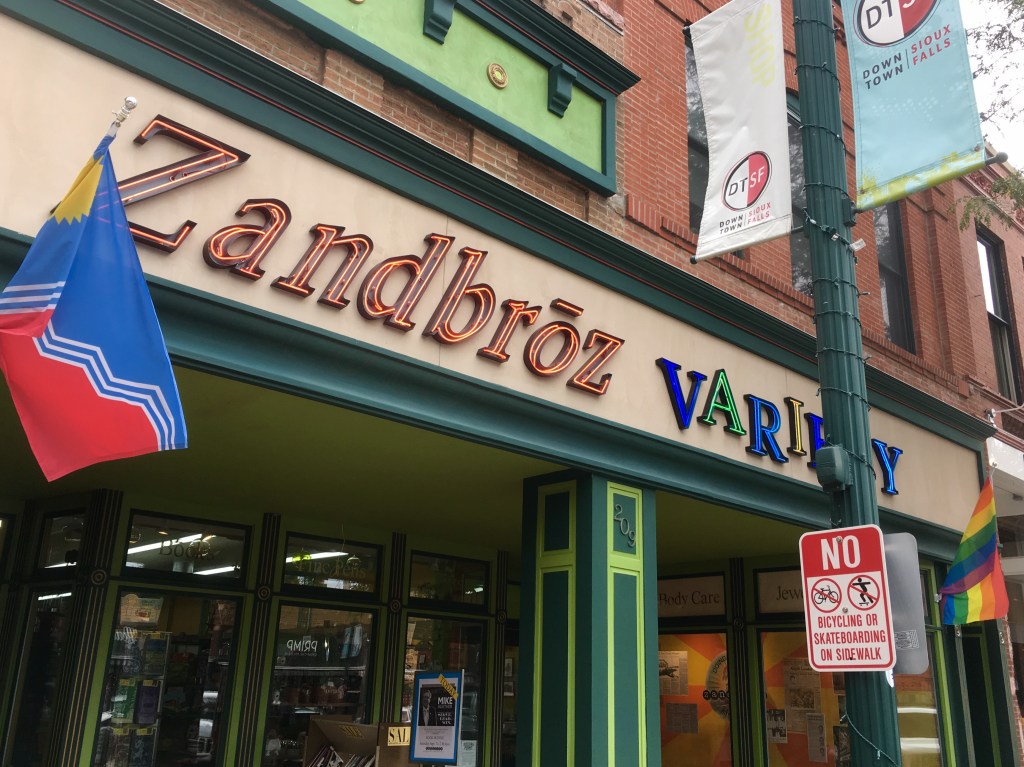
I popped into Zandbroz Variety, which sells soaps, books, pens, fine papers, cards, baskets, jewelry, gourmet foods, and many quirky things displayed charmingly in antique cupboards and vintage cabinetry from drug-store days. It was very colorful. The back area was once a soda fountain and coffee bar but at that time offered used books and vintage items for sale.
Zandbroz Variety
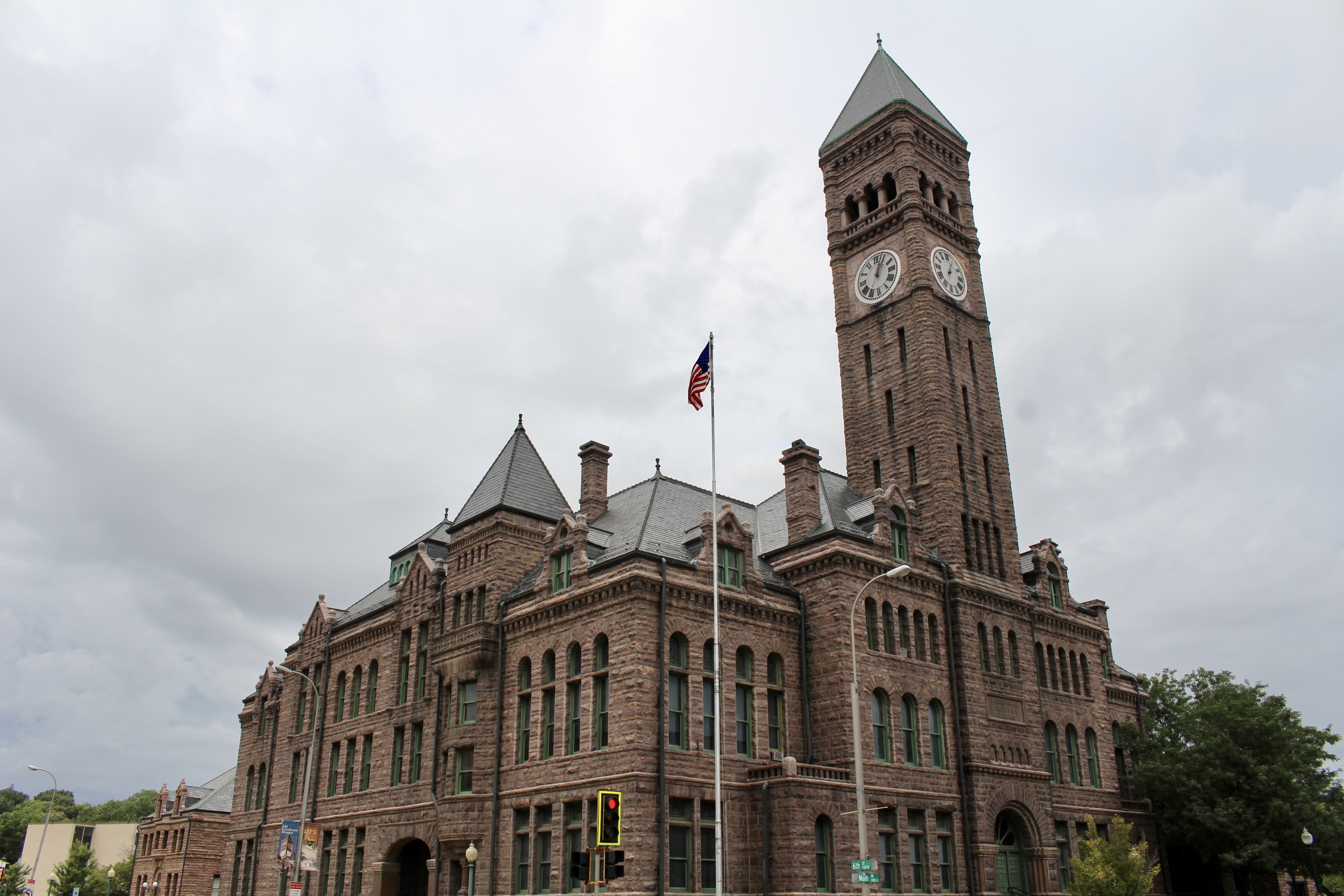
It was starting to rain by this time, so I went to the Old Courthouse Museum. The restored 1800s quartzite building featured three floors of regional history exhibits and sixteen historic murals.
Old Courthouse Museum
Let’s Ride: Vintage Motorcycles took a look at the history of motorcycles while featuring a variety of bikes from numerous manufacturers. By the 1910s, the motorcycle boom reached Sioux Falls.
Let’s Ride: Vintage Motorcycles
Let’s Ride: Vintage Motorcycles
Let’s Ride: Vintage Motorcycles
Let’s Ride: Vintage Motorcycles
Let’s Ride: Vintage Motorcycles
Let’s Ride: Vintage Motorcycles
Let’s Ride: Vintage Motorcycles
Let’s Ride: Vintage Motorcycles
World War I: The Great War was considered a war to end all wars. The Great War created many advances in technology, the medical field, and shaped military strategies. Local communities such as Sioux Falls became vital arteries in helping with the war effort. World War I became an unprecedented catastrophe that affected an immeasurable amount of people and shaped the modern world.
World War II: The Great War
World War II: The Great War
World War II: The Great War
World War II: The Great War
World War II: The Great War
The Tornado Tree showed the powerful effect of tornadoes. When a tornado went through the southern part of town, it destroyed the bridge that went over the river near 41st Street and the Mall.
The Fawick Flyer was a two-door model car built by local inventor Thomas Fawick.
Fawick Flyer
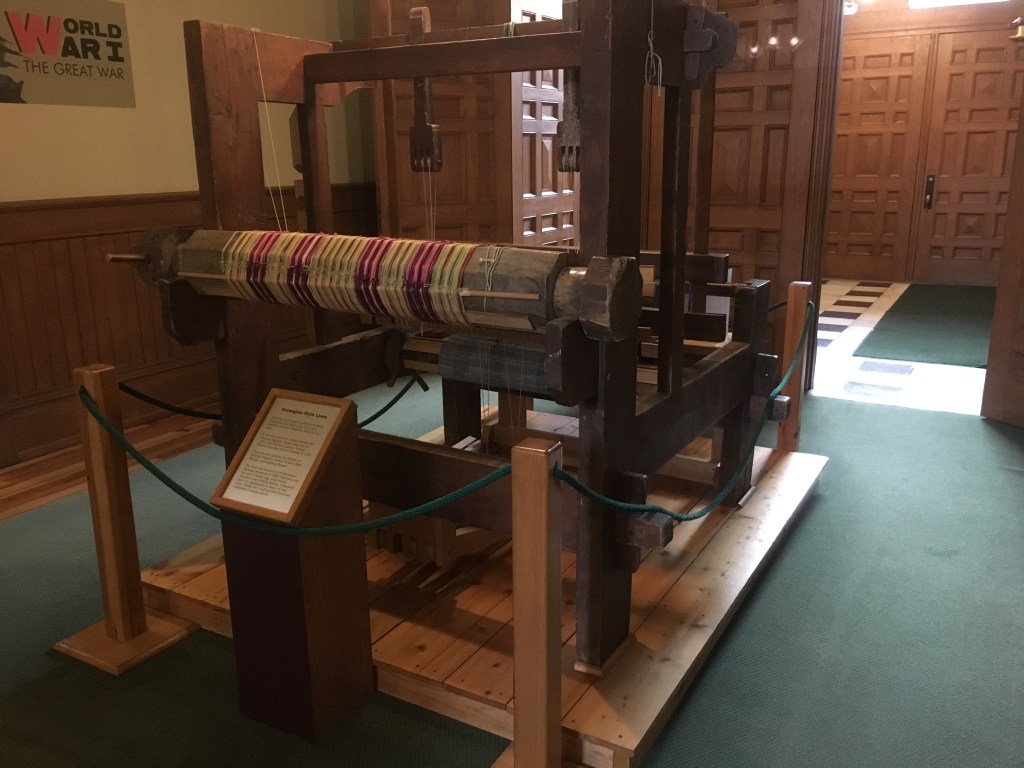
The Norwegian Style Loom is a four harness, counter-balanced, direct tie-up loom. It was hand-built by Anders Sorken and Rasmus Elgaaen. The loom was donated to the Siouxland Heritage Museum’s collection in 1988.
Norwegian Style LoomNorwegian Style Loom
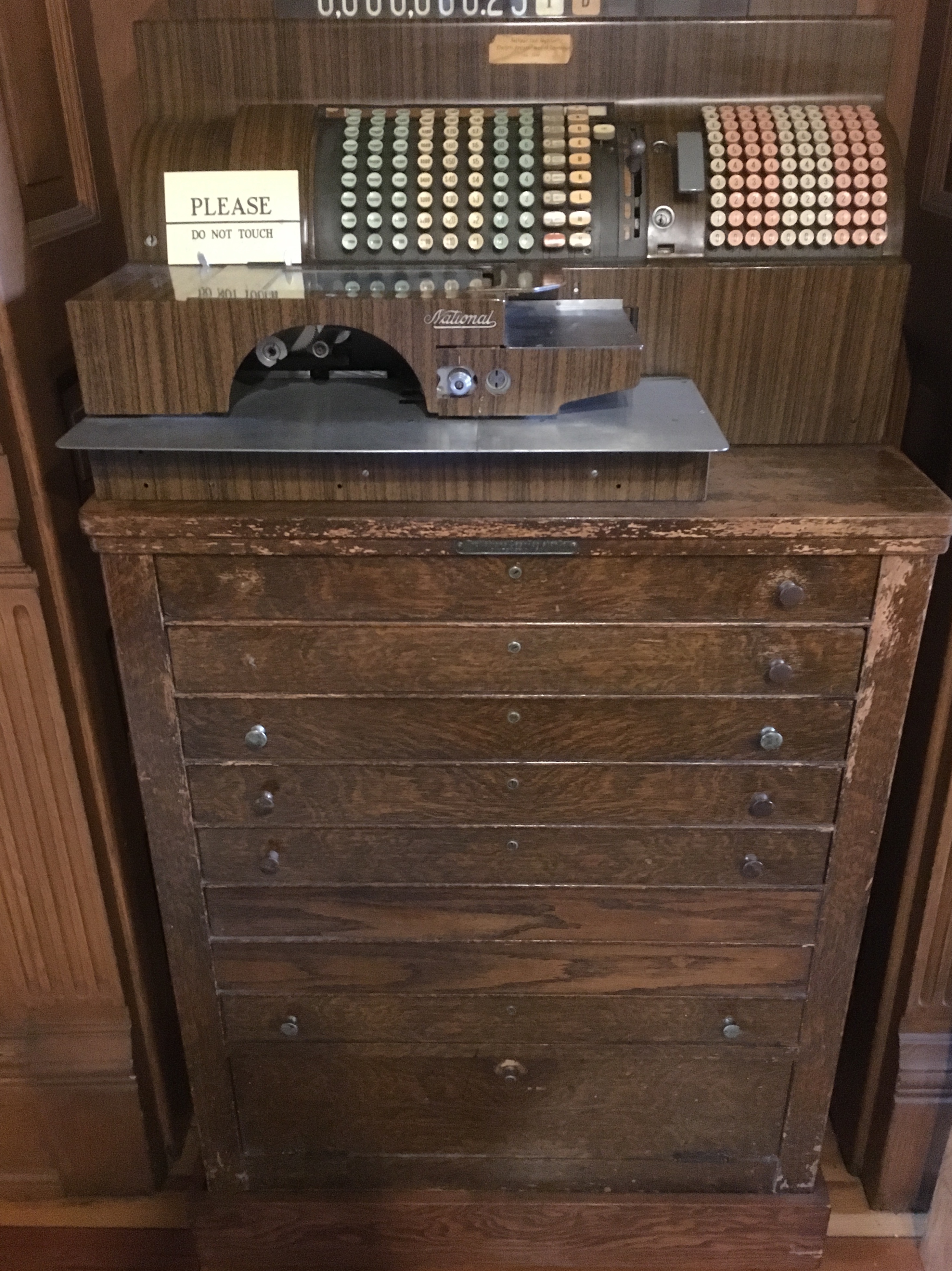
cash register
Tonics and Tools of Medicine examined early Sioux Falls medicine and the instruments that helped keep its citizens healthy. The people of 19th century Sioux Falls relied on doctors, drugstores, and some home remedies to get better, but without twenty-first century technology, early medical professionals relied on basic tools and different practices to treat their patients.
Tonics and Tools of Medicine
Tonics and Tools of Medicine
Tonics and Tools of Medicine
Tonics and Tools of Medicine
Tonics and Tools of Medicine
Tonics and Tools of Medicine
Tonics and Tools of Medicine
Tonics and Tools of Medicine
Theaters: Stage to Screen showcased the many theaters that once were in Sioux Falls. Many of them were built or remodeled for both stage and screen. Hollywood’s “Golden Era” in movies exploded, and America was mesmerized by film. These theaters flourished.
Theaters: Stage to Screen
The State Theater
Orpheum Theater
I especially loved the motorcycle exhibit and the Toys exhibit: it exhibited toys from the 1800s to the 1990s: Ouija Board (called Mystic Soothsayer), Barbies, Lincoln Logs, GI Joes, erector sets, matchbox racetracks, checkers, Clue, Lotto, Felt-o-gram, toy musical instruments, Tinker Toys, pull toys, wooden finger puppers, a pinball machine, Spirograph, Basic Microscope, Junior Doctor Kit, Chinese Checkers, Battleship, PacMan, Raggedy Ann and Andy, Pound Puppies, Mr. Potato Head, Pet Rocks, and Chatty Cathy. 🙂 There were so many toys I recognized from my childhood.
Toys exhibit
Toys exhibit
Toys exhibit
Mystic Soothsayer & checkers
Clue and Lotto
Junior Combination Board and The Game of Anagrams
American Bricks Construction Set, ca. 1940
FELT-O-GRAM and Building and Designing Set
ERECTOR set
GI Joe
Cowboys and Indians
Lincoln Logs
Tinker toys
musical instruments
Chatty Cathy
toddler toys
Wooden Finger Puppets
Spirograph and spirotot
Junior Doctor Kit, basic MICROSCOPE Set
Barbies and stuffed toys
Matchbox garage and racetrack
Mr. Potato Head
Disney Barbie Dolls
The artist who did the murals was Ole Runing, born in Norway in 1874; he immigrated to the U.S. in 1906. He spent two years on the sixteen murals and was only paid five hundred dollars. The murals depict the falls of the Big Sioux River in Sioux Falls and the Palisades rock formation near Garretson, South Dakota. Late in the project, he was aided by his son Elmer.
murals at the Old Courthouse Museum
murals at the Old Courthouse Museum
murals at the Old Courthouse Museum
This was a truly fascinating museum.
Information from the Courthouse Museum is taken from a pamphlet distributed by the Old Courthouse Museum.
I headed to the Japanese Gardens at Terrace Park, but it was raining and I was hungry, so I went to Burger King for a Whopper Junior with cheese, fries, and a Diet Coke.
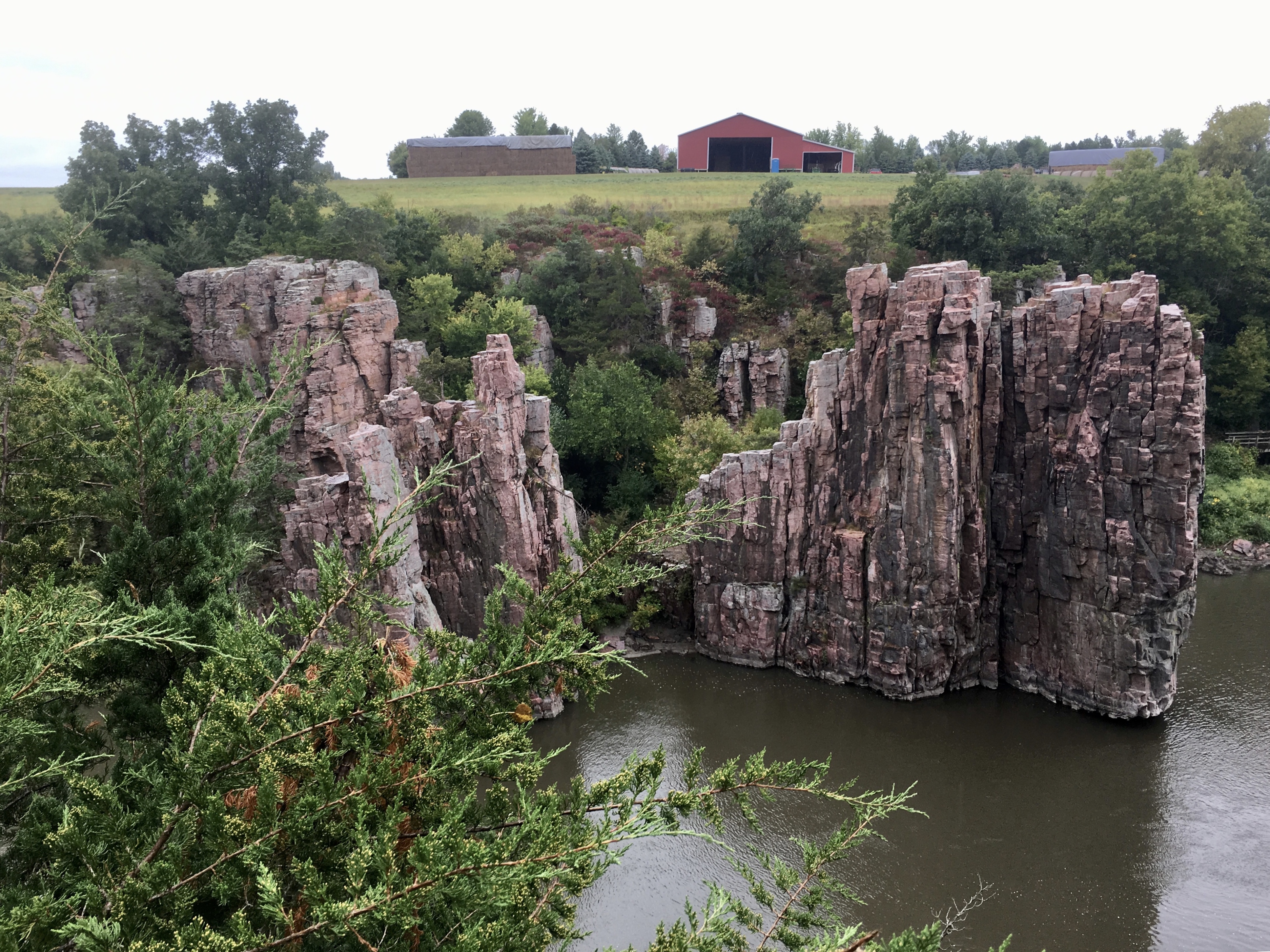
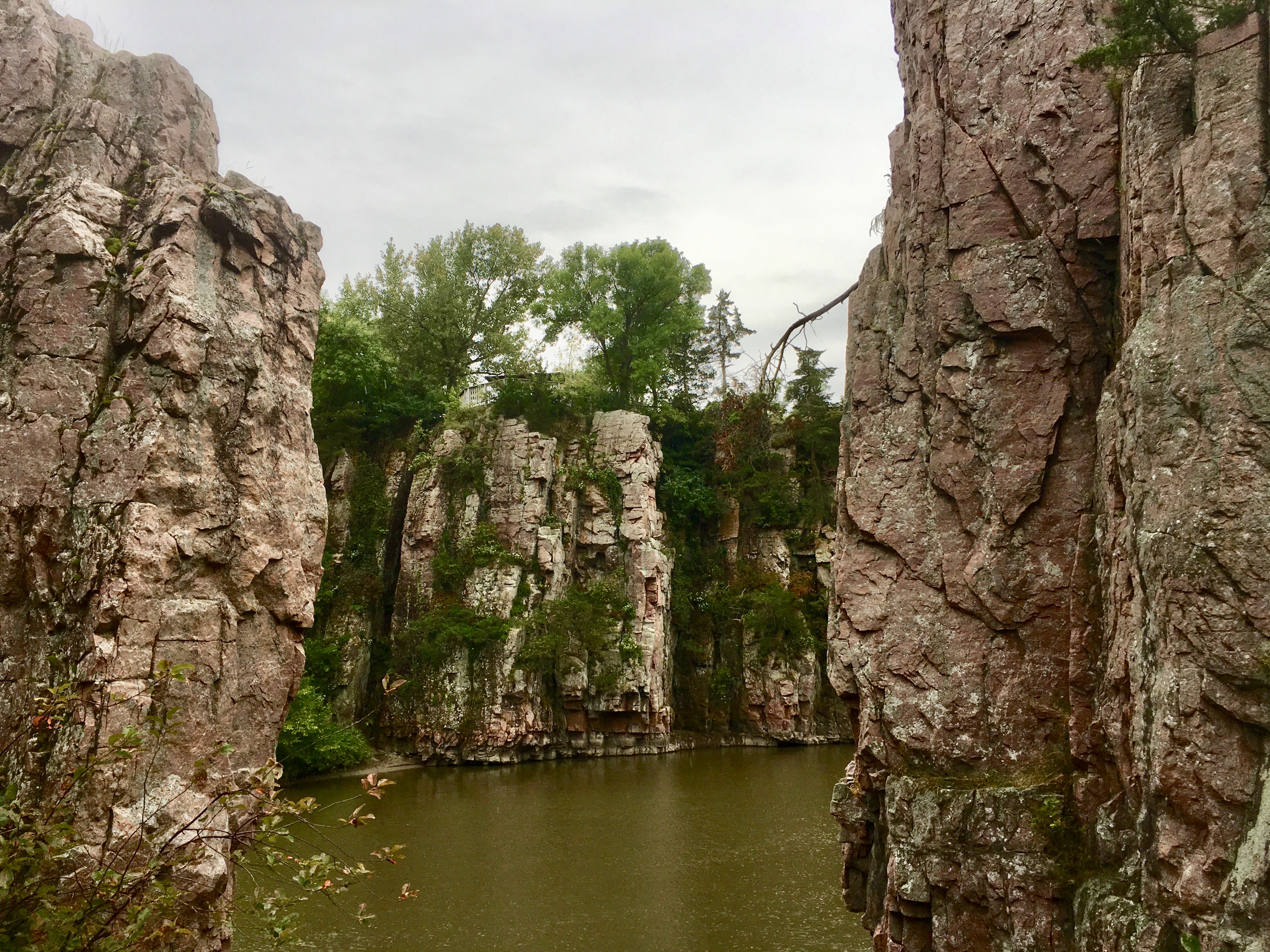
I drove east 30 minutes to Palisades State Park, passing Tucker’s Walk Vineyard. By then it was really raining, so I just went to the Balancing Rock Overlook then walked on the very short King and Queen Rock Trail.
The Split Rock Creek, which flows through Palisades State Park, is lined with Sioux quartzite formations varying from shelves several feet above the water to 50-foot vertical cliffs. Geologists estimate the Sioux quartzite spires in the park are 1.2 billion years old.
Palisades State ParkPalisades State Park
Palisades State Park
Palisades State Park
King and Queen Rock Trail
Palisades State Park
Palisades State Park
Palisades State Park
Palisades State Park
Palisades State Park
Palisades State Park
Palisades State Park
I drove over the 1908 Palisades Bridge. The steel bridge rests on natural abutments of Sioux quartzite.
1908 Historic Bridge at Palisades State Park
On the way back from Palisades, I listened to “Big Foot” by Johnny Cash about Wounded Knee. I seem to vaguely remember a book or movie titled Bury My Heart at Wounded Knee, that was required reading in high school or college. I felt I should read it again.
As I drove back, I worried that the Corn Palace wouldn’t be open the next day because it was a Sunday. I passed Augustana University: The Place for Possibilities. A sign said WRANGLE UP SOME RINGNECKS (whatever that meant!).
Then I decided I’d try to go back to Sioux Falls to the Washington Pavilion. However, they had all the roads around it blocked off for a big fair: The Sidewalk Arts Festival. I got tired of driving around looking for parking, so I drove out of the town and stopped at the Terrace Park and Japanese Gardens. The area known as Terrace Park is located on a bluff overlooking an ancient part of the Big Sioux River’s System of oxbows and overflow flood plain. This bluff is part of a series of bluffs that form the east side of the Big Sioux River valley.
It was pleasant enough but I wasn’t feeling good so decided to return to my hotel to rest.
Terrace Park & Japanese Gardens
Terrace Park & Japanese Gardens
Terrace Park & Japanese Gardens
Terrace Park & Japanese Gardens
Terrace Park & Japanese Gardens
Terrace Park & Japanese Gardens
Terrace Park & Japanese Gardens
Terrace Park & Japanese Gardens
I had stomach cramps for much of the afternoon, so I wasn’t yet hungry. I returned to my hotel to rest before dinner.
Later, I went to the colorful Guadalajara Mexican Restaurant, where I had my favorite chili relleno, a tamale, refried beans, rice and a Corona.
Guadalajara Mexican Restaurant
Guadalajara Mexican Restaurant
Guadalajara Mexican Restaurant
Guadalajara Mexican Restaurant
Guadalajara Mexican Restaurant
Chili Relleno and tamale
Guadalajara Mexican Restaurant
Back at the hotel, I talked to Mike, as I did every night of my trip.
Here we are, continuing to expand our horizons on this 4th Saturday in August. Welcome to my 12th cocktail hour, during a time where we venture a bit further from home and enjoy a beverage. I offer you Cheers! À votre santé! 乾杯/ Kanpai! Saúde! Salud! May we all remain healthy, safe, financially afloat, and hopeful.
We’ve been getting out more. I still go out every day for either a walk, a walk/jog, a bikeride, weightlifting, or Pilates. We’ve been out to eat numerous times: bartaco, P.F. Chang, Artie’s, and Istanbul Blue – all indoor venues. We go in wearing a mask, all the servers wear masks, and we put on our masks when interacting with the servers. We also go early, when the restaurant is nearly empty.
Mike at bartaco
me at bartaco
me at Fairfax Corner
Mike with his favorite sports mural at Fairfax Corner
Mike and mural at Fairfax Corner
me at Fairfax Corner
roasted chicken salad at Artie’s
Mike at Artie’s
me at Artie’s
Mike at Istanbul Blue
me at Istanbul Blue
Spinach pide at Istanbul Blue
Tropical Storm Isaias moved through around the 3rd and 4th of the month, bringing boatloads of rain.
On Saturday, August 8, we went to the National Museum of Women in the Arts in D.C. to see “Graciela Iturbide’s Mexico.” The museum recently opened and required face masks and social distancing.
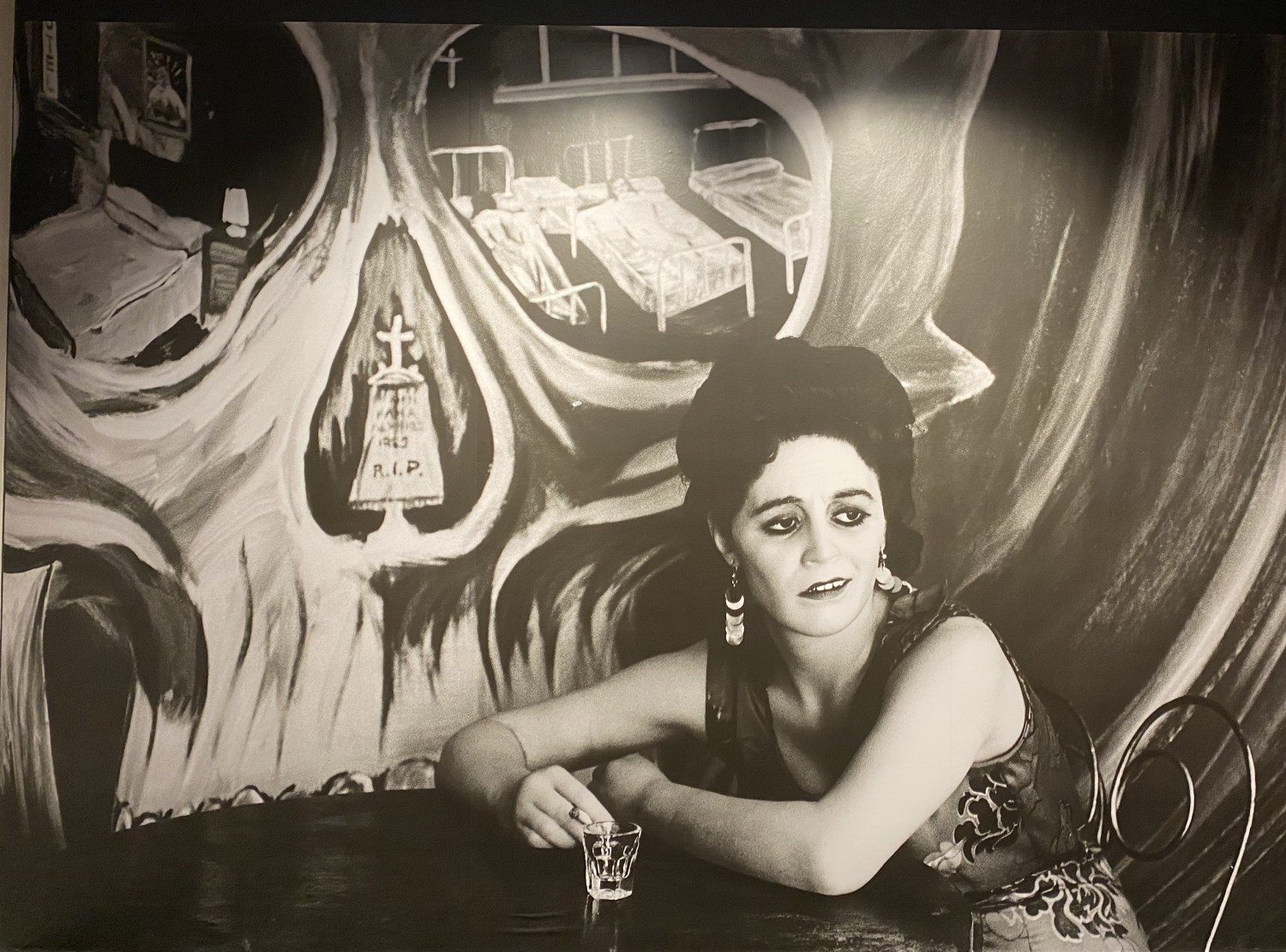
From early in Graciela Iturbide’s career, she embraced photography as a way to engage in a profound exploration of her country. Her works from the 1970s and early 1980s reveal Mexico’s hybrid culture, acutely observing its contrasts and complexities. Iturbide’s photos also highlight her attraction to the unusual geometries of Mexico City and her keen eye for the unexpected.
National Museum of Women in the Arts
Lobby of National Museum of Women in the Arts
Graciela Iturbide’s Mexico
Nuestra Señora de las Iguanas (Our Lady of the Iguanas), Juchitán, 1979
Zihuatanejo, México, 1969
Pachuco, Mexico City, 1972
Immaculada (Immaculate Girl), Xochimilco, 1984
Autoretrato como Seri (Self-Portrait as Seri), Sonoran Desert, 1979
Autoretrato como Seri (Self-Portrait as Seri), Sonoran Desert, 1979
Mujer Seri con su retrato (Seri Woman with Her Portrait), Sonoran Desert, 1979
Angelita, Sonoran Desert, 1979
Mujer ángel (Angel woman), Sonoran Desert, 1979
Sonoran Desert, 1979
Iguanas, Juchitán, 1984
Festival del lagarto (Alligator Festival(, Juchitán, 1985
Juchiteca con cerveza (Juchiteca with Beer), Juchitán, 1984
Padrinos del lagarto (The Alligator’s Godparents), Juchitán, 1986
Mexico… quiero conocerte! (Mexico…I want to get to know you!), Chiapas, 1975
Pájaros en el poste, Carretera (Birds on the Post, Highway), Guanajuato, 1990
Mercado de Sonora (Sonora Market), 1978
angel wings
El jardinero (The Gardener), Oaxaca, 1974
Los jardineros (The Gardeners), Oaxaca, 1974
political rallies
wall at museum
me at the Iturbide exhibit
When Frida Kahlo died in 1954, her grief-stricken husband muralist Diego Rivera, took her personal belongings and locked them in her bathroom in her home, the Casa Azul, in Mexico City. Fifty years later, the space was finally opened, and Graciela Iturbide was commissioned to photograph it.
In Iturbide’s series about Frida’s bathroom we enter into the legendary painter’s private life and encounter a composite portrait of Kahlo’s suffering and resilience. They represent a visual and emotional narrative of the intimate space and of objects that symbolize sickness and healing. Kahlo contracted polio as a child; at eighteen, she survived a near-fatal bus accident, sustaining grave injuries that required numerous surgeries throughout her life. Eventually, she had one leg amputated. During her recovery, she began painting – a pursuit that brought Kahlo both solace and international fame.
Both Iturbide and Kahlo have seen their art as a form of therapy and escape. According to Iturbide, “…in life everything is connected: your pain, your imagination, which perhaps can help you forget reality. It’s a way of showing how you can connect what you live with what you dream, and what you dream with what you do, and that is what remains on paper.” (From a sign at the exhibit)
El baño de Frida (Frida’s Bathroom) Coyoacán, Mexico City, 2005
El baño de Frida (Frida’s Bathroom) Coyoacán, Mexico City, 2005
El baño de Frida (Frida’s Bathroom) Coyoacán, Mexico City, 2005
El baño de Frida (Frida’s Bathroom) Coyoacán, Mexico City, 2005
El baño de Frida (Frida’s Bathroom) Coyoacán, Mexico City, 2005
We also saw the regular collection at the museum, which is known as “the only major museum in the world solely dedicated to championing women through the arts,” according to the website.
To Kiss the Spirits: Now This Is What It Is Really Like, 1993 by Hollis Sigler
Vase of Flowers 1, 1999, by Amy Lamb
Will-o’-the-Wisp, ca. 1900 by Elizabeth Adela Armstrong Forbes
Tjukurla – Other Side of Docker River, 2001 by Eunice Napanangka Jack
Eridanus, 1984 by Lynda Benglis
Sale Neige, 1980 by Joan Mitchell
Grassland Drifters, 2001 by Justine Kurland
Raft Expedition, 2001 by Justine Kurland
The Earth, 1984 by Kimsooja
Spider III, 1995 by Louise Bourgeois
Jugamarra, sitting with spears watching women dancing, 1997 by Pansy Napangati
The Large Family Group, 1957 by MARISOL (Marisol Escobar)
What’s Happening with Momma?, 1988 by Clarissa Sligh
What’s Happening with Momma?, 1988 by Clarissa Sligh
The Stags, 2008 by Patricia Piccinini
The Stags, 2008 by Patricia Piccinini
Untitled (Yellow Tub), 2003 by Angela Strassheim
It Made Sense… Mostly in Her Mind, 2011 by Amy Sherald
SoHo Women Artists, 1978 by May Stevens
Iris, Tulips, Jonquils, and Crocuses, 1969, by Alma Woodsey Thomas
Gentle Morning, 2007 by Susan Swartz
Self-Portrait Dedicated to Leon Trotsky, 1937 by Frida Kahlo
Spiritualist, 1973 by Helen Frankenthaler
They Call Me Redbone bu I’d Rather be Strawberry Shortcake, 2009 by Amy Sherald
Untitled (68), 1999 by Hellen Van Meene
Rosy, 1999 by Deborah Mesa-Pelly
Ohio Project (8), 1999 by Nikki S. Lee
Jo Baker’s Bananas, 1997 by Faith Ringgold
United States (Mexican Series), 1999 by Rosângela Rennó
United States (Mexican Series), 1999 by Rosângela Rennó
Untitled, 1991 by Frida Baranek
tires
From the series “Plaid HOuses (Maquettes),” 2005-11 by Laure Tixier
detail: To Kiss the Spirits: Now This Is What It Is Really Like, 1993 by Hollis Sigler
Medusa, from the series “Ricas y famosas,” 1999 by Daniela Rossell
La Llamada (The Call) 1961 by Remedios Varo
Arreau, Hautes-Pyrénées, 1949 by Loïs Mailou Jones
Magnetic Fields, 1990 by Mildred Thompson
Pregnant Nana, 1993 by Niki de Saint-Phalle
After visiting the museum, we had lunch at Jaleo. In D.C., even patrons inside restaurants are supposed to wear masks unless they are actively eating or drinking. Everyone in the city is required to wear masks inside and outside (unless vigorously exercising). In Virginia, we’re only required to wear them indoors.
me with my mask in Jaleo, D.C.
Jaleo
Black Lives Matter at Jaleo
Jaleo
Time stands still during the pandemic – this was posted through March 22
On August 11, Joe Biden picked Kamala Harris as his Vice Presidential running mate and later in the month, the Democratic National Convention kicked off, virtually. I’m feeling hope for the Democratic ticket and for the country in general. If Trump is elected again in November, I feel we are doomed.
I am still dealing with my laryngopharyngeal reflux (LPR). I finally had an appointment with a nurse practitioner at the gastroenterologist’s office on July 30. She scheduled me for an Upper Endoscopy (EGD) on August 14 in order to give a proper diagnosis and treatment. She prescribed another stronger PPI (similar to Nexium but stronger), Dexilant, to try before the EGD. I did not respond well to it so discontinued it. I continued on the The Acid Watcher Diet: A 28-Day Reflux Prevention and Healing Program, by Dr. Jonathan Aviv. I started the diet in this book on Monday, July 6; it is much more restrictive than the list given to me by the ENT. I’ve been on some version of the diet for 48 days now, and a positive side effect is that I’ve lost over 10 pounds. However, the change in diet hasn’t helped my reflux.
The upper endoscopy on 8/14/20 revealed my lower esophageal sphincter is not working; it is totally open, meaning that every time I eat, everything just goes right back up my esophagus and into my throat. The doctor said I could be a candidate for a procedure called Stretta, an endoscopically-guided, minimally invasive outpatient procedure performed by a doctor in about 60 minutes. A Stretta Catheter delivers radiofrequency energy to the lower esophageal sphincter (LES) and gastric cardia. I’ve read it has a high rate of effectiveness.
Before I could qualify for the procedure, I had to have a upper GI x-ray with barium to see if my esophagus and digestive system is working as it should. It worried me that the x-ray doctor said that my digestion seemed sluggish, so I worry that will prohibit me from having the procedure. I will meet the doctor next week for a consult. I’m hoping for the best, because my quality of life now is miserable, and I’m willing to try anything.
Before I had the Upper Endoscopy, the anesthetist asked me to open my mouth so she could see my teeth. She took note of crowns and fillings. To do the procedure, they put a hard plastic mouthpiece, with a hole in the center, in my mouth. The next day, one of my teeth was hurting so much that couldn’t chew on my right side. Luckily, I already had a dentist appointment for Tuesday, so he checked it out. He told me I had a crack right down the middle of the tooth, and it would have to be extracted. There was no saving it. I had the extraction done on Friday the 21st. After three months of healing, I will have to have an implant. The dentist didn’t think the plastic mouthpiece used in the endoscopy caused the crack, but it probably exacerbated what might have been a hairline crack.
I am throwing up my hands in surrender: 2020 is unfolding as the worst year ever, possibly the worst in my entire life. Between the problems with my son at the beginning of the year, my sprained ankle in February, and then getting sick with this reflux problem on March 5 and being misdiagnosed for months, COVID, lockdown and endless restrictions on travel and movement, and now having a molar extracted followed by an implant. The reflux problem continues without responding to medication…. It never seems to end. I told my dentist after he informed me of the bad news, “Twenty-twenty is the worst year of my life, and COVID is the least of my problems!”
The only positive thing on the horizon is that we are going to go to Chicago on August 25-31. We had planned the trip for May, but now things in Virginia and Illinois are about equal with numbers of COVID cases, so we’re allowed to travel. We’ll have to wear masks in public in Chicago, but we have to do that here too. It’s better than continuing to be stuck at home.
My main goal for the remaining months of 2020 is to finish writing all blog posts through my travels so far. I’m still hoping to finish them by December 16, because my subscription with WordPress will expire on that date. Whatever doesn’t get done, doesn’t get done. I plan to take at least a year off from blogging, maybe more, so I’d like to get caught up on my backlog before then.
***********
We still have the highest number of COVID cases in the world, over 5,636,400 as of August 22, 2020, and the highest number of deaths at 175,298. Worldwide, there are nearly 23 million cases and nearly 800,000 deaths. The U.S. has 24.5% of worldwide cases and 21.9% of deaths, despite having only 4.2% of the population.
Here in Virginia, we are somewhat better off than much of the country, with 110,860 cases and 2,436 deaths. Our governor has started easing restrictions and has made rules about mask-wearing inside public places, and for the most part, at least in Northern Virginia, people seem to be following the guidelines. However, since the state has begun to reopen businesses, cases have increased, especially in southern Virginia.
*********
I’m writing a monthly cocktail hour/diary about this challenging time; if I write another one, it will be Saturday, September 19. I invite you to share your own experiences with what we’re going through right now, either in the comments below, or in your own blog post, which I invite you to link below. I hope that we will get through it unscathed, sooner rather than later.
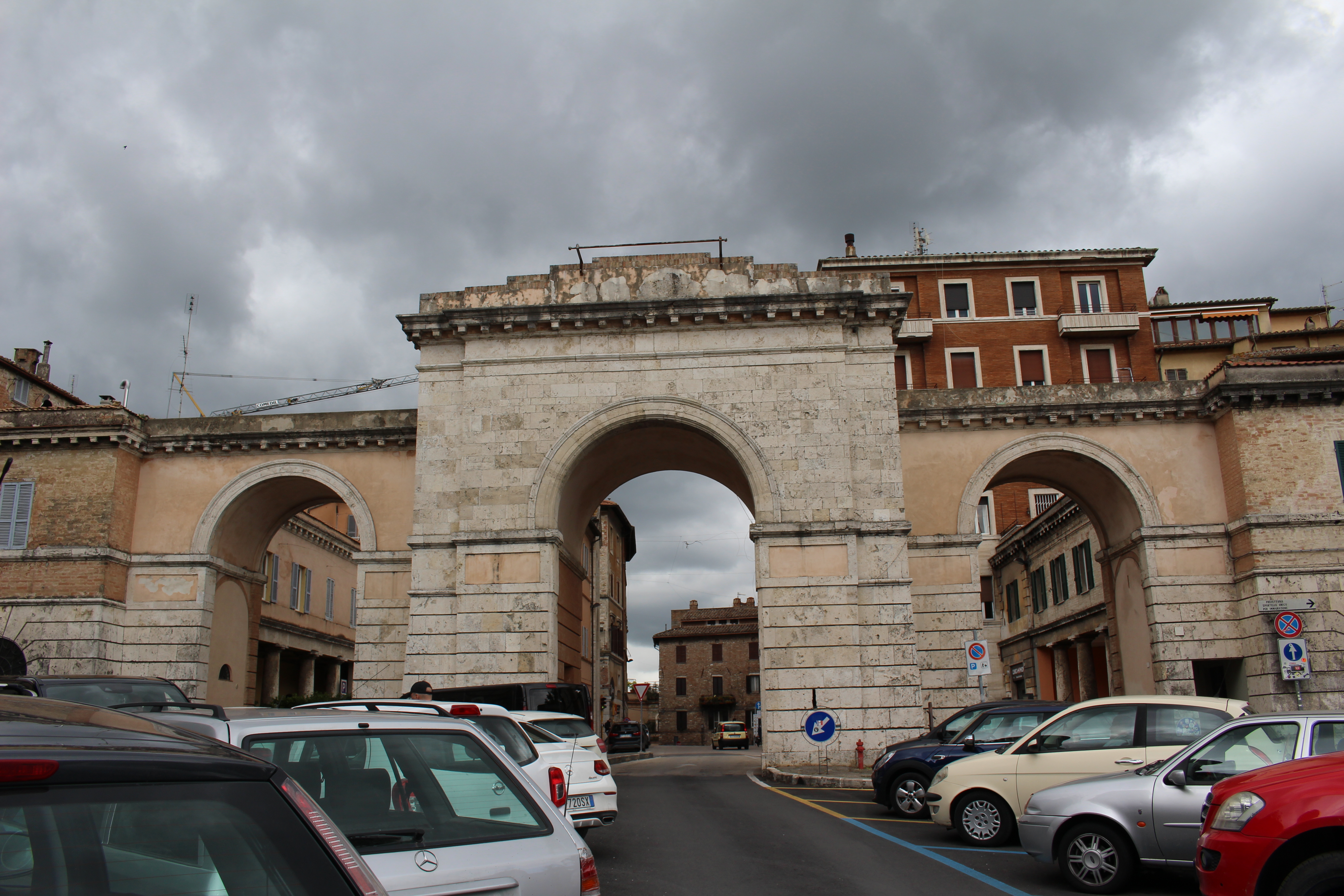
We drove up into Perugia and walked ever upward. Perugia, population 170,000, is the capital of Umbria. It is a majestic, handsome and wealthy city with trendy boutiques, upscale cafes, and grandiose architecture. A university city, it has a 30,000+ student population.
gate into Perugia
It was a cold 54°F and it started raining so we dropped into a pizzeria called ristorante ferrari where we shared umbricelli pasta with bacon and fava beans with pecorino cheese, accompanied by two glasses of red wine. I picked all the bacon out of my pasta and gave it to Mike. It was a nice cozy place to get out of the cold and rain for a while, with its brick barrel-vaulted room, like an old wine cellar. Bottles of wine for offer were everywhere in the regions of Umbria and Tuscany.
ristorante ferrari
umbricelli pasta with bacon and fava beans with pecorino cheese
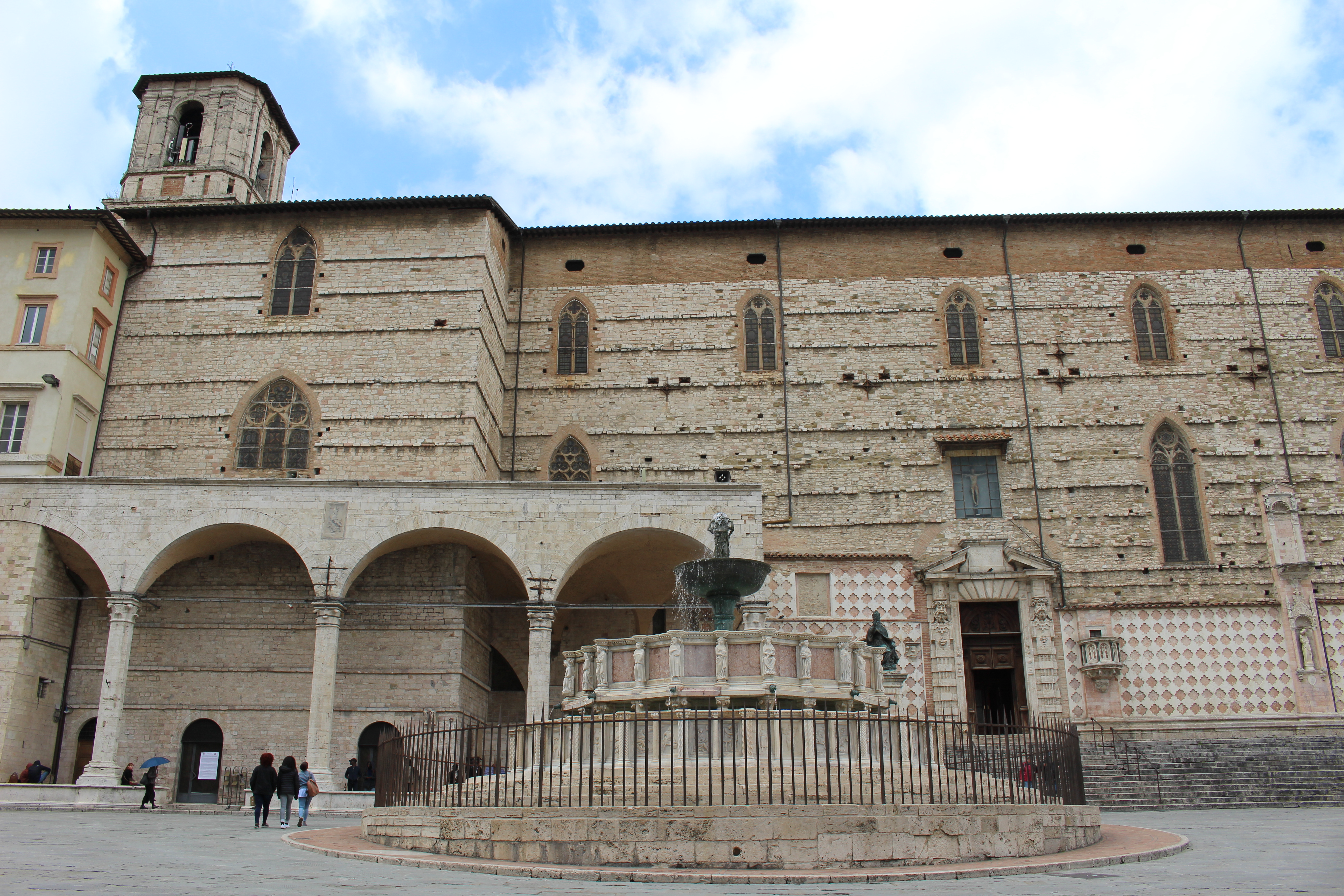
We went into the Duomo, Cattedrale di San Lorenzo, which overlooks Piazza IV Novembre. The version seen today was begun in 1345 and building continued until 1587, although the main facade was never completed.
The Cathedral apparently has the Virgin Mary’s wedding ring, which was stolen by the Perugians in 1488 from the nearby town of Chiusi, according to Essential Italy: Fodor’s Travel. The Virgin’s ring is kept high up — under 15 locks — in a red-curtained vault to the left of the entrance. It is shown to the public on July 30 (the day it was brought to Perugia) and the second-to-last Sunday in January (Mary’s wedding day), according to Fodor’s.
Cathedral of San Lorenzo
In the chapel, reserved for prayer, I snapped some photos as no one was using it. I got reprimanded by a man who motioned for me to delete the photos. I deleted one but not all.
inside Cathedral of San Lorenzo
inside Cathedral of San Lorenzo
inside Cathedral of San Lorenzo
inside Cathedral of San Lorenzo
inside Cathedral of San Lorenzo
inside Cathedral of San Lorenzo
inside Cathedral of San Lorenzo
inside Cathedral of San Lorenzo
inside Cathedral of San Lorenzo
inside Cathedral of San Lorenzo
Outside the Duomo is the elaborate pink-and-white marble Fontana Maggiore, the centerpiece of Piazza IV Novembre, which dates from 1278. It is adorned with scenes from the Old Testament, zodiac figures, a griffin, a lion, and symbols of the seven “liberal arts.”
Fontana Maggiore
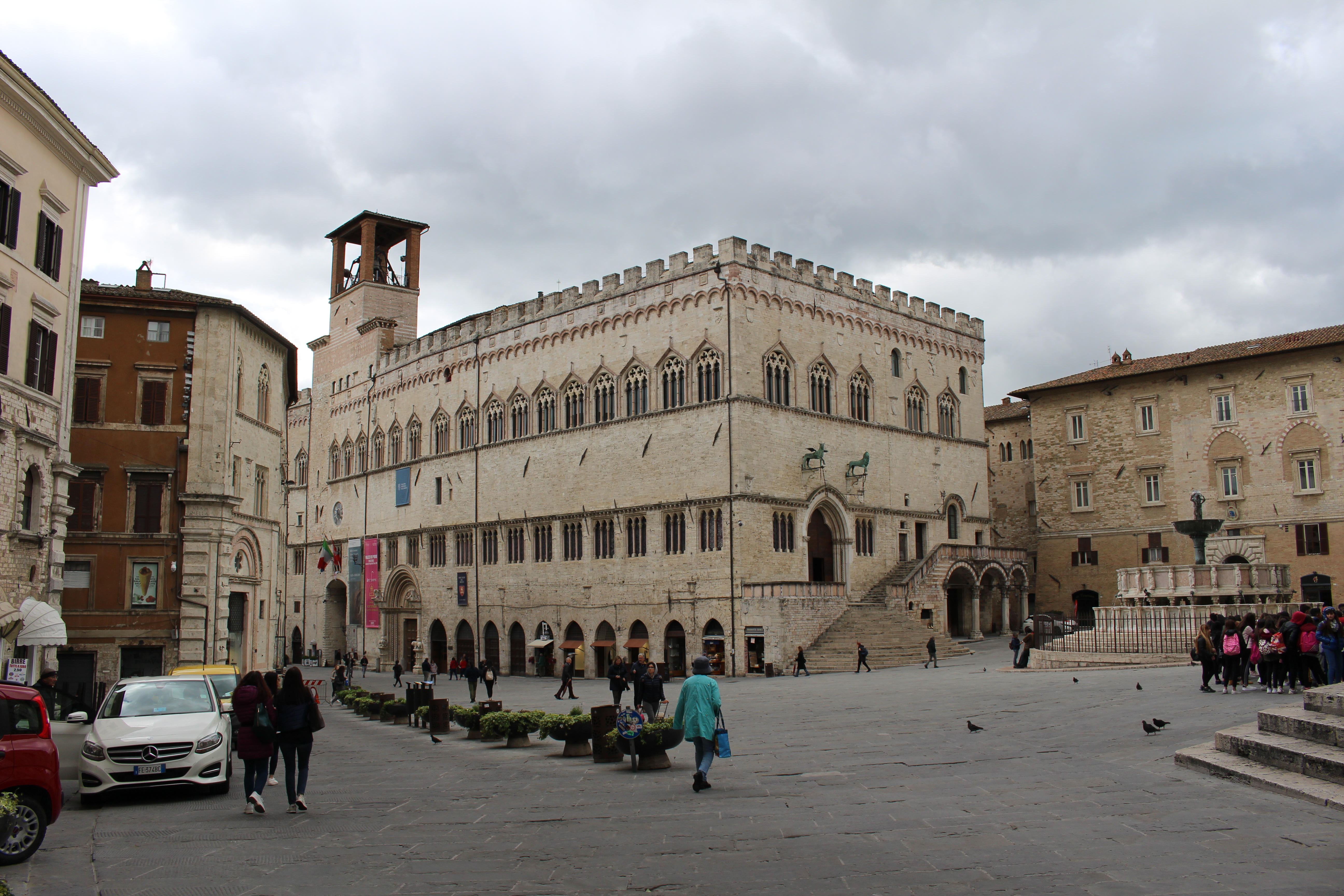
The Palazzo dei Priori is a historic Gothic palace, constructed between the 13th and 14th centuries, that was the seat of the priori (“first citizens”). This magistrature was established in Perugia in 1303. It is striking with its tripartite windows, ornamental portal and crenellations. Now it houses the city’s main art gallery, the Galleria Nazionale dell’Umbria, the Nobile Collegio del Cambio, the Nobile Collegio della Mercanzia, and the Sala dei Notari.
Palazzo dei Priori
We stopped for a little chocolate treat so I could use the bathroom after drinking all that wine and sparkling water. 🙂
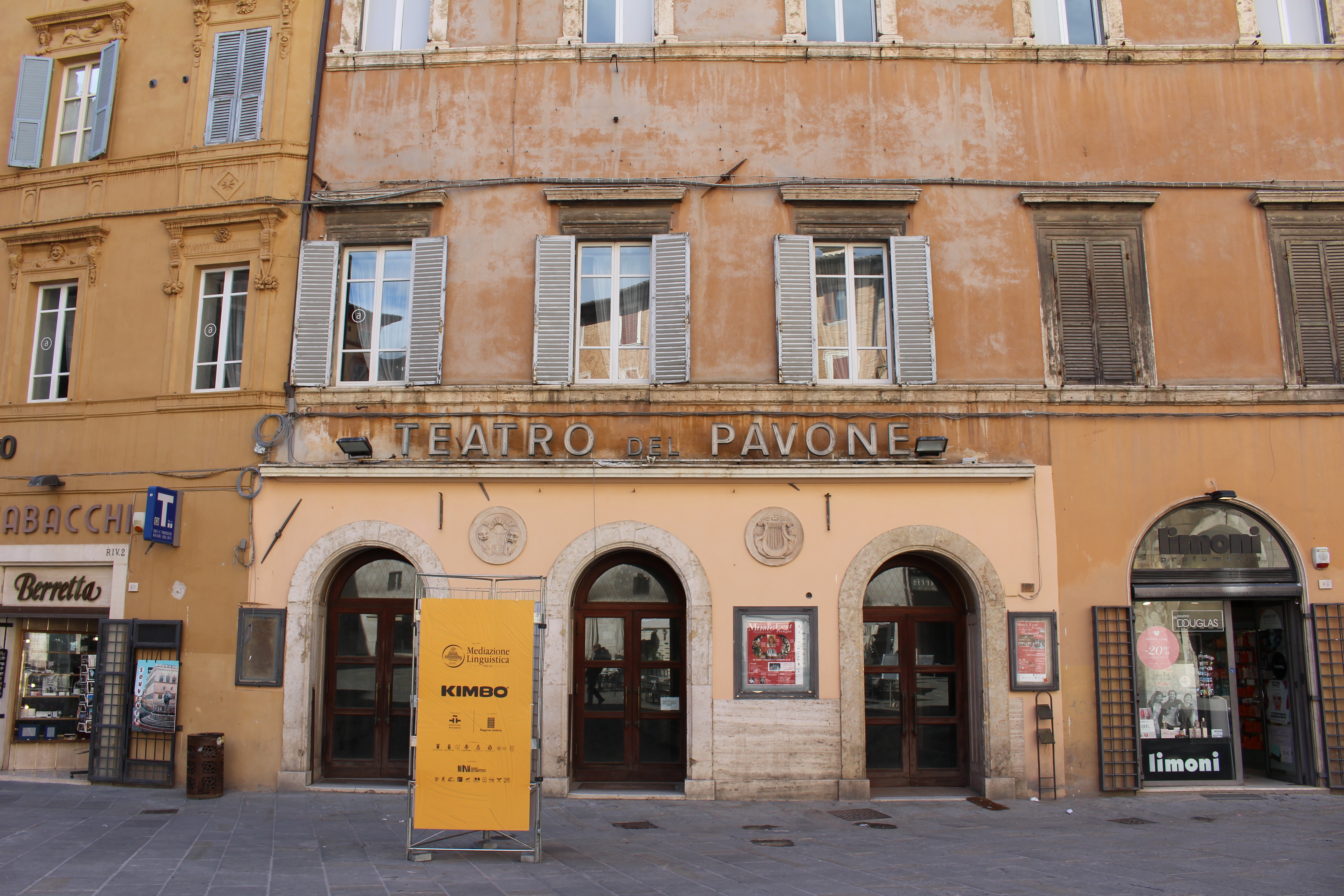
Teatro Pavoni
Perugia
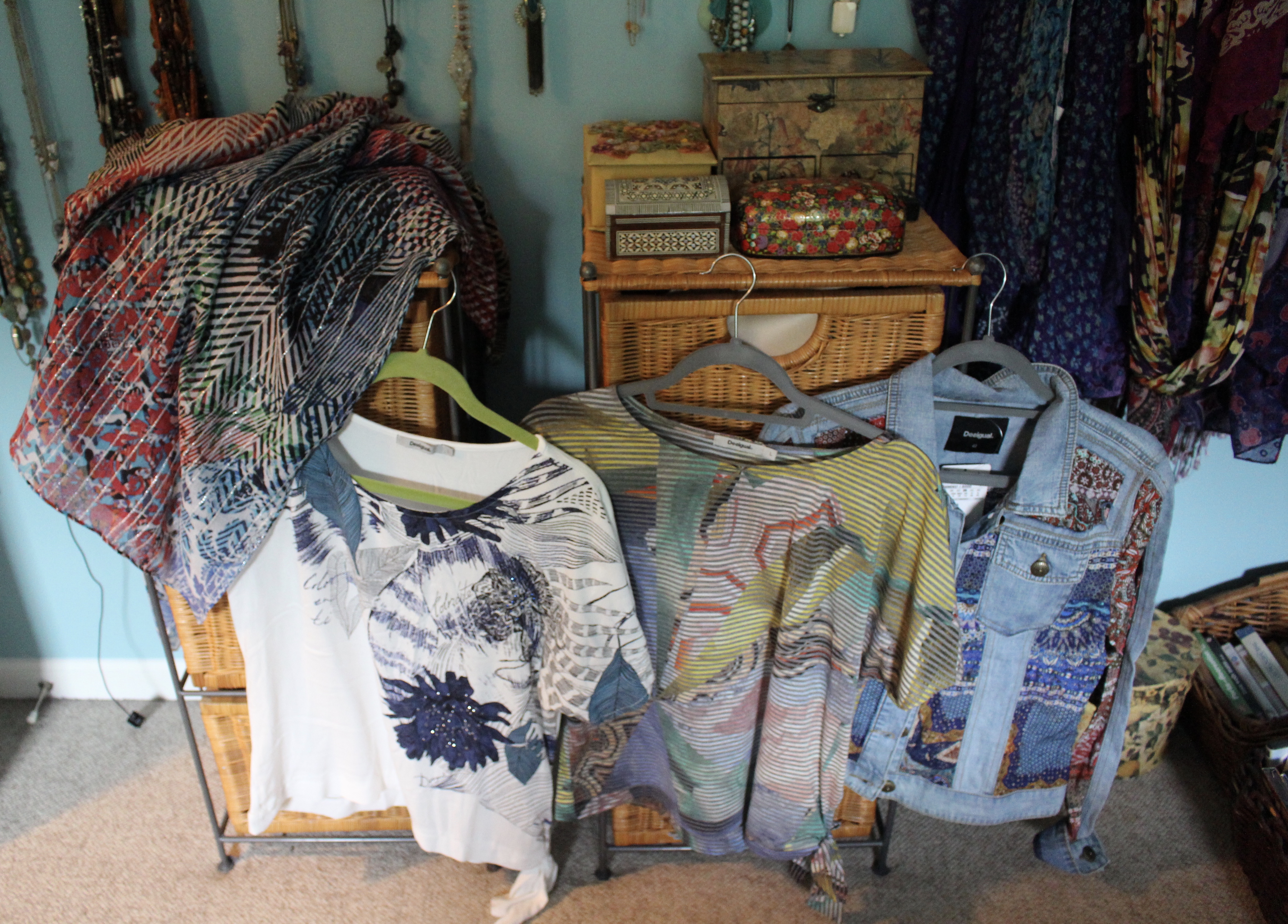
We dipped into DeSigual for what turned out to be a shopping spree. I got two cute shirts, one funky jean jacket with a patchwork of various fabrics, and a scarf. The saleswoman was very creative and had great suggestions, so I ended up buying more than I would have on my own. Mike was encouraging the whole thing, and sat watching on a stool as I tried things on.
my purchases from DeSigual
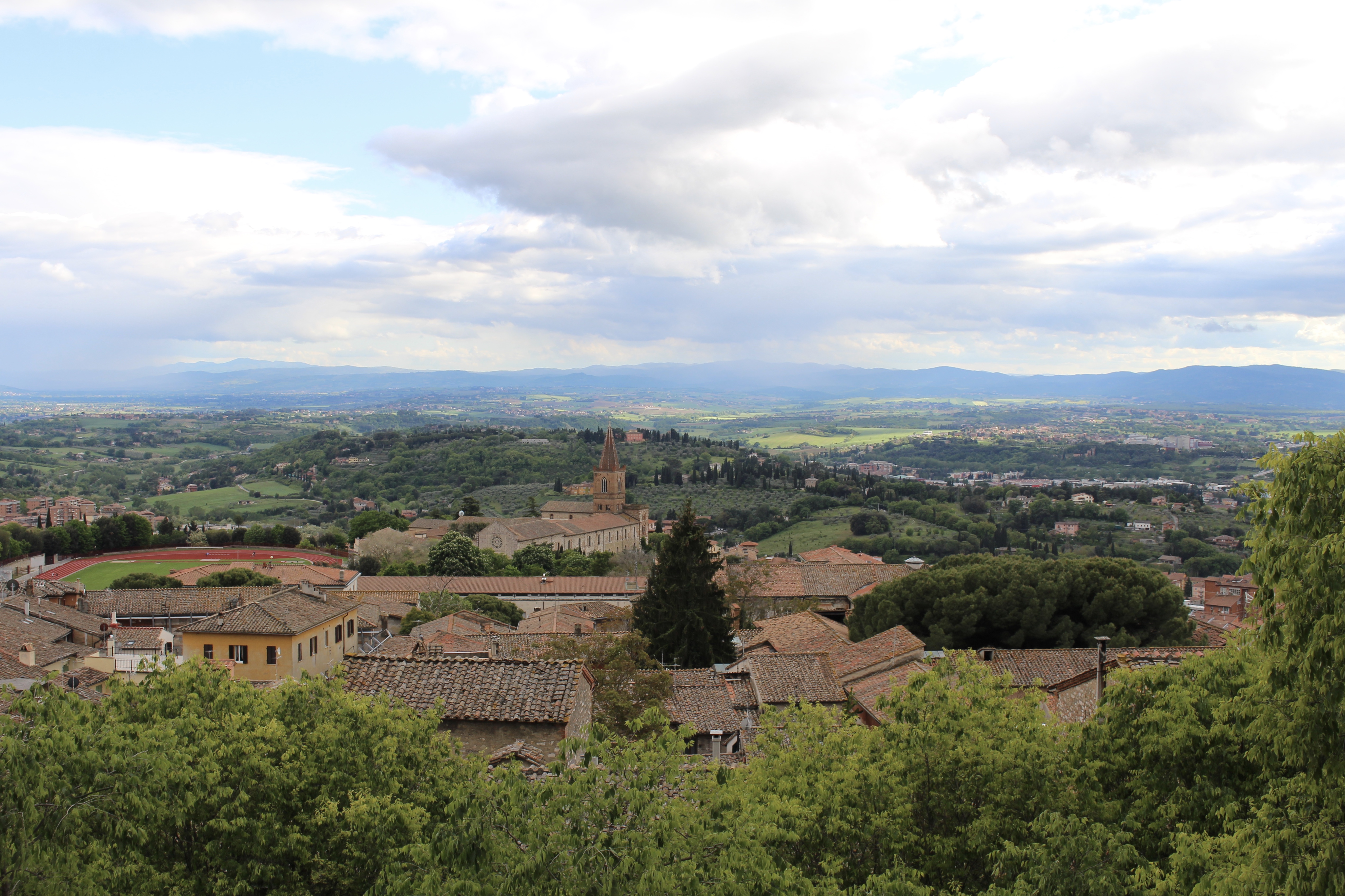
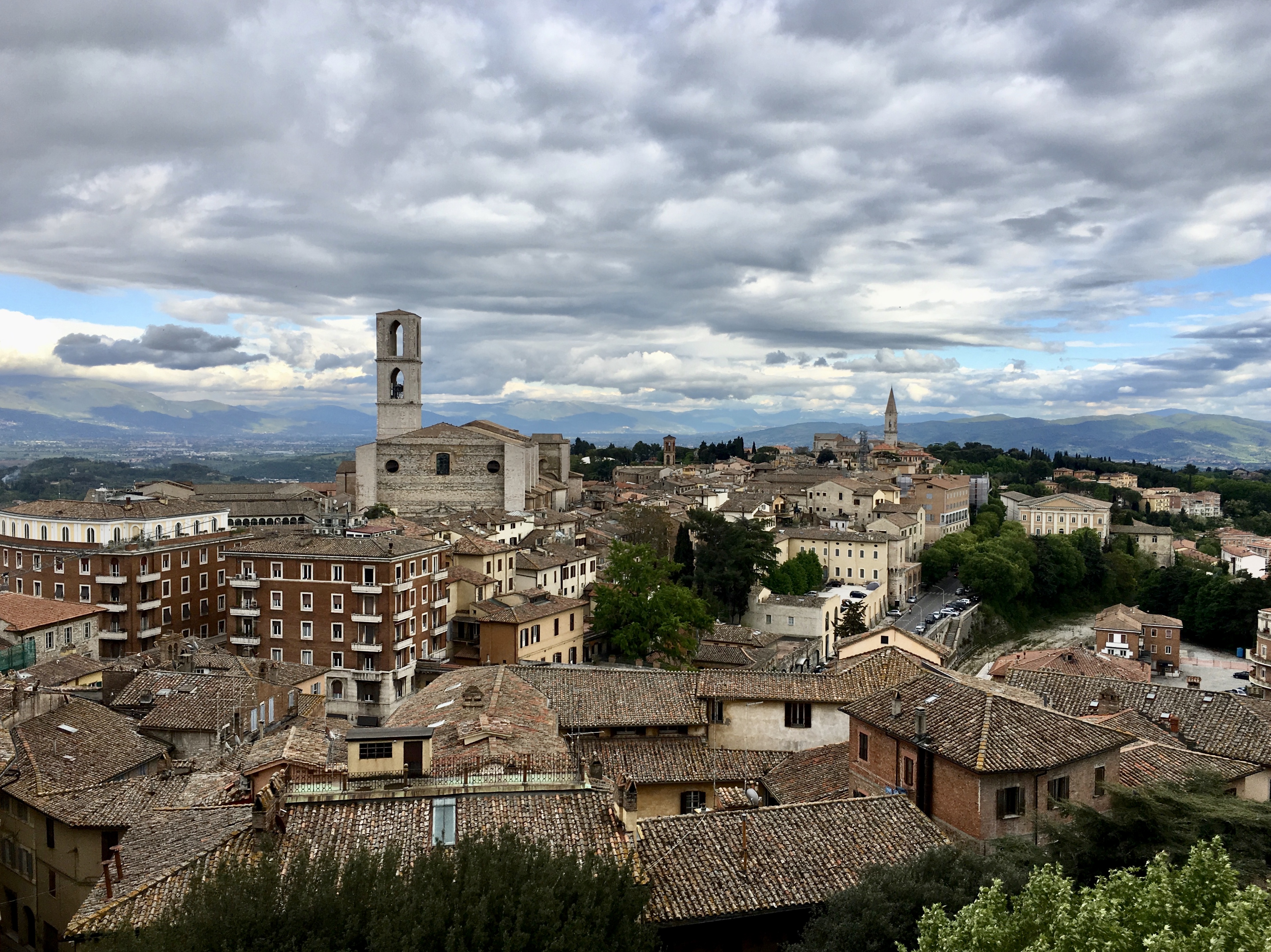
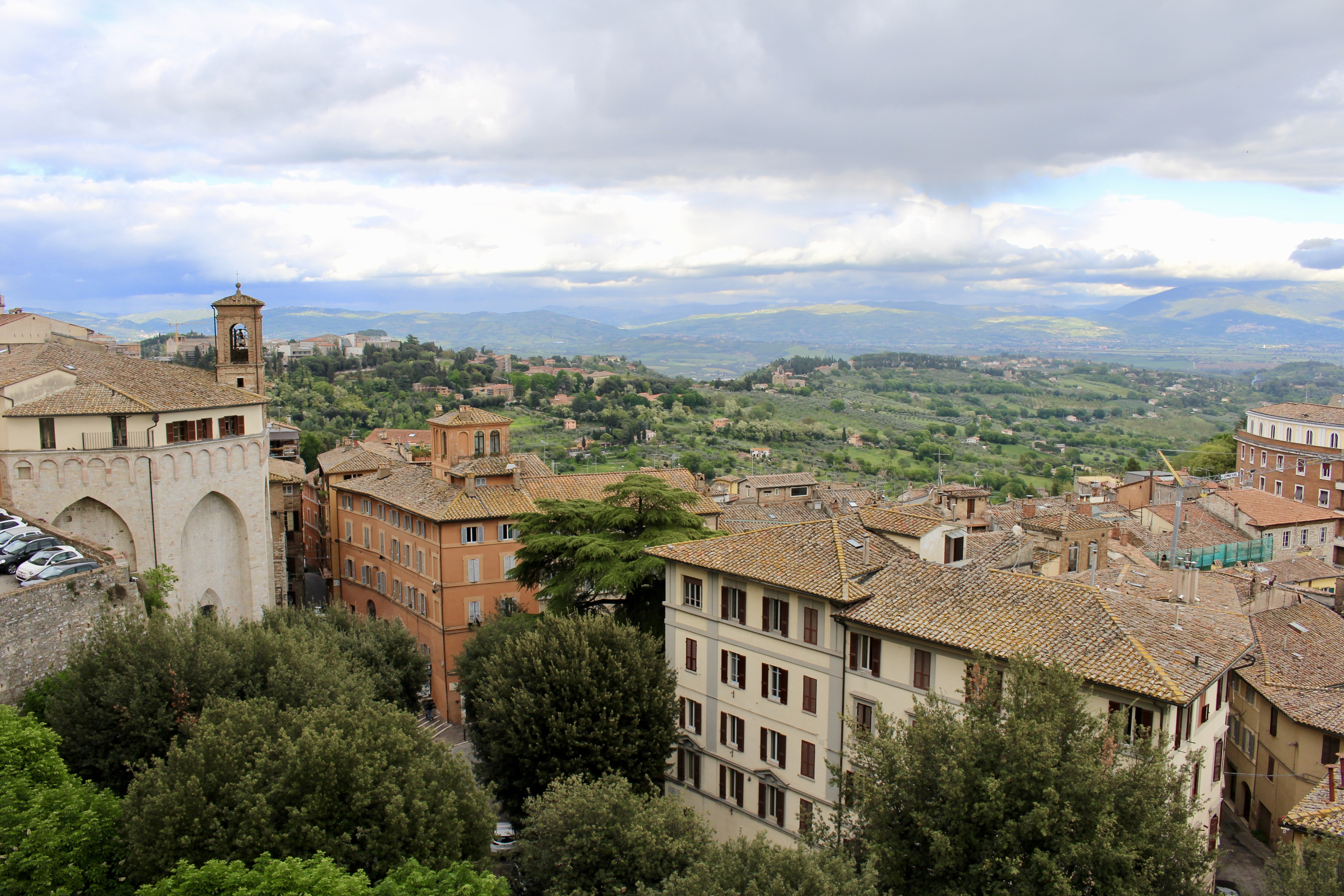
We walked around the edge of the wall for views into the valley.
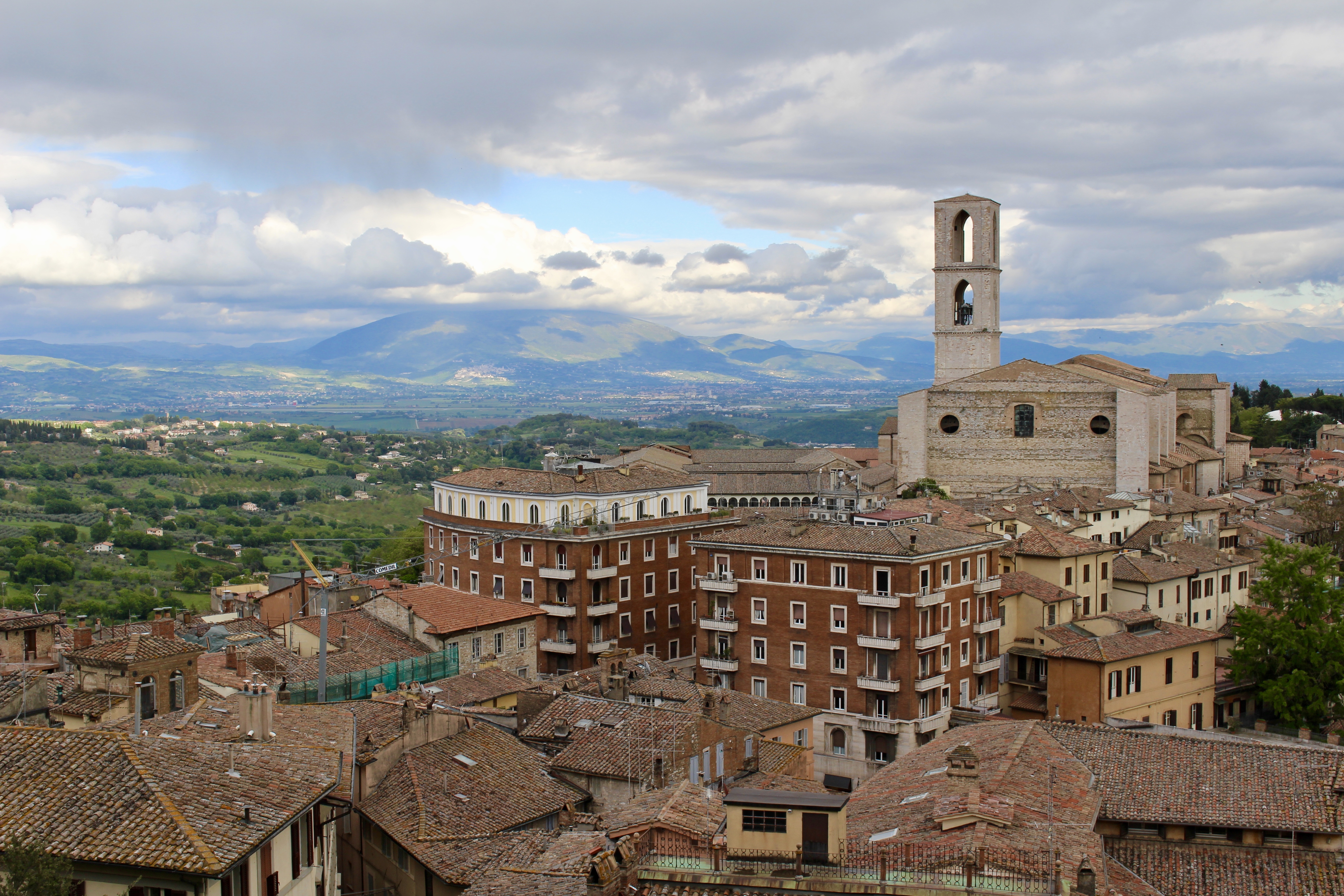
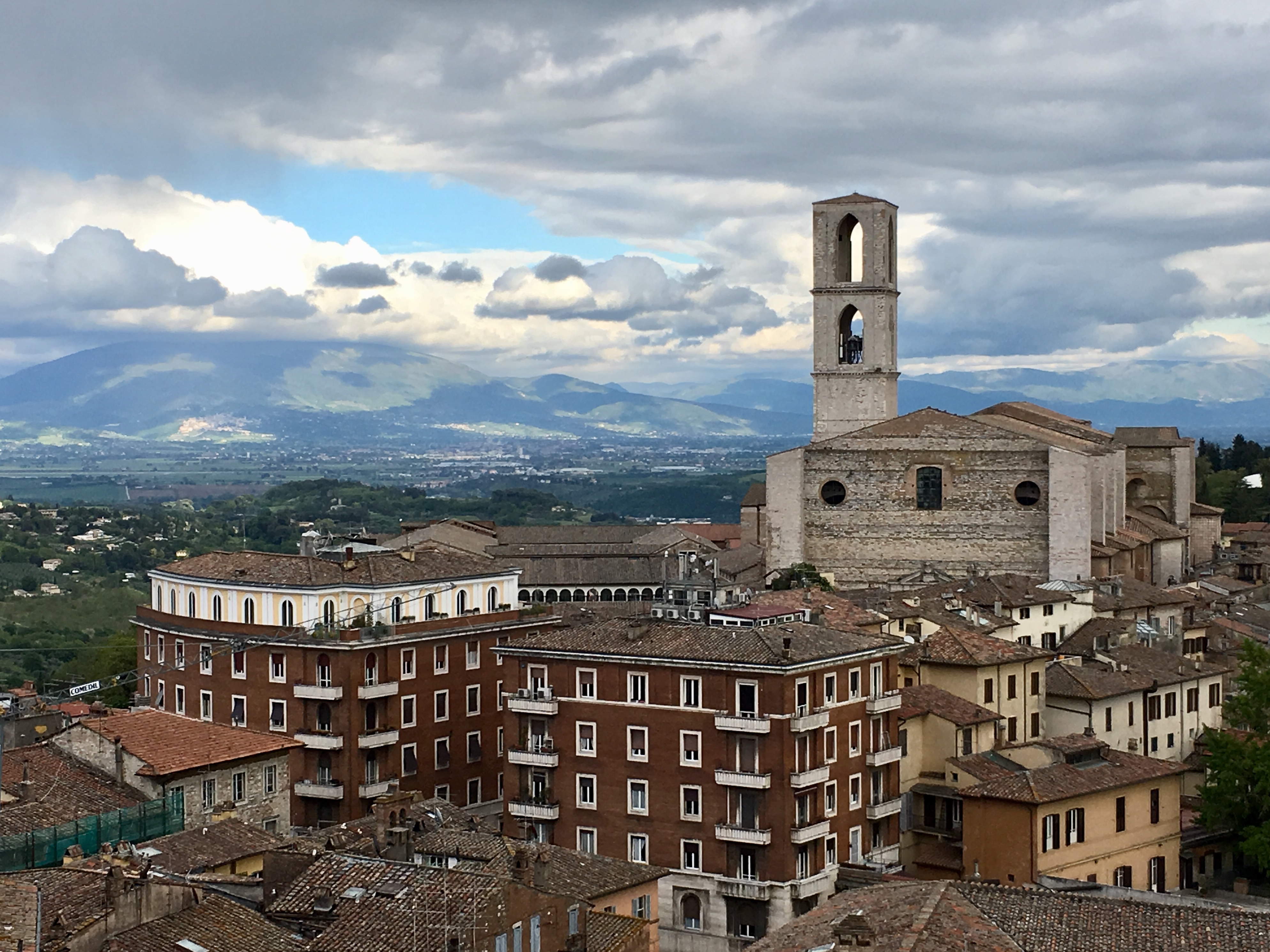
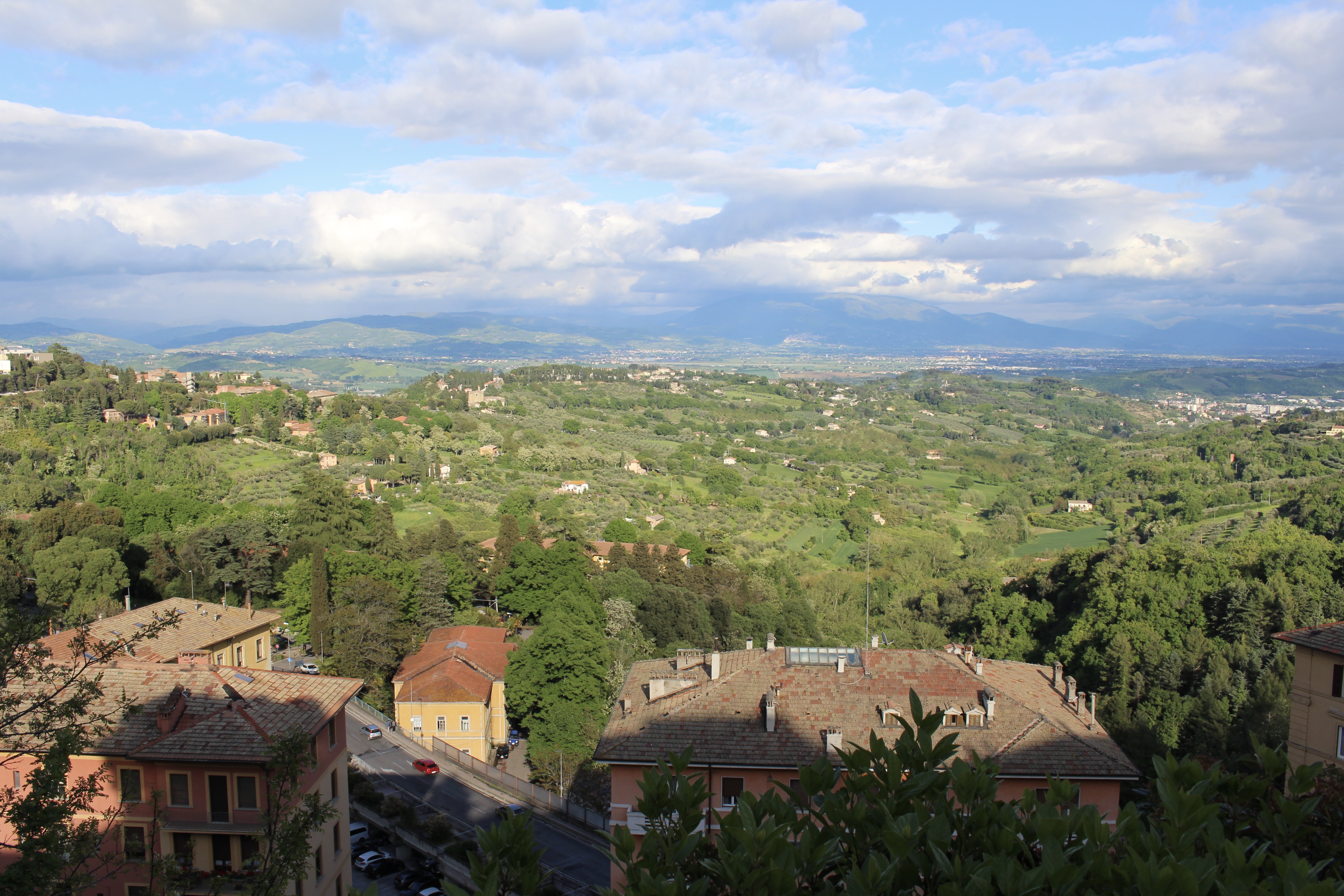
views from Perugia’s walls
views from Perugia’s walls
views from Perugia’s walls
views from Perugia’s walls
views from Perugia’s walls
We returned to our apartment for wine then we decided to go to the PAM Superstore and get breakfast groceries: yogurt, bananas, strawberries, crackers, prosciutto, orange juice, and more.
the area around our Airbnb
After asking, “Dov’è il ristorante più vicino?” (where is the nearest restaurant?), we went out to dinner at Al Battibecco ristorante / pizzeria. It was a family place with a vast interior, a grass playground outside, and tables covered in checkered tablecloths.
Al Battibecco ristorante / pizzeria
tables at Al Battibecco ristorante / pizzeria
Whole families were eating huge plates of breaded fish. We wondered if it was a regional specialty, but no one spoke English enough to tell us.
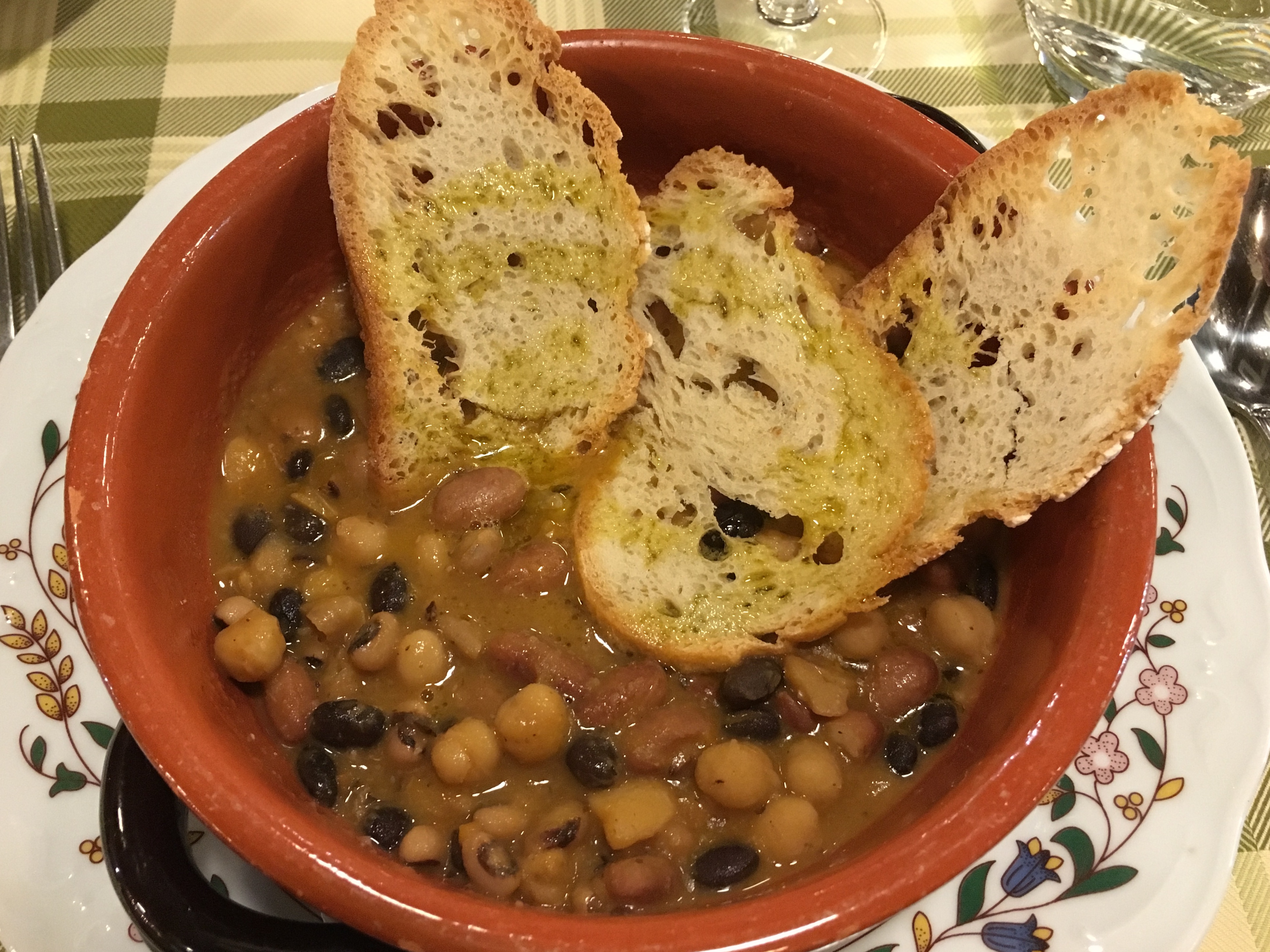
They brought us two glasses of prosecco, and we also had two glasses of wine. Mike ordered a kind of caci e pepe and I had imbrecciata, an Umbrian soup of beans and grains, delicately flavored with local herbs.
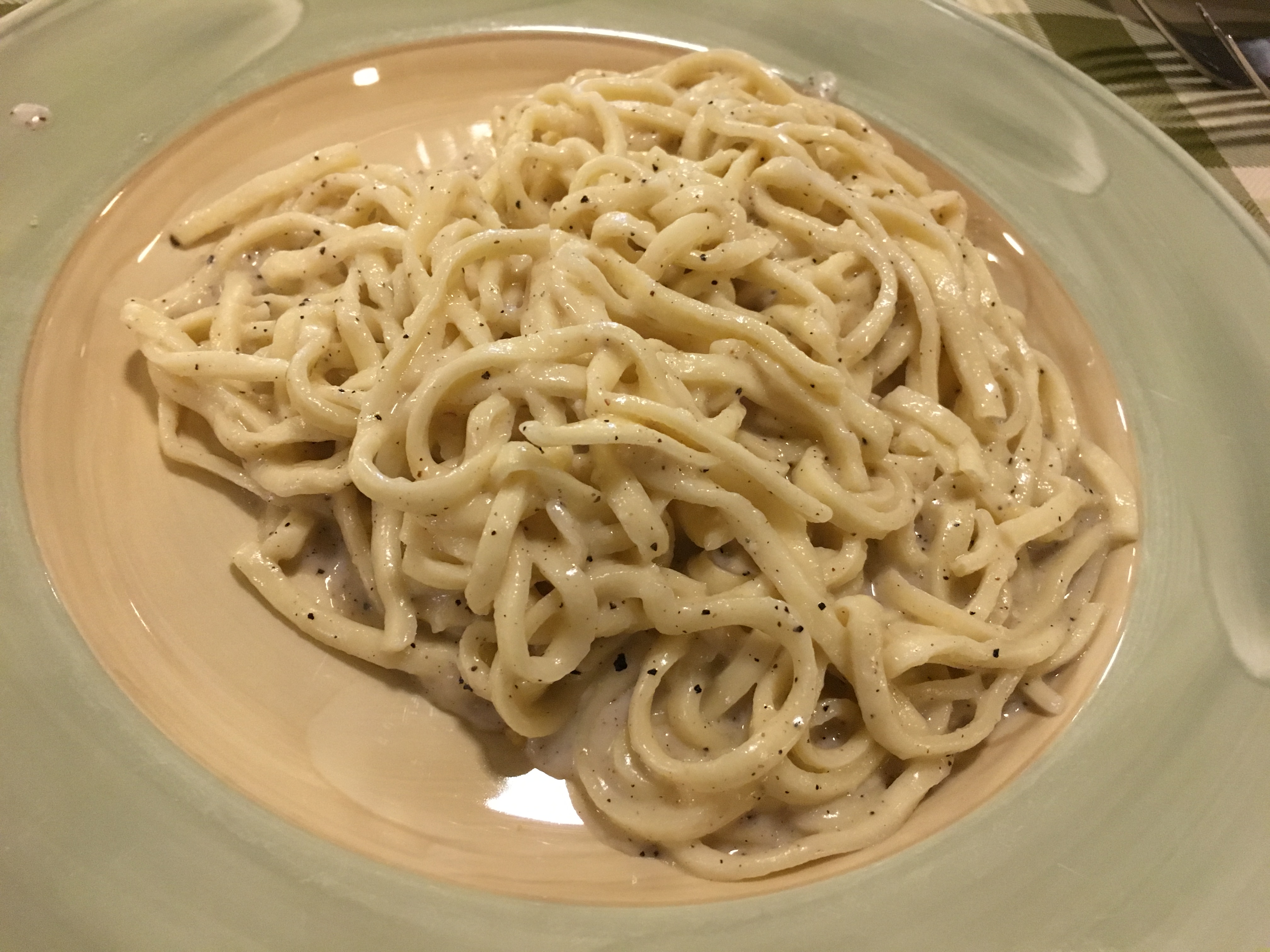
caci e pepe
imbrecciata, an Umbrian soup of beans and grains
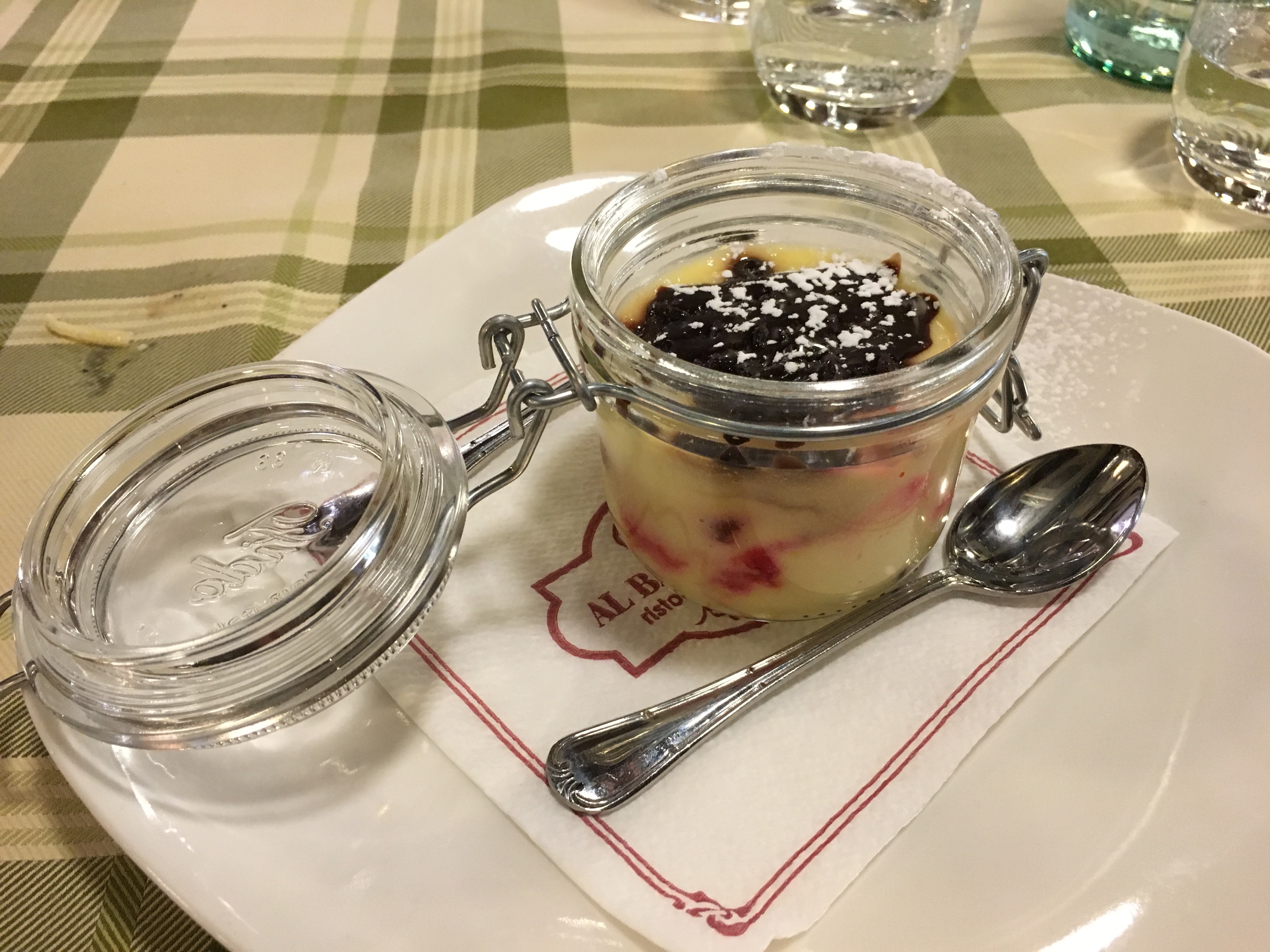
We also had a dessert of vanilla pudding with cherries served in a jar. Our waitress was a goofy face-making waitress who spoke no English, but she was very friendly.
My path less traveled. Rediscovering self after surviving the abuse that almost sunk me. Goal of strengthening and thriving on my adult legs. 👣🙏🏻 #recovery #forgiveness
This blog is for those who wish to be creative, authors, people in the healing professions, business people, freelancers, journalists, poets, and teachers. You will learn about how to write well, and about getting published. Both beginning and experienced writers will profit from this blog and gain new creative perspectives. Become inspired from global writers, and find healing through the written word.
Explore, discover and experience the world through Meery's Eye. Off the beat budget traveler. Explore places, cultural and heritage. Sustainable trotter.
shareable tales of Meery is Meeryable






























 I didn’t read many books to prepare for my trip to California, but I had read a number in the past and had a huge list of books to choose from (this list is the tip of the iceberg):



































 ~ wander.essence ~
You must be logged in to post a comment.