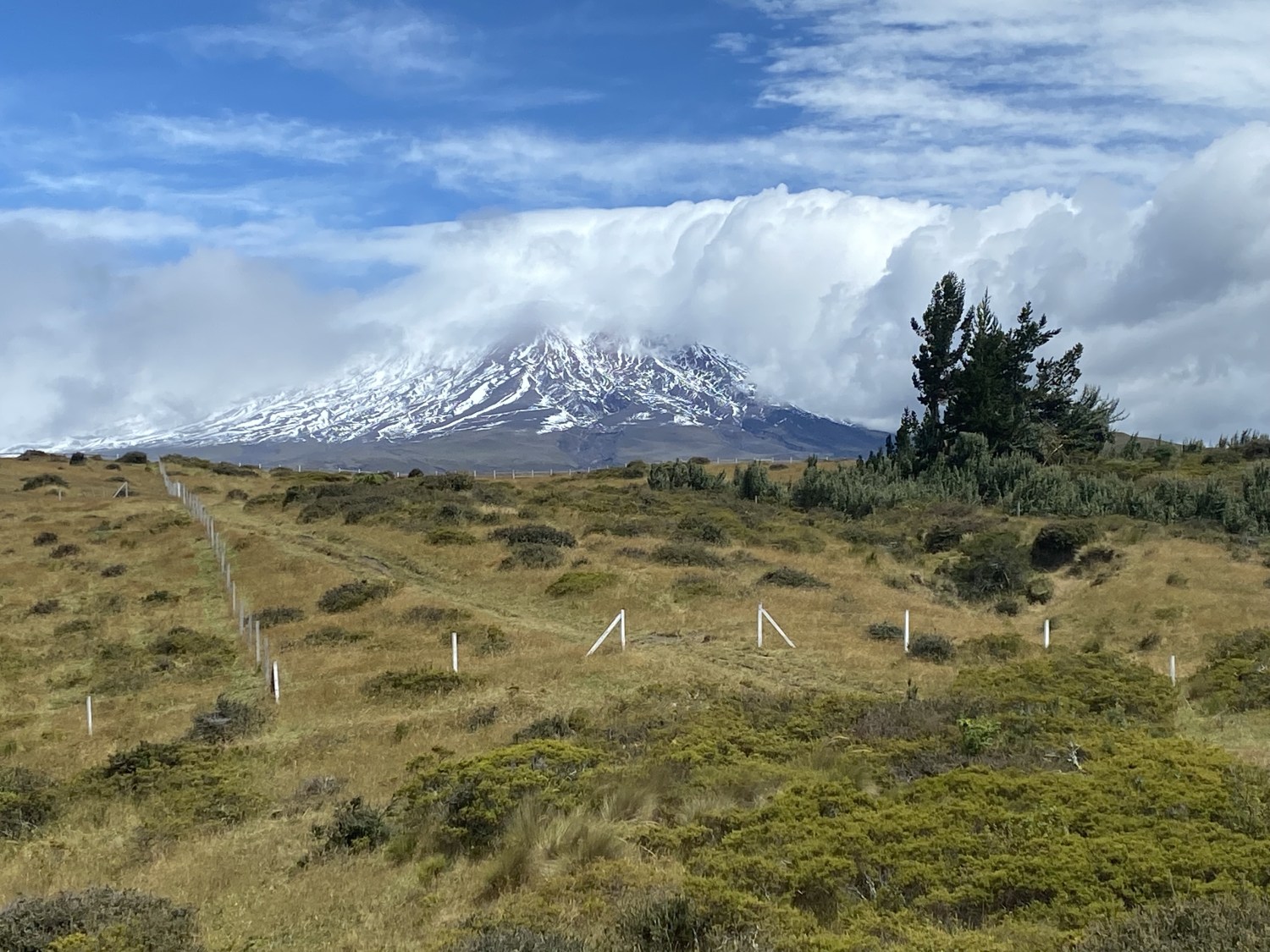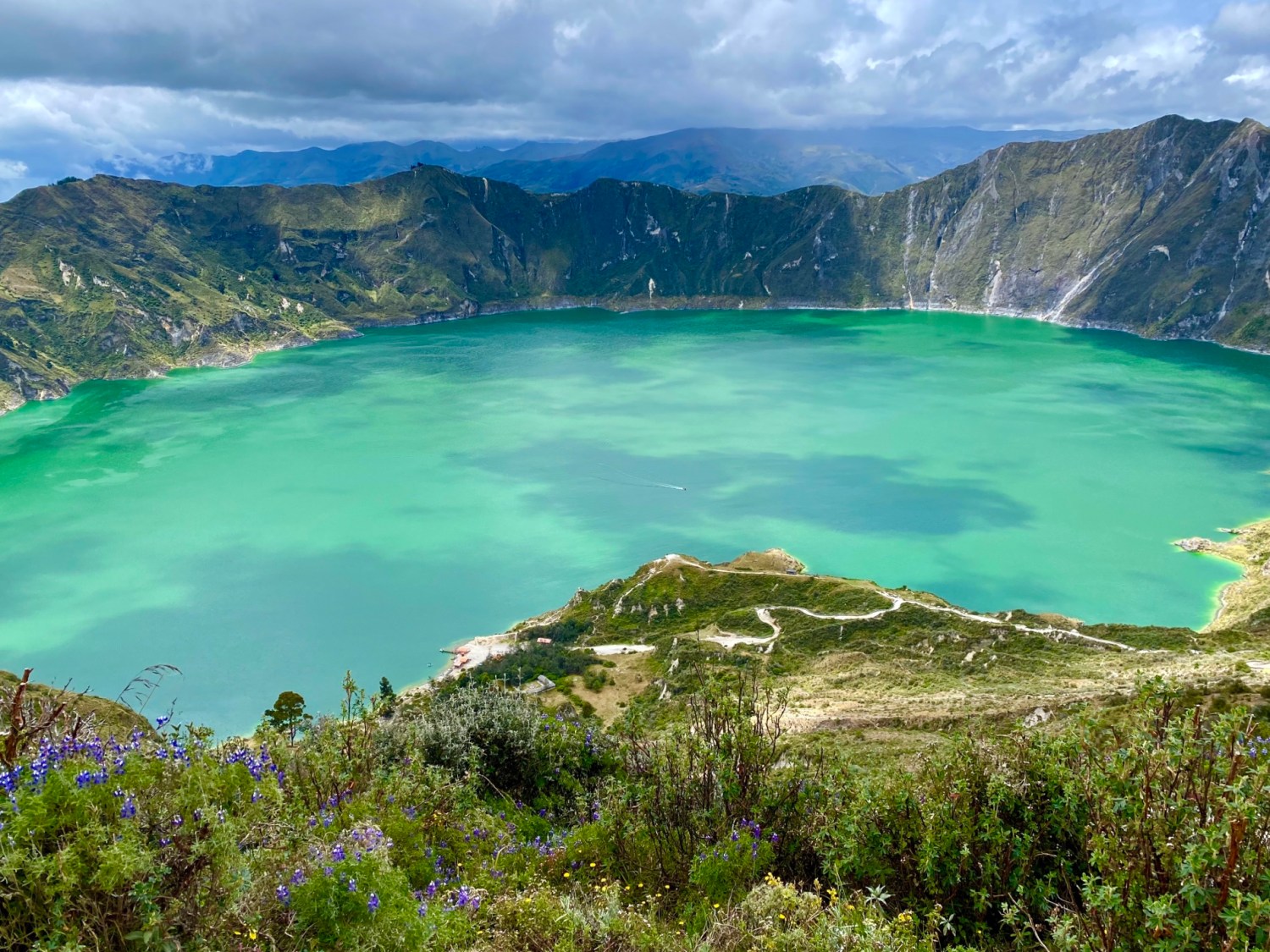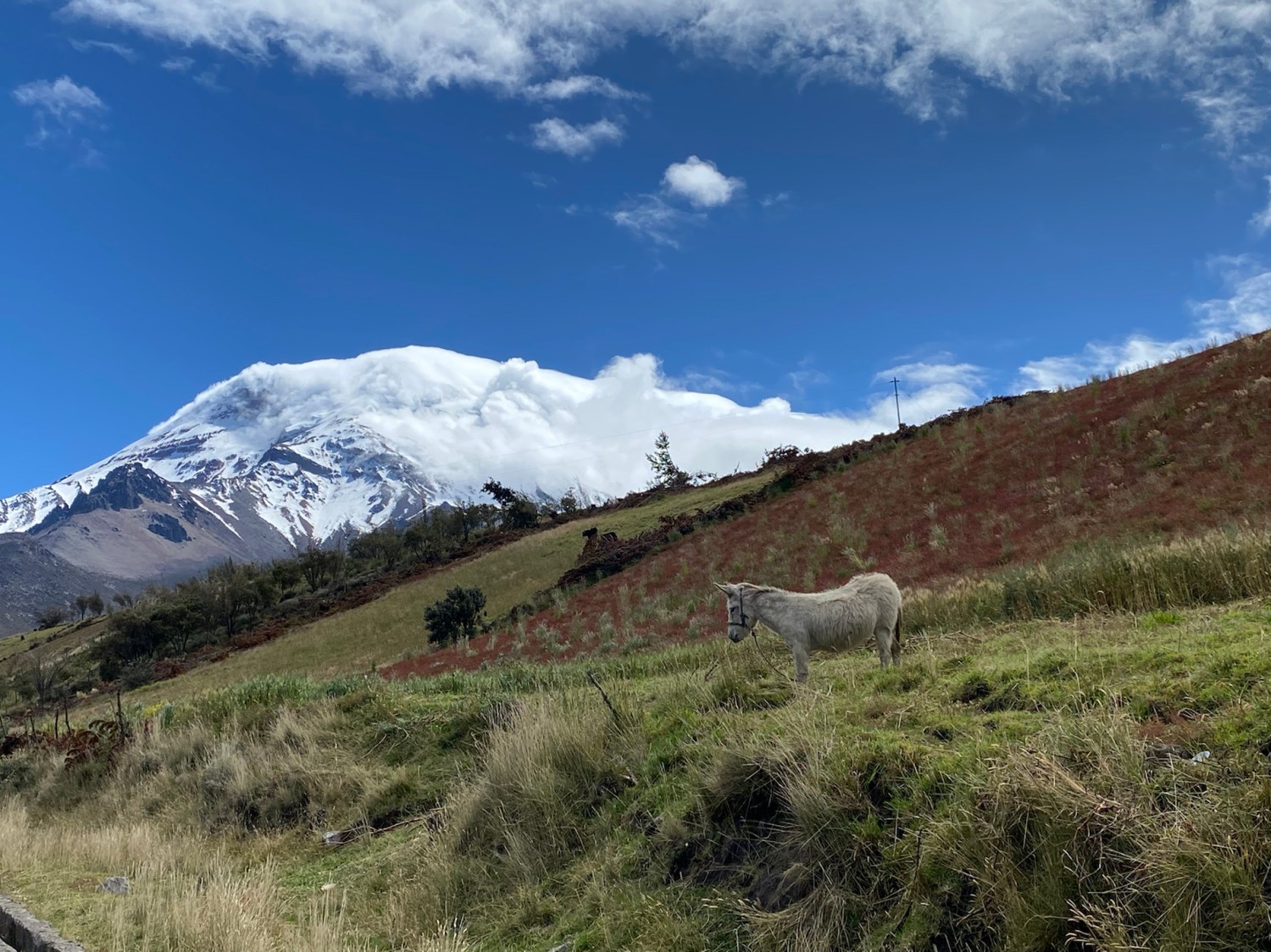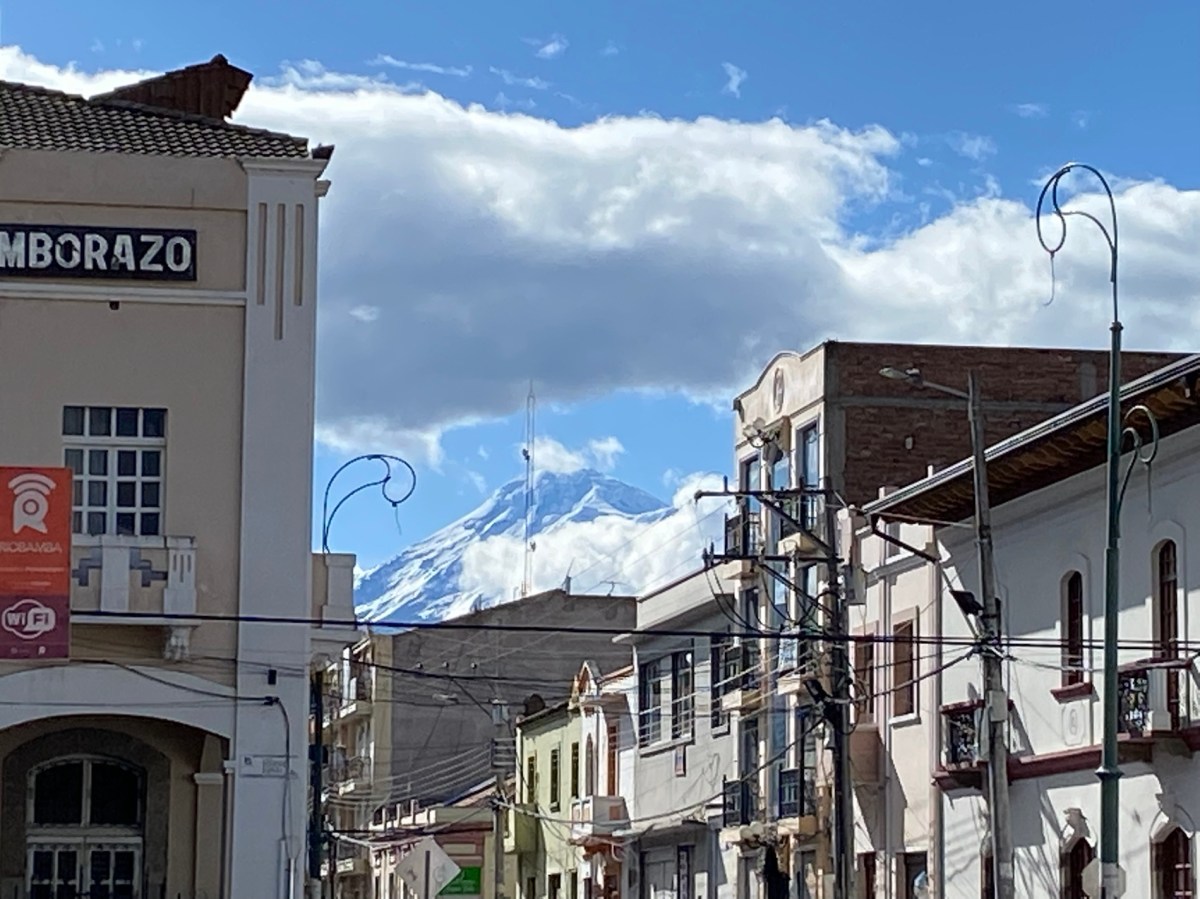
On the Sunday after we arrived in Cuenca, Gustavo Jiménez Morales, the excellent English-speaking tour guide recommended by our Airbnb host, took us in his zippy white car to three market towns (and one town on the Guitar Route) to the southeast of the city. The countryside outside of the city was stunning, with homesteads and patchwork fields etched into the mountainous terrain. On the way, we came across two cholo women cooking cuy (guinea pig) on a spit over a grill. This dish is served throughout the Andes of Ecuador. One woman was rotating the guinea pig over the fire by hand and the other woman was putting another skinned guinea pig on the spit.
A cholo in Ecuador, according to Gustavo, is a synonym for Mestizo, a person of mixed Andean and European heritage, usually a white father and an Aymara or Quechua mother. Though the term can be derogatory in many parts of South America, it can express ethnic pride. They dress colorfully in rich material with several full petticoats, embroidered blouses and hats that vary by locality.
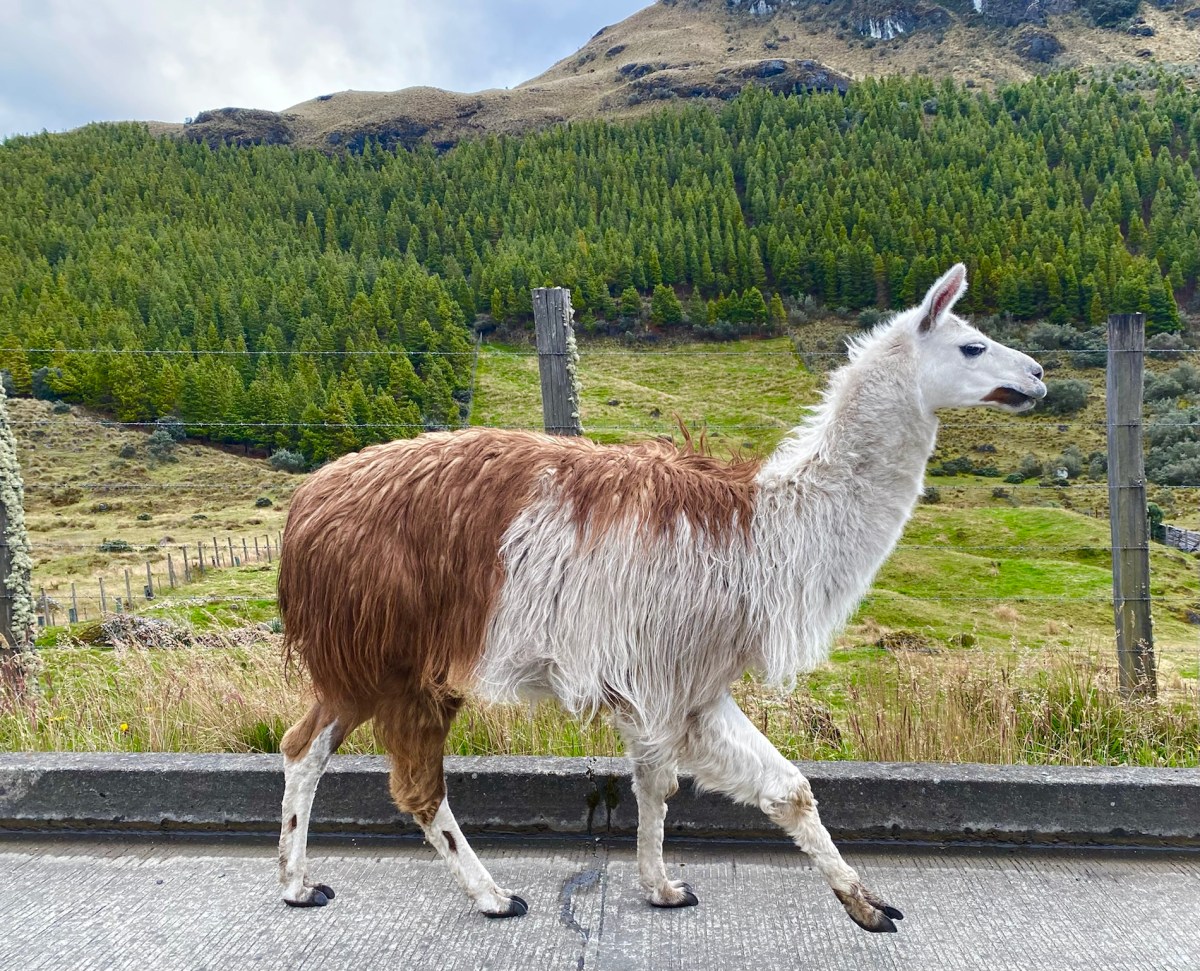
countryside southeast of Cuenca
cholos cooking cuy
San Bartolomé
Gustavo stopped on a hillside and we saw below the town of San Bartolomé, famous for its handcrafted guitars. It was founded by the Spanish in 1536, 21 years before Cuenca was founded.
I needed a bathroom break so we drove into the town and Gustavo introduced us to Samira who owns Tienda Cecilita in town. In her backyard was a garden where she picked herbs to brew us a pink healing tea. She had a nice little bathroom in her backyard that we could use, a pen of live guinea pigs, and a small cozy dining room where we enjoyed our tea accompanied by delicados.
Before leaving town, we stopped at a small guitar shop where we saw guitars in production, including small matchboxes of inlay material for the guitars. San Bartolomé is along the “Ruta de las guitarras.”
view of San Bartolomé
San Bartolomé
Samira
Samira’s herbs for the tea
Mike at Tienda Cecilita, Samira’s shop
Tienda Cecilita
me in front of Tienda Cecilita
drying corn
the tea room
me with Gustavo
Mike
guitar shop
inlay for guitars
Sigsig
Our next stop was Sigsig, a small colonial-era indigenous town best known for its Panama hats. Panama hats are misnamed; they actually originate in Ecuador. They came to be called that because they were often traded near the Panama Canal. The straw used to weave hats is from a plant native to Ecuador, similar to the palm with unique qualities. Fan-shaped leaves grow at the end of its long stalks; they are cut while still shoots to be transformed into the raw material for weaving.
For the most part weavers carry out their activities in rural areas and deliver hats in their first stage to the factories or to comisionados (middle men). The azocadoras and the reshapers usually live in urban areas of Cuenca and perform their tasks at home under a “piecework” arrangement. The next stage is performed by women and is known as the azocada (tightening), which consists of tightening the tied-off fibers to keep the weave from coming undone, followed by clipping the excess fibers. Then the hat is washed, whitened (bleached) or dyed, and dried in the sun.
When it has lost its shape and looks like a bell, the craftsman’s hands return it to its original shape; this is compostura (reshaping). The people who do this are often urban dwellers and work in their own homes.
Mike and I had both read Tom Miller’s The Panama Hat Trail before our trip, so we knew all about the process of making the Panama hats.
In Sigsig we found the Panama hat workshop called La Sigseñita, where we saw the hats in various stages of production. The women’s children were running around playing in the workshop. I bought a white Panama hat and Mike bought a navy blue one; they were $16 each. Mike and I have the furthest possible difference in the size of our heads: mine is grande and Mike’s is pequeño! 🙂
After our Panama hat excursion, we went to Sigsig’s Sunday market, with colorful stalls of fruits, vegetables, meats and household goods. We ate lunch upstairs: hornado (tender shredded pork carved from a huge roasted pig) with some corn and hominy accompaniments. Mike and I shared a plate; it was tender and delicious, and I’m not generally much of a meat eater.
cholo clothing in Sigsig
La Sigseñita
La Sigseñita
machine for pressing the hats
the workshop of La Sigseñita
Panama hats in process
me in my Panama hat
Panama hats in process
La Sigseñita
Sigsig’s market
Mike and hornado
me and Gustavo eating hornado
the Sigsig market
Chordeleg
Our next stop was Chordeleg, an important jewelry-making center since before the arrival of the Inca. Its specialty is filigree. The town also produced woodcarvings, pottery, textiles and plenty of Panama hats. Chordeleg’s wealth was evident in its neat and clean streets and charming shops. It has a pretty central park, colorful buildings around the park, and a pretty yellow church. A style of unique dangling earrings hang from the lampposts. I don’t have much interest in fine jewelry, so I bought only a cute pottery wind chime with painted bells.
Chordeleg
Chordeleg
Chordeleg
Chordeleg
my wind chime
Gualaceo
Our last stop was the town of Gualaceo, famous for its Ikat weavings, paños (indigo-dyed cotton shawls with intricate macramé fringe), and leatherworks.
The main square in town is picturesque with a fountain, trees shaped like animals, indigenous women painted on tree trunks, and a large church. We stopped in the square for pictures then headed to the factory outside of town, José Jimenez and Ana María Ulloa: The Royal Weavers of Ikat. We admired the Ikat dyed fibers. The Ikat method requires the fibers to be dyed in bundles before the weaving begins. The slightly blurry finish that’s characteristic of Ikat is prized by fabric connoisseurs. The process is mainly used in Asia, especially Indonesia, and South and Central America.
Gualaceo
Mike and Gustavo
Mike, me and Gustavo in Gualaceo
Ikat weaver Ana María Ulloa
Return to Cuenca
In the evening back in Cuenca, we went to Parque Calderón where a smooth-voiced man serenaded a small gathering with Ecuadorian tunes. We enjoyed a good dinner at Raymipampa: Desde 1933 una tradición en Cuenca. I ate shrimp served with a special sauce and Mike had Locro de Papas, a typical Ecuadorian potato soup with avocado and cheese.
Río Tomebamba in Cuenca
crossing the bridge into the old town of Cuenca
Mike sports his Panama hat in Cuenca
crazy broken plate chandelier in Raymipampa
Steps: 8,912; Miles: 3.78.
Here is a video showing some of the live action.
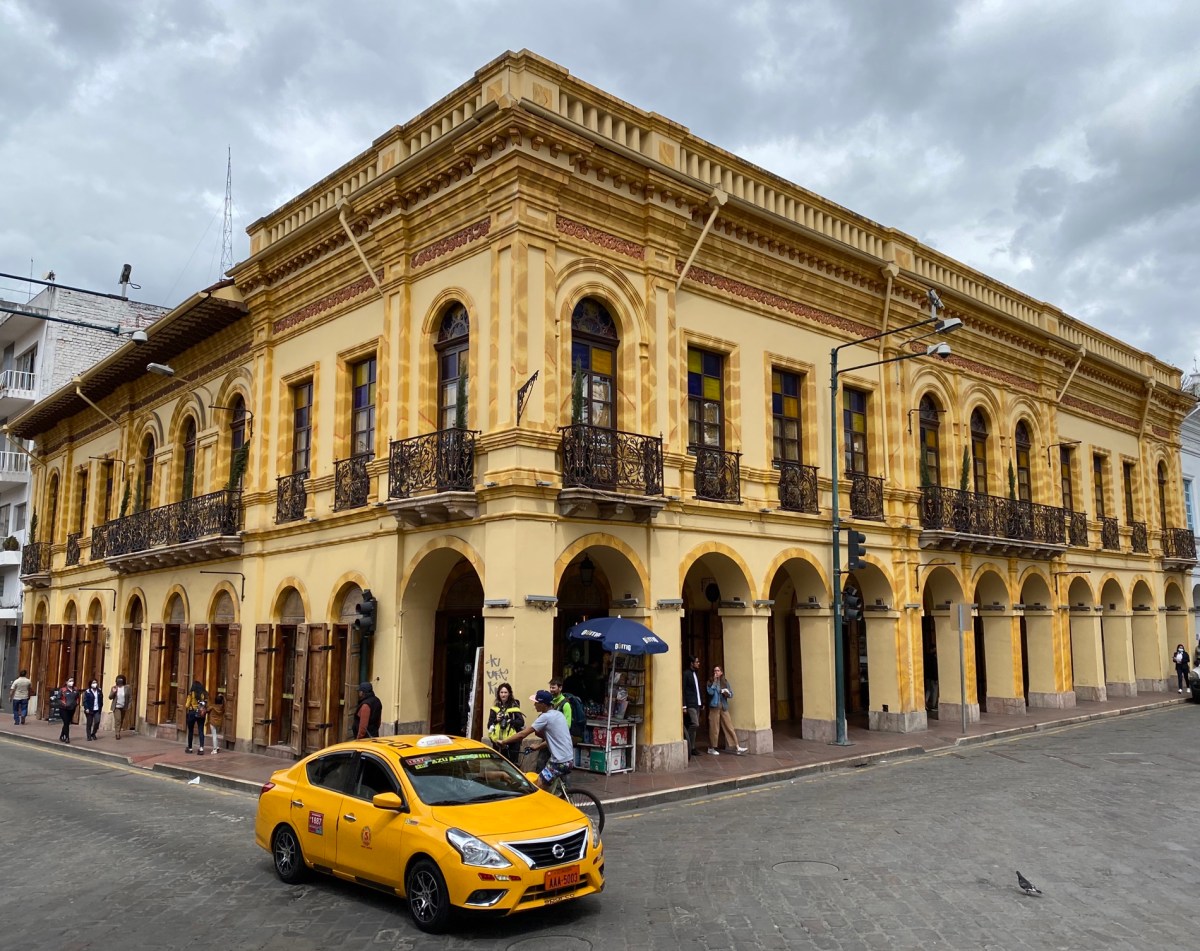
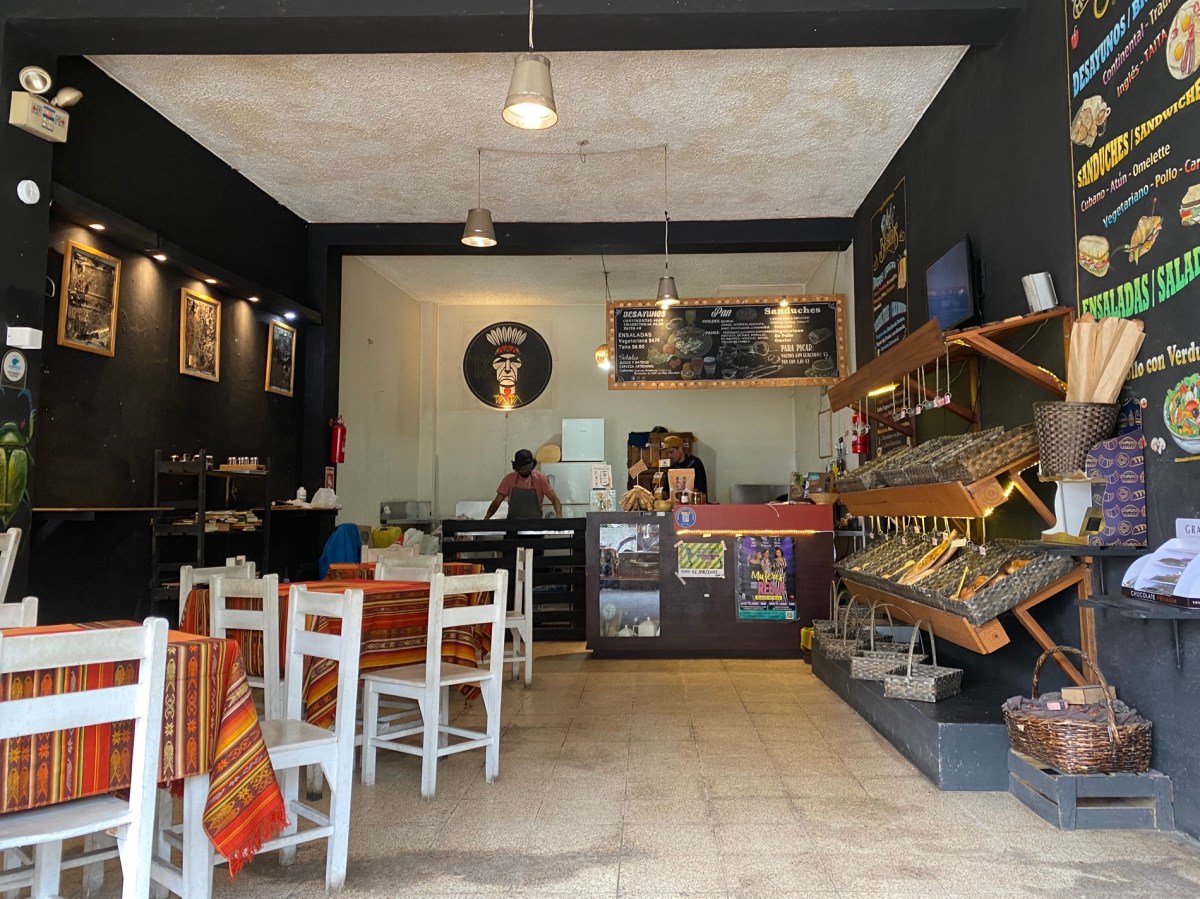
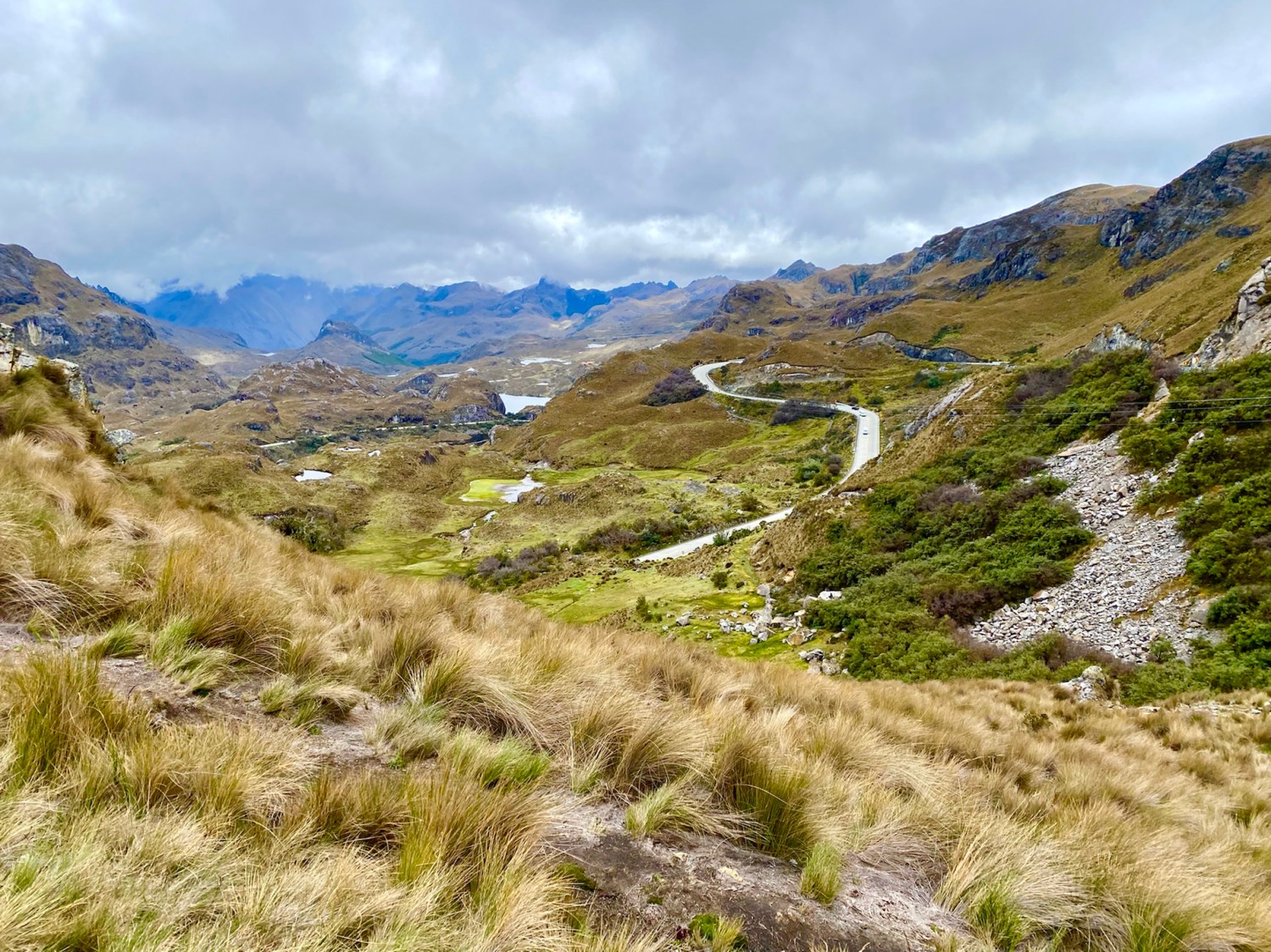
While in Cuenca, we spent 3 1/2 days exploring the city, one day going to the market towns and one day venturing to Parque Nacional Cajas.
Tuesday, July 26, 2022: We finally made it to Quito after being waylaid in 2020 due to the pandemic and, again, in June of 2022 due to the strikes and protests by the indigenous people of Ecuador. The protests and road closures caused us to cancel our trip the Friday night before we were due to fly out on June 18. When the strikes were finally settled at the end of June, we immediately rebooked our entire trip and finally arrived in Ecuador on the afternoon of Monday, July 25.
Quito, the capital of Ecuador, has an estimated urban population of 2.8 million. It sits nestled in a valley on the eastern slopes of Pichincha, an active stratovolcano in the Andes at an elevation of 2,850 m (9,350 ft), making it the second-highest capital city in the world after La Paz, Bolivia.
It wasn’t an easy journey. We had to get up at 2:15 a.m. to catch an Uber to Reagan National Airport for a 6 a.m. flight. After a 2-hour layover in Miami, we arrived in Quito at 2:00 p.m. Our Airbnb host, Lucia, had recommended Freddy as a driver, and he deposited us from the airport to her beautiful apartment north of Mariscal Sucre. We didn’t realize it at first, but it turned out to be one of Quito’s upper-middle class neighborhoods, with plenty of good restaurants and security guards manning every building. The apartment was decorated in a bohemian style with colorful handicrafts, plenty of books, and ebullient plants.
That first afternoon, we walked downhill to the supermercado to stock up on food; the trudge back uphill carrying groceries was challenging due to the city’s high altitude. We settled in, ran out for dinner at the cute Lemongrass across the street ,and then bundled up early against the cold. During three weeks in Ecuador, we didn’t find a single accommodation with heat.
view of Quito from the plane
Lucia’s apartment
view of Quito from the apartment
Lemongrass
Best beer in the world!
Thai Bowl at Lemongrass
Taco Bowl at Lemongrass
A Walking Tour of Quito’s Centro Histórico
Quito’s Old Town, Centro Histórico, has restored Spanish colonial architecture, cobblestone streets, lively palm-fringed plazas, sing-song street vendors, 18th-century churches, and tourist police galore. Shoeshine boys were busily shining not only the shoes of businessmen, but the police’s as well. A random guy asked if he could take a picture of me, which reminded me of China, where everyone wants a picture of the gringo that sticks out like a sore thumb.
On Tuesday, we followed the “Old Town Walking Tour” from Lonely Planet Ecuador & The Galápagos Islands. Twice, once at the Plaza of San Francisco and again in the neighborhood of La Ronda, police in neon yellow vests approached us and warned us to keep our backpacks in front and not to put our phones in our pockets. We read later that Quito has about 200 “tourist police” who are bilingual and are there to keep tourists safe. Apparently the historic center is rife with crime, but we stayed aware and kept our distance from others. The walking tour kept us on the go for about 5 1/2 hours and 17,168 steps, or 7.28 miles.
Plaza Grande
Plaza Grande
Plaza Grande
Palacio de Gobierno
Palacio de Gobierno
Centro Cultural Metropolitano
Santuario de los Corazones Santísimos de Jesús y María
Centro Histórico Quito
A Los Heroes Del Diez de Agosto de 1809
Banco Centro del Ecuador
Centro Histórico Quito
Plaza & Monastery of San Francisco
Centro Histórico Quito
On our walk, we came upon a hat shop, Sombreros Lopez. One of my goals was to get a Panama hat in Ecuador, but Panamas are famously from Cuenca, so I had to contain myself. However, I did buy a tan felt hat, which it was too hot to wear on this day.
hats at Sombreros Lopez
my hat – too hot to wear!
La Ronda
church in Quito
Iglesia San Augustin
We made a lunch stop at San Agustin Heladeria-Restaurante, where we each had a humita (steamed corn tamale cake wrapped in a corn husk). Mike had a pork sandwich and I had shrimp ceviche. Our biggest surprise was the smoking ice cream dish and the waiter dressed like the devil.
San Agustin Heladeria-Restaurante
humitas
smoking dessert
San Agustin Heladeria-Restaurante
We continued our walking tour past the Plaza del Teatro and eventually to the Basilica del Voto Nacional, where we elevatored to the top of one of the towers and enjoyed views over Quito just as the sun came out from behind the clouds.
Basilica del Voto Nacional
view from Basilica del Voto Nacional
door at Basilica del Voto Nacional
staircases at Basilica del Voto Nacional
inside Basilica del Voto Nacional
stained glass window at Basilica del Voto Nacional
inside Basilica del Voto Nacional
Finally, our first day came to an end as we walked by Plaza San Blas and soon caught an Uber back to our apartment. Later, we enjoyed a “Ham & Champ Pizza” at Bandidos del Páramo, another restaurant across the street from our apartment. We had two superb pizzas while in Quito, some of the best we’ve ever had.
Plaza San Blas
Steps: 17,168; Miles: 7.28.
Quito’s TelefériQo (a futile attempt)
Wednesday, July 27: It took us about 20 minutes to get to Quito’s TelefériQo by Uber. Ubers are in abundance in Quito, easy to use and cheap. We took the lift 2.5 km up the flanks of Volcán Pichincha to the top of Cruz Loma. At the top, we were at 4100m (13,451 feet). When we first arrived we found some cloudy views, but quickly a cold fog moved in and obscured any further views. We huddled in the café and drank Café Americano lattes and shared an empañada with plantain, chili and queso. We realized the futility of hoping for any views and headed back down the mountain.
TelefériQo
heading up
Polylepis shrubs
views from Cruz Loma on a cloudy day
me at the viewpoint
Polylepis shrubs
views from Cruz Loma
cafe at the top
La Floresta
We took a taxi to La Floresta, an artsy neighborhood, where we had a fabulous and beautifully-presented lunch at Casa Warmi. What a pleasant experience. The restaurant was adorable with its golden wood floors, a wall of ivy with a mounted bicycle, and a tree growing through a hole in the roof. We enjoyed corn chowder with queso, yucca fritters with raw tuna embellished with flowers, and cevichocho (ceviche with a kind of grain – chochos – and red onion and avocado). Yum!
Casa Warmi
Yucca fritters with tuna
Cevichocho
Mike on a chair with fancy feet
After lunch we walked around La Floresta, a quirky neighborhood with charming cafés, painted planters, an abandoned ruined house with an abundance of plants, and an adorable café/theater, 8cho y Media: “Siempre tendemos Paris” (We’ll always have Paris). Inside had mid-century modern decor with comfortable seating areas and movie posters. We enjoyed espressos and shared a giant chocolate chip cookie. From there we caught an Uber to Casa Museo Guayasamin.
La Floresta
La Floresta
La Floresta
La Floresta
La Floresta
8cho y Media
8cho y Media
8cho y Media
8cho y Media
8cho y Media
8cho y Media
8cho y Media
Casa Museo Guayasamín
Casa Museo Guayasamín is the former home of Oswaldo Guayasamín (1919-1999), an Ecuadorian painter and sculptor of Kichwa and Mestizo heritage. The museum houses his work and the home mostly houses his collection of pre-Columbian ceramic, bone, and metal pieces. The pieces are arranged by theme – bowls, fertility figurines, burial masks, etc. The museum also houses the artist’s collection of religious art, including works by highly-skilled indigenous artists from the Quito School. There’s even a collection of bloody crucifixes; despite being an aetheist, the artist often featured tortured Christlike figures in his own work.
He explored themes of oppression in the lower classes, racism, poverty, Latin American lifestyle, and human and social inequalities. His work focused on subjects who symbolized all human suffering.
Guayasamín built the museum in Quito that features his work. He also built the stunning house where he lived and worked. Seeing Guayasamín’s home and studio was the highlight of the tour. We watched a video of him vigorously painting a famous musician (the long yellow “towering” face shown in the video – see below). I loved seeing the huge table he used as a palette, the moveable stairs he used to do his large paintings, the paints and oversized brushes. We saw a self-portrait of the artist done at an early age and his library. One collection showed him with his mother, his greatest love. He was married three times and had seven children.
Guayasamín was buried with his best friend under a pine tree in his yard overlooking Quito. The grounds of his house, and the museum below the house, sit at a high point in Quito and overlook the city. It’s a gorgeous site.
Oswaldo Guayasamín
Casa Museo Guayasamín
the artist’s studio
the artist’s studio
the artist’s studio
Casa Museo Guayasamín
Back at the apartment, Mike captured me relaxing on the sofa under a blanket, writing in my journal. Later we mustered our energy to walk a steep set of stairs to look for a restaurant on Avenue Gonzales Suarez. We finally ate dinner at Lucia’s House, a restaurant on the edge of La Floresta. I enjoyed an Ensalada Mexicana and Mike had corn chowder with bacon. We walked back to the apartment.
me relaxing in our cozy apartment
Ensalada Mexicana
Steps: 7,561; Miles: 3.21.
Termas de Papallacta
Thursday, July 28: Freddy picked us up and drove us over the mountains and the Papallacta Pass, an hour and a quarter southeast of Quito, to Termas de Papallacta. Neither Mike nor I were feeling that great and we had scheduled massages. Mike enjoyed a deep body massage while I regretted my choice of a hot stone massage; mine was disappointingly low pressure. I wished I’d booked the deep tissue massage because my back had been killing me since Tuesday morning for no discernible reason.
The baths were in a tranquil setting surrounded by mountains, including Volcán Antisana. The town is high in the Andes at around 3400m in elevation.
We went into the hot pools with differing temperatures and tried them all. I enjoyed the hottest ones the most since the air was cold and it was a gray day. The resort was in a deep bowl with mountains all around.
Termas de Papallacta
tree at Termas Papallacta
It was all very relaxing and nice to get away from the hubbub of Quito but the best part was the drive over the mountainous landscape with our driver Freddy. He was keen to speak English and we were keen to speak Spanish, so we had many fascinating conversations using our bungled languages, interspersed with words from both languages and using Google translate when necessary to communicate. Freddy was driving over mountain passes and in the middle of traffic speaking into his phone for translations and we didn’t feel the slightest bit of concern over his multitasking. We loved our time with Freddy!
The view over the mountain pass coming back from Termas Papallacta
We got home and relaxed for a good long while. Later, we climbed the two blocks uphill to Avenue Gonzales Suarez to look for a place to eat. We stopped at a pharmacy, where we bought a thermometer and Claritin, then walked down the street, poking our heads into Hotel Quito for a view of the gorge.
We enjoyed a nice dinner at Lucia’s House. I had an Ensalada Mexicana and Mike had corn chowder with bacon. We walked back to our apartment in the dark.
Steps: 7,646; Miles: 3.21.
Quito’s TelefériQo (Second time’s a charm!)
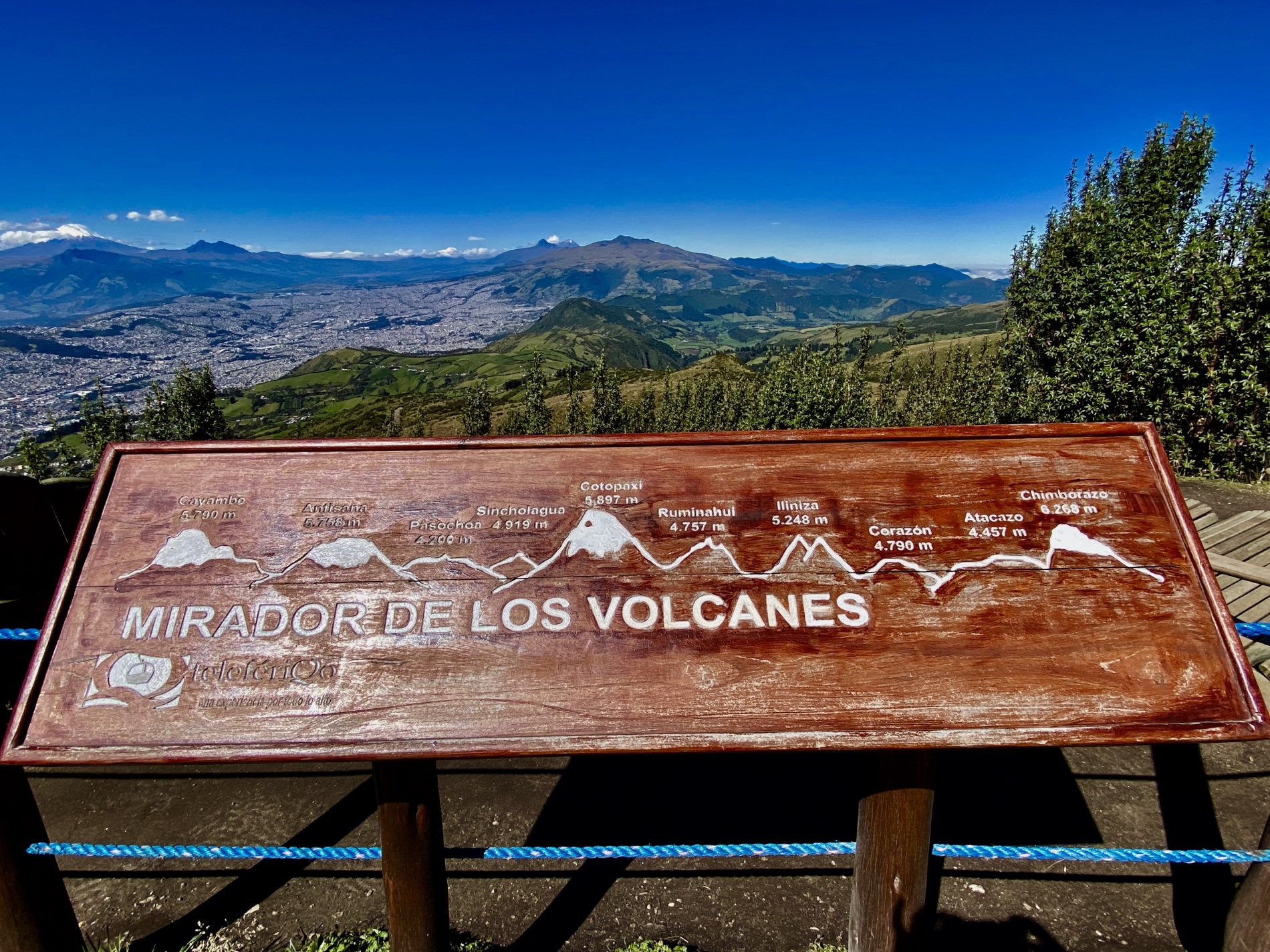
Friday, July 29: Freddy texted us early in the morning, our last day in Quito: “Hola Cathy buen día. Hoy es gran día para ir al teleferico. Esta despejado.” (Hello Cathy, good day. Today is a great day to go to the teleferico. It is clear.) We had already awoken and seen the sun and the blue skies so we got up and going and headed straight to the TelefériQo. From the top, we could see clearly the views from Rucu Pichincha. We saw all the volcanoes including Cotopaxi which we’d visit near the end of our trip (& go horseback riding) and Chimborozo, where we planned to ride bikes down the volcano. It was a stunning day and I was thrilled we got to see the views on a clear day.
Mirador de Los Volcanes
What an amazing morning. Sunshine, a cool breeze, a few clouds, the high grassland (páramo), the views of Quito and the volcanoes. I couldn’t have wished for a better last day in Quito.
As our hike from the TelefériQo was uphill at such a high altitude, it was tough to catch my breath. I took a lot of breaks. Also, my lower back had been killing me for several days and I had no idea why. I felt like I was 100 years old! Still it was worth every bit of pain I felt.
Mike climbed higher than I did; meanwhile I laid on the grass and a domesticated Andean condor came pecking in the grass around my head. He had no fear at all. You could hike to the summit of Rucu Pichincha (4680m), about a 3-hour hike for fit walkers, but we stopped well short of that.
Going up the TeleferiQo
views of Quito from Rucu Pichincha
Rucu Pichincha
Cotopaxi is behind Mike and me
views of Quito from Rucu Pichincha
Rucu Pichincha
Rucu Pichincha
Rucu Pichincha
swinging on Rucu Pichincha
Rucu Pichincha
Rucu Pichincha
Rucu Pichincha
Rucu Pichincha
a domesticated Andean condor
Rucu Pichincha
Rucu Pichincha
Rucu Pichincha
Dinner at La Plazuela
We were exhausted so we went back to the apartment to relax for the rest of the afternoon. Then we walked to La Floresta to look for La Plazuela. No one at all was in the restaurant but the woman there was very friendly. We ordered two tinto veranos (they were huge!) and a Del Huerte Pizza. To top it off, we had a Torta de chocolate accompanied by ice cream (helado). We took an Uber back to the apartment and packed up most of our stuff for our early morning flight to Cuenca.
Mike with his tinto verano in La Plazuela
me and my tinto verano
Del Huerto Pizza
La Plazuela
Steps: 12,632: Miles: 5.34.
Saturday, July 30: Freddy took us to the Quito airport on Saturday morning at 7 a.m. for our LATAM Airlines flight at 8:59 a.m. to Cuenca. We had enjoyed Quito but we were excited to get on to the next stage of our trip.
Below is a video of our days in Quito. All photos included here are different from the ones in this post, and there are a few video clips as well.
Stay tuned for more on our fabulous trip to Ecuador.
I began 2020 with hopes of going to Ecuador that July, but sadly coronavirus put a stop to that. I still held on to my dreams of exploring this South American country, so this year (2022), I finished reading Lonely Planet Ecuador & the Galápagos Islands and another little brochure (This is Ecuador: The Most Complete Guide to Ecuador Since 1968, dated December 2018) that somehow made its way to me. I started researching online things to do and see in Ecuador.
Lonely Planet guide to Ecuador & the Galápagos Islands, along with two journals
Spanish studies
My original intent was to “live like a local,” staying in Cuenca and Quito, possibly taking a Spanish immersion class and spending time wandering aimlessly and writing. In 2020, I started a Spanish class at the end of January. I’m embarrassed to say that I studied Spanish for four years in high school, but I didn’t remember much of anything. Thus I started all over at the beginning, at level 100. We started in-person classes, but due to the pandemic, we had to meet online for the remaining courses. The virtual classes weren’t much fun, and I eventually dropped them because I wasn’t consistently studying. This year I started again, this time with The Great Courses. I still have been inconsistent with studying. Finally, in mid-May, I started with Duolingo, and now I seem to be determined to meet daily goals and to practice more. This is the first language learning course I’ve done that is actually fun.
Music
For my class in 2020, I had to do a Power Point presentation about “Music of Ecuador,” so I learned about the country’s traditional music including pasillo, pasacalle, yarabi, marimba, bomba, and Sanjuanito. I also learned about some Indie rock groups, including Da Pawn and La Máquina Camaleön, both of which I love. I created a short playlist on Spotify: ecuadorian music, which I’ll add to over the coming months.
Books
Of course, I always love to read books set in my destination, so I read some of the books below (indicated with stars and ratings). I own the books in green and will read them sometime during the year.
The Voyage of the Beagle: Journal of Researches into the Natural History and Geology of the Countries Visited During the Voyage of H.M.S. Beagle Round the World by Charles Darwin (intro. by Steve Jones)
Pilgrim on the Great Bird Continent: The Importance of Everything and Other Lessons from Darwin’s Lost Notebooks by Lyanda Lynn Haupt
The Beak of the Finch by Jonathan Weiner
The Origin: A Biographical Novel of Charles Darwin by Irving Stone
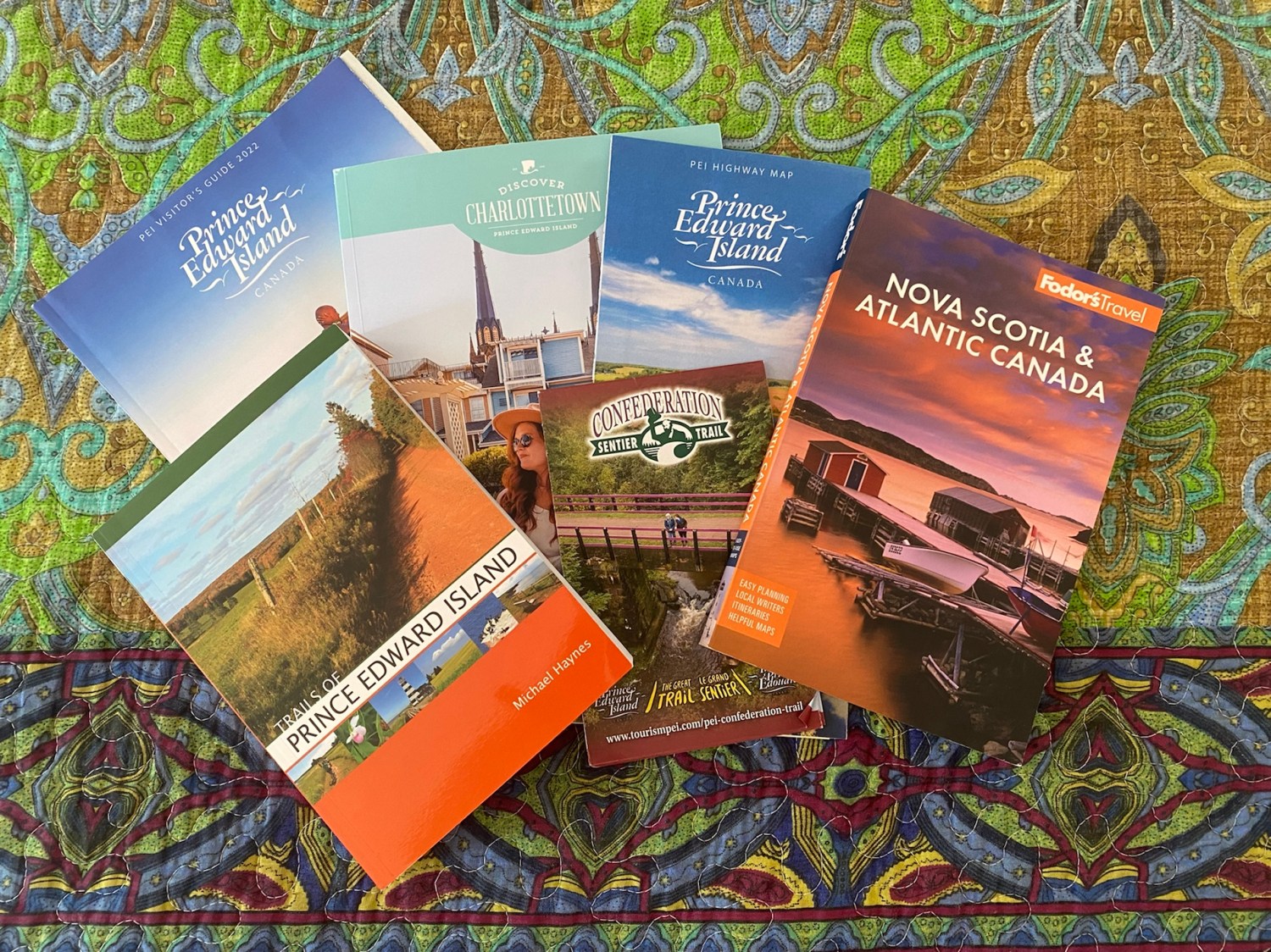
After having researched more about Ecuador, we have expanded our travel plans extensively. We will spend our first five nights in Quito, exploring the UNESCO World Heritage city, and venturing west of town to the Mindo Cloud Forest. Another day, we will possibly head southeast to the Termas de Papallacta, a complex of thermal baths in the Northern Oriente, an edge of the Ecuadorian jungle.
We will then fly to Cuenca (also a UNESCO World Heritage Site) for six nights, exploring the city, going out to three market towns, Gualeceo, Chordeleg and Sigsig one day, and venturing out for hikes to Parque Nacional Cajas for a day. I’m hoping to find myself a Panama hat at the Sigsig market. The hats are misnamed as they originate in Ecuador.
After leaving Cuenca we will make our way north about 80km along the Pan American Highway and stop in Ingapirca, a set of pre-Colombian ruins. We’ll overnight there and then head to Riobamba, where we can visit a Saturday market. From there, we’ll drive to Baños, where we can take a downhill bike ride on the Baños-Puyo Road through a series of waterfalls. The next day, we’ll take a bicycle ride down Volcan Chimborazo.
Then it’s ever northward to Latacunga, where we’ll drive a portion of the Quilotoa Loop to Tigua, Zumbahua, and Quilotoa, a large volcanic crater with an emerald green lake in an indigenous community. We might hike around the rim of the crater, about a 7.5 mile trek, or an out-and-back of a shorter distance. We could opt to hike down to the lake if the weather is bad.
After Latacunga, it’s hacienda time! We plan to stay at Hacienda Los Mortiños, from which we hope to hike and take a horseback ride into Parque Nacional Cotopaxi. The next day we’ll head north of Quito to Otavalo for its huge Saturday market; there, we’ll stay at another hacienda, Las Palmeras Inn. On the way to Otavalo, we hope to stop for lunch at yet another hacienda, Hacienda Cusín.
In all, we plan to spend three weeks in the country.
We decided against the Galápagos Islands on this trip. Originally, I didn’t think I’d have an interest in going there, but having read about it, I would like to visit at some future time.
I prepared one journal, and will bring another along in case I need two.
Quito
more Quito
Cuenca
Back in 2020, I created some intentions for my travels, although I haven’t been doing intentions since I took a break from blogging in 2021. These intentions were for my originally intended “slow travel,” where I hoped to stay in one place and write a lot. As can be seen here, our plans have become much more involved since I originally conceived of this trip.
Ecuador intentions
Warnings
We planned to leave in mid-June of 2022. However, our plans were waylaid. We received a warning from the U.S. State Department on Friday, June 10: “The Confederation of Indigenous Nationalities of Ecuador (CONAIE) is planning demonstrations and road blockages nationwide from June 13 to June 15. Multiple roads in and out of Quito, including those leading to the airport, could be affected. Some past demonstrations have turned violent and security forces have responded with crowd dispersal agents to maintain public order.
“Among the Roads Likely to be Affected Are: San Miguel del Común, Mariscal Sucre and Humberto Albornoz, Ruta Viva, Toll Intervalles, Intervalles and Guayaquil, Intervalles and Sebastiana de Benalcazar, Mitad del Mundo, Simón Bolívar sector el Troje, and Maldonado sector Escuela Riobamba. Please keep in mind that these locations are subject to change.
During this time, please take the following actions
· Avoid crowds
· Avoid demonstration areas
· Monitor local media for updates on road closures.
· Exercise caution if transiting through affected areas.
· Consider alternate routes.”
And on Tuesday, June 14, we received this: “The Confederation of Indigenous Nationalities of Ecuador (CONAIE) continues to lead demonstrations nationwide. Demonstrators have blocked multiple roads around the country, both in cities and rural areas. There are also reports of violence in some areas, including on Avenida 6 de Diciembre in Quito where demonstrators have reportedly vandalized police cars, started fires, and assaulted law enforcement officials. The situation is rapidly evolving and could continue to worsen and spread to other areas without notice. We urge you to remain vigilant, closely monitor the situation for updates, and exercise caution when traveling in both urban and rural areas of the country.”
I have read about these protests, which apparently occur frequently, in the book by Judy Blankenship: Our House in the Clouds: Building a Second Life in the Andes of Ecuador. She describes how the indigenous people block the Pan American Highway, the main north-south highway, with boulders, trees and all other kinds of debris. On Wednesday morning, pulling up a Google map of the route I saw this:
The Pan American Highway from Cuenca to Quito on Wednesday, June 14, showing road closures
In the end, we cancelled the trip the night before we were due to depart due to the ongoing violence and road closures. We waited, watching the situation and making alternate plans to go to Colombia in case the strikes weren’t resolved. In the end, after 18 days, the strikes were resolved and the government and the Indigenous People decided to sit down for talks for 90 days. We went ahead and rebooked our entire vacation, and now we’re leaving in late July.
We took a road trip to South Florida in March 2022. Our itinerary included Miami, Everglades National Park, the Florida Keys, and Fort Lauderdale. On our way back home, at the northeast corner of Florida, we spent two nights in St. Augustine. This post, part three, includes Fort Lauderdale and St. Augustine (& Cocoa Beach, where I stopped before going to Miami but is between Fort Lauderdale and St. Augustine on the coast). The first two parts of our trip can be found here: a florida road trip {part one}: miami and a florida road trip {part two}: the everglades & the keys.
In Cocoa Beach, I bought beach cover-ups at Ron Jon Surf Shop. Later, we took a water taxi through Fort Lauderdale’s Inland Waterway, known as the “Venice of America,” and admired the mansions of the rich and famous. We wandered up and down Las Olas Boulevard, enjoyed dinner at Cuba Libre and happened to hit the Las Olas Oceanside Park Market on Saturday morning. We waded through the surf at Fort Lauderdale Beach. We headed north to St. Augustine, where we explored the Historic Old Town, the Castillo San Marcos National Monument, the St. Augustine Light Station and Fort Mantazas National Monument. We enjoyed a delicious lunch on the breezy rooftop of Salt Life Food Shack and saw the old Ponce de Leon Hotel that now houses Flagler College. We topped off our time in Florida at the Tini Martini Bar. On the way home, we stopped to visit Mike’s college friends, Bob and Barbara Trott, and had lunch with Sarah in Richmond.
I recommend watching on YouTube for the best experience.
Our top things to do in Fort Lauderdale, Cocoa Beach, and St. Augustine were:
8) Fort Mantazas National Monument in St. Augustine
7) Ron Jon Surf Shop in Cocoa Beach
6) Tini Martini Bar in St. Augustine
5) Castillo de San Marcos National Monument in St. Augustine
4) Historic Old Town St. Augustine and Flagler College in the old Ponce de Leon Hotel
3) Fort Lauderdale Beach and the Las Olas Oceanside Park Market
2) Las Olas Boulevard and Cuba Libre in Fort Lauderdale
1) Water taxi through the inland waterways of Fort Lauderdale, the “Venice of America”
our Florida road trip
Miami, The Everglades and Fort Lauderdale
St. Augustine
Overall, these are our top ten favorites for our entire Florida Road Trip:
10) Fort Lauderdale Beach and the Las Olas Oceanside Park Market
9) Kayaking in Big Cypress National Preserve with Shurr Adventures Kayaking & Eco Tours
8) Airboat ride through the River of Grass at Everglades National Park with our hyperbolic guide at Gator Park
7) Las Olas Boulevard and Cuba Libre in Fort Lauderdale
6) Wynwood Walls in Miami
5) Key West
4) Water taxi through the inland waterways of Fort Lauderdale, the “Venice of America”
3) South Beach – the beach itself and the Art Deco lifeguard stations, Miami
2) South Beach Art Deco Historic District, Miami
1) Calle Ocho in Little Havana, Miami
Thank you for watching! I invite you to subscribe to my YouTube channel.
We took a road trip to South Florida in March 2022. Our itinerary included Miami, Everglades National Park, the Florida Keys, and Fort Lauderdale. On our way back home, at the northeast corner of Florida, we spent two nights in St. Augustine. This post, part two, includes Everglades National Park & The Keys. Part three will include Fort Lauderdale and St. Augustine. The first part of our trip, in Miami, can be found here: a florida road trip {part one}: miami.
We hiked the Anhinga Trail and the Gumbo Limbo Trail at Everglades National Park, and then took the Flamingo Adventures Boat ride where we saw American crocodiles and manatees. We strolled amidst tropical hardwood hammocks, mahogany trees, sabal palms, cypresses and mangroves. We ate a delicious and lively dinner at Yardie Spice, a Jamaican restaurant in Homestead, with Jamaican owner J.P. hosting. We pedaled for 15 miles at Shark Valley Visitor Center and then sped over the river of grass in an air boat at Gator Park. We kayaked in a tandem in Big Cypress National Preserve where we communed with alligators and birds of all feathers and ended up bickering as we got tangled up in the mangrove trees. We visited two state parks in the Florida Keys, the nicest being Bahia Honda State Park, and shopped, strolled, nibbled and imbibed in Key West all the way to the Southernmost Point in the Continental U.S., which is 90 miles from Cuba and 150 miles from Miami. We enjoyed a Hoochie Mama Mojito and key lime pie at Paradise Restaurant in Key West as a rooster strutted his stuff near our table. Then we lounged by the pool at our hotel and waded in the seaweed-infested surf at Sombrero Beach in Marathon.
I recommend watching on YouTube for the best experience.
Our top ten things to do in the Everglades and the Florida Keys were:
10) Sombrero Beach in Marathon (Keys)
9) Big Cypress Bend Boardwalk (Big Cypress National Preserve)
8) The Anhinga Trail and the Gumbo Limbo Trail at the Ernest F. Coe Visitor Center (Everglades National Park)
7) Flamingo Adventures Boat Ride (Everglades)
6) Bahia Honda State Park (Keys)
5) Dinner (twice) at the Jamaican Yardie Spice in Homestead
4) Bicycling 15 miles at Shark Valley (Everglades)
3) Kayaking in Big Cypress National Preserve with Shurr Adventures Kayaking & Eco Tours
2) Key West
1) Airboat ride through the River of Grass with our hyperbolic guide at Gator Park
our Florida road trip
Everglades National Park & Florida Keys
Thank you for watching! I invite you to subscribe to my YouTube channel.
We took a road trip to South Florida in March 2022. Our itinerary included Miami, Everglades National Park, the Florida Keys, and Fort Lauderdale. On our way back home, at the northeast corner of Florida, we spent two nights in St. Augustine. This post includes our time in Miami, which was my favorite part of the trip. Part two will include Everglades National Park & The Keys, and part three will include Fort Lauderdale and St. Augustine.
I first stopped at Falls Park on the Reedy in Greenville, South Carolina. I visited my youngest brother Robbie and his partner Rob at their new house in Columbus, Georgia, where we commiserated over politics, ate sushi and chile rellenos, and drank sake and margaritas. I bought beach cover-ups at Ron Jon Surf Shop in Cocoa Beach, Florida.
Falls Park on the Reedy in Greenville, SC
my brother Rob & me in Columbus, GA
Columbus, GA
Ron Jon Surf Shop in Cocoa Beach, FL
I met Mike at the Miami Airport and we strolled through the Art Deco Historic District on South Beach, saw an adorable pink lifeguard tower, and spent a feisty evening on Calle Ocho in Little Havana among roosters and coffee stores. Mike puffed on a cigar at Guantanamera. We immersed ourselves at Wynwood Walls, an outdoor museum of funky international street art. We wandered among orchids, coral trees, palms, cyads, and a rainforest at Fairchild Tropical Botanic Garden. We spent a barefoot morning lollygagging on South Beach, admiring the colorful art deco lifeguard stands then spent the afternoon basking in the sun at Bill Baggs Cape Florida State Park. We returned to Little Havana for another night of Cuban food and a history lesson on the failed Bay of Pigs Invasion (April 17, 1961) and paid tribute at the Eternal Torch in Honor of the 2506th Brigade, many of whom lost their lives or were incarcerated in horrible conditions in Cuban prisons.
I recommend watching on YouTube for the best experience.
Our top experiences in Miami were:
7) Coconut Grove
6) Fairchild Tropical Botanic Garden
5) Bill Baggs Cape Florida State Park
4) Wynwood Walls
3) South Beach – the beach itself and the Art Deco lifeguard stands
2) South Beach Art Deco Historic District
1) Calle Ocho in Little Havana
our Florida road trip
Miami, The Everglades and Fort Lauderdale
Thank you for watching! I invite you to subscribe to my YouTube channel.
We spent three days in Boston, Massachusetts from November 10-14, 2021. We’d been to New England a number of times – to Cape Cod, New Hampshire and Vermont – but never to Boston. We very much enjoyed our fall getaway.
In this oldest of towns, the birthplace of American history, we cheered the Cheers bar and danced along with weeping willows and ginkgo trees in Boston Public Garden. We followed the redbrick road known as The Freedom Trail, from the Park Street Church, which played a key role in abolishing slavery, to the Granary Burying Ground, final resting place of Paul Revere, Samuel Adams, and John Hancock. We paid tribute to the Old South Meeting House, where arguments in 1773 led to the Boston Tea Party. We walked by Faneuil Hall, where Samuel Adams railed against “taxation without representation.” Finally we saluted Paul Revere’s house, his equestrian statue, and the Old North Church, of “One if by land, two if by sea” fame. We bumped our heads below deck on the U.S.S. Constitution, aka “Old Ironsides,” in Charlestown.
We admired harvest doors in Beacon Hill and circled Fenway park, where we were caught in a sudden deluge. We fought chaotic rain and gale force winds that turned our umbrellas inside out, while making our way to the marvelous Isabella Stewart Gardner Museum, which we enjoyed despite being soaked through and through. On our final day, we strolled through Cambridge, admiring sculptures and architecture at The Massachusetts Institute of Technology (MIT) and at Harvard. We ate lobster rolls, sushi and bibimbap and toasted autumn in New England with a Southern Tier Pumking Beer with cinnamon on the rim and a Cisco Gray Lady. In a flash, we were on the “T” to the airport and back home in plenty of time for Thanksgiving.
I recommend watching on YouTube for the best experience.
Our top ten experiences in Boston were:
10) Boston Irish Famine Memorial
9) Fenway Park
8) Acorn Street
7) Cambridge: (1) MIT & (2) Harvard
6) The North End, aka “Little Italy”
5) Boston Public Library
4) Beacon Hill (the neighborhood where we stayed)
3) Boston Public Garden
2) The Freedom Trail: (1) the statue of Paul Revere & the Old North Church; (2) Granary Burying Ground; (3) Old State House & Boston Massacre Site; (4) Copp’s Hill Burying Ground
1) Isabella Stewart Gardner Museum
Thank you for watching! I invite you to subscribe to my YouTube channel. 🙂
We visited Croatia in October of 2021. After leaving Plitvice Lakes National Park, we headed to the east shore of the Adriatic Sea, known as Dalmatia, starting in Zadar then working our way south through Šibenik, Primošten, Split (including Hvar and Trogir), and finally Dubrovnik.
After leaving Plitvice Lakes National Park, we drove through tunnels and over mountains to Zadar, where we listened to the Sea Organ and watched the “Greeting to the Sun,” a light show powered by the sun’s energy. We enjoyed a fabulous dinner of John Dory fillet at Restaurant Bruschetta in Zadar and then strolled along the Riva. We climbed up to St. Michael’s Fortress in Šibenik and enjoyed a waterfront lunch. We wandered around the beaches of Primošten. We arrived in Split to cold and blustery weather and stopped for a warm-up with pear brandy at Semafor. We braved a miserable rainy and cold day in Split visiting Diocletian’s Palace, and then visited it again the next day when the sun came out. We climbed the Venetian bell tower at noon and got an earful of clanging bells. We drove to the Marjan Peninsula and visited Kašjuni Beach and then drove to Trogir and strolled the waterfront promenade. We ate one of our best meals of avocado & shrimp salad and stuffed green peppers with mashed potatoes at Semafor. We took the ferry to Hvar, where we zoomed through tunnels and mountain roads over the Island on a quad, with an enjoyable stop at a hidden winery in Jelsa. We took a ferry to the Pelješac Peninsula, saw shellfish cultivation, vineyards, and the Great Wall of Croatia, and imbibed in oysters at Mali Ston. We braved the hair-raising cliff drive into Dubrovnik. We strolled around Dubrovnik and stopped in at Buža I, where concrete stairs led to a beach. We ate delicious grilled calamari at Konoba Jezuite while bundled in a pink blanket against the frigid bura. We took our COVID tests with (luckily) negative results. We walked around the Dubrovnik City Walls and up to the Fort of St. Lawrence, where we had a birds’-eye view of the City Walls. We devoured Bosnian meatballs at the Taj Mahal and, the next morning, took the cable car to Mount Srd, where we had a great view of all of Dubrovnik. We climbed to Park Gradac for views and then ate our final meal at Restaurant Jezuite.
I recommend watching on YouTube for the best experience.
Our top eight experiences in Dalmatia were:
8) The Pelješac Peninsula and Mali Ston: eating shellfish, drinking wine. Climbing the “Great Wall of Croatia would have been fun, but we didn’t have time.
7) Primošten: the beach is beautiful and would be nice in summer.
6) Trogir: the rich and famous and their yachts.
5) Šibenik: Climbing to St. Michael’s Fortress for amazing views.
4) Dubrovnik: Walking around the City Walls. Otherwise, very touristy.
3) Split: lots to do. We were unlucky with weather but it would be great in warm weather.
2) Zadar: the town, restaurants, Sea Organ and “Greeting to the Sun.” Not so touristy.
1) Hvar: taking a quad and a secret winery at Jelsa. 🙂
We visited Croatia in October of 2021, starting in Zagreb, and working our way west to Istria, where we stopped in Opatija, Motovun, Rovinj and Pula. Then we continued southeast to Plitvice Lakes National Park where we explored the park in cold, windy and rainy weather. This was our first international trip since the pandemic started.
We also went south to Dalmatia, along the coast, which I’ll feature in an upcoming video.
In Croatia, we strolled among the disheveled and forlorn populace of Zagreb and ate pizza and fluffy pillows of warm bread with beer and rakija. We took a funicular to the Upper Town and visited the Museum of Broken Relationships with its sad tales and detritus of heartbreak. We chatted with the waiter at the Bulldog Café about divisive matters of the world. Later, we walked around the Green Horseshoe and found actors rehearsing an opera on the portico of the Croatian National Theatre. We drove to the Eastern Riviera in Opatija and promenaded down the Lungomare to meet a woman surrounded by seagulls. We enjoyed the vineyard views of Istria from the hill town of Motovun. We immersed ourselves in blue light with harbor views and seafood at Gostionica “La Gondola” in Rovinj. We wandered through the Old Town and to the Church of St. Euphemia after checking out the rock-carved “beaches.” We bicycled on a trail leading to a rocky beach where we swam under the shade of cypresses and Aleppo pines. We visited the Roman amphitheater and strolled through Pula. Finally, we were serenaded by waterfalls as we traipsed through Plitvice National Park in the pouring rain on boardwalks lined with tropical plants and marsh grasses growing out of limestone.
I recommend watching on YouTube for the best experience. 🙂
Our top six experiences in the northern portion of Croatia were:
6) Plitvice Lakes National Park (rainy, cold and miserable, but beautiful)
5) Zagreb, especially the Upper Town (Gradac) and Tkalčićeva Street
4) Motovun
3) Opatija
2) Pula and the Roman ruins
1) Rovinj (our favorite of the entire trip)
We explored Michigan as part of our Great Lakes RoadTrip in May-June of 2021. Our explorations included Minnesota, Wisconsin and Michigan. This video covers Michigan’s lower peninsula, affectionately referred to as “the Mitten” (see map below).
The Michigan Mitten is all about eclectic folksy inns; tunnels of trees; expansive sand dunes; famous authors like Hemingway, Bruce Catton, and Jim Harrison; lighthouses; weathered fish shanties; cherry orchards and grape vineyards; megachurches and the American Taliban; presidential museums; Henry Ford and the automobile; the University of Michigan in Ann Arbor; and obscure battlefields.
After crossing the Mackinac Bridge over the Straits of Mackinac, we: cruised through the Tunnel of Trees to Petoskey; enjoyed the thatch houses at Charlevoix; hiked the Cottonwood Trail at Sleeping Bear Dunes National Lakeshore; enjoyed a lovely dinner at The Cove in Leland, with views of weathered shanties on the Fishtown dock. We drove by Jim Harrison’s old home — writer’s cottage and all, and then cruised through cherry orchards and wineries up the slim Old Mission Peninsula, where we found another lighthouse. We came face-to-face with the DeVos evangelical mission in Holland, wandered the grounds of the Gerald R. Ford Presidential Museum (which was sadly closed due to COVID), and endured a bad experience with our Airbnb in Detroit, which turned out to be in the derelict Hamtramck neighborhood, and lost most of our money. We wandered through Ann Arbor and watched In the Heights at the Michigan Theater. We learned about the history of cars and American innovation at The Henry Ford in Dearborn. After dropping Mike at the Detroit airport, I went on to learn about an obscure battle in the War of 1812 at the River Raisin National Battlefield Park: “Remember the Raisin!”
Our top ten experiences in Michigan’s Lower Peninsula were:
10) Cross Village & the Tunnel of Trees
9) Grand Haven and the Tri-Cities Historical Museum
8) Grand Rapids and the grounds of the Gerald R. Ford Presidential Museum
7) Petoskey
6) Charlevoix
5) Dearborn: The Henry Ford Museum & Greenfield Village
4) Ann Arbor: the charming town & the University of Michigan
3) The Old Mission Peninsula: cherry orchards, wineries, & lighthouses
2) Sleeping Bear Dunes National Lakeshore
1) Leelanau Peninsula: Leland, Fishtown, and Jim Harrison’s old home
My path less traveled. Rediscovering self after surviving the abuse that almost sunk me. Goal of strengthening and thriving on my adult legs. 👣🙏🏻 #recovery #forgiveness
This blog is for those who wish to be creative, authors, people in the healing professions, business people, freelancers, journalists, poets, and teachers. You will learn about how to write well, and about getting published. Both beginning and experienced writers will profit from this blog and gain new creative perspectives. Become inspired from global writers, and find healing through the written word.
Explore, discover and experience the world through Meery's Eye. Off the beat budget traveler. Explore places, cultural and heritage. Sustainable trotter.
shareable tales of Meery is Meeryable
You must be logged in to post a comment.