Tuesday, July 4: Mike and I drove about 3 1/2 hours from Bergamo to arrive at Lucca. We checked into our hotel, Albergó San Marino, and then went out in search of the pilgrim credenciale. The receptionist at our hotel said he’d done the Via Francigena before and sent us confidently across town to the Tourist Info office. They in turn told us to go to Cathedral San Marino from 9:30-6:00; it was right around the corner from our hotel but we didn’t make it because we stopped for an Aperol spritz at a shady cafe near where they were setting up the stage for Lucca’s famous music festival; tonight it would be Billy Idol and Generation Sex. On Thursday night Bob Dylan would be playing, but only one general admission ticket was remaining at a cost of 145€. It didn’t matter because on Thursday, Darina and I would begin our walk to Rome, and Mike would be on his way home.
We walked to Piazza dell’Anfiteatro and had an excellent dinner at Sotto Sotto Ristorante. The waiter and manager, Eugene, was super friendly and welcoming. I had ricotta and spinach ravioli with butter and sage and Mike had the most delicious meal: Pulled pork sandwich, burrata stracciatella, green sauce and baked potatoes. It was breezy and cool and the plaza was quite lively, such a pleasant experience all around. The only detraction from the experience was some YouTube influencer sitting a couple of tables away with her family; she was taking a video of herself gushing about how she’d now reached a million followers, or some such nonsense. It was so obnoxious!
Albergó San Marino
Albergó San Marino
me in front of Albergó San Marino
Lucca Summer Music Festival 2023
doorway in Lucca
one of Lucca’s many churches
Sotto Sotto Ristorante
Mike at Sotto Sotto Ristorante
me at Sotto Sotto Ristorante
ricotta and spinach ravioli with butter and sage
Pulled pork sandwich, burrata stracciatella, green sauce and baked potatoes
Wednesday, July 5: This morning at the hotel breakfast we met an Italian couple, Stefano and Stefani, along with Stefani’s best friend Firenzia, who sported a Generation X T-shirt (Gen X is generally defined as those born between 1965-1980). We found they had attended the Generation Sex and Billy Idol concert the night before. Firenzia had been to 44 Billy Idol concerts all over the world and Stefani had been to 42. Stefani had been to San Diego multiple times and wanted to live there; Firenzia was in love with Las Vegas and wanted to marry an Elvis impersonator there. They were hilarious and even sang us a few lines of “White Wedding.” They were groupies in the truest sense of the word.
After breakfast, we walked out of Lucca’s city walls through the Porto San Pietro to the Aqueduct of Nottolini. This 19th century epic structure was once used to carry water from the mountains into the city and contained 400 arches made of stone stretching for 3km. It was rather disheveled and unkempt, not like many that have been well-preserved in other places.
Stefano, Stefani, & Firenzia
Albergó San Marino
Porto San Pietro
Aqueduct of Nottolini
Mike at Aqueduct of Nottolini
me at Aqueduct of Nottolini
When we returned from our aqueduct walk, we headed for the Lucca Cathedral Museum to get our pilgrim passports. Finally I was able to find them after being sent on a wild goose chase yesterday.
We then wandered around awhile and found San Michele Paolino Allesandro Church, where I got my first pilgrim stamp. Unlike most churches in Italy, this one is very plain inside. Known as the church of S. Michele in Foro, it was built over the ruins of a previous church (from 795) and on the area of the ancient Forum of Roman Lucca. Its present form dates back to the 12th century.
The white Church has impressive proportions and blind arcades run around the entire church. The façade is higher than the roof, which makes this church completely different from all the other ones in Lucca.
Lucca Cathedral
San Michele Paolino Allesandro church
We had lunch at Ciacco on San Napoleon Square. Mike had a panini with a zucchini omelette inside; I had Pappa Al Pomodoro: Tuscan tomato bread soup and Calabrian anchovies with burrata, a kind of room temperature soup that was more bread 🥖 than soup. It wasn’t my favorite. Then we wandered around waiting for Darina to arrive; she was keeping us informed of her progress coming from Pisa to Lucca.
Ciacco
Pappa el Pomodoro
panini with a zucchini omelette
Ciacco
church in Lucca
Polarsteps of Mike’s and my trip through Northern Italy to Lucca
Darina arrived in Lucca after her travel from Slovakia, by way of Budapest and Pisa, and met us at Piazza Napoleon for cool Aperol Spritz drinks. She came bearing a gift from Slovakia: Tatratea, a liqueur with 52% alcohol content! Mike would take it home so we could enjoy it in the safety of our own home 😂🤣.
I gave Darina the two pilgrim credenciales I’d picked up for her at the Cathedral Museum. I didn’t know if we needed one or two but we liked to get a lot of stamps, so I played it safe since the documents seemed quite elusive. After our drinks, we went to Lucca Cathedral so Darina could get her first passport stamp.
Darina with her gift of Tatratea
Darina, me and Tatratea
Lucca Cathedral
Lucca Cathedral
Lucca Cathedral
Lucca Cathedral
We all three rented bicycles and rode around Lucca’s 4km of city walls. It was a great green space, full of trees 🌳, breezes, people strolling and small groups pedaling four-person contraptions that seemed quite comedic. After we got off the city walls, Darina and I parked our bikes at several churches to get more stamps in our pilgrim credenciales.
Then it was time to finish a bottle of wine Mike and I had bought in Bergamo. Darina came to our hotel and we sat out on the patio and drank and talked about everything from Danish political TV shows to the screwed-up American political system.
a bikeride around Lucca’s city walls
Church of San Frediano
San Michele Paolino Allesandro Church
parked bikes
finishing up our bikeride
the bike shop
We finished our evening at Ristorante Des Arts, the same restaurant where Mike and I ate in April of 2019 when we briefly visited Lucca. We had cacio e pepe again, but somehow it paled in comparison. It had been cold then and we had huddled inside; this evening it was warm so we sat outside and enjoyed a different atmosphere altogether. I was pleased to meet Darina again after five years apart.
Darina and me at Ristorante Des Arts
me with Darina at Ristorante Des Arts
Mike, me and Darina at Ristorante Des Arts
Steps: 18,079; Miles 7.67. Weather Partly cloudy. Hi 83°, Lo 65°.
Thursday, July 6: Mike took off this morning at 6:30 am for the Pisa airport. Luckily he made it in time and caught his flight in Frankfurt despite a short layover. I was sad to have him go but was also trying to get in the state of mind for my pilgrimage. I rearranged my suitcase and my pack to send my suitcase through Bags Free to Rome.
I checked out of my hotel, left my suitcase and backpack at reception, and went to meet Darina at 10:30 near the Church of San Frediano with its beautiful façade, which displays a splendid Byzantine mosaic of the Ascension. Christ, in an almond shape, is surrounded by the apostles; the Madonna is portrayed in the center. We had passed it Wednesday on our bikeride but the mosaic was in the shadows. This morning, we were able to capture it in full sunlight.
We had drinks near Napoleon Square, next to the music festival stage where they were doing sound checks for Bob Dylan’s show that night. We had both done some research about how to take public transportation to Fucecchio, skipping the first 2 stages of the Via Francigena because we’d read those stages went through Lucca’s ugly suburbs. Also in the interest of time we had to choose to eliminate some stages. We thought we had our route figured out, and we headed to Lucca’s train station.
one of Lucca’s towers
Church of San Frediano
another of Lucca’s towers
the Bob Dylan sound stage
We took a train to Pisa, switched trains and arrived at San Miniato-Fucecchio. We realized too late that the Ostello Il Ponte dei Medici was actually in Ponte a Cappiano, 5 km north of Fucecchio. By this time it was late and hot and no way did we want to walk north to the Ostello and then have to backtrack south tomorrow morning. Some kindly locals tried to help and instructed us to take the train to Lucca! I said we just came from Lucca and that could not be the solution. Finally we found a taxi to take us to the Ostello for a steep 30 euros, way too much for a 12-minute drive.
Darina and I checked into our first hostel, Ostello il Ponte dei Medici, at around 3:00 after our challenging day navigating public transportation to get to Ponte a Cappiano. We weren’t too sweaty since we didn’t actually walk, so we postponed our showers and went to the only bar open in the small town, Bar Cappiano. We each had a beer and a panini with formaggio, Pomodoro & prosciutto while we observed a gaggle of local old men who probably gather there every day. It was quite fun to watch this group of obvious old friends. We wondered what on earth people do in a small town such as this, and we figured this was it: sitting around chatting at the local bar while the women cooked and cleaned at home.
After a long lazy while, we climbed uphill to the only church in town, Chiesa di San Bartolomeo. Darina buzzed the doorbell of a side building and a black priest stuck his head out of an upper window and waved like the Pope giving his benediction. We asked if he could open the church and stamp our pilgrim passport. He had a cell phone glued to the side of his head but he came down, stamped our passports and opened the church. By the time we came out, he was in the parking lot waiting and still chatting away on the phone. Down the hill someone was burning something and smoke was wafting up from below. We could see what we thought was San Miniato in the distance.
We returned to the hostel, which is built into the top of the famous medieval bridge of the town. This stop was identified as Sigeric’s Stage XXIV on the Via Francigena, also known as Aqua Nigra (“Black water”) – named for the brackish waters of the Usciana Canal which it spans. The bridge had strategic value in the medieval wars between Lucca and Florence, who each fortified or destroyed it at various times in its history. One of the Medicis rebuilt it, earning it the name “Medici Bridge.” For centuries the Hospitallers of Altopascio safeguarded the bridge for pilgrim traffic on the Via Francigena (according to Sandy Brown in Walking the Via Francigena Pilgrim Route – Part 3: Lucca to Rome).
late lunch in Bar Cappiano
Chiesa di San Bartolomeo
view of Ponte a Cappiano from Chiesa di San Bartolomeo
Ponte a Cappiano
Ponte a Cappiano
Medici Bridge (Ostello il Ponte dei Medici is inside the bridge)
Usciana Canal
Usciana Canal
Usciana Canal
We showered but didn’t bother washing our clothes because we hadn’t sweated that much. However, after showering, we immediately started sweating profusely. We escaped the stuffy hostel, which we had all to ourselves, and went back to the bar, sitting in a shady corner and writing in our journals.
The only Osteria in town opened at 8:00, so we went there for dinner. The woman, Nonna (grandmother), served us cool white wine in flower-painted wine glasses. We each had bruschetta, a plate of spaghetti arrabiata and some bread dipped in olive oil. It was a very pleasant evening as the woman was super nice and the ambiance was lovely and welcoming. We got another stamp in our passport. We now had seven stamps without having walked a step 😂🤣.
Darins with the painted glasses in the Osteria
me in the Osteria
Osteria in Ponte a Cappiano
spaghetti arrabiata
Darina and me in the Osteria
our pilgrim passports with 7 stamps
Steps: 12,405; Miles 5.26. Weather: Hi 89°; Low 64°. Mostly sunny.
The Via Francigena (pronounced Fran-chee’-gina) is an ancient road and pilgrimage route that runs from Canterbury, England, through France and Switzerland, to Rome and then to Apulia, Italy, where there were ports of embarkation for the Holy Land. In around 990, Archbishop Sigeric journeyed from Canterbury to Rome and back, but only documented his itinerary on the return journey, taken in 80 stages averaging about 20 km (12 mi) a day, for a total of some 1,700 km (1,100 mi).
This begins the story of our attempt to walk the stages from Lucca to Rome, which are in total about 410.5 km (or 255.07 miles). Since we had to cut out stages due to time constraints, our actual goal was to walk 340.8 km (or 211.77 miles).
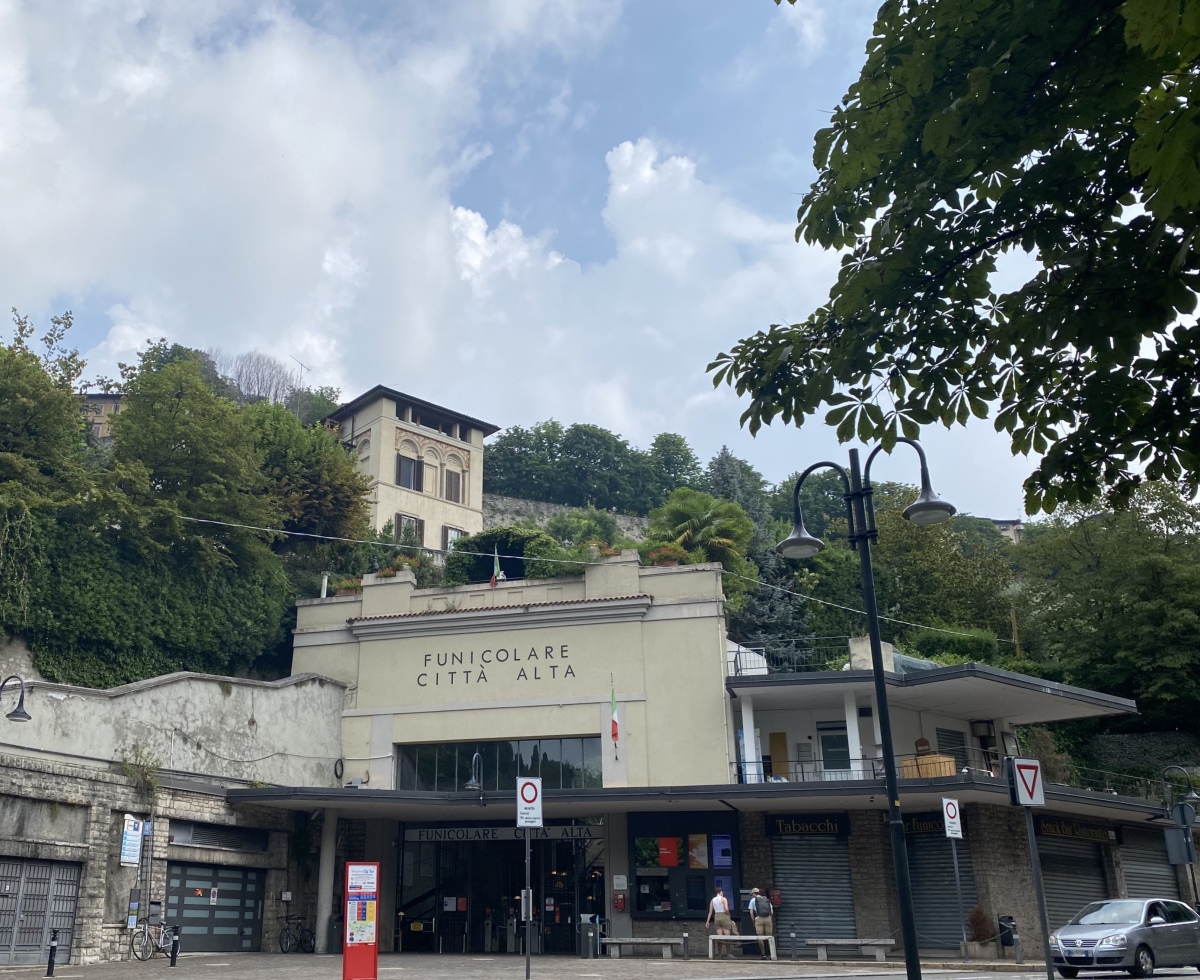
Monday, July 3: Our first and only full day in Bergamo, we drove to the Lower Town and took the funicular up to Città Alta.
Funicolare Città Alta
In the Città Alta, at the top of the funicular, we were greeted by numerous pasticcerie with shop windows full of “polenta é osei,” the most renowned sweet specialty of Bergamo’s cuisine. It is made from sponge cake, chocolate, butter, hazelnut creams and rum. The sponge cake is covered with yellow marzipan, then dusted with crystals of yellow sugar. The little birds then placed on the polenta are made from marzipan covered with a layer of chocolate.
We didn’t allow ourselves to be enticed by these sweet concoctions just yet; instead we wandered through the town, arriving at Piazza Vecchia. Sadly we found we couldn’t climb up the massive 13th century Torre Civica, also known as the Campanone, because it was closed on Mondays.
at the top of the funicular
“polenta é osei”
“polenta é osei”
Piazza Vecchia with the Campanone
Piazza Vecchia
Piazza Vecchia
We visited the Basilica of Santa Maria Maggiore, a major church in the upper town. According to popular tradition, the church was built to comply with a vow made to the Virgin Mary in 1133 by the citizens of Bergamo to protect the city from the plague that was hitting northern Italy at that time.
The church was founded in 1137 on the site of another church from the 8th century dedicated to St Mary, which had been in turn erected over a Roman temple. The church is a conglomeration of different styles, from Romanesque to Gothic. We loved the wooden marquetry designed by Lorenzo Lotto.
Basilica of Santa Maria Maggiore
We went next door to the Cathedral & Duomo, S. Alessandro Martire Church, with its brilliant white facade. Located in Piazza Duomo, in the heart of the Old Town, this area was already a sacred place in the 5th Century B.C., as known by the underground layers. The building holds numerous treasures, such as the paintings by Giovan Battista Moroni and Andrea Previtali, The Martyrdom of Saint John Bishop by Giambattista Tiepolo, an altarpiece by Carlo Ceresa and some wood and marble inlays by Andrea Fantoni.
Cathedral & Duomo, S. Alessandro Martire Church
After wandering around a bit, we had to sample some of the “polenta e osei” at Il Fornaio during our “mandatory” cappuccino and pastry break.
“polenta e osei” at Il Fornaio
me enjoying “polenta e osei” at Il Fornaio
“polenta e osei” at Il Fornaio
We strolled about some more, on a super sugar high, stopping into a random church, Chiesa di Sant’Agata nel Carmine.
Bergamo’s Città Alta
Chiesa di Sant’Agata nel Carmine
Città Alta
Città Alta
map of Città Alta
After rambling around some more, we stopped for lunch at Il Fornaio, where we shared a delicious pizza with burrata and mushrooms.
Il Fornaio
pizzas for sale at Il Fornaio
Burrata and mushroom pizza at Il Fornaio
By then we were stuffed, so we meandered aimlessly until we decided to walk down from the Città Alta to the lower town.
Bergamo
me in Bergamo
Mike in Bergamo
Bergamo
On the long path down to the Lower Town, we had fabulous views of the Città Alta perched proudly on the hilltop.
view of the Lower Town from Città Alta
Bergamo
Bergamo
Bergamo
walkway from Città Alta to the Lower Town
me on the walkway from Città Alta to the Lower Town
view of Città Alta
fetching house on the hillside
view of the Lower Town as we descended
another fetching view
Mike on the walkway down
a pretty house we passed along the walk down
When we reached the Lower Town, we stopped for Aperol spritzes and were served up some cicchetti even though we weren’t hungry and didn’t ask for any food. The waiter said it was included in the price, which turned out to be outrageous compared to other places. That’ll teach us to always look at the menu before ordering.
Mike at the café
a little stop for drinks in the Lower Town (+ cicchetti)
After taking an afternoon nap, we walked just around the corner from our Airbnb to the Accademia Carrara, officially Accademia Carrara di Belle Arti di Bergamo, an art gallery and academy of fine arts in Bergamo. The art gallery was established in about 1780 by Giacomo Carrara, a Bergamasco collector or connoisseur of the arts. The academy of fine arts was added to it in 1794.
Accademia Carrara
entrance to Accademia Carrara
We enjoyed seeing all the masterpieces by the classic Italian painters. We were given a pamphlet that showed the masterpieces we should look for and did a kind of scavenger hunt to find them. The 16 are numbered and named on the photos in the gallery below. Famous painters represented included Raphael, Botticelli, Bellini, Canaletto, Pisanello, Mantegna and Titian.
Accademia Carrara
Accademia Carrara
1. Madonna col Bambino e angelia by Benozzo Gozzoli c. 1440-1445
Accademia Carrara
2. Ritratto di Leonello d’Este by Pisanello c. 1441-1444
Saint Apollonia with her Teeth Torn Out by Giovanni d’Alemagna 1440-1445
Saint Appollinia Blinded by Giovanni d’Alemagna 1440-1445
Accademia Carrara
Accademia Carrara
3. Madonna col Bambino by Andrea Mantegna c. 1480
Accademia Carrara
Accademia Carrara
Madonna and Child by Giovanni Bellini c. 1485-1487
The Story of Virginia by Sandro Botticelli c. 1505
Saint Jerome Extracting the Thorn from the Lion’s Paw by Pittore lombardo o ligure 1465-1475
Ecce Home by Andrea Solario 1503-1505
Madonna and Child between Saints Jerome and Anne (the Baglioni Madonna) by Andrea Previtali 1511-1513
The Stoning of Saint Stephen by Lorenzo Lotto 1513-1516
Saint John the Evangelist by Lorenzo Costa c. 1480-1481
Weeping Angel by Vicino da Ferrara c. 1465-1470
Portrait of Giuliano de’Medici by Sandro Botticelli c. 1478-1480
7. San Sebastiano by Raffaello 1501-1503
8. Tre Crocifissi by Vincenzo Foppa 1450 o 1455 (?)
The Flagellation of Christ by Defendente Ferrari c. 1520
Portrait of Giovanni Benedetto Caravaggi by Giovanni Cariani c. 1519-1520
Portrait of a Gentleman by Altobello Melone c. 1513
Accademia Carrara
10. Nozze mistiche di santa Caterina d’Alessandria, un angelo e Nicolò Bonghi by Lorenzo Lotto 1523
11. Ritratto di vecchio seduto by Giovan Battista Moroni 1576
12. Ragazzo con canestra di pane e dolciumi by Evaristo Baschenis 1650-1660
13. Il Canal Grande da Ca’Foscari verso il ponte di Rialto by Canaletto c. 1726-1728
14. Caterina Cornaro riceve l’annuncio della sua deposizione dal Regno di Cipro by Francesco Hayez 1842
15. Ritratto della contessa Anastasia Spini by Piccio c. 1840
16. A Memory of Sorrow (Portrait Santina Negri) by Giuseppe Pelllizza da Volpedo 1889
Portrait of Francesco Maria Bruntino by Fra Galgario 1737
View of Saint Mark’s Square by Francesco Guardi 1760-1770
Accademia Carrara
Accademia Carrara
Accademia Carrara
The Artist’s Daughter Irene (Girl with Roses) by Cesare Tallone 1898
Madonna Nursing the Child by Bergognone c. 1492-1495
The Birth of Mary by Vittore Carpaccio c. 1502-1504
Accademia Carrara
Paolo e Francesca by Gaetano Previati c. 1887
Madonna and Child Enthroned; the Holy Trinity; Saint Peter; Saint Michael the Archangel (The Scanzo Polyptych) by Bartolomeo Vivarini 1488
Accademia Carrara
Musical Instruments and Sstatuette by Evaristo Baaschenis c. 1660
The Mother’s Curse by Ponziano Loverini 1886
We also loved the special exhibit on the Bergamasque Alps, “Vette di Luce,” especially after having spent over a week in the Dolomites. The paintings were done by various Italian artists and the photographs were taken by Naoki Ishikawa (b. 1977, Tokyo). After climbing Mount Fuji and Denali, he went on to conquer ten of the world’s fourteen highest mountains. In the Bergamo region, he was struck by the everyday life of the mountain communities: cow herding, producing cheese and butter, and the processes used to obtain great varieties of dairy products.
The Dragon’s Lair by Matteo Rubbi 2023
Pizzo Recastello by Camillo Galizzi c. 1935-1940
View of Sedrina by Costantino Rosa c. 1850-1870
“Vette di Luce”
Landscape with Snowy Mountains by Costantino Rosa c. 1861
Serio River Waterfalls by Costantino Rosa 1861
The Cabianca (from the Calvi Refuge) by Camillo Galizzi c. 1948
The North Face of the Presolana by Camillo Galizzi c. 1935-1940
View of the Val Brembana by Constantino Rosa c. 1850-1870
Naoki Ishikawa
Naoki Ishikawa
Naoki Ishikawa 2022
Naoki Ishikawa
Naoki Ishikawa
Naoki Ishikawa
Naoki Ishikawa
Naoki Ishikawa
Naoki Ishikawa
Naoki Ishikawa
Naoki Ishikawa
Naoki Ishikawa
After our museum visit we found a hole in the wall café, Café Poeme, where Mike had a brown-sauced lasagna with radicchio and I had breaded meatballs, French fries and a honey mustard sauce. We both had Hugos as we sat on the sidewalk near a busy street. It was a rather nondescript place, but the food was good.
me with a Vespa on the street of Bergamo
Mike at Café Poeme
brown-sauced lasagna with radicchio
me with a Hugo at Café Poeme
breaded meatballs at Café Poeme
our trip so far on Polarsteps
On Tuesday morning we would head to Lucca where, on Wednesday, we would rendezvous with my Slovakian friend Darina. From there, Mike would return home and Darina and I would prepare to embark on a very hot Via Francigena to Rome.
Steps: 14,456; Miles 6.13. Weather: Hi 83°, Lo 64°.
Saturday, July 1: We stopped at Lago di Garda on our way from Verona to Bergamo on Saturday. At 370 sq km, Lago di Garda is the largest of the Italian lakes, straddling the border between Lombardy and the Veneto, with mountains to the north and softer hills to the south. Villages line the shores, with harbors, vineyards, olive groves and citrus trees along their edges.
The man who ran the restaurant in Verona where we had stopped to get out of the rain had recommended we stop at the cute town of Lazise and then drive further north along the lake’s shore. We wandered around the cute town on the lake for about an hour, admiring the activity on the lake and the boats tied up in the marina.
Lazise
Lazise
Lazise
Lazise
Lazise
Lazise
Lazise
Lazise
Lazise
Lazise
Lazise
Lazise
The man had also recommended to us that we park the car at Bardolino and then walk 3km north to Garda. It was a long, hot and rather boring slog. But the town of Bardolino was very cute.
me in Bardolino
Bardolino
Bardolino
Bardolino
Bardolino
Bardolino
Bardolino
Bardolino
Bardolino
Bardolino
Bardolino
Bardolino
Bardolino
on the way to Garda
me on the hot slog to Garda
When we finally got to the town of Garda we were so hot that we didn’t feel like exploring the town, so we found a bus to take us back to Bardolino.
approaching Garda on foot
On the way to Bergamo, we drove down a thin spaghetti-like peninsula to Sirmione, which sticks out from the southern shore of Lake Garda. Being Saturday afternoon, the town was so crowded there was no parking to be found, so we made our way to Bergamo where we checked into our Airbnb around 4:30.
We would be in Bergamo for 3 nights. The apartment was abundantly supplied with everything a person could ever need except air conditioning.
our 2nd floor Airbnb in Bergamo
Our Bergamo Airbnb
Our Bergamo Airbnb
Our Bergamo Airbnb
Our Bergamo Airbnb
view from our bedroom window at our Bergamo Airbnb
We went to Ristorante Pizzeria Vesuvio, about a 7 minute walk from our house. As it was Saturday night, it was very busy and lively. Mike and I shared an asparagus pizza 🍕 and some bruschetta.
Ristorante Pizzeria Vesuvio
Steps: 19,106; Miles: 8.1. Weather: Hi 74°, Low 64°.
Lago d’Iseo
Sunday, July 2: Because it was supposed to be hot today (86°F) and because it was a Sunday, we decided rather than go to Bergamo’s ancient hilltop Città Alta (Upper Town), we would go to Lago d’Iseo, the fourth largest lake in Lombardy, fed by the Oglio River. After a 45-minute drive, we took a ferry from the town of Sulzano to the island of Monte Isola which towers from the south end of Lago d’Iseo. It is Europe’s largest lake island, at 4.28 sq km. Today it is dotted with fishing villages.
Sulzano
Taking the ferry to Monte Isola
ferry ride to Monte Isola
Monte Isola
Monte Isola
looking back at Sulzano
In the small fishing village of Peschiera Maraglio, we rented bicycles and before taking off, we sat at a cute cafe and had coffee and croissants. An elderly woman (more elderly than me) came up and started talking to us in rapid-fire Italian. Somehow I gleaned that she had apartments to rent in the building next-door and that her husband had died. That was all I could understand, yet it was quite a long (one-way) conversation, with me nodding as if I understood.
magazines in Peschiera Maraglio
me with my bike on Monte Isola
the cafe where we stopped
Peschiera Maraglio
The elderly lady going inside her house
ready to bike
After our coffee break, we rode the perimeter of the island, about 8.7km (5.4 miles). We encountered a tough ascent (106m), where I had to get off the bike and walk uphill. Near the top of the hill, where Mike waited ahead of me, we met a family from El Salvador. Mike was busy chatting away to them in Spanish, and I chimed in periodically. Later, I asked Mike what he thought the El Salvadoran guy was saying. I thought the family was in Italy because their daughter was attending a music school. Mike had understood something altogether different. I really don’t know which one of us was right. Ah, the challenges of speaking languages other than English!
From one of the higher points we could see the tiny Isola di Loreto, a tiny privately-owned island with a neo-Gothic castle surrounded by a garden full of conifers. As we neared the end of the ride, we saw another privately owned island with a private home, San Paolo Island. On a high point behind us we could see the Rocca Martinengro, a fortress built during the 14th century (around a 12th century tower) by a family from Isola.
me and my bicycle
Mike and the bikes
church on Monte Isola
Lago d’Iseo
view of Isola di Loreto
Lago d’Iseo & Isola di Loreto
cute purple Vespa
I love the purple Vespas!
the heights of Monte Isola
a cemetery
view of Rocca Martinengro
San Paolo Island
Monte Isola
We came full circle around the island and dropped our bikes in Peschiera Maraglio, where we stopped in various shops to have a look. Then we took the ferry back to Sulzano, where we got our car and took a drive up the east side of the lake.
Peschiera Maraglio
Peschiera Maraglio
Peschiera Maraglio
Peschiera Maraglio
Peschiera Maraglio
Peschiera Maraglio
ferrying back with a look at Peschiera Maraglio
looking back at Monte Iseo
view from Sulzano
Sulzano
I had a craving for calamari since I’d seen it sold at restaurants in Lazise on Saturday. It was hard to find a restaurant where there was space to park. We finally stopped to have lunch at the lovely Ristorante allá Galleria in Marone, but sadly there was no calamari on the menu. The restaurant sat prettily on Lago d’Iseo. It was quite a hot day, so luckily we were refreshed by some cool sodas, me a San Pellligrino Aranciata and Mike a lemon soda. I had risotto with smoked char and smoked trout; Mike had eggplant parmigiana. It was a nice way to enjoy the lakeside views before we returned to Bergamo.
Ristorante allá Galleria in Marone
Mike cooling off with a lemon soda
me with a San Pellligrino Aranciata
risotto with smoked char and smoked trout
eggplant parmigiana
Ristorante allá Galleria in Marone
Back at our Airbnb in Bergamo, we cooked in: pasta with leeks and tomatoes. We relaxed in our cozy apartment and would be ready to explore the city on Monday.
Steps: 6,539; Miles 2.77. Weather: Hi 86°, Lo 67°.
Wednesday, June 28: We checked into our roomy Airbnb apartment in Verona, dibbed “Casa Teatro Ristori,” after we drove down the Alto Adige Wine Road from Bolzano. It was in a quiet neighborhood not far from the old town. Our terrace overlooked the Teatro Ristori, a cozy theater used for intimate performances.
the view from our terrace in Verona
Casa Teatro Ristori Airbnb
Teatro Ristori – the view from our terrace
We had a fabulous dinner at Bistro Con Amore right around the corner from our apartment. The restaurant was run by Christian from Romania and his wife Ina from Moldova. Christian was lively and passionate about his restaurant and about opera. He broke into song several times as I drank a Hugo and Mike enjoyed an Aperol Spritz. I had spaghetti with prawns and Mike had a delectable Eggplant Parmesan with Pugliese Burrata and fresh basil. We sat beside the nicest Italian couple, Lorenzo and Cosette (which, according to her, means “a little thing”). They were there eating cicchetti (Italian tapas) before they went to their home around the corner for dinner. We had a long chat with them about different parts of Italy (where they were from), the geography and rivers, and our travel plans in their decent English and our faltering Italian.
Bistro Con Amore
me with Christian of Bistro Con Amore
Mike with his Aperol Spritz and my Hugo in the foreground
Mike’s Eggplant Parmesan
my spaghetti with prawns
After dinner we strolled around town, heading for the domineering Castelvecchio, built in the 1350s by Cangrande II della Scala. We walked across the asymmetrical brick bridge, Ponte di Castel Vecchio, a triple-arched fortified bridge in Verona which straddles the Adige River. It was built (most likely in 1354-1356) by Cangrande II to enable him to safely escape from the attached castle in the event the population rebelled against his tyrannical rule.
The bridge was totally destroyed, along with the Ponte Pietra, by the retreating German troops on April 24, 1945. The bridge’s reconstruction by architect Libero Cecchini began in 1949 and was completed in 1951, except for the left tower.
Thursday, June 29: Our first full day in Verona, we headed first to the Roman Arena, an open-air amphitheater in Piazza Bra built in 30 AD. It survived a 12th century earthquake and is now internationally famous for its legendary large-scale opera performances.
The Arena, the eighth largest in the Roman Empire, predates the Colosseum in Rome. It is one of the best preserved ancient structures of its kind. In ancient times, the arena’s capacity was nearly 30,000 people. The stage for concerts and opera performances decreases the available places to a maximum of 22,000.
The first 20th-century operatic production at the arena, a staging of Giuseppe Verdi’s Aida, took place on August 10, 1913 to mark the birth of Verdi 100 years before in 1813. Since then, summer seasons of opera have been mounted continually at the Arena, except in 1915–18 and 1940–45, when Europe was embroiled in war.
After wandering through the Arena and watching the work crews setting up the stage, we decided to buy tickets to Thursday night’s performance, which happened to be Aida, the first opera performed at the venue in the 20th century.
on the way to the Arena
Piazza Bra
Piazza Bra
Verona’s Roman Arena
Mike at Verona’s Roman Arena
Verona’s Roman Arena
view of Piazza Bra from the Arena
part of the Roman Arena
We dropped into a church not far from the Arena, San Nicolò all’ Arena, a Roman Catholic parish church dedicated to Saint Nicholas. It was built in the Baroque style between 1627-1683, although the façade wasn’t completed at the time. The neoclassical façade of the Church of San Sebastiano was relocated to San Nicolò in the 1950s, after the former church was destroyed during World War II. The interesting sculpture in front is Frutto Oggetto (“Fruit Object”) by Gino Bogoni, 1990.
streets of Verona
San Nicolò all’ Arena
Of course we had to drop by the Casa di Giulietta (Juliet’s House), a fictional place created by a city capitalizing on the fame of Shakespeare’s fictional Romeo & Juliet. In the 1930s the city authorities picked a house in Via Cappello as Juliet’s and added a 14th-century-style balcony and a bronze statue of the heroine. We stopped to touch Juliet’s breast, as it is believed caressing her breast brings good fortune in love. We looked up at the balcony and checked out the love locks, and then we were out of there. I wasn’t dressed for the occasion but I did capture a beautiful young lady dressed to the hilt for the photo op.
Casa di Giulietta
Mike holding Juliet’s breast
me caressing Juliet’s breast
a stylish woman with Juliet
locks at Casa di Giulietta
Casa di Giulietta
We stopped for cappuccino and croissants 🥐, our normal mid-morning routine. After our coffee break we wandered somewhat aimlessly while making our way slowly to the Torre dei Lamberti. We saw many enticing sweet treats and cool ancient buildings along the way. We found a sculpture of poet Berto Barbarani at Piazza Erbe, but we would have had to wait a long time to get the little girl posing out of the picture. I also bought myself another dress that was the exact style (but different color and pattern) as the one I bought in Venice for 70€; the one at a kiosk here was 25€. Live and learn.
coffee & croissant break
our little pasticceria
pretzels
macaroons
cute shop display
macaroons
popsicles
Piazza Erbe
statue of poet Berto Barbarani
Piazza Erbe
Piazza Erbe
Onward and upward we went to the Torre dei Lamberti. The 84m-high watchtower offered panoramic views of Verona and nearby mountains. Begun in the 12th century and finished in 1463, it has an octagonal bell tower. I took the lift up 2/3 of the way, while Mike climbed the stairs, and we walked up the remaining 1/3rd for the views.
Torre dei Lamberti
view from Torre dei Lamberti
We then climbed the Scala Della Ragione (Stairs of Reason) to the Galleria d’Arte Moderna Achille Forti, the city’s modern art museum. Its collection of paintings spans 1840-1940 and includes many influential Italian artists. We loved the art in this museum, especially the paintings.
Galleria d’Arte Moderna Achille Forti
Piazza Erbe, Carlo Ferrari detto Ferrarin (1813-1871)
I portoni della Bra by Ettore Beraldini (1887-1965)
Ritratto di Emilia Vignola by Alfredo Savini (1868-1924)
Panorama di Verona by Baldassarre Longoni (1876-1956)
Il pesco fiorito by Baldassarre Longoni (1876-1956)
Notre vespertine by Francesco Danieli (1852-1922)
Ponte di Veja in Lessinia veronese by Ettore Beraldini (1887-1965)
La mia sorellina by Guido Trentini (1889-1975)
Ritratto di ragazza seduta vestita di rosso by Guido Trentini (1889-1975)
Galleria d’Arte Moderna Achille Forti
Piccola descrizione asolana n. 2 by Gino Rossi (1884-1947)
La preghiera by Felice Casorati (1883-1963)
Ritratto di bambina. La figlia sul colle San Felice by Alfredo Savini (1868-1924)
Galleria d’Arte Moderna Achille Forti
Natività: omaggio al Bassano by Filippo de Pisis (1896-1956)
Palude, Porto Buso by Renato Birolli (1905-1959)
Paese selvatico by Renato Birolli (1905-1959)
Composizione by Tancredi (Tancredi Parmeggiani 1927-1964)
Cappella dei Notai
Cappella dei Notai
Cappella dei Notai
Il canneto by Eugenio Degani (1923-2000)
me in front of Il canneto
Galleria d’Arte Moderna Achille Forti
Vendemmia a Soave by Adolfo Mattielli (1883-1966)
Galleria d’Arte Moderna Achille Forti
We walked through the Piazza Signori, lined with elegant Renaissance palazzi. A famous statue of Dante sits in the middle. Slightly off the Piazza is the Arche Scaligere, the ornate Gothic funerary monuments of the Della Scala family. They were the ruling family of Verona and mainland Veneto (except for Venice) from 1262-1387, a total of 125 years. The family’s rule was marked by wars, cruel and tyrannical governance, and fratricide, offset by some beautification projects in Verona: palaces, aqueducts, bridges and a treasury.
Dante at Piazza dei Signori
Piazza dei Signori
Dante at Piazza dei Signori
Piazza dei Signori
Piazza dei Signori
Arche Scaligere
Arche Scaligere
Arche Scaligere
Arche Scaligere
By this time we were hungry for lunch so we stopped at a restaurant, Osteria Sottoriva, where we shared a table with two Brits from York, Andy and Shirley. It was a long leisurely lunch, where Mike enjoyed an Insalata d’Orzo and I had an Eggplant Parmesan that wasn’t nearly as tasty as the one Mike had Wednesday night. Mike and Andy talked sports, especially their favorite football clubs. Andy’s was Newcastle, his hometown, and Mike’s Liverpool. We chatted about our travel itineraries. Andy and Shirley planned to stay at Lake Garda for a week after they left Verona. They had taken a day trip to Venice the day before by train, and when they arrived back late at night, around 10:00 p.m., some of the people who had disembarked were trying to get a taxi to their hotels in Lake Garda, but the taxi drivers refused to take them. Later, I would experience similar taxi frustrations during my walk on the Via Francigena. As Italy doesn’t allow Uber, taxi drivers have no competition and thus are inflexible, expensive, and even tyrannical.
streets of Verona
Verona
random flowery restaurant
Osteria Sottoriva
menu at Osteria Sottoriva
my Eggplant Parmesan
Mike’s Insalata d’Orzo
Finally we visited the Italian Gothic Basilica di Sant’ Anastasia. Dating from the 13th-15th centuries, it features an elegantly decorated vaulted ceiling. This is Verona’s largest church with an overwhelming number of frescoes. We saw the beautiful fresco of St. George and the Princess by Pisanello above the entrance to the Pellegrini Chapel. Pisanello is known for his ability to evoke a fantastic chivalrous world.
We also made the acquaintance of the hunchback holding up the 1495 holy water font; he was carved by Gabriele Caliari. It is said that touching a hunchback on the hump brings good luck.
Basilica di Sant’ Anastasia
hunchback holding water font
Basilica di Sant’ Anastasia
St. George and the Princess by Pisanello
Basilica di Sant’ Anastasia
At the end of our day, we stopped for gelato at Gelateria La Romano. It was a refreshing way to end our day. After resting a bit, we made some delicious pasta in our apartment with green beans and sun dried tomatoes before going back to the Arena to see the opera Aida.
pretty Verona
more colorful macaroons
a pretty hidden square
me enjoying my gelato
Gelateria La Romano
pasta with green beans and sun-dried tomatoes
The opera Aida started at 9:15 and was scheduled to go a full 3 1/2 hours. I doubted my ability to stay up that late, so I told Mike I might want to leave early if I felt like it. He agreed, and off we went.
On our way to the opera we met our Italian “friends,” Lorenzo and Cosette. Holding our seat cushions under our arms, we told them we were on our way to see Aida. They were thrilled for us, gushing with enthusiasm over the opera.
our view from our balcony
me ready for the opera
Lorenzo and Cosette
Piazza Bar
me at Piazza Bar
Mike and I going to the opera
Mike going to the opera
The Arena
The Arena
Aida is one of the most mythical operas to be performed every year at the Arena di Verona. The series of 16 performances began this summer on June 16. The production by Franco Zeffirelli brought ancient Egypt to the stage in a modernistic way, with costumes created by Anna Anni, and a cutting-edge stage design, which featured a huge ghostlike hand that moved slowly up and down; the performance boasted a black, white and red color motif.
Detailed information on Aida:
Venue: Arena di Verona
Duration: 3 hours and a half approximately
Book by: Antonio Ghislanzoni
Music composed by: Giuseppe Verdi
Language: Italian
Directed and staged by: Franco Zeffirelli
Costume design by: Anna Anni
Aida, an opera in four acts set in ancient Egypt, was commissioned to celebrate the opening of the Khedivial Opera House in El Cairo, where it premiered in December 1871. It is among the most performed operas in history. For instance, it has been performed over a thousand times at the Metropolitan Opera of New York since 1886.
The story revolves around the Ethiopian princess Aida, who is captured and sent to Egypt as a slave. At her arrival, Radames enters the scene. He is a commander for the Pharaoh who falls in love with Aida and will have to struggle between his love for her and his loyalty to the Pharaoh. The plot thickens when Amneris, daughter of the Pharaoh, demands the love of Radames, leading to a love triangle.
We left after 2 hours because I was so uncomfortable sitting on the concrete slabs of the Arena and also felt trapped because it’s frowned upon to get up at any time except intermission, which was between Act 2 and Act 3.
Aida at the Arena di Verona
Here is a short video of some scenes from the opera.
Steps: 16,443; Miles: 6.97. High 87°, Low 66°. Partly cloudy.
Friday, June 30: On Friday morning, our last day in Verona, we ventured out to see some of the famous churches. First stop was Chiesa di San Fermo. The church was built in the 5th century in honor of saints Fermo and Rustico, who became martyrs in 304 AD. Here one church is built over another: Franciscan monks raised the 13th-C Gothic church right over an original 11th-C Romanesque structure. Inside the main Gothic church we admired the larch timber ceiling which resembles an upturned boat’s hull. Some 14th-C frescoes depict the life of St. Francis.
Chiesa di San Fermo
Chiesa di San Fermo
Chiesa di San Fermo
Chiesa di San Fermo
Chiesa di San Fermo
Chiesa di San Fermo
Chiesa di San Fermo
Chiesa di San Fermo
Chiesa di San Fermo
Chiesa di San Fermo
Chiesa di San Fermo
Chiesa di San Fermo
Chiesa di San Fermo
Chiesa di San Fermo
Chiesa di San Fermo
Chiesa di San Fermo
Chiesa di San Fermo
Chiesa di San Fermo
Chiesa di San Fermo
Chiesa di San Fermo
We stopped at the Duchi Café and then walked along the river. We didn’t get far because it started raining 🌧️ ☔️ and we hadn’t brought our raincoats or umbrellas. We ducked under the umbrellas of another cafe to eat the panini we had bought earlier, along with a bowl of bean soup we bought at the café. We enjoyed two Aperol Spritzes while waiting for the rain to stop.
Ponte Pietra over the Fiume Adige
Duchi Café
Duchi Café
ancient Roman ruins
Roman ruins
horseman
another pretty storefront
me along the Fiume Adige
a cozy respite from the rain
Mike and his sandwich
me with Aperol Spritz
bean soup
When the rain abated, we crossed the Ponte Pietra at the northern end of the city center. Two of the bridge’s arches date from the Roman Republican era in the 1st century BC, while the other three were replaced in the 13th century. The ancient bridge remained largely intact until 1945 when retreating German troops blew it up. Locals fished the pieces out of the river and painstakingly rebuilt the bridge stone by stone in the 1950s.
hills along the river
postal vehicle
walking to Ponte Pietra
the River Adige
hills to the north of Verona
the River Adige
the River Adige
Ponte Pietra
Mike and me on Ponte Pietra
hills around Verona
hills around Verona
streets of Verona
cute car in Verona
Finally we went to the Cattedrale Santa Maria Matricolare, also known as the Duomo di Verona, Verona’s 12th century cathedral. It was built after an earthquake destroyed two Palaeo-Christian churches on the same site in 1117. The Romanesque-style cathedral was consecrated on September 13, 1187. The structure was later modified by several renovations, although the plan has remained unchanged. The interior was extravagantly frescoed in the 16th-17th centuries.
Cattedrale Santa Maria Matricolare
back of Cattedrale Santa Maria Matricolare
Because of the damp weather and because we were tired from so much walking, we headed back to the apartment to relax and nap. It rained off and on all afternoon.
We went out in the evening to our favorite neighborhood restaurant, Bistro Con Amore Cicchetteria, where we sampled a delectable assembly of Italian tapas (cicchetti) accompanied by opera music. Of course I had to have my Hugo!
me on our balcony
Mike on our balcony
cicchetti at Bistro Con Amore Cicchetteria
Tiramisu at Bistro Con Amore Cicchetteria
cicchetti at Bistro Con Amore Cicchetteria
more Roman arches in Verona
Steps: 11,705; Miles 4.96. High 81°, Low 65°. Cloudy and some rain.
After leaving Verona on Saturday morning, we would head to Lake Garda and on to Bergamo.
Wednesday, June 28: On our way to Verona, we made a little detour along the Alto Adige Wine Road, with a growing area of about 4,249 hectares and an impressive variety of wines. The individual wineries here form a complex mosaic. Due to the varying altitudes of between 200 and 1,000 meters, wine growers have a wide range of microclimates and soils. The local variety Gewürztraminer and vines of international reputation like Pinot Blanc and Pinot Noir are grown here.
We made our first stop in Termeno. All around us were vineyards, cypresses, fig trees and lemon trees. The town was the home of the internationally renowned Gewürztraminer wine. We only stopped in this cute town for coffees and croissants as it was a bit early to start drinking wine. 😋
Termeno
Termeno
Termeno
Termeno
Termeno
me doing what I love best- shopping!
Termeno
We drove through a few other towns and then made a brief stop to look at the sprawling St. Valentin Church and cemetery. We continued through a few more towns looking for the perfect winery to make a stop.
St. Valentin Church & cemetery
vineyards near St. Valentin
St. Valentin cemetery
church in another wine town
We stopped at Tiefenbrunner Winery for a cold lunch and wine. We spent a long time lingering over a Bistroteller – Charcuterie board: finely sliced speck, various South Tyrolean cheeses, air-dried salami, kaminwurze, olives and horseradish. I enjoyed a glass of Gewürtztrammer and Mike had a Pinot Grigio.
Tiefenbrunner Winery
grottoes at Tiefenbrunner Winery
Tiefenbrunner Winery
pond and grottoes at Tiefenbrunner Winery
view from Tiefenbrunner Winery
Tiefenbrunner Winery
garden in Tiefenbrunner Winery
Tiefenbrunner Winery
selfie at Tiefenbrunner Winery
wines at Tiefenbrunner Winery
Bistroteller – Charcuterie board
me at Tiefenbrunner Winery
garden at Tiefenbrunner Winery
We got the idea to explore the Alto Adige Wine Road from our German neighbors at the farmhouse, Tim and Silke. If it hadn’t been for them, we wouldn’t have known anything about it.
After our lunch, we headed south to Verona, where we would stay three nights.
Saturday, June 24: As we were leaving Cinque Torri, we found on our GPS that the Great Dolomites Road was closed at the pass, so we had to reroute and couldn’t take our scenic route to Bolzano. We ended up backtracking all the way to Cortina d’Ampezzo and to Dobbiaco and Brunico and then eventually toward Bolzano on the A12 autostrada.
The Renon Plateau: Kinig Farm
Just before Bolzano we were instructed to take a windy road up and up a very steep mountain. It felt very perilous! There were many steep drop-offs and the road eventually narrowed to just over one lane wide. Switchback after switchback led us eventually to the “town” of Signato on the Renon plateau and to a farm called Kinig, where Werner (the father of the Airbnb host Franz Maria) greeted us. We had reserved an apartment on this high mountain farm for 4 nights. It was a charming little place!
Kinig farmhouse
Kinig farmhouse
Kinig farmhouse
Kinig farmhouse
urinal with painted spider that fooled both of us!
kitchen in Kinig farmhouse
Kinig farmhouse
Kinig farmhouse
view of Bolzano from the farmhouse
Soprabolzano/Oberbozen
Luckily, though the road ended at a gate, we were given a pass to open the gate so we could drive a few kilometers further up to the town of Soprabolzano/Oberbozen. Neither of us were thrilled about having to drive that winding road back down the mountain to go to dinner or get groceries in Bolzano, so that gate-opening card was truly the magic ticket. We were also given a free gondola card which we could use for the gondola down to Bolzano.
After checking into our farmhouse Airbnb apartment, we drove up the mountain to Soprabolzano. Here we stocked up on groceries for our 4 night stay in Renon, then we went to eat dinner at the lively and friendly Gasthaus Babsi, recommended by the friendly check-out lady at the supermarket. It was a cool place with a friendly staff and old American tunes playing. We shared a Rucola and Brie pizza and I had the most delightful drink called a Hugo that had Prosecco, lime, fresh mint, seltzer, and elderberry liqueur. Mike had an Estivo: white wine, soda and lemon.For dessert we shared a buckwheat cake with lingonberry jam and whipped cream. Before we left the place, the bartender gave us each complimentary limoncellos.
We took an after-dinner stroll on the lower edge of the town, where we saw beautiful views of the jagged Dolomites against a foreground of alpine meadow. The town also had a community swimming pool which we had access to. From the town, there was a large cable car 🚠 that went down into the valley to the city of Bolzano. We planned to take that down one day to avoid the harrowing drive up to our farmhouse apartment.
We admired the charming Parrocchia Maria Assunta di Soprabolzano with its fetching onion dome in the waning sunlight.
Gasthaus Babsi
Gasthaus Babsi
me with a Hugo at Gasthaus Babsi
Mike at Gasthaus Babsi
buckwheat cake with lingonberry jam and whipped cream
signs in Soprabolzano
Soprabolzano
cable car at Soprabolzano
little lambs in Soprabolzano
Hotel Post in Soprabolzano
Parrocchia Maria Assunta di Soprabolzano
Steps: 12,253; Miles 5.19. High 77°, Low 52°. Sunny.
Val di Funes: the Panoramaweg & Sunnseitnweg Circuit Hike
Sunday, June 25: On Sunday morning, we drove about an hour from Renon to Val di Funes to hike the Panorama Trail (“Panoramaweg” in German) and the Sunny-side Trail (“Sunnseitnweg”), which when linked together creates an easy, scenic circuit hike.
We started in Santa Maddalena/ St. Magdalena, a village in Val di Funes (Villnösstal) in South Tyrol. This small mountain village is home to the historic Santa Maddalena Church, which is one of the most popular photo spots in the region. The church dedicated to Santa Magdalena is located where pagan rituals once took place. The first building was mentioned in 1394 documents; today only the church tower remains of that original church. The interior has Baroque elements. The altar features a contrite St. Magdalena, patron saint of the church. Next to her are sculptures of St. Peter, John the Baptist, John the Evangelist and Jerome.
The Santa Maddalena Panorama trail led us through meadows, pockets of forest, and historic Tyrolean farmsteads along narrow footpaths as well as low-trafficked paved roads.
We enjoyed grand views of the Odle/Geisler Peaks, which form the dramatic backdrop of Santa Maddalena Church and the tidy farmhouses set in the lovely green valley.
a church near our farmhouse in Renon
Val di Funes
Panoramaweg & Sunnseitnweg
the start of the Panoramaweg
Santa Maddalena Church
Val di Funes
Panoramaweg
Santa Maddalena Church set against the Odle/Geisler Peaks
me in Val di Funes
Val di Funes
trail markers in Val di Funes
Mike in Val di Funes
Val di Funes
Val di Funes
cute little bench
tractor set up
Sunnseitnweg
Santa Maddalena Church set against the Odle/Geisler Peaks
Val di Funes
Val di Funes
Santa Maddalena Church set against the Odle/Geisler Peaks
me on the Sunnseitnweg
returning to Santa Maddalena
cemetery at Santa Maddalena Church
interior of Santa Maddalena Church
Santa Maddalena Church
After our hike, which was about 4.5 miles and took us about 3 hours of leisurely walking, we visited the tiny and picturesque onion-steepled Chiesetta di San Giovanni/ St. Johann Church nearby. It is one of the Dolomites’ most iconic photo-ops. The small Baroque church, founded by Michael von Jenner and built in 1744, sits alone in a meadow, part of the Ranuihof Farm, below the spiky peaks of the Odle mountain group. We paid to park plus a 4€ entrance fee to visit. Because of the way it was blocked off and because of the entrance fee, it felt a bit too staged for us.
Chiesetta di San Giovanni/ St. Johann Church
Sunday evening after our hike at Val di Funes, we returned to our farmhouse Airbnb and enjoyed wine, bread and cheese at a picnic table in the shade. We made an asparagus and cheese pappardelle that was quite delicious. We spent the evening relaxing in our charming apartment.
airplane in front of Kinig farmhouse
me enjoying a wine at Kinig farmhouse
Kinig farmhouse
table set for dinner
asparagus pappardelle
Steps: 13,119; Miles: 5.56. High 83°, Low 55°. Sunny.
Bolzano/Bozen
Monday, June 26: Monday morning we took the cable car 🚠 (a 12-minute ride) from Soprabolzano, not far from our farmhouse, to Bolzano down in the valley.
taking the cable car down to Bolzano
Bolzano/Bozen is the capital city of the province of South Tyrol. With a population of 108,245, Bolzano is also by far the largest city in South Tyrol. In the 2020 version of the annual ranking of quality of life in Italian cities, Bolzano was ranked joint first for quality of life alongside Bologna.
Bolzano is considered a bridge between Northern Europe and Southern Europe due to the three spoken languages in South Tyrol (Italian, German, and Ladin) and the confluence of Italian and German-Austrian culture.
Being located at multiple climate borders, Bolzano features a humid subtropical climate with hot summers and very cold winters by Italian standards.Because of its low altitude in a valley south of the main alps, Bolzano is sheltered from cool winds during daytime, ensuring much warmer temperatures year-round than in similar valley cities north of the range. It was in the mid-90s on the day we went down while it was in the low 80s on the Renon plateau.
We enjoyed wandering around the town. We walked around Waltherplatz, the main square in Bolzano. Walther von der Vogelweide, the square’s namesake, towers as a white statue in the middle of the square. We stopped at a favorite store we keep running into in various Italian towns, OVS. Mike was looking for some t-shirts and shorts and I bought a dress 👗. 😂
We had a lovely lunch in a shady and breezy alley. I had a burrata and tomato salad that was super refreshing. Mike had a tuna salad. As always in Italian towns, we love to watch the fashionable people strolling by. After lunch, we happened upon a lively flower market.
After strolling around a bit more, we made our way to the cable car and took it back up the mountain to Renon.
Bolzano/Bozen
cute orange bicycle
Bolzano/Bozen
Bolzano/Bozen
Bolzano/Bozen
Bolzano/Bozen
Bolzano/Bozen
Bolzano/Bozen
Bolzano/Bozen
burrata and tomato salad
flower market in Bolzano/Bozen
window decor
window decor
Bolzano/Bozen
Taking the cable car back up to Renon
a view of our farmhouse from the cable car
returning to Soprabolzano
The Renon/Ritten Plateau
After Bolzano, we spent the rest of our day on the Renon/Ritten Plateau, home to our farmhouse apartment. We drove to the town of Collalbo/Klobenstein and wandered around. Not much was happening there as it was in the heat of the afternoon, so we settled inside the only cafe in town to enjoy a very skimpy serving of gelato 🍧. It was refreshing but not quite enough to sooth our souls.
Collalbo/Klobenstein
gelato in Collalbo/Klobenstein
a church near Collalbo/Klobenstein
view from the church
a church near Collalbo/Klobenstein
We reached the peak at Rittner Horn, at an altitude of 2260 meters, by taking the gondola from Pemmern/Tre Vie to Schwarzseepitze. From there it’s about an hour hike up to the top, but we didn’t take the hike. We could see excellent views of the mountains all around.
gondola to Rittner Horn
view from Rittner Horn
me at Rittner Horn
view from Rittner Horn
horses seen from the gondola ride back down
After our day taking the cable car to Bolzano and exploring some of the Renon/Ritten plateau, we stayed at the farmhouse and cooked some Bratwurst and some leftover pasta with zucchini. It was nice to spend a slower day simply enjoying our home town area.
dinner in the farmhouse
Steps: 11, 706; Miles 4.96. High 97°, Low 64°. Sunny.
The High Alpine hikes of Alpe di Siusi
Tuesday, June 27: With a size of 56 square kilometers, the Alpe di Siusi in South Tyrol is the largest high alpine pasture in Europe. On Tuesday, we drove about an hour from Renon to Ortesei/St. Ulrich where we took the Mont Sëuc cable car to the alpine meadow. There we spent much of the day, about 5 1/2 hours, hiking all over the meadow, about 6 1/2 miles.
We started by following Trail 9 to Saltria, which was a long slow descent. We passed alongside pastures of grazing horses and sprawling fields of colorful wildflowers. Many people posed amidst the wildflowers for pictures.
Saltria is a small village on Alpe di Siusi, located at an elevation of 1675 meters. It’s also the lowest point of the plateau. We had amazing views of the Catinaccio/Rosengarten range as we descended. We stopped at a hotel in Saltria for a cappuccino and an apple strudel.
As we crossed the rolling Alpe di Siusi meadows, Sassolungo and Sasso Piatto dominated the view to the southeast and the Catinaccio and Sciliar mountains dominated the views directly south and to the southwest. To the north, views extend to Monte Pic, Seceda, and the Geisler Group.
Of course what goes down must come up, so we hiked a long uphill out of the valley through the Römer mountain pasture, where cattle grazed freely.
Mont Sëuc cable car
first views of the Alpe di Siusi
me at Alpe di Siusi
Alpe di Siusi
Alpe di Siusi
Alpe di Siusi
Alpe di Siusi
stream at Alpe di Siusi
Alpe di Siusi
greenery at Alpe di Siusi
wildflowers
selfie 🙂
me with Mike at Alpe di Siusi
wildflowers at Alpe di Siusi
Alpe di Siusi
Alpe di Siusi
Alpe di Siusi
me in the wildflowers
Alpe di Siusi
horses at Alpe di Siusi
Alpe di Siusi
Alpe di Siusi
Alpe di Siusi
wildflowers
Alpe di Siusi
more wildflowers
Mike at Alpe di Siusi
wildflowers
Alpe di Siusi
wildflowers
cows at Römer mountain pasture
Römer mountain pasture
Mike and his cow friends
me at Alpe di Siusi
Alpe di Siusi
Römer mountain pasture
Alpe di Siusi
Alpe di Siusi
Alpe di Siusi
Alpe di Siusi
greeter at Alpe di Siusi
Alpe di Siusi
We headed toward Compaccio but stopped for a restroom break at Rauchhütte before venturing back to our starting point. We originally intended to go to the town of Compaccio but decided not to go all the way into town.
We made another stop, this time at Sanon Hütte/Baita Sanon where Mike had a beer and I had my new favorite drink, a Hugo (Prosecco, mint and elderflower liqueur). Yum.
After we left the hut we enjoyed more beautiful views of the mountains. Looking north, we saw Monte Pic, the Geisler Peaks, Monte Stevia, Piz Duleda, and Col dala Pieres.
We had paid the extra 5 euros for the gondola from Sole Lake back up to the Mont Sëuc cable car, and we were happy we did as it saved us a long uphill slog at the end. What a gorgeous hike!
wood carvings on the way to Rauchhütte
carved bench near Rauchhütte
Rauchhütte
Rauchhütte
bathroom sign at Rauchhütte
Seiser Alm, view from Rauchhütte
leaving Rauchhütte
Alpe di Siusi
Alpe di Siusi
Alpe di Siusi
Alpe di Siusi
Alpe di Siusi
Mike at Sanon Hütte/Baita Sanon
Sanon Hütte/Baita Sanon
me at Sanon Hütte/Baita Sanon with my Hugo
bathroom signs at Sanon Hütte/Baita Sanon
Alpe di Siusi
more wildflowers
Alpe di Siusi
riding the cable car back to Mont Sëuc
Ortesei/St. Ulrich
After our hike at Alpe di Siusi, we took a short wander around the town of Ortesei/St. Ulrich. This is in Val Gardena where many people stay when they come to the Dolomites. The town looked appealing, but we were happy with our little mountain farmhouse in Renon.
Ortesei/St. Ulrich
Ortesei/St. Ulrich
Ortesei/St. Ulrich
Ortesei/St. Ulrich
Ortesei/St. Ulrich
Ortesei/St. Ulrich
Ortesei/St. Ulrich
Ortesei/St. Ulrich
Ortesei/St. Ulrich
Ortesei/St. Ulrich
Ortesei/St. Ulrich
Ortesei/St. Ulrich
Soprabolzano
After we relaxed a bit at our farmhouse apartment, we drove up to Soprabolzano where we had a lovely dinner on the terrace of The Post Hotel overlooking the valley and the cable car. We had intended to go to Gasthaus Babsi again, but it was closed on Tuesdays. We shared Rinderbouillon mit Kräuterfrittaten, a delicious soup with tiny strips of pancake in it. Mike had Hacksteak vomeinheimischen Lamm auf roten Zwiebeln und Röstinchen, a delicious lamb loaf with a potato pancake and red onions; I had Spinatspätzle mit Entenragout, spinach spaetzle with duck ragout.
After dinner we strolled briefly around the town. This would be the last time we’d see our cute little town above the farmhouse.
me at our farmhouse apartment
Mike and the airplane at our farmhouse
me with the Kinig pots & pans
The Post Hotel
me on the terrace of The Post Hotel
Rinderbouillon mit Kräuterfrittaten
Hacksteak vomeinheimischen Lamm auf roten Zwiebeln und Röstinchen
Spinatspätzle mit Entenragout
Babsi
Soprabolzano
Soprabolzano
Soprabolzano
Steps: 22,819; Miles 9.68. High 68°, Low 47°. Mostly sunny.
Leaving the Renon Plateau
Wednesday, June 28: Wednesday morning we left our farmhouse apartment in Renon and said goodbye to Werner, the 54-year-old very fit man who gave the farm to his son Franz. Franz, who is about 30, does the farming and Werner runs the apartments and a restaurant that only opens seasonally. Sadly we weren’t there at the right season to partake.
We also said goodbye to our upstairs neighbors Tim and Silke from Berlin. They had their dog named Rala with them. I liked their way of doing a vacation. They stayed in the farmhouse for two weeks; every other day they did a big outing and on the off days, they relaxed. I was envious at their long term stay at this place and their way of vacationing. We always tend to squeeze in too much, although on this trip, we have had more down time than on most. We stayed at the farmhouse 4 nights; I think that needs to be the minimum in each place on future trips. This time we were 4 nights in Venice, but only 3 in Dobbiaco, Verona and Bergamo, and only 2 in Lucca. We’ll get it right one of these days!
last view of our apartment
Werner
Silke & Tim
Tim, Silke, me and Mike
Tim, Silke, Mike and me
view of vineyards from our farmhouse
Zum Signater Hof (near our farmhouse but closed for the season)
church near our farmhouse in Renon
Renon: High: 72°, Low 53°.
Here’s a video of our time in Renon. On Settings (bottom right), hit “Quality: HD” for best experience.
After leaving Renon, we headed down the Alto Adige Wine Road (a suggestion from Tim & Silke) to Verona.
Wednesday, June 21: We left Venice this morning, taking a taxi to Alamo to rent a Volkswagen T-ROC. It wasn’t long before we were in the Dolomites. We stopped for lunch of panini 🥪 at Bar Torre Due in Longarone, a town that was rebuilt after it was totally destroyed by an “inland tsunami.” At about 10:30 p.m. on October 9, 1963 a huge piece of a mountain broke off in a huge landslide upriver of the Vajont Dam, one of the deepest and narrowest in the world. In 4 minutes, the landslide displaced the water, causing a huge tsunami to overflow the dam, killing 2,000 people, many whose clothes were ripped off by a force two times stronger than the atomic bomb at Hiroshima.
There was no sign of such mayhem today, so we enjoyed our lunch break, after which we drove through a number of small towns where the jagged peaks of the Dolomites towered all around us.
Ristorante Bar Torre Due in Longarone
Driving north
Our drive through towns
driving north
first views of the Dolomites
Dolomites
Dolomites
Dolomites
Lago di Misurina
We took our first walk at Lago di Misurina. It was a flat, easy walk, about 2 1/2-3 km, but a nice break from our drive to Dobbiaco. We even had glimpses of Tre Cime di Lavaredo (Three Peaks of Lavaredo).
Lake Misurina was where the speed skating events were held during the 1956 Winter Olympics of Cortina d’Ampezzo – the last time Olympic speed skating events were held on natural ice.
Bar at Lago di Misurina
Lago di Misurina
Lago di Misurina
Lago di Misurina
Lago di Misurina
boats at Lago di Misurina
Lago di Misurina
Lago di Misurina
Lago di Misurina
Lago di Misurina
Lago di Misurina
Lago di Misurina
Lago di Misurina
Lago di Misurina
Lago di Misurina
Lago di Misurina
Lago di Misurina
Lago di Misurina
Lago di Misurina
paddle boats at Lago di Misurina
Dobbiaco/Toblach
Late Wednesday afternoon, we checked into B&B Hotel Heidi just outside the little town of Dobbiaco/Toblach (Towns in this area have both Italian/German names since they are so close to Austria). B&B Hotel Heidi, where we stayed three nights, was the only hotel we stayed in during our time in Italy, except when we got to Lucca. Mostly we booked Airbnbs, which we much prefer. This place ended being a lively launching point for active people who were doing multi-day hikes, bike rides, motorcycle rides, or day hikes in the countryside. We ran into crowds of energetic people at breakfast each morning; it was fun to hear of their plans and absorb their enthusiasm.
This area is close to the Austrian border and feels more Austrian than Italian. Most people (95%) speak German. Dobbiaco is not far from the Tre Cime di Lavaredo hike, Lago di Misurina and hikes around Lago di Braies. There were lots more hikes we could have done from here, but we also planned to stay 4 nights in Renon/Ritten near Bolzano/Bozen. There we would do a number of high alpine meadow hikes.
B&B Hotel Heidi
grounds of B&B Hotel Heidi
After checking in, we went into town to look for dinner. We sat outdoors at Ariston Bar Pizzeria & Restaurant. We toasted each other with Forst Beers for our safe arrival in the Dolomites. I had the most delicious Tris di Canederli: speck, spinaci, rape rosse con burro sfuso e grana (dumplings with speck, spinach, beetroot with melted butter and Parmesan cheese). Mike had Maccheroni Ariston con speck, ragù di carnes, pomodoro, prosciutto, champignon e panna (Macaroni with speck, meat ragout, tomato, ham, mushrooms and cream). Speck is a type of cured, lightly smoked ham typically made in South Tyrol. It was all delicious, and very filling!
After dinner, we wandered around the charming town, where we admired a bubbling fountain, a statue of a cloaked Gustav Mahler, Austrian-style buildings shored up with huge stacks of firewood, and the pale green Baroque Parish Church of St. Giovanni Battista, built between 1764-1774 on the foundations of a Roman and later Gothic church. It was completed in 1804 with a 76m-tall bell tower.
Driving back through the countryside, we took a convoluted route in search of a town we could see in the distance which had a pretty church and steeple. We could see it, but we could never find our way to it. We kept driving around in circles until we finally gave up, returned to the hotel and settled in for the night.
Forst Beer
Tris di Canederli
Maccheroni Ariston
Dobbiaco/Toblach
Baroque Parish Church of St. Giovanni Battista
Gustav Mahler
Baroque Parish Church of St. Giovanni Battista
Dobbiaco/Toblach
Dobbiaco/Toblach
countryside around Dobbiaco/Toblach
Steps: 10,526; Miles 4.46. High 84°, Low 56°.
Tre Cime di Lavaredo
Thursday, June 22: Thursday we hiked one of the most popular trails in the Dolomites, the Tre Cime di Lavaredo Circuit Trail. It was a 35 minute drive from Dobbiaco. The views were stunning and well worth the effort. The hike is 10-11 km (6.8 miles) and it’s supposed to take 4 hours. It is rated Easy/Moderate with a 300-400 meter elevation gain. The circuit goes all around the Three Peaks of Lavaredo. Surrounding the circuit are the peaks of the UNESCO World Heritage Listed Dolomites. There is a 30€/car entry to the toll road leading to Rifugio Auronzo, where the hike begins.
The path goes past the Cappella degli Alpini, a quaint alpine church.
The first pictures are from Rifugio Auronzo to Rifugio Lavaredo.
view from the parking lot at Tre Cime di Lavaredo
Tre Cime di Lavaredo
Mike at Tre Cime di Lavaredo
Tre Cime di Lavaredo
Look closely to see the people on the path!
Tre Cime di Lavaredo
Tre Cime di Lavaredo Circuit Trail
Tre Cime di Lavaredo
me at Tre Cime di Lavaredo
Tre Cime di Lavaredo
Mike at Tre Cime di Lavaredo
me at Tre Cime di Lavaredo
Tre Cime di Lavaredo
monument at Tre Cime di Lavaredo
another monument at Tre Cime di Lavaredo
Tre Cime di Lavaredo
Cappella degli Alpini
me at Tre Cime di Lavaredo
Rifugio Lavaredo
The next set of pictures is from Rifugio Lavaredo to Forcella Lavaredo Viewpoint.
Rifugio Lavaredo to Forcella Lavaredo Viewpoint
Forcella Lavaredo Viewpoint
Tre Cime di Lavaredo Circuit Viewpoint
Forcella Lavaredo Viewpoint
Mike at Forcella Lavaredo Viewpoint
me at Forcella Lavaredo Viewpoint
This group of pictures is from Forcella Lavaredo Viewpoint to Rifugio Locatelli, where we stopped to eat our sandwiches overlooking a couple of small alpine lakes.
Forcella Lavaredo Viewpoint to Rifugio Locatelli
Rifugio Locatelli
Rifugio Locatelli
Rifugio Locatelli
map of the trails at Rifugio Locatelli
church near Rifugio Locatelli
view from Rifugio Locatelli
This set of pictures is from Rifugio Locatelli down into the steep and deep valley before ascending out of the valley well before we reached Malga Langalm.
This section is where I’ll add a caveat to the listed information. I would call it moderate/difficult mainly because of the surface of the trails. All surfaces are dirt and slippery gravel; for someone like me who has taken too many falls on surfaces like these, I found the descents not only challenging but disconcerting. I can handle the ascents because I can always get firm footing going uphill. Because of the many tiny steps I took going downhill and the slowness of my descents, the rating for me was more in the difficult range. So the hike took us just under 7 hours, vs the 4 hours estimated. Of course we made many stops for breaks and photos. I had 2,000 steps more than Mike at the end of the day!
The trail is also totally exposed, no shade at all and as temps were in the mid 80s, it was hot except for the breezes we caught now and then.
The worst part was the descent into a deep valley after Rifigio Locatelli and the steep climb on a very rocky surface back out of the valley.
approaching the deep valley after Rifigio Locatelli
interesting rock formations
me at Tre Cime di Lavaredo
Mike at Tre Cime di Lavaredo
the valley after Rifigio Locatelli
climbing up the other side of the valley
the long climb upward
up and up
view nearing the top of the valley
This group shows the rest of the way to Malga Langalm, the last rifugio before returning to the beginning of the hike. It was very slow going and a little scary with steep drop-offs but still stunning altogether.
from the valley to Malga Langalm
Malga Langalm
Finally the last section of the hike from Malga Langalm back to Rifugio Auronzo was described as easy, but it did require some effort. I felt a bit uneasy walking on the long trail carved into a huge and steep gravelly mountainside.
We enjoyed the views all around the Three Peaks and the Forcella del Col de Medo viewpoint down into the Puster Valley and to Misurina Lake.
Malga Langalm to Rifugio Auronzo
views of Lake Misurina
The hike was amazing. It is no wonder it’s so popular. It was a great adventure for us as I don’t consider myself much of a mountain climber.
Dobbiaco/Toblach
After hiking Tre Cime di Lavaredo, we showered and relaxed then shared a hamburger in our cute “hometown” of Dobbiaco/Toblach at a place called Eirisch Grill. I don’t know why we couldn’t eat a whole burger after our long hike, but all we could handle was a half each along with wine and beer. The Chris’ Burger had a beef patty, caramelized onions, cheddar, bacon, fried onions, rucola, hot Mayo and BBQ sauce. We also shared French fries even though Mike wanted German-style potato salad, which I’m not keen on.
After our dinner we strolled around the town and then took a drive in the surrounding area, very Austrian in character.
Dobbiaco/Toblach
me in Dobbiaco/Toblach
Dobbiaco/Toblach
Dobbiaco/Toblach
Dobbiaco/Toblach
Dobbiaco/Toblach
church outside of Dobbiaco/Toblach
Steps: 24,678; 10.46 miles. High 85°, Low 57°.
Lago di Braies (Pragser Wildsee)
Friday, June 23: We arrived at Lago di Braies (Pragser Wildsee) early on Friday morning, enabling us to beat the crowds. It was threatening rain and was rather overcast but the rain overnight had cooled the area off so it was very pleasant. We parked in P3, closest to the lake, for a small fee. We took the walk around the lake, 2.6 miles, admiring the crystal clear aquamarine lake with its dramatic mountainous backdrop. The trail was easy. We walked clockwise to get the steep part done first; on the right side of the lake, the path is pretty flat. You can rent a rowboat 🚣♀️ but we didn’t do so.
Lago di Braies is located within the Fanes-Senes-Baies Nature Park. It’s supposedly one of the most Instagrammable and crowded spots in the Dolomites, but I guess between the clouds and cool weather and our early arrival, we didn’t encounter that many people.
We found beaches with cairns, cows 🐄 with cowbells, and beautiful views all around. Sitting on the shore of the lake was the Marienkapelle chapel, also known as Capella di Maria, a small Catholic chapel built in an alpine architectural style in 1904.
hotel at Lago di Braies
Lago di Braies
Lago di Braies
Lago di Braies
Lago di Braies
Capella di Maria
Lago di Braies
Lago di Braies
Lago di Braies
Lago di Braies
me at Lago di Braies
the path at Lago di Braies
Lago di Braies
Lago di Braies
Lago di Braies
me at Lago di Braies
the steep part at Lago di Braies
path at Lago di Braies
cairns at Lago di Braies
Lago di Braies
Lago di Braies
Lago di Braies
Lago di Braies
cows at Lago di Braies
Lago di Braies
Lago di Braies
Mike at Lago di Braies
boat at Lago di Braies
Lago di Braies
Mike at Lago di Braies
Lago di Braies
Lago di Braies
Capella di Maria
hotel at Lago di Braies
Brunico/Bruneck
After our hike around Lago di Braies on Friday, we showered and spent the afternoon exploring the towns of the Puster Valley. We started in Brunico/Bruneck, the largest town in the Puster Valley in the Italian province of South Tyrol. It was about 20 minutes west of where we were staying In Dobbiaco/Toblach, at the confluence of the Ahr with the Reinz, which itself flows into the Eisack River. As of 2011, 83% of the population speak German, 15% Italian, and 2% speak Ladin (a Romance language mainly spoken in the Dolomite Mountains in northern Italy in the provinces of South Tyrol, Trentino and Belluno, by the Ladin people. It has some similarities to Romansh, spoken in Switzerland, as well as Friulian, spoken in northeast Italy).
The town is known for manufacturing and service industries. The ski resort on Kronplatz Mountain is nearby.
We wandered randomly through the town, dipped into shops, looked at local newspapers, and admired the Ursuline Church, built at the start of the 15th century in the Gothic style.
Brunico/Bruneck
me in Brunico
Brunico/Bruneck
Brunico
newspapers in Brunico/Bruneck
Ursuline Church
Brunico/Bruneck
Innichen/San Candido
After Brunico, we drove east toward the Austrian border to Innichen/San Candido. It is located in the Puster Valley on the Drava River, on Italy’s border with Austria. It hosts Italy’s International Snow Sculpture Festival each year. The town sits on the Drava River in the Puster Valley on Italy’s border with Austria. Innichen became part of the Kingdom of Italy in 1919. It is still the site of a Franciscan monastery founded in 1691.
In 2011, 85% of the people spoke German, 15% Italian, and 0.3% Ladin.
Innichen/ San Candido is renowned for its ski resorts, and it includes the natural park of Tre Cime. It is quite a charming town. We enjoyed strolling the cobbled streets and admiring the German-style buildings, the Jurassic relief carvings, and Innichen Abbey and its cemetery. The Romanesque-style Abbey is a former Benedictine monastery founded in the 8th century, and rebuilt in the 12th-13th centuries. We also saw the San Michele Parish Church, originally built in the 12th century in the Romanesque style; it was renovated after 1735 in the Baroque style.
I also found a sporting goods store where I bought a number of hiking shirts and a pair of hiking shorts. 🙂
Innichen/San Candido
San Michele Parish Church
Innichen/San Candido
Innichen Abbey
Innichen Abbey cemetery
Innichen/San Candido
San Michele Parish Church
Innichen/San Candido
San Michele Parish Church
Innichen/San Candido
Speckstube Eggerhof
We had found the charming Speckstube Eggerhof, an agriturismo with purple umbrellas, as we were leaving Lago di Braies this morning and we thought it was so adorable we made a reservation to come back for dinner in the evening. On our way to dinner we stopped to take a picture of one of the high alpine meadow hikes we’d heard about: Prato Piazza/ Plätzwiese.
At the restaurant, we enjoyed a hearty German meal directly from the farm. I ate a most delicious broccoli soup and three kinds of dumplings (cheese, spinach & chanterelles) with cabbage salad, melted butter and Parmesan cheese. For sure it was way too much food and I couldn’t finish the dumplings. Mike had bacon dumplings with venison goulash. I had a white burgundy and Mike a beer and a Schnapps. We shared a scrumptious rhubarb cake dusted with powdered sugar.
We chatted for a bit with one woman from Milan who translated the dessert because we were having trouble understanding what it was. Another adorable middle-aged couple, a cool-looking woman with flaming red hair and her husband/boyfriend (born in 1974) were eating beside us. They told us they were from Moderna near Bologna and were in the Dolomites for a week. They told us about an alpine hike they’d taken near the restaurant, and it turned out to be the the one we’d photographed before we got there (Prato Piazza/Plätzwiese). They had been to conferences in Seattle and Cleveland, of all places. The guy was a professor in electrical engineering and had earned his Ph.D. at Berkeley, CA and the woman had studied archeology at MIT in Cambridge but didn’t currently work in that field. It was a lovely way to end our time in the Dobbiaco area. We regretted later not taking pictures of them.
Prato Piazza/ Plätzwiese
church near Speckstube Eggerhof
Speckstube Eggerhof
Mike at Speckstube Eggerhof
Broccoli soup
me at Speckstube Eggerhof
Mike with his Schnapps
three kinds of dumplings (cheese, spinach & chanterelles)
bacon dumplings with venison goulash
rhubarb cake
Steps: 15,716; Miles 6.66. High 75°, Low 50°.
Cortina d’Ampezzo
Saturday, June 24: On Saturday morning, we left Dobbiaco and headed to Cortina d’Ampezzo, considered by many to be “The Pearl of the Dolomites.” It is a town and commune in the heart of the southern (Dolomitic) Alps in the province of Belluno. Sitting on the Boite River in an alpine valley, it is a summer and winter resort known for its skiing trails, scenery, accommodation, shops and après ski scene, and for its Italian aristocratic crowd.
We arrived in Cortina d’ Ampezzo in the middle of a long-distance mountain running race called the Lavaredo 120km (74.5 miles). The race had started at 11:00 pm the night before, Friday night, and the winner was about the cross the finish line. This race had an elevation gain of 5,800 meters (19,028 feet). The time limit for the race was 30 hours.
We stopped for a coffee & croissant and got caught up in the hubbub over the race. We heard the winner would be crossing the finish line, so Mike stood on the sidelines to watch while I wandered around the town. In a sporting goods store, I found a cute hiking shirt with a picture of a Japanese lady on the front. I’d use this shirt a lot on the Via Francigena.
Finally, Mike saw Jonas Russi (35-39 year-old age group) from Switzerland cross the finish line; he had finished the race in 12 hours and 13 minutes. The second place runner was 18 minutes behind him, and the third another 23 minutes behind. The top woman finished in 15 hours and 57 minutes.
view from Cortina d’Ampezzo
Mike in Cortina d’Ampezzo
view from Cortina d’Ampezzo
Cortina d’Ampezzo
Cortina d’Ampezzo
Cortina d’Ampezzo
Cortina d’Ampezzo
Cortina d’Ampezzo
Cortina d’Ampezzo
Cortina d’Ampezzo
Cortina d’Ampezzo
me in Cortina d’Ampezzo
the Lavaredo 120km
Cortina d’Ampezzo
Cortina d’Ampezzo
Cinque Torri
We left town soon after and began our drive toward Bolzano via the scenic Great Dolomites Road (SS48 to SS241), a 2 3/4 hour drive during which we hoped to stop for a couple of short hikes. We drove 25 minutes west on SR48 and parked at Baita Bai de Dones. We took a chairlift up to Rifugio Scoiattoli. There we did a circuit hike of about 1.7 miles at Cinque Torri, one of the most recognizable rock formations in the Dolomites. Not only is it a popular hiking and rock-climbing destination, it is also an open air war museum, with trenches and bunkers remaining from WWI.
During WWI, this was the site of conflict between the Italians and the Austro-Hungarians. Bunkers and trenches were built amidst the Cinque Torre towers. The formations remained after the war.
Cinque Torri is called such because at first glance it seems there are five main pillars. Actually up close there are many more smaller pillars and towers in this rock formation. The largest tower is Torre Grande, with the others being Torre Seconda, Torre Latina, Quarta Terre, and Quinta Inglese. Torre Grande and Torre Seconda have numerous rock-climbing routes.
We saw many people rock climbing, including little children! It was a gorgeous day for a walk, crisp and clear and breezy – perfect hiking weather.
view of Cortina d’Ampezza
a sign to heed 🙂
Cinque Torri
Cinque Torri
Cinque Torri
Cinque Torri
Cinque Torri
World War I bunker
World War I walls
World War I outdoor museum
Cinque Torri
Cinque Torri
Cinque Torri
another WWI shelter
Cinque Torri
Cinque Torri
Cinque Torri
rock climber at Cinque Torri
a narrow path through Cinque Torri
rock climbers at Cinque Torri
more rock climbers
Mike at Cinque Torri
me at Cinque Torri
Cinque Torri
Cinque Torri
me at Cinque Torri
Mike at Cinque Torri
Cinque Torri
man with horse at Cinque Torri
Cinque Torri
Cinque Torri
Cinque Torri
Cinque Torri
Cinque Torri
Here is a video of our time in the eastern Dolomites. On Settings (bottom right), hit “Quality: HD” for best experience.
Steps: 12,253; Miles 5.19. High 76°, Low 49°.
As we were leaving Cinque Torri, we found on our GPS that the Great Dolomites Road was closed at the Falzarego Pass, so we had to reroute and couldn’t take our scenic route to Bolzano. We were disappointed because it is supposed to be a beautiful route and we had planned to hike around Lago di Carezza. We ended up backtracking all the way to Cortina d’Ampezzo and then to Dobbiaco and Brunico and then eventually toward Bolzano on the A12 autostrada. We were heading to the western Dolomites, where we would stay on the Renon Plateau.
Saturday, June 17: We took the ACTV bus to Piazzola Roma in Venice from the airport. Michele, our Airbnb host, met us and we had quite a walk to our apartment carrying my heavy backpack for the Via Francigena plus our suitcases through the city’s winding streets, over bridges and up four flights of stairs. Michele gave us the rundown on our apartment in the Santa Croce neighborhood, not far from the train station and the Scarzi bridge.
our Airbnb in the Santa Croce neighborhood of Venice
our Airbnb in Venice
our Airbnb in the Santa Croce neighborhood of Venice
Santa Croce and Cannaregio
Michele recommended we go to Enoteca Al Prosecco at Campo San Giacomo, which we did posthaste. We sat in the shade and ordered Prosecco and a salad with roasted vegetables (zucchini), various cheeses, a plate of bread with olive oil and sprinkles of some spice. It was a simple but perfect opening meal for our time in Venice.
We had a nice chat with a couple from Edinburgh, Scotland. They had a house in Volterra in Tuscany and were in Venice for a mini-vacation. They were drinking a red drink they identified as campari with bitters (campari bittere). Both husband and wife knew of the Via Francigena, and they corrected my pronunciation of the walk on which I’d embark to “Fran-chee’-gin-a,” with the emphasis on the “chee.” The husband had done the Camino de Santiago before, so we shared our experiences. They said the Francigena would be hot in July. I knew that and dreaded it, but I had wanted to do it with Darina, who is on a teacher’s schedule. Little did I know how difficult the whole experience would be.
After the Prosecco, our lunch, and our long overnight of travel with little to no sleep, we were exhausted and bedraggled. We went back to the apartment to take naps. It felt so luxurious to do that instead of barreling through until nightfall, which we usually try to do when we travel to Europe.
Canals in Santa Croce
Enoteca Al Prosecco
salad at Enoteca Al Prosecco
Campo San Giacomo
After our naps, we showered and went out to explore the Cannaregio neighborhood, across the Scarzi bridge. I found a cute shop called EVIVIAN where I bought a cute white blouse with green embroidery. It was fun walking around, crossing the bridges over the myriad canals, and watching the people. We are always able to point out the stylish Italians and the very unstylish Americans – even I feel like one in Venice. I wondered why we can never find such stylish clothes in the U.S.
The restaurants Michele had recommended in Cannaregio were fully booked on Saturday night so we stopped at a random spot, La Bella Pollastrella, and sat alongside the canal. We had a rather bland dinner of cuttlefish in Venetian style with polenta and a pizza with tomatoes, cheese and shrimp. Mike drank a beer and I had a lime soda because Mike promised we’d stop later at a wine bar for a drink.
Cannaregio
me on a bridge in Cannaregio
Cannaregio
Cannaregio
Mike at La Bella Pollastrella
me at La Bella Pollastrella
cuttlefish in Venetian style
pizza with tomatoes, cheese and shrimp
After dinner, we started to quickly burn out after we walked around in search of The Ghetto (“foundry”), designated the Jewish quarter from the 16th-19th century. In 1516, the Venetian Republic decreed that Jewish lenders, doctors, and clothing merchants were allowed to run their commercial enterprises by day but at night and on the Christian holidays were locked into the gated island of the Ghetto Nuovo (New Foundry).
As we wandered around in search of The Ghetto, we passed a lively area with young people enjoying drinks and Venetian tapas (cicchetti). We weren’t really sure that we found The Ghetto; most of the area was deserted and a bit run down.
I loved the people-watching and just wandering the quiet neighborhoods. The Fondamente Cannaregio was quite packed with people and enticing shops. In the end, we were too tired to stop for a glass of wine, so we returned to our apartment for a good night’s sleep.
Sunday, June 18: This morning, we headed out about 9:00 a.m. and walked through our Santa Croce neighborhood toward the Rialto Bridge. We stopped at a bakery, Majer, in San Polo, and had chocolate croissants and cappuccinos. Brazen pigeons kept hopping up on the table. We walked through narrow alleyways and passed by pasticceria with pyramids of pistacchio cannoli in the windows. We crossed over numerous bridges with gondolas skimming by underneath. As usual, I was attracted to the laundry hanging from upper floors of buildings. The canals were serene and we loved stopping on all the bridges to admire their unique charms.
Some bridges were brick and solid, others lacy with wrought iron railings. The buildings lining the canals often sported colorful flower boxes, hanging laundry and boats tethered to hooks or wharf-like structures.
Soon we arrived at the Rialto Bridge, busy with boat and gondola traffic. The Rialto Bridge is one of four bridges that crosses the Grand Canal; Venice has over 400 bridges that cross lesser canals. It was built of Istrian stone by Antonio da Ponte over three years in 1592. The bridge crosses the Grand Canal at its narrowest point and connects two neighborhoods, San Polo and San Marco. It is adorned with stone relief carvings of St. Mark, St. Theodore, and the Annunciation. It also has numerous shops built into it. At one time it was originally lined with luxury gold and jewelry shops, much like the Ponte Vecchio in Florence.
We dipped into the Chiesa di San Salvador (1507-1663) built by Giorgio Spavento and other architects. We expected to find a Sunday mass, but instead found it deserted.
We stopped at a shop, run by a Chinese woman, where I bought a maxi-dress. The Chinese run so many businesses in Venice! We saw another sweets shop with Venetian Sweet Pistachio (Pan del Doge Pistacchio), again stacked neatly in pyramids.
laundry in the alley behind our apartment
Venice
bridges of Venice
laundry in Venice
another Venice canal
bridge of Venice
Venice canal
Venice canal
balcony covered in greenery
street of Venice
canal and gondolier
me at a pasticceria
pistacchio cannoli pyramid pyramid
Venice
Venice
Venice
Venice
The Grand Canal
The Grand Canal
Rialto Bridge
me on the Grand Canal
Chiesa di San Salvador
cannoli pyramids
cannoli pyramids
Venice
Venice
We stopped in Campo Santo Stefano where we met Elena at Antica Legatoria Ofer. The shop sold products such as journals, cards, wrapping paper and earrings made of marbled paper. I bought two pairs of marbled paper earrings, one fan-shaped green and gold pair, and one pair of purple/lavender teardrops. The purple ones matched my shirt but Elena and I both agreed we didn’t like things too matchy. She gave us lots of great recommendations for places to eat.
We then walked over the Ponte dell’ Accademia. The wooden bridge was built in 1933 as a temporary replacement for an 1857 iron bridge, but the replacement by engineer Eugenio Miozzi remains a beloved landmark. Recent structural improvements have preserved the bridge for decades to come.
Before we knew it we were in Dorsoduro. We arrived early at the Peggy Guggenheim Collection but they wouldn’t allow us to enter before our 11:50 ticket time. We went for a ham and cheese panino at Gelateria la Arte del Gusto, and then went to the museum at the designated time.
Elena & me at Antica Legatoria Ofer
imposing Venice
The Grand Canal
The Grand Canal
The Grand Canal
Mike at Gelateria la Arte del Gusto
The Peggy Guggenheim Collection
The Peggy Guggenheim Collection is among the most important museums for European and North American art of the first half of the 20th century in Italy. It is housed in Peggy Guggenheim’s former home, Palazzo Venier dei Leoni on the Grand Canal in Venice. First, we explored the museum’s sculpture garden.
Sculpture Garden at the Peggy Guggenheim Collection
Peggy Guggenheim’s grave
Peggy Guggenheim’s animals
Sculpture Garden at the Peggy Guggenheim Collection
me at the Sculpture Garden at the Peggy Guggenheim Collection
We perused the special exhibit, “Edmondo Bacci: Energy and Light,” 80 works dedicated to the Venetian artist Edmondo Bacci (1913-1978). The focus was primarily on the 1950s, with his unusual painting style, his forceful use of color, his rupture of spatial planes and the circular rhythm of his brushstrokes. It was meant to be a representation of Venetian postwar art.
“Edmondo Bacci: Energy and Light”
me at “Edmondo Bacci: Energy and Light”
Edmondo Bacci
“Edmondo Bacci: Energy and Light”
The permanent collection included work by Pablo Picasso; Umberto Boccioni; Vasily Kandinsky; Fernand Léger; Marino Marini, “The Angel of the City;” Salvador Dalí; Paul Klee; Rita Krenn-Larsen; Jackson Pollock; Clyfford Still; and primitive art by Pegeen Vail.
Peggy Guggenheim Collection
G. Severini
Peggy Guggenheim Collection
Umberto Boccioni “Dynamism of a Speeding Horse + Houses” (1915)
Max Ernst “Little Machine Constructed by Minimax Dadamax in Person” 1919-1920
Vasily Kandinsky, “Upward” 1929
view of the Grand Canal from the Peggy Guggenheim Collection
Marc Chagall “Rain” 1911
Fernand Léger, “Men in the City”
on the porch of the Peggy Guggenheim Collection
view of the Grand Canal from the Peggy Guggenheim Collection
Peggy Guggenheim Collection
Paul Klee “Portrait of Frau P. in the South” 1924
Paul Klee “Magic Garden” 1926
Jackson Pollock 1943-1945
Clyfford Still 1944
Pegeen Vail (1925-1967)
Peggy Guggenheim Collection
As we made our way back to our neighborhood, we stopped at Gelateria Squero for gelato. (I had caramel and Mike had mango and stratiachelli). As we strolled along a canal, some gondoliers glided past singing away. It was fun to watch.
We made the mistake of stopping at a Chinese-run place for drinks. Campari for me (too strong) and a Spritz for Mike. Two y0ung ladies sat next to us smoking away. Later, I ran into them in the bathroom and I couldn’t figure out how to get water to come out of the faucet. In a haughty way, one of the girls pointed out the foot pedal on the floor. She must have thought I was so stupid because she also had to point out the soap dispenser. 🙂
Gelateria Squero
more quaint canals
another imposing facade
charming Venice
Venice canals
stopping for Aperol Spritz
stopping for Campari
Venice canal
Venice canal
At Anatema, I bought a silk kimono and a scarf. Later, we went to Birraria La Corte for dinner on Elena’s recommendation. I wore the silk scarf with a blue and white patterned knit maxi dress and felt like I was Rosealba from my favorite Italian movie, Bread & Tulips (she bought a floral dress and a patterned scarf with her first paycheck from a florist shop). 🙂
Mike was making fun of me for buying so much for myself on Father’s Day. I insisted it had to make him happy to see me so stylish.
What a pleasant experience with a lovely setting and a cool breeze. The appetizer was the star of the meal: Burrata, zucchini cream, laminated zucchini with flowers, and pumpkin seeds. It was so refreshing and tasty.
For dinner, I had Ricotta Gnocchi with Scampi alla Busara, sweet Italian pepper, & sumac powder. Mike had Homemade Tagliatelle with Duck Ragout, almond sauce and black truffle. Mike got a Basil Crush and I had Prosecco; I liked his drink so much I ordered myself the Basil Crush, while he downed a grappa.
A bridal party sat behind us and the young ladies were playing games and laughing it up. At the end, the bride was delivered a tart with sparklers on it, entertaining everyone in the restaurant.
Anatema
Anatema
Birraria La Corte
Mike and his Basil Crush
me with Prosecco
Burrata, zucchini cream, laminated zucchini with flowers, and pumpkin seeds
Ricotta gnocchi with scampi alla Busara, sweet Italian pepper, & sumac powder
Homemade Tagliatelle with duck ragout, almond sauce and black truffle
cake for dessert
Basil Crush
Mike downs a grappa
the bridal shower with sparklers
We enjoyed our wander back home; it was a lovely night all around. Before going inside, we walked past the hotel we saw out of our 4th floor window: Ca’Nigra Lagoon Resort. We had been curious to know the establishment to which the beautiful grounds belonged.
Mike on one of Venice’s many bridges
me with Mike
Gondoliers galore
pistacchio cannoli
laundry and canal
me and a flower bower
Ca’Nigra Lagoon Resort
Steps: 16,340; Miles 6.93. Weather: High 81°, Low 68°.
Tuesday, June 20: Tuesday, our last day in Venice, we did all the things we’re supposed to do as tourists in Venice. Well, sort of. We started by getting an hour earlier start than on Monday.
We took the line 1 vaporetto down the Grand Canal. The line 2 (the express boat) was packed and we couldn’t get on after two consecutive boats, so we went to line 1 which stops more frequently. We sat outdoors in the breezy bow of the boat and saw all the sights front row and center. First, we passed the Ca’D’Oro, one of the older palaces in the city. Its name means “golden house” due to gilt and polychrome external decorations that once adorned its walls. Since 1927, it has been a museum, the Galleria Giorgio Franchetti.
We cruised past the Rialto Mercato and went under both the Rialto Bridge, where I loved the sight of the gondolas neatly lined up, and the lacy wooden Ponte dell’ Accademia. We found it interesting watching the delivery boats delivering food and drinks to all the establishments along the canals. We buzzed past the Peggy Guggenheim Collection, which sits right on the Grand Canal, and numerous other palaces and museums. It was such a pleasant experience that my negative opinion of the vaporetto from Monday’s excursion on the Venice Lagoon softened.
The Grand Canal
Ca’D’Oro
The Grand Canal
The Grand Canal
The Grand Canal
The Grand Canal
The Grand Canal
The Rialto Bridge
The Rialto Bridge
The Grand Canal
The Grand Canal
The Grand Canal
The Grand Canal
The Grand Canal
The Grand Canal
The Grand Canal
The Grand Canal
The Grand Canal
The Grand Canal
The Grand Canal
The Grand Canal
Ponte dell’ Accademia
The Peggy Guggenheim Collection
The Grand Canal
The Grand Canal
The Grand Canal
The Grand Canal
St. Mark’s Square
We arrived at St. Mark’s Square where we stayed for no more than a half hour and didn’t go into any buildings. I was not interested in dealing with the crowds for either the Doge’s Palace or St. Mark’s Basilica. We saw the Venetian Gothic style Doge’s Palace (Palazzo Ducale). I kept imagining it being like the nightmare Vatican Museums, where people are herded through like cattle. It is one of the main landmarks in Venice, residence of the Doge of Venice, the supreme authority of the former Republic of Venice. Built in 1340 and modified in following centuries, it became a museum in 1923.
We admired the fully enclosed limestone Bridge of Sighs (Ponte dei Sospiri), built in 1600 by Antonio Contino, which passes over the Rio di Palazzo. It has windows with stone bars and connects the new prison to the interrogation rooms in the Doge’s Palace. Here it was said convicts sighed as they caught their last sight of Venice before being thrown in prison.
St. Mark’s Basilica is the cathedral church of the Catholic Patriarchate of Venice. It is dedicated to and holds the relics of Saint Mark the Evangelist, the patron saint of the city. Modeled after the 6th century Church of the Holy Apostles in Constantinople, the present church is the third church begun in around 1063 to express Venice’s growing civic pride. Middle Byzantine, Romanesque, and Islamic influences are evident; Gothic elements were later incorporated. The original brick facade has been embellished over the years with precious stones and rare marbles, mostly in the 13th century.
Ticking away the time in front of us was the Torre dell’Orologio, St. Mark’s Clock Tower, also known as “the Moor’s clocktower.” It was designed by Maurizio Codussi and built 1496. The clock displayed the time, the phrase of the moon, and the dominant sign of the Zodiac. It was topped by two bronze figures, the “Do Mori” (Two Moors) who strike the bell hourly. Originally designed as giants, their dark patina led them to be called Moors.
On another corner of the square was the Campanile, the Basilica’s 99m-tall bell tower. Built originally in 888, it has been rebuilt two times. Galileo Galilei tested his telescope here in 1609. Now people climb to the top for 360° views of the Venice Lagoon.
What a mess St. Mark’s Square was! There was all kinds of construction going on, endless lines of people, and tacky kiosks blocking the views from every angle. The whole place should be better managed.
I didn’t have the patience to see over-the-top opulence, more old paintings and sculptures. I’m happiest wandering aimlessly and discovering simple surprises and pleasures, and lingering at cafes.
The Doge’s Palace
gondolas at St. Mark’s Square
The Bridge of Sighs
me at the Bridge of Sighs
the Campanile
St. Mark’s Basilica
St. Mark’s Basilica
St. Mark’s Basilica
St. Mark’s Basilica
St. Mark’s Basilica
St. Mark’s Basilica
St. Mark’s Basilica
St. Mark’s Basilica
St. Mark’s Basilica
Torre dell’Orologio
St. Mark’s to Rialto to Frari Church Walk
We followed a combination of two walks in the Rick Steves book we found in our Airbnb. We saw the parish church for St. Mark’s, the 10th century San Moisè, with its busy 17th-century Baroque facade.
We climbed the 1499 Scala Contarini del Bovolo, a 26m-high monolith multi-arch staircase made of solid Istrian stone. It is part of the Palazzo Contarini del Bovolo, a small palazzo. The staircase leads to an arcade, providing sweeping views of the city rooftops, the Campanile of San Marco and the Basilica’s domes. As we were leaving, a young lady did a staged Rapunzel pose for her hired photographer from one of the staircase arches. Except she didn’t have Rapunzel’s long hair.
San Moisè Church
another charming canal
Scala Contarini del Bovolo
view from the Scala Contarini del Bovolo
Rapunzel at Scala Contarini del Bovolo
beautiful building in Venice
We wandered among the fruit, vegetable and seafood vendors at the Rialto Market. Further strolling the streets, I saw a cute dress in a shop called Rughetta and tried it on while a German woman stood by hoping to pounce on it if I didn’t take it. I bought it immediately, much to the woman’s disappointment. We had a nice lunch at Ristobar San Polo where we shared a Asparagi Pizza: tomato, cheese and asparagus.
Near The Frari Church, we came upon a series of mask shops, where we admired elaborate masks associated with Carnevale di Venezia (Carnival of Venice), established in 1168. Masks were worn to conceal identities of both the lower and upper classes in the pre-Lenten celebration.
Rialto Market
Rialto Market
Rialto Market
Rialto Market
Rialto Market
Rialto Market
Rialto Market
Rialto Market
Rialto Market
Rialto Market
Rialto Market
Rialto Market
Rialto Market
Rialto Market
Rialto Market
Rialto Market
Rialto Market
Rughetta
Rughetta
another Venetian canal
Venice
Carvnevale mask shop
Finally, we visited the Frari Church, or the Basilica di Santa Maria Gloriosa dei Frari, a church located in the Campo dei Frari at the heart of the San Polo district of Venice. It is the largest church in the city and it has the status of a minor basilica. The church is dedicated to the Assumption of Mary. It was built and consecrated in 1492 by the Franciscan order, which is inspired by St. Francis of Assisi (c. 1182-1226).
There are numerous important works in The Frari. The altarpiece, Assumption of the Virgin (1516-1518) by Titian, shows cherubs lifting Mary to meet God. Titian scandalized Venice with his human depiction of Mary, which aroused excitement rather than spirituality.
Titian’s Madonna of Ca’Pesaro (1519-1526) was Titian’s second altarpiece. He put Mary on a pedestal with a squirming standing baby; they are surrounded by saints mingling with mere mortals. The painting upset Renaissance symmetry.
Donatello’s Statue of John the Baptist (1438) depicted a harshly realistic John the Baptist, dressed in animal skins and showing a full range of human emotions, typical of Renaissance art.
Titian’s tomb, completed in 1852, shows Titian with a beard and crown of laurels. His famous paintings are shown in background reliefs. Titian was a great Venetian painter who created inspirational altarpieces, realistic portraits, mythological scenes and erotic female nudes. He died from the plague in 1576.
The Canova Monument of 1827 is dedicated to Venice’s greatest sculptor, Antonio Canova (1757-1822), who created Neoclassical statues of Greek gods and goddesses. Canova designed the tomb for Titian in a pyramid shape, suggesting a pharoah’s tomb, but the Frari (brothers) picked another design. Canova then used the pyramid design for an Austrian princess. Canova’s pupils copied the design to honor their master. He isn’t actually buried here but an urn does contain his heart.
We also found in the church the gear of a 16th century tower clock.
The Frari Church
The Frari Church
Assumption of the Virgin (1516-1518) by Titian
Madonna of Ca’Pesaro by Titian (1519-1526)
Statue of John the Baptist by Donatello (1438)
The Frari Church
Titian’s Tomb (1852)
The Canova Monument (1827)
The Frari Church
gear of a 16th century tower clock
The Frari Church
After all our wanderings, it was time for a nap at home. After resting, Mike made us cantaloupe and cheese appetizers and leftover pizza slices along with some wine. Later, we went to dinner at Osteria ae Saracche, where Mike had Pici with Duck Ragout and I had Artichoke Ravioli with Zucchini and Stracciatella. The meal was decent but not fantastic.
Mike’s cantaloupe & cheese appetizers
canal in Santa Croce
Mike at Osteria ae Saracche
Artichoke Ravioli with Zucchini and Stracciatella
Mike in Santa Croce
me overlooking one of Venice’s charming canals
To top off our time in Venice, we took a gondola ride with gondolier Christian. Even though Mike wasn’t thrilled at the 100 euro cost for a half hour after 8:00, I insisted we do the one iconic Venice thing before we left the city.
Finally, we went to Campo San Giacomo to see a tango school’s students dancing in the square.
in the gondola
Mike in the gondola
me in the gondola
in the gondola
on the Grand Canal in the gondola
view from the Gondola
Mike and me in the gondola
Christian, Mike and me
tango in the square
tango in the square
Steps: 17,084; Miles 7.24. Weather: High 87°, Low 70°.
Here is a short video of our time in Venice. On Settings (bottom right), hit “Quality: HD” for best experience.
On Wednesday, we would leave Venice and head north to the Dolomites.
Monday, June 19: On our third day in Venice, we got started about an hour later than we intended and we paid dearly for that. The earlier you go someplace in Venice, the fewer tourists you will encounter, or so we’d been told. But it was lovely to enjoy our Airbnb apartment with breakfast, coffee, and leisurely journal-writing.
The vaporetto line 3 to the island of Murano from the train station near our apartment was packed and though it had a few open windows, it was already like baking in an oven at 9:30 am.
Murano
In all, it was about a 20-minute boat ride to the island of Murano, famous for its glass industry. Though Venetians had worked in glass since the 10th century, the industry moved to Murano in the 13th century due to the fire hazards of glass-blowing. Trade secrets were meticulously guarded and any glass worker who left the island was guilty of treason and subject to assassination. Now glass artisans work in Murano’s workshops.
We strolled along the canal and popped into some glass shops. Mike was taking a picture of me in front of a wall of colorful glasses when the shopkeeper yelled at him several times, “Sir. No pictures!” It was too late; he’d already taken the photo.
We loved the pretty window boxes bursting with flowers; one even had glass flowers. I stopped at Prestige where I bought 3 pairs of Murano glass earrings. Later I bought an asymmetrical red/black flowered necklace with a Japanese aesthetic at Vetro-Mania. I would have loved to have bought some glassware but knew it would be a pain to pack and carry.
We stopped at Da Tanduo where we found and ate Venetian tapas called cicchetti for an bit of an early lunch snack, accompanied by a cappuccino.
canal in Murano
me at a glass shop while Mike takes the forbidden picture
Murano
Murano
Prestige
Murano
flower boxes in Murano
Murano
glassware on a table in Murano
Murano
cicchetti
cicchetti
cicchetti
me having cappucino and cicchetti
cicchetti
Murano
We then had to stand in a long miserable line up against a building directly in the sun, waiting for the Line 12 vaporetto from Murano to Burano. It was another 33 minutes in the sweltering oven of a boat to Burano.
Burano
We disembarked and immediately headed in the opposite direction of the crowds to find the deserted areas with the brightly painted houses.
Burano was once famous for its handmade lace, but as the intricate lace went out of style in the lean post-WWII years, the industry declined. Now the brightly painted houses in Burano are a draw for photographers.
It was steamy but we wandered around taking photos. Finally we stopped at the slightly air-conditioned Ristorante Bar Sport Pizzeria, whose unimaginative name should have warned us of the bland and predictable food. We had Vongole Vapore (steamed mussels) and a super boring Insalatona Boscaiola (mix salad. mozzarella in cubes. mushrooms. artichokes. peppers). The mozzarella was missing and the salad was incredibly bland.
Strolling a bit more after lunch, we came across the 53m-tall Leaning Tower of Burano, built in 1714, part of the 16th century Chiesa di San Martino Vescovo complex. It is one of the most heavily leaning towers in Italy, showing a difference of around 1.8 meters from its base to its steeple.
Burano
Burano
Burano
Burano
Burano
Burano
Burano
Burano
Burano
Burano
Burano
Burano
Burano
Burano
Burano
Burano
Burano
Burano
Burano
Burano
Burano
Burano
Burano
Burano
Burano
Burano
Burano
Leaning Tower of Burano
Burano
me in Burano
Burano
Insalatona Boscaiola at Ristorante Bar Sport Pizzeria
Vongole Vapore at Ristorante Bar Sport Pizzeria
Burano
Burano
Burano
Burano
Burano
Burano
Burano
Burano
Burano
We walked through the rest of the town and then we were herded like cattle onto the line 12 vaporetto back to Venice Fondamente Novo (40-50 minutes of pure misery). Sweat was pouring off of me and I thought I might never make it back to our Airbnb apartment. I desperately fanned myself with the pages I’d torn out of my guidebook in a vain attempt to cool off. I had been sick with an upper respiratory infection about two weeks before we left home but still had a lingering cough. By the end of this day, I felt a major setback, like I was getting sick all over again.
Venice
I was so happy to get off that boat, even though we were let off quite far from our apartment. We slowly made our way back to Santa Croce via Cannaregio. A police boat went zooming under a bridge. We were exhausted, but we found a little bar, Enobirroteca, patrolled by an elderly dog named Vicky. We sat in a shaded alley under umbrellas and had Spritz Venezia and cicchetti (codfish with zucchini flowers – so good and refreshing). It was the perfect respite to an otherwise miserably hot day.
walking back to our apartment in Santa Croce
a police boat in Canaregio
Enobirroteca
Spritz Venezia and cicchetti
We bought some tricolor pasta so Mike could cook dinner in our Airbnb. On our way, Mike found a shop called OVS, where he bought at shirt and pair of shorts. I bought a light blue peasant top with a white pattern and a white linen cropped sleeveless v-neck.
Back at the apartment, after a quick shower, I fell asleep under a comforter in our icy cold Airbnb (we could never get the remote to work to change the temperature). I felt awful and exhausted. My cough had gotten worse and I was utterly wiped out. I wondered if I might have walking pneumonia, a lung infection that causes airways to swell, the air sacs in lungs to fill with mucus and other fluids, a high fever and cough with mucus. A person with walking pneumonia may feel well enough to walk around and carry out daily tasks without realizing he or she may have pneumonia.
When I woke up, Mike served up a kind of tri-color Cacio di Pepe for dinner. Accompanied by wine of course.
I didn’t really feel like going out but I’d promised Mike we’d go have an after-dinner drink at a neighborhood bar. I had a refreshing mojito and he a double shot of tequila. We sat and watched the people walk by but the motley tourists weren’t as stylish as others we’d seen in other neighborhoods.
Mike’s concoction of tri-color Cacio e Pepe
me in the neighborhood bar
Mike in the neighborhood bar
Steps: 12,393; Miles 5.26. Weather: High 84°, Low 68° (It felt a lot hotter than that!)
Friday, June 16: As is normal for East Coast flights to Europe, we were due to fly to Brussels and then to Venice on a 6:00 p.m. flight. We took an Uber ride from our house to Dulles International Airport with Kumar from India. He drove so slowly that a car passed us on Vale Road, a dangerous hilly two-lane road on which no one ever passes. Still, we arrived at the airport so early we didn’t have to wait in any lines. As we sat in the airport, the crowds grew and Mike heard the flight was full, which seems to be the case on every flight these days. I was worried about the severe thunderstorm warnings through 9 p.m., meaning we could be delayed and miss our connecting flight in Brussels (we only had 1 hour and 40 minutes), or worse, the take-off could be dangerous.
Me at Dulles with my backpack
By 5:00 it was raining but there was no thunder or lightning. Luckily we left at 6:11 on Brussels Airlines with no delay at all. The flight was about 7 hours and 50 minutes and we arrived in Brussels pretty much on time.
On the flight, I watched the movie Lola, about a transgender teenage boy -> girl who had been kicked out of the house by her father. Lola’s mother had been visiting Lola behind the father’s back and had saved money to help Lola get a sex change operation, but unfortunately she died before giving her the money. Lola, who had been living in a shelter, showed up for her mother’s funeral and her father acted like a real asshole. Lola took hold of her mother’s ashes and insisted on going with her father to the mother’s hometown to scatter her ashes. Finally, they came to some understanding. Her father’s heart softened but he’d still never accept that his son was a girl. It was pretty interesting to see how the trans issue affected an entire family.
The inflight meal was a rather bland rigatoni and white wine. I took a half a Valium and managed to sleep an hour or two at most. Once I woke up, I watched The Whale, which was difficult to watch. The main character, Charlie, was basically killing himself with obesity. He had left his wife and daughter for one of his young male students, who had killed himself by jumping off a bridge, leaving Charlie deep in grief. Charlie was trying to reconcile with his difficult daughter. It was a rather dark and depressing movie.
on Brussels Airlines
Leaving Washington
Flight data
the friendly skies
Flight data
Almost to Brussels
Saturday, June 17: We landed in Brussels close to 7:30 a.m. where we had to go through European immigration and then had to wait forever, till 8:30, for them to post the gate number for our 9:30 flight to Venice. Of course I had been carrying my heavy backpack plus my regular small backpack; together they were difficult to juggle. I seriously wondered how I’d manage to walk 200+ miles in the Tuscan sun and heat with that pack. It was tough enough just schlepping it around through the airport.Plus, I had brought my jean jacket which I used on the freezing plane but likely wouldn’t need in Italy. Finally, we proceeded to the gate.
Waiting in Brussels
Mike waiting in Brussels
We took off on time and landed in Venice at 11:10 a.m. We had to wait a while for our luggage to appear, so we were relieved when it finally arrived.
We then took the ACTV bus into Venice to Piazzola Roma, where our adventure would begin.
My path less traveled. Rediscovering self after surviving the abuse that almost sunk me. Goal of strengthening and thriving on my adult legs. 👣🙏🏻 #recovery #forgiveness
This blog is for those who wish to be creative, authors, people in the healing professions, business people, freelancers, journalists, poets, and teachers. You will learn about how to write well, and about getting published. Both beginning and experienced writers will profit from this blog and gain new creative perspectives. Become inspired from global writers, and find healing through the written word.
Explore, discover and experience the world through Meery's Eye. Off the beat budget traveler. Explore places, cultural and heritage. Sustainable trotter.
shareable tales of Meery is Meeryable
You must be logged in to post a comment.