
Sunday, March 2, 2025: We were sad today to leave our apartment in San Miguel de Allende. We left and drove directly to Querétaro, our last stop for 3 nights before returning to the U.S. We were luckily able to check in directly to our hotel though it was a bit early for check-in. We stayed right in the historic district in Casa Aspeytia Hotel Boutique.


With only three days remaining in Mexico, I was dreading returning to the USA which has now joined the Axis of Evil and has become a puppet of Putin. Bizarrely, I had a surge of patriotism for Ukraine and I wished I were going to Ukraine. Mike’s father was Ukrainian-American. Even at 69, I would prefer to go to Ukraine and fight for them than to return to our despicable country under our traitorous schoolyard bully and his regime of thugs. For all the people that voted for this treasonous asshole, I wished they all would go to hell.
Templo y antiguo convento de San Antonio
As soon as we checked in, we headed out to explore the town.
Templo y antiguo convento de San Antonio (Temple and former Convent of San Antonio) was built in Querétaro between 1613 and 1678; this religious complex was inhabited by the Dieguinos in Querétaro. The temple and convent occupied what today are the Plaza San Antonio and the Corregidora Garden.
The Plaza was formerly the atrium and a cemetery, and the Garden was an orchard for the friars. Inside the temple you can still admire paintings depicting the miracles of St. Anthony of Padua, an image of the Sacred Heart, the frontispiece of an ancient pipe organ and the sacristy decorated with cherubs.
The atrium of San Antonio was a public market during the second half of the 19th century. In 1877 a small fountain was added and now the atrium is a little plaza.


Plaza de la Corregidora
We continued our wanders, coming across the Plaza de la Corregidora with a monument to Josefa Ortiz de Domínguez, who alerted the revolutionary hero Ignacio Pérez that the independence conspiracy had been discovered by Spanish royalists, prompting the start of the Mexican War of Independence. She was a Mexican female version of Paul Revere, if you will.
One street was blooming with quinceañera & first communion dresses.


Museo de Arte de Querétaro (MAQRO)
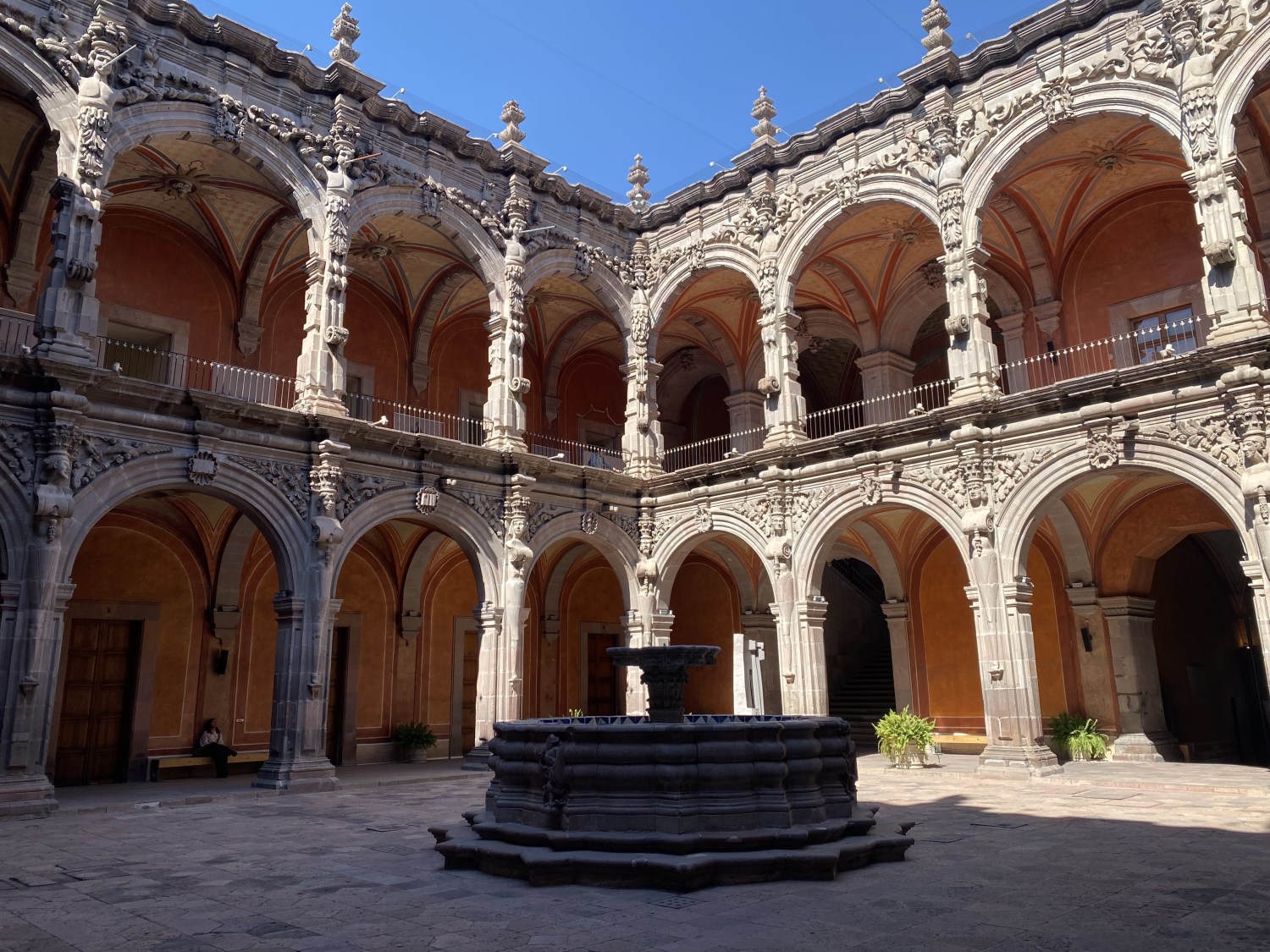
We made our way to the Museo de Arte de Querétaro (MAQRO) located in the former convent of San Agustín in Santiago de Querétaro.
The ex-Convent is one of the most beautiful baroque buildings in Latin America, especially its cloister, which is the quadrangular interior courtyard. Both the convent and the adjacent church were built in the 18th century, between 1731 and 1745. Its baroque style is full of details that represent Augustinian theology and philosophy.
The Augustinians remained in the building until 1859. During the government of President Benito Juarez, the law of reform was enacted and the building became the property of the state. It was subsequently used as military barracks, the Federal Palace, the Post Office and the Finance Office.
In 1987, the building was declared a Cultural Heritage Site and the Art Museum was created under the joined management of the state and federal government. The building was restored and opened its doors on September 22, 1988.
The Lower Cloister represents the world, the temporary work of the militant church, the sacrifice of Christ, as well as the history, vocation and charisma of the Augustinian Order. Anthropomorphic figures refer to the three stages of human life and spiritual evolution of an individual: youth, maturity, and old age.
The fountain of the cloister is one of the principal elements. It represents Christ as source of eternal life.
The Upper Cloister represents the church and its ministers. Juvenile-looking anthropomorphic figures represent the priests praying and manifesting the mystery of Trinity. Pipes in their mouths vent rainwater which symbolically represent cleansing of sins with divine grace. Among them are animals and fantastic beings that represent the sins of man that stalk those who seek to devote themselves to contemplation and devotion. In the keystones, monks and nuns represent the duties of the monastic life.
The Sky represents the Kingdom of Heaven, the dwelling place of God.
Formal exhibition spaces are tucked behind the long arcades that surround the courtyard, as well other beautiful spaces in the museum: the upstairs hallways, the staircase, and the outdoor porticoes.


We enjoyed works by Mexican sculptor and architect Pablo Fierro. As an artist, his work has focused on developing an alternative vision of sculpture, subverting its values: space, texture, and form. His work, transcending traditional frameworks of form and materiality, explores emptiness not as absence, but as the fullness of meaning. In his own work, he reflects: “Emptiness does not deny existence, it gives meaning to what we are and what remains to be.”


Another exhibit we loved was “Moments Suspended in Time” by James Harvey, an American artist based in San Miguel de Allende and a graduate of the Rhode Island School of Design. The artist attempts to express in a single glance the elusive, progressive and changing movement of bodies surrendered to the magic of music and dance. In this interesting exhibition he brings colors and strokes to his canvases, capturing and allowing, at the same time, the dynamism of the choreographic language, feelings, warmth and vitality.


My favorite exhibit at the Museo de Arte de Querétaro was “Reimaginando el papel” or “Paper Reimagined” by Terry Ann Tomlinson. Explains Tomlinson: “Using ancient Japanese techniques and traditional natural Asian fibers, I make paper that has delicacy and strength, translucency and resilience. Through abstract imagery and minimal content, I explore the profound spiritual connection between all living things.”
As someone who is enamored of paper, as found bound in physical books and journals, I was fascinated by the many ways the artist expressed herself in the medium.


We found a few odds and ends in another gallery.


We walked back to our hotel where we rested a bit before dinner, passing by the Templo de San Francisco de Asís, one of Querétaro’s oldest and loveliest buildings. Construction on this church and the adjoining Franciscan convent began as early as the 1540s, though the temple wasn’t completed until the middle of the following century. The former monastery that adjoins the church is now home to the Museo Regional de Querétaro, which we planned to visit on Tuesday.


Bistrot Chez Julien
Sunday night, we stepped out a few doors down from our hotel to have dinner at Bistrot Chez Julien, another recommendation by Endre from Terra Vista in Guanajuato. We ordered dirty martinis, salmon mouse spread, and cheese fondue with bread cubes to the tune of “Mon Mec À Moi” by Chantal Chamberland. We were happy to have something different than Mexican food, although it was a lot of bread. Who can resist a pot of hot melted cheese though?


We strolled around the town after dinner and enjoyed the lively atmosphere.


Steps: 7,334; Miles 3.11. Weather Hi 88°, Lo 49°. Sunny.
Monday, March 3: Monday morning, breakfast was served on the hotel terrace: hot cakes for Mike & Chilaquiles with salsa verde for me.
We talked to an 80-year-old man named Craig from California who told us he had lived in Mexico for 10 years and said he was presently living in Casa Aspeytia Hotel. I was surprised: “You LIVE in the hotel?” He said yes, it worked out perfectly for him. He got a free breakfast every day and could talk to different people each morning. From the hotel, he could spend his days wandering around the historic city, eating lunch out, and either having a light dinner or eating dinner at the hotel restaurant. He said the hotel did his laundry too. I said, I’m surprised you wouldn’t want an apartment where you’d have a kitchen and a living area available. He said that would mean he’d live isolated in an apartment and wouldn’t have any social interactions like he did at the hotel. He seemed perfectly happy with the arrangement and planned to continue it into the foreseeable future.


Soon after breakfast, we took off for San Sebastián Bernal.
San Sebastián Bernal & Peña de Bernal
Monday we drove about an hour northeast of Querétaro to visit San Sebastián Bernal and its famous Peña de Bernal. Mike decided to climb partway up one of the world’s largest monoliths at 335 meters. It is said only the Rock of Gibraltar and Río de Janeiro’s Sugar Loaf are taller. Many believe the peña (rock) has healing energy and it is a popular pilgrimage site during the spring equinox. He couldn’t climb up to the top because we had foolishly scheduled massages at 4:30 and it would take us over an hour to get back to Querétaro.


While Mike climbed, I wandered around the colorful town of San Sebastián Bernal & its bright yellow Parroquia de San Sebastián, built from 1700-1725. It has a small neoclassical facade set against striking yellow walls and brick-red trim.
The tiny town of San Sebastián Bernal is a charming colonial town founded in 1642. It was recently inducted into Mexico’s Pueblos Magicos program, designed to recognize special or historic cities across the country.


When Mike finished his climb, he met me at Terazza, where we shared a vegetarian pizza lunch. It was breezy and pleasant with music creating a bit of an edgy ambiance: “Wait for You” by AMÉMÉ & Franc Fala, “Kidz” by Arodes, and “Sunrise” by Tripolism & Nandu. From the terrace we had great views of Peña de Bernal and the colorful town.


After lunch we walked around the town together.


Querétaro
We drove about an hour back to Querétaro. At our hotel we enjoyed 75-minute Swedish massages. We had a drink in the hotel as well as leftover pizza, then went out to look for some elote 🌽 for Mike. We topped off the evening with cups of ice cream.


Steps: 7,183; Miles 3.04. Weather Hi 88°, Lo 49°. Sunny.
Centro Histórico de Querétaro
Tuesday, March 4: Tuesday morning we went on a walkabout through the centro histórico of Querétaro.
Temple and Convent of Our Lady of Mount Carmel
We stopped in to the Temple and Convent of Our Lady of Mount Carmel. The Carmelites founded this religious complex in 1614, along the route of the Camino Real de Tierra Adentro (Silver Route which passed through Querétaro from the mines in Guanajuato and Zacatecas).
In 1863, the friars were evicted by the Laws of Reform and the site was later used as barracks, a hospital, an armory, and an ammunition factory during the Siege of Querétaro in 1867. Its bells were melted down to make shrapnel that was used in the conflict that overthrew Maximilian of Habsburg.
Its central nave features an image of Our Lady of Mount Carmel. Here is also the Lord of Works, who is still venerated by the locals. Its atrium used to function as a market; today it is a picturesque square at the corner of streets Morelos and Juarez. Some Carmelites continue to inhabit the convent.


Fountain of Neptune
Near the temple and convent, we were greeted by the Fountain of Neptune. Constructed in 1797 by the Mexican architect Francisco Eduardo Tresguerras, this fountain was initially installed on the land of the orchard of the convent of San Antonio, on what are today the streets of Corregidora and 16 de Septiembre. Its design, which showcases the god Neptune, included beautiful ornamentations which were removed in 1848. It was finally moved to this location in 1909.
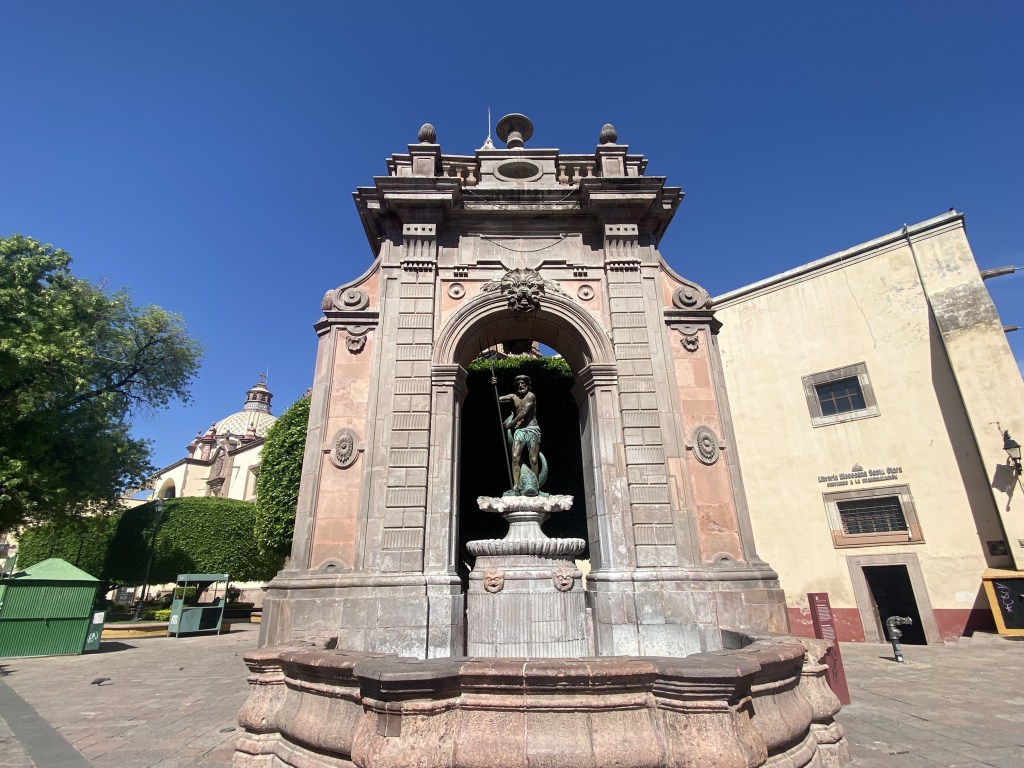
Fountain of Neptune
We continued our stroll through Querétaro.


MUCAL, Museo del Calendario
On our random walkabout, we found MUCAL, Museo del Calendario. The museum was housed in an amazing building with numerous flowering courtyards. Paintings in each gallery were done by different painters and were once used on calendars. It was so much fun to read about these paintings and their meanings. Most were depictions showing various aspects of Mexican life & culture.
I found out I am a Cabrá (goat) by the Chinese calendar. Of the goat, the sign says: “Personality and Qualities: Creative, generous, docile, intuitive, and modest, they also stand out for their honesty and sincerity, with a hint of shyness. Their nobility and tenderness can be trusted; deep down, they are pessimistic, insecure, and introverted. (Hmm…)
“The Goat comes across as docile, gentle, and hasty. They struggle to express their true emotions; it’s difficult to discover what’s going on inside; therefore, they can suddenly burst into tears for no apparent reason. With a strong tendency to daydream, they need support and guidance to be able to pursue what truly excites them, wandering in their inner world of fantasies. Insecure, they need to feel loved and in a protective environment. They have an unwavering, dreamy attitude, always in another world to escape reality.” (The part in purple I think is true of me!)
Mike is a Caballo (horse).


In the Galería Pintores / Multiple Painters Gallery (#5), we found original works of art from the great masters in calendar paintings such as Humberto Limón, Manuel Piña Vigueras (1930-1995), Antonio Gómez R., Santiago Sadurní Pernia (1923-1990), and Jesús Bribiesca.
Many calendar paintings reflected the “pin-up” style, in which girls pose in suggestive and mischievous attitude. It was a popular trend to have beautiful girls posing sensually in the calendars of the 1950s.
One image shows a family and child during his first Communion ceremony. Another shows a peasant performing her work in the field using her shawl to hold the seeds that are gently cast to the ground.
In Galería Santiago Sadurni Pernia (1923-1990) (#6), we found original paintings from this great calendar painter.


As we walked out of one gallery into another, we were surrounded by leafy and flowering courtyards with ambiance. The Galería (#7) Ángel Martin Merino (1932- ) showcased original paintings by this great calendar painter.
Galería (#8) Jesús de la Helguera (1910-1971) showed the most complete sample ever assembled from the most famous calendar painter of all time. Galería Raúl Vieyra Flores (1935- ) (#9) was a tribute to the calendar painter, recently presented in the Divus Prager Kabarett in Czech Republic with his covers of the comic book “El Libro Vaquero.”


Calendarios Antiguos/Antique Calendars (10-15) had samples of whole calendars from different years and months. Gallery 11 showcased antique calendars from 1890-1949.


We went up to the rooftop and then enjoyed fruit juices in the garden at Café MUCAL. After our break, we continued through the galleries #12 (1950-1959) and 14 & 15 (1960-2011). It was breezy and pleasant this morning in this beautiful space.


Then we wandered into a cute gift shop where we found metallic hummingbirds that we would take home tomorrow and put on our screened porch.


Temple of San Felipe Neri (Cathedral of Querétaro)
We continued walking to Temple of San Felipe Neri (Cathedral of Querétaro). Built in the late 18th century and consecrated in 1805, this temple is considered an exceptional example of the neoclassical style in Querétaro. Its façade stands out for the use of Greco-Roman and Tezontle columns, and a red volcanic stone rarely used in religious buildings of the time.
Querétaro was founded as a town of Indians without a cathedral. As the city grew, the ecclesiastical administration used existing temples, such as the Temple of the Congregation or San Francisco. At the beginning of the 20th century, San Felipe Neri was given up by its religious order and in 1921 the Holy See designated it as a cathedral. It was consecrated in 1931.

Temple of San Felipe Neri (Cathedral of Querétaro)
TEMPLO Y EX-CONVENTO DE SANTA ROSA DE VITERBO
We made it to a corner of the historic center where we found the Templo Y Ex-Convento de Santa Rosa de Viterbo, one of the finest Baroque structures in the city. It was originally designed and built by architect Ignacio Mariano de las Casas in 1754. Quite distinct from other baroque churches in Mexico, Santa Rosa de Viterbo distinguishes itself with an ornately designed exterior, replete with massive flying buttresses, carved stonework, delicate frescoes, and garish gargoyles. It stands over a small stone fountain in Plazuela Mariano de las Casa, and the overall effect is impressive.
Inside, the church is equally spectacular. Sadly, the principal altar was destroyed in 1849, but in the main nave, there are six gold-drenched churrigueresque altars from the 18th century as well as a collection of important colonial-era paintings and retablos.


We continued our stroll past a small simple chapel and an “UNO A UNO” stop sign. These are common on street corners in this area. Drivers are expected to stop, let one car go, then go themselves.


Temple and Convent of Santo Domingo
We popped into the Temple and Convent of Santo Domingo. Built around 1697, this religious complex served as a resting place for Dominican missionaries on their way to the Sierra Gorda. In the viceregal age, the temple and convent occupied 15 thousand square meters on the block between the present streets of Guerrero, Ocampo, Pino Suárez, and Arteaga.
The site still has the main temple and an annexed chapel dedicated to the Virgin of the Rosary. The interior of the temple features mural painting, cupolas, and windows inspired by architecture of the Italian Renaissance. On its façade are various elements characteristic of the Baroque of Querétaro: scrolls, foliage, garlands, and Hermes of cantera (a type of rock native to Mexico).


Yougan Sushi
We ended up at Yougan Sushi for lunch. We wanted something different from Mexican food, but at this place both the food and service were awful. My shrimp tempura rolls were layered with sliced American cheese. Mike’s udon was just okay. I really regretted this meal! Only the cute decorations in this place made it slightly worth our while.


Museo Regional de Querétaro
After lunch, we went to the Museo Regional de Querétaro, housed in the beautiful former monastery that adjoins the Templo de San Francisco de Asís.
The 11 rooms in this historic space display artifacts from Querétaro city and state, including a nice collection of ceramics and sculpture from the region’s pre-Columbian cultures.
The exhibits address each era in Querétaro’s history, with rooms dedicated to the colonial era (including personal effects of the famous Josefa Ortiz de Dominguez), the Reformation, the American invasion, the 19th century, and the Mexican Revolution. Texts are only in Spanish.


There was a modern art exhibit in one gallery called BOCAMINA (Entrance to a mine shaft or gallery), Pintura de Virginia Ledesma.


Jardín Zenea
Jardín Zenea occupies a full city block between Calles Corregidora and Juárez in the centro histórico. Named after a former Querétaro governor, Benito Santos Zenea, this lovely garden is one of the most popular gathering points in town. Often, there are performances in the round kiosk in the middle of the plaza.
We especially loved the trees pruned into dome-like shapes.


Mercado de la Cruz
At the end of our day, we walked quite a distance from our hotel to Mercado de la Cruz, Querétaro’s large covered market. It is a colorful place to shop for fresh produce, fish, meat, flowers, and crafts. It is also a great place to get a bite to eat, with a wide array of food stalls and fruit stands throughout the interior. It opened on September 28, 1979.
Mercado de la Cruz is a bustling urban market, typical of many large Mexican cities though more picturesque (and photogenic) than others.


Terraza la Grupa
Our last night in Querétaro, we enjoyed dinner on the terrace of our hotel, Casa Aspeytia, at the restaurant Terraza la Grupa. I had ravioli and Mike three pastor tacos; we also shared guacamole & chips, tomato soup in a bread bowl, and a brownie with ice cream. I think we went a bit overboard. But we did enjoy the sunset and one of us at least enjoyed the live music. 🎵


Steps: 12,795; Miles 5.43. Weather Hi 86°, Lo 50°. Sunny.
Wednesday, March 5: We left Querétaro early this morning and drove, mostly without incident, about 2 hours and 45 minutes to Mexico City International Airport, where we turned in our rental car to Alamo. Our Avianca flight was supposed to be at 4:50 p.m. but we had been notified that the plane was late and would leave instead at 5:41 p.m., arriving in El Salvador at 8:03 (2 hours 22 minutes). Sadly that meant we would likely miss our 8:30 flight home from El Salvador to Washington.
When we arrived in El Salvador, we practically ran to the gate, thinking they might let us on, but they had closed the gate and wouldn’t open it. Instead, we had to wait for a 10:05 p.m. flight to Washington.


Steps: 6,848; Miles 2.9. Weather Querétaro: Hi 88°, Lo 46°.
Thursday, March 6: We finally arrived home after a (4 hr 7 min) flight home at 3:04 a.m. on March 6. Finally, we were home sweet home in Virginia after a month away!
Welcome to Virginia
Steps: 10,833. Miles 4.59.
 ~ wander.essence ~
You must be logged in to post a comment.