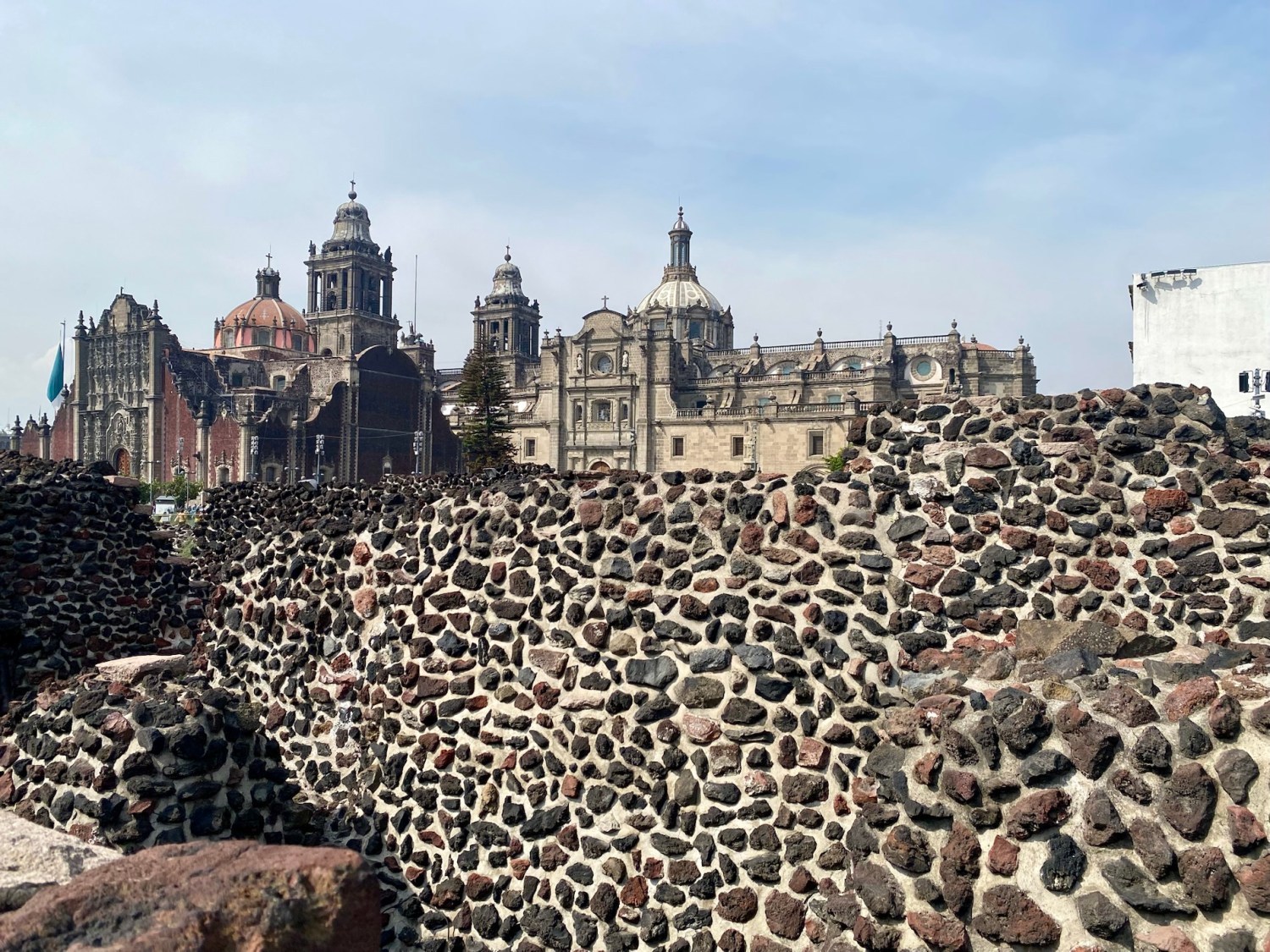

Mexico City’s Centro Histórico
Tuesday, February 18, 2025: Tuesday morning we headed to the Centro Histórico in Mexico City. The Zocalo was sadly blocked off for a special event. Also the Palacio Nacional was closed, so we couldn’t go in to see the famous Diego Rivera murals.
Catedral Metropolitana
Instead we went to the Catedral Metropolitana. This iconic cathedral is a monumental edifice: 109m long, 59m wide and 65m high. Started in 1573, it remained a work in progress during the entire colonial period, thus displaying a catalog of architectural styles. The conquistadors ordered the cathedral built atop the Templo Mayor and used most of the Templo’s Aztec stones in its construction.
Upon entering, we were met by the elaborately carved and gilded Altar de Perdón (Altar of Forgiveness).
The cathedral’s chief artistic treasure is the 18th-century Altar de los Reyes (Altar of the Kings), behind the main altar.
Fourteen richly decorated chapels line the two sides of the building. Enormous painted panels by colonial masters Juan Correa and Cristóbal de Villalpando cover the walls of the sacristy, the first component of the cathedral to be built.
We wandered freely until we encountered a barrier due to a 9:30 Mass being held. Thus we weren’t able to see the Altar of the Kings or the Main Altar.


Templo Mayor & Museo del Templo Mayor
After visiting the cathedral in Centro Histórico, we walked next door to Templo Mayor. This temple complex was the center of the universe, according to Aztec cosmology. Dedicated to gods of sun and rain, Templo Mayor was a vital hub for religion and politics. With every ruler, it expanded and included sacrifices for prosperity. Visiting the shrines, ruins, museums and gruesome relics of Templo Mayor reveals a fascinating origin story of Mexico City.
The Huey Teocalli, as the Great Temple was known, was enlarged seven times. To show the grandeur and wealth of the kingdom, a larger pyramid was built over the previous stage every so often. Archeologists have linked each phase to the rule of a tlatoani, or supreme ruler.
The Great Temple was the most important of the 78 buildings in the great plaza of Tenochtitlan. The foremost political and religious ceremonies were held there. The building sat on a huge platform, with two stairways leading to the shrines of the gods, Tlaloc, lord of rain and fertility, and Huitzilopochtli, god of war.
Few vestiges remain from the seventh expansion, which Hernán Cortés saw, because it was destroyed in the colonial period. According to estimates, it measured 84 meters from north to south, 77 from east to west, and was about 45 meters tall.
In the small introductory museum to the temple we found “the sacred tree, upholding the sky and communication with the underworld.” It is believed to be of great significance for Templo Mayor rituals, based on its location at the foot of the Huitzilopachtli shrine stairway and the round base built around it. It is an oak tree dated to AD 1440-1469. Its trunk is divided into two arms, perhaps intentionally modified.
For the people of ancient Mexico, trees had important meaning. Its branches upheld the celestial vault and cosmic energies flowed through their trunk and roots, both from the underworld and the celestial levels, radiating to the earthly plane. These energies could be beneficial or dangerous for humankind, which made it indispensable to win the favor of the gods.
Sculptures of four serpent heads line the stairway. At each end of the façade, there are two enormous undulating serpents that have retained their original color.
One of the most important places in the Sacred Center was the House of the Eagles. It was here that the Mexica elite held their ceremonies, including meditation, prayer, penitence, and the rendering of offerings.
The banquettes in the House of the Eagles display beautifully carved bas-reliefs, painted in bright colors against a red background. The scene portrayed on the banquettes is that of a procession of armed warriors converging in a zacatapayolli, a ball of dried moss or grass used to hold the bloody spines or spikes used in self-sacrifice.


Museo del Templo Mayor houses a model of Tenochtitlán and artifacts from the site, and gives a good overview of Aztec, aka Mexica, civilization, though it has little signage in English, unlike the ruins. Pride of place is given to the great wheel-like stone of Coyolxauhqui (She of Bells on Her Cheek), best viewed from the top-floor vantage point. She is shown decapitated, the result of her murder by Huitzilopochtli (her brother: the hummingbird god of war, the sun and human sacrifice), who also killed his 400 brothers en route to becoming top god. The museum’s latest artifact is an Aztec sculpture of Xipe Tótec, a deity to which the Aztec’s made human sacrifices.
Censers were used by the Aztecs to burn copal, a resin which expels an aromatic smoke that was offered to the gods.
In many offerings were found representations of diverse gods, Mezcala-style masks, Mixtec-style anthropomorphic figures, sacrifice knives and a green stone sculpture representing a heart.
Among the Aztecs, the concepts of war and sacrifice satisfied the needs of cohesion and reproduction of society. The warrior had a fundamental importance and he was immersed in an ideological-religious system that made him want to die in war or through sacrifice, since he would then be able to pay the gods their mythical sacrifice, which had given origin to life.
Nevertheless, even though war was justified due to religious aspects, in the practical area it sought to expand territories in order to obtain diverse products through the collection of tributes.
The political and economic power of the Aztecs manifested through the payment of tributes and the control over the main trade routes, thereby obtaining food, blankets, feathers, jewelry, and various exotic objects, as well as materials and labor for the construction of their big temples and public buildings.


The encounter between Hernán Cortés and Moctezuma took place on November 8, 1519. Almost two years later, on August 13th, 1521, Tenochtitlan fell definitively in the hands of the Spaniards and Cuauhtémoc was imprisoned.
Cuauhtémoc was the Aztec ruler (tlatoani) of Tenochtitlan from 1520 to 1521, and the last Aztec Emperor. The name Cuauhtemōc means “one who has descended like an eagle,” and is commonly rendered in English as “Descending Eagle,” as in the moment when an eagle folds its wings and plummets down to strike its prey; the name thus implies aggressiveness and determination.
Cuauhtémoc took power in 1520 as successor of Cuitláhuac and was a cousin of the late emperor Moctezuma II. He ascended to the throne when he was around 25 years old, while Tenochtitlan was being besieged by the Spanish and devastated by an epidemic of smallpox brought to the Americas by Spanish conquerors.
In 1525, Cortés took Cuauhtémoc and several other indigenous nobles on his expedition to Honduras, as he feared that Cuauhtémoc could have led an insurrection in his absence. While the expedition was stopped in Acalan, Cortés had Cuauhtémoc executed by hanging for allegedly conspiring to kill him and the other Spaniards.
Below are scenes from around the Zocolo: a healer near the Zocolo, a little coffee shop break at Bisquets Obregon, and gardens beside the cathedral.


Palacio de Correos de México (The Postal Palace)
Palacio de Correos de México (The Postal Palace) is an architectural extravagance of Art Nouveau, Spanish Renaissance Revival, Plateresque, Spanish Rococo style, Elizabethan Gothic, Elizabethan Plateresque, and Venetian Gothic Revival. Noteworthy elements are also Moorish, Neoclassical, Baroque, and Art Deco.

Palacio de Correos de México
Built by Italian Adamo Boari and Mexican Gonzalo Garita in 1902, the building opened in 1907 in the waning years of the Porfirato (1876-1911). The late 19th century saw Porfirio Díaz consolidate power, and a flowering of European and Neo-Indigenist architecture. The period is known today as “the Porfiriato.”
It was intended, then as now, as a main city post office. At that time, the notion of a national postal system was considered extravagant.
The Postal Palace is full of gargoyles, marble ornaments, and elaborate plaster work. Staircases are made of Mexican marbles and the bronzes were cast in the Fonderia Pignone in Florence, Italy. Inside, marble floors and shelves are combined with bronze and iron window frames. These, too came from Florence.
The stairways cross on the second floor landing, after which they move off in their own directions.


The Postal Palace continues to serve the postal service. It also contains a museum with displays of tools of the trade and historical documents.


The second floor is devoted to the permanent exhibition on Postal Culture. There’s an interactive room, and an introduction to Philately. The library contains 8,500 volumes and 240 historical documents dating from 1580 to 1900.


Palacio de Bellas Artes (Palace of Fine Arts)
The Palacio de Bellas Artes (Palace of Fine Arts) is a cultural center that hosts performing arts events, literature events and plastic arts galleries and exhibitions (including important permanent Mexican murals). “Bellas Artes” for short, has been called the “art cathedral of Mexico.”
Bellas Artes replaced the original National Theater, built in the late 19th century. The latter was demolished as part of urban redesign in Mexico City, and a more opulent building was planned to celebrate the centennial of the Mexican War of Independence in 1910. The initial design and construction was undertaken by Italian architect Adamo Boari in 1904, but complications arising from the soft subsoil and the political problem both before and during the Mexican Revolution, hindered then stopped construction completely by 1913. Construction resumed in 1932 under Mexican architect Federico Mariscal [es] and was completed in 1934. It was then inaugurated on November 29, 1934.
The exterior of the building is primarily Art Nouveau and Neoclassical and the interior is primarily Art Deco.
The building is best known for its murals by González Camarena, Diego Rivera, Siqueiros and others, as well as the many exhibitions and theatrical performances it hosts, including the Ballet Folklórico de México.


Casa de los Azulejos (House of Tiles)
The Casa de los Azulejos (House of Tiles) or Palacio de los Condes del Valle de Orizaba (Palace of the Counts of Valley of Orizaba) is an 18th-century Baroque palace in Mexico City, built by the Count of the Valle de Orizaba family. The building is distinguished by its facade, which is covered on three sides by blue and white colonial Talavera tiles from Puebla state. The palace remained in private hands until near the end of the 19th century. It changed hands several times before being bought by the Sanborns brothers who expanded their soda fountain/drugstore business into one of the best-recognized restaurant chains in Mexico. The house today serves as their flagship restaurant.


Museo Nacional de Arte
Since most museums in Mexico City are closed on Mondays, and since the city of 25 million is slow to navigate, we couldn’t stop ourselves from visiting as many museums as we could in the Centro Histórico. We were utterly exhausted but we had to stop at one last museum, the Museo Nacional de Arte.
The museum was built around 1900 in the style of an Italian Renaissance palace.
The statue in front is Carlos IV of Spain and was designed by architect Manuel Tolsá, giving the plaza here its name.
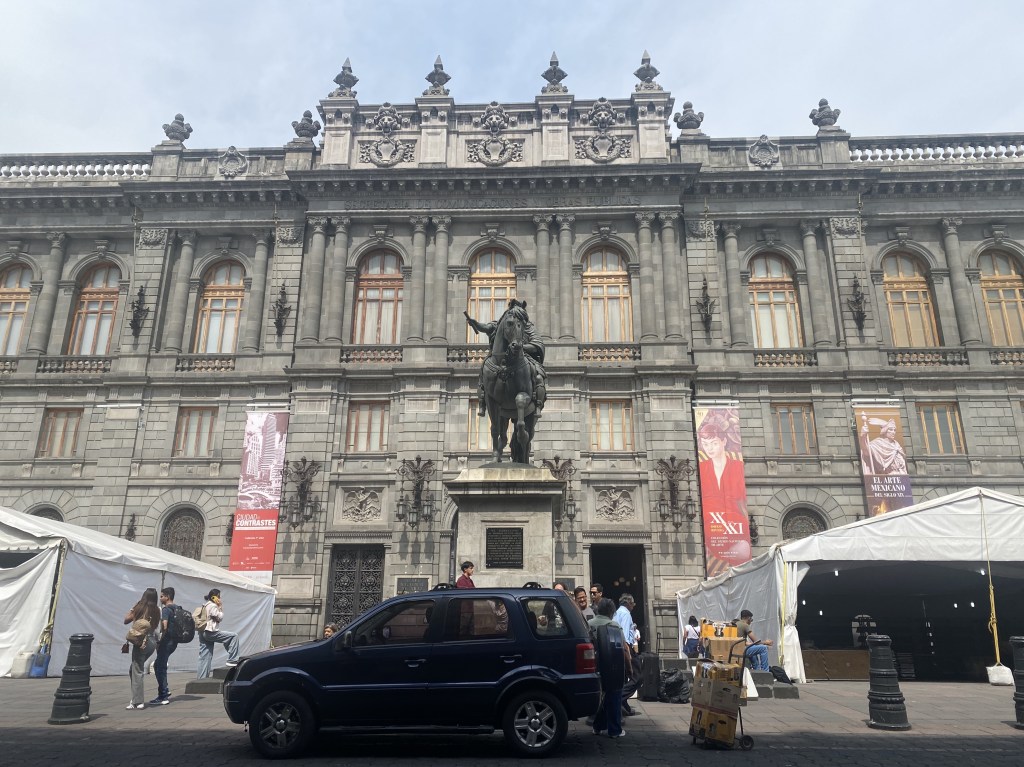
Museo Nacional de Arte
This museum holds collections representing every school of Mexican art until the early 20th century. A highlight is the work of José María Velasco, depicting the Valle de México in the late 19th century. We also found a number of Diego Rivera paintings and a mural, but sadly we couldn’t find anything by Frida Kahlo.


We found a Diego Rivera mural in the museum: Río Juchitán/ Juchitán River (1953-1955).


The rest of the mural.


Páramo in Roma Norte
After our exhausting museum day in Centro Histórico on Tuesday, Feb 18, we relaxed a bit in our apartment and then went out to the charming, atmospheric, and hip Páramo, where we had a hard time choosing from the exhaustive taco menu. We shared Taco la Poblana Taquito, Taco Emalaura Taquito, and Taco Roma Taquito. It was a wonderfully pleasant experience, topped off by a delectable chocolate cake. The music at this trendy restaurant included “Cumbia de los Pajaritos” by Grupo Fantasma; “Fu Man Chu” by Desmond Dekker & The Aces; and “Take Me to the River” by Talking Heads. This was one of our favorite dining experiences in Mexico City.


After dinner, we took a short stroll around our Roma Norte neighborhood and found a cute children’s hair salon with elevated metal cars serving as chairs for the children. We ran across the Bob Dylan mural and Mike sat on the bench below posing like Dylan. Every night we were tempted by the neighborhood heladería, but we were always too full to partake. 🙂


Steps: 13,367; Miles 5.67. Weather Hi 72°; Lo 50°. Cloudy/rainy.
 ~ wander.essence ~
You must be logged in to post a comment.