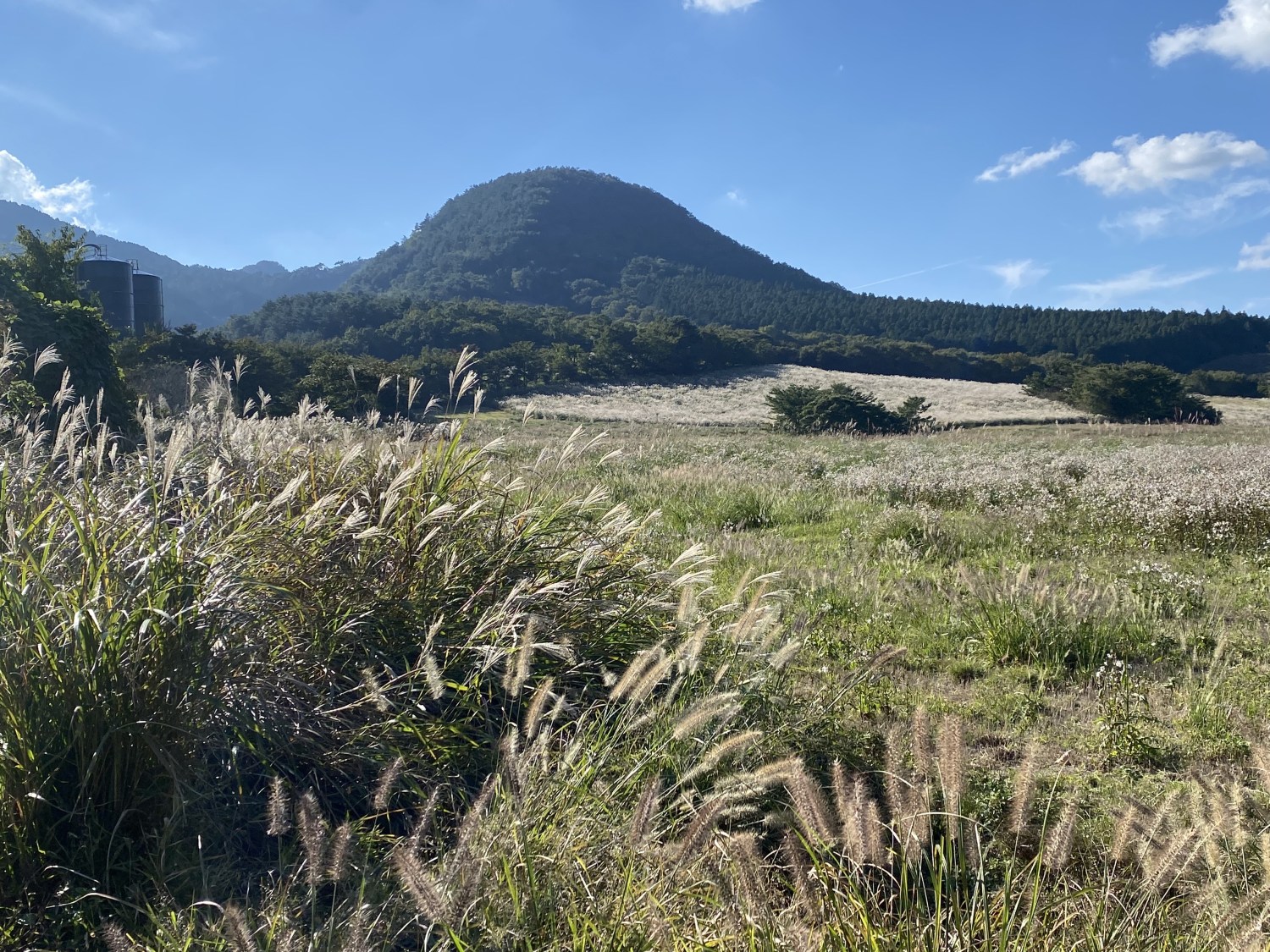

Leaving Okayama for Kyushu
Friday, October 11, 2024: Friday morning we took our last Shinkansen in Japan from Okayama to Kokura Station on Kyūshū Island.


Near the station we rented a Toyota Yaris for our final week in Japan. Mike is getting very good at driving on the left. Only every once in a while do I have to remind him to “stay to the left, stay to the left!”

Toyota Yaris rental for our last week in Kyushu
Beppu & the Seven “Hells”
We drove 1 1/2 hours without incident to Beppu, where we would stay for one night before going to Yufuin. We stopped at a rest area for a quick lunch; from a lookout there, we could see Beppu Bay and the city of Beppu.


Once we arrived in Beppu, it was too early to check in to our hotel, so we left our luggage and went off to explore Beppu’s Seven “Hells,” known in Japanese as jigoku (地獄).
According to a brochure, “Welcome to Jigoku:”
“National sites of scenic beauty are cultural assets designated by the Japanese government that are known for their beauty. On July 23, 2009, four Jigoku areas received this designation for the first time as hot springs: Umi Jigoku, Chinoike Jigoku, Tatsumaki Jigoku, and Shiraike Jigoku. They were the first areas in Oita Prefecture to be designated in 86 years. The four areas were chosen because Beppu has been renowned as a hot spring resort in Japan since ancient times. The Jigoku areas are hot spring sources that burst forth in … diverse colors and forms and have appreciation value, landmark value, and educational value.”
The “hells” of Beppu are seven hot springs for viewing rather than bathing, displaying steaming ponds of various colors, bubbling mud pools and other hydrothermal activity.
The hells are presented in a rather touristy fashion, not exactly appealing to us. Five of the seven hells are located in the Kannawa district, and two in the more remote Shibaseki district.
Five “Hells” in the Kannawa district
We spent Friday afternoon exploring the five hells in the Kannawa district. We would explore the Shibaseki district on Saturday morning before leaving Beppu.
Our first stop was Kamado Jigoku. The “cooking pot hell” features several boiling ponds and a flashy demon statue as a cook. The spring was named after the practice of cooking rice with Jigoku steam at the festival of Kamado Hachimangu Shrine. The hot springs temperature is 90° Celsius.
On the grounds, visitors can drink the hot spring water, enjoy hand and foot baths, inhale the hot spring steam and try various snacks cooked or steamed by the hot spring. We didn’t try the hand or foot baths, or any of the steamed food, but we did most everything else.


Umi Jigoku (National Site of Scenic Beauty) is one of Beppu’s more beautiful hells . The “sea hell” features a pond of boiling, cobalt blue water. Its temperature is 98°C. It was formed 1200 years ago from the explosion of Mt. Tsurumi.
Red torii gates also decorate the landscape. In its spacious gardens, there are a few smaller, orange colored hells and a clear water pond with lotus flowers. This was our favorite of the “hells.”


Oniishi Bozu Jigoku is a “hell” named after its mud bubbles which emerge from boiling mud pools and look like the shaven heads of monks. It is named after the place Oniishi. The hot spring’s temperature is 99°C. There is also a foot bath with clear water.


We didn’t care at all for Oniyama Jigoku, or “monster mountain hell.” It is also known as Wani Jigoku (literally “crocodile hell”). In 1923, the area became home to Japan’s first crocodiles, using the hot spring’s heat to provide a suitable habitat. Today about 80 crocodiles are bred and kept on the grounds. I didn’t see the purpose of this!
The hot spring’s temperature is 99.1°C.


The last of the hells we saw on Friday was Shiraike Jigoku (National Site of Scenic Beauty), the “white pond hell,” which features a pond of hot, milky water. The pond is surrounded by a nice garden and a small, run-down aquarium that has seen better days. We didn’t bother going to the aquarium, but instead went to check into our hotel.


These “hells”’were all very touristy and we didn’t really care for them much. There wasn’t much else to do in Beppu so we went anyway.
Pizza was becoming our lifesaver these final days in Japan. We were burned out on Japanese food. I realized that when I lived in Japan in 2017, I had a very small repertoire of foods I ate on repeat. During this trip, we were faced with all kinds of strange food, much of which I just couldn’t stomach. The Japanese diet really hit us hard in Yufuin (more about that later).
After checking into AMANEK Beppu YULA-RE, we went in search of pizza which happened to be right around the corner from the hotel at a cozy little Italian place called Casa Dal. After dinner, we returned to the hotel to get our welcome drinks and then we soaked in the public onsen. We only stayed in Beppu one night.


Steps: 10,958; Miles 4.64. Weather Hi 79°, Lo 56°. Sunny.
Two “Hells” in the Shibaseki District
Saturday, October 12: On Saturday morning before leaving Beppu, we went to the Shibaseki District to see the last two “Hells.” First we visited Chinoike Jigoku (National Site of Scenic Beauty), the “blood pond hell.” It features a pond of hot, red water and a large souvenir shop. It is one of the more photogenic hells. It is also the oldest natural jigoku in Japan, described as Akayusen (lit. “red hot spring”). The hot spring’s temperature is 78°C.
According to a sign: “This jigoku is the oldest natural jigoku in Japan and the pond is blood-red in color because this place is a red-colored clay area, and the red clay dissolves in boiling water. This boiling red-colored water is used as a dye and is also good for skin diseases.”


Lastly, we visited Tatsumaki Jigoku (National Site of Scenic Beauty), the “spout hell,” which features a boiling hot geyser that erupts every 30-40 minutes for about 6-10 minutes. A stone plate above the geyser hinders it from reaching its full height. The hot spring’s (fumarolic) temperature is 105°C. A short walking trail leads up the forested slope in the back of the hell grounds.


None of this remotely comes close to the fabulous Yellowstone National Park in the U.S. that has geysers and hot pools such as these. Yellowstone is in a natural setting, while the “hells” of Beppu are very touristy and garish. Coming to a place such as this makes me realize what a great National Park system we have in the U.S.
Before leaving Beppu, we wanted a quick bite to eat for lunch so we stopped at the Beppu McDonald’s. In all my travels, I’ve very rarely opted for McDonald’s as a food option, but here it was perfect – easy, convenient and quick. A Japanese man who lived in 8 countries during his diplomatic service helped us order since the menu was in Japanese. He sat with us for our brief lunch and told us he likes American people for their bluntness; he dislikes Japanese people because “they are of two faces.”


Driving from Beppu to Yufuin
As we drove from Beppu to Yufuin on Japan’s island of Kyūshū, we enjoyed views of the mountains in the region. The latter photos are from the ASOKUJU NATIONAL PARK SAGIRIDAI OVERLOOK looking down on Yufuin.


Yufuin was one of the most over-hyped areas we traveled to on the island of Kyūshū. We at first were impressed by the view down the Main Street of Yufu Mountain at its end; it reminded me of Silverton on the Million Dollar Highway in Colorado. The resemblance ended there.
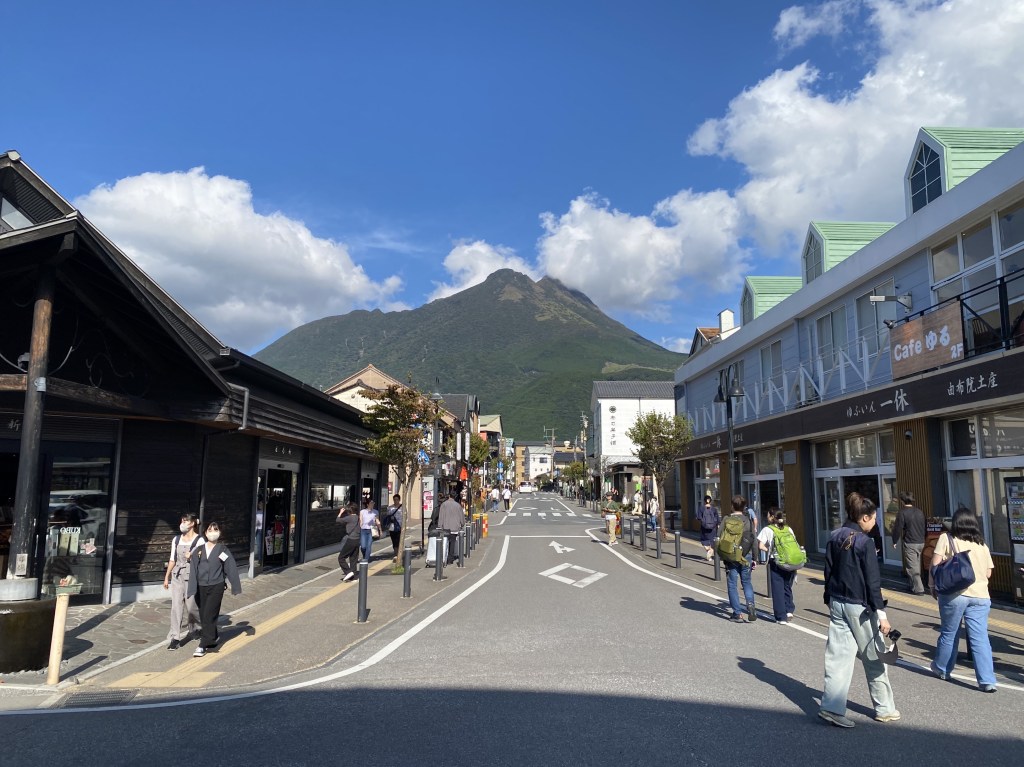
Yufuin
Though the drive was pretty getting there, the town itself had not much to offer: mainly a “cute” shopping street where everyone wandered up and down aimlessly looking at shops with various sweets or tiny useless knickknacks. I found one shop that had some nice natural stuff made of straw, wood and other nature’s bounty but I couldn’t have carried any of it in my suitcase.


Mike found a barbershop and got a haircut. The elderly barber seemed very nervous cutting a foreigner’s hair, and honestly, he didn’t even cut properly the top of Mike’s head where his sparse hair was sticking straight up. Besides that, it took him nearly a half-hour!
The shopping street was utterly packed because it was some three-day holiday weekend and we finally gave up and went to our ryokan (traditional Japanese inn), which cost us an arm and a leg and included half board (breakfast and dinner).


Yufuin Onsen Wafu Ryokan Tsuenosho
We had reserved a two-night stay at Yufuin Onsen Wafu Ryokan Tsuenosho. The ryokan had two onsens for guest use and for once we could use one as a family, meaning Mike and I could go in together. Most of the onsens we’d visited had been separate onsens for men and women. After checking into our tatami-matted traditional Japanese room, we went to the onsen for a while. We had paid for half-board at this ryokan, so dinner was to be served in our room by the host at 6:00.


The woman host only spoke Japanese but she was quite adept at speaking into Google translate to tell us all we needed to know. She explained that the meal was Kaiseki(懷石) , a traditional multi-course Japanese dinner. The term also refers to the collection of skills and techniques that allow the preparation of such meals and is analogous to Western haute cuisine.
We started with a whole fish made into sashimi, including the skin and scales. We had salty mackerel and some local beef and many pickled root vegetables along with many mushy or weird textured foods. I honestly didn’t care for any of it but felt obliged to eat it so I wouldn’t appear rude. Since we were staying two nights, we had to eat two dinners and two breakfasts, which stressed me out so much. I’m very picky about meats and fish and strange textured foods, so it felt like an endurance test to get through it.
Despite all of that, it was beautifully presented but I honestly couldn’t wait to leave that place so I wouldn’t have to eat the food for another day!


Steps: 5,556; Miles 2.35. Weather: Beppu Hi 79°, Lo 56°. Yufuin: Hi 75°, Lo 51°. Partly cloudy.
Sunday, October 13: Our Sunday morning breakfast at Yufuin Onsen Wafu Ryokan Tsuenosho wasn’t quite as unpalatable as the dinner, but it still had some strange foods. My favorite item was the rice and the omelette-type egg.


Kinrin Lake & the Yufuin Shopping Street
After breakfast at our ryokan, we went to quaint Kinrinko Lake (金鱗湖). There are no tall buildings, only traditional houses and a shrine around the very small lake. I’d actually call it more of a pond and Mike commented that it was a pond no bigger than all the ponds at Franklin Farm near our house in Virginia. We couldn’t believe people were out in droves to stroll around this “lake.”
Despite our feelings about it, Kinrinko Lake is considered a rich symbol of Yufuin. The lake was called “Taken shitan ike” in the dialect of Oita, which means “the pond at the foot of the mountain,” because it is located at the foot of Mt. Yufu. It reportedly got its name from Mori Kuso, a Confucian scholar, who spotted a fish with scales that glittered like gold swimming there at sunset in 1884. It is an unusual lake with an outer periphery of about 400m, into which hot spring water flows while fresh water gushes from the bottom of the lake. Therefore the water temperature is high throughout the year. Apparently a mist rises from the surface of the lake when the outdoor temperature falls from autumn to winter.
The Tenso Shrine gate seen on Lake Kinrinko is the main photogenic subject on the lake.


After our very short stroll, we walked up and down the shopping street with its souvenir and sweet shops and hordes of people. Soon we were bored and went in search of a pizza place for lunch. We got a small pizza which was plenty for us.


We figured we were done seeing what there was to see in the town and decided to take a drive in the countryside.
Tsukahara Highlands
After leaving the town of Yufuin on Sunday afternoon, we drove up to find some grasslands, Tsukahara-kogen, a rich grassland at an altitude of about 600 meters on the northern side of Mount Yufu. It is a gently hilly area that spreads at the foot of Mount Yufu and Mount Tsurumi.
In the midst of the grasslands, we found a cozy little coffee shop where we stopped and had coffee, vanilla pudding and crème brûlée.
It was good to get away from the crowded town of Yufuin.


Yufuin Onsen Wafu Ryokan Tsuenosho
Mike and I went to the family onsen before dinner Sunday afternoon at Yufuin Onsen Wafu Ryokan Tsuenosho. It was lovely sitting in the outdoor bath with the maple leaves rustling in the breeze.


We endured another dinner at Yufuin Onsen Wafu Ryokan Tsuenosho. Three meals down, one to go. And yes, that was octopus that didn’t even look cooked. And a sea bream head. I chose not to eat much of it this time around. I’d had enough.


Steps: 8,018; Miles 3.39. Weather Hi 74°, Lo 49°. Sunny.
Monday, October 14: Monday morning, we ate our final breakfast at Yufuin Onsen Wafu Ryokan Tsuenosho. I survived!


Finally, we left Yufuin after breakfast and drove toward Mount Aso where we would stay two nights at another ryokan. Thank goodness at that place, no food would be involved, neither dinner nor breakfast. What a relief.
 ~ wander.essence ~
You must be logged in to post a comment.