When I was looking to travel somewhere in Asia from South Korea during my winter break in January, 2011, I decided I would go on a trip to Vietnam and Cambodia. I wrote about my call to Vietnam here: call to place: vietnam in 2011.
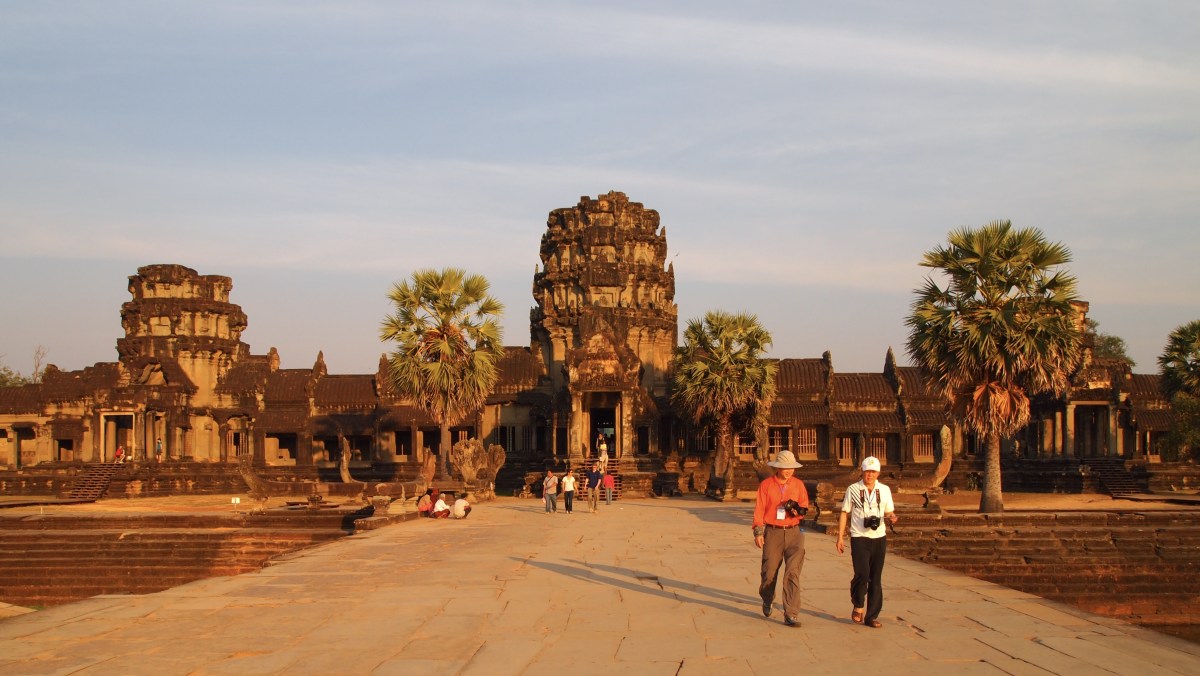
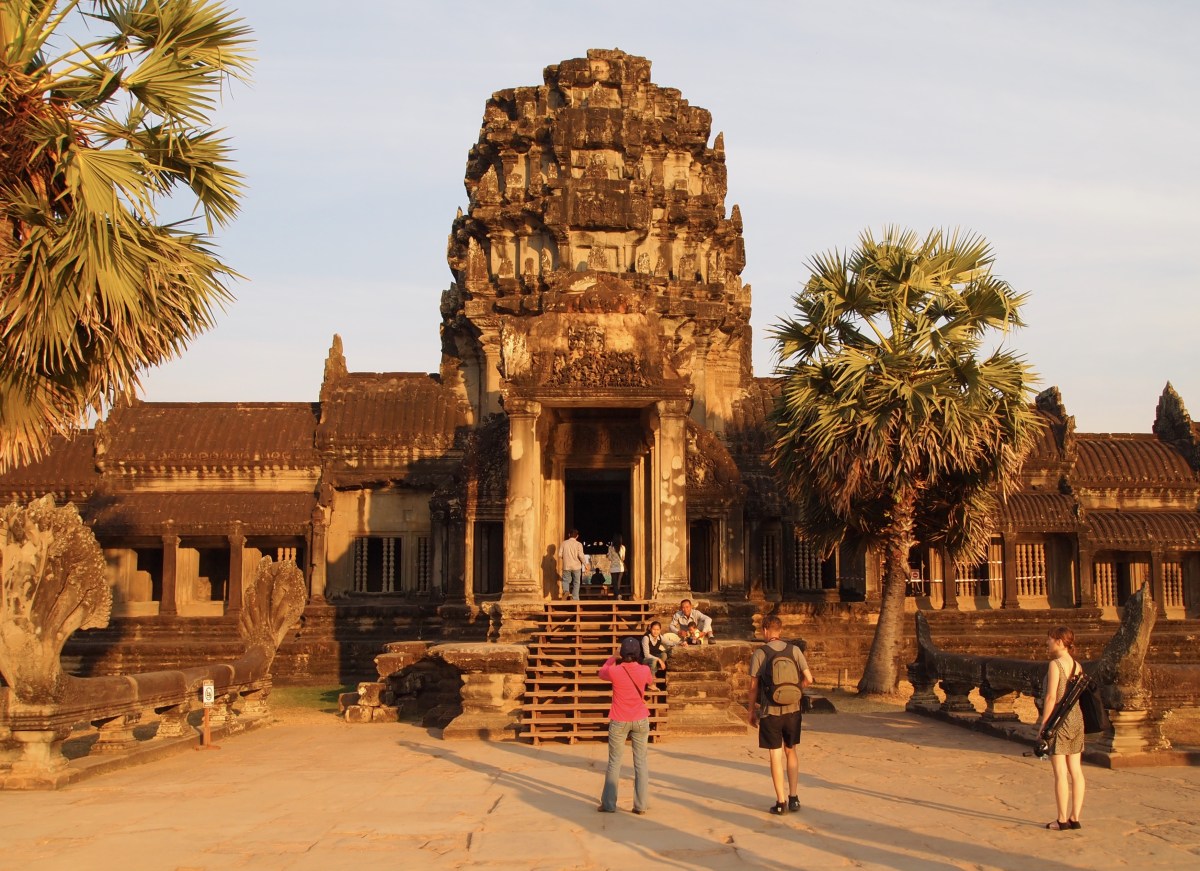
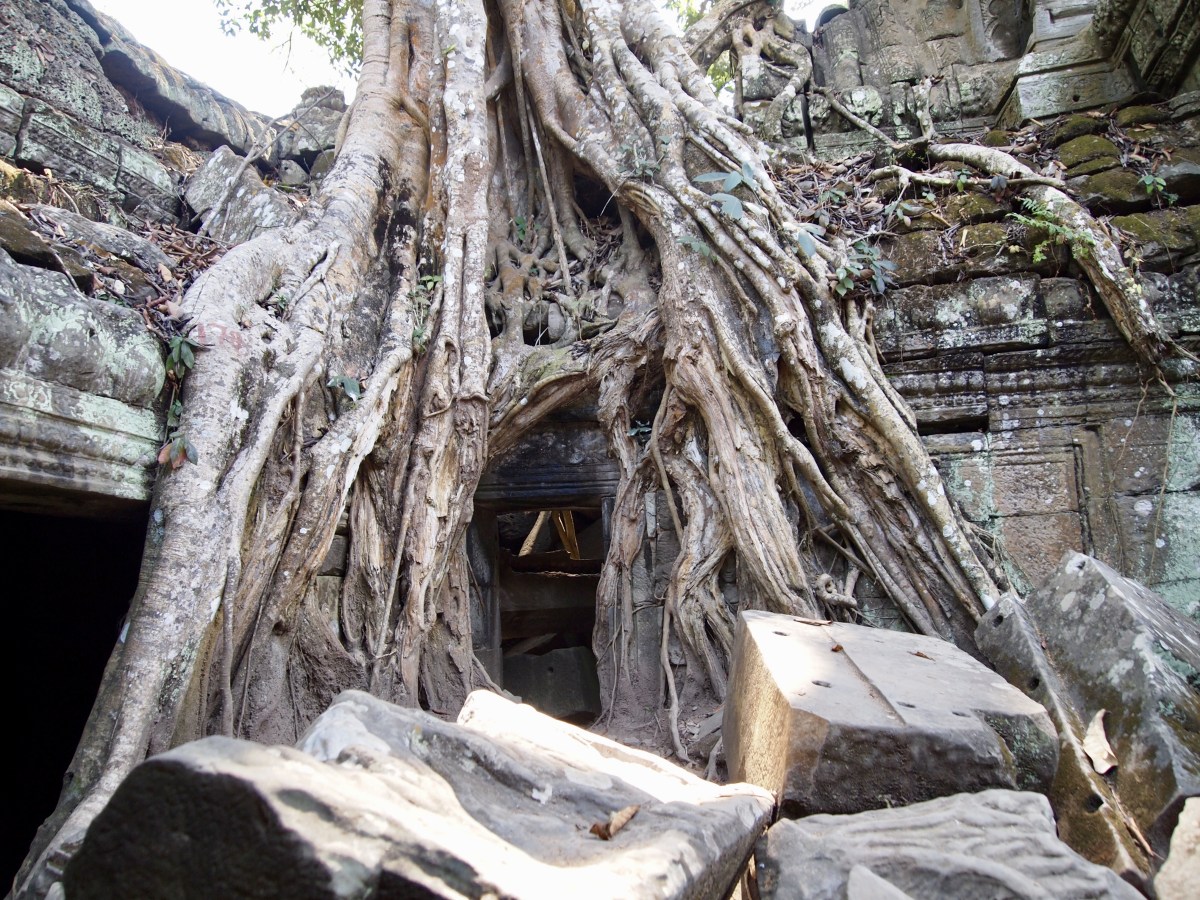
When I originally decided on Cambodia, the only place I had in my imagination was Angkor Wat, in Siem Reap. I had heard from various people that it could take 3 full days to see all the temple ruins, ruins that are engulfed by huge trees and their immense snake-like roots. Pictures of this place had fired my imagination for years. I really knew nothing about it except that it looked mysterious and beautiful.
approach to Angkor Wat
approach to Angkor Wat
Angkor Wat is a temple complex in Cambodia built for King Suryavarman II in the early 12th century. It was originally a Hindu temple, then Buddhist, and is now the world’s largest religious building. Restoration of the temples started in the 20th century, but was interrupted by civil war and Khmer Rouge control of Cambodia during the 1970s; amazingly little damage was done to the complex during this time of upheaval.
Angkor Wat
Ta Prohm
I was embarrassed to say I really didn’t know anything at all about Cambodia. I remember hearing of America’s bombing of Cambodia during the war, but I didn’t understand Cambodia’s involvement or why we were bombing them.
I would obviously have to prepare myself for more than the Angkor Wat temple complex if I wanted a deep experience of Cambodia.
********************
“THE CALL TO PLACE” INVITATION: I invite you to write a post on your own blog about what enticed you to choose a particular destination. If you don’t have a blog, I invite you to write in the comments. If your destination is a place you love and keep returning to, feel free to write about that. If you want to see the original post about the subject, you can check it out here: imaginings: the call to place.
Include the link in the comments below by Wednesday, October 23 at 1:00 p.m. EST. My next “call to place” post is scheduled to post on Thursday, October 24.
If you’d like, you can use the hashtag #wanderessence.
This will be an ongoing invitation, on the fourth Thursday of each month. Feel free to jump in at any time. 🙂
I hope you’ll join in our community. I look forward to reading your posts!
the ~ wander.essence ~ community
I invite you all to settle in and read a few posts from our wandering community. I promise, you’ll be inspired!
Thanks to all of you who wrote posts about “the call to place.” 🙂
I am traveling from September 1 to October 4. If I cannot respond to or add your links due to wi-fi problems or time constraints, please feel free to add your links in both this post and my next scheduled post. If I can’t read them when you post them, I will get to them as soon as I can. Thanks for your understanding! 🙂
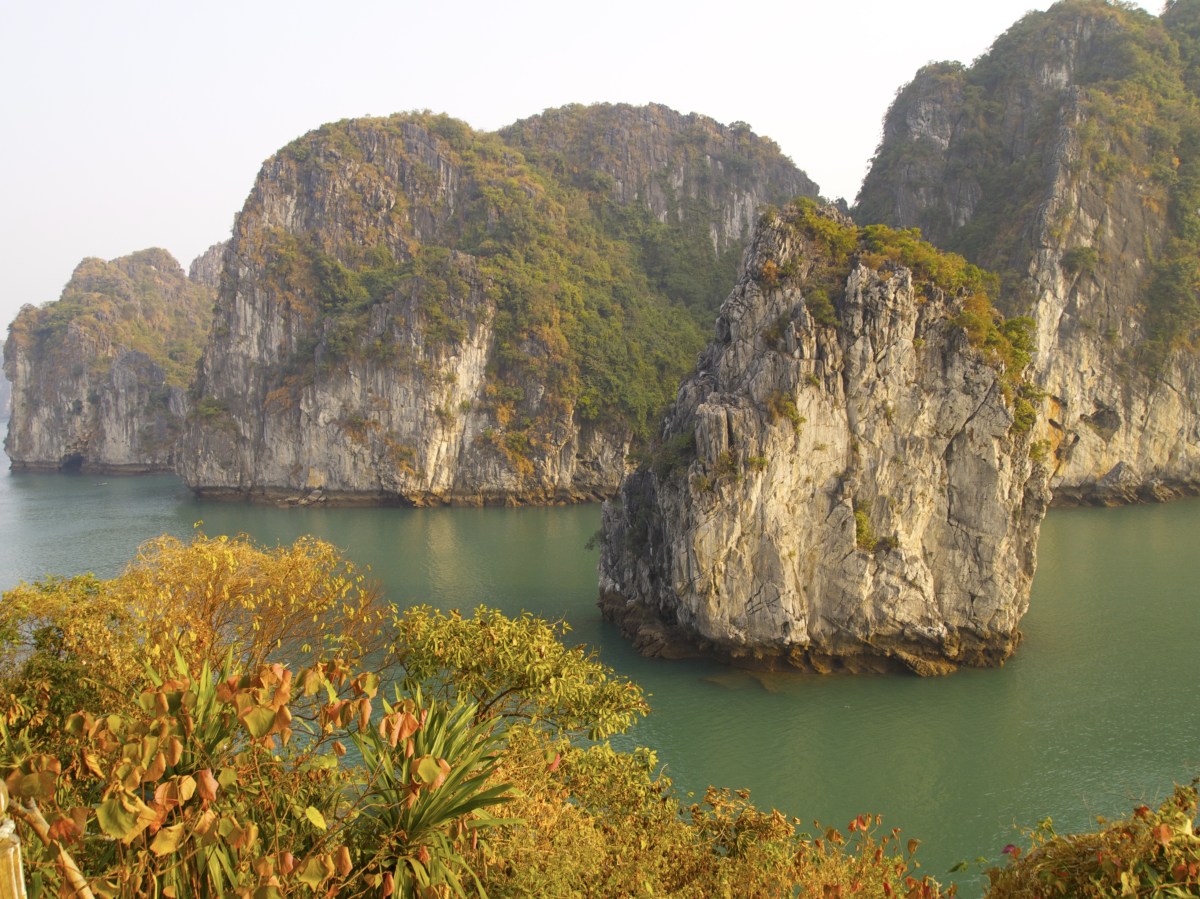
In January of 2011, I had been living and teaching English in South Korea for almost a year and had been trying to explore as much of Asia as I could. I felt the urge to travel during my winter break to Vietnam and Cambodia. In Vietnam, I’d throw myself into the craziness of Hanoi and sail on a placid junk through the mystical karsts of Halong Bay.
chaos in Hanoi
karsts in Halong Bay
karsts in Halong Bay
I was excited, as always, to travel to an exotic land. But, I also felt trepidation about this trip, mainly because of my lifetime exposure to the horrors of the Vietnam War and the extensive reading I’d been doing to prepare. I was a child of the Vietnam War-era, but I was in the generation too late, thank goodness, to actually go to war. I was too young to understand everything that was going on at the time, but I remember the horrifying images of the war brought into our living room nightly on T.V.: A Viet Cong suspect being shot point blank in the head, the terrified naked “Napalm girl,” a Buddhist monk setting himself on fire, and many others. The Vietnam War was the first U.S. military conflict to be televised. We had never before been able to watch, from the comfort of our homes, scenes of a faraway war unfold in moving pictures.
The world seemed a crazy and scary place in those years of my youth.
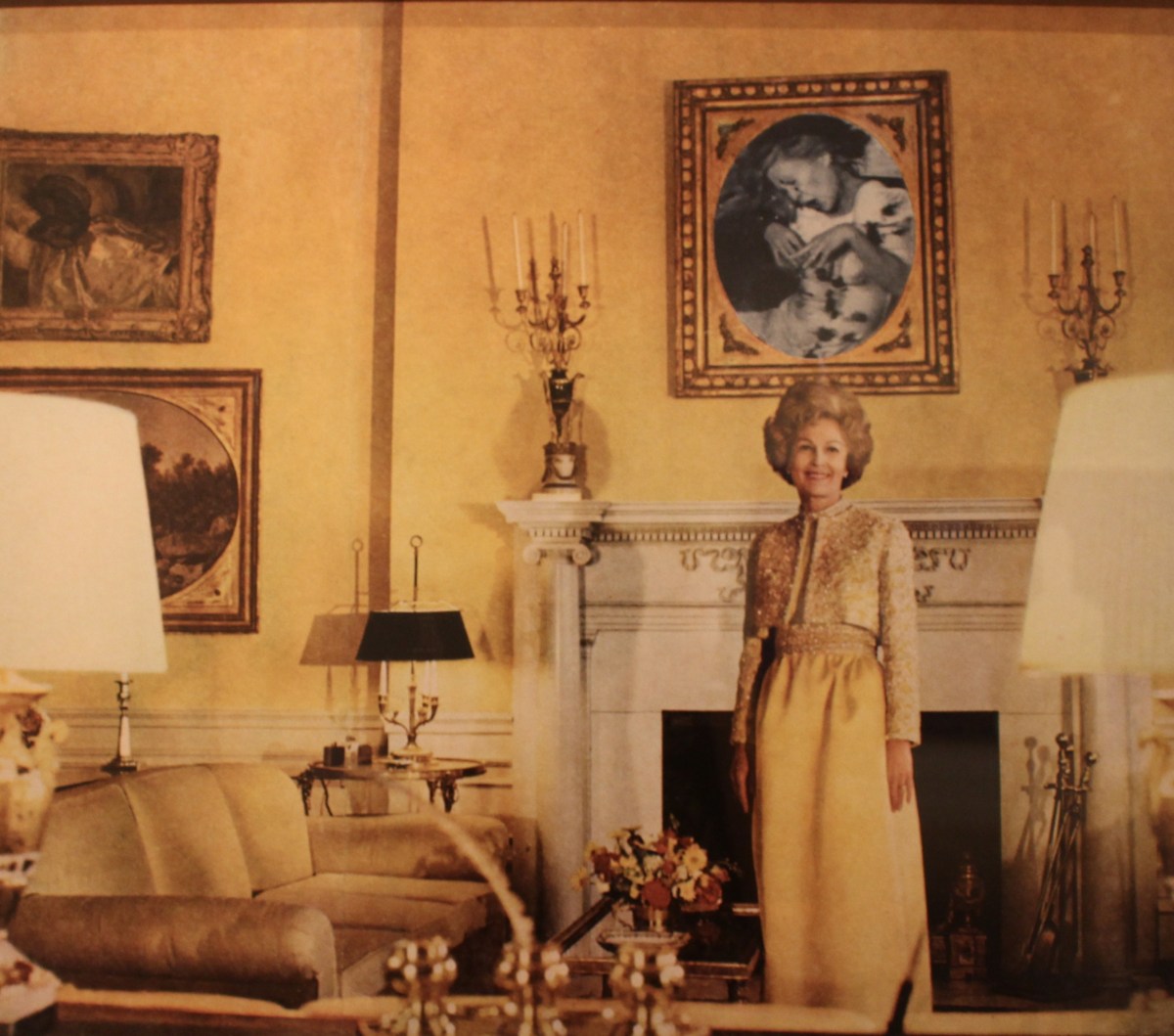
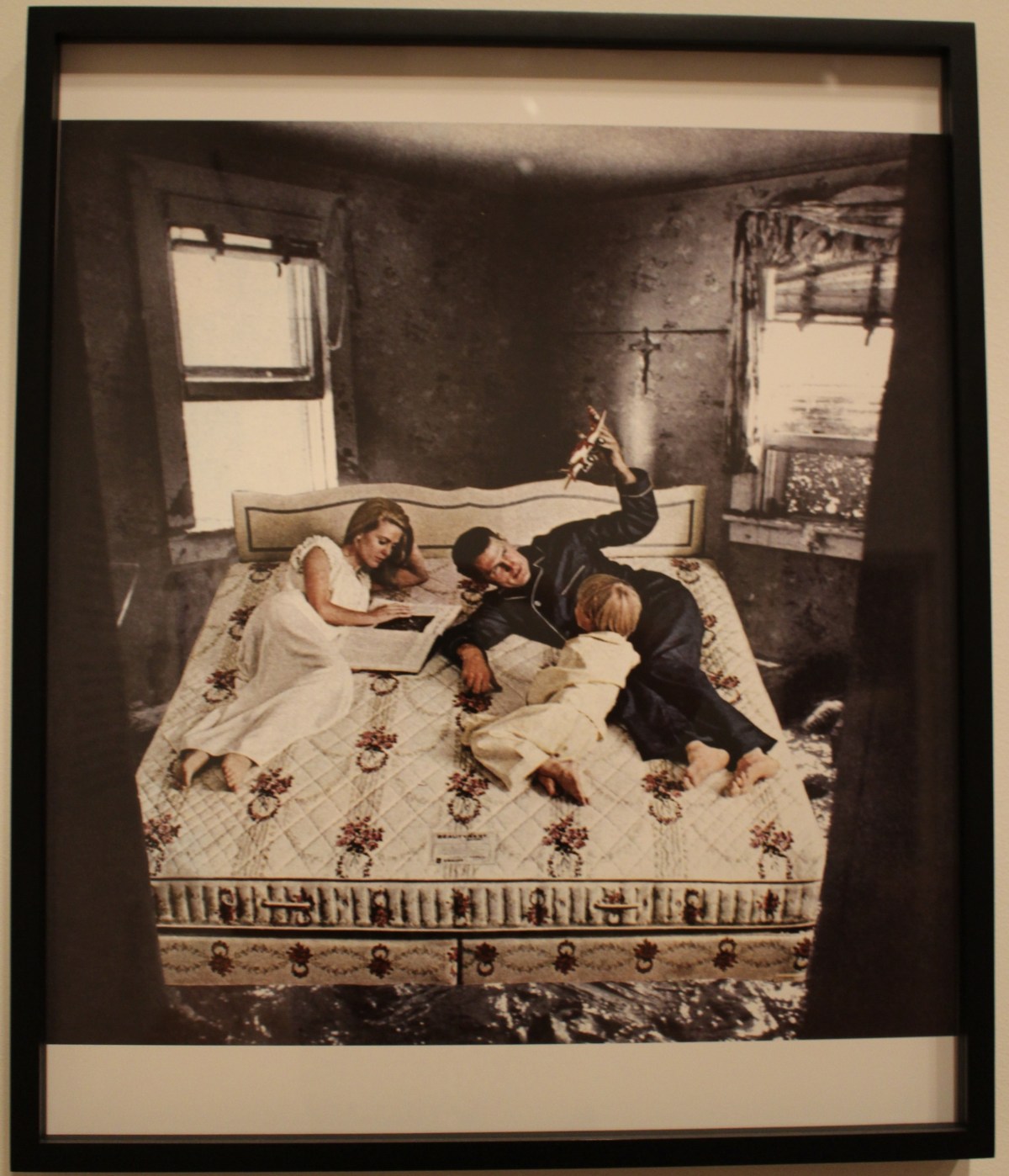
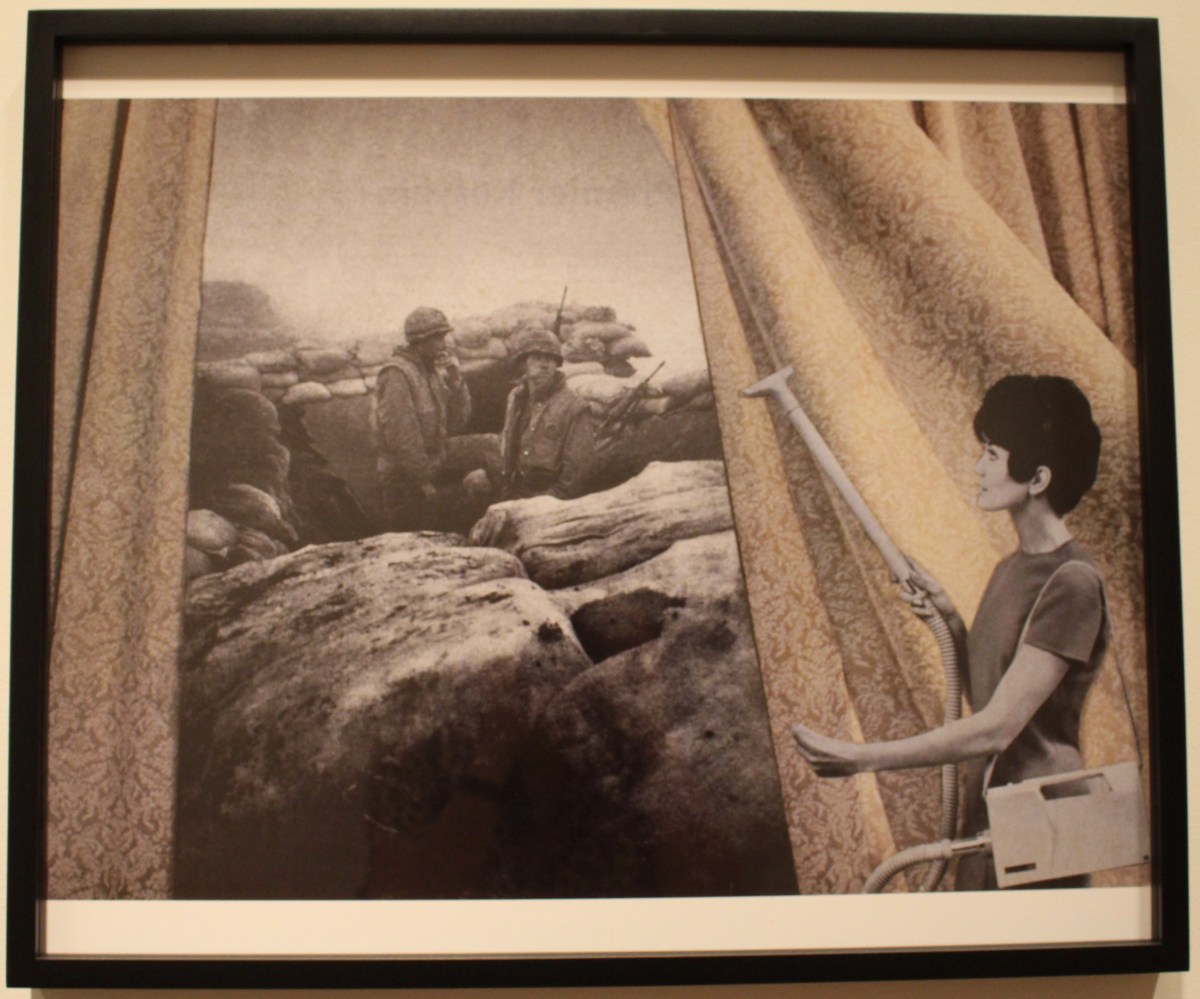
This June of 2019, I saw an exhibit, Artists Respond: American Art and the Vietnam War (1965-1975), at the Smithsonian American Art Museum (SAAM). The following photos by Martha Rosler from the series House Beautiful: Bringing the War Home, juxtapose the feminine realm of domestic life with the masculine business of waging war. The artist combined documentary and advertising images cut from popular magazines like Life and Ladies’ Home Journal to show figures from the war front, like soldiers or refugees, moving unexpectedly through affluent American homes. The photomontages aim to show how we are all interconnected, and they are reminders of how the war was brought into our U.S. homes, far from the violence our country was inflicting on Vietnam. The artist collapses the distance between “here” and “there,” essentially “bringing the war home.”
Red Stripe Kitchen by Martha Rosler
First Lady (Pat Nixon) by Martha Rosler
Beauty Rest by Martha Rosler
Cleaning the Drapes by Martha Rosler
From my home, I also watched news coverage of student protests on college campuses all over America and was infuriated by the Kent State massacre and by the way war protestors were vilified. My father was a die-hard Republican who hated war protestors, and I grew up having to listen to his tirades. I didn’t know at that time who was right, but since then, I have learned much about the Vietnam War and what a disaster it was for our country and for the Vietnamese people. And I have formed solid opinions about people’s rights to protest horrible things that governments do.
Here is a poem I wrote about a famous photograph (see photo here) taken in the aftermath of the Kent State shootings:
KENT STATE FREEZE FRAME
A young woman kneels, face jumbled,
mouth open, howling in disbelief.
In her daisy bellbottoms, she grabs
a faceless friend in a fringe jacket.
A white scarf hangs lopsided
around her neck like a noose.
The acrid smell of gunpowder
and blood blossoms in the air.

She belts out her death wail.
I traipse by and gape, as captured
by her screaming agony as by the dead
blue-jean boy lying face down
in blood and concrete.  He’s stretched out
straight as a battle line,
like my boyfriend
when he sleeps on the beach.

Someone tells me they also killed
two other boys and a girl.  Before
she was shot, she slipped a flower
into the barrel of a guardsman’s rifle
with a wistful smile –
“Flowers are better than bullets.”

Dazed and foggy, I’m on my way
to Biology lab, not even part of the protest.
I hate the whole Vietnam, Cambodia scene,
but my God, it’s on the other side of the world.
Frankly, I don’t want to get involved.
Now, here it is on my campus
and I want to kneel with that girl
and wail for my massacred fellow students
and all the boys blown apart in Vietnam,
and for fathers who think the way
mine does – that those damn hippies
deserve to die.
I wrote this poem in reaction to the photograph, as if I were a college student at Kent State. I was too young to be in college during the Kent State massacre, but I wasn’t too young to be furious over, and disgusted by, my father’s and others’ anti-protester rants.
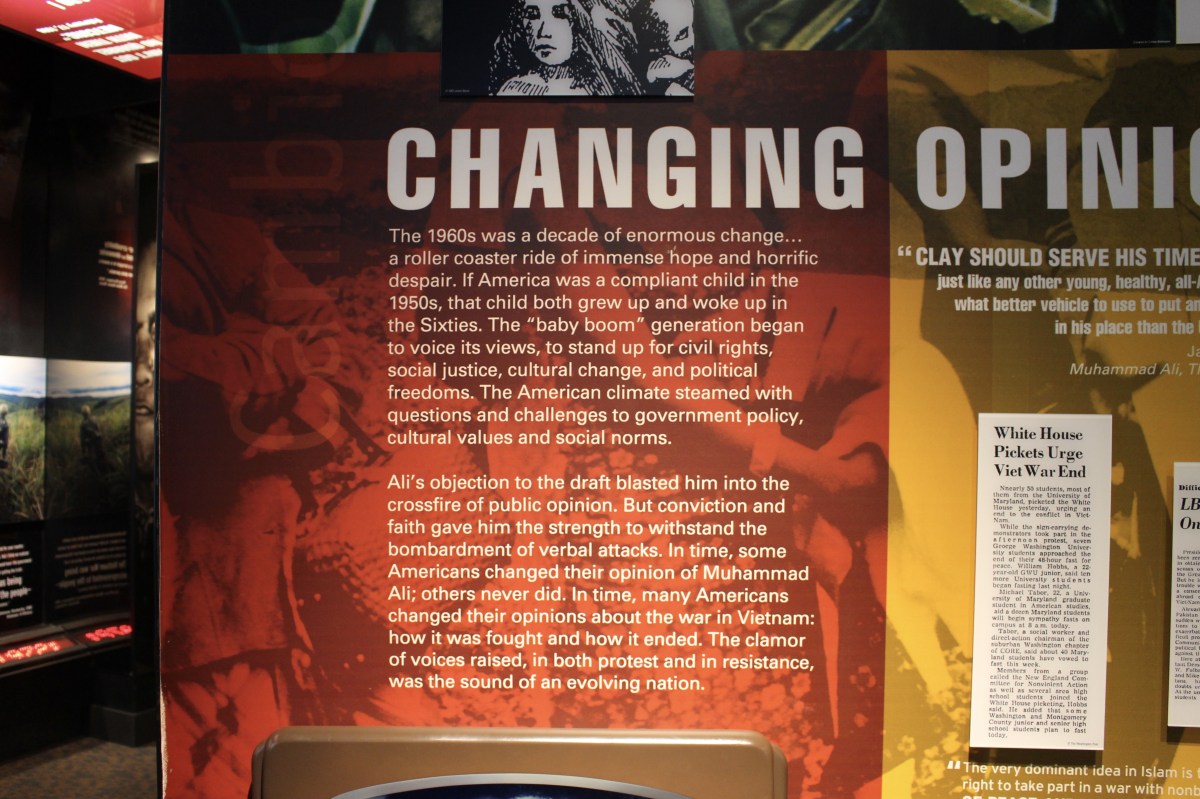
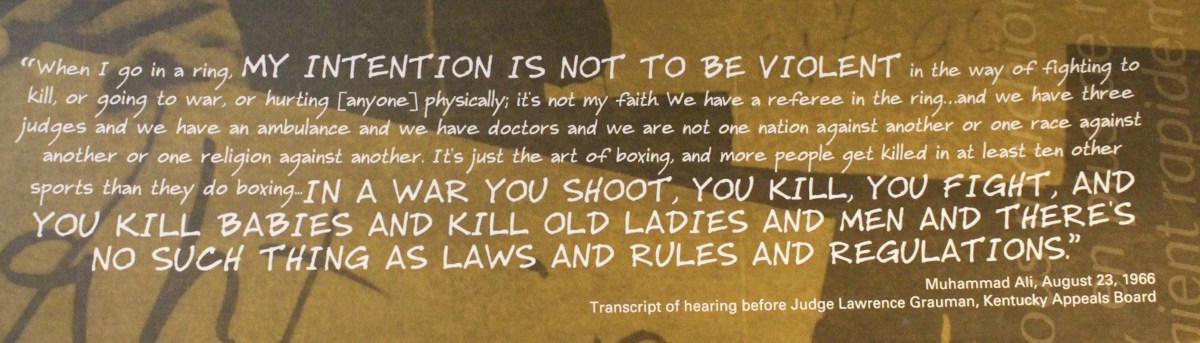
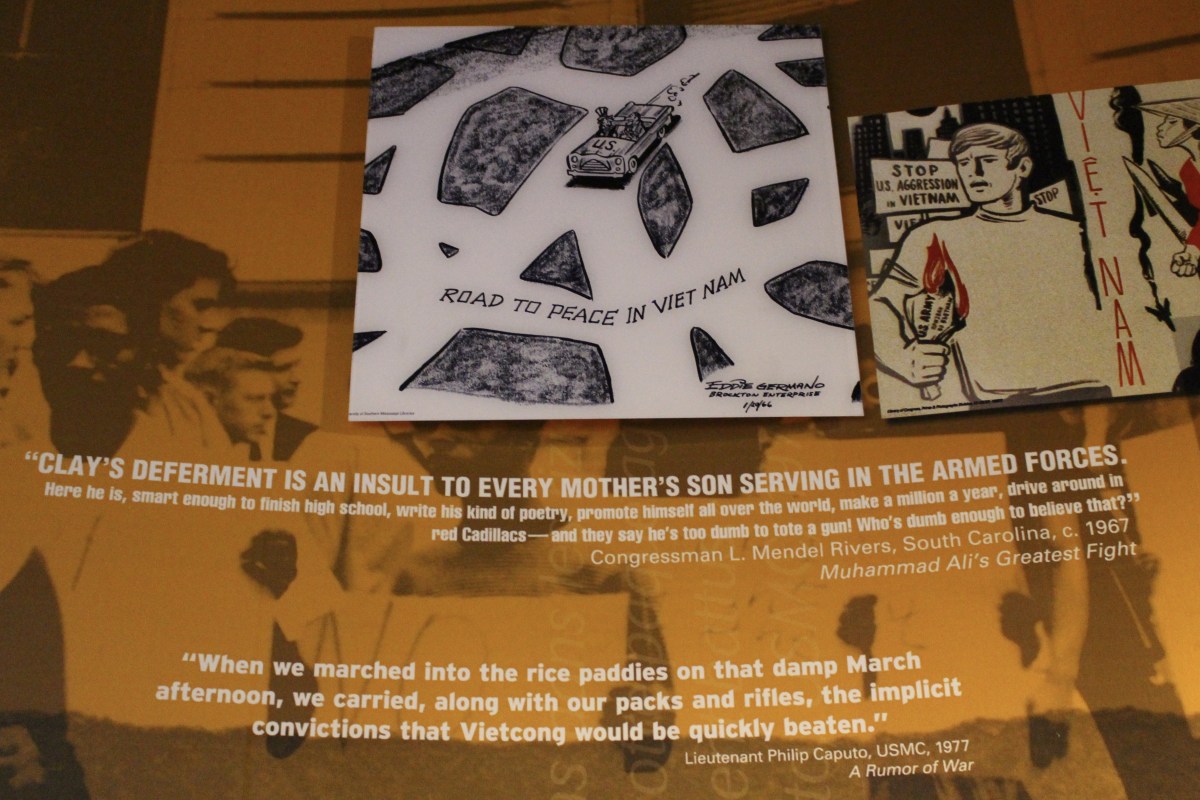
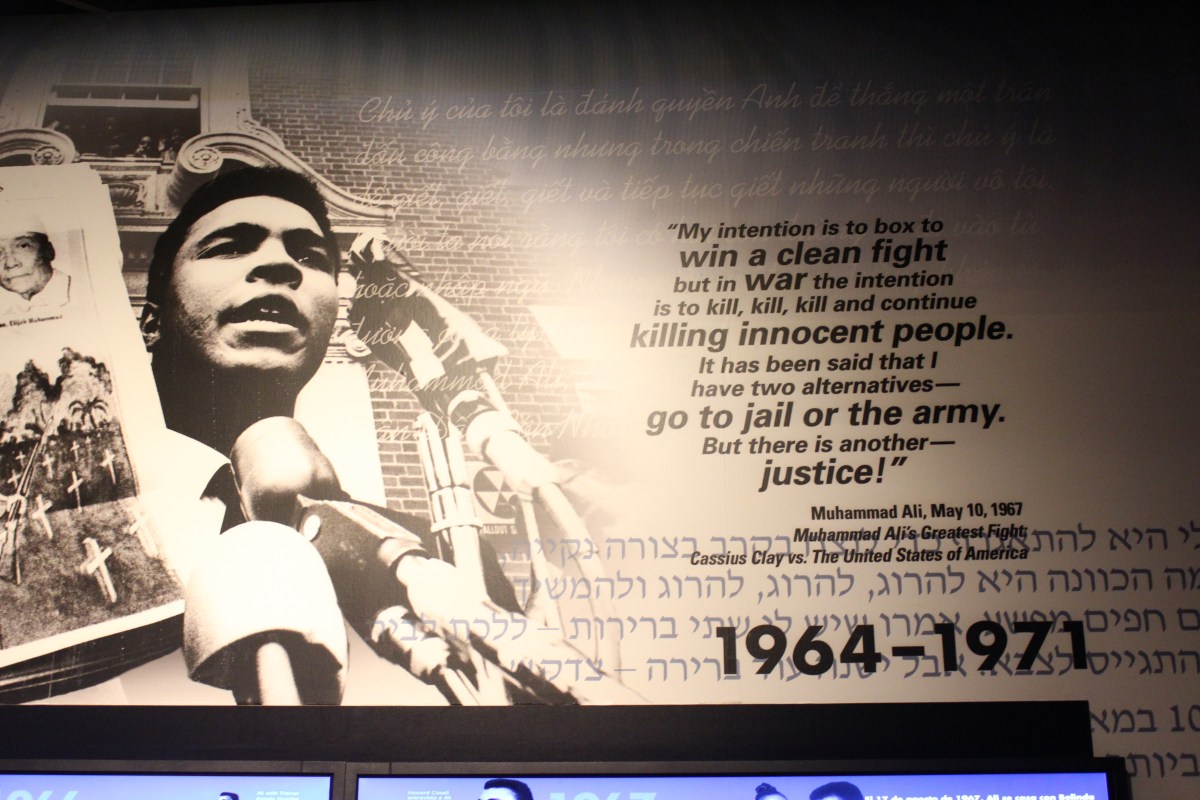
One prominent protester of the war was Muhammad Ali. I remember my father’s diatribes about him too, because Ali objected to the draft and refused to fight in Vietnam. By taking a stand against the war, he put himself into the crossfire of public opinion. Earlier this year, I visited the Muhammad Ali Center in Louisville, Kentucky, where I learned of his opposition to the war.
Changing Opinion
Muhammad Ali’s words
more about the war
Muhammad Ali
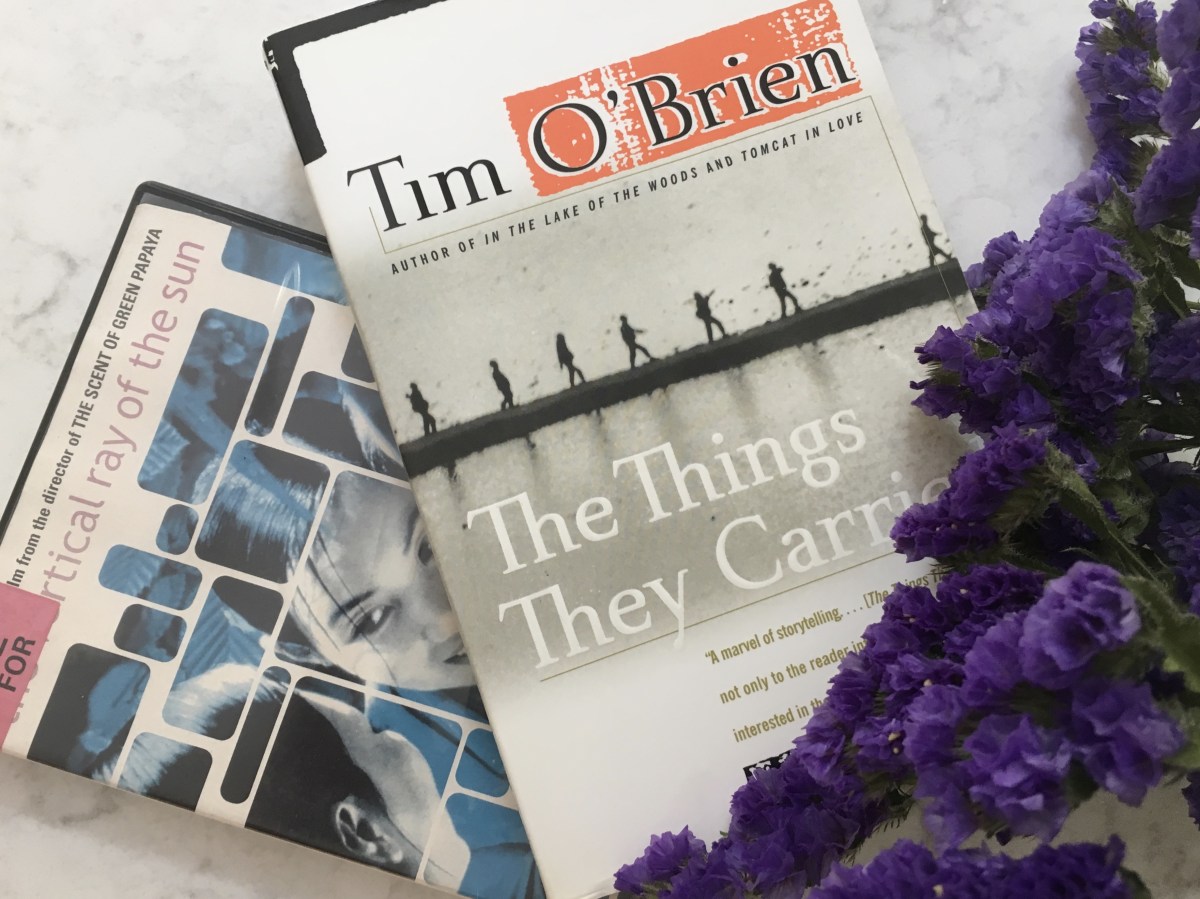
In later years, in one of my writing classes, I read a great short story by Tim O’Brien, “The Things They Carried.” It told about the things American soldiers in the Vietnam war carried with them and the meanings behind these things; in essence, these items told the greater stories of the soldiers’ lives and the horrendous war they were part of.
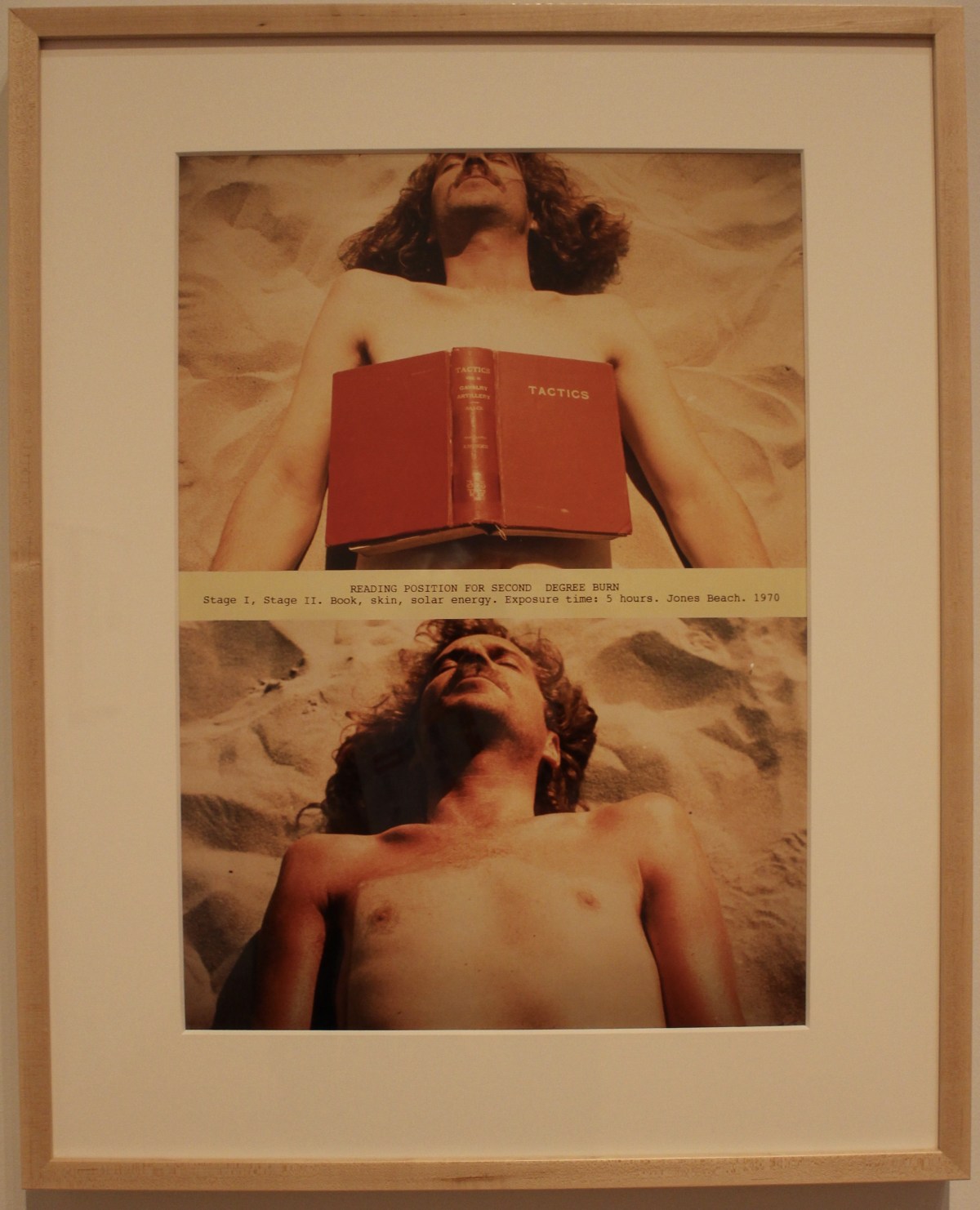
In another part of the recent SAAM exhibit, I saw how American artists made statements about the immorality of the war. Dennis Oppenheim’s photograph, “Reading Position for Second Degree Burn,” shows two photographs of the artist lying on the beach for five hours with a volume of military field tactics on his bare chest. He was trying to register a sense of what many human bodies in 1970 had to endure: His weaponizing of the sun, in particular, conjured media reports of American soldiers baking in the Vietnamese heat and Vietnamese citizens being burned, far more gruesomely, by napalm weapons (from a plaque at the museum).
Reading Position for Second Degree Burn by Dennis Oppenheim
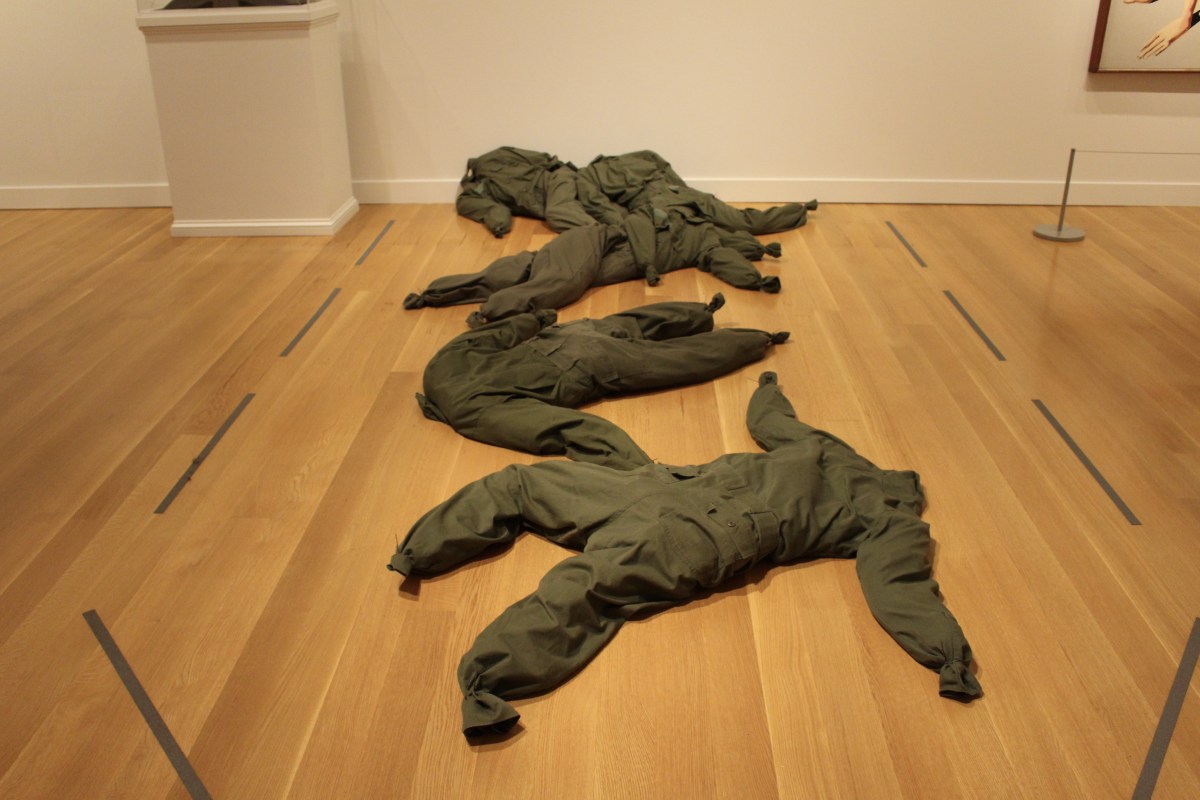
In the Non-War Memorial, artist Edward Kienholz, “imagined thousands of army uniforms – the same number as American soldiers killed in the war – filled with clay and placed in a chemically destroyed meadow in northern Idaho. Given that mechanical and chemical deforestation were deliberate U.S. military strategies in Vietnam, Kienholz’s unrealized plan to plow under and poison a pristine field sought to bring the war home to the American West” (from a plaque at the museum).
The Non-War Memorial
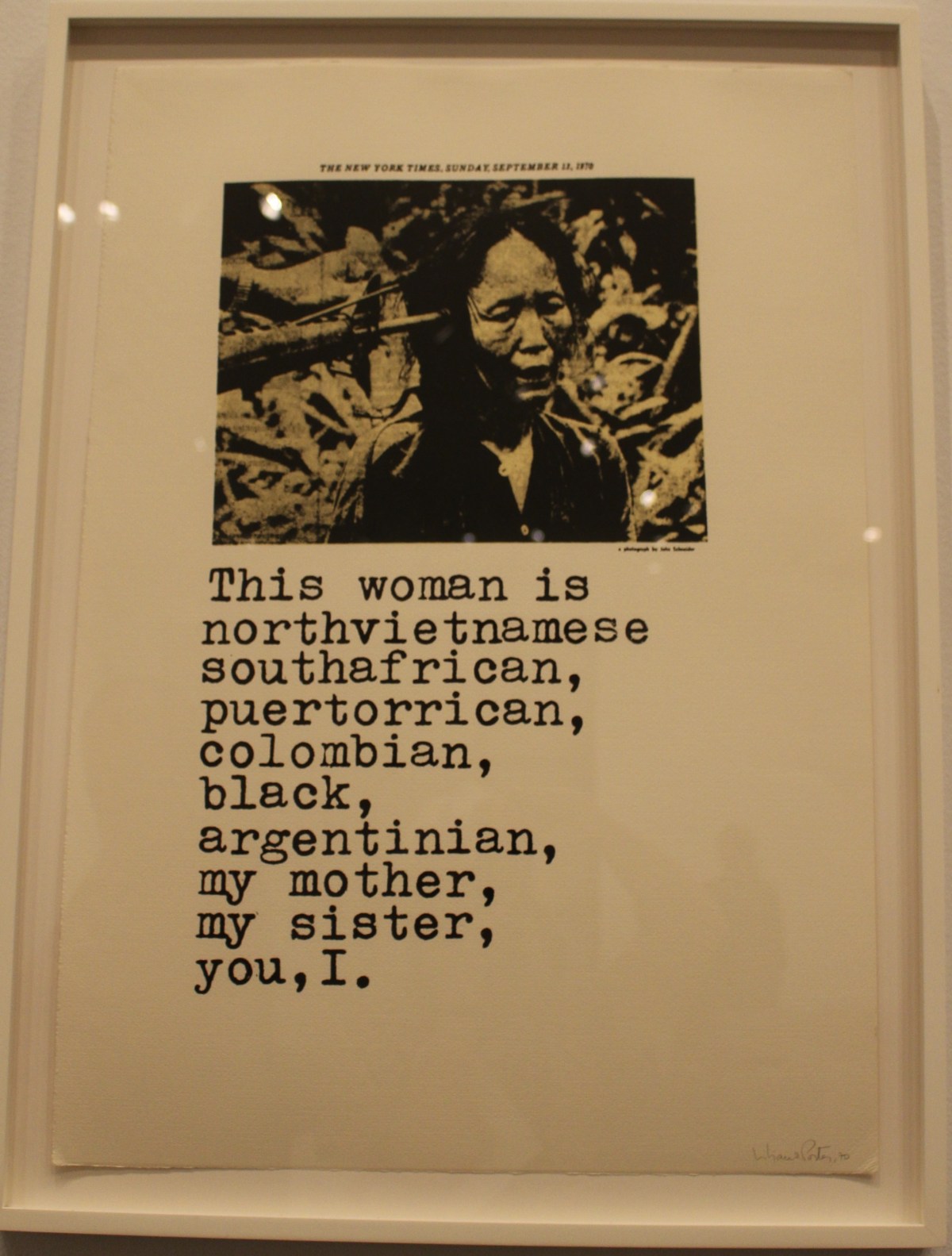
Also in the SAAM exhibit, Liliana Porter appropriated a photo taken by photojournalist John Schneider of a woman detained by U.S. and South Vietnamese forces on suspicion of Communist affiliation. Her words go from “northvietnamese” to “my mother, my sister, you, I,” to guide the viewer to empathy and identification.
Untitled by Liliana Porter
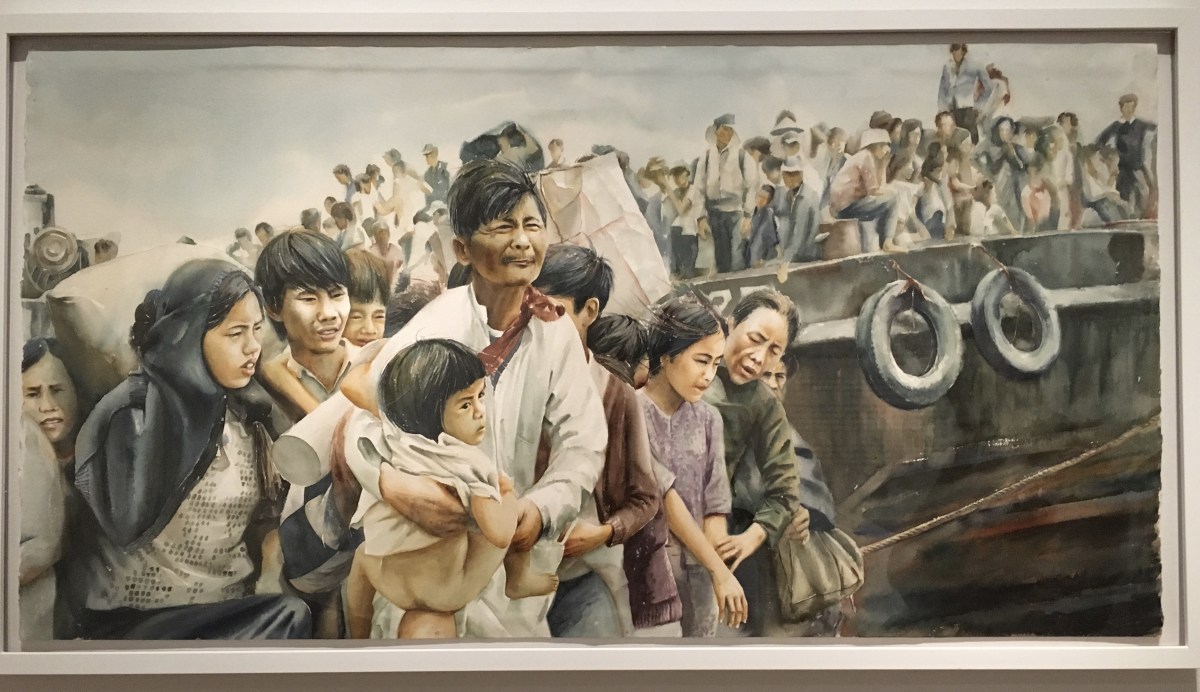
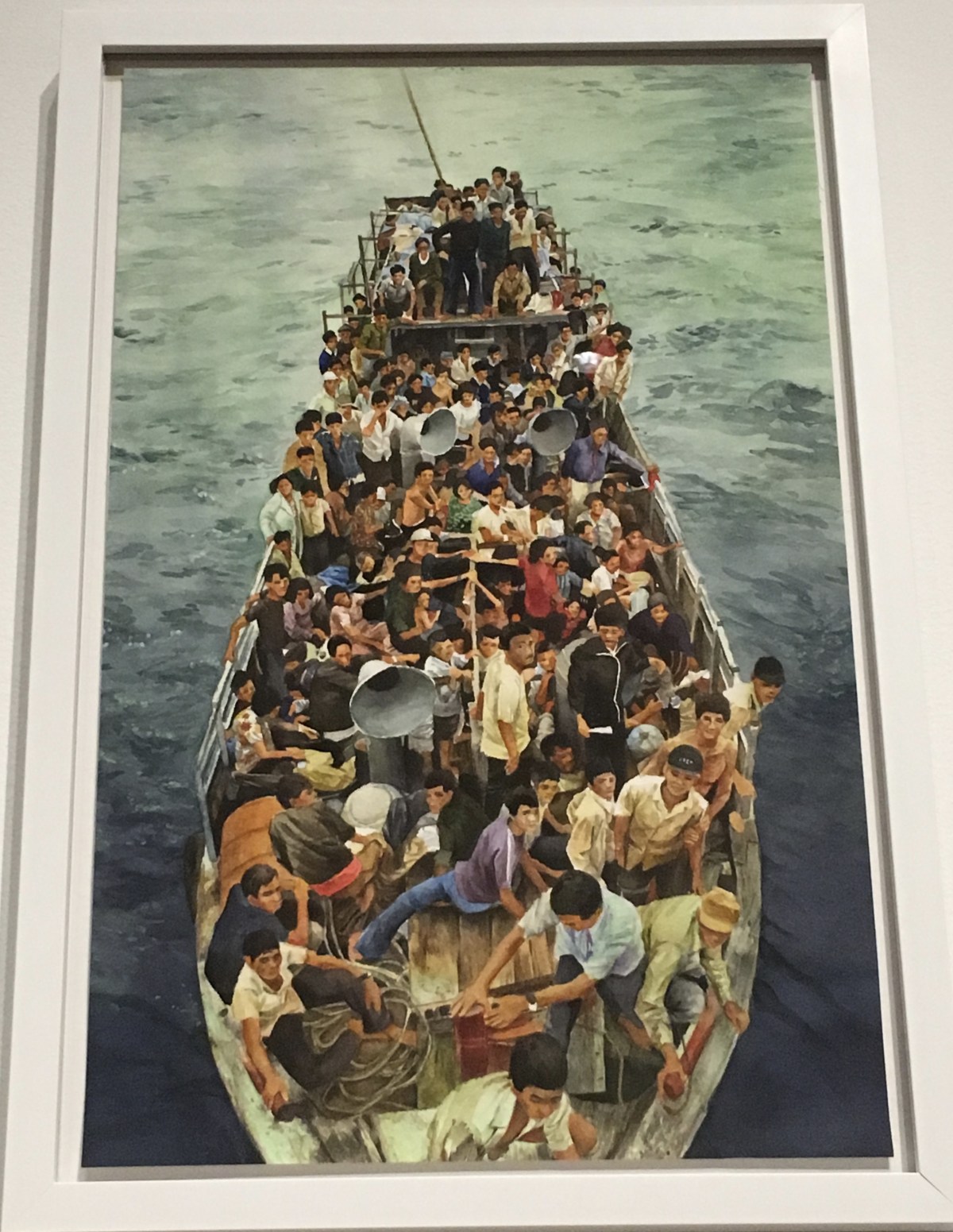
Finally, there were the refugees. In The Vietnamese Exodus History Learning Project: the exodus, the camps and the half-lived lives, artist Tiffany Chung commissioned a group of young artists from present-day Ho Chi Minh City to make watercolors based on photographs of the refugee crisis in the late 1970s and 1980s. These images were unknown to the artists painting them, having grown up in a country whose textbooks and public conversations do not acknowledge the crisis. Through this process, the artists began to recover parts of their own past.
In one scene of an immigrant camp, a little girl holds out an empty food bowl, her hopeful expression unfazed by the rain and the barbed wire surrounding her.
The Vietnamese Exodus History Learning Project
The scene below depicts Hong Kong in 1988, when refugees were no longer admitted; it shows a father clutching a small child as scores of people disembark from a crowded boat.
The Vietnamese Exodus History Learning Project
The Vietnamese Exodus History Learning Project
I had seen one movie about Vietnam that evoked a peaceful and slow-paced culture. The 2000 movie, Vertical Ray of the Sun, was about 3 sisters and their families and their loves. The movie is full of lush greenery, drenching rains, and romantic scenes. This movie has colored my imaginings of Vietnam since I saw it in 2001. Of course, when I was younger, I also saw violent and disturbing Vietnam war movies, such as the 1979 film Apocalypse Now, Platoon, Good Morning, Vietnam, Born on the Fourth of July and others.
Vertical Ray of the Sun DVD & Tim O’Brien’s The Things They Carried.
Here’s the trailer for Vertical Ray of the Sun.
Here’s a video of Vietnamese music I found on YouTube to inspire future visits.
Though I was only able to go to the north of Vietnam on this trip in 2011, I hope to return sometime to the south.
********************
“THE CALL TO PLACE” INVITATION: I invite you to write a post on your own blog about what enticed you to choose a particular destination. If you don’t have a blog, I invite you to write in the comments. If your destination is a place you love and keep returning to, feel free to write about that. If you want to see the original post about the subject, you can check it out here: imaginings: the call to place.
Include the link in the comments below by Wednesday, August 21 at 1:00 p.m. EST. My next “call to place” post is scheduled to post on Thursday, August 22.
If you’d like, you can use the hashtag #wanderessence.
This will be an ongoing invitation, on the fourth Thursday of each month. Feel free to jump in at any time. 🙂
I hope you’ll join in our community. I look forward to reading your posts!
the ~ wander.essence ~ community
I invite you all to settle in and read a few posts from our wandering community. I promise, you’ll be inspired!
Ulli, of Suburban Tracks, wrote about why he’s called to one day visit the capital of Inuit Art in Cape Dorset, Arctic Canada.
It was May of 2007. I had just completed one year of my two-year Master’s Degree in International Commerce & Policy at George Mason University. During this first year, I had come to form in my mind the dream of working in the Middle East when I completed my Master’s degree in May of 2008. My dream was to get a job working on economic or human development issues, especially democracy building, women’s empowerment or freedom of the press, in the Middle East.
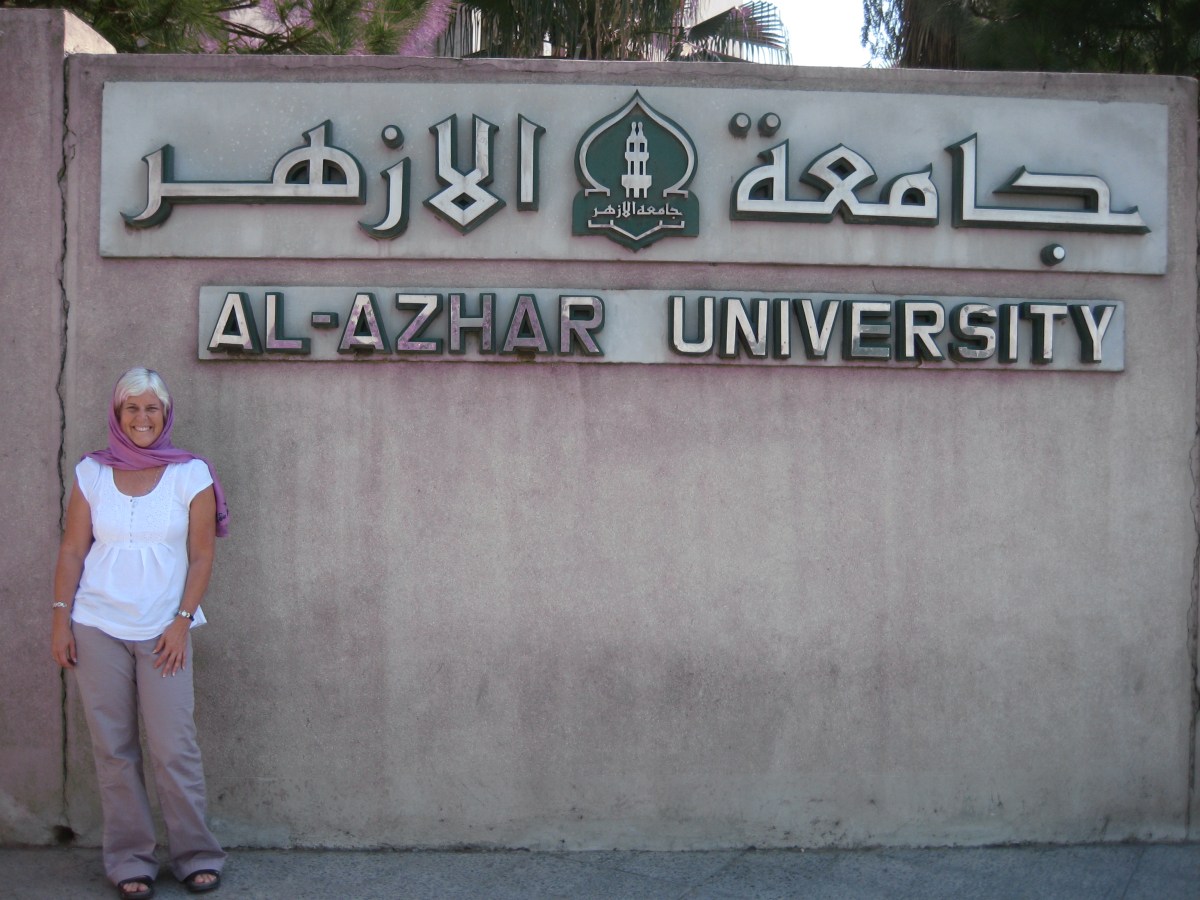
Before beginning my Master’s, I had studied Arabic from the fall of 2005 through fall semester of 2006 (3 semesters) at Northern Virginia Community College, and was curious to learn more of the language. One of my classmates at George Mason, who had been trying on Islam for size, had heard about a 1-month intensive Arabic class, in July of 2007, at Al-Azhar University under the auspices of a group in America called Al-Ameen Associates.
me at Al-Azhar University in July 2007
According to the Al-Ameen website “Al-Ameen Associates was established by Dr. James E. Jones and Matiniah Yahya M.Ed. in 1994 to provide high-quality consultation, education and counseling services.” Also, according to their website: “Dr. Jones is a professor of Comparative Religion at The Graduate School of Islamic and Social Sciences and an Associate Professor of World Religion at Manhattanville College. He has a M.A. from Yale Divinity School and a D.Min. from Hartford Seminary. Dr. Jones is the Director of the Al-Azhar Arabic Summer Immersion Program. Matiniah Yahya is a certified teacher with a Masters in elementary education and over two decades of experience as an educator.”
We would be staying in Muquttum, a suburb of Cairo. All I had to go on was the description of Muqattum from the Al-Ameen website:
“Housing is located in Muqattum which is outside downtown Cairo in a residential area. The area is quiet and it sits on a mountain. There is a breeze that is felt when there is no breeze any other place in the area. They say it is at least 5-10 degrees cooler than at the bottom of the mountain.
The building has four floors and we rent about half the building for our stay. On the first floor as you walk in, there is an open reception hall and security booth with 24-hour building security. There is a large gathering room, computer room and a room that will be used as a dining room. There is also an elevator for our use. There are small apartments on each floor. These apartments include: a living room area, equipped kitchen, 1- 2 bedrooms with storage space/closet and most have a balcony.
All apartments will have 2 people to a room which means apartments will house 2 to 4 people. Married couples will be placed in 2 person apartments first (these are limited) and the other students will be placed in same gender apartments. All rooms have air conditioning.”
So, based on the above description, I imagined a kind of oasis at the top of a mountain. Nowhere in the above description did it say there was greenery, yet somehow in my mind, the “Muqattum oasis” was filled with a sparse amount of green trees, some grass, some nice flowers swaying in the aforementioned breeze. I imagined the suburbs of America except with less greenery.
This trip cost me $2,000, which included flight, accommodation for one month, textbooks and our lessons at Al-Azhar.
I had recently separated from my husband but we were still living in the same house. It seemed like the best first step to moving out of the house.
Prior to all of this, what originally sent me to study Arabic, then International Commerce & Policy, were the 9/11 attacks and a seeking to understand the Arab world. I had been very sheltered in my little world, and was ashamed at my compete lack of knowledge. Since 9/11, I had been reading extensively and was trying to learn what I could. I had also written a novel, Scattering Dreams of Stars, in 2002-2003 (as yet unpublished) and one of my characters was an Egyptian man named Ahmed Hakim. This character surprised me by becoming one of the main characters in my tale. Since I didn’t know a single Egyptian person, all I had to go on were stereotypes; I wrote him anyway. Here are a few snippets from my novel about Ahmed:
Forehead and palms to the floor with scores of other men, moving in tandem like a massive wave, Ahmed Hakim prayed to Allah, asking for peace. He prayed for peace in the world, but peace of mind was what he truly wanted. He worried too much: about being singled out as a troublesome Egyptian-Muslim; about the possibility of war with Iraq; about the nagging symptoms that were surely signs of diabetes. It wasn’t a good time for Ian to turn up, with everything else that was going on in this screwed-up world.
********
When Lucie came home last night, she wordlessly made up with him, opening her body to him, and he explored it as if it were one of his maps. He became Ibn Battuta, the famous Moroccan explorer, hungry for expedition. He caressed her, trying to transport her to another place – the world in brown and blue, with smatters of green, the Red and Mediterranean Seas, the plateaus and deserts, valleys and deltas.
********
Ahmed believed his newspaper reading was essential to his understanding of his adopted country. He wanted his Egyptian blood to run though his veins in an American way. He wanted to belong, to be a true American, but the newspaper reminded him daily that he didn’t belong. He was an outsider and likely to stay that way for the near future.
Everywhere he went, people either looked at him suspiciously, or ignored him completely. Sometimes people spoke to him with a high false friendliness, as if he were grossly handicapped, his legs missing or half his face burned off, and they were determined not to notice. They used his skin, eyes, and hair as a barrier, to keep him at a distance. He didn’t want to be a mystery to them. He wanted to be transparent, true.
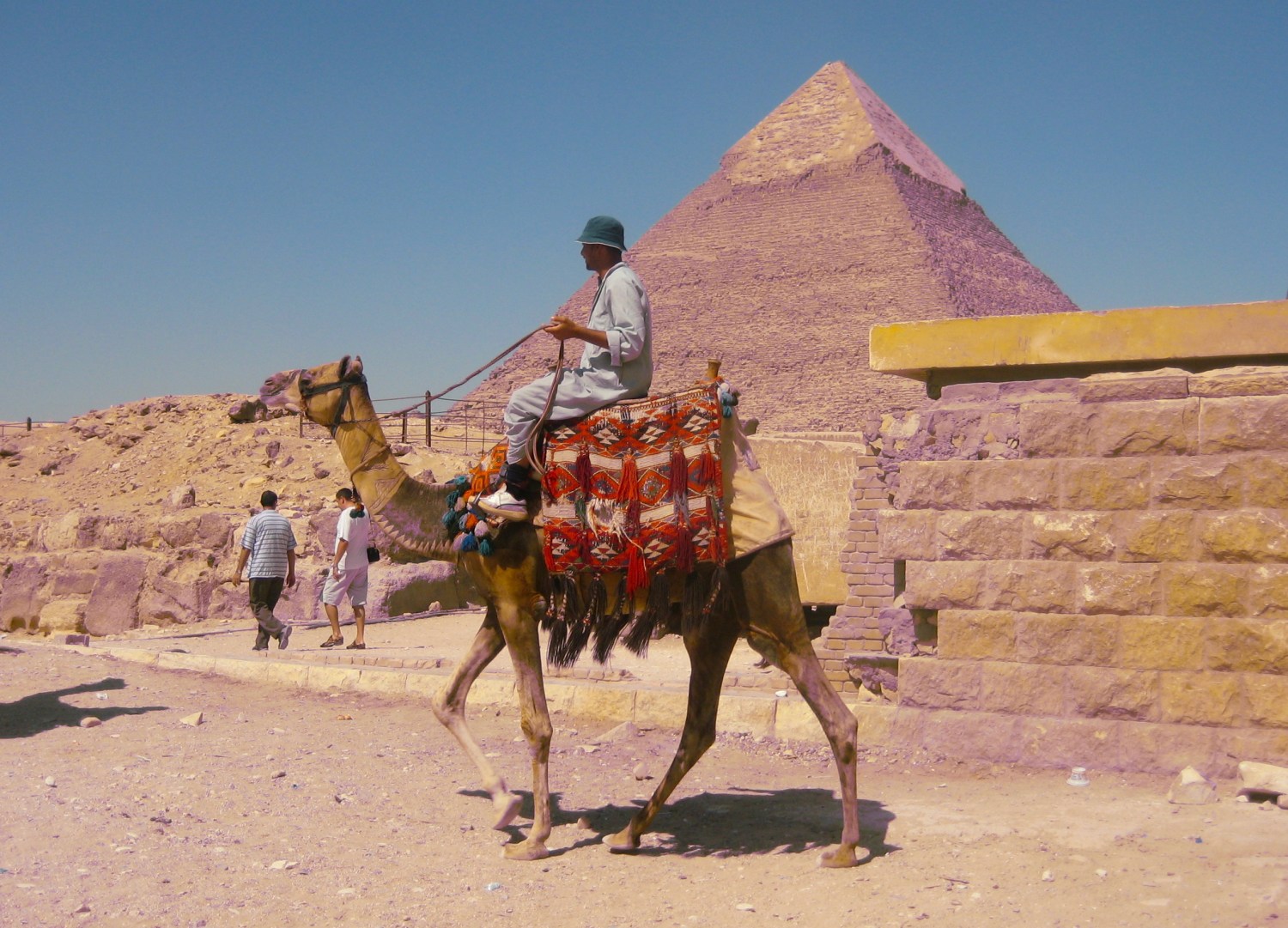
Going to Egypt for the month of July would give me immersion into the culture, introduce me to Egyptian people, and enable my husband and I to have a complete separation. It would also be my first experience living abroad. At that time, I wasn’t much of a traveler or photographer; neither did I write a blog. Of course, this trip would also enable me to visit the Pyramids, the Sphinx and the Eygptian Museum, but that wasn’t the main reason I was called to go.
camel rider at Khafre’s Pyramid
********************
“THE CALL TO PLACE” INVITATION: I invite you to write a post on your own blog about what enticed you to choose a particular destination. If you don’t have a blog, I invite you to write in the comments. If your destination is a place you love and keep returning to, feel free to write about that. If you want to see the original post about the subject, you can check it out here: imaginings: the call to place.
Include the link in the comments below by Wednesday, July 24 at 1:00 p.m. EST. My next “call to place” post is scheduled to post on Thursday, July 25.
If you’d like, you can use the hashtag #wanderessence.
This will be an ongoing invitation, on the fourth Thursday of each month. Feel free to jump in at any time. 🙂
I hope you’ll join in our community. I look forward to reading your posts!
the ~ wander.essence ~ community
I invite you all to settle in and read a few posts from our wandering community. I promise, you’ll be inspired!
Albert, of The Rambling Wombat, wrote a hilarious piece about getting a job in Papua, New Guinea in 1988.
Italy has been calling my name for years, yet I’ve been resisting the call. Movies first called me, especially my favorites: Bread & Tulips (Venice), Under the Tuscan Sun, A Room with a View, Beseiged, The Son’s Room, and The English Patient. Then it was the books: Eat, Pray, Love and The House at the Edge of Night. Yet, with all the enticements, I still resisted. The time never seemed right.
My husband traveled to Italy with his then-girlfriend, Kerri, in 1984. They married in 1985, after she’d been diagnosed with breast cancer; the disease led to her early death in January of 1987. I met Mike in the fall of 1987. A portion of our early relationship consisted of me listening to him reminiscence and grieve over the loss of his wife. She seemed saintly to me, and part of the reason I fell in love with him was because of how he expressed his feelings. I hadn’t met many men who talked of their emotions, and so I was entranced by his sharing.
However, the more I listened, the more insecure I became. How could I compete with a saint? I certainly was not a saint; I had never been one and was unlikely to ever become one. Though we married in 1988, our relationship was fraught with grieving on both sides, me grieving over the dissolution of my first marriage in divorce, and him grieving over Kerri. Our first few years of marriage were a struggle as we tried to come to terms with our losses while at the same time beginning a new life together.
When it came time to plan our first trip to Europe in 1999, I decidedly was not ready to go to Italy. We went to England. Neither was I ready to go in 2003 or 2006, when we went to France. Then came our separation from 2007-2014. During that time, I traveled to Egypt, Singapore, Thailand, South Korea, China, Turkey, Cambodia, Vietnam, Japan, India, Oman, Jordan, Nepal, Ethiopia, and Greece. Then we reconciled in 2014, just before I went to China to teach; while there, Mike came to visit me, and I traveled all over China and to Myanmar. We’ve traveled many places since we reunited. Yet, here we are 30+ years after our marriage, and we still haven’t gone to Italy, together or separately.
Now, I’m finally ready to go. My husband’s first trip seems like a lifetime ago. I’m no longer threatened by his first marriage, or his first trip to Italy. If we survived our separation, we can survive his memories of Italy, which he’s sure to have. I no longer feel threatened by them.
Lately, I’ve been growing weary of long plane flights across the Atlantic to go to one destination. It’s expensive and, in recent years, a hassle, as flights are often delayed, connections missed, and luggage lost. As Mike is still working, he can’t take time off for extended holidays. So I’ve decided this time to combine two destinations, Morocco (where I’ll go on a G Adventures tour with my friend Susan) and Italy (where Mike will join me).
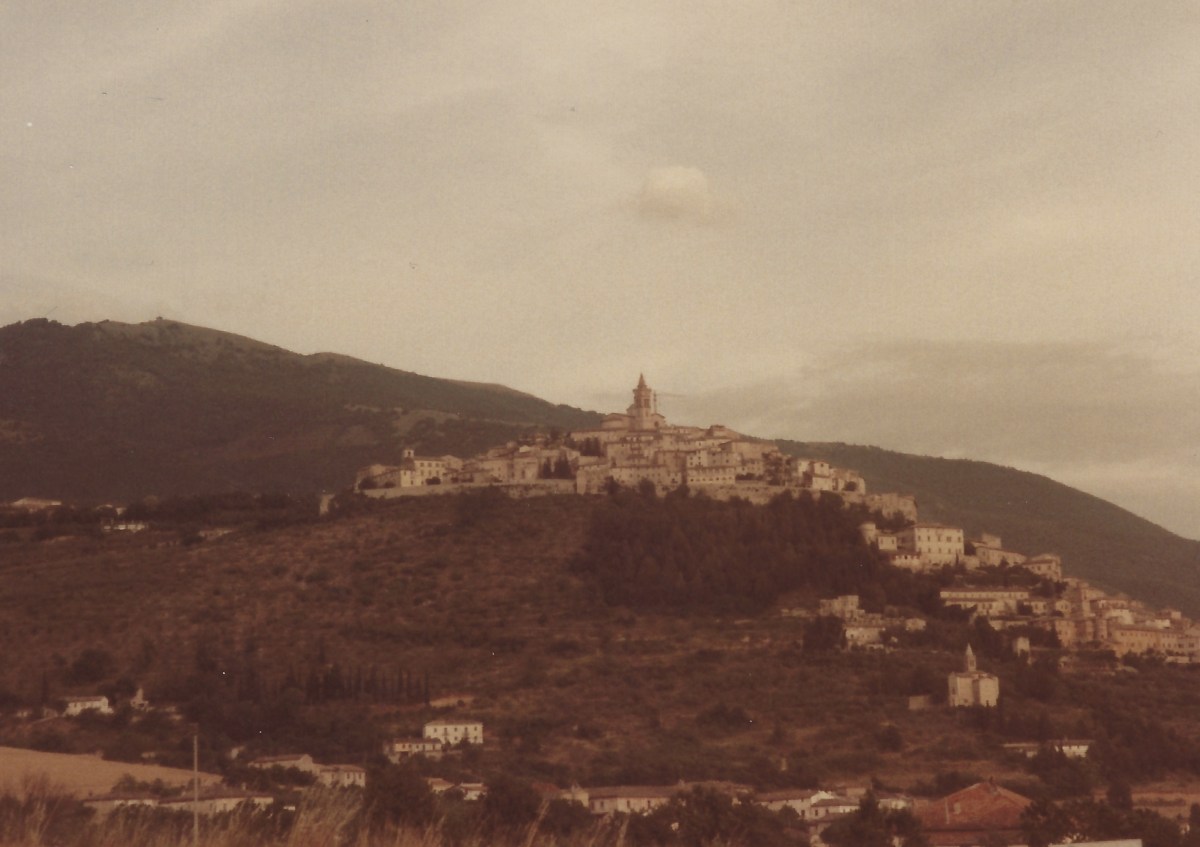
Hill town of Tuscany from Mike’s 1984 trip
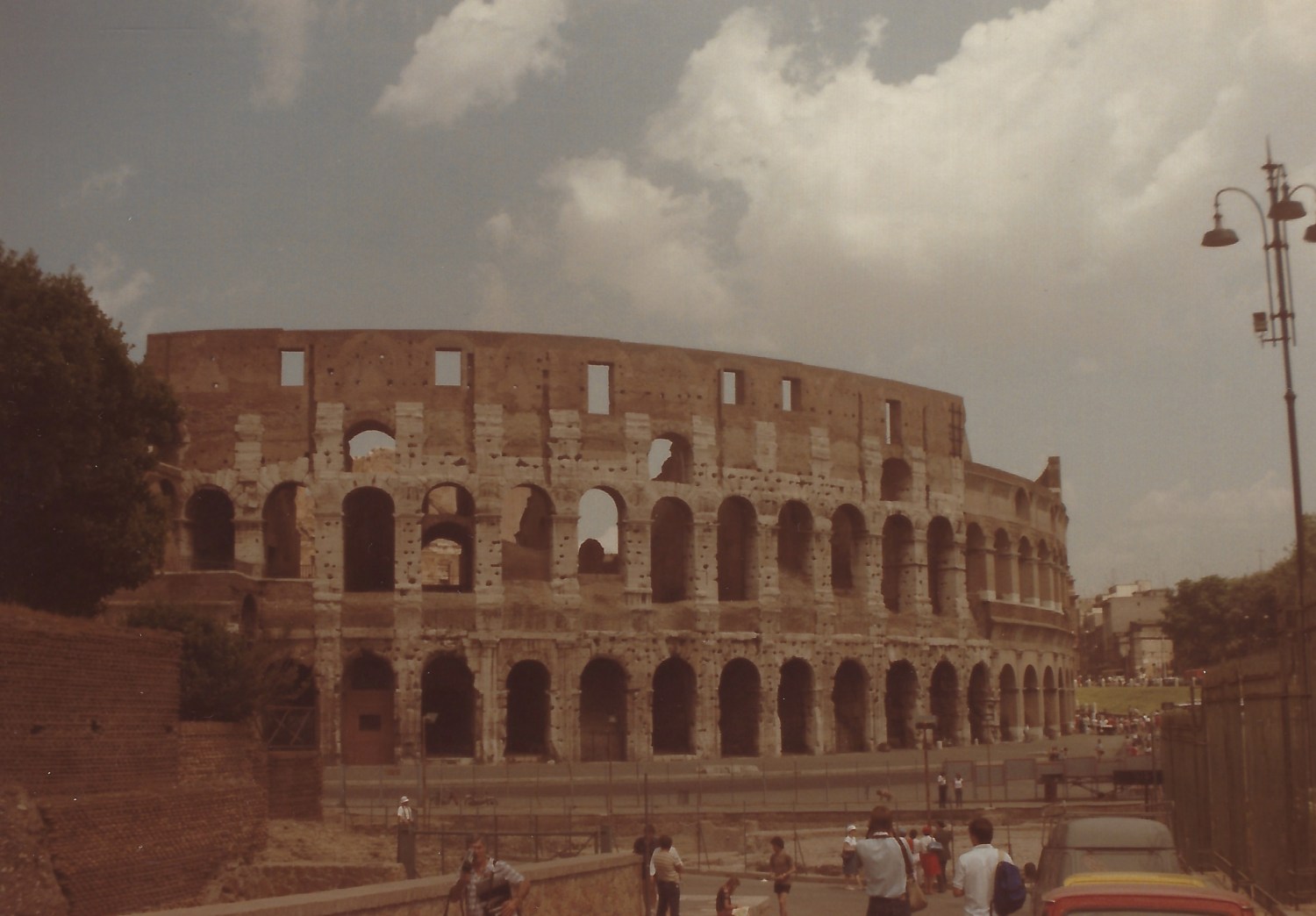
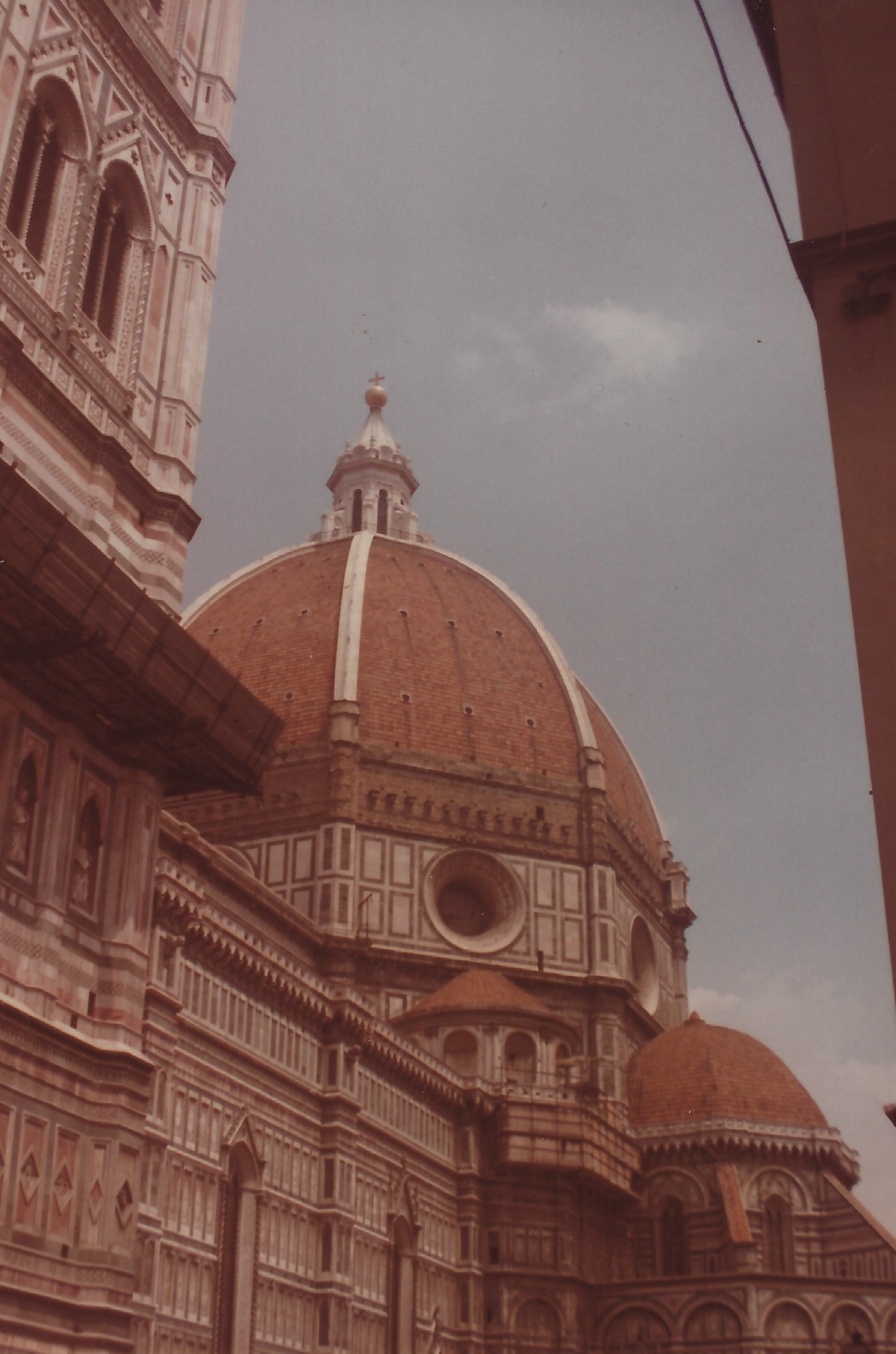
I’m enticed by Italian art and architecture, from the ancient to the classical, the ecclesiastical architecture and mosaics of the Byzantine period. The Renaissance entices, with Botticelli, Leonardo da Vinci and Michelangelo. There is the Duomo in Florence, the Piazza dei Miracoli in Pisa, the Colosseum in Rome.
Florence from Mike’s 1984 trip
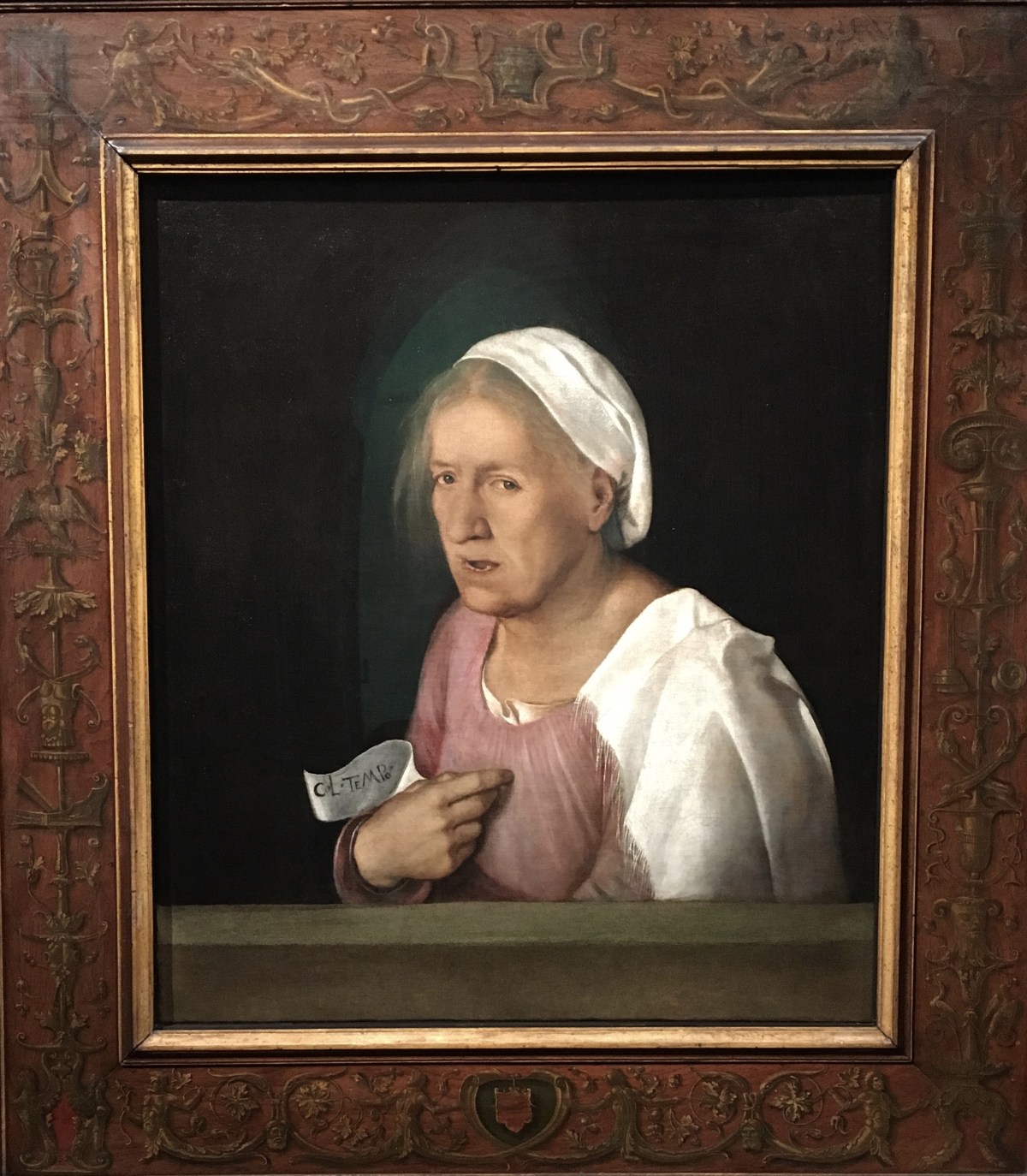
Over the years, I’ve seen and been inspired by art from the Renaissance. In early March, I encountered Giorgione’s La Vecchia (The Old Woman), in the Cincinnati Art Museum. “Although he had a short career and created relatively few works, Giorgione is regarded as the founder of the Venetian Renaissance for his innovative approach to landscape and portrait painting in the years around 1500,” according to the museum’s website.
Giorgione’s La Vecchia (The Old Woman) at the Cincinnati Art Museum
The landscapes of Tuscany are especially enticing. I’ve observed two dimensional views for years, in paintings and in photographs, but I can’t wait to immerse myself in the beauty of undulating hills with sun-kissed cypress trees and vineyards surrounding medieval and Renaissance villages. I have seen countless pictures on Instagram, always a source of inspiration.
Italian food is easily found on nearly every street corner in the U.S., but I’m sure it’s not as good as the original, which uses fresh seasonal ingredients. I’m enticed by the idea of sitting outdoors at a long table under an arbor, drinking wine, laughing and enjoying the experience of Italian meals. Breakfasts of caffè, cornetto brushed with orange-rind glaze and filled with cioccolato (chocolate), crostata (breakfast tarts), and doughnuts. Lunches of risotto balls, focaccia, panini and tramezzini. Antipasti of buffalo mozzarella, fried olives, and prosciutto e melone. Primo (first course) of pasta, gnocchi, risotto, polenta, and the Tuscan favorite of pappardelle alle cinghiale (ribbon pasta with wild boar sauce). Secondo (Second course) of steaks, Roman artichokes stuffed with mint and garlic, to chicken casseroles with salsify. Finally, Frutti e dolci (Fruit and dessert): formaggi (cheeses) and dolci (sweets), biscotti dipped in wine, pear and ricotta cake. And of course there are the wines: Chianti, pino grigio, pino nero, merlot, and chardonnay. Sparkling wines such as prosecco, Chianti Classico and Sangiovese in Tuscany, and Italian varietals such as Brunellos and Vermentino.
Of course, I want to see the iconic sights: The Colosseum and the Roman forum, Palatino, the Capitoline Museums, the Pantheon, St. Peter’s Basilica, Vatican Museums, The Spanish Steps and the Trevi Fountain in Rome.
I want to see the five historic picturesque fishing villages and cliff-terraces of the Cinque Terre, towns like Riomaggiore and Vernazza on the Ligurian coastline.
I want to experience Italy’s dolce vita in Florence and Tuscany. In Florence: the Duomo, the Uffizi, Campanile, and the various basilicas and plazas. In Tuscany: the Leaning Tower of Pisa; the Renaissance streets of Lucca; the Gothic treasures of Siena, as well as the head of St. Catherine at Basilica San Dominico; the vineyards of Chianti; the 14 towers of San Gimignano; the picturesque valley of Val d’Orcia; and the medieval town of Montepulciano. I hope to take a bicycle ride through the picturesque landscapes.
Finally, I anticipate the olive groves, vineyards, and wheat fields scattered with wildflowers and punctuated with cypress trees and castle-topped medieval towns of Umbria.
I look forward to escaping the hum-drum existence of our lives, to experience something exotic and far removed.
I always hope to be awakened spiritually inside the glorious Catholic churches which are the centerpieces of Italian towns and cities.
Here’s another inspirational video: A tale of Tuscan romance on location by Anthropologie:
********************
“THE CALL TO PLACE” INVITATION: I invite you to write a post on your own blog about what enticed you to choose a particular destination. If you don’t have a blog, I invite you to write in the comments. If your destination is a place you love and keep returning to, feel free to write about that. If you want to see the original post about the subject, you can check it out here: imaginings: the call to place.
Include the link in the comments below by Wednesday, May 22 at 1:00 p.m. EST.
My next “call to place” post is scheduled to post on Thursday, May 23. If you’d like, you can use the hashtag #wanderessence.
This will be an ongoing invitation, on the fourth Thursday of each month. Feel free to jump in at any time. 🙂
I hope you’ll join in our community. I look forward to reading your posts!
the ~ wander.essence ~ community
I invite you all to settle in and read a few posts from our wandering community. I promise, you’ll be inspired!
I am traveling from April 4 to May 10. If I cannot respond to or add your links due to wi-fi problems or time constraints, please feel free to add your links in both this post and my next scheduled post. If I can’t read them when you post them, I will get to them as soon as I can. Thanks for your understanding! 🙂
Thanks to all of you who wrote posts about “the call to place.” 🙂
I am captivated by Morocco. My fascination began with the 1956 film The Man Who Knew Too Much, with Jimmy Stewart and Doris Day, where, during a family holiday in Morocco, Dr. Ben McKenna and his wife, popular singer Jo Conway McKenna, find out about an assassination plot; their son Hank is kidnapped and clues lead them to London. When I watched this film in my early twenties, I was entranced by the exotic markets of Marrakesh, the men and women walking around in jellabas, long flowing robes with hoods or headscarves, and traditional slippers. After seeing the movie, the music and language followed me around, whispering in my ear. A vision of the place lingered.
I am captivated by the varying landscapes of Morocco, from the deserts and oases dotted with palms, to Berber fishing villages, beaches and ramparts in coastal areas, to the mountains in the Rif and the Middle and High Atlas.
I am captivated by the history of Morocco, from its Berbers to the French and Spanish controllers, to other exotically-named characters in the country’s long history: Almoravids, Almohads, Saadians, Merenids, Barbary Pirates, and Alwawites.
I am captivated by books I’ve read set in Morocco: The Seamstress (also called The Time In Between) by Maria Dueñas (set in Tetouan and Madrid), The Tattooed Map by Barbara Hodgson, Tangerine by Christine Mangan, and by interior decorating books that feature Moroccan decor.
I’m captivated by the architecture of Morocco, from art deco villas, Moroccan geometric details on European façades, fondouqs (creative courtyard complexes with ground floor artisan workshops and upstairs rented rooms), hammams (public bathhouses), kasbahs (fortified quarters housing ruling families), ksour (mudbrick castles), medersas (centers of learning), mosques with their minarets and domes, and riads (mansions with arcaded courtyards and bhous, or seating nooks), and especially by souqs (covered market streets). I’m captivated by calligraphy on tiled walls, inside stucco arches, and on woodwork. By zellij (ceramic tile mosaics) on fountains, mirrors, tables, and interior courtyards of riads.
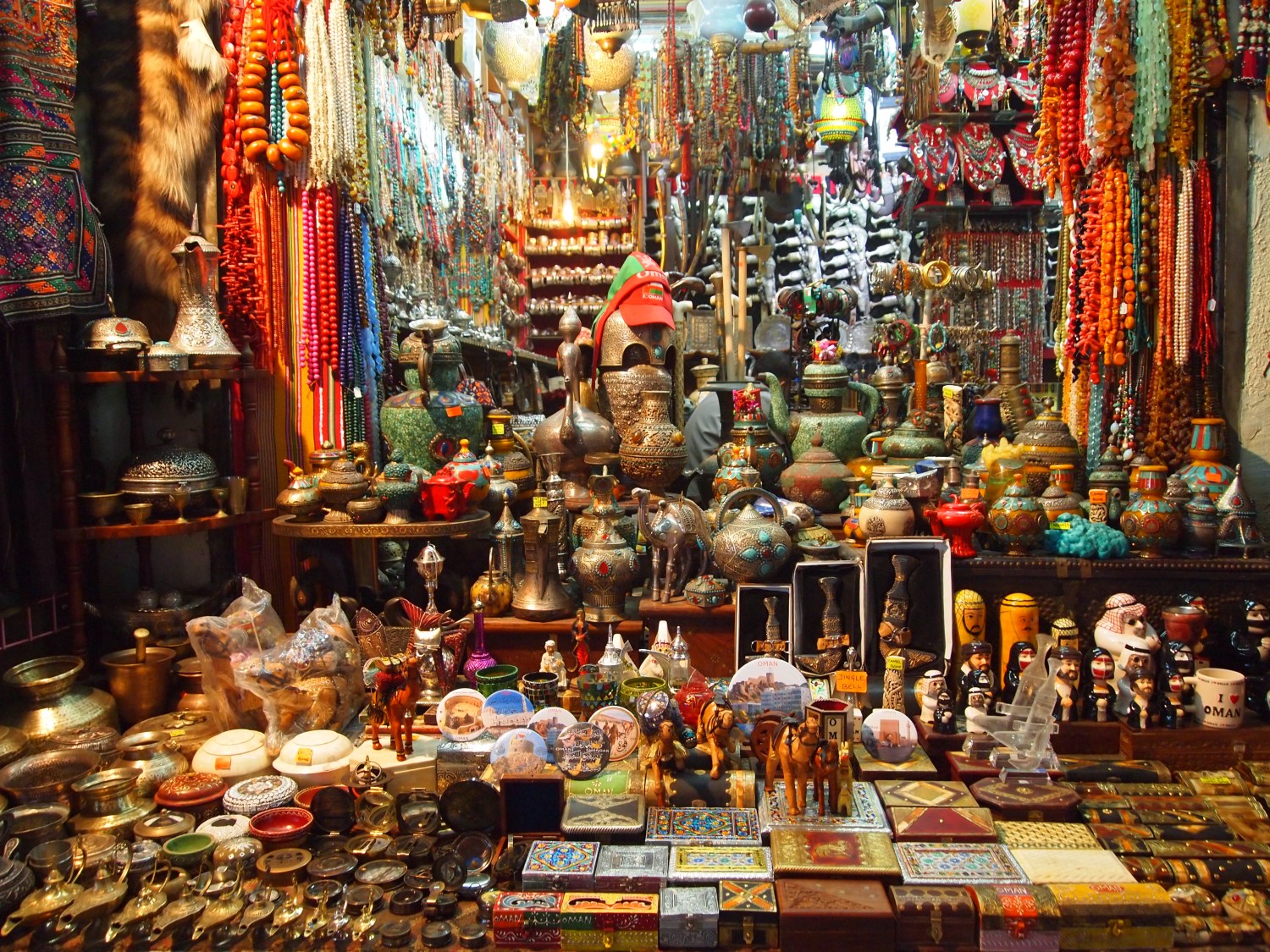
As someone who loves shopping and is easily enticed by colorful and exotic items, I am captivated by lively souqs in old medinas selling everything from woven rugs, blankets, silver, antiques, silks, pottery, carved wooden furniture, silver damascene (metalwork with intricate silver thread), leather goods, ceramics, textiles, to babouches (slippers).
market goods
I am captivated by exuberant colors and patterns on carpets. By nature-inspired embroidery and colorful silks. By leather book covers, handbags, and lampshades. By brass teapots and copper tea trays. By pierced brass lamps and tin lanterns and inlaid knives. By the scent of woodwork from orangewood, cedar, lemonwood, and pine.
market goods
I am captivated by the combination of Arab-Andalusian music, combining the flamenco-style strumming of Spanish folk music with stringed instruments and percussion of classical Arabic music, by Berber folk music, by the sounds of the Arabic language intermingled with French. I’ve studied Arabic before and lived in an Arab speaking country, and know a little of the language. For years, I’ve listened to Arabic music, its exotic notes lingering in my mind, a soundtrack that won’t stop.
I am captivated by the muezzins’ calming call to prayer five times a day, which I experienced while visiting Egypt in 2007 & 2010, Jordan in 2012, and while living in Oman from 2011-2013.
I’m captivated by Moroccan cuisine: Moroccan pancakes and doughnuts and French pastries, olives and local jiben (fresh goat’s milk cheese), khoobz (Moroccan-style pita bread), bessara (hot fava-bean puree with cumin, olive oil, and paprika), rghaif (Moroccan pastries like flattened croissants), brochettes (kebabs), merguez (spicy lamb sausage), pizza, shwarma (spiced lamb or chicken roasted on a spit), and tajines (Moroccan stews), mezze (salad course), and couscous. I’m captivated by the drinks: mint tea, coffee, and even beers (Casa & Flag) and local wines. Oh the list goes on!
I’m captivated by the multitudes of Instagram accounts I follow, with their colorful photos of medinas, Ait Ben Haddou in Ouarzazat, Volubilis, Ouzoud waterfalls, camels in the Sahara, blue boats in Essaouira, Marrakesh souqs, Hassan II Mosque, mosaic courtyards of riad guesthouses, leather tanneries of Fez, the snow-covered Atlas mountains, and the beautiful blue city of Chefchaouen.
Finally, I am captivated by two videos set in Morocco, created by my favorite store, Anthropologie:
Tangier Anthropologie
I can’t wait to leave for Morocco on Thursday, April 4, 2019.
********************
“THE CALL TO PLACE” INVITATION: I invite you to write a post on your own blog about what enticed you to choose a particular destination. If you don’t have a blog, I invite you to write in the comments. If your destination is a place you love and keep returning to, feel free to write about that. If you want to see the original post about the subject, you can check it out here: imaginings: the call to place.
Include the link in the comments below by Wednesday, April 24 at 1:00 p.m. EST.
My next “call to place” post is scheduled to post on Thursday, April 25. If you’d like, you can use the hashtag #wanderessence.
This will be an ongoing invitation, on the fourth Thursday of each month. Feel free to jump in at any time. 🙂
I hope you’ll join in our community. I look forward to reading your posts!
My strange and unexpected fascination with Kyoto, Japan started, quite simply, with a visit to What the Book? in the Itaewon neighborhood of Seoul, South Korea. Browsing through the travel section in December, 2010 when my son Alex was visiting, I come across a book by Pico Iyer calledThe Lady and the Monk: Four Seasons in Kyoto. The picture on the front was enticing enough, the photograph divided diagonally into two parts. On the top triangle was a Japanese lady in a mustard colored kimono, holding an umbrella by her side. On the bottom was a city street with neon signs and fast-moving headlight beams, like red and yellow silk threads, speeding down the length of the streets.
Inspiration
The blurb on the back cover said Pico Iyer decided to go to Kyoto and live in a monastery, to learn about Zen Buddhism from the inside, to get to know one of the loveliest cities in the world, and to experience Japanese culture. To be honest, this was what hooked me and caused me to open the book. On the first page he described an accidental encounter with Japan, which occured only because of an overnight layover on a flight to somewhere else. In the morning, he walked outside: “As I began to walk along the narrow lanes, I felt, in fact, as if I were walking through a gallery of still lifes. Everything looked exactly the way it was supposed to look, polished to a sheen, and motionless.”
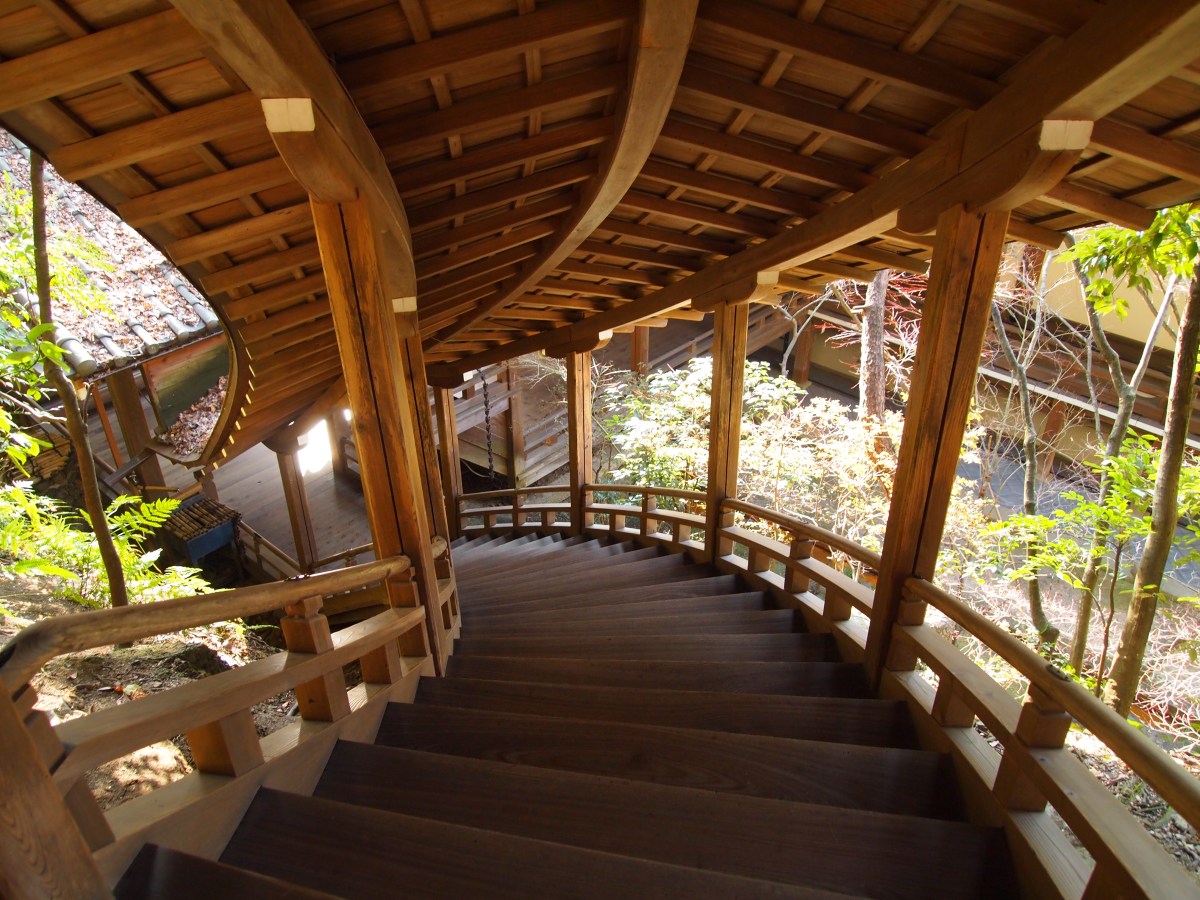
the curving staircase at Eikan-do
There were multiple things that appealed to me about the whole premise of this book. I was enthralled. First, the idea of Japan as a “still life” was intriguing. I didn’t have any interest in going to Japan as I feared it would be a repeat of Korea. Many Koreans told me Japan was just like Korea. Of course, many of those Koreans had never left their own country, so I didn’t know why I should have believed them. Then several fellow English teachers I knew in Korea also said it was about the same. These comments steered me away from Japan because I’d explored many corners of Korea during the year and I really didn’t want to spend my time and money flying to Japan to see more of the same. Nothing in Korea could honestly be compared to a “still life.” But those two simple words shifted my perspective. They felt like an invitation into a painting, a piece of art awash with color and beauty, with elegant gardens and exquisite taste.
pretty little what-nots
still life in Kyoto
The other thing that piqued my interest was Pico Iyer’s desire to learn about Zen Buddhism. In Korea, I had put off time and again doing a temple stay. I finally ended up doing one, but only toward the end of my stay in late February of 2011, after I’d been to Japan (temple stay at golgulsa sunmudo ~ a surprise encounter with monk-type martial arts). This interest in Zen was one of the things that fascinated me about this book, and about Japan.
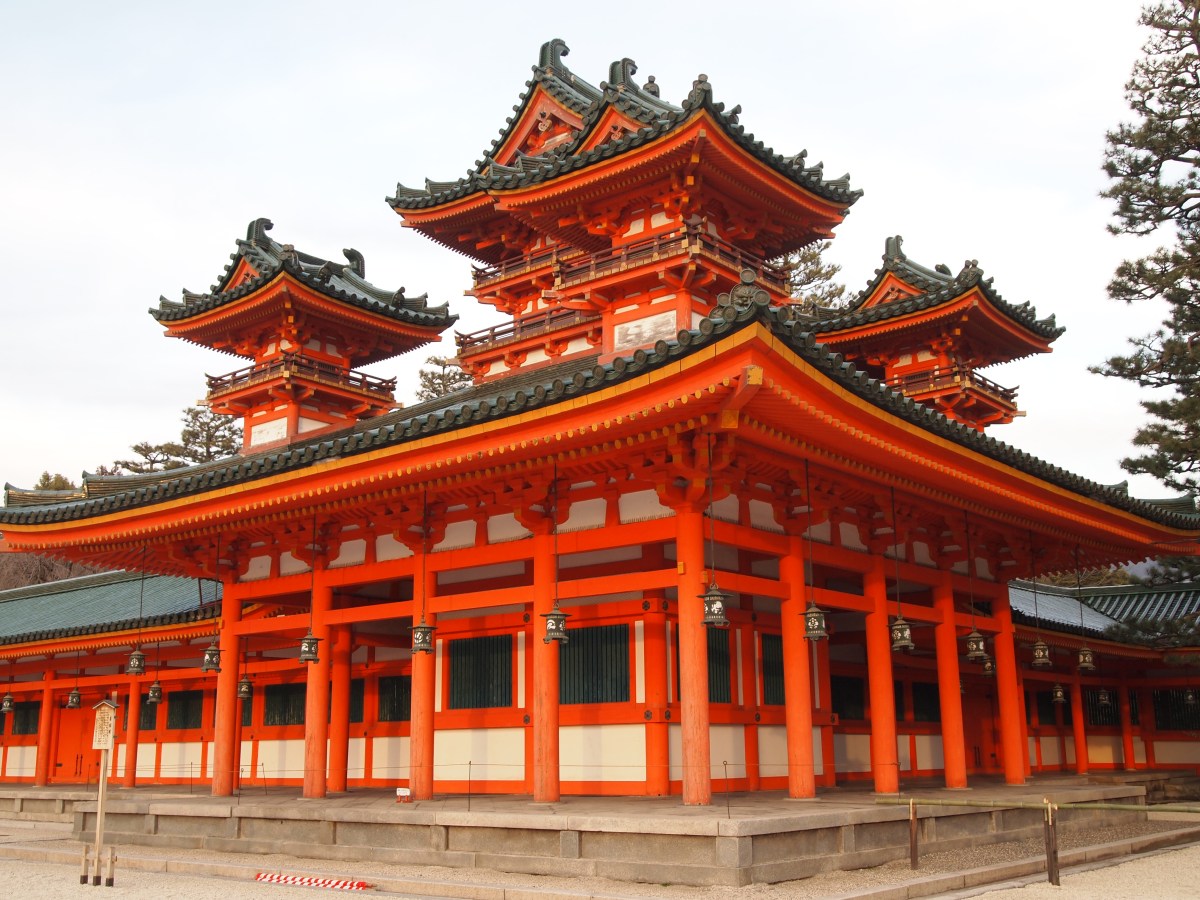
Heian-jingu Shrine
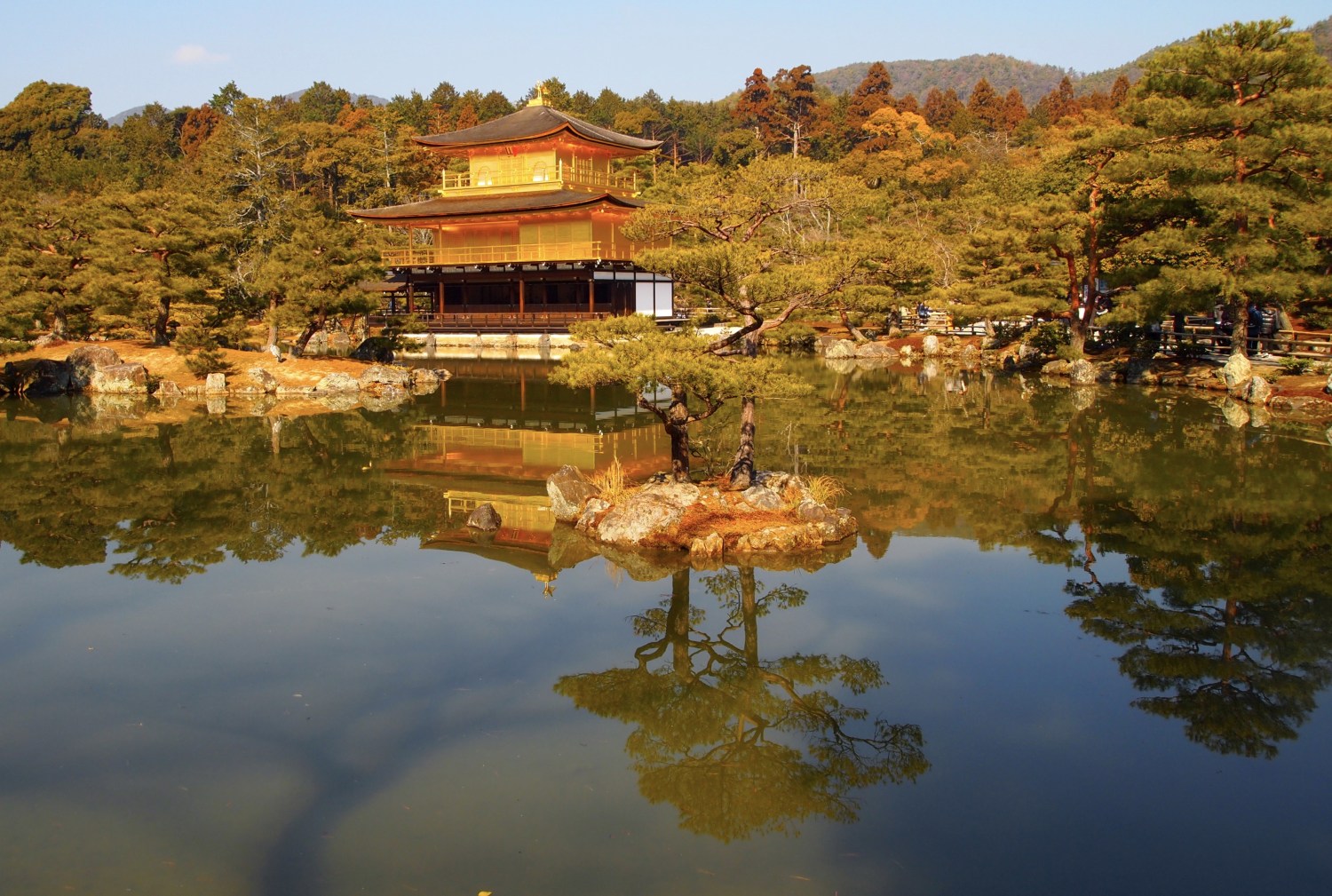
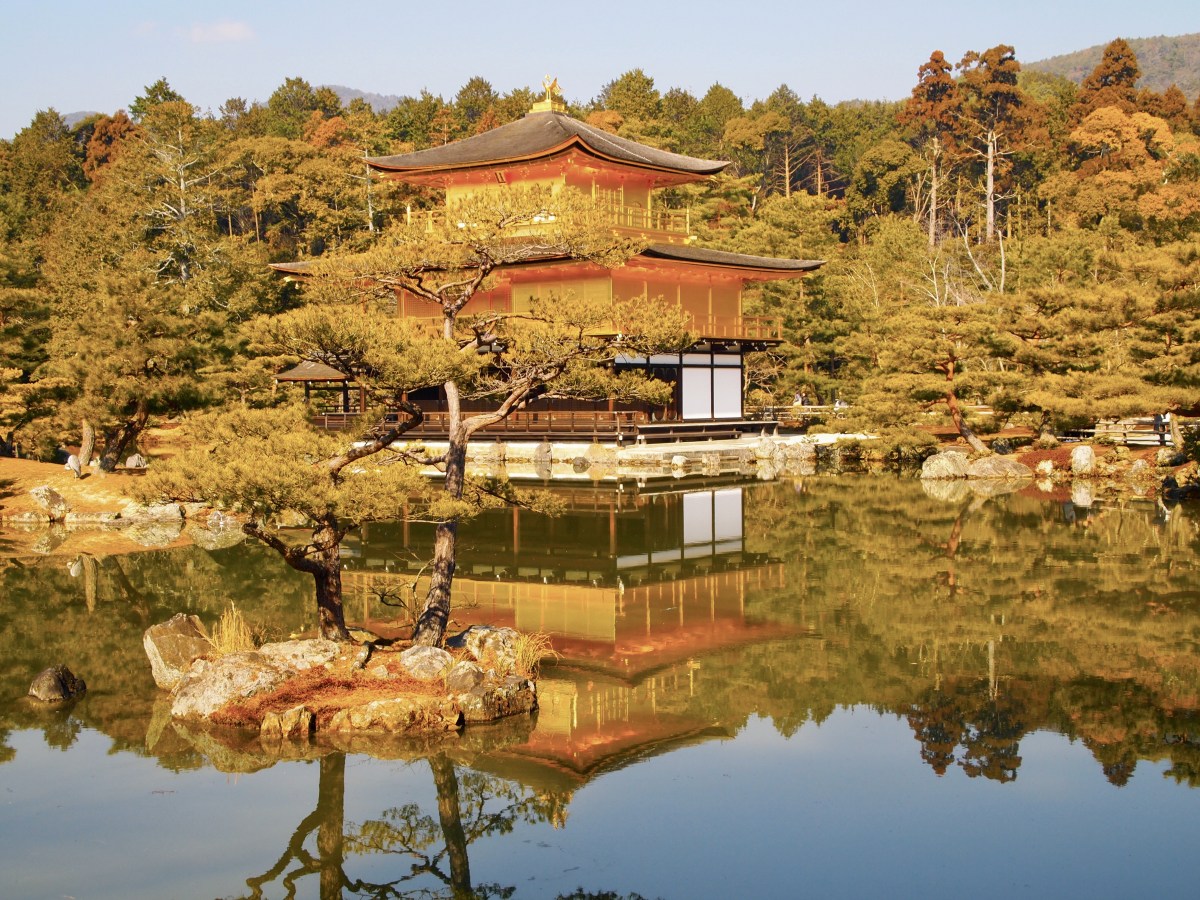
the golden pavilion at Kinkaku-ji
I enjoyed Japanese food, especially sushi that I’d eaten in the U.S. I loved to see ornamental gardens and the cultivation of beauty all around. After all, I used to take classes in interior design and had a small interior design business of my own for a while. I decorated my own house in Virginia from top to bottom. I’ve always been drawn to exuberant colors. I loved the idea of ritual. I loved the idea of tea ceremonies and flower arranging, although I’d never participated in either.
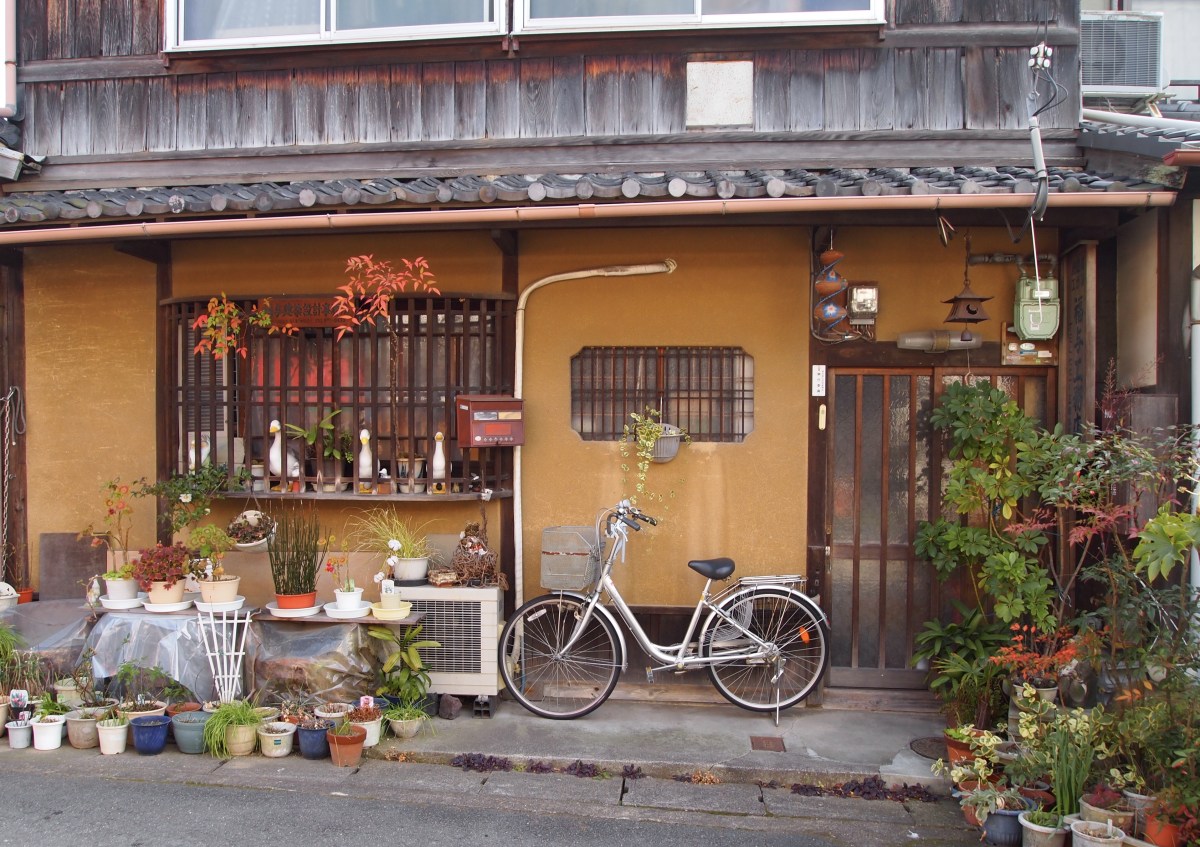
garden in Kyoto
temple in Kyoto
Tempura in Kyoto
colorful change purses
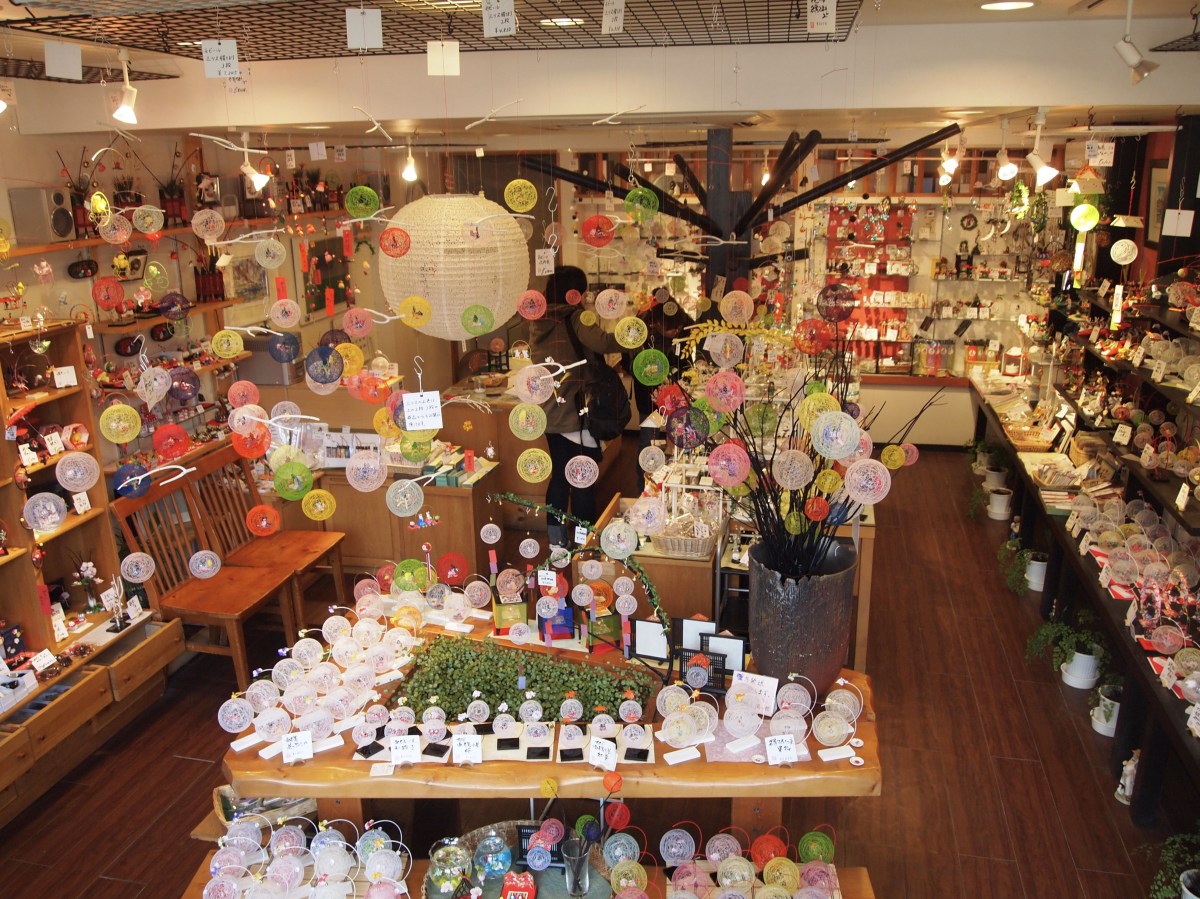
typical shop in Japan
Years ago, I read Memoirs of a Geisha. I found the geisha culture fascinating, though disturbing on many levels. I also read the book Hiroshima, by John Hersey, a moving and highly disturbing personal story of that city’s residents who survived the nuclear attack in 1945. I used to think if I ever visited Japan, I would have to go to Hiroshima where it is said you can see outlines of people who were vaporized by the bomb on concrete walls. I didn’t know if this was simply a legend. Anyway, I’d talked to people who visited Hiroshima and they said it is extremely depressing, much like visiting the Holocaust Museum in Washington, I assume. An educational and moving and disturbing voyage, something everyone should do. It wouldn’t be something I would do on my first visit.
girls in kimono at Heian-jingu Shrine
girls in kimono drinking from a well of good fortune at kiyomizu-dera temple
I wasn’t knowledgeable overall about Japanese culture. So I looked forward to spending five days in Kyoto over the lunar new year in February, 2011. I looked forward to painting myself, a mere fleeting brushstroke, into the “still life” of Kyoto conjured up by Pico Iyer.
the famous rock garden at Ryoan-ji, or Temple of the Peaceful Dragon
the cute little Randen Railway
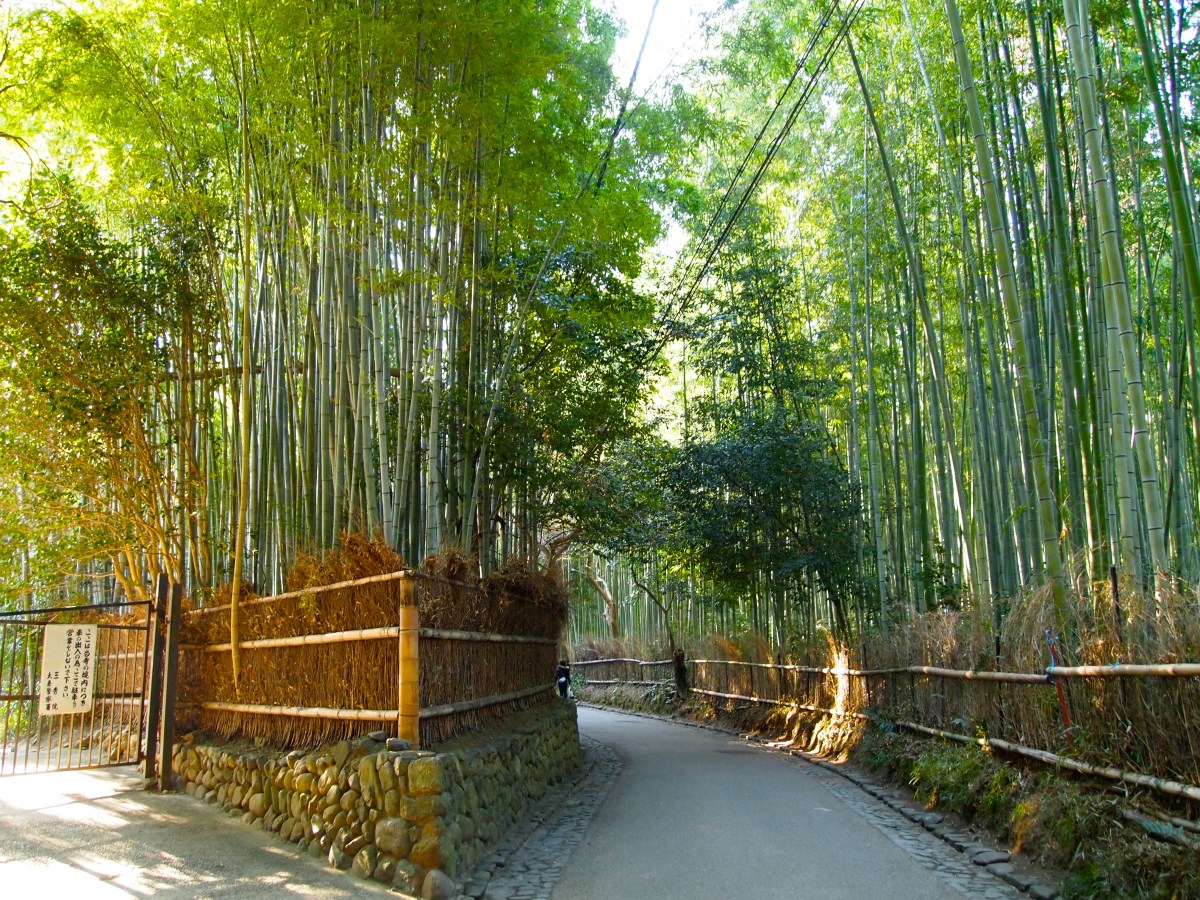
the Bamboo Path at Arashiyama
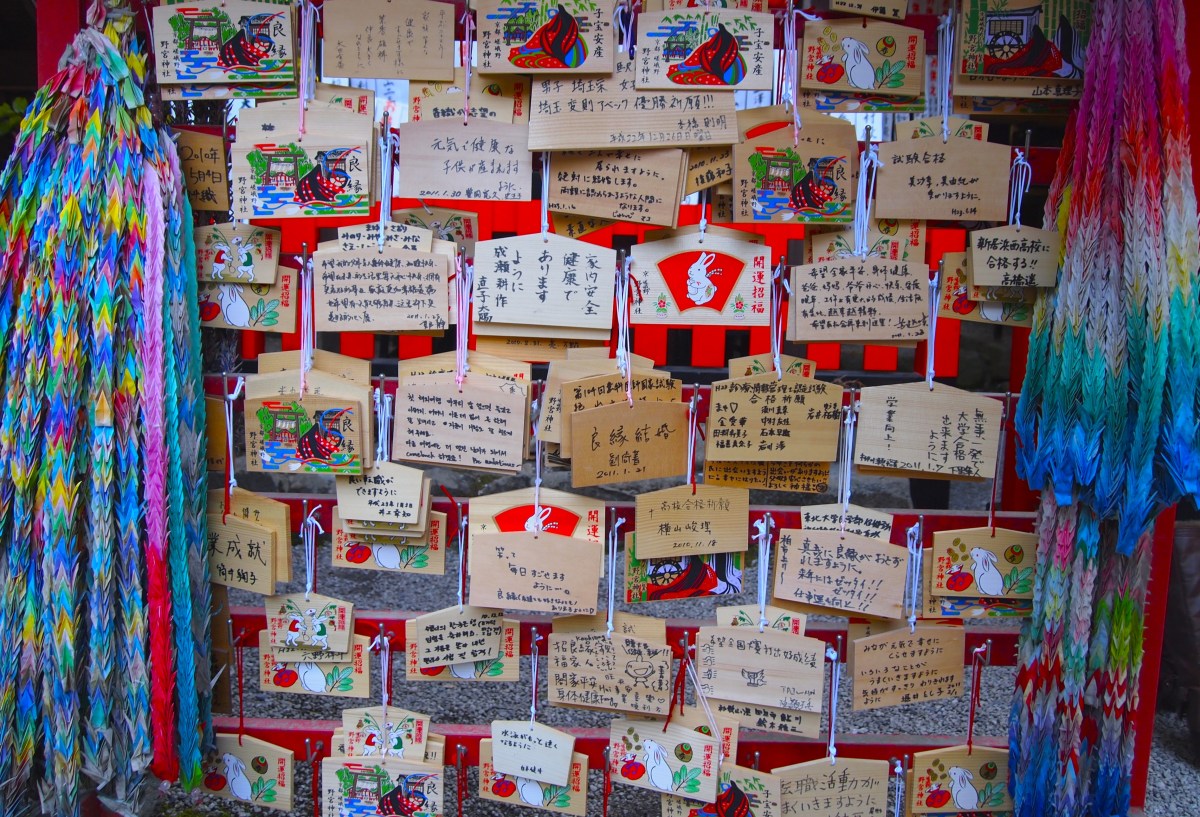
ema at Nonomiya
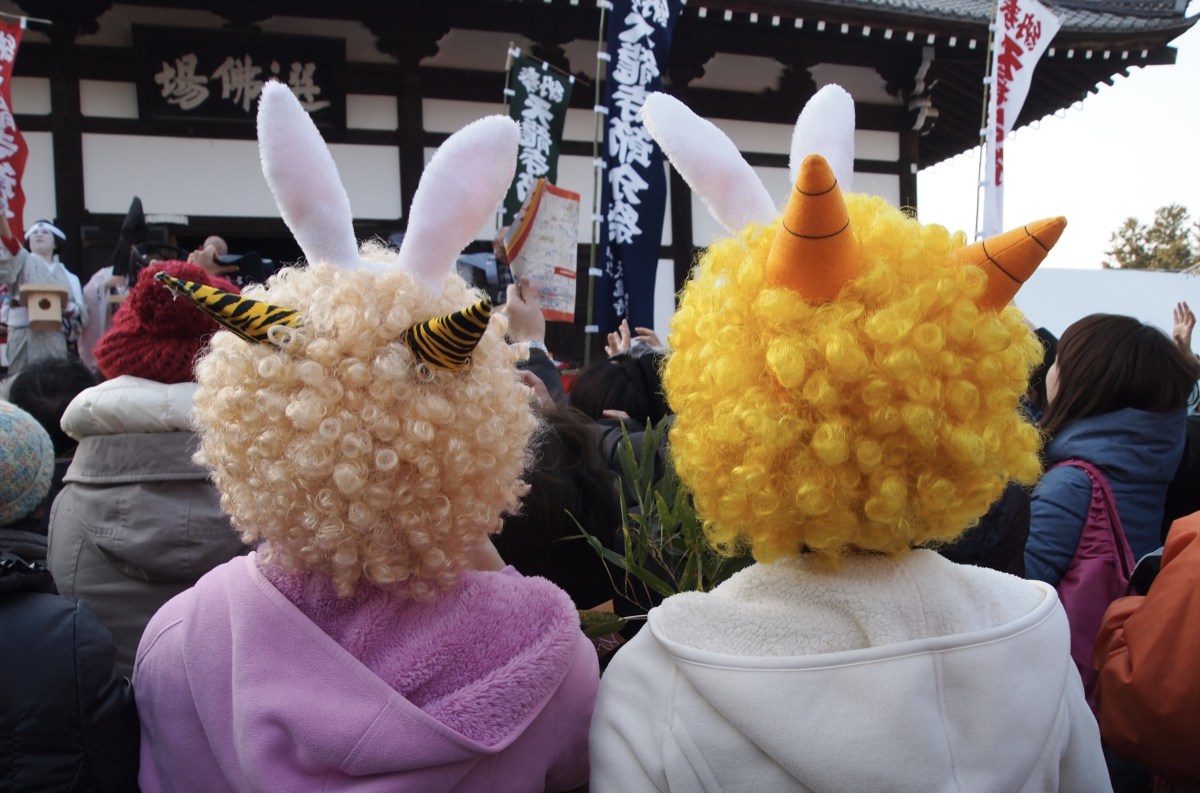
celebration of Lunar New Year at Tenryuji Temple
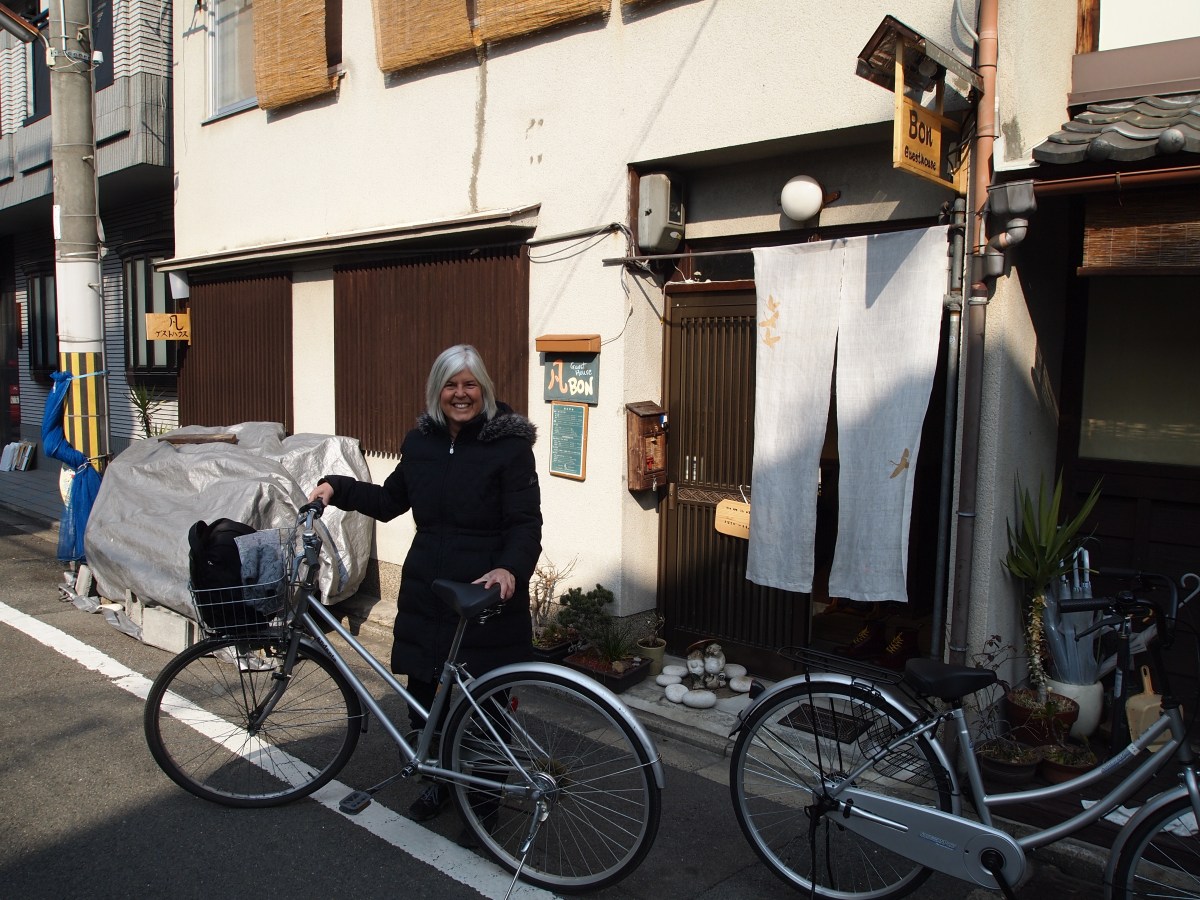
me going bicycling in Kyoto
the infinite torii gates at Fushimi-Inari-Taisha
All photos are from my first visit to Kyoto in February, 2011.
**
Fast forward to late February of 2017, six years after my first visit to Japan. I was offered a job teaching EFL to Japanese university students in Japan beginning on March 28, 2017 (the term actually began April 7 and ended August 1). I opted to extend my stay for one week, until August 8, so I could travel around Japan for a week. As I’d always wanted to visit Hiroshima, I’d have to incorporate a visit into that journey.
My short trip to Kyoto in February 2011 had been delightful. I loved the Buddhist temples, the ubiquitous vending machines, Japanese food, the cleanliness and efficiency of everything. I looked forward to exploring as much of Japan as I could in the four months I’d be there.
I would live in Sagamihara City in Kanagawa Prefecture, part of the greater Tokyo metropolitan area. The capital of Kanagawa is Yokohama, the second largest city in Japan by population (3.7 million); it lies on Tokyo Bay, south of Tokyo, in the Kantō region of the main island of Honshu, and is today one of Japan’s major ports.
“THE CALL TO PLACE” INVITATION: I invite you to write a post on your own blog about what enticed you to choose a particular destination. If you don’t have a blog, I invite you to write in the comments. If your destination is a place you love and keep returning to, feel free to write about that. If you want to see the original post about the subject, you can check it out here: imaginings: the call to place.
Please include the link in the comments below by Wednesday, November 21 at 1:00 p.m. EST. When I write my post in response to this challenge on Thursday, November 22, I’ll include your links in that post. If you’d like, you can use the hashtag #wanderessence.
This will be an ongoing invitation, on the fourth Thursday of each month. Feel free to jump in at any time. 🙂
I hope you’ll join in our community. I look forward to reading your posts!
the ~ wander.essence ~ community
I invite you all to settle in and read a few posts from our wandering community. I promise, you’ll be inspired! As I’m still in Spain/Portugal, see below in the comments for any links.
Thanks to all of you who wrote posts about “the call to place.” 🙂
Oh, the overwhelming and breathtaking power of water. I could stand for hours mesmerized by waterfalls, listening to the roar of water as it makes its way from high ground to low, spellbound by its sheer volume and power as it tumbles over cliffs and into gorges, where it swells and sinks and swirls in rapids and whirlpools.
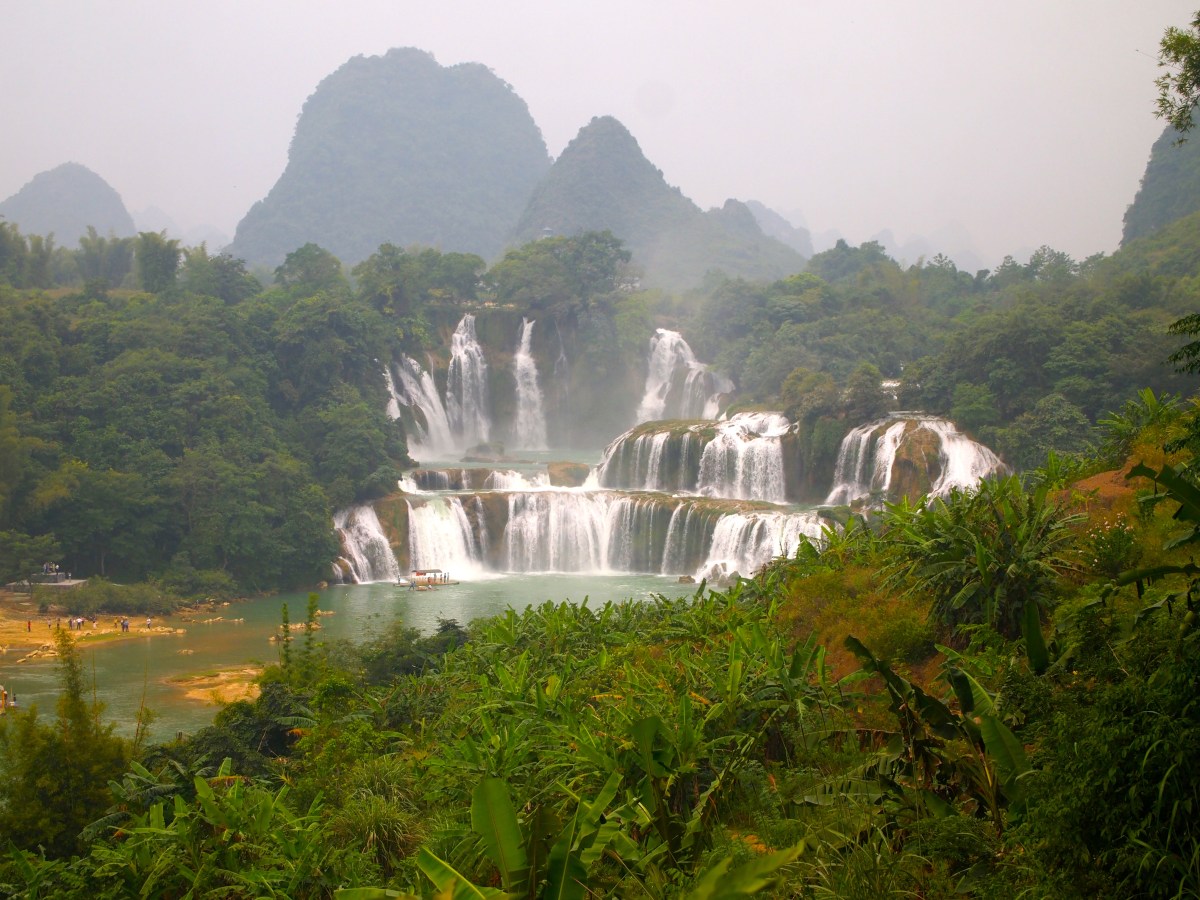
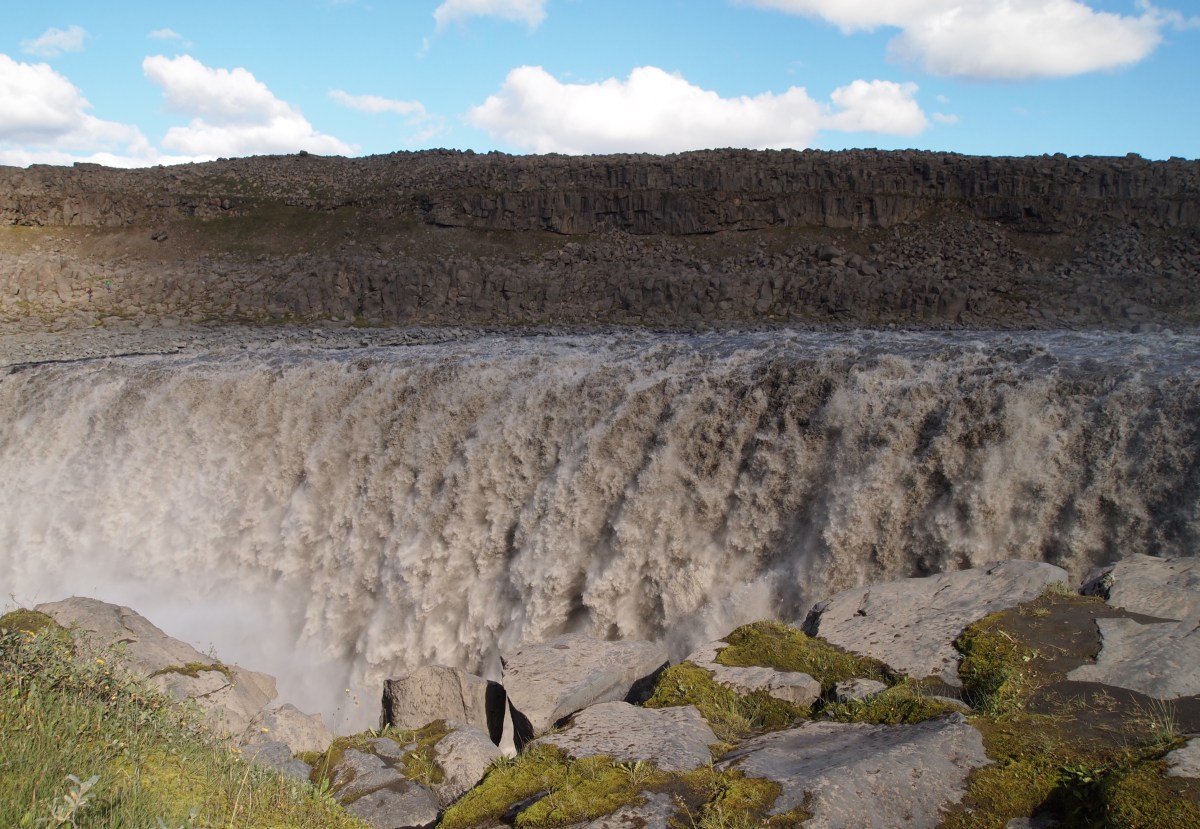
I’ve seen waterfalls that separate countries, such as Detian Waterfall on the border of China and Vietnam, as well as Dettifoss in Iceland, a waterfall known as having the greatest volume of any waterfall in Europe.
Detian Waterfall on the border between China and Vietnam
Dettifoss in Iceland
Surprisingly I haven’t seen as many waterfalls in my travels as one would expect. However, of the ones I have seen, each is unique.
Gullfoss in Iceland’s Golden Circle
Gullfoss in Iceland’s Golden Circle
Iceland has an abundance of entrancing waterfalls.
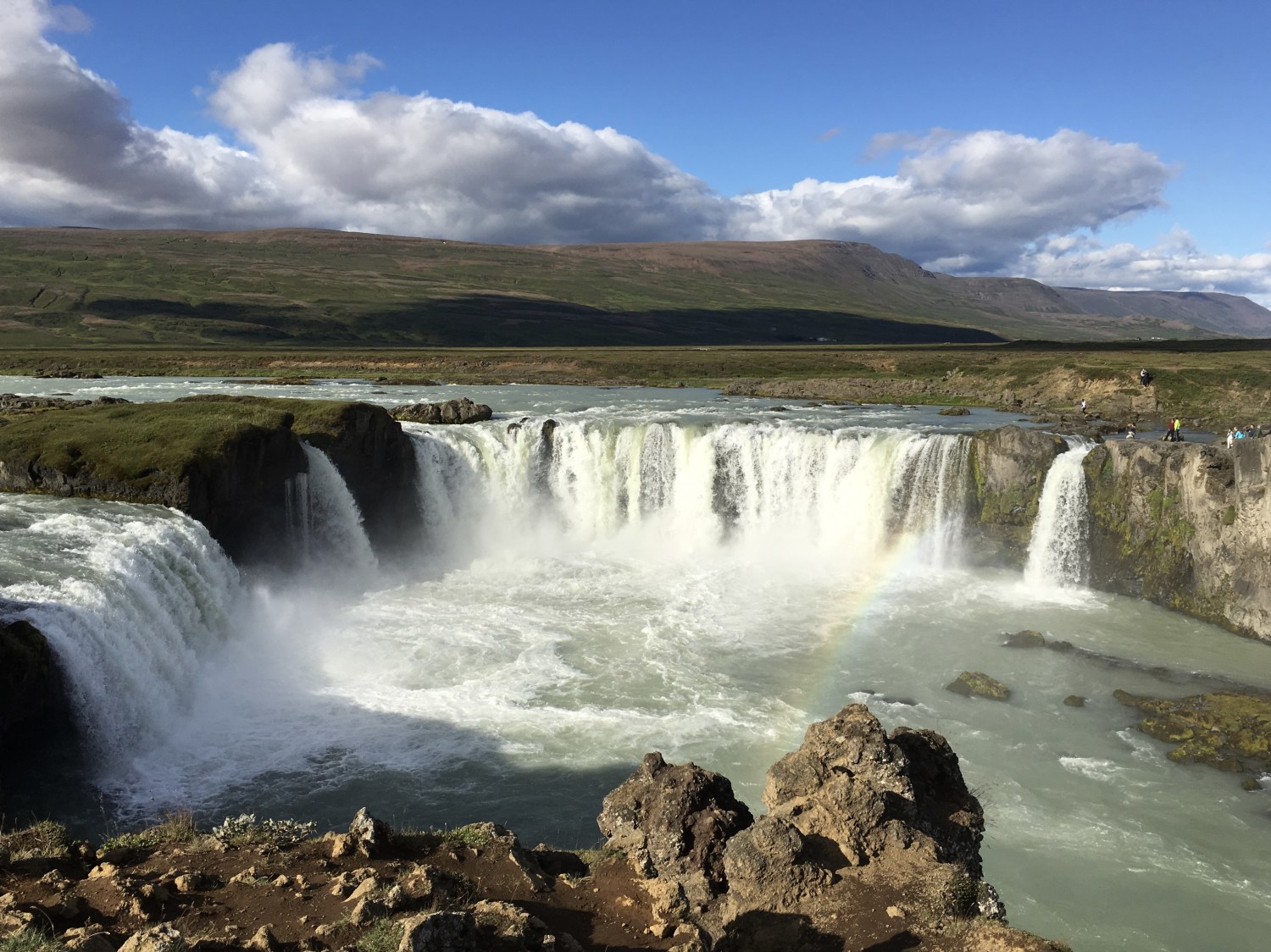
the top of Godafoss in Iceland
Godafoss
waterfalls near Seyðisfjörður
Skaftafell in Iceland
Skogafoss in Iceland
One of the falls feeding into Skogafoss
I imagine the force of Niagara Falls, as it rushes over a 17-story cliff, is tumultuous and wild, unfettered and impassioned. I’m excited to see it and immerse myself in the experience. 🙂
It’s hard to believe that, as an American who lives about a 7-hour drive from Niagara Falls, I’ve never been to visit. I generally don’t enjoy places that are too touristy, commercial or kitschy and I have in my mind that Niagara Falls is all of those things. Though Niagara’s reputation has deterred me in the past, I have become curious. I’m determined to see it even if it ultimately disappoints.
The idea of Niagara Falls came to me in January when I plotted out my 2018 travel plans. I was looking for a place within a day’s drive that I could visit on my own or with the extended family, including my adult children. My husband quashed the idea of going because he simply wasn’t interested. “Too touristy,” he gave as his reason. Then my sons ventured out west to live in Colorado, which made it no longer feasible as a family destination.
When I mentioned my plans to an old friend of mine from Oman, who now lives in Waterloo, Ontario, she told me she lives less than two hours away from the Canadian side of Niagara Falls. We planned that when I visited, I’d meet her on the Canadian side and we’d spend a day together. Since she recently lost her mother and has taken a number of days off from work, she only has one day to meet me. The plan has been laid. I haven’t seen this friend since I left Oman in June of 2013, so by the time we meet, I won’t have seen her for five years. One of the things she wants to do is to visit the Butterfly Conservatory.
While on my Four Corners road trip, I became addicted to the Passport To Your National Parks. When you visit the U.S. National Parks, Monuments, or Historic Sites, you can get a sticker describing and picturing the park, and a free passport stamp which says the name of the park and the date visited. I collected 18 stamps during my trip, and I was excited about collecting one for Niagara Falls. But, alas, Niagara Falls is NOT a National Park. I looked at my route and found the Theodore Roosevelt Inaugural National Historic Site is in Buffalo, close to Niagara Falls, so I’ll be stopping in Buffalo to see that site and collect my stamp!! Buffalo is New York State’s second largest city, so there is plenty to see there, but I doubt I’ll have much time to linger. Buffalo is also home to a Frank Lloyd Wright House, the Darwin Martin House Complex, which I hope to visit.
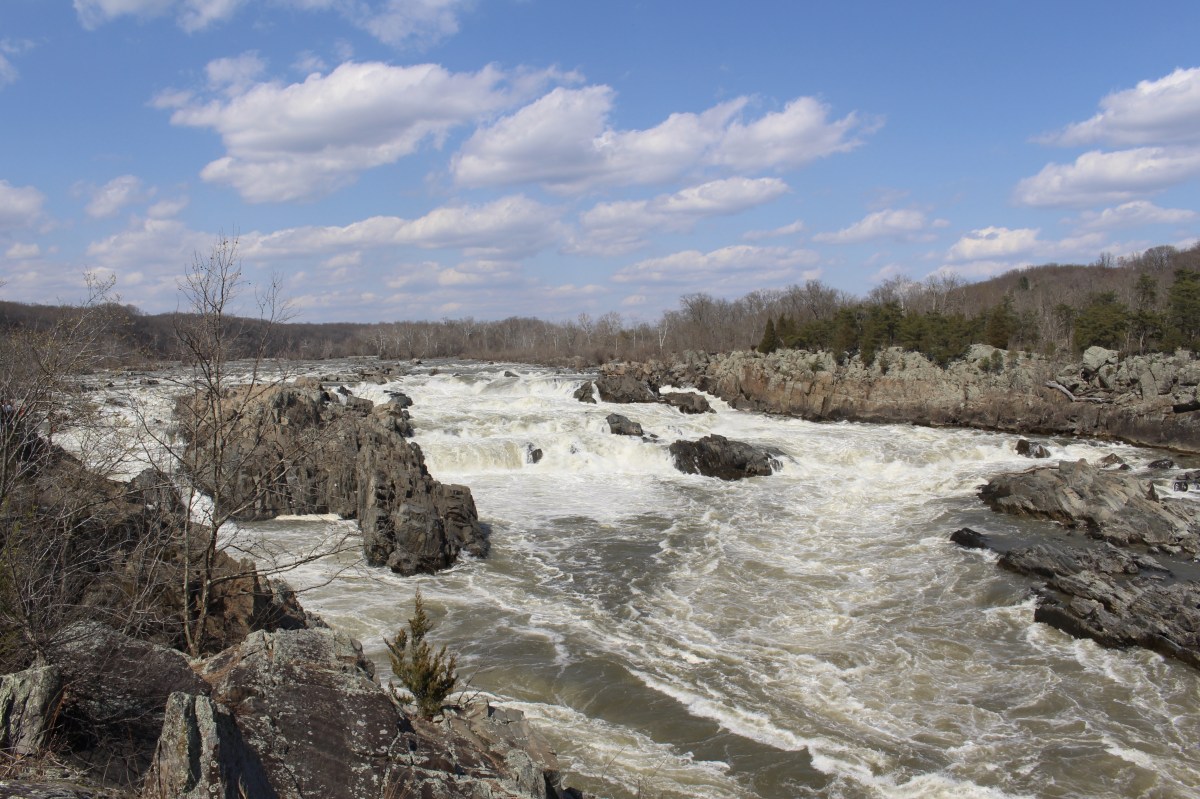
While trying to vary my walks in training to walk the Camino de Santiago in September, I decided on Monday, June 4 to visit Great Falls Park. I could collect my National Park sticker and stamp and get a walk in at the same time. You can see what Great Falls looks like normally in the pictures below: the first was taken in October of 2016 and the second in April 2018.
Great Falls, October 16, 2016
Great Falls, April 8, 2018
Here’s my “Passport to Your National Parks” and the George Washington Memorial Parkway stamp, of which Great Falls is a part.
Passport to Your National Parks
On this June Monday, the falls were tumultuous and roaring. We’d had a lot of rain over the previous week and it covered most of the rocks that are normally visible. Churning in whirlpools were tree trunks and other detritus. In the two pictures below, you can see Great Falls on April 8, 2018, compared with June 4, 2018.
Great Falls, April 8, 2018
Great Falls, June 4, 2018
I’m excited to explore Niagara Falls, comprised of three waterfalls that straddle the international border between the Canadian province of Ontario and the American state of New York: Horseshoe Falls, American Falls and Bridal Veil Falls.
********************
“THE CALL TO PLACE” INVITATION: I invite you to write a 500-700 word (or less) post on your own blog about what enticed you to choose a particular destination. If you don’t have a blog, I invite you to write in the comments. If your destination is a place you love and keep returning to, feel free to write about that. If you want to see the original post about the subject, you can check it out here: imaginings: the call to place.
Please include the link in the comments below by Wednesday, July 25 at 1:00 p.m. EST. When I write my post in response to this challenge on Thursday, July 26, I’ll include your links in that post. If you’d like, you can use the hashtag #wanderessence.
My next post will be about my upcoming trip to Portugal after I finish walking the Camino de Santiago in northern Spain.
This will be an ongoing invitation, on the fourth Thursday of each month. Feel free to jump in at any time. 🙂
I hope you’ll join in our community. I look forward to reading your posts!
the ~ wander.essence ~ community
I invite you all to settle in and read a few posts from our wandering community. I promise, you’ll be inspired!
Suzanne, of Being in Nature, wrote about her call to the gorgeous Hagia Sophia in Istabul.
In 2009, I was at a place called Tarbouch in Arlington, VA and an Iraqi guy and a Syrian woman told me, as we smoked apple-flavored tobacco in a hookah, about the ancient Middle Eastern art of coffee cup reading. The Iraqi said he had the ability to read cups. He told me to drink all my coffee, turn my cup over on the saucer and let it dry. I did as he instructed, and he proceeded to read my cup. What surprised me is that when I looked at the cup with him, I could see very clearly two people walking forward. A larger person with an Arab headdress was in the front. Behind this person was a smaller, slighter, more delicate person. The Iraqi expressed surprise, as did I, at the clearness of the picture. He said it was an Arab man and a woman of unidentified nationality; his belief was that it was me following behind an Arab nomad, walking in his footsteps. It was very odd; that image stayed with me until I was in South Korea in 2010.
ORIGINS:
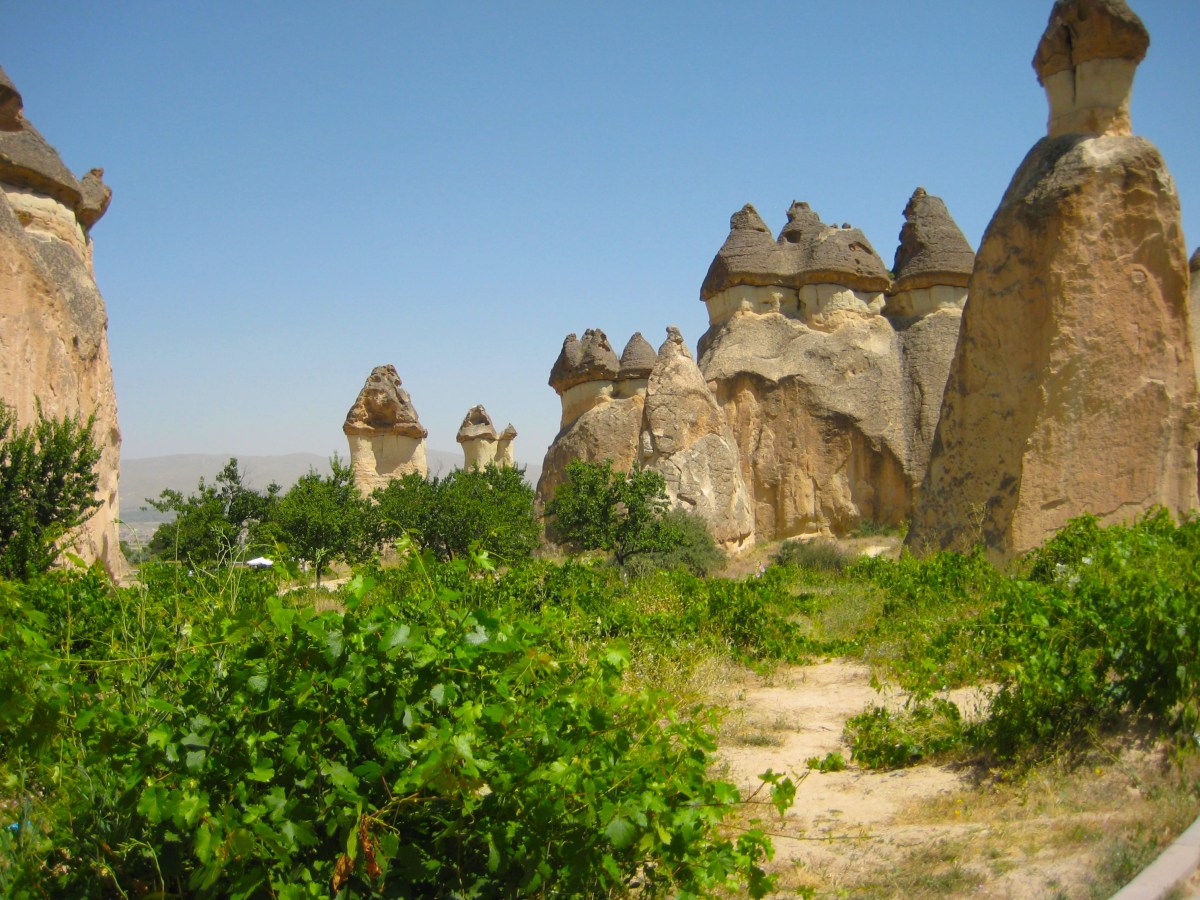
Maybe it was the photos of the lovely Hagia Sophia, its shimmering mosaics and smooth marble, in a long-ago art history class. Maybe it was the descriptions of Turkey in a novel called The Black Book by Turkish author Orhan Pamuk: vials the color of pomegranates; the sea swirling around … delicate ankles; the seaweed and seven-colored oil spills; Alaaddin’s bustling shop. Maybe it was the Turkish Groove Putumayo CD with the song “Kirmizi Biber” by Bendeniz. Or singer Tarkan’s “Kuzu Kuzu” on YouTube. Maybe it was the pictures of the cave dwellings of Cappadocia, with its fairy chimneys and otherworldly landscapes. Maybe it was falling in love with the call to prayer in Egypt, and then being beckoned to Turkey for that same call to prayer with a European twist.
What are the reasons we are pulled to any destination? I could twirl a globe and wherever my finger lands, I could go. However, I can’t ignore certain places that speak to my heart, places that promise mystery and romance and adventure. Places that are exotic and far-removed from my daily existence. Most of these places for me are in the Middle East. After having been to Egypt, and falling headlong in love with its dusty, teeming streets, its people, the pyramids, the Nile, I know I am drawn to these places. High on my list are Morocco, Lebanon, Jordan, Syria, Egypt (again), Turkey. Other places have beckoned as well: Italy, Greece, Spain, Portugal, China, Cambodia, Vietnam. Africa beckons, Peru, Brazil…. the list goes on.
I didn’t know a thing about Islam or Middle Eastern culture until I started reading voraciously about the Arab world following the September 11 terrorist attacks. A domino effect followed. I started writing a novel and felt compelled to make one of the characters an Egyptian man. I had never in my life met a single Egyptian, so I decided to study Arabic in the hope of learning more about the culture, mainly to make my character more realistic. Then I took some international relations classes at community college and I loved them so much I applied for a Master’s program at George Mason University in International Commerce & Policy. In the summer between the two-year program, a Muslim friend of mine gave me information about a program to study Arabic in Egypt for one month. I went there and studied Arabic at Al Azhar University in Cairo in July 2007. I fell in love with Egypt, though it made me incredibly sad to see all the poverty there.
I was teaching English in Korea and one of the things I wanted to do was to take advantage of the proximity to Asia to travel. However, when my two-week summer vacation beckoned, I couldn’t get excited about China or Japan, try as I might. I originally wanted to go back to Egypt, but several things turned me off to it. The idea of Istanbul kept pulling at my heart. Various things happened which only reinforced that calling to a place with such rich history, a place that is Muslim yet European, a place that straddles Asia and Europe. When it came time to buy my plane ticket, I was still debating, but the price was right for Turkey. So, off I went, to the former Constantinople.
I would depart from Korea on July 21st. Oh, sweet anticipation. 🙂
Istanbul:
lanterns in Istanbul
Hagia Sophia
View from Galata Tower
Cappadocia:
Cappadocia
Cappadocia
Cave churches
me in Cappadocia
Cave churches
hike in Cappadocia
Cappadocia
Cappadocia
Cappadocia
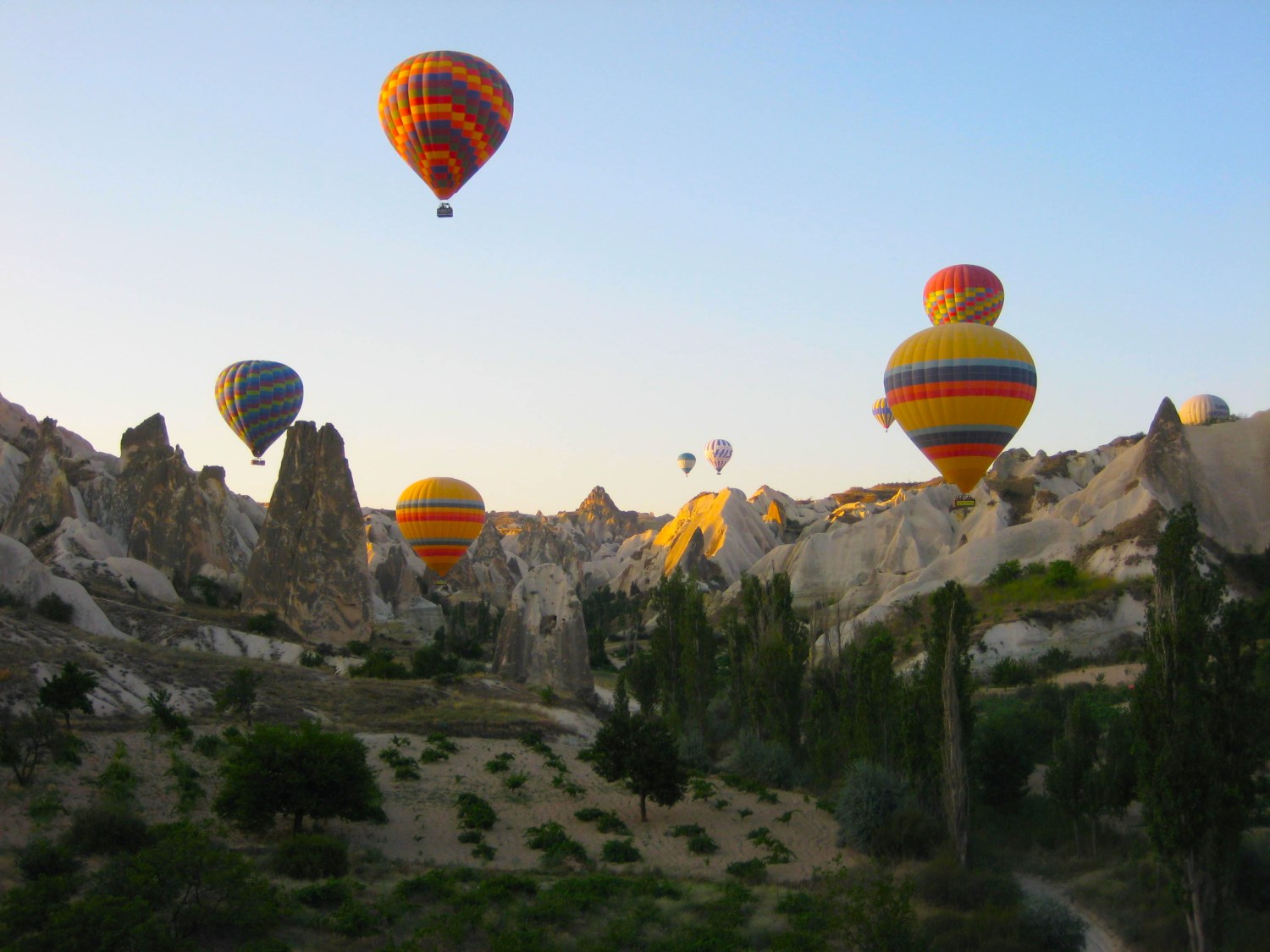
Ballooning in Cappadocia
Ballooning in Cappadocia
Ballooning in Cappadocia
Ephesus:
Ephesus
Ephesus
Pamukale:
Pamukale
********************
“THE CALL TO PLACE” INVITATION: I invite you to write a 500-700 word (or less) post on your own blog about what enticed you to choose a particular destination. If you don’t have a blog, I invite you to write in the comments. If your destination is a place you love and keep returning to, feel free to write about that. If you want to see the original post about the subject, you can check it out here: imaginings: the call to place.
Please include the link in the comments below by Wednesday, June 27 at 1:00 p.m. EST. When I write my post in response to this challenge on Thursday, June 28, I’ll include your links in that post. If you’d like, you can use the hashtag #wanderessence.
My next post will be about my upcoming road trip to Buffalo, New York and Niagara Falls.
This will be an ongoing invitation, monthly (on the fourth Thursday of each month) after that. Feel free to jump in at any time. 🙂
I hope you’ll join in our community. I look forward to reading your posts!
the ~ wander.essence ~ community
I invite you all to settle in and read a few posts from our wandering community. I promise, you’ll be inspired!
Indra, or TravTrails, wrote about her call to Hong Kong for the Chinese New Year in 2019, with evocative memories of the festivities she enjoyed in previous years, in The Inner Connect — Hong Kong
Sue, of WordsVisual, wrote about how she heeded a call to the Ystwyth Valley ( in Welsh, actually Cwmystwyth) from an article in Country Life magazine showing an image of an abandoned mine building, in Y is for Ystwyth Valley
When I was 10 years old, our family loaded into a Ford Fairlane station wagon and drove across country to southern Colorado for a reunion with my mother’s family. My mom had grown up in the small town of Pagosa Springs. I remember vividly horseback rides in the shadows of the jagged Rocky Mountains with cottonwood trees rustling in the breeze, my Uncle Gibby fishing in the San Juan River and grilling fresh trout over a hot fire. During those chilly Colorado mornings, he scrambled up dozens of eggs laced with chili powder in a cast-iron skillet. I can still taste those eggs and feel that early morning chill in the forest of aspens and box elders. I can, to this day, summon up the bliss I felt in that place.
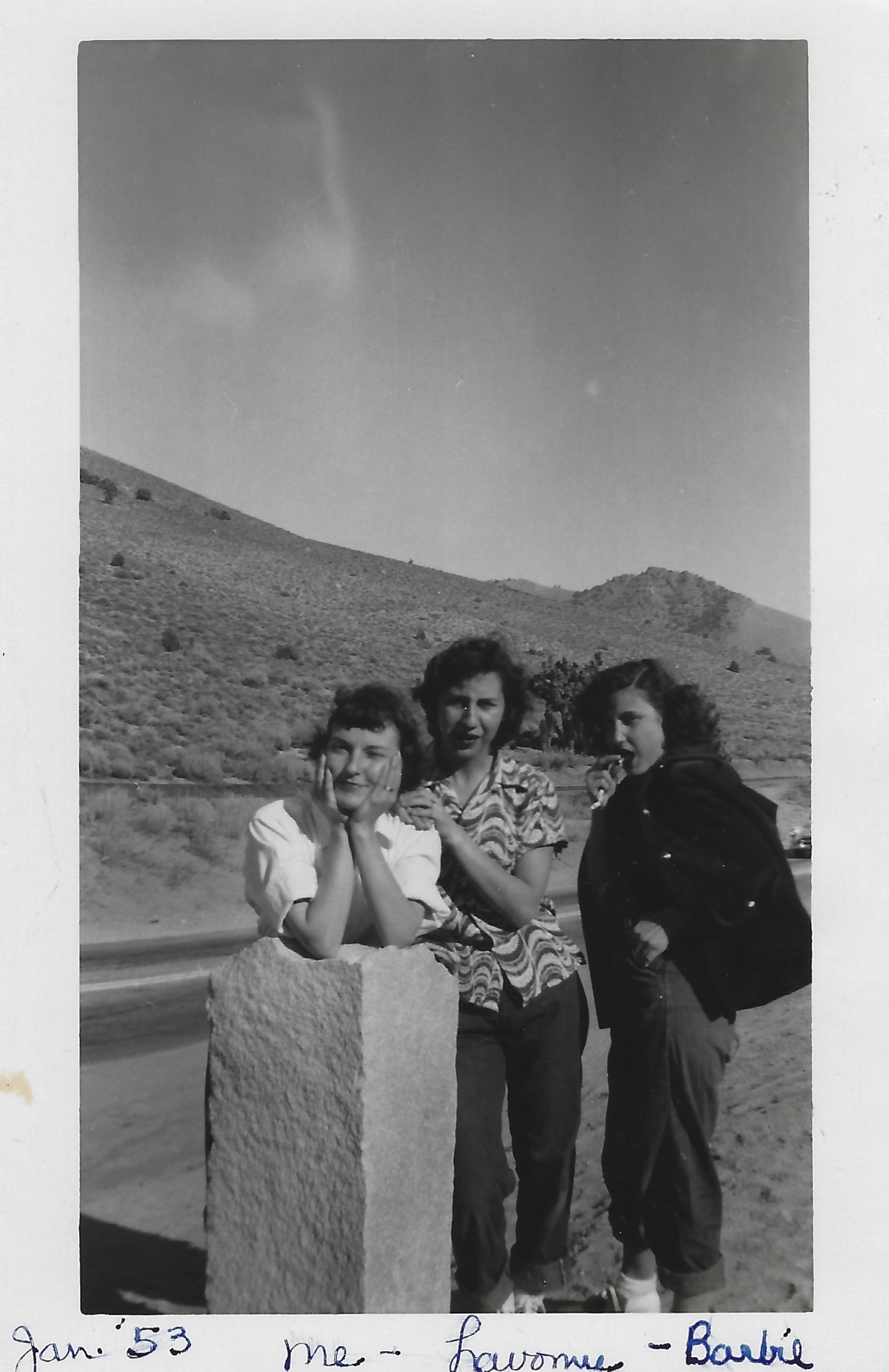
My mom and her two sisters, LaVonne and Barbie, in the southwest USA January 1953
In 1968, at ages 12-13, while the outside world was tearing itself apart over the Vietnam War, student protests and assassinations, I entertained myself by immersing myself in dreams of horses. My best friend was as crazy about horses as I was. She and I galloped, lopsided, circling her backyard, leaping over sawhorse jumps, hitting our behinds with sticks. She clucked and I clucked. Hours and hours and hours.
A classmate’s grandfather, who lived at the end of Wormley Creek Drive, had a stable, a dirt corral with jumps set up, a horse, and a scruffy pony named Maybe, who we were allowed to ride. We all joked: “Maybe he’ll buck you and maybe he won’t.” That pony and I flew over jumps like clumsy leaping grasshoppers, and sometimes, just as Maybe’s hooves hit the ground, when I was as off-balance as possible, he went into a fit of bucking. Many times I hit the ground hard. A couple of times, I hung on to his underbelly, screaming, as he bucked in circles around the yard.
When my friend wasn’t around, or when I had long hours to kill, I would read books about horses: National Velvet; Smoky: The Story of a Horse; Fury and the Mustangs; Misty of Chincoteague; Black Beauty. On gauzy afternoons, the light low in the sky through fall and winter, I stretched stomach-down out on my purple crocheted afghan, lost in writing: stories of ranches out west, palominos and appaloosas, improbable tales of girls loving horses. Pages and pages of words on lined paper.
In 1971, when I was in ninth grade, my fascination with American Indians, now properly called Native Americans, engulfed me as I hand wrote a 60-page research paper titled: “The Social Status of the American Indian Today,” using 25 sources. Here are a few glimpses of the paper, which I still have. Much of my visit out west will be exploring Native American monuments and reservations.
My 9th grade term paper
My 9th grade term paper
My 9th grade term paper
I constantly dreamed of venturing out west. I returned to the Colorado Rockies on a road trip with my first husband, but we never made it back to Pagosa Springs. After leaving Grand Junction, we headed north and drove a big circle around the rest of the country – – Wyoming, Idaho, Washington, Oregon, California and Arizona — omitting Utah altogether from our journey.
Colorado National Monument 10/6/79
Watching movies over the years has also planted wanderlust for the southwest in my mind; Thelma and Louise (1991), Little Miss Sunshine (2006), and 127 Hours (2010), which takes place in Canyonlands National Park.
Living in Oman for two years gave me an abiding appreciation of the desert, until then a foreign terrain to me. In Oman, I explored desert canyons, treeless rocky mountains, village ruins and a desert camp with the Bedouin at Sharqiya Sands.
Sharqiya Sands, Oman
Jebel Akhdar, Oman
Jebel Shams, Oman
Beehive tombs, Oman
Wadi Bani Awf, Oman
Sharqiya Sands, oman
Rocks of Izki, Oman
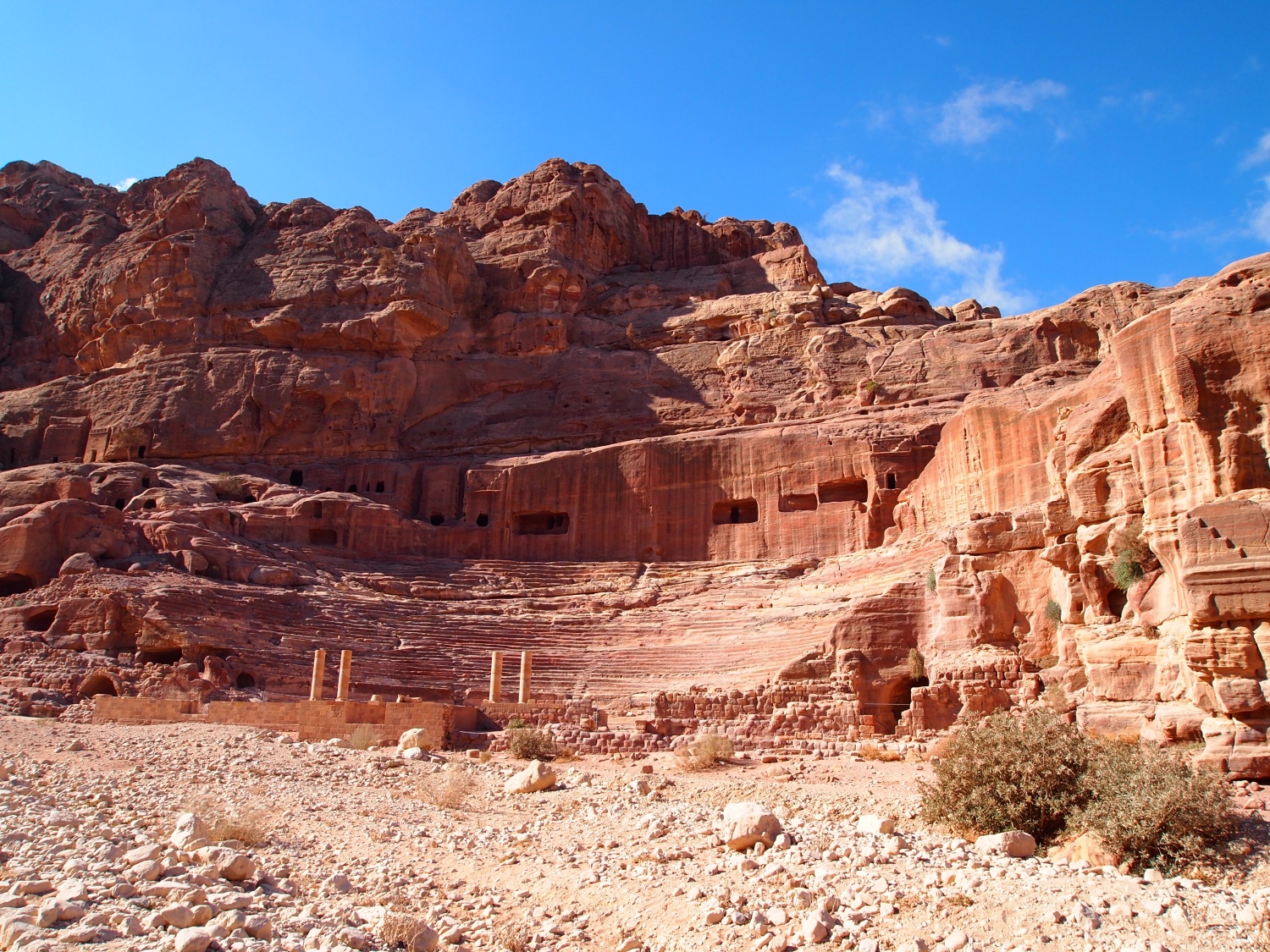
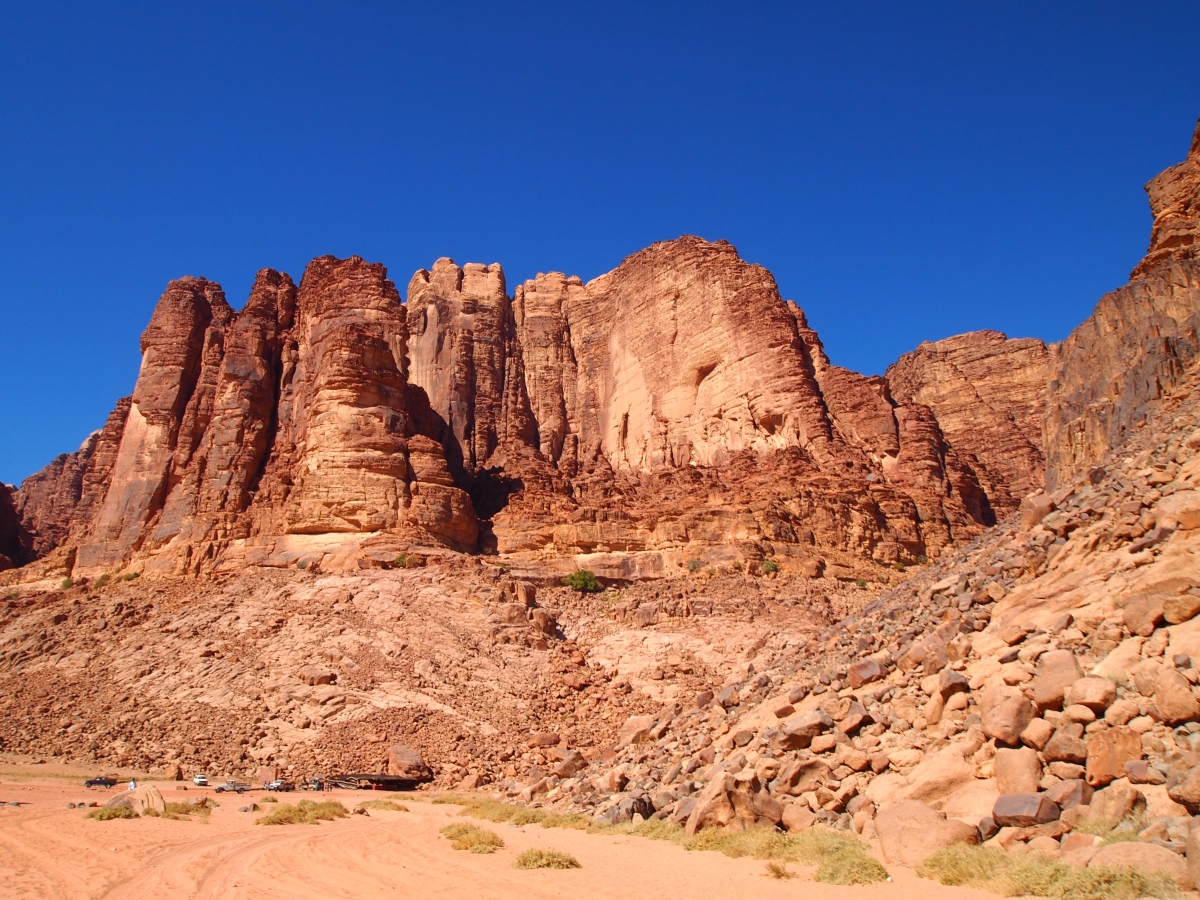
During my time in Oman, I peeled off to Jordan and walked in delight through the canyons of Petra and the desert of Wadi Rum.
Petra, Jordan
Wadi Rum, Jordan
In the years since, from red-rock pictures on Instagram to atmospheric black-and-white photographs by Ansel Adams, the national parks and monuments of Utah, Arizona and New Mexico have beckoned. The desert seems mesmerizing, with its photogenic red canyons, sandstone textures and whimsical shapes, silhouetted cacti, highways stretching toward distant horizons, and cowboys astride horses.
My oldest son moved to Denver at the first of this year. He got a job assembling products for Home Depot but didn’t much care for it, so he began to search for a butchery apprenticeship. He had mentioned this desire before leaving home in December; I found this quite surprising as he used to be vegan! It so happened, he quickly found such an apprenticeship with a small family-owned butchery in downtown Denver. Visiting him in his new home is another call to Colorado.
********************
“THE CALL TO PLACE” INVITATION: I invite you to write a 700-900 word (or less) post on your own blog about what enticed you to choose a recently visited or a future particular destination. If you don’t have a blog, I invite you to write in the comments. If your destination is a place you love and keep returning to, feel free to write about that. If you want to see the original post about the subject, you can check it out here: imaginings: the call to place.
Please include the link in the comments below by Wednesday, May 23 at 1:00 p.m. EST. When I write my post in response to this challenge on Thursday, May 24, I’ll include your links in that post. If you’d like, you can use the hashtag #wanderessence.
My next post will be about my call to Turkey in 2011.
This will be an ongoing invitation, monthly (on the fourth Thursday of each month). Feel free to jump in at any time. 🙂
I hope you’ll join in our community. I look forward to reading your posts!
the ~ wander.essence ~ community
I invite you all to settle in and read a few posts from our wandering community. I promise, you’ll be inspired!
Jude, of Travel Words, writes about her deep and ceaseless yearning to emigrate to the Land Down Under, and the convoluted path her life has taken in the process.
Pit, of Pit’s Fritztown News, writes about why he and his wife were called to Greenville, South Carolina to see the solar eclipse and participate in a bike ride, but ended up diverting to Casper, Wyoming because of a cloudy forecast for Greenville.
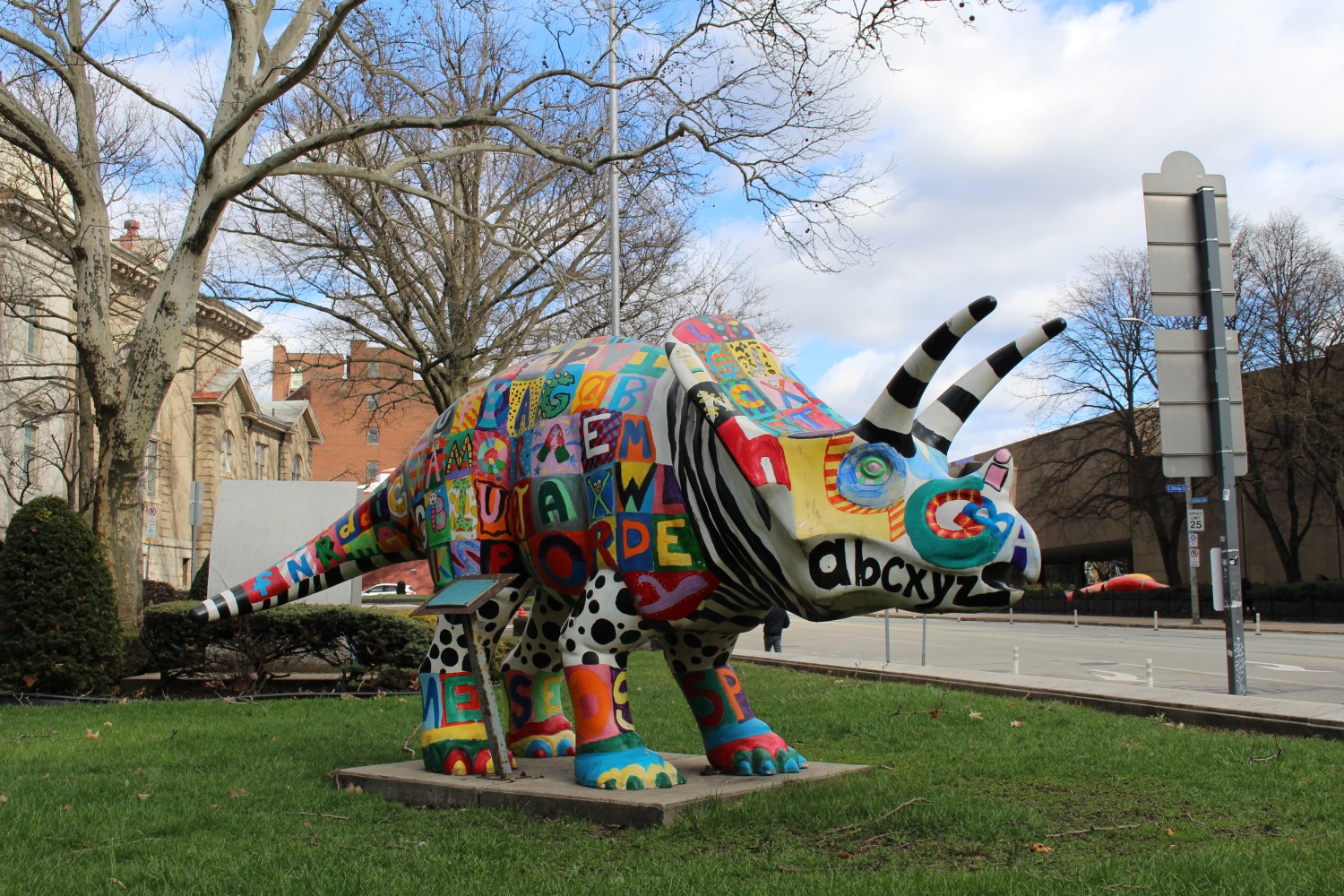
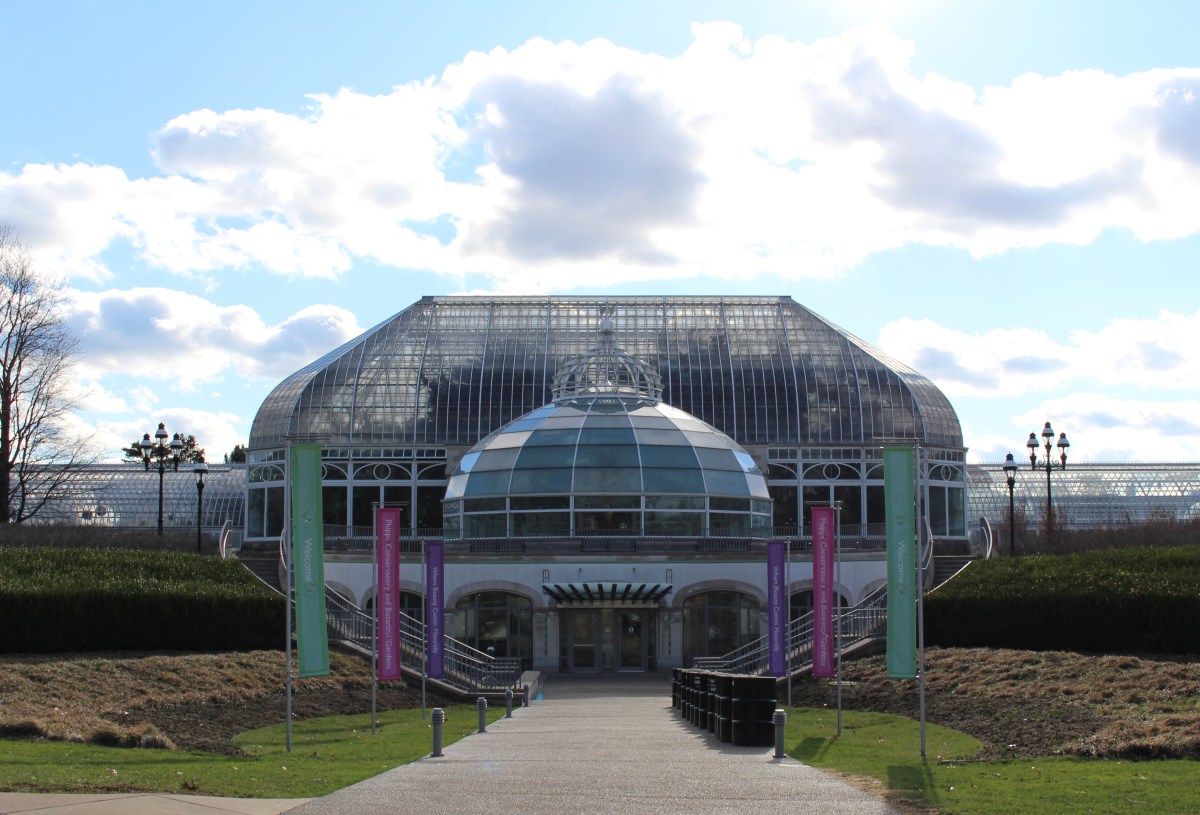
It was my husband Mike’s idea to take a three-day weekend trip to Pittsburgh as his belated birthday treat. The city is a four hour drive from our home in Northern Virginia, yet we’d never visited. Mike was interested in the historical role of the city in America’s industrial revolution. The city is often known as “Steel City” because of more than 300 steel-related businesses.
Boosting the industrial boom was the city’s location at the confluence of the Allegheny and Monongahela Rivers; they merge at Pittsburgh’s point to form the 981-mile Ohio River, the largest tributary to the Mississippi River, flowing through or along the border of six states. These waterways linked the Atlantic coast to the Midwest, allowing for westward expansion and trade. Over the waterways are 446 bridges, thus its other nickname: “City of Bridges.”
Mike says much of Pennsylvania’s value lies underground, as the Allegheny mountains are rich in minerals. He had recently read Heat and Light by Jennifer Haigh, a novel which explores how Pennsylvania is both blessed and cursed by its mineral resources.
Large scale philanthropy also started in Pittsburgh with these titans of industry: Andrew Carnegie called on the rich to use their wealth to improve society, and Andrew Mellon, Henry Phipps, Jr. and others spent much of their time and money in philanthropic causes benefiting the arts and other causes.
I was a bit skeptical at first. The city was once barely inhabitable. Flowers in city parks died, buildings changed color, and people got sick, all a result of the black smoke billowing from factories, coke ovens, railroads, and homes. One visitor in 1868 described the city as “Hell with the lid off.” Because of private citizens, especially middle-class women, the city became an early practitioner of public health and environmentalism.
Now travel magazines tout Pittsburgh as a city worthy of attention. The food, craft breweries, universities, the old hilly neighborhoods, the bridges, the Andy Warhol Museum, and other art museums are all enticements.
So, who were those titans of industry?
Andrew Carnegie (1835 – 1919) was a Scottish-American industrialist and philanthropist. He led the American steel industry’s expansion in the late 19th century, building Carnegie Steel Company, which he sold to J.P. Morgan in 1901 for $480 million. It became U.S. Steel Corporation. He was also a leading philanthropist, giving away nearly 90% of his fortune, or about $350 million, to charities, foundations, libraries and universities. He put a special emphasis on world peace, education and scientific research.
Carnegie Institute
Museum of Natural History
Andrew Carnegie plate at the Frick Museum
Andrew William Mellon (1855 – 1937) was an American banker, businessman, industrialist, philanthropist, art collector, and politician. He helped finance the establishment of Alcoa, the New York Shipbuilding Corporation, Old Overholt Whiskey and other companies. From a wealthy Pittsburgh family, he established a vast business empire before transitioning into politics. He served as United States Secretary of the Treasury from 1921 to 1932, presiding over the boom years of the 1920s and the Stock market crash of 1929. Mellon also became a prominent philanthropist, helping to establish the National Gallery of Art in Washington and the Mellon Institute of Industrial Research, which is now part of Carnegie Mellon University.
Henry John Heinz founded the H. J. Heinz Company, an American food processing company headquartered in Pittsburgh, in 1869. The H. J. Heinz Company manufactures thousands of food products in plants on six continents, including ketchup and Ore-Ida frozen potatoes. After the Kraft Heinz merger in 2015, it is the fifth largest food company in the world.
Henry Heinz
Henry Clay Frick (1849 – 1919) was an American industrialist, financier, union-buster and art patron. He founded the H. C. Frick & Company coke manufacturing company, was chairman of the Carnegie Steel Company, and played a major role in the formation of the giant U.S. Steel manufacturing concern. He also owned extensive real estate holdings in Pittsburgh and throughout the state of Pennsylvania.
Henry Clay Frick
Henry Phipps Jr. (1839 – 1930) was a steel and real-estate magnate. He was also a successful real estate investor who after selling his stock in Carnegie Steel, devoted a great deal of his time and money to philanthropic works. He founded the Phipps Conservatory & Botanical Gardens in 1893 as a gift to the City of Pittsburgh.
“THE CALL TO PLACE” INVITATION: I invite you to write a 500-700 word (or less) post on your own blog about what enticed you to choose a recently visited or a future particular destination. If you don’t have a blog, I invite you to write in the comments. If your destination is a place you love and keep returning to, feel free to write about that. You have two weeks! If you want to see the original post about the subject, you can check it out here: imaginings: the call to place.
Please include the link in the comments below by Wednesday, April 25 at 1:00 p.m. EST. When I write my post in response to this challenge on Thursday, April 26, I’ll include your links in that post. If you’d like, you can use the hashtag #wanderessence.
My next post will be about my upcoming road trip to the Four Corners area of the southwest USA (Colorado, Utah, Arizona and New Mexico).
This will be an ongoing invitation, bi-weekly in April, and monthly (on the last Thursday of each month) after that. Feel free to jump in at any time. 🙂
I hope you’ll join in our community. I look forward to reading your posts!
***************
the ~ wander.essence ~ community
I invite you all to settle in and read a few posts from our wandering community. I promise, you’ll be inspired!
Jo, of Restless Jo, writes endearingly about how her call to Poland came literally in the form of a phone call from a family her father had left behind when he was a teenager.
My path less traveled. Rediscovering self after surviving the abuse that almost sunk me. Goal of strengthening and thriving on my adult legs. 👣🙏🏻 #recovery #forgiveness
This blog is for those who wish to be creative, authors, people in the healing professions, business people, freelancers, journalists, poets, and teachers. You will learn about how to write well, and about getting published. Both beginning and experienced writers will profit from this blog and gain new creative perspectives. Become inspired from global writers, and find healing through the written word.
Explore, discover and experience the world through Meery's Eye. Off the beat budget traveler. Explore places, cultural and heritage. Sustainable trotter.
shareable tales of Meery is Meeryable


























 ~ wander.essence ~
You must be logged in to post a comment.