Skip to content
  • Home
  • about ~ wander.essence ~
    • ~ the places i’ve been ~
    • ~ places i’ve been in the u.s.a. ~
  • Travel Destinations
    • America
      • Boston
      • Delaware
      • District of Columbia
        • Washington
      • Georgia
        • Atlanta
      • Maryland
      • New Jersey
        • Cape May
      • New York
        • Adirondacks
        • Buffalo
        • Niagara Falls
      • Pennsylvania
        • Pittsburgh
      • South Carolina
      • Tennessee
        • Nashville
      • Virginia
    • American Road Trips
      • Canyon & Cactus Road Trip
      • Florida Road Trip
        • Everglades
        • Fort Lauderdale
        • Florida Keys
        • Miami
        • St. Augustine
      • Four Corners Road Trip
        • Arizona
          • Monument Valley
          • Petrified Forest National Park
          • Sunset Crater National Monument
          • Walnut Canyon National Monument
          • Winslow
          • Wupatki National Monument
        • Colorado
          • Colorado National Monument
          • Colorado Towns
          • Great Sand Dunes National Park
          • Grand Junction
        • New Mexico
        • Utah
          • Arches National Park
          • Canyonlands
          • Navajo National Monument
          • Dead Horse Point State Park
          • Hovenweep National Monument
          • Moab
          • Valley of the Gods
          • Natural Bridges National Monument
      • Great Lakes Road Trip
        • Michigan
        • Minnesota
        • Wisconsin
      • Midwestern Triangle
        • Illinois
          • Carbondale
          • Murphysboro
        • Kentucky
          • Covington
          • Lexington
          • Louisville
        • Ohio
          • Cincinnati
      • Road Trip to Nowhere
        • Nebraska
        • North Dakota
        • South Dakota
      • Tex-New Mex Road Trip
        • Texas & New Mexico Road Trip
        • New Mexico
        • Texas
    • International Travel
      • Africa
        • african meanderings {& musings}
        • Egypt
          • Cairo
        • Ethiopia
        • Morocco
      • Asia
        • Cambodia
        • China
          • China Diaries
          • Guangxi Province
        • India
          • Rishikesh
          • Varanasi
        • Japan
          • Kyoto
        • Myanmar
        • Oman
          • a nomad in the land of nizwa
          • Nizwa
        • Singapore
        • South Korea
          • catbird in korea
        • Thailand
        • Turkey
          • Cappadocia
        • Vietnam
      • Central America
        • Costa Rica
        • El Salvador
        • Nicaragua
        • Panama
          • Bocas del Toro
          • Panama City
      • Europe
        • In Search of a Thousand Cafés
        • Croatia
          • Dalmatia
            • Istria
            • Dubrovnik
            • Plitvice Lakes National Park
            • Split
            • Zadar
            • Zagreb
        • Czech Republic
          • Český Krumlov
        • England
        • France
        • Greece
        • Hungary
          • Budapest
          • Esztergom
        • Iceland
        • Italy
          • Bergamo
          • Cinque Terre
          • The Dolomites
          • Florence
          • Rome
          • Tuscany
          • Venice
          • Verona
          • Via Francigena
        • Portugal
        • Spain
          • Camino de Santiago
            • packing list for el camino de santiago 2018
      • North America
        • Canada
          • The Maritimes
            • New Brunswick
            • Nova Scotia
            • Prince Edward Island
          • Ontario
        • Mexico
          • Guanajuato
          • Mexico City
            • Teotihuacán
          • Querétaro
          • San Miguel de Allende
      • South America
        • Colombia
        • Ecuador
          • Cuenca
          • Quito
    • how to make the most of a staycation
      • Coronavirus Coping
  • Imaginings
    • imaginings: the call to place
  • Travel Preparation
    • journeys: anticipation & preparation
  • Travel Creativity
    • on keeping a travel journal
    • on creating art from travels
      • Art Journaling
    • photography inspiration
      • Photography
    • writing prompts: prose
      • Prose
        • Fiction
        • Travel Essay
        • Travelogue
    • writing prompts: poetry
      • Poetry
  • On Journey
    • on journey: taking ourselves from here to there
  • Books & Movies
    • books | international a-z |
    • books & novels | u.s.a. |
    • books | history, spirituality, personal growth & lifestyle |
    • movies | international a-z |
    • movies | u.s.a. |
  • On Returning Home
    • on returning home
  • Annual recap
    • twenty-fifteen
    • twenty-eighteen
    • twenty-nineteen
    • twenty-twenty
    • twenty-twenty-one
    • twenty twenty-two
    • twenty twenty-three
    • twenty twenty-four
    • twenty twenty-five
  • Contact

Enter your email address to follow this blog and receive notifications of new posts by email.

Join 1,057 other subscribers
Follow ~ wander.essence ~ on WordPress.com
  • Home
  • about ~ wander.essence ~
    • ~ the places i’ve been ~
    • ~ places i’ve been in the u.s.a. ~
  • Travel Destinations
    • America
      • Boston
      • Delaware
      • District of Columbia
        • Washington
      • Georgia
        • Atlanta
      • Maryland
      • New Jersey
        • Cape May
      • New York
        • Adirondacks
        • Buffalo
        • Niagara Falls
      • Pennsylvania
        • Pittsburgh
      • South Carolina
      • Tennessee
        • Nashville
      • Virginia
    • American Road Trips
      • Canyon & Cactus Road Trip
      • Florida Road Trip
        • Everglades
        • Fort Lauderdale
        • Florida Keys
        • Miami
        • St. Augustine
      • Four Corners Road Trip
        • Arizona
          • Monument Valley
          • Petrified Forest National Park
          • Sunset Crater National Monument
          • Walnut Canyon National Monument
          • Winslow
          • Wupatki National Monument
        • Colorado
          • Colorado National Monument
          • Colorado Towns
          • Great Sand Dunes National Park
          • Grand Junction
        • New Mexico
        • Utah
          • Arches National Park
          • Canyonlands
          • Navajo National Monument
          • Dead Horse Point State Park
          • Hovenweep National Monument
          • Moab
          • Valley of the Gods
          • Natural Bridges National Monument
      • Great Lakes Road Trip
        • Michigan
        • Minnesota
        • Wisconsin
      • Midwestern Triangle
        • Illinois
          • Carbondale
          • Murphysboro
        • Kentucky
          • Covington
          • Lexington
          • Louisville
        • Ohio
          • Cincinnati
      • Road Trip to Nowhere
        • Nebraska
        • North Dakota
        • South Dakota
      • Tex-New Mex Road Trip
        • Texas & New Mexico Road Trip
        • New Mexico
        • Texas
    • International Travel
      • Africa
        • african meanderings {& musings}
        • Egypt
          • Cairo
        • Ethiopia
        • Morocco
      • Asia
        • Cambodia
        • China
          • China Diaries
          • Guangxi Province
        • India
          • Rishikesh
          • Varanasi
        • Japan
          • Kyoto
        • Myanmar
        • Oman
          • a nomad in the land of nizwa
          • Nizwa
        • Singapore
        • South Korea
          • catbird in korea
        • Thailand
        • Turkey
          • Cappadocia
        • Vietnam
      • Central America
        • Costa Rica
        • El Salvador
        • Nicaragua
        • Panama
          • Bocas del Toro
          • Panama City
      • Europe
        • In Search of a Thousand Cafés
        • Croatia
          • Dalmatia
            • Istria
            • Dubrovnik
            • Plitvice Lakes National Park
            • Split
            • Zadar
            • Zagreb
        • Czech Republic
          • Český Krumlov
        • England
        • France
        • Greece
        • Hungary
          • Budapest
          • Esztergom
        • Iceland
        • Italy
          • Bergamo
          • Cinque Terre
          • The Dolomites
          • Florence
          • Rome
          • Tuscany
          • Venice
          • Verona
          • Via Francigena
        • Portugal
        • Spain
          • Camino de Santiago
            • packing list for el camino de santiago 2018
      • North America
        • Canada
          • The Maritimes
            • New Brunswick
            • Nova Scotia
            • Prince Edward Island
          • Ontario
        • Mexico
          • Guanajuato
          • Mexico City
            • Teotihuacán
          • Querétaro
          • San Miguel de Allende
      • South America
        • Colombia
        • Ecuador
          • Cuenca
          • Quito
    • how to make the most of a staycation
      • Coronavirus Coping
  • Imaginings
    • imaginings: the call to place
  • Travel Preparation
    • journeys: anticipation & preparation
  • Travel Creativity
    • on keeping a travel journal
    • on creating art from travels
      • Art Journaling
    • photography inspiration
      • Photography
    • writing prompts: prose
      • Prose
        • Fiction
        • Travel Essay
        • Travelogue
    • writing prompts: poetry
      • Poetry
  • On Journey
    • on journey: taking ourselves from here to there
  • Books & Movies
    • books | international a-z |
    • books & novels | u.s.a. |
    • books | history, spirituality, personal growth & lifestyle |
    • movies | international a-z |
    • movies | u.s.a. |
  • On Returning Home
    • on returning home
  • Annual recap
    • twenty-fifteen
    • twenty-eighteen
    • twenty-nineteen
    • twenty-twenty
    • twenty-twenty-one
    • twenty twenty-two
    • twenty twenty-three
    • twenty twenty-four
    • twenty twenty-five
  • Contact

wander.essence

wander.essence

Home from Morocco & Italy

Home sweet home!May 10, 2019
I'm home from Morocco & Italy. :-)

Italy trip

Traveling to Italy from MoroccoApril 23, 2019
On my way to Italy!

Leaving for Morocco

Casablanca, here I come!April 4, 2019
I'm on my way to Casablanca. :-)

Home from our Midwestern Triangle Road Trip

Driving home from Lexington, KYMarch 6, 2019
Home sweet home from the Midwest. :-)

Leaving for my Midwestern Triangle Road Trip

Driving to IndianaFebruary 24, 2019
Driving to Indiana.

Returning home from Portugal

Home sweet home from Spain & Portugal!November 6, 2018
Home sweet home from Spain & Portugal!

Leaving Spain for Portugal

A rendezvous in BragaOctober 26, 2018
Rendezvous in Braga, Portgual after walking the Camino de Santiago. :-)

Leaving to walk the Camino de Santiago

Heading to Spain for the CaminoAugust 31, 2018
I'm on my way to walk 790 km across northern Spain on the Camino de Santiago.

Home from my Four Corners Road Trip

Home Sweet Home from the Four CornersMay 25, 2018
Home Sweet Home from the Four Corners. :-)

My Four Corners Road Trip!

Hitting the roadMay 1, 2018
I'm hitting the road today for my Four Corners Road Trip: CO, UT, AZ, & NM!

Recent Posts

  • what i learned in flores, petén & the mayan ruins at tikal March 29, 2026
  • guatemala: lago de atitlán March 26, 2026
  • cuaresma in antigua, guatemala March 21, 2026
  • call to place, anticipation & preparation: guatemala & belize March 3, 2026
  • the february cocktail hour: witnessing wedding vows, a visit from our daughter & mike’s birthday March 1, 2026
  • the january cocktail hour: a belated nicaraguan christmas & a trip to costa rica’s central pacific coast February 3, 2026
  • bullet journals as a life repository: bits of mine from 2025 & 2026 January 4, 2026
  • twenty twenty-five: nicaragua {twice}, mexico & seven months in costa rica {with an excursion to panama} December 31, 2025
  • the december cocktail hour: mike’s surgery, a central highlands road trip & christmas in costa rica December 31, 2025
  • top ten books of 2025 December 28, 2025
  • the november cocktail hour: a trip to panama, a costa rican thanksgiving & a move to lake arenal condos December 1, 2025
  • panama: the caribbean archipelago of bocas del toro November 24, 2025
  • a trip to panama city: el cangrejo, casco viejo & the panama canal November 22, 2025

Archives

  • March 2026
  • February 2026
  • January 2026
  • December 2025
  • November 2025
  • October 2025
  • September 2025
  • August 2025
  • June 2025
  • May 2025
  • April 2025
  • March 2025
  • February 2025
  • January 2025
  • December 2024
  • November 2024
  • October 2024
  • September 2024
  • August 2024
  • July 2024
  • June 2024
  • May 2024
  • April 2024
  • March 2024
  • February 2024
  • January 2024
  • December 2023
  • November 2023
  • September 2023
  • August 2023
  • June 2023
  • May 2023
  • April 2023
  • March 2023
  • February 2023
  • January 2023
  • December 2022
  • November 2022
  • October 2022
  • September 2022
  • August 2022
  • June 2022
  • May 2022
  • April 2022
  • March 2022
  • February 2022
  • January 2022
  • December 2020
  • November 2020
  • October 2020
  • September 2020
  • August 2020
  • July 2020
  • June 2020
  • May 2020
  • April 2020
  • March 2020
  • February 2020
  • January 2020
  • December 2019
  • November 2019
  • October 2019
  • September 2019
  • August 2019
  • July 2019
  • June 2019
  • May 2019
  • April 2019
  • March 2019
  • February 2019
  • January 2019
  • December 2018
  • November 2018
  • October 2018
  • September 2018
  • August 2018
  • July 2018
  • June 2018
  • May 2018
  • April 2018
  • March 2018

Blog Stats

  • 130,105 hits
March 2026
M T W T F S S
 1
2345678
9101112131415
16171819202122
23242526272829
3031  
« Feb    

Categories

  • Aït-Ben-Haddou (4)
  • Abingdon (1)
  • Abiquiu (1)
  • Acquapendente (2)
  • Adirondacks (3)
  • Africa (39)
  • Ainokura (2)
  • Alabama (1)
  • Alajuela (3)
  • Alamogordo (1)
  • Albuquerque (3)
  • Alexandria (1)
  • Alma (1)
  • Alpe di Siusi (1)
  • Alsace-Lorraine (1)
  • Alto Adige Wine Road (1)
  • Amarante (2)
  • America (69)
  • American Bison (1)
  • American books (22)
  • American Road Trips (255)
  • American Visionary Art Museum (1)
  • Americana (1)
  • Andrew Johnson National Historic Site (1)
  • Annapolis Valley (1)
  • Annual recap (10)
  • Anticipation (46)
  • Antietam National Battlefield (2)
  • Antigua (2)
  • Aramak Tour (1)
  • Arches National Park (8)
  • architecture (1)
  • Arena Stage (1)
  • Arizona (28)
  • Aroumd (2)
  • Art Journaling (9)
  • Asciano (1)
  • Asia (41)
  • Assisi (1)
  • Astorga (2)
  • Atapuerca (1)
  • Athens (1)
  • Atlanta (7)
  • Austin (2)
  • Aveiro (2)
  • Azofra (2)
  • Aztec Ruins National Monument (1)
  • óbidos (1)
  • Baños (2)
  • Badlands National Park (1)
  • Bagan (1)
  • Bagno Vignoni (2)
  • Bajos del Toro (1)
  • Balcony House (1)
  • Bali (9)
  • Baltimore (7)
  • Baltimore Museum of Art (1)
  • Bandelier National Monument (1)
  • Bangkok (2)
  • Bear Butte (1)
  • Beatrice (1)
  • Beihai (1)
  • Belize (3)
  • Beppu (1)
  • Bergamo (3)
  • Big Bend National Park (2)
  • Bijagua (2)
  • Bismarck (3)
  • Bismarck Art Alley (1)
  • Bitchu-Takahashi (1)
  • Blue Falls of Costa Rica (1)
  • Bluff (1)
  • Bluff Fort Historic Site (1)
  • Bocas del Toro (2)
  • Bocas Town (1)
  • Bogotá (4)
  • Bolsena (2)
  • Bolzano (2)
  • Bonanzaville (1)
  • Books (48)
  • Bosque de Chapultepec (1)
  • Boston (2)
  • Boulder (1)
  • Boys Town (1)
  • Braga (3)
  • Brookings (1)
  • Brunico/Bruneck (1)
  • Budapest (1)
  • Buffalo (9)
  • Bukit Peninsula (1)
  • Bullet journaling (1)
  • Buonconvento (2)
  • Burano (2)
  • Burgos (4)
  • Cañas (2)
  • Cabo da Roca (1)
  • Caddo Lake (2)
  • Cairo (3)
  • California (4)
  • Cambodia (4)
  • Cambridge (1)
  • Camino de Santiago (64)
  • Campagnano di Roma (2)
  • Canada (15)
  • Canyon & Cactus Road Trip (4)
  • Canyon de Chelly (3)
  • Canyonlands (3)
  • Cape May (7)
  • Cappadocia (2)
  • Capranica (1)
  • Carbondale (9)
  • Carlsbad (1)
  • Carlsbad Caverns National Park (2)
  • Cartagena (4)
  • Casablanca (9)
  • Casco Viejo (1)
  • Castellina in Chianti (1)
  • Catarata del Toro (1)
  • Catskill Mountains (1)
  • Cedar Creek & Belle Grove National Historical Park (1)
  • Central America (48)
  • Central Highlands (1)
  • Centro Histórico (1)
  • Chaco Culture National Historical Park (4)
  • challenge: a call to place (39)
  • Channel Islands National Park (3)
  • Chapel in the Hills (1)
  • Charles Pinckney National Historic Site (1)
  • Charleston (11)
  • Chefchaouen (5)
  • Cheyenne (2)
  • Cheyenne Depot Museum (1)
  • Cheyenne Frontier Days Old West Museum (1)
  • Chicago (3)
  • Chichicastenango (1)
  • Chillicothe (2)
  • Chimayó (1)
  • Chimney Rock (1)
  • China (8)
  • Chinatown (1)
  • Christmas (5)
  • Churchill Downs (1)
  • Cihuatán (1)
  • Cincinnati (15)
  • Cincinnati Art Museum (1)
  • Cinque Terre (10)
  • Cinquera (1)
  • Civita di Bagnoregio (1)
  • Cloudcroft (1)
  • Cocktail Hour (24)
  • Cocoa Beach (2)
  • Coeur d'Alene (1)
  • Collalbo/Klobenstein (1)
  • Colle di Val d'Elsa (2)
  • Colombia (9)
  • Colorado (31)
  • Colorado National Monument (3)
  • Colorado Towns (6)
  • Colorful (1)
  • Condesa (1)
  • Connecticut (1)
  • Cordoba (1)
  • Coronavirus Coping (14)
  • Cortina d’Ampezzo (1)
  • Costa Nova (1)
  • Costa Rica (23)
  • Covington (7)
  • Cowgirls of the West (1)
  • Coyoacán (1)
  • Crazy Horse Memorial (1)
  • Crestone (1)
  • Crete (1)
  • Croatia (3)
  • Cuenca (3)
  • Curves (1)
  • Custer (1)
  • Custer State Park (1)
  • Czech Republic (1)
  • Dakota Dinosaur Museum (1)
  • Dali (1)
  • Dalmatia (1)
  • De Smet (1)
  • Dead Horse Point State Park (1)
  • Dead Sea (1)
  • Deadwood (3)
  • decay (1)
  • Delaware (9)
  • Delphi (1)
  • Denver (1)
  • destinations (44)
  • Devils Tower National Monument (2)
  • Diamante Eco Adventure Park (1)
  • Dickinson (1)
  • District of Columbia (22)
  • Dobbiaco/Toblach (1)
  • Dolores Hidalgo (1)
  • Drawing (7)
  • Dubrovnik (1)
  • Durango (1)
  • Dwight D. Eisenhower Memorial (1)
  • Ecuador (14)
  • Egypt (3)
  • El Cangrejo (1)
  • El Salvador (6)
  • El-Khorbat (1)
  • Embudo (1)
  • Enchanted Rock State Natural Area (1)
  • England (3)
  • Erg Chebbi (3)
  • Española (1)
  • Essaouira (4)
  • Esztergom (1)
  • Ethiopia (3)
  • Europe (121)
  • Evan Williams Bourbon Experience (1)
  • Everglades (3)
  • Evora (1)
  • Fargo (2)
  • Fès (3)
  • Fenghuang (1)
  • Fez (2)
  • Fiction (6)
  • Findlay Market (1)
  • Finisterre (2)
  • Finland (1)
  • Fira (1)
  • Fiumicino (2)
  • Flatirons Vista Trail (1)
  • Flight 93 National Memorial (1)
  • Florence (8)
  • Flores (2)
  • Florida Keys (3)
  • Florida Road Trip (5)
  • Formello (1)
  • Fort Abraham Lincoln State Park (1)
  • Fort Atkinson State HIstorical Park (1)
  • Fort Calhoun (1)
  • Fort Collins (2)
  • Fort Lauderdale (2)
  • Fort Mandan (1)
  • Fort McHenry National Monument and Historic Shrine (1)
  • Fort Robinson State Park (1)
  • Fort Sumter and Fort Moultrie National Historical Park (1)
  • Fort Union Trading Post National Historic Site (1)
  • Four Corners Road Trip (74)
  • France (7)
  • Frazier Museum (1)
  • Fredericksburg (1)
  • Fucecchio (1)
  • Fundy National Park (1)
  • G Adventures Tour (10)
  • Gallina (2)
  • Gambassi Terme (2)
  • Gateway Arch National Park (1)
  • Gavin's Point Dam (1)
  • George Rogers Clark National Historical Park (2)
  • Georgia (7)
  • Gerald R. Ford Birthsite (1)
  • Germany (1)
  • Gettysburg National Military Park (1)
  • Goals (3)
  • Gothenburg (1)
  • Grand Junction (1)
  • Great Falls (2)
  • Great Lakes Road Trip (6)
  • Great Sand Dunes National Park (2)
  • Grecia (1)
  • Greece (3)
  • Greeneville (1)
  • Greenville (1)
  • Greve in Chianti (1)
  • Guadalupe Mountains National Park (1)
  • Guanacaste (12)
  • Guanajuato (5)
  • Guangxi Province (4)
  • Guatapé (5)
  • Guatemala (6)
  • Guatemala City (2)
  • Guilin (1)
  • Guimarães (2)
  • Halifax (3)
  • Halong Bay (1)
  • Hanoi (1)
  • Heidelberg (1)
  • Hida Furukawago (2)
  • High Road to Taos (1)
  • Hikes & Walks (203)
  • HISTORIC NAKASENDO TRAIL (1)
  • Hoa Lu (1)
  • Holbrook (1)
  • Holidays (6)
  • Hong Kong (1)
  • Hopewell Culture National Historical Park (2)
  • Hopewell Rocks Provincial Park (1)
  • Hotel Hacienda Guachipelin (1)
  • Hovenweep National Monument (1)
  • Hubbell Trading Post (1)
  • Hungary (1)
  • Iceland (1)
  • Idaho (1)
  • Illinois (17)
  • Imaginings (46)
  • Imlil (2)
  • India (7)
  • Indiana (6)
  • Indonesia (9)
  • Ingapirca (2)
  • Inle Lake (1)
  • Innichen/San Candido (1)
  • International Books (32)
  • International Peace Garden (1)
  • International Travel (340)
  • Iowa (1)
  • Isla Bastimentos (1)
  • Isla Carenero (1)
  • Isla Colón (1)
  • Istanbul (2)
  • Istria (1)
  • Italy (62)
  • Jamestown (1)
  • Japan (20)
  • Japan Alps (4)
  • Jefferson (1)
  • Jewel Cave National Monument (1)
  • Jimbaran (1)
  • Joachim Regional Museum & Prairie Outpost Park (1)
  • Johnstown Flood National Memorial (1)
  • Jordan (3)
  • Joseph N. Nicollet Tower and Interpretive Center (1)
  • Joshua Tree National Park (3)
  • Joslyn Art Museum (1)
  • Journaling (10)
  • Joya de Cerén (1)
  • Kansas (2)
  • Kathmandu (2)
  • Kentucky (17)
  • KMAC (1)
  • Knife River Indian Villages (2)
  • Kunming (1)
  • Kurashiki Bikan Historical Quarter (1)
  • Kyoto (5)
  • Kyushu (4)
  • La Fortuna (3)
  • La Giustiniana (2)
  • La Peñol (1)
  • La Romita (1)
  • La Spezia (6)
  • Lago d'Iseo (1)
  • Lago de Atitlán (2)
  • Lago di Garda (1)
  • Lago di Garda (1)
  • Laguna de Apoyo (1)
  • Laguna Quilotoa (2)
  • Languedoc-Roussillon (1)
  • Latacunga (3)
  • laundry (1)
  • Lazio (6)
  • León (2)
  • León (2)
  • Leeds (1)
  • Lens-Artists (2)
  • Lewis & Clark Interpretive Center (2)
  • Lexington (8)
  • Lijiang (1)
  • Lincoln Boyhood Home National Memorial (2)
  • Lincoln City (3)
  • lines (1)
  • Lisbon (8)
  • Logroño (3)
  • Lombardy (3)
  • Longji Rice Terraces (1)
  • Longreads (6)
  • Looking ahead (3)
  • Lorca (2)
  • Lory State Park (1)
  • Los Alamos (3)
  • Los Angeles (3)
  • Louisiana (1)
  • Louisville (13)
  • Low Road to Taos (1)
  • Lucca (3)
  • Luckenbach (1)
  • Lunenburg (1)
  • Madison (1)
  • Madison County Historical Society Museum (1)
  • Magnolia Plantations & Gardens (1)
  • Magome-juku (1)
  • Mahone Bay (1)
  • Maine (1)
  • Managua (5)
  • Manarola (1)
  • Mandalay (1)
  • Mandan (1)
  • Manhattan Project National Historical Park (1)
  • Mapmaking (2)
  • Marfa (1)
  • Market towns near Cuenca (2)
  • markets (1)
  • Marrakech (7)
  • Maryland (11)
  • Massachusetts (2)
  • Matagalpa (2)
  • Mathews (1)
  • Meadowlark Botanical Gardens (4)
  • Medellín (5)
  • Medora (5)
  • Memoir (4)
  • Merzouga (5)
  • Mesa Verde National Park (4)
  • Meteora (1)
  • Mexico (11)
  • Mexico City (7)
  • Miami (3)
  • Michigan (4)
  • Middletown (1)
  • Midwestern Triangle (30)
  • Minas Basin (1)
  • Mine of Santa Brigida (1)
  • Mineral de Pozos (1)
  • Ministers Island (1)
  • Minnesota (1)
  • Minnesota (3)
  • Minot (1)
  • Minuteman Missile National Historic Site (1)
  • Mirador de Catarina (1)
  • Mississippi (1)
  • Missouri (4)
  • Missouri National Recreation River (1)
  • Missouri River Basin Lewis & Clark Center (2)
  • Mitchell (1)
  • Moab (2)
  • Montalcino (1)
  • Montana (1)
  • Montefiascone (1)
  • Montefioralle (1)
  • Montepulciano (1)
  • Monteriggioni (3)
  • Monteroni d'Arbia (1)
  • Monterosi (1)
  • Monterosso al Mare (2)
  • Monteverde (1)
  • Monthly recap (24)
  • Monument Valley (1)
  • Moorhead (1)
  • Morocco (37)
  • Mount Pleasant (1)
  • Mt. Rushmore National Memorial (1)
  • Mulberry Bend Overlook (1)
  • Murano (2)
  • Murphysboro (10)
  • Muruzabal (1)
  • Muscat (1)
  • Museum of the Shenandoah Valley (1)
  • Muxia (2)
  • Myanmar (2)
  • Nagoya (4)
  • Nagoya Castle (2)
  • Nanning (3)
  • Naoshima (1)
  • Narita (5)
  • Nashville (8)
  • National Gallery of Art (2)
  • natural bridges (1)
  • Natural Bridges National Monument (2)
  • Navajo National Monument (2)
  • Nebraska (21)
  • Nepal (4)
  • New Belgium Brewing (1)
  • New Brunswick (6)
  • New Castle (2)
  • New England Road Trip (2)
  • New Hampshire (2)
  • New Jersey (7)
  • New Mexico (12)
  • New Mexico (1)
  • New Mexico (12)
  • New York (16)
  • Newport (1)
  • Niagara Falls (7)
  • Nicaragua (25)
  • Nice (1)
  • Nicoya Peninsula (1)
  • Nizwa (3)
  • Norfolk (1)
  • Normandy (1)
  • North America (22)
  • North Dakota (26)
  • North Dakota Heritage Center (2)
  • North Platte (1)
  • Norway (1)
  • Nosara (1)
  • Nova Scotia (5)
  • Nuevo Arenal (2)
  • Nusa Dua (1)
  • Oakland (1)
  • Oakton (23)
  • Ogallala (1)
  • Ohio (17)
  • Ohkay Owingeh Pueblo (1)
  • Oia (1)
  • Okayama (4)
  • Oklahoma (1)
  • Oklahoma City (1)
  • Old Market (1)
  • Omaha (5)
  • Oman (4)
  • Ometepe (15)
  • On Journey (44)
  • On Returning Home (40)
  • On-a-Slant Village (1)
  • Ontario (4)
  • Orisson (2)
  • Ortesei/St. Ulrich (1)
  • Orvieto (1)
  • Otavalo (2)
  • Ouray (1)
  • Pagosa Springs (1)
  • Pamplona (2)
  • Panajachel (1)
  • Panama (4)
  • Panama Canal (2)
  • Panama City (2)
  • Panchimalco (1)
  • Panzano in Chianti (1)
  • Paris (2)
  • Parque Nacional Cajas (2)
  • Parque Nacional Cotopaxi (2)
  • Parque Nacional Volcán Poás (1)
  • Parque Nacional Volcán Tenorio (2)
  • Parque Nactional Volcán Rincón de la Vieja (2)
  • pastels (1)
  • Patterns (3)
  • Peña de Bernal (1)
  • Pecos National Historical Park (1)
  • Peniche (1)
  • Pennsylvania (14)
  • Perugia (2)
  • Petrified Forest National Park (5)
  • petroglyphs (1)
  • Phnom Penh (3)
  • Photography (270)
  • Phuket (2)
  • Pilgrimage (75)
  • Ping'An (1)
  • Pisa (1)
  • Pittsburgh (11)
  • Playa Costa del Sol (1)
  • Playa Hermosa (4)
  • Plitvice Lakes National Park (1)
  • Poetry (34)
  • Pokhara (2)
  • Polanco (1)
  • Ponca State Park (1)
  • Ponte a Cappiano (1)
  • Porto (4)
  • Portovenere (1)
  • Portugal (25)
  • Prairie Homestead Historic Site (1)
  • Prince Edward Island (2)
  • Prose (210)
  • Puerta del Diablo (1)
  • Querétaro (4)
  • Quito (2)
  • Rapid City (6)
  • Red Cloud (1)
  • Redlin Art Center (1)
  • Regent (1)
  • Rehoboth (2)
  • Renon (1)
  • Renon/Ritten Plateau (1)
  • Reverse culture shock (2)
  • Richmond (7)
  • Riobamba (2)
  • Rishikesh (2)
  • Rittner Horn (1)
  • Riverbend Park (1)
  • Road Trip to Nowhere (63)
  • Rocky Mountain National Park (1)
  • Roma Norte (2)
  • Rome (16)
  • Roof Squares (1)
  • Route 66 (1)
  • Ruidoso (1)
  • Sackville (1)
  • Sahara (3)
  • Saint John (1)
  • Saint-Jean-Pied-de-Port (4)
  • San Ángel (1)
  • San Francisco (2)
  • San Gimignano (5)
  • San Ignacio (1)
  • San José (3)
  • San Juan del Sur (2)
  • San Juan la Laguna (1)
  • San Juan Skyway Scenic Byway (3)
  • San Lorenzo Nuovo (1)
  • San Marcos la Laguna (1)
  • San Miguel de Allende (6)
  • San Miniato (1)
  • San Pedro la Laguna (1)
  • San Quirico d'Orcia (4)
  • San Salvador (5)
  • San Sebastián Bernal (1)
  • San Simeon (2)
  • Sant'Antimo (1)
  • Santa Barbara (2)
  • Santa Catarina Palopó (1)
  • Santa Fe (5)
  • Santa Maddalena (1)
  • Santa Rosa de Lima (1)
  • Santiago (4)
  • Santo Domingo de la Calzada (2)
  • Santorini (1)
  • Sarchí (1)
  • Sámara (1)
  • Scandinavian Heritage Center (1)
  • Scotts Bluff National Monument (1)
  • Semarapura (2)
  • Shanghai (1)
  • Shenandoah National Park (1)
  • Shepherdstown (1)
  • Shibao Shan (2)
  • Shikoku 88-Temple Pilgrimage Route (4)
  • Shirakawa-go (2)
  • Shreveport (1)
  • Sidemen (1)
  • Siem Reap (3)
  • Siena (2)
  • Silverton (1)
  • Singapore (3)
  • Sintra (2)
  • Sioux Falls (2)
  • Sisseton (1)
  • Smithsonian American Art Museum (SAAM) (5)
  • Smithsonian National Museum of Asian Art (2)
  • South America (25)
  • South Carolina (12)
  • South Dakota (24)
  • South Dakota Art Museum (1)
  • South Korea (5)
  • Spain (68)
  • Spearfish (2)
  • Spello (1)
  • Spirit Mound Historic Prairie (1)
  • Split (1)
  • Springfield (3)
  • St. Andrews by-the-Sea (1)
  • St. Augustine (2)
  • St. Louis (2)
  • Stanton (1)
  • Staycation (8)
  • Stonewall (1)
  • Street Art (3)
  • Sturgis (2)
  • Suchitoto (1)
  • Sullivan's Island (2)
  • Sunset Crater National Monument (1)
  • Sunsets (1)
  • Supreme Court of the United States (2)
  • Sweden (1)
  • Swedish Heritage Center (1)
  • Takayama (3)
  • Tam Coc (1)
  • Tamarindo (1)
  • Tangier (3)
  • Taos (4)
  • Tejutepeque (2)
  • Telluride (2)
  • Tennessee (10)
  • Teotihuacán (1)
  • Terlingua (1)
  • Termas de Papallacta (2)
  • Tex-New Mex Road Trip (16)
  • Texas (8)
  • Texas & New Mexico Road Trip (20)
  • Thailand (3)
  • Thanksgiving (1)
  • The Battery (1)
  • The Dolomites (4)
  • The Enchanted Highway (1)
  • The Journey Museum (1)
  • The Maritimes (10)
  • The Veneto (5)
  • The Walters Art Museum (1)
  • Theodore Roosevelt National Park (4)
  • Tigua (2)
  • Tikal (2)
  • Tilarán (12)
  • Tinghir (2)
  • Toadstool Geologic Park (1)
  • Todra Gorge (1)
  • Tokushima (1)
  • Tokyo (6)
  • Topeka (1)
  • Torres del Rio (2)
  • Travel (662)
  • Travel Creativity (366)
  • Travel Essay (204)
  • Travel Inspiration (46)
  • Travel photography (249)
  • Travel Preparation (50)
  • Travel videos (51)
  • Travelogue (205)
  • Trentino & South Tyrol (5)
  • Trinidad & Tobago (2)
  • Tronadora (8)
  • Truchas (1)
  • Tsumago-juku (1)
  • Turkey (5)
  • Tuscany (31)
  • twenty twenty-five (1)
  • twenty twenty-four (1)
  • twenty twenty-three (1)
  • twenty twenty-two (1)
  • twenty twenty-two (2)
  • twenty-eighteen (1)
  • twenty-fifteen (1)
  • twenty-nineteen (1)
  • twenty-twenty (2)
  • twenty-twenty-one (1)
  • Ubud (1)
  • Uluwatu (1)
  • Ulysses S Grant National Historic Site (1)
  • Umbria (10)
  • Union Market (2)
  • United Arab Emirates (UAE) (2)
  • Utah (26)
  • Valley City (1)
  • Valley of the Gods (1)
  • Varanasi (2)
  • Vatican City (1)
  • Vatican Museums (1)
  • Venice (2)
  • Venice (5)
  • Ventosa (2)
  • Vermillion (1)
  • Vermont (2)
  • Vernazza (1)
  • Verona (2)
  • Vetralla (1)
  • Via Francigena (15)
  • Vicksburg (1)
  • Vienna (10)
  • Vietnam (4)
  • Villamayor de Monjardín (2)
  • Villamayor del Rio (1)
  • Vincennes (3)
  • Virginia (41)
  • Virginia Museum of Fine Arts (5)
  • Viterbo (2)
  • Volcán Chimborazo (2)
  • Volcán Cotopaxi (2)
  • Volterra (2)
  • Volubilis (1)
  • Wall (4)
  • Walnut Canyon National Monument (1)
  • Washburn (2)
  • Washington (20)
  • Watertown (2)
  • Watford City (1)
  • West Virginia (1)
  • White Sands National Park (2)
  • Wigwam Motel (1)
  • Wilber (1)
  • Wildlife (1)
  • Wildwood (3)
  • William Howard Taft National Historic Site (1)
  • Wilmington (3)
  • Winchester (1)
  • Wind Cave National Park (1)
  • Window Rock Navajo Tribal Park (1)
  • Winslow (3)
  • Wisconsin (2)
  • Writing (252)
  • Wupatki National Monument (2)
  • Wyoming (6)
  • Xi'an (1)
  • Xunantunich (1)
  • Yangon (1)
  • Yangshuo (1)
  • Yankton (1)
  • Yokohama (4)
  • Yorktown (2)
  • Yufuin (1)
  • Yunnan Province (2)
  • Zadar (1)
  • Zagreb (1)
  • Zarcero (1)
  • Zhangjiajie (1)
  • Ōsu Kannon Temple (2)
  • Český Krumlov (1)

Africa America American books American Road Trips Annual recap Anticipation Arches National Park Arizona Art Journaling Asia Bali Books Buffalo Camino de Santiago Canada Carbondale Casablanca Central America challenge: a call to place Charleston China Cincinnati Cinque Terre Cocktail Hour Colombia Colorado Coronavirus Coping Costa Rica Delaware destinations District of Columbia Ecuador Europe Four Corners Road Trip G Adventures Tour Guanacaste Hikes & Walks Illinois Imaginings Indonesia International Books International Travel Italy Japan Journaling Kentucky Louisville Maryland Mexico Midwestern Triangle Monthly recap Morocco Murphysboro Nashville Nebraska New Mexico New York Nicaragua North America North Dakota Oakton Ohio Ometepe On Journey On Returning Home Pennsylvania Photography Pilgrimage Pittsburgh Poetry Portugal Prose Road Trip to Nowhere Rome South America South Carolina South Dakota Spain Tennessee Tex-New Mex Road Trip Texas & New Mexico Road Trip The Maritimes Tilarán Travel Travel Creativity Travel Essay Travel Inspiration Travelogue Travel photography Travel Preparation Travel videos Tuscany Umbria Utah Via Francigena Vienna Virginia Washington Writing

Pages

  • about ~ wander.essence ~
  • books & novels | u.s.a. |
  • books | history, spirituality, personal growth & lifestyle |
  • books | international a-z |
  • how to make the most of a staycation
  • movies | international a-z |
  • movies | u.s.a. |
  • on creating art from travels
  • on keeping a travel journal
  • packing list for el camino de santiago 2018
  • photography inspiration
  • writing prompts: poetry
  • writing prompts: prose
  • ~ places i’ve been in the u.s.a. ~
  • ~ the places i’ve been ~
  • Contact

Translate

Goodreads

Blogs I Follow

Unknown's avatar
Unknown's avatar
Unknown's avatar
Unknown's avatar
Unknown's avatar
Unknown's avatar
Unknown's avatar
Unknown's avatar
Unknown's avatar
Unknown's avatar
Unknown's avatar
Unknown's avatar
Unknown's avatar
Unknown's avatar
Unknown's avatar
Unknown's avatar
Unknown's avatar

Top Posts & Pages

  • what i learned in flores, petén & the mayan ruins at tikal
  • ministers island & st. andrews by-the-sea, new brunswick
  • pittsburgh's north side: andy warhol & the mexican war streets
  • amarante, portugal: the village of love
  • enticing moroccan markets
  • anticipation & preparation: the four corners area
  • books | international a-z |
  • dead horse point state park
  • the dramatic coast of peniche, portugal
  • about ~ wander.essence ~

wander.essence

wander.essence
  • Home
  • about ~ wander.essence ~
  • Travel Destinations
  • Imaginings
  • Travel Preparation
  • Travel Creativity
  • On Journey
  • Books & Movies
  • On Returning Home
  • Annual recap
  • Contact

~ wander.essence ~

where travel meets art

  • Home
  • about ~ wander.essence ~
    • ~ the places i’ve been ~
    • ~ places i’ve been in the u.s.a. ~
  • Travel Destinations
    • America
      • Boston
      • Delaware
      • District of Columbia
        • Washington
      • Georgia
        • Atlanta
      • Maryland
      • New Jersey
        • Cape May
      • New York
        • Adirondacks
        • Buffalo
        • Niagara Falls
      • Pennsylvania
        • Pittsburgh
      • South Carolina
      • Tennessee
        • Nashville
      • Virginia
    • American Road Trips
      • Canyon & Cactus Road Trip
      • Florida Road Trip
        • Everglades
        • Fort Lauderdale
        • Florida Keys
        • Miami
        • St. Augustine
      • Four Corners Road Trip
        • Arizona
          • Monument Valley
          • Petrified Forest National Park
          • Sunset Crater National Monument
          • Walnut Canyon National Monument
          • Winslow
          • Wupatki National Monument
        • Colorado
          • Colorado National Monument
          • Colorado Towns
          • Great Sand Dunes National Park
          • Grand Junction
        • New Mexico
        • Utah
          • Arches National Park
          • Canyonlands
          • Navajo National Monument
          • Dead Horse Point State Park
          • Hovenweep National Monument
          • Moab
          • Valley of the Gods
          • Natural Bridges National Monument
      • Great Lakes Road Trip
        • Michigan
        • Minnesota
        • Wisconsin
      • Midwestern Triangle
        • Illinois
          • Carbondale
          • Murphysboro
        • Kentucky
          • Covington
          • Lexington
          • Louisville
        • Ohio
          • Cincinnati
      • Road Trip to Nowhere
        • Nebraska
        • North Dakota
        • South Dakota
      • Tex-New Mex Road Trip
        • Texas & New Mexico Road Trip
        • New Mexico
        • Texas
    • International Travel
      • Africa
        • african meanderings {& musings}
        • Egypt
          • Cairo
        • Ethiopia
        • Morocco
      • Asia
        • Cambodia
        • China
          • China Diaries
          • Guangxi Province
        • India
          • Rishikesh
          • Varanasi
        • Japan
          • Kyoto
        • Myanmar
        • Oman
          • a nomad in the land of nizwa
          • Nizwa
        • Singapore
        • South Korea
          • catbird in korea
        • Thailand
        • Turkey
          • Cappadocia
        • Vietnam
      • Central America
        • Costa Rica
        • El Salvador
        • Nicaragua
        • Panama
          • Bocas del Toro
          • Panama City
      • Europe
        • In Search of a Thousand Cafés
        • Croatia
          • Dalmatia
            • Istria
            • Dubrovnik
            • Plitvice Lakes National Park
            • Split
            • Zadar
            • Zagreb
        • Czech Republic
          • Český Krumlov
        • England
        • France
        • Greece
        • Hungary
          • Budapest
          • Esztergom
        • Iceland
        • Italy
          • Bergamo
          • Cinque Terre
          • The Dolomites
          • Florence
          • Rome
          • Tuscany
          • Venice
          • Verona
          • Via Francigena
        • Portugal
        • Spain
          • Camino de Santiago
            • packing list for el camino de santiago 2018
      • North America
        • Canada
          • The Maritimes
            • New Brunswick
            • Nova Scotia
            • Prince Edward Island
          • Ontario
        • Mexico
          • Guanajuato
          • Mexico City
            • Teotihuacán
          • Querétaro
          • San Miguel de Allende
      • South America
        • Colombia
        • Ecuador
          • Cuenca
          • Quito
    • how to make the most of a staycation
      • Coronavirus Coping
  • Imaginings
    • imaginings: the call to place
  • Travel Preparation
    • journeys: anticipation & preparation
  • Travel Creativity
    • on keeping a travel journal
    • on creating art from travels
      • Art Journaling
    • photography inspiration
      • Photography
    • writing prompts: prose
      • Prose
        • Fiction
        • Travel Essay
        • Travelogue
    • writing prompts: poetry
      • Poetry
  • On Journey
    • on journey: taking ourselves from here to there
  • Books & Movies
    • books | international a-z |
    • books & novels | u.s.a. |
    • books | history, spirituality, personal growth & lifestyle |
    • movies | international a-z |
    • movies | u.s.a. |
  • On Returning Home
    • on returning home
  • Annual recap
    • twenty-fifteen
    • twenty-eighteen
    • twenty-nineteen
    • twenty-twenty
    • twenty-twenty-one
    • twenty twenty-two
    • twenty twenty-three
    • twenty twenty-four
    • twenty twenty-five
  • Contact
  • Ainokura
  • Asia
  • Hida Furukawago

the japan alps: takayama & surrounding villages

wanderessence1025's avatar wanderessence1025 November 13, 2024
Nagoya

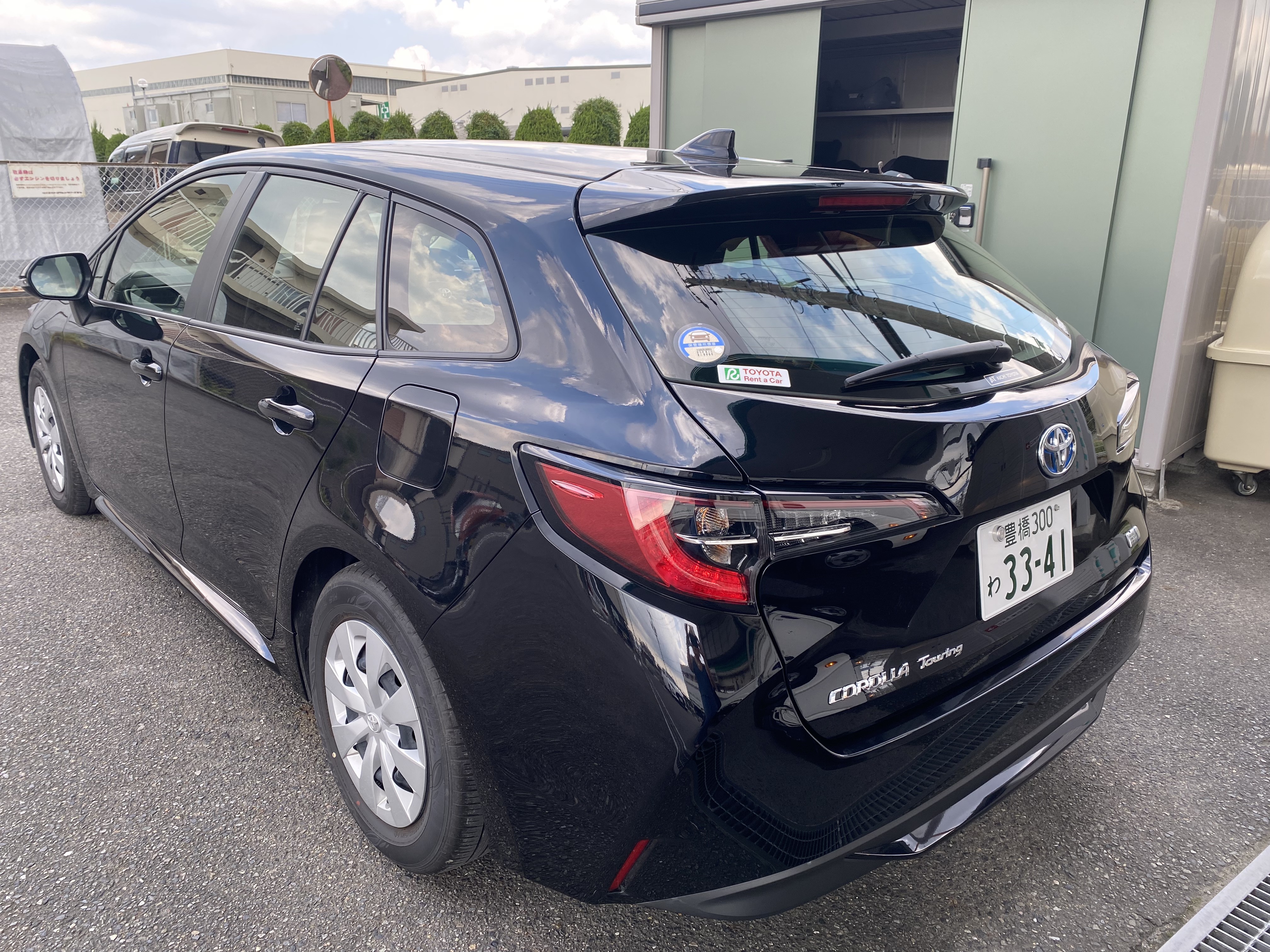
Friday, September 13: We arrived in Nagoya on the Shinkansen by 11:10 but it took us quite some time to find the express bus to Nagoya Airport. We walked to and fro on the sweltering pavement until an English teacher came along with his friend and led us to the barely noticeable bus stop. We took the bus to the tiny airport then waited there until a woman from the Information Desk called Toyota-Rent-A-Car to come pick us up. Finally, we rented a black Toyota Corolla Touring to drive to Takayama in the Japan Alps. The whole process was cumbersome, made worse by the oppressive heat.

Mike did a fabulous job driving our Toyota Corolla Touring rental car from Nagoya Airport through at least 30 tunnels on the Expressway to Takayama, and that on the left side of the road as well. I was a bit freaked out in the passenger side; it’s hard to get used to having the slow lane be on the left side of the moving traffic.
cpnXM+oaQMW8QzCgfQ8Ubw

our rental car: Toyota Corolla Touring

Takayama

We arrived at our hotel, Ichinomatsu Japanese Modern Hotel, by 3:00. It had a lovely setting. Sadly we found from the receptionist that the old town of Takayama was about to close down for the night. (I actually read later it is open every day from 9-5).

We had to change our shoes multiple times while going to our room and then back outdoors. We put our street shoes in a locker, put on house slippers, then put on outdoor slippers to walk through the garden and then house slippers again to go to our room. It was quite a production.

Ichinomatsu Japanese Modern Hotel
our room at Ichinomatsu Japanese Modern Hotel

Takayama is famous for its Hida beef so Mike wanted to try a place he found highly recommended in a blog: Center4 Hamburgers. We could have driven our car but instead we decided to walk the 23 minutes to get there. Luckily we brought our umbrellas as the sky opened up and we were drenched by the time we arrived at the quirky cafe. The place was decorated with everything imaginable from Johnny Cash T-shirts to flour sacks, vintage signs and beat-up old-fashioned shoes. Johnny Cash songs serenaded us during our meal.

We sat beside two young families, a Filipino brother and sister and their spouses. The one young family – the Filipino brother & wife (part Filipino but didn’t look it) and 2 children (ages 1 & 4) – was from Vancouver. The Filipino sister and her husband were based in Manila. We chatted with them in the cozy quarters and Mike enjoyed a Hida beef burger 🍔 and I had an avocado burger (much cheaper and made with local beef but not Hida beef). All of it was delicious. Mike downed a pour of whiskey and I had a draft Kirin Ichiban beer.

Center4 Hamburgers
Center4 Hamburgers
Center4 Hamburgers
Center4 Hamburgers
Mike at Center4 Hamburgers
me at Center4 Hamburgers
Center4 Hamburgers
Center4 Hamburgers
Center4 Hamburgers
Center4 Hamburgers
Hida Beef Burger
Hida Beef Burger
Center4 Hamburgers
Center4 Hamburgers
Center4 Hamburgers
Center4 Hamburgers
Center4 Hamburgers
Center4 Hamburgers

After dinner the rain had turned to a sprinkle and we walked back, admiring the shuttered town and looking forward to a daytime visit. We had to get back because we had reserved a half-hour slot at the hotel’s onsen at 8:30. We relaxed a bit and then donned our yukata for our allotted time slot.

We had a half hour and it was lovely but as the onsen was outdoors and the temps were in the high 70s, the hot bath was a bit much for me. I couldn’t take more than 15 minutes, so I returned to the room and promptly fell asleep on our nice firm bed.

me in my yukata
me in my yukata
me in my yukata
me in my yukata
Mike in his yukata
Mike in his yukata
Mike in his yukata
Mike in his yukata
the hotel onsen
the hotel onsen
the hotel onsen
the hotel onsen
the hotel onsen
the hotel onsen
me ready to get in the hotel onsen
the hotel onsen
the hotel onsen

Steps: 10,235. Miles: 4.33. Weather Takayama Hi 84°F, Lo 69°F. Partly cloudy.

Saturday, September 14: Ichinomatsu Japanese Modern Hotel had a fabulous breakfast. We had signed up for a half-hour time slot at 7:30 so we could get an early start. The breakfast this morning consisted of an omelette and different types of onigiri, a bit of salted salmon, radishes, cucumber, and miso soup.

the garden of the hotel with the breakfast room on the right
the garden at the hotel
looking through the garden at the onsen
the two ladies who served breakfast in shifts
breakfast, mostly omelette and onigiri
me at breakfast
me at breakfast
Mike at breakfast
Mike at breakfast
me in front of the hotel
Shirakawa-go

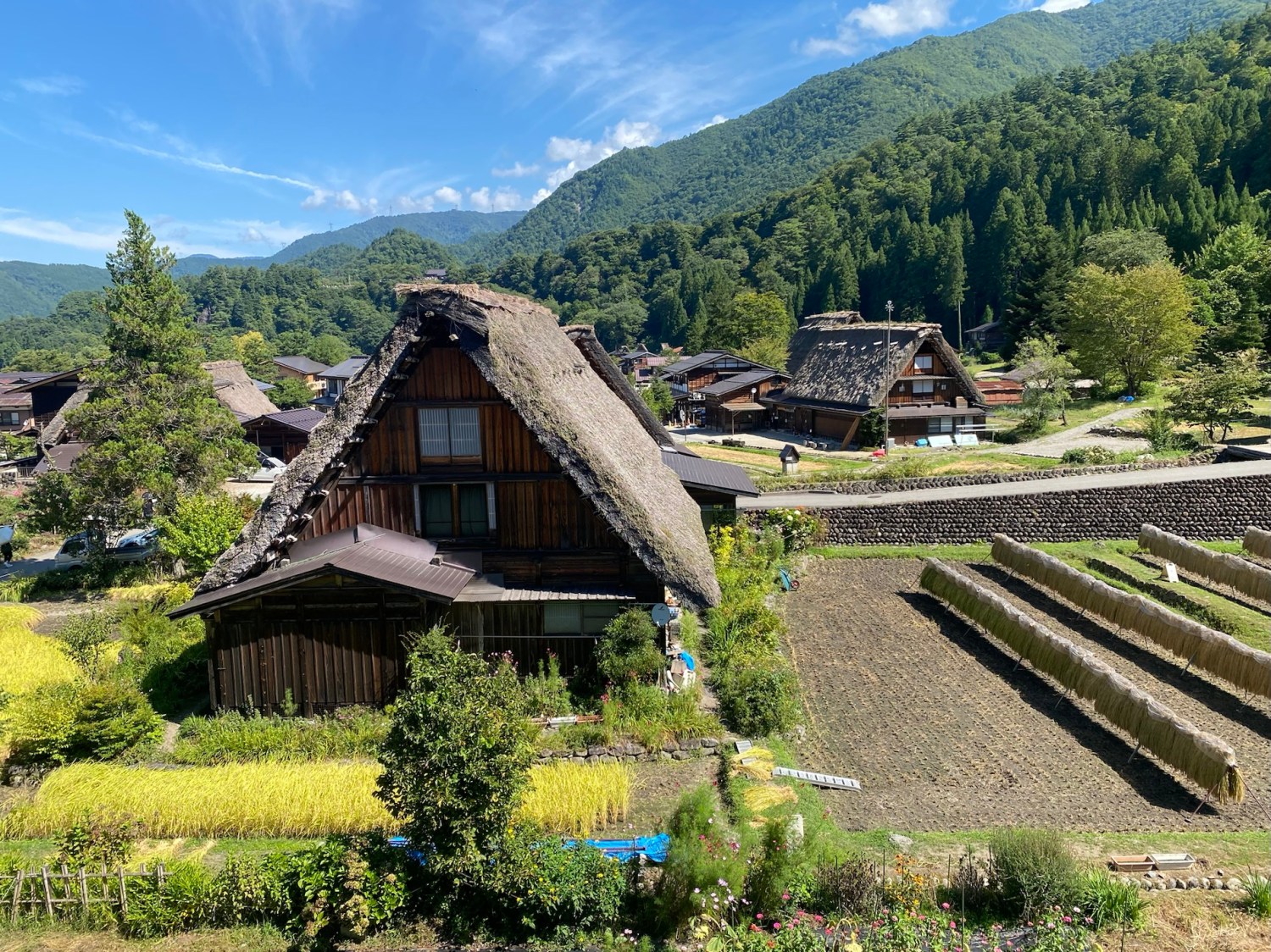
After breakfast, we drove through over 30 tunnels in the Japan Alps to visit the village of Ogimachi in Shirakawa-go, best known for farmhouses in the thatched gasshō-zukuri style. Its central settlement has some 600 residents and the largest concentration of gasshō-zukuri buildings, with over 110.  It and two other villages, Suganama and Ainokura (in the Gokayama district of Toyama Prefecture) are UNESCO World Heritage Sites. Gasshō-zukuri means “constructed like hands in prayer,” as the farmhouses’ steep thatched roofs resemble the hands of Buddhist monks pressed together in prayer. The houses are designed to withstand the large amount of heavy snow that falls in the region during winter. On this day, it was sweltering, so it was hard to imagine snow ❄️ EVER!

The style of gasshō-zukuri architecture does not use any metal objects such as braces, clamps or nails in the building construction, and instead, ropes and ties made from straw (witch-hazel sapling) are used in the construction. While the roofs are thatched with hay, if properly maintained for protection from the fires made in a sunken hearth (fireplace), the roof can last between 40 and 50 years. The thatching on the roof is replaced with the help of all the villagers in a spirit of mutual support.

Ogimachi in Shirakawa-go
me on the bridge to Ogimachi in Shirakawa-go
Ogimachi in Shirakawa-go
gasshō-zukuri house in Ogimachi
gasshō-zukuri houses in Ogimachi
Ogimachi
Ogimachi
gasshō-zukuri houses in Ogimachi
gasshō-zukuri house in Ogimachi
gasshō-zukuri houses in Ogimachi
gasshō-zukuri house in Ogimachi
Mike in Ogimachi
Mike in Ogimachi
gasshō-zukuri house in Ogimachi
me in Ogimachi
me in Ogimachi
Ogimachi
Ogimachi
Ogimachi
Ogimachi
Ogimachi
Ogimachi
Ogimachi
Ogimachi
town of Ogimachi
town of Ogimachi
a little cloth I bought to wipe my sweating face. It has the gasshō-zukuri houses on it.
gasshō-zukuri house in Ogimachi

The Myozenji Temple is the only temple and bell tower made with a traditional thatched roof. A temple of the Jodo Shinshu (True Pure Land) school, named in the first year of the Enkyo period (1744), was the dominant form of Buddhism in this area. Myozenji has a distinctive thatched main hall that dates to 1827. There is no other temple that has thatched roofing on the main hall, the living quarters and the bell tower.

The Shoromon Gate is the main gate of Myozenji Temple. Built in 1801, it is noted for its distinctive two-layered structure and high thatched roof. This design, invented by a local artisan, served as inspiration for the temple’s current main hall, which also features a thatched roof and was constructed 26 years after the gate. The Shoromon’s original temple bell was requisitioned for military use during World War II; its replacement, cast anew after the end of the war, hangs in the gate and is rung for ceremonies and on occasions such as New Year’s Eve.

On the left side of the gate stands a yew tree (Taxus cuspidata), which was planted to mark the completion of the main hall in 1827 and is designated a Natural Monument of Gifu Prefecture, while on the right side grows a cherry tree whose pink blossoms signal the coming of spring in Shirakawa-go.

Shoromon Gate
Shoromon Gate
Shoromon Gate
Shoromon Gate
Myozenji Temple
Myozenji Temple

The Myozenji Museum now occupies the building which formerly housed the monks living at the adjacent Myozenji Temple. It is one of the largest gasshō-zukuri-style houses in the village. This structure was built in 1817 and is now a museum where visitors can learn about traditional life in Shirakawa-go.  The museum building is one of the few houses of its kind in the area with plastered earthen walls, which are more fire-resistant than wooden walls.

One can observe the architecture of the traditional buildings, inspect the details up close and smell the aromatic smoke used to repel insects and protect the wood and thatched roof from damage.

We began upstairs in the four-level attic, which was used mainly for cultivating silkworms. Here we saw a variety of tools, kitchen utensils, ornaments, household implements, and other items that convey how the people of Shirakawa-go traditionally made a living. The attic also provides a look at the inside of the roof structure, which is secured by straw ropes and bindings (neso) made of witch hazel saplings. The foundation and first floor of a gasshō-zukuri-style house such as the Myozenji kuri were usually built by professional carpenters, whereas ordinary villagers would work together to assemble everything above the house’s lattice ceiling.

Myozenji Museum
Myozenji Museum
attic of Myozenji Museum
view from the attic of Myozenji Museum
attic of Myozenji Museum
view from the attic of Myozenji Museum
Mike in the attic of Myozenji Museum
attic of Myozenji Museum
architecture of roof
attic of Myozenji Museum
photo of people in village replacing the roof
view from Myozenji Museum

We had a silly photo taken of ourselves in the attic of the museum. 😂😂 Apparently the weird-looking stuffed doll they gave me to hold is a Hida Sarubobo Stuffed Doll. In Japanese, Saru means “monkey” while bobo means “baby”, so sarubobo is baby monkey. Traditionally, sarubobos are made by grandmothers for their grandchildren as dolls, and for their daughters as a charm for good marriage, good children and to ensure a well-rounded couple.

photo we bought in the museum

After viewing the attic, we followed a covered corridor into the main hall; the ornate interior is characteristic of Jodo Shinshu temples. Next to the main hall is the kuri, or living quarters of the head priest and his family. Its 330-square-meter first floor includes a large living room with an irori fireplace at the center. Above the fireplace hangs a hiama, a wooden board used to extinguish sparks rising from the fire, to dissipate smoke, and to prevent heat from dispersing throughout the house. The living room was where the family ate and spent time together sitting around the hearth in strictly prescribed seating order. The head of the household sat with his back against the thick post at the center of the building, symbolizing his role as the main breadwinner. His wife sat on the right-hand side and his firstborn son on the left, while the rest of the family had their places on the opposite side of the irori.

main hall
main hall
main hall
main hall
main hall
main hall
living room with irori fireplace
Ainokura

After leaving Shirakawa-go, we drove to the more remote and charming smaller village of Ainokura. We had a lunch there of cold soba noodles and tofu & vegetable tempura. It felt good to sit in a cool air-conditioned place. Then we wandered among more of the grass hut houses until we were exhausted from the heat and returned through another 20 tunnels on the Expressway to Takayama.

Ainokura
Ainokura
Ainokura
Ainokura
Ainokura
Ainokura
our lunch spot in Ainokura
map of Ainokura
map of Ainokura
Mike at our lunch spot
tofu & vegetable tempura
me eating lunch
me eating lunch
Mike's soba noodles
Mike’s soba noodles
Ainokura
Ainokura
Ainokura
Ainokura
Ainokura
Ainokura
Ainokura
Ainokura
Ainokura
Ainokura
Ainokura
Ainokura
Ainokura
Ainokura
Ainokura
Ainokura
Ainokura
Ainokura
Ainokura
Ainokura
Ainokura
Ainokura
Ainokura
Ainokura
Ainokura
Ainokura
Ainokura
Ainokura
Ainokura
Ainokura
Ainokura
Ainokura
Takayama

Saturday night we ate white-bread sandwiches 🥪 from a convenience store because we’d eaten such a huge lunch in Ainokura. After dinner, since Takayama is known for its sake breweries, we went to the cozy and intimate Sakedokoro Tamotsu, a sake bar. The owner, Atsu, who spoke excellent English, gave us a tasting of three types of sake and then Mike ordered a glass of one type (he is holding the bottle in the photos). I got a Ginger Plum Martini: Homemade ginger Vodka,Local Plum, Dry Vermouth, Soda. It was a very strong drink and I sipped it (for once – I usually guzzle mixed drinks!) over a long leisurely visit with Atsu and his friend, Morimo. They bonded many years ago over music; Morimo plays guitar and is especially fond of American classics from the 60s and 70s, especially Little Richard and CCR. We talked with them for a long time and enjoyed the cozy atmosphere. A very special night.

Sakedokoro Tamotsu
Sakedokoro Tamotsu
Atsu at Sakedokoro Tamotsu
sake bottles at Sakedokoro Tamotsu
Mike holding the sake he tried
me at Sakedokoro Tamotsu with my Ginger Plum Martini
sake bottles at Sakedokoro Tamotsu
Sakedokoro Tamotsu
Sakedokoro Tamotsu

We returned in time for our 8:30 time slot in the hotel onsen, but once again, it was way too hot for me to enjoy for more than 10 minutes.

Steps: 8,711. Miles: 3.71. Weather Takayama Hi 84°F, Lo 76°F. Sunny.

Hida Furukawago

Sunday, September 15: We had another nice breakfast on Sunday morning; it was different from yesterday’s and I liked it except for the gristly chicken. We enjoyed a lovely view of the courtyard.

courtyard at Ichinomatsu Japanese Modern Hotel
our breakfast view
our breakfast view
breakfast at Ichinomatsu Japanese Modern Hotel

We drove north about 20 minutes from Takayama to Hida Furukawago. The town is famous for its timber and local carpenters. A small canal, named Seto River (瀬戸川, Setogawa) and inhabited by carp, runs through the nicely preserved old town. The canal is lined by old store houses with white walls (shirakabe dozo). 

First, we visited the town’s Festival Exhibition Hall. The Furukawa Festival is an annual event of the Ketawakamiya Shrine, situated in Furukawa-cho Kamikita. It is held once a year, every April 19th and 20th, during which the spirit of the deity is led from the shrine to the town of the ujiko (shrine parishioners), who make offerings and pray to it.

After traditional Shinto rituals are held at the main hall of the shrine, the mikoshi procession takes place with large numbers of parishioners joining in a splendid parade through the town. They leave the shrine on April 19 and return on the 20th. During the festival, the procession makes dozens of stops to perform the Japanese Shinto religious rituals and the Shishimai (traditional lion dance).

This is followed by the Okoshi-Daiko and yatai float events. Of these festival events, the Okoshi-Daiko and yatai float events were designated as National Important Intangible Cultural Properties on January 28, 1980. Then, they were included as part of the “Yama, Hoko, Yatai, float festivals in Japan” registered on the UNESCO Intangible Cultural Heritage List on November 30, 2016.

Miokuri are elaborately designed drawings and writings hanging from the rear of yatai floats. The 2004 Miokuri “Hosu” (shown below) is the work of calligrapher Seison Mozumi from Furukawacho in Hida City. The Miokuri was created in 2004 for the newly completed Zuiho Ruritai, a yatai built for the purpose of handing down the cultural heritage. Hosu is the brood of the Ho’o (phoenix). Another meaning is a youth expected to become an outstanding personage in the future, as it embodies the hopes for healthy growth of the children of Furukawa.

Miokuri "Hosu" at Hida Furukawago's Festival Exhibition Hall
Miokuri “Hosu” at Hida Furukawago’s Festival Exhibition Hall
Miokuri at the Festival Exhibition Hall
some element of the famous festival

The Heisei Era’s Yatai (Zuiho-tai) was built for the purpose of preserving traditional artisanship. Among existing yatai floats, more than sixty years have passed since the most recent one was built, raising concerns that Hida no Takumi (the master craftsmen of Hida) might not be passed down to coming generations. Therefore, for six years starting in 1997, three generations, from the elderly to children, cooperated in creating this yatai.

We admired the intricate festival floats and watched a 20-minute movie about the festival. It looked wild; I’m surprised people don’t get crushed to death during it!

Heisei Era's Yatai
Heisei Era’s Yatai
One of the actual Festival Floats

Okoshi-Daiko (rousing drum): The origin of the Okoshi-Daiko is said to be the “wake-up drums” that went around to announce the start of the festival. Several hundred half-naked men carry around a frame-mounted turret on which a large drum of 80cm in diameter is perched. Drummers atop the drum beat it periodically as it makes the rounds of the town.

As the drum moves through the town, teams representing each neighborhood, carrying small drums called Tsuke-Daiko, lie in wait at various intersections to rush out and attack the turret as it passes by. The greatest glory for these teams is for their Tsuke-Daiko to gain the position nearest the turret; a mad scramble ensues as teams vie for that honor. In addition to competing with the other teams, they have to contend with the guardsmen attempting to prevent the Tsuke-Daiko from approaching the turret of the Okoshi-Daiko, resulting in a three-way offensive and defensive battle.

The young men of the Tsuke-Daiko teams encourage themselves by performing the “tombo” stunt, with one climbing to the top of a pole approximately 3.5 meters high, positioning the pole at his midsection for support and extending his arms and legs.

Okoshi-Daiko (rousing drum)
"tombo" stunt in the festival
“tombo” stunt in the festival

During the Mikoshi (portable shrine) Procession, the deity is placed inside the mikoshi and borne through the town in a stately procession, accompanied by large numbers of parishioners as well as shishi, Tokeiraku, Maihime (young female shrine dancers), and gagaku performers. Alerted by the sounds of drums and Tokeiraku that the mikoshi procession is nearing, the parishioners spread lines of salt in the middle of the road along the mikoshi route, creating and purifying a path for it. The townspeople also sprinkle a line of salt in front of their homes, drawing branch segments from the main line to their entryway, enticing the sacred presence of the deity into their homes.

The Yatai (Festival Float) Parade highlights the nine Yatai festival floats. It is a a tranquil aspect of the Furukawa Festival. A legacy of craftsmanship is displayed on the floats in the wood carving, metal engraving, and Japanese lacquer work. On the evening of April 20th, every float is decorated with Japanese “Chochin” lanterns.

mikoshi
mikoshi
mikoshi procession
mikoshi procession
mikoshi procession
mikoshi procession
other elements of the Festival

After learning everything there was to know about the Furukawa Festival, we then visited the Takumikan Craft Museum (飛騨の匠文化館, Hida No Takumi Bunkakan) built in October of 1989. It is dedicated to traditional Hida craftsmanship and was built by local carpenters using local lumber and traditional carpentry techniques (tongue and groove methods) that do not utilize nails, bolts, clamps or other metal fittings. It was built in the kurazukuri (clay-walled warehouse) style with slatted wooden cladding, to match the white-walled warehouse district by the Setogawa Canal. The large skylight on the roof, in the shape of a traditional lantern, is a symbol of the museum.

The museum exhibits traditional carpenter tools and the various types of woods used. Upon entry, we were told to sit at a large square table, where we were challenged to try to put together wooden puzzles and joints.

temple on the way to the other museum
musuem about building methods in Hida Furukawago

By this time it was pouring down rain 🌧️ ☔️ but we continued walking through the cute town with its carp-filled willow-lined canals. It actually felt better to have a cool rain than to suffer through another hot & humid day like all the days we’d had since we arrived in Japan.

We also enjoyed the box car Toyotas that EVERYONE in Japan, at least in the Japan Alps, seems to drive. They reminded us of the cars in the game of LIFE, the ones where you insert blue and pink pegs as you get married and have children.

canals with carp in Hida Furukawago
canals in Hida Furukawago
temple gate in Hida Furukawago
temple in Hida Furukawago
canals in Hida Furukawago
funny box cars
funny box cars
shrine in Hida Furukawago
another "Game of Life" boxy car
another “Game of Life” boxy car

We dropped by the huge Honkoji Temple. It has an exquisitely crafted temple gate and the main hall is the largest wooden building in the wider Hida region. 

Konkoji Temple
Konkoji Temple
bell tower at Konkoji Temple
Mike at Konkoji Temple
me at Konkoji Temple
gate to Konkoji Temple
Konkoji Temple
Konkoji Temple
Konkoji Temple
Konkoji Temple

We dropped into a cute shop where the owner creates necklaces and key chains, etc. out of local woods. I bought a wooden necklace in the shape of a teardrop on a leather string. We enjoyed chatting with the artisan and another couple who was in the shop. Also, it felt good to get out of the rain for a bit.

cute artisan shop
cute artisan shop
us at the cute artisan shop
a Japanese couple and the artistan (R)

By the time we left there, the rain had become a spittle and we stopped for some pizza at a little restaurant. A Japanese family sat next to us and the little boy, who had never before met a Westerner, had a chance to practice a bit of English. After lunch, we wandered around the town as we made our way back to our car.

Hida Furukawago
Hida Furukawago
Hida Furukawago
Hida Furukawago
Hida Furukawago
Hida Furukawago
Hida Furukawago
Hida Furukawago
pizza place in Hida Furukawago
pizza for lunch in Hida Furukawago
Hida Furukawago
Hida Furukawago
Hida Furukawago
Hida Furukawago
Hida Furukawago
Hida Furukawago
Hida Furukawago
Hida Furukawago
Takayama

We drove back to Takayama so we could explore the Old Town of Takayama, which has been beautifully preserved with many buildings and whole streets of houses dating back to the feudal ages, when the city thrived as a wealthy merchant town.

Takayama gained importance as a source of high-quality timber and highly skilled carpenters during the feudal ages. For these resources, the city was put under direct control of the shogun and enjoyed prosperity considering its remote mountain location.

The southern half of the old town, especially the Sannomachi Street, survives in a particularly pretty state with many old homes, shops, cafes and sake breweries, some of which have been in business for centuries.

After our nice quiet time in Hida -Furukawago, it was a shock to be in Takayama because of the crowds. Also, it still was raining off and on, so between the people and the rain, it was hard to take photos.

Old Town Takayama
Old Town Takayama
temple in Takayama
temple in Takayama
temple in Takayama
temple in Takayama
street in Takayama
street in Takayama
a rare find: a deserted street in Old Town Takayama

We lost patience with the whole ordeal and decided to drop by our favorite little Sake bar from Saturday night, Sakedokoro Tamotsu. The owner Atsu had just opened up at 3:00. It felt good to get out of the rain. I ordered a frozen margarita and Mike a pour of the local sake. I couldn’t feel much from the margarita, so I ordered a glass of sake too. Later two 40- to 50-year old Kiwi teachers came in and started drinking too, Graham and Tai, and we had a fun time talking with them. They told us this was their first time in the northern hemisphere, surprising until we realized we’ve only been once to the southern hemisphere – to Ecuador in 2022. A young Japanese woman dentist came in to join as well, and that was about all the bar could fit.

Atsu in Sakedokoro Tamotsu
Mike drinks sake in Sakedokoro Tamotsu
m71P5IPqTViIZMJjj4U9Ng

Takayama is known for its ramen 🍜; it has a special kind of curly noodle. We left the bar in time to make it for a famous ramen place that opened its doors at 5:00, Menya Shirakawa Bettei. Waiting customers sat on outdoor benches until they could be admitted on a first-come-first-served basis.  We got there just in time to get seats at the bar. Mike got  Shirakawa dandan noodles with pork and I got a vegetarian ramen with boiled eggs. It was all delicious as advertised. We were surprised by how fast everyone slurped and gobbled down their ramen, making room quickly for the waiting people outside. We felt very slow by comparison.

popular ramen bar in Takayama
patrons sit on a bench outside and are served first come-first served
we got a spot at the bar
ramen chefs
ramen chefs
Mike with his ramen
Mike with his ramen
Mike's ramen
Mike’s ramen
me with my ramen
me with my ramen
my ramen
my ramen

On our way back to our hotel from Old Town Takayama we came upon Hida Kokubunji Temple. Its history goes back to the Nara period. On the grounds are the center foundation stones for a seven-storied pagoda and the foundation stones of Kondo Hall. Its scale affords an idea of the high level of skills wielded by Hida artisans in woodworking. The site is engraved with the history of Hida artisans stretching back more than a thousand years.

We were impressed by the Great Ginkgo of Hida Kokubun ji. The age of this tree is estimated to be 1,200 years, and it has been designated a national natural monument. The tree is 28 m in height, with a circumference of 10 m. In the past, it was believed that snow would fall when the leaves of the gingko fell, and the tree is cherished by local residents as a herald of the changing seasons.

Hida Kokubunji Temple in Takayama
ema at Hida Kokubunji Temple
Great Ginkgo of Hida Kokubun ji
Hida Kokubunji Temple

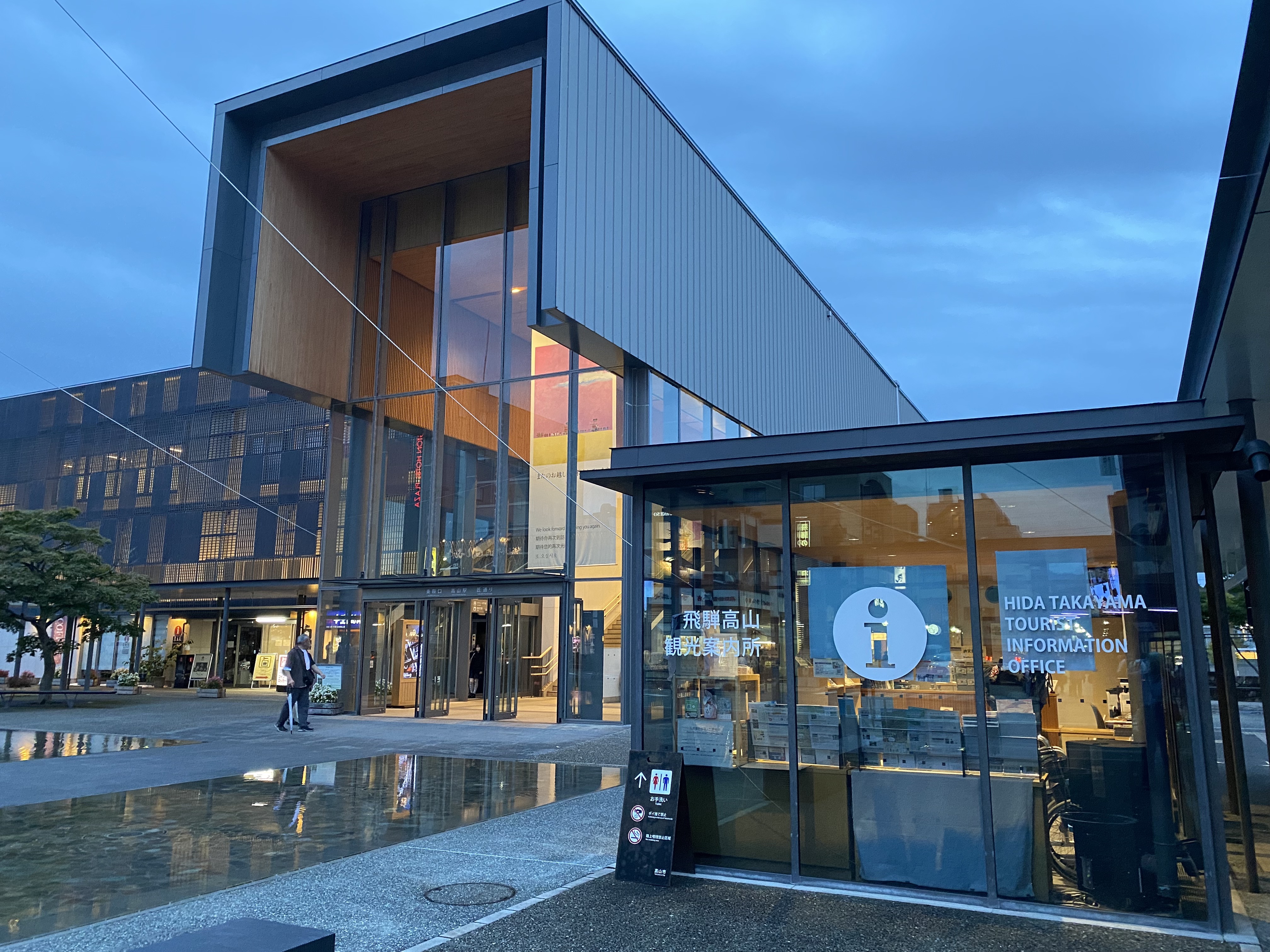
On our walk back we also passed through the very modern train station of Takayama.

9Hq9XO7YTX2WTlklF0N6yg

Takayama’s modern train station

During the day walking around in my Tevas in the rain, I got two blisters on my two little toes and I could hardly walk. Plus I could feel a cold coming on; my head was about to explode. Somehow I hobbled back to our room, a good 30 minute walk, and relaxed until our 8:30 onsen time slot. I conked out quickly after our hot baths as my cold hit me full on. I had a miserable sleep between my sinus pressure, sore throat, and two blistered little toes! It never fails that I get sick at least once during our travels.

Steps: 11,836. Miles 5.01. Weather Takayama Hi 81°F, Lo 76°F. Showers.

The Nakasendo Trail: Tsumago-juku

Monday, September 16: We originally had big plans for Monday. We had to drive from Takayama and be in Nagoya by 5:00 to return our rental car. We had hoped to walk the Historic Nakasendo Trail. During the Edo Period (1603-1868), the ‘Nakasendo’ was an important route connecting Tokyo – then called ‘Edo’ – and Kyoto. Along the route, numerous ‘postal towns’ developed to provide services such as accommodation, food, transport and protection to travelers and merchants, who were of course taxed. Many of the towns accumulated great wealth as a result and today, several remain beautifully preserved.

Come along for a little drive through some of the Japan Alps.

Japan Alps

Japan Alps

We thought we got an early start but somehow we didn’t get to the first post town, Tsumago-juku, until noon. Not only was I feeling horrible but the heat was unbearable – so oppressively hot and humid. We wanted to see the two post towns AND do the walk between them, but between my blisters and my cold and the heat, I decided it would be just fine to drive to both post towns. It turned out there was no way we could have walked the 2-3 hour hike, visited both post towns, plus made it back to Nagoya by 5:00.

NAGISO Guide map found in Tsumago-juku Tourist Information Center

We stopped first at Tsumago-juku, home to traditional wooden inns that once hosted traveling samurai lords. It felt much like an open-air museum; the government designated it as a protected area for the preservation of traditional buildings. Modern developments such as telephone poles are not allowed in the town.

Tsumago-juku
Tsumago-juku
Tsumago-juku
Tsumago-juku
Tsumago-juku
Tsumago-juku
Tsumago-juku
Tsumago-juku
Tsumago-juku
Tsumago-juku
Tsumago-juku
Tsumago-juku
Tsumago-juku
Tsumago-juku
Tsumago-juku
Tsumago-juku
Tsumago-juku
Tsumago-juku
Tsumago-juku
Tsumago-juku
Tsumago-juku
Tsumago-juku
Tsumago-juku
Tsumago-juku
Tsumago-juku
Tsumago-juku
Tsumago-juku
Tsumago-juku
Tsumago-juku
Tsumago-juku
Tsumago-juku
Tsumago-juku
Tsumago-juku
Tsumago-juku
me in Tsumago-juku
me in Tsumago-juku
Tsumago-juku
Tsumago-juku
Tsumago-juku
Tsumago-juku
Tsumago-juku
Tsumago-juku
Tsumago-juku
Tsumago-juku
Tsumago-juku
Tsumago-juku
Tsumago-juku
Tsumago-juku
Tsumago-juku
Tsumago-juku
The Nakasendo Trail: Magome-juku

Magome-juku (馬籠宿) was the forty-third of the sixty-nine stations of the Nakasendō connecting Edo with Kyoto in Edo period Japan. We stopped in this charming town after Tsumago-Juku, the other town bookending this stretch of the Nakasendō Trail.Before walking into the town, we enjoyed the views over the town and the Japan Alps.

view of Magome-juku
view of Magome-juku
view over Japan Alps

Magome’s buildings line a steep, cobblestone pedestrian road with rustic shopfronts and mountain views. I wish I’d been able to appreciate it more, but by this time of day, the heat was oppressive and I was feeling congested and miserable. We stopped into one of the only air-conditioned coffee shops we could find and enjoyed a nice long break while sipping and savoring a melon soda and an iced latte.

The town was a steady downhill from where we parked, which meant we had to climb uphill to get back to the car. Mike always takes good care of me, so he climbed back up to the parking lot while I walked downhill and met him as he drove the car to the bottom of the town. I wished I’d had more energy to take pictures as the town was quite photogenic, but I just didn’t have it in me. A number of the photos here are Mike’s.

Magome-juku
Magome-juku
Magome-juku
Magome-juku
Magome-juku
Magome-juku
Magome-juku
Magome-juku
Magome-juku
Magome-juku
Magome-juku
Magome-juku
Magome-juku
Magome-juku
air-conditioned cafe in Magome-juku
our break to get out of the heat
cute little cafe
cute little cafe
melon soda and an iced latte
Magome-juku
Magome-juku
Magome-juku
Magome-juku
Onward to Nagoya

After leaving, Magome-juku, we made our way back to Nagoya Airport so we could return our rental car.

Steps: 8,139. Miles 3.44. Weather Takayama Hi 91°F, Lo 70°F. Mostly sunny.


Share this:

  • Share on X (Opens in new window) X
  • Share on Facebook (Opens in new window) Facebook
  • More
  • Email a link to a friend (Opens in new window) Email
  • Print (Opens in new window) Print
  • Share on Pinterest (Opens in new window) Pinterest
Like Loading...
  • Asia
  • International Travel
  • Japan

arrival in japan: a brief visit to tokyo & surrounds

wanderessence1025's avatar wanderessence1025 November 6, 2024
The journey from Virginia to Tokyo

Monday, September 9, 2024:  We arrived by Uber to Washington Dulles International Airport at 9:45 a.m. for our 14-hour direct 12:25 pm United Airlines flight to Tokyo Haneda Airport. I was all about comfort for a long flight such as this, so I wore my PJ-like airplane set.

I sat in the aisle seat (Mike and I always get aisle seats across from each other) with three seats to my right. As the plane nearly finished boarding, I realized no one would be sitting in those three seats. I couldn’t believe my luck because it meant I’d be able to stretch out and sleep over all four seats. The feisty older male flight attendant said the plane must have been carrying a lot of cargo because he had never seen that flight so empty.

I settled in for the flight and opened a pack of trail mix Mike had packed. He always takes care of our snacks on trips.  I watched Mama Mia! before and during dinner for about the millionth time. Our dinner was a very blah pasta with tomato sauce and a salad.

We flew at an altitude of around 38,000 feet across the northern U.S., up near Alaska and then across the northern Pacific Ocean.  At take off, time to destination was 13 hours 55 minutes. The distance to Tokyo was 6,781 miles (10,913km).

Mike on his way to the gate at Dulles
Our United Flight, waiting for us!
me with three empty seats
the wonderful 3 empty seats!!
Time to destination: 13h 55 min
eating boring pasta and watching Mama Mia!
the flight path across the northern U.S.

Steps: 3,986; miles 1.68. Weather in Virginia: Hi 76°F. Lo 65°F. Sunny.

Tuesday, September 10: At some point in time we moved into Tuesday. When I wasn’t sleeping, I watched The Idea of You with Anne Hathaway and Nicholas Galitzine; it was about a 40-year-old single mom who begins an unexpected romance with 24-year-old Hayes Campbell, the lead singer of August Moon, the hottest boy band on the planet.

For breakfast on the plane sometime Tuesday afternoon (Japanese time), we had scrambled eggs with corn and black beans and grapes with pineapple.

The flight path across the Pacific
Time remaining 2hr 5 min
breakfast in the afternoon
approaching Japan
approaching Japan
Getting closer
Getting closer

Tokyo, Japan

As we approached Tokyo at about 3:25 on Tuesday afternoon, Mike captured photos of the largest metropolitan area on earth, with 41 million people as of 2024. (This includes the Greater Tokyo Area, which includes Tokyo and parts of six neighboring prefectures). Fourteen million residents lived within the city proper as of 2023. Delhi, India is 2nd with 28 million (2018).

img_0564

Tokyo, Japan – the largest metropolitan area on earth

Tokyo is Japan’s economic center and seat of both the Japanese government and the Emperor of Japan, Naruhito, the hereditary monarch and head of state of Japan, who has served since May 1, 2019.

Before the 17th century, Tokyo, then known as Edo, was mainly a fishing village. It became politically prominent in 1603 when it became the seat of the Tokugawa shogunate. The historical novel, Shōgun, by James Clavell takes place during this time period. The character of Blackthorne in the novel is loosely based on the historical English navigator William Adams who rose to become a samurai under Tokugawa Ieyasu, a powerful feudal lord (daimyō) who later became the military ruler of Japan (shōgun) and the founder of the Tokugawa shogunate.

By the mid-18th century, Edo was among the world’s largest cities, with over a million residents.

Following the Meiji Restoration in 1868, the imperial capital in Kyoto was moved to Edo and the city was renamed Tokyo (“Eastern capital”). In 1923, Tokyo was damaged substantially by the Great Kantō earthquake, and the city was later badly damaged by Allied bombing raids during World War II.

Beginning in the late 1940s, Tokyo underwent rapid reconstruction and expansion where Japan’s economy was propelled to the second largest in the world at that time, behind the United States.

We took the Keikyū Airport Line to Shinagawa Station (18 minutes) and then The Ueno-Tokyo Line to Tokyo Station (8 minutes). From the Yaesu North Exit, we walked 8 minutes to our hotel: karaksa hotel TOKYO STATION. Tokyo Station is the busiest station in Tokyo in terms of scheduled trains, with over 4,000 trains arriving and departing daily. It is the fifth busiest in terms of passengers, with 500,000 people using it each day.

As many hotels do in Japan, they gave us pajamas to wear. Mike had me take a photo of him standing outside our tiny room 906. The pants were a bit short! 🙂

Welcome to Tokyo
Welcome to Tokyo
me on the train to Tokyo Station
Mike in the too-short hotel PJs
karaksa hotel TOKYO STATION

We had dinner Tuesday night at a place at Tokyo Station. We had no idea what we were getting and to be honest, it wasn’t my favorite. We got oden, a type of nabemono (Japanese one-pot dishes) consisting of several ingredients such as boiled eggs, daikon or konjac, and processed fishcakes stewed in a light, soy flavored dashi broth (this broth forms the base for miso soup, clear broth soup, and noodle broth soup; it accentuates the savory flavor known as umami). We ordered white radish, potato, soft boiled egg, chopped green onion in fried fish cake and shrimp in minced fish ball and some kind of chicken salad. All were in broth except for the salad.

I love Japanese places where the waitress yells out things in a high-pitched sing-song voice and the chefs yell back and every one is yelling in a way that can only be described as “cute.” 😊

the "Oden" restaurant at Tokyo Station
the “Oden” restaurant at Tokyo Station
the "Oden" restaurant at Tokyo Station
the “Oden” restaurant at Tokyo Station
the "Oden" restaurant at Tokyo Station
the “Oden” restaurant at Tokyo Station
me at the oden restaurant
Mike at the oden restaurant
chicken "salad"
chicken “salad”
white radish, potato, chopped green onion in fried fish cake and shrimp in minced fish ball - all in savory broth
white radish, potato, chopped green onion in fried fish cake and shrimp in minced fish ball – all in savory broth

After dinner we got cozy in our hotel and zonked out, exhausted by our long flight and the end of a roughly 24-hour travel day.

Steps: 5,891; Miles 2.49. Weather in Tokyo: 93°F, Lo 78°F. Sunny.

Wednesday, September 11: At breakfast this morning we met a Japanese-American couple who had lived much of their lives in Los Angeles. They were on a cruise and gearing up to explore Tokyo for the day. The breakfast was very good at the hotel, a good mix of Western and Japanese food but nothing too outrageous. This would not always be the case with our breakfasts.

We spent a lot of time on trains in Tokyo on our first day; the country has the most efficient and punctual transportation system in the world. From the beginning, Mike said he was impressed by my ability to figure out train schedules with the help of Google Maps, which works amazingly well: it spells out arrival times, platform numbers, where to board for the fastest transfers, and how many minutes you will be on the train with all stops listed.

I was happy to be returning to a country where I could use clean bidet toilets that were abundant and easily accessed throughout the country. It seems most other countries want to ignore the inconvenience of people having to use the bathroom, including the U.S.

Aoyama-Gakuin University- Sagamihara campus & meeting an old friend in Fuchinobe

One of Mike’s wishes was to see where I taught English for a semester in 2017 at Aoyama-Gakuin University- Sagamihara campus; it is near Fuchinobe Station on the JR Yokohama Line. He hadn’t been able to visit me while I was there. From Tokyo Station, near our hotel, the trip took us 1 hour and 25 minutes. After arriving in Fuchinobe, we walked from the station to the university. I showed Mike the bicycle garage where I often parked my bike when I went out to explore Tokyo on weekends. We walked past a few houses with cool gardens along the way.

We arrived at the university, where I introduced myself to the guard (using Google translate) and told him I taught there in 2017. He told us we could walk around the dining hall but couldn’t go into the main building where our offices had been. I gave Mike a tour of the cafeteria/dining hall, showing him the numbered plastic food representing the lunch choices, the machine where I paid for and got a ticket for my choice, and the windows from which the ladies served up the meals. I pretty much ate Udon noodles topped with vegetable tempura every day. I was lucky I was able to find the university again as it had been 7 years since I taught there and I didn’t usually approach it from the train station.

Mike ready to tackle the trains to Fuchinobe
Fuchinobe
Fuchinobe
bicycle parking garage near Fuchinobe Station
house seen on the way to the university
me at Aoyama-Gakuin University- Sagamihara campus
Aoyama-Gakuin University- Sagamihara campus
me at Aoyama-Gakuin University- Sagamihara campus
Aoyama-Gakuin University- Sagamihara campus
dining hall at the university: plastic food display
dining hall: where you push the button to get your ticket
This is where the ladies prepare the food in the dining hall. We presented our ticket to them to get our lunch.
Aoyama-Gakuin University- Sagamihara campus

Mike also wanted me to take him on my daily 30-minute walk each way from the university to my tiny Leopalace apartment, which he called a rabbit hutch. It was touch and go, but luckily I was able to remember the walk. Starting out was easy and familiar, and when I got close to the apartment I started to recognize my neighborhood, but in-between everything was very nondescript (and my memory is not so great these days!). I tried to loosen my mind and let my feet lead the way. I couldn’t believe I was able to find it! It was very hot, 93°F with 85% humidity, so I was drenched by the time we made our way back to the station. Mike was happy to have seen parts of the life I lived during that spring semester.

I showed Mike the outside of my Leopalace apartment and its vending machine. We visited the 7-11, a block away, where I often got dinner, drinks or sweets.  We took pictures of one of my favorite foods, onigiri, or rice ball, a Japanese food made from white rice formed into triangular or oval shapes and often wrapped in nori (seaweed). Traditionally, an onigiri is filled with pickled umeboshi (salted Japanese plums), salted salmon, katsuobushi (simmered, smoked and fermented skipjack tuna), kombu (edible kelp), tarako (salted pollock roe), or any other salty or sour ingredient as a natural preservative. The one I ate most often was filled with tuna and mayonnaise. It tasted a bit like an old-fashioned tuna-rice casserole.

My Leopalace apartment building. My apartment was on the top far right.
vending maching outside my apartment
the steps in back leading to my apartment
The 7-11 near my apartment
Onigiri in the 7-11. I ate this often. :-)
Onigiri in the 7-11. I ate this often. 🙂

Back at Fuchinobe Station, we met my friend and colleague Graham (from Aoyama Gakuin) and his Japanese wife Ako at a Thai restaurant, Jaruan. Graham is now retired and lives permanently in Japan. It was such a wonderful treat to see him again and to meet lovely Ako. He had recently had a knee replacement and said he was feeling younger than ever.

Graham and I agree politically on almost everything, so we could commiserate about U.S. politics even though he’s British. He was hoping Kamala Harris would choose Tim Walz as her running mate, which she eventually did. He is knowledgeable about everything American; he had visited me in Virginia in March of 2019 and wanted me to take him to see Gettysburg as he’s a big Civil War buff. We ended up going to both Gettysburg and Antietam in one day (no small feat) and he knew more about Civil War battles than I did.

Ako gave us each t-shirts with funny sayings on them in Japanese. I’ll tell more about those later. She also gave me a package of facial masks, which I used every night until they were all gone. I, on the other hand, committed a Japanese faux pas by arriving empty-handed. Graham even insisted on treating us to lunch!

Graham, Ako, me and Mike
Graham and Ako
Graham and Ako
the Thai restaurant near Fuchinobe Station

Kichijōji and Harmonica Yokocho

After leaving Graham and Ako, we took the Chuo Line to Kichijōji and walked around the covered shopping arcades and the narrow alleys of Harmonica Yokocho. It was super hot, so of course we found a cute bar to dip into. Mike had a pour of whiskey and I had a refreshing Mango Sour. We chatted with the woman bartender whose daughter, Karen, just got married to a Brazilian man in Boston. She had recently spent time in Argentina with her Japanese boyfriend (he lives there) and raved about her time there. Her little bar was cool and cozy and we enjoyed talking with her while having a drink. How I love meeting people who are as full of wanderlust as I am.

Harmonica Yokocho
Harmonica Yokocho
Harmonica Yokocho
Harmonica Yokocho
plastic food in Harmonica Yokocho
plastic gyoza in Harmonica Yokocho
Harmonica Yokocho
Harmonica Yokocho
a nice Japanese lady who spoke perfect English in a bar in Harmonica Yokocho
Mike & me in the Harmonica Yokocho bar

Tokyo

One of Mike’s jobs when we travel is to look for our dinner restaurants. Wednesday night, he found Yaesu Hashimoto, which we had some trouble finding. The specialty was unagi, or Japanese freshwater eel. We had an eel appetizer, which we were offered as if it were free, but then we were charged for it. Then we had eel in omelette (super yummy) and grilled eel on rice.

eggs with eel at Yaesu Hashimoto
grilled eel at Yaesu Hashimoto
Mike at Yaesu Hashimoto
me at Yaesu Hashimoto

We still were not acclimated to the time difference so we went right to our hotel and zonked out.

Steps: 15,800; Miles 6.69. Weather in Tokyo: 93°F, Lo 78°F. Sunny.

Thursday, September 12: This morning in the breakfast room of the hotel, we again met the Japanese-American couple from L.A., who were off for another day in Tokyo. We met another couple from New Jersey who were about our age. They had just flown into Japan the day before and had rented a car for an open-ended trip all around Japan. I said, “You drove into Tokyo??” I was shocked. The man’s wife said, “He can drive anywhere. It doesn’t matter if it’s the right or left side of the road, if it’s a big city or a rural area, it doesn’t matter. He just gets in the car and drives!” I was surprised that someone would actually drive into the center of Tokyo. When we asked about their plans, they said they only planned a few days at a time. If they liked a place, they stayed longer, if not, they moved on quickly.

I thought: We need to be more like them!! We especially felt this way after this particular trip when we were stuck in certain places for way too long, or where we didn’t have enough time in other places.

Sensō-ji

I had only one day to show Mike some of my favorite places in Tokyo. We started with Sensō-ji, Tokyo’s oldest-established Buddhist temple, and one of its most significant. It is dedicated to Kannon, the bodhisattva of compassion. Structures in the temple complex include the main hall, a five-story pagoda and large gates. It is the most widely visited religious site in the world with over 30 million visitors annually.

Legend has it that in the year 628, two brothers fished a statue of Kannon, the goddess of mercy, out of the Sumida River. Each time, they put the statue back into the river, but it kept returning to them. Thus, Sensō-ji was built nearby for the goddess of Kannon. It was completed in 645, making it Tokyo’s oldest temple.

We entered through the Kaminarimon (Thunder Gate), the outer gate. We walked down the 200-meter shopping street called Nakamise, a street with a history of several centuries. This street leads to the second gate, the Hozomon Gate. In front of us, we found the temple’s main hall. The Asakusa Shrine (of the Shinto religion), built in 1649 by Tokugawa Ietmitsu, stands immediately adjacent to the temple’s main building.

The temple was destroyed during a March 10, 1945 firebombing air raid on Tokyo during WWII. The main hall was built in the 1950s.

We each shook a long cylindrical container with a small hole in it, and out came a stick with a number. We found the drawer with that number and found our fortune inside. Ours were both positive, but if they had been negative, we would have tied them to a stand and left them behind.

Before leaving, we checked in with the Nisonbutsu (“A Pair of Buddha”). The figure on the right is said to bring mercy to worhsipers, the one on the left, wisdom.

It’s an impressive and lively temple complex. Though it was hard to be highly motivated in 93 degree muggy weather, we survived and enjoyed the temple.

Sensō-ji Kaminarimon Gate
Mike and me at Sensō-ji
Sensō-ji
Sensō-ji
Sensō-ji Hozomon Gate
pagoda at Sensō-ji
pagoda at Sensō-ji
Buddha's sandals at Sensō-ji
Buddha’s sandals at Sensō-ji
Sensō-ji
Sensō-ji
my fortune at Sensō-ji
my fortune at Sensō-ji, up close
incense burner at Sensō-ji
Sensō-ji
Sensō-ji
Sensō-ji
Sensō-ji
Sensō-ji
Sensō-ji
Asakusa Shrine
Asakusa Shrine
Sensō-ji
Sensō-ji
Mike prepares to wash at Sensō-ji
Sensō-ji
Sensō-ji
Asakusa Shrine
Asakusa Shrine
Sensō-ji
Sensō-ji
Mike's fortune at Sensō-ji
Mike’s fortune at Sensō-ji
Sensō-ji
Sensō-ji
Sensō-ji
Sensō-ji
Sensō-ji Nisonbutsu
Sensō-ji Nisonbutsu

Ueno Park

After leaving Senso-ji, we went to Ueno Park where I saw the cherry blossoms 7 1/2 years ago. Today it was hot and humid and no cherry blossoms were in evidence but we stopped into three places, firstly the Ueno Daibutsu (Remains of the Ueno Daibutsu).

img_3158

Map of Ueno Park in Tokyo

Ueno Daibutsu was an Edo-period giant seated statue of Buddha (Shaka Nyorai) in what is now Ueno Park. Of bronze and dating to 1631, it was restored after earthquake damage in 1640, a fire in 1841, and again after the 1855 Edo earthquake. Its head was toppled during the 1923 Great Kantō earthquake, and much of its bulk was melted down for reuse during the Pacific War. In 1972 the face, stored in Kan’ei-ji, was put on display in its former location.

I love the ema hanging in temples. Ema are small wooden plaques, common to Japan, in which Shinto and Buddhist worshipers write prayers or wishes. Ema are left hanging up at the shrine, where the kami (spirits or gods) are believed to receive them. They often carry images or are shaped like animals, or symbols from the zodiac, Shinto, or the particular shrine or temple.

Ueno Daibutsu
Ueno Daibutsu
Ueno Daibutsu
Ueno Daibutsu
ema at Ueno Daibutsu
Ueno Daibutsu
Ueno Daibutsu
ema at Ueno Daibutsu

Our next stop in Ueno Park was Hanazono Inari Shrine. This shrine is dedicated to Inari, the god of fertility, rice, agriculture, and foxes. Inari shrines are easily recognizable by their vibrant vermilion torii gates.

Mike entering Hanazono Inari Shrine
me at the torii gates of Hanazono Inari Shrine
torii gates of Hanazono Inari Shrine
Hanazono Inari Shrine
ema at Hanazono Inari Shrine
two young ladies in kimono at Hanazono Inari Shrine
Hanazono Inari Shrine

Our last stop in Ueno Park was Kiyomizu Kannondo Temple, built in 1631. It is one of the remnants of the Kan’ei-ji temple. Its design, including a wooden balcony extending from the hillside, was inspired by Kiyomizudera in Kyoto. The temple is home to an image of Kosodate Kannon, the goddess of conception, and is particularly popular among women hoping to have children.

The temple has a platform overlooking a circle made from pine tree. This circle is called the pine tree of the moon (tsuki no matsu in Japanese). This shape became famous with local people and was picked up by Ukiyo-e artist Hiroshige in his One Hundred Famous Views of Edo (1856–59), giving this shape historical significance. The original pine tree was unfortunately destroyed in a storm during the Edo period (1603-1868); the current tree dates from 2011.

pine tree at Kiyomizu Kannondo Temple
Kiyomizu Kannondo Temple
ema at Kiyomizu Kannondo Temple
bad fortunes at Kiyomizu Kannondo Temple

Ameyayokocho Shopping Street

It was super hot by the time we left Ueno Park so we strolled briefly down the Ameyayokocho Shopping Street. Soon we found a restaurant where we could cool off and have some lunch: Shrimp tempura for me and a chicken rice set meal for Mike. After this we were exhausted because of the heat, our lunchtime beers, and our discombobulation due to our flip-flopped time zone. We returned to our hotel to relax for the hottest part of the afternoon before going out to explore at around 5:00 pm.

Ameyayokocho Shopping Street
the ever ubiquitous vending machines on Ameyayokocho Shopping Street
Ameyayokocho Shopping Street
strange socks onn Ameyayokocho Shopping Street
fish at Ameyayokocho Shopping Street
Ameyayokocho Shopping Street
having lunch at Ameyayokocho Shopping Street
tempura and rice for lunch

Monzennakacho

After our rest in the hotel, we took a short train to the Monzennakacho neighborhood, a place I’d never been during all my Tokyo explorations in 2017. I really loved this quiet old-school neighborhood. We stopped in first at Fukagawa Fudoson Temple. It belongs to the Shingon Buddhism esoteric school, founded in Japan in the 9th century by monk Kukai (Kobo Daishi). It is also affiliated with Narita-san Shinsho-ji, a temple located near Narita International Airport in the east of Tokyo.

Built in 1703, the temple was damaged by the Great Kantō Earthquake in 1923, then by 1945’s aerial bombings. It was thereafter reconstructed in a mish-mash of ancient and modern styles.

Fukagawa Fudoson Temple
ema at Fukagawa Fudoson Temple
Fukagawa Fudoson Temple

Finally, in the blue light, we visited Tomioka Hachiman Shrine, the largest Hachiman shrine in Tokyo, built in 1627. The shrine began with the worship of the god Hachiman, the god of martial arts and war. It is also intimately connected to the history of sumo in Japan.

The shrine’s big festival, the Fukagawa Hachiman Matsuri, takes place in mid-August. We saw one of the two massive festival floats that are used in that festival.

Tomioka Hachiman Shrine
ema at Tomioka Hachiman Shrine
festival float at Tomioka Hachiman Shrine
famous character at Tomioka Hachiman Shrine

We strolled around the adorable neighborhood of Monzennakacho and tried to figure out where to eat. Of course everything on menus was in Japanese and using our translator we found things like “a drooling chicken with a blue-tartan sauce,” “CHEESE-IN-MIL-FUYU HAM CUTTLE” and other mysterious foods. Finally we happened upon a pizza place and that saved us. We had some Prosecco and a tomato mozzarella & basil salad and a Romano pizza. Then we returned to our hotel and prepared ourselves for our Friday morning Shinkansen 🚄 to Nagoya, where we would get a rental car to drive to Takayama in the Japan Alps.

Monzennakacho
Monzennakacho
Monzennakacho
Monzennakacho
Monzennakacho
Monzennakacho
Monzennakacho
Monzennakacho
Monzennakacho
Monzennakacho
Monzennakacho
Monzennakacho
Monzennakacho
Monzennakacho
Monzennakacho
Monzennakacho

Steps: 14,530; Miles 6.15. Weather Tokyo: Weather in Tokyo: 93°F, Lo 78°F. Mostly sunny.

Here’s a short video showing some scenes from Japan.

Scenes from Tokyo, Japan

Scenes from Tokyo, Japan

Tokyo to Nagoya

Friday, September 13: Friday morning, we left our hotel by 8:30 to go to Tokyo Station, where it was swarming with Japanese commuters. From there we got on the 9:30 am Shinkansen (Nozomi 21) to Nagoya.

leaving our hotel in Tokyo
walking to Tokyo Staion
Tokyo Station
Tokyo Station
Tokyo Station
Tokyo Station
Tokyo Station
Tokyo Station
Tokyo Station
Tokyo Station
Mike wating for the Shinkansen at Tokyo Station
me waiting for the Shinkansen at Tokyo Station
me on the Shinkansen to Nagoya

We arrived at Nagoya Station at 11:10 and went in search of the express bus to the airport to pick up our rental car.

Share this:

  • Share on X (Opens in new window) X
  • Share on Facebook (Opens in new window) Facebook
  • More
  • Email a link to a friend (Opens in new window) Email
  • Print (Opens in new window) Print
  • Share on Pinterest (Opens in new window) Pinterest
Like Loading...
  • Asia
  • Bali
  • Cocktail Hour

the october cocktail hour: another stint in japan & a last birthday before the big 7-0

wanderessence1025's avatar wanderessence1025 October 31, 2024

October 31, 2024: Welcome to our October cocktail hour. I’m so happy you’ve dropped by during my favorite month of the year: for the crispy cool weather, for all the autumn stuff (like pumpkins, pumpkin spice latte, apple desserts and cider, to name a few of my favorite things), for visiting wineries and for walking outdoors under crimson & gold tree canopies. Today of course is Halloween, and though I’m not really into it, I do enjoy seeing the decorations in people’s yards. I suffered through an extremely long summer in Japan and Bali, but once I got home from Japan on the 18th, I fell right into my favorite season, and my 69th birthday soon followed.

At this point, I’m so over Japanese drinks, although I did fall in love with plum wine and soda, which I’ll be happy to offer. I also have Prosecco, a variety of beers, soda or seltzer water.

To celebrate my last visit EVER to Japan, I wish you “Kanpai (乾杯!)” which means “dry the glass” or “bottoms up.”

How are things going as we are fully in the midst of fall? Have you read any good books, seen any good movies, binge-watched any television series? Have you planned any adventures or had any fall getaways? Have you dreamed any dreams? Gone to any exotic restaurants, cooked any new dishes? Have you been surprised by anything in life? Have you enjoyed the simple things in life? Have you learned anything new, taken any classes or just kept up with the news? Have you sung along with any new songs? Have you undertaken any new exercise routines? Have you marched or otherwise participated in political protests? Have you been battered, or alternately, uplifted by any news?

The first day of October, Mike and I dove fully into |*Kyoto*|, starting with Kinkaku-ji, the Zen Buddhist temple known as the Temple of the Golden Pavilion. It was hot, as it was every day, so I bought a fan which I carried everywhere with me. We then walked about a half hour to Kyoto’s famous rock garden, Ryōan-ji, or Temple of the Peaceful Dragon. I dragged Mike on the cutest train imaginable, the purple Randen Historic Tram, which tickles me pink (or purple!). In Arashiyama, we ate lunch, found kimono-clad girls on the Togetsukyo Bridge, and waded through crowds in the famous bamboo forest. We wandered through Tenryu-ji, founded in 1339. We topped off our exhausting day with okonomiyaki (Japanese pancake) and plum wine with soda, then finally enjoyed our free welcome drink at our hotel, Sakura Terrace The Gallery.

Mike and I at Kinkaku-ji
Kinkaku-ji 2024
Kinkaku-ji 2024
ema at Kinkaku-ji
ema at Kinkaku-ji
Ryōan-ji 2024
Ryōan-ji 2024
me at Ryōan-ji
me at Ryōan-ji
Ryōan-ji
Ryōan-ji
Ryōan-ji
Ryōan-ji
Mike at Ryōan-ji
Mike at Ryōan-ji
Randen Historic Tram
me on the Randen Historic Tram
Japanese girls on the Togetsukyo Bridge
Arashiyama
Arashiyama
little things for sale in Arashiyama
Arashiyama Bamboo Grove
me at the Arashiyama Bamboo Grove
shrine at Arashiyama Bamboo Grove
Mike at Arashiyama Bamboo Grove
Arashiyama Bamboo Grove
Arashiyama Bamboo Grove 2024
Tenryu-ji
Tenryu-ji
Tenryu-ji
Tenryu-ji
Tenryu-ji
Tenryu-ji
Tenryu-ji
Tenryu-ji
Tenryu-ji
Tenryu-ji
me on the train
me on the train
okonomiyaki restaurant in Kyoto
Mike at okonomiyaki restaurant
me with okonomiyaki
me with okonomiyaki

Our second day in Kyoto we walked uphill through the infinite torii gates of Fushimi Inari Shrine. Again, there were hordes of people, and it was sweltering, especially as it was all uphill. After that exhausting ordeal, we tried unsuccessfully to go to Ohara, which my friend Graham had highly recommended, but we couldn’t fit on the two buses going there. We then went to Nishiki Market AFTER eating lunch at a German-type restaurant, a big mistake, as one is supposed to sample the great variety of food at the market. We were so exhausted, we got convenience store food and ate dinner in our room, finally going down to the lobby to enjoy another free welcome drink (for me, always a gin and tonic).

Fushimi Inari Shrine
Mike at Fushimi Inari Shrine
map of Fushimi Inari Shrine
Fushimi Inari Shrine
Buddha sandals at Fushimi Inari Shrine
Fushimi Inari Shrine
ema at Fushimi Inari Shrine
me at Fushimi Inari Shrine
cats at Fushimi Inari Shrine
origami and ema at Fushimi Inari Shrine
waygu beef at Nishiki Market
Nishiki Market 2024
Nishiki Market 2024
Nishiki Market
Nishiki Market
Mike at Nishiki Market
sake at Nishiki Market

It rained our third day in Kyoto, but of course we still went out and walked along the Philosopher’s Path at the foot of the Eastern Mountains. We wandered around the beautiful Ginkakuji, the Silver Pavilion (it doesn’t actually have a silver pavilion) and its moss and rock gardens. After all that, we were looking forward to the covered arcade of Nishiki Market, and this time we sampled waygu beef, eel, shrimp tempura and sake. We ate our last Kyoto dinner at the cozy okonomiyaki restaurant.

The Philosopher's Path
The Philosopher’s Path
Ginkakuji 2024
Ginkakuji 2024
Ginkakuji
Ginkakuji
Ginkakuji
Ginkakuji
Ginkakuji
Ginkakuji
Ginkakuji
Ginkakuji
Ginkakuji
Ginkakuji
shopkeepers along the Philosopher's Path got a hoot out of Mike's shirt
shopkeepers along the Philosopher’s Path got a hoot out of Mike’s shirt
The Philosopher's Path
The Philosopher’s Path
The Philosopher's Path
The Philosopher’s Path
Mike eating waygu beef at Nishiki Market
shrimp at Nishiki Market
eel at Nishiki Market
gyoza and sake at Nishiki Market
me at the okonomiyaki restaurant
Mike at the okonomiyaki restaurant
sake place at Nishiki Market

Our next destination was Tokushima on the island of |*Shikoku*|. I had been determined to walk the first 10 temples of the 88-temple pilgrimage, spread out over 2 days. It turned out we were too exhausted and we ended up finishing only 7 of the 10. I’m certainly glad I didn’t attempt the full 88-temple circuit. I wouldn’t have made it, for sure. It didn’t help that we both got sick with head colds and all-over aches and pains.

Temple 1: Ryōzenji 2024
Temple 1: Ryōzenji
Temple 1: Ryōzenji
Temple 2: Gokurakuji
Mike after ringing the bell at Temple 2: Gokurakuji
Temple 2: Gokurakuji
Mike with large cedar tree at Temple 2: Gokurakuji
Temple 3: Konsenji
Temple 3: Konsenji
Mike at Temple 3: Konsenji
Me on the way to Temple 4 (which we skipped) and on to Temple 5
wishes left at Temple 5
Temple 5: Jizoji
Temple 5: Jizoji
Getting my stamp & calligrapy in my pilgrim book at Temple 5
stamp from Temple 5: Jizoji
Mike washing at Temple 10: Kirihataji (Day 2)
me after ringing the bell at Temple 10: Kirihataji
Temple 10: Kirihataji
on the 4km walk to Temple 9
Temple 9: Horinji
Temple 9: Horinji
stamp for Temple 9: Horinji
Japanese house on the 2.5 km walk from Temple 9 to Temple 8
Temple 8: Kumadaniji
pizza reward after our second day of walking

While we were in Shikoku, on October 5, our granddaughter Allie had her first birthday and Alex and Jandira took her to the Atlanta Aquarium for a memorable birthday.

Jandira, Alex and Allie at the Atlanta Aquarium for Allie's first birthday
Jandira, Alex and Allie at the Atlanta Aquarium for Allie’s first birthday
Allie, Jandira, & Alex at the Atlanta Aquarium for Allie's first birthday
Allie, Jandira, & Alex at the Atlanta Aquarium for Allie’s first birthday
Allie, Jandira, & Alex at the Atlanta Aquarium for Allie's first birthday
Allie, Jandira, & Alex at the Atlanta Aquarium for Allie’s first birthday

We headed to |*Okayama*|, right across the Seto Inland Sea on the only train bridge that connects Shikoku to Honshu. From there we had a number of day trips planned, but we were feeling pretty wiped out from traveling in general and from Shikoku in particular, and we didn’t find the areas very exciting. Our first day trip was to |*Bitchu-Takahashi*|, where we visited the interesting Takahashi Folk Museum, the Raikyuji Temple (once the residence of a local feudal lord), the large Haibara Samurai Residence from the Edo period, and the Orii Samurai Residence with its rather eerie lifesize dolls. Actually, this was my favorite of the places we visited mainly because there were hardly any people here.

On the way to Bitchu-Takahashi
Takahashi Folk Museum
festival floats in the Takahashi Folk Museum
Raikyuji Temple
Raikyuji Temple
Raikyuji Temple
Raikyuji Temple
Raikyuji Temple 2024
Raikyuji Temple
Raikyuji Temple
Mike at the Haibara Samurai Residence
Orii Samurai Residence
On the way back from Bitchu-Takahashi to Okayama

Our next day trip was to |*Kurashiki Bikan Historical District*|, where we took a rickshaw, wandered around the weeping willow-lined canals, and climbed to A Chi Shrine. We spent the afternoon in the public onsen in our hotel and ate Indian food at the nearby shopping mall.

Cat shop in Kurashiki Bikan Historical Quarter
canals in Kurashiki Bikan Historical Quarter
Kurashiki Bikan Historical Quarter
me with Mike in a rickshaw in Kurashiki Bikan Historical Quarter
me with our rickshaw driver
Kurashiki Bikan Historical Quarter
me in Kurashiki Bikan Historical Quarter
view from shrine over Kurashiki Bikan Historical Quarter
Ohara's wife's house
Ohara’s wife’s house
Kurashiki Bikan Historical Quarter

The last day, we took a train and ferry to |*Naoshima*|, an island in the Seto Inland Sea known for its many contemporary art installations and museums. We were frankly a bit bored by the whole thing; the best part was riding rented e-bikes all around the island (except where prohibited by the museums).

I wished I had taken Mike to Hiroshima and Miyajima (a little further south of Okayama), even though I’d been to both of these places in 2017. I was trying to see new things in Japan on this trip, but I had discovered many great places when I was there before and wished in retrospect I’d just taken him to the places I loved.

me at Naoshima 2024
me at Naoshima 2024
Naoshima
Naoshima
Naoshima
Naoshima
Mike at Naoshima
Mike at Naoshima
Naoshima
Naoshima
Mike & I at Naoshima with the Inland Sea reflected
Naoshima
Naoshima
Naoshima
Naoshima
Naoshima
Naoshima
Benesse House Museum
me on my ebike on Naoshima
Mike on his ebike on Naoshima
Mike at Juicy in Okayama

Our final destination was |*Kyūshū Island*|. We took the Shinkansen from Okayama to Kokura and rented a car, a Toyota Yaris, to explore the island. Again I was amazed at Mike’s ability to drive on the left. Luckily the island is not that crowded, so the traffic was generally not too bad (except in Yufuin). From Kokura, we drove to |*Beppu*|, where we visited the Seven “Hells,” (jigoku), hot springs presented in a touristy way that are for viewing only.

overlook view of Beppu
me at one of Beppu's seven "Hells"
me at one of Beppu’s seven “Hells”
one of Beppu's seven "Hells"
one of Beppu’s seven “Hells”
Mike at one of Beppu's seven "Hells"
Mike at one of Beppu’s seven “Hells”
one of Beppu's seven "Hells"
one of Beppu’s seven “Hells”
one of Beppu's seven "Hells"
one of Beppu’s seven “Hells”
one of Beppu's seven "Hells"
one of Beppu’s seven “Hells”
one of Beppu's seven "Hells"
one of Beppu’s seven “Hells”
one of Beppu's seven "Hells"
one of Beppu’s seven “Hells”
me at one of Beppu's seven "Hells"
me at one of Beppu’s seven “Hells”
Mike at one of Beppu's seven "Hells"
Mike at one of Beppu’s seven “Hells”
one of Beppu's seven "Hells"
one of Beppu’s seven “Hells”
one of Beppu's seven "Hells"
one of Beppu’s seven “Hells”

After leaving Beppu, where we stayed for only one night, we drove to |*Yufuin*|, an onsen town in the mountains. It was a cute-looking town but was overrun by tourists for some three-day weekend holiday. The “shopping street” had nothing worth shopping for. We had paid for half-board at Yufuin Onsen Wafu Ryokan Tsuenosho, which meant we were subjected to two dinners and two breakfasts, all of which were comprised of very weird and unpalatable stuff. Though artistically presented to us in our tatami room at our low table, the Kaiseki (a traditional multi-course Japansese dinner) was a marathon to be endured. The worst thing was that the whole ryokan experience cost us an arm and leg, and since we stayed two nights, we had to eat this way for 4 meals (breakfast and dinner). The famous Kinrin Lake in the town was more like a pond without much of interest. The best thing we found in Yufuin were the grasslands, Tsukahara Highlands, outside of the town.

Yufuin
Yufuin
looking down over Yufuin
Yufuin
Yufuin
the only worthwhile shop in Yufuin
Yufuin Onsen Wafu Ryokan Tsuenosho
me at Yufuin Onsen Wafu Ryokan Tsuenosho
sashimi at Yufuin Onsen Wafu Ryokan Tsuenosho
me at Yufuin Onsen Wafu Ryokan Tsuenosho
dinner at Yufuin Onsen Wafu Ryokan Tsuenosho
Mike at Yufuin Onsen Wafu Ryokan Tsuenosho
dinner at Yufuin Onsen Wafu Ryokan Tsuenosho
breakfast at Yufuin Onsen Wafu Ryokan Tsuenosho
me at Kinrin Lake
me at Kinrin Lake
Kinrin Lake
Kinrin Lake
Kinrin Lake
Kinrin Lake
Yufuin
Yufuin
Tsukahara Highlands
Tsukahara Highlands
Tsukahara Highlands near Yufuin 2024
Yufuin Onsen Wafu Ryokan Tsuenosho
the outdoor part of the onsen at Yufuin Onsen Wafu Ryokan Tsuenosho
sashimi night 2
sashimi night 2
dinner at Yufuin Onsen Wafu Ryokan Tsuenosho
2nd dinner at Yufuin Onsen Wafu Ryokan Tsuenosho
Sea bream head at Yufuin Onsen Wafu Ryokan Tsuenosho

The highlight of Kyushu was the |*Mount Aso *|area. After leaving Yufuin, we stopped at the beautiful Park Oike, an off-the-beaten-path moss-covered forest and freshwater spring from which people could drink. This was the only cold day we had on our trip. Finally, I got a taste of fall. We also walked on some grasslands at the Mount Aso Visitor Center. The whole area reminded me of Ecuador’s Andes (except that Ecuador didn’t have crowds of people), which I loved. We enjoyed the nicest of the four ryokans we stayed in during our travels in Japan, and thankfully NO food was involved. We visited the crowded and touristy Takachiho Gorge in the rain and then visited a bizarre shrine only 3 minutes from our ryokan, the Hogihogi Shrine, known for bestowing luck on those who bought lottery tickets. It had a weird fun house on the grounds, with strange stuffed animals stuffed into corners.

Park Oike
Park Oike
Mike drinks from Oike Spring
me at Park Oike
me at Park Oike
Park Oike
Park Oike
Park Oike
Park Oike
Park Oike
Park Oike
Park Oike 2024
Park Oike 2024
Park Oike
Park Oike
Mike at Park Oike
Mike at Park Oike
Mount Aso
Mount Aso
Mount Aso
Mount Aso
me at Mount Aso
me at Mount Aso
Mike at Mount Aso
Mike at Mount Aso
Mount Aso
Mount Aso
caldera at Mount Aso
view of the valley from Mount Aso
Ryokan Konomama in Minamiaso
onsen in our ryokan
onsen in our ryokan
view of Mount Aso from our ryokan
Minamiaso Tourist Information
me at Minamiaso Tourist Information
Mike at Minamiaso Tourist Information
Minamiaso Tourist Information
Takachiho Gorge
Takachiho Gorge
Takachiho Gorge
Takachiho Gorge
Takachiho Gorge
Takachiho Gorge
Takachiho Gorge
Takachiho Gorge
Takachiho Gorge 2024
Takachiho Gorge
Takachiho Gorge
drive back from Takachiho Gorge
view over the Mount Aso valley 2024
Hogihogi Shrine
Hogihogi Shrine
Hogihogi Shrine
Hogihogi Shrine
Hogihogi Shrine
Hogihogi Shrine
Hogihogi Shrine
Hogihogi Shrine
Hogihogi Shrine
Hogihogi Shrine

Finally, we started making our way slowly back toward Tokyo so we could fly home. We drove to see the Usuki Stone Buddhas, another out-of-the-way place south of Oita which was worthwhile. The Mitsujoin Rice Terraces, near the Oita Airport, were nothing to write home about. We stayed in Hiji, the closest town to the Oita Airport, and flew back to Haneda on Thursday morning, October 17.

me at Usuki Stone Buddhas
Usuki Stone Buddhas
Usuki Stone Buddhas
Usuki Stone Buddhas
Usuki Stone Buddhas
Usuki Stone Buddhas
Usuki Stone Buddhas
Usuki Stone Buddhas
Usuki Stone Buddhas
Usuki Stone Buddhas
Usuki Stone Buddhas
Mike at Usuki Stone Buddhas
Usuki Stone Buddhas
Usuki Stone Buddhas
Mike at Usuki Stone Buddhas
Mike eating a white bread sandwich from a convenience store
Mitsujoin Rice Terraces
flying from Oita to Tokyo Haneda

We took the train from Haneda to |*Yokohoma*|, a city south of Tokyo that I visited several times when I lived and worked in Japan, and I took Mike to the beautiful Sankeien Garden which exhibits a number of historical buildings from across Japan. I wish we had spent more time around Yokohama because I would have taken him to Kamakura and Enoshima, south of the city.

Ramen in Yokohama
Ramen in Yokohama
me at the ramen place
Sankeien Garden in Yokohama
Sankeien Garden
Sankeien Garden
Sankeien Garden
Sankeien Garden
Sankeien Garden
Sankeien Garden
Sankeien Garden
Sankeien Garden
Sankeien Garden
Sankeien Garden
Sankeien Garden
Sankeien Garden
Sankeien Garden
Sankeien Garden
Sankeien Garden Yokohama 2024
Sankeien Garden
Sankeien Garden
Mike at Sankeien Garden
Sankeien Garden
Sankeien Garden
Sankeien Garden
Sankeien Garden
me at Sankeien Garden
Sankeien Garden
Sankeien Garden
Sankeien Garden
Sankeien Garden

We flew home from Tokyo Haneda on Friday the 18th at 3:45 p.m. and arrived home before we left Japan, at 3:20 p.m. that same Friday. We were utterly exhausted and we still haven’t quite recovered from a way-too-long trip. I can’t tell you how sick I was of eating Japanese food and living out of a suitcase.

Our United Airlines plane at Haneda Airport
After 12.5 hours, almost back home to Dulles Airport in Virginia

Of course we’re fully into election season here in the U.S., most of which I tried to ignore while traveling. My attempts to avoid all the rancor were not very successful, as I couldn’t stop myself from looking at social media and getting infuriated over all the idiotic, fascist and greedy Trump supporters in this country. Of course, my November cocktail hour will have the final verdict, I hope, and of course I’m wishing for a Harris/Walz victory. If Trump wins, I will be ashamed to call myself an American, and I hope I can keep away from this country for much of the time he is in power.

As soon as Monday the 21st rolled around, I went to cast my vote early for a 100% Democratic ticket, especially Harris/Walz. There the Democrats asked me if I wanted a Harris/Walz sign, which I gladly accepted and put in my yard, right on the corner, where everyone can see it! If anyone dares to touch it, I can easily get 5 more and I’ll put them ALL up!

On a walk around Herndon, Virginia, I found a lot of Harris/Walz signs, Halloween decorations and fall colors.

I voted!
I voted!
Harris/Walz
Harris/Walz
Mind your own damn business!
Harris/Walz signs
Harris/Walz signs
More Halloween decorations
old train station in Herndon
Herndon Town Hall
Herndon Town Hall
W&OD train in Herndon
Halloween decorations in Hernodon
Herndon mural
Herndon mural
Halloween
Halloween
Herndon mural
Herndon mural
Herndon mural
Herndon mural
Halloween decorations
scarecrow in our yard, who Mike calls "Catcrow"
scarecrow in our yard, who Mike calls “Catcrow”
fall colors
fall colors

My 69th birthday rolled around on Friday the 25th. I almost always get a beautiful day for my birthday, and this was no exception. Mike took half the day off and we stopped at Puccio’s in Leesburg for sandwiches and took them to Three Creeks Winery in Hamilton, VA. The winery sits in a beautiful spot where three creeks converge, and Mike drank a Cab Franc while I had a Viognier to accompany our sandwiches. It was a perfect birthday although Mike keeps reminding me I’m beginning my 70th year. So what!? That birthday is still a year away, and by the time I turn 70, he’ll be 71 going on 72! 🙂

Mike at Three Creeks Winery
me at Three Creeks Winery
Three Creeks Winery
Three Creeks Winery
Three Creeks Winery
Three Creeks Winery
me at Three Creeks Winery
P-J and Mike at Three Creeks Winery
Mike at Three Creeks Winery
Three Creeks Winery
Three Creeks Winery
me at Three Creeks Winery with my Ford Bronco Sport

We extended my birthday celebration by going out to eat Thai food at Vienna Thai and Bar, where I enjoyed white wine and a green curry with shrimp.

me at Vienna Thai and Bar
Green curry at Vienna Thai and Bar
Mike at Vienna Thai and Bar

Over the month, the kids sent us some family pictures, which helped us feel connected to the family while traveling.

Allie starts trying on costumes for Halloween
Allie eating in her high chair
Allie is now walking
Allie shows off her new winter coat
Allie at the park
Allie at the park
Little Mike in Nicaragua
Cristy and little MIke
Little Mike with Cristy's hair over his head
Little Mike with Cristy’s hair over his head
Maria and Mike
Maria and Mike
Maria and her cooking

During the time we were in Japan and once I returned home, I read three books, bringing my total to 42/52 (and putting me behind on my annual goal). I loved all of them: Norwegian Wood by Haruki Murakami, Kokoro by Natsume Sōseki, and Beauty and Sadness by Yasunari Kawabata. We didn’t watch much TV while traveling, but in the few places we had Netflix, we watched the Turkish series Zeytin Agaci, aka Another Self and the Greek series Maestro in Blue, and finished On the Verge (just okay). Once we got home, we finished Atlantic Crossing and the most current season of Emily in Paris; we continued watching Grantchester, Pachinko, Trying, Shrinking, Lincoln Lawyer, Another Self, Maestro in Blue, The Bear, and Modern Family.

I hope you’ll share how the year is panning out for you, and what plans you have for the last two months of the year.

Share this:

  • Share on X (Opens in new window) X
  • Share on Facebook (Opens in new window) Facebook
  • More
  • Email a link to a friend (Opens in new window) Email
  • Print (Opens in new window) Print
  • Share on Pinterest (Opens in new window) Pinterest
Like Loading...
  • Ainokura
  • America
  • Asia

a belated september cocktail hour: a final summer concert & a trip to the other side of the world: japan {pt.1} & bali, indonesia

wanderessence1025's avatar wanderessence1025 October 24, 2024

September 30, 2024: Welcome to our very belated September cocktail hour. I’m so happy you’ve dropped by. Although the weather in Virginia finally became the perfect fall weather, we weren’t here to enjoy it, and in fact, our summer stretched out to the end of the month in Japan and Bali.

I can offer you some hot sake and a Sapporo. Or even some cold sake. We can offer a Michelob Ultra or Hop Slam. I’ve now developed a liking for plum wine and soda water – yum.  Soda or seltzer water is also available.

From Japan, and then returning to Japan from Bali on the final day of the month, I wish you “Kanpai (乾杯!)” which means “dry the glass” or “bottoms up.”

How are things going as we are fully in the midst of fall? Have you read any good books, seen any good movies, binge-watched any television series? Have you planned any adventures or had any fall getaways? Have you dreamed any dreams? Gone to any exotic restaurants, cooked any new dishes? Have you been surprised by anything in life? Have you enjoyed the simple things in life? Have you learned anything new, taken any classes or just kept up with the news? Have you sung along with any new songs? Have you undertaken any new exercise routines? Have you marched or otherwise participated in political protests? Have you been battered, or alternately, uplifted by any news?

We spent the first week in September wrapping up our preparations for our trip to Japan and Bali, Indonesia. We went to our final summer concert: Julieta Venegas – Mexican singer, songwriter, instrumentalist, and producer who specializes in pop-rock-indie music in Spanish – at Wolf Trap Center for the Performing Arts.

me with Mike at Wolf Trap to see Julieta Venegas
Julieta Venegas tickets
Julieta Venegas concert

We took off for |*Japan*| on September 9, arriving in |*Tokyo*| on the 10th on a mostly empty plane where we were able to stretch out and sleep. Once in Tokyo, I took Mike to visit the Sagamihara campus of Aoyama-Gakuin University and to show him my daily walk from the university to my Leopalace apartment, where I lived for one semester in spring/summer of 2017. We met my friend and colleague Graham and his Japanese wife Ako at a Thai restaurant near Fuchinobe Station. After parting ways with them, Mike and I walked around the covered shopping arcades of Harmonica Yokocho in Kichijōji. I took Mike to see Tokyo’s oldest established Buddhist Temple, Sensō-ji, and Ueno Park. We strolled down Ameyayokocho Shopping Street on a relentlessly hot afternoon. We also visited the adorable neighborhood of Monzennakacho, a place I’d never visited during my previous time in Tokyo.

me on a mostly empty United Airlines flight to Tokyo
me at Aoyama-Gakuin University - Sagamihara campus
me at Aoyama-Gakuin University – Sagamihara campus
Graham, Ako, me and Mike at a Thai restaurant near Fuchinobe Station
Sensō-ji in Tokyo 2024
Ueno Daibutsu in Ueno Park, Tokyo
Kiyomizu Kannondo Temple in Ueno Park, Tokyo
Tomioka Hachiman Shrine in Monzennakacho, Tokyo
restaurant in Monzennakacho, Tokyo

On the 13th, we took the Shinkansen to Nagoya, where we rented a car and drove through over 30 tunnels to |*Takayama in the Japan Alps.*| We visited the village of Ogimachi in Shirakawa-go and the more remote town of Ainokura, best known for farmhouses in the gasshō-zukuri style. Back for the evening in Takayama, we met Atsu, a Japanese man who spoke excellent English, at his tiny sake bar in Takayama and enjoyed drinks there. The next day, we drove north to Hida Furukawago and walked in constant rain around the canal-lined town and saw the excellent museum with its elaborate festival floats. Later that afternoon, we explored Takayama’s old town in the rain. When we left Takayama, we stopped at two towns along the Nakasendo Trail, Tsumago-juku and Magome-juku, on the way to Nagoya, where we returned our rental car. I got a bad cold from trudging around those towns in excruciating heat and humidity.

taking the Shinkansen to Nagoya
me at Ichinomatsu Japanese Modern Hotel in Takayama
Mike at Ichinomatsu Japanese Modern Hotel in Takayama
Gasshō-zukuri houses in Ogimachi in Shirakawa-go 2024
Gasshō-zukuri houses in Ogimachi in Shirakawa-go
Gasshō-zukuri houses in Ogimachi in Shirakawa-go 2024
Atsu at Sakedokoro Tamotsu in Takayama
Sakedokoro Tamotsu in Takayama
Festival Exhibition Hall in Hida Furukawago
Hida Furukawago
Hida Furukawago
canals in Hida Furukawago
Konkoji Temple in Hida Furukawago
Atsu at Sakedokoro Tamotsu in Takayama
famous ramen shop, Menya Shirakawa Bettei in Takayama
Tsumago-juku
Tsumago-juku
Tsumago-juku
Tsumago-juku
Magome-juku
Magome-juku
Magome-juku
Magome-juku

On the 16th, we returned to  |*Nagoya*|, where we visited Nagoya Castle and and the famous flea market held on the grounds of Ōsu-Kannon Temple in 97°F heat; there I bought a dress and two pairs of pants. We also visited the Tokugawa Art Museum  and its water garden in Nagoya. We enjoyed a delicious grilled fish dinner near Ōsu-Kannon Temple.

Ōsu-Kannon Temple in Nagoya 2024
Nagoya Castle 2024
Nagoya Castle 2024
Nagoya Castle
Nagoya Castle
Nagoya Castle 2024
Nagoya Castle 2024
Nagoya Castle
Nagoya Castle
me at Ōsu-Kannon Temple Market
Ōsu-Kannon Temple Market
Tokugawa Art Museum in Nagoya
Tokugawa Art Museum in Nagoya 2024
Tokugawa Park
Tokugawa Park
Tokugawa Park
Tokugawa Park
Hioki Shrine near our hotel in Nagoya
Part 1 of our Japan trip on Polarsteps
fish meal at Shinpachi Shokudö Ösukannon Ekimae
dinner at Shinpachi Shokudö Ösukannon Ekimae in Nagoya

Thursday morning, September 19, we took the Shinkansen from Nagoya to |*Narita*|, where we spent the night in Wakamatsu Honten Ryokan and visited Naritasan Shinshoji Temple.

Taking the Shinkansen from Nagoya to Tokyo and on to Narita
views out the window of the Shinkansen
Naritasan Shinshoji Temple in Narita 2024
goodies in Narita
goodies in Narita
me at Wakamatsu Honten in Narita
Mike at Wakamatsu Honten in Narita

On September 20, we flew to |*Bali, Indonesia*| on Garuda Indonesia, a lovely airline. We stayed our first three nights in |*Jimbaran, Bali*|, where we explored the Bukit Peninsula, especially Nusa Dua and Museum Pasifika. We went with a driver through insane traffic to Pura Luhur Uluwatu to see the Uluwatu Kecak Dance, which was overcrowded and extremely disorganized. Finally, we went in search of batik at Krisna Oleh Oleh Bali, hung out at the Jimbaran Beach and, later, relaxed at the Movenpick pool.

Flying to Bali on Garuda Indonesia
views of Mount Fuji as we leave Japan
our flight path to Bali
flying above the clouds on the way to Bali
Movenpick Resort & Spa Jimbaran Bali
Mike and me at Movenpick Resort & Spa Jimbaran Bali
offerings for the gods
Museum Pasifika at Nusa Dua
shrine along beach promenade at Nusa Dua
hotel at Nusa Dua
hotel at Nusa Dua
hotel at Nusa Dua
hotel at Nusa Dua
me at Uluwatu on the Bukit Peninsula
view from Uluwatu
view from Uluwatu
monkeys at Uluwatu
monkeys at Uluwatu
me with Mike at Uluwatu
sunset at Uluwatu
sunset at Uluwatu
Uluwatu Kecak Dance
Uluwatu Kecak Dance
Krisna Oleh Oleh Bali
me on the Movenpick grounds
Jimbaran Beach
Jimbaran Beach
Jimbaran Beach
Jimbaran Beach
Jimbaran Beach
Jimbaran Beach
the pool bar at the Movenpick
Jimbaran Beach at sunset
Mike at Akusuka Bali
fish tacos at Akusuka Bali on Jimbaran Beach

A driver drove us to the east side of the island, |*Sidemen, Bali*|, stopping first at The Klungkung Palace, where we got taken by touts selling sarongs, which we happily wore in our photos. We enjoyed massages at Alamdhari Resort & SPA. One morning, we took a 2 1/2 hour walk through the rice terraces surrounding our hotel, dipped into the pool, enjoyed a private yoga class, and relished another massage. We went on an excursion with a driver to Tirta Ganga (a royal water palace), a White Sand Beach (meh), and Tenganan Village (known for its double Ikat textiles).

Klungkung Palace
Klungkung Palace
Klungkung Palace
Klungkung Palace
Klungkung Palace
Klungkung Palace
Mike at Klungkung Palace
me at Klungkung Palace
ceiling at Klungkung Palace
me with Mike at Klungkung Palace
Alamdhari Resort & SPA
streets of Sidemen during festival
Sidemen rice fields
Sidemen rice fields
Sidemen rice fields
Sidemen rice fields
Sidemen rice fields
Sidemen rice fields
Sidemen rice fields
Sidemen rice fields
Sidemen rice fields
Sidemen rice fields
Sidemen rice fields
Sidemen rice fields
Sidemen rice fields
Sidemen rice fields
Sidemen rice fields
Sidemen rice fields
Mike in the pool at Alamdhari Resort & SPA
pool at Alamdhari Resort & SPA
pizza at Alamdhari Resort & SPA
me with Mike at Alamdhari Resort & SPA
Alamdhari Resort & SPA
yoga at Alamdhari Resort & SPA
massages at Alamdhari Resort & SPA
Tirta Ganga
Tirta Ganga
me at Tirta Ganga
me at Tirta Ganga
Mike at Tirta Ganga
Mike at Tirta Ganga
Mike at Tirta Ganga
Mike at Tirta Ganga
Tirta Ganga
Tirta Ganga
Tirta Ganga
Tirta Ganga
me with Mike at Tirta Ganga
White Sand Beach
White Sand Beach
Lezat Beach Restaurant
Tenganan Village
Tenganan Village
Tenganan Village
Tenganan Village
Tenganan Village
Tenganan Village
me at Tenganan Village
Tenganan Village
Tenganan Village
Tenganan Village
Tenganan Village
making offerings at Alamdhari Resort & SPA
Alamdhari Resort & SPA

On September 26, we moved to |*Ubud, Bali*| for our last home-away-from-home, The Hava Ubud A Pramana Experience, to the west of Ubud’s center. We loved our visit to the Agung Rai Museum of Art (ARMA) in Ubud, which we had almost to ourselves. We enjoyed lunch at Café Lotus, right on the edge of the Ubud Water Palace. We relaxed for an afternoon by the hotel pool. We took a Gojek (like Uber) to the center of Ubud, where we wandered around Ubud Palace and the Ubud Water Palace; there, we had to dress up in a sarong and jacket. We visited Museum Puri Lukisan where we found, quite by accident, a Balinese dance performance. We enjoyed deep tissue massages at Sari Laba and went to a restorative yoga “Air Class” at Alchemy. Finally, we visited the Ceking Rice Terrace, aka Tegalalang Rice Terrace, a very touristy and rather confined set of rice terraces.

The Hava Ubud A Pramana Experience
streets of Ubud
streets of Ubud
streets of Ubud
streets of Ubud
me at La Luz Mexican Restaurant in Ubud
Mike at at La Luz Mexican Restaurant in Ubud
at La Luz Mexican Restaurant in Ubud
pool at The Hava Ubud
me at The Agung Rai Museum of Art (ARMA) in Ubud
Mike at ARMA
Mike at ARMA
me at ARMA
me at ARMA
ARMA
ARMA
ARMA
ARMA
ARMA
ARMA
ARMA
ARMA
ARMA
ARMA
ARMA
ARMA
ARMA
ARMA
ARMA
ARMA
ARMA
ARMA
ARMA
ARMA
ARMA
ARMA
ARMA Resort
ARMA Resort
ARMA Resort
ARMA Resort
ARMA Resort
ARMA Resort
ARMA Resort
ARMA Resort
view of Ubud Water Palace from Café Lotus
me at Café Lotus
me at Café Lotus
me with Mike at Café Lotus
Mike at Tygr Sushi
Mike at Tygr Sushi
Tygr Sushi
Tygr Sushi
me at The Hava Ubud
me at The Hava Ubud
Ubud Palace, aka Puri Saren Agung
Mike at Ubud Water Palace
me at Ubud Water Palace
the king and queen at Ubud Water Palace
Balinese dancers
Balinese dancers
Museum Puri Lukisan
Museum Puri Lukisan
Museum Puri Lukisan
Museum Puri Lukisan
Museum Puri Lukisan
Museum Puri Lukisan
pool at The Hava Ubud
yoga studio at Alchemy
me on the grounds at Alchemy
Alchemy yoga studio
Alchemy yoga studio
me at Ceking Rice Terrace
Ceking Rice Terrace, aka Tegalalang Rice Terrace
Our Bali adventure on Polarsteps

We left Bali at 12:20 a.m. on the 30th and returned to |*Narita, Japan*| on the morning of the 30th. We immediately took the Shinkansen to |*Kyoto*|, where we checked into the very nice Sakura Terrace The Gallery and wandered around the mysterious Gion area.

Back in Japan, on the Shinkansen to Kyoto, eating onigiri
Mount Fuji from the Shinkansen
me in Gion, Kyoto
me in Gion, Kyoto
Yasaka Shrine, aka Gion Shrine, in Kyoto

Before we left for Japan, we watched shows on streaming services: Atlantic Crossing, Another Self, Grantchester, Maestro in Blue, Pachinko, Trying and Modern Family. I read 3 books this month, bringing my total up to 39/52, with my favorite being Fault Lines by Emily Itami and Black and Blue by Anna Quindlen.

I hope you’ll share how the year is panning out for you, and what plans you have as summer turns to fall.

Share this:

  • Share on X (Opens in new window) X
  • Share on Facebook (Opens in new window) Facebook
  • More
  • Email a link to a friend (Opens in new window) Email
  • Print (Opens in new window) Print
  • Share on Pinterest (Opens in new window) Pinterest
Like Loading...
  • Anticipation
  • Asia
  • Bali

anticipation & preparation: a return to japan & an excursion to bali, indonesia

wanderessence1025's avatar wanderessence1025 September 9, 2024

Anticipation: Japan

September 9, 2024: I knew at the beginning of this year that I wanted to go to Japan and Bali, Indonesia in September-October. I was a bit shaken on New Year’s Day when I read about the 7.5-magnitude earthquake that rattled the Noto Peninsula in Ishikawa prefecture on the main island of Honshu in Japan, killing at least 241 people and damaging more than 75,000 buildings. On Tuesday, January 2, news headlines told of the Japan Airlines flight at Tokyo Haneda Airport that caught fire on the runway after colliding with a Japanese Coast Guard plane (the Coast Guard plane was en route to the Noto Peninsula to deliver relief supplies after the earthquake); miraculously all 367 passengers and 12 crew were safely evacuated, although 5 in the Coast Guard plane were killed. I was struck by the fact that all people onboard the Airbus waited patiently until they were told to evacuate in an orderly manner, which they all did. All the people on the plane survived. I could only imagine if such a situation happened in the USA, people would be in utter chaos as they all struggled to clamber over each other to get off the plane.

Since then, I’ve read about other earthquakes, predictions that a major earthquake will wreak havoc in Japan within the next 30 years, and typhoons. Still. Nothing yet has rattled my determination to go. I hope we won’t have problems of course, but I also think that if you are going to be in a natural disaster, Japan is the best country in which to be in one.

My original dream was to return to Japan (for my third trip) in order to walk a portion of the 88-temple Shikoku Pilgrimage Route, associated with the Buddhist monk, Kūkai (Kōbō Daishi) on the island of Shikoku. The standard walking course is 1,200 kilometers (750 miles) long and can take anywhere from 30-60 days to  complete. Though the pilgrimage is traditionally completed on foot, modern pilgrims uses cars, taxis, buses, bicycles or motorcycles, and often augment their travels with public transportation. I never intended to walk the entire route, but only wanted to walk a portion just to get a feel for it. Plus, I love visiting Japan’s Buddhist and Shinto temples, and I thought I would love whatever portion I could muster.

I had walked the Camino de Santiago in September-October of 2018 and enjoyed it immensely, especially as I sent my backpack ahead for much of the walk. I ended up walking the entire 790km; besides the spiritual aspect, which was incredibly fulfilling, I felt like I had really achieved something special. Five years later, in July of 2023, I attempted to walk a portion of the Via Francigena in Italy (from Lucca to Rome), this time with my Slovakian friend Darina (who I’d met on the Camino), but between the extreme heat of Italy, the hilly terrain, and the inability to send my pack ahead in a cost-efficient or dependable way, I didn’t meet my goal of walking and ended up taking public transportation for a good portion of the walk.

Sadly, I had to accept that I would not be able to walk any sizable portion of the Shikoku pilgrimage because of its mountainous terrain, a dearth of accommodations, and the inability to transport my pack. Thus my plans mostly fell by the wayside, as I decided to explore other areas of Japan that I hadn’t seen on my two previous visits. However, on this visit, we will go to Shikoku and walk the first 10 temples, which are in a cluster near the east side of the Shikoku Island in Tokushima. This should take about 2 days.

Past visits to Japan

I went to Japan for the first time on the Lunar New Year in 2011 (February 2-4). I was living and working in South Korea at the time and went only to Kyoto, inspired by a book I’d recently read, Pico Iyer’s The Lady and the Monk. Since it was the Lunar New Year, it was super crowded everywhere, but I loved it nonetheless.

Kyoto, 2011
Kyoto, 2011
Kyoto, 2011
Kyoto, 2011
Kyoto, 2011
Kyoto, 2011
Kyoto, 2011
Kyoto, 2011
Kyoto, 2011
Kyoto, 2011
Kyoto, 2011
Kyoto, 2011
Kyoto, 2011
Kyoto, 2011
Kyoto, 2011
Kyoto, 2011

I went the second time to Japan to teach English for one semester at Aoyama-Gakuin University – Sagamihara from March 28 – August 8, 2017. The university is near Fuchinobe Station, on the JR Yokohama Line, in the southwest outskirts of Tokyo. During that time, I explored every bit of Tokyo that I could, plus I went to Mount Fuji and Hakone, Kamakura, Enoshima, Yokohama, Nikko, and many other places within the vicinity of Tokyo. On my last week, after my semester was over, I went in addition to Hiroshima, Miyajima, Nara, and Mount Koya, barely making it off Mount Koya just before a typhoon hit. I wrote a blog during my 4+ months there: catbird in japan: the land of temples and what nots. That blog also includes my first trip to Kyoto in 2011.

Shinjuku Gyoen National Garden in Tokyo
Tokyo
Tokyo
a couple at Sankeien Garden in Yokohama
Shimokitazawa in Tokyo
Shibuya Crossing
Shibuya Crossing
lion on a bicycle at Golden Gai in Tokyo
view of Tokyo Tower from the Mori Art Museum
bamboo garden in Tokyo
Nikko
Nikko
Nikko
Nikko
Hasadera Temple in Kamakura
Hiroshima
Hiroshima
Hiroshima
Hiroshima
kitties
kitties
Miyajima
Miyajima
Miyajima
Miyajima
Miyajima
Miyajima
The Great Buddha at Nara
deer at Nara
deer at Nara
Naritasan Shinshoji Temple in Narita
Koyasan
Koyasan
Koyasan
Koyasan
Koyasan
Koyasan
Koyasan
Koyasan
Koyasan
Koyasan
Anticipation: Bali, Indonesia

My desire to go to Bali has been lying dormant in me for years. Each time I left Asia after my teaching stints, I looked into going to Bali, but it was always complicated and expensive to get there. I never ended up going. I have been enticed by photos I’ve seen of the temples, the rice terraces, the dramatic seaside views and the food. I’m not much of a beach person, but of course, we’ll have to go to some beaches, and do some yoga. I must admit I was also inspired by the book Eat, Pray, Love by Elizabeth Gilbert.

Also, I felt like if we were going all the way to Asia, we must make it worth our while, making the trip a nice long duration, and fitting in another country where I’ve never been (Although I’ve actually been to Indonesia for an afternoon from Singapore, I don’t count is as a country I’ve visited). Bali is of course nowhere near Japan after all; we have two 7-hour flights from Tokyo to Bali and back again. It’s like going to Europe from the U.S. in the middle of our 4-week trip to Japan.

Resources

In planning this trip, I’ve used Lonely Planet Japan and various blogs, including my own. I got some ideas from Peta and Ben at Empty Nesters on a Green Global Trek. Here is a list of some other online resources I used:

  1. Bizarre Journeys: Walking Shikoku
  2. Random Wire: Shikoku Pilgrimage
  3. Mountain Hiking Holidays: Shikoku Temple Trek 1
  4. Sacred Journeys
  5. Japan Travel
  6. Japan Travel
  7. Japan Guide
Books and Movies

There are many wonderful books set in Japan. Here is my list. The ones with links and star ratings are the ones I have read. The ones in green are ones I own but haven’t read.

Japanese reference books
Books I'm reading or have read
Books I’m reading or have read
Books on the Shikoku Pilgrimage
Japanese books I own
  1. What you are looking for is in the library: A Novel by Michiko Aoyama
  2. Speak, Okinawa: A Memoir by Elizabeth Miki Brina
  3. The Big Wave by Pearl S. Buck
  4. A Dictionary of Mutual Understanding by Jackie Copleton (Kindle) ****
  5. Etiquette Guide to Japan: Know the rules that make the difference! by Boyé Lafayette de Mente ***
  6. Silence by Shūsaku Endō
  7. Rainbirds by Clarissa Goenawan ****
  8. Memoirs of a Geisha by Arthur Golden ****
  9. The Floating World by Cynthia Gralla
  10. Malice: A Mystery (The Kyochiro Kaga Series, 1) by Keigo Higashino
  11. A Man by Keiichiro Hirano
  12. At the End of the Matinee by Keiichiro Hirano *****
  13. The Travelling Cat Chronicles by Arikawa Hiro
  14. An Artist of the Floating World by Kazuo Ishiguro *****
  15. A Pale View of Hills by Kazuo Isiguro
  16. A Beginner’s Guide to Japan: Observations and Provocations by Pico Iyer ***
  17. The Woman in the White Kimono by Ana Johns ****
  18. Beauty and Sadness by Yasunari Kawabata (Kindle)
  19. The Rainbow by Yasunari Kawabata
  20. Snow Country by Yasunari Kawabata ***
  21. The Nakano Thrift Shop by Hiromi Kawakami
  22. The Ten Loves of Nishino by Hiromi Kawakami ****
  23. All the Lovers in the Night by Mieko Kawakami *****
  24. Breasts and Eggs: A Novel by Mieko Kawakami
  25. Heaven: A Novel by Mieko Kawakami ****
  26. Pachinko by Min Jin Lee
  27. A Little Book of Japanese Contentments by Erin Niimi Longhurst
  28. Tokyo Ueno Station: A Novel by Yu Miri **
  29. An I-Novel by Minae Mizumura
  30. Norwegian Wood by Haruki Murakami (Kindle) (currently reading)
  31. Convenience Store Woman by Sayaka Murata ****
  32. The Little House by Kyoko Nakajima
  33. The Silent Cry by Kenzaburo Oe
  34. The Aosawa Murders by Riku Onda
  35. A Tale for the Time Being by Ruth Ozeki ****
  36. Clueless in Tokyo: An Explorer’s Sketchbook of Weird and Wonderful Things in Japan by Betty Reynolds (currently reading)
  37. The Inland Sea by Donald Richie (currently reading)
  38. The Pillow Book by Sei Shonagon
  39. Kokoro by Natsume Soseki (Kindle)
  40. Night Boat by Alan Spence
  41. A Traveller’s History of Japan by Richard L. Tames
  42. The Makioka Sisters by Junichiro Tanizaki
  43. The Samurai’s Garden by Gail Tsukiyama *****
  44. The Street of a Thousand Blossoms by Gail Tsukiyama
  45. The Ginger Tree by Oswald Wynd ****
  46. Days at the Morisaki Bookshop by Satoshi Yagisawa
  47. The Lake by Banana Yosimoto (Kindle)
  48. Lonely Planet Japan
  49. Hiroshima ↓
    1. The Great Fire by Shirley Hazzard DNF (didn’t care for the writing)
    2. Hiroshima by John Hersey *****
    3. The Housekeeper and the Professor by Yoko Ogawa ****
  50. Kyoto ↓
    1. The Lady and the Monk: Four Seasons in Kyoto by Pico Iyer *****
  51. Shikoku Pilgrimage & Kumano Kodo Pilgrimage ↓
    1. Shikoku Japan 88 Route Guide by Buyodo Co. Ltd.
    2. Japan’s Kumano Kodo Pilgrimage: The UNESCO World Heritage trek by Kat Davis
    3. The 88 Temples of Shikoku: A Guide for the Walking Pilgrim by Oliver Dunskus
    4. Walking with Buddha: Pilgrimage on the Shikoku 88-Temple Trail by C.W. Lockhart ****
    5. The Way of the 88 Temples: Journey on the Shikoku Pilgrimage by Robert S. Sibley *****
    6. Walking in Circles: Finding Happiness in Lost Japan by Todd Wassel ****
  52. Tokyo ↓
    1. Fault Lines by Emily Itami ****
    2. Before the coffee gets cold by Toshikazu Kawaguchi
    3. Strange Weather in Tokyo by Hiromi Kawakami (Kindle) *****
    4. Territory of Light: A Novel by Yuko Tsushima
    5. Kitchen by Banana Yoshimoto ****
    6. Moshi Moshi by Banana Yoshimoto ****

I also found some books set in Indonesia in general and Bali in particular:

fullsizeoutput_2edcd

Books set in Bali + Lonely Planet Bali, Lombok & Nusa Tenggara

  1. The Year of Living Dangerously by Christopher J. Koch
  2. The End of October by Lawrence Wright (& Atlanta, GA)
  3. Bali ↓
    1. Island of Demons by Nigel Barley
    2. Love and Death in Bali by Vicky Baum ***
    3. Snowing in Bali by Kathryn Bonella
    4. The Sea Sisters by Lucy Clarke
    5. The Painted Alphabet by Diana Darling
    6. Troppo by Madelaine Dickie
    7. A Bali Conspiracy Most Foul by Shamini Flint
    8. Under the Volcano: A Story of Bali by Cameron Forbes
    9. Eat Pray Love by Elizabeth Gilbert *****
    10. A Patch of Paradise by Gaia Grant
    11. Living in Bali (photos) by Retro Guntli
    12. A Little Bit One O’Clock: Living With a Balinese Family by William Ingram
    13. Lonely Plant: Bali, Lombok & Nusa Tenggara by Virginia Maxwell & others ****
    14. A House in Bali by Colin McPhee
    15. Yoga Bitch by Suzanne Morrison
    16. Fragrant Rice by Janet de Neefe
    17. All the Lives We Never Lived by Anurdaha Roy (currently reading)
    18. The Paradise Guest House by Ellen Sussman ****
    19. Bali: A Paradise Created by Adrian Vickers
    20. Bali Daze by Cat Wheeler
    21. Balilicious by Becky Wicks
    22. At Home in Bali (photos) by Made Wijaya

There are many wonderful movies set in Japan. I’ve seen the ones in this list that have star ratings.

  1. Rashomon (1950)
  2. Tora! Tora! Tora! (1970)
  3. Tampopo (1985) ***
  4. Enlightenment Guaranteed (1999) (German) *****
  5. Lost in Translation (2003) ***
  6. The Last Samurai (2003)
  7. Fear and Trembling (2003)
  8. Nobody Knows (2004)
  9. Memoirs of a Geisha (2005)
  10. Letters from Iwo Jima (2006)
  11. Babel (2006) ****
  12. Adrift in Tokyo (2007)
  13. The Ramen Girl (2008)
  14. Tokyo Sonata (2008)
  15. Departures (2008) ****
  16. Kabei: Our Mother (2008) ****
  17. Emperor (2012)
  18. Sweet Bean (2015) ****
  19. After the Storm (2016) ****
  20. Oh Lucy! (2017) ***
  21. Shoplifters (2018) ****
  22. Drive My Car (Doraibu mai kâ) (2021) (Hiroshima) ****
  23. Perfect Days (2023) *****
  24. Evil Does Not Exist (2023) **
  25. Touch (2024) ***** (+ London)
  26. Sunny (TV series 2024 – ) **
  27. Shōgun (TV series 2024-2026) ****

There are also some movies set in Bali, Indonesia, only two of which I’ve seen.

  1. Goona Goona or The Kriss (1932)
  2. Legong, Dance of the Virgins (1935)
  3. Ring of Fire, an Indonesian Odyseey (1988-2021)
  4. Baraka (1992)
  5. Endless Summer II (1994)
  6. Toute la Beauté du Monde (2006)
  7. The Fall (2006) Ubud Village, Bali
  8. Eat, Pray, Love (2010) Ubud Village, Bali Province ****
  9. Alex Cross (2012)
  10. Bali Is My Life (2012)
  11. Bali: Heaven and Hell (2014)
  12. The More Things Change (2017)
  13. Ticket to Paradise (2022) ***
Our Itinerary

Our itinerary will be a bit complicated. We found that it was cheaper (and, surprisingly, less time in the air) to take direct round trip flights to Tokyo and then direct round trip flights from Tokyo to Bali (Denpasar). Because we didn’t like the idea of getting off of a 14-hour flight to Tokyo and then immediately taking a 7-hour flight to Bali, we decided to break up our Japan trip and go in the middle of it to Bali.

Our plan is to go to Tokyo first, where we’ll spend one day going out to my old haunt near Aoyama-Gakuin University – Sagamihara, where I taught in 2017, near the Fuchinobe Station. I want to show Mike the university and then walk the 30-minutes to my little apartment (IF I can find it after 7 years!). We also plan to meet my friend and colleague Graham and his Japanese wife Ako for lunch near Fuchinobe. After that, we may make a stop somewhere between Fuchinobe and Tokyo Station to visit a neighborhood or area on the outskirts of the largest city on earth. The second day, I’ll take Mike to a couple of my favorite spots in Tokyo, including Senso-ji Temple and Ueno Park. Since I’ve seen most everything in Tokyo I want to see, and since Mike doesn’t care much about being in the city, we’ll head the next day to the Japan Alps, taking the Shinkansen to Nagoya and then renting a car and driving to Takayama, where we’ll stay for three nights.

Here’s our itinerary in a nutshell. The Japan itinerary is in royal blue and the Bali itinerary is in red.

  1. Days 1-3: Tokyo: Arrive at Haneda Airport. Visit my old university and neighborhood in Fuchinobe and visit Graham and Ako. Visit Senso-ji and Ueno Park in Tokyo.
  2. Days 4-6: Takayama and the Japan Alps, including Shirakawa-gō, Gokayama, Suganma and Ainokura. We also hope to explore Kamikōchi and take a 3-hour walk from Kappabashi to Myojin-ike. There are several onsen towns around that I hope we can stop in for an onsen experience.
  3. Days 7-9: Nagoya: On the way from Takayama to Nagoya, we want to stop and walk a portion of the Nakasendo Trial from Tsumago to Magome (a 2-3 hour walk). Then we’ll drop the car at Nagoya Airport. We’ll spend a day exploring Nagoya Castle and Ninmaru-en (a garden) and the Tokugawa Art Museum and Tokugawa-en (a garden). Finally, the whole point of our trip to Nagoya: we’ll spend time perusing the Ōsu Kanon Temple market, some other markets, and maybe visit the Nagoya/Boston Museum of Fine Arts.
  4. Day 10: Narita: We’ll take the Shinkansen back to Tokyo and further east to Narita, where we’ll spend the night in a ryokan and, on day 11, take our 7-hour direct flight to Bali.
  5. Days 11-13: Jimbaran, Bali. We’ll arrive late in Bali and go to stay in Jimbaran. We hope to go to the Pasifika Museum in Nusa Dua and then walk the 5km long beach promenade. That evening we’ll go to Ulu Watu to see the temple perched on sheer cliffs and watch the popular Kecak dance held on the temple grounds each night at sunset. Our last day, we’ll spend the morning at Jimbaran Beach and then go to the village of Seminyak with its boutiques, temples and spas.
  6. Days 14-16: Sidemen, Bali. Stop in Klungkung Semarapura to see a palace. Rice field scenery. Three-hour round trip hike to Pura Bukit Tageh, a small temple with big views. Walks through rice fields. Visit Taman Tirta Gangga, a water palace. Hike in surrounding hills. On the way to Ubud, visit Mount Agung and Besakih Temple.
  7. Days 17-20: Ubud, Bali. Tampaksiring, Gunung Kawi, Pura Tirta Empul in Manukaya Village (bathe in holy water). Explore Central Ubud: temples, art galleries, museums and markets. Pura Taman Saraswati (Hindu temple). Take a walking tour of Ubud’s rice fields. Campuan Ridge Walk. Museum Puri Lukisan. Tegallalang, Ceking Rice Terraces, other explorations around Ubud.
  8. Day 21-24: Kyoto, Japan. I’ve been to Kyoto before (see above), but Mike hasn’t, so we will probably do many of the same things I did when I was here before. Shikoyogoku Covered Arcade, Nishiki Temmangu Shrine, Geisha district, The Philosopher’s Walk with temple stops along the way. Ginkaku-ji, Honen-in, Eikan-do, Nanzen-ji, Heian-jingu Shrine, rickshaw tour, Daitukuji, Kinkakuji Temple (Temple of the Golden Pavilion), Ryoan-ji (Temple of the Peaceful Dragon: famous rock garden). Take the Randen Railway Kitano lline to Arashiyama and walk the Path of Bamboo. Tenryuji Temple, Kiyomizu-dera Temple (veranda at sunset). Food markets at Teramachi-dori Street, Nishiki Food Market and Fushimi-inari-taisha Shrine (home of the infinite torii gates).
  9. Day 25-27: Tokushima and walk the first 10 temples of the Shikoku 88-temple pilgrimage route.
  10. Day 28-31: Okayama & Inland Sea surrounds. In Okayama, explore Korakuen Garden and Kibi Plain. Outside of Okayama, visit Kurashiki Bikan Historical Area, Naoshima Island, Bitchu-Takahashi.
  11. Day 32-37: Kyushu. One day in Beppu, two days in Yufuin, two days at Mount Aso, back to Beppu.
  12. Day 38: Fly from Oita to Haneda and stay in Yokohama.
  13. Day 39: Metro from Yokohama to Haneda and fly back home.

All of this took a LOT of planning, too many hours to count. I made up a detailed spreadsheet in June and July with all the information about our six week trip to Japan and Bali, Indonesia with dates, locations, hotels, costs, costs and times of transport, etc. On the night of August 1, our power went out and was out for several hours. The next morning, when I got on my computer, my very detailed spreadsheet had disappeared. I found an early version of it, but all the information I’d entered, which I’d continually saved, had vanished. No matter where I looked all I found was the early version. Somehow I think the Autosave kept that earlier version when the power went out and erased the later version. I actually cried. I had put so many hours into that spreadsheet, including transportation to each destination: the train lines, the travel times, and the cost (I was trying to determine whether the Japan Rail Pass was worth the money). In August, I spent countless hours recreating the entire spreadsheet. In the end, I found it didn’t pay to use the Japan Rail Pass.

Finally, I have prepared two journals to take along, one for Japan and one for Bali.

img_2843

Japan and Bali journals

At this point, all my plans are made, and hopefully, as you read this, I am on my way to Japan.

Share this:

  • Share on X (Opens in new window) X
  • Share on Facebook (Opens in new window) Facebook
  • More
  • Email a link to a friend (Opens in new window) Email
  • Print (Opens in new window) Print
  • Share on Pinterest (Opens in new window) Pinterest
Like Loading...
  • Cartagena
  • Colombia
  • International Travel

sweltering in cartagena, colombia: jewel of the caribbean

wanderessence1025's avatar wanderessence1025 September 4, 2024
Traveling from Medellín to Cartagena & Casa Quero Hotel Boutique

Monday, April 1, 2024: After our hour-long flight from Medellín, we made it by taxi to our hotel, Casa Quero Hotel Boutique in Cartagena’s Histórico Centro. We were lucky that they had the room available for us at about 9:25 am, so we cooled off a bit in our high-ceilinged room before venturing out into Cartegena’s hot, humid and lively streets. I’d been spoiled in Bogotá and Medellin with relatively “cool” weather for 10 nights, but now we were back to tropical heat and humidity, always a challenge for me.

Casa Quero Hotel Boutique

Cartagena’s Centro Histórico

We took our first walkabout in Cartagena’s Centro Histórico, past colorful buildings decked out in vines, past vendors selling fruits, sunglasses, boat tours, cigars, and hats.

According to Lonely Planet Colombia, “Cartagena de Indias is the undisputed queen of the Caribbean coast, a historic city of superbly preserved beauty lying within an impressive 13km of centuries-old colonial stone walls. The Old Town is a UNESCO World Heritage Site – a maze of cobble alleys, balconies covered in bougainvillea, and massive churches.”

Cartagena’s Centro Histórico

Our first lunch in Cartegena was a feast for the eyes and for the stomach. We ate at Buena Vida: Marisquería Caribena. We saw people being served some very creative dishes like a whole mojarra fish marinated with a blend of spices, such as garlic, cumin, and paprika, then deep-fried to achieve a crispy, golden exterior and a tender, flaky interior. Someone else got fried shrimp (like shrimp cocktail?) on a toothpick over a tall glass of mixed Bloody Mary and beer.

I ordered Tacos Buena Vida CAMARÓNES PARRILLADOS: coleslaw / cebollita encurtida / cilantro / crema de aguacate.

Mike had CANGREJO BUENA VIDA: carne de jaiba / vino blanco / ajo / chipotle / arroz titote / ensalada Cartagenera / maiz crocante / ají dulce. Both were colorful, tasty and beautifully presented.

Buena Vida: Marisquería Caribena
Tacos Buena Vida CAMARÓNES PARRILLADOS
Mike at Buena Vida
Mike at Buena Vida
me at at Buena Vida
me at at Buena Vida
CANGREJO BUENA VIDA
CANGREJO BUENA VIDA

After lunch, we took a short afternoon walk through part of the historic center.

We found ourselves in Parque de Bolívar: This Spanish-style square, framed by lush tropical vegetation, was the center of colonial life in Cartagena de Indias. Initially called Plaza de la Catedral due to its proximity to the city’s main cathedral, it adopted the name Plaza de la Inquisición in 1610 due to the presence of the Inquisition Tribunal. The first Auto-da-Fé took place here in 1614. Enforced and carried out by civil authorities between the 15th and 19th centuries, the auto-da-fé was the ritual of public penance by punishment (most extremely, death by burning) of condemned heretics and apostates imposed by the Spanish, Portuguese or Mexican Inquisition.

In 1896, the equestrian statue of Simón Bolívar was installed in the center of Bolívar Square.

Surrounded by historic buildings such as the Palace of the Inquisition and the cathedral, as well as modern institutions like the Bank of the Republic and the Gold Museum, this square is a symbol of Cartagena’s rich history. Today, locals enjoy gathering under the shade of trees and participating in various cultural and social events.

Along one sidewalk around the square were pictures of Miss Colombia over the years.

img_8963
img_8965
Parque de Bolívar
Parque de Bolívar
statue of Simón Bolívar
building around Parque de Bolívar
pictures of Miss Colombia over the years
statues in front of Santuario de San Pedro Claver
Old Town Cartagena
Old Town Cartagena
Santuario de San Pedro Claver
Old Town Cartagena
Old Town Cartagena
Old Town Cartagena
Old Town Cartagena

Casa Quero Hotel Boutique

After walking around and sweltering through the historic center, it wasn’t long before we opted to go to our hotel’s small rooftop pool with mixed drinks of aguardiente and ginger ale. It was so refreshing especially with the afternoon breezes that are typical of Cartagena. We tried to take some selfies but are notoriously bad at doing so. One accidental shot was with a palm tree 🌴 growing out of the back of Mike’s head, looking like some bizarre hairpiece. When I saw it, I cracked up laughing. That picture gives me chuckles every time I look at it!

an afternoon at the rooftop hotel pool
Mike at the rooftop pool
an afternoon at the rooftop hotel pool
me in the rooftop hotel pool
Mike wears a palm tree wig!! :-)
Mike wears a palm tree wig!! 🙂
cracking up after looking at the crazy picture
sunset from the rooftop pool

Lobo de Mar

We went to Lobo de Mar for dinner and the food was delicious. Mike had pork belly and a delicious asparagus mushroom rice while I had bao shrimp on warm soft fluffy bao bread. The only irritation was the waiter, Wilfredo or something like that. Before we could even get settled or look at the menu, he wanted to give us his recommendations. That wasn’t the end of his annoyances. For most of our meal, he stood looking over us, leaning against the wall and watching us eat. Who does that? Then he had the nerve to ask at the end if we liked his “service” and didn’t we want to add to the normally charged service fee? In fact, I would have deducted from his service fee for being so smothering and annoying. It was too bad because the atmosphere was nice and the food wonderful; that waiter just ruined the whole experience.

The restaurant’s music playlist created a wonderful ambiance:

  • “Paradise” by Total Giovanni
  • “Dreams” by Fleetwood Mac
  • “Instant Crush (Drumless Edition)” featuring Julian Casblancais and Daft Punk – LOVED this!

church in Cartagena
church in Cartagena
Lobo de Mar
Lobo de Mar
Japanese wave mural at Lobo de Mar
me at at Lobo de Mar
bao shrimp on warm soft fluffy bao bread
Mike at Lobo de Mar
Mike at Lobo de Mar
pork belly and a delicious asparagus mushroom rice

Steps: 13,040; Miles 5.53. Weather Hi 96°, Lo 74°. Sunny and humid.

Isla Bela

Tuesday, April 2: Tuesday morning we fought the crowds at the port to take an hour-long boat to Isla Bela, a tranquil oasis with an aqua cove, thatched gazebos, beach beds, and a little wooden swing where everybody posed for pictures. Mike was having stomach problems and was worried about the long boat ride with no bathrooms on board but he managed to survive. We swam, relaxed, read, and bought coco locos from a young man selling them out of his kayak bar. Luckily it got a bit breezier as the morning progressed.

For lunch, we enjoyed a grilled fish fillet lunch with sweetened iced tea and relaxed a bit more in the shade.

Boat ride to Isla Bela
Cartagena from the boat
Mike on the boat ride to Isla Bela
Isla Bela
Isla Bela
Isla Bela
Isla Bela
Isla Bela
Isla Bela
Mike at Isla Bela
Mike at Isla Bela
me at Isla Bela
me at Isla Bela
view from our loungers on Isla Bela
the kayak bartender
the kayak bartender
Isla Bela
Isla Bela
Mike gets Coco Locos from the kayak bartender
Mike with his Coco Loco
me with my Coco Loco
view of the beach with Coco Loco
the kayak bartender
the kayak bartender
the kayak bar
the kayak bar
the cove at Isla Bela
Isla Bela
Isla Bela
grilled fish fillet lunch
Mike at lunch at Isla Bela
Isla Bela lunch spot

As the afternoon breezes kicked in, it was time to board the very choppy one-hour boat ride back to Cartagena. It was rough; people kept looking around at each other with looks on their faces that said: “We’re all terrified (aren’t you too?) but we’re pretending we’re having a grand old time and we’ll keep pretending and laughing until we capsize or get overwhelmed by the sea!” Mike and I sat in the back and got soaked by waves, so I put on my sunglasses just to prevent something sharp from flying into the boat and poking my eye out. My sunglasses got drenched and I caused quite a crack up among my fellow passengers. We were all laughing uncontrollably. It was crazy!

Check out the short video of our boat ride back at the end of this post.

Finally we made it back to the harbor, covered in sand and sea water, and we traipsed back to the hotel to rinse off and soak in the pool.

the port area at Cartagena
palanquera statue on the way back to our hotel

Cartagena

After a rinsing-off swim at the hotel rooftop pool, we had dinner Tuesday night at Restaurante Da Pietro, an Italian restaurant with live music. We shared a pizza with hamburger and veggies, and lingered quite a while to enjoy the atmosphere and the music. The waiter, Anderson, was very nice but it was a relief not to have him hovering over us all night as the waiter at Lobo de Mar had on Monday night. Some background music played when the musicians weren’t playing: “Can’t get enough of your love, Babe” by Barry White and “Let’s Get It On” by Marvin Gaye.

On our way back, we stopped for gelatos and sat on a balcony watching the street life below.

Restaurante Da Pietro
Mike at Restaurante Da Pietro
me at Restaurante Da Pietro
pizza with hamburger and veggies
Mike having gelato
Mike having gelato

Steps: 13,523; Miles 5.73. Weather Hi 91°, Lo 74°. Sunny and humid.

Hop-On Hop-Off City Sightseeing Tour of Cartagena

Wednesday, April 3: We started Wednesday morning, after a nice breakfast in our hotel courtyard, by walking to the clock tower to take the Hop-On Hop-Off City Sightseeing Tour of Cartagena. On the way we passed a vibrant flower market and men typing official documents (leases, registrations, etc.) for people on old manual typewriters.

courtyard at Casa Quero Hotel Boutique
seating area at Casa Quero Hotel Boutique
flower market on the way to the port
men typing official documents

Castillo San Felipe de Barajas

We got on the Hop-On Hop-Off bus and got a slow start waiting at a big square and driving through slow-moving traffic.

getting on the Hop-On Hop-Off Sightseeing Bus
me on the Hop-On Hop-Off Sightseeing Bus
View of Cartagena from city wall

We stopped first at the fortress of Castillo San Felipe de Barajas. The castle, originally known as Castillo de San Lázaro, was built over two centuries beginning in 1536 and is located on the Hill of San Lázaro in a strategic location, dominating approaches to the city by land or sea. It was built by African slave labor under Spanish supervision during the colonial era. It is known as the greatest fortress ever built by the Spaniards in any of their colonies, according to Lonely Planet Colombia.

In 1762 an extensive enlargement was undertaken, resulting in this powerful bastion dominating the entire hill. The castle sits 41 meters (135 ft.) above sea level.

The castle is striking for its grand entrance and its complex maze of tunnels which connected strategic points to allow provisions to be distributed and to facilitate evacuation. The tunnels were built such that any noise reverberated all the way along them, making it possible to hear the slightest sound of an approaching enemy’s feet and also easing internal communication. The fortress was involved in several battles from the late 17th to early 19th centuries between European powers. It also sought to protect the city from pirate attacks. It was impregnable and was never taken despite numerous attempts to storm it.

Castillo San Felipe de Barajas
me in a tunnel at Castillo San Felipe de Barajas
Castillo San Felipe de Barajas
me at Castillo San Felipe de Barajas
Castillo San Felipe de Barajas
Chocolate Museum outside of Castillo San Felipe de Barajas

Back on the Hop-On Hop-Off Sightseeing Tour

We got back on the Hop-On Hop-Off bus but not before I bought myself a turquoise and pink mochila hanging from the ceiling of a souvenir shop (the green building to the right of the Chocolate Museum in the photo above. 🙂

We continued on the city sightseeing tour around Bocagrande, the upscale and modern area of Cartagena known as Little Miami. We passed the Hotel Caribe, a Cartagena landmark. The Caribe Cartagena Hotel opened in 1945 with five floors that could accommodate 172 guests in 87 rooms. Even in those long-ago times, they had hot water and air conditioning.

Cartagena from the Hop-On Hop-Off Bus
Caribe Cartagena Hotel
Beach in Bocagrande
Beach in Bocagrande
Beach in Bocagrande
Beach in Bocagrande
Beach in Bocagrande
Beach in Bocagrande
Hop-On Hop-Off Bus
Hop-On Hop-Off Bus

Centro Histórico

After we got off the bus and walked back into the Centro Histórico, we encountered the famous palanqueras of Cartagena. They are originally from San Basilio de Palenque – a small village located in the southeast of Cartagena ruled entirely by runaway African slaves. In 1691, the village signed a Royal Decree stating the town’s independence from Spanish colonial powers. The palanqueras originally came into Cartagena to sell fruit from baskets carried on their heads, but these days they pose for photos against the colorful and crumbling walls of the old city.

img_9255

Palanqueras of Cartagena

We did another walkabout through colorful Cartagena and dropped into Kia for some shopping. The shop sold linen pants and other clothes in “one size fits all” that didn’t fit me! The shop had an Indian vibe to it.

We passed by the Cloister of San Toribio, an old convent built in the 17th century. Inside is supposedly a beautiful patio-garden, but we didn’t see it because it was closed.

Mike at the gate to Cartagena’s Centro Histórico
Cartagena’s Centro Histórico
Kia
Kia
Kia
Kia
Kia
Kia
Cartagena’s Centro Histórico
Cloister of San Toribio
Cartagena’s Centro Histórico

We stopped at Tahini Kebab which provided a respite from the heat with its air conditioning going full blast. I had a kibbeh wrap and Mike had a cerdo (pork) wrap.

Tahini Kebab
Tahini Kebab
Tahini Kebab
Tahini Kebab
Tahini Kebab
Tahini Kebab

Casa Quero Hotel Boutique

Anyone who knows me knows I don’t tolerate heat well; soon after lunch we went back to our room to relax a bit and escape from the heat. This is the benefit of having a longer time in a place. Mike complains that we don’t get enough down time on our vacations. I’ve always insisted that it’s because we don’t stay long enough and have to pack everything in over a few days. Now we’re in a rhythm where we go out in the mornings, relax in the room a bit after lunch, then go to the hotel pool in the afternoons. As it gets cooler in the evenings, we go out and wander and eat dinner as the sun is going down.

dcb65923-f88e-47ab-8d77-57ec1024a19b

A bit of a relaxing time in our room

We hung out in the pool on Wednesday afternoon and talked to a couple, Valerie and Steven, from New York who were in Cartagena for a wedding. We shared our Colombia experiences and found they really enjoyed Bogotá and Guatapé while we preferred Medellin and Guatapé.

Then we went out to wander around as the sun was going down, planning to stop at a ceviche place for dinner. We walked by the city walls and the sea and even by Gabriel Garcia Marquez’s house.

Old Town Cartagena
Old Town Cartagena
Mike in Old Town Cartagena
Old Town Cartagena
Old Town Cartagena
Old Town Cartagena
Old Town Cartagena
Old Town Cartagena
Old Town Cartagena
Old Town Cartagena
Old Town Cartagena
Old Town Cartagena
Old Town Cartagena
Old Town Cartagena
Old Town Cartagena
Old Town Cartagena
Old Town Cartagena
Old Town Cartagena
Old Town Cartagena
Old Town Cartagena
Old Town Cartagena
Old Town Cartagena
Old Town Cartagena
Old Town Cartagena
Old Town Cartagena
Old Town Cartagena
Old Town Cartagena
Old Town Cartagena
Old Town Cartagena
Old Town Cartagena's wall
Old Town Cartagena’s wall
Mike in Old Town Cartagena
Mike in front of Gabriel Garcia Marquez's house
Mike in front of Gabriel Garcia Marquez’s house
Old Town Cartagena
Old Town Cartagena
Old Town Cartagena
Old Town Cartagena
me in Old Town Cartagena
me on the city walls
church at Plaza de San Diego

La Cevicheria

We had dinner at La Cevicheria on Wednesday night. Mike had shrimp empañadas and a smoked eggplant salad, with sautéed onions, boc bufala, fresh tomatoes with basil, black or sesame seeds and roasted peppers.He drank a BBC Cerveza Rubia Honey Ale.

I had Ceviche Mexicano: Shrimp ceviche with lemon juice and avocado, tomato, sweet corn and sour cream, garnished with nachos and BBQ sauce.

We chatted briefly with a group of ladies from Chicago who had just arrived in Cartagena for a week-long vacation. We enjoyed the ambiance of the place with its wooden mermaids decorating the walls and Nickodemus and Osiris serenading us with “Mariposa (feat. Carol C).”

We walked by a statue in the square of Jose Fernandez de Madrid La Patria Agradecida.

La Cevicheria
La Cevicheria
BBC Cerveza Rubia Honey Ale at La Cevicheria
shrimp empanadas
shrimp empanadas
smoked eggplant salad
Ceviche Mexicano
Ceviche Mexicano
mermaid decor at La Cevicheria
statue of Jose Fernandez de Madrid La Patria Agradecida

By the time I went to bed, I was suffering with stomach cramps and in the middle of the night my stomach went on full attack. No fun at all. I don’t know what caused it, but it was obviously something I ate that didn’t sit well with me. The strange thing was that Mike suffered from the same problem on Monday night and Tuesday morning. We’ve both been eating the same things, but we couldn’t pinpoint the cause because we were sick at different times.

Steps: 11,875. Miles 5.03. Weather Hi 90°, Lo 74°. Sunny + humid.

Centro Comercial La Serrezuela

Thursday, April 4: On Thursday morning I didn’t feel like venturing out far from our hotel as my stomach was still churning and cramping. My heart wasn’t into doing any of the things I still want to do in Cartagena. We took a short walk and ended up in a modern mall, Centro Comercial La Serrezuela, with multiple floors and air conditioning. The old theater and bullring, set in the traditional San Diego neighborhood, has been restored and turned into a cultural, entertainment, shopping and culinary center.

It was rather boring as the shopping was too high-end for my liking. On the top two levels of the round mall was a kind of bullring-style concert or performance venue.

Old Town Cartagena
Old Town Cartagena
Old Town Cartagena
Old Town Cartagena
me in Old Town Cartagena
door in Old Town Cartagena
window in Old Town Cartagena
Cartagena door knocker
view from Centro Comercial La Serrezuela
view of city walls from Centro Comercial La Serrezuela
Centro Comercial La Serrezuela
bullring performance venue at Centro Comercial La Serrezuela
treats at Centro Comercial La Serrezuela
Centro Comercial La Serrezuela

At the mall, we stopped in for cappuccino & café and some dedos con queso at Cafe Quindio.

Cafe Quindio
Cafe Quindio
Cafe Quindio
Cafe Quindio
Mike in Cafe Quindio
me in Cafe Quindio
me in Cafe Quindio

After leaving the mall, we walked along the city wall to a market where all kinds of souvenirs and trinkets were for sale. I didn’t feel like eating out, so we returned to our hotel, ate some leftovers we had, and relaxed for a while. I was waiting for my stomach to get back to normal. In the meantime, I didn’t feel like eating or drinking anything. What a waste of a day!

We spent much of the afternoon lounging around in our room because my stomach was still feeling awful and I didn’t feel like going out. We couldn’t even go to the pool because a thunderstorm rolled in.

Window in Cartagena
Window in Cartagena
Window in Cartagena
Window in Cartagena
Window in Cartagena
Window in Cartagena
Old Town Cartagena
Old Town Cartagena
door knocker in Cartagena
Door in Cartagena
Door in Cartagena
door and window of Cartagena
Cartagena door
Cartagena door
city wall and beach
city wall and beach
open air market
open air market
hammocks in our hotel
Mike in our hotel room

Pezetarian

We finally went out because I thought I might be able to eat a light sushi meal so we went to Pezetarian, a small, packed and lively place where we enjoyed our meal. We shared pork gyoza: Pork, mushrooms, cabbage, ginger and scallions. I enjoyed a Pezetarian Roll: Five pieces of tempura salmon skin and five pieces of acevichado shrimps, with avocado, cream cheese and topped with mango and masago, on purple sushi rice (beets extract). Mike had a Crispy Salmon Roll: Salmon tempura, avocado, and cream cheese, topped with spicy-mayo and ceviche sauce.

Mike took the last photo of me diving in to our supposed-to-be-shared brownie and ice cream dessert before we thought to take a picture (about par for the course). Some things just can’t wait. 🍴🍴🍴

our hotel courtyard as we left for the evening
Mike and me at Pezetarian
Mike at Pezetarian
Mike at Pezetarian
pork gyoza
pork gyoza
Pezetarian
Pezetarian
Mike at Pezetarian
Mike at Pezetarian
Crispy Salmon Roll
Crispy Salmon Roll
me at Pezetarian
me at Pezetarian
Pezetarian Roll
Pezetarian Roll

Steps: 7,321. Miles 3.1. Weather Hi 89°, Lo 80°. Overcast with some thunderstorms.

Getsemaní

Friday, April 5: Friday morning I finally felt well enough to explore the Getsemaní neighborhood. We had thus far spent our time in the inner walled town consisting of the historical districts of El Centro and San Diego. The outer walled town of Getsemaní has more modest architecture but more atmosphere. It is full of colorful houses, plenty of street art and also numerous bars, cafes, fruit vendors and restaurants.

In the center of the town we found the Church of the Holy Trinity (Iglesia de la Trinidad), which dates from the beginning of the 17th century and is one of the oldest churches in the city. In the square in front of the church are some bronze freedom fighters.

newspaper stand near Getsemaní
Getsemaní
Getsemaní
doors and knockers of Getsemaní
Getsemaní
Getsemaní
me in Getsemaní
me in Getsemaní
Getsemaní
Getsemaní
Getsemaní
Getsemaní
Getsemaní
Getsemaní
Getsemaní
Getsemaní
Getsemaní
Getsemaní
Getsemaní
Getsemaní
Getsemaní
Getsemaní
Getsemaní
Getsemaní
Getsemaní
Getsemaní
Getsemaní
Getsemaní
Getsemaní
Getsemaní
Getsemaní
Getsemaní
Getsemaní
Getsemaní
Getsemaní
Getsemaní
Getsemaní
Getsemaní
Getsemaní
Getsemaní
Getsemaní
Getsemaní
Getsemaní
Getsemaní
Getsemaní
Getsemaní
Getsemaní
Getsemaní
Getsemaní
Getsemaní
Getsemaní
Getsemaní
Getsemaní
Getsemaní
me in a cafe in Getsemaní
Mike in a cafe in Getsemaní
Getsemaní
Getsemaní
Church of the Holy Trinity (Iglesia de la Trinidad)
freedom fighter sculptures in front of Church of the Holy Trinity (Iglesia de la Trinidad)
Getsemaní
Getsemaní
Getsemaní
Getsemaní
Getsemaní
Getsemaní
hats for sale in Getsemaní
Getsemaní
Getsemaní
Getsemaní
Getsemaní
staircase in Getsemaní
Getsemaní
Getsemaní
Getsemaní
Getsemaní
Getsemaní
Getsemaní
Getsemaní
Getsemaní
me in Getsemaní
me in Getsemaní
Getsemaní
Getsemaní
Getsemaní
Getsemaní
Getsemaní
Getsemaní
Getsemaní
Getsemaní
Getsemaní
Getsemaní
Getsemaní
Getsemaní
Getsemaní
Getsemaní
Getsemaní
Getsemaní
Getsemaní
Getsemaní
Getsemaní
Getsemaní
Getsemaní
Getsemaní
Getsemaní
Getsemaní
Getsemaní
Getsemaní
me in Getsemaní
me in Getsemaní
Getsemaní
Getsemaní
Getsemaní
Getsemaní
Getsemaní
Getsemaní
Getsemaní
Getsemaní
Getsemaní
Getsemaní
Getsemaní
Getsemaní
Getsemaní
Getsemaní
Getsemaní
Getsemaní
Getsemaní
Getsemaní
Getsemaní
Getsemaní
Getsemaní
Getsemaní
Getsemaní
Getsemaní
Getsemaní
Getsemaní
Getsemaní
Getsemaní
Getsemaní
Getsemaní

Besides the amazing street art, we also found more charm and met some friendly palenqueras.

palenquera in Getsemaní
palenqueras in Getsemaní
palenquera in Getsemaní
me with two palenqueras in Getsemaní

We continued walking around Getsemaní, making our way down some lively streets and then eventually headed back to the Centro Histórico.

img_9722

a favorite scene in Getsemaní

Getsemaní
Getsemaní
img_9700
Getsemaní
Getsemaní
Getsemaní
Getsemaní
img_9707
Getsemaní
Getsemaní
Getsemaní
Getsemaní
img_9712
Getsemaní
Getsemaní
Getsemaní
Getsemaní
Getsemaní
Getsemaní
Getsemaní
Getsemaní
Getsemaní
Getsemaní
me in a cafe in Getsemaní, trying to cool off
Getsemaní
Getsemaní
Getsemaní
Getsemaní
Mike in Getsemaní
Mike in Getsemaní

Centro Histórico Cartagena

We returned to the Old Town and ate lunch at La Mulata. I had Filet Camaronero: Pez blanco a en salsa de Camarones y Coco. Mike had Camaron Habanero: Camarones en mango y ají habanero.

This place came highly recommended and it was directly across the street from our hotel, Casa Quero. This was the first and only time we ate here. It was yummy and had a lively atmosphere.

We spent the afternoon at the pool.

La Mulata
La Mulata
La Mulata
La Mulata
Filet Camaronero: Pez blanco a en salsa de Camarones y Coco at La Mulata
La Mulata
La Mulata
La Mulata
La Mulata
Mike in the Old Town

Friday evening we walked to the end of the old town where we hadn’t walked much before. I wanted to see the church attached to the large dome we’d seen when we had views from a distance. Convento & Iglesia de San Pedro Claver was founded by Jesuits in the first half of the 17th century, later named to honor Spanish-born monk Pedro Claver (1580-1654), who lived and died here. Called the ‘Slave of the Slaves,” the monk spent his life ministering to enslaved people brought from Africa.

Sadly we still couldn’t see the large dome from the street. We wandered through a market at that end of town where we bought a few pictures.

Old Town Cartagena
Old Town Cartagena
Old Town Cartagena
Old Town Cartagena
Old Town Cartagena
Old Town Cartagena
Old Town Cartagena
Old Town Cartagena
Old Town Cartagena
Old Town Cartagena
Convento & Iglesia de San Pedro Claver
Old Town Cartagena
Old Town Cartagena
Old Town Cartagena
Old Town Cartagena
Botero sculpture in Old Town Cartagena

Perú Fusion

We ate our last dinner in Cartagena on Friday night at Perú Fusion. We had some delicious dishes: Causa de cangrejo: Peruvian cause base (mashed potato) with avocado and tomato, accompanied by crab with a touch of olive sauce and caviar.

I wouldn’t think of sushi as a Peruvian dish, but the “fusion” must have made it so. We shared half an order of Sushi Yacuza: Blown salmon with nippon sauce, tempura vegetables, avocado and hearts of palm bathed in ponzu sauce. We shared a whole order of Rolls de Langostino Trufado: Crispy shrimp, avocado, & asparagus with truffle sauce topping.

We talked to our friendly Venezuelan waiter who had left his country to start all over again. It’s tough for people who have to leave their own poorly-managed countries for opportunities elsewhere. He wanted to return home but couldn’t do so for the time being; he hoped things would improve there one day.

We were serenaded by another wonderful playlist. Colombians really know how to compile music playlists.

  • “Supergirl” by Dream Chaos and Della
  • “Calm Down” by DJ Goja and Magic Phase
  • “Crazy” by DJ Goja and Nito-Onna
  • “Hymn for the Weekend” by Cale and haLuna
  • “I’m Blue” by DJ Alex Man, Dj Diac and haLuna
  • “Flowers” by Hard dope, Lex Morris and Veronica Bravo
  • “All of Me” by CALE and Catching Sunrises
  • “Mockingbird” by ReMan, Zentone and Banny

Perú Fusion
Perú Fusion
Mike at Perú Fusion
Mike at Perú Fusion
Causa de cangrejo: Peruvian cause base (mashed potato) with avocado and tomato, accompanied by crab with a touch of olive sauce and caviar
Sushi Yacuza & Rolls de Langostino Trufado
me at Perú Fusion
me at Perú Fusion

On our way back to the hotel, we came across a Michael Jackson performance. The two accompanying dancers were dressed in rags and were dragging themselves across the street. Crazy!

street performers in Cartagena, Colombia

street performers in Cartagena, Colombia

Steps: 14,379; Miles 6.1. Weather Hi 91°, Lo 80°. Sunny + humid with chance of rain.

A final walk around Old Town Cartagena

Saturday, April 6: We took one last morning walk around Cartagena before checking out of our hotel at noon. Our flight to Bogotá and then on to Washington didn’t leave till 8:15 p.m. that night; we would arrive home at 6:30 a.m. on Sunday. A long afternoon stretched before us while waiting to leave; luckily after lunch we could still use the hotel pool until it was time to go.

Last walk through Old Town Cartagena

We ended our last day in Cartagena eating lunch at the same place we ate lunch on our first day here, Monday: Buena Vida. This time I had a pesto crusted fish fillet – coconut sacue / grilled tomatoes / pesto crust. My stomach, though it had felt better yesterday, started acting up again this morning, so lunch was not very enjoyable. Mike had smoked beef brisket tacos: melted cheese / avocado / street picadillo / chipotle mayo.

Mike at Buena Vida
Mike at Buena Vida
me at Buena Vida
me at Buena Vida
Lunch at Buena Vida
Lunch at Buena Vida

At the hotel pool after lunch, we talked again to Steven from New York. He had been having stomach issues as well, as had several members of the wedding party. It was a mystery as to the cause; I believed it was the ice in the drinks as we’d been told not to drink water from faucets. Anyway, no one knew but the worst thing was to have these issues on our travel day. It could be a long miserable pair of flights if things didn’t get better.

fullsizeoutput_2dc03

last day at the rooftop pool in Cartagena while waiting for our overnight flight

I was so excited to get back to springtime temperatures in Virginia. I really cannot tolerate the infernal heat and humidity. I don’t know how people can live in this kind of climate.

Here’s a short video of a couple of scenes of our boat ride from Isla Bela to Cartagena and some lively street scenes from Getsemaní.

scenes from Cartagena & Getsemaní

scenes from Cartagena & Getsemaní

Flying home from Cartagena to Bogotá to Virginia

We arrived at Cartagena Airport and got an earlier flight to Bogotá. Sadly, it just meant a longer wait in Bogotá as our flight from Bogotá to Dulles remained the same at 11:55 p.m.

Bogotá Airport
Bogotá Airport
Our Colombia trip on Polarsteps

Steps: 12,900; Miles 5.47. Weather Hi 93°, Lo 80°. Sunny and humid.

Arriving home to Virginia

Sunday, April 7: We arrived at Dulles Airport at 6:25 a.m. after a 5 1/2 hour uncomfortable flight on Avianca. The seats were tight and didn’t recline and there were no snacks offered onboard. It made for a miserable flight. I ended up catching a bad cold onboard and was so exhausted that it took me an entire week to recover.

flying into Dulles Airport at sunrise

Steps: 11,895; Miles 5.05.

Share this:

  • Share on X (Opens in new window) X
  • Share on Facebook (Opens in new window) Facebook
  • More
  • Email a link to a friend (Opens in new window) Email
  • Print (Opens in new window) Print
  • Share on Pinterest (Opens in new window) Pinterest
Like Loading...
  • America
  • Cocktail Hour
  • Memoir

the august cocktail hour: visits from our sons, disappearing spreadsheets & a metric century

wanderessence1025's avatar wanderessence1025 August 31, 2024

August 31, 2024: Welcome to our August cocktail hour. I’m so happy you’ve dropped by. The weather has finally mellowed out, so we can venture to the screened porch this evening.

I can offer you some chilled Castellana white wine, or any wine of your choice. Mike can make a delicious drink with my Slovakian friend Darina’s bottle of Tatratea (We actually toasted her on our porch one night after she finished walking her Austrian Camino in August). Or we can offer a Michelob Ultra or Hop Slam. I’ve also borrowed one of my sister Steph’s favorite cocktails: Fresca and rum.  Soda or seltzer water is also available.

In the spirit of preparing for our upcoming trip to Japan (& Bali), I wish you “Kanpai (乾杯!)” which means “dry the glass” or “bottoms up.”

Us on our screened in porch, toasting Darina who just finished walking her Austrian Camino
Darina's Tatratea gift with drinks made by Mike
Darina’s Tatratea gift with drinks made by Mike
Mike toasting with Tatratea drink

How are things going as summer is now winding down? Have you read any good books, seen any good movies, binge-watched any television series? Have you planned any adventures or had any summer getaways? Have you dreamed any dreams? Gone to any exotic restaurants, cooked any new dishes? Have you been surprised by anything in life? Have you enjoyed the simple things in life? Have you learned anything new, taken any classes or just kept up with the news? Have you sung along with any new songs? Have you undertaken any new exercise routines? Have you marched or otherwise participated in political protests? Have you been battered, or alternately, uplifted by any news?

Japan/Bali trip planning: the case of the disappearing spreadsheet

On the night of August 1, our power went out and was out for several hours. The next morning, when I got on my computer, my very detailed spreadsheet with all the information about our six week trip to Japan and Bali, Indonesia had disappeared. I found an early version of it, but all the information I’d entered, which I’d continually saved, had vanished. No matter where I looked all I found was the early version. Somehow I think the Autosave kept that earlier version when the power went out and erased the later version. I actually cried. I had put so many hours into that spreadsheet, including transportation to each destination: the train lines, the travel times, and the cost (I was trying to determine whether the Japan Rail Pass was worth the money).

It took me many hours in August to recreate the entire spreadsheet, which was incredibly frustrating. Ultimately, I found it didn’t pay for us to use the Japan Rail Pass.

Dining in & out

Mike and I went out to eat on our own several times during the month. We ate tapas at Barcelona and chile rellenos at Anita’s in Vienna; after dinner we strolled along Church Street and enjoyed cups of ice cream from Rita’s. We met one night after Mike went into the office (a rare thing) at Seasons 52 at Tyson’s Corner.

me in my kitchen
me in my kitchen
a scallop dish I made - yummy!
a scallop dish I made – yummy!
Mike at Barcelona
Mike at Barcelona
me at Reston Town Center after dinner at Barcelona
Mike at Reston Town Center
chile rellenos from Anita's
chile rellenos from Anita’s
me in front of the Freeman House on Church Street with my ice cream
Mike at Freeman House
me at the Freeman House
me at Seasons 52
me at Seasons 52
Mike at Seasons 52
Mike at Seasons 52
Exercise routines in flux

I had my last class with my favorite yoga teacher, Susan Muir; she lives in Charlottesville and it no longer makes sense for her to commute to the yoga studio in Reston (a 2-hour drive each way). Now I’m feeling a bit lost regarding yoga as I haven’t yet found a teacher I like. So I’ve cut back on yoga and am sampling different classes, but I won’t decide what to do until I return home from Japan in October.

Meanwhile, I have continued my 3-mile walks and rowing once a week.

On Sunday, August 18, Mike and his year-round riding partner, Eric, rode the Metric Century route (62 miles) of the annual Reston Bike Club’s Century Ride. Mike enjoyed this year’s route, which took him on some of his favorite roads between Leesburg, Hamilton, Waterford, and Reston.

Eric and Mike on their Metric Century
Eric and Mike on their Metric Century ride
Eric and Mike on the Metric Century

It was drizzling for much of the morning, so while he was out cycling in the rain, I stayed in and lazed around the house.

Adam returns to the U.S. after four years away

Our youngest son Adam, who lives full time in Nicaragua with his family, had come up to the U.S. in July to do petitioning jobs all over the country. We finally saw him briefly on August 7, and we all went out to dinner at Woodlands, an Indian vegetarian restaurant where we used to go as a family. We took him to the train station in Alexandria on August 9 – after having dinner at Pasara Thai – so he could take the overnight train to Atlanta to visit his older brother and family: Alex, Jandira and Allie. He stayed with them until the 15th.

Adam and Mike on the porch before we go to Woodlands
Adam and me on the porch before we go to Woodlands
me, Adam and Mike
me, Adam and Mike
Maria and little Michael
Adam and Mike at Pasara Thai before he takes the train to Atlanta
Adam and me at Pasara Thai
Adam at Pasara Thai
Adam at Pasara Thai
Alex, Allie, Jandira and Adam in Atlanta
Adam, Alex and Allie hiking up Kennesaw Mountain in Atlanta
Jandira, Alex, Allie and Adam hiking up Kennesaw Mountain in Atlanta

Finally, he drove the old van up from Atlanta, stopping to visit his petitioning friends in Durham, N.C. (and to play some pickleball with them) and then visiting his sister Sarah in Virginia Beach. He finally arrived back here on the 17th of August, at which time we went shopping for some things for his family, had Mike’s sister Barbara over for a take-out dinner from Baja Fresh and then played a rousing game of Code Names.

Adam had renewed his driver’s license and was waiting for it to come in the mail before buying his return ticket to Nicaragua. The license finally arrived on Monday the 19th, and he bought his plane ticket to leave early Wednesday morning (the 21st). Before he left, we went out for a Japanese/Korean dinner at Maru. It was so great to see him back in the U.S. after four years away, and I was happy he was able to spend time with his brother and to meet Jandira and Allie, and to spend time with Sarah and Barbara.

Adam and me before going to Maru
Adam and Mike on our way to Maru
Adam's bento box at Maru
Adam’s bento box at Maru
Adam at Maru
Adam at Maru
Adam and Mike at Maru
me at Maru
me at Maru
Adam and me at Maru
Adam and me at Maru

The map below shows all the places Adam traveled to for his petitioning jobs and visiting family and friends in the U.S. before finally returning to Nicaragua after two months. Once he got home, he sent us some pictures of Maria and little Mike.

fullsizeoutput_2ecbb

Adam’s map of work and visits

Adam flying out of Washington early in the morning
Maria and little Michael
Maria and Mike in Nicaragua
Maria holding up little Mike
Bathroom renovations finally completed!

Though most of our two bathroom renovations were completed by the end of July, the shower doors for the master bathroom walk-in shower didn’t come in until August 10, at which time Gimbert came and installed the shower doors. After several hours doing this, our bathrooms were finally complete! I was so happy with this contractor for getting this job done so quickly and efficiently.

Master bath completed
U.S. Politics – ugh!

We spent time watching speeches by Democratic speakers, as well as Republican Adam Kinzinger and self-proclaimed Independent Oprah Winfrey, and many other inspirational speakers at the Democratic National Convention in Chicago from August 19-22. Listening to Vice President Kamala Harris’s speech, I actually felt hope for the first time in a long time (ever since that despicable Trump came on the scene in 2016) about our political situation in the U.S. I still am disgusted that so many of my fellow Americans support that lying, racist, traitorous, hateful, divisive, convicted felon for president of the U.S. I can barely tolerate other Americans right now, as every time I look at a person I don’t know, I can’t help but wonder, “Are you one of them??” They literally make me sick to my stomach. They are the worst of humanity.

It is funny that while I’m in Japan, my 50-year high school reunion will be held. I had planned our trip to Japan before I knew of the reunion, but I wouldn’t have attended anyway because some of my ex-closest high school friends are Trumpers and I honestly never want to see those people again in my life. Besides, I’m appalled that so many people from my class who I thought were reasonable people are in fact Trump cult members. I sure wish these people would stop tuning in to the propaganda outlets and educate themselves on the damage that another Trump term in office will do to this country (read Project 2025!) and to the world. Even though there were Republican speakers who spoke out against Trump, Fox “News” didn’t air those speeches. How I hate these right-wing “news” outlets who have corrupted the heart of this country.

My wishes are in vain because these cult members seem determined to remain willfully ignorant in support of their cult leader, who basically speaks out loud their worst hateful and racist thoughts. Plus, the greedy people who don’t want to pay their fair share of taxes toward the common good are complicit in the ongoing corruption of democracy. Ugh. The only saving grace is that many other high-level Republicans, former Trump appointees, and a conservative judge feel the same way and are speaking out against Trump and FOR Harris/Walz. Sadly the Electoral College is the determining factor in our elections, something we need to excise from our political system. Only the popular vote should count. Republicans would never win if it were up to the popular vote.

Alex comes for a visit after a weekend in Savannah, GA

Our oldest son Alex, his wife Jandira and daughter Allie went for their first trip to Savannah, Georgia and had a fun time at the beach at Tybee Island. The following Wednesday night (the 28th), Alex arrived for a short visit and stayed until early Sunday morning (September 1). On Friday night, we went out to dinner at Artie’s with Mike’s sister Barbara to celebrate her birthday. On Saturday afternoon, Mike, Alex and I went out to Flying Ace Farm, Loudoun County’s first combination farm distillery and brewery. We enjoyed smashed burgers (the guys) and a hot dog (me), a pour of whisky for Alex, a beer for Mike, and a blackberry smash for me.

Allie at Tybee Beach
Alex and Allie at the beach
Allie and Alex at the beach
Jandira, Alex and Allie at the beach
Mike & Alex
Mike & Alex
me with Alex
me with Alex
Mike and me
Mike and me
Mike, me, Alex and Barbara at Artie's
Mike, me, Alex and Barbara at Artie’s
crab cakes, mashed potatoes and cole slaw at Arties
Barbara's birthday peach cobbler
Barbara’s birthday peach cobbler
Alex and Aunt Barbara
Artie's
Artie’s
Mike and Alex at Flying Ace Farm
me with Alex at Flying Ace Farm
Mike at at Flying Ace Farm
blackberry smash at at Flying Ace Farm
chili dog at at Flying Ace Farm
Alex and me at at Flying Ace Farm
Flying Ace Farm
Flying Ace Farm
Movies and books

We didn’t go to the movie theater at all this month, and we only saw one Indian movie on Netflix: Laapataa Ladies. Otherwise we watched shows on streaming services: Atlantic Crossing, Another Self, Grantchester, The Lincoln Lawyer (we finished Season 2), Maestro in Blue, Sunny, Pachinko, Trying and Modern Family. We finished the second season of the fabulous Unforgotten. The verdict is out on Sunny so far; I’m not sure I can stomach the violence.

Finally, I read 4 books this month, bringing my total up to 36/52, with my favorites being Walking in Circles: Finding Happiness in Lost Japan by Todd Wassel and The Authenticity Project by Clare Pooley.

I hope you’ll share how the year is panning out for you, and what plans you have as summer turns to fall.

Share this:

  • Share on X (Opens in new window) X
  • Share on Facebook (Opens in new window) Facebook
  • More
  • Email a link to a friend (Opens in new window) Email
  • Print (Opens in new window) Print
  • Share on Pinterest (Opens in new window) Pinterest
Like Loading...
  • Colombia
  • Guatapé
  • International Travel

the “resurrected” medellín, colombia

wanderessence1025's avatar wanderessence1025 August 28, 2024
Arrival in Medellín

Tuesday, March 26, 2024: We had one of the shortest flights ever from Bogotá to Medellín. What beautiful countryside all around Colombia’s second largest city. The city sits in the Aburrá Valley surrounded by the verdant Andes mountains.

approaching Medellín

The metro area of Medellín is the second-largest urban area in Colombia in terms of population and economy, with more than 4 million people. The city is important to the region for its universities, academies, commerce, industry, science, health services, flower-growing, and festivals. The city sprawls north and south along the valley floor, with slums hugging the upper reaches of the hills. We could see these slums on our way into the city from the airport.

Medellín was founded in 1616, nearly 75 years after the Spaniards first arrived in the Aburrá Valley in the 1540s. Historians believe the early settlers were Spanish Jews fleeing the Inquisition. They divided the land into small haciendas which they farmed themselves, as opposed to the slave-based plantation culture that dominated much of Colombia. These early self-reliant paisanos had a streak of independence unmatched in the rest of the country.

Medellín became the capital of Antioquia in 1826, but was a kind of provincial backwater, with few and modest colonial buildings. When the railroad arrived at the start of the 20th century, coffee production boomed and transformed the city. Mine owners and coffee barons invested their profits in the budding textile industry and their gamble paid off. Within a few decades, Medellín grew into a large metropolitan city.

In the 1980s, the city became menacing under the violent leadership of Pablo Escobar, when it became the capital of the world’s cocaine business. Gun battles were commonplace and the city’s homicide rate was among the highest on the planet. Escobar was killed in 1993, and the city has slowly and painstakingly resurrected itself as a tourist destination.

We arrived at our apartment, Go Living and Suites El Poblado – Jalo Rent at around d 3:30. El Poblado is a very upscale part of the city, way more upscale than we expected or than we’re used to. The whole hilly landscape, full of tropical abundance, is dotted with modern high rises where apparently most of the wealthy people live. Restaurants and shopping malls abound. This was certainly not what I expected. It was over the top!

bedroom in Go Living and Suites El Poblado - Jalo Rent
bedroom in Go Living and Suites El Poblado – Jalo Rent
living room in Go Living and Suites El Poblado - Jalo Rent
living room in Go Living and Suites El Poblado – Jalo Rent
Go Living and Suites El Poblado - Jalo Rent
Go Living and Suites El Poblado – Jalo Rent
view of Medellín from our apartment at Go Living and Suites El Poblado - Jalo Rent
view of Medellín from our apartment at Go Living and Suites El Poblado – Jalo Rent
view of Medellín from our apartment at Go Living and Suites El Poblado - Jalo Rent
view of Medellín from our apartment at Go Living and Suites El Poblado – Jalo Rent

Someone in our building recommended the Asian fusion restaurant Niku in Provenza, so off we went by Uber. The restaurant was quite fancy and we looked like what the cat dragged in. I asked the waiter a question about an appetizer, but I didn’t order it. They brought out the appetizer, and acted shocked that I hadn’t ordered it. I felt as if they thought I was lying. But honestly, we rarely order appetizers because we can barely even eat the meals we order.

I ordered Three Seas Rice (prawn, shrimp, salmon, whitefish, and sauteed vegetables, with an egg) and Mike ordered a Salted Loin stir-fry (Sirloin stir-fried with vegetables and edamame in ponzu and tamarind sauce). It was decent but expensive, probably the most expensive meal we’ve had on our trip. It wasn’t worth so much money, to be honest.

Niku
Niku
Salted Loin stir-fry (Sirloin stir-fried with vegetables and edamame in ponzu and tamarind sauce)
Three Seas Rice (prawn, shrimp, salmon, whitefish, and sauteed vegetables, with an egg)
inside Niku
inside Niku

I’ve been on the lookout for an Óptica store where I could get my glasses tightened so we walked around the huge El Tesoro shopping mall and there I found a glasses store where the woman painstakingly did the repair for free, trying multiple tiny tools until she got it right. Mike and I wandered around and around the mall and couldn’t find our way out. Finally someone directed us to the entrance. Outside, we got an Uber to bring us back to the apartment.

El Tesoro shopping mall

Ssteps: 6,898; Miles 2.92. Weather Hi 83°, Lo 64°.

“Real City Walking Tour” in Medellín

Wednesday, March 27: Even though I had just sworn off tours after our horrible bike tour in Bogotá, we decided to take the free highly-rated “Real City Walking Tour” in Medellin this morning. We met the group on the pedestrian bridge at the north ticket booth of Alpujarra metro stop. We arrived early as we always do to everything. There were a lot of people in the group; we early birds were separated off with Julio, who was to be our tour guide for 3 1/2 hours.

the meeting place for Real City Tours Medellín
me at the meeting place
Mike at the meeting place

We took off before the 10:00 time and immediately sat down on some steps for a half hour while Julio told us about the history, tragedy, growth, and “resurrection” (his word) of a city that has suffered much over the decades, especially in the 1980s and 1990s when the Medellin drug cartel under Pablo Escobar wreaked havoc on the city. Julio was a lively and passionate guide who used to be a professor and he had definite opinions about those years as he was a young boy at the time and remembers vividly living under menacing and lurking fear.

Julio told us that the people of Antioquia, where Medellín is, are known as paisas, and they tend to place themselves above the rest of the country in pride and attitude.

We stopped first at the La Alpujarra Administrative Center, an urban complex of government buildings built in the 1980s for the administration of the Antioquia department and Medellín municipality. The center consists of a plaza flanked by two buildings. This plaza is dominated by the sculpture called Monumento a la Raza (Monument to the Race) by Rodrigo Arenas Betancourt (1919–1995), which honors the history of Antioquia including its agriculture, religion, and solidarity. The monument is a curved concrete structure covered in several bronze sculptures, and it was inaugurated on 31 May 1988.

Monumento a la Raza
Monumento a la Raza
Monumento a la Raza
Monumento a la Raza
Monumento a la Raza
Monumento a la Raza
Monumento a la Raza
Monumento a la Raza

One of the buildings beside the plaza has a huge wall covered in plants in an effort to help abate climate change’s detrimental effects on the city.

plant-covered building in La Alpujarra Administrative Center
another sculpture in La Alpujarra Administrative Center
La Alpujarra Administrative Center

Next we walked to Plaza Cisneros, also known as Parque de Las Luces. It has an artificial forest of 300 light poles, which are up to 24 meters high. Bamboo stands are also interspersed among the the light poles. The plaza used to be the main marketplace of the city. Later, it became a very dangerous area of the city where drug cartels often shot down enemies, rival cartels, government officials, or witnesses.

The plaza was renovated with its current light fixtures as part of a renewal effort to rejuvenate the area. This project was called “Medellín is light.” However, Julio said currently the park does not light up at night because a company took all the lights down to replace them, and to this day have not replaced them. Julio believes the creation of the park in a once dangerous area gives hope to the citizens of the city.

Parque de Las Luces
Parque de Las Luces
Parque de Las Luces
Parque de Las Luces

We stopped into the Palacio Nacional Mall, which dates back to the 1920s when the city of Medellín needed new facilities to accommodate public, political, and educational offices. Renowned Belgian architect Agustín Goovaerts was tasked with designing this building, which was inaugurated in 1933.

Despite its historical heritage, the building experienced physical and social deterioration in the 1980s and 1990s. As a result of that, in 1993 it underwent significant revitalization and began to be transformed into a shopping mall.

walking to Palacio Nacional Mall
Palacio Nacional Mall
Mike in Palacio Nacional Mall

Iglesia de la Veracruz is regarded as one of the oldest churches in Medellin. The colonial church dates back to 1682 when the first brick was laid. It was completed in 1712 with the help of European immigrants.

By 1791, the church was approaching ruin with a major threat of collapse, so it was demolished almost entirely with the rebuilding of the church starting in December of that year. The blessing of the present Church of the Veracruz took place on March 25, 1809. Iglesia de la Veracruz was declared part of the cultural heritage of Colombia on March 12, 1982. Unfortunately, the area around the church currently has a bad reputation for crime and street prostitution, especially after dark.

img_7758-1

Iglesia de la Veracruz

Before long, we ended up at Botero Plaza, bordered by the Museum of Antioquia and the Rafael Uribe Uribe Palace of Culture. The 7,000 square meter outdoor park displays 23 sculptures by Colombian artist Fernando Botero, who donated these and several other artworks for the museum’s renovation in 2004.

Botero Plaza
Botero Plaza
Botero Plaza
Botero Plaza
Botero Plaza
Botero Plaza
Botero Plaza
Botero Plaza
Botero Plaza with Museum of Antioquia
Botero Plaza
Botero Plaza
Botero Plaza
Botero Plaza
Botero Plaza
Botero Plaza
Botero Plaza
Botero Plaza
Botero Plaza
Botero Plaza
Botero Plaza
Botero Plaza
Botero Plaza
Botero Plaza
Botero Plaza
Botero Plaza

The Rafael Uribe Uribe Palace of Culture houses cultural programs related to the Department of Antioquia, such as concerts, conferences, and art exhibitions. Belgian architect Agustín Goovaerts designed the building in a striking black and white Gothic Revival style. The palace was named after Rafael Uribe Uribe, a General for the Colombian Liberal Party. Construction on the project began in 1925 although only a quarter of the original design was completed.

Rafael Uribe Uribe Palace of Culture
a building bordering Botero Plaza
Rafael Uribe Uribe Palace of Culture

We stopped to admire the Parque Berrío Metro Station, another aspect of what Julio called the “resurrection” of the city. It first opened for service in November of 1995. As one of the first implementations of modern mass transportation in Colombia and the only metro system in the country, the Medellín Metro is a product of the urban planning of the Antioquia department of Colombia.

Parque Berrío Metro Station

We finished our tour at San Antonio Plaza where there was a bombing during a music concert in June of 1995, killing 29 people and wounding 205 others. According to police, a 22-pound bomb filled with shrapnel was placed beneath a bird sculpture created by renowned artist Fernando Botero. When later the mayor of Medellin wanted to remove the statue, Botero called him and told him not to dare remove that statue. He donated another bird to stand next to the bombed one. Now side by side the two birds represent the tragedy and hope of the city.

on the way to San Antonio Plaza
bombed Botero bird in San Antonio Plaza
New Botero bird in San Antonio Plaza
me, Julio and Mike in San Antonio Plaza

Hacienda Junín

Our guide Julio from Real City Tours recommended we have lunch at Hacienda Junín to try one of Medellin’s typical dishes, Bandeja Paisa: famous beans, rice, meat powder, pork rinds, blood sausage, chorizo, egg, slice of sweet plantain, avocado and arepa. My favorite was the blood sausage and reminded me of having blood sausage in Spain with Darina during our Camino de Santiago. Mike and I shared some of that huge dish and also some empañadas with pineapple chili and avocado. It was delicious and the place had a very nice setting.

Hacienda Junín
Hacienda Junín
empañadas with pineapple chili and avocado
me at Hacienda Junín
Bandeja Paisa: famous beans, rice, meat powder, pork rinds, blood sausage, chorizo, egg, slice of sweet plantain, avocado and arepa
Mike at Hacienda Junín
Hacienda Junín
Hacienda Junín
Hacienda Junín
Hacienda Junín

Museo de Antioquia

We spent the afternoon after our tour exploring the Museo de Antioquia, housed in the grand Art Deco Palacio Municipal. It is Colombia’s second oldest museum, after the Museo Nacional in Bogotá. Its permanent collection spans 19th-century and contemporary Colombian art as well as pre-Columbian pieces. The third floor highlights paintings and sculptures by Botero as well as other artists’ works from his personal collection. There are wonderful Pedro Nel Gómez murals around the building. Sadly we weren’t able to take pictures of any of the Boteros.

me at Botero Plaza
me at Botero Plaza
Botero statue with Museo de Antioquia in background
Museo de Antioquia
Museo de Antioquia
Escena con jinete, 1960 by Fernando Botero Angulo (1932) at Museo de Antioquia
Los iguazos, 1980 by Nirma Zárate (1936/1999) from The Cotton Series at Museo de Antioquia
Museo de Antioquia
Museo de Antioquia
Museo de Antioquia
Museo de Antioquia
Caballero, ca. 1967 by Marta Elena Vélez (1939)
El cáliz, 1962 by Hernando Tejada (1924/1998)
Alliance for Progress, 1964 & Walking Machine, 1964 by Leonel Estrada
Museo de Antioquia
Museo de Antioquia
Bodegón en amarillo, 1955 by Alejandro Obregón (1920/1992)
The Waiting, 1958 by Lucy Tejada (1920/2011)Museo de Antioquia
Flutists, 1958 by David Manzur (1929)
Ocher Figure, 1956 by Judith Márquez (1929)
Self-Portrait, 1941 by Pedro Nel Gómez (1899/1984) at Museo de Antioquia
Still Life, 1958 by Aníbal Gil (1932)
Flora, ca. 1968 by Alejandro Obregón (1920/1992)
Museo de Antioquia
Museo de Antioquia
Museo de Antioquia
Museo de Antioquia
Festival of Life, 1968 by Fred Hausman (1921)
Museo de Antioquia
Museo de Antioquia
Grand Highland Tangle, 1970 by Olga de Amaral (1932)
Scorpio 1, 1972 by Gerry Hoover (1943)
From the Situations Series - Prostitutes, 1972 by Saturnino Ramírez (1946/2002)
From the Situations Series – Prostitutes, 1972 by Saturnino Ramírez (1946/2002)
Waterfall, 1979 by Rodrigo Callejas (1937)
Museo de Antioquia
Museo de Antioquia
Museo de Antioquia
Museo de Antioquia
Imperialist Agression (Vietnam Is Showing Us the Way), 1972 by Taller 4 Rojo (1971/1975)
Museo de Antioquia
Museo de Antioquia
Petra and Mikaela. From the Lovers Series, 1984 by Flor María Bouhot (1949)
Museo de Antioquia
Museo de Antioquia
Museo de Antioquia
Museo de Antioquia
Black girl, 1949 by Mariela Ochoa Uribe (1912/1999)
Christ on the Cross by Ana Fonnegra
Museo de Antioquia
Museo de Antioquia
Museo de Antioquia
Museo de Antioquia
Dialogue, 1937 by Ignacio Gómez Jaramillo (1910/1970)
Museo de Antioquia
Museo de Antioquia
Landscape, 1940 by Darío Tobón Calle
Museo de Antioquia
Museo de Antioquia
Museo de Antioquia
Museo de Antioquia
Museo de Antioquia
Museo de Antioquia
Museo de Antioquia
Museo de Antioquia
A Woman Ironing, 1938 by Eladio Vélez (1897/1967)
Museo de Antioquia
Museo de Antioquia
Museo de Antioquia
Museo de Antioquia
Museo de Antioquia
Museo de Antioquia
Museo de Antioquia
Museo de Antioquia
Image of Antioquia, 1969 by Rafael Sáenz (1910/1998)
Museo de Antioquia
Museo de Antioquia
Portrait of a Village, 1997 by Ethel Gilmour
Museo de Antioquia
Museo de Antioquia
Witness Calf, Limón, Bolívar, Colombia, 2010 by Juan Manuel Echavarría (1947)
The Holyday, ca. 1958 by León Posada (1923/2010)
Museo de Antioquia
Museo de Antioquia
Museo de Antioquia
Museo de Antioquia
Mural al fresco, 1936 by Pedro Nel Gómez

My favorite was a special exhibition on Dora Ramírez, born on June 18, 1923 in Medellín. At that time the city had 100,000 residents, “with a few pretensions of modernity while still being a conservative and parochial city. For women in Medellín, their destiny was confinement, whether in marriage, at home or in convents,” according to the exhibit.

Dora went through transformations in her life but remained faithful to herself and her convictions. She exercised her right to vote at age 34.

She and other women artists had a hard time being recognized and respected in the male-dominated art world and were often called “crazy.” Later, she gave up painting to dedicate herself to tango dancing. In 2005, she said, “When one realizes how much violence exists in Colombia, one comes to the conclusion that this country can only be fixed by dancing.”

I loved how she depicted women in sumptuous textiles.  At a time when women were limited almost exclusively to a reproductive role, it is almost a miracle to find a body of documents produced by a woman throughout her life. Dora Ramirez married, fulfilled the mandate of her time; then, when she divorced, she did countless other things: she painted, exhibited all over the world, traveled, wrote letters to presidents, mayors and ministers with ideas and projects; she managed the affairs of cultural entities, danced tango… she made an archive. She was an artist who did not give into submission, who lived in her freedom.

Dora Ramírez exhibit
Dora Ramírez exhibit: "Otra chicha maya" 1989
Dora Ramírez exhibit: “Otra chicha maya” 1989
Dora Ramírez exhibit
part of the Dora Ramírez exhibit
Dora Ramírez exhibit
Museo de Antioquia
Museo de Antioquia

Janethy Moda

For a couple of years I’ve been following a tienda de ropa (clothing store) on Instagram called Janethy Moda. I was determined to search it out in Medellin, so after the museum, although I was super tired, we decided to walk to the store, about 20 minutes away. When we arrived, the store was in disarray from a renovation in progress, with construction debris all around and the store in a disheveled and disorganized state. I thought, “Damn! I’ve finally found this store and I can’t even shop in it!” However, the salespeople, especially Alba, invited me in and helped me pick out lots of clothes to try in the midst of all the construction. I was in a hot little dressing room in a corner of the store, sweating like crazy, and Alba kept bringing me more things to try on.

I’ve noticed Colombian women seem to generally have tiny waists and big hips; that is the opposite of my body which is pretty much straight. But in the end, I found five shirts that I liked so I was able to buy something from this store I’ve been following for several years.

Rafael Uribe Uribe Palace of Culture from Botero Plaza
Botero Plaza as we walked to Janethy Moda
Janethy Moda going through a renovation
me with Alma and another saleswoman at Janethy Moda

Right in front of and perpendicular to Janethy Moda was a funky street filled with bars and painted with graffiti. Mike thought we should stop and have a beer there after my little shopping spree. We had eaten the huge lunch at Hacienda Junín and we didn’t want dinner, so we sat and had a beer at La Jaus Pub Rock. A young boy was singing up a storm on the street and he actually had a great voice so we enjoyed his songs with our beers. I had to give him some money for his fabulous singing especially when he sang a song by Colombian singer Juanes, who we had seen in concert at Wolf Trap in 2023. It was a fun way to end our first full day in Medellin.

street near Janethy Moda

Steps: 12,517; Miles: 5.31. Weather Hi 85°, Lo 63°.

Guatapé and La Peñol

Thursday, March 28 and Friday, March 29: On Thursday morning, we went to Guatapé and La Peñol and returned to Medellín late Friday afternoon.  You can read about our overnight trip here: guatapé & la peñol, colombia.

Guatapé
Guatapé
street of umbrellas in Guatapé
El Peñol
El Peñol
view from the climb up El Peñol

La Mayoría Restaurante: donde bailan los caballos

On Friday night, after returning to Medellin from Guatapé, we went out to dinner at La Mayoría Restaurante: donde bailan los caballos (where horses dance). All the tables were around or in the center of a square corral of sorts, and the vaqueros (cowboys) brought horses around for people to pet. Cowboys rode around the square on their clopping horses or had the horse stand on its front legs on a barrel. Background music played over a loudspeaker or the vaquero sang a song. It had more of what I would think was a Mexican vibe, as this was the first time I’d seen anything like this in Colombia. It was quite fun and the food was pretty good too.

I had a lot of sympathy for the poor short pony at the end as I’m always struggling to deal with my own short legs!

view over Medellín from our apartment
La Mayoría Restaurante
me, Mike and a horse at La Mayoría Restaurante
La Mayoría Restaurante
me at La Mayoría Restaurante
La Mayoría Restaurante
me with horse at La Mayoría Restaurante
La Mayoría Restaurante
salad at La Mayoría Restaurante
La Mayoría Restaurante
me at La Mayoría Restaurante
short pony at La Mayoría Restaurante
La Mayoría Restaurante
view from La Mayoría Restaurante
La Mayoría Restaurante
me at La Mayoría Restaurante
Mike at La Mayoría Restaurante

After eating our dinner (Mike had BANDEJA PAISA: Traditional antiquia’s dish of red beans, white rice, chicharron, ground meat, fried egg, fried plantain, avocado and arepa, while I had LANGOSTINOS A LA PARRILLA: Grilled prawns with spicy panela sauce, mashed native potatoes and salad), we walked around the grounds to see the view over Medellin (we were in Envigado) and the entire La Mayoría complex.

Here is a short video of the horse action at La Mayoría Restaurante.

La Mayoría Restaurante

La Mayoría Restaurante

Steps: 8,223; Miles 3.48. Weather Hi 75°, Lo 56°. (Guatapé)

Museo el Castillo

Saturday, March 30:  Saturday morning, we trudged uphill about a mile from our apartment to the Museo el Castillo. By the time I got there, I was drenched in sweat.

walk from our neighborhood to Museo el Castillo

We walked around the grounds where I was annoyed by all the photo hogs: people who grab the most scenic spots and take multiple pictures there, switching out family members in the photos, for a good 5-10 minutes. People: have some consideration for others!

In order to see the inside of the castle, a 45-minute house tour was required, with about 20 people per group squeezed into airless rooms. It was all in Spanish and though I tried my best to understand I was only able to catch bits and pieces and soon was bored by the whole thing. Also, no photography was allowed inside. I would rather just wander through houses such as these on my own, but it was not to be.

The castle was built in 1930 by the architect Nel Rodríguez in the Medieval Gothic style. The design was inspired by castles in Loire Valley in France. It was the house of physician José Tobón Uribe until 1943 when industrialist Diego Echavarría Misas bought the house for his family. In 1971 it became a museum when the wife of Diego Echavarría Misas, Benedikta Zur Nieden, known as “Dita,” donated the house and all its furnishings after the death of her husband.

approach to Museo el Castillo
Museo el Castillo
Museo el Castillo
Museo el Castillo
Museo el Castillo
Museo el Castillo
Museo el Castillo
Museo el Castillo
Museo el Castillo
me at Museo el Castillo
Museo el Castillo
Museo el Castillo
Museo el Castillo
Museo el Castillo
Museo el Castillo
Museo el Castillo
Museo el Castillo
Museo el Castillo
Museo el Castillo
Museo el Castillo
Museo el Castillo
Museo el Castillo
Museo el Castillo
Museo el Castillo
Museo el Castillo
Museo el Castillo
Mike at Museo el Castillo
me at Museo el Castillo
Museo el Castillo
Museo el Castillo
Museo el Castillo
Museo el Castillo
Museo el Castillo
Museo el Castillo
Mike and me at Museo el Castillo
painting at Museo el Castillo

El Poblado Park

After our visit to Museo el Castillo, we took an Uber to El Poblado Park where we had seen a little market on our way to Guatapé on Thursday. We ate a lunch of tacos 🌮 at Tacos el Tigre which looked like a late-night music venue and bar; it had a stage for live music. We listened to “Little Talks” by Of Monsters and Men.

Then we walked up to the park and perused the market stalls. I got a few more raw emeralds (earrings and necklace), a couple of cheap woven bracelets and Mike got a new wallet.

Tacos el Tigre
Tacos el Tigre
lunch at Tacos el Tigre
me at Tacos el Tigre
Mike at Tacos el Tigre
Tacos el Tigre
Tacos el Tigre
me at the El Poblado Park market
sculpture at El Poblado Park market

Santa Fe Mall in El Poblado

After lunch Saturday, we took an Uber to the Santa Fe Mall in El Poblado, a short walk from our apartment. I ended up buying some linen pants and two shirts while Mike bought a bathing suit and a pair of pants. The malls in this part of Medellin are behemoths. The Santa Fe Mall has multiple plazas and is at least 5 stories tall. Both times we entered a mall here in El Poblano, we couldn’t find our way out without asking for directions.

G2fIL28zRyKdLYfzu04WmA

an over-the-top display at Santa Fe Mall

When we finally escaped the mall, we walked back to our apartment where we had a short rest before going out to eat.

the walk back to our apartment
view from our apartment

Laureles

When we were in Bogota, we met two friendly women from Medellin who highly recommended that we go to the Laureles area while in Medellin, and especially that we eat at Saludpan, an organic food market that serves healthy meals. So we went and had a delicious corn chowder with cheese and tortilla chips. I got a salmon sandwich in Ciabatta bread and Mike got  turkey sandwich also on Ciabatta.

me at Saludpan
me at Saludpan
Mike at Saludpan
Mike at Saludpan
Saludpan in Laureles
corn chowder with cheese and tortilla chips
me with Mike at Saludpan
salmon sandwich in Ciabatta bread
Saludpan in Laureles

Then we walked down the Main Street of Laureles where all the loud nightlife bars blared with music. We didn’t care for the loud vibes so we found a side street with a nice quiet bar, BBC (Bogotá Beer Company) Bodega 70. There we met a newlywed Dutch couple slightly younger than us and their friend Jacko, also from Netherlands, who has lived in Medellin for 11 years. Jacko refurbished used sport utility vehicles, especially vintage ones like old Range Rovers and Land Cruisers to sell abroad. The couple was on their honeymoon and we talked for a long while about the difficulties of learning languages, our love of travel, and teaching English as a foreign language. It was a nice way to end our last Saturday in Medellin.

Mike at BBC (Bogotá Beer Company) Bodega 70
BBC (Bogotá Beer Company) Bodega 70

Steps: 9,984; Miles 4.23. Weather Hi 87°, Lo 66°.

Comuna 13

Easter Sunday, March 31: We had been warned by a number of people that Comuna 13 would be super crowded during semana santa (Holy Week), so we devised a strategy to visit as early as possible on Easter morning to beat the crowds. After all, in this Catholic country, everyone should be at church, right? Well, for once, our strategy worked. By the time we were coming down after visiting the top, the crowds were just arriving.

Comuna 13 was once the most violent barrio (neighborhood) in the most violent city in the world. It was where drug cartels, gangs and paramilitaries operated and killed or displaced thousands of people. In the 1980s and 90s, it was controlled by notorious drug lord Pablo Escobar. Even after his death in 1993, drug cartels sought control of the area, leading to more violence. It wasn’t until 2002, when the Colombian military carried out Operation Orion, a strike to get rid of all rebel groups, that Comuna 13 began to turn around.

The focal point of the area is around the escaleras electricas, the outdoor escalators that provide access to home in marginalized barrios that were formerly isolated from the city below. These escalators are of the icons of the resurrection of Medellín.

Concrete, rather ramshackle buildings climb up the western hills of Medellin. They are now covered in colorful murals and graffiti. The area now welcomes tourists and offers street performances and artistic forays.

entering Comuna 13
entering Comuna 13
Comuna 13
Comuna 13
Comuna 13
Comuna 13
Comuna 13
Comuna 13
Comuna 13
Comuna 13
Comuna 13
Comuna 13
Comuna 13
Comuna 13
me at Comuna 13
me at Comuna 13
Mike at Comuna 13
Mike at Comuna 13
Comuna 13
Comuna 13
Comuna 13
Comuna 13
Comuna 13
Comuna 13
painted staircases next to escaleras electricas of Comuna 13
Comuna 13
Comuna 13
painted staircases next to escaleras electricas of Comuna 13
Comuna 13
Comuna 13
Comuna 13
Comuna 13
Comuna 13
Comuna 13
Comuna 13
Comuna 13
Comuna 13
Comuna 13
view from Comuna 13
view from Comuna 13
view from Comuna 13
view from Comuna 13
view from Comuna 13
view from Comuna 13
view from Comuna 13
view from Comuna 13
view from Comuna 13
view from Comuna 13
view from Comuna 13
view from Comuna 13
view from Comuna 13
view from Comuna 13
Comuna 13
Comuna 13
me in Comuna 13
me in Comuna 13
Comuna 13
Comuna 13
coffee shop/music venue in Comuna 13
Comuna 13
Comuna 13
view from Comuna 13
view from Comuna 13
Comuna 13
Comuna 13
Comuna 13
Comuna 13
view from Comuna 13
view from Comuna 13
Comuna 13
Comuna 13
Comuna 13
Comuna 13
Comuna 13
Comuna 13
Comuna 13
Comuna 13
Comuna 13
Comuna 13
view from Comuna 13
view from Comuna 13
Comuna 13
Comuna 13
Comuna 13
Comuna 13
Comuna 13
Comuna 13
view from Comuna 13
view from Comuna 13
Mike in a coffee shop in Comuna 13
me in the coffee shop
painterly ceiling of the coffee shop in Comuna 13
Comuna 13
Comuna 13
Comuna 13
Comuna 13
Comuna 13
Comuna 13
leaving Comuna 13
leaving Comuna 13

Jardín Botánico Medellín

After our walk through Comuna 13, we decided we needed some peace and quiet and fresh air so we went to Jardín Botánico Medellín. The Botanic Gardens cover 14 hectares, showcase 600 species of trees and plants, and include a lake, a herbarium, and a butterfly enclosure.

There we found a huge slatted wooden canopy, called the Orquideorama – an organically expanding meshwork of wooden flowers – with a yoga class going on beneath it. They were doing my favorite part of yoga class: shavasana, or corpse pose (final relaxation).

The Orquideorama was built beginning in 2008 and includes ten hexagonal “trees” of steel tubes which rise up to support a space frame that is covered by glass and screened by wooden slats. Orchids are planted at the base of each tree. They are a symbol of Medellín’s “regeneration.” The structures is 65 feet high. They collect rainwater and shelter an orchid collection and butterfly reserves.

Taken as a whole, the Orquideorama is where nature and architecture meet. It is a delicate display of the relationship and structural similarities between architecture and living organisms.

Then we wandered around more of the gardens until we were bored and then returned to our apartment. As soon as we returned, the skies opened up, and a thunderstorm roared through.

Orquideorama at Jardín Botánico Medellín
me at Jardín Botánico Medellín
Mike at Jardín Botánico Medellín
Jardín Botánico Medellín
Mike at Jardín Botánico Medellín
me at Jardín Botánico Medellín
Jardín Botánico Medellín
man-eating plants
man-eating plants
Jardín Botánico Medellín

Alambique

We had our last dinner in Medellin at an atmospheric restaurant called Alambique, which means “an alchemical still consisting of two vessels connected by a tube, used for distillation of liquids,” according to Wikipedia.

Alambique menu
Alambique menu
Alambique: “an alchemical still consisting of two vessels connected by a tube, used for distillation of liquids"
Alambique: “an alchemical still consisting of two vessels connected by a tube, used for distillation of liquids”

This restaurant was near El Poblado Parque where we had gone the day before to the craft market. It had a vibe reminiscent of The White Lotus, especially the menu with its antique botanicals, the effusive plant life, its playlist of exotic music, and vintage things like old typewriters and old books attached to the walls.

Alambique menu with The White Lotus vibes
Alambique
Alambique
Alambique menu
Alambique menu
Alambique menu
Alambique menu
Alambique menu
Alambique menu
Alambique menu
Alambique menu
Alambique menu
Alambique menu
me at Alambique
me at Alambique
Mike at Alambique
Mike at Alambique
Alambique
Alambique
Alambique
Alambique
Alambique
Alambique
Mike at Alambique
Mike at Alambique
Alambique
Alambique
Alambique
Alambique
Alambique
Alambique
Alambique
Alambique
bathroom sink at Alambique

We were warmly welcomed into Alambique and were told that our experience there was meant to be a slow one, that the dishes come out slowly, and that they are meant to be shared as they are quite large.

Here’s what we had. It was all delectable:

  • Drinks: (me) FRESH CUCUMBER Gin, Chartreuse, Roasted Lemon, Cucumber Juice, Grapefruit Juice, and Simple Syrup.
  • Mike: a double pour of 1800 Añejo Tequila.
  • Appetizer: BUÑUELO BASKETS: A mouthful of textures and flavors. [Buñuelos are hand made balls of maize and cheese with a soft crumb and a crispy crust]. Filled with shrimp cocktail with a rum and coconut lemonade shot x4 pieces.
  • Main course: BEEF AND PORK MEATBALLS WITH ALMONDS: Wrapped in pastry, stuffed with savannah cheese, on a reduction of basil and sesame.
  • Dessert: COLA DE RATON: Gulupa ice cream, coconut meringue and mouse tail: tree tomato candied with panela and wine [Tree tomatos are a delicatessen fruit from the Andean region, sweet, sour and with a pinch of salty].

a double pour of 1800 Añejo Tequila
FRESH CUCUMBER Gin, Chartreuse, Roasted Lemon, Cucumber Juice, Grapefruit Juice, and Simple Syrup
BUÑUELO BASKETS
BUÑUELO BASKETS
me at Alambique
me at Alambique
BEEF AND PORK MEATBALLS WITH ALMONDS: Wrapped in pastry, stuffed with savannah cheese, on a reduction of basil and sesame
the ambiance of Alambique
COLA DE RATON
COLA DE RATON

The playlist included the following:

  • “Fekete Tyúk, Fekete kút” by Goulash Exotica
  • “Cumbia del Olvido” by Nicola Cruz
  • “El Oro de la Tolita” (feat. Grupo Taribo)
  • “La Danza de los Mirlos” by Los Mirlos
  • “Torre de Marfil” by Gustavo Certati
  • “Quantic Flowering Inferno” by DJ Cumbero

Overall, we LOVED this experience for Easter Sunday night and for our last night in Medellin.

Steps: 9,093; Miles 3.85. Weather Hi 80°, Lo 62°.

Departing for Cartagena

Monday, April 1: On Monday morning at 4:30 a.m. we left Medellin for the airport, arriving around 5:00 a.m. for our 7:14 a.m. flight to Cartagena.

Mike in the Medellín airport
me in the Medellín Airport

We would arrive in Cartagena at 8:20 a.m. on April Fool’s Day!

Share this:

  • Share on X (Opens in new window) X
  • Share on Facebook (Opens in new window) Facebook
  • More
  • Email a link to a friend (Opens in new window) Email
  • Print (Opens in new window) Print
  • Share on Pinterest (Opens in new window) Pinterest
Like Loading...
  • Colombia
  • Guatapé
  • International Travel

guatapé & la peñol, colombia

wanderessence1025's avatar wanderessence1025 August 21, 2024
Medellín to Guatapé

Thursday, March 28, 2024: On Thursday, we hired an English-speaking driver, Peter from Belgium, to drive us from Medellín to Guatapé, a town about a 2-hour drive east of Medellín. Since we had our Medellín apartment for six nights, we decided to keep most of our things in our apartment and take only an overnight bag to Guatapé, where we would spend the night. We had originally intended to take only a day trip to Guatapé but decided we’d like to enjoy the spot at a relaxing pace.

Peter asked if we wanted to go the scenic route over the mountains rather than through the 8-mile-long tunnel through which we came from the airport. We chose the scenic route. Colombia is a big cycling country with many famous cyclists and we saw plenty of them climbing on their bikes on this route through the mountains. Peter stopped at a viewpoint  over Medellín, but sadly it was too hazy to get a good view of the city.

viewpoint over Medellín on the way to Guatapé
viewpoint over Medellín

Guatapé

Outside of Guatapé, Peter stopped at our hotel, 1714 Boutique Hotel, to let us drop our bags and then drove us into the town of Guatapé, which is a major tourist attraction, especially for travelers from Medellín. El Peñón de Guatapé, a large rock that visitors can climb, and the famous zócalos (friezes or murals) that adorn many buildings in the town attract tourists.

The flamboyant town of Guatapé sits on the shores of the Embalse (Reservoir) Guatapé, a sprawling artificial lake dotted with islands and peninsulas. It is known for the fresco-like adornments of its traditional houses. Brightly painted bas-relief depictions of people, animals, and shapes cover the lower halves of many dwellings. Besides, there are plenty of painted murals adorning walls throughout the town. These sometimes advertise businesses but also tell stories of the town’s history.

Since it was approaching Easter weekend and the crowds and traffic were already heavy, we skipped climbing the rock on Thursday and made a plan to be there at 8 am on Friday morning. Instead, we wandered around the colorful town admiring all the vibrant buildings and murals. We had fun taking photos of the cutely painted motochivas, like tuk-tuks commonly found in other countries but much cuter.

We also saw the beautiful Parroquia Nuestra Señora del Carmen de Guatapé church on the main square, built in the Greco-Roman style. Its construction began in 1865 but it took 70 years to complete. Parishioners buzzed around the church putting finishing touches on their floats for the Good Friday procession.

Guatapé
Guatapé
Guatapé
Guatapé
motochiva in Guatapé
img_8017
Guatapé
Guatapé
Guatapé
Guatapé
zVFlFazZQOOH%3LrOX88ww
Botero painting in Guatapé
Guatapé
Guatapé
Guatapé
Guatapé
Guatapé
Guatapé
Guatapé
Guatapé
Guatapé
Guatapé
motochiva in Guatapé
Parroquia Nuestra Señora del Carmen de Guatapé
Guatapé
Guatapé

We had lunch at Donde Sam, an Indian restaurant recommended by our Belgian driver Peter. We posed with Sam after we finished our delicious green shrimp curry and palak paneer.

me at Donde Sam
me at Donde Sam
Mike at Donde Sam
Mike at Donde Sam
green shrimp curry
green shrimp curry
palak paneer
palak paneer
Mike, Sam and me at Donde Sam

After lunch, we continued our wanderings through the colorful town, which is wildly photogenic.

Guatapé
Guatapé
Guatapé
Guatapé
Guatapé
Guatapé
Guatapé
Guatapé
Guatapé
Guatapé
motochiva in Guatapé
zócalos in Guatapé
zócalos in Guatapé
zócalos in Guatapé
zócalos in Guatapé
zócalos in Guatapé
zócalos in Guatapé
Guatapé
Guatapé
Guatapé
Guatapé
motochiva in Guatapé
me in Guatapé
me in Guatapé
Guatapé
Guatapé
Mike with zócalos in Guatapé
zócalos in Guatapé
zócalos in Guatapé
me in Guatapé
me in Guatapé
Guatapé
Guatapé
Guatapé
Guatapé
Guatapé
Guatapé
zócalos in Guatapé
zócalos in Guatapé
Guatapé
Guatapé
Guatapé
Guatapé
a dalmation in a shop in Guatapé
another zócalo in Guatapé

Besides the colorful buildings, we found streets shaded by a rainbow of umbrellas, and packed with people.  We made a stop to rest and have some coffee at a friendly and adorable coffee shop called Folklore, which we would adopt as our own and revisit the following day. I also couldn’t resist buying another hat despite Mike’s protests that I never wear hats that I buy while traveling once I return home. He’s not totally wrong, but every once in a blue moon I do wear them at home.

street of umbrellas in Guatapé
Mike on the street of umbrellas in Guatapé
me on the street of umbrellas in Guatapé
me with a funky little car
folklore coffee shop
Guatapé
Guatapé
Parroquia Nuestra Señora del Carmen de Guatapé
inside Parroquia Nuestra Señora del Carmen de Guatapé
me with another new hat in Guatapé
Mike with the zócalos of Guatape

1714 Hotel Boutique

We took a motochiva back to our hotel, 1714 Hotel Boutique, quite a distance from the town of Guatapé. On our way, we passed the famous rock which we’d climb the following morning, El Peñol.

taking a motochiva back to our hotel
El Peñol
El Peñol
taking a motochiva back to our hotel

Once at the hotel, we changed into our bathing suits and relaxed in the pool and hot tub, enjoying beers at the swim-up bar. We chatted with one young couple who had driven 9 hours from Bogotá for a 3-day holiday weekend. Another young couple was from Uruguay visiting Colombia.

1714 Hotel Boutique outside of Guatapé
1714 Hotel Boutique
1714 Hotel Boutique
1714 Hotel Boutique
1714 Hotel Boutique
1714 Hotel Boutique
1714 Hotel Boutique
1714 Hotel Boutique
1714 Hotel Boutique
1714 Hotel Boutique
1714 Hotel Boutique
1714 Hotel Boutique
1714 Hotel Boutique
1714 Hotel Boutique
1714 Hotel Boutique
1714 Hotel Boutique
1714 Hotel Boutique
1714 Hotel Boutique
1714 Hotel Boutique
1714 Hotel Boutique
1714 Hotel Boutique
1714 Hotel Boutique
1714 Hotel Boutique
1714 Hotel Boutique
1714 Hotel Boutique
1714 Hotel Boutique
1714 Hotel Boutique
1714 Hotel Boutique
1714 Hotel Boutique
1714 Hotel Boutique
1714 Hotel Boutique

In the evening it was too much hassle to go back into town, so we had a nice dinner on the terrace at the hotel. I enjoyed a vodka tonic and Mike had a good pour of tequila. We shared a delicious cauliflower onion soup, I had Salmon ravioli and Mike had a steak. For desert we had a chocolate volcano cake which they delivered to our room. What a relaxing afternoon after all the crowds we’ve been fighting all week during semana santa (Holy Week).

me on the terrace at 1714 Hotel Boutique
Mike at dinner at 1714 Hotel Boutique
salad at dinner
salad at dinner
salmon ravioli at 1714 Hotel Boutique
Mike and me after dinner

Steps: 7,190; Miles: 3.05. Weather: Hi 74°, Lo 56°.

La Piedra, or El Peñol

Friday, March 29: On Good Friday morning, we enjoyed a lovely breakfast at the hotel and checked out early, leaving our bags in reception. Our driver was to pick us up at 2:30 today to take us back to Medellín.

an early breakfast at the hotel
me at breakfast at 1714 Hotel Boutique

We arrived at La Piedra, or El Peñol, by 8:00 a.m. to get ahead of the crowds. El Peñol is a granite inselberg or monadnock (an isolated rock hill, knob, ridge, or small mountain) that rises abruptly 200 meters from a gently sloping plain. This rock is near Guatapé; both the rock and the town are about 2 hours east of Medellin.

At the base of the rock are tourist shacks selling knickknacks and numerous restaurants serving lunch. At the top of the rock, shops sell fruit juice, ice cream and salpicón (fruit salad in watermelon juice), along with souvenirs.

A brick staircase of 659 steps (the number of steps varies by source) rises up through a broad fissure in the side of the rock. From the top, there are supposedly magnificent views of the region, the fingers of the lake sprawling amidst an endless expanse of green mountains.

El Peñol
El Peñol
El Peñol
El Peñol
view from the climb up El Peñol
staircases going up El Peñol
view from the climb up El Peñol
Mike at step 277
Mike at step 277
Virgini Mary part of the way up
looking down at the interweaving staircase
view from the climb up El Peñol

We didn’t have the best views for two reasons. One, the lakes had been drained to a level about 30 feet lower than normal because of a 6-month bridge-building project. On the morning we went, it was very cloudy, so we didn’t get those blue sky views.

We decided any views we got would have to suffice as we hadn’t wanted to stand in a long queue to climb the 708 steps to the top. Luckily we arrived early enough that hardly anyone was there.

The first 650 steps lead to a large platform with souvenir shops and cafés. Then the other 58 steps lead up into a tower. The first 650 steps are one way up. The downhill 650 steps are on an intertwining staircase. Thus you don’t have to encounter people coming down when you’re going up.

The area around the rock and Guatapé is very scenic, with fingers of the lake curling in between the rolling hills.

me atop El Peñol
me atop El Peñol
Mike at the top of El Peñol
view from the top of El Peñol
me at the top of El Peñol
view from the top of El Peñol
a selfie from the top
Mike at the top of El Peñol
view from the top of El Peñol
view of the steps back at the bottom
a statue at the bottom

We returned to Guatapé after we climbed El Peñol, hoping to beat the crowds. Our driver wasn’t due to pick us up until 2:30 pm to take us back to Medellin, so we had a lot of time to kill anyway. We enjoyed ourselves for the second time in this charming town.

wandering around Guatapé
Mike on a flag street in Guatapé
me in Guatapé
me in Guatapé
Guatapé
Guatapé
Guatapé
Guatapé
me back on the umbrella street (not as crowded as the day before)
Mike back on the umbrella street (not as crowded as the day before)
selfie with umbrellas
the umbrella street in Guatapé
Mike in Guatapé
Mike in Guatapé
me in Guatapé
me in Guatapé
Guatapé
Guatapé
me in Guatapé
me in Guatapé
Mike in Guatapé
Mike in Guatapé
Guatapé
Guatapé
Guatapé
Guatapé
Guatapé
Guatapé

We walked by the church as people were getting ready for the Good Friday procession.

preparing for the Good Friday procession

We stopped into our favorite coffee shop, Folklore. When we visit a place more than once on a vacation, we tend to call it “our” place, so Folklore was “our coffee shop.”

Folklore
Folklore
the server at Folklore
our fancy coffee at Folklore

After wandering around the town, and stopping into a shop for what would be my first mochila purchase, we stopped at Donde Sam again for a light lunch of veggie quesadillas.

the shop where I bought my first mochila
sitting at Donde Sam
Medellín to the west, Guatape to the east

It just so happened that a Good Friday procession went right past us as we sat at our table. It brought tears to my eyes to see the whole community walking along with the procession.

Here’s a short video of a motochiva in action, along with some of the Good Friday procession.

Guatapé, Colombia Good Friday

Guatapé, Colombia Good Friday

Returning to Medellín from Guatapé

Our driver on the way back to Medellín, Dino (a Colombian man who has lived off and on in the U.S. and spoke perfect English), told us a long and convoluted story about a young Canadian college student who got involved with the drug scene in Medellín. He was kidnapped and held hostage and the gang was extorting his mother in Canada for endless sums of money. Somehow the mother got in touch with Dino and arranged for him to go up in the hills to the house where the young man was being held. Dino was supposed to wait outside the house for a very short and specific time, early one morning. The young man watched for him from a window and escaped the house at that time, while his captors were sleeping. It worked out that Daniel rescued the young man and returned him safely home.

Who knows if this is a true story or not? But kidnappings in Colombia definitely do happen, according to the U.S. State Department.

Steps: 8,223; Miles: 3.48. Weather Hi 75°, Lo 56°.

Share this:

  • Share on X (Opens in new window) X
  • Share on Facebook (Opens in new window) Facebook
  • More
  • Email a link to a friend (Opens in new window) Email
  • Print (Opens in new window) Print
  • Share on Pinterest (Opens in new window) Pinterest
Like Loading...
  • Bogotá
  • Colombia
  • International Travel

three days in bogotá, colombia

wanderessence1025's avatar wanderessence1025 August 14, 2024

Friday, March 22, 2024: We arrived in Bogotá at 1:10 p.m. on Friday. We’ve never been through a faster and more efficient immigration and customs process. We got our suitcases and then proceeded to get a yellow taxi 🚖 to our hotel. Our taxi driver was super friendly and talkative, and of course he only spoke Spanish. We somehow managed to sustain an hour-long conversation with him despite much being lost in translation. The traffic in Bogotá, especially coming out of the airport at the beginning of the Holy Week holiday, was insane.

img_6835

Welcome to Colombia

Usaquén & BioHotel Organic Suites

We finally checked into BioHotel Organic Suites in the Usaquén neighborhood, in the northern part of Bogotá. It’s an upscale neighborhood that is known as one of the safest in the city, with lots of restaurants and cuteness to go around. Unfortunately, it’s far from everything there is to see in Bogotá.

The hotel gave us a warning card when we first arrived with things such as: “Never show your identification card, passport or money to strangers. Show your ID only if requested by a police officer wearing a proper uniform.” They told us to be aware that people often pose as police officers to steal IDs from people.

BioHotel Organic Suites
lobby of BioHotel Organic Suites
warning card given to us by the hotel

We hadn’t had lunch and though it was getting close to dinner time, we had some delicious soups and beers for a late afternoon snack in the little bar area. The young cook who worked at the bar, Fabian, had been studying English two days a week and was eager to practice his English with us. He chatted with us for a good long time, talking about his country and how no one spoke English in Colombia, which we had quickly figured out. He gave us lots of recommendations of things to do. It was fun conversing with him; he was quite the talker.

bar at BioHotel Organic Suites
Mike at the bar
Mike at the bar
soup at the bar
soup at the bar
soup at the bar
soup at the bar
me with Fabian
me with Fabian
bar at BioHotel Organic Suites

After lunch we ran over to the nearest supermercado to pick up a few things. One of the employees followed us around as a sort of personal shopper, explaining what items were and showing us where to find things. Of course she only spoke Spanish, but we got the gist of things.

We took a 10-minute walk to Usaquén Park where we found the adorable restaurant, 80 Sillas. And yes, they do have 80 seats, set in a redone colonial farmhouse on the southwest corner of the plaza. We each had a glass of wine and I had Ceviche with camarones: AL ROCOTO: Creamy avocado, sautéed corn, onion, cilantro and tigre de rocoto (hot pepper). It was scrumptious.

Mike had the catch of the day (corvina) pan-fried, creamy corn and leek purée with roasted beetroot salad. It was all so good!

The atmosphere at this place was fabulous. I added lots of great music to my Spotify playlist by using Shazam to identify the songs.”Man Funk (feat. Leron Thomas)” by Guts; “Soulful Dress” by Sugar Pie DeSanto; “Guadalupe” by Jaguar; and “Muy Tranquilo” by Gramatik were some of the songs. The music and ambiance made for a very mellow mood.

We passed by a colorful cafe near Usaquén Park, had gelato for dessert, then walked back to our hotel.

mural in Usaquén
mural in Usaquén
80 Sillas
80 Sillas
me at 80 Sillas
me at 80 Sillas
Mike at 80 Sillas
Mike at 80 Sillas
Ceviche with camarones: AL ROCOTO: Creamy avocado, sautéed corn, onion, cilantro and tigre of rocoto
catch of the day (corvina) pan-fried, creamy corn and leek purée with roasted beetroot salad
80 Sillas
80 Sillas
gelato for dessert
gelato for dessert
another eatery in Usaquén

Steps: 7,675; Miles: 3.25. Weather Hi 74°, Lo 51°.

Saturday, March 23: We enjoyed the morning view out of our 6th floor room in Bogotá. We had a huge buffet breakfast but I was really annoyed because one of the Colombian waiters asked me if I was for Biden or Trump and when I said Biden, that “Odio a Trump con todo mi corazón”  (I HATE TRUMP with all my heart), he started arguing through Google translate (using MY phone!) that Rockefeller started as a shoeshine boy and made a fortune without any help from the state. (He didn’t mention that Rockefeller made his fortune on the backs of hard-working Americans by paying them slave wages). He said Trump didn’t start any wars, and I told him neither did Biden: Russians started the war against Ukraine and Israel started the war with Hamas after an attack by Hamas. Besides Trump promised to get us out of Afghanistan, yet it was Biden who did it.

He couldn’t believe I could support Biden and kept arguing with me, continuing to use my phone no less, to tell me why he was for Trump, writing in Google translate. Every single thing he said was was based on misinformation. I was infuriated and couldn’t believe I had to argue with a Colombian man who can’t even vote in the U.S. about OUR freaking presidential election. A good way to get my blood boiling my first morning in Bogotá.

d72ae492-e235-4861-beb0-4973c85eb6db

view of Usaquén from our 6th floor room

La Candelaria: The Museo Botero

We took an Uber to La Candelaria. We went first to see The Museo Botero, also known as the Botero Museum. It primarily houses works by Colombian artist Fernando Botero; however it also includes artwork from Botero’s own private art collection by other international artists.

Fernando Botero Angulo (April 19, 1932 – September 15, 2023) was a Colombian figurative artist and sculptor. His signature style, also known as “Boterismo,” depicts people and figures in large, exaggerated volume, which can represent political criticism or humor, depending on the piece. He was considered the most recognized and quoted artist from Latin America in his lifetime, and his art can be found in public places around the world.

Some pieces we found included a parody of Leonardo da Vinci’s Mona Lisa (1978) and the intimate Pareja Bailando (1987).

me at The Museo Botero
The Museo Botero
The Museo Botero
The Museo Botero
The Museo Botero
The Museo Botero
The Museo Botero
The Museo Botero
The Museo Botero
Una familia (A Family) 1989 by Fernando Botero
Monalisa 1978 by Fernando Botero
Flores 1988 by Fernando Botero
The Museo Botero
The Museo Botero
Mujer delante de una ventana 1990 by Fernando Botero
The Museo Botero
The Museo Botero
The Museo Botero
The Museo Botero
The Museo Botero
The Museo Botero
Pareja Bailando (Dancing Couple) 1987 by Fernando Botero
The Museo Botero
The Museo Botero
The Museo Botero
The Museo Botero
La carta (The Letter) 1976 by Fernando Botero
The Museo Botero
The Museo Botero
Guerrilla de Eliseo Velásquez 1988 by Fernando Botero
The Museo Botero
The Museo Botero

Botero’s works are simply named (Flowers, The Hunter, Still Life) and feature dodgy dictators, nimble dancers, dogs and birds. Curvaceous bronze statues display equally generous girth. Amidst the collection are haunting studies of Colombia’s drug-cartel violence in the 1980s and 1990s.

Naturaleza muerta con helado (Still Life with Ice Cream) 1990 by Fernando Botero
The Museo Botero
The Museo Botero
The Museo Botero
The Museo Botero
The Museo Botero
The Museo Botero
The Museo Botero
The Museo Botero
El Ladron (The Thief) by Fernando Botero
Terremoto en Popayan (Earthquake in Popayan) by Fernando Botero
Niña comiendo helado 1999 by Fernando Botero
Hombre con perro 1989 by Fernando Botero
Un pueblo 1997 by Fernando Botero
The Museo Botero
The Museo Botero
The Museo Botero
The Museo Botero
The Museo Botero
The Museo Botero
me at The Museo Botero
The Museo Botero
The Museo Botero
The Museo Botero
The Museo Botero
The Museo Botero
The Museo Botero
The Museo Botero
The Museo Botero
The Museo Botero
The Museo Botero
The Museo Botero
The Museo Botero
The Museo Botero
The Museo Botero
Hombre leyendo el periódico (Man reading the newspaper) 1998 by Fernando Botero
Colombiana 1999 by Fernando Botero
Celestina 1998 by Fernando Botero
El cazador (The Hunter) 1997 by Fernando Botero
The Museo Botero
The Museo Botero
Esmeralderos (Emerald Miners) 1999 by Fernando Botero
Masacre de Mejor Esquina 1997 by Fernando Botero
The Museo Botero
The Museo Botero
The Museo Botero
The Museo Botero
The Museo Botero
The Museo Botero
The Museo Botero
The Museo Botero
Mujer pequeña (Little Woman) 1975 by Fernando Botero
The Museo Botero
The Museo Botero
The Museo Botero
The Museo Botero
The Museo Botero
The Museo Botero
The Museo Botero
The Museo Botero
The Museo Botero
The Museo Botero
The Museo Botero
The Museo Botero

The museum was founded in 2000 when Botero donated more than 100 of his own works, along with 85 from his personal collection of other artists’ works. These included pieces by Picasso, Monet, Matisse and Klimt. The painter curated the museum himself.

The Museo Botero
The Museo Botero
Cézanne 1994 by Fernando Botero
Naturaleza muerta 1994 by Fernando Botero
Naturaleza muerta con guitarra 1993 by Fernando Botero
Girasoles 1995 by Fernando Botero
Mujer con sombrero 1943 by Pablo Picasso
Sin titulo 1945 by Sonia Delaunay
Hombre sentado con pipa 1969 by Pablo Picasso
El disco rojo persiguiendo a la alondra 1953 by Joan Miró
El divino rostro 1937 by Georges Rouault
Mujeres de vida galante 1962 by Paul Delvaux
Desnudo con silla 1935-1938 by Pierre Bonnard
El payaso volador 1981 by Marc Chagall
Maternidad 1936 by Max Beckmann
Busto retrospectivo de mujer 1933/1977 by Salvador Dalí
Paisaje de L'lle de France 1883 by Pierre-Auguste Renoir
Paisaje de L’lle de France 1883 by Pierre-Auguste Renoir
Bebedora de ajenjo en Grenelle 1886 by Henri de Toulouse-Lautrec
Vera Sergine Renoir 1914 by Pierre-Auguste Renoir
Gran espiral 1970 by Alexander Calder
Figura reclinada n 7 1978-1980 by Henry Moore
Perfil con sombrero déco 1996 by Manolo Valdés
Mike at The Museo Botero
Hortalizas frescas 1962 by Asger Jorn
Estructura con esquema de objetos 1944 by Joaquín Torres-García
Ramo inclinado 1998 by Miquel Barceló
Mornington Crescent hacia el sur 1996-1997 by Frank Auerbach
Matrimonio 1958 by Rufino Tamayo
Arlequin con bolas de nieve 1970 by Alexander Calder
Gran genio 1967-1998 by Max Ernst
The Museo Botero
The Museo Botero

The museum, which is free, is managed by the cultural branch of the Bank of the Republic and is part of La Candelaria cultural complex along with the Gold Museum, the Luis Ángel Arango Library, the Miguel Urrutia Art Museum, and the Museo Casa de Moneda.

We also perused the Colección de Art, part of the Banco de la Republica’s complex. This collection features 800 pieces by 250 artists spread over 16 exhibition halls at two addresses reached via elaborate staircases within the same museum complex as Casa de Moneda and Museo Botero.

We found an exhibit titled: “Geographies: Body and Territory:” “In the sixties and seventies, landscape painting in Colombia acquired connotations linking it to eroticism, violence and the human body… Other works refer to the physical conditions of a specific natural setting and allude to the sensory impressions they provoke…”

Subachoque 1970 by Marco Ospina Restrepo at Colección de Art
Mar de Leva 1983 by Hernando de Villar at Colección de Art
Colección de Art
Colección de Art
Colección de Art
Colección de Art
Colección de Art
Colección de Art
Colección de Art
Colección de Art
"Interior en un hospedaje en Riosucio" 1978 by Fernell Franco at Colección de Art
“Interior en un hospedaje en Riosucio” 1978 by Fernell Franco at Colección de Art
La viuda 1976 María de la Paz Jaramillo González at Colección de Art
Dos peces 1958 by Judith Márquez at Colección de Art
La torre blanca c. 1960 by Cecilia Porras De Child at Colección de Art
Mandolina sobre una silla 1957 by Fernando Botero
Matrimonio con pajaro azul 1957 by Leopoldo Richter at Colección de Art
Retrato fondo rojo c. 1950 by Guillermo Wiedemann at Colección de Art
Colección de Art
Colección de Art
Colección de Art
Colección de Art
El champán, navegación por Magdalena by Ramón Torres Méndez - Litografía de Martínez Hermanos
El champán, navegación por Magdalena by Ramón Torres Méndez – Litografía de Martínez Hermanos
Campesinos propietarios 1851 by Ramón Torres Méndez - Litografía de Martínez Hermanos
Campesinos propietarios 1851 by Ramón Torres Méndez – Litografía de Martínez Hermanos
Modo de viajar en las montañas de Quindio y Sonsón c. 1851 by Ramón Torres Méndez - Litografía de Martínez Hermanos
Modo de viajar en las montañas de Quindio y Sonsón c. 1851 by Ramón Torres Méndez – Litografía de Martínez Hermanos
Vista del Chimborazo c. 1870-1880 by Rafael Salas at Colección de Art
Sor Rosalía de las Mercedes c. 1859 by Autor desconocido at Colección de Art
Paisaje del Cotopaxi (Autor desconocido) at Colección de Art
Colección de Art
Colección de Art
Vista de Cartagena c. 1910 by Generoso Jaspe at Colección de Art
Colección de Art
Colección de Art
Salto del Tequendama c. 1825 by Charles Stuart Cochrane (Atribuido) at Colección de Art
Plaza mayor de Bogotá 1846 by Edward Walhouse Mark at Colección de Art
Desnuda femenino 1945 by Hena Rodríguez Parra at Colección de Art
Staircase at Colección de Art

The collection has been reorganized into five time periods spanning the 15th century to modern day. Most includes oils by Colombian artists, including giant figurative paintings by Luis Caballero (1943-95) on the first floor. Two first floor falls toward the east focus on 17th and 18th century religious objects.

Colección de Art
Colección de Art
Colección de Art
Colección de Art
Colección de Art
Colección de Art
Colección de Art
Colección de Art
Colección de Art
Colección de Art
Colección de Art
Colección de Art
Colección de Art
Colección de Art
Colección de Art
Colección de Art
Colección de Art
Colección de Art
Colección de Art
Colección de Art
Colección de Art
Colección de Art

The Church of Nuestra Señora de la Candelaria

The Church of Nuestra Señora de la Candelaria, often called the Iglesia de la Candelaria, is a Catholic parish church in Bogotá. It is dedicated to the Virgin Mary under the patronage of Virgin of la Candelaria.

Iglesia de la Candelaria

Before continuing to Plaza de Bolívar, we stopped for lunch at Balcones de la Canderlaria. I enjoyed AJIACO SANTAFEREÑO (a chicken and potato soup accompanied with rice, avocado , capers and crema de leche).

Mike had CHANGUA BOGOTANA (Sopa típica a base de leche, huevos, cilantro y cebolla, con calado, queso y almojábana: a typical soup with milk, eggs, cilantro, onion, with cottage cheese and meat).

on the way to Plaza de Bolívar
me at Balcones de la Canderlaria
AJIACO SANTAFEREÑO (a chicken and potato soup accompanied with rice, avocado , capers and crema de leche)
Mike at Balcones de la Canderlaria
Balcones de la Canderlaria

Plaza de Simón Bolivar

We made our way among throngs of vendors, pigeons, and street performers to Plaza de Simón Bolivar. It is marked by a bronze statue of Simón Bolivar, the city’s first public monument, cast in 1846 by Italian artist Pietro Tenerani.

Simón Bolívar (24 July 1783 – 17 December 1830) was a Venezuelan military and political leader who led what are currently the countries of Colombia, Venezuela, Ecuador, Peru, Panama, and Bolivia to independence from the Spanish Empire. He is known colloquially as El Libertador, or the Liberator of America.

The square has changed much over the centuries and is no longer lined by colonial buildings. Only the Capilla del Sagrario dates from the Spanish period. Other buildings are more recent and represent different architectural styles.

on the way to Plaza de Simón Bolivar
Plaza de Simón Bolivar
me at Plaza de Simón Bolivar
Mike at Plaza de Simón Bolivar

Casa Colonial

After visiting Plaza de Bolivar, we left La Candelaria and came by accident to Casa Colonial, which had a cute cafe in it called Nossa, as well as many other businesses and a lovely courtyard. There we ordered cappuccino and a blueberry cake and a coffee cake. Mike posed with the waitress because his shirt matched their uniforms.

Along the way, we’d seen numerous emerald shops for which Bogotá is famous. Attached to the café was an emerald shop, Fienne: fina Joyería en Filigrana, where I wandered and did a bit of damage buying a raw emerald necklace and earrings.

Colombia is the world’s largest exporter of emeralds. In the past, they were mined in dangerous conditions, similar to that of the diamond industry in Africa. In 2005, the government abolished tariffs and taxes associated with mining, effectively ending the power of the black market and associated elements.

By some estimates, the country accounts for up to 90% of the global emerald trade. They are known to be of high quality due to the perfect combination of chrome, vanadium and iron, giving them a vibrant green shade.

street mural in Bogotá
Casa Colonial
Casa Colonial
Casa Colonial
Casa Colonial
Mike at Nossa
Mike at Nossa
coffee at Nossa
coffee at Nossa
tart at Nossa
tart at Nossa
Mike at Nossa
Mike at Nossa
me at Nossa
me at Nossa

We then went to search for a non-pedestrian street where we could catch an Uber and found ourselves in a shady part of town. We waited a long time for an Uber, but in the app it showed the Uber driver picking up Mike but it was someone else. Mike called to report that it wasn’t him but Uber never answered. He cancelled the Uber but we weren’t sure it took.

We walked back toward La Candelaria where, near a Dunkin’ Donuts, we tried for another Uber and finally caught one back to our hotel in Usaquén.

fullsizeoutput_2de38

mural on an underpass on our way back to Usaquén

Usaquén Park

After resting a bit in our hotel, we wandered through a small mall near Usaquén Park, then walked through the craft market, where I bought a pair of copper earrings and Mike and I each bought miniature leather wallets. The crafts on offer were creative and unusual.

Then we went to dinner at Osaki where I had a Tiger Roll (Tempura-fried shrimp with corn, avocado, scallions, topped with ceviche-style emulsion, pickled chilies, and macha sauce) while Mike had a Spicy Maki roll (Catch of the day tartare and tempura-fried shrimp, with dynamite sauce, crispy chili, and avocado 🥑).

mural on the way to Usaquén Park
mall near Usaquén Park
craft market at Usaquén Park
Mike at Osaki
Mike at Osaki
Spicy Maki roll (Catch of the day tartare and tempura-fried shrimp, with dynamite sauce, crispy chili, and avocado 🥑)
me at Osaki
me at Osaki
Tiger Roll (Tempura-fried shrimp with corn, avocado, scallions, topped with ceviche-style emulsion, pickled chilies, and macha sauce)
cute cafe near Usaquén Park

So far, we hadn’t gone wrong with food in Bogotá. We found quite a variety of cuisines from different cultures and quaint, charming restaurants.

Steps: 8,122; Miles 3.44. Weather Hi 73°, Lo 52°. Partly rainy.

La Candelaria

Sunday, March 24: Our second day in Bogotá, which happened to be Palm Sunday, wasn’t nearly as pleasurable as our first. First, we took an Uber to La Candelaria in order to go on a Bike Tour with Bogota Bike Tours. We didn’t quite find the meeting place at first, and we ended up in a cute little plaza. I wish we would have simply hung out there, but we’d arranged the bike tour so off we went to get our bikes.

Plazoleta del Chorro de Quevedo

For a short 15 minutes we enjoyed this plaza before our bikeride. Plazoleta del Chorro de Quevedo is the place where, supposedly, Gonzalo Jimenez de Quesada, a Spanish conquistador, established his garrison, shortly before founding the city of Bogota there in 1538. The first Christian church in Bogota, the Humilladero Chapel, was built there. In 1832, an Augustine priest named Father Quevedo purchased the site and built a fountain there. The original fountain was destroyed in 1896, due to pipe damage from a collapsing bridge.

The small and lively plaza is adorned with graffiti and murals that narrate stories of the city and the country, creating a colorful and lively open-air gallery.

In the plaza, there is a small white chapel called the Hermitage of San Miguel del Principe that was re-built in 1969 on the site of the very first chapel in Bogotá.

Plazoleta del Chorro de Quevedo
Hermitage of San Miguel del Principe

Bogota Bike Tours

We left the charming Plazoleta and went to Bogota Bike Tours to pick out our bikes. We got ours and had to wait a long time because they kept accepting more and more people. They divided the unwieldy group into 3 smaller groups and we took off, for about 5 minutes. Right away we stopped at the Bogota sign, where we listened to the guide, Eduardo, talk for about 15 minutes about the history of Bogotá. It went on and on. I was ready to start riding and even though he was speaking in English, I could barely hear or understand him. My mind wandered. I simply didn’t want to hear that amount of detail.

This is why I hate tours and why I rarely go on them. Sometimes I forget how much I hate them and I sign up for one because it sounds promising. Then I realize very quickly why I hate them so much.

Finally, after the guide’s endless diatribe, we continued on. It was rough going because the city is extremely chaotic, with apparently all of its 12 million people out on this Palm Sunday of Holy Week:  people, children, dogs, vendors, taxis, cars, convoluted roads, cylindrical concrete barriers and people dawdling obliviously on sidewalks. I could barely maneuver around all the obstacles on that bulky bike. I hated every minute and was gritting my teeth. I thought, “There is no way in hell I want to continue doing this for four freaking hours!”

Then we came to what seemed to be a nice green park in an area with British-style homes. Within minutes, inside the park, we were in the middle of a huge tent city, with plastic bag tents everywhere. Apparently these were refugees from Venezuela who were protesting their inability to cross through the Darien Pass on the border of Colombia and Panama. Though people are not allowed to sleep in city parks, Eduardo said, these people were sleeping there anyway, in protest.

In the midst of the tent city in the park, Eduardo said we’d sit at a kind of food truck for 10 more minutes while everyone had a drink. In a while, we would stop for lunch with the whole group. He was talking again about the reasons people were sleeping in the park although it was illegal.

By this time I’d had enough. It was 12:00 (we’d begun at 10:40) and the ride was due to go on for another 2 1/2 hours. I said I wanted out! I told Mike I wanted to go return the bike and escape this hellish ride. So we did; we rode back about 2 miles through the gnarly crowds and obstacles, with the kindly old repairman of the bike tour leading the way. On the way back, young boys doing wheelies whizzed around us all helter-skelter. I was surprised we made it back without having an accident of some kind. I was never so happy to escape an unpleasant situation!

Will I never learn my lesson about tours??

me starting out with Bogotá Bike Tours
Bogotá Bike Tours
Bogotá Bike Tours
BOGOTA sign seen on Bogotá Bike Tours
Bogotá Bike Tours
Bogotá Bike Tours
view of Monserrate from Bogotá
Mike with Bogotá Bike Tours
Bogotá Bike Tours
Bogotá Bike Tours
Bogotá Bike Tours
Bogotá Bike Tours
Bogotá Bike Tours
Bogotá Bike Tours
Bogotá Bike Tours
Bogotá Bike Tours
Museo Nacional
Museo Nacional
Bogotá Bike Tours
Bogotá Bike Tours
me: NOT a happy camper!
Bogotá Bike Tours
Bogotá Bike Tours
returning our bikes early to Bogotá Bike Tours

Back to Plazoleta del Chorro de Quevedo

Luckily, I had a chance to return  to the colorful Plazoleta del Chorro de Quevedo that I had wanted to explore earlier.

Plazoleta del Chorro de Quevedo

After leaving the Plazoleta, we went in search of some lunch, finding more colorful street murals along the way. A cute pink VW bus popped up in our path and of course we had to pose with it. We stopped at one adorable café, but they didn’t seem to have a menu for lunch and only offered beans, rice and something else which we couldn’t determine. Cuteness doesn’t serve to abate hunger, so we left and continued our lunchtime search.

in search of lunch
in search of lunch
streets of Bogotá
streets of Bogotá
streets of Bogotá
streets of Bogotá
streets of Bogotá
streets of Bogotá
pink VW in Bogotá
pink VW in Bogotá
me with the pink VW
me with the pink VW
first lunch stop: cute but we didn't have lunch here
first lunch stop: cute but we didn’t have lunch here

Lunch at T-Bone

Finally we ended up at a cool place called T-Bone. The waitress spoke a little English and was super welcoming. We ordered three dishes which we thought were small plates, but they ended up being huge. First, we got Choripán: Grilled argentinian chorizo sausage butterly cut, served with chimichurri sauce and sourdough bread. We got a Buratta Salad which was huge. Lastly, we got Paipa al Horno: Artisanal paipa cheese melted in the oven with baguette. There was plenty of balsamic vinegar to go around and the portions were so huge we couldn’t finish the meal. The place and the food were enjoyable, although extremely filling.

T-Bone
T-Bone
T-Bone
T-Bone
Mike at T-Bone
Mike at T-Bone
T-Bone
T-Bone
Buschetta
Buschetta
Choripán: Grilled argentinian chorizo sausage butterly cut, served with chimichurri sauce and sourdough bread
Buratta Salad
Buratta Salad
Paipa al Horno: Artisanal paipa cheese melted in the oven with baguette
view of Monserrate from outside T-Bone
more Bogotá street art

The Museo del Oro

We finally made it to The Museo del Oro, one of Bogotá’s most visited tourist attractions. It displays a selection of pre-Columbian gold and other metal alloys, such as Tumbaga, and contains the largest collection of gold artifacts in the world. Together with pottery, stone, shell, wood and textile objects, these items, made of a metal sacred to indigenous cultures, testify to the life and culture of the different societies which lived in present-day Colombia before the Spanish conquest of the Americas.

The Gold Museum contains more than 55,000 pieces of gold and other materials from all of Colombia’s major pre-Hispanic cultures. The collection is laid out logically, with descriptions in Spanish and English, over 3 floors.

Second floor exhibitions break down findings by region, with descriptions of how pieces were used. There are a lot of mixed animals rendered in gold (jaguar-frog, human-eagle, etc.). Female figurines show how women of the Zenú in the pre-Columbian north, played important roles in worship.

The third floor showed how gold was used in ceremonies and rituals.

“Metal objects (transformed by goldsmiths) return to the earth as gifts to the gods imbued with profound religious meanings, they are offered up in lakes and caves, in order to restore the balance in the world.”

The Museo del Oro was packed with people which made it rather unpleasant. Entry was free on a Sunday so everyone in the city must have decided to come. Also, I didn’t think it was quite as nice as the Gold Museum in San José, Costa Rica. But there were a huge number of interesting objects there.

Museo del Oro, Bogotá
Mike at Museo del Oro, Bogotá
Museo del Oro, Bogotá
More Bogotá street art

Usaquén & BioHotel Organic Suites

After our exhausting Sunday in Bogotá with the huge crowds we encountered on that infernal bikeride, as well as the hordes of people at the Museo del Oro, we returned to our room to relax for a while. We were both full from our lunch at T-Bone so we prepared to go in search of something light to eat when suddenly it started pouring, with thunder and lightning ⚡️ ⚡️ over the city. We decided not to bother going out, but we had a light dinner in the hotel. I enjoyed a small bowl of CREMA DE ZAPALLO CON CHONTADURO Y CAMARONES, a soup with chontaduro (like sweet potato) and shrimp. Mike had asparagus with hollandaise sauce and ham. It was perfect because they were small dishes and we didn’t have to go out into the thunderstorms or to fight any crowds.

our hotel room at BioHotel Organic Suites (with hot tub)
CREMA DE ZAPALLO CON CHONTADURO Y CAMARONES, a soup with chontaduro (like sweet potato) and shrimp
asparagus with hollandaise sauce and ham
dining room at BioHotel Organic Suites

Steps: 7,538; Miles 3.2. Weather Hi 73°, Lo 56°.

Monday, March 25: We hoped our last day, Monday, in Bogota wouldn’t be so stressful. We were beginning to feel we’d made a big mistake coming to a Catholic country during semana santa (Holy Week).

Monserrate

Monday morning, we made our way by Uber to the Monserrate station to catch the Teleférico 🚡 up to Monserrate, a mountain over 3,150 metres (+10,300 feet) high that dominates Colombia’s capital city. A church (built in the 17th century) has a shrine, devoted to El Señor Caído (“The Fallen Lord”). The altar statue has many miracles attributed to it. The church was built after the original chapel was destroyed by an earthquake in 1917.

The Mountain, already considered sacred in pre-Columbian times when the area was inhabited by the indigenous Muisca, is a pilgrim destination, as well as a major tourist attraction. In addition to the church, the summit contains restaurants, a cafeteria, and souvenir shops. Monserrate can be accessed by aerial tramway (a cable car known as the teleférico), by funicular, or by climbing, the preferred way of pilgrims. The hike is up 1500 steps to the top (a 60-90 minute walk).

When we arrived at the station, the whole place was bustling with people in action: snack and souvenir vendors selling their goods, people sipping coffee and eating at cafés, taxis and cars honking, and buses barreling through. We saw long snaking queues of people in two spots. The super long queue to the left was to go up on the funicular. The queue on the right, which at first glance seemed shorter, was to go up on the Teleférico, or cable car. We first stood in the line to buy our tickets and chatted with a young family; they were visiting from Reston, Virginia (about 15 minutes from where we live in Oakton). They live on Lake Anne, where I go to walk at least once a week. We talked to another man visiting from Houston whose parents were from Venezuela.

We got our tickets then stood in the very slow line for the Teleférico for at least 45 minutes. Finally we inched to the front of the line. When the cable car arrived, they squeezed 40 of us into the gondola 🚠.  In all, the process to get onboard took a full hour.

me with Mike waiting for the Teleférico
Teleférico
Teleférico
Teleférico
Teleférico
view just before boarding the Teleférico
me with Mike on the Teleférico
view from the Teleférico
view of the Funicular track from the Teleférico
view as we approach the top of Monserrate

At the top of Monserrate we encountered hordes of people. The church at the top, a major mecca for pilgrims, was packed and a service was going on. The priest’s sermon was being broadcast on speakers throughout the park.

We wandered around, admiring the hazy views of the sprawling Bogotá below. All of downtown Bogotá, south Bogotá and some sections of the north of the city are visible facing west – a sprawling 1,700 square kilometers – making it a popular destination to watch the sunset over the city. We’d read that the metro area of Bogotá has a population of nearly 13 million people. This compares to Washington, DC’s metro area of about 6 million. We could see and feel the sheer size of the capital from that lofty viewpoint.

view of Bogotá from Monserrate
BOGOTA sign at top of Monserrate
church devoted to El Señor Caído ("The Fallen Lord")
church devoted to El Señor Caído (“The Fallen Lord”)
church devoted to El Señor Caído ("The Fallen Lord")
church devoted to El Señor Caído (“The Fallen Lord”)
me in front of the church on Monserrate
view of Bogotá from Monserrate
me at the viewpoint over Bogotá
view of Bogotá from Monserrate

We followed the stations of the cross, set amidst beautiful gardens. Somehow we were doing them in reverse. Here, I show them in the proper order.

I Jesus is condemned to death
II Jesus is made to carry the cross
III Jesus falls for the first time
me at the Stations of the Cross
IV Jesus meets his mother Mary
flowers along the Stations of the Cross
V Jesus is helped by Simon of Cyrene
VI Jesus face is wiped by Veronica
VII Jesus falls for the second time
VIII Jesus consoles the women of Jerusalem
IX Jesus falls for the third time
ivy covered arch and bell
X Jesus is stripped of his clothes
XI Jesus is nailed to the cross
XII Jesus dies on the cross
a restaurant amidst the Stations of the Cross

We dreaded getting in the line to go back down. Quite by accident, we found the funicular line to go down, which seemed short and fast moving.

fullsizeoutput_2de68

me standing in the steep line for the funicular going down

I wish we could have been up at Monserrate on a quiet day. It is quite a lovely setting.

Usaquén & BioHotel Organic Suites

At the bottom on Monserrate, we walked to a main street so we could catch an Uber.

Bogotá at the bottom of Monserrate

We finally caught an Uber back to Usaquén where we went to Oliveto for pizza. Two women carrying mochilas, the famous indigenous handbags of Colombia, stopped to chat with us and gave us some recommendations for Medellín (they were visiting Bogotá from there). They suggested we to to the Laureles area and eat at the organic market called Saludpan, which serves healthy meals.

The craft market was still open, so we stopped at a few stalls for a raw emerald necklace, earrings and a colorful straw bowl.

Usaquén
Usaquén
80 Sillas in Usaquén
pizza at Oliveto
pizza at Oliveto
Mike at Oliveto
Mike at Oliveto
me at Oliveto
me at Oliveto
craft market at Usaquén Park

We returned to the hotel after lunch because we had set up hour-long deep tissue massages at 3:00 with Andrea and Melissa at the hotel spa on the terrace. The massages felt fantastic after our crowd-induced stress over the last couple of days. After our massages, we got beers and relaxed in the open-air hot tub on the terrace. It was such a nice way to end our time in Bogotá as we would leave for Medellín on Tuesday morning.

Masseuses Andrea and Melissa at BioHotel Organic Suites
Massage area at BioHotel Organic Suites
me in the hot tub at BioHotel Organic Suites
Mike in the hot tub
Mike in the hot tub
Mike in the hot tub
Mike in the hot tub

When we left the hotel to walk to dinner, the light was beautiful on the surrounding buildings. As we got about halfway to Usaquén Park, it started sprinkling and of course we’d left our umbrellas behind. We got inside the mall and Mike offered to run back to the hotel for our umbrellas. By the time he returned the rain was coming down hard and fast. He had already gotten soaked on the way back to the hotel and had changed his shirt. We then splashed through the rain and through roads torn up by construction to go to Mediterráneo, which we found to be closed, possibly due to the construction.

We backtracked and stopped at the first available restaurant, Wok, a chain eatery with sustainably sourced Asian-fusion food. We shook the rain off as we sat down in the covered courtyard dining area. I had a wonton ramen and Mike had Miso ramen de vegetales and we each enjoyed glasses of wine. We shared a sticky toffee pudding with vanilla ice cream for dessert.

We talked to a local couple who warned that in Bogotá one must always carry an umbrella as it rains some each day and is always cloudy. The man said if you carry an umbrella, it’s sure not to rain, and if you forget to carry one, it will surely rain. So funny, but it always seems true!

By the time we left the restaurant it had stopped raining and we had a pleasant and cool walk back.

walking to Usaquén Park just before the storm
Mike at Wok
Mike at Wok
Miso ramen de vegetales
wonton ramen
wonton ramen
sticky toffee pudding with vanilla ice cream
Mike at Wok
Mike at Wok
me at Wok
me at Wok

For me, Bogotá’s weather was a welcome relief after the heat and humidity of El Salvador and Nicaragua. I loved the cool days and cooler nights and we were lucky to only have had rain a couple of times. It was very comfortable all around. Tuesday we would head to Medellin where it would be about 10 degrees warmer.

There is a lot to like in Bogotá, especially the museums, the vibrant street art, Monserrate, and the diverse and excellent restaurant scene. We’re not really night life people, so we missed that aspect of the city.

Steps: 9,181; Miles 3.89. Weather Hi 73°, Lo 56°.

Leaving Bogotá for Medellín

Tuesday, March 26: We enjoyed a rather leisurely morning in the hotel and then checked out. We got to the Bogotá airport way too early because we thought we’d encounter the usual congested traffic in he city. Luckily we got there rather quickly. We waited for or our 1:30 p.m. 55-minute flight to Medellín.

breakfast at BioHotel Organic Suites
waiting at the Bogotá airport
me waiting at the Bogotá airport

We arrived in Medelllín at 2:30 p.m. on Tuesday, March 26.

Share this:

  • Share on X (Opens in new window) X
  • Share on Facebook (Opens in new window) Facebook
  • More
  • Email a link to a friend (Opens in new window) Email
  • Print (Opens in new window) Print
  • Share on Pinterest (Opens in new window) Pinterest
Like Loading...

Posts pagination

Previous 1 … 5 6 7 … 68 Next
Blog at WordPress.com.
Let Me Bite That

Can I have a bite?

a pura vida year in costa rica

living abroad in Guanacaste

Lush Life Layers

Lake Garda Tourist

Susana Cabaço

Spiritual Insights & Personal Empowerment

Monkey's Tale

An Adventure Travel Blog

Journey with my Sketchbook

"My sketchbook is a witness of what I am experiencing, scribbling things whenever they happen." - Vincent Van Gogh

The Eternal Traveller

Remembering past journeys, recording current trips and planning for the next one!

Lookoom

Put pictures on your travel dreams

Still Restlessjo

Roaming, at home and abroad

The Creative Life Adventure

Living a creative life

Inside My Sling Bag

Living, Loving, Laughing, Learning and (Being) Lucrative

Introvert Awakenings

My path less traveled. Rediscovering self after surviving the abuse that almost sunk me. Goal of strengthening and thriving on my adult legs. 👣🙏🏻 #recovery #forgiveness

Changcha Travel Tales

LightWriteLife

I love light, I love to write, I love life - I create my words and images to capture the light in my life.

the rak's sphere

Phosphene's Write

Live your life!! Life is beautiful!!

Image Earth Travel

Independent Travel & Photography Stories

Nanchi.blog

Lookoom

Mettez des images sur vos rêves de voyages

Retire In Branson

Old Bird Travels Solo!

THE MATURE ART OF TRAVELLING ALONE. MY NEW EMAIL IS: OldBirdTravels@proton.me PLEASE LIKE AND SHARE AT THE BOTTOM OF THE POST!

P e d r o L

storytelling the world

Welcome

RECYCLE YOUR PAIN

Motivation

Jim's Travel Culture and History Blog

World travel culture and history

Charlotte Digregorio's Writer's Blog

This blog is for those who wish to be creative, authors, people in the healing professions, business people, freelancers, journalists, poets, and teachers. You will learn about how to write well, and about getting published. Both beginning and experienced writers will profit from this blog and gain new creative perspectives. Become inspired from global writers, and find healing through the written word.

Musings of the Mind

Come journey with me as we navigate through this thing called life

robynsewsthisandthat

This is where I share my passions

Saania's diary - reflections, learnings, sparkles

Life is all about being curious, asking questions, and discovering your passion. And it can be fun!

The Wild Heart of Life

Creative Nonfiction & Poetry

deventuretime

Avid adventurer, travel blogger, and experience seeker. Starting each morning with a desire to see the world through a different lens.

Stu's Camino

The Frugal Foodies

Feeding an Empty Belly and Starving Mind

The Lost-o-graph

photographs

Our travels and thoughts through photographs. It does not matter, sunrise or sunset, just have fun in between.

My Serene Words

seeking solace in the horizon of life and beyond

HANNA'S WALK

Walks Stories and Nature

One Girl, Two Dogs & Two Thousand Miles

Brawnerology

Everything Family Travel: Work Hard, Play Hard

ROAD TO NARA

Culture and Communities at the Heart Of India

MEERYABLE

Explore, discover and experience the world through Meery's Eye. Off the beat budget traveler. Explore places, cultural and heritage. Sustainable trotter. shareable tales of Meery is Meeryable

Poetry 365

citysonnet.wordpress.com/

photography, poetry, paintings

Poetry collection

Work by Rain Alchemist

Eúnoia

Following my heart, Daring to dream, Living without regrets

VICENTE ROMERO - Paintings

Still Smiling

Smiling through the good times and the bad

flaviavinci

John Wreford Photographer

Words and Pictures from the Middle East

~ wander.essence ~
Blog at WordPress.com.
  • Subscribe Subscribed
    • ~ wander.essence ~
    • Join 1,029 other subscribers
    • Already have a WordPress.com account? Log in now.
    • ~ wander.essence ~
    • Subscribe Subscribed
    • Sign up
    • Log in
    • Report this content
    • View site in Reader
    • Manage subscriptions
    • Collapse this bar
 

Loading Comments...
 

You must be logged in to post a comment.

    %d