Skip to content
  • Home
  • about ~ wander.essence ~
    • ~ the places i’ve been ~
    • ~ places i’ve been in the u.s.a. ~
  • Travel Destinations
    • America
      • Boston
      • Delaware
      • District of Columbia
        • Washington
      • Georgia
        • Atlanta
      • Maryland
      • New Jersey
        • Cape May
      • New York
        • Adirondacks
        • Buffalo
        • Niagara Falls
      • Pennsylvania
        • Pittsburgh
      • South Carolina
      • Tennessee
        • Nashville
      • Virginia
    • American Road Trips
      • Canyon & Cactus Road Trip
      • Florida Road Trip
        • Everglades
        • Fort Lauderdale
        • Florida Keys
        • Miami
        • St. Augustine
      • Four Corners Road Trip
        • Arizona
          • Monument Valley
          • Petrified Forest National Park
          • Sunset Crater National Monument
          • Walnut Canyon National Monument
          • Winslow
          • Wupatki National Monument
        • Colorado
          • Colorado National Monument
          • Colorado Towns
          • Great Sand Dunes National Park
          • Grand Junction
        • New Mexico
        • Utah
          • Arches National Park
          • Canyonlands
          • Navajo National Monument
          • Dead Horse Point State Park
          • Hovenweep National Monument
          • Moab
          • Valley of the Gods
          • Natural Bridges National Monument
      • Great Lakes Road Trip
        • Michigan
        • Minnesota
        • Wisconsin
      • Midwestern Triangle
        • Illinois
          • Carbondale
          • Murphysboro
        • Kentucky
          • Covington
          • Lexington
          • Louisville
        • Ohio
          • Cincinnati
      • Road Trip to Nowhere
        • Nebraska
        • North Dakota
        • South Dakota
      • Tex-New Mex Road Trip
        • Texas & New Mexico Road Trip
        • New Mexico
        • Texas
    • International Travel
      • Africa
        • african meanderings {& musings}
        • Egypt
          • Cairo
        • Ethiopia
        • Morocco
      • Asia
        • Cambodia
        • China
          • China Diaries
          • Guangxi Province
        • India
          • Rishikesh
          • Varanasi
        • Japan
          • Kyoto
        • Myanmar
        • Oman
          • a nomad in the land of nizwa
          • Nizwa
        • Singapore
        • South Korea
          • catbird in korea
        • Thailand
        • Turkey
          • Cappadocia
        • Vietnam
      • Central America
        • Costa Rica
        • El Salvador
        • Nicaragua
        • Panama
          • Bocas del Toro
          • Panama City
      • Europe
        • In Search of a Thousand Cafés
        • Croatia
          • Dalmatia
            • Istria
            • Dubrovnik
            • Plitvice Lakes National Park
            • Split
            • Zadar
            • Zagreb
        • Czech Republic
          • Český Krumlov
        • England
        • France
        • Greece
        • Hungary
          • Budapest
          • Esztergom
        • Iceland
        • Italy
          • Bergamo
          • Cinque Terre
          • The Dolomites
          • Florence
          • Rome
          • Tuscany
          • Venice
          • Verona
          • Via Francigena
        • Portugal
        • Spain
          • Camino de Santiago
            • packing list for el camino de santiago 2018
      • North America
        • Canada
          • The Maritimes
            • New Brunswick
            • Nova Scotia
            • Prince Edward Island
          • Ontario
        • Mexico
          • Guanajuato
          • Mexico City
            • Teotihuacán
          • Querétaro
          • San Miguel de Allende
      • South America
        • Colombia
        • Ecuador
          • Cuenca
          • Quito
    • how to make the most of a staycation
      • Coronavirus Coping
  • Imaginings
    • imaginings: the call to place
  • Travel Preparation
    • journeys: anticipation & preparation
  • Travel Creativity
    • on keeping a travel journal
    • on creating art from travels
      • Art Journaling
    • photography inspiration
      • Photography
    • writing prompts: prose
      • Prose
        • Fiction
        • Travel Essay
        • Travelogue
    • writing prompts: poetry
      • Poetry
  • On Journey
    • on journey: taking ourselves from here to there
  • Books & Movies
    • books | international a-z |
    • books & novels | u.s.a. |
    • books | history, spirituality, personal growth & lifestyle |
    • movies | international a-z |
    • movies | u.s.a. |
  • On Returning Home
    • on returning home
  • Annual recap
    • twenty-fifteen
    • twenty-eighteen
    • twenty-nineteen
    • twenty-twenty
    • twenty-twenty-one
    • twenty twenty-two
    • twenty twenty-three
    • twenty twenty-four
    • twenty twenty-five
  • Contact

Enter your email address to follow this blog and receive notifications of new posts by email.

Join 1,059 other subscribers
Follow ~ wander.essence ~ on WordPress.com
  • Home
  • about ~ wander.essence ~
    • ~ the places i’ve been ~
    • ~ places i’ve been in the u.s.a. ~
  • Travel Destinations
    • America
      • Boston
      • Delaware
      • District of Columbia
        • Washington
      • Georgia
        • Atlanta
      • Maryland
      • New Jersey
        • Cape May
      • New York
        • Adirondacks
        • Buffalo
        • Niagara Falls
      • Pennsylvania
        • Pittsburgh
      • South Carolina
      • Tennessee
        • Nashville
      • Virginia
    • American Road Trips
      • Canyon & Cactus Road Trip
      • Florida Road Trip
        • Everglades
        • Fort Lauderdale
        • Florida Keys
        • Miami
        • St. Augustine
      • Four Corners Road Trip
        • Arizona
          • Monument Valley
          • Petrified Forest National Park
          • Sunset Crater National Monument
          • Walnut Canyon National Monument
          • Winslow
          • Wupatki National Monument
        • Colorado
          • Colorado National Monument
          • Colorado Towns
          • Great Sand Dunes National Park
          • Grand Junction
        • New Mexico
        • Utah
          • Arches National Park
          • Canyonlands
          • Navajo National Monument
          • Dead Horse Point State Park
          • Hovenweep National Monument
          • Moab
          • Valley of the Gods
          • Natural Bridges National Monument
      • Great Lakes Road Trip
        • Michigan
        • Minnesota
        • Wisconsin
      • Midwestern Triangle
        • Illinois
          • Carbondale
          • Murphysboro
        • Kentucky
          • Covington
          • Lexington
          • Louisville
        • Ohio
          • Cincinnati
      • Road Trip to Nowhere
        • Nebraska
        • North Dakota
        • South Dakota
      • Tex-New Mex Road Trip
        • Texas & New Mexico Road Trip
        • New Mexico
        • Texas
    • International Travel
      • Africa
        • african meanderings {& musings}
        • Egypt
          • Cairo
        • Ethiopia
        • Morocco
      • Asia
        • Cambodia
        • China
          • China Diaries
          • Guangxi Province
        • India
          • Rishikesh
          • Varanasi
        • Japan
          • Kyoto
        • Myanmar
        • Oman
          • a nomad in the land of nizwa
          • Nizwa
        • Singapore
        • South Korea
          • catbird in korea
        • Thailand
        • Turkey
          • Cappadocia
        • Vietnam
      • Central America
        • Costa Rica
        • El Salvador
        • Nicaragua
        • Panama
          • Bocas del Toro
          • Panama City
      • Europe
        • In Search of a Thousand Cafés
        • Croatia
          • Dalmatia
            • Istria
            • Dubrovnik
            • Plitvice Lakes National Park
            • Split
            • Zadar
            • Zagreb
        • Czech Republic
          • Český Krumlov
        • England
        • France
        • Greece
        • Hungary
          • Budapest
          • Esztergom
        • Iceland
        • Italy
          • Bergamo
          • Cinque Terre
          • The Dolomites
          • Florence
          • Rome
          • Tuscany
          • Venice
          • Verona
          • Via Francigena
        • Portugal
        • Spain
          • Camino de Santiago
            • packing list for el camino de santiago 2018
      • North America
        • Canada
          • The Maritimes
            • New Brunswick
            • Nova Scotia
            • Prince Edward Island
          • Ontario
        • Mexico
          • Guanajuato
          • Mexico City
            • Teotihuacán
          • Querétaro
          • San Miguel de Allende
      • South America
        • Colombia
        • Ecuador
          • Cuenca
          • Quito
    • how to make the most of a staycation
      • Coronavirus Coping
  • Imaginings
    • imaginings: the call to place
  • Travel Preparation
    • journeys: anticipation & preparation
  • Travel Creativity
    • on keeping a travel journal
    • on creating art from travels
      • Art Journaling
    • photography inspiration
      • Photography
    • writing prompts: prose
      • Prose
        • Fiction
        • Travel Essay
        • Travelogue
    • writing prompts: poetry
      • Poetry
  • On Journey
    • on journey: taking ourselves from here to there
  • Books & Movies
    • books | international a-z |
    • books & novels | u.s.a. |
    • books | history, spirituality, personal growth & lifestyle |
    • movies | international a-z |
    • movies | u.s.a. |
  • On Returning Home
    • on returning home
  • Annual recap
    • twenty-fifteen
    • twenty-eighteen
    • twenty-nineteen
    • twenty-twenty
    • twenty-twenty-one
    • twenty twenty-two
    • twenty twenty-three
    • twenty twenty-four
    • twenty twenty-five
  • Contact

wander.essence

wander.essence

Home from Morocco & Italy

Home sweet home!May 10, 2019
I'm home from Morocco & Italy. :-)

Italy trip

Traveling to Italy from MoroccoApril 23, 2019
On my way to Italy!

Leaving for Morocco

Casablanca, here I come!April 4, 2019
I'm on my way to Casablanca. :-)

Home from our Midwestern Triangle Road Trip

Driving home from Lexington, KYMarch 6, 2019
Home sweet home from the Midwest. :-)

Leaving for my Midwestern Triangle Road Trip

Driving to IndianaFebruary 24, 2019
Driving to Indiana.

Returning home from Portugal

Home sweet home from Spain & Portugal!November 6, 2018
Home sweet home from Spain & Portugal!

Leaving Spain for Portugal

A rendezvous in BragaOctober 26, 2018
Rendezvous in Braga, Portgual after walking the Camino de Santiago. :-)

Leaving to walk the Camino de Santiago

Heading to Spain for the CaminoAugust 31, 2018
I'm on my way to walk 790 km across northern Spain on the Camino de Santiago.

Home from my Four Corners Road Trip

Home Sweet Home from the Four CornersMay 25, 2018
Home Sweet Home from the Four Corners. :-)

My Four Corners Road Trip!

Hitting the roadMay 1, 2018
I'm hitting the road today for my Four Corners Road Trip: CO, UT, AZ, & NM!

Recent Posts

  • call to place, anticipation & preparation: guatemala & belize March 3, 2026
  • the february cocktail hour: witnessing wedding vows, a visit from our daughter & mike’s birthday March 1, 2026
  • the january cocktail hour: a belated nicaraguan christmas & a trip to costa rica’s central pacific coast February 3, 2026
  • bullet journals as a life repository: bits of mine from 2025 & 2026 January 4, 2026
  • twenty twenty-five: nicaragua {twice}, mexico & seven months in costa rica {with an excursion to panama} December 31, 2025
  • the december cocktail hour: mike’s surgery, a central highlands road trip & christmas in costa rica December 31, 2025
  • top ten books of 2025 December 28, 2025
  • the november cocktail hour: a trip to panama, a costa rican thanksgiving & a move to lake arenal condos December 1, 2025
  • panama: the caribbean archipelago of bocas del toro November 24, 2025
  • a trip to panama city: el cangrejo, casco viejo & the panama canal November 22, 2025
  • the october cocktail hour: a trip to virginia, a NO KINGS protest, two birthday celebrations, & a cattle auction October 31, 2025
  • the september cocktail hour: a nicoya peninsula getaway, a horseback ride to la piedra del indio waterfalls & a fall bingo card September 30, 2025
  • the august cocktail hour: local gatherings, la fortuna adventures, & a “desfile de caballistas”  September 1, 2025

Archives

  • March 2026
  • February 2026
  • January 2026
  • December 2025
  • November 2025
  • October 2025
  • September 2025
  • August 2025
  • June 2025
  • May 2025
  • April 2025
  • March 2025
  • February 2025
  • January 2025
  • December 2024
  • November 2024
  • October 2024
  • September 2024
  • August 2024
  • July 2024
  • June 2024
  • May 2024
  • April 2024
  • March 2024
  • February 2024
  • January 2024
  • December 2023
  • November 2023
  • September 2023
  • August 2023
  • June 2023
  • May 2023
  • April 2023
  • March 2023
  • February 2023
  • January 2023
  • December 2022
  • November 2022
  • October 2022
  • September 2022
  • August 2022
  • June 2022
  • May 2022
  • April 2022
  • March 2022
  • February 2022
  • January 2022
  • December 2020
  • November 2020
  • October 2020
  • September 2020
  • August 2020
  • July 2020
  • June 2020
  • May 2020
  • April 2020
  • March 2020
  • February 2020
  • January 2020
  • December 2019
  • November 2019
  • October 2019
  • September 2019
  • August 2019
  • July 2019
  • June 2019
  • May 2019
  • April 2019
  • March 2019
  • February 2019
  • January 2019
  • December 2018
  • November 2018
  • October 2018
  • September 2018
  • August 2018
  • July 2018
  • June 2018
  • May 2018
  • April 2018
  • March 2018

Blog Stats

  • 127,693 hits
March 2026
M T W T F S S
 1
2345678
9101112131415
16171819202122
23242526272829
3031  
« Feb    

Categories

  • Aït-Ben-Haddou (4)
  • Abingdon (1)
  • Abiquiu (1)
  • Acquapendente (2)
  • Adirondacks (3)
  • Africa (39)
  • Ainokura (2)
  • Alabama (1)
  • Alajuela (3)
  • Alamogordo (1)
  • Albuquerque (3)
  • Alexandria (1)
  • Alma (1)
  • Alpe di Siusi (1)
  • Alsace-Lorraine (1)
  • Alto Adige Wine Road (1)
  • Amarante (2)
  • America (69)
  • American Bison (1)
  • American books (22)
  • American Road Trips (255)
  • American Visionary Art Museum (1)
  • Americana (1)
  • Andrew Johnson National Historic Site (1)
  • Annapolis Valley (1)
  • Annual recap (10)
  • Anticipation (46)
  • Antietam National Battlefield (2)
  • Antigua (1)
  • Aramak Tour (1)
  • Arches National Park (8)
  • architecture (1)
  • Arena Stage (1)
  • Arizona (28)
  • Aroumd (2)
  • Art Journaling (9)
  • Asciano (1)
  • Asia (41)
  • Assisi (1)
  • Astorga (2)
  • Atapuerca (1)
  • Athens (1)
  • Atlanta (7)
  • Austin (2)
  • Aveiro (2)
  • Azofra (2)
  • Aztec Ruins National Monument (1)
  • óbidos (1)
  • Baños (2)
  • Badlands National Park (1)
  • Bagan (1)
  • Bagno Vignoni (2)
  • Bajos del Toro (1)
  • Balcony House (1)
  • Bali (9)
  • Baltimore (7)
  • Baltimore Museum of Art (1)
  • Bandelier National Monument (1)
  • Bangkok (2)
  • Bear Butte (1)
  • Beatrice (1)
  • Beihai (1)
  • Belize (3)
  • Beppu (1)
  • Bergamo (3)
  • Big Bend National Park (2)
  • Bijagua (2)
  • Bismarck (3)
  • Bismarck Art Alley (1)
  • Bitchu-Takahashi (1)
  • Blue Falls of Costa Rica (1)
  • Bluff (1)
  • Bluff Fort Historic Site (1)
  • Bocas del Toro (2)
  • Bocas Town (1)
  • Bogotá (4)
  • Bolsena (2)
  • Bolzano (2)
  • Bonanzaville (1)
  • Books (48)
  • Bosque de Chapultepec (1)
  • Boston (2)
  • Boulder (1)
  • Boys Town (1)
  • Braga (3)
  • Brookings (1)
  • Brunico/Bruneck (1)
  • Budapest (1)
  • Buffalo (9)
  • Bukit Peninsula (1)
  • Bullet journaling (1)
  • Buonconvento (2)
  • Burano (2)
  • Burgos (4)
  • Cañas (2)
  • Cabo da Roca (1)
  • Caddo Lake (2)
  • Cairo (3)
  • California (4)
  • Cambodia (4)
  • Cambridge (1)
  • Camino de Santiago (64)
  • Campagnano di Roma (2)
  • Canada (15)
  • Canyon & Cactus Road Trip (4)
  • Canyon de Chelly (3)
  • Canyonlands (3)
  • Cape May (7)
  • Cappadocia (2)
  • Capranica (1)
  • Carbondale (9)
  • Carlsbad (1)
  • Carlsbad Caverns National Park (2)
  • Cartagena (4)
  • Casablanca (9)
  • Casco Viejo (1)
  • Castellina in Chianti (1)
  • Catarata del Toro (1)
  • Catskill Mountains (1)
  • Cedar Creek & Belle Grove National Historical Park (1)
  • Central America (45)
  • Central Highlands (1)
  • Centro Histórico (1)
  • Chaco Culture National Historical Park (4)
  • challenge: a call to place (39)
  • Channel Islands National Park (3)
  • Chapel in the Hills (1)
  • Charles Pinckney National Historic Site (1)
  • Charleston (11)
  • Chefchaouen (5)
  • Cheyenne (2)
  • Cheyenne Depot Museum (1)
  • Cheyenne Frontier Days Old West Museum (1)
  • Chicago (3)
  • Chillicothe (2)
  • Chimayó (1)
  • Chimney Rock (1)
  • China (8)
  • Chinatown (1)
  • Christmas (5)
  • Churchill Downs (1)
  • Cihuatán (1)
  • Cincinnati (15)
  • Cincinnati Art Museum (1)
  • Cinque Terre (10)
  • Cinquera (1)
  • Civita di Bagnoregio (1)
  • Cloudcroft (1)
  • Cocktail Hour (24)
  • Cocoa Beach (2)
  • Coeur d'Alene (1)
  • Collalbo/Klobenstein (1)
  • Colle di Val d'Elsa (2)
  • Colombia (9)
  • Colorado (31)
  • Colorado National Monument (3)
  • Colorado Towns (6)
  • Colorful (1)
  • Condesa (1)
  • Connecticut (1)
  • Cordoba (1)
  • Coronavirus Coping (14)
  • Cortina d’Ampezzo (1)
  • Costa Nova (1)
  • Costa Rica (23)
  • Covington (7)
  • Cowgirls of the West (1)
  • Coyoacán (1)
  • Crazy Horse Memorial (1)
  • Crestone (1)
  • Crete (1)
  • Croatia (3)
  • Cuenca (3)
  • Curves (1)
  • Custer (1)
  • Custer State Park (1)
  • Czech Republic (1)
  • Dakota Dinosaur Museum (1)
  • Dali (1)
  • Dalmatia (1)
  • De Smet (1)
  • Dead Horse Point State Park (1)
  • Dead Sea (1)
  • Deadwood (3)
  • decay (1)
  • Delaware (9)
  • Delphi (1)
  • Denver (1)
  • destinations (44)
  • Devils Tower National Monument (2)
  • Diamante Eco Adventure Park (1)
  • Dickinson (1)
  • District of Columbia (22)
  • Dobbiaco/Toblach (1)
  • Dolores Hidalgo (1)
  • Drawing (7)
  • Dubrovnik (1)
  • Durango (1)
  • Dwight D. Eisenhower Memorial (1)
  • Ecuador (14)
  • Egypt (3)
  • El Cangrejo (1)
  • El Salvador (6)
  • El-Khorbat (1)
  • Embudo (1)
  • Enchanted Rock State Natural Area (1)
  • England (3)
  • Erg Chebbi (3)
  • Española (1)
  • Essaouira (4)
  • Esztergom (1)
  • Ethiopia (3)
  • Europe (121)
  • Evan Williams Bourbon Experience (1)
  • Everglades (3)
  • Evora (1)
  • Fargo (2)
  • Fès (3)
  • Fenghuang (1)
  • Fez (2)
  • Fiction (6)
  • Findlay Market (1)
  • Finisterre (2)
  • Finland (1)
  • Fira (1)
  • Fiumicino (2)
  • Flatirons Vista Trail (1)
  • Flight 93 National Memorial (1)
  • Florence (8)
  • Flores (1)
  • Florida Keys (3)
  • Florida Road Trip (5)
  • Formello (1)
  • Fort Abraham Lincoln State Park (1)
  • Fort Atkinson State HIstorical Park (1)
  • Fort Calhoun (1)
  • Fort Collins (2)
  • Fort Lauderdale (2)
  • Fort Mandan (1)
  • Fort McHenry National Monument and Historic Shrine (1)
  • Fort Robinson State Park (1)
  • Fort Sumter and Fort Moultrie National Historical Park (1)
  • Fort Union Trading Post National Historic Site (1)
  • Four Corners Road Trip (74)
  • France (7)
  • Frazier Museum (1)
  • Fredericksburg (1)
  • Fucecchio (1)
  • Fundy National Park (1)
  • G Adventures Tour (10)
  • Gallina (2)
  • Gambassi Terme (2)
  • Gateway Arch National Park (1)
  • Gavin's Point Dam (1)
  • George Rogers Clark National Historical Park (2)
  • Georgia (7)
  • Gerald R. Ford Birthsite (1)
  • Germany (1)
  • Gettysburg National Military Park (1)
  • Goals (3)
  • Gothenburg (1)
  • Grand Junction (1)
  • Great Falls (2)
  • Great Lakes Road Trip (6)
  • Great Sand Dunes National Park (2)
  • Grecia (1)
  • Greece (3)
  • Greeneville (1)
  • Greenville (1)
  • Greve in Chianti (1)
  • Guadalupe Mountains National Park (1)
  • Guanacaste (12)
  • Guanajuato (5)
  • Guangxi Province (4)
  • Guatapé (5)
  • Guatemala (3)
  • Guatemala City (1)
  • Guilin (1)
  • Guimarães (2)
  • Halifax (3)
  • Halong Bay (1)
  • Hanoi (1)
  • Heidelberg (1)
  • Hida Furukawago (2)
  • High Road to Taos (1)
  • Hikes & Walks (202)
  • HISTORIC NAKASENDO TRAIL (1)
  • Hoa Lu (1)
  • Holbrook (1)
  • Holidays (6)
  • Hong Kong (1)
  • Hopewell Culture National Historical Park (2)
  • Hopewell Rocks Provincial Park (1)
  • Hotel Hacienda Guachipelin (1)
  • Hovenweep National Monument (1)
  • Hubbell Trading Post (1)
  • Hungary (1)
  • Iceland (1)
  • Idaho (1)
  • Illinois (17)
  • Imaginings (46)
  • Imlil (2)
  • India (7)
  • Indiana (6)
  • Indonesia (9)
  • Ingapirca (2)
  • Inle Lake (1)
  • Innichen/San Candido (1)
  • International Books (32)
  • International Peace Garden (1)
  • International Travel (337)
  • Iowa (1)
  • Isla Bastimentos (1)
  • Isla Carenero (1)
  • Isla Colón (1)
  • Istanbul (2)
  • Istria (1)
  • Italy (62)
  • Jamestown (1)
  • Japan (20)
  • Japan Alps (4)
  • Jefferson (1)
  • Jewel Cave National Monument (1)
  • Jimbaran (1)
  • Joachim Regional Museum & Prairie Outpost Park (1)
  • Johnstown Flood National Memorial (1)
  • Jordan (3)
  • Joseph N. Nicollet Tower and Interpretive Center (1)
  • Joshua Tree National Park (3)
  • Joslyn Art Museum (1)
  • Journaling (10)
  • Joya de Cerén (1)
  • Kansas (2)
  • Kathmandu (2)
  • Kentucky (17)
  • KMAC (1)
  • Knife River Indian Villages (2)
  • Kunming (1)
  • Kurashiki Bikan Historical Quarter (1)
  • Kyoto (5)
  • Kyushu (4)
  • La Fortuna (3)
  • La Giustiniana (2)
  • La Peñol (1)
  • La Romita (1)
  • La Spezia (6)
  • Lago d'Iseo (1)
  • Lago de Atitlán (1)
  • Lago di Garda (1)
  • Lago di Garda (1)
  • Laguna de Apoyo (1)
  • Laguna Quilotoa (2)
  • Languedoc-Roussillon (1)
  • Latacunga (3)
  • laundry (1)
  • Lazio (6)
  • León (2)
  • León (2)
  • Leeds (1)
  • Lens-Artists (2)
  • Lewis & Clark Interpretive Center (2)
  • Lexington (8)
  • Lijiang (1)
  • Lincoln Boyhood Home National Memorial (2)
  • Lincoln City (3)
  • lines (1)
  • Lisbon (8)
  • Logroño (3)
  • Lombardy (3)
  • Longji Rice Terraces (1)
  • Longreads (6)
  • Looking ahead (3)
  • Lorca (2)
  • Lory State Park (1)
  • Los Alamos (3)
  • Los Angeles (3)
  • Louisiana (1)
  • Louisville (13)
  • Low Road to Taos (1)
  • Lucca (3)
  • Luckenbach (1)
  • Lunenburg (1)
  • Madison (1)
  • Madison County Historical Society Museum (1)
  • Magnolia Plantations & Gardens (1)
  • Magome-juku (1)
  • Mahone Bay (1)
  • Maine (1)
  • Managua (5)
  • Manarola (1)
  • Mandalay (1)
  • Mandan (1)
  • Manhattan Project National Historical Park (1)
  • Mapmaking (2)
  • Marfa (1)
  • Market towns near Cuenca (2)
  • markets (1)
  • Marrakech (7)
  • Maryland (11)
  • Massachusetts (2)
  • Matagalpa (2)
  • Mathews (1)
  • Meadowlark Botanical Gardens (4)
  • Medellín (5)
  • Medora (5)
  • Memoir (4)
  • Merzouga (5)
  • Mesa Verde National Park (4)
  • Meteora (1)
  • Mexico (11)
  • Mexico City (7)
  • Miami (3)
  • Michigan (4)
  • Middletown (1)
  • Midwestern Triangle (30)
  • Minas Basin (1)
  • Mine of Santa Brigida (1)
  • Mineral de Pozos (1)
  • Ministers Island (1)
  • Minnesota (1)
  • Minnesota (3)
  • Minot (1)
  • Minuteman Missile National Historic Site (1)
  • Mirador de Catarina (1)
  • Mississippi (1)
  • Missouri (4)
  • Missouri National Recreation River (1)
  • Missouri River Basin Lewis & Clark Center (2)
  • Mitchell (1)
  • Moab (2)
  • Montalcino (1)
  • Montana (1)
  • Montefiascone (1)
  • Montefioralle (1)
  • Montepulciano (1)
  • Monteriggioni (3)
  • Monteroni d'Arbia (1)
  • Monterosi (1)
  • Monterosso al Mare (2)
  • Monteverde (1)
  • Monthly recap (24)
  • Monument Valley (1)
  • Moorhead (1)
  • Morocco (37)
  • Mount Pleasant (1)
  • Mt. Rushmore National Memorial (1)
  • Mulberry Bend Overlook (1)
  • Murano (2)
  • Murphysboro (10)
  • Muruzabal (1)
  • Muscat (1)
  • Museum of the Shenandoah Valley (1)
  • Muxia (2)
  • Myanmar (2)
  • Nagoya (4)
  • Nagoya Castle (2)
  • Nanning (3)
  • Naoshima (1)
  • Narita (5)
  • Nashville (8)
  • National Gallery of Art (2)
  • natural bridges (1)
  • Natural Bridges National Monument (2)
  • Navajo National Monument (2)
  • Nebraska (21)
  • Nepal (4)
  • New Belgium Brewing (1)
  • New Brunswick (6)
  • New Castle (2)
  • New England Road Trip (2)
  • New Hampshire (2)
  • New Jersey (7)
  • New Mexico (12)
  • New Mexico (1)
  • New Mexico (12)
  • New York (16)
  • Newport (1)
  • Niagara Falls (7)
  • Nicaragua (25)
  • Nice (1)
  • Nicoya Peninsula (1)
  • Nizwa (3)
  • Norfolk (1)
  • Normandy (1)
  • North America (22)
  • North Dakota (26)
  • North Dakota Heritage Center (2)
  • North Platte (1)
  • Norway (1)
  • Nosara (1)
  • Nova Scotia (5)
  • Nuevo Arenal (2)
  • Nusa Dua (1)
  • Oakland (1)
  • Oakton (23)
  • Ogallala (1)
  • Ohio (17)
  • Ohkay Owingeh Pueblo (1)
  • Oia (1)
  • Okayama (4)
  • Oklahoma (1)
  • Oklahoma City (1)
  • Old Market (1)
  • Omaha (5)
  • Oman (4)
  • Ometepe (15)
  • On Journey (44)
  • On Returning Home (40)
  • On-a-Slant Village (1)
  • Ontario (4)
  • Orisson (2)
  • Ortesei/St. Ulrich (1)
  • Orvieto (1)
  • Otavalo (2)
  • Ouray (1)
  • Pagosa Springs (1)
  • Pamplona (2)
  • Panama (4)
  • Panama Canal (2)
  • Panama City (2)
  • Panchimalco (1)
  • Panzano in Chianti (1)
  • Paris (2)
  • Parque Nacional Cajas (2)
  • Parque Nacional Cotopaxi (2)
  • Parque Nacional Volcán Poás (1)
  • Parque Nacional Volcán Tenorio (2)
  • Parque Nactional Volcán Rincón de la Vieja (2)
  • pastels (1)
  • Patterns (3)
  • Peña de Bernal (1)
  • Pecos National Historical Park (1)
  • Peniche (1)
  • Pennsylvania (14)
  • Perugia (2)
  • Petrified Forest National Park (5)
  • petroglyphs (1)
  • Phnom Penh (3)
  • Photography (267)
  • Phuket (2)
  • Pilgrimage (75)
  • Ping'An (1)
  • Pisa (1)
  • Pittsburgh (11)
  • Playa Costa del Sol (1)
  • Playa Hermosa (4)
  • Plitvice Lakes National Park (1)
  • Poetry (33)
  • Pokhara (2)
  • Polanco (1)
  • Ponca State Park (1)
  • Ponte a Cappiano (1)
  • Porto (4)
  • Portovenere (1)
  • Portugal (25)
  • Prairie Homestead Historic Site (1)
  • Prince Edward Island (2)
  • Prose (208)
  • Puerta del Diablo (1)
  • Querétaro (4)
  • Quito (2)
  • Rapid City (6)
  • Red Cloud (1)
  • Redlin Art Center (1)
  • Regent (1)
  • Rehoboth (2)
  • Renon (1)
  • Renon/Ritten Plateau (1)
  • Reverse culture shock (2)
  • Richmond (7)
  • Riobamba (2)
  • Rishikesh (2)
  • Rittner Horn (1)
  • Riverbend Park (1)
  • Road Trip to Nowhere (63)
  • Rocky Mountain National Park (1)
  • Roma Norte (2)
  • Rome (16)
  • Roof Squares (1)
  • Route 66 (1)
  • Ruidoso (1)
  • Sackville (1)
  • Sahara (3)
  • Saint John (1)
  • Saint-Jean-Pied-de-Port (4)
  • San Ángel (1)
  • San Francisco (2)
  • San Gimignano (5)
  • San Ignacio (1)
  • San José (3)
  • San Juan del Sur (2)
  • San Juan Skyway Scenic Byway (3)
  • San Lorenzo Nuovo (1)
  • San Miguel de Allende (6)
  • San Miniato (1)
  • San Quirico d'Orcia (4)
  • San Salvador (5)
  • San Sebastián Bernal (1)
  • San Simeon (2)
  • Sant'Antimo (1)
  • Santa Barbara (2)
  • Santa Fe (5)
  • Santa Maddalena (1)
  • Santa Rosa de Lima (1)
  • Santiago (4)
  • Santo Domingo de la Calzada (2)
  • Santorini (1)
  • Sarchí (1)
  • Sámara (1)
  • Scandinavian Heritage Center (1)
  • Scotts Bluff National Monument (1)
  • Semarapura (2)
  • Shanghai (1)
  • Shenandoah National Park (1)
  • Shepherdstown (1)
  • Shibao Shan (2)
  • Shikoku 88-Temple Pilgrimage Route (4)
  • Shirakawa-go (2)
  • Shreveport (1)
  • Sidemen (1)
  • Siem Reap (3)
  • Siena (2)
  • Silverton (1)
  • Singapore (3)
  • Sintra (2)
  • Sioux Falls (2)
  • Sisseton (1)
  • Smithsonian American Art Museum (SAAM) (5)
  • Smithsonian National Museum of Asian Art (2)
  • South America (25)
  • South Carolina (12)
  • South Dakota (24)
  • South Dakota Art Museum (1)
  • South Korea (5)
  • Spain (68)
  • Spearfish (2)
  • Spello (1)
  • Spirit Mound Historic Prairie (1)
  • Split (1)
  • Springfield (3)
  • St. Andrews by-the-Sea (1)
  • St. Augustine (2)
  • St. Louis (2)
  • Stanton (1)
  • Staycation (8)
  • Stonewall (1)
  • Street Art (2)
  • Sturgis (2)
  • Suchitoto (1)
  • Sullivan's Island (2)
  • Sunset Crater National Monument (1)
  • Sunsets (1)
  • Supreme Court of the United States (2)
  • Sweden (1)
  • Swedish Heritage Center (1)
  • Takayama (3)
  • Tam Coc (1)
  • Tamarindo (1)
  • Tangier (3)
  • Taos (4)
  • Tejutepeque (2)
  • Telluride (2)
  • Tennessee (10)
  • Teotihuacán (1)
  • Terlingua (1)
  • Termas de Papallacta (2)
  • Tex-New Mex Road Trip (16)
  • Texas (8)
  • Texas & New Mexico Road Trip (20)
  • Thailand (3)
  • Thanksgiving (1)
  • The Battery (1)
  • The Dolomites (4)
  • The Enchanted Highway (1)
  • The Journey Museum (1)
  • The Maritimes (10)
  • The Veneto (5)
  • The Walters Art Museum (1)
  • Theodore Roosevelt National Park (4)
  • Tigua (2)
  • Tikal (1)
  • Tilarán (12)
  • Tinghir (2)
  • Toadstool Geologic Park (1)
  • Todra Gorge (1)
  • Tokushima (1)
  • Tokyo (6)
  • Topeka (1)
  • Torres del Rio (2)
  • Travel (659)
  • Travel Creativity (364)
  • Travel Essay (202)
  • Travel Inspiration (46)
  • Travel photography (246)
  • Travel Preparation (50)
  • Travel videos (48)
  • Travelogue (203)
  • Trentino & South Tyrol (5)
  • Trinidad & Tobago (2)
  • Tronadora (8)
  • Truchas (1)
  • Tsumago-juku (1)
  • Turkey (5)
  • Tuscany (31)
  • twenty twenty-five (1)
  • twenty twenty-four (1)
  • twenty twenty-three (1)
  • twenty twenty-two (1)
  • twenty twenty-two (2)
  • twenty-eighteen (1)
  • twenty-fifteen (1)
  • twenty-nineteen (1)
  • twenty-twenty (2)
  • twenty-twenty-one (1)
  • Ubud (1)
  • Uluwatu (1)
  • Ulysses S Grant National Historic Site (1)
  • Umbria (10)
  • Union Market (2)
  • United Arab Emirates (UAE) (2)
  • Utah (26)
  • Valley City (1)
  • Valley of the Gods (1)
  • Varanasi (2)
  • Vatican City (1)
  • Vatican Museums (1)
  • Venice (2)
  • Venice (5)
  • Ventosa (2)
  • Vermillion (1)
  • Vermont (2)
  • Vernazza (1)
  • Verona (2)
  • Vetralla (1)
  • Via Francigena (15)
  • Vicksburg (1)
  • Vienna (10)
  • Vietnam (4)
  • Villamayor de Monjardín (2)
  • Villamayor del Rio (1)
  • Vincennes (3)
  • Virginia (41)
  • Virginia Museum of Fine Arts (5)
  • Viterbo (2)
  • Volcán Chimborazo (2)
  • Volcán Cotopaxi (2)
  • Volterra (2)
  • Volubilis (1)
  • Wall (4)
  • Walnut Canyon National Monument (1)
  • Washburn (2)
  • Washington (20)
  • Watertown (2)
  • Watford City (1)
  • West Virginia (1)
  • White Sands National Park (2)
  • Wigwam Motel (1)
  • Wilber (1)
  • Wildlife (1)
  • Wildwood (3)
  • William Howard Taft National Historic Site (1)
  • Wilmington (3)
  • Winchester (1)
  • Wind Cave National Park (1)
  • Window Rock Navajo Tribal Park (1)
  • Winslow (3)
  • Wisconsin (2)
  • Writing (249)
  • Wupatki National Monument (2)
  • Wyoming (6)
  • Xi'an (1)
  • Xunantunich (1)
  • Yangon (1)
  • Yangshuo (1)
  • Yankton (1)
  • Yokohama (4)
  • Yorktown (2)
  • Yufuin (1)
  • Yunnan Province (2)
  • Zadar (1)
  • Zagreb (1)
  • Zarcero (1)
  • Zhangjiajie (1)
  • Ōsu Kannon Temple (2)
  • Český Krumlov (1)

Africa America American books American Road Trips Annual recap Anticipation Arches National Park Arizona Art Journaling Asia Bali Books Buffalo Camino de Santiago Canada Carbondale Casablanca Central America challenge: a call to place Charleston China Cincinnati Cinque Terre Cocktail Hour Colombia Colorado Coronavirus Coping Costa Rica Delaware destinations District of Columbia Ecuador Europe Four Corners Road Trip G Adventures Tour Guanacaste Hikes & Walks Illinois Imaginings Indonesia International Books International Travel Italy Japan Journaling Kentucky Louisville Maryland Mexico Midwestern Triangle Monthly recap Morocco Murphysboro Nashville Nebraska New Mexico New York Nicaragua North America North Dakota Oakton Ohio Ometepe On Journey On Returning Home Pennsylvania Photography Pilgrimage Pittsburgh Poetry Portugal Prose Road Trip to Nowhere Rome South America South Carolina South Dakota Spain Tennessee Tex-New Mex Road Trip Texas & New Mexico Road Trip The Maritimes Tilarán Travel Travel Creativity Travel Essay Travel Inspiration Travelogue Travel photography Travel Preparation Travel videos Tuscany Umbria Utah Via Francigena Vienna Virginia Washington Writing

Pages

  • about ~ wander.essence ~
  • books & novels | u.s.a. |
  • books | history, spirituality, personal growth & lifestyle |
  • books | international a-z |
  • how to make the most of a staycation
  • movies | international a-z |
  • movies | u.s.a. |
  • on creating art from travels
  • on keeping a travel journal
  • packing list for el camino de santiago 2018
  • photography inspiration
  • writing prompts: poetry
  • writing prompts: prose
  • ~ places i’ve been in the u.s.a. ~
  • ~ the places i’ve been ~
  • Contact

Translate

Goodreads

Blogs I Follow

Unknown's avatar
Unknown's avatar
Unknown's avatar
Unknown's avatar
Unknown's avatar
Unknown's avatar
Unknown's avatar
Unknown's avatar
Unknown's avatar
Unknown's avatar
Unknown's avatar
Unknown's avatar
Unknown's avatar
Unknown's avatar
Unknown's avatar
Unknown's avatar
Unknown's avatar

Top Posts & Pages

  • tower of the four winds & the desoto national wildlife refuge
  • writing prompts: prose
  • anticipation & preparation: chicago, illinois
  • the final may cocktail hour: hoping for lockdown relief
  • the devils garden hike at arches
  • the cinque terre: a crowded hike to vernazza
  • anticipation & preparation: greece
  • a glimpse of iran at the sackler gallery
  • call to place: morocco
  • charleston: fort sumter & king street

wander.essence

wander.essence
  • Home
  • about ~ wander.essence ~
  • Travel Destinations
  • Imaginings
  • Travel Preparation
  • Travel Creativity
  • On Journey
  • Books & Movies
  • On Returning Home
  • Annual recap
  • Contact

~ wander.essence ~

where travel meets art

  • Home
  • about ~ wander.essence ~
    • ~ the places i’ve been ~
    • ~ places i’ve been in the u.s.a. ~
  • Travel Destinations
    • America
      • Boston
      • Delaware
      • District of Columbia
        • Washington
      • Georgia
        • Atlanta
      • Maryland
      • New Jersey
        • Cape May
      • New York
        • Adirondacks
        • Buffalo
        • Niagara Falls
      • Pennsylvania
        • Pittsburgh
      • South Carolina
      • Tennessee
        • Nashville
      • Virginia
    • American Road Trips
      • Canyon & Cactus Road Trip
      • Florida Road Trip
        • Everglades
        • Fort Lauderdale
        • Florida Keys
        • Miami
        • St. Augustine
      • Four Corners Road Trip
        • Arizona
          • Monument Valley
          • Petrified Forest National Park
          • Sunset Crater National Monument
          • Walnut Canyon National Monument
          • Winslow
          • Wupatki National Monument
        • Colorado
          • Colorado National Monument
          • Colorado Towns
          • Great Sand Dunes National Park
          • Grand Junction
        • New Mexico
        • Utah
          • Arches National Park
          • Canyonlands
          • Navajo National Monument
          • Dead Horse Point State Park
          • Hovenweep National Monument
          • Moab
          • Valley of the Gods
          • Natural Bridges National Monument
      • Great Lakes Road Trip
        • Michigan
        • Minnesota
        • Wisconsin
      • Midwestern Triangle
        • Illinois
          • Carbondale
          • Murphysboro
        • Kentucky
          • Covington
          • Lexington
          • Louisville
        • Ohio
          • Cincinnati
      • Road Trip to Nowhere
        • Nebraska
        • North Dakota
        • South Dakota
      • Tex-New Mex Road Trip
        • Texas & New Mexico Road Trip
        • New Mexico
        • Texas
    • International Travel
      • Africa
        • african meanderings {& musings}
        • Egypt
          • Cairo
        • Ethiopia
        • Morocco
      • Asia
        • Cambodia
        • China
          • China Diaries
          • Guangxi Province
        • India
          • Rishikesh
          • Varanasi
        • Japan
          • Kyoto
        • Myanmar
        • Oman
          • a nomad in the land of nizwa
          • Nizwa
        • Singapore
        • South Korea
          • catbird in korea
        • Thailand
        • Turkey
          • Cappadocia
        • Vietnam
      • Central America
        • Costa Rica
        • El Salvador
        • Nicaragua
        • Panama
          • Bocas del Toro
          • Panama City
      • Europe
        • In Search of a Thousand Cafés
        • Croatia
          • Dalmatia
            • Istria
            • Dubrovnik
            • Plitvice Lakes National Park
            • Split
            • Zadar
            • Zagreb
        • Czech Republic
          • Český Krumlov
        • England
        • France
        • Greece
        • Hungary
          • Budapest
          • Esztergom
        • Iceland
        • Italy
          • Bergamo
          • Cinque Terre
          • The Dolomites
          • Florence
          • Rome
          • Tuscany
          • Venice
          • Verona
          • Via Francigena
        • Portugal
        • Spain
          • Camino de Santiago
            • packing list for el camino de santiago 2018
      • North America
        • Canada
          • The Maritimes
            • New Brunswick
            • Nova Scotia
            • Prince Edward Island
          • Ontario
        • Mexico
          • Guanajuato
          • Mexico City
            • Teotihuacán
          • Querétaro
          • San Miguel de Allende
      • South America
        • Colombia
        • Ecuador
          • Cuenca
          • Quito
    • how to make the most of a staycation
      • Coronavirus Coping
  • Imaginings
    • imaginings: the call to place
  • Travel Preparation
    • journeys: anticipation & preparation
  • Travel Creativity
    • on keeping a travel journal
    • on creating art from travels
      • Art Journaling
    • photography inspiration
      • Photography
    • writing prompts: prose
      • Prose
        • Fiction
        • Travel Essay
        • Travelogue
    • writing prompts: poetry
      • Poetry
  • On Journey
    • on journey: taking ourselves from here to there
  • Books & Movies
    • books | international a-z |
    • books & novels | u.s.a. |
    • books | history, spirituality, personal growth & lifestyle |
    • movies | international a-z |
    • movies | u.s.a. |
  • On Returning Home
    • on returning home
  • Annual recap
    • twenty-fifteen
    • twenty-eighteen
    • twenty-nineteen
    • twenty-twenty
    • twenty-twenty-one
    • twenty twenty-two
    • twenty twenty-three
    • twenty twenty-four
    • twenty twenty-five
  • Contact
  • American books
  • Asia
  • Bali

top ten books of 2024

wanderessence1025's avatar wanderessence1025 December 30, 2024

I choose many of my books for the year either based on my planned travels for the year, or from my huge book collection. On this year’s list, I picked books that took place in Colombia, Japan and Bali. I read 52 books in total, with four taking place in Colombia, four in Bali, Indonesia, 24 in Japan, and others in miscellaneous places. In all, I read some 14,600 pages. Because many of them were short Japanese books, the average length of books I read was 280 pages. I also read 5 short story collections. No wonder I don’t seem to get much else done!

Sadly I fell short in reading nonfiction, although I had many nonfiction books on my list. I hope to improve on that in 2025.

fullsizeoutput_307ec

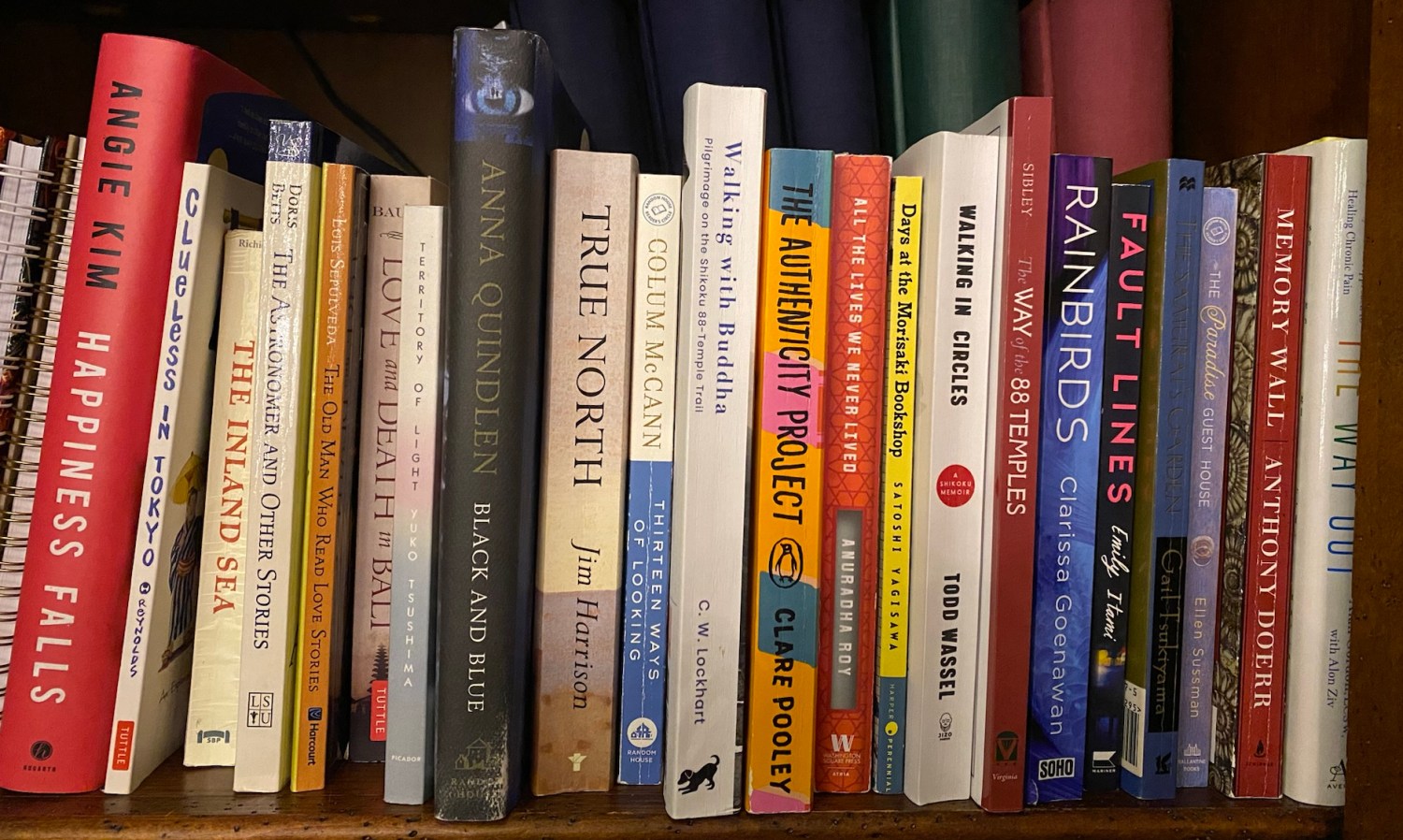
My 2024 Reading Bookshelves

Here, you can see my 2024 Year in Books. And below are my 10 favorites + one bonus book. 🙂
J9QNYQooSi6kZotnwmDJOw

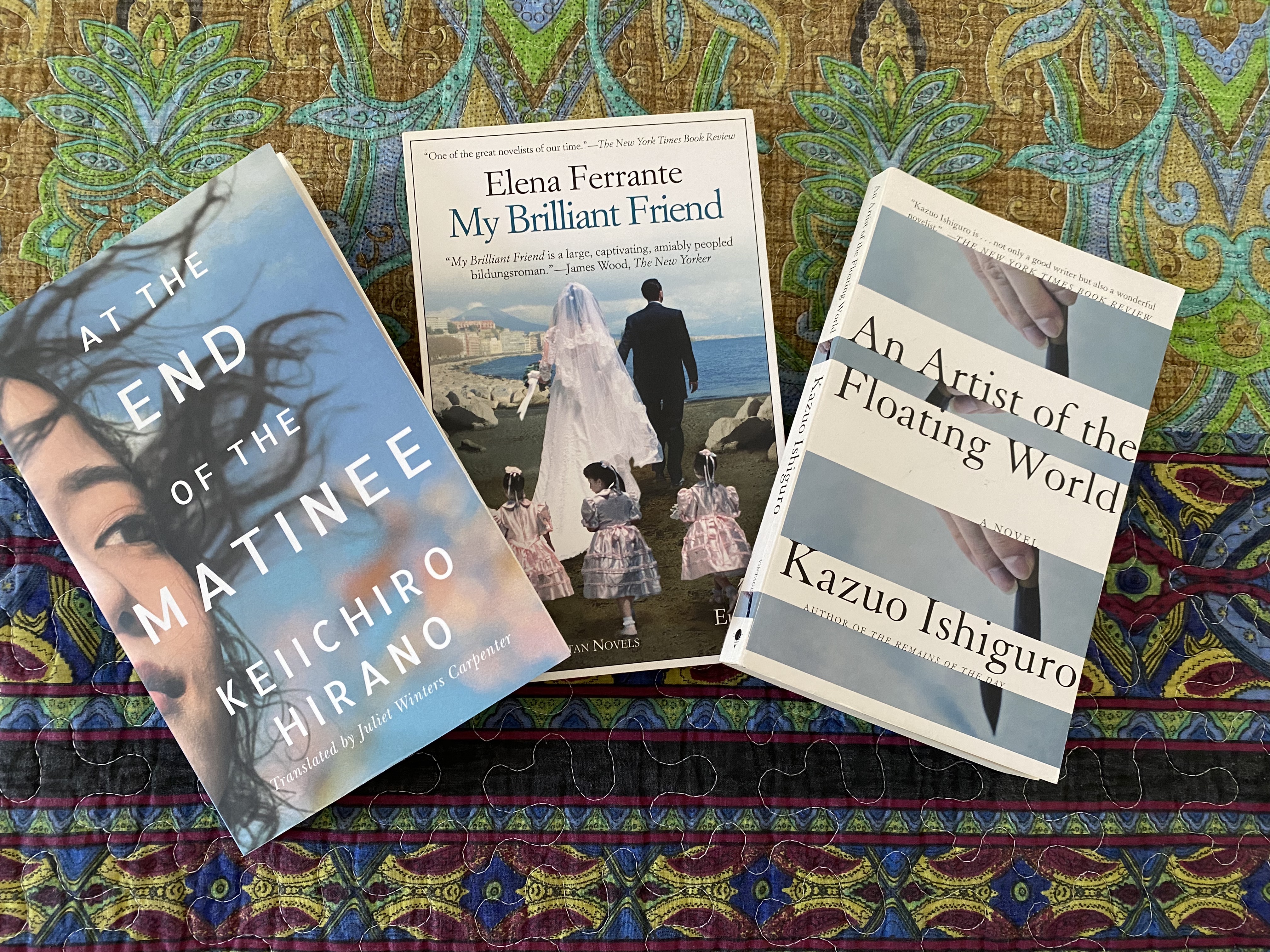
At the End of the Matinee, My Brilliant Friend, and An Artist of the Floating World

1) At the End of the Matinee by Keiichirō Hirano *****

I loved this book. The two characters, classical guitarist Satoshi Makino and journalist Yoko Komine, are deeply drawn and sympathetic. Yoko heard Makino’s music when she was younger and when she finally meets him after one of his concerts, they form an immediate bond. But they lead complicated lives; Makino lives in Tokyo but performs all over the world. He seems to be in a slump with his music and much of the story is about his struggle to revive his career and how meeting Yoko affects him and his music.

Yoko is a journalist who lives in Paris but is assigned to work in the war zone in Baghdad; she has a fiance, Richard, who seems a rather blah and superficial American. After a bomb attack in Baghdad where Yoko just misses being killed, she later finds she cannot sleep and is suffering from PTSD. She is the daughter of a Japanese woman who was on the fringes of the atomic bombing in Nagasaki and a Yugoslavian father who is a famous filmmaker. Her father was largely absent from her life, but she develops a relationship with him when she learns to speak English. His films are thought-provoking works exploring the conflicts in Yugoslavia and both Makino and Yoko find a common bond in their appreciation of his films and the musical scores to them.

The meeting between Yoko and Makino leaves a lasting impression on both of them and both of them think often of each other when apart and cannot wait to meet again. The story tells of their attempts to get together, and all the barriers that contrive to keep them apart.

2) My Brilliant Friend by Elena Ferrante *****

Usually I never read a book after watching a movie or TV series based on it, but in this case, I found the series of My Brilliant Friend so intriguing, that I decided to read the book. This is the first of four of the “Neopolitan Novels,” and now, since I’ve seen seasons 1-3 of the series, I want to read the other books. The book gives so much more context and goes into the characters’ heads more than the series can do, so I think reading it adds much depth and understanding to the story. It tells the story of a post-war Naples neighborhood, in the 1950s and 1960s, with a focus on the close yet fraught friendship between Elena Greco, known as Lenù, and her “brilliant friend,” Raffaella Cerullo, known to Elena as Lila.

I love the writing of Elena Ferrante, pseudonymous Italian novelist, and look forward to reading more of her works.

3) An Artist of the Floating World by Kazuo Ishiguro *****

This book seems on its surface an ordinary and quoditian story about an elderly artist, Masuji Ono, and his life after World War II, as Japan is rebuilding and modeling itself on American-style democracy. He is the narrator, and a rather unreliable one at that. He draws you in, and you sympathize with him, but there is innuendo by the characters who he encounters, wispy & ephemeral suggestions, that he is not without guilt in helping to contribute to, and even encourage, the war effort in Japan.

Ono was educated in a community of artists who painted “the floating world,” that world of geisha houses, evening entertainment districts lit with lanterns, the nocturnal pleasures found in pre-War Japan. It was when Ono decided he wanted to do something more substantive and meaningful that his art seemed to delve into criticisms of the old businessmen and politicians who sent the young men to war; at another time, he ended up painting provocations against China, political posters that encouraged the war effort. His life pivoted from heroic to traitorous to heroic. His reputation became tainted, and he felt regrets over things he had done, but he insisted that what he did was suitable at that time; it was the best he could do under the circumstances. In fact many of the older generation of businessmen and politicians that sent young men to war ended up committing suicide by seppuku, in Japanese “self-disembowelment,” and it seemed some of Ono’s acquaintances and even one of his daughters seemed to suggest such might be appropriate for him.

I found Ishiguro’s writing very interesting as, in a very matter-of-fact way, he showed Ono delve into these moral dilemmas while at the same time going back in time to his artistic training, his encounters and misunderstandings with other artists. Then, in the current time, he interacts with his grandson and daughters as he tries to secure his youngest daughter’s marriage and his own reputation.

fullsizeoutput_2ec30

The Sound of Things Fallling and Mad Honey

4) The Sound of Things Falling by Juan Gabriel Vásquez *****

The sound of things falling: people getting shot on the street, airplanes falling out of the sky, a whole society falling prey to violence due to political factions and drug cartels. In this excellent novel, young lawyer Antonio Yammara looks back on the insane world of Colombia in the 1980s when Pablo Escobar was at war with Colombia’s government forces and seemed to rule the country with his Medellín drug cartels, his assassinations, and his terrorist attacks. Pablo Escobar was finally shot in 1993, ridding the country of what had been a long shadow over its history.

Pablo Escobar once had a zoo called Hacienda Nápoles, from which a hippo had escaped in 2007; the hippo was shot dead in the middle of 2009, when this story begins. This incident brings back a memory to Antonio, that of a man named Ricardo Laverde, a pilot, who seemed unassuming and even meek upon their meeting. It wasn’t long before Laverde was murdered on the street while Antonio was walking with him; Antonio also took a bullet but wasn’t killed. This incident led him to investigate Laverde’s life, which led him to discover disturbing things about him and about Colombia all the way back to the 1960s.

I love the way this book is written, although the timeline is a bit difficult to follow. The story is told in a straightforward manner and the reader is spurred on the learn more about Ricardo Laverde and how knowing this man impacted Antonio’s life, as well as how Pablo Escobar’s power tragically affected an entire generation.

5) Strange Weather in Tokyo by Hiromi Kawakami (Kindle)*****

I loved the feeling I got while reading this novel, so I was sad when it came to an end. Just like the one semester I lived alone in Japan, teaching English at a university, I experienced a certain feeling of bliss and contentment by simply immersing myself in Japan. It’s a feeling of basking in solitude and in nature, in losing oneself in the tastes and textures of food and drink… and in soaking up the overall atmosphere and even melting into it. Like the main character, from whose viewpoint the story is told, Tsukiko, I was middle aged (actually quite older than her 38 years), and walked home to my tiny apartment each evening, stopping at least a couple times a week at a cozy wood-paneled bar to imbibe in a drink and eat the delectable fish prepared with great care by the owner. I didn’t meet anyone else there, except the friendly bar owner, who could speak a bit of English.

Tsukiko, on the other hand, goes often to a bar, Saturo’s, where she mainly eats and drinks (a lot) alone, but from time to time sits at the bar near “Sensei,” an old teacher (30 years her senior) of hers from high school. At first their relationship echoes their student-teacher relationship, with Sensei gently chastising Tsukiko for not paying attention to certain lessons in school. He recites Haiku to her and tells her his impressions of her as his long-ago student. Soon, Sensei reveals his interests to Tsukiko, inviting her to see his old battery collection or to go mushroom hunting. Tsukiko herself doesn’t seem to have many interests of her own, but finds Sensei to be dignified & old-fashioned, and she finds the way he appreciates simple things intriguing. She even admits of herself: “…as the years passed, I turned into quite a childlike person. I suppose I just wasn’t able to ally myself with time.”

They slowly develop feelings for each other, but these feelings take their sweet time to bloom. The slow-motion building of their emotional connection is fascinating to watch. They even go periods of time without seeing each other, and later, after Tsukiko confesses her love to Sensei, she goes to great lengths to avoid him, telling herself not to hope for any reciprocal feelings from him.

Both characters live lonely existences, but they don’t seem to mind being alone. They both think they’re perfectly happy being alone, but when they become closer, they add a depth and richness to each other’s lives that they couldn’t have imagined.

This could be a book I return to many times, just to recapture that feeling I had while living in Japan, a feeling I hope to recapture this fall as I return to Japan without having to work there. I hope to be able to bask in the feelings of contentment I felt when I was there before.

6) Mad Honey by Jodi Picoult & Jenniver Finney Boylan *****

I was intrigued by this book from the beginning, and I loved the way the co-authors started with the day of the alleged murder of a girl, Lily Campanello, and then went backwards in time and forward in time from that day, slowly unraveling any preconceived notions the reader might develop along the way. It turns out Asher McAfee was Lily’s boyfriend of only 3 months. He was found in Lily’s house holding Lily, who passed out with a bash to the head; shortly thereafter Lily dies. Asher becomes the prime suspect in her murder.

The story is told from the points of view of Asher’s mother, Olivia McAfee, a beekeeper who many years ago left an abusive relationship after hiding bruises for years, and from the victim Lily’s point of view in the months leading up to her death. Secrets are revealed, about Lily’s gender transformation, about Asher’s violent temper, about Olivia’s constant excuse-making in her marriage about her husband Braden’s abuse of her.

The story moved quickly and kept me engrossed. It is a long read, but I found it intriguing. I also learned a lot about marital abuse, beekeeping, and transgender identities and struggles.

I thank Random House Publishing Group-Ballantine for the ARC.

DeS0+LyNTfiUnCk4a1wAnw

The Samurai’s Garden and All the Lovers in the Night

7) All the Lovers in the Night by Mieko Kawakami *****

How I love stories set in Japan that revolve around lonely people who blithely live their lives, come to a realization that something needs to change, and try, however tenuously, to connect with other people. I’ve read a number of similarly-themed books in various forms with different characters, yet all of them are unique because of the circumstances and people. In this case, the protagonist Fuyuko Irie is a proofreader in her late 30s who doesn’t connect with the people in her office, so when she is offered the chance to become a freelancer and work from home, she happily accepts the offer. However, working from home isolates her even more.

When Fuyuko realizes eventually that her life has nothing to it, that she cannot even speak to her boss Hijiri about anything of interest in her life, she decides something needs to change. She begins drinking at all times of day. She looks into taking some classes at a cultural center, but after several unsuccessful attempts, she passes out and loses her bag. A kind man in his 50s, Mitsutsuka, helps her when her bag can’t be recovered and they end up meeting in a cafe sporadically, then once a week, and finally twice a week, with some periods interspersed where Fuyuko backs off, fearing her intensifying feelings, and doesn’t show up. Fuyuko thinks often of Mitsutsuka yet she knows nothing about him except that he is a high school physics teacher. They both have an interest in light, and Mitsutsuka teaches her everything he knows about light. I love how the author uses light imagery and nature as reflections of Fuyuko’s ever-deepening feelings.

Fuyuko has a small circle of women friends, one from high school, Noriko, who is married with children but never has sex with her husband and is convinced he is cheating on her. Noriko is also having an affair. Fuyuko’s only other woman friend is her boss Hijiri, who is an intense, hard-working woman who sleeps with men whenever it suits her. Often, Fuyuko remains quiet when talking with them because her life has nothing in it except her work, her loneliness and the bad memory of a sexual assault in her senior year of high school. In much of the book, I think Fuyuko is trying to figure out her role as a woman in modern Japanese society, and to find her place amidst the expectations society has of women.

I loved all the layers in this book, and felt emotionally invested in Fuyuko’s life. Just my kind of story.

8) The Samurai’s Garden by Gail Tsukiyama *****

I adored this Japanese novel with its Zen-like quality and the quiet characters. Stephen is a young Chinese man whose parents have sent him from his home in Hong Kong to his family’s seaside home in Tarumi, Japan in September of 1937. They want him to have time to rest and recover from tuberculosis at this quiet town with its sea breezes. The caretaker of the family home is Matsu, an older Japanese man of few words. One day he takes Stephen for a walk to Yamaguchi, a small remote village where a colony of lepers has been forced to live in isolation. There Stephen is introduced to Sachi, a once beautiful woman, whose face (half of it) has been severely disfigured by leprosy. Stephen can see Sachi’s beauty, a beauty that radiates from within as well as the parts of her that are not disfigured. He watches as Matsu comes alive around Sachi. Later, in the village of Tarumi, they meet Kenzo, Matsu’s childhood friend who had once loved Sachi but abandoned her after she was afflicted with leprosy.

Stephen also meets a beautiful young woman, Keiko, who he yearns to connect with. He only meets her a few times but it is obvious there is a bond between them. However, as Stephen is Chinese, he is forbidden to see Keiko by her father during these tense years while Japan is invading China (beginning July 7, 1937), destroying everything in the Imperial Army’s path.

Besides the war in China looming over Stephen’s stay, his mother has informed him by letter that Stephen’s father, an international businessman, has a Japanese woman who he lives with in Kobe. When Stephen confronts his father about this, his father says he’s in love with the Japanese woman and refuses to leave her, but he will never abandon his family.

Between the stresses of the war news and the father’s infidelity, and the clash that inevitably occurs when Kenzo realizes that Matsu and Sachi are seemingly in love, Stephen tries to find peace in his deepening appreciation of the Japanese garden that Matsu so lovingly tends, in the sea and swimming, and in his growing friendship with Matsu and Sachi. It is a heartwarming story of a young man’s awakening to both the horrors and blessings of the world.

fullsizeoutput_307ee

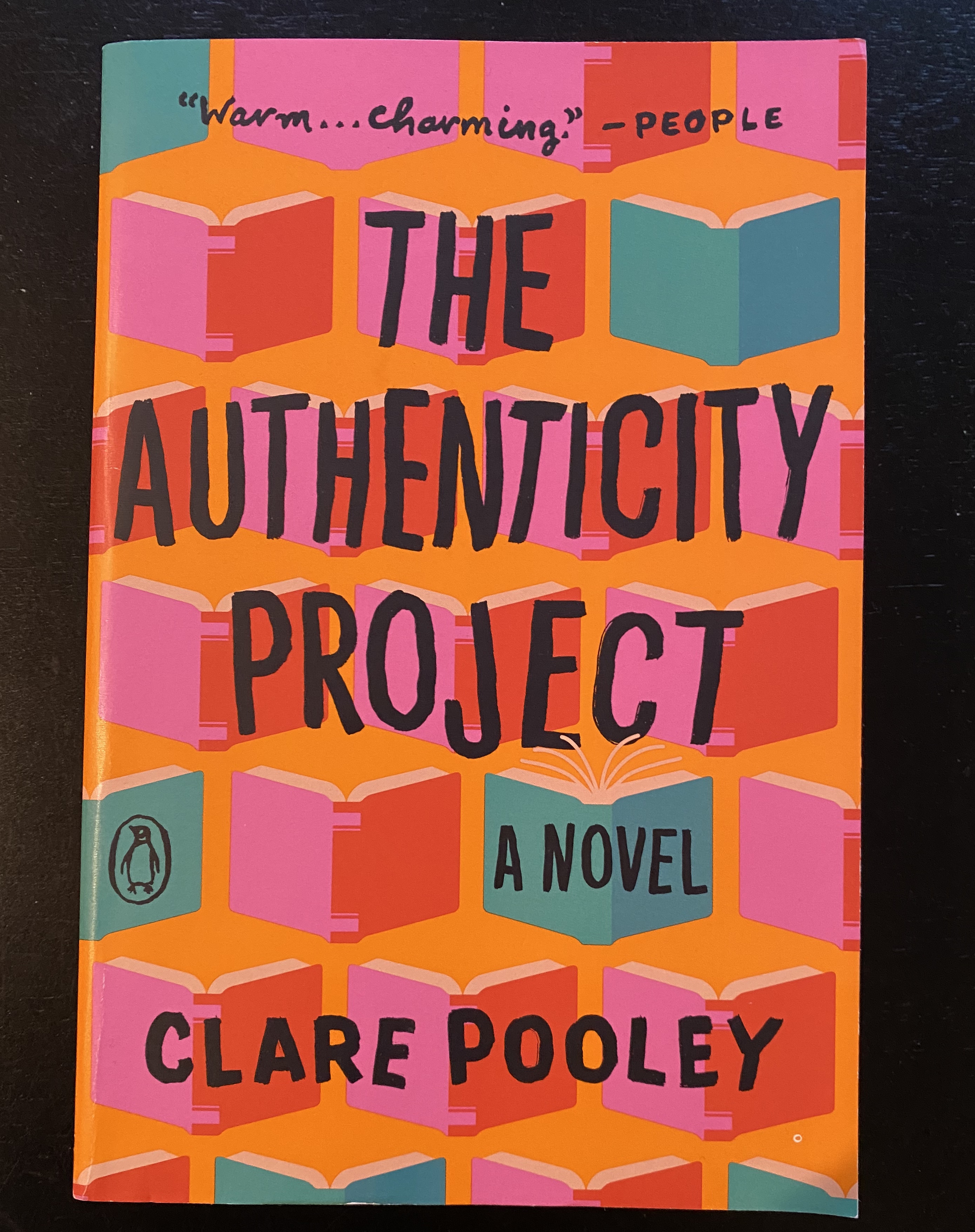
The Authenticity Project by Clare Pooley

9) The Authenticity Project by Clare Pooley *****

I really enjoyed this book. First, I always love a story told from different points of view and moving forward in time. I like the premise, that a person writes something authentic and revealing about himself in a book titled “The Authenticity Project,” and then leaves the book for other people to find it and do what they will with it. The first author in The Authenticity Project is Julian, a 79-year-old man who reveals his loneliness after his wife Mary died; after he writes his story and leaves the book in Monica’s coffee shop, we learn about Monica. Then Hazard, then Riley, then Alice, and so on and so forth. It was a pleasure to read about this little band of people who come together in the material world and form a community, such a refreshing and rare (in this day and age) coming together of people in real life.

In the Acknowledgments, the author tells how she was an addict and in trying to get sober, she started a blog, telling of her struggles and revealing her authentic self. I too write a blog and have revealed much of myself through various blogs over a 14-year period. You do form a community of sorts when you are authentic in telling your truth and in being open to others. Still, I like the community that is formed around Monica and wish for more of that myself, in real life. 🙂

10) Norwegian Wood by Haruki Murakami (Kindle) ****

I always enjoy a quiet Japanese read, and although this story is quiet, there is a deep undercurrent of emotion, pain and heartbreak. Toru Watanabe immerses himself in memories of his first love, Naoko, the girlfriend of his best friend Kizuki, who committed suicide. Toru doesn’t seem to have much going on in his life; for some reason people befriend him but he doesn’t understand why. He’s certainly not someone with a strong and decisive personality. He doesn’t know why but he somehow became a third wheel to Naoko and Kizuki, who were a couple when they were in high school. Toru doesn’t understand why Kizuki killed himself, and hadn’t noticed any hints that he might do such a thing.

After Kizuki’s suicide, Toru tries to be there for Naoko, but she is struggling with her own mental health issues and in fact stays of her own accord in a kind of self-healing place with an older woman and other societal misfits who also have emotional issues. There are apparently no doctors at this facility and it seems it is like a commune removed from the real world. And the “patients” expect to be healed by the community and by themselves from their emotional traumas.

Toru seems disillusioned by the world, has no direction until he decides to to man up and be whatever Naoko needs him to be. But Naoko really doesn’t seem to need him or want to improve her life. She says she wants to be better, but she has been too devastated by Kisuki’s death, as they were close since they were children. She seems unable to escape her grief. It is frustrating for Toru, and for the reader, that she is so aloof and unreachable.

Overall, I liked the story, which took place in the late 1960s mostly in Tokyo, with a lot of musical references like the Beatles’ “Norwegian Wood,” thus the title.

BONUS: Special Interest Book:
fullsizeoutput_2ec33

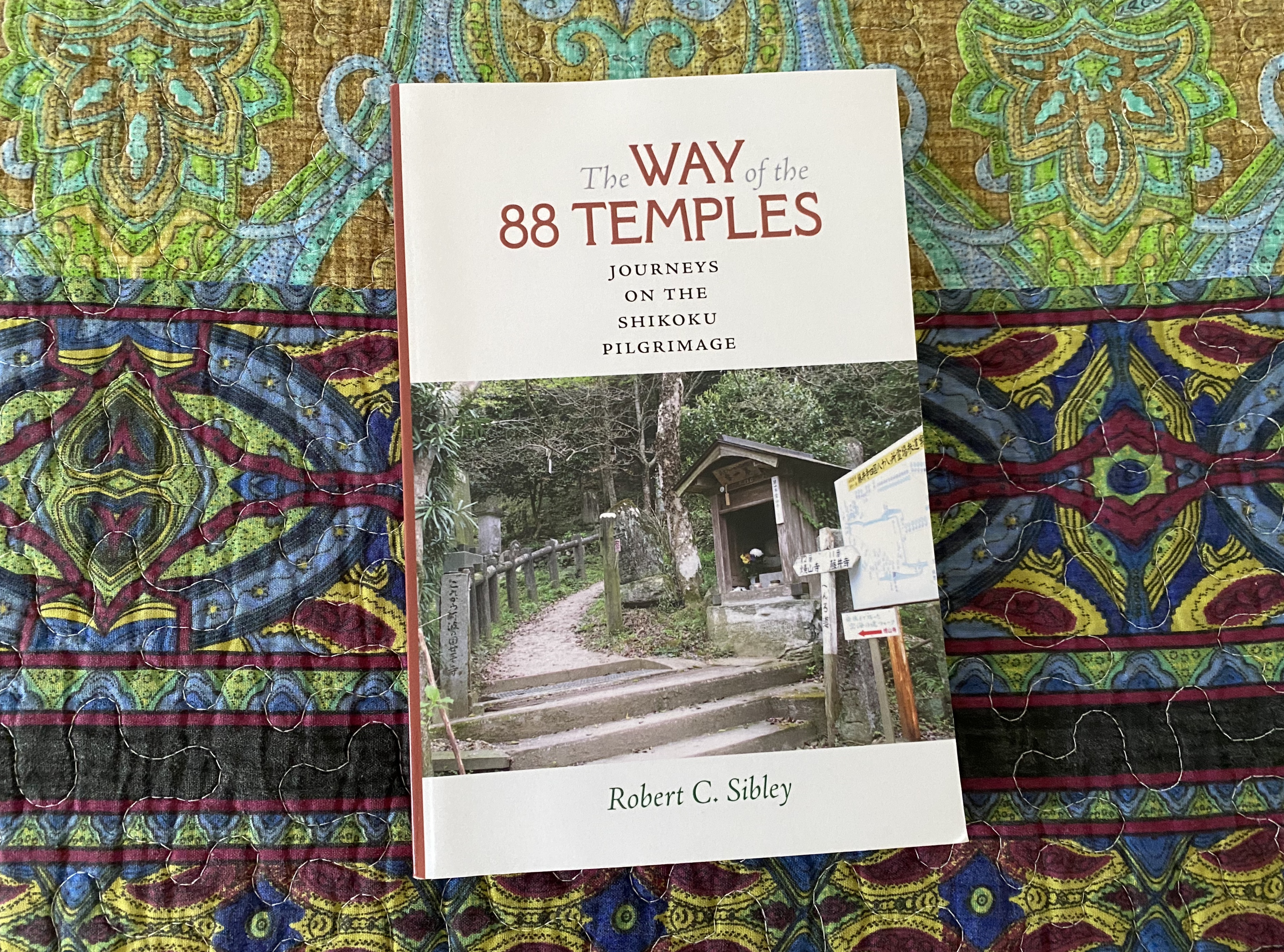
The Way of the 88 Temples: Journeys on the Shikoku Pilgrimage

The Way of the 88 Temples: Journeys on the Shikoku Pilgrimage by Robert C. Sibley *****

This is an excellent account of author Robert C. Sibley’s experience of walking the 1,400km Shikoku 88-temple pilgrimage in Japan. He describes his reason for walking the pilgrimage at first as “escapist”; he wanted “to escape the confines of everyday life.” He admitted he wasn’t a Buddhist; however, pilgrimages have a way of changing people, and he was open to finding a “spiritual sensibility.” Sibley had completed the Camino de Santiago in Spain already (as I have), and this was another quest for him. He wove together interactions with his companions and other henro (pilgrims) he met along the way, Japanese culture, landscape and food, and finally the proper ways to approach and offer prayers in each temple.

He met a Japanese father and son, Shūji and Jun, who were walking together in hopes of solving the son’s “problems.” They became friends on the trail, although it wasn’t until deep into the pilgrimage that Sibley found out the extent of the family’s struggles. He also met another Japanese man, Tanaka-san, who was walking to “fill an emptiness in his heart.” Together, the four of them completed the pilgrimage despite many struggles and blessings along the way.

I don’t think from his descriptions that I could walk such a pilgrimage with all of the mountains on this pilgrimage route. But it was wonderful to share in his experience by reading about it. It seemed a wonderful experience.

******

Did you read any great books this year? What were some of your favorites?

Share this:

  • Share on X (Opens in new window) X
  • Share on Facebook (Opens in new window) Facebook
  • More
  • Email a link to a friend (Opens in new window) Email
  • Print (Opens in new window) Print
  • Share on Pinterest (Opens in new window) Pinterest
Like Loading...
  • Asia
  • Bali
  • Indonesia

ubud, bali: balinese art, a water palace, yoga, massages, touristy rice terraces & utter chaos

wanderessence1025's avatar wanderessence1025 December 18, 2024
Arrival in Ubud

Thursday, September 26, 2024:  Kadek drove us this morning from Sidemen to Ubud, another 1 1/2 hour chaotic drive. We arrived at our hotel to the west of Ubud’s center, The Hava Ubud A Pramana Experience.

a beautiful building seen on the way to Ubud
The Hava Ubud A Pramana Experience

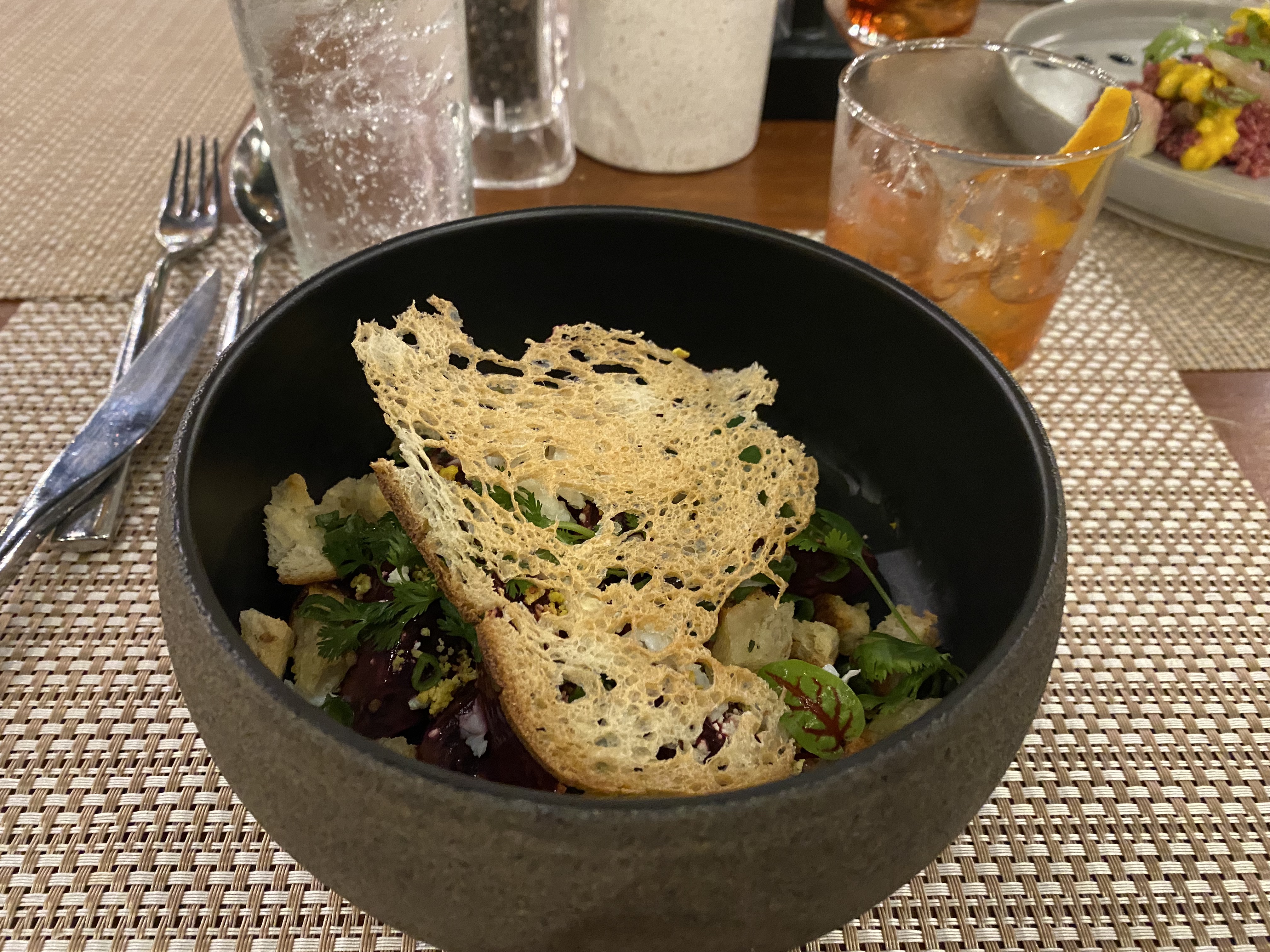
We dropped our luggage since it was too early to check in and promptly went out to eat lunch at the vegan Alchemy. Mike had a jackfruit “tuna” sandwich and I had a “halloumi” and beet salad. I got a dragon fruit kombucha and Mike a mango. Alchemy had a cool “modern hippie” vibe with a cozy and meditative feeling.

Alchemy
Alchemy
me at Alchemy
me at Alchemy
“halloumi” and beet salad
jackfruit “tuna” sandwich

We tried to walk into Ubud’s center but we didn’t quite make it. We would need to start earlier to actually explore the center. It was a chaotic scene and walking from our hotel was about 1 1/2km just to the outskirts of Ubud. It seemed quite dangerous to walk with hardly any shoulder and cars and motorbikes whizzing about to and fro. We definitely needed to acclimate to Ubud after the laid back vibes of Sidemen. I was not at all prepared for the chaos that is Ubud, and Bali in general!

Making our way back to the hotel, we stopped into a hole-in-the-wall shop where I found a lightweight pair of tie-dyed pants; they cost 50,000 Indonesian rupiah, about $3.10, and since they were too long, the shopkeeper said she would hem them overnight and I could return the next day to pick them up.  I knew I could use them even in Japan, where we could see it was forecast to be hot for the foreseeable future when we returned there on Monday. I also bought a lightweight flowy skirt which I wore out to dinner and would get a lot of use out of for the next 3+ weeks. We had both packed a bunch of fall clothes which we never used and which were dead weight in our suitcases.

We finally checked into the hotel and relaxed a bit before heading out for dinner.

chaotic Ubud
chaotic Ubud
chaotic Ubud
chaotic Ubud
chaotic Ubud
chaotic Ubud
the pants I bought for the continuing hot weather
our room at The Hava Ubud A Pramana Experience

We had a lovely dinner Thursday night, our first night in Ubud, at La Luz Mexican restaurant. Shrimp tacos for me, Carne Asado tacos for Mike and a chocolate lava cake with ice cream to share. 🙏🏻 The food scene in Ubud seemed quite diverse and impressive, and we were lucky in our west-end neighborhood to have a good number of choices.

La Luz Mexican restaurant in Ubud
me at La Luz Mexican restaurant
Carne Asado tacos
Carne Asado tacos
shrimp tacos
shrimp tacos
chocolate lava cake with ice cream
Mike and our shared dessert
La Luz Mexican restaurant

Steps: 9,581; Miles 4.05. Weather Hi 86°, Lo 70°. Mostly cloudy.

Friday, September 27: On Friday morning, we enjoyed a poolside buffet breakfast at The Hava Ubud A Pramana Experience.

pool at The Hava Ubud A Pramana Experience
The Hava Ubud A Pramana Experience
breakfast at The Hava Ubud A Pramana Experience
me at breakfast
me at breakfast

The Agung Rai Museum of Art (ARMA)

After breakfast, we took a Gojek to The Agung Rai Museum of Art (ARMA) in Ubud, which is at the southern end of Ubud. We were to the west of the center, and it usually didn’t pay to take any kind of vehicle into the town because of the gnarly traffic. However, since we got an early start, the traffic wasn’t too bad. We arrived at the museum before it had opened.

Founded by Agung Rai, a Balinese who devoted his life to the preservation and development of Balinese art and culture, the museum was officially opened on June 9, 1996.

The major goals of the ARMA Museum are, according to the website, to:

1) To collect and preserve artworks

2) To develop and preserve the art of painting, sculpture, dance, music, and various other cultural art forms

3) To provide means and infrastructure for the local society to learn various artistic skills.

ARMA
ARMA
me at ARMA
me at ARMA
Mike at ARMA
Mike at ARMA
Mike at ARMA
Mike at ARMA
the grounds of ARMA
the grounds of ARMA
entrance to the Bale Daja - Main Exhibition Area at ARMA
entrance to the Bale Daja – Main Exhibition Area at ARMA

We started our visit at the Bale Daja – Main Exhibition Area. In this area we found a huge cross-generational exhibition that served as a tribute to the painter I Nyoman Ngendon (c. 1913-1947). Ngendon was a key figure in the Batuan art movement. His works, characterized by their unique style and thematic depth, are revered in the art community. The exhibition sought to honor his contributions while showcasing the dynamic continuity of Batuan’s artistic tradition across generations.

The Batuan painting style, which originated in the village of Batuan south of Ubud, is intricate and rich with detail. Paintings can show a whole village and often reflect gods, temples, religious ceremonies, mythical illustrations, and everyday scenes from people’s lives.

The stories in the paintings can evolve, much as people’s lives do. Many intriguing paintings show multiple small scenes on the same canvas: people doing household chores, children playing, people participating in ceremonies, and sometimes historical events or tourists enjoying their vacations.

The collection ranges from traditional to contemporary, including classical Kamasan painting on tree bark, masterpieces by Batuan artists of the 1930s and 1940s and the only works to be seen on the island of Bali by 19th century Javanese artist Raden Saleh and Syarif Bustaman.

A couple of paintings were of interest in contemporary times. One, “Lion Floating Happily” by I Ketut Sadia (b. 1966), depicts an airplane accident of April 13, 2013: “An Indonesian plane carrying more than 100 passengers broke in two after missing the runway at Bali airport and landing in the sea, leaving dozens injured but no fatalities.”

Another depicts the sinking of the Titanic, in Balinese fashion. 🙂 “RMS Titanic” was painted in 2015 by I Ketut Sadia (b. 1966). The Titanic was the world’s largest and most luxurious ship at the time it launched. She was on her maiden voyage from Southampton to New York when she struck an iceberg off Newfoundland on the night of April 14, 1912 at 23:40 and sank in the morning of 15 April 1912. The painting depicts the iceberg and the sinking ship, but shows half-naked Balinese people coming to the rescue.

ARMA
ARMA
ARMA
ARMA
ARMA
ARMA
Palau Bali 2014 by Wayan Bendi
ARMA
ARMA
ARMA
ARMA
Lumba - Lumba 2020 by Pande Made Martin
Lumba – Lumba 2020 by Pande Made Martin
ARMA
ARMA
Pemburu Surga 2021 by I Wayan Aris Samanta
Candi Mendut 2011 by I Gede Widiantara
Jalan Rusak 2023 by I Wayan Malik
ARMA
ARMA
ARMA
ARMA
ARMA
ARMA
Cremation Ceremony in Bali 2019 by Ni Nyoman Merti
ARMA
ARMA
ARMA
ARMA
ARMA
ARMA
ARMA
ARMA
Kamasan painting on tree bark
Smara is Burnt to Death, Anonymous 2008
ARMA
ARMA
ARMA
ARMA
ARMA
ARMA
Fisherman c. 1980s by Ida Bagus Nyoman Rai
Rajapala c. 1980s by Ida Bagus Nyoman Rai
Lion Floating Happily by I Ketut Sadia
RMS Titanic c. 2015 by I Ketut Sadia
ARMA
ARMA
Mandala c. 1980s by I Dewa Nyoman Batuan
Bubuk Syah and Gagak Aking c. 1970s by I Dewa Nyoman Leper
ARMA
ARMA
ARMA
ARMA
ARMA
ARMA
ARMA
ARMA

Foreign artists who lived and worked in Bali are represented by Willem Gerard Hofker, Rudolf Bonnet, and Willem Dooijewaard among others.

The works of German painter Walter Spies (1895-1942) have a special place in the collection because of his important contribution to the development of Balinese arts. He influenced Balinese art, along with his partner Dutch artist Rudolf Bonnet, through an artist cooperative which provided guidance to local painters and developed a market for their work. He met his early death when a ship carrying World War II deportees from Bali to Ceylon was bombed by the Japanese in 1942.

Village Street, 1929 by Walter Spies
Preanger Landscape, 1923 by Walter Spies
River Landscape with Herdsman and Cows, 1938 by Walter Spies

Visitors received a complimentary coffee or tea at the ARMA museum when they bought a ticket. We stopped for cool drinks in the coffee shop before tackling the Modern art at the museum. None of the museums in Bali were air conditioned, at least none that we encountered.

grounds of ARMA
grounds of ARMA
cafe at ARMA
cafe at ARMA
me in an Indonesian doorway
our young server at the cafe among orchids
our cool resfreshing drinks
Mike and me at ARMA
Mike and me at ARMA
cafe at ARMA
cafe at ARMA

Prominent are works by Balinese masters such as I Gusti Nyoman Lempad, Ida Bagus Made, Anak Agung Gede Sobrat and I Gusti Made Deblog.

Modern Art collection
Wanita Malamun (Pensive Woman) by I Made Djima
ARMA
ARMA
ARMA
ARMA
ARMA
ARMA
ARMA
ARMA
ARMA
ARMA
Portrait of Agung Rai Suartini by Srihadi Soedarsono
ARMA
ARMA
Pembakaran Mayat (Cremation) c. 1979 by Raden Roedyat Martadiradja
ARMA
ARMA
ARMA
ARMA
ARMA
ARMA
Bangsawan Jawa (Portrait of a Javanese Nobleman and His Wife, 1837, by Raden Saleh Sjarief Bustaman
Harvest Season by Auke Cornelis Sonnega
ARMA
ARMA
ARMA
ARMA
Priest by Genevieve Couteau
ARMA
ARMA
ARMA
ARMA
ARMA
ARMA

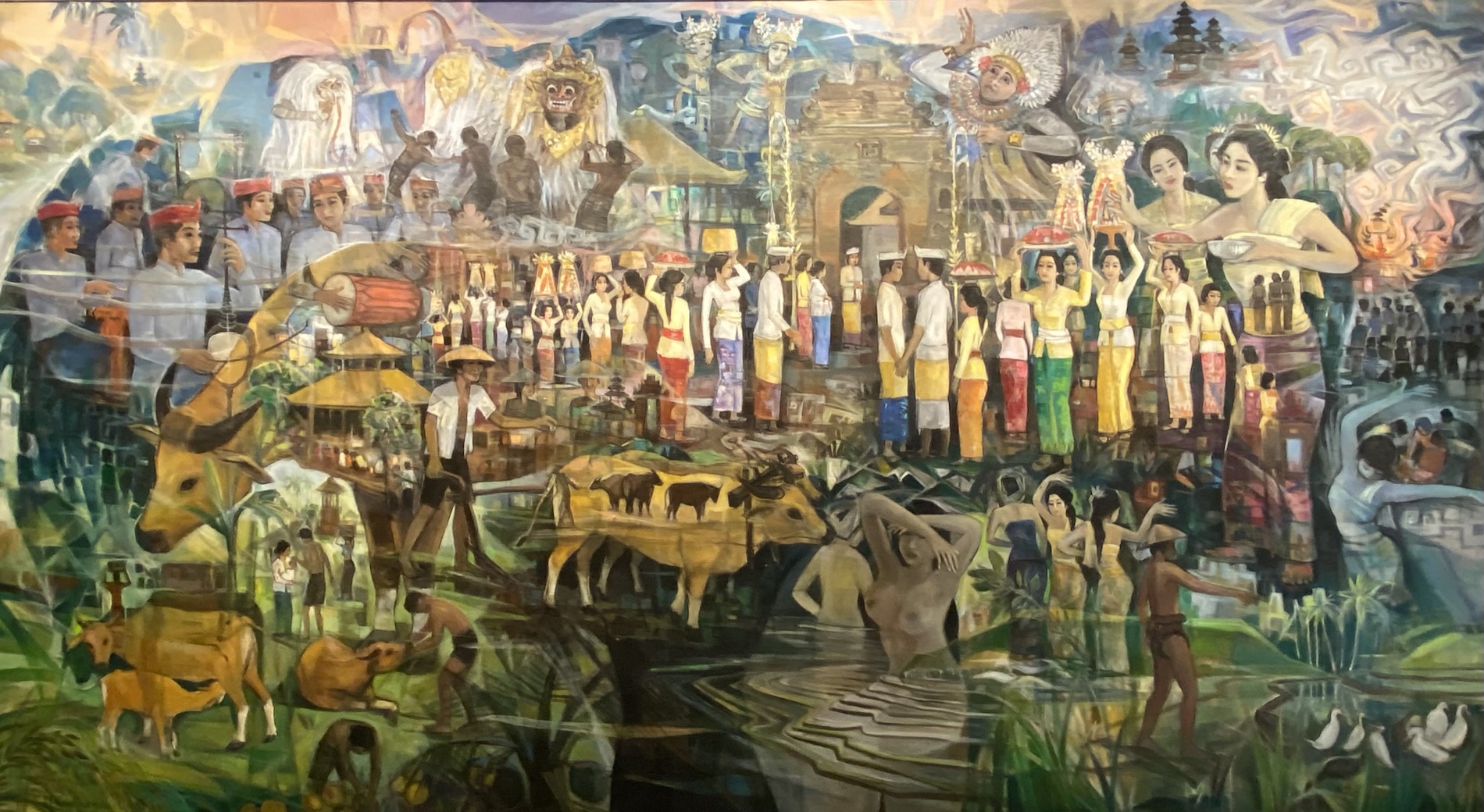
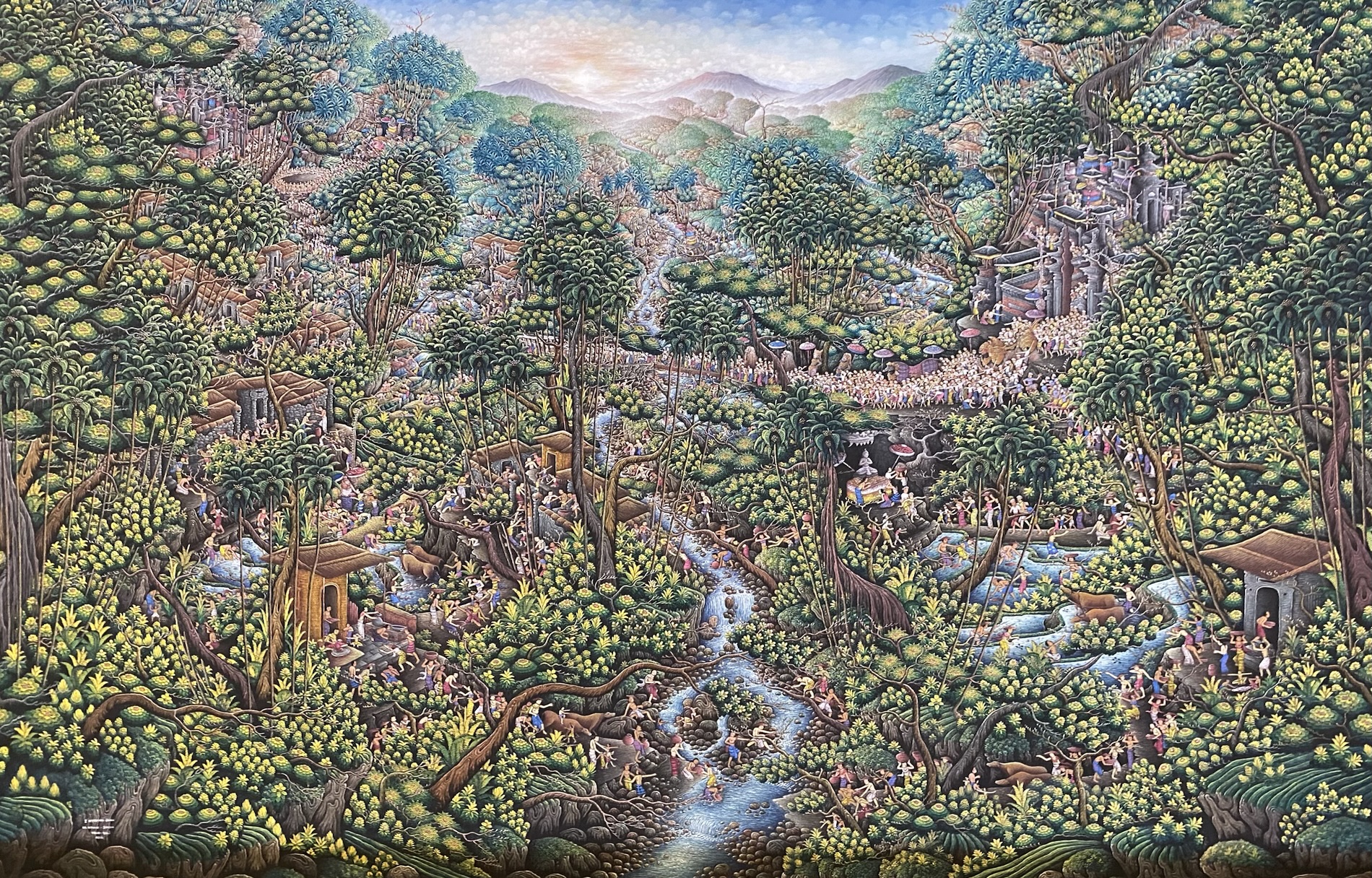
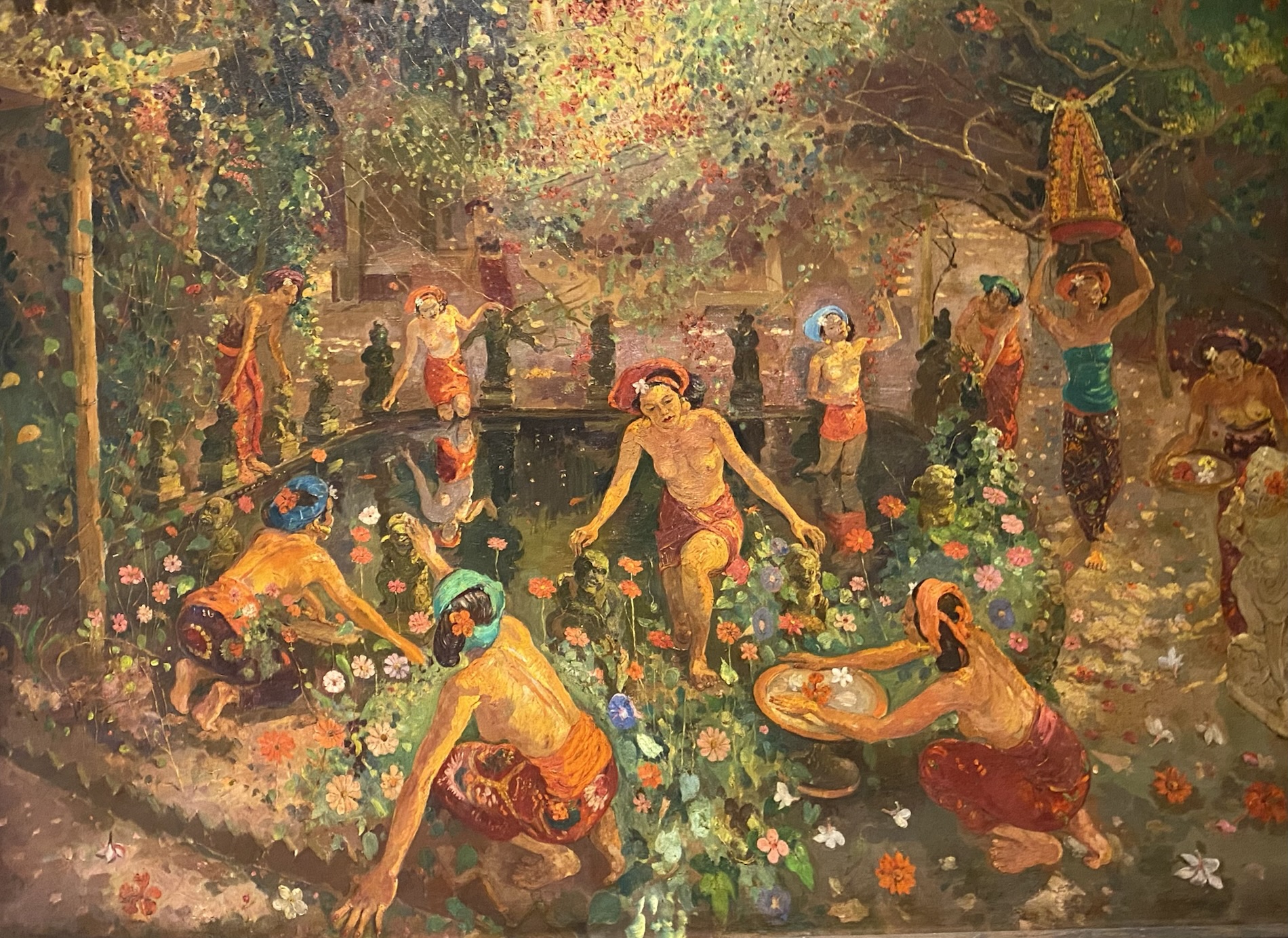
I was enamored by one painting at ARMA, but I sadly don’t know the artist. The details of this huge painting are below.

img_6067

painting at ARMA

details of painting at ARMA

In a pavilion on the grounds, we found paintings done by teenagers. The grounds of the museum were lovely and we enjoyed strolling around.

Modern Art collection
ARMA grounds
ARMA grounds
pavilion at ARMA
pavilion at ARMA
Segara Renjanaa 2024 by Ni Luh Pratiwi
ARMA
ARMA
ARMA pavilion
ARMA pavilion
ARMA grounds
ARMA grounds
ARMA pavilion
ARMA pavilion
ARMA grounds
ARMA grounds
ARMA grounds
ARMA grounds
Balinese man playing xylophone

With the ticket to the ARMA Museum, we were able to walk around the ARMA Resort, which was quite lovely.

ARMA Resort
ARMA Resort
ARMA Resort
ARMA Resort
ARMA Resort
ARMA Resort
lotus at ARMA Resort
ARMA Resort
ARMA Resort
ARMA Resort
ARMA Resort
ARMA Resort
ARMA Resort

Ubud Center

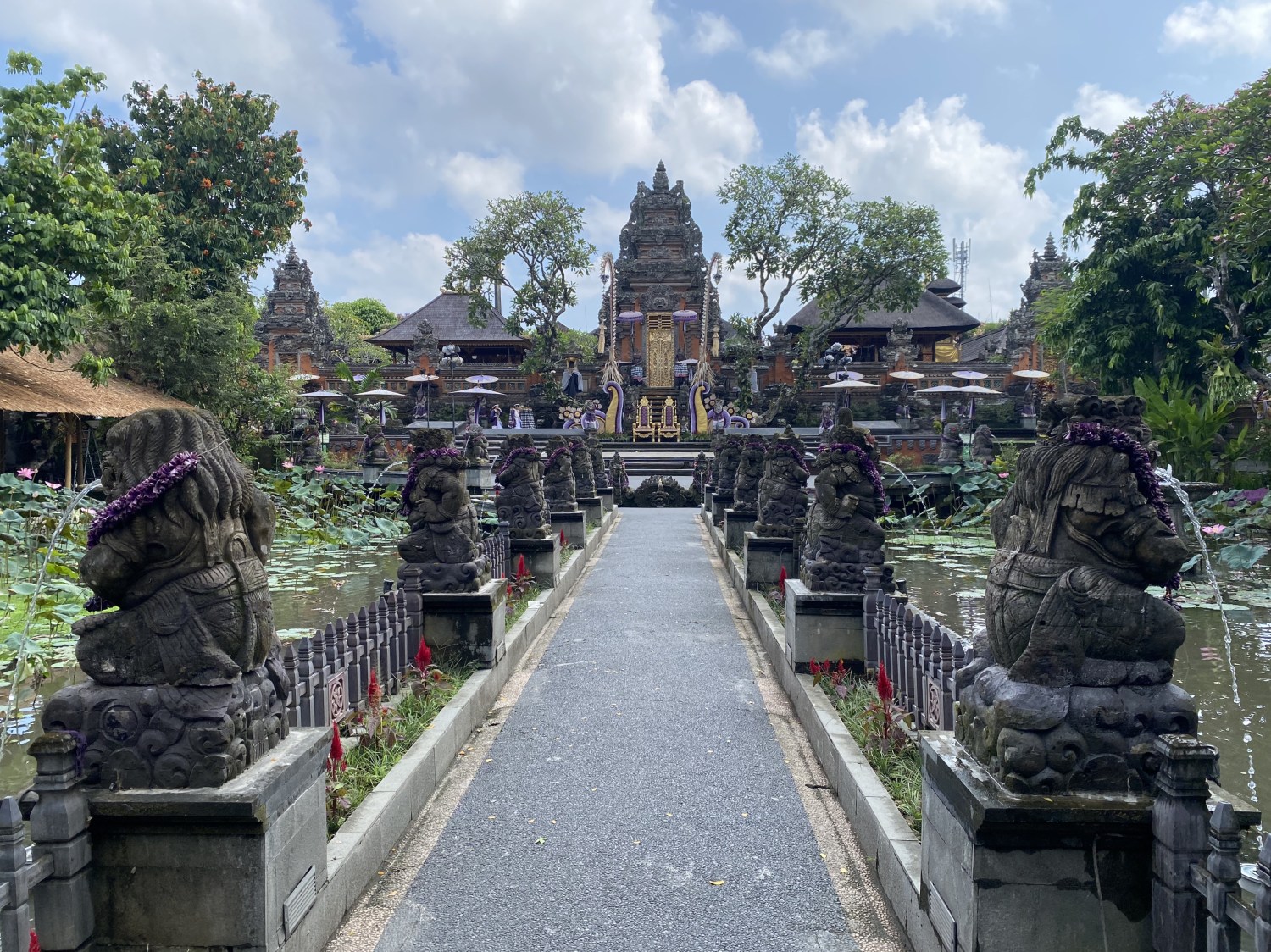
We waited a long time for a Gojek and by that time we had to wait in traffic to get to Ubud’s center. We stumbled quite by accident into the Café Lotus, where we found amazing views of the Ubud Water Palace without having to pay the entrance fee. We intended to go inside the actual Water Palace, but we were too tired and hot to attempt it on Friday. At the cafe, we enjoyed a yummy lunch of Indonesian spring rolls, Gado-Gado (Indonesian-style salad with steamed vegetables, tomato, fried bean cake, tofu, boiled egg, crackers and peanut sauce), and Spiced Pumpkin Soup.

After our wanders in Ubud’s center, we traipsed back to the hotel to enjoy the hot afternoon at the pool. We passed a warning sign for skinny people on the way to the hotel.

Café Lotus with view of Ubud Water Palace
view of Ubud Water Palace from Café Lotus
lunch at Café Lotus
lunch at Café Lotus
Indonesian spring rolls, Gado-Gado (Indonesian-style salad with steamed vegetables, tomato, fried bean cake, tofu, boiled egg, crackers and peanut sauce), and Spiced Pumpkin Soup
Mike at Café Lotus
Mike at Café Lotus
Spiced Pumpkin Soup
Spiced Pumpkin Soup
me at Café Lotus
me at Café Lotus
Gado-Gado (Indonesian-style salad with steamed vegetables, tomato, fried bean cake, tofu, boiled egg, crackers and peanut sauce)
view of Ubud Water Palace from Café Lotus
sign seen as we walked back to our hotel from Ubud's center
sign seen as we walked back to our hotel from Ubud’s center

The Hava Ubud

After lounging around at our hotel pool in the hot afternoon, we went out to Tygr Sushi for dinner. I enjoyed a dragon roll and Mike a HEAVENLY: Teriyaki Jackfruit, Cucumber, Tempura Asparagus / Marinated Tomato, Vegan Mayo, Crispy Sweet Potato. Mike got an ice cream for dessert: chocolate & mango.

Tygr Sushi
Tygr Sushi
Tygr Sushi
Tygr Sushi
dragon roll
dragon roll
HEAVENLY: Teriyaki Jackfruit, Cucumber, Tempura Asparagus / Marinated Tomato, Vegan Mayo, Crispy Sweet Potato
Mike at Tygr Sushi
Mike at Tygr Sushi
pool at our hotel
pool at our hotel
me back at the hotel in my new $3 pants

Steps: 9,278; Miles 3.92. Weather Hi 86°, Lo 71°. Some rain.

Ubud Center: Ubud Palace, Ubud Water Palace, & Museum Puri Lukisan

Saturday, September 28: Saturday morning we caught a Gojek to the center of Ubud. After the driver dropped us off, we passed by a group of women making the many offerings to the gods that are seen throughout Bali. We also passed a huge parking area for motorbikes, ever ubiquitous in town.

women preparing offerings
motorcycle parking lot

We wandered through the Ubud Market, but we didn’t see anything of interest.

We wandered around Ubud Palace, or Puri Saren Agung, a royal palace built in the early 1800s. It is one of the oldest, most well-preserved palaces in the area. It was originally built to house Ubud’s royal family, but as time went on it became a cultural and artistic center. Visitors are only allowed to walk around in a small area and the temple in the complex is off-limits to tourists.

gamelan at Ubud Palace
me at Ubud Palace
me at Ubud Palace
Ubud Palace, or  Puri Saren Agung
Ubud Palace
Ubud Palace
Ubud Palace
Ubud Palace
Ubud Palace
Ubud Palace
Mike at Ubud Palace
Mike at Ubud Palace
Ubud Palace
Ubud Palace

After Ubud Palace we properly visited Pura Taman Saraswati, officially Pura Taman Kemuda Saraswati, also known as the Ubud Water Palace. It is a Balinese Hindu temple in Ubud. The pura is dedicated to the goddess Sarasvati, revered as the goddess of knowledge, education, learning, arts, speech, poetry, music, purity, language and culture. Pura Taman Saraswati is notable for its lotus pond.

Visitors are required to wear a sarong and jacket so everyone there is wearing the same thing. It’s a fun place for photo ops but there really isn’t much to it other than the lotus pond and the cool palace architecture.

Mike at Pura Taman Saraswati, or Ubud Water Palace
Mike at Ubud Water Palace
me at Ubud Water Palace
Ubud Water Palace
Ubud Water Palace
me at Ubud Water Palace
Ubud Water Palace
Ubud Water Palace
the king and queen at Ubud Water Palace
Ubud Water Palace
Ubud Water Palace
Mike at Ubud Water Palace
me at Ubud Water Palace

We stopped for a coffee at Café Lotus, where we continued to enjoy views of the Ubud Water Palace.

We visited Museum Puri Lukisan, set in a well-tended garden and showcasing some fabulous Balinese art. In front of the museum a Balinese dance was taking place for some kind of Palestinian support group. We had to walk past the performance to get to the museum, so we got to watch a bit of the performance.

Mike at our coffee break at Café Lotus
Balinese dance
Balinese dance
Balinese dance
Balinese dance
Balinese dance
Balinese dance
Balinese dancers
Balinese dancers

Below is one of my favorite paintings from Museum Puri Lukisan with details. Sadly I didn’t get the artist information.

img_6285

a painting at Museum Puri Lukisan

Here are details from the painting.

details of painting at Museum Puri Lukisan

Below is a sample of Balinese art from Museum Puri Lukisan in Ubud.

Museum Puri Lukisan collection
painting by Walter Spies
Museum Puri Lukisan collection
grounds at Museum Puri Lukisan

We went to eat lunch after our visit to the museum. Mike felt like it was this lunch, or the ice in the drinks, that gave us stomach problems over the next several days.

me at lunch
me at lunch
our lunch
our lunch
Mike at lunch
Mike at lunch

Back to The Hava Ubud neighborhood: massages, yoga and pool time

We enjoyed deep tissue massages at 1:00 Saturday  at Sari Laba. We liked them so much, we booked massages for Sunday, our last day in Ubud, as well.

After our massages, we relaxed by the pool until time for our 4:00 yoga class.

masseuses at Sari Laba Traditional Massage
Mike at Sari Laba Traditional Massage
pool at The Hava Ubud

We went to a restorative yoga “Air Class” at Alchemy. It was supposed to be for beginners but some of the challenging poses, held for way too long in my opinion, were too much for my stiff joints and especially my knees. Still, the experience had a nice ambiance.

Alchemy yoga studio
Alchemy yoga studio
restorative yoga “Air Class” at Alchemy
me at Alchemy
me at Alchemy
Mike at Alchemy
Mike at Alchemy
Mike at Alchemy
Mike at Alchemy
me on the grounds of Alchemy
Alchemy yoga studio
Alchemy yoga studio
me at the entrance to Alchemy

We enjoyed our fanciest dinner in Ubud at Brie Restaurant & Cheesery.  A corn & prawn soup came out with fog rising mystically around it. I enjoyed burrata with zucchini pancakes and Mike got tagliatelle with smoked salmon. The staff was very cute with their black & white striped t-shirts and little black berets. They even did a coordinated dance to welcome all the guests. They had a singer on the 2nd floor (we were on the first). Downstairs we were serenaded by a playlist that included “Hamdouchia (Yamil Remix)” by Amine K (Moroko Loko) and “Free to Love” by Eighty Project. It was an upscale experience but Mike thought it was rather overrated and expensive.

appetizer at tagliatelle with smoked salmon
corn & prawn soup
corn & prawn soup
Mike at Brie Restaurant & Cheesery
tagliatelle with smoked salmon
me at Brie Restaurant & Cheesery
burrata with zucchini pancakes
singer at Brie Restaurant & Cheesery

Steps: 7,693; Miles 3.25. Weather Hi 87°, Lo 73°. Some rain.

Ceking Rice Terrace, aka Tegalalang Rice Terrace

Sunday, September 29: Sunday morning, our last morning in Bali, we enjoyed our last leisurely breakfast at the pool. We would be leaving for the airport at around 8:00 p.m. for our 12:20 a.m. flight on Monday morning, so we had kept our room for 4 nights so that we could rest and take a nap in the afternoon before our overnight flight. Thus we could relax in our room or at the pool.

z5qBn6%1RfCAGmPrDAvEhg

breakfast bar at The Hava Ubud

After breakfast, we went about a half-hour north of Ubud to Ceking Rice Terrace, aka Tegalalang Rice Terrace. This is really a small and touristy rice terrace, with all kinds of swings and photo settings. The site doesn’t even come close to the Longji Rice Terraces in Guangxi, China, the best I have seen in all my travels around Asia.

Tegalalang Rice Terrace has been cited as a UNESCO World Heritage Site. I found it quite a disappointment as it was small and too touristy for me.

A traditional irrigation system is still being used in the terraces today. It was started in the 8th century. The water comes from surrounding rivers & mountains. Farmers built water canals to allow the water to flow from one field to the other.

entrance to Ceking Rice Terrace, aka Tegalalang Rice Terrace
Ceking Rice Terrace, aka Tegalalang Rice Terrace
me at a photo spot at Ceking Rice Terrace, aka Tegalalang Rice Terrace
another corny photo
another corny photo
Ceking Rice Terrace, aka Tegalalang Rice Terrace

Nestled at the base of Mount Batukaru in the central highlands, the Jatiluwih rice terraces are supposedly more impressive than the Tegalalang terraces. They are a full 600 hectares. However, getting there would have been a 1 1/2 hour drive each way from Ubud. We’d already spent enough time driving around on Bali’s congested & derelict roads, so we didn’t make the trek to Jatiluwih.

Instead we spent the rest of the day having a nice lunch at Alchemy, getting massages again, sitting by the pool, and finally relaxing in our room in preparation for our overnight flight back to Narita in Japan.

Departing Ubud and returning to Narita, Japan

We left for Bali’s airport in Denpasar directly from Ubud, which was about a 2 hour drive in the congested traffic. Our flight back to Japan was at 12:20 a.m. on Monday, September 30, but of course we had to arrive Sunday night by 9:20. There was utter chaos at the Bali airport. I wore the Tsumagojuku t-shirt I bought in the Japan Alps when we were there in mid-September. I wanted something comfortable so that I could hopefully sleep on the plane.

img_6495

me in my Tsumagojuku t-shirt at the Denpasar Bali Airport

Steps: 10,381; Miles 4.39. Weather Hi 87°, Lo 73°. Partly cloudy.

Monday, September 30: We boarded our Garuda Indonesia flight and took off around 12:20 a.m. bound for Narita, Japan. I was so happy to be returning to Japan after dealing with the chaos and endless heat and humidity of Bali. I believe overall that Bali is overhyped and after visiting there, I have pretty much sworn off any more of southeast Asia. I’ve been already to Myanmar (my favorite), Vietnam, Thailand, Cambodia (another favorite), India, Singapore, and now Bali, and everywhere I’ve been has been hot, humid, & chaotic (Singapore wasn’t chaotic but was miserably hot and humid). However, that being said, I have always found the food in southeast Asia to be excellent, especially in Vietnam, Thailand, and Cambodia. The food scene in Ubud was especially good, with much ethnic diversity and vegetarian and vegan options. I adored the art and palaces (architecture) in Bali, but it was frustrating that there was rarely a place to escape the heat, even in museums.

Share this:

  • Share on X (Opens in new window) X
  • Share on Facebook (Opens in new window) Facebook
  • More
  • Email a link to a friend (Opens in new window) Email
  • Print (Opens in new window) Print
  • Share on Pinterest (Opens in new window) Pinterest
Like Loading...
  • Asia
  • Bali
  • Hikes & Walks

sidemen, bali: of palaces, rice fields & relaxing vibes

wanderessence1025's avatar wanderessence1025 December 11, 2024
Jimbaran to Semarapura: The Klungkung Palace

Monday, September 23, 2024: We left the Movenpick in Jimbaran at 9:00 a.m. Monday and began our two-hour traffic-congested drive to Sidemen on Bali’s east side, where we planned to spend three nights. Our driver Katur made an agreed-upon stop for us at The Klungkung Palace, officially Puri Agung Semarapura, a historical building complex situated in Semarapura, the capital of the Klungkung Regency (kabupaten).

The palace (puri) was erected at the end of the 17th century, but largely destroyed during the Dutch colonial conquest of 1908. Today the basic remains of the palace are the court of justice, the Kertha Gosa Pavilion, and the main gate that bears the date Saka 1622 (AD 1700). Within the old palace compound is also a floating pavilion, the Bale Kembang. The descendants of the rajas that once ruled Klungkung today live in Puri Agung, a residence to the west of the old palace, which was built after 1929.

We were easy targets for the insistent touts who successfully sold us sarongs, which we wore for our photos despite them not really being necessary. It was hot as always, but I loved the palace and its many water elements and architecture. And it wasn’t crowded at all, which made it all the more appealing.

Klungkung Palace
Klungkung Palace
Klungkung Palace
Klungkung Palace
floating pavilion, Bale Kembang, at Klungkung Palace
Mike in sarong at Klungkung Palace
floating pavilion, Bale Kembang, at Klungkung Palace
Klungkung Palace
Klungkung Palace
Mike at Klungkung Palace
me at Klungkung Palace
Klungkung Palace
Klungkung Palace
ceiling in pavilion at Klungkung Palace
view from the pavilion at Klungkung Palace
detailed carvings in pavilion
Klungkung Palace
Klungkung Palace
Klungkung Palace
Klungkung Palace
Klungkung Palace
Klungkung Palace
floating pavilion, Bale Kembang, at Klungkung Palace
me with Mike at Klungkung Palace
Klungkung Palace
Klungkung Palace

We did a quick walk-through of the small Museum Semarajaya on the palace grounds. I recognized the kris (special swords), which I’d read about in the 1937 novel Love and Death in Bali by Vicki Baum. The kris is a Javanese asymmetrical dagger famous for its distinctive wavy blade, although many have straight blades as well; it is one of the weapons commonly used in the pencak silat martial art native to Indonesia. The novel I had read told a fictional account of the Dutch invasion in 1906 and the resultant mass suicide, or puputan, when the three princes of Badung realized they were outgunned and outnumbered by the Dutch and decided rather than surrender and become subjugated to the Dutch, they burned their palaces, dressed in their finest white clothing, and charged the Dutch with their ceremonial golden kris. It was a slaughter and, in all, 4,000 Balinese people died, either gunned down by the Dutch or taking matters into their own hands by plunging their kris into their children, wives and themselves.

We also saw one of the xylophones, which are used in the gamelan: a traditional Indonesian percussion orchestra, which consists of ornate, percussive instruments made of hand-forged metal. The ensemble typically includes xylophones, gongs, gong-chimes, drums, cymbals, string instruments and bamboo flutes.

Museum Semarajaya
Museum Semarajaya
Museum Semarajaya
Museum Semarajaya
samples of the kris at Museum Semarajaya
Museum Semarajaya
Museum Semarajaya
Museum Semarajaya
Museum Semarajaya
xylophone used in the gamelan at Museum Semarajaya
Museum Semarajaya
Museum Semarajaya
Museum Semarajaya
Museum Semarajaya
Museum Semarajaya
Museum Semarajaya
Museum Semarajaya
Museum Semarajaya
Museum Semarajaya
Museum Semarajaya
Museum Semarajaya
Museum Semarajaya

Before leaving, we walked to a pavilion on the corner of the palace complex where we saw another beautifully decorated ceiling and a famous statue, possibly memorializing the puputan, in a circle on the street.

Klungkung Palace
Klungkung Palace
ceiling in pavilion at Klungkung Palace
famous statue
famous statue

Sidemen, Bali

We arrived at the Alamdhari Resort & Spa in Sidemen too early to check in, so we had lunch. Later it rained a bit and cooled off, so I took a nap in our room while Mike swam some short laps in the pool.

At 5:00 we had massages that were wonderfully relaxing.

Alamdhari Resort & Spa
our room at Alamdhari Resort & Spa
our balcony at Alamdhari Resort & Spa
Alamdhari Resort & Spa

We spent a lovely evening in the open air on-site Dedhari Restaurant: We enjoyed Mahi Mahi with cream sauce, Tom Yum soup, an Arak for Mike and glass of white wine for me.  We topped off our meal with fried bananas and chocolate ice cream (because they were out of vanilla).

The ambiance was lovely and we were serenaded by a playlist of songs that included: “Trouble is a Friend” by Lenka and “Beautiful Things” by Benson Boone.

Mike with Balinese shirt with the staff at Dedhari Restaurant
Mike and me at Dedhari Restaurant
Mahi Mahi with cream sauce
salad at Dedhari Restaurant
Tom Yum Soup
Tom Yum Soup
Mike enjoying our dessert
fried bananas and chocolate ice cream

Finally, for the first time in all the time we’d been traveling, we enjoyed a comfortable night temperature-wise. I was finally in my happy place. 😊😊 And the grounds of our hotel were magnificent.

Note Mike’s Balinese shirt. He got it at Kungklung Palace where the lady touts wouldn’t let him rest until he bought not one, but two: for $13 each!

Steps: 5,996; Miles 2.53. Weather Sidemen: Hi 90°, Lo 70°. Partly cloudy.

Tuesday, September 24: Tuesday morning we went for a 2 1/2 hour walk through the rice fields of Sidemen with local guide Kadek (there are many men named Kadek in Bali because the name means “second son”).

There was a big festival taking place for two days that was a semi-annual festival, Galungan, so Kadek told us everyone would return home on Wednesday to celebrate with their families. We could see the decorations in the street as we walked to the rice fields. Penjor, the arched traditional Balinese decorations made from bamboo poles, and adorned with colorful cloth, flowers, coconut tree leaves, and intricate carves, were displayed on the streets of Sidemen for the festival. These symbolize offerings to the gods; they welcome the gods to the celebrations.

sunrise view off our balcony
Penjor on the streets of Sidemen
offerings for Galungan

We learned about the irrigation systems (much like Oman’s falaj system). Kadek told us plastics and trash are a big problem because they infiltrate the irrigation systems. He said the government doesn’t do much to help the plight of the people even though they pay taxes.

He was married with two children and worked not only as a guide but for the hotel in various capacities. He also had to help tend his family’s rice fields.

irrigation system in rice terraces in Sidemen
Sidemen rice terraces
irrigation system in rice terraces in Sidemen
Sidemen rice terraces
Mike and Kadek
Mike and Kadek
river in Sidemen
river in Sidemen
Sidemen rice terraces
Kadek and me
Kadek and me
Sidemen rice terraces
Sidemen rice terraces & the yoga studio at the top of the hill

We were plenty hot by the time our walk ended so we promptly went for a dip in the pool and then had pizza and Tom Yum soup for lunch before our scheduled yoga session.

It rained for a while this afternoon, but it didn’t stop us going to our 2:00 yoga class. Today I stretched some parts that hadn’t been stretched in quite a while. Yikes!

At lunch, music created a mellow vibe including: “Rockabye (feat. Sean Paul & Anne-Marie)” by Clean Bandit and “Battle Scars (feat. Lupe Fiasco)” by Guy Sebastian.

walkway at Alamdhari Resort & Spa
Mike in the pool
Mike in the pool
our room was the top left of this building
pool at Alamdhari Resort & Spa
me in the pool
me in the pool
Dedhari Restaurant on site
Alamdhari Resort & Spa
pizza for lunch
pizza for lunch
Tom Yum soup for lunch
yoga teacher
yoga teacher
yoga studio at Alamdhari Resort & Spa
rice fields on our walk from the yoga studio
hotel view from our room
view of Mount Agung
view of Mount Agung

We enjoyed dream-inducing “Balinese” massages at 5:00. Then we went to dinner at the resort restaurant. I enjoyed Pad Thai with tofu while Mike had “BABI KECAP: SAUTED PORK IN SWEET SOYA SAUCE, SERVED WITH RICE & URABAN.”

We enjoyed a remix by Spike Stent of “Trouble is a Friend” by Lenka. We loved the music and the gentle and welcoming service in this open air restaurant.

massage studio at Alhamdari
Mike at Dedhari Restaurant for dinner
me at dinner
me at dinner
BABI KECAP: SAUTED PORK IN SWEET SOYA SAUCE, SERVED WITH RICE & URABAN
Pad Thai with tofu
Pad Thai with tofu
me with Mike at Dedhari Restaurant

Steps: 11,887; Miles 5.03. Weather: Hi 90°, Lo 70°. Sunny.

Wednesday, September 25: Today was the principal day of Bali’s important festival, Galungan, which usually runs for around ten days at various locations around Bali. It occurs twice a year in April and September. At the festival’s core is the celebration of good and overcoming evil, the victory of Dharma and the defeat of Adharma.

Ancestral spirits return to their former homes, and the locals are expected to demonstrate kindness by making offerings and chanting prayers. Locals decorate the streets with bamboo poles, locally referred to as penjor; they are used to hang offerings as a kind gesture towards the spirits.

In addition, offerings consist of special foods, scented flowers, and woven palm offerings. These sacrifices are offered at home and at the local temples (referred to as pura). Women carry their offerings on their heads, while men carry palm leaves to the temple.

At the end of the celebrations, the ancestral spirits return to their home, marked by offerings of yellow rice to mark the end of Galungan.

Kadek making offerings for Galungan at Alamdhari Resort & Spa

Tirta Gangga

We went on an excursion today with a driver, Kadek, another 2nd son but a different Kadek than our rice field guide from yesterday. We were meant to go to 1) Tirta Gangga, 2) the White Sand Beach (aka Virgin Beach or Pasir Putih), 3) Tenganan Village and 4) Goa Lawlah Temple.

On our drive to Tirta Gangga, we had some magnificent views of Bali’s countryside.

Bali's countryside north of Sidemen
Bali’s countryside north of Sidemen
Bali's countryside north of Sidemen with Mount Agung in the background
Bali’s countryside north of Sidemen with Mount Agung in the background
Balinese woman
Balinese woman
Bali's countryside north of Sidemen
Bali’s countryside north of Sidemen
Bali's countryside north of Sidemen
Bali’s countryside north of Sidemen
Bali's countryside north of Sidemen
Bali’s countryside north of Sidemen
Bali's countryside north of Sidemen
Bali’s countryside north of Sidemen
Bali's countryside north of Sidemen
Bali’s countryside north of Sidemen
Bali's countryside north of Sidemen with Mount Agung in the background
Bali’s countryside north of Sidemen with Mount Agung in the background

Our first stop, and the best of the day by far, was Tirta Gangga, a former royal palace in eastern Bali. Named after the sacred river Ganges in India, it is noted for its Karangasem royal water palace, bathing pools and its Patirthan temple.

The complex was built in 1946 by the last king of Karangsem I Gusti Bagus Jelantik. Tirta Gangga was intended as a recreation place for the king and his family. It was destroyed almost entirely by the eruption of nearby Mount Agung in 1963.

Mike and me at Tirta Gangga
Tirta Gangga
Tirta Gangga
Tirta Gangga
Tirta Gangga
me at Tirta Gangga
me at Tirta Gangga
me at Tirta Gangga
me at Tirta Gangga
Mike at Tirta Gangga
Tirta Gangga
Tirta Gangga
Tirta Gangga
Tirta Gangga
Tirta Gangga
Tirta Gangga
Tirta Gangga
Tirta Gangga
Balinese family at Tirta Gangga
Tirta Gangga
Tirta Gangga
Tirta Gangga
Tirta Gangga
Tirta Gangga
Tirta Gangga
koi at Tirta Gangga
koi at Tirta Gangga
Tirta Gangga
Tirta Gangga
Tirta Gangga
Tirta Gangga
me at Tirta Gangga
me at Tirta Gangga
Tirta Gangga
Tirta Gangga
Mike at Tirta Gangga
Tirta Gangga
Tirta Gangga
Balinese women at Tirta Gangga
Mike and me at Tirta Gangga
Tirta Gangga
Tirta Gangga
Tirta Gangga
Tirta Gangga
Mike at Tirta Gangga
me at Tirta Gangga
me at Tirta Gangga

On the way from Tirta Gangga to the White Sand Beach, we glimpsed Balinese villagers leaving a temple during Galungan.

Balinese villagers leaving the temple for Galungan
field of flowers
field of flowers

White Sand Beach (aka Virgin Beach or Pasir Putih)

Our second stop on today’s excursion was the White Sand Beach (aka Virgin Beach or Pasir Putih). It wasn’t all that much and of course I had already put in my beach time. We sat in a beach cafe and had an iced coffee. It was getting HOT!

White Sand Beach (aka Virgin Beach or Pasir Putih)
offerings at White Sand Beach
White Sand Beach (aka Virgin Beach or Pasir Putih)

Le-Zat Beach Restaurant

We stopped for lunch at Le-Zat Beach Restaurant. We liked the display with the rice shaped like the nearby volcano, Mount Agung. I enjoyed a super refreshing cucumber drink.

Le-Zat Beach Restaurant
cucumber drink at Le-Zat Beach Restaurant
volcano rice like Mount Agung at Le-Zat Beach Restaurant
Le-Zat Beach Restaurant
Mike at Le-Zat Beach Restaurant
offerings at Le-Zat Beach Restaurant
view from Le-Zat Beach Restaurant

Tenganan Pegringsingan

Our last stop was Tenganan Pegringsingan, a viilage in East Bali. It is known for the gringsingor geringsing, double ikat textiles woven in only three places in the world. The demanding technique is only practiced in parts of India, Japan and Indonesia. In Indonesia it is confined to the village of Tenganan.

The village is also known for its gamelan selunding music played on iron metallophones.

Houses in Tenganan Pegringsingan village are built on either side of the uphill to downhill concourse with their doors opening onto it. The entrances of the houses are narrow, only allowing one person to enter or leave at any one time. Entrance to and exit from the village is through the gate at the downhill end. On either side of the entrance are two small temples. Our walk through the town was miserably hot.

Tenganan Pegringsingan
for sale at Tenganan Pegringsingan
colored eggs at Tenganan Pegringsingan
Tenganan Pegringsingan
me sweltering at Tenganan Pegringsingan
Tenganan Pegringsingan
lizards at Tenganan Pegringsingan
masks at Tenganan Pegringsingan

a drive-by of Goa Lawah Temple

We decided to skip the last stop on our excursion today, Goa Lawah Temple, because we were told it would be very crowded due to today’s ceremonies. Plus we were hot and tired and wanted to enjoy the pool for one last afternoon before heading to Ubud on Thursday. I took this photo of a statue near the temple before driving another 45 minutes to Sidemen.

fullsizeoutput_3055d

monument at Goa Lawah Temple

Sidemen

We had our last dinner at Dedhari Restaurant at the hotel. The second dish in this gallery was one of my favorites encountered in Bali: Uruban or Sayur Urab, a bunch of boiled fresh vegetables, which after cooling slightly are tossed in a fried seasoning mixture. This dish is served cold or at room temperature and is spicy, tasty, and full of well-balanced flavors.

Mike had his Arak on the rocks and I my usual glass of wine. I ordered Pad Thai with tofu and Mike got pork skewers on rice with uruban. When I told the waiter how much I loved uruban, he brought me a dish of it even though it wasn’t included in my meal.

Mike drinking Arak
Mike drinking Arak
Uruban or Sayur Urab
me with uruban - YUM!
me with uruban – YUM!
pork skewers on rice with uruban
Pad Thai with tofu
Pad Thai with tofu

This would be our last night in Sidemen. We would move to Ubud on Thursday and would spend three full nights there before heading back to Japan on Monday morning at 12:20 a.m.

Steps: 7,033; Miles 2.97. Weather: Hi 90°, Lo 70°. Sunny.

Thursday, September 26:  On Thursday morning, we enjoyed our final views of Mount Agung from our room at Alamdhari Resort & Spa.

final views of Mount Agung from Alamdhari Resort & Spa
final views from Alamdhari Resort & Spa

We headed to Ubud for our last stay (3 full nights) in Bali.

We were sad to leave this area, which was by far our favorite part of Bali. It was less crowded, with beautiful landscapes and a laid-back vibe. I had been looking forward to stay in Ubud, but it would turn out to be way too chaotic for us. If we ever went back to Bali again, which we won’t, we would recommend staying far away from any of the big tourist spots, resorts and towns.

Share this:

  • Share on X (Opens in new window) X
  • Share on Facebook (Opens in new window) Facebook
  • More
  • Email a link to a friend (Opens in new window) Email
  • Print (Opens in new window) Print
  • Share on Pinterest (Opens in new window) Pinterest
Like Loading...
  • Asia
  • Bali
  • Bukit Peninsula

around & about jimbaran, bali

wanderessence1025's avatar wanderessence1025 December 4, 2024
Narita, Tokyo to Denpasar, Bali to Jimbaran

Friday, September 20, 2024: We left Narita right on time; the doors to the plane were closed at 10:45 a.m. and we took off directly at 11:00. The total distance to Bali from Narita, Japan was 5,677 km, or 3,527.5 miles. Mike and I sat on the right side of the plane in two seats: he at the window and me in the aisle seat, 25 K & H.

Mike and I shared an onigiri with tuna mayonnaise and a small can of Pringles. I read some of my book, All the Lives We Never Lived by Anuradha Roy. None of the movies interested me. The flight attendants were beautiful, gentle and kind (Indonesian I think). They wore brightly colored skirts and tops made of gorgeous fabric. They were a breath of fresh air after the black/white/navy & beige styles of the Japanese. I used my new trtl pillow and took a Valium after lunch. I may have slept about 2-3 hours. 

We flew into Denpasar Airport (Ngurah Rai International Airport) in Bali after our 7 1/2 hour flight at around 5:15 p.m., earlier than expected. We then had to go through a health check, Visa on Arrival, Immigration and Customs. We had arranged a ride to the Movenpick Resort & Spa Jimbaran Bali through Bali Fast Track. The traffic coming out of the airport was crazy. It felt like we were driving in the middle of Bangkok! 

approaching Bali
approaching Bali
lunch on Garuda Indonesia
Getting close
Getting close
Denpasar Airport
Denpasar Airport
mural at Denpasar Airport
Denpasar Airport
Denpasar Airport
Denpasar Airport
Denpasar Airport
Denpasar Airport
Denpasar Airport
traffic circle passed on the way to the Movenpick
Jimbaran

We checked into Movenpick Resort & Spa Jimbaran Bali on Friday evening around 7:00 p.m. We’re not normally resort-type people but there were several reasons we picked this for our first stop in Bali, having to do with our late-ish arrival time and its proximity to the airport, its relative proximity to Uluwatu and its attached big stretch of beach (for Mike). I personally could care less about the beach.

We promptly went out in search of dinner at an adjacent outdoor shopping mall with many eateries. We found a pizza place called Pepenero and got some small pizzas and the local beer, Bintang.

While Mike was paying, I got up to walk out of the restaurant and ran full force into the glass pane to the left of the door (the photo after the pizza shows the spot but in this view it’s the pane to the right) It was a full-on head bang that made a loud noise and I yelled, “What the heck??!!” It startled everyone in the restaurant. I hadn’t realized it wasn’t the doorway.🤣🤣 I felt sorry for the glass because my hard head didn’t feel a thing!

Movenpick Resort & Spa Jimbaran Bali
Bintang, the local beer
pizza at Pepenero
pizza at Pepenero
the entrance to Pepenero. I ran into the glass to the right of the door!

Steps: 6,757; Miles 2.86. Weather in Denpasar: Hi 89°, Lo 73°. Partly cloudy.

Saturday, September 21: The breakfast Saturday morning was astounding, with what seemed like hundreds of choices, but we grabbed all of our breakfast at the first omelette station without checking out the many options. We would know better on Sunday!

This was a place with lots of families, most of them Aussies. I loved hearing their accents all around. It was pretty convenient for them to come to Bali as it’s only a 2-3 hour flight. We hadn’t run into any Americans.

Movenpick Resort & Spa Jimbaran Bali
breakfast at Movenpick Resort & Spa Jimbaran Bali
breakfast area at Movenpick Resort & Spa Jimbaran Bali
a walk around the grounds of Movenpick Resort & Spa Jimbaran Bali
Movenpick Resort & Spa Jimbaran Bali
Mike and me in the lobby of the Movenpick
Nusa Dua & Museum Pasifika

Saturday morning we took a Gojek taxi from our hotel in Jimbaran, which sits at the western neck of the Bukit Peninsula, to Nusa Dua, a popular resort area in Bali along the southeastern coast in the Bukit Peninsula.

We wandered around an upscale outdoor shopping mall, Bali Collection. We seemed to be going around in circles for a long time, looking in vain for the Museum Pasifika.

Bali Collection
Bali Collection
offerings in front of a shop
shop at Bali Collection

We eventually made our way to the Museum Pasifika. The museum had no air conditioning so our goal to escape the heat for an hour or two proved to be sadly elusive.

Museum Pasifika
Museum Pasifika
Museum Pasifika
Museum Pasifika
Museum Pasifika
Museum Pasifika

Museum Pasifika features 600 artworks of 200 artists from Indonesia, Pacific Island, Polynesia, Indochina, Asia and European countries. We walked through pavilions to see the impressive collection of historical and masterpiece paintings and sculptures. The art was colorful and tropical and captured the South Pacific vibe.

We started in a section with various Balinese and Italian painters.

Balinese Girls by Anton Huang 1978
The Harvest by Dewa Putu Bedil 1985
Javanese Woman by Hendra Gunawan (Undated)
Sitting Girl by Sudarso 1980
The Temple of Besakih by Renato Cristiano 1995
Javanese Landscape by P.A. Garriazo 1939
Balinese Market Scene by Emilio Ambron 1939

There was an entire section by Dutch-Indonesian artist Arie Smit (1916-2016). Born in the Netherlands in 1916, he was captured by the Japanese during World War II and spent three years doing forced labor in Burma, building civil structures and architecture. When he was released in 1945, he went to what was then the Republic  of Indonesia and became an Indonesian citizen. In 1956, he went to Bali and spent the rest of his life there. His art was heavily influenced by three Pauls:  Signac, Gauguin and Cézanne.

I loved these colorful paintings.

Villagers Working the Quarry by Arie Smit 2000
Villagers Girl Followed by Two Dogs by Arie Smit 2002
Women with Offering in Twilight by Arie Smit 1999
Three Girls with Offering by Arie Smit 2003
Sanur Sea by Arie Smit 2000

Then we found more wonderful paintings by Dutch, Austrian, French, Belgian, German, Australian and Mexican artists. I especially loved the magnificent painting: Women Offering to the Sacred Pond by Adrien-Jean Le Mayeur 1948.

img_4740-1

Women Offering to the Sacred Pond by Adrien-Jean Le Mayeur 1948

The Gambang Player by Mari Ten Kate 1885
Balinese Legong Dancer by W. Dooijewaard (Undated)
Composition Figure by Auke Sonnega 1955
The Flute Player in Landscape by Auke Sonnega 1951
The Girl at Entrance of Pura by C.L. Drake (Undated)
Balinese Women by Hans Snel 1975
At the Temple (Bali) by François Brochet 1993
Balinese Girl with Flowers by François Brochet 1995
After Dancing by Paul Jacoulet (Undated)
Javaenese Dancer 1 by Léa Lafugie
Balinese Resting Under the Umbrella by Adrien-Jean Le Mayeur (Undated)
Temple Dancer by Czeslaw Mystkowski (Undated)
Patal, Sidemen, Karangasem, Bali by Hans Werner (Undated)
Two Balinese Sitting by Hans Werner 1990
Batu Jimbar by Donald Friend 1971
Rice Granary by Miguel Covarrubias 1935
Temple de Bancal with Numerous Balinese Figure by Adrien-Jean Le Mayeur 1950
me sweating like crazy in Bali, going into the next building
Mike at Museum Pasifika

In another building at the museum, we enjoyed paintings by Swiss artist Theo Meier (1908-1982), who lived in Bali for twenty years, from 1934-1955. He immersed himself in Balinese culture in a bohemian way and forged friendships with many other artists. He was captivated by Balinese Modernism and assembled a large number of paintings before, during and after WWII. His paintings reminded me of Paul Gauguin’s work.

Women in Taitura by Theo Meier 1934
Kan Keo With Balinese Offering by Theo Meier 1981
Doorway to Wat Bakoi Dar Temple, San Piseur by Theo Meier 1976
Two Monks in Front of Chom Tong Temple by Theo Meier 1967
Two Monks near a Lotus Pond, Mair Gong River, Nakorn Pathom by Theo Meier 1967
Kan Kao Posing in the Studio by Theo Meier 1976
Portrait of a Balinese Girl by Theo Meier
Two Young Balinese Sitting by Theo Meier 1941
Segara Mas by Theo Meier 1959
by Theo Meier ??
by Theo Meier ??
by Theo Meier ??
by Theo Meier ??
Rejang Dancers by Theo Meier 1964
by Theo Meier ??
by Theo Meier ??
by Theo Meier ??
by Theo Meier ??
by Theo Meier ??
by Theo Meier ??
by Theo Meier ??
by Theo Meier ??
by Theo Meier ??
by Theo Meier ??

Within this section were more interesting exhibits.

Museum Pasifika
Museum Pasifika
Museum Pasifika
Museum Pasifika
Museum Pasifika
Museum Pasifika
Museum Pasifika
Museum Pasifika

We finished up our visit to the museum in the Indochina Room and the Asia Room.

Procession Au Tonkin by Rene Bassouls 1927
After Bathing by Le Pho Ca. 1960
Rizierer Animees (Rice Fields) by Joseph Inguimberty c. 1950
La Bale D'Halong Animee by Geo Michel
La Bale D’Halong Animee by Geo Michel
Buddha Couche by André Maire 1957
Museum Pasifika
Museum Pasifika
Mili by Lea Lafugie 1928
Museum Pasifika
Museum Pasifika
Museum Pasifika
Museum Pasifika
A Palima Tahiti by Aloi Pilloko 2005
Masks at Museum Pasifika
Vanuatu Group Celebrations by Aloi Pilloko 2005
Asia Room at Museum Pasifika
Les Sauvages de la Mer Pacifique by Jean Gabriel Charvet 1804
Polynesian Couple in the Forest by Jean Luis Paguenaud 1947
Woman and Waterfall the Polynesia Forest by Jean Luis Paguenaud (Undated)
Tahitian Dancer by Paul Daxhelet (Undated)
Taj Mahal I by André Maire 1955
Benares India by W.O.J Nieuwenkamp 1935
Buddha Ceylon by André Maire

After visiting this fabulous museum, we stopped at a Starbucks and got some iced coffees and pastries. It was the only place we could find to sit down in air conditioning.

We shopped a bit in some of the stores then made our way to the Nusa Dua Beach Promenade, a paved walkway along the Indian Ocean that stretches 5km long.

Nusa Dua Beach Promenade
me at Nusa Dua Beach Promenade
Nusa Dua Beach Promenade

There we strolled until coming to Tamarind where we ordered some lunch. Why I got fish and chips I’ll never know; it was a huge meal and very hot. I could barely eat a third of it. Mike got a lamb kebab on a pita.

Tamarind
Tamarind
fish and chips at Tamarind

We made our way to a main road through a beautiful hotel, the name of which I don’t know. From there we caught a Gojek back to our hotel.

hotel at Nusa Dua
hotel at Nusa Dua
hotel at Nusa Dua
hotel at Nusa Dua
hotel at Nusa Dua
hotel at Nusa Dua
hotel at Nusa Dua
hotel at Nusa Dua
hotel at Nusa Dua
hotel at Nusa Dua
hotel at Nusa Dua
hotel at Nusa Dua
hotel at Nusa Dua
hotel at Nusa Dua

We returned to our hotel to relax for a bit at the pool until our evening outing to Uluwatu.

Mike in the Movenpick pool
musicians at Movenpick Resort & Spa Jimbaran Bali
Pura Luhur Uluwatu & the Kecak Dance

Our hired driver, Darma, drove us from The Movenpick in Jimbaran to Uluwatu on Saturday night. Because there was a traffic jam on the main road, we drove on windy, narrow and rutted backroads for around 45 minutes to get there. The traffic everywhere in Bali was INSANE!

Uluwatu, home of the important 1,000 year old temple Pura Luhur Uluwatu, is at the westerly end of the Bukit Peninsula and borders the Indian Ocean. The complex is set on limestone cliffs with crashing surf below. It is also home to a large colony of mischievous monkeys who are expert thieves. They love to steal any loose thing carried by tourists, including phones. We saw one snatch a pair of sunglasses 😎 from a young woman.

The present Uluwatu temple complex was built under the instructions of a Javanese Hindu sage in the 11th century and later developed by Hindu priests. However, it is said to have been the site of a temple for much longer. It is considered to protect the island of Bali from evil spirits.

Sadly the temple, which seemed in rather derelict shape, was not open to visitors. We walked around and admired the cliff top views and tried to keep our possessions away from the thieving monkeys.

We met three young Chinese ladies all decked out in colorful batik. I asked them if they got their outfits in Bali and they said, yes, in Kuta, north of Jimbaran.

me at Pura Luhur Uluwatu
Mike & Darma at Pura Luhur Uluwatu
monkey at Uluwatu
monkey at Uluwatu
Young Chinese ladies wearing batik
me at Uluwatu
me at Uluwatu
looking at cliffs from Uluwatu
monkeys at Uluwatu
monkeys at Uluwatu
monkey at Uluwatu
monkey at Uluwatu
monkeys at Uluwatu
monkeys at Uluwatu
sunset at Uluwatu
sunset at Uluwatu
sunset at Uluwatu
sunset at Uluwatu
Uluwatu from afar
Uluwatu from afar
Me with Mike on the cliff walk
somebody famous
somebody famous
Me, Darma & Mike at Uluwatu
sunset at Uluwatu
sunset at Uluwatu
sunset at Uluwatu
sunset at Uluwatu
sunset at Uluwatu
sunset at Uluwatu

Kecak dances are regularly performed here at sunset. There are two shows nightly, one at 6:00 and one at 7:00. We didn’t buy the tickets (6:00) online and thus missed our opportunity for the sunset show. However our driver Darma helped us get tickets at the temple for the 7:00 show.

After walking along the cliff top at Uluwatu, at around 6:20, our driver handed over our 7:00 tickets and told us to wait in line near the stage until they opened the doors to the amphitheater. People were packed in together waiting, unable to move or to sit, sweltering the entire time. I couldn’t help but think of being caught in a stampede if some loud noise went off. I really despise being in the midst of these kinds of crowds. At around 7:15 we could see they finally opened the doors to the 7:00 show and were letting in the tour groups first. Finally around 7:20 we were allowed to enter and then packed into the amphitheater, with no aisles or passageways left open for escape. I think they sold tickets with no regard to keeping control of crowd size.

After being in the super-efficient and well-organized Japan, with its excellent crowd-moving systems, this utter lack of a system was hard to take. I hate chaos such as this; I also hate when places don’t limit crowd size to match the size of the space.

Anyway, we were captive and we watched the Kecak dance which was certainly interesting but all the other hassle and crowds detracted from the experience.

Kecak (pronounced “kechak”) is a form of Balinese Hindu dance and music drama that was developed in the 1930s. Also known as the Ramayana monkey chant, the dance is not accompanied by any orchestra/gamelan but by a choir of seventy men wearing checked cloths around their waists, percussively chanting “chak”, and moving their hands and arms. The performance depicts a battle of the Ramayana, in which the monkey-like Vanaras, led by Hanuman, helps Prince Rama fight the evil King Ravana. Kecak has roots in sanghyang, a trance-inducing exorcism dance, in which a person in a state of trance communicates with deities or ancestors. Using the dancers as a medium, the deities or ancestors convey their wishes.

In the 1930s the old Indian epic Ramayana was included in the dance. Briefly the story runs as follows :

Due to a wise prince of Ayodya, Rama the legal heir to the throne of Ayodya, was exiled from the realm of his father Dasarata. Accompanied by his wife Sita and his younger brother Laksamana, they went into a forest called Dandaka. While they were in the forest the demon king Rahwana found them and lusted after the beautiful Sita. Accompanied by his prime minister Marica, they made a trick to steal Sita. Using his magic power Marica transformed himself into golden deer and succeeded in luring Rama and Laksamana away from Sita. Rahwana, making use of this opportunity, kidnapped Sita and took her to his palace Alengka. Discovering the deception, Rama and Laksamana set out to rescue Sita from the clutches of the demon king assisted by the huge army of monkeys under the command of their king (Hanoman).

Rama succeeded in getting his wife back safely.

Kecak Dance Uluwatu Bali

Kecak Dance Uluwatu Bali

Kecak dance
Kecak dance
Kecak dance
Kecak dance
Kecak dance
Kecak dance
Kecak dance
Kecak dance

After our 45 minute drive back to Jimbaran, we had a light dinner with a beet salad and other light fare.

4Griv6MXRtOxsPnWUwwkmw

a delicious beet salad at the Movenpick

Steps: 15,769; Miles 6.67. Weather: Hi 88°, Lo 77°. Sunny.

Seminyak

Sunday, September 22: Sunday morning we planned to go to Seminyak to check out the boutiques & restaurants but instead, after seeing the three young Chinese women at Uluwatu on Saturday night wearing batik, I was on a quest to find batik shirts such as theirs. They said they had gotten them at a shop in Kuta, so we asked around at the hotel and did some research and found a good place to buy batik was Krisna Oleh Oleh Bali at the bypass. A Gojek driver took us there and we spent over an hour looking around the sprawling multi-level store. I found two shirts (not as nice as the Chinese girls’ shirts), one sarong and a pair of pants. Everything was very cheap; we spent less than $25 for everything! I wasn’t sure it was the right place but it was close enough.

me at breakfast
me at breakfast
breakfast at the Movenpick
Mike at breakfast
Mike at breakfast
Krisna Oleh-Oleh
Krisna Oleh-Oleh
Krisna Oleh Oleh Bali
me with some pants
me with some pants
me with a batik sarong
Krisna Oleh Oleh Bali
rooftop of Krisna Oleh Oleh Bali
Krisna Oleh Oleh Bali

We had decided the rest of the day we would spend at Jimbaran Beach and at the Movenpick pool. I really don’t enjoy the beach anymore but I had to do my duty since Mike puts up with my shopping expeditions.

Jimbaran

After our shopping spree at Krisna Oleh Oleh, we returned to the hotel where we had pizza for lunch then headed to Jimbaran Beach for a couple of hours. BORING 😑 😴 , but I managed to survive the endless moments while Mike splashed around in the water, swam parallel to the shore and tried to ride a small wave in. Finally my duty was done and we returned to the hotel pool. Thank goodness that was the end of my beach time in Bali!

me back at the Movenpick
Mike at the Movenpick
pizza for lunch
pizza for lunch
whimsical shadows
whimsical shadows
little temple on the way to Jimbaran Beach
Jimbaran Beach
Jimbaran Beach
Jimbaran Beach
Jimbaran Beach
Jimbaran Beach
Jimbaran Beach
Jimbaran Beach
Jimbaran Beach
Jimbaran Beach
Jimbaran Beach

From the beach, we returned to the hotel pool where I rinsed off the infernal sand, got in the pool and went directly to the swim up bar. Now that was what I was talking about. We enjoyed Bintang beers and lounged around the pool for the afternoon.

Bintang beers at the swim-up bar at the Movenpick

Later in the evening we went back to the beach and ate fish tacos and pork belly rice at Akusuka Bali and watched all the sunset watchers and families at the beach. It was a whole different vibe than when we’d come down earlier in the afternoon. And it was just a tad bit cooler too.

Jimbaran Beach
Jimbaran Beach
Jimbaran Beach
Jimbaran Beach
Akusuka Bali
Akusuka Bali
sunset at Jimbaran Beach
me in a batik shirt at Akusuka Bali
Mike at Akusuka Bali
pork belly rice at Akusuka Bali
fish tacos at Akusuka Bali

Steps: 10,876; Miles 4.6. Weather: Hi 88°, Lo 77°. Partly cloudy.

Monday, September 23: We left the Movenpick in Jimbaran at 9:00 a.m. Monday and began our 1 1/2 hour traffic-congested drive to Sidemen on Bali’s east side. We would make a stop at Klungkung Royal Palace and then on to Sidemen, where we planned to spend 3 nights.

last breakfast at the Movenpick
our ride to Sidemen
our ride to Sidemen

Weather Jimbaran: Hi 88°, Lo 78°.

Share this:

  • Share on X (Opens in new window) X
  • Share on Facebook (Opens in new window) Facebook
  • More
  • Email a link to a friend (Opens in new window) Email
  • Print (Opens in new window) Print
  • Share on Pinterest (Opens in new window) Pinterest
Like Loading...
  • America
  • Cocktail Hour
  • District of Columbia

the november cocktail hour: a sickening election result, an anniversary, & a gloomy outlook in the midst of thanksgiving

wanderessence1025's avatar wanderessence1025 November 30, 2024

November 30, 2024: Welcome to our November cocktail hour. I’m happy you’ve dropped by but I must apologize for my dark and gloomy mood. Instead of drinking celebratory drinks as I’d hope to do after our election, I feel more like drinking myself into oblivion, either that or never getting out of bed again. Hopefully I will find myself among people who enjoy reading my blog, people who haven’t revealed themselves (as yet) to be fascists and racists, and people who love to travel, to have adventures, to explore the world and get to know other cultures.  People who aren’t afraid of, but rather celebrate, the diversity among us, and those who hope for progress in the world and in humanity.

Let’s go for the hard stuff today. A pour of tequila, a dirty martini, a glass of Scotch — anything to numb ourselves from the disgusting realization that we, here in the U.S., live among almost 77 million freaking a$$holes. This is how I categorize them: imbeciles; willful ignoramuses; greedy power-hungry billionaires and rich people who don’t want to pay their share of taxes for the common good; “Christian” nationalists; Fascists; or racist white supremacists. Or the idiots that were worried about the freaking “price of eggs” just because right-wing media has fed them a bunch of lies about what is mostly one of the strongest economies in the world following the pandemic. Sure, we have inflation, but it’s been coming down and most other countries are suffering the same problem.

I also have a variety of beers, soda or seltzer water if you don’t want a hard drink. 🙂

November in Virginia

How are things going after the beginning of the demise of the U.S.? Actually, I imagine many countries will gleefully watch as we fall into a hellscape our children could never have imagined. Have you read any good books that can inform your worldview, seen any good movies, binge-watched any television series? Have you planned any adventures or had any fall getaways? Have you dreamed any dreams? Gone to any exotic restaurants, cooked any new dishes? Have you been surprised by anything in life? Have you found something to be thankful for during the U.S. Thanksgiving, or in your life in general if you’re not in the U.S.? Have you learned anything new, taken any classes or just kept up with the news? Or have you decided to bury your heads in the sand and cut yourself off from all news sources for the next four (or more) years? Have you sung along with any new songs? Have you undertaken any new exercise routines? Have you marched or otherwise participated in political protests? Have you been battered, or alternately, uplifted by any news?

*******

On November 2, we went to see the deeply troubling yet powerful movie, Lee, about War correspondent & photographer Lee Miller. She documented the horrors people faced, especially women, under fascism during World War II. Lee Miller, played by Kate Winslet in the movie, was a fashion model who became an acclaimed war correspondent for Vogue magazine during World War II.

The movie felt especially prescient in the days leading up to our election where one candidate, Trump, has brainwashed a huge number of American citizens to embrace violence, hatred and fascist rhetoric. This has got to be especially disturbing to the Greatest Generation who sacrificed so much to fight the despicable Nazis in World War II.

Once out of the dark movie theater we went to Artie’s to embrace the light, have a drink in hopes of a positive outcome to the election, and to eat a delicious meal with our friendly bartender Remy, who greets everyone with “Hello beautiful people!” I’m hoping that the beautiful, loving and caring people of this country come together on Tuesday to reject the fascism, violence, retribution, and divisiveness which would be the hallmarks of another Trump presidency.

me at Artie's after seeing the movie Lee
me at Artie’s after seeing the movie Lee
Mike at Artie's after seeing the movie Lee
Mike at Artie’s after seeing the movie Lee
dinner at Artie's
dinner at Artie’s
dinner at Artie's
dinner at Artie’s

After our dinner at Artie’s, I continued my regular daily walks in Reston and Vienna and tried not to think about the coming election.

my Harris-Walz sign, right on the corner where everyone in the neighborhood could see it - BEFORE the election
my Harris-Walz sign, right on the corner where everyone in the neighborhood could see it – BEFORE the election
walk around Lake Thoreau in Reston before the election
walk in Vienna before the election

Then, on November 5, the election was held and all hope was crushed. The despicable convicted felon and insurrectionist-in-chief, Donald Trump, won the presidential election.  It’s unbelievable that a criminal (he has 34 felonies), a traitor (tried to overthrow the election results on January 6, 2021), and the most vindictive and hateful person in this country, who ran a campaign on divisiveness, fearmongering, hatred and gloom, won out over a highly-qualified, sharp-minded woman who has shown herself to be a tough prosecutor and who ran a campaign, with Tim Walz, on unity and joy.

I had so many hopes for our country, but in this sickening vote by just under 50% of American voters (the rest voted for Harris or someone else), the most disgusting scumbag won our election over a highly qualified woman. Plenty of pundits have tried to analyze the results and I have my own opinions, mostly about the huge amount of misinformation gullibly swallowed by those who are mired in right wing media outlets, especially Fox News and Elon Musk’s cesspool, the Nazi swastika-look-alike X; the rampant greed of the top 1%; and the willful ignorance of the American people. It’s embarrassing to be an American right now.

Anyway, I am going to be disengaging from politics for the next 4 years, and have deleted almost every news source from my Instagram, especially sources that I used to trust who failed miserably by normalizing Trump (NPR & many others) or by refusing to publish, in the final weeks before the election, already-written endorsements for Harris for president (The Washington Post & The LA Times).

Mike dragged me out to dinner at Ariake on that dreadful night, Nov. 6, when we got the final results. I felt like someone had beat me up with a sledgehammer and I look like it in the first photo. But I attempted a smile and will attempt to find whatever joy I can find while trying my best to disengage politically as the country is destroyed by forces equivalent to the American Taliban. I refuse to listen to all the pundits on mainstream media (I never do anyway) and will only listen to the late night comedians, especially Seth Meyers (“A Closer Look”), Stephen Colbert and Jon Stewart, because they are anti-Trump and at least they put a humorous spin on things. Anybody that posts any photos or videos of Trump on my Instagram or elsewhere will be immediately blocked. I never want to see his orange ugly face nor hear his disgusting voice. I’m hoping to spend as much of the next four years out of this country as possible, for the primary reason that I cannot bear to be in the midst of 77 million “Ugly Americans.”

Mike at Ariake after the results of the election on Nov. 6
Me at Ariake. My face tells how I feel.
Here, I try to put on a feeble smile, but inside, I feel sick.
appetizer at Ariake
appetizer at Ariake

I took down my yard sign while wearing my Harris-Walz T-shirt and I’m still keeping my signs on a chair in my garage where everyone can see them when we open our garage door. Here, I record for posterity that I voted on the right side of history and I will NEVER regret my vote as I watch the country descend into madness. As for The Washington Post headline below, this shows how awful the media in this country has become at normalizing Trump. The Post is my local paper but we are cutting back our subscription, one because in the weeks before the election, they refused to publish an endorsement of Harris that editors had already written. Then billionaire Jeff Bezos, who owns the newspaper, went to meet with Trump personally (and kiss his ring?). The headline makes the election result seem like a good thing! This is despicable coming from a paper that has historically leaned left.

The despicable news. The Washington Post lost all my respect. This headline makes it look like it's a happy thing!
The despicable news. The Washington Post lost all my respect. This headline makes it look like it’s a happy thing!
Me with my Harris/Walz tee-shirt and sign

Leonard Cohen said it all in his song “Everybody Knows:”

“Everybody knows that the dice are loaded

Everybody rolls with their fingers crossed

Everybody knows the war is over

Everybody knows the good guys lost

Everybody knows the fight was fixed

The poor stay poor, the rich get rich

That’s how it goes Everybody knows.”

A trip to Union Market and a night out at Mazadar on the 9th and 10th helped us continue to process our grief over the ongoing demise of our democracy, the wholesale destruction of the environment, the erosion of human rights and dignity for every single person, the hateful and demonizing rhetoric, and the already-underway attack on our Constitution by a new administration bent on burning it all to the ground to line their own pockets.

We found a sense of community at Union Market as we discovered murals that celebrate our diversity and our need to vote for women. We met and commiserated with others who were as disgusted and disappointed by the outcome of the election as we were. We ate food from other cultures and Mike got me a couple of gifts for our anniversary (on Nov 13) at a Latino market. I LOVE the diversity and richness of this country and DESPISE the attitude of white supremacy that now seems to prevail. A bookseller at Politics & Prose recommended a book, I think it was post-apocalyptic, where a Native community in Canada was living in perfect harmony until a bunch of white people came and ruined it. I said, in a joking way but not really joking at all, “White people ruin everything!” I got several nods and a young white man pushing a baby stroller said, with great angst in his voice, something to the effect that “That election was a disgusting travesty,” as he overheard my rather loud comment. Walking around there in D.C. made me calm down a bit and to realize there are many people who feel as I do. We who voted on the right side of history are NOT ALONE. There are actually large numbers of us and we do have power.

dessert at Mazadar on our anniversary
Union Market
Union Market
Union Market
Union Market
Immigrant Food at Union Market
Union Market
Union Market
Union Market
Union Market
me having lunch at Union Market
Mike at Union Market
Union Market
Union Market
Union Market
Union Market
mural in the Union market district
eatery in the Union market district
Pride flag at Union Market
mural in the Union Market District
Equity and Inclusion ?? That won't be happening under Trump!
Equity and Inclusion ?? That won’t be happening under Trump!
"Vote for your daughter"
“Vote for your daughter”

We celebrated our 36th (29th) anniversary at Mama Tigre (Mexican Remixed… infused with Indian spices) on Wednesday, November 13th. It was a good way to add a pound or two just in time for Thanksgiving. 🙄😤😳🙃

Mama Tigre
Mama Tigre
Mama Tigre
Mama Tigre
Mama Tigre
Mama Tigre
me at Mama Tigre on our anniversary
Mike at Mama Tigre
Mike at Mama Tigre
img_9701
img_9702
img_9703

Over the month, the kids sent us some family pictures, which helped us feel connected to the family.

Cristy, Mia and little Mike in Nicaragua
Maria and Mike
Maria and Mike
Adam and Mia
Adam and Mia
Allie gnawing on an apple
Jandira, Alex and Allie in Atlanta on Thanksgiving Day

Mike and I took a 4.8 mile walk one beautiful Sunday, the 17th, around Burke Lake. I continued to do my daily walks and enjoy the beautiful leaves, which still seem to be hanging on to the trees late in November. We’ve had an unusually warm fall.

me at Burke Lake
me at Burke Lake
neighborhood trees
neighborhood trees
neighborhood trees
neighborhood trees
November colors
November colors
November colors at Thanksgiving
November colors
November colors

On the 23rd, Mike and I made a trip to Richmond to look at houses with a realtor. I imagined that selling our house in Northern Virginia, where real estate is outrageously expensive, would give us plenty of money to find a decent house in Richmond, a much smaller city. This was not the case at all from what I saw. The whole trip, where we drove around Richmond neighborhoods and looked at 8 houses, turned out to be extremely disappointing. Now, I’m not sure I want to move to Richmond at all. I’m not going to move to a worse house than the one we have (unless it’s an apartment in another country)!

Thanksgiving here was a subdued affair, with Mike’s sister Barbara the only one in attendance. We commiserated about the election loss and what it means for the country and the world. I know the U.S. is the laughingstock of the world right now, and I hate it because I’m not  one of those who voted for one of the worst humans on the planet. I didn’t want to bother cooking a whole Thanksgiving dinner for 3 people, so I bought a prepared meal from Whole Foods and just reheated everything. Pumpkin pie is my favorite of the Thanksgiving meal, and of course I indulged in two nice slices topped with whipped cream. The three of us played a game of Ticket to Ride, with Mike winning, and then watched a couple of Thanksgiving episodes from Friends.

Our prepared Thanksgiving meal
me on Thanksgiving day
Mike and Barbara
Mike and Barbara
Mike & me at Thanksgiving
Barbara and me
Barbara and me
brother and sister at Thanksgiving
Ticket to Ride
Ticket to Ride

We will see the rest of the stateside family in Atlanta for Christmas and Adam & family in February, along with a trip to Mexico and possibly Costa Rica to look for a one-year lease on an apartment (so we can easily drive back and forth to Nicaragua to visit the growing family). I couldn’t live there for more than one year though, because I hate the heat.

Finally, on the last day of November, Mike and I drove northwest about an hour to Frederick, Maryland, where we ate brunch at Isabella’s and then wandered up and down the festive streets of the town. We did some Christmas shopping in small locally owned shops. I have decided I’d rather spend my money with small local businesses than give more money to Amazon, thus making Jeff Bezos richer.

Mike at Isabella's in Frederick, MD
Mike at Isabella’s in Frederick, MD
me at Isabella's
me at Isabella’s
How could I resist biscuits and gravy?
Isabella's in Frederick, MD
Isabella’s in Frederick, MD
Isabella's
Isabella’s
Isabella's
Isabella’s
Frederick, MD
Frederick, MD
Frederick, MD
Frederick, MD
Frederick, MD
Frederick, MD
Frederick, MD
Frederick, MD
Congratulations, you made it out of bed
me in curious iguana bookshop
Orion with a rainbow tail in Frederick

I only finished three books in November , bringing my total to 45/52 (still 2 books behind schedule to reach my annual goal). One of them was pretty good, The Inland Sea by Donald Richie, about the author’s travels through the Seto Inland Sea in Japan in the 1970s; the other, All the Lives We Never Lived by Anuradha Roy, was best in its second half (I almost gave up on it during the first half). This novel, set in India and Bali, was especially fascinating for its historical side, which took place in the 1930s, and featured the famous Walter Spies, an artist who promoted Balinese culture and yet, as an “enemy” German citizen, was interred by the Dutch in Bali for two years only to die when his ship was bombed by the Japanese en route to Ceylon.  We saw three movies in November: Lee, which I talked about above; Släptaget (Let Go), an endearing Swedish movie that we streamed on Netflix; and  Blitz , an okay movie which we streamed on Apple TV+. Of course I have utmost respect for what the British went through during the Blitz in WWII, but I didn’t care for the movie itself. We continued watching Grantchester, Pachinko, Trying, Shrinking, Lincoln Lawyer, Another Self, Maestro in Blue, The Bear, and Modern Family.

I hope you’ll share how the year is panning out for you, and what plans you have for December and the wrap-up of 2024. I hope you can share something hopeful to cheer me up, but if you want to share your frustration go ahead! As long as you’re not a pro-Trumper, you are welcome here. Otherwise, NOT.

Share this:

  • Share on X (Opens in new window) X
  • Share on Facebook (Opens in new window) Facebook
  • More
  • Email a link to a friend (Opens in new window) Email
  • Print (Opens in new window) Print
  • Share on Pinterest (Opens in new window) Pinterest
Like Loading...
  • Asia
  • Bali
  • Indonesia

narita, japan & onward to bali, indonesia

wanderessence1025's avatar wanderessence1025 November 27, 2024

Thursday, September 19, 2024: We arrived in Narita from Nagoya after a long (~4 hour) travel day. We got on the Shinkansen at 9:41 & arrived in Tokyo Station at 11:20. But it took us another 2 hours and 10 minutes to navigate 2 other trains to get to Narita, which is quite a distance east of Tokyo. Sadly we had to travel to Narita instead of Haneda, which is just south of Tokyo, because our direct flight Friday morning was on Garuda Indonesia to Bali and then back from Bali to Narita.

We took a taxi to our ryokan, Wakamatsu Honten, because we didn’t feel like a 14-minute walk in the heat. The long shopping street, Omotesando, stretches over the entire one kilometer distance from the railway station to the temple, Naritasan. Our ryokan is directly across the street from the temple’s main gate. It is a lively street lined with numerous restaurants and stores that have been selling traditional crafts, foods and souvenirs to pilgrims and tourists for centuries.

We couldn’t check in until 3:00 so we dropped our bags and wandered out to find lunch. We stumbled upon a rather slovenly restaurant where I got udon noodles with prawn tempura and Mike got a kind of meat loaf topped with scrambled eggs. We sat on cushions at the low tables (very uncomfortable I might add) and laughed when all the Japanese people who came in sat in chairs at regular tables. Even they were not foolish enough to sit on those uncomfortable cushions.

Narita
Narita
plastic food display in Narita
udon noodles with prawn tempura
Mike with his meat loaf topped with scrambled eggs
me at lunch in Narita
the Japanese ladies knew better than to sit on the low uncomfortable cushions
Narita
Narita
Narita
Narita
me in Narita
me in Narita

After lunch we visited Naritasan Shinshoji Temple (成田山新勝寺), a large and highly popular Buddhist temple complex. A broad variety of temple buildings stand on the spacious grounds of Naritasan, including the temple’s new and former main halls and a three storied pagoda.

Naritasan was built in the year 940 around its main sacred object of worship, a statue of the Buddhist Fudo Myoo deity. Kobo Daishi, the founder of the Shingon Sect and one of the most important figures in Japan’s religious history, is said to have carved the statue.

Naritasan Shinshoji Temple
me with Mike at the gate to Naritasan Shinshoji Temple
Naritasan Shinshoji Temple
me at Naritasan Shinshoji Temple
Naritasan Shinshoji Temple
colorful pagoda at Naritasan Shinshoji Temple
Naritasan Shinshoji Temple
ema at Naritasan Shinshoji Temple
Naritasan Shinshoji Temple
pagoda at Naritasan Shinshoji Temple
Naritasan Shinshoji Temple

After visiting the temple, we walked up and down Omotesando, checking out the shops and watching the people. I loved the simple style of a young Japanese woman and only wished I could have taken a photo of her from the front. It was miserably hot and humid, so we stopped to cool off at a cafe that made dango.  Dango (団子) is a Japanese dumpling made with regular rice flour and glutinous rice flour.  They are usually made in round shapes, and three to five pieces are served on a skewer, which is called kushi-dango (串団子). The pieces are eaten with sugar, syrup, red bean paste, and other sweeteners.

We wandered lackadaisically on the shopping street. Japanese “shopping streets” never sell much of interest. It seems many of them sell boxed sweets that are fancily packaged; I believe they’re bought to give as gifts.  Mike captured some of the schoolchildren in their uniforms.

Omotesando
Omotesando
I love this young lady's style. I wish I could have taken a photo of her from the front
I love this young lady’s style. I wish I could have taken a photo of her from the front
Omotesando
Omotesando
baskets on Omotesando
Omotesando
Omotesando
dango cafe
dango cafe
cool drinks in the cafe
dango
dango
schoolchildren on Omotesando
someone earnestly cooking

We went in search of something we could buy and take to our room for dinner later. We hadn’t reserved dinner at the ryokan and the manager had informed us that most of the town shut down at 5:00 so we wouldn’t find any place open for dinner. We finally found a place to buy croquettes, so we took some back to the hotel and checked in for the night. We also stopped to buy a couple of beers; we were surprised how difficult it was to find them.

the shop where we bought croquettes for dinner
croquettes
croquettes

We checked in at Wakamatsu Honten, the same ryokan where I stayed before leaving Japan after teaching at Aoyama-Gakuin University – Sagimahara campus for the spring semester of 2017.

img_4398

Wakamatsu Honten

We got cozy in our yukata and had a little fun playing around with a silly fan found in our room. We enjoyed beers, ate the croquettes we’d bought, took baths in the segregated onsens, and then went to sleep on our futons.

our room at Wakamatsu Honten
me in my yukata
me in my yukata
somehow I always feel an urge to bow when wearing yukata
Mike in his yukata
Mike in his yukata
me being silly with the fan
the other side of the fan
Mike being silly with the fan
a funny little fan with sweets on his eyes

Steps: 12,557; Miles 5.33. Weather: Hi 88º, Lo 74°. Cloudy.

Friday, September 20: We woke up early for baths in the public onsen at the ryokan. This time we managed to take some pictures of them since no one else was there.

men's onsen at Wakamatsu Honten
men’s onsen at Wakamatsu Honten
men's onsen
men’s onsen
women's onsen
women’s onsen
women's onsen
women’s onsen
women's onsen
women’s onsen

We then had an early vegetarian breakfast with multiple dishes as outlined on the placemat: “We are serving traditional ascetic[ally (sic.)] cuisine (vegetarian diet food) , the ‘SHOJIN ryori.’ The ‘SHOJIN ryori’ is said [to be] the origin of Japanese food culture. Even cooking without meats and fishes or eggs, it is still nutritious. The ‘SHOJIN ryori’ is seen as the healthy meal for physical and spiritual [well-being].” The menu included things such as tofu skin, peanut miso, plant meat, spinach, eddoe, eggplant, sesame tofu, simmer fried tofu, loquat jelly, natto, salad, pickled vegetables and miso soup, along with steamed rice.

We felt a bit rushed and obligated to finish everything, so it was a bit stressful. I can’t say I was crazy about any of it.

breakfast room at Wakamatsu Honten
me having a Japanese breakfast, SHOJIN ryori
SHOJIN ryori
SHOJIN ryori
SHOJIN ryori
SHOJIN ryori

A taxi picked us up at 7:55 a.m. and took us through heavy traffic to Narita Airport, where we would fly off to Bali.

waiting at Narita Airport for our flight on Garuda Indonesia
our Garuda Indonesia plane

We took Garuda Indonesia Flight 881 to Denpasar, Bali. 11:00 a.m. to 5:25 p.m. We left Narita right on time; the doors to the plane were closed at 10:45 a.m. and we took off directly at 11:00. As we took off, Mike was able to capture some photos of Mt. Fuji. We loved the airline; the seats were roomy and the service was impeccable.

leaving Narita, Japan for Bali, Indonesia
views of Mount Fuji from the plane

Weather in Narita: Hi 92°, Lo 74°.

Share this:

  • Share on X (Opens in new window) X
  • Share on Facebook (Opens in new window) Facebook
  • More
  • Email a link to a friend (Opens in new window) Email
  • Print (Opens in new window) Print
  • Share on Pinterest (Opens in new window) Pinterest
Like Loading...
  • Asia
  • International Travel
  • Japan

nagoya & the ōsu kanon temple market

wanderessence1025's avatar wanderessence1025 November 20, 2024
Arrival in Nagoya

Monday, September 16, 2024: After driving from Takayama to the two post towns along the Nakesendo Trail and then to Nagoya, I couldn’t take the hassle of getting a shuttle from the Toyota-Rent-a-Car place to the airport, then the Express bus from the airport to Nagoya Station and then switching trains + a 15 minute walk to our hotel, Gold Stay Nagoya Osu, while hauling our luggage. So we opted for a taxi, our first in Japan, directly to the hotel 🏨. I was so exhausted and sick after the day that I put on my PJs and got in bed while Mike went out to a convenience store to nab us some dinner. We have a wonderful apartment here in Nagoya, but it’s sadly not conveniently located to any subway stops, with at least a 15-minute walk to any station. It does have its own Japanese bath, a kitchen and, best of all, a washing machine. We were able to watch Maestro in Blue on Netflix, but I fell asleep in the middle of it. This place would turn out to be one of our most favorite places to stay in Japan.

Gold Stay Nagoya Osu

Steps: 8,139; Miles: 3.44. Nagoya: Hi 92°F, Lo 77°F. Mostly cloudy.

Tuesday, September 17: We started our Tuesday in Nagoya by walking toward the metro to go to Nagoya Station to buy our Shinkansen tickets to return to Tokyo on Thursday. On the way, we passed a modern temple with an old drum tower.

IktugMbBRraYBfuowd5InQ

old drum tower in front of a modern temple in Nagoya

Ōsu Kannon Temple

On Wednesday the 18th, there would be a big antique flea market on the grounds of Ōsu-Kannon Temple, which we planned to go to. Since it was nice and quiet today, we stopped to take some photos.

Ōsu Kannon Temple has roots back to 1933. The main object of worship at the temple is a wooden statue of Kannon, the goddess of mercy, which was carved by Kobo Daishi, an famous figure in Japanese Buddhism. The present building dates to 1970. Originally built during the Kamakura Period (1192-1333) in neighboring Gifu Prefecture, the temple was moved to its current site by Tokugawa Ieyasu in 1612 after the original temple had been repeatedly damaged by severe flooding. The current buildings are 20th century reconstructions.

img_3863

Ōsu Kannon Temple

Underneath Osu Kannon’s main hall is the Shinpukuji Library which contains over 15,000 classic Japanese and Chinese texts. Among these texts are several national treasures and important cultural properties, including the oldest copy of the Kojiki, a chronicle of the early history of Japan including its mythological origins.

me at Ōsu Kannon Temple
Mike at Ōsu Kannon Temple
ema at Ōsu Kannon Temple

Leaving the temple, we went on to the metro station and then to Nagoya station where it took us quite a while to find the place to buy our Shinkansen tickets.

I know it was a bit strange but we would be taking the Shinkansen to Narita, after only 10 days in Japan, to fly to Bali for 10 days. Then we’d return to Japan for another 19 days. It was cheaper and less time in the air to get round trip direct tickets from home to Tokyo and then round trip direct tickets from Tokyo to Bali and back.

Nagoya Castle

We took the metro to Nagoya Castle, but before going into the complex, we stopped at a coffee shop where we found a little boy eating a crazy-looking shaved ice concoction.

NAGOYA SIGN
NAGOYA SIGN
little boy in coffee shop with his shaved-ice concoction
Nagoya Castle Map
Nagoya Castle Map

We visited Nagoya Castle (名古屋城, Nagoyajō), built in the beginning of the Edo Period (1603-1868) as the seat of one of the three branches of the ruling Tokugawa family, the Owari branch. As such, it was one of the largest castles in the country, and the castle town around it ultimately grew to become Japan’s fourth largest city.

Nagoya Castle, one of the most representative Japanese castle structures of the early modern period, was constructed by Ieyasu Tokugawa (1542-1616), founder of the powerful Edo Shogunate. Following the construction of Edo Castle and Sumpu Castle, the Shogun in 1610 ordered construction of Nagoya Castle, actually the last to be built during his reign.

The operation was carried out as a national-level project to build a great castle that would symbolize the power and authority of the Tokugawa Shogunate. The five-storied Great Tenshu, the Castle’s donjon, crowned with a pair of glittering golden dolphin-like “shachi”, was especially famous as the largest wooden castle structure in Japan.

img_3885

Nagoya Castle

Most castle buildings were destroyed in the air raids of 1945, including the castle keep and the palace buildings. The current ferro-concrete reconstruction of the castle keep dates from 1959 and – before its closure in May 2018 – contained a museum about the castle’s history. The park surrounding the castle keep features two circles of moats and impressive walls with corner turrets.

Near the entry was a stone topped with a man; it was called Kiyomasa’s Stone Pulling. It is said that Kato Kiyomasa, a renowned samurai who was ordered to supervise the construction of the stone walls of the Castle Towers, issued commands atop this stone.

Nagoya Castle moats
Nagoya Castle moats
Nagoya Castle moats
Nagoya Castle moats
Kiyomasa's Stone Pulling
Kiyomasa’s Stone Pulling

Nagoya Castle’s Hommaru Palace was built in 1615 as the residence for the leader of the Owari Domain. Genkan, the entrance hall, was the first building to which visitors to the Hommaru Palace were admitted. The walls were adorned with bold depictions of tigers. Oroka, the grand corridor, was a passageway between the Genkan and the heart of the palace.

The palace burned down in the wartime air raids of 1945. Restoration work began in January 2009. Genkan, the entrance hall and Omote Shoin, the main hall, opened to public viewing in 2013. We walked through in single file lines, wearing mandatory slippers, and took photos of the beautiful tatami rooms and painted screens. Sadly, there was no air conditioning, so it was terribly stifling.

Genkan in Hommaru Palace

Omete Shein, the main hall was used for official audiences. The raised-floor room at the furthest end was reserved for lords.

Omete Shein
Omete Shein
Omete Shein
Omete Shein
Omete Shein
Omete Shein
Omete Shein
Omete Shein
me in front of Omete Shein
Omete Shein
Omete Shein
Omete Shein
Omete Shein
Omete Shein
Omete Shein
Omete Shein
Omete Shein
Omete Shein
Omete Shein
Omete Shein
Omete Shein

The Taimenjo (Reception Hall) was used for private banquets or meetings between the lord and his relatives or vassals. The Jodan-no-ma, main audience chambers, and Tsuginoma, connecting room, was decorated with paintings of famous sites, scenes of the four seasons, and groups of people.

Taimenjo (Reception Hall)

The lord or Shogun would use Saginoroka (Heron Corridor) when passing between the Taimenjo and the Jorakuden. It was constructed in 1634 at the same time as the Jorakuden. The screen paintings extending above the Nageshi, decorative beams, are a feature introduced around this time.

Saginoroka (Heron Corridor)

The Jorakuden (Shogun Accommodation Hall) was a palace extension built in 1634 for the impending visit of the Third Shogun, Tokugawa Iemitsu, en route from Edo (Tokyo) to the capital, Kyoto. During the Edo period it was known as the Go Shoin or the Oshiro Shoin. It was the most luxurious of the Hommaru buildings, with gorgeously decorated walls and ceilings, and an intricately carved, richly colored transom.

Jorakuden (Shogun Accommodation Hall)

The Umenoma (Plum Room) was a waiting room used by the high ranking vassals of Owari Province prior to audiences with the Shogun in the Jorakuden, Shogun accommodation hall. It was constructed along with the Jorakuden in 1634.

Umenoma
Umenoma
Umenoma
Umenoma
Umenoma
Umenoma

The main keep of Nagoya Castle was closed to visitors as it was undergoing a reconstruction to make it more earthquake proof.

main keep of Nagoya Castle
me at the main keep of Nagoya Castle
Mike at the main keep of Nagoya Castle

Nagoya

After visiting Nagoya Castle we returned to Ōsu-Kannon and then wandered through the shopping arcades all around there. We got little fish-shaped pastries filled with a sweet bean sauce. They were quite tasty. Japanese people love their sweets; you can find anything you imagine.

Ōsu-Kannon
Ōsu-Kannon
Ōsu-Kannon
Ōsu-Kannon
Ōsu-Kannon shopping arcades
me coming out of Alice on Wednesday
Alice on Wednesday
Alice on Wednesday
fabrics inn Ōsu-Kannon shopping arcades
Ōsu-Kannon shopping arcades
Mike eats a fish-shaped pastry
fish-shaped pastry
fish-shaped pastry
fish-shaped pastries
Ōsu-Kannon shopping arcades

We went to a sushi bar, Sushi sakaba Matsubara, for dinner on Tuesday night. The menu was all in Japanese. Nagoya must not be much of a tourist town because often restaurants in Japan have an English menu. We haven’t found English menus much in Nagoya. I used my Papago app: it sucks! We ordered some kind of sushi, some kind of snack, beers and sake. I couldn’t tell for sure what any of the food was. We enjoyed the cozy atmosphere of the bar though.

me at Sushi sakaba Matsubara
Me with the Sushi sakaba Matsubara menu
Mike with the Sushi sakaba Matsubara menu
sushi at Sushi sakaba Matsubara
Sushi sakaba Matsubara

Steps: 15,518; Miles 6.57. Weather Hi 94°, Lo 74°. Mostly sunny.

Ōsu-Kannon Temple Market

Wednesday, September 18: The main reason I wanted to come to Nagoya was for the flea market held on the grounds of Ōsu-Kannon Temple on the 18th & 28th of every month. I was inspired by Peta of Empty Nesters on a Green Global Trek because I love textiles and she had found some pants made from temple flags when she was here last year. I was especially interested in lightweight summery pants with Japanese lettering. I found one lady who sold pants and clothes but she didn’t speak English; when I asked if hers were the pants made from temple flags, using Google Translate, she said no. Other merchants sold pieces of fabric or kimonos, but this one was the only merchant I could find who sold clothing. I ended up trying on a bunch of pants that didn’t fit, but I found two that did (although one needs hemming). I also found a dress embroidered with handmade stitching which I bought. I look horrible in the pictures because I was trying them on under or over my clothes and the high today was 97 degrees with super high humidity. Needless to say it was miserable. But at least I showed up and found a merchant (not the same one) who sold clothing and I found a couple of Japanese items. The merchant was super friendly and kept giving me things to try on that I had no interest in.

It was fun to wander through the market looking at pottery, fabrics, kimonos and every other kind of imaginable thing. Also, I took some surreptitious photos of pretty ladies in fancy yukata or kimono (I don’t know how to tell which is which). Also we glimpsed some strangely stylish space-age looking women walking through the temple gate.

Ōsu-Kannon Temple Market
me at the Ōsu-Kannon Temple Market
Ōsu-Kannon Temple Market
my favorite pants I bought at the Ōsu-Kannon Temple Market
me with the market vendor
the dress I bought
the dress I bought
Mike at the Ōsu-Kannon Temple Market
the vendor at the Ōsu-Kannon Temple Market
ladies in kimono
ladies in kimono
Ōsu-Kannon Temple Market
Mike at the Ōsu-Kannon Temple Market
me at the Ōsu-Kannon Temple Market
Ōsu-Kannon Temple Market
Gate of Ōsu-Kannon Temple
space-age women walking through the Ōsu-Kannon Temple Gate
Ladies in kimono
Ladies in kimono
ladies in kimono
ladies in kimono

Tokugawa Art Museum & Tokugawa Park

We took a JR line and a subway and walked about 15 minutes in the hot sun to the Tokugawa Art Museum in Nagoya. The first picture in the set below are two girls on the metro who were dressed alike. We found two sets of matching girls today.

Some of the galleries were closed in the museum but we enjoyed the ones we could see, especially as the museum was air-conditioned.

THE TOKUGAWA ART MUSEUM and surrounding public garden, THE TOKUGAWA PARK are situated in what was the main section of a mansion complex and grounds known as the Ozone yashiki.

The second lord of the Owari branch of the Tokugawa shogun family, Mitsutomo, had the mansion built and lived here in retirement from 1695. After Mitsutomo’s death in 1700, the location was used for the homes of three high-ranking Tokugawa retainers, the Naruse, Ishiko and Watanabe families. At the Meiji restoration (1868) the land reverted to the Tokugawa family.

In the museum, we found a helmet and armor from the Edo period, 1849. It was worn by the 14th lord of Owari, Tokugawa Yoshikatsu.

We saw a modern reproduction of a lord’s tea house in the simple sukiya-style. The design is based on records of the SARUMEN tea-house at the Owari Tokgawa’s Ninomaru residence at Nagoya Castle. The name Sarumen (“monkey’s face”) comes from the resemblance of the knots purposefully left exposed in the cedar pillar flanking the alcove.

We also enjoyed the formal chamber of a daimyo’s residence. The main rooms were used for official and ceremonial purposes. Here the lord issued orders or received guests at banquets.

matching girls on the metro to the Tokugawa Art Museum
helmet & armor from Edo period, Tokugawa Art Museum
Record on the repair and manufacture of matchlocks, Edo period, 18th-19th c.
Water Jar with cloud, rabbit and crane design. China, Ming Dynasty, 15th C.
Modern reproduction of a lord's tea house
Modern reproduction of a lord’s tea house
Tokugawa Art Museum
Tokugawa Art Museum
Formal chamber of a Daimyo's Residence
Formal chamber of a Daimyo’s Residence
Formal chamber of a Daimyo's Residence
Formal chamber of a Daimyo’s Residence
Replica of decorative alcoves and raised section for the lord to sit
Tokugawa Art Museum
Tokugawa Art Museum
Tokugawa Art Museum
Tokugawa Art Museum

We found costumes related to Noh Theatre. Noh is a sophisticated musical drama that relates a delightful or often tragic story. A masked protagonist performs in dance and song, with one or two others in unmasked subsidiary roles, accompanied by a chorus, drums and flute. Shorter comic plays called Kyogen are interspersed to enliven a full performance. Noh’s restrained conventions of movement and texts full of poetical allusions achieved much of their present form by the mid-15th century under the enthusiastic patronage of the Ashikaga shoguns.

The warrior elite patronized Noh in the 16th century when many warlords were accomplished amateur performers. Noh drama in the Edo period became the official entertainment of the shogun and daimyo, powerful Japanese feudal lords, who, from the 10th century to the early Meiji period in the middle 19th century, ruled most of Japan from their vast hereditary land holdings.

Noh performances were obligatory at ceremonies and festive occasions throughout the year and to celebrate special events. Most daimyo families had a stage and a collection of Noh (and Kyogen) costumes, masks, and simple props to use whenever professional actors were called in. The amateur tradition continued. Practice in singing the texts was part of the education of any lord, and many are recorded as being talented dancers.

After our tour of the museum, we stopped in the museum “coffee room” to have cool drinks and “chestnut crunching” snacks.

Noh Theatre costumes
Tokugawa Art Museum
Tokugawa Art Museum
Tokugawa Art Museum
Tokugawa Art Museum
Flowers and Grasses, Edo period, 19th c.
Case for Incense Implements, maki-e lacquer design, peony arabesque. Edo period, 19th c.
Tokugawa Art Museum
Tokugawa Art Museum
me having a snack and cool drink at the Tokugawa Art Museum

After leaving the nice cool air conditioned museum we walked around the beautiful water garden that is part of the museum, The Tokugawa Park. It would be lovely in spring with the cherry blossoms and irises.

Tokugawa Park
Tokugawa Park
me at the Tokugawa Park
Tokugawa Park
Tokugawa Park
Tokugawa Park
Tokugawa Park
Tokugawa Park
Tokugawa Park
Mike at Tokugawa Park
Tokugawa Park
Tokugawa Park
Tokugawa Park
Tokugawa Park
Tokugawa Park
Tokugawa Park
Tokugawa Park
Tokugawa Park
Tokugawa Park
Tokugawa Park
Tokugawa Park
Tokugawa Park
Tokugawa Park
Tokugawa Park
Tokugawa Park
Tokugawa Park
Tokugawa Park
Tokugawa Park
Tokugawa Park
Tokugawa Park

When we left the park we had to retrace our 15-minute walk from the Museum and Park back to the metro in the hot sun. It was sweltering and we were hungry so we were on the lookout for a cool place to eat. Luckily we found a little Italian restaurant where we enjoyed pasta. I had creamed risotto of smoked salmon and Mike a kind of spaghetti with corn.

img_4156
mz8xR+TUSleyC3931OM7qA
LOyi6cleRY+Q9A9HQ43w6A

Ōsu-Kanon Temple Market & wrapping up our visit to Nagoya

We passed by the Ōsu-Kanon Temple Market on the way back to our hotel and I took some photos of the colorful textiles and kimono for sale. The woman who had sold me the dress and two pants had already packed up and gone home for the day. She had probably made enough money from me to call it a day!

textiles at the Ōsu Kannon Temple Market

We dropped into Hioki Shrine near our hotel. Then we were happy to return to our room to rest for a bit and escape the heat… and have a beer!

Hioki Shrine
Hioki Shrine
Hioki Shrine
Hioki Shrine
Hioki Shrine
Hioki Shrine
Hioki Shrine
Hioki Shrine
Hioki Shrine
Hioki Shrine
Mike in the hotel pajamas
us in our PJs, cooling off and enjoying a beer

Near Ōsu-Kannon, when walking back to our hotel, we’d seen the alluring plastic food display at Shinpachi Shokudö Ösukannon Ekimae. I had a craving for a fish meal, so after resting in our hotel during the hottest part of the afternoon, we went to the restaurant for a delicious fish dinner.

I enjoyed the Salt Char-grilled Thick-cut Coho Salmon Combo Meal and Mike had the Char-grilled Atka Mackerel Combo Meal (half).

Mike in Nagoya
Mike in Nagoya
Nagoya traffic
Nagoya traffic
Shinpachi Shokudö Ösukannon Ekimae
plastic food display at Shinpachi Shokudö Ösukannon Ekimae
Mike in front of Shinpachi Shokudö Ösukannon Ekimae
Salt Char-grilled Thick-cut Coho Salmon Combo Meal with Standard Rice
Mike eating Char-grilled Atka Mackerel Combo Meal (half) with Standard Rice
Char-grilled Atka Mackerel Combo Meal (half) with Standard Rice
Shinpachi Shokudö Ösukannon Ekimae

We wandered back to the hotel through the covered arcades and finished readying ourselves for our next move:  taking the Shinkansen to Narita for our flight to Bali on Friday.

Ōsu Kannon shopping arcade
walking back to our hotel after dinner

Steps: 14,888; Miles 6.3. Weather Hi 97°, Lo 78°. Mostly sunny.

Thursday, September 19: We left Nagoya Thursday morning on the Nozomi 314 Shinkansen at 9:41. While waiting for the train to arrive it was fun to capture the girls making fashion statements.

Nagoya & on to Tokyo

Nagoya & on to Tokyo

Japanese fashion at Nagoya Station
our Shinkansen tickets from Nagoya to Tokyo
views of Japan out the window of the Shinkansen heading back to Tokyo

We headed to Tokyo and then onward to Narita, where we would spend the night and fly to Bali on Friday morning.


Share this:

  • Share on X (Opens in new window) X
  • Share on Facebook (Opens in new window) Facebook
  • More
  • Email a link to a friend (Opens in new window) Email
  • Print (Opens in new window) Print
  • Share on Pinterest (Opens in new window) Pinterest
Like Loading...
  • Ainokura
  • Asia
  • Hida Furukawago

the japan alps: takayama & surrounding villages

wanderessence1025's avatar wanderessence1025 November 13, 2024
Nagoya

Friday, September 13: We arrived in Nagoya on the Shinkansen by 11:10 but it took us quite some time to find the express bus to Nagoya Airport. We walked to and fro on the sweltering pavement until an English teacher came along with his friend and led us to the barely noticeable bus stop. We took the bus to the tiny airport then waited there until a woman from the Information Desk called Toyota-Rent-A-Car to come pick us up. Finally, we rented a black Toyota Corolla Touring to drive to Takayama in the Japan Alps. The whole process was cumbersome, made worse by the oppressive heat.

Mike did a fabulous job driving our Toyota Corolla Touring rental car from Nagoya Airport through at least 30 tunnels on the Expressway to Takayama, and that on the left side of the road as well. I was a bit freaked out in the passenger side; it’s hard to get used to having the slow lane be on the left side of the moving traffic.

cpnXM+oaQMW8QzCgfQ8Ubw

our rental car: Toyota Corolla Touring

Takayama

We arrived at our hotel, Ichinomatsu Japanese Modern Hotel, by 3:00. It had a lovely setting. Sadly we found from the receptionist that the old town of Takayama was about to close down for the night. (I actually read later it is open every day from 9-5).

We had to change our shoes multiple times while going to our room and then back outdoors. We put our street shoes in a locker, put on house slippers, then put on outdoor slippers to walk through the garden and then house slippers again to go to our room. It was quite a production.

Ichinomatsu Japanese Modern Hotel
our room at Ichinomatsu Japanese Modern Hotel

Takayama is famous for its Hida beef so Mike wanted to try a place he found highly recommended in a blog: Center4 Hamburgers. We could have driven our car but instead we decided to walk the 23 minutes to get there. Luckily we brought our umbrellas as the sky opened up and we were drenched by the time we arrived at the quirky cafe. The place was decorated with everything imaginable from Johnny Cash T-shirts to flour sacks, vintage signs and beat-up old-fashioned shoes. Johnny Cash songs serenaded us during our meal.

We sat beside two young families, a Filipino brother and sister and their spouses. The one young family – the Filipino brother & wife (part Filipino but didn’t look it) and 2 children (ages 1 & 4) – was from Vancouver. The Filipino sister and her husband were based in Manila. We chatted with them in the cozy quarters and Mike enjoyed a Hida beef burger 🍔 and I had an avocado burger (much cheaper and made with local beef but not Hida beef). All of it was delicious. Mike downed a pour of whiskey and I had a draft Kirin Ichiban beer.

Center4 Hamburgers
Center4 Hamburgers
Center4 Hamburgers
Center4 Hamburgers
Mike at Center4 Hamburgers
me at Center4 Hamburgers
Center4 Hamburgers
Center4 Hamburgers
Center4 Hamburgers
Center4 Hamburgers
Hida Beef Burger
Hida Beef Burger
Center4 Hamburgers
Center4 Hamburgers
Center4 Hamburgers
Center4 Hamburgers
Center4 Hamburgers
Center4 Hamburgers

After dinner the rain had turned to a sprinkle and we walked back, admiring the shuttered town and looking forward to a daytime visit. We had to get back because we had reserved a half-hour slot at the hotel’s onsen at 8:30. We relaxed a bit and then donned our yukata for our allotted time slot.

We had a half hour and it was lovely but as the onsen was outdoors and the temps were in the high 70s, the hot bath was a bit much for me. I couldn’t take more than 15 minutes, so I returned to the room and promptly fell asleep on our nice firm bed.

me in my yukata
me in my yukata
me in my yukata
me in my yukata
Mike in his yukata
Mike in his yukata
Mike in his yukata
Mike in his yukata
the hotel onsen
the hotel onsen
the hotel onsen
the hotel onsen
the hotel onsen
the hotel onsen
me ready to get in the hotel onsen
the hotel onsen
the hotel onsen

Steps: 10,235. Miles: 4.33. Weather Takayama Hi 84°F, Lo 69°F. Partly cloudy.

Saturday, September 14: Ichinomatsu Japanese Modern Hotel had a fabulous breakfast. We had signed up for a half-hour time slot at 7:30 so we could get an early start. The breakfast this morning consisted of an omelette and different types of onigiri, a bit of salted salmon, radishes, cucumber, and miso soup.

the garden of the hotel with the breakfast room on the right
the garden at the hotel
looking through the garden at the onsen
the two ladies who served breakfast in shifts
breakfast, mostly omelette and onigiri
me at breakfast
me at breakfast
Mike at breakfast
Mike at breakfast
me in front of the hotel
Shirakawa-go

After breakfast, we drove through over 30 tunnels in the Japan Alps to visit the village of Ogimachi in Shirakawa-go, best known for farmhouses in the thatched gasshō-zukuri style. Its central settlement has some 600 residents and the largest concentration of gasshō-zukuri buildings, with over 110.  It and two other villages, Suganama and Ainokura (in the Gokayama district of Toyama Prefecture) are UNESCO World Heritage Sites. Gasshō-zukuri means “constructed like hands in prayer,” as the farmhouses’ steep thatched roofs resemble the hands of Buddhist monks pressed together in prayer. The houses are designed to withstand the large amount of heavy snow that falls in the region during winter. On this day, it was sweltering, so it was hard to imagine snow ❄️ EVER!

The style of gasshō-zukuri architecture does not use any metal objects such as braces, clamps or nails in the building construction, and instead, ropes and ties made from straw (witch-hazel sapling) are used in the construction. While the roofs are thatched with hay, if properly maintained for protection from the fires made in a sunken hearth (fireplace), the roof can last between 40 and 50 years. The thatching on the roof is replaced with the help of all the villagers in a spirit of mutual support.

Ogimachi in Shirakawa-go
me on the bridge to Ogimachi in Shirakawa-go
Ogimachi in Shirakawa-go
gasshō-zukuri house in Ogimachi
gasshō-zukuri houses in Ogimachi
Ogimachi
Ogimachi
gasshō-zukuri houses in Ogimachi
gasshō-zukuri house in Ogimachi
gasshō-zukuri houses in Ogimachi
gasshō-zukuri house in Ogimachi
Mike in Ogimachi
Mike in Ogimachi
gasshō-zukuri house in Ogimachi
me in Ogimachi
me in Ogimachi
Ogimachi
Ogimachi
Ogimachi
Ogimachi
Ogimachi
Ogimachi
Ogimachi
Ogimachi
town of Ogimachi
town of Ogimachi
a little cloth I bought to wipe my sweating face. It has the gasshō-zukuri houses on it.
gasshō-zukuri house in Ogimachi

The Myozenji Temple is the only temple and bell tower made with a traditional thatched roof. A temple of the Jodo Shinshu (True Pure Land) school, named in the first year of the Enkyo period (1744), was the dominant form of Buddhism in this area. Myozenji has a distinctive thatched main hall that dates to 1827. There is no other temple that has thatched roofing on the main hall, the living quarters and the bell tower.

The Shoromon Gate is the main gate of Myozenji Temple. Built in 1801, it is noted for its distinctive two-layered structure and high thatched roof. This design, invented by a local artisan, served as inspiration for the temple’s current main hall, which also features a thatched roof and was constructed 26 years after the gate. The Shoromon’s original temple bell was requisitioned for military use during World War II; its replacement, cast anew after the end of the war, hangs in the gate and is rung for ceremonies and on occasions such as New Year’s Eve.

On the left side of the gate stands a yew tree (Taxus cuspidata), which was planted to mark the completion of the main hall in 1827 and is designated a Natural Monument of Gifu Prefecture, while on the right side grows a cherry tree whose pink blossoms signal the coming of spring in Shirakawa-go.

Shoromon Gate
Shoromon Gate
Shoromon Gate
Shoromon Gate
Myozenji Temple
Myozenji Temple

The Myozenji Museum now occupies the building which formerly housed the monks living at the adjacent Myozenji Temple. It is one of the largest gasshō-zukuri-style houses in the village. This structure was built in 1817 and is now a museum where visitors can learn about traditional life in Shirakawa-go.  The museum building is one of the few houses of its kind in the area with plastered earthen walls, which are more fire-resistant than wooden walls.

One can observe the architecture of the traditional buildings, inspect the details up close and smell the aromatic smoke used to repel insects and protect the wood and thatched roof from damage.

We began upstairs in the four-level attic, which was used mainly for cultivating silkworms. Here we saw a variety of tools, kitchen utensils, ornaments, household implements, and other items that convey how the people of Shirakawa-go traditionally made a living. The attic also provides a look at the inside of the roof structure, which is secured by straw ropes and bindings (neso) made of witch hazel saplings. The foundation and first floor of a gasshō-zukuri-style house such as the Myozenji kuri were usually built by professional carpenters, whereas ordinary villagers would work together to assemble everything above the house’s lattice ceiling.

Myozenji Museum
Myozenji Museum
attic of Myozenji Museum
view from the attic of Myozenji Museum
attic of Myozenji Museum
view from the attic of Myozenji Museum
Mike in the attic of Myozenji Museum
attic of Myozenji Museum
architecture of roof
attic of Myozenji Museum
photo of people in village replacing the roof
view from Myozenji Museum

We had a silly photo taken of ourselves in the attic of the museum. 😂😂 Apparently the weird-looking stuffed doll they gave me to hold is a Hida Sarubobo Stuffed Doll. In Japanese, Saru means “monkey” while bobo means “baby”, so sarubobo is baby monkey. Traditionally, sarubobos are made by grandmothers for their grandchildren as dolls, and for their daughters as a charm for good marriage, good children and to ensure a well-rounded couple.

photo we bought in the museum

After viewing the attic, we followed a covered corridor into the main hall; the ornate interior is characteristic of Jodo Shinshu temples. Next to the main hall is the kuri, or living quarters of the head priest and his family. Its 330-square-meter first floor includes a large living room with an irori fireplace at the center. Above the fireplace hangs a hiama, a wooden board used to extinguish sparks rising from the fire, to dissipate smoke, and to prevent heat from dispersing throughout the house. The living room was where the family ate and spent time together sitting around the hearth in strictly prescribed seating order. The head of the household sat with his back against the thick post at the center of the building, symbolizing his role as the main breadwinner. His wife sat on the right-hand side and his firstborn son on the left, while the rest of the family had their places on the opposite side of the irori.

main hall
main hall
main hall
main hall
main hall
main hall
living room with irori fireplace
Ainokura

After leaving Shirakawa-go, we drove to the more remote and charming smaller village of Ainokura. We had a lunch there of cold soba noodles and tofu & vegetable tempura. It felt good to sit in a cool air-conditioned place. Then we wandered among more of the grass hut houses until we were exhausted from the heat and returned through another 20 tunnels on the Expressway to Takayama.

Ainokura
Ainokura
Ainokura
Ainokura
Ainokura
Ainokura
our lunch spot in Ainokura
map of Ainokura
map of Ainokura
Mike at our lunch spot
tofu & vegetable tempura
me eating lunch
me eating lunch
Mike's soba noodles
Mike’s soba noodles
Ainokura
Ainokura
Ainokura
Ainokura
Ainokura
Ainokura
Ainokura
Ainokura
Ainokura
Ainokura
Ainokura
Ainokura
Ainokura
Ainokura
Ainokura
Ainokura
Ainokura
Ainokura
Ainokura
Ainokura
Ainokura
Ainokura
Ainokura
Ainokura
Ainokura
Ainokura
Ainokura
Ainokura
Ainokura
Ainokura
Ainokura
Ainokura
Takayama

Saturday night we ate white-bread sandwiches 🥪 from a convenience store because we’d eaten such a huge lunch in Ainokura. After dinner, since Takayama is known for its sake breweries, we went to the cozy and intimate Sakedokoro Tamotsu, a sake bar. The owner, Atsu, who spoke excellent English, gave us a tasting of three types of sake and then Mike ordered a glass of one type (he is holding the bottle in the photos). I got a Ginger Plum Martini: Homemade ginger Vodka,Local Plum, Dry Vermouth, Soda. It was a very strong drink and I sipped it (for once – I usually guzzle mixed drinks!) over a long leisurely visit with Atsu and his friend, Morimo. They bonded many years ago over music; Morimo plays guitar and is especially fond of American classics from the 60s and 70s, especially Little Richard and CCR. We talked with them for a long time and enjoyed the cozy atmosphere. A very special night.

Sakedokoro Tamotsu
Sakedokoro Tamotsu
Atsu at Sakedokoro Tamotsu
sake bottles at Sakedokoro Tamotsu
Mike holding the sake he tried
me at Sakedokoro Tamotsu with my Ginger Plum Martini
sake bottles at Sakedokoro Tamotsu
Sakedokoro Tamotsu
Sakedokoro Tamotsu

We returned in time for our 8:30 time slot in the hotel onsen, but once again, it was way too hot for me to enjoy for more than 10 minutes.

Steps: 8,711. Miles: 3.71. Weather Takayama Hi 84°F, Lo 76°F. Sunny.

Hida Furukawago

Sunday, September 15: We had another nice breakfast on Sunday morning; it was different from yesterday’s and I liked it except for the gristly chicken. We enjoyed a lovely view of the courtyard.

courtyard at Ichinomatsu Japanese Modern Hotel
our breakfast view
our breakfast view
breakfast at Ichinomatsu Japanese Modern Hotel

We drove north about 20 minutes from Takayama to Hida Furukawago. The town is famous for its timber and local carpenters. A small canal, named Seto River (瀬戸川, Setogawa) and inhabited by carp, runs through the nicely preserved old town. The canal is lined by old store houses with white walls (shirakabe dozo). 

First, we visited the town’s Festival Exhibition Hall. The Furukawa Festival is an annual event of the Ketawakamiya Shrine, situated in Furukawa-cho Kamikita. It is held once a year, every April 19th and 20th, during which the spirit of the deity is led from the shrine to the town of the ujiko (shrine parishioners), who make offerings and pray to it.

After traditional Shinto rituals are held at the main hall of the shrine, the mikoshi procession takes place with large numbers of parishioners joining in a splendid parade through the town. They leave the shrine on April 19 and return on the 20th. During the festival, the procession makes dozens of stops to perform the Japanese Shinto religious rituals and the Shishimai (traditional lion dance).

This is followed by the Okoshi-Daiko and yatai float events. Of these festival events, the Okoshi-Daiko and yatai float events were designated as National Important Intangible Cultural Properties on January 28, 1980. Then, they were included as part of the “Yama, Hoko, Yatai, float festivals in Japan” registered on the UNESCO Intangible Cultural Heritage List on November 30, 2016.

Miokuri are elaborately designed drawings and writings hanging from the rear of yatai floats. The 2004 Miokuri “Hosu” (shown below) is the work of calligrapher Seison Mozumi from Furukawacho in Hida City. The Miokuri was created in 2004 for the newly completed Zuiho Ruritai, a yatai built for the purpose of handing down the cultural heritage. Hosu is the brood of the Ho’o (phoenix). Another meaning is a youth expected to become an outstanding personage in the future, as it embodies the hopes for healthy growth of the children of Furukawa.

Miokuri "Hosu" at Hida Furukawago's Festival Exhibition Hall
Miokuri “Hosu” at Hida Furukawago’s Festival Exhibition Hall
Miokuri at the Festival Exhibition Hall
some element of the famous festival

The Heisei Era’s Yatai (Zuiho-tai) was built for the purpose of preserving traditional artisanship. Among existing yatai floats, more than sixty years have passed since the most recent one was built, raising concerns that Hida no Takumi (the master craftsmen of Hida) might not be passed down to coming generations. Therefore, for six years starting in 1997, three generations, from the elderly to children, cooperated in creating this yatai.

We admired the intricate festival floats and watched a 20-minute movie about the festival. It looked wild; I’m surprised people don’t get crushed to death during it!

Heisei Era's Yatai
Heisei Era’s Yatai
One of the actual Festival Floats

Okoshi-Daiko (rousing drum): The origin of the Okoshi-Daiko is said to be the “wake-up drums” that went around to announce the start of the festival. Several hundred half-naked men carry around a frame-mounted turret on which a large drum of 80cm in diameter is perched. Drummers atop the drum beat it periodically as it makes the rounds of the town.

As the drum moves through the town, teams representing each neighborhood, carrying small drums called Tsuke-Daiko, lie in wait at various intersections to rush out and attack the turret as it passes by. The greatest glory for these teams is for their Tsuke-Daiko to gain the position nearest the turret; a mad scramble ensues as teams vie for that honor. In addition to competing with the other teams, they have to contend with the guardsmen attempting to prevent the Tsuke-Daiko from approaching the turret of the Okoshi-Daiko, resulting in a three-way offensive and defensive battle.

The young men of the Tsuke-Daiko teams encourage themselves by performing the “tombo” stunt, with one climbing to the top of a pole approximately 3.5 meters high, positioning the pole at his midsection for support and extending his arms and legs.

Okoshi-Daiko (rousing drum)
"tombo" stunt in the festival
“tombo” stunt in the festival

During the Mikoshi (portable shrine) Procession, the deity is placed inside the mikoshi and borne through the town in a stately procession, accompanied by large numbers of parishioners as well as shishi, Tokeiraku, Maihime (young female shrine dancers), and gagaku performers. Alerted by the sounds of drums and Tokeiraku that the mikoshi procession is nearing, the parishioners spread lines of salt in the middle of the road along the mikoshi route, creating and purifying a path for it. The townspeople also sprinkle a line of salt in front of their homes, drawing branch segments from the main line to their entryway, enticing the sacred presence of the deity into their homes.

The Yatai (Festival Float) Parade highlights the nine Yatai festival floats. It is a a tranquil aspect of the Furukawa Festival. A legacy of craftsmanship is displayed on the floats in the wood carving, metal engraving, and Japanese lacquer work. On the evening of April 20th, every float is decorated with Japanese “Chochin” lanterns.

mikoshi
mikoshi
mikoshi procession
mikoshi procession
mikoshi procession
mikoshi procession
other elements of the Festival

After learning everything there was to know about the Furukawa Festival, we then visited the Takumikan Craft Museum (飛騨の匠文化館, Hida No Takumi Bunkakan) built in October of 1989. It is dedicated to traditional Hida craftsmanship and was built by local carpenters using local lumber and traditional carpentry techniques (tongue and groove methods) that do not utilize nails, bolts, clamps or other metal fittings. It was built in the kurazukuri (clay-walled warehouse) style with slatted wooden cladding, to match the white-walled warehouse district by the Setogawa Canal. The large skylight on the roof, in the shape of a traditional lantern, is a symbol of the museum.

The museum exhibits traditional carpenter tools and the various types of woods used. Upon entry, we were told to sit at a large square table, where we were challenged to try to put together wooden puzzles and joints.

temple on the way to the other museum
musuem about building methods in Hida Furukawago

By this time it was pouring down rain 🌧️ ☔️ but we continued walking through the cute town with its carp-filled willow-lined canals. It actually felt better to have a cool rain than to suffer through another hot & humid day like all the days we’d had since we arrived in Japan.

We also enjoyed the box car Toyotas that EVERYONE in Japan, at least in the Japan Alps, seems to drive. They reminded us of the cars in the game of LIFE, the ones where you insert blue and pink pegs as you get married and have children.

canals with carp in Hida Furukawago
canals in Hida Furukawago
temple gate in Hida Furukawago
temple in Hida Furukawago
canals in Hida Furukawago
funny box cars
funny box cars
shrine in Hida Furukawago
another "Game of Life" boxy car
another “Game of Life” boxy car

We dropped by the huge Honkoji Temple. It has an exquisitely crafted temple gate and the main hall is the largest wooden building in the wider Hida region. 

Konkoji Temple
Konkoji Temple
bell tower at Konkoji Temple
Mike at Konkoji Temple
me at Konkoji Temple
gate to Konkoji Temple
Konkoji Temple
Konkoji Temple
Konkoji Temple
Konkoji Temple

We dropped into a cute shop where the owner creates necklaces and key chains, etc. out of local woods. I bought a wooden necklace in the shape of a teardrop on a leather string. We enjoyed chatting with the artisan and another couple who was in the shop. Also, it felt good to get out of the rain for a bit.

cute artisan shop
cute artisan shop
us at the cute artisan shop
a Japanese couple and the artistan (R)

By the time we left there, the rain had become a spittle and we stopped for some pizza at a little restaurant. A Japanese family sat next to us and the little boy, who had never before met a Westerner, had a chance to practice a bit of English. After lunch, we wandered around the town as we made our way back to our car.

Hida Furukawago
Hida Furukawago
Hida Furukawago
Hida Furukawago
Hida Furukawago
Hida Furukawago
Hida Furukawago
Hida Furukawago
pizza place in Hida Furukawago
pizza for lunch in Hida Furukawago
Hida Furukawago
Hida Furukawago
Hida Furukawago
Hida Furukawago
Hida Furukawago
Hida Furukawago
Hida Furukawago
Hida Furukawago
Takayama

We drove back to Takayama so we could explore the Old Town of Takayama, which has been beautifully preserved with many buildings and whole streets of houses dating back to the feudal ages, when the city thrived as a wealthy merchant town.

Takayama gained importance as a source of high-quality timber and highly skilled carpenters during the feudal ages. For these resources, the city was put under direct control of the shogun and enjoyed prosperity considering its remote mountain location.

The southern half of the old town, especially the Sannomachi Street, survives in a particularly pretty state with many old homes, shops, cafes and sake breweries, some of which have been in business for centuries.

After our nice quiet time in Hida -Furukawago, it was a shock to be in Takayama because of the crowds. Also, it still was raining off and on, so between the people and the rain, it was hard to take photos.

Old Town Takayama
Old Town Takayama
temple in Takayama
temple in Takayama
temple in Takayama
temple in Takayama
street in Takayama
street in Takayama
a rare find: a deserted street in Old Town Takayama

We lost patience with the whole ordeal and decided to drop by our favorite little Sake bar from Saturday night, Sakedokoro Tamotsu. The owner Atsu had just opened up at 3:00. It felt good to get out of the rain. I ordered a frozen margarita and Mike a pour of the local sake. I couldn’t feel much from the margarita, so I ordered a glass of sake too. Later two 40- to 50-year old Kiwi teachers came in and started drinking too, Graham and Tai, and we had a fun time talking with them. They told us this was their first time in the northern hemisphere, surprising until we realized we’ve only been once to the southern hemisphere – to Ecuador in 2022. A young Japanese woman dentist came in to join as well, and that was about all the bar could fit.

Atsu in Sakedokoro Tamotsu
Mike drinks sake in Sakedokoro Tamotsu
m71P5IPqTViIZMJjj4U9Ng

Takayama is known for its ramen 🍜; it has a special kind of curly noodle. We left the bar in time to make it for a famous ramen place that opened its doors at 5:00, Menya Shirakawa Bettei. Waiting customers sat on outdoor benches until they could be admitted on a first-come-first-served basis.  We got there just in time to get seats at the bar. Mike got  Shirakawa dandan noodles with pork and I got a vegetarian ramen with boiled eggs. It was all delicious as advertised. We were surprised by how fast everyone slurped and gobbled down their ramen, making room quickly for the waiting people outside. We felt very slow by comparison.

popular ramen bar in Takayama
patrons sit on a bench outside and are served first come-first served
we got a spot at the bar
ramen chefs
ramen chefs
Mike with his ramen
Mike with his ramen
Mike's ramen
Mike’s ramen
me with my ramen
me with my ramen
my ramen
my ramen

On our way back to our hotel from Old Town Takayama we came upon Hida Kokubunji Temple. Its history goes back to the Nara period. On the grounds are the center foundation stones for a seven-storied pagoda and the foundation stones of Kondo Hall. Its scale affords an idea of the high level of skills wielded by Hida artisans in woodworking. The site is engraved with the history of Hida artisans stretching back more than a thousand years.

We were impressed by the Great Ginkgo of Hida Kokubun ji. The age of this tree is estimated to be 1,200 years, and it has been designated a national natural monument. The tree is 28 m in height, with a circumference of 10 m. In the past, it was believed that snow would fall when the leaves of the gingko fell, and the tree is cherished by local residents as a herald of the changing seasons.

Hida Kokubunji Temple in Takayama
ema at Hida Kokubunji Temple
Great Ginkgo of Hida Kokubun ji
Hida Kokubunji Temple

On our walk back we also passed through the very modern train station of Takayama.

9Hq9XO7YTX2WTlklF0N6yg

Takayama’s modern train station

During the day walking around in my Tevas in the rain, I got two blisters on my two little toes and I could hardly walk. Plus I could feel a cold coming on; my head was about to explode. Somehow I hobbled back to our room, a good 30 minute walk, and relaxed until our 8:30 onsen time slot. I conked out quickly after our hot baths as my cold hit me full on. I had a miserable sleep between my sinus pressure, sore throat, and two blistered little toes! It never fails that I get sick at least once during our travels.

Steps: 11,836. Miles 5.01. Weather Takayama Hi 81°F, Lo 76°F. Showers.

The Nakasendo Trail: Tsumago-juku

Monday, September 16: We originally had big plans for Monday. We had to drive from Takayama and be in Nagoya by 5:00 to return our rental car. We had hoped to walk the Historic Nakasendo Trail. During the Edo Period (1603-1868), the ‘Nakasendo’ was an important route connecting Tokyo – then called ‘Edo’ – and Kyoto. Along the route, numerous ‘postal towns’ developed to provide services such as accommodation, food, transport and protection to travelers and merchants, who were of course taxed. Many of the towns accumulated great wealth as a result and today, several remain beautifully preserved.

Come along for a little drive through some of the Japan Alps.

Japan Alps

Japan Alps

We thought we got an early start but somehow we didn’t get to the first post town, Tsumago-juku, until noon. Not only was I feeling horrible but the heat was unbearable – so oppressively hot and humid. We wanted to see the two post towns AND do the walk between them, but between my blisters and my cold and the heat, I decided it would be just fine to drive to both post towns. It turned out there was no way we could have walked the 2-3 hour hike, visited both post towns, plus made it back to Nagoya by 5:00.

NAGISO Guide map found in Tsumago-juku Tourist Information Center

We stopped first at Tsumago-juku, home to traditional wooden inns that once hosted traveling samurai lords. It felt much like an open-air museum; the government designated it as a protected area for the preservation of traditional buildings. Modern developments such as telephone poles are not allowed in the town.

Tsumago-juku
Tsumago-juku
Tsumago-juku
Tsumago-juku
Tsumago-juku
Tsumago-juku
Tsumago-juku
Tsumago-juku
Tsumago-juku
Tsumago-juku
Tsumago-juku
Tsumago-juku
Tsumago-juku
Tsumago-juku
Tsumago-juku
Tsumago-juku
Tsumago-juku
Tsumago-juku
Tsumago-juku
Tsumago-juku
Tsumago-juku
Tsumago-juku
Tsumago-juku
Tsumago-juku
Tsumago-juku
Tsumago-juku
Tsumago-juku
Tsumago-juku
Tsumago-juku
Tsumago-juku
Tsumago-juku
Tsumago-juku
Tsumago-juku
Tsumago-juku
me in Tsumago-juku
me in Tsumago-juku
Tsumago-juku
Tsumago-juku
Tsumago-juku
Tsumago-juku
Tsumago-juku
Tsumago-juku
Tsumago-juku
Tsumago-juku
Tsumago-juku
Tsumago-juku
Tsumago-juku
Tsumago-juku
Tsumago-juku
Tsumago-juku
The Nakasendo Trail: Magome-juku

Magome-juku (馬籠宿) was the forty-third of the sixty-nine stations of the Nakasendō connecting Edo with Kyoto in Edo period Japan. We stopped in this charming town after Tsumago-Juku, the other town bookending this stretch of the Nakasendō Trail.Before walking into the town, we enjoyed the views over the town and the Japan Alps.

view of Magome-juku
view of Magome-juku
view over Japan Alps

Magome’s buildings line a steep, cobblestone pedestrian road with rustic shopfronts and mountain views. I wish I’d been able to appreciate it more, but by this time of day, the heat was oppressive and I was feeling congested and miserable. We stopped into one of the only air-conditioned coffee shops we could find and enjoyed a nice long break while sipping and savoring a melon soda and an iced latte.

The town was a steady downhill from where we parked, which meant we had to climb uphill to get back to the car. Mike always takes good care of me, so he climbed back up to the parking lot while I walked downhill and met him as he drove the car to the bottom of the town. I wished I’d had more energy to take pictures as the town was quite photogenic, but I just didn’t have it in me. A number of the photos here are Mike’s.

Magome-juku
Magome-juku
Magome-juku
Magome-juku
Magome-juku
Magome-juku
Magome-juku
Magome-juku
Magome-juku
Magome-juku
Magome-juku
Magome-juku
Magome-juku
Magome-juku
air-conditioned cafe in Magome-juku
our break to get out of the heat
cute little cafe
cute little cafe
melon soda and an iced latte
Magome-juku
Magome-juku
Magome-juku
Magome-juku
Onward to Nagoya

After leaving, Magome-juku, we made our way back to Nagoya Airport so we could return our rental car.

Steps: 8,139. Miles 3.44. Weather Takayama Hi 91°F, Lo 70°F. Mostly sunny.


Share this:

  • Share on X (Opens in new window) X
  • Share on Facebook (Opens in new window) Facebook
  • More
  • Email a link to a friend (Opens in new window) Email
  • Print (Opens in new window) Print
  • Share on Pinterest (Opens in new window) Pinterest
Like Loading...
  • Asia
  • International Travel
  • Japan

arrival in japan: a brief visit to tokyo & surrounds

wanderessence1025's avatar wanderessence1025 November 6, 2024
The journey from Virginia to Tokyo

Monday, September 9, 2024:  We arrived by Uber to Washington Dulles International Airport at 9:45 a.m. for our 14-hour direct 12:25 pm United Airlines flight to Tokyo Haneda Airport. I was all about comfort for a long flight such as this, so I wore my PJ-like airplane set.

I sat in the aisle seat (Mike and I always get aisle seats across from each other) with three seats to my right. As the plane nearly finished boarding, I realized no one would be sitting in those three seats. I couldn’t believe my luck because it meant I’d be able to stretch out and sleep over all four seats. The feisty older male flight attendant said the plane must have been carrying a lot of cargo because he had never seen that flight so empty.

I settled in for the flight and opened a pack of trail mix Mike had packed. He always takes care of our snacks on trips.  I watched Mama Mia! before and during dinner for about the millionth time. Our dinner was a very blah pasta with tomato sauce and a salad.

We flew at an altitude of around 38,000 feet across the northern U.S., up near Alaska and then across the northern Pacific Ocean.  At take off, time to destination was 13 hours 55 minutes. The distance to Tokyo was 6,781 miles (10,913km).

Mike on his way to the gate at Dulles
Our United Flight, waiting for us!
me with three empty seats
the wonderful 3 empty seats!!
Time to destination: 13h 55 min
eating boring pasta and watching Mama Mia!
the flight path across the northern U.S.

Steps: 3,986; miles 1.68. Weather in Virginia: Hi 76°F. Lo 65°F. Sunny.

Tuesday, September 10: At some point in time we moved into Tuesday. When I wasn’t sleeping, I watched The Idea of You with Anne Hathaway and Nicholas Galitzine; it was about a 40-year-old single mom who begins an unexpected romance with 24-year-old Hayes Campbell, the lead singer of August Moon, the hottest boy band on the planet.

For breakfast on the plane sometime Tuesday afternoon (Japanese time), we had scrambled eggs with corn and black beans and grapes with pineapple.

The flight path across the Pacific
Time remaining 2hr 5 min
breakfast in the afternoon
approaching Japan
approaching Japan
Getting closer
Getting closer

Tokyo, Japan

As we approached Tokyo at about 3:25 on Tuesday afternoon, Mike captured photos of the largest metropolitan area on earth, with 41 million people as of 2024. (This includes the Greater Tokyo Area, which includes Tokyo and parts of six neighboring prefectures). Fourteen million residents lived within the city proper as of 2023. Delhi, India is 2nd with 28 million (2018).

img_0564

Tokyo, Japan – the largest metropolitan area on earth

Tokyo is Japan’s economic center and seat of both the Japanese government and the Emperor of Japan, Naruhito, the hereditary monarch and head of state of Japan, who has served since May 1, 2019.

Before the 17th century, Tokyo, then known as Edo, was mainly a fishing village. It became politically prominent in 1603 when it became the seat of the Tokugawa shogunate. The historical novel, Shōgun, by James Clavell takes place during this time period. The character of Blackthorne in the novel is loosely based on the historical English navigator William Adams who rose to become a samurai under Tokugawa Ieyasu, a powerful feudal lord (daimyō) who later became the military ruler of Japan (shōgun) and the founder of the Tokugawa shogunate.

By the mid-18th century, Edo was among the world’s largest cities, with over a million residents.

Following the Meiji Restoration in 1868, the imperial capital in Kyoto was moved to Edo and the city was renamed Tokyo (“Eastern capital”). In 1923, Tokyo was damaged substantially by the Great Kantō earthquake, and the city was later badly damaged by Allied bombing raids during World War II.

Beginning in the late 1940s, Tokyo underwent rapid reconstruction and expansion where Japan’s economy was propelled to the second largest in the world at that time, behind the United States.

We took the Keikyū Airport Line to Shinagawa Station (18 minutes) and then The Ueno-Tokyo Line to Tokyo Station (8 minutes). From the Yaesu North Exit, we walked 8 minutes to our hotel: karaksa hotel TOKYO STATION. Tokyo Station is the busiest station in Tokyo in terms of scheduled trains, with over 4,000 trains arriving and departing daily. It is the fifth busiest in terms of passengers, with 500,000 people using it each day.

As many hotels do in Japan, they gave us pajamas to wear. Mike had me take a photo of him standing outside our tiny room 906. The pants were a bit short! 🙂

Welcome to Tokyo
Welcome to Tokyo
me on the train to Tokyo Station
Mike in the too-short hotel PJs
karaksa hotel TOKYO STATION

We had dinner Tuesday night at a place at Tokyo Station. We had no idea what we were getting and to be honest, it wasn’t my favorite. We got oden, a type of nabemono (Japanese one-pot dishes) consisting of several ingredients such as boiled eggs, daikon or konjac, and processed fishcakes stewed in a light, soy flavored dashi broth (this broth forms the base for miso soup, clear broth soup, and noodle broth soup; it accentuates the savory flavor known as umami). We ordered white radish, potato, soft boiled egg, chopped green onion in fried fish cake and shrimp in minced fish ball and some kind of chicken salad. All were in broth except for the salad.

I love Japanese places where the waitress yells out things in a high-pitched sing-song voice and the chefs yell back and every one is yelling in a way that can only be described as “cute.” 😊

the "Oden" restaurant at Tokyo Station
the “Oden” restaurant at Tokyo Station
the "Oden" restaurant at Tokyo Station
the “Oden” restaurant at Tokyo Station
the "Oden" restaurant at Tokyo Station
the “Oden” restaurant at Tokyo Station
me at the oden restaurant
Mike at the oden restaurant
chicken "salad"
chicken “salad”
white radish, potato, chopped green onion in fried fish cake and shrimp in minced fish ball - all in savory broth
white radish, potato, chopped green onion in fried fish cake and shrimp in minced fish ball – all in savory broth

After dinner we got cozy in our hotel and zonked out, exhausted by our long flight and the end of a roughly 24-hour travel day.

Steps: 5,891; Miles 2.49. Weather in Tokyo: 93°F, Lo 78°F. Sunny.

Wednesday, September 11: At breakfast this morning we met a Japanese-American couple who had lived much of their lives in Los Angeles. They were on a cruise and gearing up to explore Tokyo for the day. The breakfast was very good at the hotel, a good mix of Western and Japanese food but nothing too outrageous. This would not always be the case with our breakfasts.

We spent a lot of time on trains in Tokyo on our first day; the country has the most efficient and punctual transportation system in the world. From the beginning, Mike said he was impressed by my ability to figure out train schedules with the help of Google Maps, which works amazingly well: it spells out arrival times, platform numbers, where to board for the fastest transfers, and how many minutes you will be on the train with all stops listed.

I was happy to be returning to a country where I could use clean bidet toilets that were abundant and easily accessed throughout the country. It seems most other countries want to ignore the inconvenience of people having to use the bathroom, including the U.S.

Aoyama-Gakuin University- Sagamihara campus & meeting an old friend in Fuchinobe

One of Mike’s wishes was to see where I taught English for a semester in 2017 at Aoyama-Gakuin University- Sagamihara campus; it is near Fuchinobe Station on the JR Yokohama Line. He hadn’t been able to visit me while I was there. From Tokyo Station, near our hotel, the trip took us 1 hour and 25 minutes. After arriving in Fuchinobe, we walked from the station to the university. I showed Mike the bicycle garage where I often parked my bike when I went out to explore Tokyo on weekends. We walked past a few houses with cool gardens along the way.

We arrived at the university, where I introduced myself to the guard (using Google translate) and told him I taught there in 2017. He told us we could walk around the dining hall but couldn’t go into the main building where our offices had been. I gave Mike a tour of the cafeteria/dining hall, showing him the numbered plastic food representing the lunch choices, the machine where I paid for and got a ticket for my choice, and the windows from which the ladies served up the meals. I pretty much ate Udon noodles topped with vegetable tempura every day. I was lucky I was able to find the university again as it had been 7 years since I taught there and I didn’t usually approach it from the train station.

Mike ready to tackle the trains to Fuchinobe
Fuchinobe
Fuchinobe
bicycle parking garage near Fuchinobe Station
house seen on the way to the university
me at Aoyama-Gakuin University- Sagamihara campus
Aoyama-Gakuin University- Sagamihara campus
me at Aoyama-Gakuin University- Sagamihara campus
Aoyama-Gakuin University- Sagamihara campus
dining hall at the university: plastic food display
dining hall: where you push the button to get your ticket
This is where the ladies prepare the food in the dining hall. We presented our ticket to them to get our lunch.
Aoyama-Gakuin University- Sagamihara campus

Mike also wanted me to take him on my daily 30-minute walk each way from the university to my tiny Leopalace apartment, which he called a rabbit hutch. It was touch and go, but luckily I was able to remember the walk. Starting out was easy and familiar, and when I got close to the apartment I started to recognize my neighborhood, but in-between everything was very nondescript (and my memory is not so great these days!). I tried to loosen my mind and let my feet lead the way. I couldn’t believe I was able to find it! It was very hot, 93°F with 85% humidity, so I was drenched by the time we made our way back to the station. Mike was happy to have seen parts of the life I lived during that spring semester.

I showed Mike the outside of my Leopalace apartment and its vending machine. We visited the 7-11, a block away, where I often got dinner, drinks or sweets.  We took pictures of one of my favorite foods, onigiri, or rice ball, a Japanese food made from white rice formed into triangular or oval shapes and often wrapped in nori (seaweed). Traditionally, an onigiri is filled with pickled umeboshi (salted Japanese plums), salted salmon, katsuobushi (simmered, smoked and fermented skipjack tuna), kombu (edible kelp), tarako (salted pollock roe), or any other salty or sour ingredient as a natural preservative. The one I ate most often was filled with tuna and mayonnaise. It tasted a bit like an old-fashioned tuna-rice casserole.

My Leopalace apartment building. My apartment was on the top far right.
vending maching outside my apartment
the steps in back leading to my apartment
The 7-11 near my apartment
Onigiri in the 7-11. I ate this often. :-)
Onigiri in the 7-11. I ate this often. 🙂

Back at Fuchinobe Station, we met my friend and colleague Graham (from Aoyama Gakuin) and his Japanese wife Ako at a Thai restaurant, Jaruan. Graham is now retired and lives permanently in Japan. It was such a wonderful treat to see him again and to meet lovely Ako. He had recently had a knee replacement and said he was feeling younger than ever.

Graham and I agree politically on almost everything, so we could commiserate about U.S. politics even though he’s British. He was hoping Kamala Harris would choose Tim Walz as her running mate, which she eventually did. He is knowledgeable about everything American; he had visited me in Virginia in March of 2019 and wanted me to take him to see Gettysburg as he’s a big Civil War buff. We ended up going to both Gettysburg and Antietam in one day (no small feat) and he knew more about Civil War battles than I did.

Ako gave us each t-shirts with funny sayings on them in Japanese. I’ll tell more about those later. She also gave me a package of facial masks, which I used every night until they were all gone. I, on the other hand, committed a Japanese faux pas by arriving empty-handed. Graham even insisted on treating us to lunch!

Graham, Ako, me and Mike
Graham and Ako
Graham and Ako
the Thai restaurant near Fuchinobe Station

Kichijōji and Harmonica Yokocho

After leaving Graham and Ako, we took the Chuo Line to Kichijōji and walked around the covered shopping arcades and the narrow alleys of Harmonica Yokocho. It was super hot, so of course we found a cute bar to dip into. Mike had a pour of whiskey and I had a refreshing Mango Sour. We chatted with the woman bartender whose daughter, Karen, just got married to a Brazilian man in Boston. She had recently spent time in Argentina with her Japanese boyfriend (he lives there) and raved about her time there. Her little bar was cool and cozy and we enjoyed talking with her while having a drink. How I love meeting people who are as full of wanderlust as I am.

Harmonica Yokocho
Harmonica Yokocho
Harmonica Yokocho
Harmonica Yokocho
plastic food in Harmonica Yokocho
plastic gyoza in Harmonica Yokocho
Harmonica Yokocho
Harmonica Yokocho
a nice Japanese lady who spoke perfect English in a bar in Harmonica Yokocho
Mike & me in the Harmonica Yokocho bar

Tokyo

One of Mike’s jobs when we travel is to look for our dinner restaurants. Wednesday night, he found Yaesu Hashimoto, which we had some trouble finding. The specialty was unagi, or Japanese freshwater eel. We had an eel appetizer, which we were offered as if it were free, but then we were charged for it. Then we had eel in omelette (super yummy) and grilled eel on rice.

eggs with eel at Yaesu Hashimoto
grilled eel at Yaesu Hashimoto
Mike at Yaesu Hashimoto
me at Yaesu Hashimoto

We still were not acclimated to the time difference so we went right to our hotel and zonked out.

Steps: 15,800; Miles 6.69. Weather in Tokyo: 93°F, Lo 78°F. Sunny.

Thursday, September 12: This morning in the breakfast room of the hotel, we again met the Japanese-American couple from L.A., who were off for another day in Tokyo. We met another couple from New Jersey who were about our age. They had just flown into Japan the day before and had rented a car for an open-ended trip all around Japan. I said, “You drove into Tokyo??” I was shocked. The man’s wife said, “He can drive anywhere. It doesn’t matter if it’s the right or left side of the road, if it’s a big city or a rural area, it doesn’t matter. He just gets in the car and drives!” I was surprised that someone would actually drive into the center of Tokyo. When we asked about their plans, they said they only planned a few days at a time. If they liked a place, they stayed longer, if not, they moved on quickly.

I thought: We need to be more like them!! We especially felt this way after this particular trip when we were stuck in certain places for way too long, or where we didn’t have enough time in other places.

Sensō-ji

I had only one day to show Mike some of my favorite places in Tokyo. We started with Sensō-ji, Tokyo’s oldest-established Buddhist temple, and one of its most significant. It is dedicated to Kannon, the bodhisattva of compassion. Structures in the temple complex include the main hall, a five-story pagoda and large gates. It is the most widely visited religious site in the world with over 30 million visitors annually.

Legend has it that in the year 628, two brothers fished a statue of Kannon, the goddess of mercy, out of the Sumida River. Each time, they put the statue back into the river, but it kept returning to them. Thus, Sensō-ji was built nearby for the goddess of Kannon. It was completed in 645, making it Tokyo’s oldest temple.

We entered through the Kaminarimon (Thunder Gate), the outer gate. We walked down the 200-meter shopping street called Nakamise, a street with a history of several centuries. This street leads to the second gate, the Hozomon Gate. In front of us, we found the temple’s main hall. The Asakusa Shrine (of the Shinto religion), built in 1649 by Tokugawa Ietmitsu, stands immediately adjacent to the temple’s main building.

The temple was destroyed during a March 10, 1945 firebombing air raid on Tokyo during WWII. The main hall was built in the 1950s.

We each shook a long cylindrical container with a small hole in it, and out came a stick with a number. We found the drawer with that number and found our fortune inside. Ours were both positive, but if they had been negative, we would have tied them to a stand and left them behind.

Before leaving, we checked in with the Nisonbutsu (“A Pair of Buddha”). The figure on the right is said to bring mercy to worhsipers, the one on the left, wisdom.

It’s an impressive and lively temple complex. Though it was hard to be highly motivated in 93 degree muggy weather, we survived and enjoyed the temple.

Sensō-ji Kaminarimon Gate
Mike and me at Sensō-ji
Sensō-ji
Sensō-ji
Sensō-ji Hozomon Gate
pagoda at Sensō-ji
pagoda at Sensō-ji
Buddha's sandals at Sensō-ji
Buddha’s sandals at Sensō-ji
Sensō-ji
Sensō-ji
my fortune at Sensō-ji
my fortune at Sensō-ji, up close
incense burner at Sensō-ji
Sensō-ji
Sensō-ji
Sensō-ji
Sensō-ji
Sensō-ji
Sensō-ji
Asakusa Shrine
Asakusa Shrine
Sensō-ji
Sensō-ji
Mike prepares to wash at Sensō-ji
Sensō-ji
Sensō-ji
Asakusa Shrine
Asakusa Shrine
Sensō-ji
Sensō-ji
Mike's fortune at Sensō-ji
Mike’s fortune at Sensō-ji
Sensō-ji
Sensō-ji
Sensō-ji
Sensō-ji
Sensō-ji Nisonbutsu
Sensō-ji Nisonbutsu

Ueno Park

After leaving Senso-ji, we went to Ueno Park where I saw the cherry blossoms 7 1/2 years ago. Today it was hot and humid and no cherry blossoms were in evidence but we stopped into three places, firstly the Ueno Daibutsu (Remains of the Ueno Daibutsu).

img_3158

Map of Ueno Park in Tokyo

Ueno Daibutsu was an Edo-period giant seated statue of Buddha (Shaka Nyorai) in what is now Ueno Park. Of bronze and dating to 1631, it was restored after earthquake damage in 1640, a fire in 1841, and again after the 1855 Edo earthquake. Its head was toppled during the 1923 Great Kantō earthquake, and much of its bulk was melted down for reuse during the Pacific War. In 1972 the face, stored in Kan’ei-ji, was put on display in its former location.

I love the ema hanging in temples. Ema are small wooden plaques, common to Japan, in which Shinto and Buddhist worshipers write prayers or wishes. Ema are left hanging up at the shrine, where the kami (spirits or gods) are believed to receive them. They often carry images or are shaped like animals, or symbols from the zodiac, Shinto, or the particular shrine or temple.

Ueno Daibutsu
Ueno Daibutsu
Ueno Daibutsu
Ueno Daibutsu
ema at Ueno Daibutsu
Ueno Daibutsu
Ueno Daibutsu
ema at Ueno Daibutsu

Our next stop in Ueno Park was Hanazono Inari Shrine. This shrine is dedicated to Inari, the god of fertility, rice, agriculture, and foxes. Inari shrines are easily recognizable by their vibrant vermilion torii gates.

Mike entering Hanazono Inari Shrine
me at the torii gates of Hanazono Inari Shrine
torii gates of Hanazono Inari Shrine
Hanazono Inari Shrine
ema at Hanazono Inari Shrine
two young ladies in kimono at Hanazono Inari Shrine
Hanazono Inari Shrine

Our last stop in Ueno Park was Kiyomizu Kannondo Temple, built in 1631. It is one of the remnants of the Kan’ei-ji temple. Its design, including a wooden balcony extending from the hillside, was inspired by Kiyomizudera in Kyoto. The temple is home to an image of Kosodate Kannon, the goddess of conception, and is particularly popular among women hoping to have children.

The temple has a platform overlooking a circle made from pine tree. This circle is called the pine tree of the moon (tsuki no matsu in Japanese). This shape became famous with local people and was picked up by Ukiyo-e artist Hiroshige in his One Hundred Famous Views of Edo (1856–59), giving this shape historical significance. The original pine tree was unfortunately destroyed in a storm during the Edo period (1603-1868); the current tree dates from 2011.

pine tree at Kiyomizu Kannondo Temple
Kiyomizu Kannondo Temple
ema at Kiyomizu Kannondo Temple
bad fortunes at Kiyomizu Kannondo Temple

Ameyayokocho Shopping Street

It was super hot by the time we left Ueno Park so we strolled briefly down the Ameyayokocho Shopping Street. Soon we found a restaurant where we could cool off and have some lunch: Shrimp tempura for me and a chicken rice set meal for Mike. After this we were exhausted because of the heat, our lunchtime beers, and our discombobulation due to our flip-flopped time zone. We returned to our hotel to relax for the hottest part of the afternoon before going out to explore at around 5:00 pm.

Ameyayokocho Shopping Street
the ever ubiquitous vending machines on Ameyayokocho Shopping Street
Ameyayokocho Shopping Street
strange socks onn Ameyayokocho Shopping Street
fish at Ameyayokocho Shopping Street
Ameyayokocho Shopping Street
having lunch at Ameyayokocho Shopping Street
tempura and rice for lunch

Monzennakacho

After our rest in the hotel, we took a short train to the Monzennakacho neighborhood, a place I’d never been during all my Tokyo explorations in 2017. I really loved this quiet old-school neighborhood. We stopped in first at Fukagawa Fudoson Temple. It belongs to the Shingon Buddhism esoteric school, founded in Japan in the 9th century by monk Kukai (Kobo Daishi). It is also affiliated with Narita-san Shinsho-ji, a temple located near Narita International Airport in the east of Tokyo.

Built in 1703, the temple was damaged by the Great Kantō Earthquake in 1923, then by 1945’s aerial bombings. It was thereafter reconstructed in a mish-mash of ancient and modern styles.

Fukagawa Fudoson Temple
ema at Fukagawa Fudoson Temple
Fukagawa Fudoson Temple

Finally, in the blue light, we visited Tomioka Hachiman Shrine, the largest Hachiman shrine in Tokyo, built in 1627. The shrine began with the worship of the god Hachiman, the god of martial arts and war. It is also intimately connected to the history of sumo in Japan.

The shrine’s big festival, the Fukagawa Hachiman Matsuri, takes place in mid-August. We saw one of the two massive festival floats that are used in that festival.

Tomioka Hachiman Shrine
ema at Tomioka Hachiman Shrine
festival float at Tomioka Hachiman Shrine
famous character at Tomioka Hachiman Shrine

We strolled around the adorable neighborhood of Monzennakacho and tried to figure out where to eat. Of course everything on menus was in Japanese and using our translator we found things like “a drooling chicken with a blue-tartan sauce,” “CHEESE-IN-MIL-FUYU HAM CUTTLE” and other mysterious foods. Finally we happened upon a pizza place and that saved us. We had some Prosecco and a tomato mozzarella & basil salad and a Romano pizza. Then we returned to our hotel and prepared ourselves for our Friday morning Shinkansen 🚄 to Nagoya, where we would get a rental car to drive to Takayama in the Japan Alps.

Monzennakacho
Monzennakacho
Monzennakacho
Monzennakacho
Monzennakacho
Monzennakacho
Monzennakacho
Monzennakacho
Monzennakacho
Monzennakacho
Monzennakacho
Monzennakacho
Monzennakacho
Monzennakacho
Monzennakacho
Monzennakacho

Steps: 14,530; Miles 6.15. Weather Tokyo: Weather in Tokyo: 93°F, Lo 78°F. Mostly sunny.

Here’s a short video showing some scenes from Japan.

Scenes from Tokyo, Japan

Scenes from Tokyo, Japan

Tokyo to Nagoya

Friday, September 13: Friday morning, we left our hotel by 8:30 to go to Tokyo Station, where it was swarming with Japanese commuters. From there we got on the 9:30 am Shinkansen (Nozomi 21) to Nagoya.

leaving our hotel in Tokyo
walking to Tokyo Staion
Tokyo Station
Tokyo Station
Tokyo Station
Tokyo Station
Tokyo Station
Tokyo Station
Tokyo Station
Tokyo Station
Mike wating for the Shinkansen at Tokyo Station
me waiting for the Shinkansen at Tokyo Station
me on the Shinkansen to Nagoya

We arrived at Nagoya Station at 11:10 and went in search of the express bus to the airport to pick up our rental car.

Share this:

  • Share on X (Opens in new window) X
  • Share on Facebook (Opens in new window) Facebook
  • More
  • Email a link to a friend (Opens in new window) Email
  • Print (Opens in new window) Print
  • Share on Pinterest (Opens in new window) Pinterest
Like Loading...
  • Asia
  • Bali
  • Cocktail Hour

the october cocktail hour: another stint in japan & a last birthday before the big 7-0

wanderessence1025's avatar wanderessence1025 October 31, 2024

October 31, 2024: Welcome to our October cocktail hour. I’m so happy you’ve dropped by during my favorite month of the year: for the crispy cool weather, for all the autumn stuff (like pumpkins, pumpkin spice latte, apple desserts and cider, to name a few of my favorite things), for visiting wineries and for walking outdoors under crimson & gold tree canopies. Today of course is Halloween, and though I’m not really into it, I do enjoy seeing the decorations in people’s yards. I suffered through an extremely long summer in Japan and Bali, but once I got home from Japan on the 18th, I fell right into my favorite season, and my 69th birthday soon followed.

At this point, I’m so over Japanese drinks, although I did fall in love with plum wine and soda, which I’ll be happy to offer. I also have Prosecco, a variety of beers, soda or seltzer water.

To celebrate my last visit EVER to Japan, I wish you “Kanpai (乾杯!)” which means “dry the glass” or “bottoms up.”

How are things going as we are fully in the midst of fall? Have you read any good books, seen any good movies, binge-watched any television series? Have you planned any adventures or had any fall getaways? Have you dreamed any dreams? Gone to any exotic restaurants, cooked any new dishes? Have you been surprised by anything in life? Have you enjoyed the simple things in life? Have you learned anything new, taken any classes or just kept up with the news? Have you sung along with any new songs? Have you undertaken any new exercise routines? Have you marched or otherwise participated in political protests? Have you been battered, or alternately, uplifted by any news?

The first day of October, Mike and I dove fully into |*Kyoto*|, starting with Kinkaku-ji, the Zen Buddhist temple known as the Temple of the Golden Pavilion. It was hot, as it was every day, so I bought a fan which I carried everywhere with me. We then walked about a half hour to Kyoto’s famous rock garden, Ryōan-ji, or Temple of the Peaceful Dragon. I dragged Mike on the cutest train imaginable, the purple Randen Historic Tram, which tickles me pink (or purple!). In Arashiyama, we ate lunch, found kimono-clad girls on the Togetsukyo Bridge, and waded through crowds in the famous bamboo forest. We wandered through Tenryu-ji, founded in 1339. We topped off our exhausting day with okonomiyaki (Japanese pancake) and plum wine with soda, then finally enjoyed our free welcome drink at our hotel, Sakura Terrace The Gallery.

Mike and I at Kinkaku-ji
Kinkaku-ji 2024
Kinkaku-ji 2024
ema at Kinkaku-ji
ema at Kinkaku-ji
Ryōan-ji 2024
Ryōan-ji 2024
me at Ryōan-ji
me at Ryōan-ji
Ryōan-ji
Ryōan-ji
Ryōan-ji
Ryōan-ji
Mike at Ryōan-ji
Mike at Ryōan-ji
Randen Historic Tram
me on the Randen Historic Tram
Japanese girls on the Togetsukyo Bridge
Arashiyama
Arashiyama
little things for sale in Arashiyama
Arashiyama Bamboo Grove
me at the Arashiyama Bamboo Grove
shrine at Arashiyama Bamboo Grove
Mike at Arashiyama Bamboo Grove
Arashiyama Bamboo Grove
Arashiyama Bamboo Grove 2024
Tenryu-ji
Tenryu-ji
Tenryu-ji
Tenryu-ji
Tenryu-ji
Tenryu-ji
Tenryu-ji
Tenryu-ji
Tenryu-ji
Tenryu-ji
me on the train
me on the train
okonomiyaki restaurant in Kyoto
Mike at okonomiyaki restaurant
me with okonomiyaki
me with okonomiyaki

Our second day in Kyoto we walked uphill through the infinite torii gates of Fushimi Inari Shrine. Again, there were hordes of people, and it was sweltering, especially as it was all uphill. After that exhausting ordeal, we tried unsuccessfully to go to Ohara, which my friend Graham had highly recommended, but we couldn’t fit on the two buses going there. We then went to Nishiki Market AFTER eating lunch at a German-type restaurant, a big mistake, as one is supposed to sample the great variety of food at the market. We were so exhausted, we got convenience store food and ate dinner in our room, finally going down to the lobby to enjoy another free welcome drink (for me, always a gin and tonic).

Fushimi Inari Shrine
Mike at Fushimi Inari Shrine
map of Fushimi Inari Shrine
Fushimi Inari Shrine
Buddha sandals at Fushimi Inari Shrine
Fushimi Inari Shrine
ema at Fushimi Inari Shrine
me at Fushimi Inari Shrine
cats at Fushimi Inari Shrine
origami and ema at Fushimi Inari Shrine
waygu beef at Nishiki Market
Nishiki Market 2024
Nishiki Market 2024
Nishiki Market
Nishiki Market
Mike at Nishiki Market
sake at Nishiki Market

It rained our third day in Kyoto, but of course we still went out and walked along the Philosopher’s Path at the foot of the Eastern Mountains. We wandered around the beautiful Ginkakuji, the Silver Pavilion (it doesn’t actually have a silver pavilion) and its moss and rock gardens. After all that, we were looking forward to the covered arcade of Nishiki Market, and this time we sampled waygu beef, eel, shrimp tempura and sake. We ate our last Kyoto dinner at the cozy okonomiyaki restaurant.

The Philosopher's Path
The Philosopher’s Path
Ginkakuji 2024
Ginkakuji 2024
Ginkakuji
Ginkakuji
Ginkakuji
Ginkakuji
Ginkakuji
Ginkakuji
Ginkakuji
Ginkakuji
Ginkakuji
Ginkakuji
shopkeepers along the Philosopher's Path got a hoot out of Mike's shirt
shopkeepers along the Philosopher’s Path got a hoot out of Mike’s shirt
The Philosopher's Path
The Philosopher’s Path
The Philosopher's Path
The Philosopher’s Path
Mike eating waygu beef at Nishiki Market
shrimp at Nishiki Market
eel at Nishiki Market
gyoza and sake at Nishiki Market
me at the okonomiyaki restaurant
Mike at the okonomiyaki restaurant
sake place at Nishiki Market

Our next destination was Tokushima on the island of |*Shikoku*|. I had been determined to walk the first 10 temples of the 88-temple pilgrimage, spread out over 2 days. It turned out we were too exhausted and we ended up finishing only 7 of the 10. I’m certainly glad I didn’t attempt the full 88-temple circuit. I wouldn’t have made it, for sure. It didn’t help that we both got sick with head colds and all-over aches and pains.

Temple 1: Ryōzenji 2024
Temple 1: Ryōzenji
Temple 1: Ryōzenji
Temple 2: Gokurakuji
Mike after ringing the bell at Temple 2: Gokurakuji
Temple 2: Gokurakuji
Mike with large cedar tree at Temple 2: Gokurakuji
Temple 3: Konsenji
Temple 3: Konsenji
Mike at Temple 3: Konsenji
Me on the way to Temple 4 (which we skipped) and on to Temple 5
wishes left at Temple 5
Temple 5: Jizoji
Temple 5: Jizoji
Getting my stamp & calligrapy in my pilgrim book at Temple 5
stamp from Temple 5: Jizoji
Mike washing at Temple 10: Kirihataji (Day 2)
me after ringing the bell at Temple 10: Kirihataji
Temple 10: Kirihataji
on the 4km walk to Temple 9
Temple 9: Horinji
Temple 9: Horinji
stamp for Temple 9: Horinji
Japanese house on the 2.5 km walk from Temple 9 to Temple 8
Temple 8: Kumadaniji
pizza reward after our second day of walking

While we were in Shikoku, on October 5, our granddaughter Allie had her first birthday and Alex and Jandira took her to the Atlanta Aquarium for a memorable birthday.

Jandira, Alex and Allie at the Atlanta Aquarium for Allie's first birthday
Jandira, Alex and Allie at the Atlanta Aquarium for Allie’s first birthday
Allie, Jandira, & Alex at the Atlanta Aquarium for Allie's first birthday
Allie, Jandira, & Alex at the Atlanta Aquarium for Allie’s first birthday
Allie, Jandira, & Alex at the Atlanta Aquarium for Allie's first birthday
Allie, Jandira, & Alex at the Atlanta Aquarium for Allie’s first birthday

We headed to |*Okayama*|, right across the Seto Inland Sea on the only train bridge that connects Shikoku to Honshu. From there we had a number of day trips planned, but we were feeling pretty wiped out from traveling in general and from Shikoku in particular, and we didn’t find the areas very exciting. Our first day trip was to |*Bitchu-Takahashi*|, where we visited the interesting Takahashi Folk Museum, the Raikyuji Temple (once the residence of a local feudal lord), the large Haibara Samurai Residence from the Edo period, and the Orii Samurai Residence with its rather eerie lifesize dolls. Actually, this was my favorite of the places we visited mainly because there were hardly any people here.

On the way to Bitchu-Takahashi
Takahashi Folk Museum
festival floats in the Takahashi Folk Museum
Raikyuji Temple
Raikyuji Temple
Raikyuji Temple
Raikyuji Temple
Raikyuji Temple 2024
Raikyuji Temple
Raikyuji Temple
Mike at the Haibara Samurai Residence
Orii Samurai Residence
On the way back from Bitchu-Takahashi to Okayama

Our next day trip was to |*Kurashiki Bikan Historical District*|, where we took a rickshaw, wandered around the weeping willow-lined canals, and climbed to A Chi Shrine. We spent the afternoon in the public onsen in our hotel and ate Indian food at the nearby shopping mall.

Cat shop in Kurashiki Bikan Historical Quarter
canals in Kurashiki Bikan Historical Quarter
Kurashiki Bikan Historical Quarter
me with Mike in a rickshaw in Kurashiki Bikan Historical Quarter
me with our rickshaw driver
Kurashiki Bikan Historical Quarter
me in Kurashiki Bikan Historical Quarter
view from shrine over Kurashiki Bikan Historical Quarter
Ohara's wife's house
Ohara’s wife’s house
Kurashiki Bikan Historical Quarter

The last day, we took a train and ferry to |*Naoshima*|, an island in the Seto Inland Sea known for its many contemporary art installations and museums. We were frankly a bit bored by the whole thing; the best part was riding rented e-bikes all around the island (except where prohibited by the museums).

I wished I had taken Mike to Hiroshima and Miyajima (a little further south of Okayama), even though I’d been to both of these places in 2017. I was trying to see new things in Japan on this trip, but I had discovered many great places when I was there before and wished in retrospect I’d just taken him to the places I loved.

me at Naoshima 2024
me at Naoshima 2024
Naoshima
Naoshima
Naoshima
Naoshima
Mike at Naoshima
Mike at Naoshima
Naoshima
Naoshima
Mike & I at Naoshima with the Inland Sea reflected
Naoshima
Naoshima
Naoshima
Naoshima
Naoshima
Naoshima
Benesse House Museum
me on my ebike on Naoshima
Mike on his ebike on Naoshima
Mike at Juicy in Okayama

Our final destination was |*Kyūshū Island*|. We took the Shinkansen from Okayama to Kokura and rented a car, a Toyota Yaris, to explore the island. Again I was amazed at Mike’s ability to drive on the left. Luckily the island is not that crowded, so the traffic was generally not too bad (except in Yufuin). From Kokura, we drove to |*Beppu*|, where we visited the Seven “Hells,” (jigoku), hot springs presented in a touristy way that are for viewing only.

overlook view of Beppu
me at one of Beppu's seven "Hells"
me at one of Beppu’s seven “Hells”
one of Beppu's seven "Hells"
one of Beppu’s seven “Hells”
Mike at one of Beppu's seven "Hells"
Mike at one of Beppu’s seven “Hells”
one of Beppu's seven "Hells"
one of Beppu’s seven “Hells”
one of Beppu's seven "Hells"
one of Beppu’s seven “Hells”
one of Beppu's seven "Hells"
one of Beppu’s seven “Hells”
one of Beppu's seven "Hells"
one of Beppu’s seven “Hells”
one of Beppu's seven "Hells"
one of Beppu’s seven “Hells”
me at one of Beppu's seven "Hells"
me at one of Beppu’s seven “Hells”
Mike at one of Beppu's seven "Hells"
Mike at one of Beppu’s seven “Hells”
one of Beppu's seven "Hells"
one of Beppu’s seven “Hells”
one of Beppu's seven "Hells"
one of Beppu’s seven “Hells”

After leaving Beppu, where we stayed for only one night, we drove to |*Yufuin*|, an onsen town in the mountains. It was a cute-looking town but was overrun by tourists for some three-day weekend holiday. The “shopping street” had nothing worth shopping for. We had paid for half-board at Yufuin Onsen Wafu Ryokan Tsuenosho, which meant we were subjected to two dinners and two breakfasts, all of which were comprised of very weird and unpalatable stuff. Though artistically presented to us in our tatami room at our low table, the Kaiseki (a traditional multi-course Japansese dinner) was a marathon to be endured. The worst thing was that the whole ryokan experience cost us an arm and leg, and since we stayed two nights, we had to eat this way for 4 meals (breakfast and dinner). The famous Kinrin Lake in the town was more like a pond without much of interest. The best thing we found in Yufuin were the grasslands, Tsukahara Highlands, outside of the town.

Yufuin
Yufuin
looking down over Yufuin
Yufuin
Yufuin
the only worthwhile shop in Yufuin
Yufuin Onsen Wafu Ryokan Tsuenosho
me at Yufuin Onsen Wafu Ryokan Tsuenosho
sashimi at Yufuin Onsen Wafu Ryokan Tsuenosho
me at Yufuin Onsen Wafu Ryokan Tsuenosho
dinner at Yufuin Onsen Wafu Ryokan Tsuenosho
Mike at Yufuin Onsen Wafu Ryokan Tsuenosho
dinner at Yufuin Onsen Wafu Ryokan Tsuenosho
breakfast at Yufuin Onsen Wafu Ryokan Tsuenosho
me at Kinrin Lake
me at Kinrin Lake
Kinrin Lake
Kinrin Lake
Kinrin Lake
Kinrin Lake
Yufuin
Yufuin
Tsukahara Highlands
Tsukahara Highlands
Tsukahara Highlands near Yufuin 2024
Yufuin Onsen Wafu Ryokan Tsuenosho
the outdoor part of the onsen at Yufuin Onsen Wafu Ryokan Tsuenosho
sashimi night 2
sashimi night 2
dinner at Yufuin Onsen Wafu Ryokan Tsuenosho
2nd dinner at Yufuin Onsen Wafu Ryokan Tsuenosho
Sea bream head at Yufuin Onsen Wafu Ryokan Tsuenosho

The highlight of Kyushu was the |*Mount Aso *|area. After leaving Yufuin, we stopped at the beautiful Park Oike, an off-the-beaten-path moss-covered forest and freshwater spring from which people could drink. This was the only cold day we had on our trip. Finally, I got a taste of fall. We also walked on some grasslands at the Mount Aso Visitor Center. The whole area reminded me of Ecuador’s Andes (except that Ecuador didn’t have crowds of people), which I loved. We enjoyed the nicest of the four ryokans we stayed in during our travels in Japan, and thankfully NO food was involved. We visited the crowded and touristy Takachiho Gorge in the rain and then visited a bizarre shrine only 3 minutes from our ryokan, the Hogihogi Shrine, known for bestowing luck on those who bought lottery tickets. It had a weird fun house on the grounds, with strange stuffed animals stuffed into corners.

Park Oike
Park Oike
Mike drinks from Oike Spring
me at Park Oike
me at Park Oike
Park Oike
Park Oike
Park Oike
Park Oike
Park Oike
Park Oike
Park Oike 2024
Park Oike 2024
Park Oike
Park Oike
Mike at Park Oike
Mike at Park Oike
Mount Aso
Mount Aso
Mount Aso
Mount Aso
me at Mount Aso
me at Mount Aso
Mike at Mount Aso
Mike at Mount Aso
Mount Aso
Mount Aso
caldera at Mount Aso
view of the valley from Mount Aso
Ryokan Konomama in Minamiaso
onsen in our ryokan
onsen in our ryokan
view of Mount Aso from our ryokan
Minamiaso Tourist Information
me at Minamiaso Tourist Information
Mike at Minamiaso Tourist Information
Minamiaso Tourist Information
Takachiho Gorge
Takachiho Gorge
Takachiho Gorge
Takachiho Gorge
Takachiho Gorge
Takachiho Gorge
Takachiho Gorge
Takachiho Gorge
Takachiho Gorge 2024
Takachiho Gorge
Takachiho Gorge
drive back from Takachiho Gorge
view over the Mount Aso valley 2024
Hogihogi Shrine
Hogihogi Shrine
Hogihogi Shrine
Hogihogi Shrine
Hogihogi Shrine
Hogihogi Shrine
Hogihogi Shrine
Hogihogi Shrine
Hogihogi Shrine
Hogihogi Shrine

Finally, we started making our way slowly back toward Tokyo so we could fly home. We drove to see the Usuki Stone Buddhas, another out-of-the-way place south of Oita which was worthwhile. The Mitsujoin Rice Terraces, near the Oita Airport, were nothing to write home about. We stayed in Hiji, the closest town to the Oita Airport, and flew back to Haneda on Thursday morning, October 17.

me at Usuki Stone Buddhas
Usuki Stone Buddhas
Usuki Stone Buddhas
Usuki Stone Buddhas
Usuki Stone Buddhas
Usuki Stone Buddhas
Usuki Stone Buddhas
Usuki Stone Buddhas
Usuki Stone Buddhas
Usuki Stone Buddhas
Usuki Stone Buddhas
Mike at Usuki Stone Buddhas
Usuki Stone Buddhas
Usuki Stone Buddhas
Mike at Usuki Stone Buddhas
Mike eating a white bread sandwich from a convenience store
Mitsujoin Rice Terraces
flying from Oita to Tokyo Haneda

We took the train from Haneda to |*Yokohoma*|, a city south of Tokyo that I visited several times when I lived and worked in Japan, and I took Mike to the beautiful Sankeien Garden which exhibits a number of historical buildings from across Japan. I wish we had spent more time around Yokohama because I would have taken him to Kamakura and Enoshima, south of the city.

Ramen in Yokohama
Ramen in Yokohama
me at the ramen place
Sankeien Garden in Yokohama
Sankeien Garden
Sankeien Garden
Sankeien Garden
Sankeien Garden
Sankeien Garden
Sankeien Garden
Sankeien Garden
Sankeien Garden
Sankeien Garden
Sankeien Garden
Sankeien Garden
Sankeien Garden
Sankeien Garden
Sankeien Garden
Sankeien Garden Yokohama 2024
Sankeien Garden
Sankeien Garden
Mike at Sankeien Garden
Sankeien Garden
Sankeien Garden
Sankeien Garden
Sankeien Garden
me at Sankeien Garden
Sankeien Garden
Sankeien Garden
Sankeien Garden
Sankeien Garden

We flew home from Tokyo Haneda on Friday the 18th at 3:45 p.m. and arrived home before we left Japan, at 3:20 p.m. that same Friday. We were utterly exhausted and we still haven’t quite recovered from a way-too-long trip. I can’t tell you how sick I was of eating Japanese food and living out of a suitcase.

Our United Airlines plane at Haneda Airport
After 12.5 hours, almost back home to Dulles Airport in Virginia

Of course we’re fully into election season here in the U.S., most of which I tried to ignore while traveling. My attempts to avoid all the rancor were not very successful, as I couldn’t stop myself from looking at social media and getting infuriated over all the idiotic, fascist and greedy Trump supporters in this country. Of course, my November cocktail hour will have the final verdict, I hope, and of course I’m wishing for a Harris/Walz victory. If Trump wins, I will be ashamed to call myself an American, and I hope I can keep away from this country for much of the time he is in power.

As soon as Monday the 21st rolled around, I went to cast my vote early for a 100% Democratic ticket, especially Harris/Walz. There the Democrats asked me if I wanted a Harris/Walz sign, which I gladly accepted and put in my yard, right on the corner, where everyone can see it! If anyone dares to touch it, I can easily get 5 more and I’ll put them ALL up!

On a walk around Herndon, Virginia, I found a lot of Harris/Walz signs, Halloween decorations and fall colors.

I voted!
I voted!
Harris/Walz
Harris/Walz
Mind your own damn business!
Harris/Walz signs
Harris/Walz signs
More Halloween decorations
old train station in Herndon
Herndon Town Hall
Herndon Town Hall
W&OD train in Herndon
Halloween decorations in Hernodon
Herndon mural
Herndon mural
Halloween
Halloween
Herndon mural
Herndon mural
Herndon mural
Herndon mural
Halloween decorations
scarecrow in our yard, who Mike calls "Catcrow"
scarecrow in our yard, who Mike calls “Catcrow”
fall colors
fall colors

My 69th birthday rolled around on Friday the 25th. I almost always get a beautiful day for my birthday, and this was no exception. Mike took half the day off and we stopped at Puccio’s in Leesburg for sandwiches and took them to Three Creeks Winery in Hamilton, VA. The winery sits in a beautiful spot where three creeks converge, and Mike drank a Cab Franc while I had a Viognier to accompany our sandwiches. It was a perfect birthday although Mike keeps reminding me I’m beginning my 70th year. So what!? That birthday is still a year away, and by the time I turn 70, he’ll be 71 going on 72! 🙂

Mike at Three Creeks Winery
me at Three Creeks Winery
Three Creeks Winery
Three Creeks Winery
Three Creeks Winery
Three Creeks Winery
me at Three Creeks Winery
P-J and Mike at Three Creeks Winery
Mike at Three Creeks Winery
Three Creeks Winery
Three Creeks Winery
me at Three Creeks Winery with my Ford Bronco Sport

We extended my birthday celebration by going out to eat Thai food at Vienna Thai and Bar, where I enjoyed white wine and a green curry with shrimp.

me at Vienna Thai and Bar
Green curry at Vienna Thai and Bar
Mike at Vienna Thai and Bar

Over the month, the kids sent us some family pictures, which helped us feel connected to the family while traveling.

Allie starts trying on costumes for Halloween
Allie eating in her high chair
Allie is now walking
Allie shows off her new winter coat
Allie at the park
Allie at the park
Little Mike in Nicaragua
Cristy and little MIke
Little Mike with Cristy's hair over his head
Little Mike with Cristy’s hair over his head
Maria and Mike
Maria and Mike
Maria and her cooking

During the time we were in Japan and once I returned home, I read three books, bringing my total to 42/52 (and putting me behind on my annual goal). I loved all of them: Norwegian Wood by Haruki Murakami, Kokoro by Natsume Sōseki, and Beauty and Sadness by Yasunari Kawabata. We didn’t watch much TV while traveling, but in the few places we had Netflix, we watched the Turkish series Zeytin Agaci, aka Another Self and the Greek series Maestro in Blue, and finished On the Verge (just okay). Once we got home, we finished Atlantic Crossing and the most current season of Emily in Paris; we continued watching Grantchester, Pachinko, Trying, Shrinking, Lincoln Lawyer, Another Self, Maestro in Blue, The Bear, and Modern Family.

I hope you’ll share how the year is panning out for you, and what plans you have for the last two months of the year.

Share this:

  • Share on X (Opens in new window) X
  • Share on Facebook (Opens in new window) Facebook
  • More
  • Email a link to a friend (Opens in new window) Email
  • Print (Opens in new window) Print
  • Share on Pinterest (Opens in new window) Pinterest
Like Loading...

Posts pagination

Previous 1 … 4 5 6 … 68 Next
Blog at WordPress.com.
Let Me Bite That

Can I have a bite?

a pura vida year in costa rica

living abroad in Guanacaste

Lush Life Layers

Lake Garda Tourist

Susana Cabaço

Spiritual Insights & Personal Empowerment

Monkey's Tale

An Adventure Travel Blog

Journey with my Sketchbook

"My sketchbook is a witness of what I am experiencing, scribbling things whenever they happen." - Vincent Van Gogh

The Eternal Traveller

Remembering past journeys, recording current trips and planning for the next one!

Lookoom

Put pictures on your travel dreams

Still Restlessjo

Roaming, at home and abroad

The Creative Life Adventure

Living a creative life

Inside My Sling Bag

Living, Loving, Laughing, Learning and (Being) Lucrative

Introvert Awakenings

My path less traveled. Rediscovering self after surviving the abuse that almost sunk me. Goal of strengthening and thriving on my adult legs. 👣🙏🏻 #recovery #forgiveness

Changcha Travel Tales

LightWriteLife

I love light, I love to write, I love life - I create my words and images to capture the light in my life.

the rak's sphere

Phosphene's Write

Live your life!! Life is beautiful!!

Image Earth Travel

Independent Travel & Photography Stories

Nanchi.blog

Lookoom

Mettez des images sur vos rêves de voyages

Retire In Branson

Old Bird Travels Solo!

THE MATURE ART OF TRAVELLING ALONE. MY NEW EMAIL IS: OldBirdTravels@proton.me PLEASE LIKE AND SHARE AT THE BOTTOM OF THE POST!

P e d r o L

storytelling the world

Welcome

RECYCLE YOUR PAIN

Motivation

Jim's Travel Culture and History Blog

World travel culture and history

Charlotte Digregorio's Writer's Blog

This blog is for those who wish to be creative, authors, people in the healing professions, business people, freelancers, journalists, poets, and teachers. You will learn about how to write well, and about getting published. Both beginning and experienced writers will profit from this blog and gain new creative perspectives. Become inspired from global writers, and find healing through the written word.

Musings of the Mind

Come journey with me as we navigate through this thing called life

robynsewsthisandthat

This is where I share my passions

Saania's diary - reflections, learnings, sparkles

Life is all about being curious, asking questions, and discovering your passion. And it can be fun!

The Wild Heart of Life

Creative Nonfiction & Poetry

deventuretime

Avid adventurer, travel blogger, and experience seeker. Starting each morning with a desire to see the world through a different lens.

Stu's Camino

The Frugal Foodies

Feeding an Empty Belly and Starving Mind

The Lost-o-graph

photographs

Our travels and thoughts through photographs. It does not matter, sunrise or sunset, just have fun in between.

My Serene Words

seeking solace in the horizon of life and beyond

HANNA'S WALK

Walks Stories and Nature

One Girl, Two Dogs & Two Thousand Miles

Brawnerology

Everything Family Travel: Work Hard, Play Hard

ROAD TO NARA

Culture and Communities at the Heart Of India

MEERYABLE

Explore, discover and experience the world through Meery's Eye. Off the beat budget traveler. Explore places, cultural and heritage. Sustainable trotter. shareable tales of Meery is Meeryable

Poetry 365

citysonnet.wordpress.com/

photography, poetry, paintings

Poetry collection

Work by Rain Alchemist

Eúnoia

Following my heart, Daring to dream, Living without regrets

VICENTE ROMERO - Paintings

Still Smiling

Smiling through the good times and the bad

flaviavinci

John Wreford Photographer

Words and Pictures from the Middle East

~ wander.essence ~
Blog at WordPress.com.
  • Subscribe Subscribed
    • ~ wander.essence ~
    • Join 1,031 other subscribers
    • Already have a WordPress.com account? Log in now.
    • ~ wander.essence ~
    • Subscribe Subscribed
    • Sign up
    • Log in
    • Report this content
    • View site in Reader
    • Manage subscriptions
    • Collapse this bar
 

Loading Comments...
 

You must be logged in to post a comment.

    %d