Skip to content
  • Home
  • about ~ wander.essence ~
    • ~ the places i’ve been ~
    • ~ places i’ve been in the u.s.a. ~
  • Travel Destinations
    • America
      • Boston
      • Delaware
      • District of Columbia
        • Washington
      • Georgia
        • Atlanta
      • Maryland
      • New Jersey
        • Cape May
      • New York
        • Adirondacks
        • Buffalo
        • Niagara Falls
      • Pennsylvania
        • Pittsburgh
      • South Carolina
      • Tennessee
        • Nashville
      • Virginia
    • American Road Trips
      • Canyon & Cactus Road Trip
      • Florida Road Trip
        • Everglades
        • Fort Lauderdale
        • Florida Keys
        • Miami
        • St. Augustine
      • Four Corners Road Trip
        • Arizona
          • Monument Valley
          • Petrified Forest National Park
          • Sunset Crater National Monument
          • Walnut Canyon National Monument
          • Winslow
          • Wupatki National Monument
        • Colorado
          • Colorado National Monument
          • Colorado Towns
          • Great Sand Dunes National Park
          • Grand Junction
        • New Mexico
        • Utah
          • Arches National Park
          • Canyonlands
          • Navajo National Monument
          • Dead Horse Point State Park
          • Hovenweep National Monument
          • Moab
          • Valley of the Gods
          • Natural Bridges National Monument
      • Great Lakes Road Trip
        • Michigan
        • Minnesota
        • Wisconsin
      • Midwestern Triangle
        • Illinois
          • Carbondale
          • Murphysboro
        • Kentucky
          • Covington
          • Lexington
          • Louisville
        • Ohio
          • Cincinnati
      • Road Trip to Nowhere
        • Nebraska
        • North Dakota
        • South Dakota
      • Tex-New Mex Road Trip
        • Texas & New Mexico Road Trip
        • New Mexico
        • Texas
    • International Travel
      • Africa
        • african meanderings {& musings}
        • Egypt
          • Cairo
        • Ethiopia
        • Morocco
      • Asia
        • Cambodia
        • China
          • China Diaries
          • Guangxi Province
        • India
          • Rishikesh
          • Varanasi
        • Japan
          • Kyoto
        • Myanmar
        • Oman
          • a nomad in the land of nizwa
          • Nizwa
        • Singapore
        • South Korea
          • catbird in korea
        • Thailand
        • Turkey
          • Cappadocia
        • Vietnam
      • Central America
        • Costa Rica
        • El Salvador
        • Nicaragua
        • Panama
          • Bocas del Toro
          • Panama City
      • Europe
        • In Search of a Thousand Cafés
        • Croatia
          • Dalmatia
            • Istria
            • Dubrovnik
            • Plitvice Lakes National Park
            • Split
            • Zadar
            • Zagreb
        • Czech Republic
          • Český Krumlov
        • England
        • France
        • Greece
        • Hungary
          • Budapest
          • Esztergom
        • Iceland
        • Italy
          • Bergamo
          • Cinque Terre
          • The Dolomites
          • Florence
          • Rome
          • Tuscany
          • Venice
          • Verona
          • Via Francigena
        • Portugal
        • Spain
          • Camino de Santiago
            • packing list for el camino de santiago 2018
      • North America
        • Canada
          • The Maritimes
            • New Brunswick
            • Nova Scotia
            • Prince Edward Island
          • Ontario
      • South America
        • Colombia
        • Ecuador
          • Cuenca
          • Quito
    • how to make the most of a staycation
      • Coronavirus Coping
  • Imaginings
    • imaginings: the call to place
  • Travel Preparation
    • journeys: anticipation & preparation
  • Travel Creativity
    • on keeping a travel journal
    • on creating art from travels
      • Art Journaling
    • photography inspiration
      • Photography
    • writing prompts: prose
      • Prose
        • Fiction
        • Travel Essay
        • Travelogue
    • writing prompts: poetry
      • Poetry
  • On Journey
    • on journey: taking ourselves from here to there
  • Books & Movies
    • books | international a-z |
    • books & novels | u.s.a. |
    • books | history, spirituality, personal growth & lifestyle |
    • movies | international a-z |
    • movies | u.s.a. |
  • On Returning Home
    • on returning home
  • Annual recap
    • twenty-fifteen
    • twenty-eighteen
    • twenty-nineteen
    • twenty-twenty
    • twenty-twenty-one
    • twenty twenty-two
    • twenty twenty-three
    • twenty twenty-four
    • twenty twenty-five
  • Contact

Enter your email address to follow this blog and receive notifications of new posts by email.

Join 1,061 other subscribers
Follow ~ wander.essence ~ on WordPress.com
  • Home
  • about ~ wander.essence ~
    • ~ the places i’ve been ~
    • ~ places i’ve been in the u.s.a. ~
  • Travel Destinations
    • America
      • Boston
      • Delaware
      • District of Columbia
        • Washington
      • Georgia
        • Atlanta
      • Maryland
      • New Jersey
        • Cape May
      • New York
        • Adirondacks
        • Buffalo
        • Niagara Falls
      • Pennsylvania
        • Pittsburgh
      • South Carolina
      • Tennessee
        • Nashville
      • Virginia
    • American Road Trips
      • Canyon & Cactus Road Trip
      • Florida Road Trip
        • Everglades
        • Fort Lauderdale
        • Florida Keys
        • Miami
        • St. Augustine
      • Four Corners Road Trip
        • Arizona
          • Monument Valley
          • Petrified Forest National Park
          • Sunset Crater National Monument
          • Walnut Canyon National Monument
          • Winslow
          • Wupatki National Monument
        • Colorado
          • Colorado National Monument
          • Colorado Towns
          • Great Sand Dunes National Park
          • Grand Junction
        • New Mexico
        • Utah
          • Arches National Park
          • Canyonlands
          • Navajo National Monument
          • Dead Horse Point State Park
          • Hovenweep National Monument
          • Moab
          • Valley of the Gods
          • Natural Bridges National Monument
      • Great Lakes Road Trip
        • Michigan
        • Minnesota
        • Wisconsin
      • Midwestern Triangle
        • Illinois
          • Carbondale
          • Murphysboro
        • Kentucky
          • Covington
          • Lexington
          • Louisville
        • Ohio
          • Cincinnati
      • Road Trip to Nowhere
        • Nebraska
        • North Dakota
        • South Dakota
      • Tex-New Mex Road Trip
        • Texas & New Mexico Road Trip
        • New Mexico
        • Texas
    • International Travel
      • Africa
        • african meanderings {& musings}
        • Egypt
          • Cairo
        • Ethiopia
        • Morocco
      • Asia
        • Cambodia
        • China
          • China Diaries
          • Guangxi Province
        • India
          • Rishikesh
          • Varanasi
        • Japan
          • Kyoto
        • Myanmar
        • Oman
          • a nomad in the land of nizwa
          • Nizwa
        • Singapore
        • South Korea
          • catbird in korea
        • Thailand
        • Turkey
          • Cappadocia
        • Vietnam
      • Central America
        • Costa Rica
        • El Salvador
        • Nicaragua
        • Panama
          • Bocas del Toro
          • Panama City
      • Europe
        • In Search of a Thousand Cafés
        • Croatia
          • Dalmatia
            • Istria
            • Dubrovnik
            • Plitvice Lakes National Park
            • Split
            • Zadar
            • Zagreb
        • Czech Republic
          • Český Krumlov
        • England
        • France
        • Greece
        • Hungary
          • Budapest
          • Esztergom
        • Iceland
        • Italy
          • Bergamo
          • Cinque Terre
          • The Dolomites
          • Florence
          • Rome
          • Tuscany
          • Venice
          • Verona
          • Via Francigena
        • Portugal
        • Spain
          • Camino de Santiago
            • packing list for el camino de santiago 2018
      • North America
        • Canada
          • The Maritimes
            • New Brunswick
            • Nova Scotia
            • Prince Edward Island
          • Ontario
      • South America
        • Colombia
        • Ecuador
          • Cuenca
          • Quito
    • how to make the most of a staycation
      • Coronavirus Coping
  • Imaginings
    • imaginings: the call to place
  • Travel Preparation
    • journeys: anticipation & preparation
  • Travel Creativity
    • on keeping a travel journal
    • on creating art from travels
      • Art Journaling
    • photography inspiration
      • Photography
    • writing prompts: prose
      • Prose
        • Fiction
        • Travel Essay
        • Travelogue
    • writing prompts: poetry
      • Poetry
  • On Journey
    • on journey: taking ourselves from here to there
  • Books & Movies
    • books | international a-z |
    • books & novels | u.s.a. |
    • books | history, spirituality, personal growth & lifestyle |
    • movies | international a-z |
    • movies | u.s.a. |
  • On Returning Home
    • on returning home
  • Annual recap
    • twenty-fifteen
    • twenty-eighteen
    • twenty-nineteen
    • twenty-twenty
    • twenty-twenty-one
    • twenty twenty-two
    • twenty twenty-three
    • twenty twenty-four
    • twenty twenty-five
  • Contact

wander.essence

wander.essence

Home from Morocco & Italy

Home sweet home!May 10, 2019
I'm home from Morocco & Italy. :-)

Italy trip

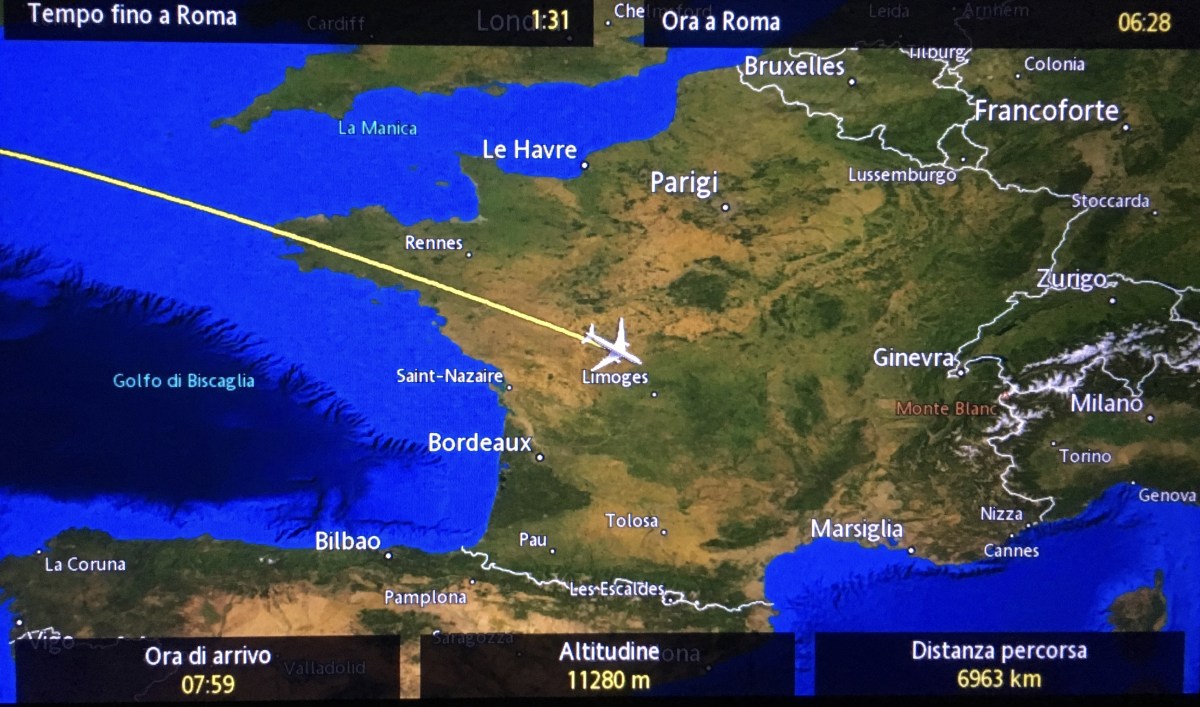
Traveling to Italy from MoroccoApril 23, 2019
On my way to Italy!

Leaving for Morocco

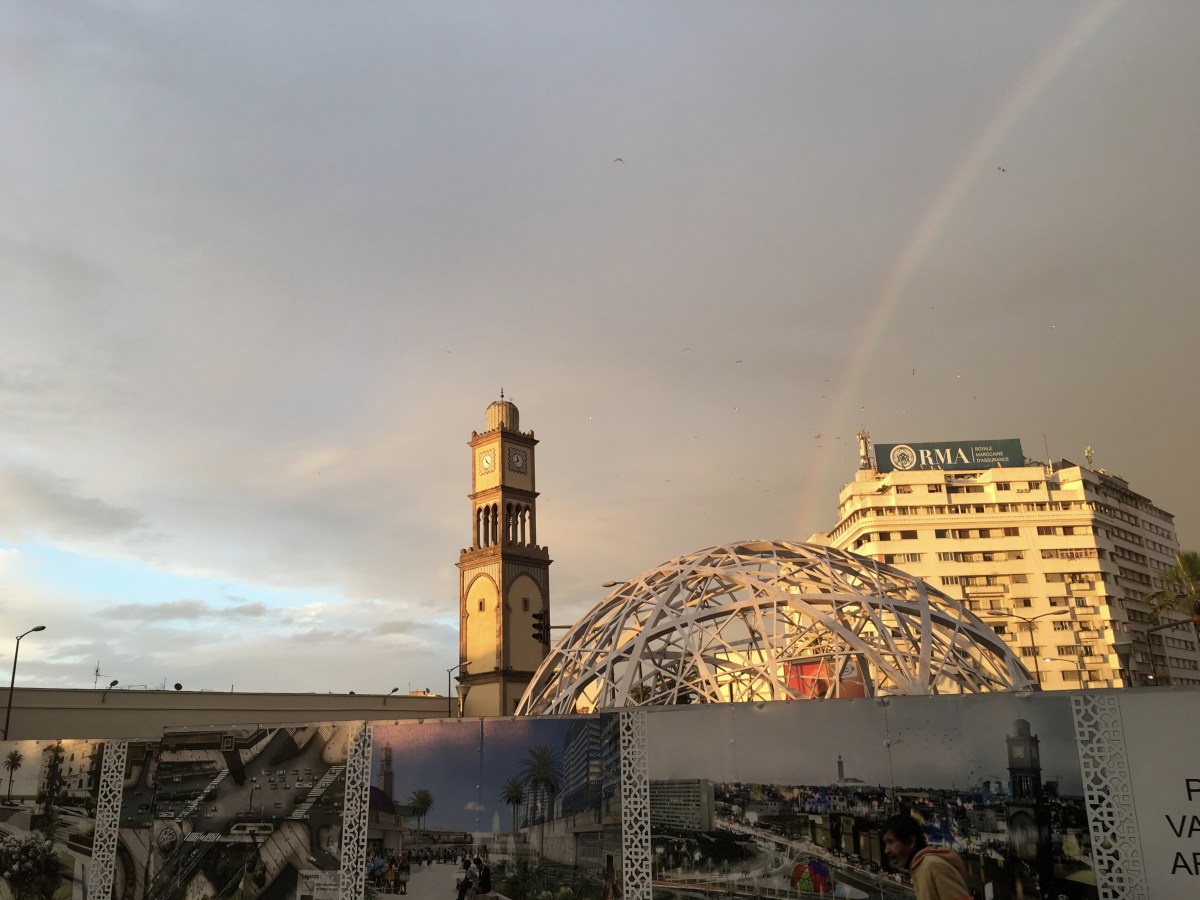
Casablanca, here I come!April 4, 2019
I'm on my way to Casablanca. :-)

Home from our Midwestern Triangle Road Trip

Driving home from Lexington, KYMarch 6, 2019
Home sweet home from the Midwest. :-)

Leaving for my Midwestern Triangle Road Trip

Driving to IndianaFebruary 24, 2019
Driving to Indiana.

Returning home from Portugal

Home sweet home from Spain & Portugal!November 6, 2018
Home sweet home from Spain & Portugal!

Leaving Spain for Portugal

A rendezvous in BragaOctober 26, 2018
Rendezvous in Braga, Portgual after walking the Camino de Santiago. :-)

Leaving to walk the Camino de Santiago

Heading to Spain for the CaminoAugust 31, 2018
I'm on my way to walk 790 km across northern Spain on the Camino de Santiago.

Home from my Four Corners Road Trip

Home Sweet Home from the Four CornersMay 25, 2018
Home Sweet Home from the Four Corners. :-)

My Four Corners Road Trip!

Hitting the roadMay 1, 2018
I'm hitting the road today for my Four Corners Road Trip: CO, UT, AZ, & NM!

Recent Posts

  • twenty twenty-five: nicaragua {twice}, mexico & seven months in costa rica {with an excursion to panama} December 31, 2025
  • the december cocktail hour: mike’s surgery, a central highlands road trip & christmas in costa rica December 31, 2025
  • top ten books of 2025 December 28, 2025
  • the november cocktail hour: a trip to panama, a costa rican thanksgiving & a move to lake arenal condos December 1, 2025
  • panama: the caribbean archipelago of bocas del toro November 24, 2025
  • a trip to panama city: el cangrejo, casco viejo & the panama canal November 22, 2025
  • the october cocktail hour: a trip to virginia, a NO KINGS protest, two birthday celebrations, & a cattle auction October 31, 2025
  • the september cocktail hour: a nicoya peninsula getaway, a horseback ride to la piedra del indio waterfalls & a fall bingo card September 30, 2025
  • the august cocktail hour: local gatherings, la fortuna adventures, & a “desfile de caballistas”  September 1, 2025
  • the july cocktail hour: a trip to ometepe, nicaragua; a beach getaway to tamarindo; & homebody activities August 3, 2025
  • the june cocktail hour: our first month in costa rica June 30, 2025
  • a pura vida year in costa rica June 12, 2025
  • the may cocktail hour: final wrap up, a wedding & leaving for costa rica June 2, 2025

Archives

  • December 2025
  • November 2025
  • October 2025
  • September 2025
  • August 2025
  • June 2025
  • May 2025
  • April 2025
  • March 2025
  • February 2025
  • January 2025
  • December 2024
  • November 2024
  • October 2024
  • September 2024
  • August 2024
  • July 2024
  • June 2024
  • May 2024
  • April 2024
  • March 2024
  • February 2024
  • January 2024
  • December 2023
  • November 2023
  • September 2023
  • August 2023
  • June 2023
  • May 2023
  • April 2023
  • March 2023
  • February 2023
  • January 2023
  • December 2022
  • November 2022
  • October 2022
  • September 2022
  • August 2022
  • June 2022
  • May 2022
  • April 2022
  • March 2022
  • February 2022
  • January 2022
  • December 2020
  • November 2020
  • October 2020
  • September 2020
  • August 2020
  • July 2020
  • June 2020
  • May 2020
  • April 2020
  • March 2020
  • February 2020
  • January 2020
  • December 2019
  • November 2019
  • October 2019
  • September 2019
  • August 2019
  • July 2019
  • June 2019
  • May 2019
  • April 2019
  • March 2019
  • February 2019
  • January 2019
  • December 2018
  • November 2018
  • October 2018
  • September 2018
  • August 2018
  • July 2018
  • June 2018
  • May 2018
  • April 2018
  • March 2018

Blog Stats

  • 121,741 hits
January 2026
M T W T F S S
 1234
567891011
12131415161718
19202122232425
262728293031  
« Dec    

Categories

  • Aït-Ben-Haddou (4)
  • Abingdon (1)
  • Abiquiu (1)
  • Acquapendente (2)
  • Adirondacks (3)
  • Africa (39)
  • Ainokura (2)
  • Alabama (1)
  • Alajuela (3)
  • Alamogordo (1)
  • Albuquerque (3)
  • Alexandria (1)
  • Alma (1)
  • Alpe di Siusi (1)
  • Alsace-Lorraine (1)
  • Alto Adige Wine Road (1)
  • Amarante (2)
  • America (69)
  • American Bison (1)
  • American books (21)
  • American Road Trips (255)
  • American Visionary Art Museum (1)
  • Americana (1)
  • Andrew Johnson National Historic Site (1)
  • Annapolis Valley (1)
  • Annual recap (10)
  • Anticipation (44)
  • Antietam National Battlefield (2)
  • Aramak Tour (1)
  • Arches National Park (8)
  • architecture (1)
  • Arena Stage (1)
  • Arizona (28)
  • Aroumd (2)
  • Art Journaling (9)
  • Asciano (1)
  • Asia (41)
  • Assisi (1)
  • Astorga (2)
  • Atapuerca (1)
  • Athens (1)
  • Atlanta (7)
  • Austin (2)
  • Aveiro (2)
  • Azofra (2)
  • Aztec Ruins National Monument (1)
  • óbidos (1)
  • Baños (2)
  • Badlands National Park (1)
  • Bagan (1)
  • Bagno Vignoni (2)
  • Bajos del Toro (1)
  • Balcony House (1)
  • Bali (9)
  • Baltimore (7)
  • Baltimore Museum of Art (1)
  • Bandelier National Monument (1)
  • Bangkok (2)
  • Bear Butte (1)
  • Beatrice (1)
  • Beihai (1)
  • Belize (1)
  • Beppu (1)
  • Bergamo (3)
  • Big Bend National Park (2)
  • Bijagua (2)
  • Bismarck (3)
  • Bismarck Art Alley (1)
  • Bitchu-Takahashi (1)
  • Blue Falls of Costa Rica (1)
  • Bluff (1)
  • Bluff Fort Historic Site (1)
  • Bocas del Toro (2)
  • Bocas Town (1)
  • Bogotá (4)
  • Bolsena (2)
  • Bolzano (2)
  • Bonanzaville (1)
  • Books (46)
  • Bosque de Chapultepec (1)
  • Boston (2)
  • Boulder (1)
  • Boys Town (1)
  • Braga (3)
  • Brookings (1)
  • Brunico/Bruneck (1)
  • Budapest (1)
  • Buffalo (9)
  • Bukit Peninsula (1)
  • Buonconvento (2)
  • Burano (2)
  • Burgos (4)
  • Cañas (2)
  • Cabo da Roca (1)
  • Caddo Lake (2)
  • Cairo (3)
  • California (4)
  • Cambodia (4)
  • Cambridge (1)
  • Camino de Santiago (64)
  • Campagnano di Roma (2)
  • Canada (15)
  • Canyon & Cactus Road Trip (4)
  • Canyon de Chelly (3)
  • Canyonlands (3)
  • Cape May (7)
  • Cappadocia (2)
  • Capranica (1)
  • Carbondale (9)
  • Carlsbad (1)
  • Carlsbad Caverns National Park (2)
  • Cartagena (4)
  • Casablanca (9)
  • Casco Viejo (1)
  • Castellina in Chianti (1)
  • Catarata del Toro (1)
  • Catskill Mountains (1)
  • Cedar Creek & Belle Grove National Historical Park (1)
  • Central America (41)
  • Central Highlands (1)
  • Centro Histórico (1)
  • Chaco Culture National Historical Park (4)
  • challenge: a call to place (38)
  • Channel Islands National Park (3)
  • Chapel in the Hills (1)
  • Charles Pinckney National Historic Site (1)
  • Charleston (11)
  • Chefchaouen (5)
  • Cheyenne (2)
  • Cheyenne Depot Museum (1)
  • Cheyenne Frontier Days Old West Museum (1)
  • Chicago (3)
  • Chillicothe (2)
  • Chimayó (1)
  • Chimney Rock (1)
  • China (8)
  • Chinatown (1)
  • Christmas (5)
  • Churchill Downs (1)
  • Cihuatán (1)
  • Cincinnati (15)
  • Cincinnati Art Museum (1)
  • Cinque Terre (10)
  • Cinquera (1)
  • Civita di Bagnoregio (1)
  • Cloudcroft (1)
  • Cocktail Hour (22)
  • Cocoa Beach (2)
  • Coeur d'Alene (1)
  • Collalbo/Klobenstein (1)
  • Colle di Val d'Elsa (2)
  • Colombia (9)
  • Colorado (31)
  • Colorado National Monument (3)
  • Colorado Towns (6)
  • Colorful (1)
  • Condesa (1)
  • Connecticut (1)
  • Cordoba (1)
  • Coronavirus Coping (14)
  • Cortina d’Ampezzo (1)
  • Costa Nova (1)
  • Costa Rica (19)
  • Covington (7)
  • Cowgirls of the West (1)
  • Coyoacán (1)
  • Crazy Horse Memorial (1)
  • Crestone (1)
  • Crete (1)
  • Croatia (3)
  • Cuenca (3)
  • Curves (1)
  • Custer (1)
  • Custer State Park (1)
  • Czech Republic (1)
  • Dakota Dinosaur Museum (1)
  • Dali (1)
  • Dalmatia (1)
  • De Smet (1)
  • Dead Horse Point State Park (1)
  • Dead Sea (1)
  • Deadwood (3)
  • decay (1)
  • Delaware (9)
  • Delphi (1)
  • Denver (1)
  • destinations (44)
  • Devils Tower National Monument (2)
  • Diamante Eco Adventure Park (1)
  • Dickinson (1)
  • District of Columbia (22)
  • Dobbiaco/Toblach (1)
  • Dolores Hidalgo (1)
  • Drawing (7)
  • Dubrovnik (1)
  • Durango (1)
  • Dwight D. Eisenhower Memorial (1)
  • Ecuador (14)
  • Egypt (3)
  • El Cangrejo (1)
  • El Salvador (6)
  • El-Khorbat (1)
  • Embudo (1)
  • Enchanted Rock State Natural Area (1)
  • England (3)
  • Erg Chebbi (3)
  • Española (1)
  • Essaouira (4)
  • Esztergom (1)
  • Ethiopia (3)
  • Europe (120)
  • Evan Williams Bourbon Experience (1)
  • Everglades (3)
  • Evora (1)
  • Fargo (2)
  • Fès (3)
  • Fenghuang (1)
  • Fez (2)
  • Fiction (6)
  • Findlay Market (1)
  • Finisterre (2)
  • Fira (1)
  • Fiumicino (2)
  • Flatirons Vista Trail (1)
  • Flight 93 National Memorial (1)
  • Florence (8)
  • Florida Keys (3)
  • Florida Road Trip (5)
  • Formello (1)
  • Fort Abraham Lincoln State Park (1)
  • Fort Atkinson State HIstorical Park (1)
  • Fort Calhoun (1)
  • Fort Collins (2)
  • Fort Lauderdale (2)
  • Fort Mandan (1)
  • Fort McHenry National Monument and Historic Shrine (1)
  • Fort Robinson State Park (1)
  • Fort Sumter and Fort Moultrie National Historical Park (1)
  • Fort Union Trading Post National Historic Site (1)
  • Four Corners Road Trip (74)
  • France (7)
  • Frazier Museum (1)
  • Fredericksburg (1)
  • Fucecchio (1)
  • Fundy National Park (1)
  • G Adventures Tour (10)
  • Gallina (2)
  • Gambassi Terme (2)
  • Gateway Arch National Park (1)
  • Gavin's Point Dam (1)
  • George Rogers Clark National Historical Park (2)
  • Georgia (7)
  • Gerald R. Ford Birthsite (1)
  • Germany (1)
  • Gettysburg National Military Park (1)
  • Goals (2)
  • Gothenburg (1)
  • Grand Junction (1)
  • Great Falls (2)
  • Great Lakes Road Trip (6)
  • Great Sand Dunes National Park (2)
  • Grecia (1)
  • Greece (3)
  • Greeneville (1)
  • Greenville (1)
  • Greve in Chianti (1)
  • Guadalupe Mountains National Park (1)
  • Guanacaste (9)
  • Guanajuato (5)
  • Guangxi Province (4)
  • Guatapé (5)
  • Guatemala (1)
  • Guilin (1)
  • Guimarães (2)
  • Halifax (3)
  • Halong Bay (1)
  • Hanoi (1)
  • Heidelberg (1)
  • Hida Furukawago (2)
  • High Road to Taos (1)
  • Hikes & Walks (202)
  • HISTORIC NAKASENDO TRAIL (1)
  • Hoa Lu (1)
  • Holbrook (1)
  • Holidays (6)
  • Hong Kong (1)
  • Hopewell Culture National Historical Park (2)
  • Hopewell Rocks Provincial Park (1)
  • Hotel Hacienda Guachipelin (1)
  • Hovenweep National Monument (1)
  • Hubbell Trading Post (1)
  • Hungary (1)
  • Iceland (1)
  • Idaho (1)
  • Illinois (17)
  • Imaginings (45)
  • Imlil (2)
  • India (7)
  • Indiana (6)
  • Indonesia (9)
  • Ingapirca (2)
  • Inle Lake (1)
  • Innichen/San Candido (1)
  • International Books (30)
  • International Peace Garden (1)
  • International Travel (333)
  • Iowa (1)
  • Isla Bastimentos (1)
  • Isla Carenero (1)
  • Isla Colón (1)
  • Istanbul (2)
  • Istria (1)
  • Italy (62)
  • Jamestown (1)
  • Japan (20)
  • Japan Alps (4)
  • Jefferson (1)
  • Jewel Cave National Monument (1)
  • Jimbaran (1)
  • Joachim Regional Museum & Prairie Outpost Park (1)
  • Johnstown Flood National Memorial (1)
  • Jordan (3)
  • Joseph N. Nicollet Tower and Interpretive Center (1)
  • Joshua Tree National Park (3)
  • Joslyn Art Museum (1)
  • Journaling (8)
  • Joya de Cerén (1)
  • Kansas (2)
  • Kathmandu (2)
  • Kentucky (17)
  • KMAC (1)
  • Knife River Indian Villages (2)
  • Kunming (1)
  • Kurashiki Bikan Historical Quarter (1)
  • Kyoto (5)
  • Kyushu (4)
  • La Fortuna (2)
  • La Giustiniana (2)
  • La Peñol (1)
  • La Romita (1)
  • La Spezia (6)
  • Lago d'Iseo (1)
  • Lago di Garda (1)
  • Lago di Garda (1)
  • Laguna de Apoyo (1)
  • Laguna Quilotoa (2)
  • Languedoc-Roussillon (1)
  • Latacunga (3)
  • laundry (1)
  • Lazio (6)
  • León (2)
  • León (2)
  • Leeds (1)
  • Lens-Artists (2)
  • Lewis & Clark Interpretive Center (2)
  • Lexington (8)
  • Lijiang (1)
  • Lincoln Boyhood Home National Memorial (2)
  • Lincoln City (3)
  • lines (1)
  • Lisbon (8)
  • Logroño (3)
  • Lombardy (3)
  • Longji Rice Terraces (1)
  • Longreads (6)
  • Looking ahead (2)
  • Lorca (2)
  • Lory State Park (1)
  • Los Alamos (3)
  • Los Angeles (3)
  • Louisiana (1)
  • Louisville (13)
  • Low Road to Taos (1)
  • Lucca (3)
  • Luckenbach (1)
  • Lunenburg (1)
  • Madison (1)
  • Madison County Historical Society Museum (1)
  • Magnolia Plantations & Gardens (1)
  • Magome-juku (1)
  • Mahone Bay (1)
  • Maine (1)
  • Managua (5)
  • Manarola (1)
  • Mandalay (1)
  • Mandan (1)
  • Manhattan Project National Historical Park (1)
  • Mapmaking (2)
  • Marfa (1)
  • Market towns near Cuenca (2)
  • markets (1)
  • Marrakech (7)
  • Maryland (11)
  • Massachusetts (2)
  • Matagalpa (2)
  • Mathews (1)
  • Meadowlark Botanical Gardens (4)
  • Medellín (5)
  • Medora (5)
  • Memoir (4)
  • Merzouga (5)
  • Mesa Verde National Park (4)
  • Meteora (1)
  • Mexico (11)
  • Mexico City (7)
  • Miami (3)
  • Michigan (4)
  • Middletown (1)
  • Midwestern Triangle (30)
  • Minas Basin (1)
  • Mine of Santa Brigida (1)
  • Mineral de Pozos (1)
  • Ministers Island (1)
  • Minnesota (1)
  • Minnesota (3)
  • Minot (1)
  • Minuteman Missile National Historic Site (1)
  • Mirador de Catarina (1)
  • Mississippi (1)
  • Missouri (4)
  • Missouri National Recreation River (1)
  • Missouri River Basin Lewis & Clark Center (2)
  • Mitchell (1)
  • Moab (2)
  • Montalcino (1)
  • Montana (1)
  • Montefiascone (1)
  • Montefioralle (1)
  • Montepulciano (1)
  • Monteriggioni (3)
  • Monteroni d'Arbia (1)
  • Monterosi (1)
  • Monterosso al Mare (2)
  • Monteverde (1)
  • Monthly recap (22)
  • Monument Valley (1)
  • Moorhead (1)
  • Morocco (37)
  • Mount Pleasant (1)
  • Mt. Rushmore National Memorial (1)
  • Mulberry Bend Overlook (1)
  • Murano (2)
  • Murphysboro (10)
  • Muruzabal (1)
  • Muscat (1)
  • Museum of the Shenandoah Valley (1)
  • Muxia (2)
  • Myanmar (2)
  • Nagoya (4)
  • Nagoya Castle (2)
  • Nanning (3)
  • Naoshima (1)
  • Narita (5)
  • Nashville (8)
  • National Gallery of Art (2)
  • natural bridges (1)
  • Natural Bridges National Monument (2)
  • Navajo National Monument (2)
  • Nebraska (21)
  • Nepal (4)
  • New Belgium Brewing (1)
  • New Brunswick (6)
  • New Castle (2)
  • New England Road Trip (2)
  • New Hampshire (2)
  • New Jersey (7)
  • New Mexico (12)
  • New Mexico (1)
  • New Mexico (12)
  • New York (16)
  • Newport (1)
  • Niagara Falls (7)
  • Nicaragua (23)
  • Nice (1)
  • Nicoya Peninsula (1)
  • Nizwa (3)
  • Norfolk (1)
  • Normandy (1)
  • North America (22)
  • North Dakota (26)
  • North Dakota Heritage Center (2)
  • North Platte (1)
  • Nosara (1)
  • Nova Scotia (5)
  • Nuevo Arenal (1)
  • Nusa Dua (1)
  • Oakland (1)
  • Oakton (23)
  • Ogallala (1)
  • Ohio (17)
  • Ohkay Owingeh Pueblo (1)
  • Oia (1)
  • Okayama (4)
  • Oklahoma (1)
  • Oklahoma City (1)
  • Old Market (1)
  • Omaha (5)
  • Oman (4)
  • Ometepe (13)
  • On Journey (44)
  • On Returning Home (40)
  • On-a-Slant Village (1)
  • Ontario (4)
  • Orisson (2)
  • Ortesei/St. Ulrich (1)
  • Orvieto (1)
  • Otavalo (2)
  • Ouray (1)
  • Pagosa Springs (1)
  • Pamplona (2)
  • Panama (4)
  • Panama Canal (2)
  • Panama City (2)
  • Panchimalco (1)
  • Panzano in Chianti (1)
  • Paris (2)
  • Parque Nacional Cajas (2)
  • Parque Nacional Cotopaxi (2)
  • Parque Nacional Volcán Poás (1)
  • Parque Nacional Volcán Tenorio (2)
  • Parque Nactional Volcán Rincón de la Vieja (1)
  • pastels (1)
  • Patterns (3)
  • Peña de Bernal (1)
  • Pecos National Historical Park (1)
  • Peniche (1)
  • Pennsylvania (14)
  • Perugia (2)
  • Petrified Forest National Park (5)
  • petroglyphs (1)
  • Phnom Penh (3)
  • Photography (265)
  • Phuket (2)
  • Pilgrimage (75)
  • Ping'An (1)
  • Pisa (1)
  • Pittsburgh (11)
  • Playa Costa del Sol (1)
  • Playa Hermosa (2)
  • Plitvice Lakes National Park (1)
  • Poetry (33)
  • Pokhara (2)
  • Polanco (1)
  • Ponca State Park (1)
  • Ponte a Cappiano (1)
  • Porto (4)
  • Portovenere (1)
  • Portugal (25)
  • Prairie Homestead Historic Site (1)
  • Prince Edward Island (2)
  • Prose (206)
  • Puerta del Diablo (1)
  • Querétaro (4)
  • Quito (2)
  • Rapid City (6)
  • Red Cloud (1)
  • Redlin Art Center (1)
  • Regent (1)
  • Rehoboth (2)
  • Renon (1)
  • Renon/Ritten Plateau (1)
  • Reverse culture shock (2)
  • Richmond (7)
  • Riobamba (2)
  • Rishikesh (2)
  • Rittner Horn (1)
  • Riverbend Park (1)
  • Road Trip to Nowhere (63)
  • Rocky Mountain National Park (1)
  • Roma Norte (2)
  • Rome (16)
  • Roof Squares (1)
  • Route 66 (1)
  • Ruidoso (1)
  • Sackville (1)
  • Sahara (3)
  • Saint John (1)
  • Saint-Jean-Pied-de-Port (4)
  • San Ángel (1)
  • San Francisco (2)
  • San Gimignano (5)
  • San José (2)
  • San Juan del Sur (1)
  • San Juan Skyway Scenic Byway (3)
  • San Lorenzo Nuovo (1)
  • San Miguel de Allende (6)
  • San Miniato (1)
  • San Quirico d'Orcia (4)
  • San Salvador (5)
  • San Sebastián Bernal (1)
  • San Simeon (2)
  • Sant'Antimo (1)
  • Santa Barbara (2)
  • Santa Fe (5)
  • Santa Maddalena (1)
  • Santa Rosa de Lima (1)
  • Santiago (4)
  • Santo Domingo de la Calzada (2)
  • Santorini (1)
  • Sarchí (1)
  • Sámara (1)
  • Scandinavian Heritage Center (1)
  • Scotts Bluff National Monument (1)
  • Semarapura (2)
  • Shanghai (1)
  • Shenandoah National Park (1)
  • Shepherdstown (1)
  • Shibao Shan (2)
  • Shikoku 88-Temple Pilgrimage Route (4)
  • Shirakawa-go (2)
  • Shreveport (1)
  • Sidemen (1)
  • Siem Reap (3)
  • Siena (2)
  • Silverton (1)
  • Singapore (3)
  • Sintra (2)
  • Sioux Falls (2)
  • Sisseton (1)
  • Smithsonian American Art Museum (SAAM) (5)
  • Smithsonian National Museum of Asian Art (2)
  • South America (25)
  • South Carolina (12)
  • South Dakota (24)
  • South Dakota Art Museum (1)
  • South Korea (5)
  • Spain (68)
  • Spearfish (2)
  • Spello (1)
  • Spirit Mound Historic Prairie (1)
  • Split (1)
  • Springfield (3)
  • St. Andrews by-the-Sea (1)
  • St. Augustine (2)
  • St. Louis (2)
  • Stanton (1)
  • Staycation (8)
  • Stonewall (1)
  • Street Art (2)
  • Sturgis (2)
  • Suchitoto (1)
  • Sullivan's Island (2)
  • Sunset Crater National Monument (1)
  • Sunsets (1)
  • Supreme Court of the United States (2)
  • Swedish Heritage Center (1)
  • Takayama (3)
  • Tam Coc (1)
  • Tamarindo (1)
  • Tangier (3)
  • Taos (4)
  • Tejutepeque (2)
  • Telluride (2)
  • Tennessee (10)
  • Teotihuacán (1)
  • Terlingua (1)
  • Termas de Papallacta (2)
  • Tex-New Mex Road Trip (16)
  • Texas (8)
  • Texas & New Mexico Road Trip (20)
  • Thailand (3)
  • Thanksgiving (1)
  • The Battery (1)
  • The Dolomites (4)
  • The Enchanted Highway (1)
  • The Journey Museum (1)
  • The Maritimes (10)
  • The Veneto (5)
  • The Walters Art Museum (1)
  • Theodore Roosevelt National Park (4)
  • Tigua (2)
  • Tilarán (9)
  • Tinghir (2)
  • Toadstool Geologic Park (1)
  • Todra Gorge (1)
  • Tokushima (1)
  • Tokyo (6)
  • Topeka (1)
  • Torres del Rio (2)
  • Travel (655)
  • Travel Creativity (361)
  • Travel Essay (200)
  • Travel Inspiration (45)
  • Travel photography (244)
  • Travel Preparation (48)
  • Travel videos (48)
  • Travelogue (201)
  • Trentino & South Tyrol (5)
  • Trinidad & Tobago (2)
  • Tronadora (5)
  • Truchas (1)
  • Tsumago-juku (1)
  • Turkey (5)
  • Tuscany (31)
  • twenty twenty-five (1)
  • twenty twenty-four (1)
  • twenty twenty-three (1)
  • twenty twenty-two (1)
  • twenty twenty-two (2)
  • twenty-eighteen (1)
  • twenty-fifteen (1)
  • twenty-nineteen (1)
  • twenty-twenty (2)
  • twenty-twenty-one (1)
  • Ubud (1)
  • Uluwatu (1)
  • Ulysses S Grant National Historic Site (1)
  • Umbria (10)
  • Union Market (2)
  • United Arab Emirates (UAE) (2)
  • Utah (26)
  • Valley City (1)
  • Valley of the Gods (1)
  • Varanasi (2)
  • Vatican City (1)
  • Vatican Museums (1)
  • Venice (2)
  • Venice (5)
  • Ventosa (2)
  • Vermillion (1)
  • Vermont (2)
  • Vernazza (1)
  • Verona (2)
  • Vetralla (1)
  • Via Francigena (15)
  • Vicksburg (1)
  • Vienna (10)
  • Vietnam (4)
  • Villamayor de Monjardín (2)
  • Villamayor del Rio (1)
  • Vincennes (3)
  • Virginia (41)
  • Virginia Museum of Fine Arts (5)
  • Viterbo (2)
  • Volcán Chimborazo (2)
  • Volcán Cotopaxi (2)
  • Volterra (2)
  • Volubilis (1)
  • Wall (4)
  • Walnut Canyon National Monument (1)
  • Washburn (2)
  • Washington (20)
  • Watertown (2)
  • Watford City (1)
  • West Virginia (1)
  • White Sands National Park (2)
  • Wigwam Motel (1)
  • Wilber (1)
  • Wildlife (1)
  • Wildwood (3)
  • William Howard Taft National Historic Site (1)
  • Wilmington (3)
  • Winchester (1)
  • Wind Cave National Park (1)
  • Window Rock Navajo Tribal Park (1)
  • Winslow (3)
  • Wisconsin (2)
  • Writing (246)
  • Wupatki National Monument (2)
  • Wyoming (6)
  • Xi'an (1)
  • Yangon (1)
  • Yangshuo (1)
  • Yankton (1)
  • Yokohama (4)
  • Yorktown (2)
  • Yufuin (1)
  • Yunnan Province (2)
  • Zadar (1)
  • Zagreb (1)
  • Zarcero (1)
  • Zhangjiajie (1)
  • Ōsu Kannon Temple (2)
  • Český Krumlov (1)

Africa America American books American Road Trips Annual recap Anticipation Arches National Park Arizona Art Journaling Asia Bali Books Buffalo Camino de Santiago Canada Carbondale Casablanca Central America challenge: a call to place Charleston China Cincinnati Cinque Terre Cocktail Hour Colombia Colorado Coronavirus Coping Costa Rica Delaware destinations District of Columbia Ecuador Europe Four Corners Road Trip G Adventures Tour Guanacaste Hikes & Walks Illinois Imaginings Indonesia International Books International Travel Italy Japan Journaling Kentucky Louisville Maryland Mexico Midwestern Triangle Monthly recap Morocco Murphysboro Nashville Nebraska New Mexico New York Nicaragua North America North Dakota Oakton Ohio Ometepe On Journey On Returning Home Pennsylvania Photography Pilgrimage Pittsburgh Poetry Portugal Prose Road Trip to Nowhere Rome South America South Carolina South Dakota Spain Tennessee Tex-New Mex Road Trip Texas & New Mexico Road Trip The Maritimes Tilarán Travel Travel Creativity Travel Essay Travel Inspiration Travelogue Travel photography Travel Preparation Travel videos Tuscany Umbria Utah Via Francigena Vienna Virginia Washington Writing

Pages

  • about ~ wander.essence ~
  • books & novels | u.s.a. |
  • books | history, spirituality, personal growth & lifestyle |
  • books | international a-z |
  • how to make the most of a staycation
  • movies | international a-z |
  • movies | u.s.a. |
  • on creating art from travels
  • on keeping a travel journal
  • packing list for el camino de santiago 2018
  • photography inspiration
  • writing prompts: poetry
  • writing prompts: prose
  • ~ places i’ve been in the u.s.a. ~
  • ~ the places i’ve been ~
  • Contact

Translate

Goodreads

Blogs I Follow

Unknown's avatar
Unknown's avatar
Unknown's avatar
Unknown's avatar
Unknown's avatar
Unknown's avatar
Unknown's avatar
Unknown's avatar
Unknown's avatar
Unknown's avatar
Unknown's avatar
Unknown's avatar
Unknown's avatar
Unknown's avatar
Unknown's avatar
Unknown's avatar

Top Posts & Pages

  • twenty twenty-five: nicaragua {twice}, mexico & seven months in costa rica {with an excursion to panama}
  • writing prompts: prose
  • cloudcroft to alamogordo to ruidoso to santa fe, new mexico
  • braga, portugal: immersion
  • anticipation & preparation: vietnam in 2011

wander.essence

wander.essence
  • Home
  • about ~ wander.essence ~
  • Travel Destinations
  • Imaginings
  • Travel Preparation
  • Travel Creativity
  • On Journey
  • Books & Movies
  • On Returning Home
  • Annual recap
  • Contact

~ wander.essence ~

where travel meets art

  • Home
  • about ~ wander.essence ~
    • ~ the places i’ve been ~
    • ~ places i’ve been in the u.s.a. ~
  • Travel Destinations
    • America
      • Boston
      • Delaware
      • District of Columbia
        • Washington
      • Georgia
        • Atlanta
      • Maryland
      • New Jersey
        • Cape May
      • New York
        • Adirondacks
        • Buffalo
        • Niagara Falls
      • Pennsylvania
        • Pittsburgh
      • South Carolina
      • Tennessee
        • Nashville
      • Virginia
    • American Road Trips
      • Canyon & Cactus Road Trip
      • Florida Road Trip
        • Everglades
        • Fort Lauderdale
        • Florida Keys
        • Miami
        • St. Augustine
      • Four Corners Road Trip
        • Arizona
          • Monument Valley
          • Petrified Forest National Park
          • Sunset Crater National Monument
          • Walnut Canyon National Monument
          • Winslow
          • Wupatki National Monument
        • Colorado
          • Colorado National Monument
          • Colorado Towns
          • Great Sand Dunes National Park
          • Grand Junction
        • New Mexico
        • Utah
          • Arches National Park
          • Canyonlands
          • Navajo National Monument
          • Dead Horse Point State Park
          • Hovenweep National Monument
          • Moab
          • Valley of the Gods
          • Natural Bridges National Monument
      • Great Lakes Road Trip
        • Michigan
        • Minnesota
        • Wisconsin
      • Midwestern Triangle
        • Illinois
          • Carbondale
          • Murphysboro
        • Kentucky
          • Covington
          • Lexington
          • Louisville
        • Ohio
          • Cincinnati
      • Road Trip to Nowhere
        • Nebraska
        • North Dakota
        • South Dakota
      • Tex-New Mex Road Trip
        • Texas & New Mexico Road Trip
        • New Mexico
        • Texas
    • International Travel
      • Africa
        • african meanderings {& musings}
        • Egypt
          • Cairo
        • Ethiopia
        • Morocco
      • Asia
        • Cambodia
        • China
          • China Diaries
          • Guangxi Province
        • India
          • Rishikesh
          • Varanasi
        • Japan
          • Kyoto
        • Myanmar
        • Oman
          • a nomad in the land of nizwa
          • Nizwa
        • Singapore
        • South Korea
          • catbird in korea
        • Thailand
        • Turkey
          • Cappadocia
        • Vietnam
      • Central America
        • Costa Rica
        • El Salvador
        • Nicaragua
        • Panama
          • Bocas del Toro
          • Panama City
      • Europe
        • In Search of a Thousand Cafés
        • Croatia
          • Dalmatia
            • Istria
            • Dubrovnik
            • Plitvice Lakes National Park
            • Split
            • Zadar
            • Zagreb
        • Czech Republic
          • Český Krumlov
        • England
        • France
        • Greece
        • Hungary
          • Budapest
          • Esztergom
        • Iceland
        • Italy
          • Bergamo
          • Cinque Terre
          • The Dolomites
          • Florence
          • Rome
          • Tuscany
          • Venice
          • Verona
          • Via Francigena
        • Portugal
        • Spain
          • Camino de Santiago
            • packing list for el camino de santiago 2018
      • North America
        • Canada
          • The Maritimes
            • New Brunswick
            • Nova Scotia
            • Prince Edward Island
          • Ontario
      • South America
        • Colombia
        • Ecuador
          • Cuenca
          • Quito
    • how to make the most of a staycation
      • Coronavirus Coping
  • Imaginings
    • imaginings: the call to place
  • Travel Preparation
    • journeys: anticipation & preparation
  • Travel Creativity
    • on keeping a travel journal
    • on creating art from travels
      • Art Journaling
    • photography inspiration
      • Photography
    • writing prompts: prose
      • Prose
        • Fiction
        • Travel Essay
        • Travelogue
    • writing prompts: poetry
      • Poetry
  • On Journey
    • on journey: taking ourselves from here to there
  • Books & Movies
    • books | international a-z |
    • books & novels | u.s.a. |
    • books | history, spirituality, personal growth & lifestyle |
    • movies | international a-z |
    • movies | u.s.a. |
  • On Returning Home
    • on returning home
  • Annual recap
    • twenty-fifteen
    • twenty-eighteen
    • twenty-nineteen
    • twenty-twenty
    • twenty-twenty-one
    • twenty twenty-two
    • twenty twenty-three
    • twenty twenty-four
    • twenty twenty-five
  • Contact
  • Camino de Santiago
  • Europe
  • Hikes & Walks

{camino day 30} arcahueja to león

wanderessence1025's avatar wanderessence1025 August 18, 2019

I left Arcahueja at 7:30 a.m. to walk into León.  I thought the walk would be as awful as it was going into Pamplona and Burgos, but it wasn’t that bad. I passed some industry — some defunct and some in full swing.  As I walked upward to Alto del Portillo, I passed crosses woven into a chain fence over a busy highway.

The path was marked to take pilgrims off the main road.  It was a bit confusing since the map didn’t reflect the detour.

Arcahueja to Puente Castro
crosses in the fence

I climbed up a hill through a neighborhood and then had a steep descent through a pine forest, through open fields and down into the city, all lit up before me in the morning sunlight.  The spires of León’s cathedral glowed.  After crossing a bridge over the main road, I came to the town of Puente del Castro.

Arcahueja to Puente del Castro (5.6 km)

fullsizeoutput_19d91

descending into León

I crossed over the stone footbridge over the río Torio into Puente del Castro and made my way up the wide main road, Alcalde Miguel Castaño into León. Avenues were broad and buildings modern and characterless.  We pilgrims always looked for the narrow winding roads of the old town.

León, with its population of 130,000, was a military garrison and base for the VIIth Roman Legion, thus the name León for “Legion.” Later, it became the capital of the old kingdoms of Asturias and León.  It was conquered by Visigoth, Moor and finally Christian forces. The ancient and modern parts of the city straddle the río Barnesega, with its patchwork of architectural styles, from Romanesque to Gothic to Renaissance to Plasteresque to neo-Gothic.

fullsizeoutput_19d97

entering León

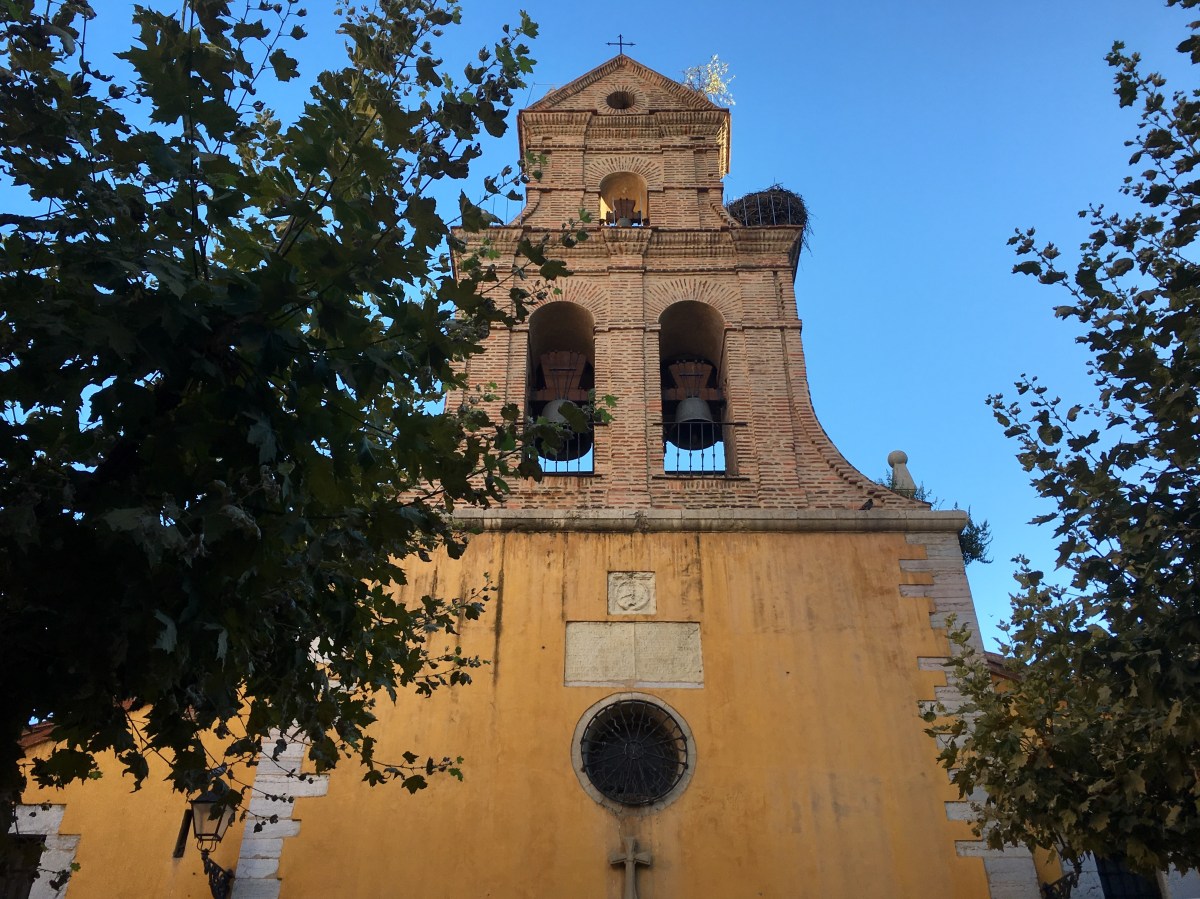
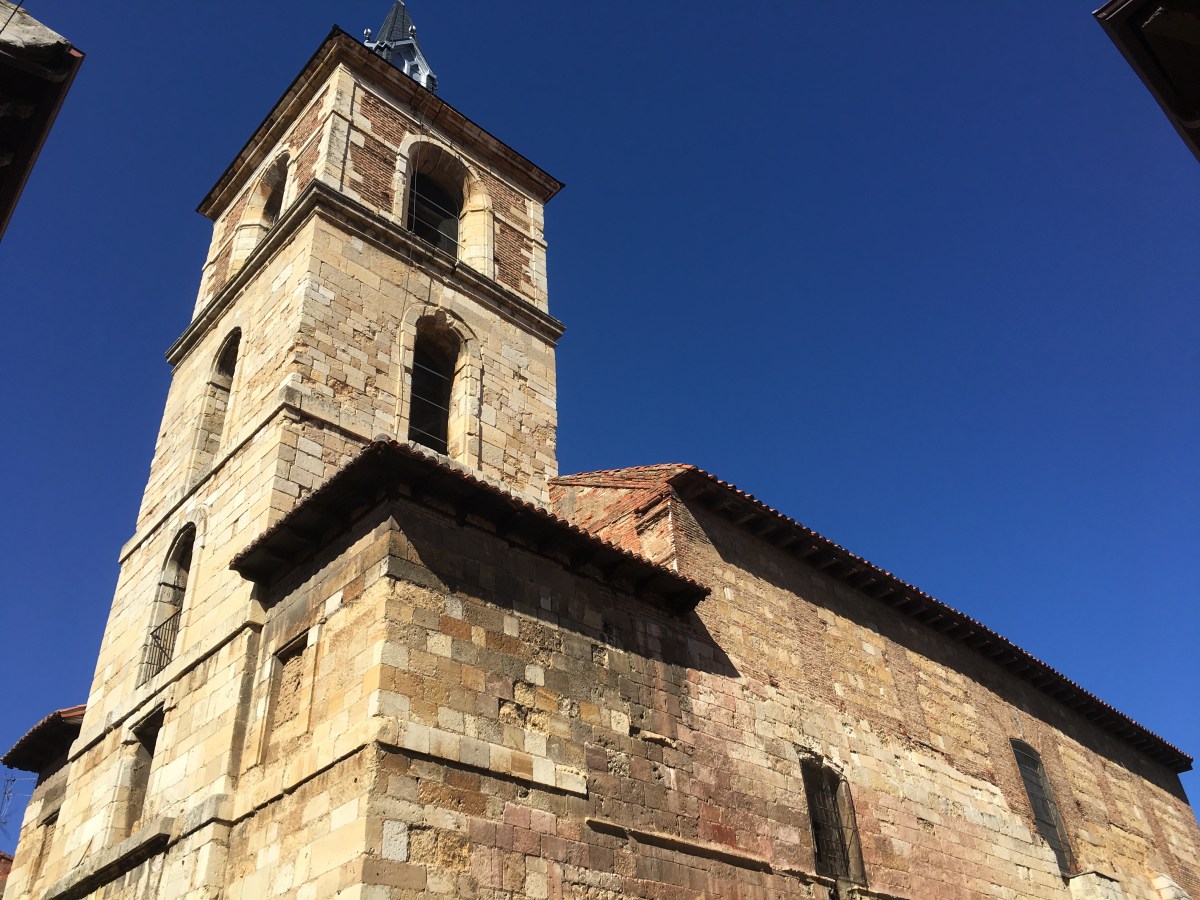
I passed the pretty yellow Iglesia de Santa Ana and Nuestra Señora del Mercado.

fullsizeoutput_16b42

Iglesia de Santa Ana

IMG_7684

Nuestra Señora del Mercado

fullsizeoutput_19d99

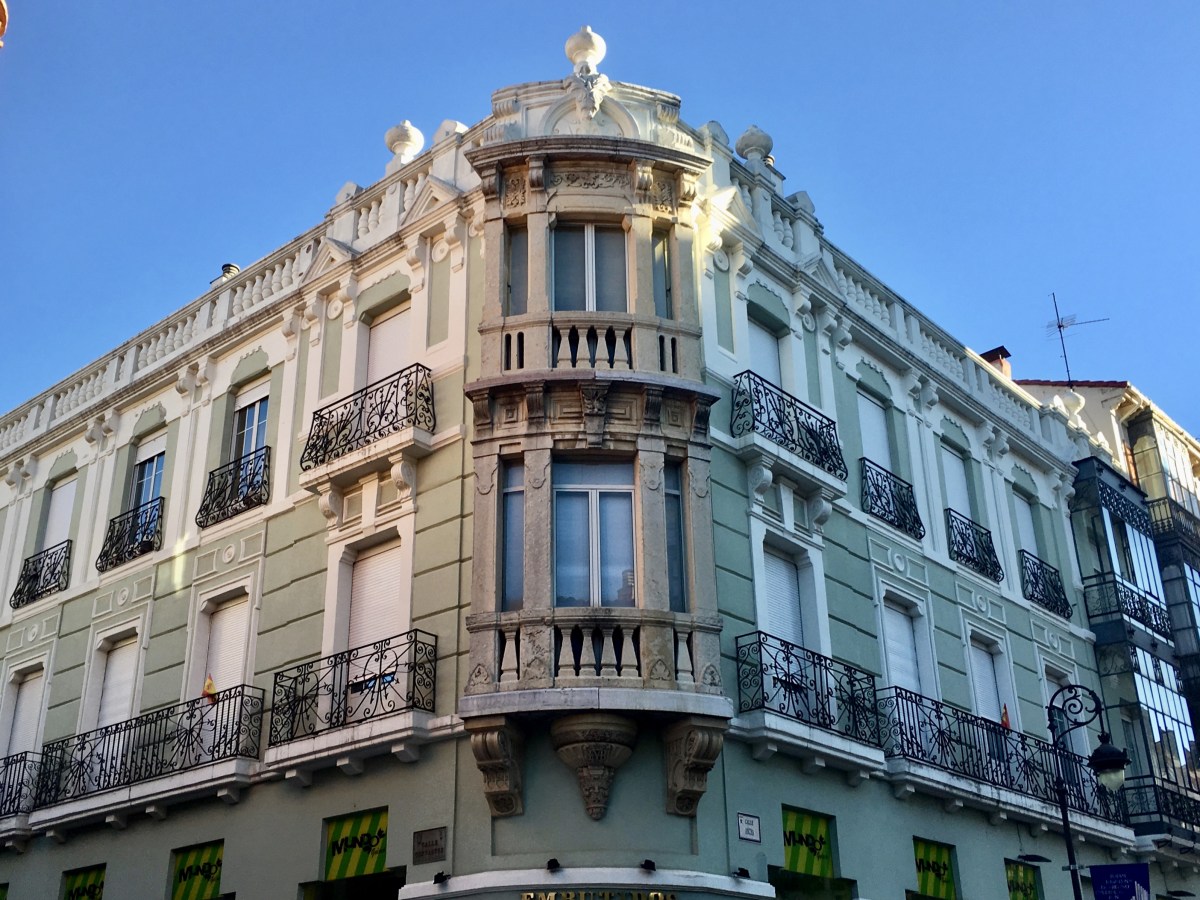
León

fullsizeoutput_16b5c

León

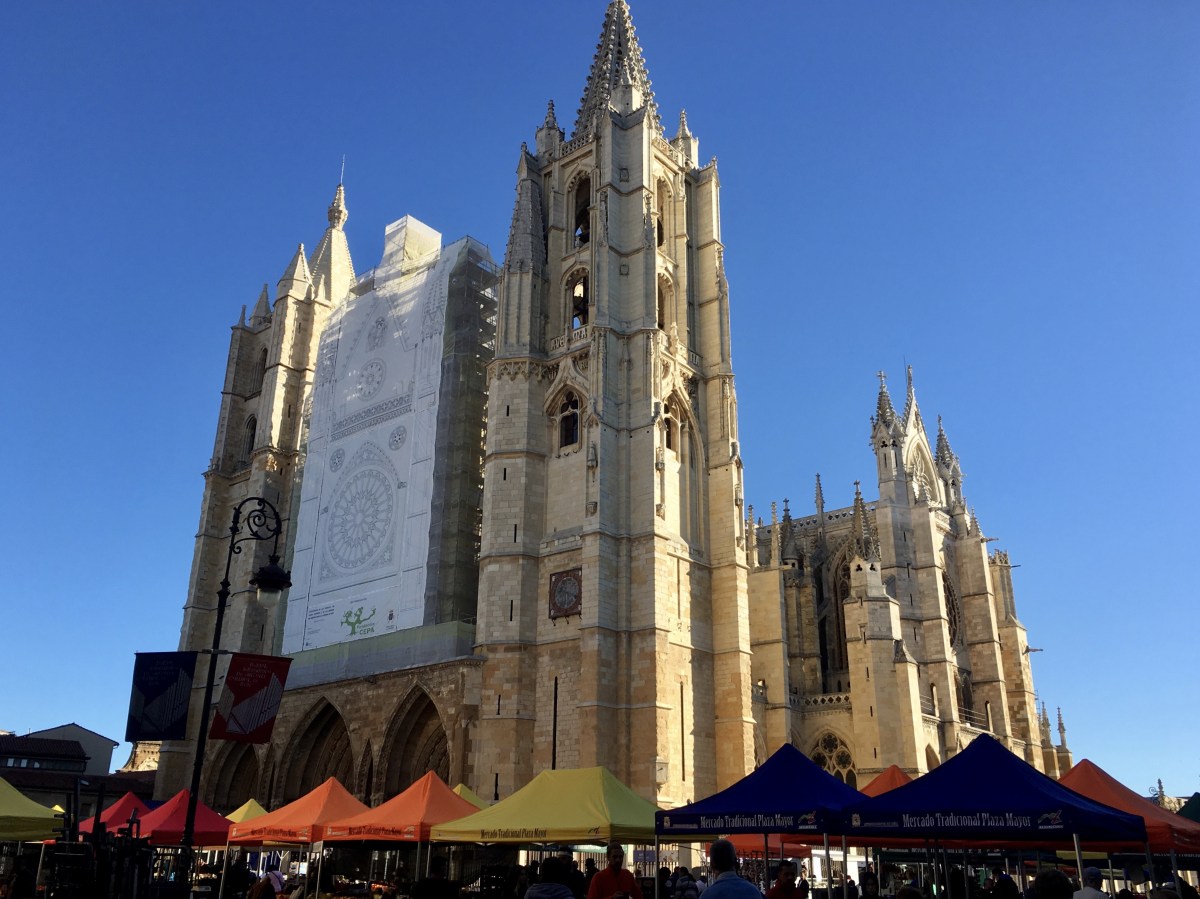
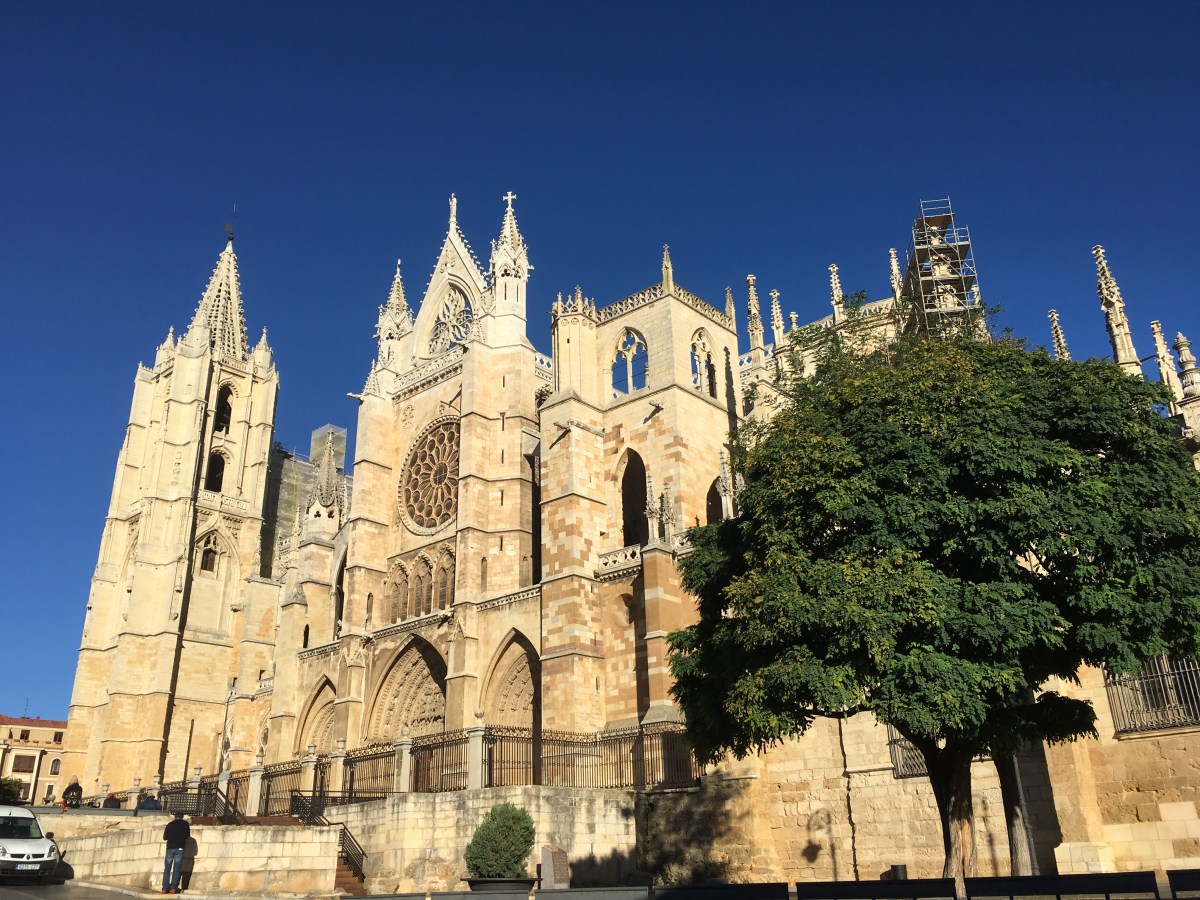
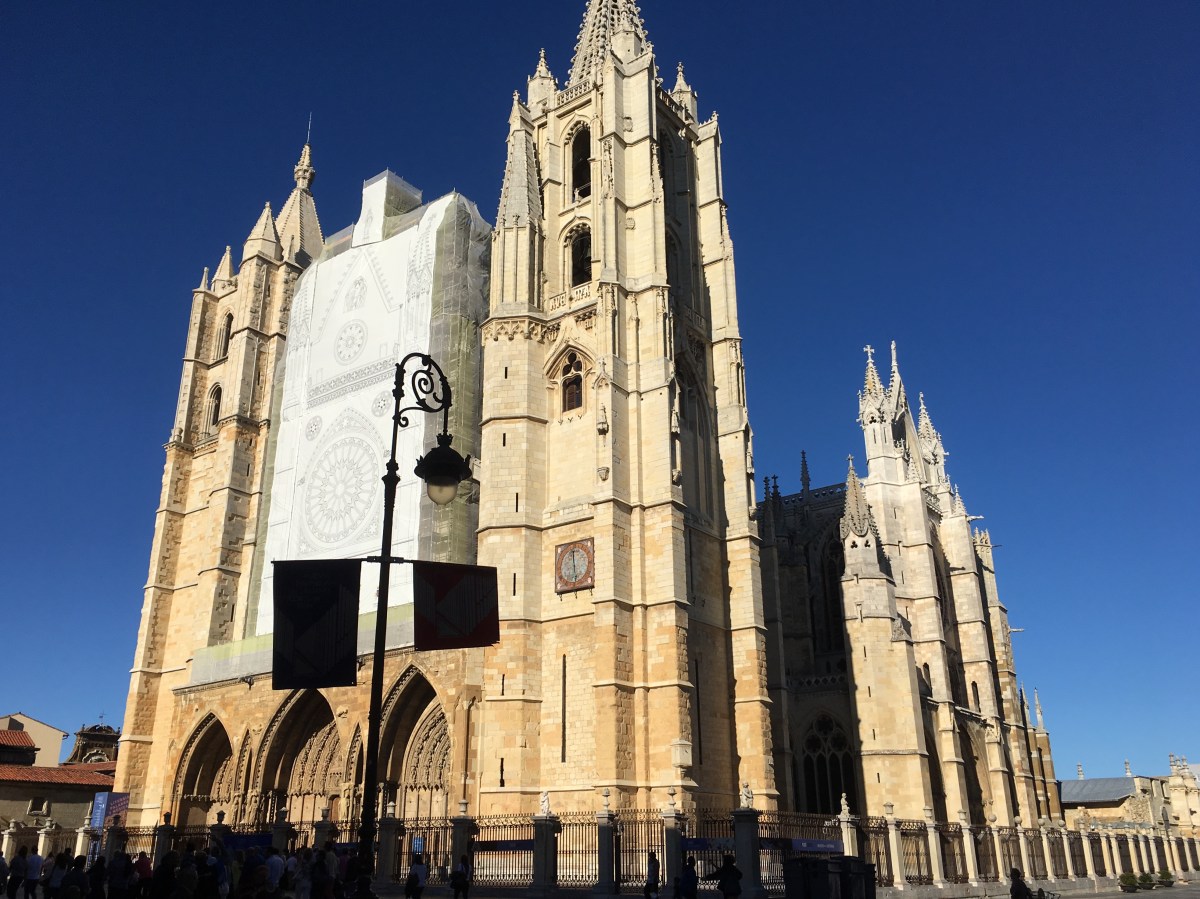
I finally arrived at Catedral de Santa María de León, also called The House of Light or the Pulchra Leonina. All around the Cathedral, in the Plaza Regal, were bustling fruit and vegetable vendors.  I happened to arrive on market day.

fullsizeoutput_19df1

Catedral de Santa María de León

fullsizeoutput_19d9f

Catedral de Santa María de León

fullsizeoutput_19da4

small church in León

Puente Castro to León Centro (1.9 km)

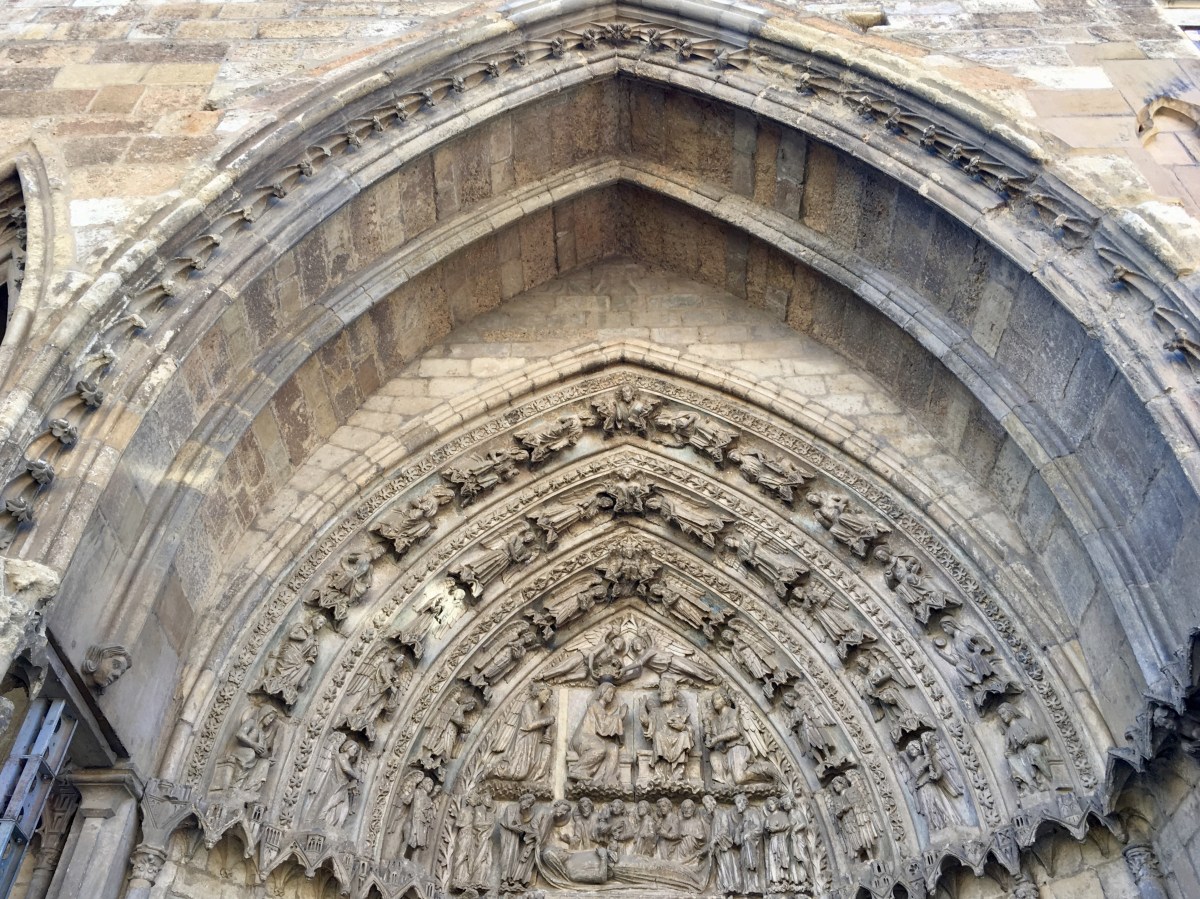
I arrived in León too early to check into my hostel, so as soon as I dropped my pack there, I went immediately to see the city’s magnificent late 13th-century Gothic Catedral de Santa María de León and museum. It was not as extensive as the Burgos cathedral and there was no pilgrim discount, unlike most other places along the way.

The cathedral is known for its stunning 125 stained glass windows set high in the walls, shedding mosaics of light into the interior. One consequence of all these windows is that the structural integrity of the building is suspect, especially after two cave-ins in the 17th and 19th centuries.

I did the audiotour, half listening and half taking photos.

IMG_7695

Catedral de Santa María de León

fullsizeoutput_19da7

Catedral de Santa María de León

fullsizeoutput_19dab

Catedral de Santa María de León

stained glass windows in Catedral de Santa María de León
stained glass
stained glass
Catedral de Santa María de León

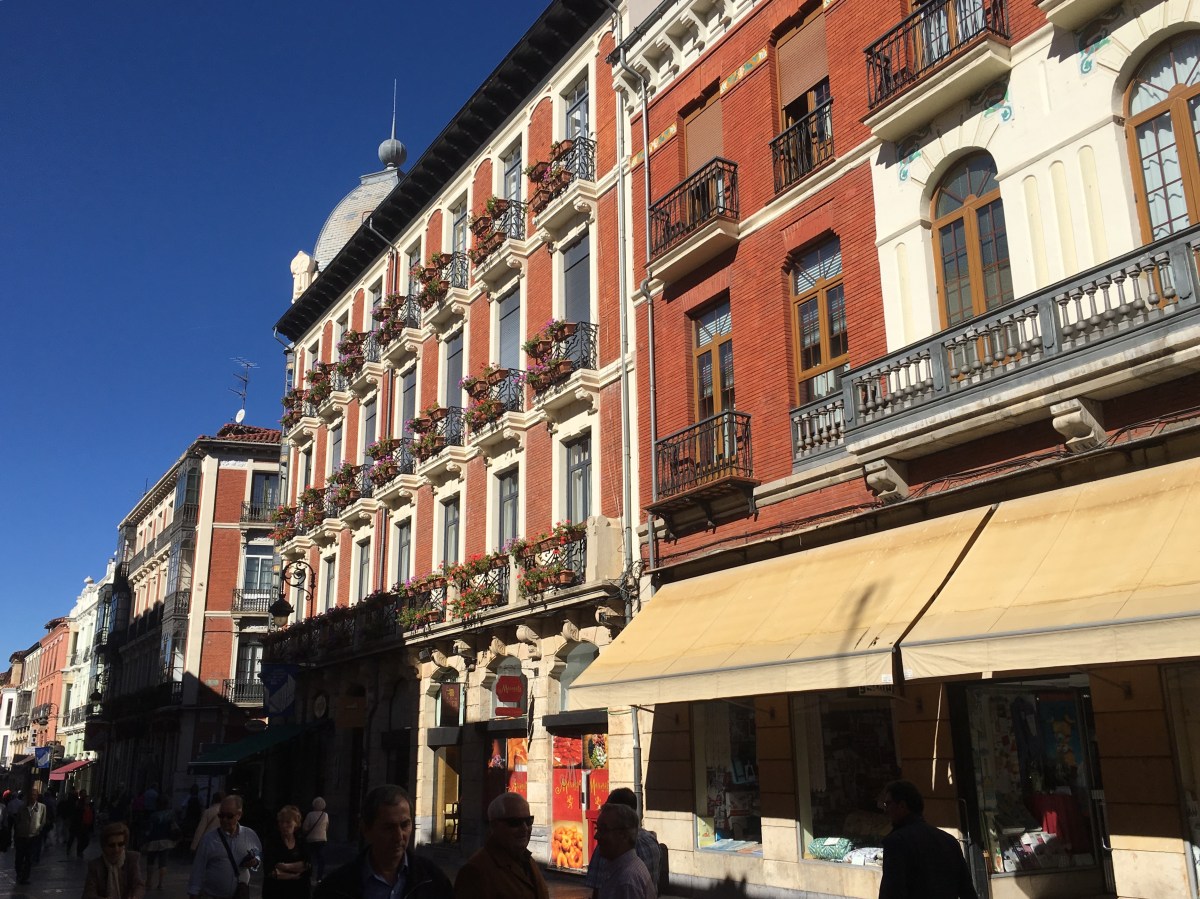
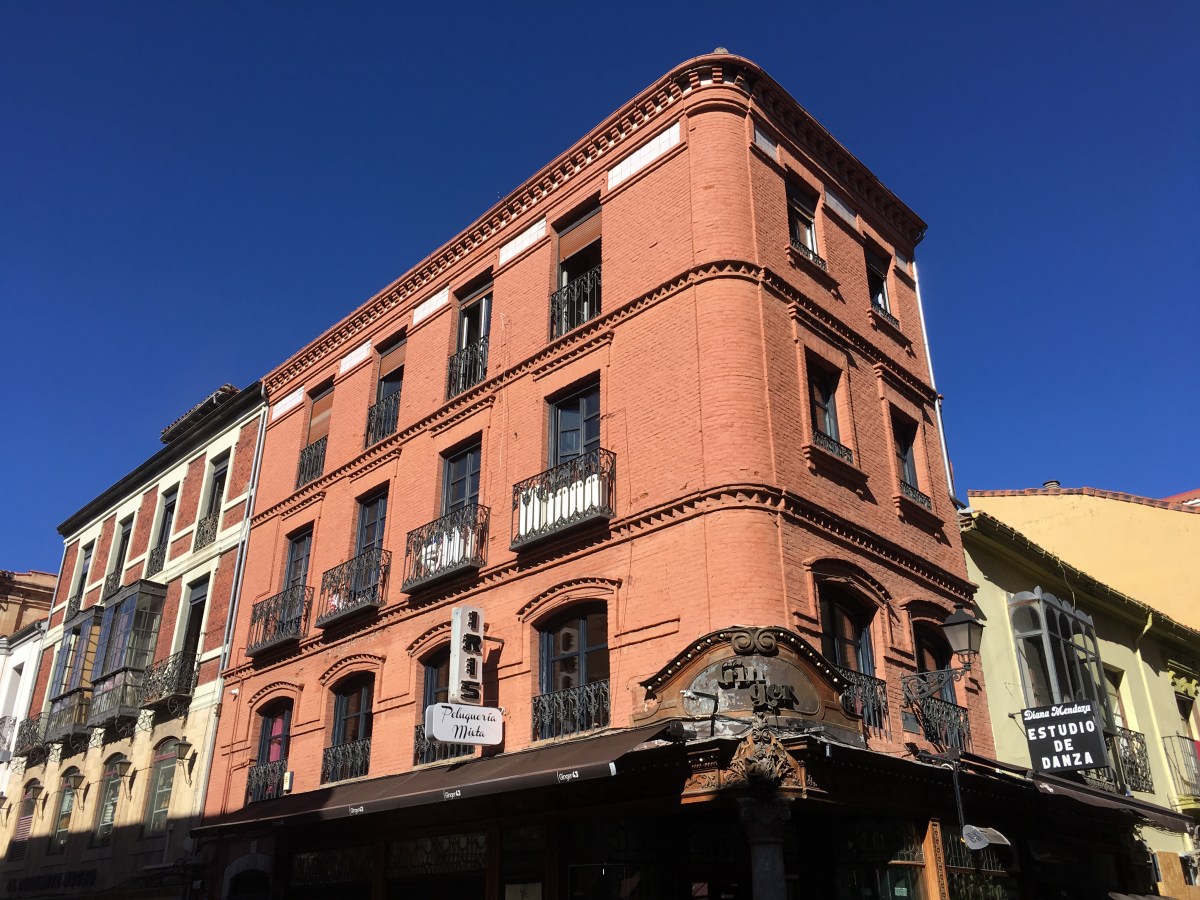
After the museum tour, I walked to Plaza Santo Domingo, where I went to a BBVA ATM for cash.  Then I went to the peregrino store, Armeria Castro, for a hat.  The mornings were getting downright cold, and I needed some head warmth.

IMG_7744

streets of León

fullsizeoutput_19dd0

streets of León

fullsizeoutput_16b40

streets of León

IMG_7749

streets of León

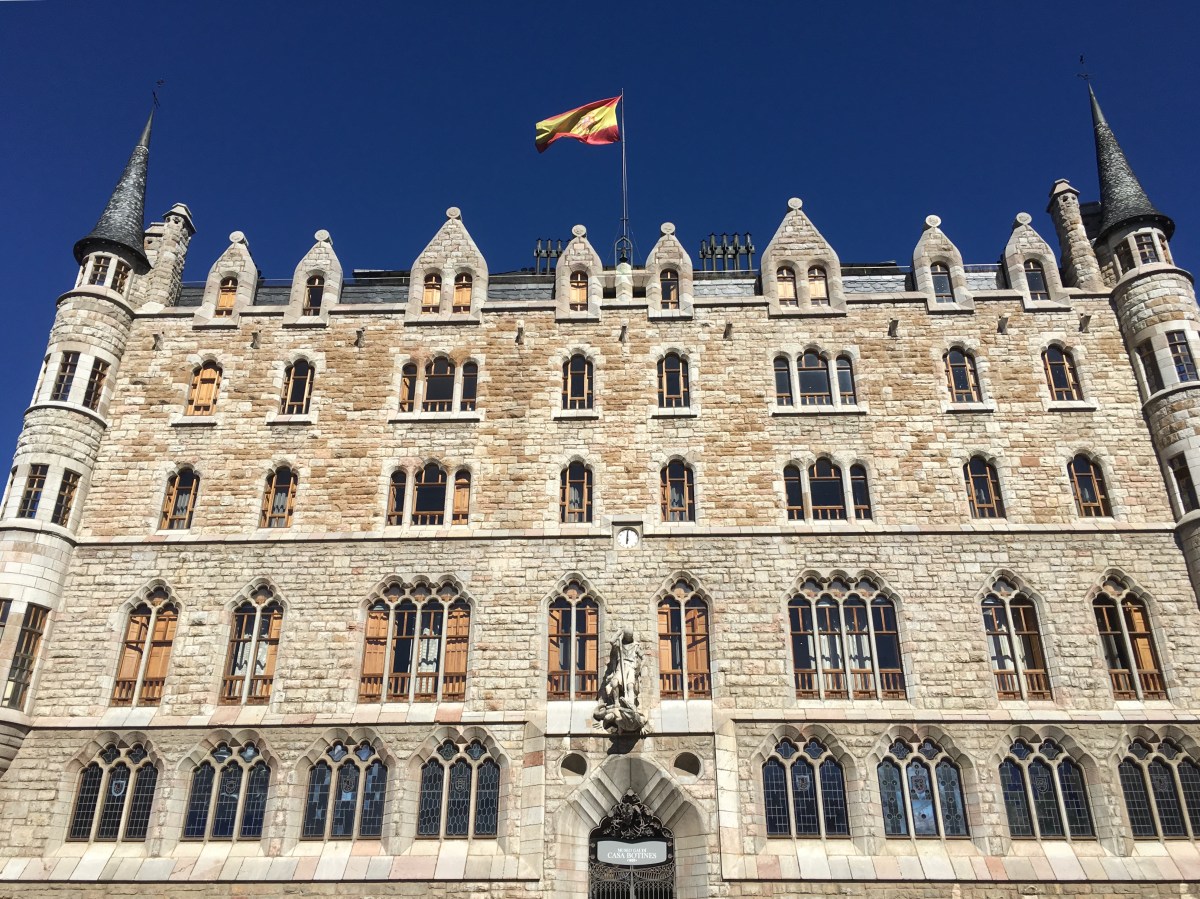
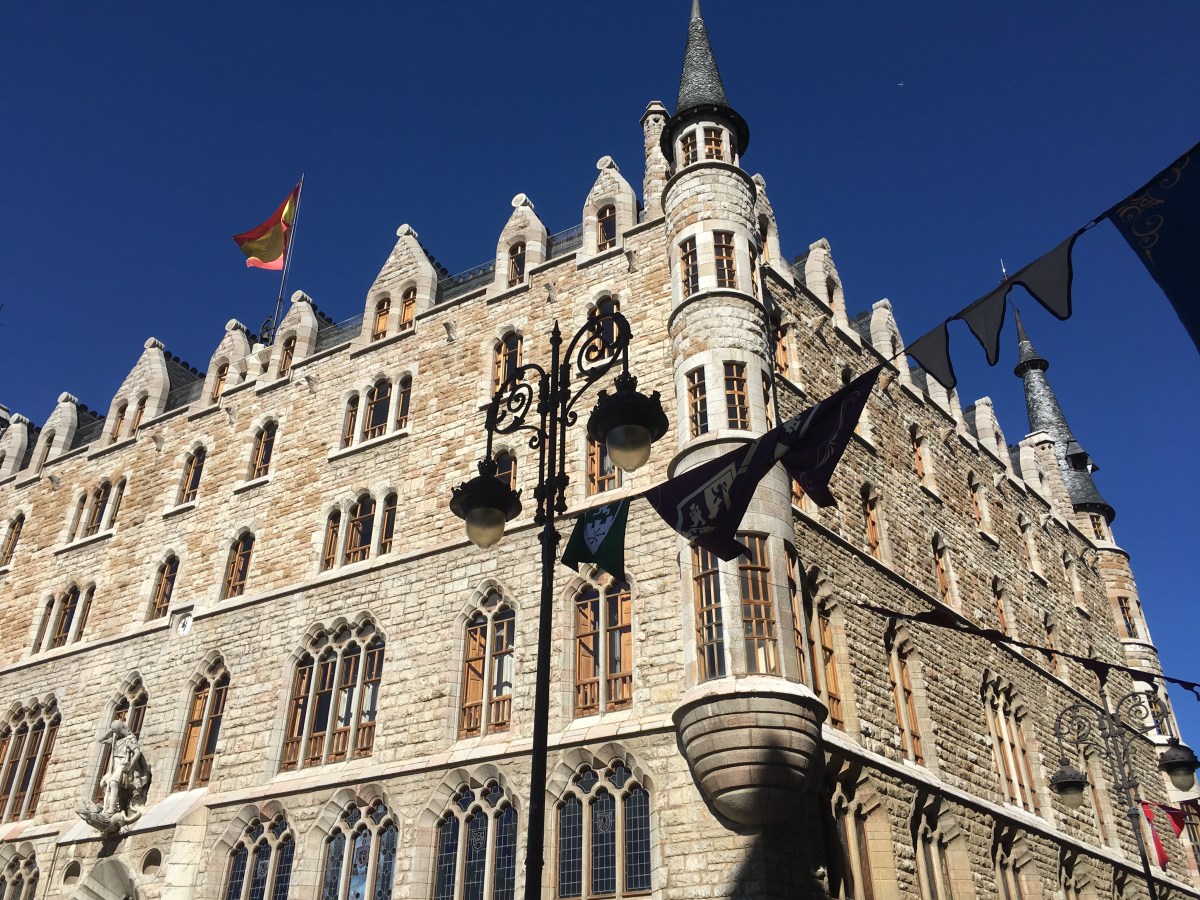
On Plaza de San Marcelo, I found Gaudi’s imposing architectural masterpiece, the neo-Gothic palace Museo Gaudi Casa de Botines, but it wasn’t open until 5:00.  This was one of the first monumental buildings built with private funds as a secular, middle class structure. Before this, most buildings were funded by religious organizations or aristocracy. It’s still a medieval design with the slender towers and the image of St. George slaying the dragon above the main door.

fullsizeoutput_16b32

Museo Gaudi Casa de Botines

IMG_7754

Museo Gaudi Casa de Botines

The Plaza de San Marcelo is also commanded by the fabulous Ayuntamiento Viejo, or Old Town Hall.

fullsizeoutput_16b33

Ayuntamiento Viejo

I strolled through a sprawling crafts market; I was enticed by many goods but unable to buy.

café
café
crafts market
crafts market
porcelain at the crafts market

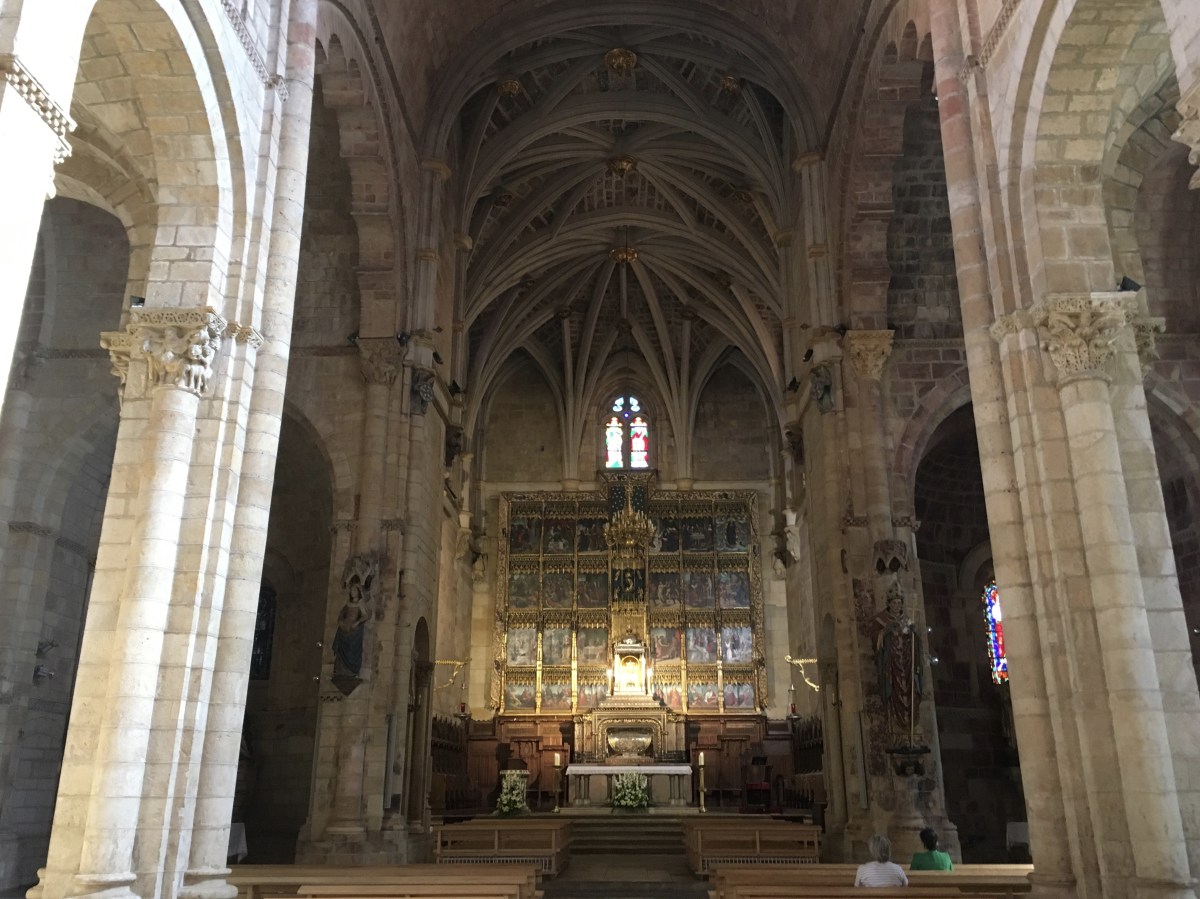
I walked to Real Colegiata de San Isidoro, an 11th century Basilica Church located on the site of an ancient Roman temple.  The remains of San Isidoro were brought here from Seville to be buried in Christian Spain as the south was still under Moorish control at that time. Isidoro had been archbishop of Seville and was the most celebrated academic and theologian of Visigothic Spain in the period preceding the Arab invasions.

I went into the church but not the museum.  Later, Darina told me they required guests take a guided tour, one hour long and all in Spanish.  She said it was fabulous.  It turned out I missed it.

fullsizeoutput_19dbd

Real Colegiata de San Isidoro

IMG_7767

streets of León

IMG_7768

streets of León

I returned to La Madriguera Hostel, where Alba checked me into a shared room with one young Spanish lady who was selling soap in the craft market. Each room only had two beds.  As I was preparing to shower and do laundry, Darina wrote that she was sitting down to lunch at Plaza del Grano.  I went to meet her at the café, where I enjoyed her company and a vegetable tortilla and beer in the square beside a closed church, Nuestra Señora del Mercado.

fullsizeoutput_19dbe

vegetable tortilla and beer

IMG_7773

Nuestra Señora del Mercado

Plaza del Grano
Plaza del Grano
Plaza del Grano
Plaza del Grano

I finally returned to my hostel at 4:00, showered and did laundry.  I was hoping to make it to one of the museums, but there was no time.

fullsizeoutput_16b2e

León laundry

I met Darina for the pilgrim mass at 6:00.  There was no laying on of hands at this mass. After mass, we were able to walk through the cloisters.

IMG_7780

Catedral de Santa María de León

fullsizeoutput_19dc0

Catedral de Santa María de León

fullsizeoutput_16b18

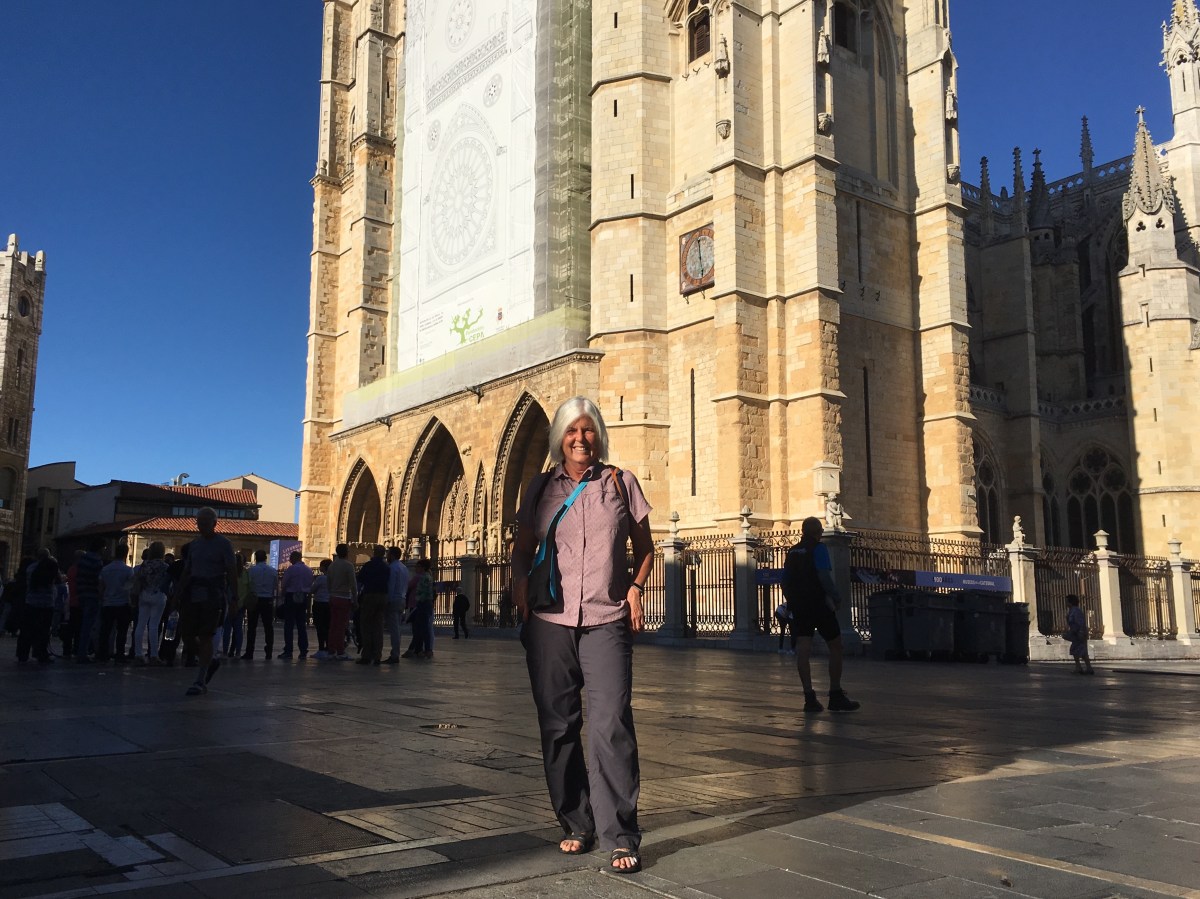
me at Catedral de Santa María de León

fullsizeoutput_16b17

Catedral de Santa María de León

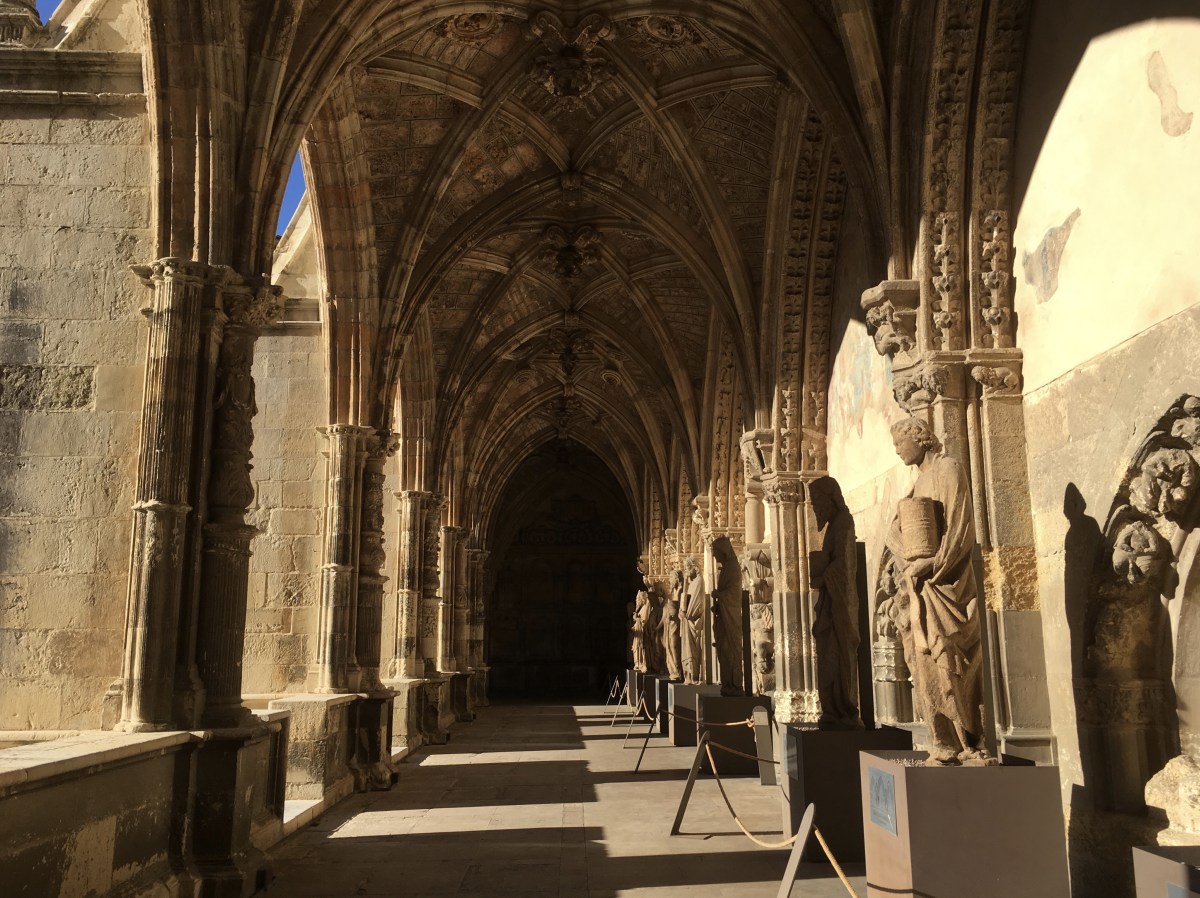
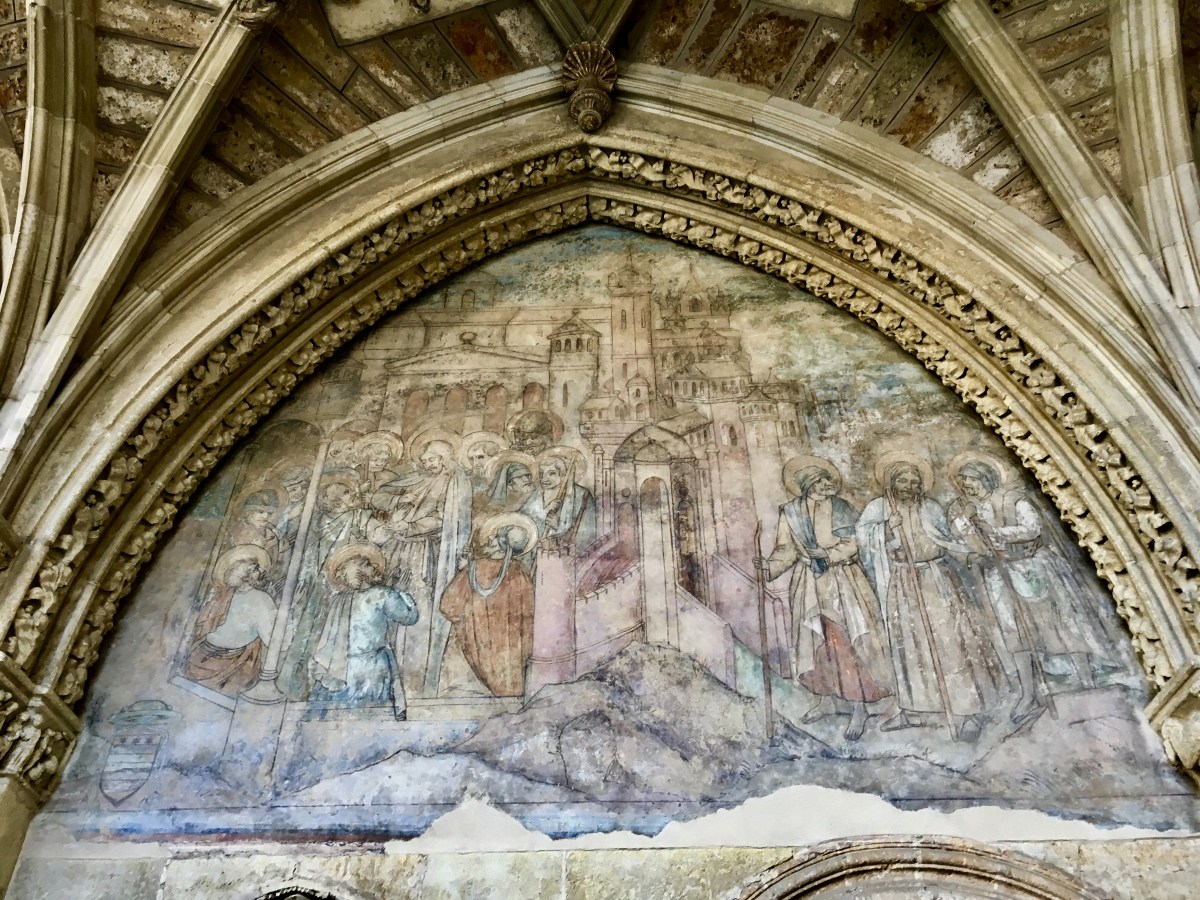
I was able to visit the cloisters on the north side of the Cathedral because I attended the pilgrim mass, but I wasn’t able to go into the museum.

fullsizeoutput_19dc3

cloister at Catedral de Santa María de León

fullsizeoutput_19dc5

cloister

fullsizeoutput_19ddb

inside Catedral de Santa María de León

cloister of Catedral de Santa María de León
inside Catedral de Santa María de León
Catedral de Santa María de León

After mass, we went to Mango to get two t-shirts and some gloves. Then we went to the tapas area, Barrio Húmedo (“wet quarter” as in alcohol), with its cluster of lively bars and restaurants.

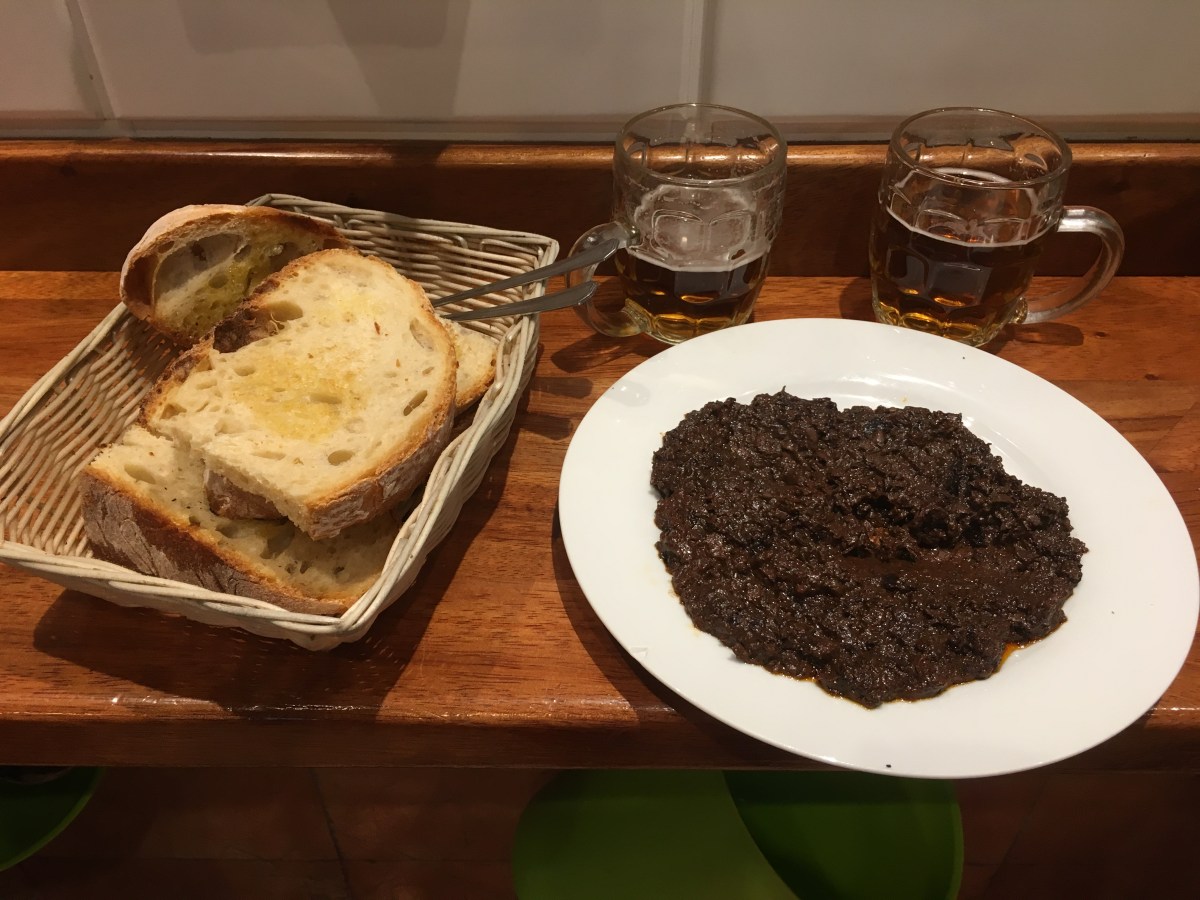
We sought out La Bicha, a restaurant recommended by Darina’s Spanish friends. The place was packed and standing room only. Many tapas places don’t have tables or chairs.  The specialty was morcilla, or blood sausage. We shared a huge plate, which we spread on bread, accompanied by beer. León didn’t seem to have the kinds of tapas we found in Pamplona, Logroño or Burgos, but we made do.  Though it didn’t look very appetizing, it was actually quite tasty.

IMG_7818

morcilla at La Bicha

We chatted about many things.  Darina told me she’d had a boyfriend for ten years, but they broke up because he was too boring. She commented that she didn’t think the movie, The Way, was realistic, especially the part about those four characters randomly meeting and then walking together the whole way.  We agreed that such a scenario was unlikely.  However, we did think of a few people we met that did join together for the duration, like Australian Karen and Taiwanese Chun-Yu.

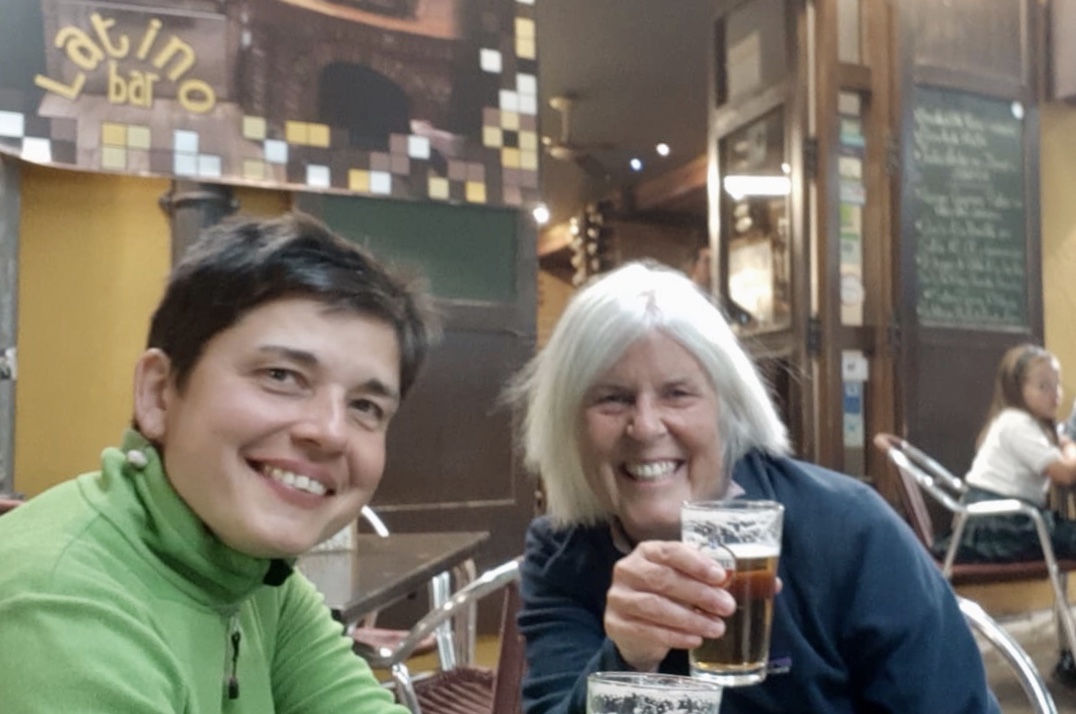
After dinner at La Bicha, we had a beer outside another cafe.  It was such a fun night altogether, as Darina has a great sense of humor; we always managed to find a lot to laugh about.

fullsizeoutput_19ded

Darina and me enjoying beers at Barrio Húmedo

I walked back to my hostel late, and all night long I imagined bed bugs crawling all over me.

**********

*Day 30: Wednesday, October 3, 2018*

*31,444 steps, or 13.33 miles: Arcahueja to León (8.2 km)*

You can find everything I’ve written so far on the Camino de Santiago here:

  • Camino de Santiago 2018

**************

On Sundays, I post about hikes or walks that I have taken in my travels; I may also post on other unrelated subjects. I will use these posts to participate in Jo’s Monday Walks or any other challenges that catch my fancy.

This post is in response to Jo’s Monday Walk, but since Jo has been out of town for a while, she hasn’t done one in a while. 🙂

Share this:

  • Click to share on X (Opens in new window) X
  • Click to share on Facebook (Opens in new window) Facebook
  • More
  • Click to email a link to a friend (Opens in new window) Email
  • Click to print (Opens in new window) Print
  • Click to share on Pinterest (Opens in new window) Pinterest
Like Loading...
  • American Road Trips
  • Cincinnati
  • Midwestern Triangle

cincinnati’s krohn conservatory

wanderessence1025's avatar wanderessence1025 August 15, 2019

Since it was snowing and raining on the early March day we visited Cincinnati, we gravitated to warm places, beginning with the Irwin M. Krohn Conservatory, where we could pretend we were in the tropics.

fullsizeoutput_19e81

Irwin M. Krohn Conservatory

fullsizeoutput_19e82

inside Krohn Conservatory

img_4583-e1565205951405.jpg

waterfall in Krohn Conservatory

In Cincinnati’s Eden Park, a greenhouse for public display opened in 1902.  Later, the old buildings were replaced with a new building in the Art Deco style and opened to the general public in 1933. In 1937, the Park Board named the new conservatory the Irwin M. Krohn Conservatory, in honor of Irwin Krohn’s 25 years of service to the Board of Park Commissioners.

In 1939, an addition was built to hold the Desert House.  In the 1970s, a gift shop was built and the entrance to the building was enlarged.  In 1995, the John Carroll Bonsai Gallery was opened.  In 1996, Krohn hosted the first Blockbuster Show, featuring butterflies, which has evolved into the annual Krohn Butterfly Show.

Now Krohn has six permanent display areas housing more thant 1,000 species of plants. The Fern House holds tropical plants, the Palm House holds a waterfall and palm trees and exotic plants, the Floral Display House has changing seasonal exhibits and a permanent collection of citrus trees. The Bonsai Collection has beautiful tiny trees crafted by the Bonsai Society. The Orchid House displays many species of orchids as well as the Carnivorous Plant Collection.

fullsizeoutput_19e8e

The Fern House

fullsizeoutput_19e97

The Fern House

Ram's Horn Croton
Ram’s Horn Croton
The Fern House
The Fern House
Variegated Hibiscus
Variegated Hibiscus
Lobster claw
Lobster claw
The Fern House
The Fern House
The Fern House
The Fern House
Strawberry Guava
Strawberry Guava
The Fern House
The Fern House
fullsizeoutput_19ea5

Mike at Krohn Conservatory

fullsizeoutput_19eaa

The Fern House

fullsizeoutput_19eae

Allspice

IMG_6226

Me on a bonsai bench

fullsizeoutput_19eb2

Floral Display House

IMG_3208

Floral Display House

fullsizeoutput_19eb3

Floral Display House

IMG_3214

Floral Display House

fullsizeoutput_19eb8

Floral Display House

IMG_3218

Floral Display House

Poinsettia Christmas tree
Floral Display Room
Floral Display Room
Floral Display Room
Floral Display Room
Floral Display Room
Floral Display Room
Calamundin Orange
Calamundin Orange
Floral Display Room
Floral Display Room

We saw ferns, painterly green leaves, yellow slender polka dot leaves, dimpled leaves with spiky edges, green- and pink-tinged leaves, strawberry guava, zigzag shrubs. We took turns sitting in butterfly and bonsai tree benches.  We strolled amidst coleus, tulips, a Christmas tree made of poinsettias, Ponderosa lemons, collages of spring, Calamundin Orange from China and Japan, Grapefuit “Rio Red,” Fragrant Elephant Tree with peeling bark, Spear Sansevieria from Angola, Bishop’s Cap, a wooden sculpture in the Desert Room, Indian Spurgetree, Dragon Bones and Spider Aloe. In the Desert Room, we were prickled pink by Pipe Organ Cactus, Golden Barrel Cactus, Madagascan Ocotillo, Blue Flame Cactus.  Our day was brightened by orchids, trained ficus trees and a tunnel of colorful flowers.

fullsizeoutput_19ec2

Fragrant Elephant Tree

fullsizeoutput_19ec5

Indian Spurgetree

fullsizeoutput_19ec7

Desert Room

fullsizeoutput_19ec9

Cactus

Indian Spurgetree
Indian Spurgetree
Indian Spurgetree
Indian Spurgetree
Dragon Bones
Dragon Bones
Pipe Organ Cactus
Pipe Organ Cactus
Golden Barrel Cactus
Madagascan Ocotillo
Madagascan Ocotillo
Blue Flame Cactus
Blue Flame Cactus
Elkhorn Euphorbia
Elkhorn Euphorbia
Floral Display Room
Floral Display Room
orchid
orchid
Venus Flytrap
Venus Flytrap
bonsai
bonsai
Mike in a tunnel of flowers
Coleus
Coleus
IMG_4643

Spirit of ’76 by William Finn

fullsizeoutput_19eed

Floral Display Room at Krohn Conservatory

*Sunday, March 3, 2019*

*6,451 steps, or 2.73 miles*

*********************

“PHOTOGRAPHY” INVITATION:  I invite you to create a photography intention and then create a blog post for a place you have visited. Alternately, you can post a thematic post about a place, photos of whatever you discovered that set your heart afire. You can also do a thematic post of something you have found throughout all your travels: churches, doors, people reading, people hiking, mountains, patterns, all black & white, whatever!

In my case, my intention was to look for thematic possibilities during my trip to Cincinnati and I found warmth and joy in the midst of an icy winter day at the Krohn Conservatory.

You probably have your own ideas about this, but in case you’d like some ideas, you can visit my page: photography inspiration.

I challenge you to post no more than 20-25 photos (I have a lot more here!) and to write less than 1,500 words about any travel-related photography intention you set for yourself. Include the link in the comments below by Wednesday, August 28 at 1:00 p.m. EST.  When I write my post in response to this challenge on Thursday, August 29, I’ll include your links in that post.

This will be an ongoing invitation, every first, second, and third (& 5th, if there is one) Thursday of each month. Feel free to jump in at any time. 🙂

I hope you’ll join in our community. I look forward to reading your posts!

the ~ wander.essence ~ community

I invite you all to settle in and read a few posts from our wandering community.  I promise, you’ll be inspired!

  • Sheetal, of sheetalbravon, posted about some beautiful art she found underground in Stockholm.
    • Most Instagrammable Metro Stations of Stockholm

Thanks to all of you who shared posts on the “photography” invitation. 🙂

Share this:

  • Click to share on X (Opens in new window) X
  • Click to share on Facebook (Opens in new window) Facebook
  • More
  • Click to email a link to a friend (Opens in new window) Email
  • Click to print (Opens in new window) Print
  • Click to share on Pinterest (Opens in new window) Pinterest
Like Loading...
  • American Road Trips
  • Cincinnati
  • Covington

bridges, parks & three cities around the ohio river

wanderessence1025's avatar wanderessence1025 August 13, 2019

Cincinnati, Ohio sits on the northern bank of the Ohio River, and serves as the southern boundary of Ohio. Across the river to the south sit Newport and Covington, Kentucky.  During the Civil War, not only did the Ohio River divide North and South, but it was a major trade route during the 1800s for residents in Ohio, Kentucky, Indiana, and Illinois. Farmers and manufacturers sent their crops and finished products on barges downstream to the Mississippi River, and then on to New Orleans. To this day, the Ohio River continues to serve as a major artery for transporting bulk items such as coal and grain.

Cincinnati’s downtown area has been under a revitalization project since 2011, following the 2008 recession.  Once the epicenter of freight rail for the western U.S.A., it had experienced a slowdown of commercial growth and a population decline.  The ongoing investment in commerce and infrastructure was vital to bringing the city to life again.

The Ohio River here is spanned by numerous bridges. Steel plays heavily in construction of bridges, buildings and sports stadiums, with brick also prevalent.

In downtown Cincinnati,  I stopped for lunch at Condado Tacos, a lively place to warm up, with its colorful wall murals and funky vibe. While eating my tacos — “Ooey-Gooeys,” with corn hard shells, black beans, queso blanco, roasted chicken, cilantro+onions & dirty sauce — I studied my designated walking route.  I threw myself out into the cold and gloomy winter streets to do the walk outlined in Walking Cincinnati: “Ohio River: Bridges, Parks, and Three Cities.”

Condado Tacos
Condado Tacos
inside Condado Tacos

I poked around briefly at the Great American Ball Park, home of the Cincinnati Reds, baseball’s first professional franchise, with its giant baseball and sculptures of famous Reds players.  It opened in 2003 at a cost of $280 million, an assemblage of 10,100 tons of steel.  As it wasn’t baseball season and since I’m not a baseball fan, I made my way west  down West Freedom Way.

Great American Ball Park

I strolled down West Freedom Way with its bicycles for hire and its lineup of restaurants and shops.

IMG_4402

West Freedom Way

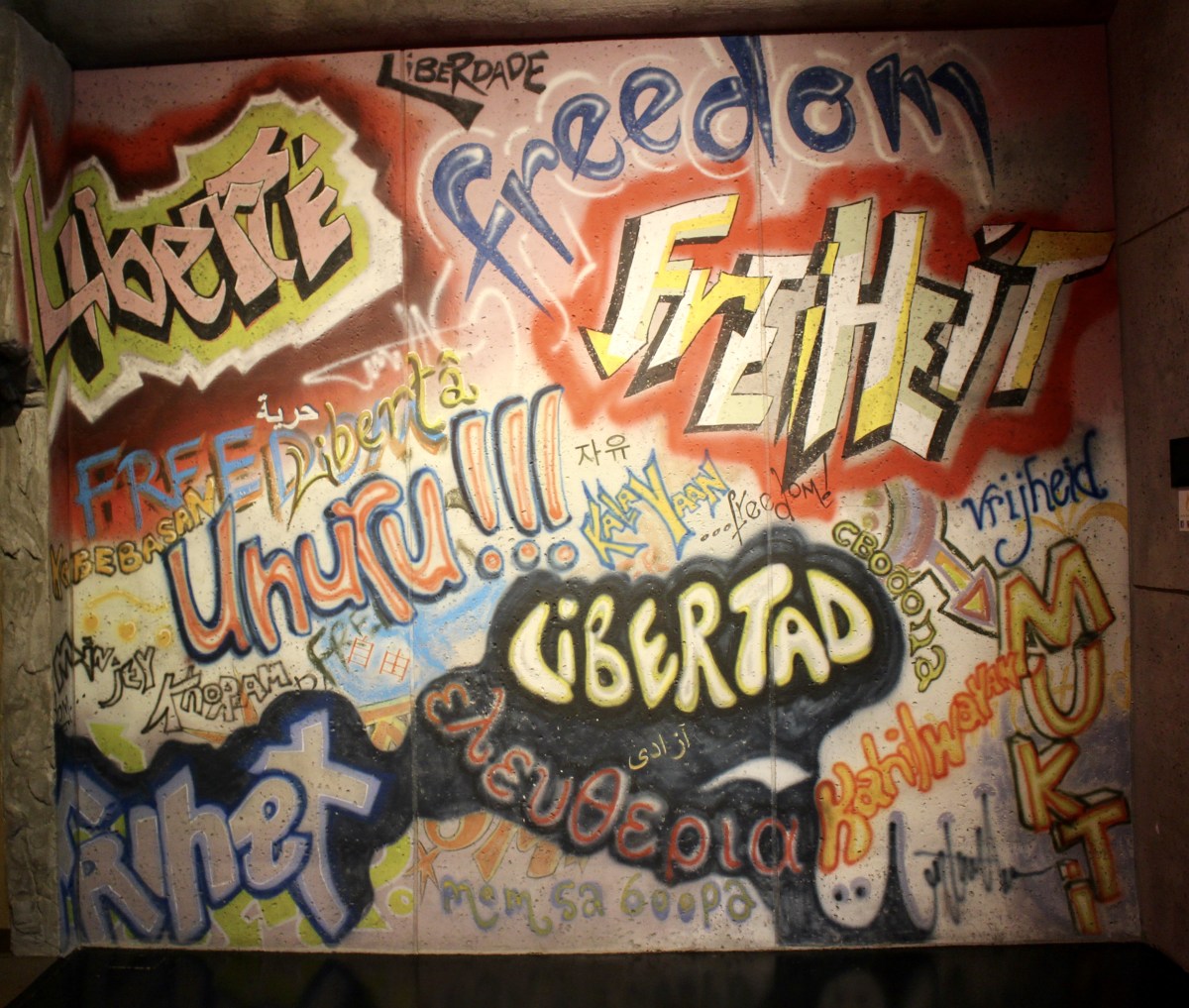
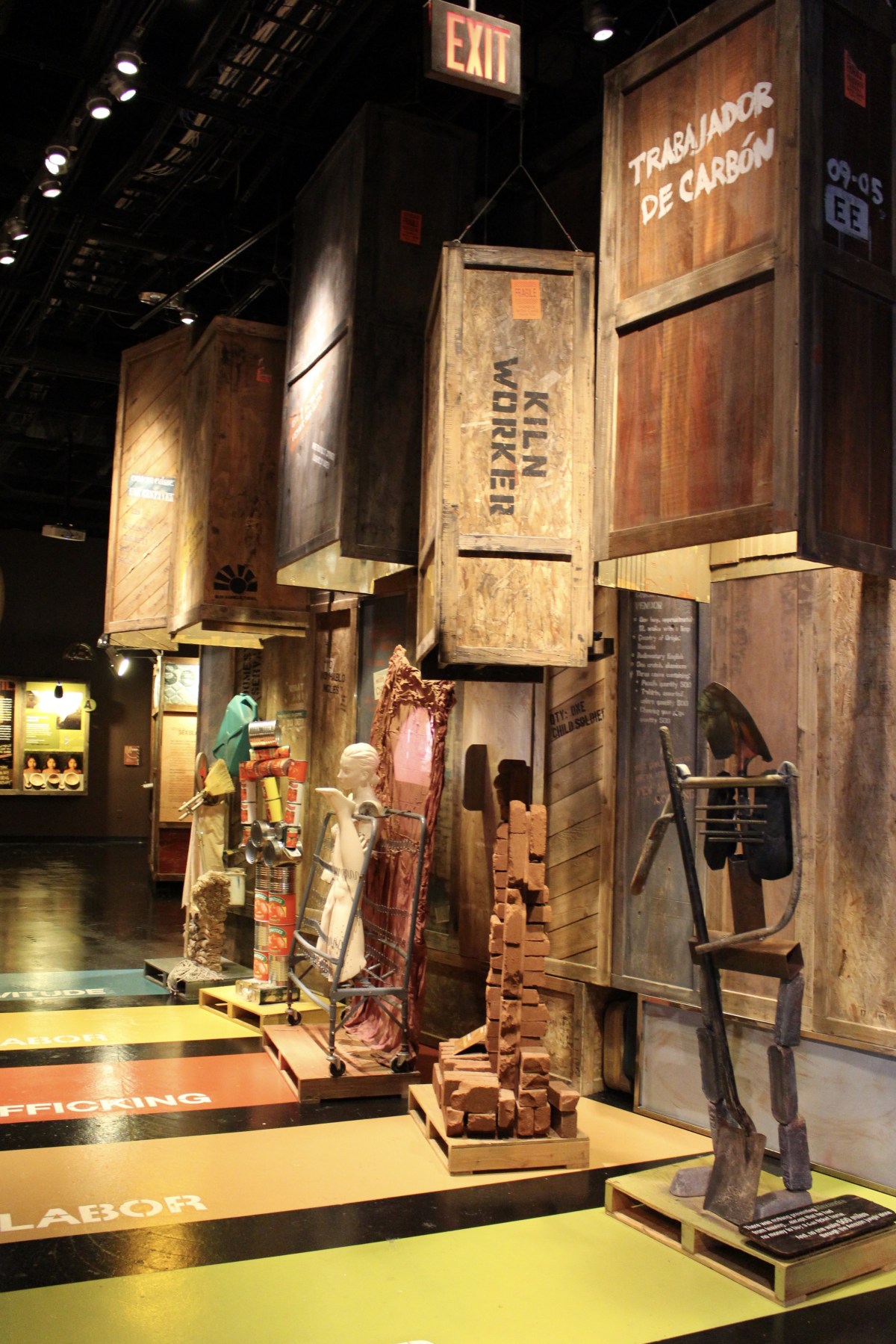
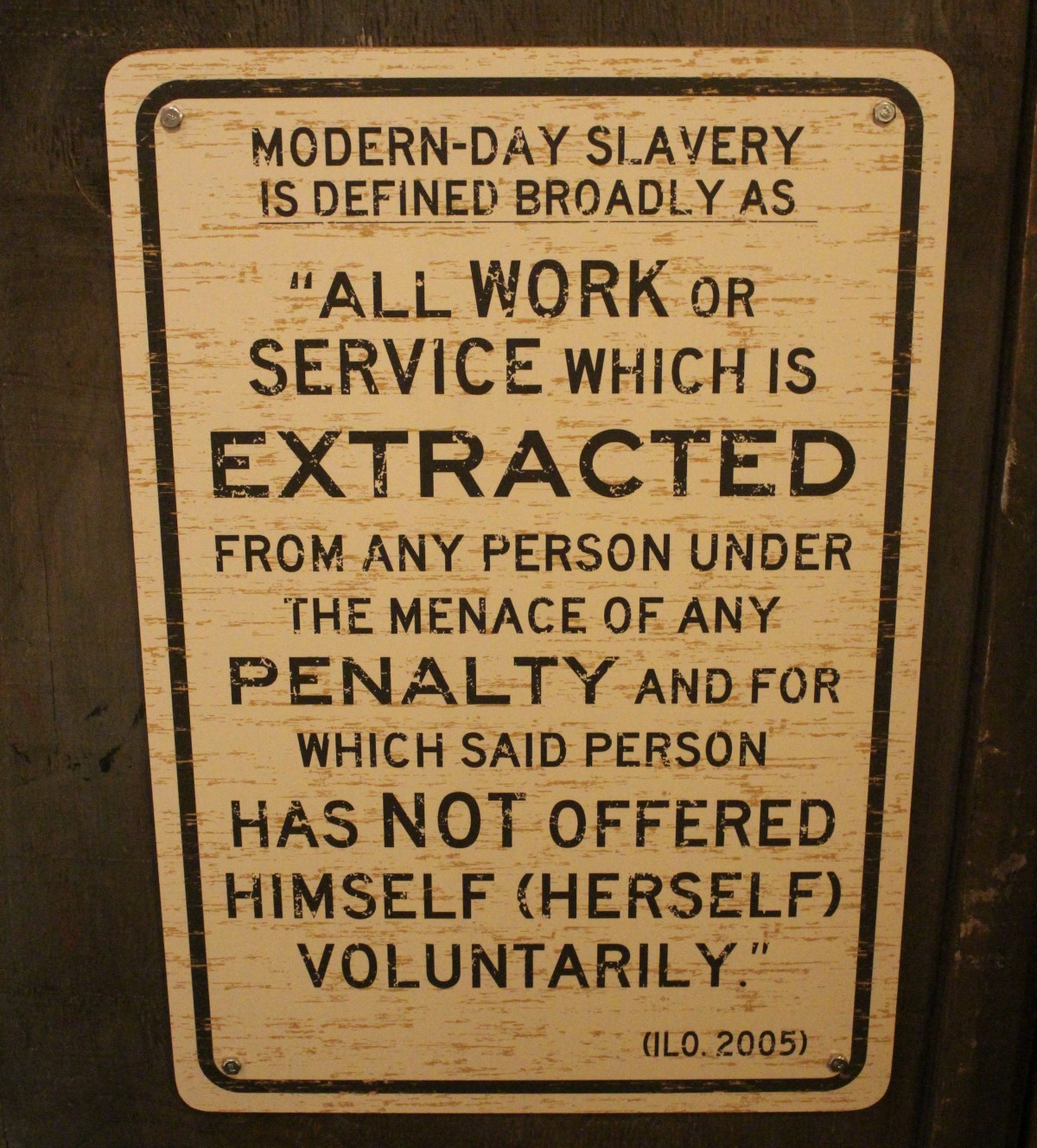
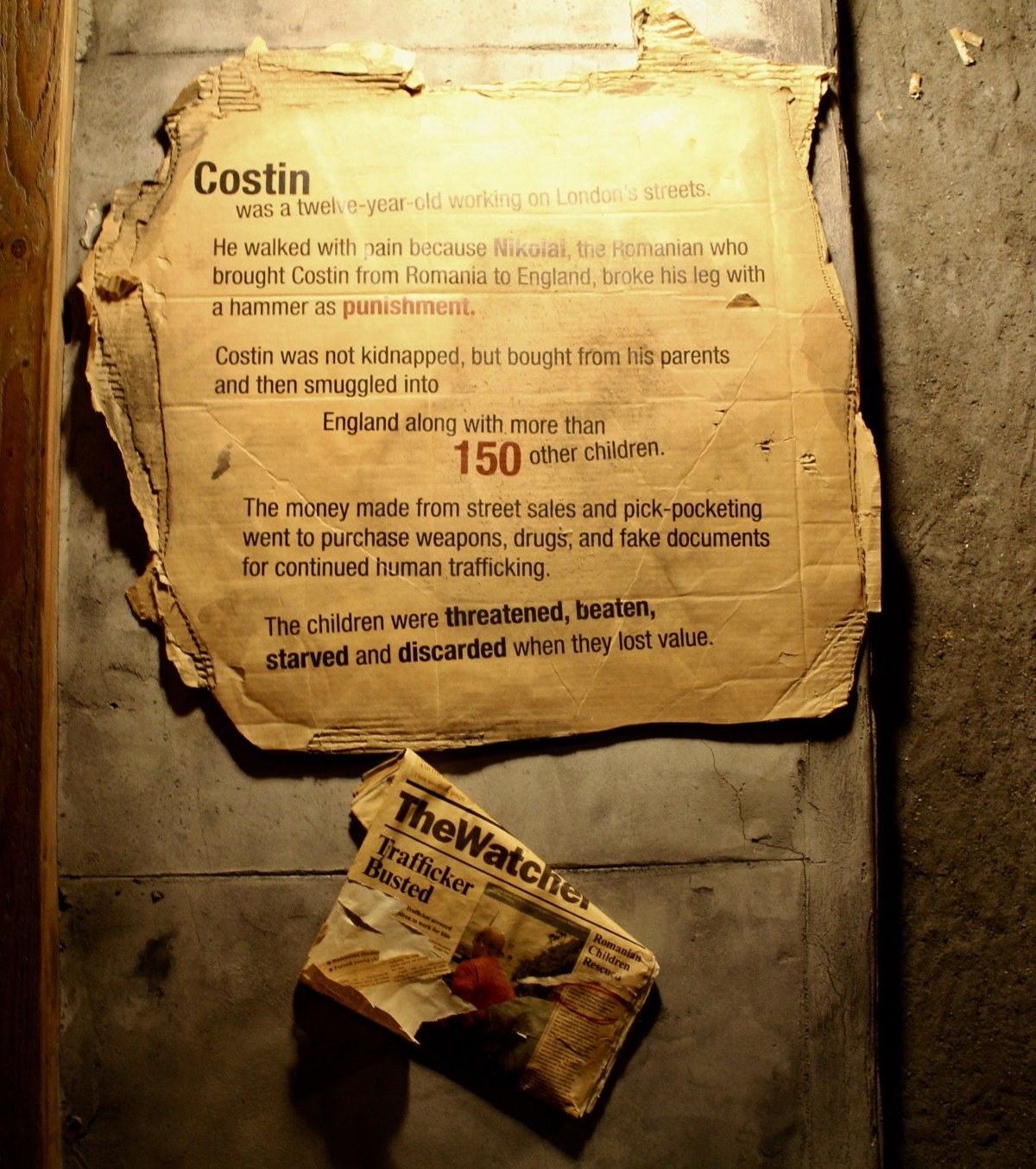
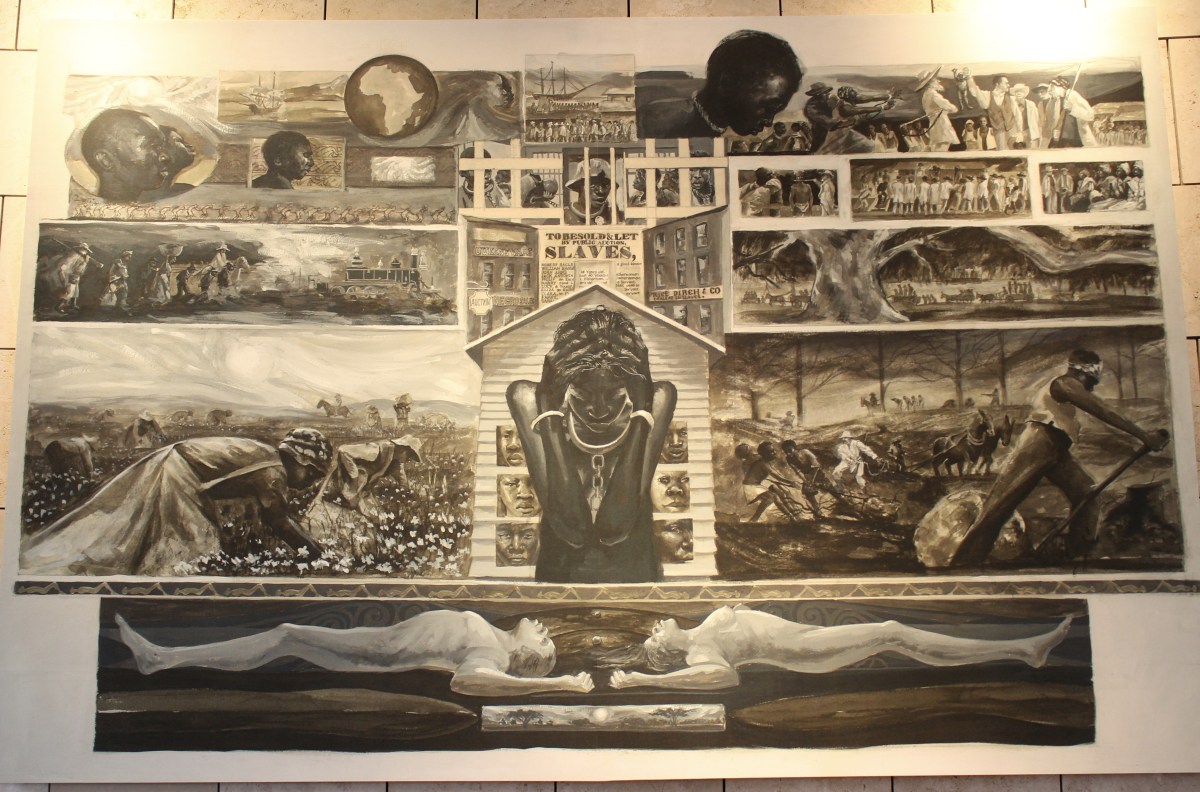
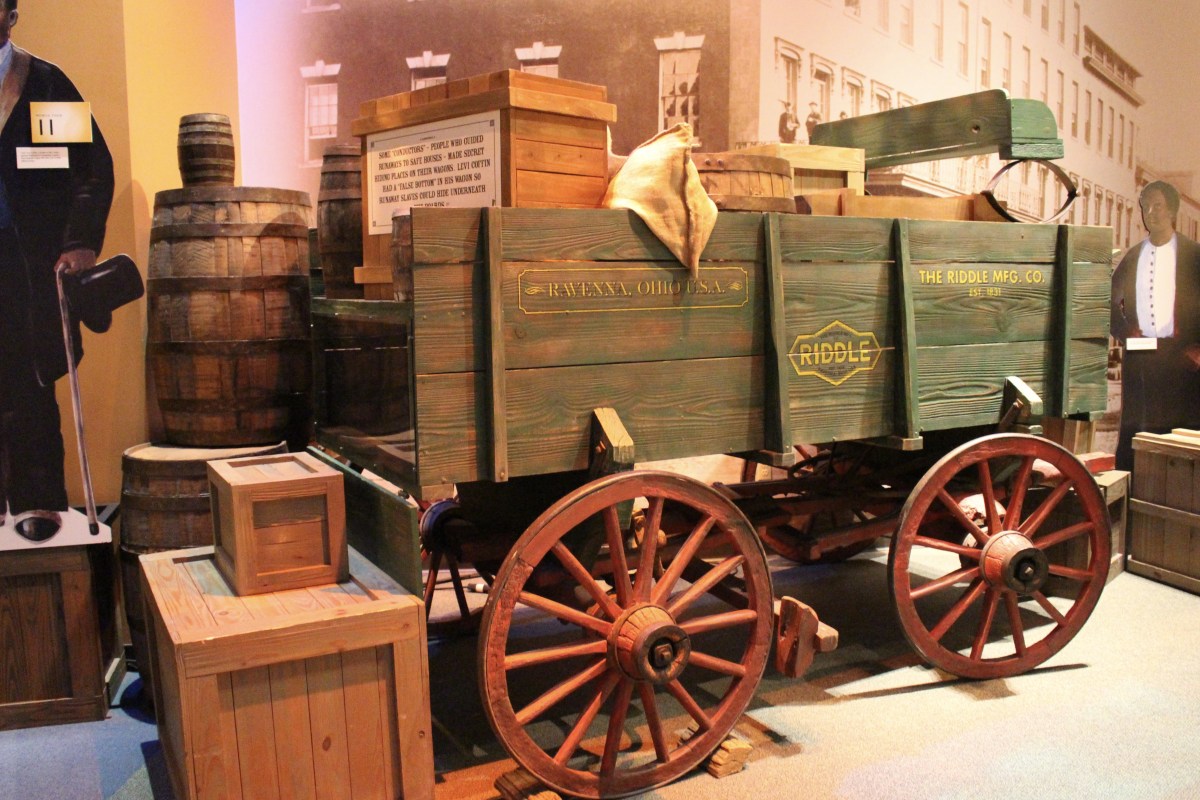
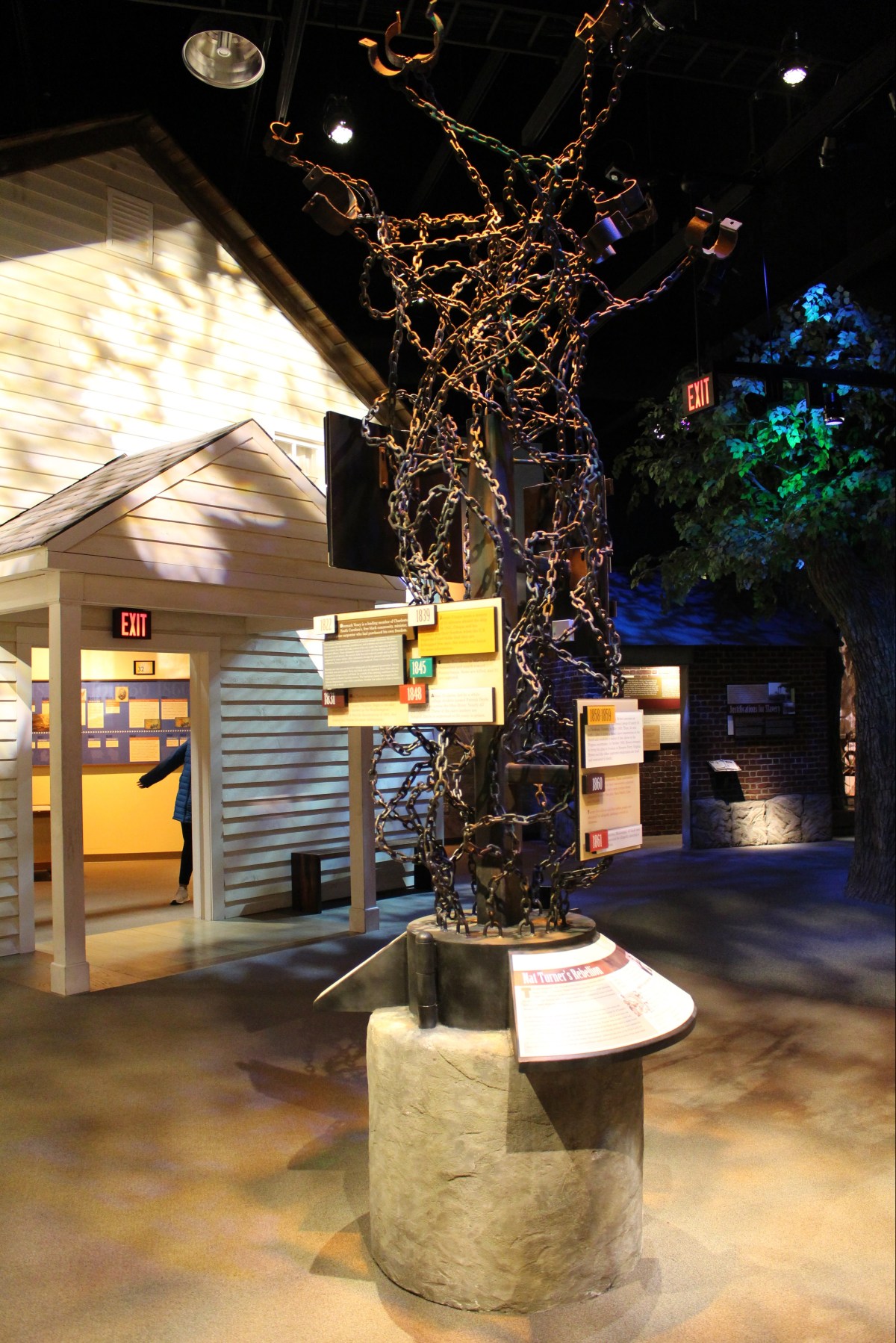
I visited the National Underground Railroad Freedom Center, where I learned all about the enslaved people in the world today, sex trafficking, the history of slavery in the Americas, the Civil War and the Emancipation Proclamation, the economic justifications for slavery – generally greed! – and much more, which I’ll write about in another post.

fullsizeoutput_19c6a

National Underground Railroad Freedom Center

As part of my visit through the dark history of slavery in our country and in the world, I stood on the second-story balcony of the museum and admired the 15-story-tall Skystar Wheel.  The Skystar, which was to temporarily call Cincinnati home until June 16, 2019, is the largest portable observation wheel in North America, with 36 climate-controlled gondolas.

IMG_3140

Skystar Wheel

I passed through connecting parks along the Ohio River, starting with the 45-acre John G. and Phyllis W. Smale Riverfront Park, opened in 2012 and meant to be the city’s front yard.

fullsizeoutput_19cb2

John G. and Phyllis Smale Riverfront Park

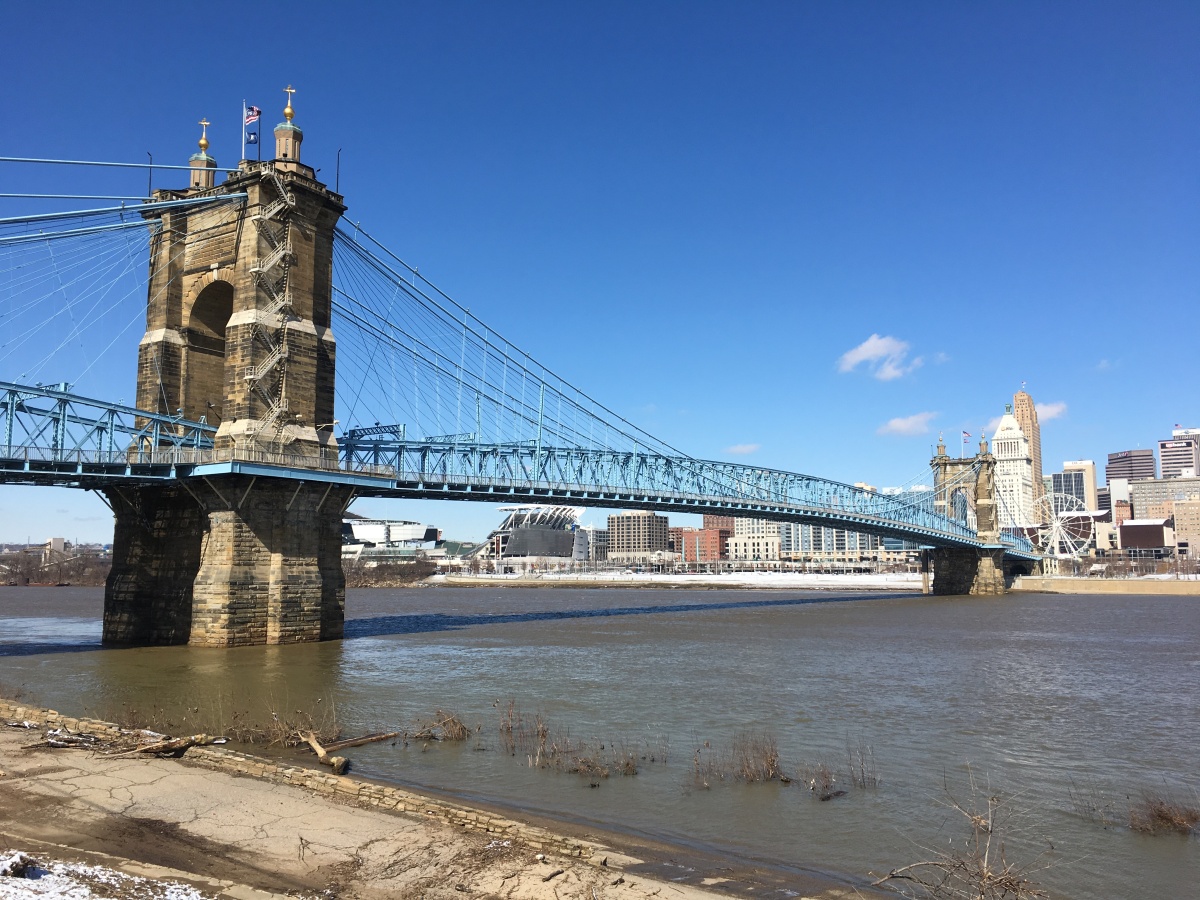
The park straddles the John A. Roebling Suspension Bridge, originally the Cincinnati-Covington Bridge, which spans the Ohio River. When it opened on December 1, 1866, it was the longest suspension bridge in the world, with its main span of 1,057 feet (322 meters).  It was listed on the National Register of Historic Places in 1975 and was designated a National Historic Civil Engineering Landmark in 1982.

fullsizeoutput_19cb9

Roebling Suspension Bridge

fullsizeoutput_19cc0

John G. and Phyllis Smale Riverfront Park

In the park, the Black Brigade Monument is a monument to Cincinnati’s little-known Black Brigade. When Confederate forces in Kentucky threatened Cincinnati in August of 1862, black residents offered their services to defend the city but were told the Civil War wasn’t their war to fight. Instead, they were rounded up by police against their will, treated roughly and often forced to work at gunpoint building defensive fortifications.  The Cincinnati Daily Gazette was the only local newspaper to denounce the treatment of the blacks and call for them to be “treated like men.” General Lew Wallace, military commander of Cincinnati, helped to remedy the situation, and organized the men along military lines, christening them the Black Brigade.  Under this new organization, the men volunteered to dig rifle pits, clear trees, and build forts, magazines and roads; they were finally paid after the second week of their labors.

fullsizeoutput_19cc1

Black Brigade Monument

I passed the 1923 Showboat Majestic docked along shore of the Ohio River. In 1980, it was added to the National Register of Historic Places and has been recently used for stage productions. I walked under the Taylor Southgate Bridge into the 1976 Yeatman’s Cove Park, with its Serpentine Wall, a contoured concrete wall of steps into the Ohio River, much like the ghats on India’s Ganges. I found a flying pig sculpture, “Lucius” (Lucky) Quinctus Pigasus, and a 12-foot statue of Cincinnatus, a Roman soldier (circa 458 B.C.) and farmer after whom Cincinnati is named, honoring the volunteer spirit of the citizen-soldier.

Showboat Majestic
Showboat Majestic
Taylor-Southgate Bridge
flying pig sculpture
Cincinnatus sculpture
serpentine wall at Yeatman's Cove Park
serpentine wall at Yeatman’s Cove Park
Yeatman's Cove Park
Yeatman’s Cove Park

I crossed the Purple People Bridge, officially called the Newport Southbank Bridge, for my interstate walk to Newport, Kentucky.  Formerly the L&N Railroad Bridge, it is now designated pedestrian-only. I cringed under huge shark mural on the side of the Newport Aquarium at Newport on the Levee, and then wandered through the bustling area full of restaurants, shops and a movie theater.

fullsizeoutput_19cd9

Newport Aquarium

Longing for peace and quiet, I made my way to the top of the levee to the 1995 Newport Riverwalk, with views of the Ohio River and the Cincinnati skyline.  Strolling west, I crossed the 4th Street Bridge, officially known as Veterans’ Memorial Bridge, over the Licking River into Covington, Kentucky.

fullsizeoutput_19cda

Newport’s Riverwalk

fullsizeoutput_19cdb

Ohio River from Newport’s Riverwalk

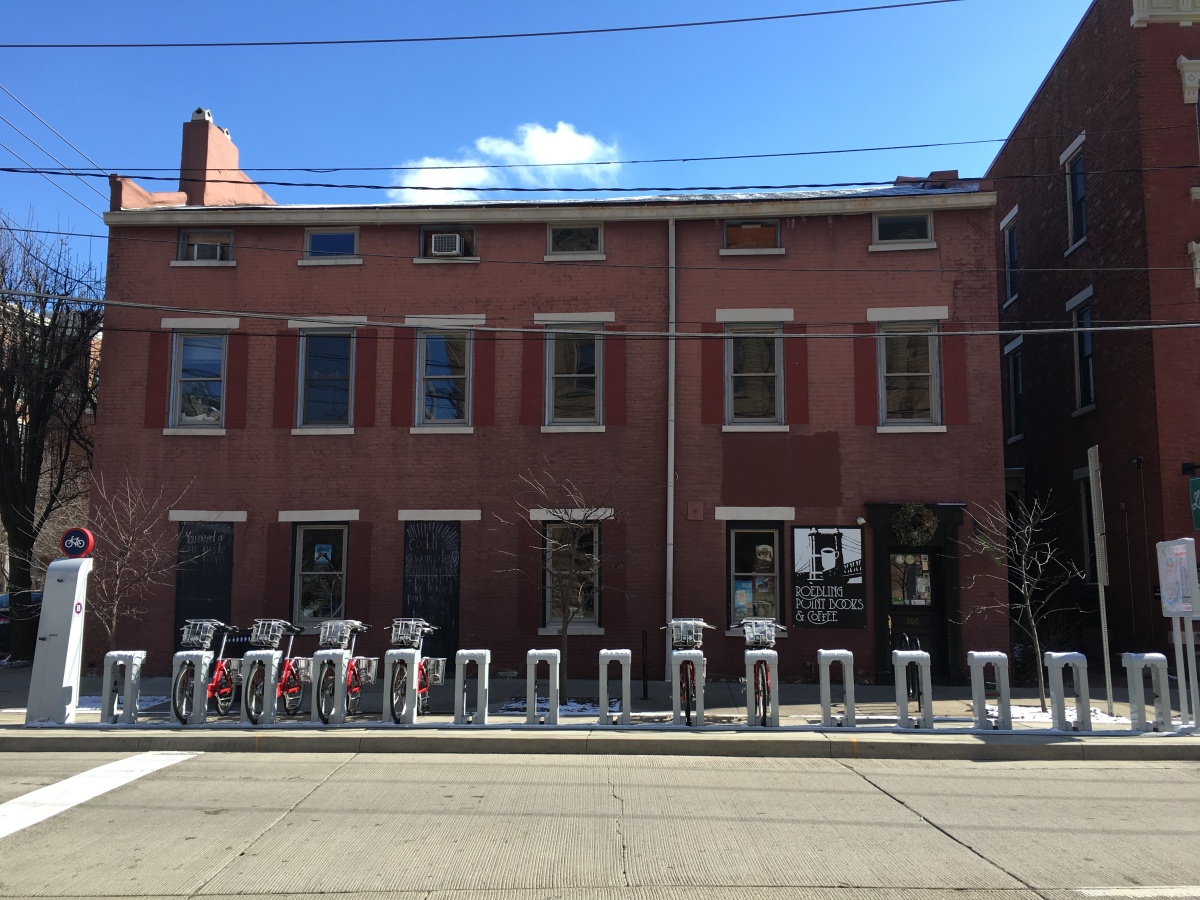
By the time I reached Covington, Kentucky, and the Roebling Point Business District, I was cold and tired.  I dropped into Roebling Point Books and Coffee, where I bought a couple of new books because I always like to support independent bookstores.

I couldn’t help but notice the tall blue and white building jutting into the clouds in Covington.  A residential building called the Ascent at Roebling’s Bridge, it was completed in March 2008 at a cost of approximately $50 million. It is said the design was influenced by the Ohio River and the Roebling Bridge.  Its 22 stories house 70 condominiums. Clad in a glass curtain wall, it slopes outward from its base on its eastern face and ends in a sloped spiral roof.

fullsizeoutput_19cde

Covington, Kentucky

fullsizeoutput_19ce1

Covington, Kentucky

fullsizeoutput_19ce2

Covington, Kentucky

Leaving Covington, I walked across the Roebling Suspension Bridge, as the passing cars hummed a tune.  Because of this hum, the bridge is often called ‘The Singing Bridge.” The bridge is famous for its role in opening access between the North and South. When the project began in 1856, it had to overcome hurdles to its construction, including ferryboat and steamboat operators who were concerned about losing their businesses.  The South was worried slaves would escape across the bridge, and the North didn’t want Confederate troops to have easy access to Cincinnati. Because of these concerns, the Cincinnati City Council passed an ordinance that the bridge could not line up with existing streets; thus it is placed mid-block between several sets of streets.

fullsizeoutput_19cea

Roebling Suspension Bridge

fullsizeoutput_19cec

Roebling Suspension Bridge

fullsizeoutput_19cee

Roebling Suspension Bridge

fullsizeoutput_19cef

view of Cincinnati from the Roebling Suspension Bridge

fullsizeoutput_19cf5

view of Cincinnati

fullsizeoutput_19cfa

Roebling Suspension Bridge

fullsizeoutput_19cfd

Roebling Suspension Bridge

fullsizeoutput_19cfe

John G. and Phyllis W. Smale Riverfront Park

fullsizeoutput_19d01

Skystar Wheel

fullsizeoutput_19d03

Roebling Suspension Bridge

fullsizeoutput_19d07

Roebling Suspension Bridge

fullsizeoutput_19d08

Skystar Wheel

After my very long walk, I checked into my Airbnb, the Ashbrook, in Covington.  It was very nice!

fullsizeoutput_190e6

the Ashbrook

I went to Molly Malone’s, a three-story Irish pub and restaurant, and sat at the bar.  I ordered a chicken pot pie which I sent back because it was lukewarm; instead of simply sticking it in a microwave, they brought me a whole new hot one.  They said they didn’t have a microwave. I washed it down with a giant mug of Pilsner Urquell. 🙂

fullsizeoutput_19d16

Molly Malone’s in Covington, KY – photo taken March 4

inside Molly Malone's
inside Molly Malone’s
Chicken pot pie
Chicken pot pie

*Saturday, March 2, 2019*

*15,029 steps, or 6.37 miles*

**********************

“PROSE” INVITATION: I invite you to write up to a post on your own blog about a recently visited particular destination (not journeys in general). Concentrate on any intention you set for your prose.

In this case my intention was to write a post reflecting on a theme for the day.  My theme for today was “bridges and architecture.”

It doesn’t matter whether you write fiction or non-fiction for this invitation.  You can either set your own writing intentions, or use one of the prompts I’ve listed on this page: writing prompts: prose. (This page is a work in process.) You can also include photos, of course.

Include the link in the comments below by Monday, August 26 at 1:00 p.m. EST.  When I write my post in response to this invitation on Tuesday, August 27, I’ll include your links in that post.

This will be an ongoing invitation. Feel free to jump in at any time. 🙂

I hope you’ll join in our community. I look forward to reading your posts!

Share this:

  • Click to share on X (Opens in new window) X
  • Click to share on Facebook (Opens in new window) Facebook
  • More
  • Click to email a link to a friend (Opens in new window) Email
  • Click to print (Opens in new window) Print
  • Click to share on Pinterest (Opens in new window) Pinterest
Like Loading...
  • Camino de Santiago
  • Europe
  • Hikes & Walks

{camino day 29} reliegos to arcahueja

wanderessence1025's avatar wanderessence1025 August 11, 2019

What a long and boring walk. First, it was freezing cold (38ºF) when I left Reliegos in the dark at 7 a.m. with two nice ladies, Janine and Margaret from Australia and New Zealand. There was nothing to eat in Reliegos, so we planned to eat in 6.2 km at Mansilla de las Mulas.   We entered the town through the 12th-century Puerta Castillo, the medieval gate in an old wall of adobe and boulders, up to Iglesia de Santa María.

Reliegos to Mansilla de las Mulas Centro (6.2 km)

sculpture in Mansilla de las Mulas

At the far end of town, we still hadn’t found an open cafe. We’d never encountered a town of this size without a bar or cafe on the Camino.

fullsizeoutput_19bf9

Mansilla de las Mulas

fullsizeoutput_19bfb

Mansilla de las Mulas

The two ladies decided to walk on, but I backtracked into the town, determined to find an open cafe. I ran into to Harold and Joan from Texas, who pointed me to a bar we had earlier walked by but thought was closed.  There I met lots of pilgrims: Tom from Alaska, Joyce and John from Oregon, and Sheryl from Seattle. I had my café con leche and toast with tomato and jambon.  We all lingered in the bar before heading back out into the cold.  Darina came in as I was leaving.

IMG_7618

toast with tomato and jambon

Mansilla de las Mulas, with a population of about 1,900, is a town which marks the convergence of two routes, the Real Camino Francés, which enters by the east gate, and the Calzada Romana, which enters by the north gate.

The name of this town comes from Mano en Silla, which means “hand on the saddle,” and features on the coat of arms. The added de las mulas (of the mules) likely refers to the town’s earlier function as a livestock market.

fullsizeoutput_19bfc

Iglesia de Santa María in Mansilla de las Mulas

fullsizeoutput_19bfe

Iglesia de Santa María in Mansilla de las Mulas

After leaving the town, I walked for ages along a busy highway. It is said that the stretch between Mansilla de las Mulas and Villarmoros is the worst on the stage, because it runs beside a noisy, dusty road in suburban surroundings.  I came to a town, Villarmoros, with confusing arrows every which way.  I followed the arrows to the left into a very small town with a bar.

fullsizeoutput_19c10

confusing arrows at Villarmoros

Inside was a wood burning stove, so I sat for a while to warm up while downing some orange juice.  I looked at my Brierley map and saw there wasn’t really a stop here.  So I had gone off the beaten path a bit and had to make my way back.

fullsizeoutput_19c00

fields on the way to Villarmoros

fullsizeoutput_19c04

Villarmoros

IMG_7627

Iglesia de San Esteban in Villarmoros

fullsizeoutput_19c08

Iglesia de San Esteban in Villarmoros

I came to a bar, Casablanca, at the entrance to Puente Villarente and had a pain au chocolate and café con leche. Sheryl stopped by the cafe and said she’d hoped to walk with Darina, but she’d disappeared from the cafe in Mansilla de las Mulas.  She had also hoped to walk with an 80-year-old woman she’d met at dinner the night before, but she’d disappeared too.  I wondered if she thought people were avoiding her. I said Darina was like me in that she usually liked to walk alone.  Some people didn’t enjoy walking alone, and I think Sheryl was one of those people.

Mansilla de las Mulas Centro to Villarmoros to Puente Villarente (6.1 km)

After crossing the unusual curved bridge over the río Porma, I walked straight through the modern and ugly town of Puente Villarente another 4.5 km to Arcahueja on an unattractive track running beneath pylons.  I passed a herd of cows stretched out in a pasture.

fullsizeoutput_16b7e

Puente Villarente

After that, there wasn’t much to look at as we approached the outskirts of León.  Ugh.  I hated the approaches to big cities. I’d liken it to walking through the outskirts of a city like Richmond, VA to get to downtown. I stopped about 8km from León just to avoid going into the city at the end of the day.  I also twisted my ankle today, so it was slow going.

Puente Villarente to Arcahueja (4.5 km)

There wasn’t much in Arcahueja.  It was the last chance to rest in the relative quiet before hitting the traffic of León.  I was happy to have a private room there.  It was so cold and my ankle was so sore that I stopped at every single cafe, making me arrive at the same time I arrived in Reliegos after 20km!

When I arrived at Albergue Turistico la Torre at around 1:00, Sheryl was sitting inside the bar having a salad.  Before showering and doing laundry, I went outside and had a mixed salad and a Radler (limon cerveza) in a bottle.

Sheryl talked about her Camino partner Sharon who she called high maintenance; Sharon had taken a bus today to meet her husband John in León.  Because Sheryl had paid Sharon to organize her entire trip for her, she was tied to her for the duration. Sheryl had been struggling with knee and leg pain and didn’t really feel like walking to León today, but she finally decided to go ahead and walk.

That guy Phil from Britain was staying in the albergue, but he brushed off Sheryl and me. When he decided to talk to the men, you couldn’t shut him up. I met Mark from the Lake District in U.K. who now lived in Spain.  He was covered in dust after walking 45km today.  He had divorced his wife but was still friends with her and was walking the Camino this time to figure out what he wanted.

I took a little stroll around the town and enjoyed resting in the afternoon.

IMG_7638

Arcahueja

IMG_7623

Arcahueja

fullsizeoutput_19c09

Arcahueja

IMG_7644

Arcahueja

IMG_7646

Arcahueja

fullsizeoutput_16b75

Arcahueja

IMG_7642

Albergue La Torre

IMG_7649

Arcahueja

IMG_7650

Arcahueja

At our small pilgrim meal in the albergue — a meal of lentil soup, albondigas and fries — I talked with Mark, Phil, and Wendy from Vancouver.  They got into a big political discussion. Phil talked about the split between conservative baby boomers and liberal millennials.  His generalizations irritated me because I’m a baby boomer and I’m not at all conservative.  They had a long discussion about Putin playing the long game and Trump’s Mafia connections.  Phil went on making generalizations about the indigenous people in America (mainly Cherokees) sitting around and getting drunk and not working.  He really irritated the crap out of me with his know-it-all-attitude.

Wendy showed me how to use Whatsapp to communicate with Jacotransfer to arrange for sending my bag ahead.  I tried it out tonight and it seemed to work.  We would see how it would work going forward.

**********

*Day 29: Tuesday, October 2, 2018*

*28,814 steps, or 12.21 miles: Reliegos to Arcahueja (16.7 km)*

You can find everything I’ve written so far on the Camino de Santiago here:

  • Camino de Santiago 2018

**************

On Sundays, I post about hikes or walks that I have taken in my travels; I may also post on other unrelated subjects. I will use these posts to participate in Jo’s Monday Walks or any other challenges that catch my fancy.

This post is in response to Capela, Sáo Miguel – Not quite a Monday Walk.  I know Jo is out of town for a while, but I figured I’d link anyway. 🙂
Share this:

  • Click to share on X (Opens in new window) X
  • Click to share on Facebook (Opens in new window) Facebook
  • More
  • Click to email a link to a friend (Opens in new window) Email
  • Click to print (Opens in new window) Print
  • Click to share on Pinterest (Opens in new window) Pinterest
Like Loading...
  • American Road Trips
  • Cincinnati
  • Hikes & Walks

cincinnati neighborhoods

wanderessence1025's avatar wanderessence1025 August 8, 2019

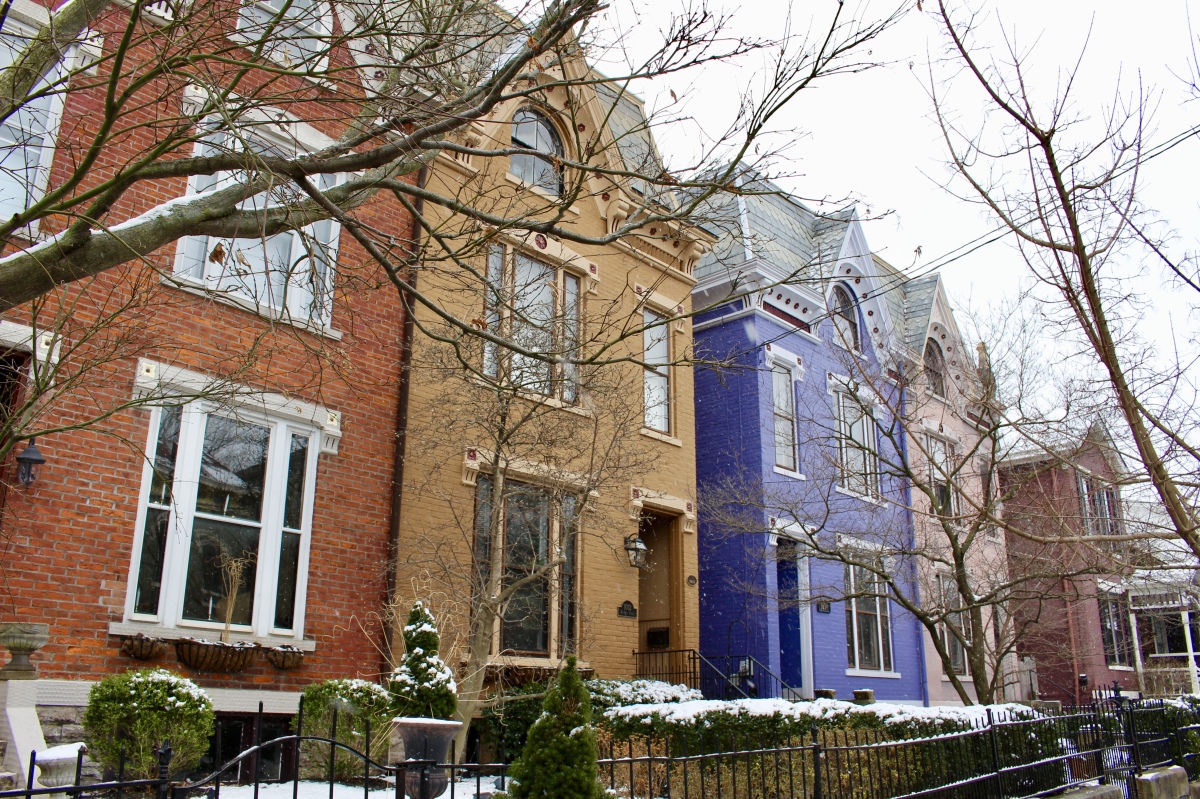
Before taking a bitter-cold walk through the Clifton Gaslight District in Cincinnati, we stopped for lunch at Skyline Chili. This 1966 store is supposedly the busiest location in the franchise and still retains an old-time feel.

I was warmed by a Cincinnati Chili 4-way (the 3-way signature dish of “steaming spaghetti, covered with the original secret-recipe chili and topped with a mound of shredded cheddar cheese,” with the addition of diced onions to make it a 4-way).  Mike ordered two Cheese Coneys (“a specially-made hot dog in a steamed bun, with mustard, covered with … original secret-recipe chili, diced onions and a mound of shredded cheddar cheese”).  We shared them and they hit the spot.

Cincinnati Chili is different from most types of chili; for one, it is rarely served in a bowl.  It is more of a Mediterranean-spiced meat sauce used to top spaghetti or hot dogs. These dishes are regional dishes in the Cincinnati area and were created in the 1920s by Slavic-Macedonian immigrants from Greece. Common spices include cinnamon, nutmeg, allspice, clove, cumin, chili powder and bay leaf. Specific combinations are known as “ways,” and are often served with oyster crackers and mild hot sauce.

fullsizeoutput_19ba0

Skyline Chili on Ludlow

IMG_4790

Skyline Chili

Skyline Chili menu with oyster crackers
me at Skyline Chili
me at Skyline Chili
Coney
Coney
Cincinnati Chili 4-way

After fueling up with our “ways,” we took a long walk through the Historic Clifton Gaslight District’s tree-lined lanes (although the trees were bare because it was winter).

We admired the sturdy brick homes, huge brownstones, and Victorian-style mansions with their turrets and porches. The neighborhood was a bit hilly but very pretty.

IMG_4732

The Public Library of Cincinnati and Hamilton County

fullsizeoutput_19bb2

Clifton Gaslight District

fullsizeoutput_19b67

Clifton Gaslight District

IMG_4736

Clifton Gaslight District

IMG_4739

Clifton Gaslight District

fullsizeoutput_19b6b

Clifton Gaslight District

Clifton is known as a gaslight district because of the gas lamps that were installed in the 1840s by Cincinnati Gas Light and Coke Company.  By 1875, the city had more than 5,000 public gas lamps.  By 1901, it became clear that electricity was the way of the future, yet even to this day more than 1,100 of the gas lamps are still in use in many Cincinnati neighborhoods, according to Walking Cincinnati.

fullsizeoutput_19b6f

gaslight in the Clifton Gaslight District

fullsizeoutput_19b72

Clifton Gaslight District

fullsizeoutput_19b74

Clifton Gaslight District

fullsizeoutput_19b75

Clifton Gaslight District

IMG_4752

Clifton Gaslight District

Annunciation of the Blessed Virgin Mary Parish, founded in 1910, is located in the heart of the Gaslight District of Clifton.

fullsizeoutput_19b79

Church of the Annunciation

fullsizeoutput_19b7a

Clifton Gaslight District

fullsizeoutput_19b7e

Clifton Gaslight District

The house at 334 Thrall Street, or Blenheim, is designed in more of a Dutch style than many of its German neighbors, and has a painting of Mespelbrunn Castle in Germany on its front wall.

fullsizeoutput_19b80

Clifton Gaslight District

fullsizeoutput_19b81

Clifton Gaslight District

fullsizeoutput_17e40

Clifton Gaslight District

Clifton Gaslight District
apartment buildings near Ludlow

We approached Ludlow Avenue, which is the main commercial strip, where historical Clifton residents came to get their goods. We popped into a few shops, and admired the theater and a couple of murals.

fullsizeoutput_19b95

Lentz on Ludlow

The old Ludlow Garage was originally an automobile shop.  For two years, from 1969-1971, it became a rock-and-roll venue.  Now, part of the building holds the local independent Ace Hardware but there are apparently plans to turn the building back into a music venue.

fullsizeoutput_17e48

Ludlow Garage

Habañero is a burrito place.

fullsizeoutput_17e34

habañero on Ludlow

IMG_4774

Ludlow street mural

The Esquire Theater is an independent theater that opened in 1911 to show silent films.  It now has six screens and shows movies that are outside the mainstream, drawing moviegoers from all over the city. It shows first-run feature films, as well as independent, foreign and low-budget films.

fullsizeoutput_19b9a

The Esquire Theater on Ludlow

The adorable store, Toko Baru, is packed with enticing gift items such as wood products, fabrics, cards, and exotic home goods.

fullsizeoutput_19b9c

fullsizeoutput_19b9b

toko baru

fullsizeoutput_1880e

mural on China Kitchen

fullsizeoutput_19b9e

Kilamanjaro on Ludlow

We enjoyed some warmth and a hot fudge sundae at Graeter’s Ice Cream, begun in 1868 by a young Louis Graeter.  For more on the history of this Cincinnati icon, see Our History – Graeter’s.

fullsizeoutput_19b96

Graeter’s Ice Cream

Mike inside Graeter's Ice Cream
Mike inside Graeter’s Ice Cream
Easter display at Graeter's
Easter display at Graeter’s
chocolate Sundae
chocolate Sundae

It was too cold to continue walking, so we got in the car and drove around through the “Clifton Historic Mansions: Mannered Streets” walk from Walking Cincinnati.

Clifton was originally a wealthy residential suburb of Cincinnati in the 1840s.  Many of the beautiful 19th century houses in the neighborhood are included in the National Register of Historic Places.

The Duhme House, built in the American Colonial Revival Style, was built in 1892 for the jeweler Charles Duhme and his wife, Ophelia.

fullsizeoutput_19ba4

Duhme House in Clifton

fullsizeoutput_19ba6

Historic Homes Walk

fullsizeoutput_19ba8

Historic Homes Walk

The Probasco-Reakirt House was designed in 1866 for Henry Probasco, the mayor of the village of Clifton. The mansion is in the Norman Romanesque Revival Style, with the outside elements a combination of textured sandstone and limestone.

fullsizeoutput_19baa

The Probasco-Reakirt House

The two-story Boulter House was designed by Frank Lloyd Wright and was built in 1956 for Cedric and Patricia Boulter, Greek scholars at the University of Cincinnati.

fullsizeoutput_19bac

The Boulter House by Frank Lloyd Wright

Then we drove to Oakley, 8 miles northeast of downtown Cincinnati,

On the side of Loesch Hardware on Madison is the Morning, Noon, and Night ArtWorks mural.

Morning, Noon and Night ArtWorks mural
IMG_3566

Morning, Noon and Night ArtWorks mural in Oakley

Bordering Oakley Square is the cool retro 20th Century Theater.  This Art Deco building with its 72-foot tower escaped demolition in the early 1990s and is now a concert and special events venue.  It was listed on the National Register of Historic Places in 1993.

fullsizeoutput_19bb0

retro movie theater in Oakley

Mike was fading fast and seemed about to fall asleep, so we drove back to our Airbnb in Covington, KY.  There, I checked in with my online Found Poetry class and Mike watched The Ballad of Buster Scruggs; I joined him to watch the last three vignettes.  We ate leftovers from our dinner the night before, a leftover chicken pot pie and truffle fries, as well as a wild rice salad we’d bought at Findlay Market.  We were going to watch Happy Valley, which my sister and I had started watching in Illinois, but we lost our cable connection. We were happy just to stay in and enjoy our cozy home-away-from-home.  We’d been out all day in the frigid temperatures, so it was nice to stay warm for an evening.

For our walks, we used the fabulous book, Walking Cincinnati: An Insider’s Guide to 32 historic neighborhoods, stunning riverfront quarters, and hidden treasures in the Queen City by Danny Korman and Katie Meyer. There were many more walks we didn’t have time for during our three day visit. I wish we could find books like this for every city in the U.S.

*Monday, March 4, 2019*

*13,479 steps, or 5.71 miles*

*********************

“PHOTOGRAPHY” INVITATION:  I invite you to create a photography intention and then create a blog post for a place you have visited. Alternately, you can post a thematic post about a place, photos of whatever you discovered that set your heart afire. You can also do a thematic post of something you have found throughout all your travels: churches, doors, people reading, people hiking, mountains, patterns, all black & white, whatever!

In my case, my intention was to look for thematic possibilities during my Midwestern Triangle Road Trip and I found some of the Cincinnati neighborhoods quite charming.

You probably have your own ideas about this, but in case you’d like some ideas, you can visit my page: photography inspiration.

I challenge you to post no more than 20-25 photos (I have more here!) and to write less than 1,500 words about any travel-related photography intention you set for yourself. Include the link in the comments below by Wednesday, August 14 at 1:00 p.m. EST.  When I write my post in response to this challenge on Thursday, August 15, I’ll include your links in that post.

This will be an ongoing invitation, every first, second, and third (& 5th, if there is one) Thursday of each month (I’ve now added the second Thursday). Feel free to jump in at any time. 🙂

I hope you’ll join in our community. I look forward to reading your posts!

the ~ wander.essence ~ community

I invite you all to settle in and read a few posts from our wandering community.  I promise, you’ll be inspired!

  • Ulli, of Suburban Tracks, wrote an interesting post interweaving his own visit of the Montafon Valley in West Austria to Hemingway’s time there in 1925-26.
    • On the Tracks of Hemingway in West-Austria, 1925-1926

Thanks to all of you who shared posts on the “photography” invitation. 🙂

Share this:

  • Click to share on X (Opens in new window) X
  • Click to share on Facebook (Opens in new window) Facebook
  • More
  • Click to email a link to a friend (Opens in new window) Email
  • Click to print (Opens in new window) Print
  • Click to share on Pinterest (Opens in new window) Pinterest
Like Loading...
  • Asia
  • Halong Bay
  • Hanoi

on returning home from vietnam in 2011

wanderessence1025's avatar wanderessence1025 August 5, 2019

“To awaken quite alone in a strange town is one of the pleasantest sensations in the world.  ~Freya Stark~

For four winter days, I explored northern Vietnam.  On a small city tour of Hanoi on Friday, I went with an unlikely group of vagabonds to West Lake, the largest lake in the city with its plethora of temples. We looked like a bunch of homeless people as we had thrown together a bunch of mismatched layers to keep warm in the unexpectedly cold Hanoi.

The capital was moved to Hanoi in 1010 by the emperor of the Ly Dynasty, who named it Thăng Long, or “ascending dragon,” because he saw a yellow cloud in the blue sky that resembled an ascending dragon.  In the 15th century, the name was changed to Hà Noi, which means “between rivers or inside river.”

After threading our way between 6 1/2 million people and 4 million motorbikes, we were accosted at West Lake by Vietnamese ladies wearing conical hats.  Some were selling yams, peanuts and ginger root out of baskets attached to their bicycles and others carried heavy poles over their shoulders, with baskets of bananas & pineapples at each end. One of them made a pitch to me for bananas; I don’t want any but she persisted. She transferred her pole to my shoulder and I was shocked by how heavy it was. Gonzales, one of our group members, kindly snapped a picture of me, the “Americanese.”

Tran Quoc Pagoda, the oldest pagoda in Vietnam, held beautiful Buddha statues in its many-layered niches. Luxuriant temples surrounded the complex; inside were more Buddhas enfolded in bountiful offerings. We lit incense sticks and made wishes. Inside, an orange-robed monk led a worship service for about 20 devotees. Tropical fruits, flowers, and colorful Vietnamese dong surrounded the Buddha in abundance. Energy was here, positive energy.

fullsizeoutput_19881

incense at Tran Quoc Pagoda

vendor in West Lake, Hanoi
banana seller near West Lake
me with bananas & conical hat
Tran Quoc Pagoda
Tran Quoc Pagoda
Tran Quoc Pagoda
Tran Quoc Pagoda
Tran Quoc Pagoda
Tran Quoc Pagoda
Tran Quoc Pagoda
Tran Quoc Pagoda
Tran Quoc Pagoda
Tran Quoc Pagoda
Tran Quoc Pagoda
Tran Quoc Pagoda
me at West Lake
me at West Lake
Tran Quoc Pagoda
Tran Quoc Pagoda
Tran Quoc Pagoda
Tran Quoc Pagoda
Tran Quoc Pagoda
Tran Quoc Pagoda
Tran Quoc Pagoda
Tran Quoc Pagoda
offerings for Buddha at Tran Quoc Pagoda

We headed to the Ho Chi Minh complex through the Old Quarter‘s extravaganza of motorbikes.  Sometimes there was a single rider with a medical mask over his face.  Sometimes whole families: father wearing a helmet, bareheaded mother and child, even a baby in the mother’s arms.  A motorbike with a huge flower bouquet, the stems whipping through the air high above the driver’s head.  One with bundles of herbs, open to the elements.  Piles of bananas.  Stacks of plate-glass, egg cartons, firewood.

The French colonial architecture, evidence of a bygone age, lent a dilapidated elegance to the hazy city. Tall thin rectangular detached row-houses painted in chipped and faded yellow, terra-cotta, light blue, green. Balconies on the front façades. The sides of the homes were windowless unpainted concrete. Porches sagged, trash was strewn everywhere. Commerce was ubiquitous, on every sidewalk, every street corner, every store front. The smell of cilantro, limes, mangos lingered in the air, mingled with exhaust from cars and motorbikes. Cyclos roamed the streets, somehow surviving the onslaught of the motorized vehicles that packed the street ten across. The energy here was infectious.

At the Ho Chi Minh complex we saw the impressive mausoleum where the Vietnamese hero lies mummified within. The Presidential Palace, formerly used by the governor-general of Indochina, was built in 1868.  It later was the official residence of the South Vietnamese president Ngo Dinh Diem. In February 1962, the palace was bombed by two South Vietnamese fighter planes in an attempt to assassinate President Diem.  It was destroyed by the bombing even though the President wasn’t hurt.  A new building was constructed called The Hall of Reunification.

We saw some of Ho Chi Minh’s collection of cars and then visited a beautiful carp pond where our guide Thanh told us you could bring the fish to the surface by clapping your hands, so everyone stood at the railing idiotically clapping hands over the pond.

On the far side of the pond was the House on Stilts, where Ho Chi Minh lived and worked from 1958-1969, when he died.  Built of lacquered and polished wood, it emphasized the simplicity and modesty the revolutionary leader believed in ~ he wanted to be seen as a man of the people.  The house was modeled on a traditional communal house on stilts.  A tunnel led from the dining room, which provided an escape route for Ho Chi Minh if his life was in danger.

The One Pillar Pagoda, built by Emperor Ly Thai Tong (1028-54), was designed to represent a lotus blossom, the symbol of purity, rising out of a sea of sorrow.  The Temple of Literature, was dedicated to Confucius in 1070 by Emperor Ly Thanh Tong and later established as a university for the education of mandarins.  It had 5 courtyards, with a serene reflecting pool in the front courtyard, roofed gateways, and low-eaved buildings.  In 1484, Emperor Le Thang Tong ordered the establishment of stelae honoring men who received doctorates in triennial exams dating back to 1442.  Each of these 82 stelae is set on a stone tortoise.

fullsizeoutput_198af

carp pond at Ho Chi Minh Complex

fullsizeoutput_198ef

Temple of Literature

Ho Chi Minh Mausoleum
Presidential Palace at Ho Chi Minh Complex
Ho Chi Minh's car collection
Ho Chi Minh’s car collection
House on Stilts
House on Stilts
painted basket
painted basket
One Pillar Pagoda
One Pillar Pagoda
Temple of Literature
musicians at Temple of Literature
Temple of Literature
gift shop at Temple of Literature

The end of our tour was at Hoan Kiem Lake, or Restored Sword Lake, with its Ngoc Son Temple.  The Buddhist temples were rich in color and offerings and energy.  Young Vietnamese couples posed for wedding photos on the red bridge leading to the temple.

A small group of us peeled off to see the water puppet show. We negotiated the crazy traffic as we attempted to get to our destination.

our group at Hoan Kiem Lake
Hoan Kiem Lake
Hoan Kiem Lake
cyclos at Hoan Kiem Lake
Hoan Kiem Lake
Hoan Kiem Lake
Hoan Kiem Lake
Hoan Kiem Lake
wedding photos at Hoan Kiem Lake
motorbikes in Hanoi
motorbikes in Hanoi
chaotic Hanoi
chaotic Hanoi

At the Thang Long Water Puppet Theater, all in Vietnamese, the little puppets performed silly actions & acrobatics and we couldn’t help but laugh even though we didn’t know the story.

After dinner, I took a cyclo back to my hotel.  By day’s end, I was loving Hanoi, its craziness, its chaos & energy, its cilantro- & lime-flavored food, its sing-song whining language, its rich colors, its French-ness.

Thang Long Water Puppet Theater
cyclo driver in Hanoi
chaotic Hanoi at night

Maybe because of this chilly and overcast weather, we were just three in the van on Saturday morning cruising from Hanoi to Halong Bay.  The road was chock-full of bicycles and motorbikes and slow-moving trucks piled high with all manner of tropical fruits, sugar cane, green leafy vegetables. One couple whizzed by; the driver had a huge sack of rice between his legs. Debris dotted the roads, the businesses, the yards. Another motorbike scooted past with dead roosters piled high behind the driver. Weathered shacks and paint-chipped houses flew by. At temples along the roadside, incense smoke spiraled upward, prayers to the Buddha. The yellow haze of Hanoi followed and enveloped us like an old ratty blanket, too threadbare to cushion any head-on collision. Ruth commented on the ever-present haze: “At least it’s atmospheric!”

Ruth, a redhead who lives in Toronto but was raised in Australia, was in the seat directly behind the driver. She was working in Hanoi for 3 weeks helping Vietnamese community colleges with strategic planning through a contract with the Canadian equivalent of USAID. She was close to my age and we immediately struck up a conversation, finding we had a lot in common. She had teenage children in college, she’d been married and divorced twice, and she loved to travel.

Behind me, in the third seat, was Ken, a bearded New Yorker with a hearing aid who was retired but traveling around the world, volunteering as he went along. Mostly teaching English, apparently. He told us that he was practically deaf for five years but had a cochlear implant. Now he was just “hard of hearing.”

We made a stop at a “happy room,” which is basically a shop for tourists that had a bathroom. I bought a bunch of Vietnamese souvenirs, sucker that I am: a buffalo tusk bracelet, an alabaster box with a carved vine of pretty flowers, a leaf box, placemats, and a lacquer picture that looks like an impersonation of Gauguin. Ruth bought some scarves. We used the “happy room” and head on our way.

We arrived at Halong Bay and boarded a little motorboat that took us out to the Dragon Pearl III, our own personal junk moored in the bay.  We lucked out in that there were just 9 of us on a junk that held 22.

Underway on the boat, all polished dark wood and gleaming brass, our guide Thanh told us there were 1969 islands in Halong Bay. Its name means “descending dragon,” and it has been recognized by UNESCO twice. As we cruised along, we marveled at the limestone karsts and isles that made Halong Bay famous. Legend has it that the gods sent a family of dragons to defend the land of Vietnam. The dragons spit out jade and jewels which became the chain of islands that served as a blockade against Chinese invaders. Later, the dragons settled here to live peacefully. The place where the mother dragon descended is called Halong Bay. It was quite lovely looking out from our little junk, as we cruised along, at rock formations shaped like slit-eyed monster faces and other imaginary notorious creatures.

After lunch, our group went on an excursion to a little island, climbing a path to reach caves filled with, alas, stalagmites and stalactites. Of course as in all things natural, rocks & clouds, we saw familiar-shaped formations such as sea horses and dragons.

After exploring the cave, we clambered back down the path to the beach, where we donned life vests and got into kayaks, promptly heading out into the rough and cold seas. Ruth and I were not experienced kayakers. We zigzagged through the choppy water, waves jumping into our boat at every opportunity. Around the islands we went, paddling hard to keep up with the others, getting soaked and cold.  On the beach, we were welcomed by a rock formation shaped like a whale against the setting sun.

After dinner, back in my cabin, I wrote a while, as I left my book behind in my suitcase at the Ngocmai Hotel. I felt quite intoxicated, high, not only from the bottle of wine I drank, but from life. From two days surrounded by interesting and adventurous people. From immersion in a fascinating culture. I hadn’t felt happy in a long time, and now at this moment I could claim true happiness, in this time and space, as my own. I loved meeting fellow nomads, soul-mate adventurers, sharing stories and our love of cultures. We had a spirit connection, a thread of whimsy and a lust for life connecting us, dreamers all.

I was floating, anchored, in the midst of whales and turtles and sea monsters in this bay of descending dragons. My cabin was toasty and pristine, and I was under a white-cloud duvet, on a bed of pure white, rich paneled walls surrounding me. I tried to draw the happiness I felt in my little notebook, but how does one draw happiness when one’s artistic ability is limited to stick figures, star doodles, hearts, musical notes, and smiley faces? How could I capture this happiness, bottle it, and take it with me back home, to Korea, where happiness was elusive as a firefly?

fullsizeoutput_1aea

junks on Halong Bay

fullsizeoutput_19741

junk on Halong Bay

fullsizeoutput_1974c

junks on Halong Bay

Junk on Halong Bay
Junk on Halong Bay
aboard the Dragon Pearl III
Dragon Pearl III
Dragon Pearl III
Halong Bay
Halong Bay
Halong Bay
Halong Bay
me on the Dragon Pearl
Halong Bay
Halong Bay
cave on an island in Halong Bay
island in Halong Bay
Halong Bay
Halong Bay
Halong Bay
Halong Bay

On Sunday morning, we floated among the descending dragon’s islets of jade.  My cabin gleamed, its wood rich and brown and deep as the earth.  I was in my down comforter cocoon.  The quiet was punctuated only by the lapping of tiny waves against the boat.  This morning I savored being alone; I had moments to myself, but I knew I could connect when I chose to.  I didn’t mind being alone under these kinds of circumstances.  It was only when I felt there was no one for me, no one to connect with, that loneliness haunted me.

I was here on top of this water world, this bay of limestone and emeralds. I loved it. Too much for words. I lay in bed and soaked it in, breathing the sea air, pulling the comforter close to ward off the chill seeping through the door. I still tasted the happiness I felt last night. How, I wonder, could I have it again? Why was it that I was greedy? Why couldn’t I just enjoy it when it came without wanting it more, again and again? Could Buddhism, I wonder, teach me to do this?

After breakfast, we went on bamboo boats through a floating fishing village.  In all of Halong Bay there were about 1600 residents of 4 fishing villages.  They lived on floating houses and sustained themselves by fishing.  In this particular village, there were 59 floating houses and about 300 people.  They lived here year round; they lived with their children, who attended school at one little schoolhouse in the village, and their dogs, who protected what few belongings they had.

Most of the houses had generators for electricity, but they were only allowed to use them from 7-9 each evening. As we floated past the villages in our bamboo boats, we could see flat screen televisions inside the huts, complete stereo systems. Thanh told us that generations lived here, that their sole livelihood was fishing, that it was a hard life. I couldn’t imagine living like this year round and rarely visiting land, or cities, or people outside this small community.

Before we came out on our boats, Thanh told us that there was a problem with the residents throwing “rabbits” in the water.  Several of us looked at each other, baffled.  Rabbits?  Where would they get rabbits to throw in the water?  WHY would they throw these rabbits in the water?  I asked Thanh, probably with a “duh” look on my face: they throw rabbits in the water?  Thanh nodded, Yes!  But one of our group knew what he was saying, “Rubbish, he’s saying they throw rubbish in the water.”  Ohhh.  That explained.  Thanh says Indochina Junk and other tour operators had a system set up to take away their rubbish.  To promote a green bay.  Bravo for them!

We took a boat back to the Dragon Pearl, where we returned to the dock and met our van to return to Hanoi.

On the way back, we were all quiet in the van. Ken slept, Ruth read, and I napped in between staring out the window, and closely observing, with clenched teeth, the harrowing chicken games on the road.  Out the window were the riff-raff edges of Hanoi.  Gray woolen skies.  Smoldering fires burning in open fields.  Women in conical hats bending over in rice fields with huge power grids in their centers.  Water buffalo grazing, oblivious to the slummy areas surrounding the fields.  Further along, more ladies in conical hats selling loaves of French bread hung on racks displayed along the highway, open to the elements, the pollution.  When the ladies made a sale, they bagged the loaves in bright yellow plastic bags.  Many of these yellow bags had made their way into the unkempt patches of dirt and grass along the roadway, yellow blights yelping out to be noticed and hauled away.

All I knew is that I felt a sore throat coming on.

Back in Hanoi we rode alongside the ceramic mosaic mural on the dyke beside Hanoi’s Red River.  The wall depicted scenes of the different periods of Hanoi, along with modern art work, children’s drawings, and paintings of Hanoi.  It was said to be the world’s largest ceramic mosaic.

I returned to my room at the Ngocmai, where I burrowed under the duvet and watched some TV, drank some orange juice, hoped to feel better.

fullsizeoutput_19834

floating fishing villages of Halong Bay

fullsizeoutput_1981a

floating fishing villages of Halong Bay

fullsizeoutput_4653

floating fishing villages of Halong Bay

Halong Bay
Halong Bay
floating fishing villages of Halong Bay
children living in the floating fishing village
floating fishing villages of Halong Bay
Halong Bay
Halong Bay
Halong Bay
Halong Bay
floating fishing villages of Halong Bay
Halong Bay
Halong Bay
Ruth on the Dragon Pearl
fullsizeoutput_19947

On Monday morning, I woke up to a drearier day than any I’d seen in Vietnam, my throat burning.  But, I was on vacation, so I forced myself out of bed and embarked on another local tour, to Hoa Lu and Tam Coc, about 100 km south of Hanoi.

Our guide, Adam, told us Hoa Lu, in Ninh Binh province, was the first capital of Vietnam. His English was bad so I didn’t understand half of what he was talking about.

He kept referring to two-digit numbers like twelve o’clock as one-two o’clock.  He told us we would see the Ling Lai Temple at Hoa Lu and then we would have lunch at one-two o’clock.  After lunch we would spend two hours on a small boat at Tam Coc, where we could see scattered tombs at the tops of the mountains.

It was a long drive in a van with no seat belts on bumpy potholed roads. The driving style was the same; on two lane roads, people drive at an excruciatingly slow pace, passing bikes, motorbikes, buses or trucks regularly despite the traffic being heavy in both directions. At the last minute, these passing vehicles managed to slide back into their proper lane before a collision occurred. In between chatting with people, this is what I saw out the windows: a gas station called Petrolimex; concrete open-air cubbyhole businesses, doorless garages with corrugated tin roofs. Rusted chain link fences, piles of dirt, piles of gravel, refuse everywhere. Palm-like tropical plants fuzzy with dust. Two- or three-story thin rectangular concrete houses with fancy balconies, chipping paint in Mediterranean colors, some with red tile roofs. Again, no paint on the sides, just windowless gray concrete. A few exceptional houses painted nicely with plants on the balconies.

Huge gravel lots dotted with grotesquely shaped rock sculptures. Honda, Yamaha, Suzuki, Symauto. Sidewalk barbers giving shaves and haircuts. The Bank for Investment and Development of Vietnam. Government buildings in faded banana yellow with brown trim, palm trees in front. A park with huge Rorschach-blot rocks. Motorbikers bundled up in knit caps, helmets, bubble jackets, slippers with fuzzy socks, masks. Old buildings in various unfinished states of construction, much like the ubiquitous apartment buildings I saw in Egypt. Not new, these unfinished projects sprouted plants and weeds and vines on walls and floors; I couldn’t help but wonder why the projects died before they ever got off the ground. Cemeteries filled with hundreds of miniature pagodas. The ever-present gray haze here with us even 50 km south of Hanoi.

And in the midst of all this, I wrote in my journal: “A journey is really all the people you meet along the way.”

The truly nice and beautiful places around Hanoi were specks in the overall landscape of rubbish and decrepitude. This was more apparent on the drive south than on the eastward drive to and from Halong Bay. In front of houses along the road, square or rectangular fish ponds were hemmed in by scrubby palm trees or refuse. One of the Vietnamese guys explained that these ponds are filled with sunfish, meals for the local families. Rubbish, rubbish everywhere. Dust, haze, smog, gray skies. It was dreary and cold.

It was a bit depressing today. There seemed no attempt made by the Vietnamese to hide their piles of rubbish. Piles of gravel, bricks, tires ~ the discarded building blocks of society in useless array. Around the sculpture businesses, chips of stone were left where they fell, littering the ground. I kept thinking that the rubbish collection business could make a killing here if the proper laws were passed and enforced, and public dollars went towards creating a rubbish collection infrastructure. My question about the rubbish is this: is it just poverty, naturally sloppy Vietnamese, or poor government planning ~ no infrastructure? I thought the garbage problem is worse than what I saw in Cairo.

I mentioned my thoughts on this to Colin and Tracy from Manchester, who just came from a month in India. Colin said in India I would see ten times the rubbish I see here. They said there are rules that you can’t smoke in certain parts of India, but it’s okay to pee or defecate anywhere. I asked them what was their favorite thing about India, and Colin said, “The flight out.” They said a trip to India is “a trip you endure, not enjoy.”

Australians Danny and Kim said Phnom Penh was worse than Hanoi by far ~ impoverished, filled with rubbish, and not much there. But they loved Siem Reap. Later, when I got to Phnom Penh, I didn’t see this at all; to me Phnom Penh was nicer than Hanoi. It’s so funny how each person’s experience of a place can be so different, how one’s experience can be colored by interactions with people, weather, where exactly one is in the place, whether transport goes smoothly. So many factors.

Finally, after an interminable drive through the dilapidated outskirts of Hanoi, we arrived at Hoa Lu, the political, economic and cultural center of 10th century Vietnam.  It was also the native land of three royal dynasties.  The ancient Citadel existed no more, and all that was left were some remainders of the dynasties.  I found the entire complex quite shabby.  No matter how we humans try, everything we create disintegrates around us.

fullsizeoutput_19953

Ling Lai Temple at Hoa Lu

fullsizeoutput_1996a

offerings at Ling Lai Temple

Hoa Lu
Hoa Lu
Special Food Goat Meat Soup with Chicken
Ling Lai Temple
Ling Lai Temple
Ling Lai Temple
Ling Lai Temple
Ling Lai Temple
Ling Lai Temple
Ling Lai Temple
Ling Lai Temple
Ling Lai Temple
Ling Lai Temple
Ling Lai Temple
Ling Lai Temple
Ling Lai Temple
Ling Lai Temple
Ling Lai Temple
Ling Lai Temple

We then headed out to the metal rowboats, not as charming as the bamboo boats on Halong Bay.  Tam Coc, which means “three caves,” was a 2-hour boat excursion down the Ngo Dong River through rice fields, limestone karst towers, and 3 caves.  My partner in the boat was the Portuguese guy João, since we were the only two not paired up.  On the boat ride, João kept talking about the “visitation” in Portugal, and I said, What? Like the Virgin Mary? After much going around and around, I finally figured out he was talking about the “vegetation” in Portugal. João kept hacking away and had been doing so the whole way down from Hanoi.  When I expressed concern about his health, he said he was sick from going from warm Ho Chi Minh City to cold Hanoi.  I knew what he meant because I felt sick all day, chilled, sore throat, nasal stuffiness and post-nasal drip.

The boat paddlers were Vietnamese of all variety, some young women with conical hats, some toothless old men. Some paddled with their feet, all playful, laughing and joking among themselves, across the expanse of water.

We floated along marveling at the sheer karsts; I kept looking for rice paddies. This place was touted as the “Halong Bay of the rice paddies,” but I didn’t see any at all. Maybe it was because it was winter and the rice had all been harvested?

We went through the 3 caves with their low ceilings, ducking to avoid getting clocked by the granite ceilings.

Our boat lady paddled us into a floating market, a virtual Vietnamese 7-11, and as we went into the midst of the boats, they surrounded us. In their straw cone hats, they flung their sales pitches at us. We were at the furthest point out and trapped. One lady offered hot coffee and as I’d been cold all day, I took her up on it. She handed me a small dirty glass with her brown stained hands. I drank it, unsanitary though I thought it was, just to feel warmth for a few short seconds. In the meantime, she held out a coke and some crackers and motioned that I should buy them for my boat lady. Portuguese Joao remained stone-faced the whole time, acting as if he were totally removed from the scene.

Finally, we were on our way back to Hanoi in the van. A repeat of the drive down, more of the same. Late in this afternoon, it was gray and even colder than earlier, so I asked the guide and driver if they could please turn on the heat. They told me the van had no heat. I had been quietly freezing for 1 1/2 hours. Finally, I’d spoken up, and still I would be cold. Overall, it was a miserable day. I would definitely NOT recommend this tour and I wished I had stayed the day in Hanoi, exploring the city.

Traveling abroad takes me out of my comfort zone and throws me into an alien world. Sometimes this world is comfortable, relaxing, beautiful, serene. Sometimes it’s a hardship, ugly, dirty, cacophonous. I often feel dislocated, a little off kilter, because nothing is familiar. Most times I like this; I feel my senses are heightened, I’m more present to the moment, I notice things I wouldn’t notice at home. Other times, it can be drudgery. But ultimately, I’m awake, I’m alive!

P1171925

floating markets at Tam Coc

fullsizeoutput_199a0

floating markets at Tam Coc

fullsizeoutput_199b0

cave at floating markets at Tam Coc

vendor at Tam Coc
vendor at Tam Coc
Tam Coc
Tam Coc
me in a boat at Tam Coc
Tam Coc
Tam Coc
paddler at Tam Coc
paddler at Tam Coc
Tam Coc
Tam Coc
Tam Coc
Tam Coc
Tam Coc
Tam Coc
Tam Coc
Tam Coc

One extraordinary thing in Vietnam was the food. In Hanoi, Pho (noodle soup stalls) were tucked into every crevice. Oversized people hunched on miniature plastic stools in front of low plastic tables savoring the street food prepared by cobbled-together food stalls.  I ate spring rolls with peanut sauce, deep-fried eggplant, chicken.  At a nondescript restaurant with a glass case showcasing delectable treats, I ordered shrimp with broccoli and noodles.

In a Hanoi hotel, accompanied by episodes of Tom & Jerry, I ate a nondescript omelet, orange juice, bananas, papaya strips, and coffee.  Though I tried to communicate that I want Pho, or Vietnamese noodle soup, somehow the omelet came unbidden to my table.

On the Dragon Pearl, we enjoyed a phenomenal 9-course lunch: soup with red beans and lotus seeds, slivered vegetable salad with carrot juice, Halong clam with fragrance smooth fruit and cilantro, oyster cakes with garlic sauce, deep-fried prawns with garlic and butter, steamed sea bass with soya sauce and vegetables, cabbage with garlic, steamed rice, and tropical fruits for dessert: passion fruit, watermelon and oranges. I added a beer and a glass of red wine for good measure.

Another extravaganza at dinner: we were served another fresh vegetable salad, covered delicately in some kind of spring-fresh sauce, cilantro abounding. Then out came the spring rolls, accompanied by two herons carved out of turnips. Prawns in a delicious sauce were decorated by a dragon carved out of a pumpkin. Crayfish, very messy to peel, but delectable. Chicken, mackerel, rice, and more tropical fruits. And the grand finale carving: a sailing junk carved from a watermelon. Apparently, the chef spent three hours of his day carving these showpieces.

In the long drive south to Hoa Lu, we stopped at another “happy room;” there I bought a Thailand plum, a cross between a pear and an apple, but not as sweet.   Back in the van, as I munched happily on this fruit, we flew past a pedaling biker loaded down with big flat cone baskets full of limes and tangerines.

At the Green Mango, an elegant and rich place hung with draperies, dimly lit, with artistically stark dried flower arrangements, the wait staff wore tee-shirts for a cause: Save the Cat Ba Langurs. The Cat Ba langurs are the most endangered primate species, with only about 53 individuals alive.  There, I savored grapes in goat cheese and cashew nut, Green Mango grilled prawn salad, lemon custard with strawberries and raspberries, chamomile tea.

Finally, on our last evening, I met Ruth at her hotel and we went to a French restaurant, La Badiane.  Ruth had to work during the day, but she also found time to go out and buy a warmer coat.  I was still cold.  We ordered a bottle of red wine and the whole set menu, with appetizers, main dish, & dessert, all masterfully and artistically prepared. I was enjoying myself too much to write down what I ate. But I swear it was delicious!!

fullsizeoutput_1975e

Herons carved from turnips on the Dragon Pearl

fullsizeoutput_672

Dragon carved from pumpkin on the Dragon Pearl

fullsizeoutput_14e70

sailing junk carved from watermelon

Hole in the wall in Hanoi
shrimp and noodles
shrimp and noodles
dinner aboard the Dragon Pearl
fish on the Dragon Pearl
me eating a Thailand plum
La Badiane
La Badiane
Ruth at La Badiane
Ruth at La Badiane

When I returned home to Korea after my trip, I continued my contract with EPIK (English Program in Korea) through the end of February. During the Lunar New Year, I visited Kyoto, Japan and then spent three weeks in India before returning home to Virginia.  Though I kept a journal while traveling, I sadly misplaced it; luckily I had recorded my journey in my blog: rice paddies & papayas: vietnam.

I also kept a few brochures in a journal I kept during my entire time in Korea.

brochures from Vietnam

Much later, in 2018, I finally watched the real story about the Vietnam War in the excellent Ken Burns 2017 10-episode TV series:  The Vietnam War, where I learned of all the lies our government told the American people during the war years.

*Friday-Monday, January 14-17, 2011*

*************************

“ON RETURNING HOME” INVITATION: I invite you to write a post on your own blog about returning home from one particular destination or, alternately, from a long journey encompassing many stops.  How do you linger over your wanderings and create something from them?  How have you changed? Did the place live up to its hype, or was it disappointing? Feel free to address any aspect of your journey and how it influences you upon your return. If you don’t have a blog, I invite you to write in the comments.

For some ideas on this, you can check out the original post about this subject: on returning home.

Include the link in the comments below by Sunday, September 1 at 1:00 p.m. EST.  When I write my post in response to this challenge on Monday, September 2, I’ll include your links in that post.

This will be an ongoing invitation on the first Monday of each month. Feel free to jump in at any time. 🙂

Share this:

  • Click to share on X (Opens in new window) X
  • Click to share on Facebook (Opens in new window) Facebook
  • More
  • Click to email a link to a friend (Opens in new window) Email
  • Click to print (Opens in new window) Print
  • Click to share on Pinterest (Opens in new window) Pinterest
Like Loading...
  • Camino de Santiago
  • Europe
  • Hikes & Walks

{camino day 28} bercianos del real camino to reliegos & ruminations {week 4}

wanderessence1025's avatar wanderessence1025 August 4, 2019

I left this morning in the dark at 6:50. Several pilgrims and I went around in circles trying to follow the confusing arrows to the Camino.  Once we found our way, we continued on the senda (track) along a road for the entire way.  We passed a wetland reserve Laguna Olma and then took an asphalt road.  It was more of the same flat Meseta for over 7 km to El Burgo Ranero.

Bercianos del Real Camino to El Burgo Ranero (7.4 km)

Bercianos del Real Camino to El Burgo Ranero

In Burgo Ranero, at second breakfast, my dear friend Darina from Slovakia caught up with me!  She had stopped in Navarette for 5 days, so was one of the few people I started with who was still behind me.  It was so nice to see her again. It also showed how slowly I was going that she managed to take five days off and still catch up with me. 🙂

She stayed in the café to book an Airbnb for León, so I went on, stopping to admire the (closed) Iglesia de San Pedro Apostol.  The typical buildings of the town are of adobe style using mud and straw.

El Burgo Ranero

fullsizeoutput_16b97

El Burgo Ranero

fullsizeoutput_19b3d

pilgrim sculpture in El Burgo Ranero

fullsizeoutput_19b41

Iglesia de San Pedro Apostol

fullsizeoutput_16b80

El Burgo Ranero

Back on the senda, I encountered some discarded hiking boots.  Cornfields stretched to either side.  I glimpsed the mountains of Galicia in the distance.  It was a long 13km from here to the next town of Reliegos, on a track that ran along a road with little traffic. This would be the second longest stretch of the Way without a town or village.

El Burgo Ranero to Cruce Villarmarco (7.9 km)

IMG_7572

El Burgo Ranero to Cruce Villarmarco

fullsizeoutput_16b81

El Burgo Ranero to Cruce Villarmarco

IMG_7577

Cruce Villarmarco

A few things I saw on the way today: arrows fashioned from pebbles, crosses, pilgrim statues, corn stalks,  and small wetlands.  I also stopped for a snack at a huge concrete banquet table in a picnic area that looked like it was made for the Last Supper.

Cruce to Reliegos (5.2 km)

fullsizeoutput_19b43

Cruce to Reliegos

fullsizeoutput_19b45

Cruce to Reliegos

fullsizeoutput_19b47

Cruce to Reliegos

fullsizeoutput_16b8f

Cruce to Reliegos

On this portion of the walk, I finally met 73-year-old Sharon, who was organizing the Camino for Sheryl, who I’d met several stops back.  Sharon’s husband John made up their threesome. Sharon told me she’d done the Camino seven times, and she told me in great detail all the different reasons she did it so many times, but it was too complicated to remember. When she finally asked about why I was doing it, I suddenly had a nature call and had to dip into the only wooded area we’d passed all day to pee.  There was evidence that lots of other people had stopped in this spot as well.

fullsizeoutput_16b92

Cruce to Reliegos

As I walked into Reliegos, I was welcomed by a number of bodegas built into the surrounding hillocks, which provided constant humidity, temperature and darkness. Only a façade or a door was visible from the outside.  They are used in modern times as warehouses or for events such as family reunions.

Reliegos

fullsizeoutput_16b88

Bodegas in Reliegos

fullsizeoutput_19b49

Bodega in Reliegos

In Reliegos, the original Astorga-Bordeaux Roman road and the French Way originally crossed.

The owner at Albergue Parada was very unfriendly and unwelcoming.  He was probably the worst I met along the way. When I asked where to leave my bag to send it ahead the next day, he showed me but insisted that I had to make the arrangements with the transport company. This was the first time I had to do this, as all other albergues did it as a matter of course.  It was always a pain for me to make phone calls, not only because I didn’t speak decent Spanish, but because I always had to turn on the Travel Pass on my phone, which cost me $10/day. Luckily I found a Spanish guy who used my phone to make the arrangements with JacoTrans.

IMG_7590

El Parada Albergue in Reliegos

fullsizeoutput_16b99

Bar Elvis in Reliegos

After I settled into Albergue Parada, I met Darina for beer and lunch at the first café in town.  At siesta time, the whole town closed down.  The bar owner started closing up and we asked her to take a photo of us.  After the photo, Darina was picking up her stuff from the table, and the owner closed the umbrella over Darina’s head.  It was hilarious.  Darina said, “I guess she really wants her siesta!”

fullsizeoutput_16b89

Darina and me

We walked around the sleeping town and took some photos of each other until we finally decided we might was well take our siestas.  I was never able to sleep in the afternoons, so that was when I caught up with Instagram and wrote in my journal.

fullsizeoutput_19b51

door in Reliegos

fullsizeoutput_19b4b

Albergue in Reliegos

fullsizeoutput_16b7a

Darina in front of Albergue de Ada

fullsizeoutput_16b74

me in front of Albergue de Ada

IMG_7600

Reliegos

IMG_7602

Darina

The local church was dedicated to San Cornelio (Saint Cornelius) (pope) and San Cipriano (Saint Cyprian) (bishop).

IMG_7605

church bells in Reliegos

Reliegos
Reliegos
a pilgrim prayer shared by Darina

For dinner, Darina was having a pilgrim meal at her albergue, so I went to Bar Gil II for dinner.  I ordered a common Camino menu item that I’d never tried before, a Russian salad.  It was so disgusting, I couldn’t eat it. It still cost me 7€ along with a glass of vino tinto.  I talked for a while to Janine and Margaret from Australia and New Zealand. I talked way too much about my loved one and his issues and wished I hadn’t told them as much as I did.  Sometimes I just needed to learn to keep my mouth shut.

Ruminations {week four}

The fourth week, I became fully immersed in the relentless Meseta.  I crossed into the province of Palencia, or Tierra de Campos, an extensive agricultural area which served as the historical boundary between the kingdoms of Castilla and León.  I walked along the Canal de Castilla under a peaceful elm-lined path and on an original Roman road still intact after 2,000 years of use. I left behind the province of Palencia and crossed into Provincia de León, part of the autonomous region of Castille y León. I continued on the Tierra de Campos, with its flat and well-irrigated farmland.

The landscape was flat, monotonous and even hypnotic, with few visual references. The stony covering on the Roman road made the walk uncomfortable, with pebbles rolling out underfoot and causing ankles to twist repeatedly. Much of the path was on soulless sendas (trails) that ran alongside the pilgrim autopistas, or motorways. The path often had a certain sameness to it: flat, alongside a barely-trafficked road, lined on one side by evenly spaced trees that gave little shade. This kind of path was easy enough but rather repetitive and boring. It was especially hard at the end of the day, when it was hot.  I began to understand deeply the challenges of the Meseta. It seemed endlessly flat and the hours were long. I passed a sign that said LIFE IS A CAMINO, and I thought that about summed it up.

It wasn’t all miserable though.  The monotony was interspersed with  lovely rolling farmland dotted with rectangular and cylindrical hay bales. A stunning sky often hovered overhead.  Owls hooted morning greetings as the sun rose, while birds twittered in the rustling trees. I watched the harvest moon float downward to earth. A field of sunflowers seemed more vibrant than others I’d seen.  Ornamental grasses danced along a canal that held reflections of trees from the opposite shore.  On the fringes of the Meseta, wind turbines twirled on ridges. I encountered what looked like hobbit homes but were actually wine cellars, or bodegas. We had amazing views over the flat farmland, and often the distances looked daunting, with the endless plain stretching away to ephemeral towns on the horizon.

Many people say they hate the Meseta.  I could say I both loved and was bored by it. Hate was certainly too strong a word.  I often found it peaceful and soothing.  The worst were the roadside paths; the ones in the wild were much more enjoyable.

Extremes of temperature became more exaggerated.  It was often cold in the mornings and hot in the afternoons.  I had days where a pleasant breeze kept on giving. On others, wind was gusting and biting. On some stretches, I was annoyed by gnats and flies swarming around my face in the heat the whole way. I used my hiking poles like a baton, twirling them around and around to keep the flying insects at bay.

I stayed at the most charming albergue, Albergueria Laganares, where romantic French music was softly playing and the husband-and-wife owner openly flirted with each other.

I enjoyed lentil soup, bread, albondigas with French fries, pudding, croquettes, lasagna, and many “second breakfasts.” I tried and was disgusted by a Russian salad, ubiquitous on pilgrim menus.

I attended my first pilgrim mass in Carrión de los Condes.  After the all-Spanish mass, the two priests called the pilgrims up and read blessings in Spanish and English. They they placed their hands on each of our heads and said blessings on our Camino journey and on each and every day of our lives and did the sign of the cross on our foreheads. I was in tears.

My fourth week, I connected with pilgrims with whom I shared a spirit of fellowship and laughter. “Grit”-challenged Anna teased me about the “toe box” on my Keen Targhees, which she thought sounded macabre. I intersected often with friendly Karen and Simon from Norfolk, UK.  We sat outside drinking wine at Albergue Amanecer, where donkeys, geese, sheep and dogs wandered around the grounds, and a donkey tried to have a sip of our wine.  I saw them again in Carrión de los Condes  and Sahagún.  While with them,  I met Kate from London but originally from South Africa; she had lived in Dubai for a time and had visited Oman, so we shared our experiences there. I also met Adele and Bud from Tasmania. I ran into them all again, except for Kate, in San Nicolás del Real Camino at the first bar in town.  Later, I ran into Kate again, who was doing a walk of joy, a thanksgiving of sorts for people she loved who had been ill, and then got better.

One morning, in the dark, 30-year-old Anne-Charlotte from Lille, France appeared by my side and we shared our reasons for doing the Camino. She told me of her boyfriend who had been suffering from trauma because he was accused of stealing at his last job, so he hadn’t been able to work since. She came from a family where everyone had a good job and they couldn’t understand why she was with him. She had been walking from Le Puy-en-Velay for two months and figured it was her time to figure out her situation on her own without her family’s interference.

A Canadian guy from Ottowa who had been living in the mountains in Mexico said, from things he’d read, it seemed the U.S. was in the middle of a political civil war. I agreed completely.

One night, the Korean husband of a woman who spent all afternoon doing laundry, shook me violently and woke me up: “Snoring!!” I wished I’d had the wits to say, “Well at least I don’t sit there having my spouse slave away while I smoke, drink and play on my phone!”

I met Sheryl from Seattle, who was walking the Camino for her niece who was 30, addicted to meth, and in prison. Later, I met 73-year-old Sharon, who was organizing the Camino for Sheryl, booking shared rooms in hotels and transporting their bags ahead.  Sharon’s husband John made up their threesome. I would see them countless times during the rest of my Camino.

Darina from Slovakia had stopped off at Navarette for a week with some teaching colleagues.  She had written to me periodically through Whatsapp, so we’d kept in touch, but we finally caught up with each other again in El Burgo Ranero.  I was happy to share lunch and beer with her in Reliegos as well. Meeting up with her again became the highlight of the remainder of my Camino.

At one pilgrim meal, I met Marius and Simona from Lithuania.  Simona told how she stayed in an albergue whose owner had done the Camino many times.  This woman believed the Camino was a death walk: you shed who you were to make way for becoming someone new.

Back at the home front, I found out a childhood friend, Tammy, had killed herself the previous weekend.  I hadn’t seen her in years but had fond memories of her. My sons were getting ready to sign a lease and move into a new apartment. I hoped it would work out for them to live together, although I had my doubts.

I continued to be obsessed with collecting sellos (stamps) in my pilgrim credenciale.  I passed the halfway point (between St-Jean-pied-de-port and Santiago) in Terradillos de los Templarios.  I got my Halfway Compostela (between Pamplona and Santiago) in Sahagún.  I continued to enjoy the pilgrim meals where people shared their reasons for doing the Camino and where fellowship evolved among pilgrims, though these times of organized fellowship were becoming less frequent.

**********

*Day 28: Monday, October 1, 2018*

*33,513 steps, or 13.78 miles: Bercianos del Real Camino to Reliegos (20.2 km)*

You can find everything I’ve written so far on the Camino de Santiago here:

  • Camino de Santiago 2018

**************

On Sundays, I post about hikes or walks that I have taken in my travels; I may also post on other unrelated subjects. I will use these posts to participate in Jo’s Monday Walks or any other challenges that catch my fancy.

This post is in response to Capelas Sáo Miguel – not quite a Monday walk. I know Jo is out of town for a while, but I figured I’d link anyway. 🙂

Share this:

  • Click to share on X (Opens in new window) X
  • Click to share on Facebook (Opens in new window) Facebook
  • More
  • Click to email a link to a friend (Opens in new window) Email
  • Click to print (Opens in new window) Print
  • Click to share on Pinterest (Opens in new window) Pinterest
Like Loading...
  • Europe
  • International Travel
  • Poetry

poetic journeys: óbidos stroll

wanderessence1025's avatar wanderessence1025 August 2, 2019

Óbidos Stroll

Parting ways with the insistent gloom,
     and a church filled with pages of stories,
          we slipped off the wet cobbled streets into Ibn Errik Rex.
     Inside, Sagres beers lulled us as we sat under ancient arches
and domed mosques hand-painted on the walls.

Later, we climbed atop the muro,
     circling the bougainvillea-adorned whitewashed village
          that hunkered, peeling, under tiled roofs,
     beneath umbrellas of frazzled palms and ebullient cacti.
Back in the medieval lanes, we wandered past windows framed 

in faded roses and ivy-filled pots carved with stern bearded faces,
     like admonitions peering out from a leafy curtain. Vintage
          vehicles on a window ledge promised nostalgic
     wanderings: a basketed bicycle, a pink convertible,
a Fiat stacked with surfboards, a Streetcar named Lisboa. 

The years swirled around us, effervescent and fleeting.
     We savored them in the Ginjinha d'Óbidos, 
          a bright red liqueur served in chocolate cups,
     which we gobbled down after gulping,
as if we could never get enough.
inside of Ibn Errik Rex
Walk around the muro
streets of Óbidos
streets of Óbidos
toy vehicles in Óbidos
streets of Óbidos
streets of Óbidos

*************************

“POETRY” Invitation:  I invite you to write a poem of any poetic form on your own blog about a particular travel destination.  Or you can write about travel in general. Concentrate on any intention you set for your poetry.

My intention for my trip to Portugal was to write several list poems (see p. 59: Getting the Knack). 1) Take a stroll and jot what you see; 2) Turn them into images; 3) Transform some images into metaphors; 4) Write a “trip” poem based on the events, things and metaphors from your walk.

You can either set your own poetic intentions, or use one of the prompts I’ve listed on this page: writing prompts: poetry.  (This page is a work in process).  You can also include photos, of course.

Include the link in the comments below by Thursday, September 5 at 1:00 p.m. EST.  When I write my post in response to this challenge on Friday, September 6, I’ll include your links in that post.

This will be an ongoing invitation, on the first Friday of each month. Feel free to jump in at any time. 🙂

I hope you’ll join in our community. I look forward to reading your posts!

Share this:

  • Click to share on X (Opens in new window) X
  • Click to share on Facebook (Opens in new window) Facebook
  • More
  • Click to email a link to a friend (Opens in new window) Email
  • Click to print (Opens in new window) Print
  • Click to share on Pinterest (Opens in new window) Pinterest
Like Loading...
  • American Road Trips
  • Cincinnati
  • Midwestern Triangle

american signs in cincinnati, ohio

wanderessence1025's avatar wanderessence1025 August 1, 2019

Going to the American Sign Museum in Cincinnati, Ohio was like going back in time to my childhood and reliving road trips I’d enjoyed in the 1960s and 1970s. It took me on a tour of small town America and iconic hotels and food establishments. This was one of the most enjoyable places I visited in Cincinnati, a photographer’s delight.

fullsizeoutput_19ae4

Entrance to the American Sighn Museum

fullsizeoutput_19ad9

giant pig

fullsizeoutput_19ada

baseball grounds & radio stations

fullsizeoutput_19adc

Fashion Frocks

fullsizeoutput_19ade

Building a Better Future

fullsizeoutput_19adf

Holiday Inn

fullsizeoutput_19ae2

Signs of the Times & bowling pin

According to the museum, signs are the oldest form of advertising and have been documented in ancient Egyptian, Greek and Roman civilizations, as well as the Middle Ages. Signs have been symbolic throughout history and have taken shape as “trade signs.”  These are visual images – painted, but more often three-dimensional — that represent the business, product, or service.  A dentist might have a large tooth representing his office, a cobbler might have a large shoe.

The use of letters is a more recent development, mainly from the mid to late-19th century. At first letters were flat-painted onto a background, but the cut-out letter soon followed.

Hand-carved and gilded letters appeared in the 1890s, and moved to the first electric signs of the Lightbulb Era, represented by a lightbulb-studded changeable letter around 1910. From there, it progressed to the introduction of backlit, “raised” opal glass letters from the late teens. Next is the beginning of the Neon Era in the late 1920s, with exposed tubing mounted on raised letters.

Cut-out, cast and other forms of metal letters – including porcelain enamel beginning in the 1930s – proliferated throughout the 1900s. Plastics became more widely available after World War II. Plastic, as well as metal, continues to be a major force in letter design and fabrication today.

IMG_2988

dimensional letters

IMG_4362

dimensional letters

Early Painted Wood Signs 1900-1940

Kurfees Paint and DANGER
blue coal
blue coal
Purina Chows
Purina Chows
Dorsel's Seal of Kentucky Flour
Dorsel’s Seal of Kentucky Flour
Buick Motor Cars & D.L. Cleeland

Showcards were a staple of commercial sign shops up until the advent of digital printing in the 1980s. They could be as simple as department store “Sale” signs or as refined as the theater posters of the 1920s – 1940s with portrait-like pictorials of starring actors and actresses.

Three Girls Lost
Three Girls Lost
Old Vegas
Old Vegas

The late 1960s version of the famous Big Boy icon has the tell-tale 3-D slingshot, red hair and striped pants of the early version. The modern Big Boy also sports checked pants vs. the early stripes, and brown or black hair instead of the more mischievous red.  Today’s Big Boys are not as well-fed as the original.

IMG_3002

Big Boy and Phillips 66

The double-faced porcelain enamel of Phillips 66 would have been mounted on a pole.  The Dolly Madison Luncheonette signs is a mid-1930s art deco sign found in Irvington, NY.  The ones shown is an economical non-illuminated version with slightly raised text.

fullsizeoutput_19ae8

Big Boy and Phillips 66

Goldleaf on glass was seen as the most revered technique among signpainter circles.  Gilding was “high art” and commanded great respect, perhaps partly for the lure of gold itself.

These large glue-chipped and gilded mahogany-framed glass signs were originally created for a cigar store owned by the Breneiser family.  The signs epitomize the height of fancy glass signs of the late 19th and early 20th centuries.

fullsizeoutput_19aef

Chas. Breneiser, Breneiser

Pre-Neon or Lightbulb Era 1900-1930: The 1927 opal glass letter production sign for Bostonians Shoes was manufactured by Flexlume Sign Corp., Buffalo, NY.

IMG_4385

Bostonians Shoes and Kelly Springfield Tires

Porcelain enamel: 1940s – 1960s

The iconic Goodyear winged foot logo is displayed in three different porcelain enamel color schemes, presumably showing the evolution of the logo from left-to-right.

fullsizeoutput_17d5b

Goodyear winged foot logo

IMG_3045

Porcelain enamel color samples

Post-WWII Neon Era 1945-1960

fullsizeoutput_19af6

Missoula Drug Co & Emmanuel Baptist Church

The early 1930s neon sign for Natural Bridge Shoes is noteworthy for its mitred corners and the black block-out glass incorporated into the “$5 ARCH SHOE $6” tubing.

fullsizeoutput_17d63

Gasoline and Natural Bridge

fullsizeoutput_19afa

Blume’s Apparel Shop

IMG_3037

United Pentecostal Church

IMG_3052

Emmanuel Baptist Church and Missoula Drug Co.

1950s-60s large-scale neon

Foster’s Freeze is of double-faced painted sheetmetal.  The plastic ice cream “insert” in the cone is internally illuminated with a lightbulb.  Cerveri Pharmacy is a double-faced neon sign showing remnants of its baked enamel finish. The 1950s sign identified a business in Reno, Nevada.

IMG_3068

Foster’s Freeze and Cerveri Pharmacy

The early 1950s SkyVu Motel porcelain enamel neon sign originally identified a Kansas City area motel. It is a “transition sign” because it bridges the Neon and Plastic Eras evident in the plastic sun/moon and cloud formation, which are internally illuminated with neon.

IMG_3063

Howard Johnson’s and SkyVu Motel

IMG_3113

Howard Johnson’s

IMG_4393

McDonald’s Hamburgers

IMG_3118

Acapulco Mexican Food, Georgiton’s Pizza

The unrestored porcelain enamel icon Big Bear originally identified a Big Bear grocery store, headquartered in Columbus, Ohio.

fullsizeoutput_19b04

Big Bear

IMG_3086

Neon

Plastic: Post World War II – early 1970s

The mid-1950s internally illuminated Bus Depot sign originally identified a bus station in an unknown small town in Wisconsin.

An excellent example of a sign bridging the Neon and Plastic Eras by incorporating both types of illumination, the backlit plastic and exposed neon “Golfer,” identified a short nine-hole golf course at a former Rochester, NY amusement park.  It was originally mounted on a pole and rotated.

fullsizeoutput_19b08

Bus Depot and Golfer

The iconic Colonel Sanders Kentucky Fried Chicken sign was manufactured in the late 1950s.

fullsizeoutput_17d46

Colonel Sanders Kentucky Fried Chicken

IMG_3072

GULF, KONA LANES

IMG_3096

Atlantic White Flash gas pumps

Popsicle
Popsicle
Army and Navy Store
Army and Navy Store
fullsizeoutput_19b05
BIG BOY Says
BIG BOY Says
Approved Clean Rest Rooms

Sign-making tools of the trade included lettering enamels and paintbrushes, Speedball textbooks of lettering and poster design, wood graining compound, antique bronze & aluminum powders, varnishes, lettering colors, japan colors, reflective glass beads, glass buttons, etc.

Lettering enamels and paintbrushes
Speedball Cartooning Kit
Woodgraining materials & brushes
japan colors & permanent striping
antique bronze powders
Enameling supplies
Enameling supplies
workshop
workshop

*Saturday, March 2, 2019*

*********************

“PHOTOGRAPHY” INVITATION:  I invite you to create a photography intention and then create a blog post for a place you have visited. Alternately, you can post a thematic post about a place, photos of whatever you discovered that set your heart afire. You can also do a thematic post of something you have found throughout all your travels: churches, doors, people reading, people hiking, mountains, patterns, all black & white, whatever!

In my case, my intention was to look for thematic possibilities during my trip to Cincinnati and I found the delightful American signs at the American Sign Museum to be quite delightful and nostalgic.

You probably have your own ideas about this, but in case you’d like some ideas, you can visit my page: photography inspiration.

I challenge you to post no more than 20-25 photos (I have a lot more here!) and to write less than 1,500 words about any travel-related photography intention you set for yourself. Include the link in the comments below by Wednesday, August 7 at 1:00 p.m. EST.  When I write my post in response to this challenge on Thursday, August 8, I’ll include your links in that post.

This will be an ongoing invitation, every first, second, and third (& 5th, if there is one) Thursday of each month. Feel free to jump in at any time. 🙂

I hope you’ll join in our community. I look forward to reading your posts!

the ~ wander.essence ~ community

I invite you all to settle in and read a few posts from our wandering community.  I promise, you’ll be inspired!

  • Jo, of RestlessJo, embarked on a stunning hike filled with lakes, gorgeous light, and hydrangeas in the Azores.
    • Jo’s Monday Walk: Sete Cidades

Thanks to all of you who shared posts on the “photography” invitation. 🙂

Share this:

  • Click to share on X (Opens in new window) X
  • Click to share on Facebook (Opens in new window) Facebook
  • More
  • Click to email a link to a friend (Opens in new window) Email
  • Click to print (Opens in new window) Print
  • Click to share on Pinterest (Opens in new window) Pinterest
Like Loading...
  • Camino de Santiago
  • Europe
  • Hikes & Walks

{camino day 27} san nicolás del real camino to bercianos del real camino

wanderessence1025's avatar wanderessence1025 July 28, 2019

I got a late start, at 7:35 a.m., because I was hesitant to leave the French tunes wafting through the atmospheric Albergue Laganares.  I lingered over a café con leche and banana at the bar, while the curly-headed proprietor’s brunette wife, with her mischievous smile, playfully flirted with her husband.

I had to leave, however, as pilgrims are obliged to do. I was out of the town in no time, my hiking boots crunching on a gravel path alongside a road. The landscape offered little variety, although clusters of trees popped up periodically.

I left behind the province of Palencia and crossed into Provincia de León, part of the autonomous region of Castille y León with a population of 495,000.  It is known to offer the most varied terrain on the Camino.  I continued on the Tierra de Campos, with its flat and well-irrigated farmland.

I crossed the río Valderaduey to the 12th-century sanctuary Ermita Virgen del Puente, or Our Lady of the Bridge, a Mudéjar-style chapel with Romanesque foundations sitting in a shady poplar grove.  The pilgrim hospice has long vanished.

San Nicolás del Real Camino to Rio Valderaduey (4.2 km)

fullsizeoutput_16bc9

Leaving San Nicolás del Real Camino

IMG_7447

Crossing into Provincia de León

fullsizeoutput_19a5d

wheatfields in Provincia de León

fullsizeoutput_16bd1

Rio Valderaduey

fullsizeoutput_16bc0

Ermita Virgen del Puente

fullsizeoutput_16bce

Ermita Virgen del Puente

The walk to Sahagún wasn’t bad. It was cool and the scenery was pleasant despite the walk being alongside a road.

Rio Valderaduey to Sahagún entrada (2.0 km)

Sahagún, with its population of 2,800, is a seat of ecclesiastical significance that prospered under the powerful order of Cluny, which at one time controlled as many as 300 monasteries and churches along the Way. Alfonso VI and his various wives are buried in the Benedictine convento de Santa Cruz.

In Sahagún, I walked off the beaten path to see the 13th-to-17th-century Iglesia de Trinidad, which is now a tourism office.  The 17th-century Iglesia San Juan is a Baroque Church with a statue of the town’s patron saint, San Facundo.

fullsizeoutput_16bc2

Iglesia San Juan

I also admired the 12th-century Iglesia San Lorenzo (Saint Lawrence), a fine example of the brick Mudejar style with its great bell tower full of windows.

fullsizeoutput_19a67

Iglesia San Lorenzo

fullsizeoutput_16bc3

Iglesia San Lorenzo

fullsizeoutput_19a6b

Confradía de Jesús: Nazareno y Patrocinio San José

Then I walked to Plaza Mayor for my second breakfast – potato tortilla and fresh orange juice – and I ran into Simon and Karen who were just getting up and going. They had been out late with Bud and Adele, and Kate from London, drinking lots of wine.  They told me Kate was planning to take a rest day in Sahagún. I was surprised to hear they planned to walk 30km today despite their late start and their hung-over states.

fullsizeoutput_19a6d

Sahagún

fullsizeoutput_19a6f

Plaza Mayor in Sahagún

fullsizeoutput_19a71

Plaza Mayor in Sahagún

They told me to go to Iglesia Señora la Peregrina to get my halfway Compostela! I thought I’d already passed the halfway mark yesterday in Terradillos de los Templarios, so I was confused.

After leaving them, I wandered uphill toward the church, stopping to admire the 12th-century Iglesia San Tirso (Saint Thyrsus), ruins in the Mudejar style.  Adjoining were the ruins of Monasterio San Benito, one of the most powerful monasteries in Spain, which eventually led to its downfall. It originally dated from the 12th century.  The Arco San Benito, now sitting alone on a trafficked avenue, was once the south entrance to the church of the monastery.

fullsizeoutput_19a72

Iglesia San Tirso

IMG_7477

ruins of Monasterio San Benito

IMG_7478

ruins of Monasterio San Benito

fullsizeoutput_16bbf

ruins of Monasterio San Benito

fullsizeoutput_16bd0

Arc of San Benito

IMG_7484

Sahagun (Centro Del Camino) & Arc of San Benito

I made my way uphill to the 15th-century Iglesia Señora la Peregrina, formerly a Franciscan convent. The office didn’t open until 10:30, so I had to wait a half hour. After giving the woman there my pilgrim credenciale, I wandered around the church and the museum, with its paintings of inspirational women and bullfighters.  Then I picked up my halfway Compostela, which would probably get rumpled in my backpack.

fullsizeoutput_16bc6

Iglesia Señora la Peregrina

fullsizeoutput_19a89

the halfway point of the Spanish Camino

museum at Iglesia Señora la Peregrina
inside Iglesia Señora la Peregrina
bullfighting paintings at the museum of Iglesia Señora la Peregrina

I left the church and headed to the historic five-arched stone bridge, Puente Canto, over the río Cea.  It was originally Roman but was reconstructed in the 11th and 16th centuries.

Sahagún entrada to Puente Canto (1.6 km)

fullsizeoutput_16ba1

view of Sahagún from the Iglesia Señora La Peregrina

fullsizeoutput_16bb5

Puente Canto

The walk from Sahagún was a path along the road the entire way.  Though some parts were hot, others were mercifully shaded.  A field of sunflowers seemed more vibrant than others I’d seen.  The path had a certain sameness to it: flat, alongside a barely-trafficked road, lined on one side by evenly spaced trees that gave little shade. This kind of path was easy enough but rather repetitive and boring. It was especially hard at the end of the day, when it was hot.  I had a bad feeling the next day would be more of the same.

Many people say they hate the Meseta.  I could say I both loved and was bored by it. Hate was certainly too strong a word. The worst were the roadside paths; the ones in the wild were much more enjoyable.

In a couple of days, I’d be done with the Meseta and back to climbing mountains.  Who was to say which I’d like best when all was said and done.

Puento Canto to Opción (3.7 km) to Bercianos del Real Camino (6.0 km)

IMG_7513

field of sunflowers

fullsizeoutput_16bb3

sunflower heaven

IMG_7523

path from Sahagún to Bercianos del Real Camino

IMG_7525

path from Sahagún to Bercianos del Real Camino

fullsizeoutput_19a92

path from Sahagún to Bercianos del Real Camino

fullsizeoutput_19a95

Bercianos del Real Camino

When I first walked into the town of Bercianos del Real Camino, with its population of 200, the small church at the entrance to the village was packed.  The congregation was singing and the priest was dressed in street clothes.

fullsizeoutput_19a97

Bar in Bercianos del Real Camino

The town of Bercianos del Real Camino was one of the worst, and least charming, I’ve stayed in. I walked around in circles looking for the poorly signposted albergue.  Though the Albergue Santa Clara was nice, with a little courtyard with umbrellas and lots of plants, there wasn’t much offered in the way of food and the owners weren’t welcoming. There were a lot of Spanish locals there in the early afternoon, dressed in their Sunday best, talking and laughing in that way that Spanish families do.

fullsizeoutput_16bb7

courtyard at Albergue Santa Clara

In the courtyard, I spoke with a Danish couple who told me the halfway mark in Sahagún is for those Spanish pilgrims who started their Camino in Pamplona.  That explained my confusion.

In the courtyard, a Korean woman was furiously doing a ton of laundry by hand while her husband sat at a table drinking a beer, smoking, and looking at his phone, as if he didn’t have a care in the world. She seemed to be washing her laundry and his laundry and some sheets and even sleeping bags.  The water from the faucet was blasting into the washtub. The owner of the albergue yelled at her: “Agua! Agua!” – running too much water. It reminded me of my father yelling at me when I washed dishes as a kid; he’d get so angry if we left the water running the whole time.  The Korean woman was very embarrassed and apologetic; sometimes Koreans seemed so meek!

I walked to Hostel Rivero for some small eggrolls and lemon beer.

After posting on Instagram, I sat at a table in the albergue courtyard and booked my accommodations ahead for the next day and for many future days.  That took some time.

Later, I went back to Hostel Rivero and had a glass of red wine and a pilgrim meal of a lentil salad, meatballs with tomato, and French fries.  I hardly talked to a soul all day except for the brief conversation with Simon and Karen and the Danish couple. Other than that, it was quite a boring day.

fullsizeoutput_16ba0

Lentil salad at Hostel Rivero

In the wee morning hour, around 4:45 a.m. the Korean husband of the laundry woman shook me violently and woke me up: “Snoring!!” he said angrily.  The next thing I knew, he and his wife were gone  I wondered why he bothered to wake me up if they were leaving anyway?

I wish I’d had the wherewithal to snap back at him when he woke me up: “At least I don’t sit there smoking a cigarette and looking at my phone while my spouse slaves away doing all my laundry!”

**********

*Day 27: Sunday, September 30, 2018*

*30,883 steps, or 13.09 miles: San Nicolas del Real Camino to Bercianos del Real Camino (18.5 km)*

You can find everything I’ve written so far on the Camino de Santiago here:

  • Camino de Santiago 2018

**************

On Sundays, I post about hikes or walks that I have taken in my travels; I may also post on other unrelated subjects. I will use these posts to participate in Jo’s Monday Walks or any other challenges that catch my fancy.

This post is in response to Jo’s Monday Walk: Sete Cidades. I know Jo is out of town for a while, but I figured I’d link anyway. 🙂

Share this:

  • Click to share on X (Opens in new window) X
  • Click to share on Facebook (Opens in new window) Facebook
  • More
  • Click to email a link to a friend (Opens in new window) Email
  • Click to print (Opens in new window) Print
  • Click to share on Pinterest (Opens in new window) Pinterest
Like Loading...

Posts pagination

Previous 1 … 43 44 45 … 67 Next
Blog at WordPress.com.
a pura vida year in costa rica

living abroad in Guanacaste

Lush Life Layers

Lake Garda Tourist

Susana Cabaço

Spiritual Insights & Personal Empowerment

Monkey's Tale

An Adventure Travel Blog

Journey with my Sketchbook

"My sketchbook is a witness of what I am experiencing, scribbling things whenever they happen." - Vincent Van Gogh

The Eternal Traveller

Remembering past journeys, recording current trips and planning for the next one!

Lookoom

Put pictures on your travel dreams

Still Restlessjo

Roaming, at home and abroad

The Creative Life Adventure

Living a creative life

Inside My Sling Bag

Living, Loving, Laughing, Learning and (Being) Lucrative

Introvert Awakenings

My path less traveled. Rediscovering self after surviving the abuse that almost sunk me. Goal of strengthening and thriving on my adult legs. 👣🙏🏻 #recovery #forgiveness

Changcha Travel Tales

LightWriteLife

I love light, I love to write, I love life - I create my words and images to capture the light in my life.

the rak's sphere

Phosphene's Write

Live your life!! Life is beautiful!!

Image Earth Travel

Travel and Photography Site

Nanchi.blog

Lookoom

Mettez des images sur vos rêves de voyages

Retire In Branson

Old Bird Travels Solo!

THE MATURE ART OF TRAVELLING ALONE. MY NEW EMAIL IS: OldBirdTravels@proton.me PLEASE LIKE AND SHARE AT THE BOTTOM OF THE POST!

P e d r o L

storytelling the world

Welcome

RECYCLE YOUR PAIN

Motivation

Jim's Travel Culture and History Blog

World travel culture and history

Charlotte Digregorio's Writer's Blog

This blog is for those who wish to be creative, authors, people in the healing professions, business people, freelancers, journalists, poets, and teachers. You will learn about how to write well, and about getting published. Both beginning and experienced writers will profit from this blog and gain new creative perspectives. Become inspired from global writers, and find healing through the written word.

Musings of the Mind

Come journey with me as we navigate through this thing called life

robynsewsthisandthat

This is where I share my passions

Saania's diary - reflections, learnings, sparkles

Life is all about being curious, asking questions, and discovering your passion. And it can be fun!

The Wild Heart of Life

Creative Nonfiction & Poetry

deventuretime

Avid adventurer, travel blogger, and experience seeker. Starting each morning with a desire to see the world through a different lens.

Stu's Camino

The Frugal Foodies

Feeding an Empty Belly and Starving Mind

The Lost-o-graph

photographs

Our travels and thoughts through photographs. It does not matter, sunrise or sunset, just have fun in between.

My Serene Words

seeking solace in the horizon of life and beyond

HANNA'S WALK

Walks Stories and Nature

One Girl, Two Dogs & Two Thousand Miles

Brawnerology

Everything Family Travel: Work Hard, Play Hard

ROAD TO NARA

Culture and Communities at the Heart Of India

MEERYABLE

Explore, discover and experience the world through Meery's Eye. Off the beat budget traveler. Explore places, cultural and heritage. Sustainable trotter. shareable tales of Meery is Meeryable

Poetry 365

citysonnet.wordpress.com/

photography, poetry, paintings

Poetry collection

Work by Rain Alchemist

Eúnoia

Following my heart, Daring to dream, Living without regrets

VICENTE ROMERO - Paintings

Still Smiling

Smiling through the good times and the bad

flaviavinci

John Wreford Photographer

Words and Pictures from the Middle East

Lower the Bar for More Fun

Traveling the World, Expecting Less, and Experiencing More

~ wander.essence ~
Blog at WordPress.com.
  • Subscribe Subscribed
    • ~ wander.essence ~
    • Join 1,033 other subscribers
    • Already have a WordPress.com account? Log in now.
    • ~ wander.essence ~
    • Subscribe Subscribed
    • Sign up
    • Log in
    • Report this content
    • View site in Reader
    • Manage subscriptions
    • Collapse this bar
 

Loading Comments...
 

You must be logged in to post a comment.

    %d