Skip to content
  • Home
  • about ~ wander.essence ~
    • ~ the places i’ve been ~
    • ~ places i’ve been in the u.s.a. ~
  • Travel Destinations
    • America
      • Boston
      • Delaware
      • District of Columbia
        • Washington
      • Georgia
        • Atlanta
      • Maryland
      • New Jersey
        • Cape May
      • New York
        • Adirondacks
        • Buffalo
        • Niagara Falls
      • Pennsylvania
        • Pittsburgh
      • South Carolina
      • Tennessee
        • Nashville
      • Virginia
    • American Road Trips
      • Canyon & Cactus Road Trip
      • Florida Road Trip
        • Everglades
        • Fort Lauderdale
        • Florida Keys
        • Miami
        • St. Augustine
      • Four Corners Road Trip
        • Arizona
          • Monument Valley
          • Petrified Forest National Park
          • Sunset Crater National Monument
          • Walnut Canyon National Monument
          • Winslow
          • Wupatki National Monument
        • Colorado
          • Colorado National Monument
          • Colorado Towns
          • Great Sand Dunes National Park
          • Grand Junction
        • New Mexico
        • Utah
          • Arches National Park
          • Canyonlands
          • Navajo National Monument
          • Dead Horse Point State Park
          • Hovenweep National Monument
          • Moab
          • Valley of the Gods
          • Natural Bridges National Monument
      • Great Lakes Road Trip
        • Michigan
        • Minnesota
        • Wisconsin
      • Midwestern Triangle
        • Illinois
          • Carbondale
          • Murphysboro
        • Kentucky
          • Covington
          • Lexington
          • Louisville
        • Ohio
          • Cincinnati
      • Road Trip to Nowhere
        • Nebraska
        • North Dakota
        • South Dakota
      • Tex-New Mex Road Trip
        • Texas & New Mexico Road Trip
        • New Mexico
        • Texas
    • International Travel
      • Africa
        • african meanderings {& musings}
        • Egypt
          • Cairo
        • Ethiopia
        • Morocco
      • Asia
        • Cambodia
        • China
          • China Diaries
          • Guangxi Province
        • India
          • Rishikesh
          • Varanasi
        • Japan
          • Kyoto
        • Myanmar
        • Oman
          • a nomad in the land of nizwa
          • Nizwa
        • Singapore
        • South Korea
          • catbird in korea
        • Thailand
        • Turkey
          • Cappadocia
        • Vietnam
      • Central America
        • Costa Rica
        • El Salvador
        • Nicaragua
        • Panama
          • Bocas del Toro
          • Panama City
      • Europe
        • In Search of a Thousand Cafés
        • Croatia
          • Dalmatia
            • Istria
            • Dubrovnik
            • Plitvice Lakes National Park
            • Split
            • Zadar
            • Zagreb
        • Czech Republic
          • Český Krumlov
        • England
        • France
        • Greece
        • Hungary
          • Budapest
          • Esztergom
        • Iceland
        • Italy
          • Bergamo
          • Cinque Terre
          • The Dolomites
          • Florence
          • Rome
          • Tuscany
          • Venice
          • Verona
          • Via Francigena
        • Portugal
        • Spain
          • Camino de Santiago
            • packing list for el camino de santiago 2018
      • North America
        • Canada
          • The Maritimes
            • New Brunswick
            • Nova Scotia
            • Prince Edward Island
          • Ontario
        • Mexico
          • Guanajuato
          • Mexico City
            • Teotihuacán
          • Querétaro
          • San Miguel de Allende
      • South America
        • Colombia
        • Ecuador
          • Cuenca
          • Quito
    • how to make the most of a staycation
      • Coronavirus Coping
  • Imaginings
    • imaginings: the call to place
  • Travel Preparation
    • journeys: anticipation & preparation
  • Travel Creativity
    • on keeping a travel journal
    • on creating art from travels
      • Art Journaling
    • photography inspiration
      • Photography
    • writing prompts: prose
      • Prose
        • Fiction
        • Travel Essay
        • Travelogue
    • writing prompts: poetry
      • Poetry
  • On Journey
    • on journey: taking ourselves from here to there
  • Books & Movies
    • books | international a-z |
    • books & novels | u.s.a. |
    • books | history, spirituality, personal growth & lifestyle |
    • movies | international a-z |
    • movies | u.s.a. |
  • On Returning Home
    • on returning home
  • Annual recap
    • twenty-fifteen
    • twenty-eighteen
    • twenty-nineteen
    • twenty-twenty
    • twenty-twenty-one
    • twenty twenty-two
    • twenty twenty-three
    • twenty twenty-four
    • twenty twenty-five
  • Contact

Enter your email address to follow this blog and receive notifications of new posts by email.

Join 1,060 other subscribers
Follow ~ wander.essence ~ on WordPress.com
  • Home
  • about ~ wander.essence ~
    • ~ the places i’ve been ~
    • ~ places i’ve been in the u.s.a. ~
  • Travel Destinations
    • America
      • Boston
      • Delaware
      • District of Columbia
        • Washington
      • Georgia
        • Atlanta
      • Maryland
      • New Jersey
        • Cape May
      • New York
        • Adirondacks
        • Buffalo
        • Niagara Falls
      • Pennsylvania
        • Pittsburgh
      • South Carolina
      • Tennessee
        • Nashville
      • Virginia
    • American Road Trips
      • Canyon & Cactus Road Trip
      • Florida Road Trip
        • Everglades
        • Fort Lauderdale
        • Florida Keys
        • Miami
        • St. Augustine
      • Four Corners Road Trip
        • Arizona
          • Monument Valley
          • Petrified Forest National Park
          • Sunset Crater National Monument
          • Walnut Canyon National Monument
          • Winslow
          • Wupatki National Monument
        • Colorado
          • Colorado National Monument
          • Colorado Towns
          • Great Sand Dunes National Park
          • Grand Junction
        • New Mexico
        • Utah
          • Arches National Park
          • Canyonlands
          • Navajo National Monument
          • Dead Horse Point State Park
          • Hovenweep National Monument
          • Moab
          • Valley of the Gods
          • Natural Bridges National Monument
      • Great Lakes Road Trip
        • Michigan
        • Minnesota
        • Wisconsin
      • Midwestern Triangle
        • Illinois
          • Carbondale
          • Murphysboro
        • Kentucky
          • Covington
          • Lexington
          • Louisville
        • Ohio
          • Cincinnati
      • Road Trip to Nowhere
        • Nebraska
        • North Dakota
        • South Dakota
      • Tex-New Mex Road Trip
        • Texas & New Mexico Road Trip
        • New Mexico
        • Texas
    • International Travel
      • Africa
        • african meanderings {& musings}
        • Egypt
          • Cairo
        • Ethiopia
        • Morocco
      • Asia
        • Cambodia
        • China
          • China Diaries
          • Guangxi Province
        • India
          • Rishikesh
          • Varanasi
        • Japan
          • Kyoto
        • Myanmar
        • Oman
          • a nomad in the land of nizwa
          • Nizwa
        • Singapore
        • South Korea
          • catbird in korea
        • Thailand
        • Turkey
          • Cappadocia
        • Vietnam
      • Central America
        • Costa Rica
        • El Salvador
        • Nicaragua
        • Panama
          • Bocas del Toro
          • Panama City
      • Europe
        • In Search of a Thousand Cafés
        • Croatia
          • Dalmatia
            • Istria
            • Dubrovnik
            • Plitvice Lakes National Park
            • Split
            • Zadar
            • Zagreb
        • Czech Republic
          • Český Krumlov
        • England
        • France
        • Greece
        • Hungary
          • Budapest
          • Esztergom
        • Iceland
        • Italy
          • Bergamo
          • Cinque Terre
          • The Dolomites
          • Florence
          • Rome
          • Tuscany
          • Venice
          • Verona
          • Via Francigena
        • Portugal
        • Spain
          • Camino de Santiago
            • packing list for el camino de santiago 2018
      • North America
        • Canada
          • The Maritimes
            • New Brunswick
            • Nova Scotia
            • Prince Edward Island
          • Ontario
        • Mexico
          • Guanajuato
          • Mexico City
            • Teotihuacán
          • Querétaro
          • San Miguel de Allende
      • South America
        • Colombia
        • Ecuador
          • Cuenca
          • Quito
    • how to make the most of a staycation
      • Coronavirus Coping
  • Imaginings
    • imaginings: the call to place
  • Travel Preparation
    • journeys: anticipation & preparation
  • Travel Creativity
    • on keeping a travel journal
    • on creating art from travels
      • Art Journaling
    • photography inspiration
      • Photography
    • writing prompts: prose
      • Prose
        • Fiction
        • Travel Essay
        • Travelogue
    • writing prompts: poetry
      • Poetry
  • On Journey
    • on journey: taking ourselves from here to there
  • Books & Movies
    • books | international a-z |
    • books & novels | u.s.a. |
    • books | history, spirituality, personal growth & lifestyle |
    • movies | international a-z |
    • movies | u.s.a. |
  • On Returning Home
    • on returning home
  • Annual recap
    • twenty-fifteen
    • twenty-eighteen
    • twenty-nineteen
    • twenty-twenty
    • twenty-twenty-one
    • twenty twenty-two
    • twenty twenty-three
    • twenty twenty-four
    • twenty twenty-five
  • Contact

wander.essence

wander.essence

Home from Morocco & Italy

Home sweet home!May 10, 2019
I'm home from Morocco & Italy. :-)

Italy trip

Traveling to Italy from MoroccoApril 23, 2019
On my way to Italy!

Leaving for Morocco

Casablanca, here I come!April 4, 2019
I'm on my way to Casablanca. :-)

Home from our Midwestern Triangle Road Trip

Driving home from Lexington, KYMarch 6, 2019
Home sweet home from the Midwest. :-)

Leaving for my Midwestern Triangle Road Trip

Driving to IndianaFebruary 24, 2019
Driving to Indiana.

Returning home from Portugal

Home sweet home from Spain & Portugal!November 6, 2018
Home sweet home from Spain & Portugal!

Leaving Spain for Portugal

A rendezvous in BragaOctober 26, 2018
Rendezvous in Braga, Portgual after walking the Camino de Santiago. :-)

Leaving to walk the Camino de Santiago

Heading to Spain for the CaminoAugust 31, 2018
I'm on my way to walk 790 km across northern Spain on the Camino de Santiago.

Home from my Four Corners Road Trip

Home Sweet Home from the Four CornersMay 25, 2018
Home Sweet Home from the Four Corners. :-)

My Four Corners Road Trip!

Hitting the roadMay 1, 2018
I'm hitting the road today for my Four Corners Road Trip: CO, UT, AZ, & NM!

Recent Posts

  • the january cocktail hour: a belated nicaraguan christmas & a trip to costa rica’s central pacific coast February 3, 2026
  • bullet journals as a life repository: bits of mine from 2025 & 2026 January 4, 2026
  • twenty twenty-five: nicaragua {twice}, mexico & seven months in costa rica {with an excursion to panama} December 31, 2025
  • the december cocktail hour: mike’s surgery, a central highlands road trip & christmas in costa rica December 31, 2025
  • top ten books of 2025 December 28, 2025
  • the november cocktail hour: a trip to panama, a costa rican thanksgiving & a move to lake arenal condos December 1, 2025
  • panama: the caribbean archipelago of bocas del toro November 24, 2025
  • a trip to panama city: el cangrejo, casco viejo & the panama canal November 22, 2025
  • the october cocktail hour: a trip to virginia, a NO KINGS protest, two birthday celebrations, & a cattle auction October 31, 2025
  • the september cocktail hour: a nicoya peninsula getaway, a horseback ride to la piedra del indio waterfalls & a fall bingo card September 30, 2025
  • the august cocktail hour: local gatherings, la fortuna adventures, & a “desfile de caballistas”  September 1, 2025
  • the july cocktail hour: a trip to ometepe, nicaragua; a beach getaway to tamarindo; & homebody activities August 3, 2025
  • the june cocktail hour: our first month in costa rica June 30, 2025

Archives

  • February 2026
  • January 2026
  • December 2025
  • November 2025
  • October 2025
  • September 2025
  • August 2025
  • June 2025
  • May 2025
  • April 2025
  • March 2025
  • February 2025
  • January 2025
  • December 2024
  • November 2024
  • October 2024
  • September 2024
  • August 2024
  • July 2024
  • June 2024
  • May 2024
  • April 2024
  • March 2024
  • February 2024
  • January 2024
  • December 2023
  • November 2023
  • September 2023
  • August 2023
  • June 2023
  • May 2023
  • April 2023
  • March 2023
  • February 2023
  • January 2023
  • December 2022
  • November 2022
  • October 2022
  • September 2022
  • August 2022
  • June 2022
  • May 2022
  • April 2022
  • March 2022
  • February 2022
  • January 2022
  • December 2020
  • November 2020
  • October 2020
  • September 2020
  • August 2020
  • July 2020
  • June 2020
  • May 2020
  • April 2020
  • March 2020
  • February 2020
  • January 2020
  • December 2019
  • November 2019
  • October 2019
  • September 2019
  • August 2019
  • July 2019
  • June 2019
  • May 2019
  • April 2019
  • March 2019
  • February 2019
  • January 2019
  • December 2018
  • November 2018
  • October 2018
  • September 2018
  • August 2018
  • July 2018
  • June 2018
  • May 2018
  • April 2018
  • March 2018

Blog Stats

  • 126,412 hits
February 2026
M T W T F S S
 1
2345678
9101112131415
16171819202122
232425262728  
« Jan    

Categories

  • Aït-Ben-Haddou (4)
  • Abingdon (1)
  • Abiquiu (1)
  • Acquapendente (2)
  • Adirondacks (3)
  • Africa (39)
  • Ainokura (2)
  • Alabama (1)
  • Alajuela (3)
  • Alamogordo (1)
  • Albuquerque (3)
  • Alexandria (1)
  • Alma (1)
  • Alpe di Siusi (1)
  • Alsace-Lorraine (1)
  • Alto Adige Wine Road (1)
  • Amarante (2)
  • America (69)
  • American Bison (1)
  • American books (22)
  • American Road Trips (255)
  • American Visionary Art Museum (1)
  • Americana (1)
  • Andrew Johnson National Historic Site (1)
  • Annapolis Valley (1)
  • Annual recap (10)
  • Anticipation (45)
  • Antietam National Battlefield (2)
  • Aramak Tour (1)
  • Arches National Park (8)
  • architecture (1)
  • Arena Stage (1)
  • Arizona (28)
  • Aroumd (2)
  • Art Journaling (9)
  • Asciano (1)
  • Asia (41)
  • Assisi (1)
  • Astorga (2)
  • Atapuerca (1)
  • Athens (1)
  • Atlanta (7)
  • Austin (2)
  • Aveiro (2)
  • Azofra (2)
  • Aztec Ruins National Monument (1)
  • óbidos (1)
  • Baños (2)
  • Badlands National Park (1)
  • Bagan (1)
  • Bagno Vignoni (2)
  • Bajos del Toro (1)
  • Balcony House (1)
  • Bali (9)
  • Baltimore (7)
  • Baltimore Museum of Art (1)
  • Bandelier National Monument (1)
  • Bangkok (2)
  • Bear Butte (1)
  • Beatrice (1)
  • Beihai (1)
  • Belize (2)
  • Beppu (1)
  • Bergamo (3)
  • Big Bend National Park (2)
  • Bijagua (2)
  • Bismarck (3)
  • Bismarck Art Alley (1)
  • Bitchu-Takahashi (1)
  • Blue Falls of Costa Rica (1)
  • Bluff (1)
  • Bluff Fort Historic Site (1)
  • Bocas del Toro (2)
  • Bocas Town (1)
  • Bogotá (4)
  • Bolsena (2)
  • Bolzano (2)
  • Bonanzaville (1)
  • Books (47)
  • Bosque de Chapultepec (1)
  • Boston (2)
  • Boulder (1)
  • Boys Town (1)
  • Braga (3)
  • Brookings (1)
  • Brunico/Bruneck (1)
  • Budapest (1)
  • Buffalo (9)
  • Bukit Peninsula (1)
  • Bullet journaling (1)
  • Buonconvento (2)
  • Burano (2)
  • Burgos (4)
  • Cañas (2)
  • Cabo da Roca (1)
  • Caddo Lake (2)
  • Cairo (3)
  • California (4)
  • Cambodia (4)
  • Cambridge (1)
  • Camino de Santiago (64)
  • Campagnano di Roma (2)
  • Canada (15)
  • Canyon & Cactus Road Trip (4)
  • Canyon de Chelly (3)
  • Canyonlands (3)
  • Cape May (7)
  • Cappadocia (2)
  • Capranica (1)
  • Carbondale (9)
  • Carlsbad (1)
  • Carlsbad Caverns National Park (2)
  • Cartagena (4)
  • Casablanca (9)
  • Casco Viejo (1)
  • Castellina in Chianti (1)
  • Catarata del Toro (1)
  • Catskill Mountains (1)
  • Cedar Creek & Belle Grove National Historical Park (1)
  • Central America (43)
  • Central Highlands (1)
  • Centro Histórico (1)
  • Chaco Culture National Historical Park (4)
  • challenge: a call to place (38)
  • Channel Islands National Park (3)
  • Chapel in the Hills (1)
  • Charles Pinckney National Historic Site (1)
  • Charleston (11)
  • Chefchaouen (5)
  • Cheyenne (2)
  • Cheyenne Depot Museum (1)
  • Cheyenne Frontier Days Old West Museum (1)
  • Chicago (3)
  • Chillicothe (2)
  • Chimayó (1)
  • Chimney Rock (1)
  • China (8)
  • Chinatown (1)
  • Christmas (5)
  • Churchill Downs (1)
  • Cihuatán (1)
  • Cincinnati (15)
  • Cincinnati Art Museum (1)
  • Cinque Terre (10)
  • Cinquera (1)
  • Civita di Bagnoregio (1)
  • Cloudcroft (1)
  • Cocktail Hour (23)
  • Cocoa Beach (2)
  • Coeur d'Alene (1)
  • Collalbo/Klobenstein (1)
  • Colle di Val d'Elsa (2)
  • Colombia (9)
  • Colorado (31)
  • Colorado National Monument (3)
  • Colorado Towns (6)
  • Colorful (1)
  • Condesa (1)
  • Connecticut (1)
  • Cordoba (1)
  • Coronavirus Coping (14)
  • Cortina d’Ampezzo (1)
  • Costa Nova (1)
  • Costa Rica (21)
  • Covington (7)
  • Cowgirls of the West (1)
  • Coyoacán (1)
  • Crazy Horse Memorial (1)
  • Crestone (1)
  • Crete (1)
  • Croatia (3)
  • Cuenca (3)
  • Curves (1)
  • Custer (1)
  • Custer State Park (1)
  • Czech Republic (1)
  • Dakota Dinosaur Museum (1)
  • Dali (1)
  • Dalmatia (1)
  • De Smet (1)
  • Dead Horse Point State Park (1)
  • Dead Sea (1)
  • Deadwood (3)
  • decay (1)
  • Delaware (9)
  • Delphi (1)
  • Denver (1)
  • destinations (44)
  • Devils Tower National Monument (2)
  • Diamante Eco Adventure Park (1)
  • Dickinson (1)
  • District of Columbia (22)
  • Dobbiaco/Toblach (1)
  • Dolores Hidalgo (1)
  • Drawing (7)
  • Dubrovnik (1)
  • Durango (1)
  • Dwight D. Eisenhower Memorial (1)
  • Ecuador (14)
  • Egypt (3)
  • El Cangrejo (1)
  • El Salvador (6)
  • El-Khorbat (1)
  • Embudo (1)
  • Enchanted Rock State Natural Area (1)
  • England (3)
  • Erg Chebbi (3)
  • Española (1)
  • Essaouira (4)
  • Esztergom (1)
  • Ethiopia (3)
  • Europe (121)
  • Evan Williams Bourbon Experience (1)
  • Everglades (3)
  • Evora (1)
  • Fargo (2)
  • Fès (3)
  • Fenghuang (1)
  • Fez (2)
  • Fiction (6)
  • Findlay Market (1)
  • Finisterre (2)
  • Finland (1)
  • Fira (1)
  • Fiumicino (2)
  • Flatirons Vista Trail (1)
  • Flight 93 National Memorial (1)
  • Florence (8)
  • Florida Keys (3)
  • Florida Road Trip (5)
  • Formello (1)
  • Fort Abraham Lincoln State Park (1)
  • Fort Atkinson State HIstorical Park (1)
  • Fort Calhoun (1)
  • Fort Collins (2)
  • Fort Lauderdale (2)
  • Fort Mandan (1)
  • Fort McHenry National Monument and Historic Shrine (1)
  • Fort Robinson State Park (1)
  • Fort Sumter and Fort Moultrie National Historical Park (1)
  • Fort Union Trading Post National Historic Site (1)
  • Four Corners Road Trip (74)
  • France (7)
  • Frazier Museum (1)
  • Fredericksburg (1)
  • Fucecchio (1)
  • Fundy National Park (1)
  • G Adventures Tour (10)
  • Gallina (2)
  • Gambassi Terme (2)
  • Gateway Arch National Park (1)
  • Gavin's Point Dam (1)
  • George Rogers Clark National Historical Park (2)
  • Georgia (7)
  • Gerald R. Ford Birthsite (1)
  • Germany (1)
  • Gettysburg National Military Park (1)
  • Goals (3)
  • Gothenburg (1)
  • Grand Junction (1)
  • Great Falls (2)
  • Great Lakes Road Trip (6)
  • Great Sand Dunes National Park (2)
  • Grecia (1)
  • Greece (3)
  • Greeneville (1)
  • Greenville (1)
  • Greve in Chianti (1)
  • Guadalupe Mountains National Park (1)
  • Guanacaste (11)
  • Guanajuato (5)
  • Guangxi Province (4)
  • Guatapé (5)
  • Guatemala (2)
  • Guilin (1)
  • Guimarães (2)
  • Halifax (3)
  • Halong Bay (1)
  • Hanoi (1)
  • Heidelberg (1)
  • Hida Furukawago (2)
  • High Road to Taos (1)
  • Hikes & Walks (202)
  • HISTORIC NAKASENDO TRAIL (1)
  • Hoa Lu (1)
  • Holbrook (1)
  • Holidays (6)
  • Hong Kong (1)
  • Hopewell Culture National Historical Park (2)
  • Hopewell Rocks Provincial Park (1)
  • Hotel Hacienda Guachipelin (1)
  • Hovenweep National Monument (1)
  • Hubbell Trading Post (1)
  • Hungary (1)
  • Iceland (1)
  • Idaho (1)
  • Illinois (17)
  • Imaginings (45)
  • Imlil (2)
  • India (7)
  • Indiana (6)
  • Indonesia (9)
  • Ingapirca (2)
  • Inle Lake (1)
  • Innichen/San Candido (1)
  • International Books (31)
  • International Peace Garden (1)
  • International Travel (335)
  • Iowa (1)
  • Isla Bastimentos (1)
  • Isla Carenero (1)
  • Isla Colón (1)
  • Istanbul (2)
  • Istria (1)
  • Italy (62)
  • Jamestown (1)
  • Japan (20)
  • Japan Alps (4)
  • Jefferson (1)
  • Jewel Cave National Monument (1)
  • Jimbaran (1)
  • Joachim Regional Museum & Prairie Outpost Park (1)
  • Johnstown Flood National Memorial (1)
  • Jordan (3)
  • Joseph N. Nicollet Tower and Interpretive Center (1)
  • Joshua Tree National Park (3)
  • Joslyn Art Museum (1)
  • Journaling (9)
  • Joya de Cerén (1)
  • Kansas (2)
  • Kathmandu (2)
  • Kentucky (17)
  • KMAC (1)
  • Knife River Indian Villages (2)
  • Kunming (1)
  • Kurashiki Bikan Historical Quarter (1)
  • Kyoto (5)
  • Kyushu (4)
  • La Fortuna (2)
  • La Giustiniana (2)
  • La Peñol (1)
  • La Romita (1)
  • La Spezia (6)
  • Lago d'Iseo (1)
  • Lago di Garda (1)
  • Lago di Garda (1)
  • Laguna de Apoyo (1)
  • Laguna Quilotoa (2)
  • Languedoc-Roussillon (1)
  • Latacunga (3)
  • laundry (1)
  • Lazio (6)
  • León (2)
  • León (2)
  • Leeds (1)
  • Lens-Artists (2)
  • Lewis & Clark Interpretive Center (2)
  • Lexington (8)
  • Lijiang (1)
  • Lincoln Boyhood Home National Memorial (2)
  • Lincoln City (3)
  • lines (1)
  • Lisbon (8)
  • Logroño (3)
  • Lombardy (3)
  • Longji Rice Terraces (1)
  • Longreads (6)
  • Looking ahead (3)
  • Lorca (2)
  • Lory State Park (1)
  • Los Alamos (3)
  • Los Angeles (3)
  • Louisiana (1)
  • Louisville (13)
  • Low Road to Taos (1)
  • Lucca (3)
  • Luckenbach (1)
  • Lunenburg (1)
  • Madison (1)
  • Madison County Historical Society Museum (1)
  • Magnolia Plantations & Gardens (1)
  • Magome-juku (1)
  • Mahone Bay (1)
  • Maine (1)
  • Managua (5)
  • Manarola (1)
  • Mandalay (1)
  • Mandan (1)
  • Manhattan Project National Historical Park (1)
  • Mapmaking (2)
  • Marfa (1)
  • Market towns near Cuenca (2)
  • markets (1)
  • Marrakech (7)
  • Maryland (11)
  • Massachusetts (2)
  • Matagalpa (2)
  • Mathews (1)
  • Meadowlark Botanical Gardens (4)
  • Medellín (5)
  • Medora (5)
  • Memoir (4)
  • Merzouga (5)
  • Mesa Verde National Park (4)
  • Meteora (1)
  • Mexico (11)
  • Mexico City (7)
  • Miami (3)
  • Michigan (4)
  • Middletown (1)
  • Midwestern Triangle (30)
  • Minas Basin (1)
  • Mine of Santa Brigida (1)
  • Mineral de Pozos (1)
  • Ministers Island (1)
  • Minnesota (1)
  • Minnesota (3)
  • Minot (1)
  • Minuteman Missile National Historic Site (1)
  • Mirador de Catarina (1)
  • Mississippi (1)
  • Missouri (4)
  • Missouri National Recreation River (1)
  • Missouri River Basin Lewis & Clark Center (2)
  • Mitchell (1)
  • Moab (2)
  • Montalcino (1)
  • Montana (1)
  • Montefiascone (1)
  • Montefioralle (1)
  • Montepulciano (1)
  • Monteriggioni (3)
  • Monteroni d'Arbia (1)
  • Monterosi (1)
  • Monterosso al Mare (2)
  • Monteverde (1)
  • Monthly recap (23)
  • Monument Valley (1)
  • Moorhead (1)
  • Morocco (37)
  • Mount Pleasant (1)
  • Mt. Rushmore National Memorial (1)
  • Mulberry Bend Overlook (1)
  • Murano (2)
  • Murphysboro (10)
  • Muruzabal (1)
  • Muscat (1)
  • Museum of the Shenandoah Valley (1)
  • Muxia (2)
  • Myanmar (2)
  • Nagoya (4)
  • Nagoya Castle (2)
  • Nanning (3)
  • Naoshima (1)
  • Narita (5)
  • Nashville (8)
  • National Gallery of Art (2)
  • natural bridges (1)
  • Natural Bridges National Monument (2)
  • Navajo National Monument (2)
  • Nebraska (21)
  • Nepal (4)
  • New Belgium Brewing (1)
  • New Brunswick (6)
  • New Castle (2)
  • New England Road Trip (2)
  • New Hampshire (2)
  • New Jersey (7)
  • New Mexico (12)
  • New Mexico (1)
  • New Mexico (12)
  • New York (16)
  • Newport (1)
  • Niagara Falls (7)
  • Nicaragua (25)
  • Nice (1)
  • Nicoya Peninsula (1)
  • Nizwa (3)
  • Norfolk (1)
  • Normandy (1)
  • North America (22)
  • North Dakota (26)
  • North Dakota Heritage Center (2)
  • North Platte (1)
  • Norway (1)
  • Nosara (1)
  • Nova Scotia (5)
  • Nuevo Arenal (1)
  • Nusa Dua (1)
  • Oakland (1)
  • Oakton (23)
  • Ogallala (1)
  • Ohio (17)
  • Ohkay Owingeh Pueblo (1)
  • Oia (1)
  • Okayama (4)
  • Oklahoma (1)
  • Oklahoma City (1)
  • Old Market (1)
  • Omaha (5)
  • Oman (4)
  • Ometepe (15)
  • On Journey (44)
  • On Returning Home (40)
  • On-a-Slant Village (1)
  • Ontario (4)
  • Orisson (2)
  • Ortesei/St. Ulrich (1)
  • Orvieto (1)
  • Otavalo (2)
  • Ouray (1)
  • Pagosa Springs (1)
  • Pamplona (2)
  • Panama (4)
  • Panama Canal (2)
  • Panama City (2)
  • Panchimalco (1)
  • Panzano in Chianti (1)
  • Paris (2)
  • Parque Nacional Cajas (2)
  • Parque Nacional Cotopaxi (2)
  • Parque Nacional Volcán Poás (1)
  • Parque Nacional Volcán Tenorio (2)
  • Parque Nactional Volcán Rincón de la Vieja (2)
  • pastels (1)
  • Patterns (3)
  • Peña de Bernal (1)
  • Pecos National Historical Park (1)
  • Peniche (1)
  • Pennsylvania (14)
  • Perugia (2)
  • Petrified Forest National Park (5)
  • petroglyphs (1)
  • Phnom Penh (3)
  • Photography (266)
  • Phuket (2)
  • Pilgrimage (75)
  • Ping'An (1)
  • Pisa (1)
  • Pittsburgh (11)
  • Playa Costa del Sol (1)
  • Playa Hermosa (3)
  • Plitvice Lakes National Park (1)
  • Poetry (33)
  • Pokhara (2)
  • Polanco (1)
  • Ponca State Park (1)
  • Ponte a Cappiano (1)
  • Porto (4)
  • Portovenere (1)
  • Portugal (25)
  • Prairie Homestead Historic Site (1)
  • Prince Edward Island (2)
  • Prose (207)
  • Puerta del Diablo (1)
  • Querétaro (4)
  • Quito (2)
  • Rapid City (6)
  • Red Cloud (1)
  • Redlin Art Center (1)
  • Regent (1)
  • Rehoboth (2)
  • Renon (1)
  • Renon/Ritten Plateau (1)
  • Reverse culture shock (2)
  • Richmond (7)
  • Riobamba (2)
  • Rishikesh (2)
  • Rittner Horn (1)
  • Riverbend Park (1)
  • Road Trip to Nowhere (63)
  • Rocky Mountain National Park (1)
  • Roma Norte (2)
  • Rome (16)
  • Roof Squares (1)
  • Route 66 (1)
  • Ruidoso (1)
  • Sackville (1)
  • Sahara (3)
  • Saint John (1)
  • Saint-Jean-Pied-de-Port (4)
  • San Ángel (1)
  • San Francisco (2)
  • San Gimignano (5)
  • San José (2)
  • San Juan del Sur (2)
  • San Juan Skyway Scenic Byway (3)
  • San Lorenzo Nuovo (1)
  • San Miguel de Allende (6)
  • San Miniato (1)
  • San Quirico d'Orcia (4)
  • San Salvador (5)
  • San Sebastián Bernal (1)
  • San Simeon (2)
  • Sant'Antimo (1)
  • Santa Barbara (2)
  • Santa Fe (5)
  • Santa Maddalena (1)
  • Santa Rosa de Lima (1)
  • Santiago (4)
  • Santo Domingo de la Calzada (2)
  • Santorini (1)
  • Sarchí (1)
  • Sámara (1)
  • Scandinavian Heritage Center (1)
  • Scotts Bluff National Monument (1)
  • Semarapura (2)
  • Shanghai (1)
  • Shenandoah National Park (1)
  • Shepherdstown (1)
  • Shibao Shan (2)
  • Shikoku 88-Temple Pilgrimage Route (4)
  • Shirakawa-go (2)
  • Shreveport (1)
  • Sidemen (1)
  • Siem Reap (3)
  • Siena (2)
  • Silverton (1)
  • Singapore (3)
  • Sintra (2)
  • Sioux Falls (2)
  • Sisseton (1)
  • Smithsonian American Art Museum (SAAM) (5)
  • Smithsonian National Museum of Asian Art (2)
  • South America (25)
  • South Carolina (12)
  • South Dakota (24)
  • South Dakota Art Museum (1)
  • South Korea (5)
  • Spain (68)
  • Spearfish (2)
  • Spello (1)
  • Spirit Mound Historic Prairie (1)
  • Split (1)
  • Springfield (3)
  • St. Andrews by-the-Sea (1)
  • St. Augustine (2)
  • St. Louis (2)
  • Stanton (1)
  • Staycation (8)
  • Stonewall (1)
  • Street Art (2)
  • Sturgis (2)
  • Suchitoto (1)
  • Sullivan's Island (2)
  • Sunset Crater National Monument (1)
  • Sunsets (1)
  • Supreme Court of the United States (2)
  • Sweden (1)
  • Swedish Heritage Center (1)
  • Takayama (3)
  • Tam Coc (1)
  • Tamarindo (1)
  • Tangier (3)
  • Taos (4)
  • Tejutepeque (2)
  • Telluride (2)
  • Tennessee (10)
  • Teotihuacán (1)
  • Terlingua (1)
  • Termas de Papallacta (2)
  • Tex-New Mex Road Trip (16)
  • Texas (8)
  • Texas & New Mexico Road Trip (20)
  • Thailand (3)
  • Thanksgiving (1)
  • The Battery (1)
  • The Dolomites (4)
  • The Enchanted Highway (1)
  • The Journey Museum (1)
  • The Maritimes (10)
  • The Veneto (5)
  • The Walters Art Museum (1)
  • Theodore Roosevelt National Park (4)
  • Tigua (2)
  • Tilarán (11)
  • Tinghir (2)
  • Toadstool Geologic Park (1)
  • Todra Gorge (1)
  • Tokushima (1)
  • Tokyo (6)
  • Topeka (1)
  • Torres del Rio (2)
  • Travel (657)
  • Travel Creativity (363)
  • Travel Essay (201)
  • Travel Inspiration (45)
  • Travel photography (245)
  • Travel Preparation (49)
  • Travel videos (48)
  • Travelogue (202)
  • Trentino & South Tyrol (5)
  • Trinidad & Tobago (2)
  • Tronadora (7)
  • Truchas (1)
  • Tsumago-juku (1)
  • Turkey (5)
  • Tuscany (31)
  • twenty twenty-five (1)
  • twenty twenty-four (1)
  • twenty twenty-three (1)
  • twenty twenty-two (1)
  • twenty twenty-two (2)
  • twenty-eighteen (1)
  • twenty-fifteen (1)
  • twenty-nineteen (1)
  • twenty-twenty (2)
  • twenty-twenty-one (1)
  • Ubud (1)
  • Uluwatu (1)
  • Ulysses S Grant National Historic Site (1)
  • Umbria (10)
  • Union Market (2)
  • United Arab Emirates (UAE) (2)
  • Utah (26)
  • Valley City (1)
  • Valley of the Gods (1)
  • Varanasi (2)
  • Vatican City (1)
  • Vatican Museums (1)
  • Venice (2)
  • Venice (5)
  • Ventosa (2)
  • Vermillion (1)
  • Vermont (2)
  • Vernazza (1)
  • Verona (2)
  • Vetralla (1)
  • Via Francigena (15)
  • Vicksburg (1)
  • Vienna (10)
  • Vietnam (4)
  • Villamayor de Monjardín (2)
  • Villamayor del Rio (1)
  • Vincennes (3)
  • Virginia (41)
  • Virginia Museum of Fine Arts (5)
  • Viterbo (2)
  • Volcán Chimborazo (2)
  • Volcán Cotopaxi (2)
  • Volterra (2)
  • Volubilis (1)
  • Wall (4)
  • Walnut Canyon National Monument (1)
  • Washburn (2)
  • Washington (20)
  • Watertown (2)
  • Watford City (1)
  • West Virginia (1)
  • White Sands National Park (2)
  • Wigwam Motel (1)
  • Wilber (1)
  • Wildlife (1)
  • Wildwood (3)
  • William Howard Taft National Historic Site (1)
  • Wilmington (3)
  • Winchester (1)
  • Wind Cave National Park (1)
  • Window Rock Navajo Tribal Park (1)
  • Winslow (3)
  • Wisconsin (2)
  • Writing (248)
  • Wupatki National Monument (2)
  • Wyoming (6)
  • Xi'an (1)
  • Yangon (1)
  • Yangshuo (1)
  • Yankton (1)
  • Yokohama (4)
  • Yorktown (2)
  • Yufuin (1)
  • Yunnan Province (2)
  • Zadar (1)
  • Zagreb (1)
  • Zarcero (1)
  • Zhangjiajie (1)
  • Ōsu Kannon Temple (2)
  • Český Krumlov (1)

Africa America American books American Road Trips Annual recap Anticipation Arches National Park Arizona Art Journaling Asia Bali Books Buffalo Camino de Santiago Canada Carbondale Casablanca Central America challenge: a call to place Charleston China Cincinnati Cinque Terre Cocktail Hour Colombia Colorado Coronavirus Coping Costa Rica Delaware destinations District of Columbia Ecuador Europe Four Corners Road Trip G Adventures Tour Guanacaste Hikes & Walks Illinois Imaginings Indonesia International Books International Travel Italy Japan Journaling Kentucky Louisville Maryland Mexico Midwestern Triangle Monthly recap Morocco Murphysboro Nashville Nebraska New Mexico New York Nicaragua North America North Dakota Oakton Ohio Ometepe On Journey On Returning Home Pennsylvania Photography Pilgrimage Pittsburgh Poetry Portugal Prose Road Trip to Nowhere Rome South America South Carolina South Dakota Spain Tennessee Tex-New Mex Road Trip Texas & New Mexico Road Trip The Maritimes Tilarán Travel Travel Creativity Travel Essay Travel Inspiration Travelogue Travel photography Travel Preparation Travel videos Tuscany Umbria Utah Via Francigena Vienna Virginia Washington Writing

Pages

  • about ~ wander.essence ~
  • books & novels | u.s.a. |
  • books | history, spirituality, personal growth & lifestyle |
  • books | international a-z |
  • how to make the most of a staycation
  • movies | international a-z |
  • movies | u.s.a. |
  • on creating art from travels
  • on keeping a travel journal
  • packing list for el camino de santiago 2018
  • photography inspiration
  • writing prompts: poetry
  • writing prompts: prose
  • ~ places i’ve been in the u.s.a. ~
  • ~ the places i’ve been ~
  • Contact

Translate

Goodreads

Blogs I Follow

Unknown's avatar
Unknown's avatar
Unknown's avatar
Unknown's avatar
Unknown's avatar
Unknown's avatar
Unknown's avatar
Unknown's avatar
Unknown's avatar
Unknown's avatar
Unknown's avatar
Unknown's avatar
Unknown's avatar
Unknown's avatar
Unknown's avatar
Unknown's avatar

Top Posts & Pages

  • Contact
  • utah: points southwest
  • anticipation & preparation: jordan in 2011
  • norfolk, nebraska: childhood home of johnny carson
  • on returning home from china
  • on returning home from turkey
  • san gimignano: a city of medieval skyscrapers
  • *colorful* in niagara falls, ontario
  • call to place: ecuador
  • on returning home from a road trip to nowhere

wander.essence

wander.essence
  • Home
  • about ~ wander.essence ~
  • Travel Destinations
  • Imaginings
  • Travel Preparation
  • Travel Creativity
  • On Journey
  • Books & Movies
  • On Returning Home
  • Annual recap
  • Contact

~ wander.essence ~

where travel meets art

  • Home
  • about ~ wander.essence ~
    • ~ the places i’ve been ~
    • ~ places i’ve been in the u.s.a. ~
  • Travel Destinations
    • America
      • Boston
      • Delaware
      • District of Columbia
        • Washington
      • Georgia
        • Atlanta
      • Maryland
      • New Jersey
        • Cape May
      • New York
        • Adirondacks
        • Buffalo
        • Niagara Falls
      • Pennsylvania
        • Pittsburgh
      • South Carolina
      • Tennessee
        • Nashville
      • Virginia
    • American Road Trips
      • Canyon & Cactus Road Trip
      • Florida Road Trip
        • Everglades
        • Fort Lauderdale
        • Florida Keys
        • Miami
        • St. Augustine
      • Four Corners Road Trip
        • Arizona
          • Monument Valley
          • Petrified Forest National Park
          • Sunset Crater National Monument
          • Walnut Canyon National Monument
          • Winslow
          • Wupatki National Monument
        • Colorado
          • Colorado National Monument
          • Colorado Towns
          • Great Sand Dunes National Park
          • Grand Junction
        • New Mexico
        • Utah
          • Arches National Park
          • Canyonlands
          • Navajo National Monument
          • Dead Horse Point State Park
          • Hovenweep National Monument
          • Moab
          • Valley of the Gods
          • Natural Bridges National Monument
      • Great Lakes Road Trip
        • Michigan
        • Minnesota
        • Wisconsin
      • Midwestern Triangle
        • Illinois
          • Carbondale
          • Murphysboro
        • Kentucky
          • Covington
          • Lexington
          • Louisville
        • Ohio
          • Cincinnati
      • Road Trip to Nowhere
        • Nebraska
        • North Dakota
        • South Dakota
      • Tex-New Mex Road Trip
        • Texas & New Mexico Road Trip
        • New Mexico
        • Texas
    • International Travel
      • Africa
        • african meanderings {& musings}
        • Egypt
          • Cairo
        • Ethiopia
        • Morocco
      • Asia
        • Cambodia
        • China
          • China Diaries
          • Guangxi Province
        • India
          • Rishikesh
          • Varanasi
        • Japan
          • Kyoto
        • Myanmar
        • Oman
          • a nomad in the land of nizwa
          • Nizwa
        • Singapore
        • South Korea
          • catbird in korea
        • Thailand
        • Turkey
          • Cappadocia
        • Vietnam
      • Central America
        • Costa Rica
        • El Salvador
        • Nicaragua
        • Panama
          • Bocas del Toro
          • Panama City
      • Europe
        • In Search of a Thousand Cafés
        • Croatia
          • Dalmatia
            • Istria
            • Dubrovnik
            • Plitvice Lakes National Park
            • Split
            • Zadar
            • Zagreb
        • Czech Republic
          • Český Krumlov
        • England
        • France
        • Greece
        • Hungary
          • Budapest
          • Esztergom
        • Iceland
        • Italy
          • Bergamo
          • Cinque Terre
          • The Dolomites
          • Florence
          • Rome
          • Tuscany
          • Venice
          • Verona
          • Via Francigena
        • Portugal
        • Spain
          • Camino de Santiago
            • packing list for el camino de santiago 2018
      • North America
        • Canada
          • The Maritimes
            • New Brunswick
            • Nova Scotia
            • Prince Edward Island
          • Ontario
        • Mexico
          • Guanajuato
          • Mexico City
            • Teotihuacán
          • Querétaro
          • San Miguel de Allende
      • South America
        • Colombia
        • Ecuador
          • Cuenca
          • Quito
    • how to make the most of a staycation
      • Coronavirus Coping
  • Imaginings
    • imaginings: the call to place
  • Travel Preparation
    • journeys: anticipation & preparation
  • Travel Creativity
    • on keeping a travel journal
    • on creating art from travels
      • Art Journaling
    • photography inspiration
      • Photography
    • writing prompts: prose
      • Prose
        • Fiction
        • Travel Essay
        • Travelogue
    • writing prompts: poetry
      • Poetry
  • On Journey
    • on journey: taking ourselves from here to there
  • Books & Movies
    • books | international a-z |
    • books & novels | u.s.a. |
    • books | history, spirituality, personal growth & lifestyle |
    • movies | international a-z |
    • movies | u.s.a. |
  • On Returning Home
    • on returning home
  • Annual recap
    • twenty-fifteen
    • twenty-eighteen
    • twenty-nineteen
    • twenty-twenty
    • twenty-twenty-one
    • twenty twenty-two
    • twenty twenty-three
    • twenty twenty-four
    • twenty twenty-five
  • Contact
  • America
  • American Visionary Art Museum
  • Maryland

baltimore: the american visionary art museum

wanderessence1025's avatar wanderessence1025 November 22, 2020

On Saturday morning, I made coffee in my hotel room and ate a very sticky and decadent iced cinnamon roll.  It was yummy but probably 1,000 calories!

It was a long slow walk to the American Visionary Art Museum in Federal Hill.  It would have been a lot more enjoyable if I hadn’t hurt or twisted (or broken?) my left ankle the day before.  It was a lovely sunny day.

E74ADEEB-BB26-4732-839E-29258B0E40A7

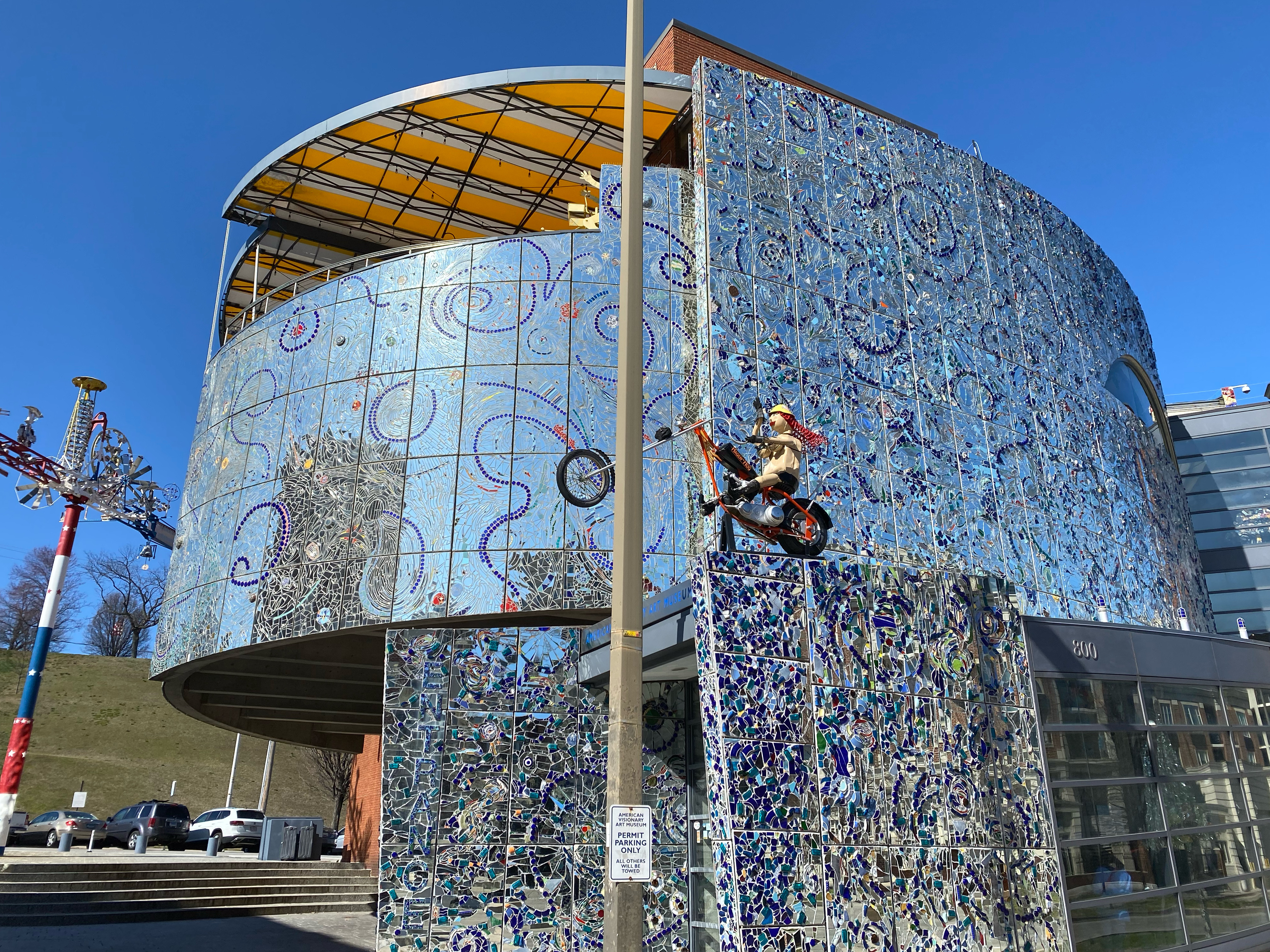
American Visionary Art Museum

yqUuUoCsSPyHOGc1bgBhVA

American Visionary Art Museum

Visionary Art, as defined by the museum, “refers to art produced by self-taught individuals, usually without formal training, whose works arise from an innate personal vision that revels foremost in the creative act itself.”  It has to do with listening to the voices of the soul.

Fred Carter’s (1911-1992) paintings and woodcarvings reflected his take on encroaching environmental destruction, social injustices, and everything he loved and felt deeply about.

Mary Proctor, born in 1960, paints doors, covering them with spiritual images and messages with a jumble of buttons, fabric, mirrors, and other found objects.

Wayne Kusy, born in 1961, completed The Lusitania in 1994; it is 16 feet long and took 194,000 toothpicks and 2 1/2 years to complete. He specializes in 20th century ocean liners because he admires “the detail and prestige [they] had.”

Gary Larson words of wisdom
The Piano Family: Adagio, Amorosa, and Bucky, 2012 by Allen David Christian
by Fred Carter
by Fred Carter
Albert Einstein by Fred Carter
Martin Luther King, Jr. by Fred Carter
by Mary Proctor
by Mary Proctor
The Lusitania by Wayne Kusy

I enjoyed Rick Skogsberg’s Can’t Lose Shoe Collection, a mix of painted new and found shoes and boots from 2014-2016.

Can't Lose Shoe Collection by Rick Skogsberg
Can’t Lose Shoe Collection by Rick Skogsberg
Can't Lose Shoe Collection by Rick Skogsberg
Can’t Lose Shoe Collection by Rick Skogsberg
Can't Lose Shoe Collection by Rick Skogsberg
Can’t Lose Shoe Collection by Rick Skogsberg
Can't Lose Shoe Collection by Rick Skogsberg
Can’t Lose Shoe Collection by Rick Skogsberg
Can't Lose Shoe Collection by Rick Skogsberg
Can’t Lose Shoe Collection by Rick Skogsberg
Can't Lose Shoe Collection by Rick Skogsberg
Can’t Lose Shoe Collection by Rick Skogsberg
Can't Lose Shoe Collection by Rick Skogsberg
Can’t Lose Shoe Collection by Rick Skogsberg

I enjoyed the museum’s quirky and thoughtful exhibits.  The main one was “The Secret Life of Earth: Alive! Awake! (And Possibly Really Angry!)” timed to coincide with the 50th anniversary of Earth Day.  The exhibition included little known facts about nature, information on how our diets and other individual behaviors influence our environment, the difference between weather and climate, the health and environmental price of using pesticides, the effects of a capitalist economy on the environment, positive solutions to many environmental problems, and even humor.

X8tndeMCQ+q3Vliwa7JSsw

The Secret Life of Earth: Alive! Awake! (And Possibly Really Angry!)”

The Secret Life of Earth: Alive! Awake! (And Possibly Really Angry!)"
The Secret Life of Earth: Alive! Awake! (And Possibly Really Angry!)”
Mushrooms are the food of the gods. - Russian proverb
Mushrooms are the food of the gods. – Russian proverb
The Secret Life of Earth: Alive! Awake! (And Possibly Really Angry!)"
The Secret Life of Earth: Alive! Awake! (And Possibly Really Angry!)”
Rachel, 2015 by Peter Eglington
The Secret Life of Earth: Alive! Awake! (And Possibly Really Angry!)"
The Secret Life of Earth: Alive! Awake! (And Possibly Really Angry!)”
Guardian Spirits, 2019 by Judy Tallwing
White Spirit Bears, 2012 by Judy Tallwing
La Madre Tierra Herida (Mother Earth Injured), 2019 by Francisco Loza
La Madre Tierra (Mother Earth) by Macario Matias Carrillo
American Visionary Art Museum
In the Heart of the Woods, 2016 by Stephen Holman
In the Silence of the Sea, 2017 by Stephen Holman
Words for thought...
Words for thought…
Words for thought...
Words for thought…

At the Earth exhibit was a televised interview with Greta Thunberg by Trevor Noah.  She commented about the U.S. conversation around climate change as if we “believe it or not,” whereas, where she’s from, it’s a fact.  Smart girl!

There was an interesting exhibit of “Reverend Albert Lee Wagner: Miracle at Midnight.” It had been ongoing since July 1, 2017 and would leave the museum on June 5, 2020.

Born into great poverty in rural Arkansas to a family of cotton pickers, Wagner was first-hand witness to extreme prejudice and racial violence.  Not until the family later moved north to Ohio did Wagner feel the freedom to speak out on the horrors he had witnessed and began making “story pictures,” accompanied by his hand-written testimony.

Especially saddened by the increase of black on black crime, Wagner evolved into a lover of all humankind, greatly concerned with our human condition.

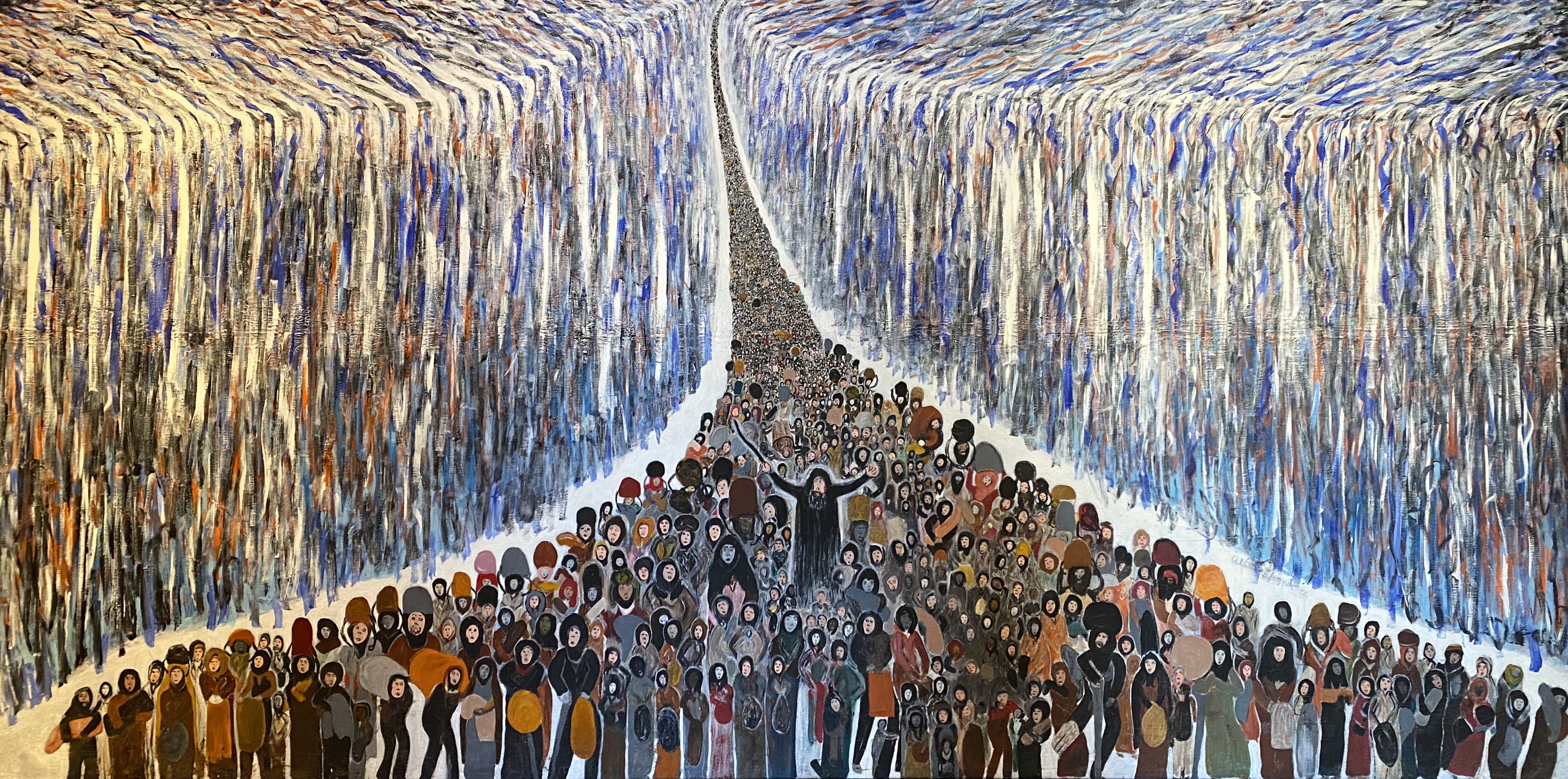
There was an especially amazing huge painting: Flee from Egypt – Moses Parting the Red Sea.

fullsizeoutput_1c6ac

Flee From Egypt (Parting of the Red Sea), 1975 by Reverend Albert Wagner

The title of the exhibit is from a transformative moment when house paint spilled on a floor board, forever changing an actively sinning Wagner as he prepared for his 50th birthday.  Transfixed by the scene of pooling paint, he experienced a spiritual awakening (epiphany), forever ending his womanizing and kick-starting an intense period of religious service and art-making that would endure until his peaceful death at the age of 82.

by Reverend Albert Wagner
Noah and the Rainbow Sign, 1994 by Reverend Albert Wagner
Abraham and Lot, n.d. by Reverend Albert Wagner
Adam and Eve, ca. 1990 by Reverend Albert Wagner

Maya Angelou’s wise observation: “If one is lucky, a solitary fantasy can totally transform a million realities.”

Another fascinating exhibit was “Esther and the Dream of One Loving Human Family.” This features Esther Krinitz’s Holocaust survival story told through 36 hand-embroidered works.  It pays tribute to humanity’s long history, past and current, of unjustly persecuted innocents and the dream of a world at peace.

"Esther and the Dream of One Loving Human Family"
“Esther and the Dream of One Loving Human Family”
My Childhood Home, 1977 by Esther Krinitz
Picking Cherries, 1996 by Esther Krinitz
Prelude to the Final Solution, 1992 by Esther Krinitz
Stefan's House, 1992 by Esther Krinitz
Stefan’s House, 1992 by Esther Krinitz
We Find No Refuge, 1994 by Esther Krinitz

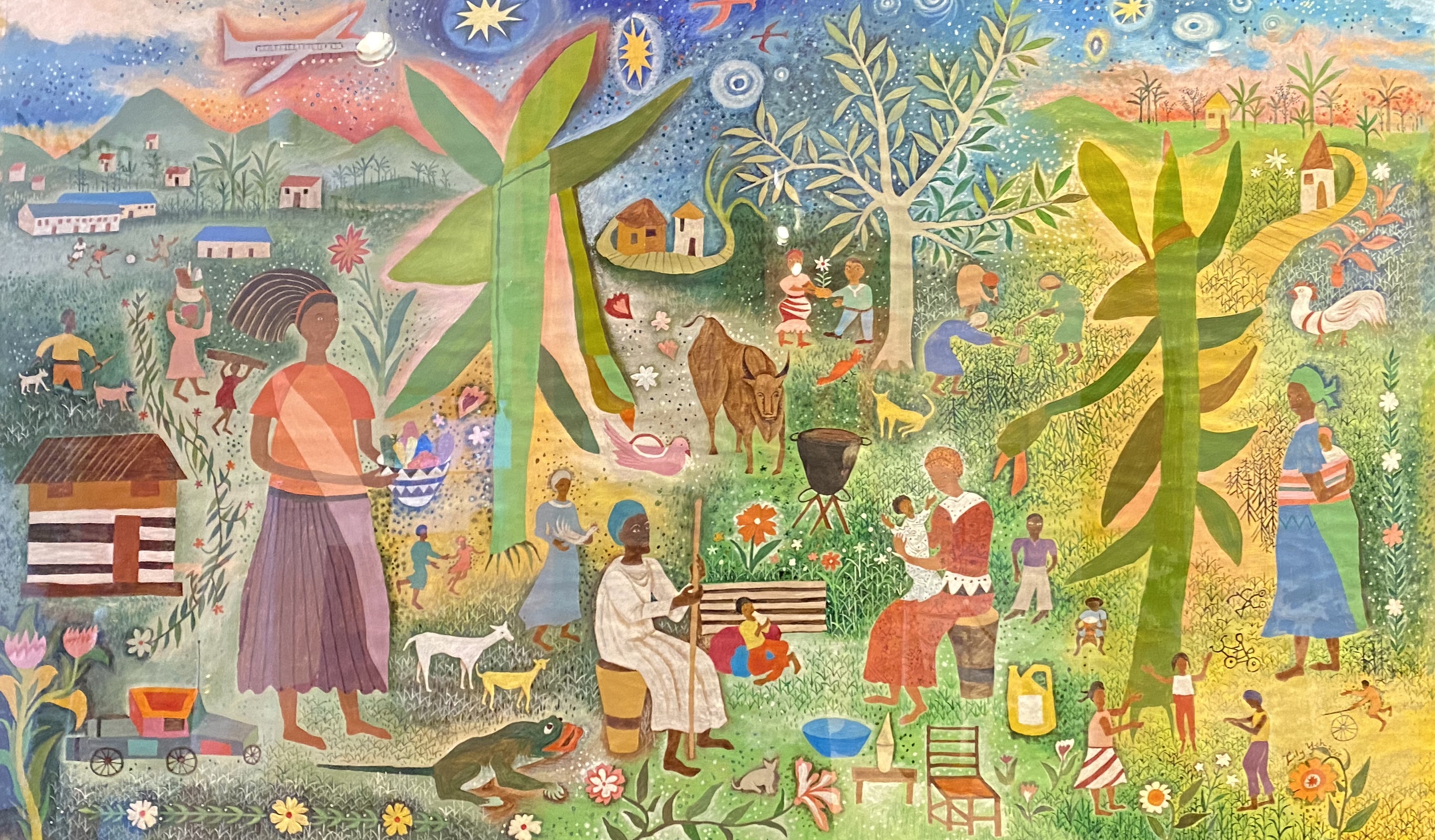
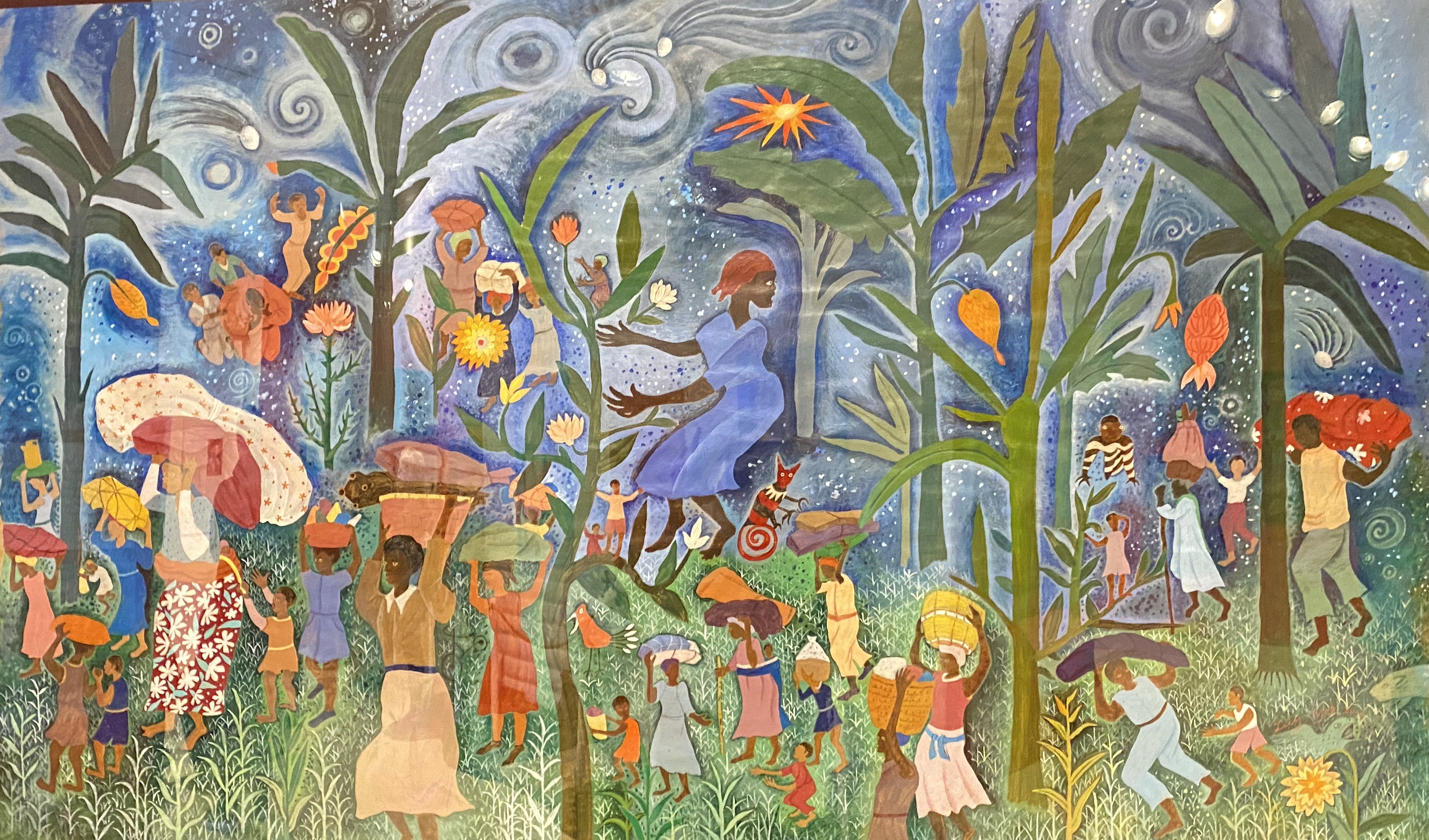
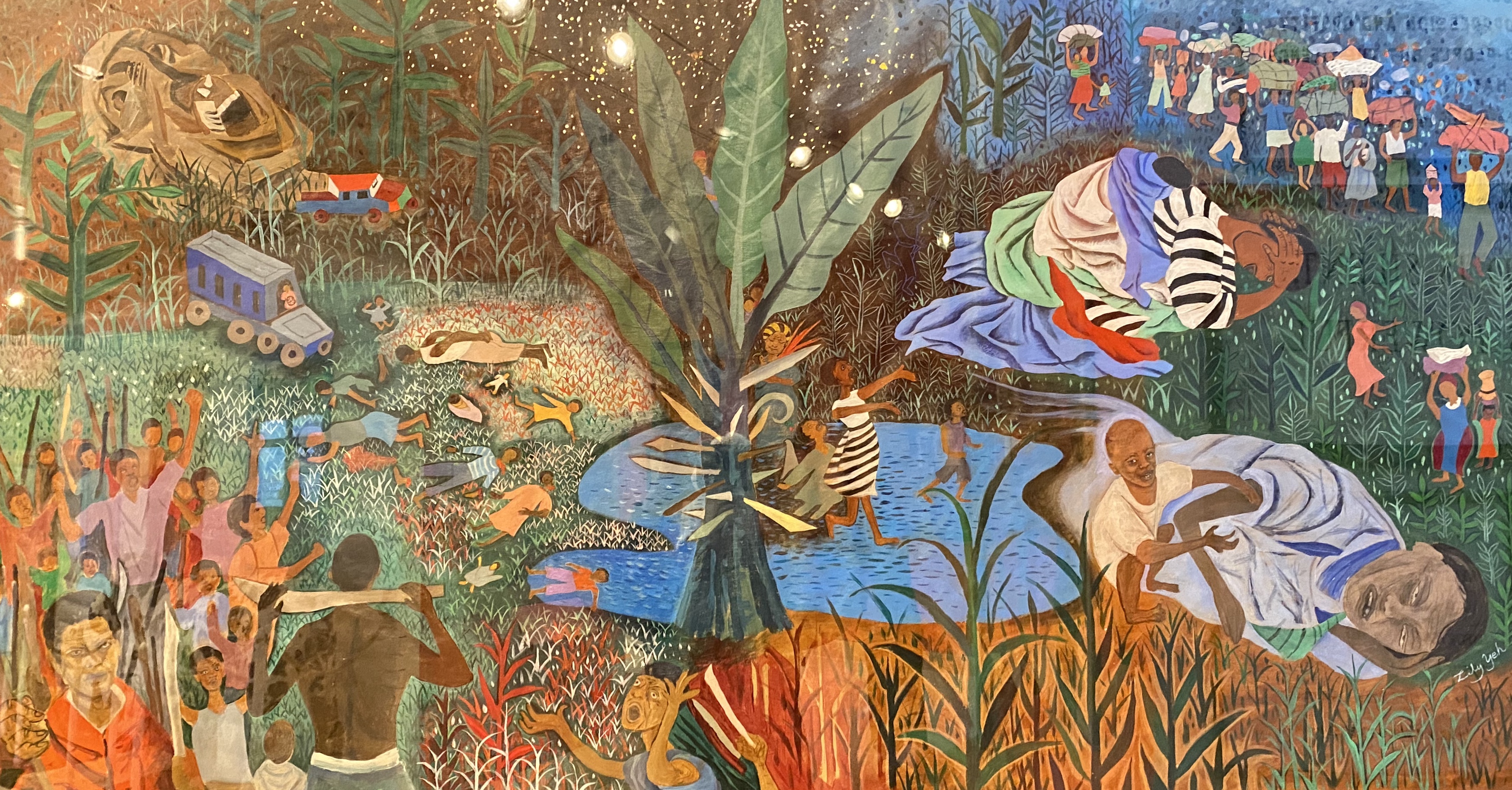
Also, there was work gathered from a partnership with Rwandan Tutsi genocide survivors and more. In this work, humanitarian and art activist Lily Yeh depicts Rwandan village life before, during, and after the 100 days of the Rwandan 1994 Genocide that left over 800,000 Tutsi men, women, elders and children murdered, mostly by brutal machete attack.

fullsizeoutput_1fa5d

Lily Yeh’s Work with the Rugero Survivors Village, Rwanda

fullsizeoutput_1fa5e

Lily Yeh’s Work with the Rugero Survivors Village, Rwanda

fullsizeoutput_1fa5f

Lily Yeh’s Work with the Rugero Survivors Village, Rwanda

Prayer for Peace, by Apache Elder Judy Tallwing, is a painting infused with thousands of tiny glass prayer beads — each one a sincere focal point that Judy has used to pray for someone’s blessing or healing, other than for herself. Judy’s painting features two stylized stealth bomber military planes.  Her message speaks to the essence of the Truth & Reconciliation mission.  She explains, “The only way we will ever obtain peace in our own families, our communities,, and throughout the world, is if we rise above all the stealth or secret ways in which we act, and have acted, to secretly harm one another.”

fullsizeoutput_1fa60

Prayer for Peace, by Apache Elder Judy Tallwing

There was other quirky art found in the museum.

floating between the floors
Birds of Prey by Chris Roberts-Antieau

David R. Klein’s Pez collection began at the time of a surprise 40th birthday party when someone gave him a variety of gag gifts, among which was a Pez dispenser. Shortly after that, he came across a vendor selling a variety of Pez dispensers at a Pennsylvania flea market, and he began to collect them.

The Pez collection of David R. Klein (1955-2010)

I wandered over to an adjacent building and found these treasures between the two buildings.

Things on the grounds outside the Jim Rouse Visionary Center

Inside the Jim Rouse Visionary Center, I found painted screens, Fifi and friends from the Kinetic Sculpture Race, Leonard Knight’s Love Balloon, Andrew Logan’s Divine, and Devon Smith’s World’s First Robot Family.

Jim Rouse Visionary Center
by Pamela Smith
by Pamela Smith
by Pamela Smith
by Pamela Smith
Bra Ball, 2001-2003, by Emily Duffy
Divine by Andrew Logan
Jim Rouse Visionary Center
Fifi from the Kinetic Sculpture Race
Jim Rouse Visionary Center
Devon Smith's World's First Robot Family
Devon Smith’s World’s First Robot Family
Devon Smith's World's First Robot Family
Devon Smith’s World’s First Robot Family
Jim Rouse Visionary Center
Bad Habits Die Hard by Chris Roberts-Antieau
Jim Rouse Visionary Center
Leonard Knight's Love Balloon
Leonard Knight’s Love Balloon
Leonard Knight's Love Balloon
Leonard Knight’s Love Balloon
Leonard Knight's Love Balloon
Leonard Knight’s Love Balloon

The young lady in the gift shop suggested I walk ten minutes to the Cross Street Market in Federal Hill, where I could find a lot of eateries.  Taking her advice, off I went, dragging my poor hurt ankle along!

*Saturday, February 22, 2020*

Share this:

  • Share on X (Opens in new window) X
  • Share on Facebook (Opens in new window) Facebook
  • More
  • Email a link to a friend (Opens in new window) Email
  • Print (Opens in new window) Print
  • Share on Pinterest (Opens in new window) Pinterest
Like Loading...
  • America
  • Baltimore
  • Maryland

the walters art museum in baltimore & dinner with an old friend

wanderessence1025's avatar wanderessence1025 November 21, 2020

After visiting the Baltimore Museum of Art, I went directly to The Walters Art Museum where I had a tuna sandwich in the cafe.  (I wrote about the Baltimore Museum of Art here: the baltimore museum of art)

The Walters Art Museum has a striking four-story glass entryway. It is named for William Thompson Walters (1820 – 1894) and his son Henry (1848 – 1931). William was a leading investor in Maryland and Pennsylvania railroads before the Civil War.
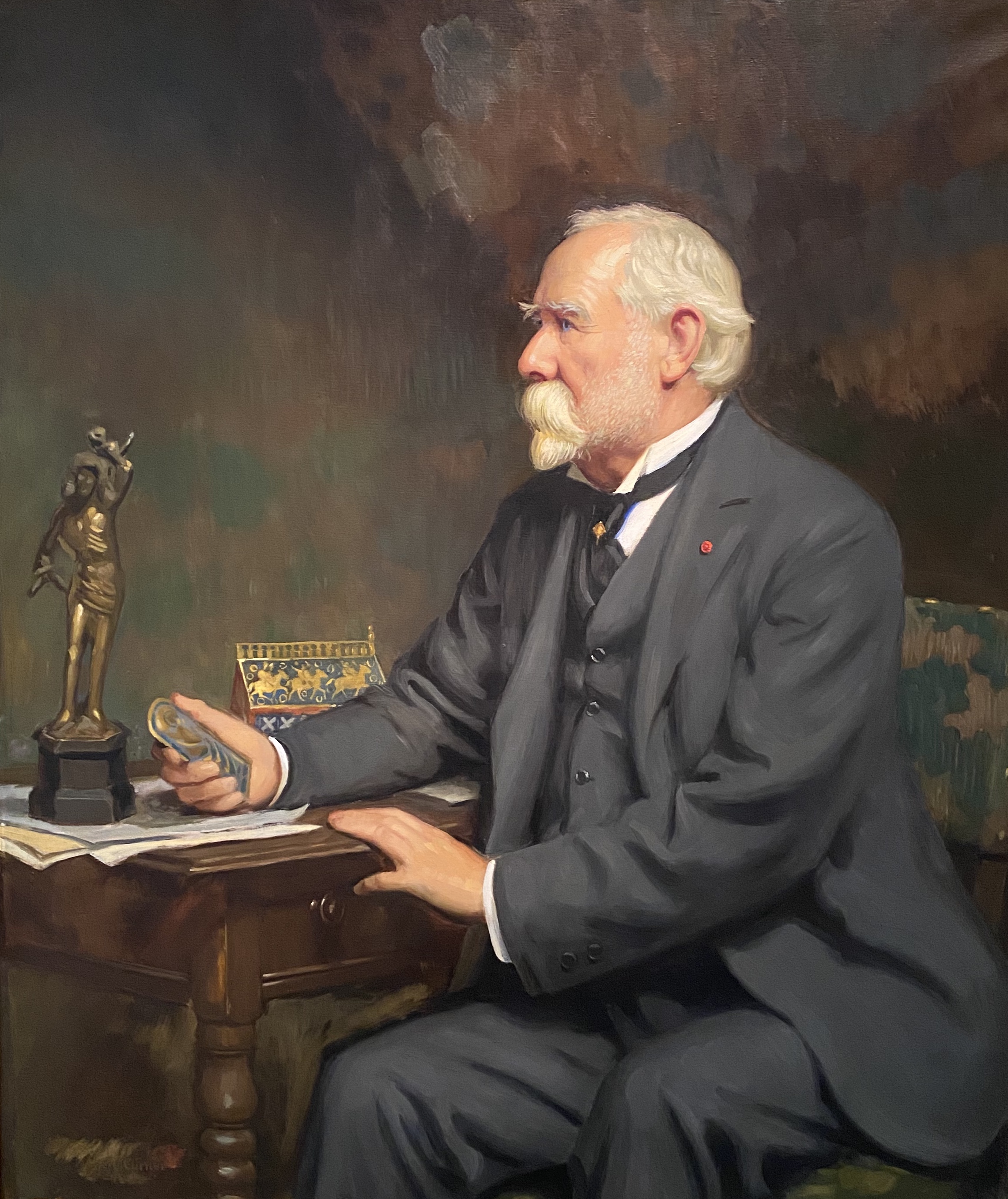
fullsizeoutput_1c5cb

Portrait of Henry Walters, 1938 by Thomas Cromwell Corner

The collection is the fruit of a half-century of conscious acquisition.  The main collection covers 55 centuries from the antiquities to modern art.

William Walters appears to have been a religious man: in the 1860s he had compiled two albums of drawings on the theme of prayer.

The scene below by Eugène Delacroix is based on an incident recounted in three of the Gospels: a furious storm breaks out while Jesus and his disciples sail across the Sea of Galilee.  To the disciples’ amazement, Jesus calms the wind and the storm, dramatizing the power of Christian belief.

fullsizeoutput_1c5b9

Christ on the Sea of Galilee, 1854 by Eugène Delacroix

After the Civil War, when William T. Walters returned to Baltimore, he had lived abroad for nearly four years. The art in one gallery romanticizes foreign people and places encountered through the trading and colonizing activities of European countries and the United States.

An Arab Sheik, ca. 1870 by Léon Bonnat
Interior of a Mosque at Cordova, 1880 by Edwin Lord Weeks
The Slipper Merchant, 1872 by José Villegas Cordero
On the Desert, before 1867 by Jean-Léon Gérôme
Odalisque with Slave, 1842 by Jean-Auguste-Dominique Ingres
Hindu Snake Charmer, 1869 by Mariano José Maria Bernardo Fortuny y Carbó
Arab Fantasia, 1867 by Mariano José Maria Bernardo Fortuny y Carbó
Collision of the Moorish Horsemen, 1843-44 by Eugène Delacroix
Poultry Market, ,Tangiers, before 1881 by José Villegas Cordero
Toreros at Prayer before Entering the Arena, ca. 1870 by Jehan Georges Vibert

A recent acquisition at the Walters was Othello by Pietro Calvi. This sculpture depicts William Shakespeare’s tragic hero. Othello, a great warrior, secretly married Desdemona, a Venetian noblewoman, provoking jealousy among his peers. Othello’s supposed friend Iago used a silk handkerchief – Othello’s first gift to his wife – as evidence that Desdemona had been unfaithful; in a rage, Othello murdered her. Calvi captures Othello’s intense emotion: a tear falls from his eye as he contemplates the handkerchief.
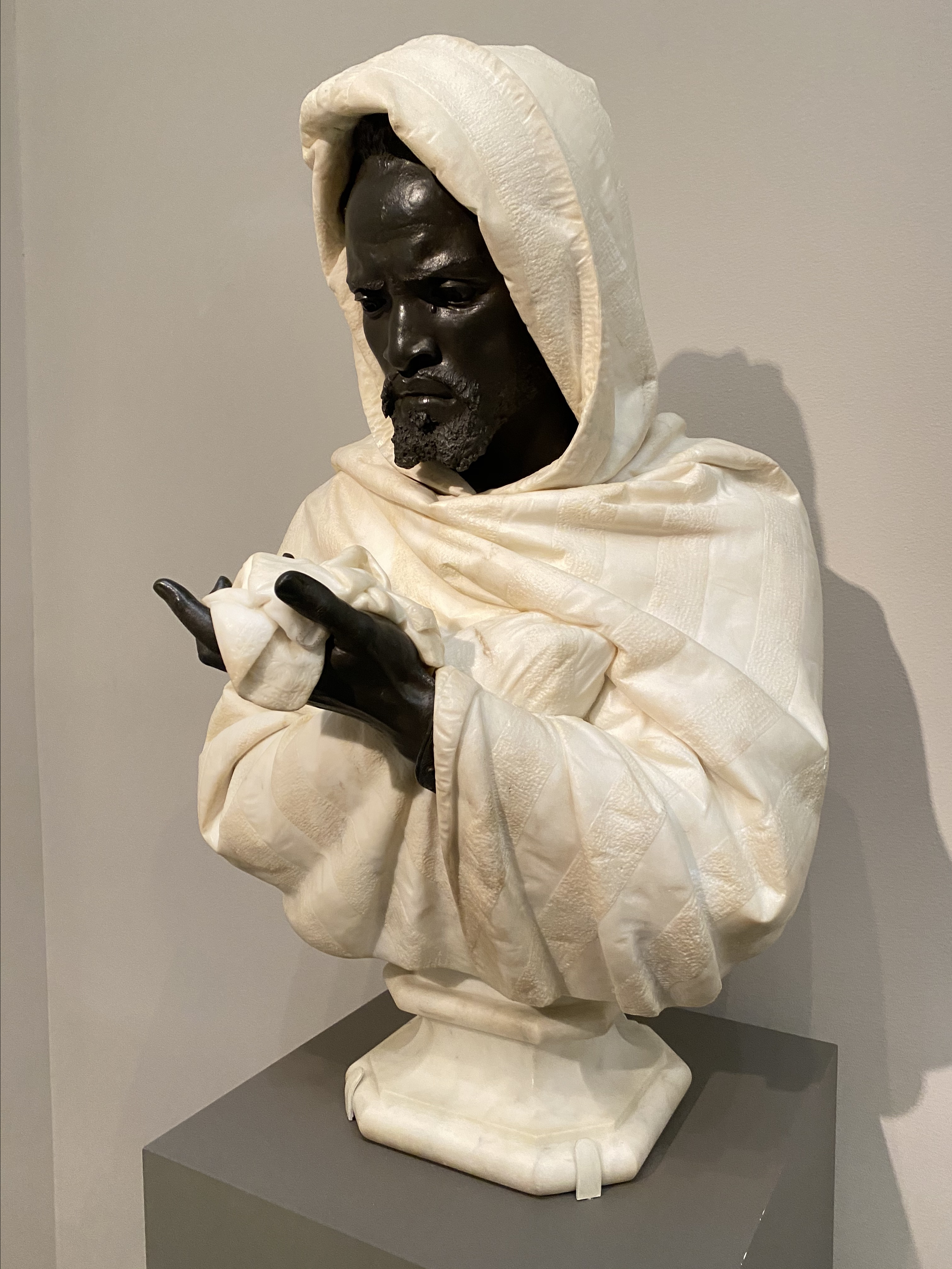
5heEcMiLQAu4Szu4GCWvAg

Othello, modeled ca. 1868; this version executed ca. 1873 by Pietro Calvi

The work of contemporary French landscape painters was sought after by American collectors from the end of the Civil War onward, and the collections of William T. and Henry mirrored those of their East Coast peers. William acquired the work of the Barbizon School, whose members broke with tradition by working outdoors and taking inspiration directly from nature.

The Jungfrau, Switzerland, 1853-55 by Alexandre Calame
The Coming Storm, 1865-75 by Charles François Daubigny
Ploughing Scene, 1854 by Rosa Bonheur
Springtime, 1872 by Claude Monet
The Church of Eragny, 1884 by Camille Pissarro
View of Saint Mammès, 1880 by Alfred Sisley
Raby Castle, Seat of the Earl of Darlington, 1817 by Joseph Mallord William Turner
Landscape in Scotland, ca. 1878 by Gustave Doré
The Tulip Folly, 1882 by Jean-Léon Gérôme
A Roman Emperor: AD 41, 1871 by Sir Lawrence Alma-Tadema
The Terracew at Saint-Germain, 1875 by Alfred Sisley
Before the Race, 1882-84 by Edgar Degas
A Stream in the Adirondacks, 1859, by James McDougal Hart

The Walters has a remarkable collection called “Books of the Art Nouveau,” which captures the romance and whimsy of that era (1890-1910).  Motifs include undulating vines, gardens of abstract flowers, and elegant maidens in billowing gowns.

Books of the Art Nouveau

I loved Lady with a Guitar; Boldini presents a woman lost in thought, resting her guitar on her thigh.  Boldini uses loose, visible brushstrokes to capture details of the figure’s hair, jewelry, and costume.
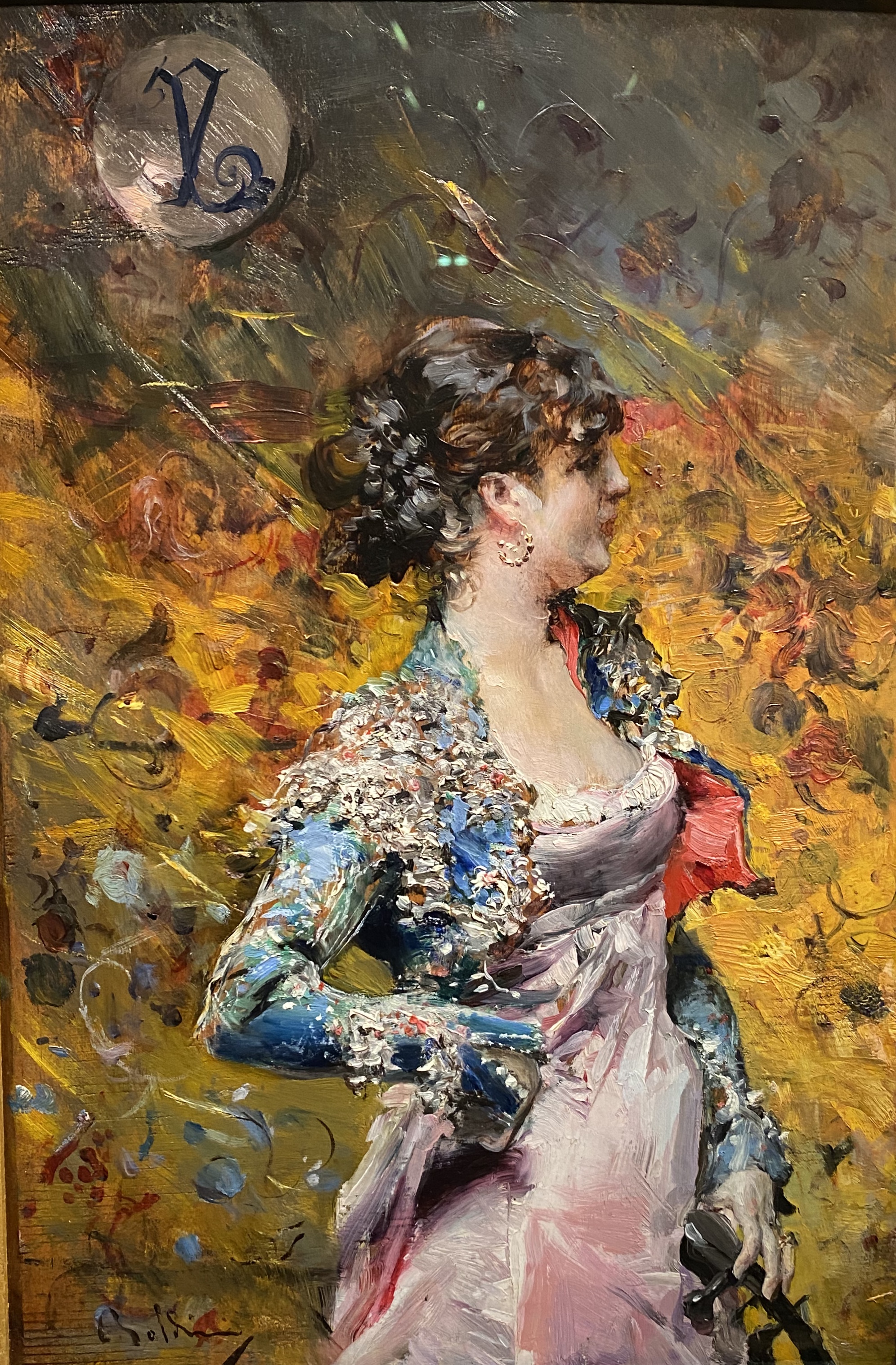
fullsizeoutput_1c5c8

Lady with a Guitar, c. 1873, by Giovanni Boldini (Italian, 1842-1931)

The museum had a special exhibit on the St. Francis Missal.  In 1208, St. Francis sought direction for his life at the Church of San Nicolò in Assisi.  Hoping for divine guidance, he opened the missal (a book containing the texts used in the Catholic mass throughout the year) on the altar three times at random and in every case, the text on the page urged renouncing earthly goods. This idea provided the foundation for the Franciscan order.

This is the very book consulted by St. Francis and his companions.
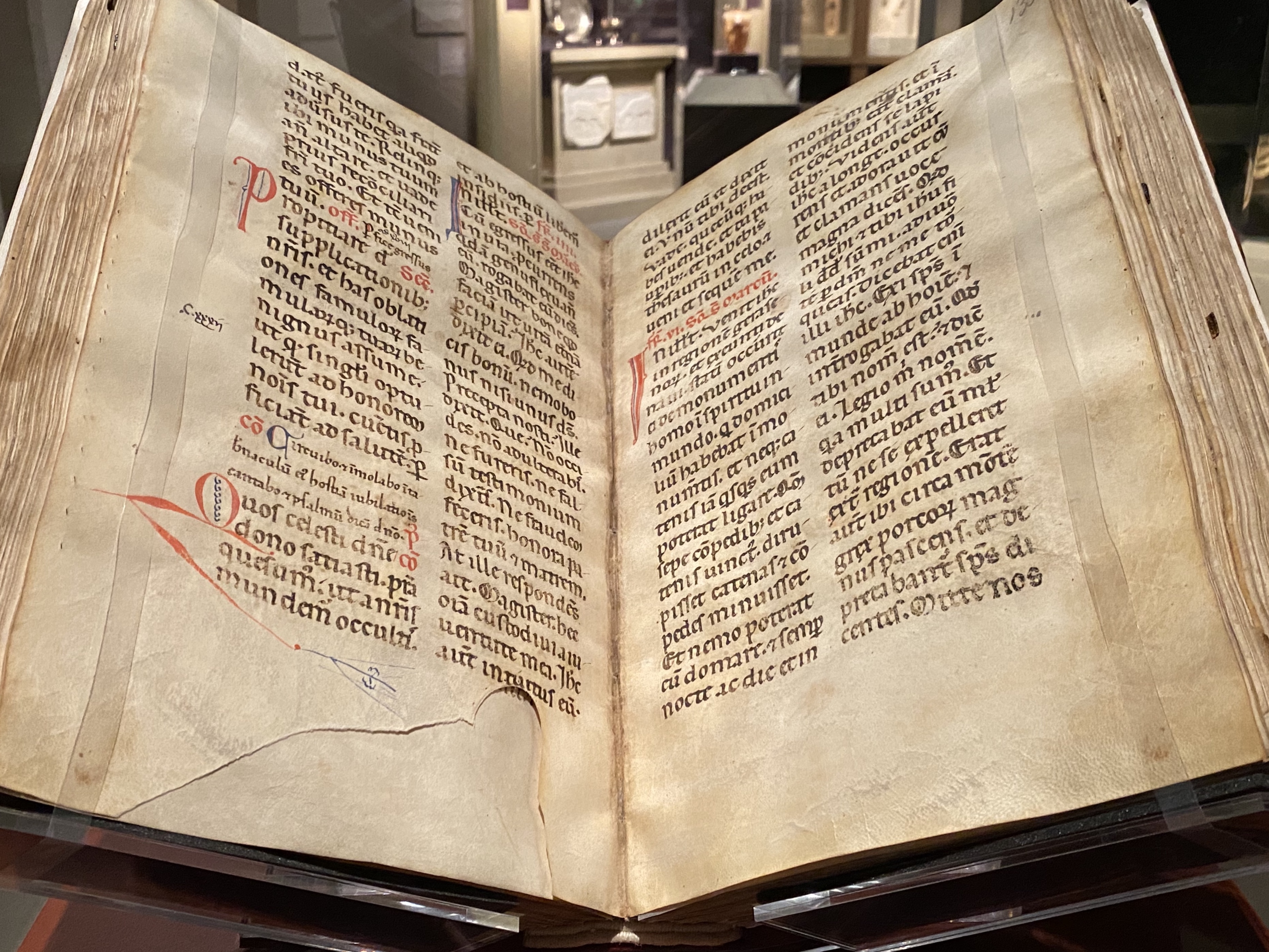
fullsizeoutput_1f31a

The Saint Francis Missal, ca. 1200

Walters Art Museum
Walters Art Museum
Walters Art Museum
Walters Art Museum
Walters Art Museum
Walters Art Museum
Saint Clare
Saint Clare
Walters Art Museum
Walters Art Museum
Walters Art Museum
Walters Art Museum
Walters Art Museum
Walters Art Museum
Walters Art Museum
Walters Art Museum
Saint Francis
Saint Francis

The arrival of Christianity in Ethiopia in the early 4th century marked the beginning of the important role played by this African kingdom in the spread of the Christian faith. Following the conversion of King Ezanas around 324, the coins of his kingdom, centered in Aksum, were the first anywhere to carry the cross as a new and powerful symbol only a few years after Christianity was accepted in Byzantium under Constantine the Great.

Triptych with Mary and Her Son Flanked by Archangels, Christ Teaching the Apostles (Center); Scenes from the Life of Christ, Saints (Left and Right), Ethiopian, Early 16th century
Diptych Icon with Saint George, and Mary and the Infant Christ, Ethiopian, early 15th century
Triptych with Mary and Her Son Flanked by Archangels (Center); Crucifixion and Resurrection, Apostles and Saints (Right and Left), Ethiopian, late 17th-early 18th century
Walters Art Museum
Walters Art Museum
Diptych Leaf with Mary and Her Son, and Archangels Michael and Gabriel, Ethiopian (Central Ethiopia), active 1445-80
Diptych with Mary and Her Son Flanked by Archangels (Left); Apostles and a Saint (Right), Follower of Fre Seyon, Ethiopian (Tegray), late 15th century
Walters Art Museum
Walters Art Museum

The history of Russian art and culture is closely tied to the legacy of Byzantium.  In A.D. 988, Grand Prince Vladimir of Kiev, in what is now Ukraine, chose the Orthodox Christianity of the Byzantine Empire over the Catholicism of Europe, at least in part because of reports of the grandeur of Byzantine churches.

The Orthodox Christian faith was thus brought to the Slavic lands (Ukraine, Belarus, and Russia) where it flourished, even during the turbulent period of Mongol (“Tartar”) rule (ca. 1240-1380).

Double-Sided Icon with the Presentation of the Virgin (front), Russian (Moscow?), early 17th century
Double-Sided Icon with the Virgin of the Burning Bush (back), Russian (Moscow?), early 17th century
Icon with the Virgin of the Burning Bush, Russian, 19th century

Throughout the Islamic world, Muslims share the same religious convictions, including the belief in one God, called Allah, and in the prophet Muhammad as the messenger of God. Unlike Christian churches, where images of holy figures may abound, Islamic religious buildings do not feature icons or other figural representations.  Instead, interiors are adorned with the word of God, through written verses from the Koran and other pious sayings.

Mausoleum doors from Iran (Tabriz?), made by Qanbar ibn Mahmud, originally opened into the mausoleum, or tomb, of Imamzada Sulayman, the son of a spiritual leader in Iran, where one particular branch of Islam, called the Shia, flourished.  The doors’ intricately carved and inlaid decoration is typical of the ornamentation in religious buildings and includes inscriptions in praise of Ali, cousin and son-in-law of the prophet Muhammad and the leader of Shia Muslims.

Mausoleum doors from Iran (Tabriz?), made by Qanbar ibn Mahmud
Walters Art Museum
Walters Art Museum

By the 1430s in northern Europe, the elegance of the International Gothic style had given way to a style of realism.

The Crucifixion, 1537 by Peter Gärtner
Scenes from the Life of Saint Catherine of Alexandria, ca. 1430-50, German (Swabia)
Exterior of an Altarpiece with Saints Lawrence and Leonard, ca 1450, by Arguis Master
Walters Art Museum
Walters Art Museum
Walters Art Museum
Walters Art Museum
Portrait of King Louis XII of France at Prayer, 1500-10, by jean Perréal (design attributed to)
Adoration of the Kings, 1526 by William Stetter, German

Another exhibit was on European ceramics, objects made from clay hardened into a permanent form by firing at high temperature in a kiln. The pieces displayed here are glazed earthenware or stoneware.  Beginning around 1515, a new approach to decoration known as istoriato  (“painted with stories”) became popular. Depicting biblical and classical subjects, painters of istoriato treated a plate like a canvas to be covered with a narrative scene.

Virgin Adoring the Christ Child, ca. 1483 by Andrea della Robbia and workshop
Istoriato Ware
Istoriato Ware
Istoriato Ware
Istoriato Ware
Istoriato Ware
Istoriato Ware
Snake-Handed Vases with Scenes from Genesis, ca. 1580-1600, Patanazzi workshop
The Agony in the Garden of Gethsemane, ca. 1525-35 by Santi Buglioni, workshop of

I found an exhibit on Saint Mary Magdalene.  In the New Testament, Mary from the town of Magdala was one of Christ’s most loyal followers.  Later tradition associated her with a reformed prostitute.  The merging of these identities produced emotionally powerful images of a remorseful yet alluring young woman.

Saint Mary Magdalene, ca. 1625-35 by Giacomo Galli, known as Spadarino
The Penitent Magdalene, ca. 1635 by Guido Reni

In the exhibit “Late Baroque and Neoclassical Art in Italy: 1700-1800,” the baroque style of the previous century gradually took on greater lightness and grace.

This gallery, with its densely hung walls, gilded furniture, light-painted wainscot, and cove ceiling evokes the installation of art in an 18th-century nobleman’s palace.

The Adoration of the Sepherds, ca. 1615 by Bernardo Strozzi
Walters Art Museum
Walters Art Museum
Walters Art Museum
Walters Art Museum

One of the last things I saw in the Walters Art Museum was Adam and Eve (1515) from the Della Robbia worskshop. Here, the first two humans are depicted with ideal bodies that recall ancient marble sculptures. The snake has a woman’s face that resembles Eve’s.  During this period, women were often described as untrustworthy, and this negative idea is reflected in the gender of the face of the snake.
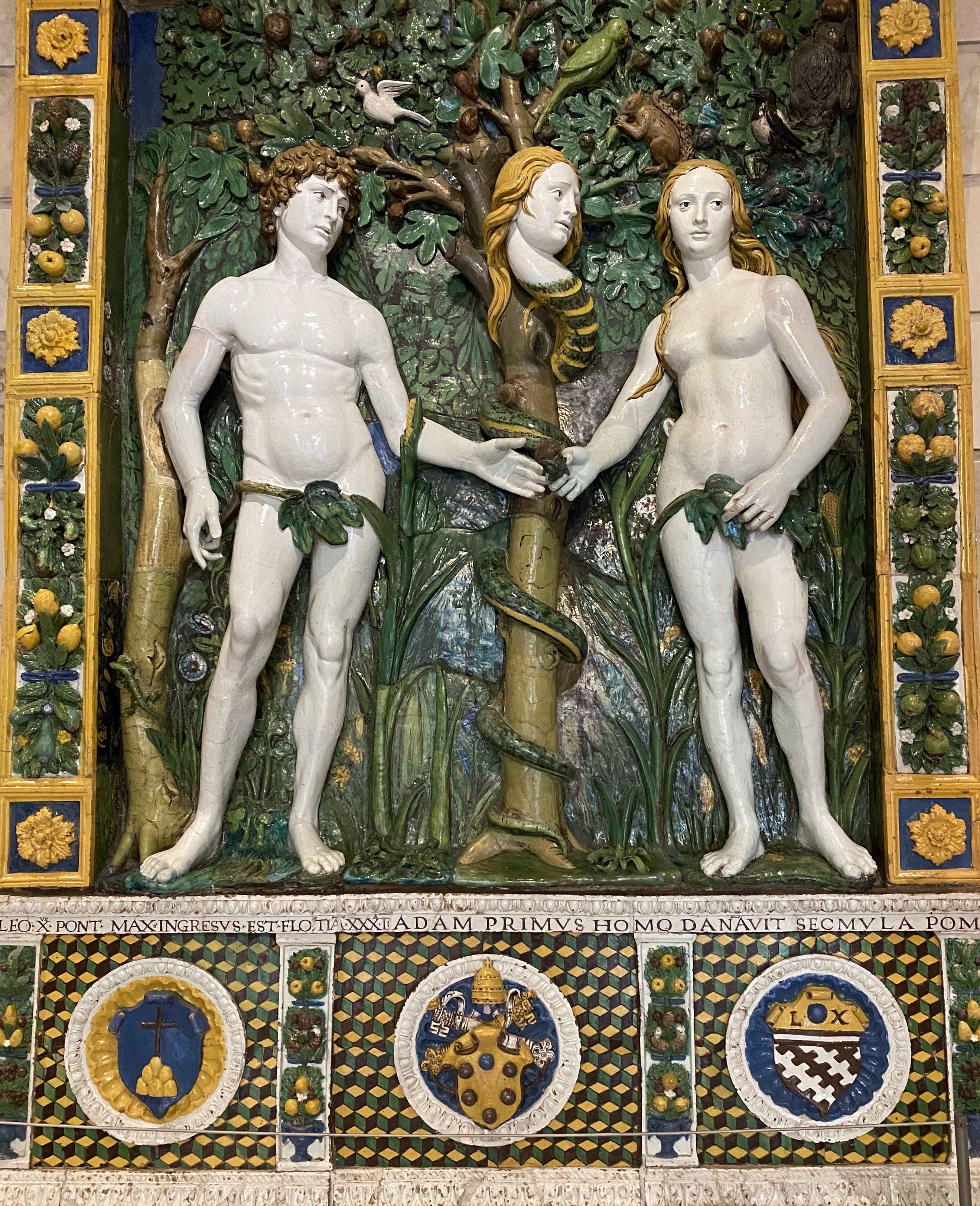
fullsizeoutput_1c5f2

Adam and Eve (1515) from the Della Robbia worskshop, Italian (Florence)

It was right after meeting Adam and Eve in the Garden of Eden that I took a tumble, stepping out over the bottom step of a marble staircase and suffering a wrenching left ankle twist.  I yelled, “Sh*t!” and a young man came to help me up.  What an embarrassing senior moment.

After dusting myself off, my stepmother called and asked if I had just called her.  I said I must have accidentally dialed her when I fell. She had heard me thanking the guy who helped me up.  I told her I’d fallen and she said that’s how she’d broken her ankle.

While talking to her, I hobbled around through Chinese snuff bottles of the Qing dynasty (1644-1911), which were made to hold snuff: a mixture of spices, aromatic herbs, and powdered tobacco. Valued for its stimulating effects and supposed medicinal benefits, tobacco had been introduced by Europeans to China in the 17th century.  Inhaling tobacco as snuff was considered to be more genteel than smoking, which was outlawed in China.  By around 1800, snuff was enjoyed at every level of Chinese society.

o24DFphhQfOjJNdjx14oJw

Chinese snuff bottles

I felt disheartened and in pain after that, so I left the art gallery and went to check in at Days Inn Wyndham Baltimore Inner Harbor.  I waited in my room until an old friend from the past, Terry, came to the hotel to meet me.

We painstakingly made our way to Watertable, on the 5th floor of Renaissance Baltimore Harbor Place Hotel.  I had a glass of wine, Harborplace Cream of Crab Chowder (delicious!), and we shared an entree of a Crab Cake dinner: 6 oz crab cake, fingerling potatoes, Chesapeake corn puree and roasted cauliflower, except I think we got roasted zucchini instead of corn puree.

Terry was my roommate at Riverside Hospital School of Professional Nursing in 1974. I hadn’t seen her since I dropped out of nursing school (deciding nursing wasn’t for me); she went on to become a nurse. She had contacted me through Facebook the week before I planned to go to Baltimore, and since she lived in Annapolis, and happened to be in a seminar in Baltimore on Friday, she met me there.

Terry wasn’t working at that time and was just doing locums (temporarily fulfilling the duties of another, like a substitute nurse).

She told me all kinds of stories about myself that I didn’t remember.  She heard a story that I flipped a tall guy (perhaps my first husband Bill) on the dance floor, and I said I remember flinging him into a ditch after drinking too much tequila after a Busch Gardens party. 🙂

I told her Bill published two books, Mathews Men and The Ghost Ships of Archangel.  She said she had gone to The Annapolis Maritime Museum to hear someone talk about Ghost Ships of Archangel. She didn’t think the lecturer she heard was Bill, but he had mentioned Mathews Men.  I said it must have been Bill because he wrote Ghost Ships.  She said she was confused and didn’t realize they were one and the same.  I showed her his picture and she said, yes, that was him. It’s a small world sometimes.

She said she thought I was always so smart and for some reason she believed I’d become a successful lawyer.  I said not at all; I hadn’t done much of substance with my life.  I said I’d lived and worked abroad teaching English for a number of years, and the living abroad was the highlight of my life.  She said I used to come in late to our dorm room and I’d say, “Read your notes to me,” and she did.  Then we’d take a quiz in class and I’d get 10 points more than she did. I honestly didn’t remember that at all.

I told her that in my Master’s program in International Commerce & Policy at George Mason University, I read all assignments, took massive detailed notes and studied them assiduously and I got almost all As but one B.  But I had to work hard!!

We shared stories about our children and our stories were eerily similar: mostly problems with under-motivated children who blame us for everything that’s gone wrong in their lives. One of her sons tragically committed suicide and the other is an acupuncturist who does just enough work to get by.  Her son was verbally abusive to her, so she made him move out.  He is brilliant but has always done the bare minimum. Her daughter doesn’t speak to her and blames her for all that’s gone wrong in her life.

I told her about calling the police on my youngest son and much later, helping him move in with his older brother.  The younger was trying to get sober but the older was still drinking and the younger went ballistic and smashed up the apartment building including the older’s TV.  I told the older to call the police on him but he wouldn’t.  It was a real sh!tshow and we had to get the younger permanently out of the older’s apartment, long distance, as they both lived in Denver, CO.

I told her about traveling to Charleston with my daughter and it turned into a disaster because my daughter thinks I criticize her for everything.

I told her about walking the Camino de Santiago and she was very interested since she wasn’t currently working.

It was interesting to meet up with Terry after so many years had passed and to find out our situations, at least with our children, were similar. I felt sad for the loss of her son, and she said she would do things differently if only she could have him back again.

Little did we know that we would be under lockdown in a couple of weeks due to COVID-19.

*Friday, February 21, 2020*

Share this:

  • Share on X (Opens in new window) X
  • Share on Facebook (Opens in new window) Facebook
  • More
  • Email a link to a friend (Opens in new window) Email
  • Print (Opens in new window) Print
  • Share on Pinterest (Opens in new window) Pinterest
Like Loading...
  • American Road Trips
  • Chimney Rock
  • Nebraska

chimney rock national historic site, nebraska

wanderessence1025's avatar wanderessence1025 November 20, 2020

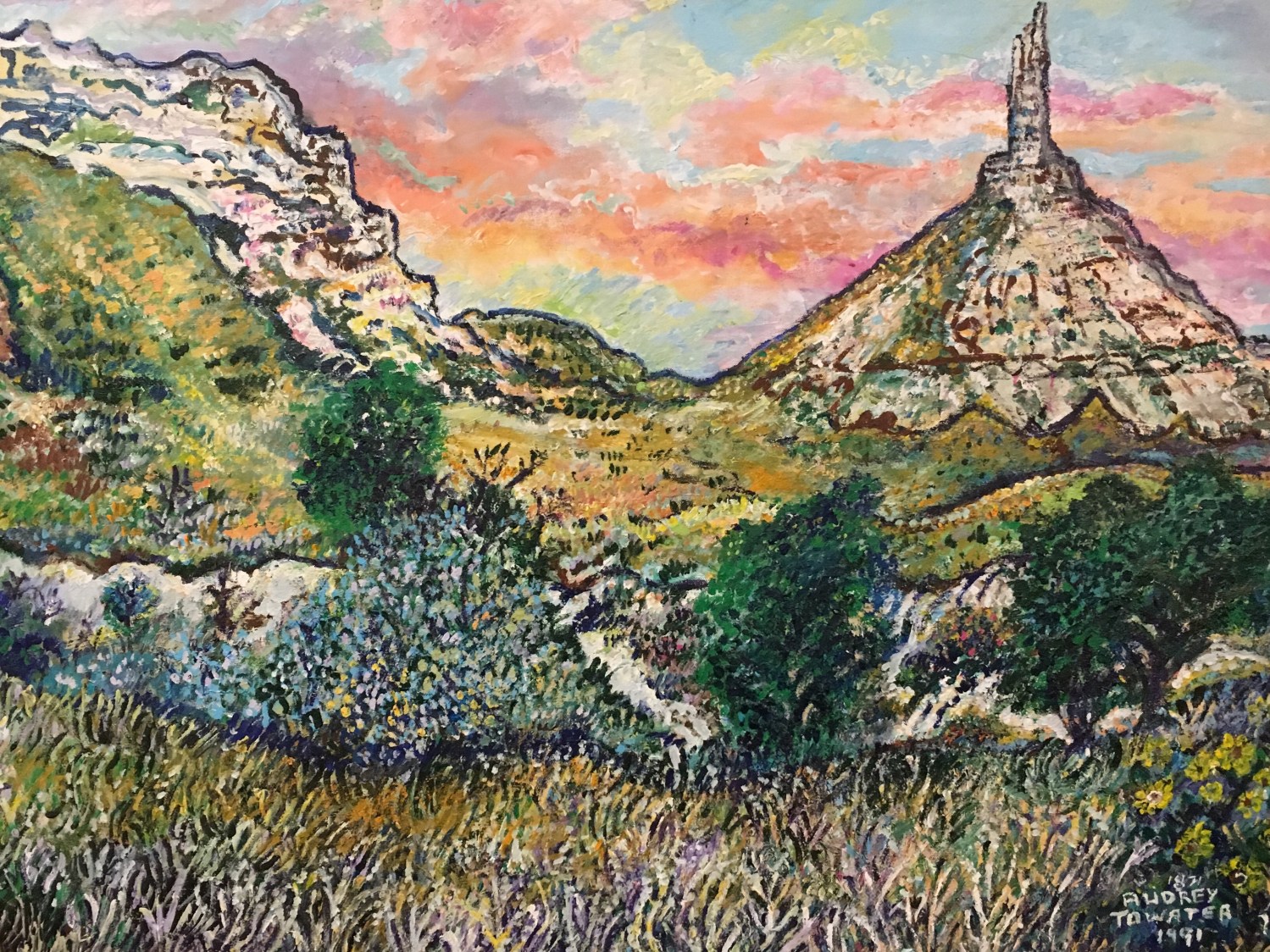
We visited Chimney Rock National Historic Site while in Scotts Bluff, Nebraska.  In the 1800s, this pointy rock was the most noted landmark along the Oregon, California and Mormon Trails.

Names for the rock have ranged from inspiring to vulgar. Native Americans, according to early fur traders, named the rock after the penis of the adult male elk. However, prim and proper Anglo-Americans preferred the more delicate “chimney.” It has also gone by other names such as “Haystack with a pole stuck in the top,” “Nose Mountain” by Warren Ferris- American Fur Trading Company, “The Smokestack,” “The Teepee” and “Wigwam.”

fullsizeoutput_1a3aa

Chimney Rock

The Oregon Trail began as an ancient network of Indian footpaths and animal trails that crisscrossed the West.  In the early 1800s, British, French and American fur trappers followed these paths as they hunted for beaver.  After a fur trader found a wide pass across the Continental Divide in 1812, South Pass in Wyoming made overland travel with ox-drawn wagons possible, and the trail became the gateway to the West. The “fur trace,” wheel tracks along the Platte River and through the Rockies, began the Oregon Trail. Christian missionaries, eager to convert Indians, joined the fur caravans for safe passage.

Desperate farmers and businessmen, hit hard by economic depressions in 1837 and 1841, traveled West in search of opportunities.  The idea of “Manifest Destiny” – that God intended the United States to stretch from coast to coast – made citizens feel it was their patriotic duty to go West.

In early 1841, the first emigrant wagon train set out from Independence, Missouri. They followed the old fur trace past Chimney Rock and Scotts Bluff. Chimney Rock was by far the most mentioned landmark in journals of over 300 settlers who moved west along the Oregon Trail.

Chimney Rock
Chimney Rock
Chimney Rock
Chimney Rock
Chimney Rock
Chimney Rock
Chimney Rock
Chimney Rock
Chimney Rock
Chimney Rock

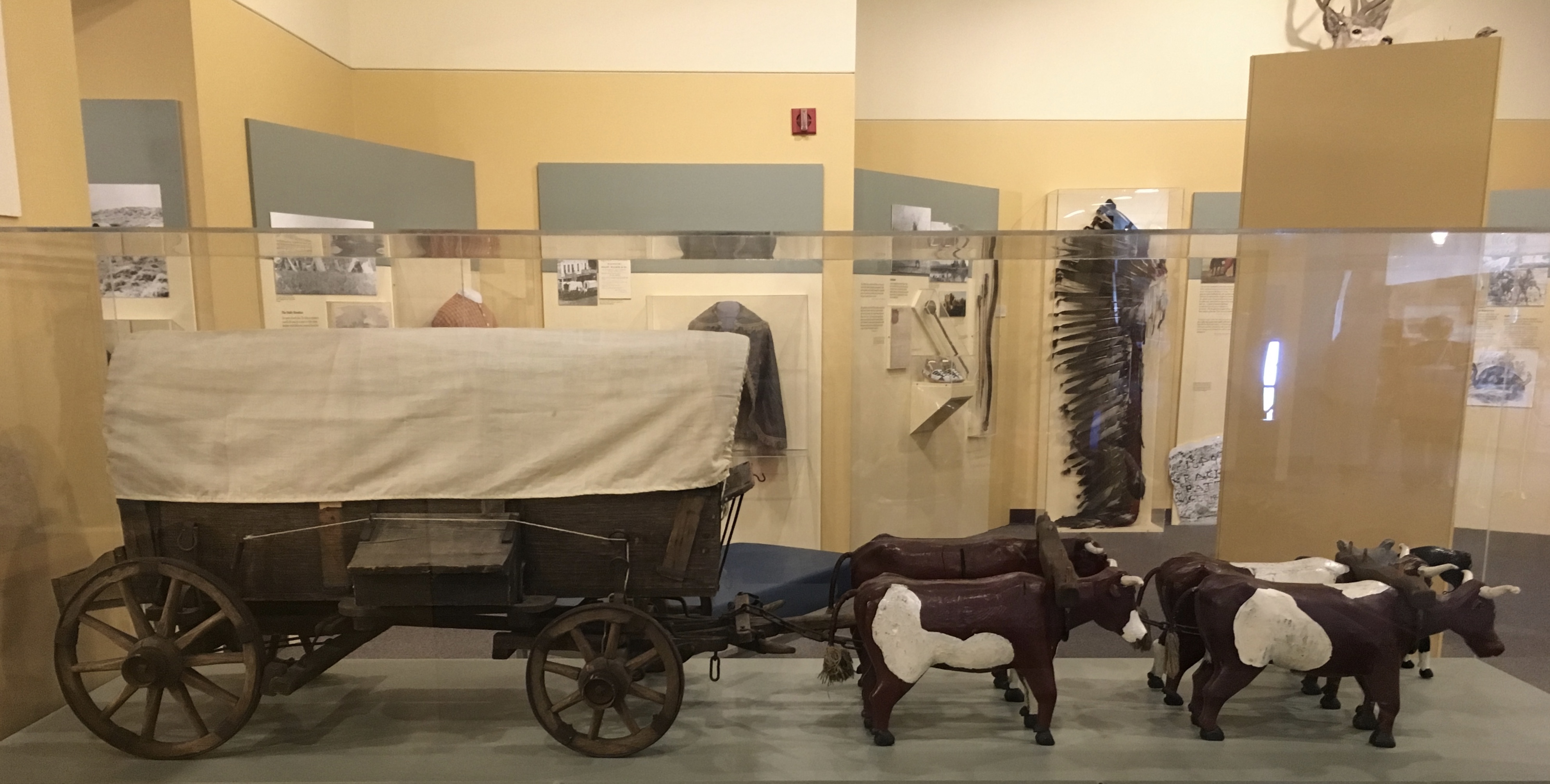
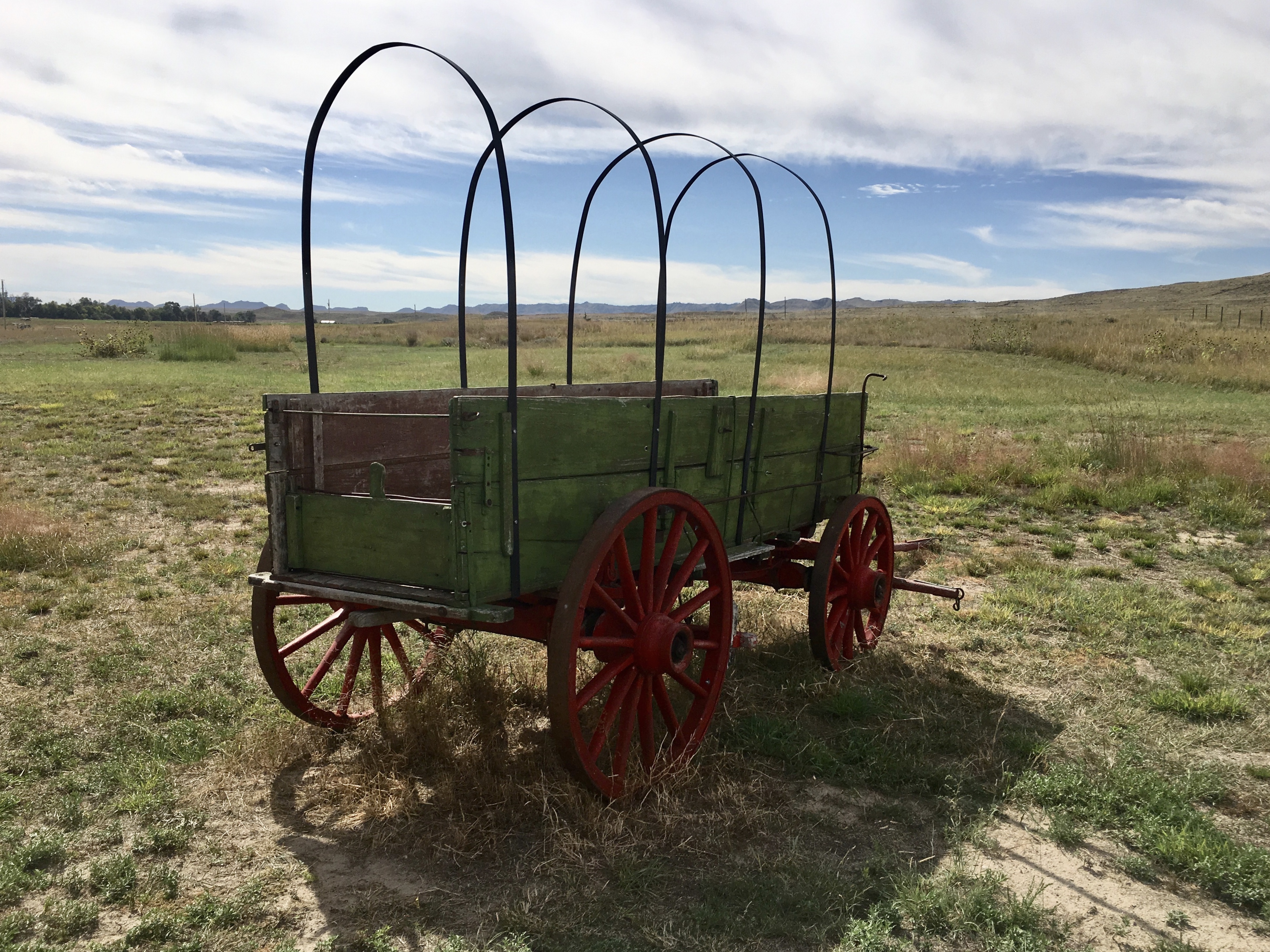
The risk of long-distance wagon travel was high, yet traffic on the trail kept growing. The highway was not straight, smooth or direct, and many discouraged travelers turned around.

fullsizeoutput_1fa11

Wagon replica

fullsizeoutput_1fa0c

Wagon at Chimney Rock

At first relations between Native Americans and emigrants were cooperative, but when the stream increased in 1849 due to the California gold strikes, tensions grew.  By the late 1850s, Indians killed travelers and travelers killed Indians. Indian resistance continued into the 1880s.  By then the Indians had suffered military defeats, settlers had claimed their most productive lands, treaties were made and broken, and most tribes were forced onto reservations.

When the transcontinental railroad was completed in 1869, the Oregon trail fell into disuse except as local trips.  In 1978 Congress designated the old wagon road as the Oregon National Historic Trail.

IMG_3772

Historic Trails, Alternates and Cutoffs

the trails through Nebraska
Legend for the map
Legend for the map

The Lewis & Clark Trail is shown in cranberry on the map above.  I have written about this extensively on my blog.

The California Trail, shown in orange in the map above, evolved as more than a quarter million people heeded the promises of California: Free land, gold, and adventure. By 1849, gold fever beckoned thousands of travelers, known as forty-niners, to California. They clogged the 2,000 mile California Trail, decimating grasslands, spreading cholera, and destroying plants and animals that Native Americans depended on for food; this led to increasing tensions with Native Americans. From Fort Kearny and South Pass in present-day Wyoming, the trail was a single cord, but it frayed after that, offering many paths to California.

By 1860, freight and mail companies, military expeditions, new settlements and trading stations, and thousands of travelers going in both directions transformed the California Trail into a road.

From 1846 and 1847, the start of war with Mexico, to 1869, over 70,000 Mormons traveled along the road west, what came to be known as the Mormon Pioneer Trail (shown in yellow on the above map). The trail started in Nauvoo, Illinois, went across Iowa, and ended near the Great Salt Lake in Utah.  Generally following pre-existing routes, the trails took tens of thousands of Mormon emigrants to a new home and refuge in the Great Basin.  From their labors arose the State of Deseret, later to become Utah Territory, and finally the state of Utah.

The Mormons had a different motivation than other emigrants.  They wanted to maintain a religious and cultural identity in an isolated area where they could permanently settle and practice their religion in peace. Mormon leaders hoped to be insulated from harassment, antagonism, and persecution.

Congress established the Mormon Pioneer National Historic Trail, a designated corridor almost 1,300 miles long, as part of the National Trails System in 1978.  This trail commemorates the 1846-47 journey of the Mormon people from Nauvoo, Illinois to the Valle of the Great Salt Lake.

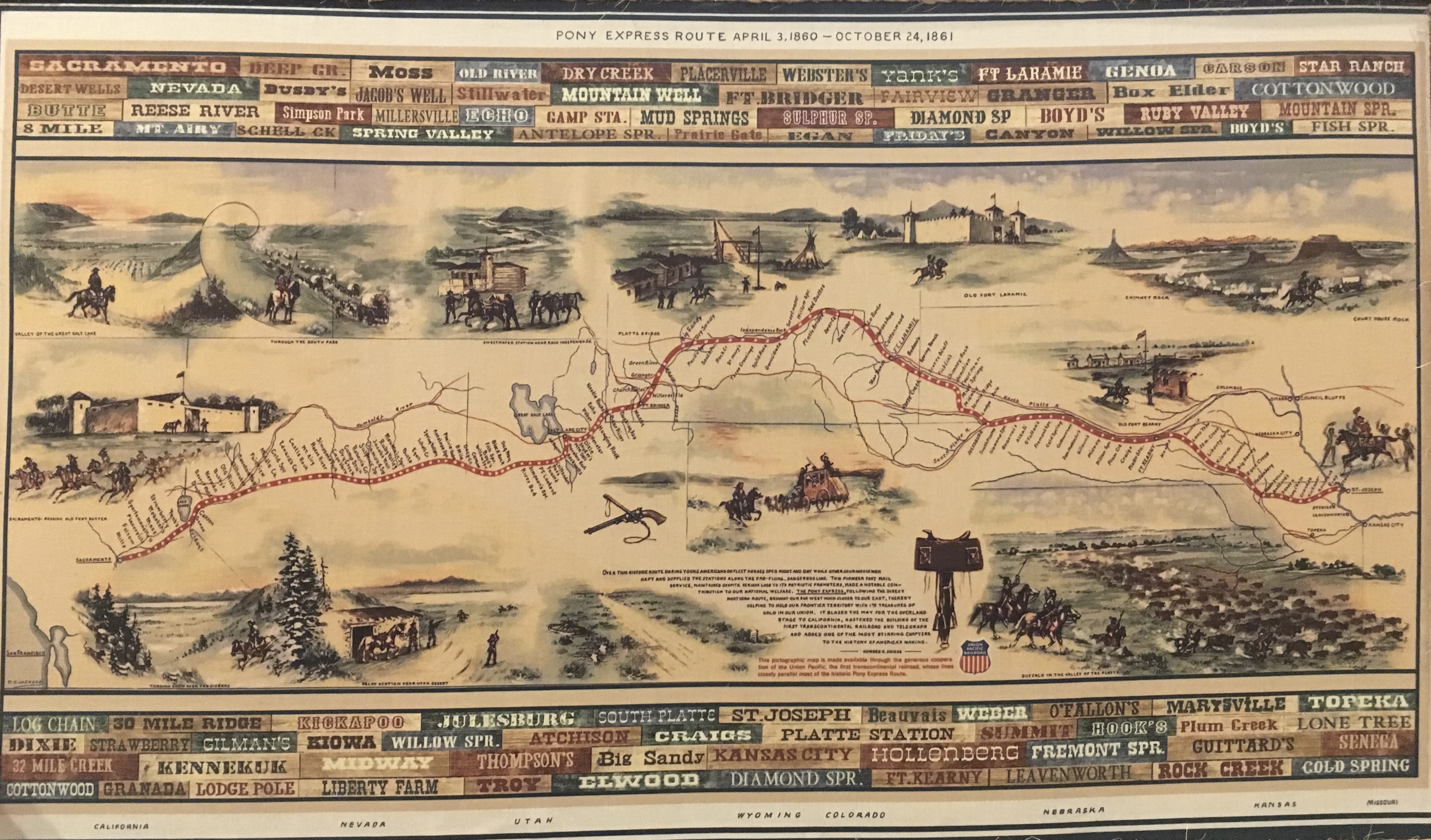
Finally the Pony Express Trail, shown in purple on the map above, only lasted 19 months. After many less-than-ideal attempts to deliver mail across the continent, William H. Russell created the Pony Express. He and his two partners, who had great experience in hauling cargo and passengers, started a new firm, the Central Overland California & Pike’s Peak Express Company (COC & PP) – the official name of the Pony Express. It began mail service April 1860 between St. Joseph, Missouri and San Francisco, CA. Home stations were established every 75-100 miles (to house riders between runs) and smaller relay stations every 10-15 miles (to provide riders with fresh horses).

The company employed between 80 and 100 riders and several hundred station workers. Riders earned wages plus room and board. Hires ranged from teenagers to about age 40. Weight restrictions were strict.  Riders had to weigh less than 120 pounds and carry 20 pounds of mail and 25 pounds of equipment.They also had to be “willing to risk death daily.”

fullsizeoutput_1fa36

Pony Express Advertisement

Horses were selected for swiftness and endurance. The company bought 400-500 horses, many thoroughbreds for eastern runs and California mustangs for western stretches.  Horses averaged 10 miles per hour, at times galloping up to 25 mph. During this route of 75-100 miles, a rider changed horses 8-10 times.

Transcontinental telegraph lines were completed in October of 1861 and the Pony delivered its last mail in November of 1861.

fullsizeoutput_1fa0d

Pony Express Route

*********

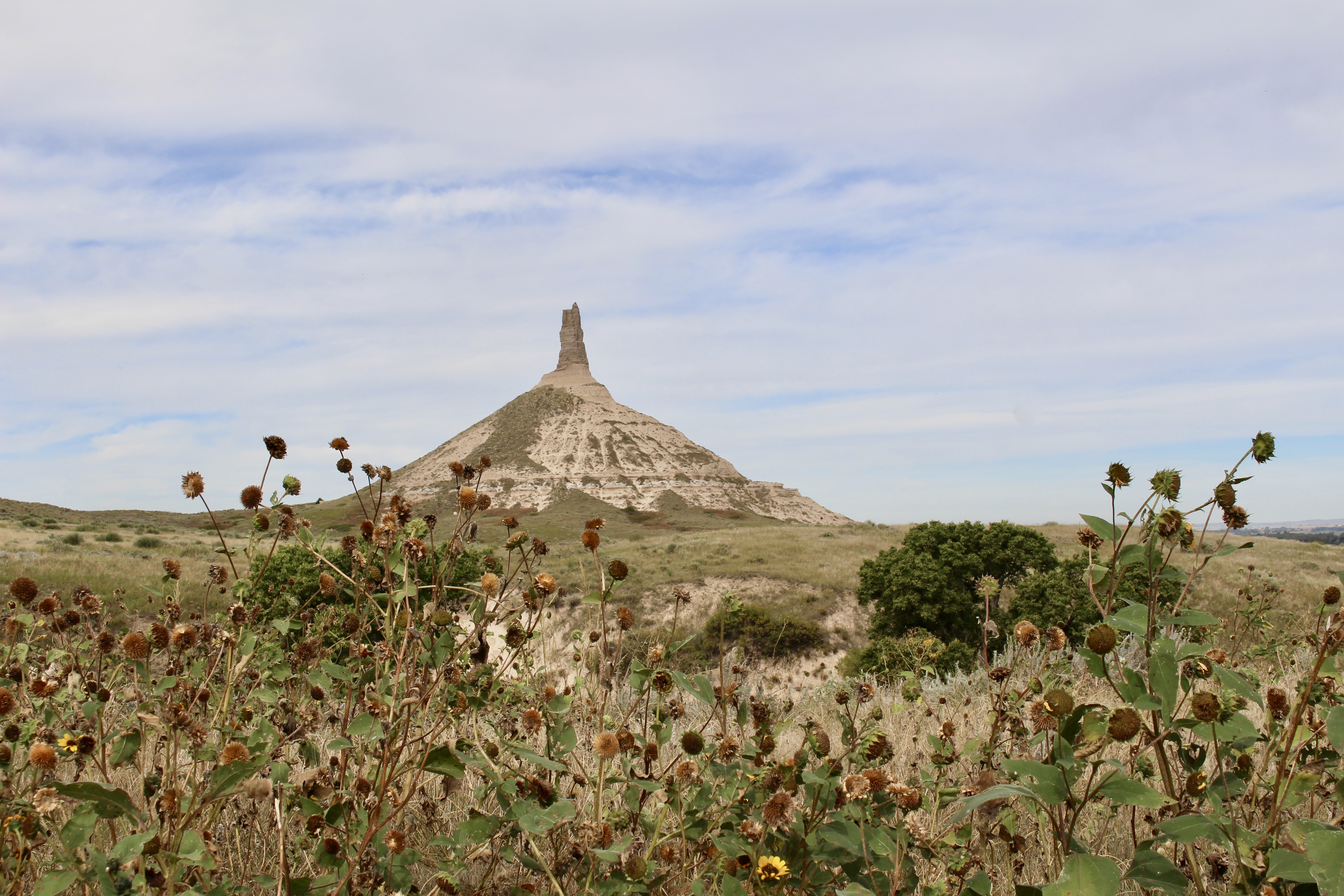
According to the National Park Service, Chimney Rock consists of “Brule clay (not “rock”) interlayered with volcanic ash and Arikaree sandstone.” Because the soft Brule clay is susceptible to erosion, it undermines the hard Arikaree sandstone (which does not erode easily), resulting in episodic changes that are unpredictable, such as rock falls.

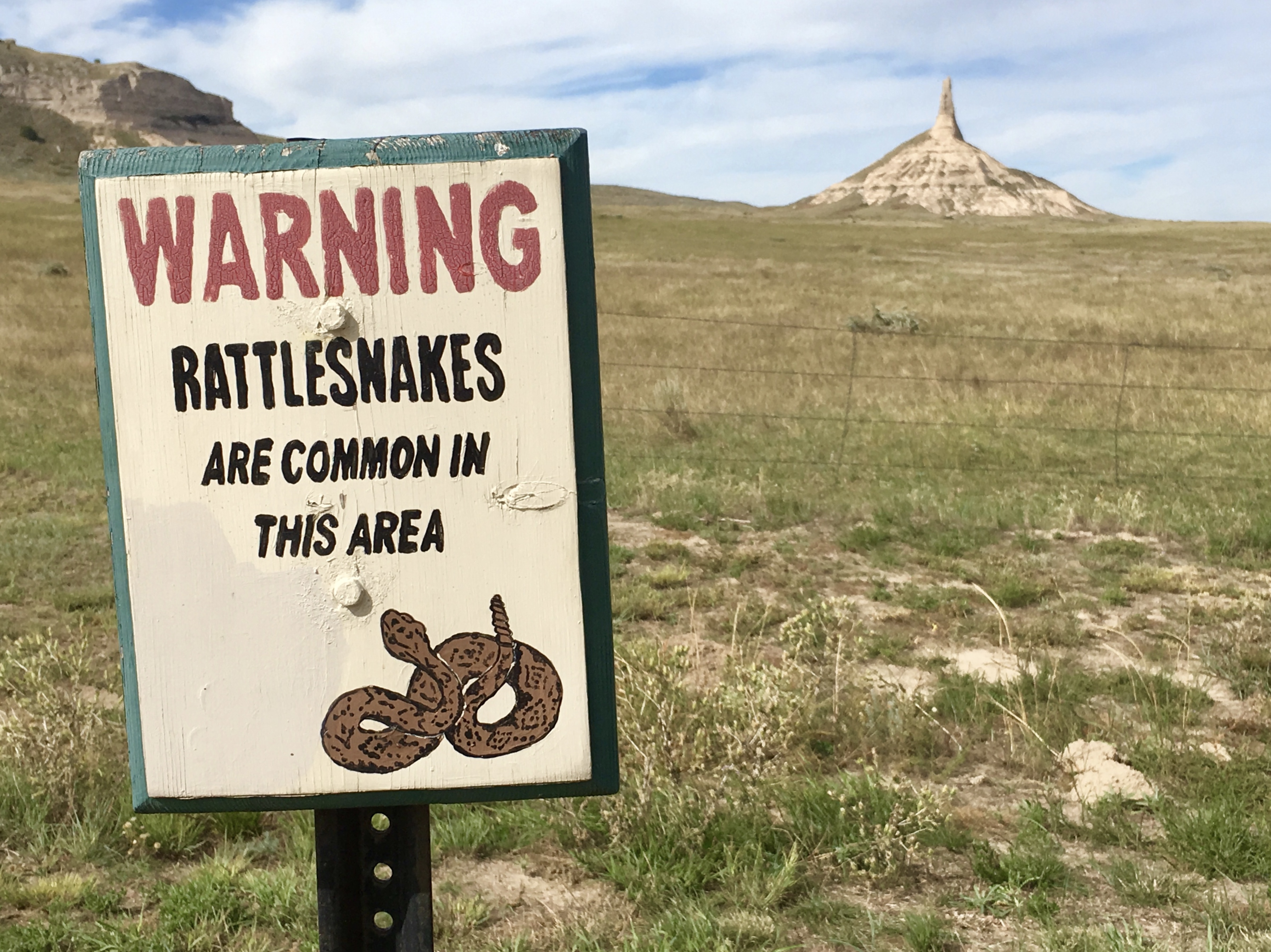
There were many dangers along the Oregon trail, including rattlesnakes. They are still a danger here today.

fullsizeoutput_1fa0a

Rattlesnake warning

In 1895, the United States Geological Survey calculated the elevation of Chimney Rock as 4,225 feet above sea level.  The spire has lost about 30 feet in the last 150 years. Today the summit rises 470 feet above the North Platte River and measures 325 feet tip to base, with the spire measuring 120 feet.

In 1906, Ezra Meeker, who went west in 1852, retraced the Oregon Trail from west to east, again in an ox-drawn wagon.  His efforts led to the formation of the Oregon Trail Memorial Association.

The Chimney Rock Cemetery was a later addition to the Historic Site.

Chimney Rock Cemetery

In 1941, the 80 acres containing the site were transferred to the Nebraska State Historical Society. In 1956, Chimney Rock was designated a National Historic Site by the federal government.

IMG_1685

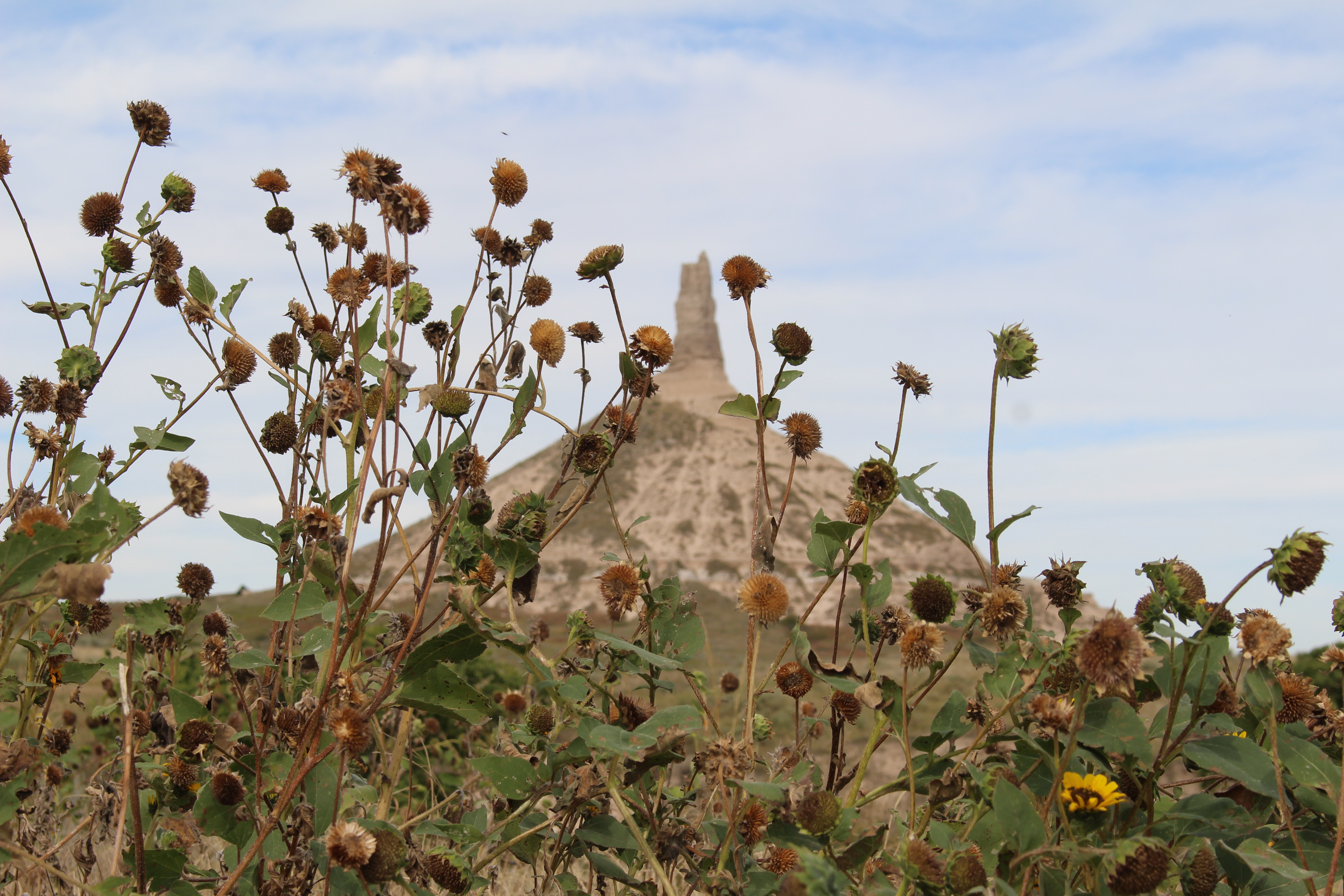
Chimney Rock

fullsizeoutput_1fa06

Chimney Rock

fullsizeoutput_1fa13

bluffs at Chimney Rock

fullsizeoutput_1a3a6

bluffs at Chimney Rock

Below is my cancellation stamp in my National Parks Passport for Chimney Rock National Historic Site.

fullsizeoutput_1fa32

Cancellation stamps for Scotts Bluff National Monument and the Oregon National Historic Trail (NHT), California NHT, Mormon Pioneer NHT, and Pony Express NHT for 9/22 and 9/23, as well as Chimney Rock NHS.

All information comes from brochures and signs created by the National Park Service.

*Monday, September 23, 2019*

Share this:

  • Share on X (Opens in new window) X
  • Share on Facebook (Opens in new window) Facebook
  • More
  • Email a link to a friend (Opens in new window) Email
  • Print (Opens in new window) Print
  • Share on Pinterest (Opens in new window) Pinterest
Like Loading...
  • American Road Trips
  • Nebraska
  • Photography

scotts bluff national monument in nebraska

wanderessence1025's avatar wanderessence1025 November 19, 2020

We arrived at Scotts Bluff National Monument late Sunday afternoon. The bluff stands out on the landscape along the North Platte River in western Nebraska.

Scotts Bluff is a remnant of the ancestral high plains that were hundreds of feet higher than today’s Great Plains. The layers are like a 10-million-year-timeline showing how the ancient plains developed. Caprock has protected Scotts Bluff from the same fate as adjacent badlands.

We drove to the top and walked along the South and North Overlooks.

Scotts Bluff - South Overlook
Scotts Bluff – South Overlook
Scotts Bluff - South Overlook
Scotts Bluff – South Overlook
Scotts Bluff - North Overlook
Scotts Bluff – North Overlook
Scotts Bluff - North Overlook
Scotts Bluff – North Overlook
Scotts Bluff - North Overlook
Scotts Bluff – North Overlook
Scotts Bluff - North Overlook
Scotts Bluff – North Overlook
Scotts Bluff - North Overlook
Scotts Bluff – North Overlook
Scotts Bluff - North Overlook
Scotts Bluff – North Overlook
Scotts Bluff - North Overlook
Scotts Bluff – North Overlook
Scotts Bluff - South Overlook
Scotts Bluff – South Overlook
Scotts Bluff - South Overlook
Scotts Bluff – South Overlook

Settlers learned the benefits of prairie grasses. In spring, they were used as grazing for livestock. Blue grama and buffalo grass have dense roots that created thick, sturdy sod used to build homes. Grasses hold soil and feed and shelter prairie animals such as black-tailed prairie dogs, mule deer, and the prairie rattlesnake.

The North Platte River Valley has been a prairie pathway for 10,000 years for everyone from American Indians to bison herds. It was called “Me-a-pa-te” by Native Americans, meaning “hill that is hard to go around.”

Through this area passed hunters from the early 1800s. Trappers came in search of “soft gold” – the pelts of fur-bearing animals inhabiting mountains and valleys. Clerk Hiram Scott from the Rocky Mountain Fur Company died near Me-a-pa-te in 1828, thus the name Scotts Bluff.

Fur traders blazed a trail through the mountains to the far west. Their old caravan route became the Oregon Trail, a 2,000 mile roadway to the Pacific Northwest.

IMG_3690

Drive down from the summit

From 1841-1869, some 350,000 people joined wagon trains at jumping off points along the Missouri River and set out westward on the California and Oregon trails.  Each mile was hard-won in the face of unpredictable weather, violent winds, quicksand, floods, disease, buffalo stampedes, and rarely, Indian attacks.

Once emigrants saw the strange landscape around Scotts Bluff, they knew for sure they were in western lands. Large formations loomed in the distance for days before the wagon trains reached them.  Scotts Bluff was one such sight, as was Chimney Rock. Travelers called the large fortress-like vision on the horizon “a Nebraska Gibraltar.” Not many emigrants lingered here, however, as they were wary of an approaching winter.  They moved on, grateful to have completed at least a third of their journey.

In the early 1860s, emigrants shared the Oregon Trail with mail and freight carriers, military expeditions, stagecoaches and Pony Express riders.

By 1867, emigrant traffic waned and the coast-to-coast telegraph replaced overland mail routes.

In 1869, when the Union Pacific and Central Pacific Railroads linked up at Promontory, Utah, the Oregon Trail fell into disuse.

We also walked along the bottom toward the Oregon National Historic Trail, where we saw wagon trains and good views of Eagle Rock.

Eagle Rock
Eagle Rock
trail to Oregon National Historic Trail

In the town of Scotts Bluff we found that the Western Sugar Cooperative is the lifeblood of the town.  It is made up of 850 sugar beet growers and shareholders. Products include regular granulated and brown sugar and powdered sugar.  Sugar beets are grown in a “temperate zone,” which encompasses 11 states including Minnesota, North Dakota and Idaho. Sugar beets provide 55% of the sugar in the U.S. Sugar cane, which makes up the other 45%, is tropical and is grown in four states.

We had dinner at the Flyover Brewing Company.  Mike had flights of beer. I had a Festbier, a pale German lager with strong malt flavors and “incredible drinkability.” I had a wild mushroom pizza with olive oil, roasted wild mushrooms, shredded cheese, red onion, fresh herbs and shaved Parmesan.  We also had a Burrata Caprese: “You’ve never had it like this: a whole ball of creamy burrata, tomatoes, basil and balsamic reduction.”

Burrata Caprese
Burrata Caprese
Flyover Brewing Company
wild mushroom pizza
wild mushroom pizza

*Sunday, September 22, 2019*  (The earlier part of this day is here: on journey: rapid city, s.d. to toadstool geologic park to fort robinson state park)

*********

Overnight in Scotts Bluff, I had a dream that a woman in our neighborhood who had just lost her twenty-six year-old son to a prion disease, a rare kind of encephalitis, had somehow turned into actress Kerry Washington (who played Olivia Hope in Scandal).  She was grieving and crying over losing her son.  She drove past us crying, and Mike was acting very strange.  When I confronted him, he said he was having an affair with her and was going to leave me, but I would be well-provided for.  I was walking atop cliffs like Scotts Bluff and thought I might just throw myself off but then I decided I’d just enjoy being free.

A very strange dream!

On Monday morning, Mike had to run to Fat Boys Tire to replace the rear driver’s side tire, which had sprung a leak during our rough drive on the gravel road to Toadstool Geologic Park.  Fat Boys had instead patched the tire and it would have to last the rest of my trip.

When we finally got going, we went first to Chimney Rock, which I’ll write about in another post.

After Chimney Rock, we returned to Scotts Bluff as we had felt rushed the evening before and wanted to explore it more.

We drove again to the top and wandered around.

Scotts Bluff South Overlook

Mike wanted to take the Saddle Rock Trail, which gradually descended from the steep slopes of Scotts Bluff to Scotts Spring and the Visitor Center.  We agreed I would drive the car down to meet him, otherwise he’d have to climb back up. He could see eroding layers of sandstone, siltstone and volcanic ash exposed along the way, along with intriguing geological features at close range.

Meanwhile I continued to walk around the top of the bluff taking pictures of the interesting rock formations, the plains and the town below.

Scotts Bluff
Scotts Bluff
Scotts Bluff
Scotts Bluff
Scotts Bluff
Scotts Bluff
Scotts Bluff
Scotts Bluff
Scotts Bluff
Scotts Bluff
Scotts Bluff
Scotts Bluff
Scotts Bluff
Scotts Bluff
Scotts Bluff
Scotts Bluff
Scotts Bluff
Scotts Bluff

Below is my National Parks Passport with cancellation stamps for Scotts Bluff for September 22 and 23, 2019.

fullsizeoutput_1fa32

Cancellation stamps for Scotts Bluff National Monument and the Oregon National Historic Trail (NHT), California NHT, Mormon Pioneer NHT, and Pony Express NHT for 9/22 and 9/23

After leaving Scotts Bluff close to 2:00, we drove nearly two hours to Cheyenne, Wyoming, where we would stay two nights.

*Steps: 9,014, or 3.82 miles*

*Monday, September 23, 2019*

Share this:

  • Share on X (Opens in new window) X
  • Share on Facebook (Opens in new window) Facebook
  • More
  • Email a link to a friend (Opens in new window) Email
  • Print (Opens in new window) Print
  • Share on Pinterest (Opens in new window) Pinterest
Like Loading...
  • American Road Trips
  • Fort Robinson State Park
  • Nebraska

on journey: rapid city, s.d. to toadstool geologic park to fort robinson state park

wanderessence1025's avatar wanderessence1025 November 18, 2020

We started our day in Rapid City under gray clouds and sputtering rain, with a 48°F chill in the air.  We strolled around the town, past various storefronts, the Elks Building, and the original 1915 Rapid City Fire Department.

Rapid City, South Dakota
Elks Building
Elks Building
Prairie Edge
Prairie Edge
1915 Rapid City Fire Department
mural at 1915 Rapid City Fire Department
1915 Rapid City Fire Department

We visited the Alex Johnson Hotel, one of the tallest buildings in town. Project construction began in August 1927, one day before work began carving the granite faces of Mount Rushmore. We stopped at the Alex Johnson Mercantile for earrings, a mug, a dragonfly bag and some cards.

Alex Johnson Hotel
Alex Johnson Hotel
Alex Johnson Hotel
Alex Johnson Hotel
inside the Alex Johnson Hotel
the bathroom at the Alex Johnson Hotel
Alex Johnson Mercantile

We wandered past some of the many president sculptures and some Native American sculptures as well.

George Washington
George Washington
Ronald Reagan
Ronald Reagan
Ronald Reagan
Ronald Reagan
George Bush Sr.
George Bush Sr.
Thomas Jefferson
Thomas Jefferson
Thomas Jefferson
Thomas Jefferson
Mitakuye Oyasin
Mitakuye Oyasin
Native Americans
Native Americans

We walked through Art Alley, but it wasn’t nearly as nice as the one in Bismarck, North Dakota, which I wrote about here: bismarck art alley.

Art Alley in Rapid City, SD

Rapid City was a cute town, but we had to be on our way to Nebraska.

We were on 79S by 10:05.  We passed Roy’s Drive-In, an old drive-in theater that was still operational.  We saw the Black Hills to the west, as well as the Needles.  A bull humped a cow in a field and a cluster of beehives buzzed with activity.  We were going straight south on the Plains.

By 10:30, the temperature had gone up by 10°F and the rain had stopped.  The sun was peeking through the clouds.  I mailed a postcard to myself at the Rapid City Post Office.

We passed French Creek, hay bales, black cows with white faces, brown cows, and painted brown and white cows.  I don’t know my cows, but they could have been Black Angus, Hereford (brown & white painted), Red Angus, Holstein (black & white) or Limousin (golden red).

It is often said that there are more cows than people in South Dakota, according to the South Dakota Breeds Council.  I saw signs for the Wyoming Quilt Trail, an extension of the American Quilt Trail movement that is alive and well throughout the United States and beyond.

We heated leftovers in a gas station microwave, and ate a lunch of shrimp and broccoli, and leftover chile relleno and tamale, rice and beans.

A sign for the Wild Horse Sanctuary informed us that the 2004 film Hidalgo was filmed in this area. In Ardmore, we left behind a bunch of junk.

Bruce Springsteen sang “Nebraska” as we crossed the state line: Welcome to Nebraska … the good life.  Home of Arbor Day.

IMG_3530

Nebraska . . . the good life Home of Arbor Day

We drove through the Oglala Grassland and the temps were finally up to 65°F by noon.  I looked up the population of the states I’d visited:

  • Nebraska: 1.9 million (37th in size) (77,358 square miles)
  • South Dakota: 882,235 (46th) (77,116 sq. miles)
  • North Dakota: 760,077 (47th) (70,761 sq. miles)

We drove down a 13-mile dirt road to Toadstool Geologic Park; the road ran alongside a railroad. The clouds looked like a still life painting, almost fake.

Thirty million years ago, this was an ancient river valley where miniature horses, humpless camels, gigantic tortoises, pigs and even rhinoceroses roamed. The broad shallow river current carried volcanic debris that, layer upon layer, formed the rocks found here today. Over time, water and wind sculpted the rock into badlands.

We walked a 1.2 mile loop hike.  The trail wound along dry stream beds, through gullies, and over sandstone rock.

The first visitors in the 1800s must have felt they were traveling through a land of giant mushrooms.  They labeled the jumble of sandstone slabs resting upon their clay pillars “toadstools.”

Toadstools are created by the forces of wind and water, eroding the soft clay faster than the hard sandstone that caps it.  Erosion collapses the toadstools while new ones form.

Toadstool Geologic Park

By 1:40, we were leaving the Oglala National Grassland. Cattails lined the road. A train barrelled past across the prairie.

fullsizeoutput_1f475

Train tracks near Toadstool Geologic Park

By 1:45, we were off the dirt road.  We saw longhorn cows and strangely-shaped cliffs and ridges as we approached Crawford, Nebraska.

fullsizeoutput_1f467

cliffs and ridges near Fort Robinson

fullsizeoutput_1f468

cliffs and ridges near Fort Robinson

At Fort Robinson State Park, the Post Headquarters was constructed in 1905.  The Post Commander’s office was located here, along with other administrative offices, post office, and the Fort’s telephone exchange. The Nebraska State Historical Society opened the Fort Robinson Museum in June, 1956, as part of the effort to preserve Fort Robinson’s Heritage.

IMG_1560

Fort Robinson Museum and History Center

IMG_1563

Fort Robinson Museum and History Center

Fort Robinson State Park

At the Fort Robinson Museum and History Center, we learned that the Fort Laramie Treaty of 1868 resulted in a Sioux political victory.  The United States Army had to abandon Forts Phil Kearney, Reno and C.F. Smith in the heart of the northern hunting range; the Bozeman Trail was closed. Although the Indians were allowed to hunt on this land the government expected them to begin permanent settlements on the newly established reservations.  They would receive food and clothing and an education while making the transition from a life of hunting to farming.

Commissioners arrived in Fort Laramie on April 19, 1868 to begin the negotiations.  Spotted Tail, the Brule Sioux chief, signed the treaty before the end of the month.  Red Cloud, the Oglala leader, did not arrive until October 4 and questioned the terms of the treaty for nearly a month before signing. The treaty of 1868 established the Great Sioux Reservation and called for an agency or administration headquarters to be located near its center. In August of 1873, the Red Cloud Agency moved from North Platte River to White River, near Crawford, Nebraska.

In March of 1874, the U.S. Government authorized the establishment of a military camp to protect the Red Cloud Agency and its employees.  Some 13,000 Lakota had been resettled at the Agency, some of them hostile. Tensions grew between whites and Lakota, who had been forced off much of the land.

War was almost assured between the United States and the Sioux, Cheyenne, and Arapaho tribes after November, 1875. President Grant instructed the army to ignore the trespassing miners in the Black Hills. Meanwhile the Bureau of Indian Affairs ordered the Sioux to settle on the reservation. Those who disobeyed would be brought in by force.

Full scale war broke out in 1876. Named after Lt. Levi H. Robinson, who had been killed by Indians while on a wood detail in February, Camp Robinson served as a base of operations for military expeditions against the Indians during the Sioux Wars of 1876-1890.

fullsizeoutput_1f478

The Sioux and Arapahoe Delegations

IMG_3634

decorative Native American items

The War Chief Crazy Horse surrendered here with his band of 889 followers on May 6, 1877, bringing the Sioux War to an end.

In late summer, rumors spread that Crazy Horse and his band were planning to break away and renew war with the whites.  On September 3, department commander General George Crook ordered him arrested.  In the meantime, Crazy Horse fled to the Spotted Tail Agency, forty miles northeast.  There he was convinced to return to Camp Robinson and give himself up.  At 6:00 p.m. on September 5th, he rode in, escorted by friendly Sioux scouts.

Crook ordered several of his band accompany Crazy Horse to Fort Laramie that evening, then to Cheyenne, and on by rail to division headquarters at Chicago to see General Phil Sheridan. Crazy Horse was taken to the guardhouse to await departure.

After a brief scuffle inside the guardhouse, Crazy Horse bolted out the door and received a fatal bayonet wound from the sentry outside.  He was then moved to the adjoining adjutant’s office, where a surgeon provided the dying man with medical aid.

fullsizeoutput_1f487

Illustration of Crazy Horse being killed by bayonet

With the Sioux War at an end, the Red Cloud Agency was moved to a new site on the Missouri River.  There it would be less costly to deliver annuities and rations.  The Oglala hated the Missouri River country and opposed the move, but they had little choice.  On October 25, 1877, they began the long march to the river.  In the spring they came back to a new agency called Pine Ridge.

On December 30, 1878, Camp Robinson was redesignated as a fort. The name change signaled its status as a permanent military post.

Native Americans
Native Americans
military uniform
military uniform
soldiers at Fort Robinson

In 1885, the 9th Cavalry regiment, nicknamed the “Buffalo Soldiers” by Native Americans, was stationed at Fort Robinson for 18 years.  This was an all-black unit with mostly white officers.

Dr. Walter Reed was stationed at Fort Robinson from 1884-1887.  After leaving the fort, he was able to prove in 1901 that yellow fever was carried by a certain species of mosquito.

fullsizeoutput_1f48a

Dr. Walter Reed

In 1886, the Fremont, Elkhorn and Missouri Valley Railroad reached Fort Robinson, stimulating settlement in the area.  The railroad assured Fort Robinson’s survival, while causing other posts to close.

fullsizeoutput_1f48b

Fort Robinson State Park

Below is a buffalo overcoat worn by Captain John Kerr, Sixth Cavalry, in 1891.

fullsizeoutput_1f47d

buffalo overcoat worn by Captain John Kerr

The peaceful life at Fort Robinson was broken when war with Spain was declared on April 19, 1898.

In 1902, the men of the “Fighting Tenth” Cavalry, veterans of the battle of San Juan Hill, made their headquarters here.  Four years later, the 10th helped capture Ute Indians who had fled their Utah reservation, the last military action against Indians on the northern Plains.  In 1907, the regiment left for duty in the Philippines.

In 1919, after the end of World War I, the fort became a Remount Depot for the U.S. Army’s Quartermaster Corps. Horses were purchased and then shipped here for conditioning and issue to the mounted services. The fort maintained registered stud horses to improve the breeding of horses in the region for potential military purposes.

saddles for cavalry
saddles for cavalry
saddles for cavalry
saddles for cavalry

The fort was selected as the summer training site for the 1936 United States Olympic Equestrian Team. The American team won several medals for individual events at the Berlin games.  Training continued here from 1937-1939 for the 1940 games to be held at Helsinki, Finland, but World War II broke out in September 1939.

America was plunged into World War II on December 7, 1941. Military events around the globe indicated that horses were outmoded, of limited value in combat, and expensive to feed.  The “horse soldiers” of the Fourth Cavalry exchanged their animals at Fort Robinson for armored cars in April 1942.

In World War II, the fort was the site of a K-9 corps training center. Dogs were trained for guard duty, to sniff out mines, to carry messages, and to pull sleds.  The dogs were donated by private citizens, and most large breeds of dogs were used.

K-9 training corps
K-9 training corps
Give dogs and dollars for defense...
Give dogs and dollars for defense…

The prisoner of war camp at Fort Robinson opened in November 1943.  It had a capacity of 3,000 men, although initially only about 700 German Afrika Korps enlisted men were held here.  By December 1944, however, the camp reached its maximum population.  Early in 1945, it was designated a naval camp, and German sailors replaced most of the army prisoners.  Most of the POWs appreciated the fair treatment they received.  The Fort Robinson POW camp closed in May 1946.

Model ship made by German prisoner of war at Fort Robinson
German prisoner of war

The army still needed pack mules on isolated battlefields in places like Italy, China and Burma.  Fort Robinson trained and shipped out over 10,000 mules before the war ended in 1945.

The U.S. Army abandoned the fort in 1947; it was transferred to the USDA for a Beef Cattle Research Station.  In 1956, a museum opened.

In 1971, the USDA closed its operations and transferred the property to the State of Nebraska.

We intended to go to Agate Fossil Beds National Monument, but we had a tire pressure problem on the driver’s side rear tire, which sent us to a gas station in Crawford and down Rt. 71S, making us miss the monument. That was our reward for driving too fast over that 13-mile dirt road to Toadstool!

We headed on to Scotts Bluff, Nebraska to finish up our day.

*Steps: 11,851; 5.02 miles*

*Sunday, September 22, 2019*

Share this:

  • Share on X (Opens in new window) X
  • Share on Facebook (Opens in new window) Facebook
  • More
  • Email a link to a friend (Opens in new window) Email
  • Print (Opens in new window) Print
  • Share on Pinterest (Opens in new window) Pinterest
Like Loading...
  • American Road Trips
  • Custer
  • Prose

south dakota: custer, wind cave national park, & rapid city

wanderessence1025's avatar wanderessence1025 November 17, 2020

On our way to Wind Cave National Park, we stopped in the cute town of Custer, South Dakota to visit with the colorful bison on the streets.  We figured this might be the closest we would get to bison on our trip.

fullsizeoutput_1b443

Bison in Custer, South Dakota

fullsizeoutput_1f409

Bison in Custer, South Dakota

fullsizeoutput_1f40b

Bison in Custer, South Dakota

IMG_3328

Bison in Custer, South Dakota

IMG_3330

Bison in Custer, South Dakota

Bison in Custer, South Dakota
Custer, South Dakota
Rocket Motel in Custer, South Dakota
Bison in Custer, South Dakota

We went from Custer to Wind Cave National Park. Protected since 1903, when it became our 7th national park, it is regarded as sacred by most American Indians.  The cave was found by settlers in 1881, when brothers Jesse and Tom Bingham heard a loud whistling noise.  They followed the sound to a small hole in the ground which is the cave’s only natural opening. The wind is created by differences between atmospheric pressure inside and outside the cave.  This wind can still be noticed at the cave entrance.

IMG_3348

The natural opening to Wind Cave

Changing weather patterns bring changes in the outside atmospheric pressure. When the outside cave pressure increases, air flows into the cave. When outside air pressure drops, air flows out of the cave. The cave “breathes” until inside and outside air pressures are equal.

Later, adventurer Alvin McDonald followed the wind and discovered the cave’s extensive network of passageways. For three years, Alvin explored Wind Cave and found around 8-10 miles of passages. 

In the fall of 1893, Alvin joined his father in Chicago at the World’s Columbian Exposition.  Tragically, he caught typhoid fever there and died at the cave on December 15, 1893.  Without Alvin’s leadership, exploration tapered off, not to resume for seven decades.

fullsizeoutput_1f410

Alvin McDonald

One of the most prominent and unique features of Wind Cave is its boxwork.  No other cave has remotely the amount of boxwork as does this cave. These thin, honeycomb-shaped structures of calcite protrude from the walls and ceilings, often covering the visible surfaces.  Although Wind Cave has few stalactites and stalagmites, many unusual formations and a variety of minerals are found in the cave. 

Boxwork
Boxwork
Boxwork
Boxwork
Boxwork
Boxwork

Other formations include popcorn, frostwork formations, and other delicate, irreplaceable features.

The presence of fossilized marine organisms such as coral in the Pahasapa Limestone provide evidence of the marine origins of the rock within which the cave formed.

fullsizeoutput_1f413

Fossilized Coral

When the cave formed, it intersected and exposed small crystal-lined pockets in the limestone called geodes. These were originally small blobs of gypsum deposited with the limestone and later dissolved away by underground water.  Calcite deposited in the cavities formed sharp crystals called Dogtooth Spar.

fullsizeoutput_1f414

Geode with Dogtooth Spar Interior

Where tiny amounts of water seep uniformly into the cave, deposits form small knobs of calcium carbonate that resemble popcorn.  Popcorn is very common in Wind Cave and often grows on the edges of boxwork. 

fullsizeoutput_1f415

Cave Popcorn

It is estimated that only 5% of of the total cave has been discovered.  In 1891, Alvin McDonald wrote in a diary of his cave trips: “Have given up the idea of finding the end of Wind Cave.”  Better equipped cavers of today continue to push farther into the cave’s black recesses.

We were unable to go into the cave because by the time we arrived, all tours had ended for the day.

Below is a chart showing the differences between Jewel Cave and Wind Cave, as well as my cancellation stamp for Wind Cave National Park. I wrote about my visit to Jewel Cave here: south dakota: mount rushmore & jewel cave national monument.

Jewel Cave
Jewel Cave
Wind Cave
Wind Cave
Cancellation stamp for Wind Cave National Park

After going through the wildlife loop at Custer State Park one more time, hoping yet failing to see the bison herd up close and personal, we returned to Rapid City, where we stopped in Prairie Edge Trading Co. & Galleries; I got a pair of earrings just before they closed.  It was a very cool place, but there wasn’t enough time to browse.

The Plains Indian Gallery at Prairie Edge features Plains Indian art, crafts and culture.  The trading company has an extensive collection of jewelry, pottery, glassware, decorative boxes and frames, Pendleton blankets, star quilts, buffalo leather furniture, housewares, fountains, candles, exclusive note cards and sportswear.

The turn-of-the century craft center has rows of display cabinets filled with beads: Italian glass beads, Czech beads, Japanese beads, trade beads, vintage beads and contemporary beads. It also carries hides, furs, feathers, shells, teeth, claws, brass, trade cloth, botanicals, plus more unique crafts and supplies.

We had dinner at Jambonz Deaux 2, a Louisiana kitchen, where I had an oyster po’ boy and Mike had chicken gumbo.  Our waiter Cody by mistake brought 32-oz jars of beer; they were huge!  We left half behind. Some background music played that was not at all memorable. The restaurant had fuchsia-colored walls with a musical theme; instruments hung on the walls and over the copper-engraved bar. 

Mike at Jambonz Deaux 2
Po boy at Jambonz Deaux 2
Chicken Gumbo at Jambonz Deaux 2
Jambonz Deaux 2
Jambonz Deaux 2
Jambonz Deaux 2
Jambonz Deaux 2

The next day, we would explore more of Rapid City and then leave South Dakota for Nebraska.

Steps: 20,429; 8.66 miles (12,500 steps were registered on my FitBit from our two-hour horseback ride).

*Saturday, September 21, 2019*


Share this:

  • Share on X (Opens in new window) X
  • Share on Facebook (Opens in new window) Facebook
  • More
  • Email a link to a friend (Opens in new window) Email
  • Print (Opens in new window) Print
  • Share on Pinterest (Opens in new window) Pinterest
Like Loading...
  • American Road Trips
  • Custer State Park
  • Hikes & Walks

south dakota: custer state park

wanderessence1025's avatar wanderessence1025 November 15, 2020

On Mike’s first day in South Dakota, on horses rented for two hours through Bluebell Lodge Stables, we went on a trail ride in Custer State Park. I rode Fred and Mike rode Repeat. Our guide, Jacey, rode Big Red.

Blue Bell Lodge Stables
Me at Blue Bell Lodge Stables
Mike - Saddle Up Riders
Mike – Saddle Up Riders
Mike on Repeat
Mike on Repeat
Jacey on Big Red
Jacey on Big Red

Our ride started out gloomily but before too long, the sun was out. We passed fishermen, Ponderosa pines, French Creek, interesting rock formations, and a burnt forest. I loved riding the horse through the creek, which we did several times. The weather was cool and crisp but not uncomfortable.

Jacey, our guide
Jacey, our guide
French Creek
French Creek
French Creek
French Creek
Custer State Park
Custer State Park
crossing French Creek
Custer State Park
Custer State Park
riding horses in Custer State Park
rock formations in Custer State Park
trail ride in Custer State Park
I cross French Creek on Fred
trail ride in Custer State Park
Mike on Repeat
Mike on Repeat
French Creek
French Creek
French Creek
French Creek
lodgings at Custer State Park
campground at Custer State Park

Just before we dismounted from our horses, Jacey took a photo of us.

fullsizeoutput_1b43f

Me and Mike on our steeds

We had a nice lunch at the Blue Bell Lodge in an Old West saloon-style setting.  I had chili and corn in a cast iron skillet, cornbread and lemonade. Mike had a chewy chicken salad with candied pecans, Gorgonzola, and grapes.

Blue Bell Lodge
Blue Bell Lodge
inside Blue Bell Lodge
Mike and me in the saddle
inside Blue Bell Lodge
chili and corn in a cast iron skilled and chicken salad
Blue Bell Lodge
Blue Bell Lodge

Custer State Park is famous for its bison herds, other wildlife, scenic drives, historic sites, visitor centers, fishing lakes, resorts, campgrounds and interpretive programs. One of the nation’s largest state parks, just 15 miles from the city of Custer, it comprises 71,000 acres.

We drove through the Wildlife Loop at Custer State Park, but we only saw pronghorn antelope. Sadly, we didn’t see bison except far away on a hill. Apparently there is plenty of grass at the south end of the park, so the bison have no incentive to move.  We only saw one lone bison lying down in a field.

Wildlife Loop at Custer State Park
lone bison along the Wildlife Loop
Wildlife Loop at Custer State Park
Wildlife at Custer State Park

We drove on the Needles Highway, where giant columns of granite pierce the sky.

Iron Creek Tunnel
Iron Creek Tunnel
Needles Highway
Needles Highway
The Needles
The Needles
The Needles
The Needles
Needles Highway
Needles Highway
Needles Highway
Needles Highway
Needles Highway
Needles Highway
Needles Highway
Needles Highway
Needles Highway
Needles Highway
Cathedral Spires
Cathedral Spires
Cathedral Spires
Cathedral Spires
Needles Highway
Needles Highway
Needles Highway
Needles Highway
Needles Highway
Needles Highway
Needles Highway
Needles Highway
Needles Highway
Needles Highway
Needles Eye Tunnel
Needles Eye Tunnel
Needles Highway
Needles Highway

We reached Sylvan Lake around 3:00.  We walked partway around.  It was cloudy and quite chilly by then.  A wedding party was having photos taken, and they looked awfully cold. Brrr.

Sylvan Lake
Sylvan Lake
Sylvan Lake
Sylvan Lake
Sylvan Lake
Sylvan Lake
Sylvan Lake
Sylvan Lake
Sylvan Lake
Sylvan Lake
Sylvan Lake
Sylvan Lake
Sylvan Lake
Sylvan Lake
Sylvan Lake
Sylvan Lake
Sylvan Lake
Sylvan Lake
Sylvan Lake
Sylvan Lake
Sylvan Lake
Sylvan Lake
Sylvan Lake
Sylvan Lake
Sylvan Lake
Sylvan Lake
Sylvan Lake
Sylvan Lake
Sylvan Lake
Sylvan Lake
Sylvan Lake
Sylvan Lake
Sylvan Lake
Sylvan Lake
Sylvan Lake
Sylvan Lake
Sylvan Lake
Sylvan Lake
Sylvan Lake
Sylvan Lake
Sylvan Lake
Sylvan Lake

We then drove through the town of Custer and visited Wind Cave National Park, which I’ll write about in another post.

After visiting Wind Cave, we drove again on the Custer Wildlife Loop, hoping this time to see the bison herd up close.

We saw wild turkeys, mule deer and burros.  Black cows were in a pasture with tags on their ears like green and orange earrings. The light over the rolling pastures was stunning.

Custer Wildlife Loop
lone bison on the Custer Wildlife Loop
Custer Wildlife Loop

We saw a bison run through a line of cars and off into the distance.  Sadly it was getting dark so it was hard to capture him, although I took a video. The herd was still too far away.  I had seen on Instagram and other places the bison herd congregating around the cars, so I was quite disappointed we didn’t get to see them close up.

the bison herd in the distance

People were feeding the burros and creating a traffic jam.  There was no way around the traffic jam as people had occupied all sides of the road in a jumble of cars. Mike got out and shooed away the burros so people could get by.

burro at Custer State Park Wildlife Loop
burros at Custer State Park Wildlife Loop

Here is the map of where we went today.

Scan 1

Map of Custer State Park and the region around Rapid City

*Saturday, September 21, 2019*

Share this:

  • Share on X (Opens in new window) X
  • Share on Facebook (Opens in new window) Facebook
  • More
  • Email a link to a friend (Opens in new window) Email
  • Print (Opens in new window) Print
  • Share on Pinterest (Opens in new window) Pinterest
Like Loading...
  • American Road Trips
  • Chapel in the Hills
  • Crazy Horse Memorial

south dakota: crazy horse memorial & chapel in the hills

wanderessence1025's avatar wanderessence1025 November 12, 2020

At the Crazy Horse Memorial, I watched the orientation film about Crazy Horse.The mission of the Crazy Horse Memorial Foundation is to protect and preserve the culture, tradition, and living heritage of all North American Indians.

In 1876, Crazy Horse led a band of Lakota warriors against Custer’s 7th U.S. Cavalry battalion in the Battle of Little Bighorn, or Custer’s Last Stand. In 1877, under a flag of truce, Crazy Horse went to Fort Robinson.  A soldier plunged a bayonet into him after a misunderstanding, and he shortly died, around midnight on September 5, 1877.

fullsizeoutput_1f367

Crazy Horse Memorial

fullsizeoutput_1f381

Crazy Horse Memorial

Chief Henry Standing Bear invited sculptor Korczak Ziolkowski (1908-1982) to the Black Hills to carve Crazy Horse. After much consideration, Korczak accepted. Ziolkowski was born in Boston of Polish descent. He endured a difficult upbringing and became a self-taught and renowned sculptor, gaining recognition at the 1939 World’s Fair, which attracted the attention of Chief Standing Bear.

Ruth Ross (1926-2014) followed Korczak, they were married and had ten children who took part in the dream of Crazy Horse as they were growing up. Dedicated management and staff, including some Ziolkowski children and grandchildren, carry on the project today.

I took a bus tour for $4 to go up closer to the Memorial to take pictures.

fullsizeoutput_1f368

Crazy Horse Memorial

No pictures were ever taken of Crazy Horse, the famous Oglala Lakota leader, so the image is based on descriptions and it is meant to convey his spirit.

IMG_1408

Crazy Horse Memorial

The mountain is 6,532 feet above sea level and is the 27th highest mountain in South Dakota.  It is made of pegmatite granite.

IMG_2873

Crazy Horse Memorial

fullsizeoutput_1a3e7

Crazy Horse Memorial

IMG_2885

Crazy Horse Memorial

IMG_1411

Crazy Horse Memorial

IMG_1414

Crazy Horse Memorial

fullsizeoutput_1a3e8

me at Crazy Horse Memorial

Crazy Horse Memorial

Ziolkowski insisted that no federal or state monies be used to fund the project even though two times $10 million was offered.  The nine-story high face of Crazy Horse was completed in 1998.  The horse’s head, which measures 219 feet (or 22 stories) is the focus of current work.

My friend Ed called while I was on the bus tour and I asked him if he could call back in an hour.  I hadn’t talked with him in ages, so I looked forward to catching up.

After the tour, I went into the Indian Museum of North America on site.

The Legend of the Drum (From the Long House People) tells that the drum pictured below was made for two good friends of all Indian people: Korczak and Ruth Ziolkowski.  The cover of the drum is made of deer skin and on this skin is a painted star, the Morning Star. In the center of this star is a painting of Thunderhead Mountain as it will look when Korczak Ziolkowksi, or Brave Wolf, finishes carving it into a statue of Crazy Horse.

Above and beyond the sculpture of Chief Crazy Horse is a spirit looking down on the monument with approval.  This is the spirit of Chief Crazy Horse.

fullsizeoutput_1f382

drum for Korczak and Ruth Ziolkowski

In the museum, I saw various Native American costumes, tipis, and paintings.

headdresses
headdresses
headdresses
headdresses
costume
costume
painting
painting
tipi
tipi
Hide painting
Hide painting
Native American painting
Native American horse

The Shawl Dancer is emblematic of the shawl dance, also called butterfly dance or fancy dance, which emerged in the 20th century.  The dance’s spins and dips show off the colorful work of the shawl and fringe draped over the dancer’s shoulders. The shawl dance is a regular feature of pow wow competitions.

IMG_2902

Shawl Dancer, by Patty Eckman, American, 2010

As I walked around the complex, I saw the 1/34 scale model by Korczak of the Crazy Horse Memorial. The edge of the memorial itself peeks out from behind the model.

fullsizeoutput_1f37c

1/34 scale model of Crazy Horse

On the way out, I was awed by the magnificent Fighting Stallions, which are 9’6″, by Korczak.

fullsizeoutput_1f37e

Fighting Stallions

fullsizeoutput_1f380

Fighting Stallions

I said my goodbyes to Crazy Horse, and was on my way to Chapel in the Hills.

IMG_2908

********

On the way to the Chapel in the Hills, I passed the Silver Dollar Saloon and Hill City, population 948. A red airplane flew nowhere fast on a pole in front of Firehouse Winery and Brewery.  I passed Dakota Stone’s Rock Shop and Miner Brewing Co.  I called my Dad to wish him a happy birthday.  While I was talking, Ed called back but I couldn’t pick up, so I missed talking to him this time around.

I finally arrived at the Chapel in the Hills and went first into the Log Cabin Museum.

The Chapel in the Hills is an exact replica of the famous Borgund Stavkirke in Norway.  Completed in 1969, the Chapel is the result of the efforts of many people, chief among them being Rev. Harry Gregerson and Mr. Arndt Dahl.  The Chapel was built as the home for Rev. Gregerson’s “Lutheran Vespers” radio ministry, through generous support from Mr. Dahl.

A major addition to the Chapel grounds was the relocation of a log cabin that now houses a collection of Scandinavian antiques. The log cabin was built in Palmer Gulch in 1877 by Edward Nielsen, born in Norway in 1843.  He came to the Black Hills to prospect for gold in 1876.  In 1925, he died and was buried in Hill City. The cabin was purchased at an auction, dismantled and moved in 1987. It was reconstructed by volunteers.

The museum is dedicated to those of Scandinavian descent who brought a part of their heritage with them to America. By using their skills with wood, they designed the tools and furniture for use in their homes. No one home would have had all of the pieces found inside, but they would have been found in a settlement of Norwegian, Swedish or Danish immigrants.

fullsizeoutput_1f38e

Log cabin

furnishings in the log cabin

Stavkirke is an exact replica of the famous 12th century Borgund Church in Norway.  Wood carvings, Christian symbols, and Norse dragon heads adorn the building, which features peg construction.

fullsizeoutput_1f397

Stavkirke

fullsizeoutput_1f398

Stavkirke

fullsizeoutput_1f385

Stavkirke

fullsizeoutput_1f399

Stavkirke

The “leper’s window” in the interior of the chapel is God’s welcome to all people. St. Andrew’s crosses remind us of the violence of our world. The intricate carving around the north entrance depicts the struggle between good and evil in the battle between a serpent and dragon.  The dragon is winning, a symbol of God’s triumph over the struggles in our lives.

Stavkirke
Stavkirke
Stavkirke
Stavkirke
interior of Stavkirke
back view of Stavkirke
roof of Stavkirke
roof of Stavkirke
roof of Stavkirke
roof of Stavkirke

The freestanding bell tower located behind the Chapel contains the original bell from American Lutheran Church, Presho, South Dakota.  The bell has summoned worshipers to the Chapel since 1969.

IMG_2951

Bell tower

I strolled through the Prayer Walk into the forest, what they call “God’s outdoor cathedral.” The gift to the Chapel of several limestone statues depicting the Life of Christ provided the opportunity to fulfill the dream of constructing a prayer or meditation walk on the Chapel grounds.  Dedicated in 2010, this secluded path winds its way up behind the Chapel. The statues and benches located along the pathway, combined with selected Bible passages, provide a place of quiet contemplation.

Prayer Walk
Prayer Walk
Prayer Walk
Prayer Walk
Prayer Walk
Prayer Walk
Prayer Walk
Prayer Walk

At the same time the Chapel was being built, a stabbur was constructed on the grounds to serve as the visitor center and gift shop.  With its characteristic larger second story and grass roof, a stabbur is a general storehouse found on many Norwegian farms. The Chapel stabbur was modeled after one from the Middle Ages in Rauland, in the Telemark District of Norway.  In was constructed in Norway and then reassembled here on site.  The original lower porch area was enclosed in the 1990s to allow more room for the gift shop.

IMG_2963

stabbur

IMG_2964

stabbur

The Viking runestones are runestones that mention Scandinavians who participated in Viking expeditions.

The stone pictured below to the left was raised to honor the forefathers of immigrants who sailed the western sea. They made their homes in a new land.

The stone to the right was raised to honor warriors for loyal service, who fought and died for the homeland.

IMG_1459

Viking runestones

Back in Rapid City, I had dinner at La Costa Mexican Restaurant: a chile relleno and tamale with refried beans and a Corona. The waitress didn’t speak English.

fullsizeoutput_1f3a0

chile relleno and tamale with refried beans and a Corona

fullsizeoutput_1f3a1

silos in Rapid City

At 9:38 p.m., I went to Rapid City Regional Airport to pick up Mike.  He would join me on the rest of my trip though Denver, Colorado, from where he would fly home.

*Drove 147.4 miles; Steps 10,457, or 4.43 miles*

*Friday, September 20, 2019*

Share this:

  • Share on X (Opens in new window) X
  • Share on Facebook (Opens in new window) Facebook
  • More
  • Email a link to a friend (Opens in new window) Email
  • Print (Opens in new window) Print
  • Share on Pinterest (Opens in new window) Pinterest
Like Loading...
  • Baltimore
  • Baltimore Museum of Art
  • Maryland

the baltimore museum of art

wanderessence1025's avatar wanderessence1025 November 10, 2020

I drove to Baltimore in late February to spend a weekend away while my husband went to his annual gathering with his high school friends.  Maryland welcomed me with its state slogan: “We’re Open for Business.” I always wonder where states get their slogans. I stopped at a rest area, and within a half hour, I was in Baltimore.

Baltimore is only an hour and 20 minutes from where I live in Northern Virginia, so I don’t know why we don’t visit more often. This was my first time to this museum, and I was impressed by the exhibits and the building. This was my last outing before we were hit by the COVID-19 pandemic.

The Baltimore Museum of Art is Maryland’s largest art museum.  The collection was given by Baltimore philanthropists including the Cone Sisters, Dr. Claribel Cone and Miss Etta Cone.

fullsizeoutput_1c517

Baltimore Museum of Art

The museum has two sculpture gardens, which I sadly missed.

“Mickalene Thomas: A Moment’s Pleasure” transformed the museum’s 2-story East Lobby into a living room for Baltimore from the 1970s and 1980s.

fullsizeoutput_1f2de

“Mickalene Thomas: A Moment’s Pleasure”

The exhibit had a strange film with little black cut-out paper dolls.

"Mickalene Thomas: A Moment's Pleasure"
“Mickalene Thomas: A Moment’s Pleasure”
"Mickalene Thomas: A Moment's Pleasure"
“Mickalene Thomas: A Moment’s Pleasure”
"Mickalene Thomas: A Moment's Pleasure"
“Mickalene Thomas: A Moment’s Pleasure”
"Mickalene Thomas: A Moment's Pleasure"
“Mickalene Thomas: A Moment’s Pleasure”

I found mosaics from Syria and present-day Turkey.

Peddler of Erotes, 3rd century, Antioch, Syria (present-day Turkey)
mosaics
mosaics
Bird Rinceau, 6th century, Syria (present-day Turkey)
mosaics
mosaics
mosaics
mosaics
The Striding Lion, 5th century, Antioch, Syria (present-day Turkey)
Bust with Octagon, 5th century, Antioch, Syria (present-day Turkey)

Spencer Finch | Moon Dust: NASA’s 1972 Apollo mission returned to earth carrying samples of dust from the moon’s surface.  Spencer Finch replicates the chemical composition of that substance in this installation, in which 417 LED lightbulbs are configured on fixtures, mimicking the patterns of molecules in moon dust. Each bulb represents one element bonded in these molecules: oxygen, magnesium, silicon, aluminum, calcium, titanium, chromium, or iron.  The heavier the element, the bigger the bulb. Suspended on cables at exact intervals, the fixtures form a three-dimensional scale model that is also an abstract sculpture.

Gazing up, one has the sense of being immersed in a star-filled sky.

fullsizeoutput_1c592

Spencer Finch / Moon Dust

In the exhibit “A Taste for Modernity,” artworks that were once contemporary are now historic. Baltimore had accepted modernity in the arts by the late 1700s.  During the 20th century, Baltimore’s taste for the modern continued with avid interest in European and American avant-garde painting.

Red, Yellow and Blue, 1942 by Irene Rice Pereira
Germania, 1951, Hans Hofmann
Luzanna [Lousuanna Lujan] and Her Sisters, 1920, by Walter Ufer
The Amazon, 1925 by Joseph Stella
The Bessie of New York, 1932 by Arthur G. Dove
Shell Holes and Observation Balloon, Champagne Sector, c. 1931 by Horace Pippin
Interior with Flowers, 1944 by Milton Avery
The City and I, 1946, by O. Louis Guglielmi
Horse, modeled c. 1914, by Elie Nadelman
The Picnic, c. 1924 by George Wesley Bellows
Bubbles, 1914-1917, Thomas Hart Benton
Interior with Woman at Piano, 1912 by Arthur B. Carles
Landscape -- Two Rivers, 1917 by Leon Kroll
Landscape — Two Rivers, 1917 by Leon Kroll

I ran into an interesting alcove with some colorful ceramics and stained glass.

Baltimore Museum of Art

I walked through another exhibit: “Free Form: 20th-Century Studio Craft.” The term “free form” captures the invention, spontaneity, and organic abstraction that energized and united mid-century American art, craft, and design. Studio crafts artists of the time enhanced their art with found materials and new fabrication techniques. Working in embroidery, ceramics, and jewelry during the 1940s to 1970s, artists focused on the use of line, color, texture and form, reflecting a shift towards an avant-garde engagement with abstraction.

Aroma, 1950-1959, by Mariska Karasz
Triad, c. 1960, by Mariska Karasz
Wood Weathered, 1970-1974, by Gloria Balder Katzenberg
Spring Game, late 1950s-1960, by Mariska Karasz
Espalier, c. 1973, by Gloria Balder Katzenberg
ceramics
ceramics
painted furniture
painted furniture

Another exhibit was on modern art.

Untitled, c. 1920-1924, by Natalia Goncharova
Dancer at Pigalle's, 1912, by Gino Severini
Dancer at Pigalle’s, 1912, by Gino Severini
Traveling Circus, 1937, by Paul Klee
Portuguese Still Life, 1915-1916, by Robert Delaunay
Man Pointing, by Alberto Giacometti
Orator at the WAll, 1945, by Jean Dubuffet
Portrait No. 1, 1938, by Joan Miró
Personages Attracted by the Forms of a Mountain, 1936 by Joan Miró
Figures and Birds in a Landscape, 1935, by Joan Miró

Another exhibit was “By Their Creative Force: American Women Modernists.”  This exhibition explored the range of American women’s creative force in a survey of modernist art and design across painting, sculpture, printmaking, and ceramics from about 1915 to 1955. These artists, from a variety of geographic and socioeconomic backgrounds, engaged with the major styles of their times, including Cubism, Precisionism, Bauhaus, Geometric Abstraction, Surrealism, and Abstract Expressionism.

fullsizeoutput_1f2e7

Red Bowl, 1953 by Grace Hartigan

Georgia O’Keeffe completed more than 200 paintings of flowers during her lifetime.  In Pink Tulip, the artist used feathered, blended brushwork to produce smooth surfaces and organic shapes alive with color. Combined with a close-cropped focus on her subject, her technique presents the tulip as a living, changing blossom. Critics often wrote that her flower paintings evoked the human body.

fullsizeoutput_1c51a

Pink Tulip, 1926 by Georgia O’Keeffe

Meditation, c. 1937, by Maria Hamel FInkelstein
Whirlpool, 1925, by Grace Turnbull
Provincetown, 1916, by Marguerite Thompson Zorach

Of course, every museum must have an exhibit on Impressionism.

The Circus, 1920, by Max Pechstein
Landscape with Figures, 1889, by Vincent Van Gogh
Landscape with a Hunter, 1908, by Raoul Dufy
Quay at Clichy, 1887, by Paul Signac
Washerwomen, c. 1888, by Pierre-Auguste Renoir
On the Shore of the Seine, c. 1879 by Pierre-Auguste Renoir
Woman with Basket of Fruit, 1915-1918, by Pierre Bonnard
Poplars on a River Bank, 1882, by Alfred Sisley
The Young Violinist (Margaret Perry), c. 1889, by Theodore Robinson
The Highway (La Côte du Valhermeil, Auvers-sur-Oise), 1880, by Camille Pissarro

The Cone sisters were ardent collectors.  Claribel Cone (1864-1929) and Etta Cone (1870-1949) formed one of the world’s most important collections of European modern art during the first five decades of the 20th century. Raised in Baltimore, the sisters were part of a large, close-knit family whose shared success in the grocery and textile industries provided them with lifelong financial security. Claribel, the older sister, had a distinguished medical career at a time when women did not regularly attend medical school. Etta, the younger sister, did not have a career but was an accomplished musician and managed the household for her family. Neither sister married or had children, but the family fortune allowed them to collect art, travel, and pursue their own interests freely.

When drawn to compelling painting, drawing, or sculpture, they found it difficult to resist its pull.  The same was true of small items of lesser consequence that filled their drawers to overflowing. They “bought passionately and by the dozens” and never threw anything away.  The sisters stored their purchases in heavy chests and hundreds of beautiful boxes made of carved wood, leather, silver, lacquer, and brocade.

VKiLJuqIQOCHadsWaHpQbQ

Collection of the Cone Sisters

2o4snvmPTLuQrTPFA9XCMA

Collection of the Cone Sisters

In 1917, Henri Matisse traveled to Nice, in the south of France, searching for new subjects to paint. The special quality of light and the congenial atmosphere of the Mediterranean coast inspired him, and over the next 25 years he spent at least part of each year painting there until he moved to nearby Vence during World War II. His works of this period are distinguished by an ever-increasing interest in light, color, pattern, and line.  One of the greatest strengths of The Cone Collection is the impressive group of paintings from the artist’s early Nice period, generally considered to extend from 1917 to 1930.  These works include landscapes, still lifes, interiors, and figure paintings that are admired for their colorful style.

Large Reclining Nude, 1935, by Henri Matisse
Woman in Turban (Lorette), Early 1917, by Henri Matisse

Matisse painted women in interiors throughout the 1920s, but The Yellow Dress can be seen as a major change in his style.  The painting combines the familiar elements of the Nice works — patterned floors and walls and shuttered windows — with an assertively monumental pose and central position for the figure.

fullsizeoutput_1c519

The Yellow Dress, 1929-1931 by Henri Matisse

Two Girls, Red and Green Background, 1947, by Henri Matisse
Small Rumanian Blouse with Foliage, 1937, by Henri Matisse
Anemones and Chinese Vase, 1922, by Henri Matisse
Still Life, Bouquet of Dahlias and White Book, 1923, by Henri Matisse
Standing Odalisque Reflected in a Mirror, 1923, by Henri Matisse
Striped Robe, Fruit, and Anemones, 1940, by Henri Matisse
Blue Nude, 1907, by Henri Matisse
Festival of Flowers, 1922, by Henri Matisse
Girl Reading, Vase of Flowers, 1922, by Henri Matisse
Purple Robe and Anemones, 1937, by Henri Matisse
Yellow Pottery from Provence, 1905, by Henri Matisse
Still Life, Compote, Apples, and Oranges, 1899, by Henri Matisse

After studying in New York with William Merritt Chase and Robert Henri, Patrick Henry Bruce moved to Paris in 1903. He was quickly accepted into the Parisian art world and met leading avant-garde artists, which led to a major shift in his work.  This modern flower study is an example of a series of still lifes that he produced from 1907 to 1912, which reflect his interest in Paul Cézanne and Henri Matisse. Bruce was one of the organizers of Matisse’s school, which opened in 1908 to a group of about ten students.

fullsizeoutput_1c588

Still Life: Flowers in a Vase, c. late 1911, by Patrick Henry Bruce

In the African Art gallery, I found masks and fertility gods.

African Art
African Art
Female Ancestral Figure (Pòròpya), c. 1930, Artist Unidentified

In the Asian Art gallery, I found Mortuary Retinue, which reminded me of the Terra Cotta Warriors. Thirty-nine ceramic figures and animals form this retinue, which accompanied a deceased individual to his tomb.  Varying heights, rudimentary facial features, hair styles, hats, and clothes distinguish the figures of Chinese soldiers from those of foreigners, who have mustaches, or minorities with long hair. The presence of foreign traders, Chinese court ladies and courtiers, and a dwarf further suggest the variety of inhabitants in the capital.

Bwi58Wg8S06YXKFIlmglAw

Mortuary Retinue, late 6th – early 7th century, Sui (581-618) or Tang (618-907) dynasty

Tower Surrounded by a Moat, 1st-2nd century, Eastern Han dynasty (25-220)
Tomb Guardian with Human Face (Tianlu), late 7th - early 8th century, Tang dynasty (618-907)
Tomb Guardian with Human Face (Tianlu), late 7th – early 8th century, Tang dynasty (618-907)
Figure of a Striding Camel, early 8th century, Tang dynasty (618-907)
Water-Moon Guanyin, 15th century, Ming dynasty (1368-1644)
Covered Wine Jar with Painted Peonies and Inscription (12th - 13th century), Jin dynasty (1115-1234)
Covered Wine Jar with Painted Peonies and Inscription (12th – 13th century), Jin dynasty (1115-1234)

Finally, I saw the Sweaters of Peace.  For over a decade, Ellen Lesperance (forn 1971) has collected imagery of life at Greenham Common Women’s Peace Camp (1981-2000), the separatist feminist camp that formed in protest of U.S. nuclear weapons storage in Berkshire, England.

Campers made and wore sweaters not only to keep their bodies warm but also to express their politics through knit-in symbols: rainbows, peace signs, battle axes, celestial skies.  In these garments, Lesperance found a way to rethink figurative painting. Using Symbolcraft — a shorthand used by knitters in the U.S. that details the stitches needed to make a garment — each painting doubles as knitting instructions to reimagine the garment in a source image.

Congratulations on Every Section of Fence Ever Pulled or Cut Down, on Every Minute in Police Custody, on Every Day in Prison. (Worsted Weight Yarn) 2019.
As If the Earth Itself Was Ours By New Covenant, 2018.

3D89E249-94A9-4C4C-B22B-309CCCF87B18

Baltimore Museum of Art

The Gatehouse provided a stunning first impression for those visiting William Wyman’s estate in the late 19th century. Wyman owned much of the land that is now Homewood campus. He loved nature and kept the grounds mostly undeveloped. The two major buildings he established here were the Villa, where he resided, and the Gatehouse, also known as Homewood Lodge, which was the public entrance to the estate.

Wyman had the Gatehouse made of a green stone called serpentine. This made it blend with the green forests surrounding it.

After Wyman gave the land to Johns Hopkins University in 1902, student groups met in this building. The Johns Hopkins News-Letter made the Gatehouse its home in October 1964, and remains there to this day.

lkPpFnN2TECjdnjQOWpUSg

Gatehouse – News Letter Office

I left the Baltimore Museum of Art and went to the Walters Art Museum.

Information about the exhibits and artwork are taken from signs at the Baltimore Museum of Art.

*Friday, February 21, 2020*

Share this:

  • Share on X (Opens in new window) X
  • Share on Facebook (Opens in new window) Facebook
  • More
  • Email a link to a friend (Opens in new window) Email
  • Print (Opens in new window) Print
  • Share on Pinterest (Opens in new window) Pinterest
Like Loading...
  • American Road Trips
  • Hikes & Walks
  • Jewel Cave National Monument

south dakota: mount rushmore & jewel cave national monument

wanderessence1025's avatar wanderessence1025 November 8, 2020

As I drove toward Mt. Rushmore, I passed through a thunderstorm with lightning striking all around, but in the distance, blue skies beckoned. On the way, I passed the Reptile Gardens and the Founding Fathers Exhibit, a Stagecoach West bus, and Bear Country USA.  There are so many tourist attractions around Rapid City: House of Scandinavia, American Buffalo Resort, Naked Winery, and Rush Mountain Adventure Park are just a few.  

Prairie Berry Winery advertised “Red Ass Rhubarb Wine.”  The holidays were on perpetual hold at The Shops at Christmas Village.  Old McDonald’s Farm Petting Village and Putza Glo mini-golf called out to families. I was in the Black Hills National Forest, where ads for Zipline Tour in Keystone and Candyland were in evidence, as well as the Alpine Slide and Black Hill Glass Blowers. Finally, blue skies appeared as I dipped into Miner’s Gateway Tunnel. 

By 9:45, I was at Mt. Rushmore National Memorial.

IMG_1331

Mt. Rushmore National Memorial

In 1923, South Dakota State historian Doane Robinson proposed carving Old West heroes in the Needles, spirelike granite formations in the Black Hills.  He approached Gutzon Borglum (1867-1941), who chose Mt. Rushmore as the site because of its size, orientation to the morning and midday light, and its fine-grained granite.  He proposed U.S. Presidents as subjects to appeal to a national audience.

Borglum began carving in 1927.  He would carve George Washington, Thomas Jefferson, Abraham Lincoln, and Theodore Roosevelt.

IMG_1335

Gutzon Borglum

George Washington (served 1789-97) was a natural first choice to be carved.  He commanded the Continental Army in the American Revolution, building a cohesive fighting force that won independence from Great Britain.  Unanimously elected first U.S. President, he served two terms and laid the foundation for today’s democracy. His was the first figure started, and because his face is in higher relief than the others, it remains the most prominent. 

Thomas Jefferson (served 1801-09) was the principal author of the Declaration of Independence in 1776.  This document continues to inspire our nation today and encourage democracies around the world (that is until our current occupier of the White House).

Abraham Lincoln (served 1861-65) took office on the eve of the nation’s greatest trial and devoted his presidency to ending the Civil War and restoring the Union.  In 1862, he issued the Emancipation Proclamation, the first step toward ending slavery.  His 1863 Gettysburg Address is still one of the most compelling American speeches. Lincoln died on April 15, 1865, shot by an assassin. Widely considered one of the greatest Americans, Lincoln was a favorite subject for Gutzon Borglum.

The youngest man to become president, Theodore Roosevelt (served 1901-09) led the nation into the 20th century.  He was instrumental in negotiating the construction of the Panama Canal, linking the Atlantic and Pacific Oceans.  He earned the nickname “Trust Buster” for his work abolishing corporate monopolies and ensuring the rights of ordinary citizens. He championed conservation legislation and set aside millions of acres of public lands. Borglum greatly admired the 26th president and considered him a friend.

Mt. Rushmore
Mt. Rushmore
Mt. Rushmore
Mt. Rushmore

President Calvin Coolidge dedicated the memorial in 1927. On March 6, 1941, Gutzon Borglum died and Lincoln Borglum oversaw the carving until its completion on October 31 of that same year.

The original cost of the carving was $989.992.32; about 85% was paid for by federal funds. The 1990s redevelopment was $56 million.

About 400 laborers, mostly from the ranks of the unemployed, worked on the memorial. There were few injuries and no deaths.

About 450,000 tons of rock were blasted from the mountain.

The presidents’ noses are about 20 feet long, eyes about 11 feet wide, and mouths about 18 feet wide.

Ponderosa Pines dot the Black Hills, which takes its name from the illusion of darkness and density the pines create when viewed from a distance. The forest is not really dense though; its open understory is ideal for pine saplings. Besides Ponderosa Pines, common trees are birch, cottonwood, spruce and aspen.

IMG_1355

Ponderosa Pines at Mt. Rushmore

Because of a major renovation through May 2020, several places were closed, as well as some trails. The Lincoln Borglum Visitor Center was closed, as was Grand View Terrace and amphitheater.

I took the Nature Trail to the Sculptor’s Studio, the Borglum View Terrace, and then the Presidential Trail, which was 0.6 miles and 422 steps.

Sculptor's Studio
Sculptor’s Studio
Mt. Rushmore from the Borglum View Terrace

In 1959, Mt. Rushmore was the site of a dramatic scene in the movie North by Northwest.  The filming was actually in a studio.

IMG_2806

Mt. Rushmore National Memorial

IMG_1359

George Washington

IMG_1360

Mt. Rushmore National Memorial

IMG_2809

Mt. Rushmore National Memorial

me at Mt. Rushmore National Memorial
Mt. Rushmore National Memorial


I bit adieu to the four presidents and was on my way to Jewel Cave National Monument.

IMG_2825

profile view of George Washington

I saw the Wrinkled Rock Climbing Area and the Horse Thief Lake Trailhead, and then was welcomed to Four Mile.  At Comanche Park, I grabbed an egg salad sandwich and a Reese’s cup.

All information is from a pamphlet distributed by the National Park Service.

********

I arrived at Jewel Cave National Monument at 12:20.  I watched a video about the cave. Jewel Cave National Monument was established in 1908.  Less than a mile was documented at that time. We now know it’s over 180 miles long, but no one knows its full extent. Airflow studies indicate much more cave is yet to be discovered.

It is the third longest known cave in the world.

The quest to map the cave has led to some amazing discoveries.  Scientific studies have shown that Jewel Cave could connect with Wind Cave. They are about 20 miles apart on the surface, but no direct caving route is possible.  If a connection exists, hundreds of miles will need to be mapped before it is discovered.

Exploring Jewel Cave is more important than just trying to break records.  Surveying, mapping and measuring the cave helps us learn even more about the underground frontier.

Explorers go into the caves for days at a time and camp in order to keep probing into the far-reaching cave. They’re excited when they find new things like pools (Jewel Cave is usually dry) or large rooms or new formations.  They continually map the cave as they probe deeper.

fullsizeoutput_1f350

mapping the cave

South Dakota prospectors Frank and Albert Michaud discovered the cave in about 1900 when they heard wind rushing through a hole in the rocks in Hell Canyon. Enlarging the hole, they entered an underground world of sparkling crystals. The brothers and their friend Charles Bush filed a claim on the “Jewel Tunnel Lode,” then tried to turn a profit by attracting tourists. Although their business never thrived, they brought national attention to the caves and the need to protect them. In 1908 Jewel Cave became a national monument.

Nearly 60 years later, rock climbers Herb and Jan Conn joined an expedition into the cave. Over the next 21 years, they led 708 caving trips.  A typical Conn expedition spent about 12-14 hours underground. Having charted over 65 miles of cave, the Conns retired in 1981, and a new generation took up the challenge.

Today’s cave explorers are mostly volunteers. Exploration trips are typically 16-18 hours underground. On multi-day trips, groups make a seven-hour trek to an underground base camp, then depart from there to various sites.

IMG_1394

How to explore a cave

The elevation of the known cave ranges from 4,740 feet to 5,408 feet above sea level.  It is 668 feet from its lowest to its highest point. Jewel Cave extends beneath about 4 square miles of surface area.  The only known natural entrance is in Hell Canyon.

fullsizeoutput_1f34f

How deep is Jewel Cave?

Beautiful calcite crystals gave Jewel Cave its name.  Some of the cave is further decorated with formations created by dripping water. 

Water picks up carbon dioxide from the soil and becomes a weak acid.  As it seeps through the rock, it dissolves calcium carbonate from the limestone.  Upon entering the cafe, it deposits the calcium carbonate as calcite.

There are numerous formations in the cave: moonmilk, and hydromagnesite balloons are just a couple.

Popcorn formed when calcite was precipitated during evaporation of seeping or splashed water.

Dogtooth Spar is made of small 6-sided calcite crystals formed underwater with sharp points, like a dog’s teeth.  In Jewel Cave, they are not as common as the larger nailhead spar. 

Frostwork includes fragile formations resembling ice crystals.  They grow in areas with lots of air movement.

Rimstone Dams are calcite ridges, also known as “microgours.” They once captured tiny pools of water as it moved down a flowstone slope.

Scintillites are made of tiny quartz crystals on fingers of eroded chert.

Gypsum formed in drier areas of the cave.  There are different types of gypsum formations such as needles, beards, flowers, and spiders. Gypsum “flowers” have bizarre shapes and seem to defy gravity. 

Draperies, also called curtains, are curved pieces of calcite formed on inclined walls and ceilings. A Bacon Drapery inside the cave is over 20 feet long.

Jewel Cave formations
Calcite Crystals
Calcite Crystals
Popcorn
Popcorn
Dogtooth Spar
Dogtooth Spar
Frostwork
Frostwork
Rimstone Dams
Rimstone Dams
Scintillites & Gypsum
Draperies
Draperies

Jewel Cave has one of the world’s largest colonies of hibernating Townsend’s big-eared bats.

The elevator was broken, so only the strenuous 1/2 mile Historic Lantern Tour was available.  It didn’t start until 2:15 and was 1:45 long. I had to leave to get to the Crazy Horse Memorial, so I was actually relieved I didn’t feel compelled to do it.

All information is from exhibits in the Visitor Center and a pamphlet distributed by the National Park Service.

Here are my cancellation stamps for Mt. Rushmore and Jewel Cave.

cancellation stamp for Mt. Rushmore
Cancellation stamp for Jewel Cave

After leaving Jewel Cave, I headed to Crazy Horse Memorial.

*Friday, September 20, 2019*

Share this:

  • Share on X (Opens in new window) X
  • Share on Facebook (Opens in new window) Facebook
  • More
  • Email a link to a friend (Opens in new window) Email
  • Print (Opens in new window) Print
  • Share on Pinterest (Opens in new window) Pinterest
Like Loading...

Posts pagination

Previous 1 … 18 19 20 … 67 Next
Blog at WordPress.com.
a pura vida year in costa rica

living abroad in Guanacaste

Lush Life Layers

Lake Garda Tourist

Susana Cabaço

Spiritual Insights & Personal Empowerment

Monkey's Tale

An Adventure Travel Blog

Journey with my Sketchbook

"My sketchbook is a witness of what I am experiencing, scribbling things whenever they happen." - Vincent Van Gogh

The Eternal Traveller

Remembering past journeys, recording current trips and planning for the next one!

Lookoom

Put pictures on your travel dreams

Still Restlessjo

Roaming, at home and abroad

The Creative Life Adventure

Living a creative life

Inside My Sling Bag

Living, Loving, Laughing, Learning and (Being) Lucrative

Introvert Awakenings

My path less traveled. Rediscovering self after surviving the abuse that almost sunk me. Goal of strengthening and thriving on my adult legs. 👣🙏🏻 #recovery #forgiveness

Changcha Travel Tales

LightWriteLife

I love light, I love to write, I love life - I create my words and images to capture the light in my life.

the rak's sphere

Phosphene's Write

Live your life!! Life is beautiful!!

Image Earth Travel

Travel and Photography Site

Nanchi.blog

Lookoom

Mettez des images sur vos rêves de voyages

Retire In Branson

Old Bird Travels Solo!

THE MATURE ART OF TRAVELLING ALONE. MY NEW EMAIL IS: OldBirdTravels@proton.me PLEASE LIKE AND SHARE AT THE BOTTOM OF THE POST!

P e d r o L

storytelling the world

Welcome

RECYCLE YOUR PAIN

Motivation

Jim's Travel Culture and History Blog

World travel culture and history

Charlotte Digregorio's Writer's Blog

This blog is for those who wish to be creative, authors, people in the healing professions, business people, freelancers, journalists, poets, and teachers. You will learn about how to write well, and about getting published. Both beginning and experienced writers will profit from this blog and gain new creative perspectives. Become inspired from global writers, and find healing through the written word.

Musings of the Mind

Come journey with me as we navigate through this thing called life

robynsewsthisandthat

This is where I share my passions

Saania's diary - reflections, learnings, sparkles

Life is all about being curious, asking questions, and discovering your passion. And it can be fun!

The Wild Heart of Life

Creative Nonfiction & Poetry

deventuretime

Avid adventurer, travel blogger, and experience seeker. Starting each morning with a desire to see the world through a different lens.

Stu's Camino

The Frugal Foodies

Feeding an Empty Belly and Starving Mind

The Lost-o-graph

photographs

Our travels and thoughts through photographs. It does not matter, sunrise or sunset, just have fun in between.

My Serene Words

seeking solace in the horizon of life and beyond

HANNA'S WALK

Walks Stories and Nature

One Girl, Two Dogs & Two Thousand Miles

Brawnerology

Everything Family Travel: Work Hard, Play Hard

ROAD TO NARA

Culture and Communities at the Heart Of India

MEERYABLE

Explore, discover and experience the world through Meery's Eye. Off the beat budget traveler. Explore places, cultural and heritage. Sustainable trotter. shareable tales of Meery is Meeryable

Poetry 365

citysonnet.wordpress.com/

photography, poetry, paintings

Poetry collection

Work by Rain Alchemist

Eúnoia

Following my heart, Daring to dream, Living without regrets

VICENTE ROMERO - Paintings

Still Smiling

Smiling through the good times and the bad

flaviavinci

John Wreford Photographer

Words and Pictures from the Middle East

Lower the Bar for More Fun

Traveling the World, Expecting Less, and Experiencing More

~ wander.essence ~
Blog at WordPress.com.
  • Subscribe Subscribed
    • ~ wander.essence ~
    • Join 1,032 other subscribers
    • Already have a WordPress.com account? Log in now.
    • ~ wander.essence ~
    • Subscribe Subscribed
    • Sign up
    • Log in
    • Report this content
    • View site in Reader
    • Manage subscriptions
    • Collapse this bar
 

Loading Comments...
 

You must be logged in to post a comment.

    %d