

Driving from Guanajuato to San Miguel de Allende. First stop: Santa Rosa de Lima
Tuesday, February 25, 2025: Tuesday morning, we left Guanajuato and drove over scrubby but scenic highlands to Santa Rosa de Lima, a small town known for its glazed majolica-style ceramics. We stopped at the Mayólica Santa Rosa and admired the colorful pottery and even bought a couple of small pieces. The workshop produces hand-painted urns, flowerpots, flatware, and tiles, often depicting plants, flowers, fruits and animals. They also produce clay figurines of animals.
Santa Rosa sits at 2,400 meters (8,000 feet) with mountains of pine trees surrounding it.


Then we visited Conservas Santa Rosa, a women’s cooperative which makes jams and marmalades with locally-grown fruits. There we sampled a variety of jams, salsas and chili pepper/olive oil combos, and came away with some snacks to take to San Miguel de Allende.


We headed from there to Dolores Hidalgo, about a 40 minute drive.

Landscape on the way to Dolores Hidalgo
Dolores Hidalgo
We continued our trip to San Miguel with another stop in Dolores Hidalgo. We started by wandering haphazardly and came across the pink Iglesia de la Tercera Orden [Church of the Third Order], an 18th century church with Baroque architectural elements. The church was inaugurated in 1755. Its facade is partially covered with local tiles and it has a nice little courtyard on one side.


Mike bought some fresh mangos from a street vendor and we walked to Plaza Principal and sat on a bench in the shade. It was such a beautiful, well-maintained square.


Like many cities, the downtown district in Dolores Hidalgo is organized around a plaza principal (central square). The plaza is at the heart of the city’s busiest commercial zone, and it is a popular spot with local families. In the very center of the plaza, there is a bronze statue of the famous pastor Miguel Hidalgo, originally commissioned by President Benito Juárez.
The city was a small town known simply as Dolores when Father Miguel Hidalgo y Costilla uttered his famous “Grito de Dolores” (Cry of Dolores) while standing in front of Nuestra Señora de los Dolores parish church in the early hours of September 16, 1810. He called for the end of Spanish rule and encouraged the people to take up arms. This event marked the beginning of Mexico’s struggle for independence. After Mexico achieved independence, the town was renamed Dolores Hidalgo in his honor.
Dolores Hidalgo was named a Pueblo Mágico (Magic Town) in 2002.
On the west side, the plaza is bordered by the Casa de Visitas (Plaza Principal 25), an 18th-century mansion. During the War of Independence, Dolores’s Spanish governor and his wife were held in the Casa de Visitas as prisoners of the rebel army.
A young man in the park was making small sandwiches with avocado, chicharrones, salsa & chilies. We had to sample one and it was delicious.


One of the most famous churches in Mexico, the Parroquia de Nuestra Señora de los Dolores (Parish Church of Our Lady of Sorrows) is the jewel of Dolores Hidalgo’s central square. This impressive sandstone church has an elaborate churrigueresque facade, topped by two soaring bell towers. Inside, wood floors and rows of wood pews stand before a neoclassical altar.
In the left transept, there is an ornate, hand-carved baroque altar washed in gold leaf. On the right is a walnut altar which has been carefully carved in wood but left without gold leaf or paint. Not only is the untreated wood beautiful, it illustrates the craftsmanship behind many of Mexico’s baroque altarpieces.


After leaving Dolores Hidalgo, we drove on another hour to San Miguel de Allende, where we would spend five nights.
***************************
A day trip to Mineral de Pozos
Friday, February 28: Friday at lunchtime we arrived in the “ghost mining town” of Mineral de Pozos. This half-abandoned city, sitting on a hillside in the high desert chaparral, was a prosperous city during the 19th century, home to about 70,000 people and several prolific mineral mines. Over time, the town’s resources were depleted, the mines flooded and the population dwindled. The town has reawakened a bit, thanks to artists and expats settling down permanently away from the bustle of San Miguel de Allende.
We found a place to have lunch in a cute rooftop café, La Pila Seca de los Famosos de Pozos, where we shared enmoladas con pollo and an Aztec soup to the tunes of “Tanto la Queria” by Andy & Lucas, “Yo Quisiera” by Reik, and “Loba” by Shakira.


We took a short afternoon stroll around the weathered but charming little town. We wandered through the plaza principal and admired the Iglesia San Pedro; we had seen its dome from the rooftop cafe.
The town is full of mining history, traditions, architectural beauty, and ancient and modern festivities mostly held on weekends, when the town is apparently bustling.
Mineral de Pozos has a bohemian air, cobblestone streets, and traditional houses, located in the municipality of San Luis de la Paz, northeast of the state of Guanajuato. It was about an hour + 15 minute drive from San Miguel de Allende.


The ruined Mine of Santa Brigida
After visiting Mineral de Pozas, we drove about 15 minutes north of town on dirt roads that felt like we were in the middle of nowhere. We were actually in route to the Mine of Santa Brigida. This is the mine responsible for the economic boom in the region as it had gold, silver, copper, lead, zinc and mercury. It is also the oldest in the state becoming one of the emblems of the town.
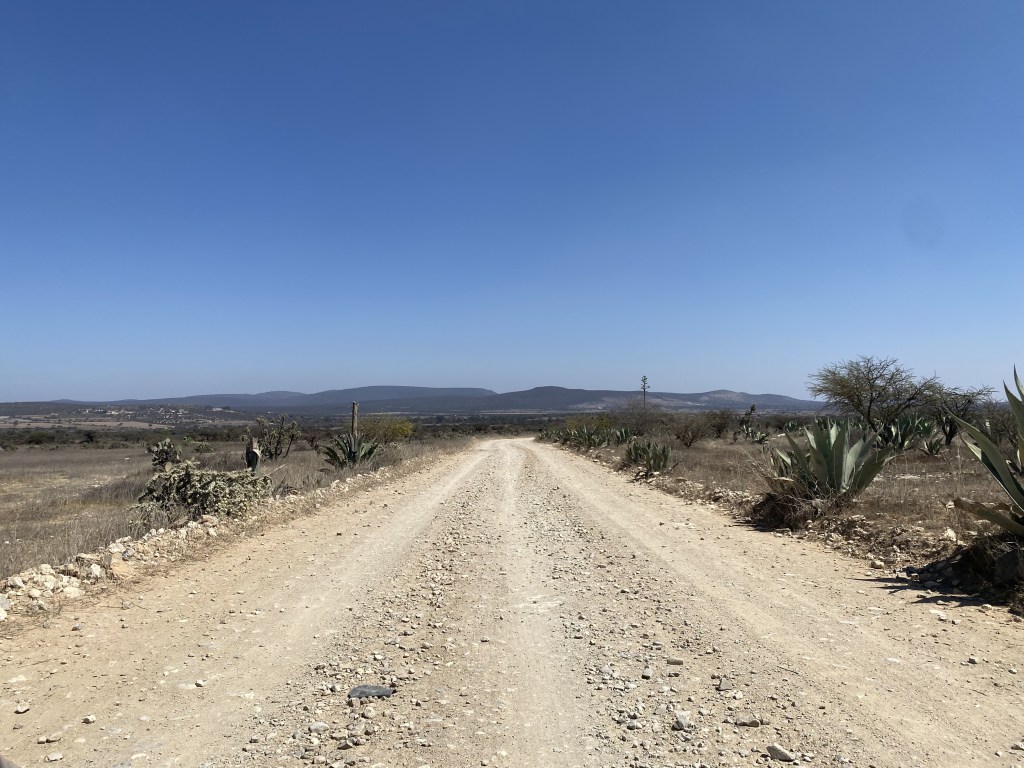
dirt road to Mine of Santa Brigida
In the semi-desert area we parked near a large red-and-white building which once served as the mine’s former management offices, paid the minder 200 pesos, and walked around the ruins.
Santa Brigida was actually mined by indigenous people before it came under Spanish control. It was a pit mine, so it doesn’t have a traditional mine shaft. We walked along the large and deep crevice in the earth which is the mouth of the mine, unmarked and gravelly. In addition to the mine, there are several deep wells around the mining camp, with no danger signs to mark their existence.


We went into the Arcos Mágicos (Magic Arches of the Sun and the Moon), built in 1595 by the Jesuits. This building of narrow arches was the purifier of poisonous gases from the underground mine system, and also served to “air” the gold and silver at each of its doors. These arched ovens were also used for mercury amalgamation, which extracts metals from the rock.
It was also the astronomical and astrological observatory of the Jesuits, a site where two phenomena of lunar and solar light were manifested.


We also saw ruins of the three smelting ovens, Hornos Jesuitas, as well as the hull of what was the Hacienda de Beneficio de Santa Brígida.
This excursion reminded me of all my explorations of ruins with my friend Mario when I lived in Oman from 2011-2013.


After leaving the mine, we drove back about an hour + 20 minutes to San Miguel de Allende.
 ~ wander.essence ~
You must be logged in to post a comment.