
Wednesday, June 28: We checked into our roomy Airbnb apartment in Verona, dibbed “Casa Teatro Ristori,” after we drove down the Alto Adige Wine Road from Bolzano. It was in a quiet neighborhood not far from the old town. Our terrace overlooked the Teatro Ristori, a cozy theater used for intimate performances.


We had a fabulous dinner at Bistro Con Amore right around the corner from our apartment. The restaurant was run by Christian from Romania and his wife Ina from Moldova. Christian was lively and passionate about his restaurant and about opera. He broke into song several times as I drank a Hugo and Mike enjoyed an Aperol Spritz. I had spaghetti with prawns and Mike had a delectable Eggplant Parmesan with Pugliese Burrata and fresh basil. We sat beside the nicest Italian couple, Lorenzo and Cosette (which, according to her, means “a little thing”). They were there eating cicchetti (Italian tapas) before they went to their home around the corner for dinner. We had a long chat with them about different parts of Italy (where they were from), the geography and rivers, and our travel plans in their decent English and our faltering Italian.


After dinner we strolled around town, heading for the domineering Castelvecchio, built in the 1350s by Cangrande II della Scala. We walked across the asymmetrical brick bridge, Ponte di Castel Vecchio, a triple-arched fortified bridge in Verona which straddles the Adige River. It was built (most likely in 1354-1356) by Cangrande II to enable him to safely escape from the attached castle in the event the population rebelled against his tyrannical rule.
The bridge was totally destroyed, along with the Ponte Pietra, by the retreating German troops on April 24, 1945. The bridge’s reconstruction by architect Libero Cecchini began in 1949 and was completed in 1951, except for the left tower.


Steps: 8,476; Miles 3.59. Verona’s High: 84°, Low 66°. Mostly sunny.
Thursday, June 29: Our first full day in Verona, we headed first to the Roman Arena, an open-air amphitheater in Piazza Bra built in 30 AD. It survived a 12th century earthquake and is now internationally famous for its legendary large-scale opera performances.
The Arena, the eighth largest in the Roman Empire, predates the Colosseum in Rome. It is one of the best preserved ancient structures of its kind. In ancient times, the arena’s capacity was nearly 30,000 people. The stage for concerts and opera performances decreases the available places to a maximum of 22,000.
The first 20th-century operatic production at the arena, a staging of Giuseppe Verdi’s Aida, took place on August 10, 1913 to mark the birth of Verdi 100 years before in 1813. Since then, summer seasons of opera have been mounted continually at the Arena, except in 1915–18 and 1940–45, when Europe was embroiled in war.
After wandering through the Arena and watching the work crews setting up the stage, we decided to buy tickets to Thursday night’s performance, which happened to be Aida, the first opera performed at the venue in the 20th century.


We dropped into a church not far from the Arena, San Nicolò all’ Arena, a Roman Catholic parish church dedicated to Saint Nicholas. It was built in the Baroque style between 1627-1683, although the façade wasn’t completed at the time. The neoclassical façade of the Church of San Sebastiano was relocated to San Nicolò in the 1950s, after the former church was destroyed during World War II. The interesting sculpture in front is Frutto Oggetto (“Fruit Object”) by Gino Bogoni, 1990.


Of course we had to drop by the Casa di Giulietta (Juliet’s House), a fictional place created by a city capitalizing on the fame of Shakespeare’s fictional Romeo & Juliet. In the 1930s the city authorities picked a house in Via Cappello as Juliet’s and added a 14th-century-style balcony and a bronze statue of the heroine. We stopped to touch Juliet’s breast, as it is believed caressing her breast brings good fortune in love. We looked up at the balcony and checked out the love locks, and then we were out of there. I wasn’t dressed for the occasion but I did capture a beautiful young lady dressed to the hilt for the photo op.


We stopped for cappuccino and croissants 🥐, our normal mid-morning routine. After our coffee break we wandered somewhat aimlessly while making our way slowly to the Torre dei Lamberti. We saw many enticing sweet treats and cool ancient buildings along the way. We found a sculpture of poet Berto Barbarani at Piazza Erbe, but we would have had to wait a long time to get the little girl posing out of the picture. I also bought myself another dress that was the exact style (but different color and pattern) as the one I bought in Venice for 70€; the one at a kiosk here was 25€. Live and learn.


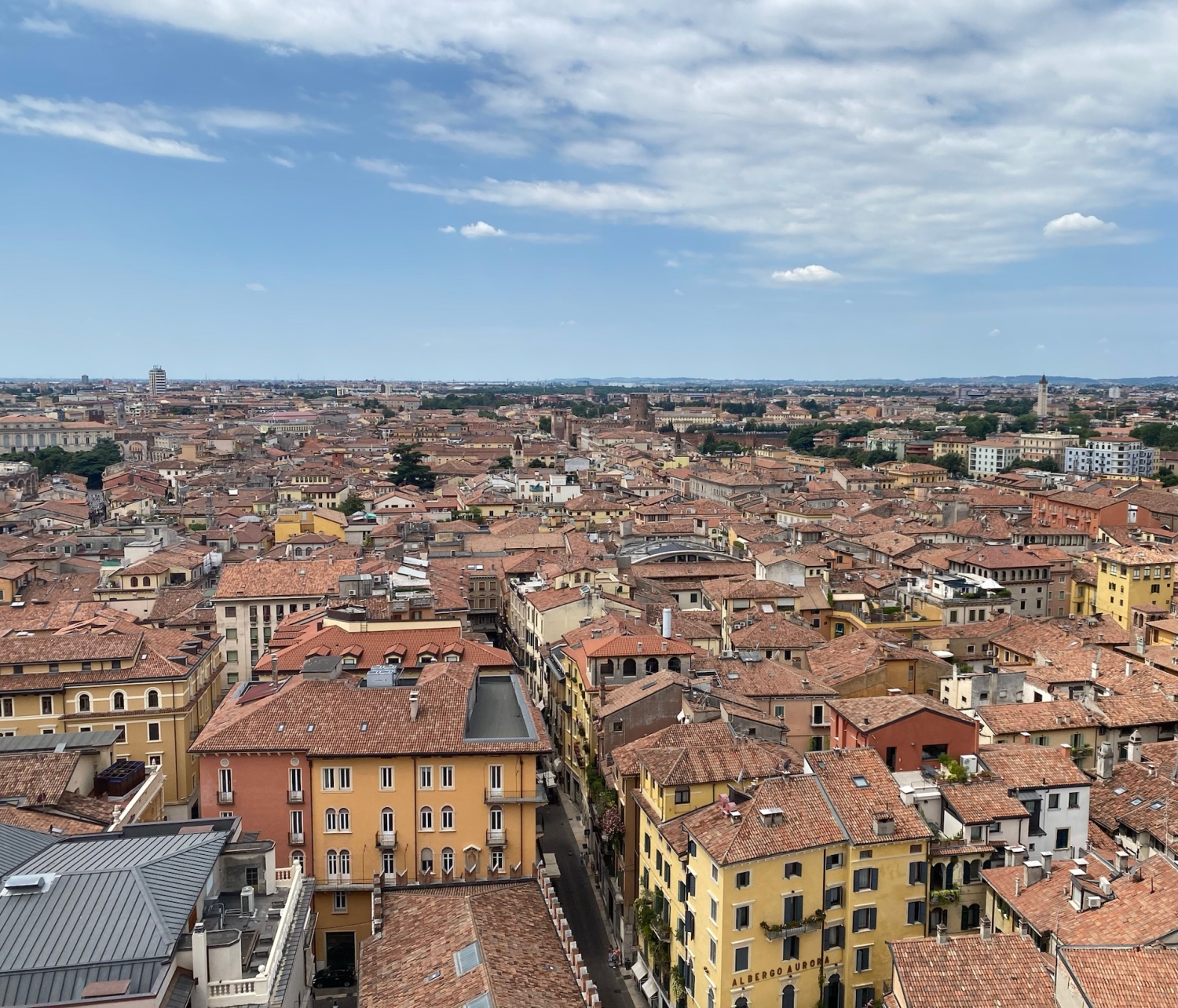
Onward and upward we went to the Torre dei Lamberti. The 84m-high watchtower offered panoramic views of Verona and nearby mountains. Begun in the 12th century and finished in 1463, it has an octagonal bell tower. I took the lift up 2/3 of the way, while Mike climbed the stairs, and we walked up the remaining 1/3rd for the views.


We then climbed the Scala Della Ragione (Stairs of Reason) to the Galleria d’Arte Moderna Achille Forti, the city’s modern art museum. Its collection of paintings spans 1840-1940 and includes many influential Italian artists. We loved the art in this museum, especially the paintings.


We walked through the Piazza Signori, lined with elegant Renaissance palazzi. A famous statue of Dante sits in the middle. Slightly off the Piazza is the Arche Scaligere, the ornate Gothic funerary monuments of the Della Scala family. They were the ruling family of Verona and mainland Veneto (except for Venice) from 1262-1387, a total of 125 years. The family’s rule was marked by wars, cruel and tyrannical governance, and fratricide, offset by some beautification projects in Verona: palaces, aqueducts, bridges and a treasury.


By this time we were hungry for lunch so we stopped at a restaurant, Osteria Sottoriva, where we shared a table with two Brits from York, Andy and Shirley. It was a long leisurely lunch, where Mike enjoyed an Insalata d’Orzo and I had an Eggplant Parmesan that wasn’t nearly as tasty as the one Mike had Wednesday night. Mike and Andy talked sports, especially their favorite football clubs. Andy’s was Newcastle, his hometown, and Mike’s Liverpool. We chatted about our travel itineraries. Andy and Shirley planned to stay at Lake Garda for a week after they left Verona. They had taken a day trip to Venice the day before by train, and when they arrived back late at night, around 10:00 p.m., some of the people who had disembarked were trying to get a taxi to their hotels in Lake Garda, but the taxi drivers refused to take them. Later, I would experience similar taxi frustrations during my walk on the Via Francigena. As Italy doesn’t allow Uber, taxi drivers have no competition and thus are inflexible, expensive, and even tyrannical.


Finally we visited the Italian Gothic Basilica di Sant’ Anastasia. Dating from the 13th-15th centuries, it features an elegantly decorated vaulted ceiling. This is Verona’s largest church with an overwhelming number of frescoes. We saw the beautiful fresco of St. George and the Princess by Pisanello above the entrance to the Pellegrini Chapel. Pisanello is known for his ability to evoke a fantastic chivalrous world.
We also made the acquaintance of the hunchback holding up the 1495 holy water font; he was carved by Gabriele Caliari. It is said that touching a hunchback on the hump brings good luck.


At the end of our day, we stopped for gelato at Gelateria La Romano. It was a refreshing way to end our day. After resting a bit, we made some delicious pasta in our apartment with green beans and sun dried tomatoes before going back to the Arena to see the opera Aida.


The opera Aida started at 9:15 and was scheduled to go a full 3 1/2 hours. I doubted my ability to stay up that late, so I told Mike I might want to leave early if I felt like it. He agreed, and off we went.
On our way to the opera we met our Italian “friends,” Lorenzo and Cosette. Holding our seat cushions under our arms, we told them we were on our way to see Aida. They were thrilled for us, gushing with enthusiasm over the opera.


Aida is one of the most mythical operas to be performed every year at the Arena di Verona. The series of 16 performances began this summer on June 16. The production by Franco Zeffirelli brought ancient Egypt to the stage in a modernistic way, with costumes created by Anna Anni, and a cutting-edge stage design, which featured a huge ghostlike hand that moved slowly up and down; the performance boasted a black, white and red color motif.
Detailed information on Aida:Venue: Arena di VeronaDuration: 3 hours and a half approximatelyBook by: Antonio GhislanzoniMusic composed by: Giuseppe VerdiLanguage: ItalianDirected and staged by: Franco ZeffirelliCostume design by: Anna Anni
Aida, an opera in four acts set in ancient Egypt, was commissioned to celebrate the opening of the Khedivial Opera House in El Cairo, where it premiered in December 1871. It is among the most performed operas in history. For instance, it has been performed over a thousand times at the Metropolitan Opera of New York since 1886.
The story revolves around the Ethiopian princess Aida, who is captured and sent to Egypt as a slave. At her arrival, Radames enters the scene. He is a commander for the Pharaoh who falls in love with Aida and will have to struggle between his love for her and his loyalty to the Pharaoh. The plot thickens when Amneris, daughter of the Pharaoh, demands the love of Radames, leading to a love triangle.
We left after 2 hours because I was so uncomfortable sitting on the concrete slabs of the Arena and also felt trapped because it’s frowned upon to get up at any time except intermission, which was between Act 2 and Act 3.


Here is a short video of some scenes from the opera.
Steps: 16,443; Miles: 6.97. High 87°, Low 66°. Partly cloudy.
Friday, June 30: On Friday morning, our last day in Verona, we ventured out to see some of the famous churches. First stop was Chiesa di San Fermo. The church was built in the 5th century in honor of saints Fermo and Rustico, who became martyrs in 304 AD. Here one church is built over another: Franciscan monks raised the 13th-C Gothic church right over an original 11th-C Romanesque structure. Inside the main Gothic church we admired the larch timber ceiling which resembles an upturned boat’s hull. Some 14th-C frescoes depict the life of St. Francis.


We stopped at the Duchi Café and then walked along the river. We didn’t get far because it started raining 🌧️ ☔️ and we hadn’t brought our raincoats or umbrellas. We ducked under the umbrellas of another cafe to eat the panini we had bought earlier, along with a bowl of bean soup we bought at the café. We enjoyed two Aperol Spritzes while waiting for the rain to stop.


When the rain abated, we crossed the Ponte Pietra at the northern end of the city center. Two of the bridge’s arches date from the Roman Republican era in the 1st century BC, while the other three were replaced in the 13th century. The ancient bridge remained largely intact until 1945 when retreating German troops blew it up. Locals fished the pieces out of the river and painstakingly rebuilt the bridge stone by stone in the 1950s.


Finally we went to the Cattedrale Santa Maria Matricolare, also known as the Duomo di Verona, Verona’s 12th century cathedral. It was built after an earthquake destroyed two Palaeo-Christian churches on the same site in 1117. The Romanesque-style cathedral was consecrated on September 13, 1187. The structure was later modified by several renovations, although the plan has remained unchanged. The interior was extravagantly frescoed in the 16th-17th centuries.


Because of the damp weather and because we were tired from so much walking, we headed back to the apartment to relax and nap. It rained off and on all afternoon.
We went out in the evening to our favorite neighborhood restaurant, Bistro Con Amore Cicchetteria, where we sampled a delectable assembly of Italian tapas (cicchetti) accompanied by opera music. Of course I had to have my Hugo!


Steps: 11,705; Miles 4.96. High 81°, Low 65°. Cloudy and some rain.
After leaving Verona on Saturday morning, we would head to Lake Garda and on to Bergamo.


 ~ wander.essence ~
You must be logged in to post a comment.