
Arrival in Okayama
Monday, October 7: After traveling from Tokushima to Takamatsu to Okayama, we walked quite a distance from Okayama Station to our hotel, Dormy Inn Okayama Natural Hot Spring. It was too early to check in so we went out for lunch. Whereas Kyoto and Tokyo often have English menus and cater more to foreigners, we found no English menus in Tokushima or Okayama. Luckily the proprietor at Juicy took his time using Google Translate to help us order. I got eggplant and soba noodles. The eggplant took me on a trip down memory lane; when I lived in Fuchinobe, I used to go once a week to a fish restaurant where I had a most delicious eggplant similar to this one. I don’t remember what Mike got.


When we finally checked in, our room was so tiny we couldn’t even move in it! We promptly went downstairs and asked for an upgrade to a larger room. We would have been miserable in that room for 4 nights. The hotel provided pajamas which, though extremely ugly, were probably the most comfortable ones we were given during our entire trip. 🙂


Later, we went out to eat at what looked like a small fish restaurant, but I was not at all happy with the food. I honestly don’t remember what we ate, but I do remember it was very weird.


Both of us felt pretty exhausted so we went to the public onsen in the hotel and then relaxed for the night. We were both getting travel weary and sick, which was no fun at all.
Steps: 7,684; Miles 3.25. Weather: Hi 77°, Lo 64°. Rainy.
A day trip to Bitchu-Takahashi
Tuesday, October 8: Our first day trip from Okayama was to Takahashi (高梁), often referred to as Bitchu-Takahashi after the surrounding region to distinguish it from other places with the same name. It is a small city in the mountainous interior of Okayama Prefecture.
The town’s modern main train station has attached to it a sprawling Starbucks, library and bookstore. We enjoyed a coffee here before heading toward the old town.


Takahashi Folk Museum
We stopped into the Takahashi Folk Museum, which held many artifacts from the town’s history, including its festival floats.
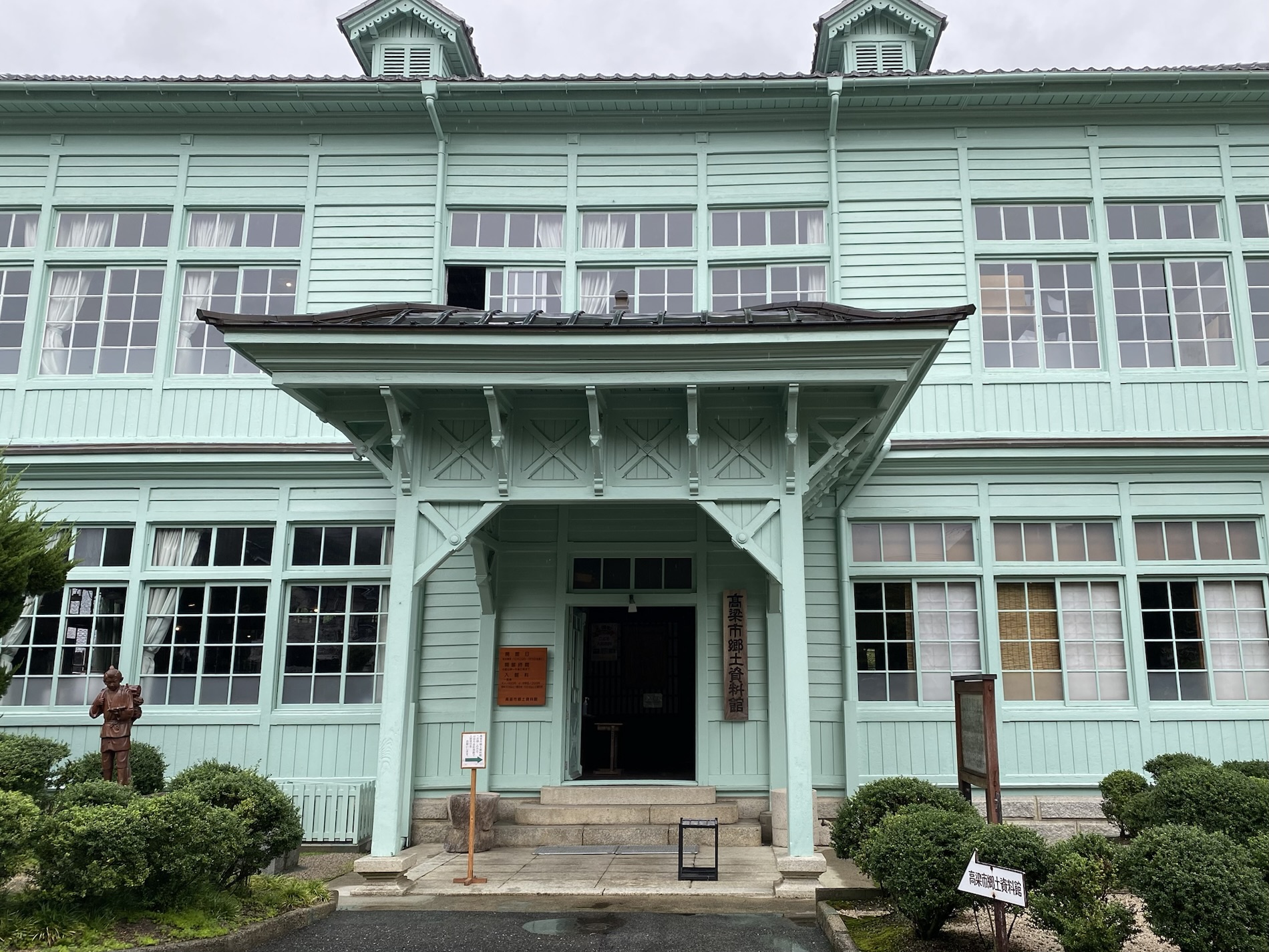
Takahashi Folk Museum
Located in an atmospheric Meiji Period building, the Takahashi Folk Museum (Takahashi-shi Kyodo Shiryokan) is packed with nearly 3,000 tools, appliances and other items and memorabilia collected over the past centuries. The second floor displays portable shrines that were used in local festivals.


Though the town is best known for Matsuyama Castle, the only original mountaintop castle and the oldest surviving castle in Japan, we didn’t have the energy to climb up to where it sits high up on the mountain above town. In fact, we never actually saw it at all.
Raikyuji Temple
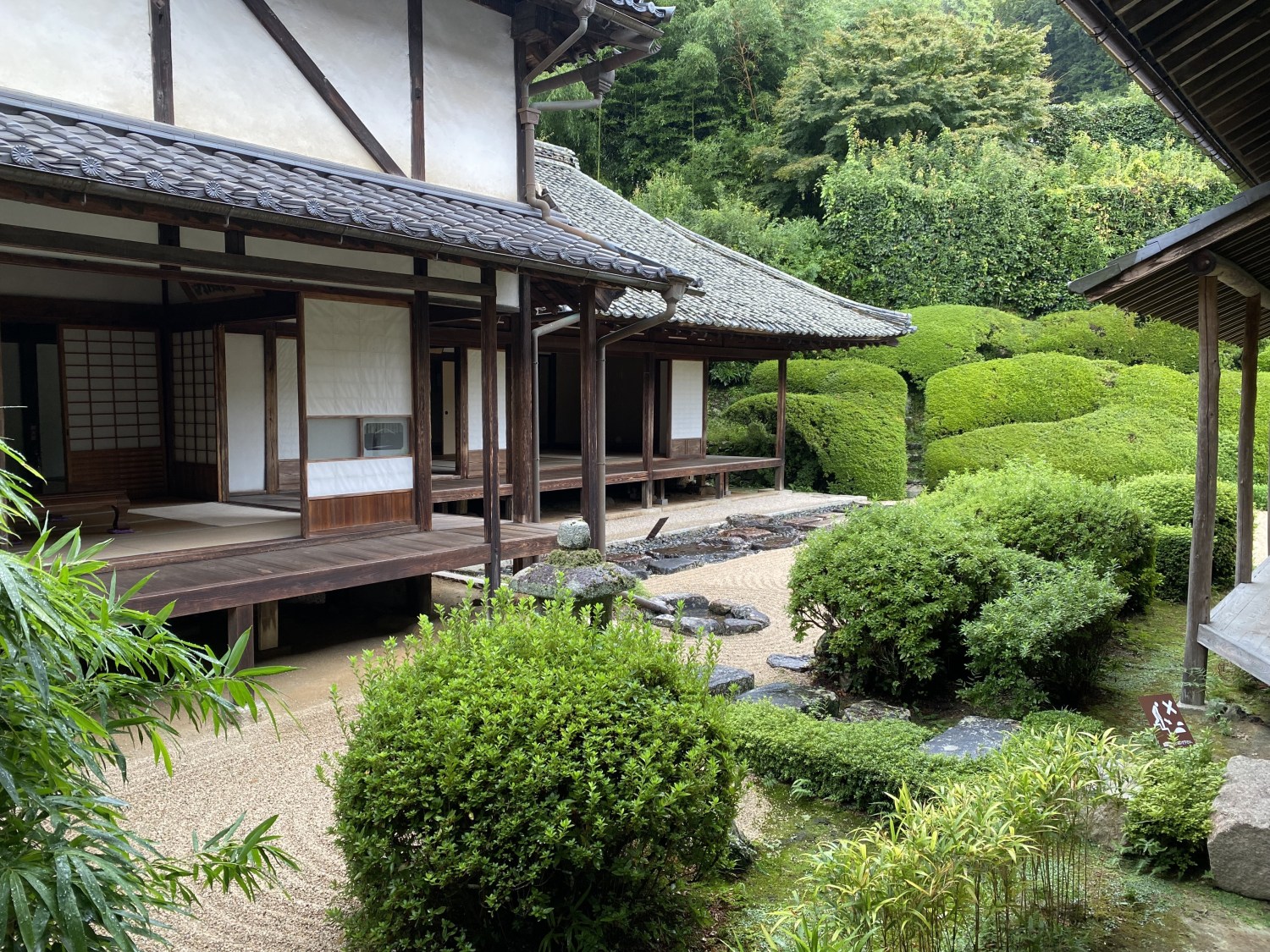
Raikyuji Temple (頼久寺, Raikyūji) is a temple of the Rinzai school of Japanese Zen Buddhism in Takahashi’s old town. The temple once served as the residence of Kobori Enshu, a local feudal lord who was also active as a renowned architect, garden designer and tea ceremony master.
Kobori Enshu designed the dry garden at Raikyuji Temple. The garden incorporates elements such as islands representing a crane and turtle (symbols of longevity and health) and borrowed scenery, which he commonly employed in his designs. We could view the garden from the temple building, but we couldn’t set foot into the garden.


Haibara Samurai Residence
We visited the large Haibara Samurai Residence in Bitchu-Takahashi. It was home to the Haibara family, who were high ranked samurai during the Edo Period. We were able to explore the residence’s many tatami rooms, kitchen and toilet, and view the gardens.


Orii Samurai Residence
The last place we visited in Takahashi was the Orii Samurai Residence, built about 170 years ago. We wandered through the main building, where some life-size dolls were arranged to reenact daily life during the Edo Period. One of them bowed and nearly made me jump out of my skin. We also admired the gardens from the house.


Return to Okayama
We enjoyed our views of rural Japan as we returned to Okayama on the train from Takahashi.


We had a hard time finding any good Japanese restaurants around our hotel in Okayama. Besides, we were having some stomach issues and we didn’t know if they were from Japanese foods we had eaten or if they were associated with the colds and coughs we had. Anyway, when we returned from Takahashi we stopped at a place near the train station where I had some very bony salted mackerel & rice. I can’t say I got much off the bones.

bony salted mackerel & rice
Later on Tuesday evening, after relaxing in our hotel and bathing in the onsen, we went to a dining court on the 6th floor of the Aeon Mall and ate hamburgers with gravy and cheese. The meal was a welcome treat as we were craving some Western food.


Steps: 14,486; Miles 6.14. Weather: Hi 77°, Lo 53°. Cloudy/rainy.
A day trip to Kurashiki Bikan Historical Quarter
Wednesday, October 9: What is the Japanese fascination with cats? Not a cat lover myself, I fail to see the appeal. This Bengal Cats Specialized Café was the first place we encountered on Wednesday when we visited the Kurashiki Bikan Historical Quarter. I considered buying one of the stuffed cats for our granddaughter, but in the end I couldn’t decide on one.


During the Edo Period (1603-1868), Kurashiki was an important regional trade hub for Japan’s most important commodity, rice. Large quantities of rice from the surrounding area were brought into Kurashiki and stored there in storehouses before being shipped to Osaka and Edo. Because of the city’s importance in the rice trade, Kurashiki was put under direct control of the shogunate, and the city was even named after its many storehouses (kura).
Later, the town became an important textile center under the Kurabō Textile Company. Owner Ōhara Magosaburō (1880-1943) opened the Ōhara Museum of Art in 1930 to house his large collection of predominately Western art. Today it draws many Japanese tourists.
The municipality worked for several years to bury the electrical cables in the city center to recreate a medieval atmosphere and to fully accentuate the buildings’ architecture.
The first thing we did in Kurashiki Bikan Historical District was to take a rickshaw through the old town.


After our rickshaw ride, we strolled around Kurashiki Bikan Historical Quarter. One of the main attractions of the city is a boat ride on Kurashiki’s canal, which enables one to experience Japan’s feudal atmosphere. The boat goes under a small bridge, made of only one stone, at a 90° angle to the waterway. The tour lasts about 20 minutes. The participants are asked to wear traditional hats to stick with the district’s decor. Though we didn’t go on the boat ride, we were able to watch people as they floated along the weeping willow-lined canals.


Parallel streets to the canal took us between traditional houses which had not been converted into souvenir shops. We also saw the pottery for which Kurashiki Bikan Historical District is famous.


We climbed up to Achi-jinja shrine in Tsurugatayama-kōen, a park that overlooks the old area of town. The shrine is home to a wisteria tree guessed to be 300-500 years old. We enjoyed the views over the rooftops of Kurashiki Bikan Historical Quarter.
Back down in the old town, we stopped in a bamboo grove and several denim shops, since the area is famous for denim.


When we got back to Okayama from Kurashiki, we spent time bathing and relaxing in the public onsen and then went out to the dining area on the 6th floor at Aeon Mall, this time for Indian food at Namaste-Ganesha. We still weren’t feeling good and were burned out from Japanese food. Little did I know that the butter paneer would cause me an upset stomach the following day.


Steps: 15,198; Miles 6.43. Hi 77°, Lo 53°. Sunny.
A day trip to Naoshima Island on the Seto Inland Sea
Thursday, October 10: On our last day in Okayama, we took a train through the countryside to Uno Port, where we took a ferry to Naoshima Island on the Seto Inland Sea. The island is best known for its many contemporary art installations and museums.


As soon as we got to the island, we rented e-bikes and began our exploration of the island.


Much of Naoshima’s art was installed by the Benesse Corporation, which oversees art museums, installations and sculptures both on Naoshima and on neighboring islands. Benesse’s museums were designed by the well known Japanese architect Ando Tadao and include the Chichu Art Museum, Lee Ufan Museum and all the buildings of the Benesse House.
The Benesse project started in the early 1990s, when the Benesse Corporation chose Naoshima as the setting for its growing modern art collection. In addition to the main museums, many outdoor sculptures are situated around the coast, including Kusama Yayoi’s Yellow Pumpkin, which is a symbol of the island.
We parked our bikes (as required) and wandered around the Benesse House grounds. I wasn’t overly impressed by the outdoor art collection. The sea itself was more compelling than the art. I had been to a similar outdoor art collection in Hakone in 2017 (a weekend in hakone: the hakone open-air museum) which I thought was more fascinating than Naoshima.


Benesse House Museum
We were not impressed by the brutalist design of the Benesse House Museum, nor were we impressed by the few pieces of art on display in the concrete bunker-like museum. To be honest, after seeing so many fabulous art galleries all over the world, we found the contemporary art here lacking. It just wasn’t that thought-provoking or impressive. I found myself wishing for more art like we saw at the fabulous museum in León, Nicaragua or the museums of Balinese art in Bali. I could name so many fabulous museums all over the world, but this one just didn’t do it for me. I wish we could have appreciated it more since we’d spent a day of our time in Japan here, but I actually felt bored by it.


Taking a trip to one of the islands on the Inland Sea and riding the e-bikes was more fun than interacting with the art. We found ourselves feeling sorry for people who were disembarking with suitcases at the ferry as we returned to Uno Port. We thought how boring it would be to spend the night in Naoshima.
The last photo in this series shows a young girl’s school bag brimming with stuffed animals, a common sight in Japan.


Return to Okayama
After our day on Naoshima, we stopped by Juicy for some sake and a late lunch. I had eggplant, avocado sashimi & gyoza and Mike had a steak set meal. The proprietor welcomed us back and happily used Google Translate once again to help us order. He was a super friendly guy.


Because we ate such a late lunch, we didn’t feel like going out for dinner. We just took baths in the public onsen and relaxed the rest of the evening.
We would head to the southernmost of Japan’s four large islands, Kyūshū, on Friday morning for our last week in Japan. Kyūshū (lit. ‘Nine Provinces’) is the third-largest island of Japan’s four main islands and the most southerly of the four largest islands (i.e. excluding Okinawa and the other Ryukyu (Nansei) Islands).
Steps: 12,067; Miles 5.11. Hi 77°, Lo 53°. Sunny.
 ~ wander.essence ~
You must be logged in to post a comment.