

Arrival in Nagoya
Monday, September 16, 2024: After driving from Takayama to the two post towns along the Nakesendo Trail and then to Nagoya, I couldn’t take the hassle of getting a shuttle from the Toyota-Rent-a-Car place to the airport, then the Express bus from the airport to Nagoya Station and then switching trains + a 15 minute walk to our hotel, Gold Stay Nagoya Osu, while hauling our luggage. So we opted for a taxi, our first in Japan, directly to the hotel 🏨. I was so exhausted and sick after the day that I put on my PJs and got in bed while Mike went out to a convenience store to nab us some dinner. We have a wonderful apartment here in Nagoya, but it’s sadly not conveniently located to any subway stops, with at least a 15-minute walk to any station. It does have its own Japanese bath, a kitchen and, best of all, a washing machine. We were able to watch Maestro in Blue on Netflix, but I fell asleep in the middle of it. This place would turn out to be one of our most favorite places to stay in Japan.


Steps: 8,139; Miles: 3.44. Nagoya: Hi 92°F, Lo 77°F. Mostly cloudy.
Tuesday, September 17: We started our Tuesday in Nagoya by walking toward the metro to go to Nagoya Station to buy our Shinkansen tickets to return to Tokyo on Thursday. On the way, we passed a modern temple with an old drum tower.
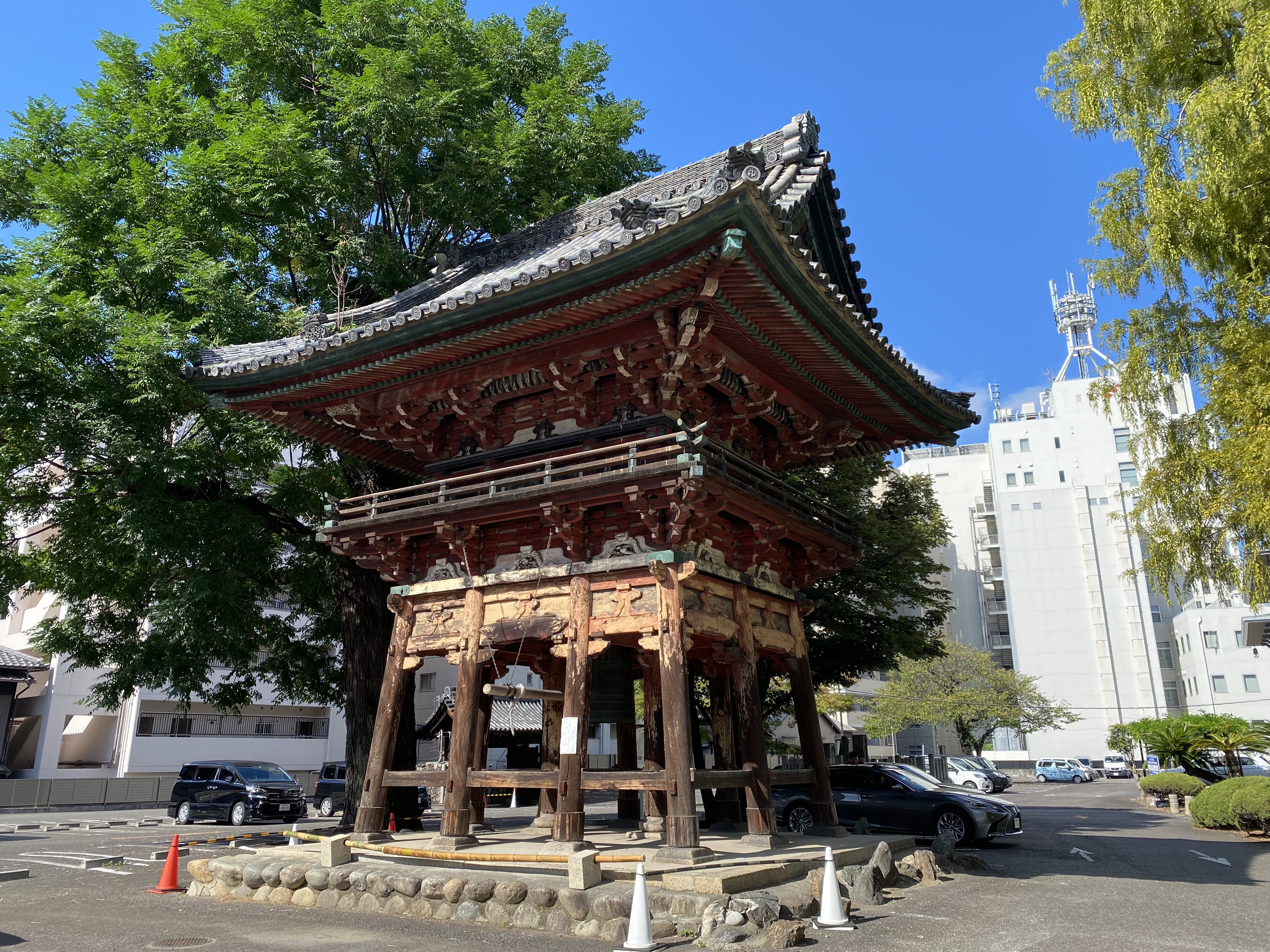
old drum tower in front of a modern temple in Nagoya
Ōsu Kannon Temple
On Wednesday the 18th, there would be a big antique flea market on the grounds of Ōsu-Kannon Temple, which we planned to go to. Since it was nice and quiet today, we stopped to take some photos.
Ōsu Kannon Temple has roots back to 1933. The main object of worship at the temple is a wooden statue of Kannon, the goddess of mercy, which was carved by Kobo Daishi, an famous figure in Japanese Buddhism. The present building dates to 1970. Originally built during the Kamakura Period (1192-1333) in neighboring Gifu Prefecture, the temple was moved to its current site by Tokugawa Ieyasu in 1612 after the original temple had been repeatedly damaged by severe flooding. The current buildings are 20th century reconstructions.
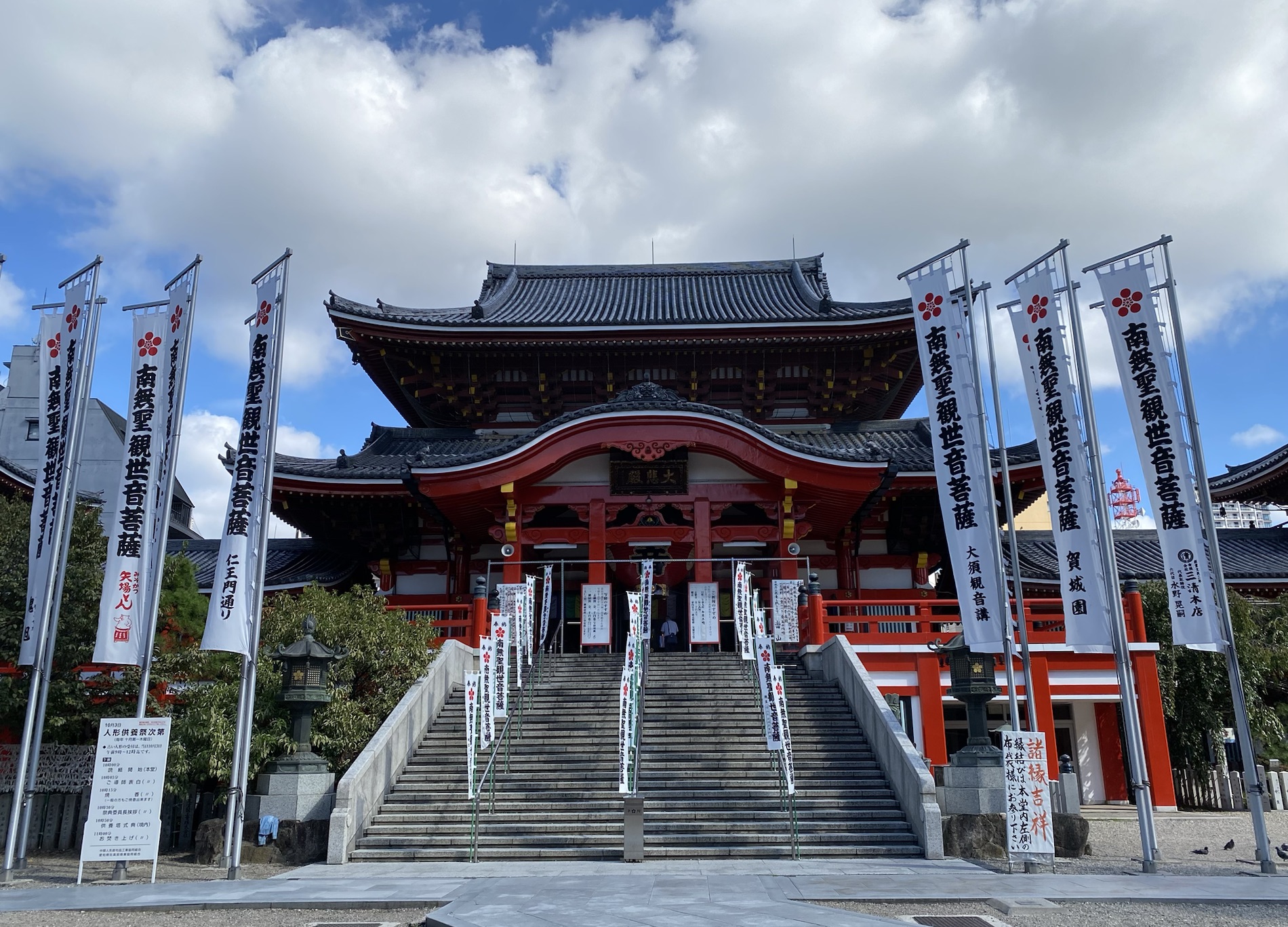
Ōsu Kannon Temple
Underneath Osu Kannon’s main hall is the Shinpukuji Library which contains over 15,000 classic Japanese and Chinese texts. Among these texts are several national treasures and important cultural properties, including the oldest copy of the Kojiki, a chronicle of the early history of Japan including its mythological origins.


Leaving the temple, we went on to the metro station and then to Nagoya station where it took us quite a while to find the place to buy our Shinkansen tickets.
I know it was a bit strange but we would be taking the Shinkansen to Narita, after only 10 days in Japan, to fly to Bali for 10 days. Then we’d return to Japan for another 19 days. It was cheaper and less time in the air to get round trip direct tickets from home to Tokyo and then round trip direct tickets from Tokyo to Bali and back.
Nagoya Castle
We took the metro to Nagoya Castle, but before going into the complex, we stopped at a coffee shop where we found a little boy eating a crazy-looking shaved ice concoction.


We visited Nagoya Castle (名古屋城, Nagoyajō), built in the beginning of the Edo Period (1603-1868) as the seat of one of the three branches of the ruling Tokugawa family, the Owari branch. As such, it was one of the largest castles in the country, and the castle town around it ultimately grew to become Japan’s fourth largest city.
Nagoya Castle, one of the most representative Japanese castle structures of the early modern period, was constructed by Ieyasu Tokugawa (1542-1616), founder of the powerful Edo Shogunate. Following the construction of Edo Castle and Sumpu Castle, the Shogun in 1610 ordered construction of Nagoya Castle, actually the last to be built during his reign.
The operation was carried out as a national-level project to build a great castle that would symbolize the power and authority of the Tokugawa Shogunate. The five-storied Great Tenshu, the Castle’s donjon, crowned with a pair of glittering golden dolphin-like “shachi”, was especially famous as the largest wooden castle structure in Japan.

Nagoya Castle
Most castle buildings were destroyed in the air raids of 1945, including the castle keep and the palace buildings. The current ferro-concrete reconstruction of the castle keep dates from 1959 and – before its closure in May 2018 – contained a museum about the castle’s history. The park surrounding the castle keep features two circles of moats and impressive walls with corner turrets.
Near the entry was a stone topped with a man; it was called Kiyomasa’s Stone Pulling. It is said that Kato Kiyomasa, a renowned samurai who was ordered to supervise the construction of the stone walls of the Castle Towers, issued commands atop this stone.


Nagoya Castle’s Hommaru Palace was built in 1615 as the residence for the leader of the Owari Domain. Genkan, the entrance hall, was the first building to which visitors to the Hommaru Palace were admitted. The walls were adorned with bold depictions of tigers. Oroka, the grand corridor, was a passageway between the Genkan and the heart of the palace.
The palace burned down in the wartime air raids of 1945. Restoration work began in January 2009. Genkan, the entrance hall and Omote Shoin, the main hall, opened to public viewing in 2013. We walked through in single file lines, wearing mandatory slippers, and took photos of the beautiful tatami rooms and painted screens. Sadly, there was no air conditioning, so it was terribly stifling.


Omete Shein, the main hall was used for official audiences. The raised-floor room at the furthest end was reserved for lords.


The Taimenjo (Reception Hall) was used for private banquets or meetings between the lord and his relatives or vassals. The Jodan-no-ma, main audience chambers, and Tsuginoma, connecting room, was decorated with paintings of famous sites, scenes of the four seasons, and groups of people.


The lord or Shogun would use Saginoroka (Heron Corridor) when passing between the Taimenjo and the Jorakuden. It was constructed in 1634 at the same time as the Jorakuden. The screen paintings extending above the Nageshi, decorative beams, are a feature introduced around this time.


The Jorakuden (Shogun Accommodation Hall) was a palace extension built in 1634 for the impending visit of the Third Shogun, Tokugawa Iemitsu, en route from Edo (Tokyo) to the capital, Kyoto. During the Edo period it was known as the Go Shoin or the Oshiro Shoin. It was the most luxurious of the Hommaru buildings, with gorgeously decorated walls and ceilings, and an intricately carved, richly colored transom.


The Umenoma (Plum Room) was a waiting room used by the high ranking vassals of Owari Province prior to audiences with the Shogun in the Jorakuden, Shogun accommodation hall. It was constructed along with the Jorakuden in 1634.


The main keep of Nagoya Castle was closed to visitors as it was undergoing a reconstruction to make it more earthquake proof.


Nagoya
After visiting Nagoya Castle we returned to Ōsu-Kannon and then wandered through the shopping arcades all around there. We got little fish-shaped pastries filled with a sweet bean sauce. They were quite tasty. Japanese people love their sweets; you can find anything you imagine.


We went to a sushi bar, Sushi sakaba Matsubara, for dinner on Tuesday night. The menu was all in Japanese. Nagoya must not be much of a tourist town because often restaurants in Japan have an English menu. We haven’t found English menus much in Nagoya. I used my Papago app: it sucks! We ordered some kind of sushi, some kind of snack, beers and sake. I couldn’t tell for sure what any of the food was. We enjoyed the cozy atmosphere of the bar though.


Steps: 15,518; Miles 6.57. Weather Hi 94°, Lo 74°. Mostly sunny.
Ōsu-Kannon Temple Market
Wednesday, September 18: The main reason I wanted to come to Nagoya was for the flea market held on the grounds of Ōsu-Kannon Temple on the 18th & 28th of every month. I was inspired by Peta of Empty Nesters on a Green Global Trek because I love textiles and she had found some pants made from temple flags when she was here last year. I was especially interested in lightweight summery pants with Japanese lettering. I found one lady who sold pants and clothes but she didn’t speak English; when I asked if hers were the pants made from temple flags, using Google Translate, she said no. Other merchants sold pieces of fabric or kimonos, but this one was the only merchant I could find who sold clothing. I ended up trying on a bunch of pants that didn’t fit, but I found two that did (although one needs hemming). I also found a dress embroidered with handmade stitching which I bought. I look horrible in the pictures because I was trying them on under or over my clothes and the high today was 97 degrees with super high humidity. Needless to say it was miserable. But at least I showed up and found a merchant (not the same one) who sold clothing and I found a couple of Japanese items. The merchant was super friendly and kept giving me things to try on that I had no interest in.
It was fun to wander through the market looking at pottery, fabrics, kimonos and every other kind of imaginable thing. Also, I took some surreptitious photos of pretty ladies in fancy yukata or kimono (I don’t know how to tell which is which). Also we glimpsed some strangely stylish space-age looking women walking through the temple gate.


Tokugawa Art Museum & Tokugawa Park
We took a JR line and a subway and walked about 15 minutes in the hot sun to the Tokugawa Art Museum in Nagoya. The first picture in the set below are two girls on the metro who were dressed alike. We found two sets of matching girls today.
Some of the galleries were closed in the museum but we enjoyed the ones we could see, especially as the museum was air-conditioned.
THE TOKUGAWA ART MUSEUM and surrounding public garden, THE TOKUGAWA PARK are situated in what was the main section of a mansion complex and grounds known as the Ozone yashiki.
The second lord of the Owari branch of the Tokugawa shogun family, Mitsutomo, had the mansion built and lived here in retirement from 1695. After Mitsutomo’s death in 1700, the location was used for the homes of three high-ranking Tokugawa retainers, the Naruse, Ishiko and Watanabe families. At the Meiji restoration (1868) the land reverted to the Tokugawa family.
In the museum, we found a helmet and armor from the Edo period, 1849. It was worn by the 14th lord of Owari, Tokugawa Yoshikatsu.
We saw a modern reproduction of a lord’s tea house in the simple sukiya-style. The design is based on records of the SARUMEN tea-house at the Owari Tokgawa’s Ninomaru residence at Nagoya Castle. The name Sarumen (“monkey’s face”) comes from the resemblance of the knots purposefully left exposed in the cedar pillar flanking the alcove.
We also enjoyed the formal chamber of a daimyo’s residence. The main rooms were used for official and ceremonial purposes. Here the lord issued orders or received guests at banquets.


We found costumes related to Noh Theatre. Noh is a sophisticated musical drama that relates a delightful or often tragic story. A masked protagonist performs in dance and song, with one or two others in unmasked subsidiary roles, accompanied by a chorus, drums and flute. Shorter comic plays called Kyogen are interspersed to enliven a full performance. Noh’s restrained conventions of movement and texts full of poetical allusions achieved much of their present form by the mid-15th century under the enthusiastic patronage of the Ashikaga shoguns.
The warrior elite patronized Noh in the 16th century when many warlords were accomplished amateur performers. Noh drama in the Edo period became the official entertainment of the shogun and daimyo, powerful Japanese feudal lords, who, from the 10th century to the early Meiji period in the middle 19th century, ruled most of Japan from their vast hereditary land holdings.
Noh performances were obligatory at ceremonies and festive occasions throughout the year and to celebrate special events. Most daimyo families had a stage and a collection of Noh (and Kyogen) costumes, masks, and simple props to use whenever professional actors were called in. The amateur tradition continued. Practice in singing the texts was part of the education of any lord, and many are recorded as being talented dancers.
After our tour of the museum, we stopped in the museum “coffee room” to have cool drinks and “chestnut crunching” snacks.


After leaving the nice cool air conditioned museum we walked around the beautiful water garden that is part of the museum, The Tokugawa Park. It would be lovely in spring with the cherry blossoms and irises.


When we left the park we had to retrace our 15-minute walk from the Museum and Park back to the metro in the hot sun. It was sweltering and we were hungry so we were on the lookout for a cool place to eat. Luckily we found a little Italian restaurant where we enjoyed pasta. I had creamed risotto of smoked salmon and Mike a kind of spaghetti with corn.


Ōsu-Kanon Temple Market & wrapping up our visit to Nagoya
We passed by the Ōsu-Kanon Temple Market on the way back to our hotel and I took some photos of the colorful textiles and kimono for sale. The woman who had sold me the dress and two pants had already packed up and gone home for the day. She had probably made enough money from me to call it a day!


We dropped into Hioki Shrine near our hotel. Then we were happy to return to our room to rest for a bit and escape the heat… and have a beer!


Near Ōsu-Kannon, when walking back to our hotel, we’d seen the alluring plastic food display at Shinpachi Shokudö Ösukannon Ekimae. I had a craving for a fish meal, so after resting in our hotel during the hottest part of the afternoon, we went to the restaurant for a delicious fish dinner.
I enjoyed the Salt Char-grilled Thick-cut Coho Salmon Combo Meal and Mike had the Char-grilled Atka Mackerel Combo Meal (half).


We wandered back to the hotel through the covered arcades and finished readying ourselves for our next move: taking the Shinkansen to Narita for our flight to Bali on Friday.


Steps: 14,888; Miles 6.3. Weather Hi 97°, Lo 78°. Mostly sunny.
Thursday, September 19: We left Nagoya Thursday morning on the Nozomi 314 Shinkansen at 9:41. While waiting for the train to arrive it was fun to capture the girls making fashion statements.


We headed to Tokyo and then onward to Narita, where we would spend the night and fly to Bali on Friday morning.


 ~ wander.essence ~
You must be logged in to post a comment.