
Nagoya
Friday, September 13: We arrived in Nagoya on the Shinkansen by 11:10 but it took us quite some time to find the express bus to Nagoya Airport. We walked to and fro on the sweltering pavement until an English teacher came along with his friend and led us to the barely noticeable bus stop. We took the bus to the tiny airport then waited there until a woman from the Information Desk called Toyota-Rent-A-Car to come pick us up. Finally, we rented a black Toyota Corolla Touring to drive to Takayama in the Japan Alps. The whole process was cumbersome, made worse by the oppressive heat.
Mike did a fabulous job driving our Toyota Corolla Touring rental car from Nagoya Airport through at least 30 tunnels on the Expressway to Takayama, and that on the left side of the road as well. I was a bit freaked out in the passenger side; it’s hard to get used to having the slow lane be on the left side of the moving traffic.

our rental car: Toyota Corolla Touring
Takayama
We arrived at our hotel, Ichinomatsu Japanese Modern Hotel, by 3:00. It had a lovely setting. Sadly we found from the receptionist that the old town of Takayama was about to close down for the night. (I actually read later it is open every day from 9-5).
We had to change our shoes multiple times while going to our room and then back outdoors. We put our street shoes in a locker, put on house slippers, then put on outdoor slippers to walk through the garden and then house slippers again to go to our room. It was quite a production.


Takayama is famous for its Hida beef so Mike wanted to try a place he found highly recommended in a blog: Center4 Hamburgers. We could have driven our car but instead we decided to walk the 23 minutes to get there. Luckily we brought our umbrellas as the sky opened up and we were drenched by the time we arrived at the quirky cafe. The place was decorated with everything imaginable from Johnny Cash T-shirts to flour sacks, vintage signs and beat-up old-fashioned shoes. Johnny Cash songs serenaded us during our meal.
We sat beside two young families, a Filipino brother and sister and their spouses. The one young family – the Filipino brother & wife (part Filipino but didn’t look it) and 2 children (ages 1 & 4) – was from Vancouver. The Filipino sister and her husband were based in Manila. We chatted with them in the cozy quarters and Mike enjoyed a Hida beef burger 🍔 and I had an avocado burger (much cheaper and made with local beef but not Hida beef). All of it was delicious. Mike downed a pour of whiskey and I had a draft Kirin Ichiban beer.


After dinner the rain had turned to a sprinkle and we walked back, admiring the shuttered town and looking forward to a daytime visit. We had to get back because we had reserved a half-hour slot at the hotel’s onsen at 8:30. We relaxed a bit and then donned our yukata for our allotted time slot.
We had a half hour and it was lovely but as the onsen was outdoors and the temps were in the high 70s, the hot bath was a bit much for me. I couldn’t take more than 15 minutes, so I returned to the room and promptly fell asleep on our nice firm bed.


Steps: 10,235. Miles: 4.33. Weather Takayama Hi 84°F, Lo 69°F. Partly cloudy.
Saturday, September 14: Ichinomatsu Japanese Modern Hotel had a fabulous breakfast. We had signed up for a half-hour time slot at 7:30 so we could get an early start. The breakfast this morning consisted of an omelette and different types of onigiri, a bit of salted salmon, radishes, cucumber, and miso soup.


Shirakawa-go
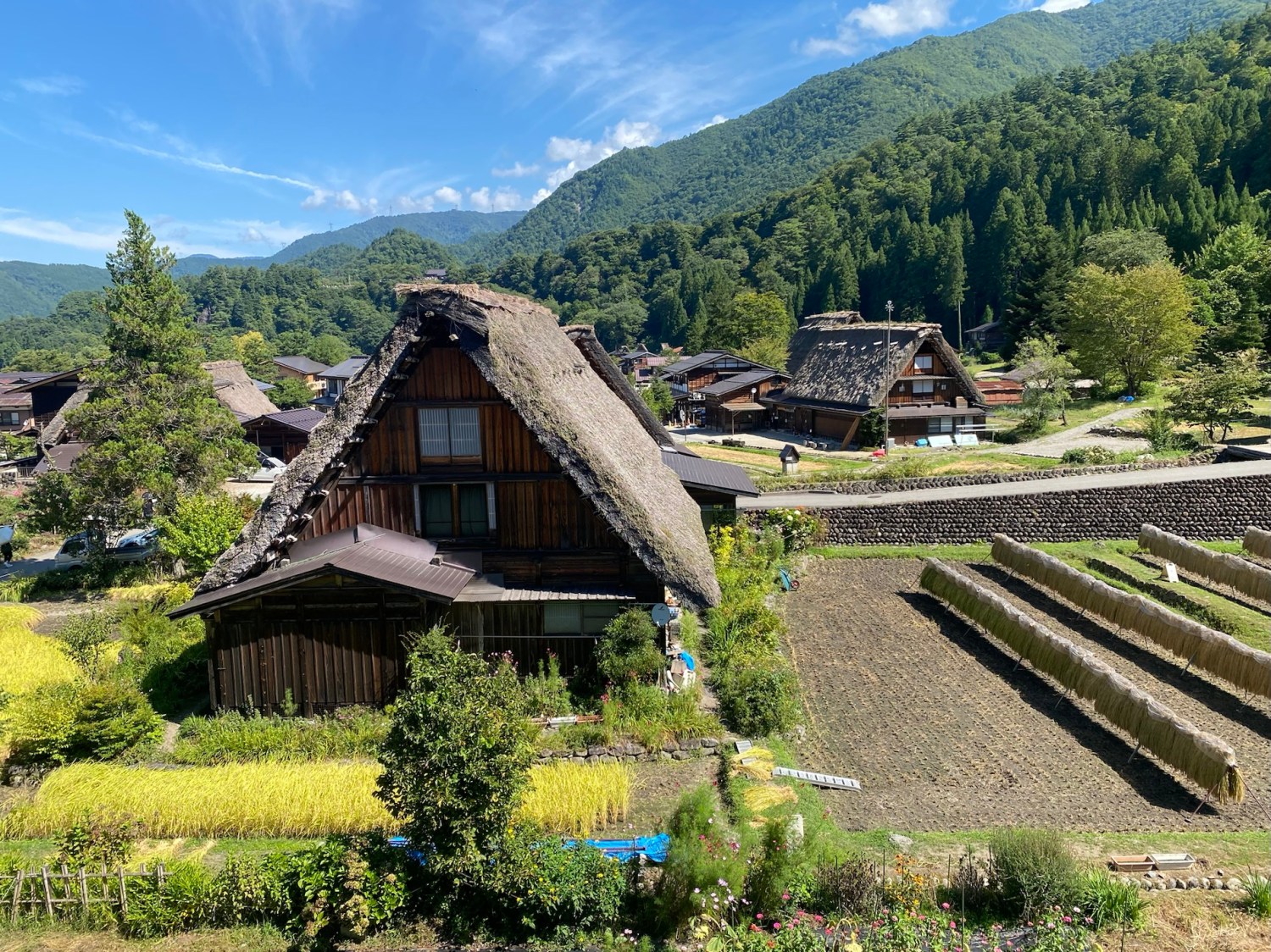
After breakfast, we drove through over 30 tunnels in the Japan Alps to visit the village of Ogimachi in Shirakawa-go, best known for farmhouses in the thatched gasshō-zukuri style. Its central settlement has some 600 residents and the largest concentration of gasshō-zukuri buildings, with over 110. It and two other villages, Suganama and Ainokura (in the Gokayama district of Toyama Prefecture) are UNESCO World Heritage Sites. Gasshō-zukuri means “constructed like hands in prayer,” as the farmhouses’ steep thatched roofs resemble the hands of Buddhist monks pressed together in prayer. The houses are designed to withstand the large amount of heavy snow that falls in the region during winter. On this day, it was sweltering, so it was hard to imagine snow ❄️ EVER!
The style of gasshō-zukuri architecture does not use any metal objects such as braces, clamps or nails in the building construction, and instead, ropes and ties made from straw (witch-hazel sapling) are used in the construction. While the roofs are thatched with hay, if properly maintained for protection from the fires made in a sunken hearth (fireplace), the roof can last between 40 and 50 years. The thatching on the roof is replaced with the help of all the villagers in a spirit of mutual support.


The Myozenji Temple is the only temple and bell tower made with a traditional thatched roof. A temple of the Jodo Shinshu (True Pure Land) school, named in the first year of the Enkyo period (1744), was the dominant form of Buddhism in this area. Myozenji has a distinctive thatched main hall that dates to 1827. There is no other temple that has thatched roofing on the main hall, the living quarters and the bell tower.
The Shoromon Gate is the main gate of Myozenji Temple. Built in 1801, it is noted for its distinctive two-layered structure and high thatched roof. This design, invented by a local artisan, served as inspiration for the temple’s current main hall, which also features a thatched roof and was constructed 26 years after the gate. The Shoromon’s original temple bell was requisitioned for military use during World War II; its replacement, cast anew after the end of the war, hangs in the gate and is rung for ceremonies and on occasions such as New Year’s Eve.
On the left side of the gate stands a yew tree (Taxus cuspidata), which was planted to mark the completion of the main hall in 1827 and is designated a Natural Monument of Gifu Prefecture, while on the right side grows a cherry tree whose pink blossoms signal the coming of spring in Shirakawa-go.


The Myozenji Museum now occupies the building which formerly housed the monks living at the adjacent Myozenji Temple. It is one of the largest gasshō-zukuri-style houses in the village. This structure was built in 1817 and is now a museum where visitors can learn about traditional life in Shirakawa-go. The museum building is one of the few houses of its kind in the area with plastered earthen walls, which are more fire-resistant than wooden walls.
One can observe the architecture of the traditional buildings, inspect the details up close and smell the aromatic smoke used to repel insects and protect the wood and thatched roof from damage.
We began upstairs in the four-level attic, which was used mainly for cultivating silkworms. Here we saw a variety of tools, kitchen utensils, ornaments, household implements, and other items that convey how the people of Shirakawa-go traditionally made a living. The attic also provides a look at the inside of the roof structure, which is secured by straw ropes and bindings (neso) made of witch hazel saplings. The foundation and first floor of a gasshō-zukuri-style house such as the Myozenji kuri were usually built by professional carpenters, whereas ordinary villagers would work together to assemble everything above the house’s lattice ceiling.


We had a silly photo taken of ourselves in the attic of the museum. 😂😂 Apparently the weird-looking stuffed doll they gave me to hold is a Hida Sarubobo Stuffed Doll. In Japanese, Saru means “monkey” while bobo means “baby”, so sarubobo is baby monkey. Traditionally, sarubobos are made by grandmothers for their grandchildren as dolls, and for their daughters as a charm for good marriage, good children and to ensure a well-rounded couple.


After viewing the attic, we followed a covered corridor into the main hall; the ornate interior is characteristic of Jodo Shinshu temples. Next to the main hall is the kuri, or living quarters of the head priest and his family. Its 330-square-meter first floor includes a large living room with an irori fireplace at the center. Above the fireplace hangs a hiama, a wooden board used to extinguish sparks rising from the fire, to dissipate smoke, and to prevent heat from dispersing throughout the house. The living room was where the family ate and spent time together sitting around the hearth in strictly prescribed seating order. The head of the household sat with his back against the thick post at the center of the building, symbolizing his role as the main breadwinner. His wife sat on the right-hand side and his firstborn son on the left, while the rest of the family had their places on the opposite side of the irori.


Ainokura
After leaving Shirakawa-go, we drove to the more remote and charming smaller village of Ainokura. We had a lunch there of cold soba noodles and tofu & vegetable tempura. It felt good to sit in a cool air-conditioned place. Then we wandered among more of the grass hut houses until we were exhausted from the heat and returned through another 20 tunnels on the Expressway to Takayama.


Takayama
Saturday night we ate white-bread sandwiches 🥪 from a convenience store because we’d eaten such a huge lunch in Ainokura. After dinner, since Takayama is known for its sake breweries, we went to the cozy and intimate Sakedokoro Tamotsu, a sake bar. The owner, Atsu, who spoke excellent English, gave us a tasting of three types of sake and then Mike ordered a glass of one type (he is holding the bottle in the photos). I got a Ginger Plum Martini: Homemade ginger Vodka,Local Plum, Dry Vermouth, Soda. It was a very strong drink and I sipped it (for once – I usually guzzle mixed drinks!) over a long leisurely visit with Atsu and his friend, Morimo. They bonded many years ago over music; Morimo plays guitar and is especially fond of American classics from the 60s and 70s, especially Little Richard and CCR. We talked with them for a long time and enjoyed the cozy atmosphere. A very special night.


We returned in time for our 8:30 time slot in the hotel onsen, but once again, it was way too hot for me to enjoy for more than 10 minutes.
Steps: 8,711. Miles: 3.71. Weather Takayama Hi 84°F, Lo 76°F. Sunny.
Hida Furukawago
Sunday, September 15: We had another nice breakfast on Sunday morning; it was different from yesterday’s and I liked it except for the gristly chicken. We enjoyed a lovely view of the courtyard.


We drove north about 20 minutes from Takayama to Hida Furukawago. The town is famous for its timber and local carpenters. A small canal, named Seto River (瀬戸川, Setogawa) and inhabited by carp, runs through the nicely preserved old town. The canal is lined by old store houses with white walls (shirakabe dozo).
First, we visited the town’s Festival Exhibition Hall. The Furukawa Festival is an annual event of the Ketawakamiya Shrine, situated in Furukawa-cho Kamikita. It is held once a year, every April 19th and 20th, during which the spirit of the deity is led from the shrine to the town of the ujiko (shrine parishioners), who make offerings and pray to it.
After traditional Shinto rituals are held at the main hall of the shrine, the mikoshi procession takes place with large numbers of parishioners joining in a splendid parade through the town. They leave the shrine on April 19 and return on the 20th. During the festival, the procession makes dozens of stops to perform the Japanese Shinto religious rituals and the Shishimai (traditional lion dance).
This is followed by the Okoshi-Daiko and yatai float events. Of these festival events, the Okoshi-Daiko and yatai float events were designated as National Important Intangible Cultural Properties on January 28, 1980. Then, they were included as part of the “Yama, Hoko, Yatai, float festivals in Japan” registered on the UNESCO Intangible Cultural Heritage List on November 30, 2016.
Miokuri are elaborately designed drawings and writings hanging from the rear of yatai floats. The 2004 Miokuri “Hosu” (shown below) is the work of calligrapher Seison Mozumi from Furukawacho in Hida City. The Miokuri was created in 2004 for the newly completed Zuiho Ruritai, a yatai built for the purpose of handing down the cultural heritage. Hosu is the brood of the Ho’o (phoenix). Another meaning is a youth expected to become an outstanding personage in the future, as it embodies the hopes for healthy growth of the children of Furukawa.


The Heisei Era’s Yatai (Zuiho-tai) was built for the purpose of preserving traditional artisanship. Among existing yatai floats, more than sixty years have passed since the most recent one was built, raising concerns that Hida no Takumi (the master craftsmen of Hida) might not be passed down to coming generations. Therefore, for six years starting in 1997, three generations, from the elderly to children, cooperated in creating this yatai.
We admired the intricate festival floats and watched a 20-minute movie about the festival. It looked wild; I’m surprised people don’t get crushed to death during it!


Okoshi-Daiko (rousing drum): The origin of the Okoshi-Daiko is said to be the “wake-up drums” that went around to announce the start of the festival. Several hundred half-naked men carry around a frame-mounted turret on which a large drum of 80cm in diameter is perched. Drummers atop the drum beat it periodically as it makes the rounds of the town.
As the drum moves through the town, teams representing each neighborhood, carrying small drums called Tsuke-Daiko, lie in wait at various intersections to rush out and attack the turret as it passes by. The greatest glory for these teams is for their Tsuke-Daiko to gain the position nearest the turret; a mad scramble ensues as teams vie for that honor. In addition to competing with the other teams, they have to contend with the guardsmen attempting to prevent the Tsuke-Daiko from approaching the turret of the Okoshi-Daiko, resulting in a three-way offensive and defensive battle.
The young men of the Tsuke-Daiko teams encourage themselves by performing the “tombo” stunt, with one climbing to the top of a pole approximately 3.5 meters high, positioning the pole at his midsection for support and extending his arms and legs.


During the Mikoshi (portable shrine) Procession, the deity is placed inside the mikoshi and borne through the town in a stately procession, accompanied by large numbers of parishioners as well as shishi, Tokeiraku, Maihime (young female shrine dancers), and gagaku performers. Alerted by the sounds of drums and Tokeiraku that the mikoshi procession is nearing, the parishioners spread lines of salt in the middle of the road along the mikoshi route, creating and purifying a path for it. The townspeople also sprinkle a line of salt in front of their homes, drawing branch segments from the main line to their entryway, enticing the sacred presence of the deity into their homes.
The Yatai (Festival Float) Parade highlights the nine Yatai festival floats. It is a a tranquil aspect of the Furukawa Festival. A legacy of craftsmanship is displayed on the floats in the wood carving, metal engraving, and Japanese lacquer work. On the evening of April 20th, every float is decorated with Japanese “Chochin” lanterns.


After learning everything there was to know about the Furukawa Festival, we then visited the Takumikan Craft Museum (飛騨の匠文化館, Hida No Takumi Bunkakan) built in October of 1989. It is dedicated to traditional Hida craftsmanship and was built by local carpenters using local lumber and traditional carpentry techniques (tongue and groove methods) that do not utilize nails, bolts, clamps or other metal fittings. It was built in the kurazukuri (clay-walled warehouse) style with slatted wooden cladding, to match the white-walled warehouse district by the Setogawa Canal. The large skylight on the roof, in the shape of a traditional lantern, is a symbol of the museum.
The museum exhibits traditional carpenter tools and the various types of woods used. Upon entry, we were told to sit at a large square table, where we were challenged to try to put together wooden puzzles and joints.


By this time it was pouring down rain 🌧️ ☔️ but we continued walking through the cute town with its carp-filled willow-lined canals. It actually felt better to have a cool rain than to suffer through another hot & humid day like all the days we’d had since we arrived in Japan.
We also enjoyed the box car Toyotas that EVERYONE in Japan, at least in the Japan Alps, seems to drive. They reminded us of the cars in the game of LIFE, the ones where you insert blue and pink pegs as you get married and have children.


We dropped by the huge Honkoji Temple. It has an exquisitely crafted temple gate and the main hall is the largest wooden building in the wider Hida region.


We dropped into a cute shop where the owner creates necklaces and key chains, etc. out of local woods. I bought a wooden necklace in the shape of a teardrop on a leather string. We enjoyed chatting with the artisan and another couple who was in the shop. Also, it felt good to get out of the rain for a bit.


By the time we left there, the rain had become a spittle and we stopped for some pizza at a little restaurant. A Japanese family sat next to us and the little boy, who had never before met a Westerner, had a chance to practice a bit of English. After lunch, we wandered around the town as we made our way back to our car.


Takayama
We drove back to Takayama so we could explore the Old Town of Takayama, which has been beautifully preserved with many buildings and whole streets of houses dating back to the feudal ages, when the city thrived as a wealthy merchant town.
Takayama gained importance as a source of high-quality timber and highly skilled carpenters during the feudal ages. For these resources, the city was put under direct control of the shogun and enjoyed prosperity considering its remote mountain location.
The southern half of the old town, especially the Sannomachi Street, survives in a particularly pretty state with many old homes, shops, cafes and sake breweries, some of which have been in business for centuries.
After our nice quiet time in Hida -Furukawago, it was a shock to be in Takayama because of the crowds. Also, it still was raining off and on, so between the people and the rain, it was hard to take photos.


We lost patience with the whole ordeal and decided to drop by our favorite little Sake bar from Saturday night, Sakedokoro Tamotsu. The owner Atsu had just opened up at 3:00. It felt good to get out of the rain. I ordered a frozen margarita and Mike a pour of the local sake. I couldn’t feel much from the margarita, so I ordered a glass of sake too. Later two 40- to 50-year old Kiwi teachers came in and started drinking too, Graham and Tai, and we had a fun time talking with them. They told us this was their first time in the northern hemisphere, surprising until we realized we’ve only been once to the southern hemisphere – to Ecuador in 2022. A young Japanese woman dentist came in to join as well, and that was about all the bar could fit.


Takayama is known for its ramen 🍜; it has a special kind of curly noodle. We left the bar in time to make it for a famous ramen place that opened its doors at 5:00, Menya Shirakawa Bettei. Waiting customers sat on outdoor benches until they could be admitted on a first-come-first-served basis. We got there just in time to get seats at the bar. Mike got Shirakawa dandan noodles with pork and I got a vegetarian ramen with boiled eggs. It was all delicious as advertised. We were surprised by how fast everyone slurped and gobbled down their ramen, making room quickly for the waiting people outside. We felt very slow by comparison.


On our way back to our hotel from Old Town Takayama we came upon Hida Kokubunji Temple. Its history goes back to the Nara period. On the grounds are the center foundation stones for a seven-storied pagoda and the foundation stones of Kondo Hall. Its scale affords an idea of the high level of skills wielded by Hida artisans in woodworking. The site is engraved with the history of Hida artisans stretching back more than a thousand years.
We were impressed by the Great Ginkgo of Hida Kokubun ji. The age of this tree is estimated to be 1,200 years, and it has been designated a national natural monument. The tree is 28 m in height, with a circumference of 10 m. In the past, it was believed that snow would fall when the leaves of the gingko fell, and the tree is cherished by local residents as a herald of the changing seasons.


On our walk back we also passed through the very modern train station of Takayama.
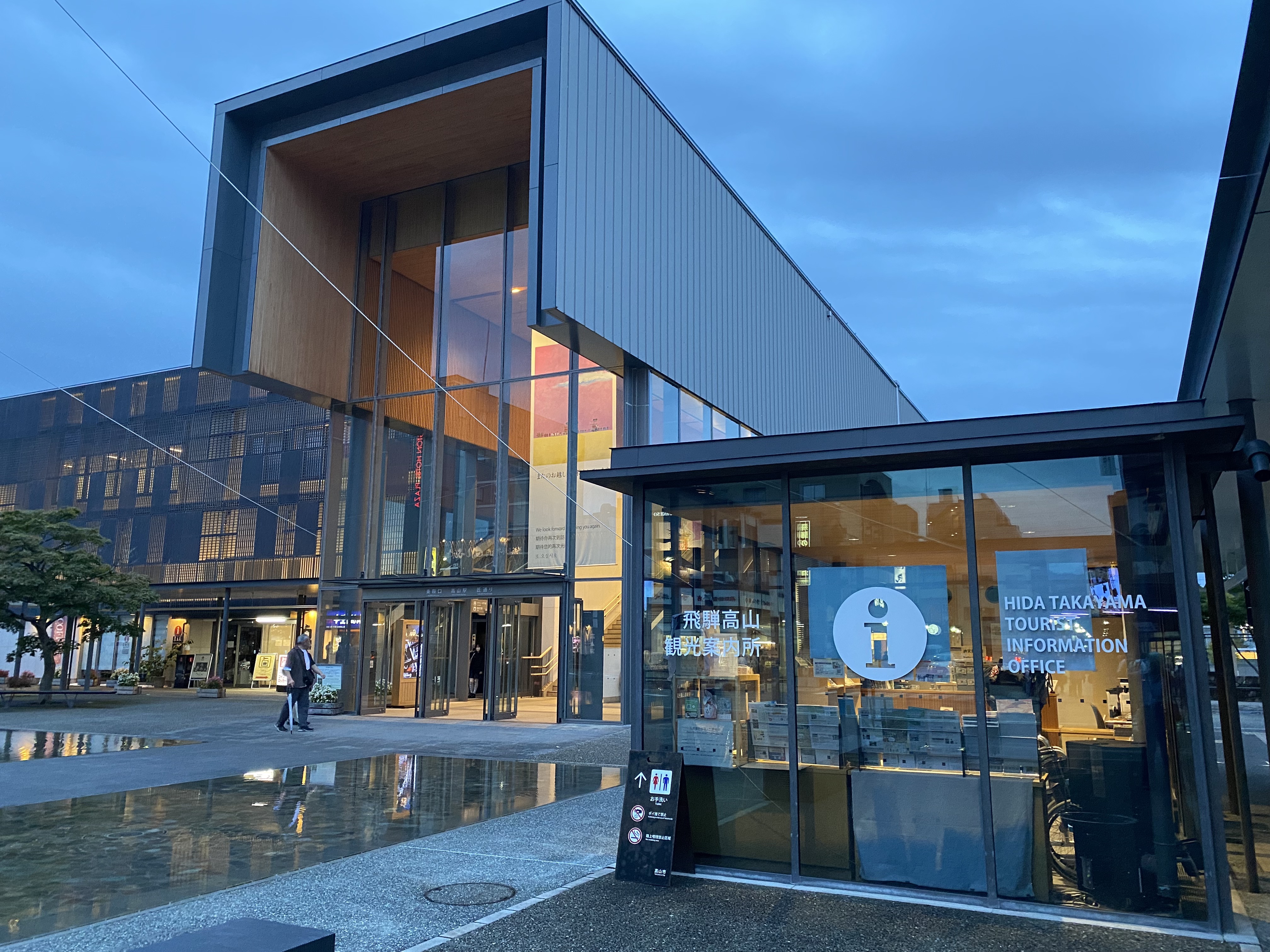
Takayama’s modern train station
During the day walking around in my Tevas in the rain, I got two blisters on my two little toes and I could hardly walk. Plus I could feel a cold coming on; my head was about to explode. Somehow I hobbled back to our room, a good 30 minute walk, and relaxed until our 8:30 onsen time slot. I conked out quickly after our hot baths as my cold hit me full on. I had a miserable sleep between my sinus pressure, sore throat, and two blistered little toes! It never fails that I get sick at least once during our travels.
Steps: 11,836. Miles 5.01. Weather Takayama Hi 81°F, Lo 76°F. Showers.
The Nakasendo Trail: Tsumago-juku
Monday, September 16: We originally had big plans for Monday. We had to drive from Takayama and be in Nagoya by 5:00 to return our rental car. We had hoped to walk the Historic Nakasendo Trail. During the Edo Period (1603-1868), the ‘Nakasendo’ was an important route connecting Tokyo – then called ‘Edo’ – and Kyoto. Along the route, numerous ‘postal towns’ developed to provide services such as accommodation, food, transport and protection to travelers and merchants, who were of course taxed. Many of the towns accumulated great wealth as a result and today, several remain beautifully preserved.
Come along for a little drive through some of the Japan Alps.
We thought we got an early start but somehow we didn’t get to the first post town, Tsumago-juku, until noon. Not only was I feeling horrible but the heat was unbearable – so oppressively hot and humid. We wanted to see the two post towns AND do the walk between them, but between my blisters and my cold and the heat, I decided it would be just fine to drive to both post towns. It turned out there was no way we could have walked the 2-3 hour hike, visited both post towns, plus made it back to Nagoya by 5:00.


We stopped first at Tsumago-juku, home to traditional wooden inns that once hosted traveling samurai lords. It felt much like an open-air museum; the government designated it as a protected area for the preservation of traditional buildings. Modern developments such as telephone poles are not allowed in the town.


The Nakasendo Trail: Magome-juku
Magome-juku (馬籠宿) was the forty-third of the sixty-nine stations of the Nakasendō connecting Edo with Kyoto in Edo period Japan. We stopped in this charming town after Tsumago-Juku, the other town bookending this stretch of the Nakasendō Trail.Before walking into the town, we enjoyed the views over the town and the Japan Alps.


Magome’s buildings line a steep, cobblestone pedestrian road with rustic shopfronts and mountain views. I wish I’d been able to appreciate it more, but by this time of day, the heat was oppressive and I was feeling congested and miserable. We stopped into one of the only air-conditioned coffee shops we could find and enjoyed a nice long break while sipping and savoring a melon soda and an iced latte.
The town was a steady downhill from where we parked, which meant we had to climb uphill to get back to the car. Mike always takes good care of me, so he climbed back up to the parking lot while I walked downhill and met him as he drove the car to the bottom of the town. I wished I’d had more energy to take pictures as the town was quite photogenic, but I just didn’t have it in me. A number of the photos here are Mike’s.


Onward to Nagoya
After leaving, Magome-juku, we made our way back to Nagoya Airport so we could return our rental car.
Steps: 8,139. Miles 3.44. Weather Takayama Hi 91°F, Lo 70°F. Mostly sunny.


 ~ wander.essence ~
You must be logged in to post a comment.