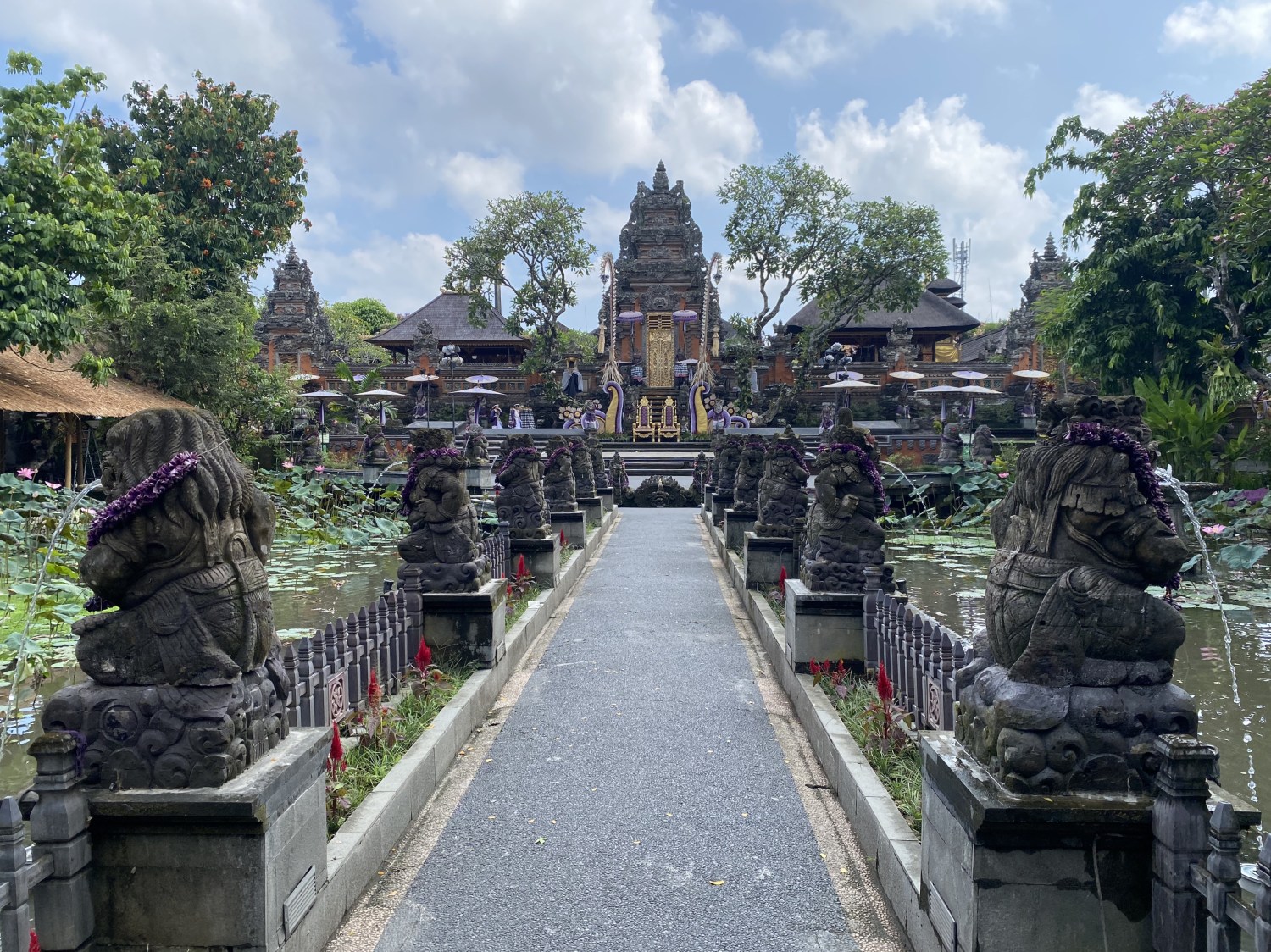

Arrival in Ubud
Thursday, September 26, 2024: Kadek drove us this morning from Sidemen to Ubud, another 1 1/2 hour chaotic drive. We arrived at our hotel to the west of Ubud’s center, The Hava Ubud A Pramana Experience.


We dropped our luggage since it was too early to check in and promptly went out to eat lunch at the vegan Alchemy. Mike had a jackfruit “tuna” sandwich and I had a “halloumi” and beet salad. I got a dragon fruit kombucha and Mike a mango. Alchemy had a cool “modern hippie” vibe with a cozy and meditative feeling.


We tried to walk into Ubud’s center but we didn’t quite make it. We would need to start earlier to actually explore the center. It was a chaotic scene and walking from our hotel was about 1 1/2km just to the outskirts of Ubud. It seemed quite dangerous to walk with hardly any shoulder and cars and motorbikes whizzing about to and fro. We definitely needed to acclimate to Ubud after the laid back vibes of Sidemen. I was not at all prepared for the chaos that is Ubud, and Bali in general!
Making our way back to the hotel, we stopped into a hole-in-the-wall shop where I found a lightweight pair of tie-dyed pants; they cost 50,000 Indonesian rupiah, about $3.10, and since they were too long, the shopkeeper said she would hem them overnight and I could return the next day to pick them up. I knew I could use them even in Japan, where we could see it was forecast to be hot for the foreseeable future when we returned there on Monday. I also bought a lightweight flowy skirt which I wore out to dinner and would get a lot of use out of for the next 3+ weeks. We had both packed a bunch of fall clothes which we never used and which were dead weight in our suitcases.
We finally checked into the hotel and relaxed a bit before heading out for dinner.


We had a lovely dinner Thursday night, our first night in Ubud, at La Luz Mexican restaurant. Shrimp tacos for me, Carne Asado tacos for Mike and a chocolate lava cake with ice cream to share. 🙏🏻 The food scene in Ubud seemed quite diverse and impressive, and we were lucky in our west-end neighborhood to have a good number of choices.


Steps: 9,581; Miles 4.05. Weather Hi 86°, Lo 70°. Mostly cloudy.
Friday, September 27: On Friday morning, we enjoyed a poolside buffet breakfast at The Hava Ubud A Pramana Experience.


The Agung Rai Museum of Art (ARMA)
After breakfast, we took a Gojek to The Agung Rai Museum of Art (ARMA) in Ubud, which is at the southern end of Ubud. We were to the west of the center, and it usually didn’t pay to take any kind of vehicle into the town because of the gnarly traffic. However, since we got an early start, the traffic wasn’t too bad. We arrived at the museum before it had opened.
Founded by Agung Rai, a Balinese who devoted his life to the preservation and development of Balinese art and culture, the museum was officially opened on June 9, 1996.
The major goals of the ARMA Museum are, according to the website, to:
1) To collect and preserve artworks
2) To develop and preserve the art of painting, sculpture, dance, music, and various other cultural art forms
3) To provide means and infrastructure for the local society to learn various artistic skills.


We started our visit at the Bale Daja – Main Exhibition Area. In this area we found a huge cross-generational exhibition that served as a tribute to the painter I Nyoman Ngendon (c. 1913-1947). Ngendon was a key figure in the Batuan art movement. His works, characterized by their unique style and thematic depth, are revered in the art community. The exhibition sought to honor his contributions while showcasing the dynamic continuity of Batuan’s artistic tradition across generations.
The Batuan painting style, which originated in the village of Batuan south of Ubud, is intricate and rich with detail. Paintings can show a whole village and often reflect gods, temples, religious ceremonies, mythical illustrations, and everyday scenes from people’s lives.
The stories in the paintings can evolve, much as people’s lives do. Many intriguing paintings show multiple small scenes on the same canvas: people doing household chores, children playing, people participating in ceremonies, and sometimes historical events or tourists enjoying their vacations.
The collection ranges from traditional to contemporary, including classical Kamasan painting on tree bark, masterpieces by Batuan artists of the 1930s and 1940s and the only works to be seen on the island of Bali by 19th century Javanese artist Raden Saleh and Syarif Bustaman.
A couple of paintings were of interest in contemporary times. One, “Lion Floating Happily” by I Ketut Sadia (b. 1966), depicts an airplane accident of April 13, 2013: “An Indonesian plane carrying more than 100 passengers broke in two after missing the runway at Bali airport and landing in the sea, leaving dozens injured but no fatalities.”
Another depicts the sinking of the Titanic, in Balinese fashion. 🙂 “RMS Titanic” was painted in 2015 by I Ketut Sadia (b. 1966). The Titanic was the world’s largest and most luxurious ship at the time it launched. She was on her maiden voyage from Southampton to New York when she struck an iceberg off Newfoundland on the night of April 14, 1912 at 23:40 and sank in the morning of 15 April 1912. The painting depicts the iceberg and the sinking ship, but shows half-naked Balinese people coming to the rescue.


Foreign artists who lived and worked in Bali are represented by Willem Gerard Hofker, Rudolf Bonnet, and Willem Dooijewaard among others.
The works of German painter Walter Spies (1895-1942) have a special place in the collection because of his important contribution to the development of Balinese arts. He influenced Balinese art, along with his partner Dutch artist Rudolf Bonnet, through an artist cooperative which provided guidance to local painters and developed a market for their work. He met his early death when a ship carrying World War II deportees from Bali to Ceylon was bombed by the Japanese in 1942.


Visitors received a complimentary coffee or tea at the ARMA museum when they bought a ticket. We stopped for cool drinks in the coffee shop before tackling the Modern art at the museum. None of the museums in Bali were air conditioned, at least none that we encountered.


Prominent are works by Balinese masters such as I Gusti Nyoman Lempad, Ida Bagus Made, Anak Agung Gede Sobrat and I Gusti Made Deblog.


I was enamored by one painting at ARMA, but I sadly don’t know the artist. The details of this huge painting are below.
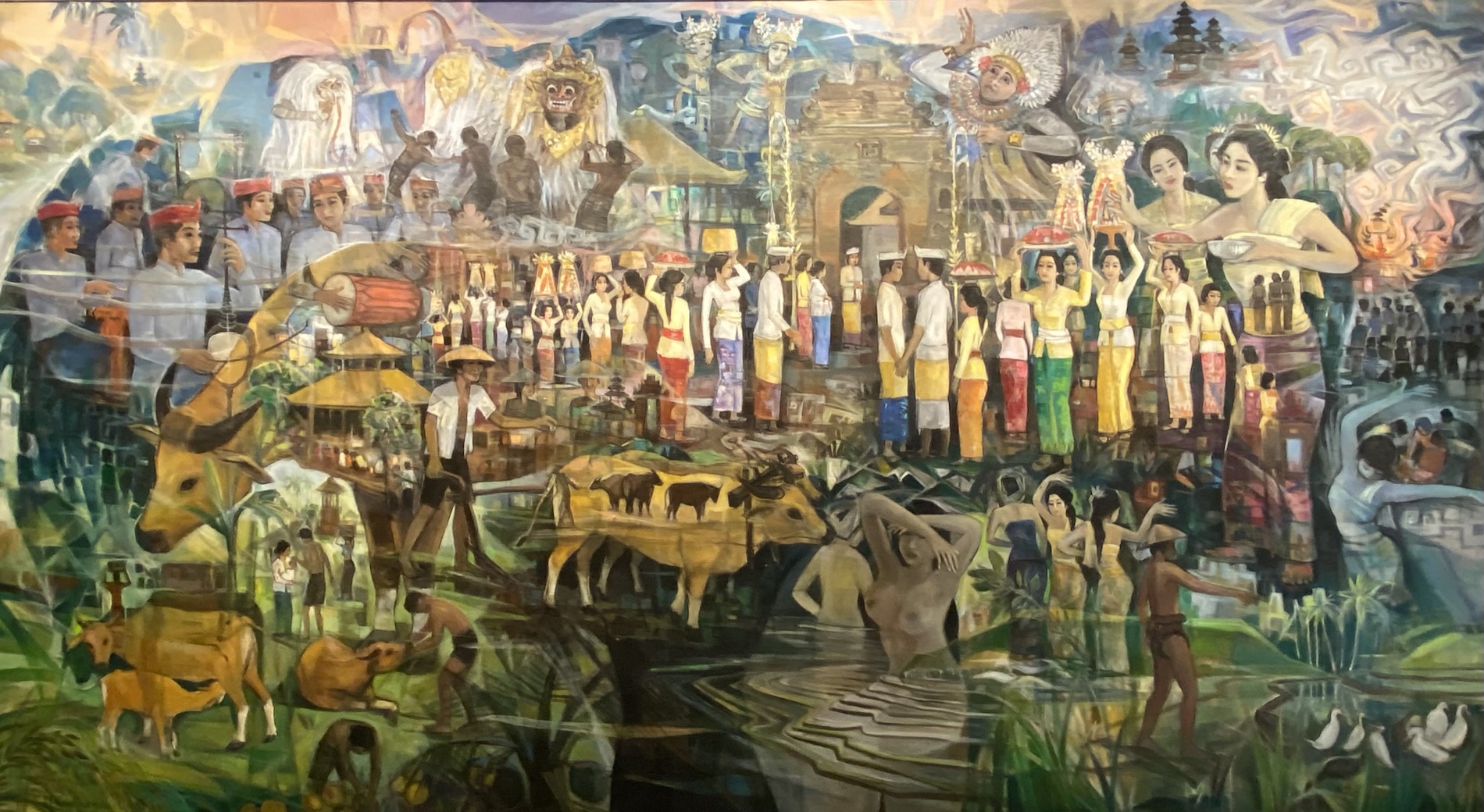
painting at ARMA


In a pavilion on the grounds, we found paintings done by teenagers. The grounds of the museum were lovely and we enjoyed strolling around.


With the ticket to the ARMA Museum, we were able to walk around the ARMA Resort, which was quite lovely.


Ubud Center
We waited a long time for a Gojek and by that time we had to wait in traffic to get to Ubud’s center. We stumbled quite by accident into the Café Lotus, where we found amazing views of the Ubud Water Palace without having to pay the entrance fee. We intended to go inside the actual Water Palace, but we were too tired and hot to attempt it on Friday. At the cafe, we enjoyed a yummy lunch of Indonesian spring rolls, Gado-Gado (Indonesian-style salad with steamed vegetables, tomato, fried bean cake, tofu, boiled egg, crackers and peanut sauce), and Spiced Pumpkin Soup.
After our wanders in Ubud’s center, we traipsed back to the hotel to enjoy the hot afternoon at the pool. We passed a warning sign for skinny people on the way to the hotel.


The Hava Ubud
After lounging around at our hotel pool in the hot afternoon, we went out to Tygr Sushi for dinner. I enjoyed a dragon roll and Mike a HEAVENLY: Teriyaki Jackfruit, Cucumber, Tempura Asparagus / Marinated Tomato, Vegan Mayo, Crispy Sweet Potato. Mike got an ice cream for dessert: chocolate & mango.


Steps: 9,278; Miles 3.92. Weather Hi 86°, Lo 71°. Some rain.
Ubud Center: Ubud Palace, Ubud Water Palace, & Museum Puri Lukisan
Saturday, September 28: Saturday morning we caught a Gojek to the center of Ubud. After the driver dropped us off, we passed by a group of women making the many offerings to the gods that are seen throughout Bali. We also passed a huge parking area for motorbikes, ever ubiquitous in town.


We wandered through the Ubud Market, but we didn’t see anything of interest.
We wandered around Ubud Palace, or Puri Saren Agung, a royal palace built in the early 1800s. It is one of the oldest, most well-preserved palaces in the area. It was originally built to house Ubud’s royal family, but as time went on it became a cultural and artistic center. Visitors are only allowed to walk around in a small area and the temple in the complex is off-limits to tourists.


After Ubud Palace we properly visited Pura Taman Saraswati, officially Pura Taman Kemuda Saraswati, also known as the Ubud Water Palace. It is a Balinese Hindu temple in Ubud. The pura is dedicated to the goddess Sarasvati, revered as the goddess of knowledge, education, learning, arts, speech, poetry, music, purity, language and culture. Pura Taman Saraswati is notable for its lotus pond.
Visitors are required to wear a sarong and jacket so everyone there is wearing the same thing. It’s a fun place for photo ops but there really isn’t much to it other than the lotus pond and the cool palace architecture.


We stopped for a coffee at Café Lotus, where we continued to enjoy views of the Ubud Water Palace.
We visited Museum Puri Lukisan, set in a well-tended garden and showcasing some fabulous Balinese art. In front of the museum a Balinese dance was taking place for some kind of Palestinian support group. We had to walk past the performance to get to the museum, so we got to watch a bit of the performance.


Below is one of my favorite paintings from Museum Puri Lukisan with details. Sadly I didn’t get the artist information.
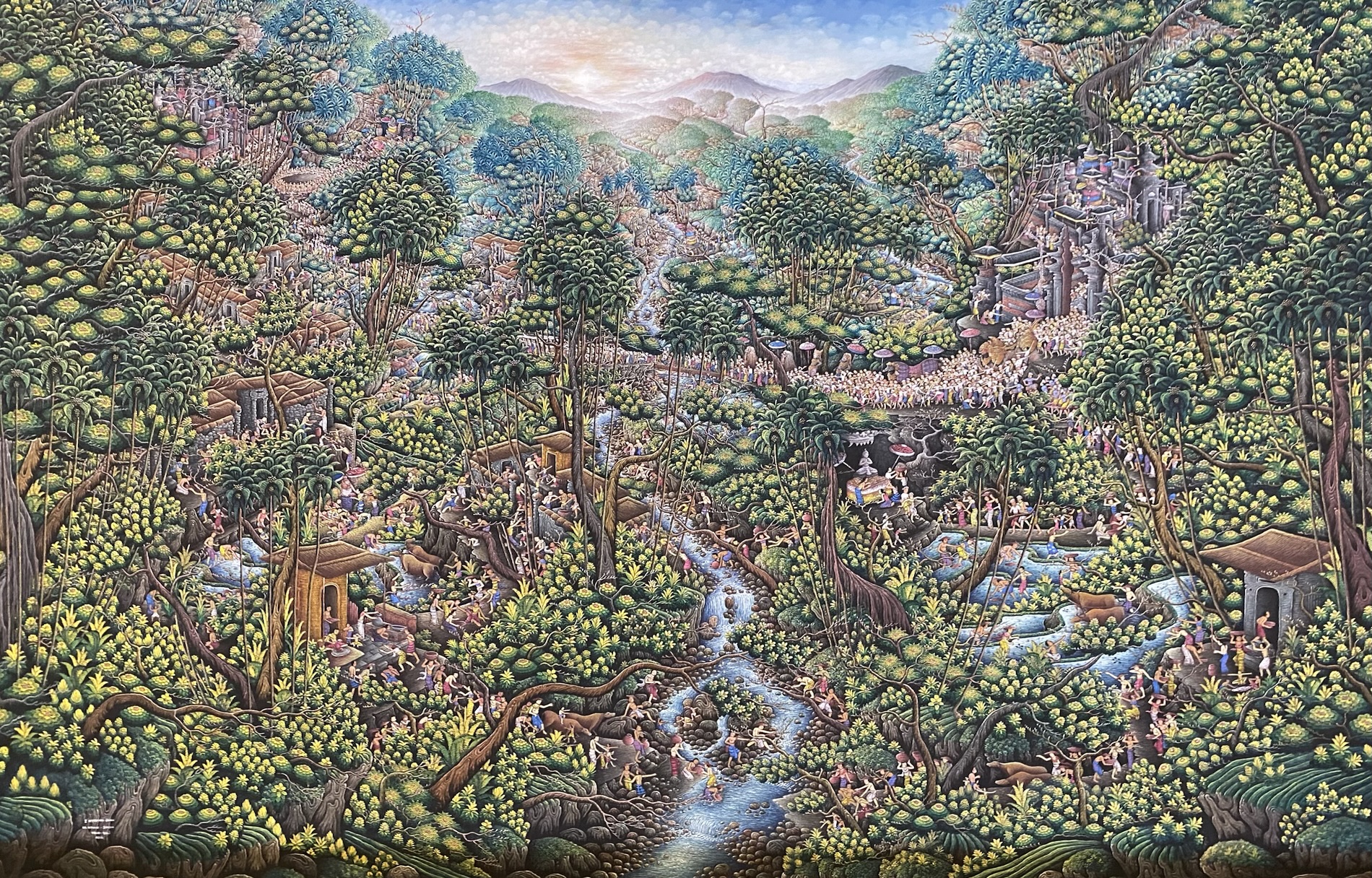
a painting at Museum Puri Lukisan
Here are details from the painting.


Below is a sample of Balinese art from Museum Puri Lukisan in Ubud.


We went to eat lunch after our visit to the museum. Mike felt like it was this lunch, or the ice in the drinks, that gave us stomach problems over the next several days.


Back to The Hava Ubud neighborhood: massages, yoga and pool time
We enjoyed deep tissue massages at 1:00 Saturday at Sari Laba. We liked them so much, we booked massages for Sunday, our last day in Ubud, as well.
After our massages, we relaxed by the pool until time for our 4:00 yoga class.


We went to a restorative yoga “Air Class” at Alchemy. It was supposed to be for beginners but some of the challenging poses, held for way too long in my opinion, were too much for my stiff joints and especially my knees. Still, the experience had a nice ambiance.


We enjoyed our fanciest dinner in Ubud at Brie Restaurant & Cheesery. A corn & prawn soup came out with fog rising mystically around it. I enjoyed burrata with zucchini pancakes and Mike got tagliatelle with smoked salmon. The staff was very cute with their black & white striped t-shirts and little black berets. They even did a coordinated dance to welcome all the guests. They had a singer on the 2nd floor (we were on the first). Downstairs we were serenaded by a playlist that included “Hamdouchia (Yamil Remix)” by Amine K (Moroko Loko) and “Free to Love” by Eighty Project. It was an upscale experience but Mike thought it was rather overrated and expensive.


Steps: 7,693; Miles 3.25. Weather Hi 87°, Lo 73°. Some rain.
Ceking Rice Terrace, aka Tegalalang Rice Terrace
Sunday, September 29: Sunday morning, our last morning in Bali, we enjoyed our last leisurely breakfast at the pool. We would be leaving for the airport at around 8:00 p.m. for our 12:20 a.m. flight on Monday morning, so we had kept our room for 4 nights so that we could rest and take a nap in the afternoon before our overnight flight. Thus we could relax in our room or at the pool.
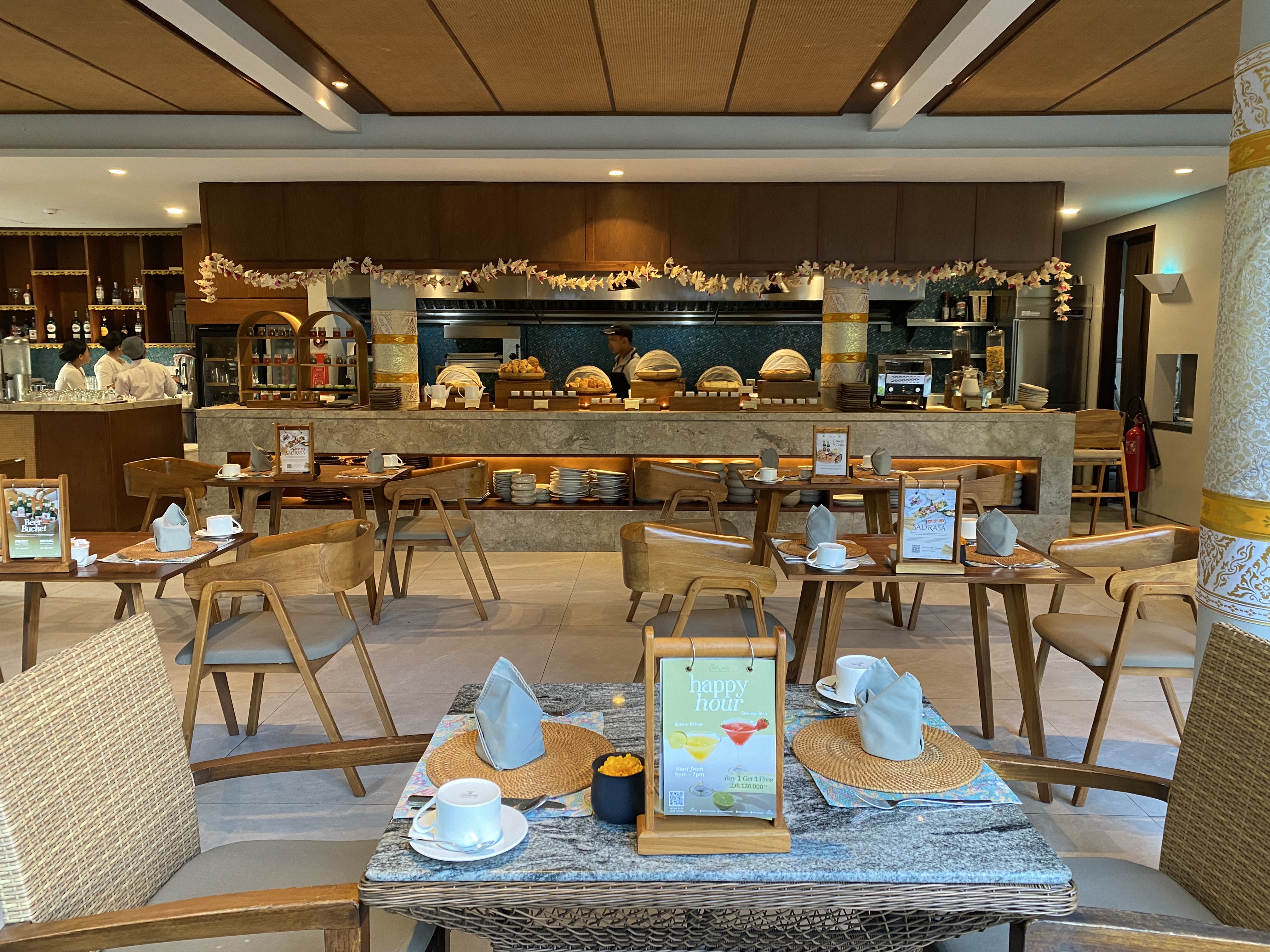
breakfast bar at The Hava Ubud
After breakfast, we went about a half-hour north of Ubud to Ceking Rice Terrace, aka Tegalalang Rice Terrace. This is really a small and touristy rice terrace, with all kinds of swings and photo settings. The site doesn’t even come close to the Longji Rice Terraces in Guangxi, China, the best I have seen in all my travels around Asia.
Tegalalang Rice Terrace has been cited as a UNESCO World Heritage Site. I found it quite a disappointment as it was small and too touristy for me.
A traditional irrigation system is still being used in the terraces today. It was started in the 8th century. The water comes from surrounding rivers & mountains. Farmers built water canals to allow the water to flow from one field to the other.


Nestled at the base of Mount Batukaru in the central highlands, the Jatiluwih rice terraces are supposedly more impressive than the Tegalalang terraces. They are a full 600 hectares. However, getting there would have been a 1 1/2 hour drive each way from Ubud. We’d already spent enough time driving around on Bali’s congested & derelict roads, so we didn’t make the trek to Jatiluwih.
Instead we spent the rest of the day having a nice lunch at Alchemy, getting massages again, sitting by the pool, and finally relaxing in our room in preparation for our overnight flight back to Narita in Japan.
Departing Ubud and returning to Narita, Japan
We left for Bali’s airport in Denpasar directly from Ubud, which was about a 2 hour drive in the congested traffic. Our flight back to Japan was at 12:20 a.m. on Monday, September 30, but of course we had to arrive Sunday night by 9:20. There was utter chaos at the Bali airport. I wore the Tsumagojuku t-shirt I bought in the Japan Alps when we were there in mid-September. I wanted something comfortable so that I could hopefully sleep on the plane.
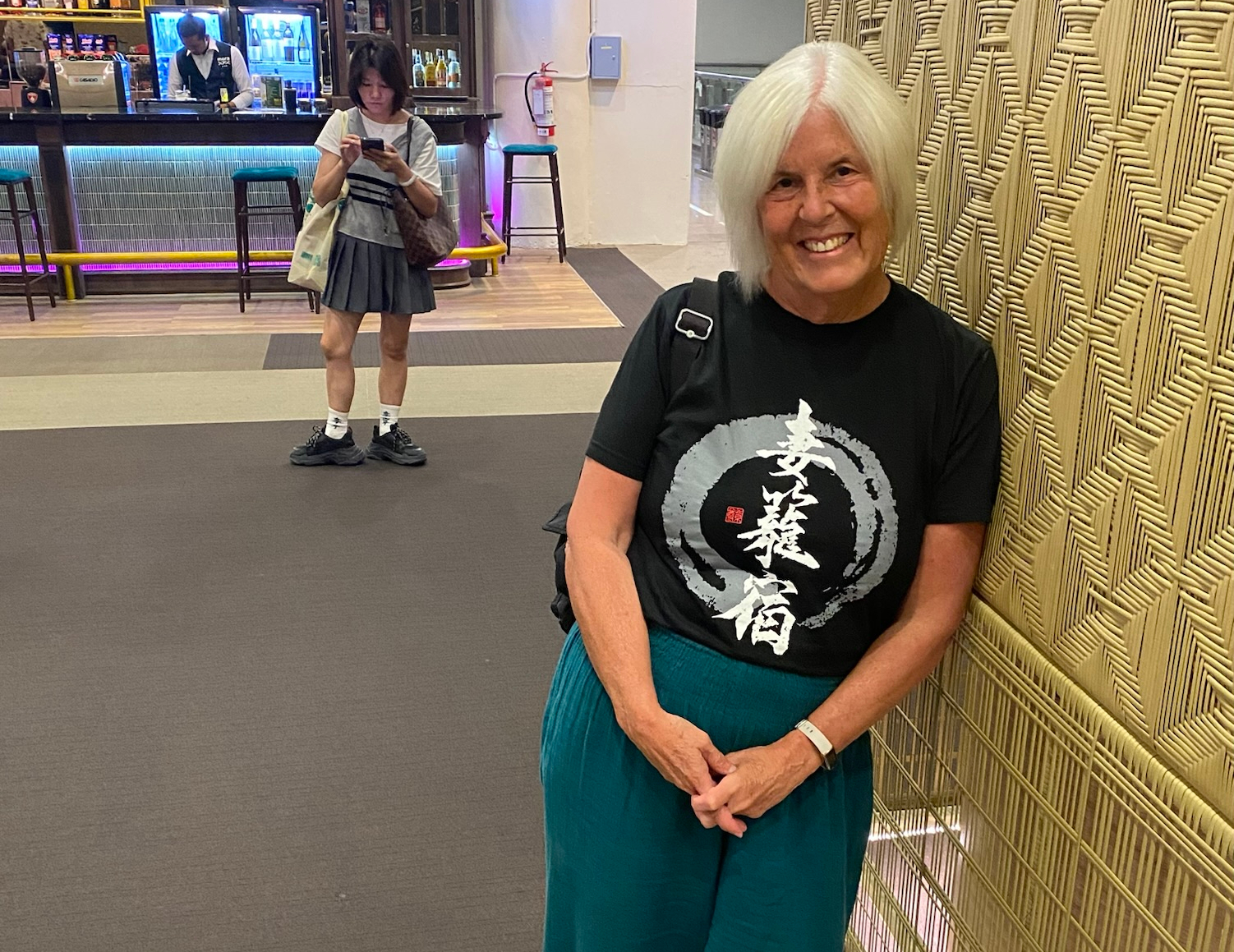
me in my Tsumagojuku t-shirt at the Denpasar Bali Airport
Steps: 10,381; Miles 4.39. Weather Hi 87°, Lo 73°. Partly cloudy.
Monday, September 30: We boarded our Garuda Indonesia flight and took off around 12:20 a.m. bound for Narita, Japan. I was so happy to be returning to Japan after dealing with the chaos and endless heat and humidity of Bali. I believe overall that Bali is overhyped and after visiting there, I have pretty much sworn off any more of southeast Asia. I’ve been already to Myanmar (my favorite), Vietnam, Thailand, Cambodia (another favorite), India, Singapore, and now Bali, and everywhere I’ve been has been hot, humid, & chaotic (Singapore wasn’t chaotic but was miserably hot and humid). However, that being said, I have always found the food in southeast Asia to be excellent, especially in Vietnam, Thailand, and Cambodia. The food scene in Ubud was especially good, with much ethnic diversity and vegetarian and vegan options. I adored the art and palaces (architecture) in Bali, but it was frustrating that there was rarely a place to escape the heat, even in museums.
 ~ wander.essence ~
You must be logged in to post a comment.