

A Challenging Drive from Mexico City to Guanajuato
Friday, February 21, 2025: On Friday morning, we took an Uber at 9:30 am to Alamo Car Rental at the Mexico City Airport. By the time we signed all the paperwork and left the airport, it was 11:00. We thought we had a 4 1/2 hour drive ahead to Guanajuato. We had asked for a transponder so we could use it to go through toll plazas seamlessly and then pay whatever tolls we accrued when we returned the car. Every country in which we’ve rented cars has operated this way.
We then made our way north 20 minutes when we reached a single-booth plaza to the autopista but the transponder registered “invalid;” the gate to the highway wouldn’t open and we were shuttled off to a busy local road. Mike looked at Waze and it seemed if we didn’t use the toll road, it would take us 7 hours to get to Guanajuato. We tried to call Alamo but got a US number and no human to speak to. Thus we did a U-turn and drove 30 minutes through heavy traffic back to Alamo.


There a woman who spoke English explained that we needed to put money on the transponder at a 7-11. She walked Mike to the terminal and helped him put 800 pesos on the card. One hour & 20 minutes later, at 12:20, we were on the road again.
We arrived back at the same toll plaza and the card still read invalid. We tried to pay with cash, but the man there said it was not possible to pay with cash. We were shuttled off once again to the same local road. This time we stopped at a gas station and Mike was told the cash balance normally takes 15-20 minutes to register. It had been a half hour since Mike had added the pesos.
Finally Google Maps led us on congested local roads to a large toll booth. The transponder still registered “invalid” but they did take cash. We finally got on the autopista and were on our way. It wasn’t until over an hour later that the transponder finally worked; however it didn’t work on all the highways.
So, between an auto accident where we were rerouted and between a huge traffic jam getting into Guanajuato and then getting lost in the city, the drive which was supposed to take 4 1/2 hours took us 7 hours.
Guanajuato: Hotel Terra Vista
We arrived at the amazing Hotel Terra Vista, where we had a beautiful apartment. It was huge, and actually slept 8 people including a fold-out couch.


We headed off quickly to eat at a nearby seafood place as we were told it closed at 7:00 p.m.


Steps: 4,329; Miles 1.83. Weather Mexico City: Hi 70°, Lo 48°. Mostly Cloudy / Guanajuato: Hi 73°, Lo 50°. Cloudy with some rain.
Saturday, February 22: We enjoyed our first view of Guanajuato from our beautiful apartment in Hotel Terra Vista, owned by Canadians Susan and Endre Pataky. The workshop pictured is used extensively by the owner Endre; he builds custom furniture for people and has served as general contractor for the building of the property itself. We adored this place!
The owners kept chickens on the property and each morning put out fresh eggs which guests could buy and use. We had bought four the night before, so we whipped up scrambled eggs for breakfast.


After breakfast, we walked from the patio area of our Terra Vista Apartment down the road and then down 280 steps into the center of Guanajuato City, capital of the state of Guanajuato. The city was made prosperous in the late 18th century by silver mining; by 1780, Guanajuato was the world’s single biggest silver city, producing between a fifth and a quarter of all New Spain’s silver.
The city’s prosperity was abruptly curtailed when the Mexican War of Independence (Mexico’s war with Spain from 1810-1821) broke out in 1810, starting in nearby Dolores Hidalgo. The rebel army invaded Guanajuato when it refused to surrender on September 28, 1810, and the Alhóndiga de Granaditas, the public granary, was the site of one of the most important and bloodiest battles in the War of Independence.
While other silver mines went into decline after independence, Guanajuato’s silver mines continued to produce throughout the 19th century. In the late 1980s, Guanajuato began massive restoration projects on its many historic buildings. The historic center has numerous small plazas and colonial-era mansions, churches, and civil constructions built using pink or green sandstone. The city historic center and the adjacent mines were proclaimed a World Heritage Site by UNESCO in 1988.
The city of about 195,000 people (2020 census) is located in a narrow valley, which makes its streets narrow and winding. Most are alleys that cars cannot pass through, and some are long sets of stairs up the mountainsides. Many of the city’s thoroughfares are partially or fully underground. We were told there are 28 tunnels that run under the city.
Our first encounter with a church in town was Iglesia San Francisco, a church and former convent, originally built in the 18th century by Franciscan friars as accompaniment to their school and orphanage. The church has a stunning pink sandstone churrigueresque entryway.


We strolled through to the Jardín de la Unión & Teatro Juárez. The Jardín de la Unión is a lively square with square-clipped trees that sits in front of Teatro Juárez. It’s surrounded by shops and cafes and is a great place to sit in the shade and watch the bustle all around.
The Jardín de la Unión was once the atrium of a large San Diegan convent in the city center. It was converted to a public space during the post-independence Reformation of the early 19th century.
We climbed to a rooftop cafe where we shared a waffle, sipped coffee, and enjoyed the views of Teatro Juárez, accompanied by the songs “Farolito” by Gilberto Gil & Natalia Lafourcade and “Tú Sí Sabes Quererme (feat. Los Macorinos)” by Natalia Lafourcade.
Back at street level, I found two beautiful bracelets at a shop across from Teatro Juárez. Then we walked all around the lively Jardín de la Unión.


What a colorful and lively city Guanajuato is! We continued our aimless wanderings, admiring the city’s sherbet-colored colonial buildings, its plethora of churches, Guanajuato University, & the triangle-shaped esplanade, Plaza de la Paz, with its striking yellow Basilica de Nuestra Señora de Guanajuato, the city’s first parish church. In 1957, the church was upgraded from parroquia (parish church) to the elevated title of basilica. Built in the 17th century with funds from the mines, the building’s brightly painted facade is largely original, though its churrigueresque bell tower was added in the 19th century. Each of the church’s three entryways is surrounded by a lovely hand-carved sandstone facade.
The basilica’s interior is a wash of subtle pastels, marble floors and shiny crystal. The walls are painted with delicate frescoes in pink, aqua and white.
We stopped for lunch at La Tasca de la Paz. We tried the traditional dish, Enchiladas de Minero Rico (Tortillas de maíz bañadas en salsa de chile guajillo acompañada de papas y zanahoria) and Consomé Casero: Apapacho de pollo con verduras. We enjoyed people-watching and listening to the tune of “Eternal Life” by Palaye Royale.
Later we walked by the university and saw the imposing Templo de la Compañia de Jesús, an exquisite pink sandstone church that was constructed 1747-1765 by Jesuit priests. Another boon of the silver trade, the large neoclassical cupola behind the main facade was added to the building during the 19th century, commissioned by the Jesuit brother of a mining magnate.


Teatro Juárez
Teatro Juárez is a historical 19th century theater located in Guanajuato. It was built from 1872 to 1903 from a design by architect José Noriega and by order of General Florencio Antillón. The building was completed by architect Antonio Rivas Mercado and engineer Alberto Malo, who implemented refurbishments that significantly changed the exterior and interior.
The building has an opulent neoclassical facade emblematic of the Porfiriato, the period of rule of President Porfirio Díaz, which ended with the Mexican Revolution of 1910. The theater was inaugurated in 1903 with a performance of Verdi’s Aida. The building eventually fell into disrepair; attempts to restore the building began in the 1950s and went through 1973. Now it is a prominent performing arts venue.
Looking out over the Jardín de la Unión, Teatro Juárez has 12 Doric columns supporting a cornice topped by a row of black stone muses. Inside, the Gran Salón Auditorio, influenced by Moorish design, is decorated with hand-cut wood-and-stucco relief painted in brilliant reds, blues and golds.


Funicular Panorámico & El Pípila
After our visit to Teatro Juárez, we took the Funicular Panorámico, just behind the theater, up the hillside to the rose-colored El Pípila statue. From the public esplanade, we found magnificent views of Guanajuato in the ravine below.


Hotel Terra Vista
We took a short walk back to our apartment, relaxed, sipped cold cervezas, & chatted with a British couple and a couple from Brooklyn, Scott & Alexandra. We talked a lot about the horrors that our new president is bringing to the world. Scott & Alexandra are very active in Democratic politics in Brooklyn. Of course as New Yorkers, they have a long-standing hatred of the 🍊 💩.


After our long and lively discussion, Mike and I walked to a little hole-in-the-wall taco 🌮 place where we brought back delicious taco makings: mine was champignons & veggies & Mike’s was a unknown combo of meats and veggies. We set up the tacos in our apartment and enjoyed a delicious local meal.


Steps: 11,357; Miles 4.81. Weather: Hi 78°, Lo 48°. Mostly sunny.
Universidad de Guanajuato
Sunday, February 23: On Sunday, after breakfast in our apartment, we walked down to the town center to see the Universidad de Guanajuato (University of Guanajuato), a university based in the Mexican state of Guanajuato, made up of about 47,108 students in programs ranging from high school level to the doctorate level. Over 30,893 of those are pursuing undergraduate, masters, and doctorate degrees and 16,215 are in high school. The university offers 215 academic programs, including 117 postgraduate programs, and 90 bachelor’s degrees. The university has schools in fourteen cities throughout the state of Guanajuato.
We had read you could climb to the roof of the massive building for fabulous views of the town, but when we arrived eager to climb, we were told it was closed on Sunday and we should come back Monday through Friday.


Museo Casa Diego Rivera
We headed instead to the Diego Rivera Museum. The Museo Casa Diego Rivera is a museum founded in the birthplace of the artist Diego Rivera (1886 – 1957) in September 1975 with the aim of disseminating the works of the painter and prominent Mexican muralist who captured his communist ideals in building murals.
Within the museum itself there are six temporary rooms where exhibitions of Mexican and foreign artists are held. One hundred two works by Diego are on display, including sketches, illustrations, projects and paintings.
There was a special exhibit by renowned Dutch graphic artist M.C. Escher, titled “Structured Universe.” In this exhibit the curators showed us on a human scale how everything is organized here on earth down to the smallest sized animal recognizable to the naked eye, the insect.
“The artist specialized in woodcuts and lithographs, but his mezzotints have also been acknowledged as masterpieces in the medium. His work ranges from postal stamps, to tiling or tessellated geometric arrangements, and, most fascinatingly, analysis of self-reference, conscience, and paradoxes of logic and perspective.” (from the museum exhibition).


It was disappointing that no photos could be taken of Rivera’s works. I thought his studio in San Ángel, Mexico City was more interesting than his birthplace home, although the home was quite nice with its central courtyard.
According to the museum: “From his stance as a militant, activist and agitator, Diego Rivera championed art with ideological content and the post-revolutionary social struggle to constitute the Mexican nation, with the muralist movement at the center of his socialist art designed to reach the masses.”


For me, the most interesting part of the museum included black & white photos of Diego Rivera and Frida Kahlo.


We finished our visit at the Museo Casa Diego Rivera in the courtyard of the house and then continued our wanders through the colorful town. We happened upon the Templo y Plaza de San Roque. The Templo San Roque is an old 18th century chapel overlooking a plaza of the same name. Originally built in 1726 by Father Don Juan José de Sopeño y Cevera, the building served as a santa escuela (Jesuit school) 1746-1794. The pink sandstone exterior has a simple stone entryway and three stone saints embedded into a wall of sandstone bricks.


Alhóndiga de Granaditas
The Alhóndiga de Granaditas (public grain exchange), now the Regional Museum of Guanajuato, is an old grain storage building in Guanajuato City. This historic building, designed in a spare neoclassical style, was created to replace an old grain exchange near the city’s river. The giant boxy building resembles a fortress from the outside. Inside, a spacious patio is framed by heavy green sandstone columns. It is equivalent to the regional grain exchange. Its construction lasted from 1798 to 1809, by orders of Juan Antonio de Riaño y Bárcena, a Spaniard who was the quartermaster of the city during the Viceroyalty of New Spain.
Miguel Hidalgo y Costilla and his insurgent army stormed the building during the first battle of the Mexican War of Independence in September 1810, leading to the legend of El Pípila. El Pípila (the turkey) was a cripple who had an unusual way of walking. The Spaniards had hunkered down into the granary waiting for reinforcements. El Pípila, not fearing for his safety, strapped a large stone on his back, picked up a bucket of tar, grabbed a flaming torch and ran at the only weak point of the structure, the wooden door. The stone on his back protected him from the Spanish arrows that came at him. Once at the door, he coated it in tar and set fire to it with his torch. The solid wood door was weakened and the smoke blinded the Spaniards as the rebels rushed into the Alhondigas.
After the battle, the Alhóndiga was cleared out and served as a military barracks and warehouse. During the 19th century, it was a city jail for several decades. The building became a museum in 1949.
The building received World Heritage listing as part of the Historic Town of Guanajuato in 1988.
The walls of the building’s staircases are painted with dramatic murals about the independence movement by celebrated early-20th-century artist José Chávez Morado.
In the final salon, a collection of vintage photographs shows Guanajuato as it was in the early 1900s.


Some of the exhibits in the Alhóndiga de Granaditas showed old photographs of Guanajuato’s history. One exhibit was titled “Cartonería (cardboard),” which shows Mexican folk art such as folk toys, masks, catrinas and alebrijes.


We enjoyed a Sunday afternoon lunch break in a pretty square at El Cerro de Las Ranas where Mike had Pollo con mole, and I had a chile relleno. We listened to “Secreto de Amor” by Joan Sebastian.


We took at taxi back to our hotel and enjoyed wonderful afternoon views of Gunajuato from the terrace of Terra Vista.


An evening in Guanajuato
We took a break from Mexican food on Sunday evening, taking a taxi from our place on the ridge into town and having sushi at Delica Mitsu. Caravan Palace serenaded us with “Lone Digger.”


Taking a stroll after dinner we saw the Museo Iconografico Don Quixote, which seems strange to find in Mexico.


Then we wandered down to Teatro Juárez where musicians were serenading people sitting on the front steps.


In the evenings, the streets of Guanajuato come alive with a cacophony of music from different bands. Around the Jardín de la Unión and around Teatro Juárez different bands play different tunes to people sitting on steps or in cafes. What results is a cantankerous brew of noise and one-upmanship. It’s a wild scene.
Steps: 12,390; Miles 5.25. Weather: Hi 79°, Lo 50°. Sunny.
Last day in Guanajuato
Monday, February 24: Monday morning we walked down to the town again for our last time, as we would leave on Tuesday for San Miguel del Allende.


We saw the Teatro Principal, another important theater in town.


We still wanted to go up on the roof of the University of Guanajuato to see the views. This time the university was open, but we weren’t allowed access because we weren’t students. The guard told us we could come back at 7:00 pm, but by then it would be dark. Finally, after our third visit, we had to give up!


We then wandered to Callejón del Beso, (Alley of the Kiss), where two balconies across from each other on a narrow street are so close that a couple can kiss each other from the two balconies. According to a local legend, two lovers from different social classes lived in houses on opposite sides of the alley. Their families were opposed to the romance. Doña Ana was a rich young woman, while her lover, Don Carlos, was a poor miner. At night they would lean over their adjoining balconies for evening kisses.


Mercado Hidalgo
We wrapped up our last day in Guanajuato by visiting the Mercado Hidalgo, one of the nicest examples of turn-of-the-20th-century architecture in the city.It was inaugurated on September 16, 1910, by President Porfirio Díaz. It was a gift to the city in commemoration of the 100th anniversary of the Mexican War of Independence. It was originally designed as a train depot. The covered market today holds a jumble of fruit and vegetable stands, taco joints, juice bars and stands selling dulces tipicos (traditional Mexican candies). The second floor holds crafts and souvenirs, mostly inexpensive trinkets.
We wandered around the 2-story market and then had lunch at a small joint called Mariscos Del Mar. Usually the portions of Mexican food are huge, so I was happy to find a light salad-like camarones tostada. Mike’s lunch, on the other hand, was huge as usual.


Last night in Guanjuato: Hotel Terra Vista
We took a taxi to Terra Vista, relaxed a bit, then took beers out to the terrace where we continued our political discussions with Scott and Alexandra, as well as Endre, the owner of Terra Vista, who is a Canadian from Calgary and was playing a bit of a devil’s advocate but not in a bad way. He was challenging us to explain our points of view especially regarding both Biden’s and Trump’s use of Executive Orders. It was a good discussion and it was fun to talk to smart well-informed people, but honestly part of the reason we were in Mexico was to escape our vitriolic politics. We did feel a common bond with this group over our beliefs in human rights, support for Ukraine, limited presidential powers, the dangers of fascism, 47 (I refuse to say his name) and Elon Musk.


Steps: 7,669; Miles 3.25. Weather: Hi 73°, Lo 50°.
Tuesday, February 25: We ate breakfast and said goodbye to Endre after he gave us a piece of bark from his woodworking shop where he wrote a number of recommendations for San Miguel de Allende and Querétaro. Before we left, he also gave us a tour of a house he’s building on the property which he intends to sell, for an asking price of $280,000. The design of it wasn’t especially to my liking, but the price sure seemed good.


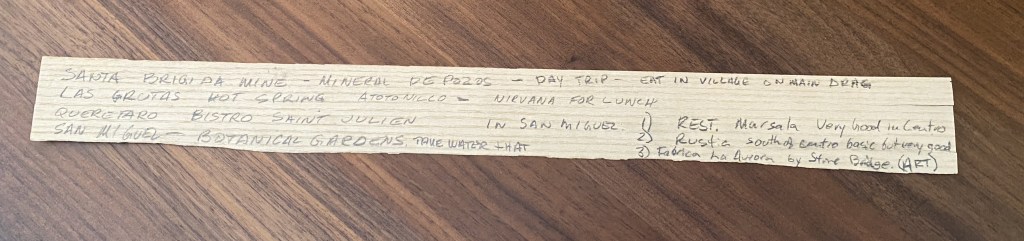
Endre’s recommendations for San Miguel de Allende and Querétaro
On our way out of town, heading on a northerly route toward San Miguel de Allende, with stops planned in Santa Rosa de Lima and Dolores Hidalgo, we saw a colorful but strange building. We had no idea what it was, possibly a church repurposed into a restaurant?
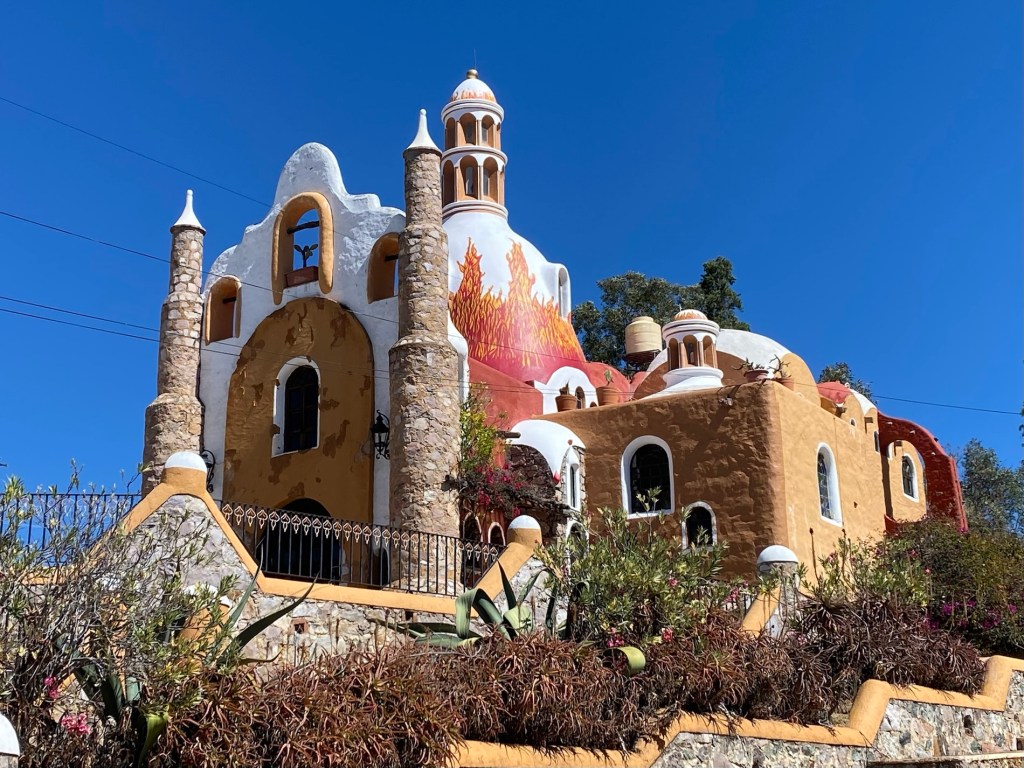
a colorful place just north of Guanajuato
We drove on to Santa Rosa de Lima, our first stop of the day.
Discover more from ~ wander.essence ~
Subscribe to get the latest posts sent to your email.
 ~ wander.essence ~
We loved Guanajuato, thanks for taking me back today 😊 We heard people having similar problems with the toll roads, did it eventually get figured out for the rest of your trip? Maggie
LikeLike
I loved Guanajuato too, Maggie! I could definitely consider living there long-term! And I loved the place we stayed.
As for the tolls, the biggest problem was that first toll booth where you get on the autopista from Mexico City. I think the women at Alamo tried to explain that we needed to put money on the transponder, but since our Spanish is so bad we didn’t understand it. We never did figure out why it took so long to be reflected on the transponder after we put money on it. Later, once we got on the autopista at a different place, sometimes it worked and sometimes it didn’t, but at least they did take cash at those larger toll booths. On the way back from Querétaro, we had no problem until we again reached that toll booth going back into Mexico City; that time our money had run out on the transponder and again, they wouldn’t take cash. We never did understand what was happening with that one toll booth. It was very frustrating for our first day of driving!
LikeLiked by 1 person
We had a similar apartment, although I think smaller. I’ve read other accounts of problems driving in Mexico, some were the tolls, some the cost, we just took buses.
LikeLike
What a good-looking place, Cathy. I’d be very happy wandering there xx
LikeLike
It’s such a colorful and lively town, Jo! We loved it there. It’s a great walkable city, so you would love it, I think. And we loved the place we stayed too. They said they sometimes rent out those apartments long-term. I would happily live long-term at the same apartment where we stayed. It will be a consideration for sure when we try to live in Mexico for at least a year in 2027 (after our Costa Rica adventure from June 1, 2025-May 31, 2026) and after a three-month stint in Sweden, Norway and Finland (assuming we’re not in the midst of WWIII by then).
LikeLike
It all sounds very exciting, Cathy xx
LikeLike
What a wonderful place, you are right, so colourful and so much to see. The panoramas looking down on it are amazing. at least you had a great place to stay after your trials on the road.
LikeLike
What a treat to be able to explore all these places.
LikeLike