
Driving from Yufuin to Mount Aso
Monday, October 14, 2024: Finally we left Yufuin on Monday morning and drove toward Mount Aso where we would stay two nights at another ryokan. Thank goodness at this place no food would be involved, neither dinner nor breakfast. What a relief.
Park Oike
We drove about an hour up into the mountains and found Park Oike, an off-the-beaten-path moss-covered forest and freshwater spring from which people could drink.
Oike Springs yields about 20,000 tons per day of spring water. The water of the springs is mild water which contains a lot of minerals; it is designated as one of Japan’s 100 remarkable waters.
The water from the springs forms a stream which winds through primeval forest. Big trees and giant rocks are decayed and moss-covered. A cloudy sky and a cool breeze rustling through the trees finally brought me my first taste of autumn, the only day on our 39-day trip that offered relief from relentless heat.
This was truly one of my favorite places on this trip to Japan. Secluded, cool, beautiful and not at all touristy. My happy place.


Mount Aso
Driving from Park Oike to Mount Aso, we had beautiful views of the grasslands atop the volcano.
The Aso-san volcanic caldera is among the world’s largest (128km in circumference). The present Aso Caldera formed as a result of four huge caldera eruptions occurring over a range of 90,000–300,000 years ago. The caldera, one of the largest in the world, contains the city of Aso as well as Takamori and Minamiaso. The caldera extends about 18 km east to west and about 25 km north to south.
It’s difficult to understand the scope of this caldera and it was surprising to me that we were staying inside of it, in the valley of Minamiaso.


The central cone group of Aso consists of five peaks, often called the “Five Mountains of Aso” (阿蘇五岳): Mt. Neko, Mt. Taka (also called Takadake or Taka-Dake), Mt. Naka (also called Nakadake or Naka-Dake), Mt. Eboshi, and Mt. Kishima (also called Kishimadake or Kishima-Dake ). The highest point is the summit of Mt. Taka, at 1,592 m above sea level. The crater of Mt. Naka, the west side of which is accessible by road, contains an active volcano which continuously emits smoke and sometimes toxic gas; it has occasional eruptions.
We went to the Visitor Center and walked through the grasslands in strong gusts and rain.


Then we drove up to the Mt. Naka caldera where it was freezing cold and so windy we thought we might blow into the hole!


We then drove from the Mount Aso Visitor Center and enjoyed gorgeous views down into the valley where we would stay, Minamiaso.


Ryokan Konomama in Minamiaso
On Monday and Tuesday nights, we stayed in the valley on the southern edge of Mt. Aso’s caldera at Ryokan Konomama in Minamiaso. This ryokan was the nicest of the four ryokans we stayed in during our trip. It had comfy beds on platforms, our own private onsen, which was easy to fill up when we wanted to use it. The onsen had views of Mt. Aso. The only negatives were the squat traditional table and chairs that were frankly uncomfortable for us Westerners. We were in an annex house so we had quiet and privacy. From the main house was a walkway to an observatory where we could soak our feet and look out over Mt. Aso.
To my relief, there was no food involved for breakfast or dinner; this suited us perfectly well. We simply bought yogurt, bananas and orange juice and enjoyed those for breakfast. The ryokan offered a free drink and coffee in the main house and ice cream bars for dessert.


We even found an Italian restaurant about 20 minutes away where I had shrimp and avocado pasta. It was a nice spacious home for our two nights around Mount Aso.

shrimp and avocado pasta
Steps: 9,247; Miles 3.91. Weather: Hi 75°, Lo 63°. Mostly cloudy.
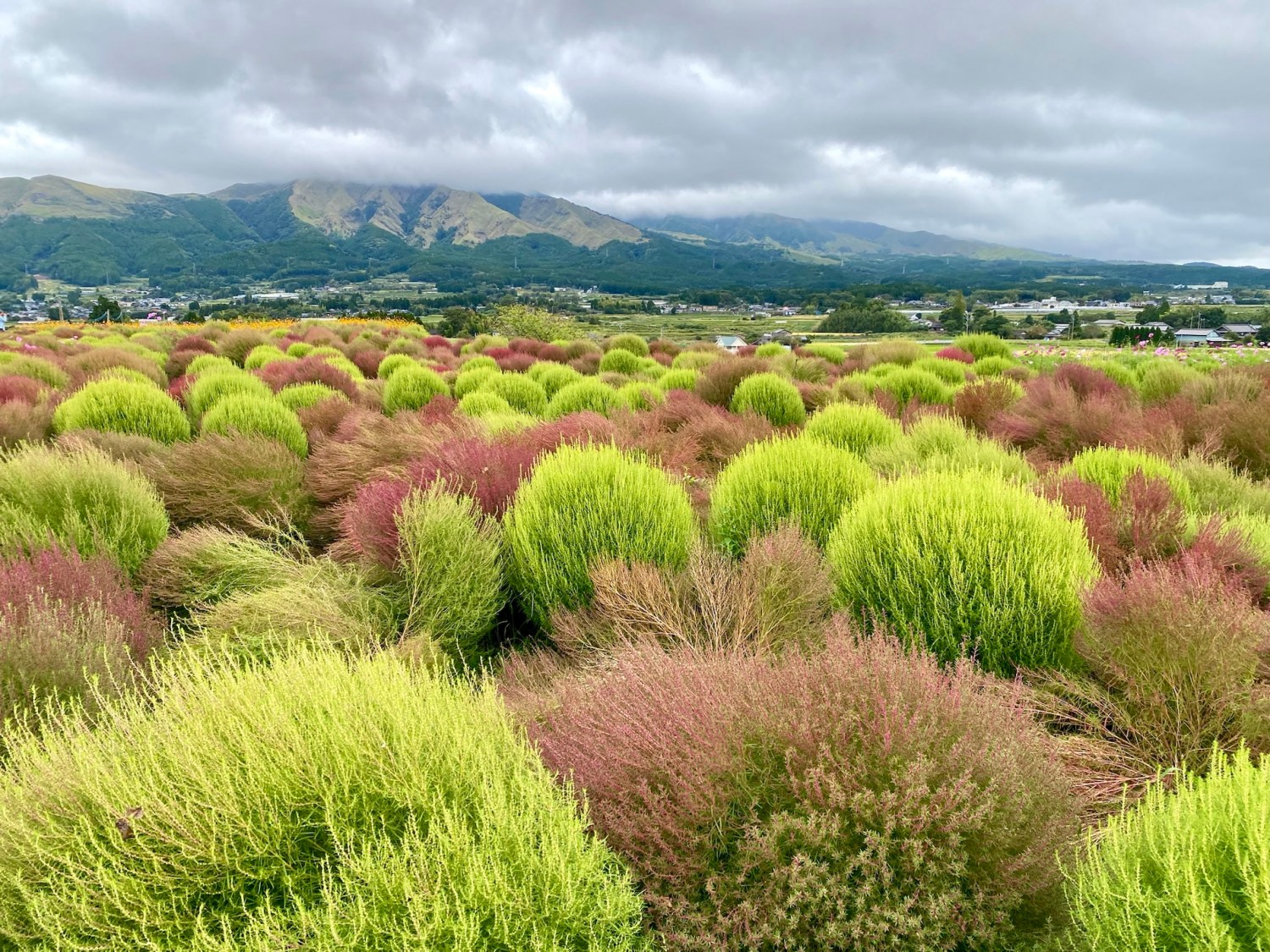
Tuesday, October 15: On our way out to explore the Mount Aso area on Tuesday – sadly a cloudy and rainy day – we stopped at the Visitor Information in Minamiaso and found a field of flowers and cool bushes with a backdrop scene of Mount Aso. We stopped to admire the scenery and take photos. It was a stunning little setup.


Takachiho Gorge
In a steady rain, we drove quite some distance over curvy mountainous roads to visit Takachiho Gorge (高千穂峡, Takachiho-kyō), a narrow chasm cut through the rock by the Gokase River. The nearly sheer cliffs lining the gorge are made of volcanic basalt columns where the stone twisted and flowed as it formed.
The gorge was formed over 120,000 years ago by a double volcanic eruption. There is a 1km-long nature trail above the gorge, which we took. Partway along the gorge is the 17-meter high Minainotaki waterfall cascading down to the river below. Tourists can rent rowboats to take into the gorge, but it was rainy and crowded and we probably couldn’t have gotten one even if we’d wanted to.
Though a pretty spot, it was warm, rainy, touristy and swamped with Chinese tourist groups. I was drenched in dampness by the time we descended and climbed back out of the gorge.


Scenes looking over the valley from our drive back from Takachiho Gorge were gorgeous.


Hogihogi Shrine
We visited the very bizarre, deserted and amusement-park-like Hogihogi Shrine about 3 minutes drive from our ryokan. Apparently people come here to pray for good luck, especially if they’ve bought a lottery ticket. It was a rather hokey place.


Minamiaso
After driving to two different restaurants that we found closed on Tuesday night, including our little Italian place from the night before, we ended up at the only open place, Yakiniku, an all meat place. When I say “meat” I mean offal, gizzards, neck, and any other unappetizing cut of meat you can imagine, including horse meat. I wrote in Google translate to the proprietor: “I don’t eat meat. What can you recommend?” It turned out I could eat rice, a green salad, taro & green beans “locally harvested.” What I had was tasty but not at all filling; Mike had to remove a couple of pieces of gristly meat from his mouth.


Steps: 7,382; Miles 3.12. Weather Hi 81°, Lo 65°. Mostly cloudy and rainy.
Usuki Stone Buddhas
Wednesday, October 16: On Wednesday we started slowly making our way back home, in steps, first stopping at the Usuki Stone Buddhas south of Oita. The Usuki Stone Buddhas (臼杵磨崖仏, Usuki magaibutsu) are a group of 61 religious statues in four groups carved in bas-relief into a tuff cliff in the city of Usuki, Ōita Prefecture. The site was designated a National Special Historic Site of Japan in 1952. In 1962, 59 of the 61 statues were collectively designated a National Important Cultural Property, with the designation elevated in 1995 to National Treasure.
Magaibutsu (磨崖仏, literally “polished-cliff Buddha”), are bas-relief images carved directly into a cliff face.
Based on the style, it is estimated that most of the statues were made in the late Heian period (794 – 1185), and some in the Kamakura period (1185–1333). With the decline in Shugendō pilgrimages from the Muromachi period onward, the statues were forgotten and remained exposed to the elements, some of them possibly for over a thousand years.


This was one of our favorite spots on Kyūshū, along with the Mount Aso area. Not too touristy, off-the-beaten-path, quiet and secluded, it was a nice relaxing spot for us to stroll around on our way to Hiji, north of Beppu and south of Oita Airport, from where we would fly back to Tokyo on Thursday morning.
Mitsujoin Rice Terraces
Finally, we stopped briefly at the nothing-to-write-home-about Mitsujoin Rice Terraces about 17km south of the Oita Airport. Mike didn’t even bother to get out of the car to take photos.


Last night in Kyushu at the fico HIJI hotel
Then we went to the fico HIJI hotel which had the smallest imaginable room but it had Netflix and washing machines, so we did two loads of laundry and watched Maestro in Blue and AnotherSelf, after eating filet-o-fish sandwiches from a brand-spanking new McDonald’s around the corner.
Steps: 5,903; Miles 2.5. Weather Hi 81°. Lo 69°. Mostly cloudy.
Discover more from ~ wander.essence ~
Subscribe to get the latest posts sent to your email.
 ~ wander.essence ~
Well, it might not all have been to your taste but you certainly can’t accuse Japan of being boring. I like the look of that ryokan with views to Mount Aso and the grasslands. I suppose it must be relatively cheap to visit Japan from China.
LikeLike
Hi Jo, For sure Japan could never be called boring. That ryokan near Mt. Aso was fabulous and we loved the views from that valley. I imagine it is very cheap to visit Japan from China. I visited the first time in 2011 from Korea, and it was very cheap.
LikeLiked by 1 person
I love the wild flowers and bushes, and the interesting fungi in your first gallery. It does look a lot cooler which must have been a relief.
LikeLike
I was so happy to finally have cooler weather, Anabel. And we loved that landscape & flora around Mount Aso.
LikeLiked by 1 person
Such wonderful landscapes. The views are amazing. 😊
LikeLike
We loved this area of Japan, Pepper. Thank you for dropping by! 🙂
LikeLiked by 1 person
You saw some beautiful scenery, not all of it is what I would have expected in Japan. And that field full of pink cosmos is just gorgeous.
LikeLike
I’m glad in many ways that I got to see parts of Japan on this trip that I hadn’t seen before. In some ways, I wish I had revisited some of my favorites from when I lived there, just so Mike could see them. But I also was glad to explore further afield. 🙂
LikeLiked by 1 person