Arrival in Narita & onward to Kyoto
Monday, September 30, 2024: We left Bali at 12:20 a.m. this morning (9/30) and actually managed to sleep for about 5 hours on our 7 hour flight. Garuda Indonesia is one of the nicer airlines I’ve ever flown on; it was very comfortable.

flying back to Japan from Bali

flying back to Japan from Bali

onboard Garuda Indonesia

clouds out the window while flying back to Japan

Japan Immigration Landing Permission
We arrived in Narita at 8:50 a.m. as scheduled and immediately bought our tickets for the Narita Express to Shinagawa and from there the Shinkansen to Kyoto. I was so happy to be back in Japan after the total chaos and lack of any systems in Bali; I am always in admiration of Japan’s efficiency. Infrastructure and a system that works are everything, in my opinion!
Once we were on the Shinkansen, we were able to relax because these are the most comfortable trains imaginable. I ate my favorite onigiri (tuna and mayo) for lunch. Onigiri (お握) is a Japanese rice ball made from white rice. It is usually formed into triangular or cylindrical shapes, and wrapped in nori (seaweed). Yum!!!
We were lucky to enjoy views of Mount Fuji on the way to Kyoto.
The only thing I wanted to know was WHY WHY WHY was it still 90 degrees in Kyoto at the end of September and beginning of October?????

me waiting for the Shinkansen at Shinagawa Station in Tokyo

Mike waiting for the Shinkansen at Shinagawa Station in Tokyo

me eating onigiri

Mount Fuji from the Shinkansen
Arrival in Kyoto & a stroll around the Gion District
A 3-minute walk from Kyoto Station took us to Sakura Terrace The Gallery, our lovely and convenient hotel. We checked in, rested a bit after our long overnight and morning of travel, then headed out to the Gion district of Kyoto.

Sakura Terrace The Gallery

Kyoto Station. Our hotel was where the red star is.

Sakura Terrace The Gallery

Sakura Terrace The Gallery

Sakura Terrace The Gallery
Kyoto has great historical significance in Japan, and it holds numerous cultural assets. Because of this, it is one of the most visited areas in Japan. It was originally laid out in a grid pattern modeled after China’s Tang-dynasty capital Chang’an (contemporary Xi’an). The city served as the capital of Japan and home to the Japanese imperial family from 794 to 1868, at which time the Meiji Restoration took the imperial family to Tokyo, the new capital. However, political power shifted elsewhere during the Kamakura period (1185-1333), when Kamakura served as the national capital, and during the Edo period (1600-1867), when the Tokugawa shogunate ruled Japan from Edo (now Tokyo) (Lonely Planet Japan).
We strolled through Gion (祇園), Kyoto’s most famous geisha district. It is filled with shops, restaurants and ochaya (teahouses), where geiko (Kyoto dialect for geisha) and maiko (geiko apprentices) entertain. We didn’t see any geisha, nor were we entertained by any of them, but there were plenty of mysterious looking places where we could imagine such entertainment was taking place. Mostly, we just found tourists wandering around the alleys and streets.
We ended up at a vegetarian udon noodle shop. Everything was delicious and wonderfully presented. I had an Udon tempura set, while Mike had a Tofu Steak set.

me in Gion

our vegetarian udon noodle shop

Udon tempura set

me and our meal

Mike and his Tofu Steak set

display in the vegetarian udon noodle shop
After dinner in Gion, we walked to Yasaka Shrine (八坂神社), also known as Gion Shrine; it is one of the most famous shrines in Kyoto and is considered the guardian shrine of the Gion entertainment district. Founded over 1350 years ago, the shrine sits between the popular Gion and Higashiyama districts and is often visited by tourists walking between the two.
The shrine’s main hall combines the honden (inner sanctuary) and haiden (offering hall) into a single building. In front of it stands a dance stage with hundreds of lanterns that get lit in the evenings. Each lantern bears the name of a local business in return for a donation.

Yasaka Shrine

Yasaka Shrine

ema at Yasaka Shrine

ema at Yasaka Shrine

ema at Yasaka Shrine

lanterns at Yasaka Shrine

lanterns at Yasaka Shrine

Yasaka Shrine

Yasaka Shrine

Yasaka Shrine

Theatre in Kyoto
Steps: 10,209; Miles 4.32. Weather: Hi 85°, Lo 66°. Sunny.
Tuesday, October 1: I came to Kyoto during the Lunar New Year in February 2011, when I was teaching English in South Korea. It was freezing cold when I was here then. On Tuesday the forecast was 90 degrees, so it was much less pleasant for me. Give me a cold day any day! But when traveling we have to deal with the weather hand we’re dealt, so onward we marched.
Kinkaku-ji, the Temple of the Golden Pavilion
Mike wanted to see my favorite places in Kyoto, so I took him first to my favorite place, Kinkaku-ji, a Zen Buddhist temple known as the Temple of the Golden Pavilion; it is one of 17 World Cultural Heritage sites in Kyoto. It is also one of the most popular buildings in Japan, second only to Mt. Fuji in the number of tourists it attracts. The Golden Pavilion is a 3-story building, the top two stories of which are covered with pure gold leaf.
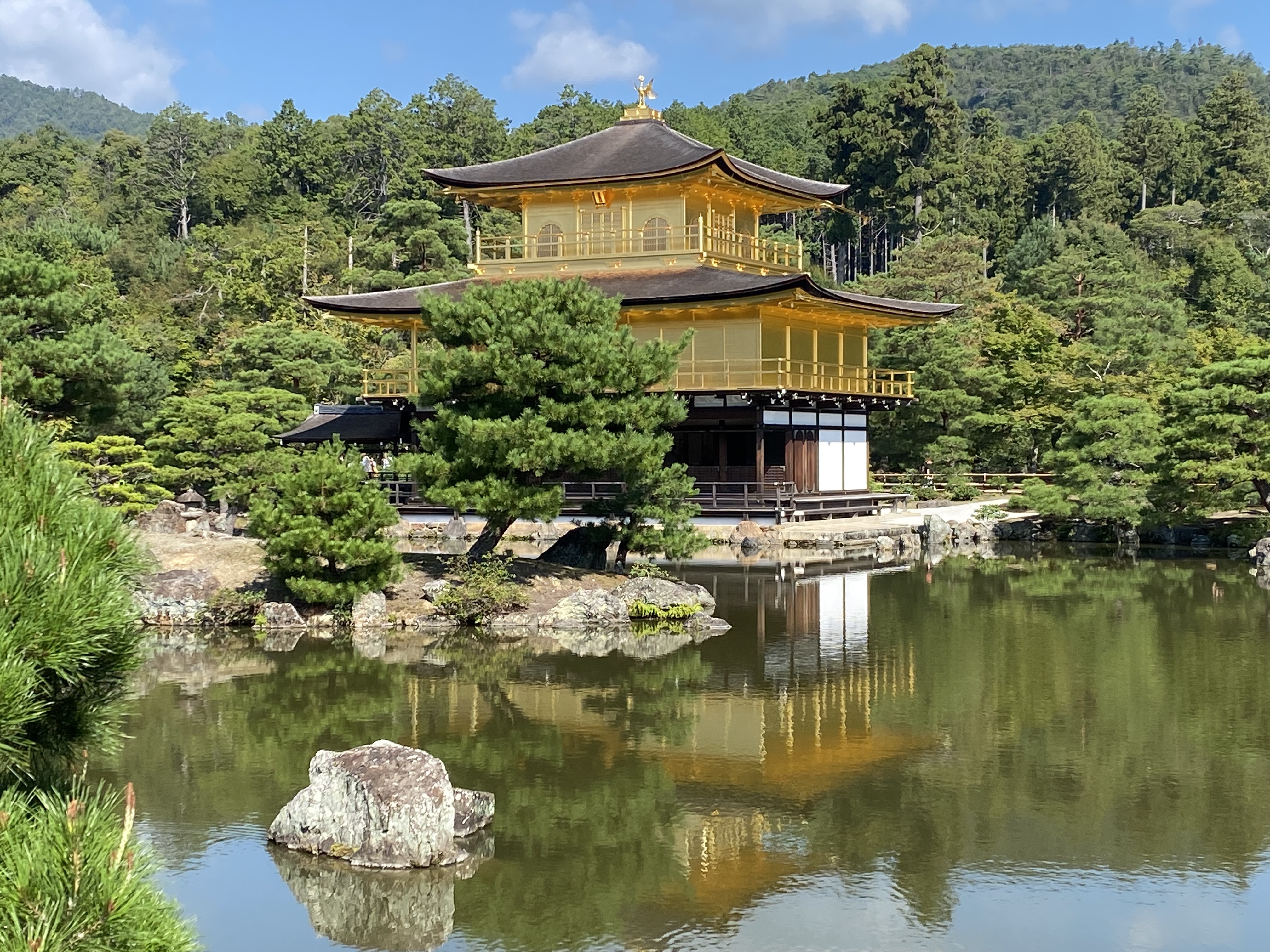
Kinkakuji
Originally built in 1397, the present building was reconstructed in 1955 after a mentally ill man burned the original down in 1950. A fictionalized version of this incident can be found in The Temple of the Golden Pavilion by Yukio Mishima.
Kinkaku-ji is a Zen temple of the Shokoku-ji School of Rinzai Buddhist denomination. The area used to be the Saionji family’s villa. In 1397, Yoshimitsu, the third Shogun of Ashikaga Shogunate, took it over and built the Kitayama palace centering around a golden stupa, “Kinkaku.” When founded, the Kitayama palace was the center of politics and culture and was used to welcome the emperors of Japan and trading partners from China. The building supposedly houses Buddha relics, specifically Buddha’s ashes. It was registered as a World Cultural Heritage Site in 1994.
The Golden Pavilion extends over a lovely pond that reflects it in all its gleaming gold. It’s stunning. People were standing on the edges of the pond, admiring its beauty and taking photos. Mike and I wandered around admiring the picture-postcard beauty before the sun started roasting us and we headed out to our next destination.

me with Mike at Kinkakuji

Kinkakuji

me at Kinkakuji

Kinkakuji

Kinkakuji

Kinkakuji

Kinkakuji

on the grounds of Kinkakuji

ema at Kinkakuji

ema at Kinkakuji

ema at Kinkakuji

me with ema at Kinkakuji (& the new fan I bought to keep cool)

ema at Kinkakuji

ema at Kinkakuji

ema at Kinkakuji
Ryōan-ji, or Temple of the Peaceful Dragon
We kept our explorations on Tuesday to the northwest area of Kyoto. The next temple we visited was about a 20-minute walk along a quiet commercial road to Ryōan-ji, or Temple of the Peaceful Dragon. Ryōan-ji belongs to the Rinzai school and was founded in 1450.
This is home to the famous rock garden, the symbol of Kyoto, that draws tourists to contemplate the emptiness between the rocks. It’s an oblong of meticulously raked sand with a formal collection of 15 strategically placed rocks on little beds of moss, apparently afloat in this sea of sand, and hugged by an earthen wall. The creator of this garden left no explanation of this interesting but austere arrangement. Apparently it causes photographers fits because it is impossible to capture the entire garden with all 15 rocks in one photograph. Apparently no matter where you sit, you can see only 14 rocks at one time. There are no trees or plants, just moss and white stones and beautiful trees behind the surrounding wall.
This simple and remarkable garden measures only 25m from east to west and 10m from south to north. The rock garden is said to have been created at the end of the Muromachi Period (around 1500) by a highly respected Zen monk, Tokuho Zenketsu.

Ryoan-ji, or Temple of the Peaceful Dragon

Ryoan-ji, or Temple of the Peaceful Dragon

Ryoan-ji, or Temple of the Peaceful Dragon

Ryoan-ji, or Temple of the Peaceful Dragon

Ryoan-ji, or Temple of the Peaceful Dragon

Mike at Ryoan-ji

me at Ryoan-ji

Ryoan-ji

Ryoan-ji

Ryoan-ji
We sat for a while admiring the beauty and mystery of this place, then wandered around the veranda of Ryōan-ji Temple, admiring the lovely paintings in the tatami-matted tea rooms. I loved walking barefoot on the smooth & cool wood floors in the shade cast by the surrounding garden.
Originally a country house of the Tokudaiji Clan, it was acquired in 1450 by Hosokawa Katsumoto for use as a Zen training temple. It was destroyed by fire during the Ōnin War (a civil war that lasted from 1467 to 1477) and was rebuilt in 1499. It was registered as a World Heritage Site in 1994.

Ryoan-ji

me on the verandah at Ryoan-ji

Mike at Ryoan-ji

Ryoan-ji

Ryoan-ji

me at Ryoan-ji

Ryoan-ji

Ryoan-ji

Ryoan-ji

Ryoan-ji, or Temple of the Peaceful Dragon

Ryoan-ji

Ryoan-ji

tall skinny trees at Ryoan-ji

me at Ryoan-ji

convoluted roots at Ryoan-ji

Ryoan-ji

Ryoan-ji

Mike at Ryoan-ji
The Randen Railway Kitano line & Arashiyama
For our final stop of the day, we ventured to Arashiyama in the northwest suburbs of Kyoto. By the way, all the sights to see in Kyoto are spread out all over the city and the public transport system is not as far-reaching as that in Tokyo. A lot of walking is involved. Or buses.
We headed off on a quest to find the Randen Railway Kitano line at Ryoanji Station. It’s an electric railway that connects the center of Kyoto with the western suburb of Arashiyama, and it must be the cutest little train I’ve ever seen. It’s one of many things that tickles me about Japan. It’s painted a cheery purple color and consists of only one car, driven by a pressed and uniformed driver with a little conductor hat and white gloves. It made a clanging noise as it rumbled along the tracks and dropped us eventually in the suburb of Arashiyama.

walk to Ryoanji Station

walk to Ryoanji Station

walk to Ryoanji Station

Randen Railway Kitano line

conductor on the Randen Railway

me on the Randen Railway Kitano Line

Mike on the Randen Railway Kitano Line

me getting off the Randen Railway Kitano Line with the conductor getting off behind me

me with a colorful “bamboo forest”
When we arrived in Arashiyama, we walked down the cute yet touristy main street where we found a cozy little restaurant. There we enjoyed some vegetarian udon noodles.

lunch spot in Arashiyama

plastic food display at our lunch spot

another Japanese fashionista

vegetarian udon noodles

Mike eating lunch
We walked to the Togetsukyo Bridge over the Oi River and found some young ladies decked out in their kimono who were all too happy to pose for a photo.
The Togetsukyo Bridge is in itself a big tourist attraction in Arashiyama, and a symbol of the area’s beauty. Despite being made of concrete, the wooden balustrade fits in with the surrounding natural landscape. The Togetsukyo Bridge was designed to be in harmony with the nature of Arashiyama.

young Japanese ladies on the Togetsukyo Bridge

view from the Togetsukyo Bridge
We strolled down the tourist street looking at the adorable displays of tiny things that seem to be sold everywhere but have no discernible purpose. I call them little what-nots and they are found everywhere in Japan.

what-nots on the streets of Arashiyama

what-nots on the streets of Arashiyama

what-nots on the streets of Arashiyama

what-nots on the streets of Arashiyama

what-nots on the streets of Arashiyama

what-nots on the streets of Arashiyama
I also bought a rather fancy fan and a stand, which I brought back to put on display in my house. The two items cost about $37, still cheaper than most fans in that shop!

fan shop in Arashiyama

fan shop in Arashiyama

fan shop in Arashiyama

Arashiyama

Arashiyama
The Bamboo Forest in Arashiyama
Finally, we went off to find the Bamboo Forest. All of this was basically the same route I took in 2011 when I was here in Kyoto for the Lunar New Year.
We took a long stroll, with hundreds of other people, through the Arashiyama Bamboo Grove, a natural bamboo forest consisting mostly of mōsō bamboo (Phyllostachys edulis); it has several pathways for tourists and visitors. The Ministry of the Environment considers it a part of the soundscape of Japan.
We stopped in at Nonomiya-jinja Shrine. Imperial princesses who served at Ise Shrine first resided here to purify themselves. Today the shrine is dedicated to the main deity, the Sun Goddess, and to the deity of fire. For generations, emperors sent unmarried daughters to serve at Ise Shrine, where they were known as Saigu. A princess who was set up as a Saigu first spent at least one year undergoing purification within the Imperial Palace, before moving to Nonomiya-jinja. After three years of purification here, she was then taken in a procession to Ise.

Arashiyama Bamboo Grove

me at Arashiyama Bamboo Grove

Arashiyama Bamboo Grove

ema at Nonomiya-jinja Shrine

ema at Nonomiya-jinja Shrine

ema at Nonomiya-jinja Shrine

ema at Nonomiya-jinja Shrine

Nonomiya-jinja Shrine

Nonomiya-jinja Shrine

moss garden at Nonomiya-jinja Shrine

ema at Nonomiya-jinja Shrine

ema at Nonomiya-jinja Shrine

Nonomiya-jinja Shrine

Nonomiya-jinja Shrine

ema at Nonomiya-jinja Shrine

Arashiyama Bamboo Grove

Mike at Arashiyama Bamboo Grove

me at Arashiyama Bamboo Grove

Arashiyama Bamboo Grove

Arashiyama Bamboo Grove

Arashiyama Bamboo Grove

Arashiyama Bamboo Grove

Arashiyama Bamboo Grove

Arashiyama Bamboo Grove

crowds at Arashiyama Bamboo Grove

Arashiyama Bamboo Grove

me at Arashiyama Bamboo Grove

Japanese folks at Arashiyama Bamboo Grove

Japanese folks at Arashiyama Bamboo Grove

Arashiyama Bamboo Grove

Arashiyama Bamboo Grove

crowds at Arashiyama Bamboo Grove

Arashiyama Bamboo Grove
Tenryū-ji
We continued to stroll through the bamboo forest at Arashiyama until we reached Tenryū-ji, the head temple of the Tenryū-ji branch of the Rinzai sect of Zen Buddhism. The temple was founded by Ashikaga Takauji in 1339, primarily to venerate Gautama Buddha. Construction was completed in 1345. As a temple related to both the Ashikaga family and Emperor Go-Daigo, the temple is held in high esteem, and is ranked number one among Kyoto’s so-called Five Mountains. In 1994, it was registered as a UNESCO World Heritage Site, as part of the “Historic Monuments of Ancient Kyoto.”
The temple’s main 14th century Zen garden, with its backdrop of the Arashiyama mountains, is an example of shakkei (borrowed scenery).
The last picture shows a very tired, sweaty, and wild-haired me on the train on the way back from Arashiyama.

grounds of Tenryū-ji

Tenryū-ji

Tenryū-ji

Tenryū-ji

Tenryū-ji

pond at Tenryū-ji

Tenryū-ji

lotus pond at Tenryū-ji

lotus pond at Tenryū-ji

a hot & sweaty me on the train back to Kyoto Station
Back to our Kyoto neighborhood
Tuesday night, after our day exploring all over northwest Kyoto and walking over 7 3/4 miles, we went out to eat in our neighborhood. Our hotel is a 3-minute walk from the sprawling Kyoto Station yet is in a mostly quiet residential neighborhood. Mike found an okonomiyaki restaurant, Nishiyama, just a block from our hotel on a quiet street. Okonomiyaki is like a Japanese pancake or pizza. The food was delicious. Mike got okonomiyaki with squid and I got Negiyaki (Ordinary Okonomiyaki sauce or soy sauce), a type of okonomiyaki cooked with lots of green onion (with no squid or pork). I had plum wine with soda and Mike had plum wine straight. The asparagus appetizer was also delectable.

Nishiyama

Mike with plum wine at Nishiyama

asparagus appetizer (YUM!!)

asparagus appetizer

Mike at Nishiyama with his Okonomiyaki with squid

me at Nishiyama

Negiyaki (Ordinary Okonomiyaki sauce or Soy sauce), a type of Okonomiyaki cooked with lots of green onion (with no squid or pork)
We wandered around the neighborhood on a very pleasant evening (finally it was cooling off a bit at night) and enjoyed seeing the lantern-lit buildings promising cozy happenings inside.
Some of the pictures show us around our hotel and in front of the men and women’s public baths.

our Kyoto neighborhood

our Kyoto neighborhood

our Kyoto neighborhood

Mike at Sakura Terrace The Gallery reception area

me in front of the women’s public bath

Mike in front of the men’s public bath
Steps: 18,226; Miles: 7.72. Weather: Hi 90°, Lo 64°. Sunny.
The infinite torii gates at Fushimi Inari Shrine
Wednesday, October 2: On Wednesday morning in Kyoto, on the hottest day of our stay here (90° F), we decided to visit Fushimi Inari Shrine (伏見稲荷大社, Fushimi Inari Taisha), an important Shinto shrine in southeast Kyoto. It is famous for its thousands of vermilion torii gates, which straddle a network of trails behind its main buildings. The trails lead into the wooded forest of the sacred Mount Inari, which stands at 233 meters and belongs to the shrine grounds. The pathway wanders 4km up the mountain and is dotted with dozens of atmospheric sub-shrines.
Fushimi Inari is the most important of some 40,000 shrines all through Japan dedicated to Inari, the Shinto god of rice, as well as to the god of sake. It was dedicated by the Hata family in the 8th century. As the role of agriculture diminished, deities were called upon to ensure prosperity in business. Foxes are thought to be Inari’s messengers, resulting in many fox statues across the shrine grounds. The stone foxes are often referred to as Inari. The key often found in the fox’s mouth is for the rice granary. Fushimi Inari Shrine has ancient origins, predating the capital’s move to Kyoto in 794.
I came to this shrine during the Lunar New Year in 2011 when I worked in Korea. I had ridden a bicycle lent by the hostel and had to catch a flight back to Korea that afternoon. Little did I know how much of this shrine I missed that time. Mike and I spent two solid hours climbing to the top. It was hot and there were hundreds of people, although the numbers thinned out near the top. On the way down I had a problem with my left ankle and that made for slow going.
These are truly INFINITE torii gates at Fushimi Inari Taisha. Honestly, they never seemed to end! And I thought I had visited this shrine in 2011 and had seen most of it. I was nowhere close to seeing the entire thing!

Mike on the train to Fushimi Inari Taisha

Fushimi Inari Taisha

Fushimi Inari Taisha

Fushimi Inari Taisha

me at Fushimi Inari Taisha

Fushimi Inari Taisha

Fushimi Inari Taisha

Fushimi Inari Taisha

Fushimi Inari Taisha

Fushimi Inari Taisha

Fushimi Inari Taisha

Mike at Fushimi Inari Taisha

Fushimi Inari Taisha

Fushimi Inari Taisha

Mike at Fushimi Inari Taisha

me at Fushimi Inari Taisha

Fushimi Inari Taisha

Fushimi Inari Taisha

Fushimi Inari Taisha

Fushimi Inari Taisha

me at Fushimi Inari Taisha

view over Kyoto from Fushimi Inari Taisha

map of Fushimi Inari Taisha

me mimicking the Japanase at Fushimi Inari Taisha

Mike doing a Japanese pose at Fushimi Inari Taisha

Fushimi Inari Taisha

Fushimi Inari Taisha

Fushimi Inari Taisha

Fushimi Inari Taisha

Mike at Fushimi Inari Taisha

Fushimi Inari Taisha

Fushimi Inari Taisha

Fushimi Inari Taisha

me at Fushimi Inari Taisha

Mike at Fushimi Inari Taisha

Fushimi Inari Taisha

Fushimi Inari Taisha

Fushimi Inari Taisha

Fushimi Inari Taisha

Fushimi Inari Taisha

Fushimi Inari Taisha

me at Fushimi Inari Taisha

Fushimi Inari Taisha

Fushimi Inari Taisha

Mike at Fushimi Inari Taisha

Fushimi Inari Taisha

Fushimi Inari Taisha

Fushimi Inari Taisha

Fushimi Inari Taisha

Fushimi Inari Taisha

me at Fushimi Inari Taisha

Fushimi Inari Taisha

Fushimi Inari Taisha

Fushimi Inari Taisha

me at Fushimi Inari Taisha

Fushimi Inari Taisha

Fushimi Inari Taisha

Fushimi Inari Taisha

Fushimi Inari Taisha

Fushimi Inari Taisha

Fushimi Inari Taisha

Fushimi Inari Taisha

Fushimi Inari Taisha

me at Fushimi Inari Taisha

Fushimi Inari Taisha

Fushimi Inari Taisha

Fushimi Inari Taisha

Fushimi Inari Taisha

Fushimi Inari Taisha

Fushimi Inari Taisha

Fushimi Inari Taisha

Fushimi Inari Taisha

Fushimi Inari Taisha

Mike at Fushimi Inari Taisha
Just before we left Fushimi Inari Taisha, I found some colorful origami strands that reminded me of Hiroshima when I was there in August of 2017.

Fushimi Inari Taisha

Fushimi Inari Taisha

Fushimi Inari Taisha

Fushimi Inari Taisha

Fushimi Inari Taisha

Fushimi Inari Taisha
A dead-end attempt to reach Ohara
Mike and I took a train to try to find a bus to Ohara, a rural area highly recommended by my friend Graham. Sadly we waited and waited for a bus to come in Miyakehachiman, and when two of them came (#17 & #19) they were so packed it was impossible to get onboard.

trying to reach Ohara on several trains

trying to reach Ohara on several trains

Miyakehachiman

me at the train station in Miyakehachiman

train back into Kyoto
München & Nishiki Market
We decided to give up on going to Ohara and headed instead to Nishiki Market. By this time we were hungry and hot and wanted desperately to sit down and cool off. We stopped at the first restaurant we could find, München. Mike had a hamburger set meal and I had creamy crab croquettes and fried prawns. The meal wasn’t great and we realized later that we should have waited to try the staggering variety of food at Nishiki Market.

Mike at München

our lunch at München
After lunch, we wandered through Nishiki Market. What a mouthwatering feast for the eyes! We were so disappointed we had just eaten and vowed to return another day.
Mike & I sampled some sake before leaving the market and slowly made our way back to our hotel. We passed a huge bicycle parking lot on the way.

Nishiki Market

Nishiki Market

Nishiki Market

Nishiki Market

Nishiki Market

Nishiki Market

Nishiki Market

Nishiki Market

Nishiki Market

Nishiki Market

Nishiki Market

Nishiki Market

Nishiki Market

Nishiki Market

Nishiki Market

Nishiki Market

Nishiki Market

Mike at Nishiki Market

Nishiki Market

Nishiki Market

Nishiki Market

Nishiki Market

Nishiki Market

Nishiki Market

Nishiki Market

Nishiki Market

Nishiki Market

Nishiki Market

Mike at Nishiki Market

Nishiki Market

Nishiki Market

Sake at Nishiki Market

Mike samples sake at Nishiki Market

me trying sake at Nishiki Market

Nishiki Market

Nishiki Market

Nishiki Market

bicycle parking garage
We somehow got lost in Kyoto Station and it took us a long time to find our way out. We were exhausted from climbing to the top of Mt. Inari through the infinite torii gates and attempting our botched trip to Ohara, so we went back to the hotel, got some convenience store food and got comfy in our hotel room. We went down to the lobby later for our free welcome drink, which was offered every night of our stay. I usually had a refreshing gin and tonic.
Steps: 18,287; Miles 7.74. Weather Hi 87°, Lo 64°. Some thunderstorms.
A rainy day along The Path of Philosophy (Tetsugaku-no-Michi)
Thursday, October 3: Thursday morning in Kyoto, we woke to a steady rain and the forecast kept promising sunshine within the next hour. Each hour the forecast changed to more rain and so it continued throughout the entire day. Of course we couldn’t let rain stop us on vacation, so we took a train and a bus to northern Higashiyama to walk The Path of Philosophy along a canal that lies at the foot of the eastern mountains.
We found another Japanese fashion statement on the train and then stopped for coffee at the cafe “& bull.” Then we strolled north on the path, keeping our umbrellas open overhead. I should have remembered when I had walked this path before, I had started at Ginkaku-ji, but we accidentally started in the middle and had to walk north to the temple, then backtrack south to walk the rest of the path.
The Philosopher’s Walk (哲学の道, Tetsugaku-no-michi) is a pedestrian path that follows a cherry-tree-lined canal in Kyoto between Ginkaku-ji and Nanzen-ji. First opened in 1890 and extended again in 1912, the path follows the course of a shallow irrigation channel bringing water from the Lake Biwa Canal. In spring and fall it is especially colorful, but on this rainy day, everything was green.

a schoolgirl on the train

& bull coffee shop

& bull coffee shop

The Philosopher’s Walk

The Philosopher’s Walk

The Philosopher’s Walk

The Philosopher’s Walk

The Philosopher’s Walk

The Philosopher’s Walk

maple tree on The Philosopher’s Walk

The Philosopher’s Walk

little pink car

The Philosopher’s Walk

The Philosopher’s Walk
Ginkaku-ji
At the northern end of The Philosopher’s Path is Ginkaku-ji (銀閣寺, Silver Pavilion), a Zen temple along Kyoto’s eastern mountains (Higashiyama). In 1482, shogun Ashikaga Yoshimasa built his retirement villa on the grounds of today’s temple, modeled after Kinkaku-ji (Golden Pavilion), his grandfather’s retirement villa at the base of Kyoto’s northern mountains (Kitayama). He desired a place to retreat from the turmoil of civil war. The villa was converted into a Zen temple after Yoshimasa’s death in 1490.
Today, Ginkakuji consists of the Silver Pavilion, which is not silver. Apparently, the shogun’s ambition to cover the building with silver was never realized. The temple complex includes half a dozen other temple buildings, a beautiful moss garden and a unique dry sand garden. It is enjoyed by walking along a circular route around its grounds, from which the gardens and buildings can be viewed.

Ginkakuji

Ginkakuji

Ginkakuji
The expansive, meticulously maintained dry sand garden, known as the “Sea of Silver Sand,” has a massive sand cone named “Moon Viewing Platform.” It is said to be symbolic of a mountain and lake. Beside the garden stands the Hondo (main hall), which displays paintings on its sliding doors (fusuma) but cannot be entered.

Sea of Silver Sand at Ginkakuji

Ginkakuji

Sea of Silver Sand at Ginkakuji

Sea of Silver Sand at Ginkakuji
Despite its name, the Silver Pavilion was never covered in silver. Instead, it is believed that the name arose as a nickname more than a century after the building’s construction to contrast it with the Golden Pavilion. Alternatively, it is explained that moonlight reflecting on the building’s dark exterior (which used to be covered in black lacquer) gave it a silvery appearance.
The pavilion is one of only two buildings on the grounds of Ginkaku-ji which have survived intact the many fires and earthquakes of the past centuries, although it has been undergoing periodical renovation to keep it well preserved.
Ginkakuji’s moss garden features ponds with islands and bridges, little streams and various plants. The path climbs a hill behind the buildings from where there are nice views of the entire temple grounds and the city beyond. For us, the moss garden was the highlight of Ginkaku-ji. The trees also gave us some cover from the steady rain.

Ginkakuji

Ginkakuji

Ginkakuji

Ginkakuji

Ginkakuji

moss garden at Ginkakuji

Ginkakuji

moss garden at Ginkakuji

moss garden at Ginkakuji

moss garden at Ginkakuji

moss garden at Ginkakuji

moss garden at Ginkakuji

Ginkakuji

moss garden at Ginkakuji

moss garden at Ginkakuji

Ginkakuji

Ginkakuji

Ginkakuji

Ginkakuji

Ginkakuji

me in the rain at Ginkakuji

Mike at Ginkakuji

Ginkakuji

Ginkakuji

Ginkakuji

Ginkakuji

Ginkakuji

fish cooking on the road back to The Philosopher’s Walk
Back to the Philosopher’s Path
After leaving Ginkaku-ji, we backtracked south along the the Philosopher’s Path, passing by the “& bull” coffee shop where we’d stopped earlier. We also returned to a shop where I’d fallen in love with a bag made from old kimono fabric. I of course bought the bag as a special treat for myself for my birthday month. The shopkeepers got a big hoot out of the T-shirts we were wearing. Both were gifts from my friend Graham’s wife Ako. Mine translates to something like “person of leisure” or “free time” (does it mean lazy?). Mike’s they found super hilarious and couldn’t stop laughing at it. Apparently it translates to something like “self-satisfied or spoiled” or “tough on others, lenient on oneself.” Anyway, we entertained them for quite some time with those t-shirts!

“Tough on others, lenient on oneself”

My t-shirt: “person of leisure”
We continued south along the Philosopher’s Path. The route is so-named because two 20th-century Japanese philosophers and Kyoto University professors, Nishida Kitaro and Hajime Tanabe, are thought to have used it for daily exercise. I imagine the two strolling along under the cherry blossoms musing about life’s big questions.

Mike on The Philosopher’s Path

me on The Philosopher’s Path

pretty Japanese young women on The Philosopher’s Path

The Philosopher’s Path

The Philosopher’s Path

The Philosopher’s Path

maples on The Philosopher’s Path

a pretty house along The Philosopher’s Path
Return to Nishiki Market
After our rainy walk along The Philosophers Path, we headed back to the wild Nishiki Market. It was packed with people but it was covered so a good way to stay dry on our last rainy day in Kyoto. Mike wanted to sample some Waygu beef, I wanted to sample grilled shrimp, and we both wanted to sample grilled eel and more sake. The market was pure delicious madness!

Nishiki Market

Nishiki Market

the waygu cook at Nishiki Market

Mike eats waygu at Nishiki Market

the waygu place at Nishiki Market

Nishiki Market

Nishiki Market

the grilled shrimp guy at Nishiki Market

grilled shrimp at Nishiki Market

me with my grilled shrimp at Nishiki Market

grilled eel at Nishiki Market

Nishiki Market

grilled eel at Nishiki Market

sake at Nishiki Market

I drink sake & snack on gyoza at Nishiki Market

Nishiki Market

food court at Nishiki Market

Nishiki Market
Our Kyoto neighborhood
Our last dinner in Kyoto was back at the restaurant where we ate our 2nd night, to eat okonomiyaki (お好み焼き), the savory pancake made with loads of shredded cabbage then pan fried with egg, sliced meat and katsuobushi (dried bonito flakes) on top. It is cooked on a grill right at the table. It was finished off with a drizzle of sweet Worcestershire sauce and mayonnaise.
We returned to our hotel for our last complimentary drink by a fire pit and prepared ourselves to move Friday morning to Tokushima on the island of Shikoku.

asparagus at the Okonomiyaki restaurant

me with my plum wine & seltzer

Mike at Okonomiyaki

Okonomiyaki

enjoying our complimentary drinks at the hotel
Steps: 13,368; Miles 5.66. Weather Hi 87°, Lo 66°. Rainy.


















 ~ wander.essence ~
You must be logged in to post a comment.