

Jimbaran to Semarapura: The Klungkung Palace
Monday, September 23, 2024: We left the Movenpick in Jimbaran at 9:00 a.m. Monday and began our two-hour traffic-congested drive to Sidemen on Bali’s east side, where we planned to spend three nights. Our driver Katur made an agreed-upon stop for us at The Klungkung Palace, officially Puri Agung Semarapura, a historical building complex situated in Semarapura, the capital of the Klungkung Regency (kabupaten).
The palace (puri) was erected at the end of the 17th century, but largely destroyed during the Dutch colonial conquest of 1908. Today the basic remains of the palace are the court of justice, the Kertha Gosa Pavilion, and the main gate that bears the date Saka 1622 (AD 1700). Within the old palace compound is also a floating pavilion, the Bale Kembang. The descendants of the rajas that once ruled Klungkung today live in Puri Agung, a residence to the west of the old palace, which was built after 1929.
We were easy targets for the insistent touts who successfully sold us sarongs, which we wore for our photos despite them not really being necessary. It was hot as always, but I loved the palace and its many water elements and architecture. And it wasn’t crowded at all, which made it all the more appealing.


We did a quick walk-through of the small Museum Semarajaya on the palace grounds. I recognized the kris (special swords), which I’d read about in the 1937 novel Love and Death in Bali by Vicki Baum. The kris is a Javanese asymmetrical dagger famous for its distinctive wavy blade, although many have straight blades as well; it is one of the weapons commonly used in the pencak silat martial art native to Indonesia. The novel I had read told a fictional account of the Dutch invasion in 1906 and the resultant mass suicide, or puputan, when the three princes of Badung realized they were outgunned and outnumbered by the Dutch and decided rather than surrender and become subjugated to the Dutch, they burned their palaces, dressed in their finest white clothing, and charged the Dutch with their ceremonial golden kris. It was a slaughter and, in all, 4,000 Balinese people died, either gunned down by the Dutch or taking matters into their own hands by plunging their kris into their children, wives and themselves.
We also saw one of the xylophones, which are used in the gamelan: a traditional Indonesian percussion orchestra, which consists of ornate, percussive instruments made of hand-forged metal. The ensemble typically includes xylophones, gongs, gong-chimes, drums, cymbals, string instruments and bamboo flutes.


Before leaving, we walked to a pavilion on the corner of the palace complex where we saw another beautifully decorated ceiling and a famous statue, possibly memorializing the puputan, in a circle on the street.


Sidemen, Bali
We arrived at the Alamdhari Resort & Spa in Sidemen too early to check in, so we had lunch. Later it rained a bit and cooled off, so I took a nap in our room while Mike swam some short laps in the pool.
At 5:00 we had massages that were wonderfully relaxing.


We spent a lovely evening in the open air on-site Dedhari Restaurant: We enjoyed Mahi Mahi with cream sauce, Tom Yum soup, an Arak for Mike and glass of white wine for me. We topped off our meal with fried bananas and chocolate ice cream (because they were out of vanilla).
The ambiance was lovely and we were serenaded by a playlist of songs that included: “Trouble is a Friend” by Lenka and “Beautiful Things” by Benson Boone.


Finally, for the first time in all the time we’d been traveling, we enjoyed a comfortable night temperature-wise. I was finally in my happy place. 😊😊 And the grounds of our hotel were magnificent.
Note Mike’s Balinese shirt. He got it at Kungklung Palace where the lady touts wouldn’t let him rest until he bought not one, but two: for $13 each!
Steps: 5,996; Miles 2.53. Weather Sidemen: Hi 90°, Lo 70°. Partly cloudy.
Tuesday, September 24: Tuesday morning we went for a 2 1/2 hour walk through the rice fields of Sidemen with local guide Kadek (there are many men named Kadek in Bali because the name means “second son”).
There was a big festival taking place for two days that was a semi-annual festival, Galungan, so Kadek told us everyone would return home on Wednesday to celebrate with their families. We could see the decorations in the street as we walked to the rice fields. Penjor, the arched traditional Balinese decorations made from bamboo poles, and adorned with colorful cloth, flowers, coconut tree leaves, and intricate carves, were displayed on the streets of Sidemen for the festival. These symbolize offerings to the gods; they welcome the gods to the celebrations.


We learned about the irrigation systems (much like Oman’s falaj system). Kadek told us plastics and trash are a big problem because they infiltrate the irrigation systems. He said the government doesn’t do much to help the plight of the people even though they pay taxes.
He was married with two children and worked not only as a guide but for the hotel in various capacities. He also had to help tend his family’s rice fields.


We were plenty hot by the time our walk ended so we promptly went for a dip in the pool and then had pizza and Tom Yum soup for lunch before our scheduled yoga session.
It rained for a while this afternoon, but it didn’t stop us going to our 2:00 yoga class. Today I stretched some parts that hadn’t been stretched in quite a while. Yikes!
At lunch, music created a mellow vibe including: “Rockabye (feat. Sean Paul & Anne-Marie)” by Clean Bandit and “Battle Scars (feat. Lupe Fiasco)” by Guy Sebastian.


We enjoyed dream-inducing “Balinese” massages at 5:00. Then we went to dinner at the resort restaurant. I enjoyed Pad Thai with tofu while Mike had “BABI KECAP: SAUTED PORK IN SWEET SOYA SAUCE, SERVED WITH RICE & URABAN.”
We enjoyed a remix by Spike Stent of “Trouble is a Friend” by Lenka. We loved the music and the gentle and welcoming service in this open air restaurant.


Steps: 11,887; Miles 5.03. Weather: Hi 90°, Lo 70°. Sunny.
Wednesday, September 25: Today was the principal day of Bali’s important festival, Galungan, which usually runs for around ten days at various locations around Bali. It occurs twice a year in April and September. At the festival’s core is the celebration of good and overcoming evil, the victory of Dharma and the defeat of Adharma.
Ancestral spirits return to their former homes, and the locals are expected to demonstrate kindness by making offerings and chanting prayers. Locals decorate the streets with bamboo poles, locally referred to as penjor; they are used to hang offerings as a kind gesture towards the spirits.
In addition, offerings consist of special foods, scented flowers, and woven palm offerings. These sacrifices are offered at home and at the local temples (referred to as pura). Women carry their offerings on their heads, while men carry palm leaves to the temple.
At the end of the celebrations, the ancestral spirits return to their home, marked by offerings of yellow rice to mark the end of Galungan.


Tirta Gangga
We went on an excursion today with a driver, Kadek, another 2nd son but a different Kadek than our rice field guide from yesterday. We were meant to go to 1) Tirta Gangga, 2) the White Sand Beach (aka Virgin Beach or Pasir Putih), 3) Tenganan Village and 4) Goa Lawlah Temple.
On our drive to Tirta Gangga, we had some magnificent views of Bali’s countryside.


Our first stop, and the best of the day by far, was Tirta Gangga, a former royal palace in eastern Bali. Named after the sacred river Ganges in India, it is noted for its Karangasem royal water palace, bathing pools and its Patirthan temple.
The complex was built in 1946 by the last king of Karangsem I Gusti Bagus Jelantik. Tirta Gangga was intended as a recreation place for the king and his family. It was destroyed almost entirely by the eruption of nearby Mount Agung in 1963.


On the way from Tirta Gangga to the White Sand Beach, we glimpsed Balinese villagers leaving a temple during Galungan.


White Sand Beach (aka Virgin Beach or Pasir Putih)
Our second stop on today’s excursion was the White Sand Beach (aka Virgin Beach or Pasir Putih). It wasn’t all that much and of course I had already put in my beach time. We sat in a beach cafe and had an iced coffee. It was getting HOT!


Le-Zat Beach Restaurant
We stopped for lunch at Le-Zat Beach Restaurant. We liked the display with the rice shaped like the nearby volcano, Mount Agung. I enjoyed a super refreshing cucumber drink.


Tenganan Pegringsingan
Our last stop was Tenganan Pegringsingan, a viilage in East Bali. It is known for the gringsingor geringsing, double ikat textiles woven in only three places in the world. The demanding technique is only practiced in parts of India, Japan and Indonesia. In Indonesia it is confined to the village of Tenganan.
The village is also known for its gamelan selunding music played on iron metallophones.
Houses in Tenganan Pegringsingan village are built on either side of the uphill to downhill concourse with their doors opening onto it. The entrances of the houses are narrow, only allowing one person to enter or leave at any one time. Entrance to and exit from the village is through the gate at the downhill end. On either side of the entrance are two small temples. Our walk through the town was miserably hot.


a drive-by of Goa Lawah Temple
We decided to skip the last stop on our excursion today, Goa Lawah Temple, because we were told it would be very crowded due to today’s ceremonies. Plus we were hot and tired and wanted to enjoy the pool for one last afternoon before heading to Ubud on Thursday. I took this photo of a statue near the temple before driving another 45 minutes to Sidemen.
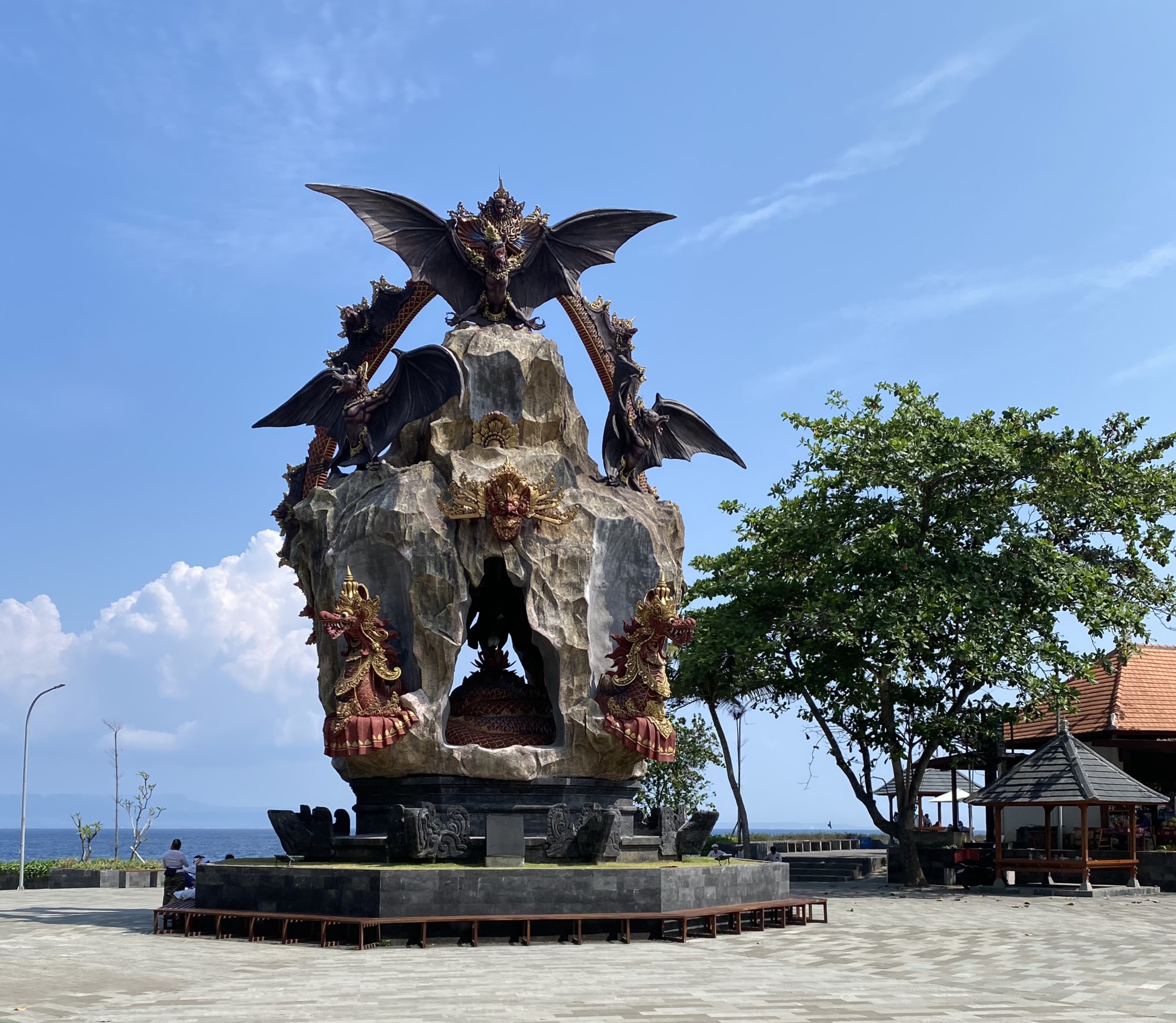
monument at Goa Lawah Temple
Sidemen
We had our last dinner at Dedhari Restaurant at the hotel. The second dish in this gallery was one of my favorites encountered in Bali: Uruban or Sayur Urab, a bunch of boiled fresh vegetables, which after cooling slightly are tossed in a fried seasoning mixture. This dish is served cold or at room temperature and is spicy, tasty, and full of well-balanced flavors.
Mike had his Arak on the rocks and I my usual glass of wine. I ordered Pad Thai with tofu and Mike got pork skewers on rice with uruban. When I told the waiter how much I loved uruban, he brought me a dish of it even though it wasn’t included in my meal.


This would be our last night in Sidemen. We would move to Ubud on Thursday and would spend three full nights there before heading back to Japan on Monday morning at 12:20 a.m.
Steps: 7,033; Miles 2.97. Weather: Hi 90°, Lo 70°. Sunny.
Thursday, September 26: On Thursday morning, we enjoyed our final views of Mount Agung from our room at Alamdhari Resort & Spa.


We headed to Ubud for our last stay (3 full nights) in Bali.
We were sad to leave this area, which was by far our favorite part of Bali. It was less crowded, with beautiful landscapes and a laid-back vibe. I had been looking forward to stay in Ubud, but it would turn out to be way too chaotic for us. If we ever went back to Bali again, which we won’t, we would recommend staying far away from any of the big tourist spots, resorts and towns.
 ~ wander.essence ~
You must be logged in to post a comment.