
Thursday, September 19, 2024: We arrived in Narita from Nagoya after a long (~4 hour) travel day. We got on the Shinkansen at 9:41 & arrived in Tokyo Station at 11:20. But it took us another 2 hours and 10 minutes to navigate 2 other trains to get to Narita, which is quite a distance east of Tokyo. Sadly we had to travel to Narita instead of Haneda, which is just south of Tokyo, because our direct flight Friday morning was on Garuda Indonesia to Bali and then back from Bali to Narita.
We took a taxi to our ryokan, Wakamatsu Honten, because we didn’t feel like a 14-minute walk in the heat. The long shopping street, Omotesando, stretches over the entire one kilometer distance from the railway station to the temple, Naritasan. Our ryokan is directly across the street from the temple’s main gate. It is a lively street lined with numerous restaurants and stores that have been selling traditional crafts, foods and souvenirs to pilgrims and tourists for centuries.
We couldn’t check in until 3:00 so we dropped our bags and wandered out to find lunch. We stumbled upon a rather slovenly restaurant where I got udon noodles with prawn tempura and Mike got a kind of meat loaf topped with scrambled eggs. We sat on cushions at the low tables (very uncomfortable I might add) and laughed when all the Japanese people who came in sat in chairs at regular tables. Even they were not foolish enough to sit on those uncomfortable cushions.


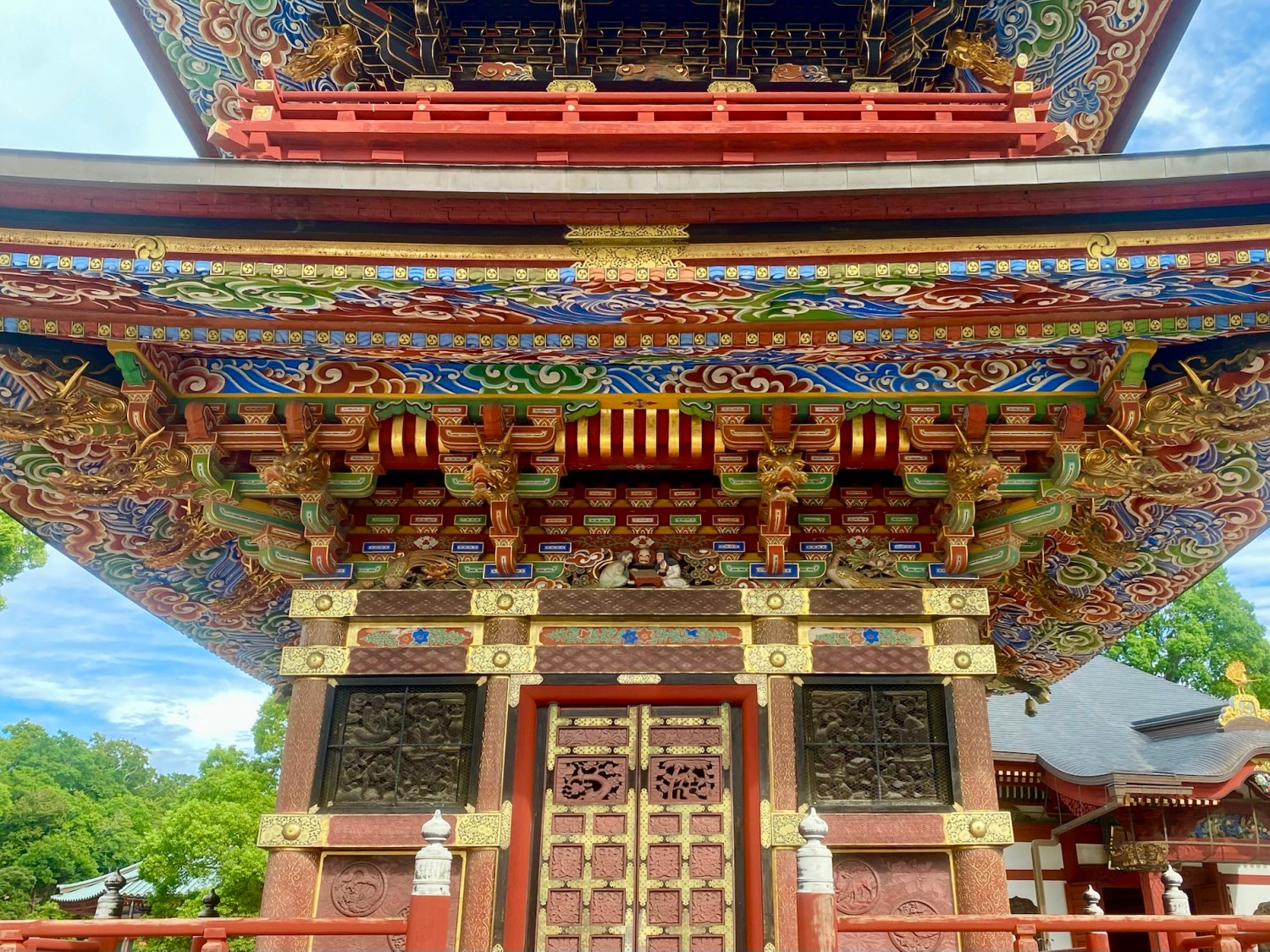
After lunch we visited Naritasan Shinshoji Temple (成田山新勝寺), a large and highly popular Buddhist temple complex. A broad variety of temple buildings stand on the spacious grounds of Naritasan, including the temple’s new and former main halls and a three storied pagoda.
Naritasan was built in the year 940 around its main sacred object of worship, a statue of the Buddhist Fudo Myoo deity. Kobo Daishi, the founder of the Shingon Sect and one of the most important figures in Japan’s religious history, is said to have carved the statue.


After visiting the temple, we walked up and down Omotesando, checking out the shops and watching the people. I loved the simple style of a young Japanese woman and only wished I could have taken a photo of her from the front. It was miserably hot and humid, so we stopped to cool off at a cafe that made dango. Dango (団子) is a Japanese dumpling made with regular rice flour and glutinous rice flour. They are usually made in round shapes, and three to five pieces are served on a skewer, which is called kushi-dango (串団子). The pieces are eaten with sugar, syrup, red bean paste, and other sweeteners.
We wandered lackadaisically on the shopping street. Japanese “shopping streets” never sell much of interest. It seems many of them sell boxed sweets that are fancily packaged; I believe they’re bought to give as gifts. Mike captured some of the schoolchildren in their uniforms.


We went in search of something we could buy and take to our room for dinner later. We hadn’t reserved dinner at the ryokan and the manager had informed us that most of the town shut down at 5:00 so we wouldn’t find any place open for dinner. We finally found a place to buy croquettes, so we took some back to the hotel and checked in for the night. We also stopped to buy a couple of beers; we were surprised how difficult it was to find them.


We checked in at Wakamatsu Honten, the same ryokan where I stayed before leaving Japan after teaching at Aoyama-Gakuin University – Sagimahara campus for the spring semester of 2017.

Wakamatsu Honten
We got cozy in our yukata and had a little fun playing around with a silly fan found in our room. We enjoyed beers, ate the croquettes we’d bought, took baths in the segregated onsens, and then went to sleep on our futons.


Steps: 12,557; Miles 5.33. Weather: Hi 88º, Lo 74°. Cloudy.
Friday, September 20: We woke up early for baths in the public onsen at the ryokan. This time we managed to take some pictures of them since no one else was there.


We then had an early vegetarian breakfast with multiple dishes as outlined on the placemat: “We are serving traditional ascetic[ally (sic.)] cuisine (vegetarian diet food) , the ‘SHOJIN ryori.’ The ‘SHOJIN ryori’ is said [to be] the origin of Japanese food culture. Even cooking without meats and fishes or eggs, it is still nutritious. The ‘SHOJIN ryori’ is seen as the healthy meal for physical and spiritual [well-being].” The menu included things such as tofu skin, peanut miso, plant meat, spinach, eddoe, eggplant, sesame tofu, simmer fried tofu, loquat jelly, natto, salad, pickled vegetables and miso soup, along with steamed rice.
We felt a bit rushed and obligated to finish everything, so it was a bit stressful. I can’t say I was crazy about any of it.


A taxi picked us up at 7:55 a.m. and took us through heavy traffic to Narita Airport, where we would fly off to Bali.


We took Garuda Indonesia Flight 881 to Denpasar, Bali. 11:00 a.m. to 5:25 p.m. We left Narita right on time; the doors to the plane were closed at 10:45 a.m. and we took off directly at 11:00. As we took off, Mike was able to capture some photos of Mt. Fuji. We loved the airline; the seats were roomy and the service was impeccable.


Weather in Narita: Hi 92°, Lo 74°.
Discover more from ~ wander.essence ~
Subscribe to get the latest posts sent to your email.
 ~ wander.essence ~
I quite like the look of your breakfast! And its explanatory placemat. I always thought vegetarian food would be hard o find in Japan.
LikeLike
It seems you can find vegetarian meals, but it is difficult. Believe me, when I saw the way some of the meats were prepared, I pretended to be vegetarian but often couldn’t find much of a substitute. Are you vegetarian?
LikeLike
Yes, I have been vegetarian for over 40 years. Most places have now caught on but there are some that just don’t get it at all and I suspected Japan might be one of them.
LikeLiked by 1 person
Your photos of the shrine are lovely. I found when I went to Japan ordering food could be tricky because I was looking at it with western eyes and it wasn’t always what I thought it might be.
LikeLike
Thank you, Carol. That shrine, and especially that pagoda, is a lovely spot. As for the food, I realized that I love the Western version of Japanese food better than the Japanese version. We have a favorite sushi restaurant we go to all the time, where everything is prepared in Japanese style but to American tastes. I’ve pretty much found that everywhere I’ve been: a country adapts another culture’s food to its own. Even the Japanese create Thai food or Italian food with Japanese twists. Are you still on your Antarctica trip? It looks fabulous!
LikeLiked by 1 person
We have two days to go. It’s been the most incredible experience and such a privilege to visit the 7th continent.
LikeLike