Wednesday, January 11, 2023: Today we drove to Parque Nacional Volcán Tenorio, which required us to backtrack back to Liberia and then head east on Route 1 in Costa Rica. When we turned off to take Route 6 north to Bijagua, we were desperate to find a gas station so we asked a roadside vendor where to find petrol. He was patient with our Spanish, correcting our incorrect words and slowly describing, with energetic hand gestures, directions to the next town of Canas, a bit further east along the main highway. He told us to get gas, turn around and come back to go up Route 6 to Bijagua. He taught us to say, “Pura Vida Mai!” which is something like “Pure Life, buddy!” He said it with much enthusiasm. We bought some of his snacks and thanked him profusely, then we got back on the highway, found gas, and returned to pass by him again. As we drove by, I yelled out the window, “Pura Vida Mai!” He smiled ear-to-ear, waved, and gave us a thumbs up as we drove past. We got a big laugh out of that.
Parque Nacional Volcán Tenorio
After the town of Bijagua, we turned off toward the National Park. Tenorio Volcano National Park and Tenorio Protected Zone are an integral part of the Agua y Paz Biosphere Reserve named by UNESCO in September 2007. As part of the Maleku people’s ancestral territory, the area is of huge cultural value. The park covers more than 30,000 acres, spanning much of the land northwest of Lago Arenal.
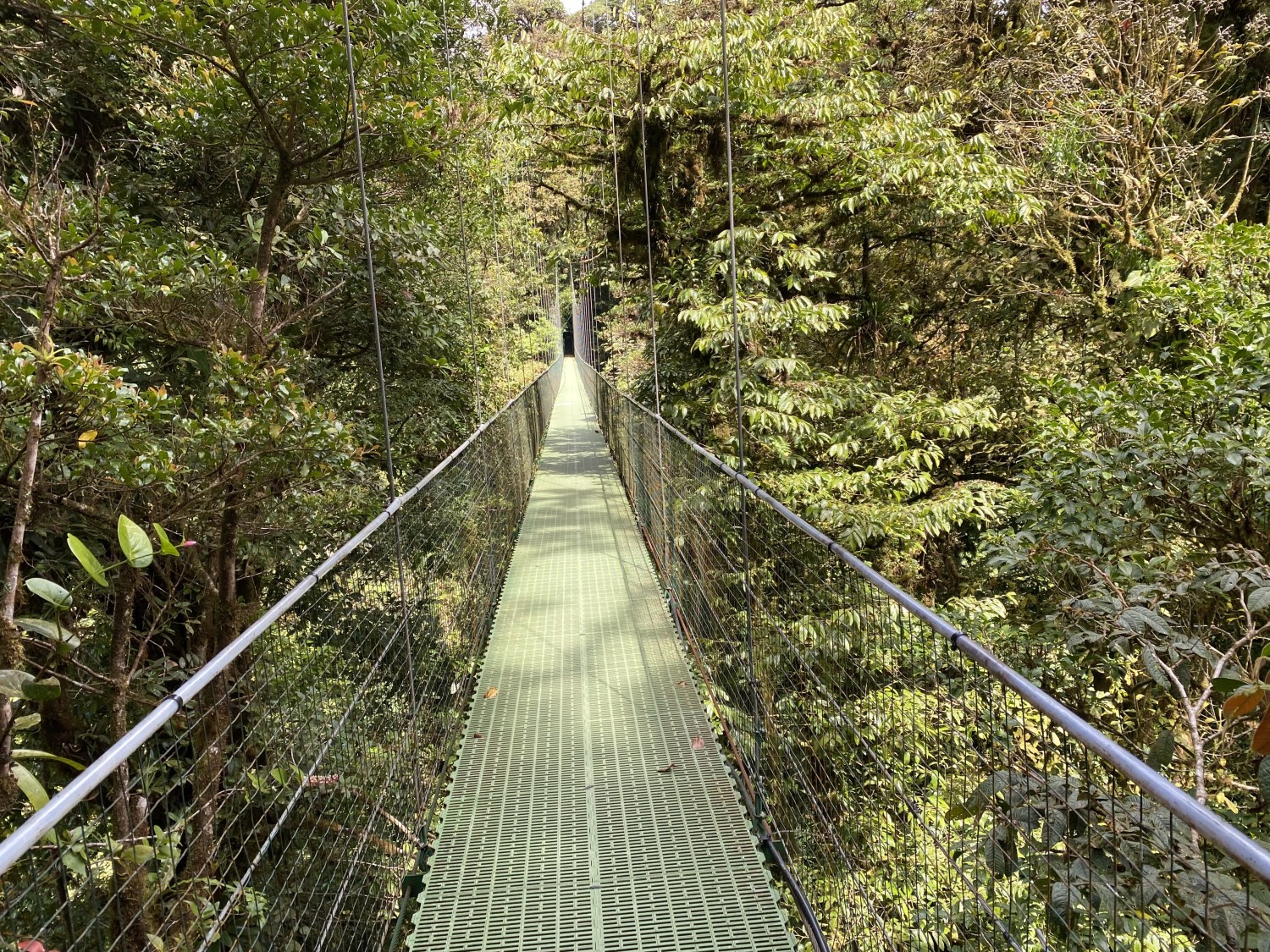
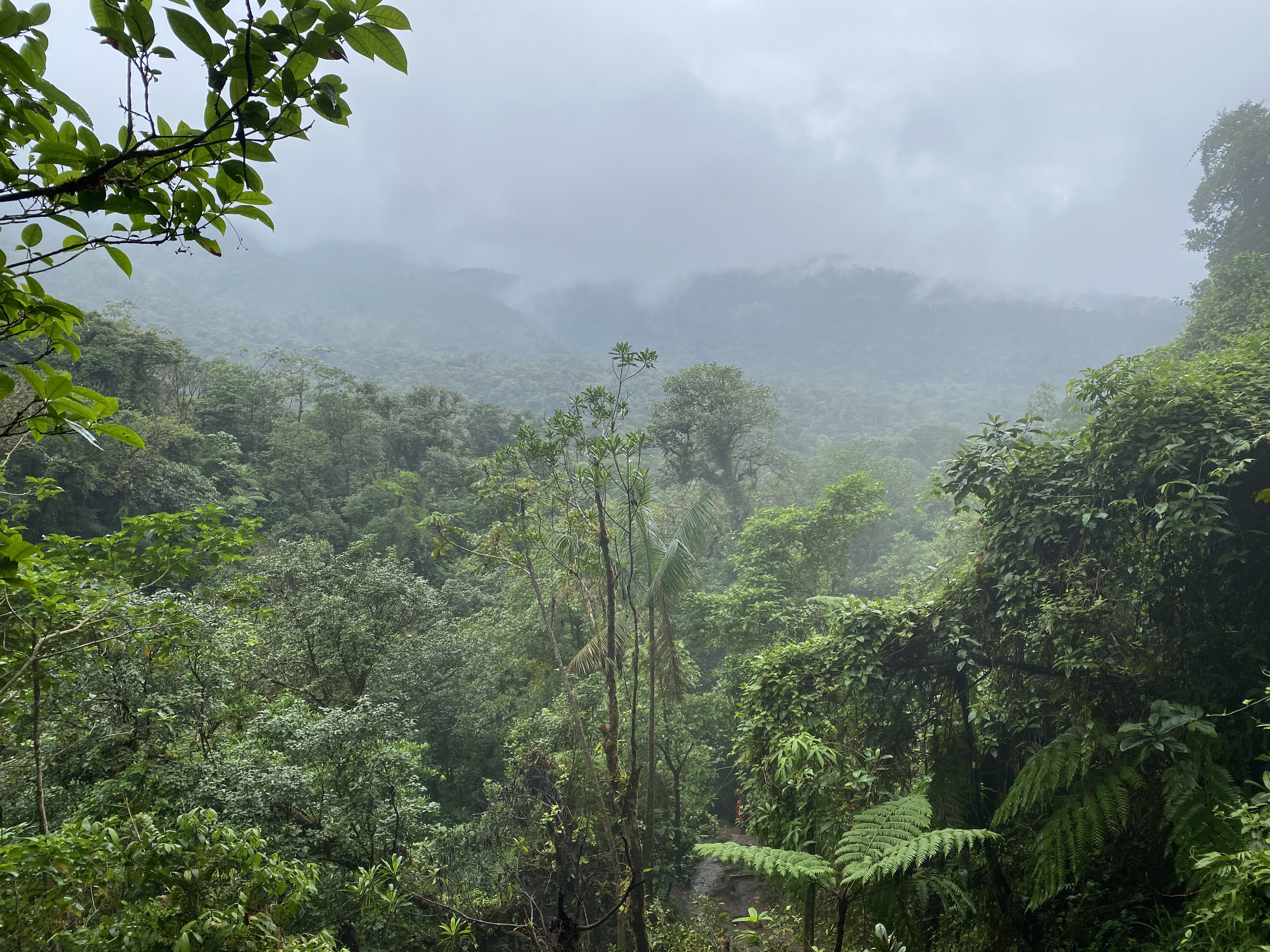
We entered through the El Pilón ranger station and walked the Sendero Principal (Main Trail, 3km one way). We encountered lush rainforest; a green vine snake; a soaking rain; mud, tree branches and rocks. And on the entire way out, we got pretty drenched by a steady rain. The forest was mostly primary, protecting species like Jícaro danto, the fruits of which are eaten by the tapir, which disperses the seeds.
lush rainforest at Volcán Tenorio
a green vine snake at Volcán Tenorio
lush rainforest at Volcán Tenorio
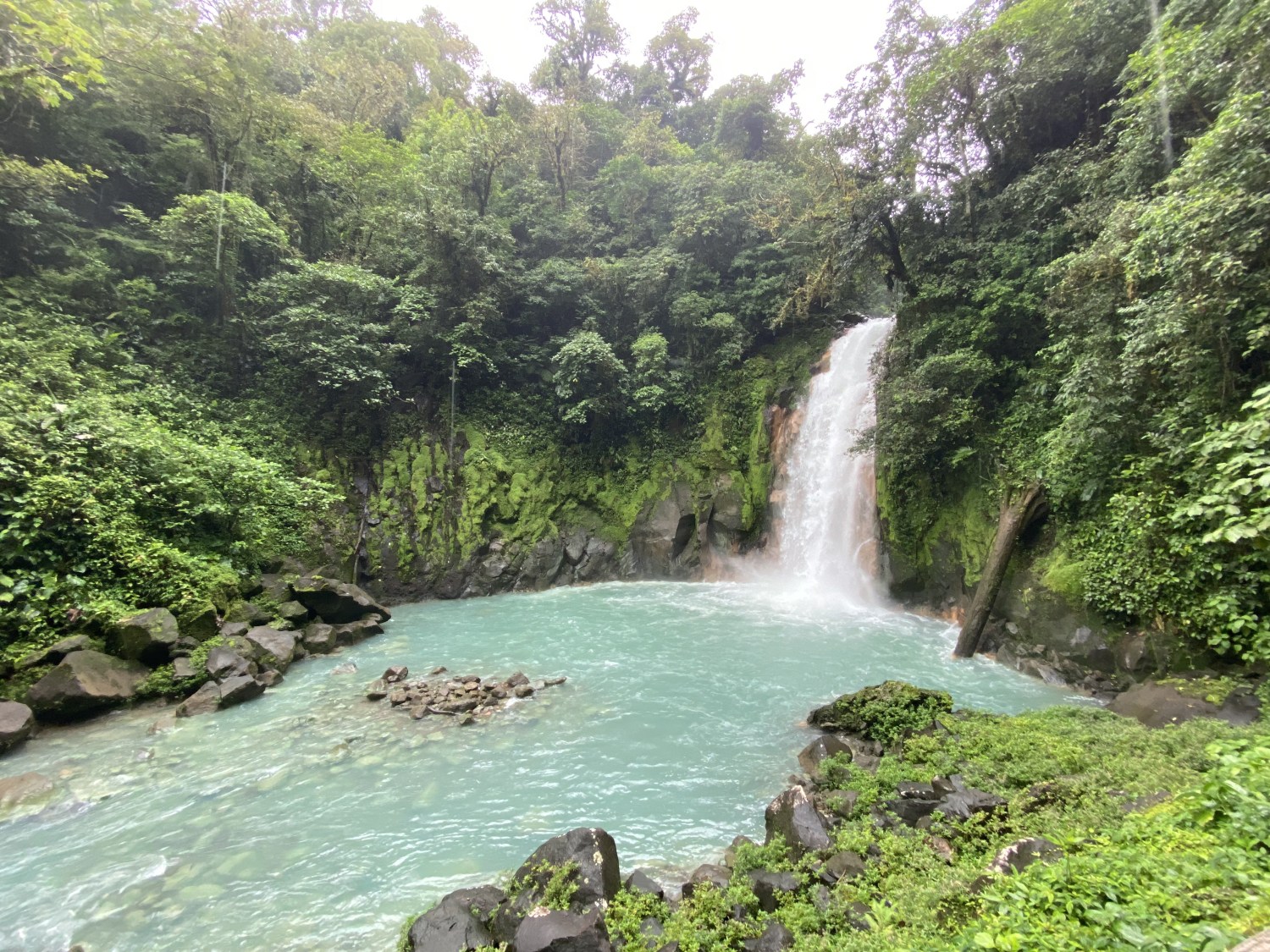
We walked 250 steps down to the 30-meter-tall Catarata Río Celeste, which spills out of the rainforest into an aquamarine pool. Swimming is not allowed in the park, so though the pool at the base of Catarata Río Celeste is enticing, it is off limits.
Catarata Río Celeste
me at Catarata Río Celeste
Catarata Río Celeste
We found a mountain mirador with a foggy view.
a mirador with a foggy view
On the trail, we also stopped at Laguna Azul (Blue Lagoon) and finally the bubbling jacuzzi-like Borbollones, or bubbling waters. Sadly the bridge to Los Teñideros was washed out, so we couldn’t see the celestial blue color of the river at that point.
Laguna Azul (Blue Lagoon)
Mike at Laguna Azul (Blue Lagoon)
me and Mike at Laguna Azul (Blue Lagoon)
on the way to Borbollones
on the path to Borbollones
Borbollones
Mike at Borbollones
lush tropical plants near Borbollones
Though it was rainy for the first half of the hike and the trail was gooey and muddy, the sky cleared as we made our way back, giving the forest a whole different feel. The rainforest was astoundingly lush.
Relevant mammals in the park are the tapir and cats like the jaguar and puma. Birds include umbrella bird species, the sunbird, the crested hawk and the crested eagle. We didn’t see any of these animals.
As we passed by the waterfall again, Mike went back down the 25o steps to see it with the sun shining on it. On the way up, he found a beautiful bird of paradise while I walked on by myself.
the sky starts to clear
bluer skies
bird of paradise (photo by Mike)
lush rainforest
blue skies!
After the hike, we stopped in Cami’s Shop: Minimarket and Souvenirs, where we bought more chocolate and I got a flowered Costa Rica baseball cap.
Cami’s Shop
Mural at Cami’s Shop
After leaving the park, we took a drive further into the mountains where we crossed a bridge over the Río Celeste and waved to the people swimming below.
a country drive
people in the Río Celeste
pretty murals
We finally backtracked toward the Celeste Mountain Lodge, midway between the park and Bijagua.
Celeste Mountain Lodge
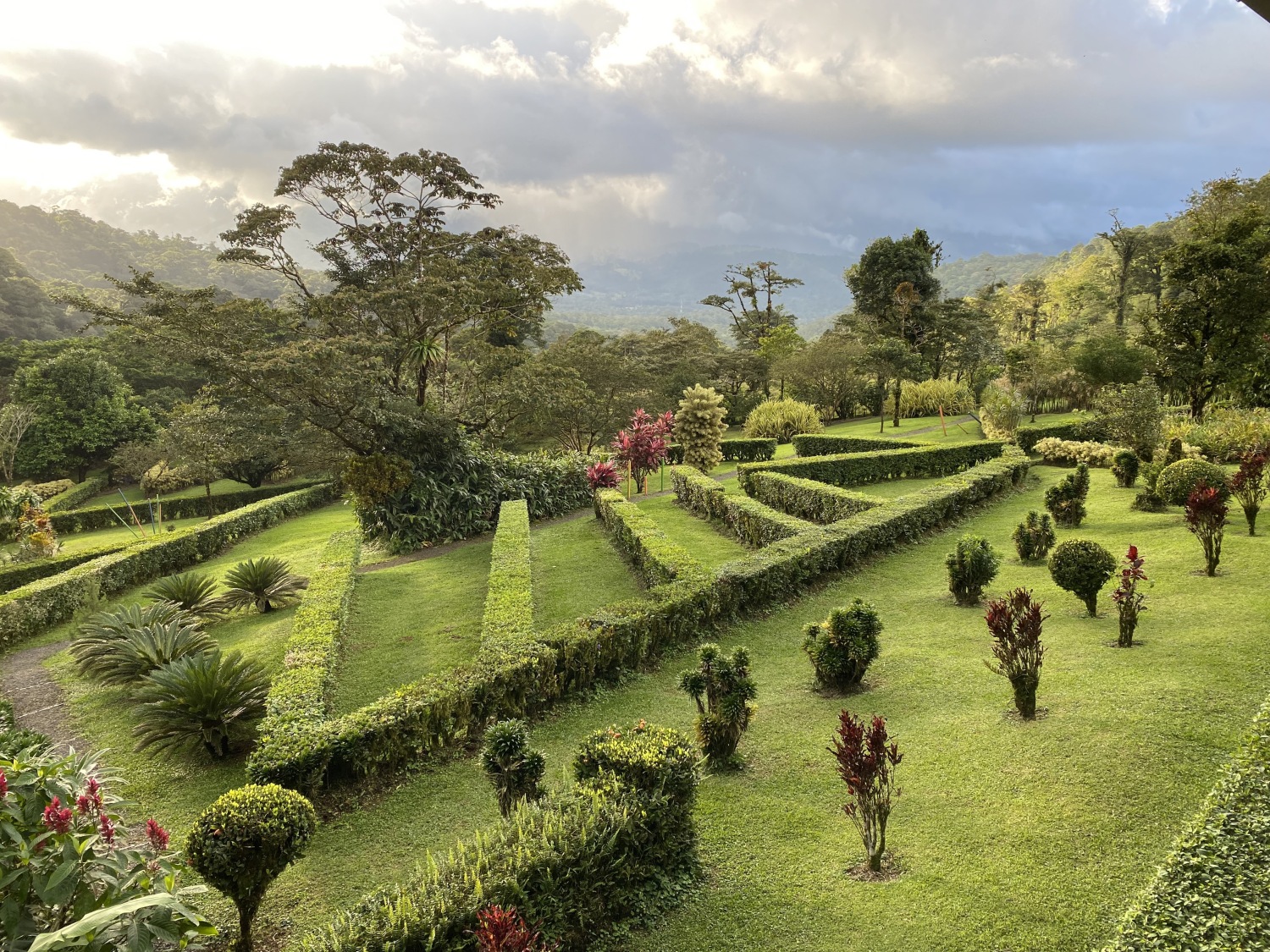
Celeste Mountain Lodge is a 2-story 18-room hotel with an incredible contemporary design; open air communal areas bring the outdoors in to make you feel like you’re right in the forest. Volcán Tenorio and Volcán Miravalles surround the pretty well-manicured property.
We loved the design, the ambiance, the professionalism, and the creativity of our hotel, Celeste Mountain Lodge near Parque Nacional Volcán Tenorio. It is owned by a French-Canadian man who has perfected all aspects of the place. The music was perfectly suited as was the decor, which seemed to revolve around an open-air concept, where guests feel the outdoors is enveloping them in a cozy cocoon. Painted corrugated iron was used to great effect in decor and light fixtures.
Celeste Mountain Lodge
We took a walk all around the grounds after we checked in to our room. The gardens at the hotel were sprawling and lush and the view of the grounds with the volcanoes in the background was breathtaking.
gardens at Celeste Mountain Lodge
We had drinks (I had a Caipirinha (Cactaja & lime)) on cushions stuffed with coconut fibers while serenaded by smooth jazz. We were treated to a stunning sunset while we talked with some Americans from Holland, Michigan and Connecticut. One couple had been to many of the same places I had been. The couple from Michigan, Tim and Nancy, had been a librarian and a teacher respectively in Mumbai, India and Tokyo, Japan. Tim had lived in Oman in the 1970s before Sultan Qaboos had overthrown his father and modernized the country.
The open kitchen was immaculate and the chefs were extremely talented and well-coordinated. We enjoyed a meal both delicious and artistically prepared.
I ordered lasagna served with little sausages and cauliflower. Before the main course, we’d had appetizers of ceviche and a giant pitcher of fresh fruit juice. Mike had a steak and we had cannelloni for dessert. We were serenaded by upbeat contemporary Spanish music including “Pīdeme” and “Bachata Cha” by Salsaloco de Cuba. I had learned how to use the app Shazam to identify the songs. 🙂
We loved our one-night stay at this place and wished we could have stayed longer. 🙂
Mike at dinner
the dining area at Celeste Mountain Lodge
ceviche
lasagna
me having dinner at Celeste Mountain Lodge
the open air kitchen at Celeste Mountain Lodge
Thursday, January 12: We had a fabulous breakfast at the hotel then I walked around taking a video of the outdoor spaces. We enjoyed beautiful views of the volcanoes as we left Bijagua and headed to Tilarán on our way to Monteverde. Tilarán is set atop the Cordillera de Tilarán (Tilarán Mountain Range).
views of the volcanoes as we leave Bijagua
views of the volcanoes
volcano views
Here’s a video of our short time at Parque Nacional Volcán Tenorio:
We drove past the roadside vendor who’d helped us find gas yesterday. One our third time past him, I yelled out one more time, “Pura Vida Mai!” He jumped up and gave us a happy thumbs up. It set us off on another round of laughter, a great note on which to part ways with our friend!
Monday, January 9, 2023: It was only about a half-hour drive from Liberia to get to Hotel Hacienda Guachipelin near the entrance to Parque Nactional Volcán Rincón de la Vieja. This park of 14,090 hectares has been divided into two sections: Las Pailas and Santa María. Las Pailas includes the active volcano Rincón de la Vieja, along with fumaroles, bubbling volcanic mud pots, and steam geysers as well as oft-used hiking trails and a large number of refreshing waterfalls.
Volcán Rincón de la Vieja, the huge 15km-wide volcano, dominates the park. Just shy of 2,000 meters tall, the dormant Santa María crater is the park’s largest peak. At least eight other craters hide in the volcano’s girth. Over 30 rivers flow on its slopes, which consist of premontane wet forest, dry forest and cloud forest.
Hotel Hacienda Guachipelin, a top Costa Rican ecotourism hotel, sprawls over 3,400 acres of farmland and is surrounded by exuberant gardens with native trees, exotic flowers, over 300 species of birds and wildlife, as well as views of the volcano and the Pacific Ocean. The sustainable ranch also offers 64 rooms for overnight guests, a spa, a vegetable garden, a greenhouse and a restaurant that serves food grown or raised on-site. The Hacienda staff also oversees the off-site Río Negro Hot Springs, ten small thermal water pools hidden in remote forest at the edge of the Río Negro. There’s also a mud bath where you can paint yourself with volcanic clay.
We stayed at the Hacienda for two nights. After settling into our room, we walked around the grounds, admiring the colorful papier mâché characters and oxcarts used as decor. Tropical exuberance was in full display.
Hotel Hacienda Guachipelin
papier mâché characters
seating areas at Hotel Hacienda Guachipelin
me with a bird mural
Costa Rica’s iconic oxcart
papier mâché character
tropical exuberance at Hotel Hacienda Guachipelin
grounds of Hotel Hacienda Guachipelin
We hiked to the turquoise pool, Poza Turqesa, and the red pool, Poza Roja, where Mike did a little skinny-dipping. 🙂
Poza Turqesa
Poza Turqesa
Poza Roja
Poza Roja
Poza Roja
Mike a-swimming
Poza Roja
We passed burial and domestic sites and petroglyphs. Mounds of rocks are burial places from the de Bagaces Period (300-800 AD), cemeteries located in small valleys close to the water. The people in these lands had a monotonous life. They hunted species such as wild boar, deer, and birds; they also fished. If a man had a pregnant woman it was better for him to stay with her; his hunting mates would share a portion of food with the couple.
They farmed their land in plots, letting some plots “rest” while they planted others. This was so the soil could recover its nutrients and future harvests would improve.
burial and domestic sites
Later in the afternoon, we enjoyed a 45-minute “magneisum deep tissue massage” at Simbiosis Spa. After our massage we were led to a sauna where we baked for 5 minutes. Then we dipped into an icy cold pool for a few seconds. Next, we slathered ourselves with warm volcanic mud, full of “healthy” minerals.
Finally, we sat in a warm pool for 10 minutes. When all was said and done, we were told not to shower for two hours to let the minerals be absorbed through our skin and into our bodies. It was a lovely and relaxing experience. And the masseuses and staff were very patient with our plodding Spanish!
Simbiosis Spa
massage space at Simbiosis Spa
Sauna at Simbiosis Spa
cold water bath at Simbiosis Spa
volcano mud to slather on ourselves
vat with cooling volcano mud
Mike and I slathered in volcano mud
on the way to the warm bath
the warm bath
We returned to Hotel Hacienda Guachipelin after our spa treatment to find a cacophony of squawking parrots in a tree right outside Recepción. They were having quite a fiesta up there in the hinterlands.
We sat around by the pool and enjoyed our complimentary welcome drink while we waited for the minerals to permeate our bodies for the requisite two hours.
We enjoyed a late dinner of grilled fish and a humongous hamburger in the Hacienda Guachipelin Restaurant, accompanied by a mojito (me) and a tequila shot (Mike).
tree of squawking parrots
the view from our room
poolside as the sun set
Mike and his huge burger
me with my fish dinner
The following day, Tuesday, we had booked a 1-day Adventure Pass.
Tuesday, January 10: Today we had the 1-Day Adventure Pass to the Rincon de la Vieja National Park. Four main activities were included:
A horseback riding Costa Rica Adventure;
A tubing adventure on the Río Negr0 (Black River) with Class III rapids;
Canopy (zip line) tour and rapelling through the Río Blanco Canyon
Relaxing with volcano-heated thermal waters, steam, and mud bath (we didn’t ever do this).
The package also included a buffet lunch at Hacienda Guachipelin Restaurant.
Before starting our day, we enjoyed a nice breakfast at the Hacienda restaurant.
walk to breakfast
our breakfast
We started our day at 8:30 a.m. by horseback riding through the dry tropical forest of the Hacienda property for about an hour. We had to wear our bathing suits and watershoes since we’d be going directly to the Río Negro for the tubing adventure.
The horses walked slowly and were kept in line by the sabaneros (cowboys). One little boy’s horse kept going off the track and had to be pushed back in line. My saddle wasn’t cinched tightly enough and kept rocking back and forth. When we got to the high point of the ride, one of the cowboys had me dismount and he tightened the saddle.
The ride was actually a bit boring.
Mike on his horse
me on my horse
Then we took a bus to the Río Negro where we got our life jackets and paddles and tubes and tubed down many Class III rapids, often being shot downriver at the whim of the water. Too many times to count, I somehow got stuck on rocks or eddies off to the side and was unable to make my way back into the current. Once I got stuck on a rock and the photographer was nearby. I asked him for help and he told me I needed to get out of the tube. I was worried I wouldn’t be able to get back in. Somehow I paddled my way back into the current on my own.
We were in the rapids or peacefully drifting downriver for 1 1/2 hours. It was rough! People were getting swamped and running into boulders and getting stuck and going down chutes like bumper cars, hitting each other and the boulders. Guys were positioned along the river to break up traffic jams. It was a wild and crazy time. Towards the end, many people were tossed into the river.
me tubing down the Roja Negra River
Mike tubing
We returned to our rooms and changed out of our bathing suits and into dry clothes and tennis shoes. Then we enjoyed a buffet lunch.
Next we had our zip line adventure through the Río Blanco Canyon. We had nine zip lines in all, with some of the platforms about 60 feet high above the river in a narrow canyon. It was scary coming in for a landing. Immediately upon landing, we had to grab the tight wire zip line and pull it down or jump up so the guys could hook up our carabiners, pulleys, trolleys, and lanyards to the wire.
prepared for our zip line adventure through the Rio Blanco Canyon
Mike zip lining
me ziplining
Mike goes down the chute
Mike rapelling
Mike ziplining
me ziplining
me ziplining
From one platform, we had to walk across a swinging bridge and climb up the canyon wall on metal rungs screwed into the wall onto what seemed the highest and smallest platform of all. There was no guy to meet us on that platform and at one point six of us were waiting on the tiny platform, perched 60 feet high above the river. Finally, the zip line guy rappelled down the canyon and crossed the canyon to hook us up for the 9th and final line. The whole time, I couldn’t bear to look down and I kept imagining that platform toppling to the river below, or me losing my balance and falling off (although I was tethered, I did NOT feel secure!). Because of the heights and the platforms and the jumping up, I was shaking the whole time. The only thing that didn’t scare me was the actual zipping! The photo of the group of people from Oklahoma standing on the last platform with me as we prepared to take off exemplifies my most terrifying moments. The height of terror!
Cathy on the platform of terror
Mike on the platform
When the zipline part of the adventure was over, we saw a man with two oxen hitched up to Costa Rica’s traditional oxcart. People were posing sitting on the ox but we passed up that opportunity.
With its brightly painted wooden wheels and matching ox yoke, “la Caretta” is the quintessential symbol of Costa Rica’s past. It played an important role in the country’s history since it made the export of coffee and other goods possible. The oxcart is considered one of Costa Rica’s national symbols.
the ox & oxcart
the ox & oxcart
We drove to Oropéndola Waterfall where we hiked down switchbacks and across a hanging stairway bridge to a swimming hole at the foot of the waterfall. Mike swam in the swimming hole with some other people who were already in the water when we arrived. It was a beautiful setting. I didn’t go in because we were planning to go to a stream and mud bath later.
driving to Oropéndola Waterfall
Oropéndola Waterfall
the rope stairway to Oropéndola Waterfall
Oropéndola Waterfall
the hike back from Oropéndola Waterfall
We then walked to a series of four cataracts along the Río Negro, which downstream would lead to some thermal springs and mud baths. However, it was starting to get late and since we’d already done the spa treatment and mud rubdown, we skipped it and returned to the hotel to have a drink by the pool before dinner. (Actually I was quite annoyed with Mike as he was the one pushing to see all the waterfalls, which didn’t give us enough time to enjoy the thermal pools).
walking to cataracts along the Río Negro
Cataract #1 along the Río Negro
Cataract #2 along the Río Negro
Cataract #3 along the Río Negro
Cataract #4 along the Río Negro
We ended our last night at Hotel Hacienda Guachipelin sitting with a drink by the fire pits and chatting with a couple, Mike and Linda, who lived winters in Arizona and summers in Oregon.
Relaxing by the fire pits
relaxing outdoors
Mike and his famous drink
me at the firepit
We enjoyed our last dinner in the Hacienda Guachipelin Restaurant. Under “sopas” on the menu was a dish called “Gallo de Chorizo.” Mike asked if it was indeed a soup and they said yes although the description didn’t sound like a soup: “a classic tico, served with pico de gallo sauce on soft corn tortillas.” When the waiter brought the dish, Mike had gone to the bathroom and I argued with the waiter that the dish was not in fact a soup, which Mike wanted. The manager came over. Finally they offered Mike another soup that wasn’t on the menu. He enjoyed that.
I don’t remember what I ordered but neither of us were very hungry so we didn’t want a lot of food.
We relaxed in our room after our big adventure day.
Here is a video of our time at Hotel Hacienda Guachipelin.
Wednesday, January 11: As we drove out of Hacienda Guachipelin on Wednesday morning, we had one last view of Rincón de la Vieja as we made our way to Parque Nacional Volcán Tenorio.
Saturday, January 7, 2023: After a delicious breakfast at our hotel, we left San Juan del Sur and headed to the Costa Rican border at Peñas Blancas.
Crossing the border was no fun at all. A Saturday and the holidays made for a very long and slow-moving line. We had to turn in our rental car at Alamo in Nicaragua and then lugged all our belongings quite a distance to the Alamo office going into Costa Rica. Alamo Jack directed us to the long line of people and guessed it could be an hour and half to get through. Alex and I got into line to hold our place while Mike signed all the paperwork with Alamo Jack. We only moved a few yards in about 20 minutes.
Crossing the border from Nicaragua to Costa Rica at Peñas Blancas
Luckily when Alamo Jack found out that we were in our 60s (I’d have thought it would be obvious!), he pulled us out of the line and drove us to the front of the line because “Costa Rica is nice to people in their 60s!” Because Alex wasn’t in his 60s, yet he was part of our family group, he was allowed to go through with us. What started as a seeming nightmare turned into a rather decent experience.
Entering Costa Rica
We drove on modern highways with hardly any traffic until we got to Liberia. Alex commented right away that he thought Costa Rica was too much like America. Between the familiar fast food restaurants and other American-styled businesses, he wasn’t impressed. I felt like we’d crossed into a more upscale and organized world than what we found in Nicaragua. But Alex was right: I wasn’t crazy about the American influences.
Between Liberia and Playa Hermosa, we stopped for lunch at an open air restaurant, La Choza de Laurel, which obviously catered to tourists. The food was rather blah, but we were happy to eat it after the stressful border crossing.
Playa Hermosa
We checked into Hotel Velero in Playa Hermosa. Once again, this was a place recommended by Mike’s friend Carol and her husband Carlos in Costa Rica. They didn’t steer us wrong. We promptly changed into bathing suits and spent the afternoon relaxing at the beach and the poolside. After a while, Alex and I ordered mojitos from the bar while we sat poolside. I read some of Monkeys Are Made of Chocolate: Exotic and Unseen Costa Rica by Jack Ewing, which is about Costa Rican wildlife, ecotourism, ecological preservation, and wildlife corridors in the country.
Hotel Velero in Playa Hermosa
Playa Hermosa
Hotel Velero in Playa Hermosa
Monkeys are Made of Chocolate
Hotel Velero in Playa Hermosa
Alex in Hotel Velero
Hotel Velero in Playa Hermosa
At sunset, we took a walk down the beach and then walked uphill to Ginger Restaurant Bar, which serves Asian-inspired tapas in a tree house setting. I was sweating after the walk uphill and, irritatingly, never stopped sweating through the entire meal. 😦
The food was delicious and the atmosphere charming. We enjoyed a rather expensive meal:
Thai Green Curry Chicken in Crispy Wontons: filled with creamy Thai green curry chicken with coconut milk.
After our delectable meal, we made our way downhill to Hotel Velero, where we relaxed and psyched ourselves up for our morning ziplining adventure at Diamante Eco Adventure Park.
Diamante Eco Adventure Park
Sunday, January 8: We enjoyed a lovely beach-side breakfast at El Velero, then took off for our drive to Diamante Eco Adventure Park, located in Guanacaste. We had a ziplining tour arranged there. It was the first time I’d ever done ziplining, and though it was terrifying, it was also thrilling. It took a while for the operators to hook us up with the necessary gear.
Alex, me and Mike all geared up for ziplining
We took four separate ziplines. The first one wasn’t too scary. The other upright ziplines were not too scary at all either, except when we came screeching to a halt at each platform.
Alex ziplining
Mike and me ziplining
On the second zipline we returned back across to a lower point with views of the ocean behind us.
Alex ziplining
Alex ziplining
Mike ziplining
me ziplining
me ziplining
Diamante’s oceanfront location offers the longest dual line in the country. It features a nearly a mile long line (1,360 meters (4,461 feet) long), Superman-style, with great ocean views. It is 80 stories high at its peak and it reaches a maximum speed of 60mph. Diamante uses state-of-the-art carbon lines and an automatic braking system so guests never have to touch the lines.
A van drove us up and up a series of switchbacks to the top of a mountain, the highest point in the park, to do the “Superman,” the aforementioned super high, long and fast zipline, on which you lie flat, belly-down and go headfirst like a torpedo, and nearly as fast as one. I didn’t stop screaming until I was over halfway to the finish!
Alex prepares for the Superman
Alex and Debbie on the Superman zipline
Mike and I take off on the Superman zipline
Mike and me on the Superman zipline
We obviously couldn’t take our cameras or phones, so we had to purchase the photos from Diamante. I took a short video of someone else doing one of the ziplines because we couldn’t film ourselves. You can see more of our ziplining in the video below.
Later in the day, we got by email the photos of the Aerial Adventure. My face at the start of the Superman zipline shows I was pretty unsure about what I was about to do. I was not relaxed, not at all!
At the end of our four ziplines, we also did a Quick Jump: a freefall down a 30-foot tower somewhat like a bungee jump but a lot less scary. You can see that in the video below.
We perused the fabulous gift shop at Diamante where we bought tee shirts, hats, stickers and various other souvenirs, including chocolate bars. In the outdoor dining area, we enjoyed cold drinks; Alex had an Imperial beer, while Mike and I had fruit juices.
Alex looks over the Diamante landscape
the view from Diamante
Alex enjoys an Imperial
Back to Playa Hermosa
We drove back to the hotel along the curvy coastal roads. In town, we stopped at Ginger to take pictures of the tree house restaurant and we found a large lizard (maybe a gecko?) in the parking lot. He makes an appearance in the video below.
Ginger Restaurant during the day
Back at the hotel, we put on bathing suits and walked from one end of Playa Hermosa to the other. It was such a beautiful beach with boats bobbing in the harbor, palm trees fringing the sand, and rocky promontories at either end.
Playa Hermosa
breezy palms at Playa Hermosa
me at Playa Hermosa
Mike at Playa Hermosa
Playa Hermosa
Playa Hermosa
Playa Hermosa
Playa Hermosa
Playa Hermosa
Playa Hermosa
Playa Hermosa
Playa Hermosa
Playa Hermosa
Playa Hermosa
Playa Hermosa
Playa Hermosa
Playa Hermosa
Playa Hermosa
We went out to dinner at Bocelli Ristorante Pizzeria. A poster of Charlie Chaplin in Le Dictateur watched over us. We shared a delicious pizza with some blackened thing on it, but I don’t remember what it was.
Bocelli Ristorante Pizzeria
our pizza
In the evening, there was a saxophonist playing Stevie Wonder by the pool: “You can feel it all over…🎶” Mike made his famous whiskey and Ginger Ale and we sat on the balcony and listened to the music.
poolside music at Hotel Velero
Monday, January 9: Mike and I got up early and took a walk on the beach and then met Alex, where we enjoyed French toast at a beach-side table for breakfast. We checked out of the hotel and took Alex to the airport in Liberia, from which he would fly home. We saw him off through security, but not before we stood in line a while to pay the Exit Tax. When we got to the front of the line and Alex handed over his passport, the woman said, “You’re American? You don’t need to pay an Exit Tax.” I wish some signs had told us that before we wasted time standing in that infernal line.
early morning walk at Playa Hermosa
French toast for breakfast at Hotel Velero
Here is a video which shows more of the action during our ziplining adventure.
After leaving Alex, we headed through Liberia where we drove around awhile looking in vain for the giant bull, El Toro, that I’d read about. We never found the bull, so we finally headed out of town to our next destination, Hotel Hacienda Guachipelin near Parque Nacional Volcán Rincón de la Vieja.
Friday, January 6: It was with a heavy heart that we parted ways with Adam in San Jorge so he could make his way back to Ometepe and we could drive on to San Juan del Sur and then on to Costa Rica on Saturday. Originally, we had planned for Adam to spend one more night with us in San Juan del Sur, but he was anxious to get back to his home and his little dog, Biggy Smalls.
We felt diminished by his absence but thankful to have had time with him. It was fascinating to see the life he has chosen and to be part of it, if only briefly. We were sad and lackadaisical all afternoon and evening.
The drive from Rivas to San Juan del Sur was quite easy and straightforward, and Mike refrained from passing other cars or doing anything which might cause his license to be confiscated. We settled in to HC Liri Hotel. It was the 2nd least favorite accommodation we stayed in, with Hotel La Posada del Doctor in León being the worst.
San Juan del Sur is on the Pacific Ocean in Southwest Nicaragua. It sits beside a crescent-shaped bay and was a popular layover spot for gold prospectors headed to California in the 1850s. This portion of the Pacific has been the focus of many historic Nicaragua Canal proposals because of its location on the narrow isthmus of Rivas between the Pacific and Lake Nicaragua. In the end, the Panama Canal won out; it was built from 1903-1914.
The city is a vacation spot for tourists, a home to many expats from the U.S., Canada and Europe, and a hot spot for international surfing competitions. Families who live here work in fishing, tourism or the food and beverage industry. Adam wanted me to see it in case I might like it and agree to move there one day. It seemed too bedraggled to me; it’s a place I wouldn’t consider living. Besides, the political situation in the country is untenable, although it might be an option if Trump gets elected again.
The Mirador del Cristo de la Misericordia (Christ of the Mercy) sits on one of the highest points on the northern edge of the bay. It is one of the tallest Jesus statues in the world. We could see it from the beach but we didn’t really have time to go up and see the view from there.
Alex, Mike and I walked along the beach to El Timon, which was recommended by some friends of Mike’s who have made a home in Costa Rica. We planned to visit those friends, Carlos and Carol, at their farm near Tilarán on our way to Monteverde. El Timon is one of the largest and oldest restaurants in San Juan del Sur, a kind of beach shack by the bay. We enjoyed the laid-back vibes of the place while eating nachos.
walking along the beach to El Timon
El Timon
El Timon decked out for New Year’s
El Timon
nachos for lunch
We walked back to our hotel after lunch and relaxed on the rather shabby grounds. Mike made us drinks and we sat by the pool and admired the gorgeous sunset.
Ox cart in San Juan del Sur
mural on business in San Juan del Sur
beach at San Juan del Sur
view from HC Liri Hotel in San Juan del Sur
Mike and Alex enjoy the pool
sunset views from the hotel
views from the hotel
sunset views from the hotel
inside HC Liri Hotel
For some ridiculous reason, we took a taxi back to El Timon for dinner. The taxi driver took us on a rather long detour and I felt like we might be kidnapping victims — until he stopped to pick up his wife to take her out to dinner. 🙂
We managed to enjoy our dinner despite feeling down in the dumps. We hoped our time in Costa Rica would be good, but it would be hard since we still missed our family time with Adam. Alex would be with us for only 3 more nights, then he’d be on his way home to start what was supposed to be his first semester at George Mason University. By the time we returned home, it turned out he had decided to take a full course load at Northern Virginia Community College instead, to get another Associates Degree. Mike and I would be on our own for 7 more nights after Alex left.
Nicaragua was a challenge because of its primitive conditions, but it was eye-opening and educational. We found some gorgeous natural spots in the country, and we were thankful that Adam directed us to the best spots.
For dinner, I had grilled octopus but found some of it rather chewy. It was accompanied by fried plantains.
El Timon at dinner
octopus at El Timon
We decided to walk back on the beach after dinner, and then we prepared ourselves for the border crossing into Costa Rica on Saturday morning.
Wednesday, January 4, 2023: We packed up early in Granada and left the Airbnb by 7 a.m., driving 1 1/2 hours to San Jorge, Rivas. There, we caught the 9:00 ferry (about 1 hour on the very rough seas of Lake Nicaragua) to Moyogalpa, the main gateway to Ometepe. Located on the west side of Volcán Concepción, it is the largest village and commercial center on Isla Ometepe.
the ferry to Ometepe
Adam, Alex and Mike on the ferry
ropes in the ferry to Ometepe
view of Ometepe from the ferry
We stopped to take a picture on the airport runway (it’s the only air strip on the island and is rarely used), and then went directly to Punta Jesús María, a narrow spit of land formed by water currents and sediments. In some years, during the dry season, the sand bank juts into the lake for more than 1 km and you can walk to the tip with water splashing in from both sides.
From the land spit, you can have a panoramic view of Isla Ometepe with its two volcanoes. The third volcano, which can be seen across the lake on the mainland of Nicaragua, is Mombacho, which we saw when we were in Granada.
Sadly today we weren’t lucky enough to get out on the sandbar because the lake level, still high from the rainy season, had totally submerged it.
On the long dirt road there, as we drove behind a red truck stuffed with a family of Nicaraguans standing in the back, Adam turned on the music he used to make a video he’d sent us, “Vido de Rico” (Rich Life), a song by Camilo, and played it as we videotaped the drive. Sadly, I can’t include the song on the video as I don’t have the copyright, so I used another Spanish song.
Punta Jesus Maria
Punta Jesus Maria
Punta Jesus Maria
Mike at Punta Jesus Maria
me at Punta Jesus Maria
Punta Jesus Maria
Mike and me at Punta Jesus Maria
We stopped at the Emerald Rainbow Caravan Hostel where Adam worked and lived for a while. The hostel has numerous vehicles that have been painted and converted to guest rooms with Turkish decor. We met some of Adam’s friends, but we talked mostly to Bob from Pennsylvania; he owns a house near the hostel. We sat and visited with him for a bit. He was very thankful that Adam had stayed with him while he had appendix surgery, which he said almost killed him. We could easily see how much people around these parts love Adam.
Emerald Rainbow Caravan Hostel
Bob, Adam’s friend from Pennsylvania
a turkey at Emerald Rainbow Caravan Hostel
Emerald Rainbow Caravan Hostel
Beware of Falling Coconuts
Emerald Rainbow Caravan Hostel
We made another stop to meet Manja, a German woman who married a Nicaraguan man, Horacio, and has two children; the girl is Elouisa but I didn’t catch the boy’s name. Manja has lived on Ometepe for 12 years. She runs a school where Adam volunteers by teaching math to the children. She has been a good friend to Adam. She happened upon Ometepe while volunteering for a women’s organization when she was young and didn’t know yet what to do with her life.
Manja’s backyard
Manja’s kids
We ate lunch at Cafe Campestre, where the food was delicious (but service was very slow). Adam played poker here every Saturday night with a group of ex-pat men. Adam and I ordered Red Snapper Ceviche (very spicy!). Alex enjoyed Red Beef Massaman: a fragrant, mildly spiced tender local beef curry with coconut milk, kaffir lime, potatoes, tamarind, and peanuts. Mike had Pumpkin and Chickpea Curry: pumpkins sauteed in coconut milk with chickpeas, fresh turmeric, lemongrass, galangal, lime and red chilies.
We chatted with the British owner Ben who has been on the island for about 20 years; he has a love of Indian food and is passionate about cooking with spices from around the world.
Manja and Elouisa joined us at the table for most of our lunch. Elouisa teased Adam a lot and kept tossing chili sauce, pepper and salt into his beer. He has a great rapport with children.
Elouisa & Adam at Cafe Campestre
Cafe Campestre
We had helped Adam buy a house on Ometepe as he loves the simple life here and has forged a great community of ex-pats, Christians at the church he attends, and Nicaraguans. He works on various farming projects with rice and plantains, and although nothing has worked out yet, he believes he’s learning from his challenges and failures.
After lunch, we went to Adam’s bright green Nica-style house which needs a lot of work (new roof, new plumbing, indoor kitchen, on and on…). It was a big mess and a lot of junk was piled everywhere. He does have a stovetop, freezer, a nice cupboard with screen panels, and wooden rocking chairs made by a carpenter friend. He also has three bicycles, a massage table, an outdoor shower, an inside toilet, and a motorbike. He laid bricks to create a walkway to the shower and back porch. Adam loves Manja’s Nica-house and there is definitely potential in his, but it needs a LOT of work!
We met his little dog, Biggy Smalls (a female), who he was very happy to see since he’d been traveling with us. Some of his neighbors had looked after her while he was gone.
Adam’s house is in Balgùe near Santa Cruz and on the Volcán Maderas side of Ometepe. Balgùe has a laid-back backpacker vibe and new accommodations and restaurants keep popping up.
Alex, Adam, Biggy and another dog at Adam’s house on Ometepe
Plantains growing in Adam’s yard
Adam’s gardens
Adam’s house on Ometepe
Ometepe’s main road runs in a rough barbell shape, circling each of the two volcanoes and running along the northern shore of the isthmus between them. The Concepción side of the island is more developed, and the major towns of Moyogalpa and Altagracia are connected by paved road.
Alex was feeling very grumpy and down on himself, feeling like he always falls short compared to his brother. He sees that Adam is very sociable and fits in easily everywhere. Alex doesn’t believe he has it in him to be sociable and easygoing with people. Of course, I think he sells himself short as I find him very personable, smart, hard-working and capable.
We stayed at El Encanto Garden Hotel, managed by Adam’s friends Josh and Carolina. From the outdoor dining area of the hotel, we enjoyed watching hummingbirds and seeing the view of Volcán Concepción.
view of Volcán Concepción from El Encanto Garden Hotel
We ate a delicious dinner at Pizzeria Mediterránea where, once again, Adam ran into a number of friends. His community here seems expansive and inclusive.
One of his friends was Emre from Turkey. Emre was setting up tables in front of the restaurant, selling bracelets and other jewelry. He said he loved Ataturk, but despises Erdogan. I bought a bracelet from him in solidarity. 🙂
Pizzeria Mediterránea
Adam, me and Alex at Pizzeria Mediterránea
Pizzeria Mediterránea
Thursday, January 5: In the morning, Mike and the boys went on a walk uphill from Adam’s house, while I enjoyed a relaxing morning writing in my journal. I showered and relaxed on the porch, enjoying the breeze and lush tropical surroundings at El Encanto Garden Hotel.
El Encanto Garden Hotel
We went to Al Ojo de Agua in the afternoon. Al Ojo de Agua is in the community of Santo Domingo on Ometepe. The water from this natural pool comes directly from Volcán Concepción. Because it is volcanic water, it is rich in potassium, magnesium, calcium, sulfur and sodium.
Another source I read said the crystal clear water was from an underground river that came from Volcán Maderas, Ometepe’s other volcano. The swimming hole is rimmed with cement to form two separate swimming areas where the water gets renewed constantly by the spring that emerges from the bottom of the upper pool.
The lower pool is almost 2 meters deep and 4o meters long. On the edge around the pools can you doze in wooden sun chairs or sit at plastic tables and order food from the restaurant or eat food that you bring yourself.
We ordered a lunch of quesadillas and tacos and fruit juices. At the far end was a platform with a rope swing where you could swing out and jump into the deep water. The boys and Mike had fun doing that while I watched over our belongings.
After a while, Alex and Adam brought us some Coco Locos, rum and coconut drinks. I brought out my selfie stick which I had never used before. We were all laughing hysterically at my utter incompetence at using the selfie stick. I was drinking out of a straw and trying to use the selfie stick and laughing when I suddenly choked and spit out the drink all over the ground. I couldn’t breathe and I thought, this is it! I’m done for! The guys tried to calm me down and I was finally able to breathe with some difficulty.
It was hilarious while at the same time utterly terrifying. Finally, after I calmed down, I decided to give the rope swing a try. I swam to the far end of the pool and thought I saw some steps in the concrete wall so I could climb out. Suddenly, I found myself being sucked into the drainage system for the pool. It took a mighty effort to pull myself free.
I finally climbed up on the platform, put myself in a Zen state of mind, and, without hesitation, jumped out over the water on the rope swing. I felt like I was a thousand pounds of dead weight and plopped heavily into the water.
Adam said he worried about me, especially after almost choking and then almost getting sucked into the drainage pipe. But I survived the rope jump without incident. I didn’t choose to do it twice!
Al Ojo de Agua
Al Ojo de Agua
Al Ojo de Agua
Al Ojo de Agua
Al Ojo de Agua
Al Ojo de Agua
Al Ojo de Agua
Al Ojo de Agua
Al Ojo de Agua
the selfie stick debacle at Al Ojo de Agua
This is the moment I choked!
Adam at Al Ojo de Agua
Mike and me at Al Ojo de Agua
Coco Locos
me swimming at Al Ojo de Agua
When we returned to El Encanto, I took a shower and relaxed some more while Alex and Adam went for a ride on Adam’s motorbike (with Alex driving).
At 4:00 in the afternoon, we rented kayaks from Adam’s friend Hector near Playa Caiman. We took the kayaks down the Rio Istian where the birds and wildlife became increasingly active as it neared sunset. We heard lots of birds in the trees and saw an egret up close; he took off in flight as we approached. We skirted the mangroves and enjoyed the silence. It was a beautiful and peaceful excursion that we all enjoyed immensely, a great way to spend our final afternoon in Ometepe.
Volcanoes of Ometepe
Playa Caiman
Playa Caiman
kayaking at Playa Caiman
Adam kayaking at Playa Caiman 2023
Alex kayaking at Playa Caiman
kayaking at Playa Caiman
an egret
cloud formations
sunset at Playa Caiman
Adam at sunset at Playa Caiman 2023
sunset at Playa Caiman
one volcano as seen from Playa Caiman
sunset at Playa Caiman
landing after our kayak trip
We enjoyed a lovely dinner in the thatched roof restaurant at Hotel Los Cocos. We listened to the song “Ola Adiós” by Vacación at the restaurant.
dinner at Hotel Los Cocos
Later, we sat out on the patio of El Encanto and talked with the managers of the hotel, Josh and Carolina, and two Dutch travelers who planned to head to Mexico for the first time on Monday. It was a fun and fascinating conversation about travel and life in Ometepe.
Friday, January 6: After another delicious breakfast at El Encanto, we packed up and drove an hour, arriving in Moyogalpa by 10 a.m. to catch the 11:30 ferry back to the mainland. We had a lot of time to kill so we walked around to get a feel for life in the island port town.
We stopped at The Corner Store for some fruit juices and cold coffee drinks. We were so happy to have Adam with us to help figure out the ferry!
Moyogalpa, on the west side of Volcán Concepción, is home to the ferry terminal for hourly boats from the mainland. It’s the nerve center for Ometepe’s fledgling tourist industry.
We wandered uphill on the main drag to have a look at the pretty Iglesia Moyogalpa and admired the nativity scenes and Christmas decorations.
breakfast at El Encanto
leaving El Encanto via dirt road
Moyogalpa
Moyogalpa
Moyogalpa
Moyogalpa
Moyogalpa
nativity scene leading to Iglesia de Moyogalpa
Iglesia de Moyogalpa
inside Iglesia de Moyogalpa
Moyogalpa
Moyogalpa
Moyogalpa
Moyogalpa
map of Ometepe in Moyogalpa
We took the hour-long ferry across to the mainland. It was the same small ferry we’d used to cross over just two days earlier.
Leaving Ometepe and its two volcanoes
After we got to the mainland, we drove Adam to a hardware store to look for a lockbox for his house, but he couldn’t find one. We drove him quickly back to the port so he could catch the 1:30 ferry. Mike passed a car so we could make it on time. We got stopped at a checkpoint by the police not far from where we passed the car. The policeman wanted to confiscate Mike’s driver’s license until Monday, which would have held us up in Nicaragua for three more days; we were due to leave the country on Saturday morning. Thanks to Adam’s knowledge of life in the country and his excellent Spanish-speaking abilities, we were able to avoid the penalty by handing over a 500-cordoba note (~$14).
Adam had told Mike as we left the airport in Managua the first day to never open his wallet in front of the police if we were ever stopped. Instead, he advised him to keep a 500-cordoba note in the glove compartment or between the two front seats to hand the police if we ever got stopped. Since the policeman seemed determined to keep the license despite Adam telling him we were leaving the country the next day, Mike pulled out the reserved note, folded it into his hand, and slipped it to the policeman. He took it quietly and waved us through.
Adam still missed the ferry but it was okay because he met a friend of his and they had a nice chat on the way back to the island.
Here is a video of our time on Isla Ometepe.
We said our goodbyes to Adam, and headed next to San Juan del Sur, where we would spend the night before crossing the border to Costa Rica.
Sunday, January 1: After visiting the Mirador de Catarina on our way from León (nicaragua’s laguna de apoyo & a wasted trip to volcán masaya), we drove onward to Granada and met Erick to let us into our fabulous Airbnb apartment. It was an old colonial home with an open-air plan. There was only a gate locking in our car with about 5 locks on it. It had no real front door or windows, but was open in many spots to the sky. The kitchen was nice, and it had a comfortable living area, a swimming pool, two large bedrooms and 2 1/2 baths.
By far, it was the best placed we stayed in Nicaragua. Every other place had been too cramped for the four of us, but this place had plenty of space to spread out.
Our Granada Airbnb
Our Granada Airbnb
Our Granada Airbnb
artwork in our Granada Airbnb
pictures in our Airbnb bathroom
Our Granada Airbnb
After settling in, we all four walked a couple of blocks to Pan de Vida, where we ordered two pizzas, one vegetarian and one with meat. Mike asked a couple at a long picnic table if we could join them; it was a kind of communal dining place, it seemed. Adam was stressed out by us intruding on the couple and said he felt he was going to be sick any minute, so Alex ran back with him to the apartment. Alex returned to the apartment to join us after dropping Adam at the apartment. With all the locks, and only one set of keys, it was very difficult for one of us to leave without the others.
The restaurant had an open-air courtyard. I enjoyed watching the people with a glass of vino blanco. Mike and Alex had passionfruit juice.
Pan de Vida
Pan de Vida
Adam seemed to be better when we returned to the apartment. Alex said Adam was just stressed out and felt bad from drinking water from the faucet in Granada.
Steps: 4,347; Miles 1.84.
Monday, January 2, 2023: This morning we took a stroll around the historical center of the Granada Department. With an estimated population of 104,980 in 2021, it is Nicaragua’s 9th most populous city. Granada is one of the country’s most important cities, both historically and politically. It has a rich colonial heritage as seen in its architecture and layout.
The city is also known as La Gran Sultana, reflecting its Moorish and Andalusian appearance, unlike its sister city and historical rival León, which displays its Castilian heritage.
Granada was founded in 1524 by Francisco Fernandez de Córdoba, making it one of the oldest cities in the New World. Because it sits on Lago de Nicaragua (Lake Nicaragua), which is navigable to the sea via the Rió San Juan, it was a trade center from its inception. The city became wealthy, but vulnerable. Pirates sacked the city three times between 1665-1670.
After independence from Spain, Granada challenged the colonial capital León for leadership of the new nation. Because of the challenges, León enlisted the services of mercenary William Walker and his band of “filibusterers.” Walker sacked Granada, declared himself president, and launched a conquest of Central America. After a number of embarrassing defeats, he fell into retreat, setting Granada on fire and leaving a sign in the ashes: “Here was Granada.” The city rebuilt and, though its power has waned, it has become an important tourist center.
In our wanderings, we saw the Cathedral, but would have to return another day when it was open. We walked around the interior of another church, Iglesia Merced, and tried to climb the tower, but it closed for siesta just as we got there.
We dipped into various hotels and cafés to see the lush interior courtyards. Colorful mosaics decorated the pedestrian streets. We enjoyed some fresh fruit juices on a shaded porch: pineapple, melon, papaya and watermelon. It was a relief to sit in the shade to escape Granada’s intense heat.
We wandered through a small market in the main square, Parque Central, which sold tee shirts and other souvenirs. We found colorful paintings, and were surprised by the paintings of young men and women sitting on toilets, which seemed to be everywhere.
A white obelisk at Plaza de la Independencia said: “A Las Glorias de 1821. Honor a los Heroes 1811.” It is dedicated to the heroes of the 1821 struggle for independence.
Capilla del Sagrado Corazón
Calle le Calzada
Egyptian relief
inside a bar and courtyard
Calle le Calzada
Calle le Calzada
hotel along Calle le Calzada
inside the hotel
all decked out for Christmas
hotel courtyard
Calle le Calzada
Calle le Calzada
Calle le Calzada
Catedral de Granada
Catedral de Granada
hotel in Granada
market at Parque Central
Catedral de Granada
obelisk at Plaza de la Independencia
fruit juices
Granada streets
Iglesia La Merced
interior of Iglesia La Merced
Granada’s colorful buildings
me in Granada
me in Granada
Choco Museo
We enjoyed a great mini tour at a chocolate museum: Choco Museo. After teaching us everything about the process of chocolate-making, our guide had us do a little jig while we crushed coffee beans. We chanted: “Baté, baté, chocolate” (mix, mix, mix the chocolate), while scissoring our knees back and forth. We must be the most spastic, uncoordinated family in the world! It was so silly, and so much fun. 🙂
According to a dial, when chocolate was used for trading, as a type of currency, it cost 1,000 beans for a woman (mujer). A rabbit was 30 beans and a slave was 500.
The Mayas were the first to discover the delicious secrets of cacao around 2000 B.C. They cultivated trees in their own gardens for daily consumption. Everyone, regardless of status, could enjoy a chocolate drink. They invented the preparation.
We learned a lot about cacao:
The cacao tree grows in warm and humid tropical regions of the world. Its fruits, cacao pods, grow directly from its trunk.
Cacao leaves are very large. On the jungle floor, they keep the tree moist, key to its health, and feed it with essential nutrients.
The cacao flower is beautiful, attracting midges to pollinate it. It takes 3 months for a flower to turn into a ripe cacao pod.
The cacao pod is the fruit of the cacao tree. It is shaped like a football and its color may vary from yellow to red or green. Each pod contains an average of 40 beans.
The cacao bean is the seed of the cacao pod. Each cacao bean has a thin shell. The inside part, called “nibs” is the raw material of chocolate making.
We also learned about the process of making chocolate:
The harvest: When ripe, cacao pods are cut from the tree and kept together on the floor. Each pod is cut in half by machete, making sure not to cut any beans inside. The sweet white pulp and cacao beans inside the pod are separated in a plastic bag for the fermentation process. The shell of the pod is full of fiber but is usually used as fertilizer.
Fermentation lasts about six days. The white pulp and cacao beans are placed in wooden boxes and covered with banana leaves and jute bags to conserve rising temperatures (up to 50°C). The beans turn from purple to brown and the flavor of cacao develops in the seed.
The drying process takes generally five days, followed by a quality control process of cacao beans, using a guillotine.
Some interesting figures about chocolate:
One hectare of land > 1,000 cacao trees > 40,000 cacao pods > 1,000 kg of cacao > 10,000 chocolate bars
We had fun learning about the chocolate-making process and participating in the little jig. Of course we also had to buy some products, including some cacao lotion for me and chocolate bars for all of us.
Choco Museum
Choco Museum 2023
Choco Museum
Choco Museum
cacao pod at the Choco Museum
Choco Museum
Choco Museum
Choco Museum
Choco Museum
our guide at the Choco Museum
Choco Museum
Choco Museum
Choco Museum
Choco Museum
On our way back to our Airbnb, we popped into the Garden Cafe and determined we’d go there on Tuesday. After getting plenty hot walking around, we enjoyed lounging and swimming in the pool at our Airbnb.
walking back to the Airbnb
peeking inside the Garden Cafe
Garden Cafe
streets of Granada
Danny’s Isletas Boat Tour
In the afternoon, we went on Danny’s Isletas Boat Tour. On the tour, with Victor as our tour guide and Guadalupe as our boat captain, we enjoyed the beautiful nature of the islands of Granada, visiting the ancient Fort of San Pablo on an islet, as well as the Monkey Island. We saw three types of monkeys: capuchinos, howler monkeys, and spider monkeys. It was breezy, cool and refreshing, a nice escape from Granada’s heat.
Many of the islets are occupied. Some are privately owned and hold homes or vacation houses. Hotels and shops are established on some of the islands and boating tours are available.
The Fort of San Pablo on one islet was built in order to protect the city of Granada from pirates in the 18th century.
We saw a whole flock of egrets in one tree.
On the Isletas tour we could see Mombacho Volcano covered in cloud. Mombacho Volcano is 1345m and is the defining feature of Granada’s skyline. It is still active and puffs out smoke periodically.
We saw many of the homes and restaurants that occupy the islets. One spider monkey got very close to our boat and provided a good bit of entertainment. According to Victor: “Monkeys good in sex. Females mate 3 times a day for 8-25 minutes when in heat.” This comment got a lot of laughs.
Danny’s Isletas Boat Tour
Mike, Adam and Alex on Danny’s Isletas Boat Tour
Danny’s Isletas Boat Tour 2023
Danny’s Isletas Boat Tour
Fort of San Pablo
Fort of San Pablo
view from Fort of San Pablo
me, Mike, Alex and Adam at Fort of San Pablo 2023
Alex and Adam at Fort of San Pablo
Adam at Fort of San Pablo
view from Fort of San Pablo
view from Fort of San Pablo 2023
view from Fort of San Pablo
view from Fort of San Pablo of Mombacho
Danny’s Isletas Boat Tour
Volcán Mombacho
Danny’s Isletas Boat Tour
Back in Granada
When we returned to Granada, we went to Pita Pita, a Mediterranean restaurant, for dinner. It was packed, so service was very slow. I enjoyed the special watermelon mojito. We all shared a delectable fried cauliflower with a tahini dipping sauce that I couldn’t get enough of. I think I ate most of the entire plate. I also enjoyed homemade beef lasagna with a green salad, most of which I had to take back to our apartment because I ate so much of the cauliflower! 🙂
Pita Pita
Watermelon mojito at Pita Pita
cauliflower and tahini at Pita Pita
Sadly, my FitBit was at the end of its life and quit charging, thus I could no longer measure my steps on our trip. 😦
Tuesday, January 3: We started our morning by going to the cool leather shop Soy Nica, where Alex bought a bag for his girlfriend Jandira and I bought a couple of bags for myself.
Soy Nica is a family-run business. Its leather goods are 100% handmade by local craftsmen using cow leather and skin. They never use plastic, carton, rubber, fabric, etc. Leathers come from Nicaraguan cows. I seem to remember the owner said he was from Denmark, and he, like Adam, never wants to return to Europe (America in Adam’s case). The designs are Scandinavian.
We dropped off our goods in the apartment and Mike and I went by ourselves to visit Granada Cathedral, which had been closed when we went by yesterday. Located right on the Central Plaza, the cathedral is a bright yellow neoclassical church originally built in 1583 and destroyed countless times since. This version was built in 1915. The interior of the church features three naves and four chapels and extensive stained glass windows set into the dome. There were beautiful new-looking frescoes painted on the ceilings. We hoped to go up into the bell tower but we could never find an access point.
The Central Plaza was alive with activity, with vendors and live music. The Cathedral provides an iconic backdrop to the city’s cultural life.
inside Granada Cathedral
We were finally able to go up the bell tower at Iglesia La Merced. Built in 1534, La Merced is one of the oldest cathedrals in Central America. It was razed by pirates in 1655 and rebuilt with its current baroque facade between 1781-1783. It was one of the most important churches in Granada until its main tower was destroyed in 1854 by William Walker’s forces; it was restored with the current elaborate interior and the rebuilding of the tower in 1862. Today Catholics come to see the Virgen de Fatima. La Merced has three interior naves and is located two blocks west of the Central Plaza, where it sits on a small corner plaza surrounding by other fascinating colonial buildings.
From the bell tower, we enjoyed expansive views over the small town of Granada.
view from Iglesia La Merced
view of Granada Cathedral from Iglesia La Merced 2023
view from Iglesia La Merced
We walked further down the street to see the rather dilapidated yet attractive colonial Iglesia de Xalteva, which houses La Virgen de la Asunción. It was rebuilt in the 1890s after being heavily damaged by an earthquake.
We strolled through some of the side streets where we enjoyed the colorful homes and their cool doors and birdcage windows. We could also see Volcán Mombacho.
Iglesia de Xalteva
me with one of Granada’s doors
streets of Granada
Parque Central
hotel near Parque Central
birdcage houses
Granada Cathedral
view of Volcán Mombacho from Granada
We met Alex and Adam for lunch at the Garden Cafe, where we enjoyed fresh delicious fish tacos, sandwiches and limeade. I also bought a cute pair of earrings after browsing the cafe’s enticing shop.
Garden Cafe
Garden Cafe
Garden Cafe
Fish tacos at Garden Cafe
Garden Cafe
Garden Cafe
Garden Cafe
Garden Cafe
Finally, the boys returned to the Airbnb while Mike and I did a quick walk through the Centro Cultural Museos de Convento San Francisco. Not quite as nice as the museum we loved in León, it was a sprawling building with numerous courtyards and art for sale. I especially loved the Nicaraguan paintings in the museum. I wish we’d had more time there, but we’d made plans to visit Laguna de Apoyo for the afternoon with the guys.
After our afternoon at the lagoon, we returned to the Airbnb, where the guys cooked up some steaks they’d bought at a butcher shop. I ate my leftover lasagna from Pita Pita.
Here’s a video of our time in Granada.
We started packing up everything for an early departure in the morning. We’d reserved a spot on the 9:00 a.m. ferry to Ometepe Island. We’d been told to be there an hour early, which meant we had to leave Granada by 6:45 a.m.
Sunday, January 1, 2003: We started the New Year by leaving León and driving a scenic route south of Managua. During our whole time in Nicaragua, we managed to miss the capital altogether, as planned. I had heard it is one of the ugliest capitals in the world. Adam, however told us that he loved Managua — the energy and the vibe. He loved riding his motorbike through the city and zigzagging in and out of traffic. Maybe we’ll have to check it out whenever we return.
We drove high on a mountain ridge with densely forested mountains all around us. After about two hours, as we approached Catarina, Adam pointed out the spot where he hit a dog on his motorbike and went skidding across the road during his first year in Nicaragua. He was in a daze and kindly Nicaraguans came out to help him. They called for help and got him to a hospital. He was terribly shaken and the love people showered on him was what made him fall in love with the country. He seemed very nostalgic about the whole experience.
Mirador de Catarina
We arrived at Catarina, a town close to Masaya. It is famous for its observation point over the Laguna de Apoyo (Apoyo Lagoon), as well as for its flower nurseries. The Catarina Mirador is one of the highest hills surrounding the Apoyo Lagoon and the view is superb. It has a bit of a circus atmosphere with scores of vendors selling every imaginable thing and musicians serenading people for money.
Mirador de Catarina
Mirador de Catarina
The Apoyo Lagoon Natural Reserve protects Laguna de Apoyo, a volcanic lake, and its drainage basin. Laguna de Apoyo is a type of lake that normally retains water and allows no outflow to other external bodies of water, such as rivers or oceans; drainage converges instead into lakes or swamps, permanent or seasonal. It occupies the caldera of an extinct volcano. The lake is round with a diameter of 6.6km. It is 175m deep and occupies an area of 19.44 square kilometers.
We ate lunch at Rancho Esperanza, an open-air two-story restaurant with a bit of a view. I enjoyed grilled chicken with jalapeño sauce, tostones (smashed and refried plantains), and grilled onions & peppers, accompanied by a delicious salad.
tostones at at Rancho Esperanza
lunch at Rancho Esperanza
After lunch, we strolled along the mirador where people were promenading on horses. A young girl rode a virtual “unicorn” with a gold horn and a rainbow-colored mane.
The Catarina viewpoint is a popular place among Nicaraguans during weekends; families and friends gather to enjoy the view, nosh on snacks from street vendors or enjoy leisurely restaurant meals. Families were out in droves because it was a Sunday and New Year’s Day.
Mirador de Catarina
Laguna de Apoyo
Mike, Alex and Adam at Laguna de Apoyo
Alex, me and Mike at Laguna de Apoyo
Mirador de Catarina
Adam at Mirador de Catarina
Alex at Mirador de Catarina
Laguna de Apoyo
Laguna de Apoyo
Laguna de Apoyo 2023
Laguna de Apoyo
As we moseyed our way out of the congested mirador by car, I saw a vendor selling miniature paintings, so I hopped out of the car and quickly bought two paintings: one of the Nicaraguan national bird, the mot mot, and the other a volcano with storks at its base. Both cost me $8. The traffic was moving slowly, so I was able to hop back in easily. Souvenir shops and nurseries lined the path and Death personified strolled with his cane along the road.
leaving Mirador de Catarina
souvenir shops at Mirador de Catarina
souvenirs at Mirador de Catarina
death personified?
nurseries at Mirador de Catarina
We then drove onward to Granada, where we would stay for three nights.
Posada Ecológica la Abuela
Tuesday, January3: On a hot Tuesday afternoon while we were in Granada, we ventured again to Laguna de Apoyo, but this time to a different access point from where we stopped in Catarina. Adam had visited Posada Ecológica la Abuela before, and he convinced us to go there, although there are many such places around the lagoon that are equally enticing. It is a lively bit of paradise and on this day, it was filled to the brim with Nicaraguan families still celebrating the holidays. We relaxed, nibbled on snacks, drank Toñas, the Nicaraguan beer, and piña coladas, and swam in the lagoon. The boys went down a steep slide into the water and jumped off platforms.
Mike swam out toward the middle of the crater lake. Adam said he fears going out too far from shore; there is something about the deep dark water that unsettles him. While swimming, we could see colorful birds in the trees and monkeys hanging and jumping from tree branches.
It was nice to cool off for the afternoon, as Granada had been very hot that morning.
Posada Ecológica la Abuela
Nicaragua’s bird: the mot mot
Posada Ecológica la Abuela
Toña: a Nicaraguan beer
Posada Ecológica la Abuela at Laguna de Apoyo
Posada Ecológica la Abuela
It was a relaxing afternoon until we decided to go to Volcán Masaya to see the molten magma at nightfall. What a complete waste of time. The gatekeepers took $40 ($10/person) without mentioning a 30-car backup in the park; the cars were waiting for a very limited number of parking spots. They would only let in one car for each car that left; we weren’t moving at all. Alex and Adam got out and walked a long way up the line of cars and never found the front of the line. It would have taken hours to see it but we weren’t about to wait around that long. We did a T-turn and went back to the gate and protested enough that the gatekeepers grudgingly returned our money. What an utter waste of time, because it had taken us a while to get there. I really hate tourist attractions that don’t have a system!
We headed back to our Airbnb in Granada for our last night there.
Friday, December 30, 2022: After our breakfast in Hotel San José in Matagalpa, we showered, packed and were on our way to León. I was disappointed because it seemed Mike had lost the Nicaragua guidebook and the nice map of Nicaragua I’d brought. There was a city walk in the guidebook for León, and now it seemed we wouldn’t be able to take that walk. We looked in all the suitcases and bags and in the car, but it was nowhere to be found.
As we drove, we passed acres of coffee beans drying along the road. People tending the beans were wrapped up in so much clothing that not an inch of their skin was exposed. Coffee production is obviously king around Matagalpa Department.
We also passed a large rice production area, cultivated and irrigated for year-round farming.
León
Overall, we drove an easy 2 1/2 hours from Matagalpa to León. We checked into our hotel, Hotel La Posada Del Doctor. The room was tiny, one double bed pushed up against a wall (I hate beds pushed up against walls!), and two single beds with a tiny and quite derelict-looking bathroom. The outdoor open courtyard was nice, however, as was the shaded seating area around the edges with comfortable chairs and pool tables.
Hotel La Posada Del Doctor
decor at Hotel La Posada Del Doctor
We promptly went out to walk around the city, sadly without that lost guidebook. It seemed our wanderings would be aimless, after all.
We headed first to León’s Cathedral, but as we were hungry we detoured around and behind it to the Mercado in search of lunch. My favorite thing was a Manuelita, a kind of crepe. I also had fried cheese and a plantain. While at lunch in the market, a guy started yelling at Adam, who told him, “Despacio (“slowly, slowly”).” The guy had been staring at us, Adam said. The woman who sold us our food told us the man was a regular there who suffered mental problems.
Alex, Adam and me at the Mercado
After lunch we went to the Catedral de León, also known as the Cathedral of the Assumption of Mary. It is a significantly important and historic landmark in León. The Cathedral was awarded World Heritage Site status by UNESCO.
The Cathedral’s construction lasted between 1747 and 1814, and it was consecrated by Pope Pius IX in 1860. It has maintained the status of being the largest cathedral in Central America and one of the best known in the Americas due to its distinct architecture and special cultural importance.
Catedral de León, officially the Basilica de la Asunción, is a pantheon of Nicaraguan culture. The tomb of Rubén Darío, Leon’s favorite son, is on one side of the altar, guarded by a sorrowful lion and the inscription: “Nicaragua is created of vigor and glory, Nicaragua is made for freedom.”
We also walked around inside and sat down for a moment of silence and to absorb the spiritual atmosphere. Of course, we admired another huge nativity scene.
We bought tickets to climb up the tower and walk around the rooftop. We didn’t have great views because of the heavy white concrete railing, but the domes on top were artistic and pleasingly arranged. The roof was a dazzling white; with the white domes and the blue sky, it brought back memories of Santorini, Greece. We did manage to enjoy some views of the flat plain around León and the cone-shaped volcanoes rising up in the distance.
Catedral de León, officially the Basilica de la Asunción
interior of Catedral de León
Nativity scene in Catedral de León
rooftop of Catedral de León
volcanoes in the distance
Catedral de León rooftop
Catedral de León rooftop 2023
Catedral de León rooftop
me on the Catedral de León rooftop
Alex on Catedral de León rooftop
Catedral de León rooftop
In front of the Cathedral was a large Christmas tree and saddled fake horses all lined up. Mike walked through a bunch of pigeons to see if they’d scatter, but they just ignored him. We found more brilliantly-hued nativity scenes.
After walking around the top of the cathedral, Alex, who was sadly still sick, returned to the hotel to rest and Adam walked around on his own to check out nearby gyms.
holiday decor at Catedral de León
ponies in front of Catedral de León
nativity scene in front of Catedral de León
We went to the Museo Histórico de la Revolución, which has seen better days. An eerie emptiness abounded: offices were bare, staircases were covered in dust and debris, walls were shedding hunks of paint amidst pigeon droppings. Tiny marks in the wall were bullet holes from intense fighting that once took place.
The guide explained about Nicaragua’s complicated past and who the major players were, especially Augusto César Sandino (May 18, 1895 – February 21, 1934), the Nicaraguan revolutionary and leader of a rebellion between 1927 and 1933 against the United States’ occupation of Nicaragua. Despite being referred to as a “bandit” by the U.S. government, his exploits made him a hero throughout much of Latin America, where he became a symbol of resistance to American Imperialism.
We also learned of Carlos Fonseca and others who fought for years to upend Anastasio Somoza Debayle’s dynasty. We got an overview of the Nicaraguan revolutionaries who stood up against the Somoza dictatorship. The museum traces the history from the devastating earthquake of 1972 to the Sandinista overthrow.
The Somoza family ruled for over 4 decades (1936-1979), with increasing dissatisfaction felt by Nicaragua’s citizens. The key turning point was in 1972 when a huge earthquake killed thousands and left huge populations homeless. Somoza’s National Guard embezzled much of the aid money, inciting citizens to fury and a slow-burning rebellion.
The guide then took us up on the rusted corrugated iron roof – the metal sheets were held down by rocks – for views over León. The roof had gaping holes and crudely-drawn yellow arrows pointing where we should walk. The museum, housed in a former Somoza government building, was a central location during the Sandinista revolution. Abandoned and in decay since 1979, former Sandinista revolutionary fighters worked to turn it into a museum.
We clambered across, fearful of one of the metal sheets collapsing. Luckily, we found an amazing view of León’s churches and the landscape beyond that in the not-too-distant past had been so ravaged by war.
The building was very derelict and our guide worried for its future. She mentioned the Chinese wanted to buy it but for what purpose, she didn’t know.
Museo Histórico de la Revolución
Augusto César Sandino
Carlos Fonseca
the derelict Museo Histórico de la Revolución
rooftop of Museo Histórico de la Revolución
view of Catedral de León from the rooftop of Museo Histórico de la Revolución
Museo Histórico de la Revolución
Leaving the Museum of the Revolution, we found some street art that was revolutionary-themed.
revolutionary-themed street art
streets of León
We also walked by an unknown church and the Iglesia La Recolección. The 1786 Iglesia de la Recolección is considered the city’s most beautiful church, a Mexican-style Baroque confection of swirling columns and bas-relief medallions that portray the life of Christ. The lavishly decorated facade is dyed a deep yellow accented with cream and peeling paint.
church in León
Iglesia La Recolección
Because we’d had such a big lunch, all we had for dinner were little nibbles. The guys drank beers as they played pool on the borders of the courtyard.
pool tables were under the eaves along the edges
Steps: 8,670; Miles: 3.68.
Las Peñitas
Saturday, December 31, 2022: NEW YEAR’S EVE: After out typical Nicaraguan breakfast (scrambled eggs, plantains, red beans and rice, toast and cheese), we drove out to Las Peñitas, a wide sandy Pacific beach fronted by a cluster of surfer hostels and boutique hotels. Smallish regular waves make for decent surfing, especially for beginners.
We cruised up and down looking for the most welcoming spot to spend the morning. We stopped at Playa Roca Hotel and were told we could park there as long as we bought something in the restaurant. We sat on an L-shaped wooden bench around a coffee table under a thatched roof. It was hot as it had been since we’d arrived in León, but we had on our bathing suits and were ready to beach it. Rough rocks formed a kind of headland on the left side of the crescent beach where waves were battering the rocks. Alex did his typical handstand atop one of the rocks. The guys went bodysurfing and got tossed about quite a bit. I went in myself and was promptly knocked over by a wave and had trouble regaining my footing.
Some of the other thatch roofed restaurants and hotels along the beach were gussied up with waving green palm trees. We saw hand-drawn signs for surfing classes and rooms for rent: “Rento habitacion.” American music played over a loudspeaker and crashing waves added an offbeat rhythm to the tunes.
After a while, I ate a shrimp taco, rice and beans and a Victoria Frost, while “You’re my angel” serenaded me. The guy who worked at the bar was super friendly.
Nica breakfast at the hotel
Playa Roca Hotel at Las Peñitas
Playa Roca
Las Peñitas
Las Peñitas
Mike, Adam and Alex at Playa Roca
Las Peñitas
Playa Roca
Playa Roca Hotel 2023
Playa Roca
Playa Roca
Playa Roca
Las Peñitas
Las Peñitas
Las Peñitas
Las Peñitas
Las Peñitas
Las Peñitas
Las Peñitas 2023
Las Peñitas
Las Peñitas
Las Peñitas
Adam singing
the friendly waiter at Playa Roca
my shrimp taco
Next to Las Peñitas, following the same stretch of beach is Poneloya. The two villages are similar but Las Peñitas is a bit more geared toward backpackers and other foreign visitors.
Bienvenidos Poneloya – Las Peñitas
León
Back in León, the four of us went to the street to find a rickshaw. A guy with a single bench seat insisted he could carry all four of us, but we knew it was impossible no matter what configuration we tried. Luckily we found another rickshaw and split up and took both to the museums.
Museo Rubén Darío
We headed first to the Museo Rubén Darío, with its pretty green courtyard. León is the home of the country’s most famous poet, Rubén Darío.
Félix Rubén García Sarmiento (January 18, 1867 – Febraury 6, 1916), known as Rubén Darío, was a Nicaraguan poet who initiated the Spanish-language literary movement known as modernismo (modernism) that flourished at the end of the 19th century. Darío had a great and lasting influence on 20th century Spanish-language literature and journalism.
This was the poet’s home and national museum. It was in the house where he lived the first 14 years of his life. He started writing poetry here at age 12. His first poem is on display here as are various personal effects. Everyday items provide a window into well-to-do Nicaraguan life in the late 1800s. Some highlights were handwritten manuscripts of Darío’s famous works, his Bible, the bed where he died “an agonizing death” and the fancy clothes he wore as the ambassador to Spain, and a library with curlicued wooden bookcases. His work was featured in Mundial magazines, a Peruvian weekly magazine that marked the birth of modern journalism in Peru, both for its graphic design and its content, when it appeared in Lima on April 28, 1920. It ran through 576 issues to 4 September 1931.
The house itself was very cool but all the information was in Spanish so we didn’t learn much about the poet from the museum. We had never read any of his poetry so Adam pulled up one of his poems online and read aloud the translated version of a verse.
Nicaragua is famous for its many poets, many of whom inspired the Revolution.
Museo Rubén Darío
Museo Rubén Darío
Museo Rubén Darío
Museo Rubén Darío
Museo Rubén Darío
Museo Rubén Darío
Museo Rubén Darío
Rubén Darío poem
Museo Rubén Darío
Museo Rubén Darío
Rubén Darío at age 23
Museo Rubén Darío
Centro de Arte Fundación Oriz-Gurdián
We then went to the Centro de Arte Fundación Oriz-Gurdián, founded in 2000. The museum is made of four colonial houses replete with ornate interior courtyards. The sprawling one-story buildings occupy at least two full city blocks. Much of the museum roof is open to the sky. It showcases a vast collection: early pre-Columbian and Spanish colonial religious artifacts to modern and contemporary artworks.
The Art Center was born on December 5, 2000 with the inauguration of the Norberto Ramirez house. In November of 2002, Derbyshire House opened. In 2006, the house Delgadillo opened and in 2013, the House Deshon followed. The four houses with large corridors, lounges and gardens, built between the 18th and 19th centuries, are examples of the most authentic León architecture of those times. They belonged to illustrious families of the city. They were acquired and restored from the year 1999 by the Ortiz-Gurdián family with the desire that they would house in the interior the collection of universal art and be enjoyed by their Nicaraguan compatriots and international visitors.
The houses showcase art as follows:
The House Norberto Ramirez: the collection “from occidental art to Nicaraguan art.”
House Derbyshire: exhibition of Latin American painting.
House Delgadillo: the collection of “Integración and Grupo Praxis.”
House Deshon: contemporary art collection from the Ortiz-Gurdián Foundation.
I loved this museum. This was definitely my favorite place in León. I loved not only the South American and Nicaraguan art, but the buildings themselves, which were works of art themselves with their numerous courtyards, bubbling fountains and fish ponds. There was even a section on European art (not as interesting to me) and modern art, including a Marilyn Monroe series by Andy Warhol. I found the Latin American art most intriguing.
Centro de Arte Fundación Oriz-Gurdián
Centro de Arte Fundación Oriz-Gurdián 2023
Centro de Arte Fundación Oriz-Gurdián
me at Centro de Arte Fundación Oriz-Gurdián
Centro de Arte Fundación Oriz-Gurdián
work by Oswaldo Guayasamin of Ecuador
Centro de Arte Fundación Oriz-Gurdián
Nicaraguan paintings
Nicaraguan paintings 2023
Nicaraguan paintings
Nicaraguan paintings 2023
Nicaraguan paintings
Centro de Arte Fundación Oriz-Gurdián
Strolling around town
As we strolled around town, we came upon a statue, “Los Motivos del Lobo” in front of Iglesia de San Francisco (Church of St. Francis). Its origins date to 1639. The statue shows the parable of St. Francis and the Wolf of Gubbio. St. Francis gained his reputation for having control over animals when he persuaded this man-eating wolf to convert to eating more conventional food and become a mascot for the town. Rubén Darío wrote: “Los Motivos del Lobo” (“The Motives of the Wolf”) which tells the story from the wolf’s perspective.
The 1639 Iglesia de San Francisco is one of the oldest churches in the city, a national heritage site with lots of gold, a gorgeous nave, and a rococo interior. Abandoned between 1830-1881, it was later refurbished with two elaborate altarpieces for San Antonio and Our Lady of Mercy.
“Los Motivos del Lobo” in front of Iglesia de San Francisco
Iglesia de San Francisco
On the street, Adam picked up a squishy Sopa de Leche, a milky flan or custard with brown sugar. Alex found he loved it.
After strolling around town a bit more, we returned to our hotel where Alex and Adam played pool for a while before we went to dinner at El Bodegón, a cozy and breezy courtyard restaurant with excellent food but not the greatest service. I welcomed in the New Year with a tarmindo mojito. I had Tostadas de Vegetales and Mike had Quesadillas de Lechón.
There was a large party (tour group) in the restaurant which caused us to have to wait a very long time for our food.
New Year’s Eve dinner at El Bodegón
Tamarindo Mojito
Mike, Alex and Adam at El Bodegón
decor at El Bodegón
Tostadas de Vegetales
After dinner we wandered through the downtown, still freshly festooned and lit up for the holidays and watched entire families promenading in their finery.
another nativity
the festooned town of León
a church along the way
a church we popped into
I was too tired to welcome in the New Year, so I went to bed while the rest of the family sat outdoors and played pool and talked to a couple with young children who lived part time in León.
Steps: 4,241; Miles: 1.8 (My FitBit was not working properly, nor was it charging. I had to give up on step-counting after today).
Sunday, January 1, 2023: HAPPY NEW YEAR!
We had breakfast one last time in the hotel courtyard: this time pancakes and scrambled eggs for Mike and me, the traditional Nica breakfast for the boys. We left the hotel after checking out the relief map of Nicaragua and the rotund doctor.
relief map of NIcaragua
rotund doctor
We got packed up for our drive to Granada. As we packed the car, surprise, surprise, I found the Nicaragua guidebook and map under the seat in the trunk. A lot of good it did for the city walk I wanted to do in León.
On our way out of town, we drove by the Municipal Theater. It was the first theater in Nicaragua. Construction started in 1884 and the theater was inaugurated one year later. It was one of the cultural hot spots of Central America, visited by the rich who enjoyed piano concerts, opera, and other cultural presentations.
The facade of the building was remodeled in 1913 and years later the complete interior was remodeled. In 1956 a fire almost completely destroyed the building. The outer walls were the only parts left standing. Nowadays the theater provides a stage for cultural shows and presentations.
Municipal Theater
Finally, we drove by “El Calvario” Church, one of Nicaragua’s most beautiful churches. It was built in the early 17th century. The church has a neoclassical facade, which together with its bright colors makes it stand out among the surrounding buildings at the end of Calle Real. Its design has both Spanish and French elements. It is notable for its symmetry of design. In the year 2000, a fence was added to protect the church.
Tuesday, December 27, 2022: We left home at the ungodly hour of 3:15 a.m., taking an Uber to Reagan International Airport. Our flight on American Airlines took off at 6:30 a.m. and landed us three hours later in Miami, 924 miles. The only refreshment was a Lotus Biscoff, a cardboard-like gingerbread cookie. Mike had tomato juice, which I never think of ordering but looked refreshing. Alex slept almost the entire flight, which I envied. We had a period of some turbulence, surprising because we weren’t in clouds but under sunny skies. 🙂
There was a nasty body odor smell throughout the cabin that made for unpleasantness. A curly-headed toddler was screaming his head off across the aisle from us before takeoff. It was so obnoxious. The only way the parents could calm him down was to show him either a video or a video game on the phone. What a brat!
Taking off from D.C.
In flight over the U.S. East Coast
coming in for a landing in Miami (South Beach below)
In Miami we walked a long way to Gate D7, then grabbed some lunch. I had a turkey and Swiss sandwich, Mike a tuna wrap, and Alex an egg, cheese and bacon empañada. I also got a Pure Green Cold Pressed Juice with apple, lemon and ginger (& kale, spinach, cucumber, celery, zucchini and romaine) that gave my stomach somersaults.
The plane loaded quickly in Miami but we took off an hour late because of seven planes ahead of us. The flight was 1,017 miles over 2:46 hours.
A guy behind us was talking about his female friend who got murdered and robbed of her purse and phone in Nicaragua. He was looking to adopt her 12-year-old daughter and had three children of his own.
I got stuck in the middle seat with Mike at the window and Alex in the aisle seat. Alex worked on Soduko and was reading Love & Math that he got for Christmas. Mike was chuckling over Nadine’s escapades in the book Happier Than a Billionaire.
Adam had been writing to say he was in Managua and planned to shop some before meeting us at the airport. I looked forward to seeing him after nearly three years.
landing in Managua – volcano below
Coming into Managua
Arrival in Nicaragua and onward to Matagalpa
We arrived in Managua at 12:35 p.m., but we had to pick up our luggage and go through customs; there, I had to stand in a separate line to have my carry-on bag searched. I had brought my Canon Power Shot, which I never use but carry only as a backup in case something happens to my phone; for some reason it showed on their scanner and they didn’t know what it was. Mike and Alex went ahead to get the rental car from Alamo, a Toyota Rush, and when I was finally released by customs, I gave Adam a big hug. I was so happy to see him! We thought he must have grown because he seemed super tall to us all.
Mike got the rental car and we piled all our luggage in the back and began our drive to Matagalpa. We were on the road, a decent 2-lane road shared with moto taxis and motorbikes. Mountains loomed before us.
Driving to Matagalpa
We stopped to use a bathroom and get some snacks. Adam wanted us to try Chicharrones con Sabor a limon. We also got a bag of Del Rancho Chicharrones. Both were different versions of fried pork skins. It has taken me a long time to get used to my once-vegan sons becoming fully carnivorous.
We drove ever so slowly behind lumbering overloaded trucks, moto taxis and horses pulling carts for 2 1/2 hours to Matagalpa.
Our hotel in Matagalpa, Hotel San José, had an interior courtyard with a colorful nativity scene. The back of the courtyard was bursting with tropical plants. We enjoyed cool beers in the hotel courtyard. It was wonderful to all be together again.
Hotel San José
Hotel San José
courtyard at Hotel San José
Mike, Adam, Alex and me at Hotel San José
Matagalpa is one of Nicaragua’s largest cities, but it is fairly provincial and laid back. Soaring mountains circle the city’s central neighborhoods. Coffee, which accounts for the city’s historic wealth, is produced in the hillsides. The city serves as a good urban base to explore the surrounding countryside of primary forest, gushing waterfalls and coffee plantations.
We went to dinner at Casa Blanca, where I enjoyed shrimp with garlic sauce, and then we wandered through a magical park, Darío Park, lit with Christmas lights and the biggest nativity scene I had ever seen. We found a statue in the park of Rubén Darío (1867-1916), a Nicaraguan poet who had a great and lasting influence on 20th century Spanish-language literature and journalism. He has been praised as the “Prince of Castilian Letters” and undisputed father of the modernismo literary movement.
Across from the park, we saw the pink San José Church, relevant in the architecture and history of the city. Formerly called the Church of Laborío or Dolores, in 1881 it served as a barracks for rebellious Indians. It’s an elegant construction with a colonial façade to which a bell tower with a clock was added. Large swaths of the pink paint were peeled off so it seemed rather sad and derelict.
We were all exhausted from our long day of travel, so we exchanged Christmas gifts in our long narrow 4-bedded room and zonked out early. Sadly, the shoes we gave Adam for Christmas were too small but he thought they’d stretch. I could have kicked myself for not buying pairs in two sizes just in case one didn’t fit. 😦
Alex and Adam at Casa Blanca
my shrimp dinner
statue of Rubén Darío
Rubén Darío Park
Rubén Darío Park
Rubén Darío Park
San José Church
Steps: 8,644; Miles: 3.64.
Reserva Natural Cerro Apante
Wednesday, December 28: Our breakfast at Hotel San José was served up at a private table; it was a meal we would eat frequently in both Nicaragua and Costa Rica: scrambled eggs with peppers and onions, fried plantain chips, a slice of soft cheese (like Feta), and rice and red beans.
We drove to the start of the hike at Reserva Natural Cerro Apante, a cloud forest reserve with a cool pleasant climate. The sign at the outset said:
Sendero El Roble
Distancia 3.2 kmts ± 3 horas
Dificultad: moderamente dificil
Parqueo C$ 30
The reserve has an area of 1,962 hectares. Its name means “hill of water” in Nahuatl, or “land of two waters.” It is named so for the numerous sources of water that originate here. The water is used by people in the urban and rural areas of Matagalpa.
breakfast at Hotel San José
sign at Reserva Natural Cerro Apante
our Toyota Rush
It features a tropical cloud forest with 75 species of plants, including a mix of trees such as sweet gum and walnut which come from North America and whose southern limit of distribution is in Nicaragua. Several species of oak and pine also thrive here. In addition, eight registered orchid species are known. Giant tree ferns known as monkey’s tail are also abundant.
The route was very steep, rocky and root-tangled. We walked through tropical exuberance, around bamboo patches, and alongside streams. Alex and Adam sat in the branches of a fallen tree for a pose.
We found a waterfall where the guys swam. Adam jumped into a pool from a tall rock.
Reserva Natural Cerro Apante
Mike at Reserva Natural Cerro Apante
Adam at Reserva Natural Cerro Apante
Alex and Adam
me wtih Alex
Adam
Mike
Reserva Natural Cerro Apante
Then we continued climbing to the mirador overlooking the city of Matagalpa, La Cruz de Cerro Largo Viewpoint. We came up a long steep set of steps from behind a blue and white metallic cross. In front of the cross is the rather derelict mirador, where we could see the city of Matagalpa scattered across the valley. Cerro Apante is 1,442 meters above sea level. At its summit is the 33-meter-high La Cruz de la Paz (in memory of the years of Jesus Christ’s earthly life), the highest Catholic monument in Nicaragua. The statue is a carving of the Virgin Mary with a winged Christ child at her feet. It is part of the Montaña de la Paz project, meant to be a pilgrimage site where the Christian faithful can come to reflect, pray and make spiritual retreats.
The viewpoint and the huge statue were quite unusual, but we were happy to be rewarded with cacao bars Adam gave us as Christmas gifts, expansive views, and conversation in Spanish with some very friendly Nicaraguans.
another cross on the way to La Cruz de la Paz
La Cruz de la Paz
La Cruz de la Paz
La Cruz de la Paz
view of Matagalpa
Adam & Alex at La Cruz de la Paz
view of Matagalpa 2023
La Cruz de la Paz 2023
views of area surrounding Matagalpa
Mike and me at the viewpoint
Adam and Alex at the viewpoint
The route back took us on a loop so we could experience different views and flora. Coming down on steep gravelly surfaces is always challenging to me, but I took my time and tried to be patient, not an easy thing for me! We found a horse grazing freely. Our hike was exhausting but in the end, the views were worth all the effort.
a grazing horse
pretty butterfly
coming back down Reserva Natural Cerro Apante
interesting vegetation
crazy looking cacti
more interesting vegetation
Spanish moss on trees
more Spanish moss
more interesting plant life
return to the beginning
Back in Matagalpa, we found a cute veterinarian office with a mural of cows, horses, pigs and oxen on the front. We dropped into a little restaurant in town, but the food was rather disappointing. I was okay with my cheese quesadilla, but the guys weren’t happy at all with the lack of meat in their dishes.
veterinarian office in Matagalpa
our disappointing lunch
We enjoyed a beer in the hotel courtyard, showered and relaxed for a while. Alex seemed to be feeling a bit under the weather and he took a nap while we relaxed before dinner.
Adam had walked around earlier, while we were resting, and scoped out a Mexican restaurant, Rincón Azteca, with a taco special. As we walked to go out to dinner, we stumbled across a blue car with four little white fuzzy heads looking out at us. The owner of the pups came out and tried to hand one over to me. Then we stopped into a festively decorated church where we found yet another richly arranged nativity scene.
We enjoyed various taco dishes and a chalupa poblano. Adam, who loves his sweets, downed two horchatas and we sipped on something like non-alcoholic margaritas. The colorful drinks were served in jars with handles, overlooked by festive snowmen.
The decor in the restaurant was cute and colorful with striped blankets and patterned pillows on orange couches and sombreros to try on for photos.
cute little pups
cute pups and their owner
nice church in Matagalpa
church in Matagalpa
church in Matagalpa
church in Matagalpa
church in Matagalpa
me at Rincón Azteca
me with Mike at Rincón Azteca
Rincón Azteca
tacos at Rincón Azteca
tacos
chalupa poblano at Rincón Azteca
Steps: 12,955; Miles: 5.49.
Selva Negra and a wander around Matagalpa
Thursday, December 29: Today we visited Selva Negra Mountain Resort and Coffee Estate, a historical coffee farm set up by German immigrants in 1891.
In the 1850s, when gold was discovered in California, many American and European passengers made their way to California crossing the Isthmus of Central America through Nicaragua. On one of these trips, a German couple, Ludwig Elster and Katharina Braun, from the region of Germany’s Black Forest (Selva Negra in Spanish), chose to stay in Nicaragua rather than continue to San Francisco. They were discouraged from their original intention of going to California for the gold rush because they were told it wasn’t a good environment for families and children. Instead of looking for gold, they planted the first coffee beans in this region. The coffee was of good quality, so many other Europeans and Americans chose to do the same. It was known then as “La Hammonia” Farm, strictly a coffee farm.
One hundred years later, Eddy Kühl and Mausi Hayn, descendants of the first settlers, decided to build a tourist resort, completed between 1975-1976. They built 23 mountain bungalows, an additional building with 14 rooms, a youth hostel, bar and restaurant.
In addition to coffee production and the hotel, Selva Negra Ecolodge, alternative sources of production have been developed over the last 30 years, whether for in-house consumption or income generation. These include organic meat and milk products such as cheeses: Gouda, Manchego, Camembert, & Feta; vegetables and fruit crops; pork and sausages; laying hens and meat chickens, etc.
Activities are all eco-touristic: mountain hiking, horseback riding, bird watching, and coffee plantation tours.
We did the coffee plantation tour, where we were walked through the stages of the process. We were introduced to the machinery that sorts and washes the coffee beans. We tasted some of the defective coffee. Selva Negra sells coffee all over the world, mostly to the U.S. but also to Australia, Mexico and Czech Republic. One of their biggest customers is Whole Foods in the U.S.
We watched the raking and drying of the coffee beans. Depending on the type and quality of the beans, drying can take days to months.
There is much integration on the farm: leftover food from the restaurant feeds the pigs, the pigs’ waste generates methane gas used to fuel the kitchen that cooks the sausages made from the pigs. They also use multiple methane gas processes from coffee wastewater, animal manure and human waste.
driving to Selva Negra
Selva Negra
Selva Negra
Selva Negra
Selva Negra
machinery at Selva Negra
coffee beans at Selva Negra
coffee beans
coffee beans
machinery at Selva Negra
coffee beans
tasting defective coffee beans
machinery at Selva Negra
Sign for Selva Negra
more signs at Selva Negra
signs at Selva Negra
the owner’s house in the middle of the operation
German owner’s house
more signs
a little pond on the coffee plantation
coffee beans drying
coffee beans drying
coffee beans drying
coffee beans drying
coffee beans drying
Adam, Mike, me and Alex at Selva Negra
the coffee map
the coffee map
the youth hostel at Selva Negra
Selva Negra
At Selva Negra, we took a 4WD down into the coffee plantation. We drove past the workers’ quarters. Deeper into the plantation, we saw giant lemons, which they let fall to the ground to make the soil more acidic. Cacao grows on the plantation as well. The coffee hacienda grows 100% organic shade coffee.
On the bumpy ride, there was only room inside the truck for Mike and me and two Nicaraguan women, one of whom wanted to set her daughter up with Adam. Adam and Alex had to sit in the truck bed, not comfortable because of a sudden smattering of rain and the bumpy ride.
workers’ quarters at Selva Negra
lemons on the plantation
cacao on the plantation
the shade-grown coffee
Coffee plants
coffee beans
coffee beans
coffee beans
The two Nicaraguan ladies on our tour
We witnessed the lunchtime break for the workers on the coffee plantation. They work from 7-4 each day with a 10-minute lunch. The company brings the food down in a kind of chow-wagon (truck), and workers stand in line to get their food and gobble it down. They carry their bags of coffee beans down to lunch because they want to keep access to the beans they’ve picked; they’re paid by the box, about $2/box. Most workers pick 5-10 boxes/day. It’s very labor intensive and they’re not about to leave their bags behind during lunch.
workers head to lunchtime at Selva Negra
the chow wagon at Selva Negra
After our tour, we drank the free coffee we got as part of the tour and ate some cheese we bought at a table in the dining area, which overlooks a small lake.
When we got back to the hotel, Alex wasn’t feeling good, so he took a nap while Mike, Adam and I wandered around Matagalpa. Mike and Adam did a little dance to some music bursting from a storefront.
Adam and Hotel San José
Matagalpa mural
Matagalpa mural
Matagalpa wanderings
We strolled over to the Coffee Museum. It tells the story of how in 1852, Luis Elster (1814-1916) and his wife Katharina Braun (1830-1887) arrived with their two-year-old boy, Wilhelm. While awaiting a ship to California in San Juan del Sur, Nicaragua, they found two North Americans returning to New York. They were told conditions were bad for children in California. They were told to go north, close to Matagalpa, where there were gold mines. They went north in a wagon pulled by oxen to Matagalpa and then to San Ramon, where they bought land from indigenous people and founded their farm Ludwigwalk, or “La Lima.” Luis dug for gold, but didn’t find big quantities. Instead they planted coffee seeds and were surprised when the bushes yielded cherries bigger and more aromatic than those on the Pacific. (I believe this is the same couple referred to above at Selva Negra, but the names and dates don’t match exactly).
The Elsters dried the beans in the sun and after dried, they exported them to Germany to be dehusked. There were many problems, mainly that transporting them was too bulky and the taste was affected. They thought of a way to remove the dried shells using wood cylinders.
We saw a map of the coffee trajectory. European and North American immigrants received land from the government with the condition that they had to plant coffee (in Matagalpa and Jinotega). We learned of different types of coffee and different roasts.
the Coffee Museum in Matagalpa
We wandered past street markets where Adam introduced us to Nicaraguan street food: buñelos (yucca cheese sugarballs); respado (a snow cone with sweetened condensed milk and fruit syrups; atol (milk & grain sweetened); and unripe mangoes with salt, lime and chili.
It was quite busy in the streets with all kinds of commerce and blaring music and loudspeakers announcing various bargains.
Nicaraguan street food
We found a statue in Morazan Park of Carlos Fonseca and Comandante Tomas Borge Martinez, both drivers of the revolution.
Comandante Tomas Borge Martinez andCarlos Fonseca
me and Mike with the statue
another famous person
I wandered into the Matagalpa Cathedral, also known as Catedral de San Pedro, which still had a large nativity scene. It is the third largest cathedral in Nicaragua, built in 1874 as a parish church under the Jesuits. It reflects the opulence of Matagalpa in that age. It is built in a Baroque style with heavy bell towers set at both sides of an airy spacious interior. Dedicated to St. Peter the Apostle, it is the seat of the Roman Catholic Diocese in Matagalpa. It was finally completed and consecrated in 1897.
Matagalpa Cathedral
Matagalpa Cathedral
nativity scene at Matagalpa Cathedral
Matagalpa Cathedral
We also stopped at the Carlos Fonseca Museum, once the revolutionary leader’s childhood home. Carlos Fonseca Amador (23 June 1936 – 8 November 1976), was a Nicaraguan teacher, librarian and revolutionary who founded the Sandinista National Liberation Front (FSLN – Frente Sandinista de Liberación Nacional). He was killed in the mountains of the Zelaya Department, Nicaragaua, three years before the FSLN took power.
The small and simple house, made of taquezal (mud and wood), holds two exhibition rooms, one small office and a salon-turned-library. Photo exhibits of Fonseca, showing images of different stages of his life, as well as important people in his life, line the walls. On display are also information about his childhood and family, his revolutionary activism in different countries, guerilla partners and more. There were many faded old news clippings, including one about his death in the war against the Guardia Nacional (Somoza’s army), as well as personal artifacts.
Carlos Fonseca Museum
returning to our hotel
We returned to the hotel to find Alex well-rested, although he still didn’t feel good. We all went out to dinner for local Nica food at El Taquero, which made the guys happy but not me because too much meat was involved in every dish. Even the Chalupina I ordered because I thought it didn’t have meat, was full of fatty meat. 😦
El Taquero
Alex, Adam and me at El Taquero
dinner at El Taquero
Steps: 10,490; Miles: 4.45.
Below is a video of our time in Matagalpa.
The following day, Friday, we would be on our way to León, where we would stay to welcome in the New Year.
Twenty twenty-two was: A year of traveling south, further south and then north, from the bottom of the eastern seaboard to the top, a vertical kind of year: a south Florida road trip to Miami, the Everglades and the Keys; a three-week trip to Ecuador, our first ever to South America; and a trip to the Canadian Maritimes. A year of obstacles to travel: a national strike by indigenous people in Ecuador and Hurricane Fiona in the Maritimes. A year of walking outdoors, bicycling, and yoga practice. Another year of our eldest son living at home and continuing to work on his college degree. A year of Alex meeting a charming young woman, Jandira, originally from Angola, though she’s been in the U.S. a long time. A year of my daughter completing a course in Paralegal studies and beginning a new job search. A year where our daughter lost both of her pets, her dog Bagel and her cat Chicken Little. A year of our youngest son continuing to live in Nicaragua and the family going to visit him at the end of December. A year of finally getting our wills and trusts done. A year of meeting old friends & family: my brother who moved recently to Georgia and who I hadn’t seen in ages; Lisa, who I met in Egypt in 2007, and Ed, who I worked with at the State Department in 2007. A year of watching my father continue to decline with Alzheimer’s. A year when my father sadly passed away just before Christmas but he specified he didn’t want a funeral. A year of Alex graduating from Northern Virginia Community College and getting accepted into George Mason University to continue with his Computer Science degree. A year of stunning revelations from the January 6 Committee about the attempted overthrow of our government by a sitting president; the horrifying Russian invasion of Ukraine; a tragic school shooting in an Uvalde, Texas elementary school, where 19 children and 2 teachers were murdered in cold blood; and a crowd crush in Seoul, South Korea during Halloween celebrations, in which hundreds of young people were killed or injured. A year of the right-wing illegitimate Supreme Court striking down Roe v. Wade, suddenly taking away the right for millions of women to decide the fate of their own bodies. A year of Spanish studies on Duolingo, with the addition of Arabic, French and Italian. A year of favorite movies: The Worst Person in the World, Drive My Car, Downton Abbey: A New Era, The Forgiven, and Norwegian Wood. A year of reading 58/55 books for the year (My Year in Books 2022). A year in which the Merriam-Webster word of the year (much belated in my opinion) was “gaslighting,” a noun that means “1) psychological manipulation of a person usually over an extended period of time that causes the victim to question the validity of their own thoughts, perception of reality, or memories and typically leads to confusion, loss of confidence and self-esteem, uncertainty of one’s emotional or mental stability, and a dependency on the perpetrator; 2) the act or practice of grossly misleading someone especially for one’s own advantage.” A year in which the Oxford word of the year was “goblin mode,” a slang term which describes “a type of behaviour which is unapologetically self-indulgent, lazy, slovenly, or greedy, typically in a way that rejects social norms or expectations.” A year when the TIME Person of the Year was Volodymyr Zelensky of Ukraine. A year of the U.S. hitting and surpassing 1,090,204 COVID deaths and the world hitting 6.678 million deaths.
In January, I: hunkered down in my house trying desperately to stay warm in snow & sub-freezing temperatures and trying to avoid the huge surge in omicron; watched the news about thousands stranded overnight on 48 miles of I-95 due to a snowstorm and felt relieved I hadn’t been there; watched as Biden commemorated the 1/6 insurrection and blamed “the former president” for fomenting violence and the Big Lie; took down our Christmas tree and decorations; made my first video/slideshow on Chicago, followed by one on Utah; ate chili rellenos, chili dogs, BBQ shrimp flatbread, and Thai basil chili sauce with shrimp; chatted with Jayne on Zoom; celebrated my son’s new job at an orthopedic clinic; chanted at a contemplative taizé service; and started studying Spanish (again). Read 7 books out of my goal of 55, with my favorite being Chances Are … by Richard Russo; streamed some good movies, including The Lost Daughter, Promising Young Woman, and A Bottle in the Gaza Sea. Finished The Miniaturist and started watching Station Eleven, Mare of Easttown, and The Girl from Oslo.
My January bullet journal page
the view out my window 1/3/22
The CCT on 1/7/22
The CCT on 1/7/22
The CCT on 1/7/22
In February, I: touched base with Lisa, my old friend from Egypt, about visiting her in Prince Edward Island and Atlantic Canada in September; had a pedicure, haircut, hair straightening, my annual physical and eye doctor visits; walked 3 miles daily and did yoga weekly; enjoyed my monthly massage; celebrated Alex’s first week on the job with an Ethiopian dinner; watched movies Parallel Mothers, Death on the Nile, The Worst Person in the World, and Drive My Car; finished Mare of Easttown and season 2 of Emily in Paris; got Spanish songs from Adam on WhatsApp; posted videos on Arizona and southern Minnesota; finally met with a lawyer about updating our wills; chatted with Jayne; celebrated Valentine’s Day at Clarity; felt anger, disgust, and shock over Putin’s invasion of Ukraine and the terrifying possibility of World War III; celebrated Mike’s 68th birthday at Lebanese Taverna; enjoyed another birthday celebration for both Mike and Alex at home with Barbara, topping it off with humor from Saturday Night Live. Read 6 books out of my goal of 55 for the year (bringing my total up to 13/55), my favorites being The Body in Question, The Startup Wife, and Radical Acceptance: Embracing Your Life with the Heart of a Buddha; mourned the loss of 948,215 people in the U.S., and 5.9 million in the world, from two years of COVID.
February bullet journal
Mike at Clarity for Valentine’s Day
Valentine’s Day at Clarity
Dinner at Clarity
Russia Invades Ukraine
me with Mike at Lebanese Taverna for his birthday
The atrocities get underway
In March, I: listened to President Biden’s State of the Union, visited the National Museum of African American History & Culture and finally saw the “Great Wave of Kanagawa” mural in Georgetown. Celebrated Alex’s 31st birthday at Artie’s, sang happy birthday to him over carrot cake, and enjoyed a lavender pedicure. Watched One Night in Miami in preparation for our South Florida trip. Read 4 books out of my goal of 55 for the year (bringing my total to 17/55), my favorite being Intimacies by Katie Kitamura. Made two video/slideshows on northern Minnesota and Wisconsin. Took a road trip to South Florida, where I first stopped at Falls Park on the Reedy in Greenville, South Carolina. Visited my brother Robbie and his partner at their new house in Columbus, Georgia, where we commiserated over politics, ate sushi and chile rellenos, and drank sake and margaritas. Bought beach cover-ups at Ron Jon Surf Shop in Cocoa Beach, Florida. Met Mike at the Miami Airport and visited the Art Deco Historic District on South Beach, saw an adorable pink lifeguard tower, and spent a feisty evening on Calle Ocho in Little Havana among roosters and coffee stores. Watched Mike puff on a cigar at Guantanamera. Visited Wynwood Walls, an outdoor museum of funky international street art. Wandered among orchids, coral trees, palms, cyads, and a rainforest at Fairchild Tropical Botanic Garden. Spent a barefoot morning lollygagging on South Beach and admiring the colorful art deco lifeguard stands then spent the afternoon basking in the sun at Bill Baggs Cape Florida State Park. Returned to Little Havana for another night of Cuban food and a history lesson on the failed Bay of Pigs Invasion (April 17, 1961) and paid tribute at the Eternal Torch in Honor of the 2506th Brigade, many of whom lost their lives or were incarcerated in horrible conditions in Cuban prisons. Hiked the Anhinga Trail and the Gumbo Limbo Trail at Everglades National Park, and then took the Flamingo Adventures Boat ride where we saw American crocodiles and manatees. Walked amidst tropical hardwood hammocks, mahogany trees, sabal palms, cypress and mangroves. Ate a delicious and lively dinner at Yardie Spice, a Jamaican restaurant in Florida City, with friendly J.B. hosting. Took a 15-mile bike ride at Shark Valley Visitor Center and then sped over the river of grass in an air boat at Gator Park. Went kayaking in a tandem with Mike in Big Cypress National Preserve where we communed with alligators and birds of all feathers; ended up bickering as we got tangled up in mangrove roots. Visited two state parks in the Florida Keys and shopped, strolled, nibbled and imbibed in Key West all the way to the Southernmost Point in the Continental U.S., which is 90 miles from Cuba and 150 miles from Miami. Enjoyed a Hoochie Mama Mojito and key lime pie at Paradise Restaurant in Key West as a rooster strutted his stuff near our table. Stopped in Little Havana one more time on our way back through Miami so Mike could stock up on cigars for his yearly buddies’ gathering in July. Took a water taxi through Fort Lauderdale’s Inland Waterway and admired the mansions of the rich and famous. Wandered up and down Las Olas Boulevard, enjoyed dinner at Cuba Libre and happened to hit the Las Olas Oceanside Park Market on Saturday morning. Headed north to St. Augustine, where we explored the Historic Old Town, the Castillo San Marcos National Monument, the St. Augustine Light Station and Fort Mantazas National Monument. Enjoyed a delicious lunch on the breezy rooftop of Salt Life Food Shack and saw the old Ponce de Leon Hotel that now houses Flagler College. Topped off our time in Florida at the Tini Martini Bar. On the way home, stopped to visit Mike’s college friends, Bob and Barbara Trott, and had lunch with Sarah in Richmond.
March bullet journal
Lake Anne in Reston
National Museum of African American History & Culture
Rosa Parks
National Museum of African American History & Culture
Dinner at Arties to celebrate Alex’s 31st birthday
The gravel trail in my neighborhood
Carrot cake for the birthday boy
Falls Park on the Reedy in Greenville, SC
Greenville, SC
Falls Park on the Reedy in Greenville, SC
my brother Rob & me in Columbus, GA
Columbus Riverwalk
Rob, me and Rob in Columbus, GA
Columbus, GA
Ron Jon Surf Shop in Cocoa Beach, FL
Art Deco District in South Beach, Miami
me in Little Havana, Miami
Mike smokes a cigar at Guantanamera in Little Havana
Rooster in Little Havana
Lifeguard tower in South Beach
Cape Florida Light House on Key Biscayne
Bikeride through Snake Valley, Everglades National Park
Alligator in the Everglades
Mike with his alligator friends at Gator Park
Alligator in the Everglades
Blue heron
Everglades National Park
Strangler fig in the Everglades
John Pennekamp Coral Reef State Park
Key West
Southernmost poin in the U.S., Key West, FL
bar in Key West
Smallest Bar in Key West
Inland waterways of Fort Lauderdale, FL
me in Fort Lauderdale
Fort Lauderdale
Fort Lauderdale
me in Cuba Libre, Las Olas Blvd, Fort Lauderdale
Mike in Cuba Libre, Las Olas Blvd, Fort Lauderdale
Castillo de San Marcos National Monument, St. Augustine, FL
St. Augustine, FL
Flagler College at the Old Ponce de Leon Hotel, St. Augustine
St. Augustine Light Station grounds
Salt Life Food Shack in St. Augustine
Tini Martini Bar, St.Augustine
Lake Newport, Reston, VA
Cute yard setup in Reston
In April, I: made video/slideshows on Michigan and Croatia; walked through the bluebells at Riverbend; listened to Brother and JOSEPH at the Barns of Wolf Trip. Visited my dad in Yorktown and, sadly, found him totally bedridden and declining. Encouraged Sarah to quit her job and go back to school, found out her dog Bagel had cancer and had to be put down, enjoyed a celebratory 38th birthday dinner with her at Pinky’s, and walked (Sarah ran) the Monument Avenue 10k in Richmond, after which we had a falling out and later made up. Got my second COVID booster, got a haircut and a massage, and had a Dexascan and mammogram, with normal results. Enjoyed a long chat with Jayne and a fun meeting with Leah at Pearl Dive Oyster Palace. Walked daily and did yoga. Ate sushi, bibimbap, and flatbreads, and drank plum sake. Celebrated Easter with Barbara, Mike and Alex at home. Felt happy that Alex met a girl, Jandira, and started seeing her. Read 5 books out of my goal of 55 for the year (bringing my total to 22/55), with my favorites being Stiltsville, Klara and the Sun, and The Country Under My Skin: A Memoir of Love and War by Gioconda Belli; watched movies in the theater, including Mothering Sunday, The Rose Maker, and Everything Everywhere All at Once. Finished Nashville and started watching Better Things and Servant of the People with Volodymyr Zelenskyy. Mourned the loss of 991,231 people in the U.S., and 6.2 million in the world, from two+ years of COVID.
April bullet journal
bibimbap at Maru Korean
lunch with Leah at Pearl Dive Oyster Palace
Mike at YamaChen’s Sushi
me at YamaChen’s Sushi
a walk through the CCT on Easter Sunday
rosebud
bluebells at Riverbend
Riverbend Park
wild blue phlox at Riverbend
azaleas
cherry blossoms
Monument Avenue 10K in Richmond
Monument Avenue 10K
Mile 6
cheering squads
mural in Richmond
a deer on the Glade Trail
dogwoods
a yummy salad at Bear Branch Tavern
In May, I: made video/slideshows on Croatia, Boston and Miami; studied Spanish through The Great Courses and Duolingo; planned and booked our trip to Ecuador; worked steadily on my memoir; enjoyed margaritas and nachos on Cinco de Mayo; celebrated Mother’s Day with Alex and Mike at Agora Tyson’s; ate at Kalypso, Ariake, and the H-Mart Food Court. Was infuriated by a leaked draft opinion of the Supreme Court’s intent to overturn Roe v. Wade and a woman’s right to abortion, shoving us back into the Dark Ages. Met my friend Ed at Fontaine Bistro in Old Town Alexandria for the first time in over 2 years. Visited my bedridden dad in Yorktown, and felt encouraged to find him still eating heartily. Contributed to Sarah’s new Paralegal course at VCU, which she started on May 16. Walked daily and did yoga and bicycled weekly. Went on a scavenger hunt of sorts with blogging buddy Toby Oberg at the National Gallery of Art and then joined our husbands for dinner at Oyamel Cocina Mexicana. Was horrified by another mass shooting at a Uvalde, Texas elementary school, where 19 children and 2 teachers were murdered in cold blood. Continued to be furious with elected officials who fail to take action on gun control, including background checks and a ban on assault rifles. Read 8 books out of my goal of 55 for the year (bringing my total to 30/55), with my favorites being Cañar: A Year in the Highlands of Ecuador, The Old Man Who Read Love Stories, and The Panama Hat Trail; watched movies in the theater, including Downton Abbey: A New Era. Finished Station Eleven and started watching Hacks. Mourned the loss of 1,004,730 people in the U.S., and 6.3 million in the world, from two+ years of COVID.
May bullet journal
chicks along the lake
Mike and Alex smoking Cuban cigars on Cinco de Mayo
drink at Agora Tyson on Mother’s Day
Agora Tyson’s
me at Kalypso at Lake Anne
Lake Anne in Reston
a yummy frittata
crepe at Fontaine Bistro
peonies
National Gallery of Art
Paul Cézanne
Paul Cézanne
Paul Gauguin
The Bathers by Paul Gauguin
Vincent Van Gogh
The Favorite of the Emir by Jean Joseph Benjamin Constant
Young Spanish Woman with Guitar by Auguste Renoir
Woman of the “Orient” by Henri Lehmann
Banks of the Seine, Vétheuil by Claude Monet
Mike and me in the atrium at the National Gallery of Art
The Notch of the White Mountains by Thomas Cole
gallery at National Gallery of Art
Nonchaloir (Repose) by John Singer Sargent
The Adoration of the Magi by Sandro Botticelli
National Gallery of Art
Louis Maurice Boutet de Monvel’s Joan of Arc Series
Green River Cliffs, Wyoming by Thomas Moran
John & Toby Oberg, me and Mike at Oyamel
another slaughter at a U.S. school
Police response in question
In June, I: studied Spanish through The Great Courses and Duolingo. Did yoga, walked and rode my bike to get in shape for riding down Chimborozo Volcano in Ecuador. Visited my bedridden dad in Yorktown, and felt encouraged to find him still eating heartily. Enjoyed wine and snacks outdoors at Jardín in Richmond with my daughter Sarah. Signed wills and trusts at our lawyer’s office. Packed for our trip to Ecuador, but had to cancel the night before our departure due to nationwide strikes, protests and road closures. Started making backup plans to go to Colombia instead of Ecuador. Had a mediocre meal at Chuy’s and enjoyed Thai food in the lovely living room setting at Sisters Thai. Celebrated Father’s Day by having lunch at Union Market and later enjoyed a cookout with salmon and summer corn. Walked with Poonam at Eakin Park and shared a vegetarian lunch made by her Nepalese cook; another day we walked around Lakes Anne and Newport. Was furious that our right-wing illegitimate Supreme Court struck down Roe v. Wade, suddenly taking away the right for millions of women to decide the fate of their own bodies. Ate Ethiopian at Enatye and strolled around Reston Town Center after dinner. Watched the January 6 Committee hearings and learned more about Trump’s despicable sedition and attempted overthrow of the government. Wondered again if there will ever be any justice for these criminal traitors. Read 4 books out of my goal of 55 for the year (bringing my total to 34/55), with my favorites being The Expatriates and Our House in the Clouds: Building a Second Life in the Andes of Ecuador. Felt excited that the Danish political series Borgen has returned to Netflix after a long hiatus, and we dove back in. Watched one movie in the theater, the Iranian Hit the Road, and others on TV, including No Escape about Americans getting caught up in protests in an unnamed Asian country. Finished This Is Us and the French series Call My Agent! Continued our perpetual mourning for the loss of 1,015,933 people in the U.S., and 6.3 million in the world, from two+ years of COVID.
June bullet journal
the Glade Trail
Mike at Sisters Thai
Me at Sisters Thai
Sisters Thai
Sisters Thai
Sisters Thai
Union Market
Ferns along the gravel trail
Roe v. Wade struck down
Ethiopian food at Enatye
Aide: Trump fought to lead armed mob
hydrangeas around Lake Anne
In July, I: continued my Spanish studies through The Great Courses and Duolingo. Rebooked our Ecuador trip when the strikes ended at the end of June. Did yoga, walked and rode my bike to get in shape for riding down Chimborozo Volcano in Ecuador. Was shocked at the assassination of Shinzo Abe, the longest serving prime minister of Japan. Visited my bedridden dad in Yorktown, encouraged by his hearty eating, and then had lunch with Sarah in Richmond at C&M Gallery Restaurant. Enjoyed dinner at a Russian-Uzbek restaurant, RusUz in Alexandria and lunch at Tiki Thai in Reston. Watched more of the January 6 Committee hearings and learned about Trump’s utter inaction during the hours of the insurrection. Continue to be doubtful there will ever be any justice for these traitorous criminals. Took Mike to the airport for his annual get together with his high school friends in Ohio. Enjoyed a Korean meal with Alex at Maru. Felt wary when the WHO declared monkeypox a global emergency. Welcomed Mike back home after his weekend away, just in time to go to Ecuador. Flew by way of Miami to Quito, took the “Old Town Walking Tour” from Lonely Planet Ecuador, and came face-to-face with the tourist police, who were out in force protecting tourists from the criminal elements. Enjoyed pizza at Bandidos del Páramo. Took the TelefériQo up Volcán Pichincha on a foggy day and when we didn’t see anything, we came back down and explored the quirky neighborhood, La Floresta. Visited Casa Museo Guayasamin, where we explored the artist’s work, his studio and his stunning home. Got massages and soaked in hot baths for a day at Termes de Papallacta. Took the TelefériQo up to Ruca Pichincha (again) on our last sunny Friday in Quito, and this time we hiked up and enjoyed amazing views of all the volcanoes surrounding the city. Flew from Quito to Cuenca, settled into our Airbnb apartment and took a walking tour of the city with the excellent guide, Gustavo Jiménez Morales. Took a tour of market towns east of Cuenca with Gustavo on Sunday, stopping for herbal tea in San Bartolomé, buying Panama hats in Sigsig, wandering through the well-tended Chordeleg, and checking out an Ikat factory outside of Gualaceo. Read 4 books out of my goal of 55 for the year (bringing my total to 38/55), with my favorites being Convenience Store Woman and The Farm on the River of Emeralds. Watched movies in the theater, including Where the Crawdads Sing, The Forgiven and Both Sides of the Blade. Finished the T.V. series Parenthood and the Australian series Offspring (I’ll miss the adorable Nina).
July bullet journal
me at RusUz
Tiki Thai
Tiki Thai
Old Town Quito
view from La Ronda of El Panecillo & La Virgen de Quito
Basilica del Voto Nacional
view of Quito from Basilica del Voto Nacional
me at Casa Warmi in Floresta
Ochoymedia in Floresta
Casa Museo Guayasamín
Termas de Papallacta
view of Quito from Ruca Pichincha
Mike and me with Cotopaxi behind us
Cuenca, Ecuador
Prohibido Museo de Arte Extremo
relief carving in Cuenca
the flower market in Cuenca
door to Catedral de la Immaculada Concepción
Catedral de la Immaculada Concepción in Cuenca
Countryside on the way to the three markets
me with Gustavo above San Bartolomé
guinea pigs in San Bartolomé
store in San Bartolomé
me in San Bartolomé
herb tea prepared by Samira in San Bartolomé
Gustavo and a guitar-maker
Indigenous woman in Sigsig
Panama hat cooperative in Sigsig
Me and Mike with our new Panama hats
Panama hat cooperative in Sigsig
hornado at the Sigsig market
painted trees in Gualaceo
guitar in Gualaceo
Ikat factory outside Gualaceo
In August, I: Continued explorations of Ecuador with Mike. Imbibed in churros & chocolate at Dos Chorreras Chocolateria, where we found a shiny red car piled with chocolates and a disco ball overhead. Climbed the tower of the New Cathedral of Cuenca for views over its iconic Czech blue-tiled domes, Parque Calderón, and the city. Enjoyed an off-beat dinner at Consuelo, topped off by the strange dessert concoction of merengue and ice cream cones called Espumilla. Visited the Museo del Sombrero de Paja Toquilla to learn about the Panama hat. Experienced a beating at the hands of limpias, powerful women who clean out bad energy from the soul, at Mercado 10 de Agosto. Visited the Homero Ortega Hat Museum and bought a vintage Panama hat after picking up our rental car, a Toyota Yaris, from the airport. Ventured to Parque Nacional Cajas, where we hiked around Laguna Toreadorra amidst spongy mosses, succulents, Polylepis trees, and cacti in the high grassland known as páramo. Learned about the ancient Incan and Cañari cultures, and the various ethnic groups of Ecuador at the Pumapungo Museum in Cuenca. Ate cuy (guinea pig) at Guajibamba and then enjoyed dessert on the rooftop terrace of Negroni while admiring the blue domes of the New Cathedral. Bought yet another Panama hat! Drove up the Pan American highway to Ingapirca where we climbed the Temple of the Sun and learned about the Incas and Cañaris. Took a 45-minute loop hike to see Cara del Inca (a cliff with a human face) and drank Chicha de Jora, a corn beer. Enjoyed our stay at our first hacienda, Posada Ingapirca, where we shivered all night and in the cold morning shower. Enjoyed a city celebration and parade in Riobamba and ate tapas at Amona, while children stood outside the locked door gesturing for handouts (hands to mouth). Drove to Baños, a total waste of time. Felt disappointed that our biking guide, who we’d booked to take us biking down Volcán Chimborazo, got Covid and had to cancel. Drove up to Chimborazo anyway on a sunny day and had magnificent views of the symbiotic clouds caressing the volcano, and of the elegant vicuña (wild relatives of the llama). Drove from our adorable Hostal Huasicama in Latacunga to Tigua, where we bought bright paintings of Andean life, to Laguna Quilotoa, a volcanic crater lake. Hiked down the steep gravelly trail to the bottom, slipping and sliding the whole way, and then had to wait a long time for a donkey and horse to take us back up (I was having trouble breathing due to elevation). Hiked around Laguna Limpiopungo at Parque Nacional Cotopaxi in the cold and rain. Enjoyed the festive atmosphere at Hacienda Los Mortinos with its groups of Dutch tourists; finally warmed up when staff lit the woodstove in our room. Rode my horse, Dorado, with guide Edizon and Mike into Cotopaxi park, where all three of us were pelted with freezing rain and only had views of the volcano once the clouds lifted. Nearly fell off my horse when he decided to jump a stream rather than wade through it. Explored the lovely Hacienda Cusín, once a working ranch but now a hotel with exquisite grounds and interiors, near Otavalo. Stayed at the Las Palmeras Inn in Otavalo, another hacienda, and spent much of Saturday shopping at the Otavalo market, the largest market in Ecuador and the largest market of its kind in South America. Flew to Miami, where we spent the night, and then homeward on an early morning flight. Celebrated Alex’s completion of his semester with a dinner at Artie’s. Bid adieu to Alex as he moved into a house with some old friends in Alexandria (not far from where we live). Rode my bike, did yoga, walked, went to the gym, and started booking our trip to the Canadian Maritimes. Saw Emily the Criminal and Anne of Green Gables (in preparation to visit Prince Edward Island). Read 4 books out of my goal of 55 for the year (bringing my total to 42/55), my favorite being Rules for Visiting. Continued our perpetual mourning for the loss of 1,043,838 people in the U.S., and 6.49 million in the world, from two+ years of COVID.
August bullet journal
Cuenca
Dos Chorreras Chocolateria in Cuenca
Blue domes of Cuenca’s New Cathedral
me at Consuelo
Mercado 10 de Agosto
Espumilla
sporting our hats at the Museo del Sombrero de Paja Toquilla
Mercado 10 de Agosto
a limpia cleanses Mike’s soul
Mercado 10 de Agosto
Homero Ortega Hats
Homero Ortega Hats
Mirador del Turi iin Cuenca
Mike at Park Cajas
me at Park Cajas
Parque Nacional Cajas
murals in Cuenca
Museo Pumapungo
Museo Pumapungo
Museo Pumapungo
Museo Pumapungo
The New Cathedral
flower market in Cuenca
another Panama hat for me
Cuenca’s barranco
Cuenca’s barranco
Ingapirca
Ingapirca
Ingapirca
Ingapirca
Sun Temple at Ingapirca
Ingapirca
Cara del Inca at Ingapirca
Mike at Posada Ingapirca
trout at Posada Ingapirca
Posada Ingapirca
Posada Ingapirca
Riobamba
me in Riobamba
a city parade in Riobamba
Riobamba
view of Chimborazo from Riobamba
me in Riobamba
sheep on the way to Chimborazo
vicuña at Chimborazo
plants at Chimborazo
the dry side of Chimborazo
Chimborazo
mural in Hostal Huasicama
landscape on the way to Quilatoa
Cañon del Toachi
Cañon del Toachi
Laguna Quilotoa
Laguna Quilotoa
Laguna Quilotoa
path down to Laguna Quilotoa
Laguna Quilotoa
driving back to Latacunga
view of Cotopaxi
Laguna Limpiopungo at Parque Nacional Cotopaxi
Parque Nacional Cotopaxi
Tambopaxi
Hacienda Los Mortiños
view from our room at Hacienda Los Mortiños
Hacienda Los Mortiños
plants at Hacienda Los Mortiños
Mike and me on horseback in front of Cotopaxi
me on horseback in front of Cotopaxi
Mike and Cotopaxi
Volcán Cotopaxi
view out of our room
Volcán Cotopaxi
Hacienda Cusín
Tigua-style painting at Hacienda Cusín
library in Hacienda Cusín
Hacienda Cusín
Hacienda Cusín
Hacienda Cusín
murals at Hacienda Cusín
Hacienda Cusín
Hacienda Cusín
Hacienda Cusín
Hacienda Cusín
Las Palmeras Inn
Las Palmeras Inn
llama in residence at Las Palmeras Inn
Las Palmeras Inn
Las Palmeras Inn
our cottage at Las Palmeras Inn
Volcán Imbabura
house at Las Palmeras Inn
Las Palmeras Inn
pizza in Otavalo
Otavalo Market
Mike’s strong shot at Maytushka in Otavalo
me at Las Palmeras
view at Lake Audubon in Reston
Lake Newport
trail in Reston
In September, I: Walked, did yoga, rode my bike, and went to the gym in the never-ending battle to keep the pounds at bay. Got my bivalent COVID booster (#5 shot), which is supposed to protect against omicron and other variants. Celebrated my sister-in-law’s birthday at L’Auberge Chez Francoís, reviving a long-neglected family tradition. Walked with Poonam on the Glade Trail and when she fell and couldn’t get up, felt helpless to pull her up by myself. Mourned the death of Queen Elizabeth at 96 in sympathy for my British friends. Ate soup dumplings at Yu Noodles, and tried Padack at Seven Corners for the first time. Went to the Middle East Institute Art Gallery to see “More Than Your Eyes Can see: Contemporary Photography from the Arab World,” then enjoyed excellent grilled pulpo (octopus) and Tostones con salsa de mango at Del Sur Café in D.C. Visited my ailing father in Yorktown and met Sarah at Brambly Park Winery, where we had a huge falling out. Started physical therapy for pain in my right hip. Headed for Nova Scotia, Canada only to find out that the Category 4 Hurricane Fiona was heading that way. Picked up Mike at the Halifax airport just in time for us to hunker down in our Airbnb while Hurricane Fiona blew through overnight. Lost power for two days because of the storm. Drove an hour southwest to Mahone Bay to find coffee since no place in Halifax had power. Wandered around the colorful UNESCO town of Lunenburg and explored the fishing village of Blue Rocks, “Lunenburg’s answer to Peggy’s Cove.” Enjoyed our first fish cakes and seafood chowder at the Salt Shaker Deli. Clambered around the rocky coastal shelf at Peggy’s Cove and admired its stalwart lighthouse along with hordes of tourists. Enjoyed the amazing costal views and colorful vegetation as we hiked at Polly’s Cove. Paid respects to the victims at the SwissAir Flight 111 Memorial from the 1998 crash in St. Margaret’s Bay. Enjoyed mussels, chowder, and Digby scallops at Bluenose II Café in Halifax and then strolled along the lively waterfront boardwalk. Learned about Halifax history at the Maritime Museum of the Atlantic, including the 1912 Titanic sinking, the 1917 Halifax Explosion, and the huge numbers of shipwrecks off the shore. Enjoyed beer and whiskey and poutine at The Old Triangle, where the talkative waitress gave us a list of recommended spots to see. Drove to the Annapolis Valley and the Minas Basin, where we walked along the bay floor at low tide at Blomidon Provincial Park. Enjoyed a picnic lunch at Hall’s Harbour and then did a wine tasting at Domaine de Grand Pré. Enjoyed my first lobster roll at McKelvie’s in Halifax. Walked the Pennant Point Trail past the naturist Crystal Crescent Beach, but it was too cold to see any nude bathers. Admired the folksy paintings of Maud Lewis at the Art Gallery of Nova Scotia. Imbibed in tequila and tacos at Antojo Tacos & Tequila after having beers at the Beer Garden. Strolled the boardwalks through breezy marshes at the Sackville Waterfowl Park. Went from our new apartment in Saint John, New Brunswick to hike the Laverty Falls trail at Fundy National Park. Had an argument with Mike about books over Indian food at Thandi and then gave the waiter grief about his patriarchal attitude. Sadly finished one of our favorite TV series, The Bridge. Saw Mrs. Harris Goes to Paris at Cinema Arts Theatre. Finished 2 books out of my goal of 55 for the year (bringing my total to 44/55), my favorite being Born a Crime by Trevor Noah. Continued our perpetual mourning for the loss of 1,053,412 people in the U.S., and 6.53 million in the world, from two+ years of COVID.
September bullet journal
Alex
L’Auberge Chez Francois menu
L’Auberge Chez Francois
Alex and Barbara
Alex and me at L’Auberge Chez Francois
Alex, Barbara, Mike and me at L’Auberge Chez Francois
dinner at Yu Noodles
dinner at Padack
“More Than Your Eyes Can See: Contemporary Photography from the Arab World”
me at Del Sur Cafe in D.C.
Mike at Del Sur Cafe in D.C.
view from Del Sur Cafe
Hurricane Fiona on track to hit the Maritimes
our Airbnb in Halifax
Lunenburg
Lunenburg
Blue Rocks
Blue Rocks
Mike at Blue Rocks
Blue Rocks
me at Blue Rocks
Blue Rocks near Lunenberg, Nova Scotia
Mike at Peggy’s Cove
Peggy’s Cove
Peggy’s Cove
Mike at Peggy’s Cove
Peggy’s Cove
Peggy’s Cove
Polly’s Cove
Polly’s Cove
Polly’s Cove
Polly’s Cove
Halifax Waterfront Boardwalk
The Beer Garden in Halifax
mural in Halifax
Maritime Museum of the Atlantic
The Old Triangle
Blomidon Provincial Park
Annapolis Valley
Hall’s Harbour
Hall’s Harbour
Wolfville, Nova Scotia
Domaine de Grand Pré
Crystal Crescent Beach
Crystal Crescent Beach, near Halifax, NS
Crystal Crescent Beach
monument in Halifax
Maude Lewis house at the Art Gallery of Nova Scotia
Art Gallery of Nova Scotia
Halifax Harbour
Halifax Harbour
me at Halifax Harbour
me at Antojo Tacos & Tequila
Sackville Waterfowl Park
me at Sackville Waterfowl Park
Sackville Waterfowl Park
Mike at Sackville Waterfowl Park
Sackville Waterfowl Park
covered bridge at Sackville Waterfowl Park
Sackville Waterfowl Park
Laverty Falls hike at Fundy National Park
Laverty Falls hike
Mike on Laverty Falls hike
Laverty Falls
Laverty Falls
Laverty Falls hike
Laverty Falls
me at Laverty Falls
marina at Alma
Saint John, New Brunswick
sunset at Saint John
flower shop in Saint John
In October, I: Continued exploring New Brunswick, Canada with Mike. Saw the strange phenomenon of the Reversing Falls at Saint John, where the strong Fundy tides rise higher than the water level of the Saint John River twice each day and appear to reverse the rapids. Walked around the unimpressive Container Village at the Saint John waterfront. Drove across a sand bar to Ministers Island and had to get off the island by 2:00 to avoid being stuck there by the tides. Wandered around the adorable St. Andrews by-the-Sea where I bought a fisherman’s hat and earned the nickname of “Roscoe” from Mike. Explored the sea bottom at low tide at Hopewell Rocks Provincial Park, and admired the “Flowerpot Rocks” there; they would be partially underwater at high tide. Enjoyed lobster rolls and a lazy lobster dinner at Alma Lobster Shop. Returned to Hopewell Rocks the next day, too late to see the rocks at high tide. Drove the 8-mile long Confederation Bridge over the Northumberland Strait. Met my old friend Lisa, who I studied Arabic with in Egypt in 2007, in Sea View, Prince Edward Island. Went on a ride in Lisa’s truck to meet her friends and then to see her favorite sights: Black Horse Corner, Park Corner Heritage Cemetery, the New London Lighthouse and the Cape Tryon Lighthouse, French River, and the red sand beaches. Enjoyed two fabulous breakfasts and dinners by Lisa, one of which included an early Canadian Thanksgiving dinner. Rode electric bikes around Charlottetown and for a bit along the Confederation Trail. Found much of Prince Edward Island National Park shut down because of trees felled by Hurricane Fiona. Visited Green Gables, the inspiration for L.M. Montgomery’s Anne of Green Gables, and was surprised to discover her love of fashion and her scrapbooking passion. Drove back across the Confederation Bridge and then the U.S. border to Brunswick, Maine. Had a horrible endless day driving home from Maine, encountering multiple traffic delays and detours due to heavy traffic on the Friday before the Columbus Day weekend. Continued physical therapy for the pain in my right hip. Found out my daughter was heartbroken over the death of her cat, Chicken Little, died. Ate sushi at Ariake and enjoyed an early 67th birthday celebration at Artie’s with Alex and Mike. Rode my bike for 11 miles on my Tuesday birthday. Met our friends Karen and Michael for dinner and drinks at Tiki Thai. Got my flu shot and second pneumonia vaccine. Voted early, blue all the way. Saw a student production of Head Over Heels at Center for the Arts at George Mason University. Drove to western Virginia to browse at the adorable Old Luckett’s Store (“Vintage Hip”) and enjoyed a giant chili dog and blackberry smash at Flying Ace Farm and Distillery. Was heartbroken to hear of the horrible crowd crush in Itaewon in Seoul, South Korea, where over 150 young people were killed while celebrating Halloween. Started watching the new season of White Lotus and got Apple TV+ so we could finally watch Ted Lasso. Watched Rear Window, Norwegian Wood, Notorious, Little White Lie, Ticket to Paradise, and That’s Amor. Finished 3 books out of my goal of 55 for the year (bringing my total to 47/55), my favorites being In the Field by Claire Tacon and Anne of Green Gables by L.M. Montgomery. Continued our perpetual mourning for the loss of 1,070,264 people in the U.S., and 6.59 million in the world, from two+ years of COVID.
October bullet journal
Mural in Saint John, New Brunswick
The Creamery at Covenhoven on Ministers Island
Ministers Island
Covenhoven on Ministers Island
Cedar Lane on Ministers Island
St. Andrews By-The-Sea
Greenock Church at St. Andrews By-The-Sea
Lepreau Falls
Hopewell Rocks
Mike at Hopewell Rocks
Hopewell Rocks
Hopewell Rocks
Hopewell Rocks, New Brunswick
Hopewell Rocks
Cape Enrage
covered bridge in Fundy National Park
Alma, New Brunswick
Mike in Alma
Alma, New Brunswick
Hopewell Rocks at higher tide
Confederation Bridge
Lisa, me and Mike at Black Horse Corner
Lisa and me at Park Corner Cemetery
French River, PEI
sunset on PEI
New London Lighthouse, PEI
French Village
another fishing village on PEI
Lisa & me at her Thanksgiving feast
me at Green Gables
Prince Edward Island National Park
North Rustico, PEI
our front porch at home
sushi at Ariake
sushi at Ariake
Mike at Ariake
me with Alex at Artie’s on my birthday
Me with Mike
Tuna salad at Artie’s
blowing out my candle for my birthday
ghostly beings
Karen, Michael, Mike and me at Tiki Thai
a bikeride on my actual birthday
falls colors
Me with Mike at “Head Over Heels”
me at The Old Luckett’s Store
The Old Luckett’s Store
The Cottage
Flying Ace Farm and Distillery
Mike with a Cubano at Flying Ace Farm
Me with a chili dog & blackberry smash
a mural in Purcellville
Scores Killed in Seoul Crowd Crush
fall colors
In November, I: Continued physical therapy on my right upper hip; studied Spanish on Duolingo; planned and booked our upcoming trip to Nicaragua & Costa Rica. Enjoyed soup dumplings at Yu Noodles and injera with lentils and veggies at Enatye Ethiopian with Mike and Alex. Went to the Renwick Gallery for our 34th (27th) anniversary to see “This Present Moment: Crafting a Better World,” and enjoyed pulpo and the Latin American vibe at Del Sur Café. Visited my bedridden dad in Yorktown, and felt sad to see him wasting away despite continuing to eat. Had a 29th birthday celebration with our son’s girlfriend, Jandira, who we finally met after 8 months. Had a lovely Thanksgiving with almost the whole family here: Sarah, Alex, Jandira and Mike’s sister Barbara – everyone except Adam, who is still in Nicaragua and who we’ll see in late December. Spent Thanksgiving Day, after eating a huge feast, playing Codenames and Monopoly Deal. Walked daily but missed out on yoga due to PT sessions. Read 4 books out of my goal of 55 for the year (bringing my total to 51/55), with my favorite being Bodies of Water by T. Greenwood. Started watching the second season of The White Lotus and the fifth season of The Crown. Mourned the loss of 1,079,197 people in the U.S., and 6.6 million in the world, from two years & eight months of COVID.
November bullet journal
a walk along Glade Drive
Kimchi House in Alexandria
Kimchi House
Bibimbap at Kimchi House
dinner at Sweet Ginger
Fading fall colors
me at the Renwick
the Renwick Gallery in D.C.
me at Del Sur Cafe in D.C.
Alex at Enatye Ethiopian
Ethiopian food at Enatye Ethiopian
Alex & Jandira
Jandira blows out her birthday candles
Thanksgiving table
Thanksgiving table
Barbara and Jandira playing Codenames
Sarah and Mike at Codenames
walk around Lake Audubon on Thanksgiving Day
Alex, me and Sarah
Alex & Jandira
me with Mike
sunrise out our window
In December, I: Visited the Hirshhorn Museum & Sculpture Garden to see “One with Eternity: Yayoi Kasuma in the Hirshhorn Collection.” Discovered other interesting and disturbing works in our wanders through the museum, including one on Contemporary Photography in China, in which protest art attempts to reclaim what was lost in the Cultural Revolution and tries to reckon with the recent past. Ate dinner in Arlington at Buena Vida Gastrolounge. Wished our son in Nicaragua a happy 30th birthday on Pearl Harbor Day. Finished up physical therapy on my right hip. Had a nice long talk with my friend Jayne in California. Celebrated as Alex graduated from Northern Virginia Community College and got officially accepted into George Mason University to continue his Computer Science degree. Saw Empire of Light at Cinema Arts Theatre followed by a delectable Vietnamese dinner. Went with Alex and Mike to Washington National Cathedral to see the annual display of creches and to eat our traditional lunch at the Lebanese Taverna Market. Felt heartbroken that my father passed away on December 18 after a years-long decline from strokes and Alzheimer’s, and after having become totally bedridden for the last year. Had a Zoom call with my siblings to toast my dad since he specified that he didn’t want any kind of funeral, although we’ll have a celebration of life in January or February. Enjoyed a Christmas celebration with Alex and Jandira, Mike and Barbara topped off by a game of Ticket to Ride. Took an early morning flight to Managua, Nicaragua to visit our son, Adam. Climbed Cerro Apante in Matagalpa to see views of the city and the huge Virgin Mary statue. Visited the Selva Negra coffee farm and learned about revolutionary leader Carlos Fonseca. Tried Nicaraguan street foods with Adam’s guidance: buñelos, respado, atol, and unripe mangoes with salt, lime & chili. Climbed to the roof of the Catedral de León and walked through the decrepit Museo de Revolución. Sunned and body-surfed at Playa Las Penitas on the Pacific coast, and then visited León museums in the afternoon: the Museo Rubén Dario and the Centro De Arte Fundación Ortiz-Gurdian. Ate a delicious New Year’s Eve dinner at El Bodegón in León, although I didn’t stay up to see in the New Year. Read 7 books out of my goal of 55 for the year (bringing my total to 58/55), with my favorites being Make Your Home Among Strangers by Jennine Capo Crucet and The Year of Fog by Michelle Richmond. Finished the second season of White Lotus. Mourned the loss of 1,090,204 people in the U.S., and 6.678 million in the world, from two years & ten months of COVID.
December bullet journal
Yayoi Kasuma in the Hirshhorn Collection
John Akombrah at the Hirshhorn
Contemporary Photography in China at the Hirshhorn
Hirshhorn permanant collection
Food trucks and the U.S. Capitol
Mike at Buena Vida Gastrolounge
lingering leaves
East Wind Vietnamese
Mike at Lake Anne in Reston
Washington National Cathedral
Alex and me at Washington National Cathedral
Alex and Mike at Washington National Cathedral
Washington National Cathedral
creches at the Cathedral
Stained glass window at the Cathedral
view of Washington from the Cathedral
My mom and dad in China Lake, CA
My dad holding me
Steph and Seth, Trey, Dad, Alex, Joan and Kelsey
Dad and me
Me at Anita’s not very happy about losing our power for 26 hours
Alex & Jandira make a pot of chili on Christmas Eve
Jandira and Alex opening presents
Jandira and Alex
Jandira and Alex
Jandira and Alex
Mike and me
Barbara, Jandira, Alex, me and Mike
Flying out of Washington on Dec. 27
Flying into Miami on our way to Managua
Mike, Adam, Alex and me in Matagalpa
me at Rincón Azteca Mexican Food in Matagalpa
Alex and Adam hiking up Cerro Apante
view of Matagalpa from Cerro Apante
Mike & me on Cerro Apante
Adam & Alex atop Cerro Apante
youth hostel at Selva Negra near Matagalpa, Nicaragua
the family at Selva Negra
Mike and me in Morazan Park in Matagalpa
León Catedral
León Catedral
me atop León Catedral
León Catedral
Iglesia de la Recoleccción in León
Adam and Mike at Playa Las Penitas
Sign for Poneloya
me with Mike on the rooftop of the Museum of the Revolution in León
Nicaraguan painting in the Centro De Arte Fundación Ortiz-Gurdian
Mike, Alex and Adam at El Bodegón on New Year’s Eve
Here are some of my previous years’ recap posts. I now wish I had one for every year of my life, as they serve as great reminders of my adventures, joys, challenges, and tribulations in years past!
My path less traveled. Rediscovering self after surviving the abuse that almost sunk me. Goal of strengthening and thriving on my adult legs. 👣🙏🏻 #recovery #forgiveness
This blog is for those who wish to be creative, authors, people in the healing professions, business people, freelancers, journalists, poets, and teachers. You will learn about how to write well, and about getting published. Both beginning and experienced writers will profit from this blog and gain new creative perspectives. Become inspired from global writers, and find healing through the written word.
Explore, discover and experience the world through Meery's Eye. Off the beat budget traveler. Explore places, cultural and heritage. Sustainable trotter.
shareable tales of Meery is Meeryable
You must be logged in to post a comment.