
The journey from Virginia to Tokyo
Monday, September 9, 2024: We arrived by Uber to Washington Dulles International Airport at 9:45 a.m. for our 14-hour direct 12:25 pm United Airlines flight to Tokyo Haneda Airport. I was all about comfort for a long flight such as this, so I wore my PJ-like airplane set.
I sat in the aisle seat (Mike and I always get aisle seats across from each other) with three seats to my right. As the plane nearly finished boarding, I realized no one would be sitting in those three seats. I couldn’t believe my luck because it meant I’d be able to stretch out and sleep over all four seats. The feisty older male flight attendant said the plane must have been carrying a lot of cargo because he had never seen that flight so empty.
I settled in for the flight and opened a pack of trail mix Mike had packed. He always takes care of our snacks on trips. I watched Mama Mia! before and during dinner for about the millionth time. Our dinner was a very blah pasta with tomato sauce and a salad.
We flew at an altitude of around 38,000 feet across the northern U.S., up near Alaska and then across the northern Pacific Ocean. At take off, time to destination was 13 hours 55 minutes. The distance to Tokyo was 6,781 miles (10,913km).


Steps: 3,986; miles 1.68. Weather in Virginia: Hi 76°F. Lo 65°F. Sunny.
Tuesday, September 10: At some point in time we moved into Tuesday. When I wasn’t sleeping, I watched The Idea of You with Anne Hathaway and Nicholas Galitzine; it was about a 40-year-old single mom who begins an unexpected romance with 24-year-old Hayes Campbell, the lead singer of August Moon, the hottest boy band on the planet.
For breakfast on the plane sometime Tuesday afternoon (Japanese time), we had scrambled eggs with corn and black beans and grapes with pineapple.


Tokyo, Japan
As we approached Tokyo at about 3:25 on Tuesday afternoon, Mike captured photos of the largest metropolitan area on earth, with 41 million people as of 2024. (This includes the Greater Tokyo Area, which includes Tokyo and parts of six neighboring prefectures). Fourteen million residents lived within the city proper as of 2023. Delhi, India is 2nd with 28 million (2018).

Tokyo, Japan – the largest metropolitan area on earth
Tokyo is Japan’s economic center and seat of both the Japanese government and the Emperor of Japan, Naruhito, the hereditary monarch and head of state of Japan, who has served since May 1, 2019.
Before the 17th century, Tokyo, then known as Edo, was mainly a fishing village. It became politically prominent in 1603 when it became the seat of the Tokugawa shogunate. The historical novel, Shōgun, by James Clavell takes place during this time period. The character of Blackthorne in the novel is loosely based on the historical English navigator William Adams who rose to become a samurai under Tokugawa Ieyasu, a powerful feudal lord (daimyō) who later became the military ruler of Japan (shōgun) and the founder of the Tokugawa shogunate.
By the mid-18th century, Edo was among the world’s largest cities, with over a million residents.
Following the Meiji Restoration in 1868, the imperial capital in Kyoto was moved to Edo and the city was renamed Tokyo (“Eastern capital”). In 1923, Tokyo was damaged substantially by the Great Kantō earthquake, and the city was later badly damaged by Allied bombing raids during World War II.
Beginning in the late 1940s, Tokyo underwent rapid reconstruction and expansion where Japan’s economy was propelled to the second largest in the world at that time, behind the United States.
We took the Keikyū Airport Line to Shinagawa Station (18 minutes) and then The Ueno-Tokyo Line to Tokyo Station (8 minutes). From the Yaesu North Exit, we walked 8 minutes to our hotel: karaksa hotel TOKYO STATION. Tokyo Station is the busiest station in Tokyo in terms of scheduled trains, with over 4,000 trains arriving and departing daily. It is the fifth busiest in terms of passengers, with 500,000 people using it each day.
As many hotels do in Japan, they gave us pajamas to wear. Mike had me take a photo of him standing outside our tiny room 906. The pants were a bit short! 🙂


We had dinner Tuesday night at a place at Tokyo Station. We had no idea what we were getting and to be honest, it wasn’t my favorite. We got oden, a type of nabemono (Japanese one-pot dishes) consisting of several ingredients such as boiled eggs, daikon or konjac, and processed fishcakes stewed in a light, soy flavored dashi broth (this broth forms the base for miso soup, clear broth soup, and noodle broth soup; it accentuates the savory flavor known as umami). We ordered white radish, potato, soft boiled egg, chopped green onion in fried fish cake and shrimp in minced fish ball and some kind of chicken salad. All were in broth except for the salad.
I love Japanese places where the waitress yells out things in a high-pitched sing-song voice and the chefs yell back and every one is yelling in a way that can only be described as “cute.” 😊


After dinner we got cozy in our hotel and zonked out, exhausted by our long flight and the end of a roughly 24-hour travel day.
Steps: 5,891; Miles 2.49. Weather in Tokyo: 93°F, Lo 78°F. Sunny.
Wednesday, September 11: At breakfast this morning we met a Japanese-American couple who had lived much of their lives in Los Angeles. They were on a cruise and gearing up to explore Tokyo for the day. The breakfast was very good at the hotel, a good mix of Western and Japanese food but nothing too outrageous. This would not always be the case with our breakfasts.
We spent a lot of time on trains in Tokyo on our first day; the country has the most efficient and punctual transportation system in the world. From the beginning, Mike said he was impressed by my ability to figure out train schedules with the help of Google Maps, which works amazingly well: it spells out arrival times, platform numbers, where to board for the fastest transfers, and how many minutes you will be on the train with all stops listed.
I was happy to be returning to a country where I could use clean bidet toilets that were abundant and easily accessed throughout the country. It seems most other countries want to ignore the inconvenience of people having to use the bathroom, including the U.S.
Aoyama-Gakuin University- Sagamihara campus & meeting an old friend in Fuchinobe
One of Mike’s wishes was to see where I taught English for a semester in 2017 at Aoyama-Gakuin University- Sagamihara campus; it is near Fuchinobe Station on the JR Yokohama Line. He hadn’t been able to visit me while I was there. From Tokyo Station, near our hotel, the trip took us 1 hour and 25 minutes. After arriving in Fuchinobe, we walked from the station to the university. I showed Mike the bicycle garage where I often parked my bike when I went out to explore Tokyo on weekends. We walked past a few houses with cool gardens along the way.
We arrived at the university, where I introduced myself to the guard (using Google translate) and told him I taught there in 2017. He told us we could walk around the dining hall but couldn’t go into the main building where our offices had been. I gave Mike a tour of the cafeteria/dining hall, showing him the numbered plastic food representing the lunch choices, the machine where I paid for and got a ticket for my choice, and the windows from which the ladies served up the meals. I pretty much ate Udon noodles topped with vegetable tempura every day. I was lucky I was able to find the university again as it had been 7 years since I taught there and I didn’t usually approach it from the train station.


Mike also wanted me to take him on my daily 30-minute walk each way from the university to my tiny Leopalace apartment, which he called a rabbit hutch. It was touch and go, but luckily I was able to remember the walk. Starting out was easy and familiar, and when I got close to the apartment I started to recognize my neighborhood, but in-between everything was very nondescript (and my memory is not so great these days!). I tried to loosen my mind and let my feet lead the way. I couldn’t believe I was able to find it! It was very hot, 93°F with 85% humidity, so I was drenched by the time we made our way back to the station. Mike was happy to have seen parts of the life I lived during that spring semester.
I showed Mike the outside of my Leopalace apartment and its vending machine. We visited the 7-11, a block away, where I often got dinner, drinks or sweets. We took pictures of one of my favorite foods, onigiri, or rice ball, a Japanese food made from white rice formed into triangular or oval shapes and often wrapped in nori (seaweed). Traditionally, an onigiri is filled with pickled umeboshi (salted Japanese plums), salted salmon, katsuobushi (simmered, smoked and fermented skipjack tuna), kombu (edible kelp), tarako (salted pollock roe), or any other salty or sour ingredient as a natural preservative. The one I ate most often was filled with tuna and mayonnaise. It tasted a bit like an old-fashioned tuna-rice casserole.


Back at Fuchinobe Station, we met my friend and colleague Graham (from Aoyama Gakuin) and his Japanese wife Ako at a Thai restaurant, Jaruan. Graham is now retired and lives permanently in Japan. It was such a wonderful treat to see him again and to meet lovely Ako. He had recently had a knee replacement and said he was feeling younger than ever.
Graham and I agree politically on almost everything, so we could commiserate about U.S. politics even though he’s British. He was hoping Kamala Harris would choose Tim Walz as her running mate, which she eventually did. He is knowledgeable about everything American; he had visited me in Virginia in March of 2019 and wanted me to take him to see Gettysburg as he’s a big Civil War buff. We ended up going to both Gettysburg and Antietam in one day (no small feat) and he knew more about Civil War battles than I did.
Ako gave us each t-shirts with funny sayings on them in Japanese. I’ll tell more about those later. She also gave me a package of facial masks, which I used every night until they were all gone. I, on the other hand, committed a Japanese faux pas by arriving empty-handed. Graham even insisted on treating us to lunch!


Kichijōji and Harmonica Yokocho
After leaving Graham and Ako, we took the Chuo Line to Kichijōji and walked around the covered shopping arcades and the narrow alleys of Harmonica Yokocho. It was super hot, so of course we found a cute bar to dip into. Mike had a pour of whiskey and I had a refreshing Mango Sour. We chatted with the woman bartender whose daughter, Karen, just got married to a Brazilian man in Boston. She had recently spent time in Argentina with her Japanese boyfriend (he lives there) and raved about her time there. Her little bar was cool and cozy and we enjoyed talking with her while having a drink. How I love meeting people who are as full of wanderlust as I am.


Tokyo
One of Mike’s jobs when we travel is to look for our dinner restaurants. Wednesday night, he found Yaesu Hashimoto, which we had some trouble finding. The specialty was unagi, or Japanese freshwater eel. We had an eel appetizer, which we were offered as if it were free, but then we were charged for it. Then we had eel in omelette (super yummy) and grilled eel on rice.


We still were not acclimated to the time difference so we went right to our hotel and zonked out.
Steps: 15,800; Miles 6.69. Weather in Tokyo: 93°F, Lo 78°F. Sunny.
Thursday, September 12: This morning in the breakfast room of the hotel, we again met the Japanese-American couple from L.A., who were off for another day in Tokyo. We met another couple from New Jersey who were about our age. They had just flown into Japan the day before and had rented a car for an open-ended trip all around Japan. I said, “You drove into Tokyo??” I was shocked. The man’s wife said, “He can drive anywhere. It doesn’t matter if it’s the right or left side of the road, if it’s a big city or a rural area, it doesn’t matter. He just gets in the car and drives!” I was surprised that someone would actually drive into the center of Tokyo. When we asked about their plans, they said they only planned a few days at a time. If they liked a place, they stayed longer, if not, they moved on quickly.
I thought: We need to be more like them!! We especially felt this way after this particular trip when we were stuck in certain places for way too long, or where we didn’t have enough time in other places.
Sensō-ji
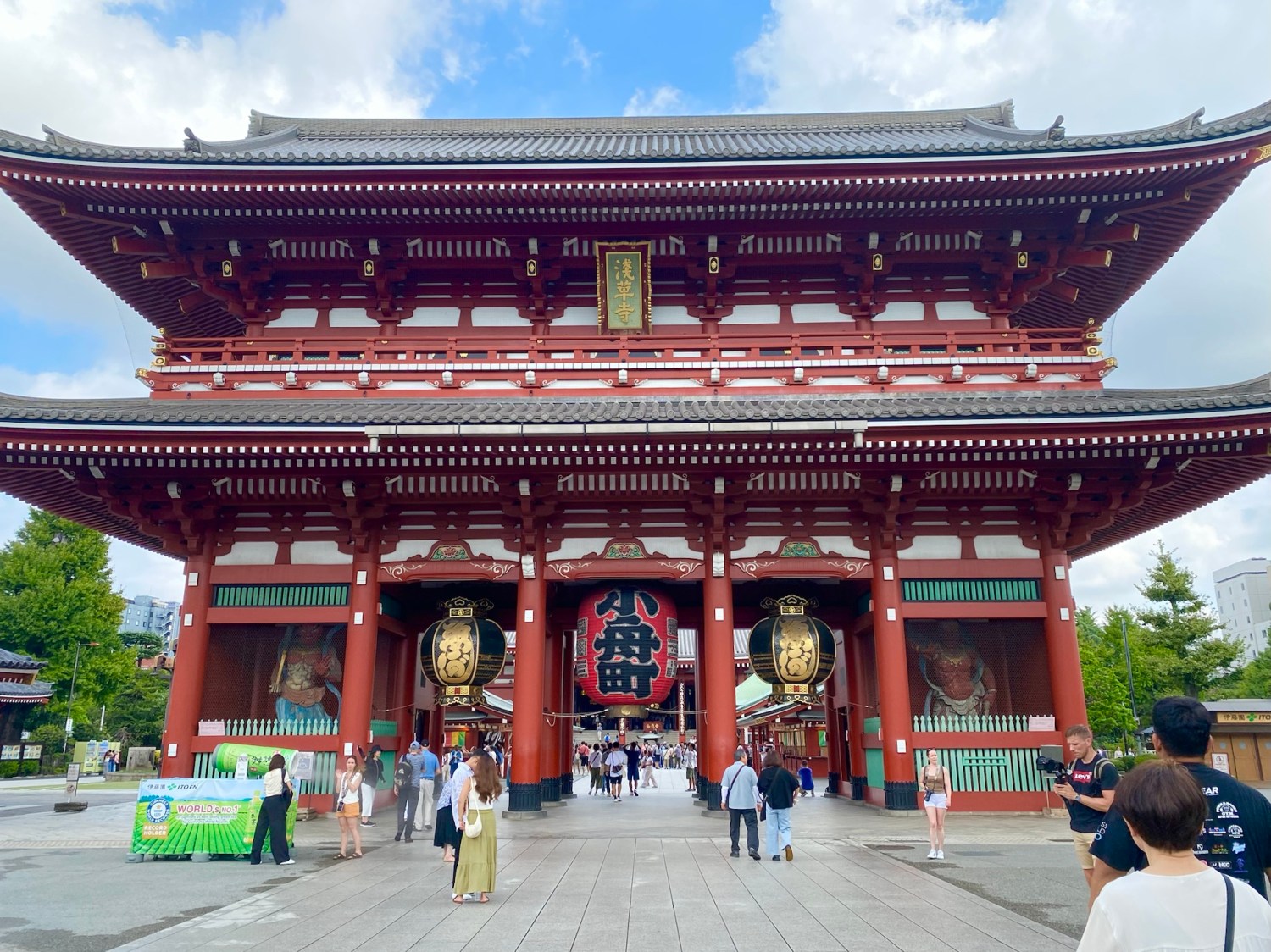
I had only one day to show Mike some of my favorite places in Tokyo. We started with Sensō-ji, Tokyo’s oldest-established Buddhist temple, and one of its most significant. It is dedicated to Kannon, the bodhisattva of compassion. Structures in the temple complex include the main hall, a five-story pagoda and large gates. It is the most widely visited religious site in the world with over 30 million visitors annually.
Legend has it that in the year 628, two brothers fished a statue of Kannon, the goddess of mercy, out of the Sumida River. Each time, they put the statue back into the river, but it kept returning to them. Thus, Sensō-ji was built nearby for the goddess of Kannon. It was completed in 645, making it Tokyo’s oldest temple.
We entered through the Kaminarimon (Thunder Gate), the outer gate. We walked down the 200-meter shopping street called Nakamise, a street with a history of several centuries. This street leads to the second gate, the Hozomon Gate. In front of us, we found the temple’s main hall. The Asakusa Shrine (of the Shinto religion), built in 1649 by Tokugawa Ietmitsu, stands immediately adjacent to the temple’s main building.
The temple was destroyed during a March 10, 1945 firebombing air raid on Tokyo during WWII. The main hall was built in the 1950s.
We each shook a long cylindrical container with a small hole in it, and out came a stick with a number. We found the drawer with that number and found our fortune inside. Ours were both positive, but if they had been negative, we would have tied them to a stand and left them behind.
Before leaving, we checked in with the Nisonbutsu (“A Pair of Buddha”). The figure on the right is said to bring mercy to worhsipers, the one on the left, wisdom.
It’s an impressive and lively temple complex. Though it was hard to be highly motivated in 93 degree muggy weather, we survived and enjoyed the temple.


Ueno Park
After leaving Senso-ji, we went to Ueno Park where I saw the cherry blossoms 7 1/2 years ago. Today it was hot and humid and no cherry blossoms were in evidence but we stopped into three places, firstly the Ueno Daibutsu (Remains of the Ueno Daibutsu).
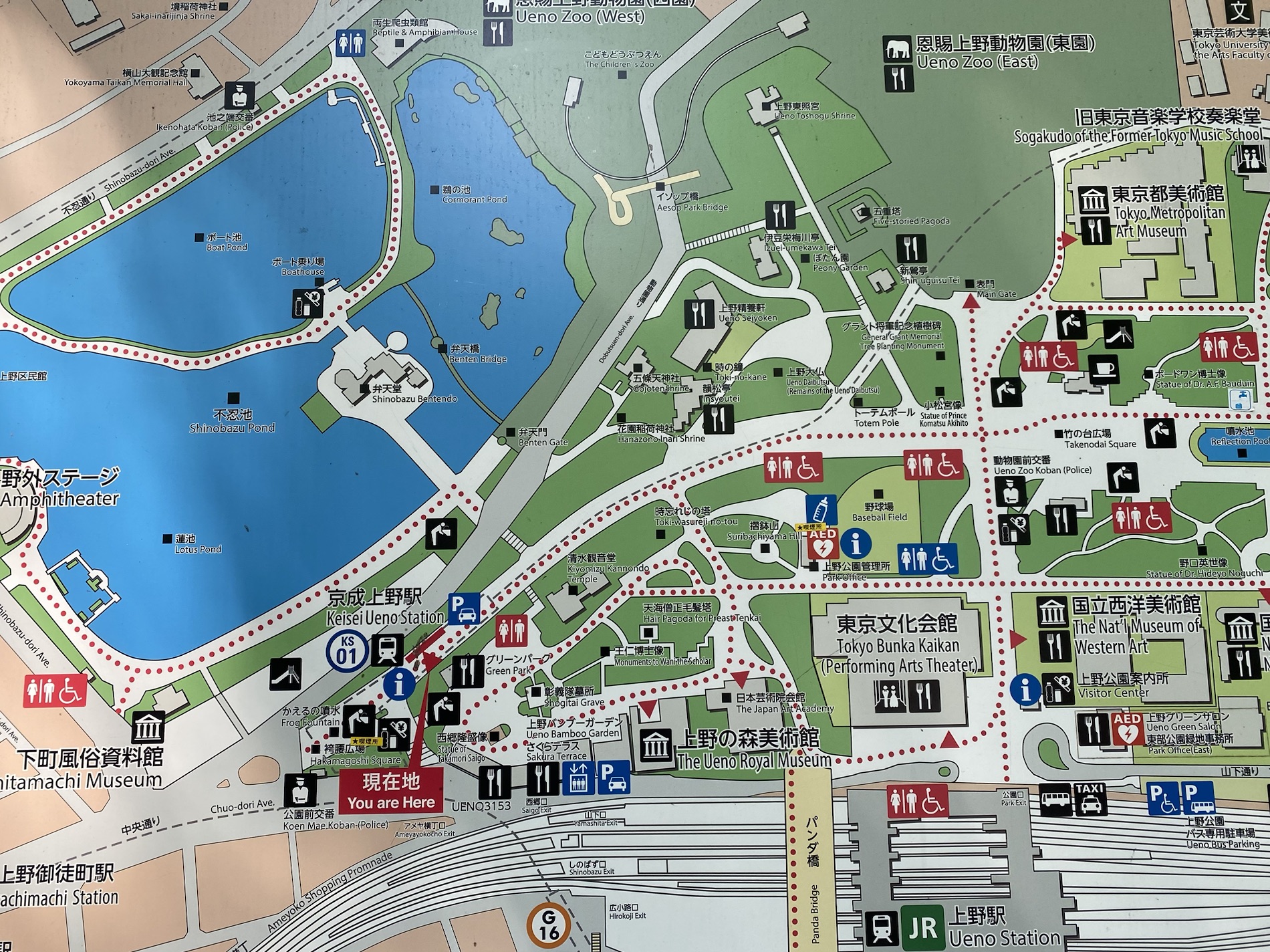
Map of Ueno Park in Tokyo
Ueno Daibutsu was an Edo-period giant seated statue of Buddha (Shaka Nyorai) in what is now Ueno Park. Of bronze and dating to 1631, it was restored after earthquake damage in 1640, a fire in 1841, and again after the 1855 Edo earthquake. Its head was toppled during the 1923 Great Kantō earthquake, and much of its bulk was melted down for reuse during the Pacific War. In 1972 the face, stored in Kan’ei-ji, was put on display in its former location.
I love the ema hanging in temples. Ema are small wooden plaques, common to Japan, in which Shinto and Buddhist worshipers write prayers or wishes. Ema are left hanging up at the shrine, where the kami (spirits or gods) are believed to receive them. They often carry images or are shaped like animals, or symbols from the zodiac, Shinto, or the particular shrine or temple.


Our next stop in Ueno Park was Hanazono Inari Shrine. This shrine is dedicated to Inari, the god of fertility, rice, agriculture, and foxes. Inari shrines are easily recognizable by their vibrant vermilion torii gates.


Our last stop in Ueno Park was Kiyomizu Kannondo Temple, built in 1631. It is one of the remnants of the Kan’ei-ji temple. Its design, including a wooden balcony extending from the hillside, was inspired by Kiyomizudera in Kyoto. The temple is home to an image of Kosodate Kannon, the goddess of conception, and is particularly popular among women hoping to have children.
The temple has a platform overlooking a circle made from pine tree. This circle is called the pine tree of the moon (tsuki no matsu in Japanese). This shape became famous with local people and was picked up by Ukiyo-e artist Hiroshige in his One Hundred Famous Views of Edo (1856–59), giving this shape historical significance. The original pine tree was unfortunately destroyed in a storm during the Edo period (1603-1868); the current tree dates from 2011.


Ameyayokocho Shopping Street
It was super hot by the time we left Ueno Park so we strolled briefly down the Ameyayokocho Shopping Street. Soon we found a restaurant where we could cool off and have some lunch: Shrimp tempura for me and a chicken rice set meal for Mike. After this we were exhausted because of the heat, our lunchtime beers, and our discombobulation due to our flip-flopped time zone. We returned to our hotel to relax for the hottest part of the afternoon before going out to explore at around 5:00 pm.


Monzennakacho
After our rest in the hotel, we took a short train to the Monzennakacho neighborhood, a place I’d never been during all my Tokyo explorations in 2017. I really loved this quiet old-school neighborhood. We stopped in first at Fukagawa Fudoson Temple. It belongs to the Shingon Buddhism esoteric school, founded in Japan in the 9th century by monk Kukai (Kobo Daishi). It is also affiliated with Narita-san Shinsho-ji, a temple located near Narita International Airport in the east of Tokyo.
Built in 1703, the temple was damaged by the Great Kantō Earthquake in 1923, then by 1945’s aerial bombings. It was thereafter reconstructed in a mish-mash of ancient and modern styles.


Finally, in the blue light, we visited Tomioka Hachiman Shrine, the largest Hachiman shrine in Tokyo, built in 1627. The shrine began with the worship of the god Hachiman, the god of martial arts and war. It is also intimately connected to the history of sumo in Japan.
The shrine’s big festival, the Fukagawa Hachiman Matsuri, takes place in mid-August. We saw one of the two massive festival floats that are used in that festival.


We strolled around the adorable neighborhood of Monzennakacho and tried to figure out where to eat. Of course everything on menus was in Japanese and using our translator we found things like “a drooling chicken with a blue-tartan sauce,” “CHEESE-IN-MIL-FUYU HAM CUTTLE” and other mysterious foods. Finally we happened upon a pizza place and that saved us. We had some Prosecco and a tomato mozzarella & basil salad and a Romano pizza. Then we returned to our hotel and prepared ourselves for our Friday morning Shinkansen 🚄 to Nagoya, where we would get a rental car to drive to Takayama in the Japan Alps.


Steps: 14,530; Miles 6.15. Weather Tokyo: Weather in Tokyo: 93°F, Lo 78°F. Mostly sunny.
Here’s a short video showing some scenes from Japan.
Tokyo to Nagoya
Friday, September 13: Friday morning, we left our hotel by 8:30 to go to Tokyo Station, where it was swarming with Japanese commuters. From there we got on the 9:30 am Shinkansen (Nozomi 21) to Nagoya.


We arrived at Nagoya Station at 11:10 and went in search of the express bus to the airport to pick up our rental car.
 ~ wander.essence ~
You must be logged in to post a comment.