
Arrival in Medellín
Tuesday, March 26, 2024: We had one of the shortest flights ever from Bogotá to Medellín. What beautiful countryside all around Colombia’s second largest city. The city sits in the Aburrá Valley surrounded by the verdant Andes mountains.


The metro area of Medellín is the second-largest urban area in Colombia in terms of population and economy, with more than 4 million people. The city is important to the region for its universities, academies, commerce, industry, science, health services, flower-growing, and festivals. The city sprawls north and south along the valley floor, with slums hugging the upper reaches of the hills. We could see these slums on our way into the city from the airport.
Medellín was founded in 1616, nearly 75 years after the Spaniards first arrived in the Aburrá Valley in the 1540s. Historians believe the early settlers were Spanish Jews fleeing the Inquisition. They divided the land into small haciendas which they farmed themselves, as opposed to the slave-based plantation culture that dominated much of Colombia. These early self-reliant paisanos had a streak of independence unmatched in the rest of the country.
Medellín became the capital of Antioquia in 1826, but was a kind of provincial backwater, with few and modest colonial buildings. When the railroad arrived at the start of the 20th century, coffee production boomed and transformed the city. Mine owners and coffee barons invested their profits in the budding textile industry and their gamble paid off. Within a few decades, Medellín grew into a large metropolitan city.
In the 1980s, the city became menacing under the violent leadership of Pablo Escobar, when it became the capital of the world’s cocaine business. Gun battles were commonplace and the city’s homicide rate was among the highest on the planet. Escobar was killed in 1993, and the city has slowly and painstakingly resurrected itself as a tourist destination.
We arrived at our apartment, Go Living and Suites El Poblado – Jalo Rent at around d 3:30. El Poblado is a very upscale part of the city, way more upscale than we expected or than we’re used to. The whole hilly landscape, full of tropical abundance, is dotted with modern high rises where apparently most of the wealthy people live. Restaurants and shopping malls abound. This was certainly not what I expected. It was over the top!


Someone in our building recommended the Asian fusion restaurant Niku in Provenza, so off we went by Uber. The restaurant was quite fancy and we looked like what the cat dragged in. I asked the waiter a question about an appetizer, but I didn’t order it. They brought out the appetizer, and acted shocked that I hadn’t ordered it. I felt as if they thought I was lying. But honestly, we rarely order appetizers because we can barely even eat the meals we order.
I ordered Three Seas Rice (prawn, shrimp, salmon, whitefish, and sauteed vegetables, with an egg) and Mike ordered a Salted Loin stir-fry (Sirloin stir-fried with vegetables and edamame in ponzu and tamarind sauce). It was decent but expensive, probably the most expensive meal we’ve had on our trip. It wasn’t worth so much money, to be honest.


I’ve been on the lookout for an Óptica store where I could get my glasses tightened so we walked around the huge El Tesoro shopping mall and there I found a glasses store where the woman painstakingly did the repair for free, trying multiple tiny tools until she got it right. Mike and I wandered around and around the mall and couldn’t find our way out. Finally someone directed us to the entrance. Outside, we got an Uber to bring us back to the apartment.


Ssteps: 6,898; Miles 2.92. Weather Hi 83°, Lo 64°.
“Real City Walking Tour” in Medellín
Wednesday, March 27: Even though I had just sworn off tours after our horrible bike tour in Bogotá, we decided to take the free highly-rated “Real City Walking Tour” in Medellin this morning. We met the group on the pedestrian bridge at the north ticket booth of Alpujarra metro stop. We arrived early as we always do to everything. There were a lot of people in the group; we early birds were separated off with Julio, who was to be our tour guide for 3 1/2 hours.


We took off before the 10:00 time and immediately sat down on some steps for a half hour while Julio told us about the history, tragedy, growth, and “resurrection” (his word) of a city that has suffered much over the decades, especially in the 1980s and 1990s when the Medellin drug cartel under Pablo Escobar wreaked havoc on the city. Julio was a lively and passionate guide who used to be a professor and he had definite opinions about those years as he was a young boy at the time and remembers vividly living under menacing and lurking fear.
Julio told us that the people of Antioquia, where Medellín is, are known as paisas, and they tend to place themselves above the rest of the country in pride and attitude.
We stopped first at the La Alpujarra Administrative Center, an urban complex of government buildings built in the 1980s for the administration of the Antioquia department and Medellín municipality. The center consists of a plaza flanked by two buildings. This plaza is dominated by the sculpture called Monumento a la Raza (Monument to the Race) by Rodrigo Arenas Betancourt (1919–1995), which honors the history of Antioquia including its agriculture, religion, and solidarity. The monument is a curved concrete structure covered in several bronze sculptures, and it was inaugurated on 31 May 1988.


One of the buildings beside the plaza has a huge wall covered in plants in an effort to help abate climate change’s detrimental effects on the city.


Next we walked to Plaza Cisneros, also known as Parque de Las Luces. It has an artificial forest of 300 light poles, which are up to 24 meters high. Bamboo stands are also interspersed among the the light poles. The plaza used to be the main marketplace of the city. Later, it became a very dangerous area of the city where drug cartels often shot down enemies, rival cartels, government officials, or witnesses.
The plaza was renovated with its current light fixtures as part of a renewal effort to rejuvenate the area. This project was called “Medellín is light.” However, Julio said currently the park does not light up at night because a company took all the lights down to replace them, and to this day have not replaced them. Julio believes the creation of the park in a once dangerous area gives hope to the citizens of the city.


We stopped into the Palacio Nacional Mall, which dates back to the 1920s when the city of Medellín needed new facilities to accommodate public, political, and educational offices. Renowned Belgian architect Agustín Goovaerts was tasked with designing this building, which was inaugurated in 1933.
Despite its historical heritage, the building experienced physical and social deterioration in the 1980s and 1990s. As a result of that, in 1993 it underwent significant revitalization and began to be transformed into a shopping mall.


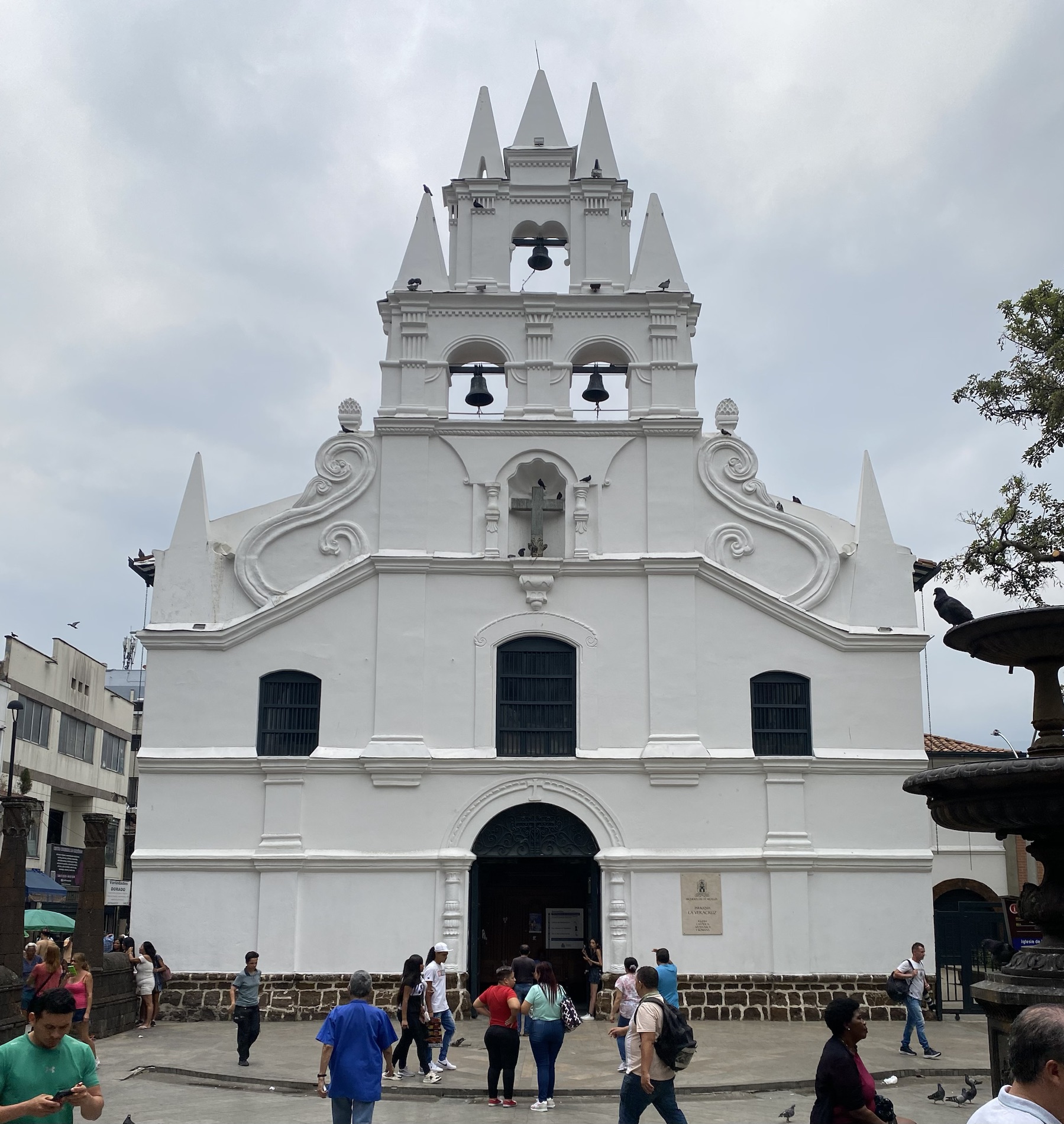
Iglesia de la Veracruz is regarded as one of the oldest churches in Medellin. The colonial church dates back to 1682 when the first brick was laid. It was completed in 1712 with the help of European immigrants.
By 1791, the church was approaching ruin with a major threat of collapse, so it was demolished almost entirely with the rebuilding of the church starting in December of that year. The blessing of the present Church of the Veracruz took place on March 25, 1809. Iglesia de la Veracruz was declared part of the cultural heritage of Colombia on March 12, 1982. Unfortunately, the area around the church currently has a bad reputation for crime and street prostitution, especially after dark.
Iglesia de la Veracruz
Before long, we ended up at Botero Plaza, bordered by the Museum of Antioquia and the Rafael Uribe Uribe Palace of Culture. The 7,000 square meter outdoor park displays 23 sculptures by Colombian artist Fernando Botero, who donated these and several other artworks for the museum’s renovation in 2004.


The Rafael Uribe Uribe Palace of Culture houses cultural programs related to the Department of Antioquia, such as concerts, conferences, and art exhibitions. Belgian architect Agustín Goovaerts designed the building in a striking black and white Gothic Revival style. The palace was named after Rafael Uribe Uribe, a General for the Colombian Liberal Party. Construction on the project began in 1925 although only a quarter of the original design was completed.


We stopped to admire the Parque Berrío Metro Station, another aspect of what Julio called the “resurrection” of the city. It first opened for service in November of 1995. As one of the first implementations of modern mass transportation in Colombia and the only metro system in the country, the Medellín Metro is a product of the urban planning of the Antioquia department of Colombia.


We finished our tour at San Antonio Plaza where there was a bombing during a music concert in June of 1995, killing 29 people and wounding 205 others. According to police, a 22-pound bomb filled with shrapnel was placed beneath a bird sculpture created by renowned artist Fernando Botero. When later the mayor of Medellin wanted to remove the statue, Botero called him and told him not to dare remove that statue. He donated another bird to stand next to the bombed one. Now side by side the two birds represent the tragedy and hope of the city.


Hacienda Junín
Our guide Julio from Real City Tours recommended we have lunch at Hacienda Junín to try one of Medellin’s typical dishes, Bandeja Paisa: famous beans, rice, meat powder, pork rinds, blood sausage, chorizo, egg, slice of sweet plantain, avocado and arepa. My favorite was the blood sausage and reminded me of having blood sausage in Spain with Darina during our Camino de Santiago. Mike and I shared some of that huge dish and also some empañadas with pineapple chili and avocado. It was delicious and the place had a very nice setting.


Museo de Antioquia
We spent the afternoon after our tour exploring the Museo de Antioquia, housed in the grand Art Deco Palacio Municipal. It is Colombia’s second oldest museum, after the Museo Nacional in Bogotá. Its permanent collection spans 19th-century and contemporary Colombian art as well as pre-Columbian pieces. The third floor highlights paintings and sculptures by Botero as well as other artists’ works from his personal collection. There are wonderful Pedro Nel Gómez murals around the building. Sadly we weren’t able to take pictures of any of the Boteros.


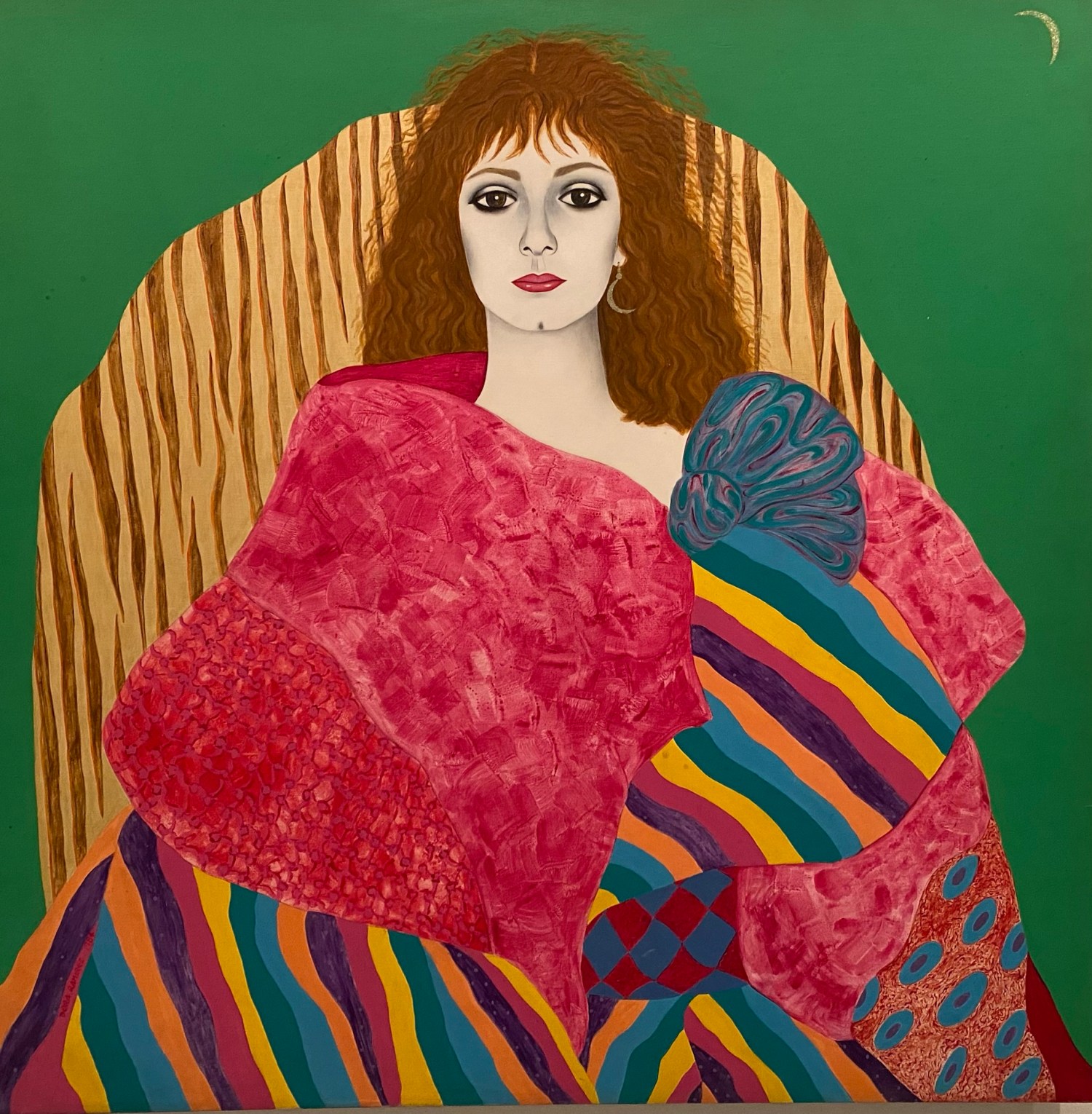
My favorite was a special exhibition on Dora Ramírez, born on June 18, 1923 in Medellín. At that time the city had 100,000 residents, “with a few pretensions of modernity while still being a conservative and parochial city. For women in Medellín, their destiny was confinement, whether in marriage, at home or in convents,” according to the exhibit.
Dora went through transformations in her life but remained faithful to herself and her convictions. She exercised her right to vote at age 34.
She and other women artists had a hard time being recognized and respected in the male-dominated art world and were often called “crazy.” Later, she gave up painting to dedicate herself to tango dancing. In 2005, she said, “When one realizes how much violence exists in Colombia, one comes to the conclusion that this country can only be fixed by dancing.”
I loved how she depicted women in sumptuous textiles. At a time when women were limited almost exclusively to a reproductive role, it is almost a miracle to find a body of documents produced by a woman throughout her life. Dora Ramirez married, fulfilled the mandate of her time; then, when she divorced, she did countless other things: she painted, exhibited all over the world, traveled, wrote letters to presidents, mayors and ministers with ideas and projects; she managed the affairs of cultural entities, danced tango… she made an archive. She was an artist who did not give into submission, who lived in her freedom.


Janethy Moda
For a couple of years I’ve been following a tienda de ropa (clothing store) on Instagram called Janethy Moda. I was determined to search it out in Medellin, so after the museum, although I was super tired, we decided to walk to the store, about 20 minutes away. When we arrived, the store was in disarray from a renovation in progress, with construction debris all around and the store in a disheveled and disorganized state. I thought, “Damn! I’ve finally found this store and I can’t even shop in it!” However, the salespeople, especially Alba, invited me in and helped me pick out lots of clothes to try in the midst of all the construction. I was in a hot little dressing room in a corner of the store, sweating like crazy, and Alba kept bringing me more things to try on.
I’ve noticed Colombian women seem to generally have tiny waists and big hips; that is the opposite of my body which is pretty much straight. But in the end, I found five shirts that I liked so I was able to buy something from this store I’ve been following for several years.


Right in front of and perpendicular to Janethy Moda was a funky street filled with bars and painted with graffiti. Mike thought we should stop and have a beer there after my little shopping spree. We had eaten the huge lunch at Hacienda Junín and we didn’t want dinner, so we sat and had a beer at La Jaus Pub Rock. A young boy was singing up a storm on the street and he actually had a great voice so we enjoyed his songs with our beers. I had to give him some money for his fabulous singing especially when he sang a song by Colombian singer Juanes, who we had seen in concert at Wolf Trap in 2023. It was a fun way to end our first full day in Medellin.


Steps: 12,517; Miles: 5.31. Weather Hi 85°, Lo 63°.
Guatapé and La Peñol
Thursday, March 28 and Friday, March 29: On Thursday morning, we went to Guatapé and La Peñol and returned to Medellín late Friday afternoon. You can read about our overnight trip here: guatapé & la peñol, colombia.


La Mayoría Restaurante: donde bailan los caballos
On Friday night, after returning to Medellin from Guatapé, we went out to dinner at La Mayoría Restaurante: donde bailan los caballos (where horses dance). All the tables were around or in the center of a square corral of sorts, and the vaqueros (cowboys) brought horses around for people to pet. Cowboys rode around the square on their clopping horses or had the horse stand on its front legs on a barrel. Background music played over a loudspeaker or the vaquero sang a song. It had more of what I would think was a Mexican vibe, as this was the first time I’d seen anything like this in Colombia. It was quite fun and the food was pretty good too.
I had a lot of sympathy for the poor short pony at the end as I’m always struggling to deal with my own short legs!


After eating our dinner (Mike had BANDEJA PAISA: Traditional antiquia’s dish of red beans, white rice, chicharron, ground meat, fried egg, fried plantain, avocado and arepa, while I had LANGOSTINOS A LA PARRILLA: Grilled prawns with spicy panela sauce, mashed native potatoes and salad), we walked around the grounds to see the view over Medellin (we were in Envigado) and the entire La Mayoría complex.
Here is a short video of the horse action at La Mayoría Restaurante.
Steps: 8,223; Miles 3.48. Weather Hi 75°, Lo 56°. (Guatapé)
Museo el Castillo
Saturday, March 30: Saturday morning, we trudged uphill about a mile from our apartment to the Museo el Castillo. By the time I got there, I was drenched in sweat.


We walked around the grounds where I was annoyed by all the photo hogs: people who grab the most scenic spots and take multiple pictures there, switching out family members in the photos, for a good 5-10 minutes. People: have some consideration for others!
In order to see the inside of the castle, a 45-minute house tour was required, with about 20 people per group squeezed into airless rooms. It was all in Spanish and though I tried my best to understand I was only able to catch bits and pieces and soon was bored by the whole thing. Also, no photography was allowed inside. I would rather just wander through houses such as these on my own, but it was not to be.
The castle was built in 1930 by the architect Nel Rodríguez in the Medieval Gothic style. The design was inspired by castles in Loire Valley in France. It was the house of physician José Tobón Uribe until 1943 when industrialist Diego Echavarría Misas bought the house for his family. In 1971 it became a museum when the wife of Diego Echavarría Misas, Benedikta Zur Nieden, known as “Dita,” donated the house and all its furnishings after the death of her husband.


El Poblado Park
After our visit to Museo el Castillo, we took an Uber to El Poblado Park where we had seen a little market on our way to Guatapé on Thursday. We ate a lunch of tacos 🌮 at Tacos el Tigre which looked like a late-night music venue and bar; it had a stage for live music. We listened to “Little Talks” by Of Monsters and Men.
Then we walked up to the park and perused the market stalls. I got a few more raw emeralds (earrings and necklace), a couple of cheap woven bracelets and Mike got a new wallet.


Santa Fe Mall in El Poblado
After lunch Saturday, we took an Uber to the Santa Fe Mall in El Poblado, a short walk from our apartment. I ended up buying some linen pants and two shirts while Mike bought a bathing suit and a pair of pants. The malls in this part of Medellin are behemoths. The Santa Fe Mall has multiple plazas and is at least 5 stories tall. Both times we entered a mall here in El Poblano, we couldn’t find our way out without asking for directions.

an over-the-top display at Santa Fe Mall
When we finally escaped the mall, we walked back to our apartment where we had a short rest before going out to eat.


Laureles
When we were in Bogota, we met two friendly women from Medellin who highly recommended that we go to the Laureles area while in Medellin, and especially that we eat at Saludpan, an organic food market that serves healthy meals. So we went and had a delicious corn chowder with cheese and tortilla chips. I got a salmon sandwich in Ciabatta bread and Mike got turkey sandwich also on Ciabatta.


Then we walked down the Main Street of Laureles where all the loud nightlife bars blared with music. We didn’t care for the loud vibes so we found a side street with a nice quiet bar, BBC (Bogotá Beer Company) Bodega 70. There we met a newlywed Dutch couple slightly younger than us and their friend Jacko, also from Netherlands, who has lived in Medellin for 11 years. Jacko refurbished used sport utility vehicles, especially vintage ones like old Range Rovers and Land Cruisers to sell abroad. The couple was on their honeymoon and we talked for a long while about the difficulties of learning languages, our love of travel, and teaching English as a foreign language. It was a nice way to end our last Saturday in Medellin.


Steps: 9,984; Miles 4.23. Weather Hi 87°, Lo 66°.
Comuna 13
Easter Sunday, March 31: We had been warned by a number of people that Comuna 13 would be super crowded during semana santa (Holy Week), so we devised a strategy to visit as early as possible on Easter morning to beat the crowds. After all, in this Catholic country, everyone should be at church, right? Well, for once, our strategy worked. By the time we were coming down after visiting the top, the crowds were just arriving.
Comuna 13 was once the most violent barrio (neighborhood) in the most violent city in the world. It was where drug cartels, gangs and paramilitaries operated and killed or displaced thousands of people. In the 1980s and 90s, it was controlled by notorious drug lord Pablo Escobar. Even after his death in 1993, drug cartels sought control of the area, leading to more violence. It wasn’t until 2002, when the Colombian military carried out Operation Orion, a strike to get rid of all rebel groups, that Comuna 13 began to turn around.
The focal point of the area is around the escaleras electricas, the outdoor escalators that provide access to home in marginalized barrios that were formerly isolated from the city below. These escalators are of the icons of the resurrection of Medellín.
Concrete, rather ramshackle buildings climb up the western hills of Medellin. They are now covered in colorful murals and graffiti. The area now welcomes tourists and offers street performances and artistic forays.


Jardín Botánico Medellín
After our walk through Comuna 13, we decided we needed some peace and quiet and fresh air so we went to Jardín Botánico Medellín. The Botanic Gardens cover 14 hectares, showcase 600 species of trees and plants, and include a lake, a herbarium, and a butterfly enclosure.
There we found a huge slatted wooden canopy, called the Orquideorama – an organically expanding meshwork of wooden flowers – with a yoga class going on beneath it. They were doing my favorite part of yoga class: shavasana, or corpse pose (final relaxation).
The Orquideorama was built beginning in 2008 and includes ten hexagonal “trees” of steel tubes which rise up to support a space frame that is covered by glass and screened by wooden slats. Orchids are planted at the base of each tree. They are a symbol of Medellín’s “regeneration.” The structures is 65 feet high. They collect rainwater and shelter an orchid collection and butterfly reserves.
Taken as a whole, the Orquideorama is where nature and architecture meet. It is a delicate display of the relationship and structural similarities between architecture and living organisms.
Then we wandered around more of the gardens until we were bored and then returned to our apartment. As soon as we returned, the skies opened up, and a thunderstorm roared through.


Alambique
We had our last dinner in Medellin at an atmospheric restaurant called Alambique, which means “an alchemical still consisting of two vessels connected by a tube, used for distillation of liquids,” according to Wikipedia.


This restaurant was near El Poblado Parque where we had gone the day before to the craft market. It had a vibe reminiscent of The White Lotus, especially the menu with its antique botanicals, the effusive plant life, its playlist of exotic music, and vintage things like old typewriters and old books attached to the walls.


We were warmly welcomed into Alambique and were told that our experience there was meant to be a slow one, that the dishes come out slowly, and that they are meant to be shared as they are quite large.
Here’s what we had. It was all delectable:
- Drinks: (me) FRESH CUCUMBER Gin, Chartreuse, Roasted Lemon, Cucumber Juice, Grapefruit Juice, and Simple Syrup.
- Mike: a double pour of 1800 Añejo Tequila.
- Appetizer: BUÑUELO BASKETS: A mouthful of textures and flavors. [Buñuelos are hand made balls of maize and cheese with a soft crumb and a crispy crust]. Filled with shrimp cocktail with a rum and coconut lemonade shot x4 pieces.
- Main course: BEEF AND PORK MEATBALLS WITH ALMONDS: Wrapped in pastry, stuffed with savannah cheese, on a reduction of basil and sesame.
- Dessert: COLA DE RATON: Gulupa ice cream, coconut meringue and mouse tail: tree tomato candied with panela and wine [Tree tomatos are a delicatessen fruit from the Andean region, sweet, sour and with a pinch of salty].


The playlist included the following:
- “Fekete Tyúk, Fekete kút” by Goulash Exotica
- “Cumbia del Olvido” by Nicola Cruz
- “El Oro de la Tolita” (feat. Grupo Taribo)
- “La Danza de los Mirlos” by Los Mirlos
- “Torre de Marfil” by Gustavo Certati
- “Quantic Flowering Inferno” by DJ Cumbero
Overall, we LOVED this experience for Easter Sunday night and for our last night in Medellin.
Steps: 9,093; Miles 3.85. Weather Hi 80°, Lo 62°.
Departing for Cartagena
Monday, April 1: On Monday morning at 4:30 a.m. we left Medellin for the airport, arriving around 5:00 a.m. for our 7:14 a.m. flight to Cartagena.


We would arrive in Cartagena at 8:20 a.m. on April Fool’s Day!
 ~ wander.essence ~
You must be logged in to post a comment.