
Thursday, October 26, 2023: On Thursday morning, we started to make our way to Albuquerque, where we would stay 3 nights before Mike would fly home to Virginia. We took the High Road from Taos, a string of villages where Spanish heritage in New Mexico is most evident. Residents along this road have ancestors who settled in these towns during the 18th century.
We started by driving one more time to the end of our Taos neighborhood to see if we could see the Rio Grande Gorge in better light, but alas, it seemed the sun must be directly overhead to see it without shadows. We passed adobe houses that I could only dream of owning, if Mike and I could ever agree on where we’d like to settle in retirement.


Once underway, we took a short detour to Sipapu, an inexpensive ski resort, where we captured views from some roadside overlooks. We drove through Peñasco and Picurís Pueblo, and finally stopped briefly in Las Trampas (settled in 1751) to see the San José de Gracia Church (built 1760-1776), an example of New Mexican village church architecture and a National Historic Landmark. Vertical bell towers frame its thick adobe walls. Parishioners periodically re-mud the adobe walls, which are as much as six feet thick.


Next stop on the High Road was Truchas, where we found, tucked in a small plaza off the main street, the Nuestra Señora del Rosario de las Truchas Church, built in 1764.


We stopped for views near Córdova, originally named Pueblo Quemado after a nearly burned-out Indian Pueblo, which was permanently resettled in 1750 after Indian attacks.


We made a stop at the highlight of the High Road from Taos: Chimayó. It was lunchtime so we went to Rancho de Chimayó Restaurante, where we sat inside the old adobe home and shared a bowl of green chile soup and a salad. We imbibed in some kind of non-alcoholic pink frozen drink.
I also bought a couple of pairs of earrings made by Native Americans. 😍😍


The village of Chimayó was founded in the early 18th century, soon after the reconquest of New Mexico. The village surrounded a defensible plaza, much like other traditional villages.
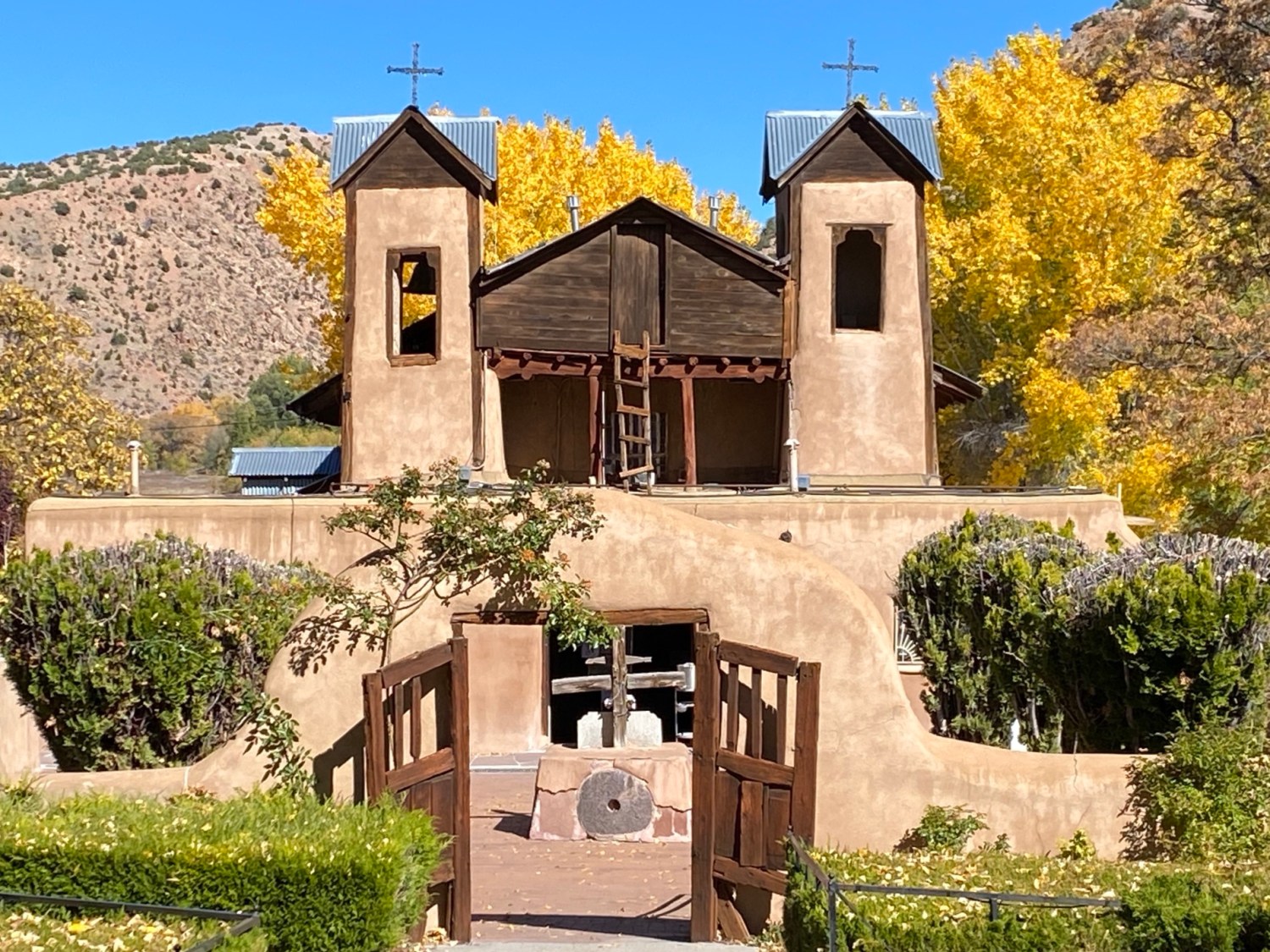
El Santuario de Chimayó is a Roman Catholic pilgrimage site. The pilgrimage tradition began in 1945 as a commemoration of the Bataan Death March. Before that, in 1814, it had a reputation as a miraculous spot where a local farmer, Bernardo Abeyta, is said to have dug up a glowing crucifix; the carved wood figure was placed at the altar of the adobe chapel built in 1816.
The chapel is noteworthy for its six-foot crucifix and healing dirt. In the sanctuary complex is a small antechamber that holds el pocito, the little hole where the glowing crucifix was supposedly dug up. From this pit, people can scoop up a small portion of the exposed red earth to apply to ailing parts of the body. The parish apparently refreshes the dirt each year with new dirt blessed by the priests. The adjacent room holds abandoned crutches, prayers and handwritten testimonials.
The wife of a couple in front of us was digging up some soil for her skeptical husband who didn’t believe the dirt could cure his cancer. She told him to have faith, after all, how could it hurt?


Nineteenth-century santeros (people who make religious images) created the unique religious folk art in the altar screens. Modern-day santeros added large santos (saints) in the chapel. Sadly absolutely no photography was allowed inside the church, but I was able to buy a few postcards which pictured the interior.
We also perused the Virgil Store, a kind of trading post, and went into the beautiful Santo Niño de Atocha Chapel, built in 1857.


Finally, we made our way to Albuquerque, arriving around 3:30 p.m.
Steps: 6,389; Miles 2.71. Drove 180.4 miles. Weather (Taos): Hi 66°, Lo 32°. (Albuquerque: Hi 73°, Lo 47°)
 ~ wander.essence ~
You must be logged in to post a comment.